



Thick hair and cornrows can be a beautiful match, but only when the parts are clean and the tension stays sane. Half cornrows for little girls with thick hair keep the front neat, let the back move, and avoid that heavy, all-over braided helmet look that some kids start fussing about halfway through the day.
That balance matters more than people admit. Thick hair has weight, volume, and its own little opinions; if you fight it with tiny rows, too much gel, and a too-tight grip, the style looks stiff before the second recess bell. Give the hair a shape instead, and it settles down.
Half cornrows do that neatly. They can be plain and school-safe, dressy and photo-ready, or playful enough for a birthday with beads and ribbons, and the back can stay curly, puffy, braided, or tucked. The real trick is choosing the version that fits the child’s hair density, length, and tolerance for sitting still.
Why These Half Cornrows Work So Well on Thick Hair
-
The front stays controlled: Cornrowing just the top or front section keeps flyaways off the face, which matters when thick hair starts puffing up by lunchtime.
-
The style feels lighter: Leaving the back loose or only partly braided keeps the head from feeling overloaded, and that makes a real difference for younger kids.
-
Thick hair gives the braids grip: Dense hair tends to hold parts and rows better than slippery textures, so the finished style often looks cleaner with less product.
-
You get room for personality: Beads, cuffs, ribbons, curls, puffs, and buns all work with half cornrows because the style leaves you a second canvas.
-
It stretches one wash day farther: A tidy front with protected sections can buy you a few extra days before the whole style needs to be redone.
-
It can be gentle when done right: Medium-sized parts and careful tension matter more than tiny, tight rows that tug on a tender hairline.
1. Classic Center-Part Half Cornrows with Loose Curls
A straight center part is the calm, no-drama version of half cornrows. Four to six neat rows at the front keep the hairline tidy, while the back stays loose and curly, stretched, or lightly rod-set for movement. On thick hair, this one looks balanced rather than busy.
I like this style for school days because it reads clean from the front and still feels soft from the back. If the curls are allowed to fall rather than be brushed into submission, the whole look keeps its shape without feeling stiff. Simple. Solid. Hard to mess up.
2. Side-Swept Half Cornrows with Small Beads
A deep side part changes the whole mood. The cornrows sweep over one temple and tuck toward the opposite side, which gives thick hair a softer line and lets the face stay open on the other side. Tiny beads on the ends keep the style playful without dragging it down.
This is the style I reach for when a child wants something a little prettier than plain rows but not so fancy that it turns into a whole production. The best part is the angle: side-swept braids make thick hair look shaped, not bulky. A small detail, but it matters.
3. Zigzag-Part Half Cornrows
Zigzag parts are for the child who likes a little surprise. The rows still sit neatly across the front, but the part line wiggles across the scalp instead of cutting straight through it, and that single change makes the style look custom without adding much extra time.
On thick hair, zigzag parting works because it breaks up density visually. The braids do not sit in one hard line, so the style feels lighter and more playful. Keep the zigzags medium-sized, though. If they get too tiny, the parting starts to look fussy instead of fun.
4. Half Cornrow Halo with a High Puff
This one has a bit of drama, in a good way. The cornrows curve around the front hairline like a halo, then the back hair is gathered into a high puff or puff ponytail. Thick hair gives the puff real shape, so you get volume without needing extra stuffing or teasing.
The reason it works is simple: the front is controlled, the crown gets shape, and the puff lifts everything up instead of letting the style sink. It’s a nice option for picture day because the silhouette is clean from every angle. And yes, it stays age-appropriate. No stiff edges needed.
5. Heart-Part Half Cornrows
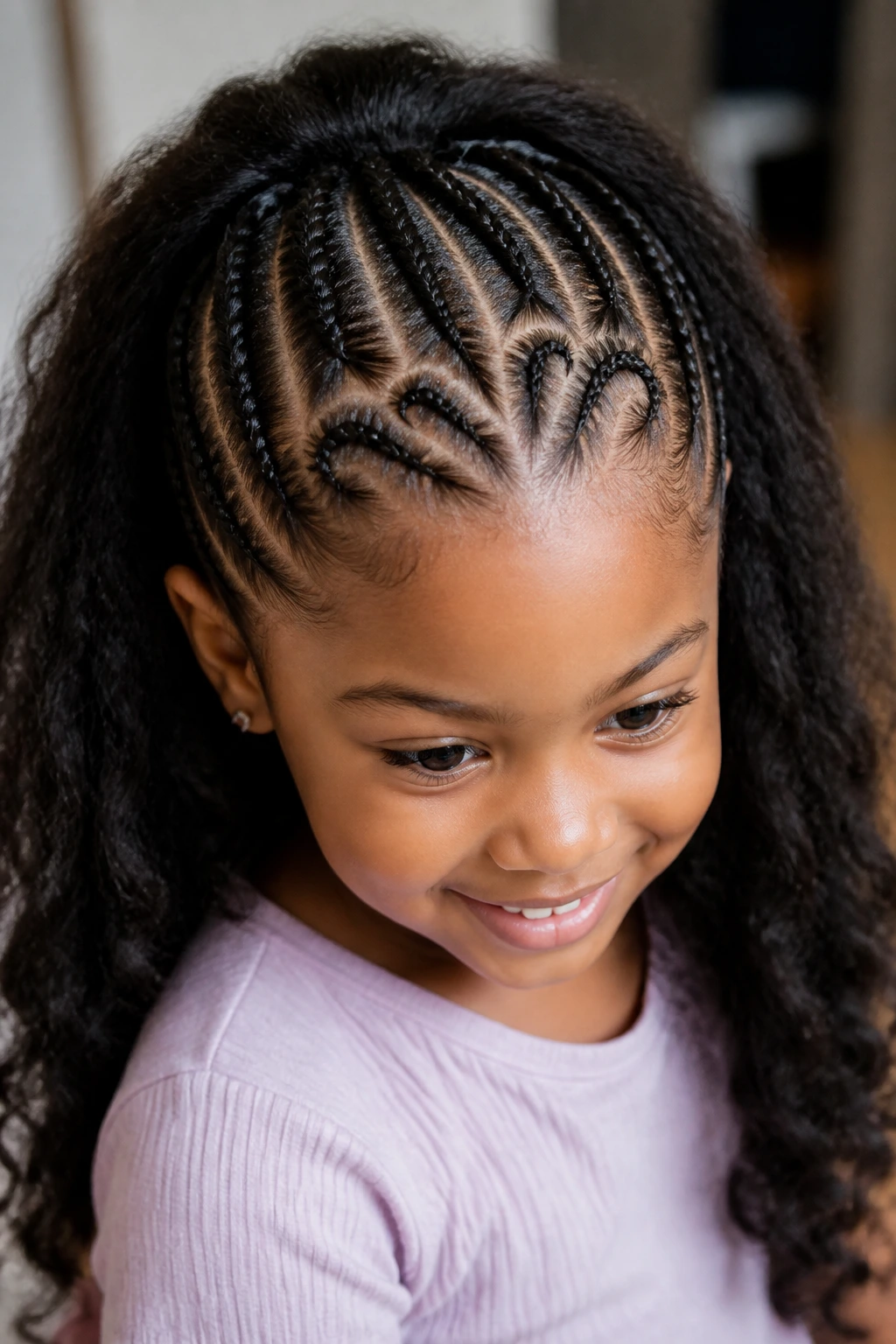
Heart parts are one of those details that children notice immediately. The braids usually start from two small heart-shaped sections near the front or crown, then trail back into half cornrows that leave the rest of the hair loose. It’s decorative without being overcomplicated.
Thick hair helps here because the heart shape holds better and looks fuller in photos. The key is to keep the heart clear and not overcrowded with too many tiny braids. One strong shape is prettier than a bunch of little ones fighting for space.
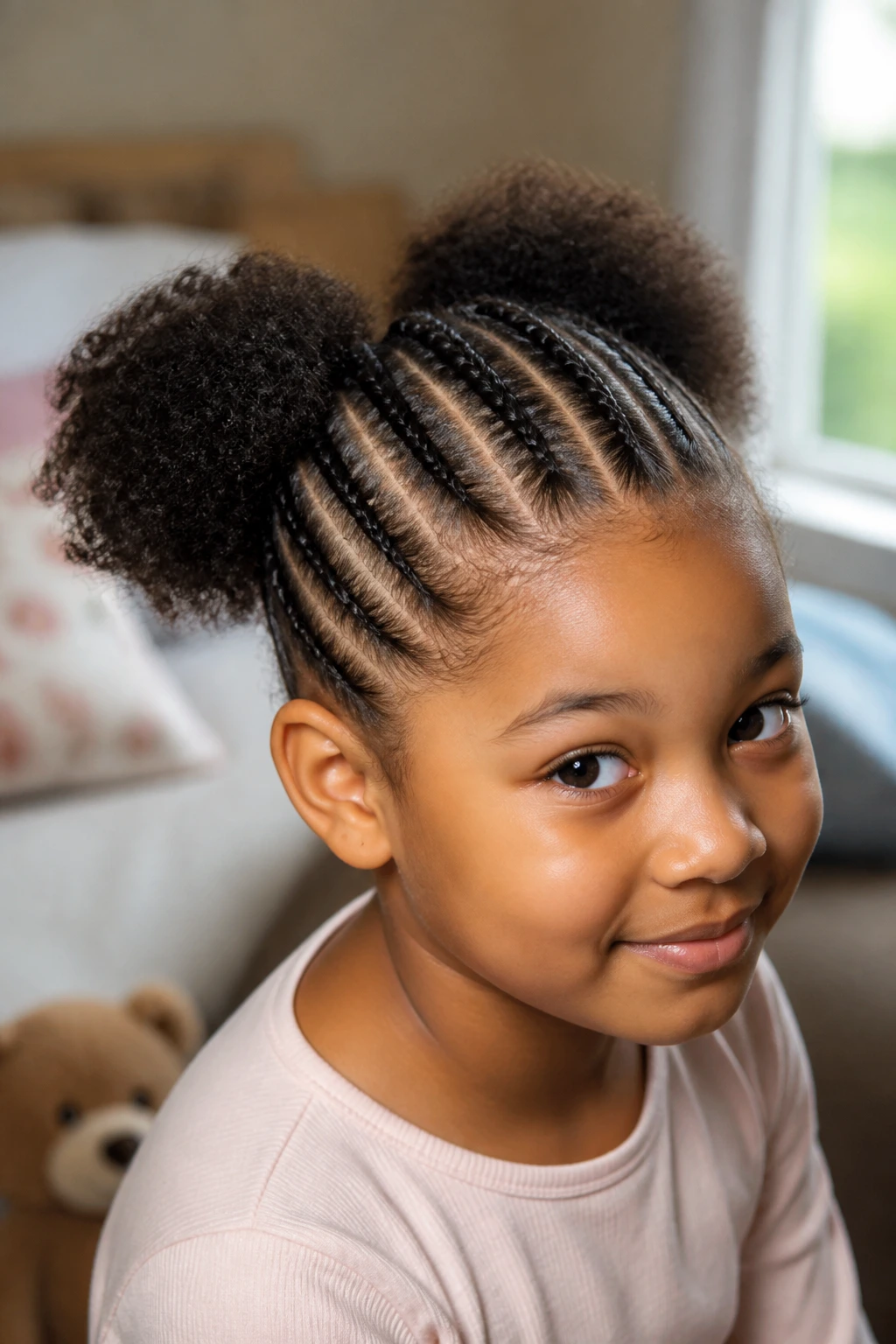
6. Six Straight-Back Half Cornrows into Two Puffs
This style gives you order up front and softness in the back. Six straight-back cornrows sit across the front half of the head, then the loose back hair gets split into two puffs or puff ponytails. On a child with thick hair, those puffs have enough volume to look full instead of skimpy.
The look is practical. Hair stays off the face, the two puffs keep the style young and lively, and there’s less daily fuss than with loose curls that tangle easily. If the child likes symmetry, this is a strong pick. If she likes movement, leave the puffs slightly loose so they bob instead of sit stiffly.
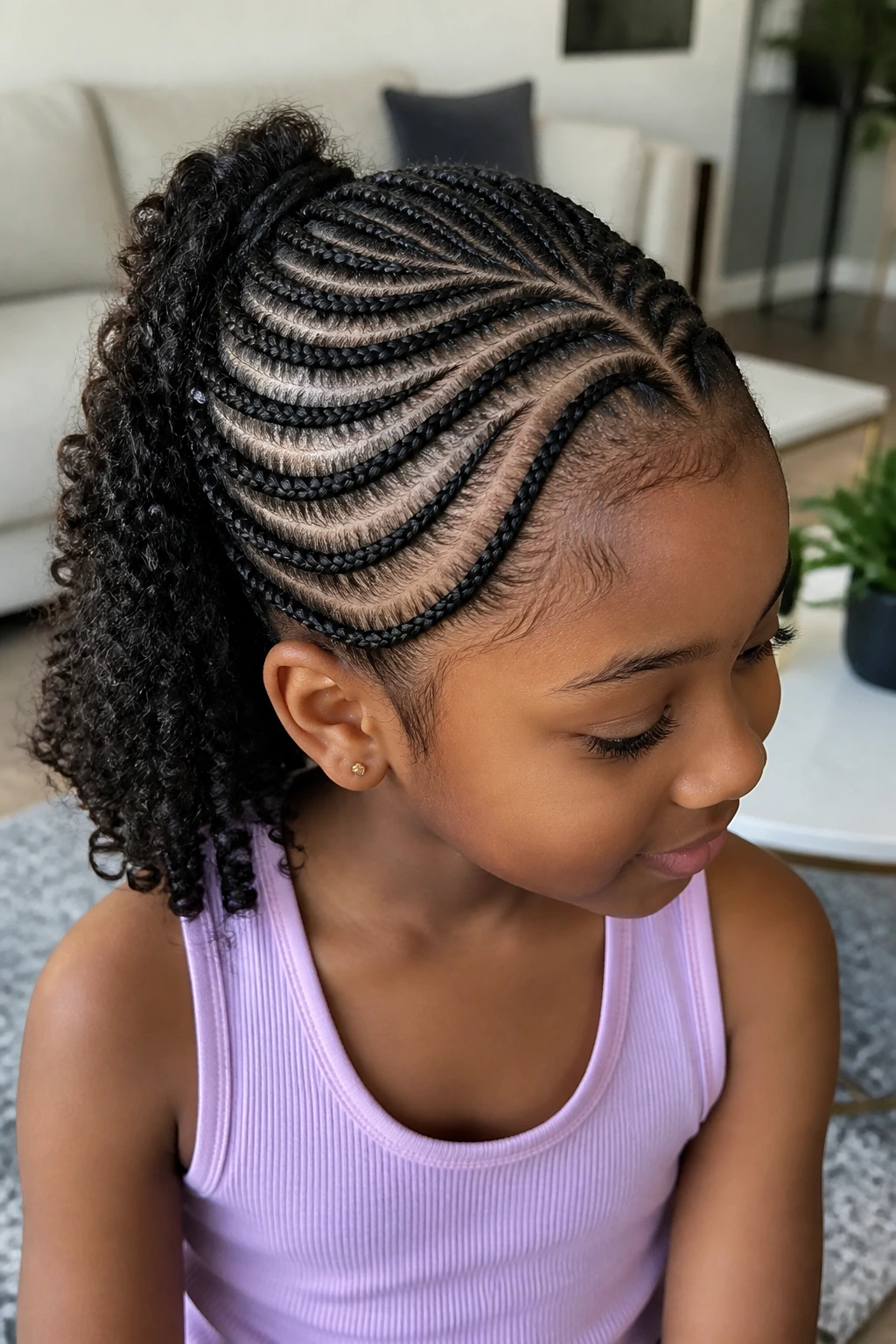
7. Curved Cornrows with Curly Ends
Curved cornrows trace a gentle arc instead of running straight back, and that curve softens the whole style. The braids can sweep around the temple or crown before dropping into curly ends, which is a nice contrast against thick hair’s natural fullness.
I prefer curved rows when the goal is to make the style look shaped rather than strict. They’re also handy if the hairline is uneven or the front sections need a little visual balancing. The curly ends do the rest. They keep the style from looking too severe, which is a common problem with tighter cornrow patterns.
8. Half Cornrows into a Top Bun
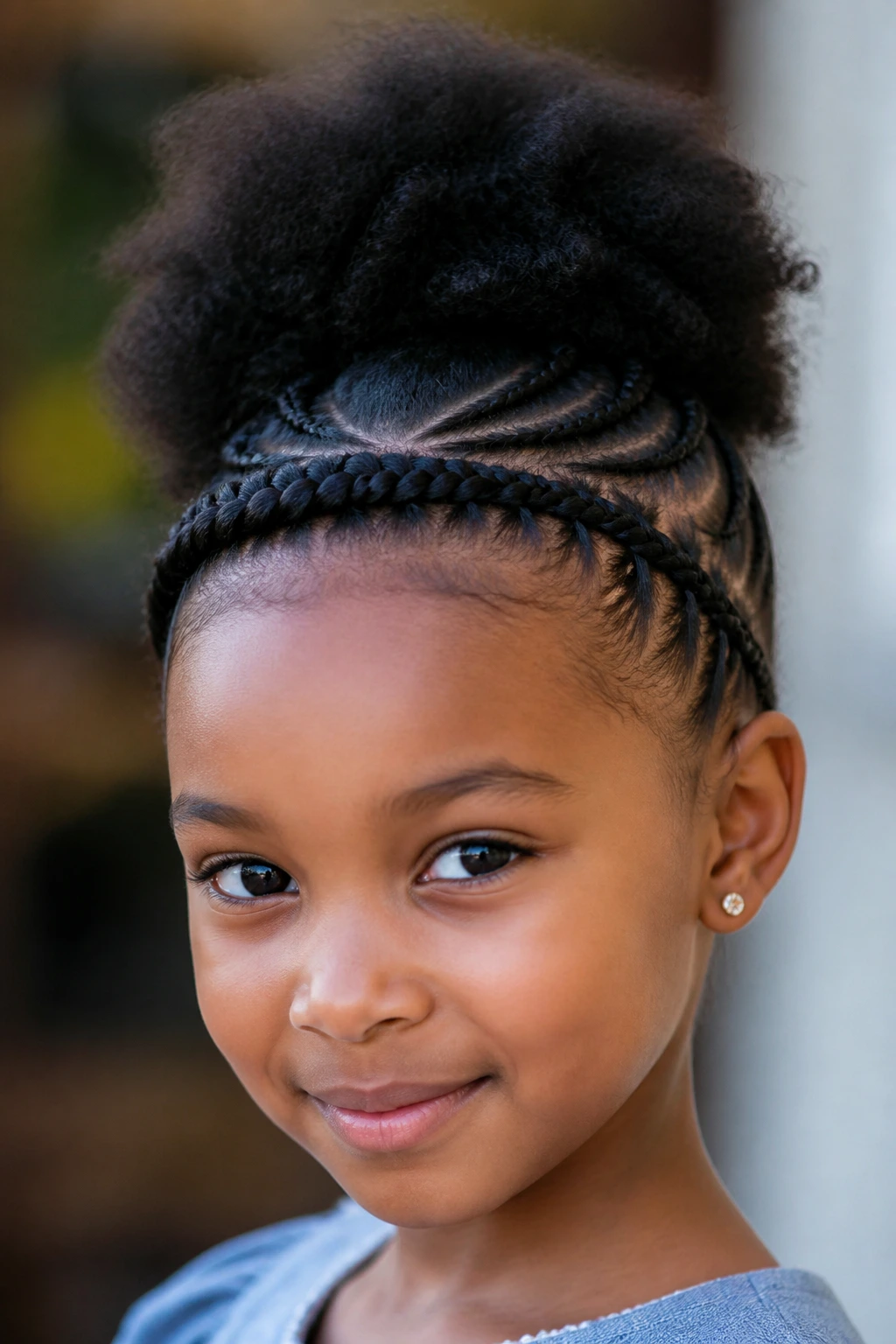
A top bun with half cornrows is neat, compact, and surprisingly useful. The front braids pull the hair back cleanly, and the back section gets twisted or gathered into a bun high on the crown. Thick hair makes the bun look substantial without needing a donut or padding.
This is the kind of style that works on busy days when you need the hair up and out of the way, but still want something a little more polished than a plain ponytail. Keep the bun secure but not rock-hard. If a child complains about a pulling sensation, it’s too tight.
9. Feed-In Half Cornrows with Clean, Thin Beginnings
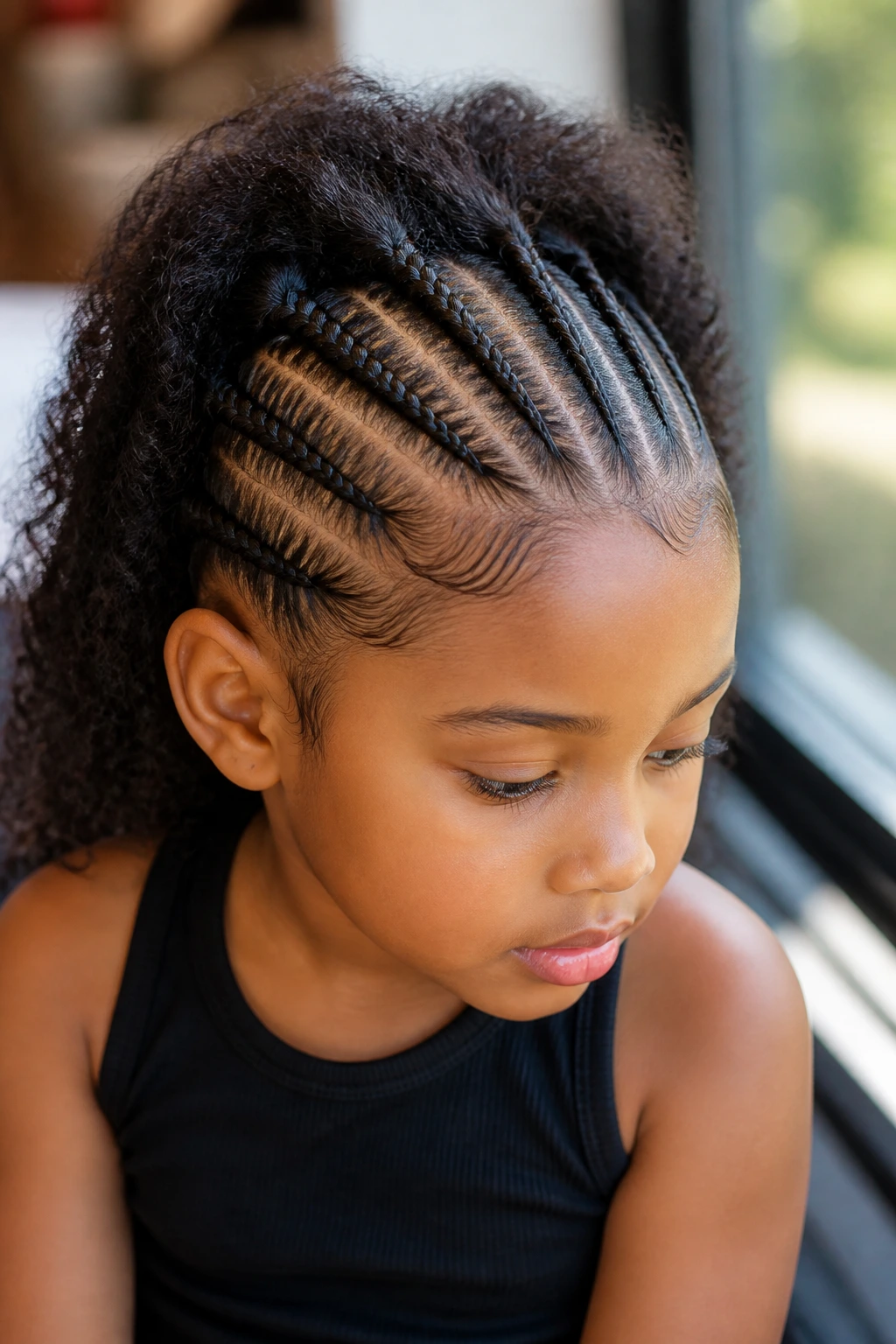
Feed-in braids start narrow at the front and gradually get fuller as hair is added. That softer start looks especially good on thick hair because it keeps the hairline from looking bulky right away. The rows can be straight, curved, or angled; the main feature is that gentle build.
What I like most is the finish at the scalp. Feed-in work keeps the first inch or two tidy, which helps the style look more expensive than it is. It also gives a cleaner border for accessories. If you want one of the most polished half cornrow looks, this is near the top of the stack.
10. Triangle-Part Half Cornrows
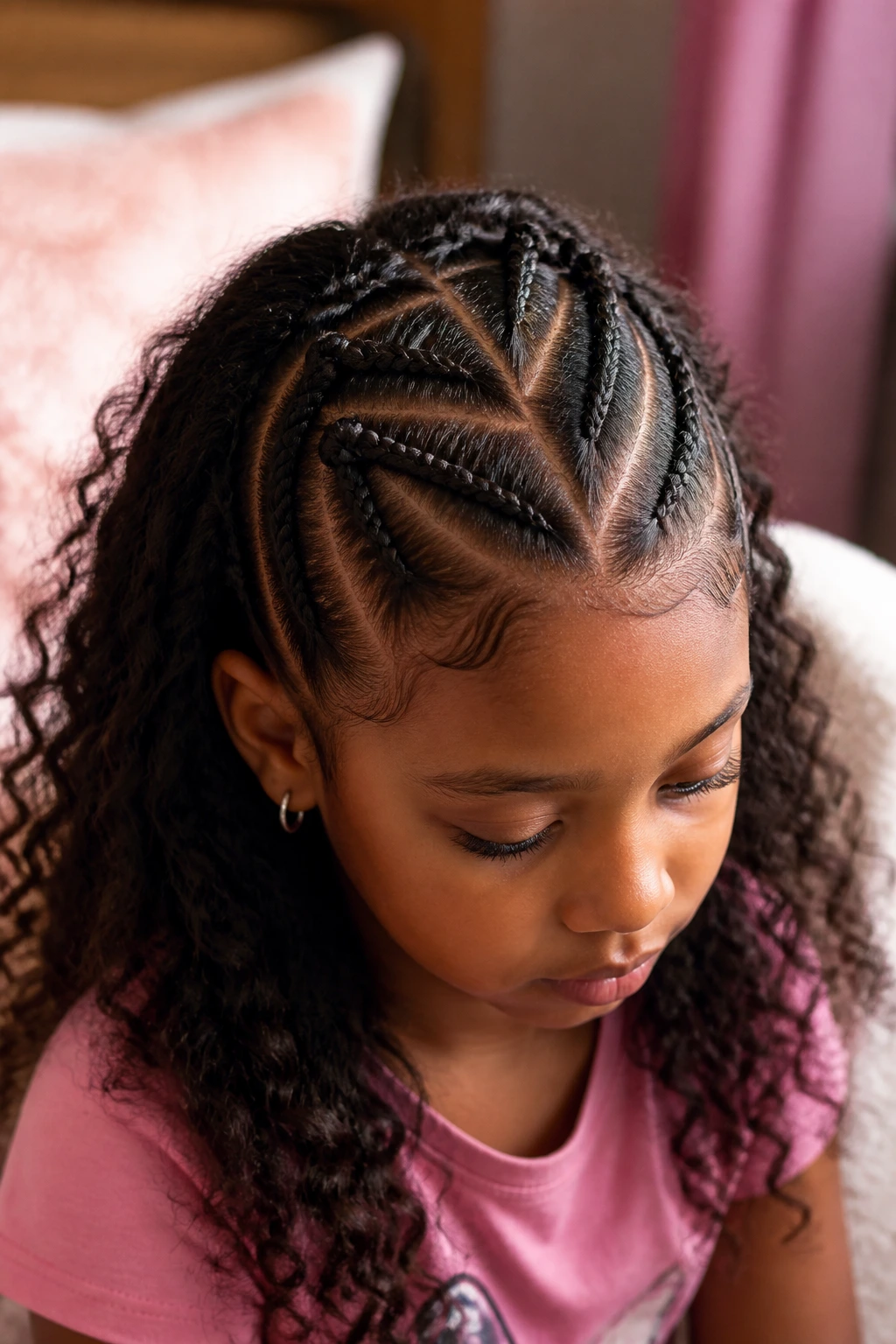
Triangle parts give the style a sharp, graphic feel. Instead of rectangular sections, the front hair is divided into triangles, and those shapes make thick hair look intentional instead of crowded. The braids themselves can be simple, but the parting does the heavy lifting.
This is a good choice when you want the style to look different without adding extra braiding time. Triangle parts are also helpful on dense hair because they distribute volume more evenly across the scalp. No clumping. No flat-looking corners. Just clean geometry and a strong finish.
11. Criss-Cross Cornrow Front with Loose Back
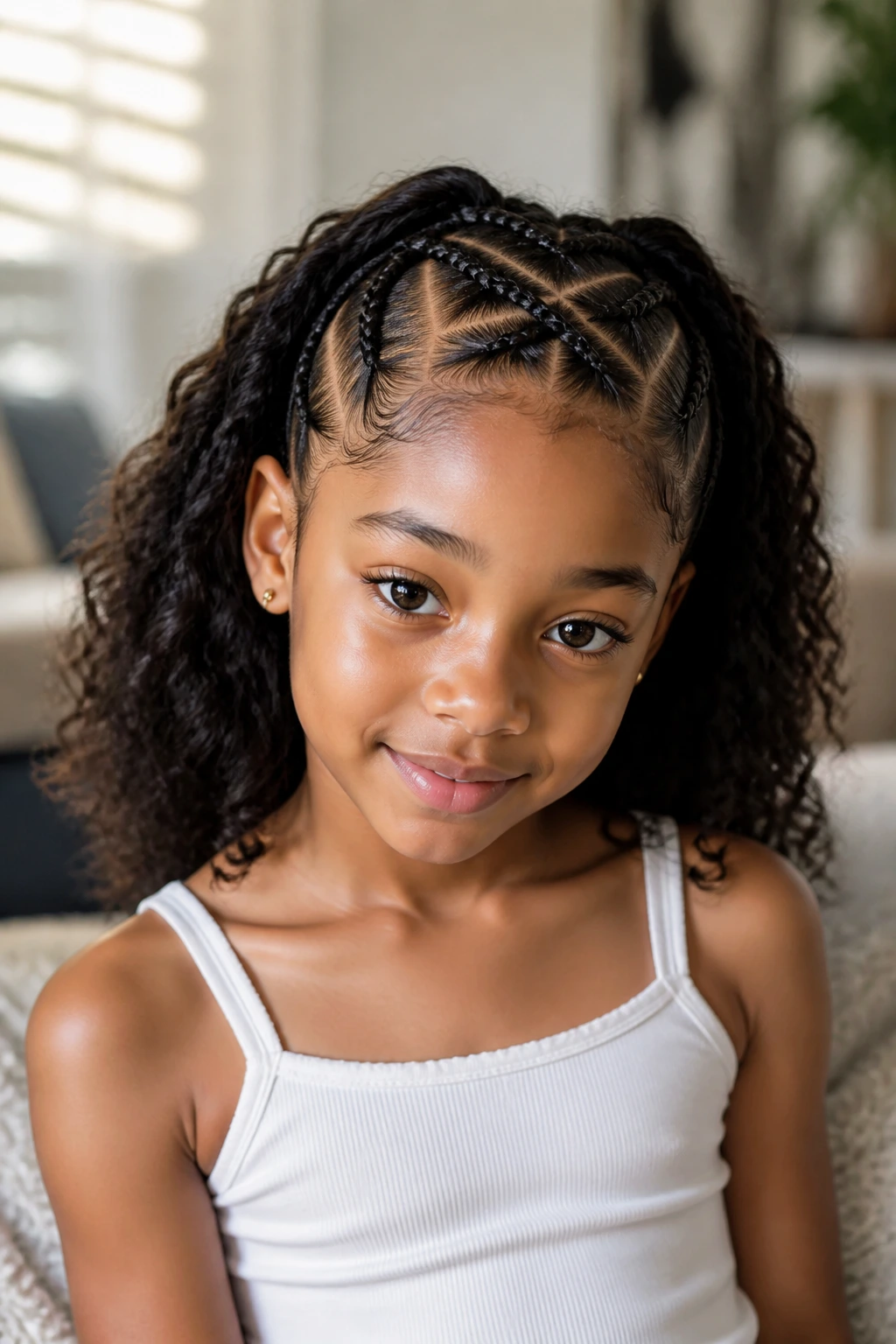
Criss-cross cornrows are the showier cousin of straight-back rows. The front sections cross over each other in a pattern that creates an X-like effect, then the back stays loose for contrast. It sounds complicated, but the visual payoff is immediate.
On thick hair, this pattern keeps the front from looking too blocky. The crossing lines break things up, and the loose back gives the style room to breathe. I’d choose this for a birthday or family event, not because it’s loud, but because it looks like someone actually planned the hairstyle instead of just braiding straight back and hoping for the best.
12. Two Jumbo Rows with Tiny Accent Braids
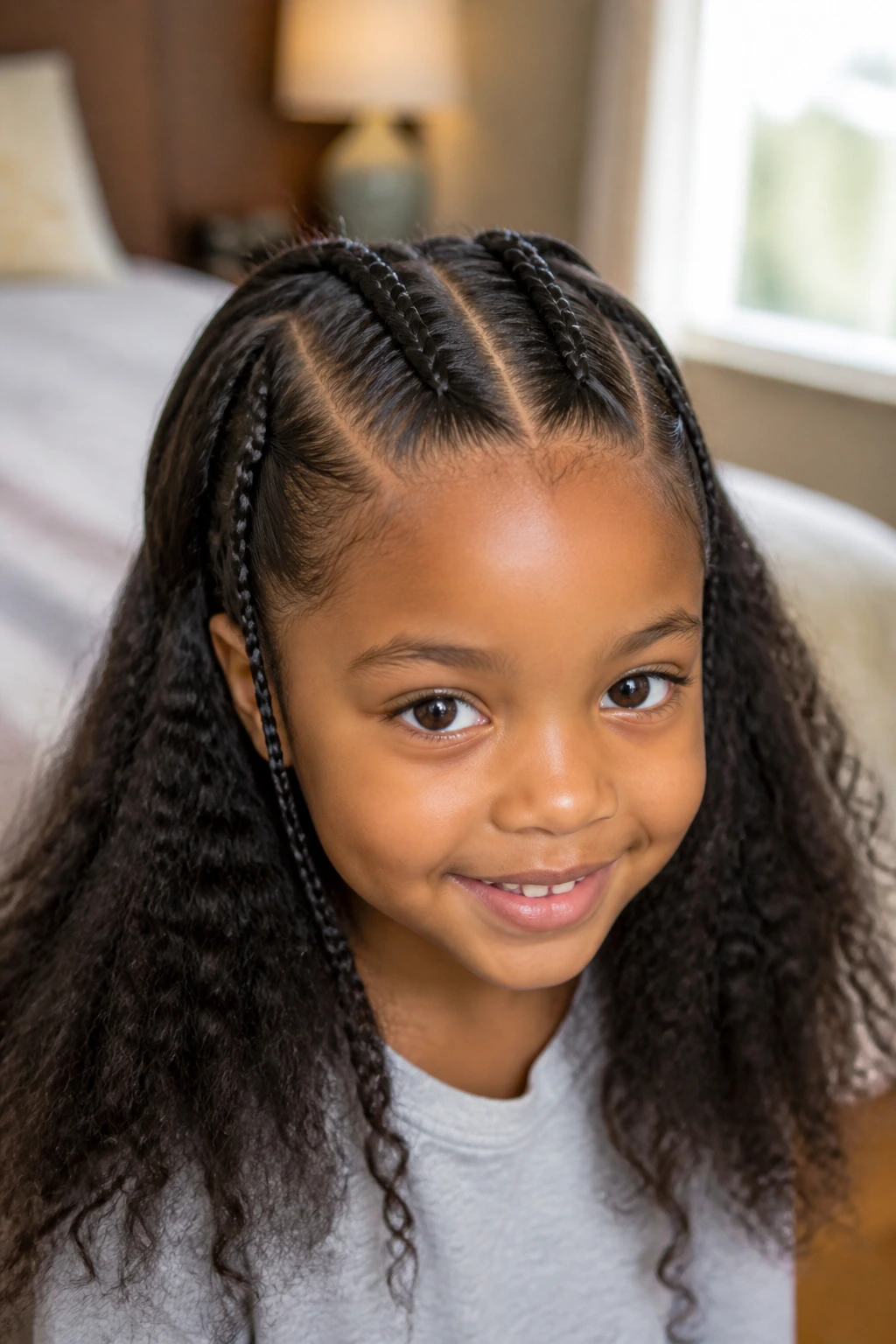
Sometimes fewer rows win. Two large cornrows across the front, each flanked by a tiny accent braid, can look cleaner on thick hair than six narrow rows that start to bunch up. The contrast between jumbo and small gives the style a neat rhythm.
This works well for kids who don’t want to sit too long in the chair. The braiding time is shorter, and the style still looks finished. Add a little mousse at the end and the parting stays crisp. Easy to wear. Easy to redo. That counts.
13. Cornrow Mohawk with Loose Back Hair
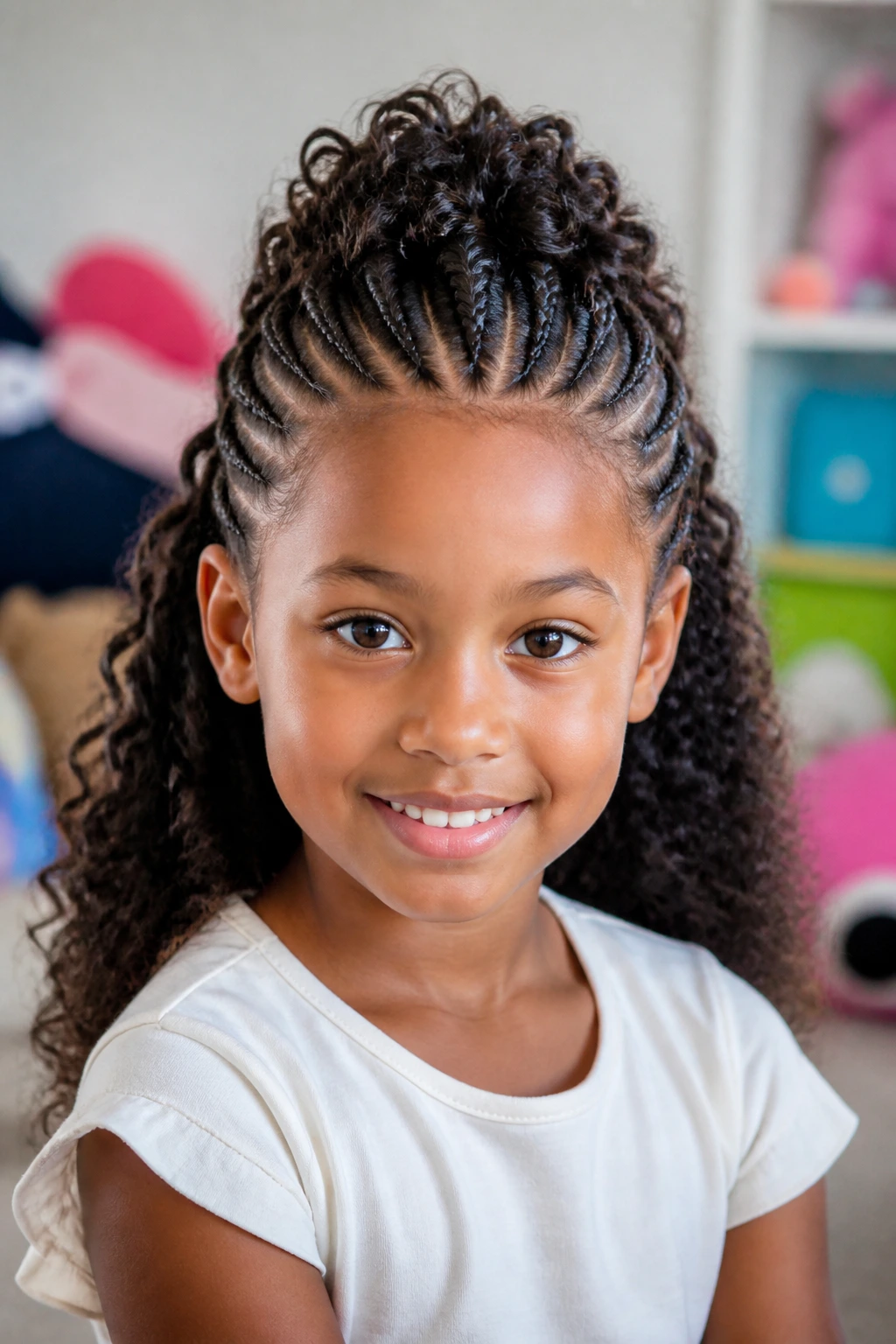
A cornrow mohawk pulls the hair along the center strip of the head, leaving the sides neat and the back free. On thick hair, the mohawk shape has real volume, so it looks bold without needing much extra styling. The loose back hair keeps it from feeling too severe.
The strongest version uses three or five braids running from front to crown, then lets the back fall into curls, a puff, or stretched ends. It’s a good choice when a child wants something spirited but still comfortable. The silhouette is the whole point here. Clean sides. Full center. Plenty of movement.
14. Half Cornrows into a Braided Ponytail
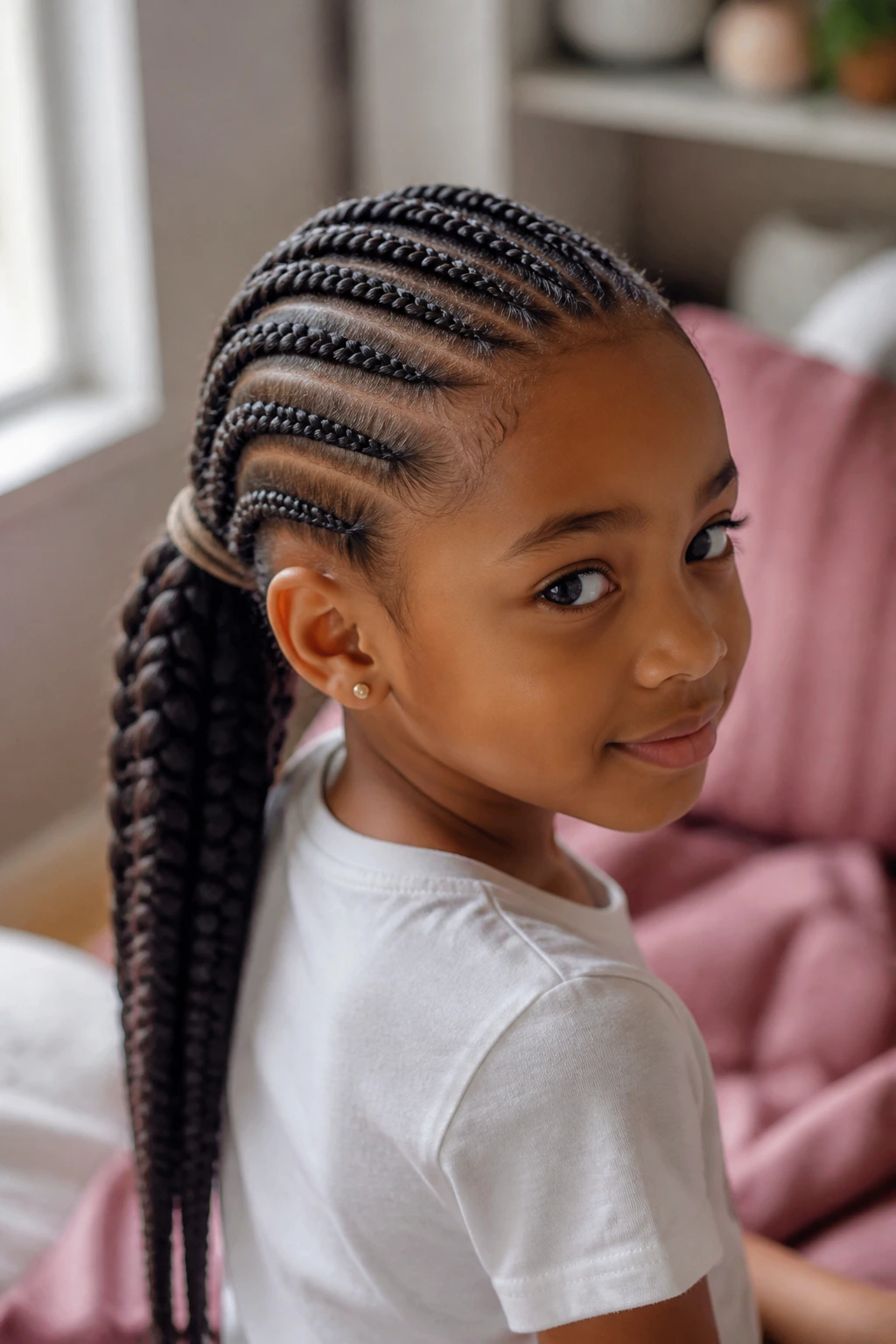
A braided ponytail gives half cornrows a tidy finish. The front rows lead straight into a single ponytail at the back, which can be braided all the way down for extra neatness. Thick hair makes the ponytail look full, even when the braid is small.
I like this one because it stays controlled through a full day of movement. There’s less chance of tangling than with loose ends, and it keeps the style from puffing out in humidity. If the ponytail feels too heavy, pull it a touch lower. The shape still works.
15. Half Cornrows with Bubble Ponytail Ends
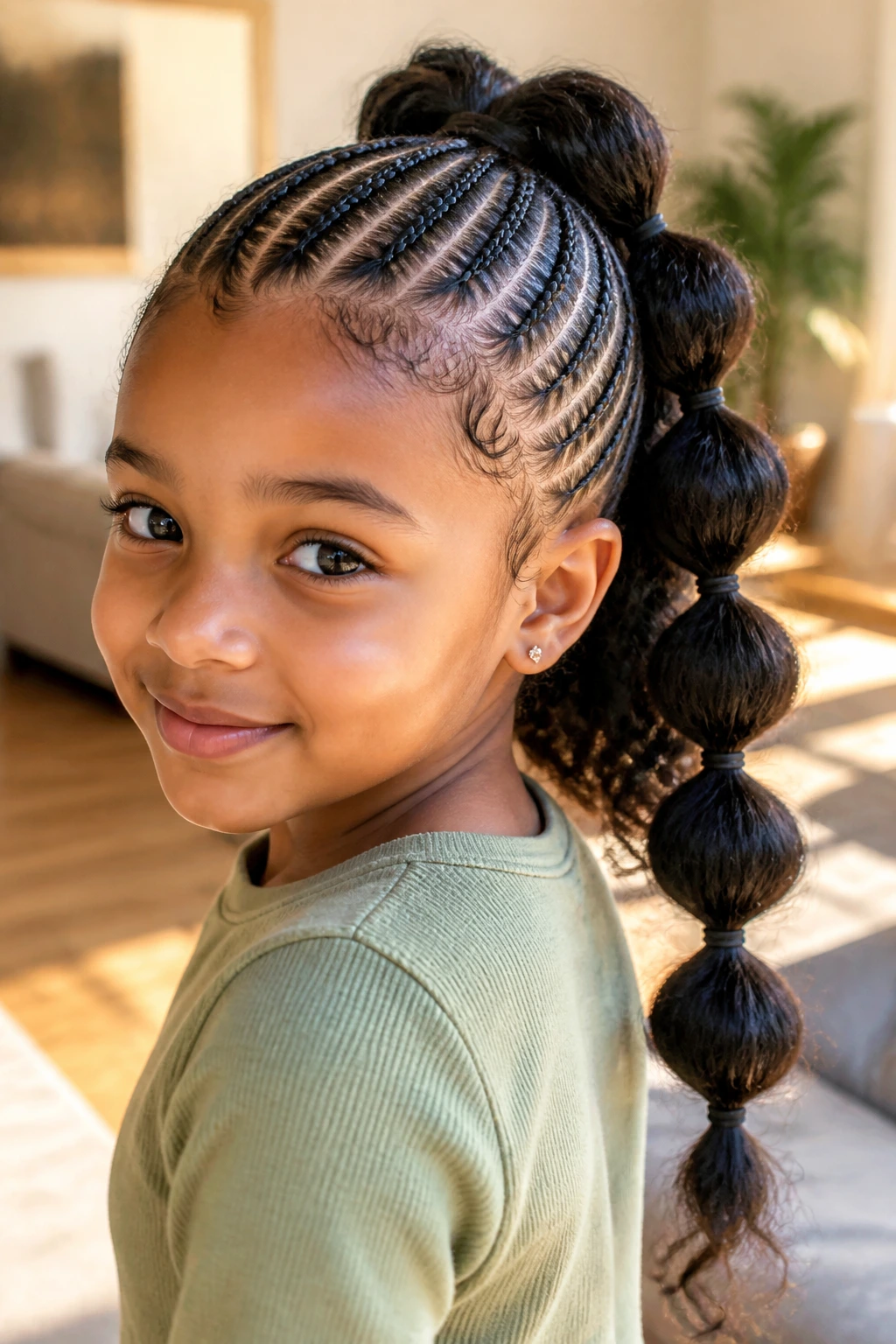
Bubble ponytails are playful without being childish in a cheap way. After the half cornrows feed into a ponytail, small elastics are spaced down the length so the ponytail puffs into rounded sections. Thick hair holds the bubbles better than thin hair, which is half the appeal.
Use this when you want a style that keeps its shape and gives a little bounce. The bubbles should be even, not stretched so tight that the ponytail looks strained. A ribbon at the base can be enough. More than that and the look starts to fight itself.
16. Asymmetrical Side Cornrows to One Ear
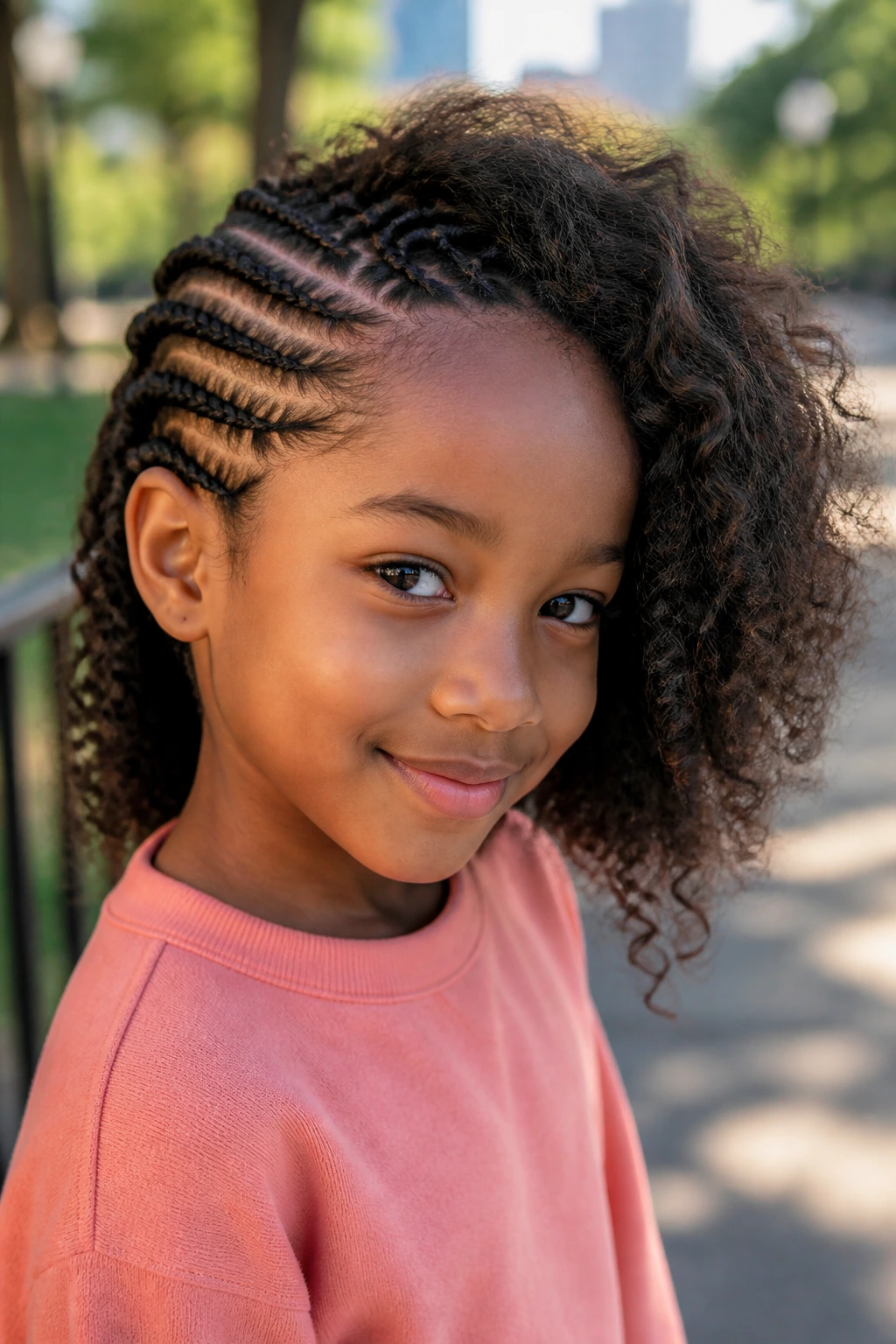
One-sided cornrows feel fresh because they break the habit of perfect symmetry. The braids sweep toward one ear, while the opposite side stays loose and fuller. On a child with thick hair, that contrast keeps the style from feeling heavy all over.
This is a good pick for a kid who likes to tuck one side behind the ear or wear a small bow near the temple. It looks relaxed but still deliberate. The secret is leaving enough loose hair to balance the braids visually. Too little, and the style looks unfinished.
17. Half Cornrows with Beads and Cuffs
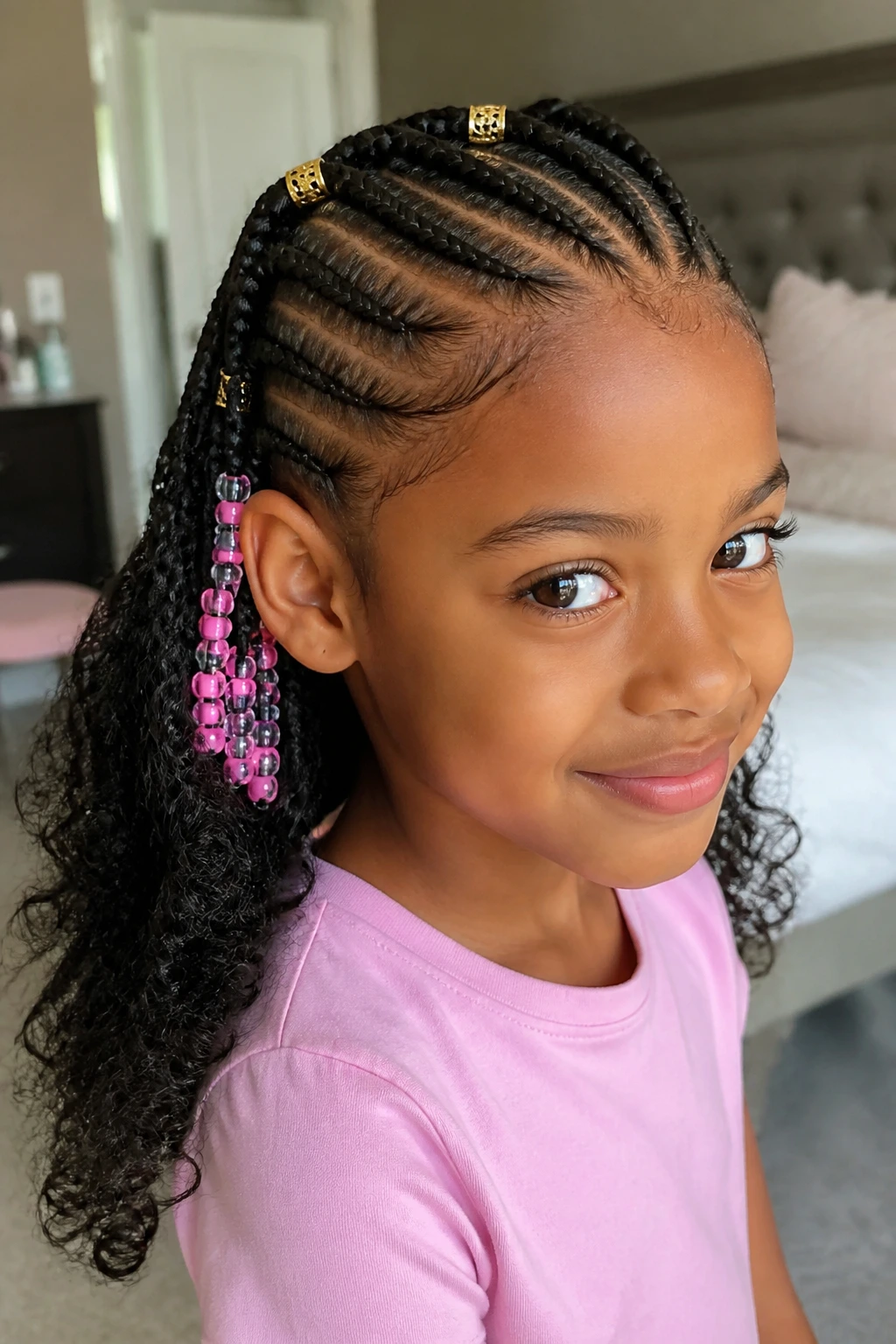
Beads and cuffs are the quickest way to move a plain braid into something memorable. The cornrows can be any shape—straight, curved, side-swept—but the ends get decorated with small beads or metal cuffs that catch light and add rhythm to the style.
On thick hair, accessories sit better because the braid ends are sturdy. Still, don’t overdo it. A few beads on the outer rows and cuffs on the inner braids usually look cleaner than covering every strand in hardware. The style should sound like play, not like a toy aisle collapsed on the head.
18. Stitch Cornrows with Sharp Parting
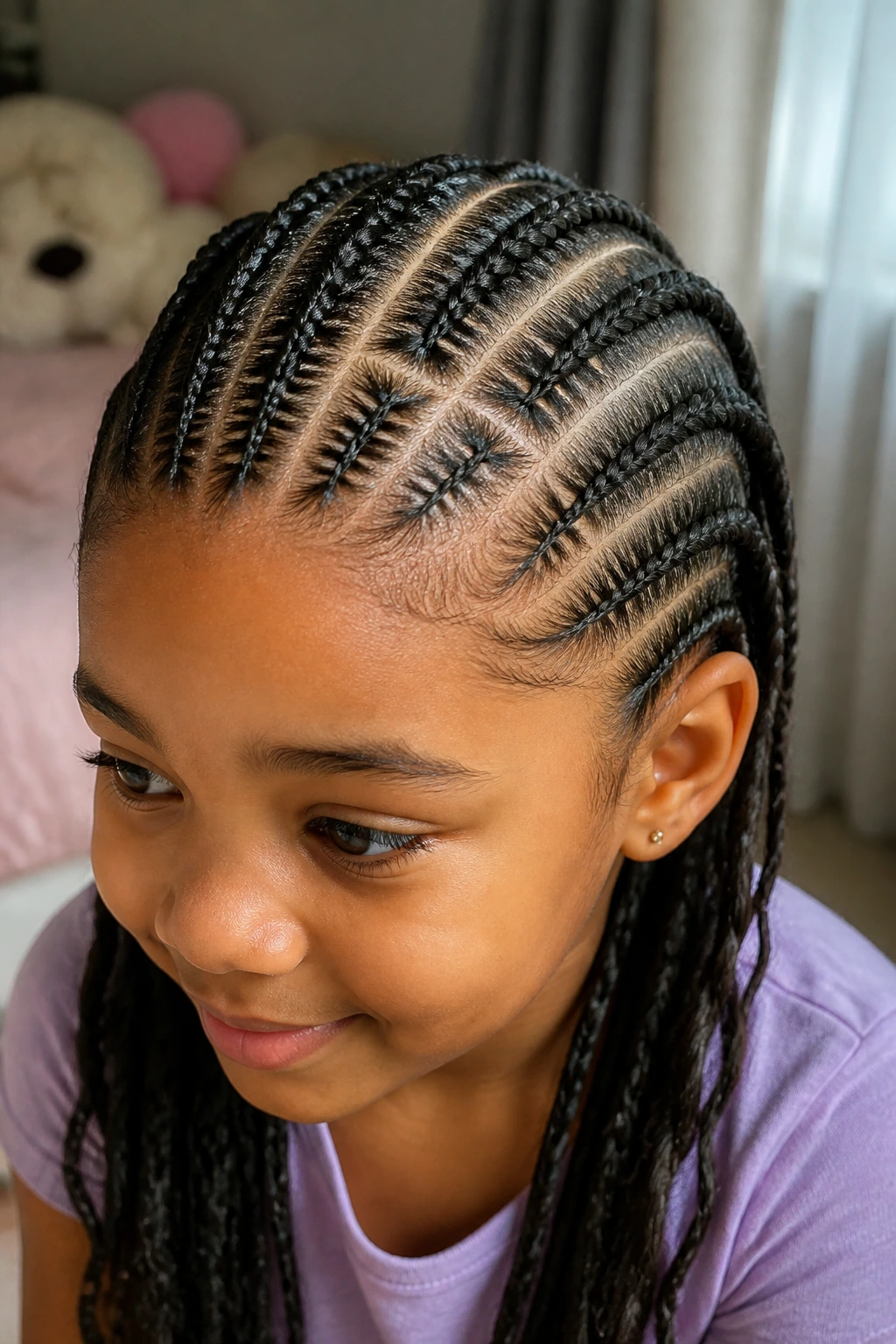
Stitch braids have those crisp, straight part lines that resemble little seams. They look especially nice on thick hair because the density gives the parts a clean edge when the sections are measured carefully. The front half can be done in four, six, or eight stitch rows depending on the child’s age and patience.
I like stitch cornrows for dressier occasions because the parting does a lot of the visual work. They look neat even before accessories go in. A little shine spray at the end helps, but don’t drown the scalp. Sharp parts are enough. The rest is just maintenance.
19. Half Cornrow Crown into a Low Bun
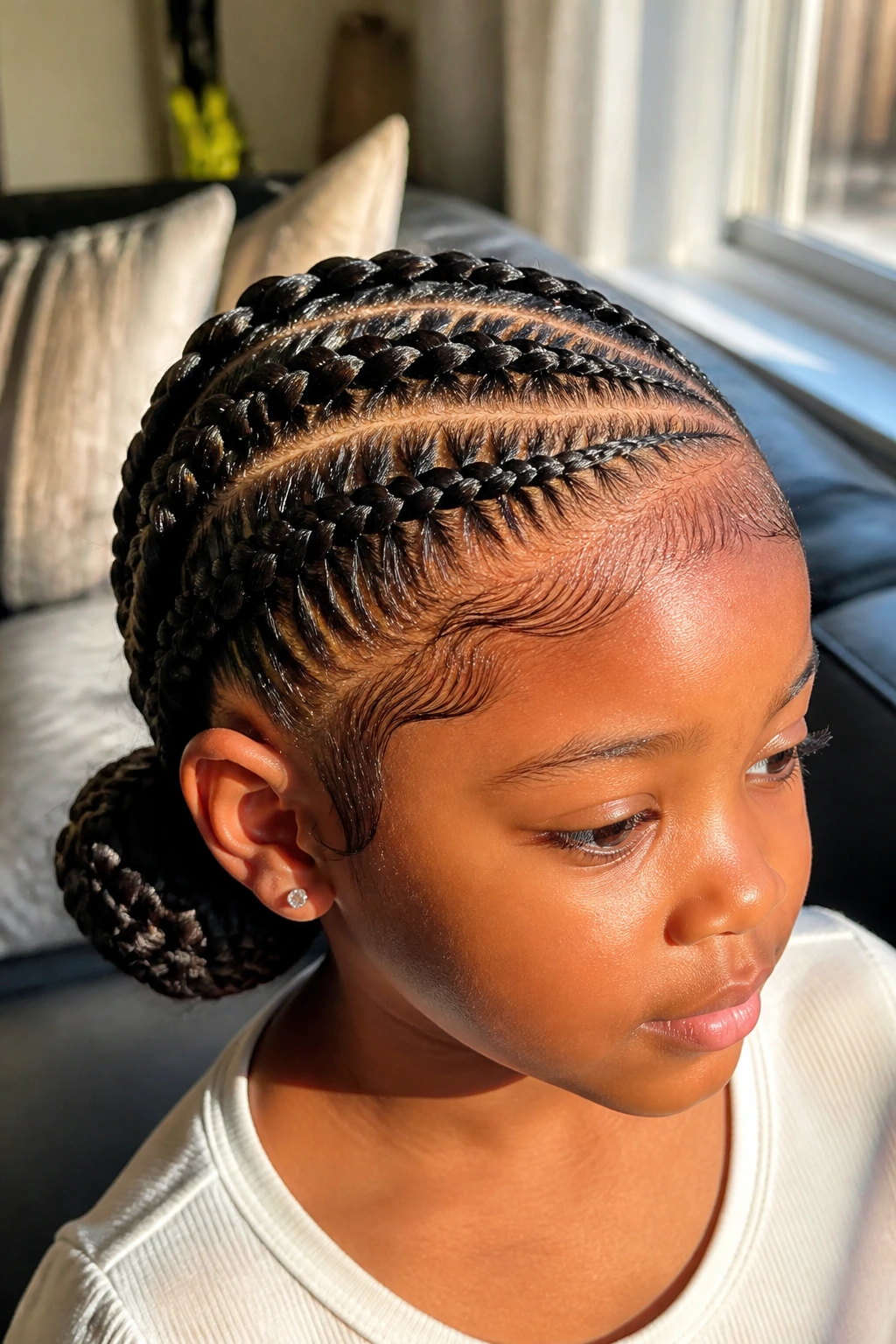
This version wraps the cornrows around the crown and gathers the loose section into a low bun at the nape. It feels a little more composed than a high bun and a little softer than a full braided updo. Thick hair gives the bun body without making it look bulky.
The low placement also tends to be more comfortable for kids who nap in the car or rest their head on a pillow. That matters more than people think. Cute is fine, but comfort wins in real life. If the bun is secured with too many pins, though, it stops being cute. Keep it simple.
20. Swirl Cornrows Around the Hairline
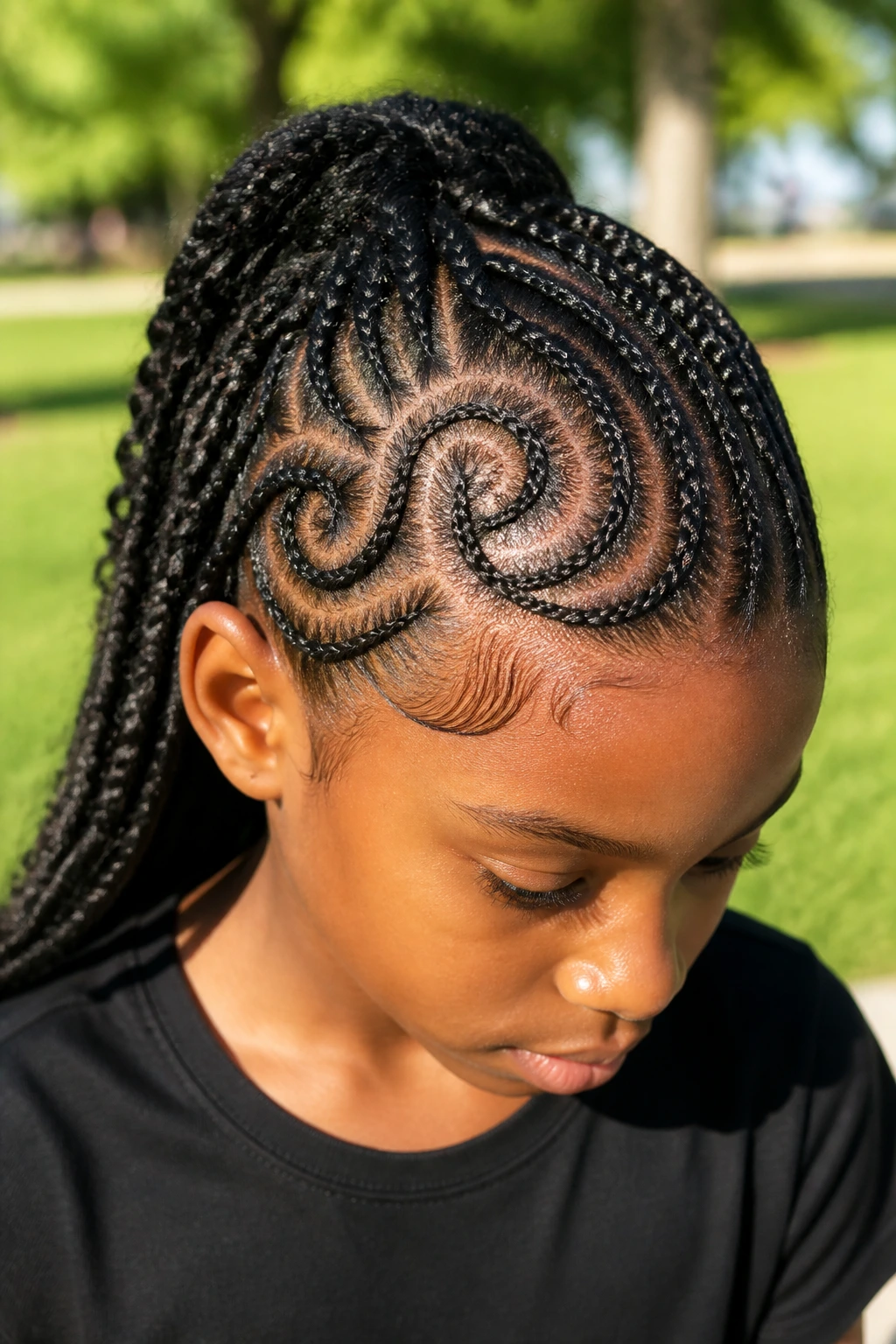
Swirl patterns look like someone drew a ribbon around the head. The rows curve around the hairline and then move back in a spiral or looping shape, which can be gorgeous on thick hair because the pattern stays visible even when the hair is full.
This style is for the child who likes something different from the usual straight-back set. It does take more careful parting, so the braider needs a steady hand and a comb with a fine tail. Worth it, though. Swirls photograph well, and they make the hair look sculpted rather than flat.
21. Middle-Part Half Cornrows with Curly Ends
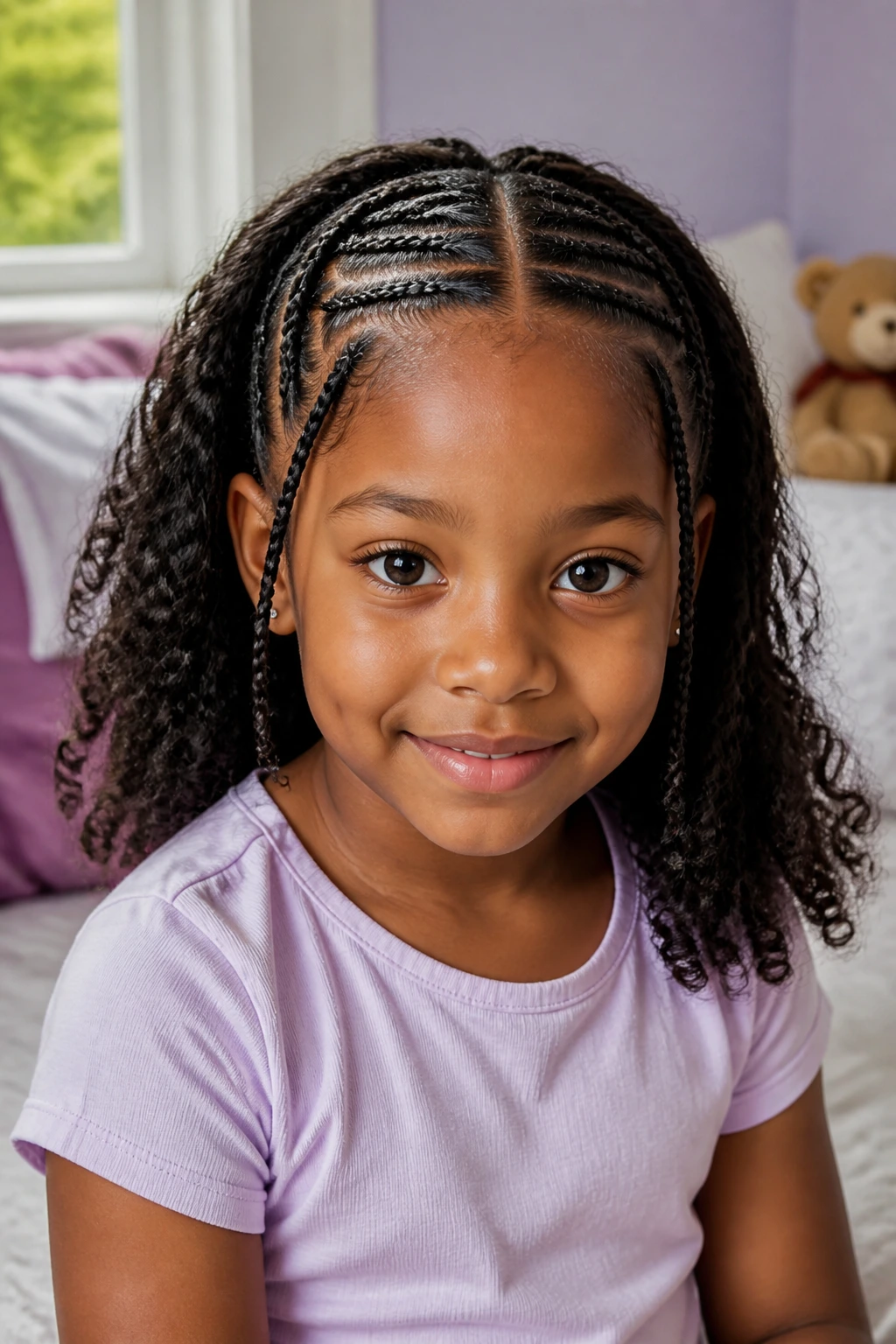
A middle part gives structure, and curly ends give life. The front half is divided down the center, then braided into neat rows that frame the face evenly. The back is left loose or curled so the style doesn’t end up too severe for a child.
On thick hair, the middle part helps the whole look feel balanced. It’s a good choice if the child’s face is naturally symmetrical or if you want the braids to mirror each other cleanly. Keep the curls soft and springy. Hard, crunchy ends can make a sweet style look oddly stiff.
22. Half Cornrows and Bantu Knots at the Crown
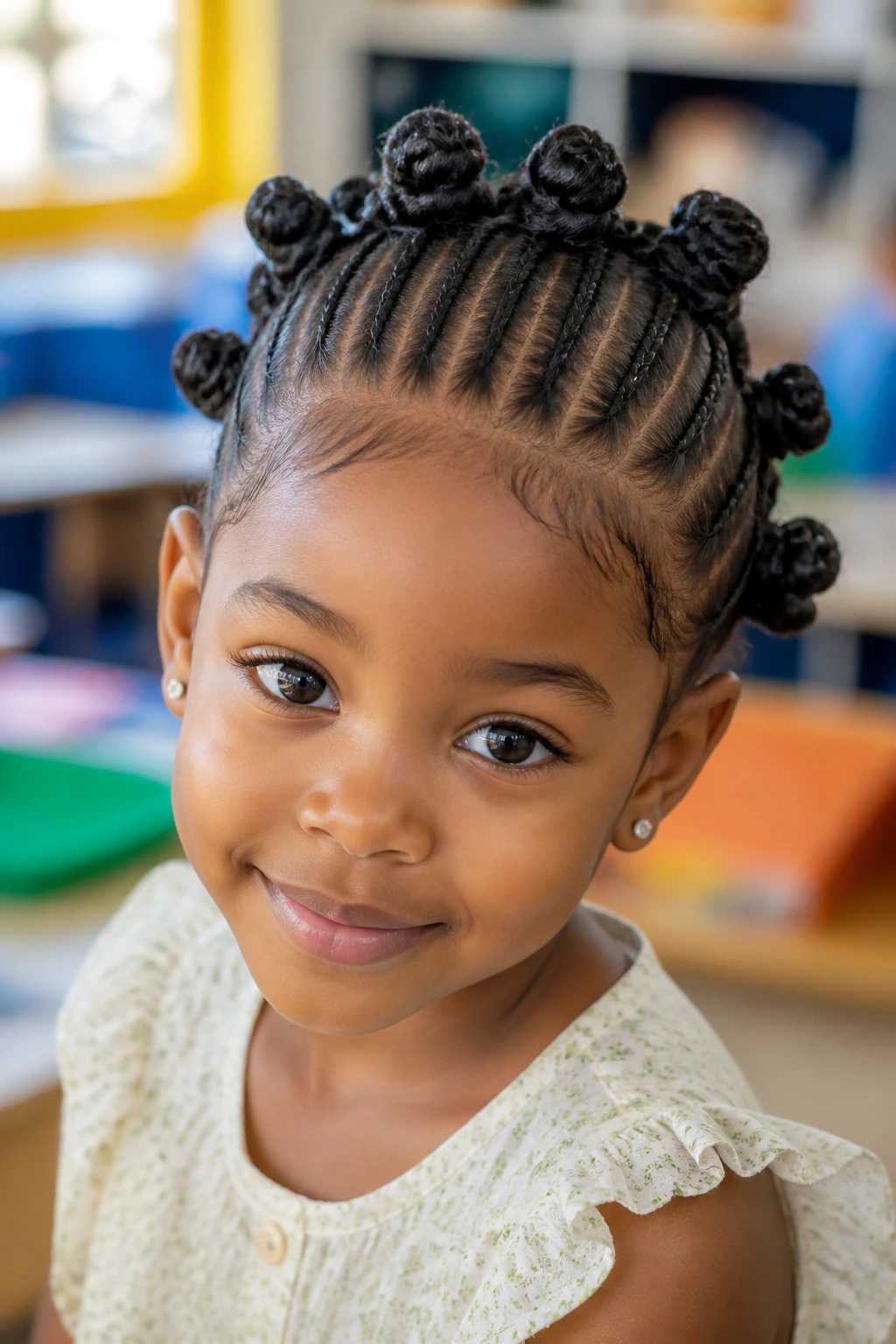
This one has real personality. The front can be braided into half cornrows, then the crown or back section is twisted into small Bantu knots for a playful, rounded finish. Thick hair gives the knots enough body to look full instead of pinched.
I’d choose this for a special day when the goal is to make the hairstyle the outfit’s anchor. It’s also practical because the knots keep the hair tucked and protected. If the child moves a lot, secure each knot carefully and don’t crowd them together. Space gives the style room to breathe.
23. Rainbow Bead Half Cornrows
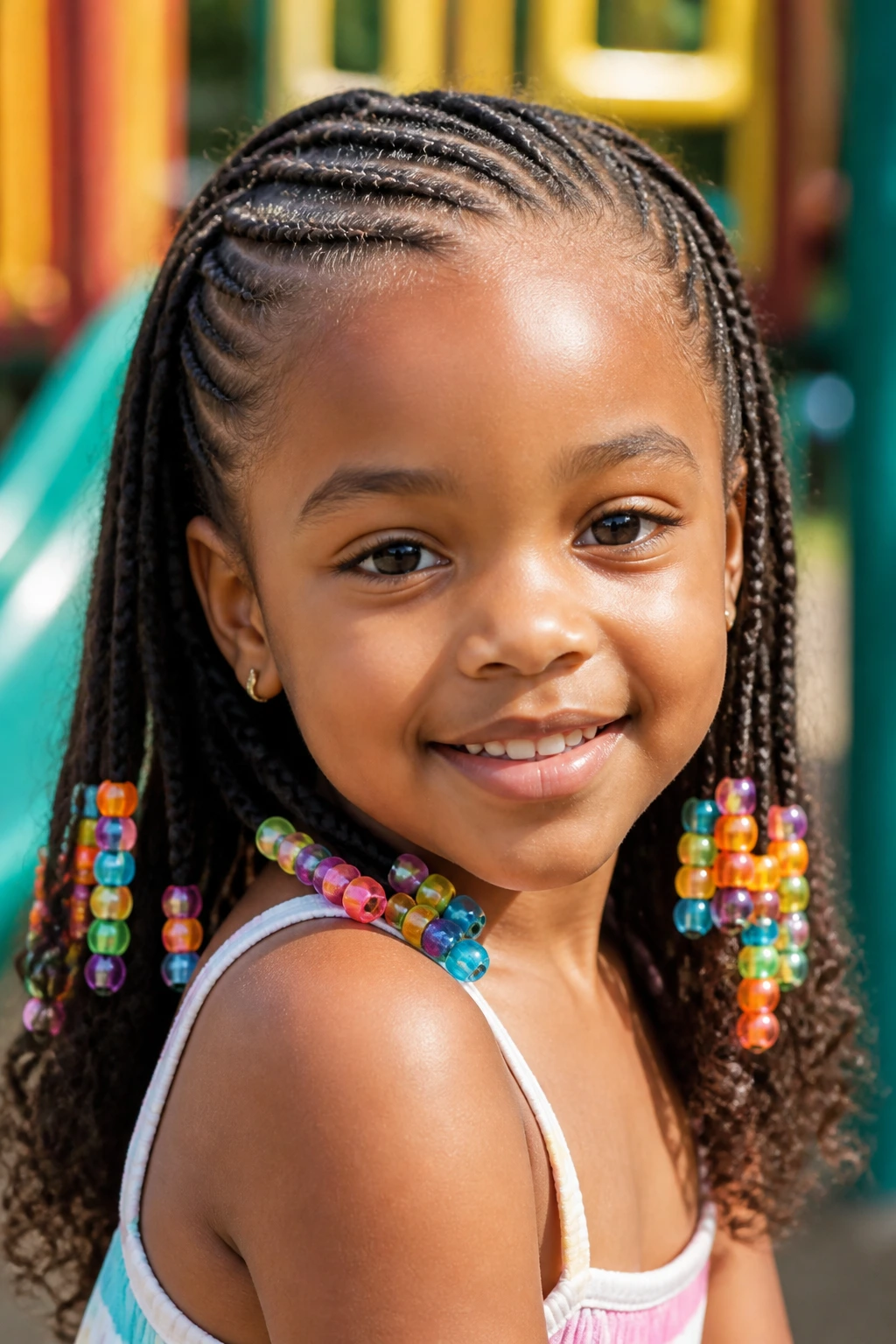
Rainbow beads are not subtle, and that’s the point. The cornrows can be simple and straight, but the ends are finished with a mix of colorful beads that turn the hairstyle into something cheerful and unmistakably kid-friendly. Thick hair holds the weight of beads better, which makes this style easier to wear.
The trick is balance. Choose a few colors that work together rather than dumping every bead in the bag onto one head. Even a small cluster of red, yellow, blue, and green can look lively without becoming chaotic. The hairstyle should feel happy, not loud for the sake of being loud.
24. One-Sided Half Cornrows with a Deep Side Part
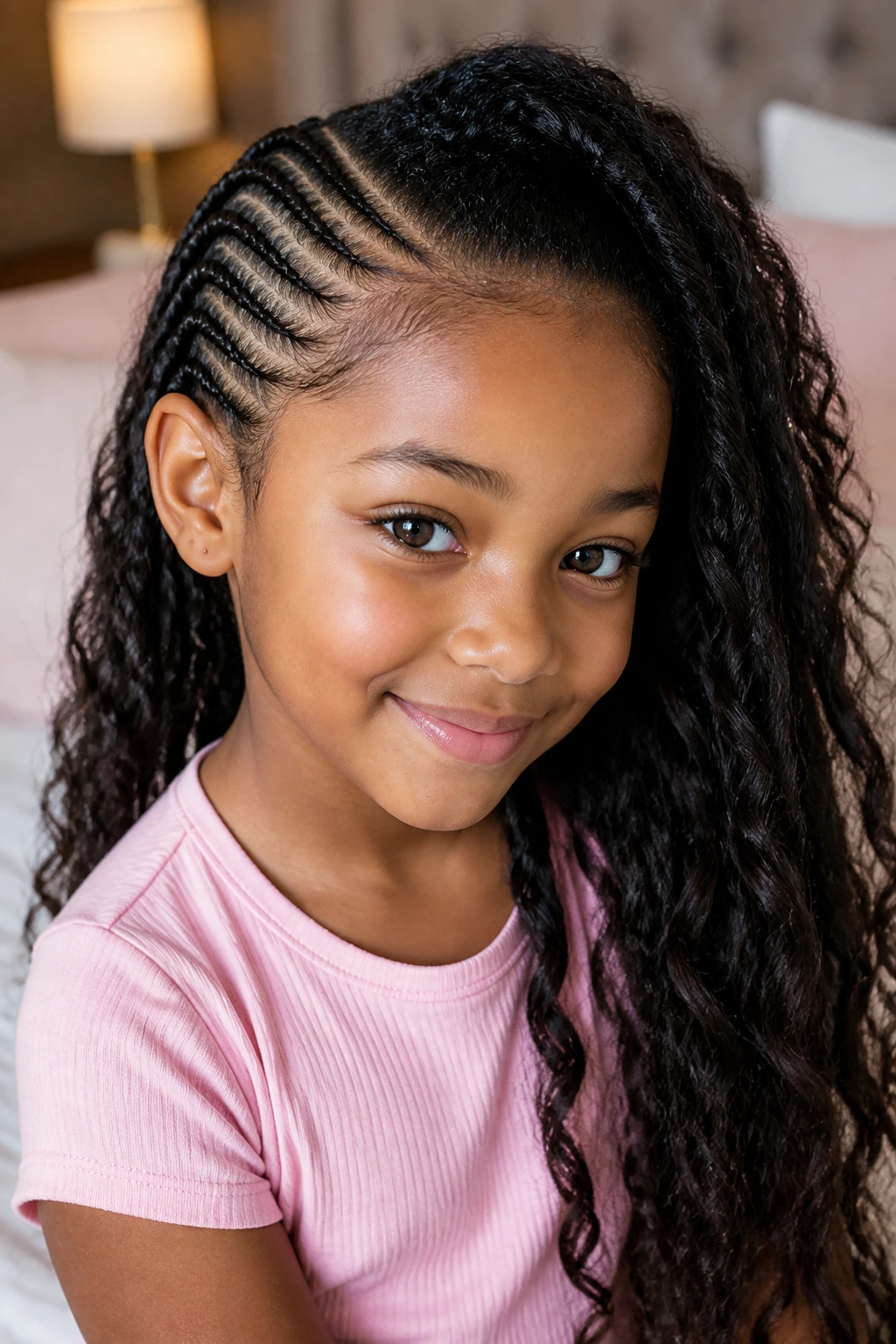
A deep side part changes the shape of the face fast. Cornrows gathered on one side let the style lean dramatically without needing a complicated braid pattern, and the thick hair on the loose side balances the whole thing naturally.
This is one of the best styles for kids who like to tuck hair behind one ear or wear a bow off to the side. It’s also forgiving if the loose side has a little frizz; the asymmetry makes that look intentional. I’d call it graceful, but not fussy. That’s a useful sweet spot.
25. Double-Heart Part Half Cornrows
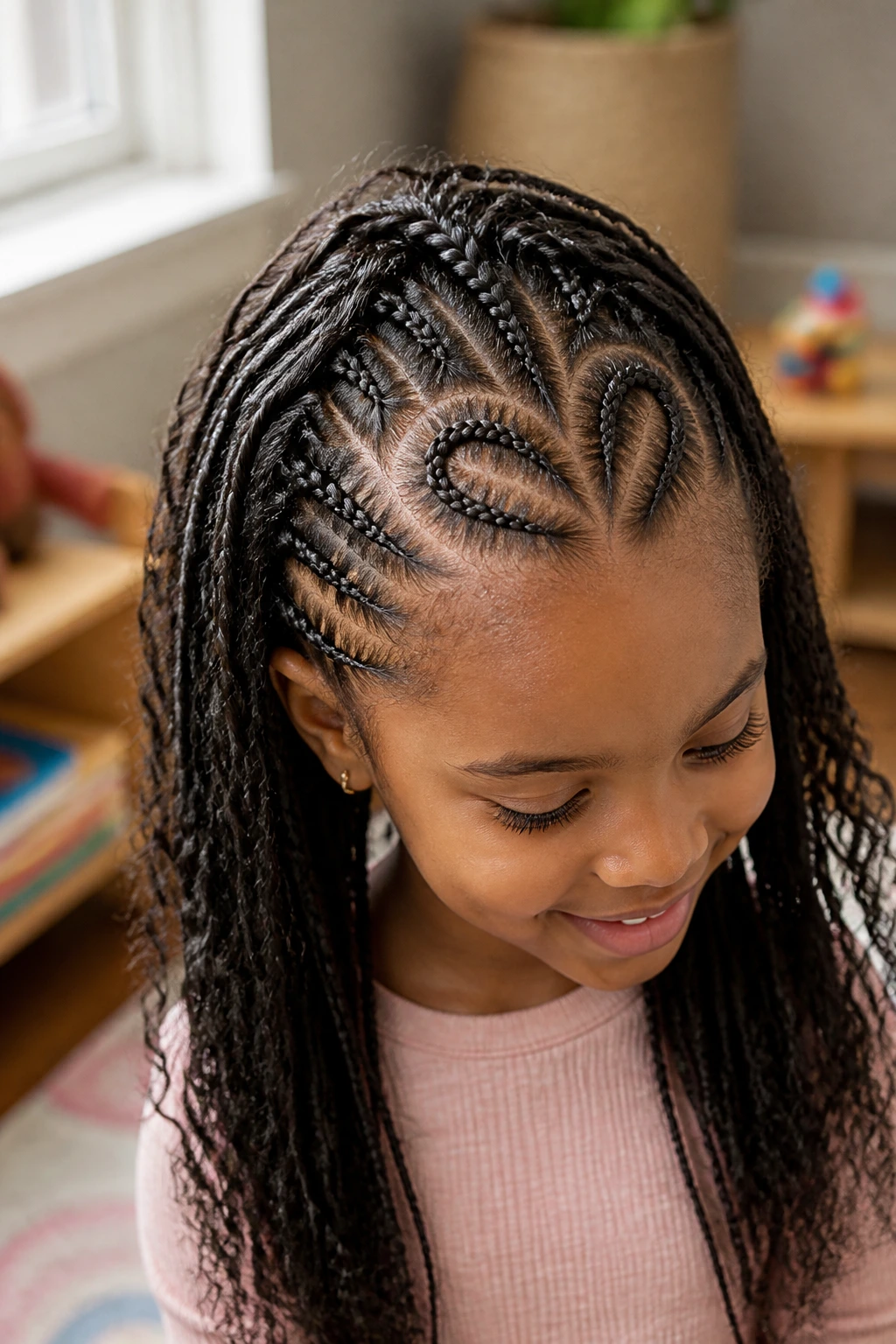
Double-heart parts take a normal style and give it a clear point of view. Two heart shapes can sit near the front or crown before the braids move backward, and the design is obvious enough to be admired but not so large that it overwhelms the head.
This one works best when the parts are neat and the braids are kept medium-sized. On thick hair, the hearts show up cleanly if the sections are measured carefully. It’s a lovely option for birthdays, school events, or any day when the child wants her hair to feel special without being stuffed with accessories.
26. Half Cornrows into Twin Buns
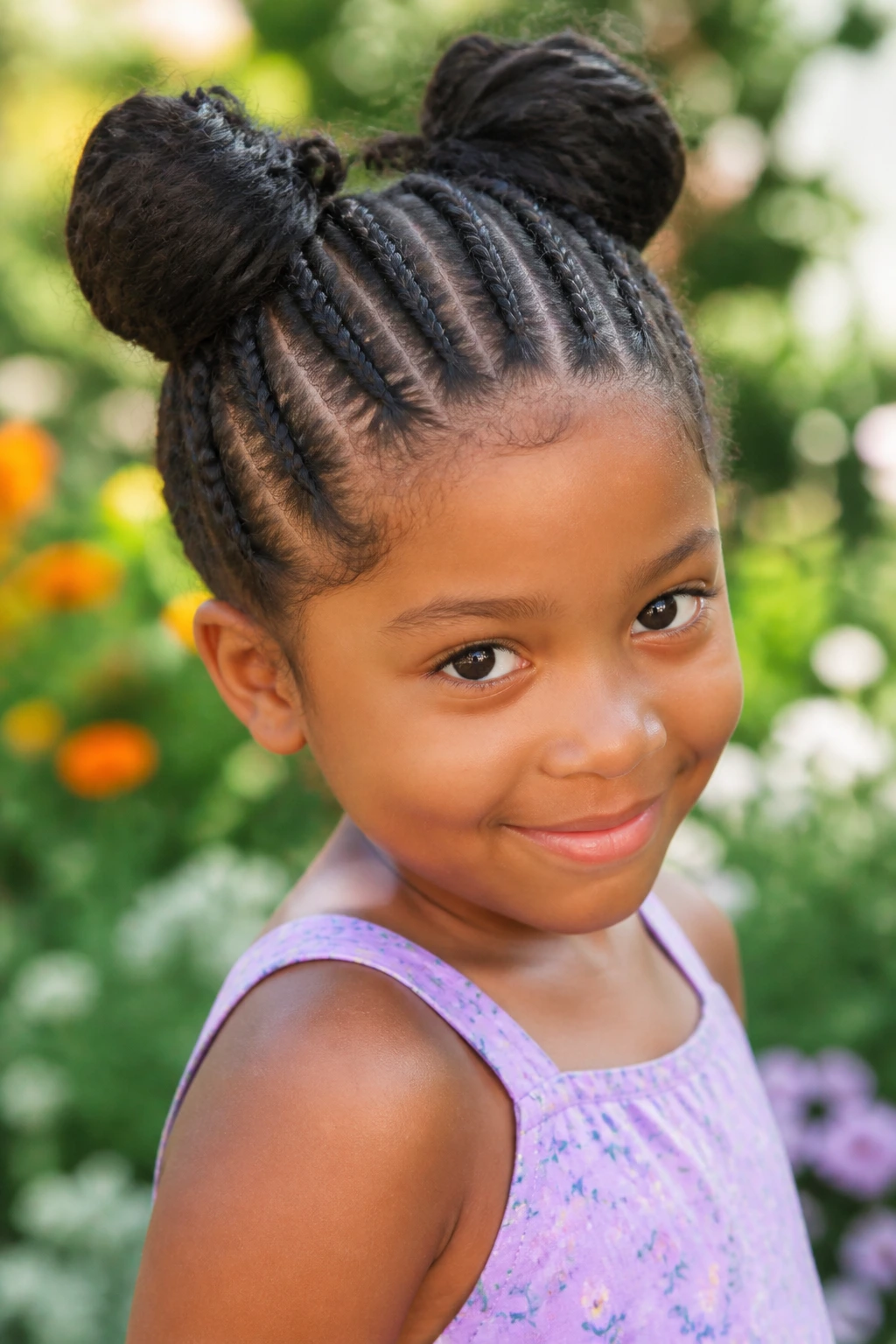
Twin buns make the style feel youthful and energetic. The front cornrows lead into two buns on either side of the crown or back, and thick hair gives both buns enough size to look complete. No padding needed, which is a small mercy.
The look is especially useful when the child wants hair up but not completely slicked down. It stays neat, and the buns can be set high for a playful look or lower for something calmer. If the buns are uneven, don’t panic. A little natural asymmetry usually looks better on a child than machine-perfect symmetry anyway.
27. Tucked-End Half Cornrows for a Neater Finish
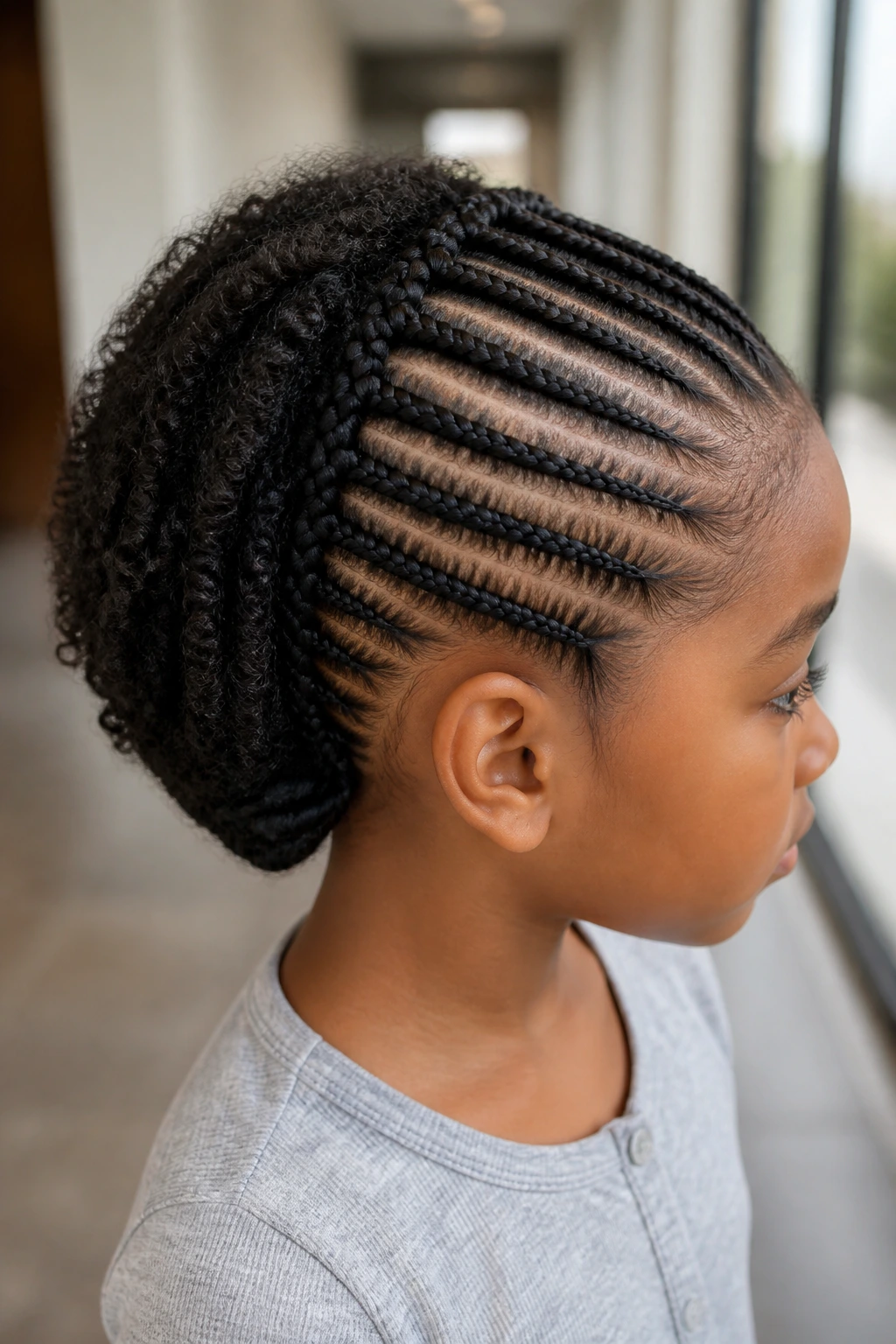
Tucked ends are for the days when you want the braids to stop cleanly instead of hanging loose. After the front rows are done, the ends are folded under, pinned, or braided into the remaining hair so the finish looks compact and tidy. Thick hair helps hide the tucked sections.
This style is practical if the child gets annoyed by loose ends brushing the neck or snagging on sweaters. It also stays neater in wind. The only catch is that the tuck needs to be secure but not hard. You want the hair folded, not compressed like a suitcase.
28. Layered Feed-In Rows with a Side Swoop
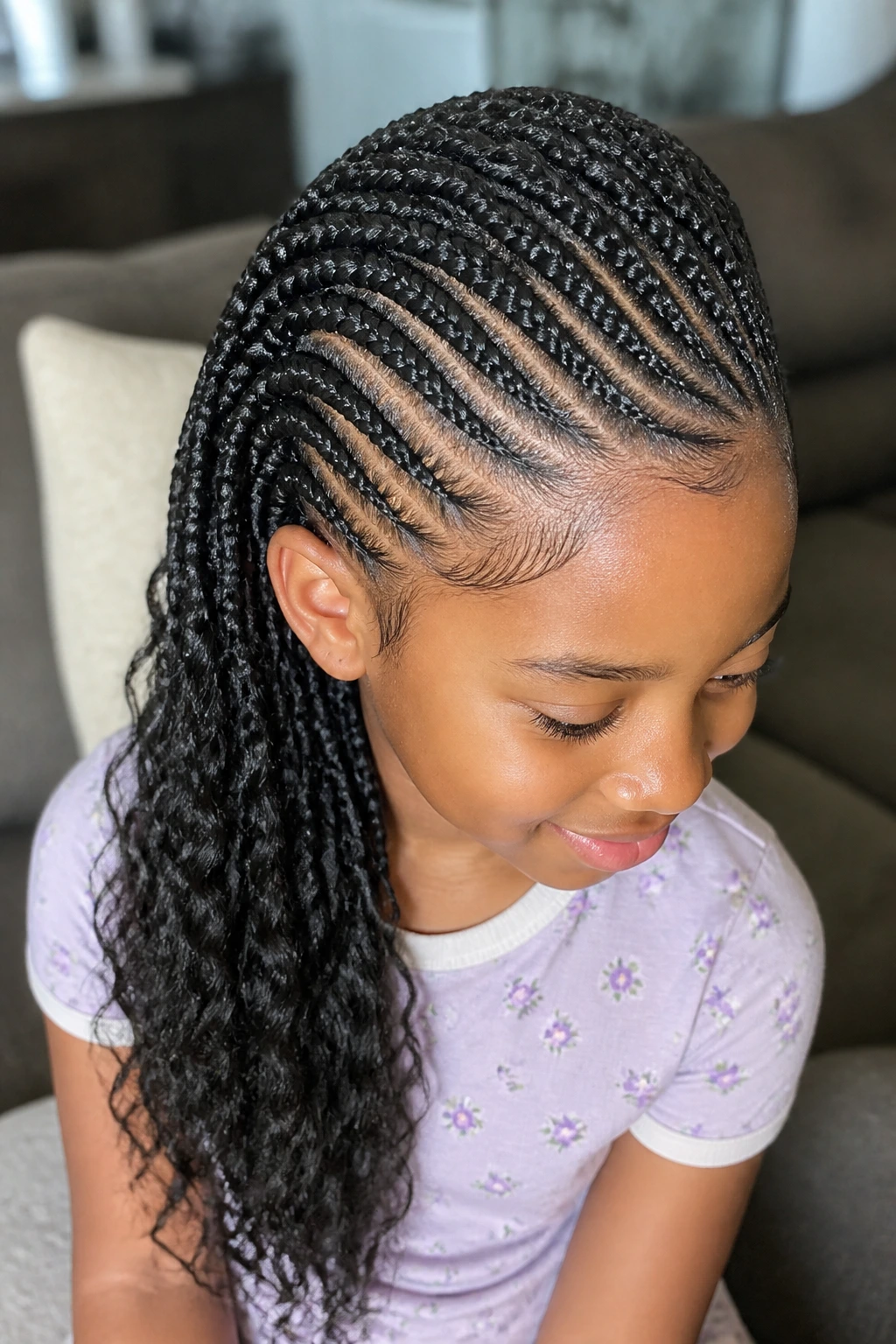
Layered feed-in rows begin with narrow braids at the front, then widen slightly as they move back, and the whole set sweeps to one side. On thick hair, that layered effect keeps the top from feeling too boxy. The side swoop adds movement and helps the style follow the shape of the face.
This is one of those styles that looks more complicated than it is, which is usually a good thing. If you want a bit of polish but not a full fancy pattern, this lands nicely. A light mousse finish is enough. The braid shapes do the talking.
29. Half Cornrows with Twist-Out Back
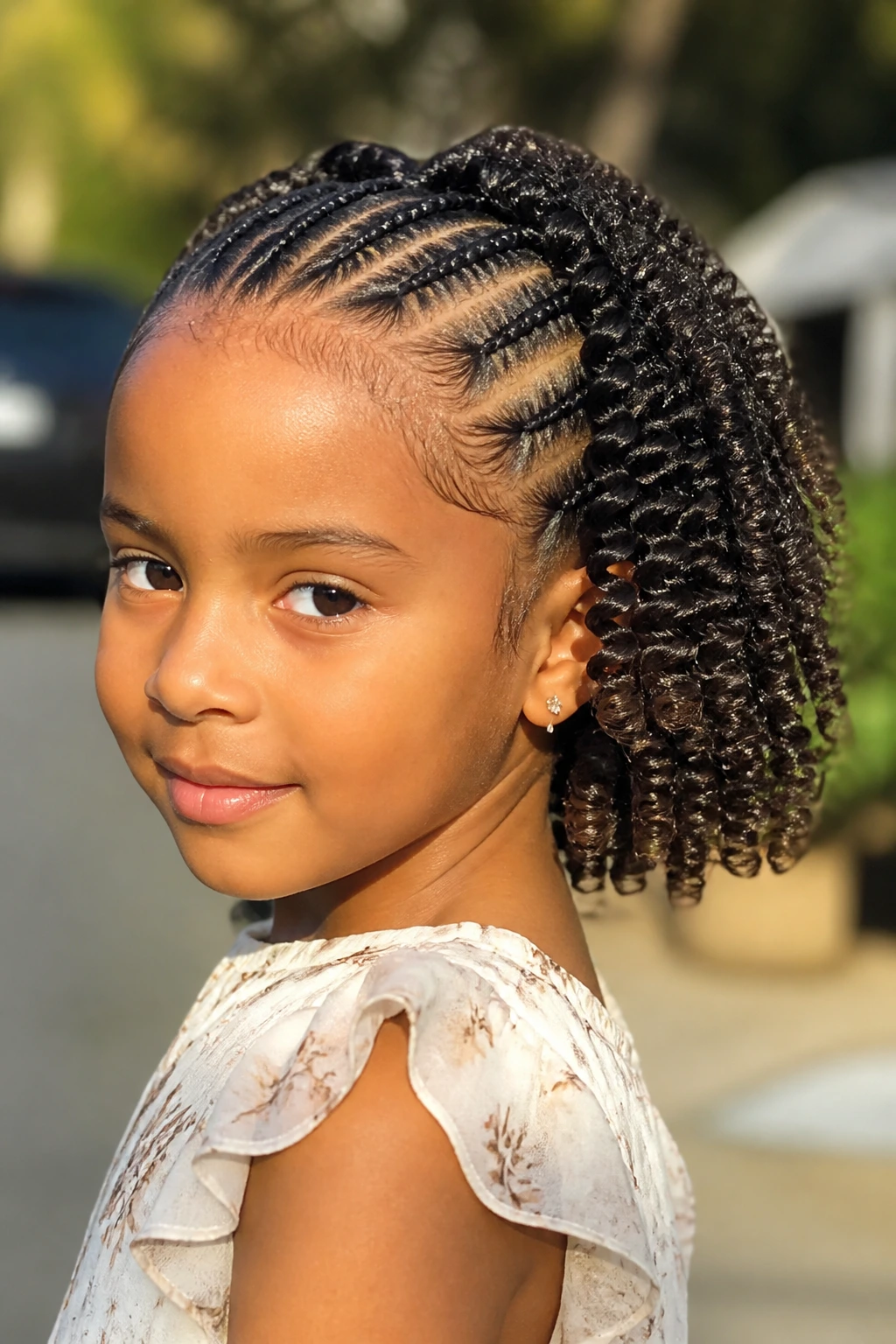
A twist-out back gives half cornrows a soft, stretched texture that sits somewhere between curls and braids. The front rows stay crisp, while the back sections are twisted beforehand and unraveled later so the hair falls in defined waves. Thick hair loves this because the texture tends to hold.
I like this version when the child wants fullness without the tangles that sometimes come with loose curls. The twist-out gives shape and doesn’t collapse as fast. If the back is left too dry, though, it can frizz quickly. A little leave-in before the twist-out step helps a lot.
30. Half Cornrows with Box-Braid Ends
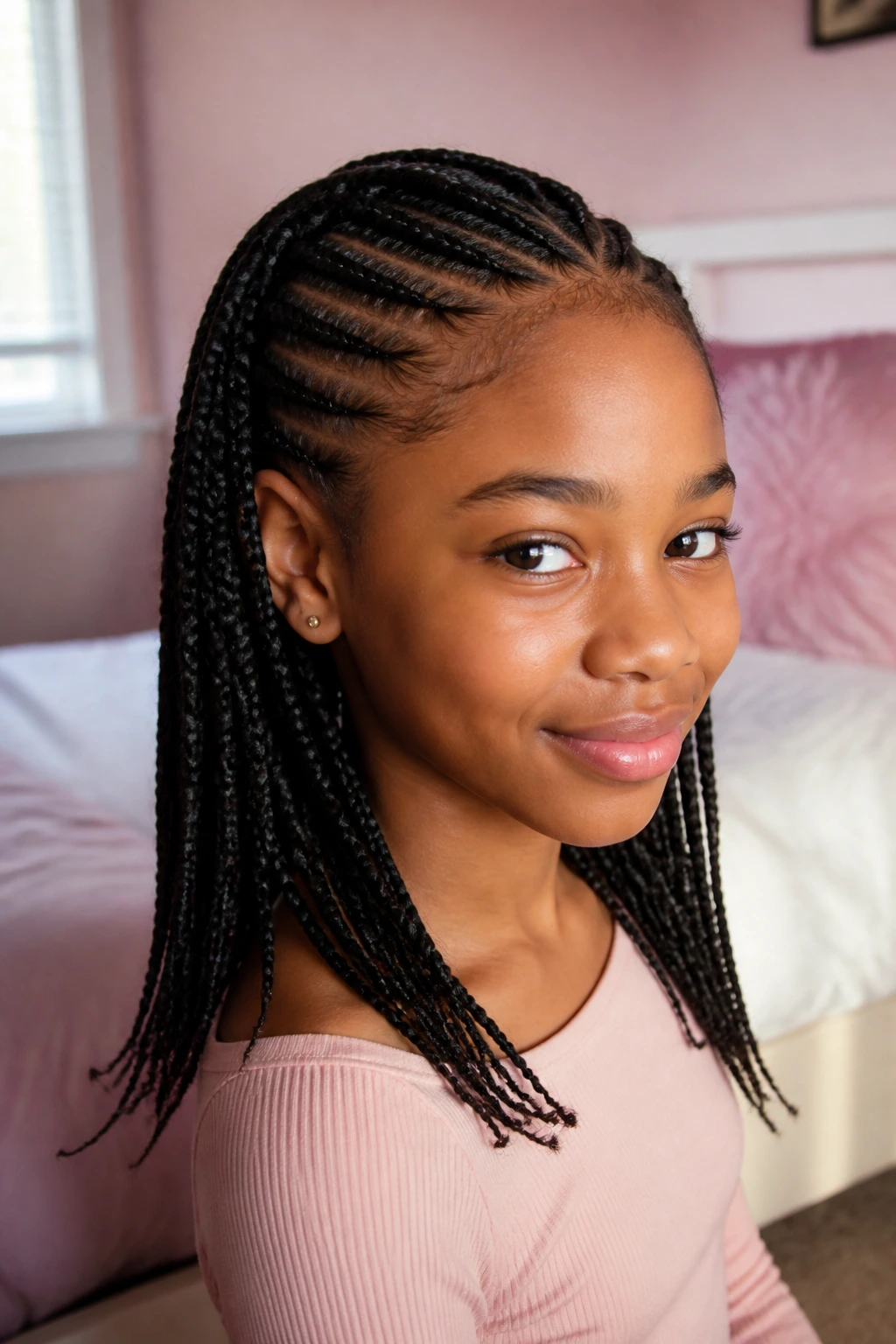
Box-braid ends are sturdy and neat, which makes them a smart finish for active kids. The front half is cornrowed back, then the loose section is divided into box braids instead of left free. That mix gives the style longer wear and makes bedtime easier.
This is one of the more practical choices on the list. Thick hair supports the braids well, and the square sections help keep the ends separated. If you want a style that can last beyond a single busy weekend, this is a strong candidate. It’s not flashy. It just works.
31. Ladder-Pattern Half Cornrows with Loose Curls
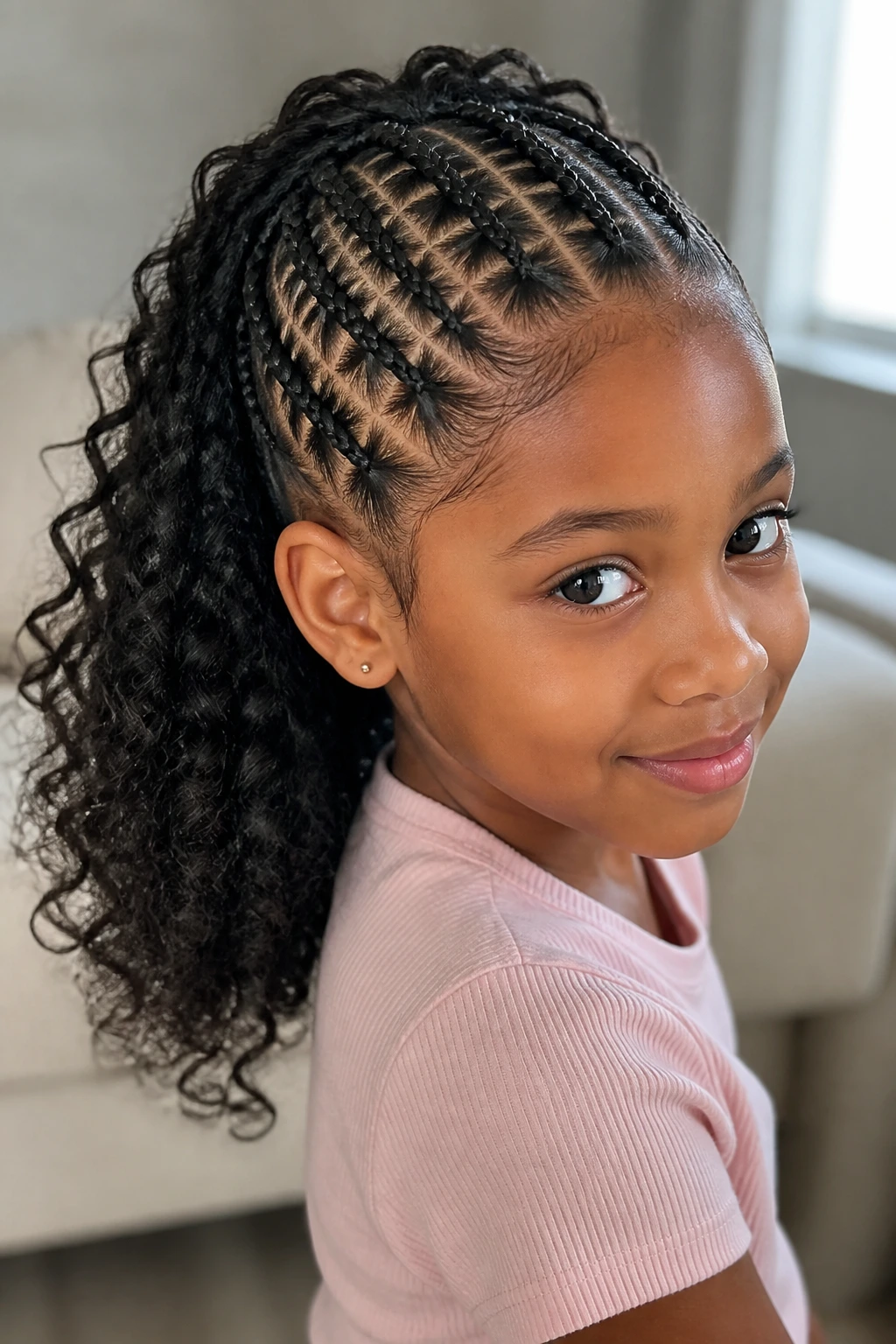
A ladder pattern steps the braids across the head in parallel rows, almost like rungs. It gives the front half a structured look without feeling rigid, and the loose curls behind it soften everything. On thick hair, the ladder lines show clearly, which is half the appeal.
This style is a nice middle ground between a basic set of rows and a full geometric design. It looks deliberate but not overworked. Keep the rows evenly spaced, because uneven ladders are easy to spot. When the spacing is clean, the style reads crisp from a distance and detailed up close.
32. Half Cornrows with a Top Knot and Trailing Braids
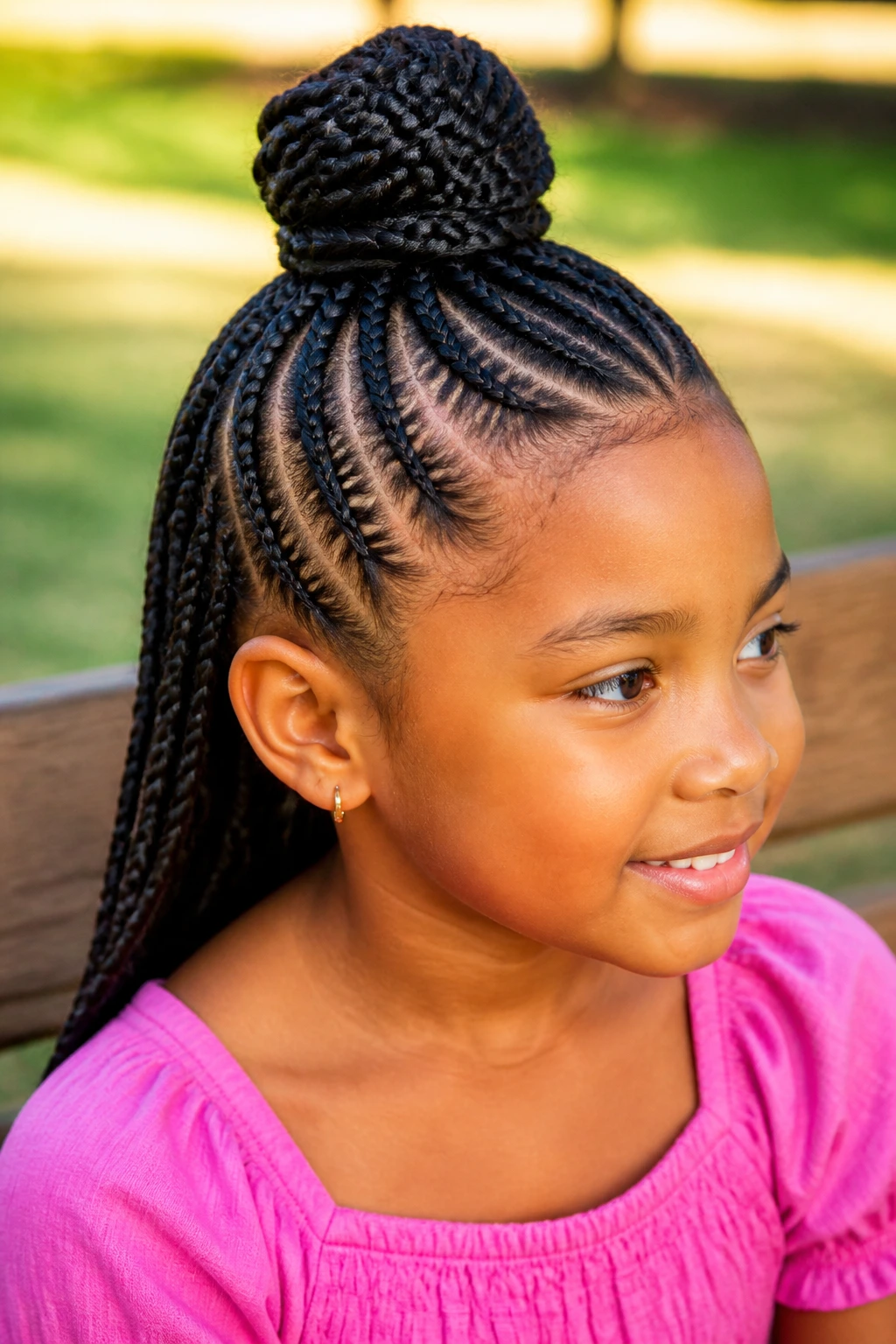
The top knot sits high and tidy, while a few trailing braids hang from the knot or the back section. That combination gives the style height without making the whole head look crowded. Thick hair gives the knot enough volume to look rounded and full.
This one feels especially good for a child who likes a bit of drama but still needs the hair off the neck. The trailing braids move nicely, and the top knot keeps the silhouette interesting. Don’t pull the knot too high if the child is tender-headed. You want lift, not complaints.
33. Protective Half Cornrows with a Low Ponytail
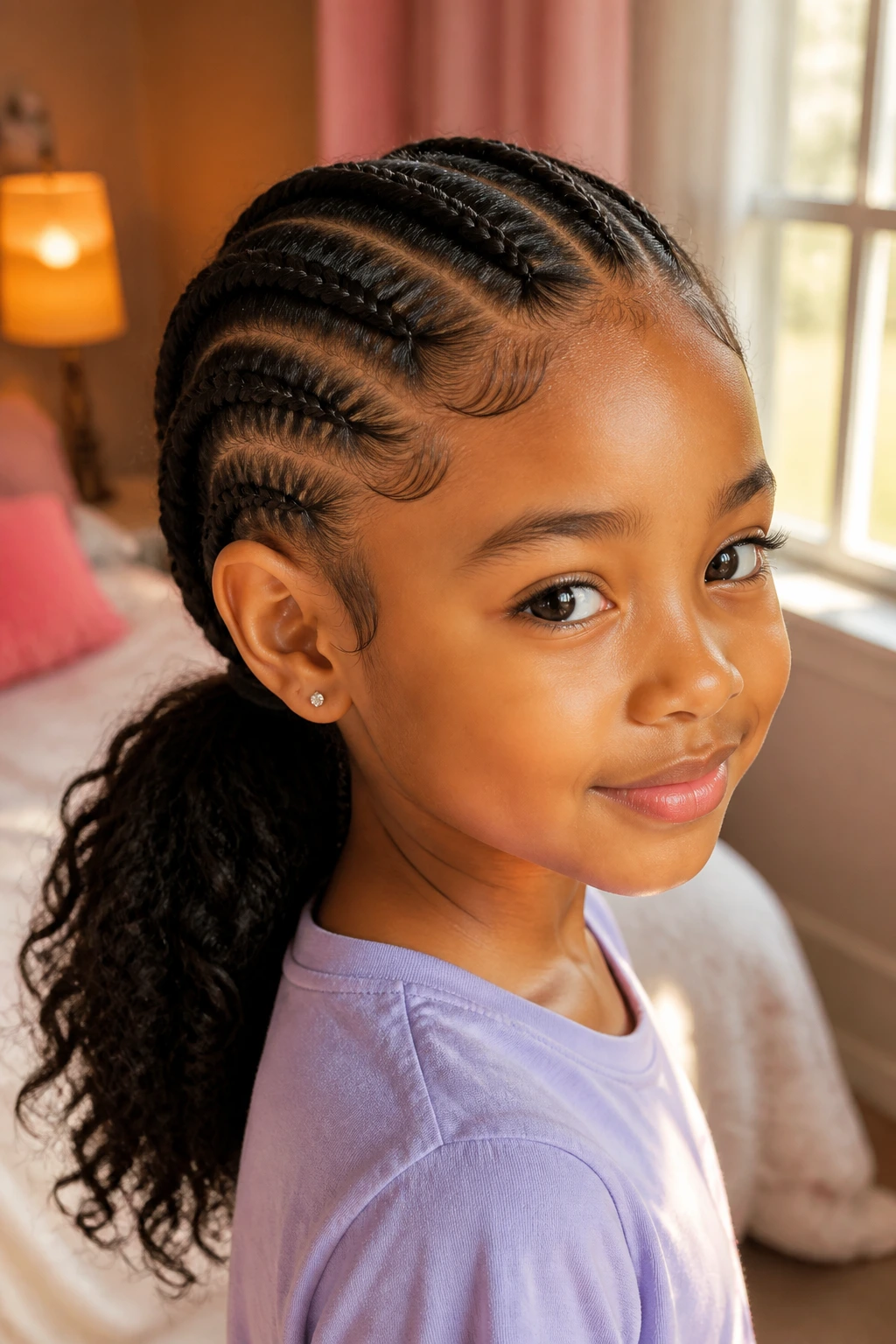
A low ponytail is the quiet workhorse of half cornrows. The front braids keep the hairline neat, then the back is gathered low at the nape so the style stays calm and practical. On thick hair, the ponytail still has enough bulk to look full and intentional.
This is one of the easiest styles to wear for several days without it turning frizzy too fast. The low placement keeps it comfortable against car seats and pillows, which sounds minor until you’re the one detangling a child at bedtime. A satin scrunchie helps here. Thin rubber bands do not.
34. Ribbon-Woven Half Cornrows
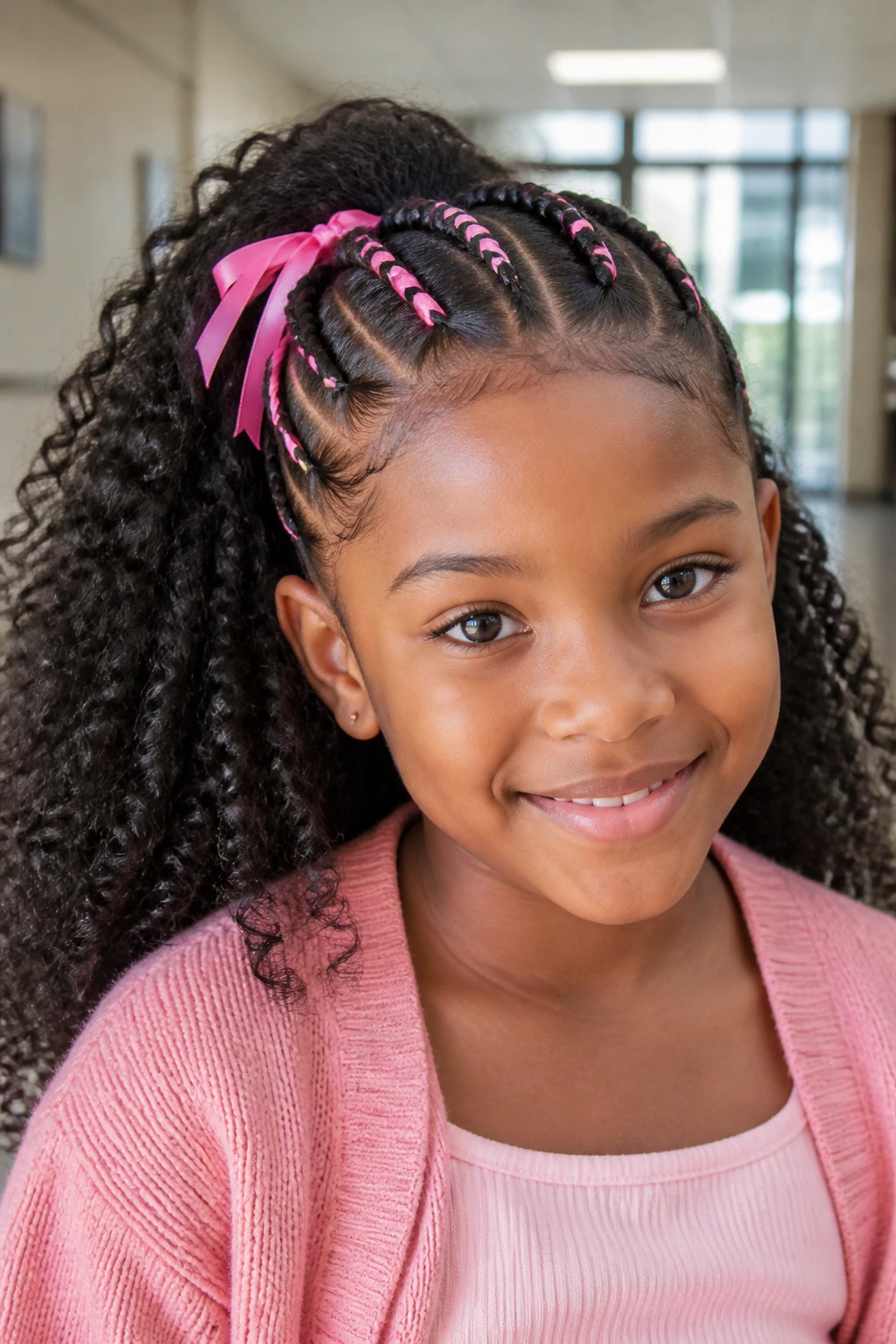
Ribbon woven through cornrows can soften the whole hairstyle in one move. The ribbon may be threaded into a few front rows or tied at the ends, and the effect is neat, colorful, and a little old-fashioned in the best way. Thick hair holds the ribbon in place because the braid has enough structure to support it.
I’d use this for school events, photos, or a celebration where you want a touch of sweetness without reaching for heavy accessories. Keep the ribbon width modest so it doesn’t overpower the braids. Satin ribbon tends to sit better than stiff craft ribbon, and it moves more naturally.
35. Mixed-Pattern Half Cornrows for Special Days
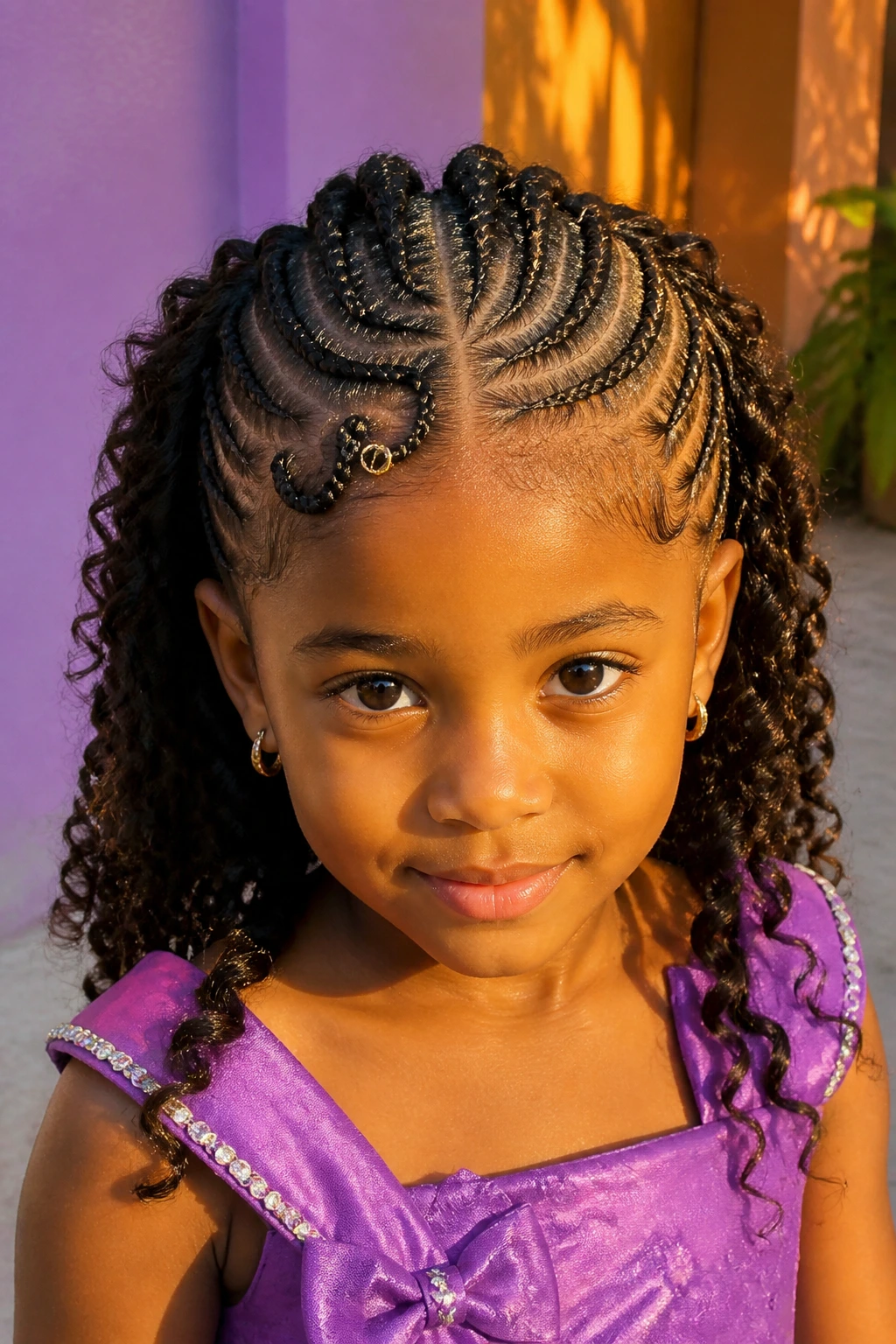
Mixed patterns combine two or three braid ideas in one head: maybe a straight row down the middle, curved rows on the sides, and a small heart or zigzag in front. It sounds busy, but on thick hair it can be balanced if each section stays readable.
This is the style for special days when plain simply isn’t the goal. The best versions use one dominant pattern and one accent pattern, not five competing ideas. That rule keeps the style from tipping into chaos. If you want the child to feel decorated without looking overdone, mixed patterns can do that beautifully.
Why Half Cornrows Feel Right on Thick Hair
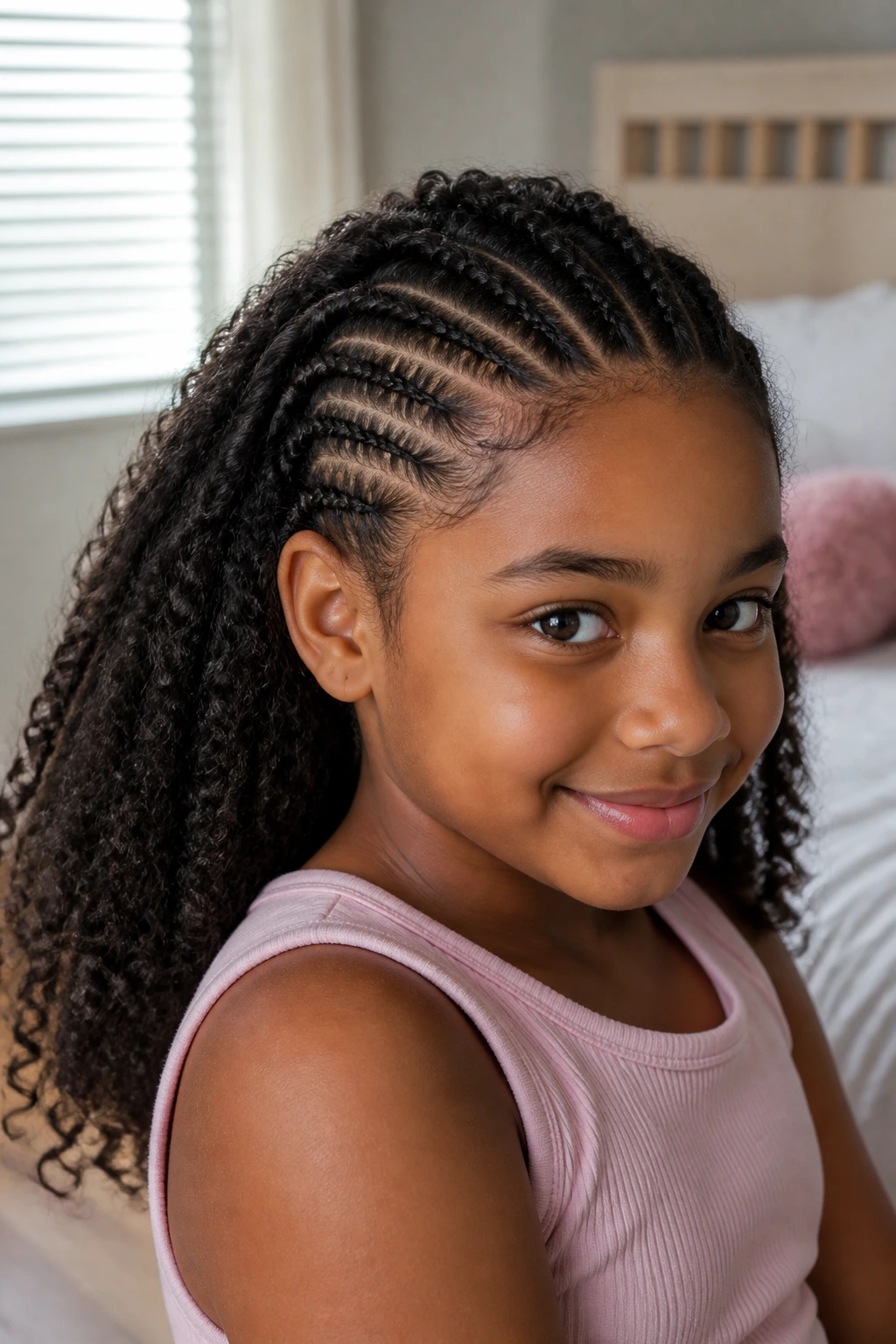
Half cornrows do a very specific job on thick hair: they tame the front, keep the shape neat, and still leave room for the hair’s natural body. That matters because thick hair often looks best when it is guided rather than squeezed. The style has to respect the fullness, not flatten it into submission.
The other reason these styles keep winning is flexibility. One braid pattern can look school-ready with bare ends, then turn photo-friendly with beads, curls, or a ribbon. That kind of range is useful when you’re styling a child, because the hair has to survive real life, not a perfect studio moment.
Essential Tools for These Styles
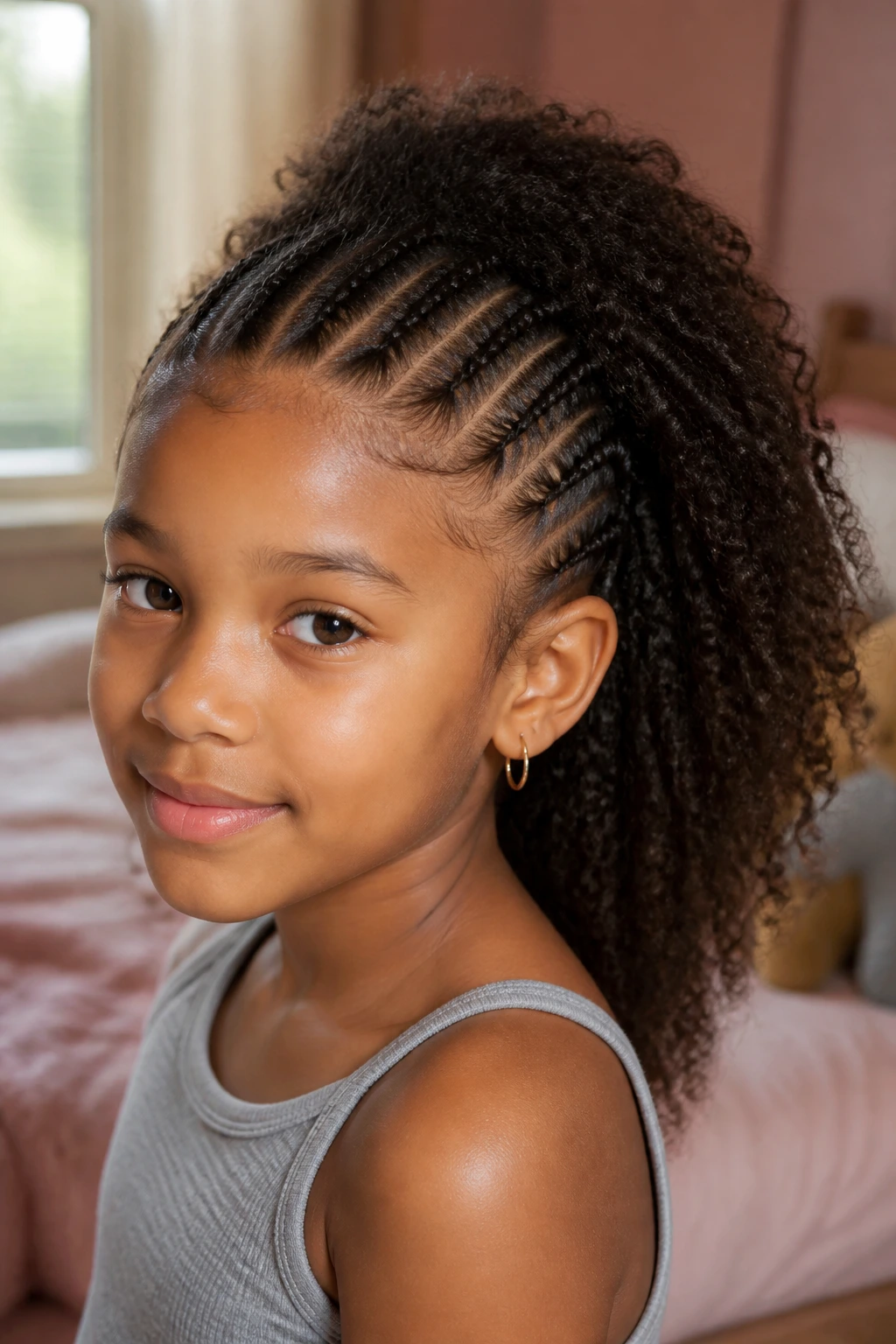
-
Rat-tail comb: The fine tail makes crisp parts, and crisp parts are half the battle with thick hair.
-
Wide-tooth comb or detangling brush: Use this first, before any parting starts. Fighting knots on a dry scalp is a bad time.
-
Leave-in conditioner or detangling spray: Helps the braids go in smoother and keeps the hair from feeling rough.
-
Braiding gel or light edge control: Use a small amount to smooth the parts and hairline; too much makes the scalp greasy.
-
Hair clips: These keep the loose sections out of the way while you work the front rows.
-
Small elastics: Useful for ponytails, bubble ends, or tucked finishes. Pick snag-free ones.
-
Mousse or setting foam: A light finish helps the braids lay down and keeps stray hairs under control.
-
Satin scarf or bonnet: Needed for bedtime, not optional if you want the style to last.
-
Beads, cuffs, or ribbons: Decorative, but keep them light enough for a child to sleep comfortably.
Smart Parting and Prep for Dense Hair
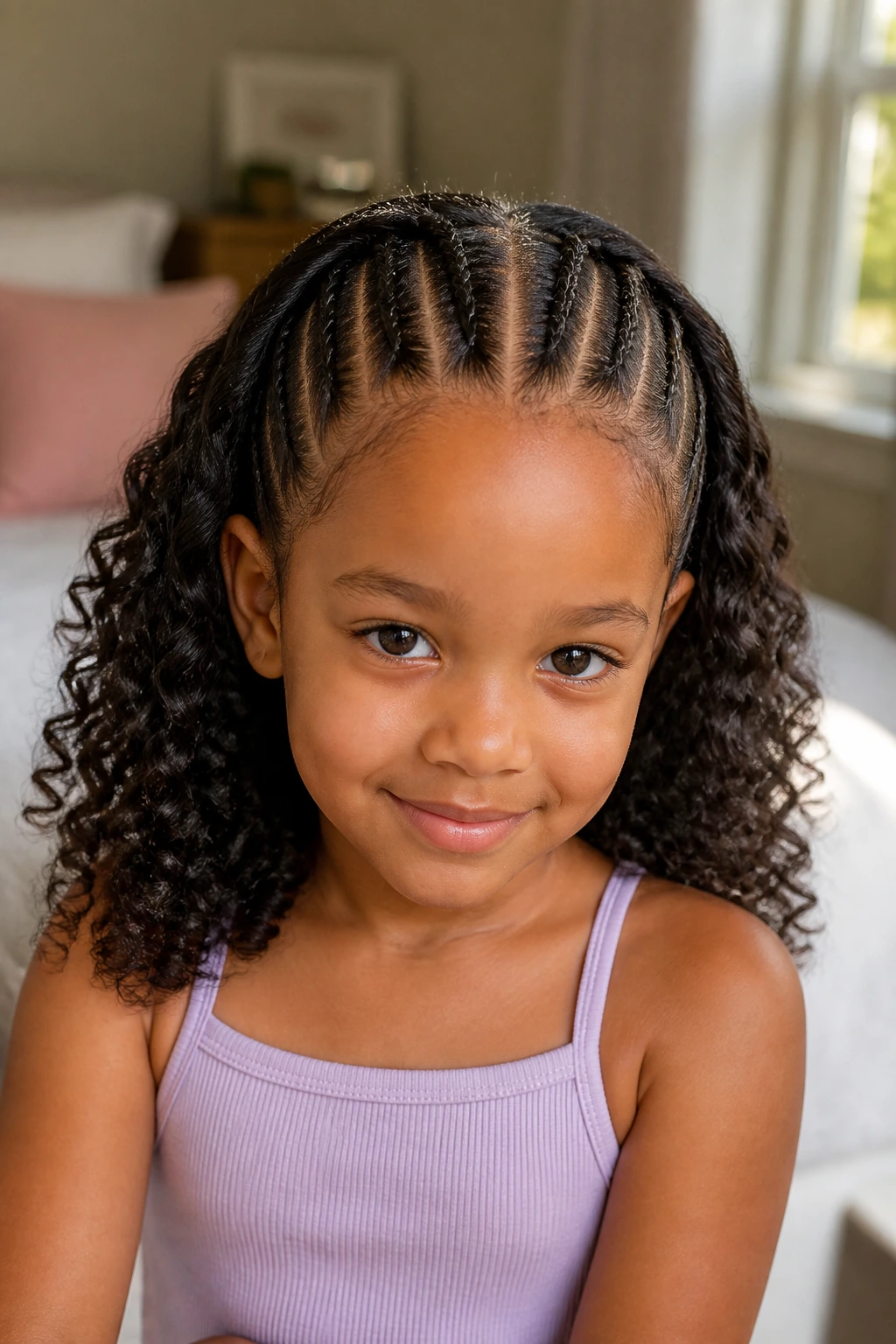
Thick hair rewards prep more than speed. If you start braiding before the hair is detangled and stretched, you spend the next hour fighting lumps at the root and frizz at the ends. Start with clean, moisturized hair, then detangle in sections from ends to root. Small sections. No yanking.
Parting matters almost as much as the braid itself. Use the tail of a rat-tail comb, make each line clean, and clip the unused hair away so the sections do not blend into each other. On dense hair, I like to part a little larger than I would on fine hair. Tiny sections can look neat for a moment and then swell into a thick little mess.
If the hair is extremely full, a light stretch beforehand helps. That can mean a blow-dry on low heat with a comb attachment, or a set of big twists or braids the night before. The goal is not bone-straight hair. The goal is hair that cooperates long enough for the braid pattern to show.
How to Wear These Styles for School, Play, and Picture Day
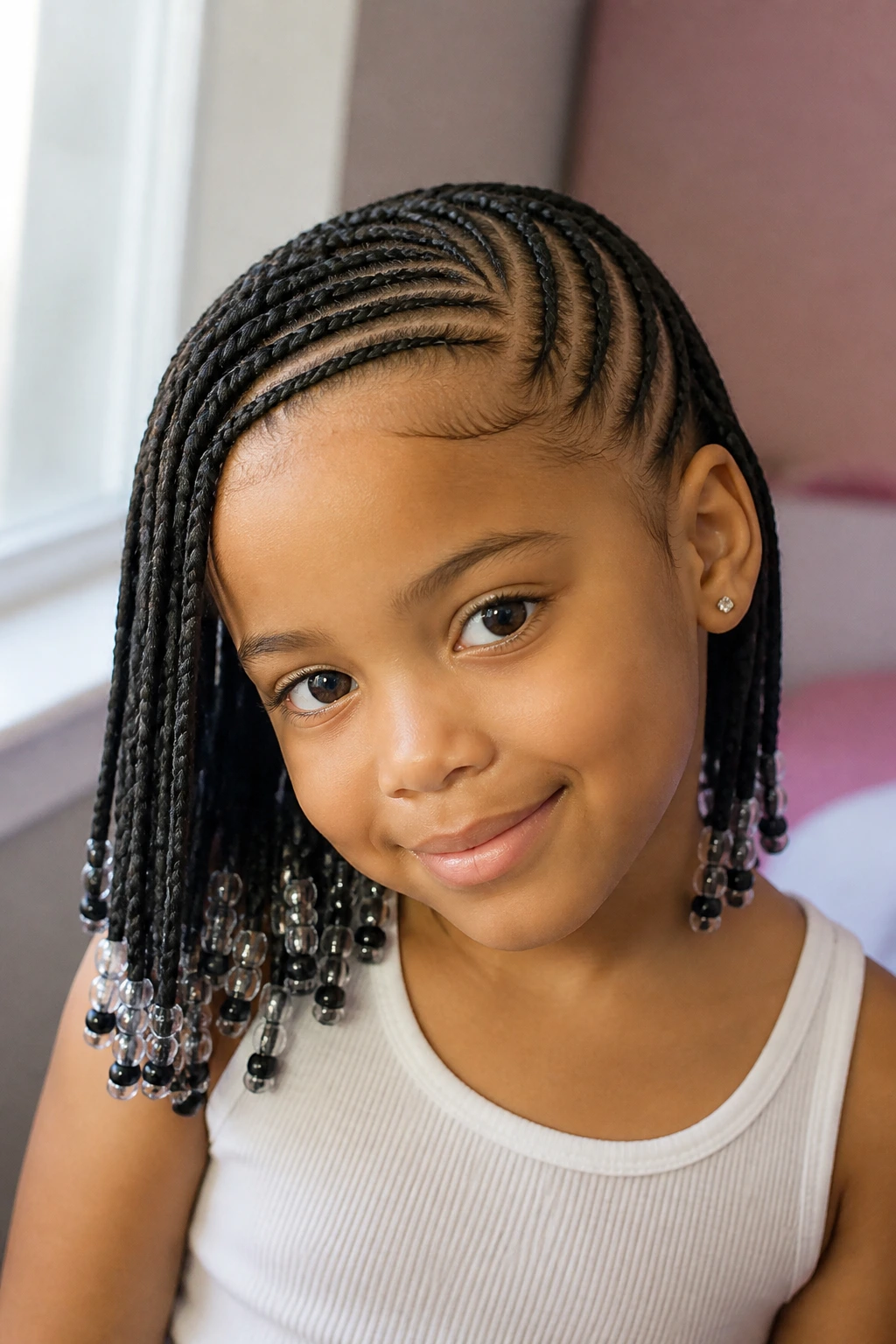
School Morning: Choose styles with fewer accessories and medium-sized parts. A center part, side sweep, or twin-puff finish stays neat through a long day and does not need constant fixing in the bathroom mirror.
Playground Proof: If the child runs hard, jumps a lot, or wears headphones, lean toward styles with tucked ends, braided ponytails, or box-braid finishes. Loose curls are pretty, but they tangle faster.
Picture Day: This is where heart parts, zigzags, ribbons, cuffs, and shiny mousse earn their keep. The hair should still look like a child’s hair, just more shaped and cared for.
Sensitive Scalps: Wider rows, fewer sections, and lighter tension matter more than decoration. A beautiful braid that hurts is a bad braid. I’d rather see a simpler style worn happily than a fancy one worn with tears.
Additional Tips and Styling Boosters
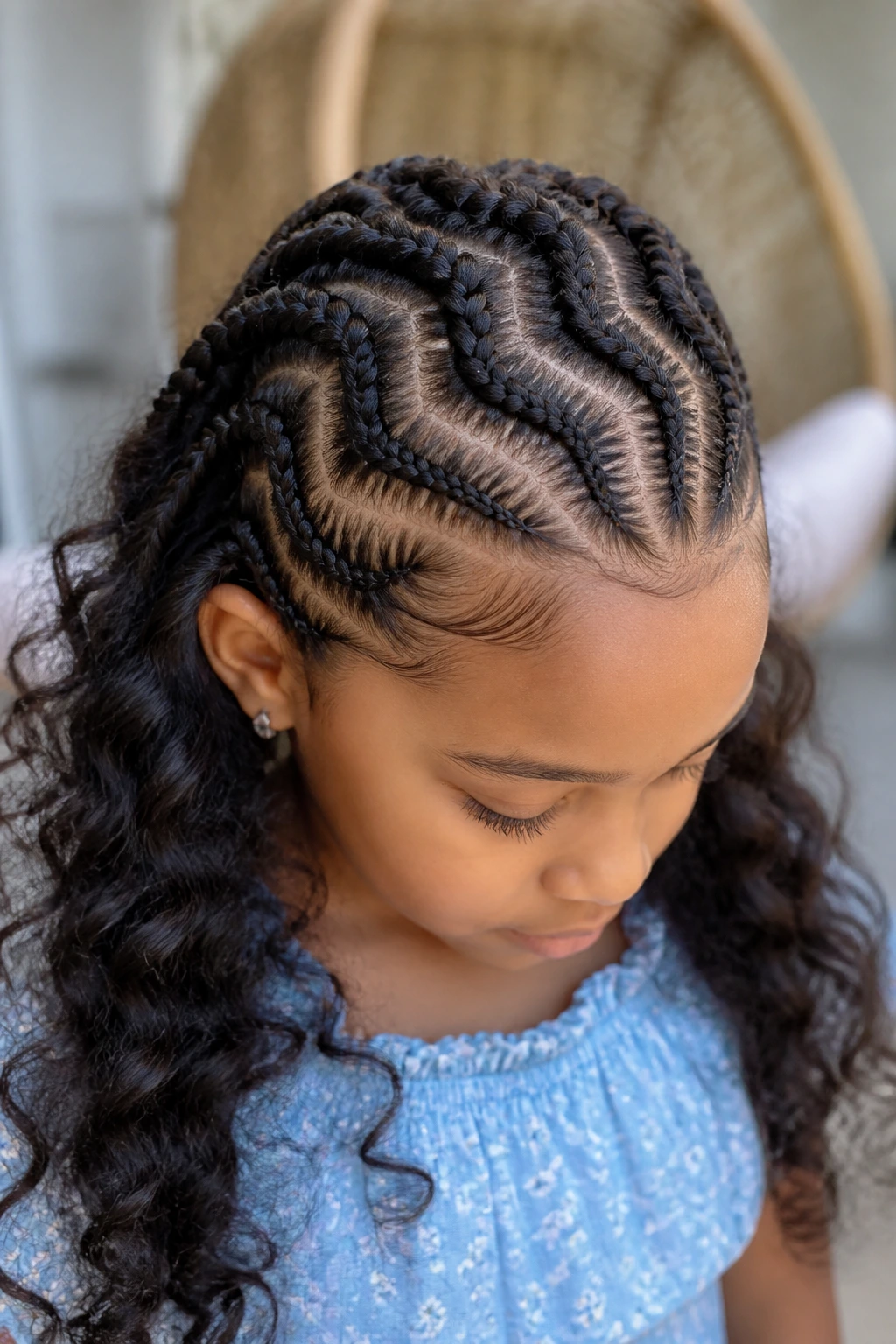
Flavor Enhancement: A tiny bit of mousse over the finished braids smooths stray hairs and gives the rows a cleaner outline. Don’t drench the scalp; a light hand does the job.
Customization: Swap loose ends for curls, puffs, ponytails, or box braids depending on how much maintenance you want. The front cornrows stay the same; the back section decides the mood.
Serving Suggestions: A bow at one temple, a row of cuffs on the outer braids, or a single ribbon woven through the center row can be enough. You do not need to decorate every braid.
Make-It-Yours: For a child who hates things touching the neck, choose buns or tucked ends. For one who loves movement, keep the back loose and let the ends bounce. For a child who wants something special but calm, use one accent part—heart, zigzag, or triangle—and stop there.
Make-Ahead, Nighttime Care, and Refreshing
These styles hold up best when you treat bedtime like part of the hairstyle, not an afterthought. Wrap the braids with a satin scarf or put on a bonnet every night. If the back is loose, gather it gently with a satin scrunchie or braid it into a soft plait so it doesn’t snag while sleeping.
Most half cornrow styles on thick hair last about one to two weeks before the parts start looking fuzzy, depending on the child’s activity level and scalp oil. If the hair gets sweaty, mist the braids lightly every few days with water and a small amount of leave-in, then smooth the rows with mousse. Do not soak the style. Wet braids that never dry fully smell awful fast.
If you need to prep ahead, detangle and stretch the hair the night before, then braid the next morning. That saves time and reduces tears. If the edges start lifting, fix just the front rather than redoing the whole head. One clean refresh can buy you several more days.
Common Mistakes to Avoid
The biggest mistake is braiding too tight because the hair is thick and “can take it.” Bad idea. Thick hair can hold a braid, yes, but the scalp still has limits. If the child winces, complains, or keeps touching the same spot, loosen it.
Another problem is oversized product use. Heavy gel, thick grease, and too much edge control make the parts greasy and the scalp itchy. Use enough to smooth the braid, not enough to coat the head.
Leaving the back section completely ignored is another one. If the front is neat and the back is frizzy, the style looks unfinished by the end of the day. Even loose hair needs some shape, whether that means curls, twists, or a simple braid-out.
And please do not skip nighttime wrapping. The style may look fine after one day, but cotton pillowcases rough it up fast. Satin is not fancy fluff here. It is maintenance.
Ways to Change the Look Without Starting Over
Lighter School Version: Use four or six clean rows and leave the back in a stretched braid-out. It keeps the hair neat without piling on accessories.
Birthday Version: Add heart parts, beads, or ribbons, but pick one main decoration and let that be the star. Too many extras can look noisy.
Low-Tension Version: Choose wider sections, fewer braids, and soft ends like curls or a low ponytail. This works best for tender-headed kids.
Longer-Wear Version: Feed the front rows into box braids or a braided ponytail. That finish stays tidy longer than loose curls.
Dressy Version: Try stitch parts, a side swoop, or a swirl pattern and finish with cuffs. Clean parts matter more than a pile of accessories.
Frequently Asked Questions
Are half cornrows a good choice for little girls with thick hair?
Yes, because the front stays neat while the back still has room for fullness. Thick hair gives the braids enough grip that they usually hold shape well, and that makes half cornrows a practical protective style.
How long do half cornrows usually last on thick hair?
Most styles hold for about one to two weeks if the scalp is cared for at night and the hair is not constantly soaked with water. Styles with tucked ends or braided ponytails usually last longer than loose curls.
Should the hair be stretched before braiding?
Stretched hair is easier to part and braid cleanly, especially when the hair is dense or highly coiled. A light blow-dry on low heat or an overnight twist-out can help, but you do not need to straighten the hair completely.
What if my child has a tender scalp?
Choose wider parts, fewer rows, and lower tension at the roots. Skip tiny sections and heavy accessories. Comfort has to come first, or the style will get pulled apart the second the child gets home.
Can I wash half cornrows without ruining them?
Yes, if you keep the wash gentle and focus on the scalp. Diluted shampoo, a careful rinse, and thorough drying are the key steps. Soaking the style or scrubbing the braids hard will puff them out fast.
Do beads or cuffs make the style last longer?
Not longer in a technical sense, but they can help the ends stay grouped together and look tidy. Keep the accessories lightweight, especially for sleeping, or they’ll become a nuisance.
What is the best style if we need something quick?
A center-part or side-swept set with loose curls, a low ponytail, or two puffs is usually faster than heart parts, stitch braids, or swirls. Simpler parting means less time in the chair and less chance of uneven sections.
How do I keep the parts neat on thick hair?
Work in small, clipped sections and use the tail of a rat-tail comb. Smooth the scalp lightly before you braid, but don’t flood it with product. Clean parting lines stay visible longer than heavy product ever will.
Braids That Stay Neat Without Feeling Fussy
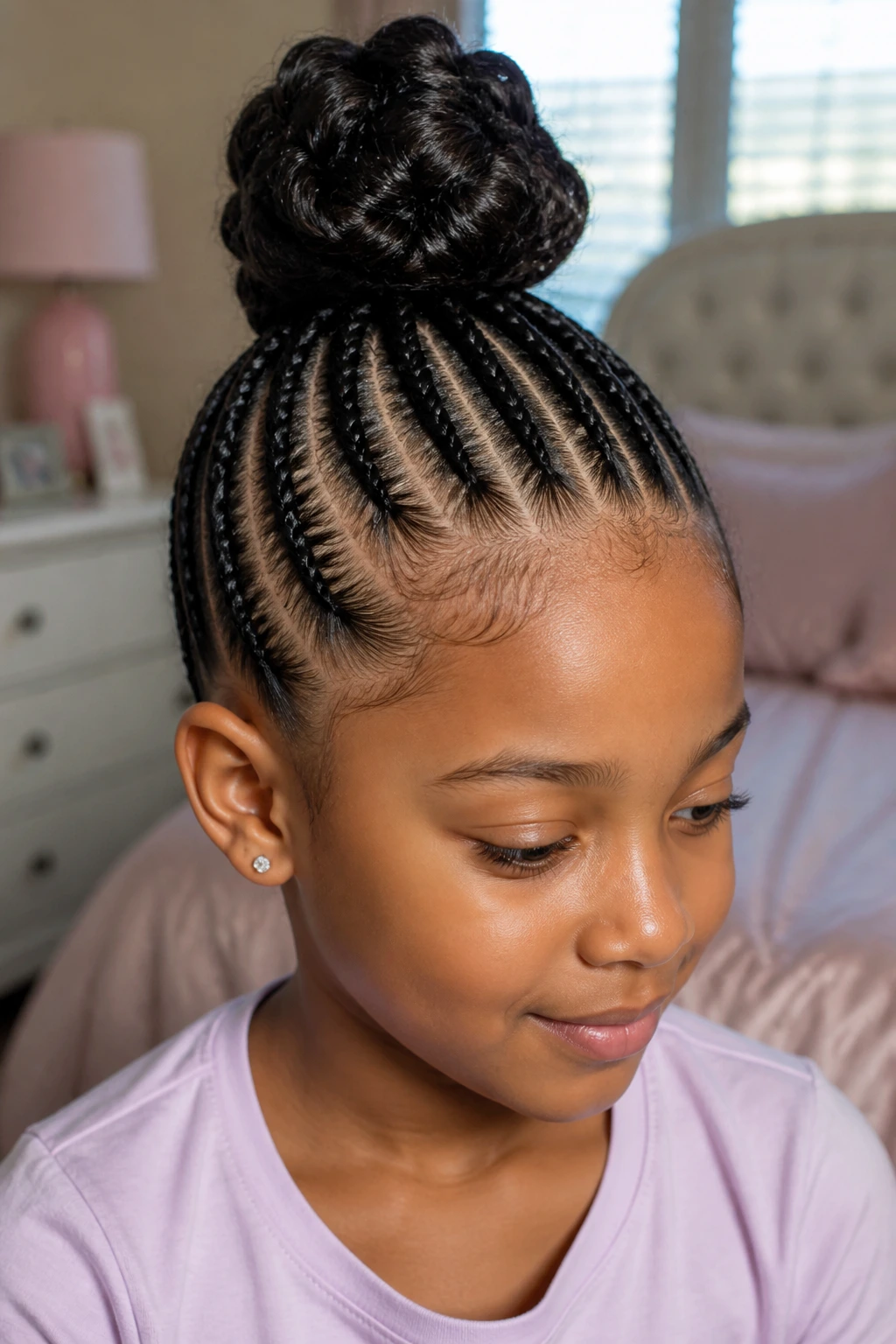
Half cornrows work because they respect the way thick hair actually behaves. They keep the front controlled, let the back keep its body, and make room for curls, puffs, buns, beads, or ribbons without turning the whole head into a stiff block.
That mix of structure and freedom is why these styles keep coming back. They do not ask a child to sit still all day in a tight helmet of hair, and they do not leave the hair looking unfinished either. A good half cornrow style lands right in the middle, where real life lives.
Choose the version that fits the child’s mood, scalp, and schedule, then keep the parts clean and the tension kind. The rest falls into place.