



A round face doesn’t need to be hidden. It needs lines. Vertical lines, diagonal lines, a little lift at the crown, and ends that refuse to sit in one heavy circle around the jaw. That’s why shaggy rocker hairstyles for round faces work so well when a blunt lob or a wide, chin-length bob starts feeling too boxy. They break the outline up. They make the hair move before the eye settles on width.
And they’re not one-note cuts, either. A good rocker shag can be soft and airy, rough and grungey, curly and wild, or razor-sharp with a side part that falls across one cheekbone like a curtain pulled halfway closed. The trick is in where the layers start, where they stop, and how much bulk stays around the sides of the face. Get those three things right and the haircut does the flattering work for you.
Some of the styles below are loud. Some are barely dressed-down classics with a little extra grit. A few are short enough to show off earrings and necklines; others keep the length but remove the dead weight that makes round faces look wider than they are. The point isn’t to make your face look like someone else’s. It’s to stop the hair from fighting the shape you already have.
Why These Cuts Work on Round Faces

- Crown Lift: Height at the roots pulls the eye upward, which matters more than most people think when the cheeks are the widest point.
- Broken Outline: Choppy ends and shattered layers interrupt the circle effect that blunt cuts can create at jaw level.
- Diagonal Framing: Side parts, curtain bangs, and cheekbone-skimming pieces make the face read longer without looking severe.
- Texture Over Bulk: Rocker texture gives movement, but the good versions keep the hair airy instead of puffy.
- Easy Grow-Out: These cuts usually soften well as they grow, which is handy if you hate sitting in a salon every few weeks.
1. Collarbone Shag With Curtain Bangs
A collarbone shag is one of those cuts that looks casual until you study it. Then you notice the sneaky part: the length sits just low enough to pull the face downward, while the curtain bangs split the forehead and keep the width from landing all in one place. It’s a strong choice if your round face tends to look widest right at the cheeks.
Why It Flatters So Well
The layers should start around the cheekbone or just below it, not right at the chin. That keeps the front from flipping outward in a way that adds width where you least want it. Ask for soft internal layers, not heavy stacking.
A blow-dry with a round brush gives the bangs their bend, but don’t polish the rest too much. The shag is the point. A little roughness makes the cut feel modern instead of like a tidy salon helmet.
Quick shape notes
- Best with medium-density hair
- Works with straight or wavy texture
- Keeps the neckline open
- Needs a light texturizing spray, not a sticky mousse
2. Wolf Cut With Cheekbone Fringe
This is the cut people ask for when they want edge. The wolf cut leans into separation, and on a round face that separation is useful because it stops the silhouette from reading as one solid shape. The cheekbone fringe is the detail that keeps it from sliding too far into mullet territory.
The best version has volume at the crown, length through the sides, and pieces that land right across the upper cheek. That diagonal line is doing a lot of work. Too many layers at the exact jawline, though, and the face can look wider instead of leaner.
Wear it a little messy. Honestly, this cut looks better after a bit of movement than it does when freshly blasted into place. If your hair is thick, ask for internal debulking so it doesn’t balloon out around the sides.
3. Long Razor Shag With an Off-Center Part
Why does this one work so well? Because length below the shoulders gives the eye a place to travel, and the off-center part keeps the top from feeling symmetrical in a way that mirrors a round face. Symmetry is not always your friend here. A slight shift is.
The razor finish matters. It softens the ends and makes the cut look lived-in rather than heavy. You want the front pieces to graze the collarbone and the back to feel a little lighter, almost feathery. On straight hair, it can slip into flatness if you skip root lift, so a touch of mousse at the crown helps.
Best if you have:
- Straight to loose-wavy hair
- A fuller face you want to elongate
- Hair that gets bulky at the ends
- Patience for a quick round-brush finish
4. Shoulder-Length Shag With Side-Swept Bangs
Picture this on a round face: one side opens up cleanly, the bangs sweep diagonally across the forehead, and the shoulder length keeps the cut from sitting at the exact widest part of the face. That’s the whole trick. Simple. Effective.
This version is less rebellious than a wolf cut, but it still has enough texture to feel rocker rather than polished. The bangs should not be thick or blunt. They need a little see-through quality at the ends so they don’t create a horizontal line across the face. If your hair grows in a cowlick-heavy pattern, tell your stylist that upfront. Otherwise the fringe can fight you every morning.
A light wax or cream at the ends is enough. Don’t load it up. The shape wants movement, not wet-looking strands.
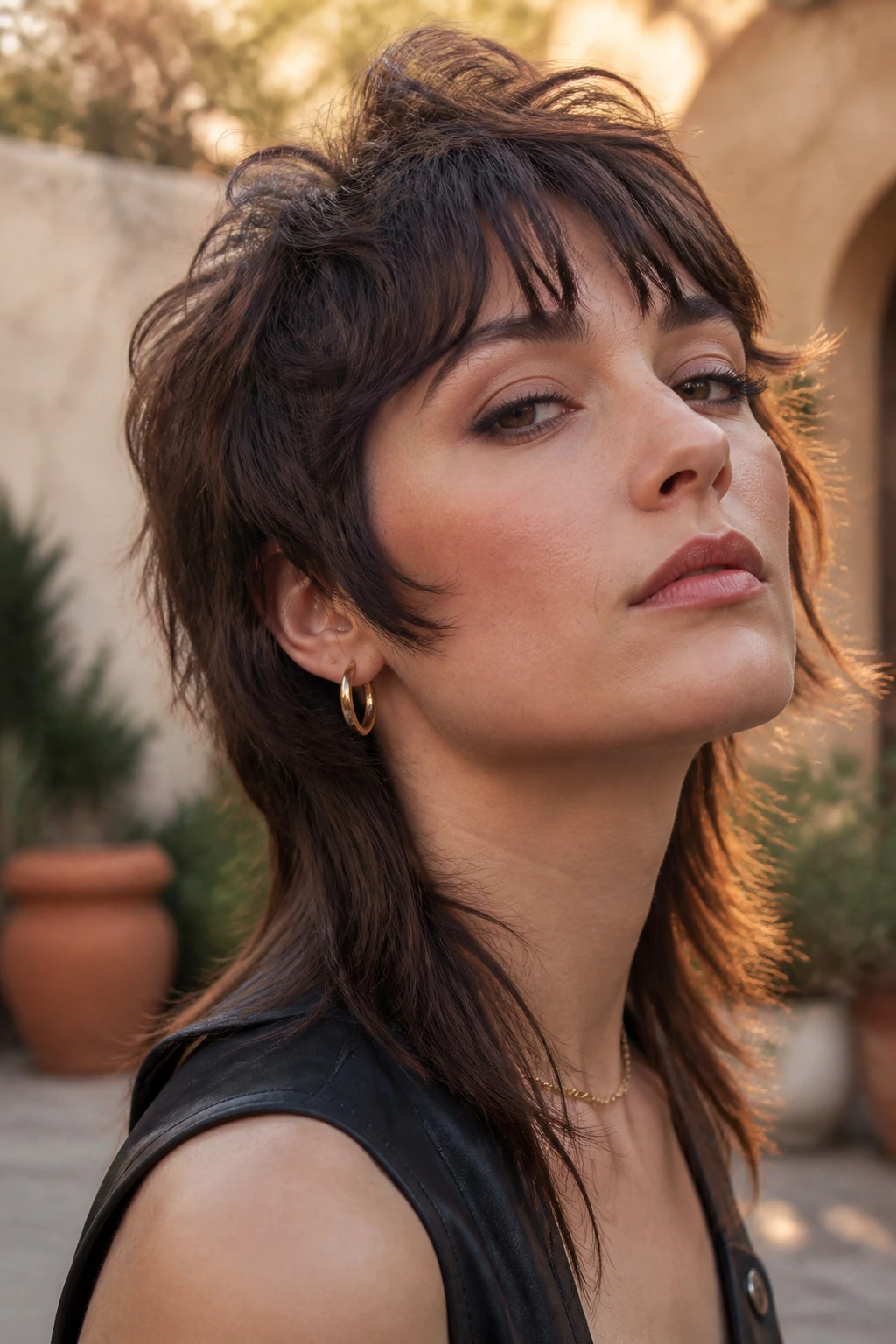
5. Soft Mullet With Feathered Crown
A soft mullet sounds more extreme than it often looks. On the right round face, it can be one of the smartest choices because it pushes volume upward and leaves the nape a little longer, which stretches the whole head shape visually. The feathered crown is what keeps it from turning severe.
The sides should be broken up, not cut into one heavy shelf. If the hair stacks too much at the temples, the whole cut gets boxy fast. I like this one best on thick, slightly wavy hair, where the texture gives the haircut enough air to feel intentional. Straight hair can wear it too, but it usually needs a bit of bend through the top sections.
It’s not a shy haircut. That’s the appeal. It looks better with a jacket, dark eyeliner, or just a no-nonsense attitude.
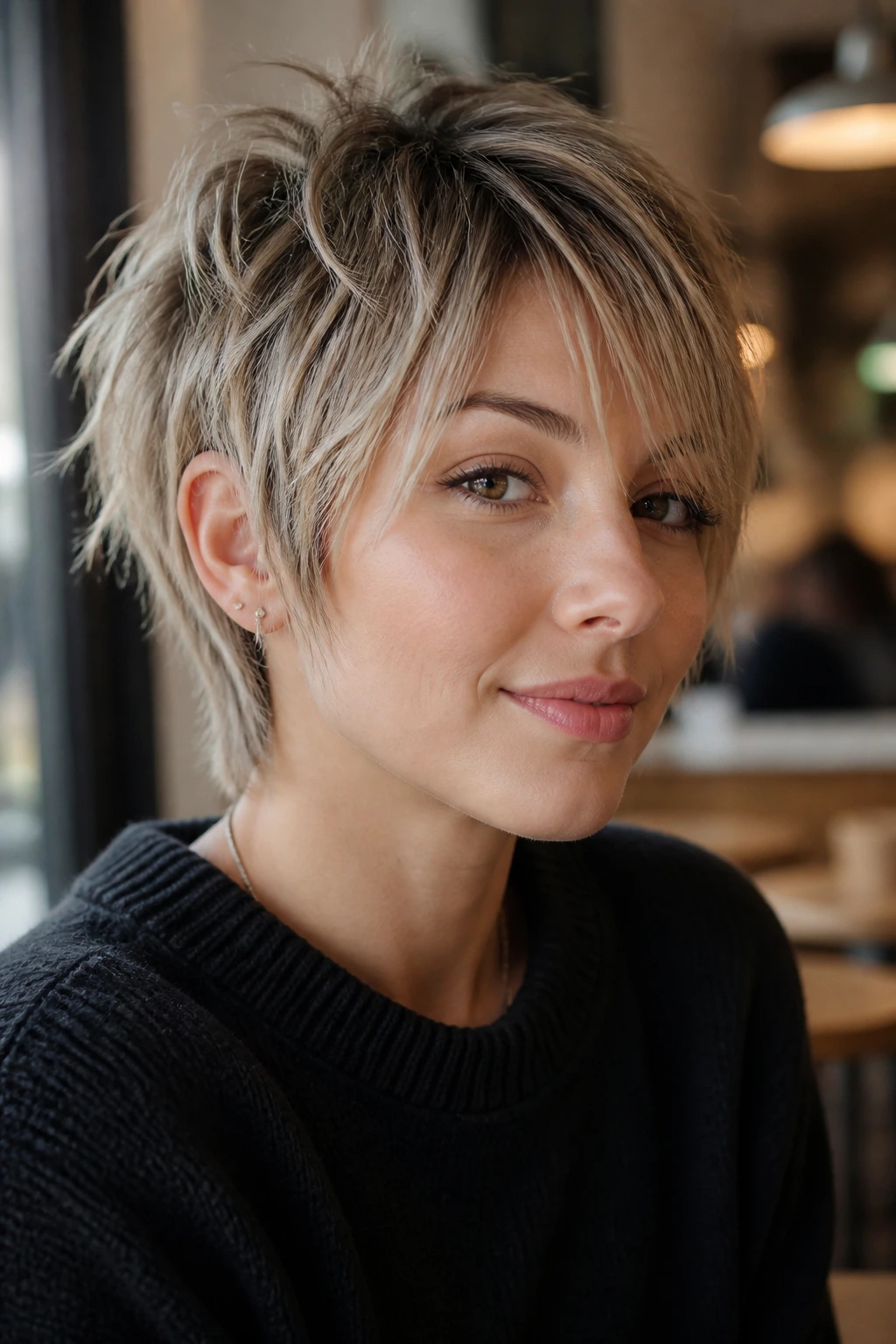
6. Piecey Pixie Shag
Short hair and round faces can get tricky, but a piecey pixie shag gets around the problem by building height, not width. The top stays longer, the sides stay tight enough to avoid puffiness, and the fringe breaks up the forehead instead of sealing it off in one solid block.
What to ask for
- Long top layers that can be pushed up or forward
- Tapered sides, but not shaved-down to the scalp
- Razored texture through the crown
- A fringe that can split or sweep
This cut is a good fit if you like a little attitude and don’t mind styling your hair with your fingers. A matte paste works better than shiny pomade here. Shine tends to emphasize the roundness of the shape instead of the texture.
7. Choppy Lob With Airy Layers
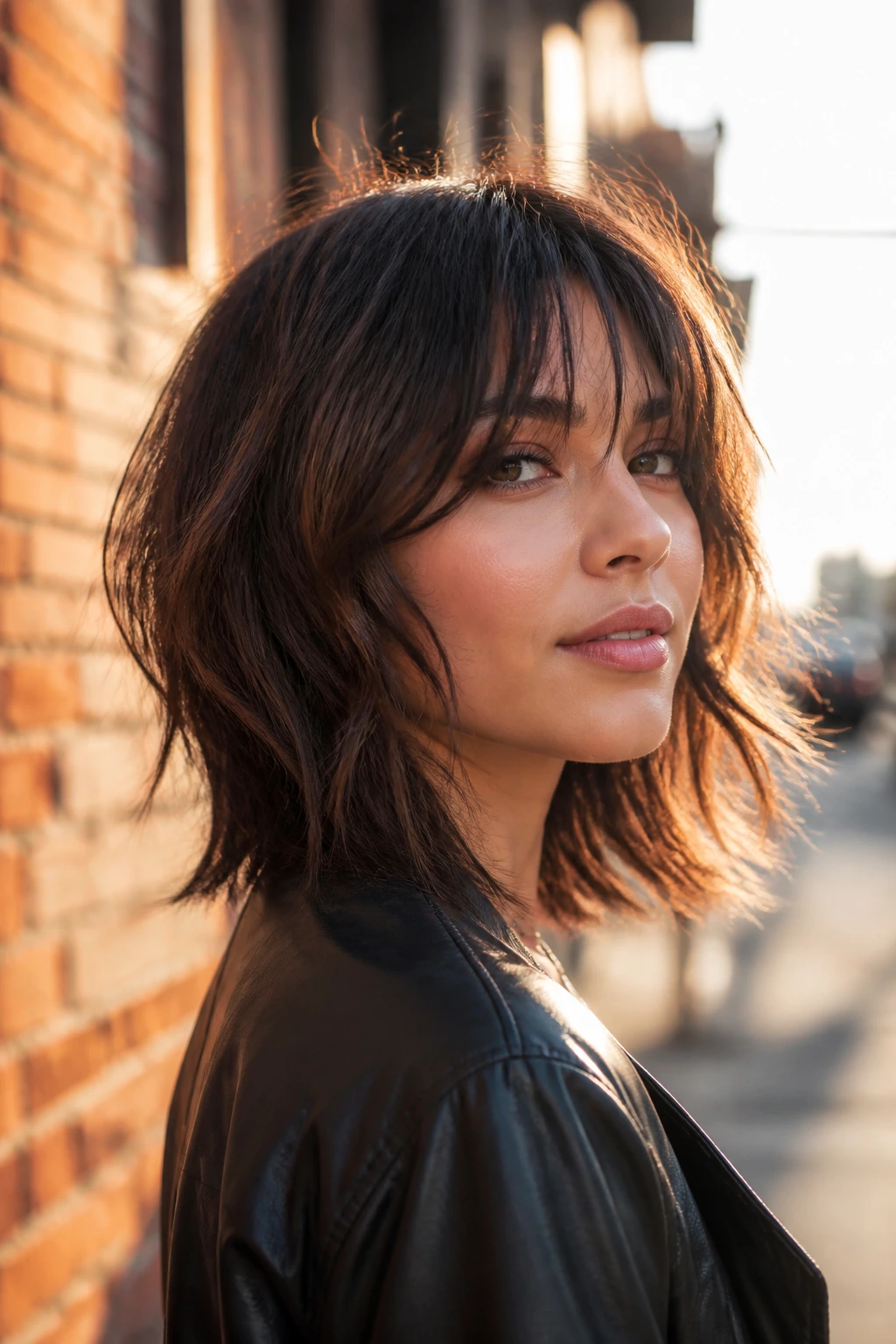
The lob is the safe word in hair salons, but a choppy lob is a different animal. It keeps enough length to avoid widening the face at the jaw, then breaks the perimeter with light, uneven ends. On round faces, that broken line matters. A lot.
Airy layers through the mid-lengths stop the style from hanging like one heavy curtain. If the hair is fine, keep the layers subtle so you don’t lose density. If it’s thick, ask for more internal shaping so the bluntness doesn’t make the sides swell. The best finish is a little bend with the ends turned in different directions, not a perfect flip.
This one works when you want rocker texture without a dramatic cut. It’s probably the easiest style in the whole set to grow out.
8. Curly Shag With Spiral Fringe

Curly hair and round faces are not a problem. Bad layering is the problem. A curly shag with spiral fringe can be one of the most flattering shapes in this entire list because the curl pattern adds vertical movement while the fringe creates a soft frame that doesn’t cling too tightly to the cheeks.
The key is where the shortest pieces land. If the face-framing curls start around the cheekbone and drop below the chin in the front, the face reads longer. If the top is cut too short, the curl spring can create a mushroom effect. Nobody needs that. Diffuse upside down for root lift, then scrunch in a little cream only on the mid-lengths and ends.
Let the fringe live. Curly bangs look best when they’re not forced into a neat line. A little irregularity keeps them from making the face look boxed in.
9. Deep Side-Part Rocker Shag
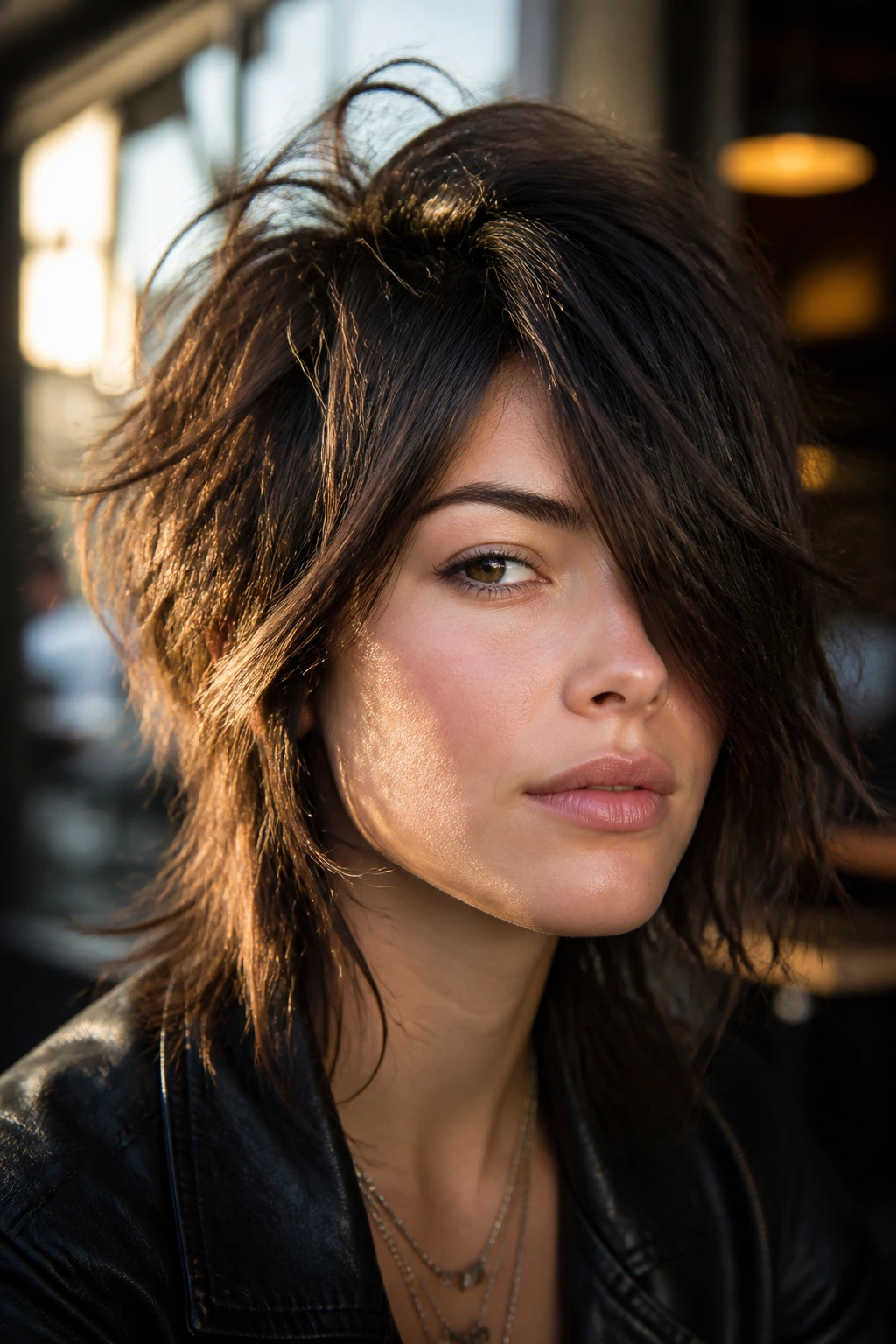
A deep side part is one of the simplest tricks in hairstyling, and it still works because it changes the geometry of the face. On a round face, that diagonal sweep cuts across the widest area and gives the whole haircut a longer read. Add shaggy layers and the effect gets stronger.
This cut is especially good if you have fine hair that needs instant lift at the root. The part gives the top a natural push, and the layers stop the ends from looking thin. If you blow-dry, direct the hair away from the part first, then back. That bit of resistance gives better volume than blasting it flat from the start.
A deep side part also wears well with blunt jewelry and strong makeup. It adds shape without asking the rest of your look to do much work.
10. Tapered Nape Shag
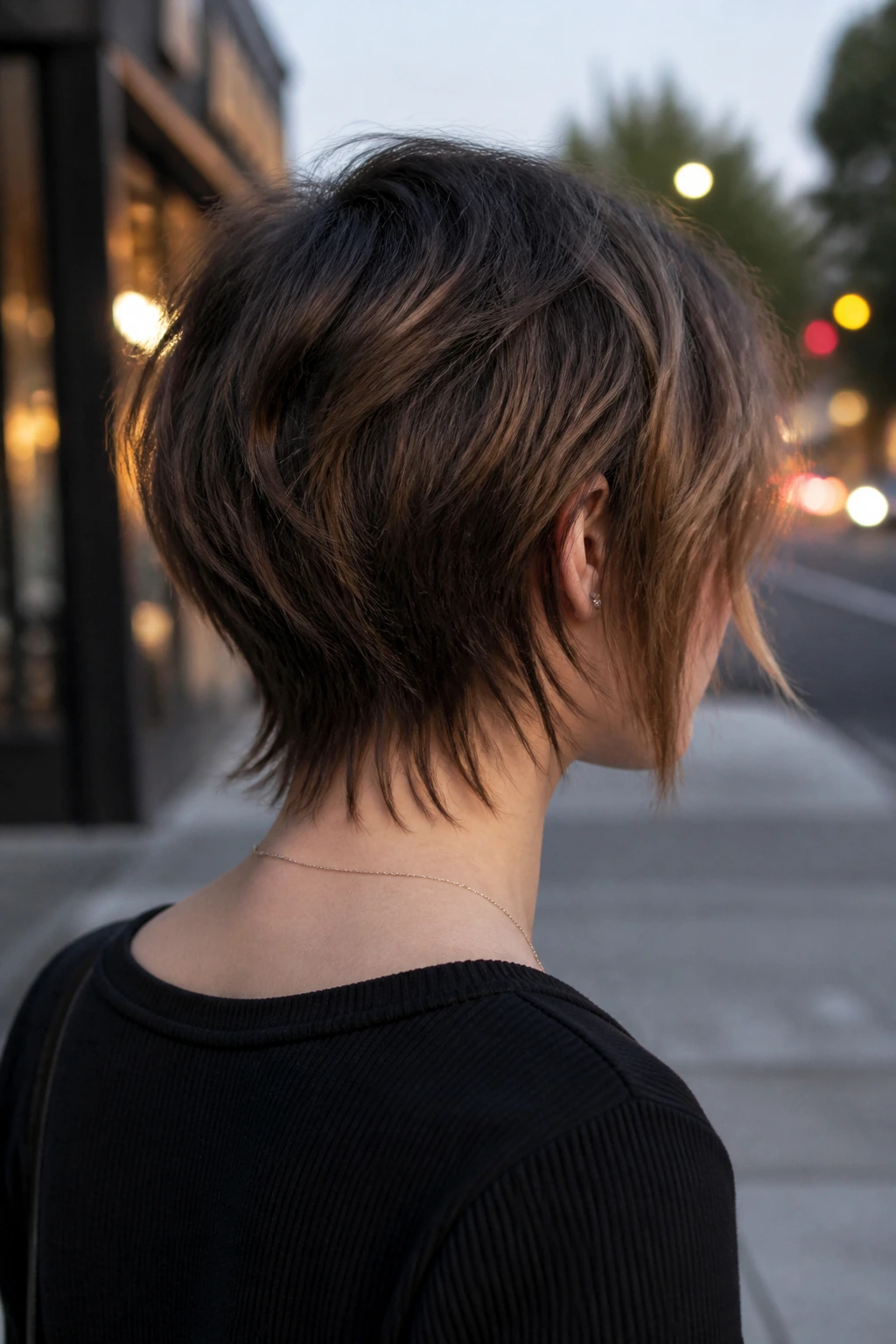
A tapered nape shag is a quiet little menace. The back sits shorter and lighter, which removes bulk where round faces don’t need it, while the front keeps enough length to pull the eye downward. The whole cut feels leaner and more directional.
This is a good pick if your hair grows thick at the neck or you hate that “triangle puff” some layered cuts create in the back. Ask your stylist to keep the sides soft and the crown lifted, but not overloaded. Too much crown height can start looking like a mushroom cap, which defeats the point.
It’s also a nice choice if you wear collars, jackets, or scarves a lot. The nape stays neat under fabric, and the front still has enough movement to feel undone.
11. French-Girl Shag With Bottleneck Bangs

Bottleneck bangs sit somewhere between curtain bangs and a wispy fringe, and they’re excellent on round faces because they open at the center and narrow toward the temples. That shape creates a vertical path through the face, which is exactly the sort of visual trick shaggy rocker styles rely on.
This version feels softer than a wolf cut and less fussy than a full fringe. The layers around the face should be soft enough to fall over the cheekbones, not hang like two straight strips. I like it best on hair that has a little natural bend, because the bang shape holds without too much styling.
If you wear glasses, this can be a very good option. The bangs can split around the frames instead of crashing into them.
12. Razor-Cut Lob With Shattered Ends
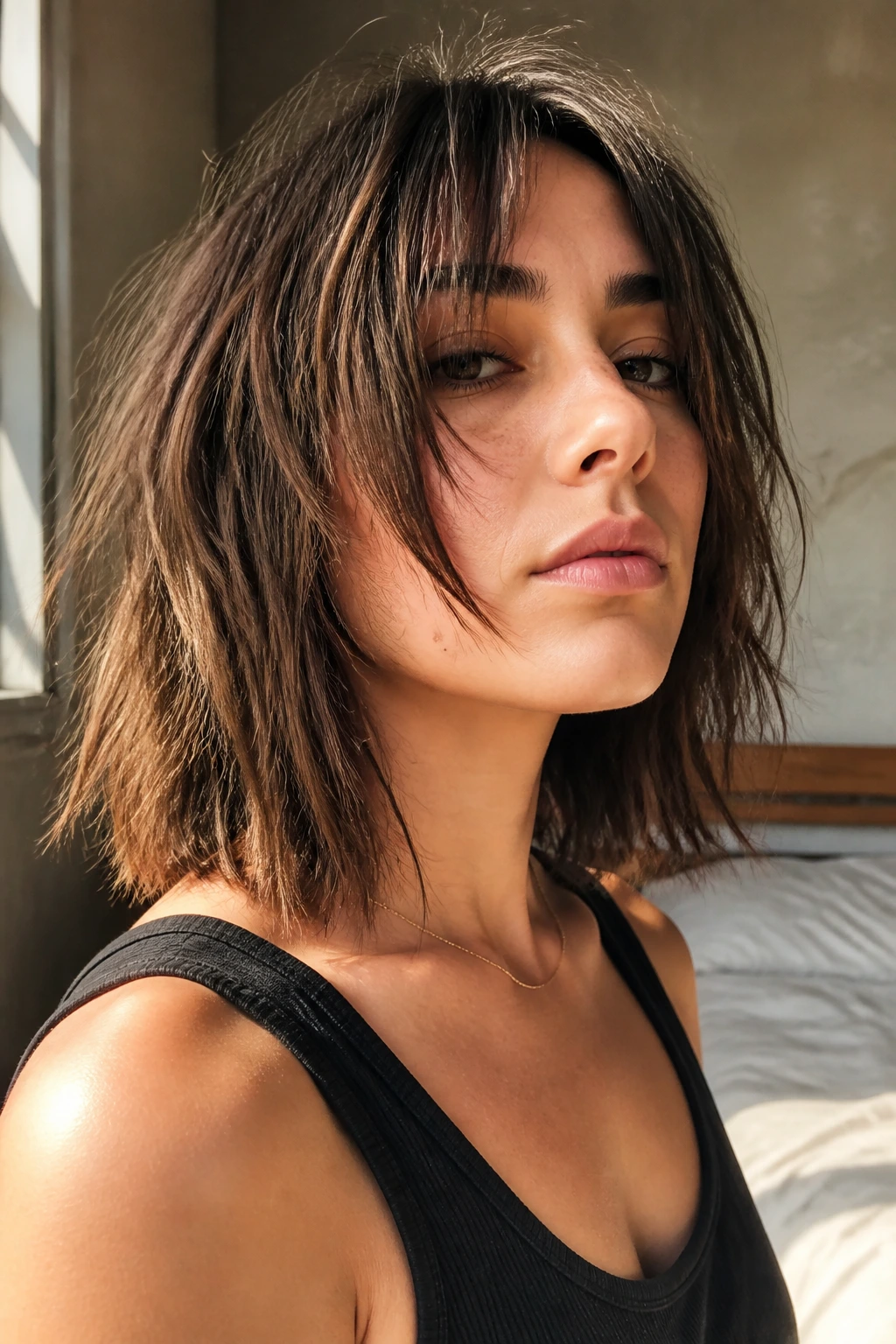
A razor-cut lob looks clean from a distance and slightly ragged up close, which is exactly why it suits this style family. The shattered ends keep the outline from sitting too neatly around a round face. Nothing about it is too exact. That’s the appeal.
The cut works best when the layers are more visible at the front than the back. You want the front pieces to skim the jaw and collarbone without stopping right at the widest point of the cheeks. A flat iron bend at the ends helps if your hair is stubbornly straight, but don’t iron every strand into submission. That kills the rocker feel.
For fine hair, keep the razoring light. Too much removal can leave the ends wispy in a bad way. For thicker hair, a little more shredding gives better movement and stops the shape from looking blocky.
13. Mid-Length Grunge Shag

Why does this one look so right on a round face? Because it refuses to sit still. The mid-length grunge shag uses uneven layers, a rough texture, and a slightly off-center shape to avoid any obvious horizontal line. Round faces need that break in the pattern.
The best version lands somewhere between the shoulders and upper chest. Long enough to stretch the face, short enough to keep the movement visible. Add a curtain-like fringe or a side-swept piece and the cut gets even better. If the hair is thick, ask for debulking underneath so the surface doesn’t swell.
This one loves dry shampoo. It can even look better on day two, when the roots have a little grit and the layers separate more cleanly.
14. Feathered Rocker Cut With Crown Lift

This is the closest thing to a glam-70s revival in the list, and it works because feathering creates upward motion. On a round face, that upward motion matters. It pulls attention away from the widest part of the cheeks and sends it toward the top and the length of the hair instead.
Keep the crown airy. That’s the mistake people make with feathered cuts: they either flatten them or overbuild them. You want a controlled lift, not a teased tower. The sides should taper in a way that hugs the head rather than flaring out.
Use it if you want:
- A softer rocker look
- A cut that can be blown smooth or worn messy
- Some height without obvious backcombing
- A shape that grows out without looking lopsided
15. Messy Crop With Long Fringe
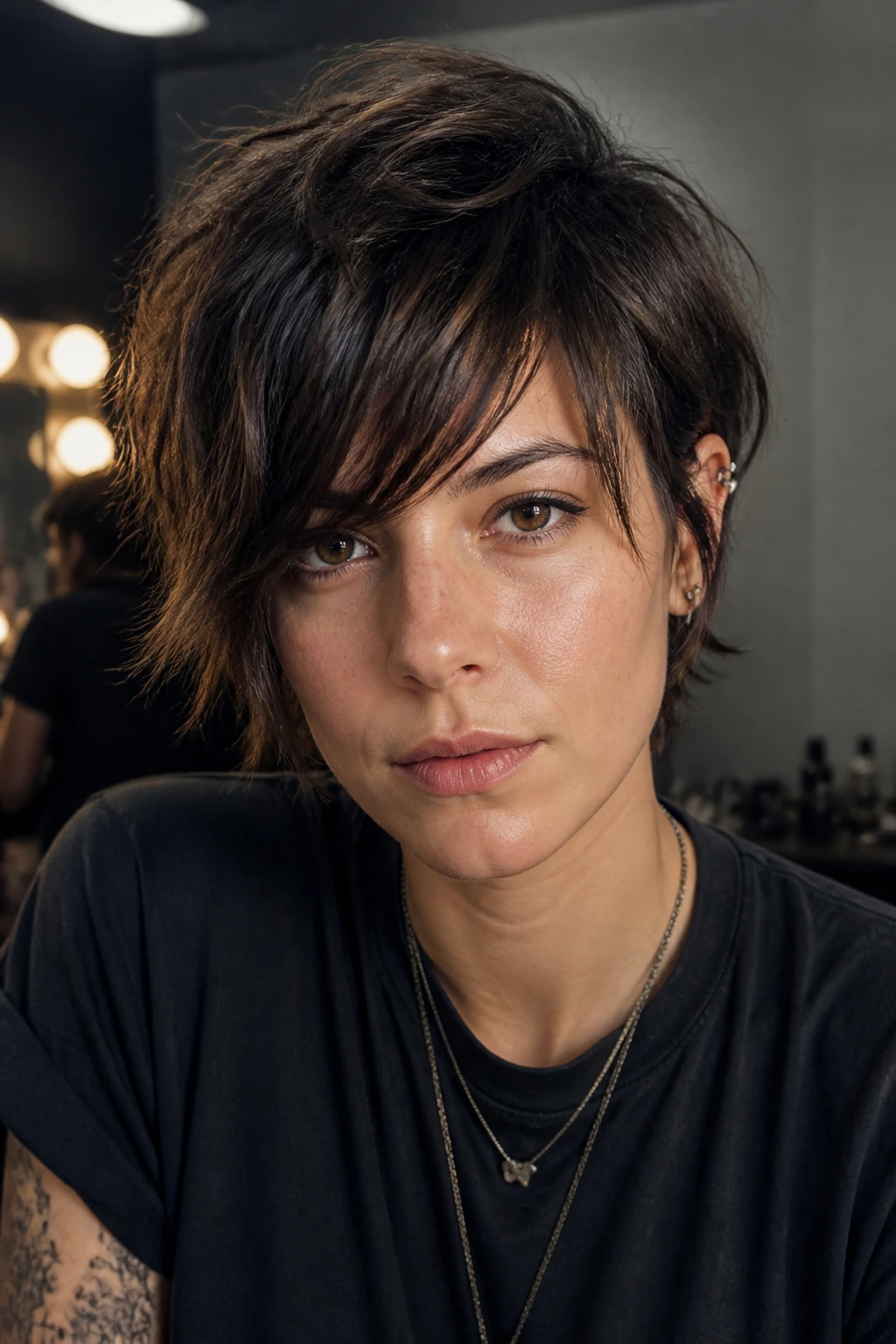
A messy crop with a long fringe is one of the cleanest ways to wear short hair on a round face without losing edge. The long fringe breaks the forehead, the cropped sides reduce width, and the texture on top keeps the haircut from feeling severe.
It’s a sharp little cut, but not a hard one. The fringe should be cut so it can fall diagonally, not straight across. If it lands at eyebrow level and sweeps slightly to the side, the face reads longer right away. Too short and the whole thing can start looking top-heavy. Too dense and the forehead loses air.
This cut is good for people who want a lower-maintenance shape but still like a little drama around the eyes.
16. Disco Shag With Wide Bangs
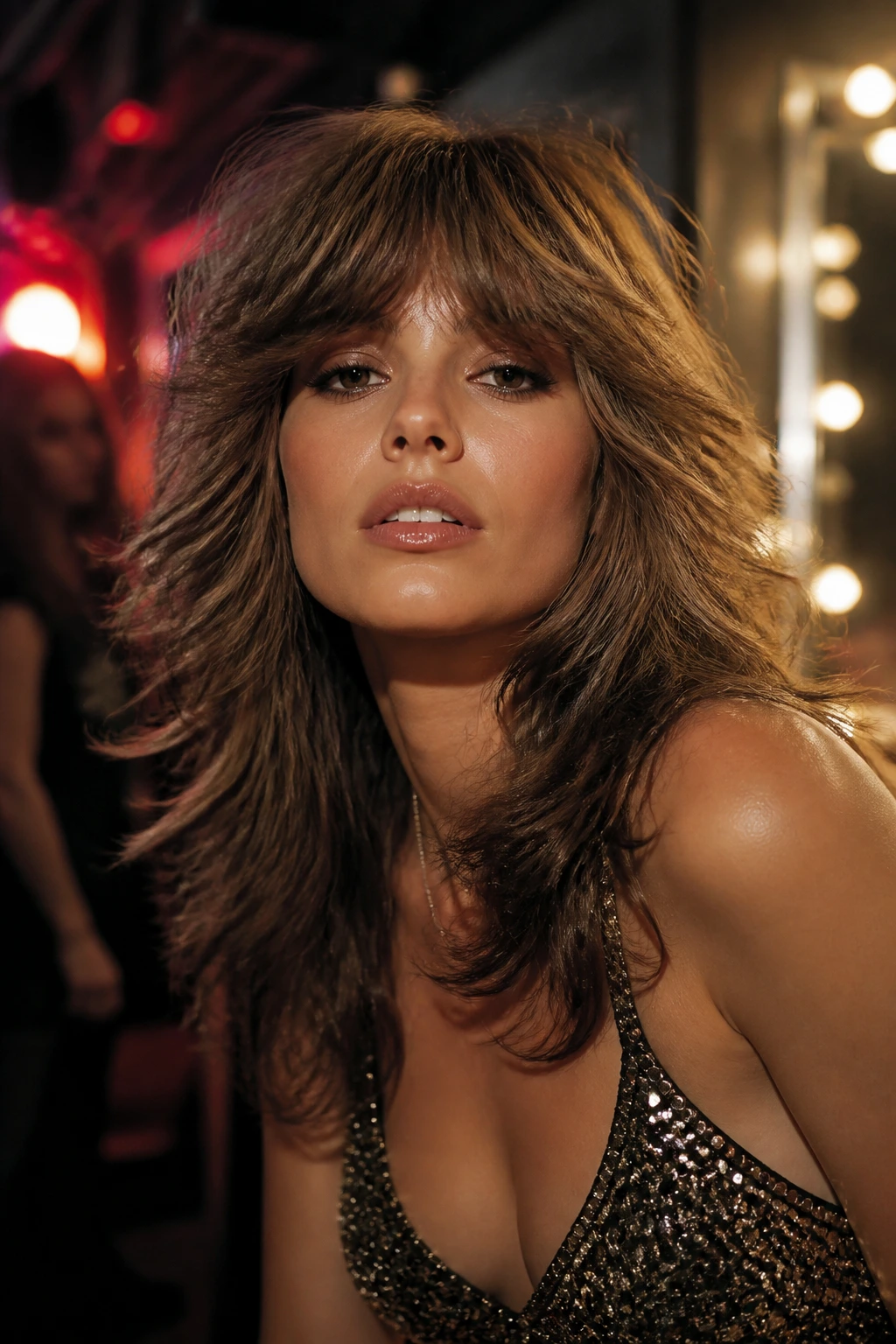
Wide bangs can scare people off, but they work here when they’re broken up and feathered. A round face benefits from a fringe that opens outward rather than one heavy strip that lands across the eyebrows. The disco shag does that by pairing width at the top with movement through the rest of the cut.
The danger is bulk. If the bangs are too dense, the face can look shorter. So the better version has texture cut into the ends and enough lift at the crown to keep the shape from collapsing. I like this cut on wavy hair most, where the fringe can bend and separate naturally.
A round-brush blowout makes the whole thing feel more polished, but a rough dry with a diffuser can be just as good. The hair should never look pinned down.
17. Glam Rock Shag With Big Volume

This one is for people who want hair to enter the room first. Big volume can flatter a round face when it lives at the crown and upper lengths, not at the sides near the cheeks. That’s the difference between “edgy” and “puffy.” It’s a small difference with huge consequences.
The cut needs internal layers and a front that falls past the jaw. If the volume blooms right beside the face, you get width. If it rises above and drops lower, you get length. That’s the geometry here. Blow-dry the roots upward, flip the head for a few seconds, then set the shape with cool air.
This style looks especially strong with a leather jacket or a sharp neckline. It has that old rock-star stubbornness to it.
18. Air-Dried Wave Shag

If your hair already wants to wave, stop fighting it. The air-dried wave shag uses the natural bend to create movement around a round face without forcing the cut into a polished shape. That loose finish keeps the face from feeling boxed in.
The layers should be light through the front and a little fuller through the back. Then you can scrunch in a curl cream or lightweight mousse and leave it alone. The key is not to touch it while it dries. Seriously. Touching it too much turns waves into frizz and frizz widens the silhouette.
This is one of the easiest rocker looks to live with, especially if you don’t like a full styling routine every morning. It looks a little different each day, and that’s part of the charm.
19. Subtle Mullet for Straight Hair

A subtle mullet for straight hair sounds like a contradiction until you see it done well. The front stays long enough to soften the cheeks, the back stays longer for movement, and the layers at the crown keep everything from sitting flat and round. It’s not a loud mullet. It’s a smart one.
This cut depends on clean shaping. Straight hair shows every bad angle, so the stylist needs to remove weight carefully. Ask for texture around the ends and a smooth transition from front to back. If the sides get too bulky, the face gains width. If the back gets too thin, the whole shape turns stringy.
You can wear this with a tucked tee and boots, or with a blazer if you’re one of those people who likes contrast. It has range.
20. Textured Pageboy Shag

A pageboy usually sounds too tidy for a rocker list, but once it’s textured and broken up, it becomes a useful shape for round faces. The rounded base gives structure, while the shag layers stop it from feeling locked into one perfect curve.
The length should sit just below the chin or at the collarbone, never right on the jaw. That matters more than people think. A pageboy that ends at the jawline can widen the face fast. A textured version with a little flip at the ends, though, can actually do the opposite by creating movement below the widest point.
It’s a surprisingly elegant cut with a little grit in it. And yes, that combination works better than it sounds.
21. Shoulder-Grazing Cut With Flipped Ends

The shoulder-grazing length is a gift for round faces, but only when the ends don’t hang flat. A small outward flip at the bottom creates motion and breaks the circle effect that can happen when hair lands exactly at the shoulders. That’s why this cut feels lively instead of heavy.
What makes it work
- Ends should be cut with texture, not bluntness
- Layers should start high enough to move
- A middle or off-center part both work
- A light bend at the ends is enough; no need for a full curl
This is one of the best options if you want a rocker mood without looking like you tried too hard. The flip can come from a round brush, a flat iron twist, or even the way the hair dries naturally.
22. Heavy Layered Long Cut
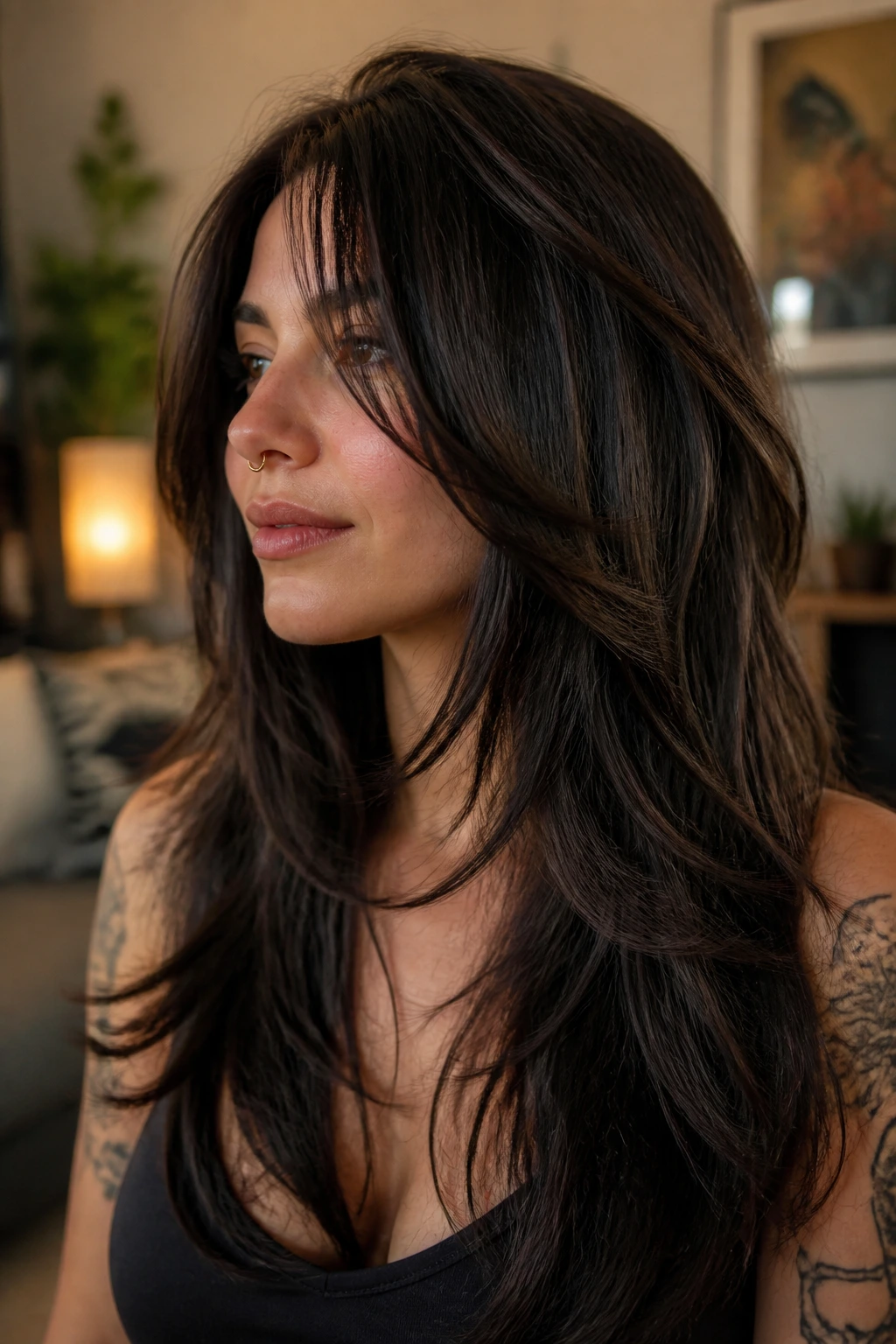
Long hair can still be rocker, and on a round face it often looks better when the layers are heavy enough to remove bulk but not so chopped up that the ends thin out. This style keeps the length, then uses long internal layers to build movement around the face and through the lower half of the hair.
The face-framing pieces need to start below the cheekbone if you want a lengthening effect. Anything too short can pull the eye sideways. Keep the front slightly longer than you think you need. People often cut those pieces too high and then wonder why the face looks broader.
This cut is a good choice if you like the feeling of hair on your shoulders but don’t want the weight sitting like a curtain around your jaw.
23. Wispy Micro Bangs With Long Shag

Micro bangs are not for everybody, and I’d rather be honest about that than pretend otherwise. On the right round face, though, wispy micro bangs can be sharp and interesting because they create a break at the forehead without eating up the whole face. The long shag underneath keeps the rest of the shape moving vertically.
The bangs have to be wispy. Not thick. Not helmet-like. A little spacing between the strands is what keeps them from boxing in the face. The shag through the lengths should be loose and swingy so the contrast feels deliberate.
This is a high-personality cut. If you like low-drama hair, skip it. If you like people noticing your bangs before they notice anything else, it has real bite.
24. Soft Wolf Cut With Face-Framing Curls

Curl texture can make a wolf cut feel less aggressive and more wearable. The soft version keeps the crown lifted, lets the layers fall with the curl pattern, and places the face-framing pieces where they can skim past the cheeks instead of ending right on them.
If your curls are tighter, ask for long layers and a gentle shape around the front. If they’re looser, you can go a little shorter through the crown. Either way, the front should open the face, not close it in. A round face benefits when the curls create a vertical path down the front rather than a compact halo at cheek level.
Diffusing with the head tipped slightly forward helps. So does a bit of root clip work at the top while the hair dries. Small things. Big difference.
25. No-Fuss Rocker Shag With Tuckable Length
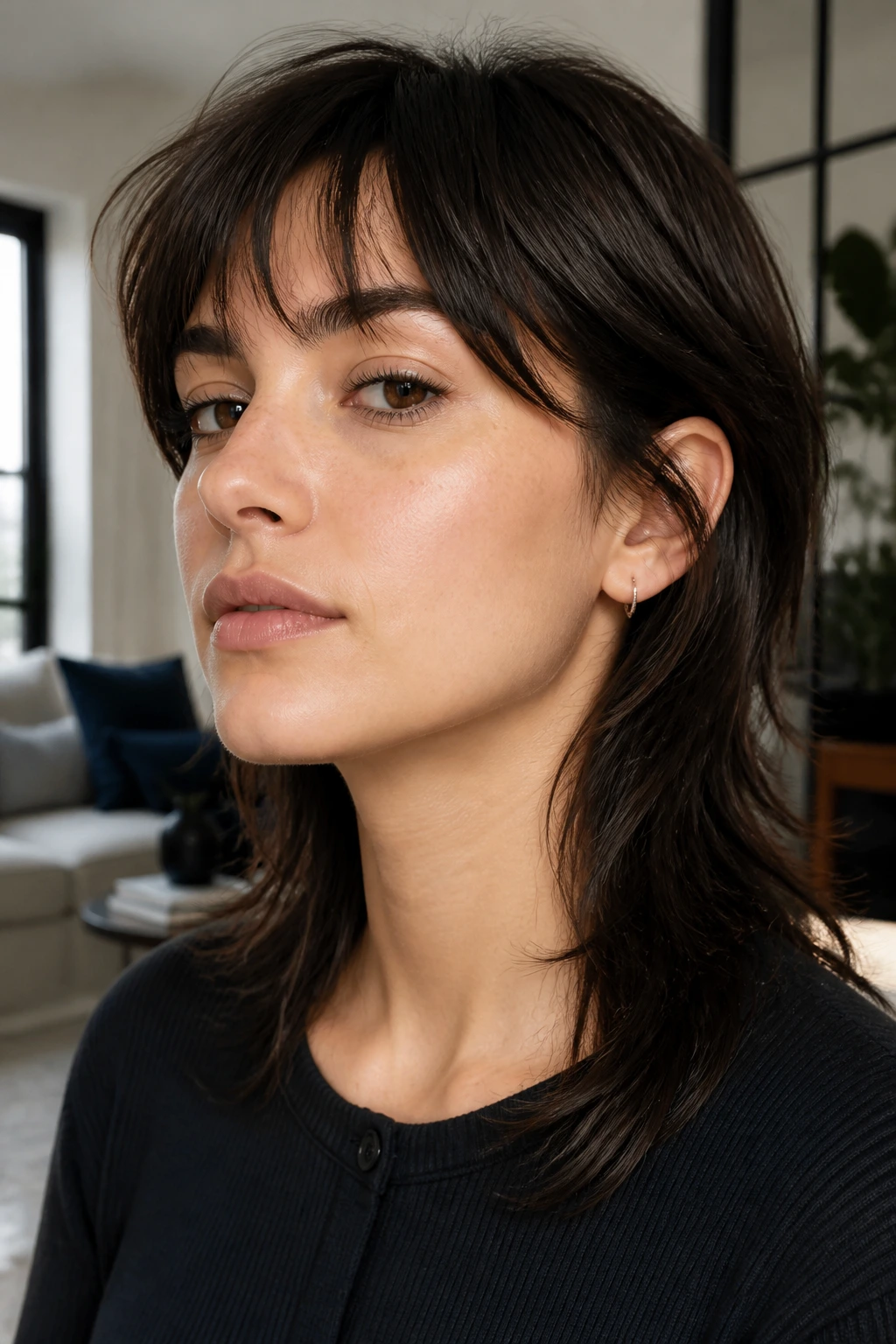
This one is for people who want the shape to do the work, not the styling routine. The length is long enough to tuck behind the ears, which is useful on round faces because it opens the sides when you want a cleaner line, then drops back down when you don’t.
The shagging stays subtle through the mids and stronger at the ends. That keeps the hair from becoming too wispy at the surface. If you wear glasses, this is a very useful cut because the front pieces can sit around the frames instead of swallowing them.
I like this version for everyday wear. It looks good a little messy, and it does not demand a full production every time you leave the house.
26. Rounded Bob-Shag Hybrid

A regular rounded bob can be a problem on a round face. Too much curve, and the whole head starts looking like one shape. The bob-shag hybrid fixes that by keeping the bob length but breaking the perimeter with shag texture and lighter internal layers.
The trick is to soften the bottom line, not erase it. You still want enough shape to feel intentional. Ask for movement around the front and a little air near the crown. That keeps the cut from sitting too close to the cheeks.
This is a good middle ground if you like short hair but want something less rigid than a classic bob. It’s neat enough for work, rough enough for a band tee. That’s a decent span.
27. Crown-Boosted Long Shag
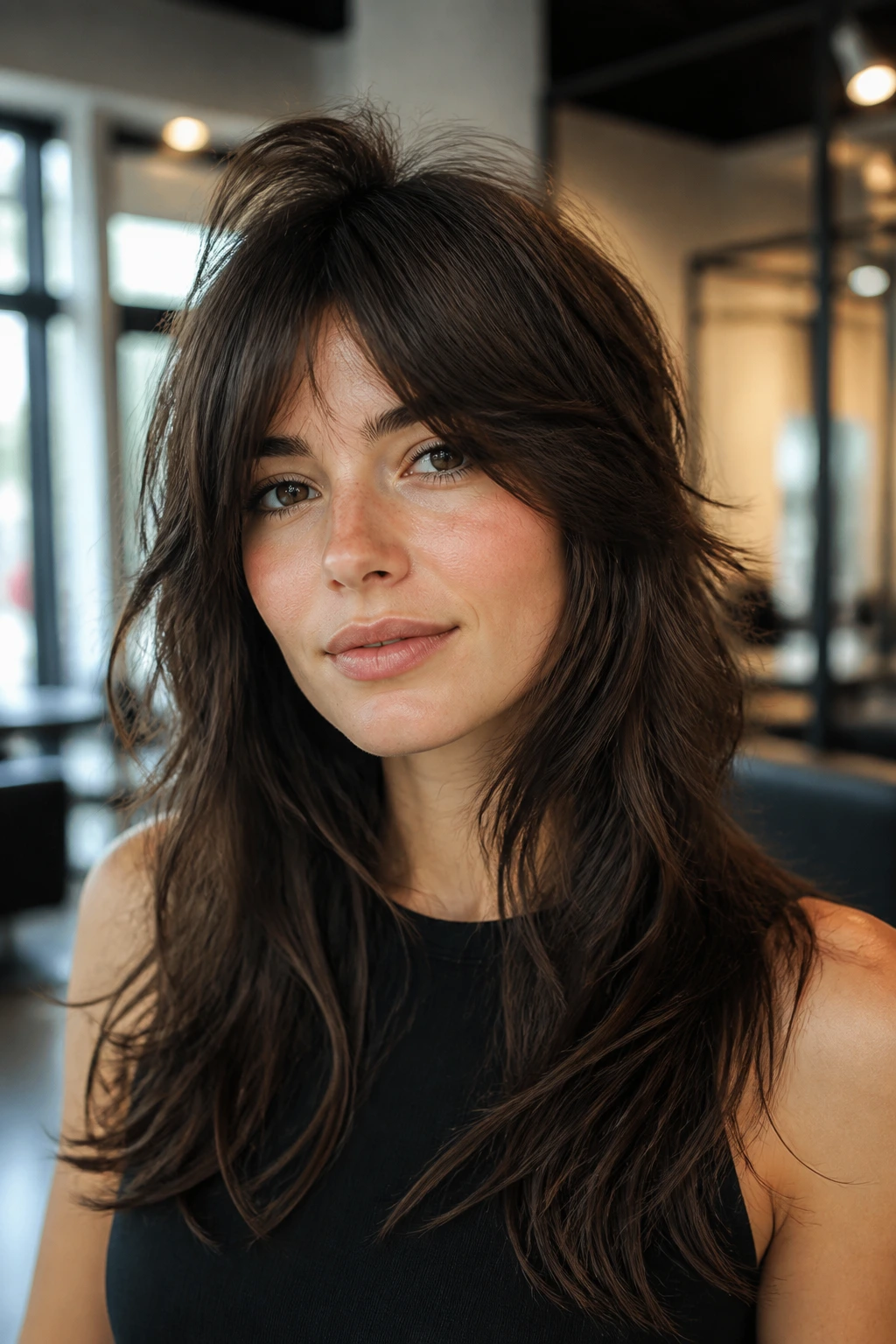
If your round face gets flattened by hair that lies close to the head, this cut solves that quickly. The crown boost creates height where you need it, while the long layers keep the sides from puffing out. It’s a smart shape, not a fussy one.
A little mousse at the roots and a quick lift with a blow-dryer nozzle can change the whole line of the haircut. Keep the face-framing pieces longer than chin level if you want the strongest slimming effect. The ends can be rough, soft, or nearly feathered, depending on how much edge you want.
This cut is strong on thick hair and surprisingly useful on fine hair too, because the crown work creates the illusion of more body without needing a ton of length.
28. Choppy Midi With Curtain Fringe

The midi length lives in that useful zone between short and long, and the choppy finish stops it from getting heavy. On a round face, that length can work beautifully when the curtain fringe opens the center and the layers flick away from the cheeks instead of toward them.
It’s one of the more wearable rocker looks here. Not tame. Just easier to live with. If your hair is straight, a bend at the ends makes it feel less blunt. If it’s wavy, you may barely need to touch it.
The fringe should be light enough to part without splitting too starkly. That softness around the forehead keeps the face from looking wider than it is.
29. Retro Rocker Cut With Feathery Ends

This cut leans into a little nostalgia, but the good version doesn’t feel costume-y. Feathery ends, a lifted crown, and layered front sections create the kind of movement that flatters round faces because it keeps the eye moving up and down instead of side to side.
The best length depends on your neck and shoulders. If the cut ends right at the widest point of the jaw, it can fight the face shape. If it falls a little below, the whole thing feels longer and lighter. A side part helps if you want extra asymmetry.
It’s a good choice if you like a hint of old-school rock without going full throwback.
30. Low-Maintenance Shag For Air Drying
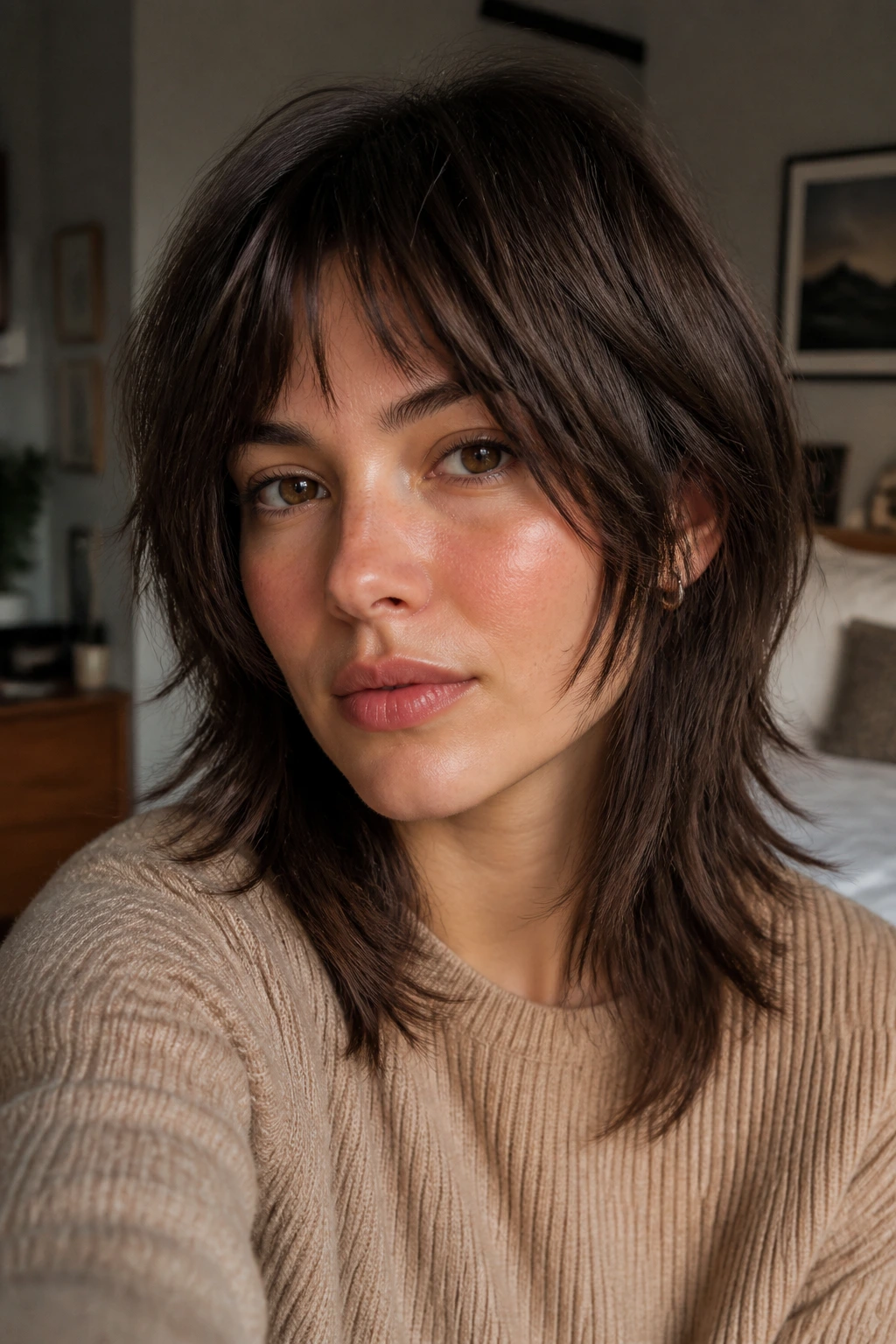
Not every good haircut needs a round brush, and this one proves it. The low-maintenance shag is built so the layers fall into place after a towel blot and a little product, which makes it useful for round faces that need shape but not constant styling.
The lengths should be chosen with your texture in mind. Wavy hair can take more layering; straight hair may need a softer hand so the ends don’t go stringy. Either way, the face-framing pieces should land below the cheekbone and drift toward the collarbone. That long diagonal line does the flattering work.
This is the cut I’d pick for someone who wants rocker texture without living in front of a mirror. It still has attitude. It just doesn’t demand a ceremony every morning.
Why the Shape Matters More Than the Length

A lot of people focus on whether hair is short or long, and that’s not the real question. The real question is where the weight sits. On a round face, width at the cheeks and jaw tends to read faster than length at the ends, so the haircut has to be built to move attention upward or downward, not sideways.
That’s why shag layers, razored ends, curtain pieces, and off-center parts keep showing up in these styles. They interrupt the circle. They give the face more angles. Even a short cut can work if it creates vertical lift at the crown and keeps the sides from blooming out at cheek level.
A blunt line can be fine on some faces. On a round one, it often needs help. A little broken texture is that help.
What to Ask for in the Chair
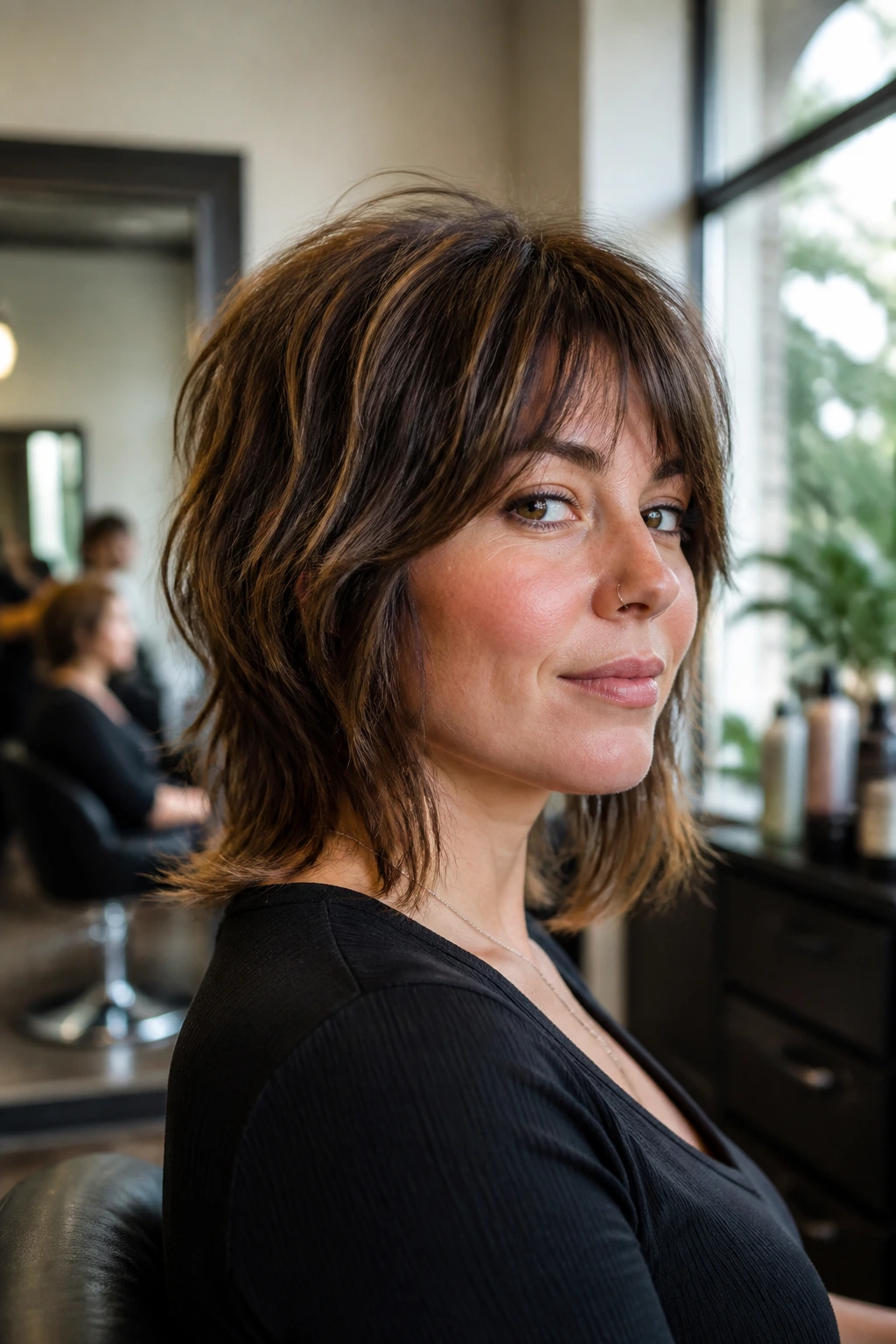
Bring reference photos, but don’t rely on them alone. A good stylist needs a few plain-language instructions too. Say you want more length through the front than the sides, layers that begin around the cheekbone or lower, and enough crown lift to keep the top from lying flat. If you want bangs, say whether you want them to split, sweep, or sit wispy against the forehead.
Tell the stylist where your hair usually puffs up. Around the cheeks? At the ends? At the crown? That detail matters. A round face can handle a lot more texture when the bulk is removed in the right spots and left alone in the wrong ones.
If your hair is thick, ask how much weight they plan to remove underneath. If it’s fine, ask how they’ll keep the ends from going see-through. Those are the two questions that prevent the most disappointment.
Essential Tools and Products

- Round brush: Best for lifting the crown and bending curtain bangs without making them stiff.
- Texturizing spray: Gives piecey separation through the mids and ends; a light hand is enough.
- Mousse: Useful at the roots for volume on fine or flat hair.
- Dry shampoo: Helps rocker shags hold shape on day two and day three.
- 1-inch curling iron or wand: Good for adding loose bends to straight hair without making it look curled in a formal way.
- Diffuser: The cleanest way to dry waves and curls without blasting them into frizz.
- Matte paste or light wax: Best for pixies, crops, and short shags where definition matters.
- Heat protectant: Non-negotiable if you blow-dry or heat-style. Skipping it is a bad bargain.
- Tail comb: Handy for changing parts and lifting roots at the scalp.
- Small clips: Useful when you’re setting the crown or pinning bangs while they cool.
How to Style the Finish for Different Days

A shaggy rocker cut does not need the same finish every morning. Some days you want it clean enough for work. Other days you want the hair to look like it has a story. Same cut. Different message.
Polished day: Blow-dry the crown first, then wrap the face-framing pieces around a brush just enough to bend them away from the cheeks. Keep the ends soft. You want movement, not curl.
Messy day: Mist in texturizing spray, scrunch the mids, and pinch a few front pieces with matte paste. That’s enough for most of these cuts. If you overwork it, the texture gets frizzy and the shape spreads out.
Curly or wavy day: Use a diffuser on low heat and stop touching the hair once the cast starts forming. Then break up only the top layer of stiffness with your hands. Leave some separation. The style needs it.
Short-cut day: Push the crown up with fingers and keep the sides closer to the head. That one move makes short rocker hair look sharper on a round face than flattening everything into place ever will.
Additional Tips and Style Boosters

Flavor Enhancement: A tiny amount of root-lift mousse at the crown can make a huge difference on round faces. Use it only at the roots, though. If it gets through the mids and ends, the hair starts to swell in the wrong places.
Customization: If your face is widest at the cheeks, keep the shortest face-framing pieces below that point. If your forehead is wider than your jaw, a curtain or bottleneck fringe helps break up the top half without closing the face in.
Serving Suggestions: Tuck one side behind the ear, leave the other side loose, or flip the front pieces away from the face for a sharper line. Small asymmetries matter. They keep the haircut from feeling too symmetrical, which is exactly what round faces don’t need.
Make-It-Yours: Fine hair usually benefits from fewer, longer layers. Thick hair can take more internal removal and still hold shape. Curly hair should keep the front longer than you think so the shrinkage doesn’t drag the pieces up to cheek level.
Common Mistakes to Avoid
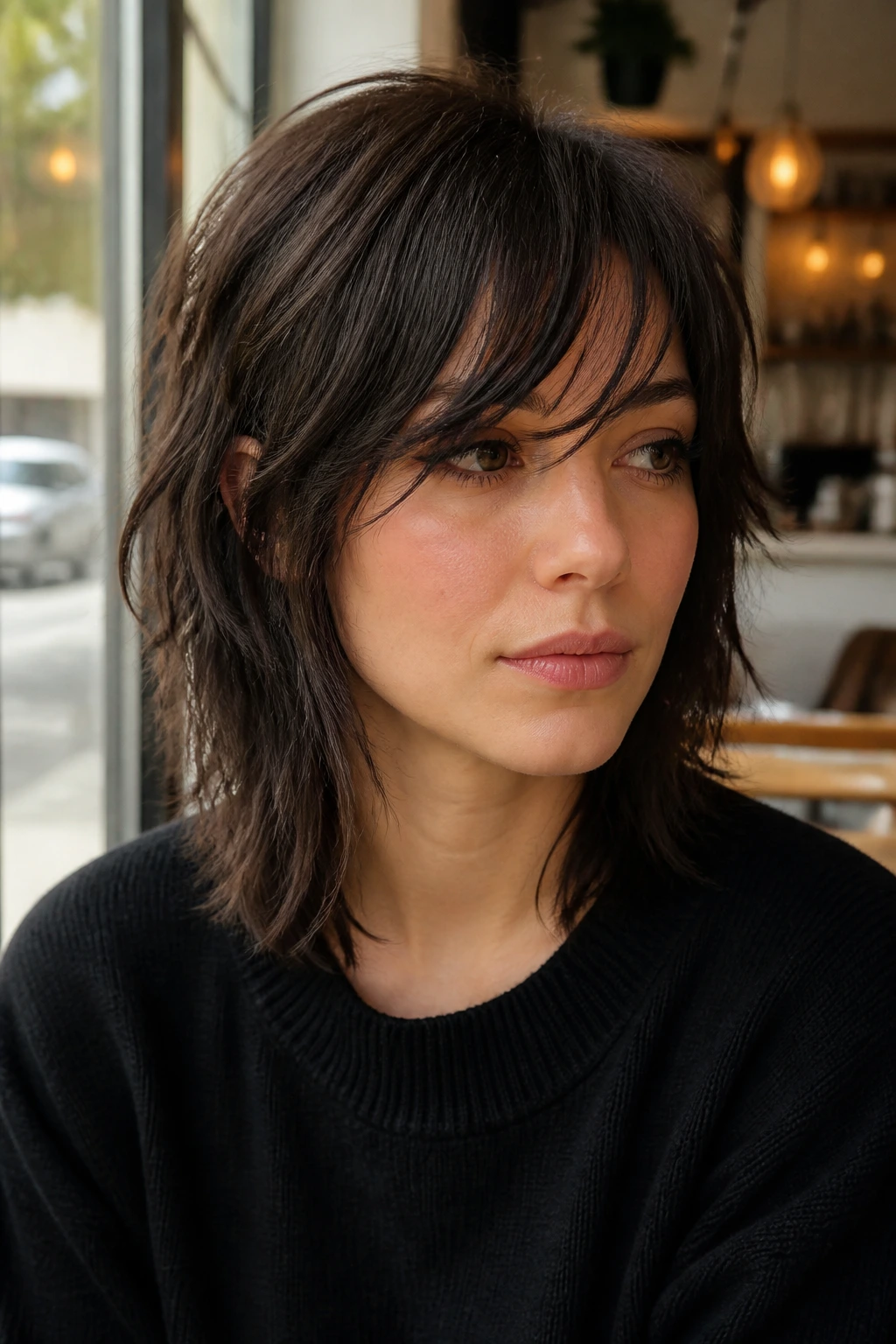
The first mistake is cutting the front too short. When the shortest pieces land right at the cheek or jaw, they often widen the face instead of slimming it. The fix is simple: keep the most visible face-framing pieces below the widest point of the face.
Another one is adding too much bulk at the sides. Thick hair especially can puff outward if the stylist layers it badly. You want width removed from the body of the cut, not built into it.
A third mistake is smoothing the hair until it goes flat. Rocker shag texture needs some lift and some bend. If you iron out every wave and press the roots down, the haircut loses the whole point and the face can look broader.
Finally, skipping upkeep on the fringe will change the shape faster than people expect. Bangs and front pieces show the grow-out first. Even a small trim around the eyes and cheekbones keeps the cut doing its job.
Variations and Adaptations to Try

Soft Office Shag: Keep the layers long, the fringe light, and the ends clean enough to tuck behind the ears. It still reads rocker, just quieter.
Curly Rebel Shag: Let the curls do more of the work and ask for longer face-framing pieces so shrinkage doesn’t lift them too high.
Short and Sharp Crop: Go shorter through the nape and sides, but keep the top piecey and lifted. Good if you want edge without length.
Thick-Hair De-Bulk Version: Focus on internal weight removal and avoid overtexturizing the ends. The goal is shape, not fray.
Air-Dry Friendly Version: Ask for layers that follow your natural wave pattern. If your hair looks good on day one but impossible on day two, this version fixes that.
Maintenance, Trims, and Grow-Out
Shaggy rocker cuts usually hold their shape for 6 to 8 weeks before the layers start drifting enough to change the silhouette. Bangs or short fringe pieces may need a light cleanup every 3 to 4 weeks if you want the face-framing effect to stay precise.
If you’re growing the cut out, keep the perimeter controlled while the internal layers soften. That way the hair doesn’t turn into one wide, shapeless block around the face. A few face-framing dustings go a long way during grow-out.
At home, use a satin pillowcase or loosely secure the hair before sleep if the texture tugs easily. The goal is to keep the crown from flattening and the ends from kinking into odd bends. A quick mist of water and a fingertip restyle in the morning is usually enough to wake the cut back up.
Frequently Asked Questions
Will curtain bangs make a round face look wider?
Not if they’re cut correctly. The center should open up and the longer pieces should fall past the cheeks, which creates a vertical line instead of a boxy one.
Are shaggy cuts better than blunt bobs for round faces?
Usually, yes, because the texture breaks up the outline. A blunt bob can work, but it needs careful length and a little asymmetry to avoid widening the face.
Can a round face wear a short shag?
Absolutely. The trick is keeping height on top and avoiding too much volume at the sides. A piecey pixie shag or short crop can look sharp when the crown is lifted.
What if my hair is fine and flat?
Choose a cut with crown lift and fewer layers through the ends. Fine hair can go limp fast if the stylist removes too much weight, so you want shape without thin, see-through edges.
What if my hair is thick and puffy?
Ask for internal debulking and longer face-framing sections. Thick hair usually needs the bulk removed from inside the cut, not just around the perimeter.
Do side parts still work?
Yes, and they work fast. A deep or off-center part creates a diagonal line that breaks the roundness and gives the top more height with almost no effort.
How do I keep the rocker texture from looking messy in a bad way?
Use less product than you think, and put it in the right spots. Roots need lift, mids need separation, and the ends need just enough definition to show the cut’s shape.
The Cut That Keeps Its Edge

Round faces don’t need a haircut that hides them. They need one that knows where to place the weight, where to break the line, and where to let the hair move. That’s the quiet magic of a good shaggy rocker cut: it gives you texture with purpose, not texture for its own sake.
The best part is how many directions this look can go. You can keep it soft, go full wolf cut, wear it curly, chop it short, or let it grow into something looser and more lived-in. The shape still does the same job. It leads the eye where you want it to go.
If you’re taking one thing to the salon, make it this: ask for lift at the crown, length through the front, and texture that starts below the cheeks. That one request will save you from a lot of bad hair decisions.