



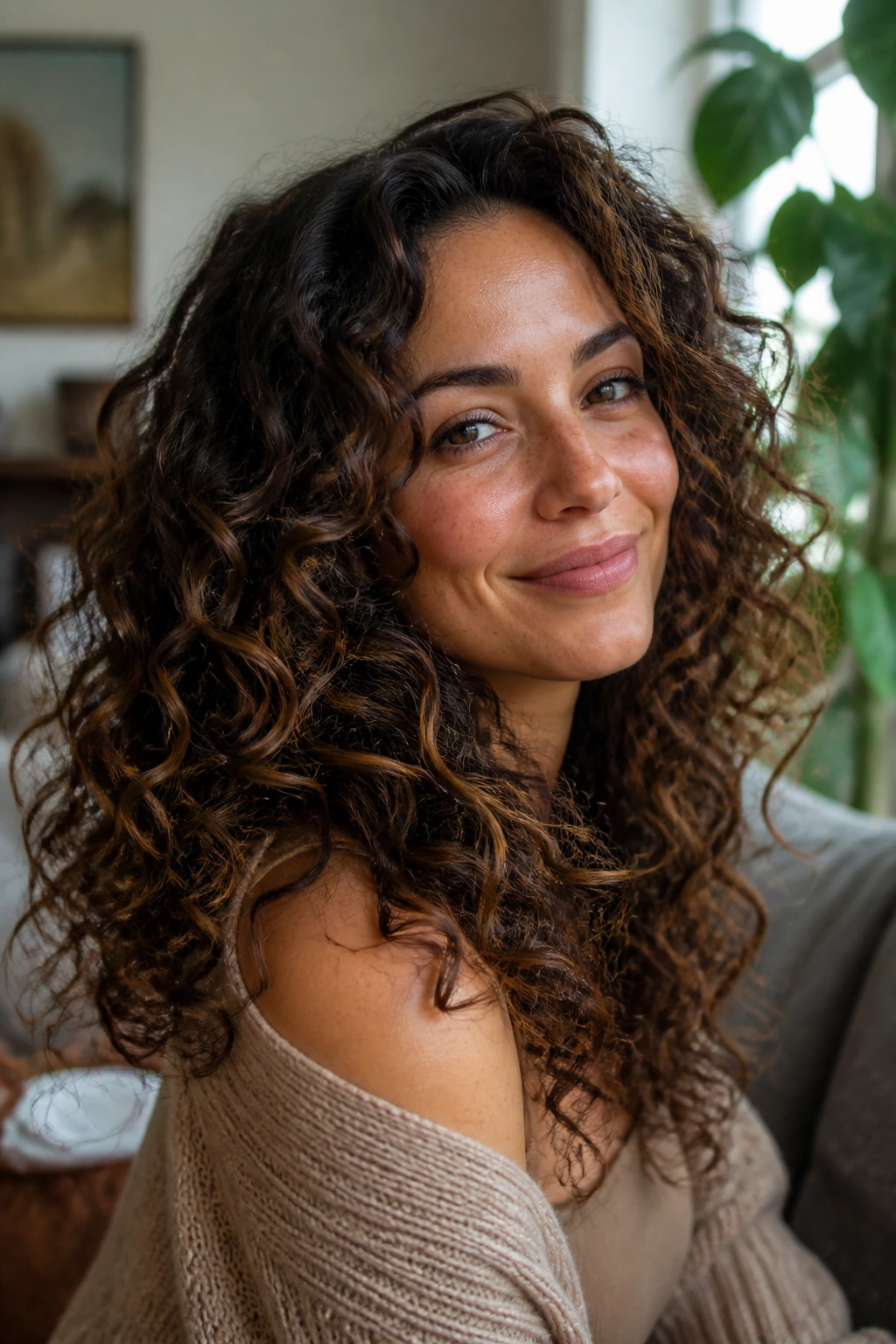
Brunette balayage for dark hair with curly hair is one of those color moves that looks richer the more you move it. Straight hair can show a highlight line in a flat, obvious way. Curls do something better: they break the color into ribbons, flashes, and little pockets of shine that show up differently every time the light hits.
That’s why this color family works so well on dark curls. The trick is not to go pale. It’s to place brown-on-brown contrast where the spiral opens, where the outer curve catches light, and where your layers already want to sit. A good brunette balayage doesn’t fight the curl pattern. It follows it.
And that’s where the range gets fun. Caramel, mocha, chestnut, ash brown, mahogany, honeyed copper-brown — all of them can live on dark hair without turning brassy or striped if the placement is right. Some of the looks below stay nearly understated. Others lean bolder around the face, the ends, or the crown. The sweet spot is usually the one that still looks good on day three, when the curls have settled and the halo of color is doing the real work.
Why You’ll Love This Collection
-
Soft grow-out: Balayage starts away from the root, so the line of demarcation stays blurred even when your curls have grown out an inch or two.
-
Curl-friendly placement: The lighter pieces sit where the curl bends and opens, which means the dimension still shows after shrinkage.
-
Brown-on-brown depth: Dark bases look fuller with brunette tones than with high-contrast blonde streaks, especially on thick or dense curls.
-
Easy tone control: Warm caramel, cool mushroom brown, and red-brown mahogany each change the mood without changing the whole haircut.
-
Works with shape: Long layers, curly shags, lobs, bobs, and rounded afros all take to this color family in different ways.
-
Low-drama upkeep: A gloss, a trim, and a solid moisture routine usually keep the color looking tidy for weeks.
Why Brunette Balayage Looks So Good on Dark Curls
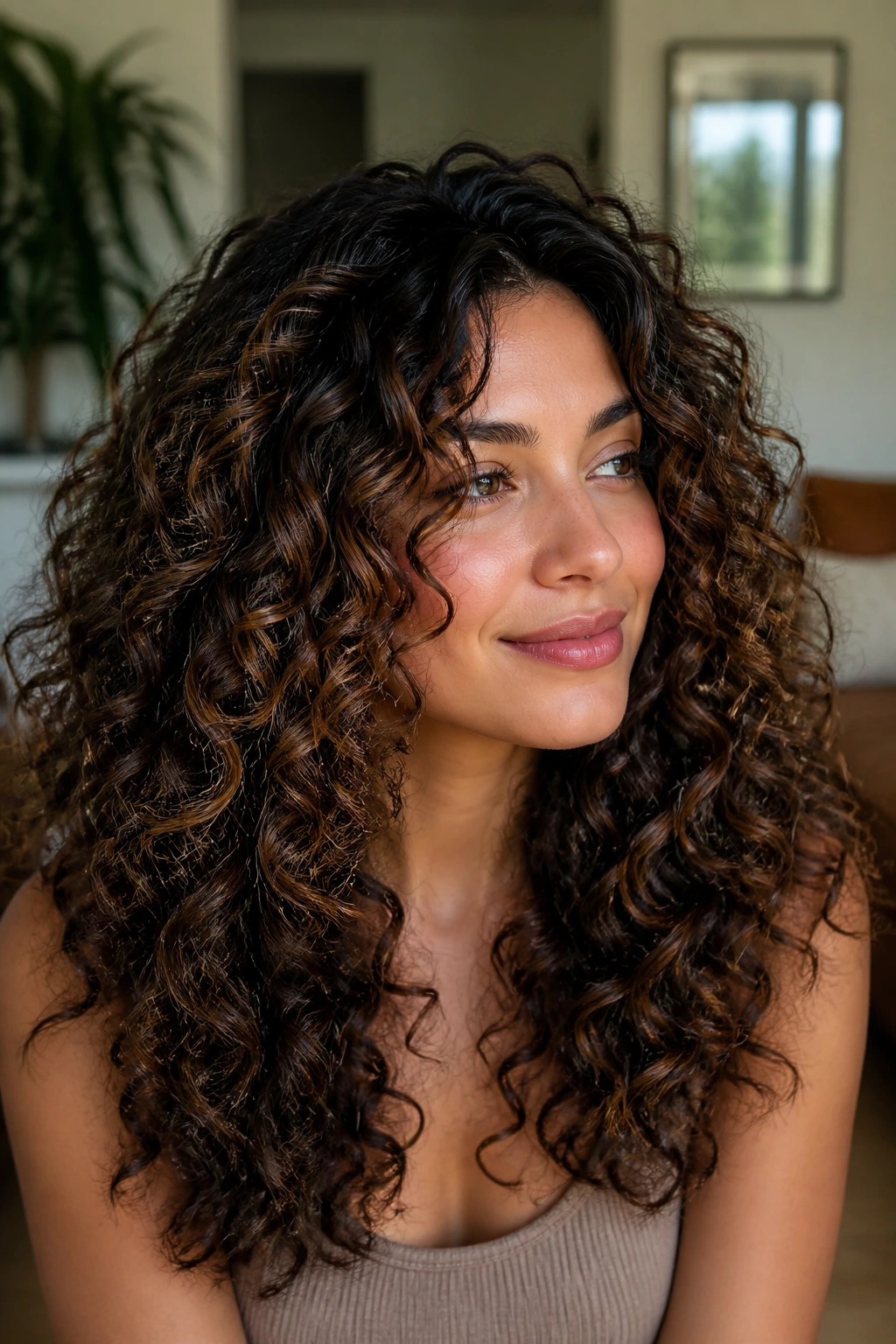
Dark curls have built-in texture. That matters more than people think. A spiral already creates shadow, and shadow is what lets color read as dimensional instead of painted on. When a colorist hand-places brunette balayage a little off the root and a little heavier on the outer ring of the curl, the hair stops looking one-note.
There’s also the matter of movement. A curl doesn’t lie flat long enough to show every highlight the same way. It turns the color into a moving surface. A chestnut ribbon that looks quiet in the mirror can suddenly catch the light when you turn your head or tuck one side behind your ear.
Warm brunettes tend to read brighter on dark curls because they sit between the base and the light, not far outside it. Cooler brunettes — ash, taupe, mushroom brown — can look sharper and more modern, but they need enough depth at the root to avoid a dusty finish. That balance is the whole game.
If your curls are dense, the placement matters even more. A few thicker ribbons on the canopy will show better than a hundred tiny streaks buried underneath. If your curls are loose and springy, the face frame and the top layer do most of the talking. Either way, the best versions are never uniform. They look painted, not striped.
1. Espresso Ribbon Balayage
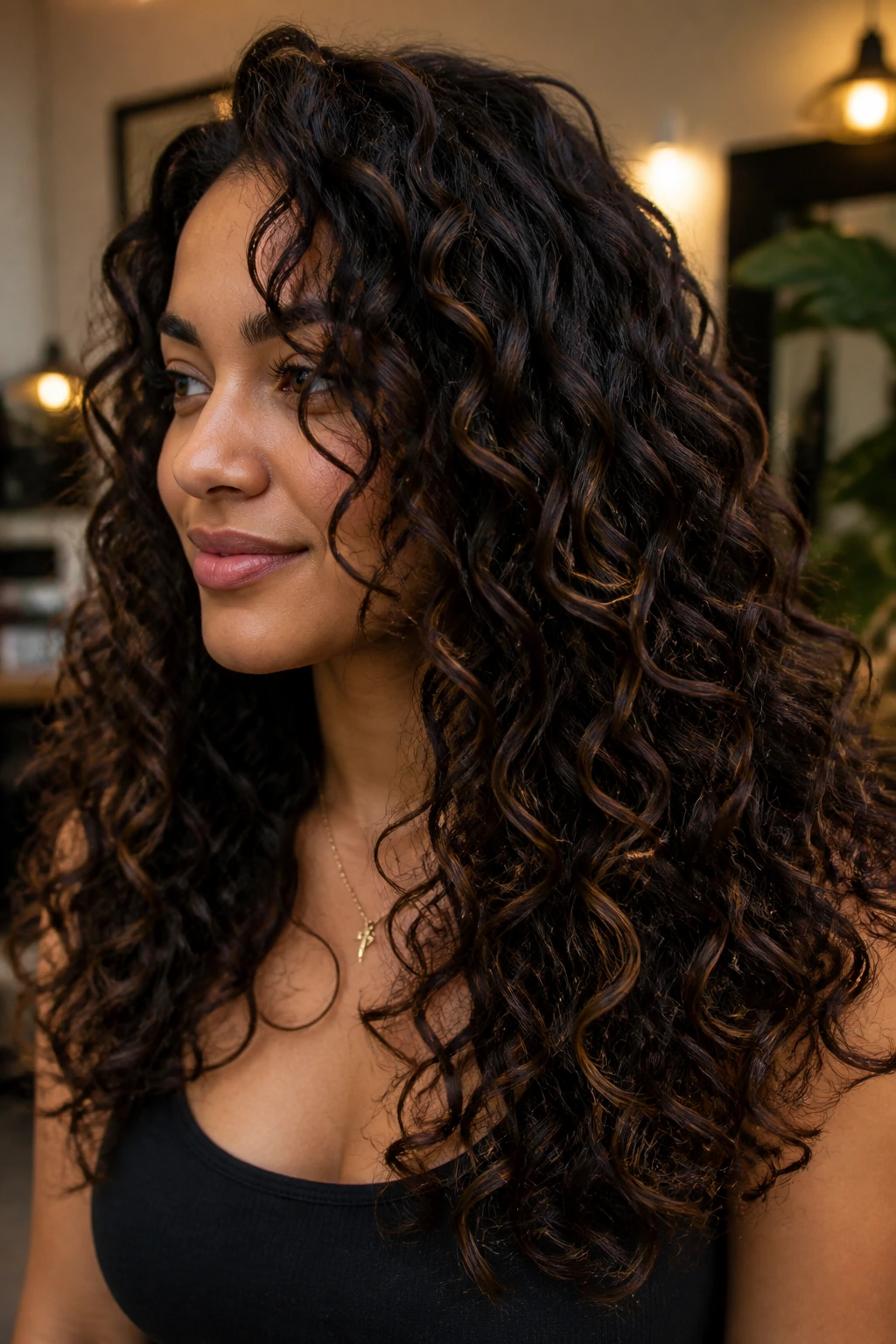
Espresso ribbon balayage is the quiet one in the room, and that’s exactly why it works. The base stays deep, almost black-brown in places, while thin ribbons of soft mocha weave through the mid-lengths and outer coils. On curly hair, those ribbons don’t read as streaks. They read as movement.
What makes this look so smart is the low contrast. You get shine without losing the weight of the dark base, which matters if your curls are thick or tightly packed. Ask for the lightest pieces to sit a half-inch or so off the root and concentrate around the crown and outer curve of the spiral. Too much brightness near the scalp can make the color look patchy once the hair shrinks.
It’s a good choice if you want people to notice your curls first and the color second. That’s the point.
2. Caramel Coil Framing
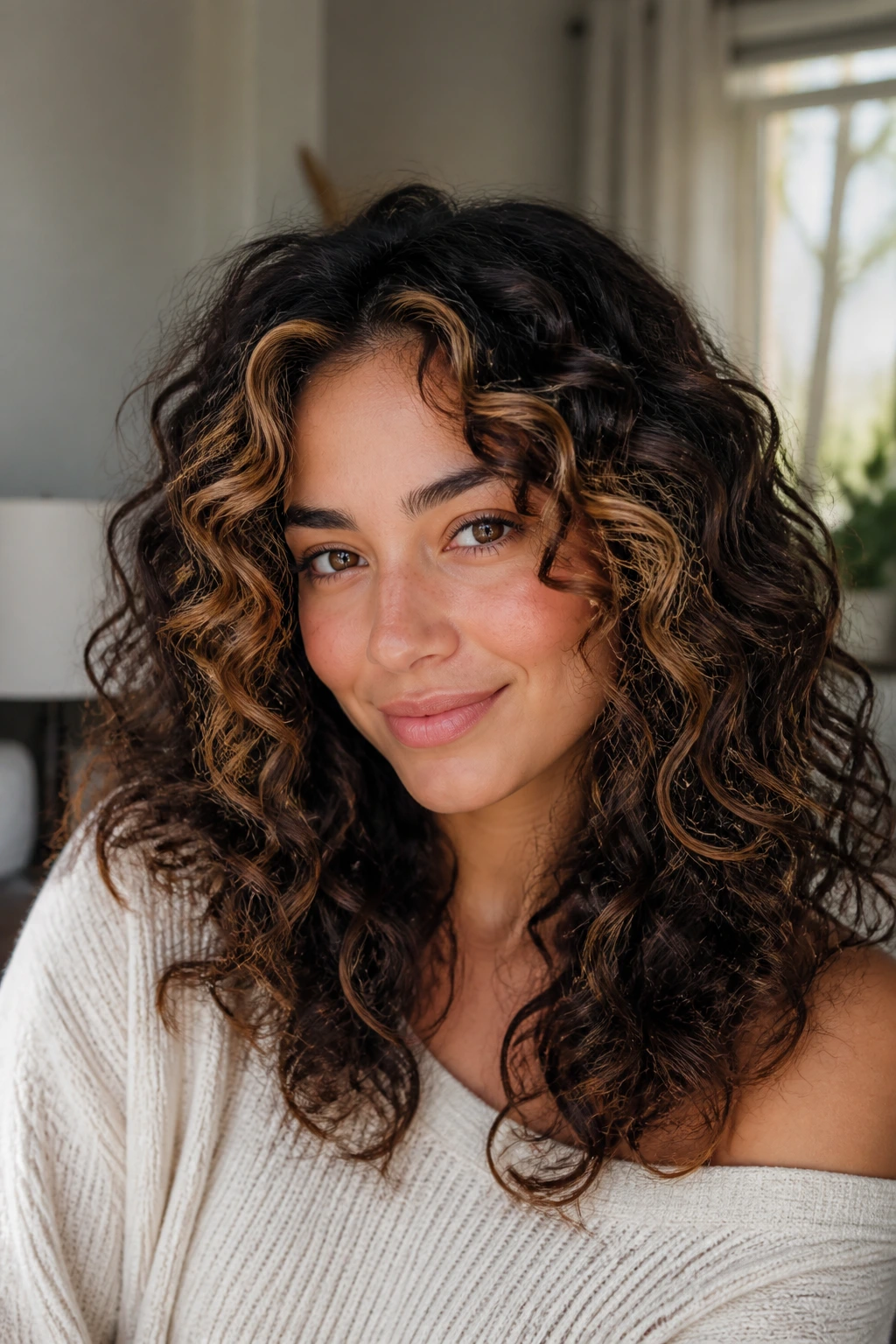
Caramel coil framing puts the brightest pieces where your face already needs them: around the cheekbones, along the part, and over the top curls that move first. It’s the easiest brunette balayage to read from across the room because the warm caramel tone shows up fast against a dark brunette base.
Where It Matters Most
The color should hug the first two curls nearest the face, then fade backward into softer brown pieces. That keeps the look from turning into a heavy front stripe. On long curls, a few caramel ribbons in the lower half help repeat the pattern so the front doesn’t feel isolated.
This one flatters round and oval faces especially well. The reason is simple: the lighter pieces pull the eye upward and outward, which gives the curls a lifted look even before you touch a diffuser. If you like warmth, this is the easy win.
3. Mocha Melt Layers
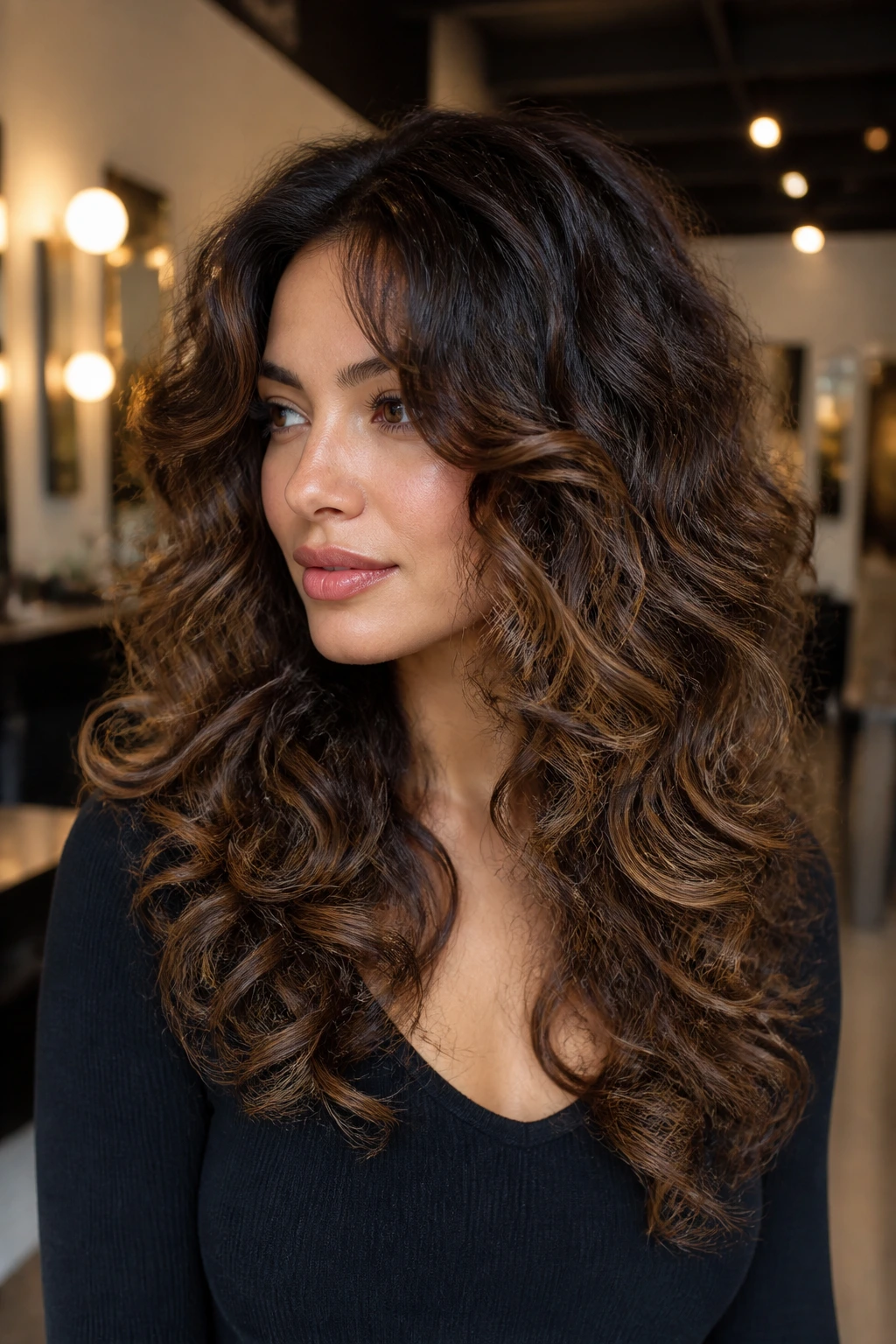
What keeps a mocha melt from looking flat? Layers. Without them, the brown tones can blur into one dark mass, and you lose the point of the balayage entirely.
A good mocha melt starts with a rich brunette root and slides into a softer milk-chocolate midsection, then ends with a slightly lighter mocha on the outer curls. It’s not about making every coil lighter. It’s about creating a gradient that follows the haircut. On a layered curly cut, the transitions look natural because each layer catches a slightly different amount of light.
This is a solid pick if you want dimension without warmth. It’s especially nice on cooler skin tones and on people who wear black, charcoal, or deep jewel colors a lot. The color sits quietly until the light hits it, and then the whole shape wakes up.
Ask For This
- A soft root shadow
- Hand-painted mocha through the mid-lengths
- Slightly lighter ends on the outer curls only
4. Honeyed Ends on a Deep Brunette Base
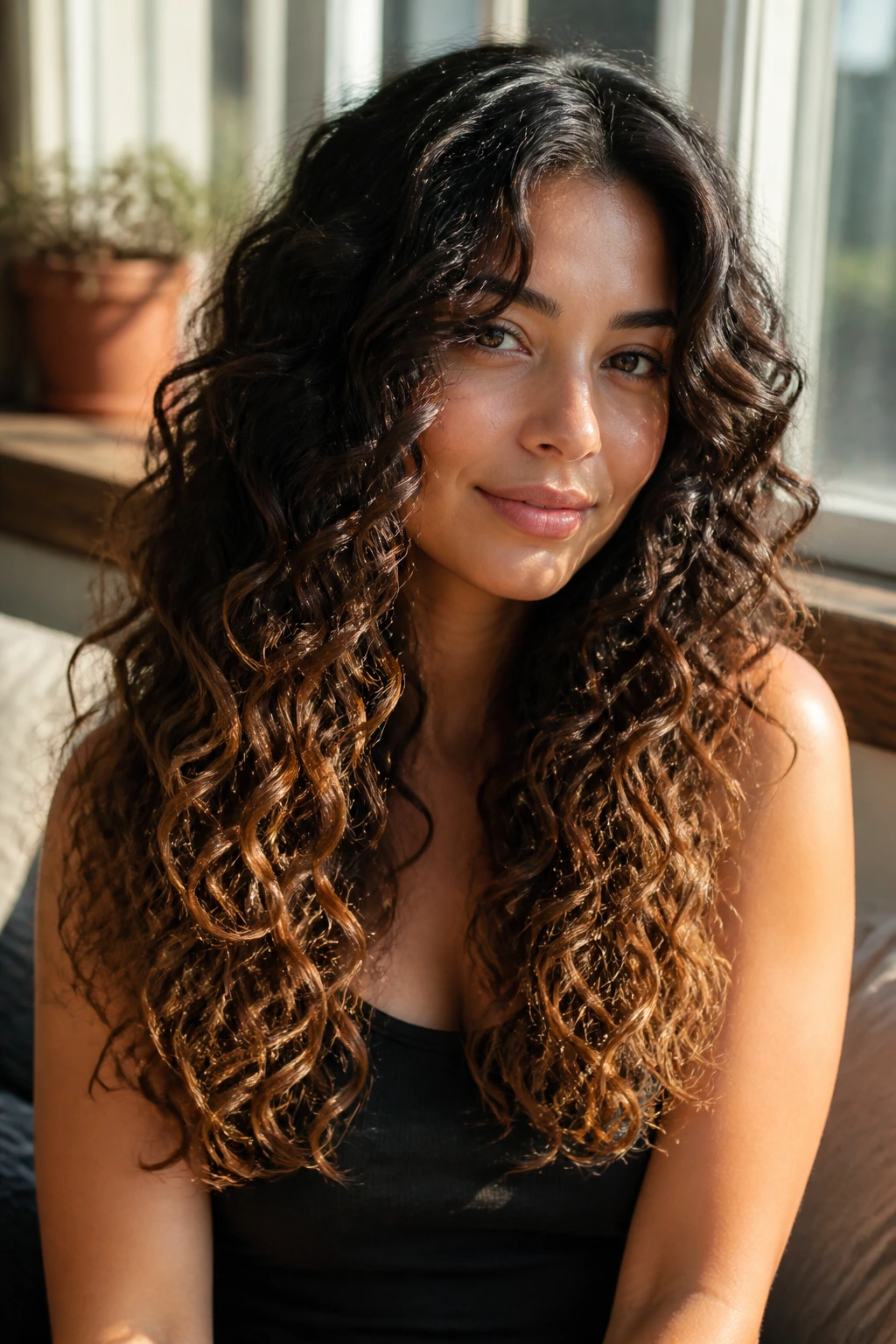
Honeyed ends can look expensive on the right curls, but they need restraint. Too much lift near the bottom can make dark curls look dry, and that’s a trade most people regret. Keep the honey tone focused on the last third of the length, especially if your hair is long and springy.
The payoff is a warm, sunlit finish that shows through every coil. It works best when the upper half stays dark enough to hold the shape. That contrast gives the ends a glow without turning the whole head brassy.
I like this look on people who wear their curls big. The light pieces move when the curls bounce, which makes the ends feel alive instead of heavy. If your hair is already porous, go a little deeper on the honey and keep the gloss rich and neutral.
5. Cinnamon Face Frame
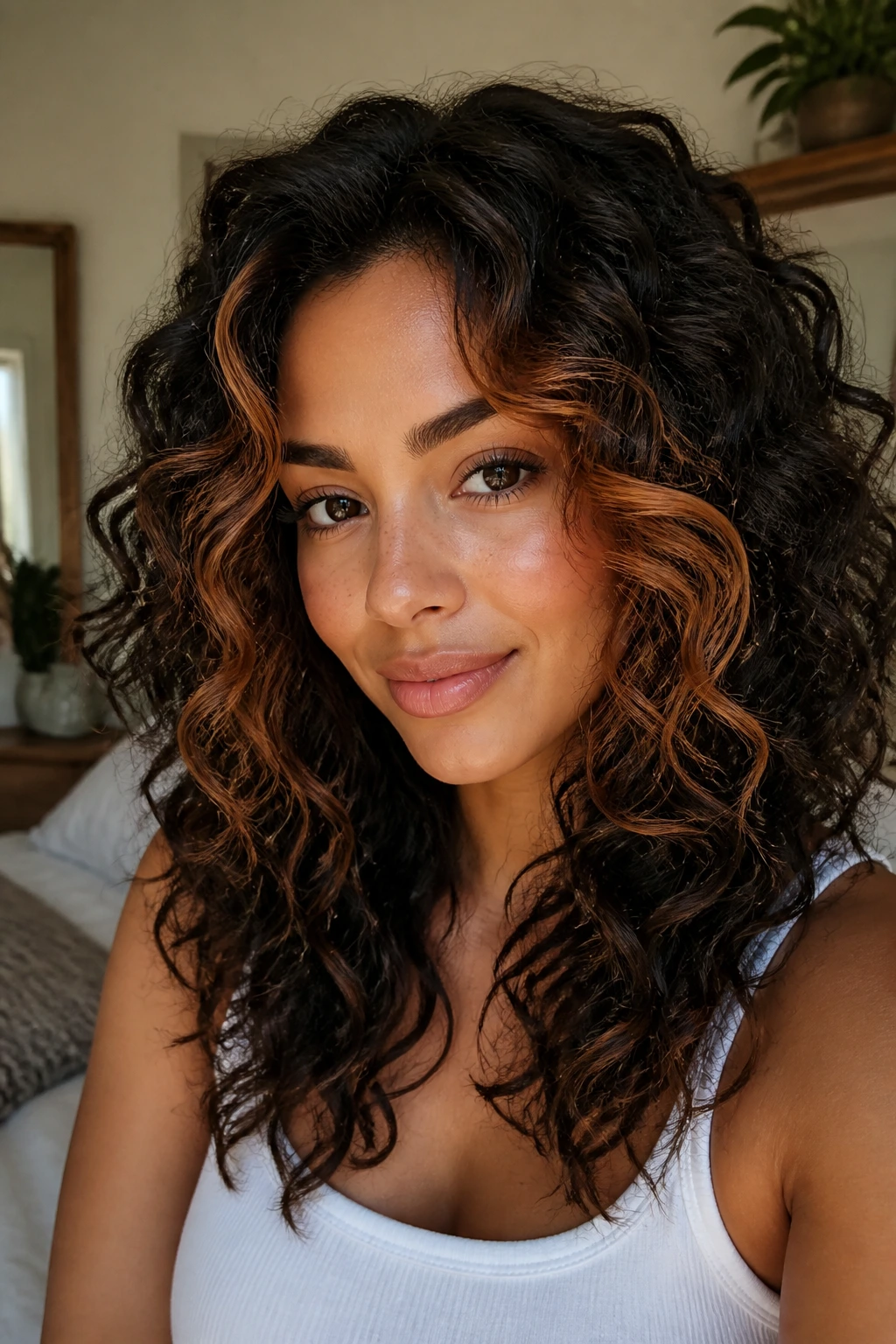
Cinnamon face framing has a red-brown softness that makes dark curls look awake. It’s warmer than caramel and less yellow, which is useful if golden highlights tend to go brassy on you. The best version sits around the part and the first ring of curls near the cheekbones, then fades into the darker body of the hair.
This look is especially strong on olive and neutral skin because the cinnamon tone doesn’t fight the undertone. It adds warmth without turning orange. On very dark curls, a small amount goes a long way. A few painted pieces are enough to make the front curl pattern stand out.
If you wear your hair half-up a lot, this is a nice pick. The color still shows when the front is pulled back, and the remaining face frame does the work of softening the whole shape.
6. Hazelnut Halo Balayage
Hazelnut halo balayage is all about the top layer. The lighter brown sits on the canopy and along the outermost curls, which gives the illusion that the whole head has more light bouncing through it than it really does. It’s a smart choice for dense hair that tends to swallow color.
The hazelnut tone stays middle-ground: warmer than ash, cooler than caramel. That’s the reason it works so easily on dark bases. It looks believable. No harsh stripe, no washed-out ends.
If your hair has lots of shrinkage, this is one of the best placements to try. The crown still catches light even when the length bunches up, and the curls keep the finish soft. A good gloss makes this look better than a heavy lift ever could.
7. Chocolate Cherry Shine
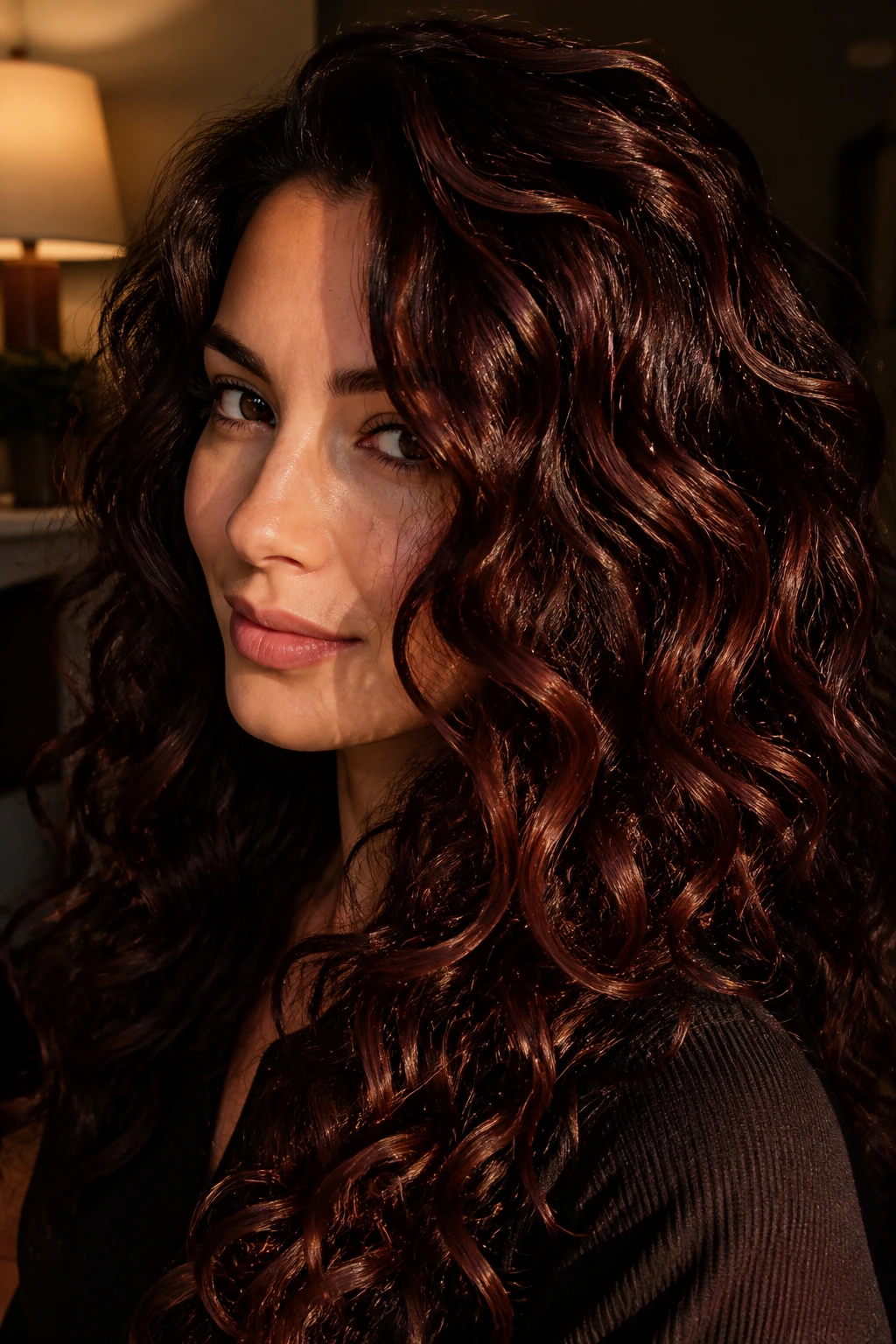
Chocolate cherry is for people who want their brunette balayage to lean a little moody. The brown stays deep, but the highlight tone carries a red-brown cast that comes alive in sun, indoor warm light, and glossy curls. It’s not a bright red. It’s more like a cherry wood stain.
That subtle red undertone is useful on dark hair because it doesn’t fight the base. It sits inside it. On curly hair, the shine is the point. Each coil turns a slightly different shade depending on the angle, which makes the color feel richer than a standard caramel blend.
This one is especially flattering if your wardrobe leans black, cream, burgundy, olive, or denim. It gives the curls a polished look without pushing them toward blonde territory.
8. Mushroom Brown Ribbons
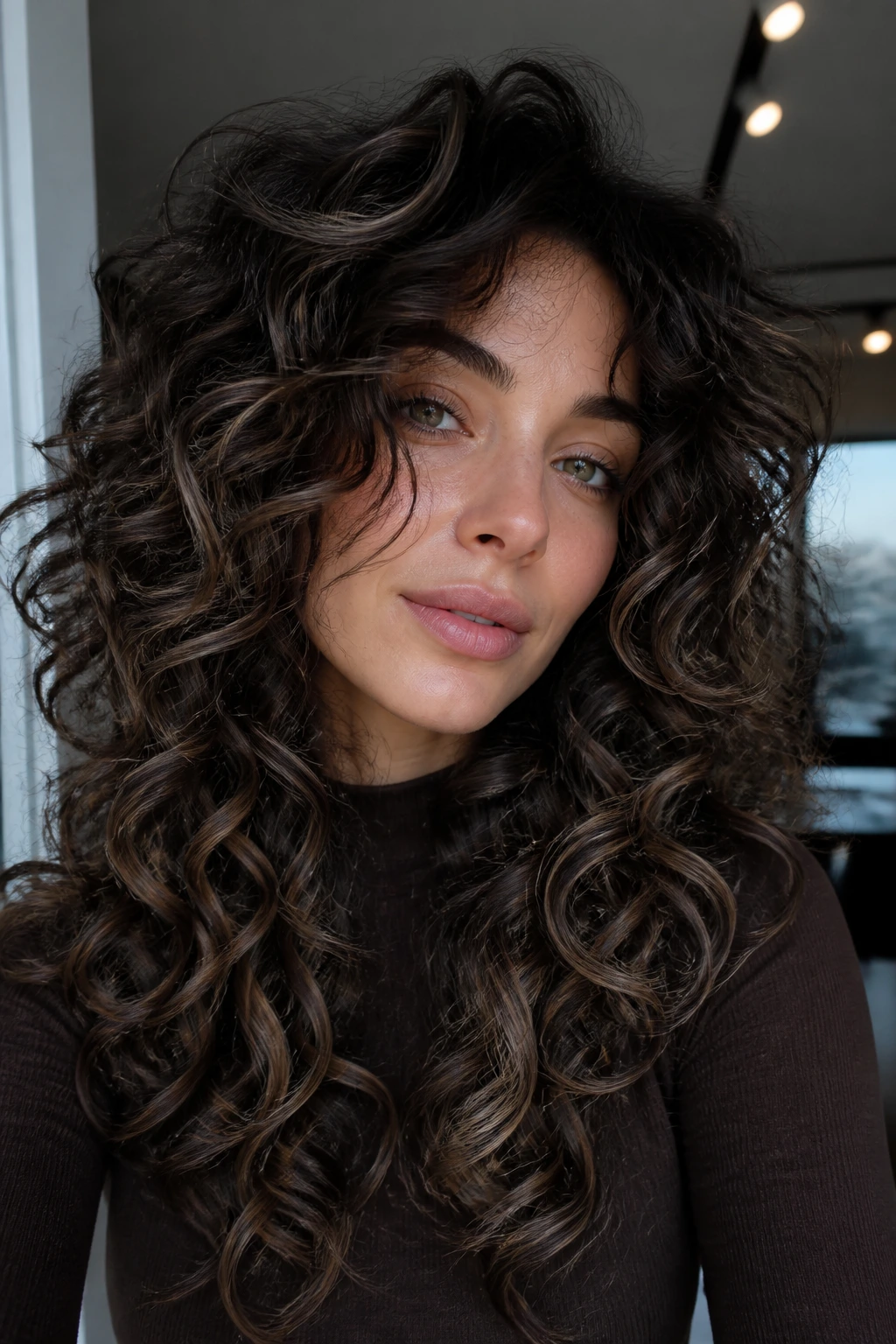
Mushroom brown can be tricky on curls if the tone gets too muddy, but when it’s done right, the result is cool, soft, and a little smoky. The ribbons should live in the taupe-brown range, not gray for the sake of gray. Dark hair needs enough depth to keep the finish from looking dusty.
This is a good option for people who hate warmth in their hair. It reads modern without shouting. On dark curls, the cool tone shows best when placed around the outer bend of the ringlet and through the canopy, where the light naturally lands.
If your skin tone runs cool or muted, this can be one of the prettiest brunette balayage choices on the list. Keep the gloss neutral, not silver, and the curls will hold their shape better.
What to Watch For
- Too much ash can flatten the curl pattern.
- A muddy gloss can erase the dimension.
- Better to stay smoky than chalky.
9. Toffee Spiral Lights
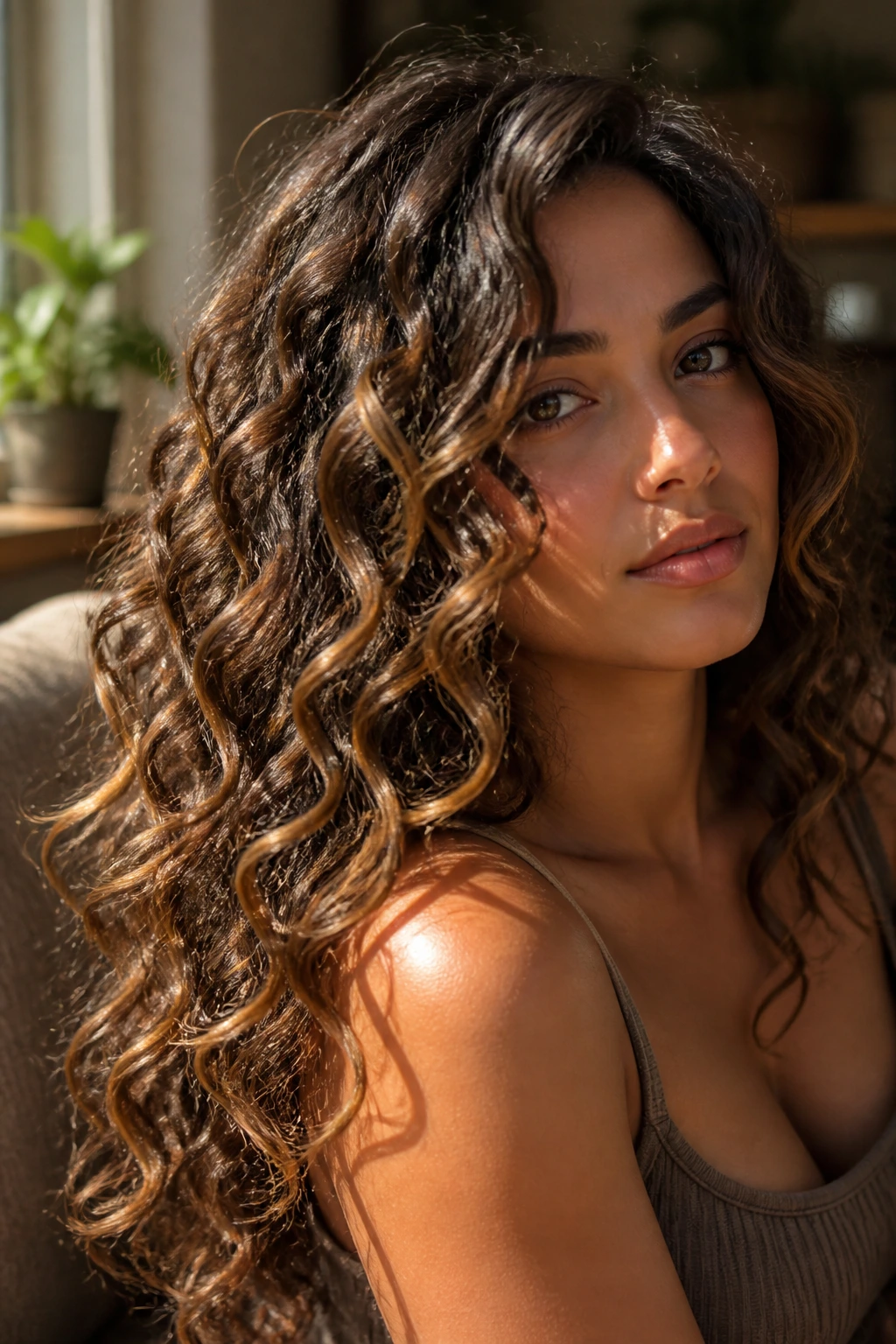
Toffee spiral lights are a little brighter and a little more obvious than the softer brown looks, which makes them good for loose curls and big waves. The color should land in wider painted pieces, not tiny micro-strands. On curly hair, bigger placement often reads cleaner.
Toffee is warm, but it still sits inside the brunette family. That matters. You get a lift in brightness without jumping all the way to blonde. The result feels sun-warmed rather than bleached.
I like this on long hair because the spiral pattern gives the color room to stretch. The ends can be a touch lighter than the upper half, but not so much that the contrast turns chunky. Think ribbons, not stripes.
10. Bronze Tip Sweep
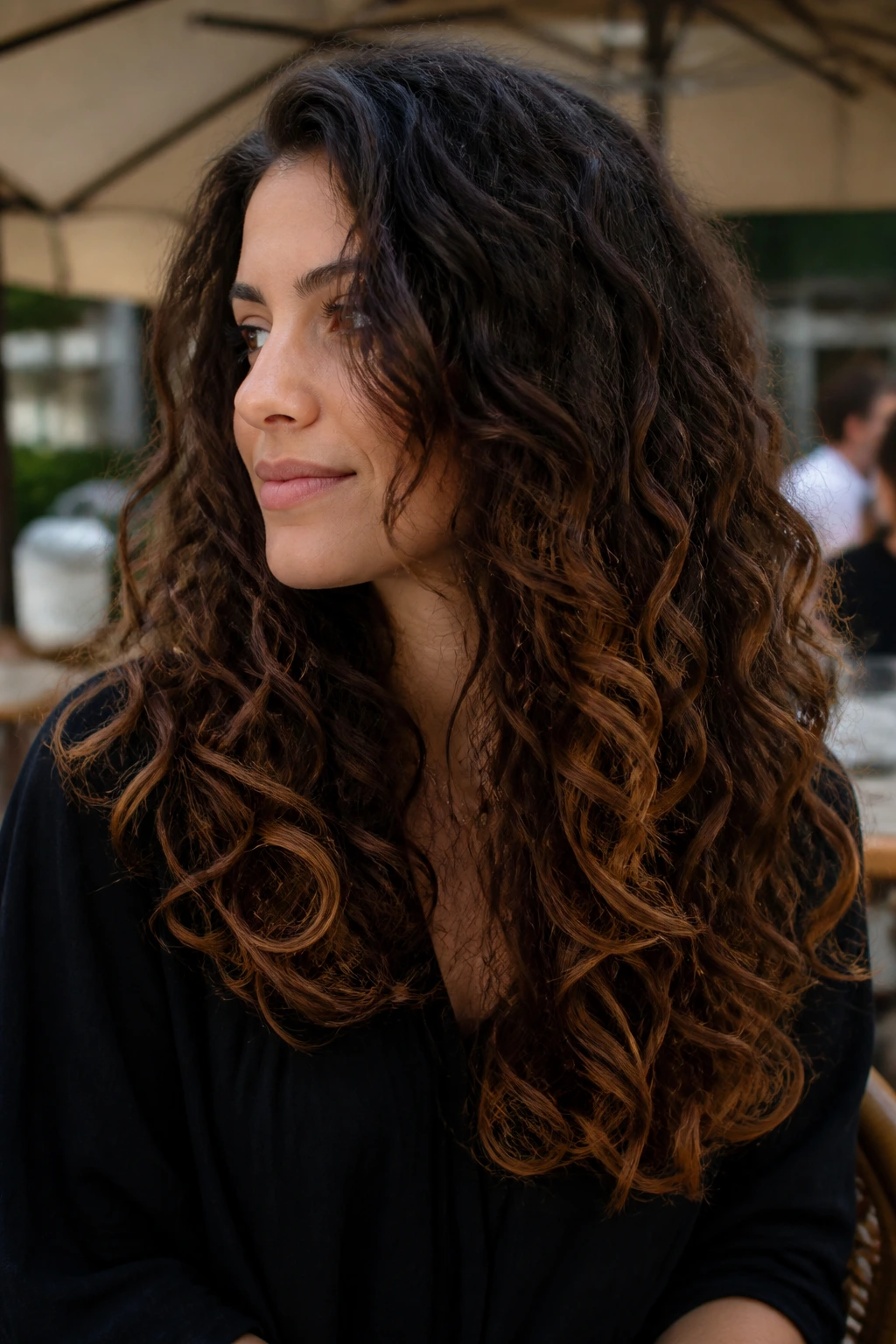
Bronze tip sweep looks best when the lightest color lives at the ends and the rest of the curl stays rooted in deep brunette. The bronze tone gives the tips a burnished shine that catches the eye without taking over the whole head.
This works especially well on longer curls because the ends have enough length to show the color shift. On shorter cuts, the bronze can disappear into the overall shape. If you want the finish to stand out, ask for the sweep to begin just below the mid-length, not at the very bottom inch.
The feel here is polished, not beachy. More molten, less sun-kissed. That’s a nice change if you’re tired of caramel everything.
11. Walnut Whisper Balayage
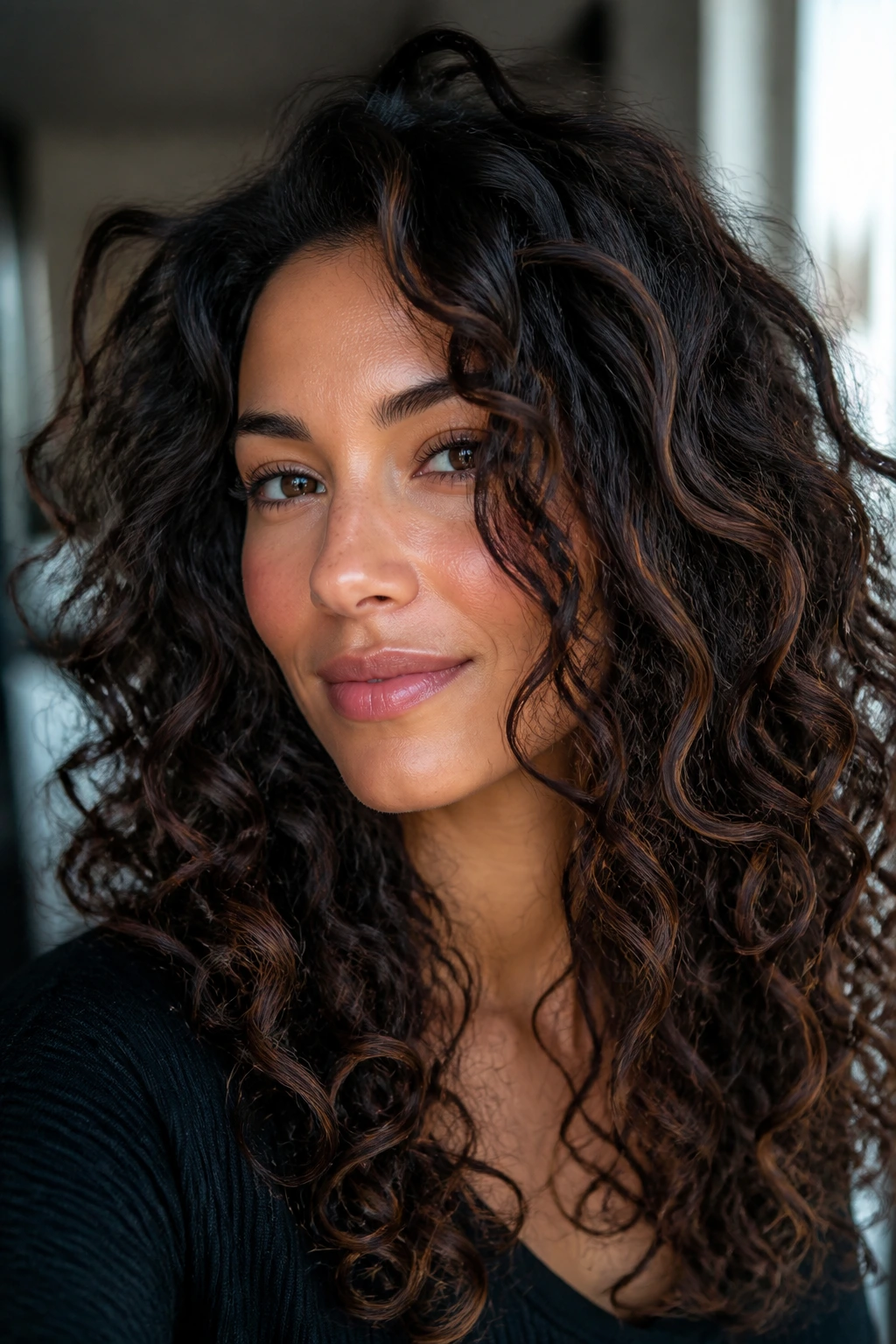
Walnut whisper balayage is the low-key option for people who want dimension but don’t want anyone to shout about it. The lighter pieces stay only one or two levels above the base, which keeps the curls rich and full. On dark hair, that subtle lift can still be enough if the placement is smart.
A look like this is ideal for workplaces that lean conservative or for anyone who wants color that still makes sense when the curls are pulled into a clip. The best effect happens in natural light. Indoors, it reads like healthy depth. Outside, the walnut pieces show as soft movement.
This is one of my favorites for tighter curl patterns because you don’t need much brightness to see the shape.
12. Golden Espresso Contour
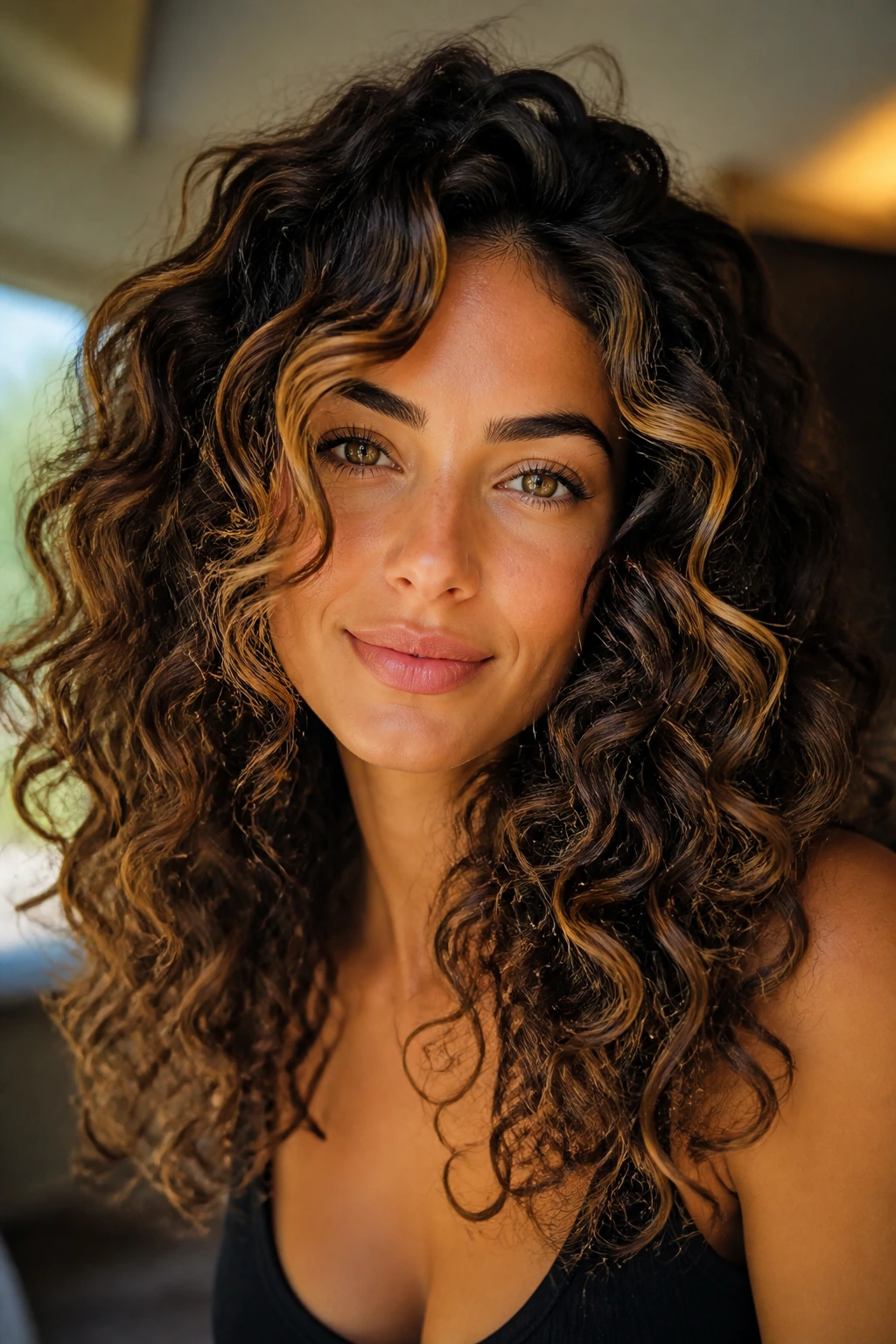
Golden espresso contour adds brightness to the front while keeping the rest of the head grounded in dark brown. The golden pieces should arc around the face and skim the top curls, almost like a frame built by sunlight. If you put the light pieces everywhere, you lose the contour and the face-framing effect.
This is a strong choice if you want your haircut to look more sculpted. The darker root and sides hold the perimeter, while the golden front brings light where people look first. It’s flattering on long layers and on curly lobs that need a bit of lift.
The trick is to keep the gold warm rather than yellow. Gold brown, not blonde. That’s the line.
13. Ash Brown Dimension
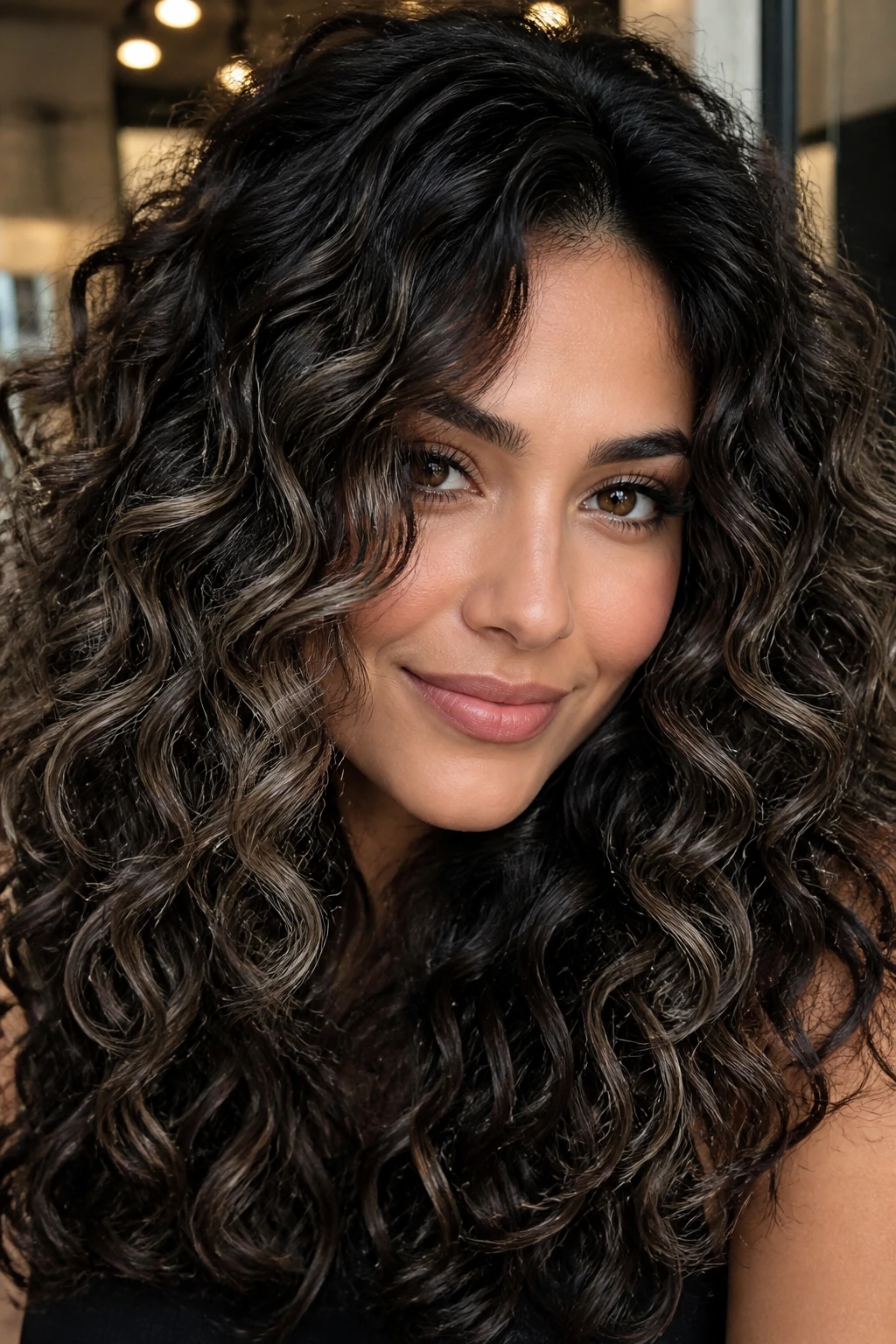
Ash brown dimension suits people who want a cooler brunette result without going slate or silver. The shade should still have brown in it. If it turns flat or gray, the curl pattern gets lost.
On dark curls, ash brown works best as a few well-placed ribbons instead of an all-over lightening job. Place them on the surface of the curl pattern and near the top layer. That keeps the base deep and gives the lighter strands a place to show.
This style looks especially sharp on dense, glossy curls that already have a lot of natural shine. The cool tone makes the shine read as sleek instead of warm.
14. Maple Glaze Ends
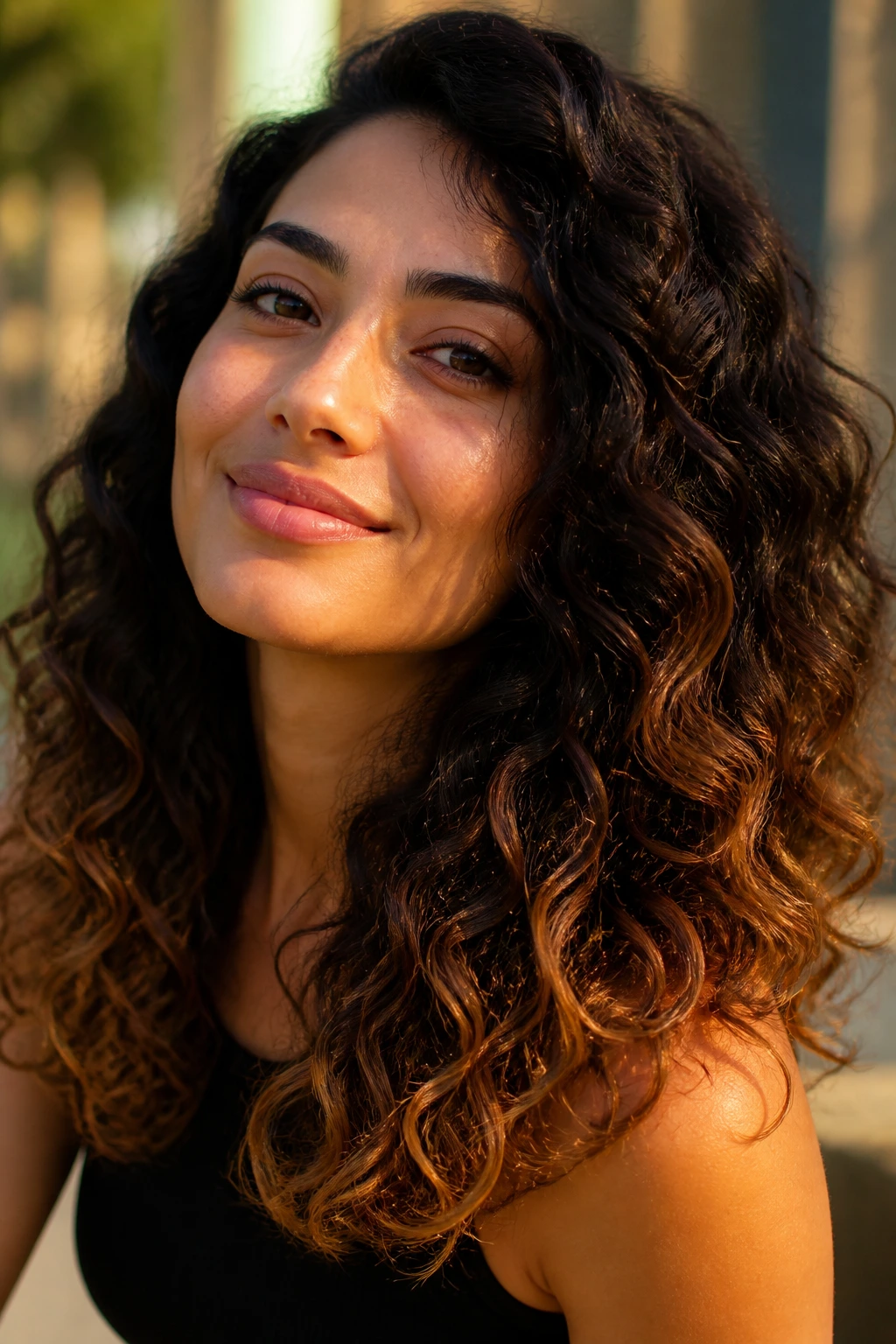
Maple glaze ends are warm, glossy, and a little sticky-looking in the best sense of the word. The color lands somewhere between amber and soft brown sugar. On curly hair, that warmth can make the ends look thicker and more hydrated than a pale highlight ever would.
The glaze should be concentrated on the lower third, with just a few faint pieces reaching higher. If the color climbs too high, it stops looking like a glaze and starts looking like a full balayage transformation. This version is softer.
It’s a good option for hair that needs a richer finish rather than a brighter one. Pair it with a rounded cut or loose layers, and the curls will sit in a way that shows off the tone.
15. Chestnut Lived-In Balayage
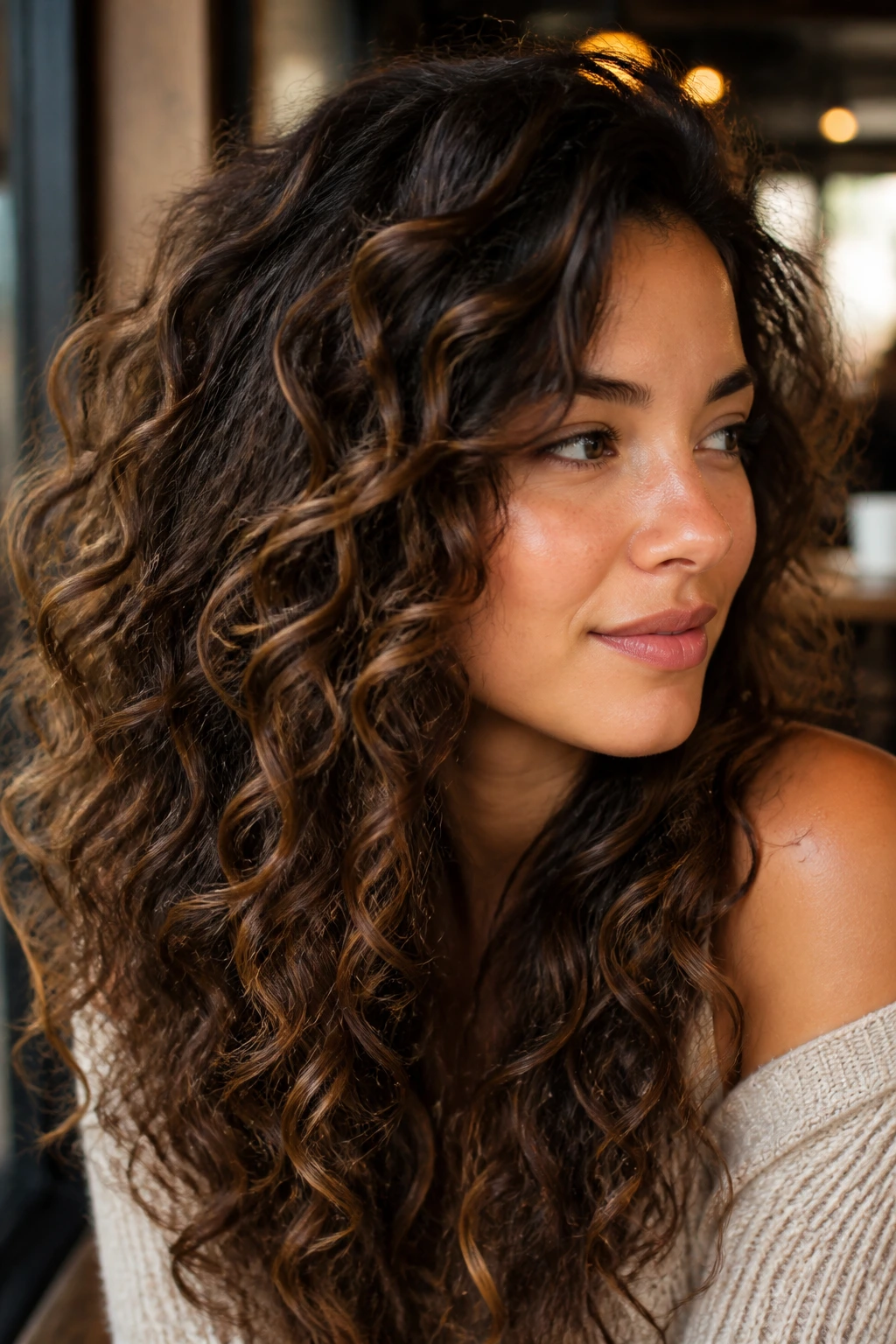
Chestnut lived-in balayage is the easiest middle ground in the whole set. It isn’t too warm, too cool, or too light. It just looks like your hair has a little more depth where the curls stack and a little more light where they break apart.
That makes it a strong long-term choice. The grow-out stays subtle, and the color still looks intentional after several weeks because the chestnut tone sits close to a natural brunette range. It’s the kind of color that doesn’t argue with a busy schedule.
If you want a brunette balayage that works with a curly shag, a butterfly cut, or a long rounded shape, this is one to keep on the shortlist.
16. Cocoa Money Piece
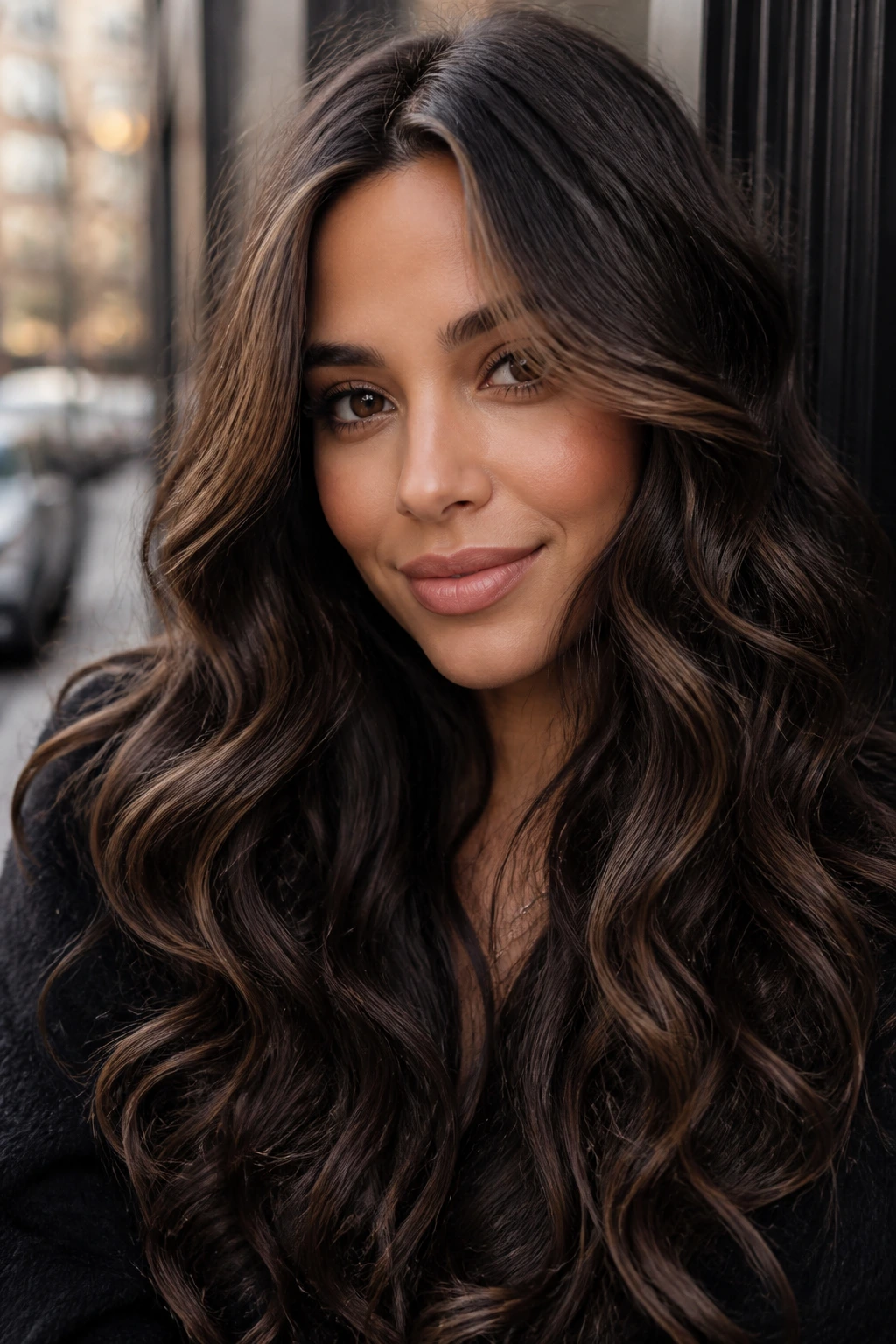
The money piece gets a bad reputation when it’s too loud. Cocoa money piece avoids that problem by staying inside the brunette family and giving the front only a slightly lighter cocoa sweep. The effect is clean, not chunky.
It’s especially useful if the rest of your hair is very dark and you want one place where the color speaks clearly. Around the face, the lighter cocoa pieces lift the whole style without changing the overall depth. The contrast is enough to define the curls near the cheekbones and brow.
This works well with side parts and middle parts alike. On a middle part, the symmetry looks sharp. On a side part, the brighter side does a little more of the talking.
17. Smoky Taupe Curl Paint
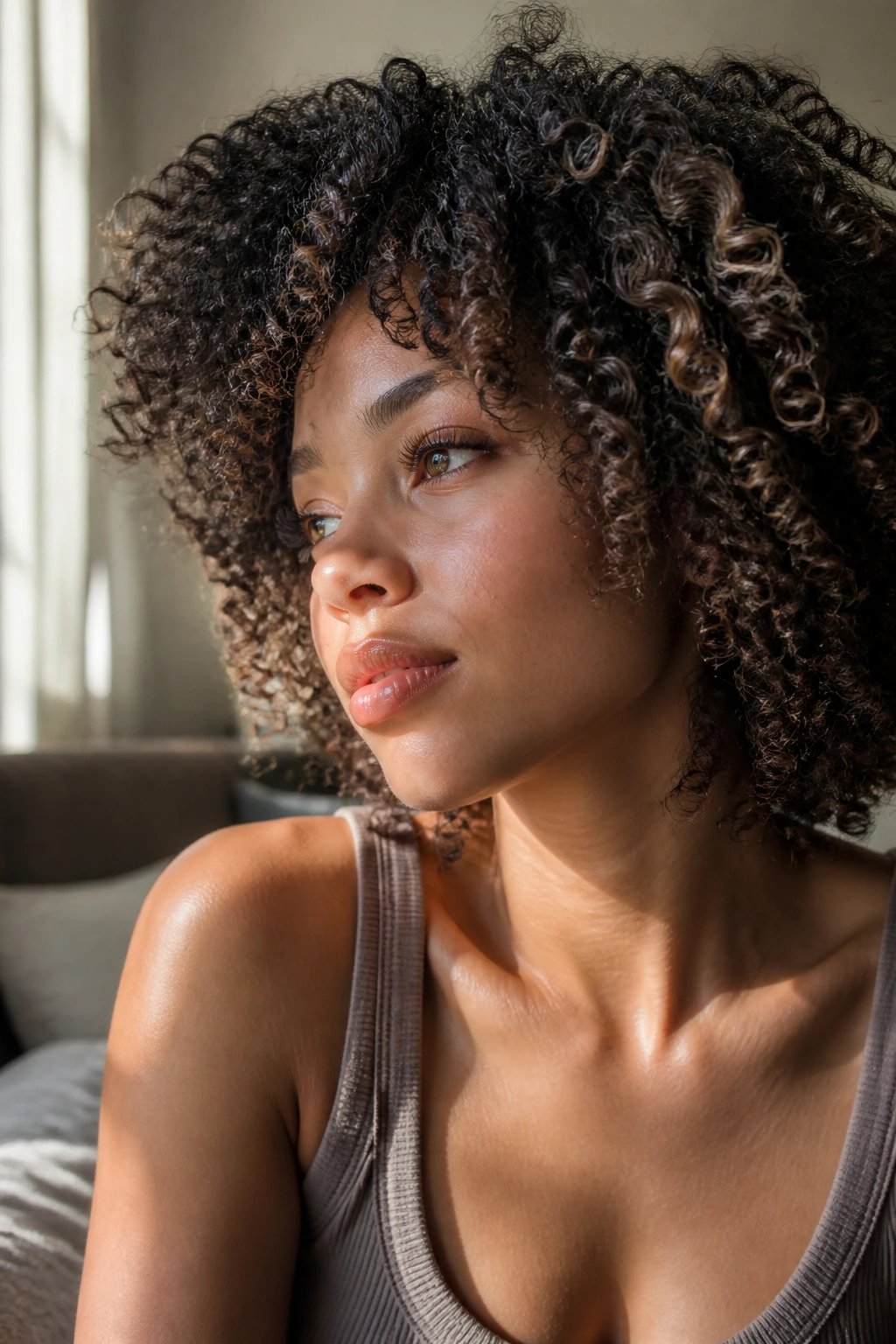
Smoky taupe curl paint brings a cool, muted finish that looks refined on dark curls. The taupe pieces should be soft enough that they still look brown in shade, then slightly smoky in sun. That shift is what gives the style interest.
This is a good choice for people who dislike obvious warmth and want a brown that feels a little urban, a little editorial. On coily hair, the taupe reads best when it’s painted on the outer surface of the curl cluster rather than buried inside it.
The finish is subtle from a distance. Up close, the depth shows. That’s a nice balance if you like hair that rewards a second look.
18. Auburn-Brown Curl Ribbons
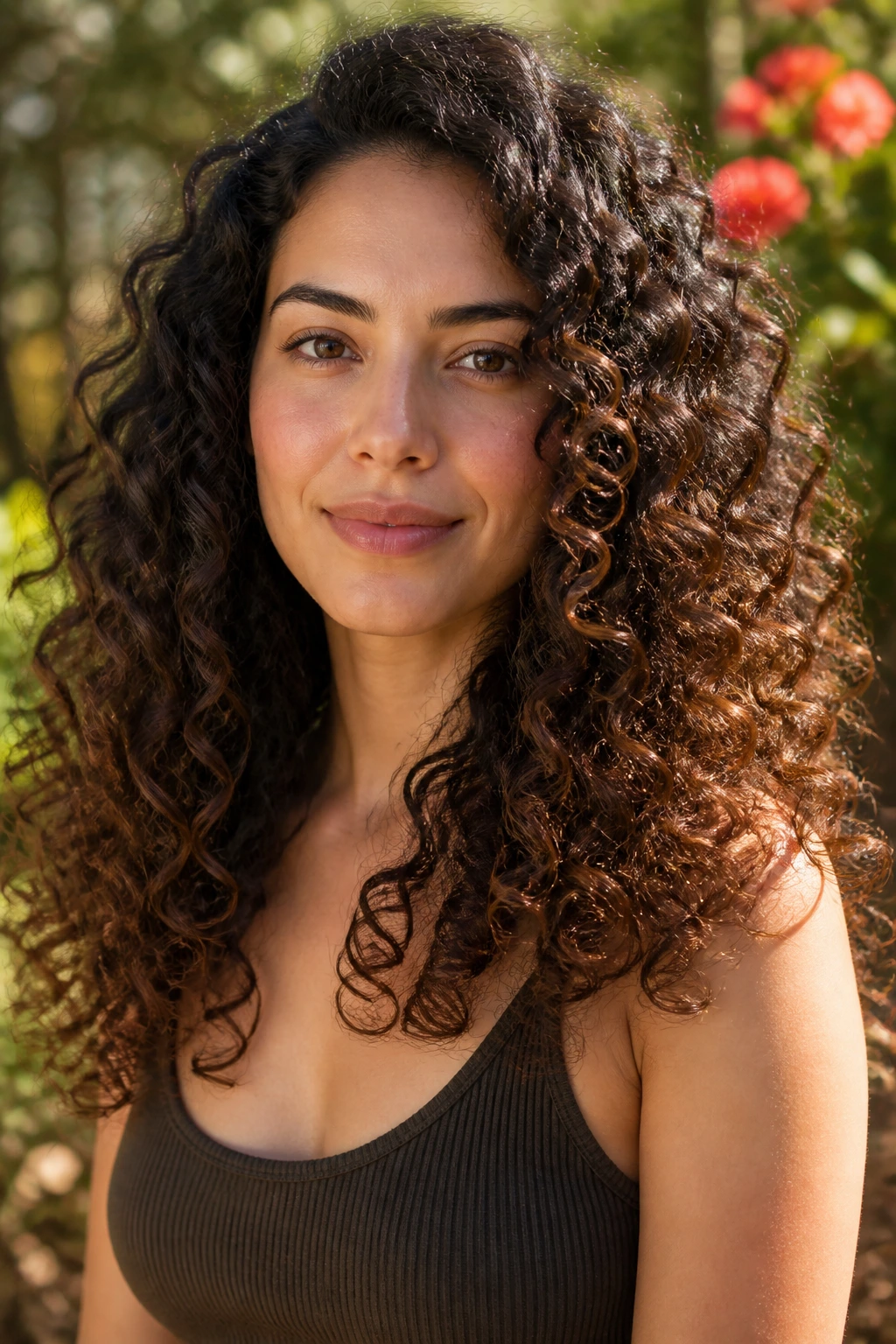
Auburn-brown ribbons have a warm, rich pull that makes dark curls look dense and glossy. Auburn adds a red-brown note, but it should stay brown enough that the curls still feel grounded. Too much red and the look can drift into copper territory.
This is a flattering choice for anyone with warm or neutral skin and dark eyes. The red-brown shimmer picks up in sunlight and under warm indoor lamps, which makes it a good pick for people who want their color to look alive without going bright.
On layered curls, auburn pieces show most on the outer bends and the ends. That’s where the light catches first, and that’s where the color earns its keep.
19. Almond Cream Highlights
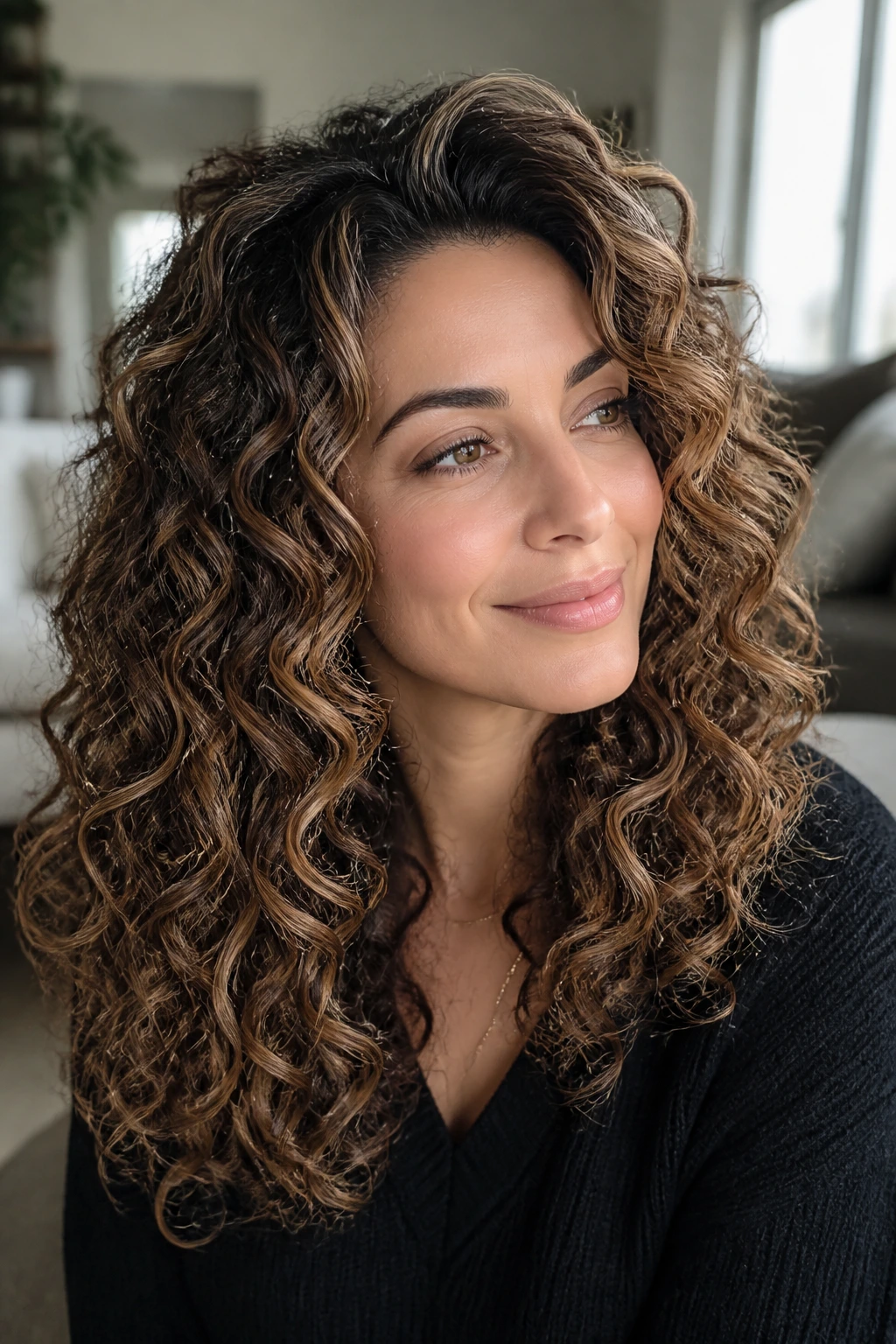
Almond cream highlights sound lighter than they usually look in real life. That’s the nice part. The tone should still sit inside brunette territory, just a little softer and creamier than caramel. On dark curls, a few well-placed pieces can make the whole shape seem more open.
This look is best when you want lightness without obvious blonding. It suits long spirals, loose 3A curls, and fuller shapes that need a bit of lift at the top. If the pieces are too thin, the effect disappears. If they’re too wide, you lose the softness.
Almond cream is one of the more wearable choices if you’re trying balayage for the first time.
20. Rooted Bronde Glow
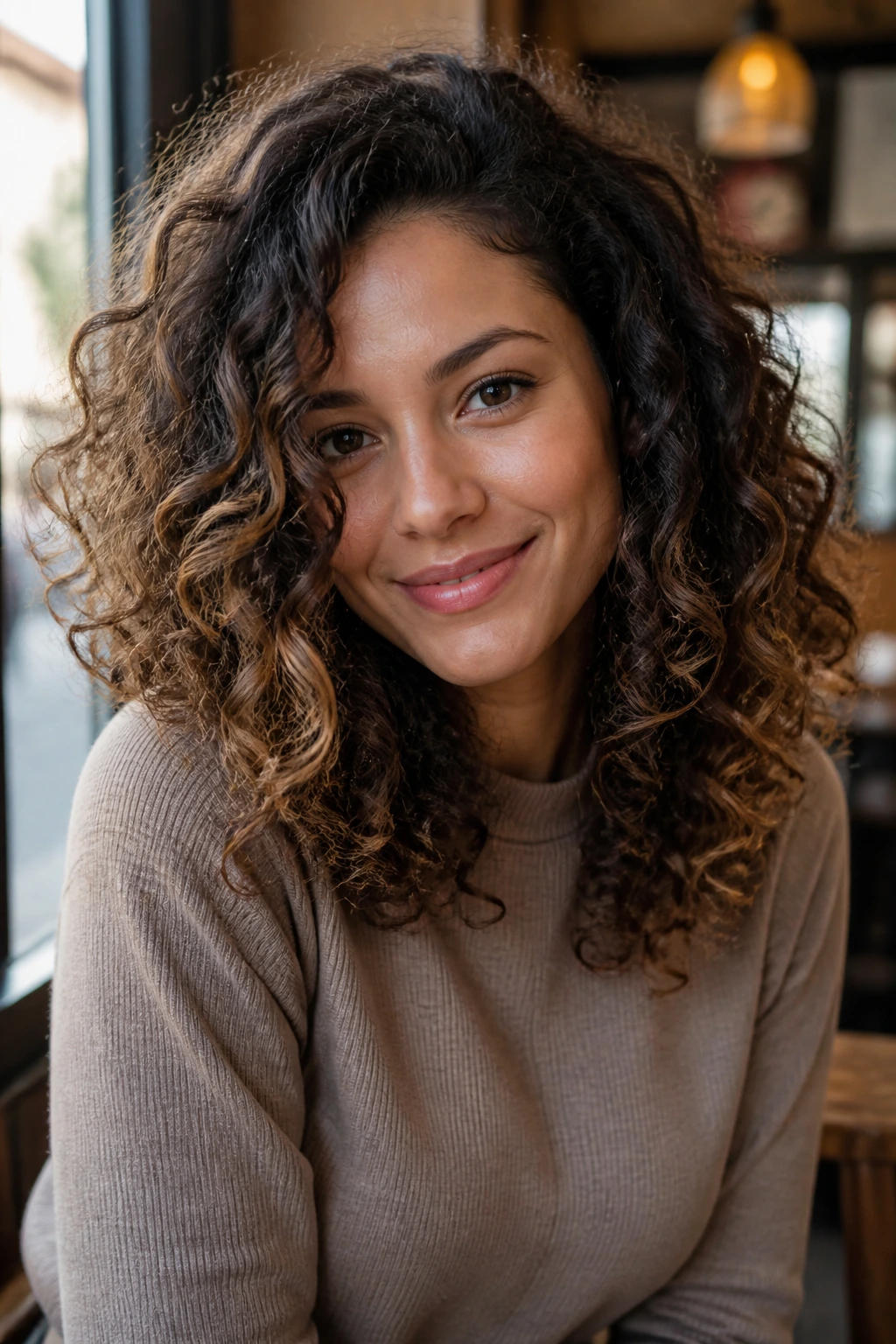
Rooted bronde glow gives you the middle road between brunette and blonde, but it still belongs here because the root stays deep and the overall feel remains dark. The bronde should be soft, not sandy. Think of it as a glow at the edges, not a full lift.
This is the look for someone who wants the biggest contrast in the collection without going full blonde. The curls need some length and some shape so the bronde can show in the bend of the spiral. On very short hair, it can turn busy.
Keep the root shadow rich. That’s the part that stops the color from looking stripey.
21. Mahogany Shadow Lights
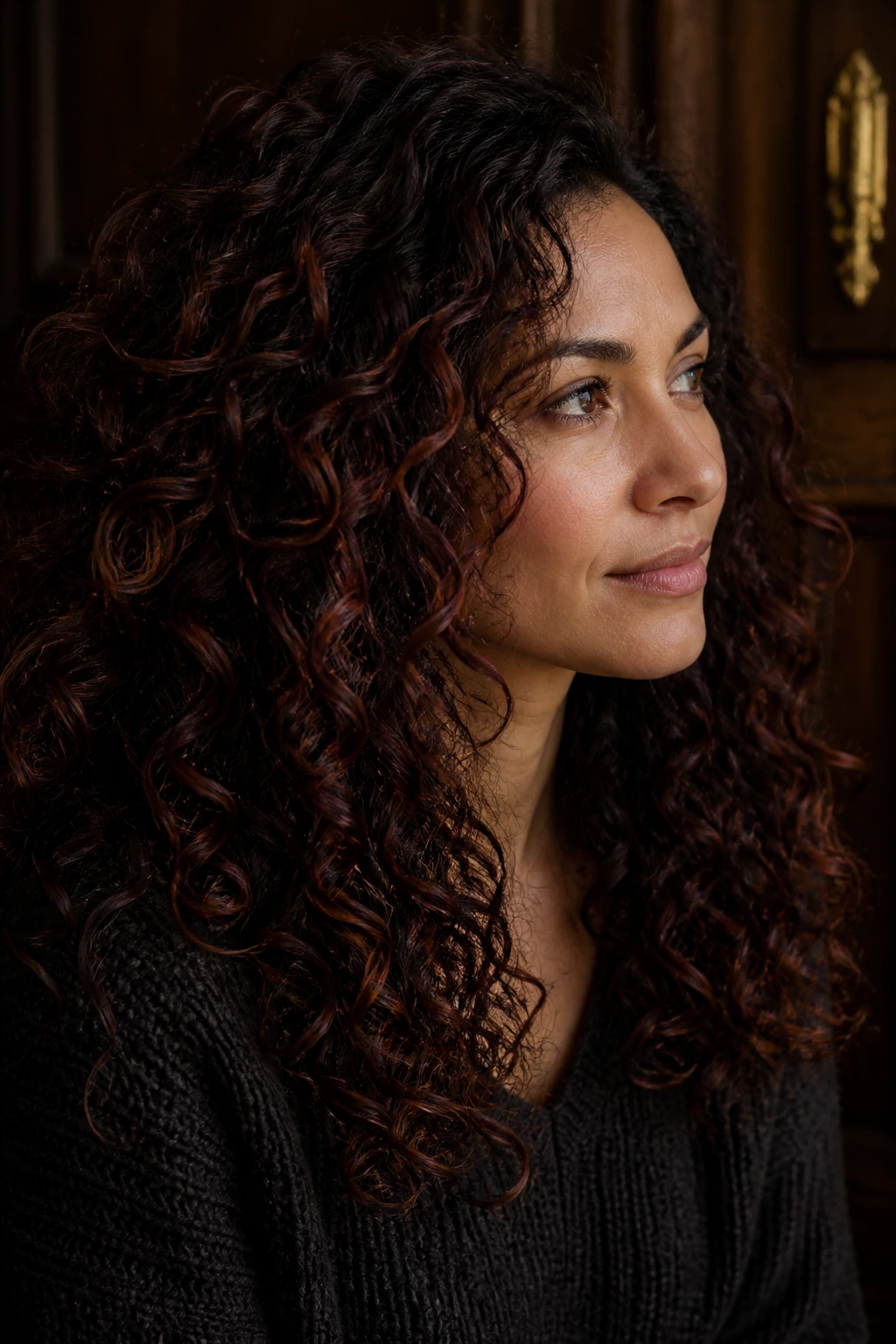
Mahogany shadow lights are all about depth. The mahogany tone brings a red-brown richness that sits well under dark curls, while the shadow keeps the base from going flat. It’s one of the prettiest options if you like hair that feels lush rather than bright.
This shade works beautifully on thick, coarse curls because the red-brown light catches in the texture. On finer curls, it still works, but the placement should stay lighter and closer to the top layer.
If you want something that feels a little formal, a little dramatic, and not at all beachy, mahogany is the one to keep in mind.
22. Latte Swirl Balayage
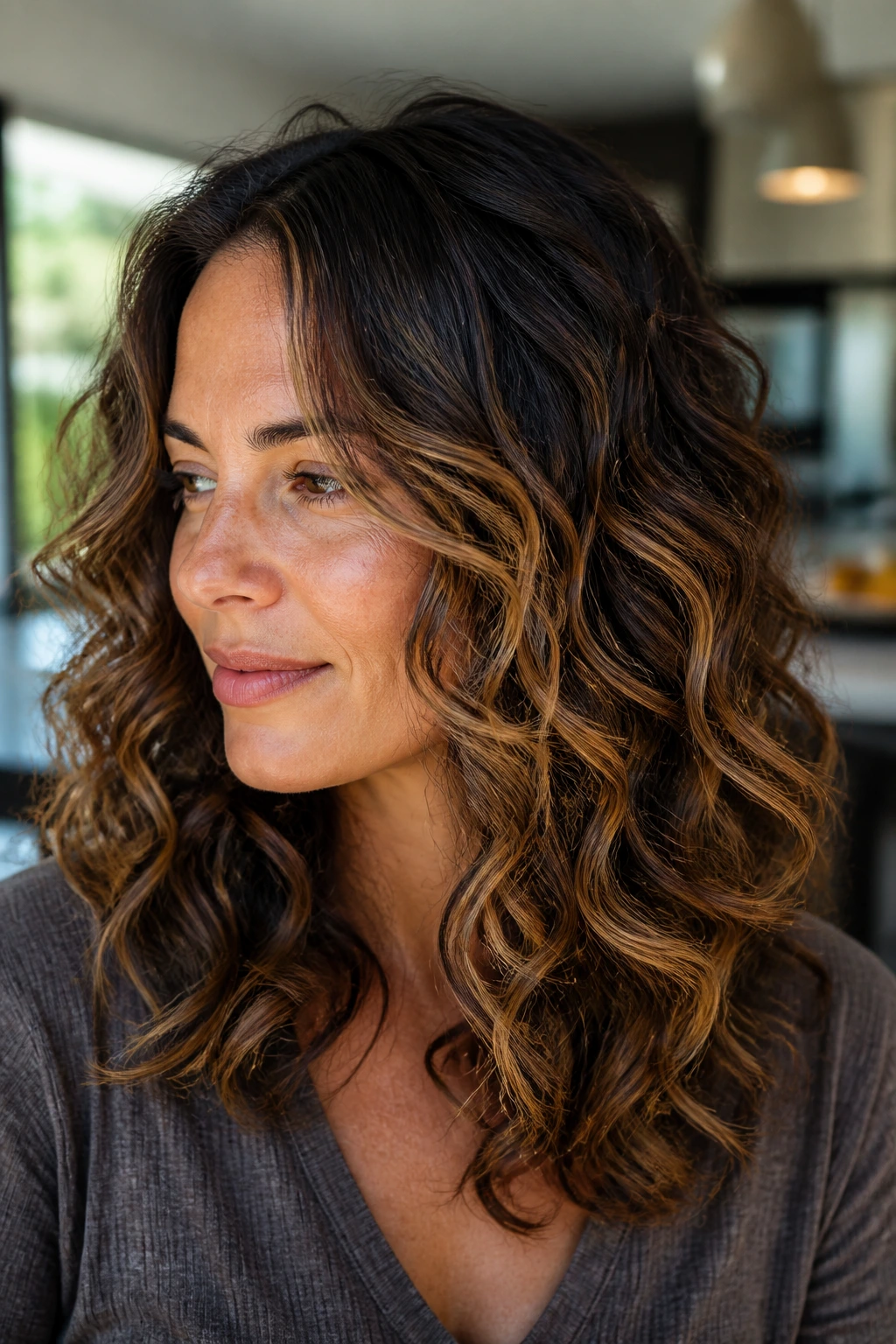
Latte swirl balayage softens dark hair with creamy brown pieces that look almost frothy in a good curl pattern. The key is not to push the color too pale. A latte swirl should still feel like brunette hair with movement, not a blonde idea wearing brown lipstick.
The shape matters here. On a curly cut with lots of internal layers, the swirl effect can show in each bend. On a one-length shape, the color tends to sit more heavily and lose some of the lift.
This is one of the easiest ways to make dark curls look lighter without losing the base that gives them weight.
23. Sandalwood Soft Lights
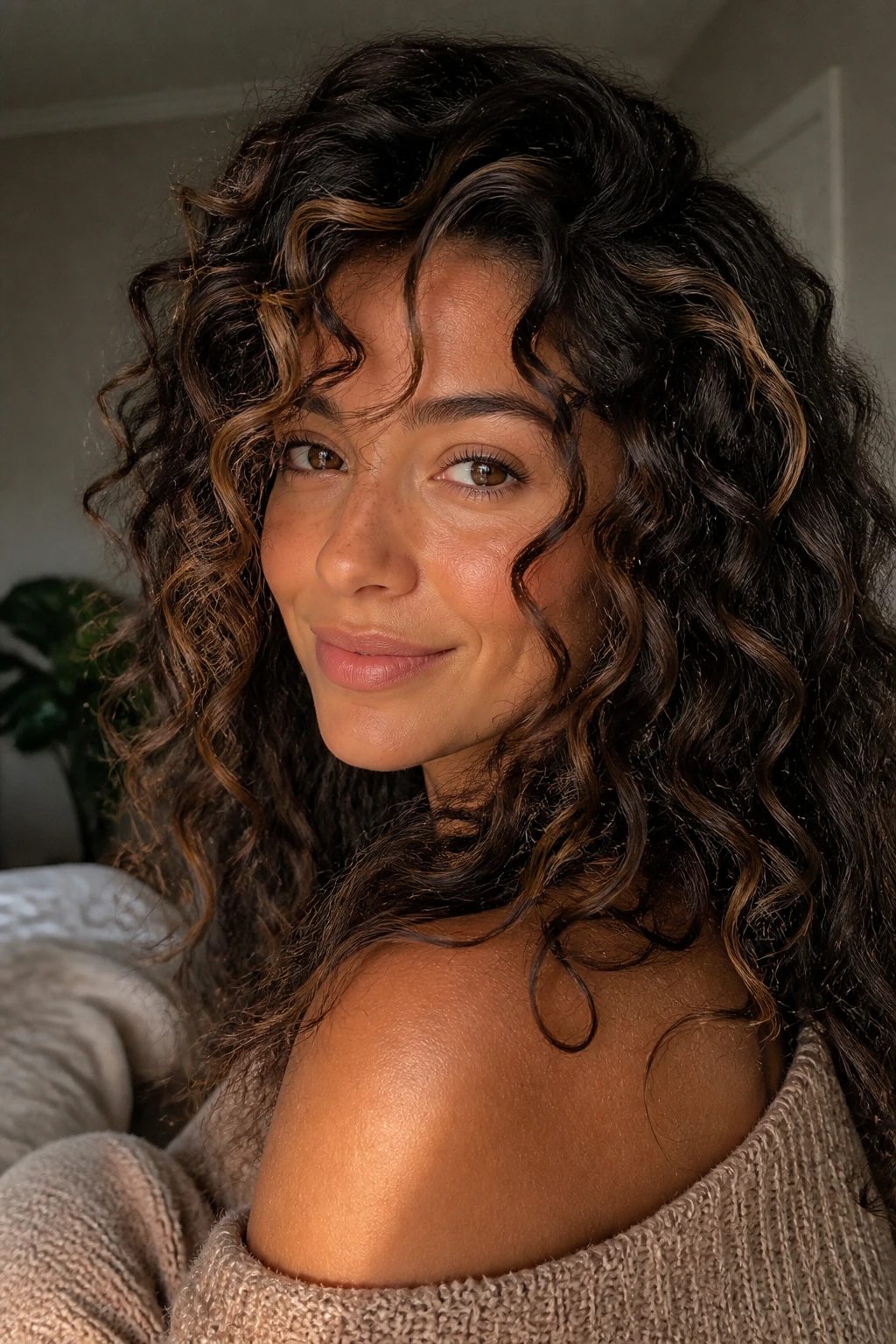
Sandalwood soft lights are warm, muted, and a little earthy. The tone sits between brown and beige, which makes it ideal for dark curls that need a gentle change rather than a dramatic lift. On the right hair, it looks natural enough to pass for sun-softened brunette.
This is a strong choice for thick hair because the softer tone keeps the shape from feeling too heavy. A few pieces across the canopy and around the face are usually enough. If you spread the light too far underneath, you won’t see it unless the curls are blown apart.
It’s one of those color choices that gets better after a few washes, once the gloss settles.
24. Copper-Brown Pop Pieces
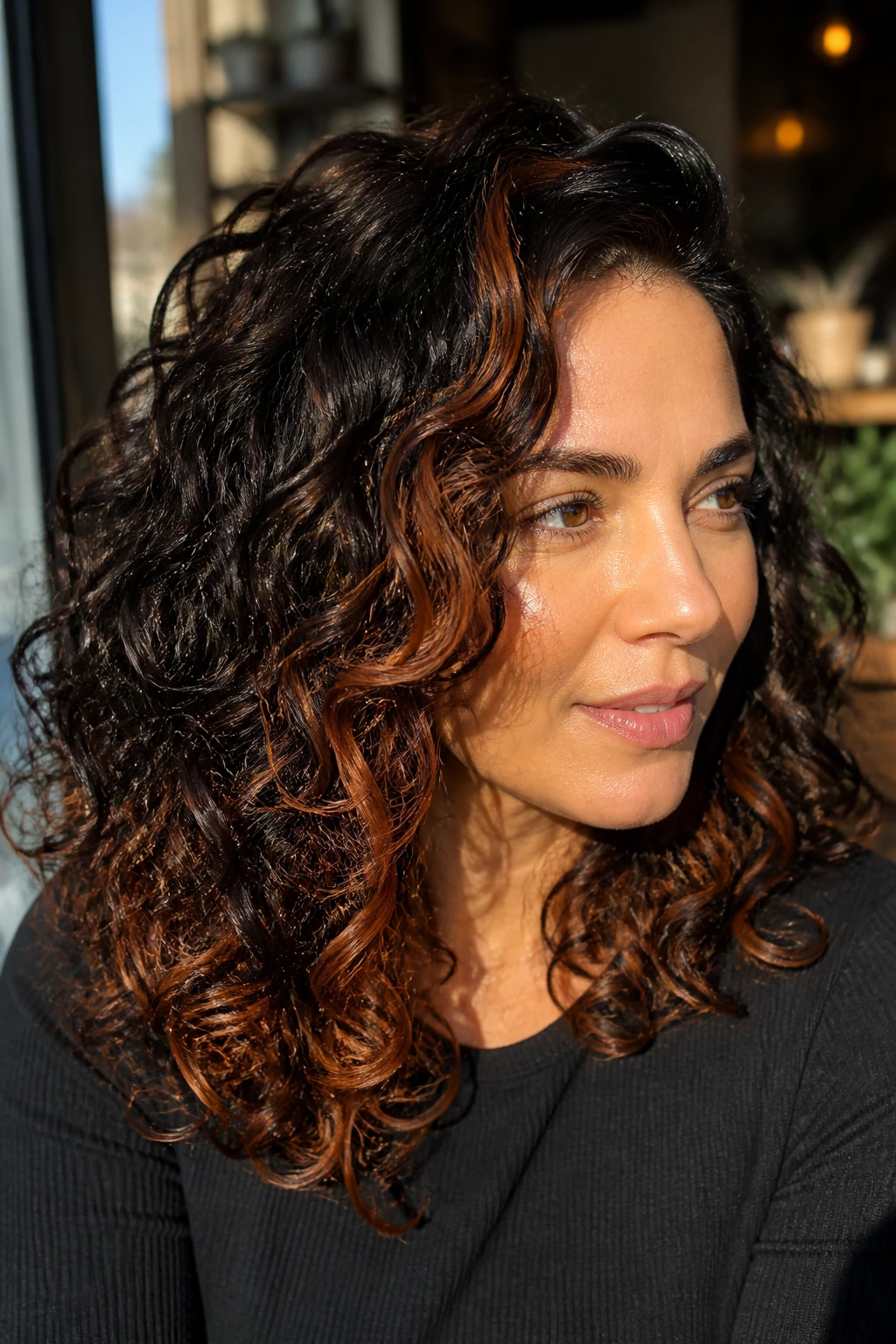
Copper-brown pop pieces are for people who want a little drama without crossing into bright copper. The pieces should be concentrated in a few visible areas — usually the front, the crown, or the outermost curls near the ends. That way, the copper-brown reads as an accent instead of a full-time commitment.
This is a smart pick if your dark curls need a little energy. Copper brown catches the light fast, so a small amount goes a long way. The finish feels playful, but still grounded enough for daily wear.
If you straighten your hair sometimes, these pieces show up differently there too. That can be a nice bonus, though on curls they’re at their best.
25. Dark Roast with Caramel Flecks
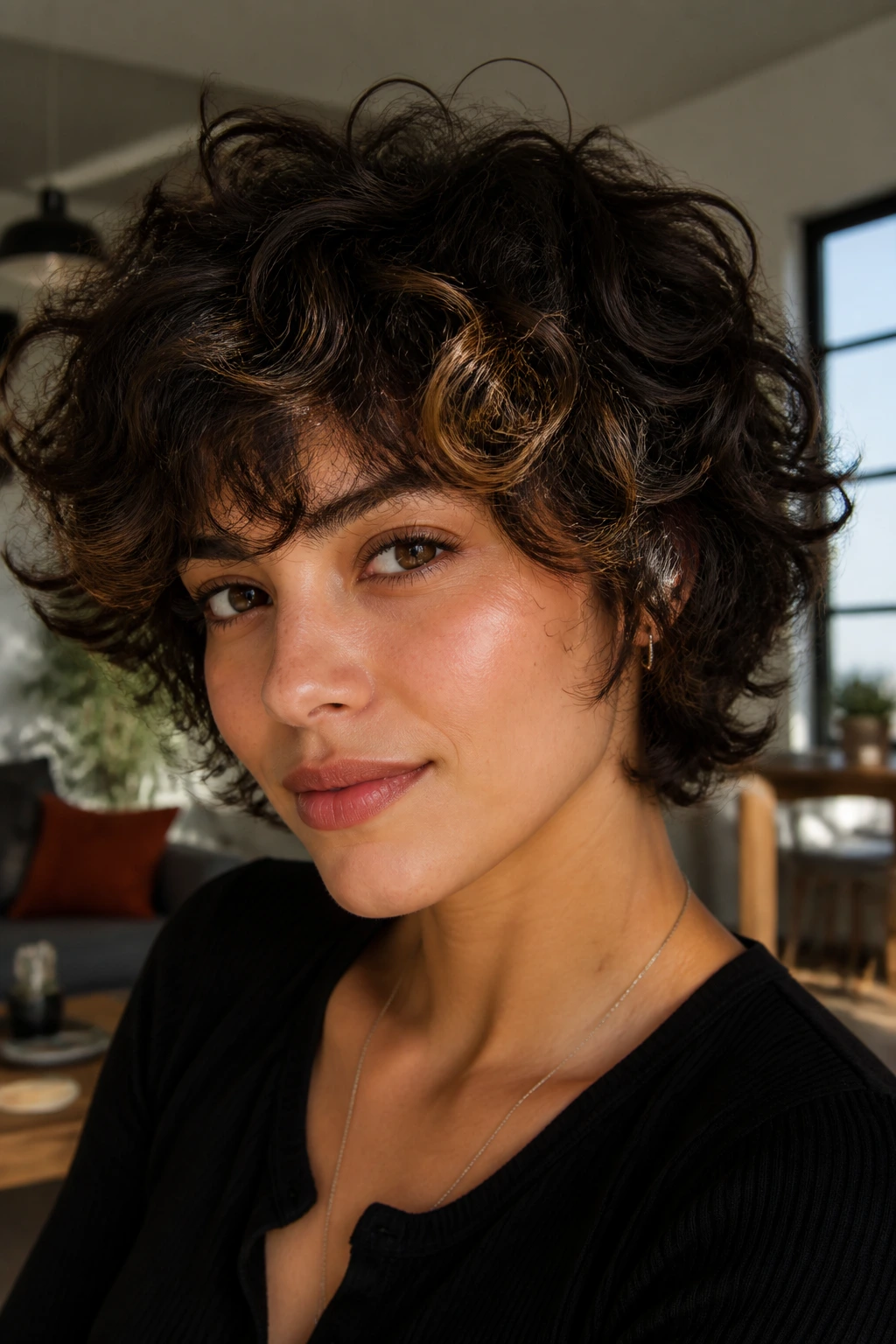
Dark roast with caramel flecks is the right name for a look that stays mostly deep and only opens up in a few tiny places. It’s especially good on short curls, layered shags, and dense hair that can’t carry a lot of brightness without looking busy.
The caramel should be used almost like punctuation. A few flecks around the front, a few along the top layer, and maybe a touch on the outer ends. That’s enough. Any more, and the style starts to lose its dark richness.
This one is practical. It hides grow-out, works on busy wash routines, and still gives the curls a little flicker when you move.
26. Nutmeg Frame and Ends
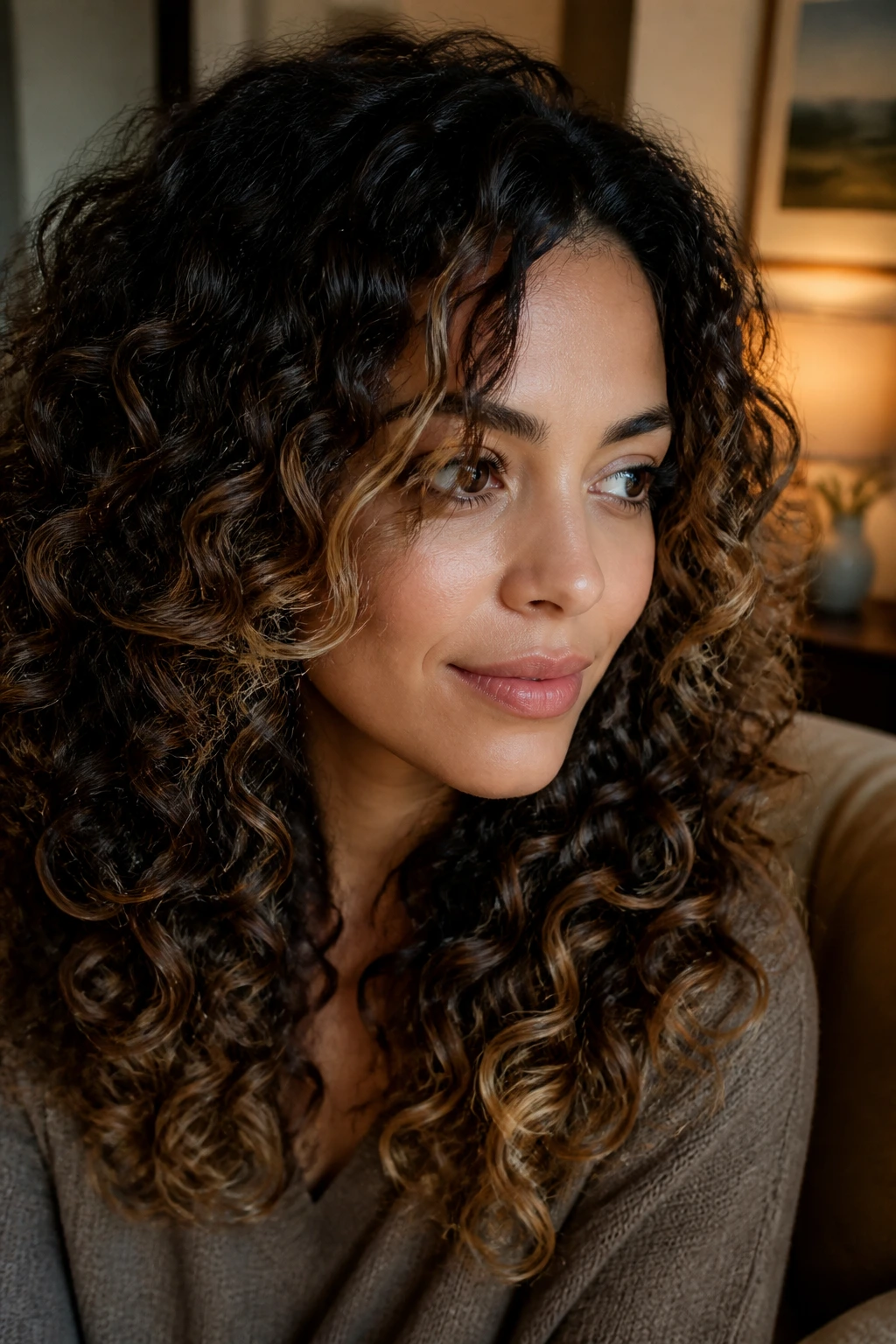
Nutmeg frame and ends gives the face and the bottom of the hair a warmer, spiced finish. The shade lands in that middle-brown zone with enough warmth to stand out, but not enough to pull orange. On curly hair, the look can be cozy and a little textured at once.
I like this idea for people with medium-to-dark brown bases who want a change that won’t look loud after one wash. The framing brightens the face, while the ends keep the shape from feeling heavy. A rounded cut or a curly wolf cut makes the most of it.
It’s a good reminder that balayage doesn’t have to be blonde to be noticeable. Brown can carry the whole thing.
27. Walnut and Honey Dip Dye
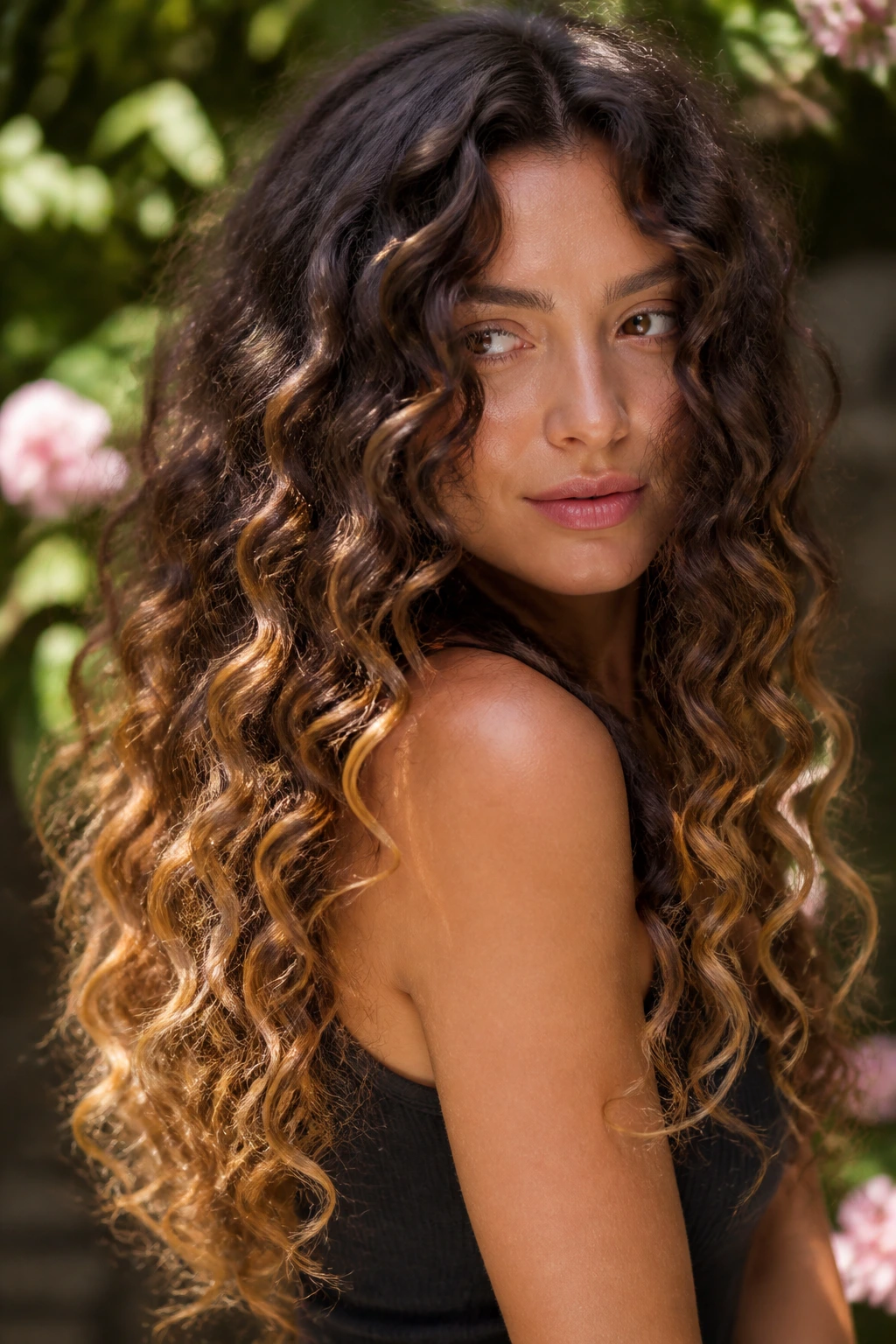
Walnut and honey dip dye leans more obvious than the softer looks above, but it can be pretty on long curls if the transition is done with care. Keep the walnut tone at the root and mid-length, then let the honey appear in the lower portion where the hair naturally thins out and light hits faster.
The dip-dye feel works best when the line is blurred, not sharp. On curly hair, the spiral will soften the shift on its own, which helps a lot. You still want the colors to be close enough that the ends feel like an extension of the base, not a separate piece.
This one is for someone who wants to see the color from the back as well as the front.
28. Deep Mocha with Face Framing
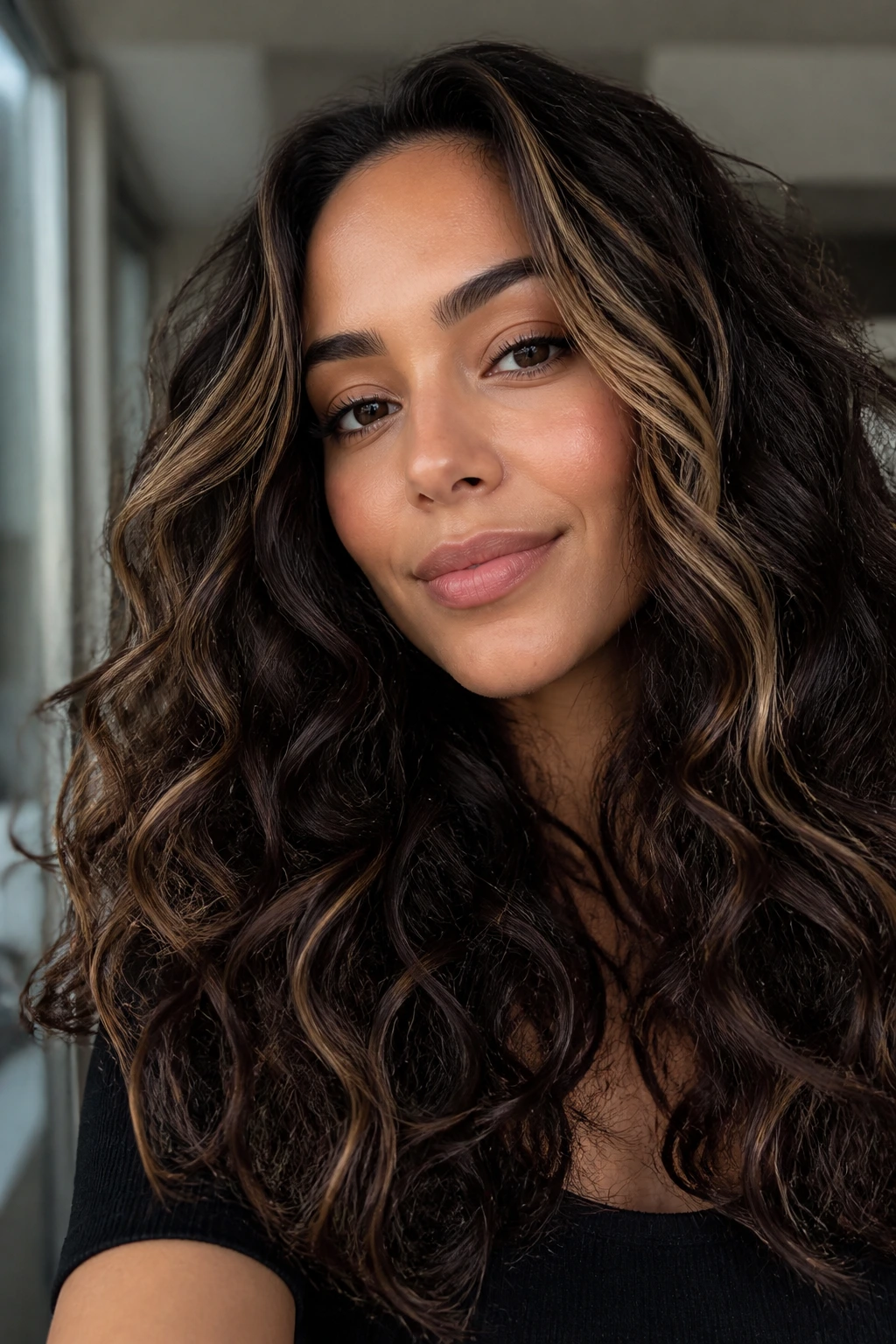
Deep mocha with face framing is the safe, polished choice that still looks styled. Most of the hair stays close to the natural brunette range, while the front pieces get a touch more light so the curls around the face don’t disappear into shadow.
The benefit is balance. You keep the richness of the dark base, but the front opens up the face shape. On curly hair, that little bit of brightness can make a surprisingly big difference because the front curls sit near your eyes and cheekbones.
If you work in a place that prefers subtle color, this is one of the most wearable brunettes you can ask for.
29. Brunette Babylight Cloud
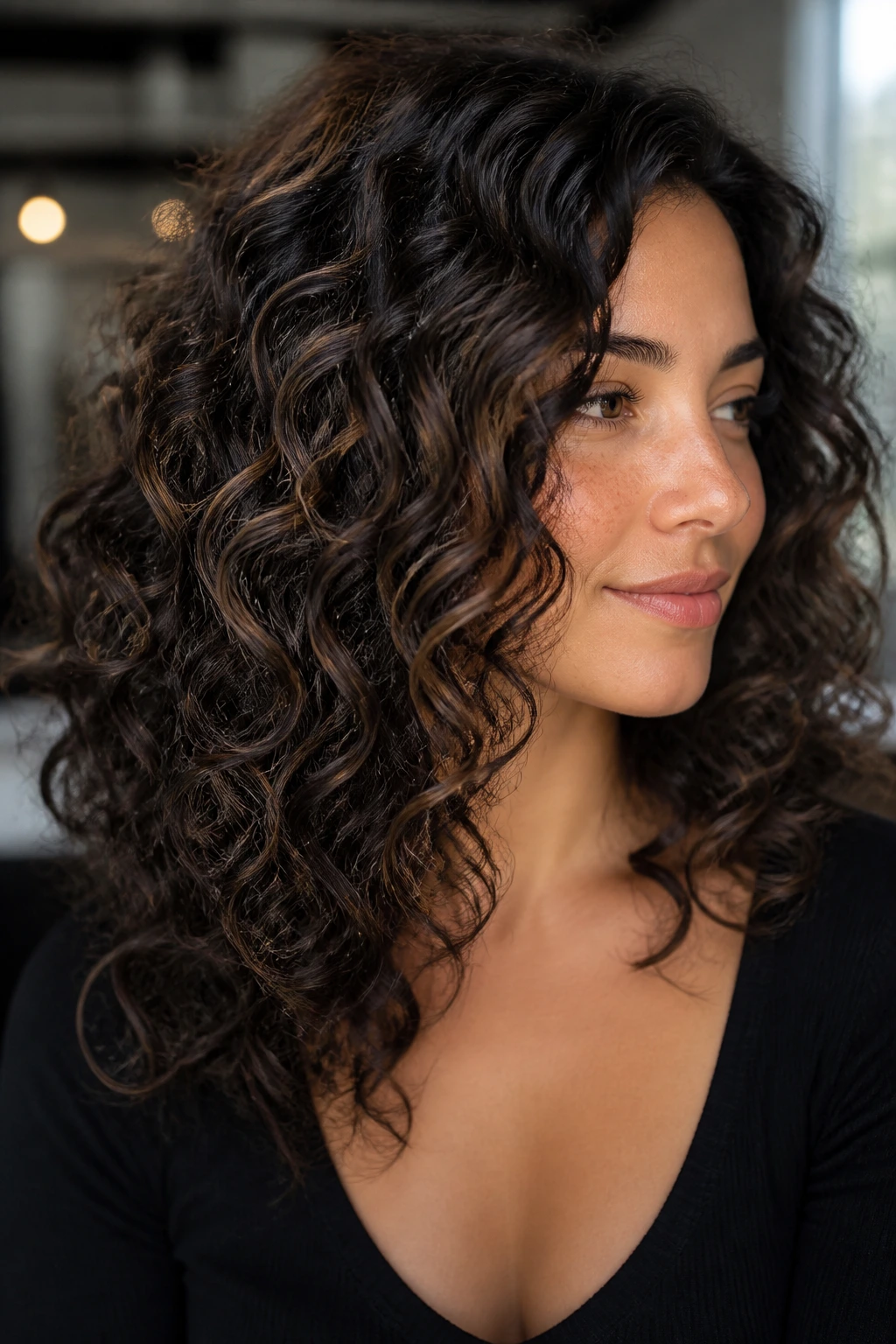
Brunette babylight cloud is the softest, most delicate option in the set. The lighter pieces are very fine, almost mist-like, and they sit throughout the curls rather than in obvious ribbons. On dense dark curls, that can create a cloud of dimension that shows up as shine more than color blocks.
This look takes patience from the stylist and good aftercare from you. The payoff is a finish that looks expensive in a very quiet way. It’s especially nice if you don’t like big contrast and want the color to look blended from every angle.
A gloss helps this one more than almost any other style here. Without it, the fine pieces can disappear.
30. Velvet Brown Multitone Balayage
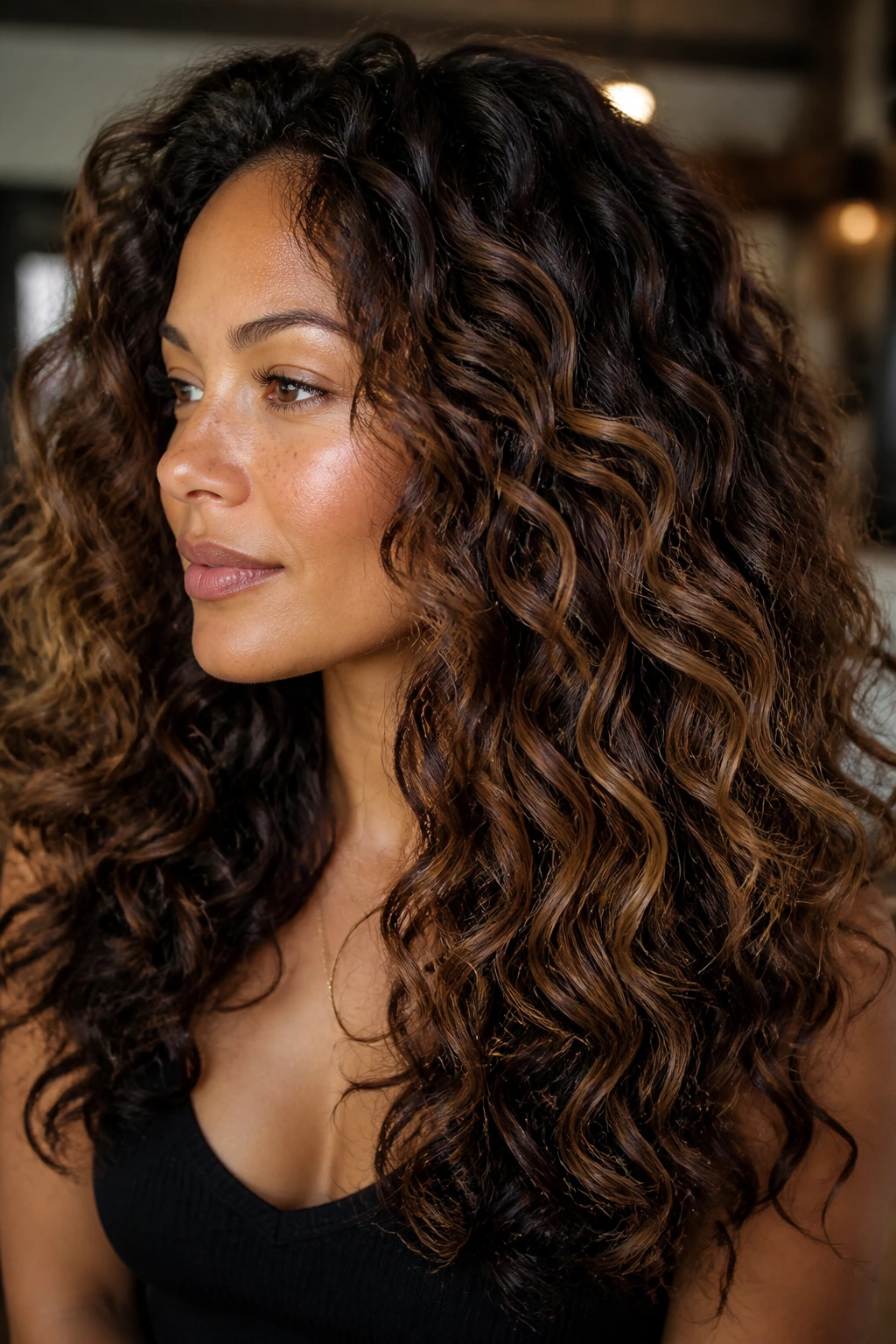
Velvet brown multitone balayage is the richest, most layered version of the whole group. Instead of relying on one highlight shade, it mixes two or three browns — usually a deep chocolate, a soft chestnut, and a slightly lighter mocha or caramel. On curly hair, that mix can look almost plush.
The reason this works so well is simple: curls love variation. A single tone can flatten in thick hair. Multiple brunette shades keep the light moving across the curl pattern. The result feels full, soft, and deeply dimensional.
If you want one look that can go sleek, diffused, or air-dried and still hold up, this is the one I’d put at the top of the pile.
Why the Right Placement Matters More Than the Lightest Shade
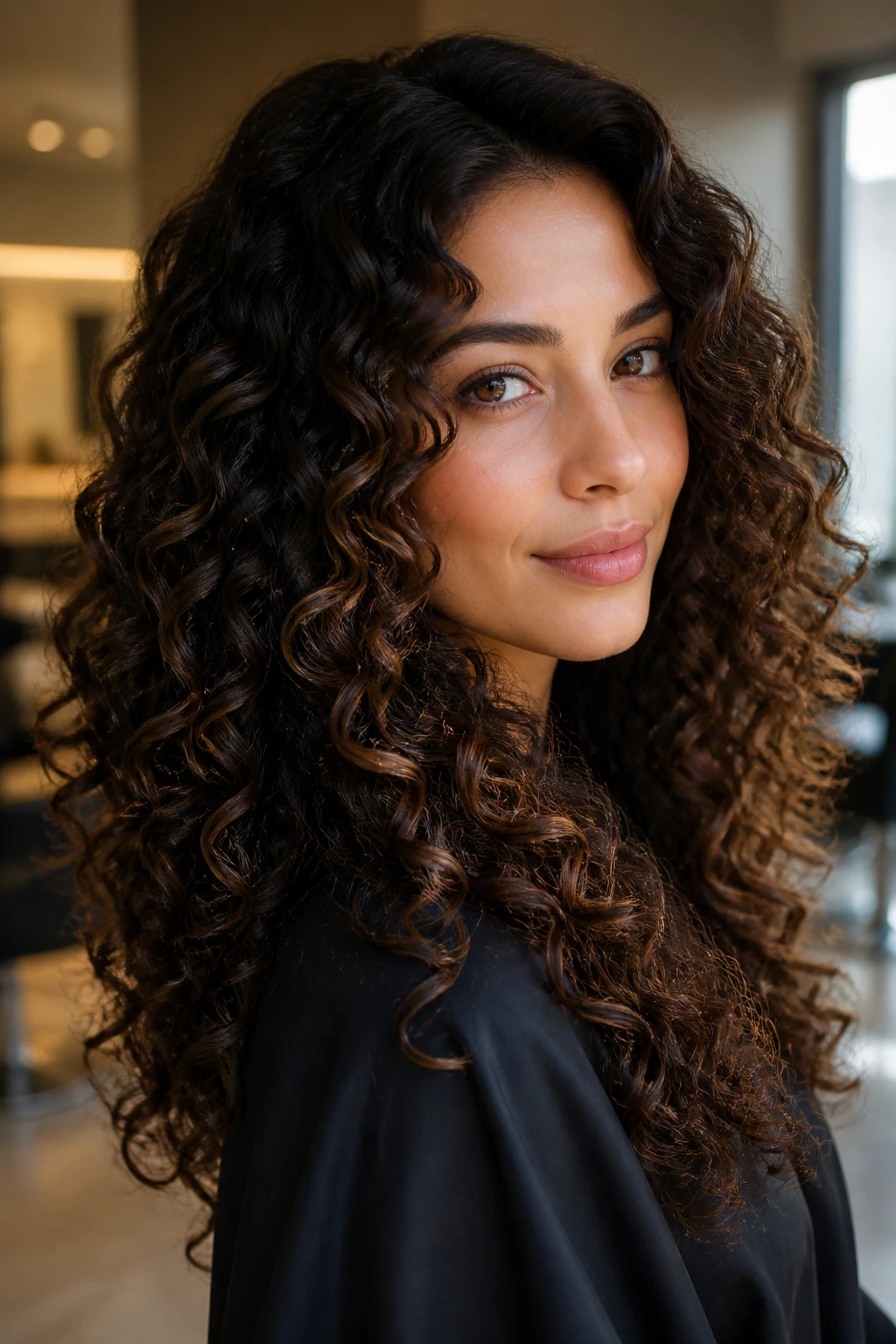
A lot of people start by asking how light they should go. That’s the wrong first question. On dark curly hair, placement usually matters more than lift. A caramel ribbon placed on the outer bend of a curl will show more than a much lighter piece hidden under a pile of dense coils.
The curl pattern is the frame. Balayage is the shading inside it. If the haircut is blunt and heavy, the color has to work harder. If the cut has layers, movement, and a shape that lets curls separate a little, the brunette tones do half the job for you.
That’s why so many of the best brunette balayage looks on dark curls stay closer to brown than blonde. The color doesn’t need to scream. It needs to move.
Essential Tools for These Looks
-
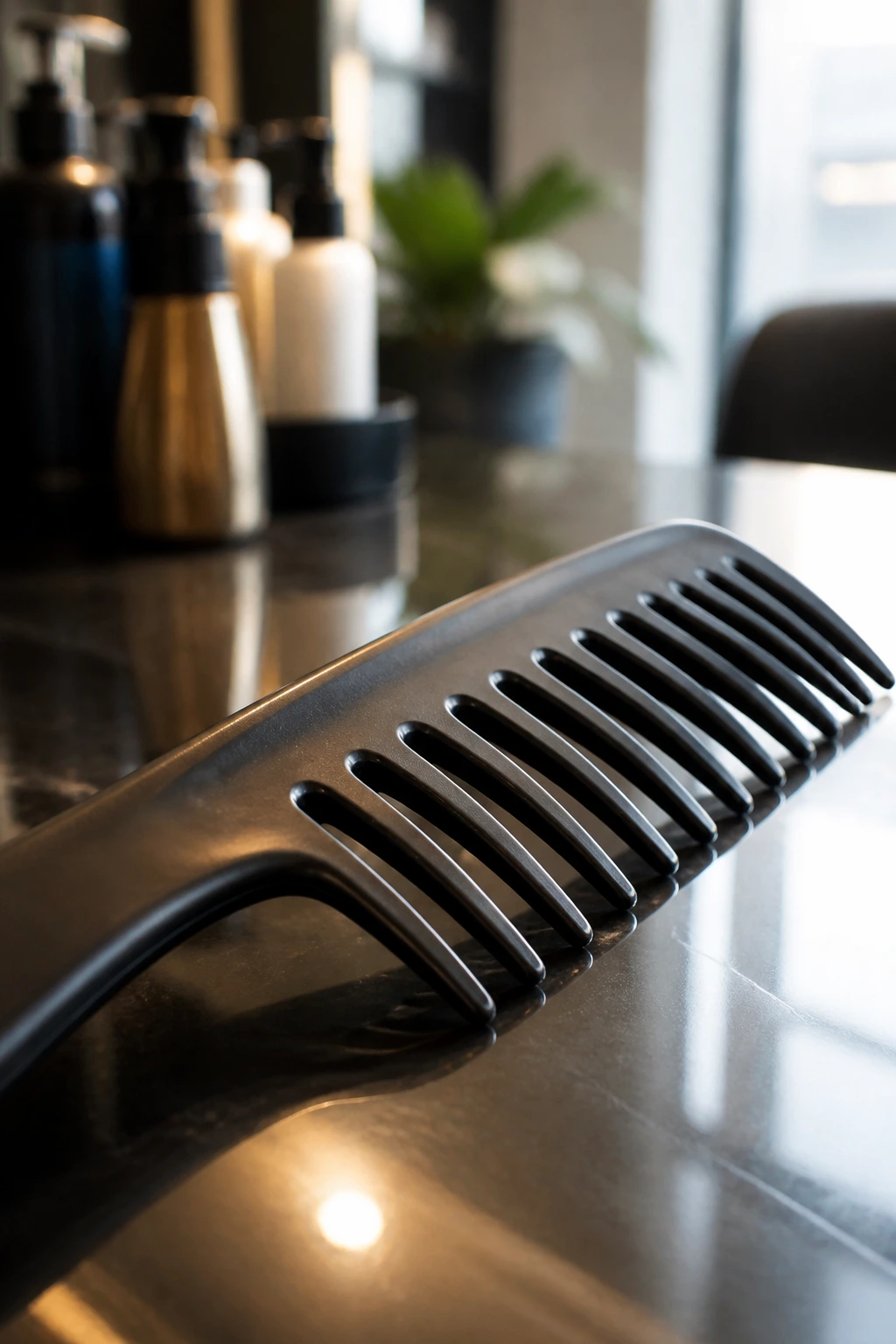
Wide-tooth comb: Good for detangling curls before styling without scraping the cuticle.
-
Sectioning clips: Useful for separating the crown, sides, and back so the lighter pieces show where they should.
-
Diffuser attachment: Helps curls dry with less frizz and keeps the balayage ribbons visible instead of blurred.
-
Microfiber towel or cotton T-shirt: Cuts down on rough drying, which matters more once the hair has been lightened.
-
Curl cream or leave-in conditioner: Keeps highlighted curls from looking dry or puffy at the ends.
-
Color-safe shampoo: Helps the brunette tones stay rich instead of washing out into dull brown.
-
Gloss or toning conditioner: Handy if you want to keep caramel, ash, or mocha from drifting brassy.
-
Satin bonnet or pillowcase: Reduces friction overnight, which helps the color and curl pattern last longer between wash days.
Smart Color and Product Choices
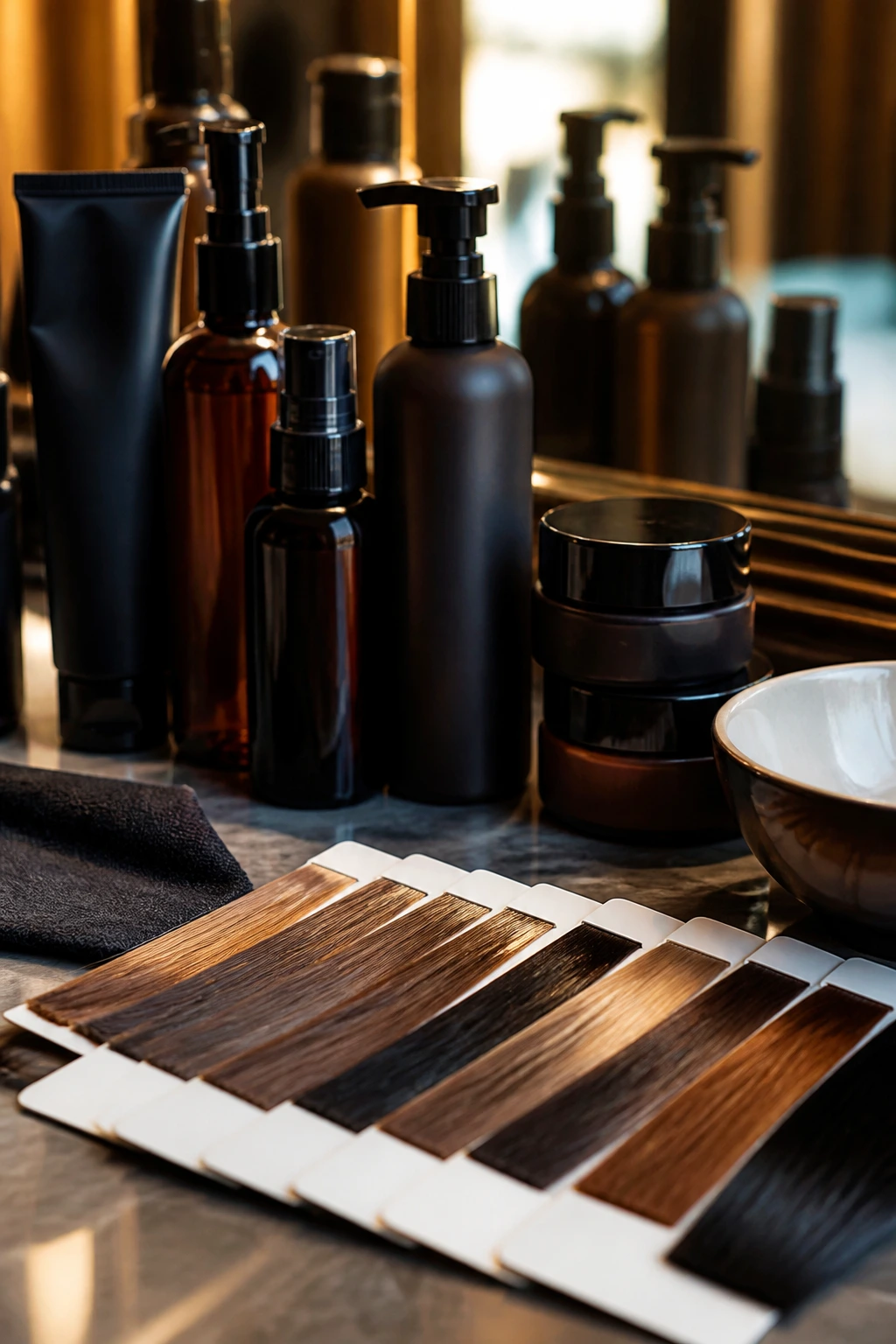
The smartest brunette balayage on dark hair starts with the tone you choose, not the lift level. If your base is very deep brown, warm shades like caramel, hazelnut, honeyed chestnut, and maple usually blend more smoothly than pale ash. They sit closer to the natural pigment, so the result looks richer and less forced.
Cooler shades can be beautiful, too, but they need a clean hand. Mushroom brown and smoky taupe work best when the stylist leaves enough darkness underneath. If the hair is lifted too far and then toned too gray, curly texture can start to look dusty. Nobody wants that.
For care products, go with a sulfate-free shampoo, a dense conditioner, and a weekly moisture mask. If the hair has been lightened in any way, a bond-building treatment can help the ends stay elastic. On curly hair, elasticity is everything. Once the curl starts to stretch and snap dry, the color looks rough no matter how pretty it was on day one.
One practical note: if your hair is dark, dense, or previously colored, a single session may not get you to the shade you want. That’s not failure. That’s chemistry and hair history doing what they do. Going a shade or two lighter in stages usually protects the curl pattern better than forcing a big jump with stronger lightener.
How to Wear These Shades So They Show Up in the Curls
Presentation: Ask for the brighter pieces to sit where the curls naturally open — around the face, on the canopy, and across the outer curve of the spiral. That’s where the color will actually be seen.
Accompaniments: Long layers, a curly shag, a rounded lob, or a soft bob all help brunette balayage read more clearly. A blunt one-length cut can hide the variation, which is a shame when the color is the whole point.
Portions: For subtle dimension, ask for one or two levels of lift and keep the pieces wide enough to show through the curl pattern. For a bolder finish, concentrate more brightness at the front and the lower third of the length.
Finish: Diffuse with a light curl cream or air-dry with a gel that doesn’t leave the hair stiff. The better the curl clumps hold, the cleaner the color placement looks.
Extra Ways to Make the Color Richer
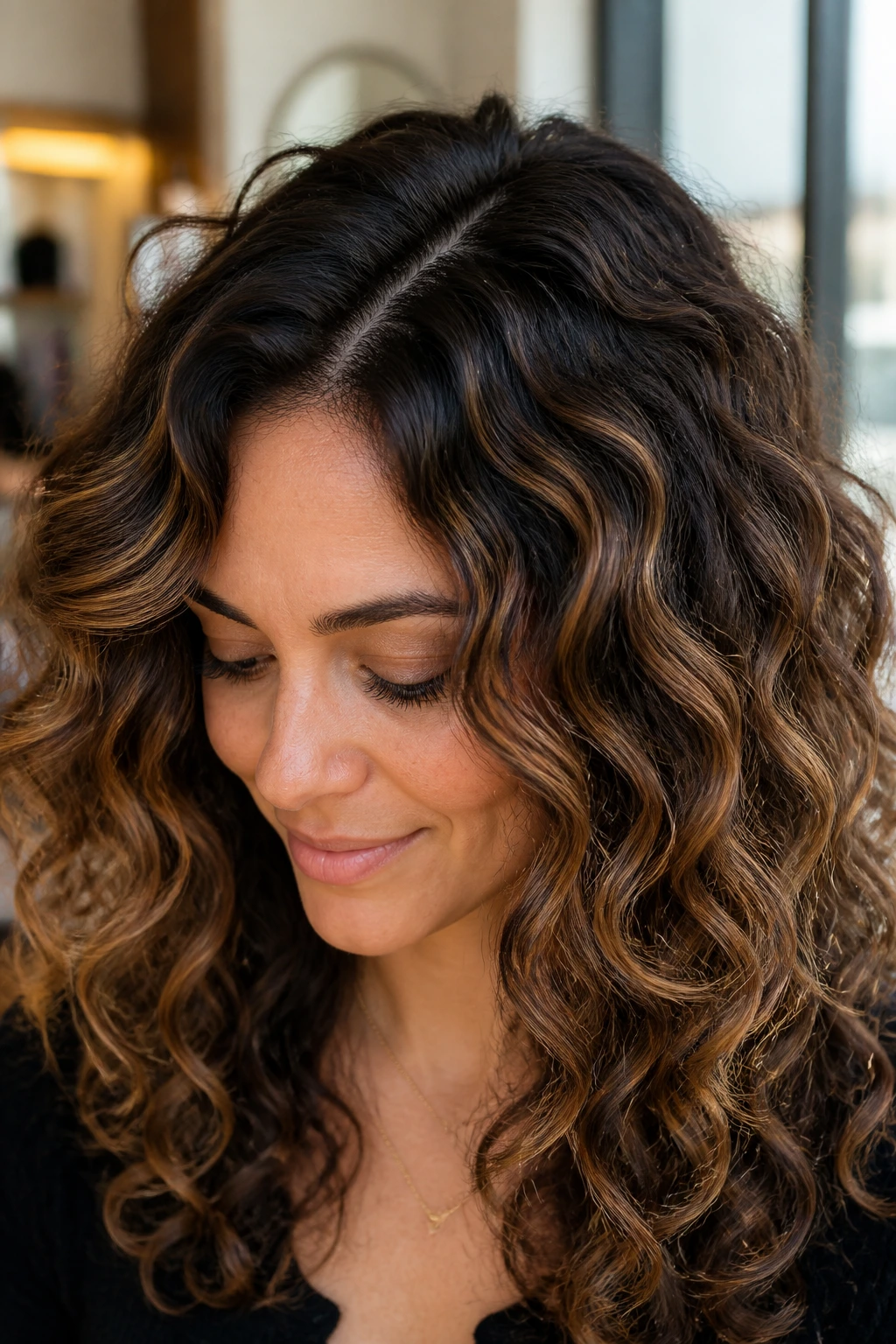
Glossing: A demi-permanent brown gloss every 6 to 8 weeks can keep caramel, chestnut, and mocha tones from fading into a flat brown. It also makes curls look smoother around the edges.
Dimension: Ask for at least two brunette tones, not one. A deep root shadow plus a slightly warmer mid-tone gives dark curls more depth than a single brown formula ever will.
Customization: If you run warm, lean caramel, honey, chestnut, or auburn-brown. If you run cool, try mushroom brown, ash brown, or smoky taupe. If your skin is neutral, almost any of these can work as long as the placement is soft.
Make-It-Yours: For a low-maintenance schedule, keep the lightest pieces away from the root. For a bolder look, add a money piece or brighten the ends. For fine curls, keep the ribbons larger. For thick curls, finer babylights can stop the color from looking too heavy.
How to Keep Brunette Balayage Fresh Between Visits
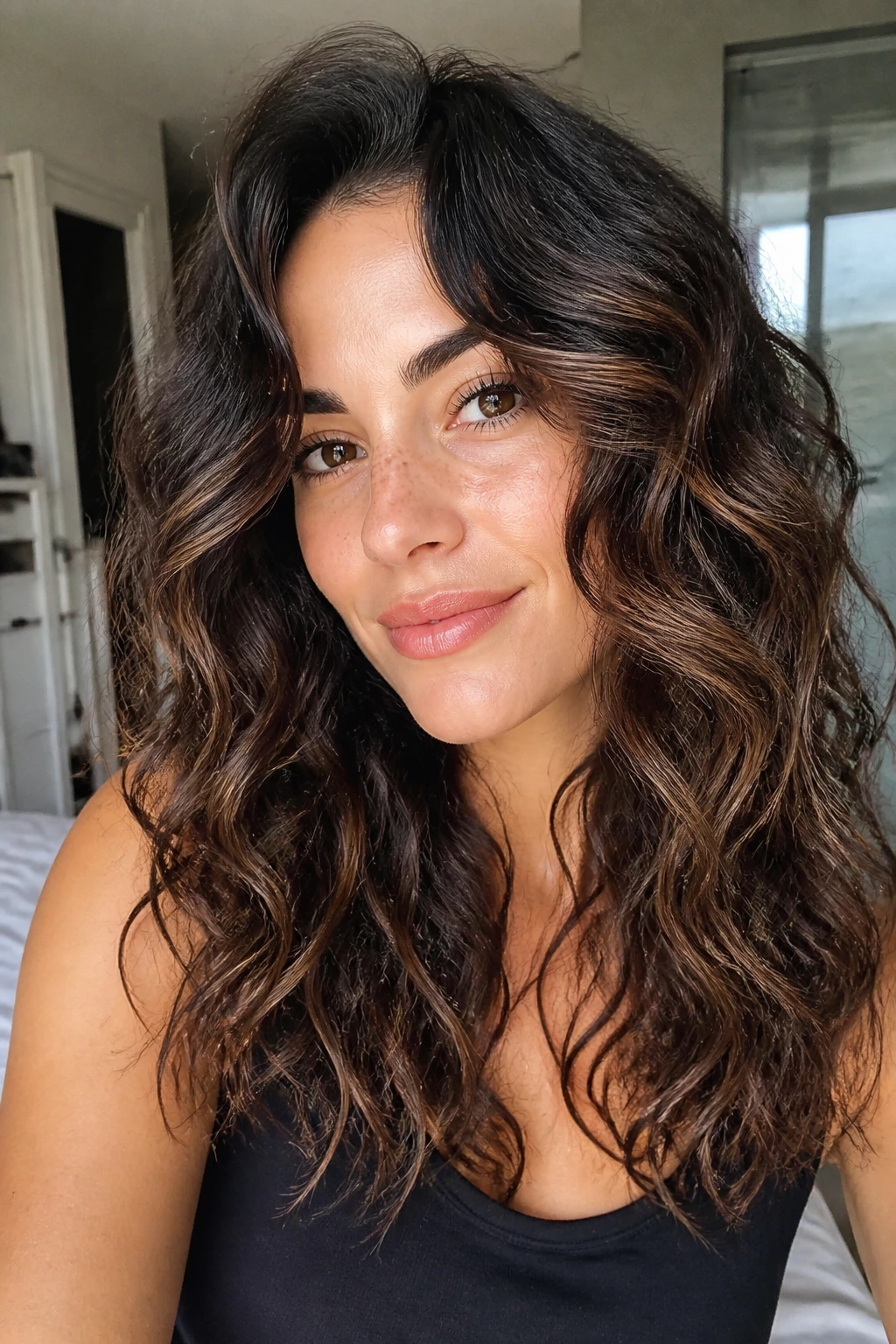
Treat the hair like it has been gently lightened, because it has. Wash two or three times a week if you can, and use cool to lukewarm water. Hot water strips tone fast and makes the ends puff up, which is the fastest way to make pretty brunette highlights look tired.
A deep conditioning mask once a week keeps the highlighted curls from drying out. If the hair feels stretchy or rough, add a bond-building treatment every week or two until it settles. Don’t overload protein. Curl hair that’s been colored can get stiff if you keep throwing hard protein at it.
Most brunette balayage looks do well with a gloss refresh every 6 to 8 weeks and a salon maintenance appointment around the 10- to 14-week mark, depending on how much contrast you asked for. If your look is very subtle, you can stretch that longer. If you went for a money piece or stronger face frame, the line around the front will ask for more attention sooner.
Clarifying shampoo should stay occasional — about once every 3 to 4 weeks, no more if the hair is dry. Use it when buildup starts to make the curls limp. Then put moisture back in right away. That order matters.
Variations and Adaptations to Try
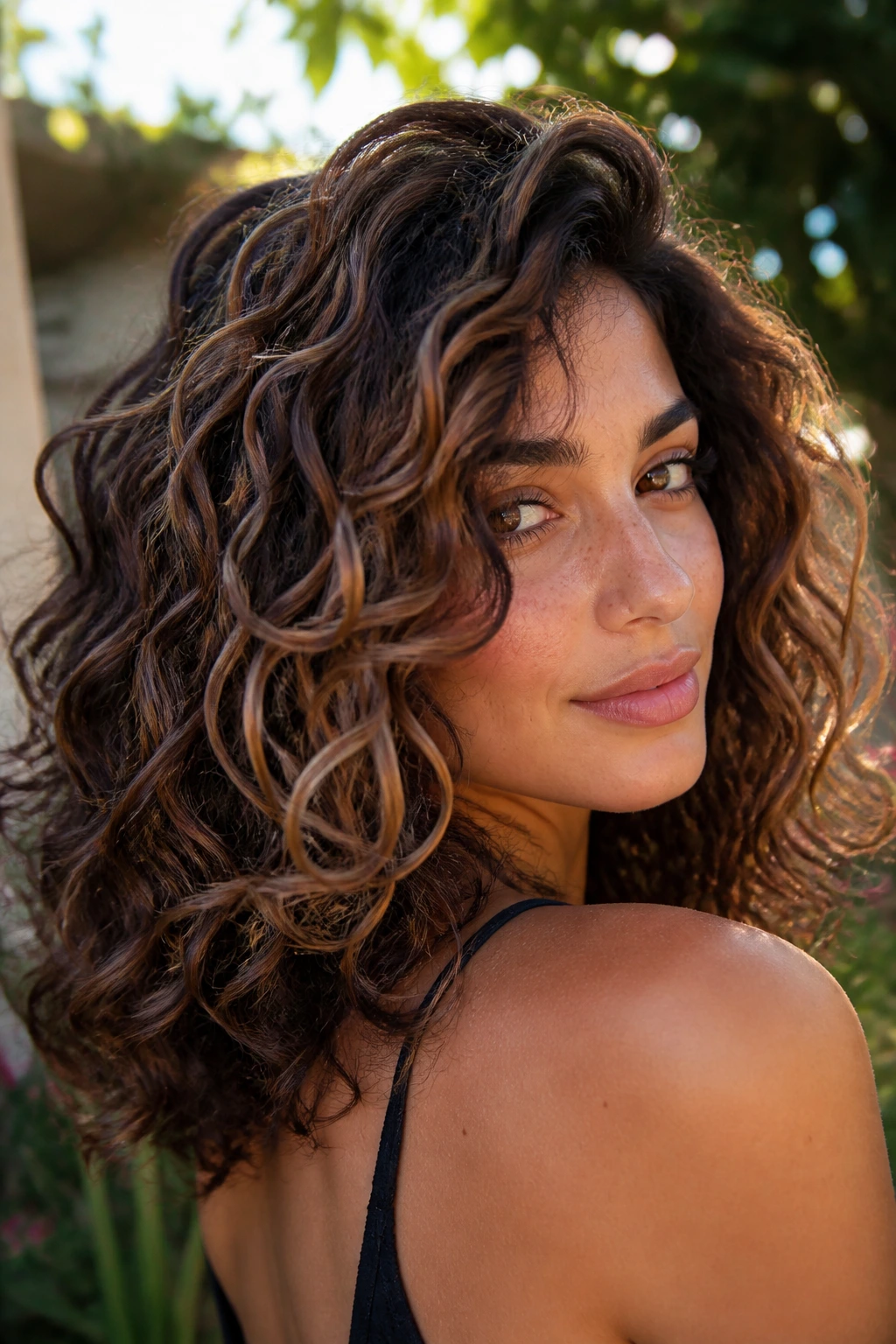
Warm Caramel Drift: This version leans golden and soft, with caramel placed mostly on the canopy and front curls. It’s a good match for warm or neutral skin and for people who want the color to look sunlit rather than smoky.
Cool Mushroom Brunette: Here the brown tones shift cooler, toward taupe and ash. It suits dark curly hair that tends to go orange with warm color, and it looks especially clean on dense ringlets with good shine.
Mahogany Velvet: Add a red-brown gloss over the balayage pieces to give the curls more depth and a little drama. It works well if you like rich clothing colors, darker makeup, or hair that looks different in warm indoor light.
Low-Maintenance Shadow Melt: Keep the roots deep and only lighten the mid-lengths and ends by a small amount. This is the right move if you want color that can go longer between visits and still look intentional.
Bold Money-Piece Brunette: Brighten the front a bit more than the rest of the hair and let the remaining balayage stay soft. The contrast makes the curl pattern around the face pop and gives you a clearer change without committing to a full lightening job.
Curly Bob Halo: On a bob or lob, keep the lighter pieces around the outer curve and top layer so the shape doesn’t get busy. The shorter the hair, the more careful the placement needs to be.
Common Mistakes to Avoid
-
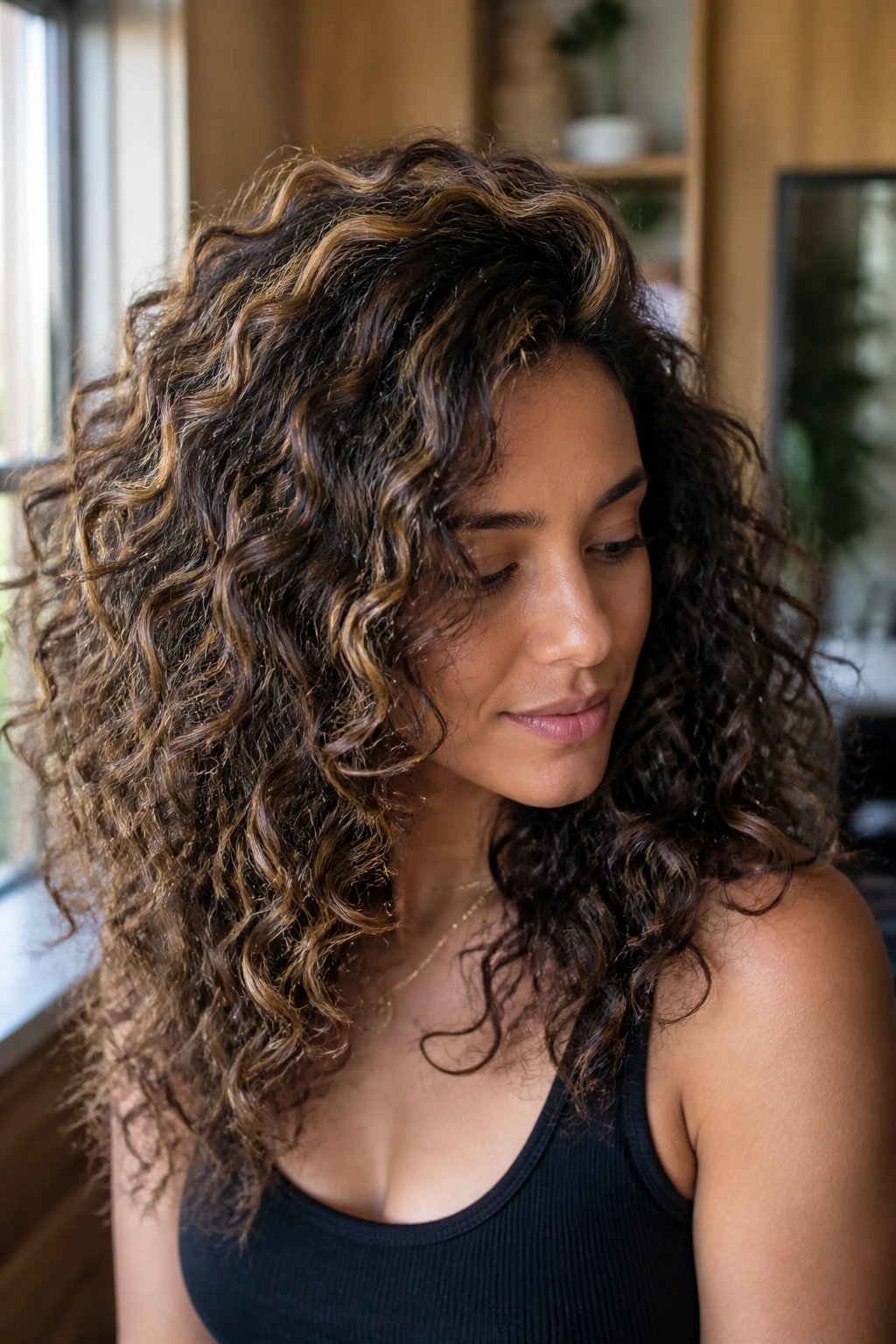
Going too light too fast: Dark curls can handle brightness, but not always in one jump. If the highlight is much lighter than the base, the curl pattern can look stripy and dry. Fix it by staying in the brown family or lifting in stages.
-
Placing color too close to the root: Balayage should look soft and grown-in. If the lightener starts at the scalp, you lose the blurred effect and the grow-out gets harsh fast.
-
Choosing the wrong tone for your undertone: Very warm browns can turn orange on some hair, while flat ash can look muddy on others. Match the tone to your skin and your base pigment, not to a photo on a screen.
-
Ignoring porosity: Lightened curls soak up product differently, and porous ends can go dull or frizzy fast. Use a richer conditioner, a gentler shampoo, and don’t stack strong clarifying and protein on the same week unless the hair really needs it.
-
Overusing purple shampoo: On brunette balayage, purple shampoo often does more harm than good. It can leave brown hair dull or oddly gray. A blue-toned brown care product is usually a safer pick if brass shows up.
Frequently Asked Questions
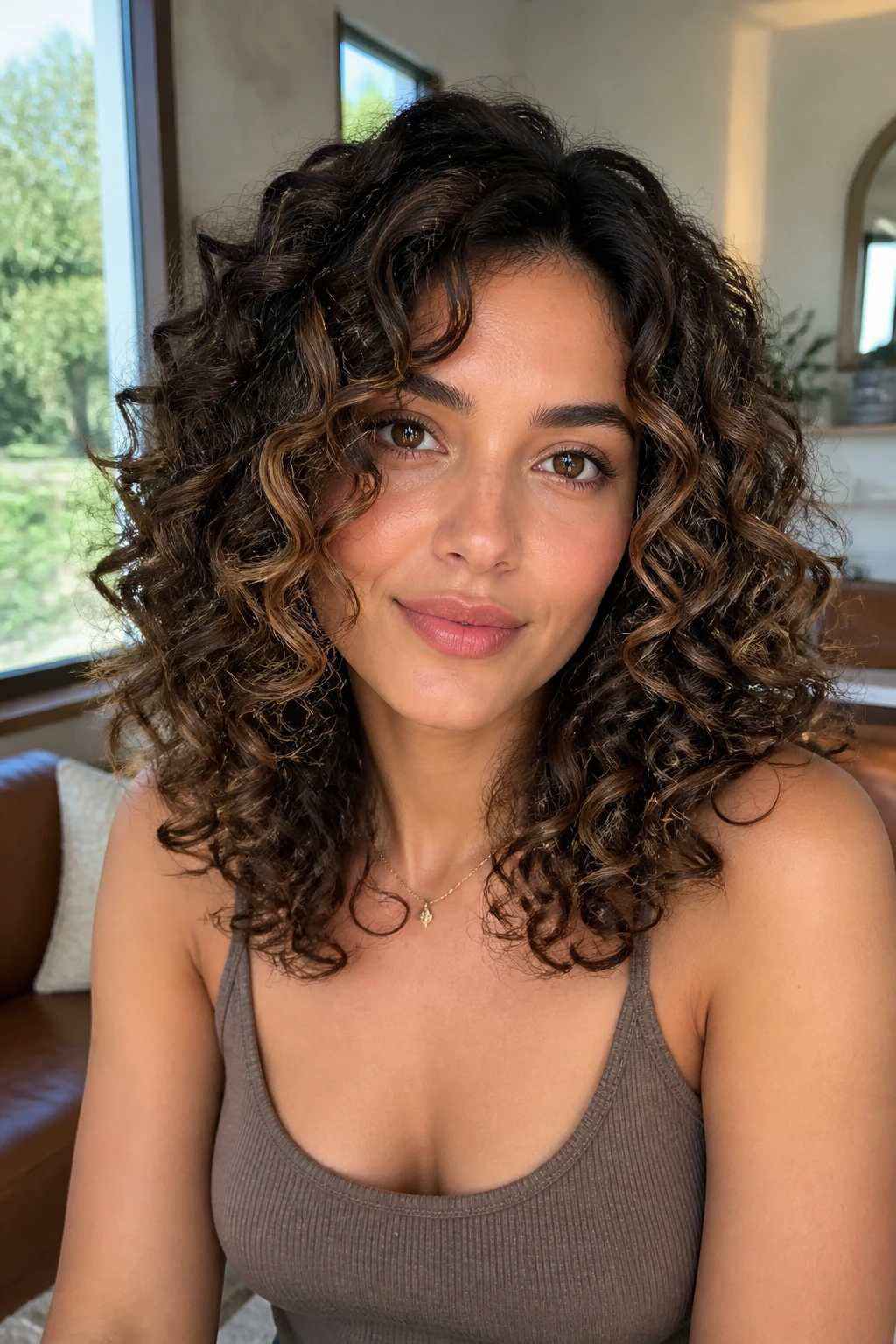
Does brunette balayage work on almost-black hair?
Yes, but the result usually looks best when the lighter pieces stay in the caramel, chestnut, or mocha range. If the hair is extremely deep, a softer lift often reads better than trying to push toward blonde. The curl pattern will show the color more than a straight strand ever would.
Will balayage damage my curls?
Any lightening can dry curls out, but careful placement and a gentle formula help a lot. The bigger issue is over-lightening or overlapping old lightened hair. Keep the ends protected, use moisture weekly, and avoid heat styling on top of fresh color if you can.
Should I ask for highlights or balayage?
If you want softer grow-out and a painted look, balayage is usually the better ask. If you want more uniform brightness from root to end, highlights fit that better. On curly hair, balayage often blends more naturally because the spiral already breaks up the color.
What curl types show brunette balayage best?
Loose waves through tight coils can all wear it well, but the placement changes. Looser curls can show wider ribbons, while tighter curls often look best with softer surface painting and a deeper root shadow. Dense hair usually needs slightly bigger placement to avoid getting lost.
How often will I need touch-ups?
A subtle brunette balayage can usually stretch to about 10 to 14 weeks before needing a refresh, sometimes longer if the grow-out is soft. Bolder face-framing pieces or brighter ends may need toning sooner. A gloss can keep the shade fresh between bigger visits.
Can I do this if my hair is already dry?
Yes, but the color plan should be gentler. Ask for deeper brunette tones, fewer lightened pieces, and a stronger conditioning routine after the service. Dry curls don’t love aggressive lightening. They usually look better with dimension than with a dramatic jump.
What should I bring to the salon?
Bring 2 or 3 photos that show the tone and placement you like, not just the general vibe. It also helps to say how often you wash your hair, whether you heat-style, and how much grow-out you’re willing to tolerate. Those details matter more than the photo filters.
Can I use box dye before getting balayage?
It’s usually a bad setup for curly hair, especially dark hair. Box dye can create uneven pigment that lifts unpredictably and may leave the curls muddy or patchy. If you’ve used it before, say so before anything else. That changes the plan.
The Grow-Out That Keeps Its Shape
The nicest thing about brunette balayage on dark curly hair is that it doesn’t ask your curls to become something else. It works with the bends, the shadows, the shrinkage, and the way dark hair naturally holds depth. That’s why the best versions look good on wash day and still look good when the curls have settled into a softer shape.
Choose the tone that sits closest to your base and the placement that flatters your cut. That’s where the magic lives. A few well-placed ribbons can do more than a full head of brightness ever will, especially when the curls are doing the styling for you.