



A round face changes the whole conversation around a bob. The cut can’t stop at the cheeks and call it a day; it has to pull the eye downward, carve a little vertical line, and keep the sides from blooming outward. That’s where a wavy inverted bob earns its keep, especially when lowlights are doing the color work instead of loud, stripey contrast.
Wavy inverted bobs for round faces with lowlights work because they do three things at once: the back stays snug, the front hangs longer, and the darker ribbons inside the waves create depth instead of a flat, puffed-out surface. A blunt one-length bob can make a full face look fuller. This shape does the opposite. It narrows. It moves. It has a little swing when you turn your head, which sounds like a small thing until you see how much difference it makes.
The tricky part is placement. If the waves open right at cheek level, the face reads wider. If the lowlights are too chunky, the color looks busy rather than dimensional. And if the back is stacked too high, you get that overbuilt triangle that looks fine in the salon mirror and strange the second you step outside. The good versions are softer than that. Smarter. A little less obvious.
Why These Shapes Work So Well on Round Faces
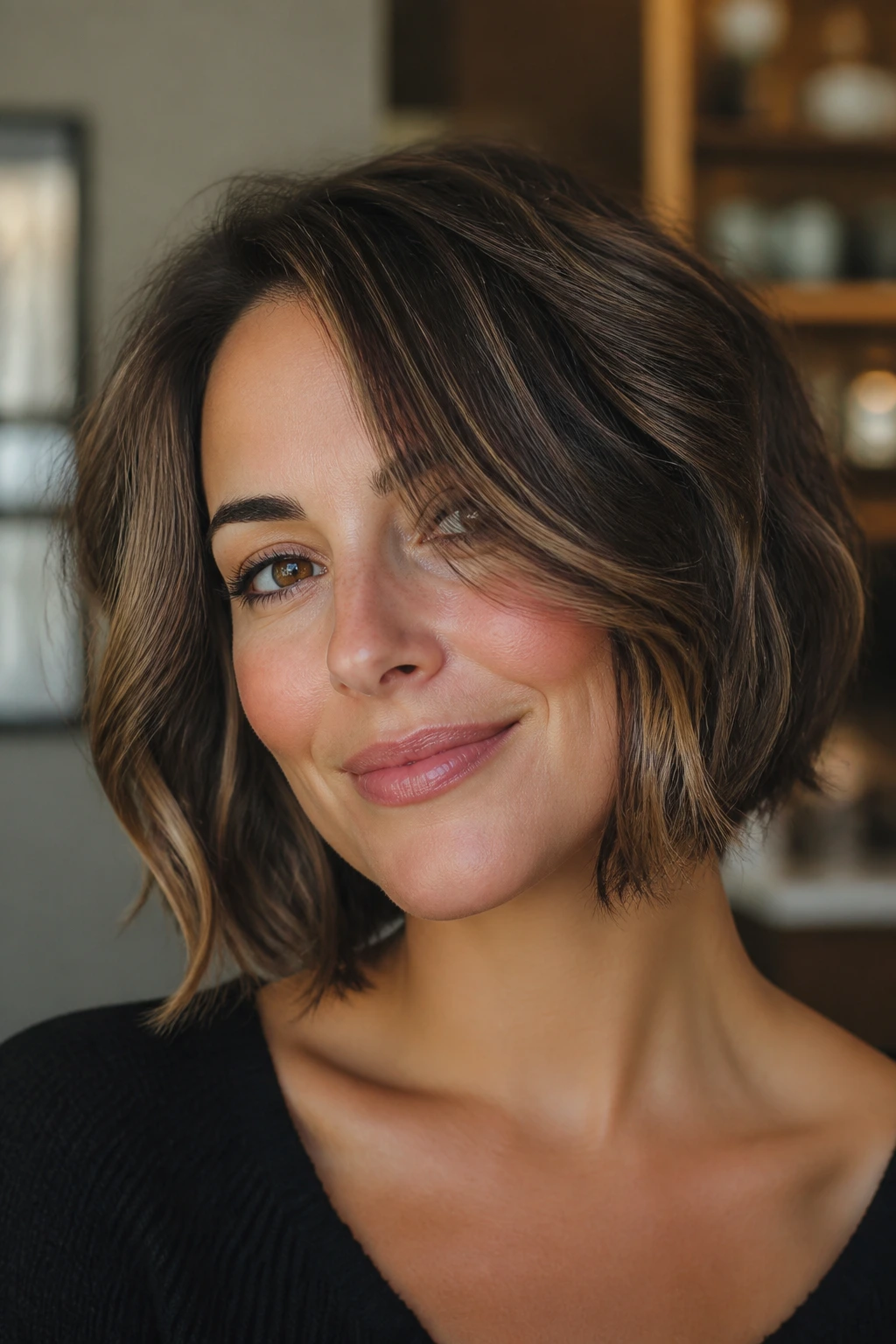
- The front length does the slimming: Most of these bobs keep the longest pieces below the cheekbone, which pulls the eye past the widest part of the face instead of parking there.
- Lowlights add shadow, not bulk: A shade or two deeper than the base gives the waves depth, so the hair reads as layered and shaped instead of puffy and one-note.
- The back stays controlled: A tighter nape keeps the profile clean. That gives the front room to swing without making the whole cut balloon out.
- Waves soften the angle: Straight lines can look severe on a round face. Loose bends break that up while still keeping the bob from turning into a shapeless cloud.
- You can steer the face with the part: A side part, off-center part, or soft curtain fringe changes where the width sits. That matters more than most people think.
1. Chin-Skimming Chestnut Inverted Bob
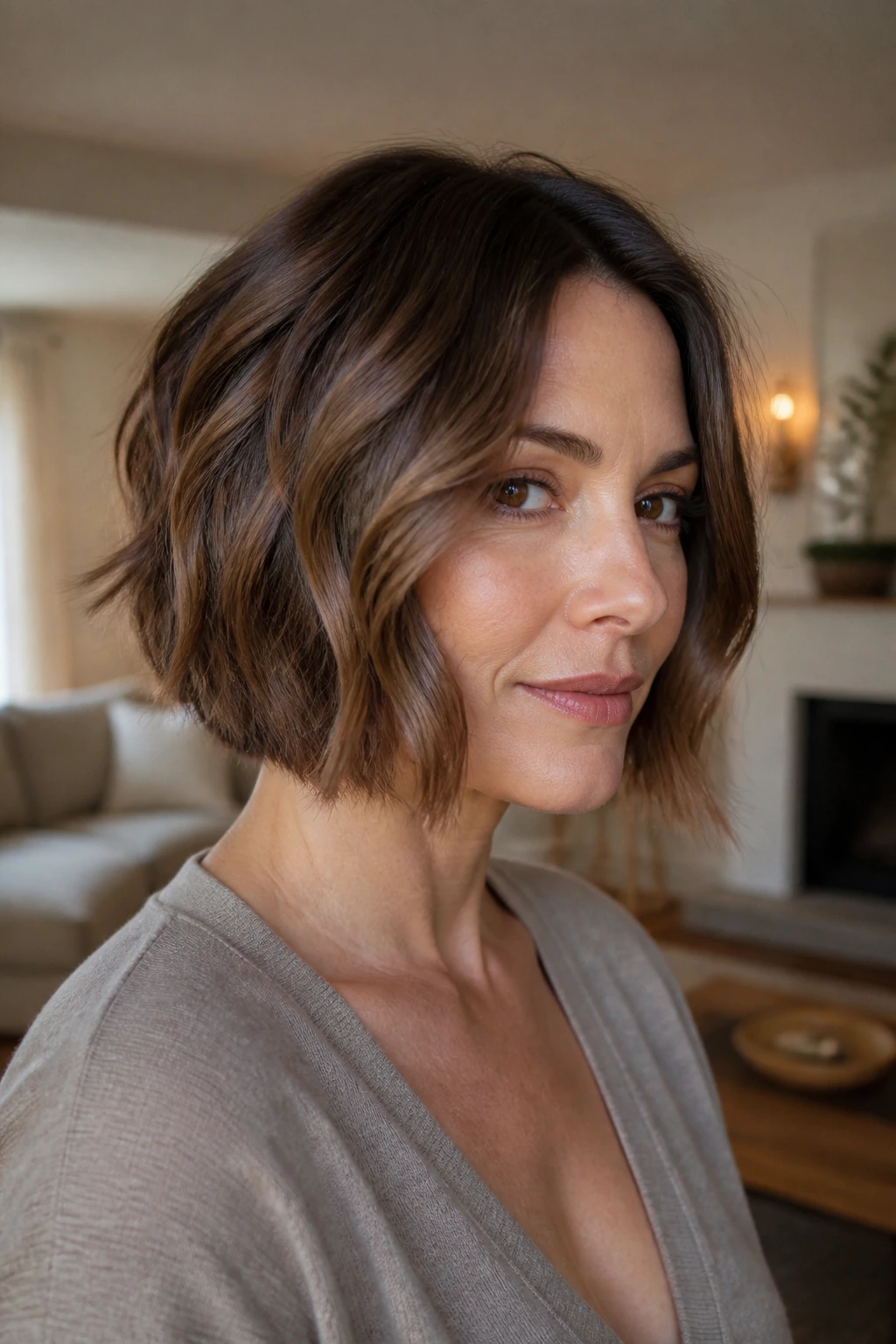
The chin-skimming front is the quiet hero here. It lands below the cheek, which keeps the widest part of the face from becoming the star of the show, and the chestnut lowlights tucked through the bends give the waves enough contrast to look thick without looking heavy.
Why It Flatters a Round Face
The front pieces should graze the jaw, not stop on top of it. That simple difference changes the whole silhouette. Ask for soft stacking at the back, then keep the waves loose and directional, bending away from the face from about ear level down.
- Best for: medium-density hair that holds a curl without fighting you
- Lowlights: chestnut or walnut, placed under the top layer
- Styling note: a 1-inch iron gives a soft bend, not a barrel curl
Best move: leave the ends a little straighter than the mid-lengths. That tiny contrast keeps the cut from puffing at the perimeter.
2. Deep Side-Part Mushroom Brown Inverted Bob
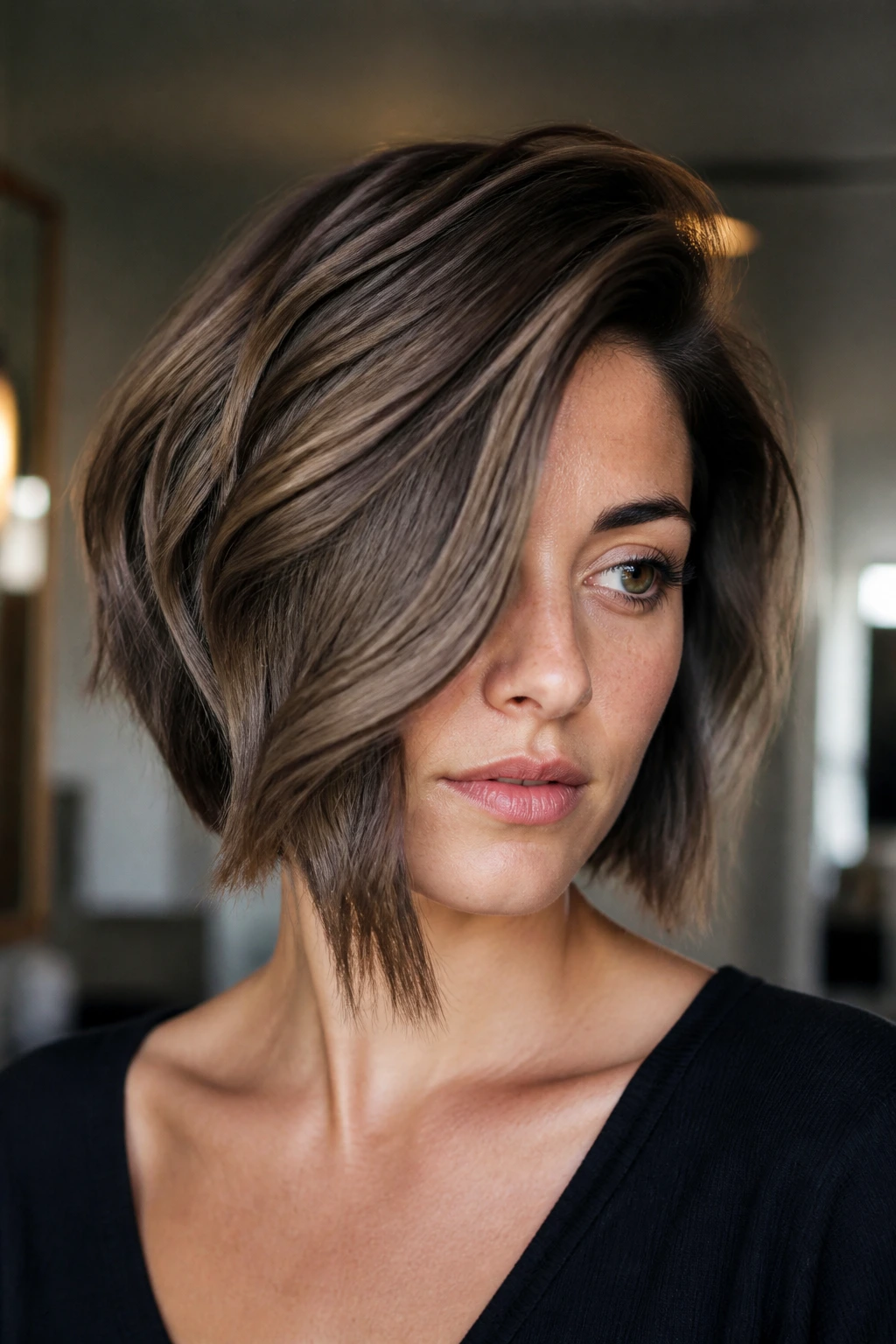
A deep side part does more face-slimming work than another inch of length. The longer front on the heavy side drapes past the cheek, and the mushroom brown lowlights break up the surface so the waves don’t turn shiny and round all at once.
This is the version I reach for when someone wants the bob to feel modern but not fussy. The part creates a diagonal line, which round faces usually welcome, and the cool-toned lowlights keep the color from looking too warm and bulbous under indoor light.
It also gives you a nice escape hatch on second-day hair. A little mist, a rough bend with a curling wand, and the part does most of the visual work for you.
3. Collarbone Mocha Bob with Curtain Bangs
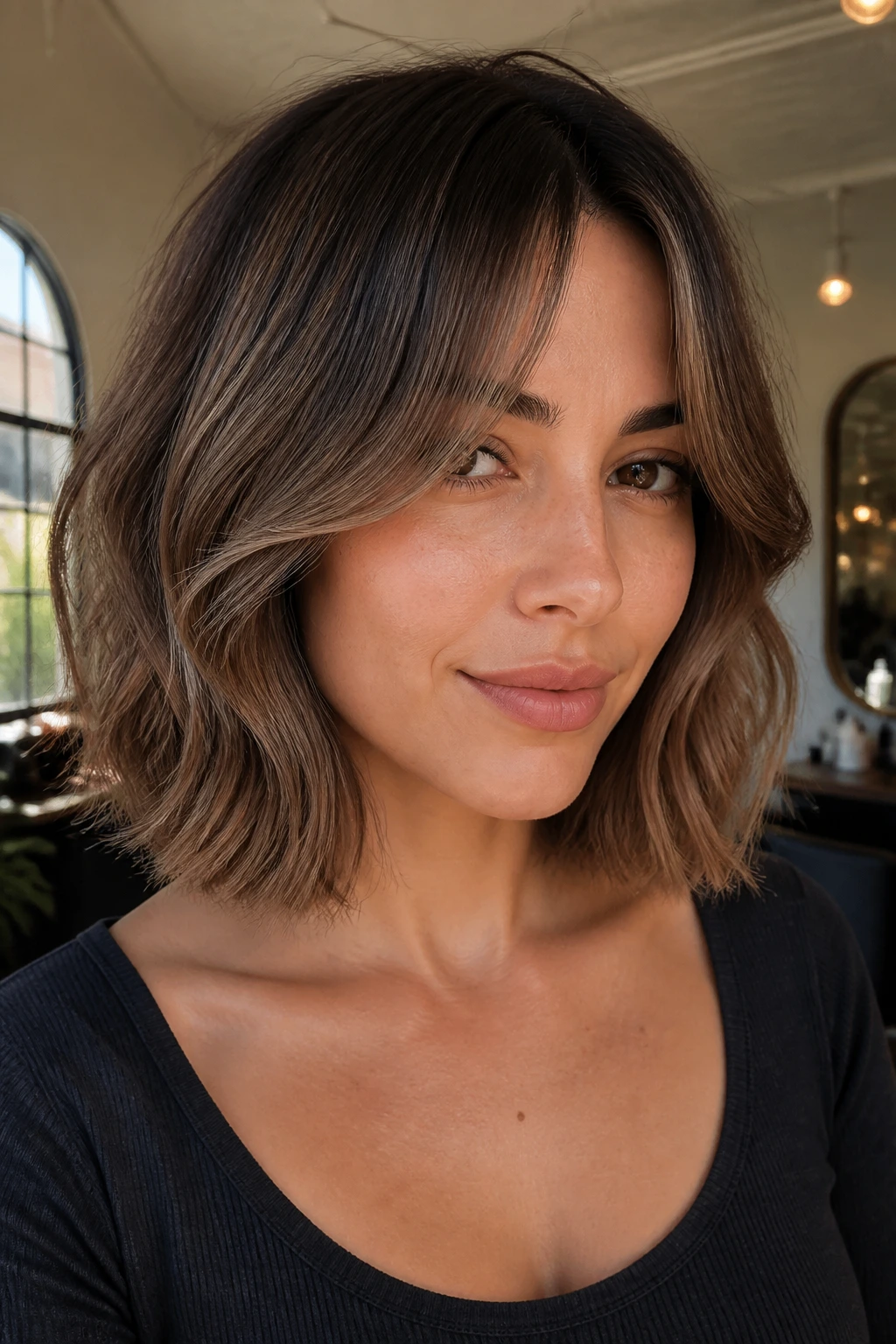
Can curtain bangs work on a round face? Yes — if the shortest point opens the forehead and the longest pieces slide along the cheekbone instead of stopping right there. In this version, the inverted bob stays just long enough to keep the face looking open, and the mocha lowlights travel through the mid-lengths so the fringe doesn’t feel detached.
How to Wear It
Blow-dry the bangs forward first, then sweep them out with a round brush so they split softly in the middle. The rest of the hair should get loose, face-away bends from the temples down. If you curl the fringe too tight, it gets cute for about ten minutes and then starts fighting the rest of the cut.
- Best for: soft, fine hair that needs a little shape around the forehead
- Watch for: bangs that end at the cheek; that’s too wide
- Color note: mocha lowlights work best when they sit under the crown, not right at the face
4. Razor-Soft Espresso Bob with Tucked Ends
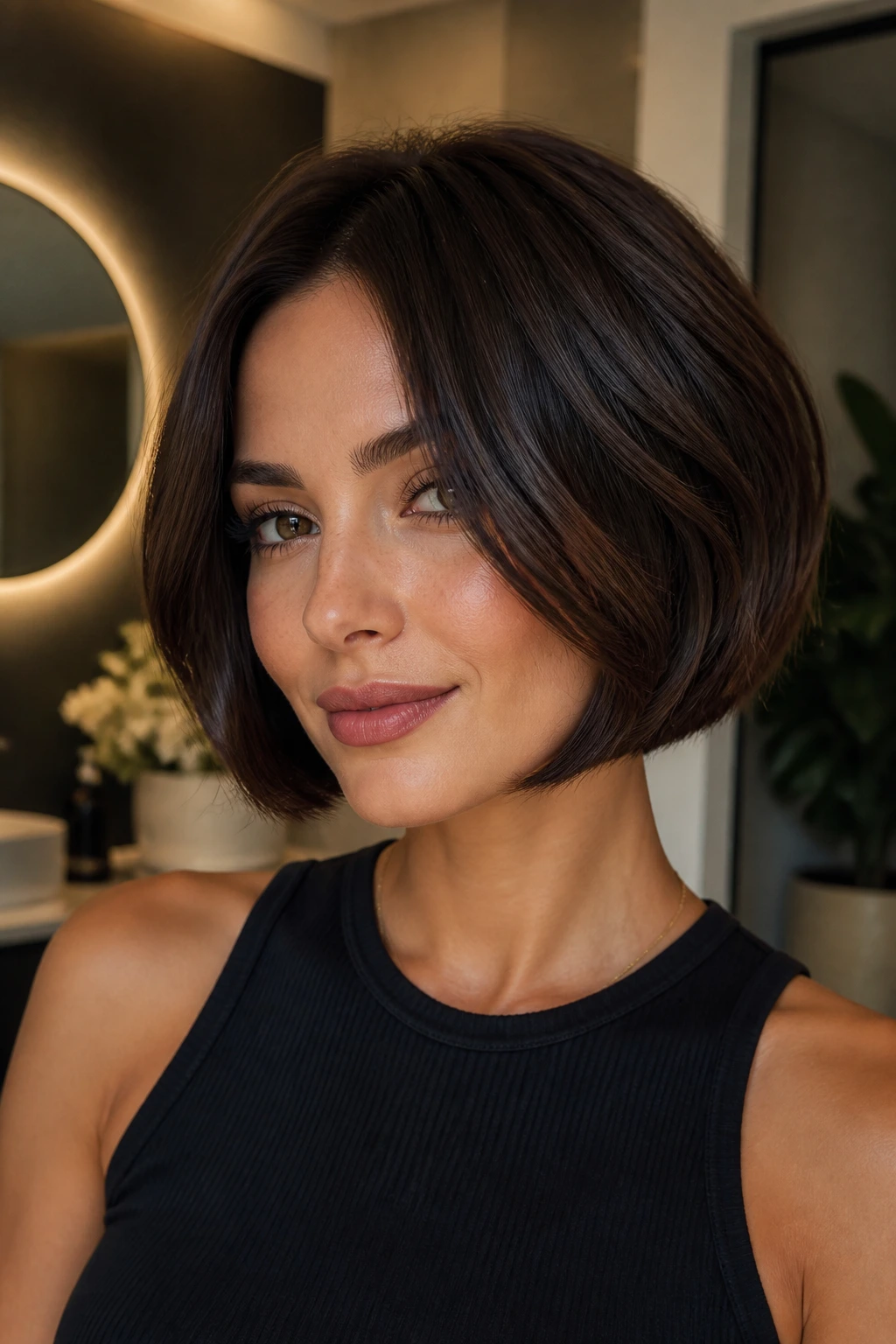
If your bob flips out at the ends every time you round-brush it, stop fighting it and cut for it. A razor-soft espresso bob uses wispy internal layers, so the edge moves instead of sitting like a shelf. The tucked-under finish at the front keeps the line narrow near the cheeks, which round faces usually need.
The espresso lowlights are darker and cleaner than chestnut, so the waves read sleek instead of sugary. That’s useful if your hair tends to frizz around the ears or if you wear a side tuck a lot.
A little serum on the ends helps, but don’t drown the cut in oil. You want separation, not grease.
5. Copper-Brown Inverted Bob with Loose S-Waves
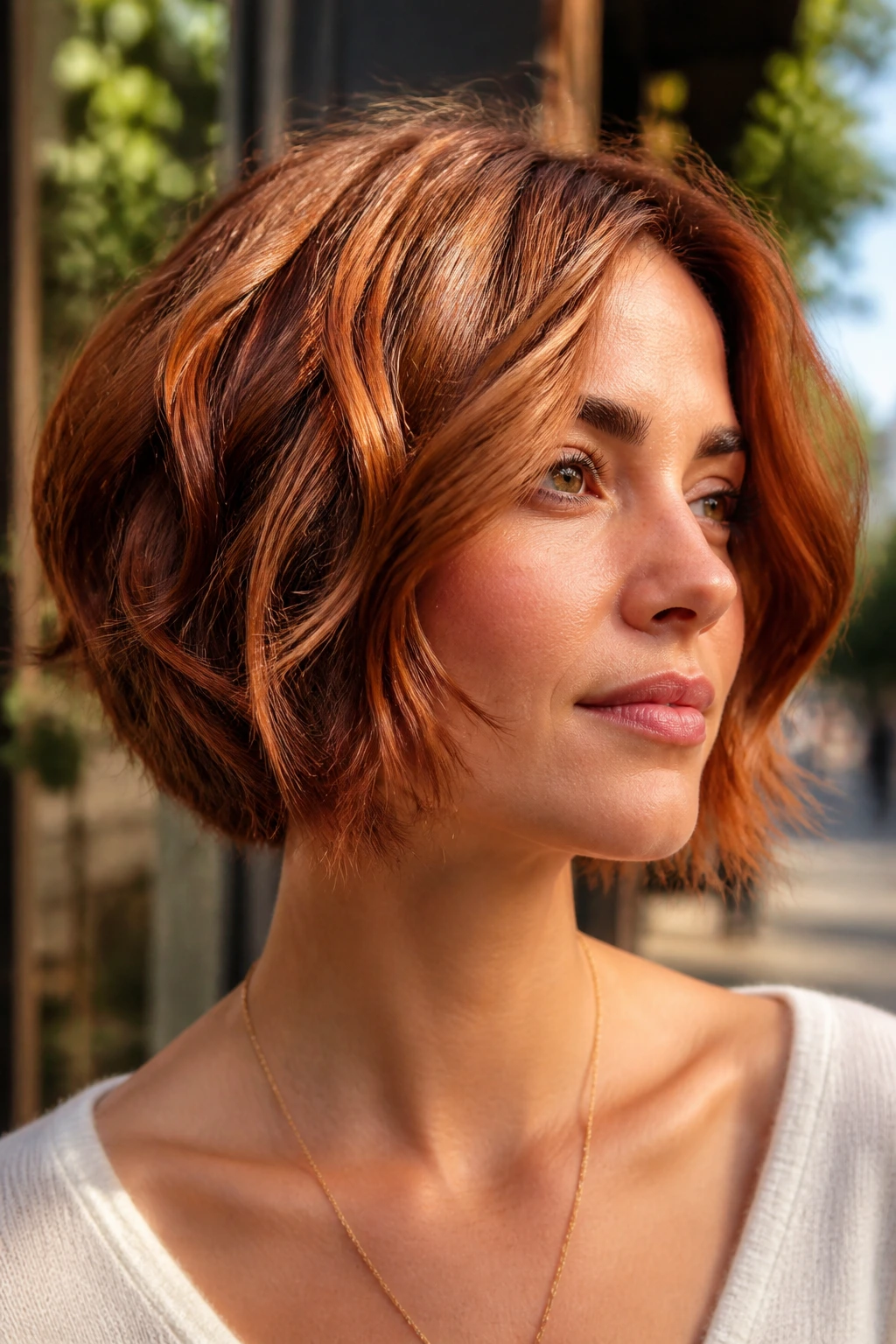
This one has warmth, but it’s a controlled warmth. The copper-brown base gets deeper auburn lowlights through the underside, and those shadows keep the wavy finish from looking inflated. On a round face, that darker depth near the neck and back helps the cut narrow visually without going severe.
The best part is the movement. Loose S-waves don’t sit in one big circle; they fold and bend. That’s exactly what keeps this bob from echoing the shape of the face.
I like this version on hair with a little natural bend already in it. The color does the heavy lifting, and the waves only need a quick pass with a wand.
6. Bronde Inverted Bob with Long Front Pieces
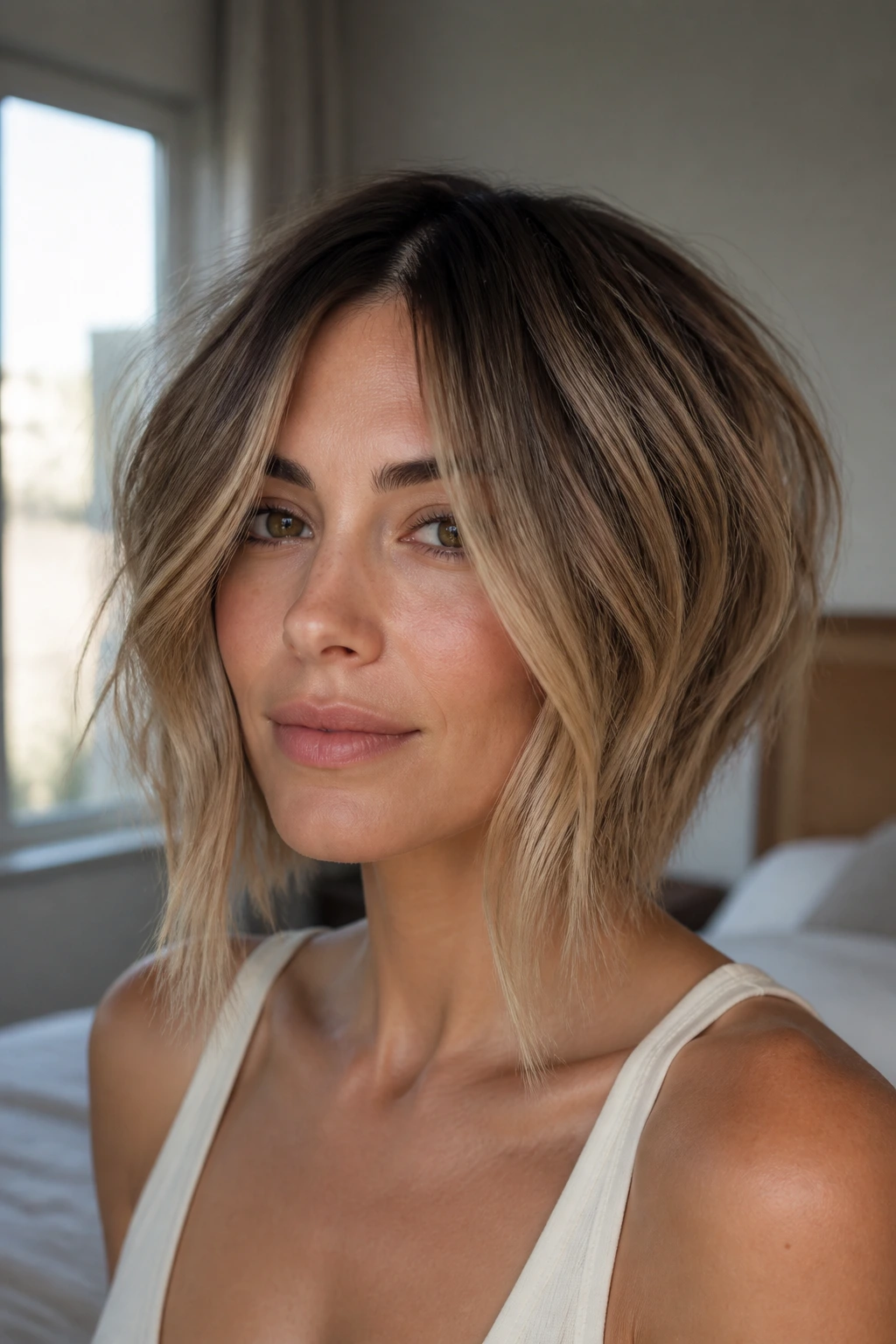
A bronde bob can go flat fast if the color is all brightness and no shadow. This version fixes that with beige-brunette lowlights underneath the top layer and long front pieces that hit below the jawline. The result is softer than a blunt blonde bob and a lot kinder to a rounder face.
The front should feel like a curtain, not a helmet edge. That means the angle should be visible, but not so sharp that it starts looking like a wedge. A few bent waves through the mids keep the shape relaxed.
This is one of the easiest looks to live with if you don’t want a heavy color commitment. The lowlights grow out quietly, which is a small mercy.
7. Ash-Brown Textured Bob with Piecey Waves
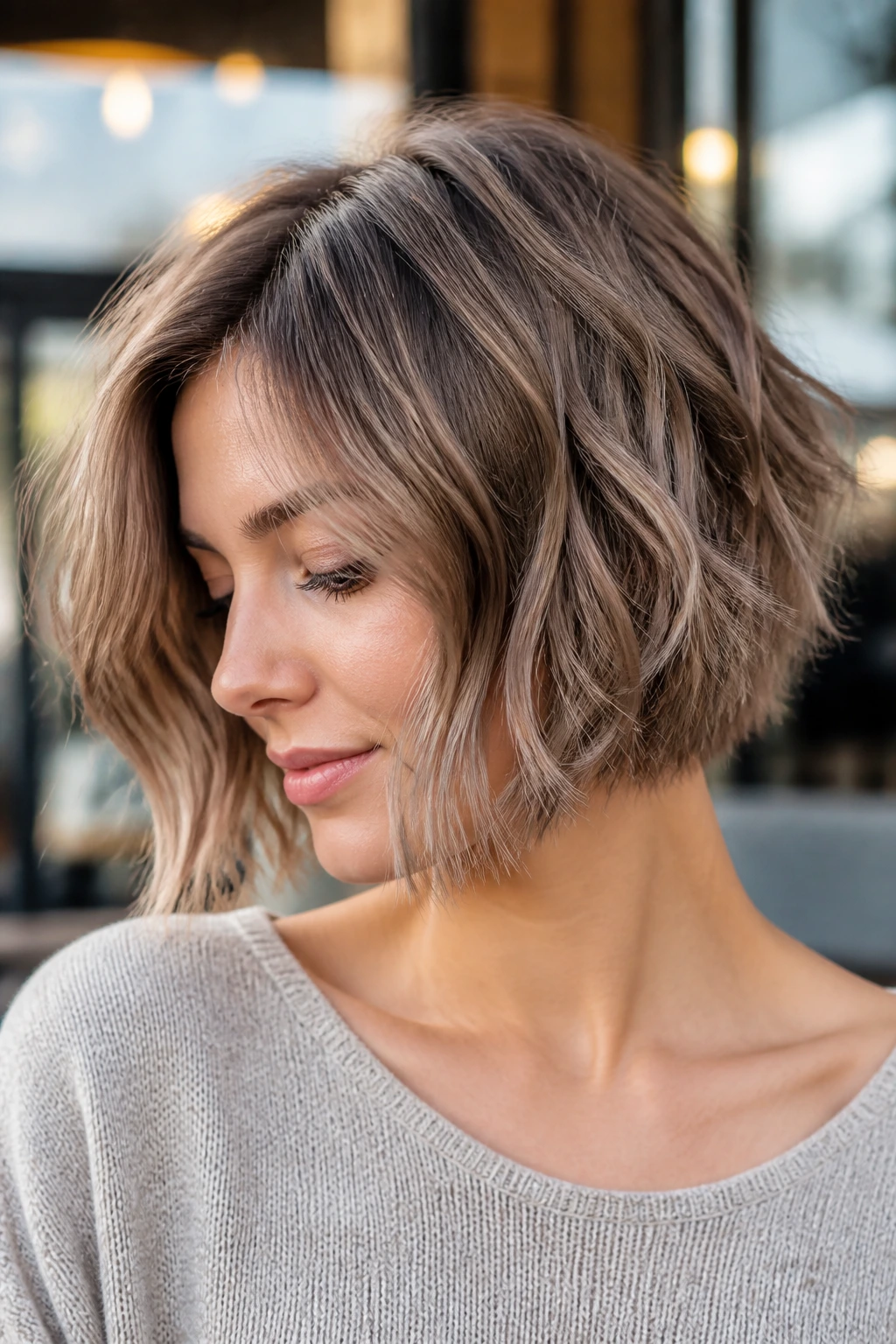
Ash brown has a way of cooling down a face shape that already carries a lot of fullness. In this bob, the lowlights sit a shade or two deeper than the base, and the piecey waves keep the silhouette broken up rather than round and complete.
Why It Works
The texture matters here more than the exact length. Ask for internal weight removal so the bob can move, then style it with a light mousse and a small amount of texturizing spray. Too much product turns ash tones dull; too little and the cut loses definition.
- Best for: fine to medium hair that wants lift without teasing
- Color zone: lowlights under the crown and near the nape
- Finish: airy, separated, not crunchy
My take: this is one of the best choices if you want the haircut to look done even when you haven’t spent long on it.
8. Cocoa Bob with Brow-Skimming Fringe
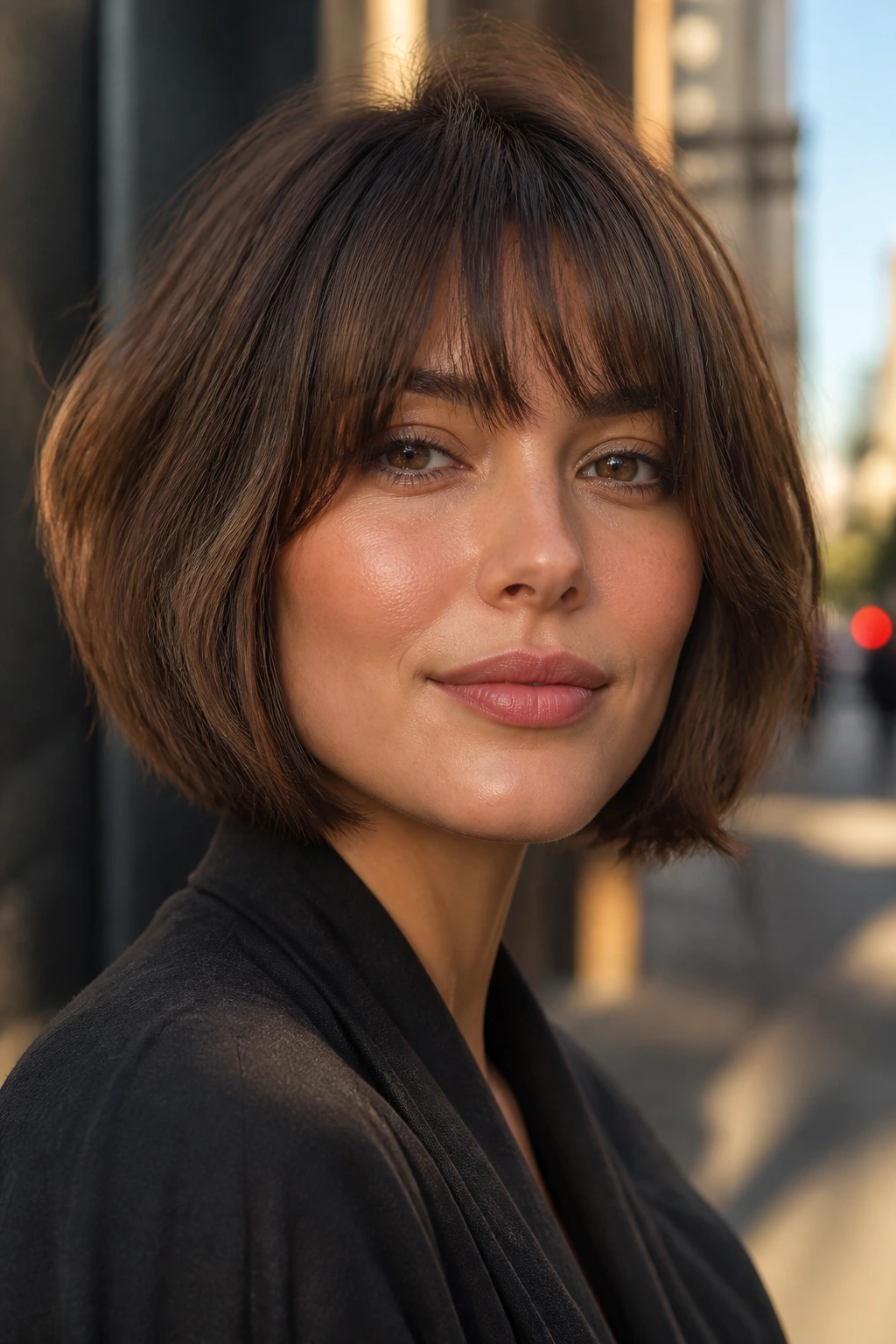
A brow-skimming fringe can help a round face more than people expect, as long as it stays soft at the edges. The cocoa lowlights keep the fringe from floating too brightly against the forehead, and the inverted shape below it narrows the lower half of the face.
What I like here is the balance. The fringe gives you a focal point up top, while the longer front pieces keep the jawline from feeling boxed in. The lowlights stop the whole cut from turning into one solid brown cap, which is where this style goes wrong when the color is too flat.
Wear it with a loose bend, not a tight wave. The fringe already gives you enough structure.
9. Dark Chocolate Bob with Sleek Crown and Bent Ends
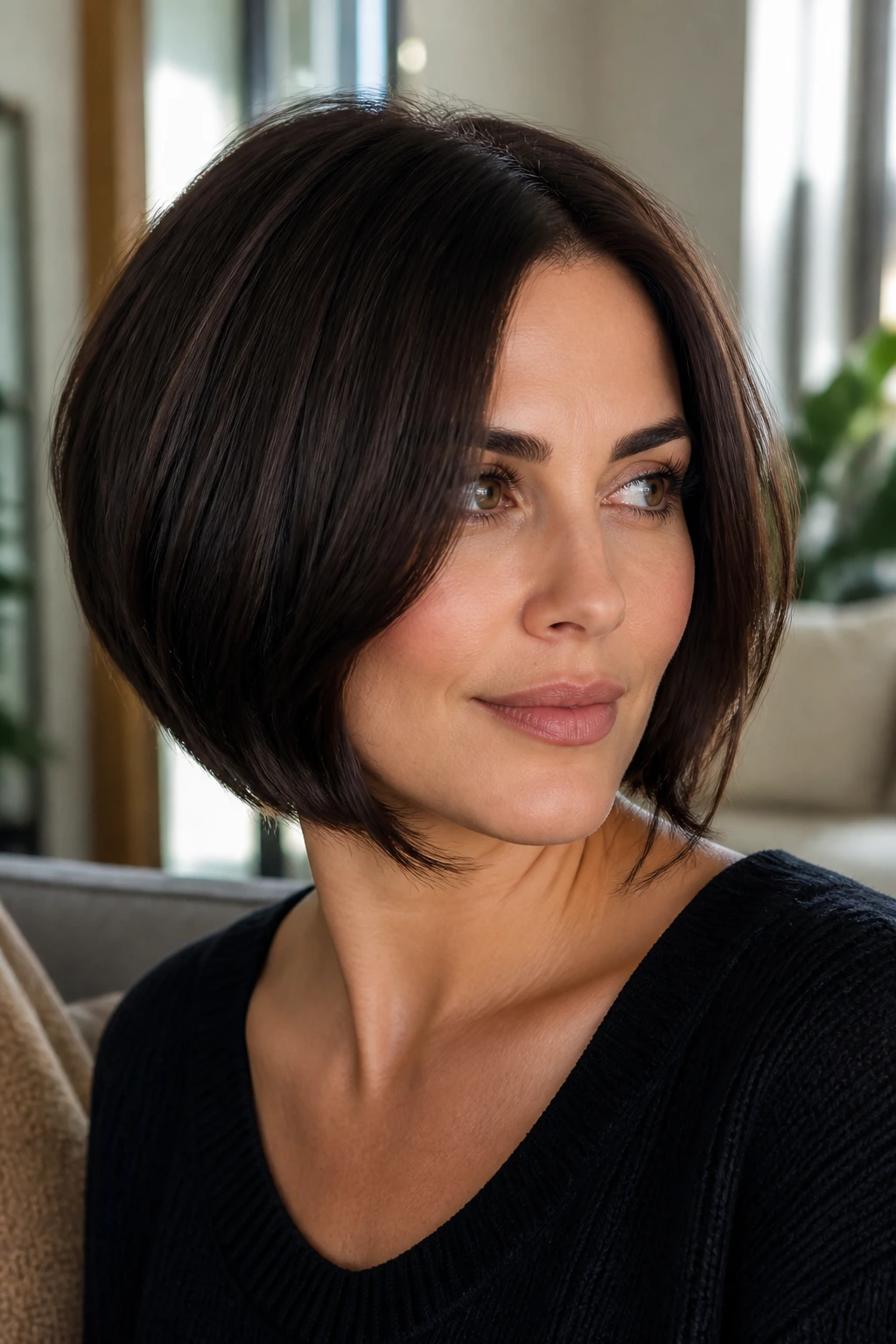
Can a round face wear a sleeker bob without looking wider? Absolutely — if the crown stays smooth and the bends happen below the cheekbone. This dark chocolate version uses lowlights almost like contouring, with deeper pieces under the top layer so the profile looks narrower and the front still has swing.
How to Keep It from Going Flat
Blow-dry the roots at the crown upward for a few seconds, then smooth the top with a brush. Don’t overbend the sides. A soft curve at the ends is enough.
- Good for: thicker hair that can hold a smooth shape
- Avoid: waves that start too high on the cheek
- Styling trick: bend the last 2 inches only
This one has a cleaner, sharper feel than the softer bobs above, and that’s the point.
10. Beige Brunette Bob with Airy Volume
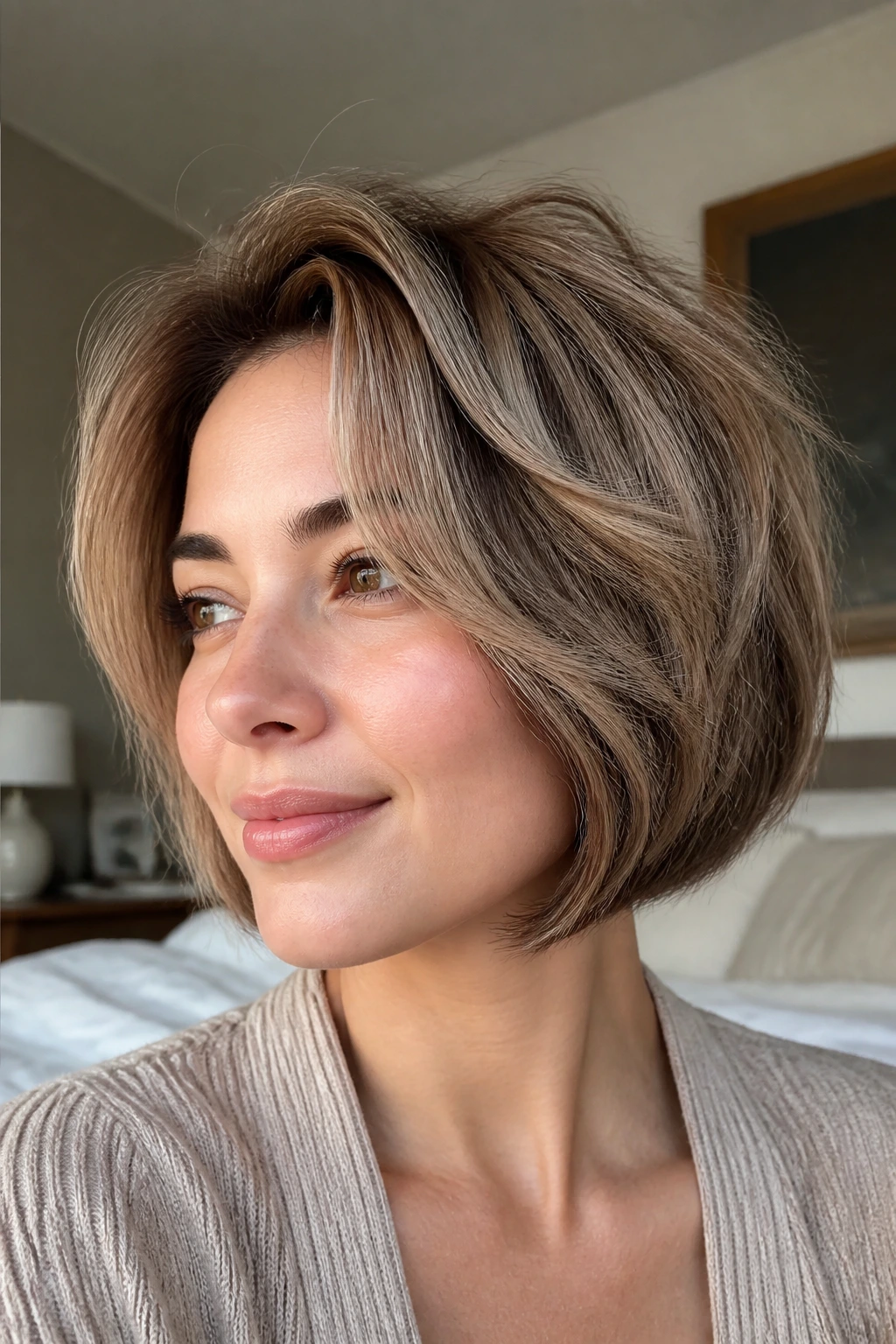
A beige brunette bob can look milky and round if it’s all one tone. Add deeper lowlights through the underside and the nape, and it suddenly has structure. The airy volume sits at the crown, not the sides, which is exactly where you want the emphasis on a round face.
I like this for hair that falls flat at the roots but puffs at the ends. The inverted shape takes care of the heavy perimeter. The lowlights take care of the washed-out color. The waves just need to be loose enough to move.
If you like a side tuck, this is one of the easiest bobs to wear that way. The cut already knows where to narrow.
11. Peekaboo-Lowlight Bob with Center Part
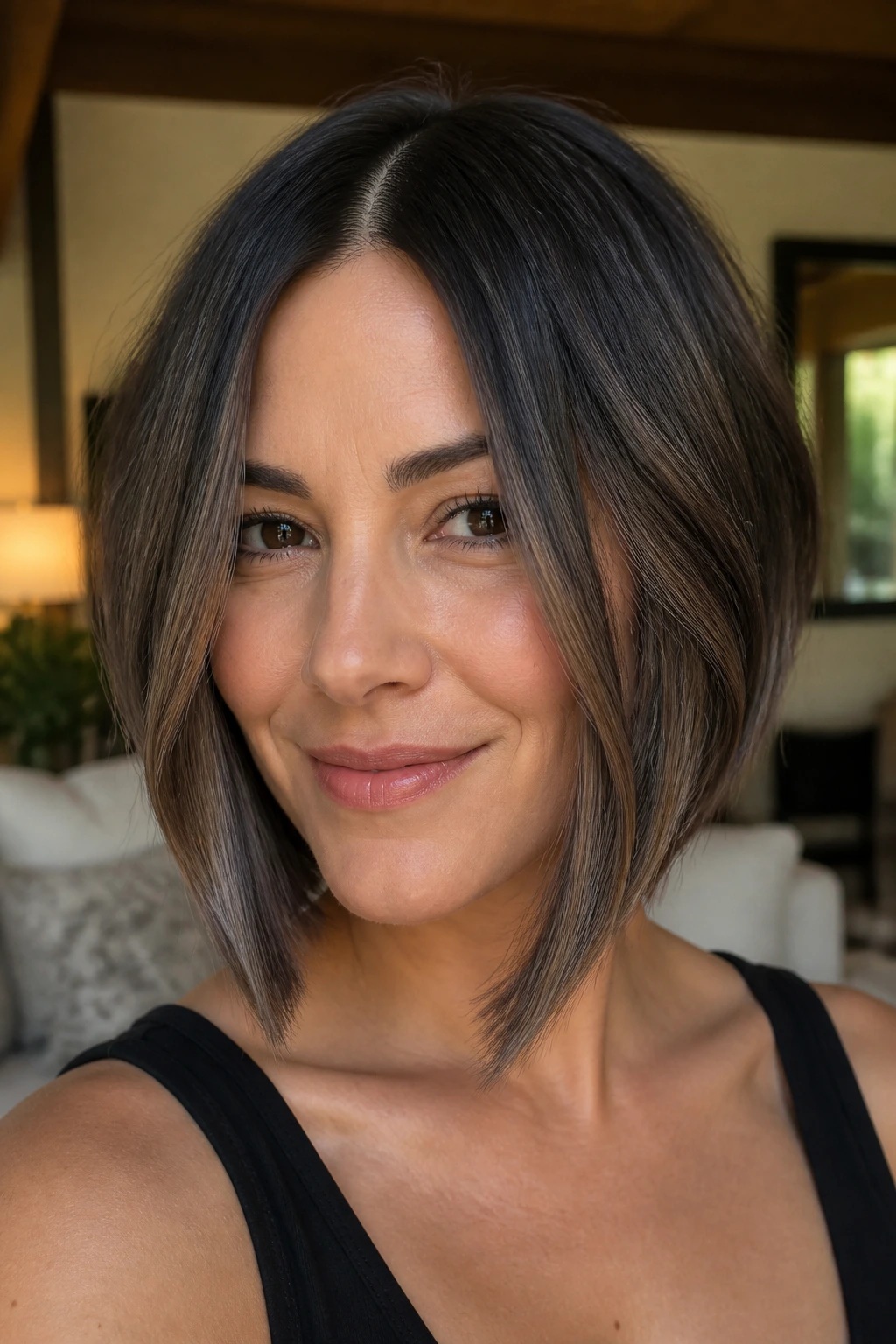
A center part on a round face isn’t forbidden. It just needs help. Peekaboo lowlights hidden beneath the top layer give the bob depth when the hair separates in the middle, so the style doesn’t look like two bright curtains hanging off the cheeks.
The longer front pieces should fall past the chin, then swing inward a bit. That inward turn matters. It keeps the eye moving down instead of out.
This is the version I’d pick for someone who wants a calm, low-key look but still wants the cut to have shape in motion. The color is doing the quiet work. The part simply lets it show.
12. Bottleneck Bang Inverted Bob
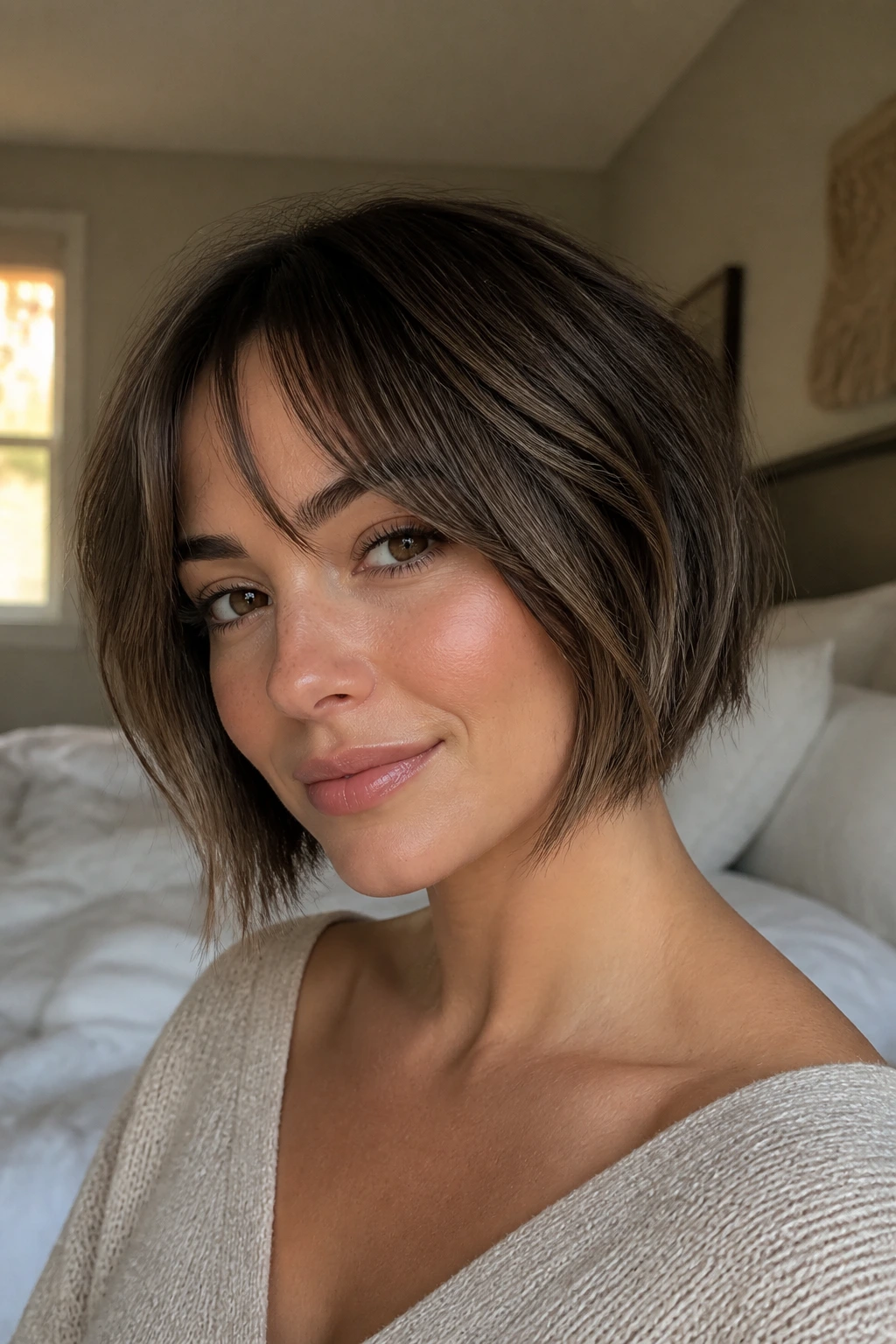
Bottleneck bangs are softer than a blunt fringe and less committed than curtain bangs. They open a round face at the center, then stretch out toward the temples without drawing a hard line across the widest part of the cheeks. Pair that with smoky brown lowlights, and the whole cut feels narrower and more deliberate.
What Makes It Different
The bangs should stay wispy at the middle and longer at the edges. That shape matters. It gives you softness up top and leaves the inverted bob below free to angle down the face.
If you’ve always liked fringe but hate how heavy it can feel, this is the compromise. Not a tiny one, either. It really changes the balance of the cut.
13. Thick-Hair Inverted Bob with Built-In Debulking
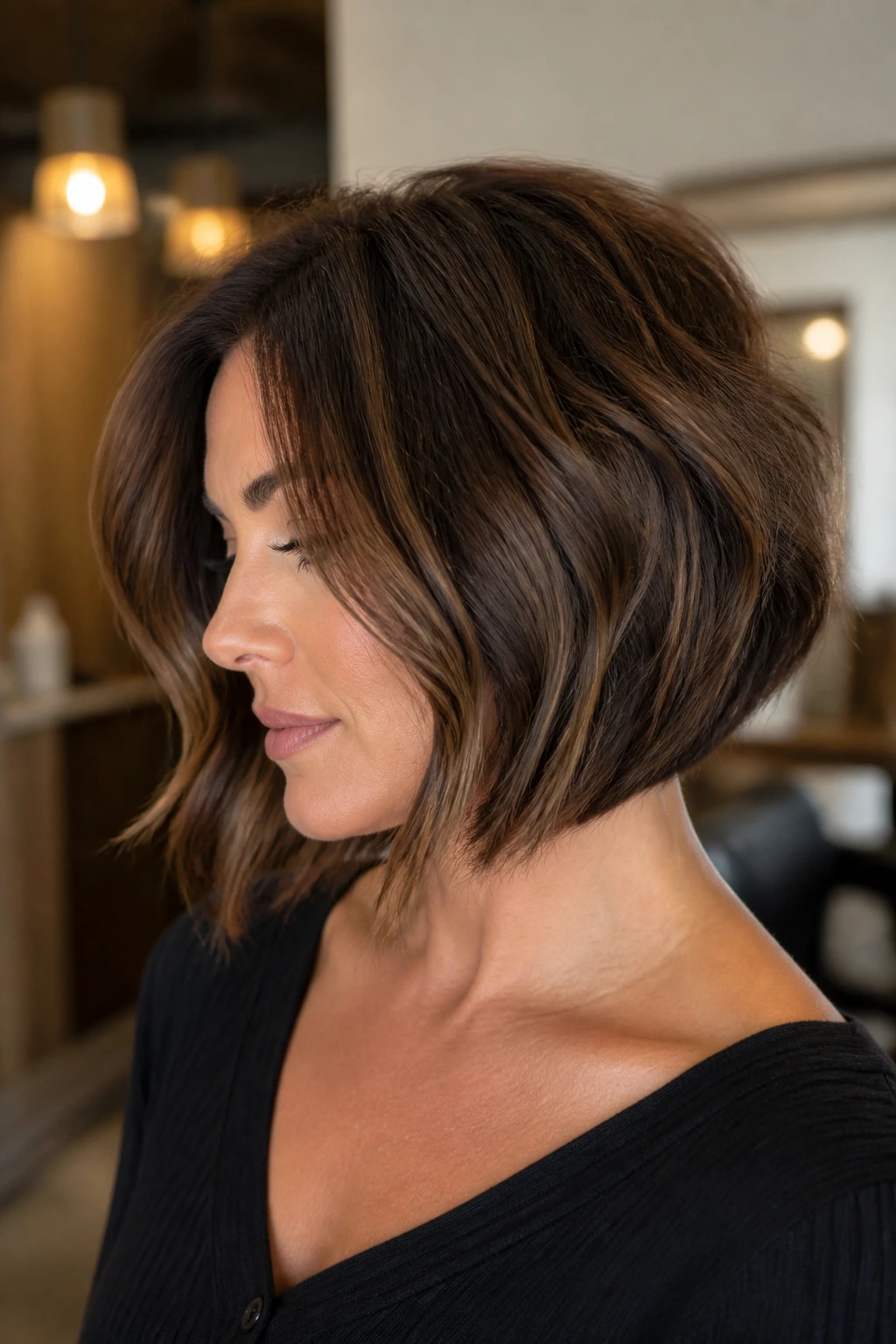
Thick hair needs a different kind of honesty. If you cut it into a round, stacked shape without removing interior weight, it can sit like a helmet by noon. This version uses hidden debulking and deep walnut lowlights so the bob has shape without extra width.
Why It Works on Dense Hair
The back can still be shorter, but the layers inside the cut need to be carved, not shredded. Ask for weight removal where the hair piles up at the occipital bone, then keep the front long enough to skim the jaw.
- Best for: coarse or dense hair that resists collapse
- Color note: walnut or espresso lowlights show shape better than warm caramel
- Finish: controlled, not puffy
This is one of those cuts that gets better as it settles. Day one is fine. Day two is usually better.
14. Fine-Hair Inverted Bob with Crown Lift
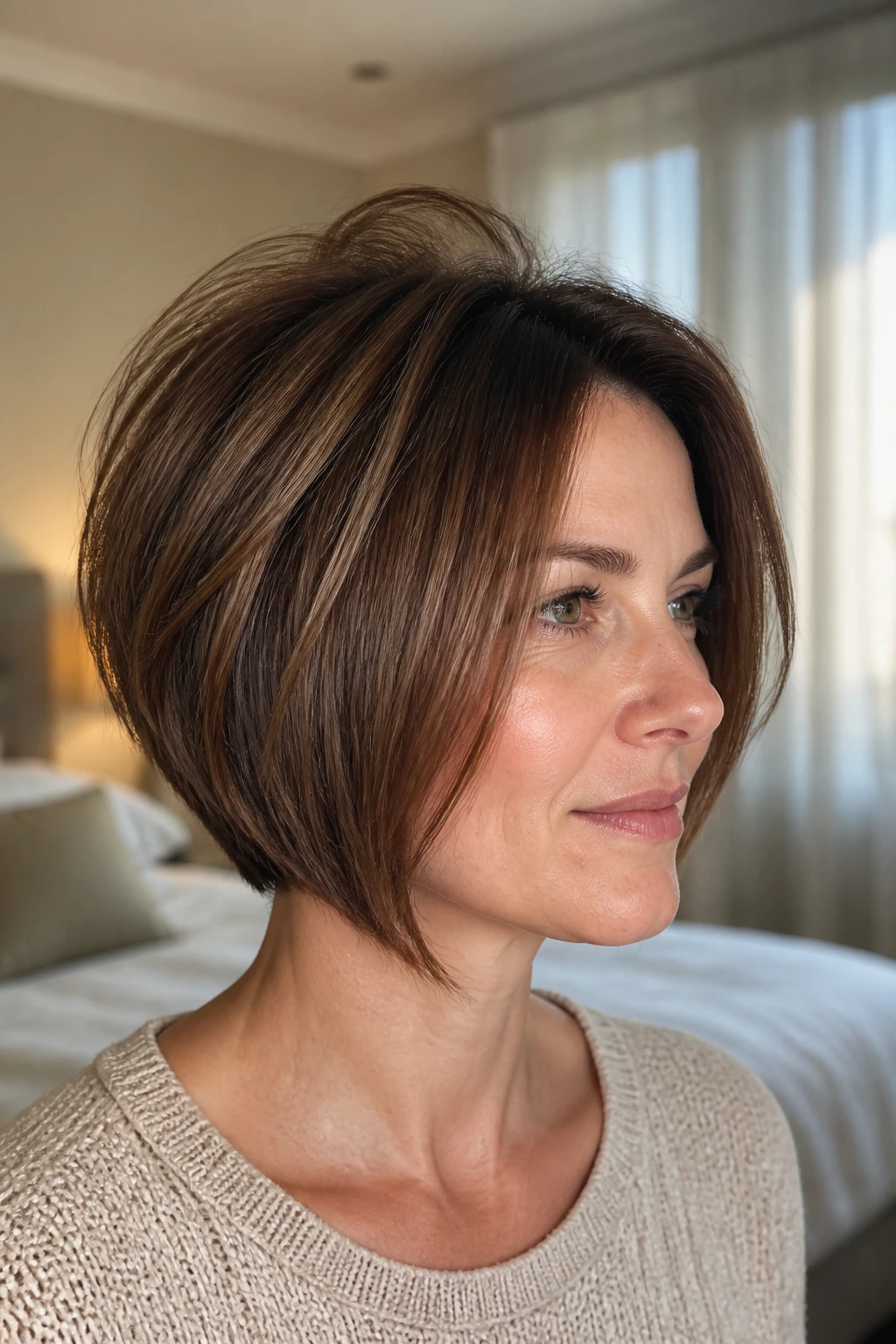
Fine hair needs lift at the crown and restraint at the sides. Too much stacking can make it look thin at the bottom, but too little leaves it limp. The answer is a soft inverted bob with subtle chestnut lowlights that create the illusion of thickness without striping the hair.
The lowlights should be delicate here. Chunky color on fine hair can look harsh. Small, broken ribbons through the mid-lengths give the texture more grip and keep the surface from reading as one pale sheet.
A root-lift spray at the crown helps, but the cut is doing most of the work. That’s the part people miss.
15. French Bob with Mocha Ribbons
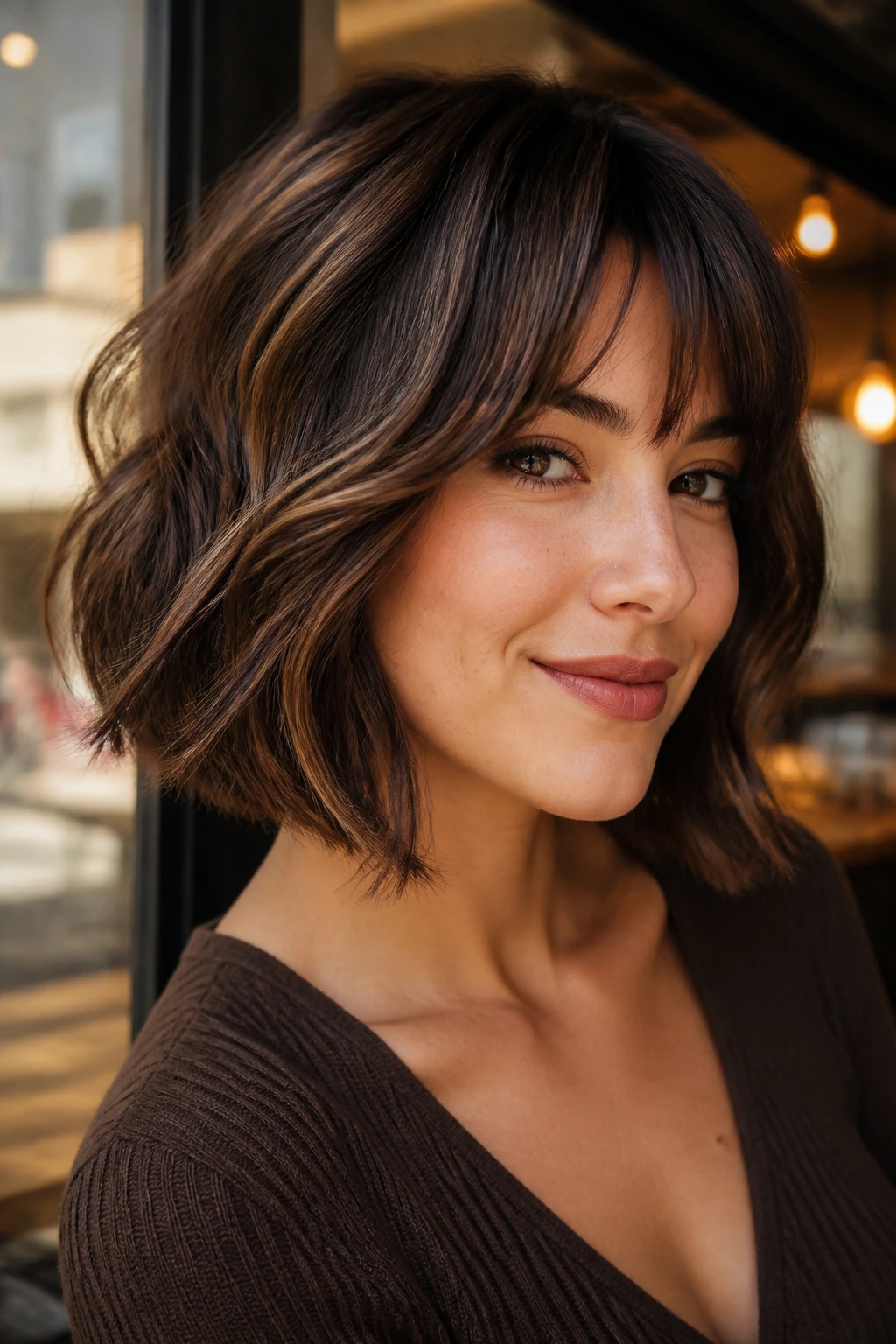
Does a French bob belong in an inverted-bob roundup? When it’s cut with a little more length in the front and a soft wave through the ends, yes. The mocha ribbons add enough darkness to keep the shape from looking too airy on a round face, and the slightly shorter back gives it that neat, tucked feel.
How to Wear It
Keep the bend loose and a little imperfect. A precise curl makes this style feel costumey. A soft bend, especially around the mouth and jaw, feels much better.
The fringe can be light and separated, or you can skip it entirely. Either way, keep the front longer than you think you need.
16. Shaggy Inverted Bob with Feathered Fringe
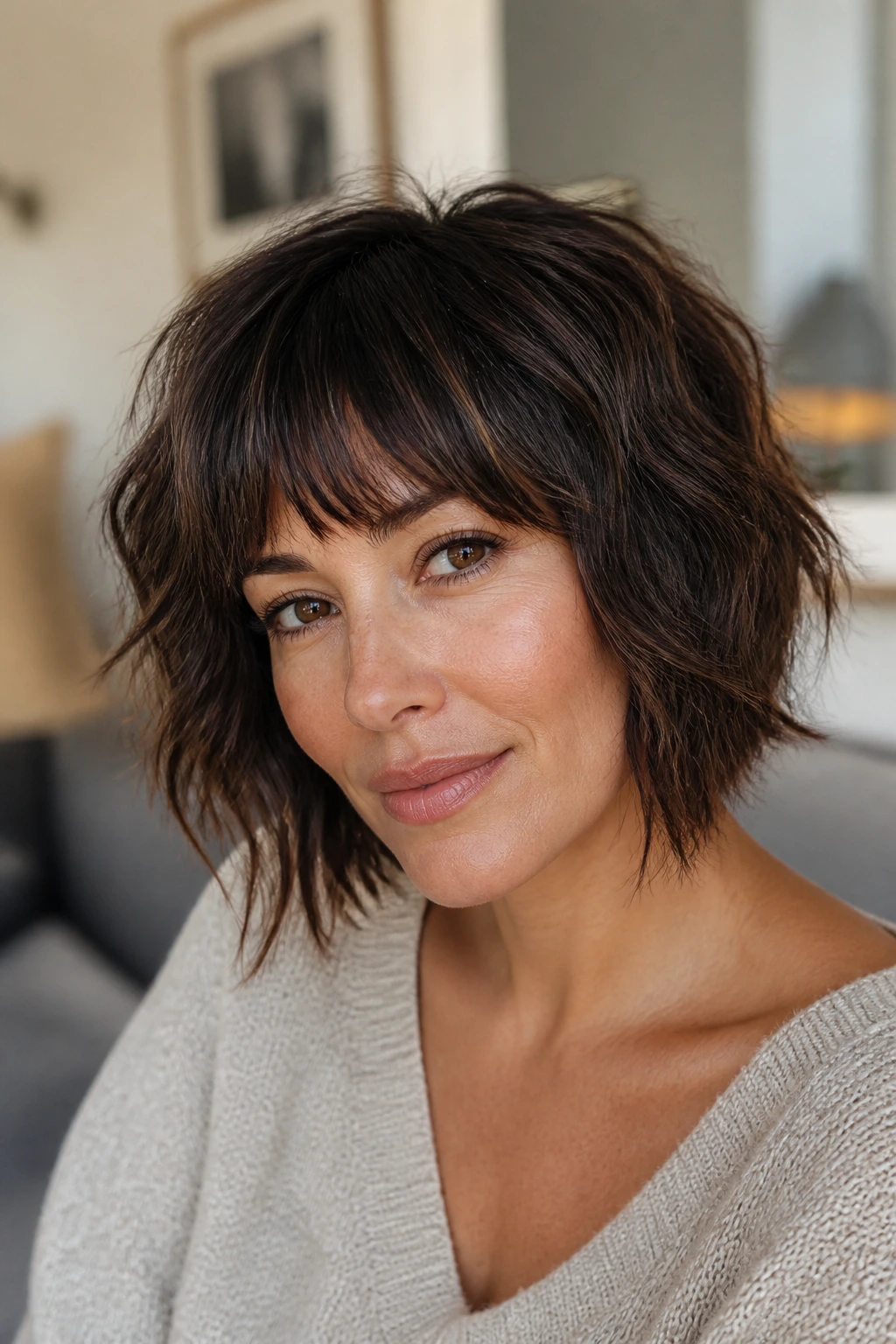
If you want the bob to look a little undone, this is the one. Feathered fringe takes some attention away from the widest part of the face, and the shaggy waves keep the shape broken up. Deep coffee lowlights under the top layer stop the cut from turning fluffy.
A shag can go wrong on a round face if the shortest pieces sit right at the cheek. Don’t do that. Keep the front longer, let the texture start lower, and let the color add the shadow the haircut doesn’t want to fake.
This version feels casual in the best way. Not careless. Just a little lived-in.
17. Long-Front Shadow-Lowlight Bob
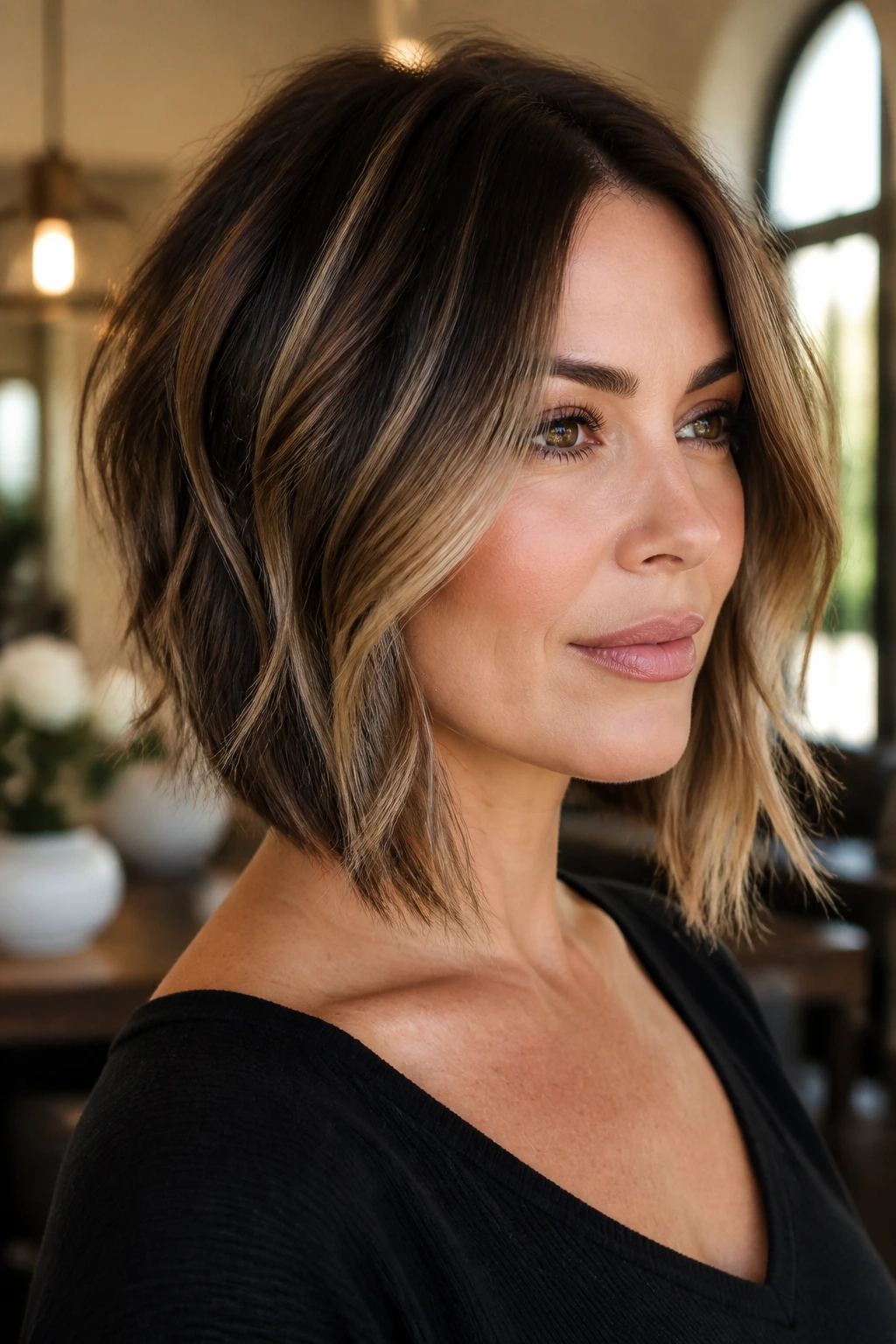
Some bobs do all their talking through the angle. This one whispers. The front pieces stay long enough to soften the jaw, while shadow lowlights under the surface keep the waves from becoming a solid block of brightness. The effect is clean, slim, and a little expensive-looking without trying too hard.
What I like most is how forgiving it is. If your waves aren’t identical on both sides, the shadowing hides a lot. If one side falls flatter, the angle still holds.
This is a strong pick for anyone who wants movement more than volume.
18. Walnut Bob with Big Waves
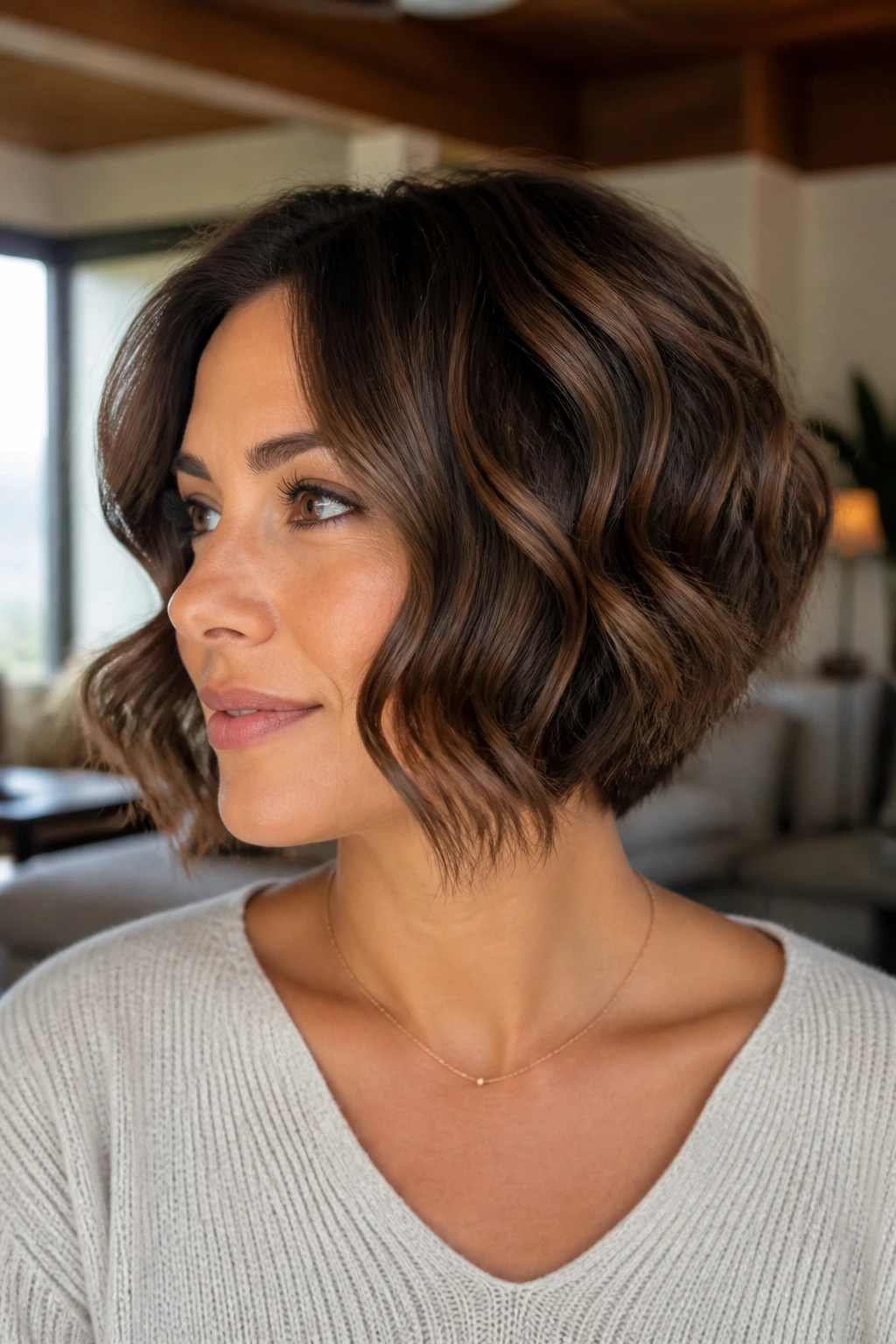
Big waves can work on a round face, but they need space. A walnut-colored inverted bob gives those waves depth so they don’t read like one giant curl expanding at the sides. The back stays shorter and neater, while the front waves land below the cheekbone.
Compared with Beach Waves
Beach waves are softer and messier. These are a touch more polished. That makes them better if you want the cut to look intentional rather than casual.
Wear this version with a side part if your cheek area feels full. The angle gets stronger, and the lowlights keep the texture from going flat in photos or under bright indoor light.
19. Glossy Espresso Bob with Clean Angle
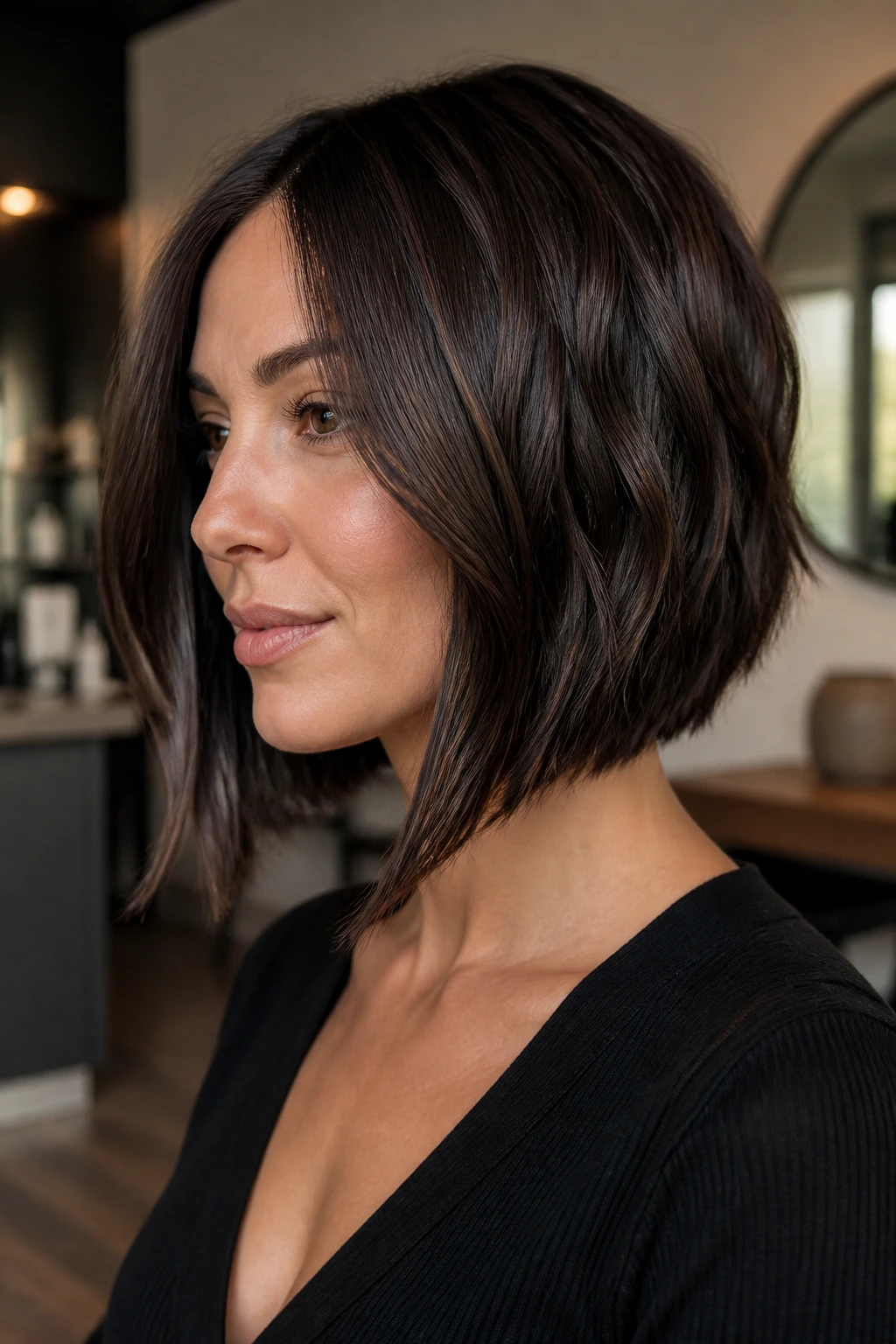
A glossy espresso bob has a sharper edge than the softer brunette looks, and that can be a good thing on a round face when the waves stay controlled. The lowlights are so deep they almost disappear from a distance, then show up in the bend and at the nape.
Why It’s Worth Asking For
The clean angle matters more than the wave itself. If the back is stacked neatly and the front drops past the jaw, the face looks longer. If the ends are too rounded, you lose that effect fast.
- Best for: straight-to-wavy hair with a little natural shine
- Lowlight tone: espresso, not black
- Finish: smooth crown, soft bend at the ends
This one has backbone. I like that.
20. Honey-Brown Bob with Root Shadow
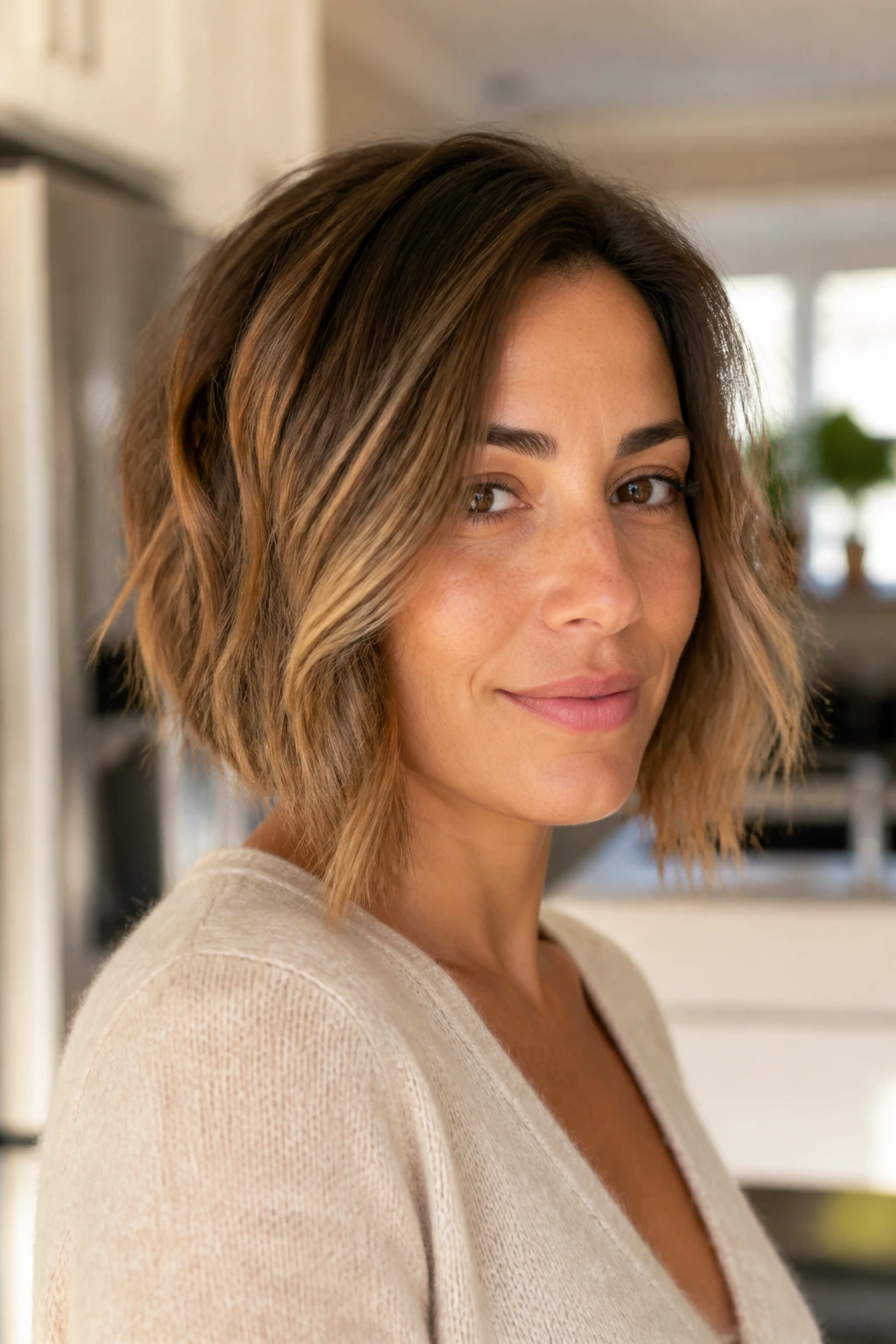
Honey brown can make a round face look wider if the color is too bright from root to tip. A root shadow solves that. Add lowlights through the underlayers, keep the front longer, and the bob suddenly has shape instead of sweetness overload.
The root shadow also makes grow-out easier, which is practical and not at all boring. You won’t be racing back to the salon because the base got a half inch longer.
A loose wave through the mids is enough. Don’t overstyle it. The color and the cut are already carrying weight.
21. Soft A-Line Bob with Rounded Undercurve
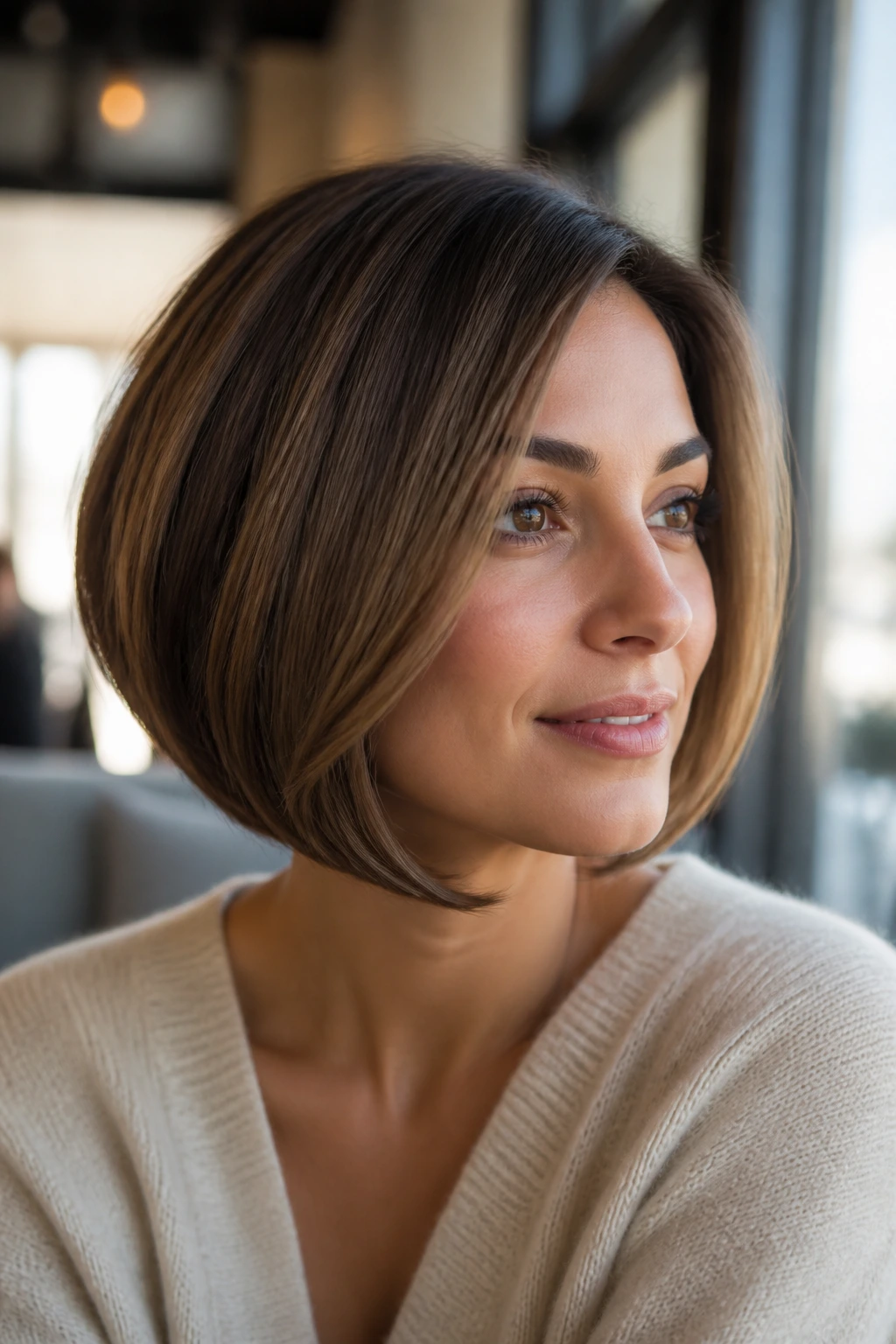
Is an A-line bob the same thing as an inverted bob? Close, but not always. This softer version leans into the same idea: shorter at the back, longer at the front, with a rounded undercurve that bends inward near the jaw. Walnut lowlights add depth so the curve doesn’t look too flat.
Why It Fits a Round Face
The front should be long enough to guide the eye downward. The undercurve should be gentle, not bubble-shaped. If you let the wave sit too high on the cheeks, you’re back where you started.
This is a very good choice if you want polish without sharpness. The shape has enough line to slim, but not so much that it feels severe.
22. Side-Swept Fringe Bob for Round Cheeks
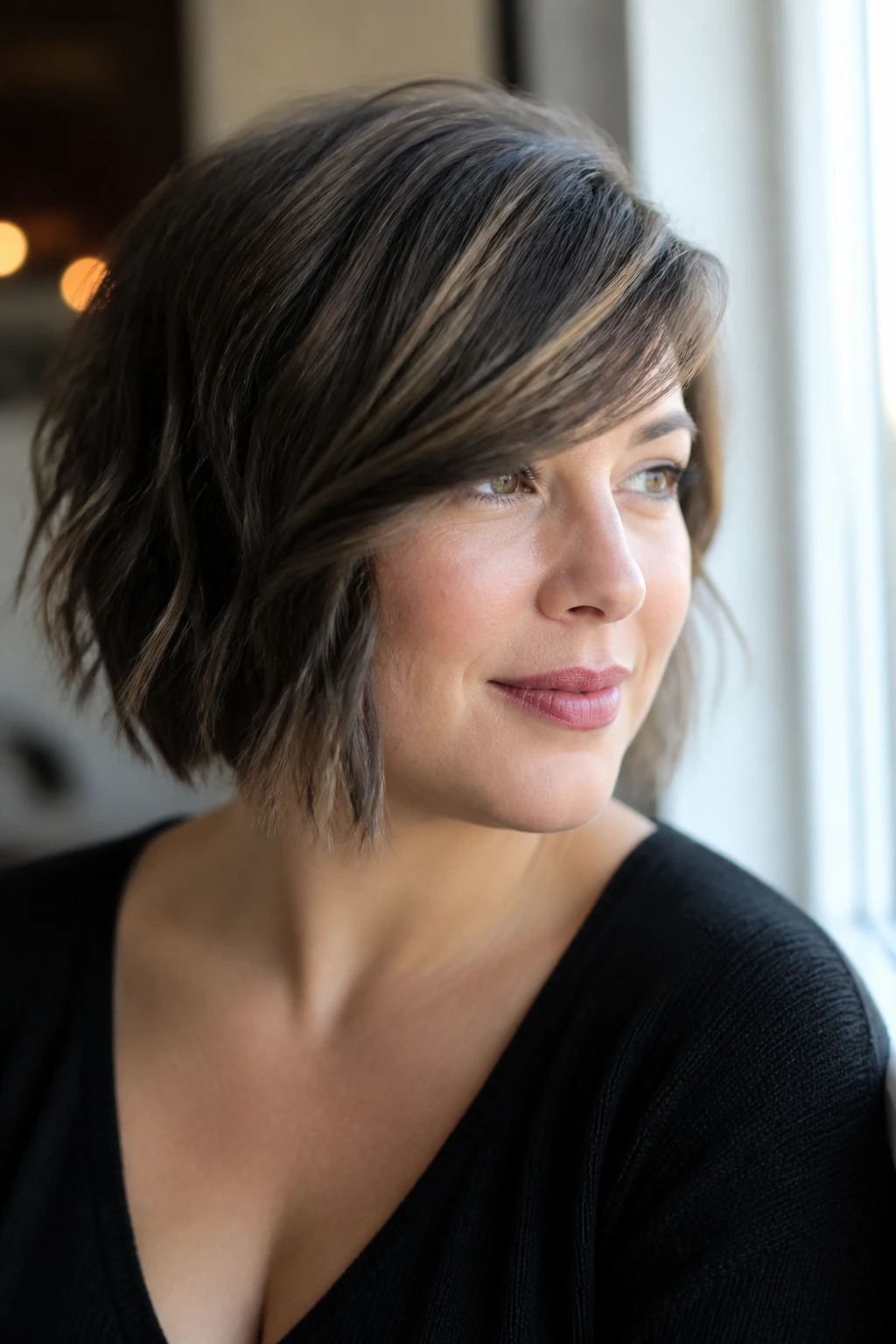
A side-swept fringe can interrupt the width of a round face in a good way, especially when it slides into an inverted bob with smoky brunette lowlights. The fringe should start high and sweep low, not sit heavy at the temple. That’s the trick.
The rest of the bob can stay wavy and soft, but the front needs control. A loose side bend through the fringe area keeps the shape elegant enough for everyday wear.
This is a smart pick if you like a little face coverage without committing to full bangs. It opens and closes the face at the same time, which sounds odd until you see it.
23. Beach-Wave Collarbone Bob with Dimensional Lowlights
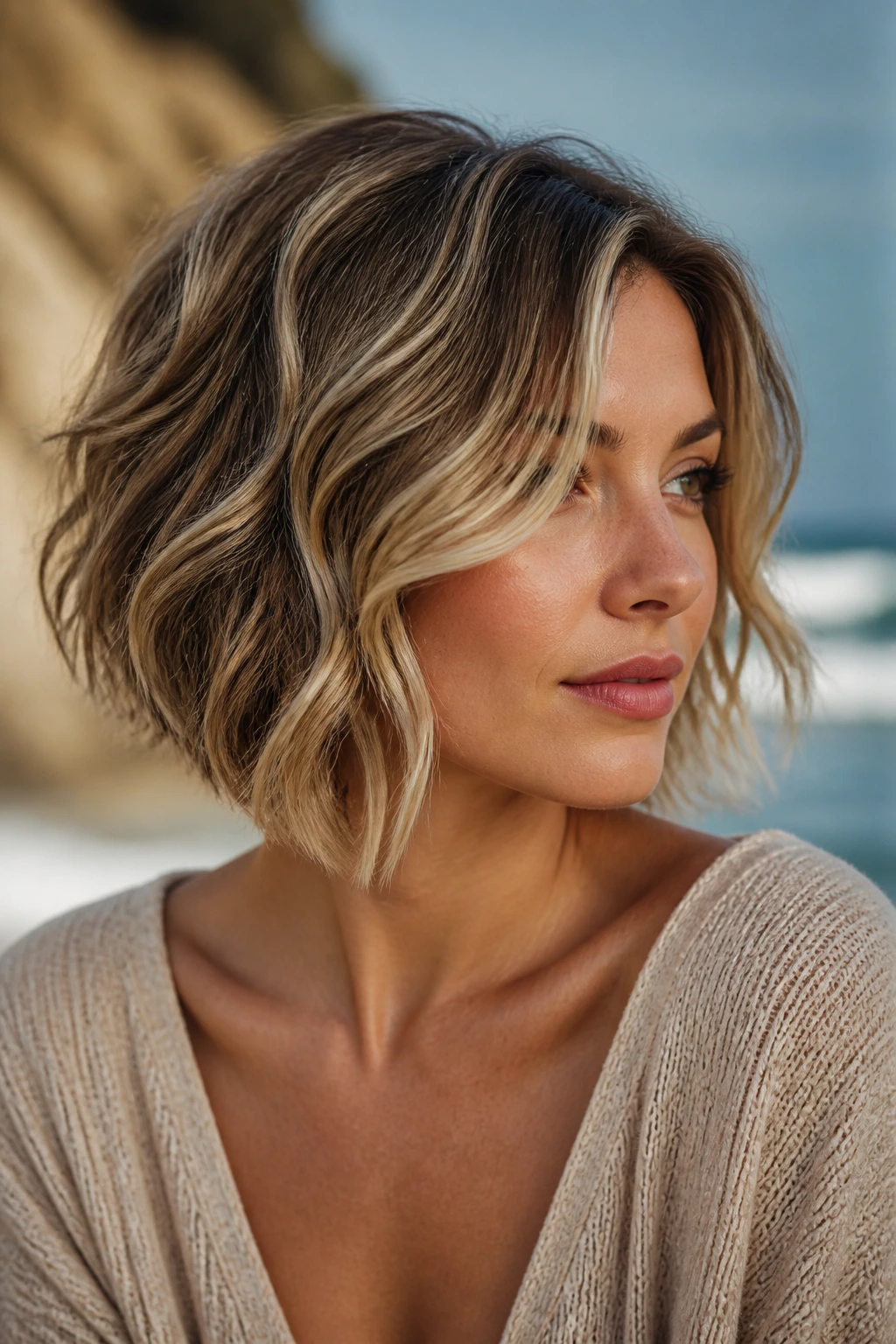
A collarbone bob gives you room to play, but on a round face it still needs that inverted feel in the back or it can drift too wide. Dimensional lowlights scattered under the top layer keep the beach waves from blending into one pale shape.
The best beach waves here are loose, not crimped, and they should start low enough to leave the cheeks open. Think soft bends at the lower half of the head, not curls stacked all over the sides.
This version is relaxed, but it is not lazy. There’s a difference.
24. Smoky Brunette Bob with Face-Framing Darkness
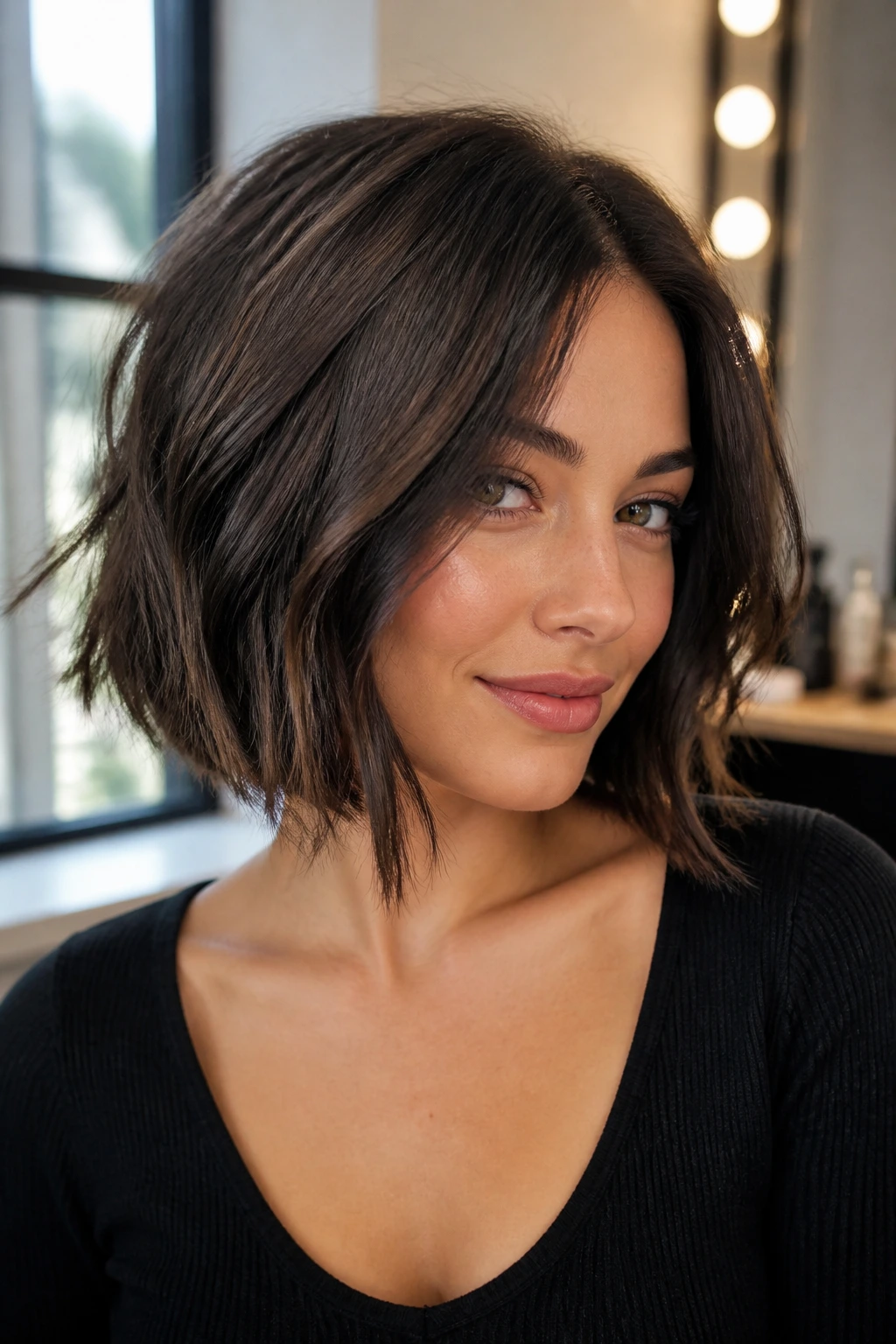
Face-framing darkness can sound harsh, but when it’s placed below the cheekbone and blended into a smoky brunette base, it creates a narrowing effect that round faces usually like. The lighter top surface keeps the hair alive, while the darker pieces around the jaw add depth.
That depth is the whole point. You’re not painting stripes. You’re creating shadow where the face needs it.
I’d choose this for anyone who likes a more editorial, slightly dramatic finish. The cut still stays wearable, which matters more than drama for drama’s sake.
25. Luxe Dimensional Bob with Soft Flip at the Ends
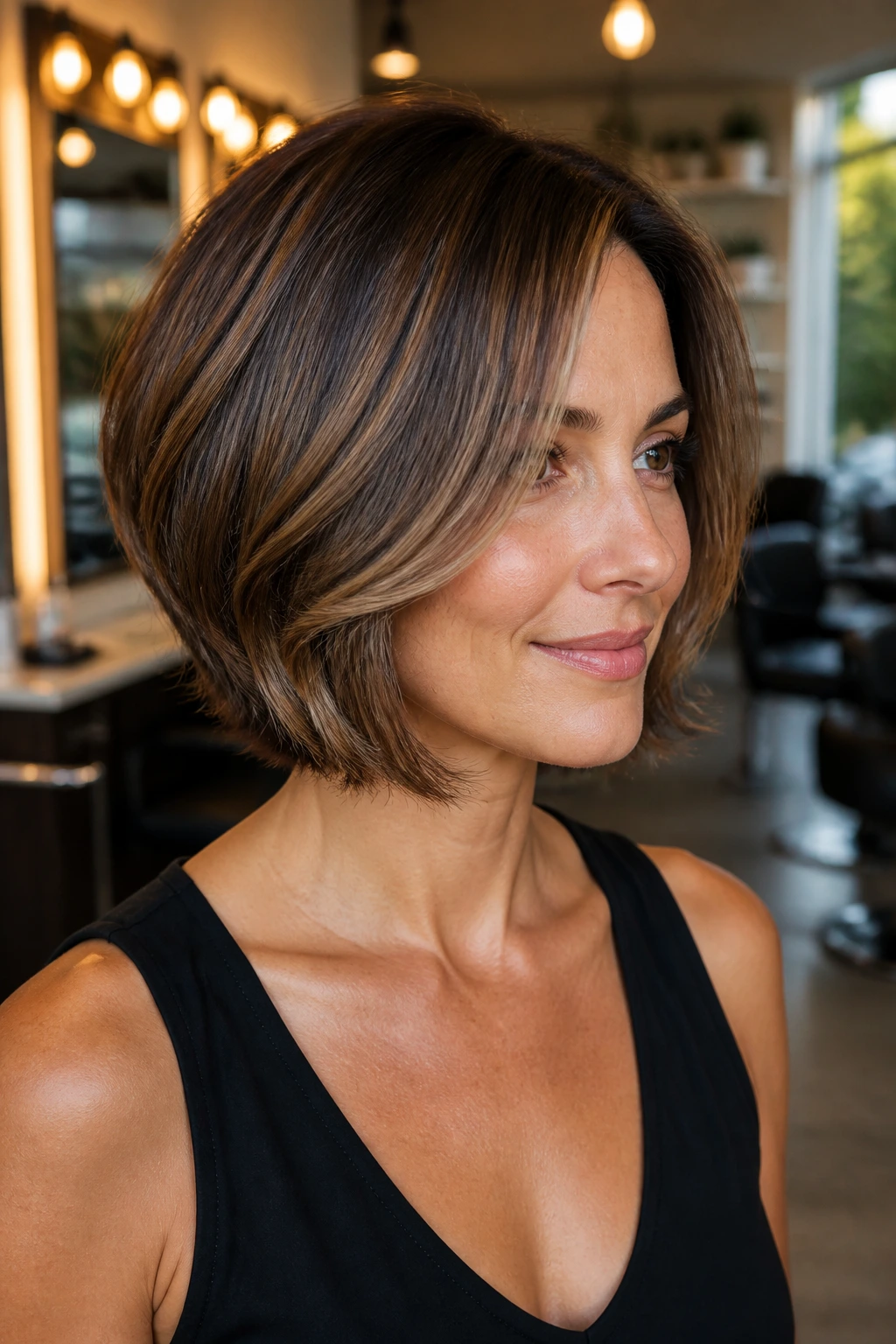
A soft flip at the ends can look either chic or too old-school. The difference is the angle. In this version, the back stays compact, the front swings below the jaw, and the truffle-and-chestnut lowlights keep the waves from turning into one shiny, round halo.
The Final Shape to Ask For
Ask for a bob that flips just enough to show movement, not enough to widen the sides. Keep the crown smooth, keep the front long, and let the color sit in layers.
- Best for: a polished finish with a little motion
- Color note: truffle, chestnut, or soft espresso lowlights
- Styling note: bend the ends outward by half an inch only
It’s a strong finish to the list because it proves the shape can be refined without going stiff.
How the Inverted Shape Changes the Face Line
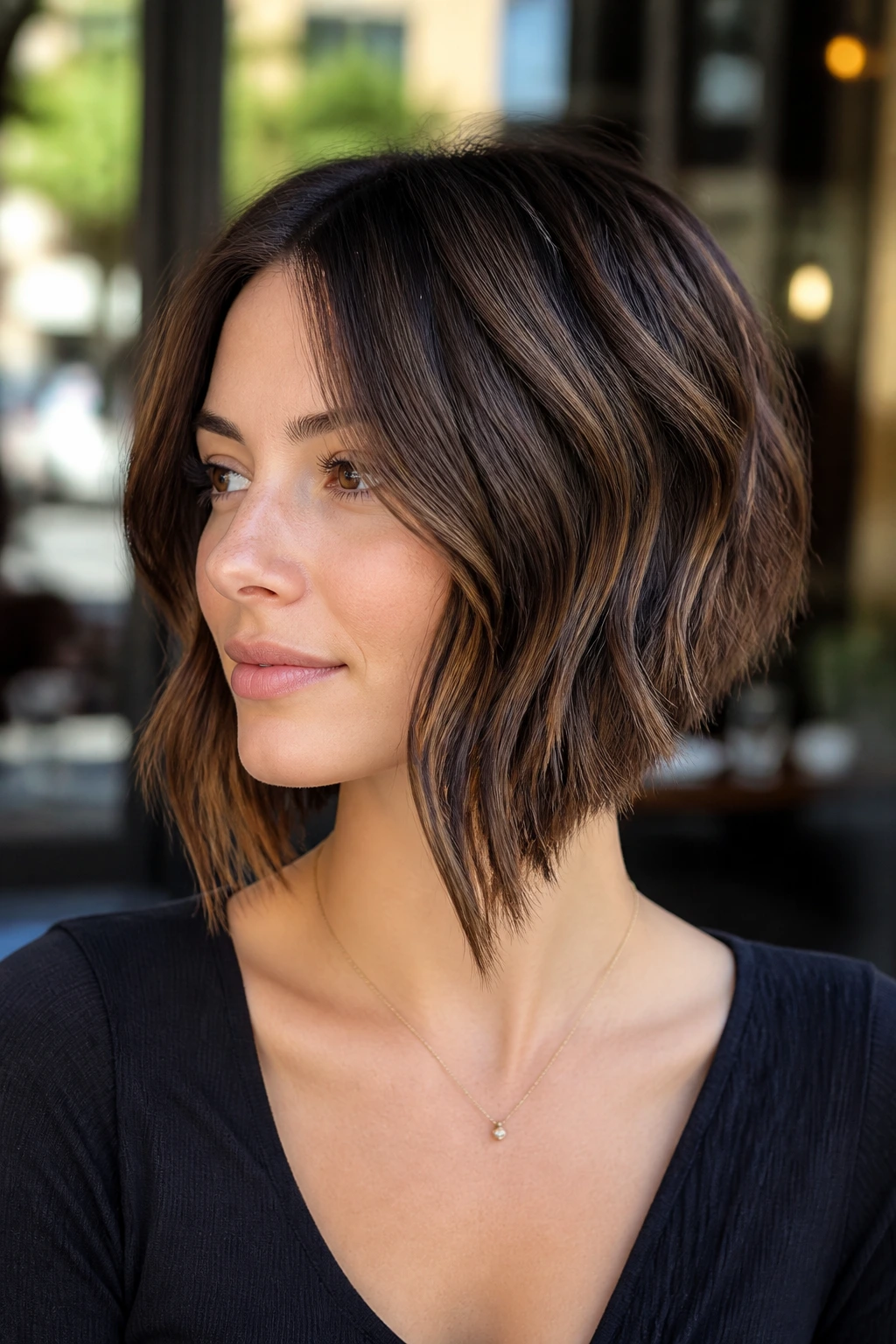
The inverted bob works on a round face because it cheats in a useful way. The nape stays shorter and cleaner, which prevents bulk from collecting at the back of the head. The front pieces stay longer, usually somewhere between the jaw and collarbone, and that creates a diagonal line that the eye follows downward.
Waves help, but only when they’re placed with some restraint. If the bend sits high on the cheek, the face reads wider. If the wave begins lower, around the mouth or jaw, the effect is softer and more lengthening. That’s why the best versions of this cut feel controlled rather than fluffy.
Lowlights make the cut look even smarter. Darker ribbons tucked under the top layer create depth around the nape, the temple, and the underside of the bend. That shadow keeps the style from turning into a shiny ball of hair, which is the enemy here.
A lot of people ask for volume when what they really need is direction. Not the same thing. Volume can puff out at the sides. Direction pulls the eye where you want it to go.
The Tools That Keep These Waves and Lowlights in Line
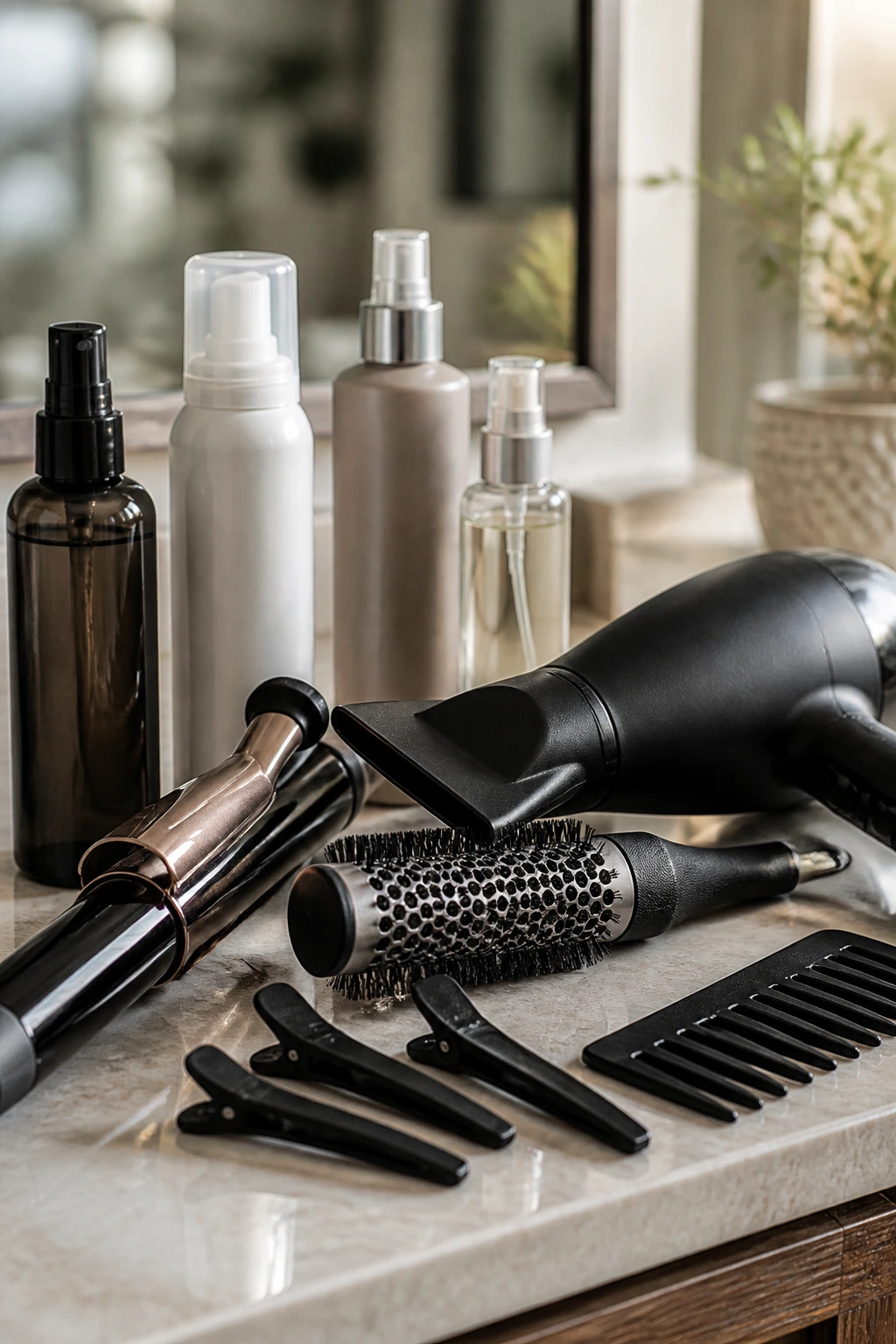
- 1-inch curling wand or iron: Best for soft, loose bends that don’t make the bob look too round.
- Blow dryer with concentrator nozzle: Helps you aim the roots up and the sides down, which matters more than a fancy styling trick.
- Medium round brush, 1.5 to 2 inches: Good for smoothing the crown and bending the front pieces under slightly.
- Duckbill clips or sectioning clips: Keep the top layer out of the way while you style the lower sections.
- Heat protectant spray: Non-negotiable if you’re using hot tools more than once a week.
- Lightweight mousse: Gives wavy hair grip at the roots without turning it sticky.
- Texturizing spray: Useful on dry hair when the waves need separation near the ends.
- Smoothing serum: A drop or two on the front pieces keeps frizz from widening the outline.
- Wide-tooth comb: Better than a brush for breaking up curls without making them blow up.
Choosing the Right Cut, Photo, and Lowlight Shade
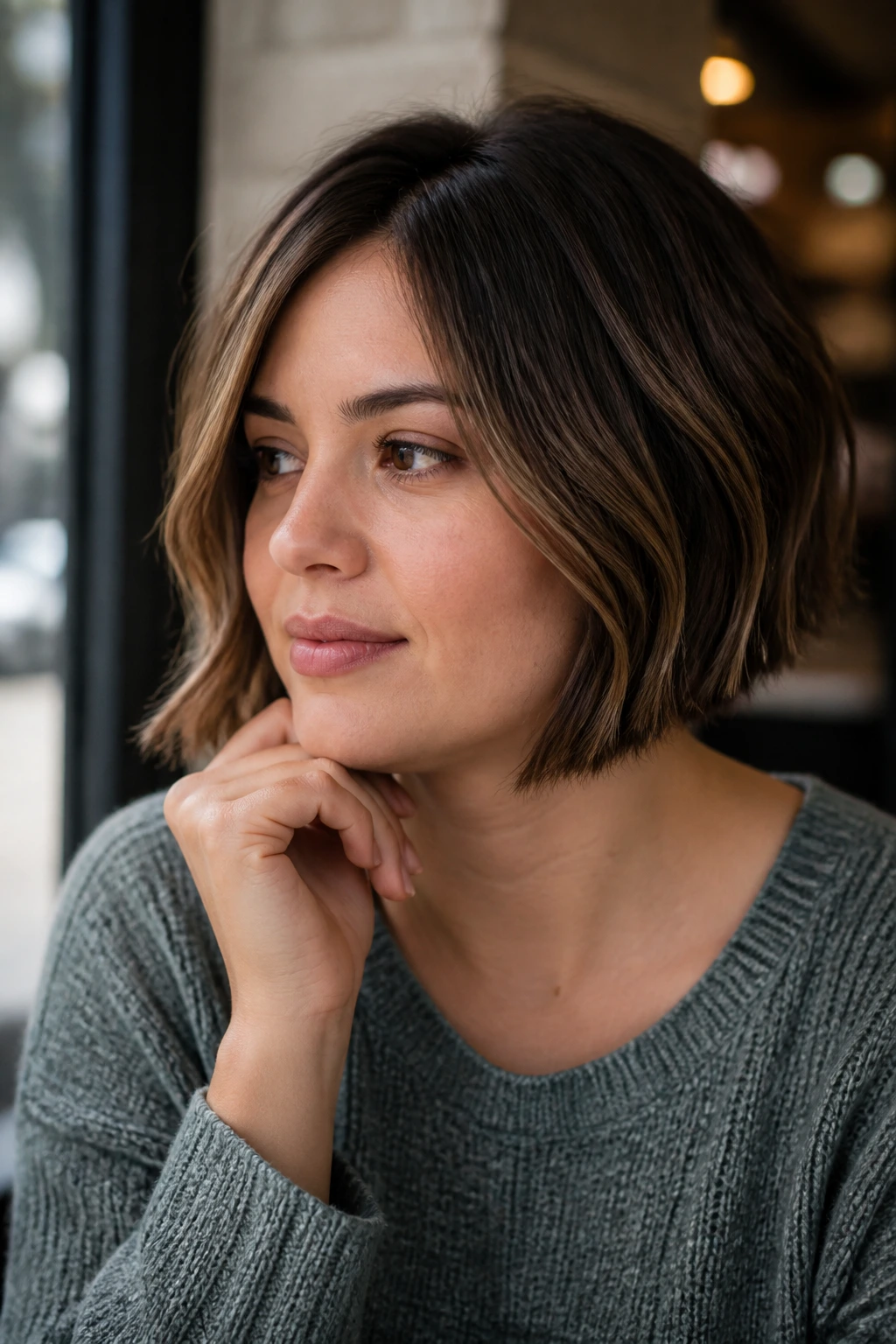
Bring a photo that shows three things: the front length, the amount of stack in the back, and the wave pattern. A single pretty picture is not enough if you cannot tell where the front ends land. For a round face, that detail matters more than the exact curl pattern.
The lowlight shade should sit one to two levels deeper than your base for a soft effect, or three levels deeper if you want more visible contour. On light brown hair, mushroom brown and mocha are safe bets. On dark blonde, beige brunette and taupe brown usually blend better than anything reddish. On medium brunette hair, walnut, cocoa, and espresso give the most shape. If your hair is already deep brown, keep the lowlights subtle or the whole look can go muddy.
Ask your stylist to place the darker pieces where the hair opens up: under the top layer, through the nape, and in selective ribbons near the sides. You do not need dark stripes hugging the cheeks. You need shadow inside the shape. That’s a smaller request, but it’s the right one.
How to Style the Waves So They Don’t Puff at the Cheeks
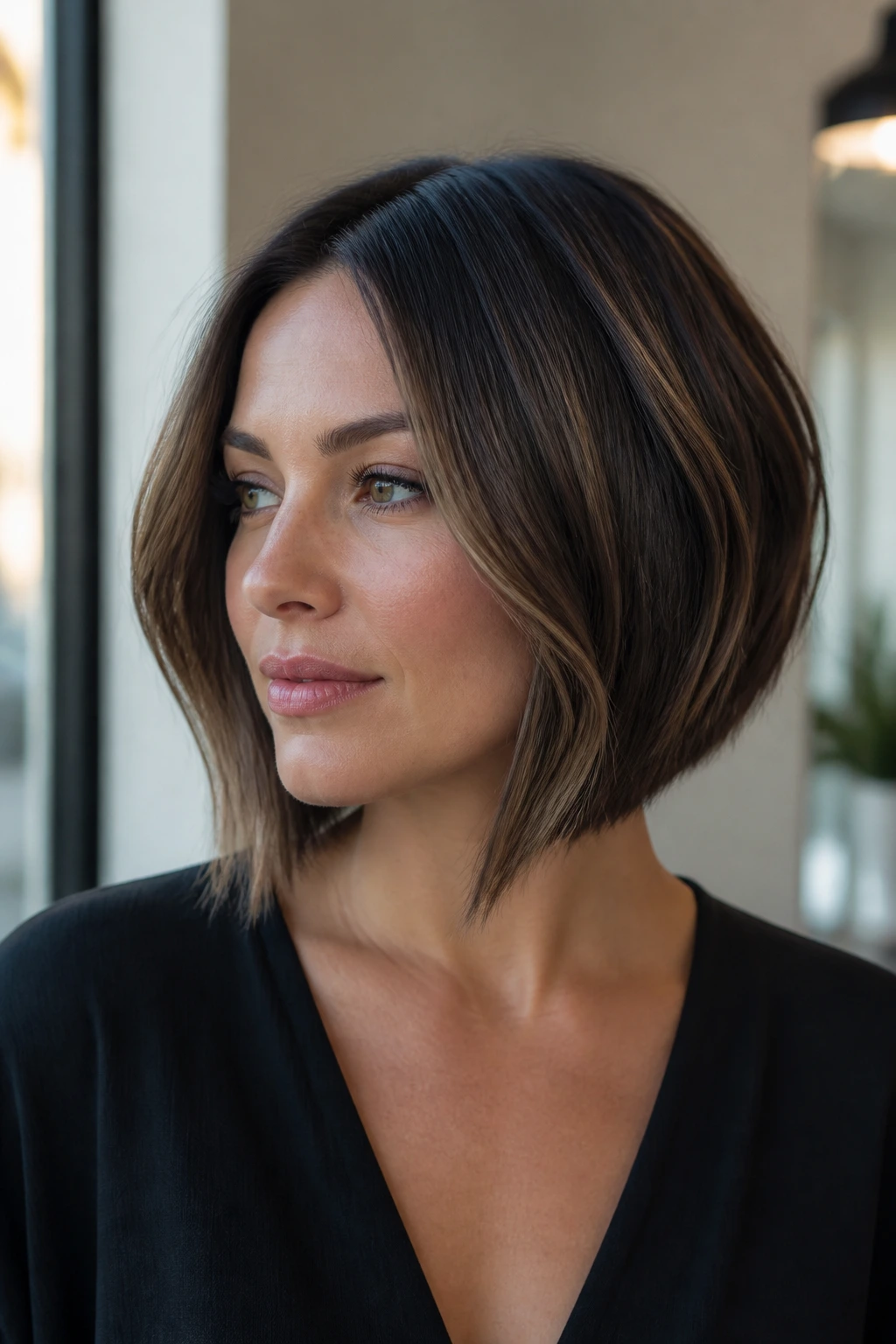
- Root lift: Dry the crown up and back for volume at the top, not the sides. Two or three seconds of lift at each section is enough.
- Wave placement: Start your curl below the cheekbone. If the bend begins too high, the face gets wider fast.
- Parting: Try a side or slightly off-center part first. A dead-center part can work, but only when the front length is generous.
- Product choice: Use a lightweight mousse at the roots and a mist of heat protectant on the mids. Heavy creams can collapse the wave and spread the sides.
- Finish: Break the curl with your fingers, not a brush. A brush can puff the whole shape into a halo.
- Direction: Curl the front pieces away from the face, then let the ends soften inward by themselves. That keeps the line narrow without looking stiff.
One more thing. If your hair flips outward at the ends, don’t panic and don’t overcorrect with more heat. Smooth the bend once, then leave it alone. Chasing every strand is how a bob starts looking wide and tired.
Common Mistakes That Make the Cut Wider Than It Should Be
- Stopping the front at the cheekbone: That’s the fastest way to make a round face look broader. Keep the longest pieces below the jaw or close to the collarbone.
- Curling everything into the same size wave: Uniform curls read as a circle. You want mixed movement — some bend, some stretch, some straighter ends.
- Placing lowlights too high and too chunky: Big dark stripes near the face can look harsh. Ask for thinner ribbons under the surface instead.
- Puffing the sides with too much product: Thick cream, heavy oil, and too much dry shampoo can all widen the outline. Start small and add only if needed.
- Ignoring the crown: Flat roots leave all the volume at the sides, which is the opposite of what you want here.
- Cutting the back too short: A super-short stack can look cute in theory and triangular in real life. Keep the back neat, not aggressive.
If one of these mistakes happens, it’s usually fixable. A better part, a softer wave, or a trim that lowers the front line can rescue a lot.
Variations and Adaptations to Try
Air-Dry Wave Version: Ask for a softer perimeter and fewer layers, then let the wave pattern do the work. A light mousse and scrunching with a microfiber towel are enough. Good if you hate daily heat styling.
Sharper Salon-Finish Version: Keep the crown smooth, deepen the side part, and bend only the last half of the lengths. This looks cleaner and works well with espresso or walnut lowlights.
Curly-Wavy Hybrid: If your hair is naturally bendy, cut the front longer than you think and keep the layers blended. The lowlights should follow the curl pattern instead of fighting it.
Fine-Hair Lift Version: Use subtle stacking, soft lowlights, and a root-lift product. Too much layering on fine hair can make the ends look thin, so keep the shape light and controlled.
Thick-Hair Control Version: Remove internal bulk, keep the front long, and place darker color under the top surface. This keeps the bob from ballooning around the cheeks.
Low-Maintenance Grow-Out Version: Use root shadow and lowlights that blend a little darker at the base. You’ll get softer regrowth and fewer sharp lines between color visits.
Maintenance and Day-Two Care
These bobs hold their shape best with regular trims every 6 to 8 weeks. If you wait much longer, the front length starts to drift into the cheeks, and the whole face-slimming effect gets weaker. The color needs its own rhythm too. Lowlights usually stay clean for a while, but a gloss or toner refresh every 6 to 10 weeks keeps the brunette shades from turning dusty or flat.
Washing every 2 to 3 days is the sweet spot for most wavy bobs. Too much washing strips the lowlight tone and makes the hair frizzier. Too little, and the roots start to collapse. Use a color-safe shampoo, then a light conditioner only from mid-lengths down. If the hair is fine, keep conditioner off the root area entirely.
Day two is often where these cuts shine. Mist the hair with water, add a pea-sized bit of mousse or wave cream, and re-bend the front pieces for 5 to 10 seconds each with a wand if needed. Sleep on a silk or satin pillowcase if the waves flatten fast. If one side bends out weirdly, clip it in place while it cools after styling. That small habit saves a lot of morning frustration.
Questions People Ask Before They Book the Cut
Will an inverted bob make a round face look shorter?
Not if it’s cut right. The longer front pieces and the angled line usually make the face look a bit longer, especially when the waves start below the cheekbone.
Should I avoid bangs with a round face?
No, but choose the right kind. Curtain bangs, bottleneck bangs, and soft side-swept fringe work better than a blunt, heavy line that stops across the forehead.
What lowlight shades work best on brunette hair?
Walnut, mocha, cocoa, and espresso are the safest bets. They add depth without making the hair look striped or muddy.
Can this cut work on fine hair?
Yes, if the layers stay soft and the color isn’t too chunky. Fine hair usually needs crown lift, not a lot of aggressive stacking.
What if my hair is thick and puffy?
Ask for internal debulking and a cleaner nape. Thick hair can wear this shape well, but it needs weight removed from the right places or it grows outward.
Do I need hot tools every day?
No. A good cut and the right lowlights do half the work. On many hair types, a quick bend at the front and a little root lift are enough.
How do I keep the waves from expanding at the sides?
Start the bend lower, keep the ends slightly straighter, and avoid heavy creams. The hair should move down and in, not out.
The Shape That Keeps Its Lines
A good wavy inverted bob on a round face does not shout. It angles, narrows, and leaves a little breathing room around the cheeks. The lowlights make that shape look richer, deeper, and less like one smooth block of color. That’s the part most people miss when they ask for “dimension.” They want brightness. What they actually need is shadow.
The best version for you depends on hair density, part preference, and how much styling you’ll tolerate in the morning. Pick the front length first, then the lowlight depth, then the fringe if you want one. Get those three pieces right and the rest falls into place faster than you’d expect.
If you’re taking one idea to a salon, make it this: keep the front long enough to pull the eye below the cheeks, and let the lowlights live inside the wave instead of sitting on top of it. That one decision does a lot of the work for you.