



Frizz has a bad reputation it doesn’t deserve. On the right bob, that airy halo around the ends can look sharp, lived-in, and expensive in the best sense of the word — not stiff, not helmety, not trying too hard. Wavy bobs for frizzy hair and round faces work when the cut gives the wave a place to settle instead of fighting it every morning.
The trap is length. A bob that stops right at the fullest part of the cheek often makes the face look wider, because the eye lands exactly where you least want extra emphasis. Push the front a little longer, soften the perimeter, and let the cut move away from the jawline. Suddenly the shape reads cleaner, lighter, and more deliberate.
There’s also a sneaky truth about frizzy hair: some of what people call frizz is just texture with nowhere to go. Put that texture in a smarter shape — collarbone length, off-center part, internal layers, a soft angle through the front — and it stops looking like a problem. The styles below all do that in different ways, which is why this collection is so useful when your hair has a mind of its own.
Why These Wavy Bobs Earn Their Keep

-
They pull the eye downward: The best cuts here place the longest pieces below the cheekbone, which keeps a round face from feeling boxed in at the sides.
-
They work with frizz instead of sanding it off: A little surface puff looks intentional when the cut has movement baked into it; that same puff looks messy on a blunt, heavy shape.
-
They give you styling range: Some of these bobs look best air-dried, some want a diffuser, and a few clean up fast with a round brush and a dab of serum. That flexibility matters on busy mornings.
-
They keep the outline readable: Waves and frizz can blur a haircut fast. These styles keep a clear perimeter, so the bob still looks like a bob by the end of the day.
-
They flatter round faces from different angles: Side parts, asymmetry, longer fronts, and soft fringe all change the visual line. Small shifts make a bigger difference than people expect.
-
They don’t demand perfect hair: That’s the real win. A slightly imperfect bend, a little puff at the crown, a piece that flips the “wrong” way — all of it can still fit the cut.
What to Tell the Stylist So the Bob Behaves
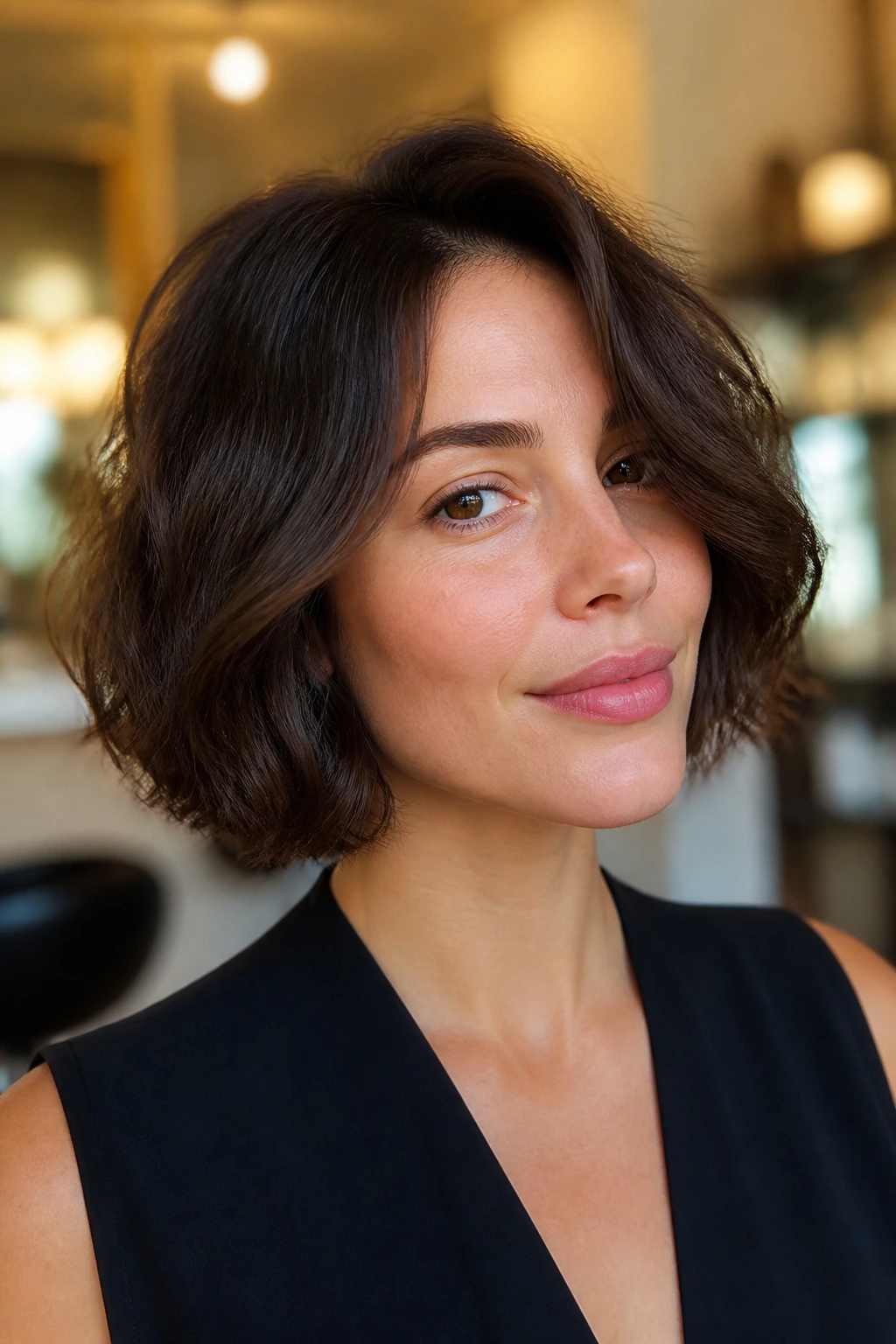
The cut matters more than the product shelf. That’s the part people miss. You can own the nicest curl cream on the block and still end up with a triangle if the perimeter is too blunt and the volume sits too high at the cheeks.
Ask for a shape that drops below the widest point of your face, not right on it. If your hair is thick or coarse, say you want internal removal of bulk, not aggressive thinning at the ends. Those are not the same thing, and your hair will wear the difference in the first hour after a wash.
Bring up the part too. A slight off-center part often helps a round face more than a dead-center line, especially when the sides need a little vertical length. If you love a middle part, keep the front pieces longer so they skim past the cheeks instead of stopping at them.
A few phrases that help at the chair:
- “Keep the front longer than the back.”
- “I want softness, not a choppy halo at the ends.”
- “Please remove weight inside, not from the outline.”
- “Can we keep the length below the cheekbone?”
- “I need the cut to survive air-drying.”
One more thing. If your waves are strong, ask the stylist to check the shape dry before they finish. Wet hair lies. It lies a lot. A bob can look perfectly balanced when wet and then spring up two inches at the sides once it dries, which is exactly how people end up annoyed in the mirror on day two.
1. Collarbone Sweep Bob
This is the safest place to start, and I mean that as a compliment. The collarbone sweep bob lands long enough to graze the neck and short enough to keep the wave from dragging the face down, which makes it one of the easiest wavy bobs for frizzy hair and round faces to wear.
Why it works: The front pieces fall below the cheekbone, so they carve a longer line through the face. The collarbone length also gives frizz room to soften instead of blooming outward at jaw level. You get movement without the puffy “triangle” shape that happens when a bob is cut too high.
Styling note: Scrunch a light mousse into damp hair, then twist the front sections away from the face with your fingers. A diffuser on low heat keeps the bends loose; high heat usually makes the ends look rough.
Best for: Anyone who wants a bob that can live in two worlds — polished on Monday, undone on Friday — without changing the cut.
2. Off-Center French Bob
A classic French bob gets a little smarter when it’s nudged off-center and kept just a touch longer in the front. That tiny shift matters. On a round face, it stops the haircut from sitting like a circle on a circle.
Why it flatters round features: The off-center part creates a diagonal line, which makes the face feel longer. The shorter length keeps the whole look crisp, while the soft wave breaks up the bluntness so the cut doesn’t feel severe.
Stylist note: Ask for a chin-to-upper-jaw length with softened corners, not razor-clean ends. If your hair is especially frizzy, tell your stylist to keep some perimeter weight so the shape doesn’t puff out after the first wash.
What to watch for: This cut is lovely when it sits close to the face, but it can turn boxy if too much bulk is removed through the lower half. Leave the bottom line with some heft.
3. Angled Swing Bob
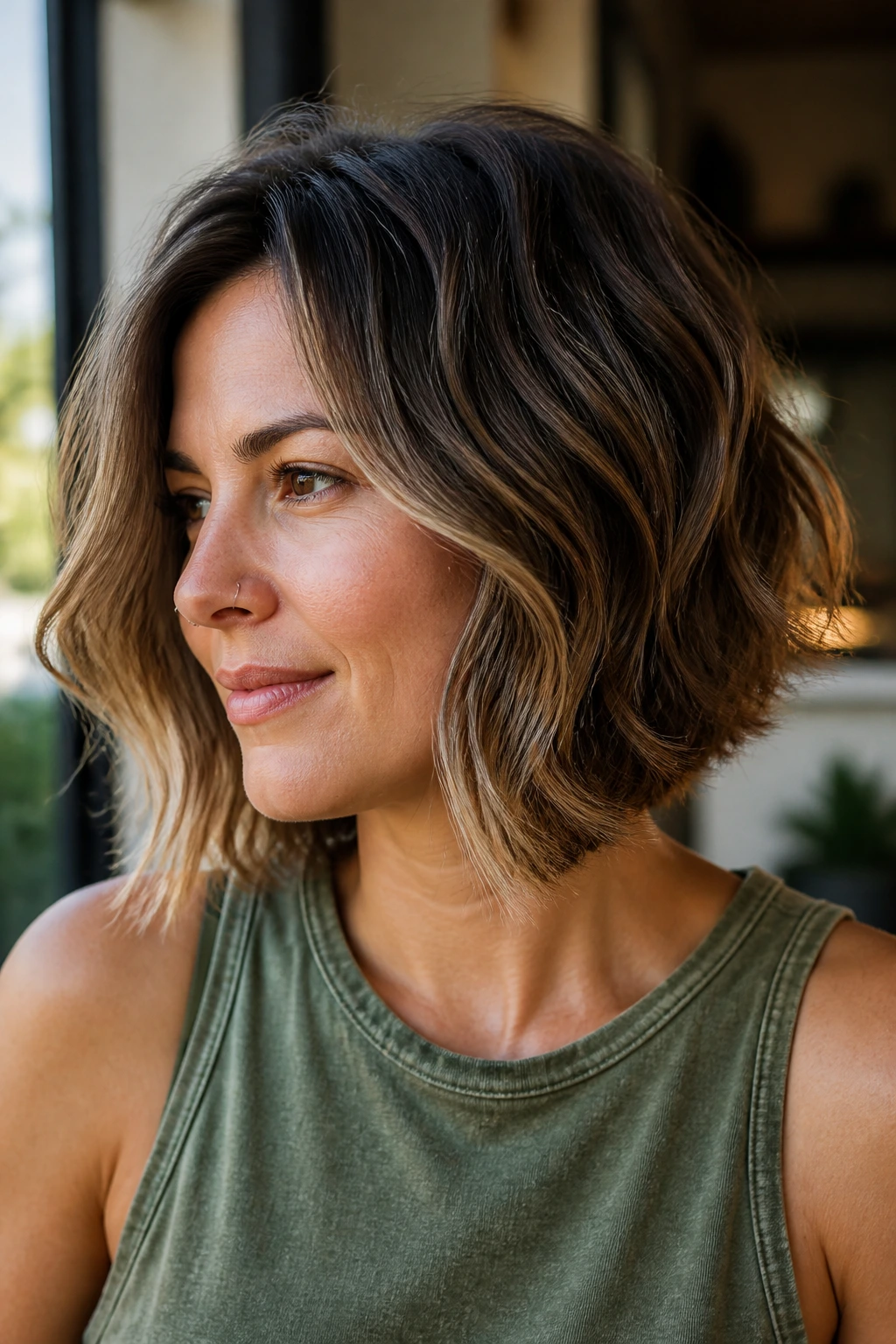
Why does a slightly longer front make such a difference? Because it draws the eye where you want it. The angled swing bob keeps the back a little shorter and lets the front pieces swing forward, which trims the visual width of a round face without making the haircut look severe.
The move here is subtle. You are not asking for a sharp wedge. You want a soft angle that appears when the hair moves, especially if your waves start forming once the hair hits about 70 percent dry. That bend gives the cut its swing.
Ask for this: A gentle A-line, with the longest pieces skimming the upper neck or collarbone and the back staying compact. If your hair is dense, a little internal shaping near the crown helps the front swing instead of puff.
Best styling move: Blow-dry just the front two sections with a medium round brush, then let the rest air-dry. That small amount of direction makes the angle show up more clearly.
4. Curtain-Bang Wavy Bob
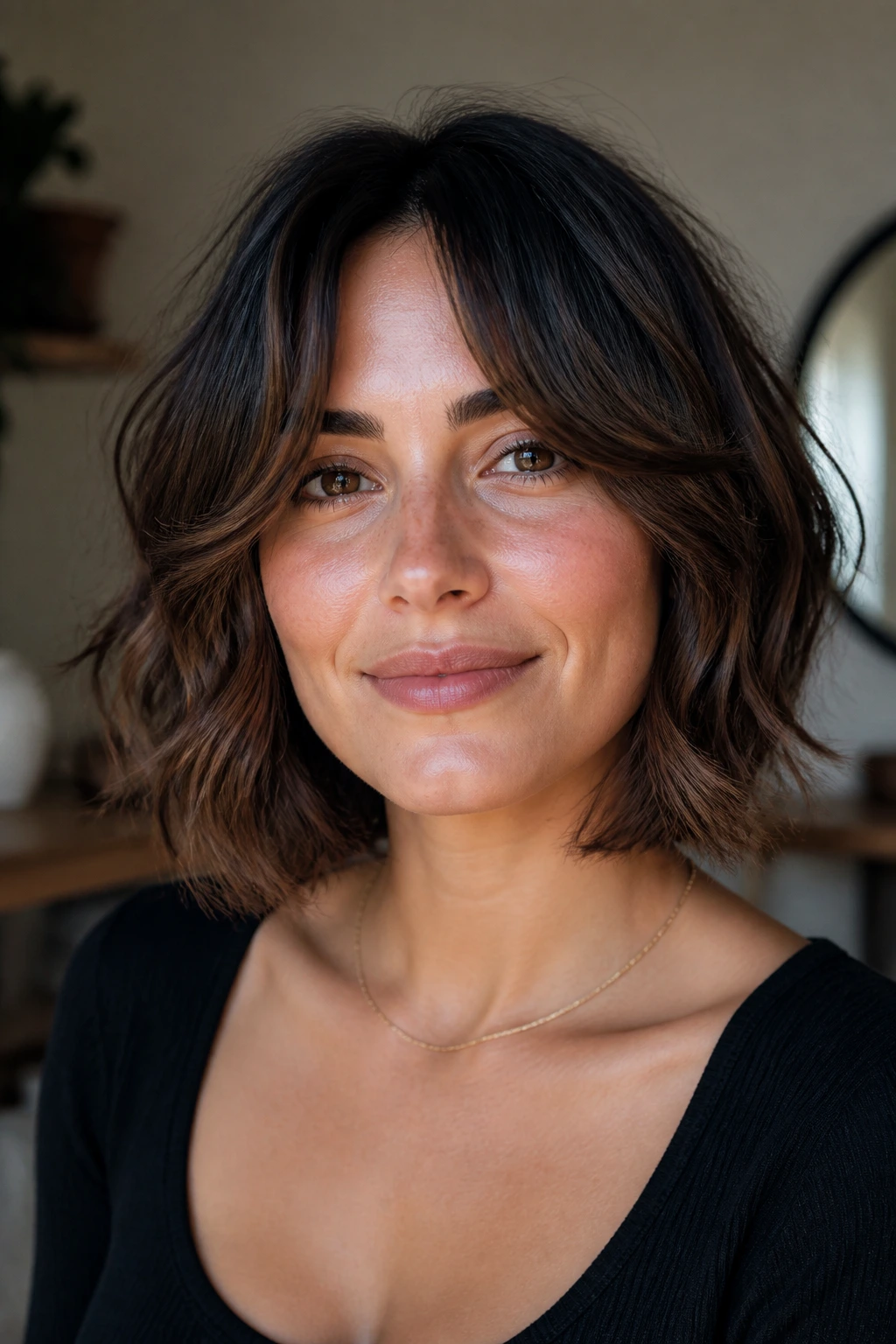
Curtain bangs are not decoration here. They are geometry. A wavy bob with curtain bangs opens the face vertically and keeps the eye moving down the center line instead of bouncing across the cheeks.
The good version stays soft at the bridge of the nose and gets longer beside the cheekbones. That longer side piece matters because it breaks the roundness without turning the haircut into a full fringe commitment. For frizzy hair, the bang should be cut to move, not sit like a solid sheet.
Styling note: Dry the bangs first, side to side, with a flat brush or your fingers. If you leave them to fend for themselves, they’ll dry in whichever direction they feel like, and curtain bangs with opinions are a lot to manage.
Best for: Wavy hair that has enough bend to separate on its own, plus anyone who wants face framing without the upkeep of a blunt fringe.
5. Soft Blunt Bob

A blunt bob sounds like the wrong answer for frizzy hair, and sometimes it is. But soften the ends, keep the length just under the jaw, and let the wave break up the line, and suddenly the cut looks clean instead of hard.
The trick is restraint. You keep the outline strong, but the interior gets a little air. That lets the hair move without exploding. For a round face, a soft blunt bob works best when the sides are not puffy at cheek height and the part is slightly off-center.
Stylist note: Ask for a blunt perimeter with minimal texturizing through the bottom inch. Too much thinning at the ends can make frizzy hair look frayed, and once that starts, you’re spending the rest of the week trying to smooth it down.
Best styling move: Use a pea-sized amount of smoothing cream on damp mids and ends, then dry with the nozzle pointed downward. Not glamorous. Effective.
6. Cheekbone-Frame Layer Bob
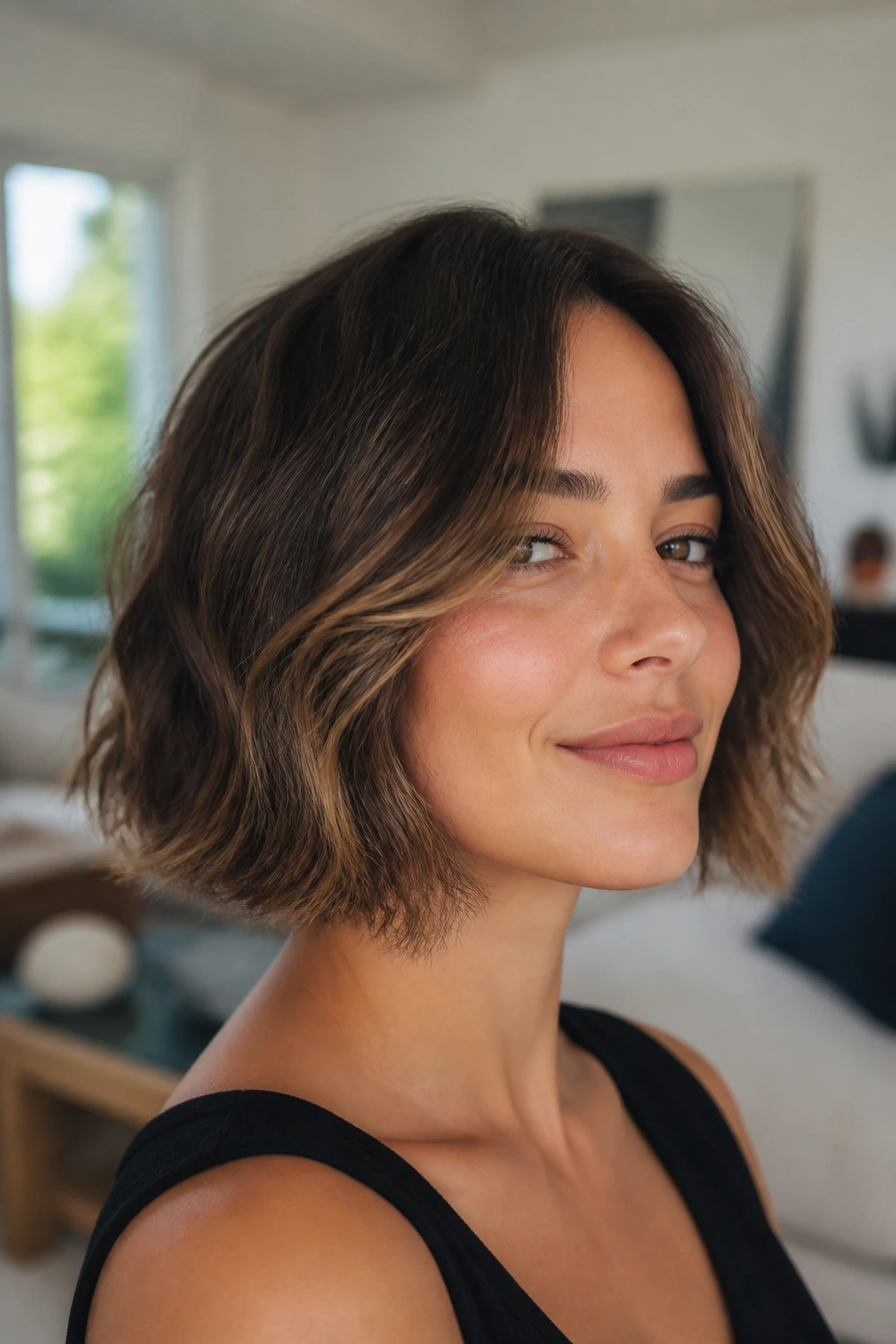
This one sounds like it should make a round face wider, but the placement is everything. Cheekbone-framing layers work when they start a little above the cheek and fall past it, creating a soft curtain that narrows the face rather than spotlighting the width.
The shape feels airy because the layers don’t all end together. That staggered finish keeps frizz from gathering in one heavy band. I like this version on wavier hair that has some lift already, because the cut can ride that texture instead of fighting it.
Ask your stylist for: Long face-framing pieces, internal shaping through the crown, and a perimeter that stays below the jawline. If you mention “face-framing,” be specific about length. Otherwise you may walk out with pieces that hit right at the cheek and do the opposite of what you wanted.
Quick styling note: Flip the front sections away from the face with a wide-barrel iron or even a quick round-brush bend. A slight outward sweep opens the look nicely.
7. Invisible-Layer Lob

The invisible-layer lob is a workhorse. You can’t always see the layering, but you feel it when the hair falls instead of ballooning. That matters a lot for thick, frizzy waves, because too much visible layering can make the silhouette fuzzy.
The best part? It keeps the bottom line intact. The bob still reads as a clean shape, but the inside has enough movement that the hair doesn’t bunch at the ends. On a round face, that extra length and softness help the haircut sit lower and slimmer.
Styling note: This cut loves a leave-in cream followed by a light gel or mousse. Cream gives slip. Gel keeps the wave clumped enough that the frizz doesn’t separate into a cloud.
Best for: Hair that feels bulky when it’s cut short, or anyone who wants a bob that behaves like a lob without losing shape.
8. Deep Side-Part Bob
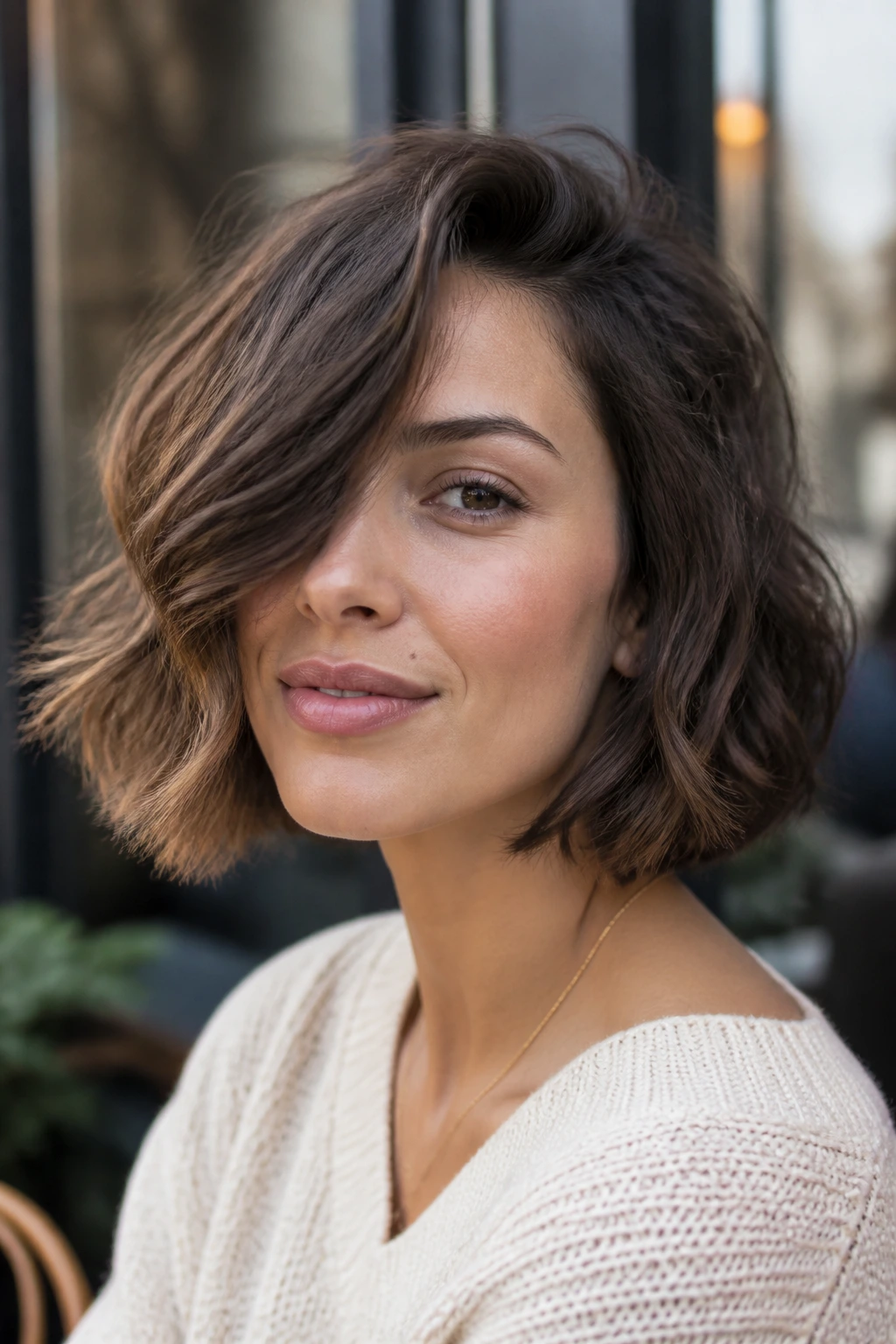
A deep side part is one of the fastest ways to make a bob look more deliberate. It creates height at the top and a longer line through one side of the face, which is exactly the sort of asymmetry a round face often needs.
This cut looks best when the front on the heavier side falls past the cheekbone. That longer curtain shifts focus downward. The wave adds softness, and the part adds structure. Frizz is actually useful here because a little lift at the roots helps the part stay visible.
Stylist note: If your hair tends to collapse, ask for a little extra length on the heavier side so the part doesn’t disappear after the first brush-through. The cut should still feel balanced when you shake your head and let the hair settle.
Best styling move: Set the part while the hair is damp, not when it’s already half-dry. Hair remembers its drying position more than people think.
9. Feathered Razor Bob
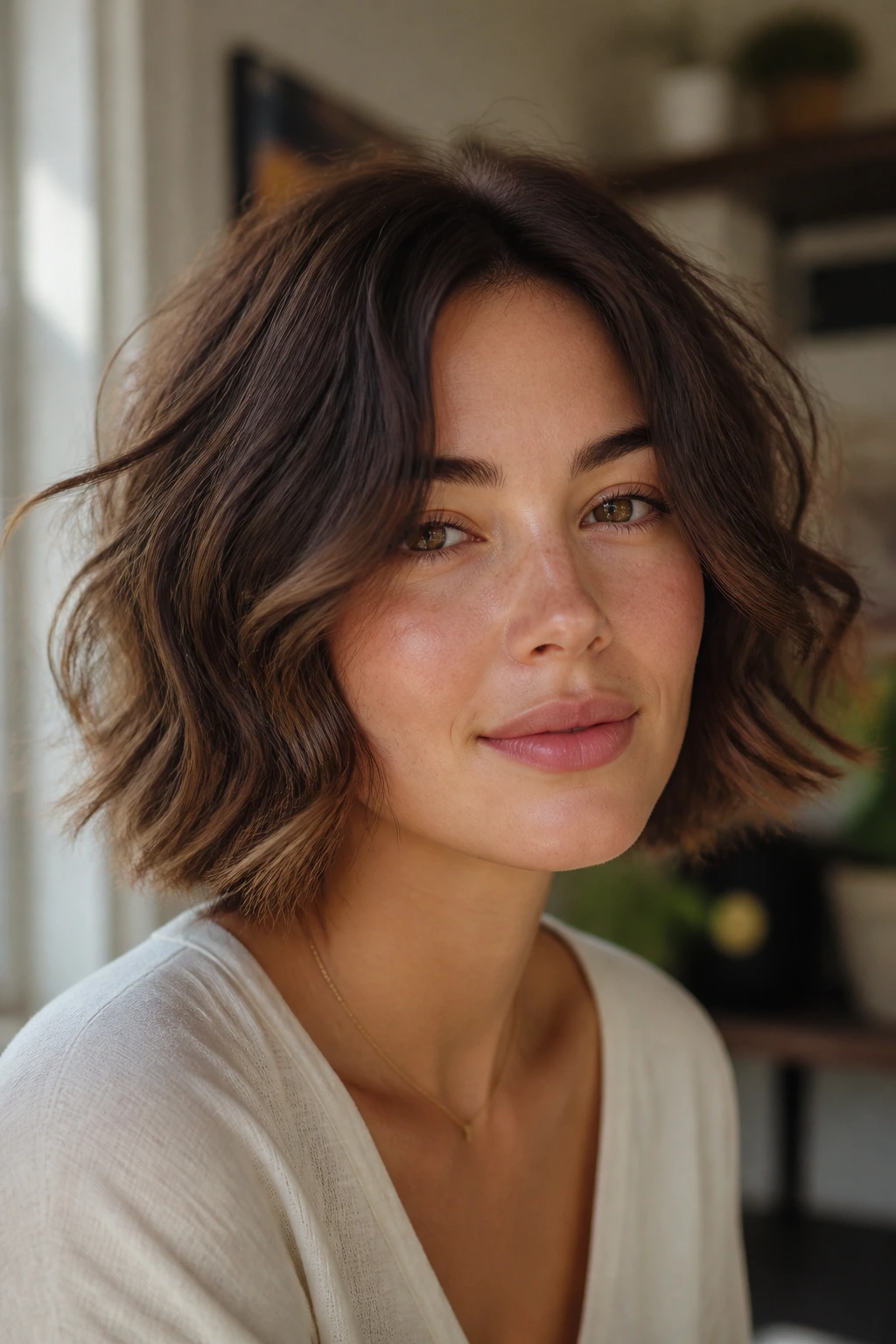
Razor-cut bobs can go wrong fast on frizzy hair. But when the feathering is controlled and the ends are kept soft, the result is airy in a way that suits waves beautifully.
The reason it works on a round face is simple: feathering removes visual mass. Instead of one thick block at the sides, you get movement that breaks up the width. Just don’t overdo it. Too much razoring turns the edges fuzzy, and fuzzy is not the same as soft.
Ask for: Feathering mostly through the mid-lengths, with the perimeter left stable. If your hair is coarse, this is where a stylist’s restraint matters. The goal is to release weight, not shred the shape.
Best for: Wavy hair that feels heavy around the ears or jaw and needs a lighter outline without losing length.
10. A-Line Bob

The A-line bob is the geometry teacher of this group. Shorter in the back, longer in the front, it draws the eye forward and downward, which helps a round face look a little leaner without any dramatic tricks.
I like it on frizzy waves because the front length gives the texture somewhere to settle. The back can stay neat and compact, especially if your hair likes to swell at the nape. That contrast keeps the bob from expanding all over the place.
Stylist note: Don’t ask for a harsh, angled wedge unless you want a very crisp look. A softer A-line is more wearable with waves. The front should feel swingy, not pointed.
How to style it: A round brush on the front pieces, a quick scrunch on the back, and a light mist of flexible hairspray is enough. The point is movement, not lacquer.
11. Nape-Tapered Bob
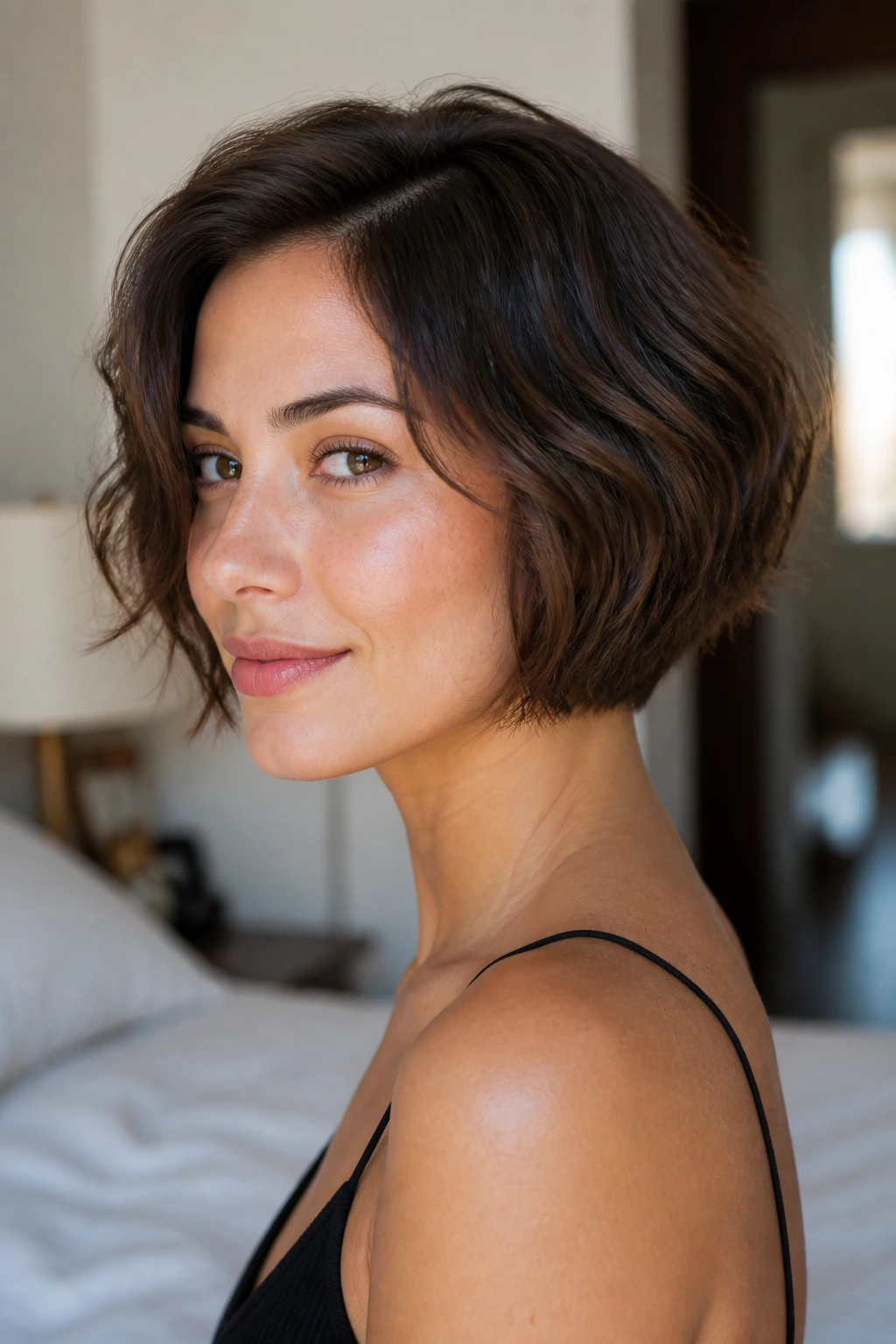
This cut is one of my favorites for thick hair. The nape stays close and tidy, while the top keeps enough length and texture to breathe. That taper makes the neckline look cleaner and stops the back from puffing out like a little shelf.
For a round face, the benefit is indirect but real: when the back sits compact, the front can stay longer without the whole haircut feeling heavy. The eye follows the line from nape to jaw to collarbone instead of stopping at the widest part of the cheeks.
Styling note: Ask for a clean nape taper rather than aggressive stacking. Stacking creates lift, and lift is not always your friend when the goal is to narrow the face.
Best for: Coarser or denser waves that need a neat base to keep the silhouette controlled.
12. Box Bob With Rounded Corners

A boxy bob sounds square, and square sounds wrong for a round face — until you soften the corners. Then the cut gets this chic, modern balance: enough structure to feel intentional, enough bend to avoid looking hard.
The rounded corners matter because they keep the front from sitting as a blunt shelf around the cheeks. That shape is the whole trick. Frizz can actually help the style here by making the edges look less rigid and more lived-in.
Stylist note: Ask for a boxier outline through the back with gently softened corners near the front. If the stylist takes too much off the sides, the shape loses its point and starts ballooning.
Best styling move: Use a medium barrel to bend the ends just under, not out. A tiny under-curve keeps the box from feeling too flat or too sharp.
13. Air-Dry Bob
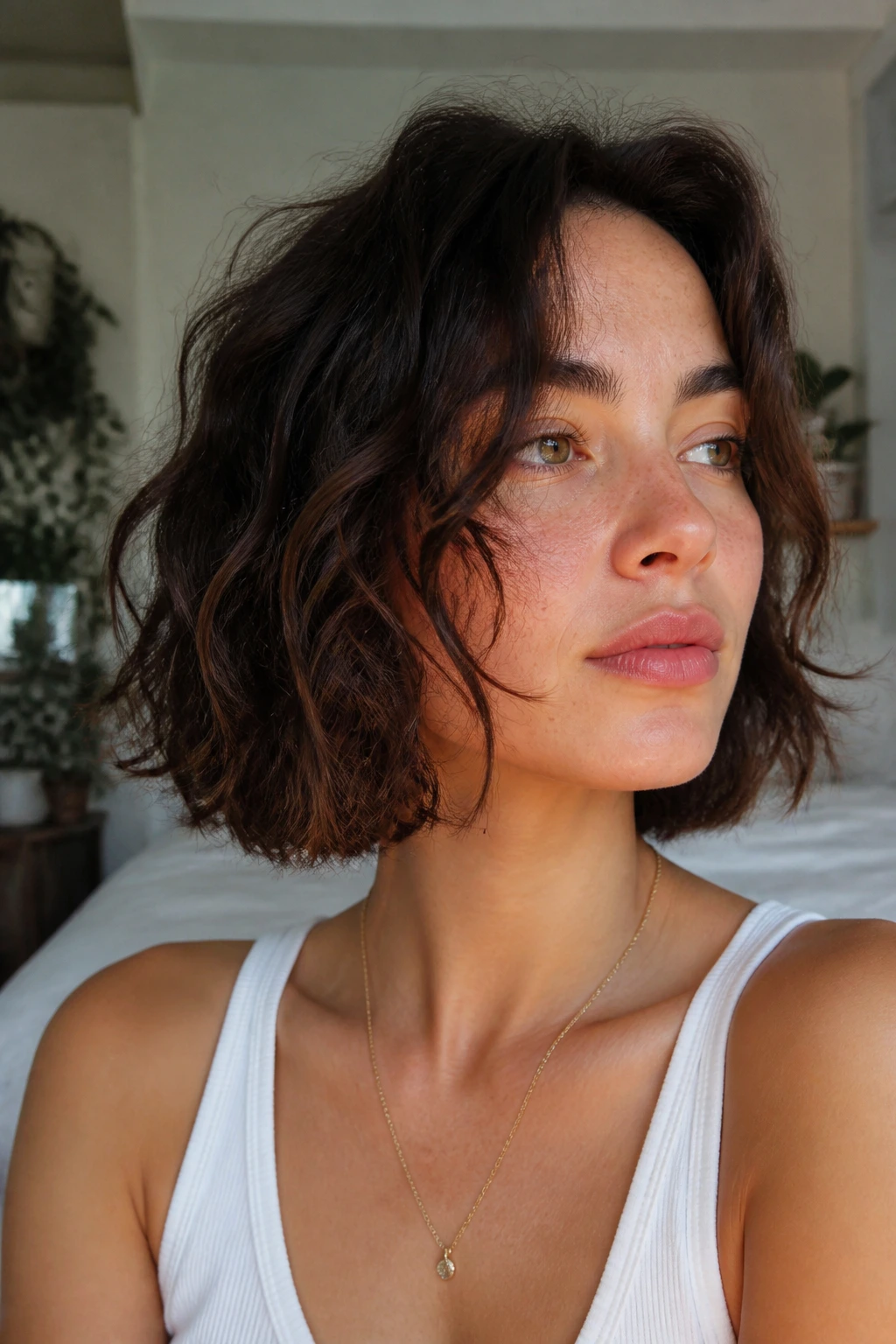
Not every good bob needs a round brush. Some of the best wavy bobs for frizzy hair and round faces are built to air-dry well, then get refined with a few fingers and a small amount of product. That’s the appeal here.
The cut should have enough internal shaping to let the wave separate into clumps, but not so much texture that the ends fray. Think of it as giving the hair a map and then stepping back. The map matters. The step back matters too.
Styling note: Apply leave-in conditioner, then a light mousse or gel while the hair is still wet. Scrunch, part it where you want it, and don’t touch it until it’s about 80 percent dry. Touching it early is how the frizz starts to win.
Best for: People who want a haircut that can survive a rushed morning and still look like a haircut by noon.
14. Bottleneck Bang Bob

Bottleneck bangs are a smart middle ground. They start narrow in the center and widen softly toward the temples, which means they don’t cut a round face in half the way a heavy straight fringe can.
Paired with a wavy bob, they create a vertical line through the middle and a little movement at the sides. That balance keeps the face from looking broad. The wave keeps the bangs from reading too neat, which is useful if your hair has a little frizz at the hairline.
Stylist note: Keep the center short enough to show the shape, but let the side pieces graze the cheekbones. If the sides stop too high, they can make the face look rounder. That’s the line to avoid.
Styling note: Dry the fringe first and separate it with your fingers, not a stiff brush. Bottleneck bangs look better with softness, not perfect symmetry.
15. Crown-Lift Bob
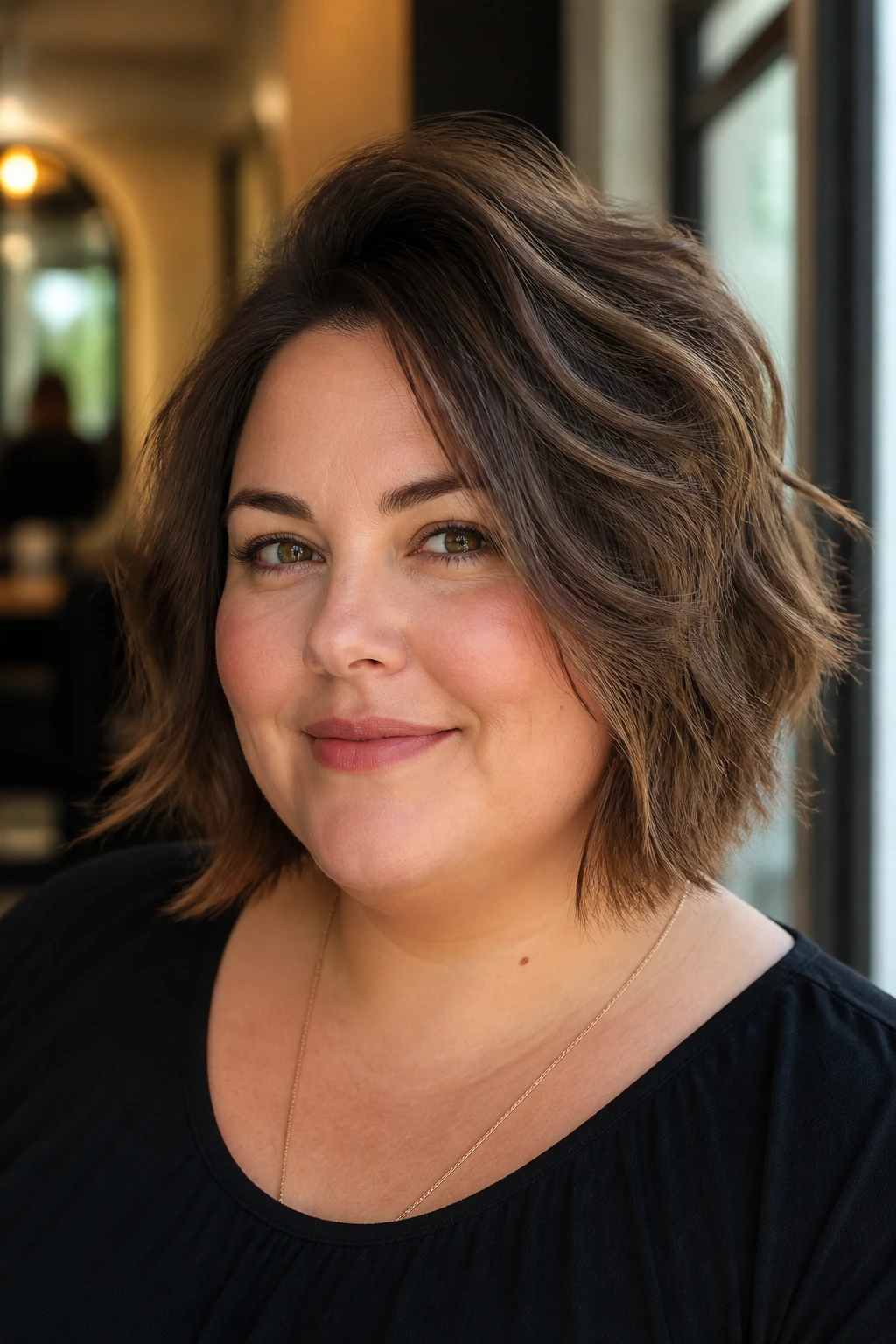
A little height at the crown goes a long way on a round face. The crown-lift bob uses internal layering and careful blow-drying to build lift where the head naturally needs length.
The silhouette feels more vertical because the volume sits on top instead of spreading wide through the cheeks. Frizzy hair can make this tricky, which is why the cut needs to be balanced; if the ends are too thin, the crown lift just makes the rest look sparse.
Stylist note: Ask for subtle crown layers and a perimeter that still has weight. You want shape, not a feather-duster finish.
Best styling move: Clip the crown at the roots for ten minutes while the hair cools after drying. That small trick can keep the top lifted without loading on product.
16. Center-Slimming Bob

A center part on a round face is not forbidden. It just needs the right frame. The center-slimming bob uses longer front pieces and gentle internal layers to make the middle part work for you instead of against you.
The long front line creates two vertical panels that narrow the face visually. If the cut is too short at the cheek, the center part can emphasize width. If the front stays below the jaw, the whole thing looks cleaner.
Stylist note: Ask for length that brushes the collarbone or at least falls below the chin, plus soft shaping around the mouth and jaw. That keeps the middle part from feeling severe.
Best for: People who like a clean, even look and don’t want to live in an off-center part forever.
17. Asymmetrical One-Side Bob

A stronger asymmetrical bob has attitude. One side hangs longer, the other side stays a little tighter, and the uneven line does some useful face-slimming work without looking fussy.
The longer side pulls attention downward, while the shorter side opens the neck. On frizzy waves, the cut looks best when the difference is obvious enough to matter but not so dramatic that it needs constant fixing. You want movement, not a daily geometry project.
Stylist note: Ask for a visible but soft asymmetry, with the longer side landing below the jaw and the shorter side still touching the top of the neck. Keep the ends textured just enough to keep the wave from sitting like a block.
Best styling move: Tuck the shorter side behind one ear and let the longer side fall forward. That tiny change sharpens the whole shape.
18. Piecey Sleeper Bob

This is the cut for people who like day-two hair more than day-one hair. A piecey sleeper bob is designed to look slightly better after the first night’s flattening, because the shape already has separated sections and a little built-in movement.
The reason it flatters a round face is the same reason messy hair sometimes does: the broken pieces create vertical lines. The key is to keep the base clean so the piecey texture reads as choice, not neglect. There’s a fine line there, and it matters.
Stylist note: Ask for texture through the mids, not shredded ends. If the ends are too wispy, the bob loses weight and the whole outline gets floaty.
Best styling move: A small amount of texture spray at the mids, then a light scrunch after the hair cools. Stop there. More product can make the waves separate into frizz.
19. Underflip Bob
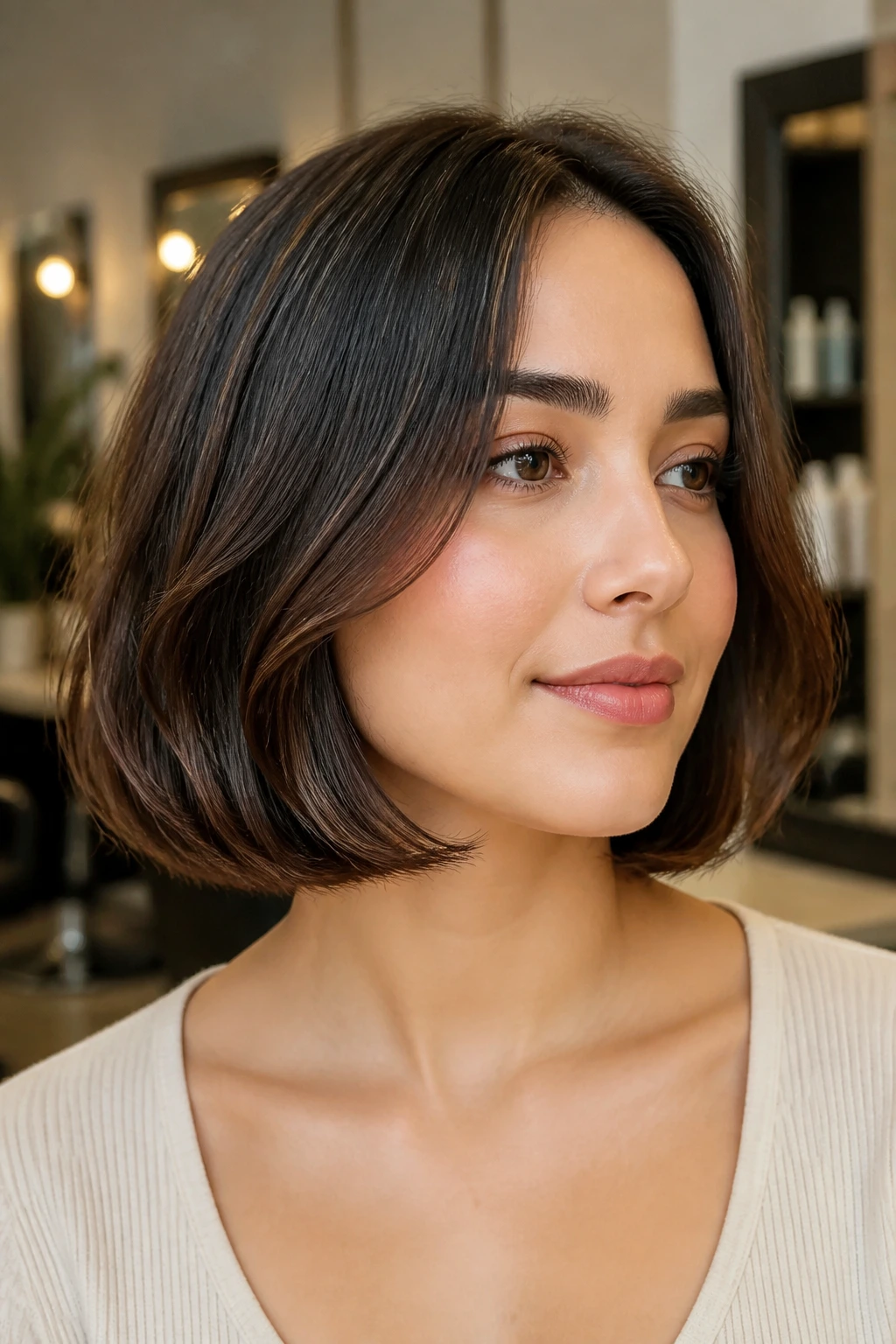
A clean underflip at the ends can make a frizzy bob look refined without making it flat. The shape curves under just enough to keep the line tidy, which is useful when the hair wants to kick outward on its own.
On a round face, the underflip helps because it keeps the attention moving down and inward. The haircut still has movement, but the ends don’t flare out at cheek height. That flare is the thing you’re trying to avoid.
Stylist note: Ask for enough length to allow the ends to be directed under with a brush or iron. If the bob is cut too short, the flip becomes a puff.
Best styling move: Wrap only the bottom inch around a medium round brush or 1-inch iron, and leave the rest of the wave loose. A tiny polished finish at the ends can pull the whole bob together.
20. Shoulder-Skimming Wavy Bob

A shoulder-skimming bob is the longer sibling in the family, and it has a real advantage: it gives thick or frizzy hair space to settle. The extra length keeps the sides from ballooning too high, which is useful on round faces that need a little vertical pull.
This version is especially kind on hair that’s prone to swelling in humidity. It doesn’t lose its shape as fast, and the waves can stack without making the sides look heavy. If you want a bob feel without the high-maintenance edge of a chin-length cut, this is the one I’d put first.
Stylist note: Keep the front pieces a little longer than the back and ask for soft, low layers. Too many short layers can make shoulder-skimming hair bunch up around the face.
Best for: Anyone whose hair is more “big and wavy” than “fine and airy.”
21. Curly-Wavy Hybrid Bob
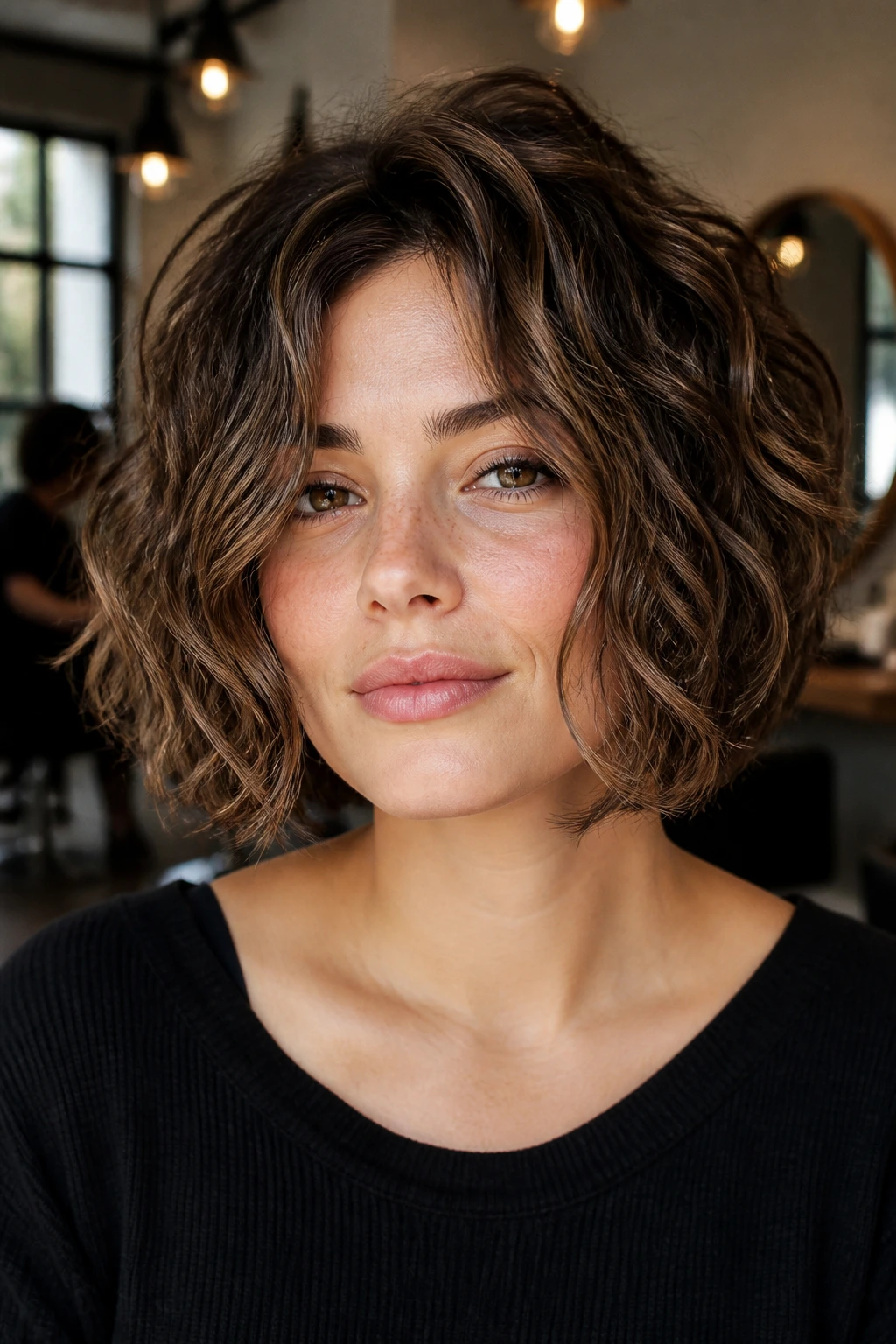
Some hair refuses to choose between waves and curls. Fine. Let it do both. The curly-wavy hybrid bob respects that texture by keeping enough length and room for the bend pattern to expand without turning into a frizzy puff.
The face-shaping trick here is all about the front pieces. Keep them longer and softer, especially if the curls spring tighter near the cheeks. That longer front line helps a round face look more oval without forcing the hair to be something it isn’t.
Stylist note: This cut often benefits from being shaped with the hair in its natural dry state, or at least checked dry before the final trim. Curly-wavy hair lies in a wet cut and then tells the truth later.
Best styling move: Use a curl cream plus a small amount of gel, then diffuse on low. Let the curls form their own pattern before you touch them.
22. Long Face-Frame Lob
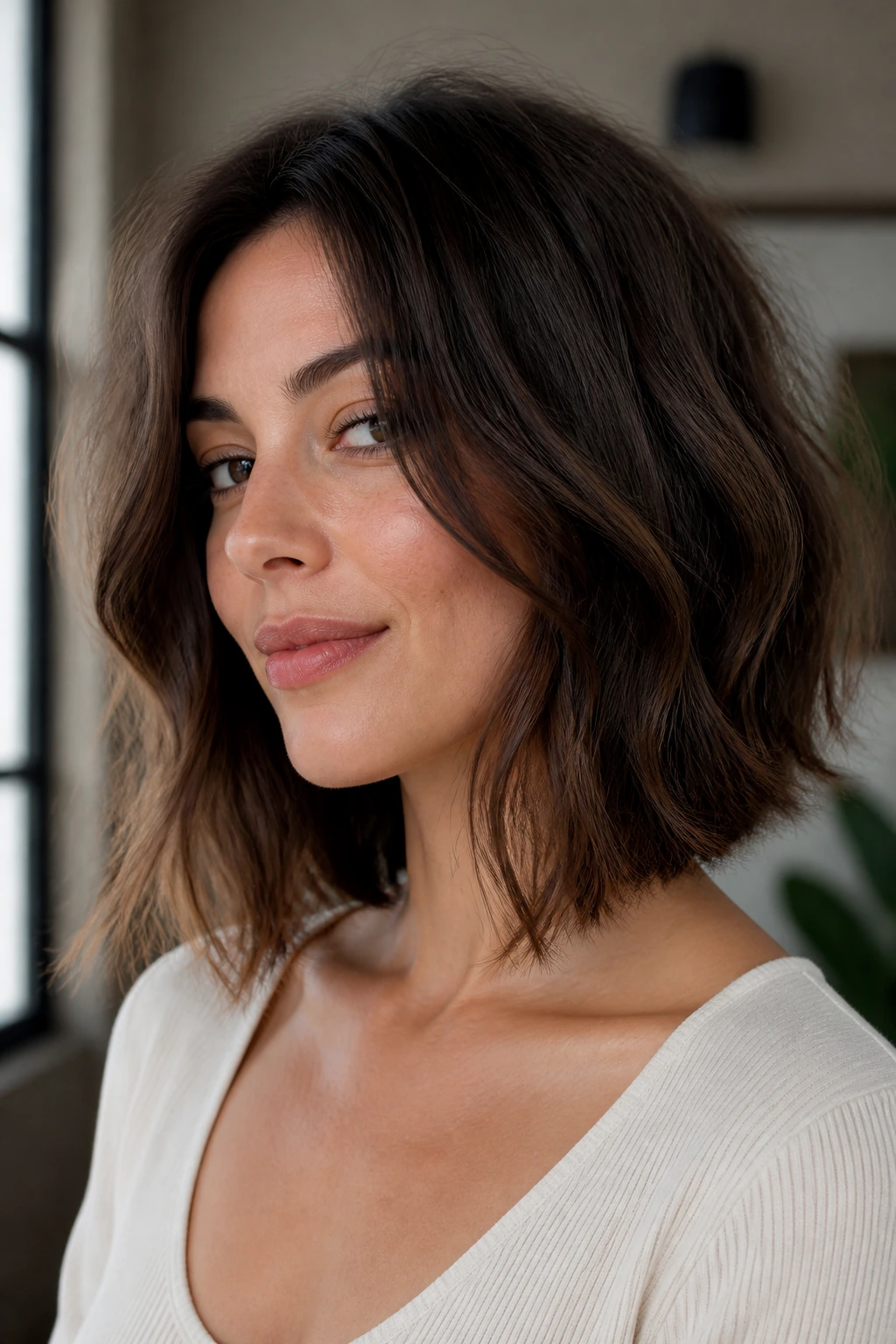
The long face-frame lob is one of the most forgiving options in the whole group. It keeps the overall length around the collarbone, then uses long face-framing layers to sculpt the cheeks and jawline. That combination is hard to beat.
The layers should start below the cheekbone, not on it. That’s the key. When they fall a little lower, they draw the eye down and make the face feel longer. Frizz actually softens the effect in a good way, because the layers don’t look chopped.
Stylist note: Ask for face-framing pieces that begin around the chin and taper past the jaw. If the stylist lifts them too high, you’ll lose the slimming line you were after.
Best for: Most hair densities, especially if you want a shape that looks good both straight and wavy.
23. Tucked-Behind-Ear Bob

This one is less about the haircut and more about the way the haircut behaves. A bob that tucks neatly behind one ear needs enough length in front to move, but not so much bulk that the tuck creates a lump.
On a round face, the tucked side opens space while the untucked side gives you the longer line. That asymmetry is flattering and easy. It also gives frizzy hair a practical escape hatch when one side decides to swell on you.
Stylist note: Tell the stylist you want one side long enough to tuck without springing back. That usually means the front should skim the jawline or slightly below it.
Best styling move: Smooth a tiny bit of serum over the tucked side only. Too much on both sides makes the whole bob collapse.
24. Glossy Airy Bob
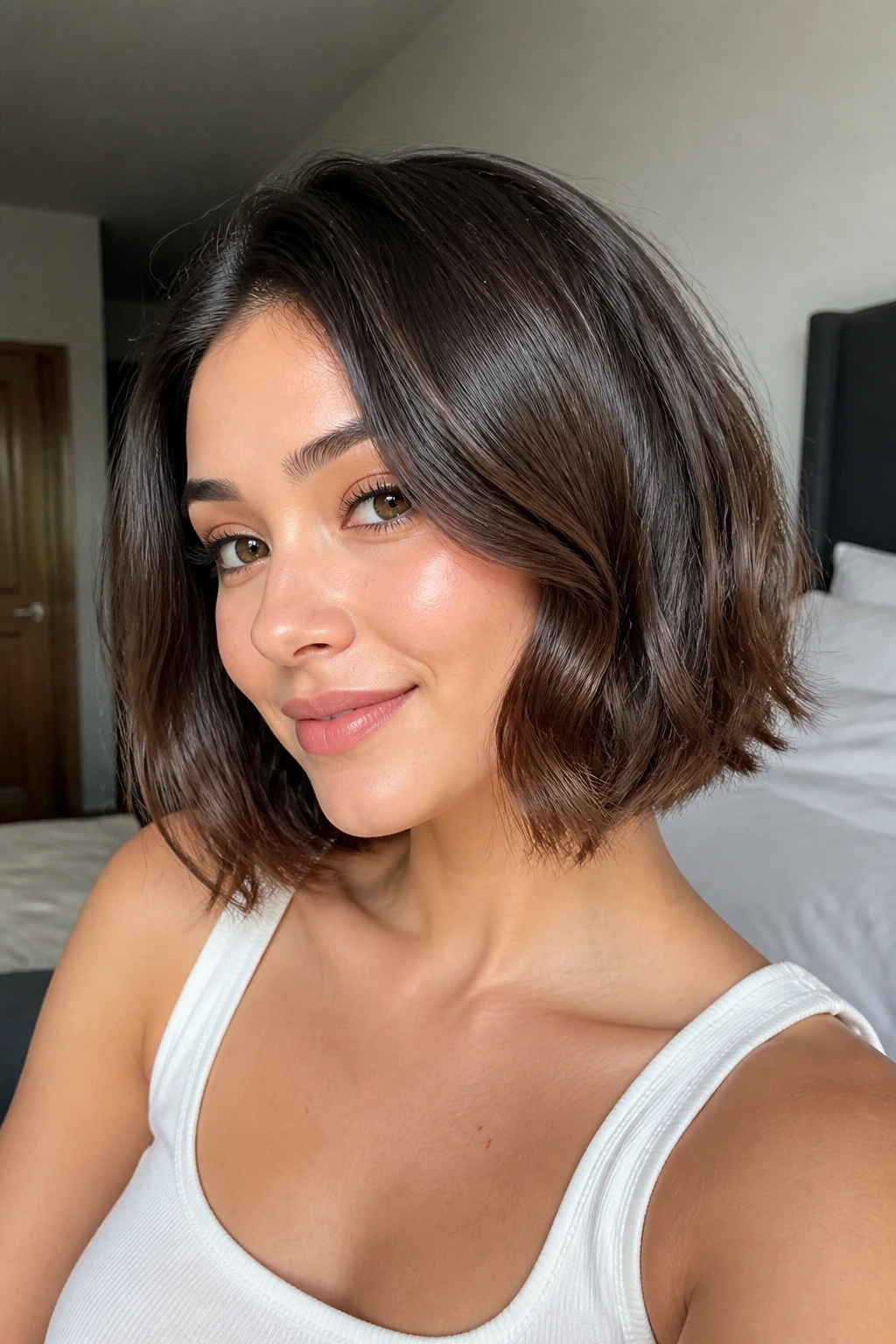
Glossy and airy sounds contradictory until you see the cut done right. The perimeter stays clean, the wave stays soft, and a light shine product keeps the frizz from looking dry or rough. You get movement, but the surface looks cared for.
That combination is useful on round faces because shine tends to sharpen the outline, while airy texture keeps the bob from looking stiff. It’s a nice middle ground when you want your hair to look finished without looking lacquered.
Stylist note: Ask for a soft blunt line with minimal breakup through the bottom. Then rely on styling to add the airy bend. If the cut is too shattered, the gloss disappears into fuzz.
Best styling move: After drying, smooth one drop of serum over the outer layer only. Not the roots. Just the top layer and the ends.
25. Tousled Vacation Bob

A tousled vacation bob is the cut you wear when you want your hair to feel like it had a good time without looking careless. It’s loose, piecey, a little sun-dried in spirit, but still shaped enough to flatter a round face.
The length usually sits between the jaw and collarbone, which gives the face room to breathe. Waves and frizz are welcome here, as long as the perimeter stays intentional. That’s the difference between “beachy” and “I gave up.” Tiny line. Huge difference.
Stylist note: Keep some length in the front and avoid over-layering the sides. You want movement through the ends, not a cloud around the head.
Best styling move: Salt spray is fine in moderation, but pair it with a leave-in conditioner so the hair doesn’t dry rough. The vacation effect should look sun-warmed, not parched.
Why the Right Bob Shape Beats More Product

A lot of people reach for product when the real issue is the cut. That’s understandable. Product is easier to buy than a scissor correction. But if a bob sits at the widest part of a round face or sheds bulk in the wrong places, no cream is going to rewrite the outline.
The best wavy bobs for frizzy hair and round faces share a few habits. They keep the front a little longer. They place volume high enough to lift, but not so wide that it flares. And they let the texture look like part of the plan. That last part matters more than people think.
If a haircut makes your hair feel more cooperative on day one, it usually keeps paying off every morning after that. Frizz is far less annoying when it’s living inside a shape that already makes sense.
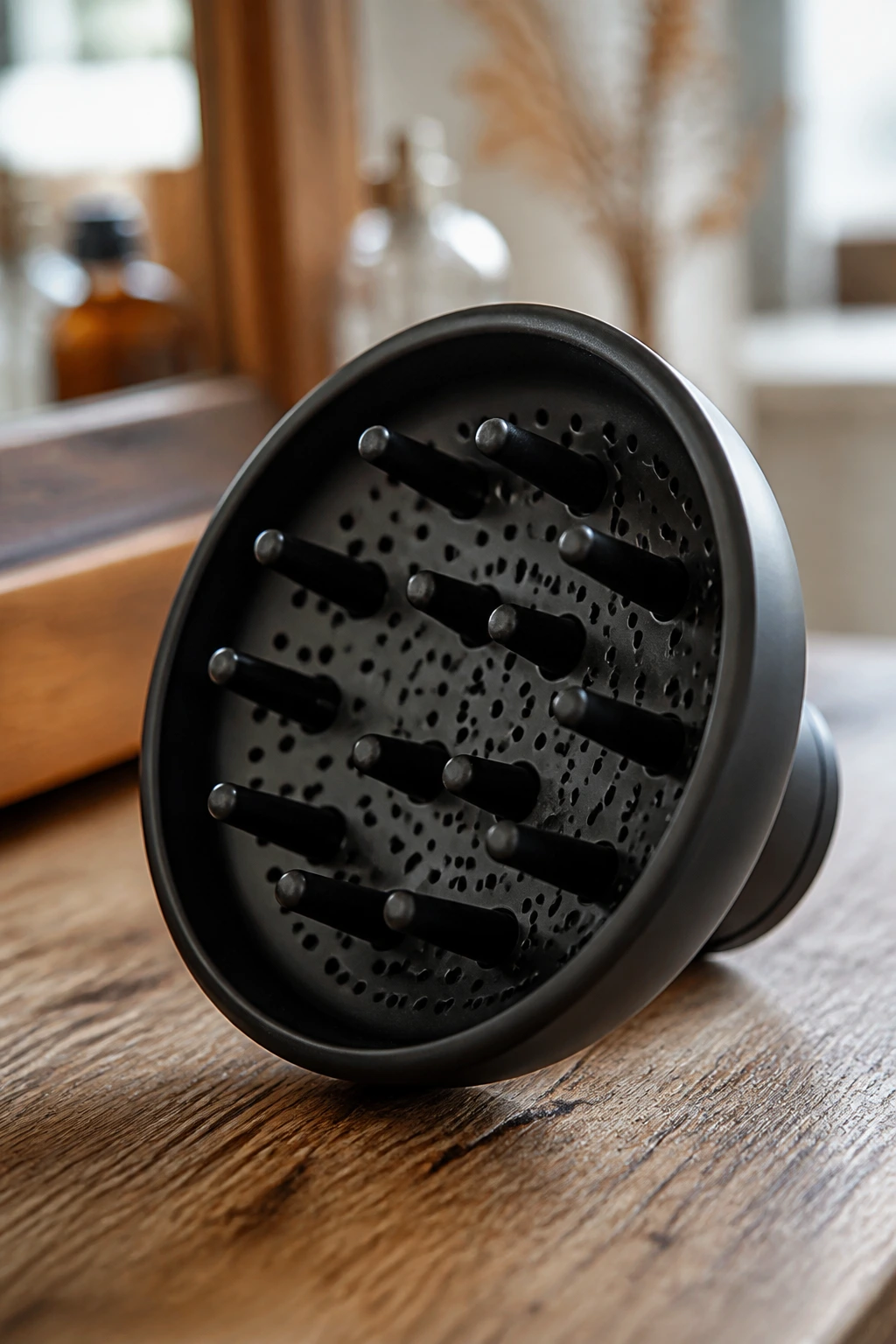
Essential Tools for Styling a Wavy Bob
-
Diffuser attachment: This is the easiest way to dry waves without blasting them apart; use low heat and low airflow.
-
1-inch or 1.25-inch curling iron: Handy for bending a few stubborn front pieces or fixing the ends without curling the whole head.
-
Round brush, medium or small: Best for a cleaner bend at the ends and a little lift at the crown.
-
Wide-tooth comb: Safer than a fine comb on wavy, frizz-prone hair, especially when detangling damp lengths.
-
Spray bottle filled with water: Useful for reactivating waves on day two instead of rewashing.
-
Leave-in conditioner or curl cream: Helps the hair hold together so the surface frizz doesn’t split the wave pattern.
-
Mousse or light gel: Gives the bob enough memory to keep its shape after drying.
-
Heat protectant: Non-negotiable if you use a blow-dryer or iron; frizzy hair tends to look rough faster when overheated.
-
Small sectioning clips: Useful for setting the front pieces, especially on styles with bangs or asymmetry.
-
Silk or satin pillowcase: Not a styling tool in the usual sense, but it cuts down on overnight friction that makes the bob explode in the morning.
Smart Product and Cut Notes Before You Book
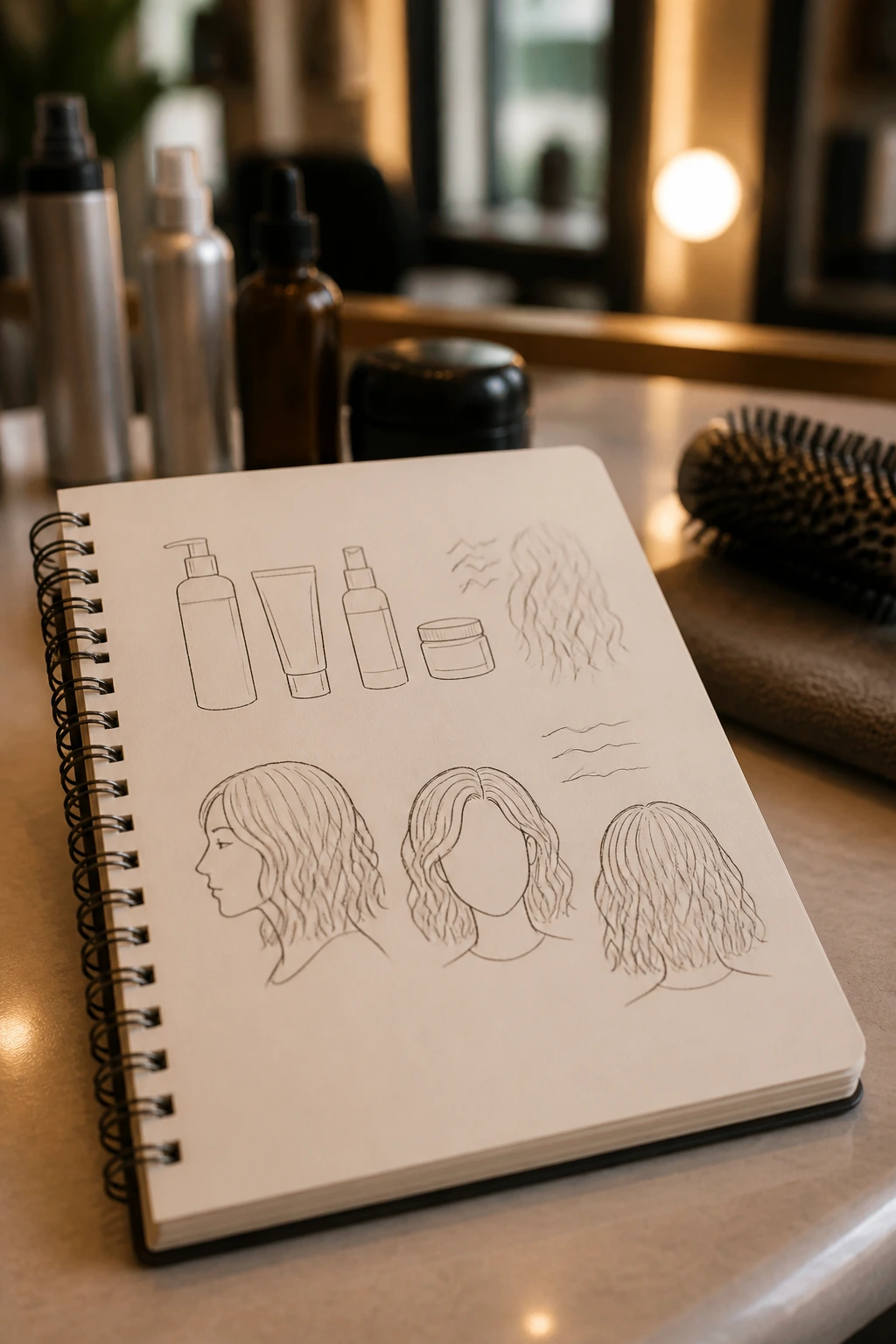
The right bob starts before the first snip. If your hair is fine but frizzy, you usually want less texturizing and more careful shaping, because fine strands can frizz out when they’re over-thinned. If your hair is thick, you can handle a bit more internal removal, but the perimeter still needs weight or the ends will puff.
Texture matters too. Loose waves can usually handle a softer blunt line, while waves that lean coarse or curly often need longer lengths and more controlled internal layering. That keeps the bob from turning into a triangle as soon as humidity shows up. And humidity will show up. It always does.
Bring a photo, but bring the right kind of photo. Look for the same density, similar wave pattern, and a face shape that’s close enough to yours to be useful. A bob on pin-straight, medium-density hair tells you less than a bob on hair that actually behaves like yours. Same with bangs. Curtain bangs on a fine, soft pattern do not behave the same way they do on thick, springy hair.
One more salon note. Ask whether the cut was finished dry or wet. That question tells you a lot about how the shape was built and how much movement the stylist expected. If you’re prone to frizz, a dry check at the end is worth its weight in gold.
How to Wear These Bobs Day to Day

Air-Dry Days: Keep the hair damp, not dripping, when product goes in. Scrunch from the ends up to the cheekbones, then let the bob set with as little touching as possible. The less you fuss, the cleaner the wave pattern usually looks.
Heat-Styled Days: Use a round brush or curling iron only where the haircut needs direction — usually the front pieces, the ends, or the crown. The rest can stay wavy. A bob does not need every inch to behave the same way.
Humidity Days: Start with a leave-in and a light gel or mousse. The goal is not absolute smoothness; it’s controlled texture. A bob that keeps a little frizz in the right places can still look polished, while a stiff, over-smoothed bob often falls apart faster in damp air.
Dressier Days: Clean lines matter. Tuck one side behind the ear, add a slight bend to the front, and let the other side sit loose. Small asymmetry makes the haircut feel intentional without needing a full blowout.
Extra Styling Moves That Make the Shape Read Better
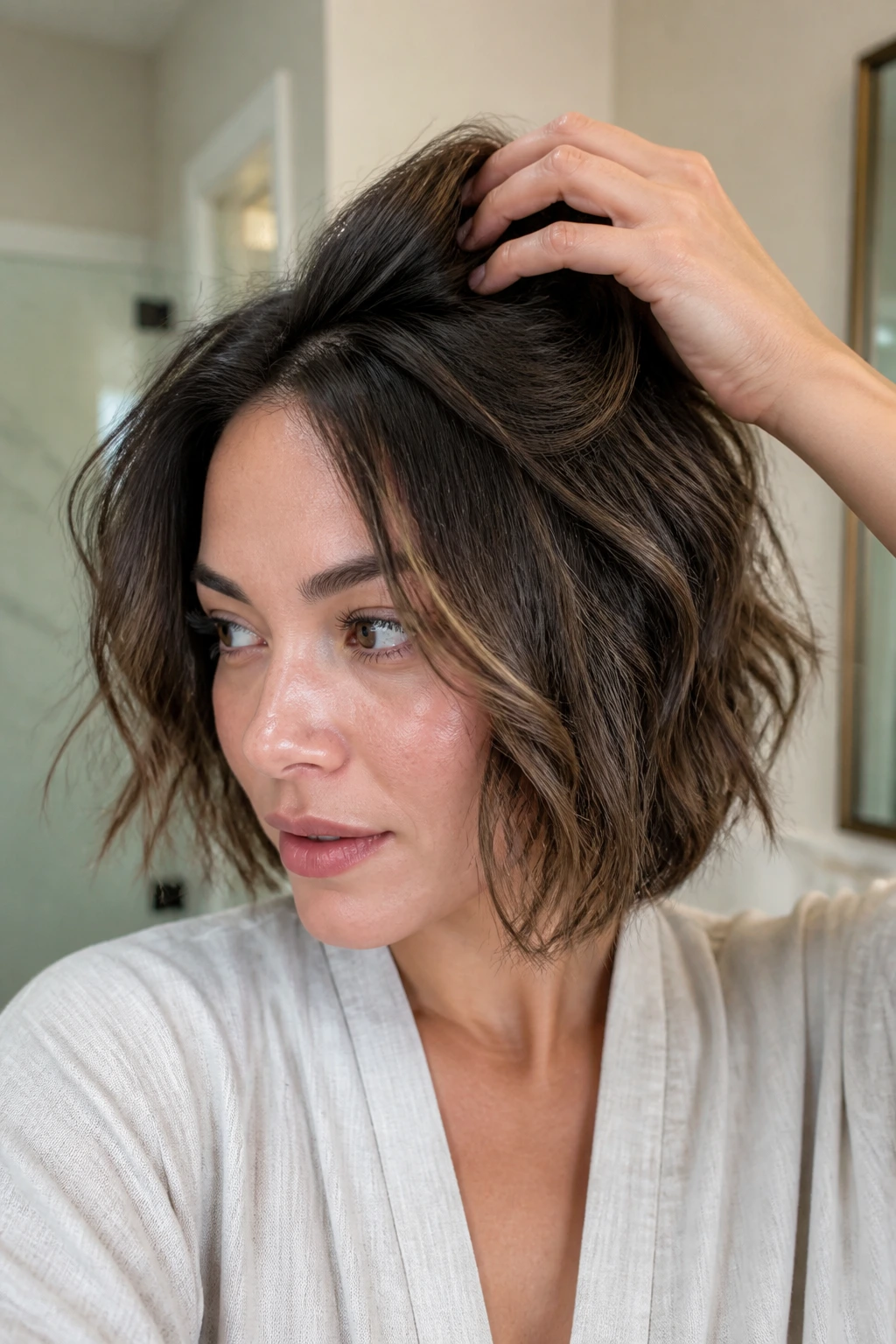
Root Lift: Clip the top layers at the crown for 10 to 15 minutes after drying, especially if your hair collapses flat at the roots. That tiny pause helps the bob keep height without teasing.
Texture Control: Use a pea-sized amount of curl cream on the mids and ends, then seal with a lighter gel or mousse. Too much cream alone can make frizzy hair expand instead of clump.
Face-Framing: Bend the front pieces away from the cheeks, not toward them, when you use heat. That little outward curve opens the face and keeps the bob from hugging the widest part of the cheeks.
Make-It-Yours: Fine hair usually needs a lighter hand and fewer layers. Thick hair usually needs more internal shaping and a touch more length. Coarse hair often looks best when the perimeter stays strong and the ends are not shredded into wisps.
How to Keep the Bob Looking Intentional Between Salon Visits

A good bob doesn’t need to be rescued every morning. It does need maintenance, though, and not the fake kind where you keep adding product until the hair feels like an old candle. The shape stays cleaner when you trim it often enough that the front doesn’t slip past the point where it flatters your face.
Most bob shapes start to blur after about 6 to 8 weeks, especially if your hair grows fast or frizzes at the ends. If the cut is longer and softer — a lob, a shoulder-skimming shape, a heavily layered version — you can stretch that closer to 8 to 10 weeks. Past that, the front pieces often lose the line that made the haircut work in the first place.
Night care matters more than most people admit. Sleep on a silk or satin pillowcase if you can. If your hair is long enough to flip, clip the front loosely away from your face so it doesn’t bend in one ugly ridge overnight. Never go to bed with a wet bob unless you want the next morning to start with a battle.
On day two, mist the mids and ends with water, add a fingertip of leave-in if the ends feel rough, and scrunch the wave back into place. If the roots have gone flat, a few seconds with a blow-dryer at the crown is usually enough. You do not need to redo the whole head.
Variations and Adaptations to Try

The Fine-Hair Lift Version: Keep the length around the collarbone and the layers light, almost invisible. Fine hair looks best when the cut creates movement without stealing density from the outline, so avoid aggressive thinning and lean on mousse for body.
The Thick-Hair Control Version: Choose a longer bob with internal weight removal and a stronger perimeter. Thick, frizzy hair usually behaves better when the bottom line stays solid and the inside gets the softening, not the other way around.
The Curly-Wavy Hybrid Version: If your hair lives between waves and curls, ask for a dry-shape check and keep the front slightly longer. This version lets the bend pattern expand without turning the sides into a halo.
The Low-Heat Air-Dry Version: Built for people who hate heat tools. The cut should have enough structure to air-dry into a shape on its own, then you finish with a little product and patience. Not glamorous. Very practical.
The Glossy Evening Version: Same bob, different finish. Add a heat protectant, bend the front with a brush or iron, and smooth the outer layer with a drop of serum. The texture stays soft, but the outline sharpens up.
The Fringe-Free Face-Frame Version: Skip bangs entirely and use longer front pieces that begin near the cheekbone and drop past the jaw. If you don’t want fringe maintenance, this is the easiest way to still get that face-slimming effect.
Common Mistakes That Puff Up the Shape

-
Cutting the bob right at the cheekbone: That places the widest part of the haircut exactly where a round face already has fullness. Move the front lower, or ask for longer framing pieces.
-
Thinning the ends too hard: The symptom is a fuzzy, see-through perimeter that spreads instead of sitting. Fix it by keeping weight at the outline and removing bulk inside the haircut, not from the edge.
-
Using too much cream and not enough hold: Frizzy waves need clumping and memory. Cream alone can make the hair feel soft but collapse by noon; pair it with mousse or light gel.
-
Skipping the part decision: A bob with no clear part often gets wider because it settles in the middle of the face. Choose an off-center line or a deep side part if you want more length through the face.
-
Overblowing the crown and flattening the sides: Too much root lift at the top with no direction through the front can make the head look top-heavy. Balance the crown with longer front pieces.
-
Expecting one cut to do every job: A bob built for air-drying won’t behave the same way as one built for a round brush. Decide which kind of life your hair actually has, then ask for that shape.
Frequently Asked Questions

Will a wavy bob make a round face look wider?
It can, if the length stops at the wrong place. A bob that ends at the cheek or jawline often widens the face visually, but a bob with longer front pieces, an off-center part, or a soft angle usually does the opposite.
How short can frizzy hair go without puffing out?
That depends on density and wave pattern, but chin length is often the shortest safe zone for many people. If your hair is very coarse or very frizzy, keeping the front below the jaw usually gives you more control.
Are curtain bangs a good idea with a round face?
Yes, if they’re cut long enough to taper beside the cheeks. Short, blunt bangs can shorten the face, while curtain bangs and bottleneck bangs create a vertical line that softens roundness.
Do I need to blow-dry a wavy bob every day?
No. A well-cut bob can air-dry well if the shaping is right and you use the right product. Many people only need to blow-dry the front pieces or the crown, not the whole head.
What if my hair is thick and puffy?
Ask for a longer bob with internal weight removal and a stable perimeter. Thick, puffy hair usually does better with less visible layering and more control through the inside of the cut.
Can I wear a center part with this haircut?
You can, but the front pieces need enough length to frame the face. If the bob ends too high at the cheeks, a center part can make the face look broader. Longer front layers solve most of that.
Which product keeps frizz down without killing the wave?
A leave-in conditioner paired with a light mousse or flexible gel usually works better than a heavy cream alone. The wave needs structure, not greased-down softness.
How often should I trim a bob like this?
Plan on every 6 to 8 weeks for shorter versions, and every 8 to 10 weeks for longer lobs. Once the front pieces lose their line, the whole face-framing effect gets muddy fast.
The Cut That Keeps Its Shape

A bob works best when it feels like it belongs to your hair, not when it forces your hair into obedience. That’s why these wavy bobs for frizzy hair and round faces matter: they use length, angle, and texture to change the silhouette before product ever enters the picture.
Pick the version that matches how much maintenance you can live with. A collarbone sweep bob buys you flexibility. A curtain-bang bob adds face framing. A longer lob buys you time. The right choice is the one that still looks good when humidity shows up, when your blow-dry gets lazy, and when you have five minutes instead of twenty.
The best haircut is the one that keeps doing its job after the salon cape comes off.