



A square face can carry a short bob better than most people think—provided the fringe does some of the heavy lifting. The cut should not sit there like a cardboard edge at the jaw; it needs movement, diagonals, and a little softness where the face is strongest.
That is why short bobs with bangs for square faces can look so good when they’re cut with a clear plan. A blunt line right at the jaw can turn the face boxy in a hurry. Shift the length a half inch lower, break up the front pieces, or let the bangs open at the temples, and the whole mood changes.
I keep coming back to the same idea: the best bob for a square face does not hide the angles. It edits them. Curtain bangs, side-swept fringe, wispy ends, and a bit of bend through the mid-lengths pull the eye into motion instead of letting it stop dead at the jaw.
Why These 25 Bobs Earn Their Keep

Jaw-softening shape: The strongest looks here use curves, diagonals, or broken-up texture near the forehead and jaw, so the face reads balanced instead of rigid.
Bangs that do real work: Curtain bangs, bottleneck fringe, and side-swept pieces shorten the forehead visually without creating a hard horizontal line.
Length matters more than hype: A bob that lands just below the jaw usually feels softer on a square face than one that stops exactly at the widest point.
Texture saves the day: A little bend, bevel, or piecey movement keeps the cut from reading like a helmet.
Not every bob needs to be soft: Some of the sharper cuts here are meant to look deliberate and sculpted; they just need the right fringe so the square face looks framed, not squared off.
The Shape Rules That Keep a Bob Soft Instead of Boxy
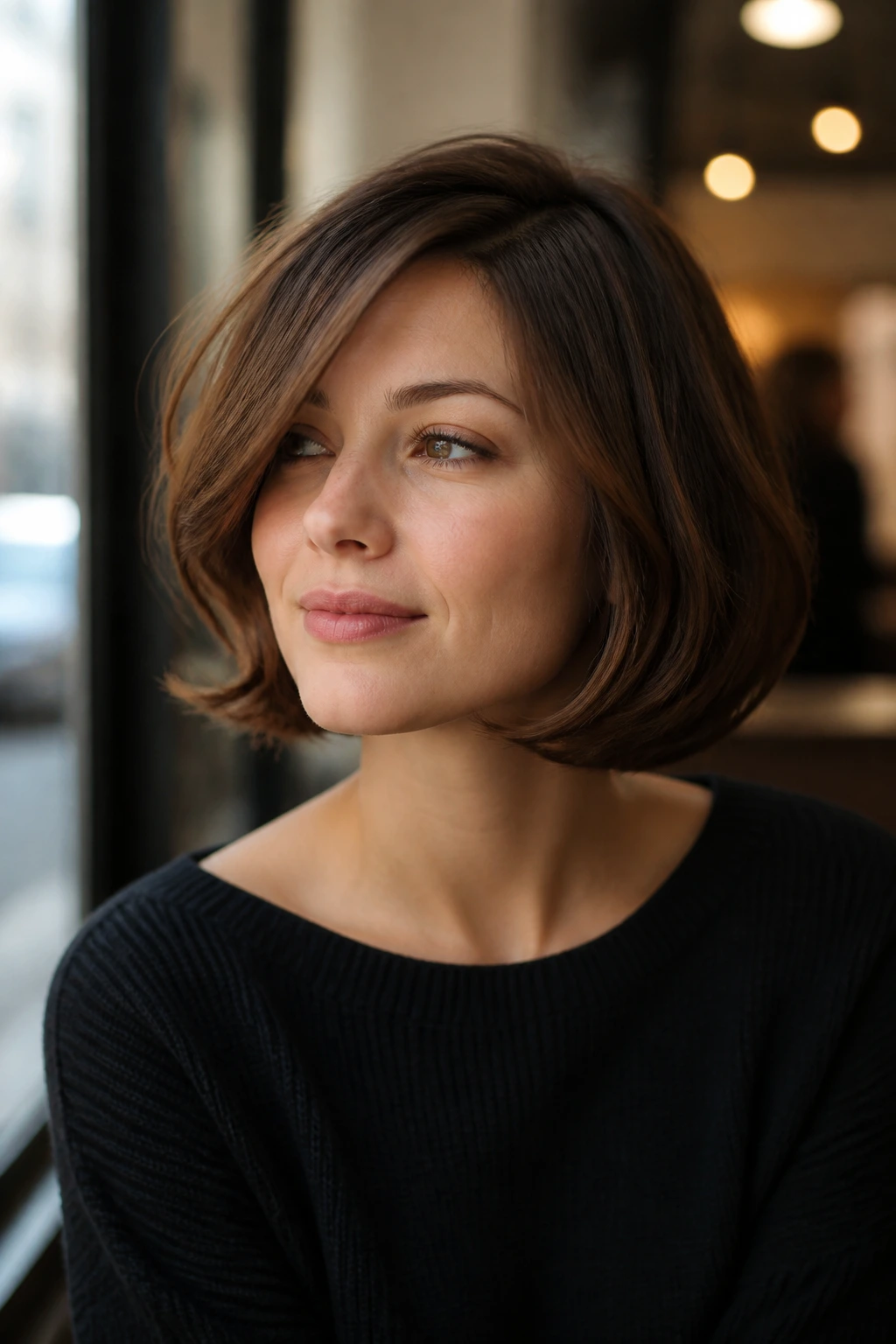
A square face usually has a strong jaw, a broad forehead, and sides that read fairly straight from temple to chin. That structure is not a flaw. It is a very good canvas, and a bob can either flatter it or fight it.
The mistake I see most often is a cut that ends exactly where the jaw is widest, with no bend, no layering, and no front pieces to break the line. That kind of bob makes the face stop abruptly. A better version nudges the eye downward or upward with purpose—curved bangs, a side part, a slightly longer front, or a bit of rounding through the ends.
Where the eye should move
You want the shape to move. Up through the crown, across the fringe, and then down through a softened edge at the jaw. If every line in the haircut is straight and parallel, the face can look heavier than it is.
What bangs actually change
Bangs do more than cover the forehead. They change the top half of the face, which is why the right fringe matters so much on square faces. Curtain bangs and bottleneck bangs are so useful because they open in the middle and widen near the cheekbones, which creates a gentle diagonal frame. A blunt, thick fringe can work too, but only if the ends are softened and the rest of the cut has some movement.
Why texture keeps the cut honest
A square face can wear sleek hair, but sleek hair needs a little internal shape or the edges get hard. Piecey ends, beveling, and light layering keep the style from turning severe. Even a classic blunt bob looks kinder when the ends are beveled by a few degrees rather than chopped into a flat shelf.
1. Soft Blunt Bob with Curtain Bangs
The first thing you notice is the shape: a clean bob line that stops just below the jaw, then curtain bangs that split open at the center and drift toward the cheekbones. It feels polished, but not stiff. That little opening in the fringe is doing more work than most people realize.
Why it flatters a square face
This cut is the safe entry point if you want structure without the boxy feeling. The blunt baseline gives the bob weight, while the curtain fringe creates two diagonal paths down the face. That breaks the straight jaw line in a way that looks natural, not fussy.
Ask for the front pieces to start around the cheekbone, then taper toward the mouth. If the bangs are cut too short, they lose that softening effect fast.
Quick styling note
A 1.25-inch round brush or a large curling iron bend is enough. You do not want tight curls here. Just a loose turn away from the face, then a little finger-combing so the fringe stays open.
2. French Bob with Brow-Grazing Fringe
A French bob has attitude. Shorter than most bobs, often sitting around the cheekbone or upper jaw, it looks best when the fringe lands right at the brows and the ends are a touch imperfect.
What makes it different
The reason this works on square faces is that it shifts the attention upward. The cut is compact, so the eye goes straight to the eyes and cheekbones instead of parking on the jaw. Brow-grazing bangs soften the forehead without building a heavy wall across it.
This one suits fine to medium hair especially well, because the natural lightness helps the outline stay airy. If your hair is very dense, ask your stylist to bevel the ends and remove bulk from the interior, or the shape can feel too solid.
Best styling habit
A quick dry with your fingers and a touch of texture spray is enough. If you try to blow it into perfection, you lose the charm.
3. Textured Chin-Length Bob with Feathered Bangs
If you want movement, this is the one. The ends are shattered a little, the bangs are feathered instead of blunt, and the whole cut has enough irregularity to keep a square face from looking too fixed.
Why it works on a square jaw
A chin-length bob can be tricky on square faces because the jawline is already strong. Feathered bangs solve half the problem by breaking the forehead into softer pieces, and the textured ends solve the other half by making the edge feel lighter. The result is shape without heaviness.
This cut loves thick hair, because texture can get lost when the hair is too fine. With denser hair, the feathered fringe keeps the front from looking bulky. If your hair is naturally straight, ask for point-cutting through the ends so the shape doesn’t read as one hard line.
A small detail that matters
Do not let the stylist over-thin the fringe. Feathered does not mean wispy to the point of see-through. You still want enough presence to frame the eyes.
4. Side-Swept Bob with Long Fringe
Want a bob that feels less symmetrical and a little more flattering around strong angles? Go side-swept.
The deep side part creates an immediate diagonal, which is gold on a square face. The long fringe can sweep across the forehead and graze one brow or cheekbone, then disappear into the rest of the cut.
Why it reads softer
Square faces do not usually need more straight lines. They need interruption. A side-swept fringe interrupts the vertical and horizontal structure of the face in the right place, and the eye follows that line naturally. It is subtle, but it changes everything.
This is one of the best cuts if you wear glasses, because the side fringe can sit above or just beside the frames without crowding them. It also behaves well on second-day hair, which is a gift. A little dry shampoo at the roots and a quick re-bend with a brush is usually enough.
5. Rounded Bob with Piecey Bangs

This bob curves inward just enough to skim the jaw instead of boxing it in. The bangs are separated into soft pieces, so the forehead is framed rather than covered.
The appeal here
A rounded bob is a neat fix for anyone who likes shape but hates harshness. The curve at the hemline softens the lower face, while the piecey bangs stop the top from reading too heavy. On a square face, that combination can be very flattering because it keeps the strong jaw visible without making it the loudest thing in the room.
This one works best with a blowout that bends the ends under just slightly. If you flip the ends too much, the bob starts to look too engineered. Keep it close to the head, not puffed out.
Who should try it
Straight and slightly wavy hair both handle this well. If your hair is very curly, you can still wear the shape, but the bangs need to be cut with shrinkage in mind or they’ll spring too short.
6. Angled A-Line Bob with Wispy Bangs
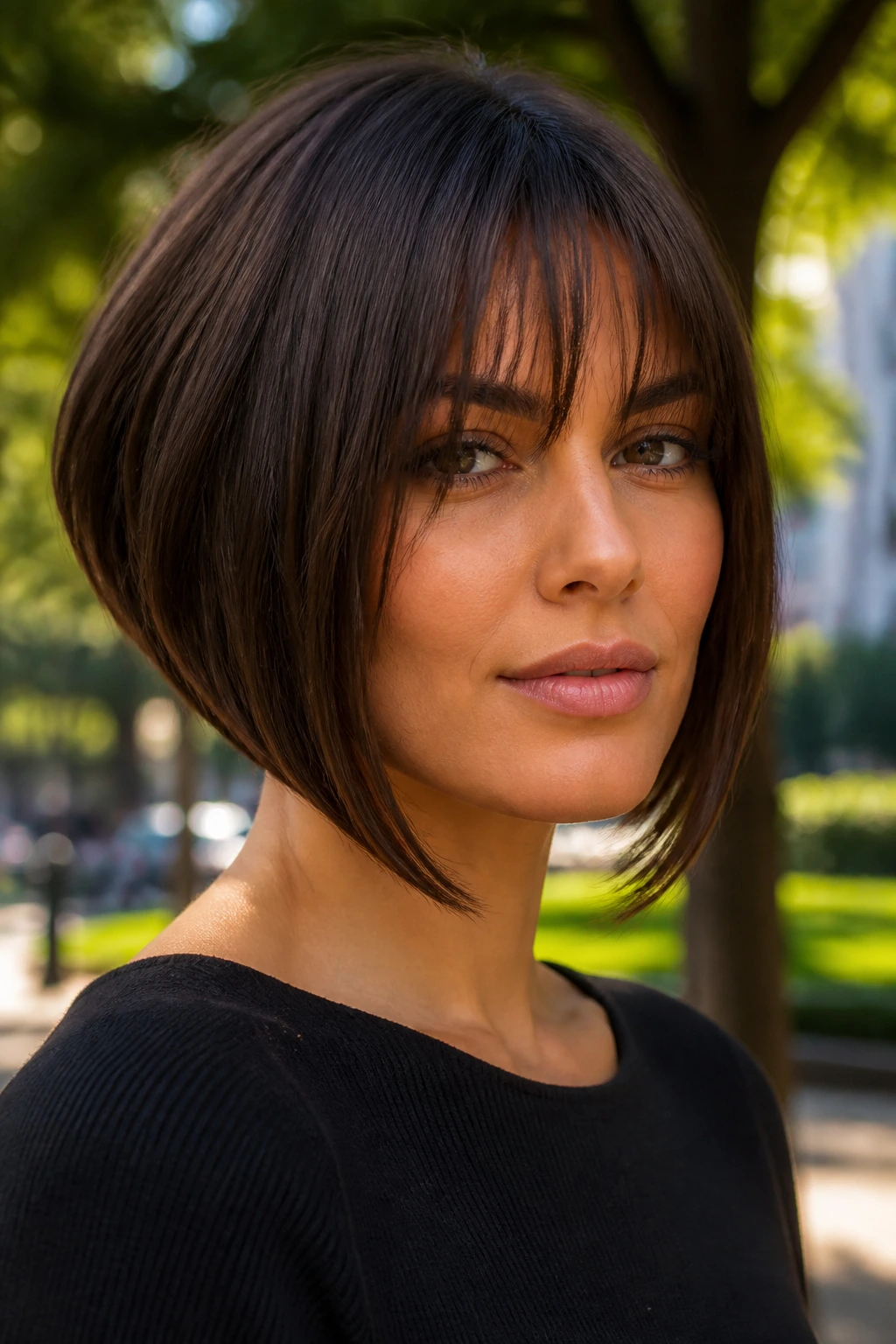
An A-line bob gives you longer front pieces, which is useful when you want to keep some length around a square jaw. The back sits shorter and neater, so the whole cut feels lifted without adding width.
Why the angle helps
That forward angle draws the eye diagonally, which is exactly what a square face likes. Wispy bangs soften the forehead and keep the top of the style light, so the cut doesn’t turn into one large solid shape.
If your jaw is broad and you still want a shorter bob, this is one of the better bets. The length in front gives you room around the face, and the nape stays tidy. I’d avoid a super-heavy bang with this cut; it can overbalance the shape fast.
Styling note
A flat brush and a light smoothing cream are enough for a sleek version. For a more casual look, bend only the front pieces and leave the back straighter. That little mismatch makes the angle show up.
7. Micro Bob with Airy Baby Fringe

This is the bold one. A micro bob sits high, usually around the jaw or a touch above, and the airy baby fringe keeps it from turning severe.
Why it can work
A square face can wear a short cut like this if the edges are broken and the fringe is translucent. The danger with a micro bob is obvious: if the outline is too rigid, the face can look boxier. But when the fringe is soft and the ends are lightly textured, the cut has a fashion edge that feels deliberate.
This is best on fine hair or hair with a bit of natural bend. Very thick hair can make the shape look bulky unless it’s carefully thinned from underneath. And no, this is not the most low-maintenance choice in the group. It needs a little styling, especially around the fringe.
Best use case
Pick this if you want your hair to feel sharp, modern, and slightly daring. It’s not the quiet option.
8. Layered Bob with Bottleneck Bangs
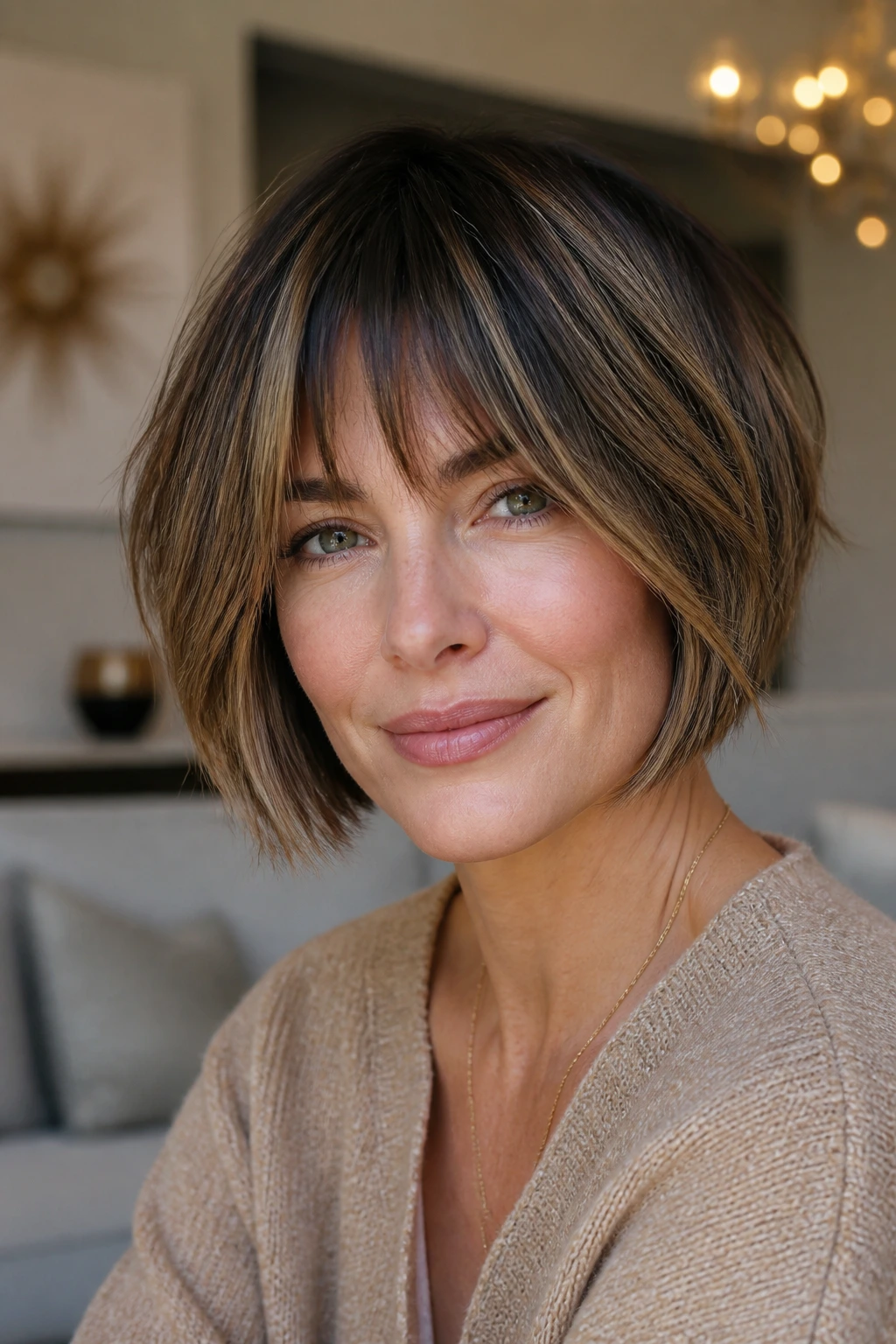
Bottleneck bangs are one of the smartest fringe shapes for square faces. They’re shorter in the center, then widen toward the temples and taper into the sides of the hair.
Why the shape is so forgiving
That width near the temples helps balance a square jaw without cutting the forehead in half. The layered bob underneath keeps the outline from sitting like a block, which matters if your hair is dense or straight.
This shape has a nice side effect: it grows out gracefully. The bangs turn into soft face-framing pieces rather than one awkward shelf. That is worth a lot, because bangs that grow badly can ruin an otherwise good cut in a week.
How I’d style it
Blow-dry the fringe first, before the rest of the hair dries fully. Use a small round brush or a vent brush, then pinch the ends with your fingers while they’re still warm. That keeps the bottleneck shape loose instead of stiff.
9. Wavy Bob with Deep Side Part

A deep side part can do what a lot of styling products promise and fail to deliver: it changes the whole geometry of the haircut.
The waves soften the outline, and the side part creates a long diagonal over the forehead. On a square face, that diagonal matters. It pulls the eye off the jaw and gives the cheekbones a little more room to show.
Best part about this one
It’s forgiving. If your hair has a natural bend, you can air-dry it with a little mousse and let the cut do the work. If your hair is straighter, a few loose bends with a curling wand around the mid-lengths are enough. Don’t curl everything from root to tip. That makes the shape too round.
This is one of the styles I’d hand to someone who wants a bob but does not want to babysit it every morning.
10. Choppy Bob with Razored Bangs

This one has edge. The ends are chopped up a bit, the bangs are razored, and the whole haircut feels lighter than a blunt bob.
Why it helps square faces
Texture interrupts straight edges. That’s the whole game here. A razored fringe never sits like a rigid bar across the forehead, and the choppy ends keep the jawline from meeting a flat hemline. If your face shape tends to look too angular with neat hair, this cut fixes that in a visible way.
It’s especially good for thick hair because the razor work removes some of the weight. Fine hair can wear it too, but the texture has to be controlled. Too much razoring and you end up with ends that look thin and tired.
Small warning
If your hair frizzes easily, keep a light smoothing cream on the ends. Choppy should read piecey, not fuzzy.
11. Jaw-Length Bob with Full Fringe
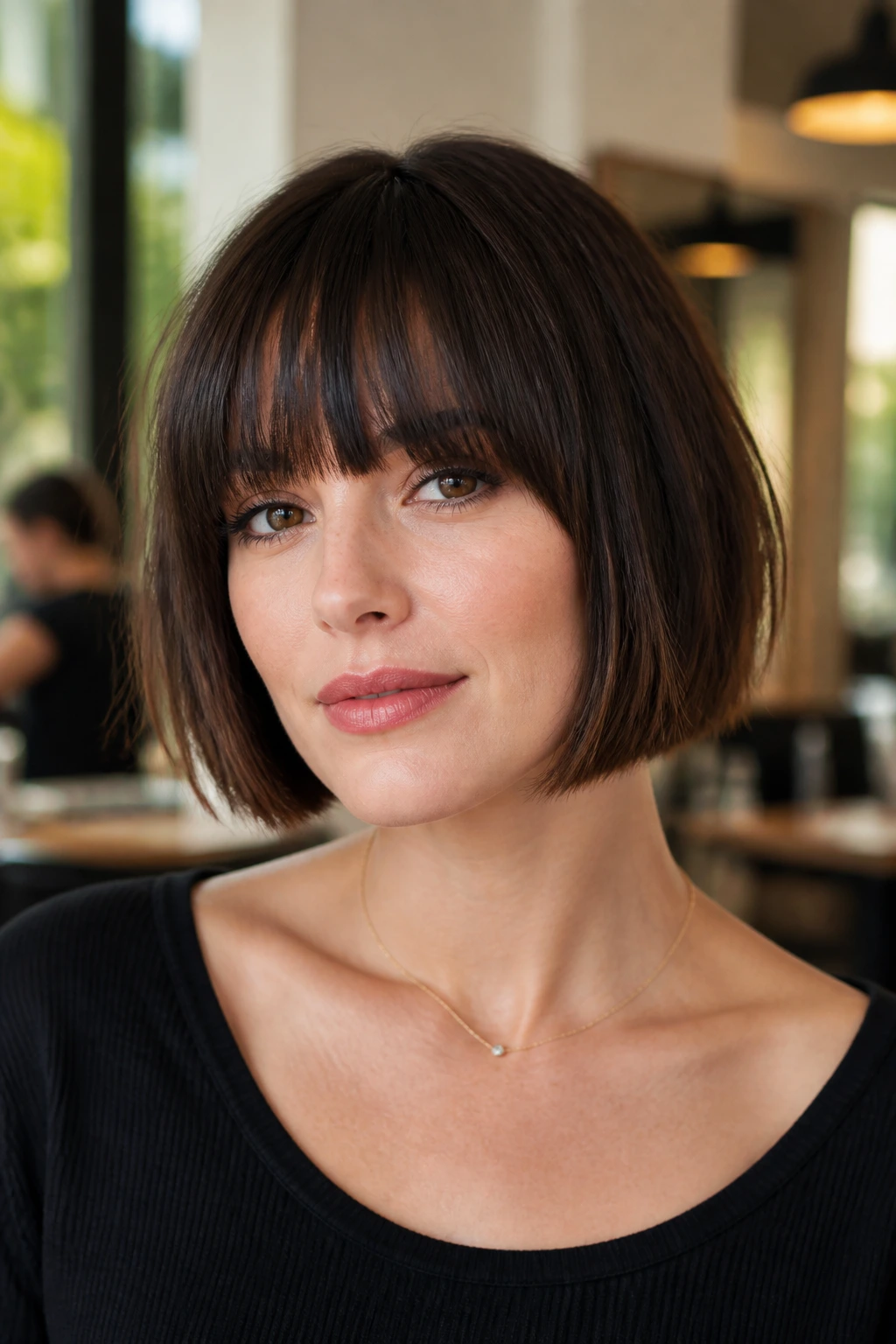
Yes, a full fringe can work on a square face. No, it does not have to make the face look harder.
The trick is keeping the fringe soft at the edges and pairing it with a bob that has a little bevel rather than a dead-flat line. The length lands at the jaw, but the softness in the bangs keeps the cut from becoming too graphic.
Why this one is risky—and good
This is the most structured look in the bunch. That means it can look brilliant when the cut is precise, and awkward when it isn’t. If the bangs are too heavy, the face can feel boxed in. If they’re softened and the bob has a little curve, the effect is striking and sharp in a good way.
I’d choose this for someone who likes clean lines and doesn’t mind regular trims. It is not a lazy haircut. But if you want a strong, editorial shape, it earns its keep.
12. Tapered Bob with Sweeping Curtain Bangs
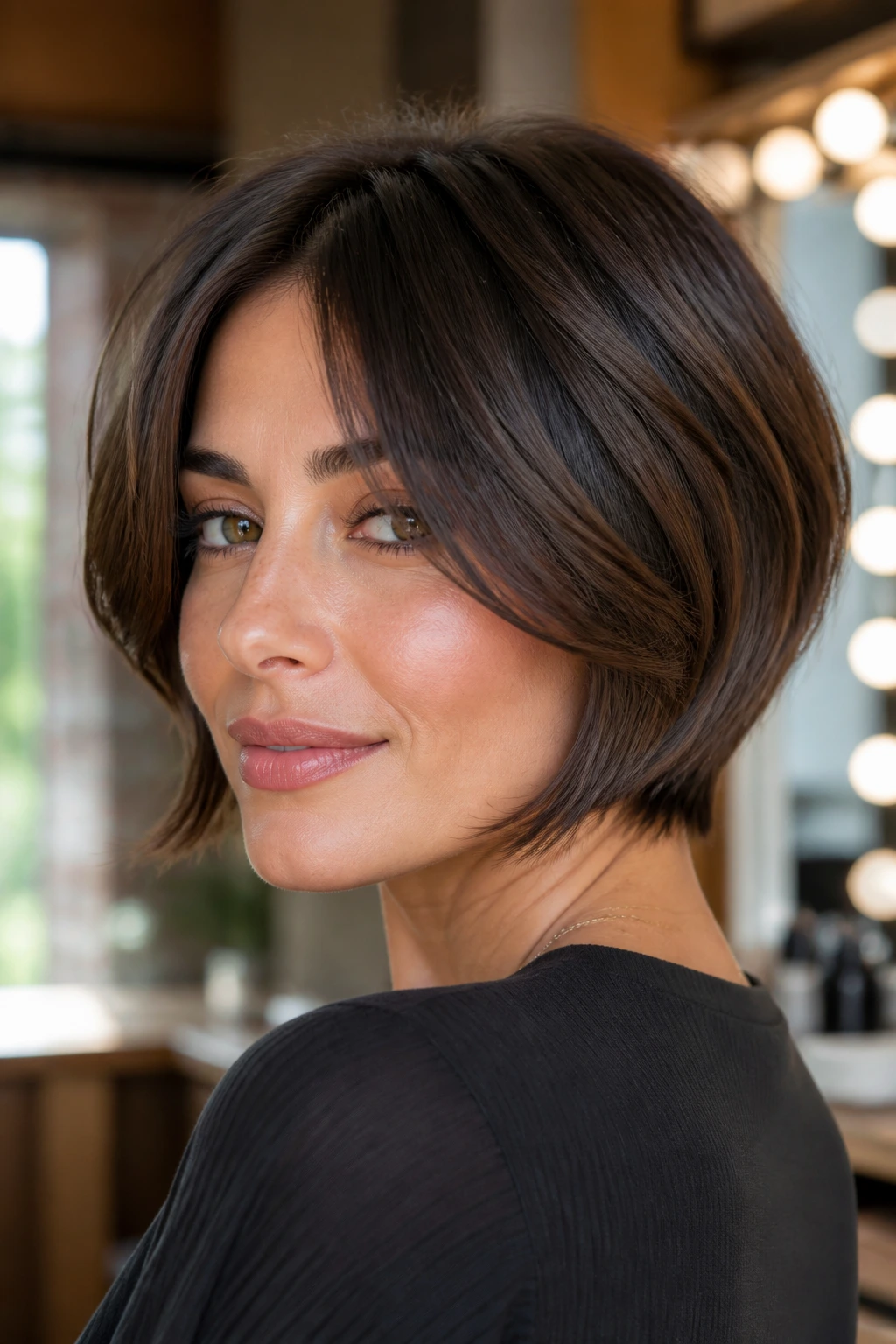
The tapered bob narrows toward the nape and opens up through the front, which is helpful when you want lift without width.
Curtain bangs sweep away from the center and toward the cheekbones, making this one of the most face-friendly shapes here. The combination keeps the eye moving in a soft arc instead of a straight line.
What to ask for
Ask the stylist to leave the front slightly longer than the back, then taper the nape cleanly. The bangs should not split too far apart or they lose the face-framing effect. They should skim, not disappear.
This cut looks especially good with a blowout brush finish. The bend at the ends matters. Straightening it pin-straight can make the taper too obvious and the bob can start to look severe.
13. Asymmetrical Bob with Peekaboo Bangs

A little imbalance is a good thing here. One side sits slightly longer, and the bangs fall just enough to peek across the forehead without hiding it.
Why asymmetry helps
Square faces can handle structure, but a symmetrical cut sometimes makes the geometry too obvious. The asymmetrical line breaks that up. Peekaboo bangs do the same thing on top by letting a bit of skin show through the fringe.
This is one of my favorite options for someone who wants a bob that feels intentional rather than sweet. It has personality. It also works well with bold earrings, because the off-center shape creates room around the ears and cheekbones.
Styling idea
Tuck the shorter side behind one ear and let the longer front fall forward. That simple move shows off the angle and keeps the cut from feeling too uniform.
14. Neck-Length Bob with Soft Blunt Bangs

This one sits a touch below the jaw, which is a smart place to land when your face already has a strong lower half. The bangs are blunt in shape, but soft in texture, so they do the job without making the forehead feel boxed in.
Why it’s useful
Neck-length gives the jaw room. That alone makes a difference. The soft blunt fringe keeps the look polished, and because the length is not sitting right on the widest point of the jaw, the face reads a little longer.
This is a good compromise if you like the feel of a classic bob but worry about going too short. It also grows out in a civilized way. A lot of shorter cuts get strange fast. This one tends to age better between trims.
Styling cue
Keep the ends smooth and slightly beveled. If the fringe is too thick, lighten the center a little so it doesn’t become a hard band.
15. Tousled Bob with Airy Fringe

A tousled bob is all about movement. The fringe is there, but it’s broken up and light, which keeps the forehead open.
The charm here is that the cut looks easier than it is. There’s shape under the mess. On a square face, that looseness prevents the haircut from drawing a hard frame around the jaw.
Best hair types
Wavy hair loves this. Straight hair can wear it too, but you’ll need a bend iron or a quick wave with a flat iron. Thick hair benefits from a few internal layers so the tousle doesn’t turn into a puff. Fine hair, oddly enough, can look fantastic here if you don’t overstyle it. A little grit spray goes a long way.
My blunt opinion
If you hate perfect hair, start here. It forgives a skipped blow-dry better than almost any cut in the list.
16. Sleek Glass Bob with Side Bangs
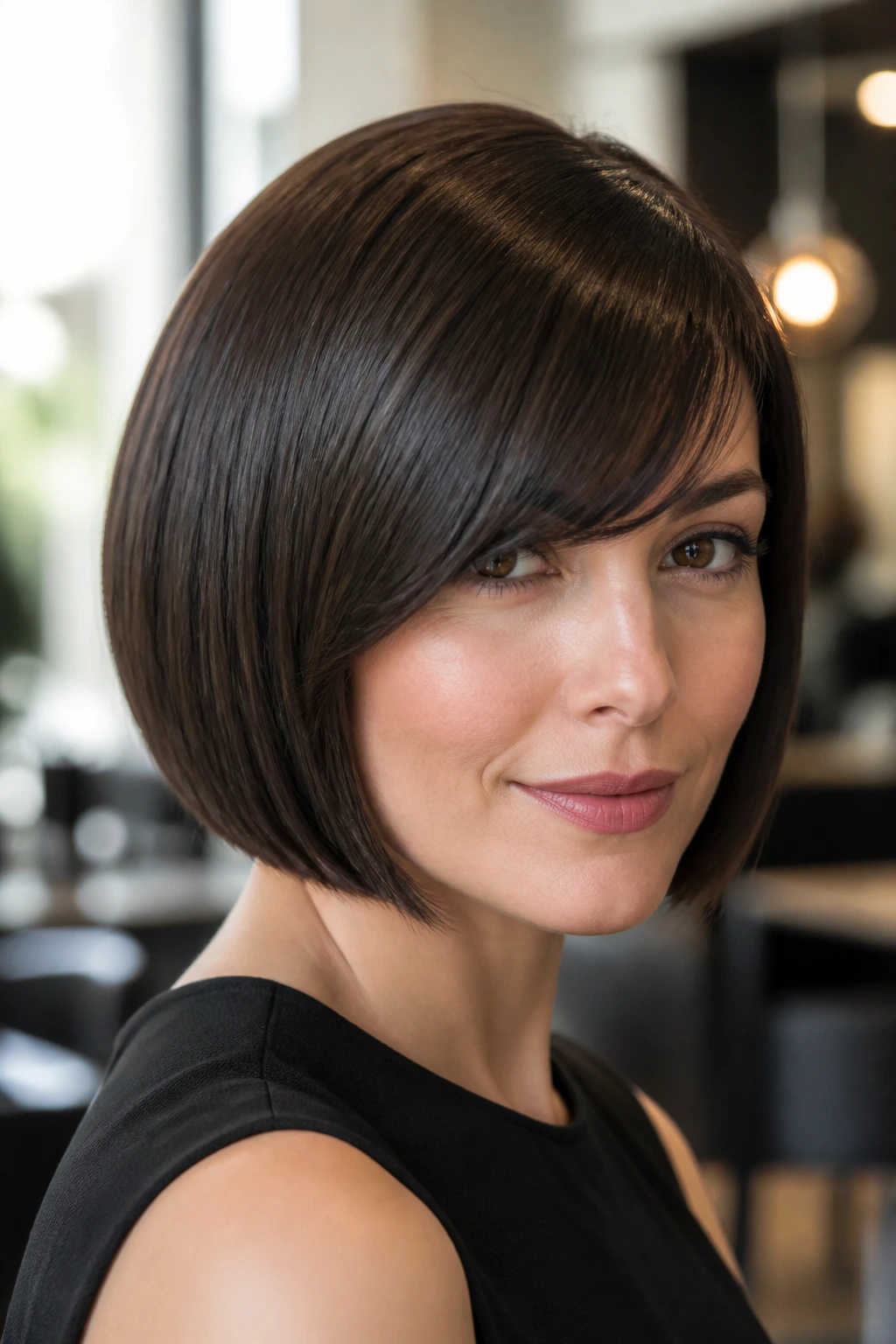
A glass bob is all about shine and line. It is crisp, smooth, and very controlled. On a square face, that can be either brilliant or too much, so the side bangs are the part that save it.
Why the side bang matters
A center-parted sleek bob can emphasize symmetry in a way that makes the jaw look even straighter. A side bang breaks that. It interrupts the hard line and gives the face a diagonal to follow, which keeps the style from feeling severe.
This cut is for someone who likes polish. You need a good flat iron, heat protectant, and a smoothing product that doesn’t leave the ends greasy. If you skip those, the style loses its whole point.
Quick note
Do not flatten the fringe so hard that it sticks to the forehead. A little lift at the root keeps the cut from feeling pasted on.
17. Shaggy Bob with Curved Bangs
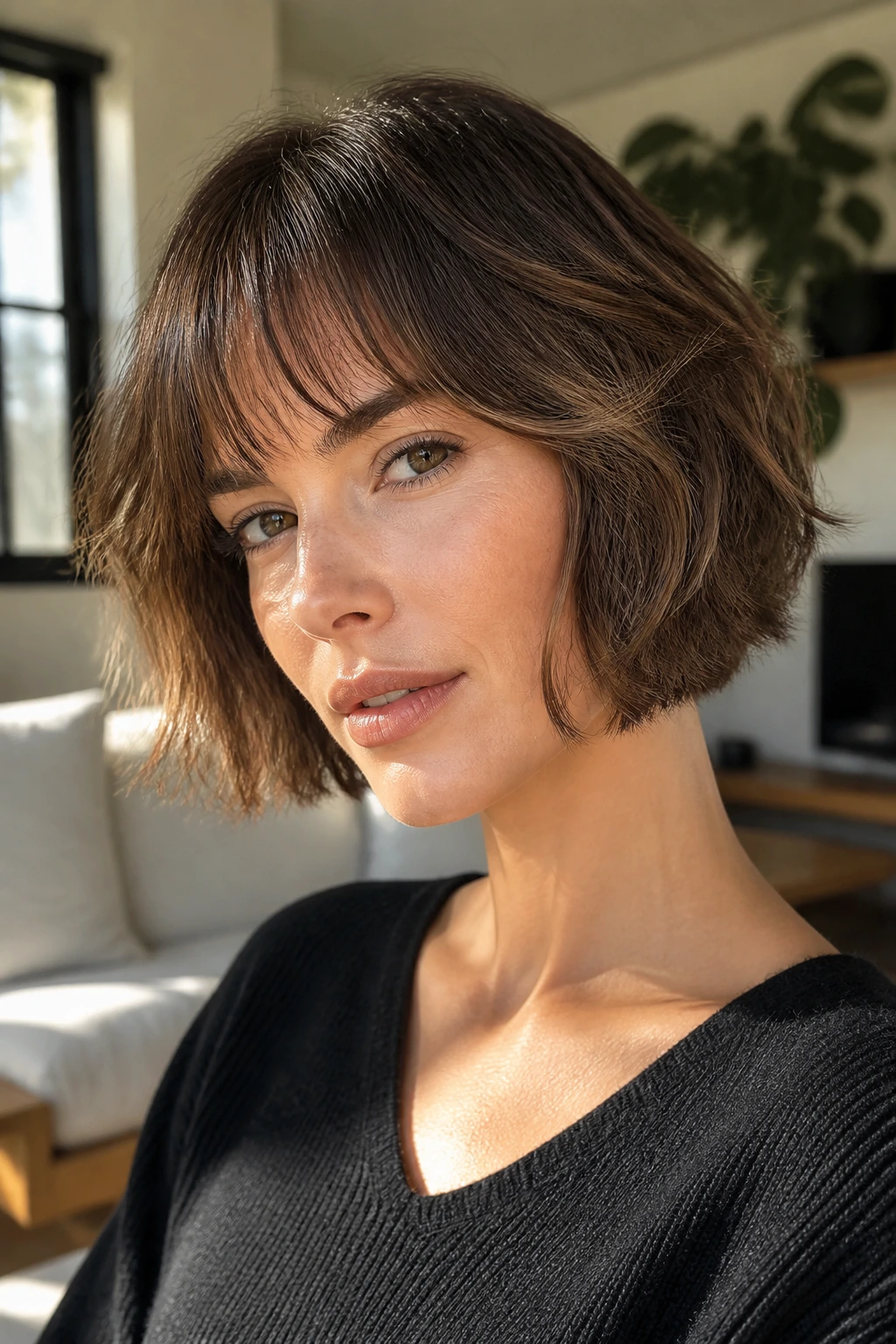
A shaggy bob softens almost everything. The layers create motion, and the curved bangs follow the shape of the forehead instead of cutting straight across it.
Why it flatters square faces
Curved bangs echo the natural contour of the face, which makes the jaw feel less dominant. The shag layers then keep the sides from building weight where you don’t want it. This is especially useful if your hair has a bit of wave or curl and you want that texture to look intentional.
It’s one of the easiest styles to live with if your morning routine is minimal. You can air-dry it, scrunch a little mousse through the ends, and go. The cut should do most of the work. If it needs endless heat styling every day, the shape probably isn’t right.
A stylist note
Ask for the bangs to be curved, not chopped straight and then “fixed” with styling. The cut itself should know what it’s doing.
18. Stacked Bob with Wispy Fringe

A stacked bob brings lift at the back, which can be very helpful if your hair falls flat at the crown. The wispy fringe keeps the front from getting heavy.
Why the stacking helps
A square face often looks best when the haircut creates height where the face is strongest at the sides. The stacked back does that by giving a little lift and shape without widening the cheeks. The wispy bangs keep the front airy, so the overall cut does not turn bulky.
This one is smart for fine hair that needs a little body. It can also work for thick hair if the nape is carefully layered. The big risk is over-stacking, which can make the shape look dated or too round. Keep it modern and soft.
Best finish
A round brush at the crown, then a little finger-shaping around the fringe. That’s enough.
19. Disconnected Bob with Long Fringe
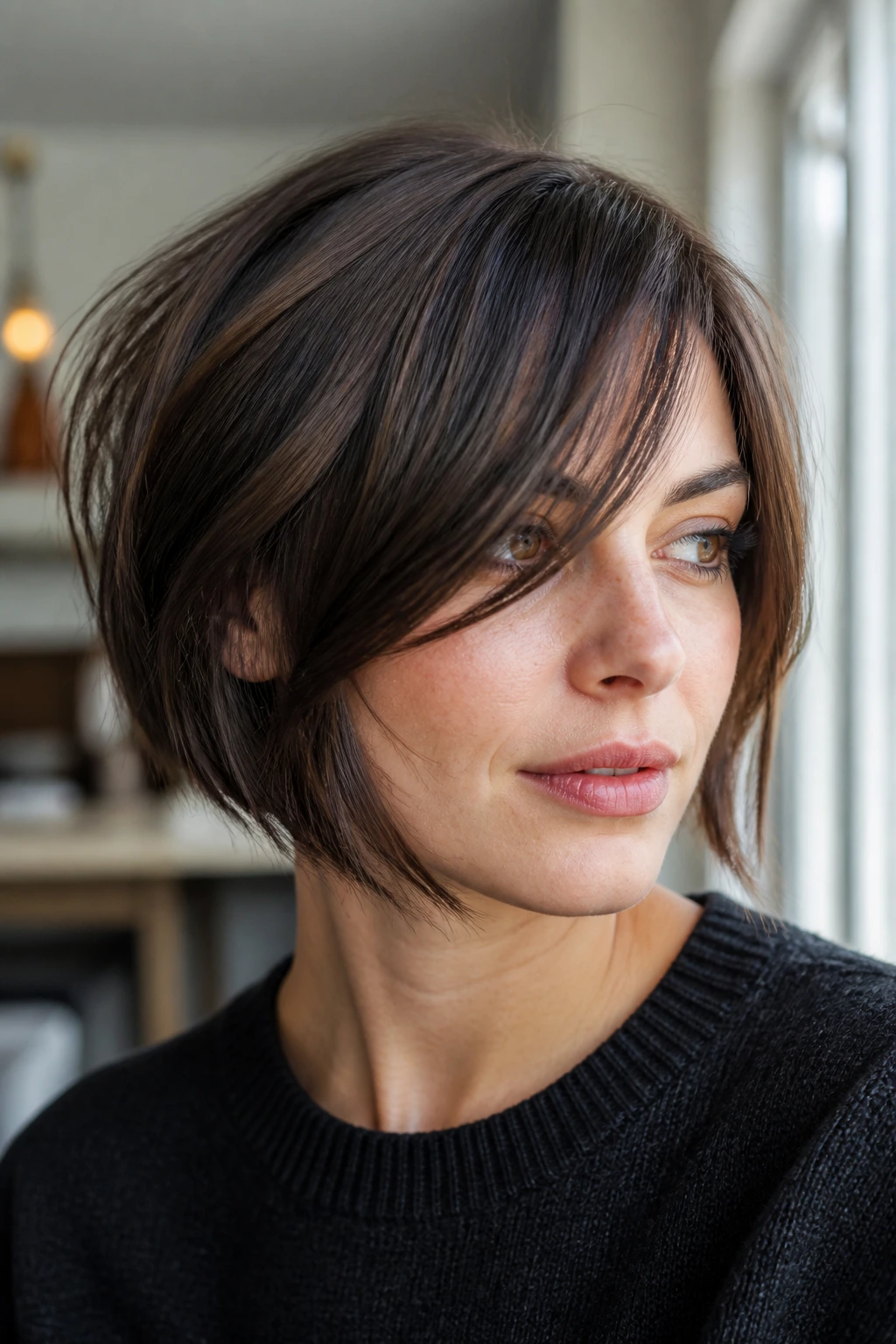
A disconnected bob sounds technical, and it is. The top layer and the underlayer do not blend perfectly, which creates a little separation and movement. Add a long fringe, and the whole cut becomes more interesting around a square face.
Why it works
Separation is the point. Square faces can take structure, but they need it broken up. This cut avoids the single heavy block that sometimes happens with blunt bobs. The long fringe gives you diagonal motion across the forehead, while the disconnection keeps the ends from looking too solid.
It’s best if you like texture and don’t mind a bit of styling. This is not a wash-and-forget haircut. But it does look expensive in that slightly undone way when the cut is right.
Worth knowing
Ask for the fringe to stay soft at the cheek level. If it’s too long and too heavy, it just hides the face instead of framing it.
20. Soft Inverted Bob with Side-Swept Bangs
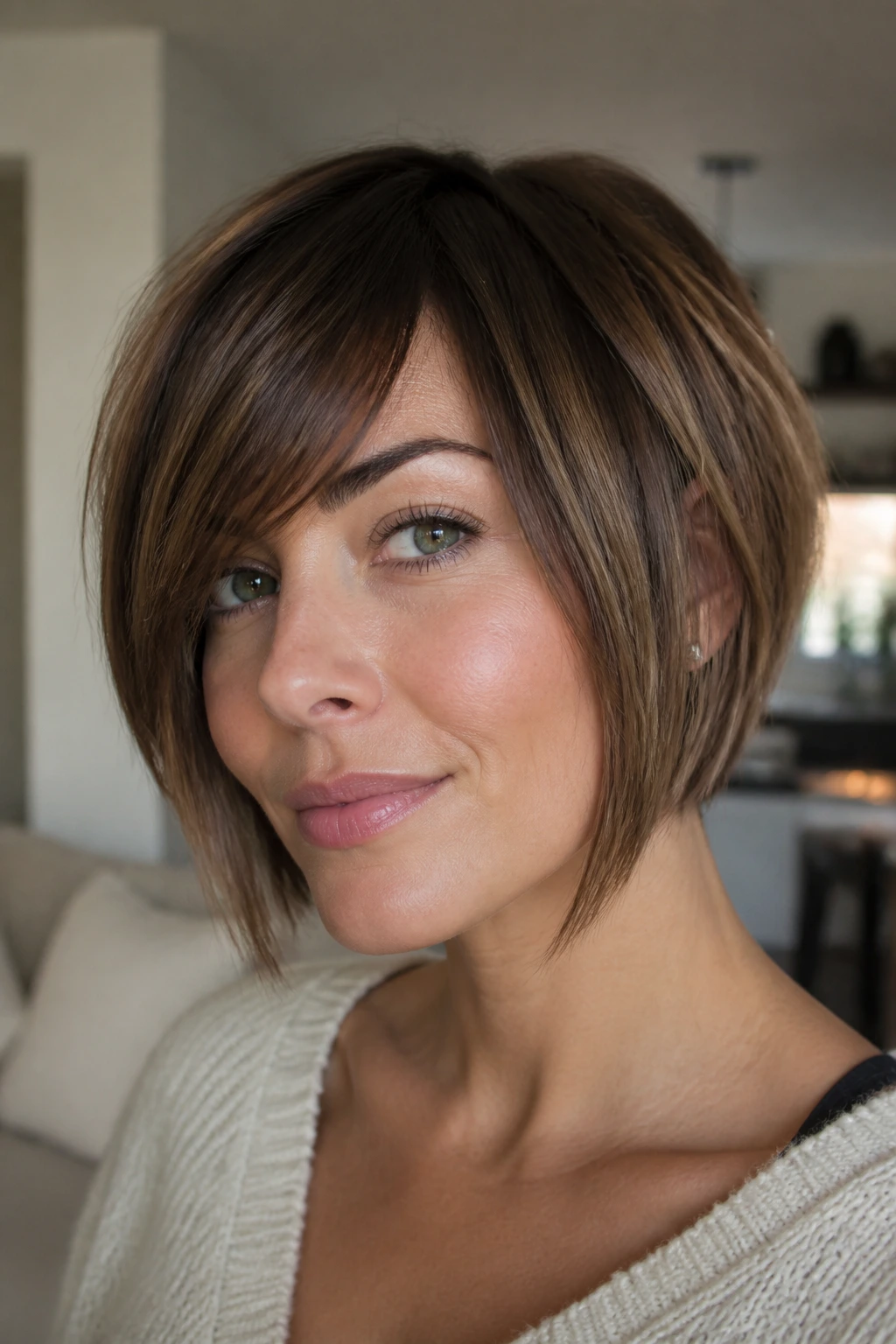
The inverted bob has more length in front and a shorter back, but this version keeps the lines soft so it doesn’t turn severe.
What it does for a square face
The longer front pieces create a downward path that helps elongate the face visually. Side-swept bangs add another diagonal, which is the real reason this cut works. You’re not adding more shape to the jaw. You’re directing the eye away from it.
This is a very practical choice if you want a little shape without too much maintenance. It works on straight hair, wavy hair, and even fine hair that needs a bit of structure. The key is not letting the front get too pointy. Soft corners are better than sharp ones.
21. Curly Bob with Curved Fringe

Curly hair and square faces can be a very good match when the shape is cut dry and the fringe follows the curve of the forehead.
Why this one deserves attention
A curly bob naturally breaks up hard lines, which helps a square jaw immediately. The curved fringe keeps the front from looking like a flat rectangle, and the spring of the curls adds softness around the sides of the face. The shape should be rounded, but not puffed out at the temples.
This cut absolutely needs shrinkage planning. A fringe that looks perfect when wet can jump way too short once dry. Cut curls where they live, not where they look polite in the sink.
Good rule
If your curls are dense, ask for a little internal shaping and leave enough length in the fringe to account for bounce. That one detail saves a lot of regret.
22. Micro-Layered Bob with Textured Bangs
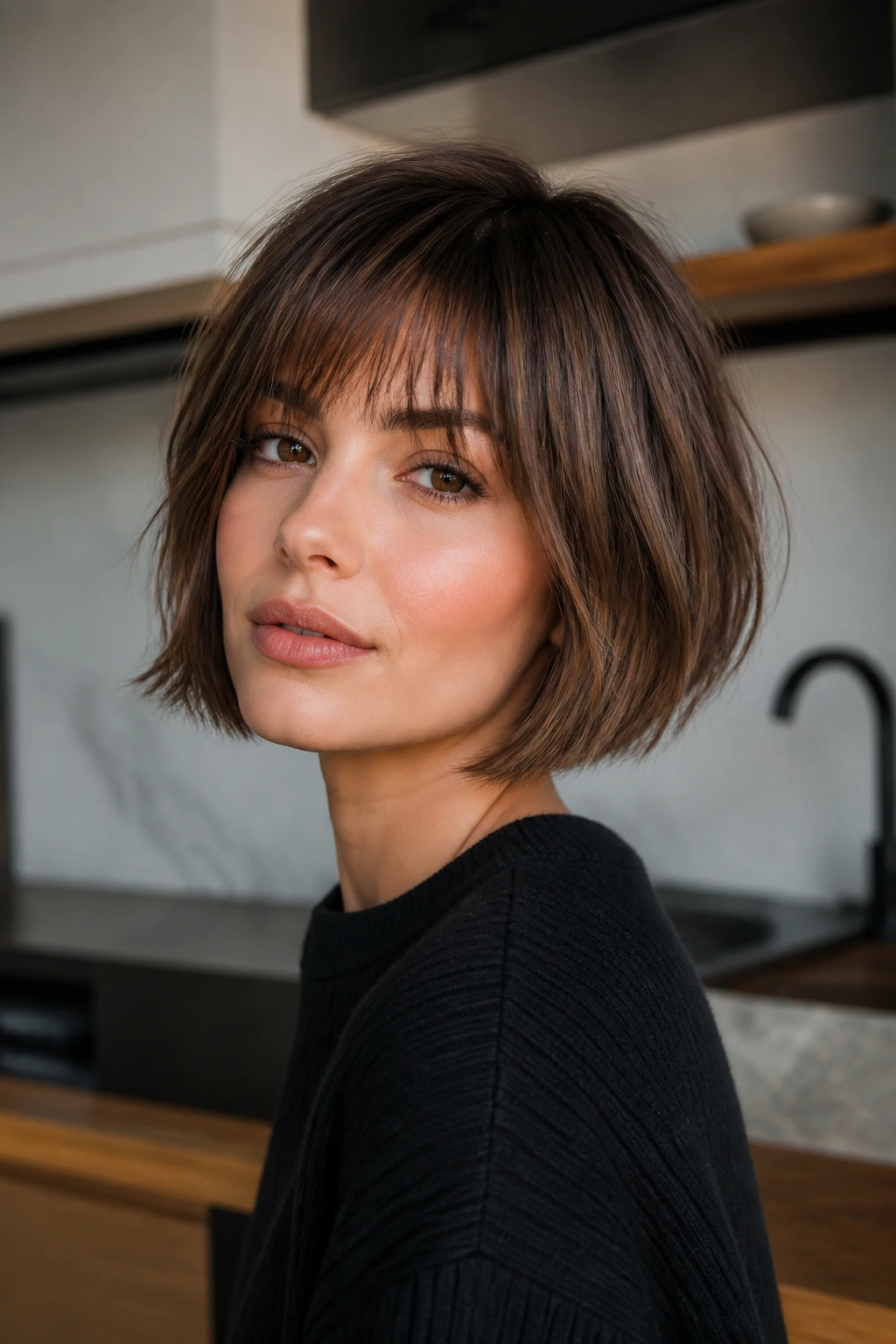
Here’s the quiet workhorse of the list. Micro-layers keep the bob from reading as one heavy block, and textured bangs soften the forehead without creating a blunt line.
Why it works so well
This style is especially kind to fine hair, which can look limp in a one-length bob. The tiny layers create just enough movement for the shape to bend around the jaw. On a square face, that motion matters. It keeps the haircut from feeling like a hard shape sitting on top of another hard shape.
I like this version when someone wants a bob that still feels clean but not fussy. It is controlled, not messy. The texture should be subtle, not choppy for the sake of it.
Small styling habit
Use a root-lift spray at the crown and a tiny amount of lightweight cream on the ends. Too much product and the layers collapse.
23. Wedge Bob with Flipped Bangs
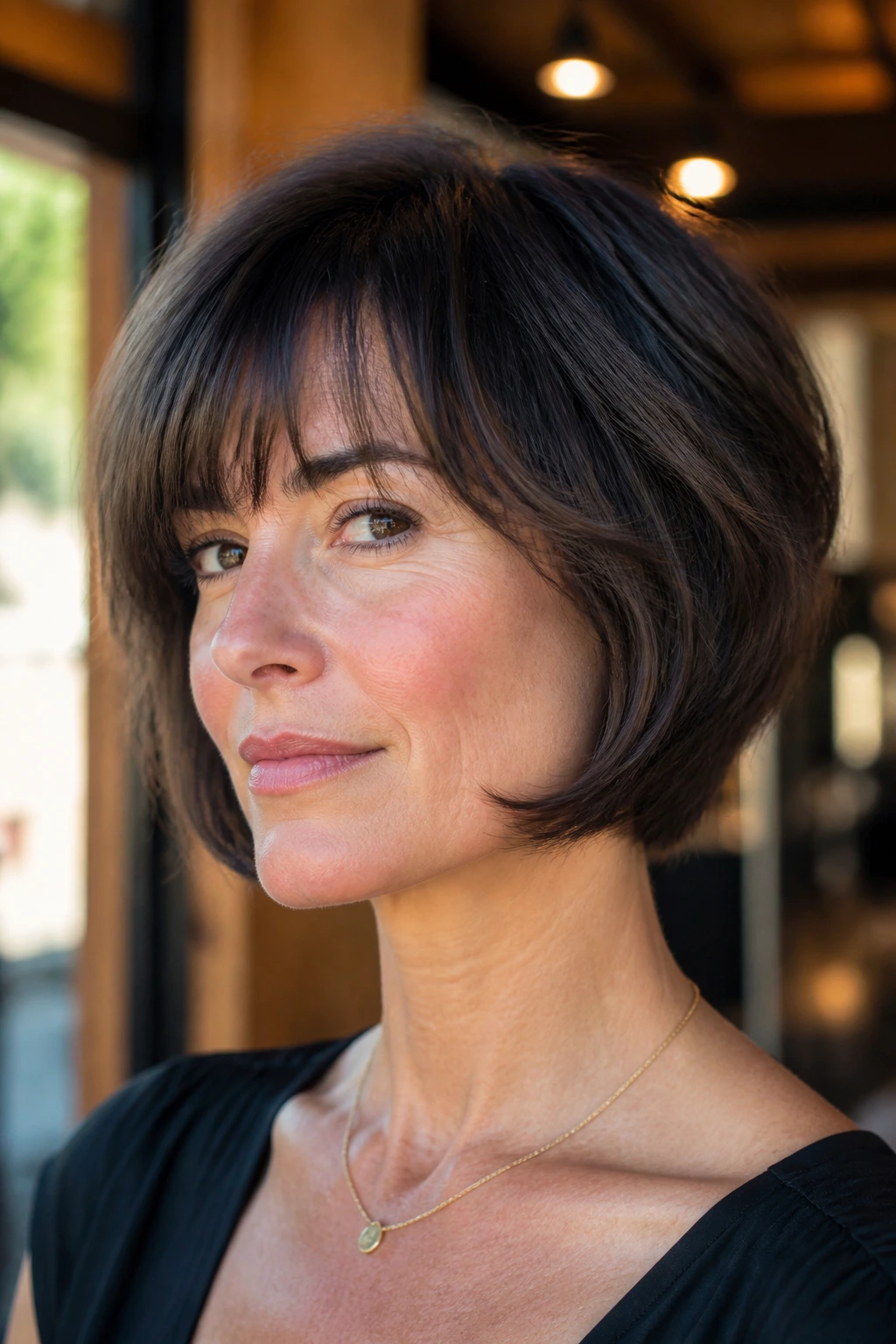
The wedge bob has a retro edge, with a bit more fullness through the back and a narrower front line. On a square face, the bangs make or break it.
Why it can be flattering
The flipped shape gives the silhouette lift, which helps if your hair is naturally flat at the back of the head. Flipped bangs, when they’re soft rather than crunchy, can break the forehead line and keep the style from reading too rigid.
This one is not for someone who hates volume. It has shape, and it wants to show it. The danger is going too far with the flip and turning the ends into a helmet. Keep the bend subtle. Think curve, not curl.
Better with
Medium-density hair and a round brush. If your hair is very fine, it may lose the wedge. If it is very thick, the shape can become bulky unless the underside is carefully removed.
24. Tucked Bob with Long Curtain Bangs
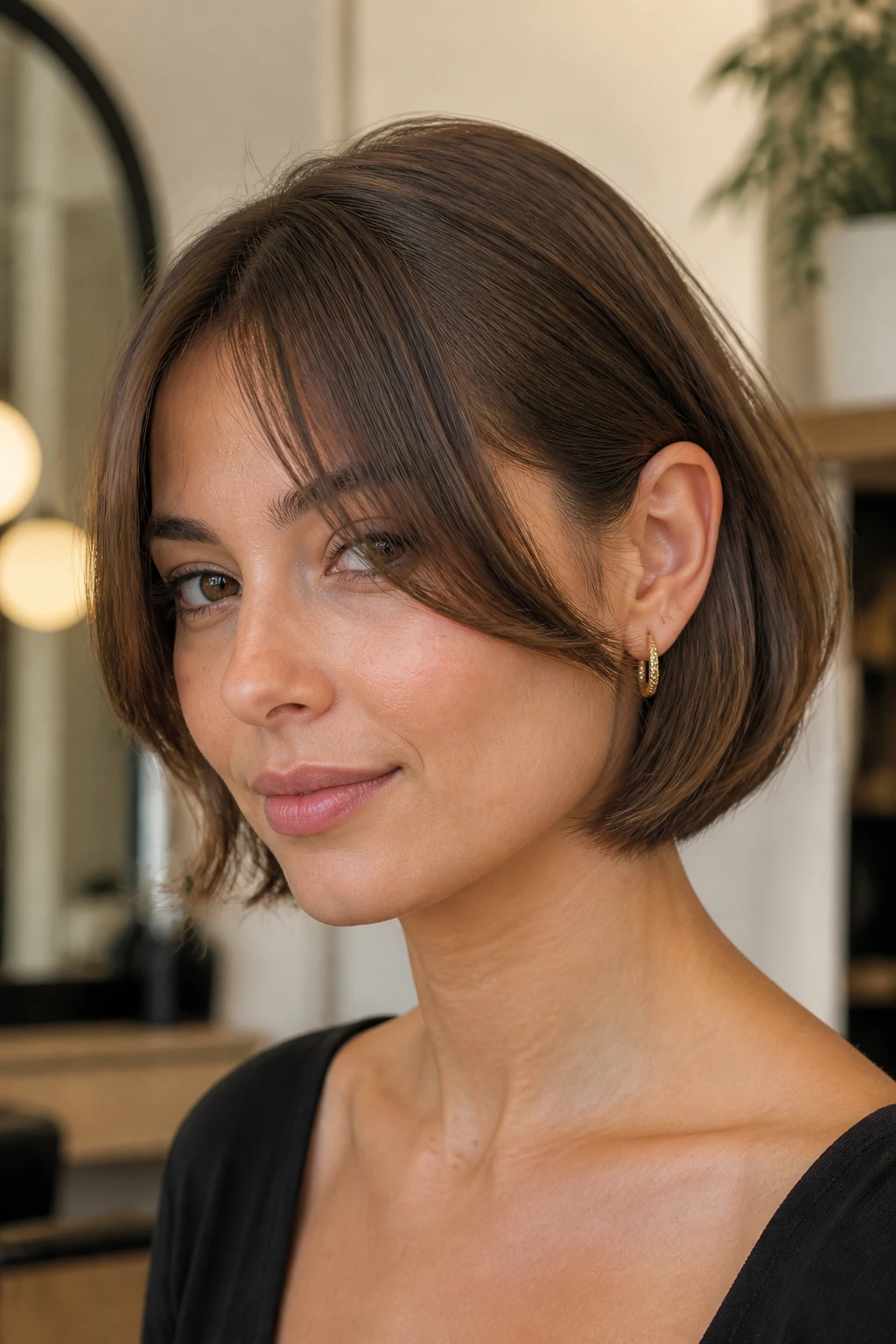
This is the bob you wear when you want polish with almost no drama. The cut is short enough to feel fresh, but the longer curtain bangs and the tucked styling keep it relaxed.
Why the tucked look works
Tucking one side behind the ear opens the face and shows off the jaw in a controlled way. That sounds counterintuitive on a square face, but it works because the bangs soften the center and the tucked side breaks the symmetry. The face gets framed instead of boxed.
It is also easy to live with. You can wear it straight, wavy, or slightly bent, and the shape still reads. If you wear earrings, this cut gives them room. That’s not a small thing.
Quick styling note
Keep the curtain bangs longer than you think you need. Once they are too short, the whole styling trick gets harder.
25. Chin-Skimming Bob with Soft Scissor Fringe

This one feels like the most wearable classic in the bunch. The line skims the chin rather than stopping hard on it, and the scissor-cut fringe is soft enough to flatter a square face without hiding it.
Why it’s a keeper
A chin-skimming length is a sweet spot for a lot of square faces because it sits just below the jawline and leaves a little breathing room. The soft fringe means the forehead gets a frame, not a wall. You get structure, but the haircut does not feel severe.
This is the kind of bob that works in real life, not just in a salon mirror. It can be worn smooth, a little bent, or with a touch of texture spray. If you want a bob that looks thoughtful without being high-maintenance, start here.
Best final word on it
It’s the most forgiving cut in the list. That matters more than glamour points.
How to Ask Your Stylist for the Right Cut
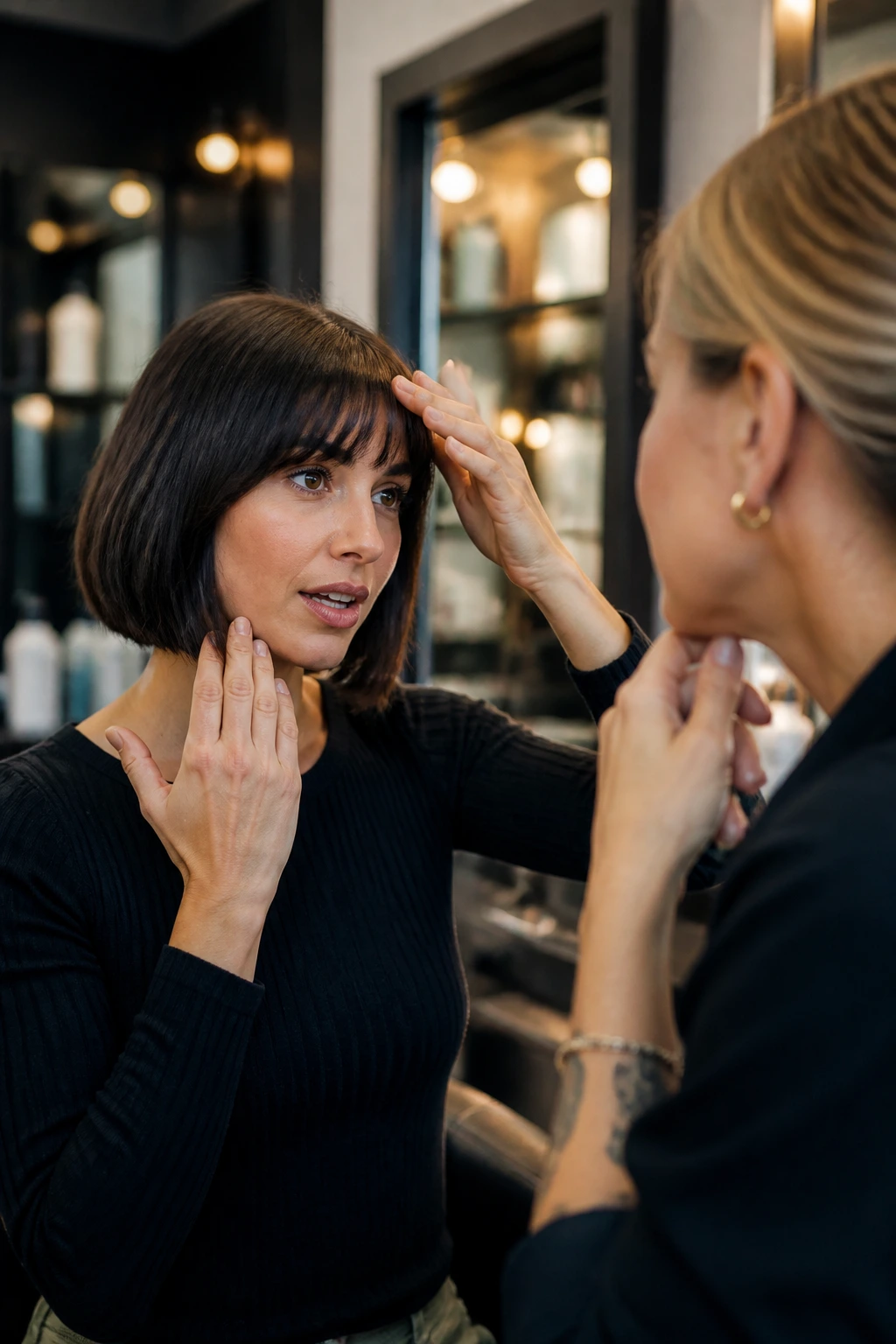
A lot of bob disappointment comes from bad language in the chair, not bad hair. “Short bob” means one thing to you and something else entirely to a stylist, especially when square faces are involved.
Bring photos, yes, but bring them with notes. Tell your stylist whether you want the line to sit at the chin, just below the jaw, or at the neck. Say where your bangs should start and how open you want them to feel. If you like curtain bangs, say you want the shortest point around the nose bridge or cheekbone, not halfway up the forehead.
The phrases that actually help
- “Keep the front a little longer than the jaw.”
- “Soften the bang edges; don’t make them a hard bar.”
- “I want movement around the face, not width at the sides.”
- “Point-cut the fringe so it breaks up a straight line.”
That last one matters more than people realize. Point-cutting adds softness at the ends, which is exactly what keeps a bob from feeling too square.
And one more thing: tell them how you wear your hair on a normal morning. Sleek? Wavy? Air-dried? That answer should shape the cut more than the fantasy version of you who owns six curling irons and gets up early.
Essential Tools for Styling These Bobs
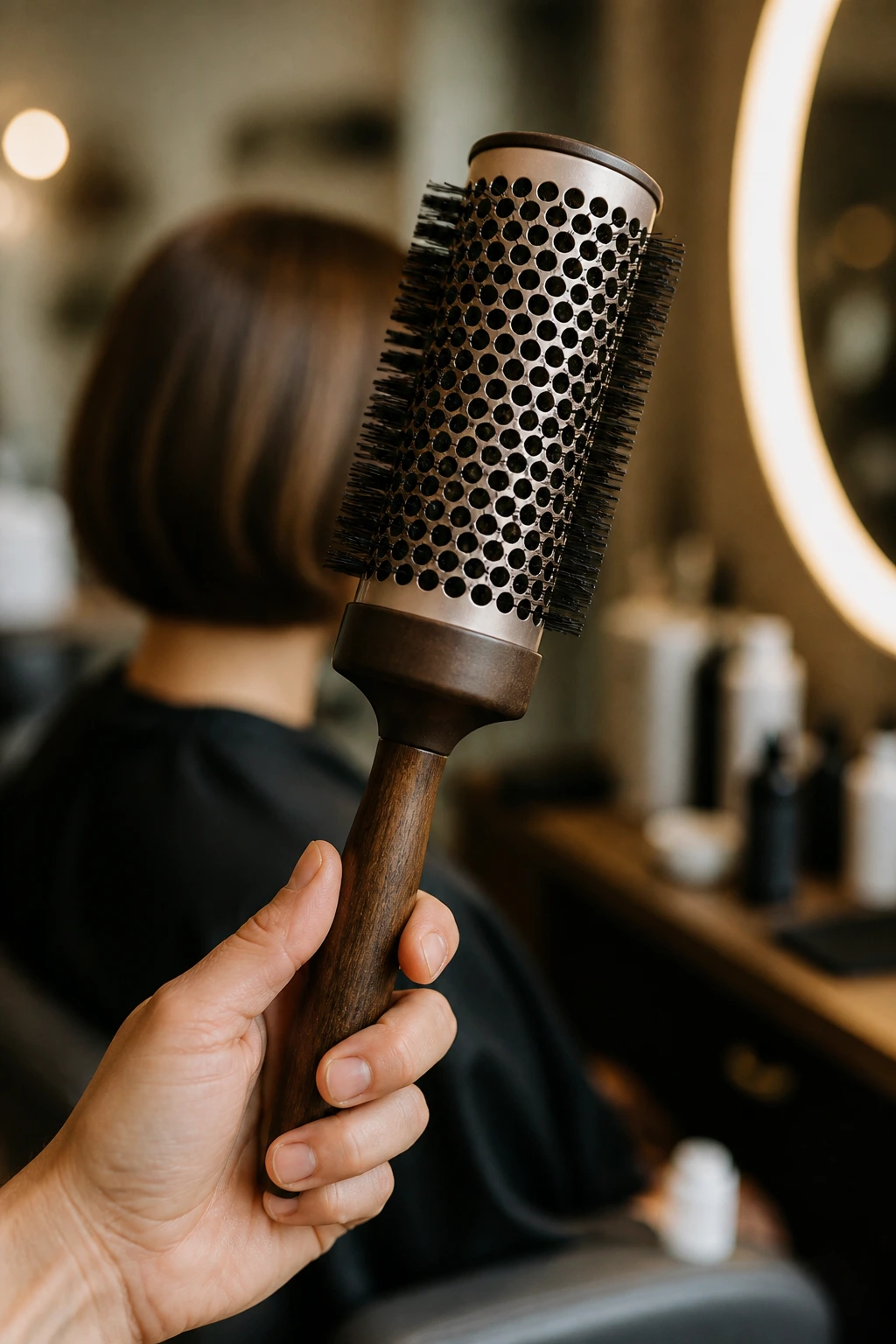
You do not need a drawer full of gadgets, but the right few tools make short bobs much easier to control.
- Blow dryer with a concentrator nozzle: Helps direct the hair where you want it, especially around the fringe and crown.
- Small to medium round brush: Best for bending curtain bangs, side bangs, and the front pieces under or away from the face.
- Flat iron or 1-inch styling iron: Useful for sleek glass bobs, quick root smoothing, and a gentle bend at the ends.
- Tail comb: Good for clean parting and separating the fringe without fluffing up the roots.
- Duckbill clips: Handy for sectioning the top while you dry the bangs first.
- Heat protectant spray: Non-negotiable if you use heat more than once a week.
- Lightweight mousse or root-lift spray: Gives short bobs body without the crunchy feel that heavy creams leave behind.
- Texturizing spray: Best for piecey, tousled, choppy, and shag-influenced cuts.
- Dry shampoo: Saves second-day fringe and keeps the roots from collapsing.
- Small finishing serum: A pea-sized amount on the ends is enough for sleek or blunt versions.
If you only buy two things, buy the round brush and the heat protectant. Those two do the most work for the least money.
Products and Finish Choices That Change the Whole Look

A bob is not just a cut. It is a finish. Same haircut, different product, wildly different outcome.
Fine hair usually needs a mousse at the roots and a very light texture spray on the ends. Heavy creams can flatten the shape and make bangs separate in weird little strings. Thick hair tends to behave better with a smoothing balm or a tiny bit of serum on the perimeter, because the ends need control more than lift.
Curly or wavy hair does well with curl cream, but use it sparingly near the fringe. Too much product in the bangs is how you get greasy-looking roots by lunchtime. I like to keep fringe products lighter than the rest of the head. That rule saves a lot of frustration.
Finish choices worth trying
- Soft bend: Best for curtain bangs, French bobs, and chin-length cuts.
- Sleek and polished: Best for glass bobs, blunt bobs, and inverted shapes.
- Piecey texture: Best for choppy, shaggy, and tousled bobs.
- Air-dried movement: Best for wavy hair and curly versions.
Pick one finish on purpose. A bob that is trying to be sleek and messy at the same time often ends up neither.
How to Wear These Cuts Without Fighting the Face
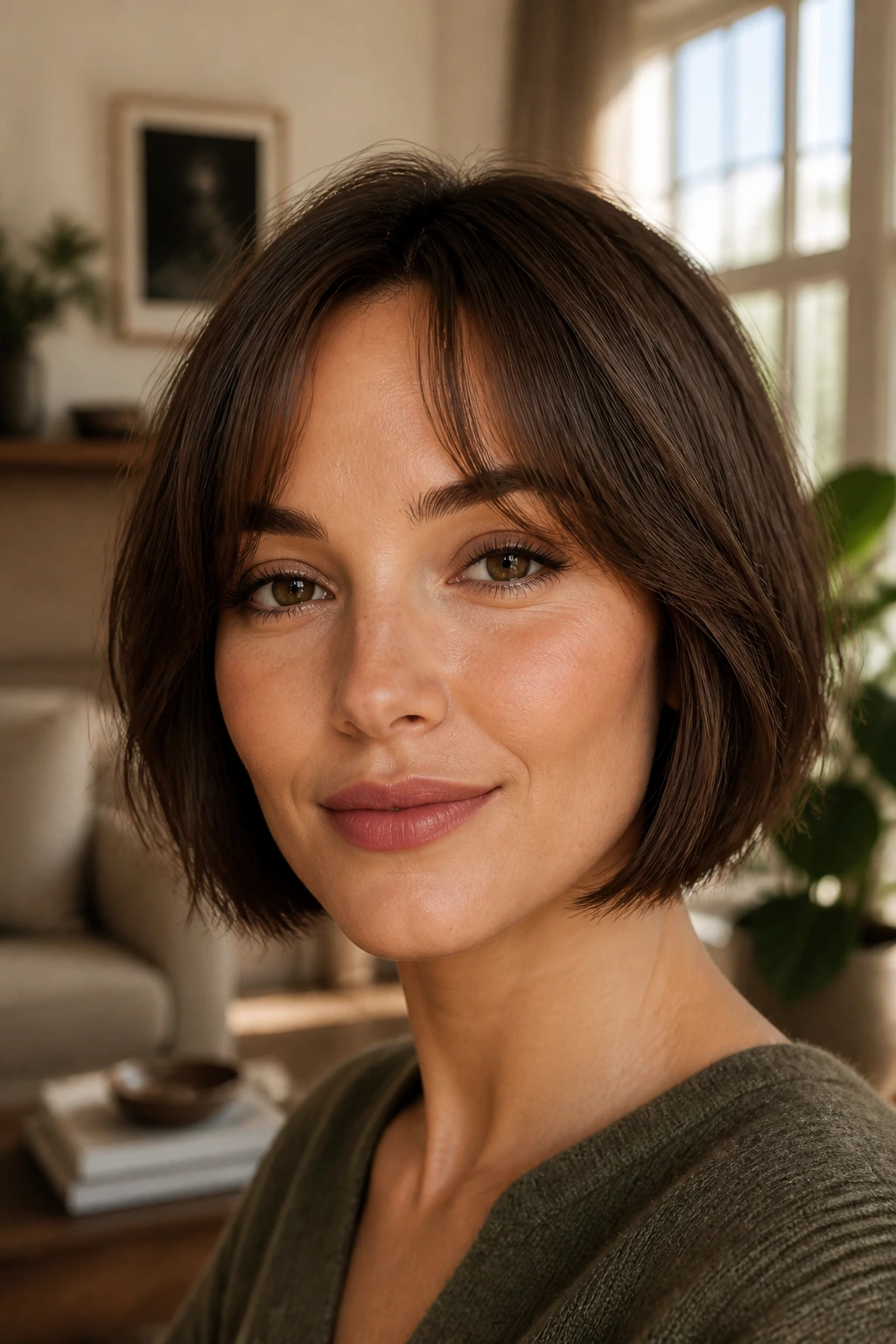
The best styling trick is not complicated. It is placement.
Presentation: Let the fringe open the forehead instead of burying it. A center split, side sweep, or bottleneck shape gives a square face room to breathe. If the bangs sit like a straight wall, the face can feel compressed.
Accompaniments: Earrings matter more than people think. Small hoops, slim drops, and frames with rounded corners all work well because they echo the softer lines in the haircut. Chunky square glasses can look strong too, but they need a bob with movement, not a hard-edged cut.
Proportion: Chin-length and just-below-jaw lengths are the safest starting points. Micro bobs can look incredible, but they need texture or bend. If you want your jaw to appear less dominant, let the front pieces fall a little past it.
Finish: Sleek if you like precision, bent if you want softness, tousled if you want the cut to feel casual. Choose one and stick with it on the days that matter. The haircut shows better when the styling decision is clear.
Extra Styling Moves and Texture Boosters

A few small adjustments can change the whole feel of a bob.
Root Lift: Clip the top section up while the hair cools, or blow-dry the crown forward first and back over a round brush. That gives the top height without adding width at the cheeks.
Directional Bend: Turn the ends slightly inward for a softer frame, or outward if you want a more relaxed, undone feel. Keep the bend subtle. Big flips can look dated fast.
Fringe Reset: Bangs usually need the most attention. Mist them with water, re-dry just the fringe, and use the tiniest brush you own. If you try to restyle the whole head every day, you’ll get tired of the cut.
Detail Work: A dot of pomade or styling wax on the ends can separate choppy layers and keep them from fluffing out. Use almost nothing. A little goes a long way, and too much makes the bob collapse.
Maintenance, Trims, and Grow-Out Guidance

Short bobs are honest. They tell you when they need a trim.
A blunt bob usually wants a reshape every 6 to 8 weeks, because even half an inch of growth changes the line. Layered or shaggy versions can stretch closer to 8 to 10 weeks if the shape is forgiving. Bangs, though, are a different story. Curtain bangs might hold for a month or so, but a full fringe often needs a cleanup every 3 to 4 weeks if you want it to sit right.
What helps between salon visits
Use dry shampoo at the roots, not just on day two but the moment the fringe starts to separate. Bangs that split in the center usually need less oil and more support. A quick mist of water and a five-minute blow-dry on the front pieces can reset the cut better than re-styling the whole head.
If you’re growing it out, ask the stylist to shift the fringe toward bottleneck or curtain shape before the length gets awkward. That little transition is kinder than trying to survive a blunt bang growing into your eyes for two months.
Sleep on a satin pillowcase if you can. It does not solve everything, but it cuts down on morning puff and flattening around the fringe.
Common Mistakes to Avoid

A few mistakes show up over and over with bobs on square faces, and they’re predictable once you know what to watch for.
- Cutting the bob right at the widest part of the jaw: The symptom is a shape that looks boxier the second it dries. The fix is a slightly lower hemline, a softer edge, or longer front pieces.
- Making the bangs too thick and too straight: That can shrink the forehead and make the face look shorter. Ask for softness at the temples or a light point-cut finish.
- Adding too much side volume: If the sides puff out at cheek level, the face reads wider. Keep lift at the crown, not at the temples.
- Over-layering fine hair: The ends can look thin and stringy fast. Fine hair usually needs a cleaner baseline, not a shredded one.
- Ignoring your daily routine: A cut that needs a blowout every morning is a bad fit if you air-dry most days. The haircut should match the life you actually live.
Most bad bob outcomes are not the haircut’s fault. They’re a mismatch between shape and habit.
Variations and Adaptations to Try

Fine-Hair Friendly Bob: Keep the line cleaner, use a blunt baseline, and choose curtain or bottleneck bangs that stay light. Fine hair often looks best when the shape is simple and the product load is low.
Thick-Hair Softening Bob: Ask for internal debulking, a slightly longer fringe, and beveled ends. Thick hair can take texture, but it needs the bulk removed in the right places or the bob turns heavy fast.
Curly or Wavy Version: Get the cut shaped dry, or at least with shrinkage in mind. The fringe should sit longer than you think, because curls spring up once they dry.
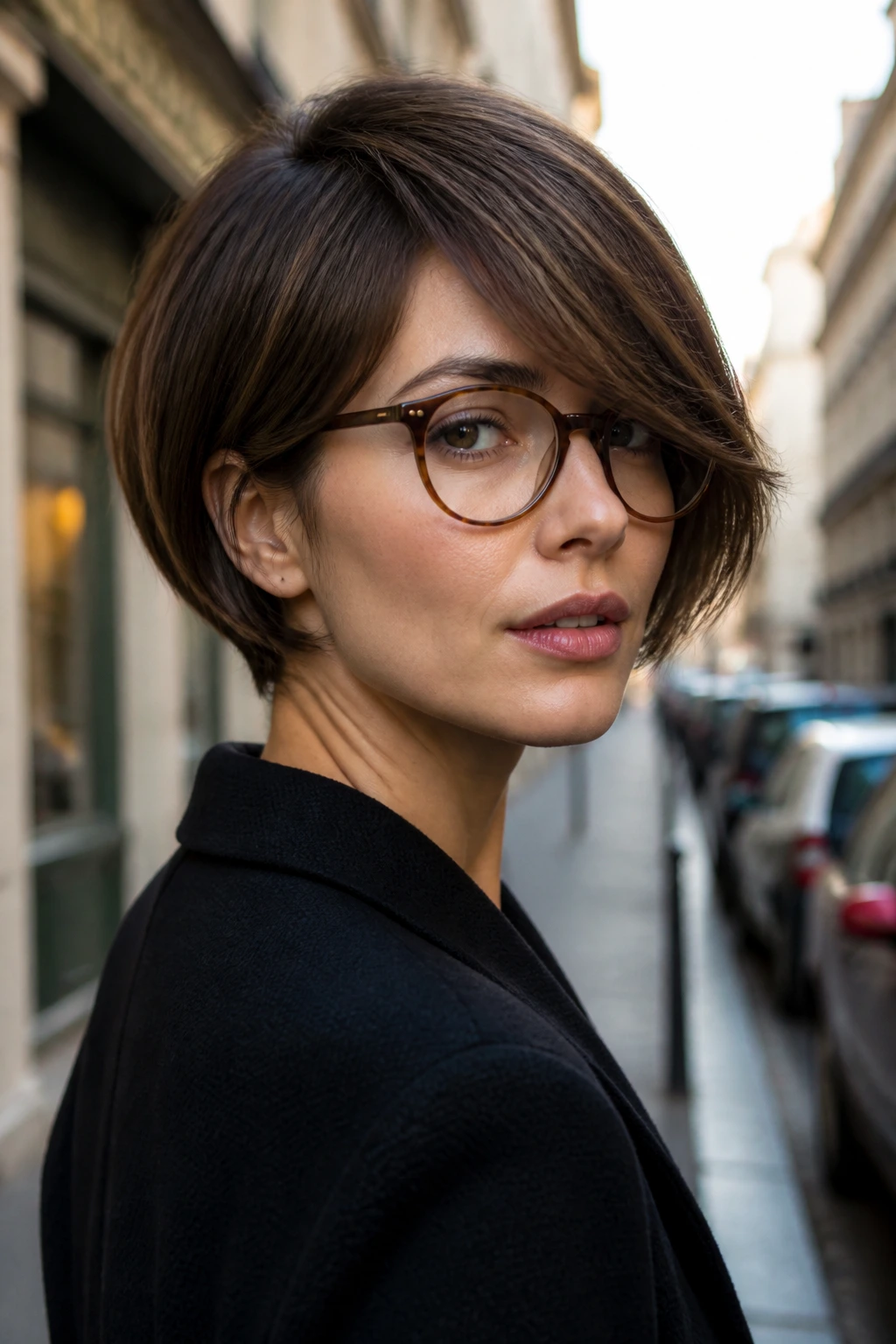
Glasses-Friendly Fringe: Side-swept bangs or a bottleneck fringe usually work better than a thick blunt bang. They leave room for frames and keep the top half of the face open.
Low-Maintenance Grow-Out Cut: Pick a chin-skimming bob with longer curtain bangs. It grows out in a way that still looks like a style, not a compromise.
Frequently Asked Questions
Which bang shape is most flattering for a square face?
Curtain bangs and bottleneck bangs usually do the most work because they create a soft diagonal around the forehead and temples. Side-swept bangs are close behind if you want a little more coverage on one side.
Are blunt bangs a bad idea for square faces?
Not automatically. A blunt fringe can look strong and chic, but it needs softened edges and a bob that is not stopping hard at the jawline. Otherwise the face can read too boxy.
Do short bobs make square faces look wider?
They can, if the hemline lands right on the jaw and the cut has no movement. A bob that sits just below the jaw, or one with angled front pieces, usually feels softer.
What bob length is safest if I’m nervous?
Chin-skimming or slightly below the jaw is the easiest place to start. You get the freshness of a short cut without putting a hard line directly on the widest part of the face.
Can curly hair pull off short bobs with bangs?
Yes, but the cut needs to be shaped with curl shrinkage in mind. The fringe should be left longer than a straight-hair bang, and the bob should follow the curl pattern instead of fighting it.
How often do bangs need trimming?
Most fringe styles need attention every 3 to 4 weeks if you want them to sit cleanly. Curtain bangs can go a bit longer because they grow out more gracefully.
What if my bob looks too boxy after the cut?
Usually the fix is one of three things: soften the ends, move the part off-center, or add more bend through the front pieces. If it still feels too hard, the length may need to sit a touch lower than the jaw.
Can I wear these cuts with glasses?
Absolutely. Side-swept bangs, bottleneck bangs, and longer curtain fringe all play nicely with frames. The only trouble comes when the bangs and glasses fight for the same space.
A Strong Shape, Softly Framed
The best short bob for a square face does not try to apologize for the jaw. It gives the jaw a better setting. That’s the whole point. A little curve in the fringe, a slight bend at the ends, and the right length can turn a hard line into something much more flattering.
If you’re choosing between options, start with curtain bangs, bottleneck bangs, or a side-swept fringe and keep the front just a little longer than the jaw. Those details buy you a lot of flexibility. Once the shape is right, the rest is just deciding how sleek or tousled you want to live with it.