



A curly bob looks expensive when the shape and color are doing the same job.
The layers stop the ends from puffing out, and the lowlights sink into the bends so the curls read with more depth, not more bulk. That’s why layered bobs for curly hair with lowlights work so well when a plain one-length bob starts to feel a little boxy by the third day.
The trick is placement. Darker ribbons tucked into the interior of the cut make each curl clump read cleaner, while surface stripes can flatten the whole thing into a busy halo. The best versions feel lived-in, not striped; they sit at the jaw, the cheekbone, or just below the collarbone and keep their shape even when the weather is doing its usual nonsense.
The 25 looks below lean into different curl patterns, density levels, and levels of contrast, because one bob shape does not suit every head of hair.
Why This Collection Feels Worth Bookmarking

-
Curl-pattern first: These cuts are split across loose waves, springy ringlets, tight coils, and dense curls, so you can match the shape to your actual texture instead of a filtered photo.
-
Lowlight placement matters: A darker ribbon hidden in the interior of the bob does more for dimension than a random streak on the surface.
-
Different lengths, same idea: Some of these cuts sit at the chin, some skim the collarbone, and some land in between, which makes it easier to work with shrinkage and face shape.
-
Salon-friendly language: You’ll see terms like stacked back, face-framing layers, deep side part, and dry cut cues that a stylist can actually use.
-
Low-drama options included: Not every bob here needs a round brush and a half hour of styling. A few are meant to air-dry, diffuse, and go.
1. Chin-Grazing Curly Bob with Chestnut Lowlights
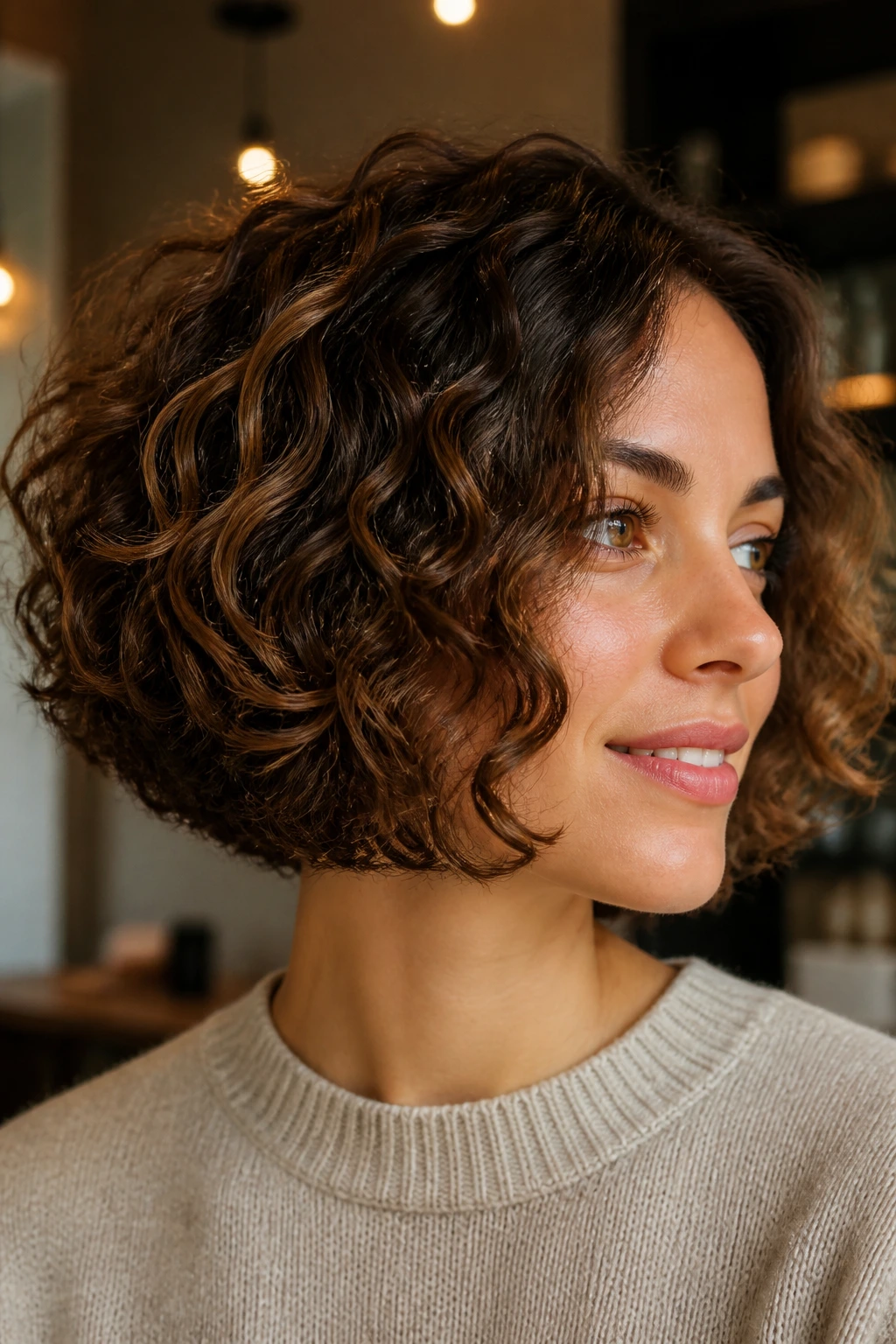
This is the one I reach for when a bob needs to look tidy without turning stiff. The chin length gives the curls a clear edge, while the chestnut lowlights tuck into the bends and keep the shape from reading as one big puff around the face.
Why It Works
- Best for 2C to 3A curls that spring up about an inch after drying.
- Ask for the first layers to start around the mouth or upper lip, not high at the cheekbone.
- Place the chestnut lowlights under the top layer and around the nape so the contrast shows when the curls move.
- If your hair is dense, keep the perimeter a little heavier. That bottom line is what stops the cut from floating.
My rule: leave the front pieces a half inch longer than the wet cut looks necessary. Curly hair lies.
2. Jaw-Length Curly Bob with Walnut Ribbons
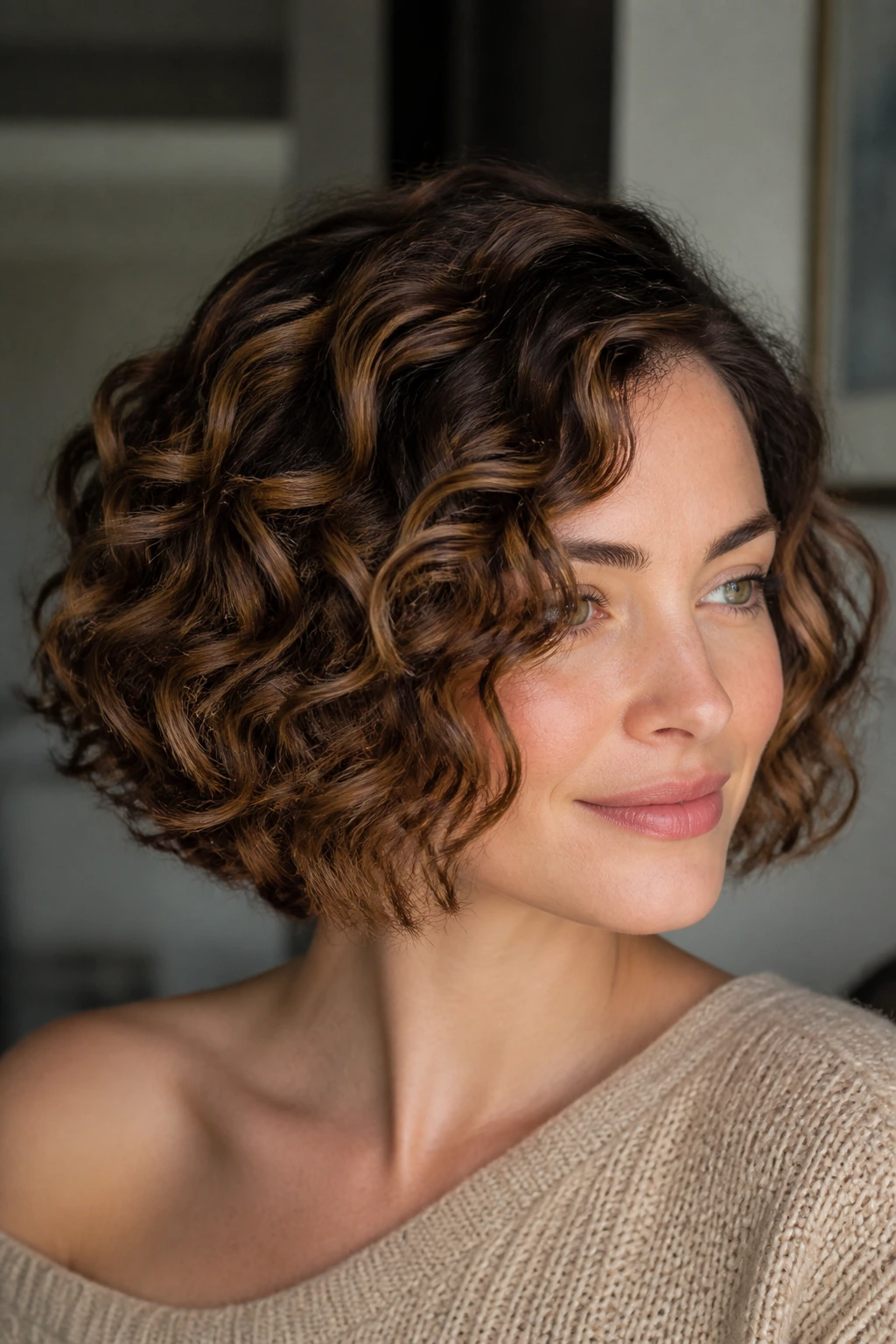
A jaw-length bob is blunt enough to feel polished, but walnut lowlights keep it from going flat at the edges. The darker ribbons break up the mass of curls and make the silhouette read cleaner from the front.
If your hair swells sideways, this is a calmer option than a stacked cut. The shape still has bounce, but the weight sits close to the face instead of spreading out around the ears. That matters more than people think.
The best version uses a soft side part and a few narrow lowlights just behind the hairline. Too many dark pieces around the front can drag the face down. A few tucked low pieces? Much better.
3. Stacked Curly Bob with Cocoa Underlayers
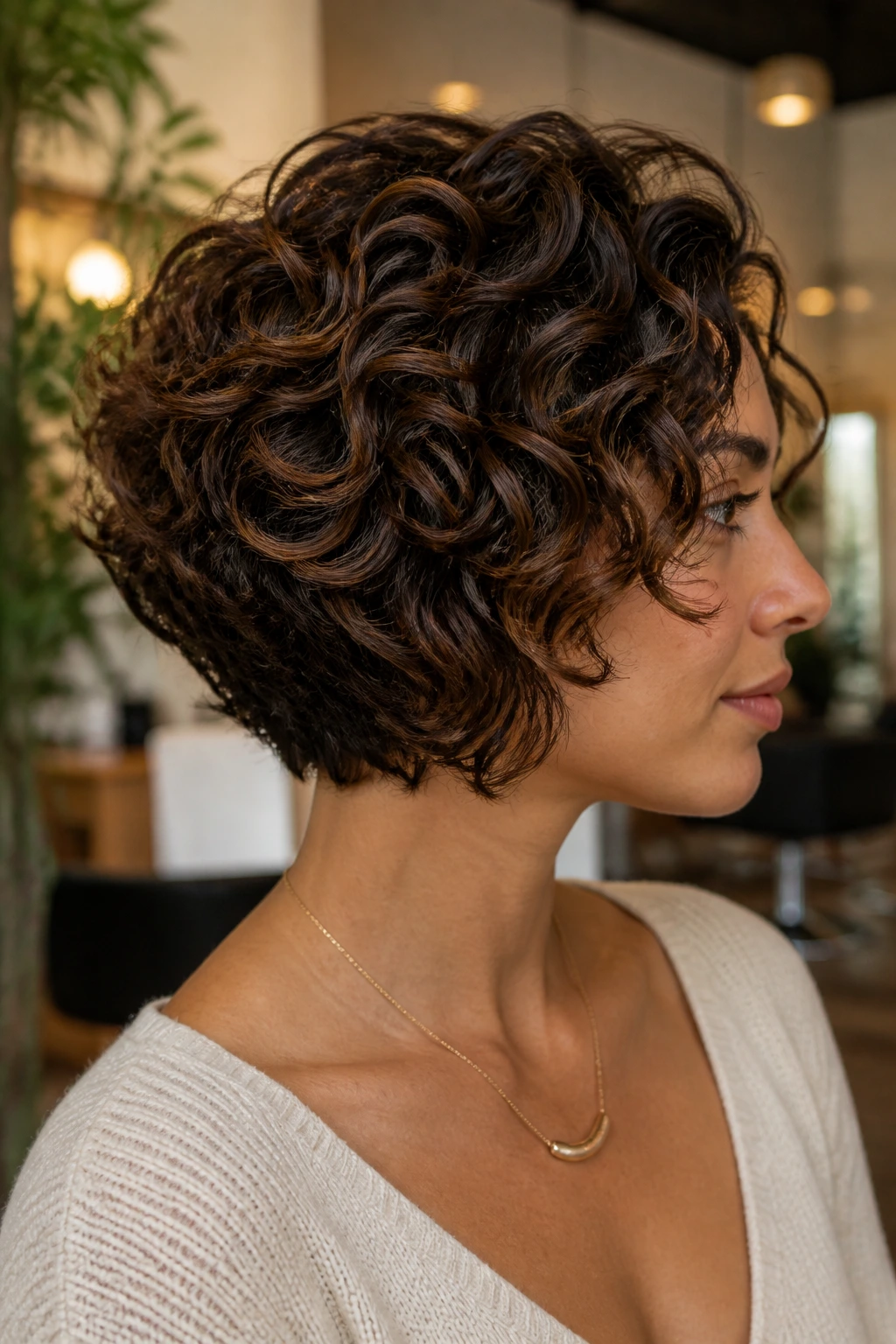
What if you want lift in the back without a haircut that screams for a flat iron? This is the answer. The stacked back builds height at the nape, and the cocoa lowlights live underneath where they add depth without stealing the show.
How to Wear It
The stack works best on thicker 3A to 3C curls that need a little shape control. Ask for the back to be shorter by about 1 to 1½ inches than the front so the bob curves inward instead of flaring out.
The lowlights should go in the lower interior panels, not across the whole surface. That keeps the crown brighter and the nape darker, which gives the illusion of movement even on a quiet day.
A diffuser helps here. Air-drying works too, but the stack usually looks sharper when the roots get a little lift.
4. French Bob with Espresso Shadow
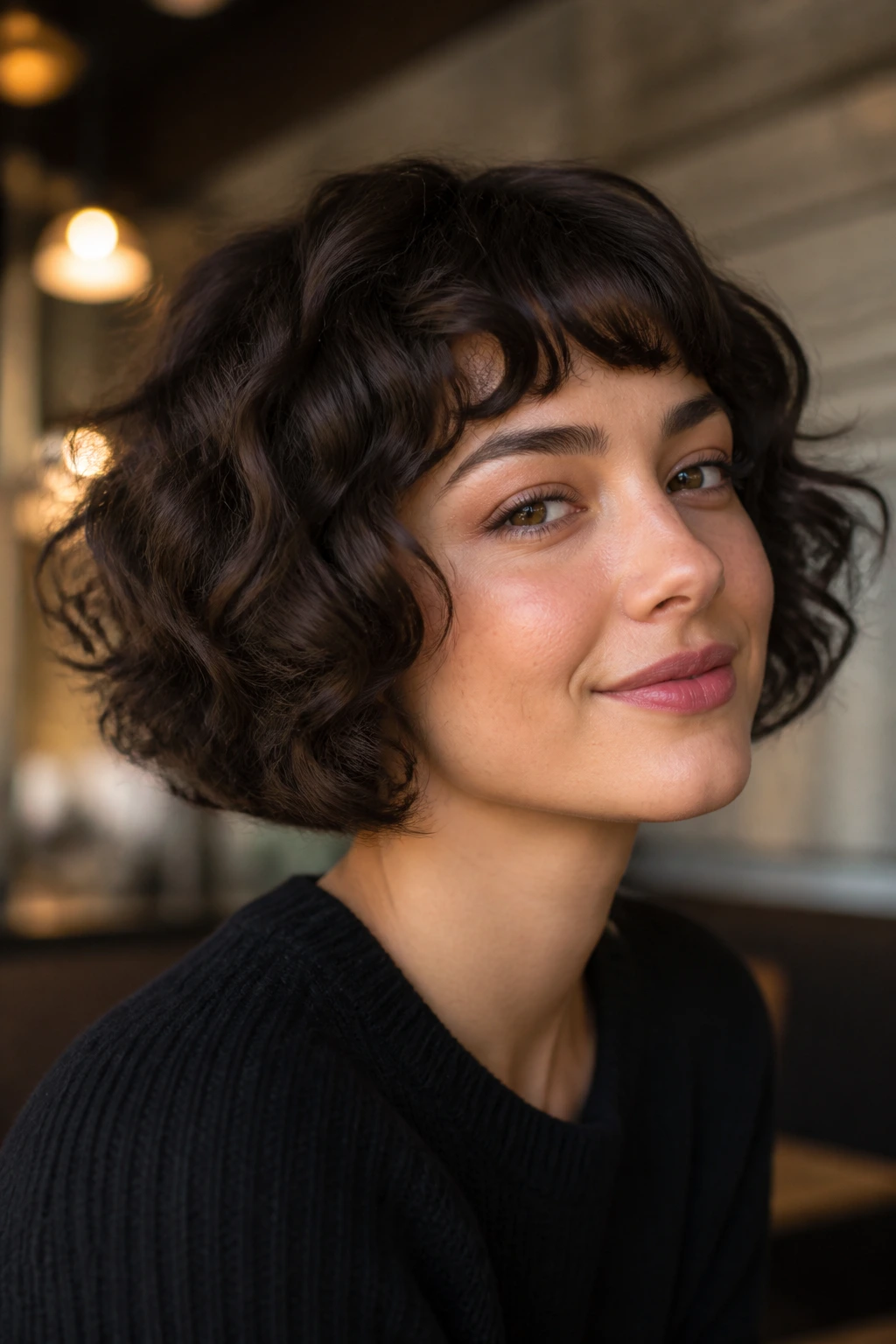
This one is small, cheeky, and very hard to make look accidental. The French bob sits shorter, often around the mouth or just above the jaw, and the espresso shadow adds a whisper of depth so the curls don’t blur into one soft cloud.
I like this version on looser curls that can hold a rounded edge. The lowlights should be subtle — not stripy, not obvious, just enough to show the curl pattern in low light. If the cut is done well, the outline does most of the work.
Quick Notes
- Works best when the curls are defined but not too heavy.
- Ask for soft interior layering, not a choppy shag.
- Keep the lowlights near the roots and under the crown for a natural shadow effect.
It’s a small cut. It should look deliberate from every angle.
5. Inverted Curly Bob with Mocha Ends
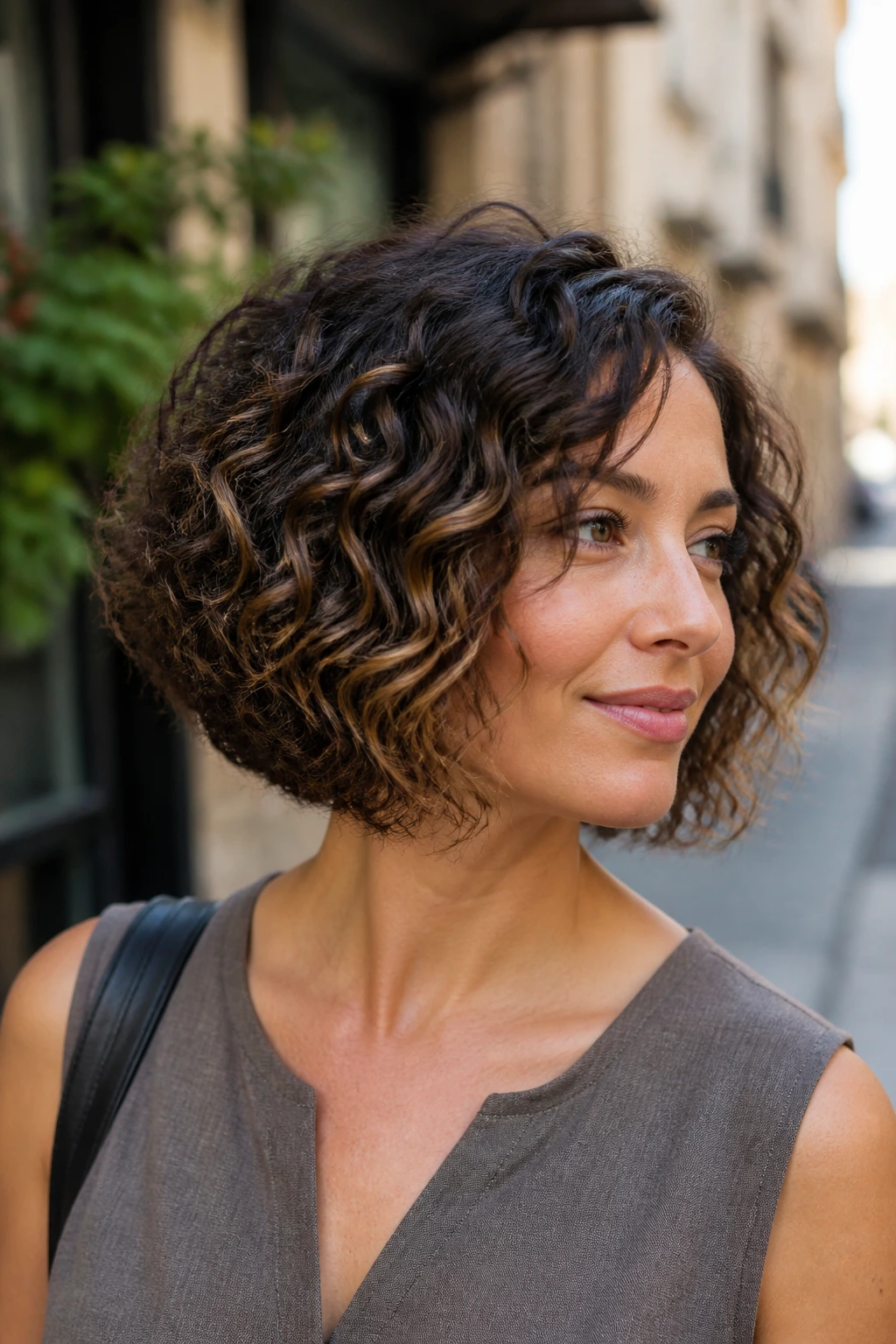
The inverted bob gives you a little longer length in front, which helps if you want the bob shape without losing the sense of softness near the face. The mocha lowlights at the ends make the front pieces look denser and keep the line from turning wispy.
This is one of those cuts that changes with the angle of the head. From the front, it looks elegant and slightly longer. From the side, the shorter back gives the curls a lifted curve that feels more sculpted than fluffy.
Keep the front pieces just below the chin if your curl pattern shrinks hard. If the front gets too short, the whole thing can jump up and sit awkwardly high.
6. Curtain-Bang Curly Bob with Cinnamon Lowlights
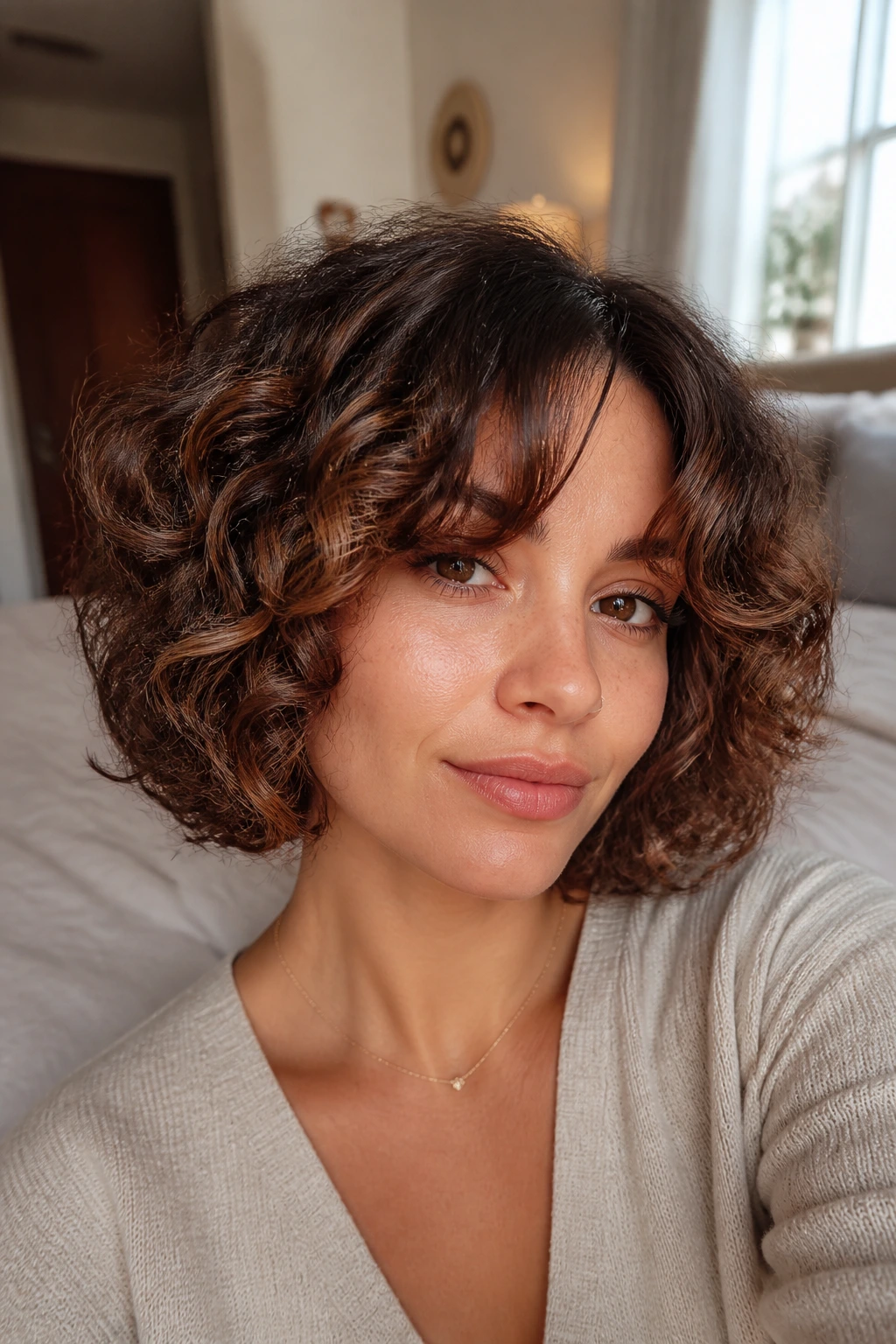
Curtain bangs and curly bobs can get messy fast, but when they’re cut with enough room to curl, they frame the face in a nice, loose way. The cinnamon lowlights give the fringe a little shape, which keeps the bangs from looking like a separate event.
The trick is to let the bangs fall into the rest of the haircut instead of pretending they live alone. When the front layers connect to the bob, the color looks richer and the whole cut feels softer around the eyes.
If your curls are on the tighter side, ask for the bangs to be a touch longer than you think you need. They will bounce up. They always do.
7. Tight-Coil Bob with Sepia Depth
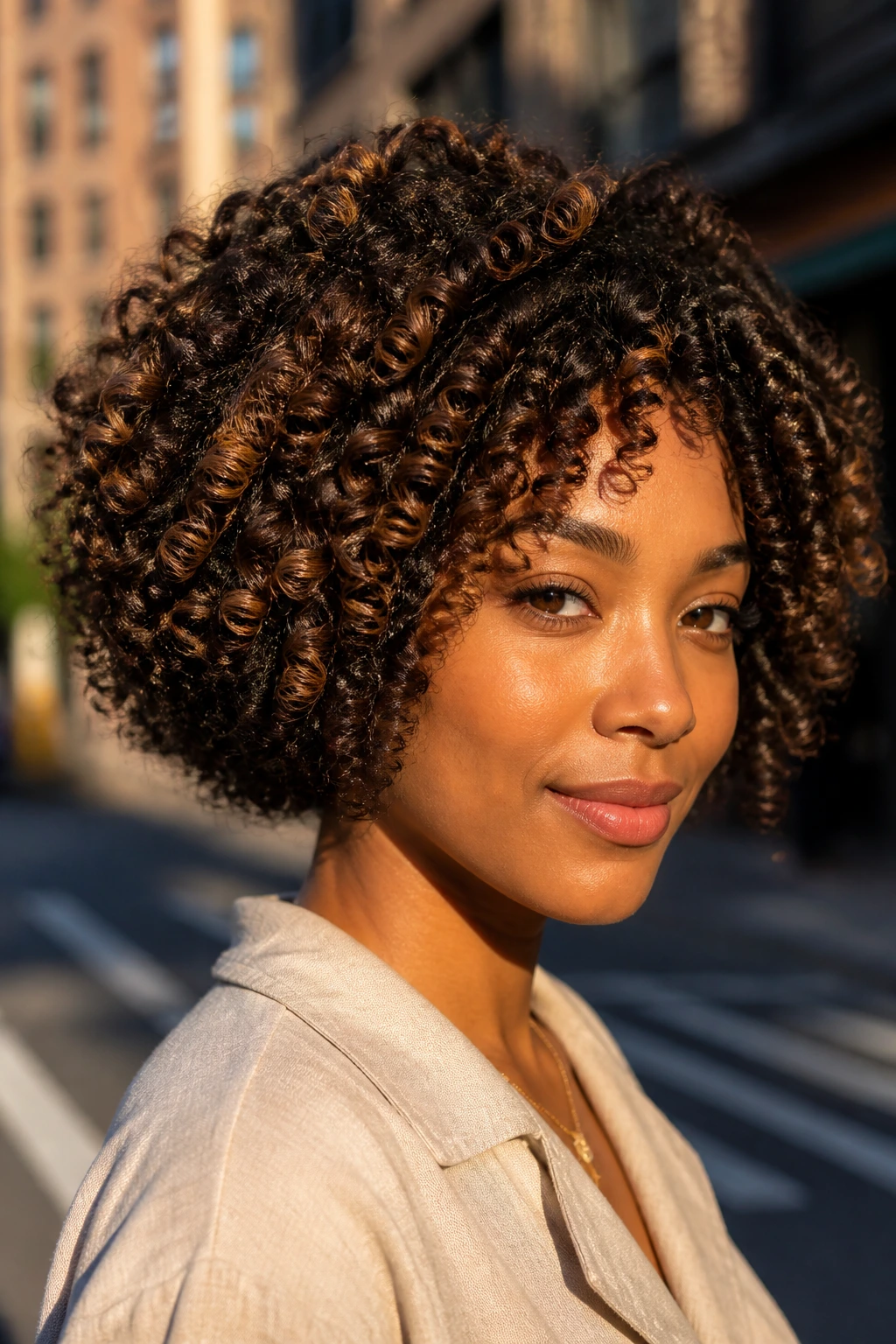
Can a bob work on tighter coils without ballooning into a round shape? Absolutely, if the layers are placed with restraint. Sepia lowlights help define the coil pattern by creating shadow between the clumps, which is what keeps the cut from reading as one wide shape.
What Makes It Different
The best version is cut dry or mostly dry so the stylist can see the coil spring. The perimeter should follow the natural shape of the head, not fight it, and the layers should be subtle enough that the bob still looks full at the bottom.
A little more length in the front helps here. If the bob is too short, the tighter curls shrink faster than you want and the silhouette gets boxy.
For styling, use a leave-in plus a light gel. Heavy creams can weigh the top down and hide the lowlight contrast.
8. Collarbone Curly Bob with Bronze Veil
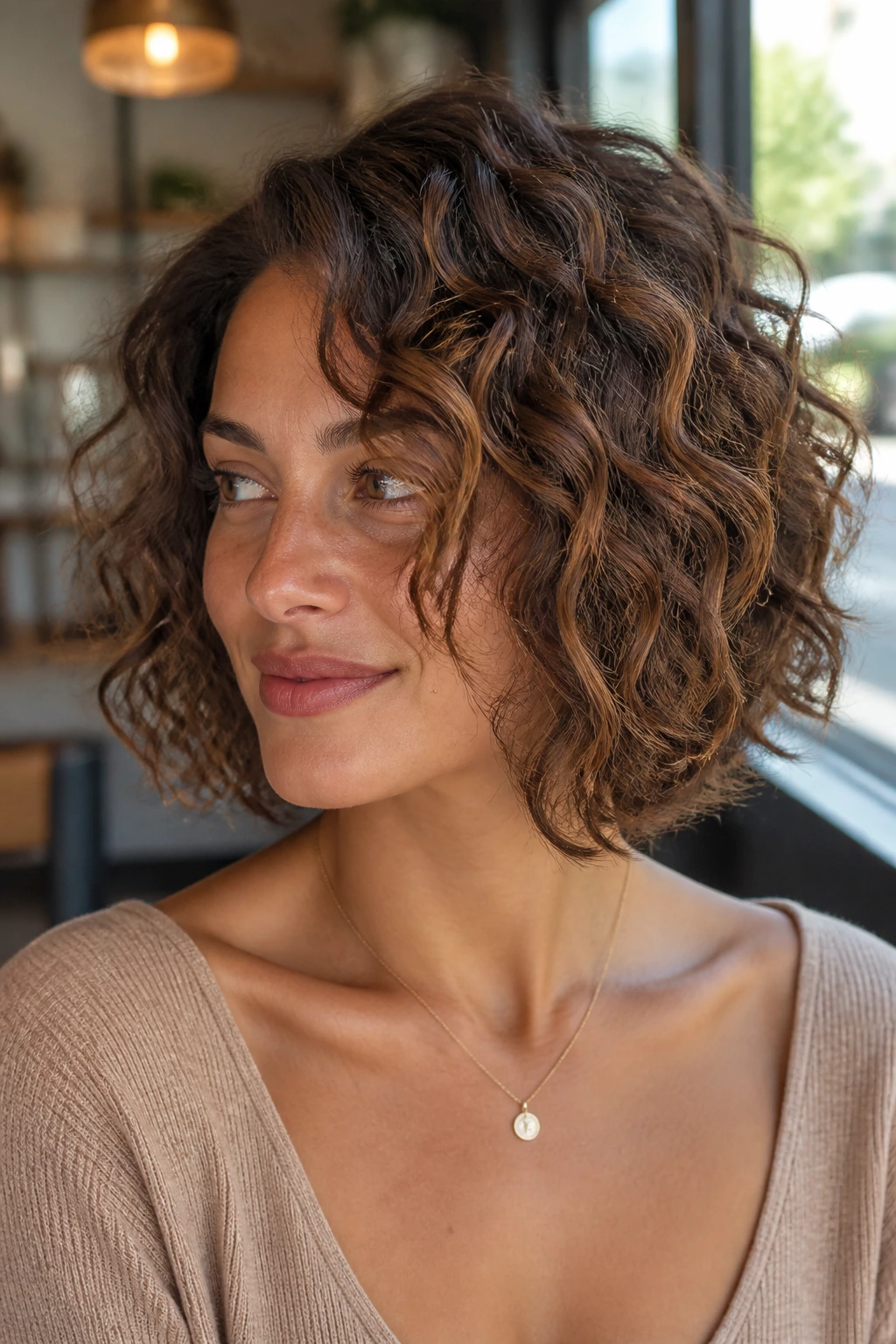
This is the grown-up version for people who want the bob shape but aren’t interested in living at chin length. The collarbone length lets the curls hang with a little more weight, and the bronze veil of lowlights moves through the mid-lengths instead of sitting only near the roots.
It’s a good match for medium-density hair that needs room to swing. The lowlights should be soft enough to look like natural shadow, not obvious color blocks. If you wear it air-dried, the bronze pieces show up as little pockets of depth between the curls.
You can tuck one side behind the ear and still keep the shape intact. That’s the kind of detail I like in a bob. It behaves.
9. Asymmetrical Curly Bob with Deep Brown Contrast
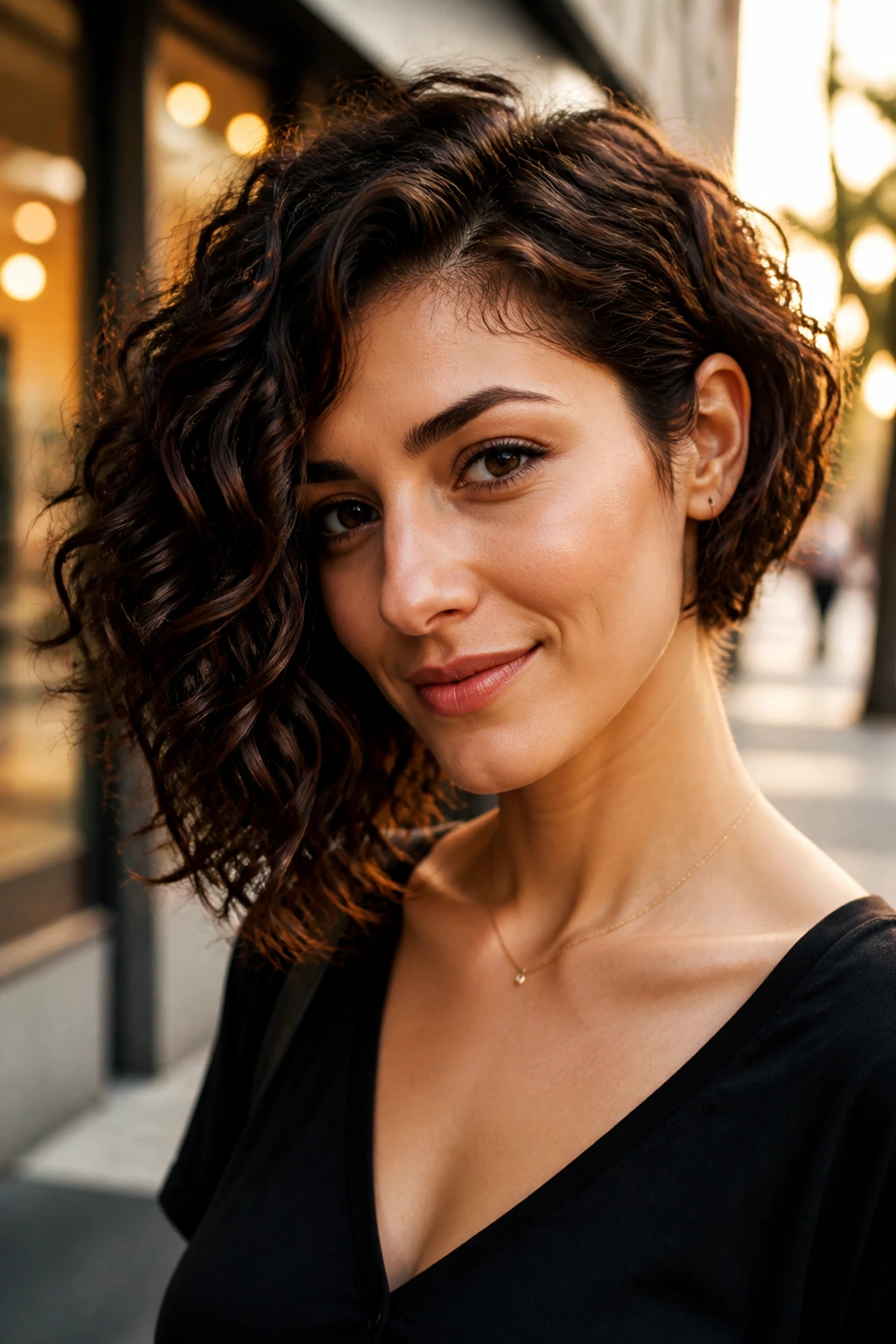
A side that falls a touch longer can make curly hair look sharper without taking away softness. Add deep brown contrast in the longer side and you get a cut that feels deliberate, a little dramatic, and easier to wear than a full-on asymmetrical crop.
The longer side should be only about ½ to 1 inch below the shorter side, unless your curls are very loose. More than that starts to look like a different haircut on each side. The lowlights should follow the longer side so the eye reads movement instead of imbalance.
This cut suits people who like a little edge but still want the bob to look wearable on a normal Tuesday. No helmet effect. No overthinking.
10. Side-Part Curly Bob with Mahogany Sweep
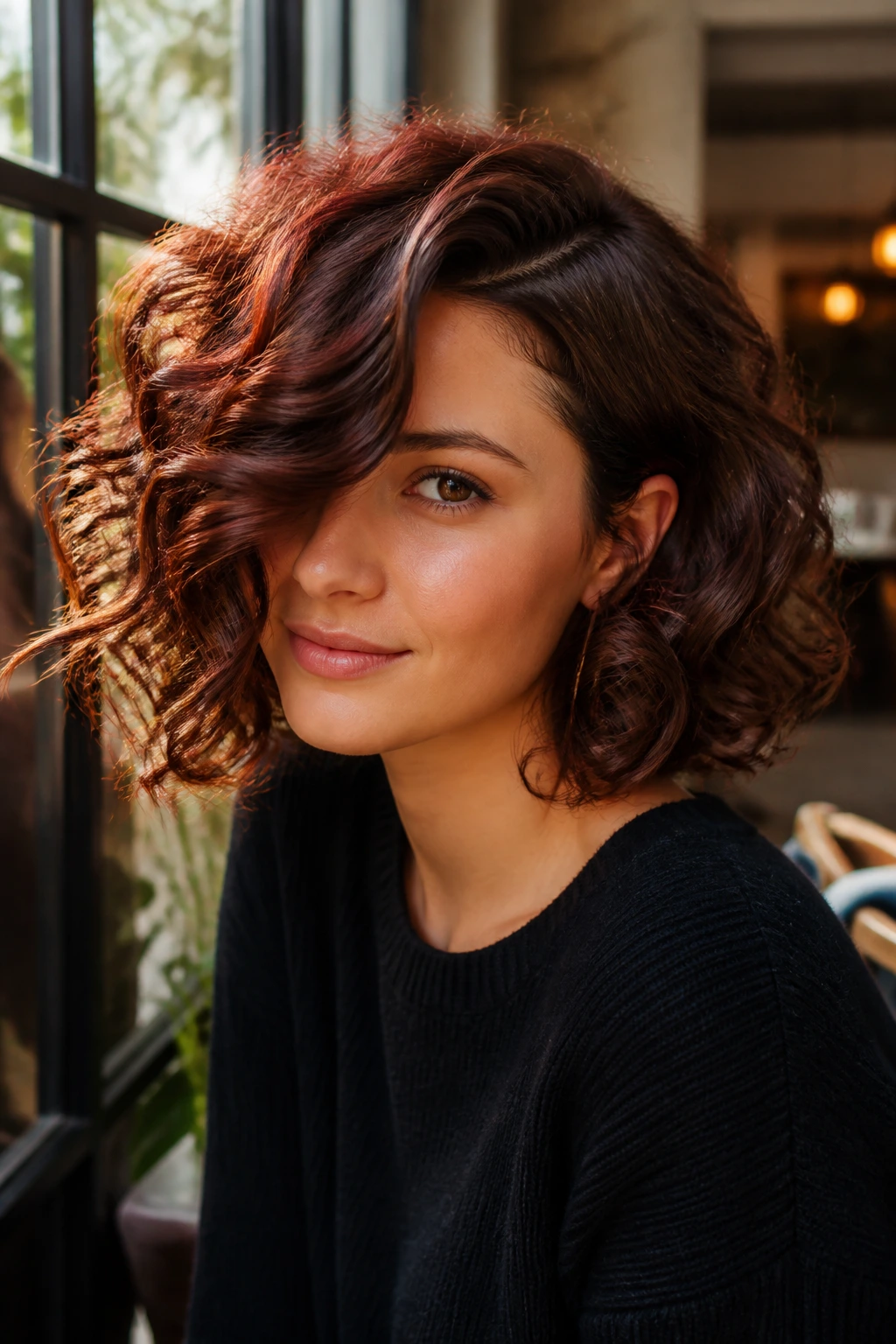
A deep side part can rescue a bob that feels too even. The mahogany lowlights sweep in with the part and create a curved shadow line that makes the hair look fuller at the crown, not wider at the cheeks.
This one is especially good if one side of your hair falls flatter than the other. A side part gives you a built-in lift on the heavier side and lets the curls stack in a more natural way. The mahogany should live mostly in the mid-lengths and underneath, with just a few pieces near the part for continuity.
I’d use this on hair that likes a little direction. It’s not a fussy cut, but it does reward a defined part and a bit of root clipping while drying.
11. Shaggy Curly Bob with Chestnut Fray
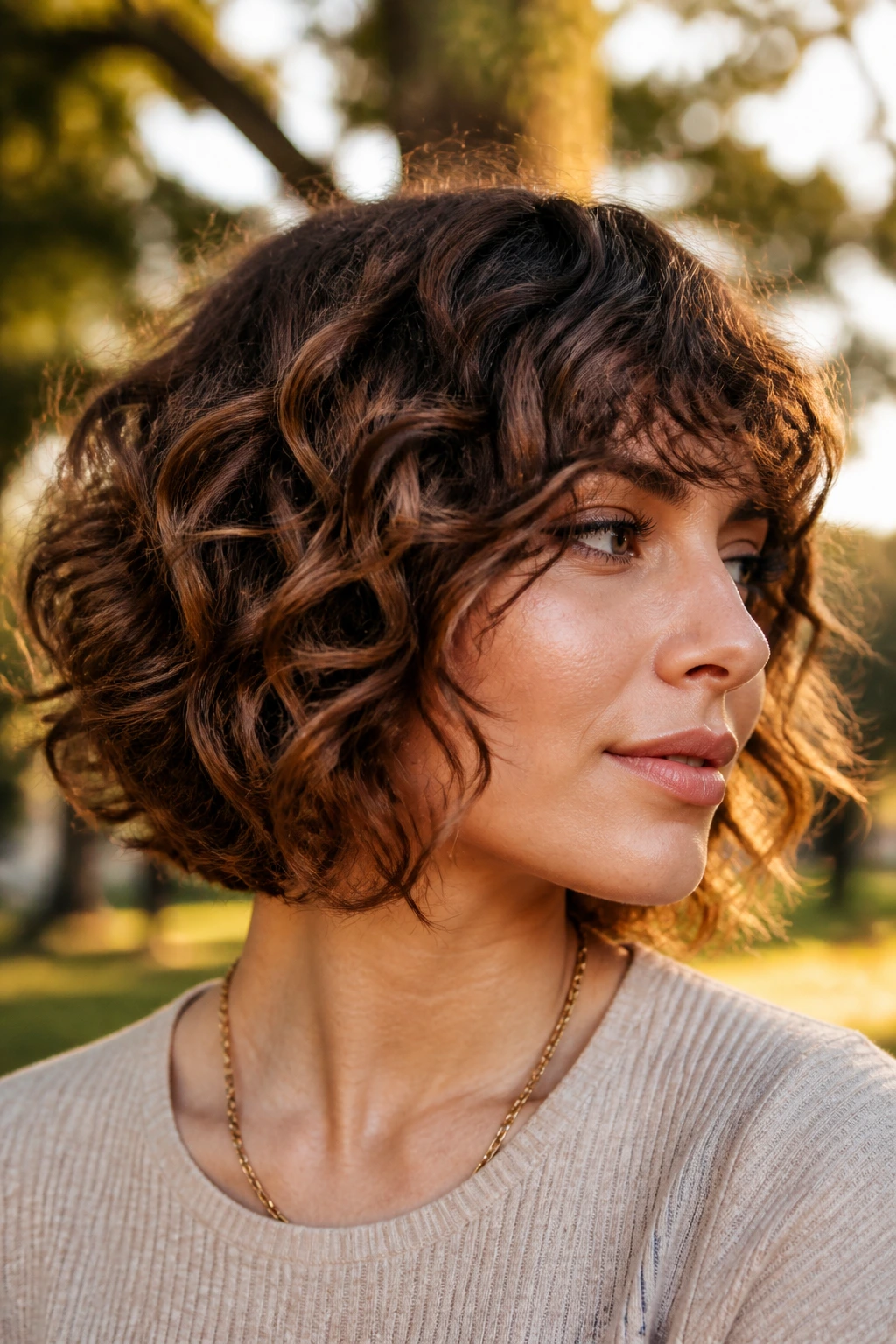
The shaggy version is for people who want their curls to look a little wild, in a good way. The chestnut lowlights break up the fray so the layers show, instead of disappearing into a fuzzy shape.
The haircut should not be over-thinned. That’s the mistake. A curly shag bob needs movement, but it still needs a bottom edge, or else the whole thing turns into a cloud. Keep some weight at the perimeter and let the top layers do the work.
Quick Read
- Best on dense 3A to 3C curls.
- Ask for soft, staggered layers rather than razor-heavy ones.
- Place lowlights around the mid-lengths and back panels so the texture shows from the side.
This is one of the few curly bob styles that looks better a little messy.
12. Blunt-Edge Curly Bob with Hidden Layers
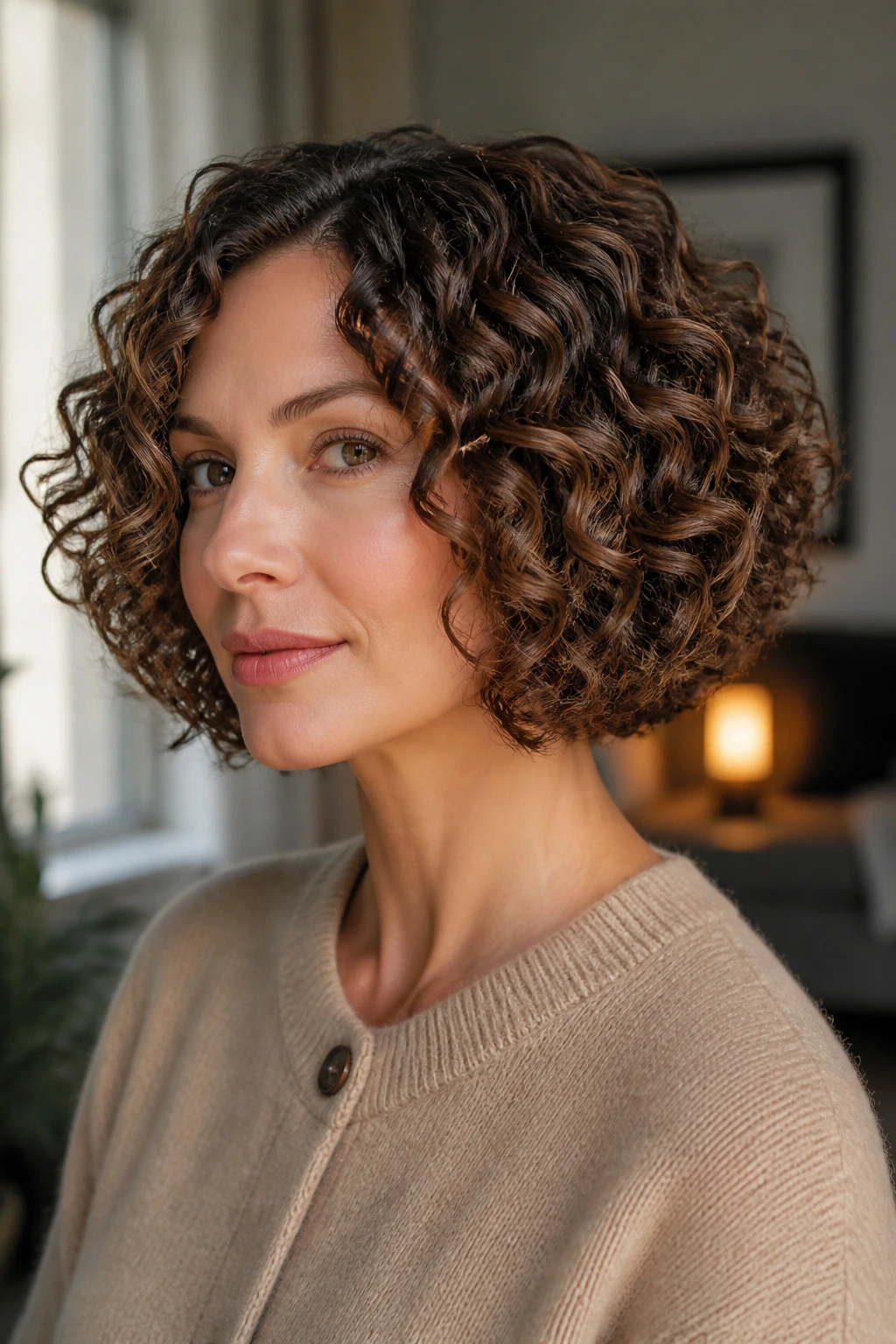
A blunt-looking edge can be surprisingly useful for curly hair, especially if the curls are fine and tend to collapse at the ends. Hidden layers keep the bob from sitting like a shelf, while the lowlights stay tucked inside so the shape still reads clean from the outside.
Unlike a shag, this cut keeps the outline tidy. That’s the point. The interior layering gives the curls room to stack, but the outer line stays compact enough to look polished. If you wear glasses or a strong lip color, this bob balances those features well.
Ask the stylist to keep the lowlights subtle and concentrated underneath. Surface color changes too much the whole tone of the haircut. Hidden is better here.
13. Flipped-Out Curly Bob with Auburn Brown Lowlights
A flipped-out bob sounds retro because it is, and that’s exactly why it works. The auburn brown lowlights add warmth to the underside of the curls, so the flipped ends look lively instead of stiff.
This is a fun option when you want a bob that moves away from the face a little. The flip should come from the cut and the curl pattern, not from heat styling alone. A light diffuser and a small round brush at the very ends can help, but don’t smooth the life out of it.
The lowlights should live near the ends and lower layers. That’s what makes the flip feel warm and dimensional. Flat color would make this look old-fashioned. The depth keeps it fresh.
14. Bottleneck-Bang Curly Bob with Mocha Fringe
Bottleneck bangs sit somewhere between a curtain bang and a fringe, and on curly hair they can be very good if you leave enough length for shrinkage. Mocha lowlights through the fringe help define the front without making it heavy.
The face framing should start around the cheekbones and open near the eyes. That gives the bangs room to part naturally and fall into the rest of the bob. If your fringe is too short, it can stand up and fight the curls. Long enough wins here.
This is a smart choice for people who want the bob to feel a little softer than a blunt fringe cut. It has shape, but it doesn’t shut the face down.
15. Rounded Afro Bob with Espresso Panels
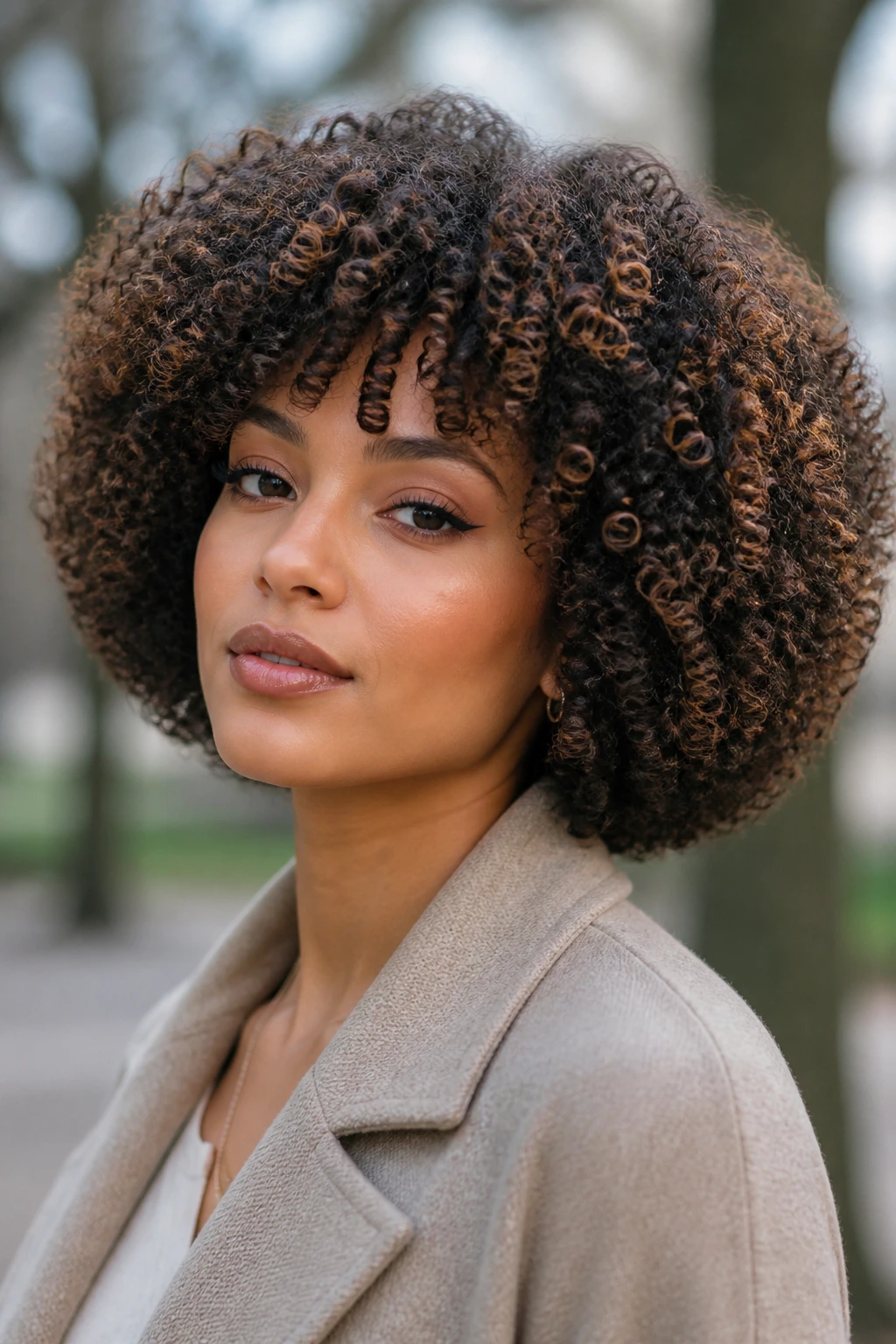
A rounded afro bob is all about silhouette. The shape hugs the head a little more closely, then opens through the crown and sides so the curls read as a sculpted dome instead of a wide square. Espresso panels in the interior give the shape definition without making the whole cut darker.
This is one of the best looks for tighter textures that hold volume naturally. The color should be placed where the curls fold inward — around the back, the underside, and the side panels — because that’s where the shadow line gives the shape structure.
If you like big hair, this is still big hair. It just has better edges.
16. Loose-Layer Lob with Mushroom Brown Depth
Some days you want a bob. Some days you want enough length to tuck it behind your ears and forget about it. The loose-layer lob lives in that middle space, and mushroom brown lowlights help it read as intentional rather than grown out.
I like this on waves and looser curls that need movement more than structure. The layers should be soft and long, with the shortest pieces around the cheeks and the longest pieces brushing the collarbone. Too much layering here would steal the clean line that makes the cut work.
The mushroom tones are cooler and quieter than caramel or auburn. That’s useful if your base color already runs warm and you want the curl pattern to stay the focus.
17. Wet-Diffused Curly Bob with Smoky Brunette Finish
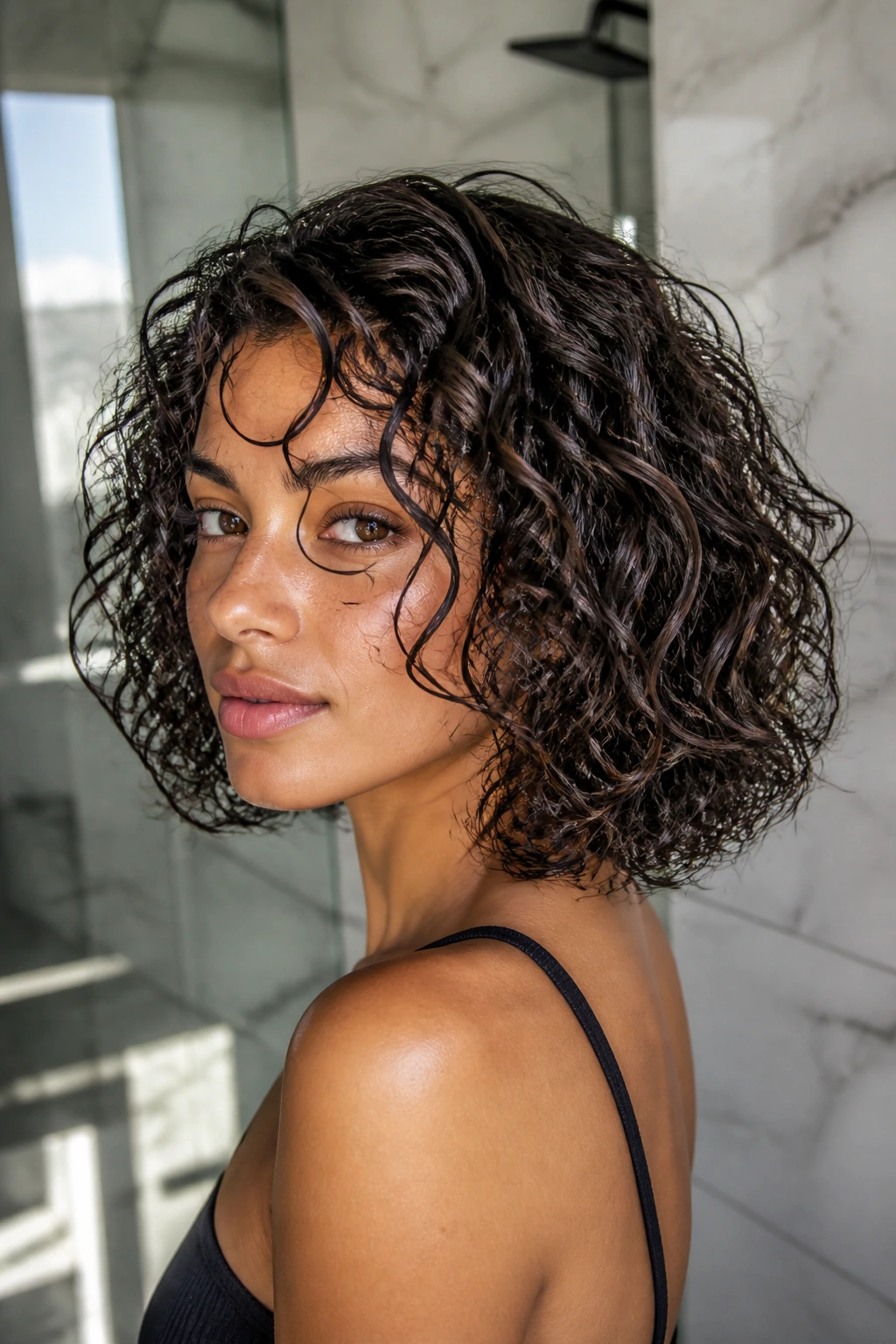
A wet-look finish can be sharp, but only if the cut underneath has enough shape to hold it. Smoky brunette lowlights deepen the damp-looking sheen and make the curls look glossy instead of greasy.
This version is for people who don’t mind product. A gel or mousse set on soaking-wet hair, then diffused with low heat, gives the bob a more polished outline. The darker lowlights help the finished style hold together because frizz doesn’t break up the color story as much.
The Science Behind It
- Wet styling shows clump definition.
- Smoky brunette lowlights add a shadowed base.
- Low heat keeps the curls from puffing before the gel sets.
If you want a sleek curl day without straightening, this is the one to save.
18. Face-Framing Curly Bob with Toffee Brown Ribbons
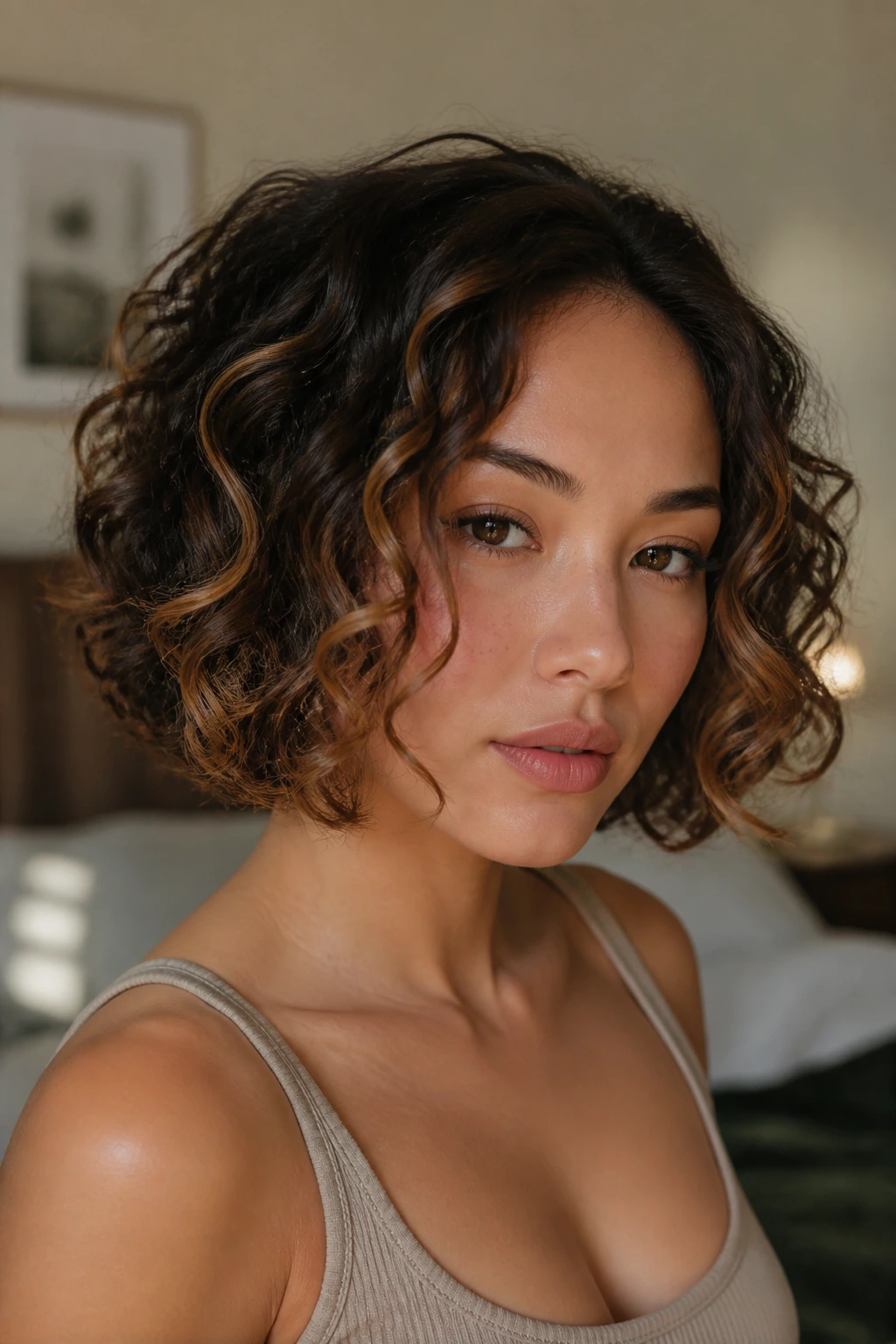
This cut is for people who want the front to do the talking. The toffee brown ribbons run through the face-framing layers, which makes the eyes, cheekbones, and jawline read more clearly without turning the whole bob into a halo of color.
The layers should start just below the chin and angle softly into the sides. That gives the front pieces a chance to curl away from the face rather than clamp onto it. The ribbons should be narrow and controlled. Too much color near the face can look busy fast.
It’s a good pick if you wear a lot of simple clothes. The haircut does enough on its own. You don’t need much else.
19. Deep Side-Part Curly Bob with Chocolate Melt
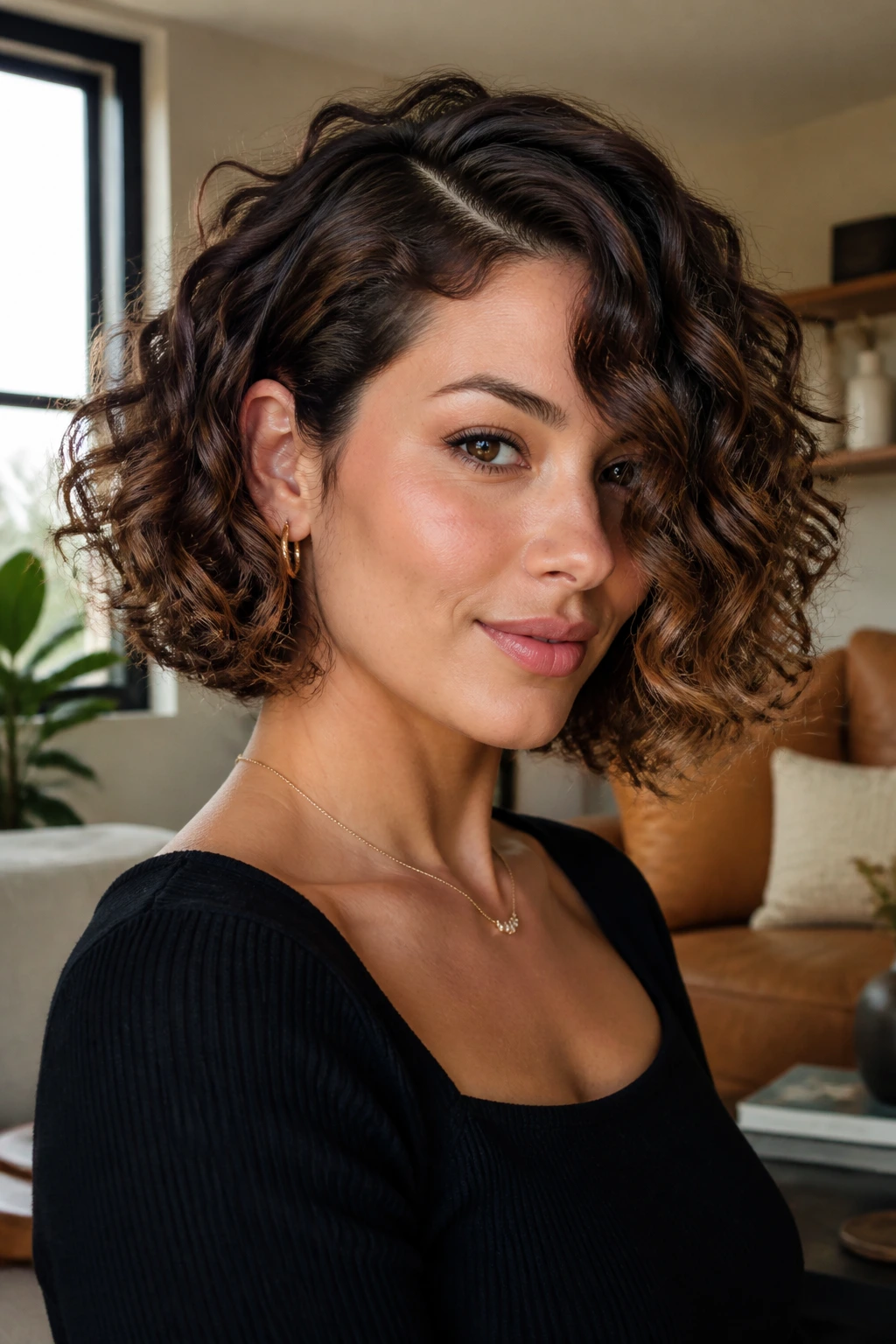
A deep side part changes the mood of a bob immediately. Add a chocolate melt that moves from darker roots into slightly lighter ends, and the whole shape looks fuller at the top and softer through the bottom.
This cut works well when one side of the head naturally dries flatter. The part gives the curls a direction to follow, and the lowlights help the root area look denser. That matters if your hair is fine or medium-fine and tends to lose lift by afternoon.
I’d keep the front pieces long enough to sweep across the cheekbone. The part can do a lot, but it should not have to do everything.
20. Sculpted Curly Bob with Dimensional Lowlight Veils
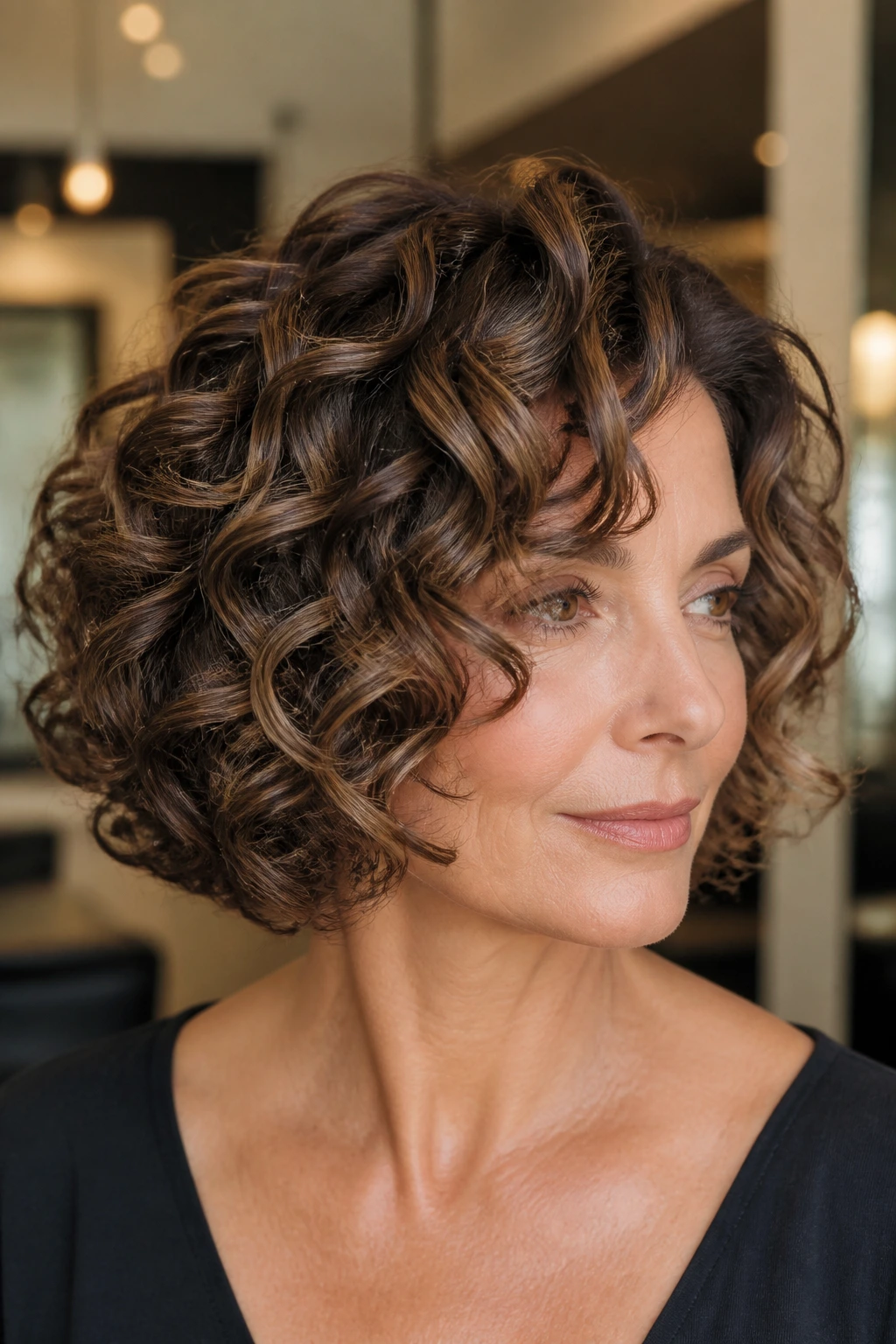
This is the polished version of the curly bob — the one that looks as if every curl landed in the right place, even when it didn’t. Dimensional lowlight veils are placed in soft panels, not obvious streaks, so the haircut gains shape from the inside out.
The sculpted effect comes from balance. Shorter layers at the crown create lift, medium layers give movement, and the perimeter stays clean enough to keep the bob anchored. If the cut gets too fragmented, the sculpted feel disappears.
Best on thick curls, especially if you want the haircut to hold its outline for more than one day. It’s a strong shape. That’s why it works.
21. Air-Dried Curly Bob with Hazelnut Interior Depth
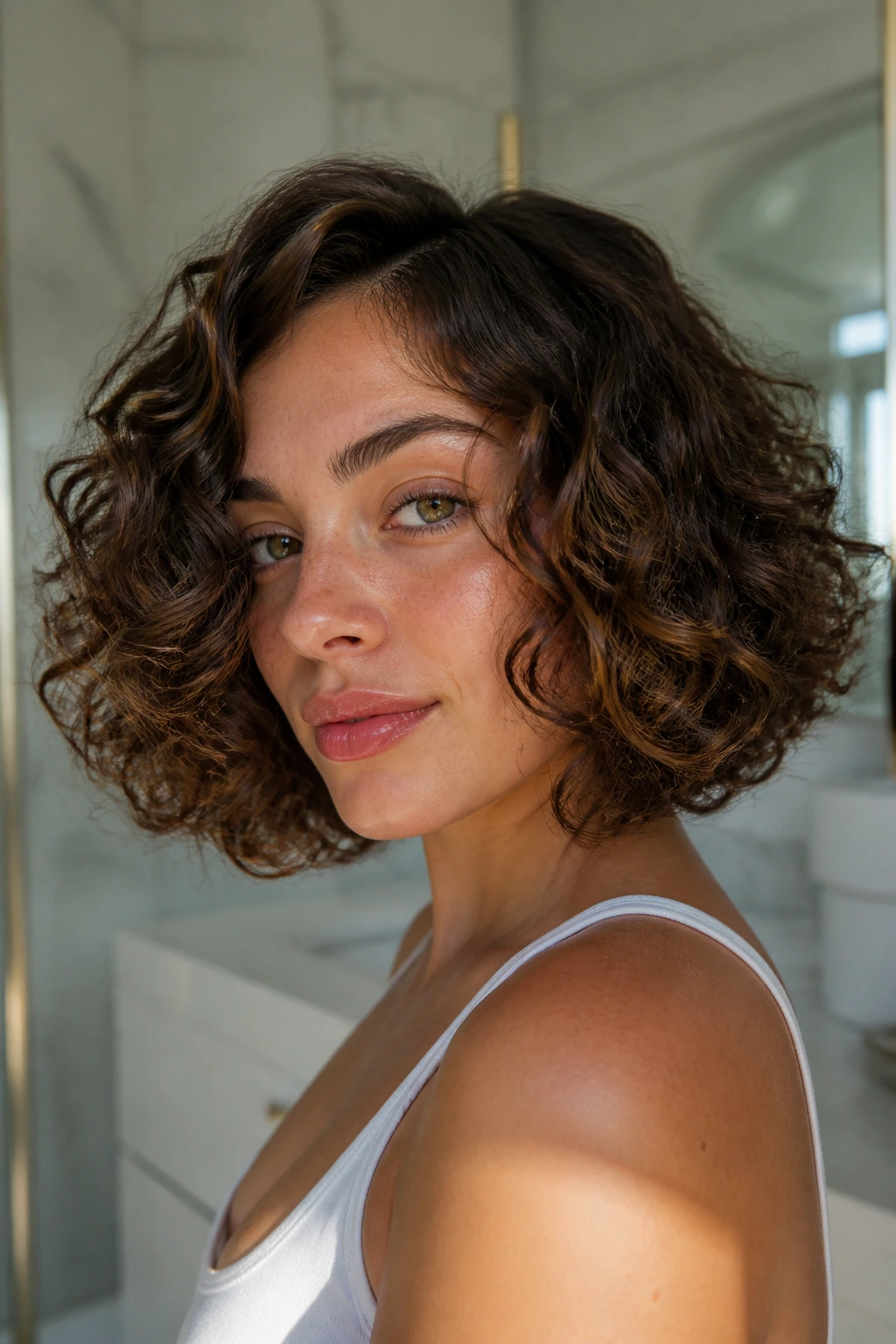
If you’re not the type to stand in front of a diffuser for 20 minutes, this is the bob to notice. The hazelnut lowlights sit inside the shape and show up naturally as the curls dry, which means the cut looks finished without a lot of work.
The layers should be light and internal. No aggressive texturizing. The bob needs enough structure to keep the front from collapsing, but it should still dry into separate curl clumps with a little space between them.
A spray bottle, leave-in, and a small amount of gel are enough. Anything heavier starts to hide the depth you actually want to see.
22. Underlayer Curly Bob with Warm Brown Swirls
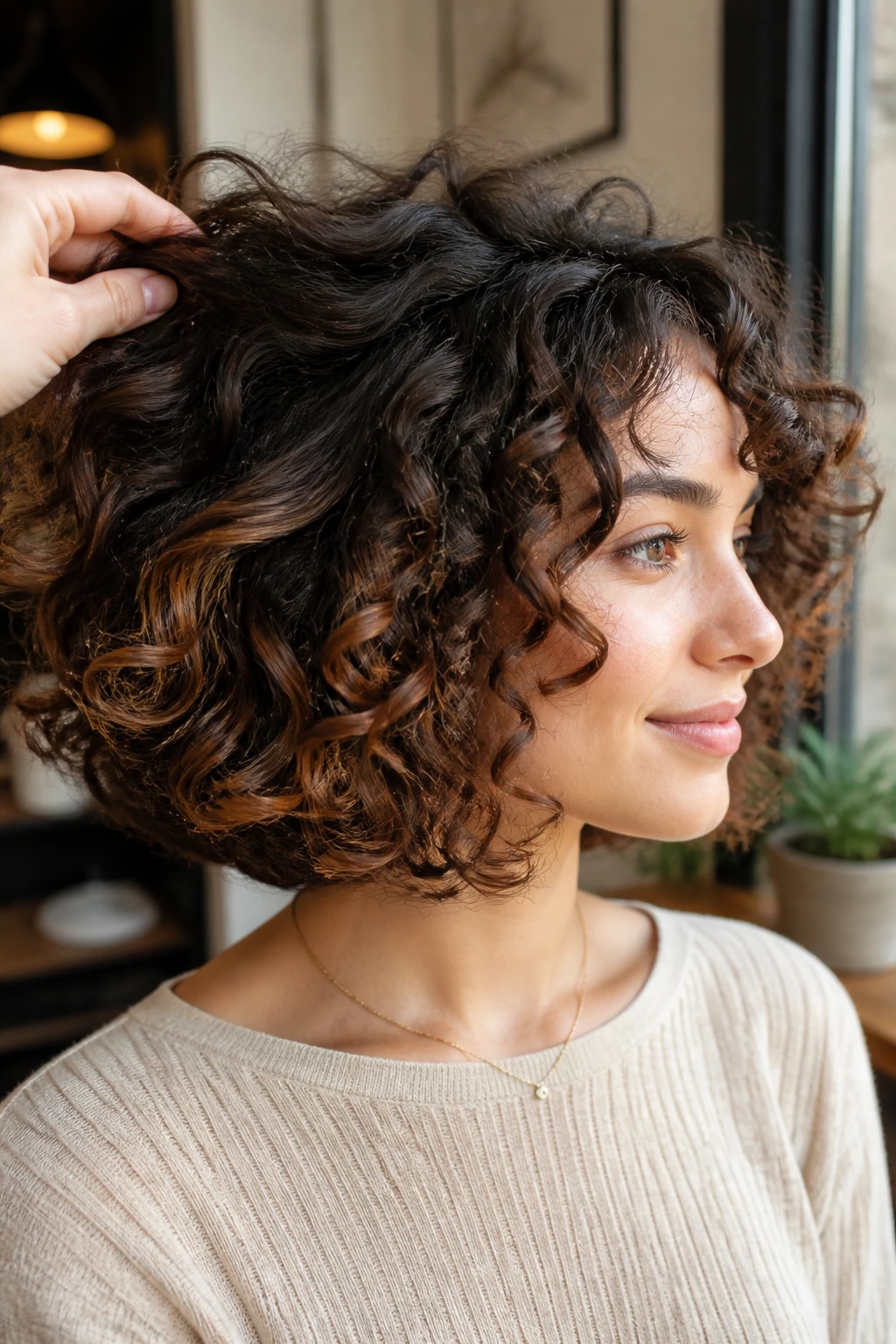
This one is sneaky. From the surface, the bob looks clean and fairly simple. Then the curls move and the warm brown swirls show up underneath, which gives the haircut a second life when it shifts.
I like this approach for people who want color without a lot of obvious change. The underlayer placement means the lowlights reveal themselves when you tuck the hair back, bend over, or turn your head. That kind of movement matters in curly hair more than a static photo ever will.
The shape itself should stay soft and rounded. The color is doing the drama here, not the cut.
23. Swoopy Curly Bob with Rooty Lowlight Melt
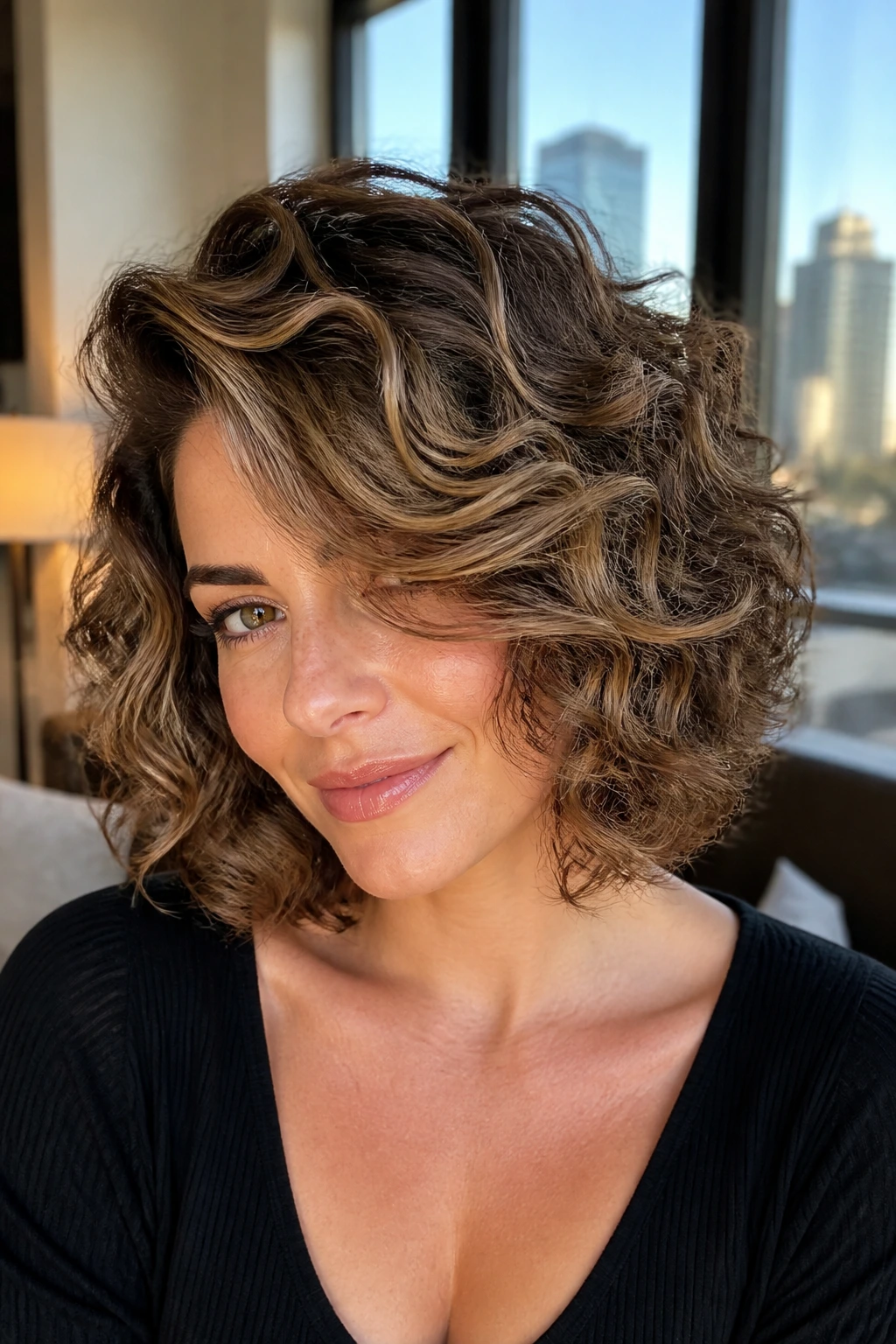
A swoopy bob depends on a deep side sweep or a curved front that moves away from the face. Rooty lowlight melt keeps the crown darker and makes the sweep look thicker at the base, which is useful if your roots tend to go flat.
The melt should be gradual. No hard line between root and lowlight, and no sudden dark block at the part. The better the blend, the more the curl pattern looks naturally full. You want shadow, not a patchy effect.
This is a smart choice if you like to flip your part from side to side. The color shift stays readable even when the direction changes.
24. Parisian Curly Bob with Sepia Brown Tones
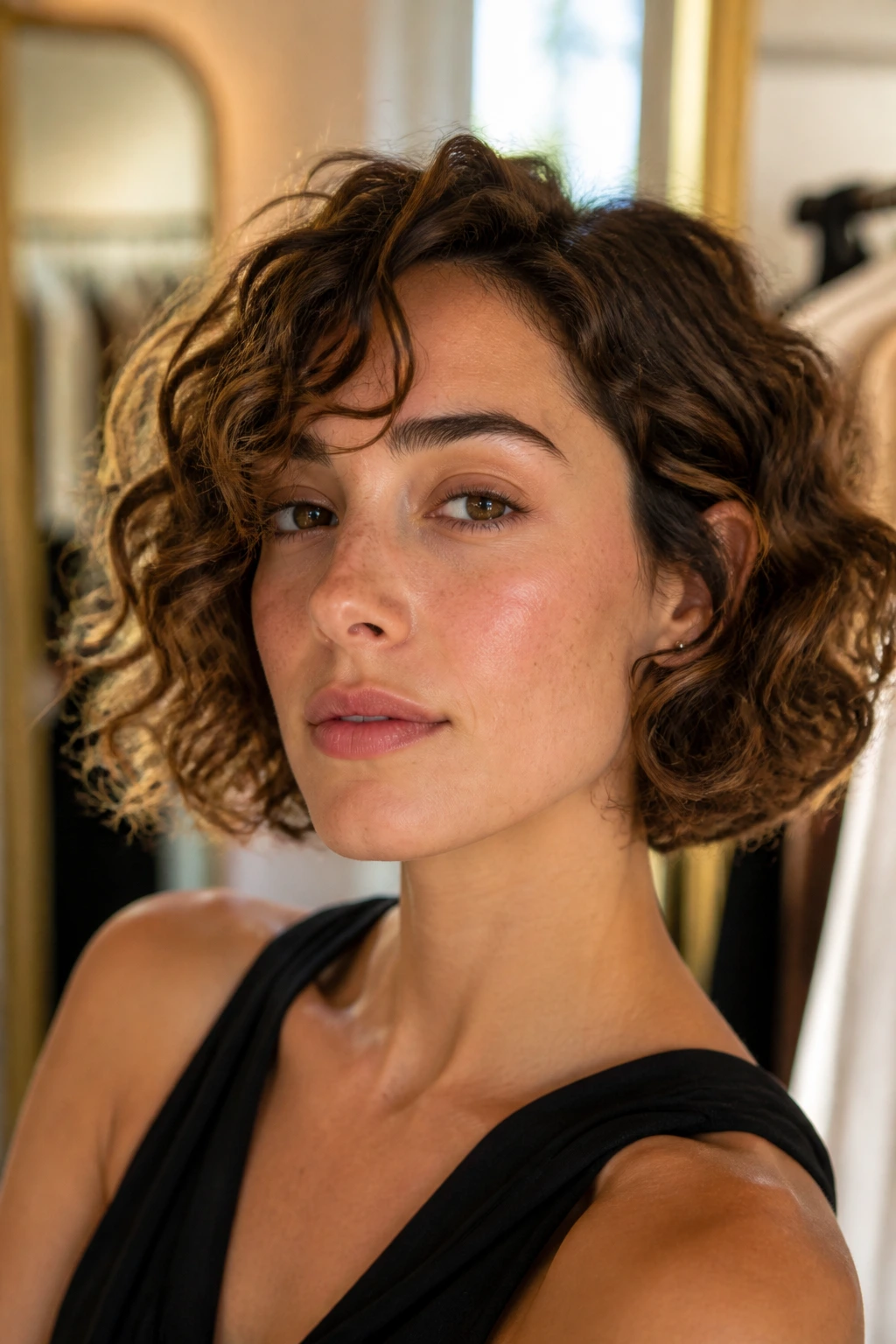
This bob has a little attitude and not much patience for over-styling. The sepia brown tones sit in the mid-lengths and lower panels, giving the curls an old-photo depth that feels soft rather than loud.
The cut should stay compact around the face, with enough length to tuck behind one ear if needed. The charm is in the looseness, not in elaborate styling. A light cream and a diffuser are usually enough. If the curls are healthy, the shape does the rest.
This is the look I’d recommend when someone wants something chic but not precious. It’s a haircut that can handle a little wind.
25. High-Volume Bob with Cocoa Veil
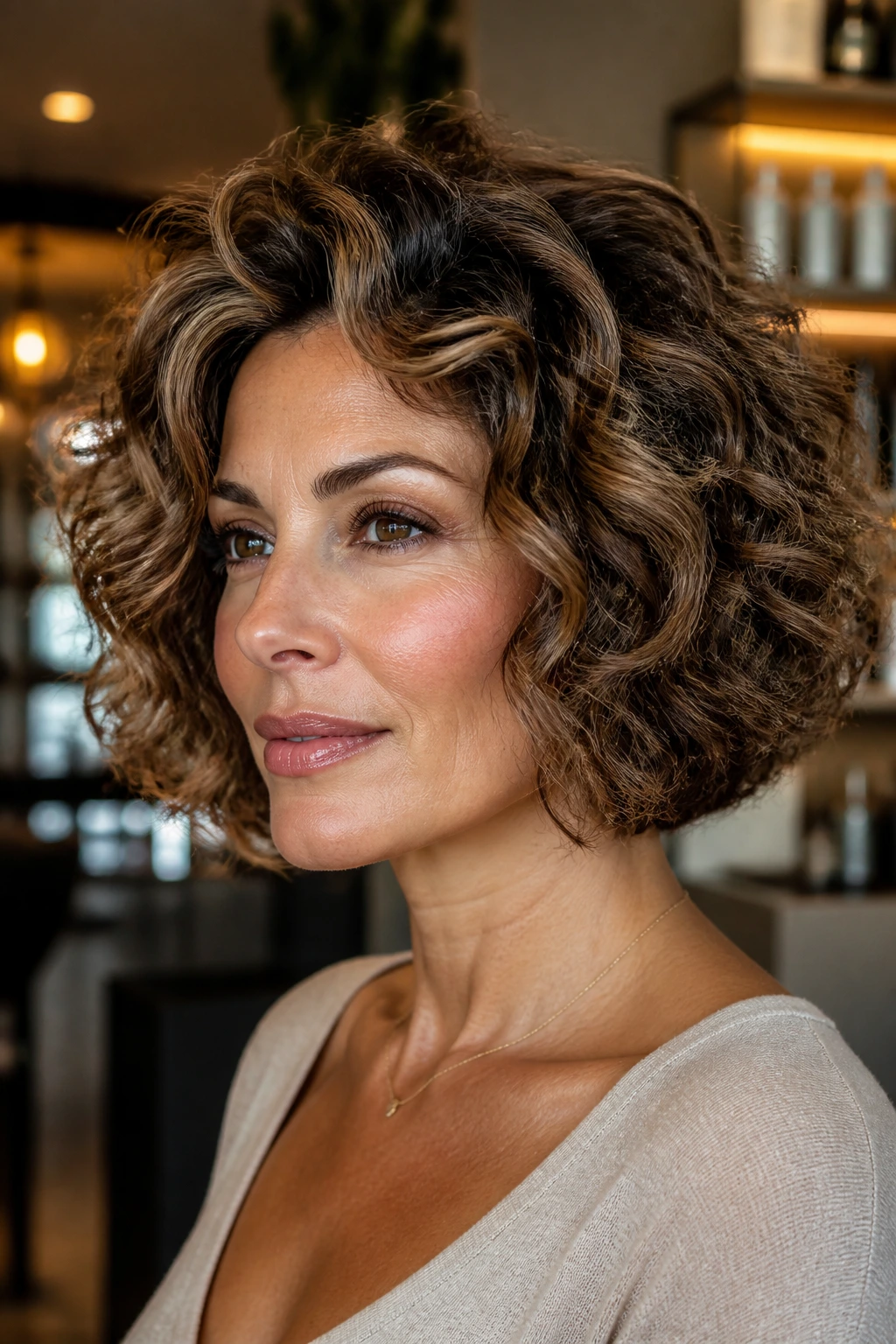
The final look goes big, but not sloppy. A cocoa veil of lowlights runs through the interior so the volume reads as a shape with layers instead of a mass of curls expanding in every direction.
This is the cut for people who want fullness and are not afraid of it. The layers should be generous enough to lift the crown and remove some weight from the sides, while the perimeter keeps a clear line at the jaw or just below it. That line is what makes the volume feel controlled.
It’s one of my favorites for dense curls, because dense curls need somewhere to go. Give them structure, and they’ll give you the volume back on purpose.
Why Lowlights Make Curly Bobs Read Fuller
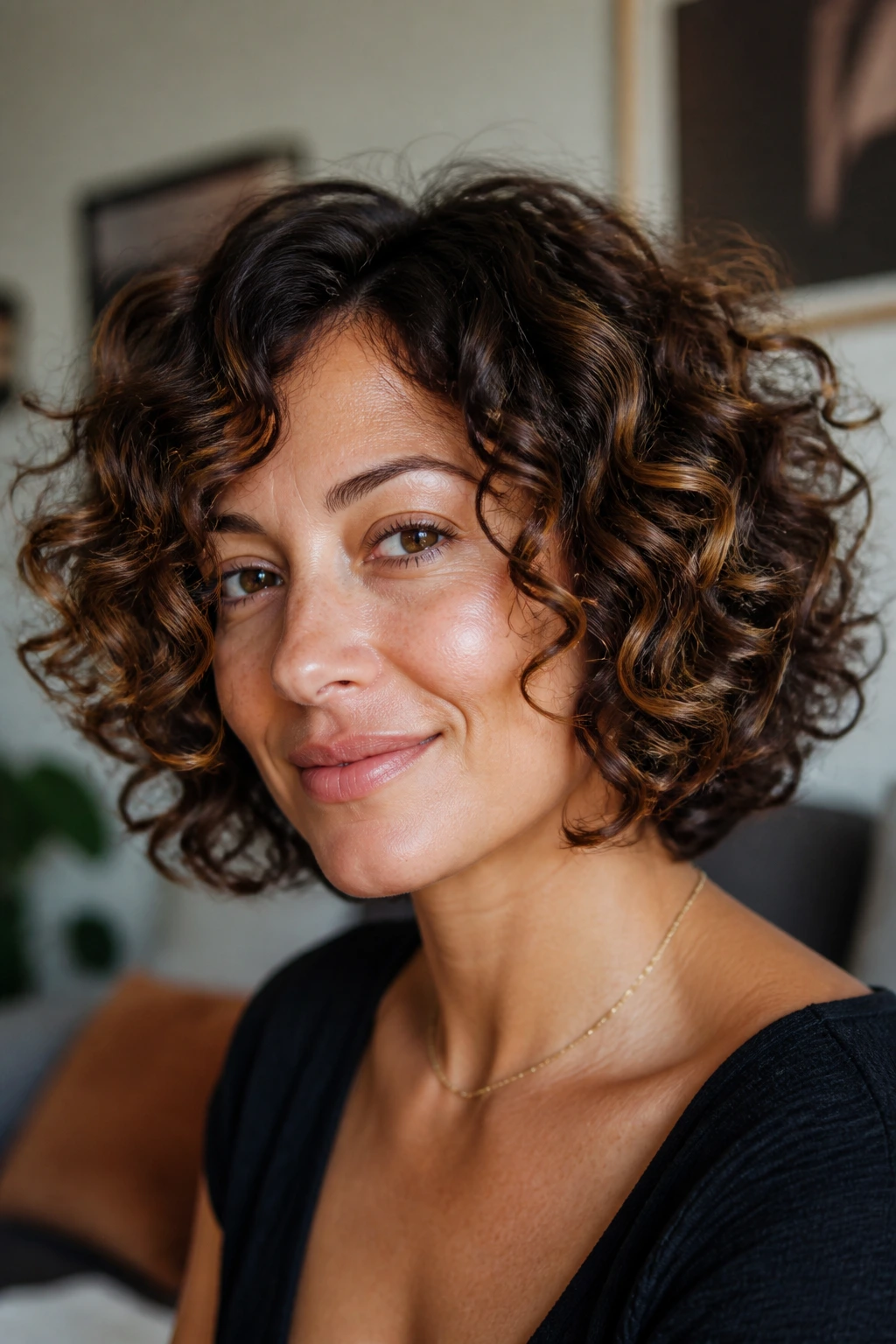
Lowlights do a job on curly hair that highlights sometimes can’t: they create shadow where the curl bends inward. That little bit of darkness is what keeps a curly bob from looking like one smooth, round shape. The eye starts to see individual curl clumps, the interior layers, and the edge of the cut, instead of one soft blur.
The placement matters more than the shade alone. A level 5 or 6 brown can look rich and dimensional on medium bases, while deeper brunettes usually need something softer so the color doesn’t go muddy once the hair dries. If the lowlight is too dark, it stops reading as dimension and starts reading as a stripe. If it’s too light, it disappears into the curl pattern and does almost nothing.
Where the Darker Pieces Belong
The smartest places are the interior panels, the nape, and the lower side sections. Those are the spots that curl closest to the head and benefit most from a little shadow. Around the face, a few fine pieces are enough; too much darkness there can close everything in and make the bob look heavy.
One more thing. Curly hair shrinks. A lot. If the lowlights sit only where the curls look longest when wet, they may disappear entirely once the hair dries. That’s why dry cutting and curl-aware color placement go together so well. The shape and the shade have to agree.
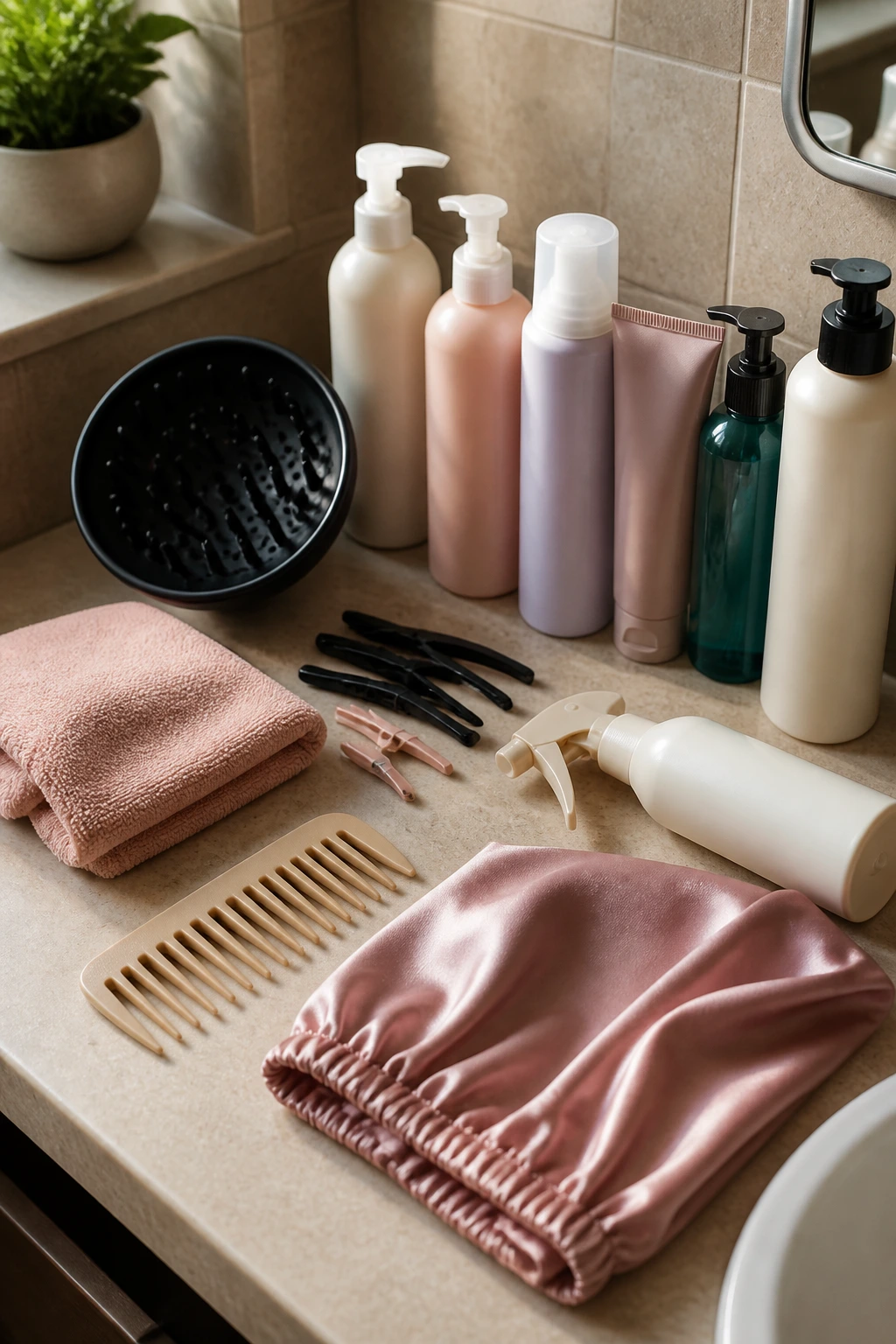
Essential Tools for Styling and Salon Visits
-
Wide-tooth comb: Detangles in the shower without tearing apart curl clumps or stretching the bob out of shape.
-
Microfiber towel or cotton T-shirt: Squeezes out water with less frizz than a terry towel.
-
Leave-in conditioner: Keeps the ends from looking dry and helps the layers separate cleanly.
-
Curl cream: Good for looser curls that need a little slip and definition.
-
Foam or mousse: Useful when you want lift at the crown without heavy buildup.
-
Strong-hold gel: Helps the lowlights show by keeping frizz from clouding the curl pattern.
-
Diffuser attachment: Preserves the bob shape and lifts the roots without blasting the curl pattern apart.
-
Duckbill or sectioning clips: Hold the top layers up while you dry the underneath.
-
Spray bottle: Handy for next-day refreshes and for reactivating product without rewashing.
-
Satin pillowcase or bonnet: Keeps the bob from flattening and fuzzing overnight.
-
Color-safe shampoo and conditioner: Protects the lowlight tone from dulling too fast.
-
Light gloss or clear glaze: Good for color-treated curls that need a little shine between appointments.
How to Ask for the Cut and Color at the Salon
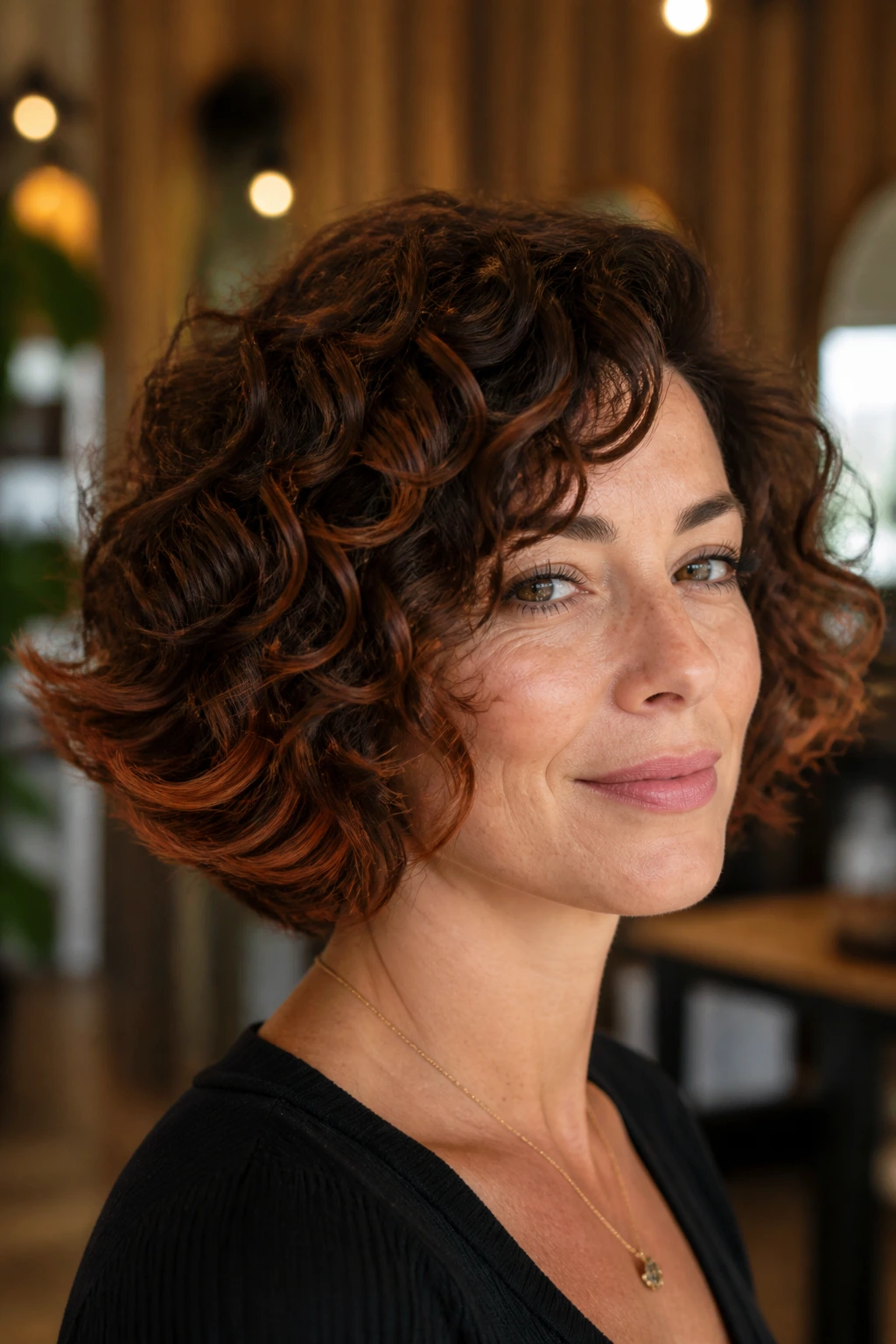
Bring photos, but bring the right kind. One photo should show the silhouette you want — chin length, jaw length, stacked back, lob, whatever the shape is. A second photo should show the color placement, because the way the lowlights sit in the hair matters more than the exact shade name.
Say the words out loud: dry cut, shrinkage, interior lowlights, and perimeter length. Those four details are often the difference between a bob that works and one that needs a rescue appointment. If your curls spring up fast, ask the stylist to leave extra length at the first pass and refine once the hair is fully dry.
Talk About the Lowlights Separately
The color conversation should be specific. Ask for lowlights that are one to two levels deeper than your base, with the darker pieces placed under the crown, through the mid-lengths, or inside the curl clumps rather than across the whole top layer. If your hair is already dark, a soft brown or smoky brunette tone usually reads better than near-black.
Bring Up Density and Maintenance
Dense hair can handle more color panels. Fine hair usually looks better with fewer, wider ribbons. If you want a low-maintenance grow-out, ask for a softer blend and a demi-permanent formula. If you want a stronger visual contrast, tell the stylist you’re fine with a bolder shadow line and a slightly more visible root area.
How to Wear These Bobs Day to Day
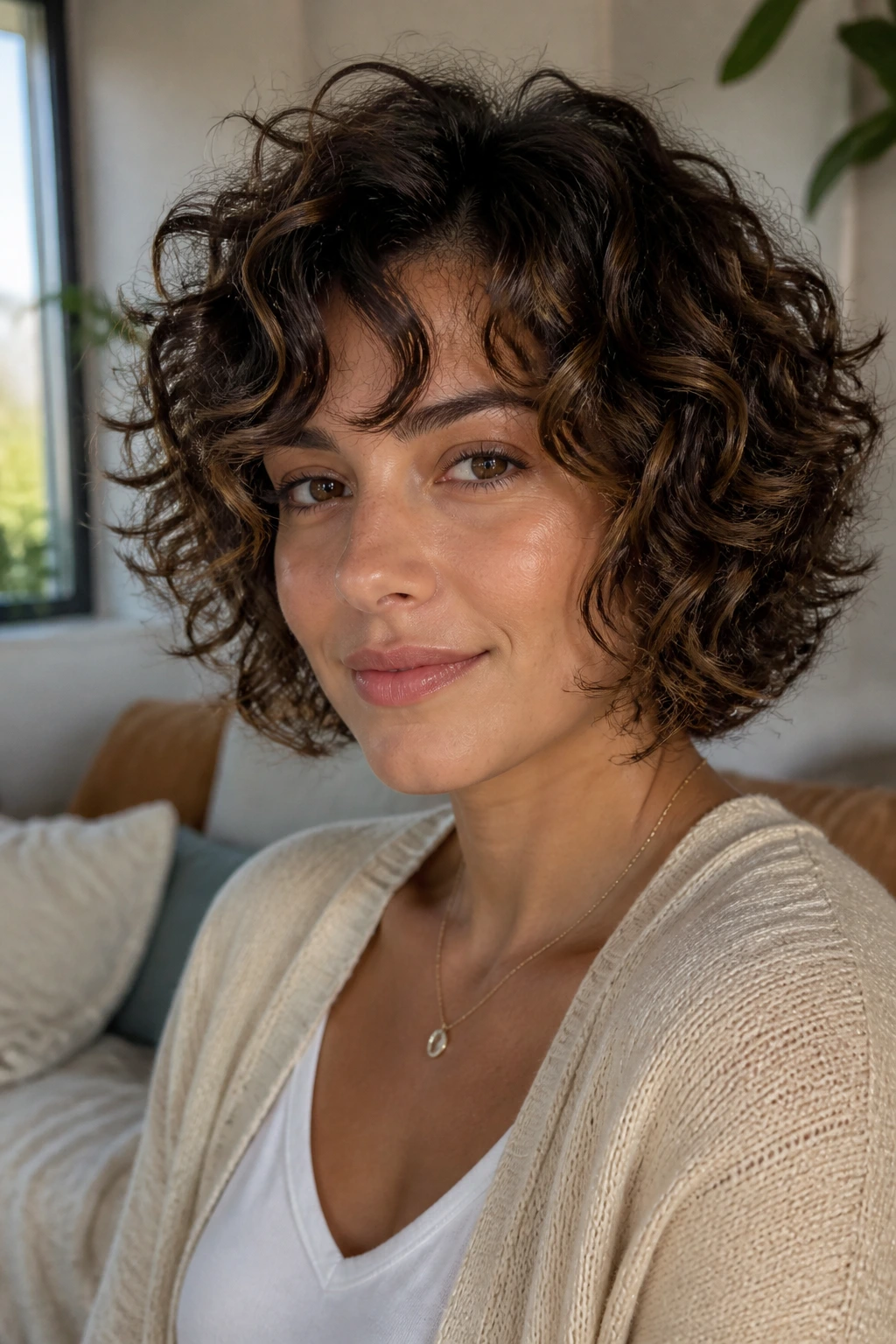
Shape: Keep the perimeter where the curls naturally settle after drying. If the front pieces keep flipping into your mouth, the cut is probably too short in front.
Finish: Diffuse when you want a sharper outline and a little lift at the crown. Air-dry when you want the lowlights to read as soft shadow and the curl pattern to look looser.
Accessories: Small hoops, slim headbands, and one clean side clip work better than bulky barrettes that crush the top layer. Let the haircut stay the focal point.
Clothing Pairings: Higher necklines can make a bob look neat and framed; V-necks and open collars give the curls more room around the jaw. If you wear glasses, a slightly longer front keeps the face from feeling crowded.
Refresh: A light mist of water, a dab of leave-in, and a few scrunches at the ends is usually enough on the second day. Don’t drown it. That only stretches the shape.
Additional Tips and Shade Boosters
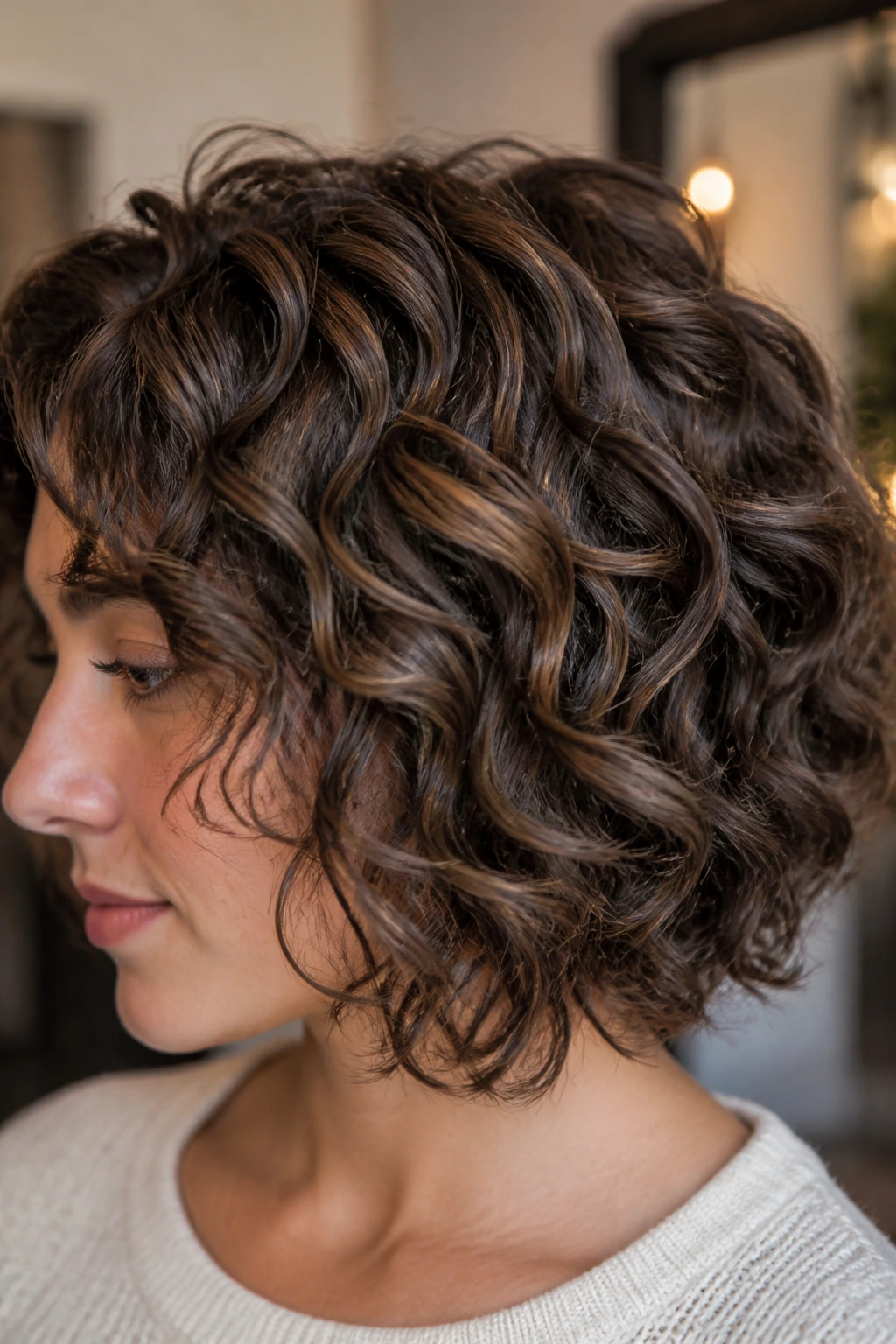
Tone Enhancement: Keep the lowlights within one or two levels of the base color. If you go much darker, the curl definition can look painted on instead of woven in.
Customization: Put darker pieces inside the crown if your bob feels too round, or around the face if you want more contour. That one placement decision changes the whole mood of the cut.
Refresh Trick: A clear gloss or a brown glaze every few weeks keeps the lowlights from going flat and helps the curls reflect light instead of swallowing it.
Make-It-Yours: Fine curls usually need fewer panels and less layering. Thick curls can take more interior movement. Tight coils often look best with a little more length than the reference photo suggests, because shrinkage is not a rumor.
Maintenance, Refresh, and Grow-Out
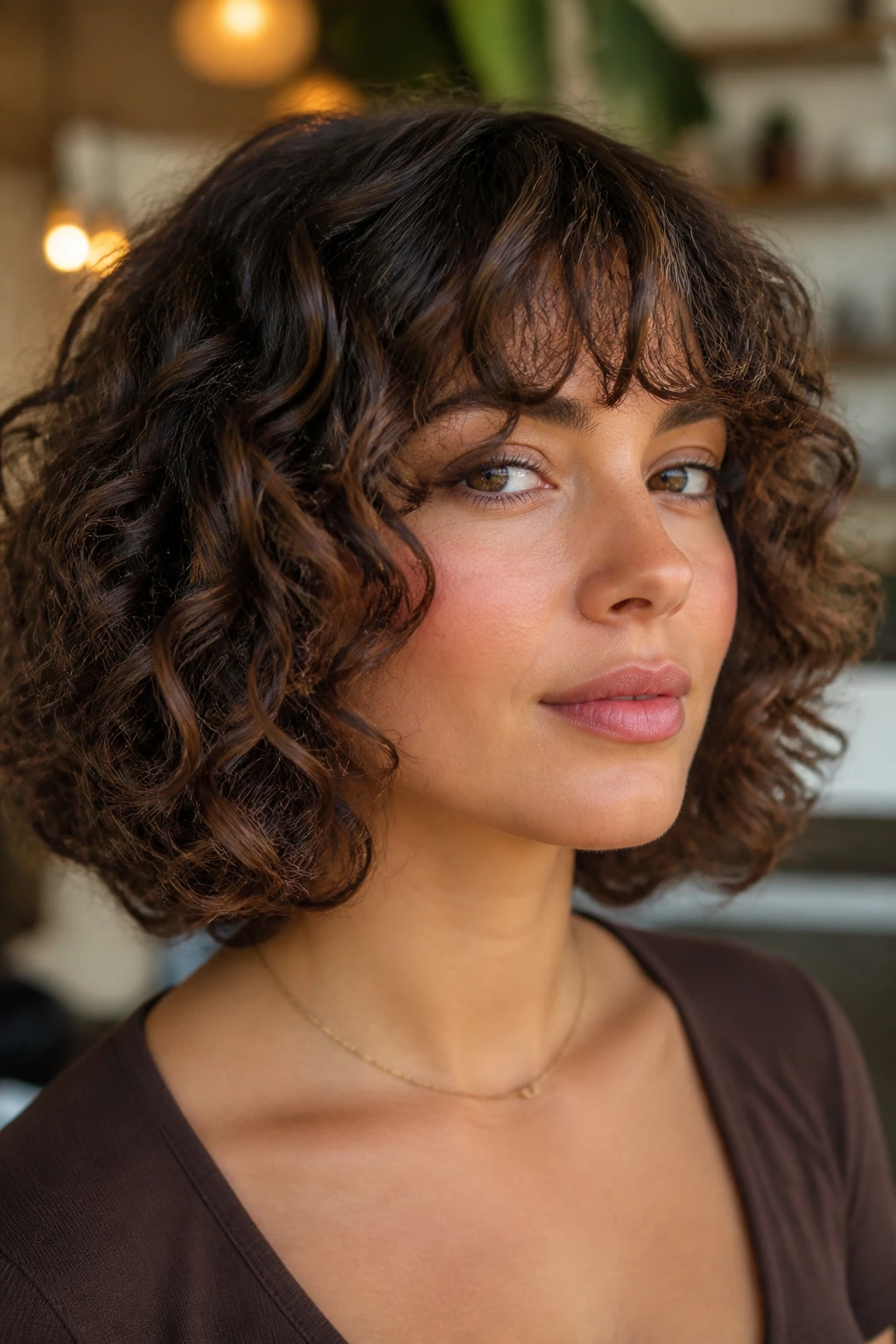
Curly bobs do not stay cute by accident. The shape needs a little maintenance, especially if the cut sits at the jaw or higher. For chin-length versions, a trim every 6 to 8 weeks keeps the edges from flipping into a triangle. Longer lob versions can usually stretch to 8 to 10 weeks before the perimeter starts looking tired.
Color follows a separate clock. A demi-permanent lowlight refresh every 6 to 12 weeks keeps the depth visible, depending on how fast your hair fades and how often you wash it. If you heat-style a lot or spend time in bright sun, the tone may soften faster. A gloss between color visits can keep the finish from going dull.
Wash Day, Done Right
Use enough conditioner to keep the ends soft, but rinse well. Curly bobs show buildup fast, especially around the crown and near the ears. A lightweight curl cream or foam usually holds the shape better than a heavy butter. If the hair starts to look stringy, the product is louder than the cut.
Overnight and Between Washes
Sleep on satin. Or wear a satin bonnet if you’re the type to toss the pillowcase off the bed by morning. On day two, rewet the top layer lightly, scrunch the ends, and pinch the curl clumps back into place. A bob loses its clean line when the top dries flat and the bottom stays fluffy, so refreshing the crown matters more than people think.
Common Mistakes to Avoid
-
Cutting the bob too short while the curls are wet: The hair may jump up an inch or more once it dries. Fix it by cutting with shrinkage in mind or leaving the front and perimeter longer than you think you need.
-
Placing lowlights only on the surface: That creates a streaky look and does nothing for depth. The fix is to tuck darker pieces into the interior panels, nape, and underside.
-
Over-layering the crown: Too many short pieces at the top can make the bob puff out while the ends look thin. Keep the crown controlled and let the perimeter carry some weight.
-
Using very dark lowlights on already dark hair: Near-black pieces can look muddy in curls, especially once the hair dries and separates. A softer brown usually gives better shadow.
-
Skipping trims and hoping the shape will hold itself: Curly bobs grow into triangles if the edge is left alone too long. A clean nape and side perimeter keep the silhouette honest.
-
Loading on heavy creams every day: The curl pattern gets clumped and the lowlights disappear under product. Use enough to define, not enough to coat.
Variations and Adaptations to Try
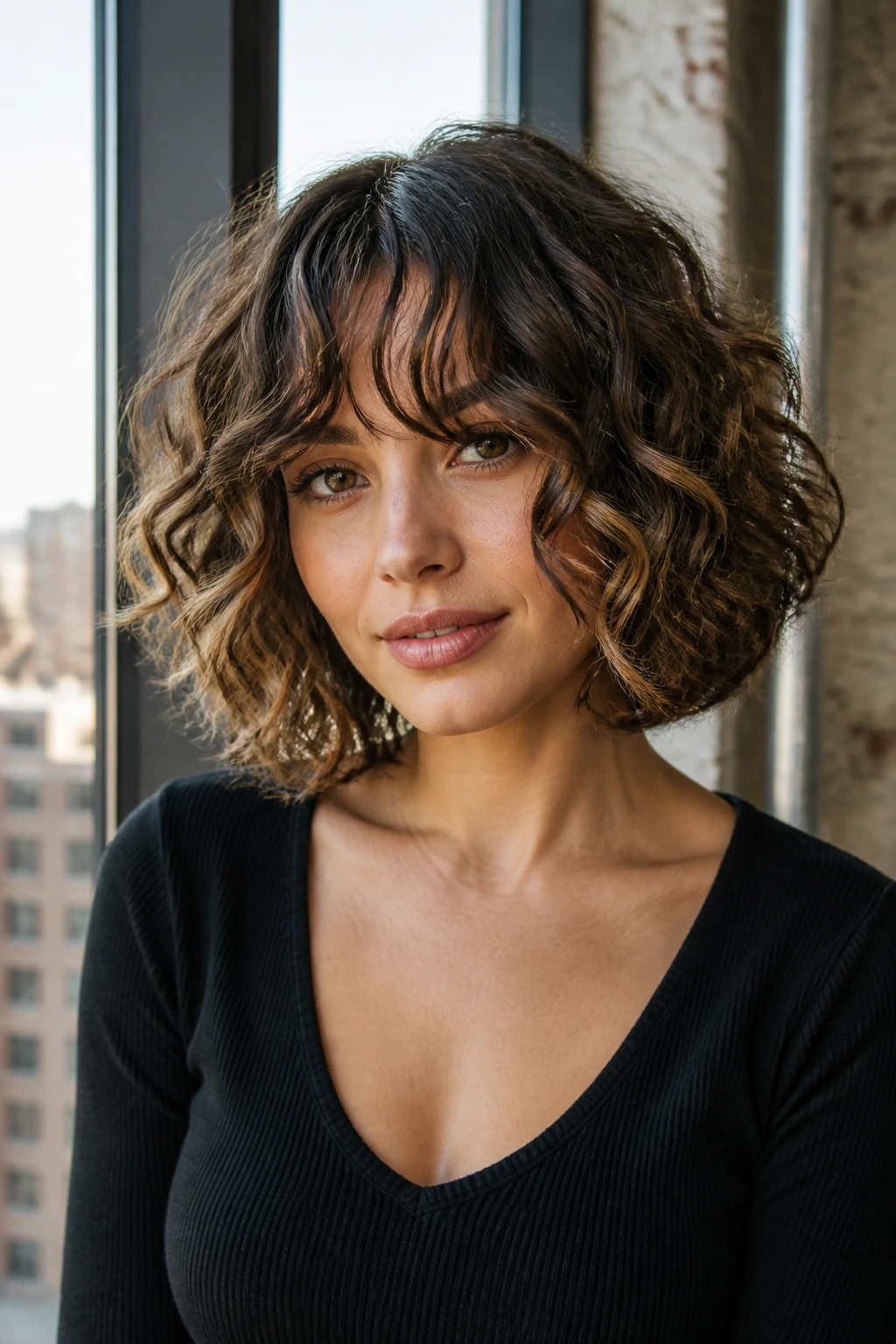
The Soft Grow-Out Bob: Keep the length at the collarbone and place lowlights mostly underneath. This is the easiest version to live with if you don’t want to babysit your haircut every six weeks.
The Sculpted Coil Bob: Shorter at the nape, rounded around the head, and cut with the coil pattern in mind. It suits tighter textures that need shape more than length.
The Fringe-Forward Bob: Add curtain bangs or bottleneck bangs and keep the lowlights concentrated around the front. This version works when you want the eyes and cheekbones to stand out.
The Glossy Office Bob: Use subtler lowlights and a cleaner perimeter. It reads neater in conservative settings and still has enough movement to avoid looking rigid.
The Tousled Weekend Bob: Ask for a few more interior layers and a softer color melt. This one can look a little undone and still feel intentional, which is the whole point.
Frequently Asked Questions About Curly Bobs and Lowlights
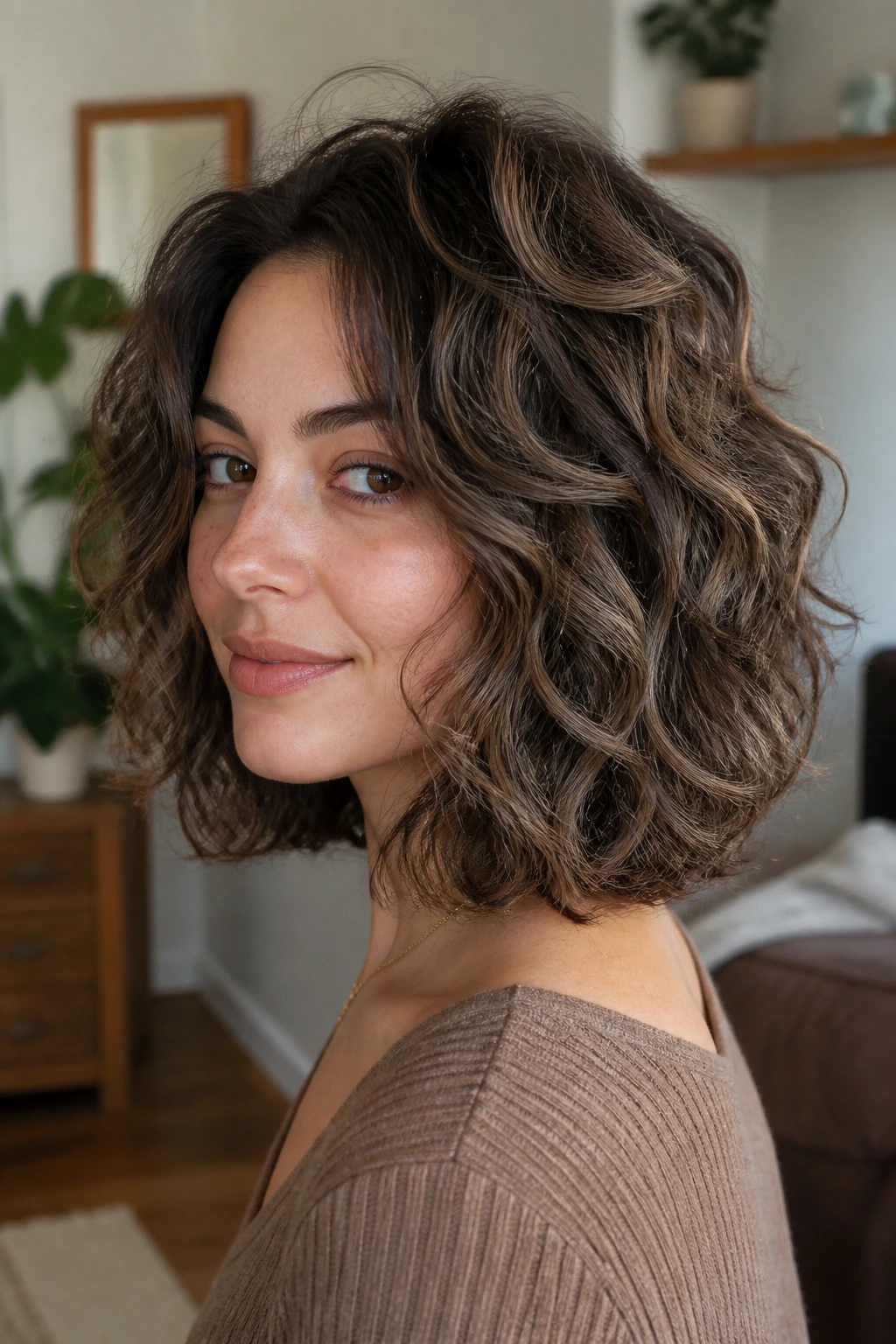
Do lowlights make curly hair look thinner?
Not when they’re placed well. On curly hair, lowlights usually make the hair look more structured because they create shadow inside the curl clumps. Too-dark or overly striped placement can do the opposite, so the placement matters more than the idea of lowlights itself.
How short can I go with a curly bob if my hair shrinks a lot?
Shorter than you think you can, but not by much. If your curls shrink hard, ask the stylist to cut the perimeter where you want it to land dry, then refine from there. Chin length wet can become lip length dry, which is why a dry check is worth the extra time.
Can fine curls wear layered bobs with lowlights?
Yes, but the layers need to be softer and the color panels fewer. Fine curls can look stringy if they’re over-thinned, so keep the perimeter clean and use subtle lowlights that add depth without carving the head into stripes.
Should a curly bob be cut wet or dry?
Dry or mostly dry usually gives the best read on shape, especially when shrinkage is dramatic. A wet cut can still work for cleanup, but if the stylist can’t see the curl pattern in its natural state, the perimeter may land too short.
How many lowlights are too many?
If you can count every panel from across the room, there are probably too many. Curly hair needs dimension, not a zebra pattern. Fewer, well-placed ribbons usually look richer than a lot of tiny streaks.
What if my curls are mixed — some loose, some tight?
Ask for the shortest curls to guide the internal layering, not the outer silhouette. Mixed textures need a bob that respects the shrinkiest pieces while still giving the looser sections enough length to hang. That keeps the outline from becoming uneven after a wash.
Can I wear this cut if I air-dry most of the time?
Yes, and some of these looks are better air-dried than diffused. Use a leave-in and a light hold product, then let the curls set without touching them too much. The lowlights will read as shadow rather than obvious color blocks.
How often should I refresh the color?
For many curl types, every 6 to 12 weeks is a sensible range. If your hair fades fast or you want the lowlight contrast to stay crisp, refresh sooner with a gloss or demi-permanent touch-up. If you prefer a softer grow-out, let the shade blur a little.
The Shape That Holds
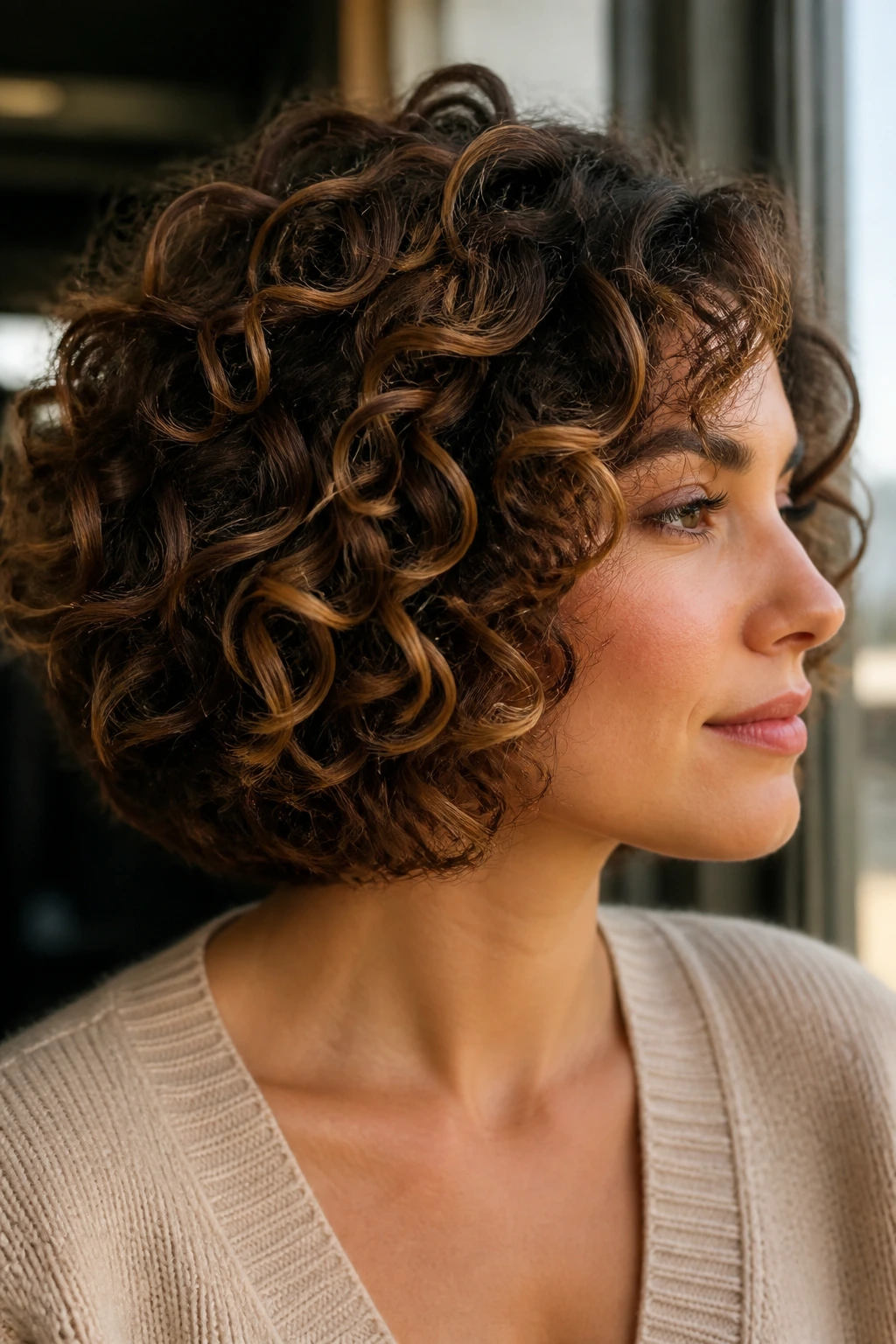
A curly bob gets interesting when the cut and color stop fighting each other. The layers carve out space for the curl pattern, and the lowlights give that shape something to sit against. Without the darker interior pieces, a lot of curly bobs end up looking airy in a way that’s more accidental than flattering.
Pick the version that matches your shrinkage, density, and patience level first. Then let the shade do the quiet work. If you save one photo for your next salon visit, make it the one whose silhouette already looks right before you start thinking about color.