



Curly bangs go wrong for one boring reason: people cut them like straight bangs and hope the curls will cooperate later. They won’t. The minute a curl dries, it takes its own length back, and that little front section can swing from sweet to lopsided in an hour if the cut ignores shrinkage. That’s exactly why soft wispy bangs for curly hair with face-framing layers make so much sense: they leave room for spring, soften the forehead line, and keep the haircut from sitting like one heavy slab across the face.
The other gift here is movement. A curl-friendly fringe should not feel pasted on. It should break into little bends, slip into the cheekbones, and soften around the jaw so the front of the haircut looks connected to the rest of the shape. When that connection is missing, curls can end up with that awkward triangular look at the sides and a fringe that seems like it belongs to a different head entirely. Nobody needs that drama.
What makes this topic worth paying attention to is that there isn’t one “curly bangs” answer. Loose waves, springy ringlets, tighter coils, thick density, fine hair, broad foreheads, long faces, side parts, center parts — all of those change the way a wispy fringe behaves. The styles below cover the whole range, from barely-there face wisps to fuller cloud cuts, so you can match the shape to your curl pattern instead of forcing your curl pattern into a cut it never asked for.
Why This Collection Works Better Than a Blunt Fringe

- Shrinkage-friendly lengths: These styles leave enough room for curl spring, so the bangs land where you actually want them once they dry.
- Soft front balance: The face-framing layers stop the fringe from looking like a separate shelf and pull the eye toward the cheeks and eyes instead.
- Grow-out that doesn’t feel awkward: The better versions here still look intentional after 4 to 8 weeks, which matters if you’re not booking trims constantly.
- Curl-pattern aware: Loose curls, ringlets, coils, and mixed textures all need a different front shape, and these cuts respect that instead of pretending one length fits all.
- Styling is easier, not harder: A wispy curly fringe usually needs less daily wrestling than a dense one, because the airier line breaks up frizz and bulk before it starts.
- Face-framing layers do the heavy lifting: The layers around the cheeks and jaw keep the look connected, which is the difference between “cute fringe” and “why does my hair look top-heavy?”
1. Brow-Grazing Curtain Wisps
This is the version I reach for when someone wants bangs but does not want the full commitment of a blunt line. The center sits near the brows, then drifts longer toward the temples, so the fringe opens like a soft curtain instead of closing like a wall. On loose curls, it feels especially easy; the pieces bend naturally, and the face-frame layers around the cheekbones do most of the visual work.
Why it works
The center length gives the curl room to spring up without turning into a tiny box on the forehead. The side pieces soften the transition into the rest of the haircut, which matters if you wear your curls layered and don’t want a hard disconnect at the temple. I like this shape on 2C to 3A curls because it keeps the forehead visible without losing that bang effect.
What to ask for
- Shortest point at brow level when dry
- Longer side pieces that start around the cheekbone
- Point-cut ends so the line stays airy
- A dry curl check before the final snip
The trick is restraint. If the front is cut too wide, the curtain effect disappears and you get a heavy fringe that looks more like a shelf. Keep the section narrow, keep the ends soft, and let the side layers do their job. That’s the whole point.
2. Micro-Wisps for Tight Curls
Tiny front pieces can be a lifesaver on 3C and 4A curls, especially when the hair around the forehead wants to spring up fast and sit away from the skin. These are not baby bangs in the strict sense; they’re little wisps that skim the upper forehead and blend into the first face-framing layers. The result is delicate, not fussy.
The reason this shape works is simple: it doesn’t try to flatten a tight curl pattern into a straight band. Instead, it creates a controlled little cluster at the front and lets the rest of the curl stack around it. If you have a lot of density, this can remove just enough visual weight without making the front look sparse.
A good stylist will cut this dry and curl by curl, then stop long before the section turns thin. Thin is not the goal here. Airy is. You want enough hair left to form actual curl clumps when you diffuse, because if the front pieces are sliced too aggressively, they frizz outward and the whole effect loses its shape by lunch.
3. Cheekbone-Feather Fringe
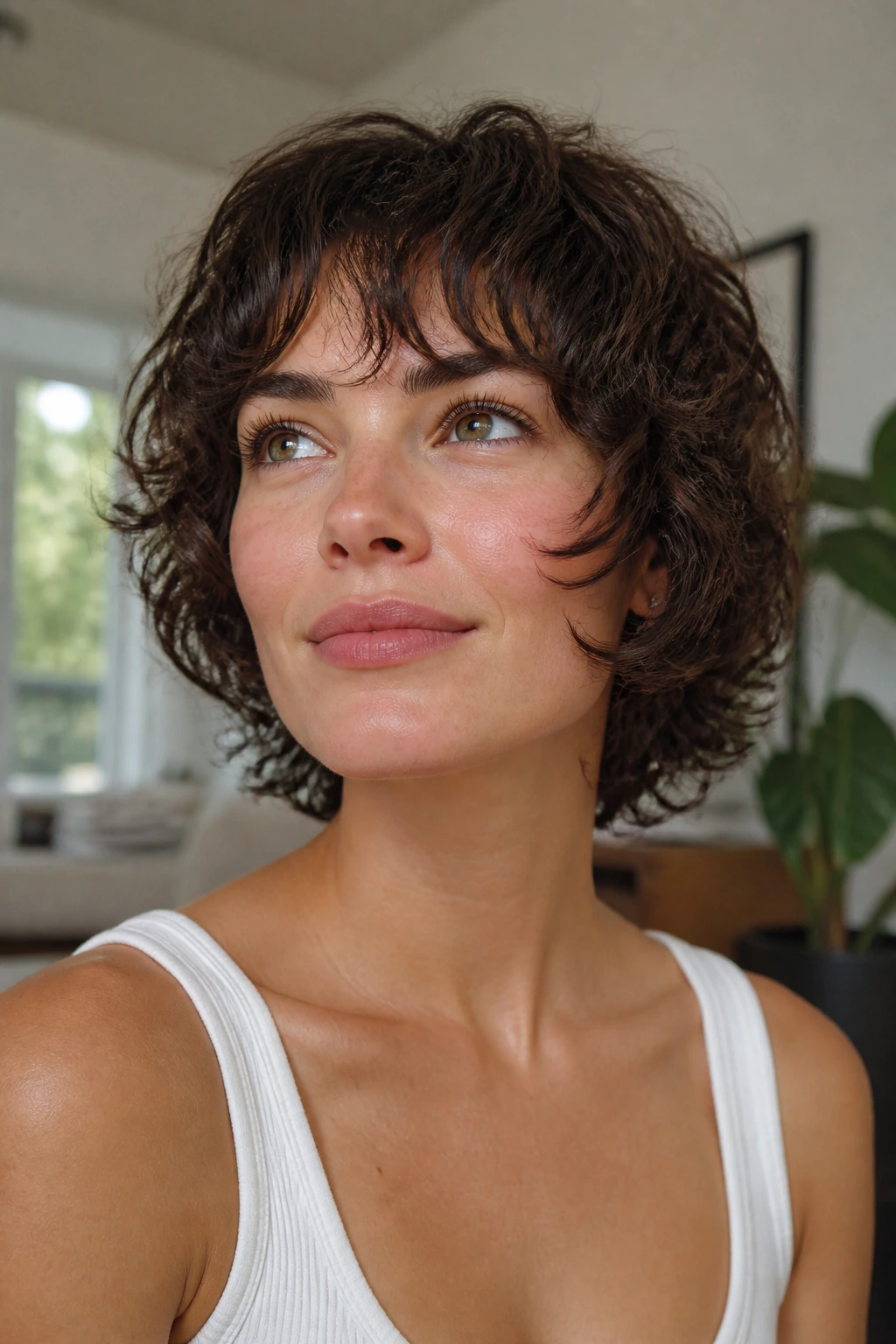
If your curls puff at the temples first, this is the shape that quietly fixes the problem. The fringe starts soft and short near the center, then feathers out around the cheekbones so the front of the haircut directs the eye upward and outward instead of straight across the face. It looks especially good on round and heart-shaped faces because it breaks up width without getting severe.
The shape line
The shortest strands usually land between the brow and upper lashes when dry, but the face-framing pieces extend to the top of the cheekbone or just below it. That contrast gives the haircut a little motion. Not too much. Just enough.
Best curl patterns
- 2C curls that need more definition in front
- 3A curls that collapse if the front is too heavy
- 3B curls that like a cleaner cheek line
This one works best when the ends are point cut rather than thinned with shears. Thinning shears can leave curly front pieces looking broken in a bad way, especially if the hair is coarse. A few careful snips at the perimeter are enough.
4. Side-Swept Spiral Bangs
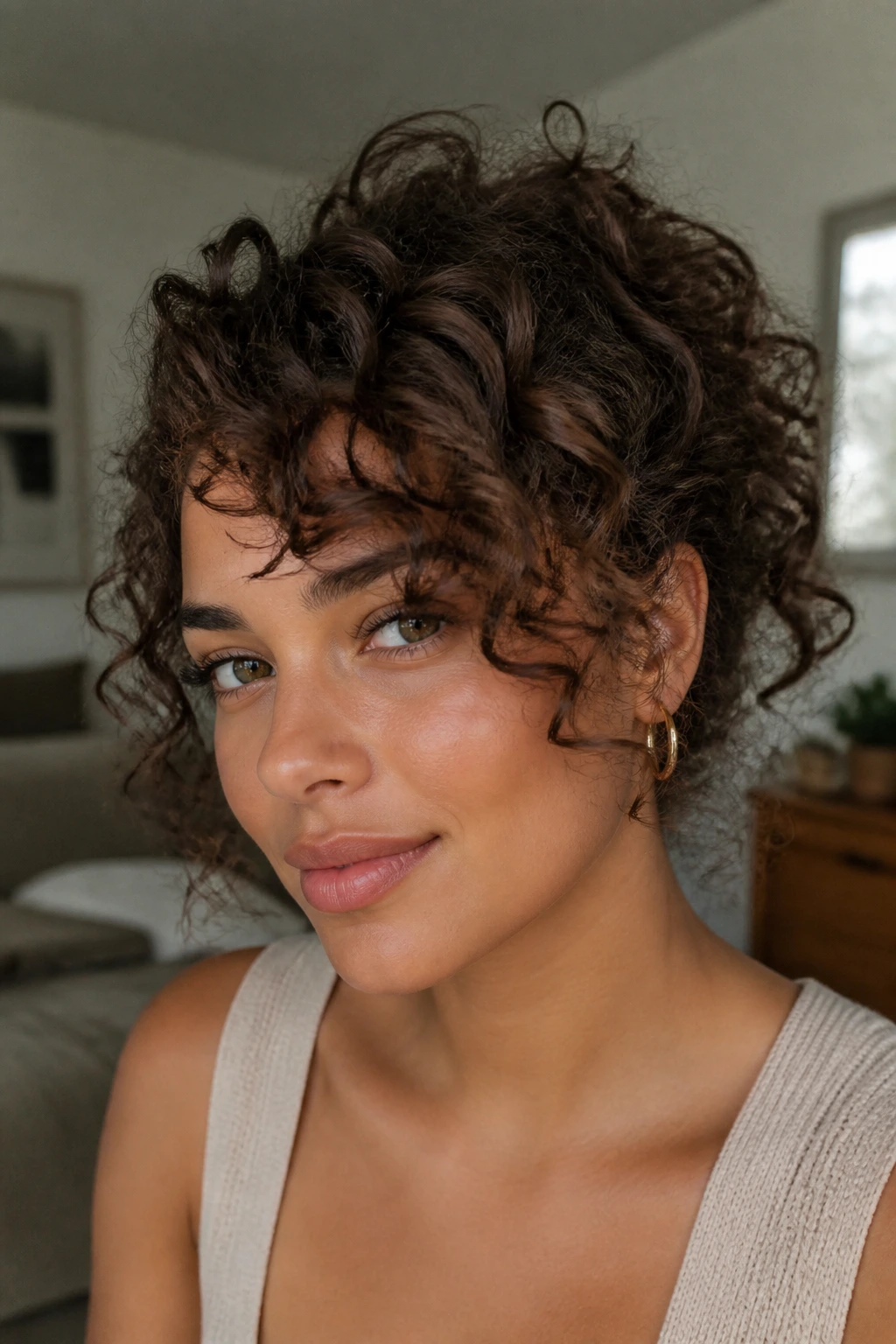
A side-swept fringe is the friendliest option for anyone with a cowlick, an off-center part, or a curl pattern that refuses to settle in the middle. Instead of fighting for symmetry, the bangs sweep in one direction and let the curl spiral follow the natural bend of the hairline. It’s a little less obvious than a centered curtain bang, but that’s part of the appeal.
This shape also buys you flexibility. On wash day, the bangs can sit dramatic and lifted. By day three, they can soften into a curved sweep that still looks intentional. The face-framing layers on the open side should start a touch higher — usually near the temple or cheekbone — so the whole front area keeps moving instead of falling into one block.
I like this on people who wear glasses. The diagonal line keeps the front from crowding the frames, and the curve around the cheekbone keeps the haircut from feeling top-heavy. If your hair likes to split on its own, this is the one that stops arguing with it.
5. Rounded Ringlet Bangs
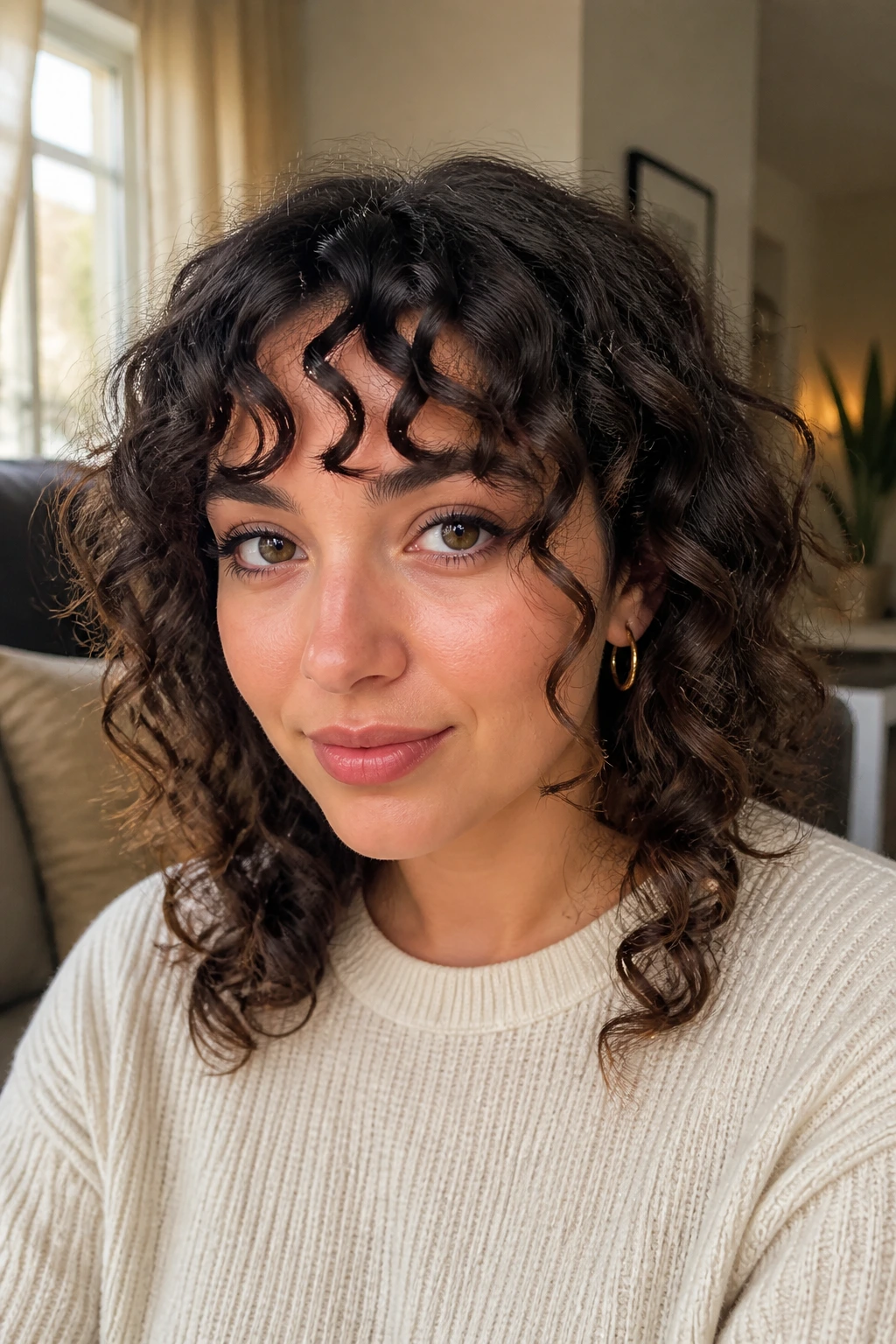
There’s something charming about a fringe that makes room for an actual ringlet or two to sit front and center. Rounded ringlet bangs create a soft arc across the forehead, with the middle slightly shorter and the sides tapering down into the face layers. The look is sweet, but not sugary; the curls do the talking.
The main thing to watch is density. If the section is too thick, the bangs become a dense curtain and lose the airiness that makes them flattering. If they’re too sparse, they separate into random strings. The sweet spot is a front section that forms two to four defined curl clumps when styled, not ten little frizzy strands trying to behave.
This shape loves a diffuser. Set the curls in their natural clumps, clip the roots lightly if they collapse, and don’t touch them until they’re dry. The rounded line will hold better that way, and the face-framing layers will echo the same curve around the cheeks.
6. Bottleneck Bangs for Loose Curls

Bottleneck bangs narrow in the center and widen out toward the temples, which is a nice way to say they solve a lot of “I want bangs, but not too much bang” hesitation. On loose curls, the shape is clean and soft at the same time. The middle section gives you the visual hit across the forehead, while the longer sides melt into the face-frame layers.
How the length usually falls
- Center: around brow to upper lash length when dry
- Sides: cheekbone to jaw level
- Face layers: start where the bangs stop, so there’s no hard seam
This cut is especially good if your curls lose definition when they get too much weight. The narrow middle takes off just enough bulk to keep the front light, and the wider side pieces help the haircut feel like a full shape instead of a fringe with a couple of extras hanging on.
Don’t overstyle it. A bit of mousse, a soft gel cast if you like one, and a gentle diffuse are usually enough. Too much cream can make the narrow center collapse into a stringy mess, and nobody wants that.
7. Shaggy Fringe With Soft Sides

This is the version for people who like their curls a little undone, a little swingy, and not at all precious. The fringe stays wispy, but the face-framing layers are more broken up, with little lengths around the ears and jawline that keep the haircut from looking polished in that stiff, salon-poster way. It’s casual. In the good sense.
A shaggy fringe works best when the shortest front pieces are not too blunt. The ends should look fractured on purpose — not hacked, just feathered. That broken line helps curls stack on top of each other without creating a thick block right across the forehead. If you’ve ever had bangs that looked cute for ten minutes and then turned boxy, this is the antidote.
It’s also one of the better options for second- or third-day hair. The front can get a little piecey, and in this case that’s a feature, not a flaw. A quick mist of water and a fingertip twist around the front curls is usually enough to wake them back up.
8. Center-Part Wisps That Split Naturally

Why fight the part your curls already want? If your hair naturally opens in the middle, this cut lets the front split into two light wisps that fall away from the forehead instead of hanging as one unified curtain. The shape is clean, low-stress, and especially good for people who get annoyed by bangs touching their lashes all day.
The face-framing layers here do more than people expect. They create a little hollow space around the nose and cheekbones, which keeps the middle part from feeling severe. On long faces, that softens the vertical line. On broad foreheads, it breaks up the expanse without covering everything.
Small but useful details
- Keep the front pieces narrow
- Start the cheek layers close to the temple
- Use a light hold product so the part stays split
- Diffuse from above, not from straight on, to avoid puffing the center
This is one of the easiest shapes to maintain if you hate fuss. It doesn’t demand perfect styling, and when the curl drops a little, it still reads as deliberate.
9. Grown-Out Bangs That Still Look Planned
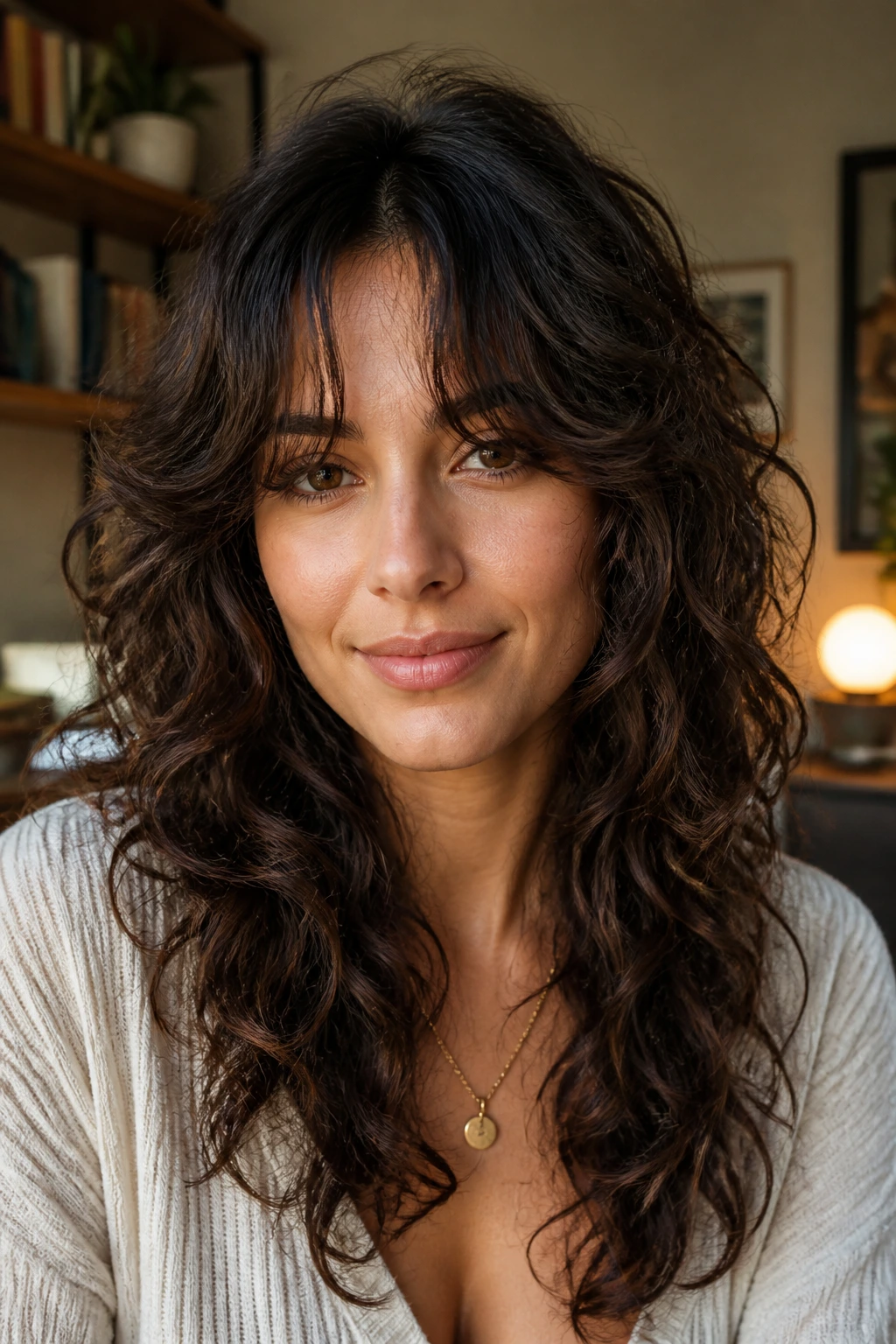
This is for the person who wants the fringe look without the “I need a trim every five minutes” lifestyle. The bangs start longer — usually around the nose bridge or just below it when dry — and they blend fast into the front layers. That length buys you time, which is nice, because curly hair never grows out in a perfectly polite way.
The danger with grown-out bangs is looking like you simply forgot to cut them. The fix is shape. The center should still have a slightly shorter point, even if it’s subtle, and the face-framing layers should begin early enough to make the whole front section feel designed. If the layers start too low, the bangs drift into no-man’s-land and the haircut loses its frame.
I like this on people who like to pin their hair back sometimes. The longer fringe can tuck, twist, or clip away on hot days, then fall back into place without looking chopped off. It’s a friendly option, and frankly, there are weeks when friendly is better than fashionable.
10. Birkin-Inspired Curly Fringe

A Birkin-ish curly fringe should feel broken up and airy, not dense and straight across. The line skims the brows, but the ends are soft enough that the curls still read as curls. It has a little Parisian laziness to it — the good kind, not the sloppy kind.
The reason this shape is trickier than it looks is that too much density kills the effect. You want a fringe that looks almost undercut in its lightness, with the front pieces sitting in little separated clumps. The face-framing layers should be long enough to connect to the cheek and jaw, so the bangs never feel like a stray piece dropped onto the face.
Good match for:
- Loose-to-medium curls
- Medium density hair
- Oval or long face shapes
- People who don’t want a high-maintenance line
The styling cue is simple: keep the front piecey, not fluffy. A dab of lightweight gel, then a diffuse with the fringe clipped lightly forward, usually gives the right finish. If it gets too polished, it loses the charm.
11. Piecey Bangs for Dense Curls
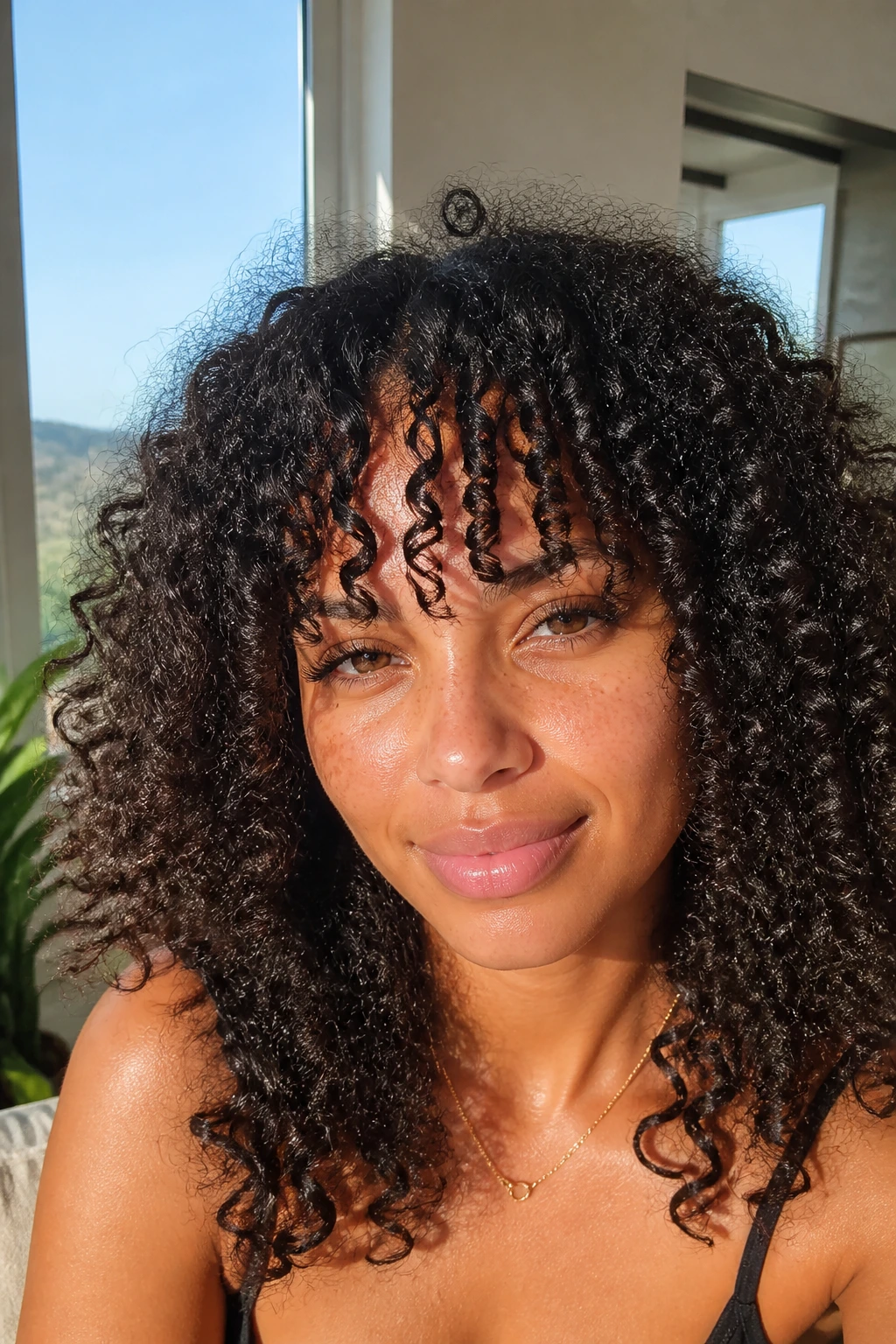
Dense curls need spacing. Without it, the fringe turns into a thick row of hair that sits on the forehead like a cap. Piecey bangs solve that by separating the front into distinct curl clusters, with enough air between them to keep the line light. It sounds subtle, but the difference is huge in person.
What I like about this version is how it handles strong curl memory. Instead of fighting the front into one continuous shape, it lets the curls sit in little islands. The face-framing layers should mirror that separation, with a few longer bits near the temples and cheekbones that keep the front from feeling boxed in.
Use a product that gives slip without weight. If the bangs are too slick, they clump into one odd shape. If they’re too dry, they explode outward. The sweet spot is a small amount of curl cream under a lighter mousse or foam, then a gentle scrunch. That combo keeps the pieces visible without turning them crunchy.
12. Halo Fringe for Coils
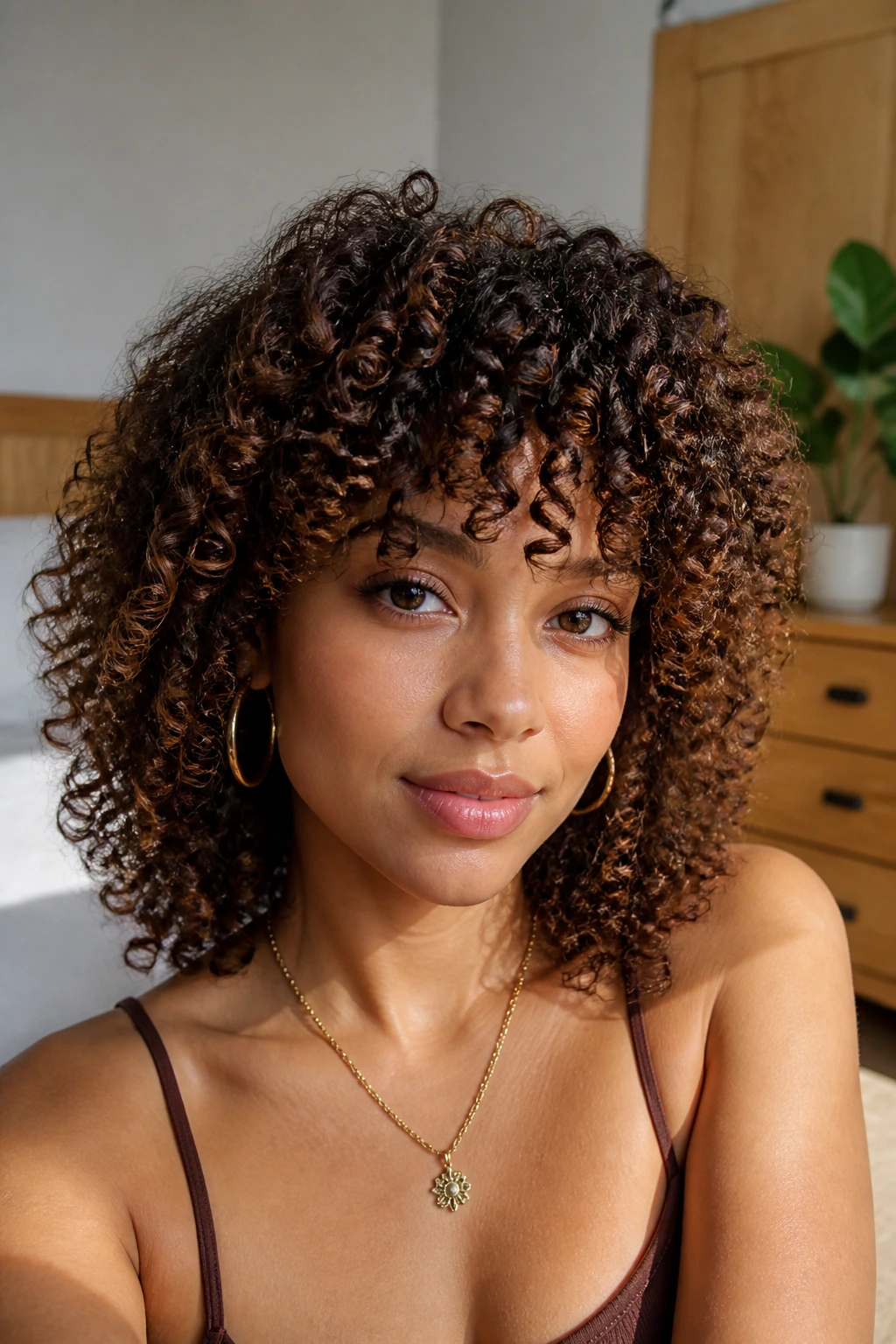
A halo fringe works beautifully on coils because it respects the natural spring around the forehead and temples instead of forcing one flat band across the face. The curls curve around the front like a soft frame, with the shortest pieces sitting near the brow line and the side layers sweeping back toward the ears. It’s one of the few bang shapes that can feel both bold and gentle.
The key is balance. Too much front density and the halo becomes a helmet. Too little, and the shape disappears. The best versions use enough hair to form a soft circle of texture, then trim the outer edges so the front doesn’t look like it was randomly shortened. That rounded connection is what makes the style feel finished.
This cut is especially flattering if you like wearing your hair out and big. It gives the face a little opening without shrinking the entire silhouette. And yes, shrinkage matters here more than ever; coils can sit much shorter than expected once they dry, so the cut should leave room for that spring.
13. Arc Bangs That Follow the Eyebrows

Arc bangs are for people who want the fringe to echo the face, not carve a hard line across it. The shape follows the eyebrow curve in a soft arch, with the center slightly lower and the sides lifting outward into the front layers. It gives the haircut a gentle frame that feels deliberate.
This style is sneaky-good on heart-shaped faces because it softens the wider forehead area without pulling all the attention downward. The face-framing layers then continue the same arc around the cheekbones. That visual repeat is what makes the cut look polished without being stiff.
The line should be shaped dry, or at least mostly dry. Wet curls lie. They always do. If you cut this too short while the hair is damp, the arc can bounce up into a little half-moon that sits way too high on the forehead. Leave a bit more length than you think you need, then refine.
14. Wolf-Cut Fringe With Tapered Layers
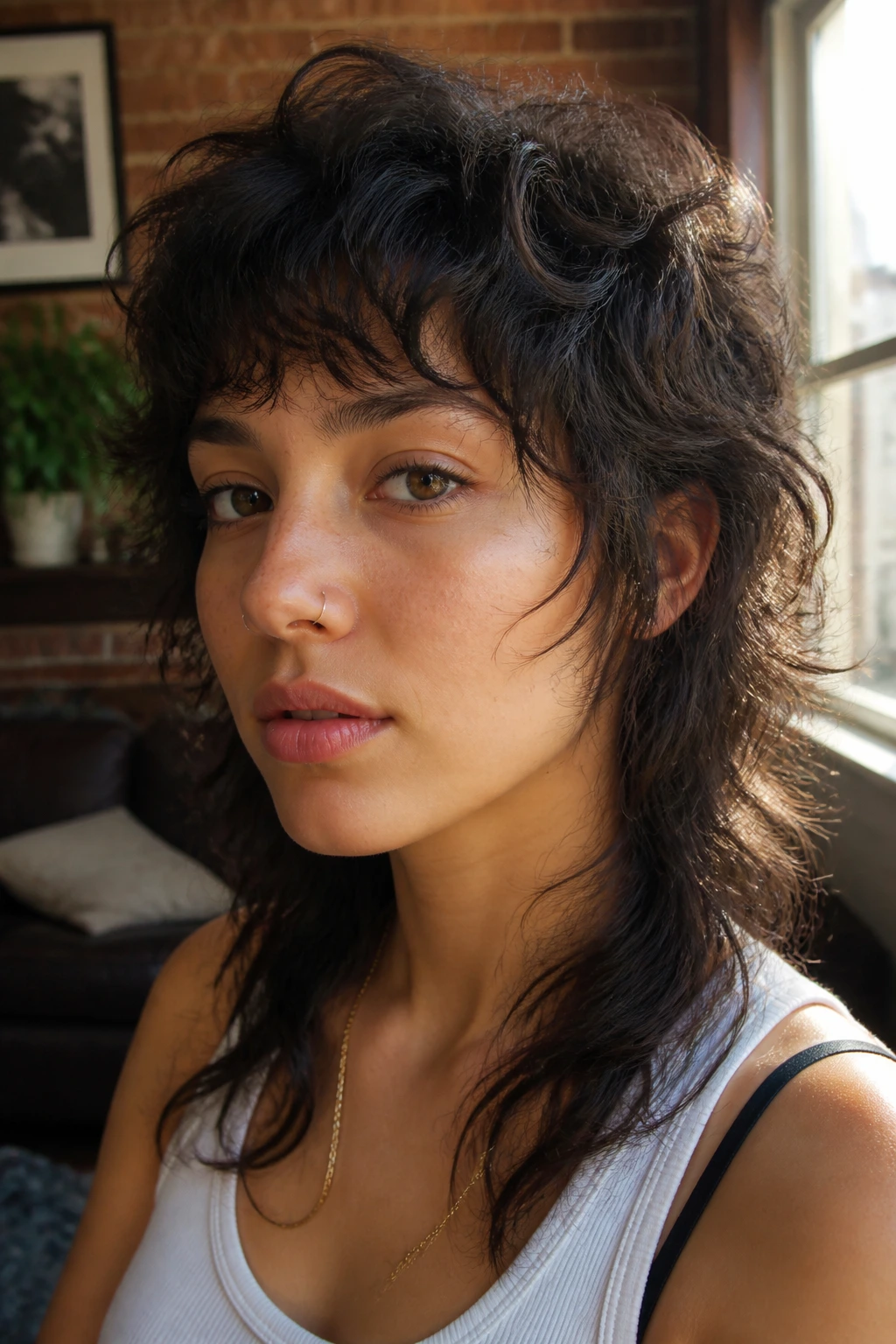
The wolf-cut version is for someone who likes movement with a touch of edge, but still wants the front to stay soft enough to wear daily. The bangs are wispy, the crown has a little lift, and the face-framing layers taper fast from the cheek down toward the collarbone. It’s a more textured answer, and it wears best on hair with some natural volume.
What gives it its shape
The front fringe isn’t the whole story here. The crown layers create the lift, the side layers break the bulk, and the bang area stays light enough to avoid a heavy wall at the forehead. If one of those pieces is overdone, the cut can tip into mullet territory fast.
Who it suits
- Thick 2C to 3B curls
- People who air-dry often
- Anyone who likes a little shag energy
- Hair that can handle internal layering
I’m partial to this cut on curls that get flat at the crown but puffy at the sides. The tapered face frame redirects the volume, which is a small miracle when the hair has its own ideas.
15. Chin-Skimming Curly Fringe
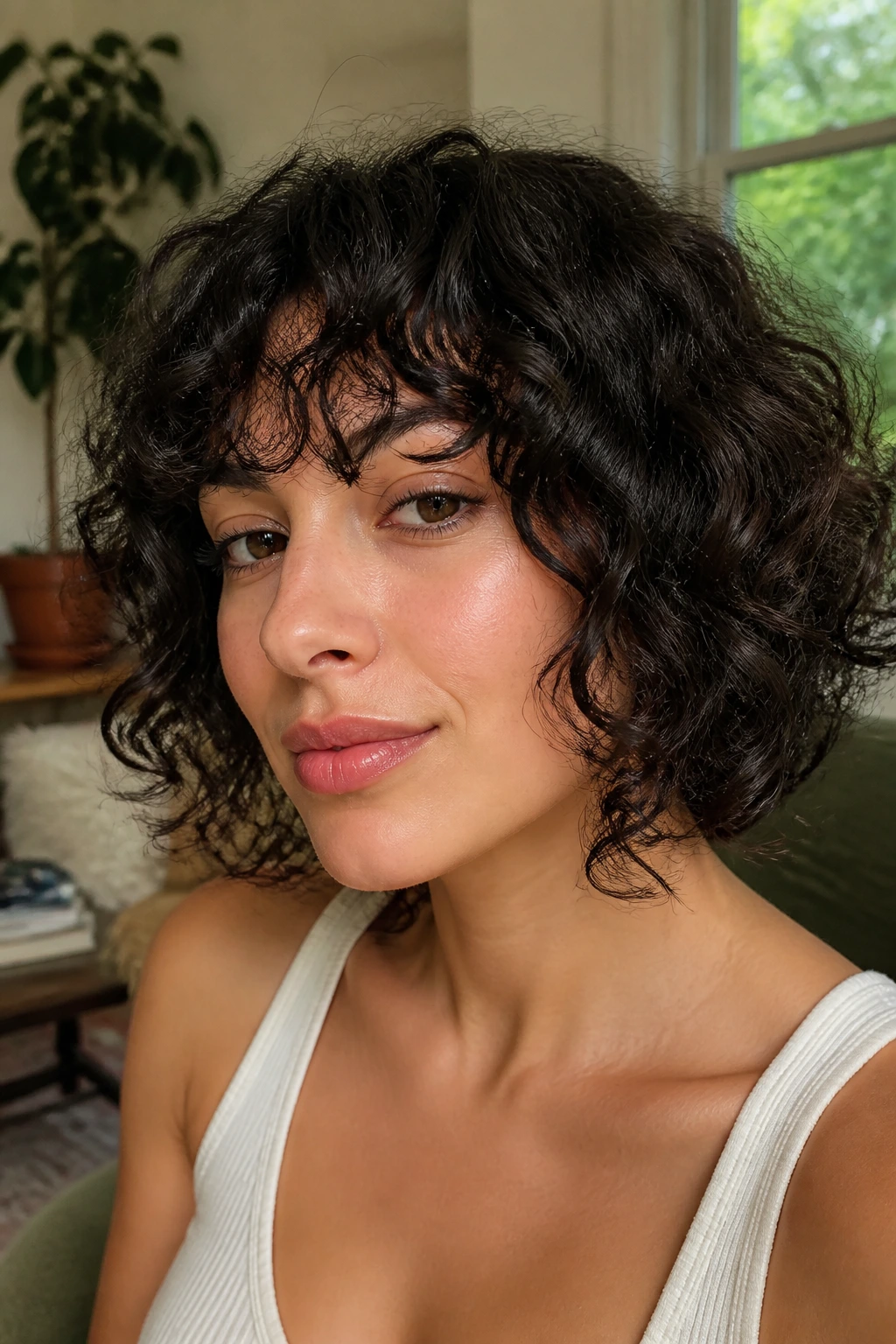
If you are nervous about bangs, start here. Chin-skimming fringe is long enough to tuck, pin, or let blend into the sides, which means you can live with the shape before deciding whether to go shorter. On curly hair, that longer front length also helps the curls settle instead of bouncing straight up into the air.
The face-framing layers begin almost immediately under the chin, which keeps the front from feeling like a heavy curtain that forgot to move. That connection is important. Without it, long bangs on curly hair can read as a disconnected front shelf. With it, the whole haircut feels softer and more grown-in.
This is one of the easiest shapes to style on day two or three. A quick spritz of water, a finger coil on the front pieces, and a tiny bit of foam usually bring it back. It is the haircut version of a good backup plan. Which is useful.
16. Split Bangs With Cascading Face Layers

Split bangs are for anyone who wants the forehead open but still wants something happening in the front. The bang section parts down the middle or just off center, then the two sides cascade into cheek and jaw layers that move when you turn your head. It’s airy, which is the point.
The cut can be read as casual or refined depending on how the curls land. If the front pieces are left too blunt, the split looks accidental. If the ends are lightly point cut and the side pieces are long enough to drape into the face, the shape feels deliberate. I like it best on hair that naturally breaks around the center, because then you aren’t forcing a part that the curl pattern resents.
This one also plays nicely with glasses. The split opens the face instead of crowding it, and the cascading side pieces stop the hair from gathering right at the frame arms. Small detail. Big difference.
17. Floaty Bangs for High-Volume Hair

High-volume curls can handle more fringe than people think, but the line has to stay floaty. That means internal weight removal, soft edges, and enough separation that the bangs don’t form one dense band. A floaty fringe brings the eye up without stealing all the air from the front of the haircut.
The danger with volume is overcorrecting. If you cut too much out, the front can frizz and disappear. If you leave too much in, the bangs turn into a heavy shelf. The right balance usually comes from dry cutting and being honest about how the hair behaves when fully expanded.
Good signs this cut will work
- Your curls expand evenly
- The front doesn’t collapse flat after washing
- You like movement around the eyes
- Your hair has enough body to support a soft line
A little mousse and a diffuser with low airflow usually give the best finish. Too much heat will separate the curls and make the fringe look frayed at the edges, which defeats the point.
18. Tousled Fringe With Collarbone Layers

This is the longer, more relaxed cousin of the short fringe. The bangs stay soft and touchable, but the face-framing layers continue all the way down to the collarbone, which makes the haircut feel long, layered, and easy to tuck behind the ear when needed. It’s especially good if you wear your curls up on busy days.
How it behaves in real life
The fringe can fall forward when you want it to, then disappear into the longer layers when you clip half the hair back. That flexibility is the whole draw. On shoulder-length or slightly longer curls, it gives enough shape at the front without forcing you into a very obvious bang.
If your hair is thick, ask for gentle layering through the front rather than big chunks removed at once. If the layers are too chopped up, the ends can split apart in a way that looks frizzy instead of tousled. The softer the cut, the better the grow-out.
I like this on people who say they “don’t do hair” but still want a little shape. You can scrunch, diffuse, and go. That’s the appeal.
19. Long Bottleneck Bangs With Curtain Sides
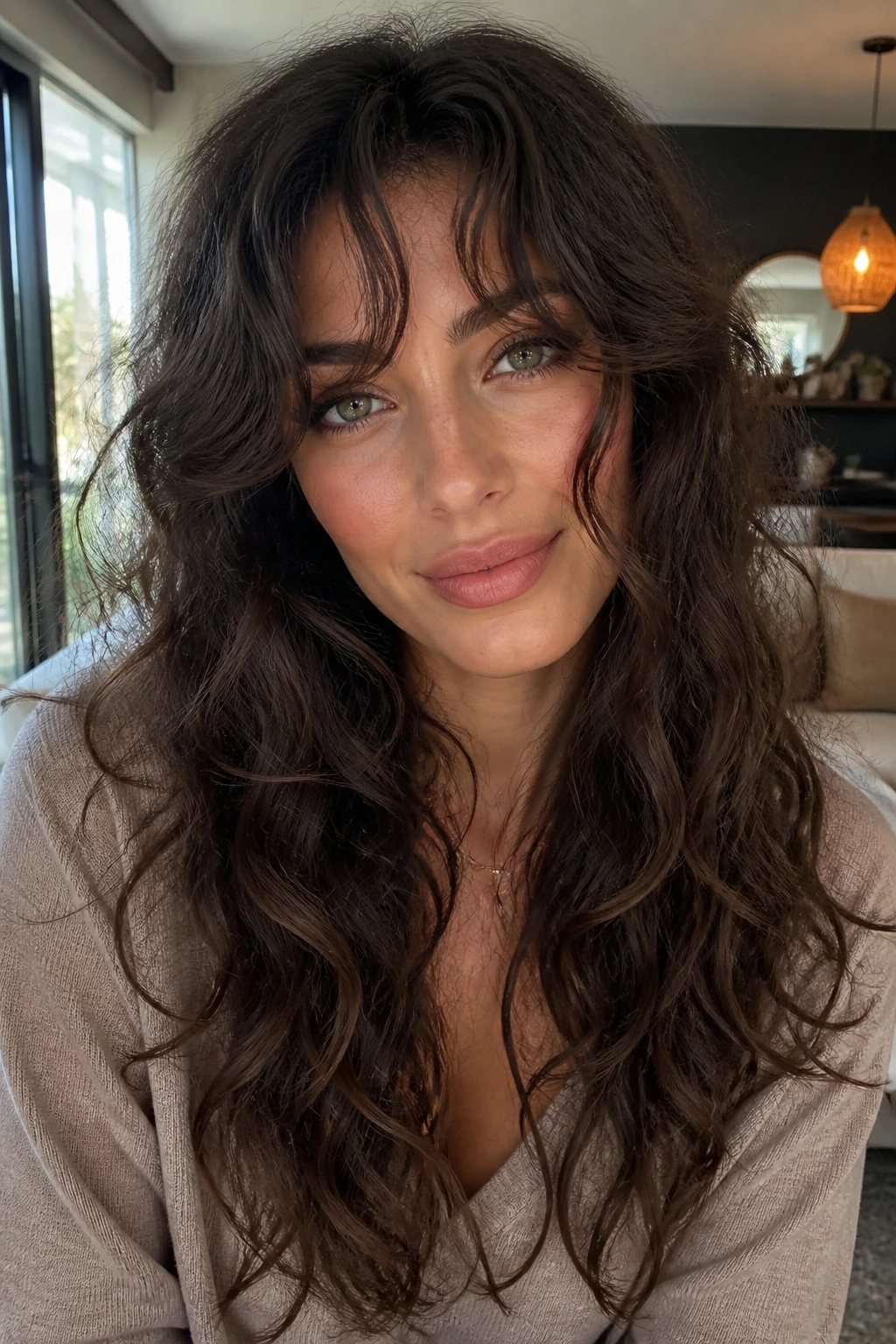
This is a more glamorous, slower-moving version of bottleneck bangs. The center is still slightly shorter, but the side pieces stay long and fall like curtain sides into the front layers. The whole shape has more length, more softness, and a little less obvious bang energy.
It’s a smart choice if you want the front of your haircut to flatter your face without becoming the main event. On curly hair, long bottleneck bangs keep the front open while still giving the eyes a frame. The face-framing layers should start around the cheekbone and continue down toward the jaw so the transition feels smooth.
This cut suits people who like to wear their curls stretched a touch or diffused with less shrinkage. If your curl pattern springs up hard, leave the center longer than you think. The side pieces can always be refined later, but a bang that’s too short is a lesson nobody asked for.
20. Romantic Ringlet Fringe

This one leans into the curl. Instead of breaking up the front too much, the cut lets one or two front ringlets become the star and then supports them with soft side layers around the cheeks. The result feels romantic in the real sense — airy, a little undone, and not overworked.
The magic is in the clump formation. If the front curls are encouraged into separate, clean ringlets, they land neatly across the forehead without looking stiff. A small amount of gel can help, especially if your curls are medium porosity and need a little structure to hold the shape through the day.
This is not the style for someone who hates touching their hair. It does reward a bit of attention, though. A quick finger twirl on the front ringlets after styling can help them settle into a prettier arc, and the face-framing layers keep the rest from feeling too sweet.
21. Deconstructed Fringe for Thick Hair

Thick curls need room, or they puff like crazy. A deconstructed fringe breaks the front into uneven little lengths so the forehead stays visible and the weight spreads out instead of piling up. The face-framing layers echo that broken line, which keeps the front from turning into one big furry block.
The key here is to avoid over-thinning. There’s a difference between deconstructed and see-through, and that difference matters a lot. You want separation at the edges, not a fringe that looks as if it has been attacked with thinning shears. The shape should still have body.
This is one of the best options if your curls are coarse and take up space. The front can feel lighter immediately, and the grow-out stays interesting because the irregular line just softens rather than turning blunt. That’s useful when haircuts live longer than their appointment calendar.
22. Soft Swoop Bangs and a Deep Side Part
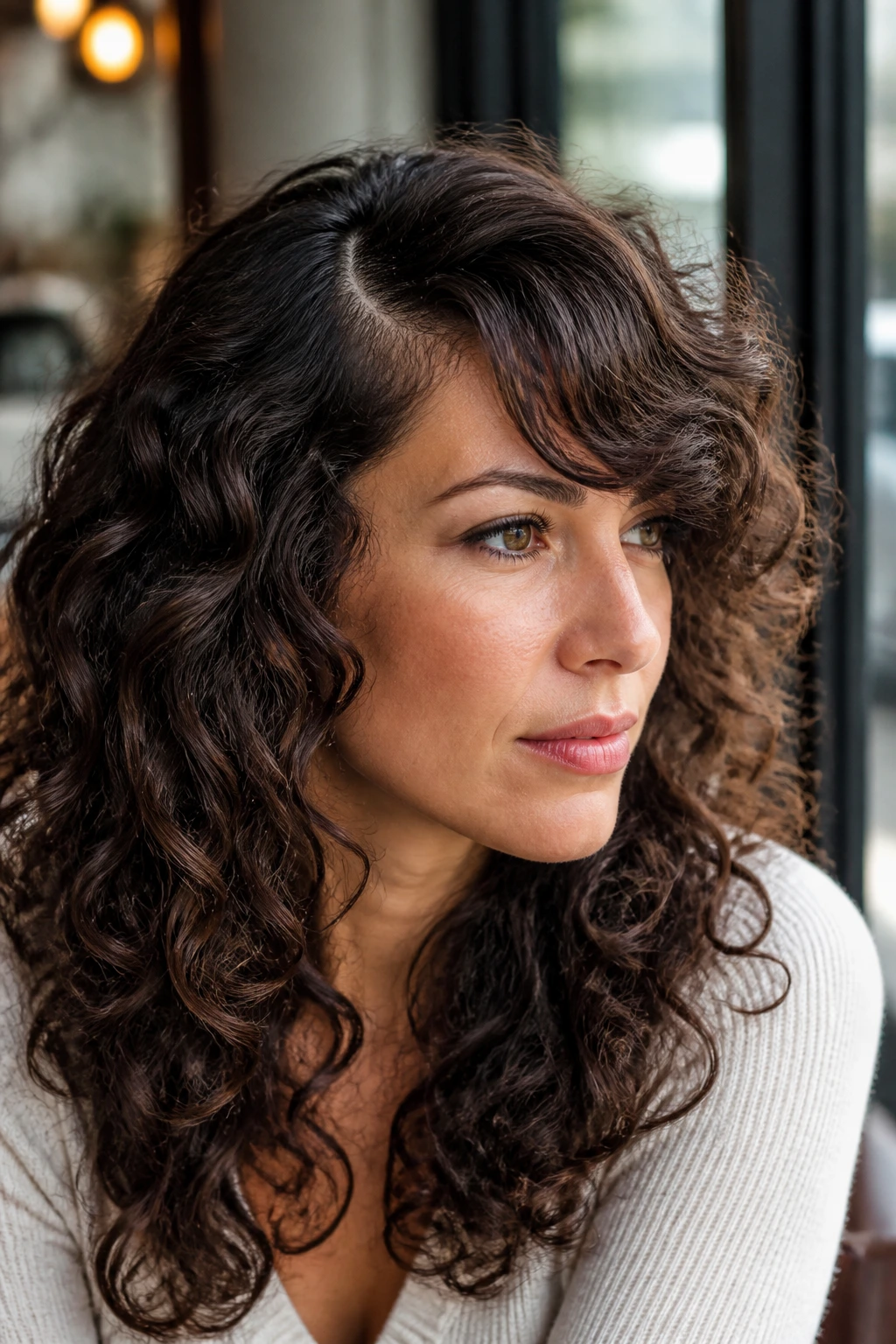
A deep side part can rescue a fringe that refuses to sit in the middle. The bangs sweep across the forehead in a soft diagonal, then blend into longer face-framing layers on the open side. It gives the haircut a little movement and a bit of drama, but in a quiet way.
Best when:
- You have a strong cowlick near the front
- Your curls separate badly at the center
- You want one side to feel longer and softer
- You like a shape that changes depending on how you style it
This cut also flatters asymmetry in the face. The sweep softens one side of the forehead, while the longer layers on the opposite side keep the style from feeling lopsided in a random way. It’s deliberate asymmetry, which is a nicer phrase than “my hair won’t stay where I put it.”
A little root lift at the heavier side helps the swoop hold. If the front is too flat, the shape loses its curve and becomes a stray chunk of hair across the face. Keep it lifted, not stiff.
23. Airy Bangs for Fine Curls

Fine curls need a light hand. If the bang section gets too dense, the front can droop and separate into stringy pieces. Airy bangs leave enough hair for curl definition, but not so much that the fringe overwhelms a smaller face or a finer texture. It’s a quieter shape, which can be lovely.
The face-framing layers should be long and soft, not stacked heavily. That helps the haircut keep some width around the cheeks without collapsing the top. On fine curls, a little mousse often works better than a rich cream, because the cream can weigh the fringe down before the curls set.
I like this style for people who want softness more than statement. The bangs sit lightly on the forehead, the sides blend fast, and the whole front area keeps moving. It feels natural, which is harder to pull off than it sounds.
24. Fringe With a Bouncy Lob

A curly lob with wispy bangs is a sneaky-good combination because the shoulder-to-collarbone length keeps the silhouette grounded while the fringe adds face movement up top. The front pieces can skim the brows, then fade into the shorter front layers around the jaw and collarbone. It’s balanced, and balance matters when curls already have personality.
This shape works nicely on people who wear their hair both curly and loosely stretched. The longer length gives you flexibility, and the fringe stops the cut from feeling plain. If you have a strong cheekbone line, the front layers can sit right there and make the whole cut look intentional with almost no extra effort.
The main caution is density. A lob can carry a slightly fuller fringe, but if both the front and the sides are heavy, the haircut starts to feel boxed in. Keep the bangs soft, keep the ends movable, and let the bob length do the grounding.
25. Full Cloud Cut With Wispy Bangs
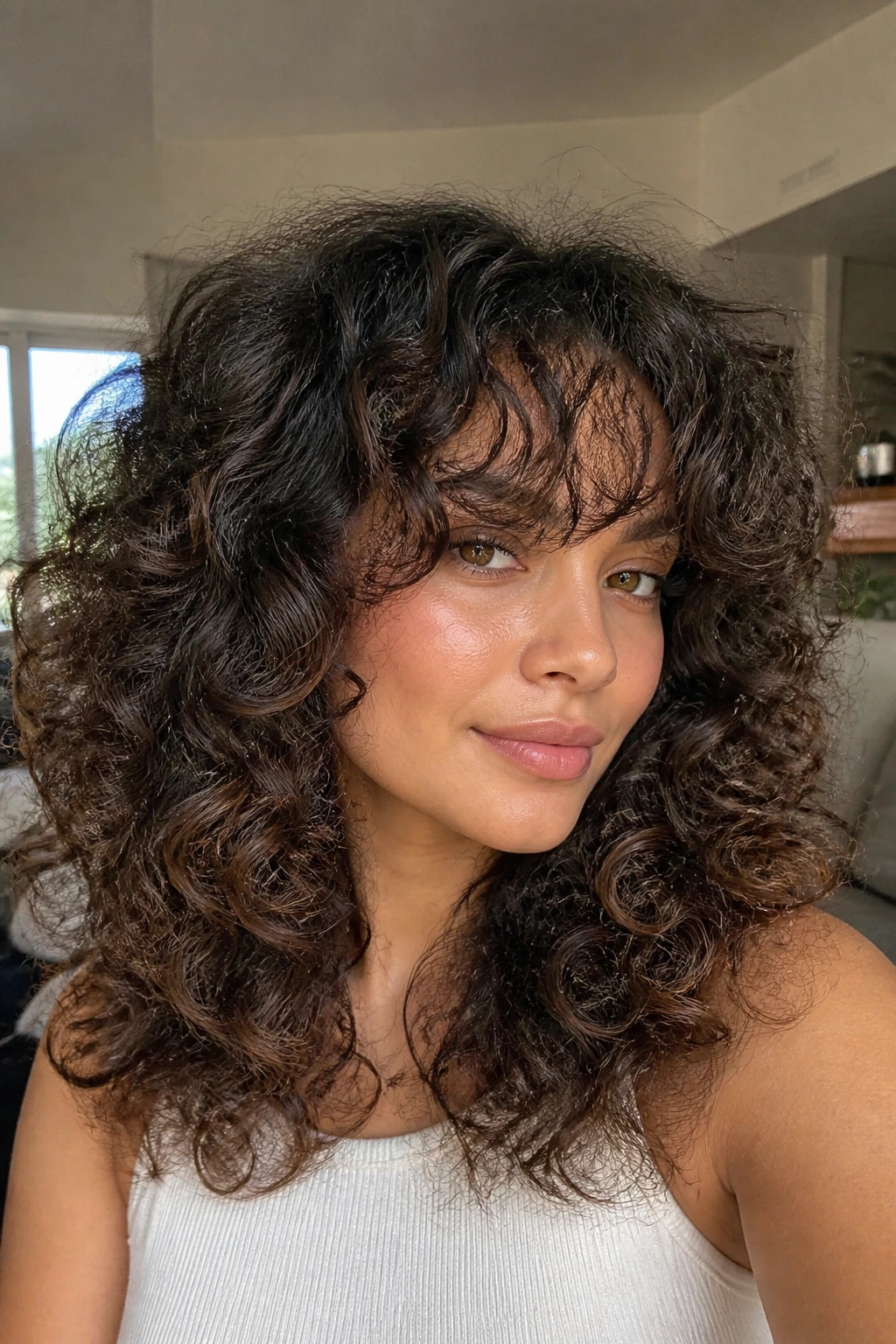
This is the bold one. The cloud cut embraces volume everywhere, with soft bangs at the front and rounded face-framing layers that keep the silhouette airy instead of triangular. It works best on thick curls, big curls, or anyone who likes their hair to look like it has its own weather system.
The fringe itself should stay wispy enough to avoid blocking the forehead, but it can be a little fuller than in the other styles because the whole haircut is carrying more shape. That front softness matters. If the bangs become too dense, the cloud shape tips into bulk. The right cut keeps the front light so the rest of the volume can breathe.
This is not a shy haircut. It looks best when you commit to the fullness and style the curls with enough product to define the shape without freezing it. Think movement, not shellac. The face-framing layers are what keep the cloud from swallowing the face, and they are doing a lot of work here.
What Makes Wispy Curly Bangs Hold Their Shape Better
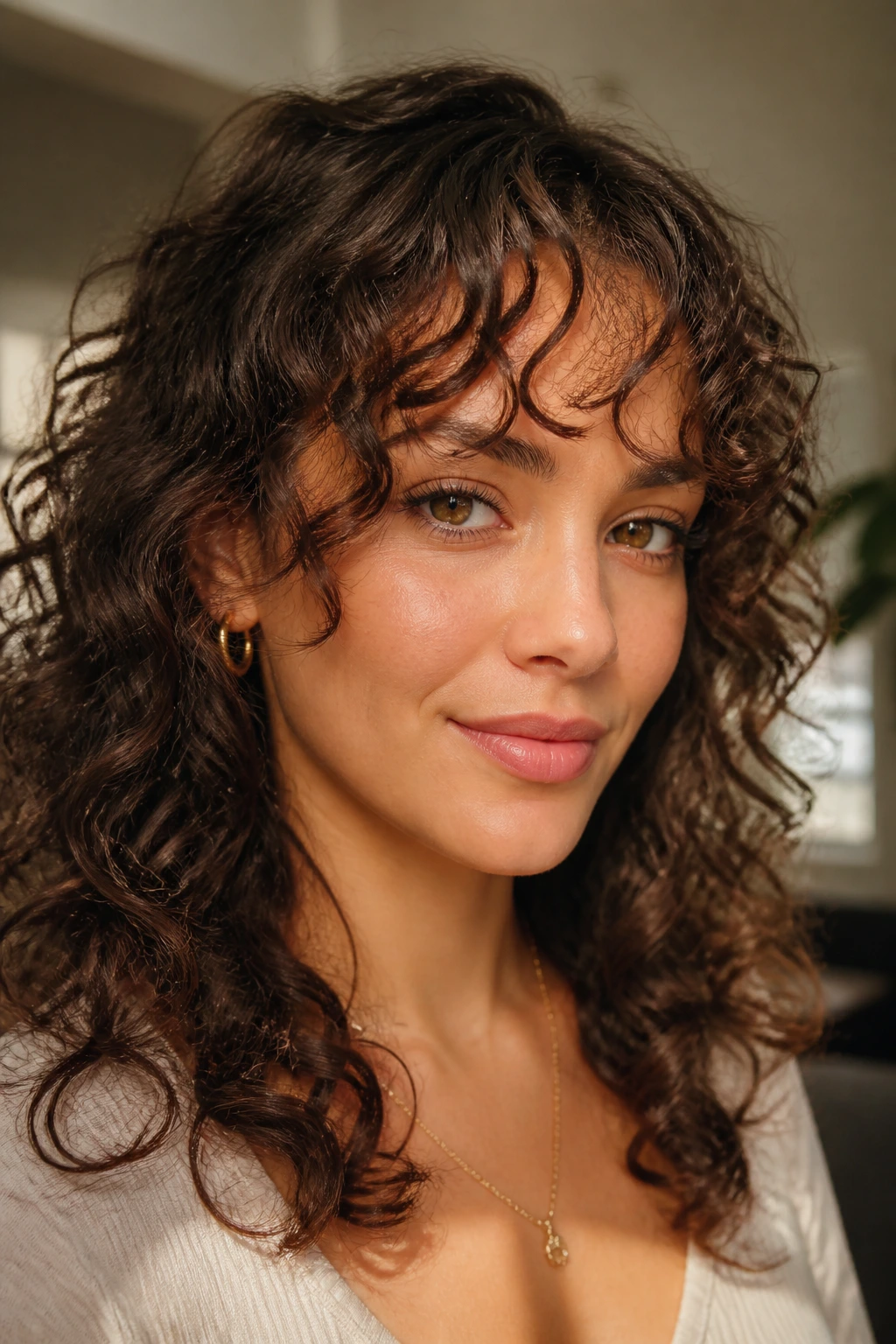
The best curly fringe starts with one simple truth: curls behave better when they are allowed to be curls. That sounds obvious, but so many bad bang cuts come from trying to flatten the front into a straight line and then hoping styling products will rescue the rest. They won’t. The shape has to be cut with the curl pattern in mind, especially around the forehead where shrinkage is strongest.
Face-framing layers are the part people underestimate. A fringe alone can look like a little hair accident if the sides are too blunt. When the layers begin around the cheekbone, temple, or jaw, the whole front section gets a path to follow. That is what makes the style feel soft instead of chopped.
Dry cutting helps because it shows the real length in real time. Wet curls stretch, and then they rebound. That rebound is where the trouble starts. A stylist who works curl by curl can see how each piece falls, how much shrinkage it has, and whether the bang should land at the brow, the lash, or lower. That little difference changes everything.
The Tools That Make Styling the Front Easier
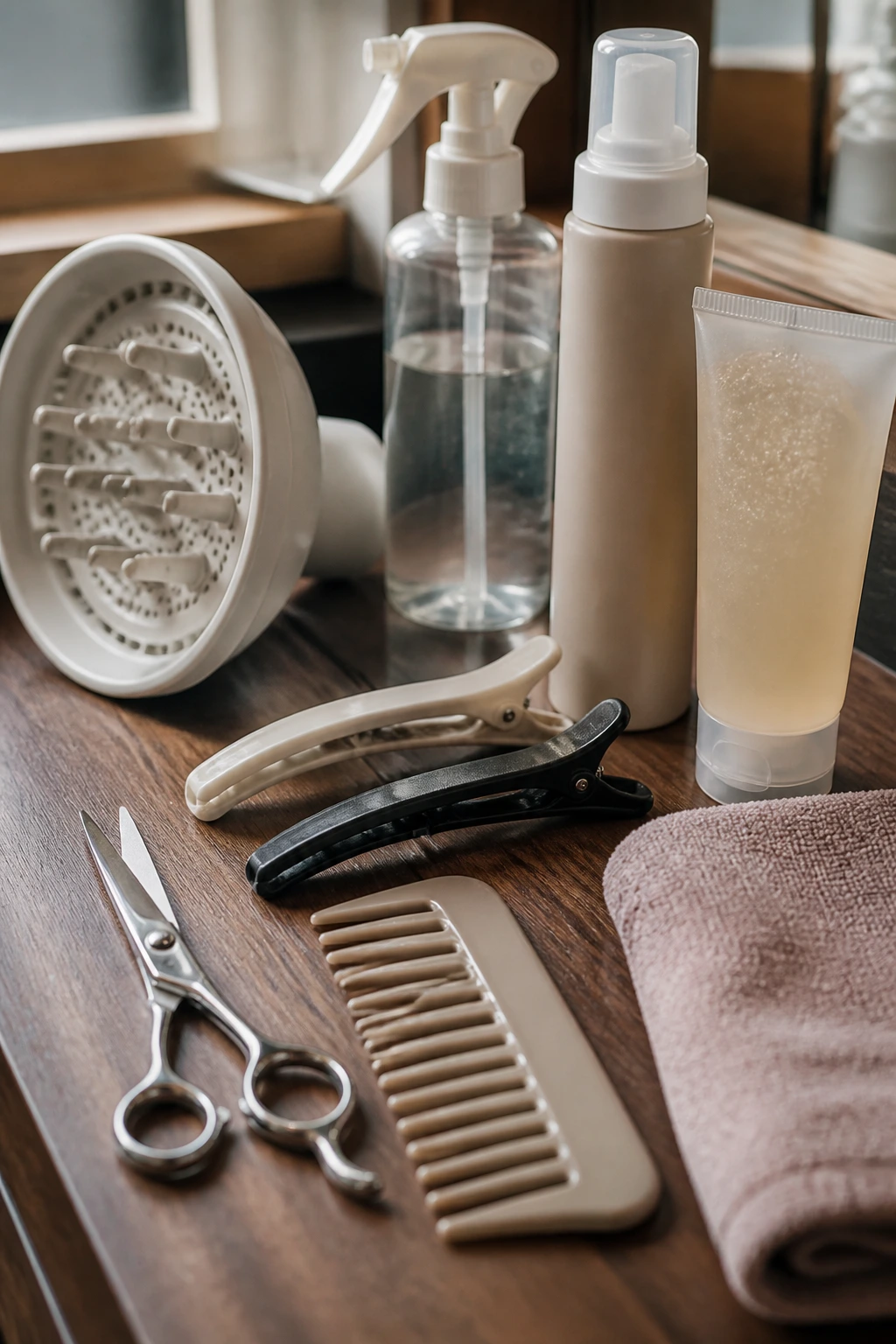
- Curl-specific scissors or very sharp salon shears: Dull blades crush the hair and leave frayed ends, which shows fast in the front.
- Duckbill or sectioning clips: These keep the bang section separate while you style the rest of your curls.
- A spray bottle with plain water: The fringe often needs a tiny refresh even when the rest of the head is fine.
- Microfiber towel or cotton T-shirt: These reduce roughing up the front curls before they set.
- Wide-tooth comb or fingers: Use these to place the curls without breaking them apart too much.
- Diffuser attachment: A good diffuser keeps the bang area lifted without blasting it into frizz.
- Light mousse or foam: This gives shape without the weight that can drag bangs down.
- Soft-hold gel: Optional, but useful if your fringe loses form fast.
- Hand mirror and regular mirror: You need both if you’re checking symmetry on the sides and front at the same time.
What to Ask for at the Salon Before the Snip
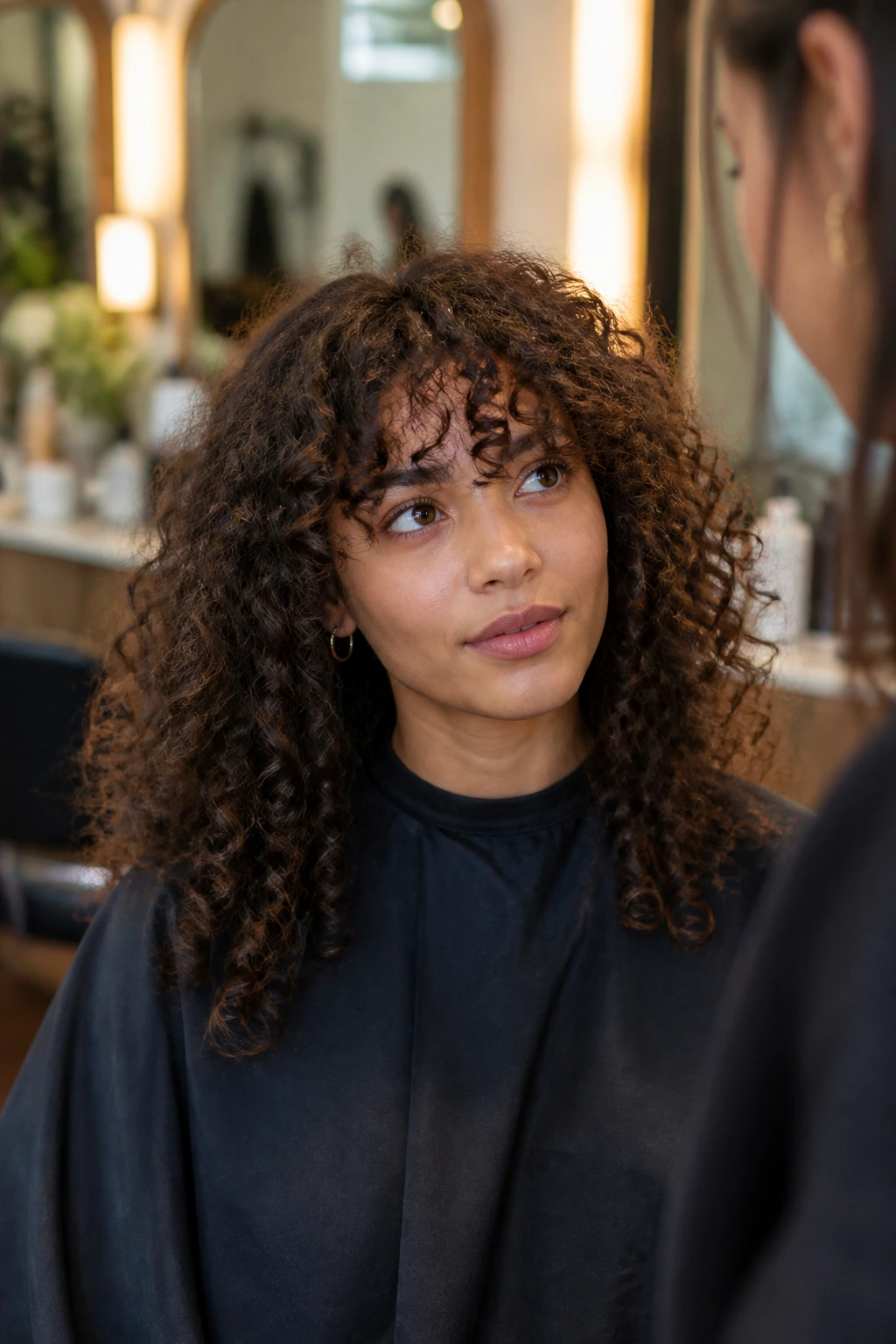
A good curly bang cut is less about the haircut menu and more about the conversation. Tell the stylist how often you wear your hair natural, whether you side part or center part, and how much shrinkage you usually see around the forehead. That last one matters more than people think. A half inch in the chair can turn into a full inch and a half after drying.
Ask for the bang section to be cut in the same pattern you wear it. If you always part your hair off-center, don’t let someone insist on a strict middle part just to make the sections look even on the head. Curly hair is not a geometry test.
Bring photos, but bring ones that match your curl pattern and density. A photo of loose waves won’t help a 4B coil much, and a photo of a thick curl cloud won’t help fine curls either. The useful picture is the one that shows the front length and the relationship between the bang and the face layers.
How to Style the Front So It Looks Soft, Not Puffy

The cleanest curly bang shape usually starts while the hair is still damp. Set the fringe where you want it to land, then use a small amount of mousse or foam from roots to mid-lengths so the front has hold without heaviness. If you like a little more definition, add a thin layer of gel on the very ends only. Too much product near the roots can pin the fringe flat, and that ruins the lift.
Diffusing matters more here than it does on the rest of the head. Cup the bang section gently in the diffuser bowl, and keep the airflow low to medium. A hot blast can pull the front apart before the curl sets, which is how you end up with the weird separated bang pieces nobody asked for.
Parting: Decide on your part while the hair is damp. Curly bangs take that cue seriously.
Texture: Keep the front lightly defined, not stiff. A soft cast is better than a crunchy one.
Volume: Clip the roots for a few minutes if the bangs collapse too fast.
Finish: Scrunch only when dry, and only if the front needs a little movement. Sometimes the curls already know what they’re doing.
Additional Shape Boosters and Small Fixes

Root Lift: If your fringe sinks into your forehead, clip the roots for 5 to 10 minutes while the hair dries. That tiny lift changes the whole front silhouette.
Curl Separation: If the bangs clump into one thick piece, separate them with wet fingers before they dry. Don’t rake through later and expect kindness from the curls.
Humidity Shield: A light anti-frizz serum on the very outer layer of the face-framing pieces can help in damp weather, but keep it off the roots or the fringe may flatten.
Midweek Reset: Mist the bangs only, scrunch once, and diffuse for a few minutes. You usually do not need to rewash the whole head just because the front has gone sleepy.
Make It Yours: If you wear glasses, keep the center a touch shorter and the side layers slightly longer so the frames do not crowd the face.
Common Mistakes That Ruin the Shape Fast

Cutting the bangs wet and too short. This is the classic mistake. Wet curls stretch, then spring up, and the fringe ends up floating higher than you meant. Fix it by cutting dry or nearly dry, and leave the first pass longer than you think.
Making the fringe too dense. A heavy front section looks like a curtain, not wisps. The symptom is a flat, bulky bang line that blocks the forehead and fights your curl pattern. Ask for point cutting and lighter density at the center.
Starting the face-framing layers too low. If the layers begin at the chin on a haircut that needs cheekbone movement, the front can still look boxy. The fix is simple: have the layers begin closer to the temple, cheekbone, or upper jaw, depending on your face shape.
Using too much cream in the front. Rich products can make wispy bangs collapse and separate in weird strings. Switch to foam or mousse for the bangs and save the heavier cream for the mid-lengths.
Ignoring the natural part. If your curls split hard on one side, forcing a center fringe can make the front keep drifting apart. Work with the part you already have or at least keep the central section narrow enough to move with it.
Over-texturizing the ends. Too much thinning turns curly bangs frizzy and hollow. A few deliberate point cuts are enough; you do not need to erase half the hair to create softness.
Variations and Adaptations to Try
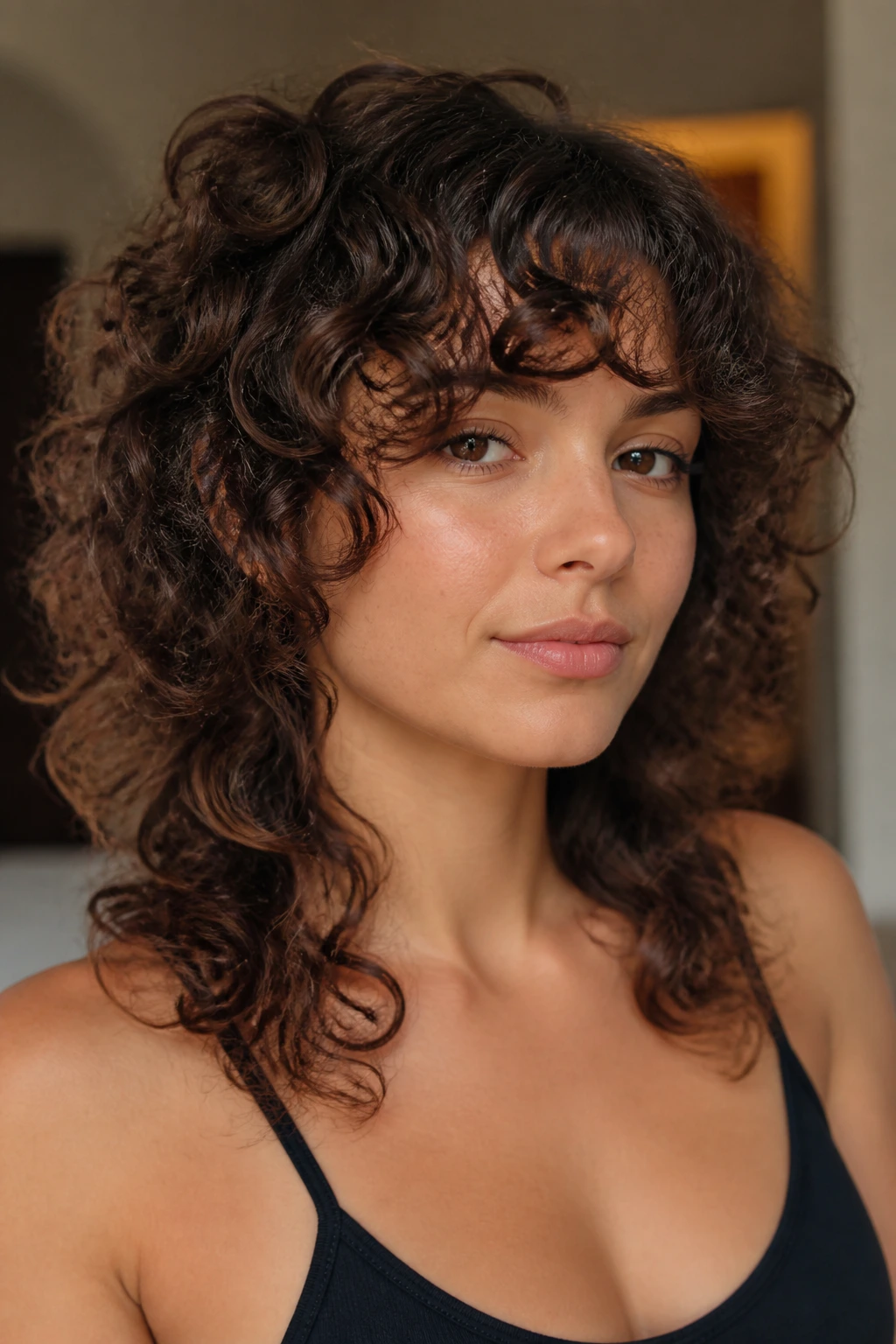
The Low-Maintenance Grow-Out: Keep the fringe longer, around nose to lip length when dry, and let the face-framing layers start at the cheekbone. This is the easiest version if you do not want a sharp line that needs constant trimming.
The Soft Shag Hybrid: Pair wispy bangs with more broken-up crown layers and cheeky front pieces. It suits curlier textures that like movement and looks especially good when air-dried.
The Glasses-Friendly Sweep: Cut the bangs slightly shorter in the middle, then angle the sides longer so the fringe clears the frame arms. This keeps the front open and stops the lenses from getting crowded.
The Coil-Forward Halo: For tighter textures, let the front sit in soft ringlets instead of flattening into a line. The result is fuller and more sculptural, with the bangs blending into the side layers in a rounded arc.
The Quiet Side Part: Shift the front section into a deep side part and let the bangs skim one eye line. It’s useful when the center part keeps splitting or when you want a more relaxed, asymmetrical finish.
Keeping the Shape Between Trims
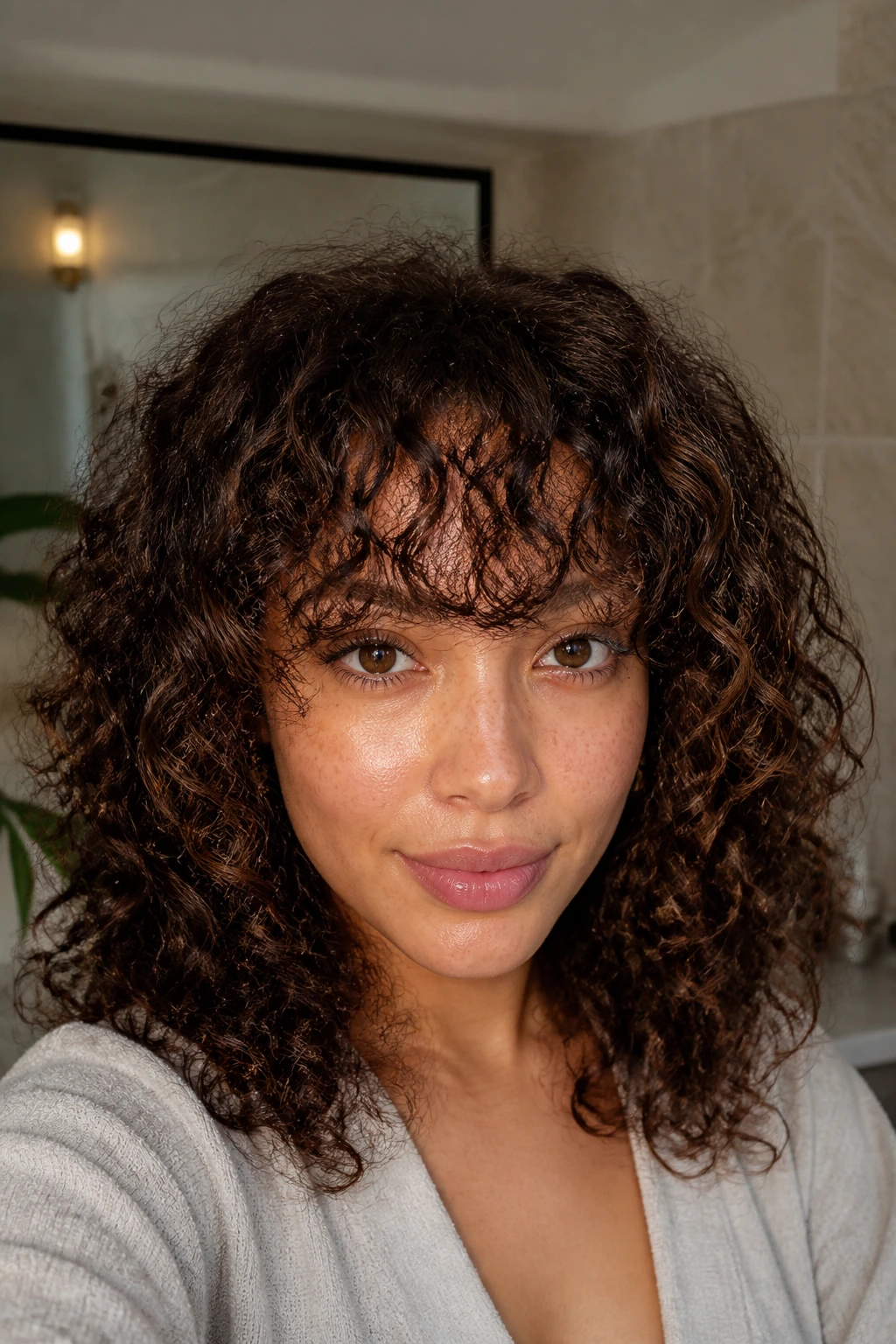
Curly bangs need a little maintenance, but not the panicked kind. A fringe trim every 6 to 10 weeks usually keeps the shape from drifting too far, though tighter curls may stretch that schedule a bit if the cut starts longer. If the bangs are part of a face-framing layer system, the sides often grow out more gracefully than the front, so the bang area is the first place to check.
At home, the front usually needs more frequent refreshing than the rest of the head. That’s normal. The forehead creates friction, sweat, and oil, and bangs react to all three. A quick water mist, a small amount of foam, and a few minutes under the diffuser are often enough to bring them back to life.
Sleeping with curly bangs loose is a gamble. A silk bonnet, silk pillowcase, or even clipping the fringe up and away from the face can keep the shape from flattening. If the curls are especially delicate, I’d rather see them protected at night than washed every single morning. That gets old fast.
The other habit worth keeping is a front-section check on wash day. If the bangs start to separate into two different stories — one side puffed, one side flat — fix that while the hair is damp. It takes thirty seconds then and turns into thirty minutes later if you ignore it.
FAQ About Soft Curly Bangs and Face-Framing Layers
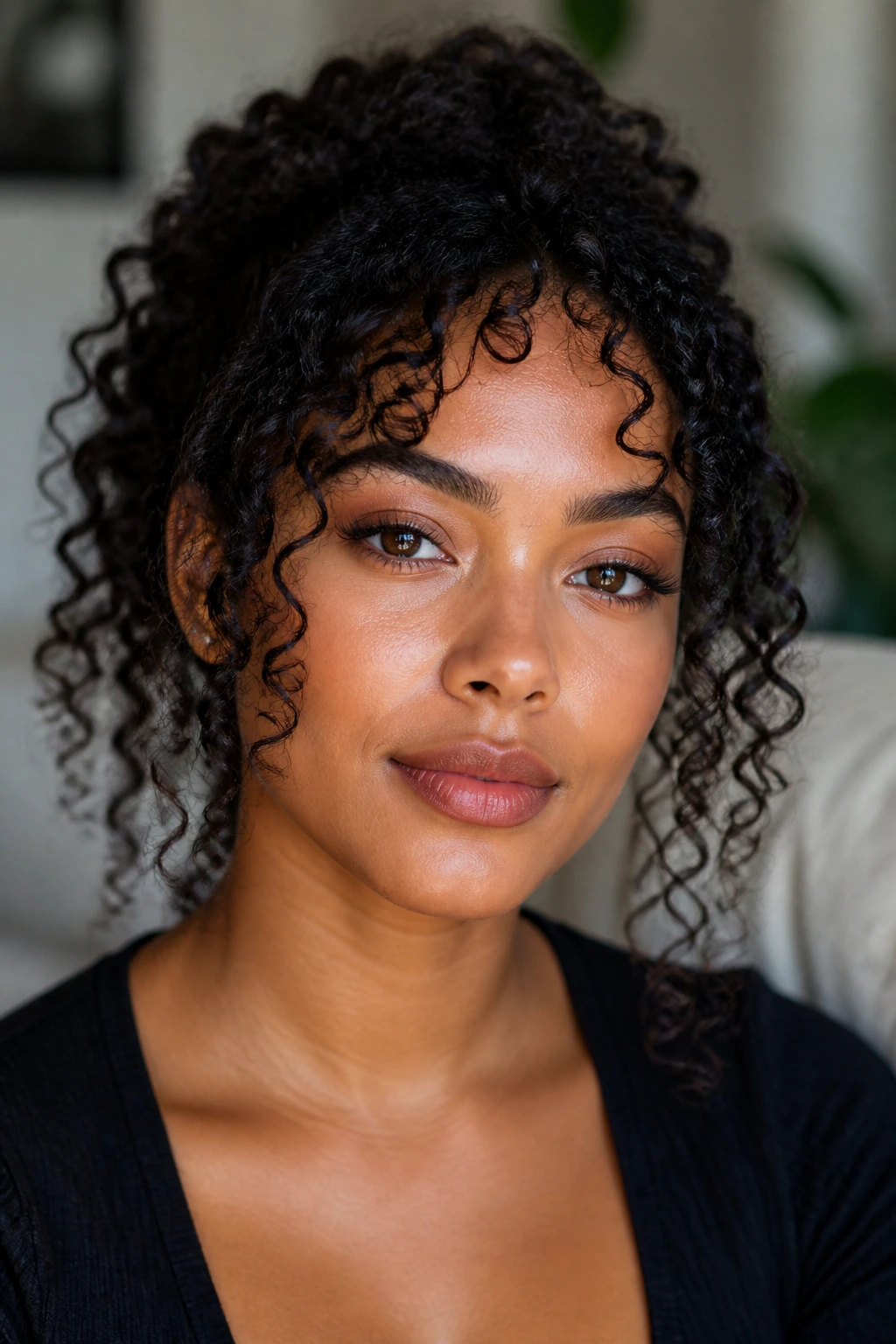
Will wispy bangs work on tight curls?
Yes, but the front should be cut with more length and less density than loose curls need. Tight curls spring up quickly, so the real goal is a soft frame, not a short strip of hair across the forehead.
Should curly bangs be cut wet or dry?
Dry is safer in most cases. Wet curls lie about their length, and the bang area is too easy to cut too short if you trust the damp shape.
Do face-framing layers make curly hair look thinner?
Not if they’re cut with restraint. Well-placed front layers remove bulk where it sits heavy and keep the outline soft, but over-layering can make the ends look stringy. The difference is where the layers start and how much weight gets removed.
What if my bangs keep splitting in the middle?
That usually means your part or cowlick is pushing them apart. Try a narrower bang section, a different part placement, or a light root clip while the front dries.
How often will I need trims?
Most curly fringe shapes need a cleanup every 6 to 10 weeks, though longer bang styles can stretch beyond that. The shortest front point tells the truth first; when it starts hanging in your eyes or bouncing too high, it’s time.
Can I wear curly bangs back on bad hair days?
Absolutely. Longer wispy fringes tuck behind the ear, clip back, or disappear into a twist faster than blunt bangs do. That flexibility is one of the reasons these cuts stay wearable.
What product keeps the front soft instead of crunchy?
A light mousse or foam usually does the trick better than heavy cream. If you want extra control, add a tiny bit of soft-hold gel to the very ends, not the whole fringe.
Will these styles work if my curls are mixed textures?
Yes, but the front should be cut to the texture that appears most often around the hairline. Mixed patterns need a bit of patience in the chair, because the bang section may behave differently from the rest of the head.
The Fringe That Lets the Curl Lead
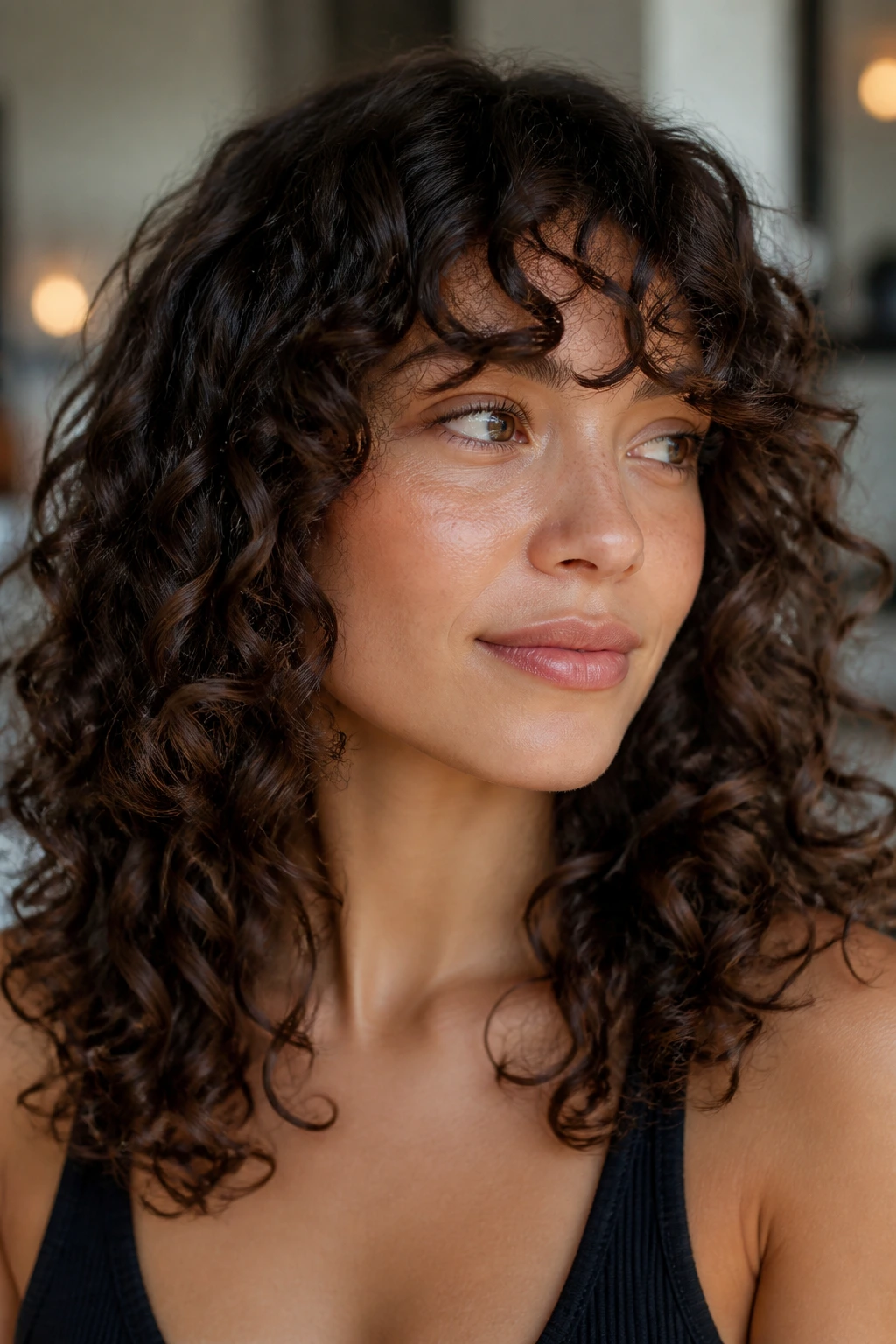
The best curly bangs do not try to tame curl pattern into silence. They give it a frame, a landing place, and enough softness to move with your face instead of fighting it. That is why the wispy versions work so well: they keep the front light, they let the side layers do some of the visual lifting, and they leave room for the hair to spring the way it wants to.
If there is one thing to carry into the salon, it’s this: show your stylist where the curls actually land when dry, not where you hope they’ll land. That one detail changes the cut more than any trendy label ever will. Bring that, plus a sense of how much maintenance you’ll tolerate, and the right front shape gets a lot easier to find.
A good curly fringe should make you feel like your hair is finally speaking the same language as your face. Once it does, everything else — the part, the cheek layers, the little pieces that fall around the eyes — starts making sense.