



Thick hair behaves differently at formal events. It doesn’t flatten into place and politely stay there. It pushes back. It takes up space. And if the style isn’t built with that in mind, you end up with a bun that looks crowded, a ponytail that feels heavy by dinner, or curtain bangs that split too wide and start doing their own thing halfway through the night.
That’s exactly why formal hairstyles for thick hair with curtain bangs can look so good when they’re done with a little strategy. Curtain bangs soften the face without hiding it, and thick hair gives the whole shape enough substance to look finished instead of flimsy. The trick is not fighting the bulk everywhere. It’s choosing where the volume should live. Low at the nape? Great. Lifted at the crown? Also great. Pinned into a twist with a few loose tendrils? Even better.
There’s a nice range here, too. Some of these looks lean polished and sharp, some are softer and romantic, and some sit right in that middle ground where the hair looks controlled but not stiff. The best ones do one very practical thing: they let thick hair do what it already wants to do, then direct it instead of wrestling it flat.
Why These Styles Work So Well on Thick Hair
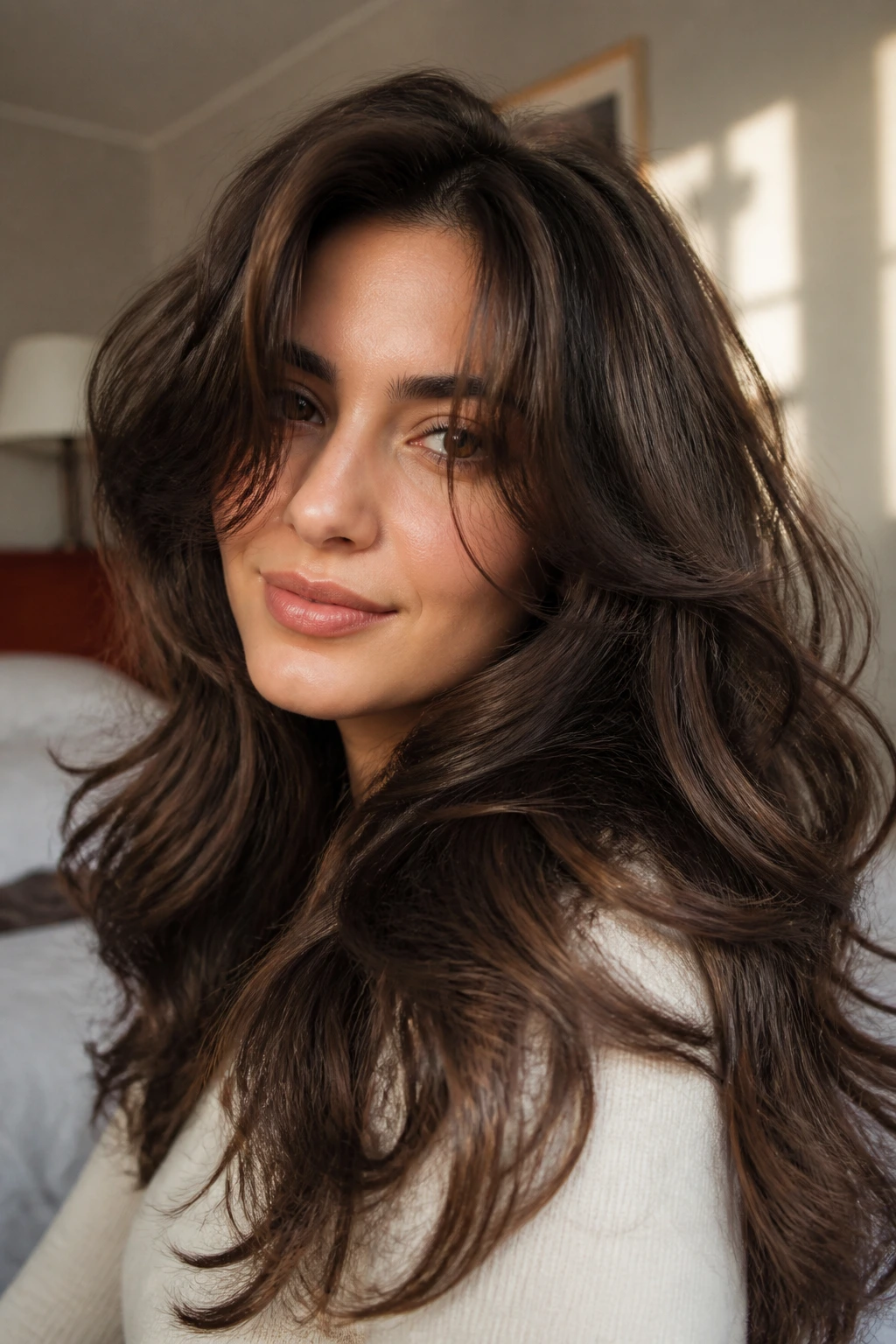
- The weight helps the shape: Thick hair gives buns, twists, and ponytails a fuller outline, so the style reads intentional instead of wispy.
- Curtain bangs soften formal lines: A center-split fringe keeps slick styles from looking severe, especially around the forehead and cheekbones.
- Pins stay hidden more easily: Dense hair covers anchors and elastic wraps, which makes updos look cleaner with less fuss.
- Texture holds better: Waves, bends, and braids tend to last longer because there’s more hair to hold the pattern.
- You get options at every length: Even if your hair is mid-back or just past the shoulders, curtain bangs make the front look styled while the back does the heavy lifting.
1. Sculpted Low Chignon
A low chignon is one of those styles that quietly knows what it’s doing. On thick hair, it doesn’t collapse into a skimpy knot at the nape; it becomes a real shape with some architecture to it. Add curtain bangs, and the whole thing softens at the front so the style feels formal without turning stiff.
Why it works: Thick hair gives the chignon enough bulk to look expensive in the old-school sense — full, smooth, and solid at the base. The curtain bangs keep the front from looking too severe, especially if you curve them away from the face with a 1-inch round brush or a curling iron turned vertically.
Best move: Smooth the top with a light cream, twist the length into a low coil, and pin from underneath with long bobby pins. A tiny bit of shine spray at the end is enough. Too much, and the chignon starts to look oily instead of polished.
2. French Twist with Soft Curtain Lift
A French twist changes the mood fast. It takes thick hair and turns it upward, which is useful when you want the back of the head to feel sleek but not flat. The curtain bangs matter here because they break up that straight vertical line and keep the style from feeling overly tight.
This version works best when the twist is smooth through the sides and slightly soft at the crown. You do not need every strand glued down. In fact, if your hair is very thick, a little texture at the root helps the twist sit better and keeps it from looking like a helmet. Leave the bangs with a gentle bend, then tuck the ends of the fringe just past the cheekbone for that easy split-front frame.
3. Old Hollywood Waves
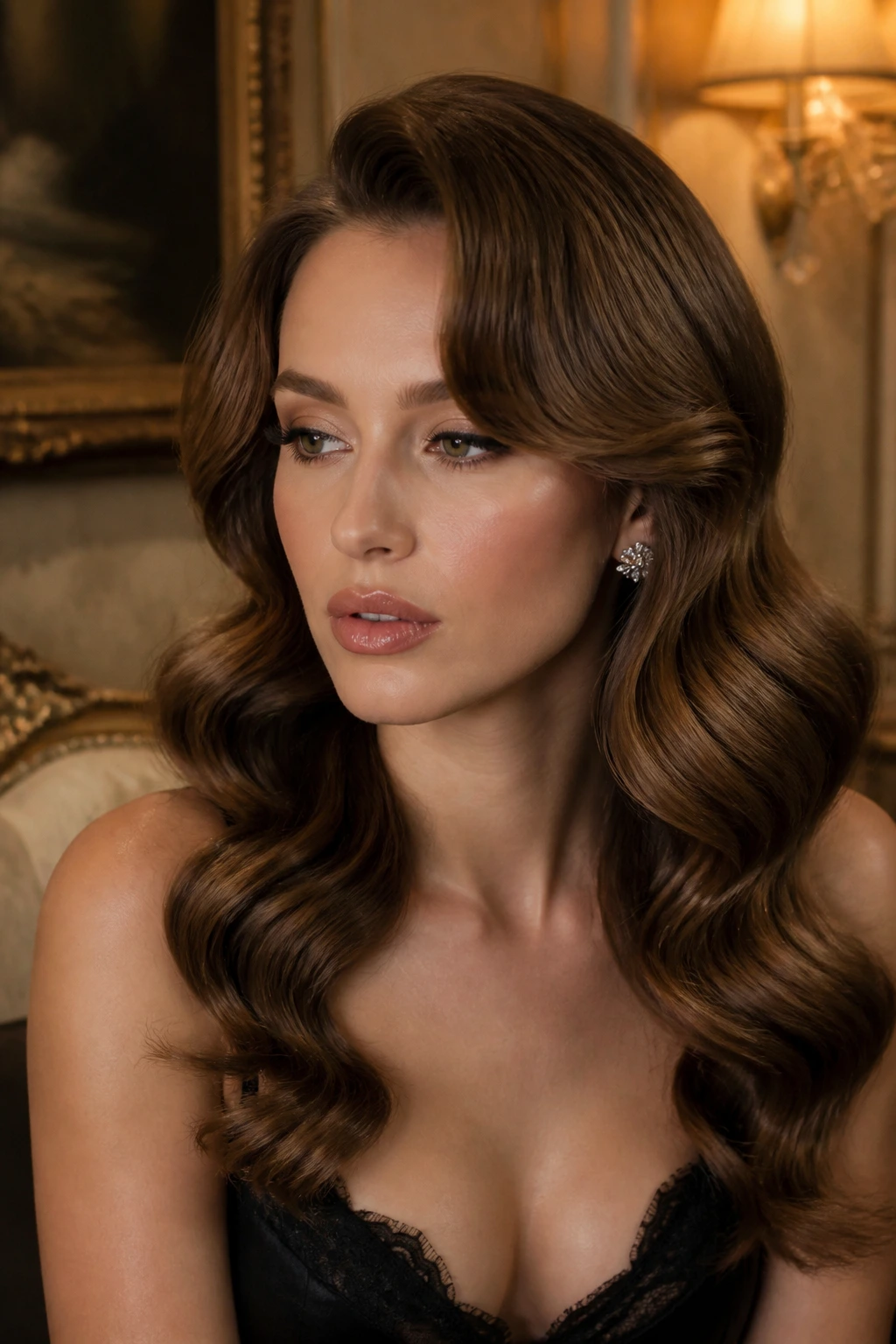
Thick hair is made for waves that have some weight to them. Fine hair often needs help pretending. Thick hair does not. The structure is already there, which is why a deep side-swept wave set or center-parted Hollywood wave can look so rich on this texture.
Curtain bangs fit this style because they echo the wave pattern instead of fighting it. Set the bangs with a large barrel or Velcro roller away from the face, then brush them into that soft split. The key is keeping the wave line clean from mid-length to ends. If the ends puff out, the whole style loses its formality. If you brush too much, the waves turn into one big cloud. Go slow. Let each section cool before you touch it again.
4. Sleek Wrapped Low Ponytail
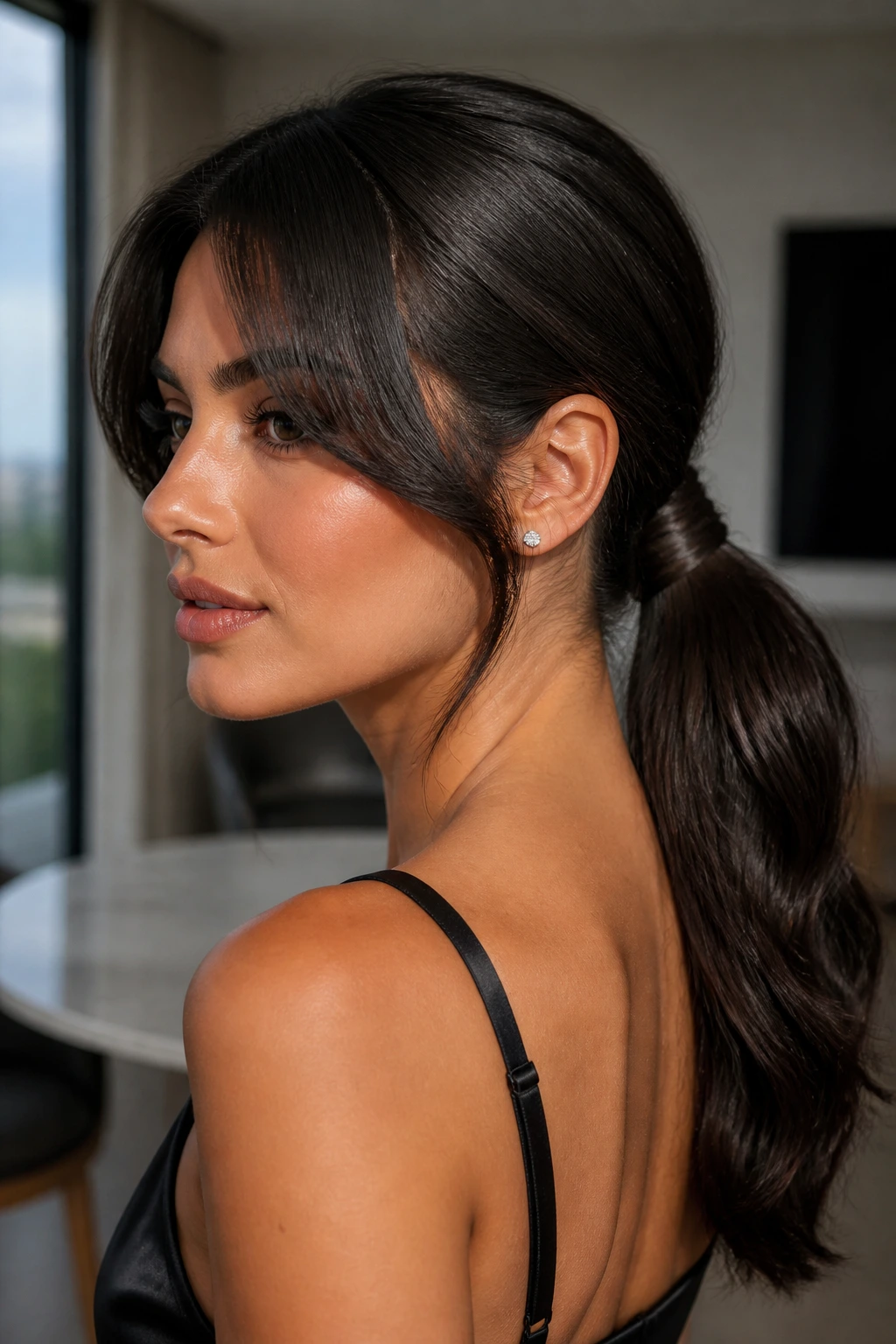
If you want clean lines, start here. A wrapped low ponytail is one of the easiest ways to make thick hair look deliberate at a formal event, because the weight of the hair helps the ponytail hang in a full, smooth line instead of shrinking into a stub.
The curtain bangs do the softening work while the rest of the style stays sharp. Blow-dry the fringe first, then press the top smooth with a paddle brush and a little smoothing cream. Wrap a small section of hair around the elastic, pin the end underneath, and keep the tail straight or give it one soft bend with a flat iron. It reads modern. It also lasts.
5. Half-Up Twist Crown
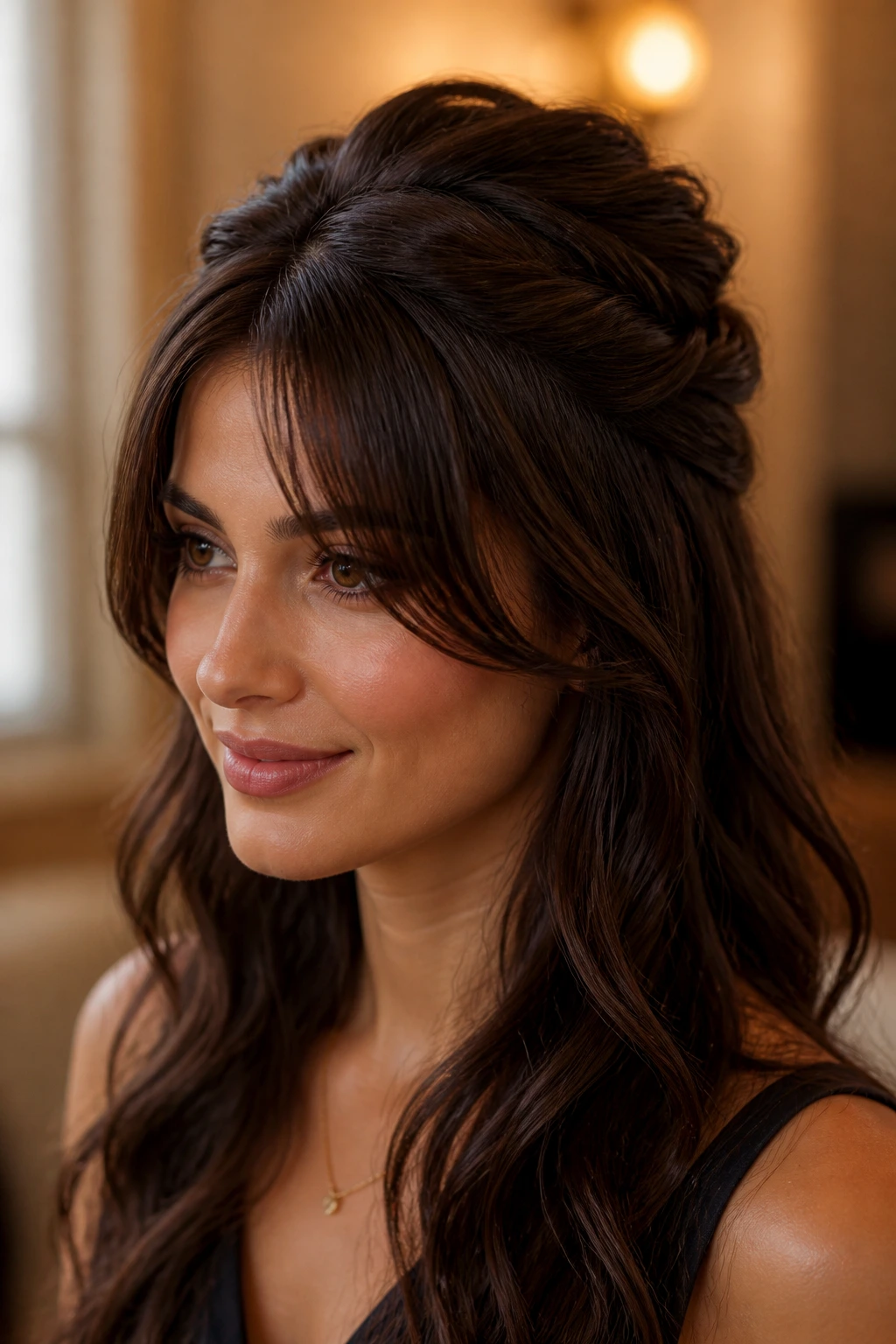
Half-up styles are a sweet spot for thick hair. They take pressure off the face and crown without making you put every last strand up. That matters when your hair has real density, because full updos can feel heavy after a couple of hours.
A twist crown keeps the front tidy and lets the length stay loose, which is where curtain bangs earn their keep. The bangs bridge the gap between the pinned crown and the rest of the hair, so the style doesn’t look split into two unrelated parts. I like this one with soft curls underneath — nothing too ringlet-y. The top should look structured, the bottom should move.
6. Braided Crown Bun
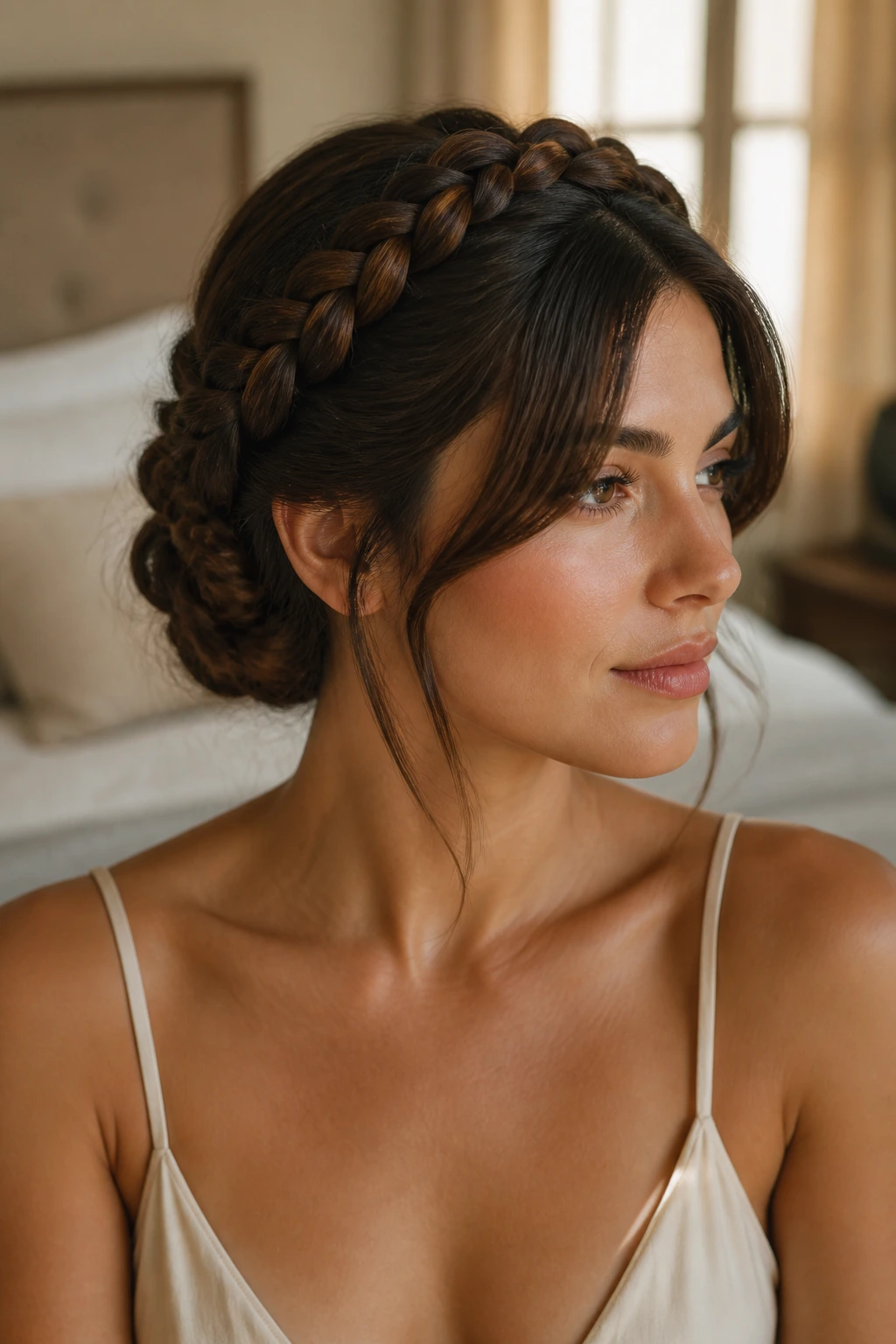
Braids and thick hair get along. That is the simple truth. A braided crown bun uses that bulk to create detail instead of hiding it, and the curtain bangs keep the front from feeling too formal or too young.
The braid acts like a built-in headband, which is useful if your hair slips at the temples. Wrap the braid into a bun at the back or slightly off-center, depending on how much drama you want. The only real warning: keep the braid tension even. If the braid tightens in one spot, thick hair can make the ridge look chunky. Soft, even sections look far better.
7. Soft Textured Low Bun
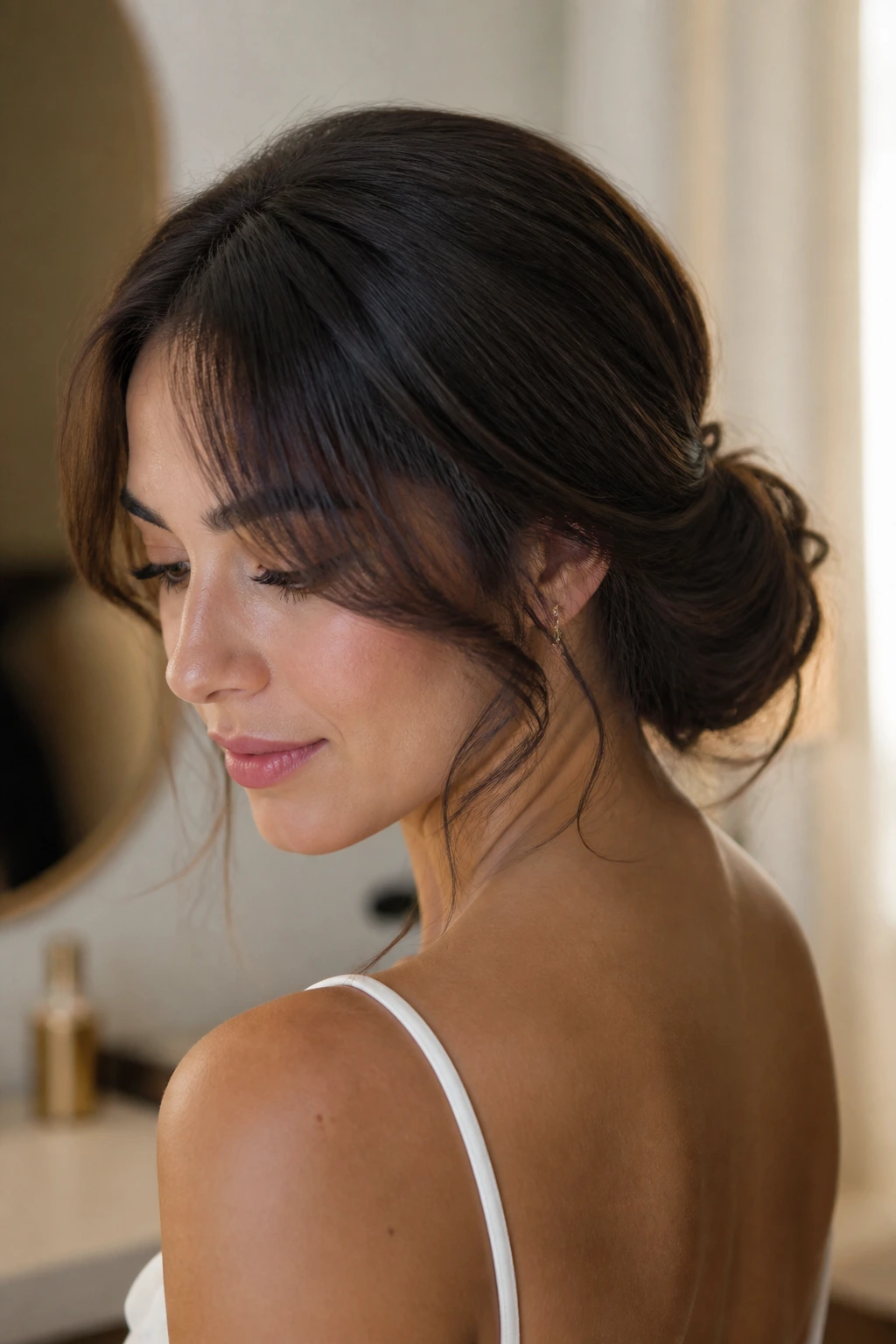
A soft low bun is the style I reach for when I want the hair to look polished from across the room but less rigid up close. Thick hair gives you enough volume to build a bun with actual shape, and a few loose pieces around the ears stop the whole thing from feeling too severe.
Curtain bangs make this style easy to wear with a dress that has a high neckline or a sharp collar. They create a visual break right where the face begins, which keeps the bun from looking like a hard line. The texture matters here. A little grit from a texturizing spray gives the bun grip and a more expensive finish than slicking it down flat.
8. Bubble Ponytail
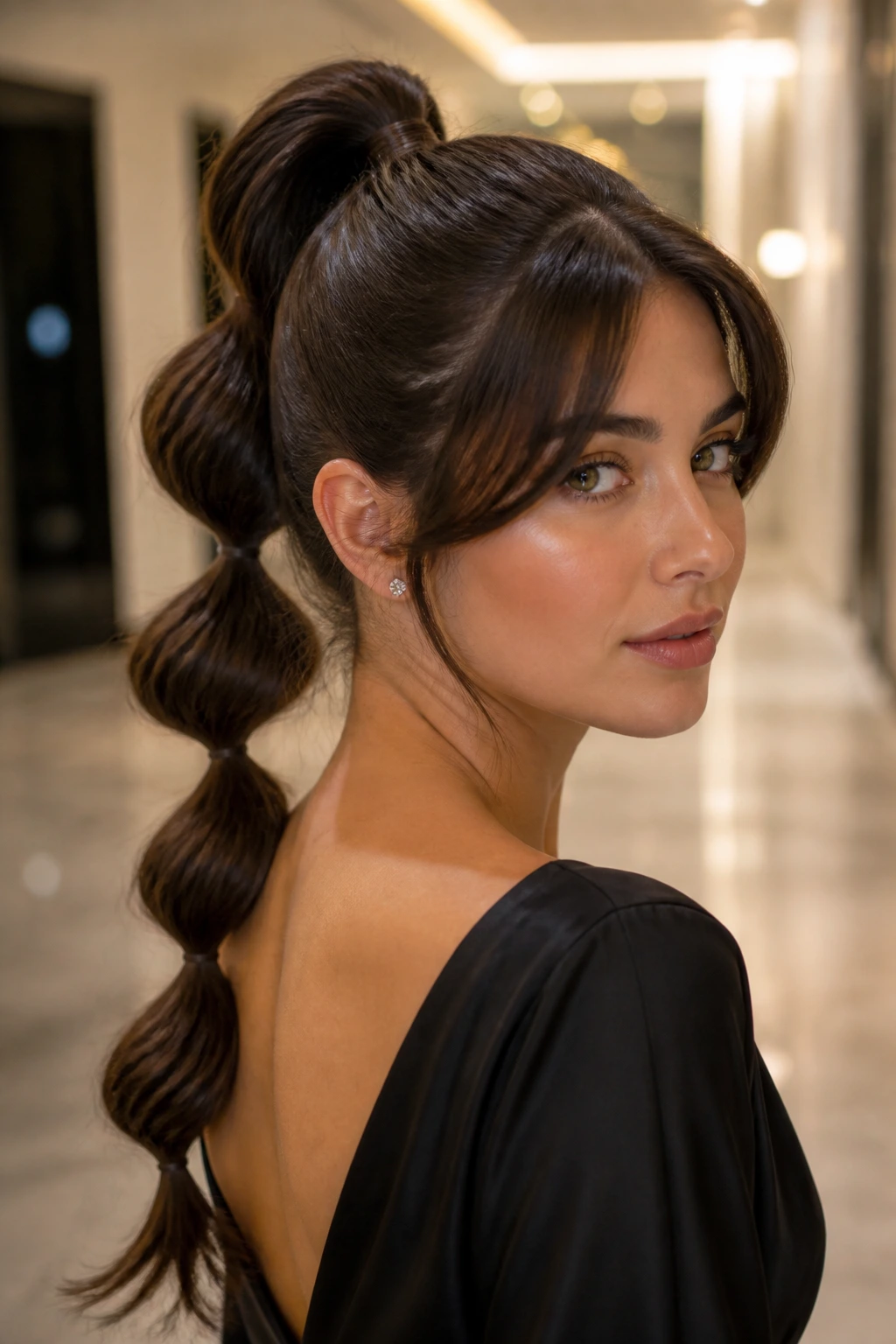
Bubble ponytails look fussy on fine hair. On thick hair, they make sense. You’ve got enough volume to fill each section, so the “bubble” reads as a real shape instead of a sad little puff.
Curtain bangs make this style feel formal instead of playful. The fringe frames the face while the ponytail does the visual work down the back. Use small elastics spaced evenly down the tail, then gently tug each section outward until it rounds. Don’t over-pull. You want defined bubbles, not exploded ones. A glossy finish helps a lot here, because thick hair can go puffy fast if the cuticle is rough.
9. Side-Parted Voluminous Blowout
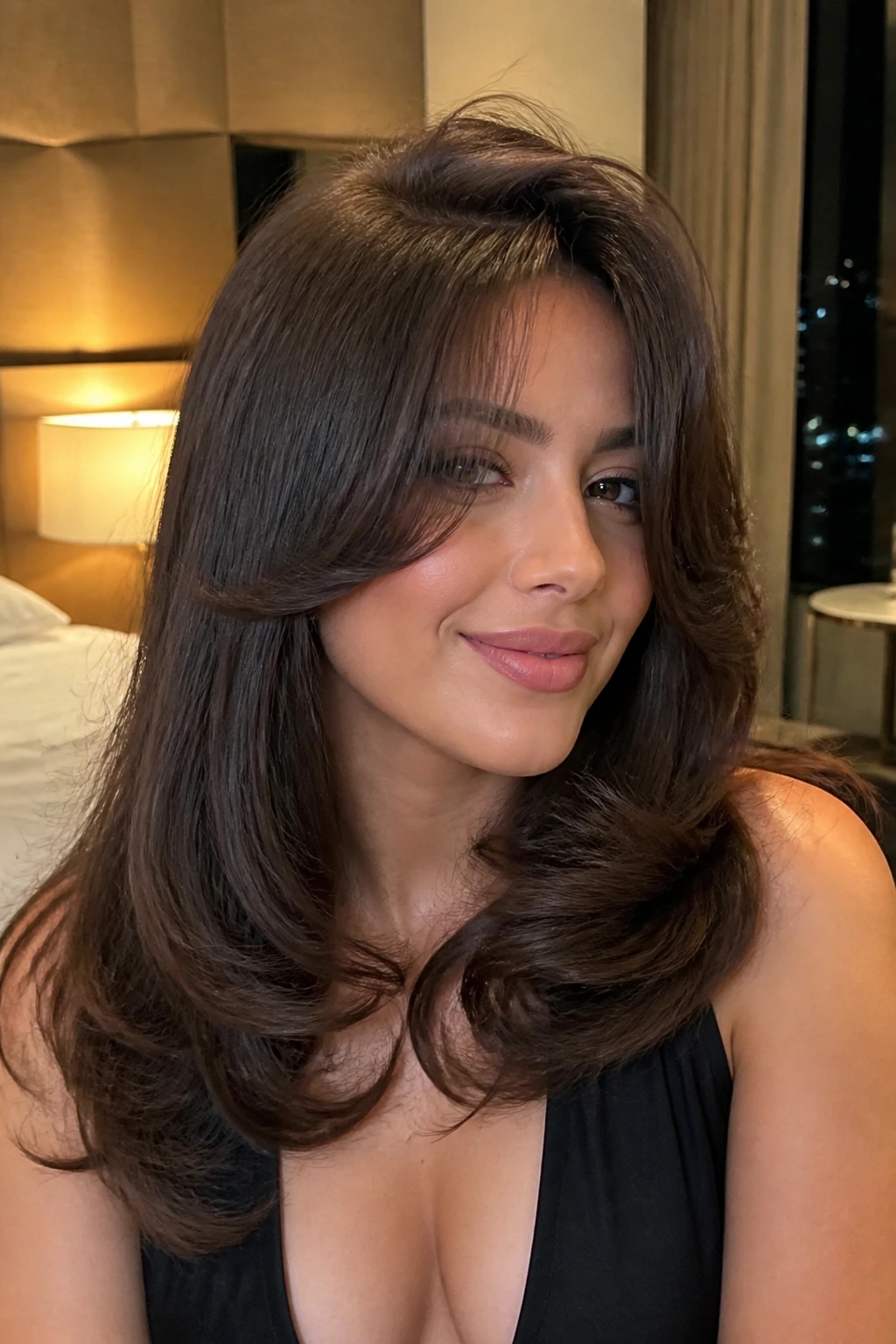
Not every formal look needs pins. Sometimes the smartest move is a blowout with a strong shape, a deep side part, and curtain bangs that fall into the face just enough to soften the line. Thick hair holds this look better than almost any other texture, because the body is already there.
The secret is control. Use a round brush and keep the ends beveled, not flipped wildly. The curtain bangs should sweep out and down, not stick straight forward. A light mist of flexible hairspray at the root is enough. If you load the whole head with product, the blowout loses the movement that makes it feel dressed up.
10. Sculpted Side-Swept Ponytail
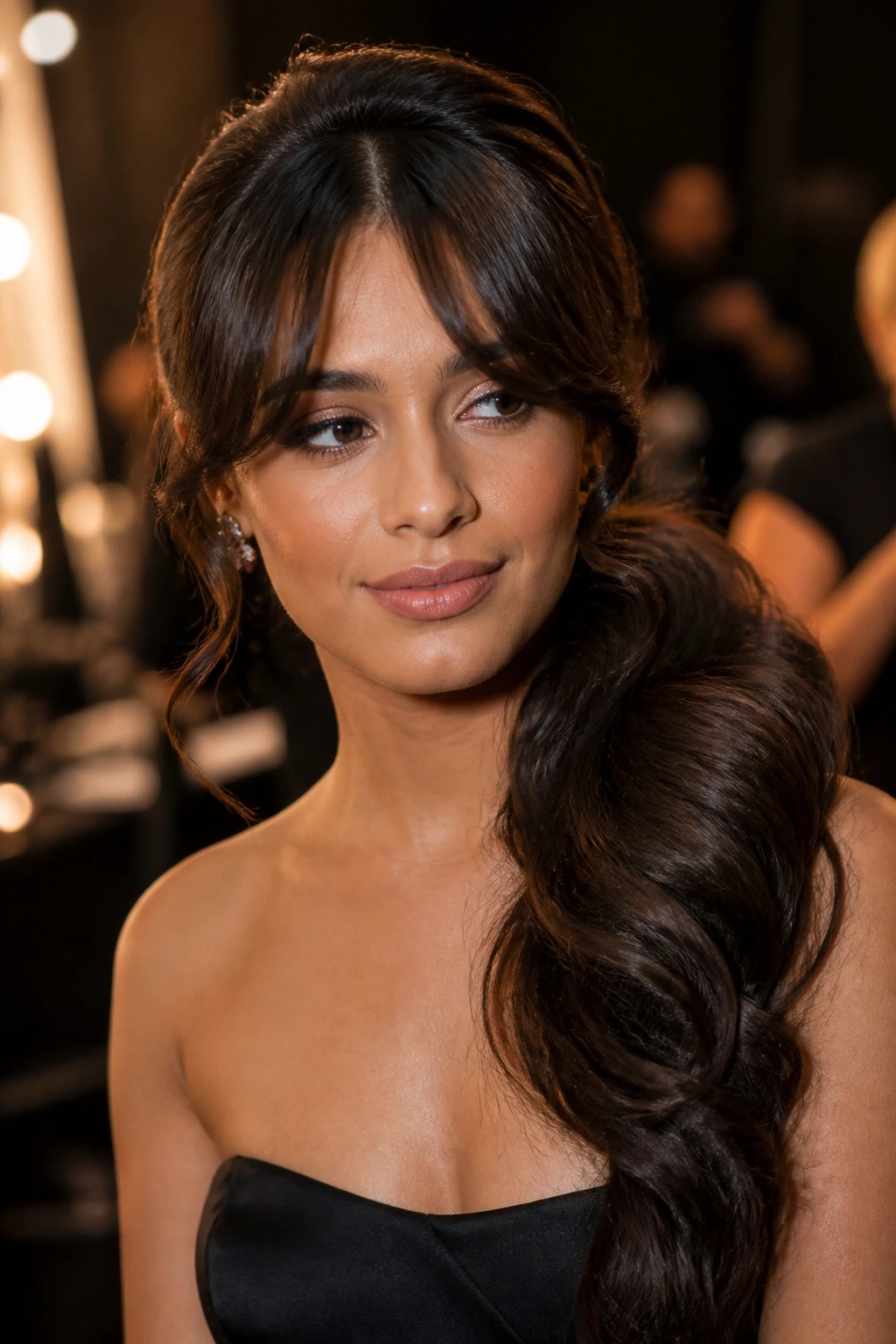
A side-swept ponytail brings the drama lower, which can be a relief if you don’t want a high updo sitting on top of your head all night. Thick hair gives the ponytail weight, so it drapes across one shoulder with a nice line instead of bouncing around.
The curtain bangs help this style stay balanced. They keep the face open on both sides even though the ponytail leans off-center. I like a subtle bend through the tail — one or two large curls, brushed into a smooth curve. The point is elegance, not volume for volume’s sake.
11. Cascading Curls Pinned to One Side
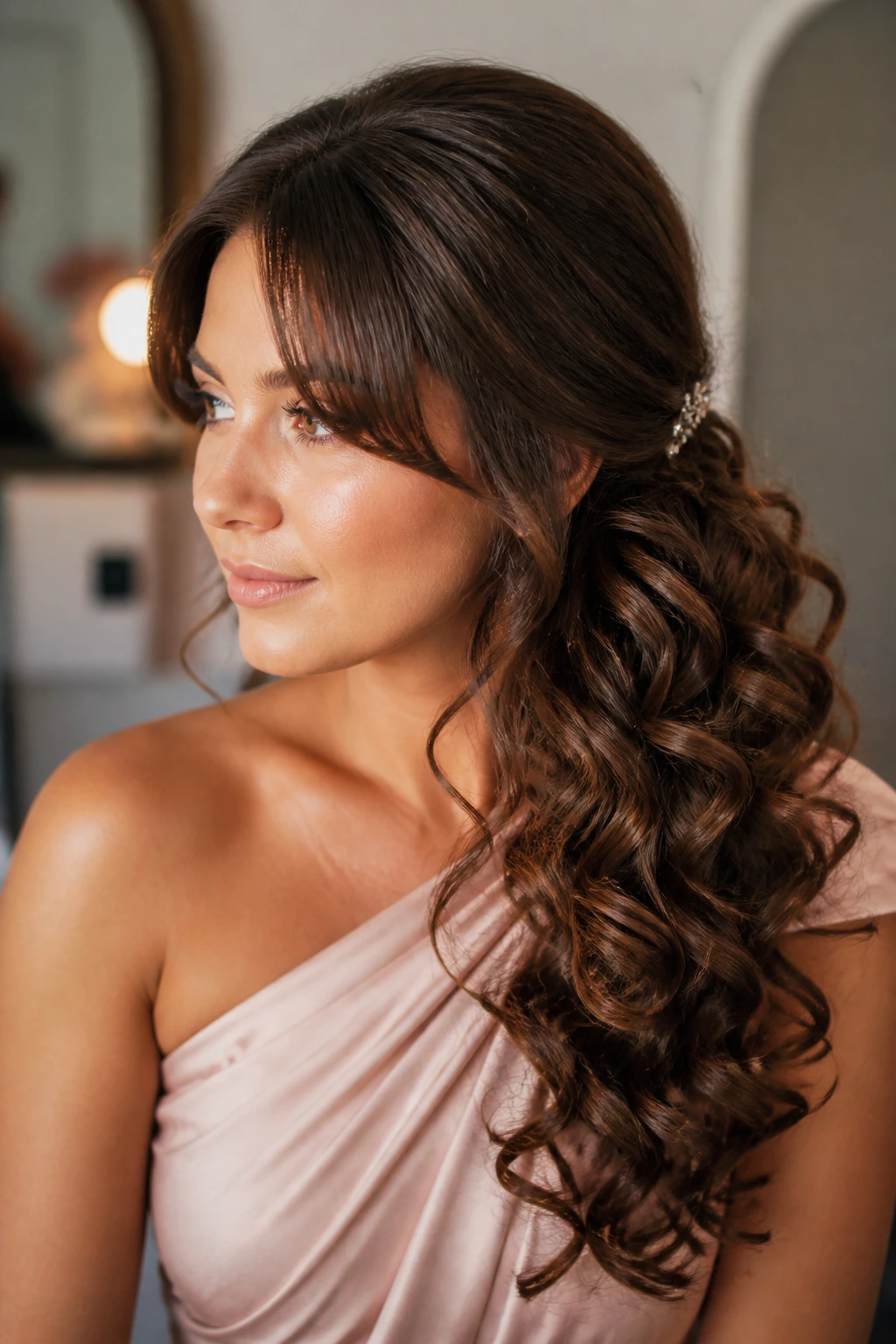
This is the style for when you want your hair to look lush and a little theatrical without building a formal updo. Thick hair gives the curls density, which makes the pinned side feel secure and the loose side feel full.
Curtain bangs are the bridge. They blend the pinned section into the rest of the hair so the style doesn’t look like a side sweep from the left and loose hair from the right. A single decorative pin above the ear is enough. More than that can start to look crowded, especially if the dress already has detail at the neckline.
12. Knotted Half-Updo
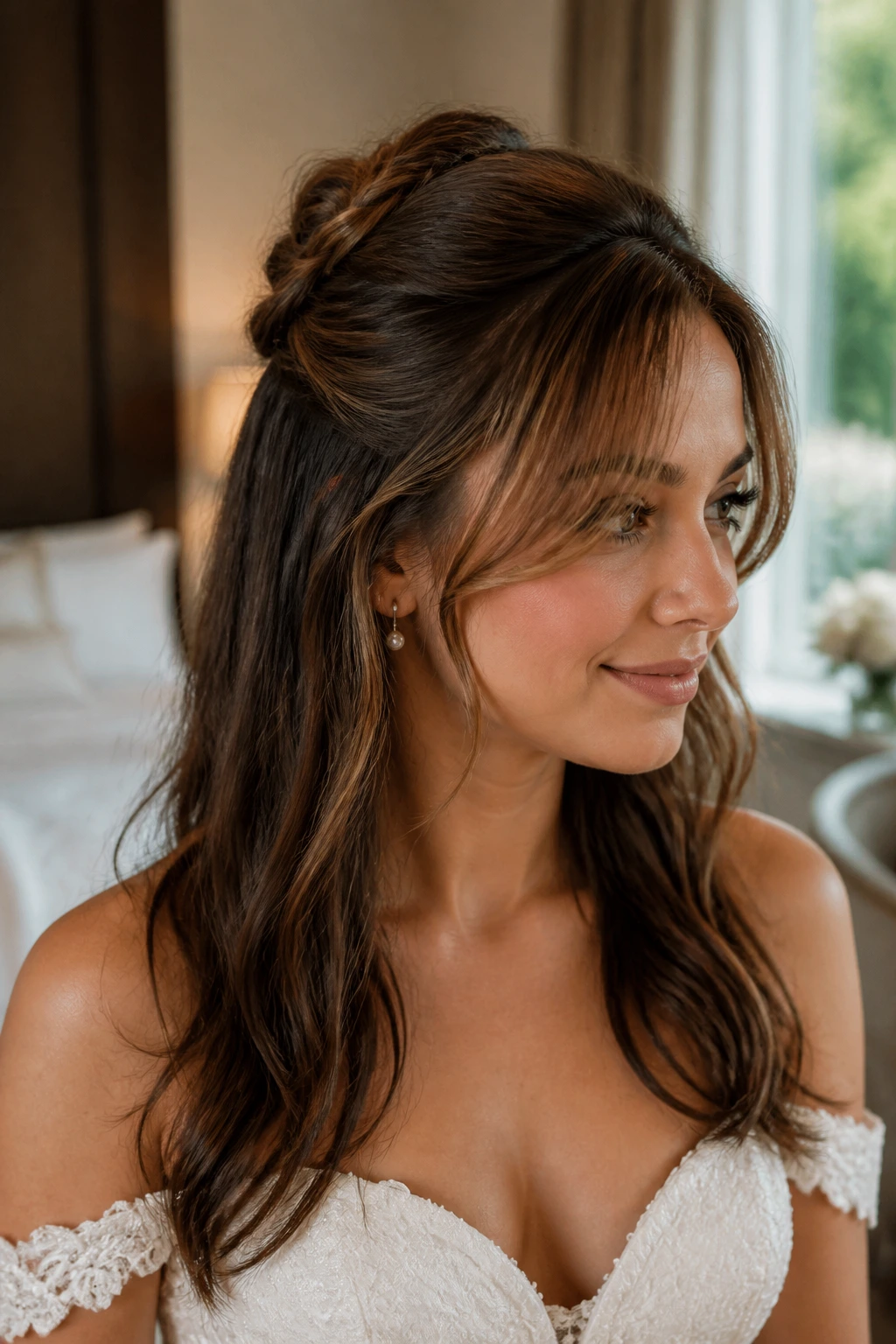
A knotted half-updo sits in that useful middle space between relaxed and polished. It’s neat, but not severe. It lets thick hair keep some movement while taking weight off the face and shoulders.
What makes it formal is the finish. Keep the top smooth, knot the two sections securely, then tuck the ends under and pin them flat. The curtain bangs should stay soft and rounded at the front — not curled into tiny tubes. This style works especially well if your hair has a bit of natural wave, because the loose length below the knot looks deliberate instead of over-styled.
13. Ballerina Bun with a Soft Fringe
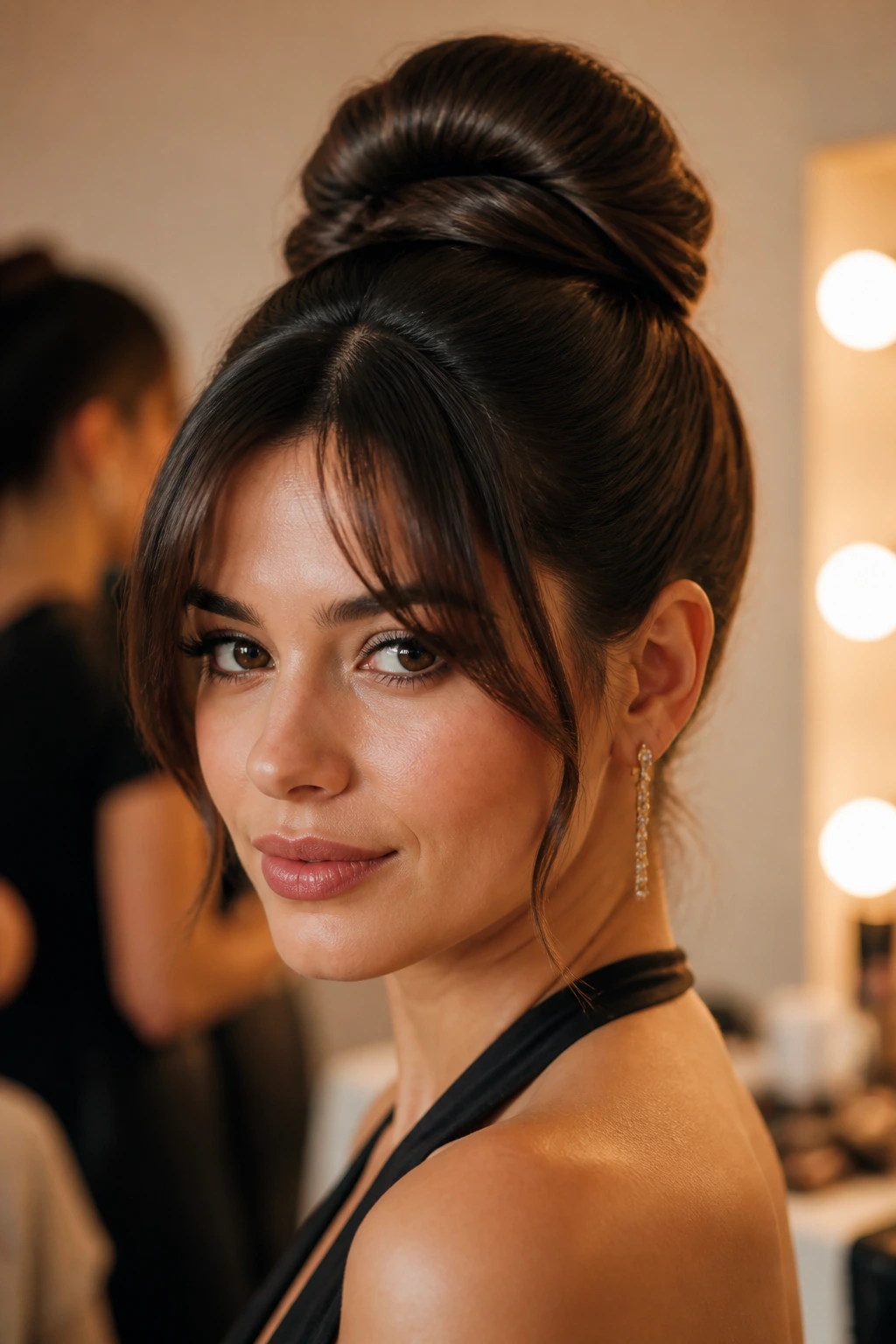
A ballerina bun on thick hair can go two ways. It can look elegant and clean, or it can look overstuffed. The difference is in the smoothing and the placement. Keep the bun centered or just below center, and don’t make it so tight that the head shape turns harsh.
Curtain bangs save the look from feeling severe. They give the face a little movement and stop the bun from dominating every angle. This is one of the best styles for high necklines and dresses with strong shoulders. It shows off the neck, keeps the hair off the back, and still gives you that soft front frame.
14. Dutch Braid into a Tucked Chignon
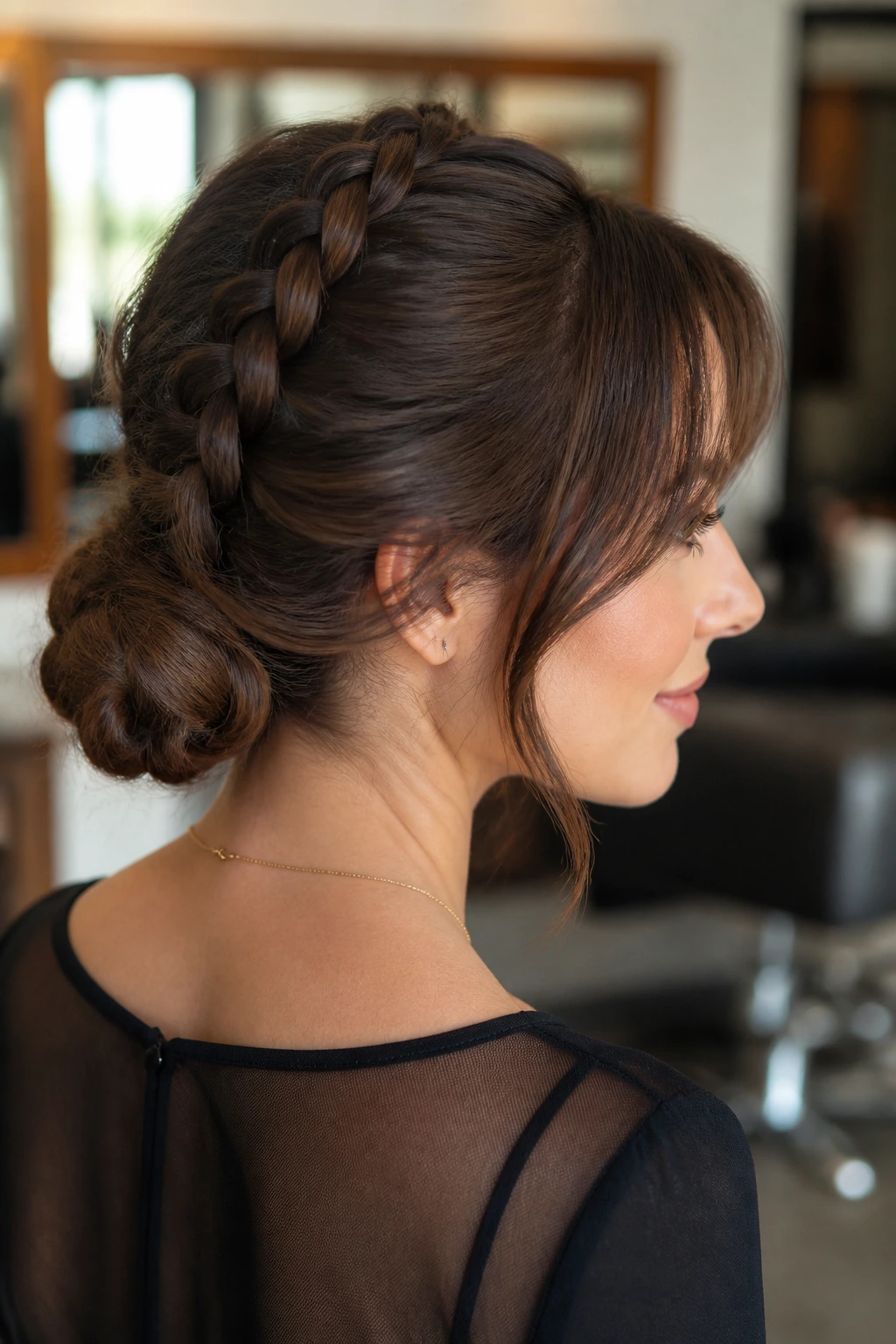
A Dutch braid gives thick hair direction. That’s the useful part. Instead of letting all that density spread out, the braid corrals it down the center of the head and into a tucked chignon at the nape.
The result feels detailed without being busy. Curtain bangs keep the front from getting too athletic or too school-uniform-like, which can happen with tightly braided styles. Leave the bangs with a gentle bend and keep a little softness around the temples. If the braid feels too large, that’s not a flaw — thick hair is supposed to make a braid look substantial. Lean into it.
15. Rope-Braid Chignon
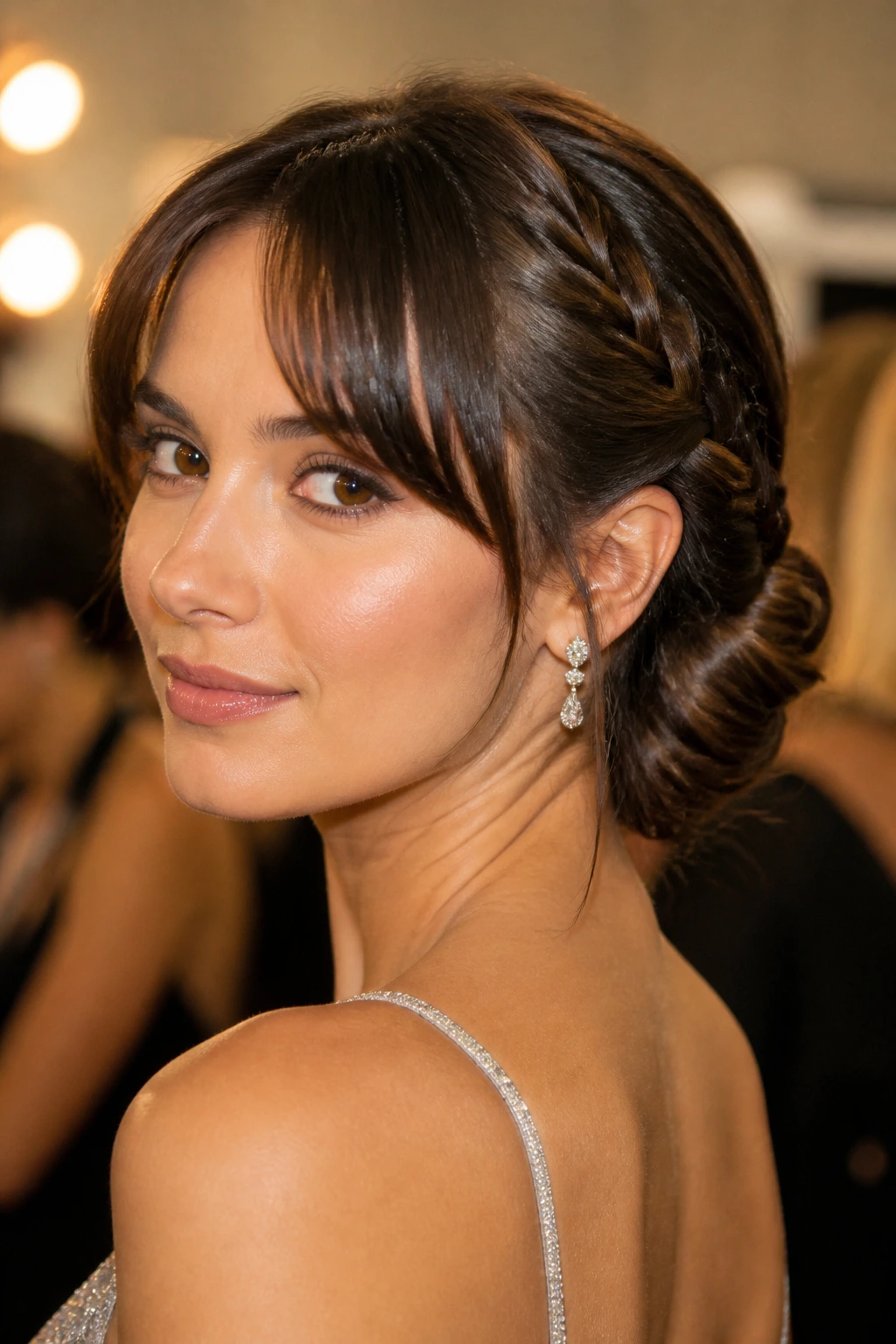
Rope braids have a cleaner, shinier look than many three-strand braids, and thick hair holds the twist well. That makes this style a good match for black-tie dinners or formal photos where you want something neat with visible detail.
The rope twist can start from the side, wrap toward the nape, and disappear into a low chignon. Curtain bangs help keep the forehead line open so the style doesn’t feel over-contained. If your hair is layered, use a tiny amount of pomade on the shorter pieces before twisting. It keeps the braid from fraying at the surface, which is one of those small fixes that makes the whole thing look more expensive.
16. Gibson Tuck with Curtain Bangs
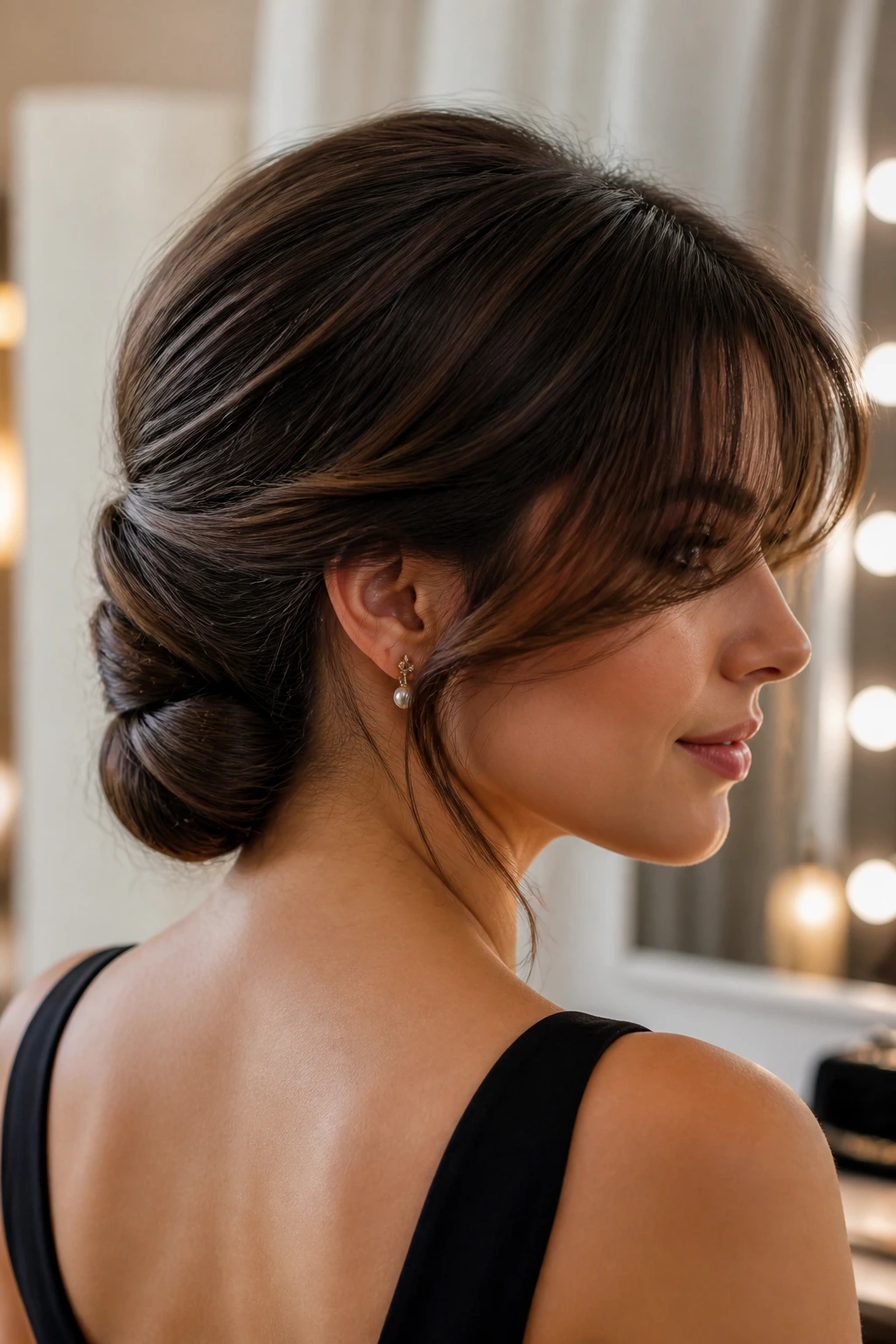
The Gibson tuck is old-school in the best way. It has that rolled shape at the nape that feels polished without needing a lot of visible pins, and thick hair gives it enough body to look full instead of skimpy.
Curtain bangs are what make the style feel current. They stop the tuck from reading too vintage or too costume-like. If your hair is long enough, roll it loosely and tuck the ends under in sections. If it’s very thick, split the back into two rolls rather than one giant fold. That makes the shape lie flatter and keeps the nape from puffing out under the roll.
17. High Twist Bun
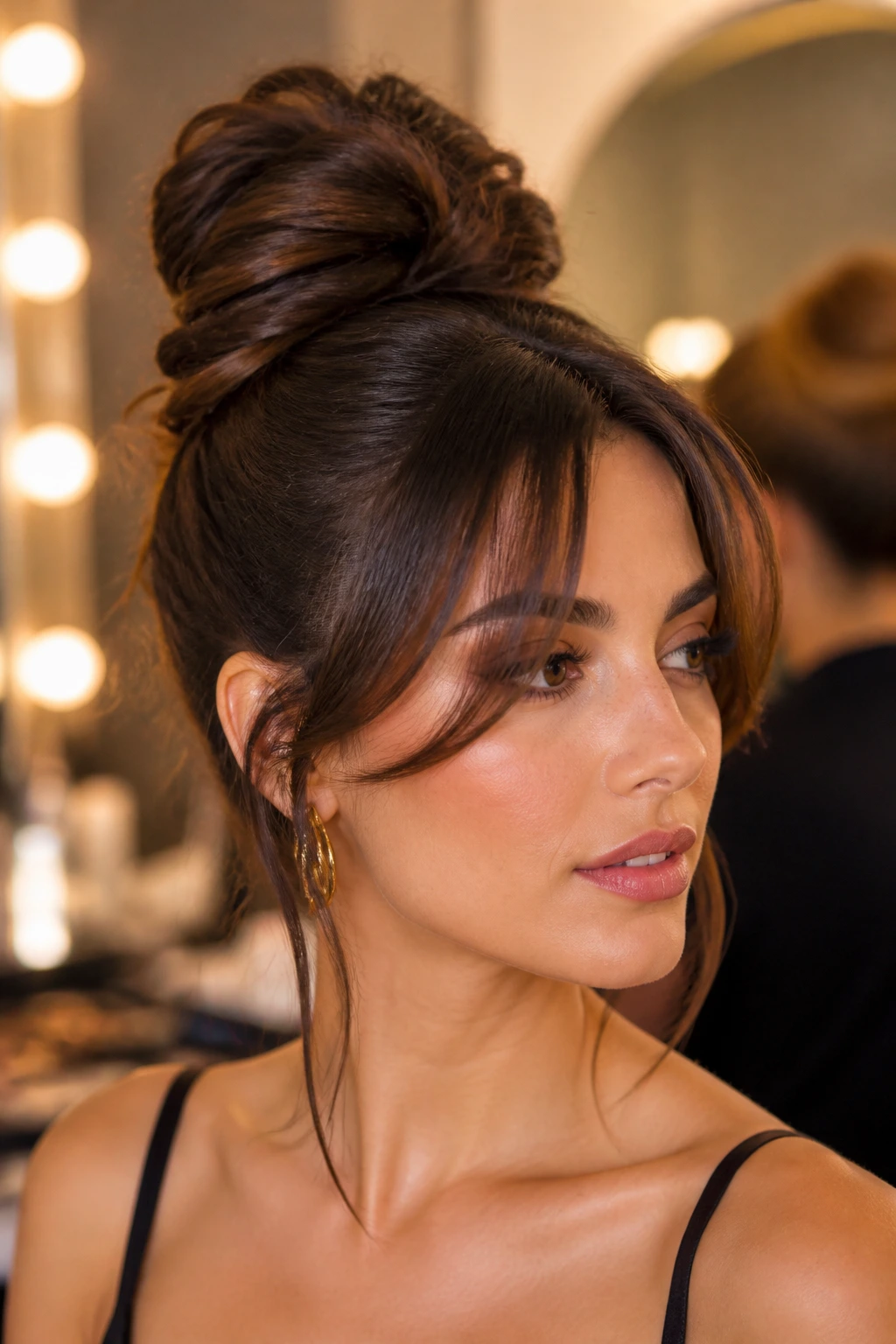
A high twist bun works when you want height. Thick hair can support that shape better than most textures, which is why this style often looks more stable on dense hair than it does on fine hair.
The catch is balance. If the bun sits too far forward, the style starts pulling the face upward in a weird way. Keep it centered at the crown or just behind it, and leave the curtain bangs feathered rather than pasted down. A few face-framing pieces can soften the top-heavy look and make the bun feel intentional instead of stacked on.
18. Glass-Hair Straight Style
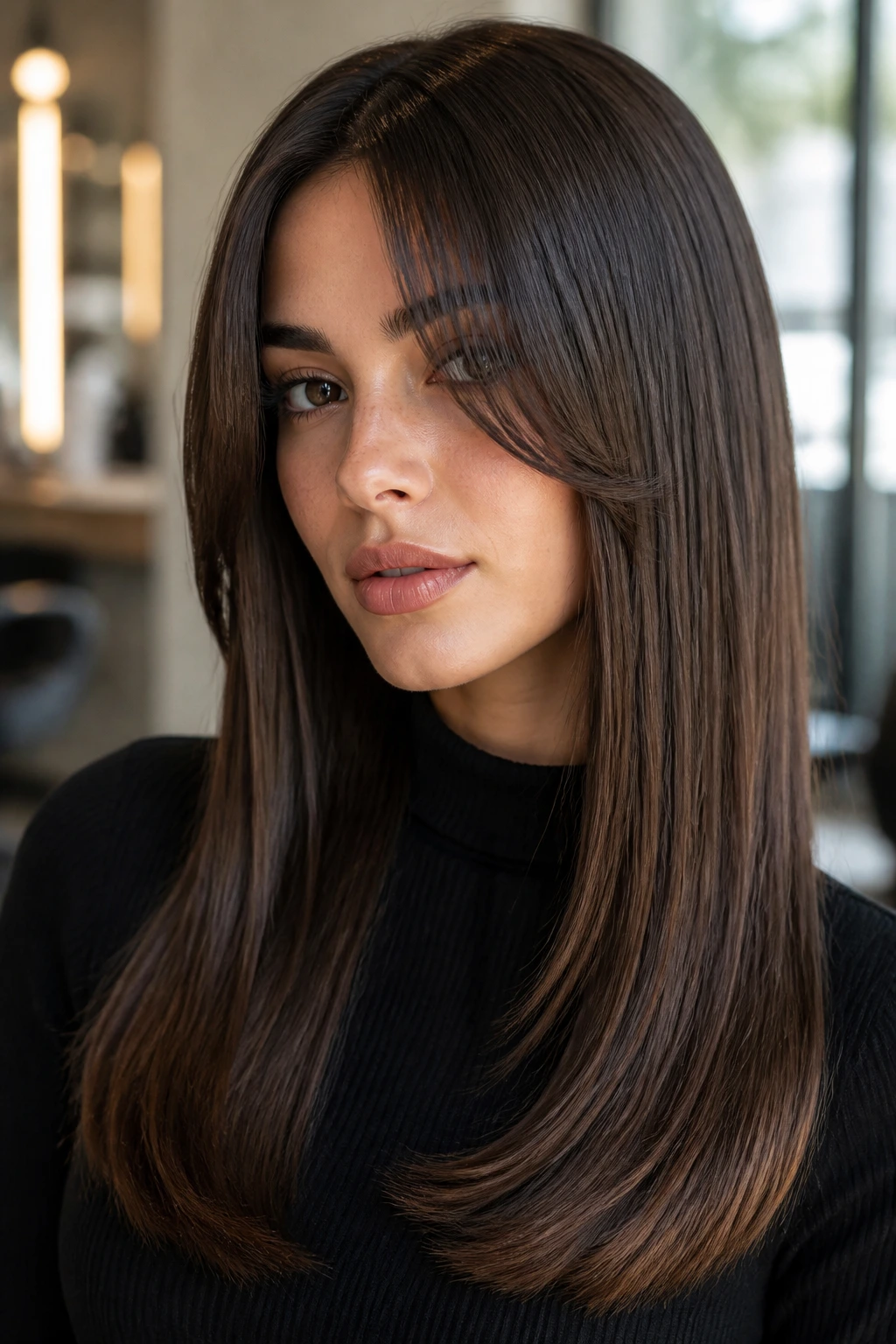
Glass hair can look harsh if the finish is too flat. With curtain bangs and beveled ends, though, it turns sleek instead of severe. Thick hair is a strong candidate because it can hold that mirror-smooth surface once you get the heat and tension right.
This style is all about prep. Blow-dry with a nozzle, run a flat iron in small sections, and keep the movement at the ends subtle. The bangs should split cleanly down the center and fall in soft arcs at the cheekbones. If you want a formal look that feels sharp under lights, this one does the job without a single pin.
19. Retro Flipped Ends
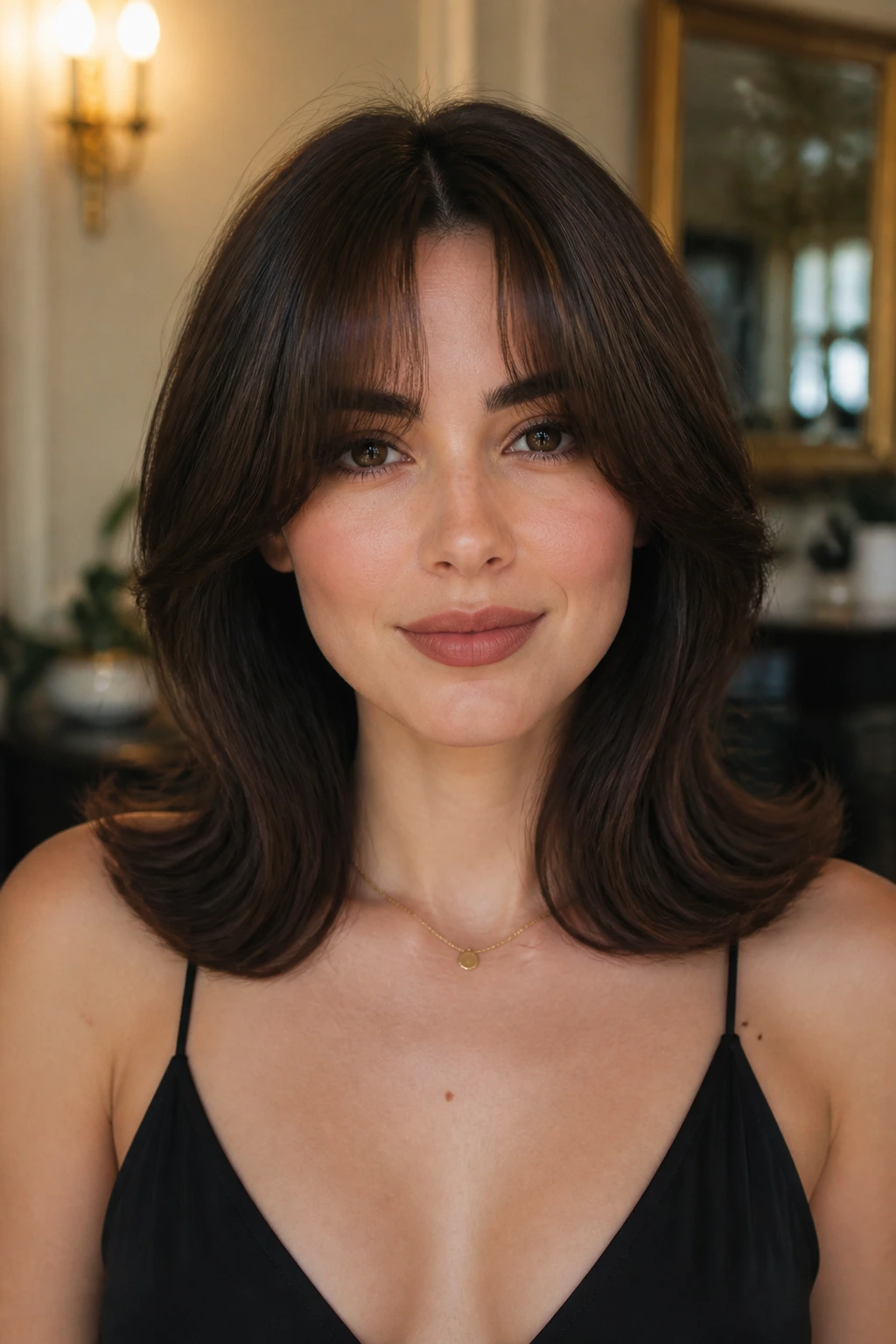
A little flip at the ends changes everything. Retro styles can get ignored because people assume they’re too playful for formal wear, but on thick hair they look structured and deliberate, especially when the curtain bangs echo that same soft bend.
Keep the roots smooth and the flip controlled. The ends should curl under or out just enough to show shape. Not a big wave. Not a hard kink. The kind of finish you’d get from a round brush and a 1.5-inch iron. This works well with mid-length thick hair, where the weight can hold the flip instead of collapsing it.
20. Waterfall Braid Half-Up
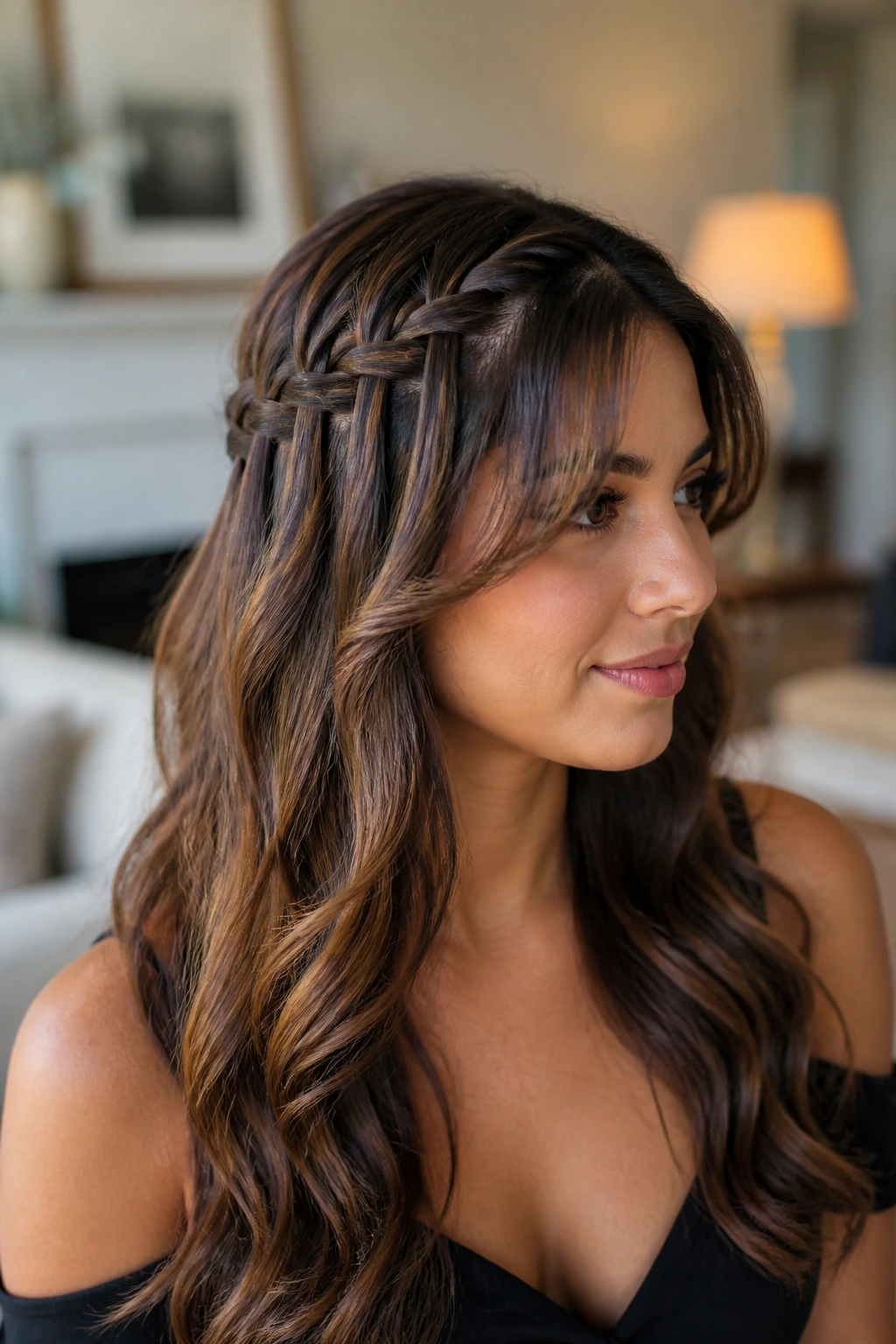
A waterfall braid gives you decoration while leaving most of the length free, which is a smart compromise if your thick hair feels too heavy for a full updo. It also photographs with nice texture, because the braid creates a line through the hair without taking away movement.
Curtain bangs matter here because they keep the front from looking overdone. The style already has visible detail. You don’t need the fringe to compete. Let it sit softly at the cheekbones, then keep the rest of the hair in smooth waves or polished curls. The braid should be the accent, not the whole point.
21. Twisted Low Pony with Crown Volume
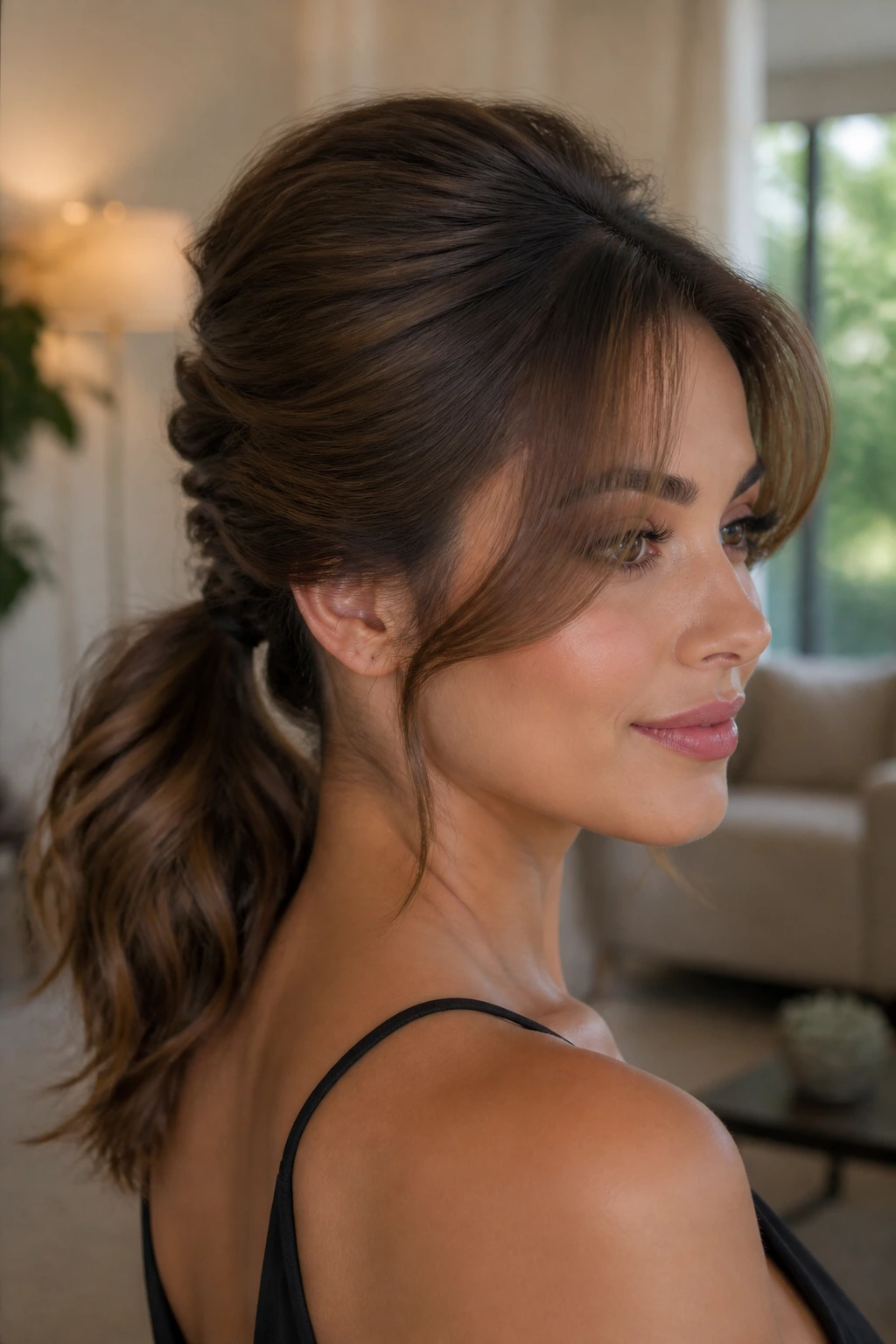
A twisted low pony gives you a clean line and a little lift at the crown. That lift is useful with thick hair, because a flat crown can make the ponytail feel heavy and the head shape feel boxy.
The twist can be as simple as gathering two side sections and crossing them into the pony before wrapping the base. Curtain bangs bring the softness back to the front, which keeps the style from reading too minimal or too hard. If your hair is very dense, leave the ponytail itself smooth at the top and add texture only toward the ends. That contrast looks better than fuzzing the whole thing up.
22. Crown Braid into a Ponytail
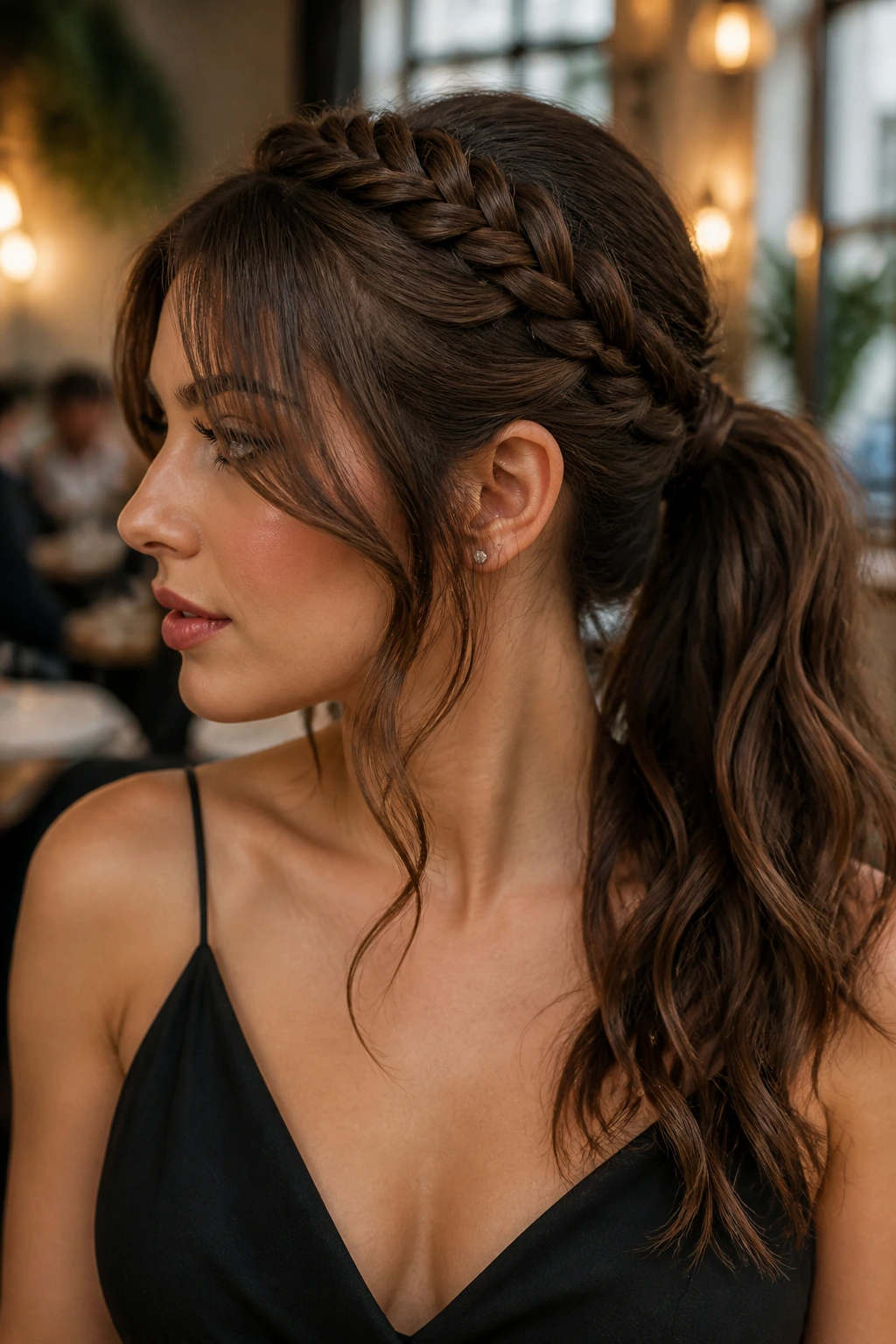
Crown braids can look too casual if they stop there. Add a ponytail at the base and the whole style tightens up. Thick hair makes the braid look richer, and the ponytail gives it a more formal ending.
This is a good pick for events where you’ll be moving around a lot. The braid controls the top, the ponytail keeps the length off the shoulders, and the curtain bangs stop the crown from feeling severe. Pull a few soft pieces at the temples if you want the look to read less rigid. Just don’t pull enough to loosen the braid’s line.
23. Braided Topknot
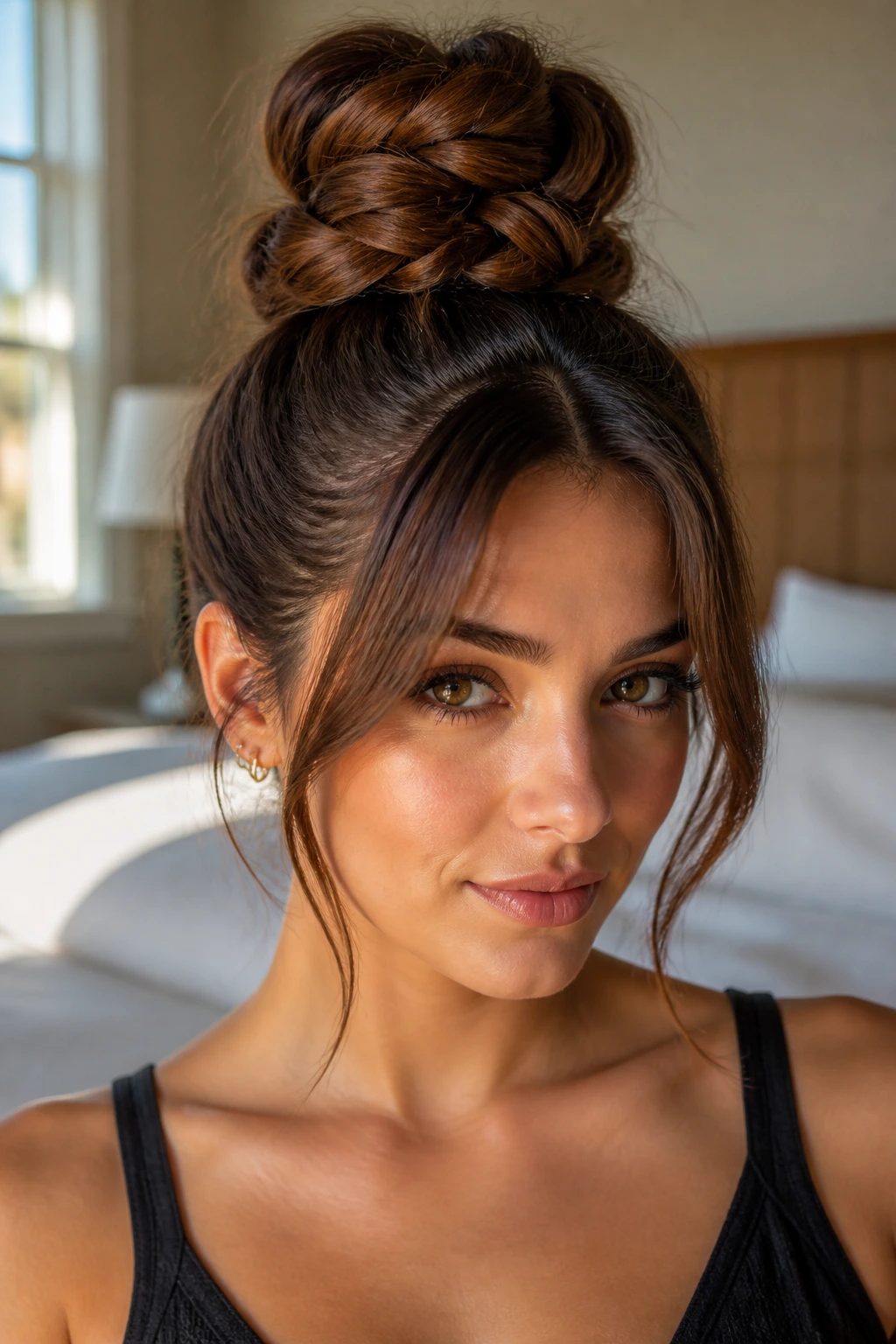
A braided topknot takes the bulk that thick hair brings and turns it into the point. That’s why it works. Instead of fighting the volume, it uses it to create height and shape at the top of the head.
Curtain bangs keep the face open, which matters because a topknot can get severe fast. Wrap the braid into a knot, pin it firmly, and smooth the sides with a brush and a touch of cream. If you have a long fringe, let the bangs sit slightly rounded rather than straight down. The result feels structured, but not frozen.
24. Polished Low Roll
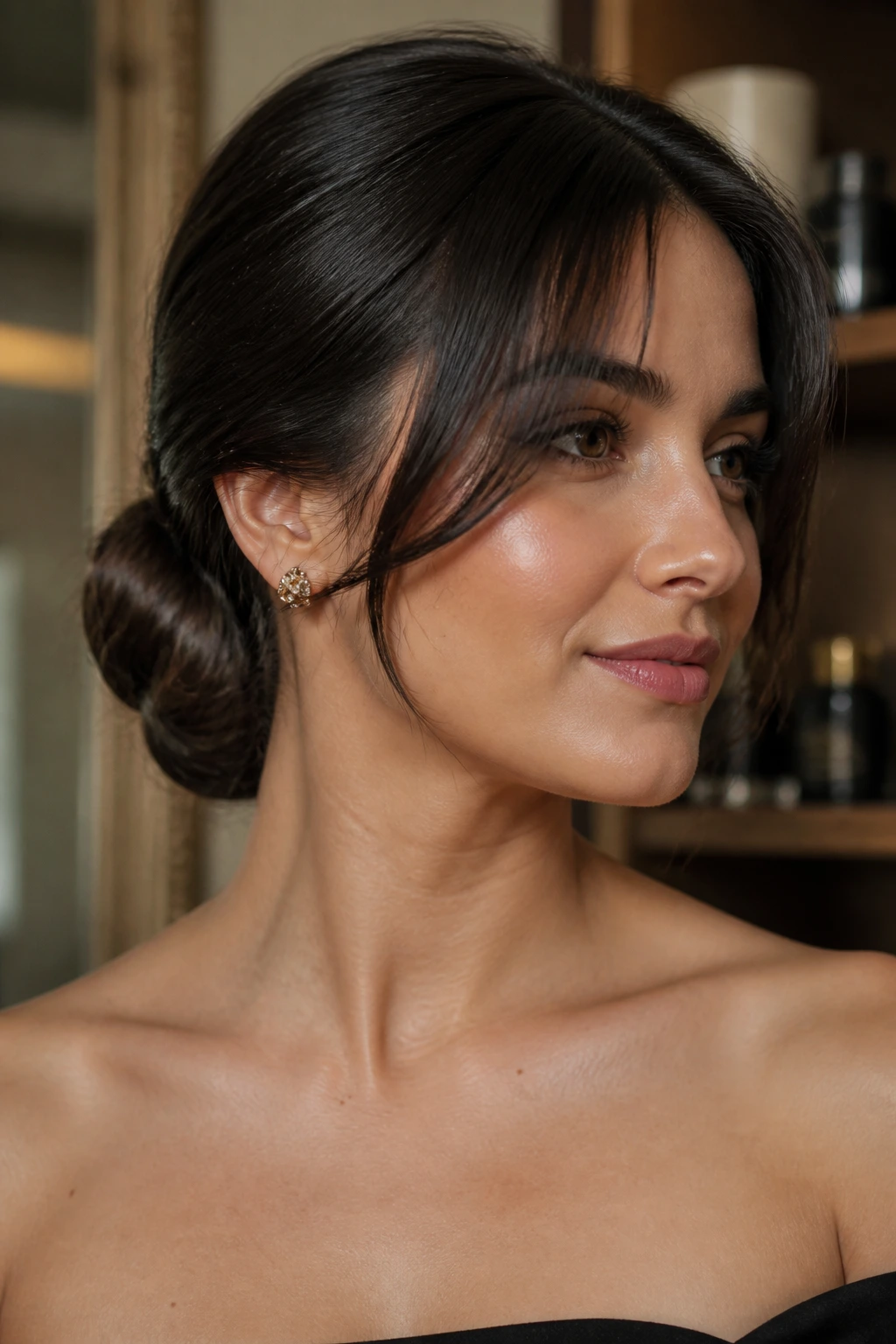
The low roll is one of those styles that looks more complex than it is. Thick hair gives it enough cushion and body to create a smooth roll at the nape without needing a ton of padding.
The curtain bangs make it wearable for modern events. They soften the forehead and keep the roll from reading too old-fashioned. Keep the roll narrow if your neckline has detail, or widen it a bit if you want the back of the head to become the focal point. Either way, smooth the surface first. A low roll shows every bump if you rush it.
25. Brushed-Out Formal Blowout
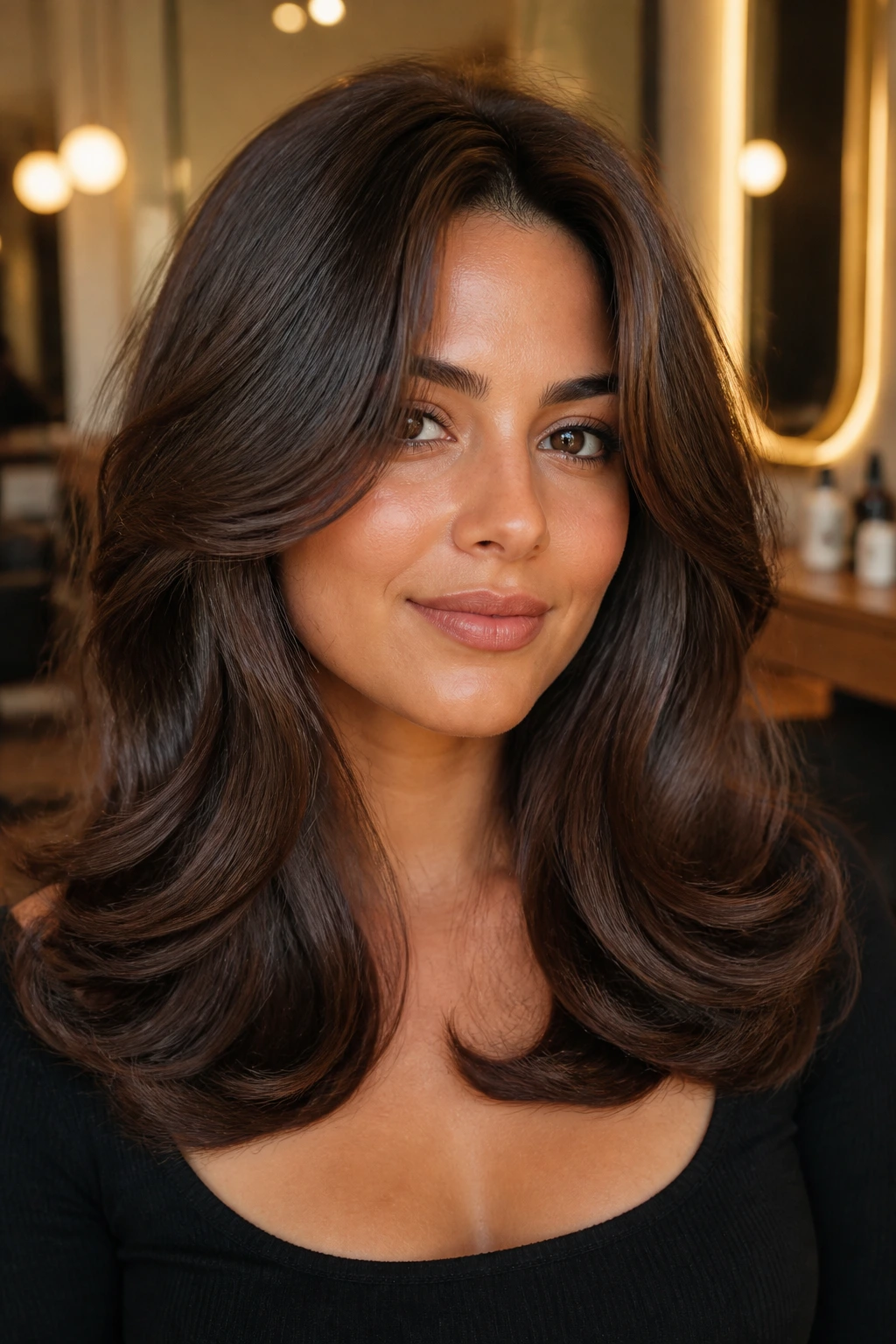
A brushed-out blowout can be formal when the shape is controlled and the bangs are set with intention. Thick hair gives the blowout body that lasts, and curtain bangs give it a face frame that feels done without needing pins or braids.
This is the style I’d choose if I wanted polish but not too much structure. Use a round brush, set the bangs away from the face, and let the ends turn softly under or away depending on the neckline of the outfit. The whole look should move when you walk. If it sits too stiffly, it stops feeling like a blowout and starts feeling like a helmet.
What Thick Hair and Curtain Bangs Need From a Formal Style
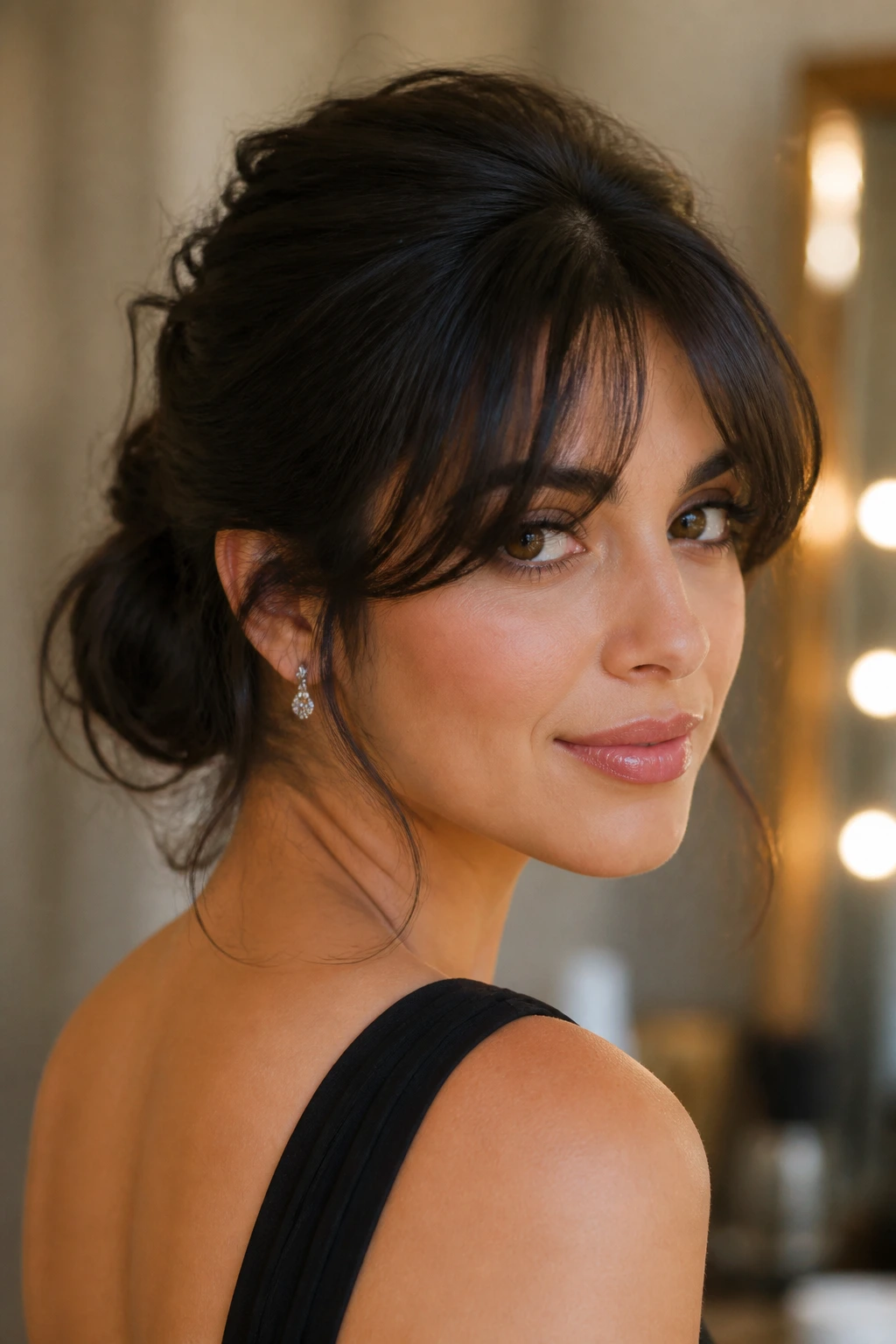
Thick hair likes a plan. That sounds obvious, but it’s the part people skip. When density is high, the hair can build heat at the roots, slip at the nape, and drag down pins if the structure isn’t anchored in layers. A formal style for this texture should distribute weight, not just pile it somewhere and hope the spray does the rest.
Curtain bangs need a separate plan. They don’t want to be smashed straight down, and they don’t want to be over-curled into tiny loops. The sweet spot is a soft bend that opens from the center and settles around the cheekbones. That shape keeps the face framed while still letting the style feel dressed up. If the bangs are too flat, they disappear into the hairstyle. If they’re too round, the whole front starts looking dated.
The best formal looks for this combination usually do two things at once: they control the back and sides, and they keep the front alive. That might mean a low chignon with loose fringe, a ponytail with a polished crown, or a braid that keeps the top in place while the bangs soften the forehead. Once you stop treating the fringe and the main style as separate jobs, the whole result gets cleaner.
Essential Tools for These Hairstyles
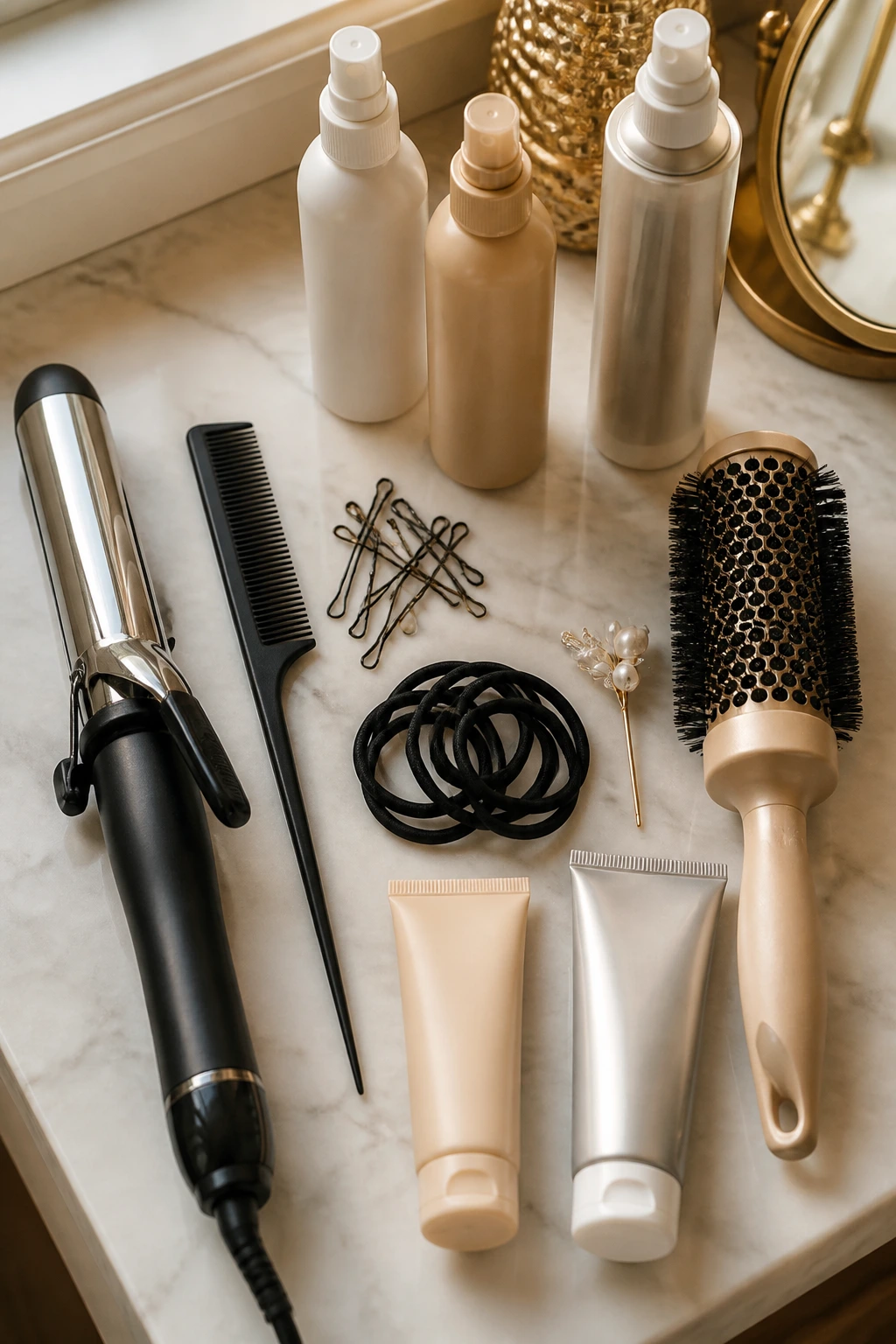
- 1-inch or 1.25-inch curling iron: Best for setting curtain bangs, soft waves, and beveled ends without making the curls too tight.
- Tail comb: Useful for sectioning, parting, teasing the crown, and keeping the center split straight.
- Mixed-size bobby pins: Long pins anchor heavy buns better; shorter pins are good for hiding loose layers near the bangs.
- Strong elastics: Choose a durable hair tie that won’t snap under dense hair or stretch out by the end of styling.
- Heat protectant spray: Non-negotiable if you’re using irons or blow-dry brushes; thick hair can hide heat damage until it gets rough.
- Round brush: A medium or large round brush helps shape curtain bangs and polish the top sections.
- Smoothing cream or serum: Keep it light. Thick hair can go greasy fast if you overdo the product.
- Texturizing spray or dry shampoo: Helpful for grip at the roots and better pin hold, especially on freshly washed hair.
- Flexible-hold hairspray: Good for movement-heavy styles like waves and half-up looks.
- Decorative pins or combs: Pick one accent piece, not three. Thick hair already brings enough visual weight.
Smart Product and Prep Tips
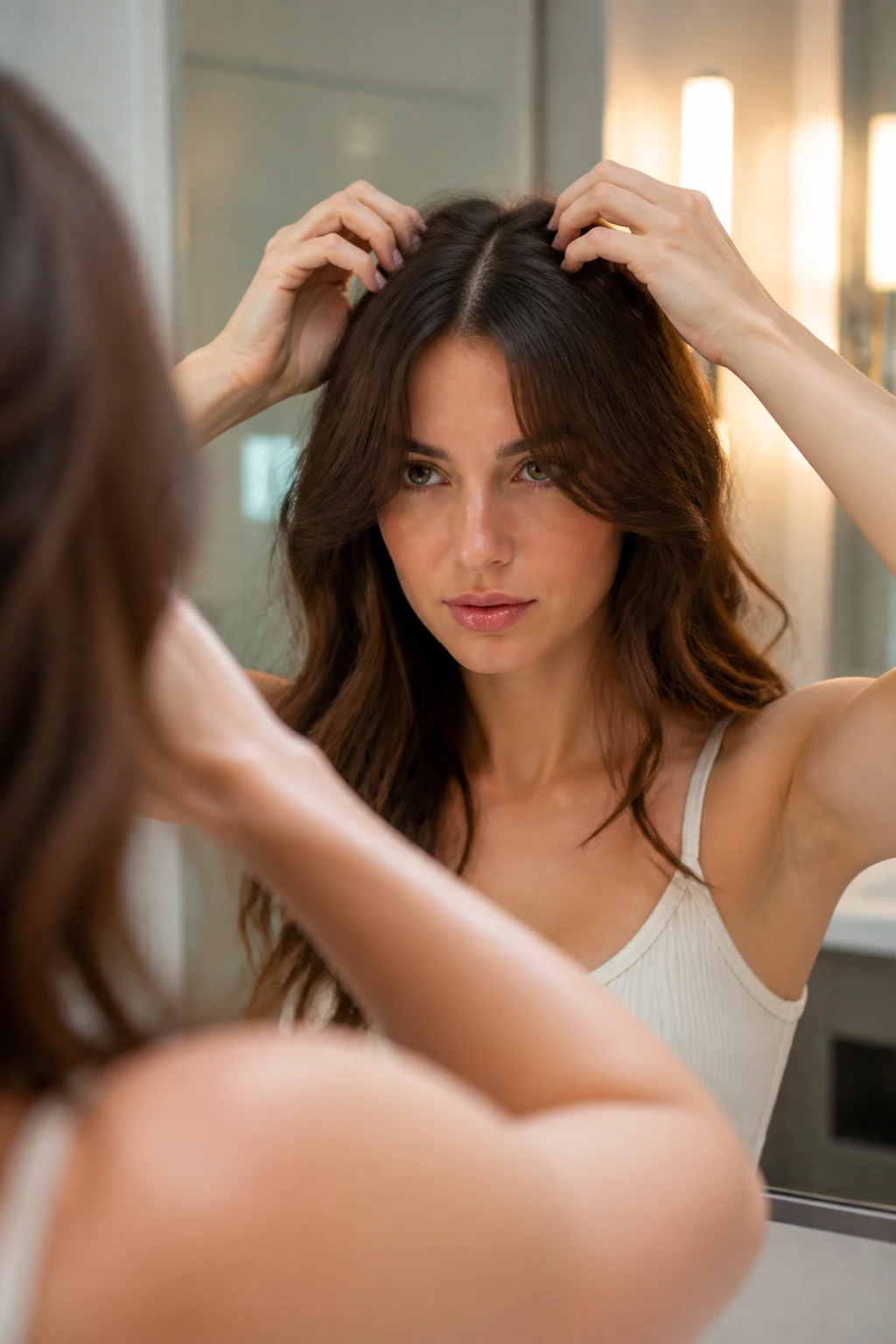
Start with the right base. Thick hair that was washed that morning can be slippery, especially if it’s very clean and soft. If the style needs grip, wash the day before or add a light dusting of dry shampoo at the roots. That little bit of friction helps the pins hold and keeps the bangs from falling flat.
Set the curtain bangs separately. Don’t wait until the end and treat them like an afterthought. Blow them out first, clip them to cool in their split shape, and only then finish the rest of the hair. If the fringe is set first, the whole style usually sits better because the front has a clean frame from the start.
Use less serum than you think. A pea-sized amount can calm flyaways on thick hair. Two pumps can turn the surface greasy in one swipe. I’d rather see a little frizz at the ends than a heavy, collapsed crown.
Anchor with purpose. Thick hair needs pins placed against tension, not just shoved in. Push a bobby pin in, then flip it and push it back through the seam of the bun or twist. That cross-grip matters. It’s the difference between a style that lasts through dessert and one that starts loosening while you’re still taking photos.
How to Wear These Styles
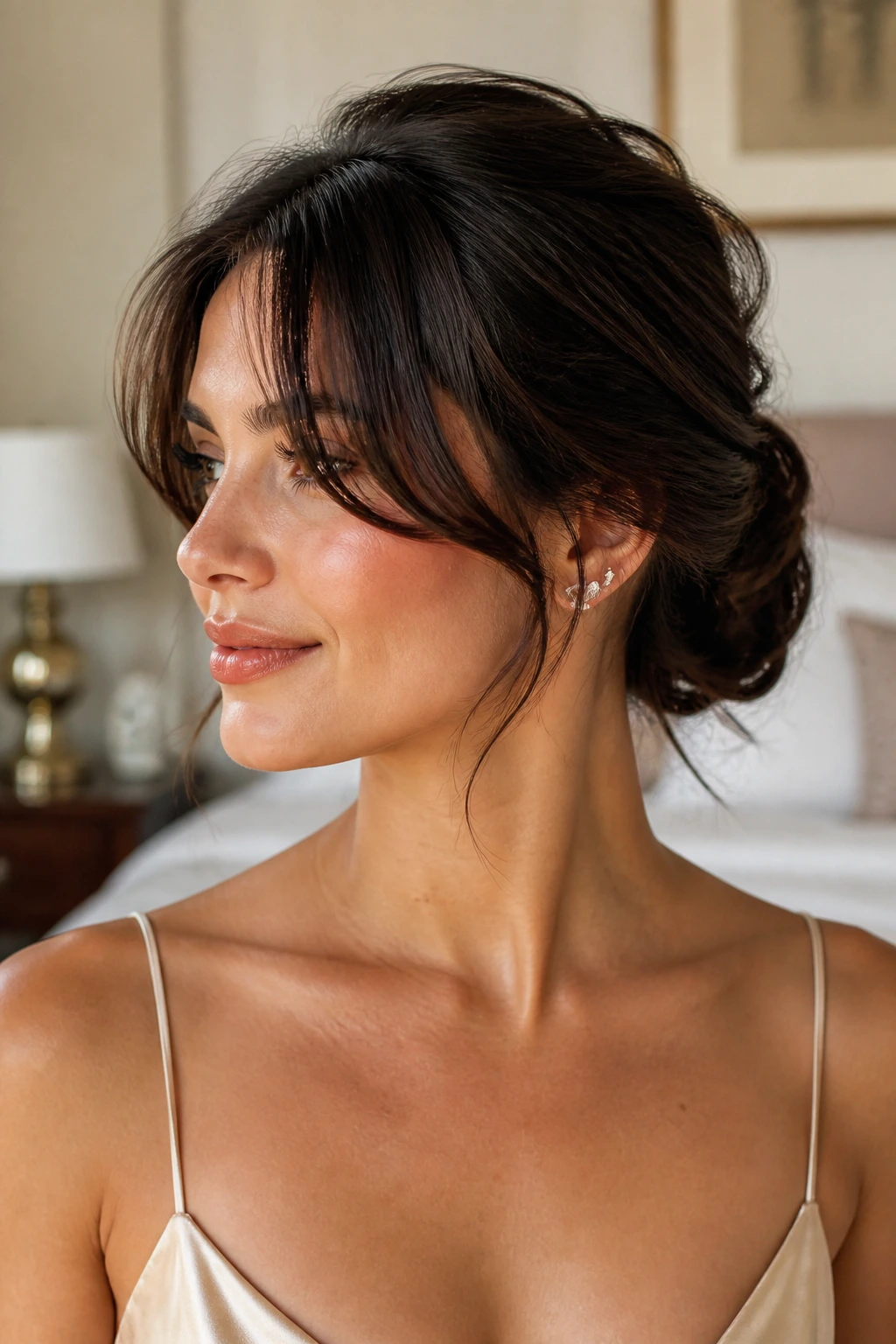
Presentation: Keep the bangs soft and intentional. Whether the rest of the hair is pinned, waved, or wrapped, the curtain fringe should open the face instead of hiding it. A clean center split or a slight off-center bend works better than a jagged part.
Accessories: Pearl pins, thin metal combs, velvet ribbons, and small crystal clips all fit formal dressing, but only if you choose one focal point. Thick hair already gives the style presence. One good accessory usually beats five small ones fighting for attention.
Outfit Pairing: Low buns and chignons sit best with dresses that have open backs, high necks, or strong shoulders. Waves and blowouts look especially good with square necklines, strapless cuts, or simple slip dresses. If the outfit is elaborate, keep the hair calmer. If the dress is plain, the hair can carry more detail.
Longevity: Spray the roots lightly before you leave, then carry a travel-size hairspray or a couple of spare pins if the event runs long. Thick hair can loosen in specific spots — usually the temples or the nape — so those are the places worth checking first.
Additional Tips and Style Boosters
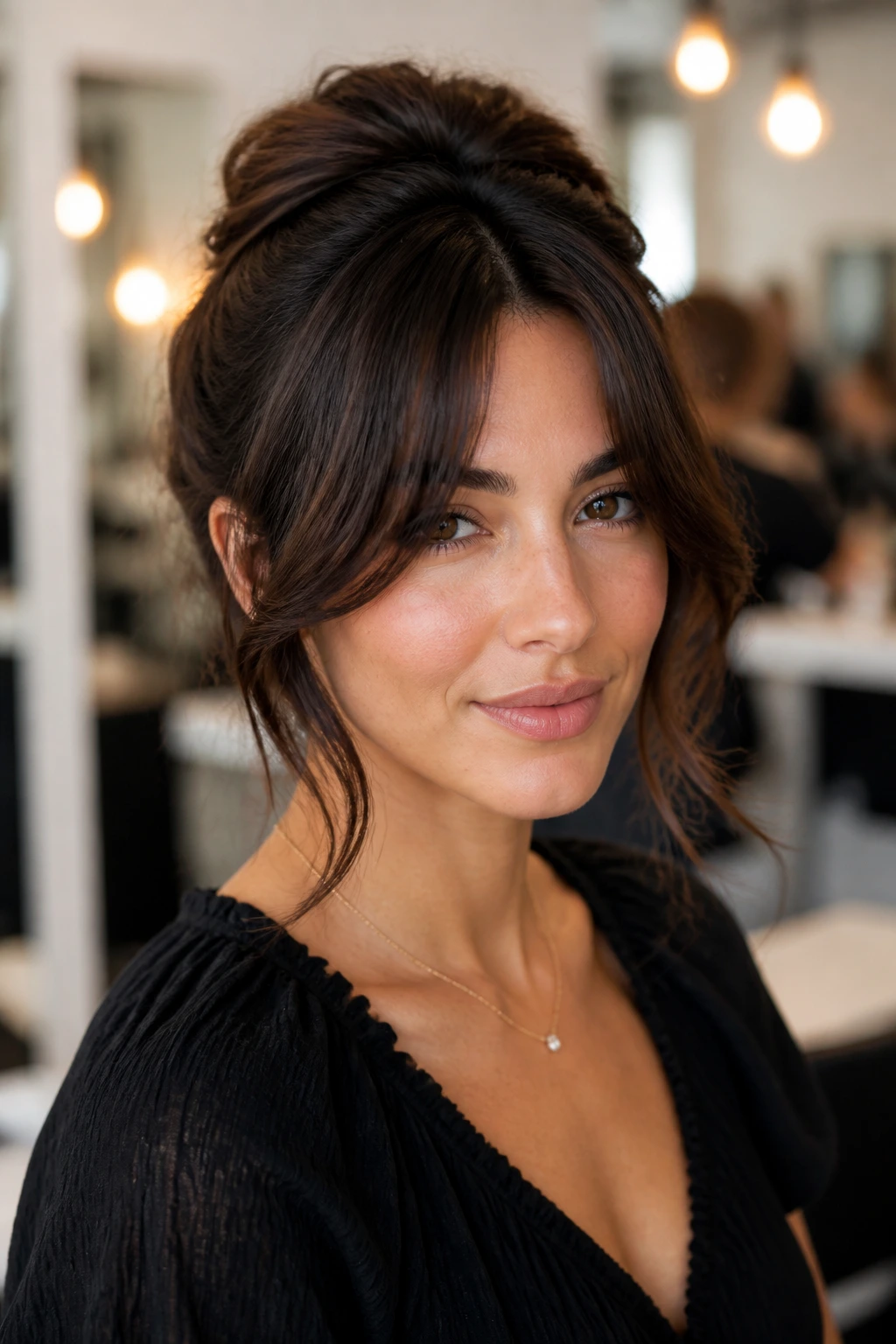
Volume Placement: Put lift at the crown if the style sits low, and keep the sides smoother if the style sits high. That balance stops the head shape from getting too round or too wide. Thick hair can handle volume, but it still needs direction.
Frizz Control: Smooth the surface with a small amount of cream before hot tools go in. After styling, use a clean hand with a tiny bit of serum on the ends only. The fringe should look soft, not wet. That distinction matters more than people think.
Bangs Detail: Curtain bangs look best when the shortest pieces hit around the cheekbone or just below it. If they’re much shorter, the formal style can start feeling disconnected. If they’re longer, tuck the ends into the wave or bun shape so the fringe reads as part of the whole look.
Fast Refresh: If the style starts slipping, don’t rebuild it. Pin the weak section, smooth the top with a brush, and re-spray the bang bend with a little water mixed with setting lotion or flexible spray. A quick cool blast from the dryer can reset the fringe in under a minute.
Prep, Hold, and Overnight Care
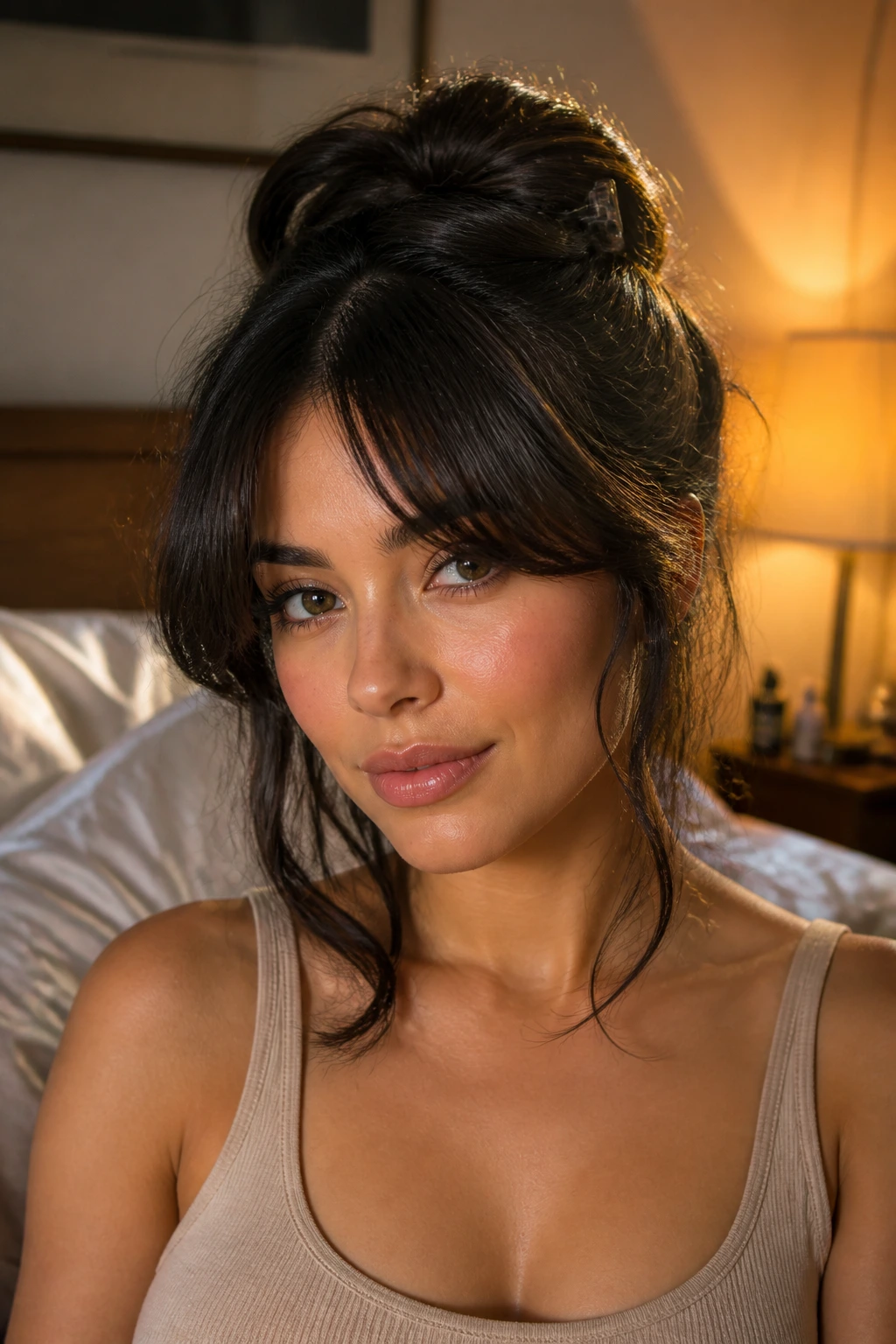
A formal style on thick hair can usually stay in good shape through an entire event window — think 8 to 12 hours if the pins are placed well and the finish is not overloaded with heavy oil. The front fringe often needs the first refresh. That’s normal. Curtain bangs take the most exposure to heat, movement, and face contact, so they’re usually the first part to loosen.
If you need the look to survive from getting ready to the last photo, set the bangs and the crown 20 to 30 minutes before you put on your outfit. That gives the shape time to cool and settle. For waves or blowouts, pinning the curl shape while it cools makes a noticeable difference. For buns and twists, let the hair rest before you shake out any face-framing pieces. Rushing that part is how the style loses its polish.
Overnight care is a different story. A loose satin wrap, silk pillowcase, or soft clip at the fringe can keep the curtain bangs from splitting into odd angles. If you’re trying to preserve a blowout or wave set for a second wear, pin the fringe with a roller or a couple of flat clips and keep the rest in a loose pineapple or low braid. The next day, a 30-second pass with a round brush or curling iron on the bangs is usually enough to bring the shape back. Thick hair does not need a full restart every time.
Variations and Adaptations to Try
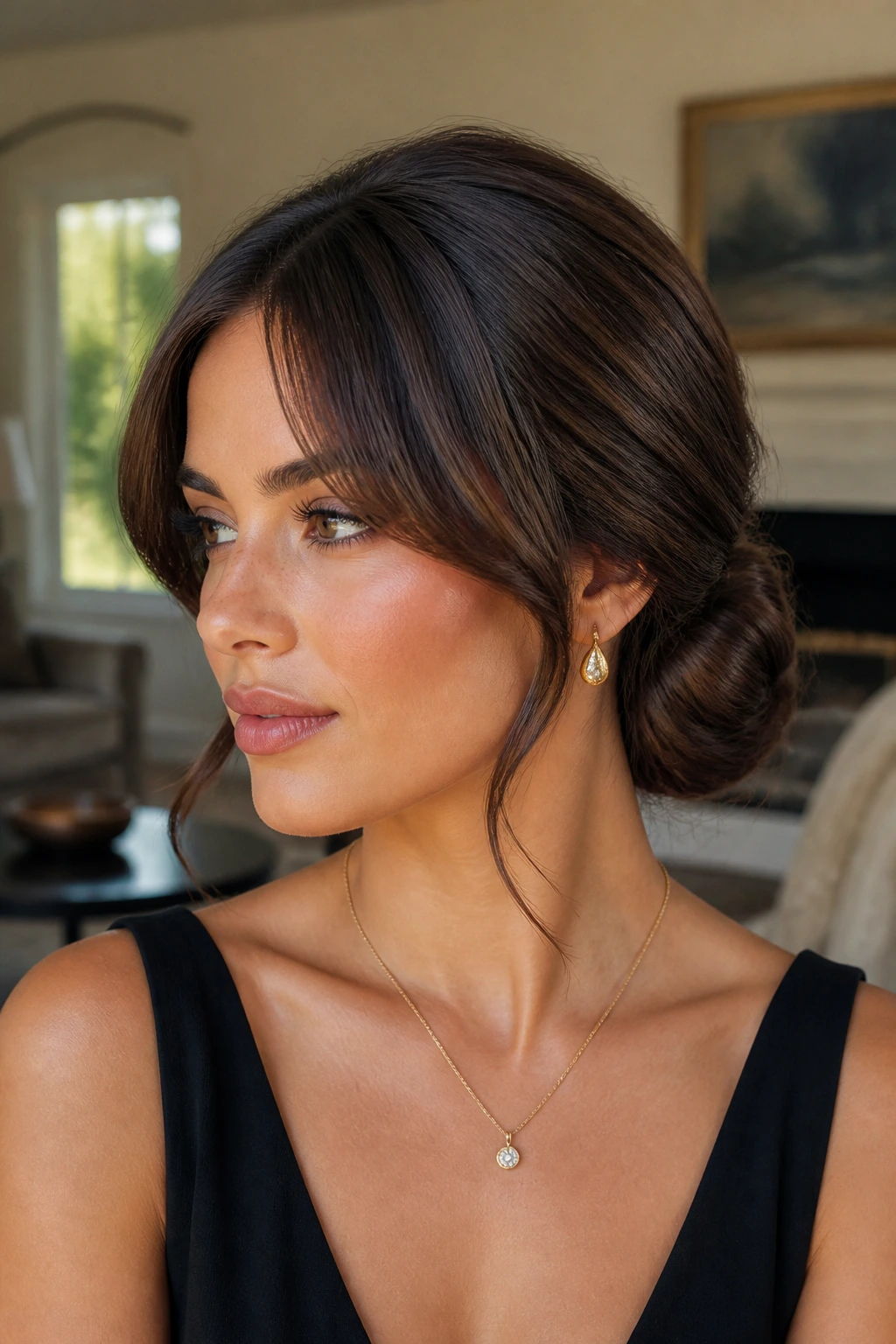
Heat-Free Formal Set: Use large rollers, pin curls, or a wrapped overnight setting method instead of hot tools. Thick hair holds a bend well if it’s set while damp, and the curtain bangs can be clipped into shape with a soft bend at the ends.
Humidity-Proof Finish: Swap heavy creams for lightweight anti-frizz spray and keep the surface smooth rather than overly glossy. This works best for low buns, wrapped ponytails, and braided styles that can tolerate a little texture without looking unfinished.
Curly and Wavy Hair Adaptation: Don’t force the curtain bangs into a straight fringe. Let them follow the natural bend, then build the rest of the style around that motion. Braids, low buns, and pinned side styles tend to behave best with texture that already wants to move.
Accessory-Forward Version: Add a single comb, ribbon, or pair of pins at the base of a bun or ponytail. Thick hair can handle ornamentation without looking crowded, but only if the accessory is placed where the eye naturally lands.
Extra-Long Hair Adaptation: Split the length into two sections before twisting or rolling. That keeps heavy hair from pulling the style downward and makes buns lie flatter at the nape.
Shorter Curtain Bangs Fix: If the fringe sits high on the forehead, wear it in a more separated, airy shape and pair it with a lower, calmer style like a chignon or tucked roll. Trying to force short bangs into a heavy wave usually makes the front look overworked.
Common Mistakes to Avoid
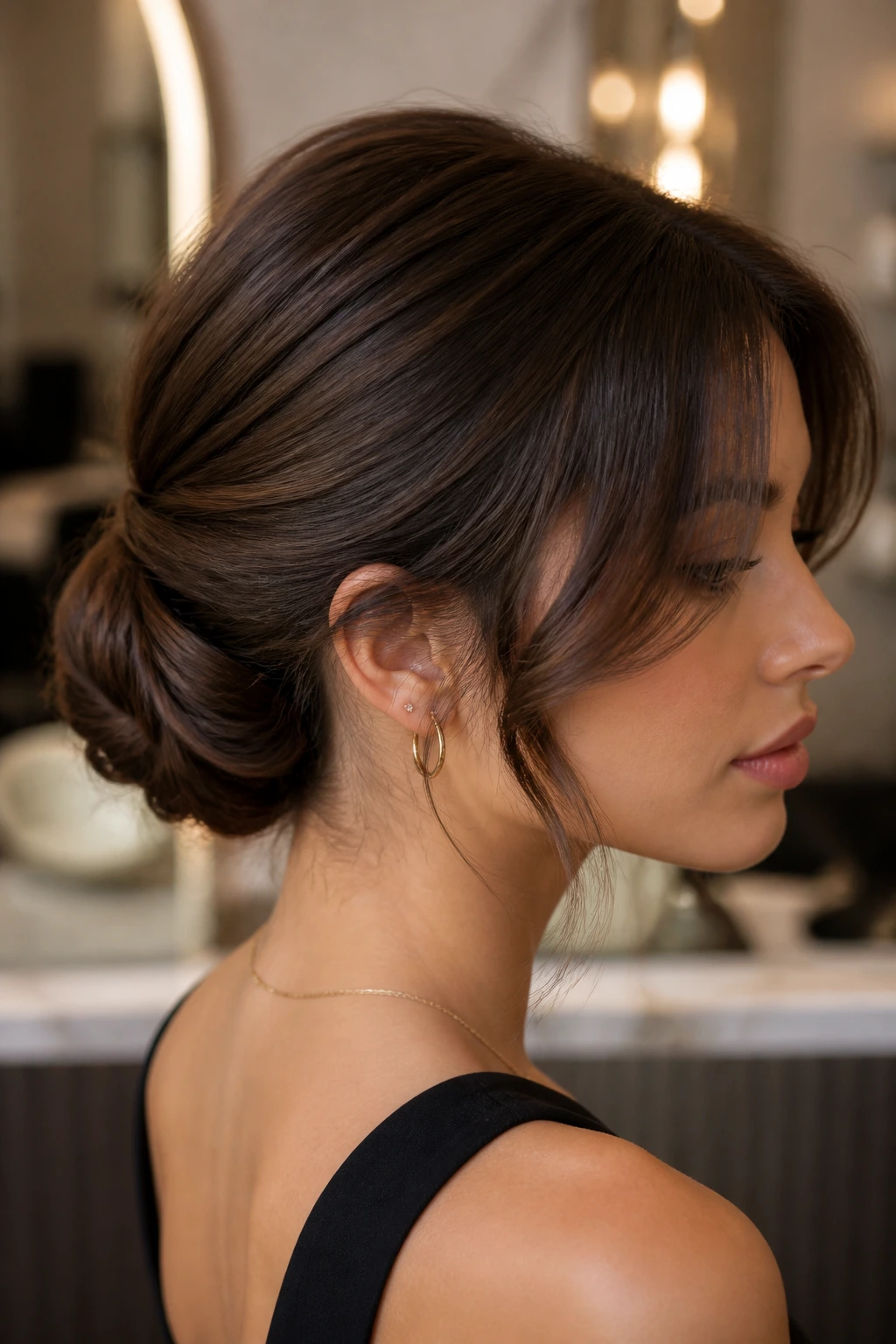
Loading on too much product: Thick hair does need control, but too much cream or spray turns it limp and sticky. The signs are easy to spot: flat roots, greasy ends, and bangs that separate into strings. Use a little, style, then add more only if the hair still feels rough.
Making the curtain bangs too tight: If the fringe is pulled straight back or curled too sharply, the face frame disappears. The fix is a soft bend, not a hard curve. Set the bangs with heat, let them cool, then brush them lightly into place.
Ignoring pin direction: A bobby pin shoved straight into thick hair often slides right back out. Cross it against the tension of the style, especially in buns and twists. That tiny shift makes a big difference in how long the look holds.
Building too much height too low: Thick hair can create a beautiful crown, but if the bulk sits too low and wide, the style can feel boxy. Raise the root slightly where the style needs lift and smooth the sides so the shape stays balanced.
Skipping the cool-down: Hot hair changes shape when it cools. If you pin, spray, and immediately tug at the style, it will often settle the wrong way. Give curls, bangs, and twists a few minutes to set before you start fussing.
Frequently Asked Questions
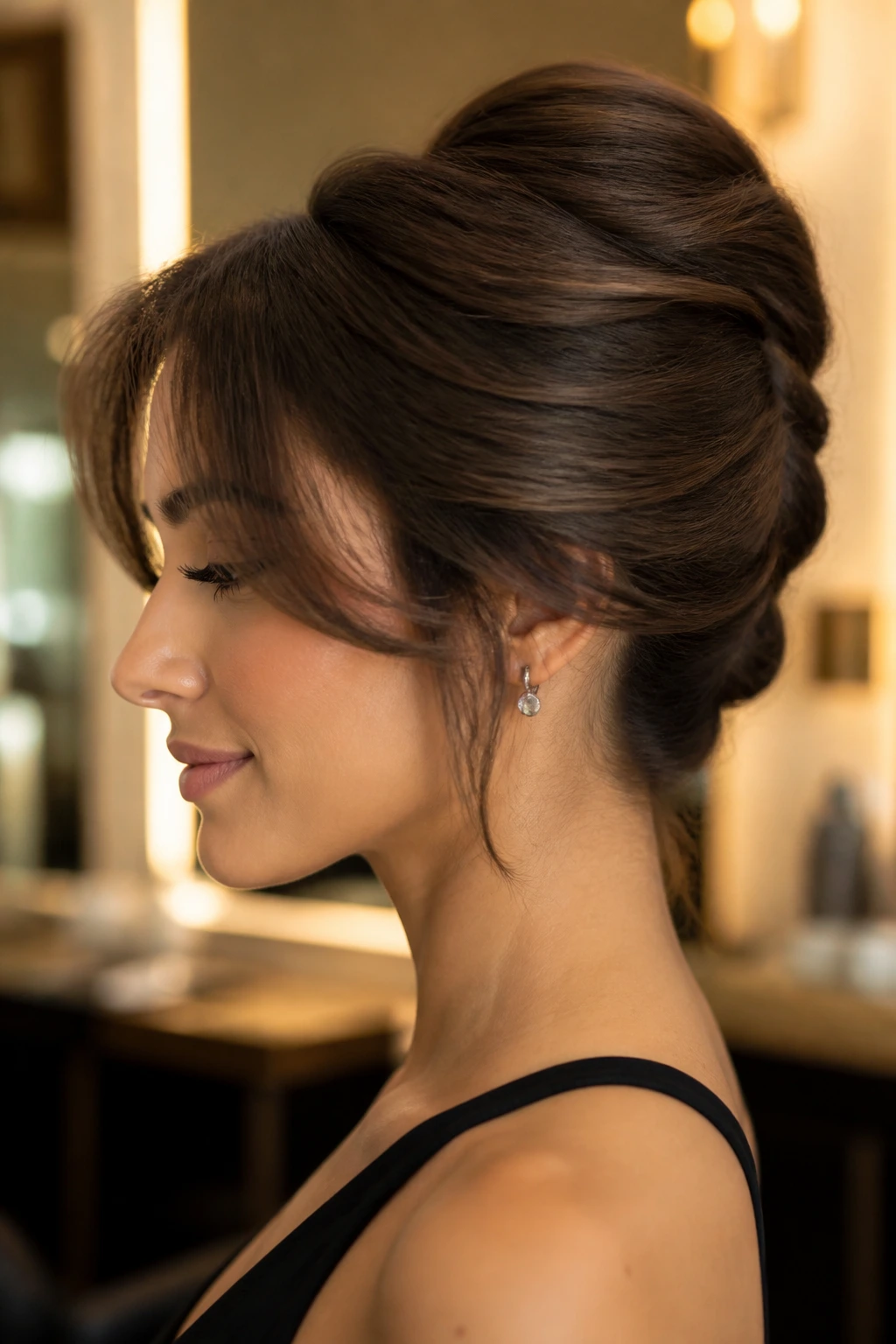
How short can curtain bangs be and still work with formal hairstyles?
Curtain bangs that reach the cheekbone or just below usually give the most flexibility. Shorter bangs can still work, but they’re trickier with sleek updos because they don’t blend as easily into the rest of the style.
What’s the easiest formal style for thick hair if I’m doing it myself?
A wrapped low ponytail or a soft low bun is usually the least stressful. Both styles forgive small mistakes, and thick hair gives them enough fullness that they still look deliberate even if the finish isn’t salon-perfect.
Should thick hair be washed right before styling?
Not always. Very clean hair can be slippery, which makes pins and braids slide. If your hair tends to feel too soft after washing, styling it on day-two hair or adding a little dry shampoo at the roots can make the shape hold better.
How do I keep curtain bangs from separating too wide?
Set them with a round brush or roller, let them cool in place, then use a tiny amount of smoothing cream on the ends. If they still separate too far, pin the outer edges lightly at the temples for a few minutes while the rest of the style sets.
Will these looks work on naturally curly thick hair?
Yes, and some of them are better that way. Braids, low buns, half-up twists, and side-pinned styles usually look even richer on curly hair, as long as the bangs are shaped to follow the curl pattern instead of being forced straight.
What if my updo feels too heavy halfway through the event?
That usually means the weight is sitting too low or the pins are too far apart. Loosen a little tension at the crown, add one or two hidden pins closer to the base, and remove any extra product that’s making the hair feel sticky.
Are accessories worth using with thick hair, or does it already have enough presence?
One accessory can help if it’s placed where the eye naturally lands, like above a bun seam or at the base of a ponytail. More than one, especially on top of a detailed braid or twist, can start to feel crowded fast.
Can I do these styles without heat?
Absolutely. The best no-heat options are braided crowns, low buns, twists, and rolled tucks. Curtain bangs can be clipped into a soft bend while the rest of the hair dries, then released once they’ve taken shape.
A Few Minutes in Front of the Mirror
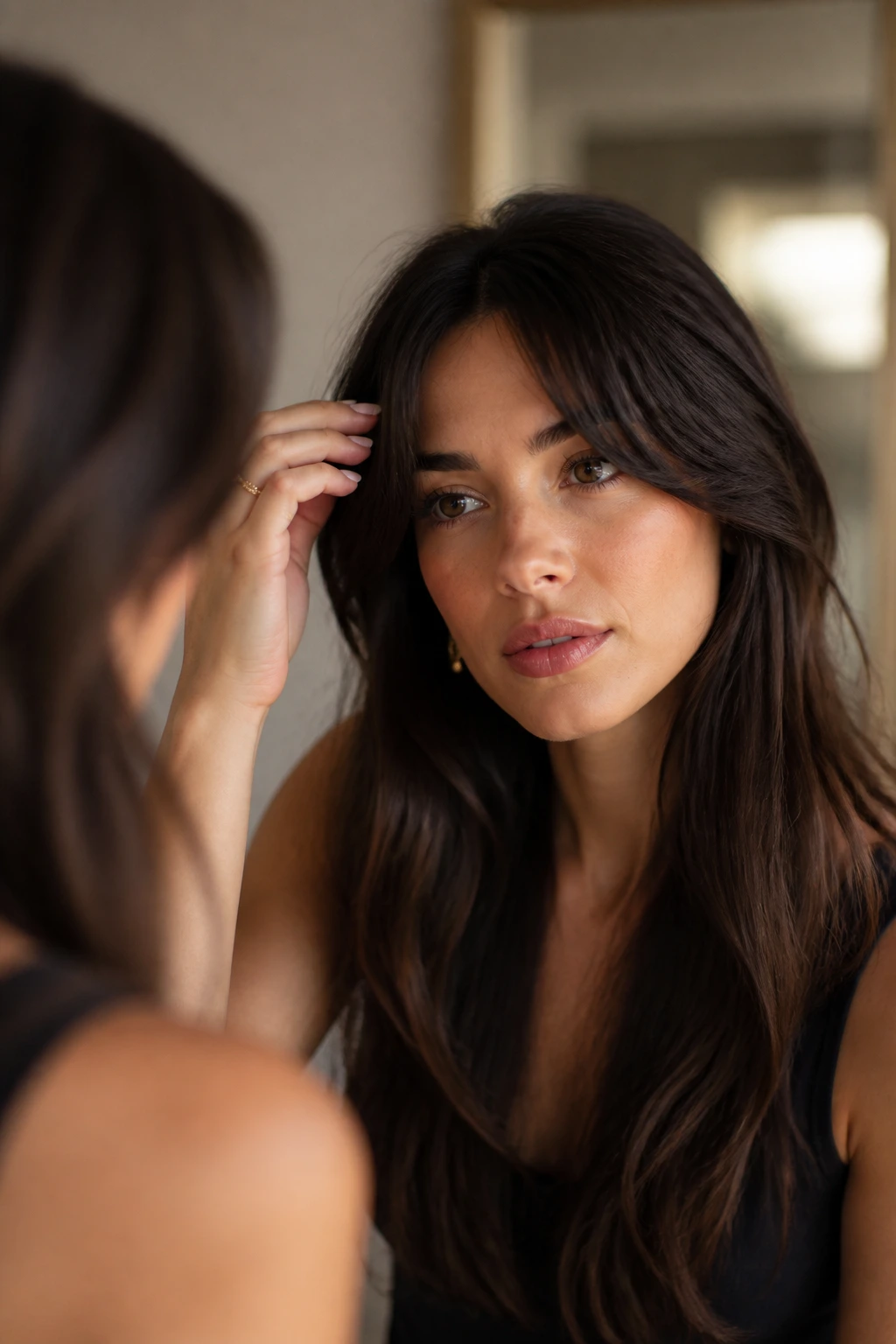
Thick hair with curtain bangs gives you something a lot of formal styles quietly need: substance. The hair has enough body to hold a shape, and the fringe keeps that shape from turning severe. That’s the combination that makes these looks feel wearable instead of staged.
The best version is the one that respects the way your hair moves. Smooth where it needs control, soft where it needs life, and pinned only where the structure actually needs help. When those pieces line up, the style stops fighting you and starts looking like it belongs on you.