



Long hair can carry a lot of weight at the front of the face, and that’s exactly why bangs for long hair and heart-shaped faces can be such a smart move. Get the shape right, and the fringe stops feeling like an add-on. It starts acting like balance.
Heart-shaped faces usually bring width through the forehead and cheekbones, then taper into a narrower chin. That structure can look gorgeous with length, but a blunt, heavy fringe can make the top half feel crowded. The better versions make room: softer centers, longer temple pieces, diagonal movement, and a little air between the strands so the face can still breathe.
I’ve always thought the best bangs are the ones that do their job quietly. They don’t shout “new haircut.” They just make the whole head shape look more intentional. A good fringe can take long hair from straight-down-and-done to something with actual shape, and the difference shows the second you tuck one side behind the ear.
Why These Fringe Ideas Are Worth Bookmarking
-
They soften a wider forehead: The right bang shape breaks up the upper face without hiding it under a solid curtain of hair.
-
They keep long hair from looking flat at the front: A little bend or split in the fringe creates movement where long lengths often go limp.
-
They work with grow-out: Several of these styles stay flattering even after a few weeks, which matters more than people admit.
-
They fit different textures: Straight, wavy, and curly hair all need different fringe math, and this collection doesn’t pretend one cut solves everything.
-
They connect to long layers: The strongest looks here don’t stop at the forehead. They blend into the rest of the haircut so the front and length feel like one idea.
-
They give you options, not a trap: You’ll see soft versions, bolder versions, and low-maintenance versions, which is handy if you want bangs without signing up for daily drama.
What a Heart-Shaped Face Asks of a Fringe
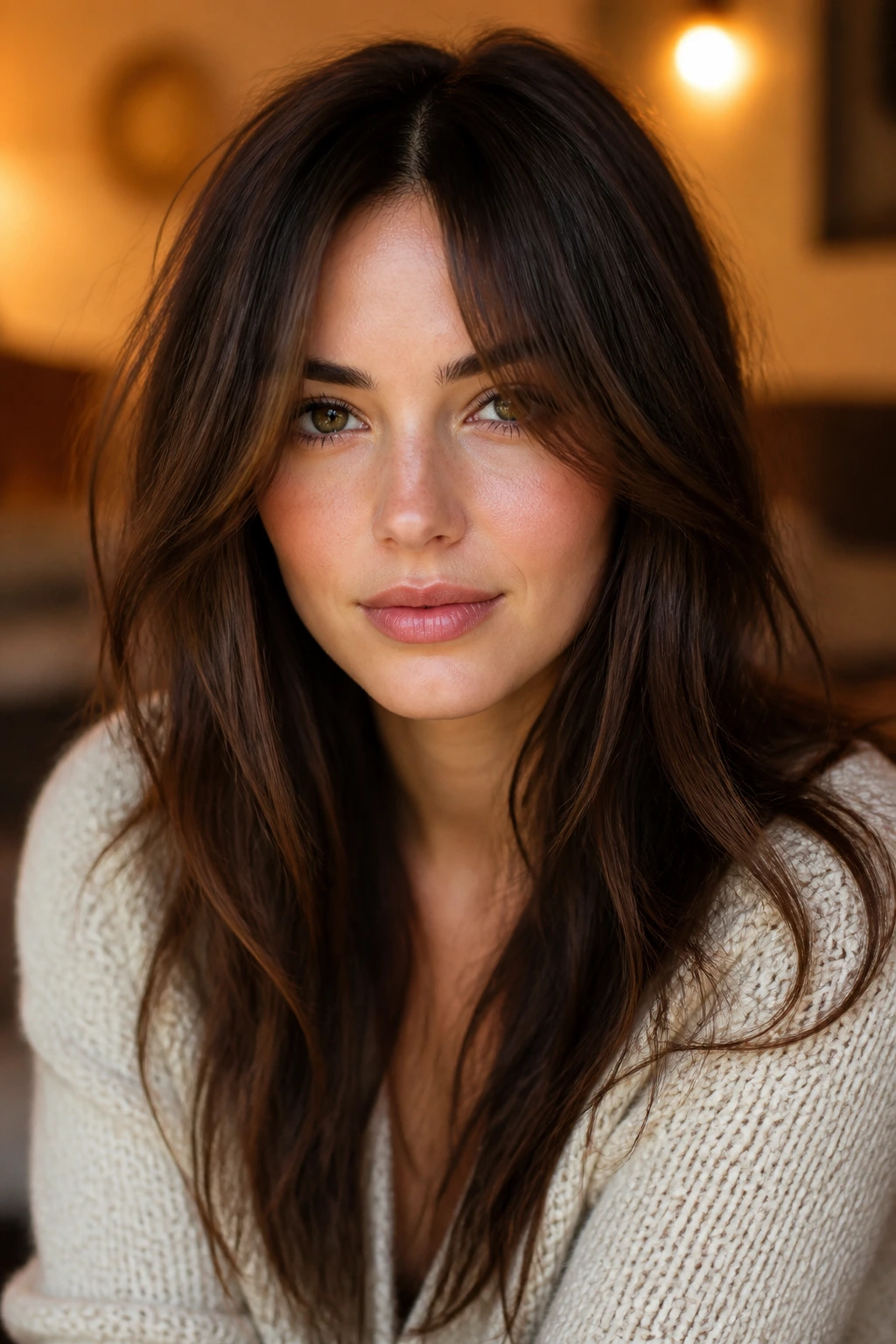
A heart-shaped face changes the stakes a little. The forehead usually carries the most visual width, the cheekbones are often the star, and the chin narrows enough that a hard horizontal line across the top can look bossy in the wrong way. That doesn’t mean you need to hide the forehead. Far from it. It means the fringe should guide the eye instead of blocking it.
The best bangs for this face shape usually do one of three things: split in the center, sweep to the side, or land with a soft curve that opens around the cheeks. That is why curtain bangs, bottleneck bangs, and side-swept fringe keep showing up in good haircut conversations. They don’t carve off the face. They bend around it.
Long hair changes the picture, too. When the length is all one note, the front can feel heavy and a little bottomless. A fringe gives the cut a focal point near the eyes, then the long layers carry the rest downward. That balance is the whole trick.
What usually works best
-
Softness at the temples: Longer side pieces help keep the forehead from looking boxed in.
-
A little separation in the center: A split or nearly split fringe lets the face keep some vertical length.
-
Movement near the cheekbones: That’s where the face already has structure, so the bangs can echo it instead of fighting it.
What tends to go wrong
- A fringe cut too short across the entire forehead can make the top half look wider.
- Dense, square bangs can sit like a shelf.
- Super-short pieces with no temple length can make long hair feel disconnected.
Straight, Wavy, and Curly Hair Need Different Bangs
Texture matters more than the face-shape chart you found on a salon wall. Straight hair lies where you put it, which makes clean curtain shapes and brow-grazers easy to maintain. Wavy hair bends at the temples and around the eyes, so it usually likes some extra length and a soft edge. Curly hair wants room to spring up, which means a fringe that looks “long enough” when wet can end up much shorter once it dries.
That’s why a lot of stylists cut fringe with texture in mind, not just shape. On wavy hair, they often leave the shortest point longer than you expect. On curls, they usually work in the hair’s dry state or use a dry cut, because wet curls lie to everybody. Straight hair has the opposite problem: it can look perfect while wet and then split awkwardly once the roots settle.
If your hair is thick, a heaviness problem is more likely than a thinness problem. If your hair is fine, the fringe can disappear unless the cut is intentional and the blow-dry gives it some root lift. Either way, you want a bang style that plays nicely with your texture on a Tuesday morning, not just under salon lights.
1. Soft Curtain Bangs
Soft curtain bangs are the easiest place to start, and that’s not a faint compliment. They split near the center, fall a little longer toward the temples, and melt into long layers instead of sitting on the face like a hard edge. On a heart-shaped face, that soft split keeps the forehead from feeling boxed in while the longer sides pull attention toward the cheekbones.
Why they work
The center part opens the face just enough to keep it from feeling top-heavy. Then the side pieces do the real work: they frame the widest part of the forehead and carry the eye down and out, which is exactly where long hair needs help. They also grow out better than most blunt styles, so you don’t get punished if you miss a trim by a couple of weeks.
A good curtain bang should move. If it lies too flat, the whole point gets lost.
Quick styling note
Blow-dry the fringe away from your face first, then back down through a round brush with a bend at the ends. A small round brush, about 1 to 1.25 inches, gives better control than a giant one that just smears the hair around.
2. Bottleneck Bangs
Bottleneck bangs are a little more sculpted than curtain bangs, and that’s why they can look so good on heart-shaped faces. They’re short in the middle, then gradually get longer as they move toward the temples, like the narrow neck of a bottle opening into a wider shoulder. The shape softens the forehead without forcing a heavy wall of hair across it.
The center break gives a bit of air, which matters. A heart-shaped face already has presence up top; it doesn’t need a solid block competing with the brow bone. The longer sides also help the fringe slide into long hair without a hard stop.
I like bottleneck bangs when someone wants fringe but still wants to tuck pieces away on days when styling feels like too much. They’re forgiving. Not lazy. Forgiving.
Best for
- Hair that can hold a slight bend
- Long layers that start near the cheekbone
- People who want a fringe that still looks intentional as it grows out
3. Side-Swept Fringe
If a center part feels too symmetrical for you, side-swept fringe is a clean answer. The diagonal line breaks up the forehead and sends the eye across the face instead of straight down it. That little angle can be very flattering on a heart shape, especially when the sides are long enough to blend into the rest of the haircut.
This style is also kind to cowlicks. A stubborn front swirl can make straight-across bangs split weirdly at the worst possible place, but a side sweep can work with that bend instead of trying to erase it. On long hair, that matters. You want the fringe to cooperate with the way your hair naturally falls.
Good to know
A deep side part creates more drama; a softer side part gives a gentler look. If your hair is fine, don’t over-layer the fringe or it can vanish by lunch. If your hair is thick, ask for internal thinning, not a choppy outer line.
4. Wispy See-Through Bangs
Wispy bangs are for people who want forehead coverage without the feeling of a hair curtain pressing on their face. The strands are spaced out on purpose, so light gets through and the fringe stays airy. On a heart-shaped face, that airiness keeps the forehead visible in a softer way, which can be more flattering than a dense block.
These bangs work especially well on fine to medium hair, where a heavy fringe can quickly look flat and stringy. They also pair nicely with long hair because they don’t steal the show. The length still reads as the main event, while the bangs add a bit of softness around the eyes.
The catch is maintenance. Wispy bangs can get greasy fast because they sit right on the skin. They also need a touch of texture product, not a drenching of serum. A pea-sized amount of lightweight cream is plenty.
How to wear them
Let them fall a little imperfectly. The charm is in the separation, not in making every strand obey.
5. Long Layered Fringe
Long layered fringe is basically a peace treaty between “I want bangs” and “I don’t want bangs to run my life.” The front pieces are cut long enough to tuck, twist, or part, then blended into the surrounding layers so the haircut feels soft from every angle. On a heart-shaped face, that blending is a gift because it keeps attention near the eyes and cheekbones without making the forehead look over-edged.
What I like here is the flexibility. You can wear the fringe centered, pushed off to one side, or dried with a bend and still end up with something that looks deliberate. It’s one of the easiest styles to live with if you wear your long hair down most of the time.
H3: Why it flatters long hair
The bangs never feel cut off from the rest of the hair. That connection matters more than people think. Long layers and a long fringe need to speak the same language, or the haircut starts looking like two separate decisions.
6. Cheekbone-Grazing Curtain Fringe
This is the version I reach for when I want the bangs to do the most flattering work possible. The shortest point sits a little higher than the cheekbones, then the sides drift right across that area, which draws the eye to one of the strongest parts of a heart-shaped face. It’s a very clean bit of visual steering.
The fringe should not hug the forehead too tightly. It needs room. If the hair clings flat against the skin, it loses that airy, face-softening effect and starts looking like a tired middle part. Give it some body at the root, then let the ends skim instead of sit.
This style looks especially good with long, layered hair that moves. If the rest of the cut has bounce, the fringe can echo it instead of sitting still while everything else sways.
7. Feathered Face-Framing Bangs
Feathered bangs are softer than they sound. The ends are point-cut or razor-shaped so they taper instead of landing in a blunt line, and that lighter finish can be lovely on a heart-shaped face. It keeps the forehead open while still giving the front of the haircut some structure.
These bangs are a good fit if your hair already has a little bend or wave. The feathered edges catch that movement and stop the fringe from looking too formal. They also pair well with long layers because the whole cut feels like it was planned together, not assembled from separate parts.
Styling note
Dry them with a round brush, then let the last inch swing away from the face. That outward motion is what gives the feathered shape its softness. Skip heavy oils near the root. They flatten the whole effect.
8. Arched Brow-Grazer Bangs
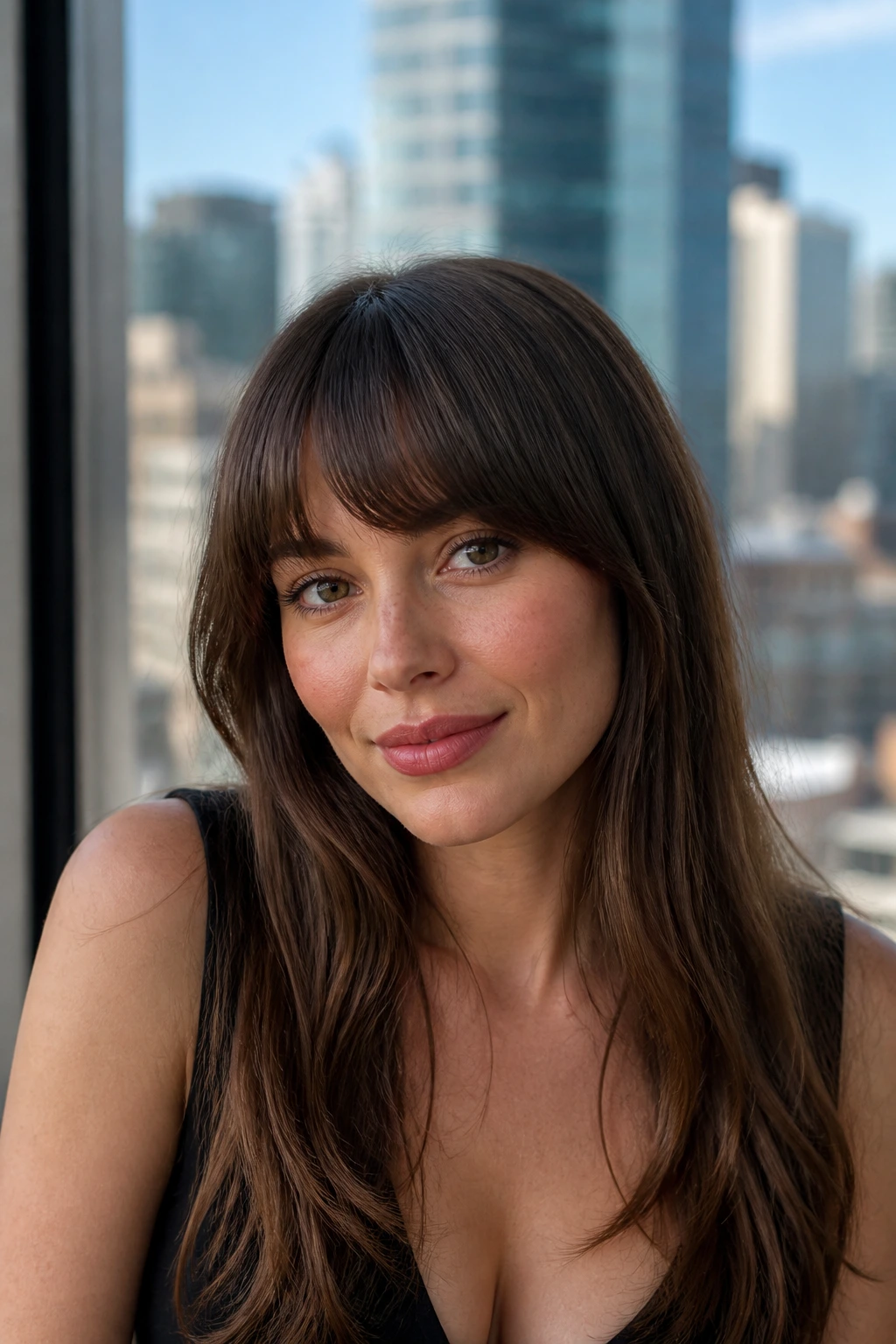
A soft arch across the brows can look surprisingly good on a heart-shaped face. The curve echoes the natural shape of the forehead without making it feel wider, and the brow-grazing length keeps the fringe close to the eyes in a way that feels polished rather than severe. It’s a strong shape, but it does not have to look harsh.
This one works best when the center is not cut too short. If the shortest point sits just at or a touch below the brows, the arch has room to read as graceful instead of choppy. It’s also a better choice for straight or slightly wavy hair, since the curve depends on a cleaner fall.
The biggest mistake is over-curving it. That can make the bangs look like a little helmet. Keep the arch soft and the sides a bit longer, and the whole thing gets much easier to wear.
9. Piecey French-Girl Bangs

Piecey bangs have attitude, but not the annoying kind. The strands are separated enough that the fringe never becomes a dense sheet, which is useful on a heart-shaped face because the forehead stays partly visible. That tiny bit of show-through makes the cut feel lighter.
They also fit long hair better than a lot of people expect. Instead of fighting the length, they give the front a lived-in shape that works with loose waves, air-drying, and slightly imperfect styling. If you hate the idea of blow-drying every morning, this style has appeal.
What to ask for
Ask for texture, not choppiness. There’s a difference. The goal is broken-up strands with movement, not uneven pieces that look like they were cut in the dark.
10. Razored Bottleneck Bangs
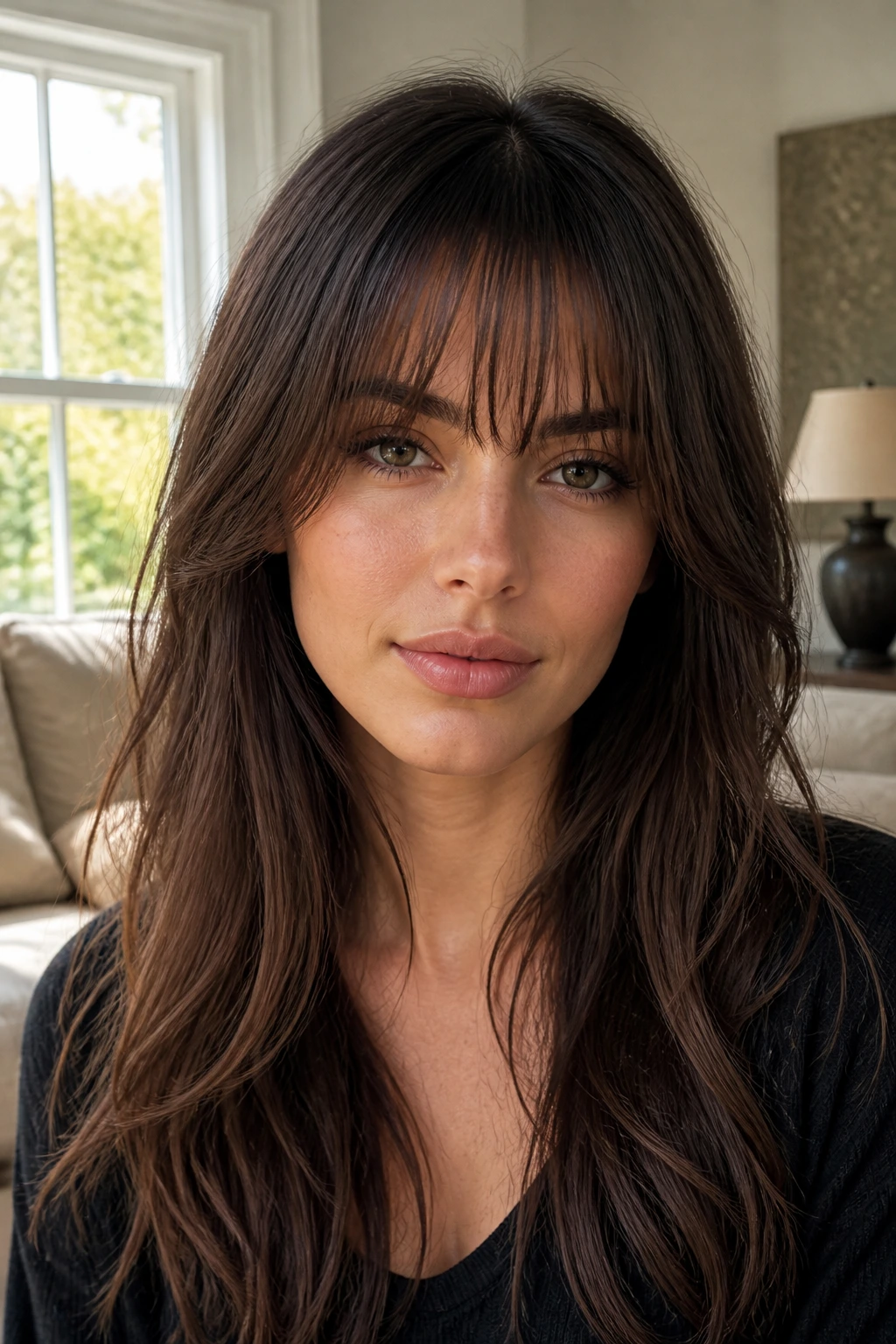
This is the softer, airier cousin of the classic bottleneck shape. A razor or deep point-cutting technique takes weight out of the ends, which helps thick hair from turning into a heavy fringe block. For heart-shaped faces, that lighter edge keeps the forehead from feeling crowded.
Razored bangs are lovely when you want the front to move a little more. They bend easier, tuck easier, and grow out with less drama. On long hair, that matters because the fringe should feel connected to the rest of the cut, not like a hard stop sitting on top of it.
They are not the best choice if your ends are already fragile or overly processed. A razor can make damaged hair look frayed. If your hair snaps easily, a scissor-based soft cut is kinder.
11. Invisible Bangs
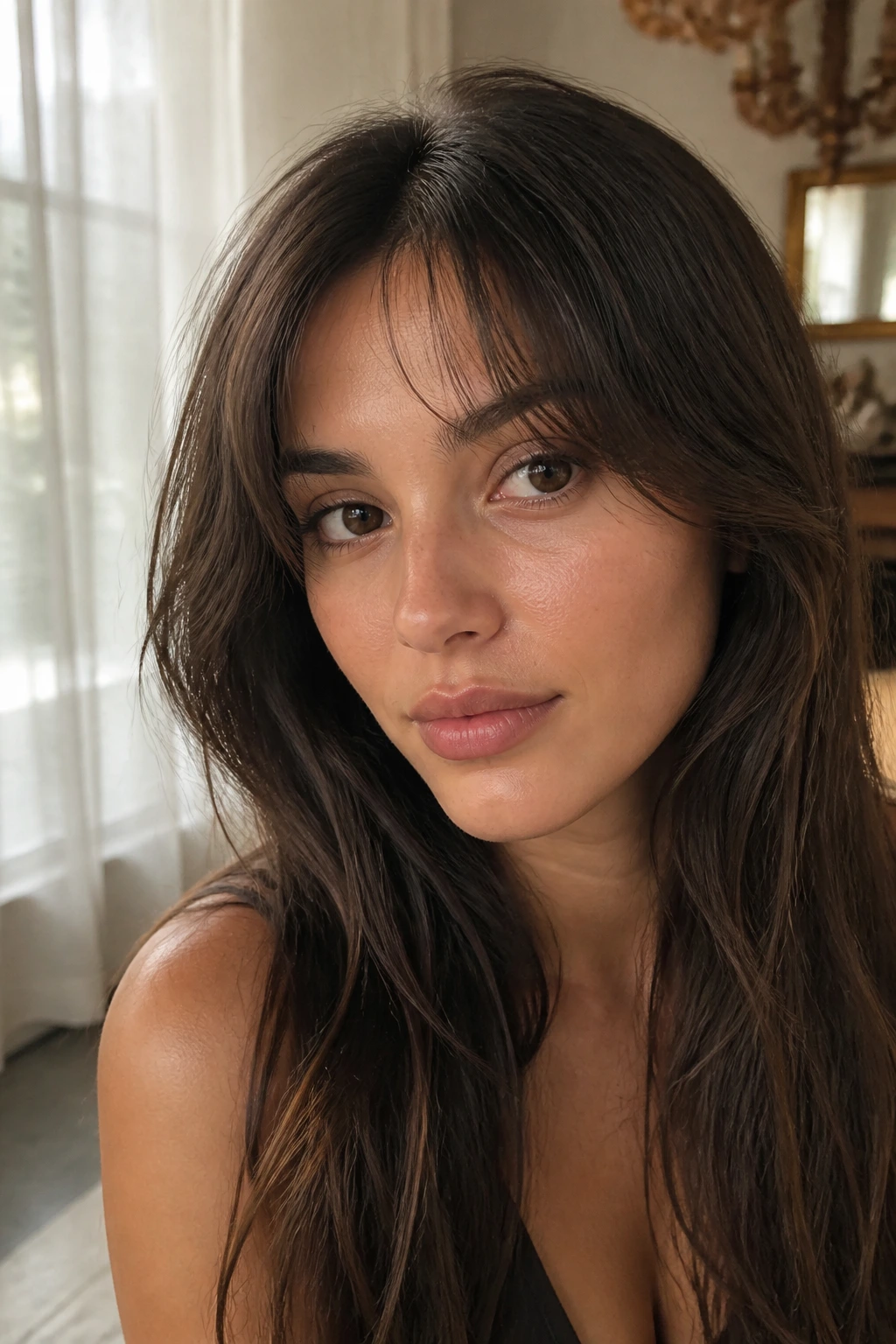
Invisible bangs are what happens when a fringe becomes almost part of the hairline instead of a statement on its own. The center is soft and long, the sides melt into the front layers, and the whole thing feels barely there until you notice how much better the face looks. That subtlety is useful on heart-shaped faces, where a little front shape can go a long way.
This style is ideal if you want to test bangs without fully committing to a visual wall across your forehead. It’s also a good choice for people who wear their hair up a lot. When pulled into a ponytail or bun, the front still leaves some softness around the face.
Best for first-timers
If you’re nervous, start here. It grows out cleanly, and it gives you room to decide whether you want more fringe later.
12. Long Side Fringe with Layers
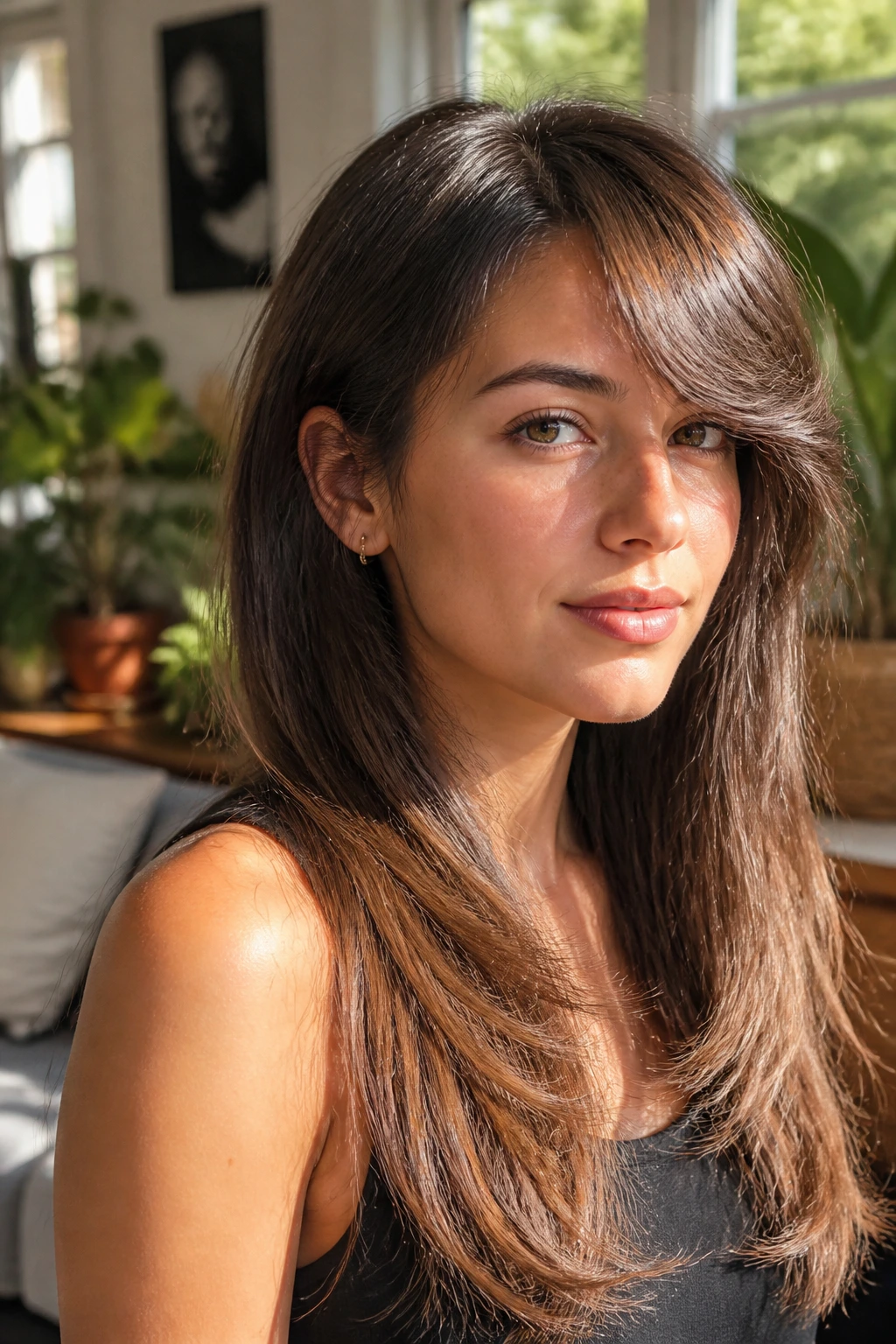
A long side fringe is one of the most practical cuts in the whole group. It sweeps across the forehead, then slides into the front layers so it never looks disconnected from the rest of the hair. On a heart-shaped face, that diagonal line softens width up top and keeps the chin area from looking too small in comparison.
I like this shape for people who wear long hair loose most days. It tucks behind the ear when you want it gone, then falls back across the face with very little effort. That’s a real quality if your mornings are not a long, ceremonial event.
H3: Who should try it
- Anyone with a cowlick that refuses center-part bangs
- Hair that prefers side parts
- People who want a fringe that behaves on day three, not just on wash day
13. Choppy Textured Bangs
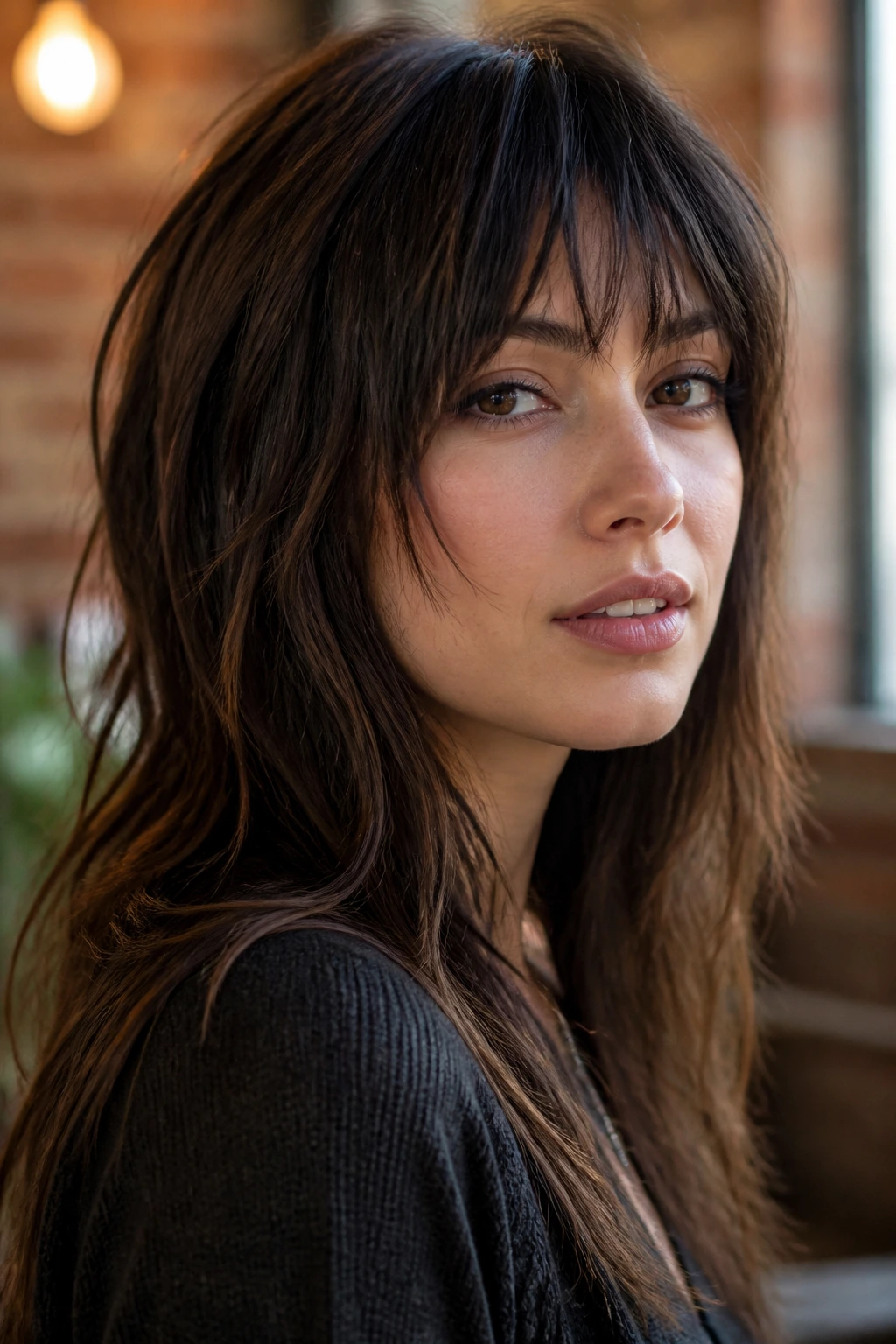
Choppy bangs are not the same as careless bangs. The cut should still be intentional, but the edge is broken up so the fringe doesn’t sit in one flat line. That texture helps on a heart-shaped face because it keeps the upper face from looking too broad or too formal.
These bangs shine on thicker hair. Dense hair needs somewhere to go, and choppy structure gives it movement instead of bulk. They can also give long hair a little edge if the rest of the cut is very smooth or very polished. That contrast can be chic. Or just useful. Sometimes the line between the two is thin.
Styling note
Use a small amount of texturizing spray at the roots and a touch at the ends. Too much, and the fringe starts looking dry and stringy. Too little, and the texture disappears.
14. C-Shape Fringe
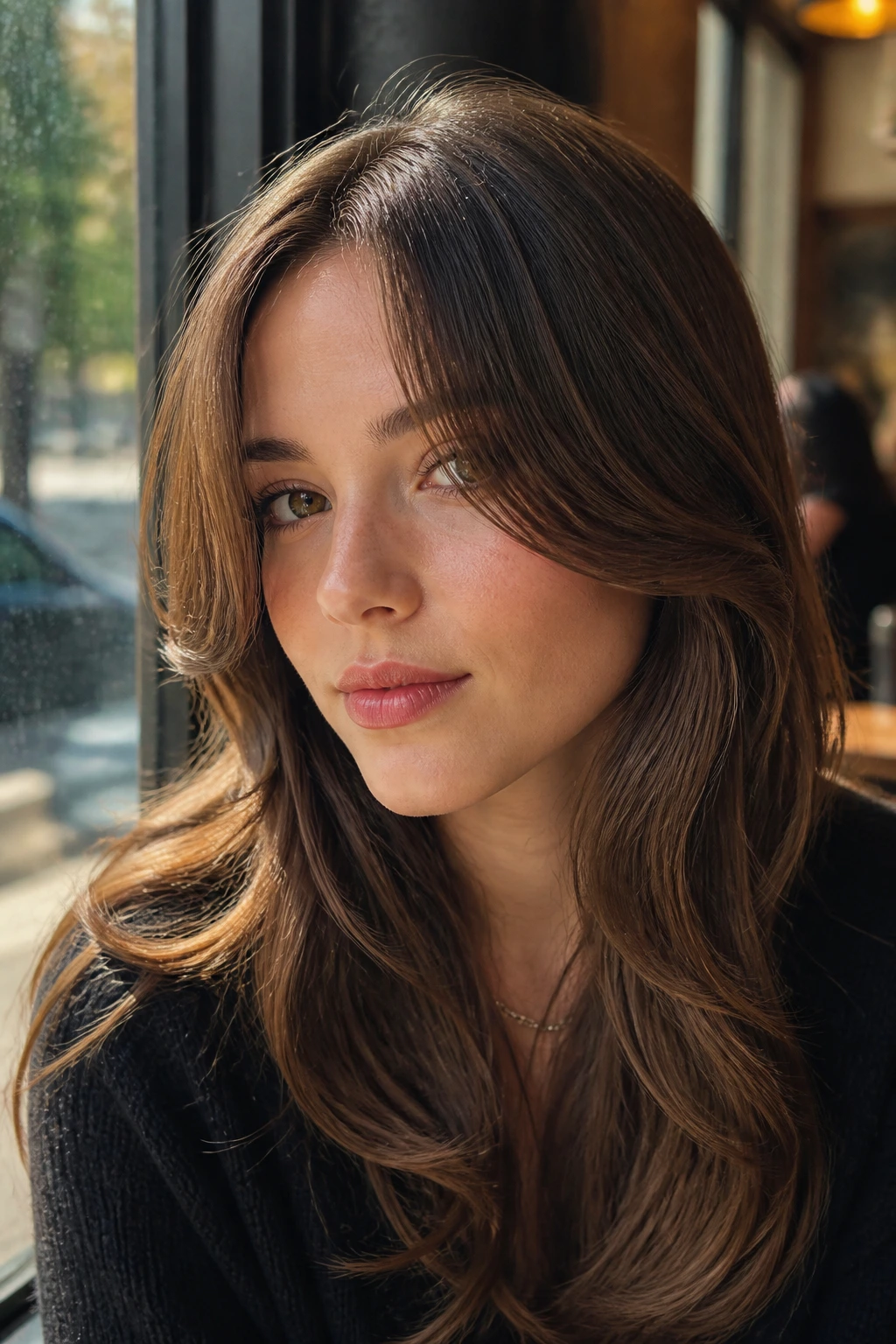
A C-shape fringe curves around the face in one smooth sweep, usually starting closer to the center and curling inward toward the cheek. The shape is flattering on heart-shaped faces because it echoes the natural roundness around the upper face while tapering into the sides.
What makes this one interesting is the softness around the temples. Instead of a hard break, the fringe wraps around and then gets longer, which helps long hair feel more layered near the front. It has a polished look without looking stiff.
This is a good option if you want bangs that read as styled even on light styling days. The curve does a lot of the work for you. A little blow-dry bend helps, but you do not need a full salon set every morning.
15. Soft Blunt Bangs
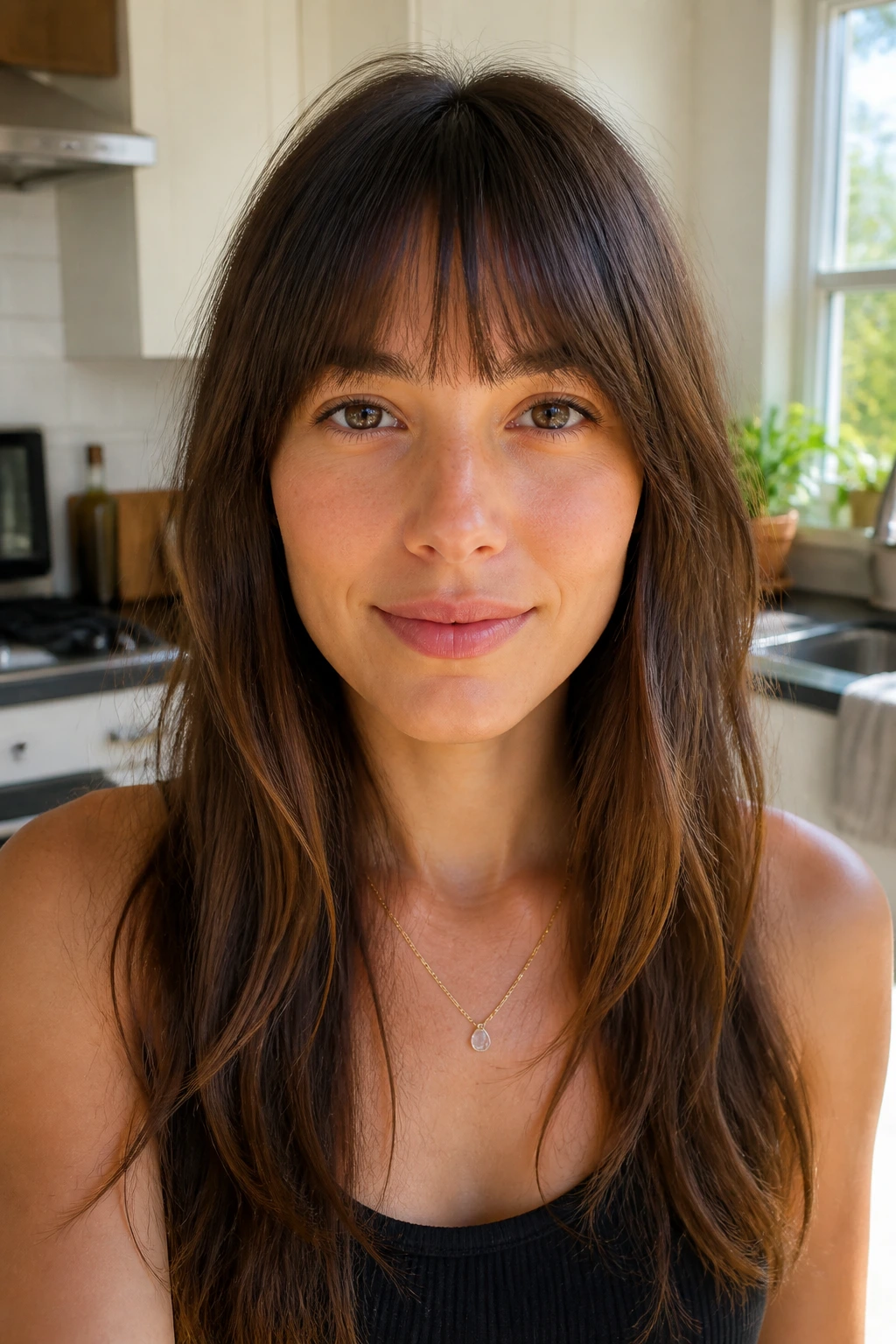
Blunt bangs can scare people with heart-shaped faces, and I get why. A heavy, straight-across line can feel like a lid if it’s too dense or too short. But when the edge is softened just enough and the sides are left a touch longer, the style becomes much more wearable.
The payoff is structure. A soft blunt fringe gives the face a clear frame and can make the eyes look more prominent, which long hair sometimes needs. The trick is to avoid the hard shelf effect. That means no severe one-length block from temple to temple.
Best version to ask for
Ask for bluntness with texture at the ends, not a thick, geometric line. It should sit cleanly but move when you blink. That sounds fussy, but it’s the difference between chic and helmet.
16. Heavy Fringe with Tapered Sides
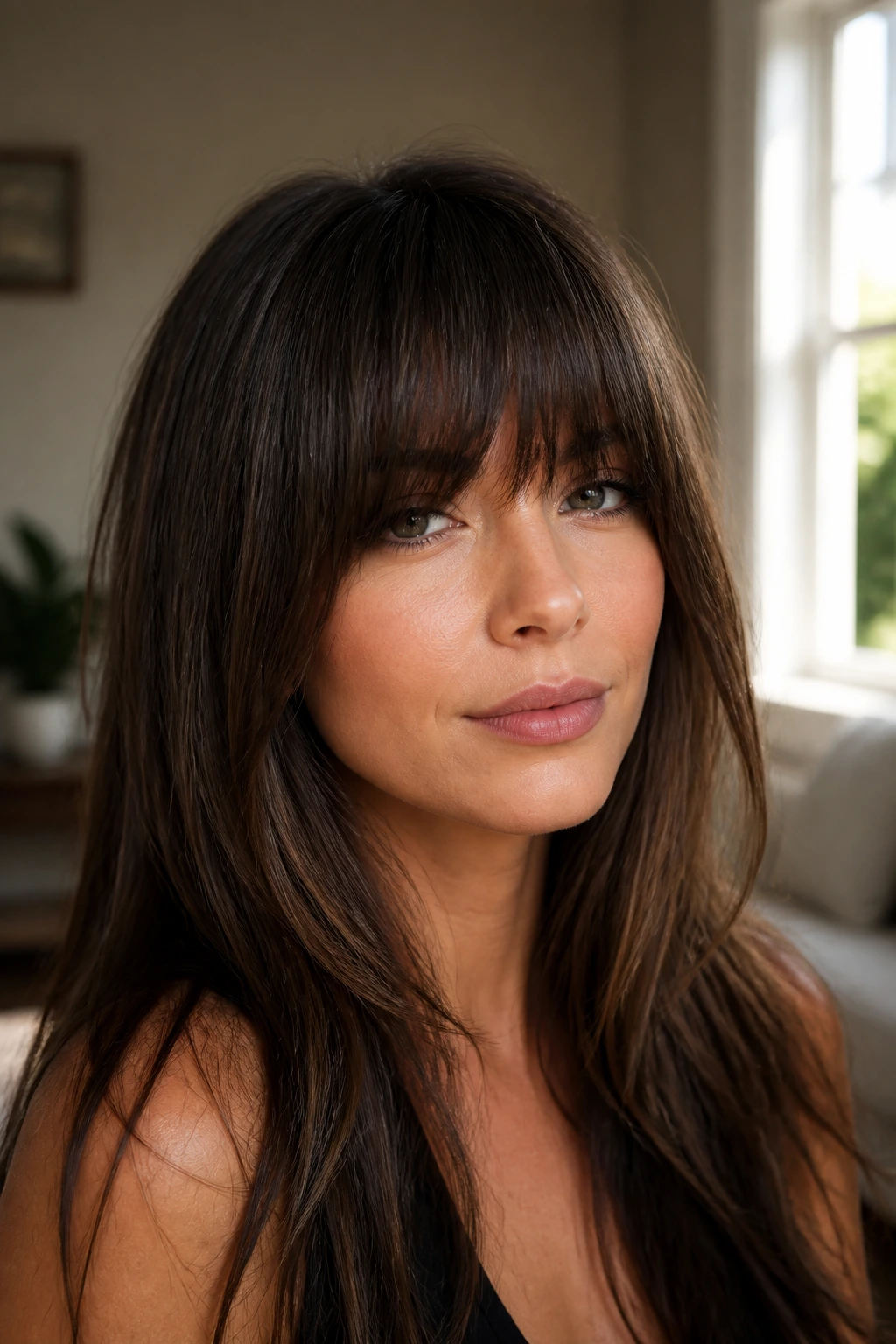
This is the bold choice in the mix. The center carries more weight, so the bangs make a statement right away, but the tapered sides keep them from overwhelming a heart-shaped face. That taper is doing a lot of work. Without it, the style can get boxy fast.
It’s a strong look on long hair because the contrast is part of the appeal. Long lengths keep the haircut soft overall, while the heavy center fringe anchors the face. If you like a little drama and you’re willing to style it, this can be a really satisfying shape.
A small warning
Heavy fringe shows every mistake. If the cut is too thick at the edges or too short in the middle, it starts feeling blunt in the wrong way. Keep the temples longer, or the whole front looks pasted on.
17. Split Fringe with Long Layers
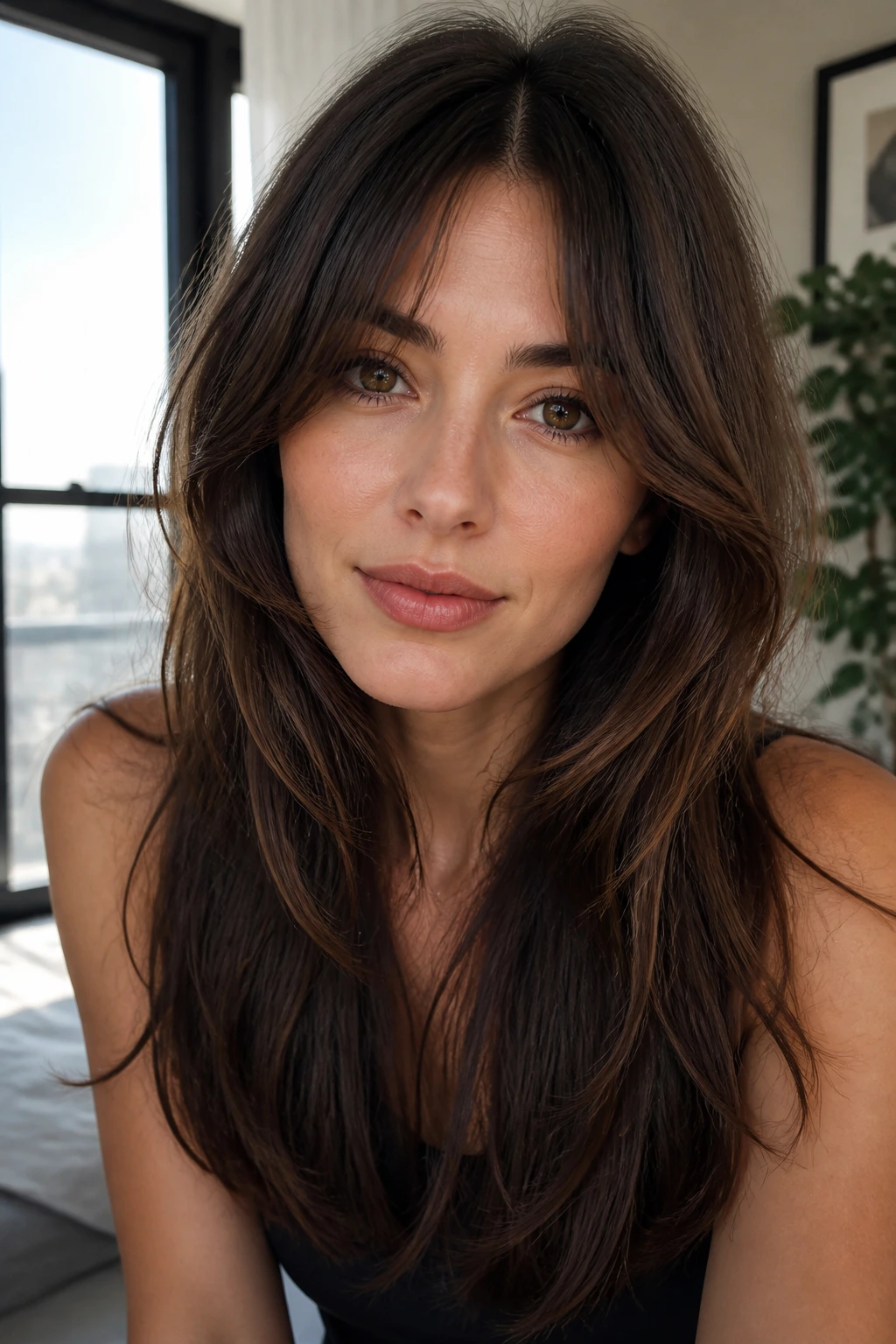
A split fringe is not as full as classic curtain bangs, and that’s the point. The center opens enough to show some forehead, while the long layers on each side frame the cheekbones and connect to the rest of the hair. On a heart-shaped face, that open center can keep the forehead from feeling trapped.
This style is a favorite for people who like to push hair around during the day. It doesn’t fight side parts, center parts, or a bit of wind. It just rearranges itself and stays flattering. Long hair helps here, because the fringe has room to melt into the length.
If you’re lazy about styling, this is one of the easier choices. It looks good a little messy.
18. Airy Micro-Curtain Bangs
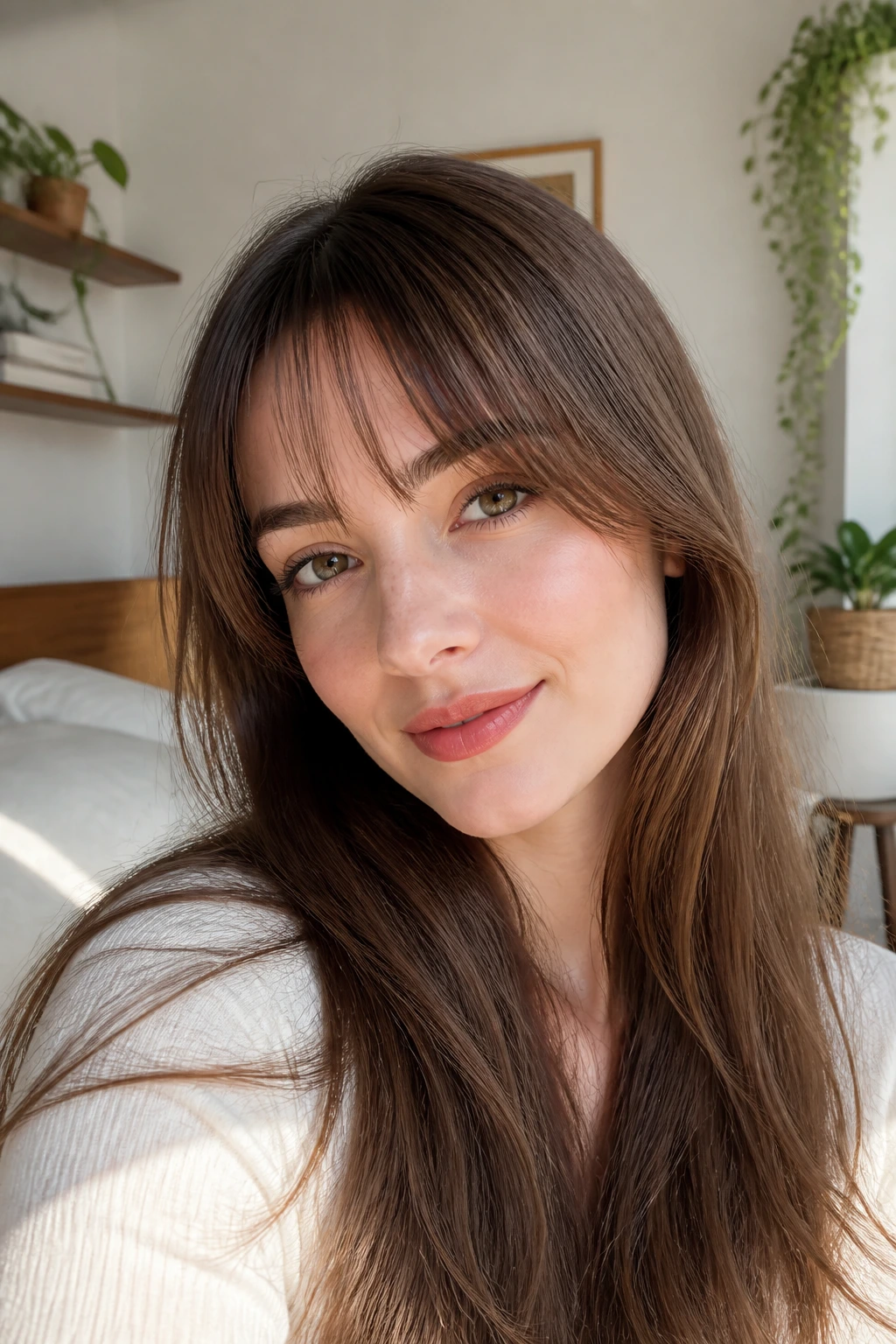
Airy micro-curtain bangs sit shorter than a classic curtain fringe, but they’re not the baby-bang version. The center opens above the brows, the sides sweep down, and the overall effect stays light. On a heart-shaped face, that lightness matters because it keeps the forehead from looking overbuilt.
This is a more modern shape, and it asks for a little more care than the softer classics. The payoff is a front fringe that feels fresh and sharp without being severe. It’s especially nice if your long hair has a blunt edge or a very polished finish and you want the front to loosen things up.
What to expect
You’ll probably need a round brush or a quick pass with a small flat iron to keep the sweep from collapsing. If you don’t want to style daily, skip this one.
19. Grown-Out Bangs
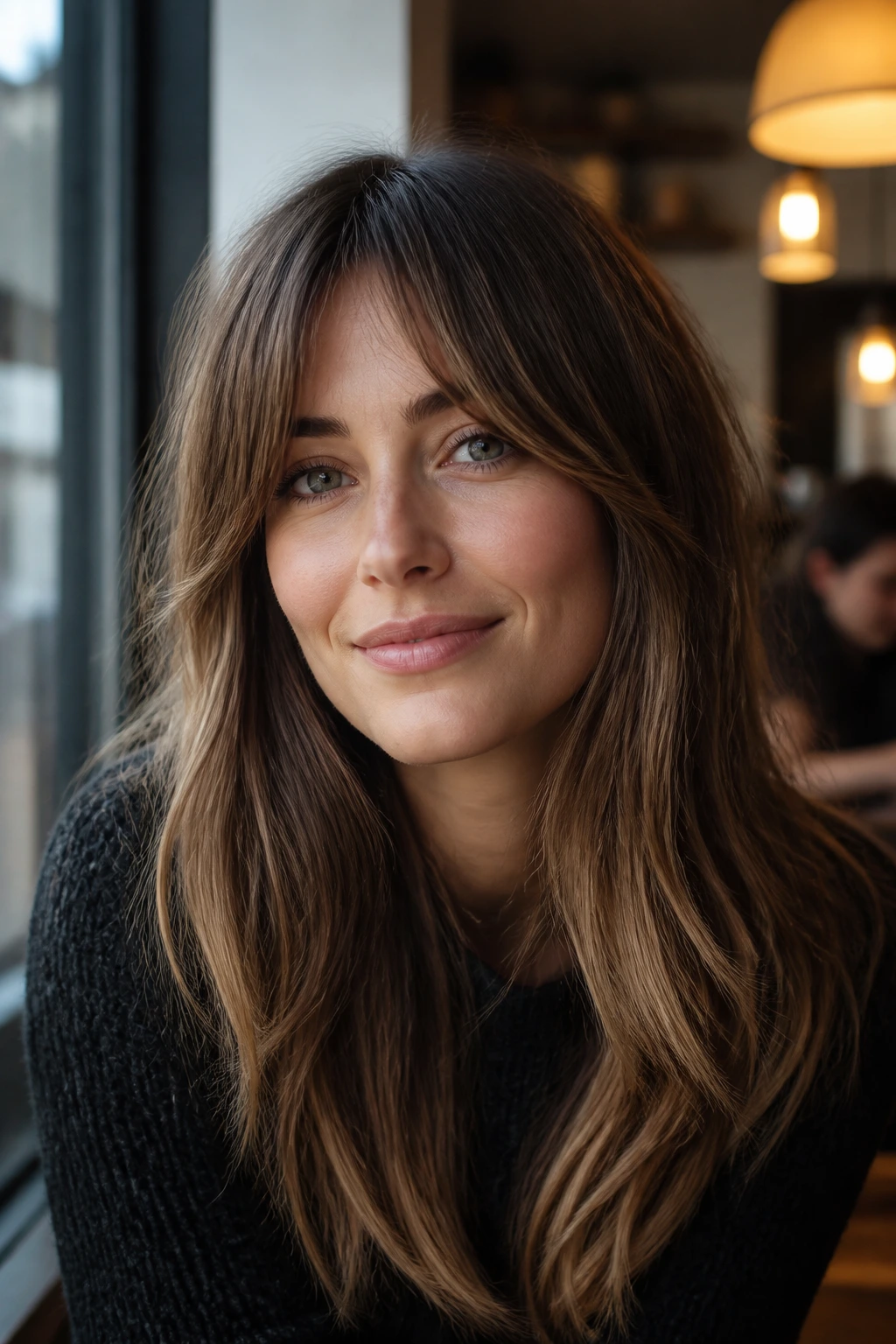
Grown-out bangs are not a compromise if they’re cut well. They sit somewhere between fringe and face-framing layers, which makes them one of the easiest options for long hair. On a heart-shaped face, the longer length at the sides helps soften the forehead while keeping the front from feeling chopped.
This style works beautifully if you know you won’t be back in the salon every month. It also suits people who are in the awkward phase between having bangs and not having bangs. The haircut can look deliberate instead of like you missed your trim by six weeks.
A grown-out fringe is often the most honest choice. It accepts that hair moves. Smart haircuts do that.
20. Sweeping S-Curve Fringe
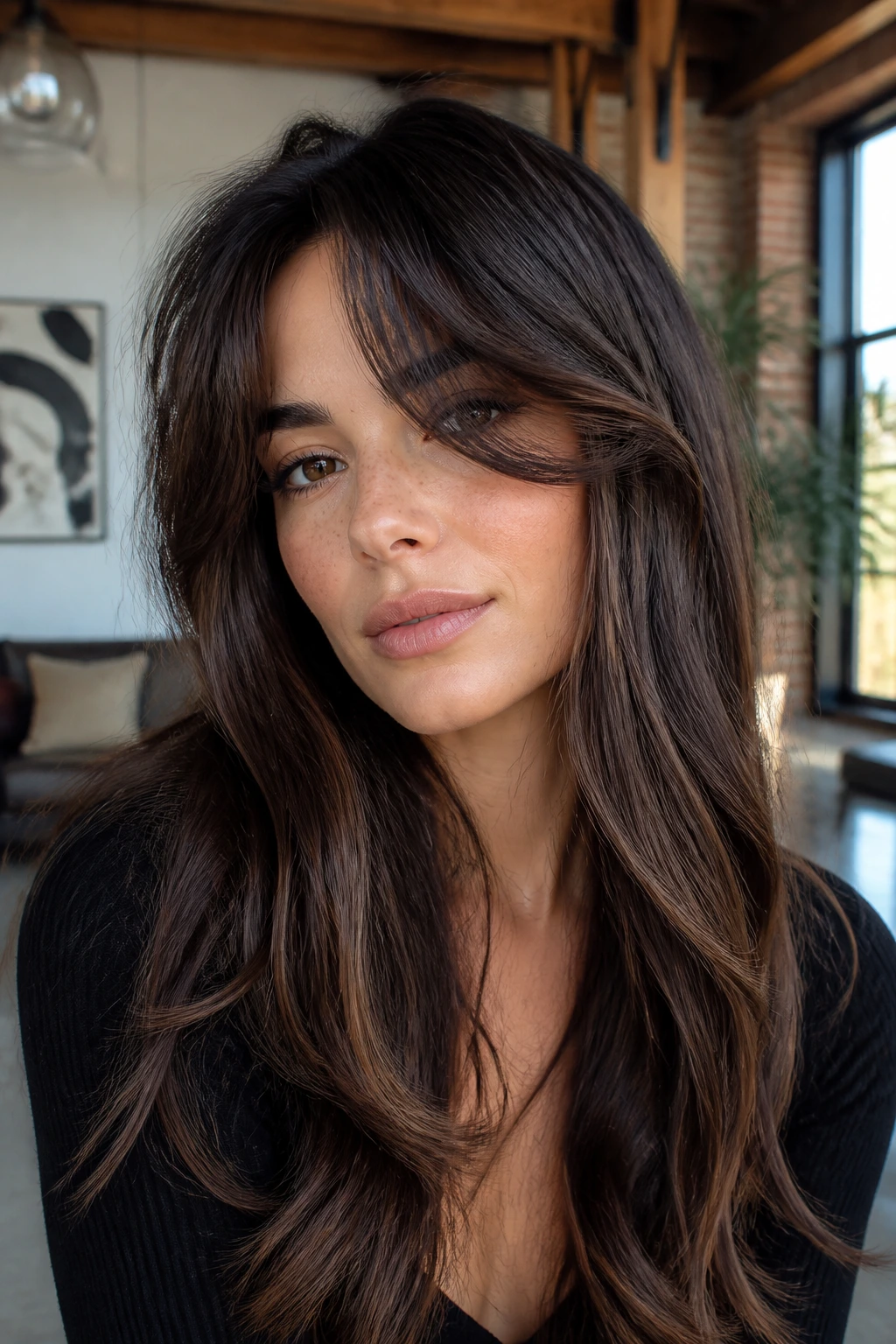
The S-curve fringe bends one way near the center, then curves back in the opposite direction near the cheekbone. That shape can sound fussy on paper, but in the mirror it reads as soft, polished movement. On a heart-shaped face, the curve keeps the eye moving around the forehead rather than landing on one heavy line.
It’s a good option for people who like a more styled finish. The curve creates shape even before the rest of the hair is done. That means the fringe can carry a whole look, which is handy if you wear your long hair simply and want the front to do the talking.
Styling note
Set the roots in opposite directions while drying, then guide the curve with a brush. If the fringe wants to split weirdly, pin it flat while it cools for a minute. That tiny step makes a big difference.
21. Layered Brigitte Bangs
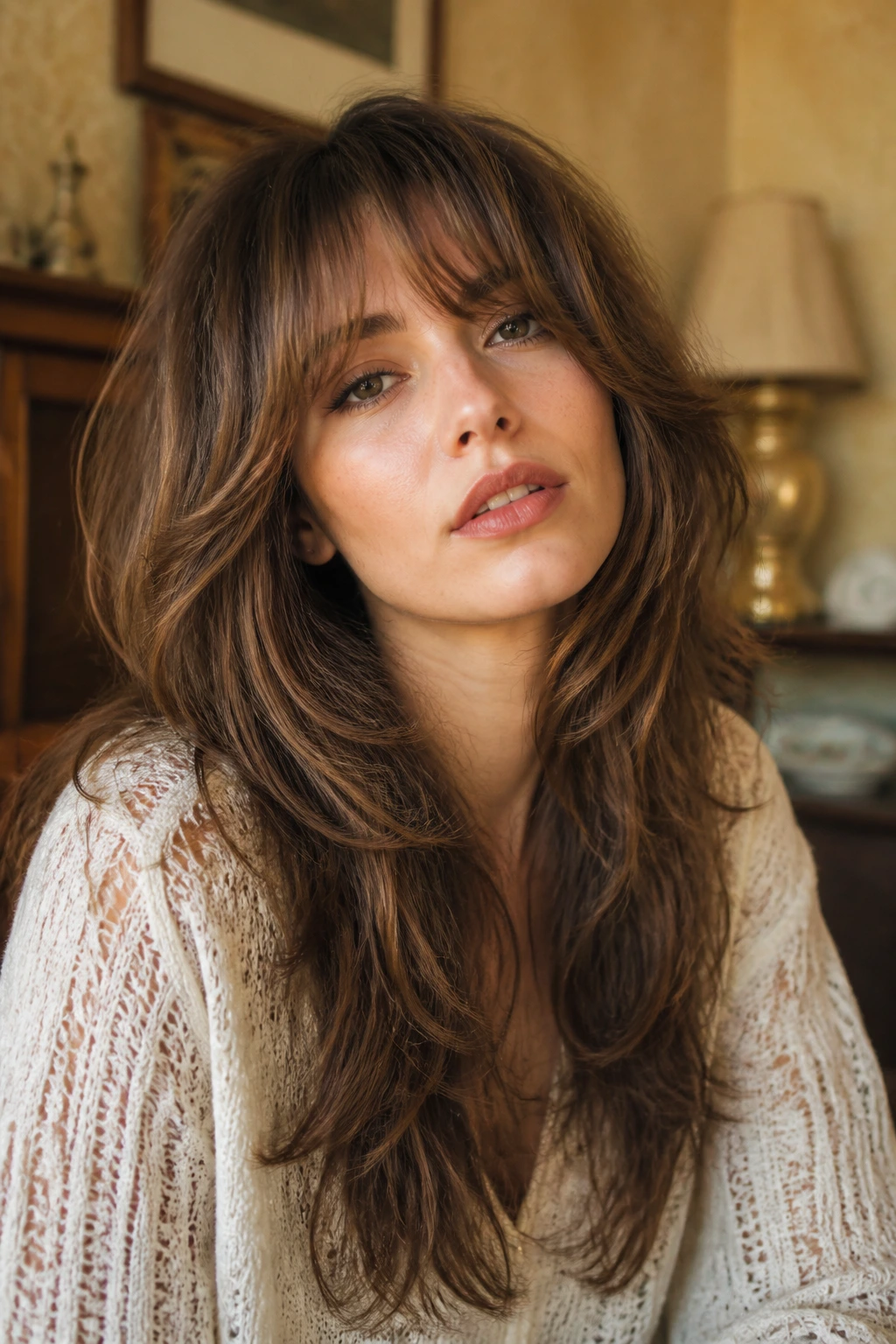
There’s a reason this retro shape keeps coming back. Layered Brigitte bangs have enough volume to feel romantic, but the soft layers keep them from becoming costume hair. On a heart-shaped face, the fullness can balance a narrow chin while the feathered edges stop the forehead from looking too broad.
This one works especially well with long, soft waves. The fringe and the rest of the hair share the same mood, which is half the battle. If the lengths are sleek and the bangs are fluffy, the haircut can feel divided. When both move the same way, it all clicks.
I’d call this a higher-maintenance option, but a rewarding one. If you like a blowout, you’ll probably like this.
22. Razor-Cut Curtain Fringe
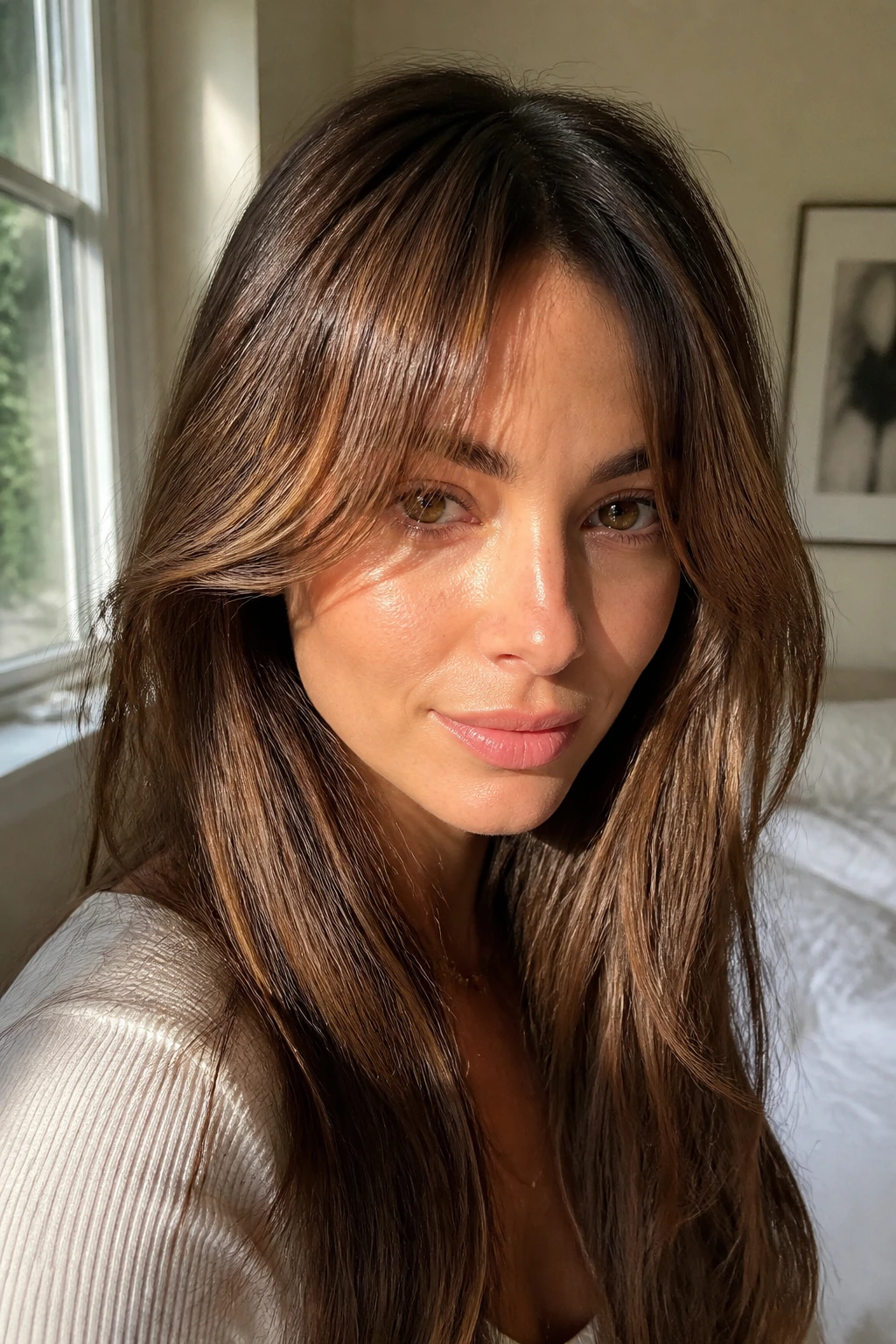
Razor-cut curtain fringe has a lighter edge than scissor-cut versions. The blades take weight out of thick hair and create soft, broken ends that move nicely around the forehead. For heart-shaped faces, that means less density at the top and more flow around the cheekbones.
This style is useful if your hair tends to puff up or if the front becomes too bulky after a fresh cut. The razor gives the fringe some swing. It also helps the bangs blend into the layers faster, which matters when the rest of your hair is long and full.
Best for
- Thick straight hair
- Hair that feels bulky at the front
- People who want a fringe with movement, not a dense sheet
23. Soft Bottleneck Flip
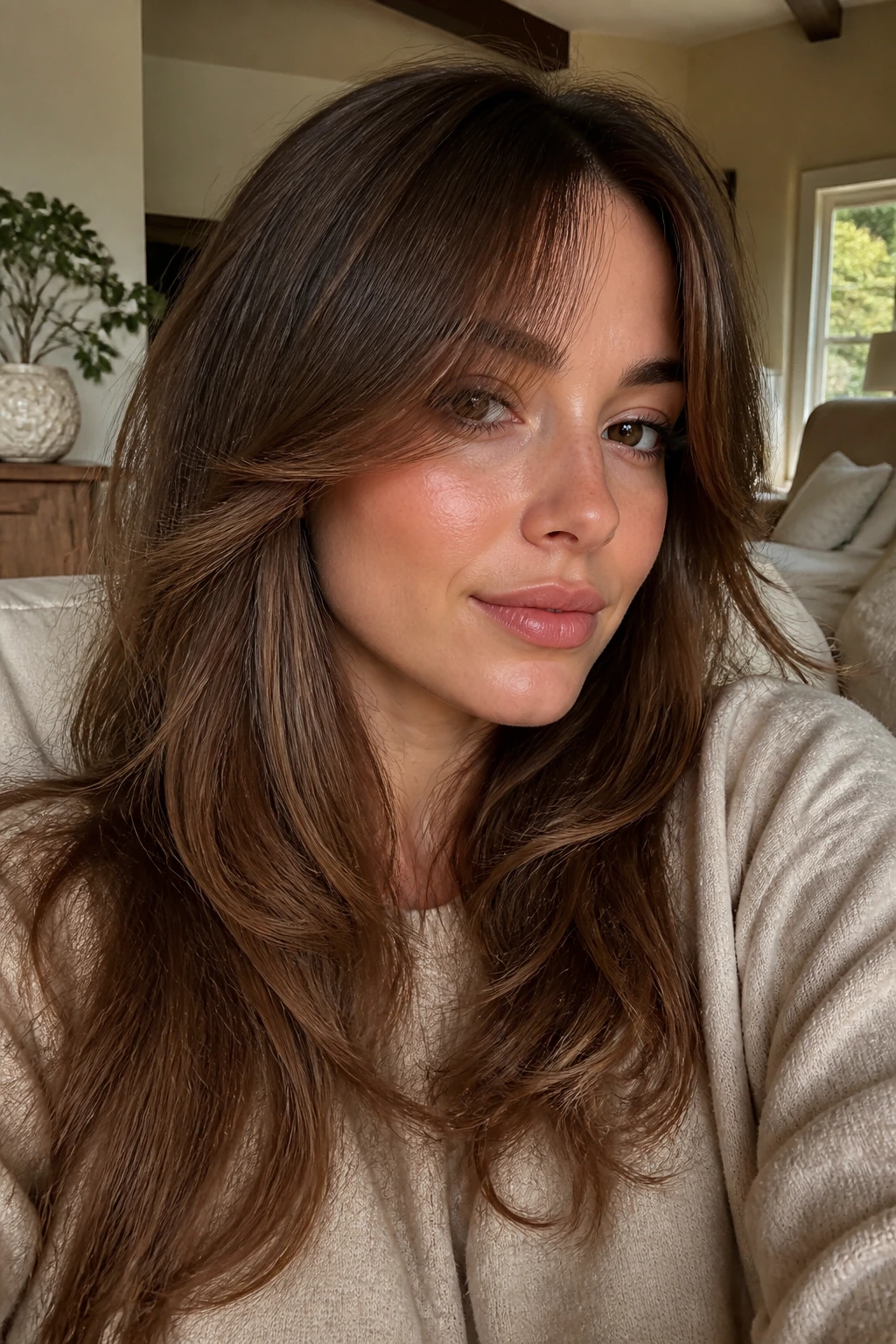
This is the playful version of bottleneck bangs. The center stays close to the face, then the sides flip out a little at the ends instead of dropping straight down. That outward motion helps a heart-shaped face because it opens the cheek area and keeps the fringe from collapsing into the forehead.
The flip makes the style feel less serious. That can be a relief if you like bangs but hate when they look too formal. Long hair pairs well here because the front pieces can echo the flip and keep the whole haircut lively.
Quick styling note
Use a round brush or the bend of a flat iron at the last inch only. Over-flipping the ends makes the bangs look dated. A small curve is enough.
24. Glam Side Bend Bangs
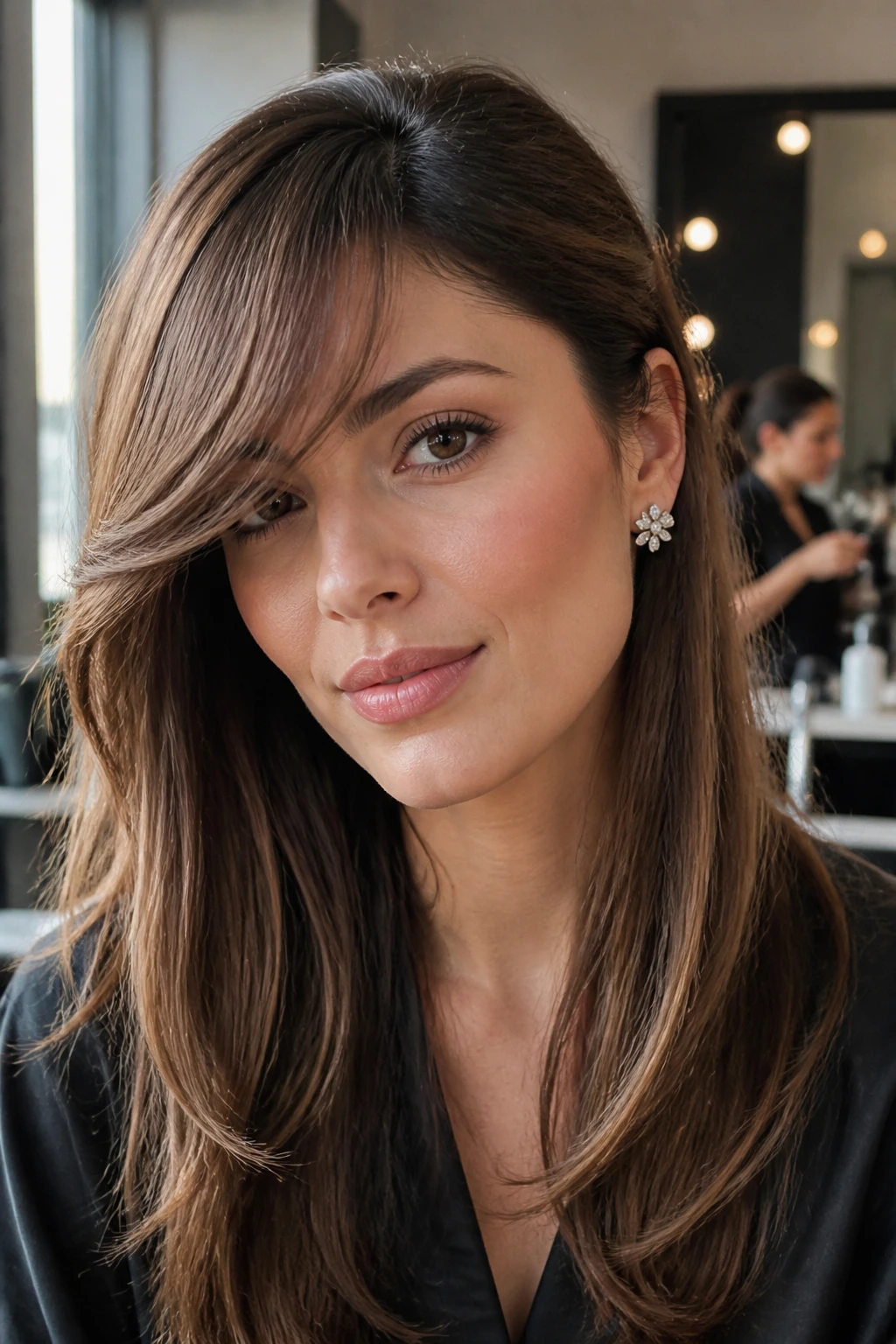
Glam side bend bangs are the dressed-up cousin of a standard side-swept fringe. The part is a little cleaner, the lift at the root is a little higher, and the bend across the forehead feels more deliberate. On a heart-shaped face, the diagonal line narrows the visual width up top and gives the cheekbones a strong frame.
I like this style for events, but it doesn’t have to be fussy. A good blow-dry and a brush through the ends can take it far. If your long hair is smooth, shiny, or layered with a bit of polish, this fringe finishes the look without stealing it.
25. Face-Framing Fringe with Long Curtain Layers
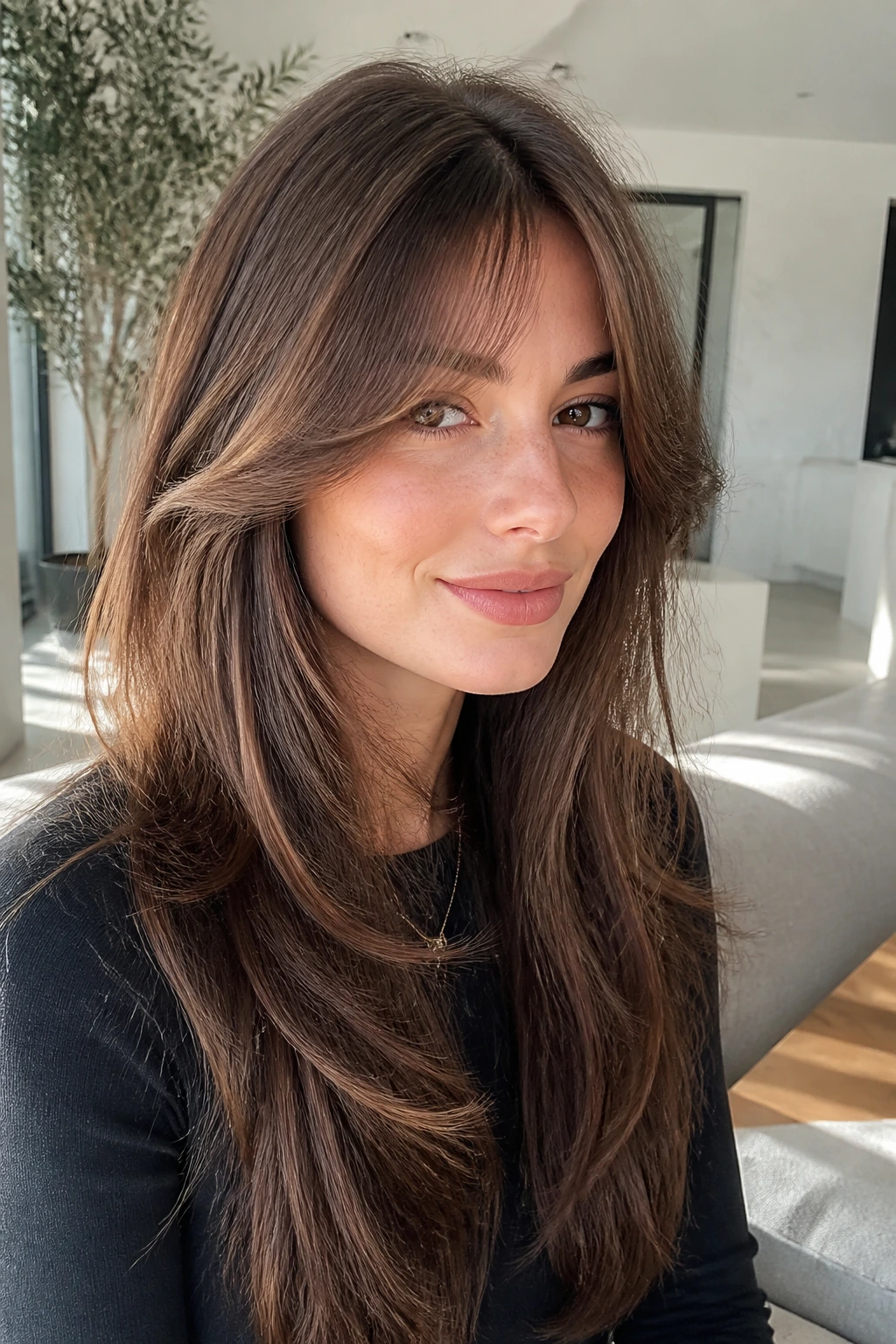
This is the all-in choice if you want the front of the haircut to be as important as the length. The fringe starts as a soft curtain, then stretches into long face-framing layers that live right around the cheeks and jaw. On a heart-shaped face, that stretch is gold. It softens the forehead, flatters the cheekbones, and stops the chin from feeling too small in the overall shape.
It also gives you flexibility that a shorter fringe can’t. You can wear it centered, off-center, tucked, pinned, or brushed wide. The haircut keeps making sense no matter what you do with it, which is why so many people end up staying in this category once they try it.
A useful way to think about it
This is not fringe as a separate feature. It’s fringe as part of the whole cut. That’s usually where the best long-hair bangs land anyway.
How to Brief Your Stylist So the Cut Lands Right
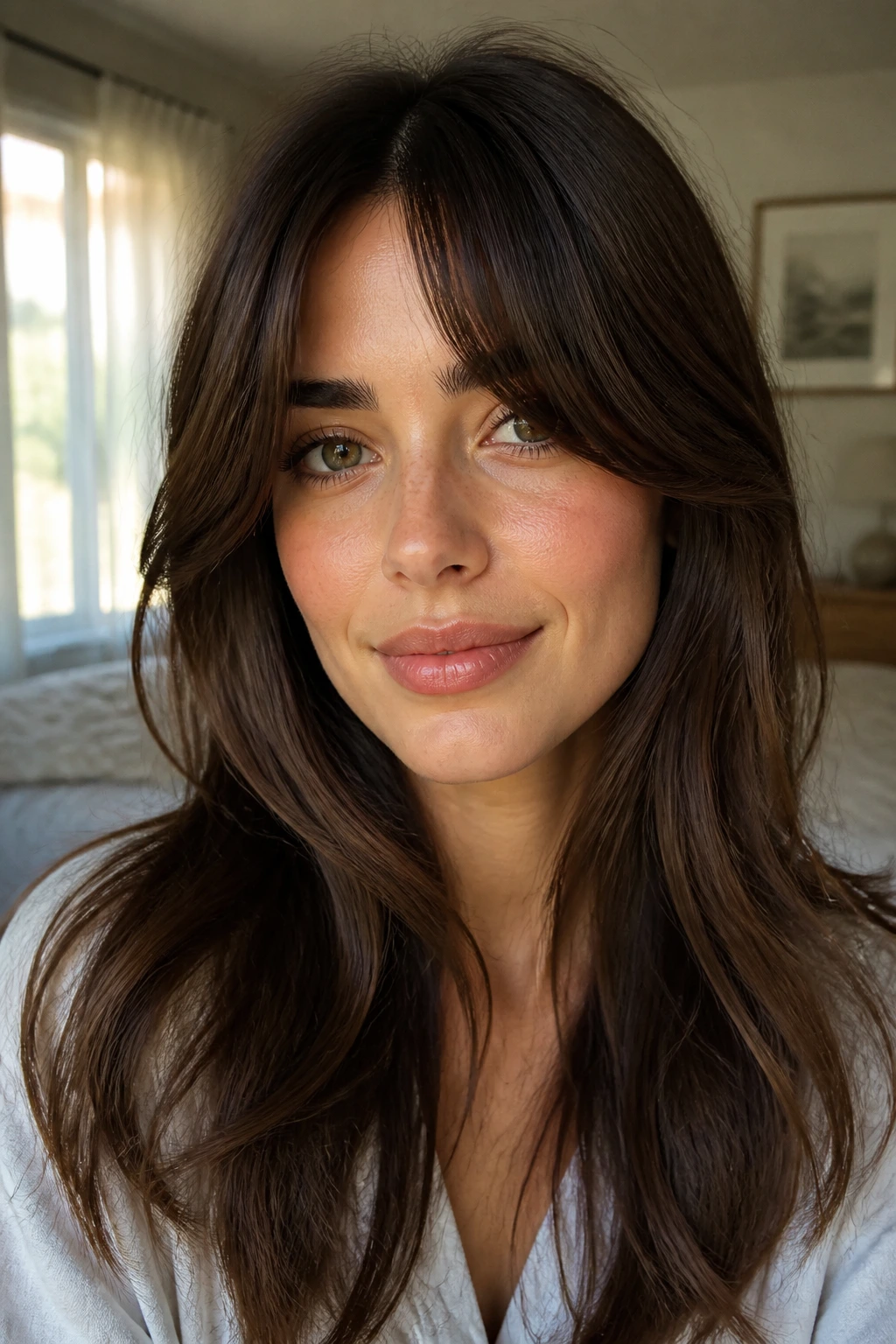
The fastest way to ruin a good bang idea is to describe it in vague language and hope for salon magic. Don’t do that. Bring photos, but bring the right kind of photos: one with the hair down from the front, one from a slight angle, and if possible one that shows how the fringe moves when the model turns her head. A single perfect front-facing shot can hide a lot of nonsense.
Say how much forehead you want covered. Say whether you part your hair in the center, on the side, or both. And tell them how often you are willing to style the fringe, because a five-minute bang and a fifteen-minute bang are not the same haircut.
A few phrases that help
- “Keep the temples longer than the center.”
- “I want movement, not a heavy shelf.”
- “Make it work with long hair, not against it.”
- “My hair does this weird thing here.” Point to the cowlick. Don’t leave it as a mystery.
If your hair is wavy or curly, ask whether a dry cut makes sense. If your hair is very fine, ask for soft internal texture instead of a lot of thinning. That one conversation can save you from months of pinning the fringe back with a bobby pin and resentment.
Tools That Make Bang Styling Less of a Fight
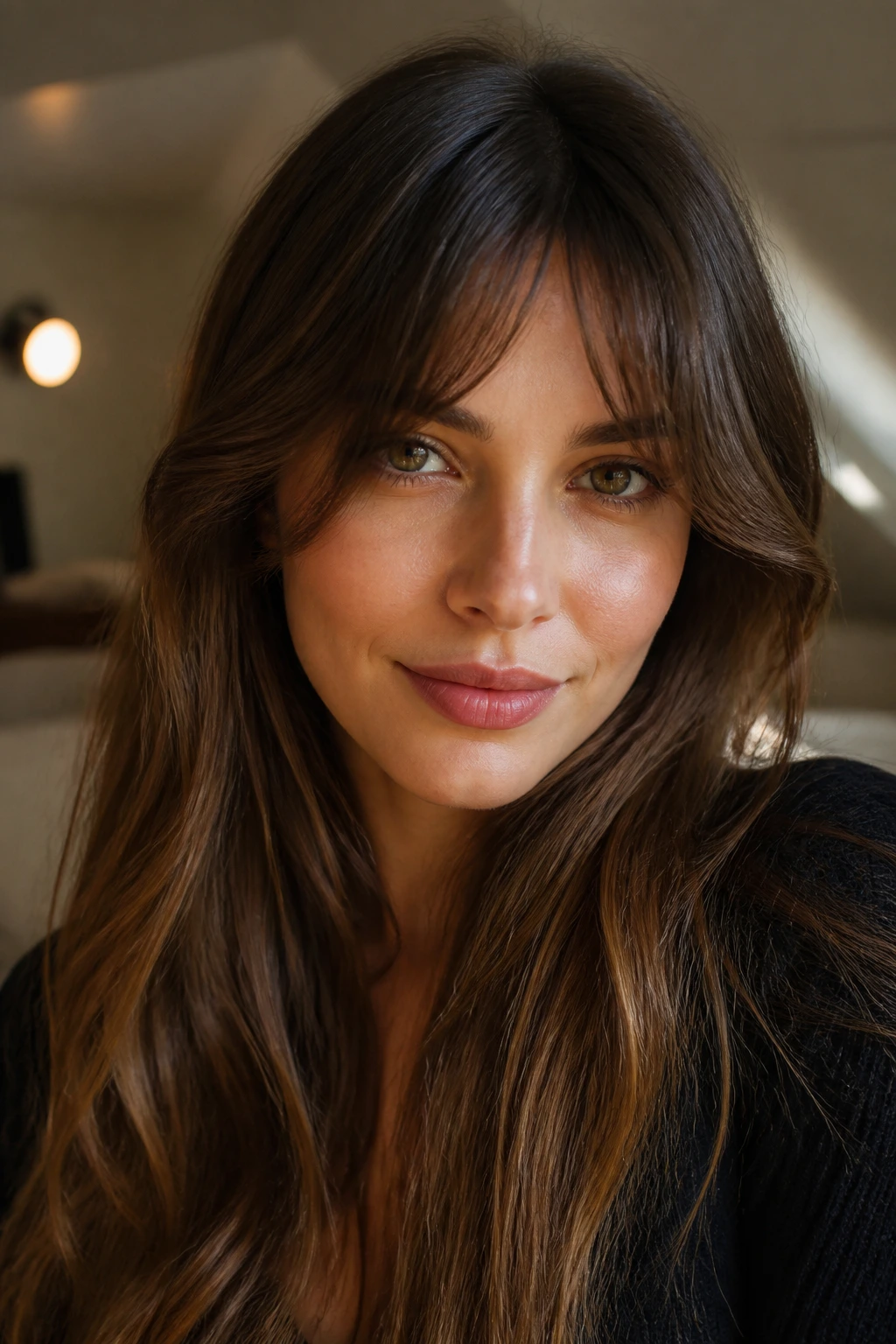
You do not need a vanity full of gadgets. You do need a few things that do their job well.
-
Small round brush, 1 to 1.25 inches: Best for shaping curtain, bottleneck, and brow-grazing fringe without blowing the hair apart.
-
Blow dryer with a concentrator nozzle: The nozzle helps direct heat at the roots so the fringe dries in the right direction instead of puffing everywhere.
-
Duckbill clips or sectioning clips: These keep the rest of the hair out of the way while you dry the bangs first, which is the least annoying way to do it.
-
Mini flat iron: Useful for side-swept or piecey fringe when you need a tiny bend, not a full straightening pass.
-
Dry shampoo: Good for the roots of the bangs, especially if your forehead tends to make them collapse by midday.
-
Light texturizing spray or mousse: Adds grip without turning the fringe into crunchy straw. Use less than you think.
-
Fine mist water bottle: Handy for rewetting the fringe without soaking the rest of your hair.
A wide-tooth comb can help with separation, but I would rather style bangs with fingers and brush than over-comb them into submission. Bangs usually want a little softness. Too much combing makes them too neat.
Daily Styling Moves That Keep Bangs From Separating
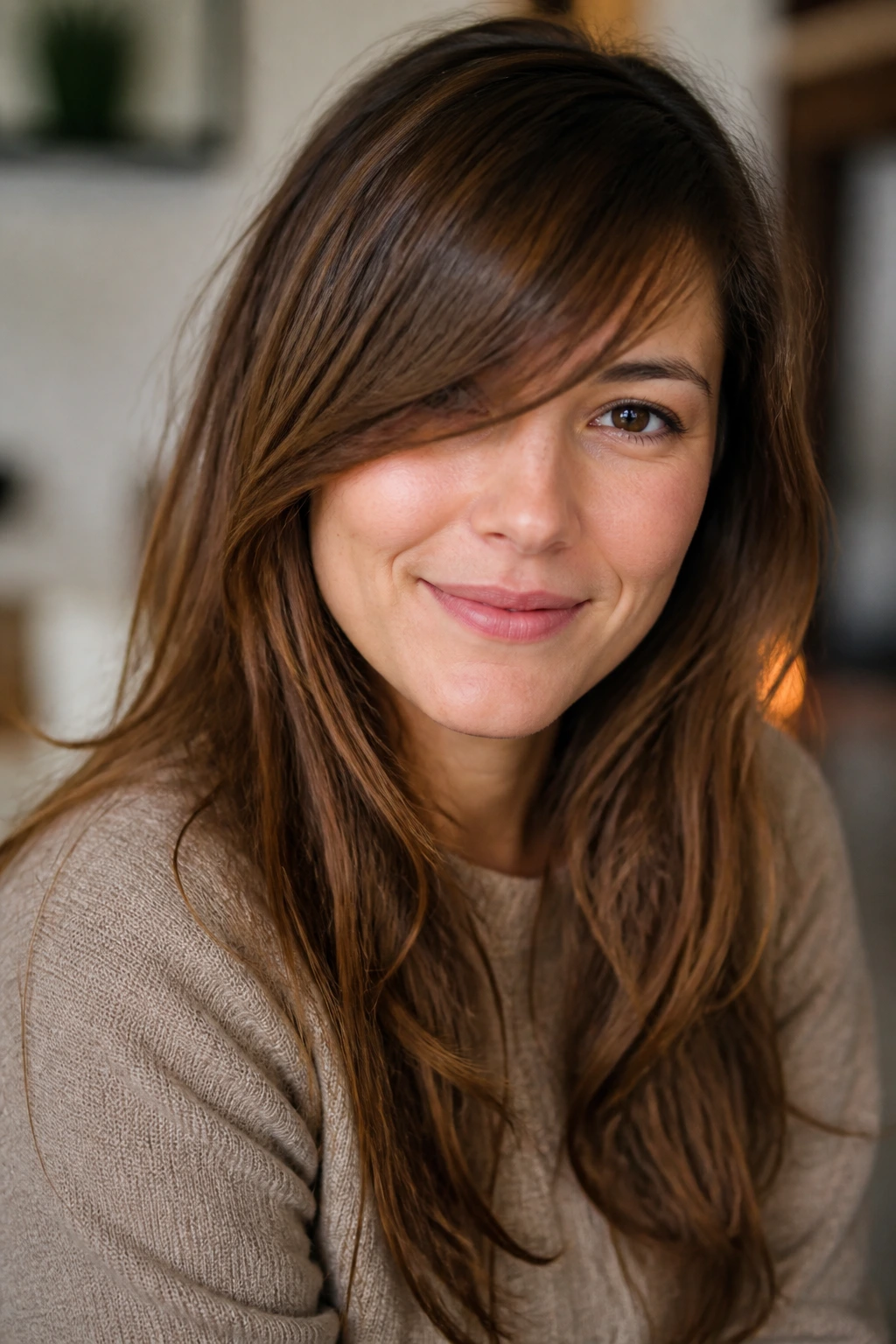
Bang styling gets easier when you stop treating the fringe like a separate project. Dry it first. Every time. The rest of the hair can wait in clips while you focus on the front, because once the bangs dry the wrong way, they tend to stay that way.
Start with slightly damp fringe, not dripping wet. A quick blast at the roots, side to side, helps build lift. Then shape the ends with a brush or your fingers, depending on the style. Curtain bangs and bottlenecks usually need the most round-brush work. Side fringe can often be nudged into place with a flat brush and a cool shot from the dryer.
Two habits that pay off
-
Change the direction while drying: Dry the bangs one way, then the other, then settle them where you want. That breaks the memory of a stubborn part line.
-
Use less product at the root than you think: The root gets greasy faster than the ends. Put product lower down if you want texture, not on the scalp.
If the fringe splits by noon, don’t panic and overstyle it. Sometimes the fix is as simple as a tiny dusting of dry shampoo at the root and a two-second lift with your fingers. Bangs that move a little are usually better than bangs that have been shellacked into place.
Common Bang Mistakes That Show Up Fast
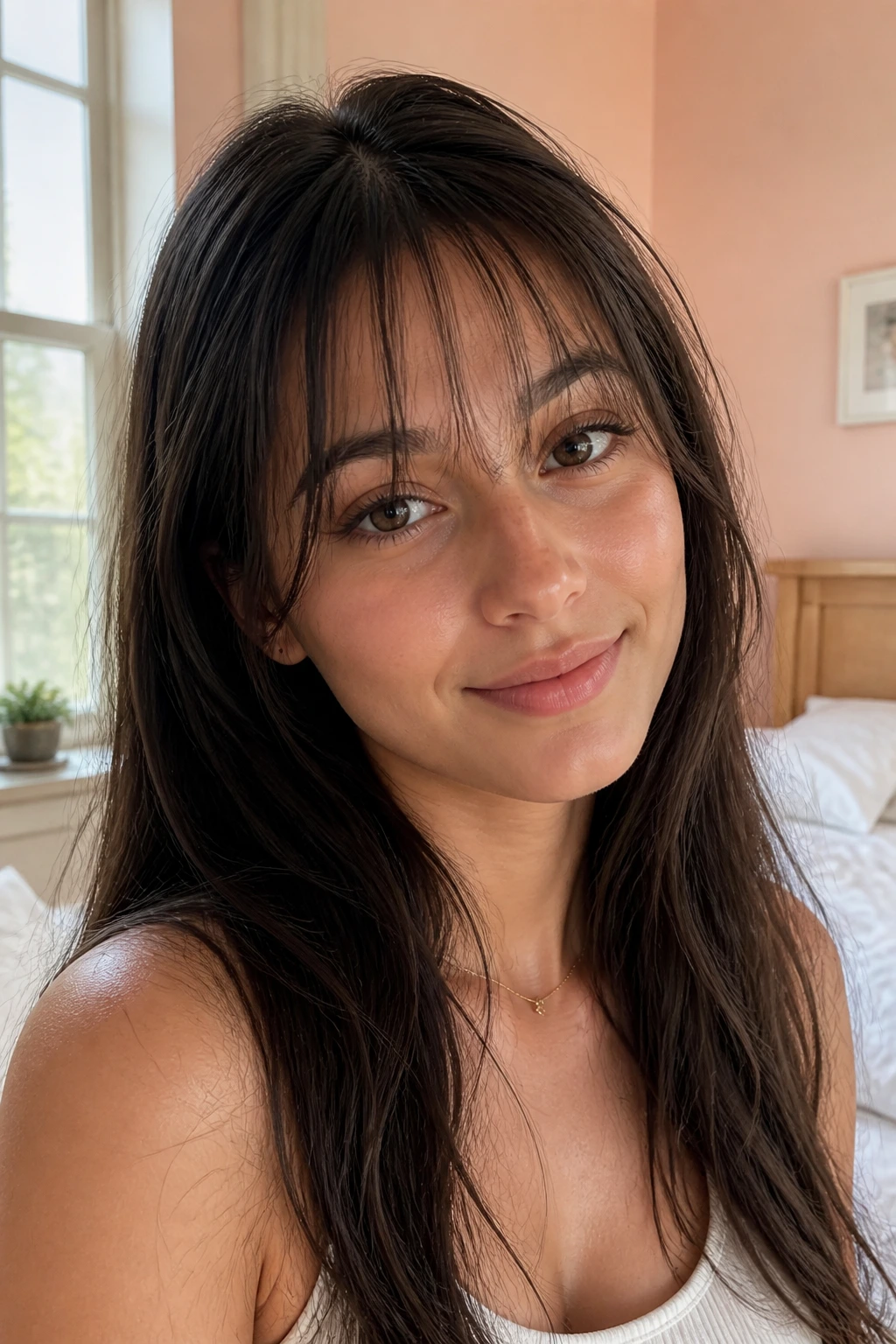
The first mistake is cutting the fringe too short in the center. On a heart-shaped face, that can make the forehead look broader and the overall shape feel top-heavy. The fix is simple: leave a little more length than you think you need, then trim later if you want more openness.
The second mistake is ignoring the hair’s natural bend. A cowlick at the hairline or a wave at the temple can split the fringe in odd places if you cut it too straight. Ask for a shape that works with that pattern, not against it.
The third mistake is making the fringe too dense. Heavy bangs can swallow the forehead and make long hair feel disconnected. If your hair is thick, ask for internal weight removal and a softer edge.
The fourth is forgetting about maintenance. A fringe that looks sharp on day one can collapse by day ten if the ends are too blunt or the roots are too oily. Bangs need tiny trims, quick restyles, and a little honesty.
And please, do not cut them at home with dull kitchen scissors. I know people do it. I also know the results.
Variations and Alternatives Worth Trying
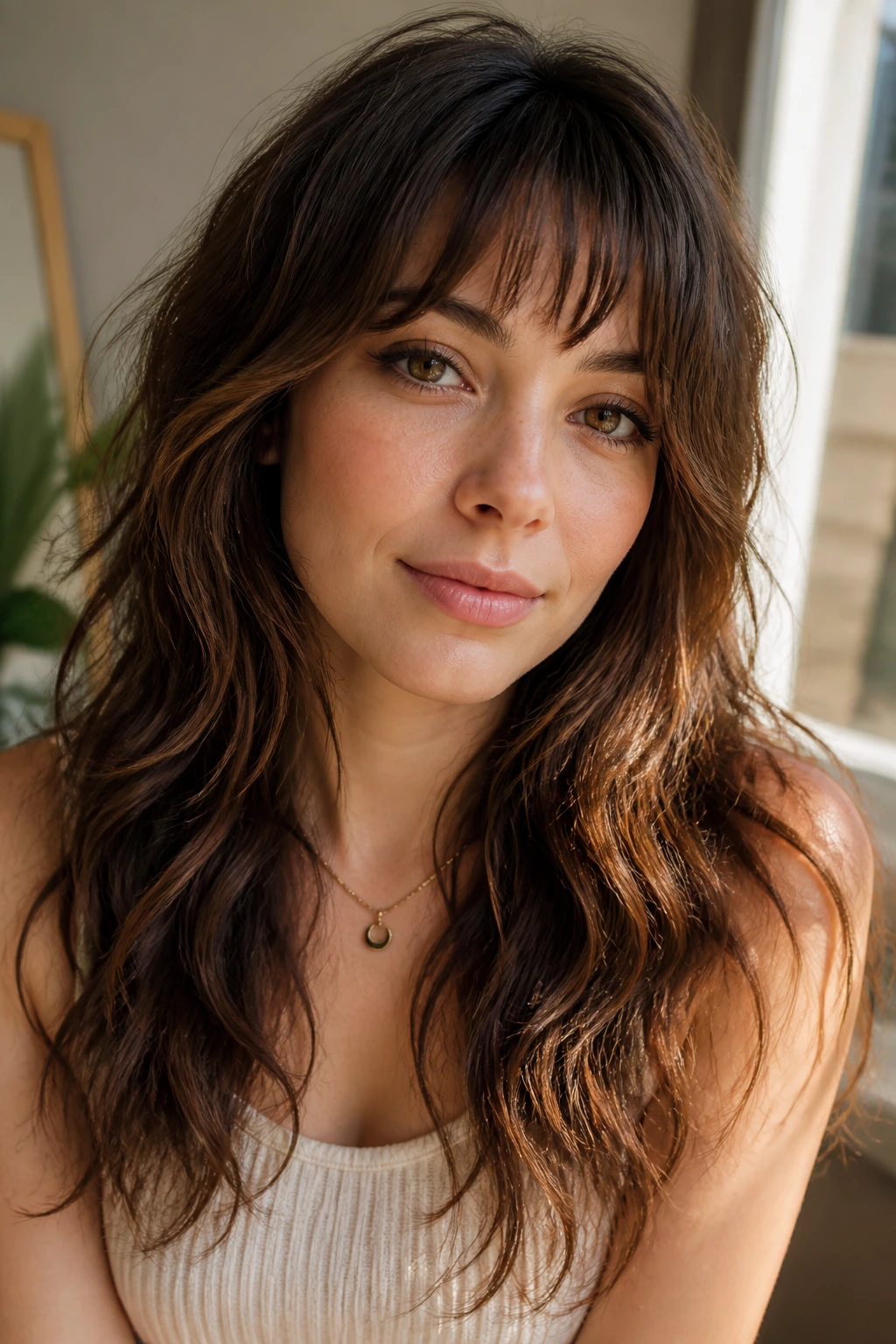
Curly-Friendly Fringe: Keep the shortest pieces longer and let the curl pattern dictate the final shape. This works best when the fringe is cut dry or nearly dry, because curls spring up more than straight hair ever will.
Low-Maintenance Grow-Out: Ask for a fringe that already blends into the front layers. It should look like a long curtain with purpose, which makes the awkward grow-out phase much easier to live through.
Bold Brow Line: If you want more structure, go a little stronger with a soft blunt edge or a brow-grazing arch. Keep the sides tapered so the look stays flattering on a heart-shaped face.
Fine-Hair Lift: A soft, wispy fringe with a bit of root lift can add shape without dragging the hair down. Heavy bangs on fine hair usually collapse; light bangs usually last longer and move better.
Glasses-Friendly Fringe: Leave enough length for the fringe to sit above or around the frame line. Side-swept or curtain shapes usually work better than dense straight-across bangs, which can crowd the lenses fast.
Keeping the Fringe Fresh Between Trims
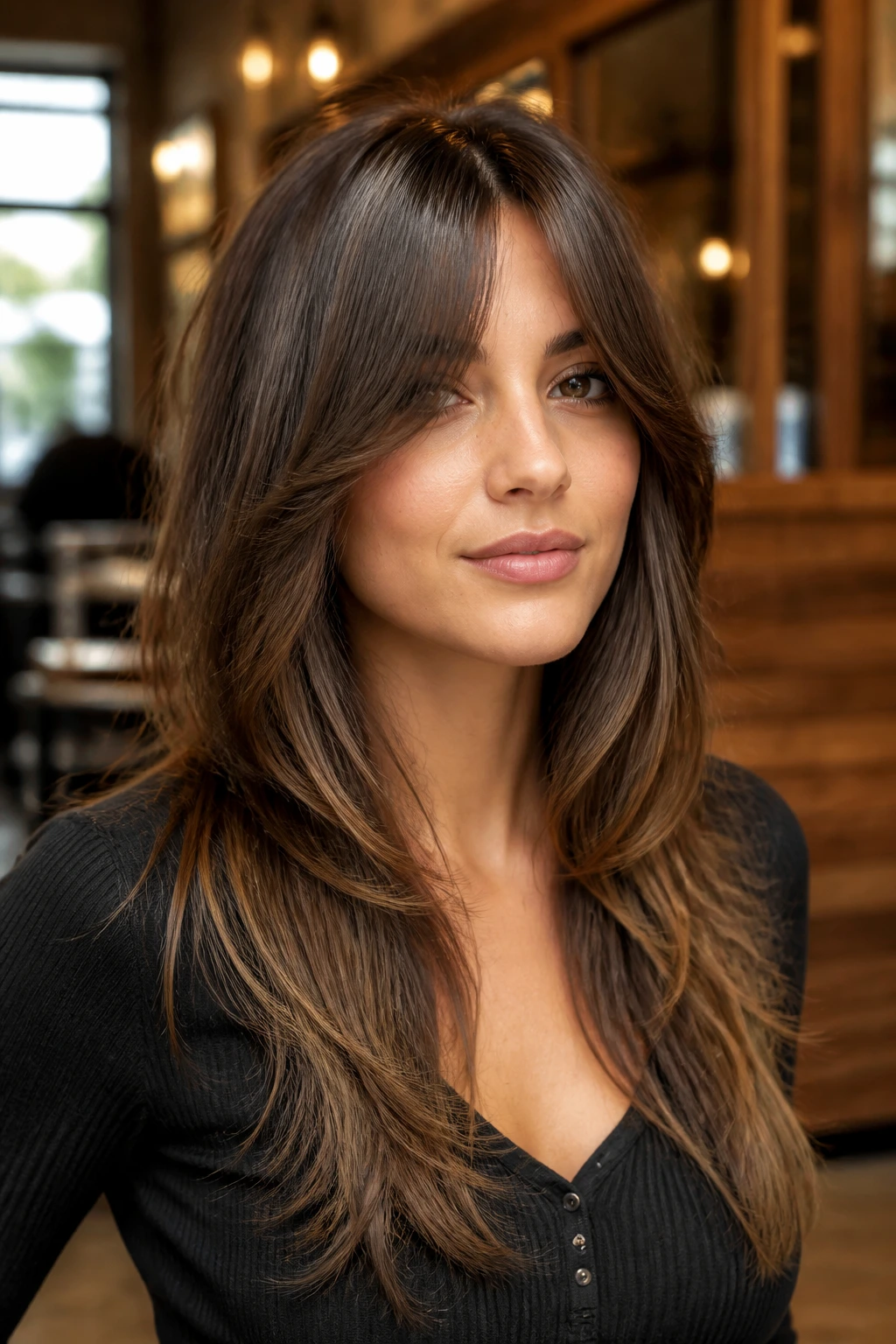
Bangs usually need attention sooner than the rest of the haircut. That is not a flaw. It’s the bargain you make with face-framing hair. For crisp fringe, a trim every 3 to 5 weeks keeps the shape clean. Softer styles can stretch a little longer, especially if they’re meant to grow into long layers.
Wash or refresh the bangs more often than the rest of your hair if they sit on your forehead all day. Oil transfer is real. A quick rinse at the sink, a mini blow-dry, and a dab of dry shampoo at the root can buy you another day or two without a full wash.
A sensible routine
- Daily: Re-shape the fringe with a brush or fingers for 30 to 60 seconds.
- Every few days: Clean the root if it starts to separate or feel stringy.
- Every 3 to 5 weeks: Get a trim if you want the line to stay sharp.
If you want to grow the bangs out, ask your stylist to start blending them into the front layers before they become annoying. That soft transition is the difference between a grow-out that looks deliberate and one that looks like a delay tactic.
Frequently Asked Questions About Bangs for Long Hair and Heart-Shaped Faces

Which bang style is most flattering on a heart-shaped face?
Soft curtain bangs and bottleneck bangs tend to be the easiest bets because they soften the forehead while leaving the cheekbones visible. If you want something bolder, a side-swept fringe or a gently arched brow-grazer can work well too.
Can heart-shaped faces wear blunt bangs?
Yes, but the line should usually be softened a little and the sides should stay longer. A hard, heavy block across the forehead can make the upper face feel wider than it is.
Are curtain bangs still good with long hair?
Very. Long hair gives curtain bangs room to blend into face-framing layers, which makes the whole cut feel connected. The longer the hair, the more important that blend becomes.
What if my hair is wavy or curly?
Choose a fringe that has room to shrink up as it dries. Longer curtain shapes, split fringe, and soft layered bangs usually behave better than short blunt cuts.
How often will I need to trim bangs?
If you want a clean shape, expect a trim every 3 to 5 weeks. Softer, grow-out-friendly fringe can go a little longer, but the front still needs attention more often than the rest of the haircut.
Can I part my bangs off to one side if I hate how they sit in the center?
Usually, yes. That is one reason side-swept and split styles are so useful. Even curtain bangs can be nudged wider or narrower depending on how your hair falls.
Will bangs make my forehead look smaller?
They can, but the better goal is balance, not hiding the forehead. A fringe that opens at the center or sweeps away from the temples often creates a more flattering shape than a dense curtain that blocks everything.
What should I do if the fringe separates in the middle all day?
Try drying the roots in opposite directions first, then setting them where you want them. A small bit of dry shampoo at the root can help too, but if the split is caused by a strong cowlick, the cut may need to be adjusted.
The Fringe That Fits
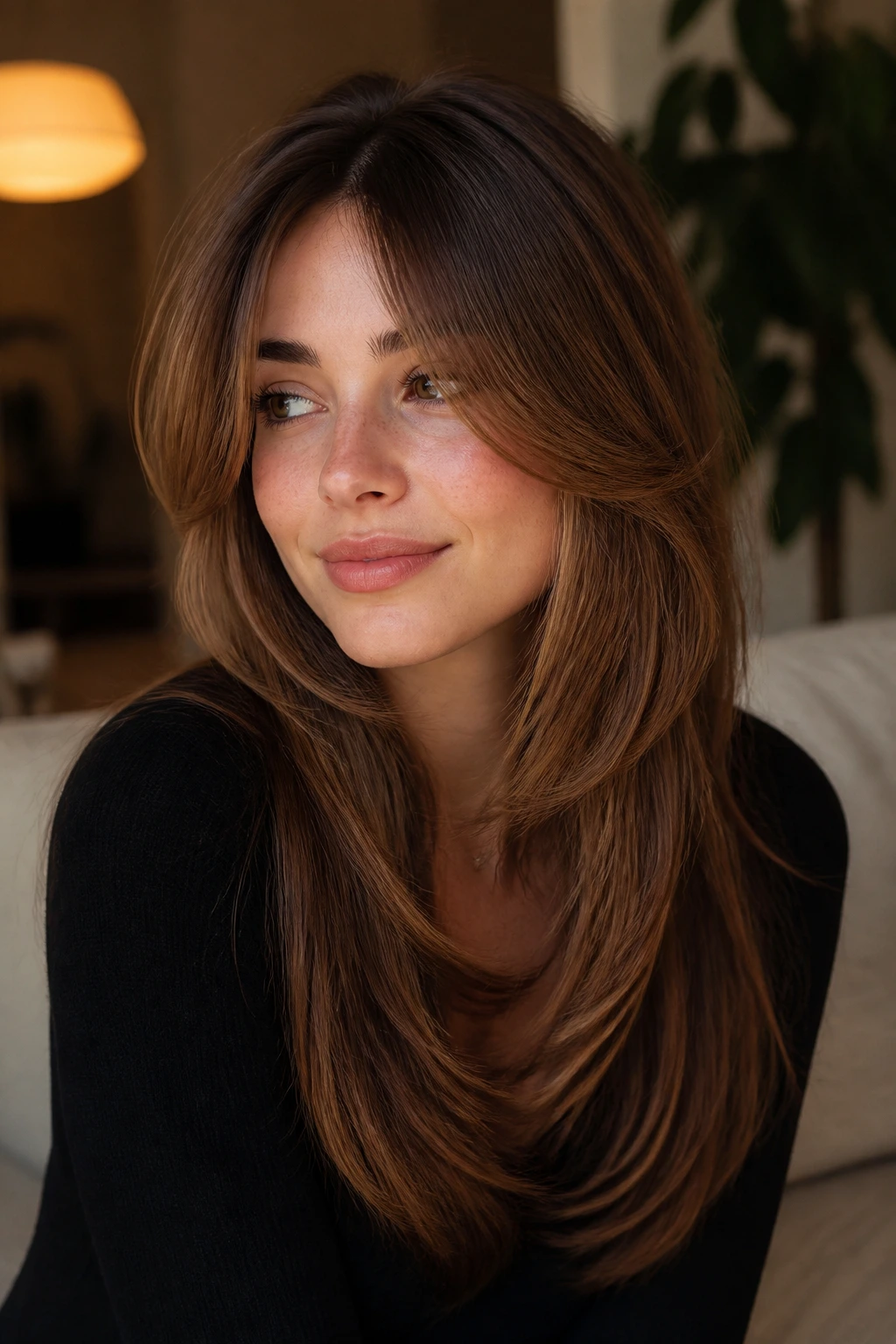
The nicest thing about bangs on long hair is that they can change the whole mood of a cut without taking away the length you like. On heart-shaped faces, that change works best when the fringe respects the forehead, leans into the cheekbones, and leaves the chin area looking balanced rather than crowded.
You do not need the boldest bangs in the room. You need the ones that fit your texture, your part, and your willingness to style them before coffee. When those three things line up, the cut starts doing the quiet work it was meant to do.
And that is usually the moment people stop asking whether they “can pull off bangs” and start wondering which version they should try next.