



Curly bangs have a way of telling the truth fast. If the cut is off by even half an inch, you see it in the mirror before coffee is done. If the shape is right, though, the whole face opens up in a way that feels effortless in the best possible sense — not careless, not overworked, just alive.
That’s why bangs for curly hair and oval faces are such a good pairing to study. Oval faces give you room to play; they can take a blunt line, a soft curve, a broken fringe, or a side sweep without the proportions going strange. Curly texture adds the part most people forget: movement. The fringe never sits in one place for long, which is exactly why the best modern cuts are built with shrinkage, spring, and day-two behavior in mind.
The mistake I see most often is not trying bangs at all. The second mistake is worse: cutting them as if they were straight hair with a little texture sprinkled on top. Curly bangs need a shape that respects the curl pattern, the density at the front hairline, and the way the hair will settle after a diffuser, a finger twist, or a humid commute. Get those things right, and the fringe stops feeling like a gamble.
Why These Bangs Earn Their Spot
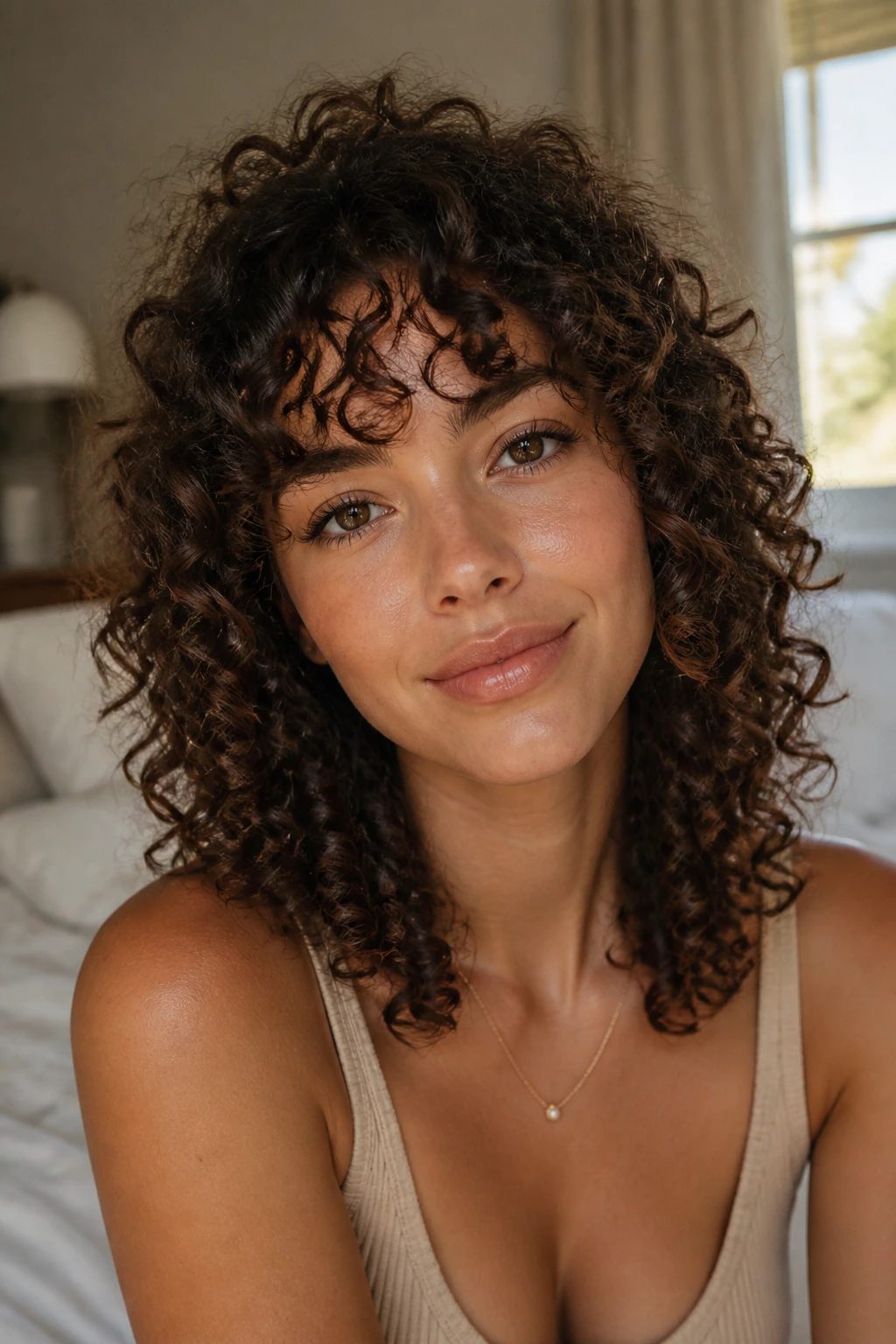
- Oval-face balance: An oval face can carry shorter, longer, fuller, or lighter bangs because the forehead, cheekbones, and jaw already sit in a pretty even line.
- Curl-shrinkage friendly: Every style below is described with stretch and wear in mind, so you’re not left with a fringe that jumps an inch too high after drying.
- Salon-friendly wording: These shapes are easy to explain to a stylist without sounding like you’re guessing at a Pinterest photo.
- Texture-first styling: The cuts work with loose waves, springy curls, and tighter coils instead of pretending one curl type can wear every fringe the same way.
- Modern, not fussy: These are bangs with movement, broken lines, and soft edges — the kind that look better a little lived-in.
- Built for real life: You’ll see where each style needs a diffuser, where a finger-coil is enough, and where a trim will save you from that awkward “too short, now what” phase.
1. Curly Curtain Bangs
Curly curtain bangs are the safe harbor of the fringe world, except they don’t look safe at all. They split softly down the middle, drop around the cheekbones, and let the curls fall into two loose panels that frame an oval face without boxing it in. On curly hair, this shape has a nice trick: the front never looks too severe, even when the curls bounce up higher than expected.
Why They Work
The center part keeps the forehead open, which suits oval faces that already have balanced proportions. The longer sides also give you wiggle room for shrinkage, so you can cut these a little longer than you think and still keep the shape. I’d ask for the shortest point to land around the bridge of the nose when dry-stretched, then taper into the cheekbone area. That gives you movement without the “I cut my bangs in a hurry” vibe.
If your curls are loose, this fringe falls with a soft bend. If they’re tighter, the two panels become more sculpted and face-brightening. Either way, it’s one of the easiest modern options to grow out.
2. Bottleneck Fringe
Bottleneck bangs are shaped like the narrow neck of a bottle — shorter in the center, longer as they move outward. On curly hair, that shape does something lovely: it keeps the middle light while letting the sides blend into the rest of the cut. Oval faces can wear this without effort because the lines stay vertical and fluid, not blunt and boxy.
A good bottle-neck fringe should sit just above the brows in the middle when dry and stretch down toward the cheekbone at the sides. That range matters. Curly hair shrinks differently at each section, and this cut gives the front some breathing room. It also pairs well with layered lobs and mid-length shags, especially if you want bangs but don’t want the entire front of your face covered.
What to Ask For
Ask for a soft center and longer side pieces, then insist on a dry check before anything gets shorter. That one request saves a lot of regret.
3. Brow-Skimming Curly Fringe
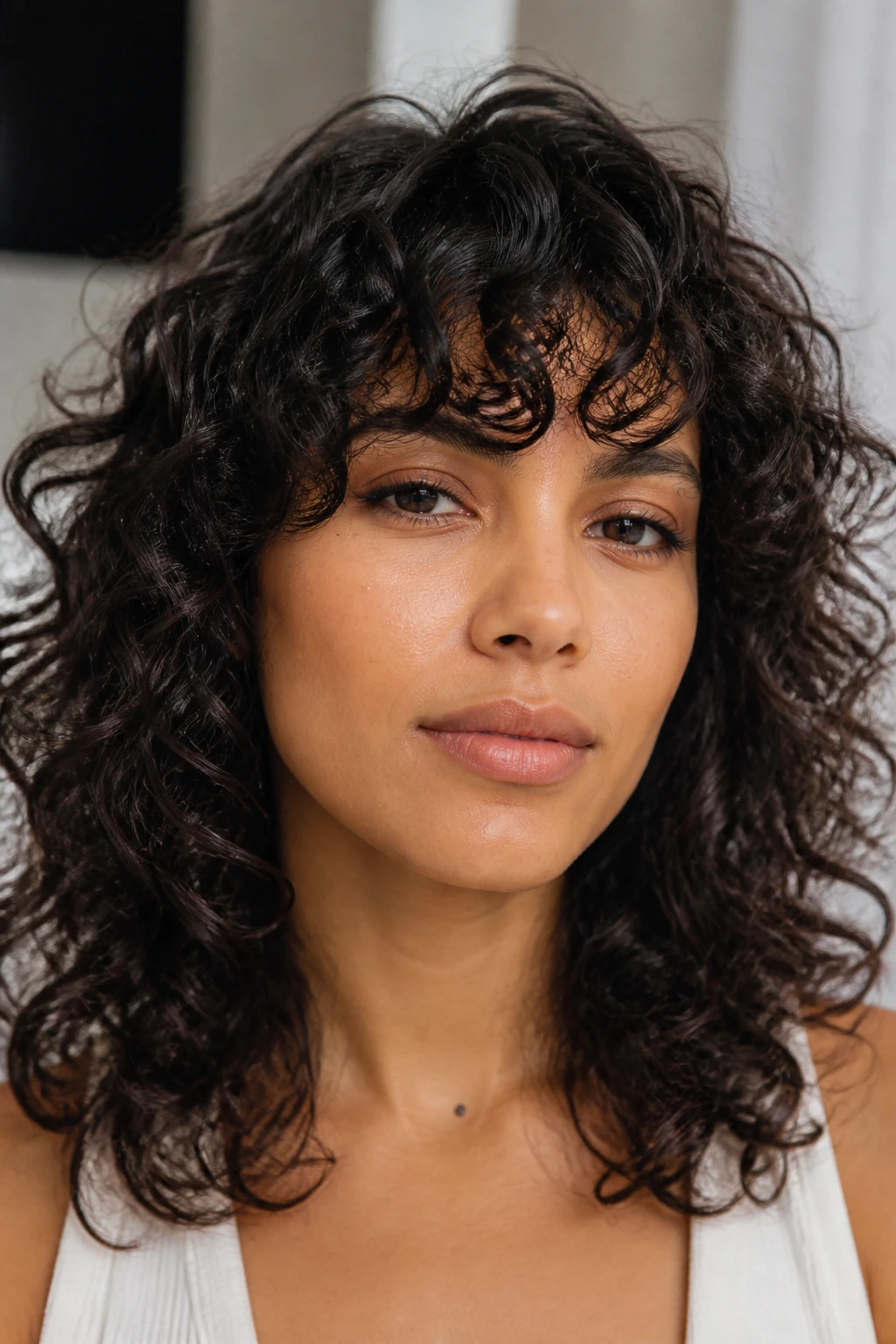
If you like the idea of bangs but do not want to lose your eyebrows in the process, brow-skimming curls are the move. They land near the brows when dry, then bounce a little higher or lower depending on the pattern. On an oval face, that line gives the eyes a nice frame without stealing the rest of the haircut.
This style works best when the stylist cuts with shrinkage in mind and leaves the fringe slightly longer than the final target. Curls at the front often spring up more than the hair at the crown, so a wet cut here can go sideways fast. I prefer this shape when the bangs are point-cut or carved with small vertical snips, because the edge stays soft instead of turning into a shelf.
It’s a good choice if you want a visible bang but still like the option to sweep pieces aside on day two.
4. Side-Swept Spiral Bangs
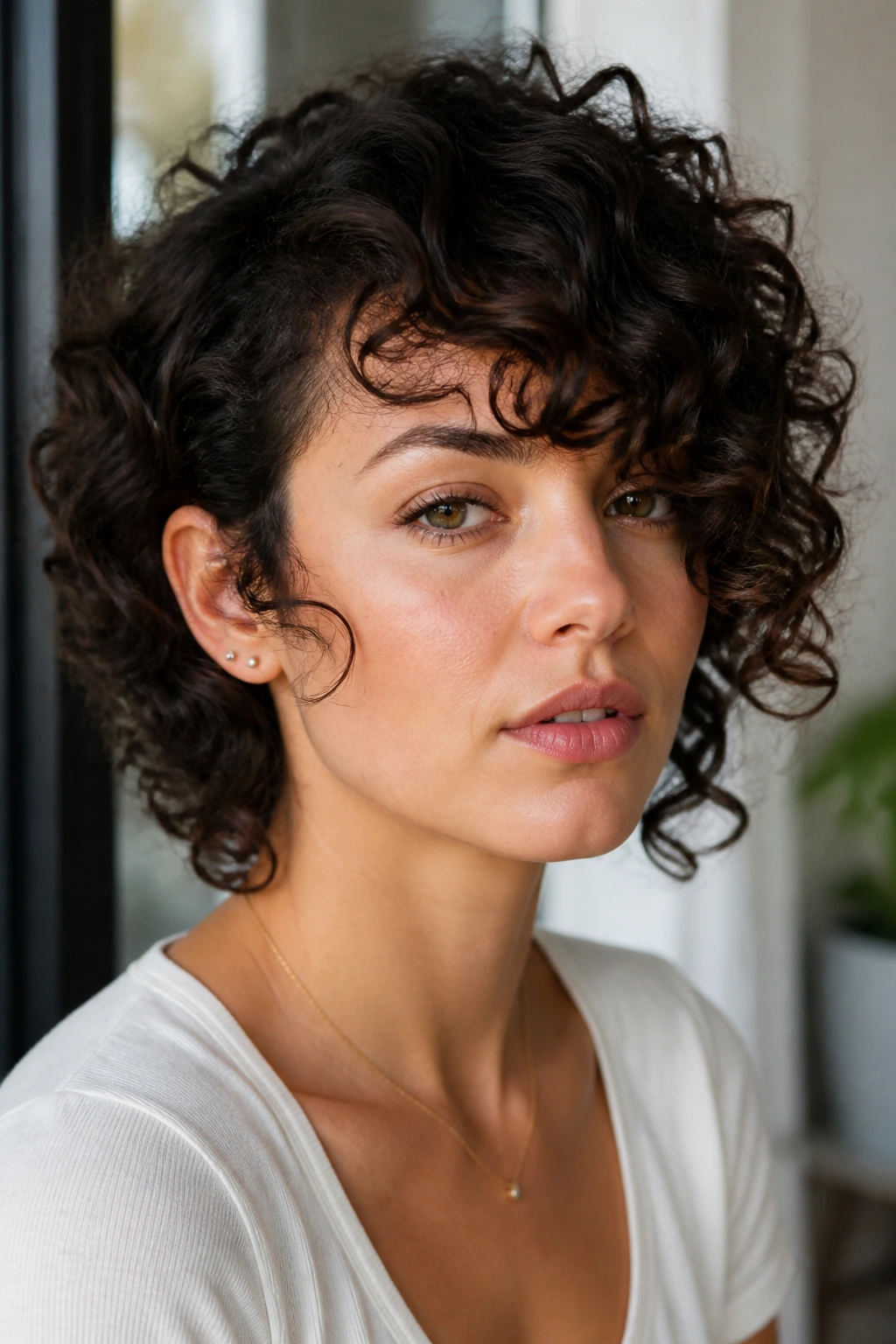
Side-swept curly bangs bring a lot of motion to an oval face without changing the overall balance of the cut. The front section starts near a deep part and slides across the forehead in a loose sweep, with the ends curling into the cheekbone or temple area. It’s a flattering shape when you want the forehead partially open but not fully exposed.
What makes this one work is direction. A deep side part gives the curls a lane to follow, which helps reduce the puff that can happen when the front is cut too wide. It also plays well with finer curls that need a little lift at the root. If your hair tends to separate in the front, this shape can make that separation look intentional instead of random.
Best for
- Loose curls that need movement
- Day-two hair that likes to fall to one side
- People who want bangs but also wear glasses often
5. Rounded Halo Bangs
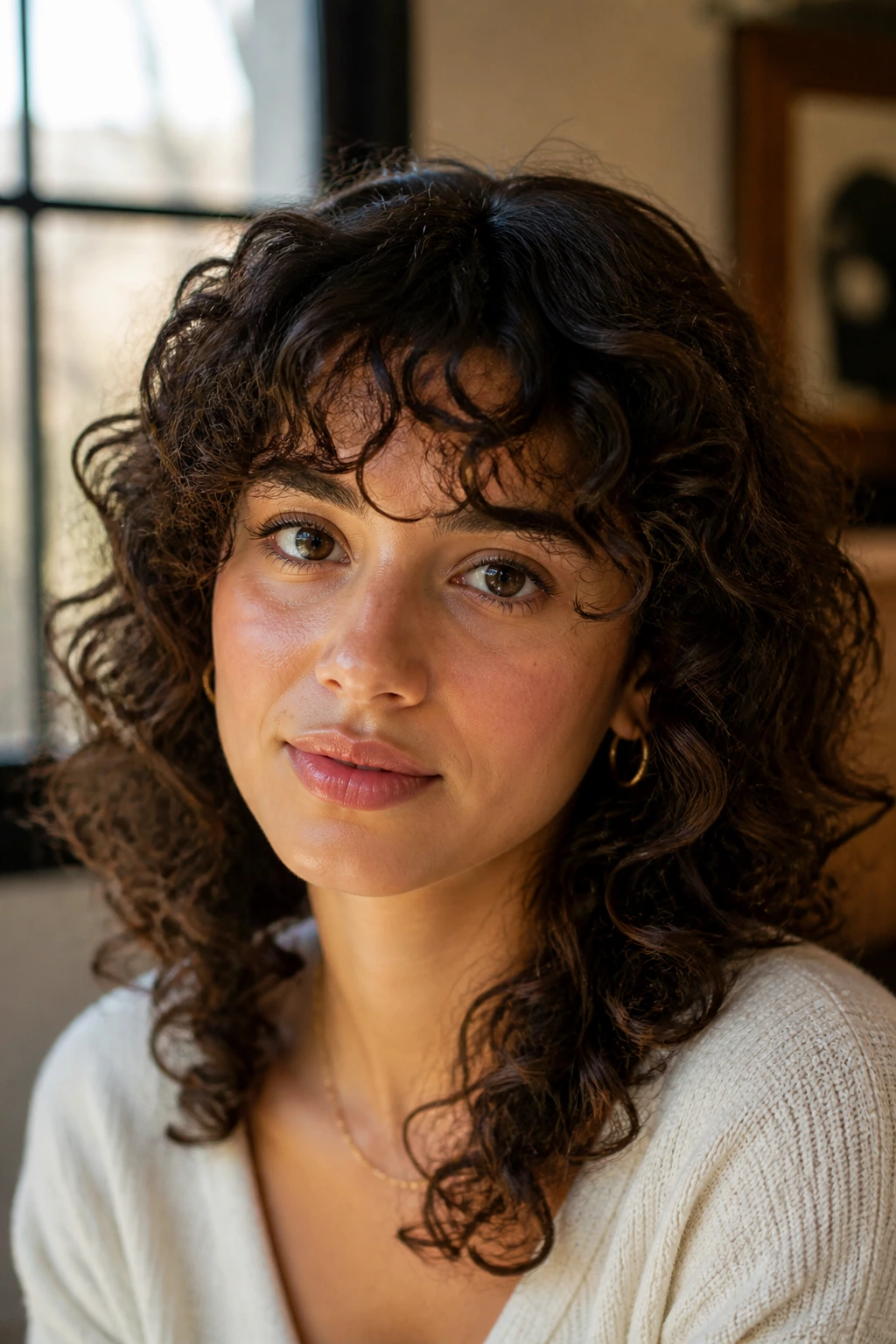
Rounded halo bangs curve gently across the forehead and then soften at the sides, almost like a crescent that follows the face. They’re especially pretty on curly hair because the curl pattern reinforces the arch instead of fighting it. On an oval face, the shape adds warmth around the eyes and cheekbones without making the features look crowded.
This is not a stiff, helmet-like fringe. Good halo bangs should breathe. The middle sits a touch shorter, the sides lengthen, and the whole line looks like it belongs to the rest of the curls. If your front hairline is dense, this shape helps distribute that fullness in a way that feels polished rather than heavy.
Pro note
Ask for the line to be cut dry, then checked again after scrunching. Curls lie when they’re wet. They lie a lot.
6. Choppy Shag Bangs
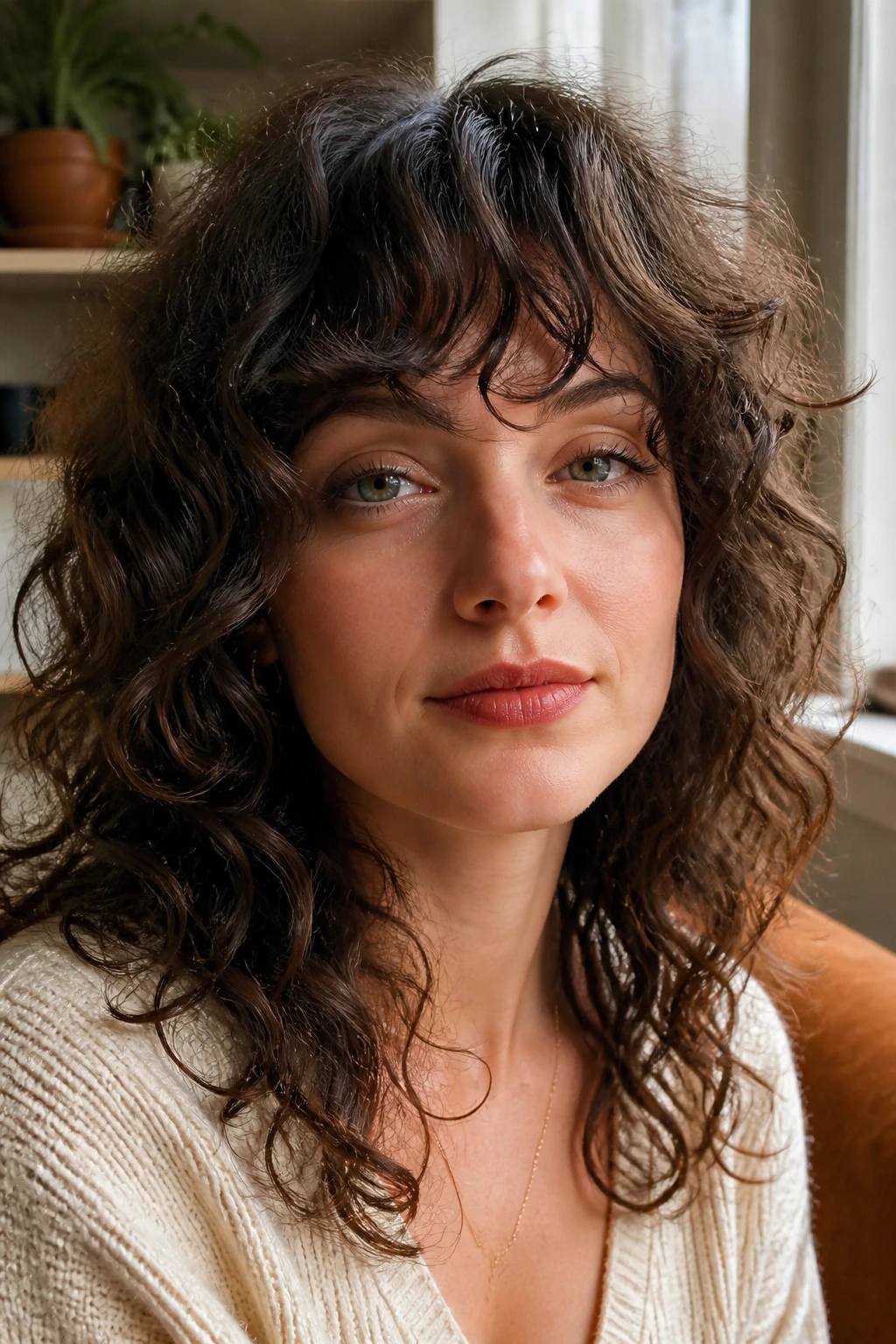
Choppy shag bangs have that lived-in, slightly rebellious look that works so well with curly texture. Instead of a smooth, even line, the fringe is broken into short, uneven pieces that merge into the shag’s layers. On an oval face, the effect is relaxed and a little edgy, but not harsh.
The reason this cut holds up is simple: curls already want to move. A choppy fringe doesn’t force them into a strict shape, so the cut feels easier on day one and day five. I like this one especially for medium-density curls because it keeps the front from swelling into one big block. The bits that fall higher around the brow, and the bits that drop lower near the temples, create that undone texture people keep trying to fake.
How it wears
Diffused dry, it looks airy. Air-dried, it looks even more piecey. Either way, it usually behaves better than a perfectly even blunt bang.
7. Piecey See-Through Bangs
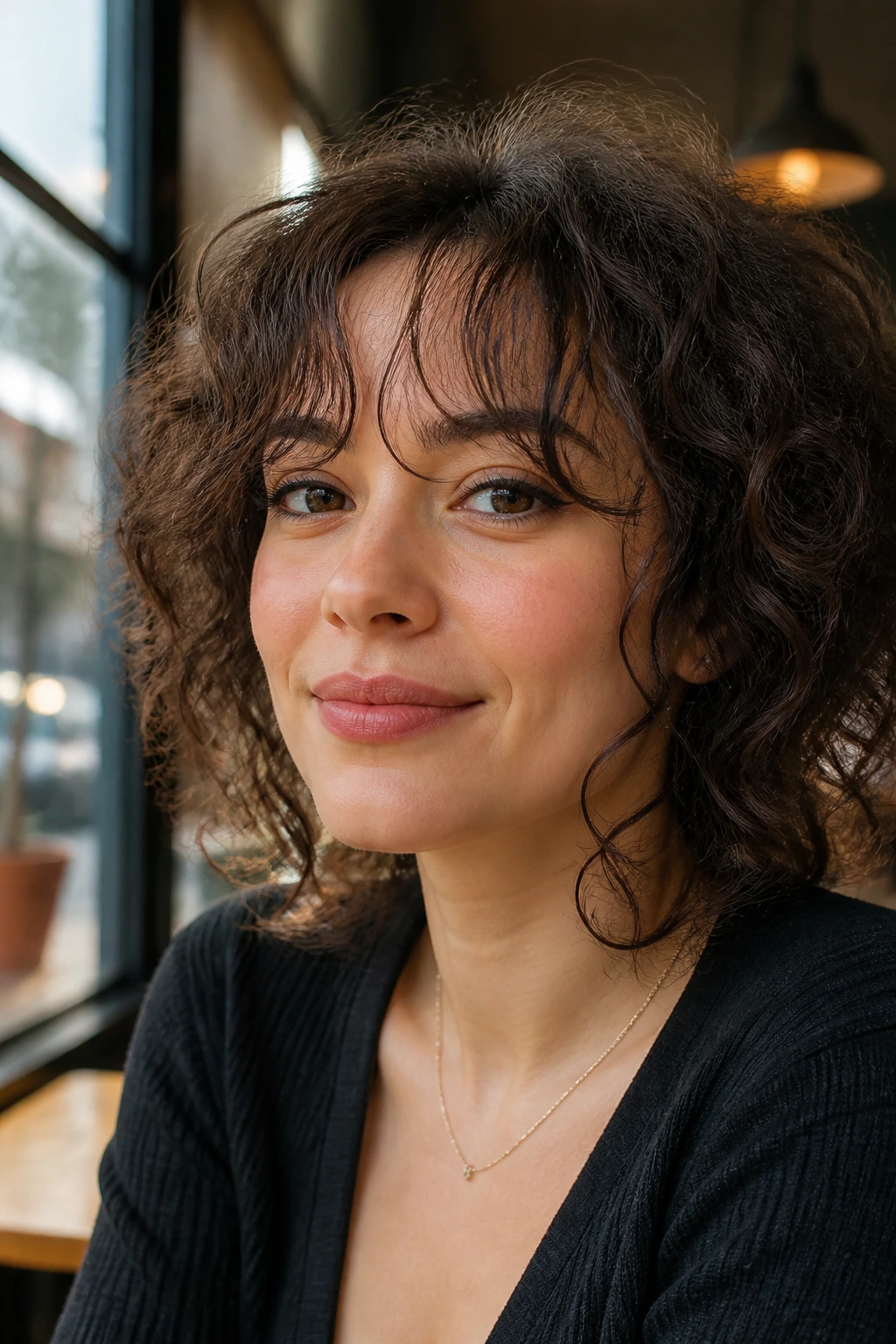
Piecey see-through bangs are for anyone who likes the idea of a fringe but not the weight of a full one. The strands are spaced out just enough that the forehead still peeks through, which keeps the look light on curly hair. On an oval face, that transparency can be a nice counterpoint to naturally full curls elsewhere.
This style depends on separation. A little curl cream, a little gel, and a light finger-twist at the front can help the pieces hold their own instead of merging into one frizz cloud. It’s a smart choice if your curls are finer or if the front section is less dense than the rest of your hair. The cut can be short, but the visual effect stays soft.
If you hate how some fringes sit too heavy after lunch, this is the opposite. It keeps breathing.
8. Micro Bangs with Curls
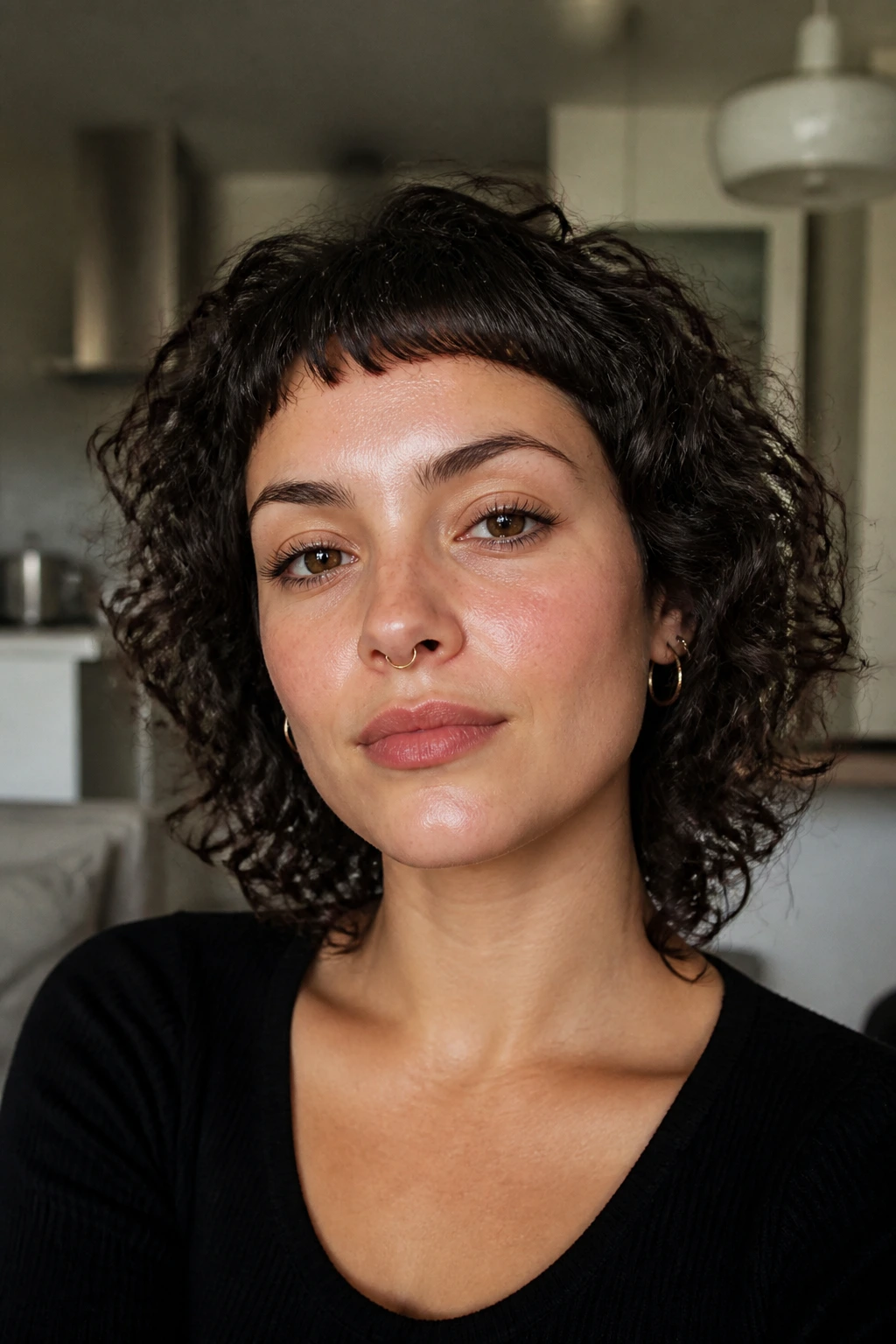
Micro bangs are the boldest thing on this list, and they’re not here to play nice. On curly hair, they land high on the forehead, then shrink into a shape that can look sharp, artsy, or slightly punk depending on the rest of the cut. Oval faces can handle the short length because the proportions stay balanced; the face has enough symmetry to carry the break in line.
The catch is obvious. Shrinkage matters more here than anywhere else. A micro fringe that looks chic at the salon can jump into unintentionally tiny territory once it dries. That’s why this cut needs a stylist who cuts curls dry and knows exactly how much bounce your pattern has. I’d rather see these cut conservatively short than dramatically short.
Best with
A structured bob, a rounded curly crop, or a shag with a little attitude.
9. Long Face-Framing Bangs
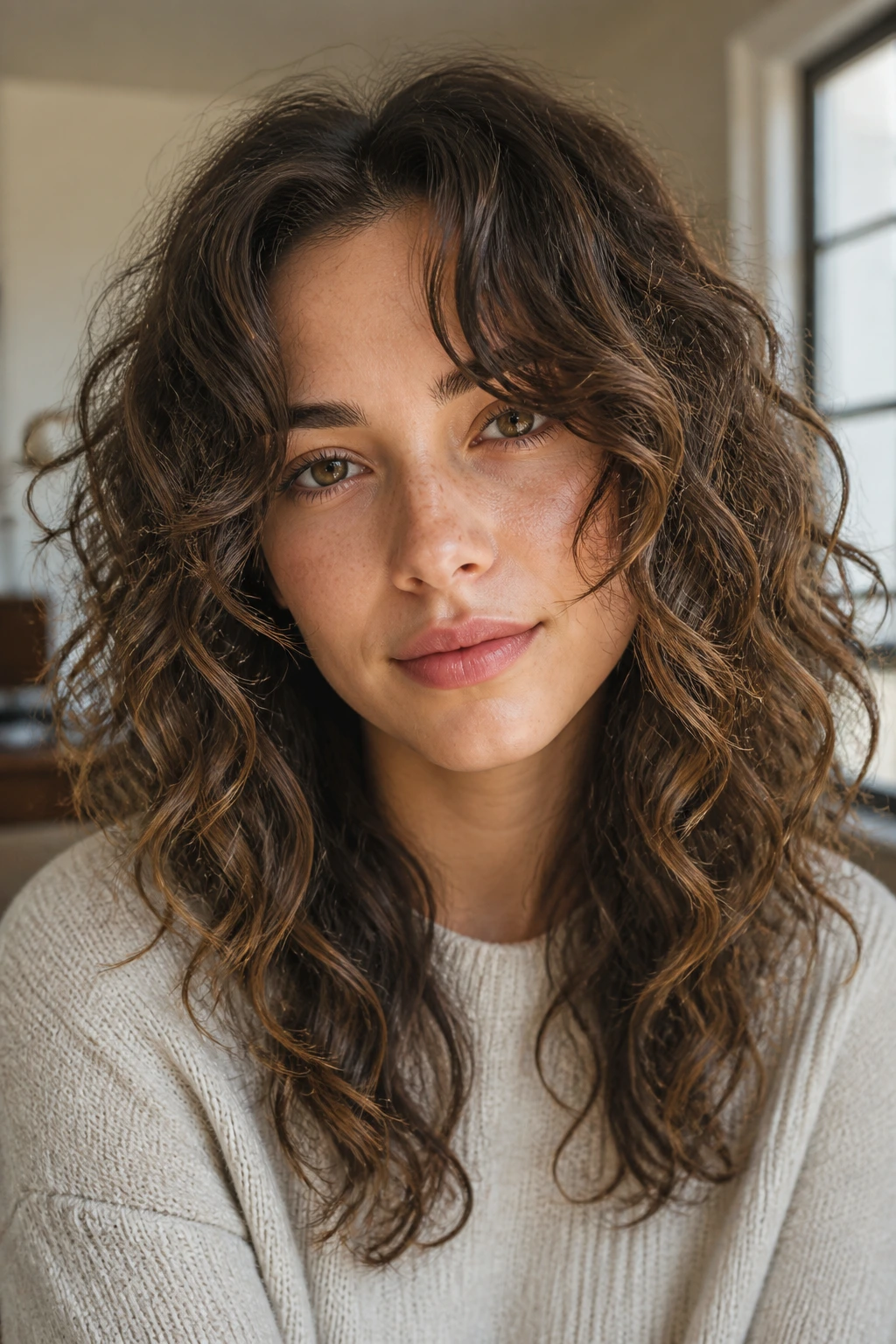
Long face-framing bangs are what you reach for when you want the bangs effect without the commitment of a full fringe. The front pieces start around the cheekbones or jaw and slide into the rest of the curls, so the line feels soft and easy. Oval faces like this kind of length because it keeps the proportions open while still bringing attention to the eyes.
There’s also a practical reason people keep coming back to this shape: it’s forgiving. If the hair is having a flat day, these pieces can be tucked behind the ears or pulled forward with a little mist and scrunching. If the curls are thriving, they fall in a way that looks intentional. Nothing is fighting for center stage.
This is the style for someone who wants bangs in theory and flexibility in practice.
10. Asymmetrical Bangs
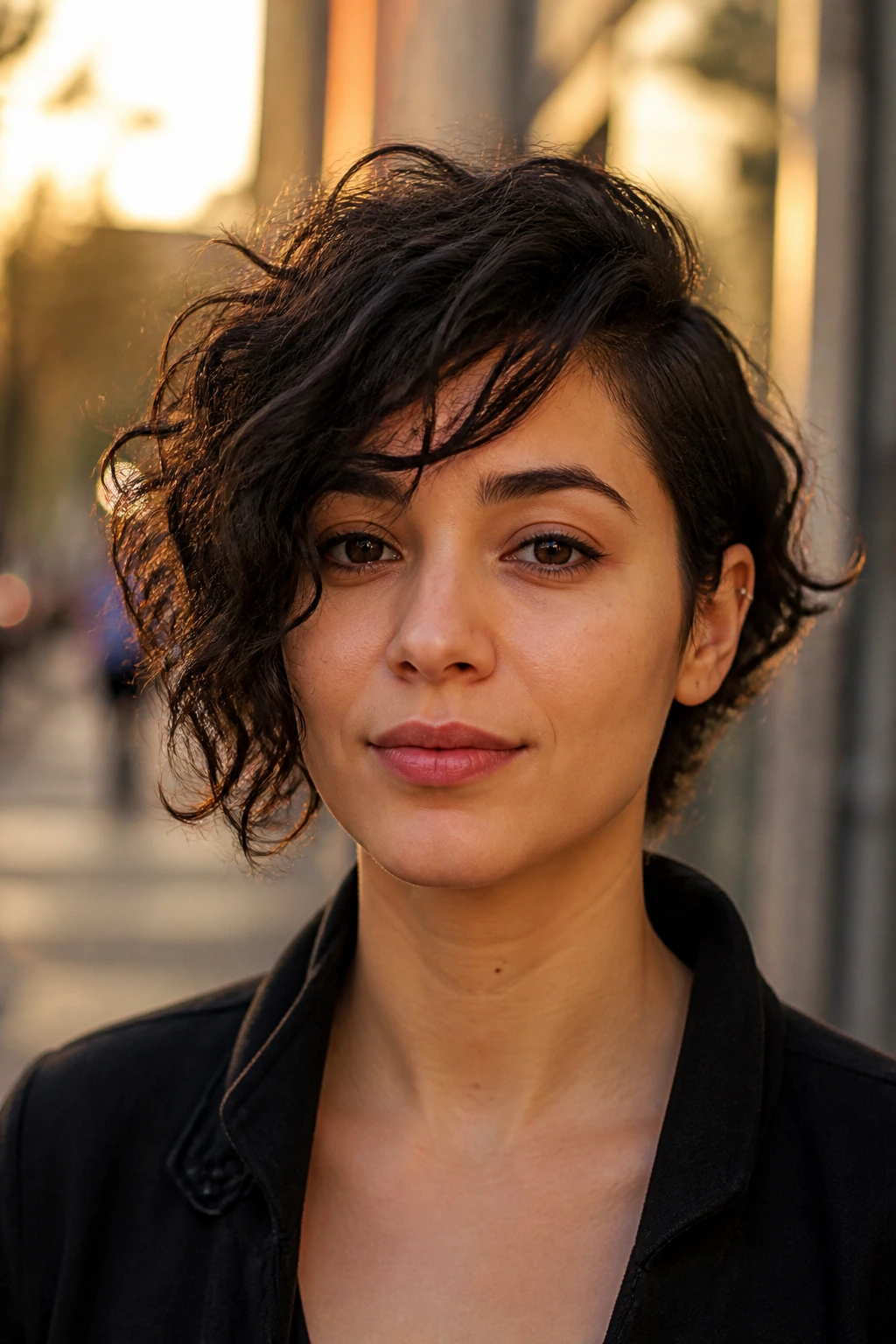
Asymmetrical bangs lean to one side, with one section shorter and the other drifting longer across the forehead. On curly hair, that uneven line can look sharp in a very modern way because the curls break up the geometry a little. Oval faces are good candidates here; the natural balance of the face lets the asymmetry stand out without looking lopsided.
The key is restraint. You want an intentional difference, not a random one. One side might skim the brow while the other reaches the temple or cheekbone, but the overall shape should still connect to the rest of the haircut. I like this when the hair has a side part already, because the style feels like it grew there instead of being bolted on.
It’s a good pick if you like a fringe with a directional feel.
11. Birkin-Inspired Curly Bangs
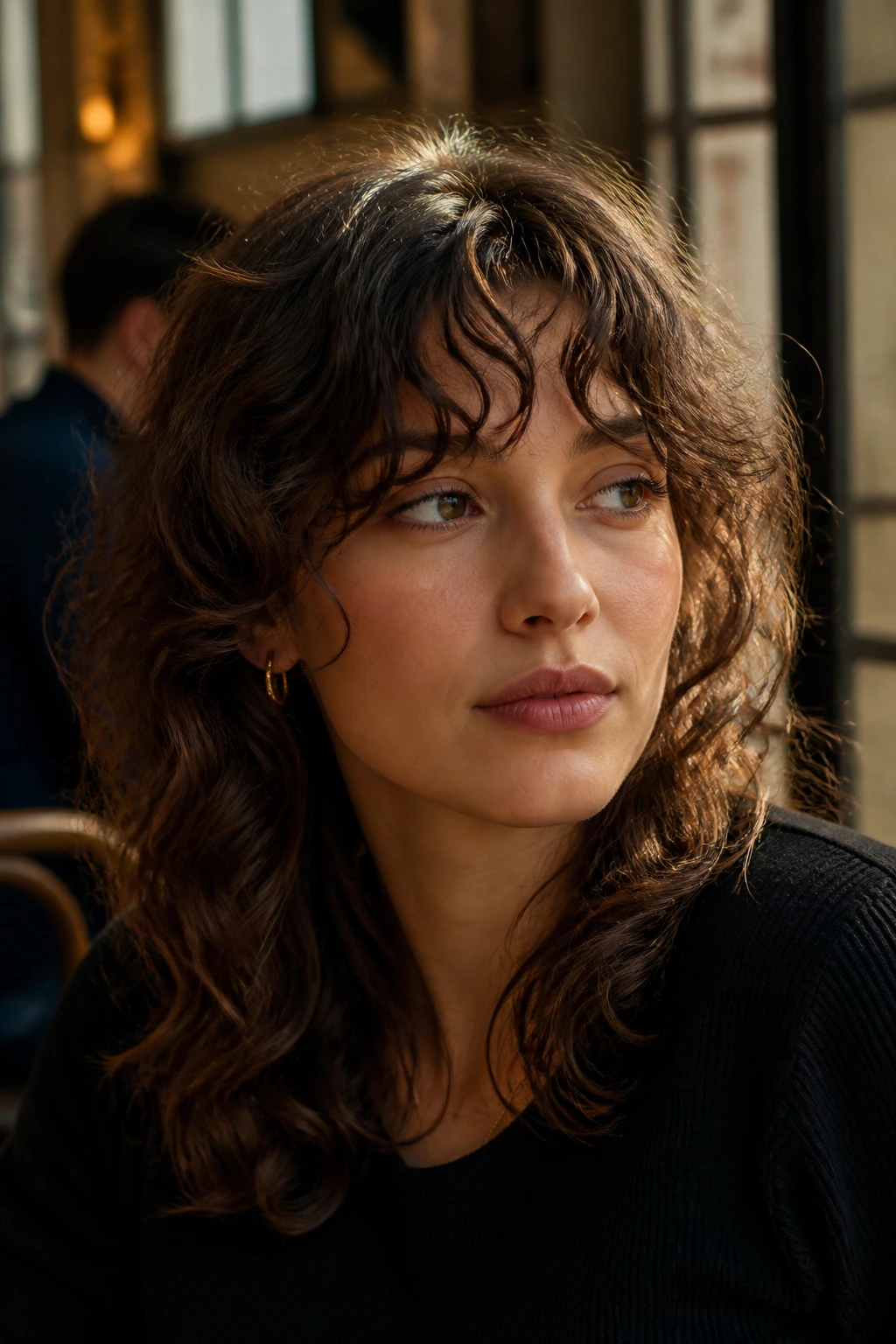
Birkin-inspired bangs have that slightly fuller, slightly undone French feel, but curly texture gives them a different personality. They sit softly across the forehead with a bit more weight than curtain bangs, then break up at the ends so the line never turns rigid. On an oval face, that fuller front can be flattering because it adds a little presence without overwhelming the features.
These bangs do best when the cut leaves room for shrinkage and the ends are softened with point cutting. Straight-across edges tend to look too blunt once curls start doing their thing. A light styling cream and a diffuser can make the fringe sit close to the forehead, but I’d still keep some air in it. The charm is in the looseness.
If you want bangs that feel a little intellectual, a little Parisian, and not too fussy, this is the lane.
12. Blunt Curly Fringe
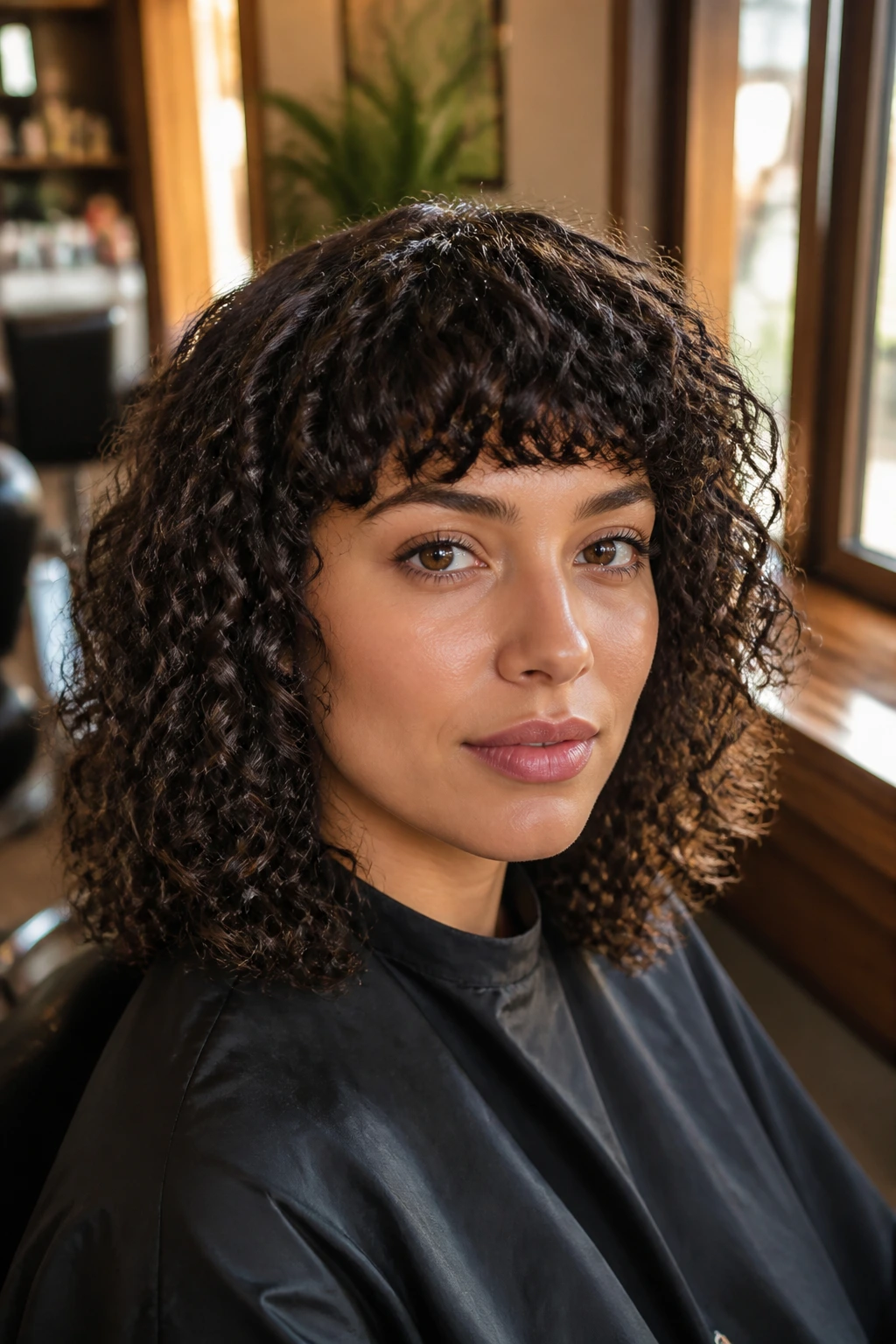
A blunt curly fringe sounds like a contradiction until you see it done well. The line is more even than most curly bang styles, but the texture keeps it from looking like a ruler. On oval faces, the straight-across shape can be striking because it changes the rhythm of the face without throwing the proportions off.
This style works best on denser curls that can support a fuller front. Fine curls sometimes lose the line too quickly, while thicker curls keep enough shape to make the bluntness read. The trick is not to cut it too short. Leave space for the bounce, and let the edge be softened just enough that the fringe looks sharp but not stiff.
A blunt fringe needs
- Dry cutting
- Careful shrinkage planning
- Light shaping, not heavy thinning
That last part matters. Over-thinning a blunt curly fringe usually leaves holes instead of movement.
13. Soft Arched Bangs
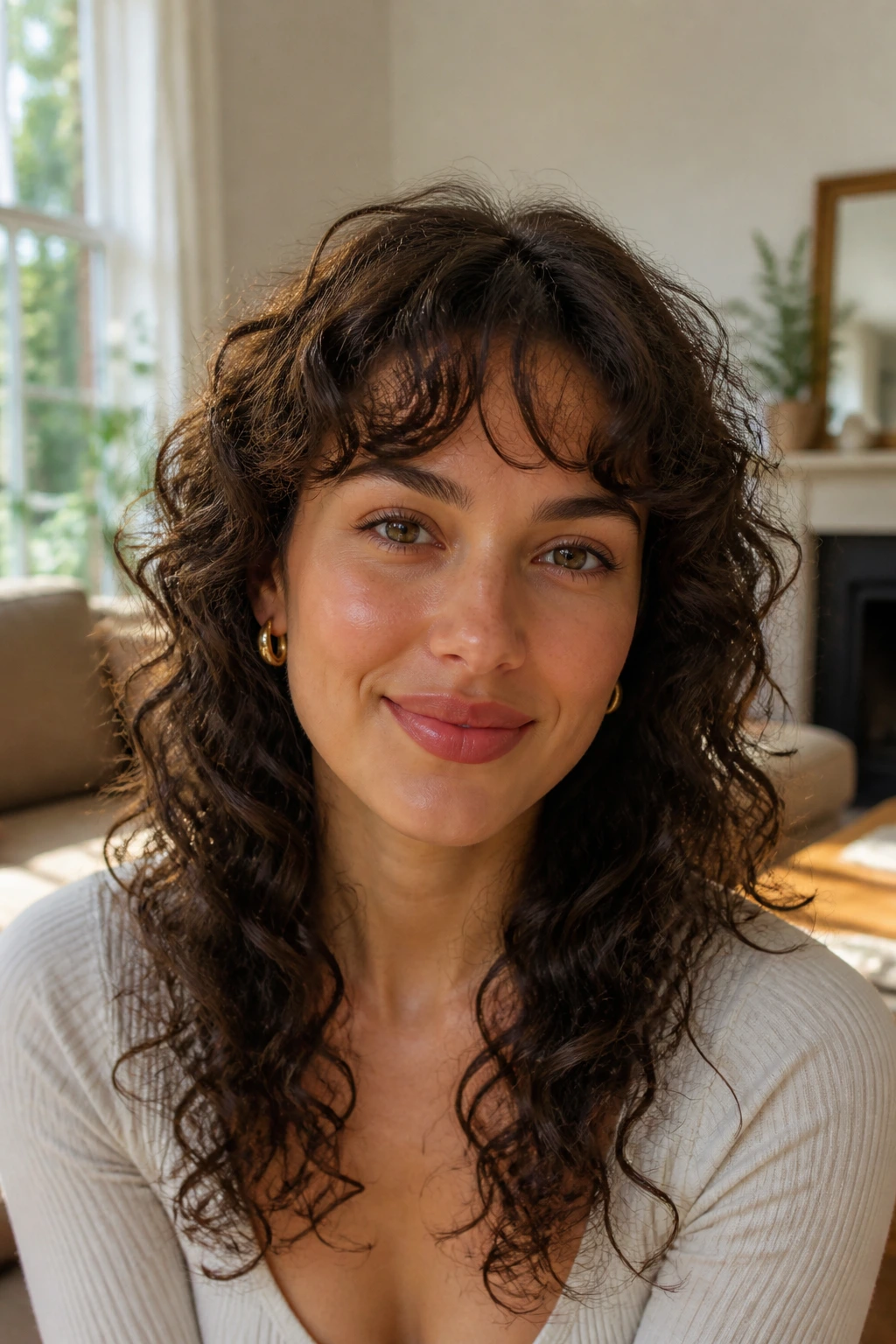
Soft arched bangs curve gently upward in the middle and taper down toward the sides, creating a subtle arc across the forehead. Curly hair gives this shape a lot of character because the natural bend of the curls reinforces the arch. Oval faces can wear it almost like a frame: the brow area gets emphasis, while the sides taper neatly into the rest of the cut.
I like this style when someone wants a polished look that still feels relaxed. It’s less dramatic than a micro fringe, less expected than curtain bangs, and more controlled than a shag. The line can be cut to graze the brows or sit just above them, depending on curl spring. On day one, it should look a touch longer than you think it needs to. On day two, it usually settles where you wanted it all along.
14. Wolf Cut Bangs
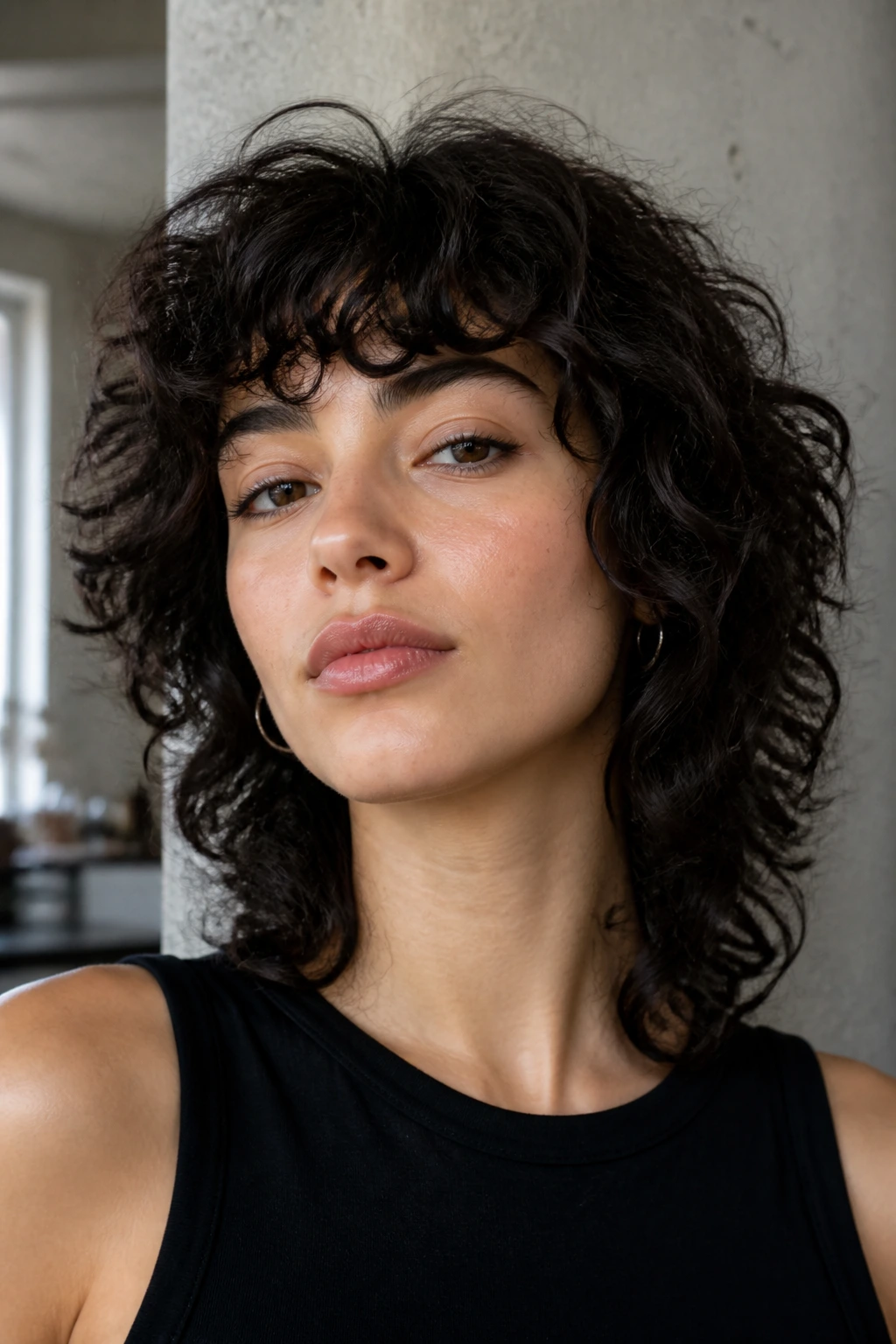
Wolf cut bangs are messy in a deliberate way. They’re short, layered, and designed to melt into the wild texture of the rest of the cut. On curly hair, that means the fringe doesn’t sit apart like a separate little shape; it becomes part of the overall silhouette. Oval faces can pull this off because the face shape already takes layers well.
This is not a neat fringe. That’s the point. The front pieces should feel feathered, a little irregular, and easy to push around with your fingers. If your curls are thick, the wolf cut bangs keep the front from becoming too heavy. If your curls are looser, they add texture where you might otherwise have a flat patch near the hairline.
A diffuser helps, but finger-coiling the front for two or three minutes can sharpen the shape fast.
15. Grown-Out Fringe
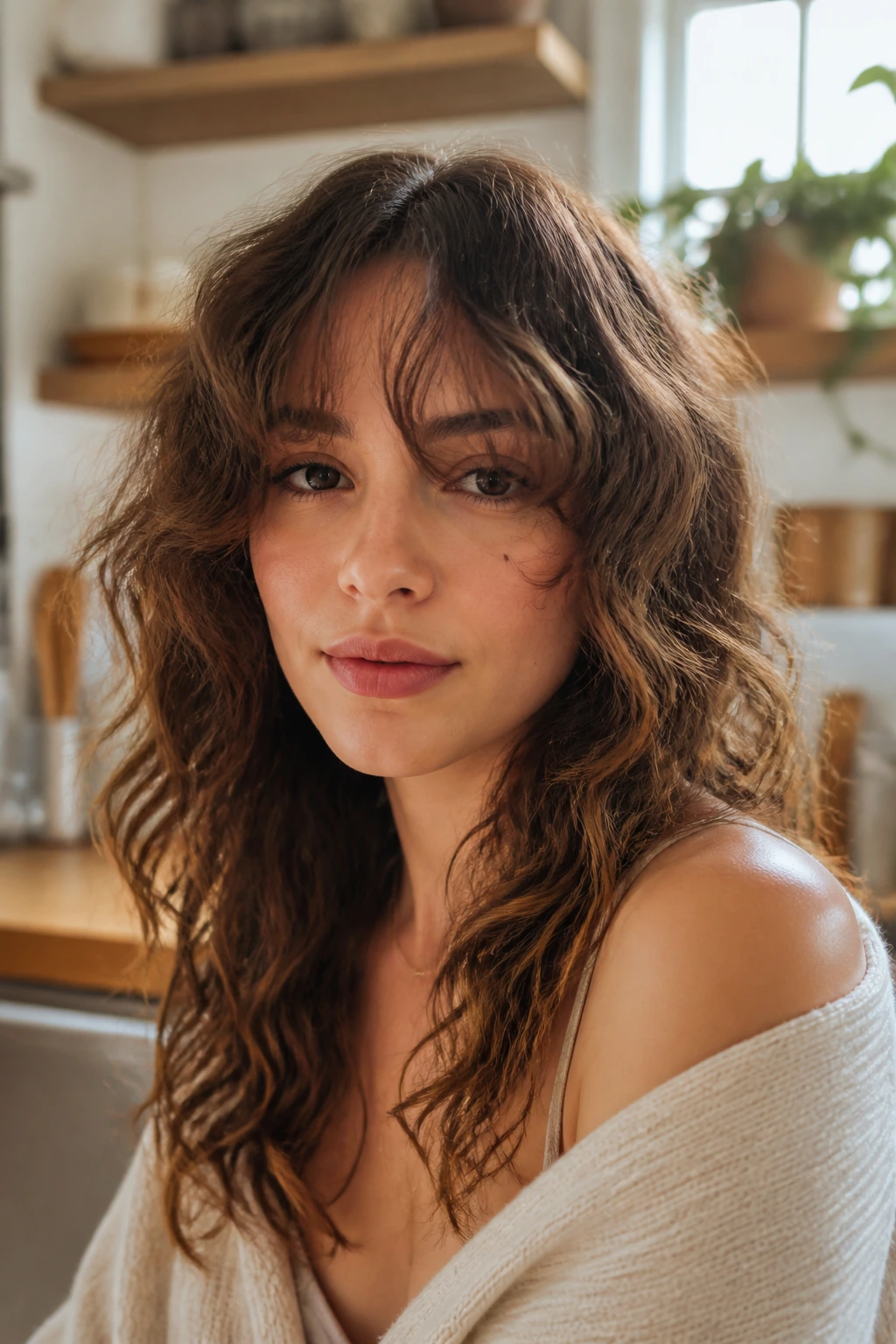
Grown-out bangs are underrated because they look accidental only when they’re cut badly. Done on purpose, they give curly hair a soft, long frame that sits somewhere between a fringe and face layers. Oval faces are ideal for this because the shape stays open and balanced, even when the bangs drift below the brows.
This style is a good answer for anyone who wants bangs but doesn’t want the maintenance bill of a precise fringe. The pieces usually start around the brow or upper cheekbone and blend gradually into the rest of the cut. A little bend in the front is enough; you do not need perfect symmetry. In fact, too much symmetry can make this shape feel stiff.
It’s a smart style if you’re growing out a shorter fringe and want the in-between stage to look intentional instead of awkward.
16. Coily Sculpted Fringe
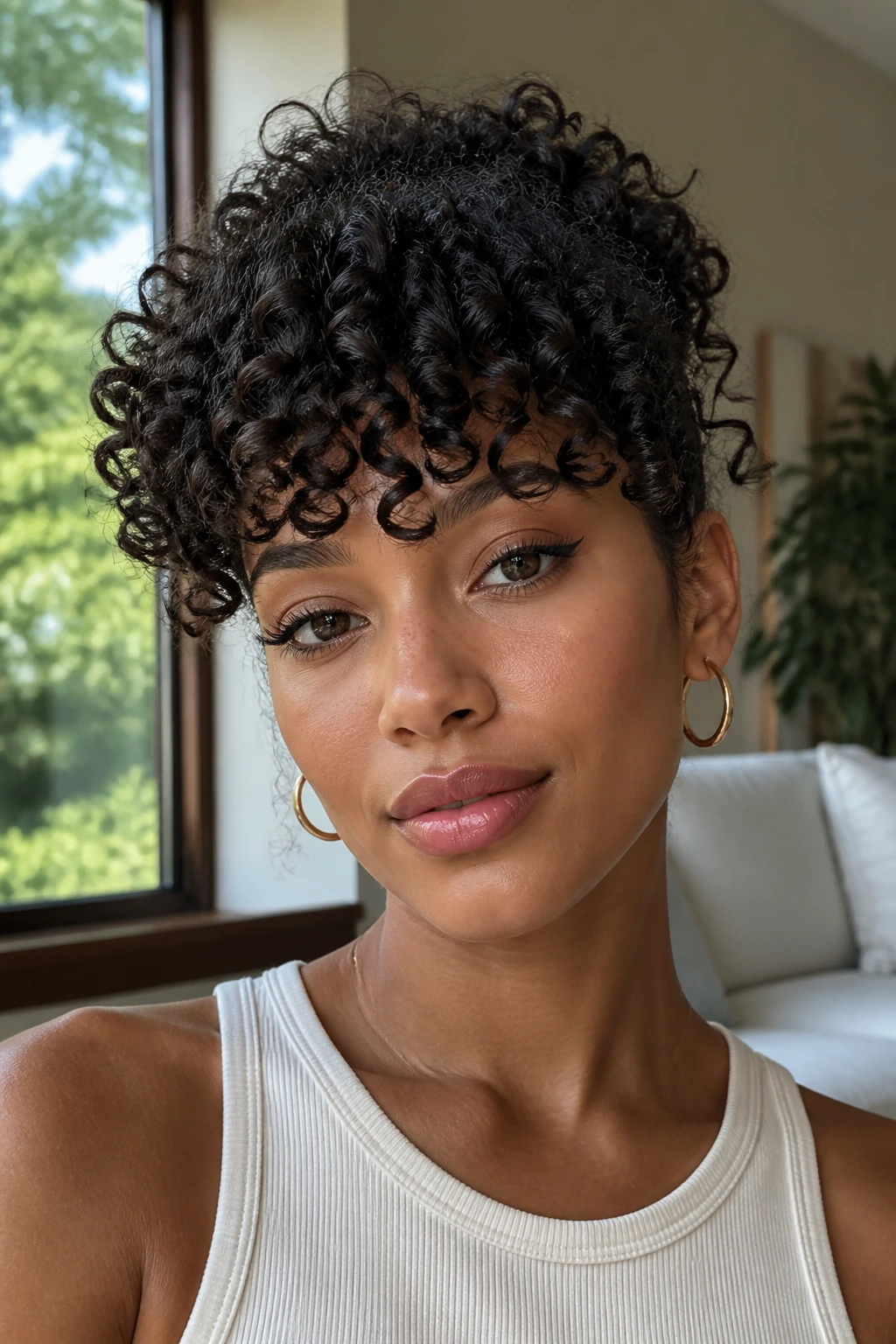
Coily sculpted bangs bring definition to tighter curl patterns instead of trying to flatten them into a straight line. The front is shaped so the coils stack, curve, and sit with intention across the forehead. On an oval face, the result is beautiful because the face can handle the fullness while the coils add a strong focal point.
This fringe works best when each section is cut dry and allowed to fall where it wants to fall. A heavy hand will wreck the pattern. A light touch, though, gives you a front shape that feels rich and architectural. I like this one when the bangs are slightly shorter in the middle and a touch longer toward the sides, because that keeps the coil pattern from looking boxed in.
Use a small amount of cream, then seal with gel if the hair frizzes easily. Coily fringe needs hold more than fluff.
17. Retro Flipped Bangs
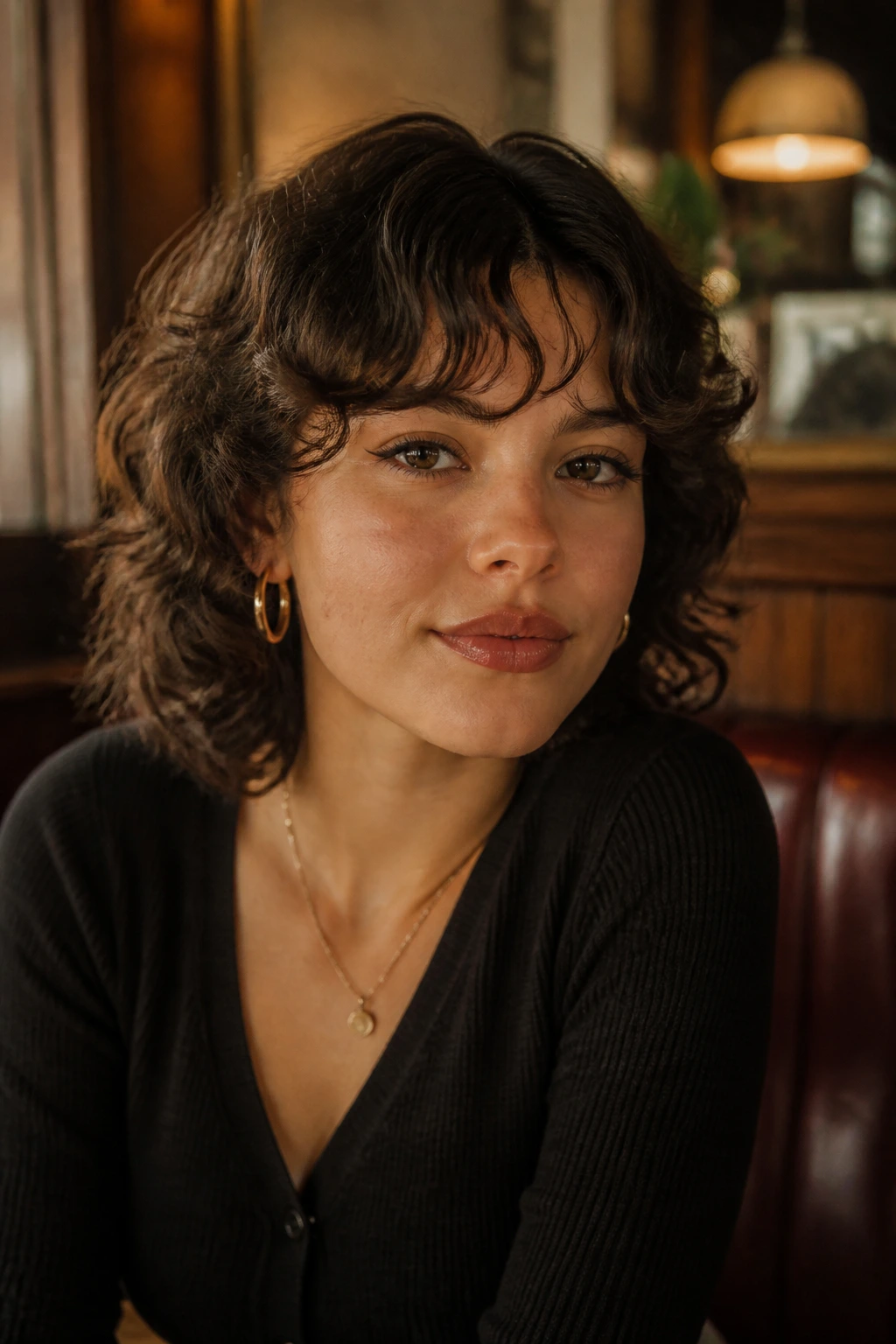
Retro flipped bangs have a little swing to them. The front is cut so the ends can turn away from the face, creating that old-school flip without turning the style into a costume. On curly hair, this motion looks playful rather than polished to the point of stiffness, and oval faces can wear the shape without losing balance.
This cut can be worn with a rounded blow-dry, but it also works with natural texture if the curl pattern naturally bends outward at the ends. The line should be light enough to move, not so heavy that it collapses against the forehead. If your hair has a tighter bend, the flip can appear as a subtle outward curve instead of a big swoop. That’s fine. Better, even.
It’s a fun choice when you want your bangs to feel a little nostalgic and a little mischievous.
18. Deep Side-Part Fringe
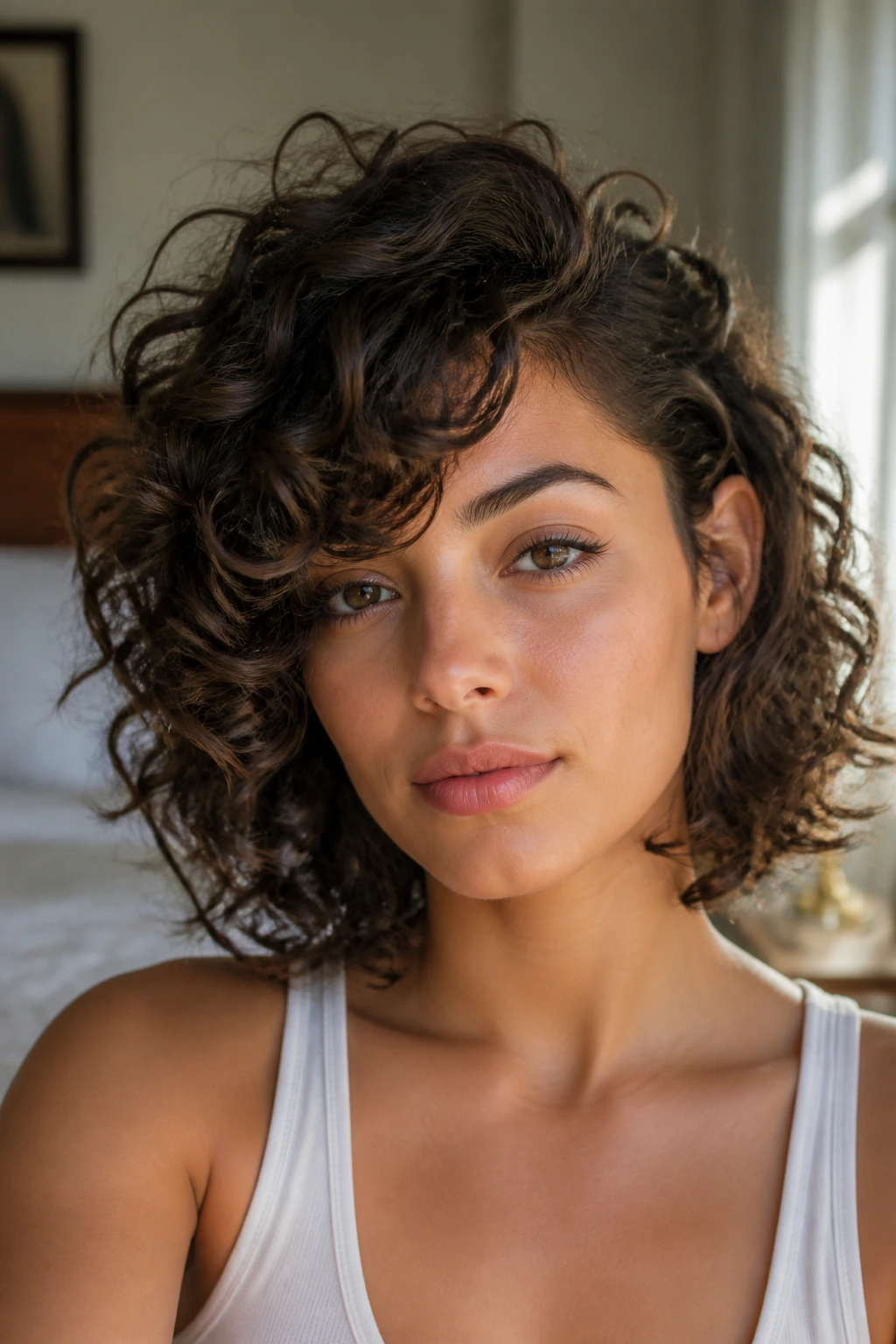
A deep side-part fringe is all about weight. Most of the bang lives on one side, with a heavier sweep that drapes across the forehead and into the temple. Curly hair makes this look richer because the shape has texture built in; it doesn’t need sleekness to read. Oval faces handle the strong diagonal well, which keeps the style from feeling too severe.
I reach for this shape when someone wants bangs but doesn’t want them centered. The deep part creates lift at the root, which is useful if the front tends to go flat. It also gives you a quick styling shortcut: a little mist, a little scrunch, and the fringe is already halfway to its final shape.
If you wear your hair tucked behind one ear a lot, this is worth a close look.
19. Feathered Bangs
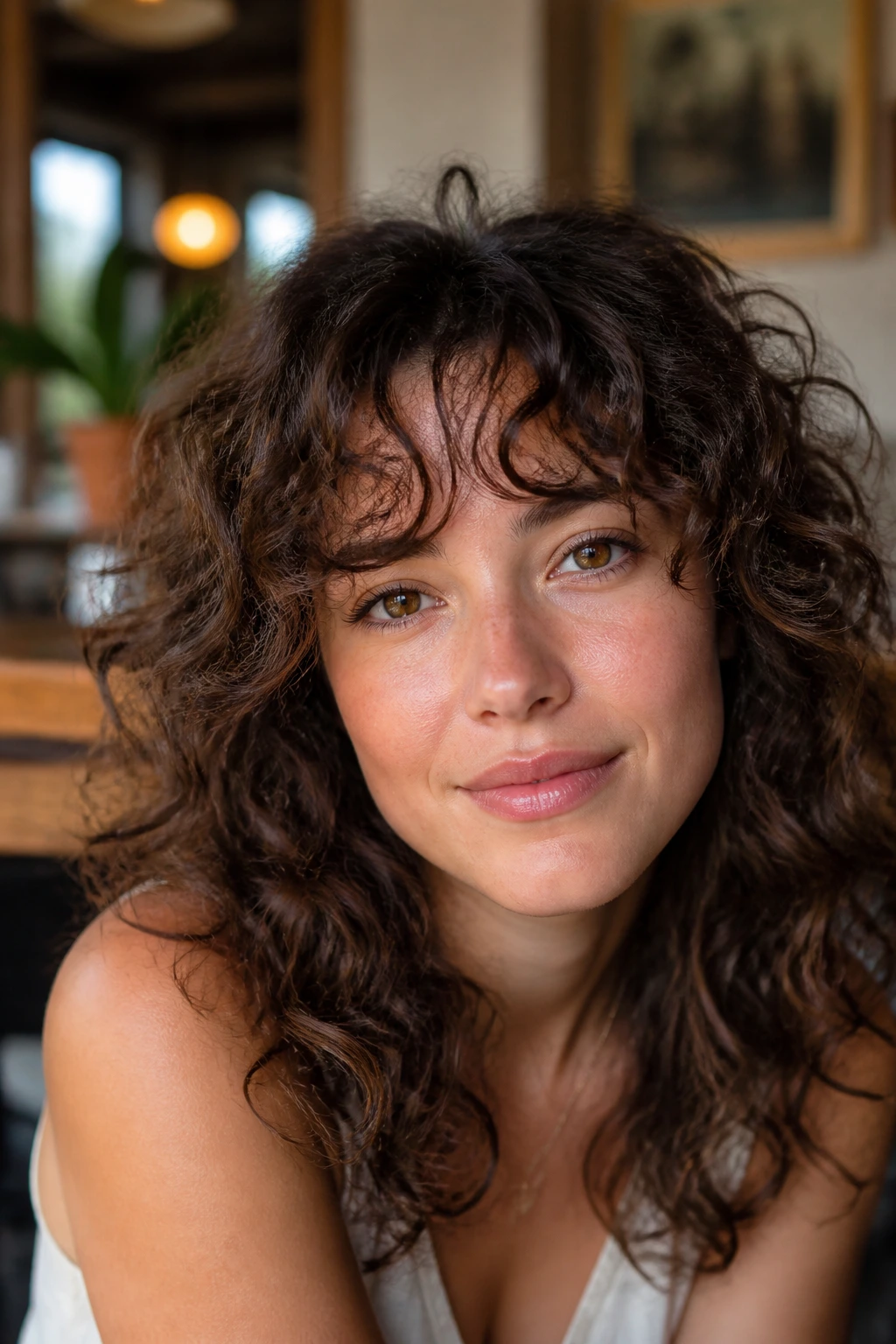
Feathered bangs are lighter than they sound. The ends are softened, broken up, and allowed to spread a little instead of forming one heavy block across the forehead. On curly hair, that feathering keeps the fringe from looking bulky. Oval faces benefit because the cut opens the center of the face while still adding some structure.
The best feathered fringe has a little air between the strands. Not too much. Too much and you get wispy pieces that disappear. Too little and the fringe turns dense. A point cut or razor finish can help here, though the right tool depends on the curl type and the stylist’s hand. I’d pair this with shoulder-length or longer cuts when the goal is movement, not drama.
It’s one of those styles that looks casual but takes a careful cut.
20. U-Shaped Curly Bangs
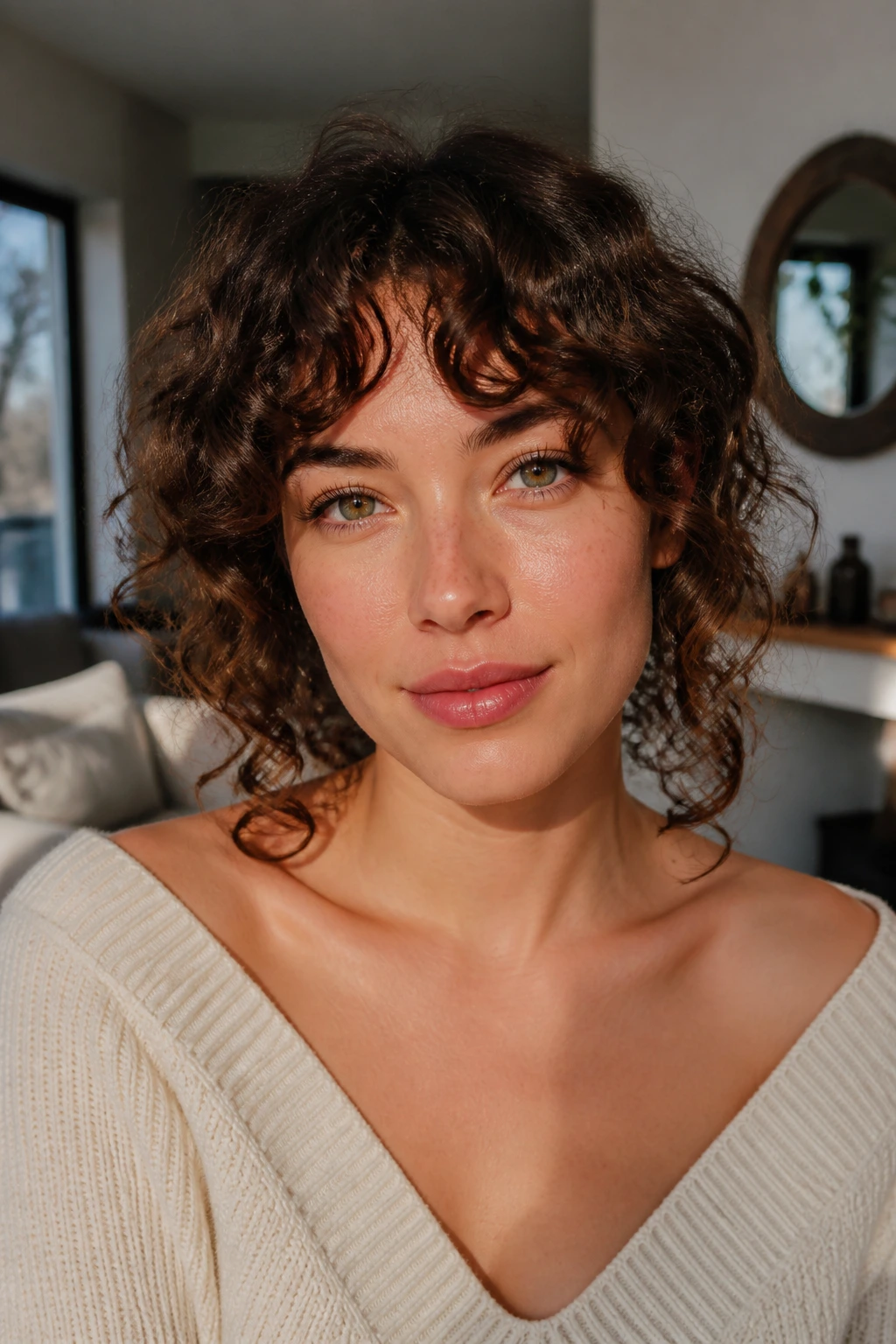
U-shaped bangs are like curtain bangs with a clearer curve. The center is shorter, the edges lengthen, and the overall line drops in a soft U across the forehead. On curly hair, that shape is useful because it works with the natural spring of the curls rather than forcing them into a straight wall. Oval faces get a nice frame that feels open at the sides.
This cut is especially handy if the front section is dense but not evenly dense. The U-shape lets the stylist give a little more weight where the forehead needs coverage and a little less where the curls should blend into the rest of the haircut. It’s a practical shape, which sounds dull until you see it move. Then it becomes the whole point.
Ask for the center to be checked in its dry state. That’s where shrinkage can sneak in and turn a soft curve into a too-short bump.
21. Wispy Fringe with a Lob
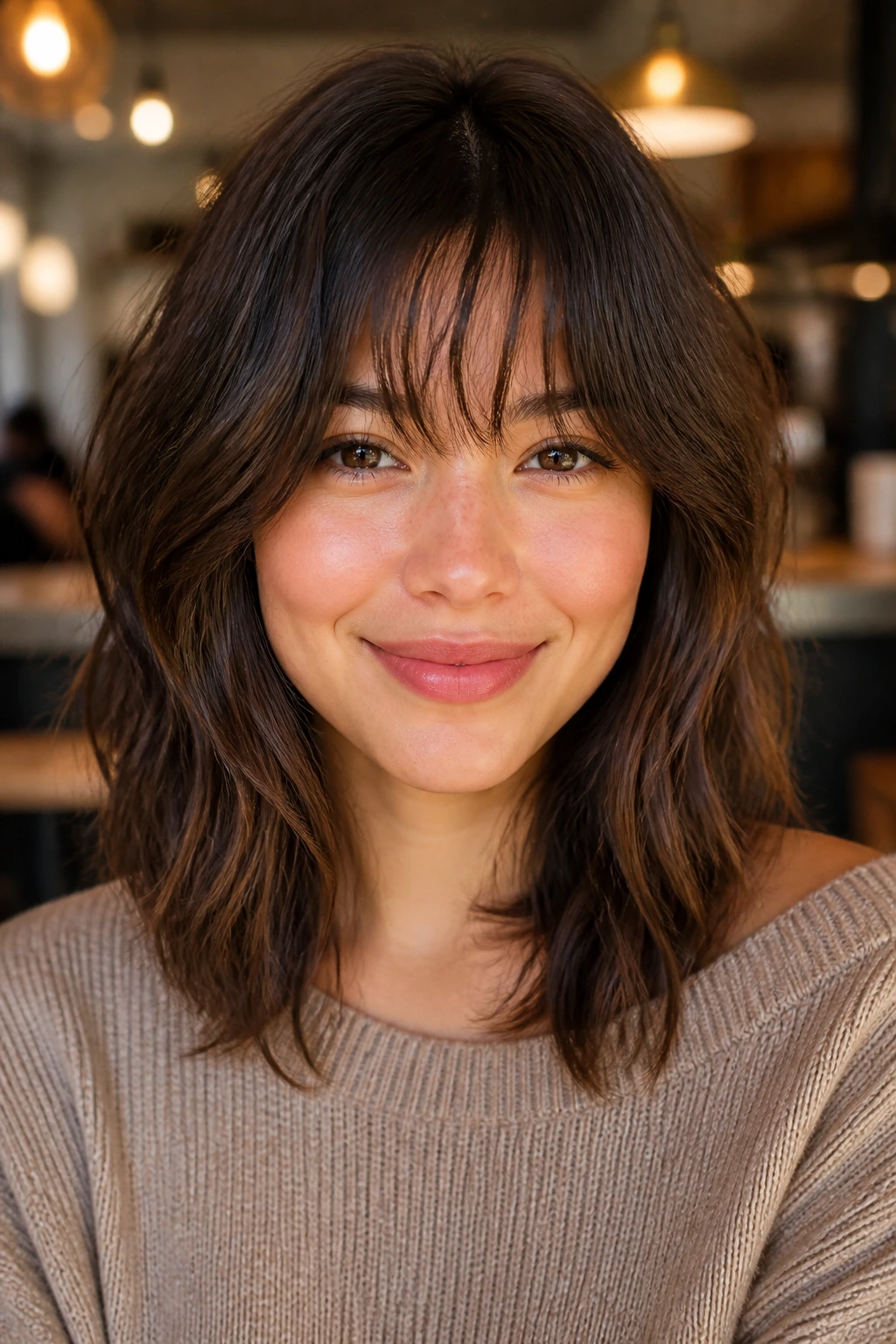
A wispy fringe paired with a lob keeps the haircut light around the face. The bangs are narrow, airy, and a touch separated, which works well when the rest of the curl pattern has some volume. Oval faces can wear this look easily because the lob already gives length and structure, while the fringe softens the front.
This style is a smart middle ground. It gives you bangs without taking much real estate across the forehead, and it stays easy to tuck, twist, or refresh. If your hairline is finer, wispy bangs can keep the front from looking too packed. If your curls are stronger, the wispy shape just means the fringe won’t fight the rest of the haircut.
Best kept for
- People who don’t want a heavy bang line
- Hair that needs movement near the brow
- Low-commitment fringe wearers
That last part matters. Not everyone wants bangs that announce themselves from across the room.
22. Full Fringe with Dense Curls
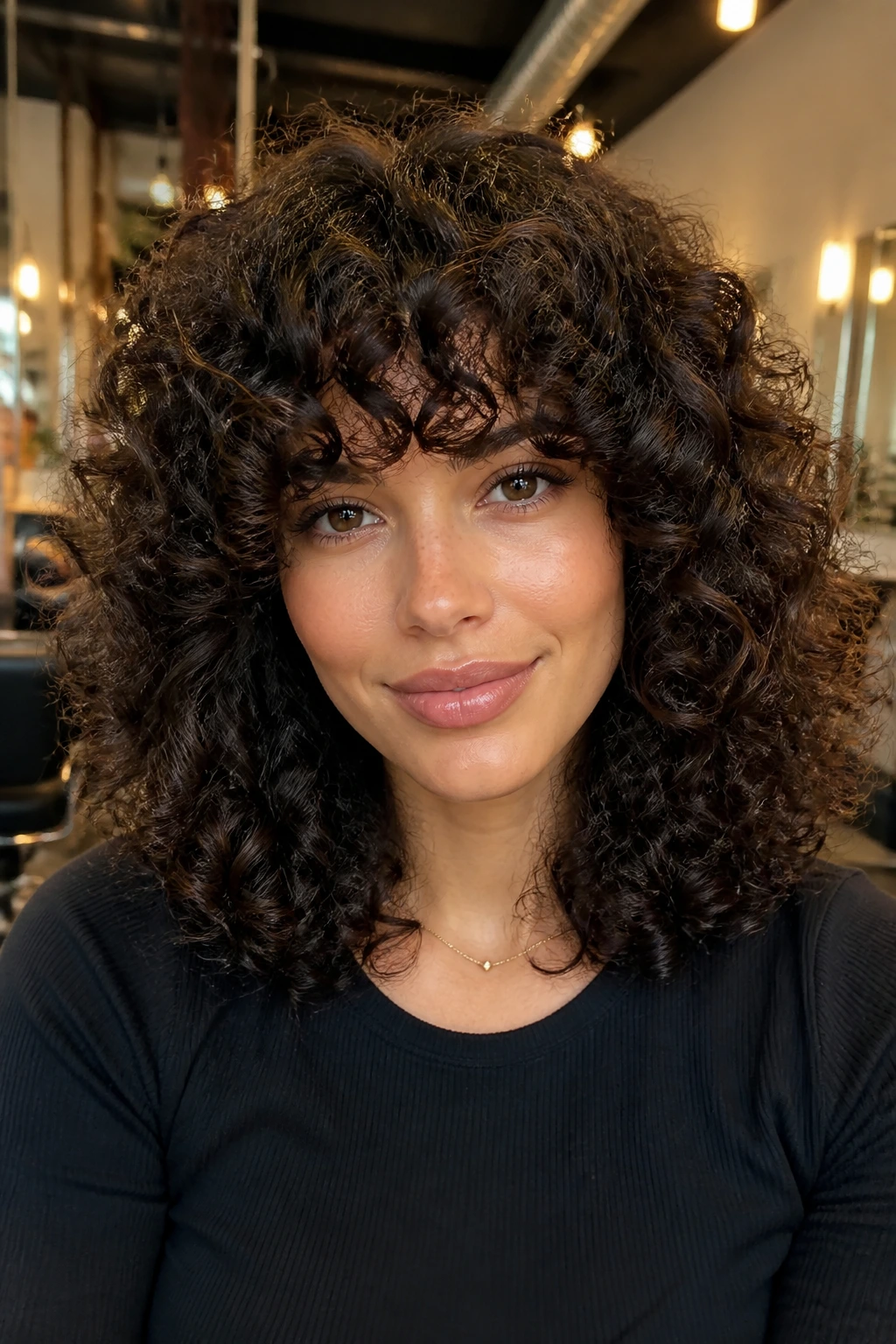
Full fringe with dense curls is for people who want presence. The bangs sit fuller across the forehead, with enough curl density to create a proper frame instead of a few stray pieces. On an oval face, this can look rich and dramatic without crossing into too much territory, because the face shape already gives the style room to land.
This cut needs thoughtful shaping. If the bangs are too short, the fullness can spring up and feel overwhelming. If they’re too long, they can drag into the eyes and turn annoying. The sweet spot is often slightly longer than the brows when dry, then trimmed after the curls settle. Dense curls can hold a strong line beautifully, but only if the ends are shaped so the fringe doesn’t balloon out.
Use this when you want your bangs to be a real feature, not a whisper.
23. Temple-Grazing Bangs
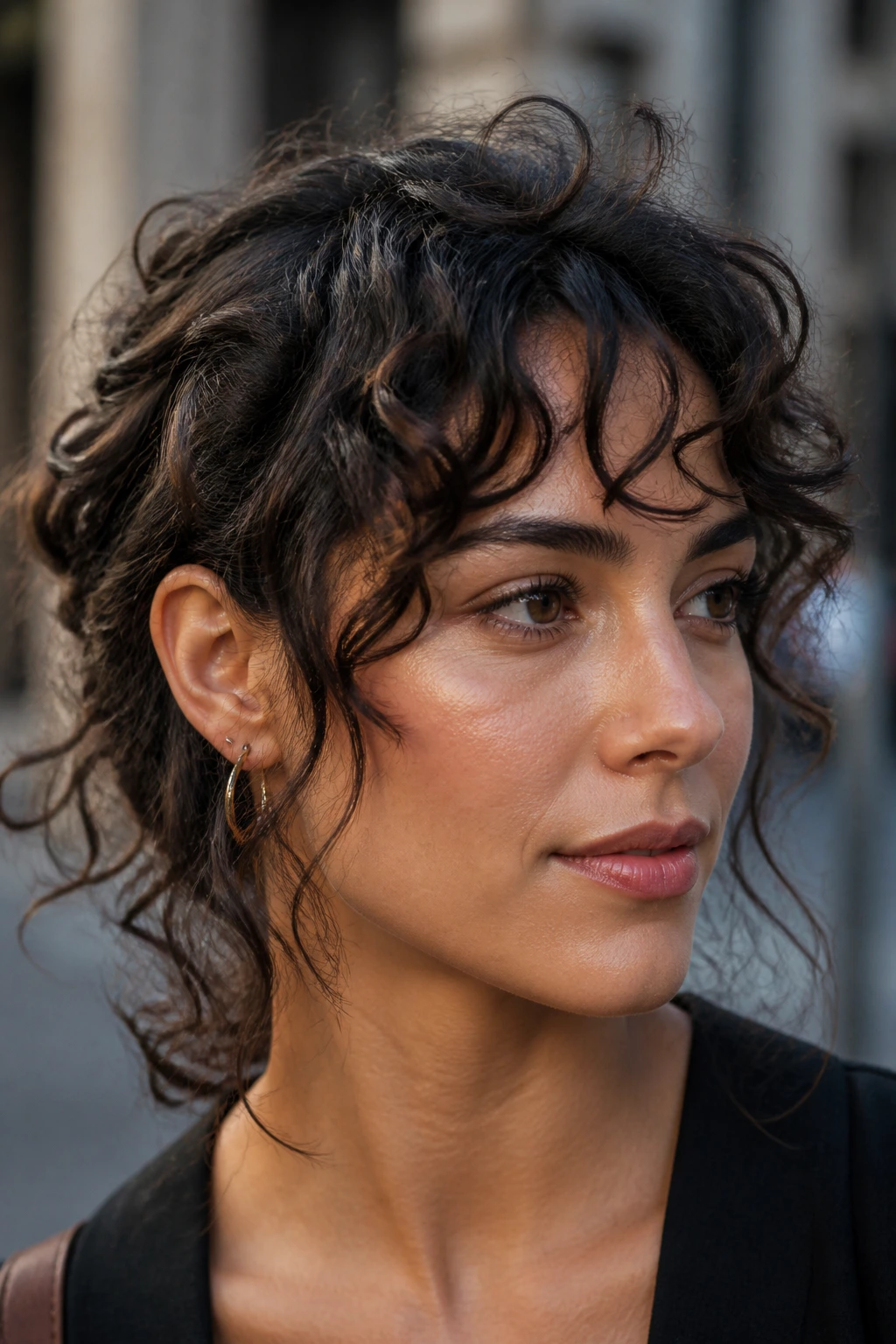
Temple-grazing bangs start where many fringes stop: at the outer edges of the face. Instead of covering the forehead, they frame the temples and skim down toward the cheekbones. On curly hair, that shape feels modern because it creates movement without demanding a full bang commitment. Oval faces benefit from the soft side emphasis.
This is a good choice if you’re nervous about forehead coverage or if your hair tends to separate at the center. The temple pieces can sit like soft brackets around the face, which keeps the overall look airy. I like this with a side part, but it can also work with a middle part if the cut is balanced well. It’s one of the easiest ways to get the “bangs” feeling without constantly dealing with fringe in your eyes.
24. Tapered Pixie Fringe
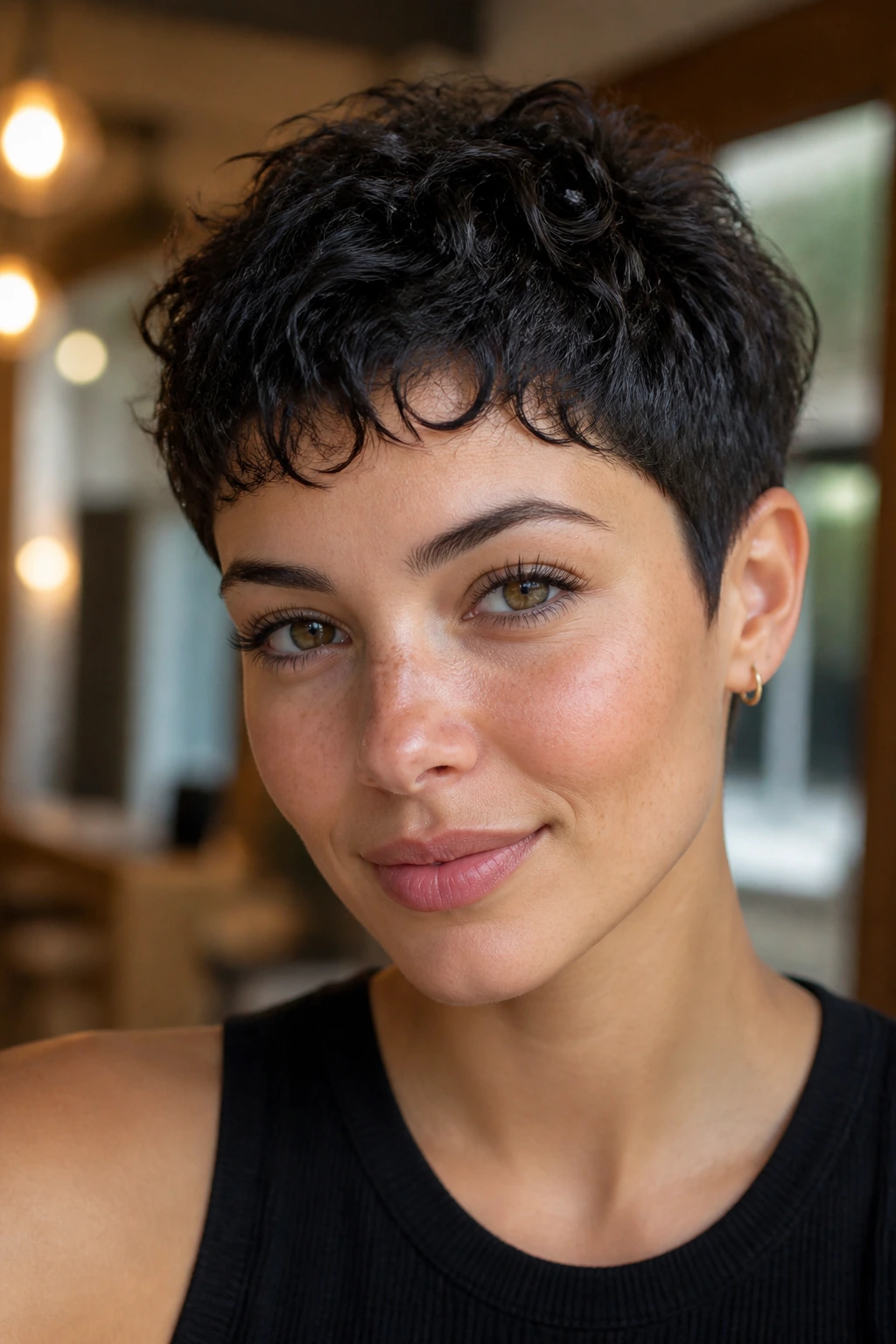
Tapered pixie bangs are short, sharp, and very dependent on the cut around them. On curly hair, they can look surprisingly soft because the texture blunts the line just enough to keep it wearable. Oval faces are a good fit for this style, especially when the rest of the crop stays close and tailored.
The taper matters more than the length. You want the fringe to shorten cleanly near the center or front, then blend into the sides without forming a hard shelf. If the curls are dense, the front needs careful thinning so it doesn’t puff out. If they’re looser, the short length can fall in a gentle bend that looks almost velvet-soft.
This is not a timid cut. It’s for someone who wants the fringe to read as part of a whole crop, not a decorative add-on.
25. Cascade Bangs
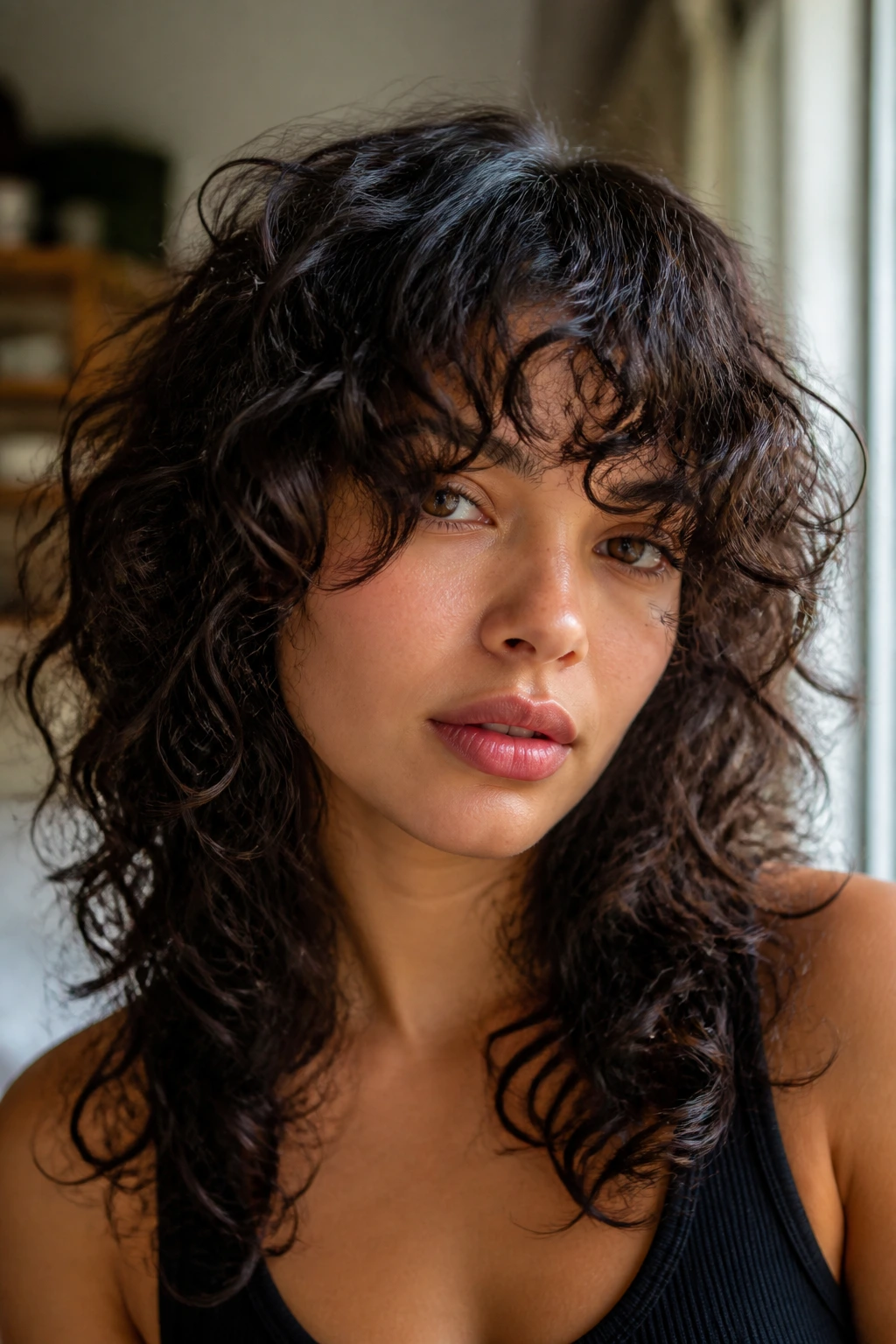
Cascade bangs fall in stages, with one layer dropping into the next so the front feels layered rather than cut as one line. Curly hair makes this especially pretty because the layers catch and release in different places. On an oval face, cascade bangs can soften the forehead while keeping the shape long and fluid.
I like this style when the goal is movement over precision. The front can start shorter near the brows, then fall into cheekbone pieces and finally merge into the rest of the haircut. Nothing sits too flat. Nothing looks pasted on. If your curls are mixed in texture — tighter near the crown, looser in front, or vice versa — this layered approach helps everything feel intentional.
It’s one of the most forgiving modern fringe shapes on the list, and probably the easiest to live with if you hate fighting your bangs every morning.
Why Curly Bangs Need a Dry-Cut Mindset
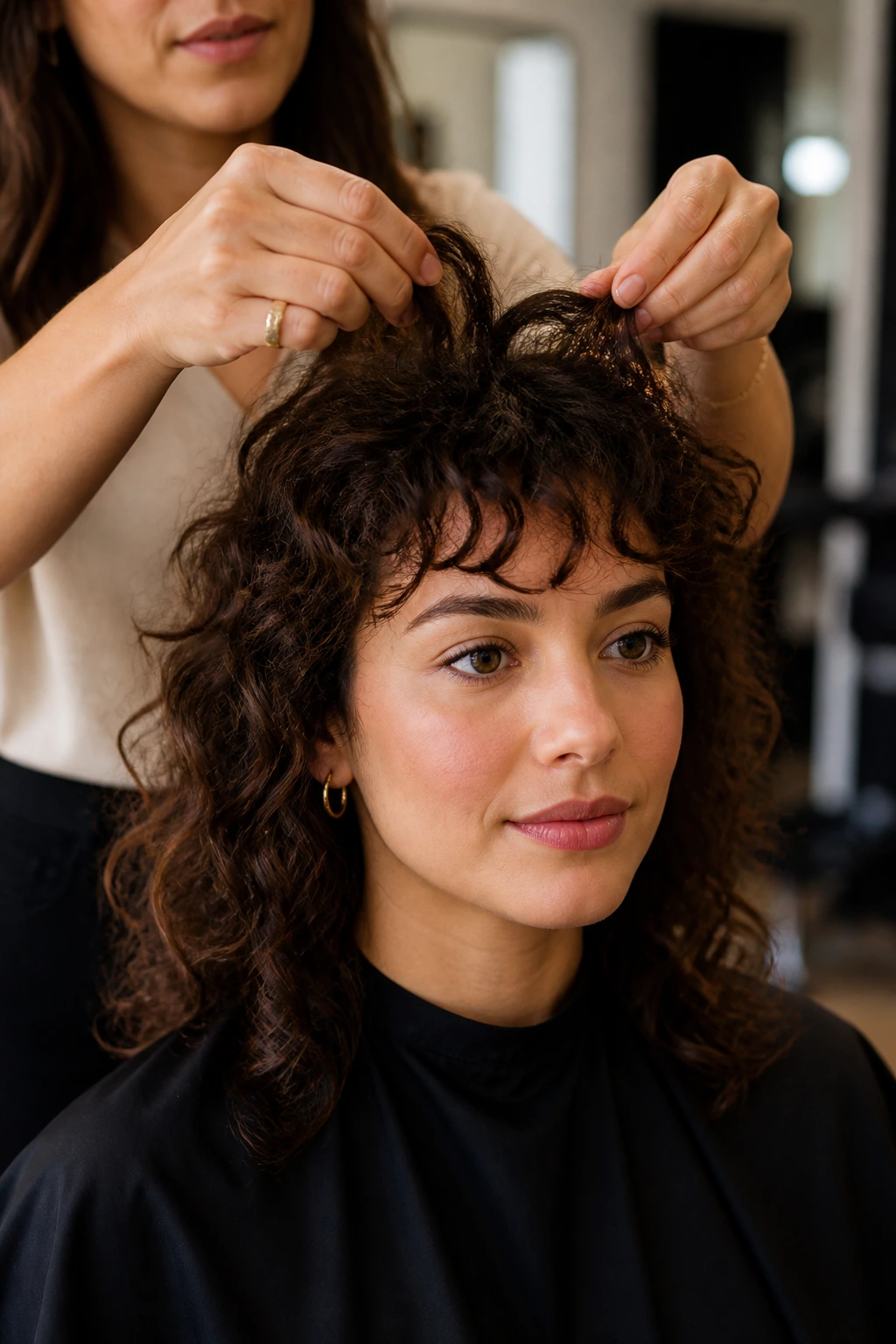
Curly bangs behave better when the cut respects their natural shrinkage. That sounds obvious, but plenty of bad fringe jobs happen because someone trims curls the same way they’d trim straight hair. Wet curls stretch. Dry curls spring. The difference can be an inch or more, which is enough to turn a flattering brow-skimming fringe into something that looks like it was cut during a power outage.
The best approach is usually a dry cut or at least a dry check before the final trim. A stylist can still shape curls while they’re damp, but the front section should be re-evaluated once it’s in its natural state. That’s especially true for oval faces, because the face shape will tolerate many bang lengths, but the curl pattern won’t forgive a bad assumption. The style matters less than the shrinkage plan.
Why Oval Faces Give You So Much Room
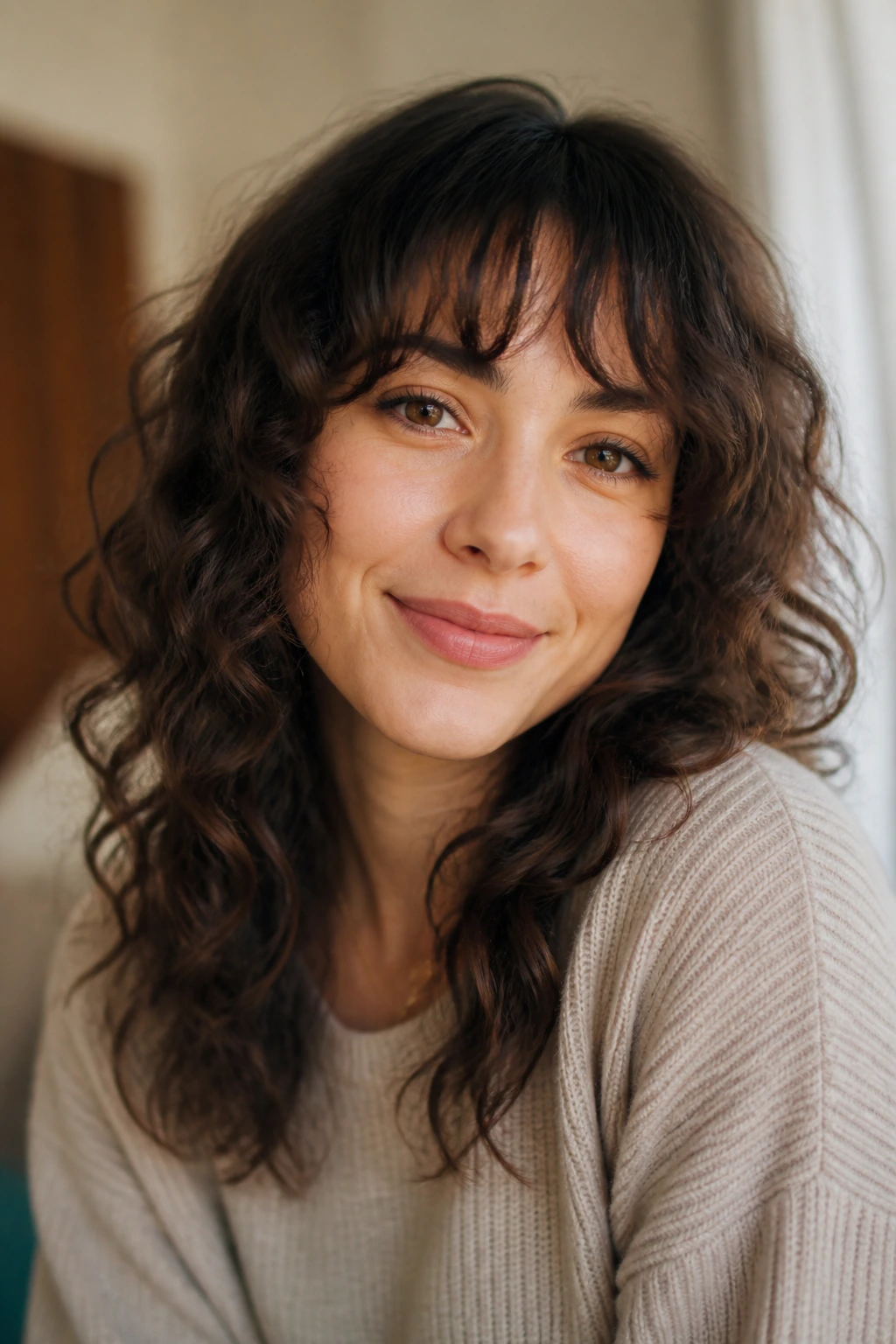
Oval faces are the rare shape that can wear a lot of bang styles without needing heavy correction. The forehead isn’t too long, the jaw isn’t too wide, and the cheekbones usually provide a nice middle point for fringe lengths to land on. That means a blunt line can work. So can a broken fringe, a curtain shape, or a side sweep.
That freedom is nice, but it can also make people indecisive. If everything works, how do you choose? I’d start with the amount of maintenance you can tolerate, then decide how much forehead you want covered. A short fringe needs more attention. A longer face-framing bang lets you live a little. In practice, the right choice is often the one you’re willing to style on a dull Tuesday.
The Right Tools for Curly Fringe Work
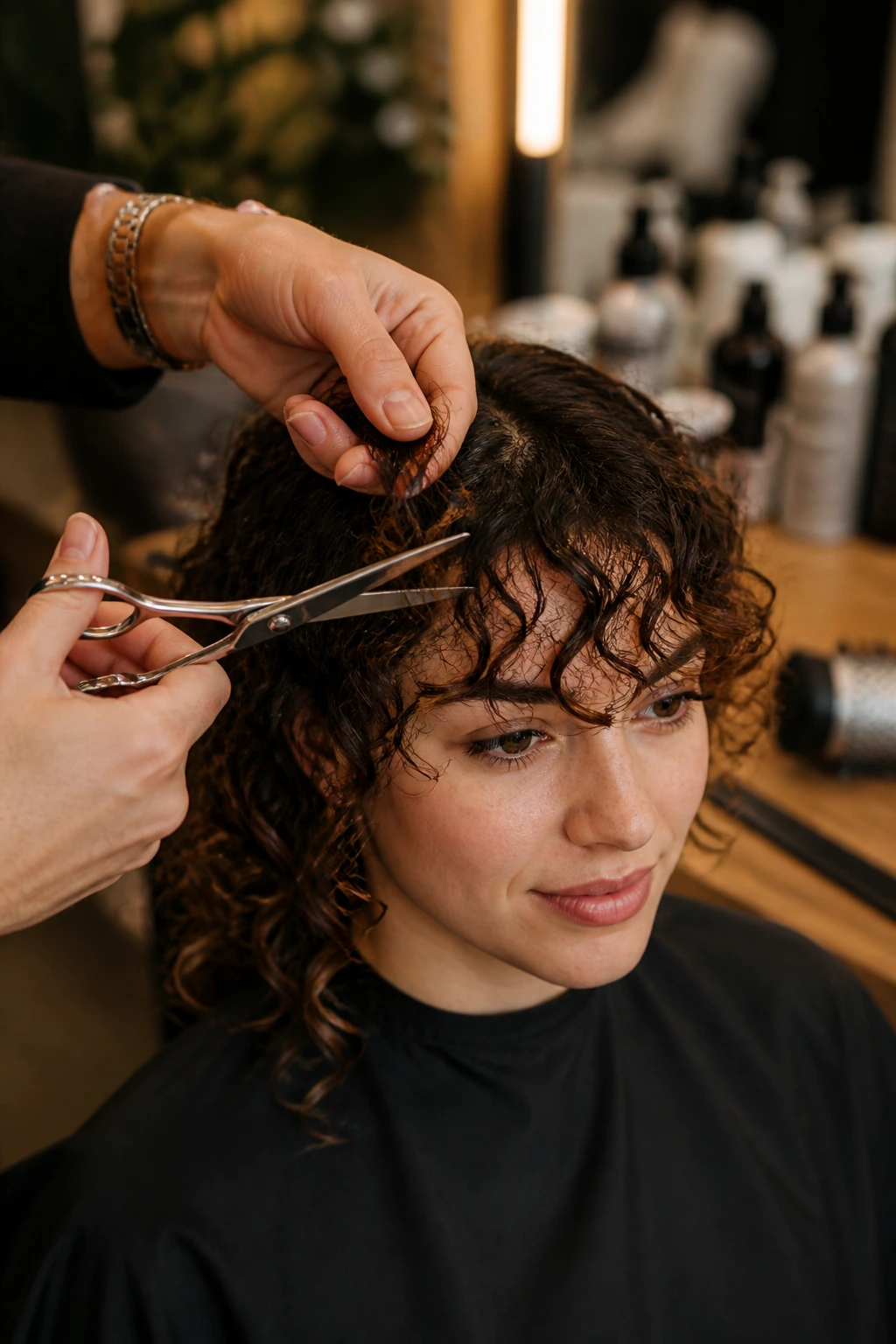
- Sharp haircutting shears: Dull scissors chew the ends and leave curly bangs frayed before you’ve even styled them.
- Diffuser attachment: This helps the fringe dry in place without blasting the curl pattern apart.
- Wide-tooth comb: Use it gently if the front needs detangling; don’t yank through a dry fringe.
- Sectioning clips: Bangs need isolation while cutting and while styling, or they blend into the rest of the hair too soon.
- Spray bottle with water: Light misting helps reset the front, but keep it light so you don’t drown the curl.
- Microfiber towel or cotton T-shirt: Better than a rough bath towel when you’re blotting the fringe.
- Round brush or Denman-style brush: Optional, but useful if you want a smoother bend before the diffuser goes on.
- Light curl cream and gel: Cream for softness, gel for hold. Too much of either turns the fringe heavy.
How to Ask for the Shape You Want
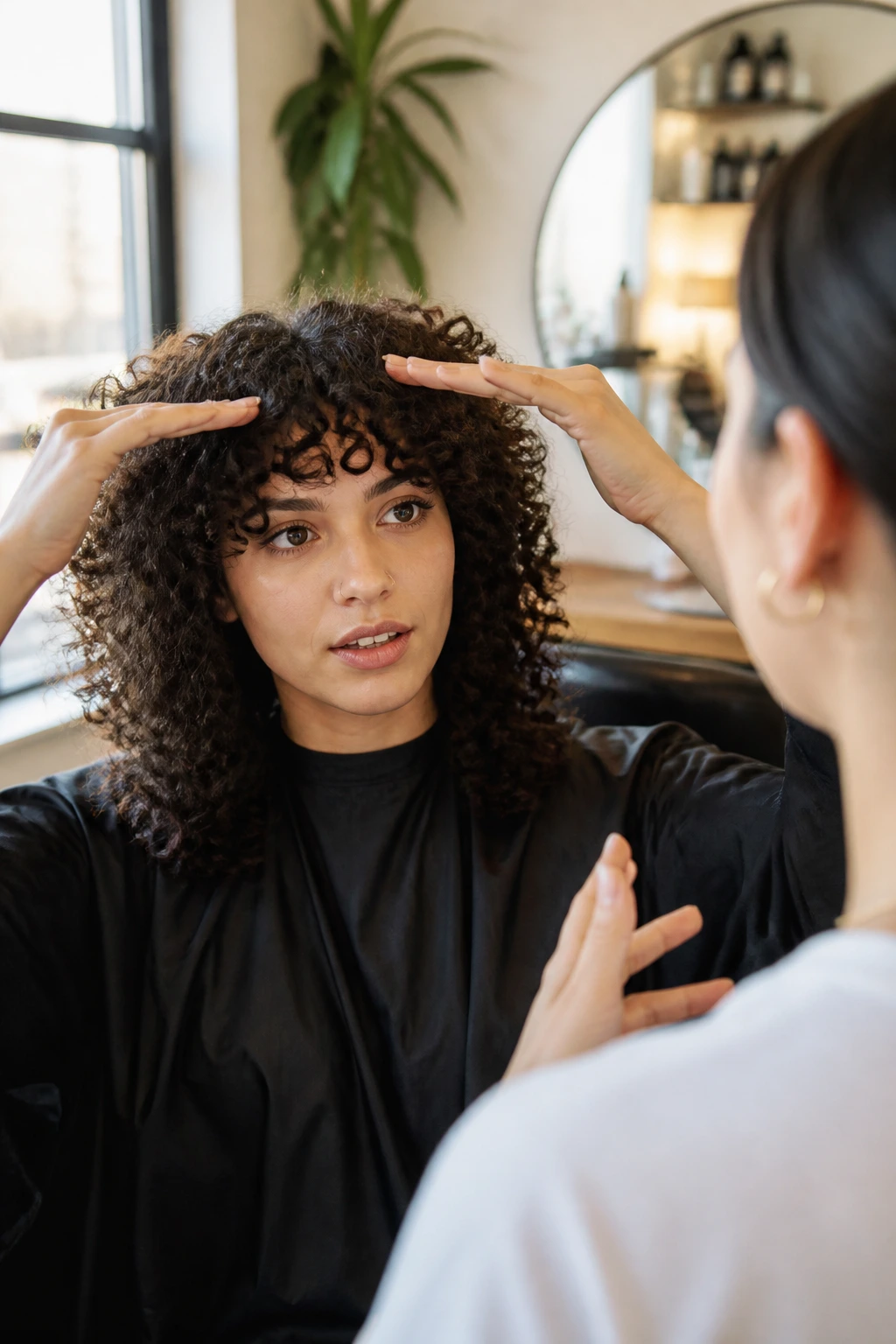
Bring more than a photo. Bring a sentence. Better yet, bring two. A stylist can work with “I want curtain bangs that land around my cheekbones when dry, not wet,” far more easily than “something soft and modern.” The first sentence has a target. The second one has a mood.
Start with the shrinkage story: tell them whether your curls spring up a lot or only a little.
Name the landing spot: brow, bridge of nose, cheekbone, or temple.
Say how much forehead you want covered: full, partial, or barely there.
Ask for a dry check: this is the part that saves the cut.
And one more thing. If you usually wear your hair in a side part, say that before the scissors come out. Bangs that fight your part will spend every morning trying to escape.
Styling Curly Bangs So They Sit Well

Curly bangs need less product than people think, and more patience than they want. Start with a small amount of cream or leave-in conditioner, then add gel only where the fringe frizzes first. The front area usually needs the lightest touch in the whole head because too much product makes bangs collapse into a sticky curtain.
A diffuser helps, but the angle matters. Dry the bangs from below or from the side so the curl pattern keeps its shape. If you blast the front from above, you can flatten the root and puff the ends. Finger-coiling a few stubborn pieces is worth the minute it takes. So is stopping the dryer before the fringe is 100% crisp; a tiny bit of dampness left in the curls often settles into a better shape than fully blasting them dry.
Common Mistakes That Make Curly Bangs Go Sideways
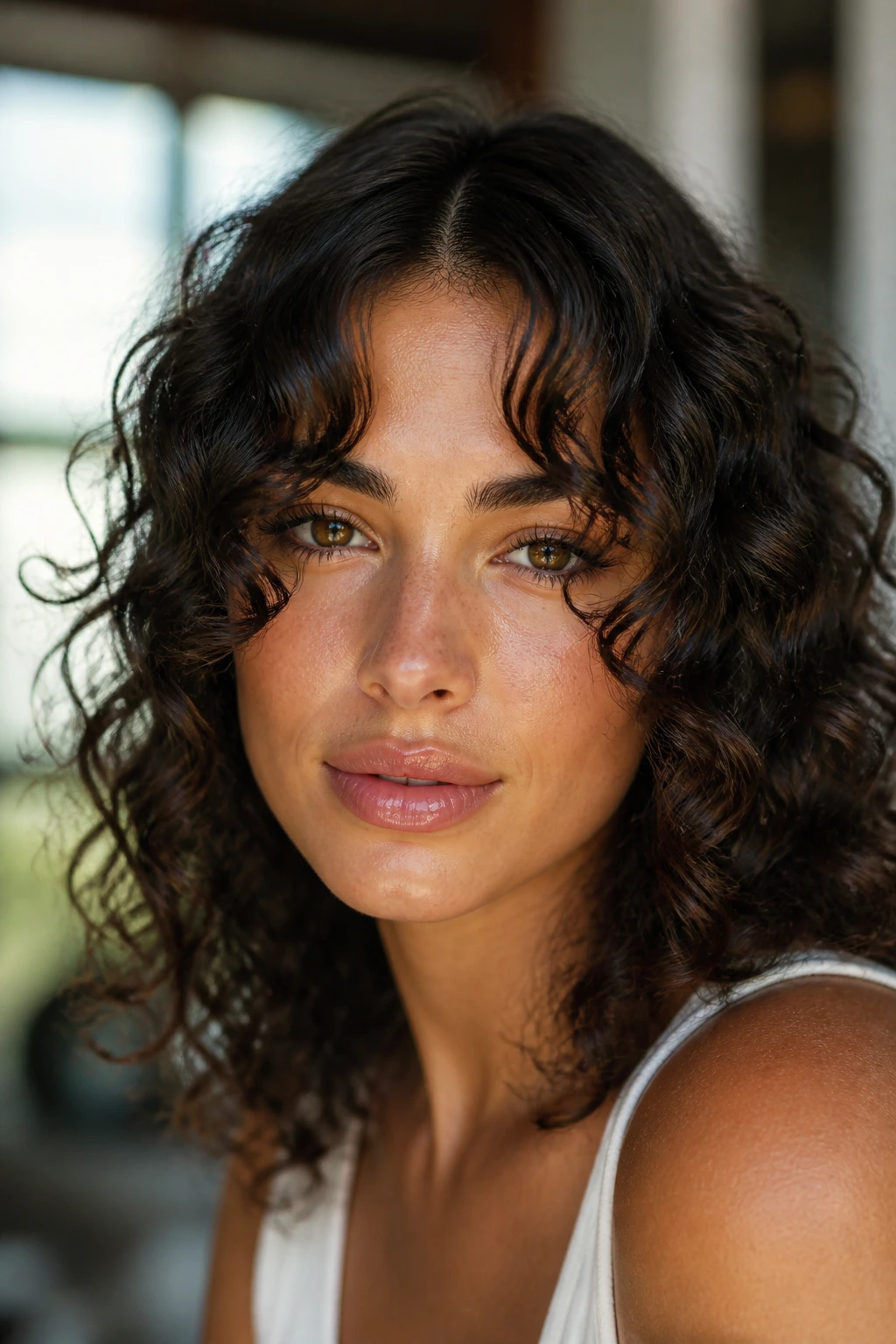
The first mistake is cutting them too short while they’re wet. The symptom is obvious: the fringe pops up, splits awkwardly, and spends the next six weeks hovering above the brows. The fix is to cut longer than you think and confirm the shape dry.
The second mistake is over-thinning the front. When curly bangs are thinned too hard, they stop looking soft and start looking patchy. You’ll see gaps, frizz, and pieces that won’t join the rest of the fringe. A little point cutting is enough in most cases.
Another common miss is using too much product at the front. Heavy creams weigh bangs down near the scalp, then make the ends stringy. Use a smaller amount than you’d use on the rest of the hair.
Finally, don’t ignore your part. If your curls want to fall left, forcing them center every day creates a fight you’ll lose.
Variations and Adaptations to Try
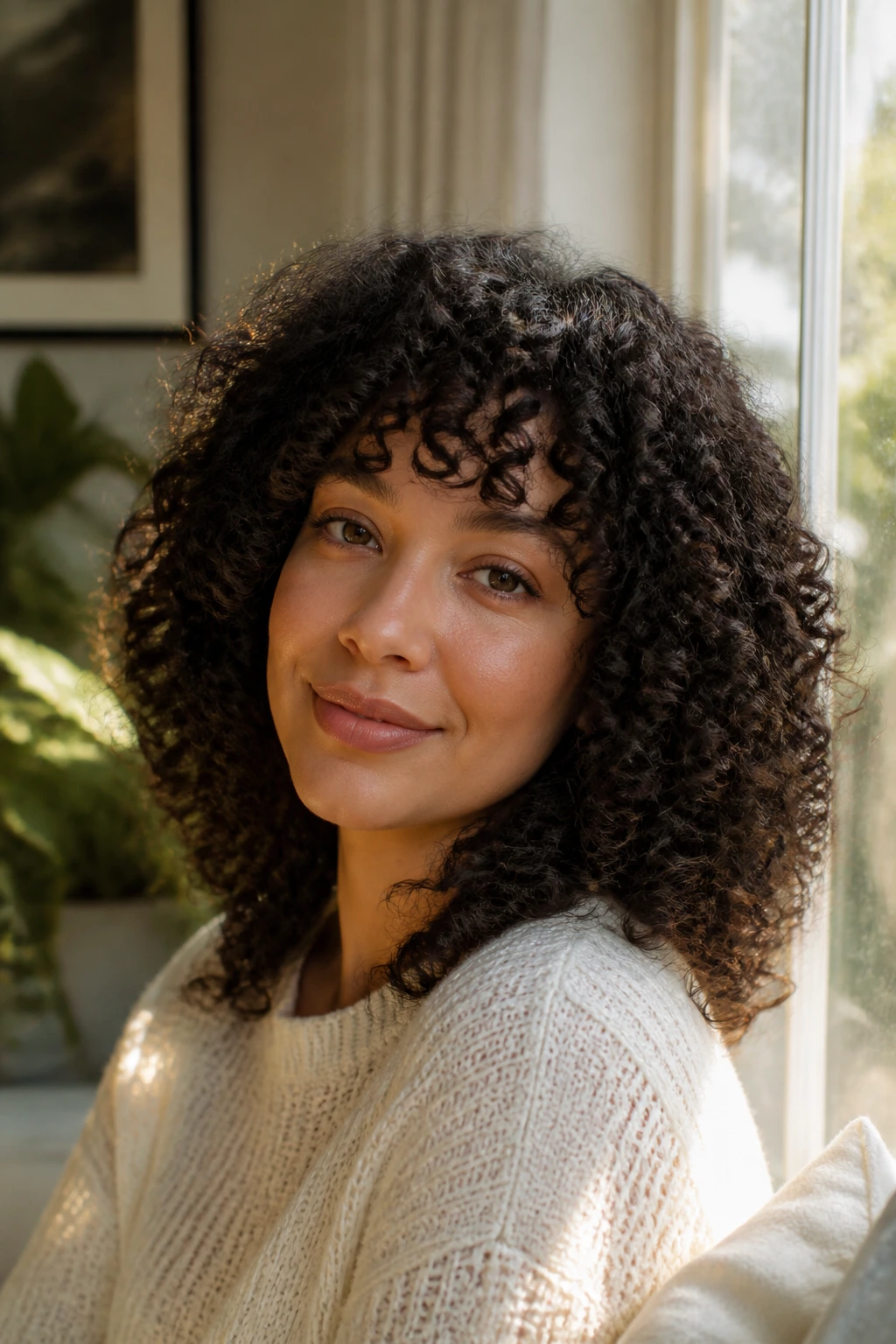
The Low-Maintenance Grow-Out Version: Keep the fringe long enough to tuck behind one ear, with the shortest point near the nose or brow. This works well if you want bangs that can disappear on busy days.
The Dense-Curl Version: For tighter, fuller curls, leave more length and shape the front into a rounded or halo form. The extra room prevents the bangs from shrinking into a wall.
The Fine-Curl Version: If the front section is less dense, go for see-through, wispy, or side-swept bangs. A lighter shape keeps the fringe from looking like it’s been split down the middle by chance.
The Statement Crop Version: Short micro or pixie-style bangs work when you want a stronger contrast with the rest of the cut. Just keep the dry cut conservative.
The Humidity-Friendly Version: Choose curtain, bottleneck, or long face-framing bangs and keep the edges soft. Those shapes survive moisture better than a hard line.
Keeping Curly Bangs in Shape Between Cuts
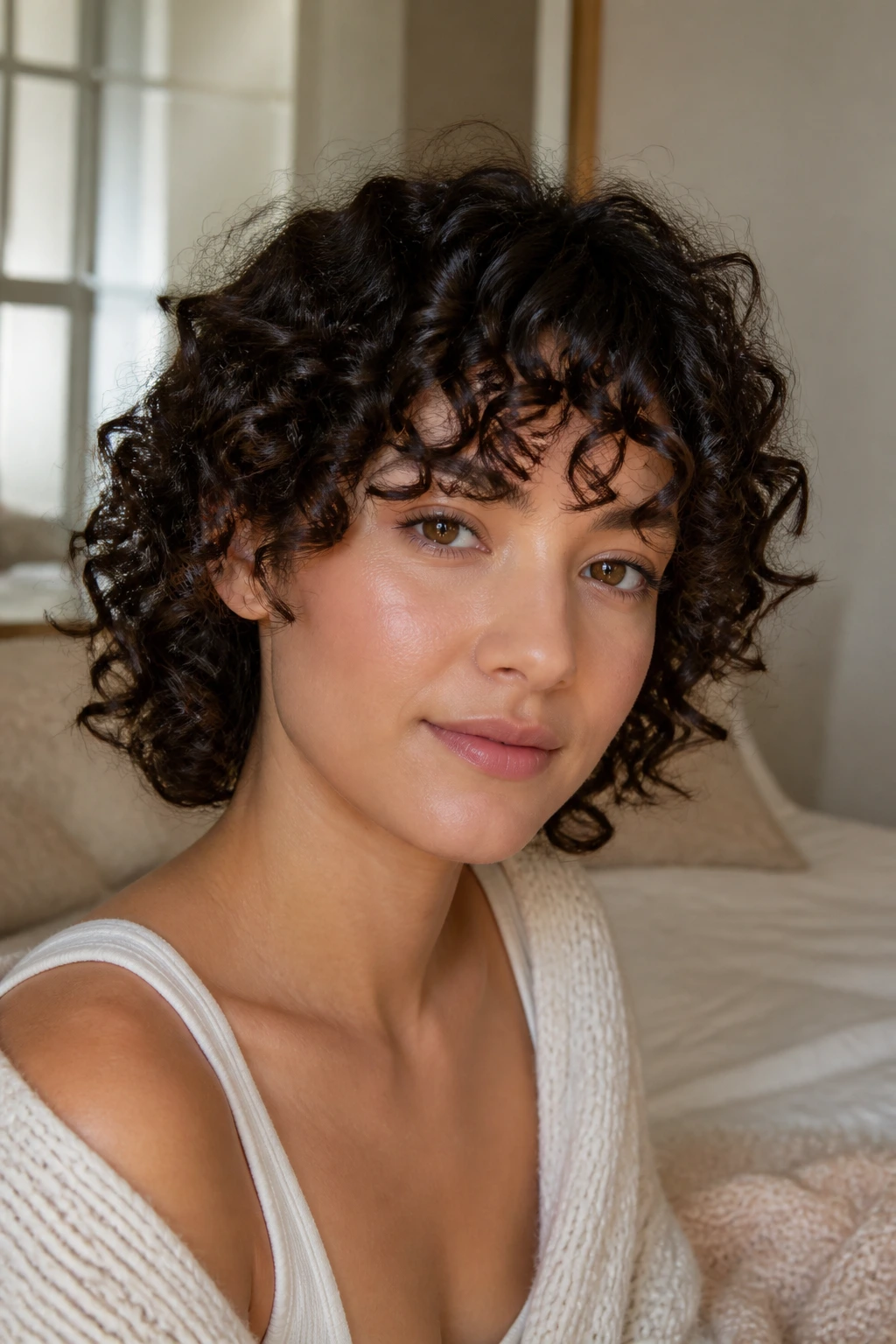
Curly bangs ask for maintenance, but not the exhausting kind. Most fringe shapes need a trim every 6 to 8 weeks if you want the line to stay crisp. Longer curtain or face-framing shapes can often stretch to 8 to 12 weeks, especially if you’re happy with a softer, grown-out look.
Between washes, a light mist of water or a curl refresher spray can bring the front back to life. Don’t soak it. A damp fringe is enough for scrunching or finger-coiling a few pieces back into place. If the roots puff up, a tiny bit of gel smoothed over the surface — just the surface — usually beats piling on more cream.
Sleep also matters. A satin pillowcase or a loose pineapple can keep the front from flattening overnight. If you wake up with bangs bent in a weird direction, wet your fingertips, reshape the front, and diffuse for a minute or two. That’s often all it takes.
FAQ
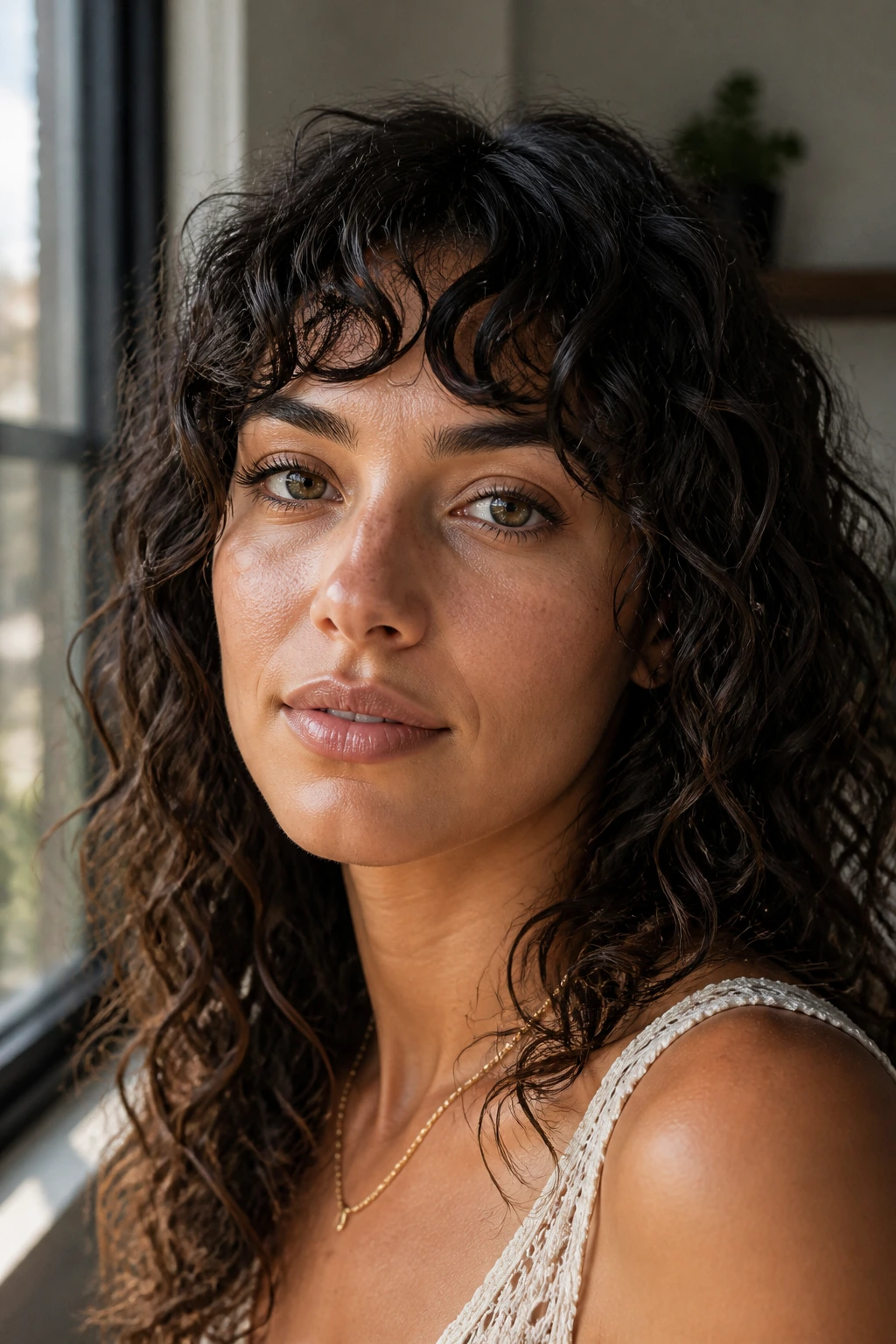
Do curly bangs work on every oval face?
Usually, yes. Oval faces are flexible enough to carry blunt, side-swept, curtain, or short fringe shapes without the proportions getting awkward. The bigger question is curl pattern and density, because those affect how much movement and shrinkage you’ll see.
Should curly bangs be cut wet or dry?
Dry cutting is usually safer for curly fringe because you can see the real shape, not the stretched version. Some stylists work damp and then refine dry, which is fine if they know exactly how your curls behave.
How short is too short for curly bangs?
If the front hair springs up a lot, even a brow-length cut can become micro-length once dry. A good rule is to leave more length than you think you need, then trim in small passes after the curls settle.
What if my bangs separate in the middle all day?
That usually means the center is too heavy, the part is too forceful, or the styling product is too slippery. Try a lighter gel, a quick finger-coil, and a cut that respects your natural part instead of battling it.
Can I wear curly bangs with glasses?
Yes, but the length matters. Curtain bangs, side-swept fringe, and longer face-framing pieces usually sit better with frames than a very short straight-across bang.
Do I need to straighten curly bangs to make them look good?
No. Straightening can look neat for an hour and then puff, kink, or frizz at the first sign of moisture. The better move is to shape the fringe for your texture and let it do what curly hair does.
What if the front of my hair is finer than the rest?
Choose a lighter fringe like see-through, wispy, or side-swept bangs. Heavy blunt bangs can expose the fine section and make it look thinner than it really is.
How do I stop curly bangs from getting puffy in humidity?
Use less cream, a little more gel, and don’t over-diffuse them. A soft hold product plus a good dry shape tends to outperform a heavy moisturizer that turns the front fluffy later.
The Fringe That Fits
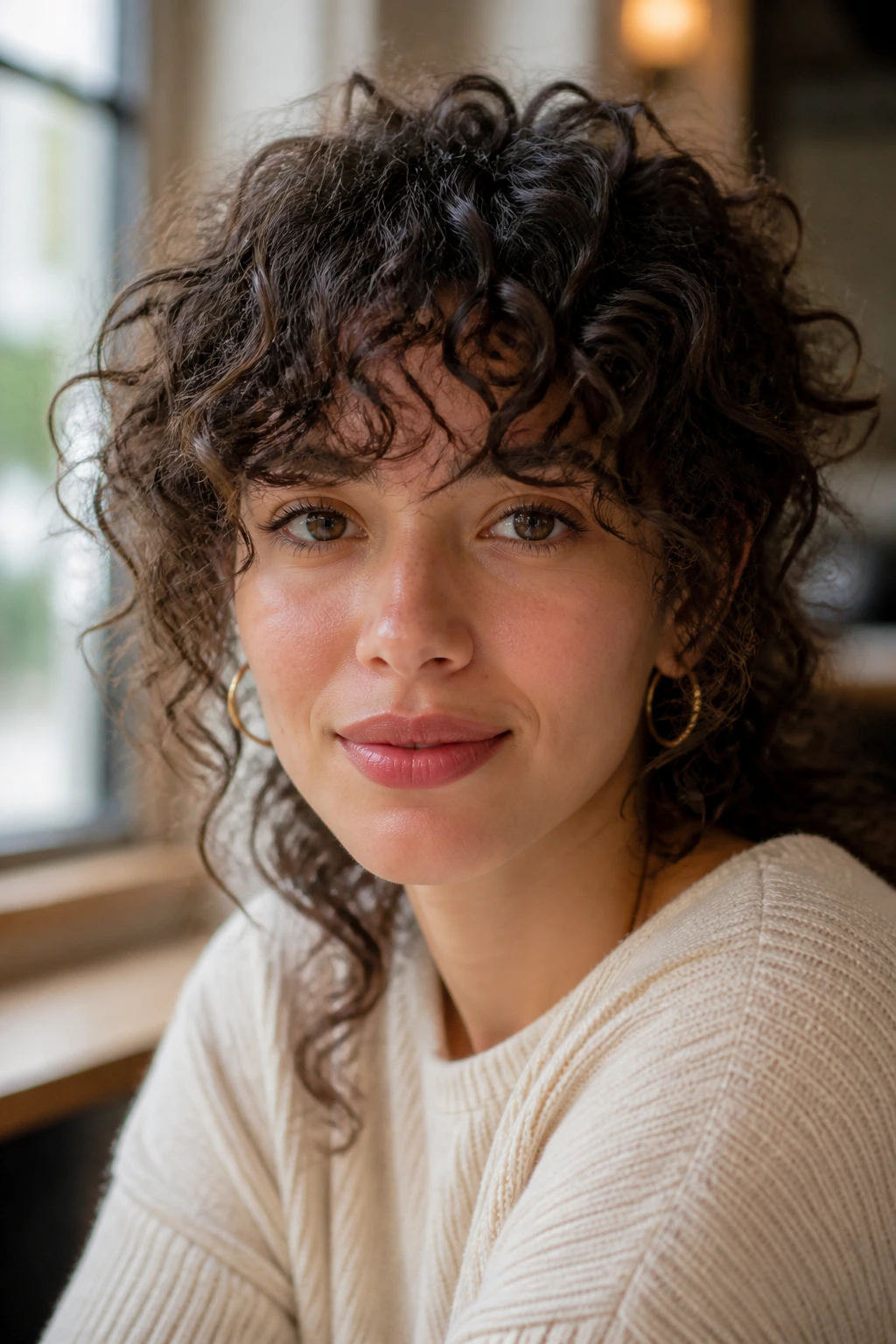
Good curly bangs don’t fight your texture. They work with the spring, the shrinkage, and the fact that the front of your hair always seems to have its own opinion. That’s the real trick with bangs for curly hair and oval faces: the face shape gives you room, and the curl pattern gives you life.
If you’re choosing your next fringe, start with how much upkeep you can actually live with. Then pick the shape that matches your hair’s personality, not someone else’s blowout. A great bang cut should look like it belongs on day one, day three, and the morning after you forgot to diffuse it properly. That’s the version worth keeping.