



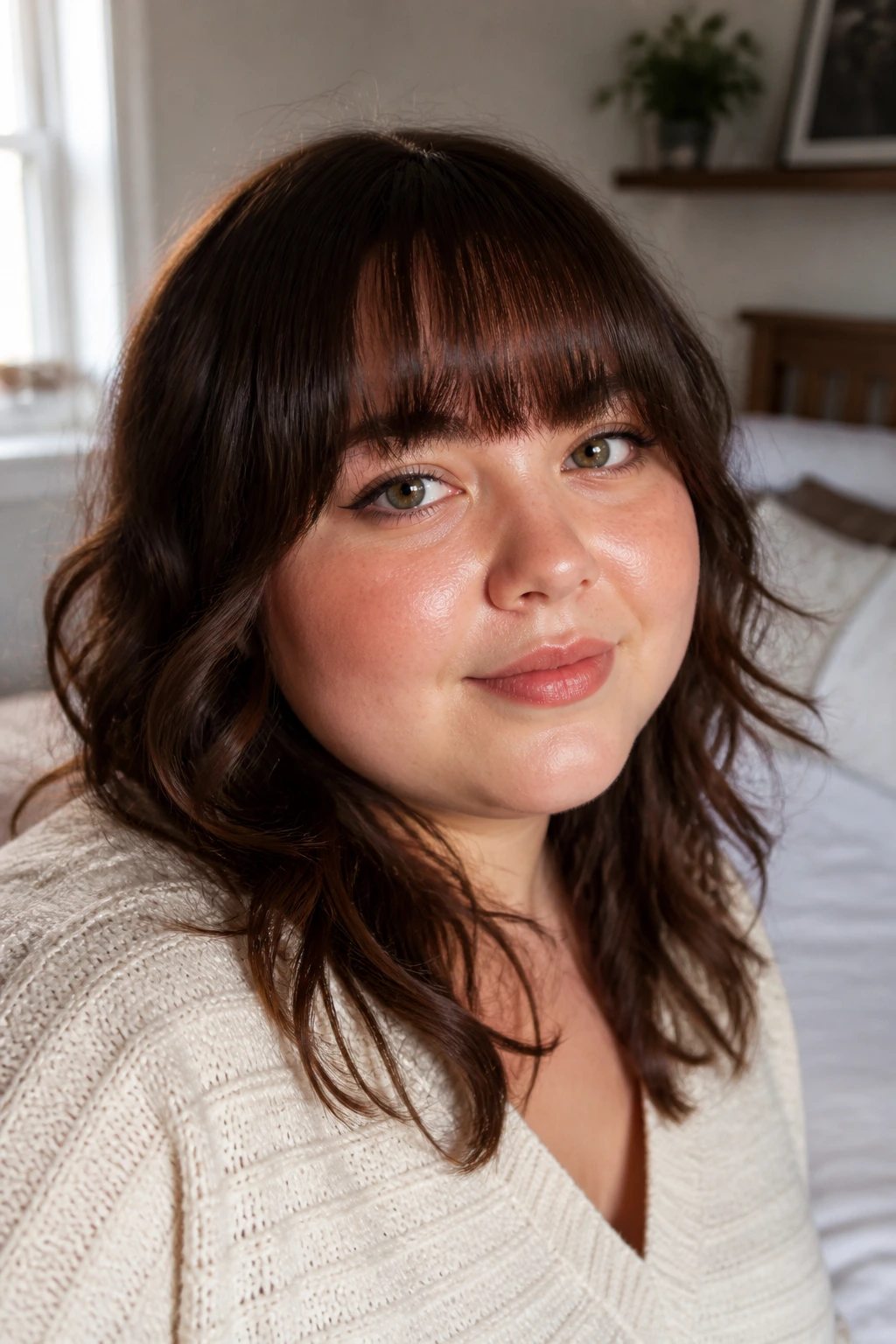
Straight across bangs for round faces with loose curls can do something sneaky in the best way: they carve a clean, deliberate line across the forehead, then let the curls soften everything below it. That combination matters. Round faces usually carry their width through the cheeks, so a fringe that sits in the right place gives the eye a place to stop before it keeps circling the face.
The problem is that a lot of people hear “bangs” and picture something too wispy, too short, or too flat to survive real curl movement. That’s the wrong mental image. Loose curls need a fringe with enough density to hold its shape, enough length to avoid springing up too high, and enough precision that it doesn’t puff into a little cloud by noon. Get those three things right, and the whole haircut looks cleaner and sharper.
I’ve always liked this category because it doesn’t ask curls to pretend they’re pin-straight. The fringe does the structured work. The lengths do the softening. And for round faces, that split is often the sweet spot.
Why These Bangs Change the Shape So Well
-
The fringe creates a visual stop line: A straight-across bang interrupts the curve of the cheeks, which helps the face feel a little longer and less circular.
-
Loose curls keep the cut from feeling stiff: The bend in the lengths balances the bluntness of the fringe, so the haircut reads as polished instead of severe.
-
Density matters more than most people think: A bang that’s too sparse can separate and frizz; a fuller panel gives the forehead a cleaner frame.
-
The right length keeps the face open: Eyebrow-skimming or just-below-brow lengths usually give round faces more shape than bangs that sit high and expose too much forehead.
-
There’s room to tune the look: A tiny bit of texturing, a heavier panel, or a slightly longer corner can shift the whole haircut from sweet to sharp.
How to Ask for the Fringe So It Sits Right
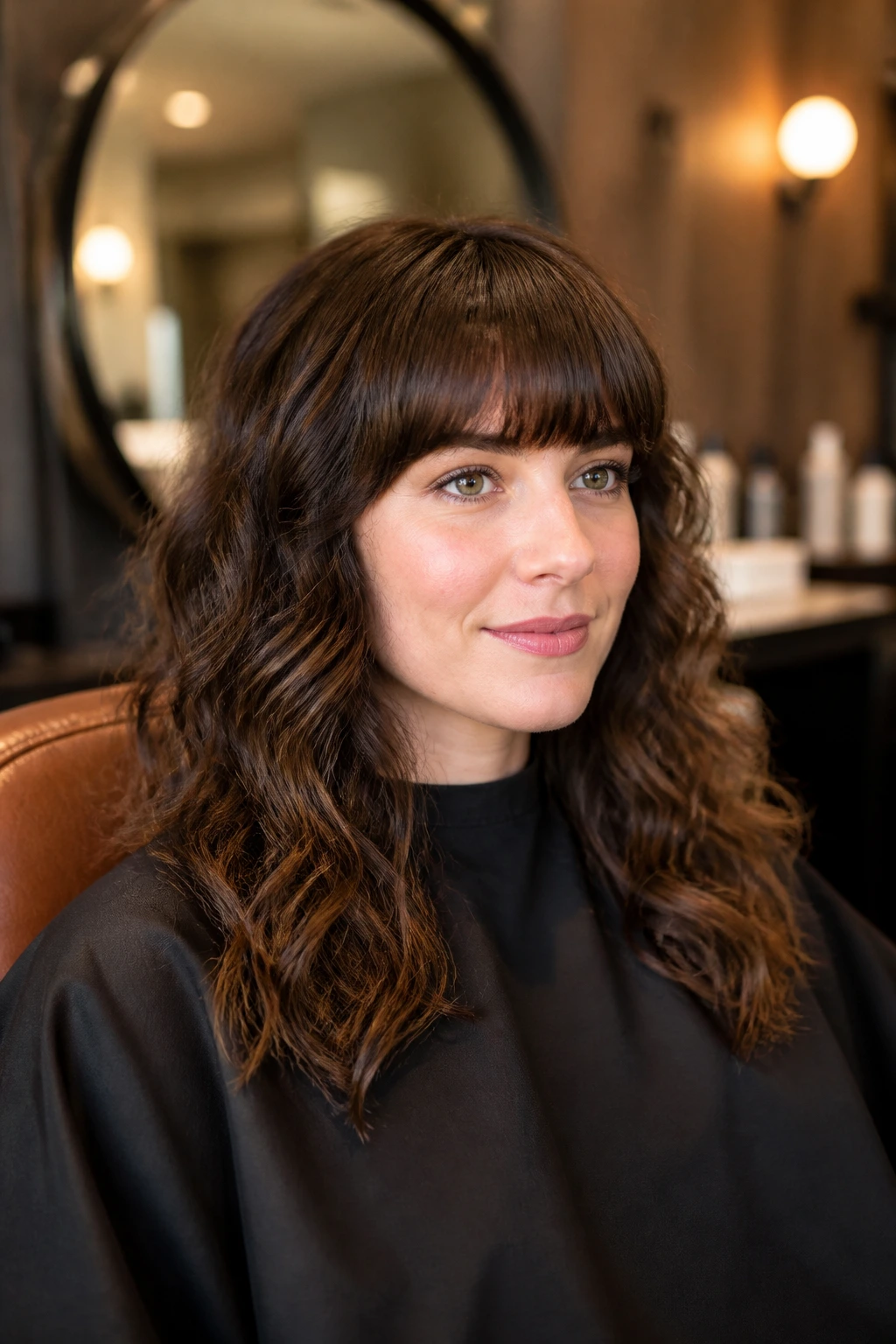
Say this plainly at the salon: you want straight-across bangs that are cut for how your hair dries, not how it looks wet. That one detail saves a lot of regret. Loose curls often lift half an inch or more as they dry, and a bang that looked cautious in the chair can end up hovering way too high.
Bring a photo with your actual curl pattern in mind, not a picture of someone with stick-straight hair. If your curls are fine and open, a lighter fringe may work. If they’re dense or springy, ask for a fuller bang panel so the line doesn’t disappear once the hair dries.
I also like the small, specific request: keep the center at eyebrow level and let the corners drift a touch lower if needed. That tiny adjustment gives the face a cleaner frame without turning the fringe into a blunt shelf.
1. Eyebrow-Skimming Blunt Fringe with Loose Shoulder Curls
This is the easiest place to start if you want the cleanest version of straight-across bangs for round faces with loose curls. The fringe sits just at the brows, which gives the face a crisp top edge, while the shoulder-length curls keep the look soft. It’s direct without feeling harsh.
The key is density. You want enough bang hair to stay together in a single panel, especially if your curls have a little spring to them. I’d rather see a fringe that’s full and tidy than one that’s airy and split down the middle by lunch.
If your curl pattern is loose enough to fall in wide bends, this cut gives you shape without a lot of fuss. Dry the bangs first, then let the rest of the curls do their own thing.
2. Dense Brow-Line Fringe with Collarbone Waves
Why does this one work so well on a round face? Because the fringe gives you a firm horizontal line, and the collarbone waves stretch the silhouette downward. That pairing matters more than people expect. A round face can look wider when the curls stop at the cheek, but collarbone length gives the eye a longer path.
The shape advantage
The bangs should be thick enough to read as one line, not a see-through fringe. The waves below can be loose and a little broken up, which keeps the haircut from turning boxy. I like this look on hair that holds a bend without getting fuzzy at the ends.
If you want to style it well, keep the fringe smooth and let the waves stay slightly undone. Too much polish in both places can make the whole look feel helmet-like.
3. Softly Feathered Straight Fringe with Airy Ends
A straight-across bang does not have to feel hard. A tiny bit of feathering at the very bottom edge takes the edge off the line without wrecking the shape. That’s the trick here: keep the outline clean, but let the last few millimeters break up so the fringe doesn’t sit like a cardboard strip.
This version suits loose curls that already have movement and bounce. You get the clear forehead frame you want, but the ends of the bangs don’t look like they were cut with a ruler and left alone. That tiny softness matters on round faces because it keeps the look friendly around the cheeks.
Best for: medium-density hair, soft S-waves, and people who want bangs that still look decent after a long day.
Styling note: use a small round brush or a mini flat iron only on the bangs. Leave the lengths alone so the curl pattern stays alive.
4. Eye-Grazing Blunt Fringe and a Deep Side Lift
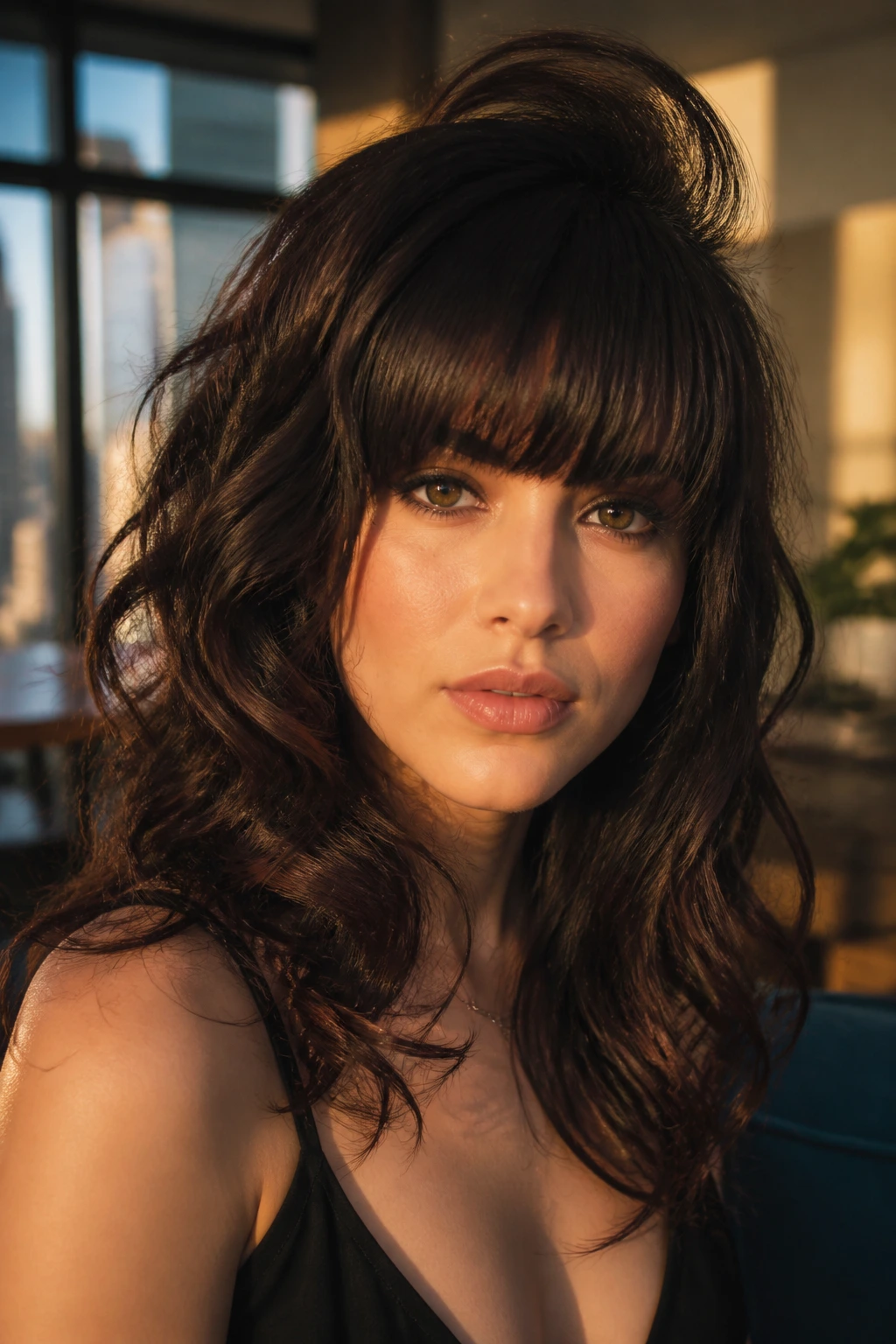
This one has a little drama in the best way. The bangs sit close to the eyes, which gives the face more vertical tension, and the deep side lift in the curls keeps the look from settling into a circle. It’s a smart move if your round face feels widest at the cheeks and you want the forehead area to do more of the visual work.
You do need some discipline here. Eye-grazing bangs can turn sloppy fast if they’re cut too short or dried without direction. The cure is simple: blow-dry the fringe forward first, then bend it just enough to skim the brows and lashes without stabbing into the eyes.
I like this version on hair that has enough body to hold a side lift near the temple. It reads a little glam, a little editorial, and still works in real life if you’re willing to give the front a minute with the dryer.
5. Glassy Fringe on a Long Lob
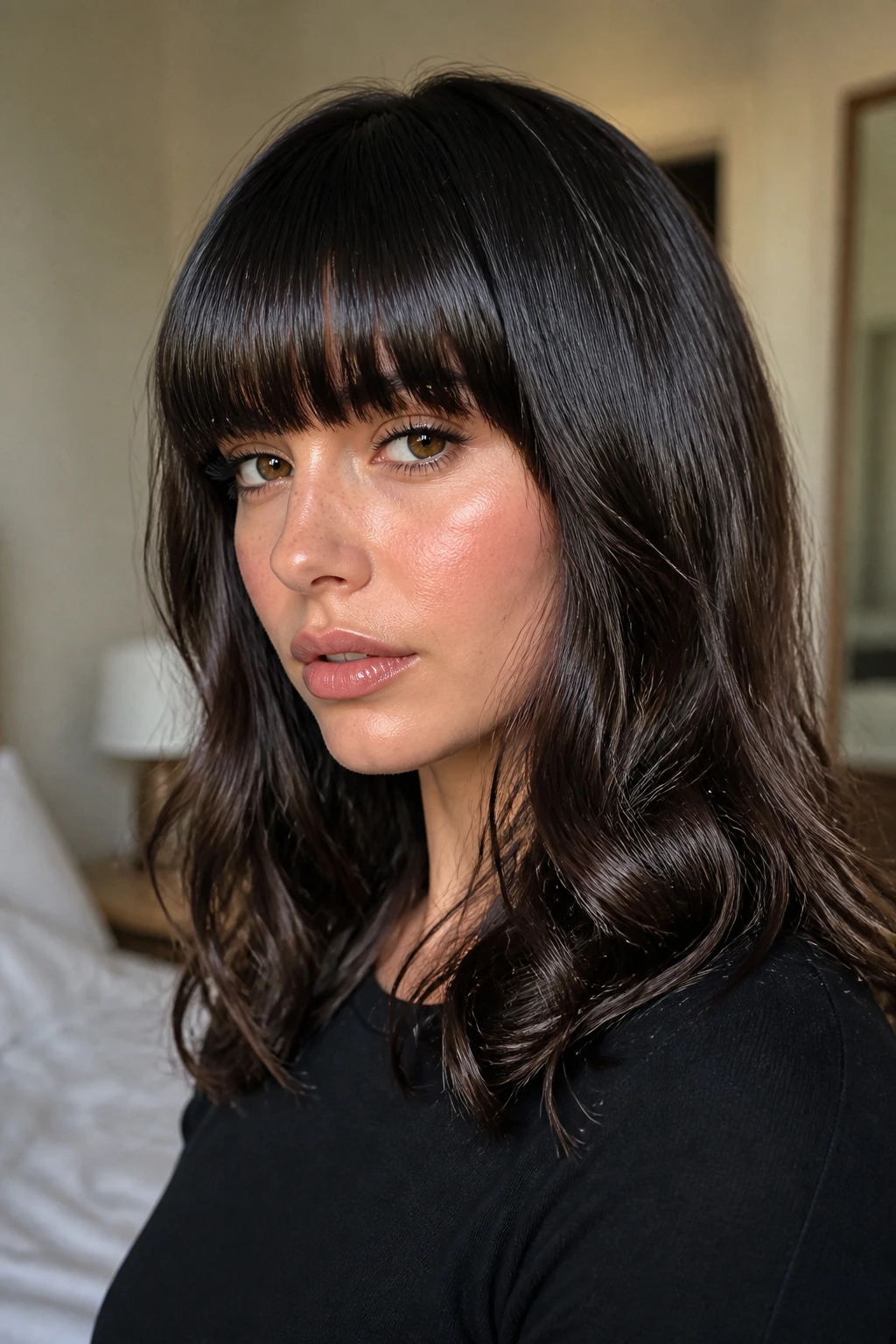
A long lob gives the bangs room to breathe. The fringe stays straight and tidy, while the lengths fall just past the collarbone in loose curls with a smoother surface. The contrast is what makes it good. Sharp top, soft body.
What makes it different
The hair around the face should stay controlled, almost glossy in finish, so the bangs don’t disappear into the rest of the cut. On a round face, this works because the long lob adds length below the jaw while the fringe adds structure above the brows.
If you hate fluffy bangs, this is a strong option. Use a light smoothing cream on the fringe and keep the curls below lightly separated with your fingers. You want bend, not puff.
6. Micro Blunt Fringe with Bigger Curl Length

Short bangs are not for everyone, and I’ll be blunt about that. But on the right face shape and curl pattern, a micro blunt fringe can look sharp because it puts the focus high on the forehead while the loose curls below create the softness. The face feels lifted rather than widened.
The danger is obvious: go too short, and the bang can jump into awkward territory once the curls dry. This works best if the fringe is cut with a little extra length for shrinkage and then refined dry. You want a clean line that sits above the brows, not a surprise crop.
I like this on people who wear their curls bigger and fuller through the lengths. The contrast keeps the cut from feeling too cute or too precious. It has edge.
7. Chin-Length Curly Bob with Straight-Across Bangs
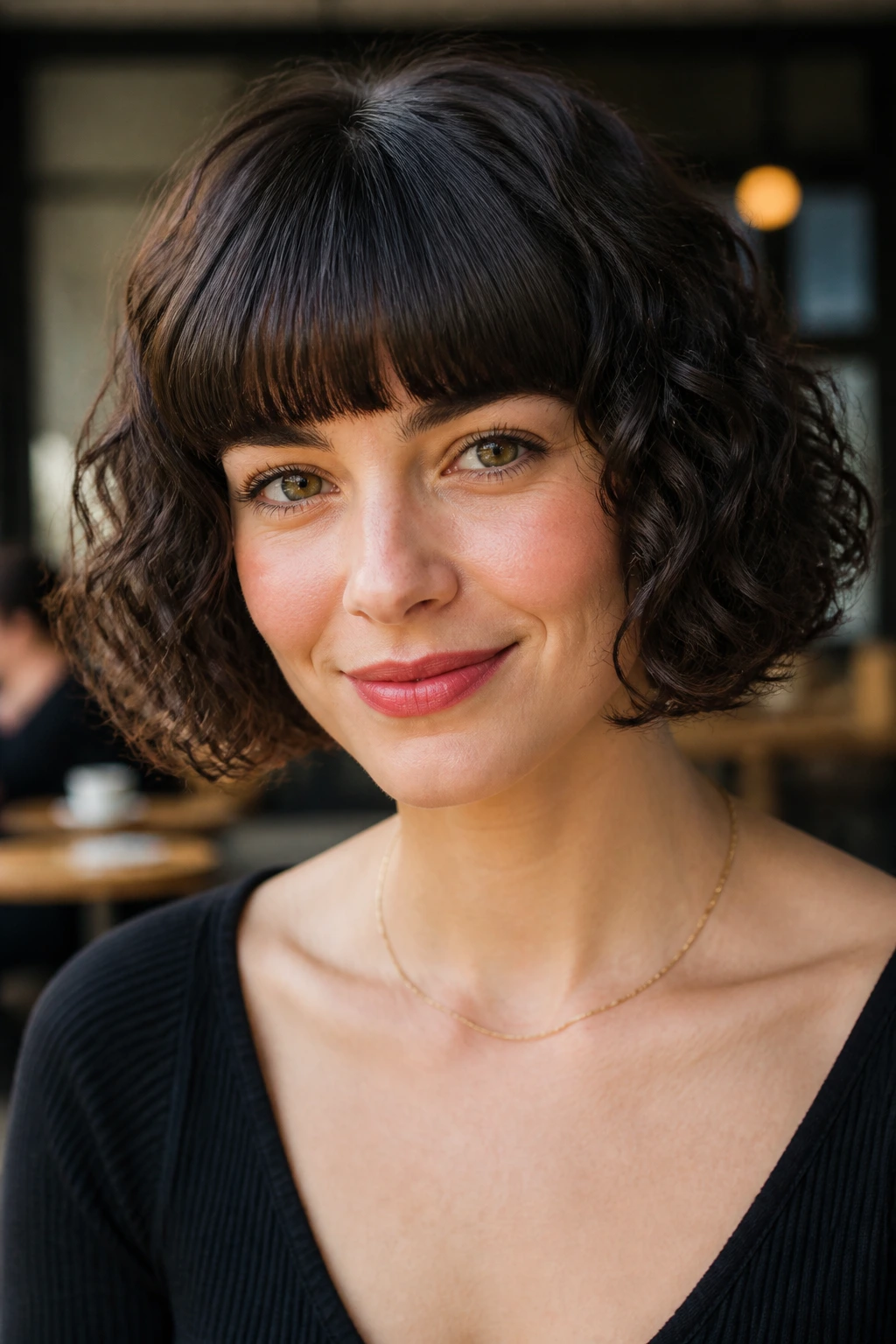
This is the most compact version on the list, and it has a real point of view. The bob lands at the chin, which means the curls don’t add width at the cheeks, and the straight-across bangs give the face a neat front frame. On a round face, that can be a useful little trick.
The cut needs precision. If the bob sits too high and the bangs are too soft, the whole shape can puff out around the jaw. Keep the bob blunt enough to read as a shape, then let the curls do the moving underneath.
I’d call this a good choice for someone who likes strong lines and doesn’t mind styling the fringe every morning. It’s tidy. It’s a little French, a little practical, and it does not get lost in the curls.
8. Shaggy Lob with a Clean Fringe Line

The shaggy lob is where you can let the lengths misbehave a little, because the bangs do the organizing. That straight fringe gives the eye something firm to land on, while the layered lob below breaks up the curve of a round face. It’s one of my favorite pairings when curls tend to get big fast.
Best for
- Medium-to-thick loose curls that expand as they dry.
- People who want the fringe to feel polished while the rest stays relaxed.
- Hair that looks better with movement than with perfection.
The shag layers should start below the chin so they don’t fight the face shape. Too many layers around the cheeks and you lose the slimming effect. Keep the bangs clean. Let the rest wander a little.
9. Long Blunt Fringe with Face-Framing Pieces
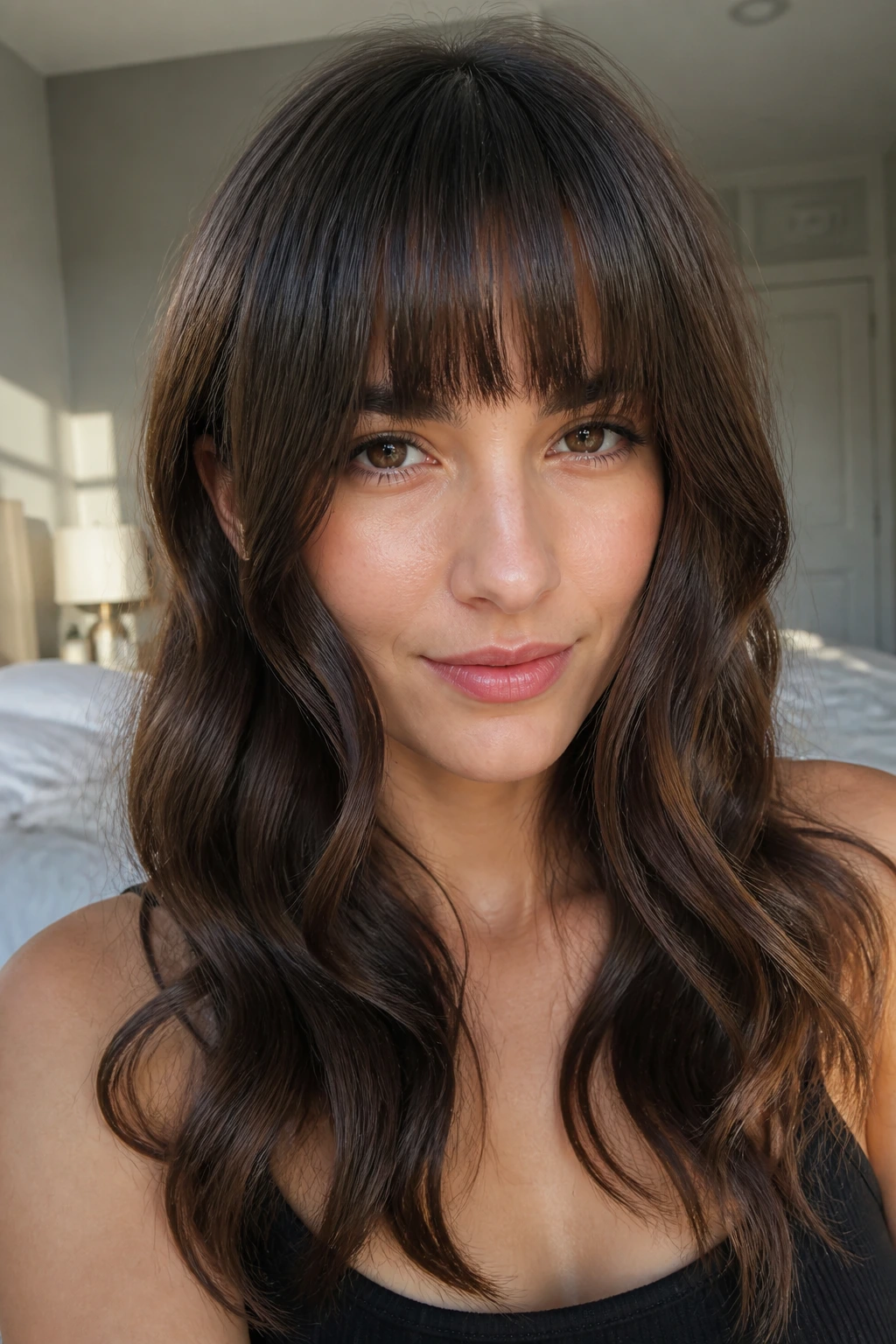
Here the bangs stay straight across, but they’re a touch longer, often brushing the lashes or resting just below the brows. That extra length matters on round faces because it avoids cutting the forehead off too abruptly. The face-framing pieces on either side fall in loose curls and help draw the eye downward.
This is the version I’d choose for someone who wants bangs but is nervous about commitment. Long fringe ages well through a grow-out, and it handles curl shrinkage better than a short bang. You can tuck the corners behind the ears on a bad day and still look intentional.
A small detail makes all the difference: keep the front pieces just long enough to skim the cheekbone, not the widest part of the cheek. That’s the line that keeps the face from feeling boxed.
10. Old-Hollywood Waves with a Sharp Fringe
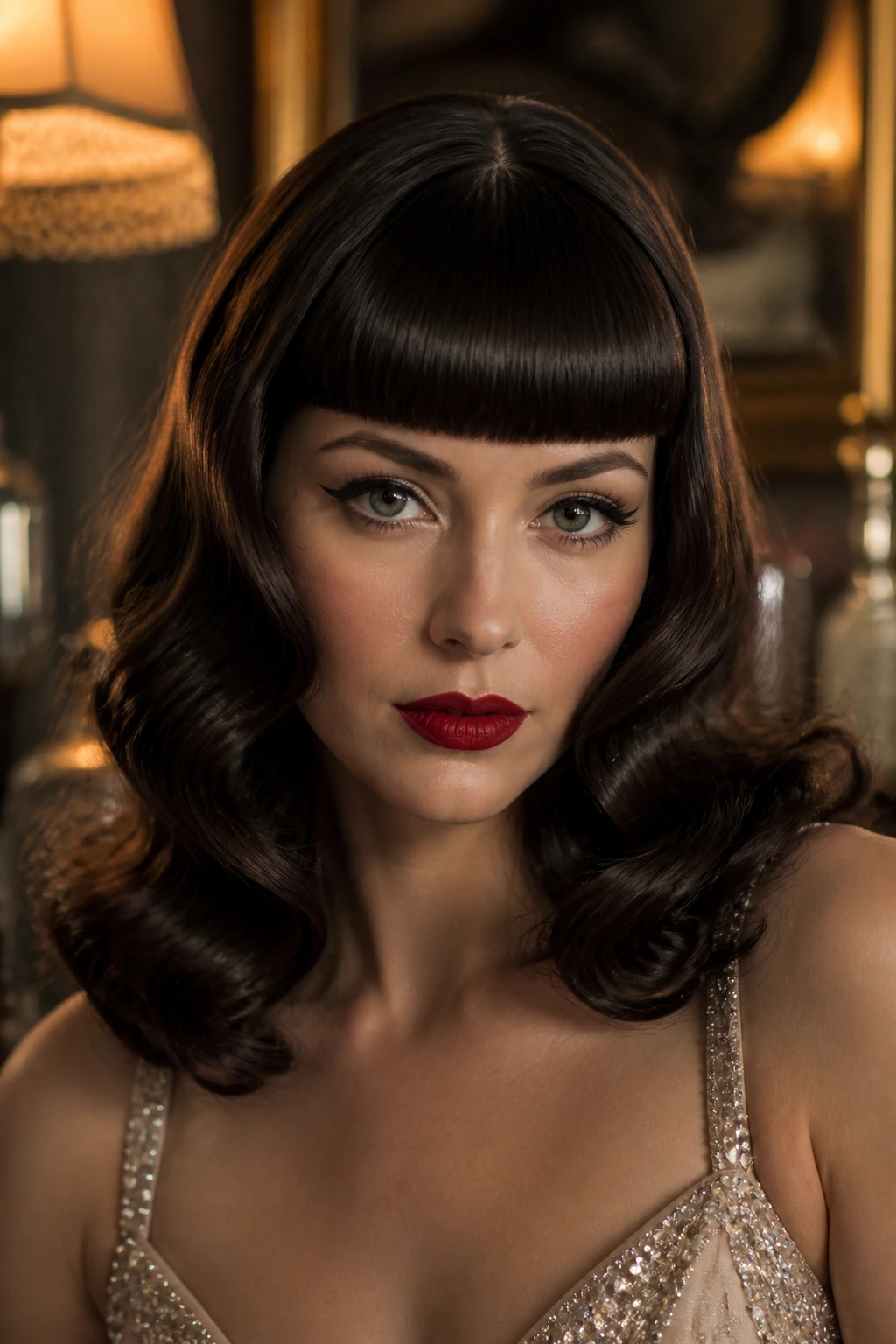
This cut has more polish than most of the others, and I mean that in a good way. The loose curls are shaped into smooth, deliberate waves, and the fringe is cut sharply across the forehead. On a round face, the contrast creates a stronger vertical impression because the waves fall in a cleaner, more controlled line.
A lot of people think loose curls must always look undone. They don’t. With the right barrel size and a little brushing through, you can get those soft, wide waves that feel dressy without turning stiff. The bangs bring the edge; the waves bring the softness.
If you like a little retro shape, this is the cut that makes a plain black top and hoop earrings look more finished than they have any right to.
11. Copper Curls and a Clean Brow Line
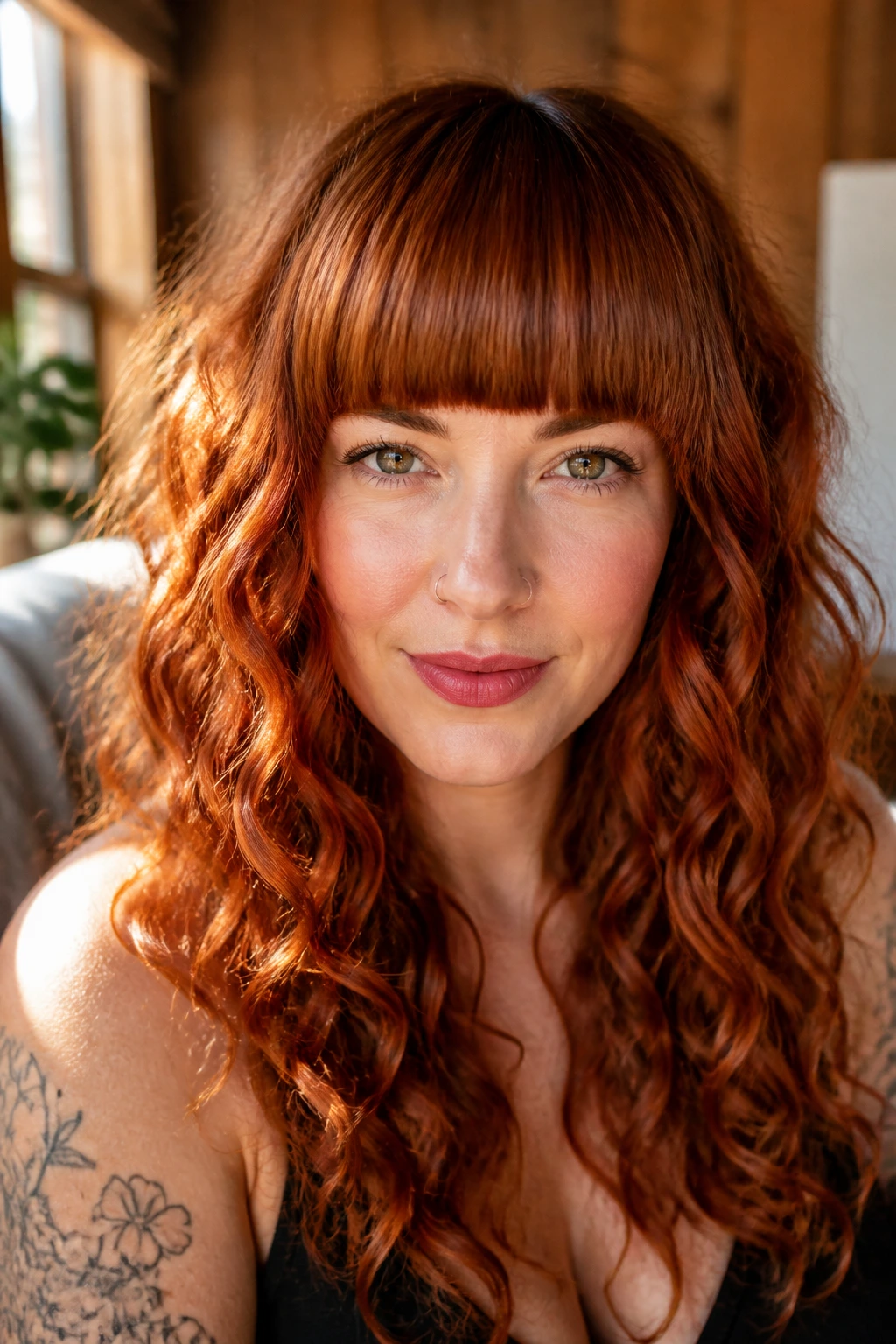
Color changes the whole feel of a fringe. Copper loose curls tend to show every bend and every line, so a straight-across bang looks especially clear against that warmth. The result is bright, face-forward, and a little bolder than the softer brunette versions.
Why color matters here
Warm red tones make the bang line more visible, which helps on round faces because the forehead frame reads quickly. If your curls are copper or auburn, keep the fringe dense enough to hold its shape. Sparse bangs can look see-through in vivid color, and that’s not the effect you want.
I like this pairing with a medium-length cut that sits just below the shoulders. The curl shape stays loose, but the color gives the haircut more life. That’s a nice trade.
12. Brunette Shine with a Center-Held Fringe
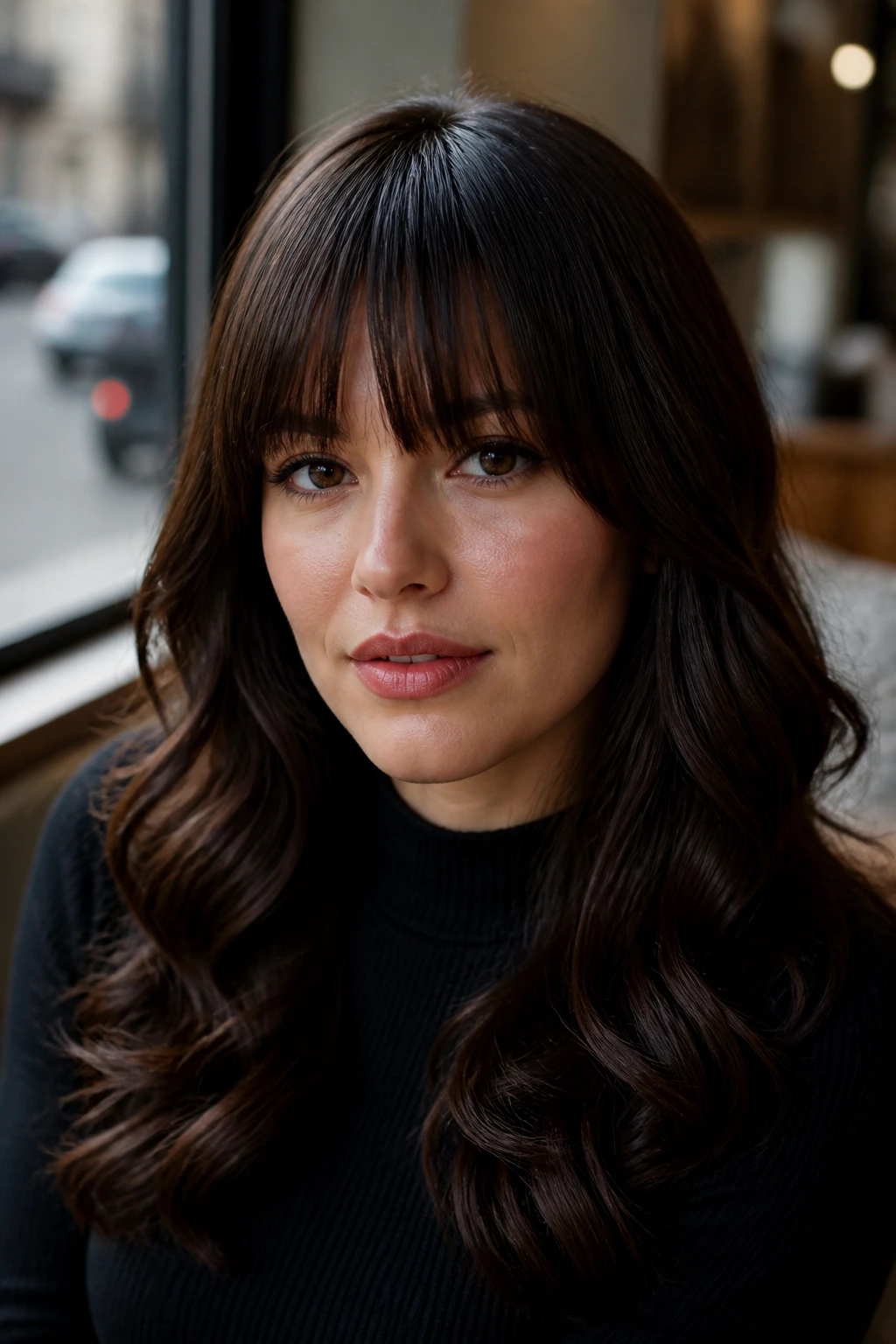
This is a quieter version, but it has more control than it first appears. The bangs stay straight across, yet the styling keeps a slight center hold so the fringe doesn’t split too far apart. The loose curls below stay glossy and loose, which creates a smooth frame around a round face.
The important thing is balance. If the bangs are too flat and the curls too wide, the face can feel wider. Keep the bangs sleek and the curl volume a little lower at the sides of the cheek. That keeps the silhouette from spreading out.
This look suits darker brunette hair especially well because the fringe line reads clearly even when the rest of the cut moves. It’s simple, but not plain.
13. Fine-Hair Friendly Lightweight Blunt Fringe

Fine hair can wear straight-across bangs, but the fringe has to be cut with some honesty. Too much thinning and it turns feathery in a bad way. Too little density and the bangs separate into tiny strands that do nothing for a round face.
The solution is a lightweight blunt fringe with clean edges and a careful amount of interior support. The bangs should be compact enough to hold together, but not so heavy that they collapse flat against the forehead. Loose curls below can add body, which actually helps fine hair look fuller overall.
I’d keep the curl pattern soft and the parting clean. Fine hair looks best when the front is neat and the rest has enough movement to make the whole cut feel intentional.
14. Thick-Hair Friendly Dense Bang Panel
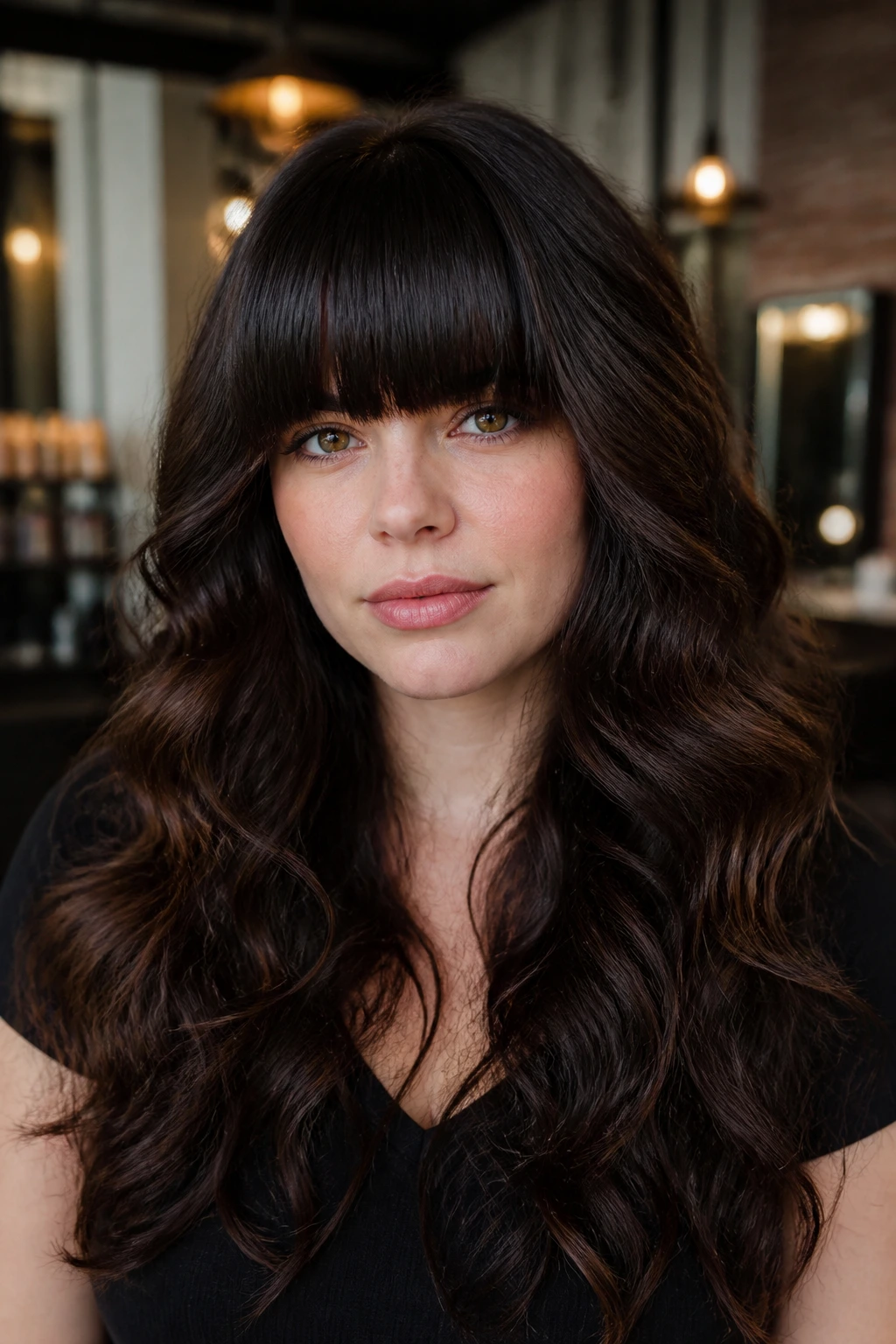
Thick hair is a gift here, but only if the bang panel is handled properly. A dense fringe gives the forehead a strong frame, which round faces usually need. The loose curls underneath can carry the shape without fighting it.
Thickness trick
Ask for internal removal only where the fringe gets bulky at the root. Don’t let the stylist over-thin the ends. Thick hair needs weight in the bangs so the line stays straight instead of splintering into little pieces.
This version looks best when the bang line is blunt enough to read from across the room. If you like a haircut that looks like it knows what it’s doing, this is it.
15. A-Line Lob with Longer Corner Bangs
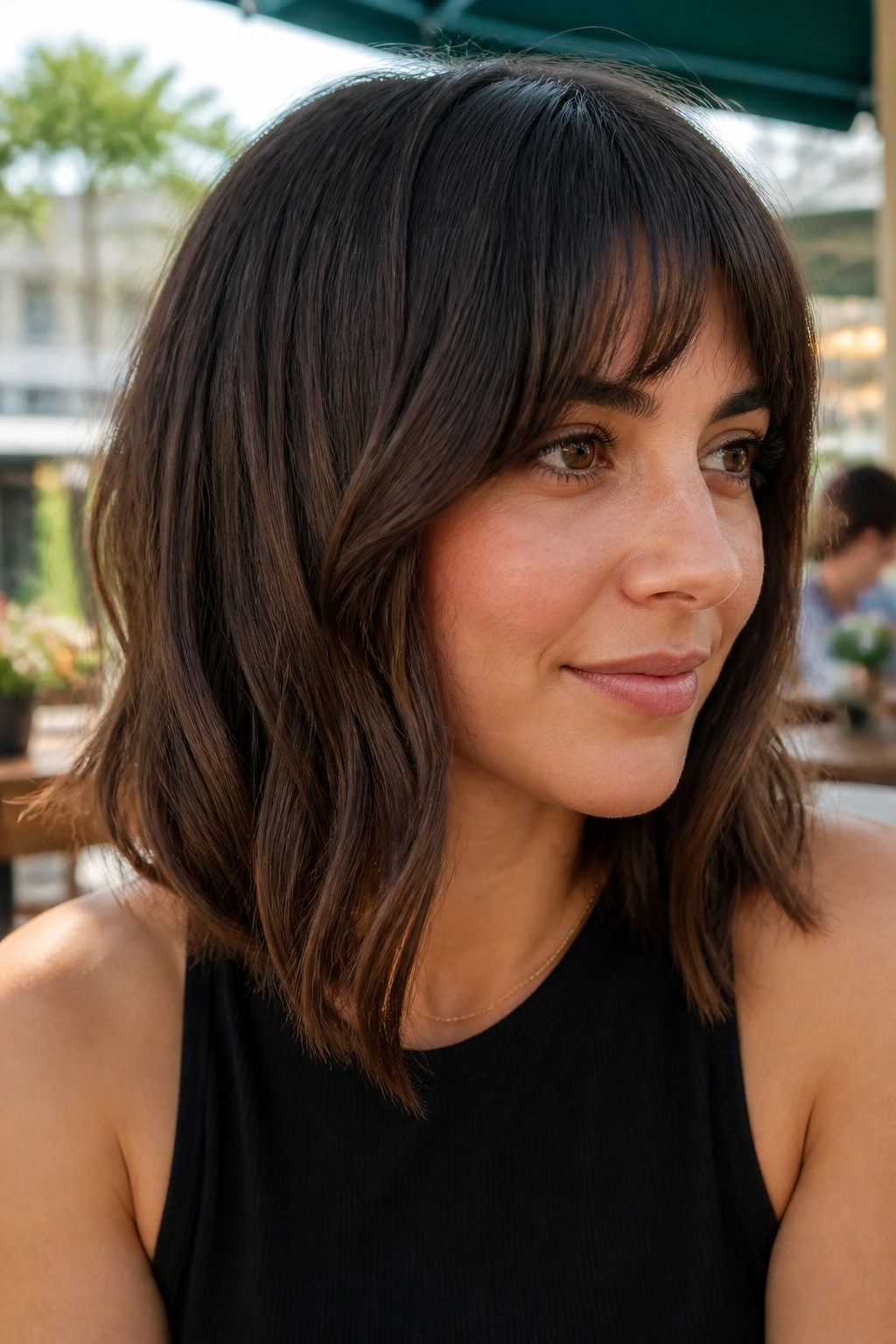
The A-line lob gives the haircut a subtle forward angle, and that angle helps a round face look a bit longer. The bangs stay straight across in the center, but the corners are a touch longer, which softens the line where the fringe meets the temples. It’s a small adjustment. It matters.
Loose curls on an A-line lob have a nice habit of falling forward without swelling out at the sides. That makes the face look contained in a good way. The cut feels neat from the front and fuller from the profile, which is why I think it’s underrated.
If you like bangs but hate the feeling of a hard rectangle across the forehead, this is the compromise. It still counts as straight-across. It just has a smarter edge.
16. Rounded Fringe and Cheekbone Layers

The bang line is straight, but the styling underneath has a rounded curve that echoes the curl pattern. That little bit of harmony helps round faces because it doesn’t fight the natural shape of the cheeks; it guides it. The cheekbone layers should start below the widest part of the face so they don’t widen the middle.
This cut works especially well when the curls are loose enough to form a soft halo without turning frizzy. You want the fringe to stay the cleanest part of the whole haircut. Everything else can breathe.
A lot of stylists overlook this one. They focus on the bangs and forget that the layers around the face can either sharpen or soften the result. Here, they do some quiet but important work.
17. Inky Dark Hair with a Crisp Fringe Edge
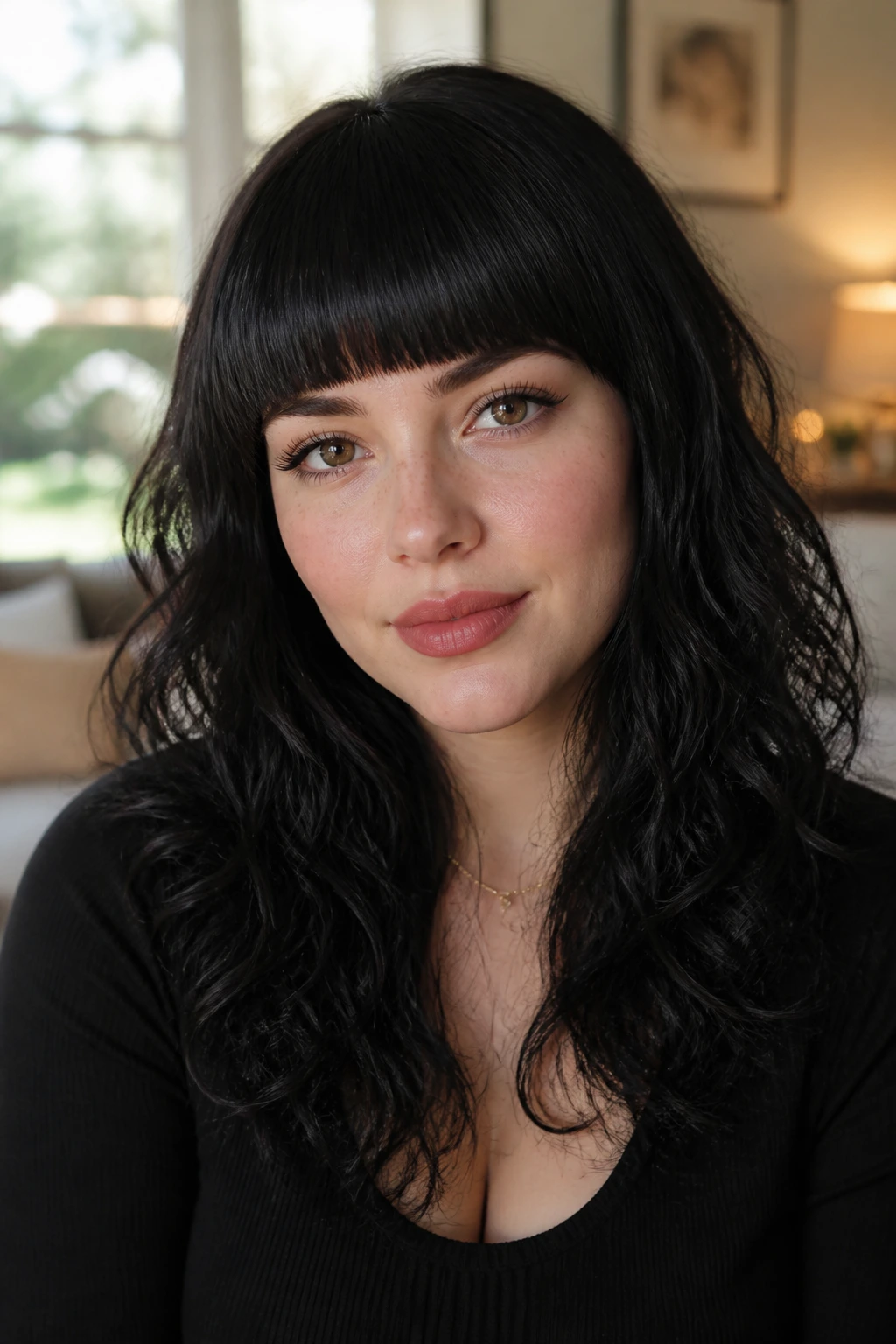
Dark hair makes a blunt fringe look even sharper because the line reads so clearly. On loose curls, that contrast can be striking without being loud. The fringe becomes the anchor, and the curls give the cut movement below it.
If you wear black or deep brown hair, the trick is to keep the bangs clean and the lengths softly textured. Too much volume at the sides can widen the face. Too much smoothness everywhere can make the haircut feel flat. The middle ground is the sweet spot.
I like this version for someone who wants the bangs to do the talking. The fringe should be the first thing you notice, then the curls should keep the haircut from feeling too severe.
18. Low-Maintenance Air-Dried Fringe
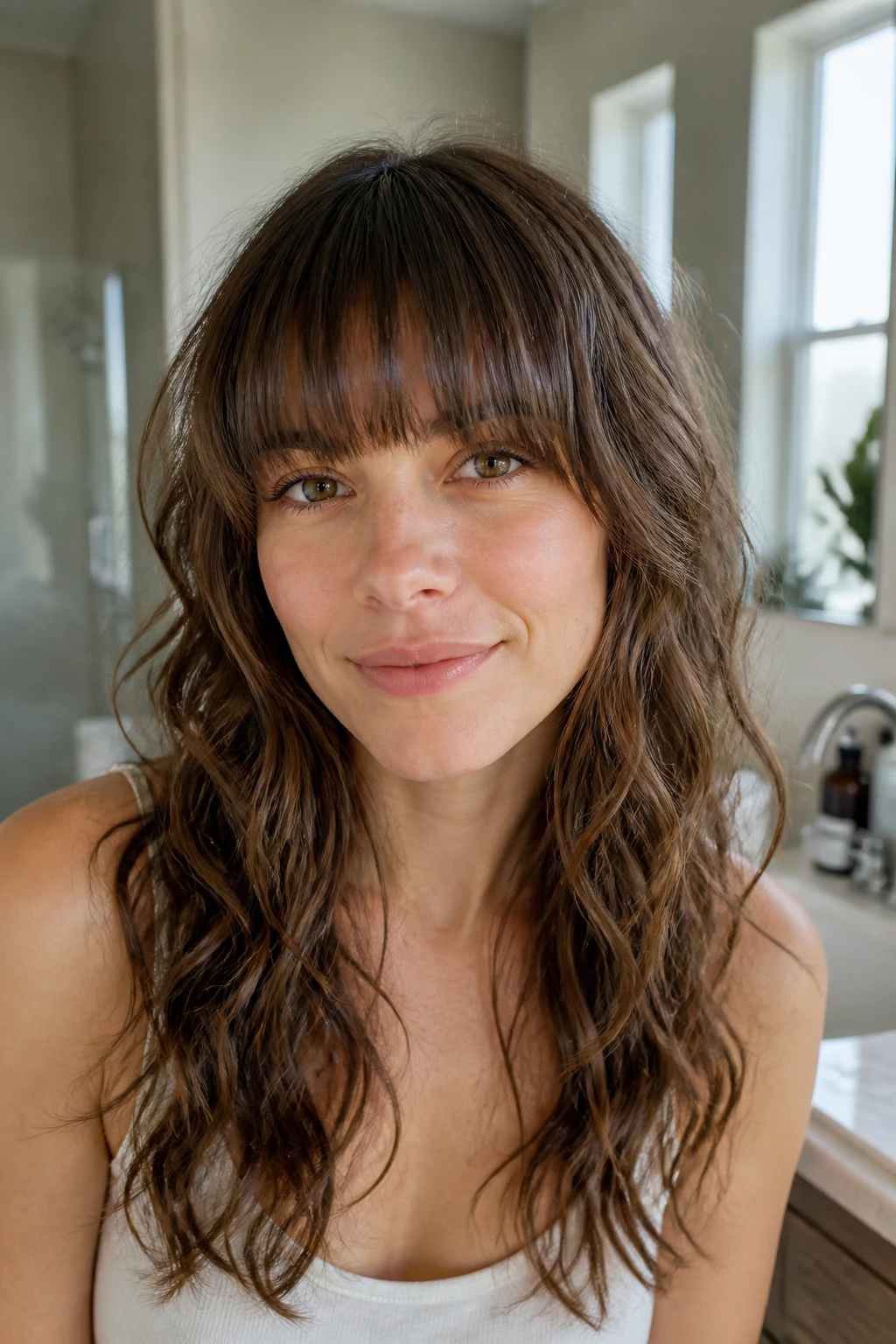
Can straight-across bangs be low-maintenance? Yes, but only if you accept that the fringe needs a small reset most mornings. The trick here is to cut the bangs long enough to survive air-drying and to shape them so they fall forward naturally. The loose curls below can dry on their own and do their thing.
Easy routine
- Mist the fringe with water, not a soaking spray.
- Smooth it with fingers or a tiny brush.
- Clip it flat for a few minutes if it wants to split.
- Let the curls air-dry around it.
This works best on hair that doesn’t frizz up the second it meets air. If your curl pattern is more cooperative than rebellious, you’ll get a neat fringe with very little heat.
19. Event-Ready Polished Fringe and Loose Curls
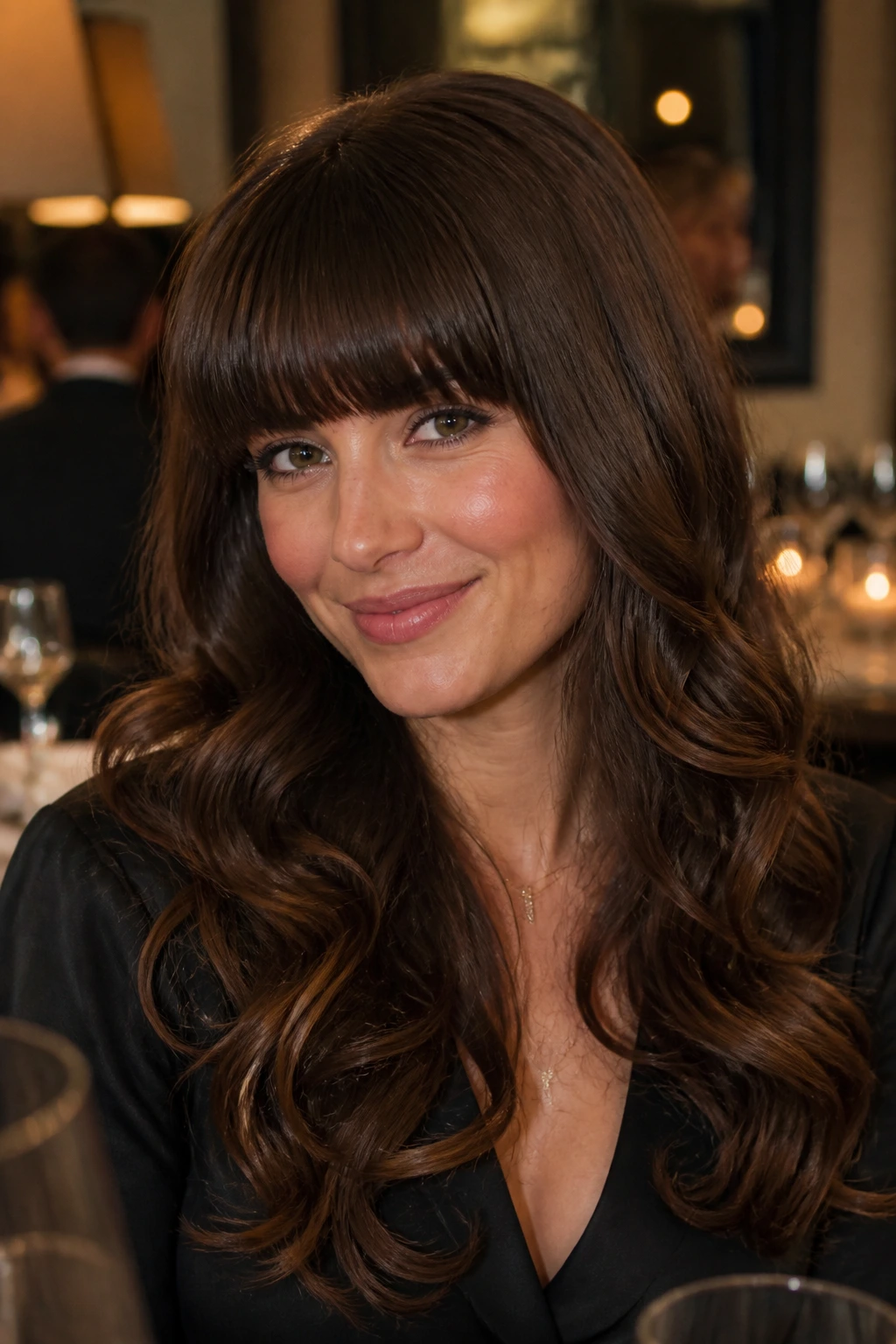
This is the version you reach for when you want the bangs to look deliberate from the first glance. The fringe is smooth, the curls are defined, and the whole style has a finished shape that suits round faces because it extends the silhouette downward. There’s no puff, no accidental wideness at the cheek.
You don’t need to straighten the lengths. That’s the part people get wrong. Just give the bangs a little more control than the rest of the hair, and keep the curl pattern smooth with a medium barrel or large rollers. The result feels dressed up without losing the softness of loose curls.
It’s a good one for photos, dinners, and any day when you want the haircut to look like it was planned on purpose.
20. Short Straight Fringe with Temple Tapers
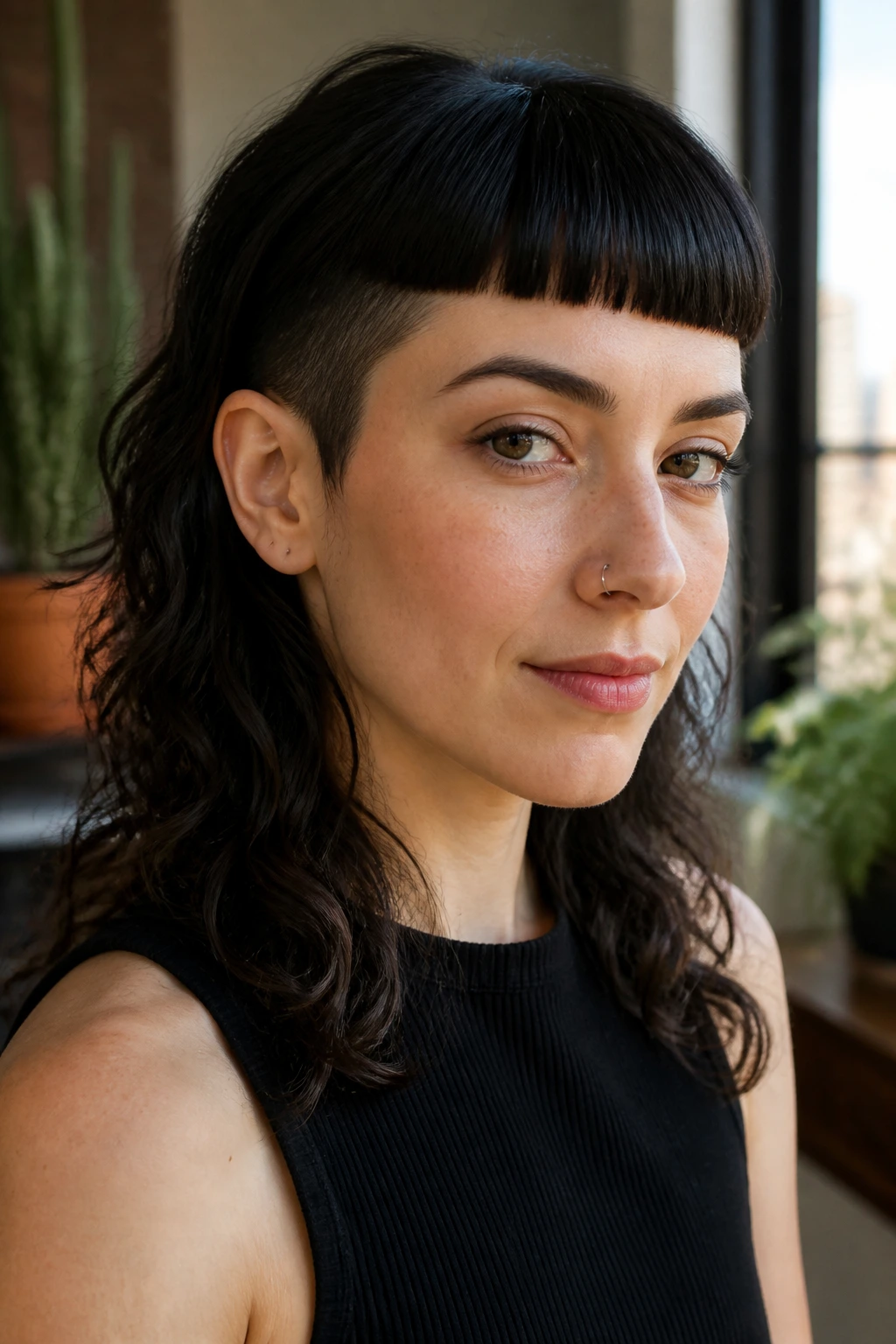
A short fringe can look sharp on a round face if the temple area is handled carefully. The bangs sit high enough to open up the eyes, but the taper near the temples stops the haircut from feeling like a box. Loose curls below keep the energy relaxed.
The danger with short straight bangs is obvious: if the line is cut too high, the forehead can dominate the face. That’s why the taper matters so much. It softens the corners, which keeps the head shape from looking wide.
This is not the most forgiving cut on the list, but it has personality. If you like a fringe with a little attitude, this one brings it.
21. Root-Lifted Fringe with Loose Curls
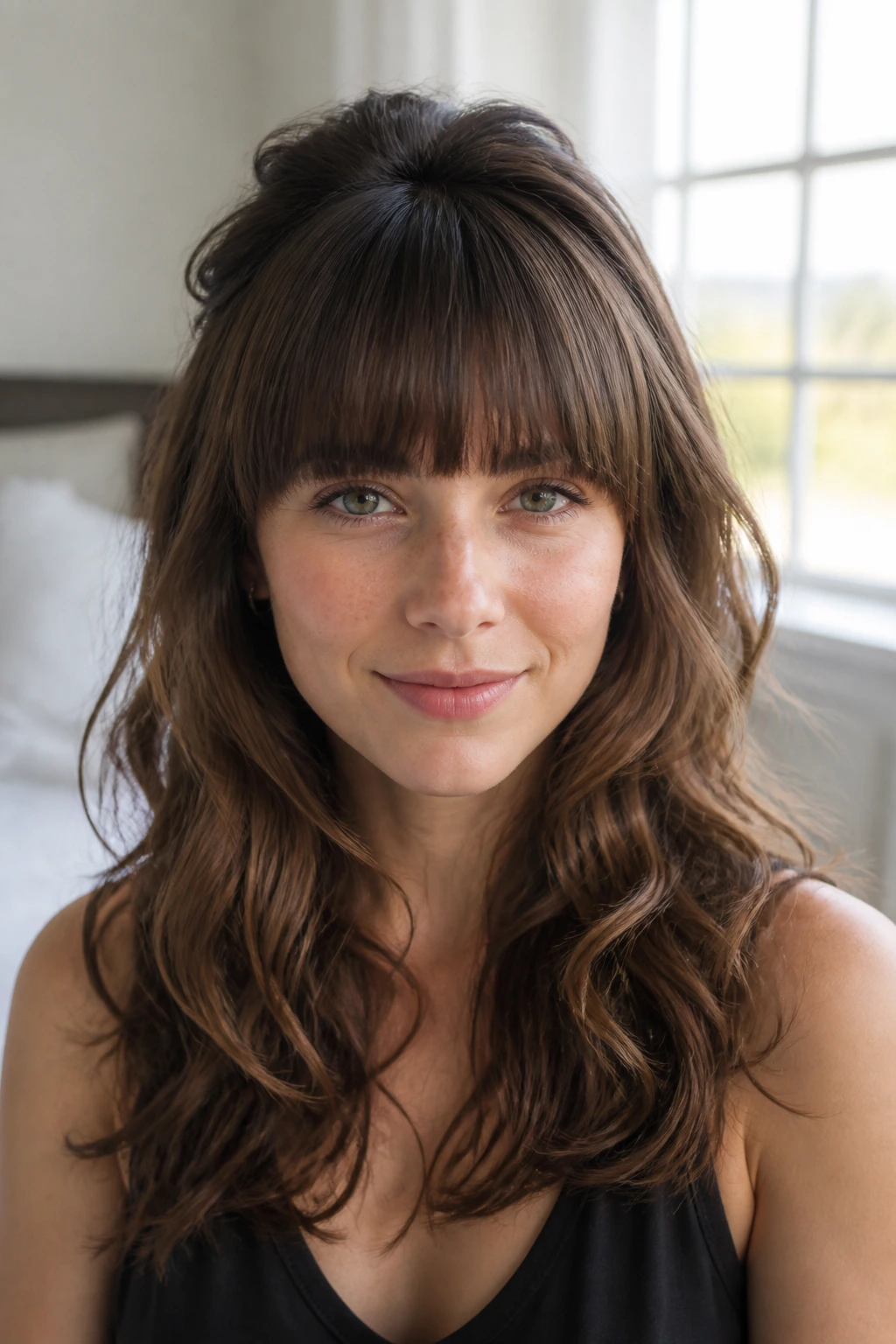
Round faces benefit from a little lift at the crown, and this style leans into that. The bangs stay straight across, but the roots are dried with a bit of upward direction so the fringe doesn’t flatten into the forehead. The loose curls below add movement without dragging the whole cut downward.
The crown lift matters because it creates a subtle lengthening effect. You’re not trying to build height for the sake of it. You’re just giving the face a longer line from hairline to cheek, which makes the bangs feel more balanced.
A tiny round brush and a cool shot from the dryer are enough. Don’t overwork it. The shape should look light, not stiff.
22. Collarbone Cut with a Heavy Bang Panel
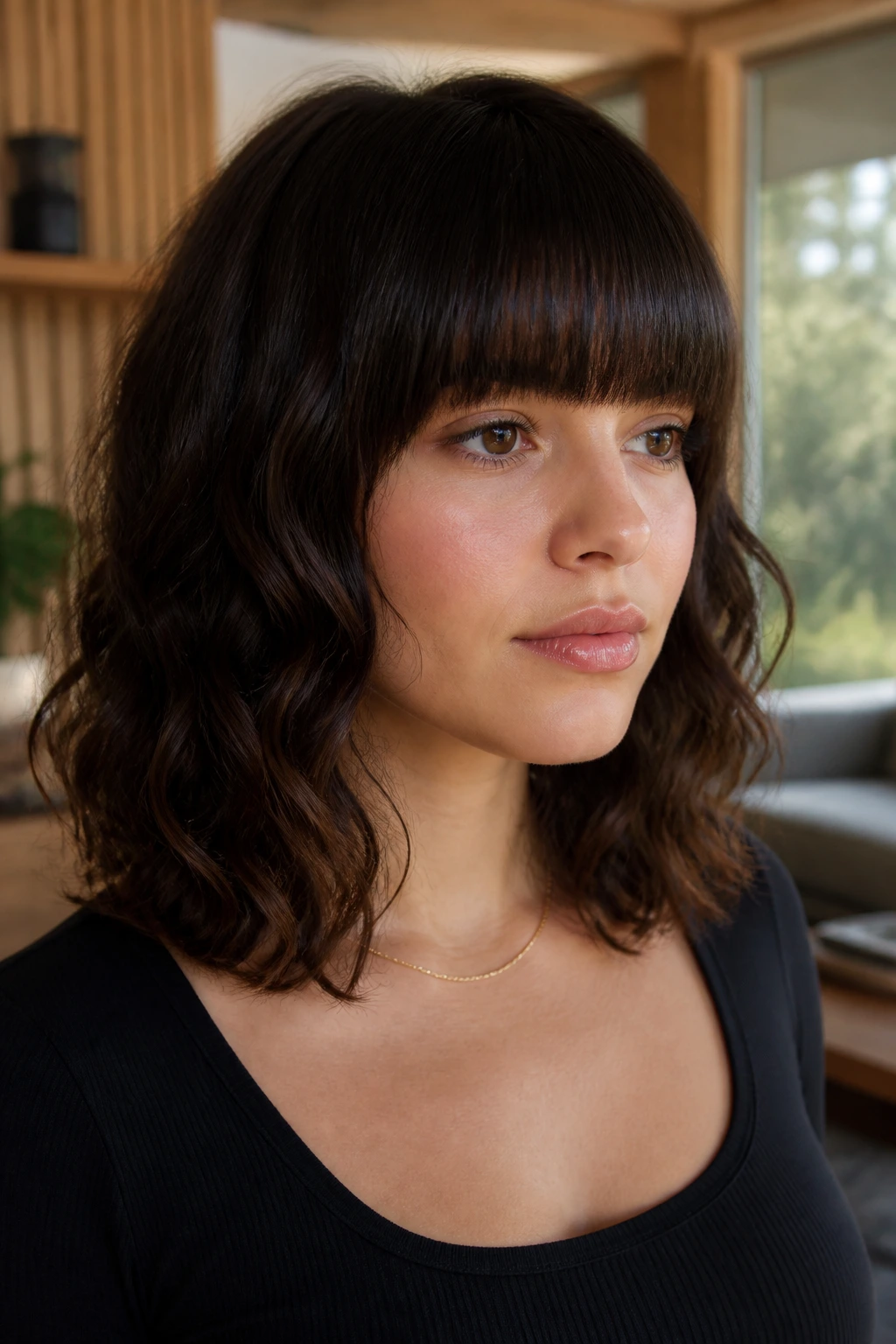
This version leans into fullness. The bangs are dense and clean, and the collarbone-length curls give the haircut a long, lean finish. On round faces, the extra length below the jaw keeps the cheeks from feeling like the widest thing on the head.
A heavy bang panel can look gorgeous if the rest of the cut is simple. Too many layers and the look gets busy. Too much texture at the cheek and the face widens again. Keep the lower half of the haircut easy and the fringe blunt.
If you like a little 1970s energy without going full throwback, this is a very solid middle ground. The bangs are the statement. The lengths just support them.
23. French Bob with a Straight Fringe
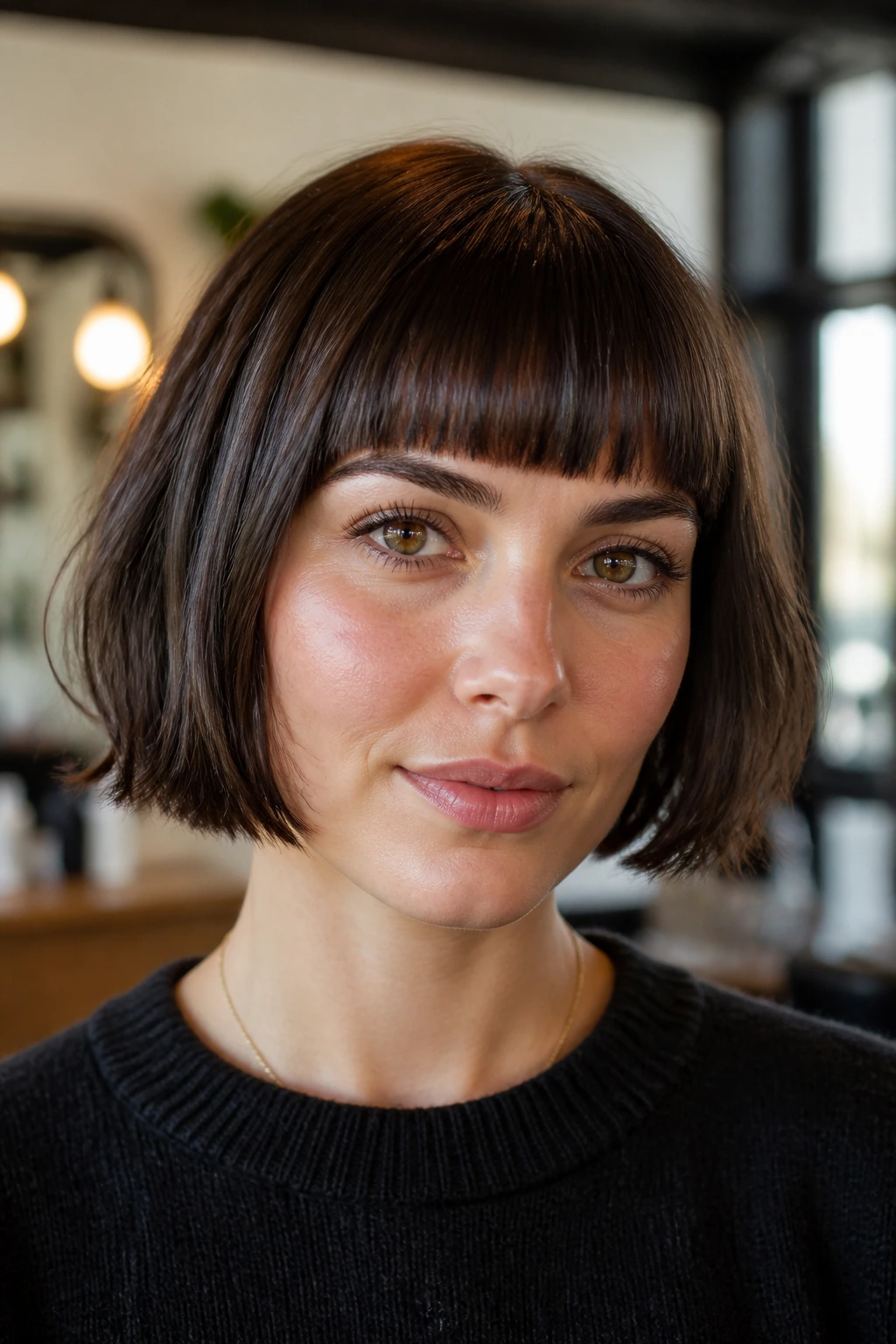
The French bob and a straight fringe have a natural chemistry. The bob sits shorter, usually near the jawline, and the bangs carve out the forehead cleanly. On a round face, that can be a smart way to show the neck and keep the cheeks from taking over the whole silhouette.
The French bob angle
The bob should not puff out at the jaw. That’s the mistake. Keep the ends controlled and let the loose curls bend inward just enough to frame the lower face. The bangs can stay blunt, but the overall finish should feel relaxed, not crispy.
I like this cut for people who don’t want a lot of hair hanging around their face. It opens things up and still gives you that straight-across bang line that makes the whole haircut look defined.
24. Soft Retro Curls with a Blunt Fringe
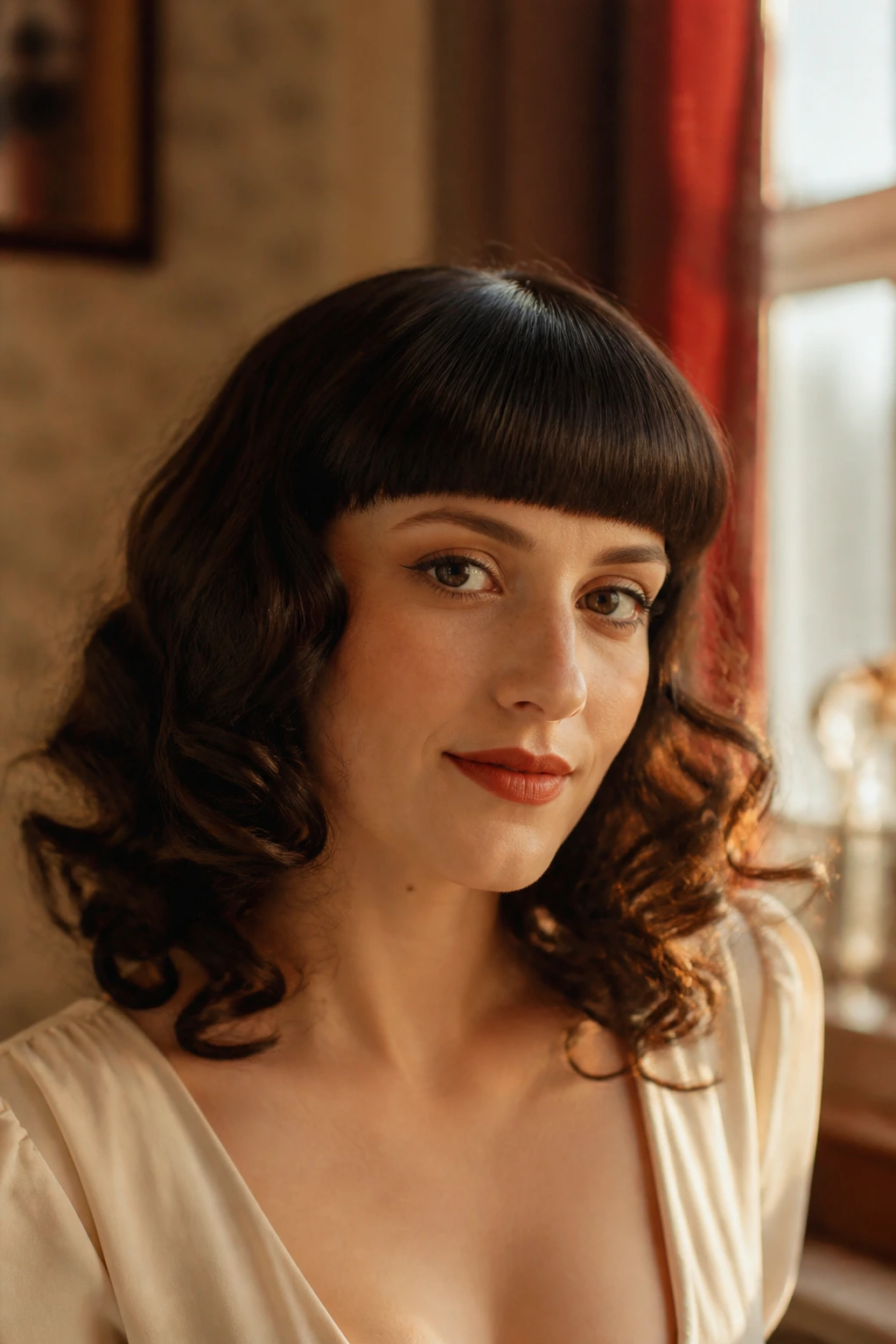
There’s a sweet spot between vintage and current, and this sits right there. The curls are loose but shaped, with a little bounce through the mid-lengths, and the fringe lands straight across the forehead. On round faces, that shape works because the curls bring motion while the bangs keep the top crisp.
The style benefits from a slightly heavier fringe than you might expect. Retro curls can look too airy if the bangs are too thin, and then the face loses its frame. A fuller bang panel keeps the whole look rooted.
This is one of those cuts that can feel playful without getting messy. The shape does the work. You just need to keep the bangs neat and the curls brushed into soft bends.
25. Mid-Length Lob with Bangs Cut to the Brow
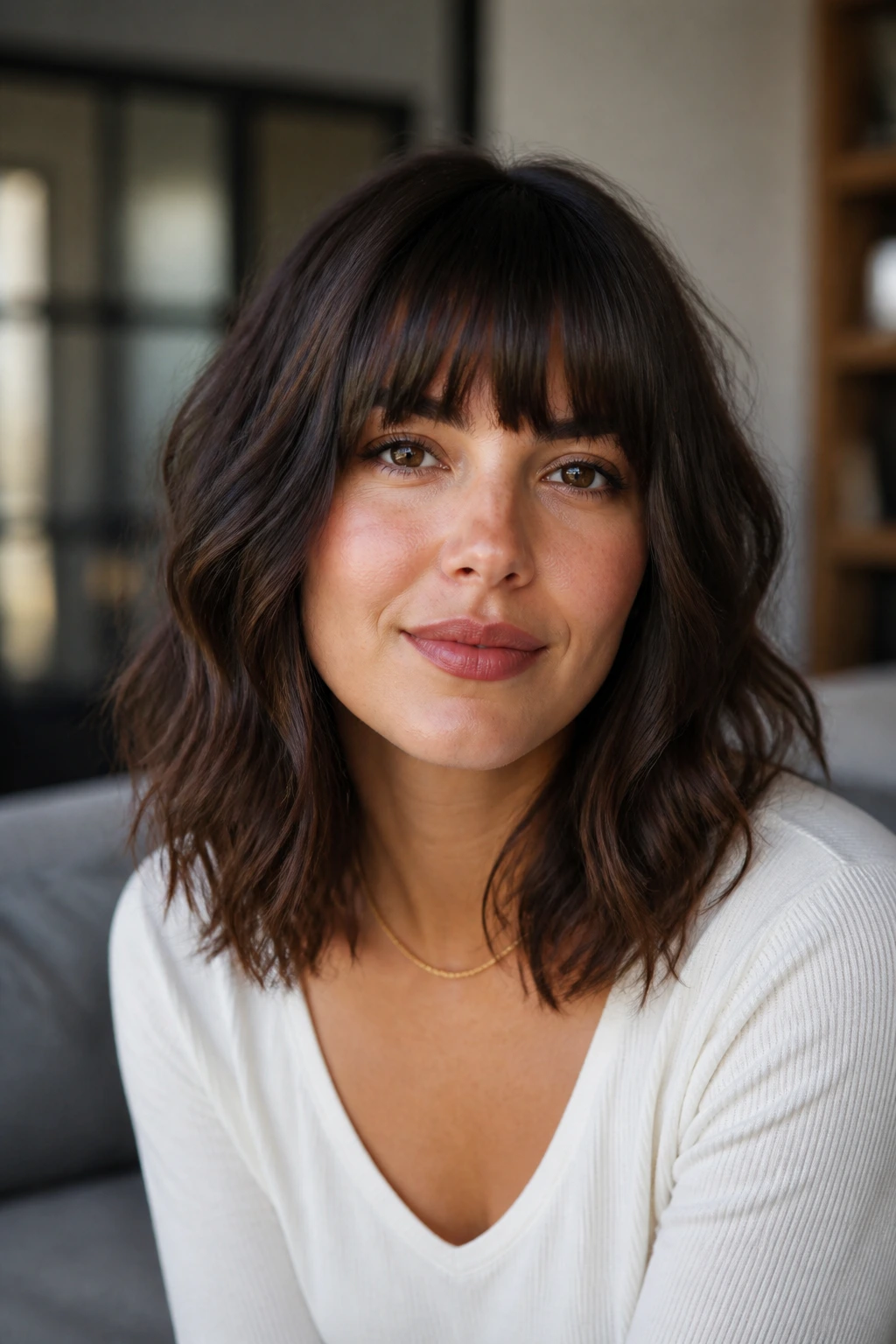
If you want the safest all-around option on the list, this is probably it. The mid-length lob gives loose curls enough room to fall below the cheeks, and the bangs cut right to the brow create a clean front frame. Nothing here is extreme. That’s why it works.
The length is forgiving, the fringe is readable, and the overall shape is easy to live with. On round faces, that combination helps because the eye goes up to the bangs, then down to the longer curls, instead of getting stuck on the width of the cheeks.
This is the haircut I’d point to if someone said, “I want bangs, but I don’t want to gamble.” Fair enough. This one keeps the silhouette calm and the forehead line sharp.
The Small Styling Moves That Make the Cut Behave
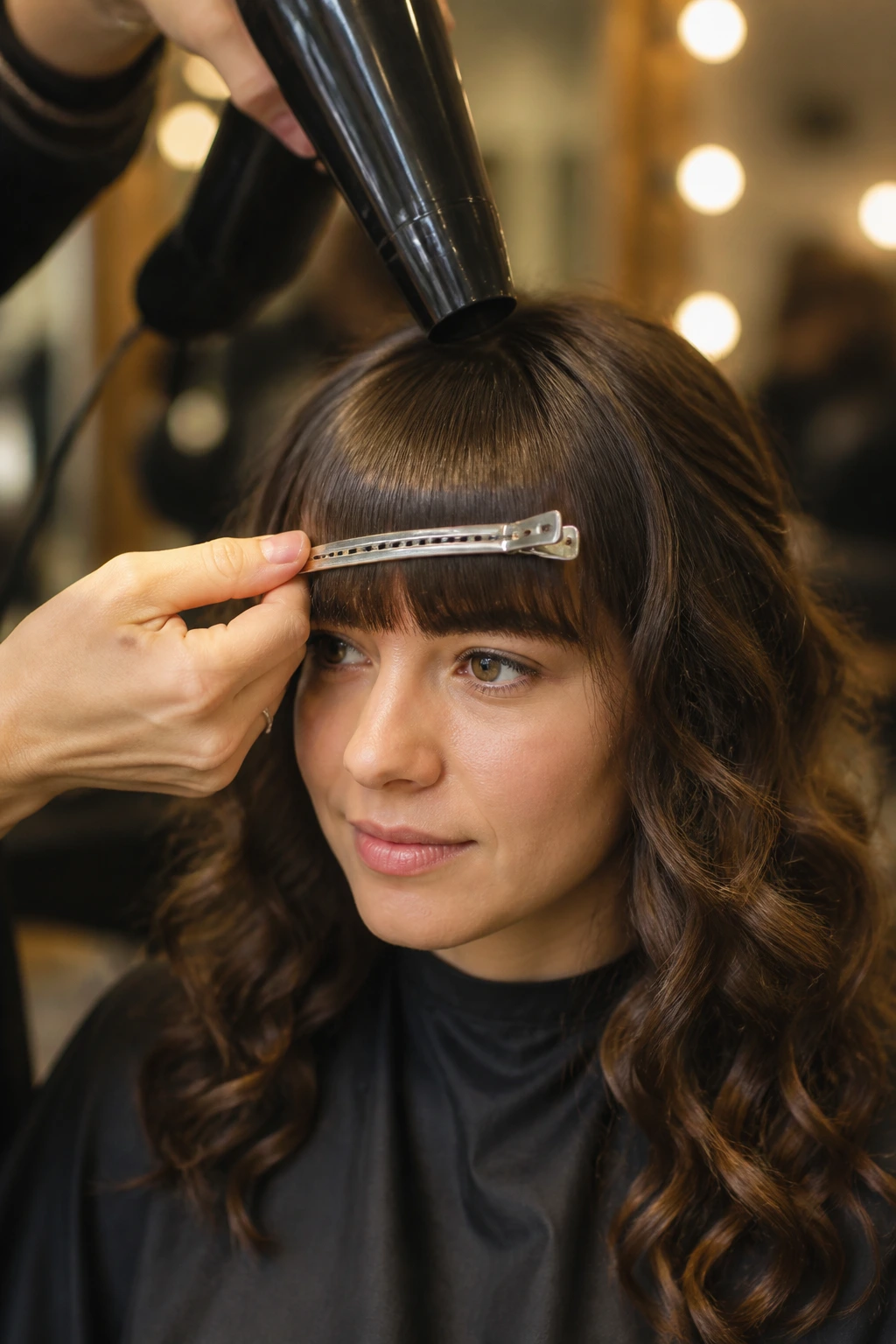
The cut matters, but the daily handling matters just as much. Straight bangs on loose curls should be styled as their own section, not treated like an afterthought while the rest of the hair is left to figure itself out. The fringe gets grease, humidity, and forehead heat first. It deserves a minute.
Start by drying the bangs separately. A tiny round brush or a fine comb plus a dryer nozzle is enough. Pull the fringe forward, move the airflow from root to end, then finish with a cool shot so the shape sets before you touch the rest of the curls.
Do not overheat the fringe. That’s where people create frizz they later blame on the haircut. Two slow passes are better than six frantic ones. If the bangs still feel stubborn, clip them flat while they cool and let them reset.
For the lengths, I prefer loose curls that keep some separation. A curl cream or light mousse is enough in most cases. Heavy product near the fringe makes it look stringy, and stringy bangs are harder to fix than fluffy ones.
Essential Tools and Products for This Look
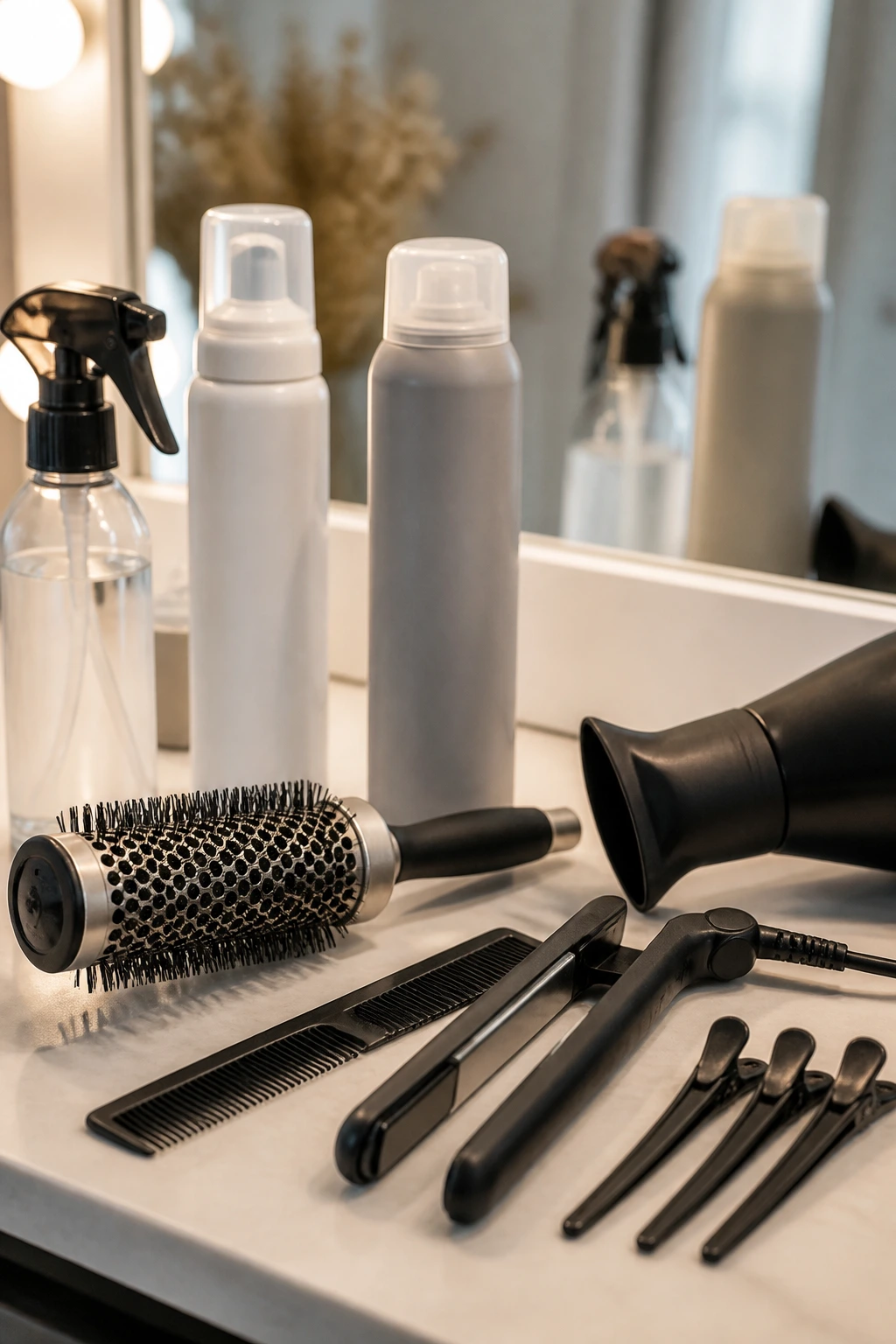
- Small round brush, 1 to 1.5 inches: Best for shaping the fringe without pulling the curls flat.
- Fine-tooth comb: Useful for directing the bang line before drying; especially handy if the fringe wants to split.
- Blow dryer with concentrator nozzle: Keeps airflow controlled so the bangs dry forward instead of all over the place.
- Mini flat iron or slim ceramic flat iron: Good for a quick polish on the fringe only; use it sparingly.
- Heat protectant spray: A light mist keeps the front from getting fried by daily styling.
- Lightweight mousse: Helps loose curls keep shape without weighing down the bangs.
- Dry shampoo: Useful at the roots and along the fringe line when the forehead starts to shine.
- Duckbill clips: Great for setting the bangs flat while they cool or while the rest of the hair dries.
- Microfiber towel or cotton T-shirt: Cuts down on frizz when you scrunch the curls after washing.
How to Style the Fringe Without Fighting the Curl
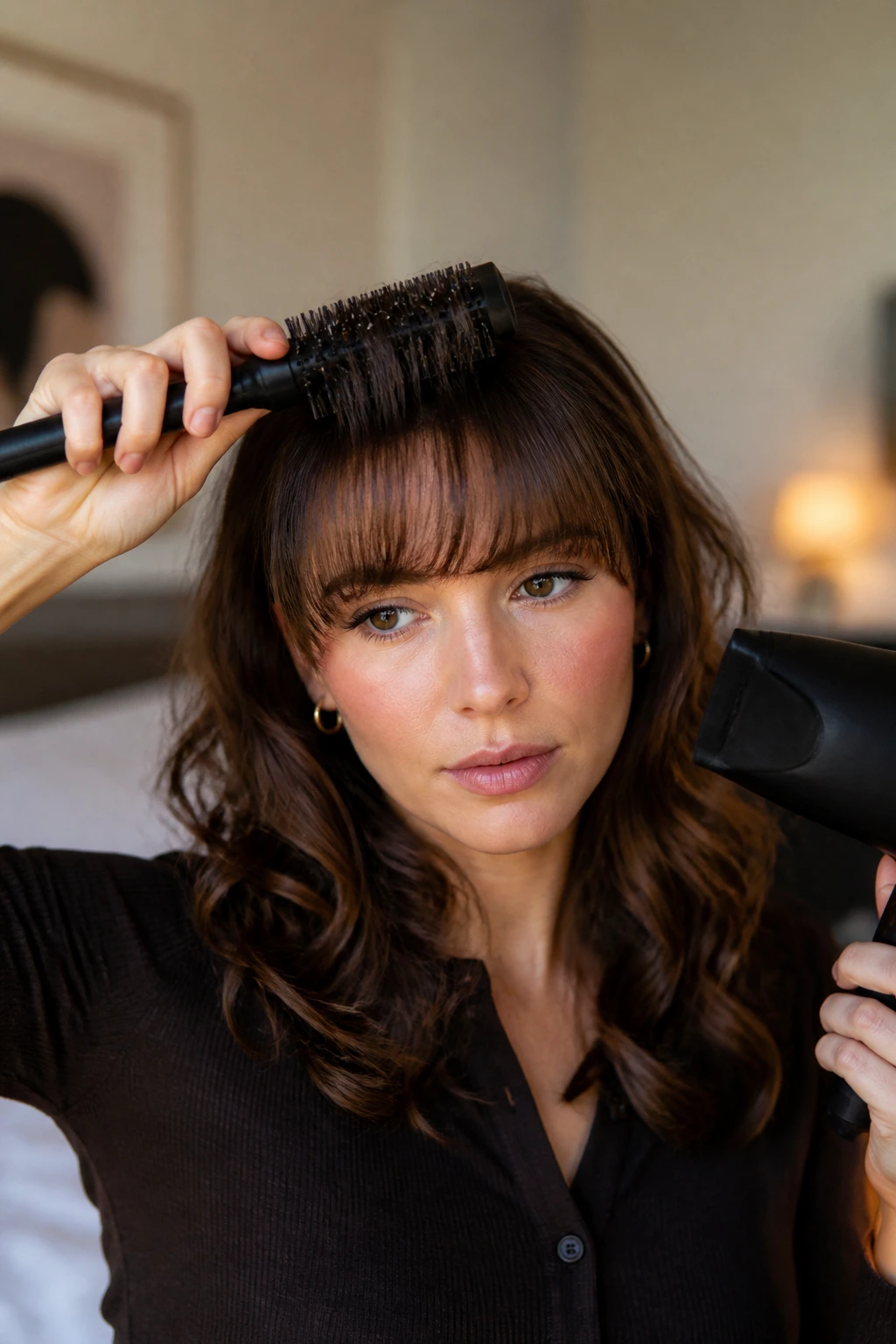
The smartest routine is simple. Dry the bangs first, shape the curls second. If you reverse that order, the bangs usually pick up extra moisture from the face and go crooked right when you want them to stay neat.
A good rhythm looks like this: mist the fringe, blow-dry it forward, clip it to cool if needed, then move on to the lengths. If you like more polish, use the flat iron only on the bang section, taking a tiny diagonal bend at the ends so the line doesn’t look stiff. The curls below can air-dry, diffuse, or get a soft twist with a mousse.
The other move that helps a lot is root control. A little lift at the crown keeps the bangs from sitting heavy against the forehead, which is useful on round faces because it subtly lengthens the upper half of the face. You’re not building height for show. You’re creating space.
Humidity is the wild card. On damp days, dry shampoo at the roots and a touch of smoothing cream on the fringe edges can keep the whole shape from ballooning out. Go light. Heavy products on bangs are a shortcut to a greasy forehead by noon.
Common Mistakes That Make the Style Harder Than It Needs to Be
-
Cutting the fringe too short the first time: Loose curls shrink, and a bang that looks safe when damp can jump halfway up the forehead. Fix it by asking for a dry check before the final trim.
-
Over-thinning the bang panel: This turns straight-across bangs into scattered pieces that frizz apart. Keep enough weight in the fringe so it reads as one line.
-
Letting the curl length flare at the cheeks: If the widest part of the curls sits right at cheek level, the face looks broader. Move the length below the jaw or keep layers lower.
-
Styling the fringe with the same product as the curls: Heavy curl cream on bangs usually makes them collapse. Use a lighter touch on the front than on the rest of the hair.
-
Skipping regular trims: Bangs that grow into the eyes start to split and curl under in odd ways. Trim or dust them before they get to that stage.
Variations and Alternatives Worth Trying

The Brow-Skimming Basic: This is the simplest version if you want a clean frame and minimal fuss. It keeps the bangs low enough to shape the face but not so long that they vanish into the curls.
The Lash-Graze Version: Let the fringe sit a little lower if your curls jump up when dry. That extra length gives you room to shape the bangs forward without needing to trim them every two weeks.
The Shagged-Out Fringe: Keep the straight line, but add a little internal texture to the lengths below. It fits looser, messier curls and gives the haircut a more relaxed finish.
The French Bob Pairing: Shorter overall, sharper at the bottom, and better for people who want the bangs to be the clear focal point. The clean perimeter keeps the face looking longer.
The Grow-Out Friendly Split: If you think you may tire of bangs, ask for a fringe that can separate softly in the middle once it grows. It’s not a permanent look, but it saves you from the awkward in-between stage.
Keeping the Shape Between Salon Visits
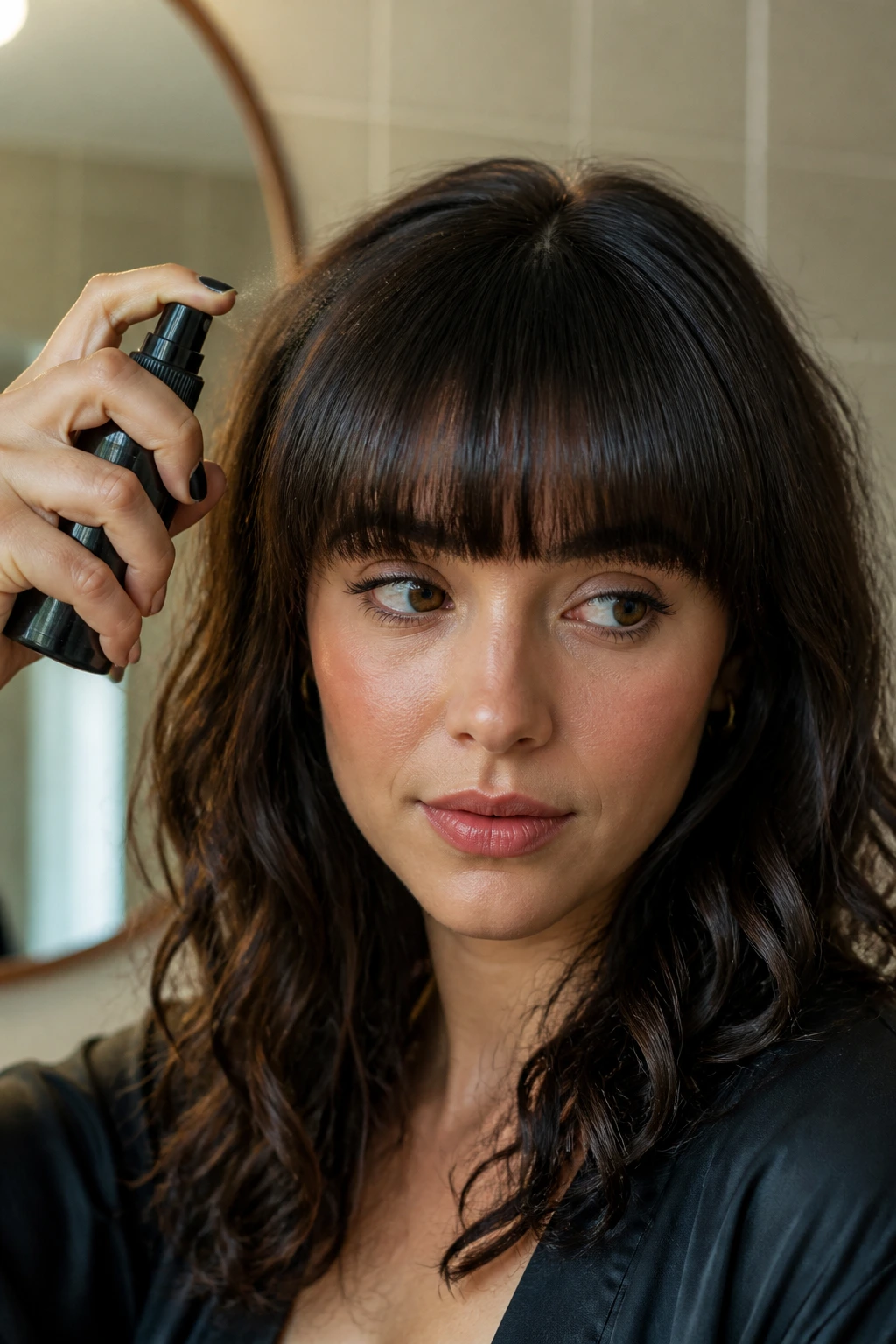
Bangs show wear faster than the rest of the haircut. They pick up skin oils, forehead heat, steam from the shower, and the little bend from sleeping on one side. That’s normal. The fix is a short daily reset, not a dramatic restyle.
The easiest habit is to rinse or mist the fringe separately if the rest of the hair doesn’t need a full wash. A quick blow-dry at the roots keeps the line in place, and a tiny dab of dry shampoo along the front can buy you another day. If the bangs start to split, don’t keep brushing harder; rewet them lightly and reshape them forward.
For trims, I like a rhythm of every 3 to 5 weeks for heavier fringes and closer to 4 to 6 weeks if the bangs are longer and softer. If you’re growing them out, ask for small dustings rather than full reshaping. That keeps the line from getting ragged.
At night, a loose clip or a soft roller can help the fringe keep its direction. It sounds fussy. It isn’t, once you’ve had one good morning where the bangs fall into place without a fight.
What People Get Wrong With This Bang Shape

The biggest mistake is assuming all straight-across bangs behave the same way. They don’t. On loose curls, the cut line, density, and length all matter more because the hair keeps moving after you leave the salon chair. A blunt fringe that looks sleek in a mirror can become a puffed, uneven edge by lunch if it was thinned too much.
Another problem is placing the curls too wide at the cheeks. Round faces need room around the jaw and cheek area, not more bulk sitting right on top of it. Keep the shape narrow there and let the length fall lower. That one move changes the entire silhouette.
And yes, heat matters. A fringe that gets chased with a hot tool every day will frizz faster and need more product, which starts a cycle nobody enjoys. A little control is enough. You do not need to iron every strand into obedience.
Frequently Asked Questions
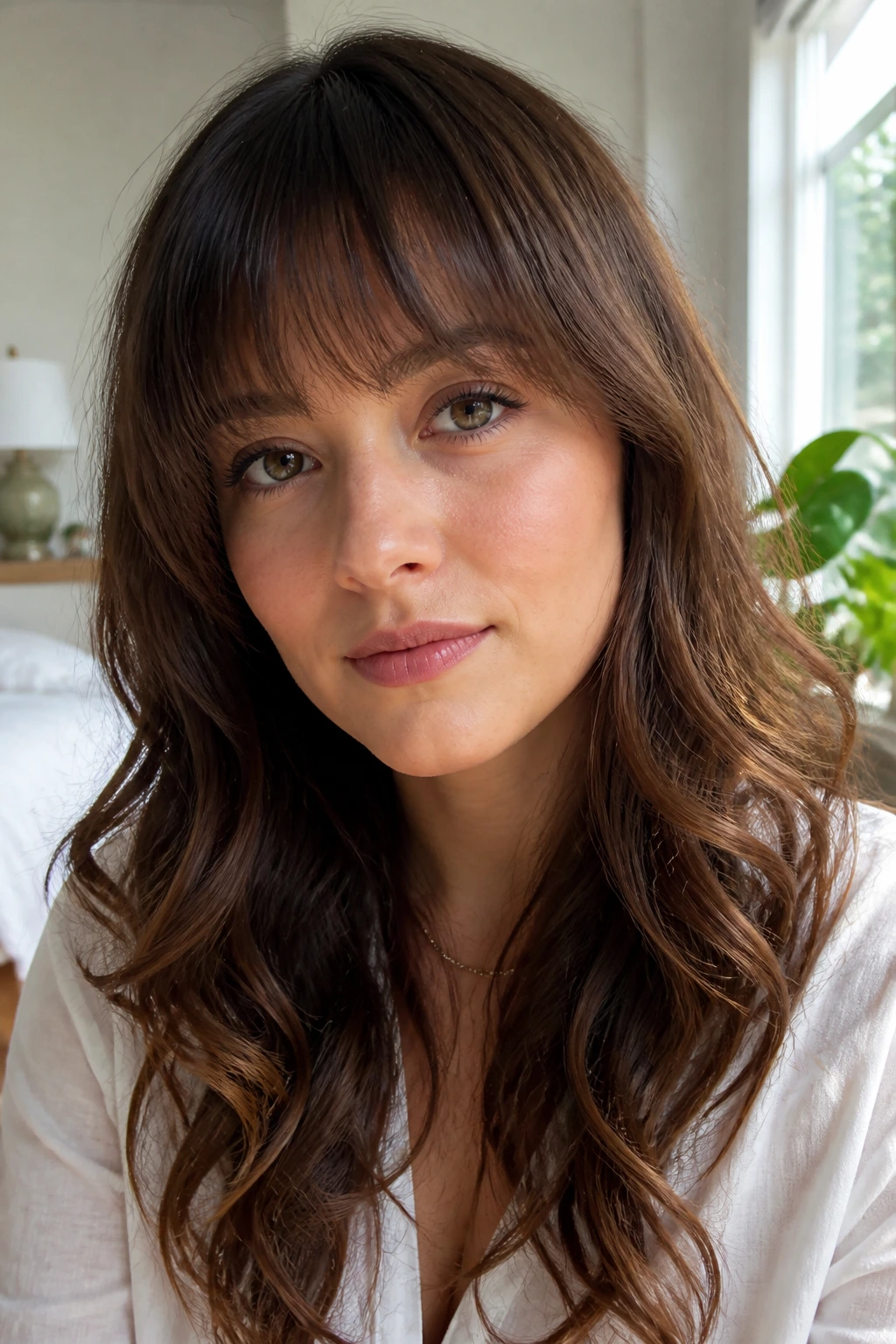
Do straight across bangs make a round face look wider?
They can, if they’re too short, too thin, or cut with too much volume at the cheek. The better version creates a firm line at the forehead while the curls drop lower and narrow the silhouette beneath it.
What bang length is best for loose curls?
Eyebrow-skimming to just-below-brow lengths usually give the best balance. If your curls shrink a lot, ask for a slightly longer starting point so the fringe lands where you actually want it once dry.
Should straight-across bangs be cut wet or dry?
A lot of stylists start wet, then refine dry, and that’s the safest approach for curls. The dry check matters because loose curls can spring up in a way that wet hair simply won’t show.
Can fine hair wear this look?
Yes, but the fringe needs to keep enough density to read as one panel. If the bangs are too sparse, they separate and make the forehead look busier rather than cleaner.
What if my bangs split in the middle every morning?
That usually means the fringe is too short, too light, or dried in the wrong direction. Mist it, comb it forward, and clip it flat for a few minutes; if the split keeps happening, the cut may need more weight.
How often should I trim straight-across bangs?
Most people need a touch-up every 3 to 5 weeks, though longer fringes can stretch a little farther. Letting them go too long usually leads to awkward curling, not an easy grow-out.
Do I need to straighten my whole head for this style?
No. That’s one of the nicer things about it. Straighten or polish the bangs, then let the loose curls below keep their movement.
What if humidity makes my fringe puff out?
Use a lighter product on the bangs and dry them fully at the roots before leaving the house. Dry shampoo near the hairline and a small flat iron pass on just the front can keep the line cleaner without flattening the curls.
A Fringe That Frames Instead of Fights
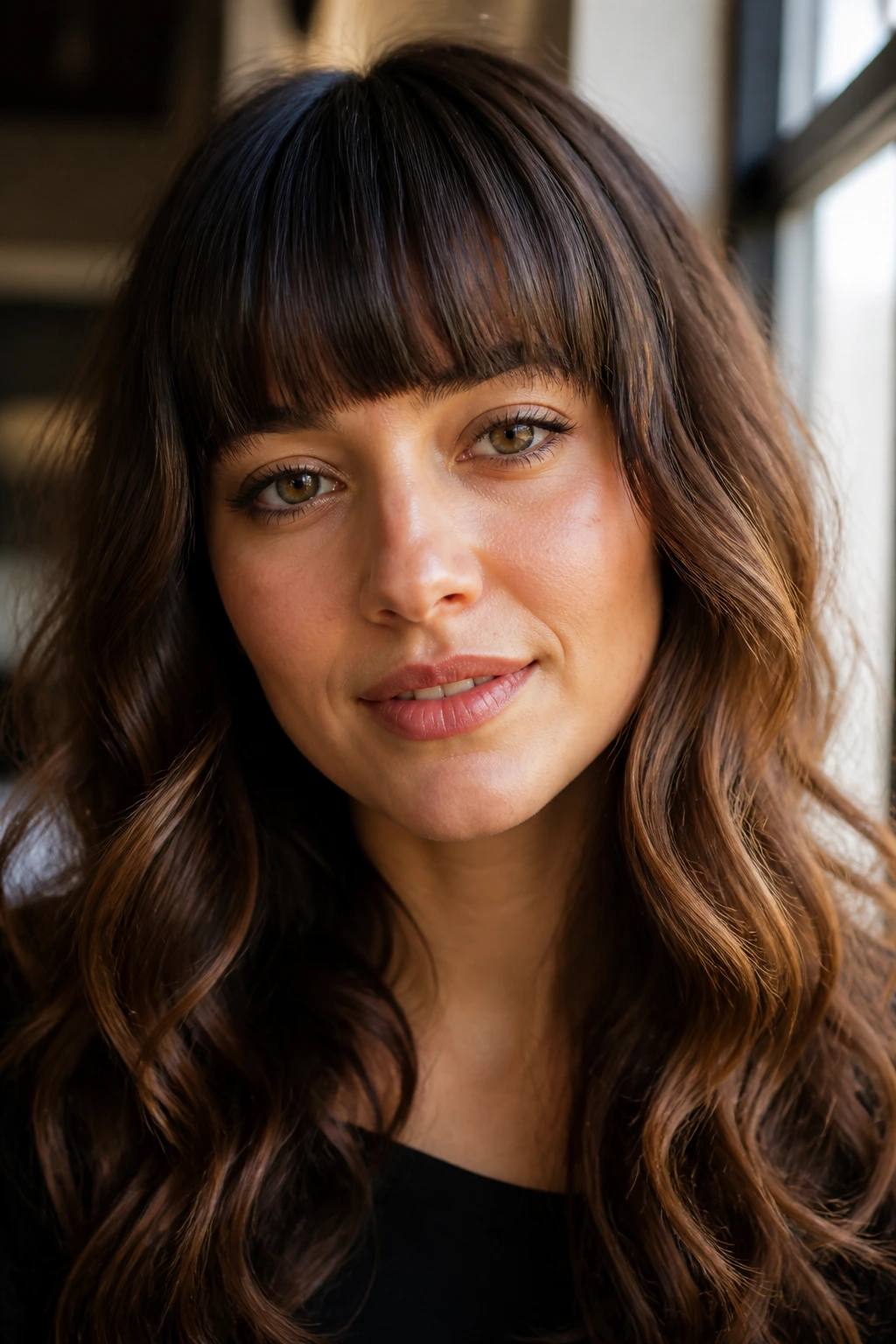
Straight-across bangs can be a very smart choice on a round face when the cut is built around the curl pattern instead of against it. The fringe gives you structure. The loose curls give you softness. That’s the whole game, and it’s why this pairing keeps showing up on faces that need a little more shape around the forehead.
The best version is the one that respects how your hair actually dries. Get the line right, keep the bangs dense enough to hold together, and leave the curls room to move below the cheek. That balance is what makes the shape feel modern instead of forced. Bring a good reference photo, then ask for the fringe to be cut for your real texture, not the texture you wish you had.