



A good short haircut does something sneaky. It sharpens the face, lifts the neck line, and makes earrings look like they belong there — all without turning the whole head into a hard block.
That matters a lot with short haircuts for women over 50 with face-framing layers, because the front of the cut does the real work. A few cheekbone-skimming pieces can soften a strong jaw, a longer fringe can hide a cowlick at the temple, and a little movement around the eyes can keep a cut from feeling stiff or helmet-like. The wrong short cut tends to sit there and announce itself. The right one moves.
Hair also changes. Not in some dramatic, movie-trailer way. It gets finer at the crown for some women, coarser for others, a little more stubborn around the ears, a little less obedient at the nape. Gray hair can be silky, wiry, or both in the same head of hair. So the smartest short cuts aren’t the ones that chase a fantasy image. They’re the ones that work with what’s actually growing out of your scalp.
Why These Cuts Keep Their Shape Up Front
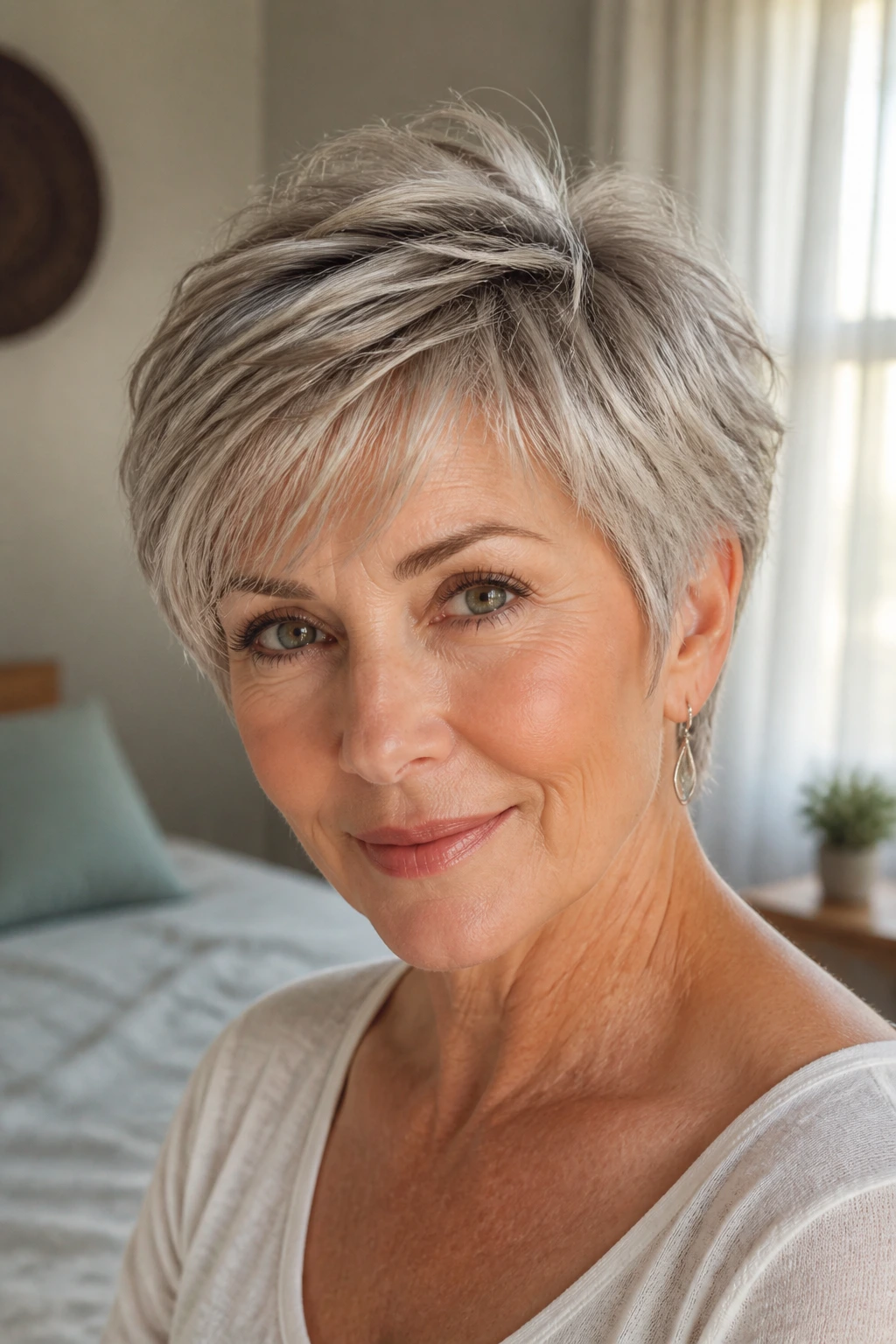
- They soften the face without hiding it: A few layered pieces at the cheekbone or jawline blur sharp edges and keep the cut from looking boxy.
- They make thin hair look fuller where it counts: Shorter layers around the front create movement, which keeps fine hair from clinging flat to the head.
- They grow out with less drama: When the front is layered on purpose, the grow-out looks like a style change instead of a mistake.
- They play well with glasses: Shorter front pieces can stop exactly where your frames begin, which keeps the face open instead of crowded.
- They give gray and silver hair a cleaner shape: Silver strands show every line, so a little layering keeps the cut from reading as one solid mass.
- They can be tailored to a real face, not a stock photo: A skilled stylist can shift the shortest point of the layer by half an inch and change the whole balance.
1. Soft Feathered Pixie
The soft feathered pixie is the cut I keep coming back to when someone wants short hair that still has a little air in it. The nape stays close and tidy, but the top and temple pieces are left soft enough to sweep across the forehead or tuck behind one ear. It’s tidy without looking severe. That matters.
What makes it work is the contrast. The back stays short so the shape doesn’t collapse, while the front layers land around the brow bone and upper cheek. If your hair has a slight wave, the feathering gives it a gentle bend instead of a stiff point. Fine hair likes this cut because the layers don’t need to be heavy to create lift; they just need to be placed well.
A tiny bit of mousse at the roots and a quick blow-dry with a small round brush is usually enough. Skip the urge to load on wax. The best version of this cut has movement, not helmet shine.
2. Chin-Length Bob with Swooped Front Pieces
Why does a chin-length bob look softer the second the front pieces angle a little longer? Because that extra length changes the line of the whole haircut. Instead of a straight horizontal edge sitting at the jaw, the front pieces sweep downward and pull the eye forward. That can do a lot for round, square, or fuller faces.
This bob is especially good when you want short hair but don’t want the cut to end abruptly at the cheek. The front should land somewhere between the bottom of the cheekbone and the top of the jaw, depending on your face shape. If the hair is straight, the line looks clean and crisp. If it has bend, the swoop keeps it from feeling too blunt.
Best when you want:
- A polished shape that still has softness around the mouth and jaw
- Enough length to tuck one side behind the ear
- A cut that works with side parts and deep side parts
- Easy styling with a paddle brush or a round brush
Leave the front a touch longer than your first instinct. Short front pieces are easy to overcut, and they lose their elegance fast.
3. Textured Bixie with Sideburn Layers
The bixie sits in that useful middle ground between a bob and a pixie, and the sideburn layers are what make it flattering rather than choppy. Those pieces at the temples and just in front of the ears can be kept longer, which gives the face a little frame without swallowing the features. It’s one of the easiest ways to get volume without going full short crop.
This cut behaves well on hair that wants movement but not too much length. You get the lightness of a pixie through the crown and nape, then a softer curtain around the cheeks. That front softness matters if your hairline is a little uneven or if your temples are thinner than the rest of your head. The layers take the eye where you want it.
A little styling cream on damp hair helps separate the pieces. Too much product turns the bixie into a sticky mess, and that defeats the point. Keep the front pieces swingy. Not stiff.
4. Feathered Crop with Crown Lift
A feathered crop is the quiet workhorse of short haircuts. It uses short, tapered sides and a slightly lifted crown to create shape without a lot of styling fuss. The face-framing comes from the top layers and the light feathering around the temples, which lets the cut soften the forehead instead of sitting flat against it.
This one is particularly kind to fine hair that loses steam by noon. The crown lift gives the illusion of fullness, and the feathered front stops the cut from feeling like a helmet cap. Gray hair often looks terrific in this shape because the texture reads clearly; each feathered section catches the eye instead of hiding in a dense block.
If your hair tends to puff at the sides, keep the perimeter neat and let the top do the moving. That’s the trick. Shorter around the ears, a little air through the top, and a soft edge near the face.
5. French Bob with Curtain Bangs
A French bob has a little attitude, but it doesn’t need to be fussy. The length usually sits near the cheekbone or just at the jaw, and the curtain bangs split the front in a way that opens the face instead of closing it off. It’s neat. It’s slightly romantic. It also looks better with a bit of natural bend than with perfect blowout polish.
This shape flatters women who want the face-framing layers to do the talking without a lot of length hanging around the neck. The curtain fringe can be cut to hit the top of the cheekbones, which gives a nice lift to the eyes. If the hair is thick, ask for a little internal removal of bulk so the bob doesn’t sit like a block.
The best part? It ages well. Not in the strange, overdone sense of “youthful,” but in the practical sense that it doesn’t rely on one perfect styling day to look put together.
6. Stacked Bob with Longer Front Angles
The stacked bob is the cut for anyone who likes structure. The back is built with short, graduated layers that create lift at the nape, while the front angles stay longer and sweep toward the chin. The result is a clean profile from the side and a softer frame from the front.
A stacked bob can feel a little strict if the front is cut too blunt. That’s where the longer angles save it. They pull the eye diagonally, which is kinder to round cheeks and softer jawlines. The best version has a little bounce when you turn your head — not a rigid shelf.
What to watch for
- Ask for the back to be stacked, not piled high.
- Keep the front longer if you wear glasses.
- Ask for texture at the ends if your hair is dense.
- Blow-dry with a round brush only at the crown and front; the rest can air-dry with a little smoothing cream.
This is one of those cuts that looks expensive even when it’s not trying to be.
7. Side-Swept Pixie Cut
A side-swept pixie is a little softer than the classic cropped version, and that softness is why it works so well. The fringe sweeps across the forehead and can fall nearly to the eyebrow, while the sides stay trimmed close enough to keep the shape clean. It’s a nice option if you want short hair but need something less severe around the eyes.
The side sweep creates a diagonal line, which is a small thing with a big effect. Diagonals soften the face. They also make a pixie feel more flexible, because the fringe can be tucked, brushed forward, or lifted with a bit of paste. If you’ve got a strong cowlick at the front, this is often a better bet than a blunt short fringe.
Keep the product light. A pea-size amount of cream or paste is enough for most hair lengths here. More than that and the fringe starts to separate in a way that looks forced.
8. Shaggy Bob with Razored Ends
The shaggy bob is not for someone who wants every hair lying politely in line. It’s for someone who wants movement, some edge, and a front that softens the face by breaking up the outline. Razored ends make the bottom look airy, while the shorter face-framing pieces around the cheekbone keep the whole thing from feeling too round.
This cut works especially well on wavy hair and on thicker hair that needs some relief around the perimeter. The front layers can sit at different lengths — some at the cheek, some at the jaw — and that unevenness is exactly what gives the cut life. A razor can be too aggressive on very fine hair, though, so if your strands are wispy, ask for slide cutting or point cutting instead.
The shaggy bob looks best a little undone. Air-dry with a curl cream or quick-dry spray, scrunch once or twice, and leave it alone. The charm is in the mess.
9. Jaw-Skimming Bob with Inward Layers
A jaw-skimming bob is a very specific thing. If it hits too high, it can make the face feel wider; if it goes too low, the shape loses its clean line. The sweet spot is right at the jaw or just below it, with inward layers around the front so the hair curves toward the chin instead of flipping out.
That inward bend matters if your hair tends to kick away from the face. It gives the cut a gentle hug around the jawline, which can be especially flattering on square or long faces. The style looks neat with a side part, but it also works with a middle part if the front pieces are long enough to fall softly on either side.
I like this cut on women with straight hair because it doesn’t need much help. A flat brush and a quick bend under at the ends usually do the job. No big production. Good cuts rarely need one.
10. Tapered Crop with Volume at the Crown
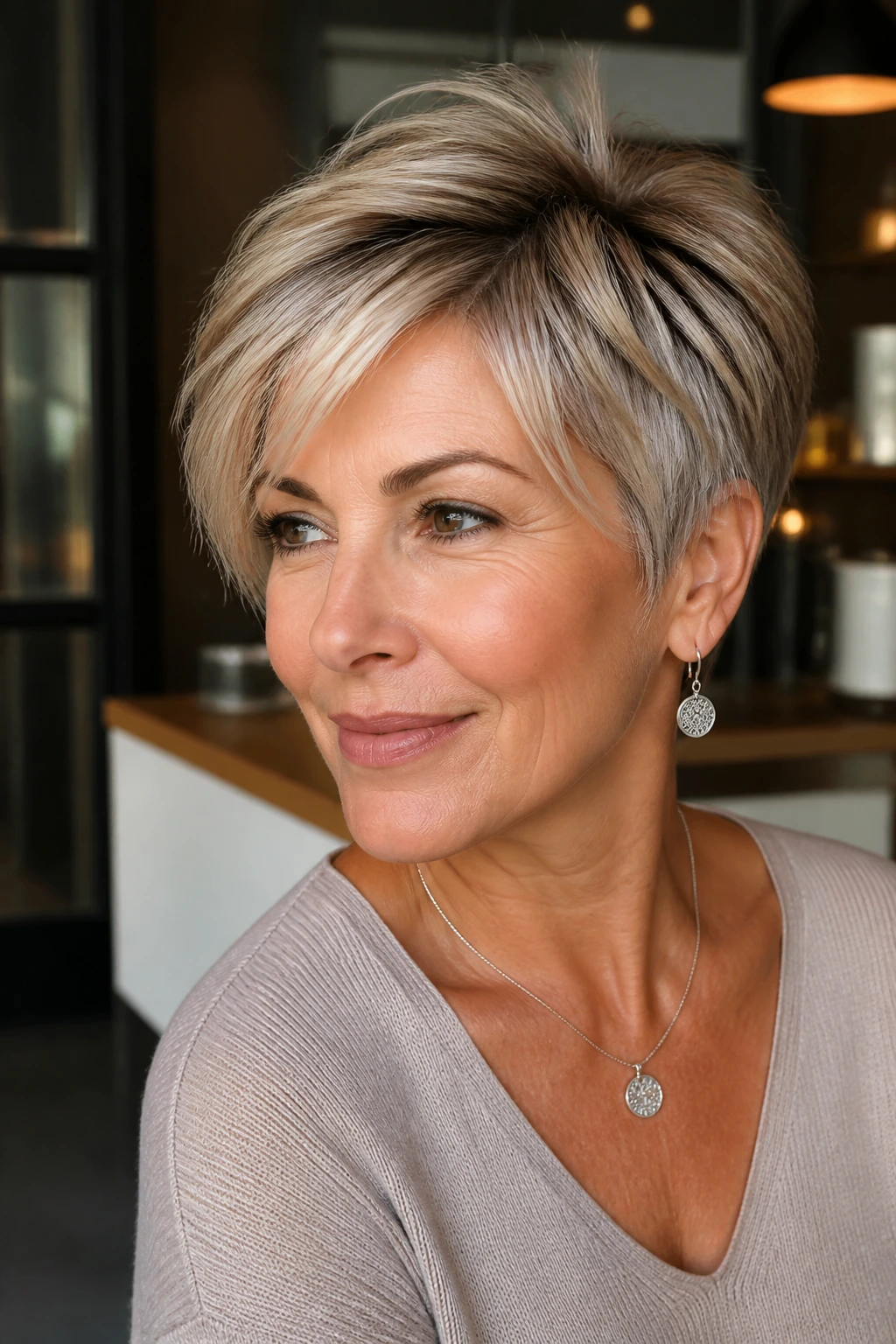
A tapered crop is short on the sides and back, then lifted through the crown so the head doesn’t read flat. The front layers usually land at the temple or just above the brow, which gives a little frame without dragging the face down. It’s clean, light, and far less severe than people expect from a very short cut.
The crown volume is the whole point. If the top lies too close to the head, the face can look longer or the cut can feel unfinished. But when the crown is shaped with enough length and a little texture, the silhouette becomes elegant in a sharp, modern way. This cut is especially useful for fine hair that looks tired by midmorning.
If you’ve got a small cowlick at the crown, mention it before the scissors come out. A good stylist will work with it instead of trying to force it flat, which never ends well.
11. Jawline Lob with Short Face-Framing Layers
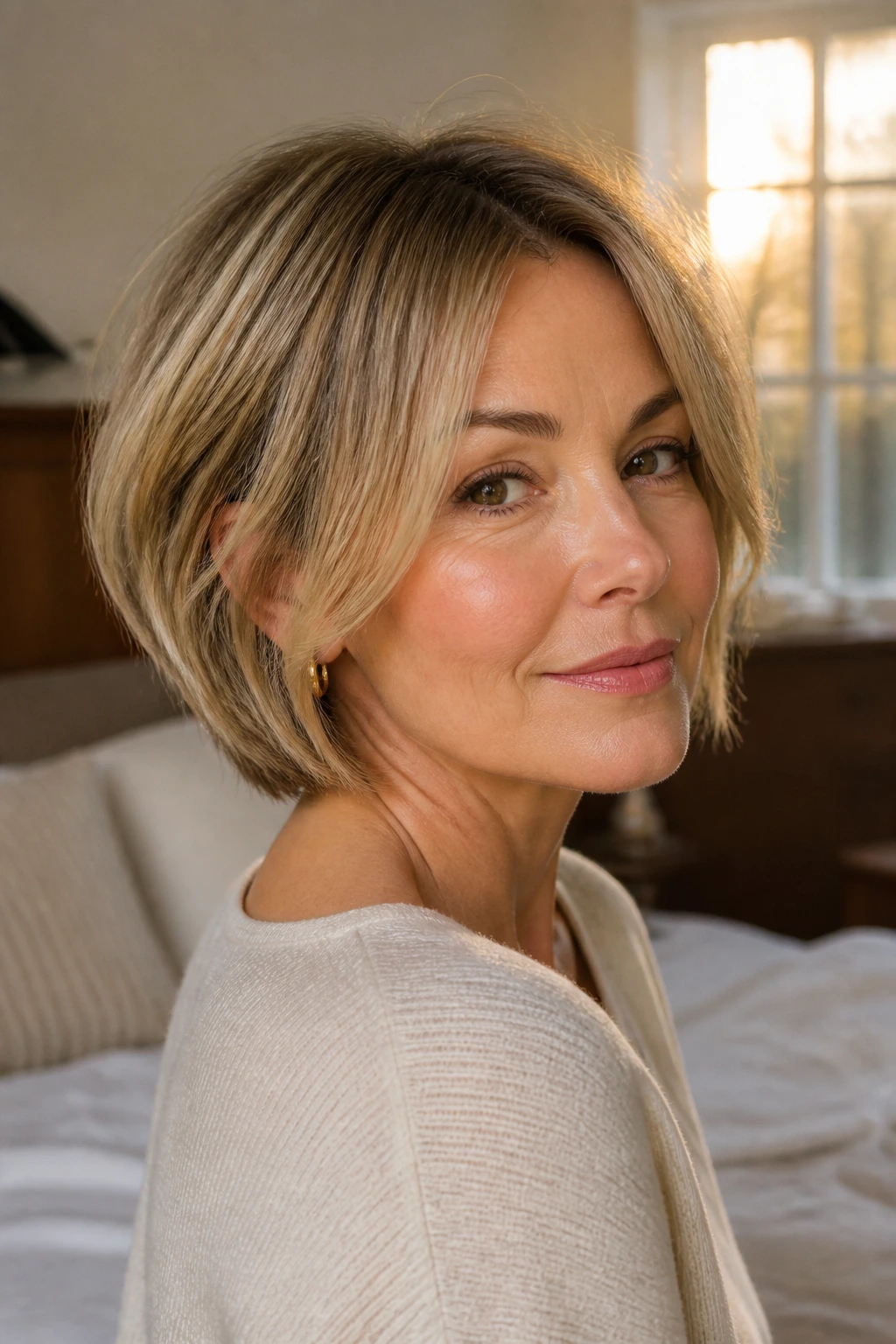
A lob that stops around the jawline is a smart middle path for women who want short hair without going fully cropped. The face-framing layers are shorter than the rest of the cut and usually begin around the cheekbones, which breaks up the solid line and keeps the style from sitting heavy.
This shape is useful if your hair is thick or if you like to tuck one side behind the ear. The length gives you enough room to play with a soft wave, but the shortened face pieces keep the front from hanging like a curtain. If your neck is narrow or you have a delicate jaw, the lob can feel especially balanced because it doesn’t crowd the lower face.
Best for:
- Women who want one more styling option than a classic bob
- Thick hair that needs movement near the front
- People growing out a pixie or a shorter bob
- Side parts, soft bends, and low-effort waves
A dab of smoothing cream at the ends keeps the front pieces from frizzing out at the first sign of humidity.
12. Soft Wedge Cut with Layered Temples
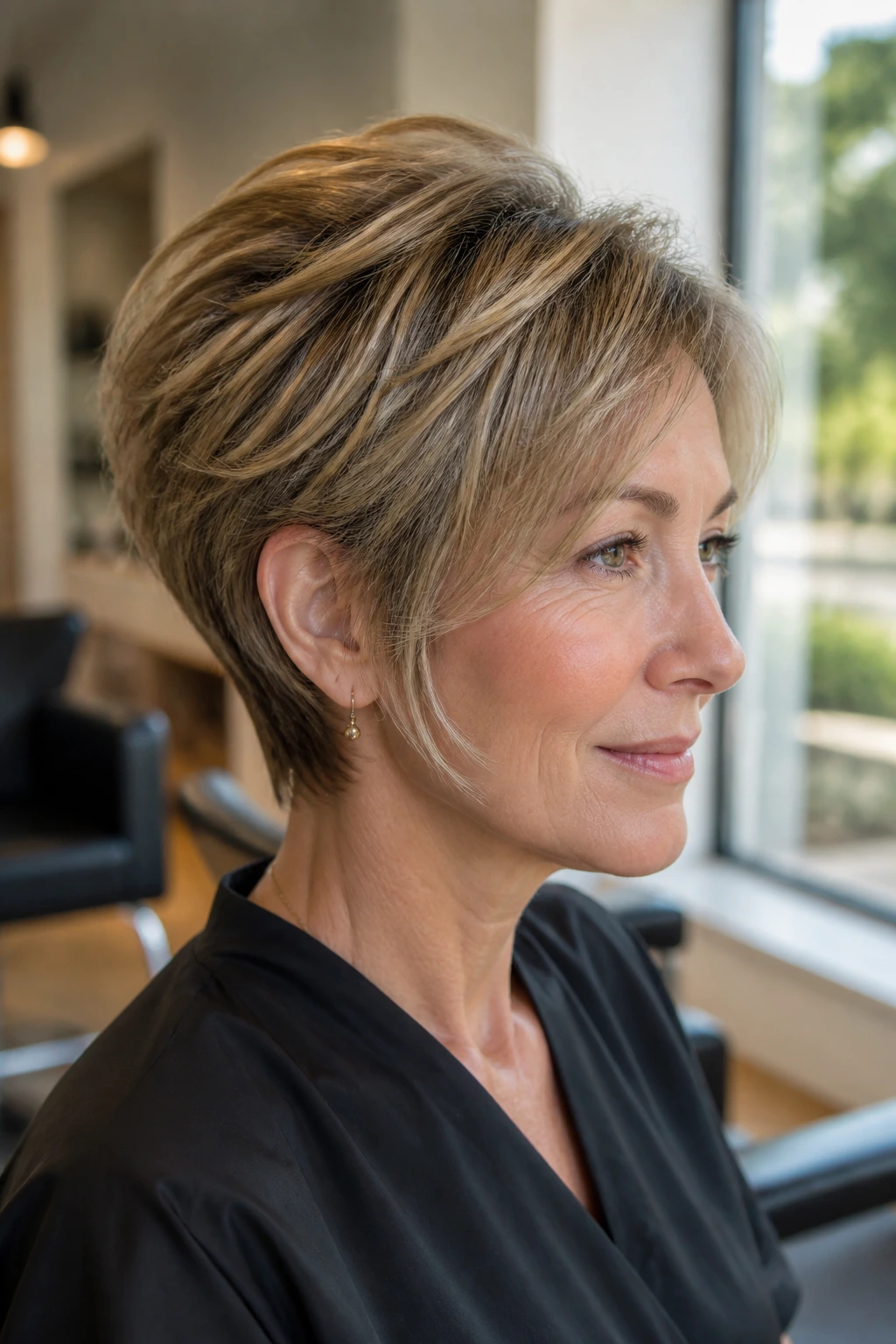
The soft wedge is old-school in the best sense, but it needs the right modern touch. Shorter layers at the back create a rounded, lifted shape, while the temple pieces are left softer and longer so the cut doesn’t harden the face. That front detail keeps the whole thing from reading as a dated salon helmet.
What I like about this cut is the way it supports the profile. The back can be neat and compact, which is useful if you want the hair off the neck, but the front remains gentle. If you wear glasses, the temple layers can be placed so they don’t fight with the frames. That’s one of those details that sounds small until you live with it every day.
Shape notes
- Keep the nape snug.
- Leave the front pieces long enough to skim the cheek.
- Add light texturizing through the crown, not the whole head.
- Ask for a blow-dry that lifts at the roots and curves the ends in.
The result is tidy, not stiff.
13. Curly Crop with Shaped Front Spirals
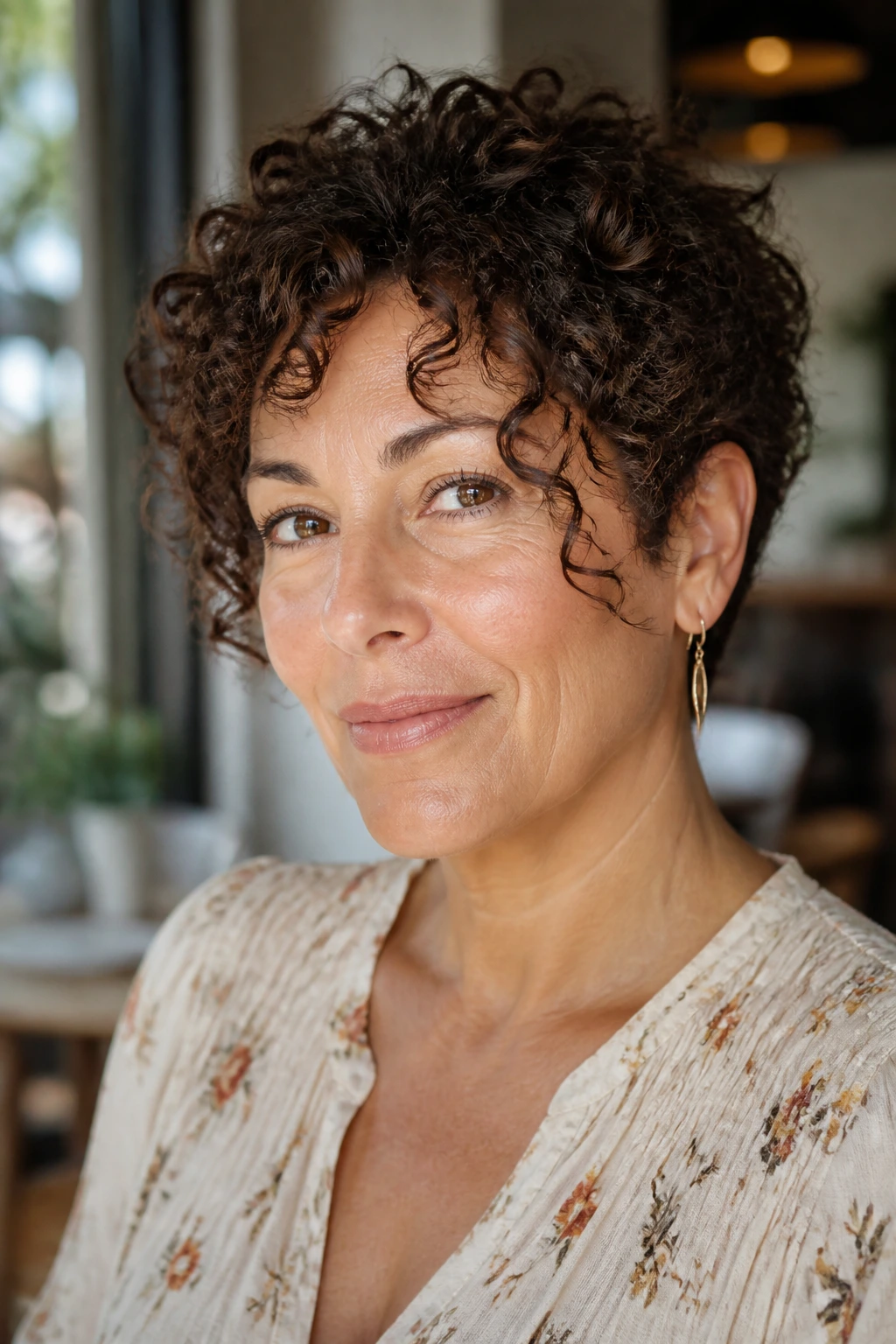
Curly hair wants a different kind of short cut. If the front is hacked too short, the curls spring up and the face-framing disappears. The better version leaves enough length at the front for the spirals to sit around the cheekbones or jaw, where they can shape the face instead of crowding it.
This crop works because it respects curl pattern. A stylist should cut it with the curl behavior in mind — often dry or mostly dry — so the front lands in the right place once the curl bounces back. A bit of length at the temples keeps the sides soft, while the back stays compact enough to avoid triangle shape.
If your curls are loose, a little curl cream and a diffuser are enough. If they’re tighter, keep the face pieces a touch longer than you think. Curly hair is honest about shrinkage. It won’t hide a bad length choice for long.
14. Wavy Italian Bob with Airy Front Layers
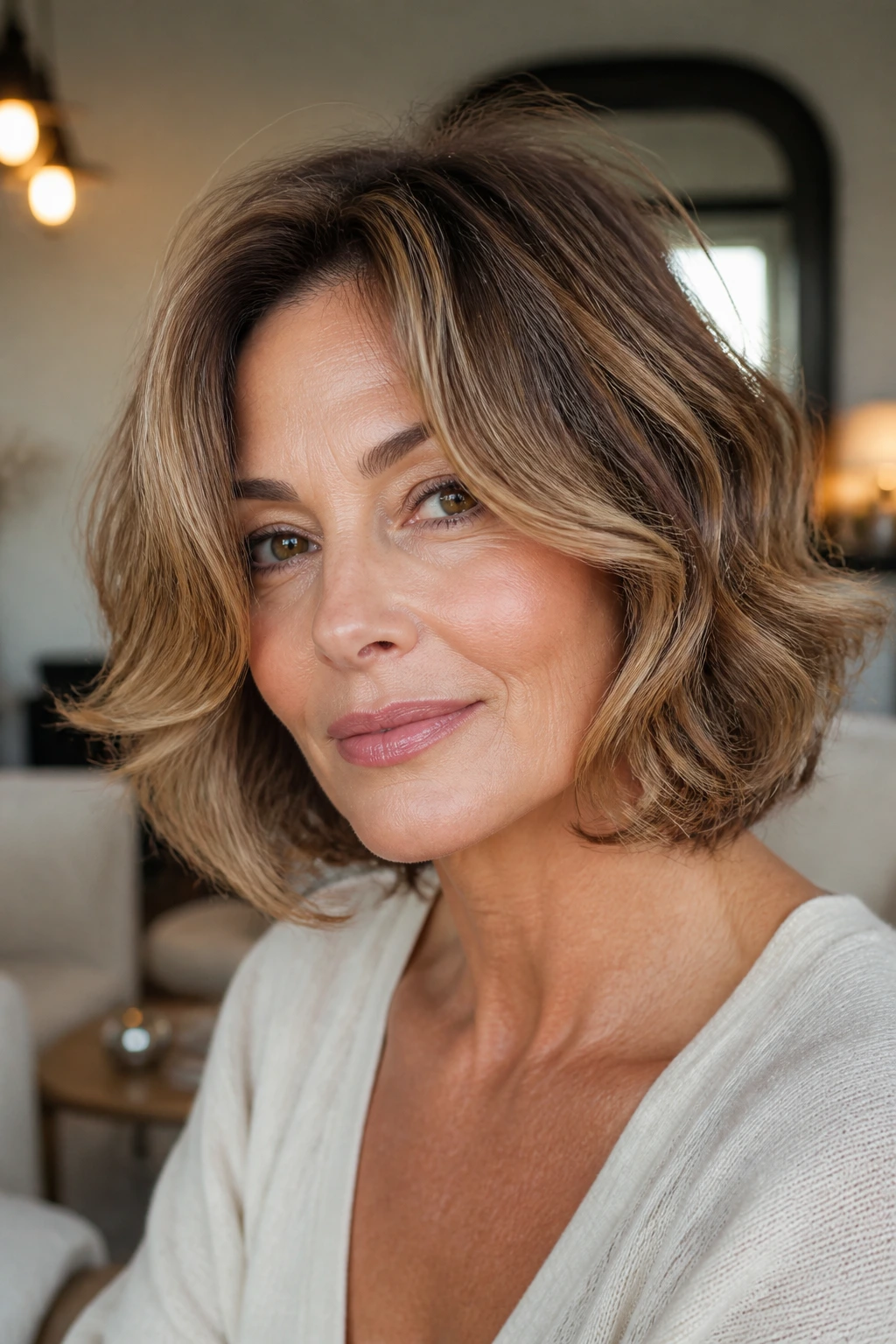
The Italian bob has that easy, brushed-through fullness that looks expensive without acting like a style project. On wavy hair, the airy front layers make all the difference. They keep the bob from turning into one broad shape and let the movement fall around the cheekbones instead of puffing at the sides.
The cut usually sits between the chin and just above the shoulders, but the real magic is in the front. Those longer layers can be pushed forward and then lightly bent away from the face, which gives the cheekbones a bit of lift. It’s a good choice if you like a polished finish that still feels loose.
A large round brush or a hot-air brush can shape the front in minutes. Don’t overthink the rest. The charm of this style is that it looks deliberate, not frozen.
15. Asymmetrical Bob with Long Side Sweep
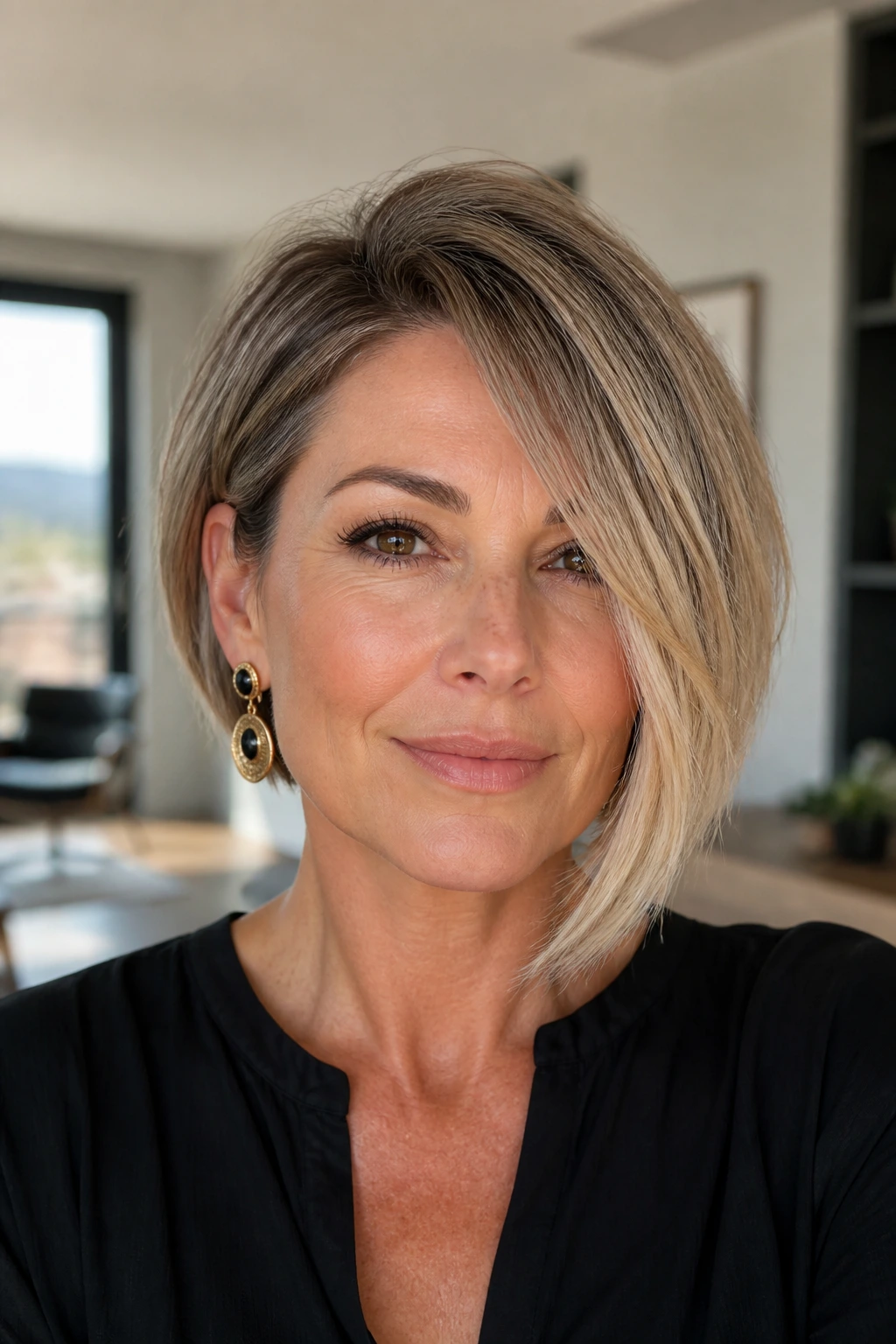
An asymmetrical bob brings a little drama, but it doesn’t have to be loud. One side is kept slightly longer, and the front sweep usually falls across the cheek on that longer side. That diagonal line can sharpen the face and make the neck look longer. Handy trick. Clean trick.
This cut is especially useful if your face feels wider through the cheeks or if you want the haircut to look different from the usual straight bob. The asymmetry creates motion even when the hair is still. It also lets a stylist work around one side that grows faster, or a part that insists on sitting slightly off-center.
Keep the difference subtle unless you want a more graphic look. Half an inch to an inch is often enough. Push it too far and the cut stops looking wearable for daily life.
16. Layered Pageboy with Tucked Sides
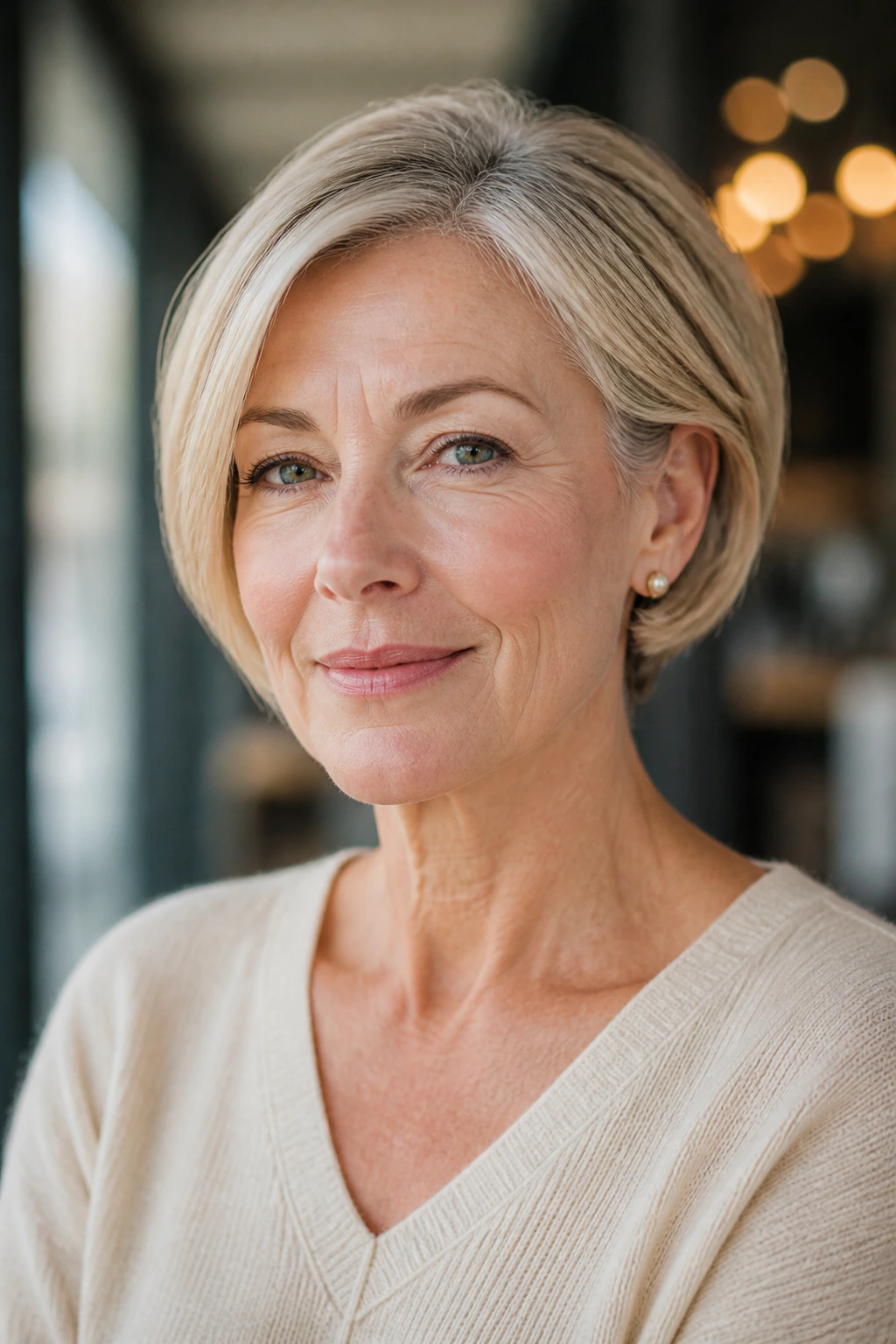
The pageboy has come a long way from the stiff, bowl-like version people remember. With layered sides and a soft tuck behind the ears, it becomes much easier to wear. The front pieces can be cut to curl under slightly, which gives the face a neat frame without the hard edge of a blunt bowl.
This cut suits straight to slightly wavy hair and works well on someone who likes a polished outline. The longer front layers can skim the jaw, while the back stays smooth and rounded. If your hair is thick, the layering helps take some of the weight out so the ends don’t balloon.
I’d avoid over-texturizing this one. The pageboy lives or dies on shape. Too much random choppiness and it loses the very line that makes it interesting.
17. Tousled Crop with Long Bangs
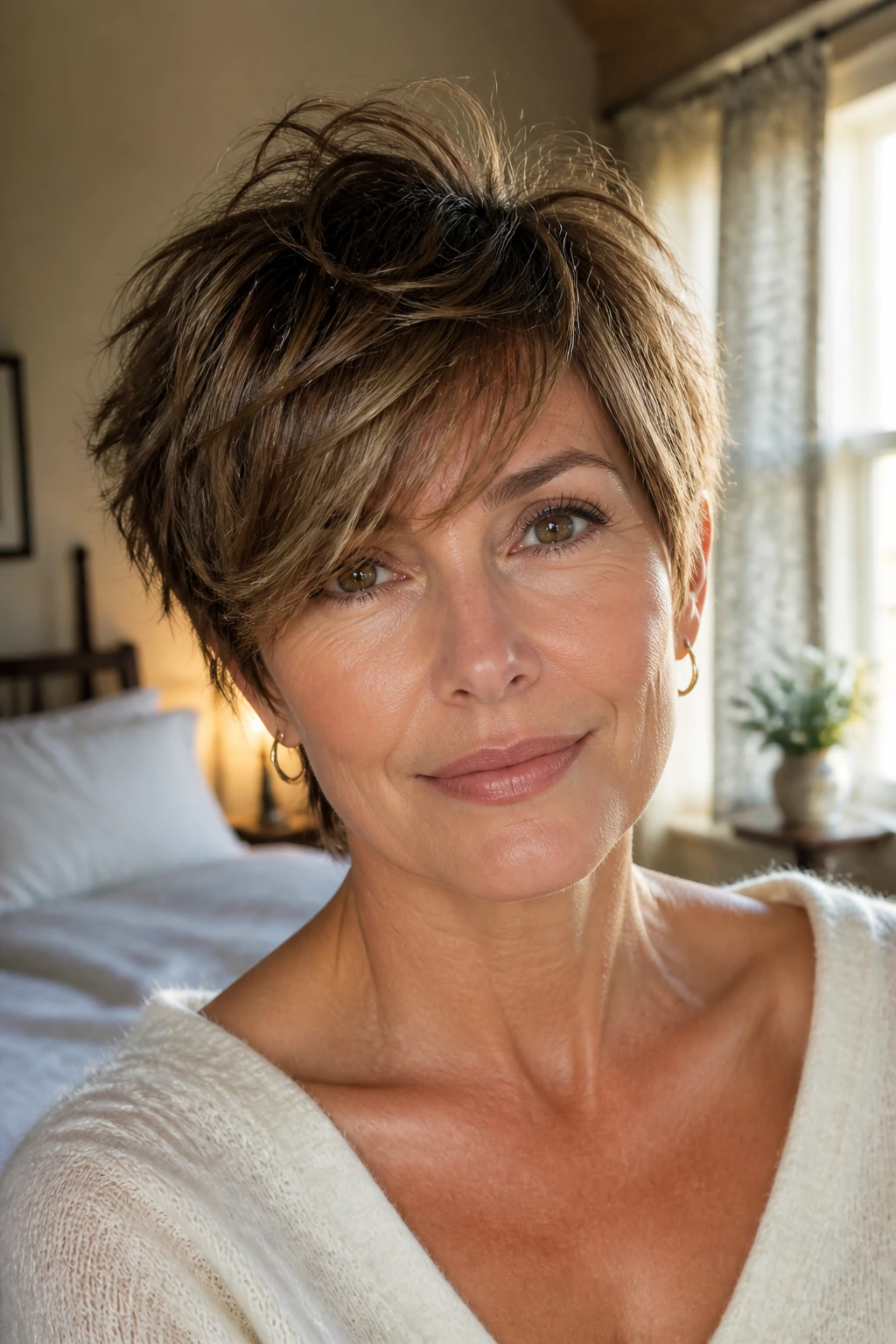
A tousled crop with longer bangs is one of the easiest ways to soften short hair without making it precious. The back and sides stay short enough to keep the cut light, while the front fringe gets enough length to sweep across the forehead and brush the brow line. That longer bang is what keeps the face open.
This style is forgiving. It can dry with a little bend, a little wave, or a bit of frizz and still look intentional. That makes it a good match for women who don’t want to fight their hair every morning. A small amount of texturizing spray or mousse is usually enough to build shape at the front and crown.
If your hair is very fine, ask for the bangs to be cut with softness, not a razor-heavy chop. Long bangs that are too shredded can separate and show scalp. Not the look.
18. Neck-Grazing Soft Mullet
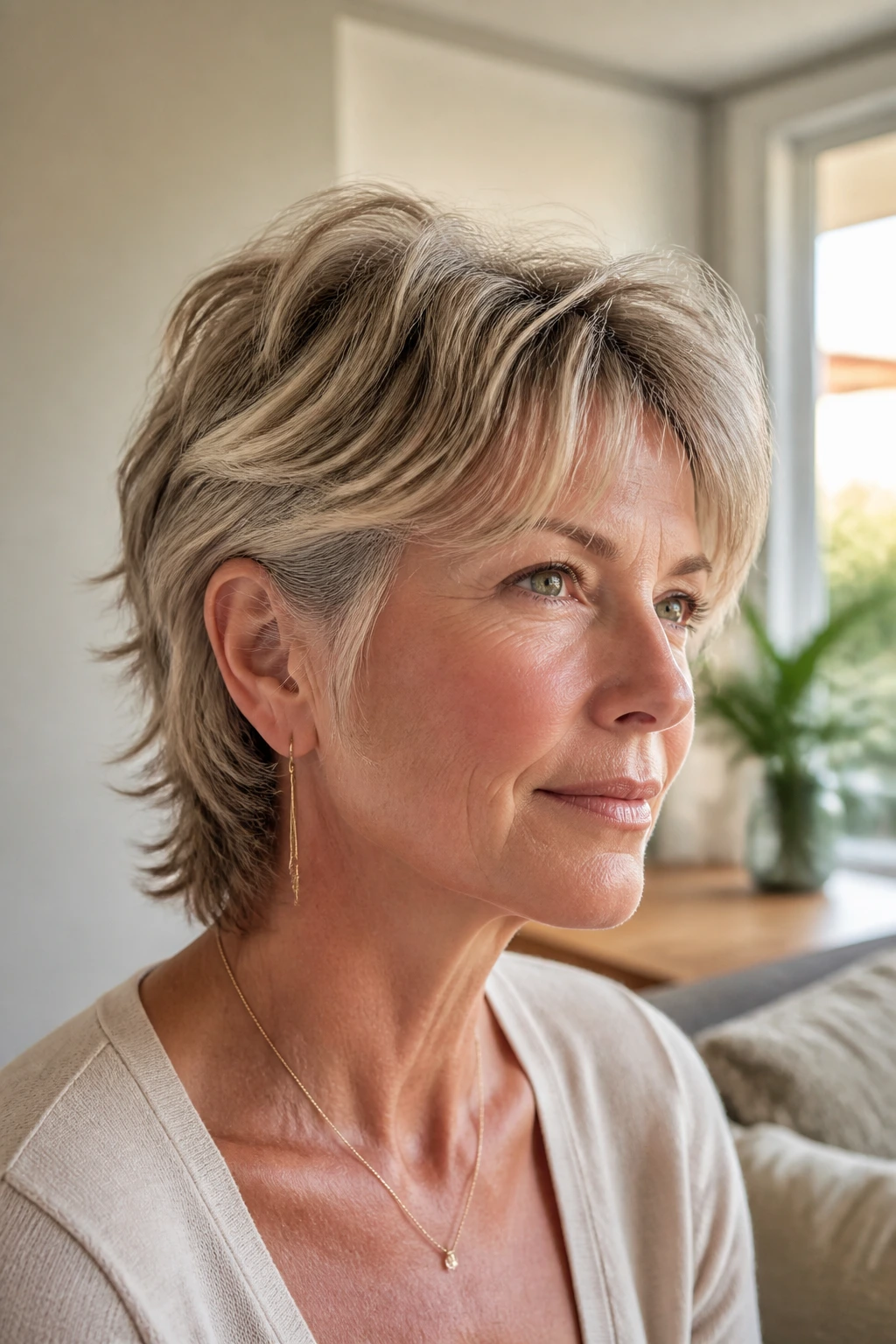
A soft mullet sounds braver than it is. In a wearable version, the top and front stay airy and layered, the sides are slightly shorter, and the back reaches just enough to skim the neck. Face-framing layers in the front keep it from feeling too edgy or too retro, which is the balance that makes it work.
The shape is good for wavy or slightly textured hair that likes to move. It also helps if you want volume at the crown without a bulky back. The front pieces can fall around the eyes and cheekbones, which gives the cut a bit of softness against the more playful outline behind it.
Why it works
- The front keeps the face open.
- The back removes weight from the neck.
- The crown gets lift without looking teased.
- It grows out into a shag if you let it.
This is not the cut for someone who wants polished and quiet. It’s for someone who likes hair with a little personality.
19. Swoopy Bob with Hidden Undercut Nape
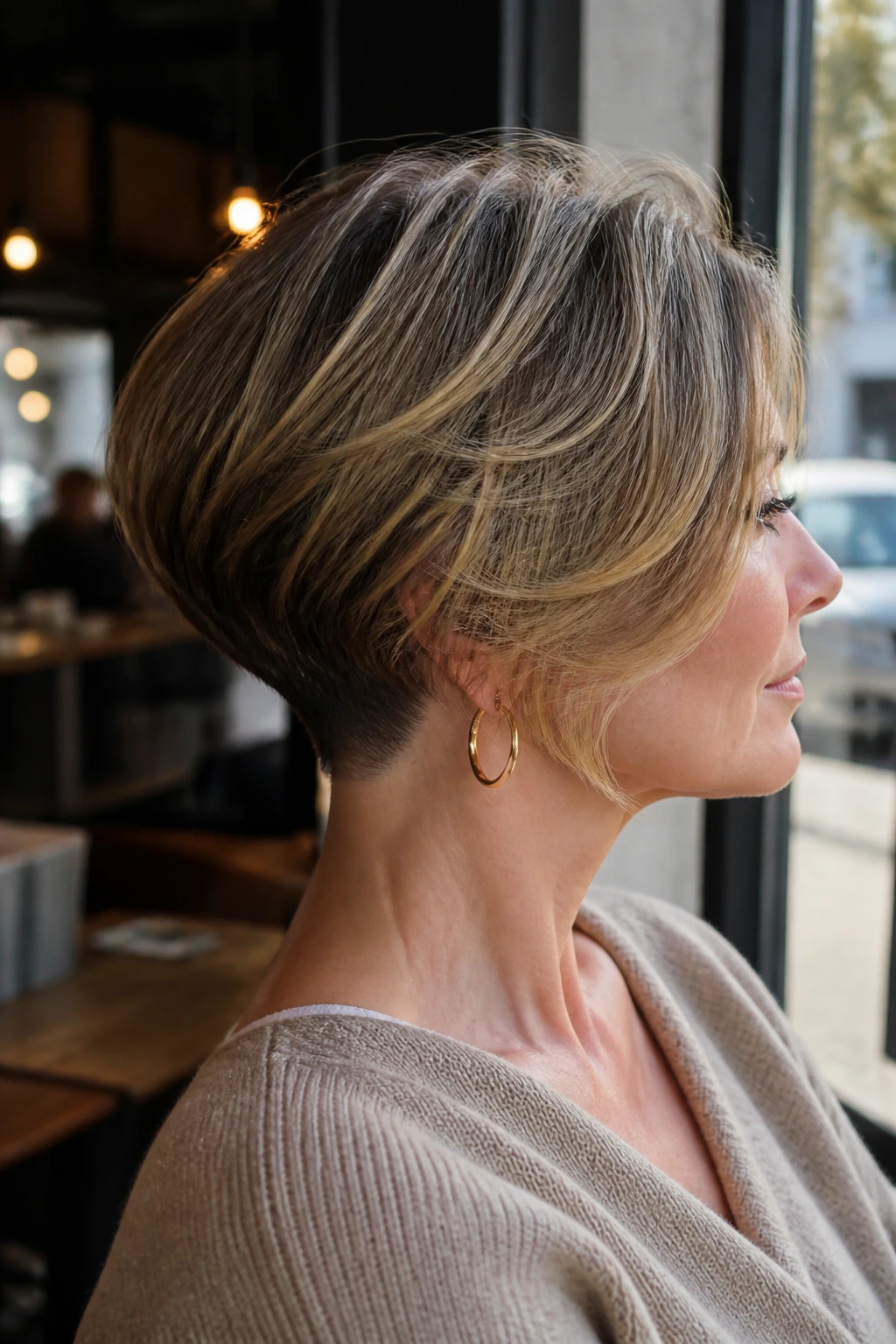
Here’s the sneaky good thing about this bob: the undercut lives where no one sees it first. The nape is trimmed close to remove bulk, which lets the top and front layers swoop freely instead of sitting heavy. That front movement matters if your hair tends to puff at the bottom or if the back of your head is dense.
The face-framing layers can be kept long enough to brush the cheekbone or jawline, which gives the cut a softer read than the undercut name might suggest. It’s especially useful for thick hair. Thick hair often wants to create a triangle; this cut keeps the silhouette lean.
Be careful with the undercut placement. Too high and you lose the subtlety. Too low and it doesn’t remove enough weight to matter. Half an inch can change the result.
20. Feathered Shag Crop
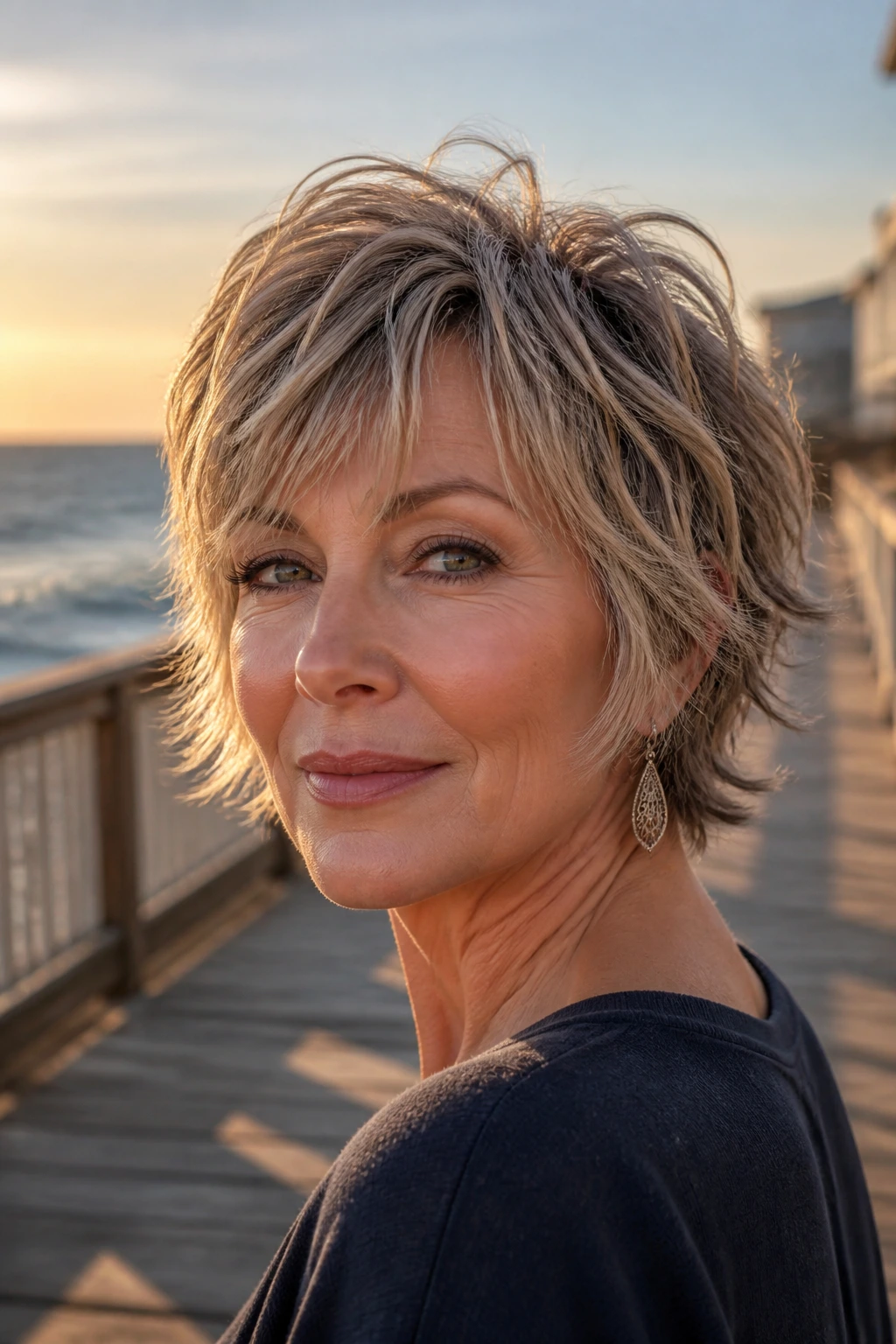
The feathered shag crop is all about movement. Short layers around the top and front keep the shape lively, while feathered ends around the cheeks soften the face in a way that feels a little casual, a little stylish, never frozen. If your hair has a wave, this cut can look especially good on day two.
It’s a strong option for hair that needs texture more than length. The layers break up thickness, but they also build lift near the front so the cheekbones don’t disappear under a solid curtain. A light styling cream or mousse is enough to get the pieces to separate without looking crunchy.
Don’t over-style the bangs. The whole point is that the cut moves a little as you do. When it’s too perfect, it loses the charm.
21. Rounded Bob with Face-Hugging Pieces
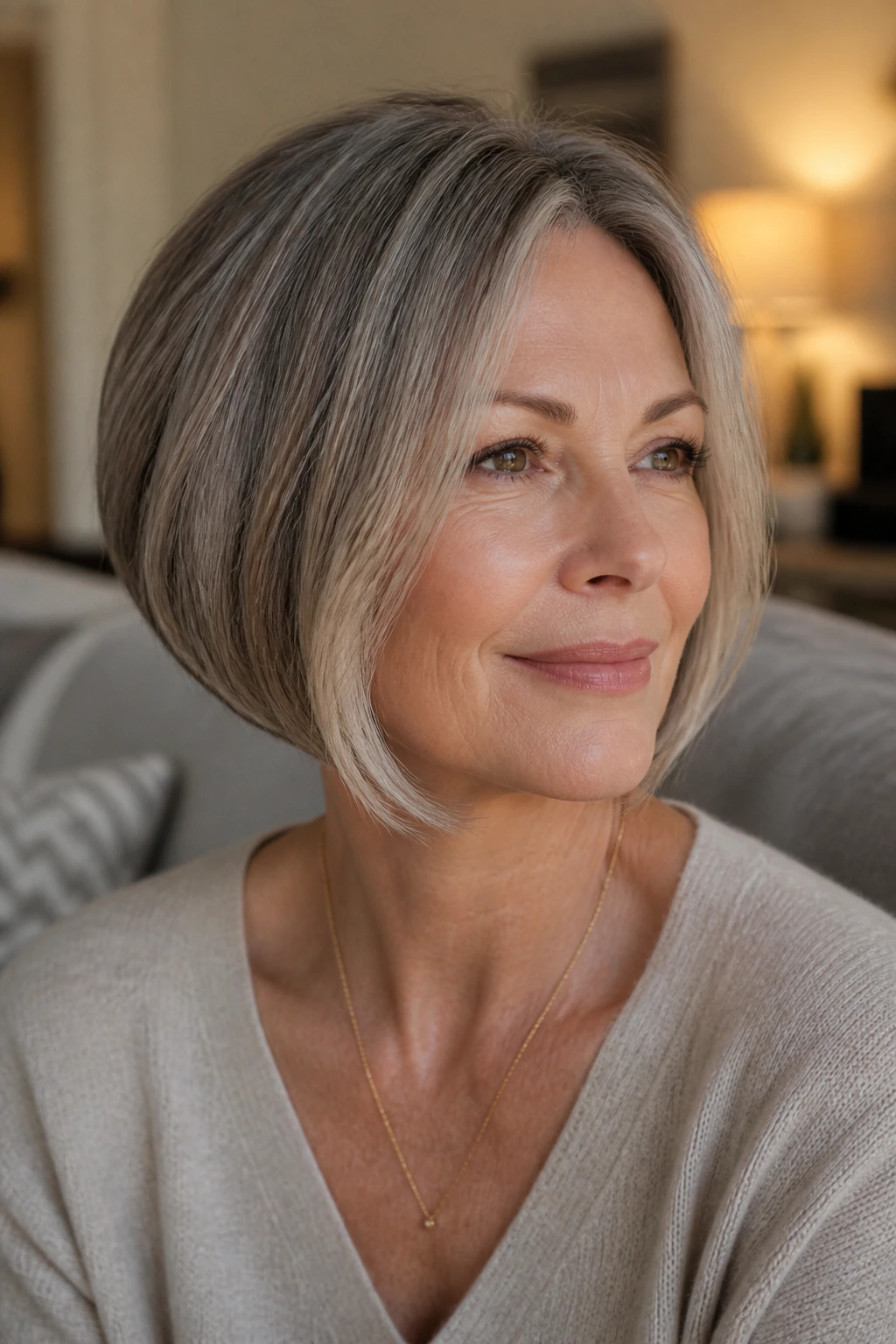
A rounded bob can be beautiful, but only if the front pieces are handled with care. The curve around the back gives the haircut a soft, polished silhouette, while the front layers hug the face and keep the line from turning too uniform. That face-hugging effect is what gives the cut warmth.
This is a good choice when you want a shape that feels controlled but not rigid. The rounded body creates structure, and the front pieces can be cut to land at the cheekbone, which gives the face a small lift. If your hair is straight, this is easy to smooth. If it’s wavy, you’ll want to use a round brush or a large brush blow-dry to keep the curve visible.
The danger here is making the whole thing too round. Keep some softness at the ends. Otherwise it starts to resemble a cap.
22. Ear-Length Brushed-Back Crop
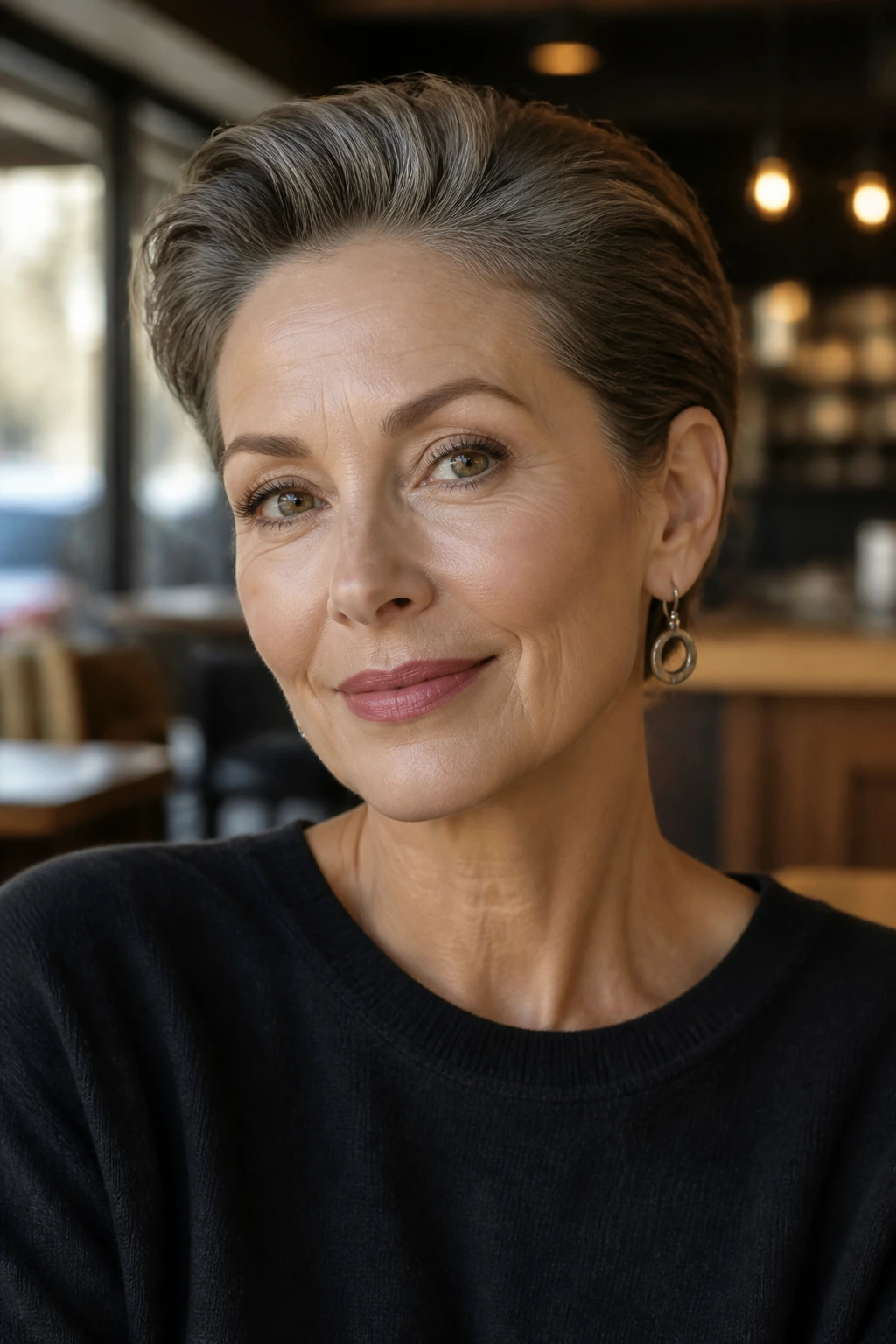
The ear-length crop is bolder than most of the cuts on this list, and brushed-back styling keeps it from feeling too severe. The front layers are left long enough to sweep away from the face, which opens the eyes and gives the cut a clean, lifted look. It can be striking on silver hair.
This cut works best when the styling is relaxed rather than shellacked. A bit of root lift and a side-to-back sweep through the front is enough. The shape exposes the cheekbones and jaw, so it’s a nice option if you like your face fully visible and your earrings to do some of the work.
It does require a bit of confidence. There’s no hiding in this shape. That’s also what makes it interesting.
23. Razored Pixie Bob
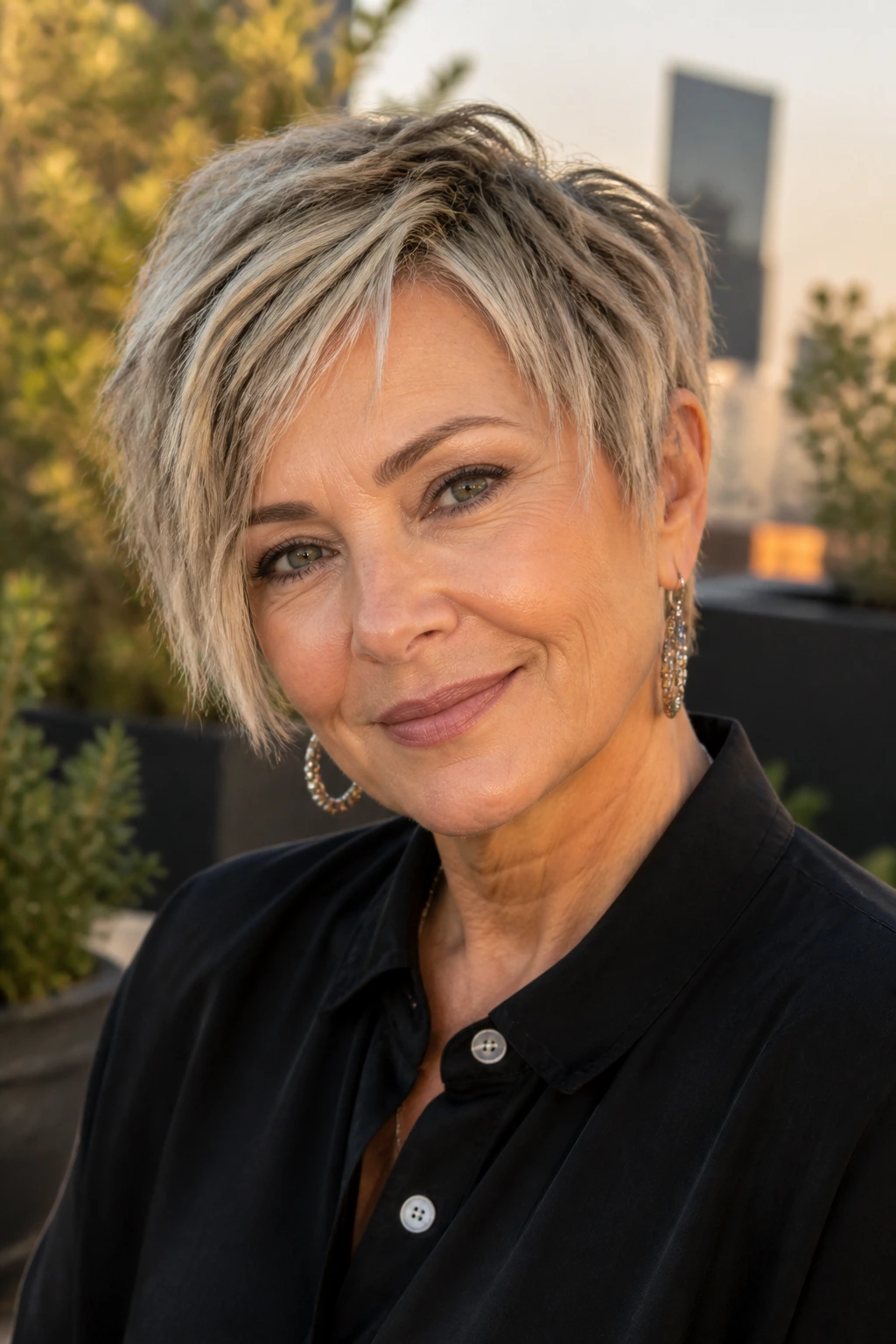
The razored pixie bob sits between a pixie and a bob, but the razor work gives it a sharper edge than the soft bixie. The front pieces can be left a touch longer, then textured so they fall in broken, light layers around the face. That keeps the cut from feeling too blunt or too boyish.
This style is good for hair that gets bulky fast. The razor removes weight in a way scissors sometimes can’t, especially around the temples and behind the ears. If your hair is fine, ask the stylist to go light with the razor so the ends don’t turn wispy and see-through.
What I like most here is the flexibility. Wear it smoothed down for a neat look, or push the front up and forward for something a little more modern. It changes character fast.
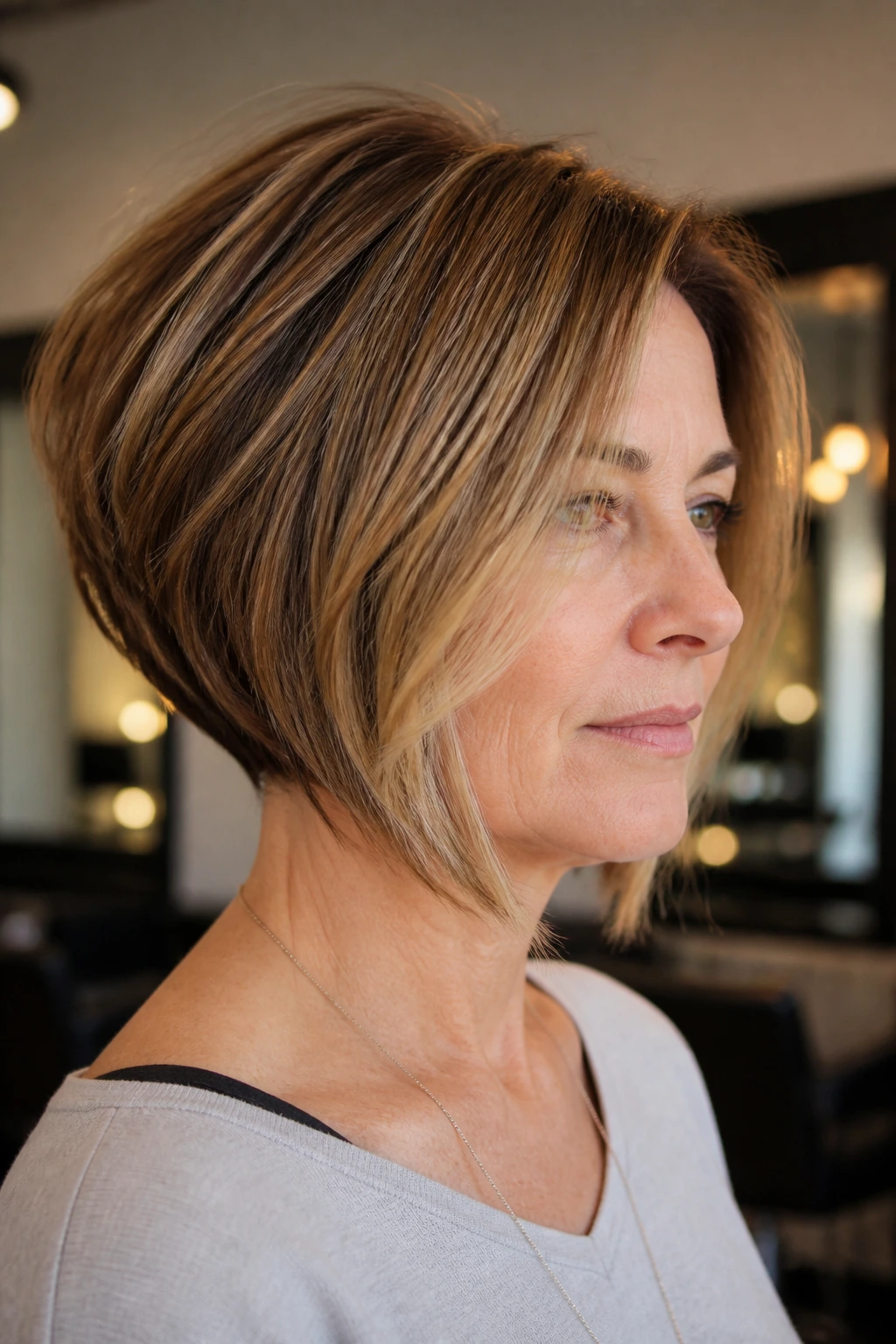
24. Chin-Length Inverted Bob
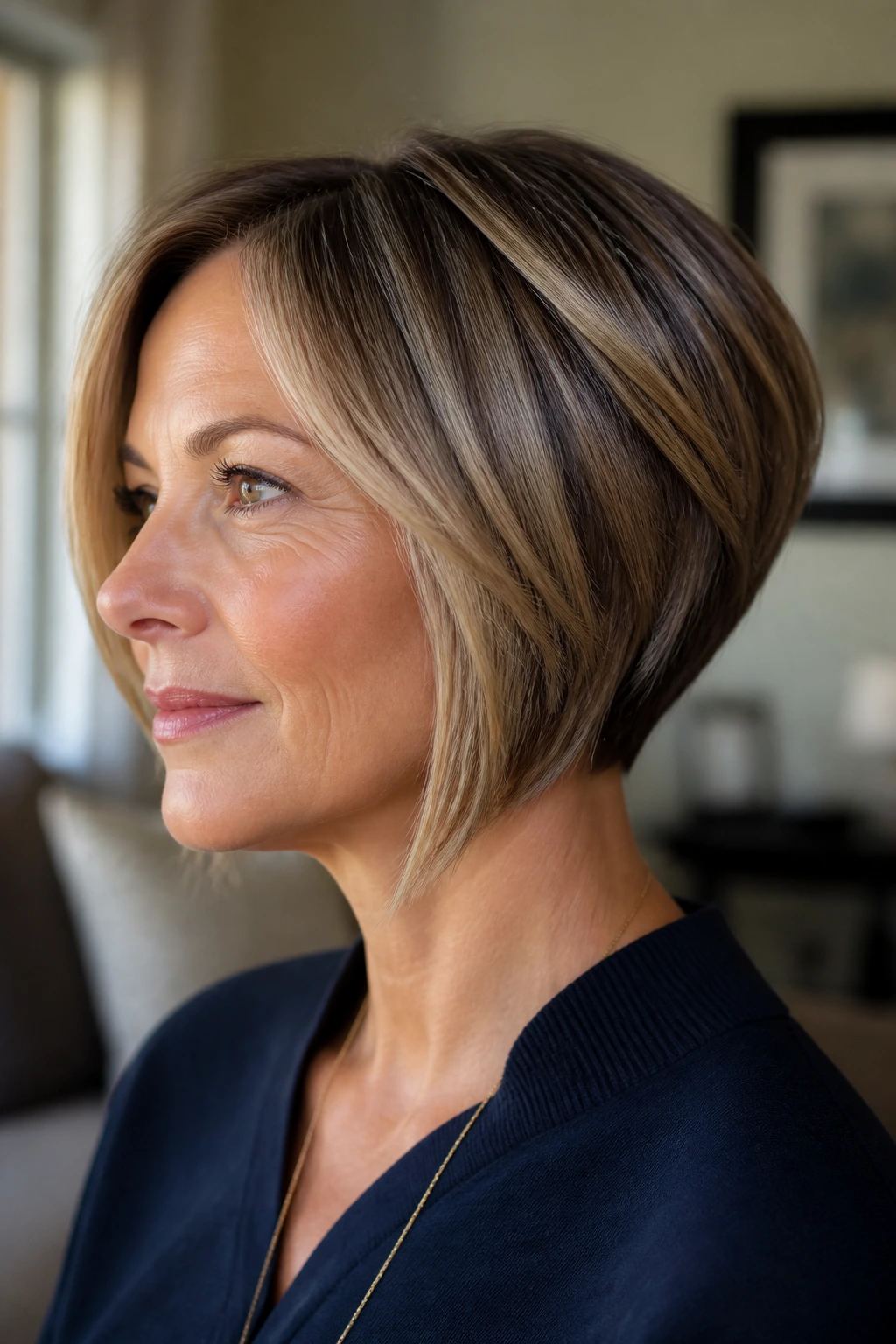
An inverted bob angles up at the back and stays longer in front, which creates a clean line through the jaw. The face-framing layers are usually cut to soften that front angle, so the haircut doesn’t feel too geometric. It’s a strong shape, but it doesn’t have to be harsh.
This cut flatters women who want the neck open and the front a little longer. The angle makes the side view look sharp, while the longer front pieces keep the face from feeling boxed in. It also works well on straight hair because the line stays visible without much styling effort.
If your hair is thick, ask for internal shaping so the front doesn’t swing too heavy. If it’s fine, keep the angle subtle. Too much dramatic graduation can leave the ends looking thin.
25. Softly Textured Crop with Nape Taper
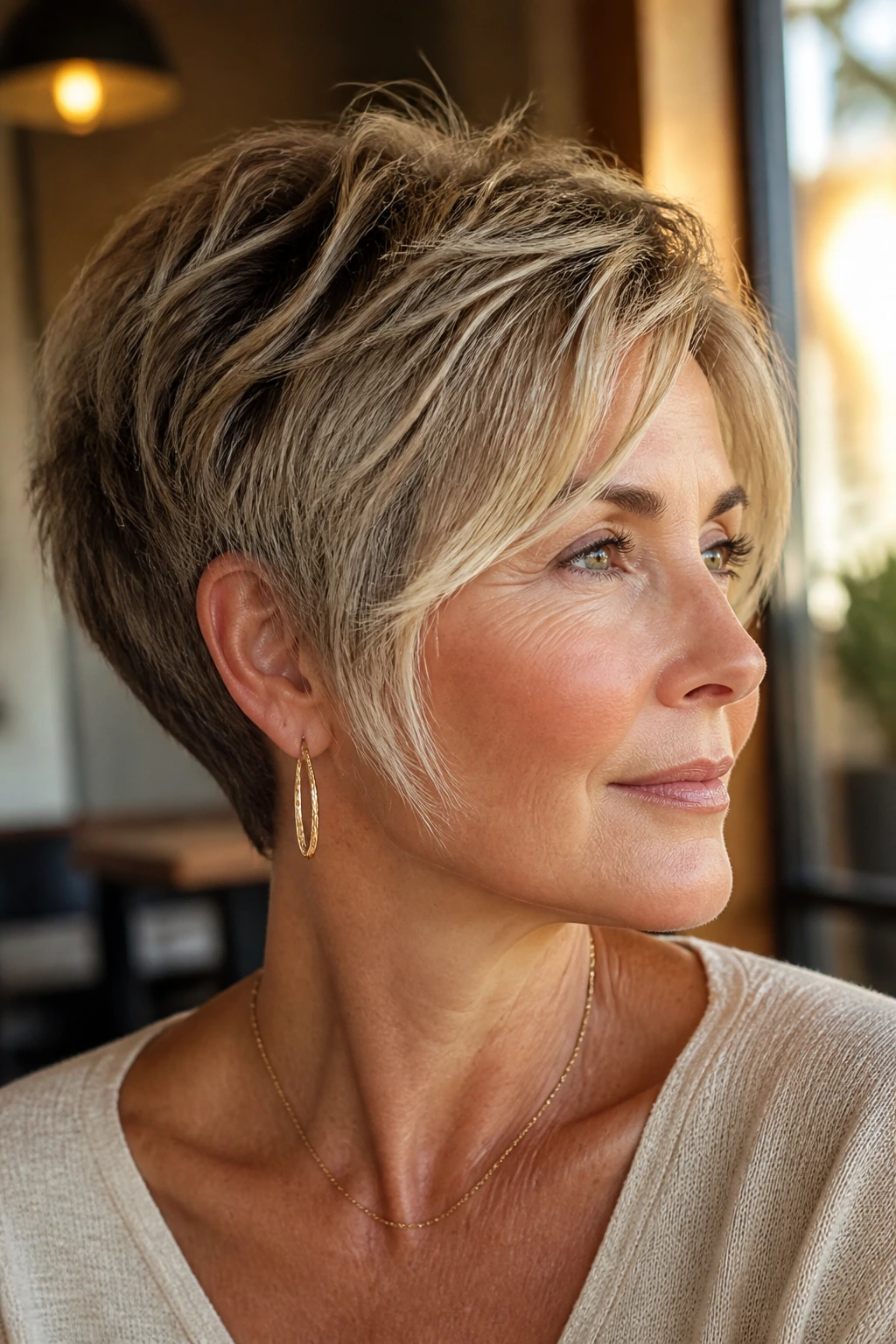
This is the one I’d point to for someone who wants short hair that behaves on ordinary mornings. The nape is tapered close, the top carries a little texture, and the front pieces are left soft enough to frame the cheekbones without demanding a round brush session every day. It’s easy, but not plain.
The taper at the nape keeps the back neat for several weeks, which helps when you’re between salon visits. The textured front keeps the cut from feeling rigid, especially if your hair grows in with a little wave or a strong crown pattern. A tiny amount of cream is usually enough.
If you want one short cut that doesn’t argue with your life, this is a good place to land. It’s not the flashiest option in the room. It doesn’t need to be.
How to Choose the Right Shape for Your Face and Hair
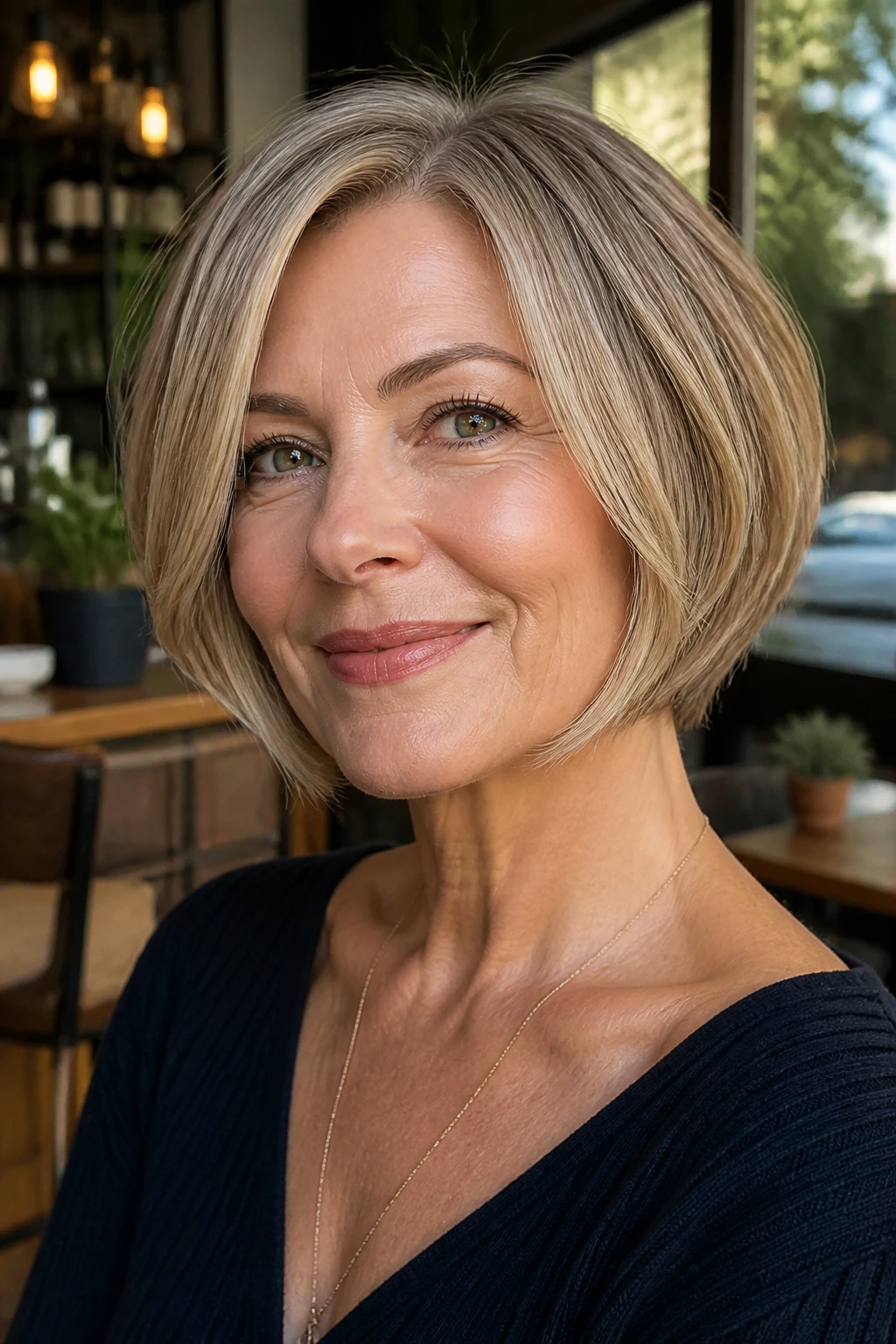
A good short haircut starts with the same question a good tailor asks: where does the shape need room, and where does it need structure? Face-framing layers are not there to hide your face. They’re there to steer the eye. A layer that lands at the cheekbone will do a different job from one that ends at the jaw, and that difference is the whole game.
Round faces usually look best with longer front pieces that create a vertical line — think angled bobs, side-swept pixies, or lob-length front sections that taper down. Square faces often soften up with curved layers around the cheek and a fringe that doesn’t end in a straight line across the forehead. Long faces usually like width and movement at the sides, so a jaw-skimming bob or a rounded crop can bring the proportions back into balance. Heart-shaped faces often want a little fullness near the jaw to offset a broader forehead.
Hair texture matters just as much. Fine hair usually behaves better with cleaner outlines and a little root lift. Thick hair needs weight removed in the right places — not all over the head, and not with thinning shears used like a rake. Wavy and curly hair usually need the front cut to honor shrinkage. If the stylist cuts the front too short while the hair is wet, the face-framing piece can vanish when it dries.
What to Ask the Stylist So the Cut Lands in the Right Place
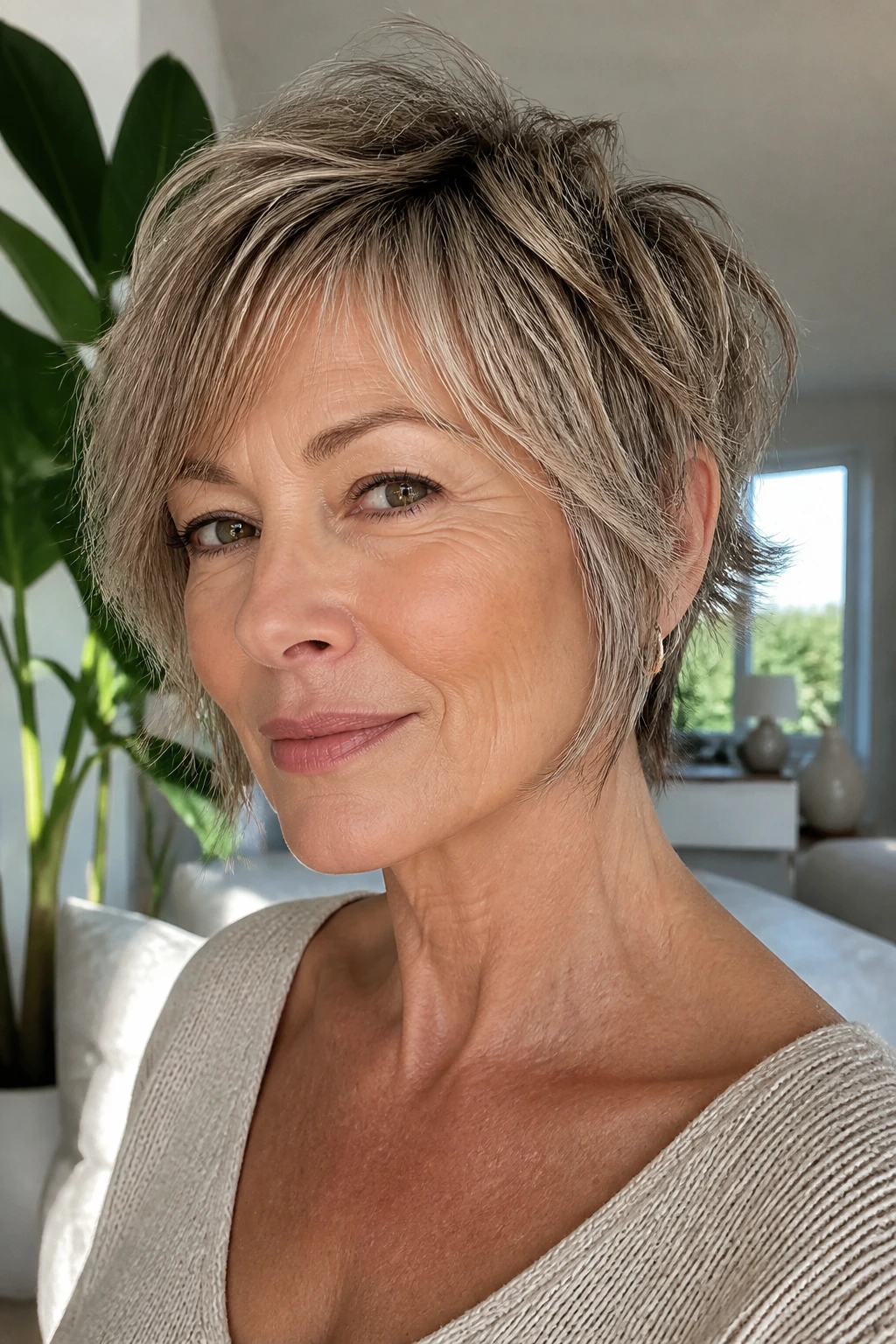
A photo helps, but a photo alone isn’t enough. What you want to say is where the shortest front piece should land when the hair is dry. Point to your face. Say cheekbone, jawline, or just below the brow. That tiny bit of language is more useful than asking for “something soft.”
Say how you wear your hair. If you tuck one side behind your ear every day, mention it. If you wear glasses, say where the frame sits on your face. A cut that looks pretty when all the hair is hanging forward can become fussy once the sides are tucked back or pushed behind the temples.
Talk about your trouble spots. Cowlick at the hairline? Crown that goes flat? One side grows faster? Those are not side notes. They determine where the layers should start and how short the front can go without misbehaving.
Be honest about styling time. If you’re willing to blow-dry for seven minutes, say so. If you want air-dry and go, say that too. A layered pixie designed for a round brush will not feel like the same haircut if you let it dry untouched. Hairdressers know this. Sometimes clients don’t say it out loud.
Styling Tools That Earn Their Place on the Counter
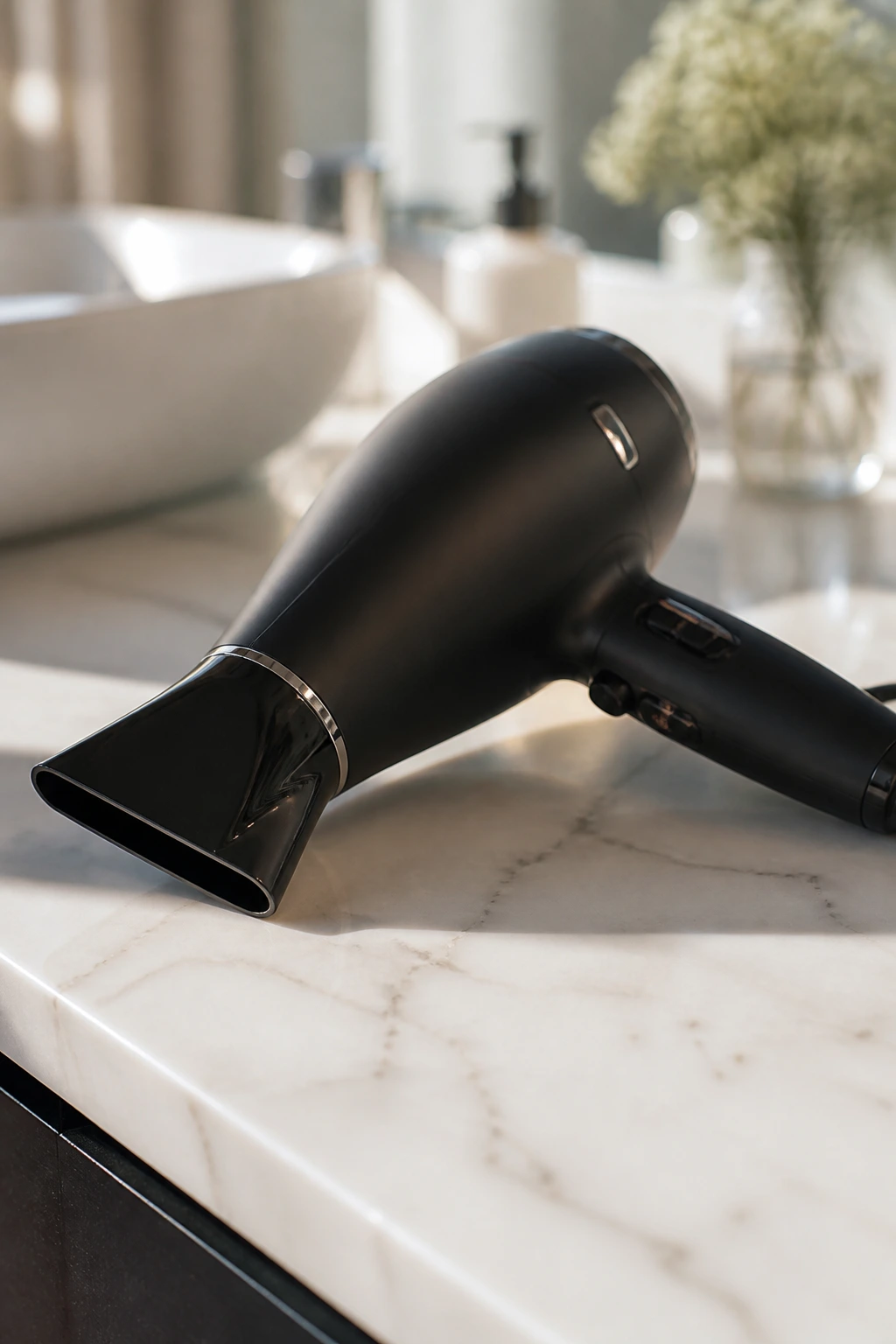
- Blow-dryer with a concentrator nozzle: The nozzle keeps air moving in one direction, which matters when you’re trying to smooth short front layers instead of blasting them apart.
- Small round brush, 1 to 1.5 inches: Best for lifting the fringe, bending the front under, and giving a pixie or bob a little curve at the ends.
- Paddle brush: Useful for quick smoothing on chin-length bobs, lobs, and stacked shapes that need less sculpting.
- Texturizing spray: Helps piece out the front and crown on shaggy cuts, bixies, and feathered crops without making the hair sticky.
- Light mousse or root lift spray: Good for fine hair that needs support at the crown before the blow-dry starts.
- Cream or light pomade: A pea-size amount can calm flyaways around the temple and nape, especially on short cuts with softer edges.
- Heat protectant: If you use a dryer, round brush, or flat iron, this is not optional. Short hair can still get fried, and the damage shows fast.
A good set of tools does not need to be expensive. It needs to match the haircut. That’s the real test.
How to Keep the Shape Between Salon Visits
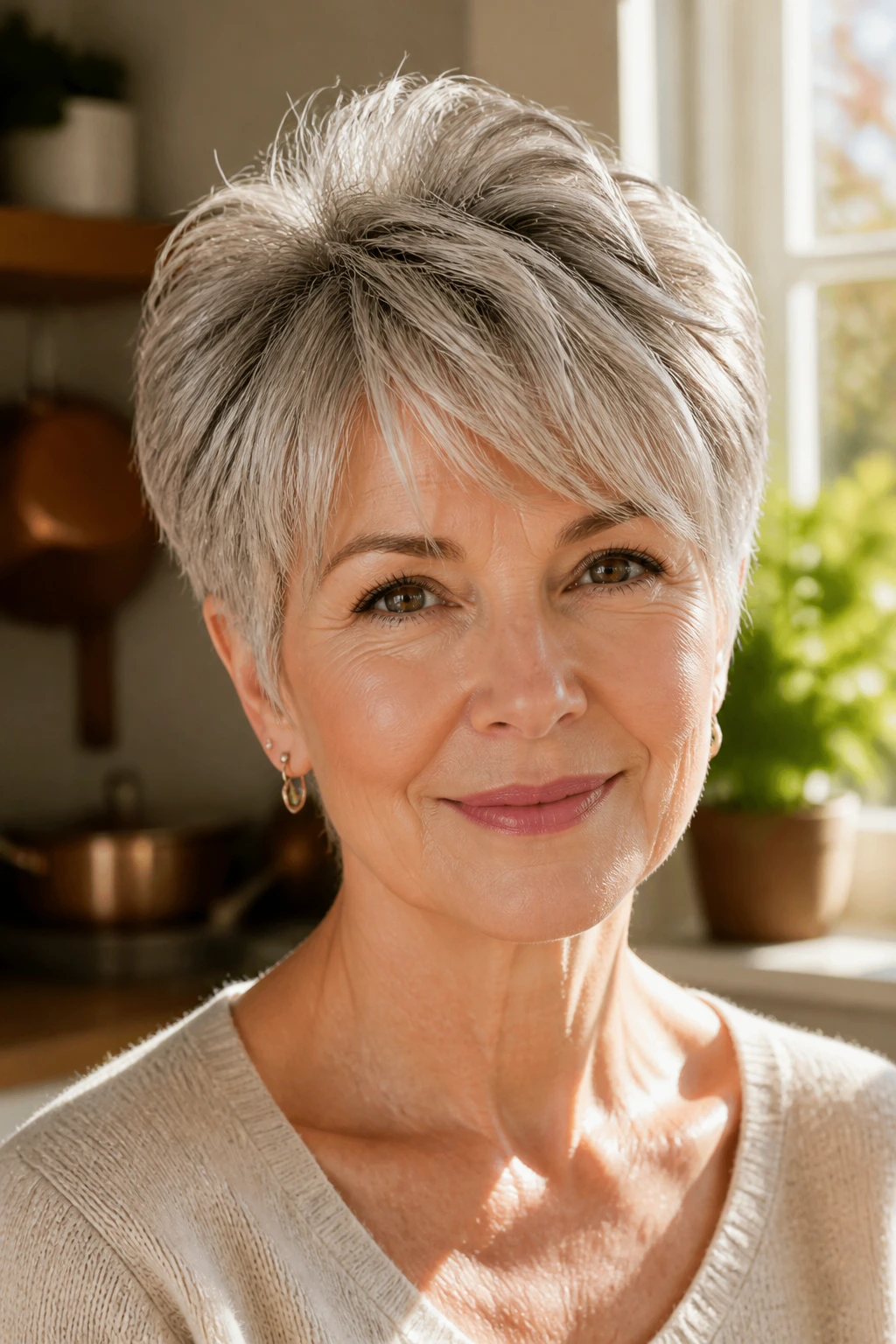
Short hair grows louder than long hair. A quarter-inch on a pixie can change the whole balance. That’s why the maintenance schedule matters more here than with longer cuts. Most pixies and crops need a shape refresh every 4 to 6 weeks, especially if the front pieces are part of the design. Bobs and lobs can usually stretch to 6 to 8 weeks, sometimes a little longer if the cut is soft and layered.
The front pieces are the first things to go off. A fringe that sat at the cheekbone can suddenly sit in the eyes. A cute side sweep can turn into a stubborn flap by the third week. If you’re comfortable doing a tiny trim at home, keep it to the fringe only and use sharp hair scissors. The rest should stay in the chair.
Sleeping on short hair can flatten the crown and bend the front pieces in odd ways. A satin pillowcase helps. So does a quick mist of water at the roots and a fingertip lift in the morning. For textured hair, a little leave-in conditioner on the front pieces can revive the shape without starting over from scratch.
Common Mistakes That Flatten the Cut

The first mistake is asking for “layers” without naming where those layers should land. That sounds harmless, but it often leads to a cut that’s short everywhere and flattering nowhere. If you want face-framing, point to the cheekbone, jaw, or temple.
Another common miss is cutting the front too short. Very short front pieces can look sharp for one week, then suddenly feel harsh or fussy as they grow. Leave the front a touch longer than you think you need. Hair always springs up more than people expect.
Over-thinning the ends is another one. The symptom is easy to spot: the haircut gets fluffy and frayed instead of light and clean. That happens most often on thick hair. The fix is point cutting or careful internal shaping, not aggressive thinning shears through the whole head.
A fourth problem is ignoring the crown. A beautiful bob can still look flat if the top is too dense or too heavy. A little lift up there changes the balance. Not a teased nest. Just enough support to keep the silhouette from sinking.
Finally, people often style the front too stiffly. Short hair with face-framing layers usually wants movement. If the front pieces are glued into place, the cut loses the very softness you paid for.
Variations and Alternatives to Try

The Silver-Soft Version
This one leans into gray, white, or salt-and-pepper hair and uses airy front layers to keep the shape light. It works especially well when the color is dimensional rather than fully flat, because the layering catches the natural shifts in tone.
The Curly-First Version
Here, the cut is shaped around curl pattern instead of straight-line precision. The front stays longer, the sides are softened, and the stylist avoids cutting it too short while wet. That keeps the face-framing pieces visible after the curls bounce up.
The Glasses-Friendly Version
This variation places the shortest point of the front just above or just outside the frame line. It keeps hair from crowding the temples and stops the cut from fighting your glasses every morning.
The Low-Heat Version
For women who do not want to spend time with a brush and dryer, this version is built around air-dry texture. The layers are cut to fall into place with a little cream or mousse and a quick finger comb.
The Fuller-Hair Taper
Thick hair needs bulk removed in specific zones — usually the nape, behind the ears, and sometimes through the internal front layers. This keeps the face-framing pieces soft without turning the whole cut into a triangle.
Tools and Reference Pieces Worth Having
- A few saved photos from the front, side, and back: One salon photo is not enough. Short cuts change character from every angle.
- A hand mirror: Useful for checking how the nape and sideburn layers sit at home.
- Hair scissors, if you trim your fringe yourself: Only for tiny touch-ups, never for reshaping the whole cut.
- Clips: Helpful when you want to dry just the front pieces with a brush.
- A wide-tooth comb: Gentle on texture and good for distributing product through short layers.
- A clarifying shampoo: Useful once in a while if styling creams and sprays start weighing the cut down.
- A purple shampoo, if your silver hair needs it: It can keep white or gray hair from going dull or yellowed, as long as you do not overuse it.
How to Make the Cut Work on Busy Mornings
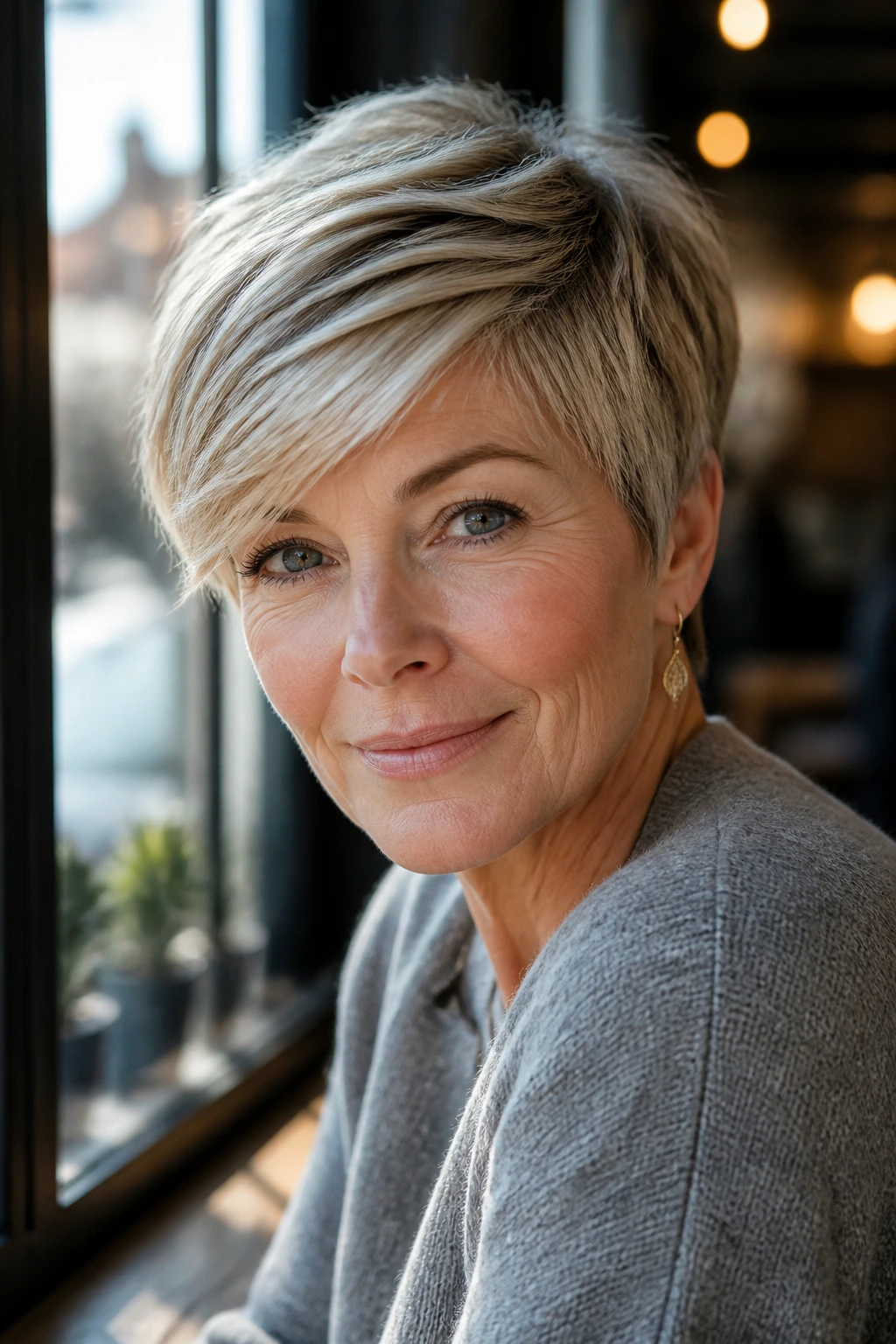
A short layered cut does not need a full styling ritual, but it does need a plan. For fine hair, prep the roots with mousse, then rough-dry to 80 percent before shaping the front with a small brush. For thick hair, dry the crown first so the weight doesn’t drag the top flat. For wavy hair, scrunch in a light cream and only smooth the face-framing pieces if they land strangely. For curly hair, stop trying to make every curl obey. Shape the front, define the top, and let the back behave like itself.
A 5-minute routine is usually enough when the cut is right. Water to reset. A little product where it matters. A brush only on the front if needed. That’s the line between a haircut that lives in your bathroom and one that makes your mornings harder than they need to be.
Frequently Asked Questions

Which short haircut is most flattering for thinning hair?
A soft pixie, feathered crop, or textured bixie usually gives thinning hair the most lift without exposing too much scalp. The trick is keeping the front layers light and placing the bulk where it adds shape, not where it shows every sparse spot.
Do face-framing layers work with glasses?
Yes, and they often work better than blunt short cuts. The key is to keep the shortest front piece just outside the frame line so the hair and glasses do not compete around the temples.
Are bangs a bad idea after 50?
Not at all. The better question is what kind of fringe works with your hairline and styling habits. Side-swept bangs, curtain bangs, and longer wispy bangs often look easier than a short blunt fringe that needs daily attention.
How do I stop a short cut from puffing out at the sides?
Ask for internal shaping and keep the perimeter cleaner. Then use less product than you think you need — too much cream or spray can make the sides swell up, especially on thick or wavy hair.
What if my hair is curly and shrinks a lot?
Leave the face-framing pieces longer than you would on straight hair, and ask for the cut to be shaped with the curl pattern in mind. Dry cutting or cutting mostly dry helps the stylist see where the curl will actually land.
How often should I trim a pixie or short bob?
Pixies and crops usually need a trim every 4 to 6 weeks to keep the front and nape neat. Bobs can stretch a little longer, usually 6 to 8 weeks, depending on how fast your hair grows and how exact the shape is.
What should I ask for if I want low-maintenance hair?
Ask for a cut that looks good air-dried and tell the stylist how many minutes you want to spend styling. That single sentence can change the whole haircut. A low-maintenance cut is not just about length — it’s about where the layers sit.
Can I grow one of these cuts out without looking awkward?
Yes, if the front is cut with some softness instead of a hard line. A well-shaped pixie or bob can grow into a shaggy bob, a longer bob, or a soft crop without a painful in-between stage.
The Shape That Keeps Working
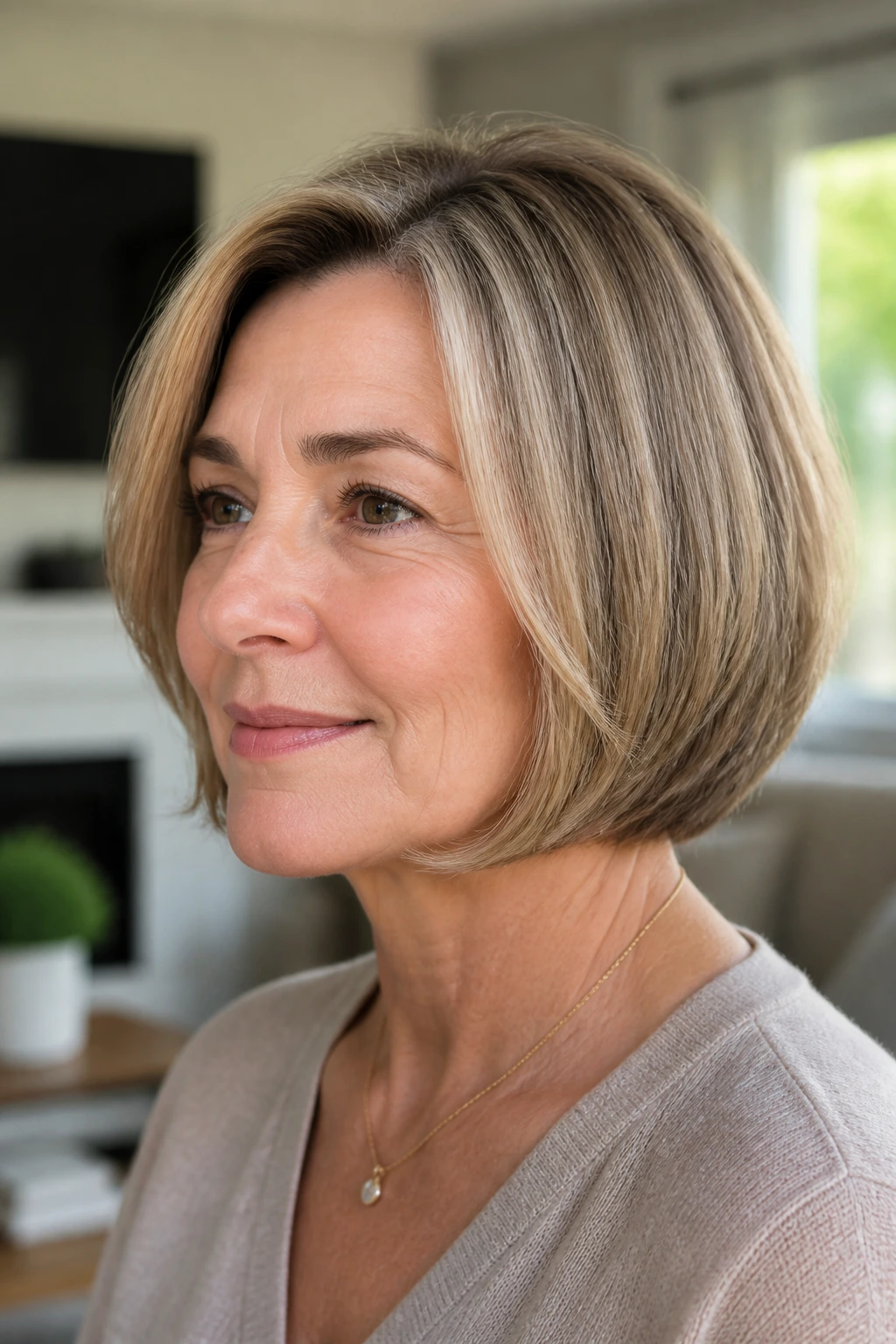
The best short haircuts for women over 50 with face-framing layers do one thing well: they make the front of the cut matter. A cheekbone layer, a side sweep, a soft curve at the jaw — those are not tiny details. They’re the part that keeps a short haircut from feeling blunt, flat, or fussy.
I like cuts that do their job quietly. The ones that look better after a quick finger comb, not only after a 20-minute styling routine. If you choose the shape with your face, hair texture, and daily habits in mind, the haircut starts doing some of the work for you. That’s the real win.