



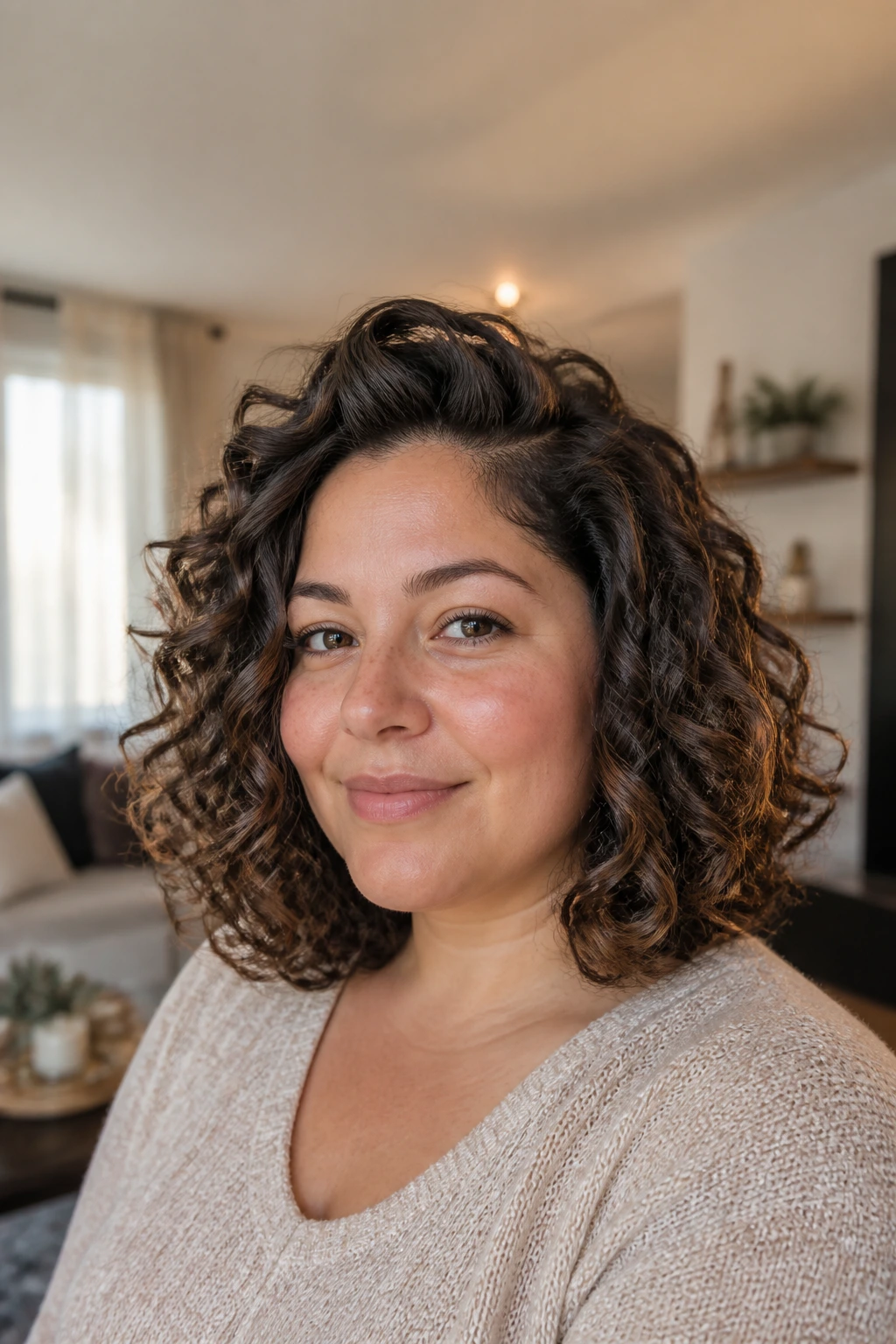
A side-swept lob for round faces with curly hair does a very particular kind of flattering work. It draws the eye diagonally, lets the curls move instead of ballooning straight out from the cheeks, and keeps the whole shape from landing in that awkward “too short to be sleek, too long to be shapeless” zone. When it’s cut well, the front falls across the face with intention; when it’s cut badly, it turns into a puffed-out triangle or a heavy curtain that hides the cheekbones and gives nothing back.
The length matters more than people think. On curly hair, a lob that looks shoulder-skimming when wet can spring up two inches or more once it dries, which is why the sweet spot usually lives between the collarbone and the top of the shoulders. That extra room gives the curls space to form without sitting right at the widest part of the face. And the side sweep? It should feel like a diagonal line, not a comb-over. Soft. Lived-in. Slightly off-center, never stiff.
I’ve always thought this cut works best when it respects the curl pattern instead of fighting it. A lot of round-face haircut advice leans too hard on “make everything longer.” That’s lazy. The better move is to keep the silhouette open at the front, build controlled shape through the ends, and let one side carry a little more visual weight than the other. That’s where the magic is. The styles below cover the full range, from loose waves to tighter coils, because curly hair is not one texture. It never has been.
Why These Side-Swept Lobs Work on Real Curls
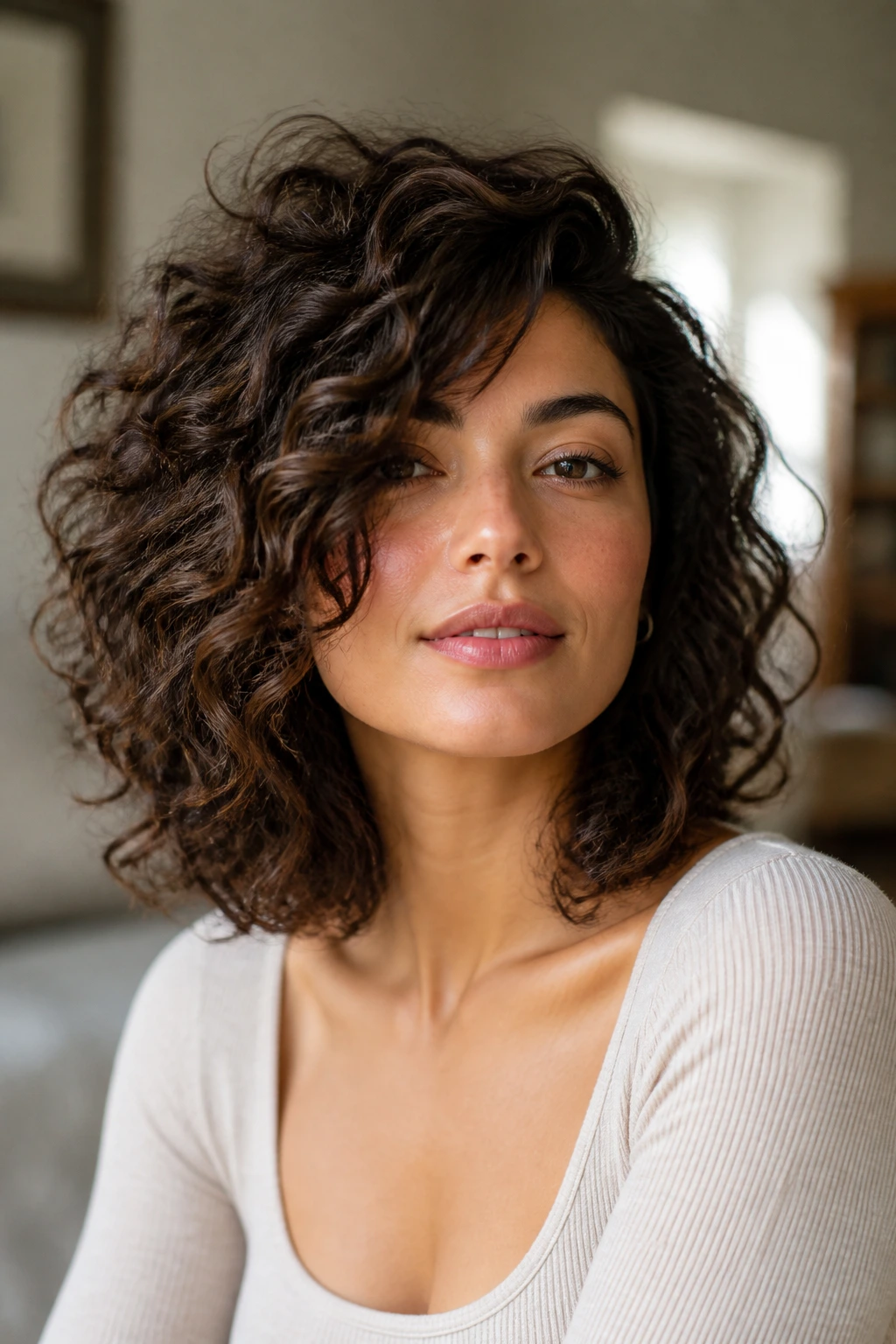
Diagonal lines do the heavy lifting. A side part and a sweep across the forehead pull the eye from temple to jaw instead of letting it sit on the width of the cheeks.
Length below the widest point helps. When the lob lands at the collarbone or slightly lower, it skips the exact spot that makes round faces look broader.
Curl spring changes the cut. Curly hair shrinks as it dries, so the best lobs are usually cut a touch longer than straight-hair versions.
The shape can be soft without going flat. You do not need a harsh asymmetry to get the effect. A few longer front pieces often do more than a dramatic angle.
This cut plays well with texture. Loose waves, springy ringlets, and tighter coils all work here if the layers are placed with the curl pattern in mind.
1. Deep Side-Part Lob with Long Face-Framing Pieces
This is the cleanest version of the side-swept lob, and I like it because it does not try too hard. The part sits well off center, usually just past the arch of one eyebrow, and the longer front pieces skim the cheekbones before dropping toward the collarbone. On a round face, that diagonal is doing real work. It breaks the width at the cheeks and gives the eye a place to travel.
The best version keeps the back only a little shorter than the front. You want enough difference to create movement, not so much that it starts looking like two different haircuts. If your curls spring up strongly, ask for the front to be left about 1 to 1.5 inches longer than where you want it to land when fully dry.
Best for: medium to tight curls that need a little structure.
How I’d style it: side part, light curl cream, then a stronger gel just on the front sweep so it falls in one polished curve instead of puffing out.
A one-sentence truth: the front pieces should bend, not buckle.
2. Collarbone Curly Lob with Soft Underlayers
This one is for people who want shape without obvious layering. The length kisses the collarbone, which gives a nice vertical line on a round face, and the underlayers remove bulk from the inside rather than slicing the surface apart. That matters. Too many curly cuts create a halo of width because every layer is visible; this version hides the architecture a bit better.
The side-swept effect comes from the part and the way the front is directed during styling. The hair should fall forward over one eye, then loosen into soft curls around the jaw. If your curls are dense, this is a smart choice because it keeps the perimeter full while taking some weight out beneath the top layer.
Why it works: the underside moves, but the outer shape stays smooth.
Ask for: long internal layers, no blunt chin line, and the longest point grazing the collarbone.
A little caution: if the underlayers are too short, the cut starts to kick out at the sides. That’s the thing to avoid.
3. Off-Center Lob with a Curly Curtain Sweep
Why does this one flatter round faces so well? Because it borrows a curtain-bang idea without committing to a full fringe. The part is only slightly off center, but the front sections are long enough to split and sweep across the forehead in soft arcs. The effect is lighter than a deep side part and more relaxed than a centered style.
I like this shape on curls that clump well on their own. You get a little movement at the front, a little opening around the eyes, and no hard line at the cheek. The cut itself doesn’t need to be extreme; the styling does the talking. Keep the front pieces just below cheekbone level and let the ends taper toward the jaw.
How to style it
Use a palmful of leave-in, then add a mousse at the roots only on the sweep side so the hair has enough lift to fall over, not collapse downward. Diffuse on low heat until the part is set, then finger-separate only the front pieces.
That last part matters. Touching the front too much kills the sweep.
4. Side-Swept Lob with a Tucked-Behind-One-Ear Finish
This cut looks especially good when you like a bit of asymmetry with your clothes and earrings. One side is left loose and full; the other is tucked behind the ear so the face gets a sharper diagonal line. On a round face, that contrast is useful because it trims the visual width on one side without chopping the hair off.
I’ve always found this style works best when the curls are medium-sized and springy, not too tight and not too loose. The tucked side should still have enough length to show movement near the jaw. If the hair is cut too blunt at chin level, the tuck can expose the width you were trying to hide. Keep the perimeter just below the chin, and better yet, near the top of the shoulder.
- Good for: glasses, statement earrings, and curls that hold shape.
- Ask for: a lob with enough front length to tuck without exposing the ear line.
- Style with: a light gel on the loose side and a softer cream on the tucked side.
Simple fix. Leave one side imperfect on purpose.
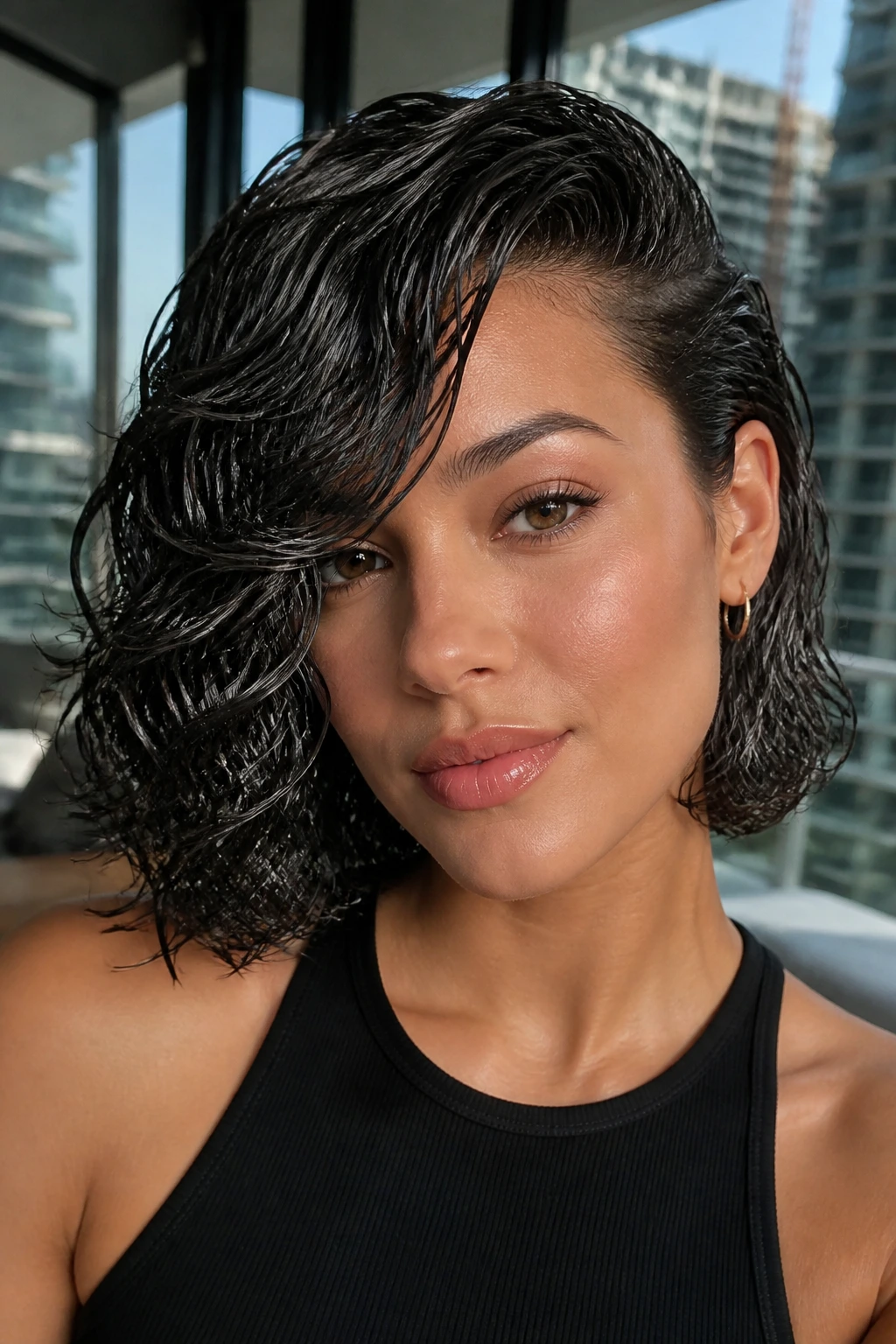
5. Sculpted Wet-Look Lob with a Side Sweep
This is the boldest style in the group. It works because the glossy finish compresses the width at the cheeks and turns the side sweep into one clean shape instead of a cloud of separate curls. On round faces, that polish can be a relief. There’s less visual clutter, more line.
It’s especially flattering for tighter curls or coils when you want definition for an event. The hair is parted deeply, smoothed close to the scalp at the top, then encouraged to curve over the forehead and down one side. I would not use this every day unless you enjoy reworking your hair in the mirror. It takes product and intention.
Good details to ask for
- Length that lands between the collarbone and shoulder.
- Soft layers only at the ends.
- Enough front length for a visible sweep, usually at least cheekbone level when dry.
The whole point is clean curves. If the roots are too fluffy, the style loses the slick line that makes it special.
6. Rounded Lob with a Lifted Crown
A round face does not need more roundness. Agreed. But a lifted crown changes the silhouette in a good way, because it adds height where the face is shortest and keeps the sides from carrying all the width. This lob stays soft at the ends while the top is encouraged upward with root clips or a diffuser.
I like this on curls that go flat at the scalp but bloom strongly at the ends. The cut should remove a little weight near the crown without stacking it aggressively in the back. If the crown is too short, the hair can puff; if it’s too long, the lift disappears. You want the middle road.
This version feels a little more playful than the sleeker lobs. It has bounce. It has air. And it doesn’t need a perfect part. A slight off-center line is enough.
Best fit: 3A to 3C curls that need more top lift than side width.
7. Razor-Soft Lob with Interior Movement
A razor-soft lob can be lovely on curly hair, but only when the stylist knows where not to cut. The ends look feathered, not shredded, and the shape moves in a way that feels loose around the face. On a round face, that softness helps because there are no blunt edges landing straight across the cheeks.
This is the kind of cut that looks casual until you see it dry. Then the layers fall into place and the side sweep happens almost by itself. It suits looser curls and waves especially well, since too much texture in the blade work can make tighter curls frizz at the ends.
What to request: interior layers, soft perimeter, no aggressive texturizing near the front.
A small opinion: if your hair already frizzes easily, skip heavy razor work near the face. The shape will thank you later.
8. Curved-End Lob with a Side-Swept Front

Here the ends are the whole story. They curve inward just enough to stop the hair from kicking out at the sides, which is one of the fastest ways to make a round face look wider. The front stays longer and is directed diagonally across the face, while the rest of the lob forms a soft U-shaped outline.
That shape is useful because it keeps the eye moving down instead of out. It works particularly well on curly hair that has a little bend but not a ton of density. If the hair is very thick, the curved ends can become bulky unless the inside is opened up a little.
- Parting: slightly off center.
- Length: collarbone to shoulder.
- Front: cheekbone to jaw-grazing, depending on shrinkage.
I prefer this when someone wants a cut that still looks good on day three. The curve stays visible even after the curl pattern loosens a bit.
9. Flipped-Under Lob with a Soft Sweep
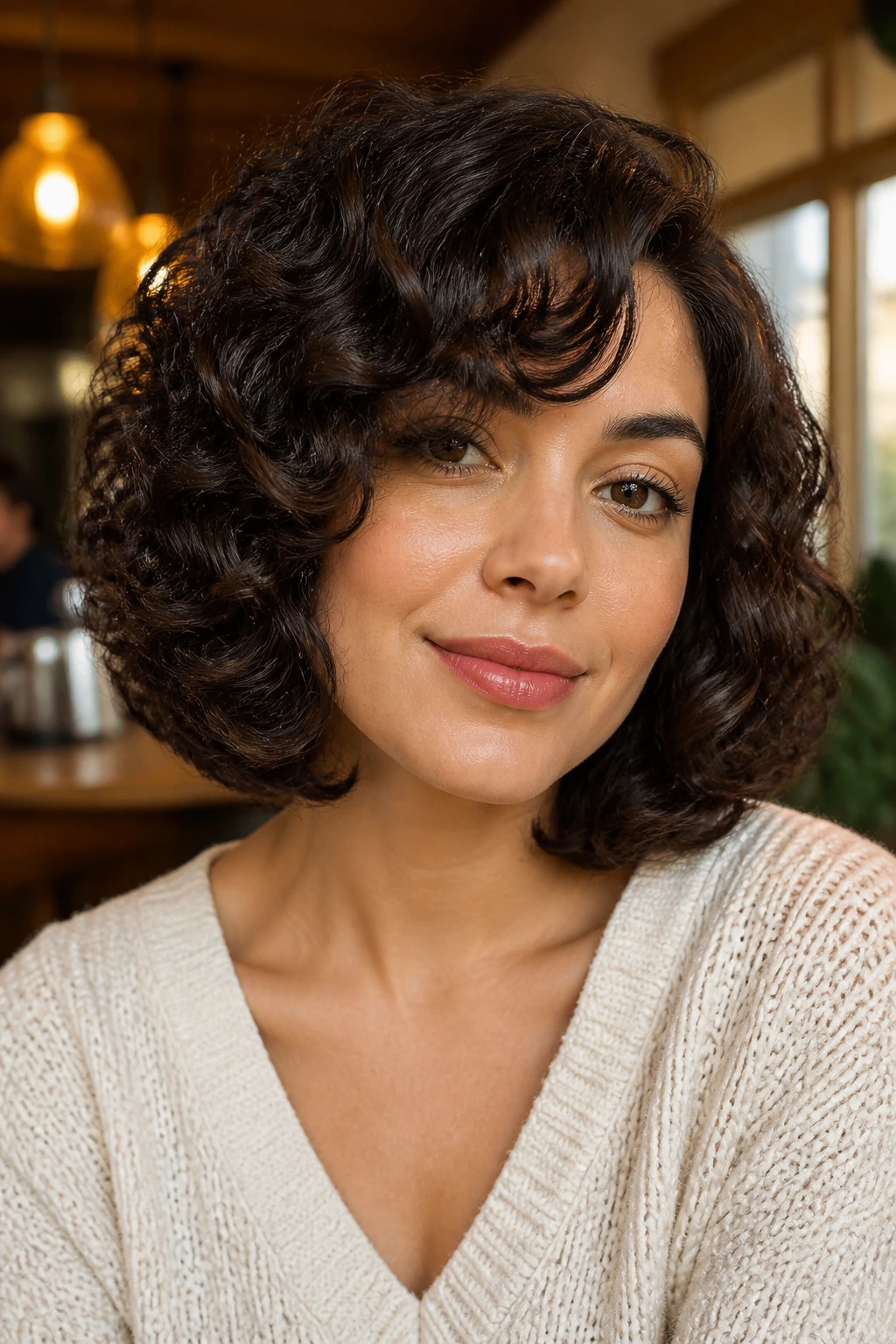
This one has a little retro polish, and I’m a fan of that. The ends tuck under rather than fanning outward, which makes the silhouette neater around the jaw. The side sweep keeps it from feeling too neat, though. It’s the contrast that makes it work.
Think of it as a lob with a controlled bottom edge. The curls at the front are encouraged to fall across the forehead, while the lower section bends under near the shoulders. If your curls are coarse or dry, a small amount of smoothing cream on the ends helps a lot. Use too much, and the movement disappears. Use too little, and the ends frizz outward. Tricky, yes. Worth it, also yes.
Best for: people who want a polished finish without going straight hair.
10. Cheekbone-Grazing Lob with Light Layers

Some styles are subtle enough that you only notice what they’re doing after you stare at them for a minute. This is one of those. The front pieces land right at the cheekbone, which sounds risky on a round face, but the trick is that they’re soft and separated, not heavy. They frame the face like side curtains instead of bars across a window.
The rest of the lob stays fairly clean, with light layers that remove bulk without chopping the shape apart. If your curls are dense, this can prevent that wide shelf effect around the cheeks. If your curls are fine, keep the layering lighter still so the ends don’t look thin.
A useful rule
If the front piece lands at the cheekbone, the rest of the cut should fall below the jaw. That balance keeps the face framed, not boxed in.
11. Off-Center Lob with a Low Side Part

This style is a little calmer than a deep side part. The part sits low and off center, which makes it more wearable if your scalp does not like dramatic part shifts or if one side of your hair has a stubborn cowlick. The result still gives you the diagonal line, just without the big swoop.
It’s a nice option for people who wear curly hair every day and want something that behaves in messy weather. The hair can be air-dried, clipped at the roots, or diffused with a diffuser attachment. No elaborate setup. No hard edge.
- Works with: looser curls, waves, and fine curly hair.
- Ask for: a balanced lob with a slightly longer front on the heavier side.
- Avoid: a straight-across perimeter at chin length.
That last point matters more than people admit. A blunt chin line is the enemy of this entire shape.
12. Collarbone Lob with Long, Loose Ringlets
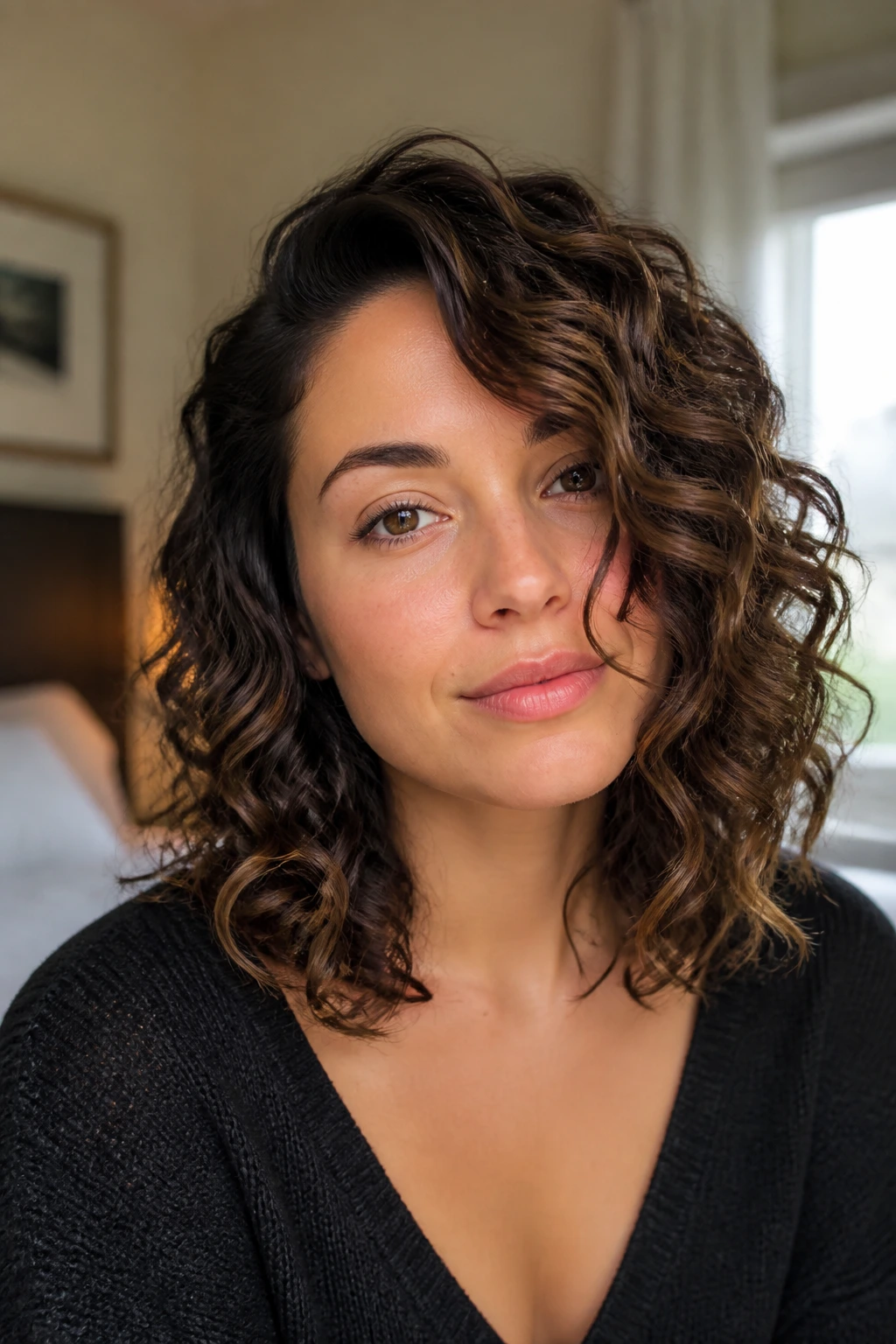
This version is for the curl pattern that likes to stretch and fall in long loops. The lob lands at the collarbone, but the ringlets themselves form a pretty, vertical line that keeps the face from feeling too wide. The side sweep can be gentle here — not a big dramatic fall, just enough direction to guide the eye.
I like this cut when a client wants movement but not a lot of visible layering. The ringlets do most of the work. If the curls are healthy and hydrated, this shape can look expensive in the best sense of the word: rich texture, easy movement, no fussed-up finish.
What makes it stand out
- The front isn’t overworked.
- The side part keeps the shape directional.
- The collarbone length gives the curls a place to settle.
It’s quietly strong. Sometimes that’s the smartest haircut in the room.
13. Side-Swept Lob with Airy Root Clips
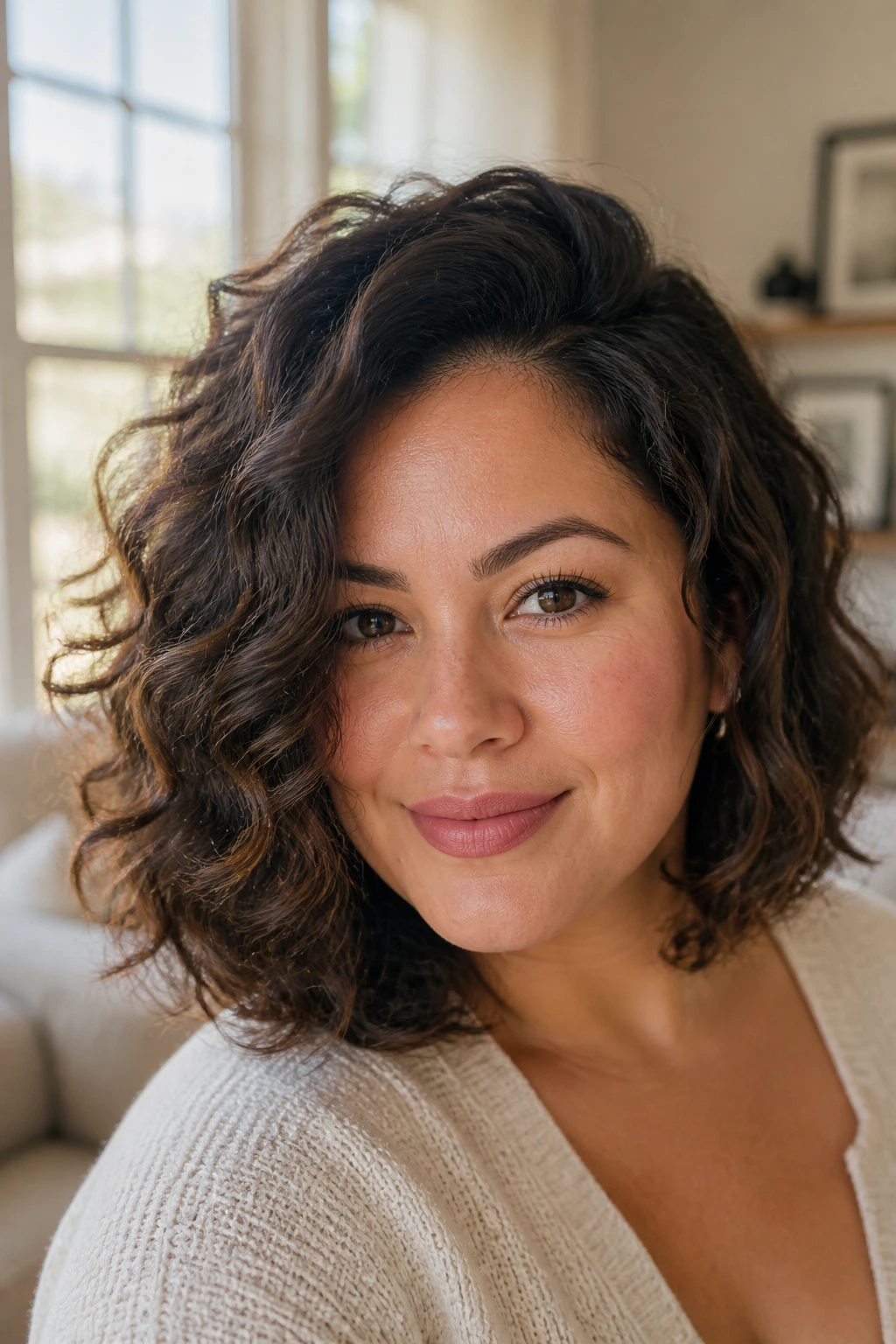
Can a lob be both soft and lifted? Yes, if the root area is set right. This style uses root clips or a diffuser lift at the crown so the hair rises away from the scalp before dropping into the side sweep. On a round face, that little bit of height changes everything. It shifts the visual focus up and down instead of side to side.
The shape works beautifully on medium-density curls that need more structure at the base. Leave the front long enough to skim the cheek, then let the rest taper toward the shoulders. I’d avoid heavy creams near the roots here; they drag the whole thing down.
How to use it
Set the part while the hair is soaking wet, clip the crown for 10 to 15 minutes, and remove the clips only when the roots feel mostly dry. That’s when the lift holds.
14. Tousled Lob with Piecey Definition
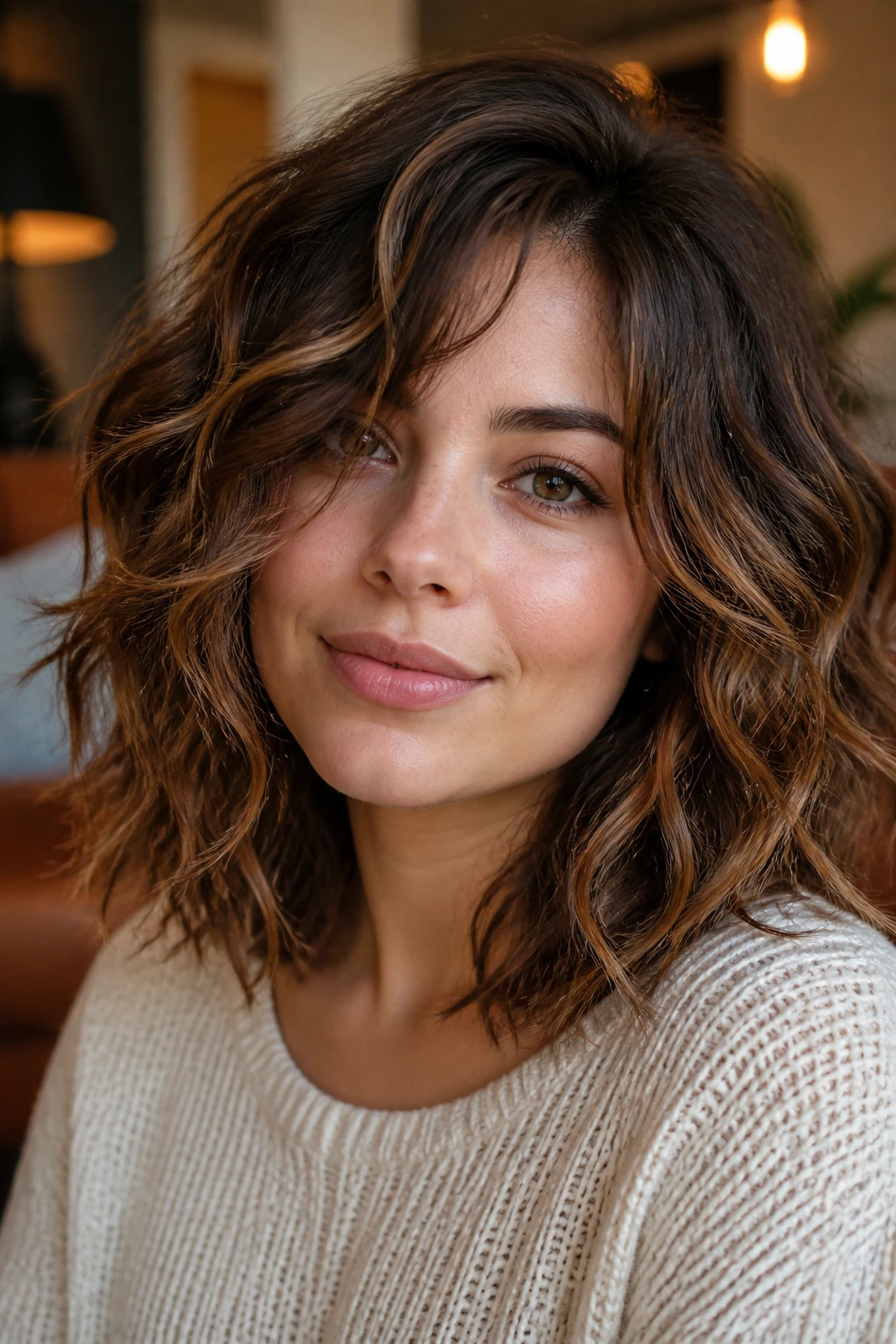
This is the casual one. The kind that looks like it was styled with five minutes and a decent product, which, to be fair, it often is. The side-swept effect comes from piecey front sections and a bit of separation through the ends. It’s not sleek. It’s not round-brush polished. It’s deliberately imperfect.
The reason it works on round faces is that the pieces break up the outline. Instead of one big curly mass, you get narrow lanes of movement. That keeps the cheeks from becoming the widest point in the frame. If your curls tend to clump into large sections, use a lighter gel and separate only once the cast is fully dry.
One caution: too much finger-fluffing turns piecey into frizzy fast. Stop while the shape still looks deliberate.
15. Jaw-Skimming Lob with a Longer Front Angle
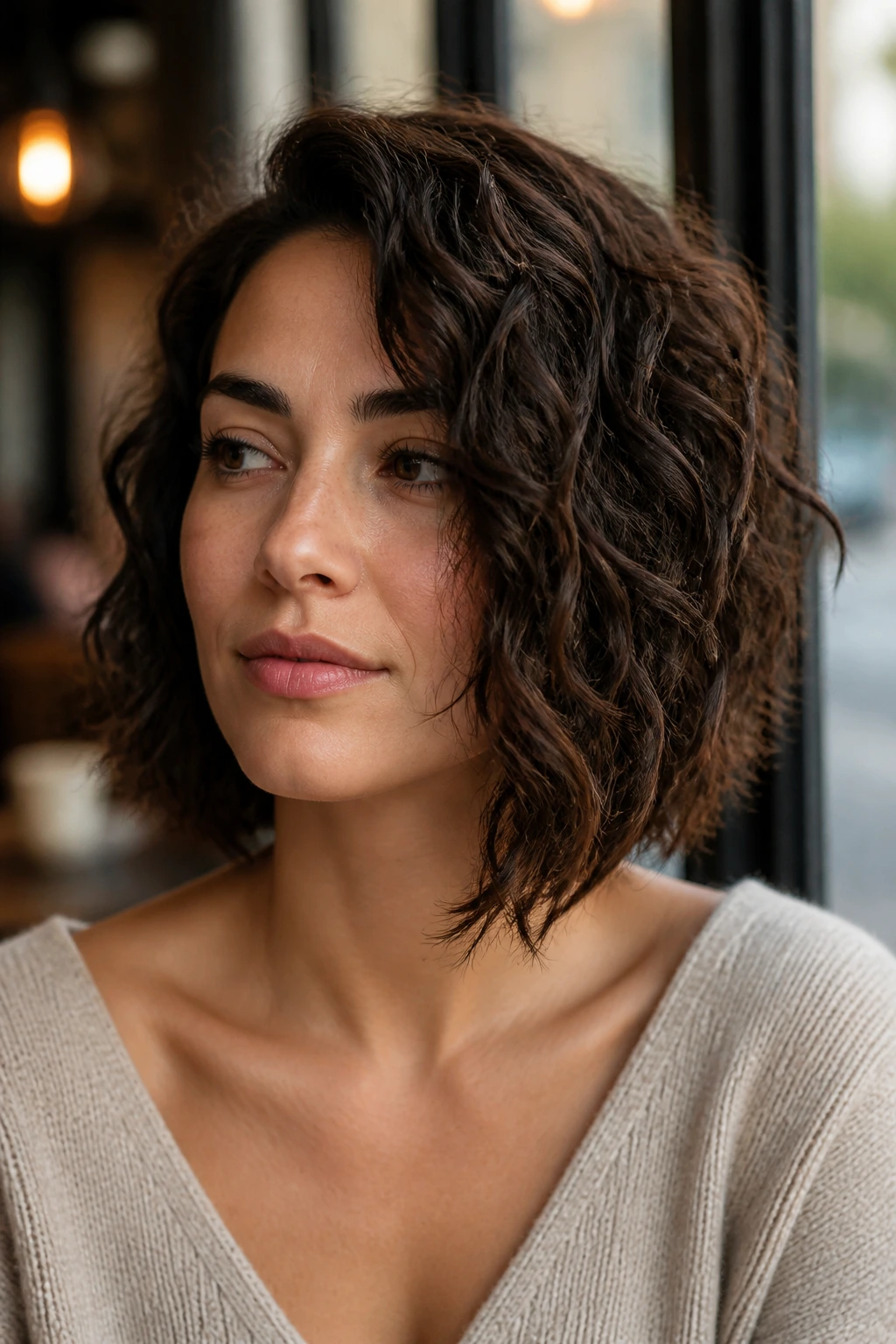
A jaw-skimming cut can be tricky on a round face, but the longer front angle saves it. The hair touches near the jaw on one side, then drops longer as it moves toward the front and the collarbone. That diagonal gives structure without making the face feel boxed in.
This style suits people who like a sharper silhouette. It’s a little more fashion-y than the softer lobs above. The angle needs to be obvious enough to read as intentional, but not so sharp that it becomes a stacked bob. If the front is left at least an inch longer than the jaw line, the cut stays flattering once the curls spring up.
- Best for: 2C to 3B curls.
- Not ideal for: very dense hair that expands heavily at the jaw.
- Style note: keep the side sweep loose, not pinned flat.
16. Sleek-Root Lob with Curly Ends

This combination sounds contradictory, and that’s exactly why I like it. The roots are smoothed near the scalp so the top half stays close to the head, while the lower half keeps its curl and bounce. On a round face, reducing width at the top and sides can make the entire face look a touch longer.
The key is restraint. Use a lightweight blow-dry cream or leave-in at the roots, then diffuse the mid-lengths and ends without disturbing the curl pattern too much. If you press the whole head flat, you lose the point. If you do nothing at the root, the style can puff outward.
Best use case: when you want a polished lob for work, photos, or a night out, but you still want your curl pattern to show.
17. Shaped Lob with a Soft Side Flip

This one has movement without shouting about it. The hair flips away from the face on the heavier side, and the lighter side stays closer to the cheek. That little imbalance is useful on a round face because it keeps one side open and the other side streamlined.
The shape can be very flattering for people who don’t want a deep part but still want asymmetry. It’s also a nice grow-out style, because the flip remains visible even when the cut gets a little longer than planned. I’d ask for layers that start below the cheekbone so the flip has room to happen.
Tiny detail, big payoff: a side flip needs a bit of root lift at the base, or it collapses into a plain part and loses the whole effect.
18. Curly Lob with a Shaped Nape
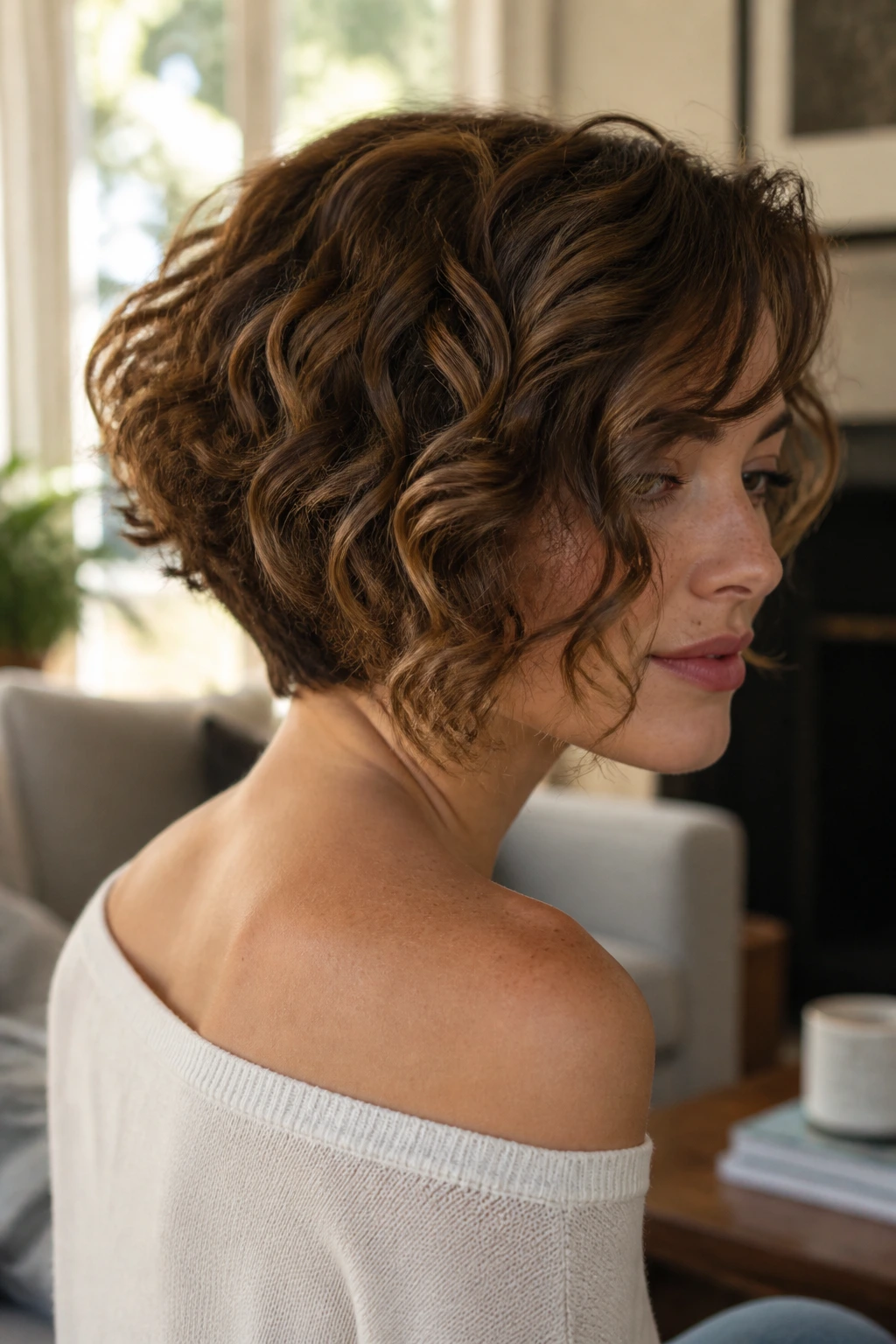
The nape is often ignored, which is a shame. Shaping it slightly shorter keeps the back from bulking out and gives the front sweep more contrast. On a round face, that tighter back line can make the front pieces look longer and sleeker by comparison.
This cut is especially good if your curls are dense at the back of the head. It keeps the silhouette from becoming a mushroom shape. The front should still stay long and soft, with the sweep falling toward the cheek. If the nape is too short, though, the cut starts feeling like a bob instead of a lob. That’s the tradeoff.
A smart ask for your stylist
Keep the nape tidy, not shaved. You want shape, not a disconnect.
19. Heavy-Sweep Lob with a Side-Loaded Front
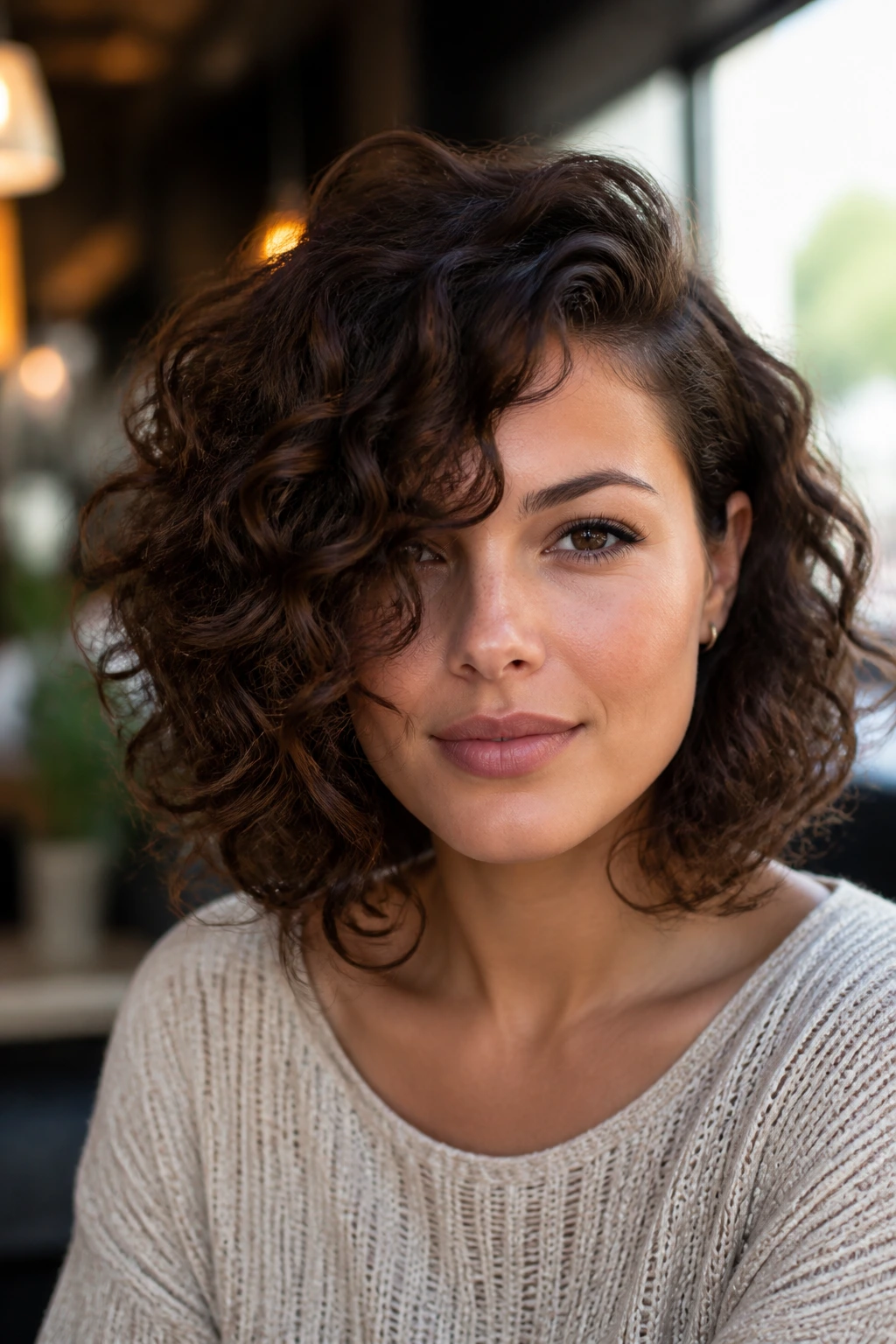
What happens when you want the front to do more of the talking? You get this cut. One side carries a heavier curtain of curls that sweeps across the forehead and down toward the mouth or jaw, while the opposite side stays lighter and more open. The result is dramatic in a controlled way.
It’s a strong choice for fuller cheeks because the heavy side creates a long visual line right where you want it. The trick is making sure the front isn’t all bulk. It should fall in sections, not one solid block. If the curls are too packed together, you lose the diagonal and gain weight instead.
Best with: medium-to-thick curls and a bit of length at the front.
20. Shag-Inspired Lob with a Side Bias
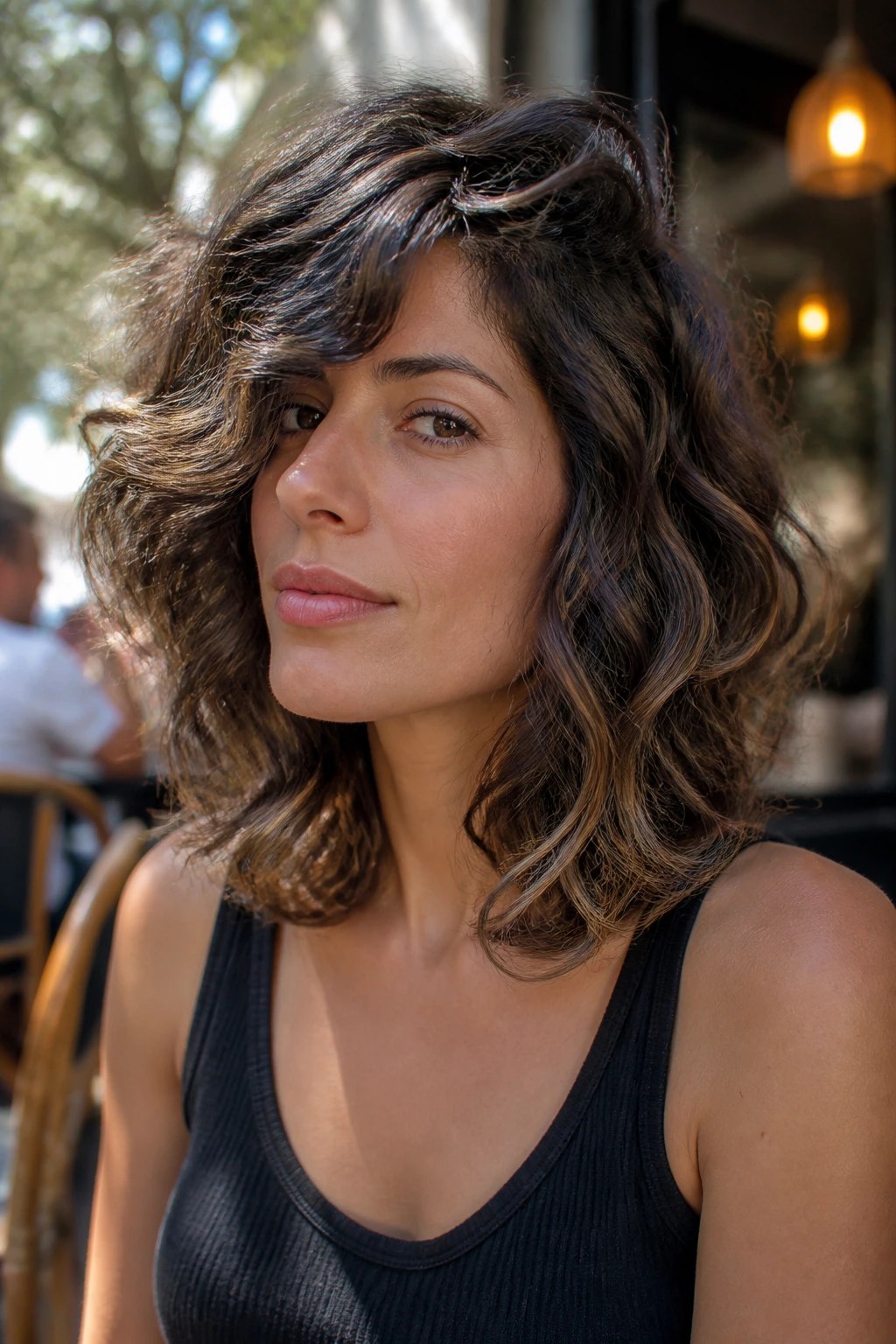
This is the most lived-in option here. The layers are more noticeable, the texture is looser, and the side sweep feels almost accidental — which is why it looks good. A shag-inspired lob can be magic on round faces because it breaks up the circumference of the head without relying on a hard shape.
I like this for curl patterns that need help moving. The layers keep the texture from sitting in one heavy shelf, and the side bias gives the face a slant instead of a circle. If your curls are fine, go lighter on the layering. If they’re thick, a little more internal shaping helps the whole thing sit better.
What to watch for
Too many short layers around the cheeks will widen the face. Keep the shortest layers below cheek level if you want the style to stay flattering.
21. Glam Lob with Defined Side Ringlets
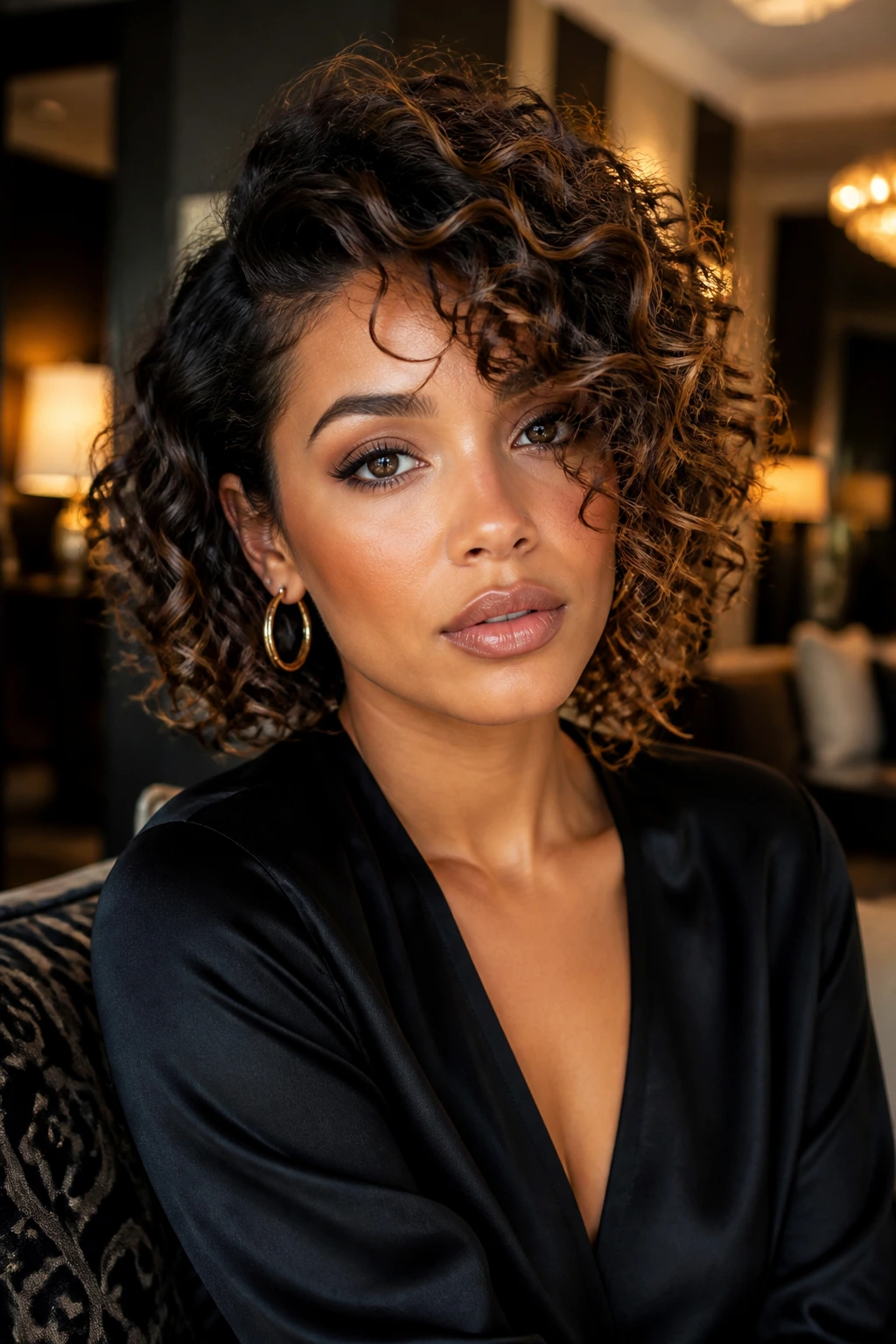
This one is for the days when you want the curls to behave like they know they’re being looked at. The ringlets are defined, the side sweep is deliberate, and the shape reads polished rather than casual. On a round face, the long ringlets pull the eye downward, which is the whole point.
It’s a good cut for special-occasion styling, but it doesn’t have to feel fussy. A well-cut lob with a clean side part and enough front length can hold this shape with little more than mousse and a diffuser. I’d say this is one of the best choices for thicker curls that need a little discipline up top and room to spring at the ends.
Best detail: ask for the front to stay longer than the chin, even if the rest feels short.
22. Twist-Out Lob with a Deep Side Part
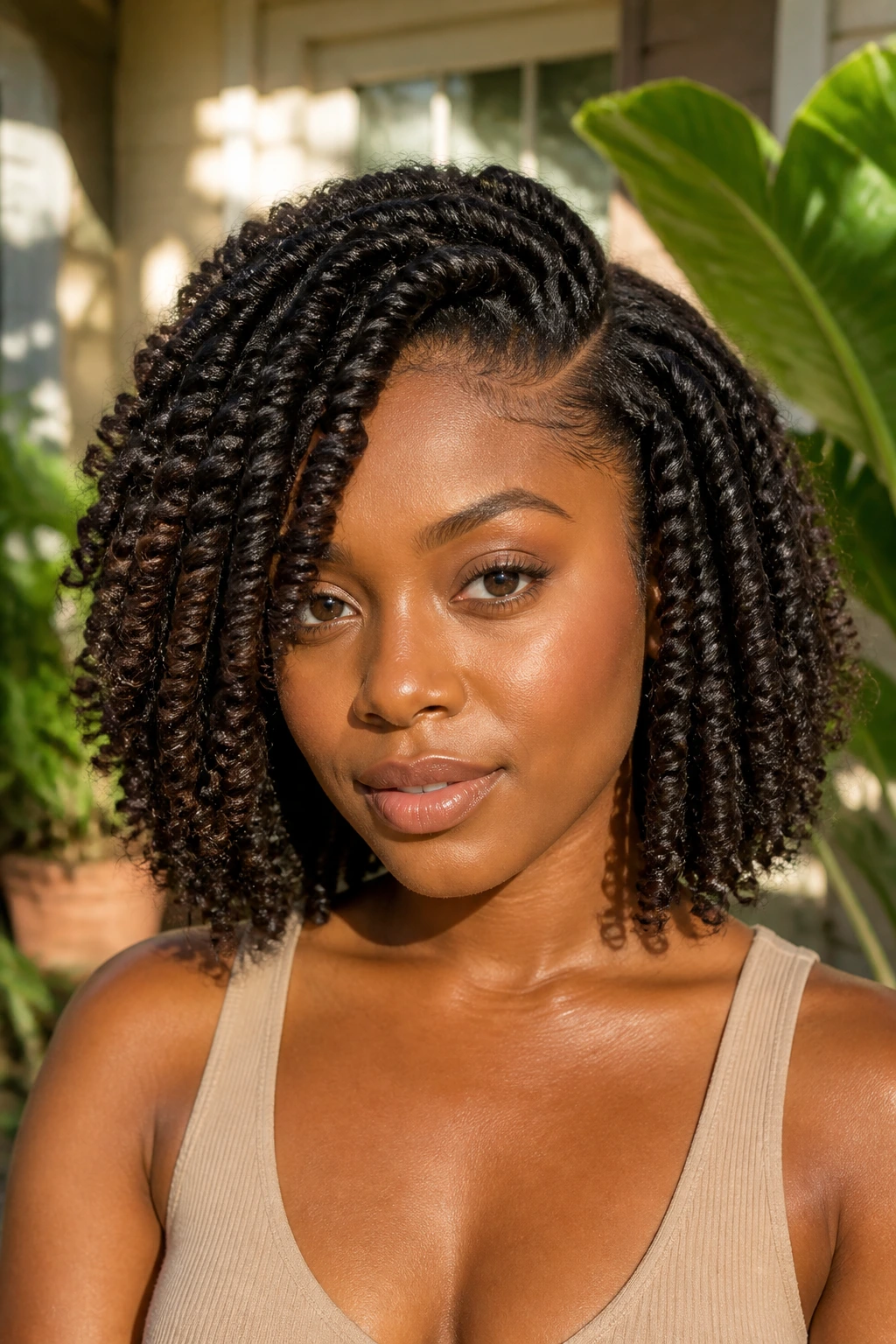
A twist-out lob gives you the side sweep with a little extra control over the curl pattern. The side part creates the asymmetry, and the twist-out texture makes the curls separate in a more deliberate, polished way. On a round face, that kind of vertical definition can be very flattering because the twists tend to elongate the silhouette.
This is especially good for coily hair or anyone who likes a heatless routine. The haircut should leave enough front length for the twist-out to fall across the face without bouncing back too high. If the layers are too short, the whole thing shrinks into a shape that feels more compact than sweeping.
A final practical note: twist-outs need dry time. If you unravel too early, you lose definition and gain frizz. Patience matters here.
Why Side-Swept Lobs Read So Well on Round Faces
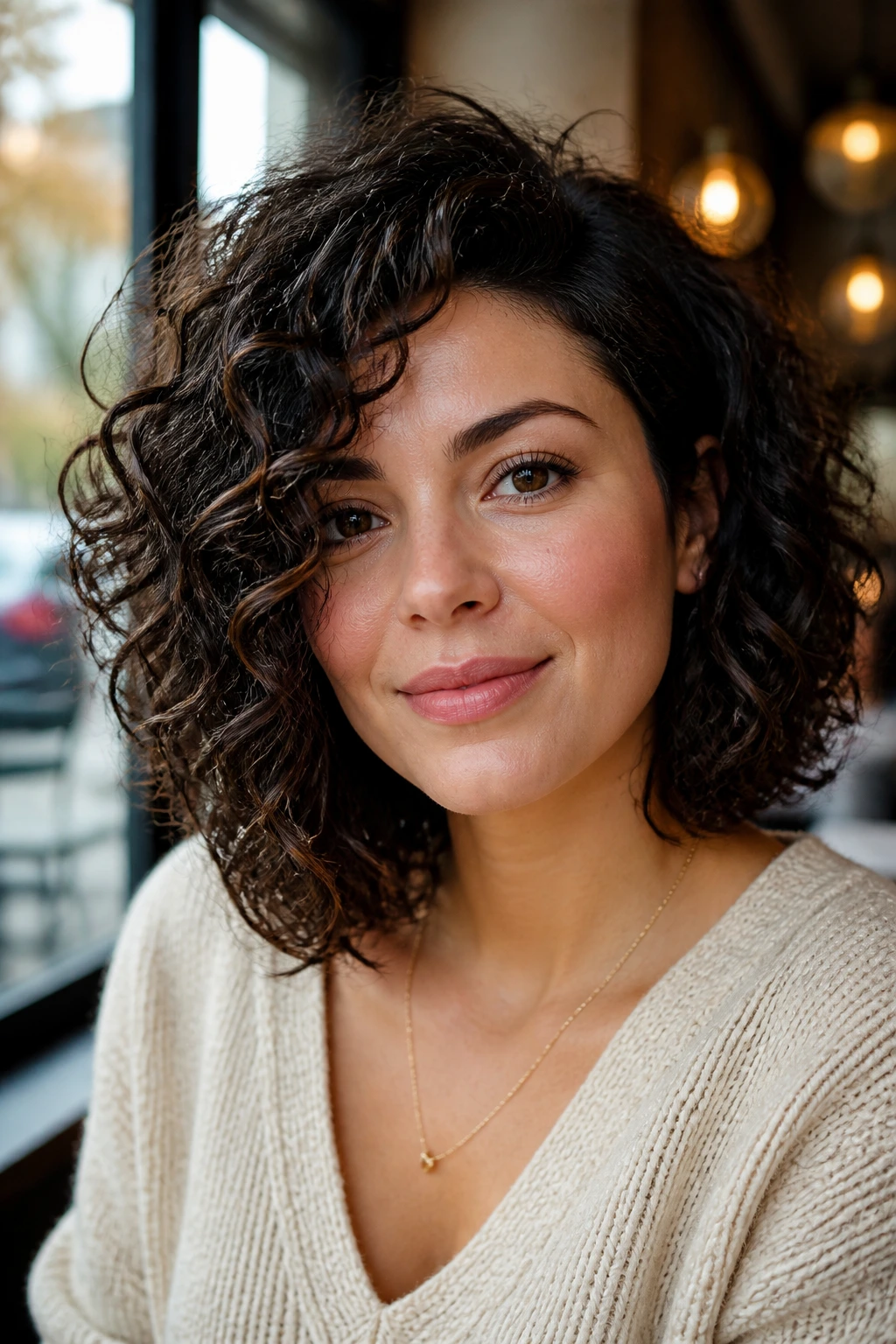
A side-swept lob works because it changes the direction of the eye. Round faces tend to carry softness through the cheeks and jaw, so a haircut that introduces diagonal lines creates contrast without harshness. The side part, the longer front pieces, and the collarbone length all help with that. None of it is mysterious. It’s shape management.
Curly hair adds another layer. The curl pattern brings volume, which can be a blessing or a headache depending on where the hair expands. Place that volume at the crown and below the jaw, and the face looks more open. Place it at the cheek level, and everything widens. That’s why the best curly lobs are never accidental. The layers, part, and length all need to agree.
The line to remember
Keep the width below the cheekbones and the front longer than the jaw. That one rule saves a lot of bad cuts.
The Salon Conversation That Saves You From a Too-Short Cut
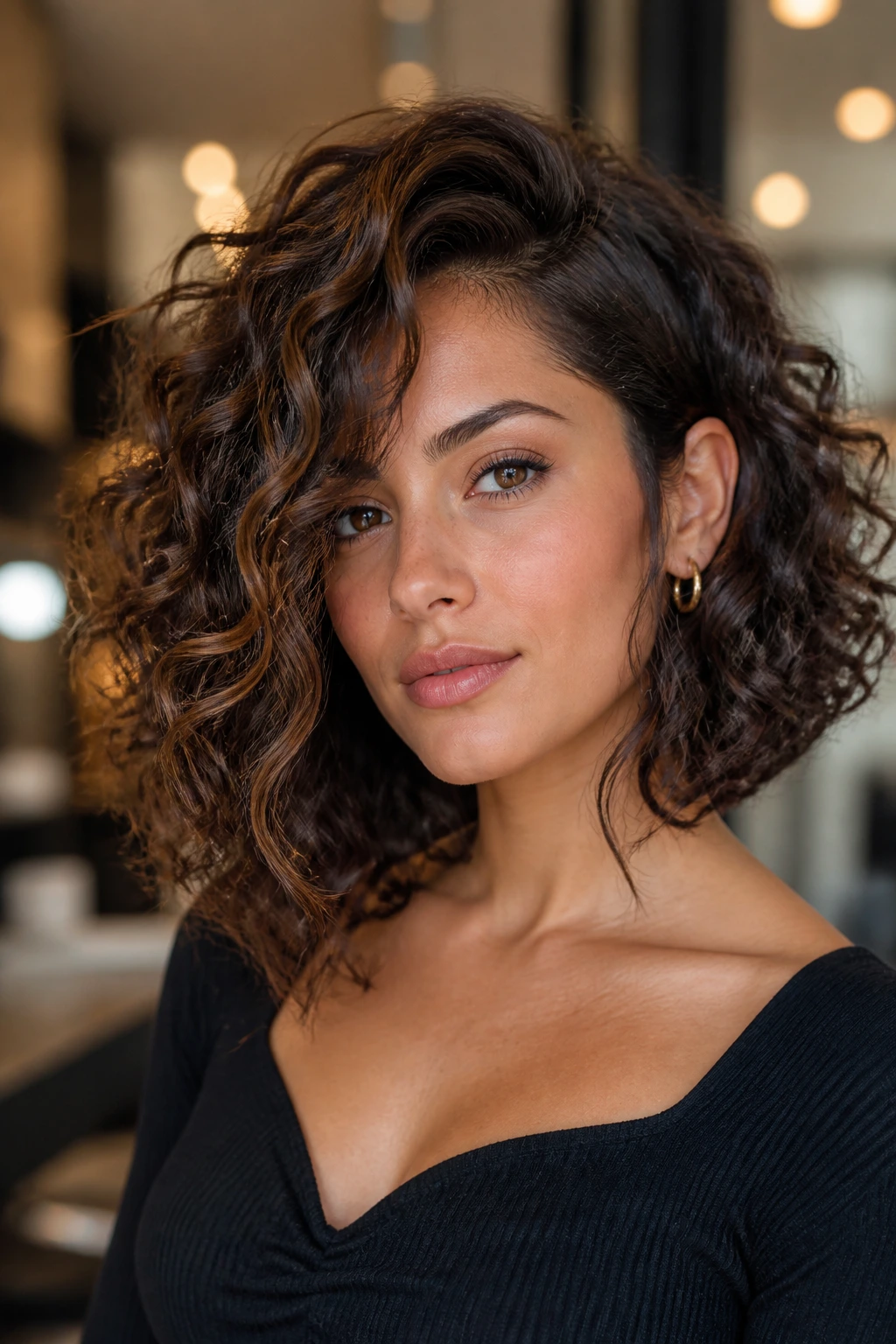
Do not walk in and say, “I want a lob.” That’s how people end up with something that sits at the widest point of their face and dries two inches shorter than expected. Bring at least two photos, and make sure one of them shows the curl pattern from the side, not just the front. A front view hides too much.
Tell your stylist where you want the length to land when dry. For most curly side-swept lobs, that means the longest front pieces should hit the collarbone or just above it, while the back may sit slightly shorter. If you shrink a lot, say so. If your hair falls heavy and straightens out under its own weight, say that too.
Ask for these details
- A side part slightly off center.
- Length that stays below the cheekbone.
- Long front pieces, not a blunt chin line.
- Layers placed to remove bulk, not create a shelf.
A good cut here is not about one magic number. It’s about where the shape lands after your curls dry.
Tools and Products That Help Curly Lobs Behave
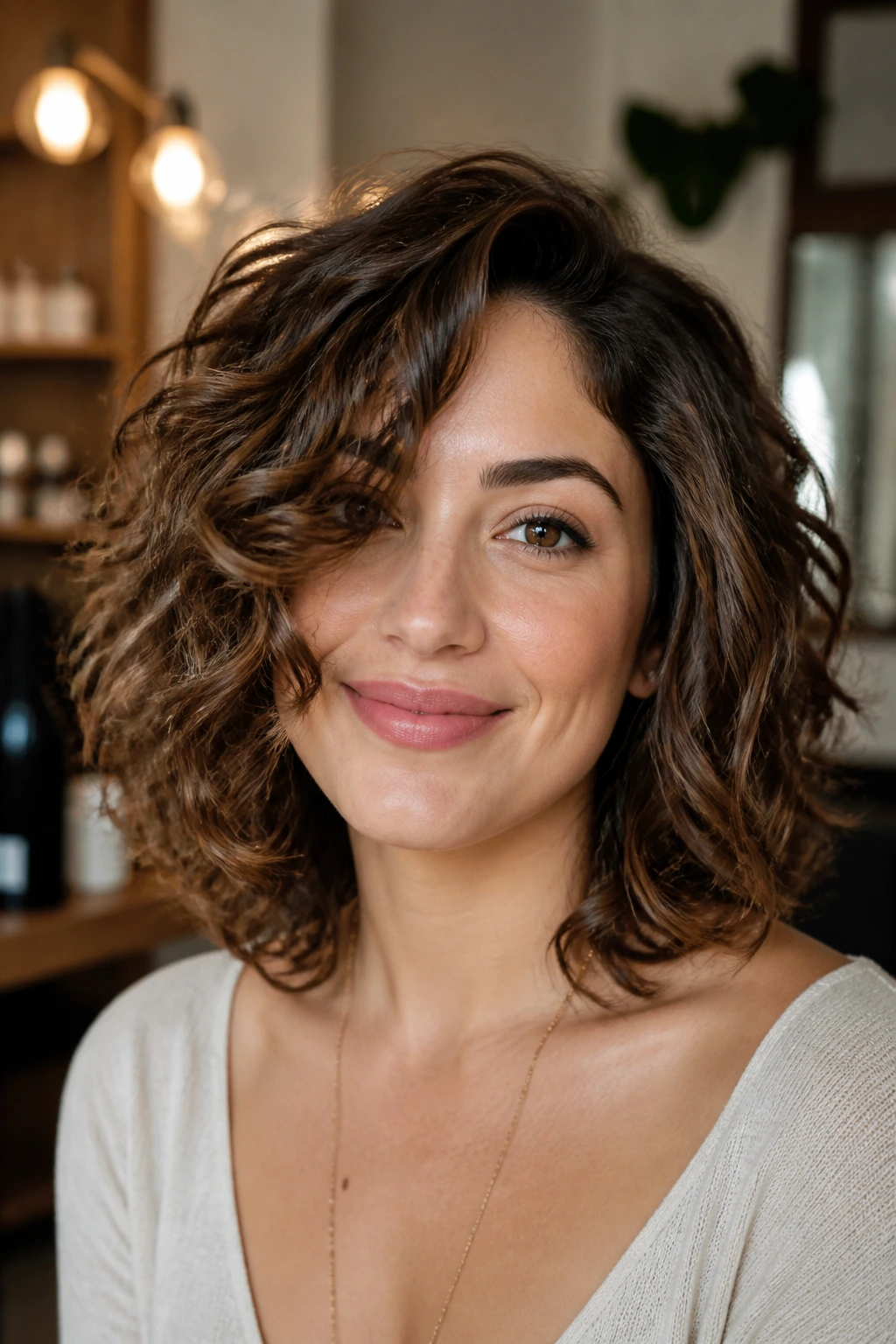
The right tools do not make the haircut, but they do make the haircut show up the way it should.
- Wide-tooth comb: Good for detangling in the shower without ripping apart the curl clumps.
- Microfiber towel or cotton T-shirt: Helps blot water without roughing up the cuticle.
- Leave-in conditioner: Keeps the front sweep soft enough to move.
- Light mousse: Useful when you want the crown to lift without heaviness.
- Curl cream: Good for looser curls that need shape more than hold.
- Strong-hold gel: Best for a defined side sweep that needs to last all day.
- Diffuser attachment: Helps dry curls without blasting them into frizz.
- Root clips: Helpful when you want crown height or a cleaner side part.
- Heat protectant: Needed if you stretch the front with a brush or blow-dryer.
- Satin pillowcase or scarf: Keeps the side sweep from getting crushed overnight.
Use less product than you think at the roots. That area gets heavy fast.
How to Style a Curly Lob Without Crushing the Sweep
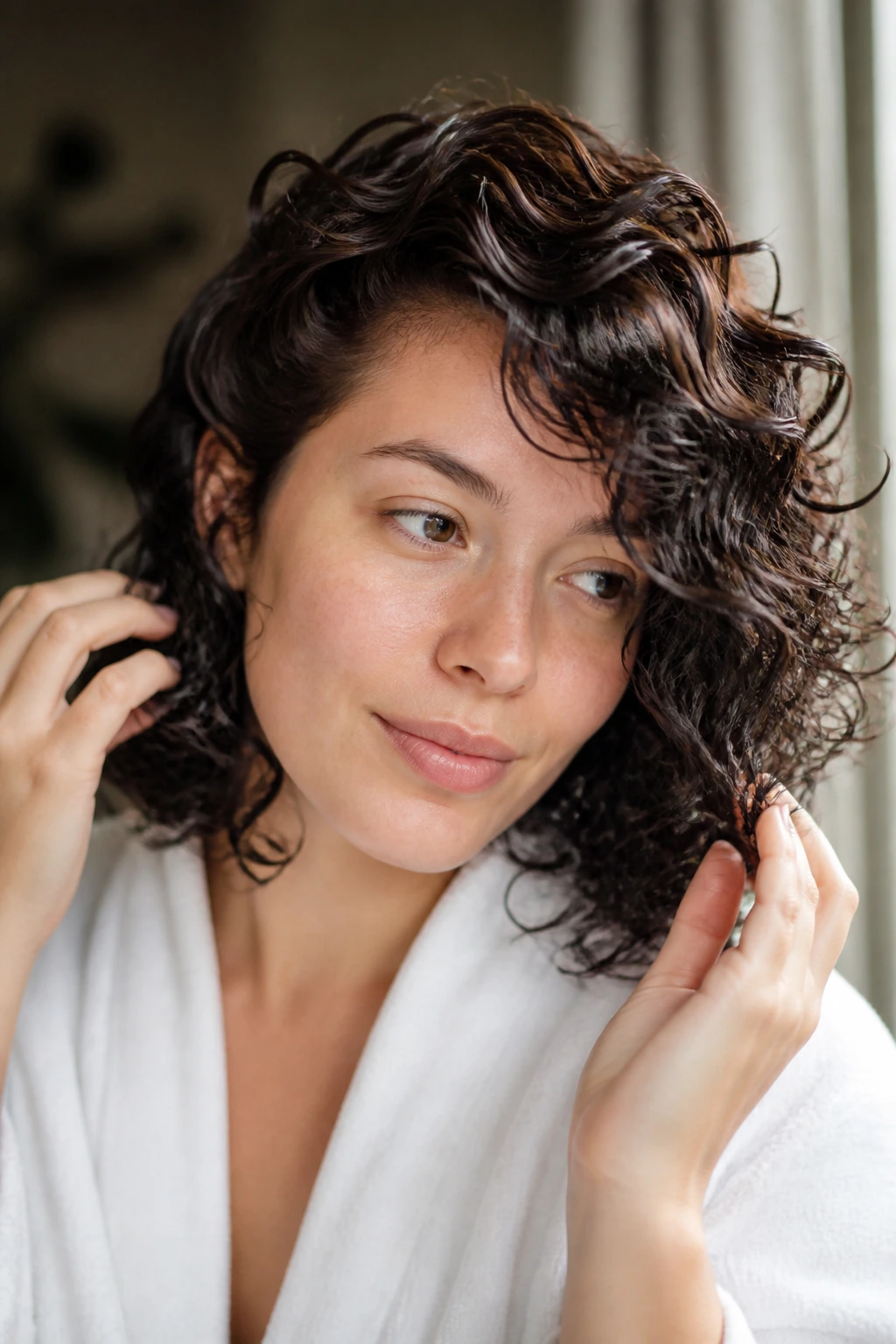
The trick is to build the shape while the hair is still damp enough to obey. Start with a side part, not a center part you’ll fight later. Apply leave-in first, then a light styling product through the mid-lengths and ends. If you want a cleaner sweep, add gel to the front pieces and a softer cream to the rest.
Diffusing on low heat usually gives the best balance. Flip your head only if it helps the roots lift; if your curls go puffy when upside down, stay upright. Clip the top at the side part for 10 to 15 minutes if you need more direction. And when the hair is dry, resist the urge to keep touching the front. That’s where people ruin an otherwise good shape.
A small styling sequence that works
- Part while wet.
- Set the crown with a clip.
- Smooth the front sweep with fingertips.
- Diffuse on low until 80 to 90 percent dry.
- Break the cast only at the very end.
That’s it. No circus.
Smart Length, Layering, and Parting Choices
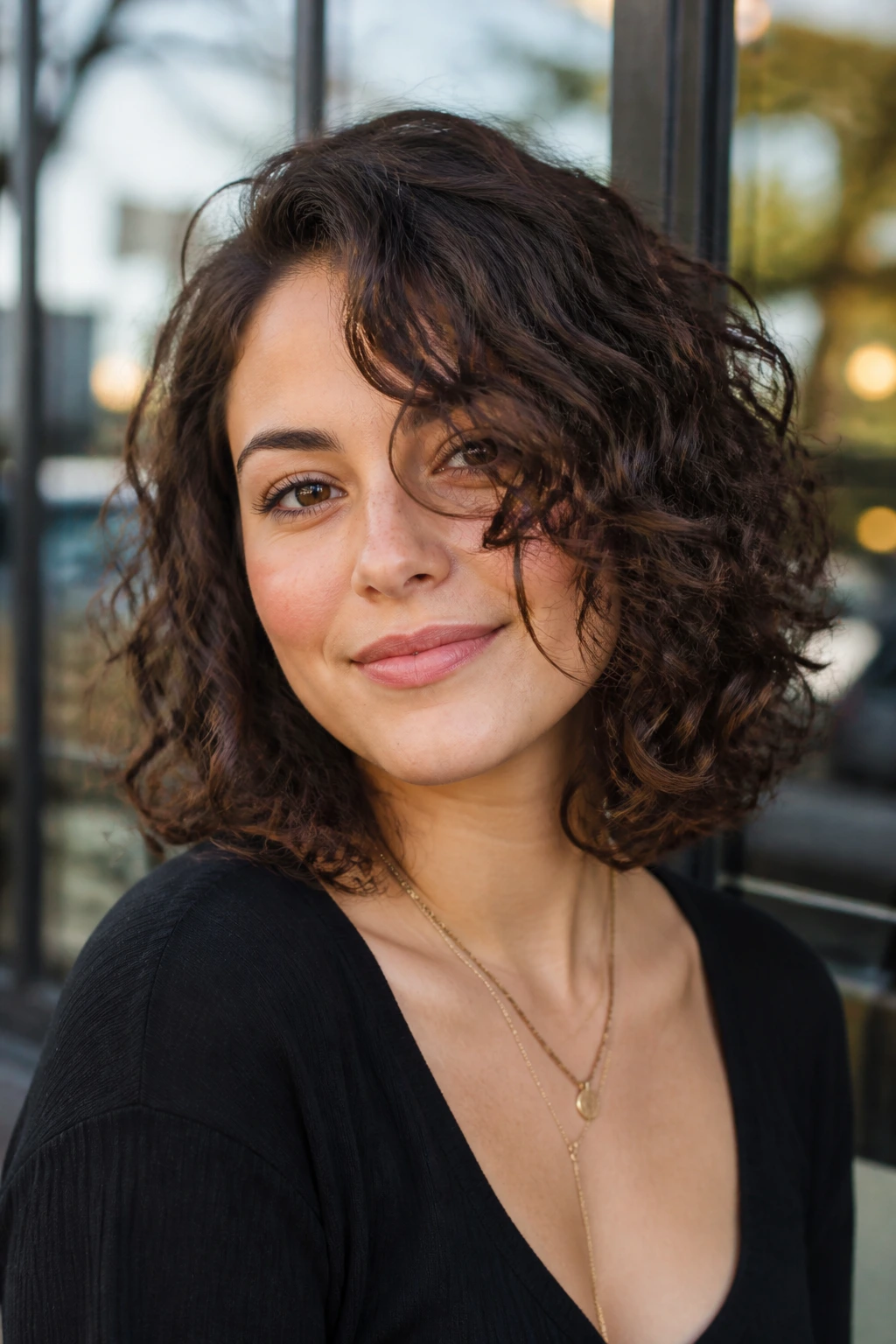
Length is the first decision, and it matters more than layering. On a round face, a lob that ends at the chin often emphasizes width. A cut that lands at the collarbone or just under it usually gives the face a cleaner vertical line. If your curls shrink a lot, the wet length should be longer than you first expect. Hair that looks a touch too long in the chair often lands exactly right once it dries.
Layering should solve a problem, not create one. Heavy curls need weight removed from the inside so they don’t sit in one block at the sides. Fine curls need lighter layers so the ends don’t disappear. And the part? A side part that sits slightly off center usually does more for a round face than a dramatic deep part, especially if the hair wants to flip or part itself in a certain direction.
Common Mistakes That Flatten the Shape

Cutting it too short at the cheeks is the easiest way to lose the flattering effect. If the front lands right at the widest part of the face, the eye stops there. The fix is a longer front, usually at cheekbone length or lower when dry.
Adding too much width at the sides is another one. This happens when the layers are cut so that every curl pops outward at the same level. The symptom is that mushroomy, round silhouette. The fix is internal shaping and a little more length below the jaw.
Using heavy cream all over the roots makes the style collapse. You want slip in the mid-lengths, not oil-slick heaviness at the scalp. Put richer product only where the hair actually needs it.
Ignoring shrinkage is a classic curly-hair problem. If you cut to where you think the hair “should” land when wet, it may bounce up much shorter than planned. Tell the stylist how much your hair springs.
Over-fluffing the front kills the sweep. That side piece needs direction. Once it’s dry and set, leave it alone.
Variations and Adaptations to Try

The Glasses-Friendly Sweep: Keep the front pieces long enough to fall just below the frame line, with soft layers that don’t snag at the temples. This works best if you wear narrow or medium-width frames and want the hair to move around them instead of fighting them.
The Fine-Curl Lift Lob: Use a lighter cut with fewer internal layers and more root volume at the crown. Fine curls need air, not heavy shape, so this version keeps the ends from looking skinny while still giving the face a diagonal line.
The Tight-Curl Cascade: Let the curl pattern do the talking, but leave the front pieces longer and slightly more stretched than the rest. This is a good choice for coils or tighter ringlets because it keeps the face open without forcing the curl into a narrow shape.
The Heatless Twist-Out Lob: Build the side sweep with twists or flat twists on damp hair, then separate once fully dry. It’s a smart option if you want the style without hot tools, and the finished curve around the forehead can look very precise.
The Grow-Out Lob: Keep the back a little shorter and the front longer, then trim only the perimeter every 8 to 10 weeks. This version holds its shape well as the hair grows, which is useful if you hate awkward in-between stages.
Keeping the Shape Fresh Between Washes
Curly side-swept lobs usually hold up better than people expect, but they do need a little maintenance. Sleep on a satin pillowcase or wrap the front section loosely so the sweep doesn’t get flattened against the forehead. If the roots go soft overnight, mist the part lightly with water, add a pea-sized amount of mousse to the crown, and reclip while the hair dries for 10 minutes.
Between wash days, focus on the front and the part first. That’s the part everyone sees, and the part that makes the style read as intentional. If the mid-lengths get dry, scrunch in a small amount of leave-in mixed with water. If the ends start to frizz, smooth a drop of serum over just the outer layer. Do not drench the whole head. Curly lobs get limp fast when overloaded.
Trim timing matters too. Most curly lobs benefit from a shape clean-up every 8 to 12 weeks, especially if the front starts to lose the diagonal line. If you’re growing it out, you can stretch that a little longer, but the front pieces will still need attention. The sweep is the feature. Let it go fuzzy for too long and the whole haircut loses its point.
Frequently Asked Questions
Will a side-swept lob make a round face look wider?
Not if the length and part are placed well. The cut gets tricky only when it ends at the cheeks or puffs outward at the sides. Keep the longest pieces below the jaw and use a diagonal front, and the face usually looks longer rather than wider.
What is the best length for curly hair on a round face?
Collarbone to just above the shoulders is the safest range. That length leaves room for shrinkage and keeps the curl volume away from the widest part of the face. If your curls are tight and springy, go a touch longer than you think you need.
Should I ask for a deep side part or a soft off-center part?
A soft off-center part works for more people. Deep parts can look dramatic, but they can also overflatten one side or exaggerate a cowlick. If you want a more wearable style, start with a slight offset and adjust from there.
Can this cut work with tight curls or coils?
Yes, and it can be very flattering. The key is length at the front and enough weight removal through the interior so the sides do not puff out. Twist-outs, diffuser styling, and longer face-framing pieces all help.
How do I keep the front from falling into my eyes?
Set the sweep while the hair is damp, use a little gel on the front section, and clip the roots on the part side for a few minutes. Once the hair dries, avoid re-scrunching that area. Too much touching breaks the line and brings the curls right back into your face.
Do curly lobs need heat styling to look good?
No. Heat can stretch the front or smooth the roots, but the shape works fine with leave-in, mousse, gel, and a diffuser. A heatless twist-out or air-dried set can hold the side sweep just as well if the haircut is right.
What if one side of my hair is fuller than the other?
That’s common, and it’s not a problem. Keep the fuller side slightly longer or use it as the heavy sweep side, then clip the lighter side back behind the ear. You can also set the part opposite the fuller side to balance the silhouette.
The Shape That Does the Angles for You
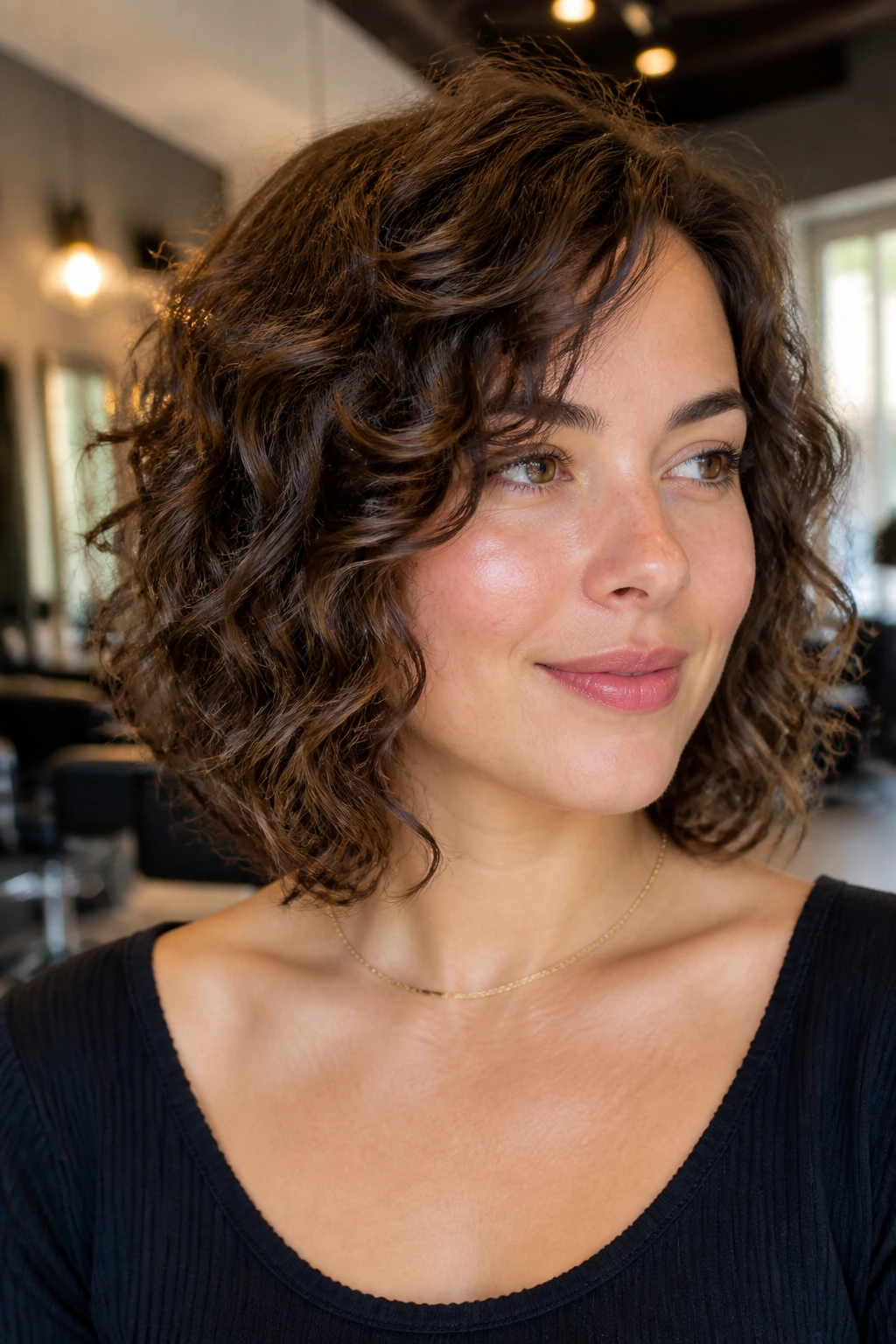
A good side-swept lob does not fight curly hair, and it does not pretend a round face needs fixing. It simply gives the shape some direction. That’s the part I like most. The cut takes all the natural softness, all the spring, all the movement, and turns it into a line that opens the face instead of boxing it in.
The best versions are rarely the most dramatic. They’re the ones with the right length, the right part, and enough front piece to move across the cheek without sitting right on top of it. If you get those pieces in place, the rest tends to behave. And when curly hair behaves, even a little, the whole haircut looks smarter than the effort it took.