



Fine hair and a square face can make bangs feel like a test you did not study for. A blunt fringe on thin strands can go flat before lunch, and a wide, straight line across a square forehead can make the jaw look even more pronounced. The wrong cut does not just sit there; it changes the whole balance of the face.
Piecey bangs are the smarter move. They keep air between the strands, so the fringe reads fuller than it is, and they break up hard lines around the forehead and temples. That matters on square faces, where you usually want some softness near the corners of the face instead of another clean edge.
There’s a small but important detail people miss: fine hair needs shape, not bulk. If the bang section is too wide or too dense, it steals density from the rest of the front and starts to split in sad little gaps. A better cut uses a narrower section, a softer center, and ends that are texturized just enough to move without fraying.
So the goal is not one single “safe” fringe. It’s a whole menu of piecey bangs for fine hair and square faces, from barely-there wisps to longer curtain shapes, with a few bolder options for anyone who wants more attitude. Some of these are easy to air-dry. Some need a round brush and five extra minutes. All of them are about making fine strands look intentional, not fragile.
Why These Bangs Work So Well

- They fake density without lying about it: piecey separation makes the fringe look full, even when the hair itself is fine and soft.
- They soften the strongest part of a square face: broken ends and diagonal lines take the edge off the jaw and keep the forehead from looking boxed in.
- They grow out with less drama: most piecey fringe styles turn into face-framing layers instead of a heavy curtain you want to trim off immediately.
- They give you options with styling: a quick blow-dry, a finger twist, or a tiny bend with a mini iron can all work here.
- They sit well under day-to-day life: glasses, humidity, gym hair, and a slightly oily forehead are all easier to handle when the bang line is not dense and blunt.
- They let you keep forehead coverage without losing lightness: that balance is the whole trick, and it’s why these cuts flatter fine strands better than thick, heavy fringe.
1. Airy Curtain Bangs With Broken Ends
This is the most forgiving place to start, and I mean that in the nicest possible way. Airy curtain bangs split at the center, skim the brows, and slide down toward the cheekbones, which gives a square face a softer diagonal frame without swallowing the forehead. On fine hair, the broken ends matter more than the center part; they stop the fringe from looking like two tidy ropes hanging down the face.
Ask for the center to be a touch shorter than the sides, then have the stylist point-cut the last half-inch so the edges do not sit in one blunt row. If the bang section is too wide, you lose density fast. Keep it narrow, keep it light, and let the outer pieces blend into the front layers.
Best detail to request: the shortest point should land around the brow line when dry, not wet. Wet hair stretches. Fine hair lies. Both will fool you.
2. Brow-Skimming Wisps That Skip the Heavy Line
Why does this style work so well on fine hair? Because it barely asks for density at all. Brow-skimming wisps are the opposite of a thick fringe shelf; they hover over the brows, open a little at the center, and leave enough skin showing that the face still feels bright and open.
Square faces usually look best when the front hairline is softened, not masked. These wisps do that quietly. The sides can feather into the temples, which takes some of the visual weight off the jaw and keeps the face from looking too square from top to bottom.
How to wear it: tuck the longer sides behind a little bend at the temples, then let the center fall in soft, separated strands. A pea-sized amount of mousse at the roots is usually enough. More than that and the fringe starts to clump, which defeats the whole point.
3. Deep Side-Swept Bangs That Blur the Jaw
If your part already lives off to one side, use it. Deep side-swept bangs create a long diagonal line across the forehead, and that shape is flattering on square faces because it shifts attention away from the corners of the jaw. It also gives fine hair a little lift at the root, which is half the battle with softer strands.
I like this version for people who want bangs but do not want to feel “bangy.” The fringe can start near the arch of the brow and sweep to the opposite cheekbone, with the ends slightly broken up so it does not sit like a polished ribbon. The result feels cleaner than curtain bangs and less fussy than a full front fringe.
For straight fine hair, this is one of the easiest styles to keep in line. Blow-dry the roots in the opposite direction first, then sweep them over. That tiny reset at the root gives you a better bend and keeps the side from collapsing flat against the face.
4. Bottleneck Bangs With a Lift at the Crown
Bottleneck bangs earn their name honestly: narrow in the center, wider as they move out toward the temples. That shape is useful on a square face because it opens the middle of the forehead and lets the side pieces do the softening work. On fine hair, the narrow center helps you avoid that over-thinned, see-through look that can happen when stylists get enthusiastic with scissors.
This cut looks best when the center sits just below the brows and the sides graze the tops of the cheekbones. That gives the face a soft frame without drawing a hard box around it. The little lift at the crown matters too. Fine hair usually needs movement near the roots, or the whole fringe sinks.
Styling note: blow-dry the center first, then guide the side pieces away from the face with a small round brush. If you pull everything straight down, you lose the bottleneck shape and end up with ordinary curtain bangs.
5. Feathered Shag Bangs With Loose Texture
This is the one for people who want a little edge. Feathered shag bangs are choppier than curtain bangs and looser than a blunt fringe, which gives fine hair a useful illusion of body. The layers are short enough to move, but not so shredded that they disappear.
Square faces often look good in a shag because the texture breaks up the geometry. A solid line across the brow can make the face feel boxier. Feathered bangs do the opposite. They scatter light, leave little gaps, and create a softer frame around the eyes.
Why it suits fine hair
The shag’s secret is not thickness. It is movement. Fine hair can look fuller when the ends are feathered and separated, because each piece catches the eye instead of all the strands clinging together in one flat curtain.
How to keep it from going limp
Use a root-lifting mousse or spray at the front hairline, then rough-dry the bangs with your fingers until they are about 80 percent dry. Finish with a quick twist of the ends using your fingers, not a lot of brushing. Too much brushing smears the texture into one flat shape.
6. Split Bangs That Open at the Brows
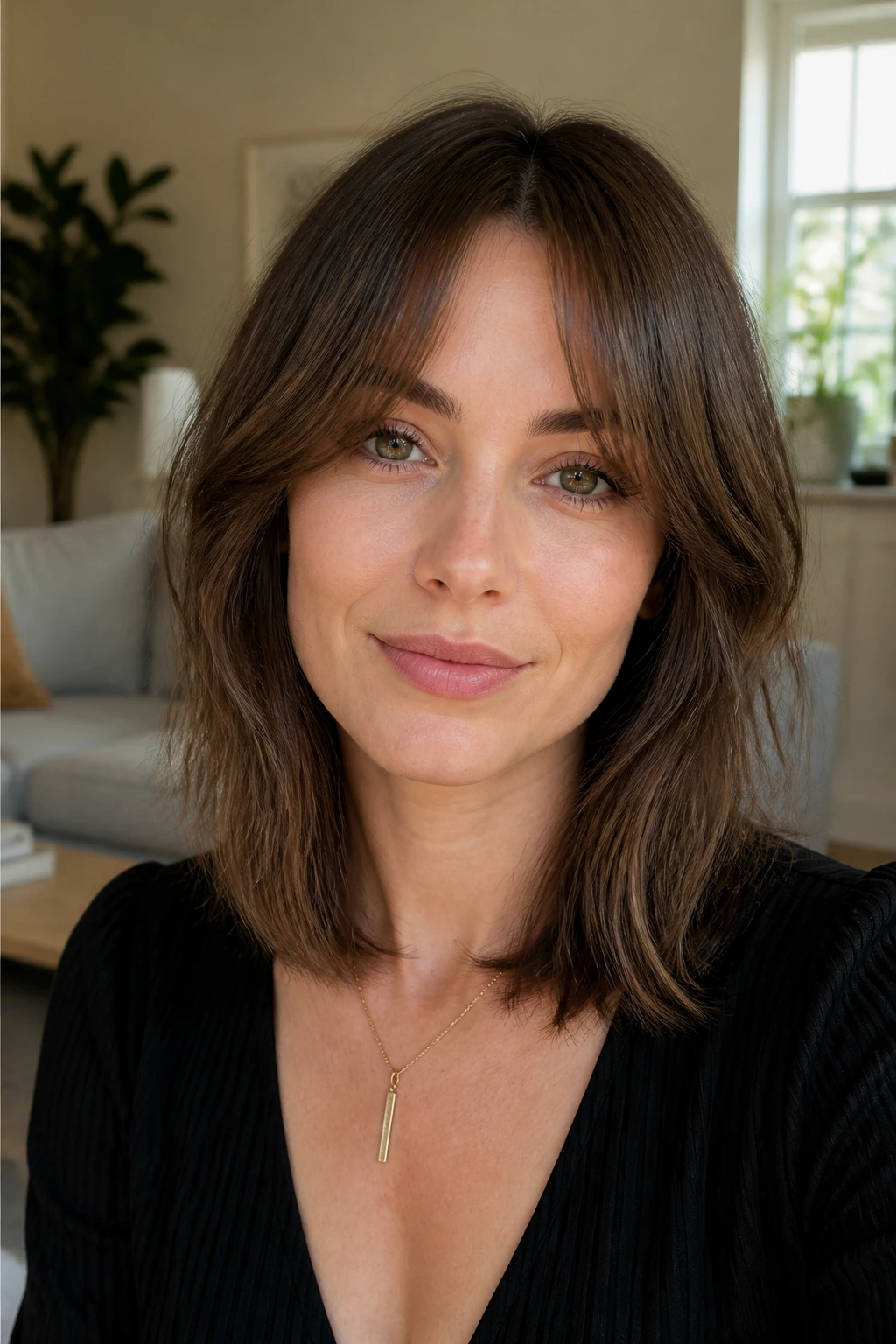
Split bangs are a cousin of curtain bangs, but they feel a little more relaxed and a little less styled. The center gap can be subtle or obvious, and that opening is useful on square faces because it keeps the forehead from feeling blocked off. It also gives fine hair a way to look airy without looking sparse.
This version works especially well if your hair naturally parts in the middle or near the middle. Fighting a cowlick with a thick bang is a bad afternoon. Working with a split shape is easier, faster, and far less annoying. Let the center part open just enough that the two sides frame the brows, then let the rest taper into the front layers.
I prefer this on medium-length cuts. On a bob, it can feel a little too tidy unless the ends are broken up. On longer hair, it softens the face in a way that feels easy, not overdone.
7. Cheekbone-Grazing Fringe That Softens Corners
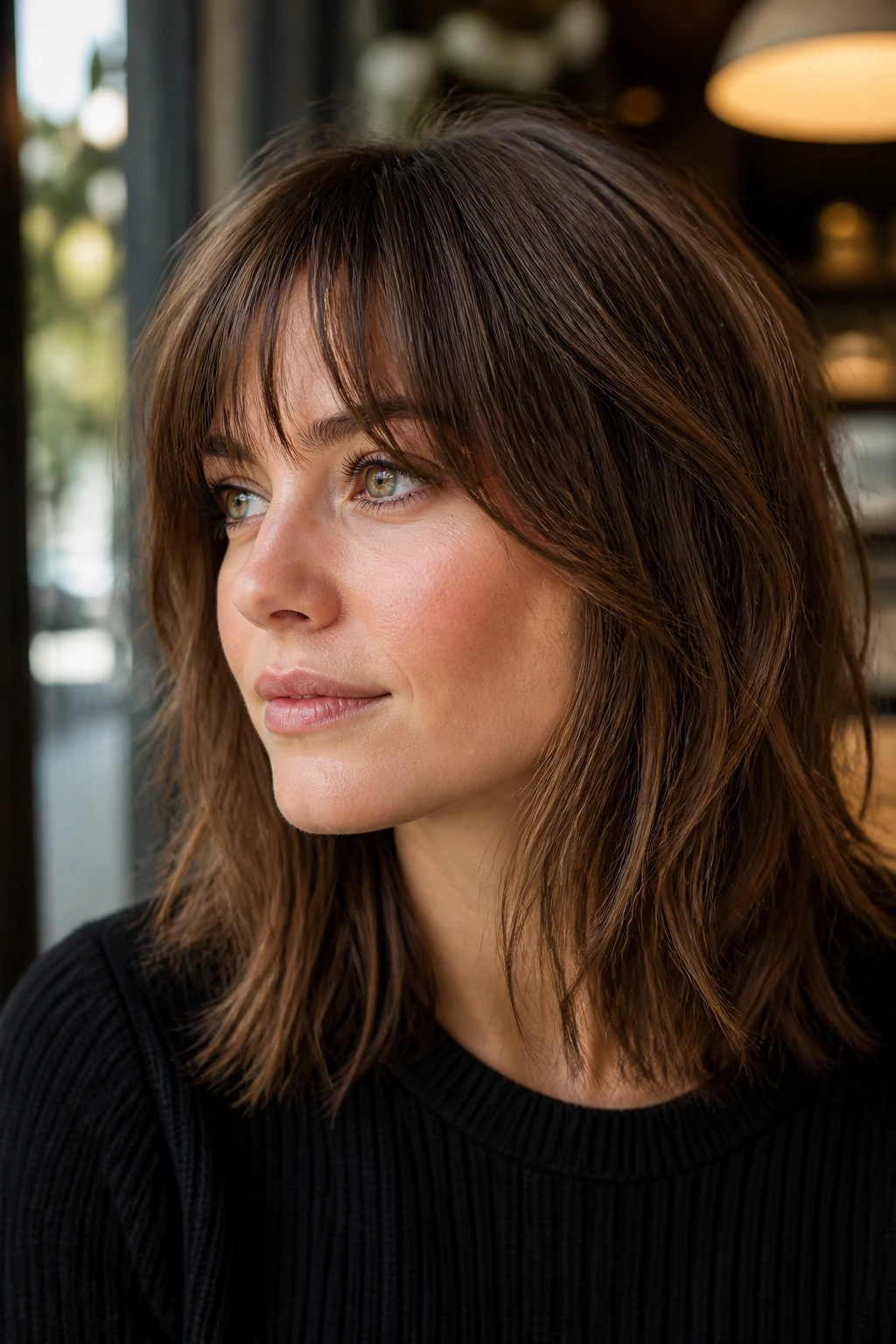
Here’s the face-shape trick people overlook: a fringe that lands near the cheekbone can make a square jaw look less sharp because the eye gets drawn upward and inward, not straight down to the corners. That’s why cheekbone-grazing bangs work so well here. They build a soft frame right where the face starts to widen.
Fine hair likes this style if the ends are lightly texturized. If the bangs are left too blunt, they can look thin at the tips and heavy at the roots. A cleaner approach is to let the center stay a little shorter and the sides stretch down toward the cheekbone with a broken edge.
A good version of this style should move when you turn your head. If it sits like a curtain nailed to the forehead, something is off. The best ones look like they were pushed into place with a fingertip, not sprayed into submission.
8. Arched Piecey Bangs for a Softer Brow Line

Arched piecey bangs are a nice middle ground when you want a little more shape than wisps but less weight than a blunt fringe. The center sits slightly shorter, then the line curves gently upward toward the temples instead of cutting straight across. That curve softens a square face in a way that straight bangs rarely do.
Fine hair benefits from the arch because it creates structure without needing density. A gentle curve reads polished. A hard line reads heavy. Those are not the same thing, and the difference matters more than people think.
This style is especially good if you wear your hair tucked behind the ears often. The fringe still stands on its own, and the arch keeps the front from collapsing into the rest of the hair. A tiny bend with a flat iron at the very ends is usually enough.
9. Grown-Out Fringe That Looks Intentional
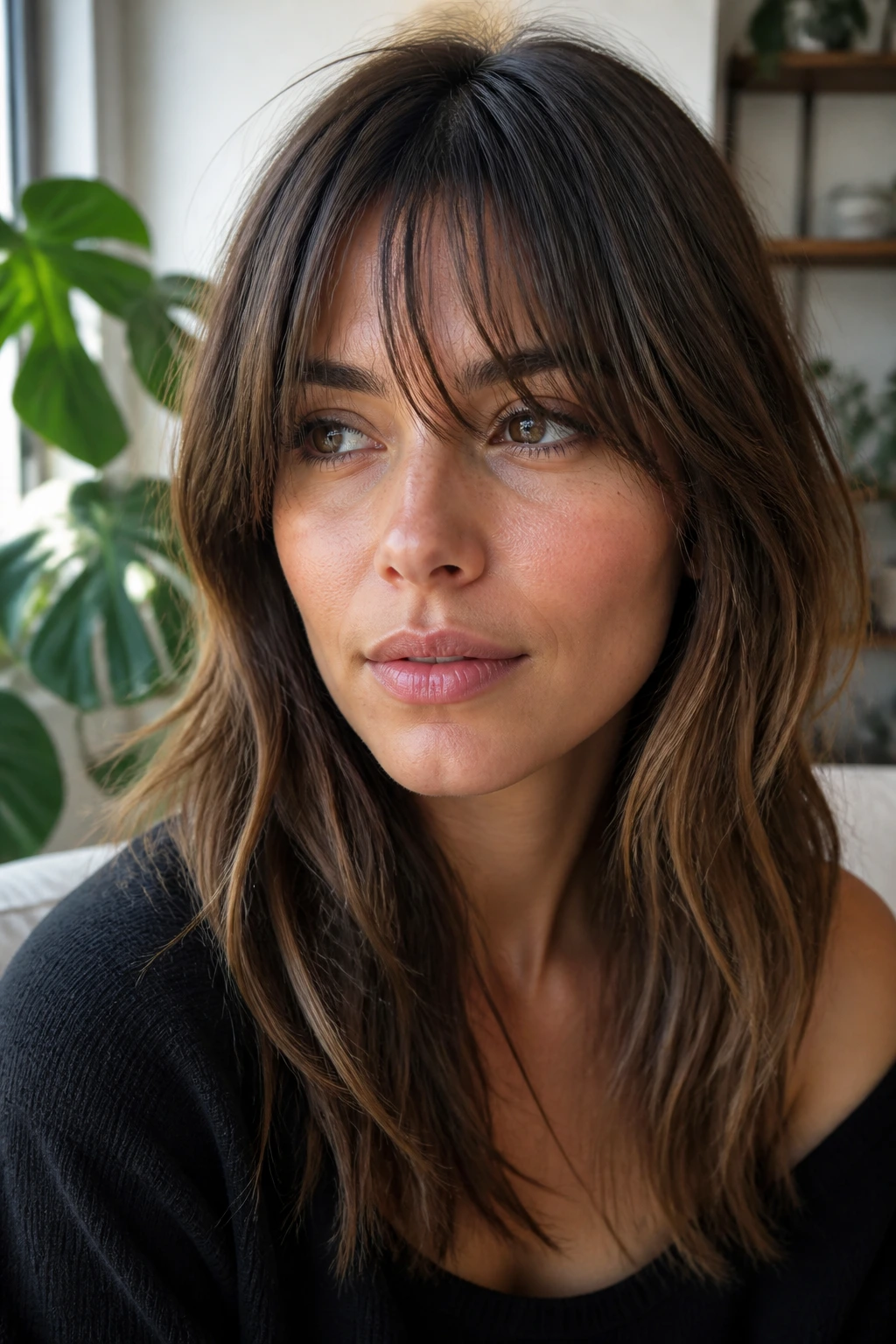
Not every good fringe is freshly cut. Sometimes the best piecey bangs are the ones that have already started to grow out, as long as the shape is still being managed. Grown-out bangs sit somewhere between curtain pieces and face-framing layers, which makes them excellent for square faces because they blur the forehead and the jaw at the same time.
Fine hair often looks better here than in a dense, brand-new fringe. The extra length gives the strands a little more weight, so they stop floating around in a thin, nervous way. You still want separation, though. A little dry shampoo at the roots and a fingertip twist through the ends keeps the shape from going stringy.
This is a practical choice if you do not want to chase trims every few weeks. It looks relaxed, but not sloppy, when the side pieces hit around the cheekbone and the center hangs just above the lashes. The whole thing should feel like it belongs to the haircut, not like a half-finished decision.
10. Razored Fringe With Air Between the Strands
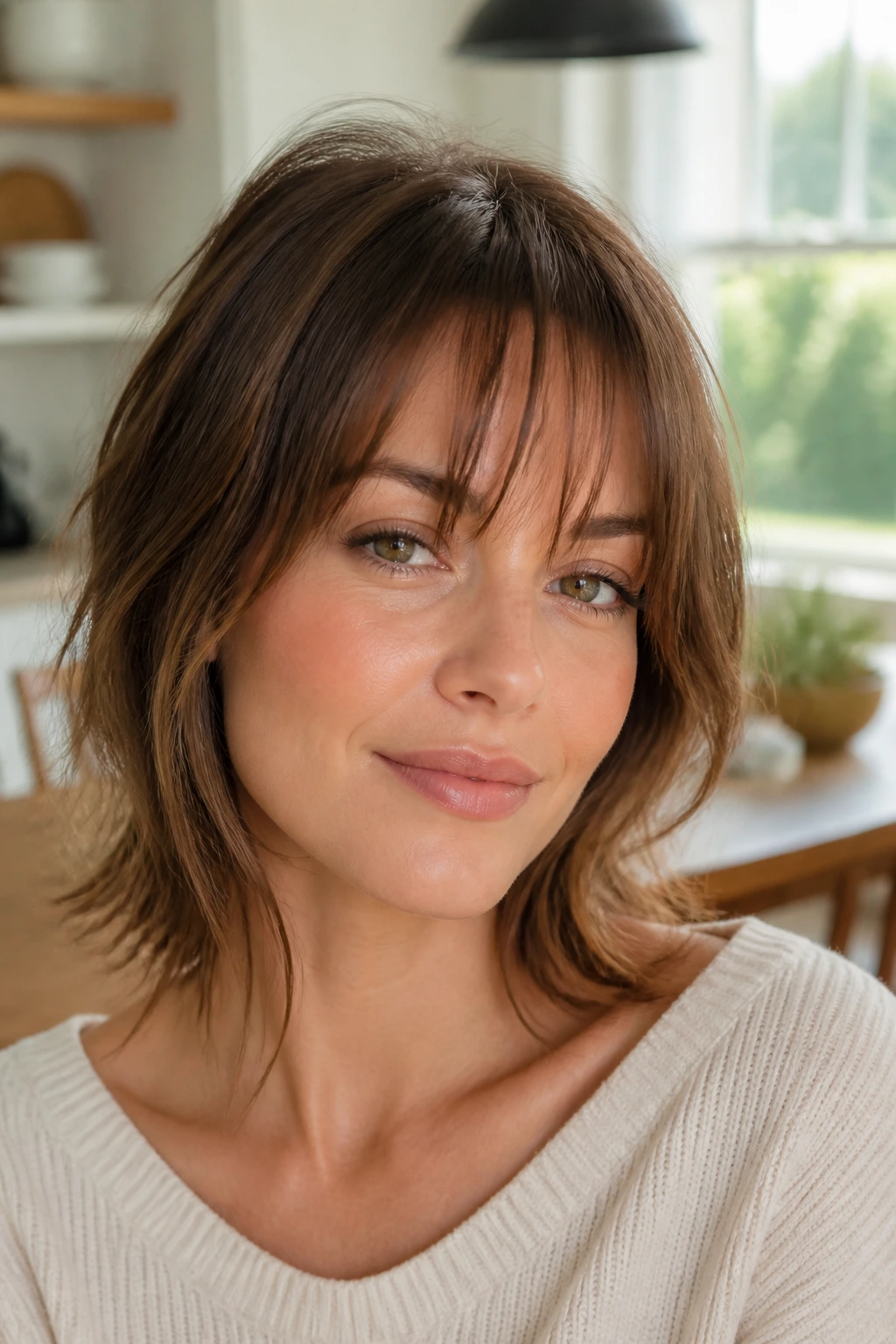
Razored bangs can be beautiful on fine hair, but only when the razor is used with a light hand. Too much slicing can leave the ends wispy in a bad way. Done well, though, a razored fringe creates that airy, separated look that fits square faces and softens the front line.
The point is not to shred the hair. The point is to remove the blunt blocky edge that makes a fringe look heavy. On fine hair, that blunt edge is often what makes the bangs fall in one flat sheet. A careful razor pass can turn that sheet into little movable pieces.
Best for: hair that already has a bit of bend or a loose wave.
Not ideal for: very fragile ends that break easily.
Ask for: soft removal at the ends, not a full chop through the whole fringe.
11. Side-Blend Bangs for Pin-Straight Hair

If your hair is poker-straight and fine, side-blend bangs can be a lifesaver. They do not fight the way your hair naturally falls. Instead, they use the straightness to make the fringe look clean and crisp while the side pieces soften the face line.
Square faces usually need a little diagonal movement, and this cut gives it without forcing a full curtain shape. The bangs sweep across the forehead, then blend into the front layers in one continuous line. That blend matters. It keeps the fringe from looking like it was added on top of the haircut as an afterthought.
This is one of those styles that looks expensive when it is cut correctly. Not because it is fancy, but because it sits quietly and does not argue with your hair texture. That is often the whole trick with fine hair.
12. Light Birkin Bangs With a Softer Edge
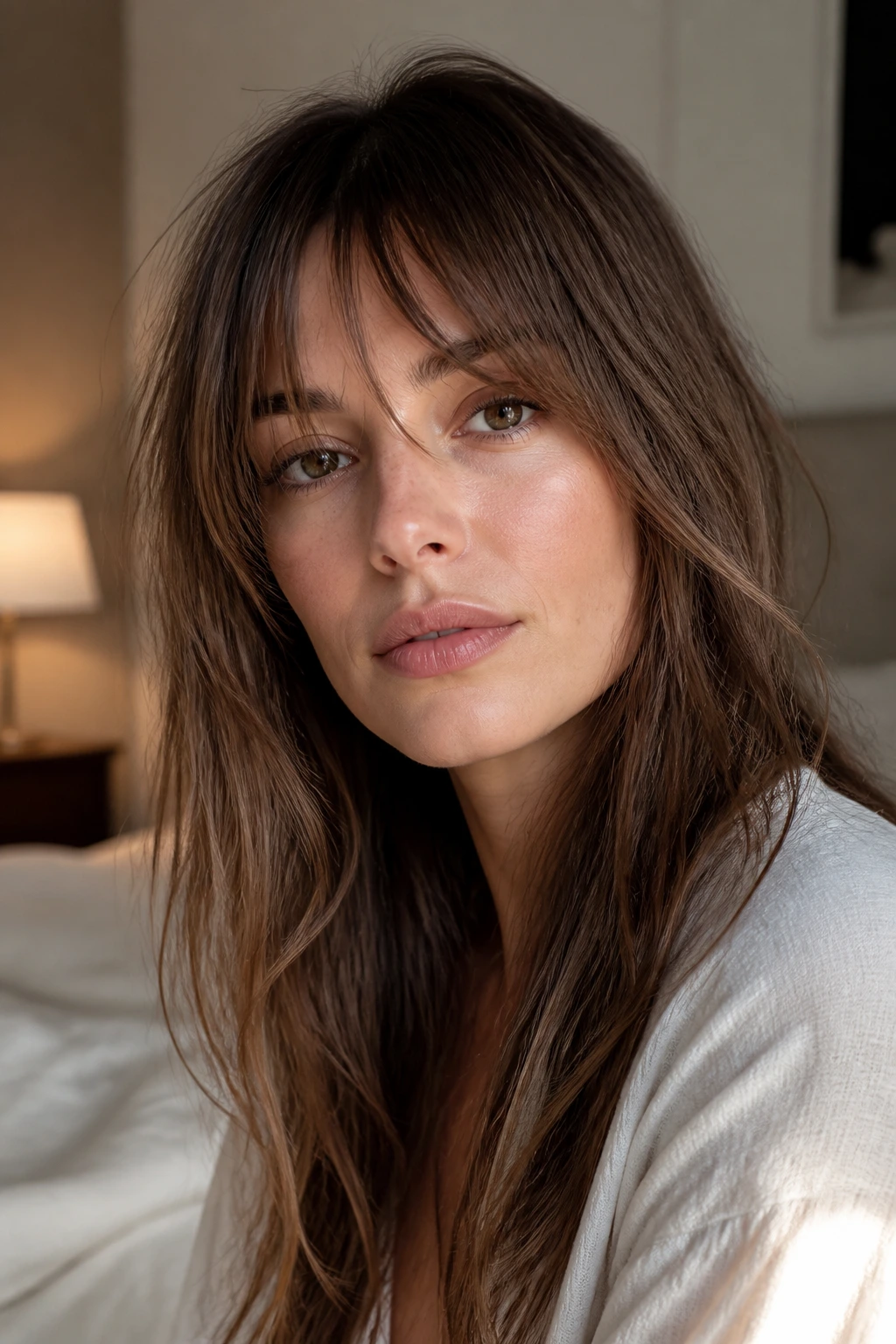
Classic Birkin bangs can be a little too solid for fine hair and a square jaw, so the lighter version is the one to know. Keep the fringe airy, slightly uneven, and a touch longer at the sides. The center should not feel boxed in. It should feel like soft coverage.
The reason this works is simple: you get forehead coverage without a thick horizontal line. Square faces benefit from the broken edge, and fine hair benefits from the fact that the fringe is narrow enough to keep its shape. The style looks especially good when the rest of the hair is loose and slightly undone.
I would not pair this with overly glossy styling cream. That makes the bangs clump. A matte texturizing spray or a touch of dry shampoo gives them the right finish, with a little grit and movement instead of shine.
13. Collarbone Cut With Feathered Bangs
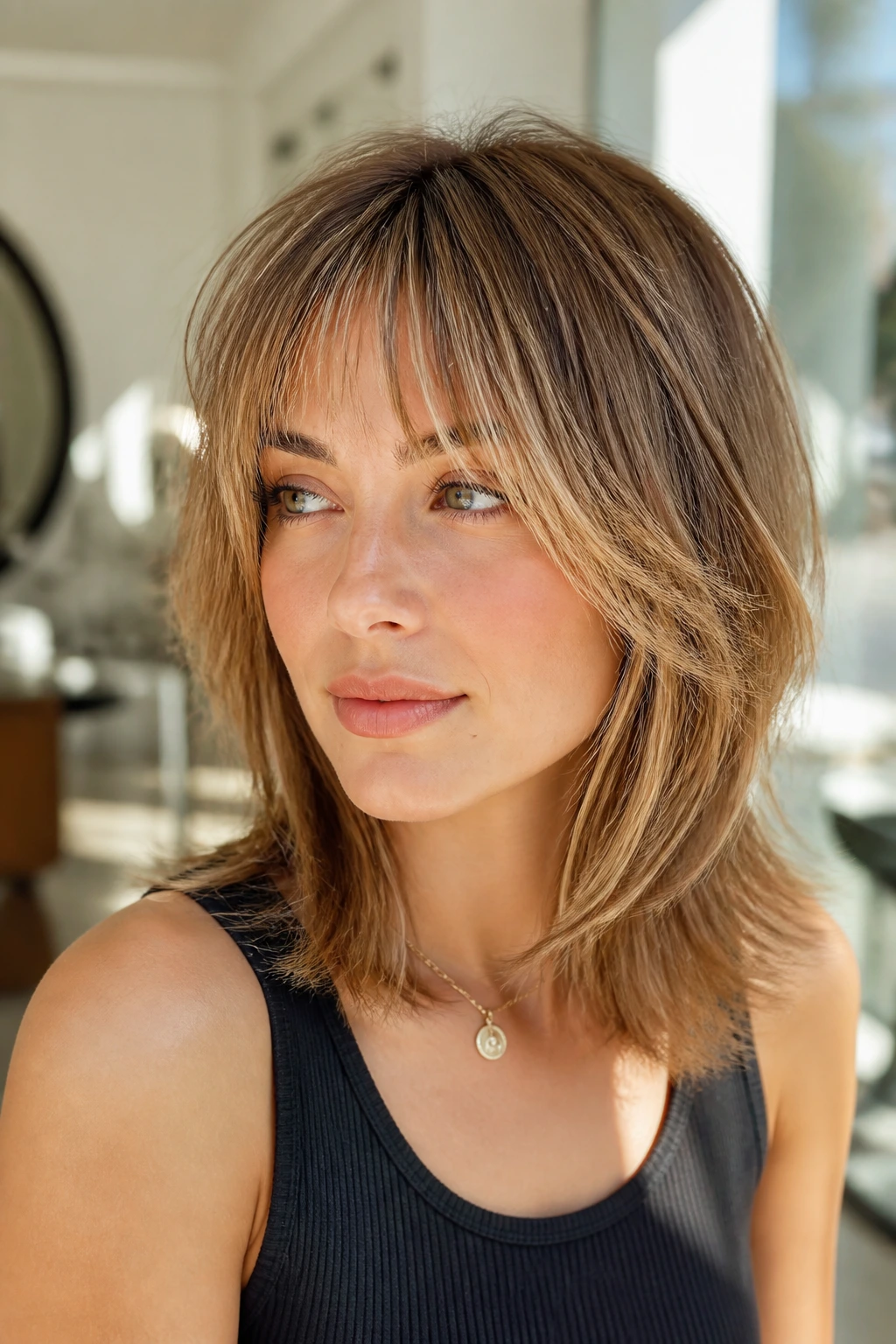
Sometimes the bangs look best when the rest of the haircut carries some of the job. A collarbone-length cut with feathered bangs gives fine hair more body through the sides and ends, so the fringe does not have to work so hard. That helps square faces because the eye gets pulled down through soft, layered length instead of stopping at a hard jawline.
The bang itself should be lighter than the rest of the cut. Think of it as the opening note, not the whole song. A soft center part or a very shallow off-center part keeps the forehead open, while the side pieces flow into the collarbone length and create a clean shape.
This is a good choice if you like hair that moves when you walk. The layers catch a little air, the bangs stay light, and the whole cut avoids that helmet effect that fine hair can sometimes fall into when it is too blunt.
14. C-Curl Bangs That Turn the Face Inward
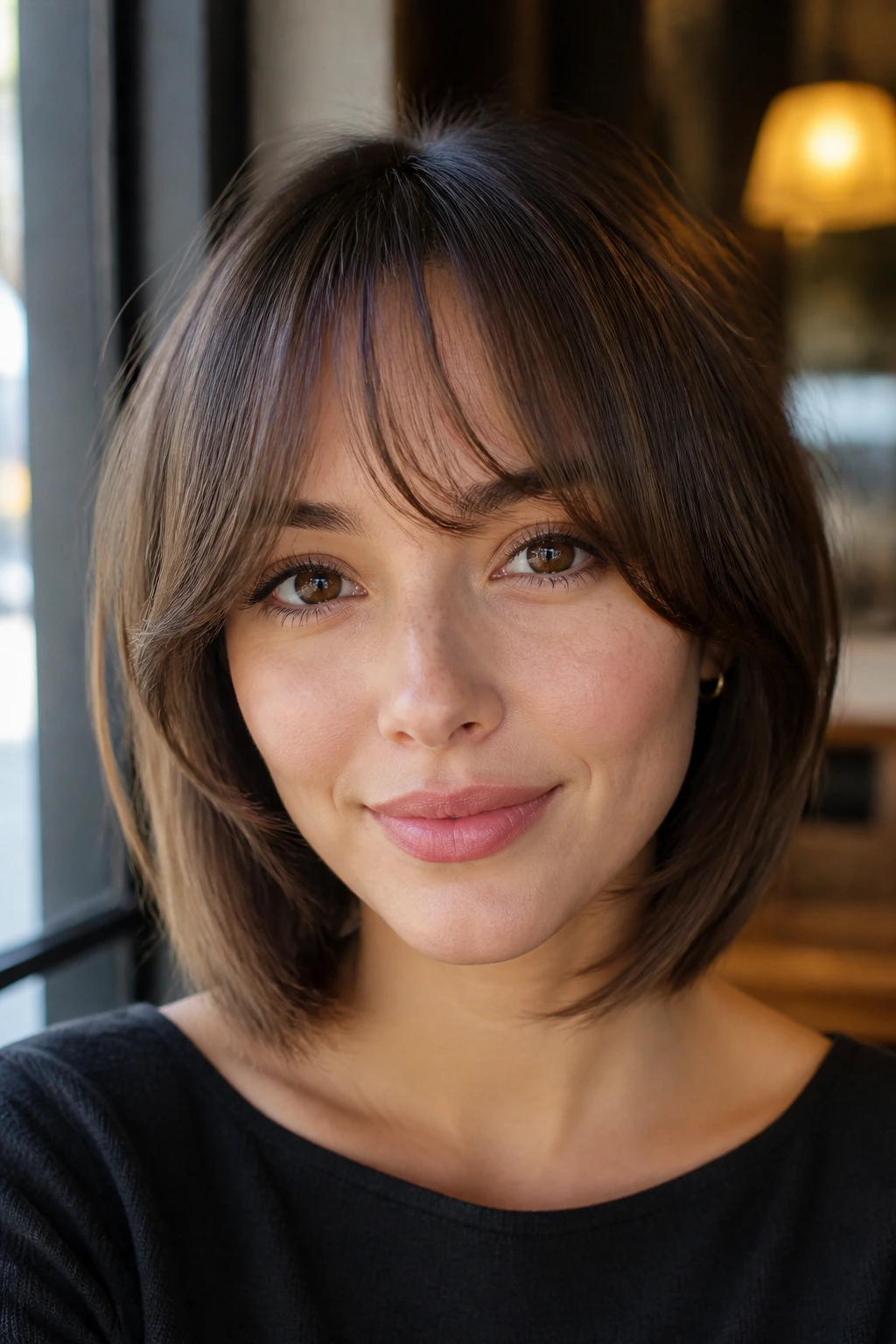
C-curl bangs are a little more styled, but they pay off fast. The ends bend inward in a soft C shape, usually brushing the brows or the upper cheekbone. On a square face, that inward curve pulls attention toward the center of the face and away from the jaw corners.
Fine hair can do this well because it does not need much heat to hold the bend. A small round brush or a 3/4-inch iron is enough. The shape should be gentle, not rolled into a tight curl. Tight curls make the fringe look too deliberate, and that can be a problem if the rest of the hair is soft.
This style is especially good for people who want their bangs to look neat on workdays and a little messier on weekends. It holds shape, but it does not look frozen. That balance is hard to fake if the haircut is too dense.
15. Piecey Bangs With a Lob That Carries the Weight
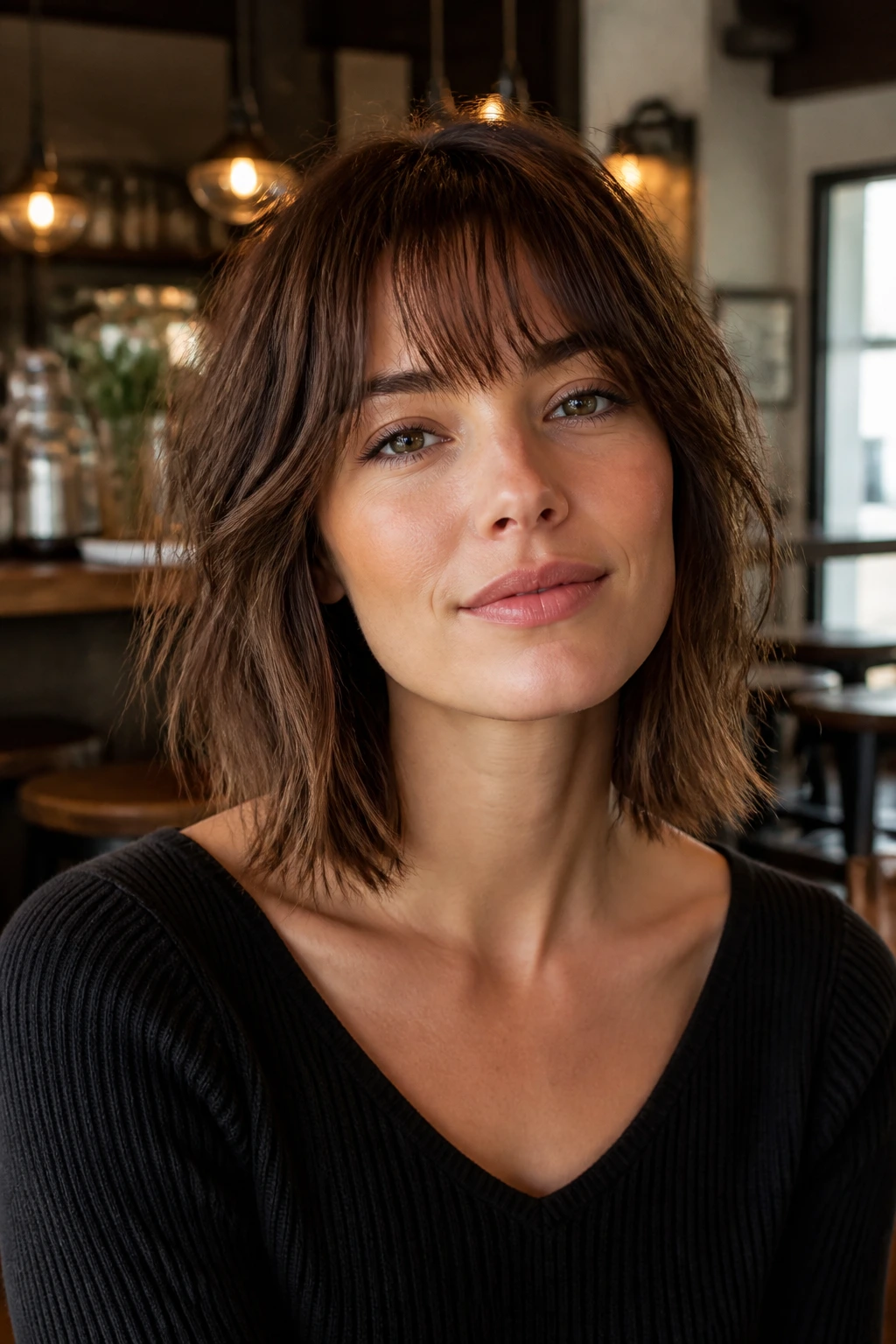
A lob gives fine hair a little more structure through the body of the cut, which makes piecey bangs look fuller by comparison. The fringe does not have to hold the whole front together. The lob does some of the visual work. That is good news if your strands are thin or soft.
Square faces often benefit from a lob because the length ends below the jaw, which removes some of the boxiness at the face line. Add piecey bangs on top of that, and you get a frame that softens the forehead while the lob softens the lower half of the face. It is a clean combo.
If you like precision, ask for the bangs to be narrow and the sides to be slightly longer than the center. That keeps the fringe from looking heavy against the bulk of the cut. It also gives you an easier grow-out path, which matters more than people think when the hair is fine and every extra snip changes the whole balance.
16. Shattered Baby Curtains for a Shorter Front
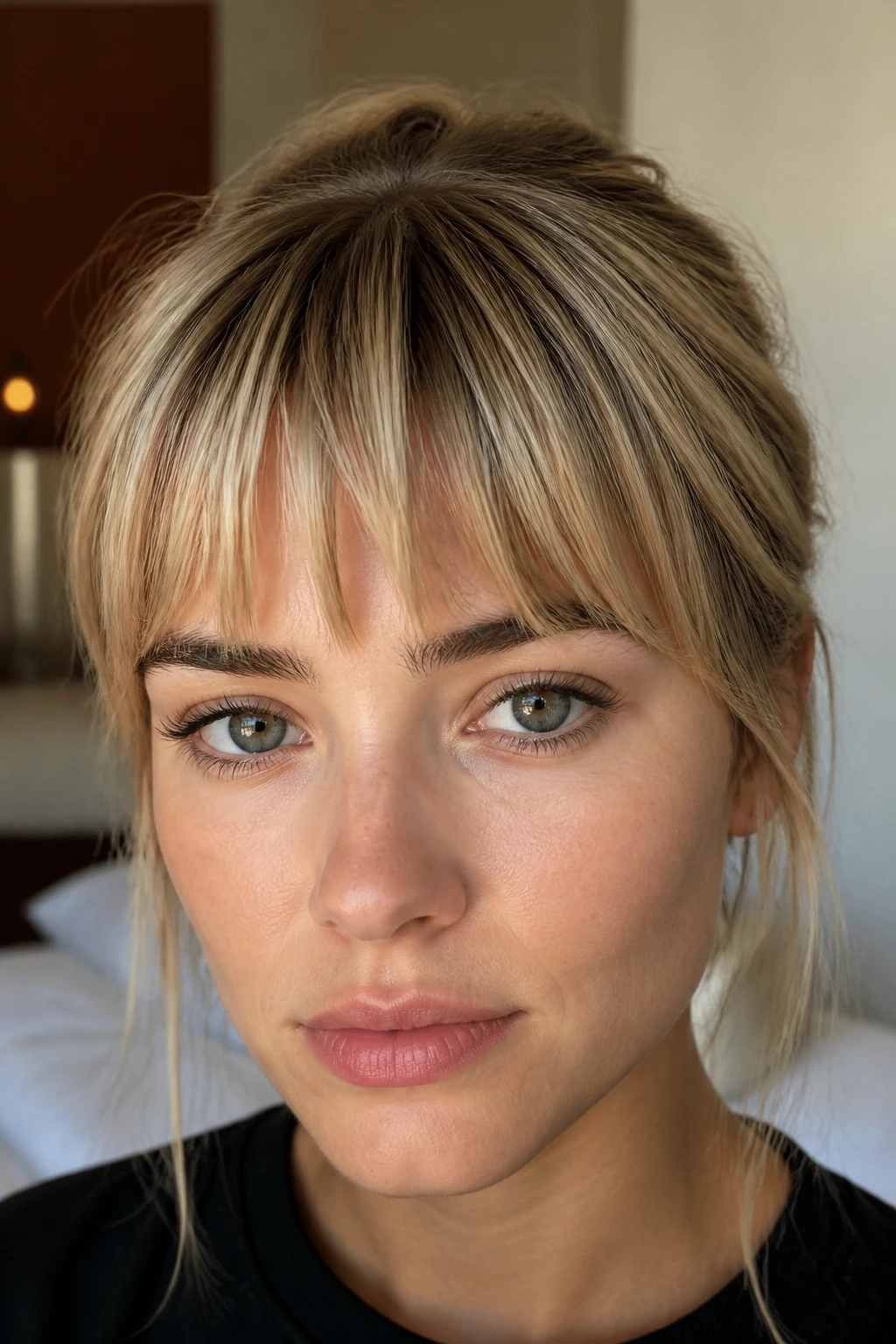
Shorter front pieces can work on square faces if they are shattered enough to move. Baby curtains are not the same as blunt micro bangs. They are shorter in the center, open fast, and sit with a little irregularity through the ends. That broken line matters.
Fine hair can wear this style if the stylist avoids over-thinning the center. The shape should still have enough material to sit softly on the forehead. If the bangs get too sparse, they end up looking accidental. If they stay a little chunky, they make the face look sharper than it needs to be.
This style feels a bit more fashion-forward than the longer options. It suits someone who likes a visible fringe but does not want full coverage. If you wear brows with some shape, even better. The whole cut reads cleaner when the brow line is part of the picture.
17. Wispy Bangs With Soft Temple Pieces
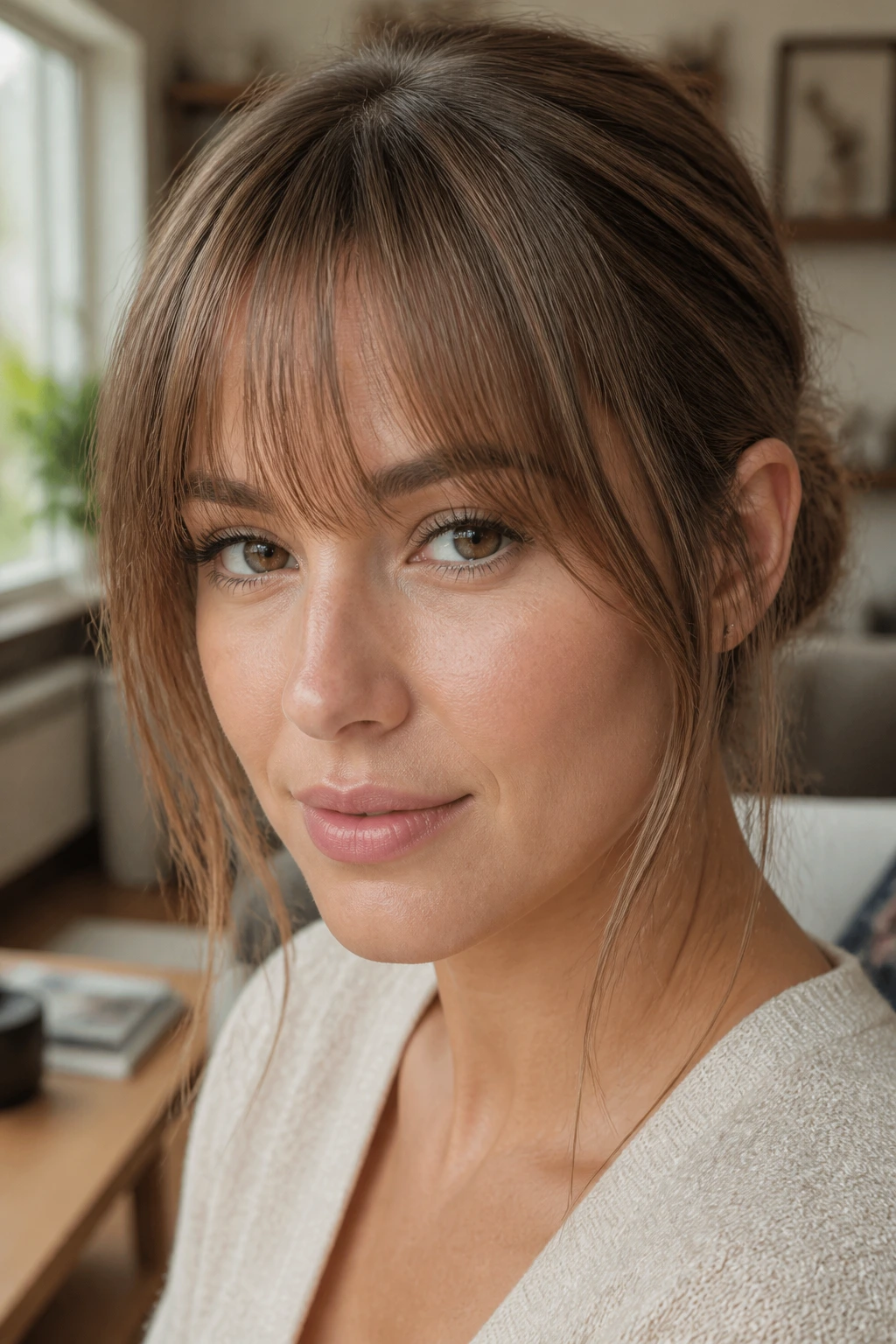
Wispy bangs are not lazy bangs. They are precise bangs that know when to stop. The center stays light and airy, while the temple pieces stretch long enough to soften the sides of a square face. That combination gives you forehead coverage without making the front look crowded.
Fine hair is a strong candidate here because wisps can be gorgeous when the cut respects the natural slimness of the strands. The secret is not to chase density. It is to keep the piecey bits separated and let the temple hair feather into the haircut.
A lot of people try to make wispy bangs behave like a heavier fringe. Bad idea. They lose the airy texture and start hanging in sad little strings. A small amount of powder or spray at the root gives the style some lift, then a finger comb keeps the ends loose.
18. Bangs That Melt Into Long Layers
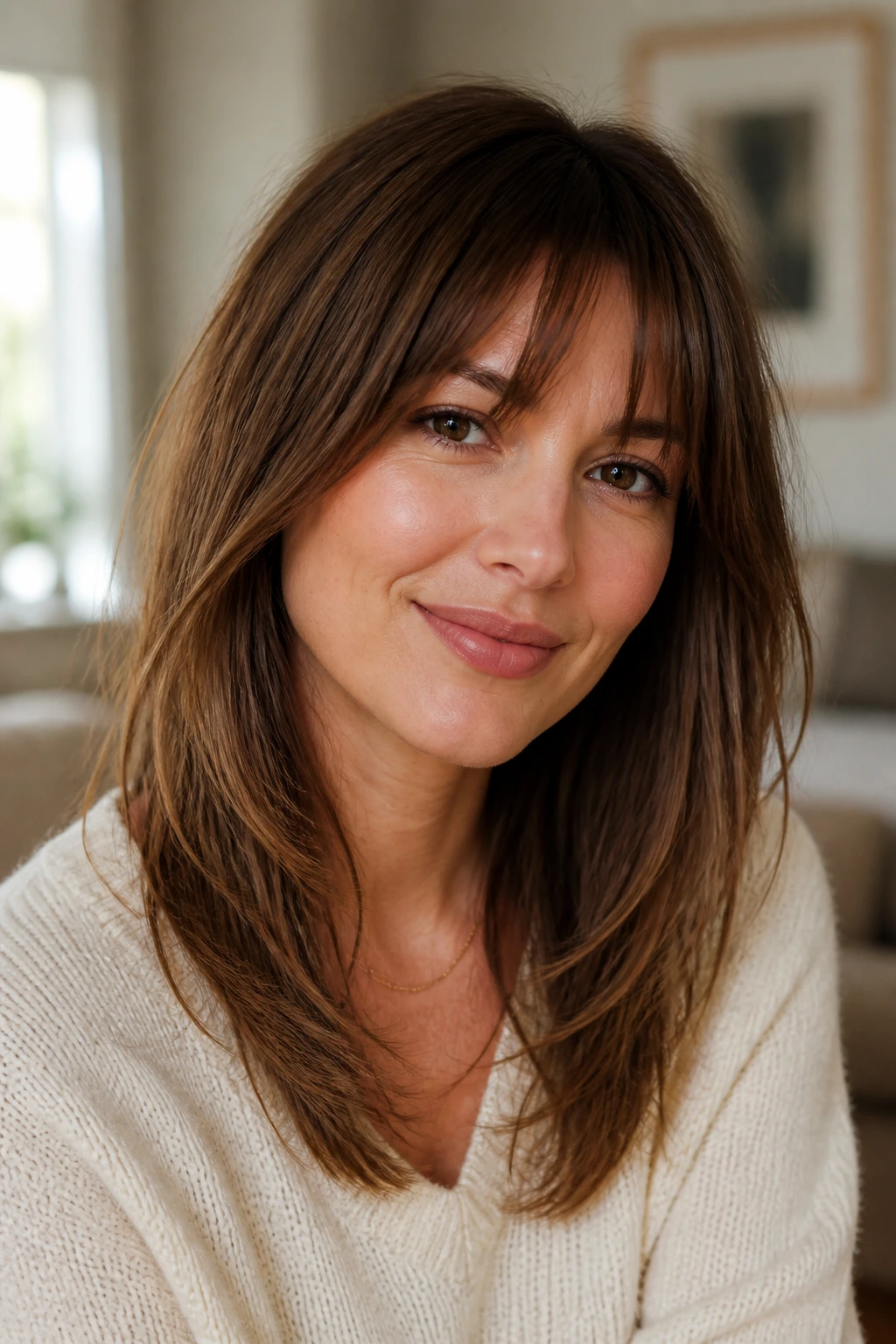
This is the low-drama option, and I love it for that. The front pieces are cut so they almost disappear into the rest of the long layers, which means the bangs soften the face without ever feeling separate from the haircut. For square faces, that melting effect is gold. It keeps the angles from standing out.
Fine hair likes this because the cut stays light from root to tip. Nothing is overbuilt. Nothing is too dense. The fringe simply starts near the brow area and gets longer as it moves outward, blending into the rest of the hair in a way that looks natural even when it has been styled.
If you want to wear bangs but worry about commitment, this is a solid hedge. On day one, it reads as a fringe. Two months later, it reads as flattering face-framing layers. That’s a better grow-out story than most short cuts can tell.
19. Air-Dried Fringe That Keeps Its Bend

Some bangs only work if you blow-dry them into obedience. Air-dried fringe is different. It is cut to keep a soft bend on its own, which makes it a good fit for fine hair that goes limp under too much brushing. Square faces benefit because the natural bend keeps the front line from becoming too sharp.
The trick is to set the shape while the hair is still damp. A little mousse, a quick finger-comb, and one or two duckbill clips at the roots can help the fringe dry in the right direction. Once it’s dry, you can break up the ends with a tiny bit of dry texture spray.
This is the sort of bang style that looks better when it is not perfect. A tiny unevenness through the pieces gives it life. Overstyled air-dried bangs can look stiff. Under-guided ones can split apart. Somewhere in the middle is the sweet spot.
20. Light Blunt Fringe With Built-In Gaps
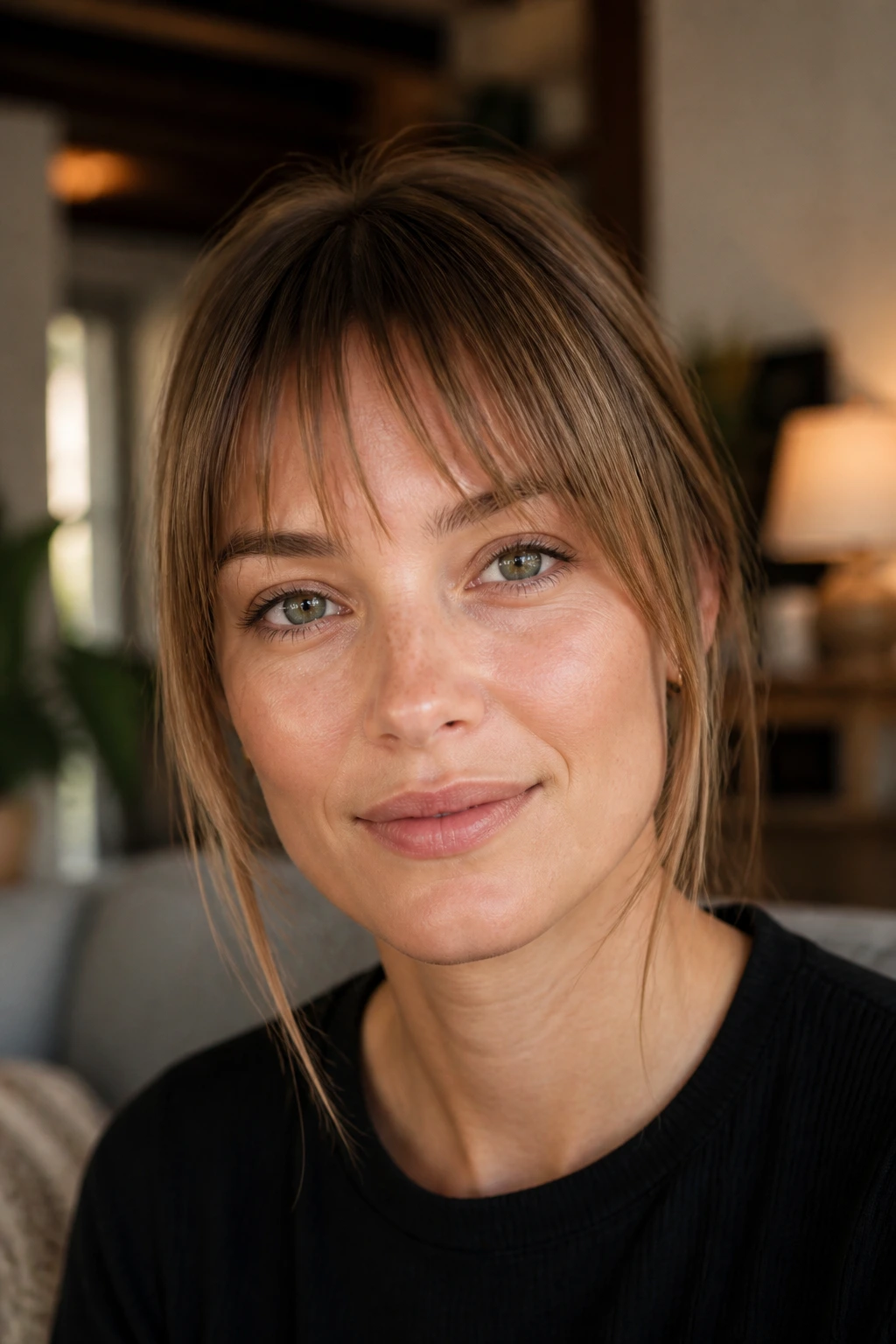
Yes, blunt bangs can still work here, but only if they are kept light and broken up. The phrase “blunt fringe” usually scares me on fine hair, because too much line can flatten the whole face. Still, a lighter version with built-in gaps can look sharp in a good way if the square face needs a little contrast.
The difference is in the density and the finish. You want a thin, soft blunt line that has been point-cut just enough to let air through. Keep the edges a touch rough, keep the center a little longer than you think, and do not load it up with oil or serum.
This is a bolder look than the curtain options. It suits someone who wants the fringe to feel deliberate, not delicate. The face-softening comes from the gaps at the edges and the longer side pieces, which take the edge off the square line without making the whole cut look too sweet.
21. Side-Blend Fringe for Wavy Hair
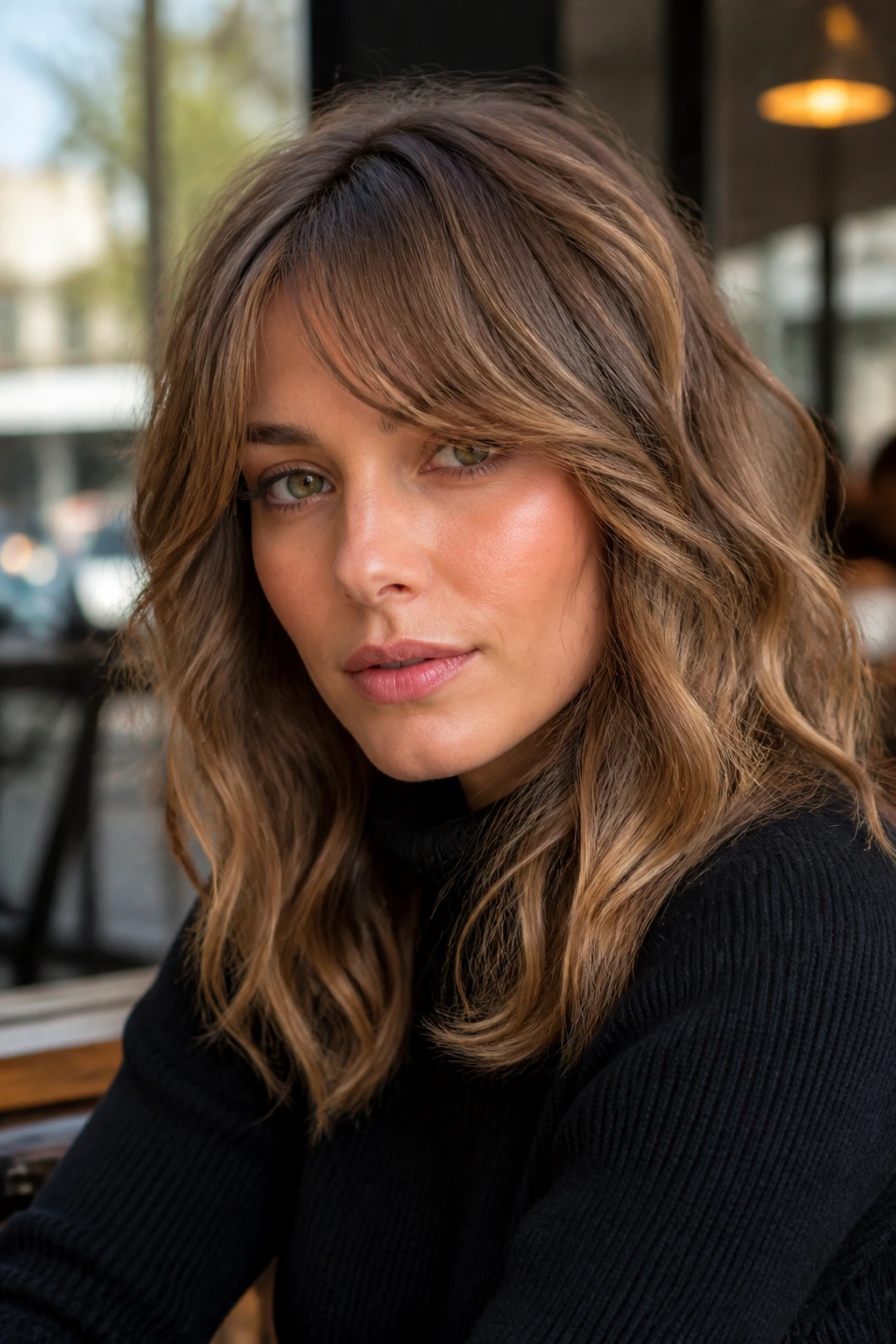
Wavy fine hair has a nice advantage: it can create texture without a lot of product. A side-blend fringe uses that bend to keep the bangs piecey and loose, which is ideal if your square face needs softness more than structure. The part does most of the work.
This cut should have enough length to let the wave fall naturally, but not so much that it hangs in your eyes. The outer pieces can wrap toward the cheekbone, which makes the front feel balanced. If the wave pattern is strong, resist the urge to iron everything flat. The texture is the point.
A light mist of water and a palmful of mousse are often enough. Scrunch, twist, and leave it alone. Wavy hair hates being bullied. So do bangs.
22. Tousled Bangs With a Mid-Length Cut

Tousled bangs are the friendliest version of a piecey fringe when you want hair that looks lived-in rather than styled to death. Pair them with a mid-length cut, and fine hair gets a little extra movement through the body, while the bangs stay loose enough to soften a square face instead of outlining it.
The texture here should feel imperfect on purpose. A few separated strands across the forehead, a little lift at the root, and side pieces that bend outward just enough to frame the jaw. If all of it starts to look too neat, the style loses the point.
This version is good for people who do not want to spend ten minutes every morning on the fringe alone. It can be roughed up with fingers and a tiny amount of dry shampoo. That’s usually all it takes.
23. Layered Fringe Over a Bob
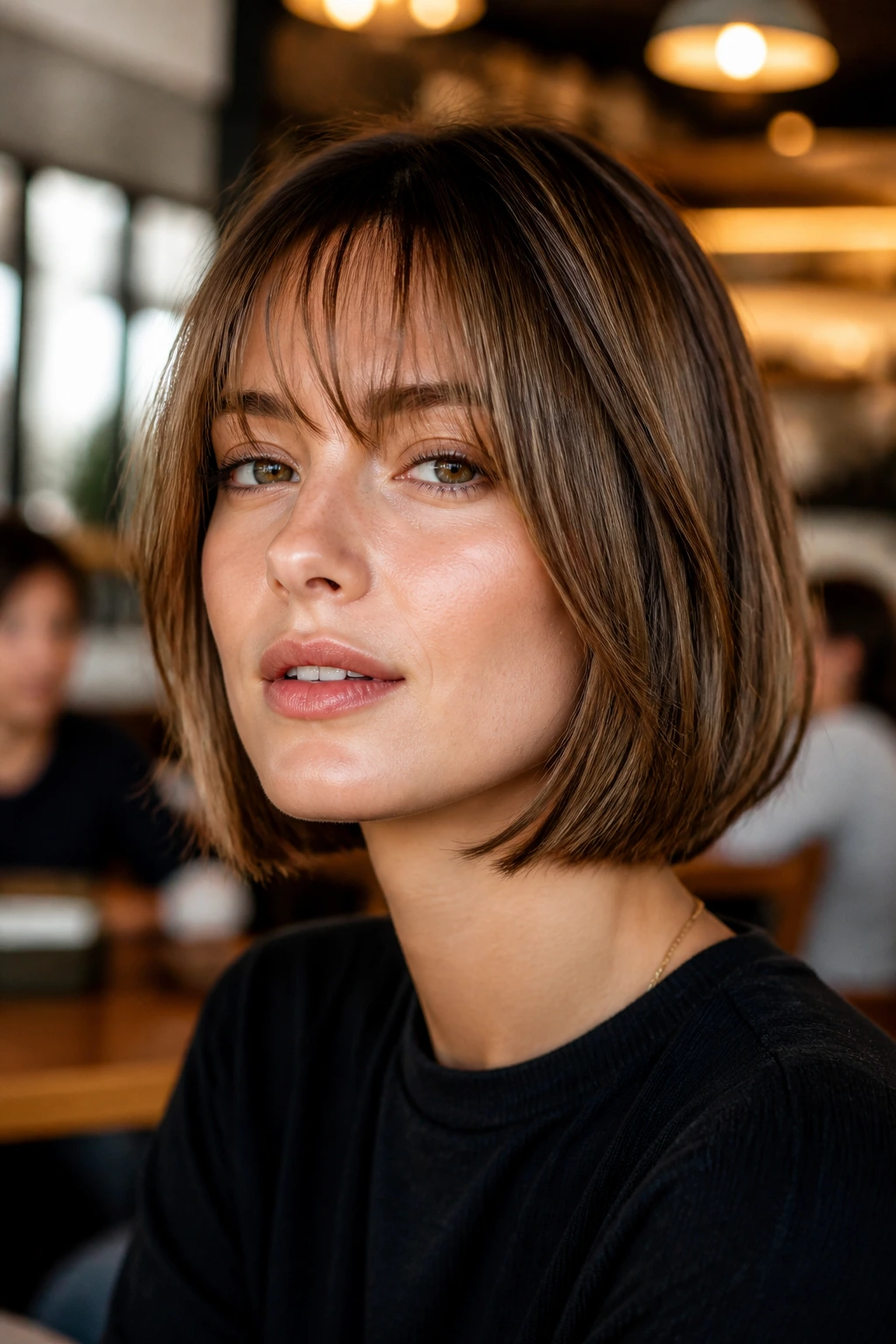
A bob and a layered fringe can be a smart pairing for fine hair because the bob creates a clean line around the head while the bangs add movement up front. On a square face, the key is to keep the fringe layered enough that it softens the forehead without making the bob feel boxy.
I prefer a bob that sits a little below the jaw if the face is already square. That keeps the strongest line from landing right at the chin. The fringe then breaks up the top half of the face, and the combination feels balanced instead of severe.
Keep the layers in the bangs light and short enough to move, but not so short that they spring up weirdly on dry days. That balance is touchy with fine hair. A quarter-inch too much can change the whole mood of the cut.
24. Split Fringe With Internal Layers
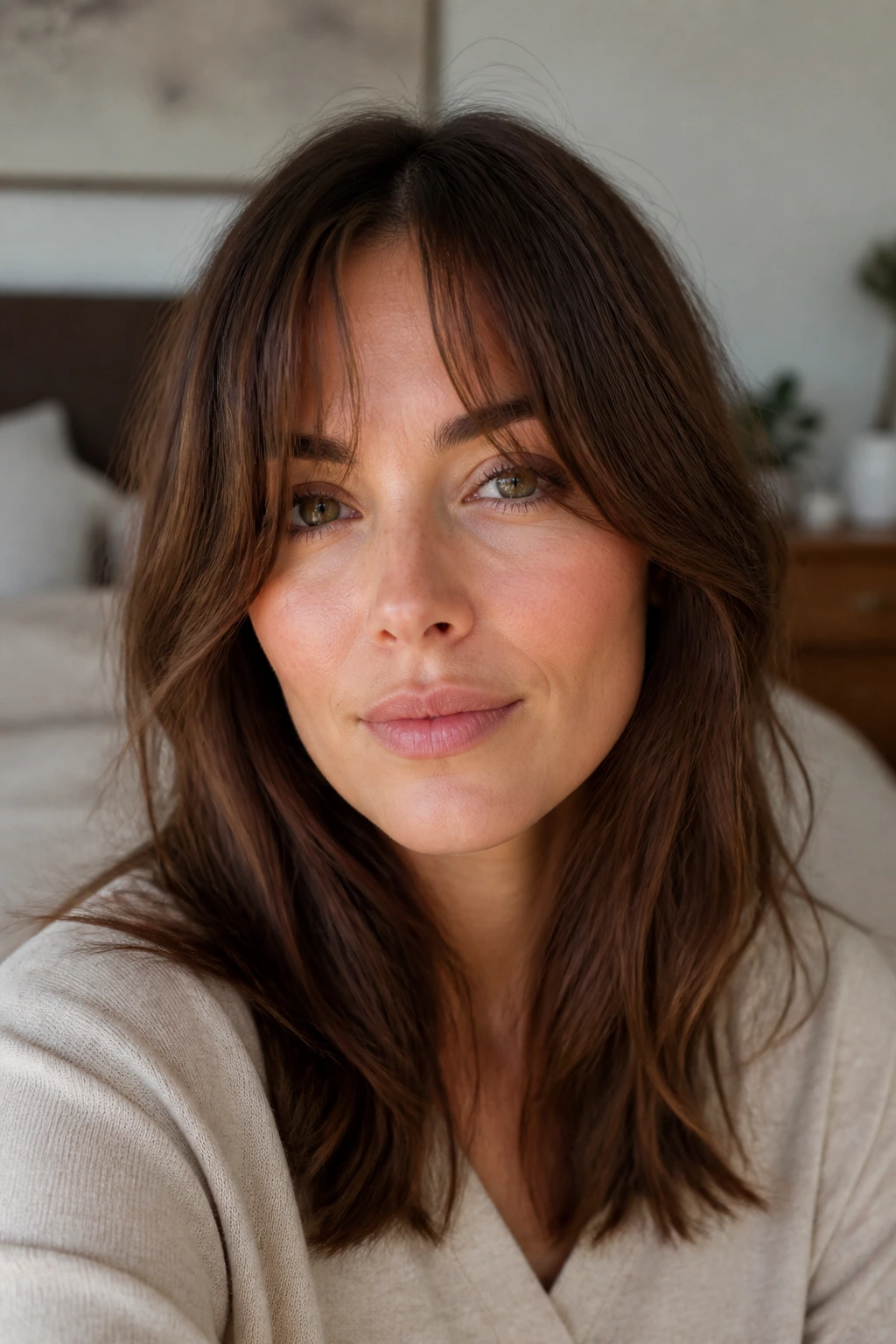
Internal layers are the invisible fix nobody talks about enough. They remove weight from inside the fringe, which keeps the outer line soft and piecey without making the bangs look thin. Split fringe works especially well with this method because the center opens naturally and the sides fall in a more flattering line for square faces.
This is a smart option if your bangs tend to stick together. Internal layers give them room to separate instead of hanging in one flat sheet. The result looks easy, but it is actually the product of careful weight removal.
One thing to watch: if the stylist takes too much out of the middle, the fringe can split too far apart. That is not piecey. That is sparse. There is a difference, and it matters.
25. Soft Narrow Curtain Bangs for the Most Easygoing Finish

If I had to pick one style for someone who wants the least fuss and the most flexibility, this would be it. Soft narrow curtain bangs keep the center light, the sides long, and the whole shape narrow enough that fine hair does not have to do heavy lifting. For square faces, the result is soft but not sugary.
The narrow shape also means the fringe plays nicely with the rest of the haircut. It does not swallow the forehead. It does not frame the face in a hard rectangle. It simply sits there, opens up the center, and lets the side pieces do their softening job.
This style looks good air-dried, blow-dried, or bent with a mini iron. That versatility is the reason it ends up being a repeat cut for so many people with fine strands. It is not flashy. It is useful. Sometimes that is the better thing.
Why Piecey Texture Beats a Heavy Shelf
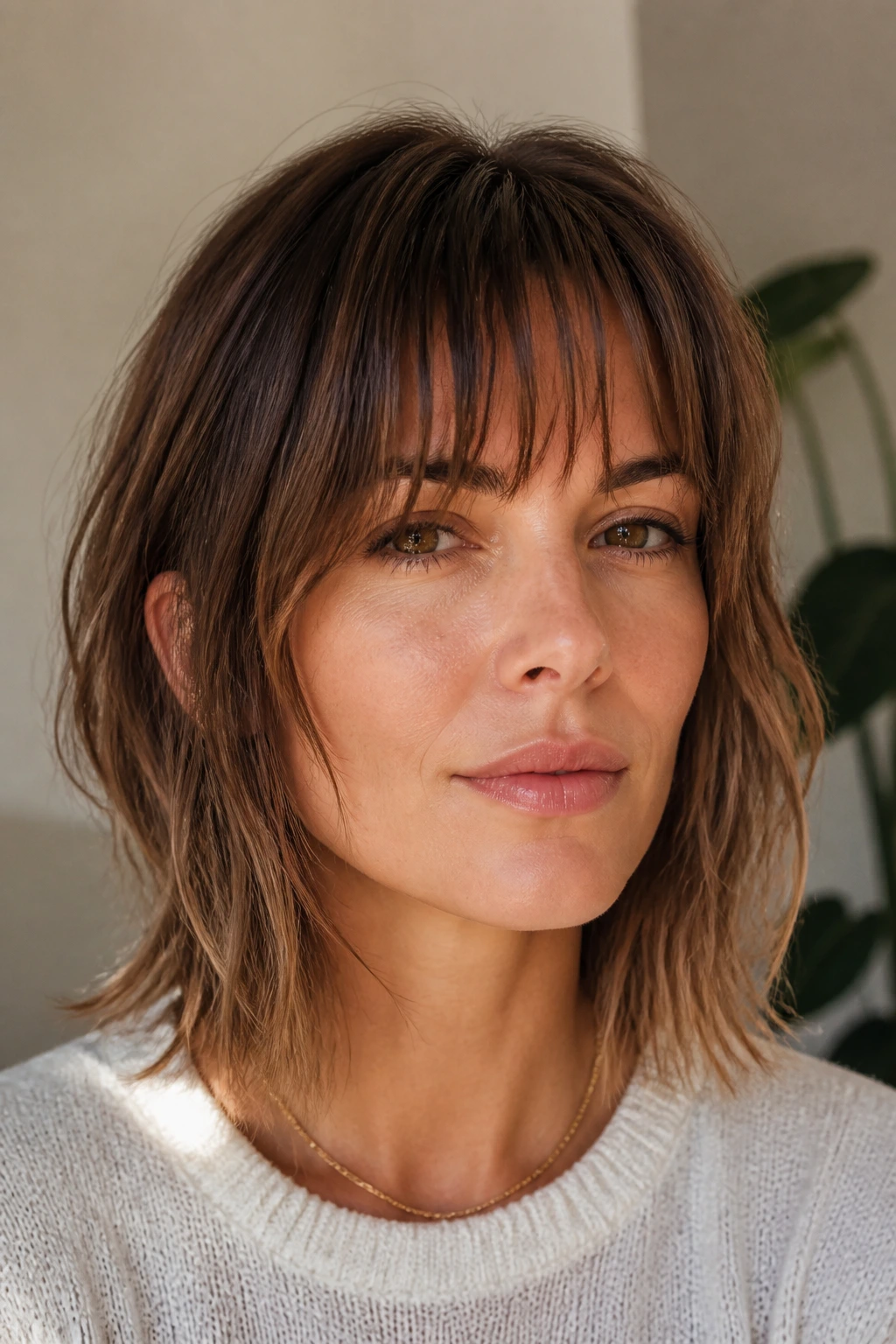
A heavy, thick bang can look chic in a photo and stubborn in real life. Fine hair rarely has the density to hold that kind of blocky fringe, and square faces usually do not need another straight edge sitting right above the brows. Piecey texture fixes both problems by spreading the visual weight across separated strands instead of forcing the hair into one dense line.
The other advantage is shape. When the ends are broken up, the fringe can bend around the forehead instead of squaring it off. That matters more than people realize. A square face does not need to be hidden; it needs softened corners, a little movement near the temples, and a front shape that does not fight the jaw.
The density trap
If the bang section is too wide, the crown and front can start to look thin. You feel like you “have bangs,” but the rest of the hair starts to pay for it. A narrower section keeps the rest of the haircut looking fuller.
The angle trick
Diagonal lines are kinder here than straight ones. Curtain shapes, side sweeps, and split fronts all pull the eye across the face rather than stopping it on a blunt border.
The grow-out trick
Piecey bangs age well because the longer side pieces turn into face-framing layers. That gives you more mileage between trims, which is a nice thing when the front of your hair grows at an annoying speed.
What to Say at the Salon Chair

Ask for the cut in plain language. Stylists do not need poetry. They need to know where your cowlick sits, how much forehead you want to show, and whether your hair gets flat at the roots by noon. If you have fine hair, say that out loud. It changes how the bang section should be sized.
Tell your stylist you want piecey movement, not a thick shelf. That phrase matters. It signals that you do not want the fringe packed with density. Ask for point-cutting or soft texturizing at the ends, and ask them to keep the central pieces a touch longer than the final goal so the fringe does not jump too short when dry.
A few details help a lot:
- Bring a photo of someone with similar hair density. Hair thickness changes everything.
- Point to your cowlick or part line. That tells the stylist where the fringe will want to split.
- Ask where the shortest piece should sit when dry. On fine hair, that answer is usually a little longer than your first instinct.
- Say how often you want trims. If you hate maintenance, that changes the shape they should give you.
Essential Tools for Styling Fine Bangs
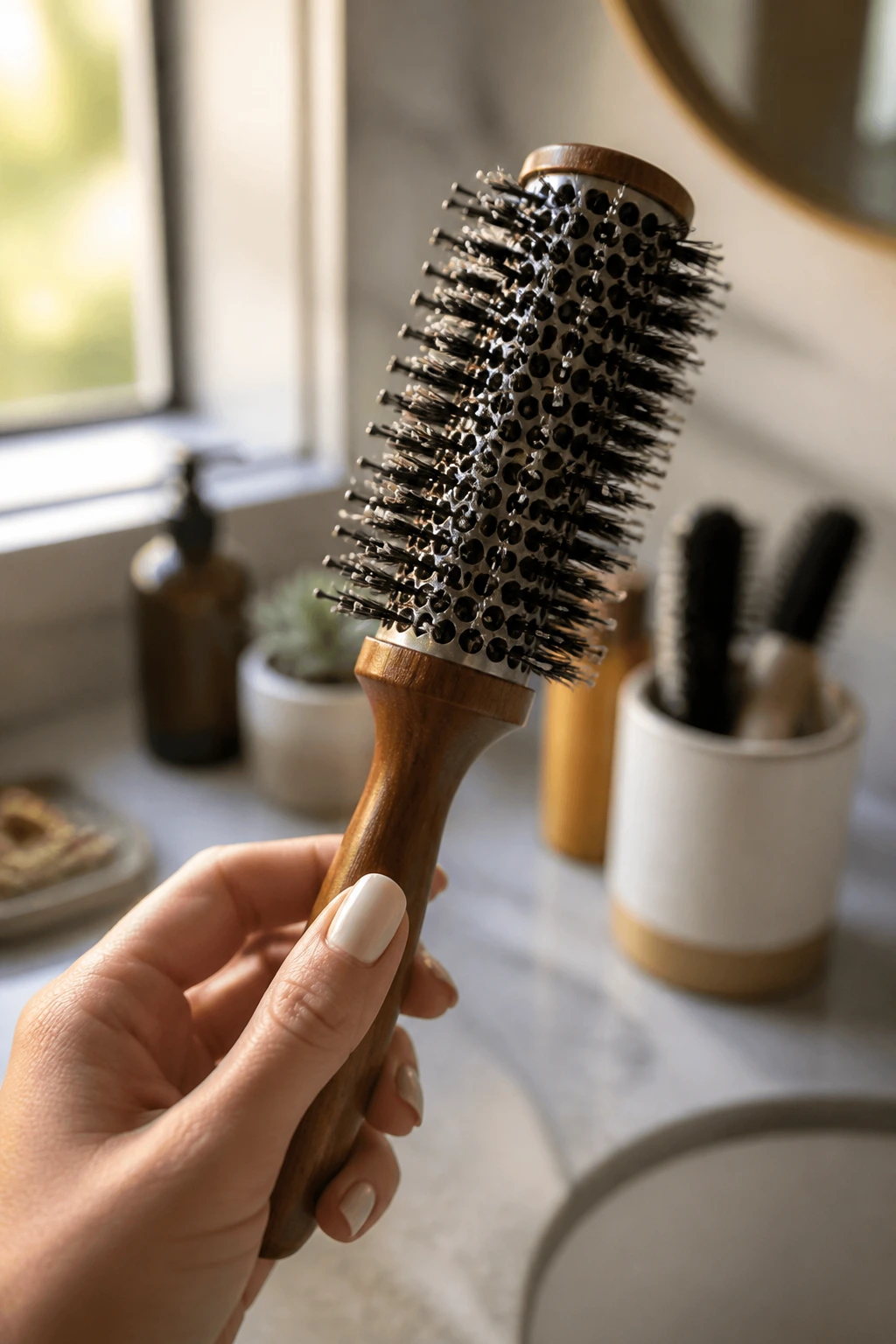
- A small round brush, 1 to 1.25 inches: Big brushes are clumsy on short front pieces; a smaller one gives better bend and root lift.
- A blow dryer with a concentrator nozzle: The nozzle keeps air focused so you can push the bangs in the right direction instead of blasting them apart.
- A tail comb: Useful for clean parting and for clipping the fringe section out of the way while the rest of the hair dries.
- Duckbill clips: These help set a bend at the roots or hold the side pieces while they cool.
- Lightweight mousse or root-lifting spray: Fine hair usually needs a little support at the root, not a creamy product that makes it limp.
- Texturizing spray or dry shampoo: Use this on day two or three to restore separation and keep the fringe from sticking together.
- A mini flat iron or small curling iron, 3/4 inch: Handy for a quick bend at the ends, especially if your bangs refuse to cooperate after a wash.
- A soft towel or microfiber wrap: Press moisture out gently; rough rubbing can make fine bangs frizz and split.
How to Wear Them With the Rest of Your Cut

Face Shape: With a square face, the fringe should soften the forehead without creating another hard border. Side pieces that angle toward the cheekbone usually do more for the face than bangs that stop right at the brow in one blunt line.
Best Pairings: Lobs, shags, collarbone cuts, and long layers all play nicely with piecey bangs because they keep the overall shape moving. A very strong one-length bob can still work, but the fringe needs extra texture so the whole look does not feel blocky.
Density: Fine hair looks better when the bang section is narrow and the ends are feathered. If you ask for too much width, the front can look thin even if the bangs themselves look full. That is a common mistake.
Finish: Matte texture usually beats glossy shine here. A little grip helps the bangs separate. Heavy serums and oils can turn piecey fringe into oily fringe, which is a short road to regret.
Styling Tricks That Keep the Fringe Alive

Volume Boost: Dry the bangs first, before the rest of the hair, while they are still damp. Pull the roots from side to side with a brush, then finish with a cool shot to lock the bend in place. That little reset at the root gives fine hair more lift than piling on product ever will.
Texture Boost: After drying, rub one drop of light paste or a puff of texturizing powder between your fingertips and pinch only the ends. Do not coat the whole bang section. The root should stay clean and the ends should look separated.
Pro Move: If your bangs split where you do not want them to, clip them flat against the forehead while they cool. Two to three minutes is often enough to change the direction. It sounds fussy. It works.
Quick Reset: On day two, mist the fringe with water, comb it into place with your fingers, then hit only the roots with the dryer for 15 to 20 seconds. That is usually enough to make them look freshly cut again.
Common Mistakes That Make Bangs Look Sparse or Boxy
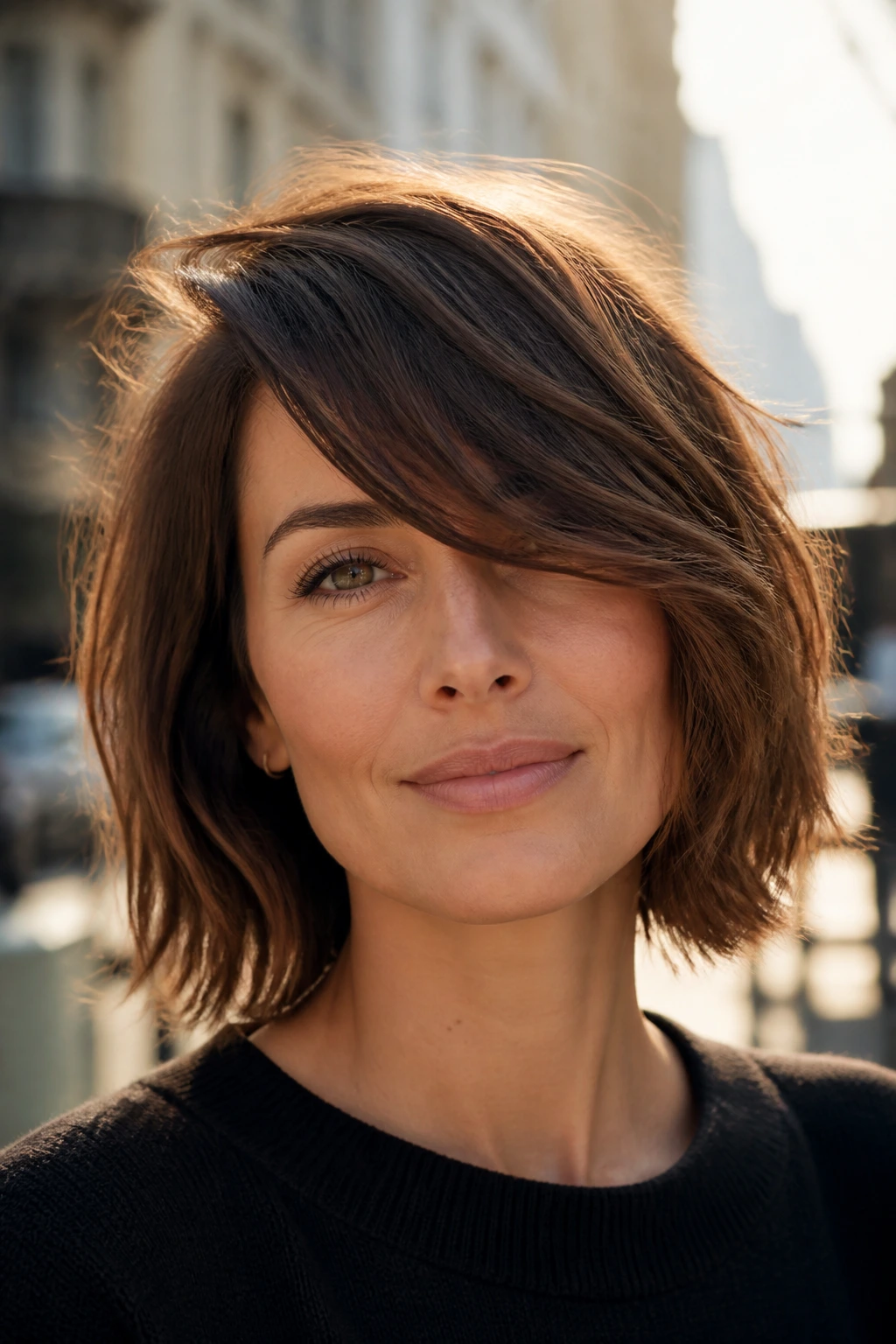
- Cutting too much hair into the fringe: This steals density from the rest of the front and can make fine hair look thinner overall. Fix it by asking for a narrower bang section and keeping more weight in the sides.
- Leaving the line too blunt: A hard, straight edge across the forehead can make a square face look harsher and fine hair look flat. Ask for point-cutting or soft texturizing at the ends.
- Using heavy cream or oil near the roots: Fine bangs collapse fast under rich products. Put moisture products only on the lengths, and keep the fringe root light.
- Ignoring the cowlick: If your bangs naturally split or kick up, a cut that fights it will need daily battle. Shape the bangs around the cowlick instead of pretending it is not there.
- Cutting them too short on the first pass: Fine hair can spring up once it dries. Leaving an extra quarter inch buys you room to adjust.
- Trying to make them behave without heat or clip-setting: Some styles need a minute of directed drying. Skipping that step often turns “piecey” into “messy for the wrong reason.”
Variations and Adaptations to Try
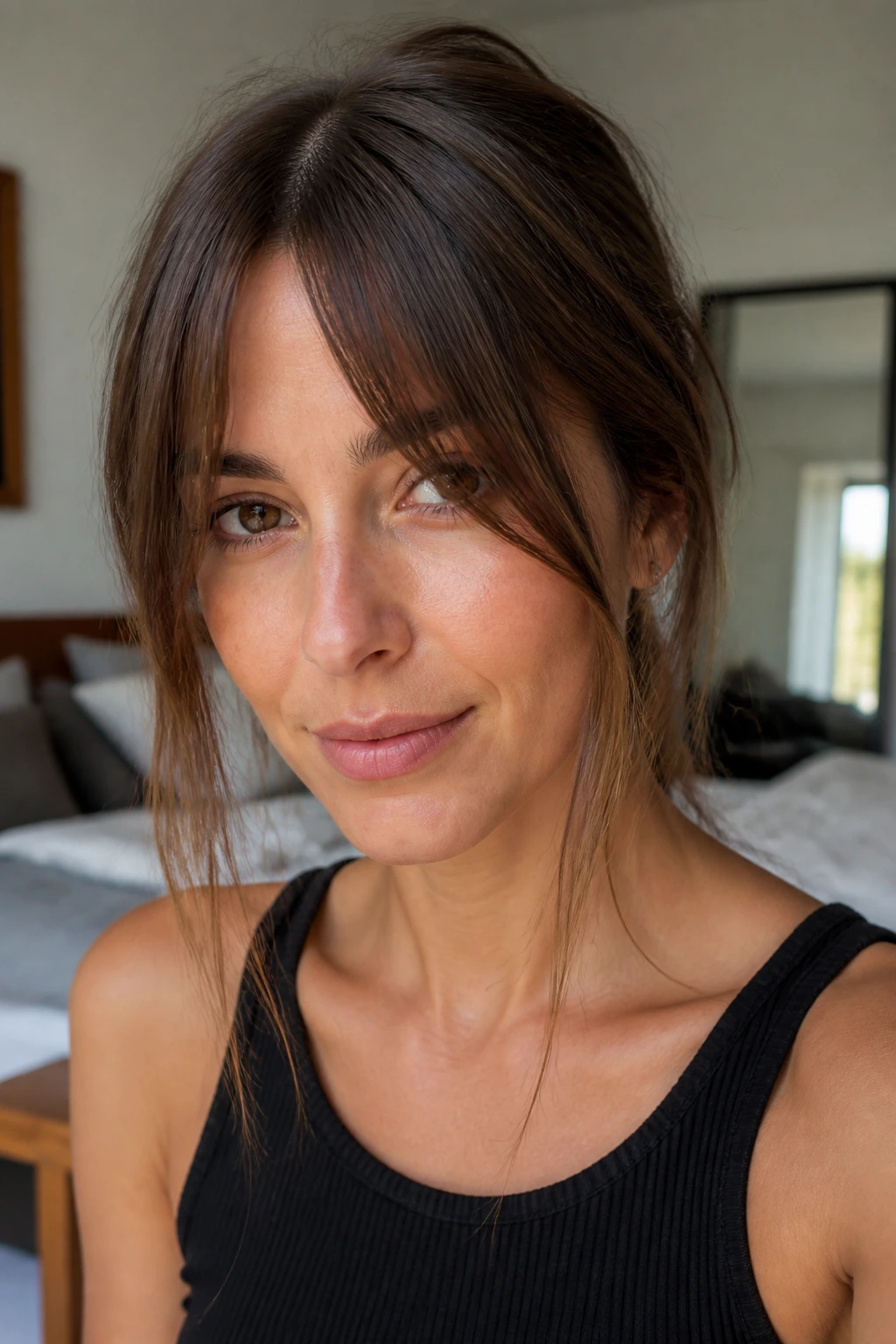
The Air-Dry Version: Best for wavy or slightly bent fine hair. Ask for a lighter center and longer sides, then use mousse and clips instead of a full blowout. The fringe will dry with a natural split that suits square faces well.
The Polished Blowout Version: Good if you like a neater front. Blow-dry the bangs with a small round brush, bend the ends under just a touch, and use a cool shot to hold the shape. The result looks more finished without losing softness.
The Cowlick-Friendly Split: If your front hair wants to divide in the middle, lean into it. Ask for a split fringe with narrow center pieces and longer temple sections so the natural part becomes part of the design.
The Bob-Friendly Fringe: Pair a short bob with a slightly narrower, broken fringe. This keeps the haircut from feeling boxy and gives fine hair more structure through the front and sides.
The Grow-Out Fringe: If you hate trimming bangs every few weeks, ask for pieces that start near the brow but blend into cheekbone layers. It buys you time and still softens the face.
Trims, Washing, and Day-Two Maintenance
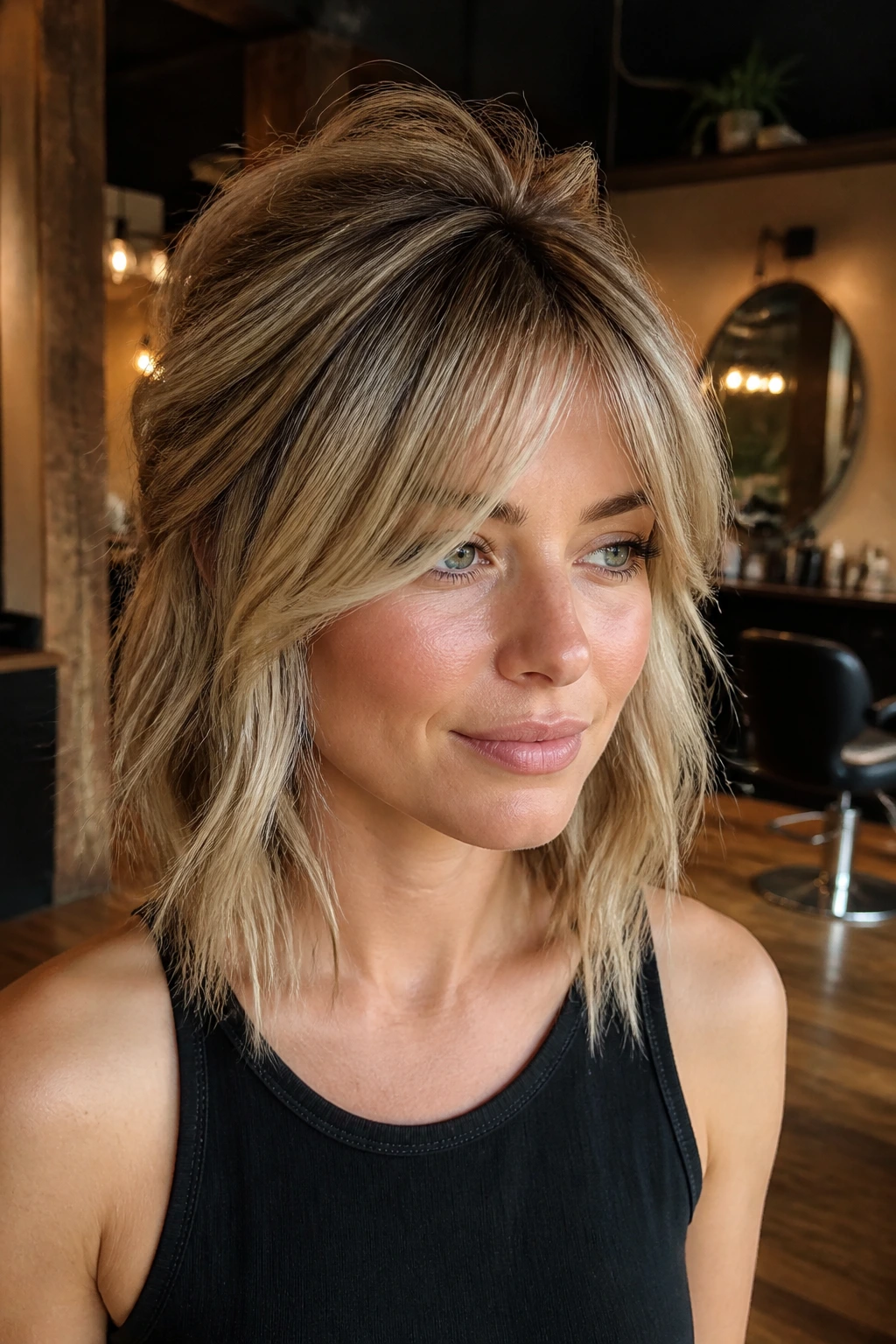
Bangs need more babysitting than the rest of the haircut. That is the deal. If your forehead gets oily, the fringe may need a quick wash or rinse every 1 to 2 days. Fine hair shows grease fast, and piecey bangs look best when the roots are clean and the ends stay separate.
Trim the fringe every 3 to 5 weeks if you want to keep the shape crisp. If you prefer a grow-out phase, you can stretch that longer, but the sides may start swallowing the center. That usually means the shape needs a light refresh rather than a full haircut.
At night, clip the bangs up or sweep them under a loose headband if your forehead tends to get slick. On day two, a tiny mist of water and a blast from the dryer is often enough to wake them up. Dry shampoo helps, but use it at the roots only. If you dust the whole fringe, it can turn chalky and stiff.
Frequently Asked Questions

Are piecey bangs good for fine hair?
Yes, because they create the look of separation and movement without demanding a lot of density. The key is keeping the bang section narrow and the ends soft, so the fringe does not collapse into a flat line.
Do square faces look better with curtain bangs or side-swept bangs?
Both can work. Curtain bangs soften the center of the forehead, while side-swept bangs add a long diagonal line that blurs the jaw; the better choice depends on whether you want more openness or more sweep across the face.
How short should fine-hair bangs be?
Usually a little longer than you think. Fine hair shrinks up and separates as it dries, so having the shortest point land around the brow line, or slightly below it, gives you room to style without ending up too short.
What if my bangs separate into two chunks?
That usually means the section is too wide, the center has too little weight, or you used too much product. Try narrowing the fringe area, keeping a touch more density at the center, and using a lighter hand with cream or oil.
Can I wear piecey bangs with glasses?
Yes, and the softer styles often work better with glasses than heavy blunt fringe. Keep the shortest point from sitting directly on the frame line, and let the side pieces angle away from the temples so the whole thing stays open.
How do I style them without heat?
Use a small amount of mousse on damp bangs, part or clip them into shape, and let them dry in the direction you want. Once they are dry, break up the ends with your fingers and a touch of dry shampoo at the roots.
Should I avoid thinning shears on fine hair?
Not always, but they need to be used sparingly. Too much thinning can leave holes in the fringe and make fine hair look even lighter, so point-cutting and careful texturizing are often safer.
What’s the easiest bang style to grow out?
Soft narrow curtain bangs or a grown-out fringe with longer side pieces. They slide into face-framing layers with less awkwardness than a dense, short fringe that stops suddenly at the brow.
The Fringe That Fits

The best piecey bangs for fine hair and square faces do two jobs at once: they add air without adding heaviness, and they soften strong angles without hiding the face. That combination is why these styles keep coming back in different forms. They are useful first, pretty second.
If your hair is fine, the temptation is to ask for more bang than the hair can carry. Resist that. Ask for a narrower section, a lighter center, and ends that move. The cut will look better on day one and even better when you are a week out and the fringe has settled into real life.
Bring photos, yes. Bring your parting pattern too. That matters more than people admit. The right fringe on the wrong part will fight you every morning, and no haircut is worth that kind of drama.