



Gray hair can look sharp on tan skin. It can also look flat in a hurry if you pick the wrong silver, bleach the life out of the ends, and then hide the best pieces under a heavy fringe.
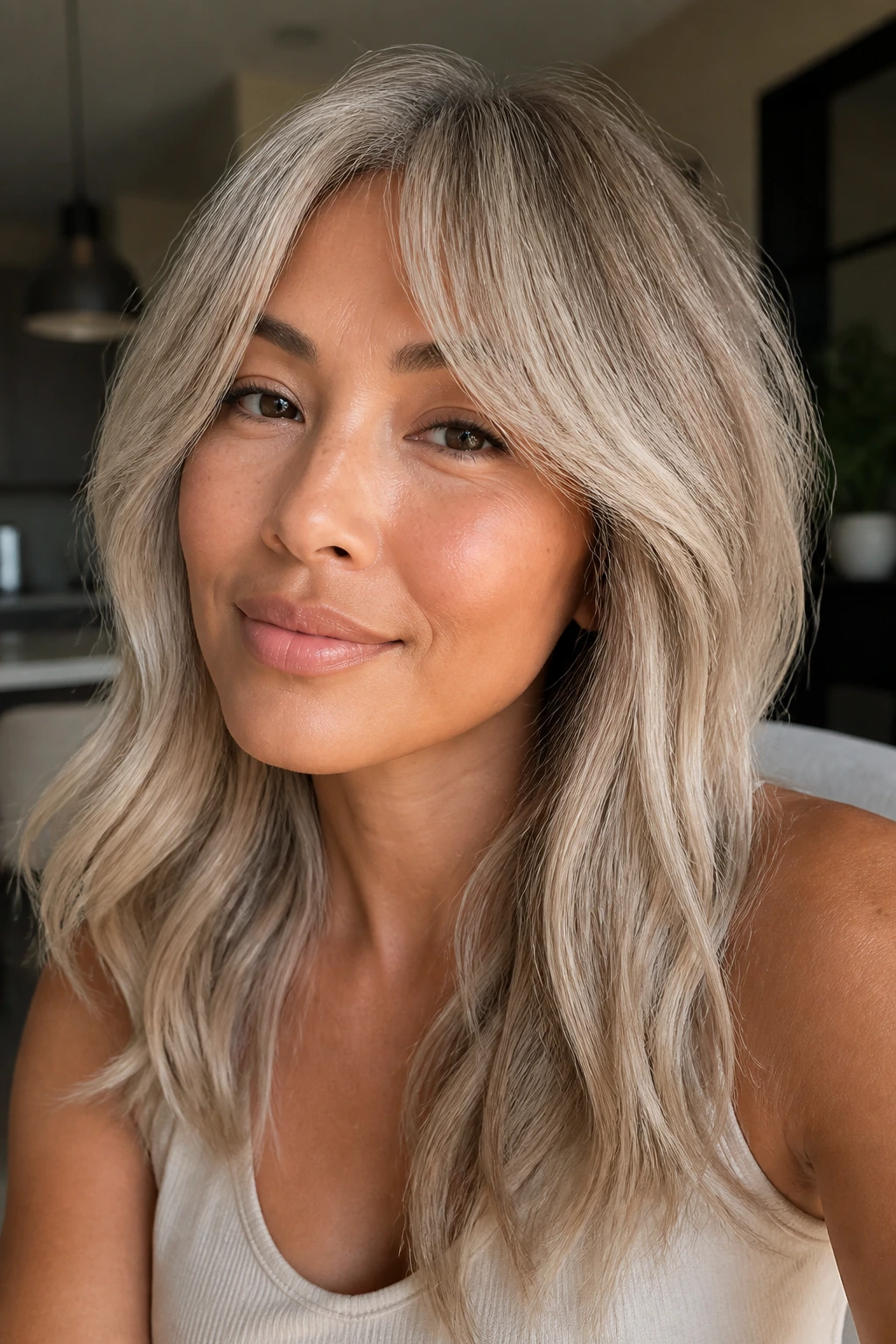
That’s why these gray hair color ideas for tan skin with curtain bangs lean on dimension instead of one-note ice. Tan skin often carries gold, olive, or peach undertones; a good gray formula leaves enough warmth in the roots, then threads smoky silver where the light hits the cheeks and jaw. Curtain bangs help because they sit right in that middle zone. They can show off a face frame, soften a hard root line, and keep the whole look from turning severe.
The version that lands best is not milky white. It’s smoke, pewter, mushroom, graphite, silver-beige, and soft platinum with a clean shape around the face. Get that balance right and the color looks deliberate, not accidental—and the bangs do half the work before you even reach for a styling brush.
Why These Gray Looks Work With Curtain Bangs
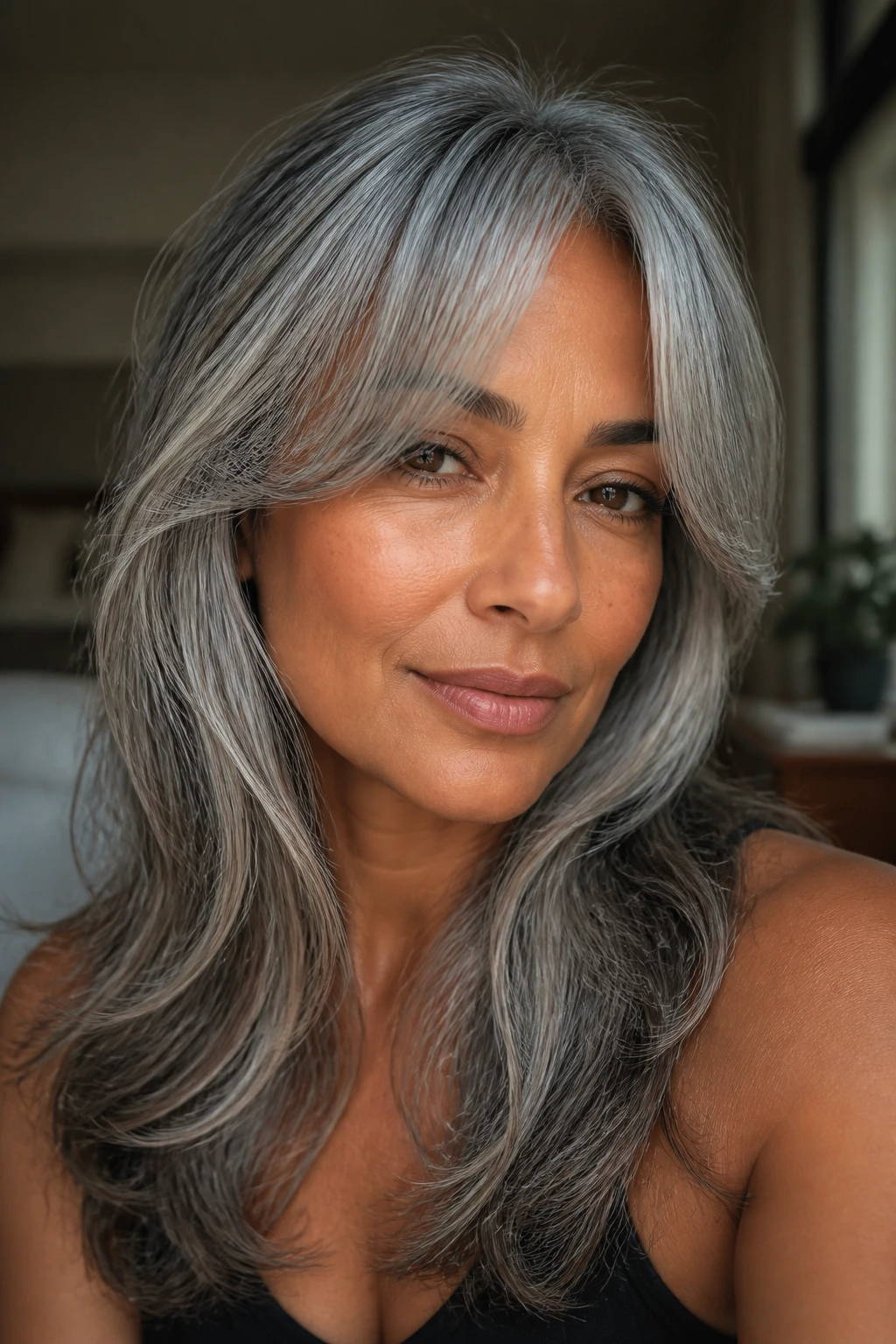
-
The face stays warm: Curtain bangs let you keep the brightest gray around the cheekbones instead of blasting the entire head with the same cool tone, which is what usually makes tan skin look tired.
-
Root shadow does the heavy lifting: A root that sits 1-2 levels deeper than the mid-lengths gives the gray somewhere to land, and that tiny bit of depth keeps regrowth from shouting at you.
-
The fringe softens the metal: Gray can read hard when it’s cut into a blunt line, but a curtain shape breaks it up into movement, so even graphite and pewter feel wearable.
-
Texture shows off the color: Waves, bends, and a little lift at the crown make the silver ribbons visible. If the hair is pinned flat to the head, the best dimension disappears.
-
Tan skin gets options, not one rule: Golden tan, olive tan, and neutral tan all take different gray families better, which means you’re not stuck chasing the same icy shade everyone else is wearing.
How Tan Skin Changes the Gray Formula
Tan skin is not one thing. That’s the mistake people make before they even reach for a toner. A warm golden tan can look washed out under a harsh blue-gray, while an olive tan can make pale silver feel almost chalky. Neutral tan has the easiest lane, but even there, the wrong gray can make your makeup do all the work.
Golden and Peachy Tan
If your skin leans golden or peachy, keep a little beige in the mix. Mushroom gray, silver-beige, taupe smoke, and champagne silver all sit more naturally than pure platinum. The color still reads gray, but it doesn’t drain the face.
Olive Tan
Olive tan can handle cooler edges better. Graphite, pewter, slate, and even a steel-blue tint can look expensive here because the skin already has that muted undertone. The trick is to keep the root soft so the cool shade doesn’t turn hard around the hairline.
Neutral Tan
Neutral tan can move both ways. You can go lighter, darker, warmer, or colder, but I’d still keep some shadow near the scalp and some softness through the bangs. Flat gray is the enemy here. Dimension always wins.
1. Mushroom Gray With Soft Curtain Bangs
Mushroom gray is the gray look I reach for when I want something smoky but not fussy. It has that beige-brown undertone under the silver, so on tan skin it reads like a cool neutral instead of a slab of ash. With curtain bangs, the whole shape feels airy, almost brushed by wind, especially if the fringe starts around the cheekbones and drops longer at the sides.
Why It Works on Tan Skin
Ask for a level 6 or 7 brown base with mushroom-gray ribbons woven through the mid-lengths and ends. That depth keeps the face from going flat, and the beige in the formula prevents the gray from looking sterile.
Quick Shade Notes
- Best for golden tan and olive tan skin.
- Ask for a soft root shadow so the grow-out line stays gentle.
- Keep the curtain bangs slightly longer than eyebrow length so they sweep instead of sit heavy.
My favorite part: mushroom gray looks even better when the hair is bent into loose waves. The gray catches the curve, not the whole strand, and that keeps the color alive.
2. Graphite Balayage Over Espresso Roots
Graphite balayage is the one I’d hand to anyone who wants gray without looking washed out. The espresso root gives the whole head a dark anchor, and the graphite pieces ride on top like brushed metal. On tan skin, that contrast is what keeps the look sharp instead of dusty.
The curtain bangs matter here because they break the darkness right at the face. A few graphite threads through the fringe make the color feel connected to the rest of the hair, not pasted on after the fact. If your brows are dark and your eyes have a strong shape, this one is especially good. It has presence.
Tell your stylist you want the lightest gray pieces kept away from the scalp and focused through the lengths, with the bangs feathered just enough to show movement. Straight, blocky curtain bangs kill this look. Soft bend, not stiffness.
3. Silver Beige Melt
Can silver look soft on tan skin? Yes, if you dilute it with beige. That’s the whole trick here. A silver beige melt has the brightness of gray but the warmth of a neutral blonde glaze, so it doesn’t fight tan undertones the way high-contrast ice sometimes does.
What To Ask For
Ask for a pearl or beige toner over a light blonde base, then a root smudge one shade deeper than the mids. That gives you a clean melt instead of a hard stripe.
Why Curtain Bangs Help
Curtain bangs create a little frame of softness at the forehead and cheekbones. With a silver beige melt, that softness matters because the color itself is already light. If the fringe is too blunt, the whole thing can tip into pale and thin-looking. If it’s feathered and slightly layered, the color looks polished.
This is a good pick if you want gray hair that still feels airy and bright, but not icy enough to erase the warmth in your skin.
4. Charcoal Money Piece and Long Curtain Fringe
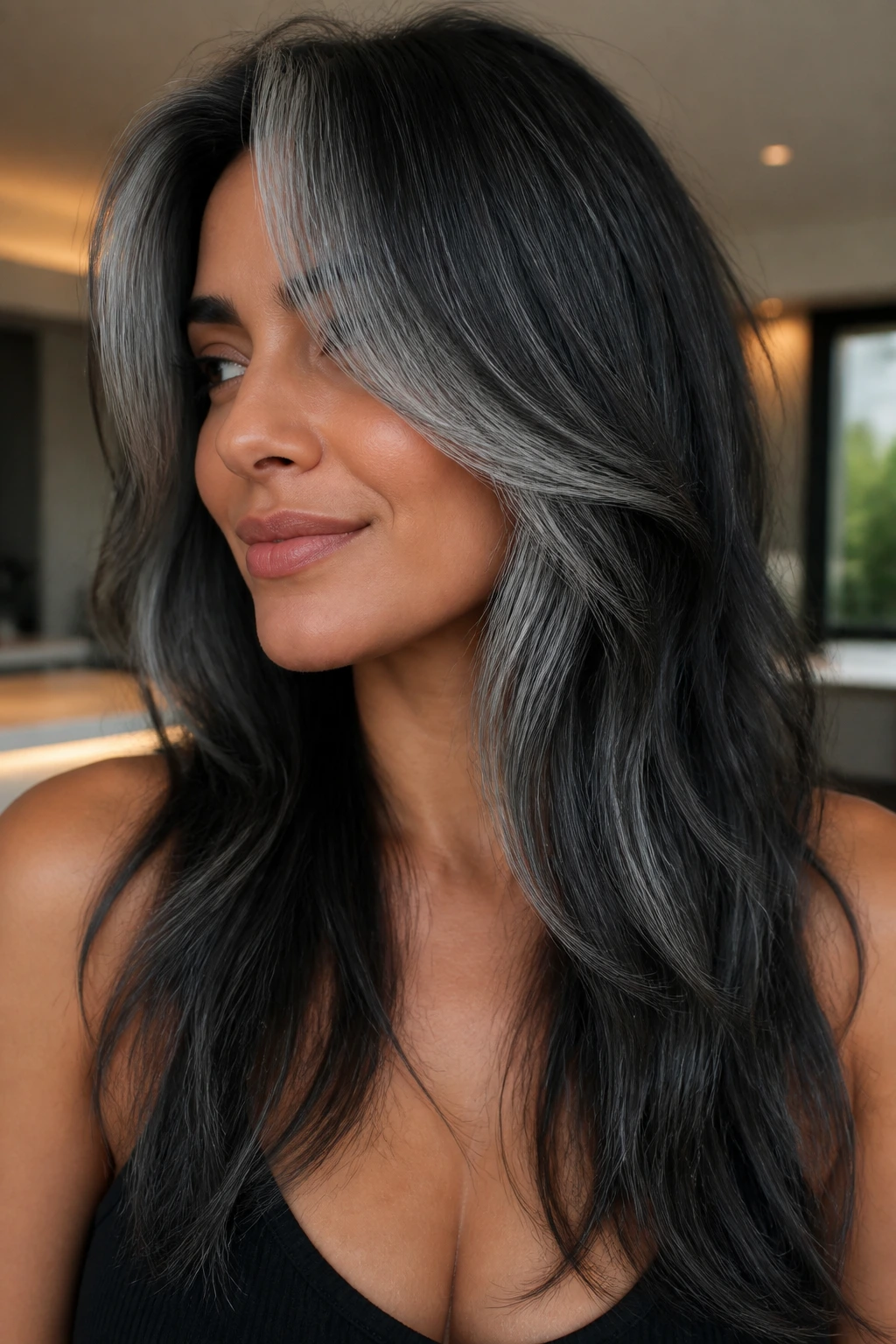
Picture this: you wear your hair down, and the first thing anyone sees is two smoky charcoal panels falling beside your face. Not bright silver. Not flat black. Charcoal. It’s darker, cleaner, and far easier to wear on tan skin than a full-head platinum blast.
The money piece gives you the drama where it matters most, right at the temples and cheekbones, while the rest of the hair stays deeper and softer. Curtain bangs make the shift believable because they bridge the gap between the dark base and the lighter face frame. A lot of high-contrast colors fail there. This one doesn’t.
Best on medium to long hair. If the fringe is too short, you lose the sweep. If it’s long enough to tuck into the sides of the face, the charcoal looks intentional instead of severe.
5. Dove Gray Bob With Feathered Bangs
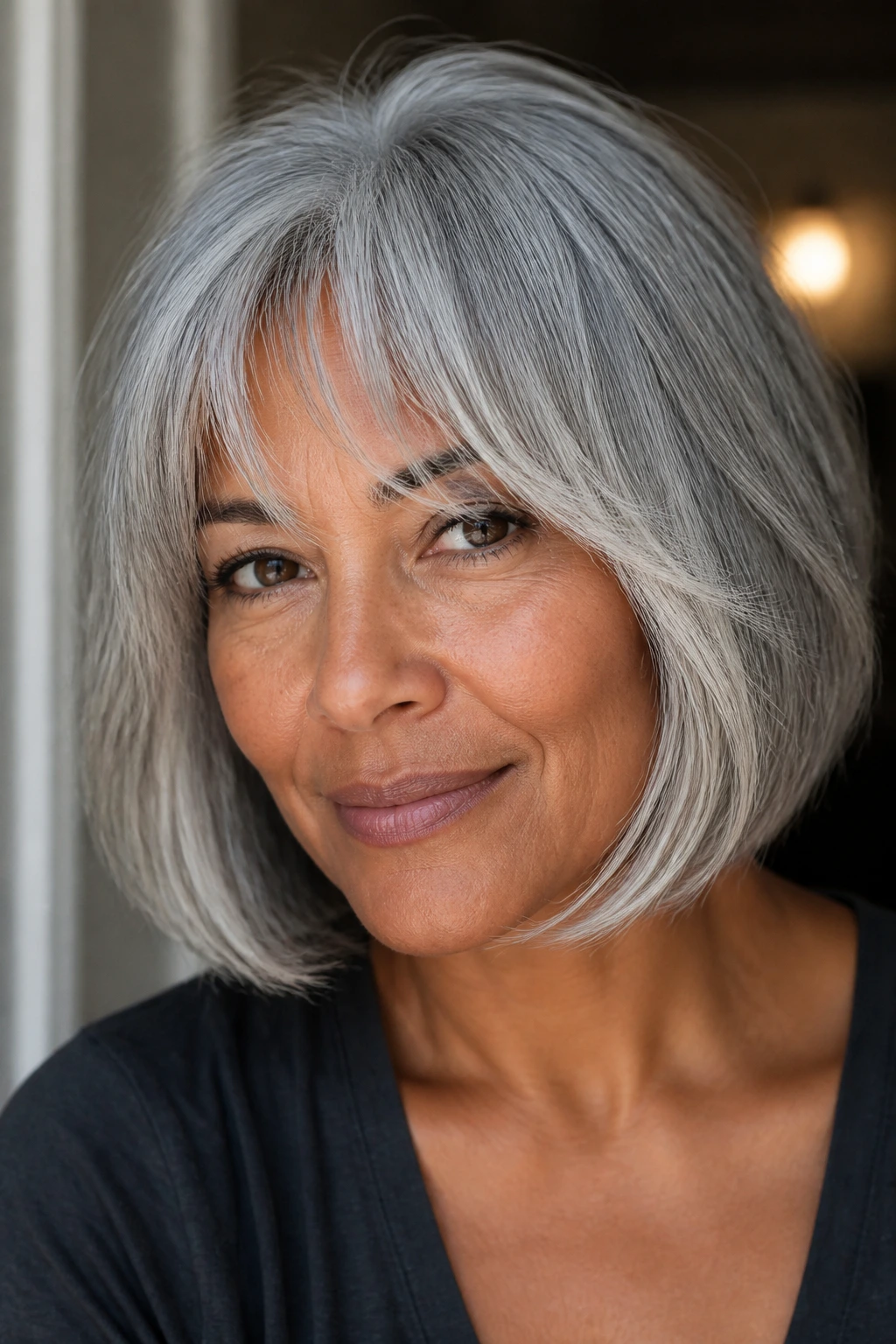
Dove gray is one of those shades that looks quiet in the bowl and rich on the head. It has a soft, cool finish—more cloud than chrome—and that softness is exactly why it suits tan skin. The hue doesn’t shout. It hovers.
A bob cut gives the color a clean edge, and feathered curtain bangs keep the front from feeling too boxy. I like this especially on hair that has a bit of movement but not a ton of thickness. The ends stay tidy, the top stays light, and the gray sits in a smooth sheet instead of breaking into random patches.
If you want a shorter gray look that still feels feminine and easy to style, this is one of the better options. The fringe should be cut with a soft center part and longer sides that land near the cheekbones. Anything shorter can make the bob feel abrupt.
6. Taupe Smoke Waves
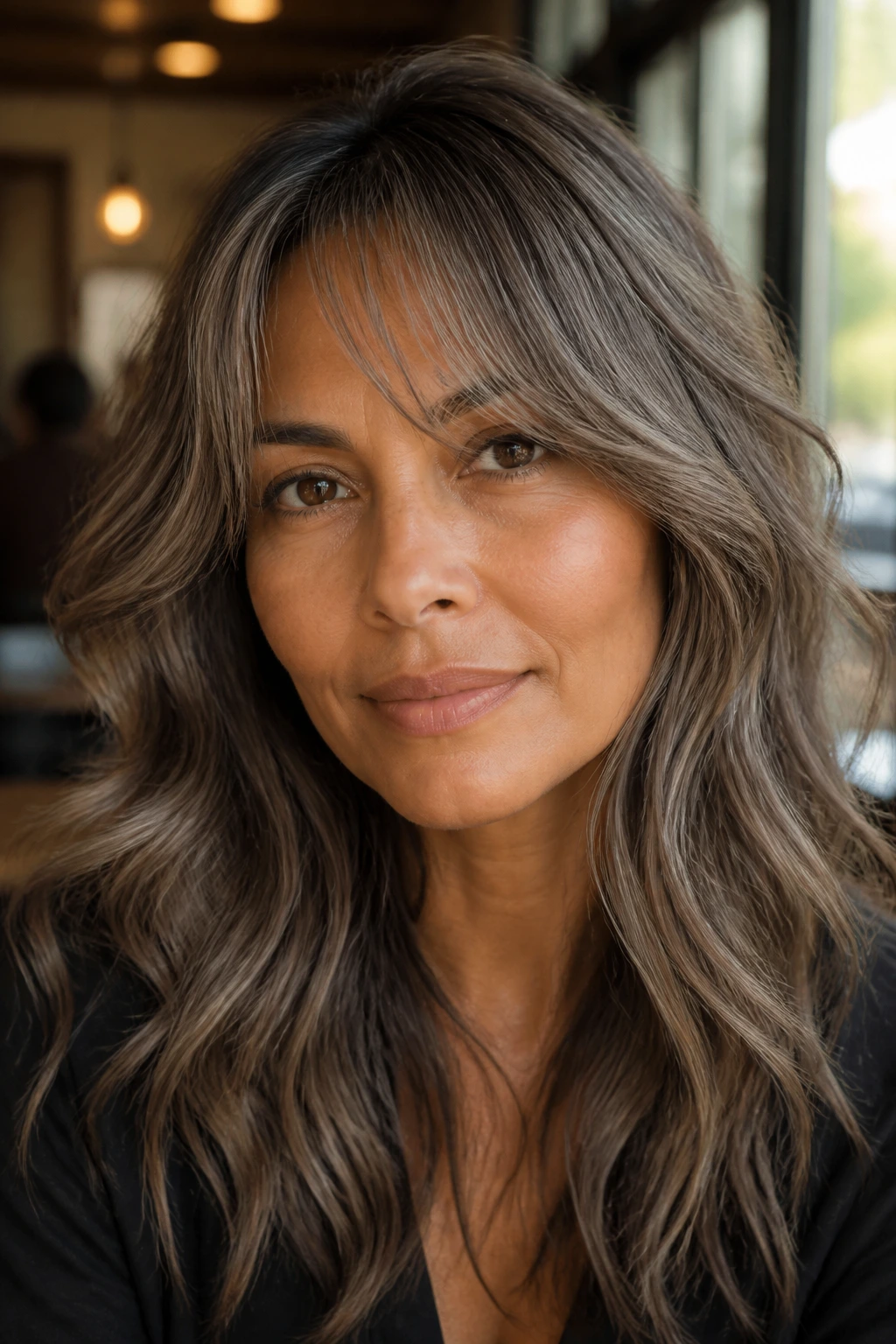
Taupe smoke is the gray for people who dislike anything that looks too cold. It sits between brown and silver in a way that feels lived-in, not overprocessed. On tan skin, that middle ground is gold. It keeps the complexion steady while still giving you the gray effect.
Unlike icy silver, taupe smoke depends on texture. Waves, bends, and a little bend through the curtain bangs make the color show its brown-gray blend. Straight hair can make it fade toward brown; too much shine can make it lose the smoke. The right amount of movement is what keeps it interesting.
Best if your wardrobe leans warm neutrals, camel, black, cream, olive, or denim. It’s a low-drama gray, and I mean that as a compliment. Some people want the hair to speak first. This color does exactly that, without becoming precious about it.
7. Pearl Gray Glaze on a Dark Blonde Base
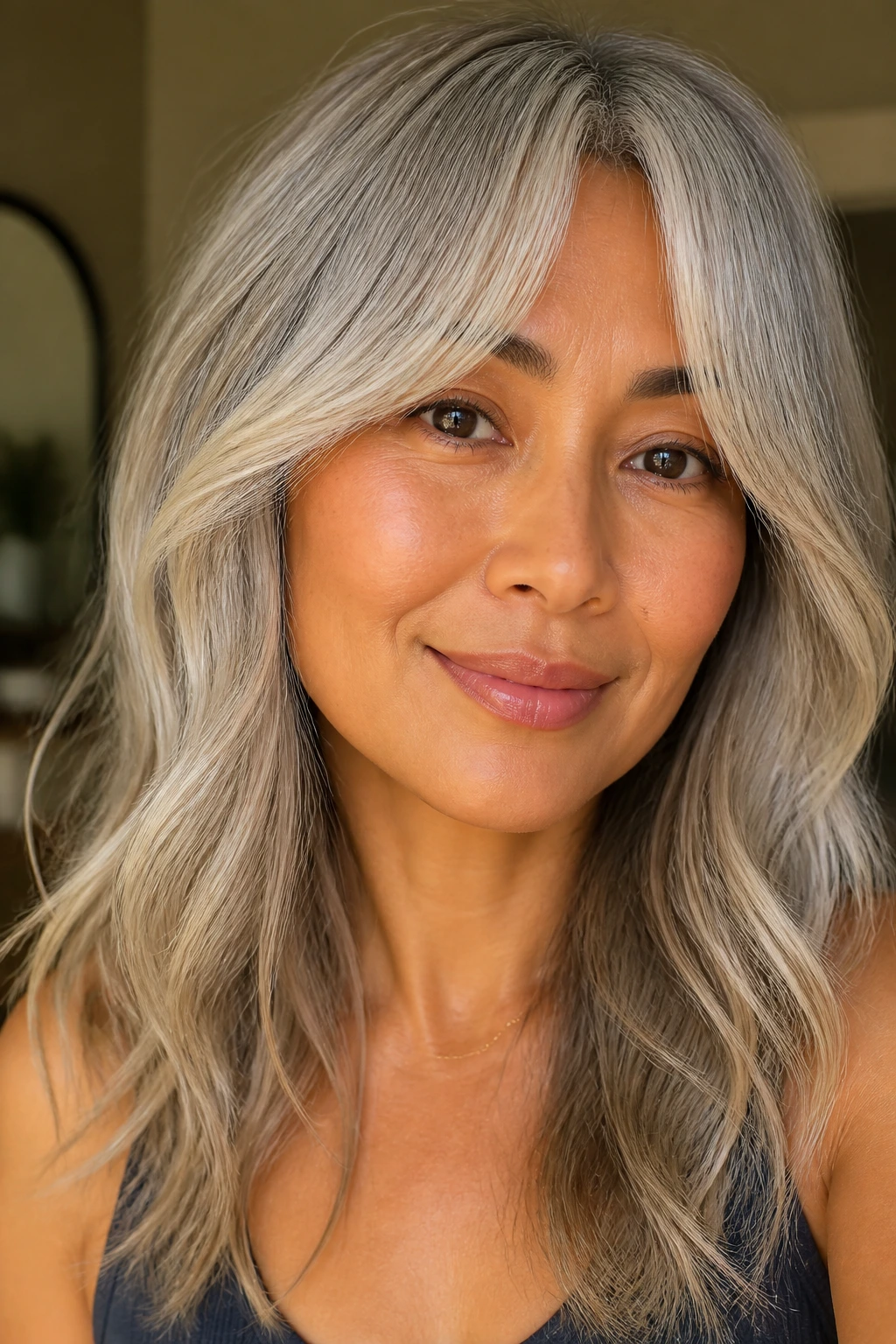
Pearl gray is what happens when gray stops feeling industrial and starts feeling polished. On a dark blonde or light brown base, it creates a translucent finish that catches light in a very soft way. Tan skin usually likes that because the skin still reads as warm while the hair gives you cooler contrast.
What Makes It Different
The magic is in the glaze, not a harsh lift. You’re not bleaching the life out of the hair to get a white sheet. You’re refining the base, then laying a pearl-gray toner over it so the gray has depth underneath.
How to Wear It
Keep the curtain bangs light and airy, not too dense at the roots. A thick fringe can swallow the pearl effect and make the color look dull. With a loose blowout, the hair moves in soft ribbons and the gray shifts from silver to beige as you turn your head.
Best for: neutral tan skin and anyone who wants a gentler gray that still looks finished.
8. Gunmetal Ribbon Highlights
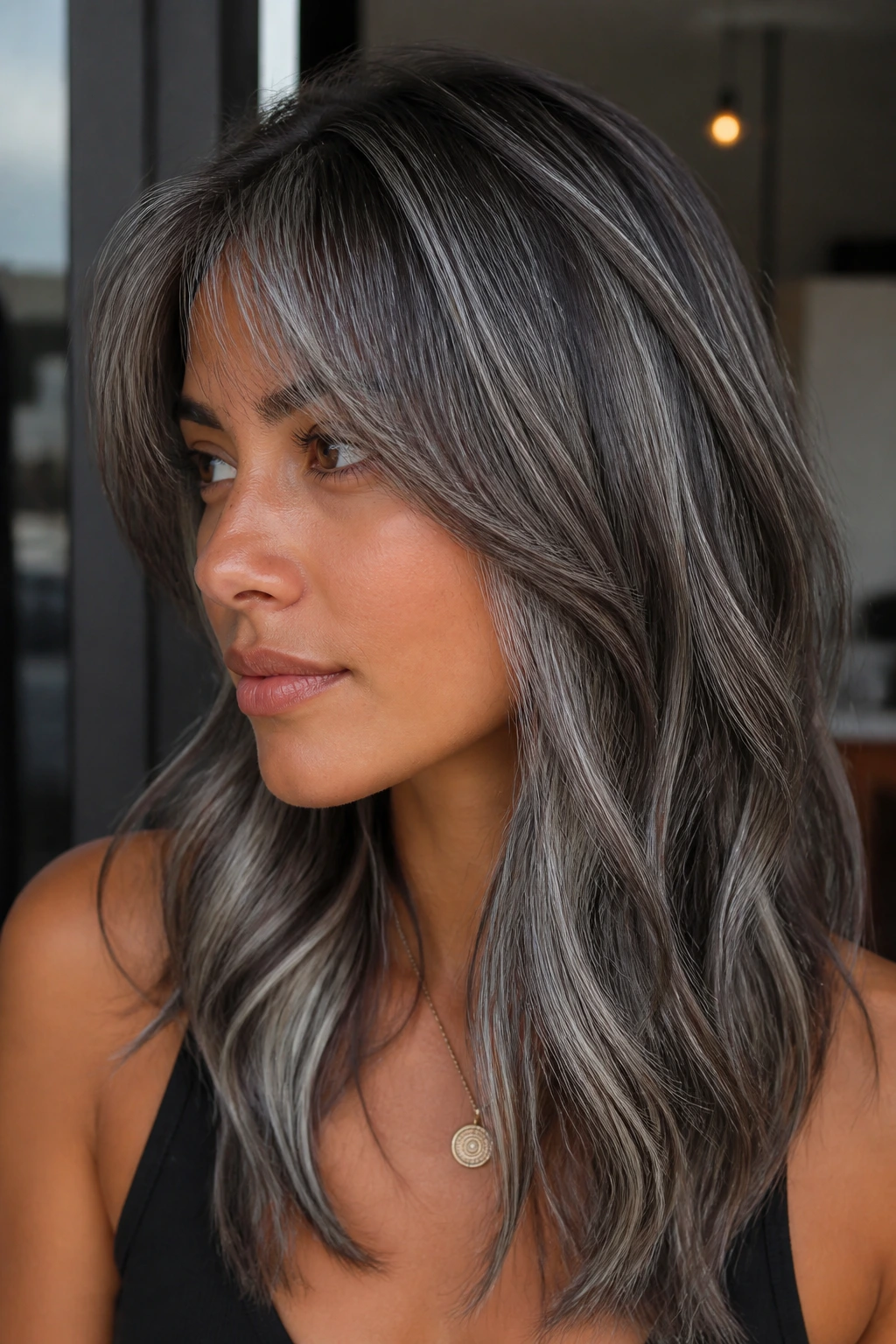
Gunmetal is one of my favorite gray families because it has edge without the squeaky, over-lightened look. Ribbon highlights are the right way to use it. Thin, dark metallic pieces scattered through the top and sides keep the hair dimensional, and the curtain bangs let a few of those ribbons frame the face.
This works especially well if your hair is thick or naturally deep brown. The gunmetal slices through the base and keeps it from reading like one dark block. On tan skin, that matters. You want movement. You want contrast. You do not want a helmet.
Ask for very thin ribbons, not chunky streaks. The bang area should stay softer than the back, or the face frame becomes too hard. A gloss with a cool finish every few weeks keeps the metal tone clean.
9. Ash Brown-to-Gray Ombre
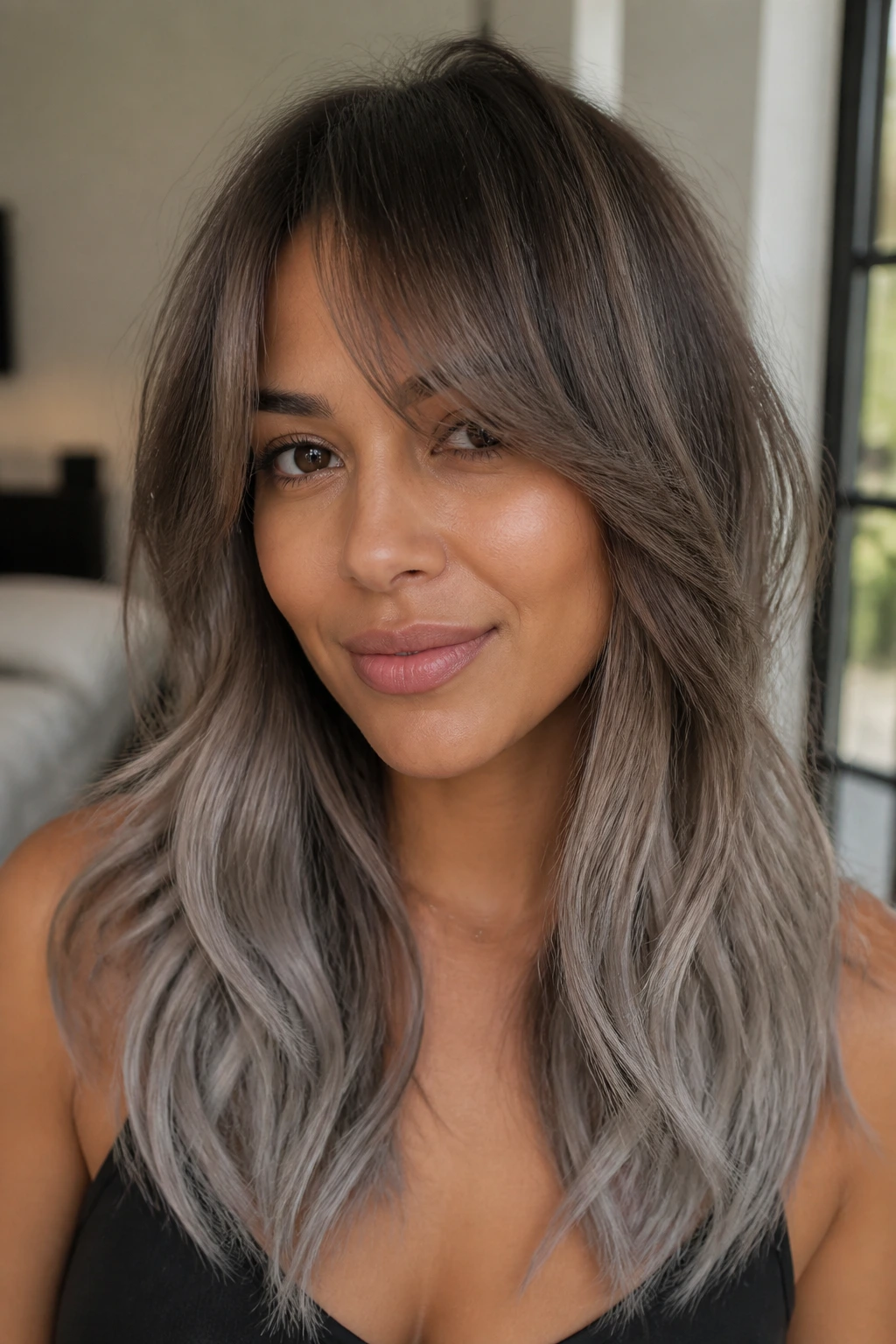
Why start gray at the roots when you can let it fade up from brown? Ash brown-to-gray ombre gives you a gradual shift, and that softness is a big part of why it works on tan skin. The brown near the scalp keeps the color grounded, while the gray through the ends adds that smoky finish people are usually after.
Curtain bangs help the transition because they sit right in the middle of the color story. The front can be a little lighter than the roots but not as light as the ends, which makes the whole shape feel balanced. It’s a smart choice if you want gray hair ideas that don’t demand a huge commitment all at once.
This is one of the easier gray looks to live with during grow-out. The ombre line gives you permission to keep things softer for longer. That matters more than people admit.
10. Steel Blue-Gray With Cheekbone Fringe
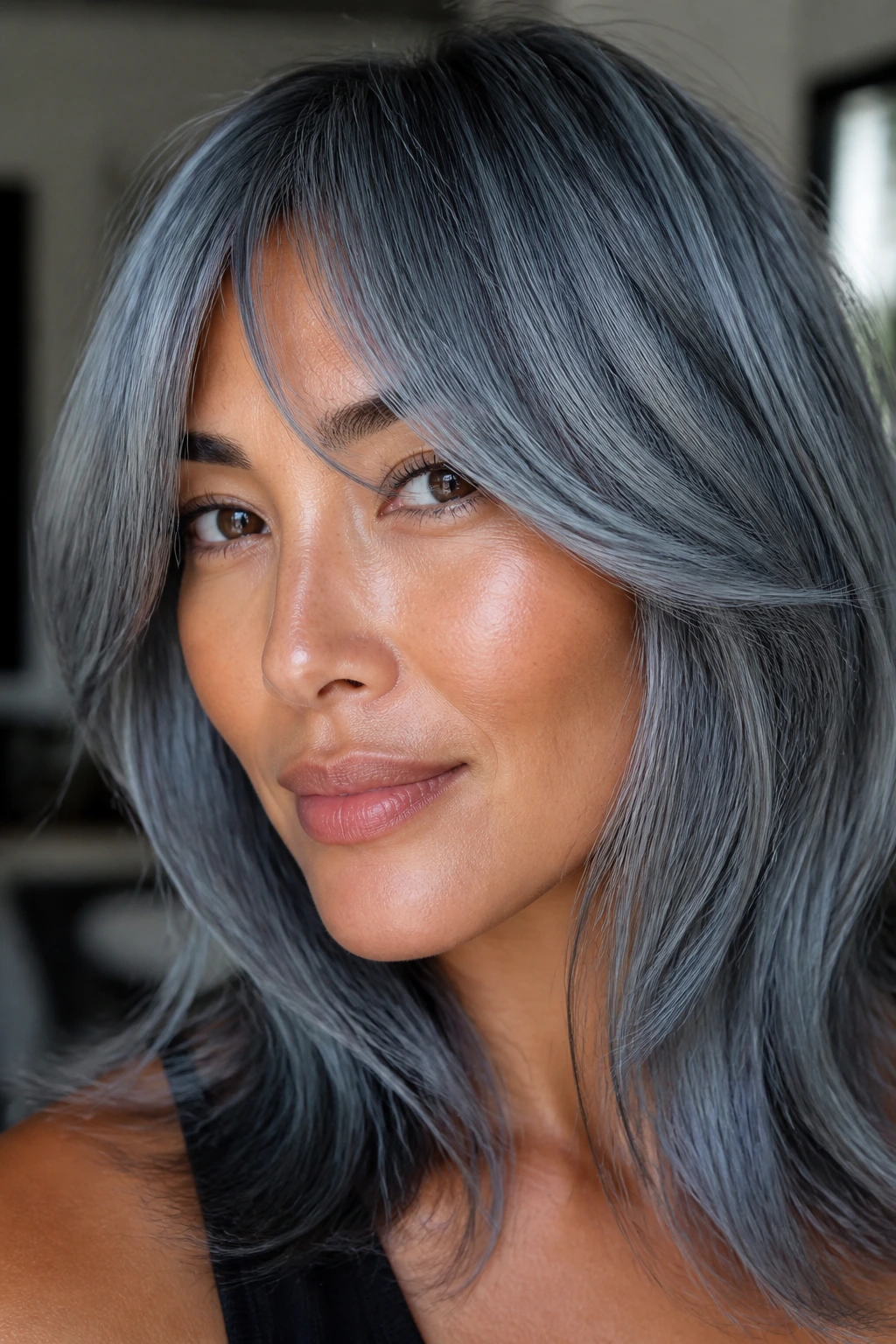
Steel blue-gray is a cooler, sharper mood. It has a tiny blue cast that makes the gray read sleek rather than dusty, and on olive tan skin it can look very clean. On golden tan, I’d only go here if you’re willing to keep the rest of the look soft and glossy.
The Catch
The tone can turn flat if the hair is cut too heavily. That’s where curtain bangs save it. A cheekbone-length fringe creates a diagonal line across the face, which stops the steel from feeling rigid.
Best For
- Olive tan skin
- Dark brows and eyes
- Medium to thick hair that holds a bend
- People who like a cooler finish that still has movement
If you want this look to stay polished, skip heavy matte products. A light glossing cream or serum on the ends keeps the steel tone reflective instead of chalky.
11. Salt-and-Pepper Lob
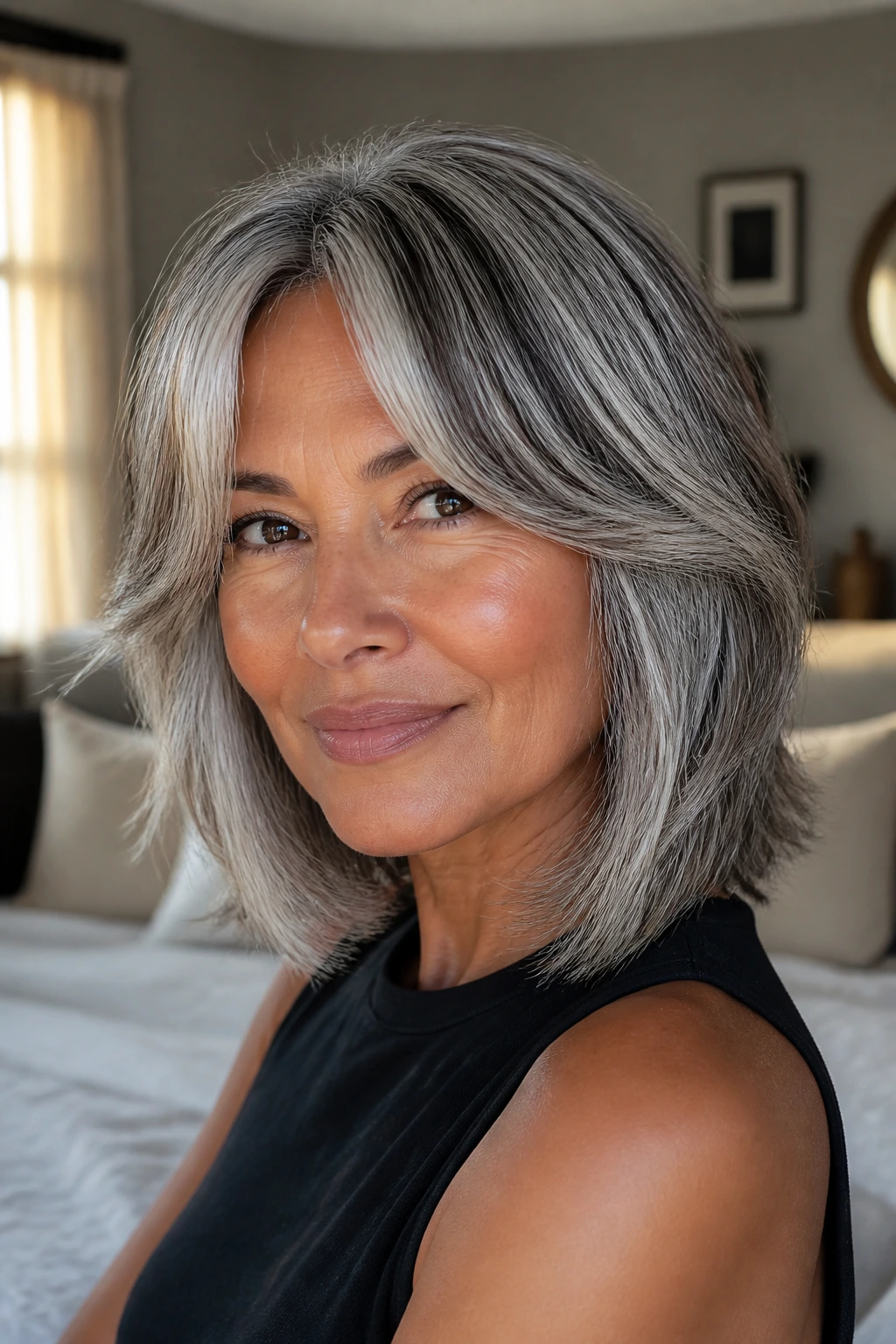
Salt-and-pepper hair is having a moment for a reason: it looks like hair, not a dye job trying too hard. On tan skin, the natural mix of gray, white, and darker strands can be flattering because it preserves depth around the face. The lob length keeps it modern, and curtain bangs stop the cut from reading like a straight-line office haircut.
I prefer this version when the gray is not uniform. Let the darker strands live near the roots and underneath; let the silver show in the top layers and through the fringe. That unevenness is the whole point. Flat salt-and-pepper can feel sleepy. Dimension wakes it up.
If you’re transitioning from natural color, this is one of the smartest ways to do it. You’re not forcing the hair into a fake silver shell. You’re letting the existing pattern do the work.
12. Smoky Mocha With Silver Ends
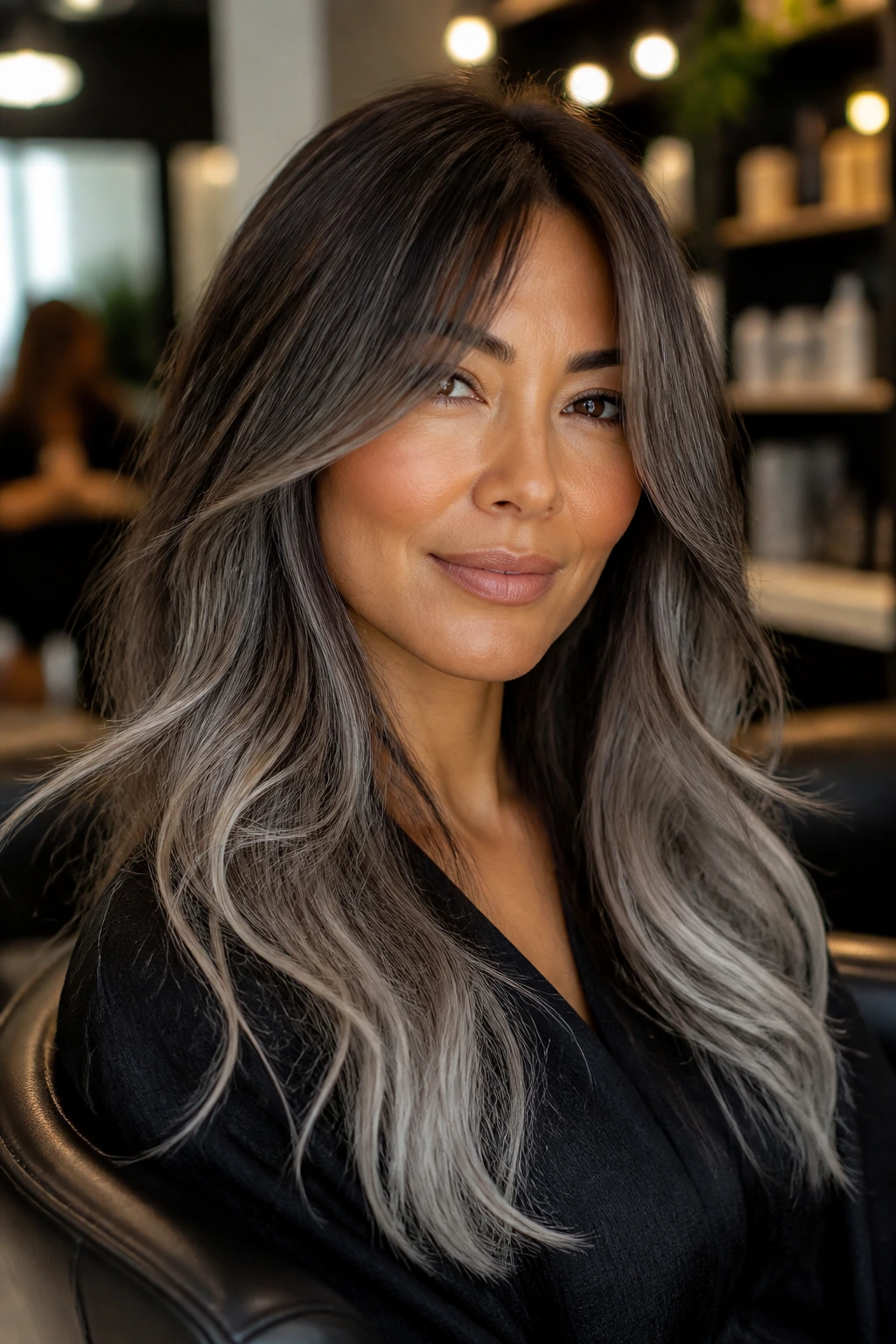
Smoky mocha with silver ends is for anyone who likes a darker base but still wants the gray payoff. The top remains mocha—rich, brown, a little cool around the edges—while the ends drift into silver smoke. It’s a smart gradient for tan skin because the face gets depth from the darker top and brightness from the lower length.
The curtain bangs should stay in the smoky mocha family, not the silver family. That keeps the front soft and wearable. If the bangs are too light, the face can get busy fast. Let the ends have the drama instead.
This is a solid pick for long layers. The gray at the ends shows best when the hair moves, so think loose bends, not stiff curls. If your ends are damaged, though, this one will expose that fast. Trim first. Then color.
13. Icy Mushroom Bronde
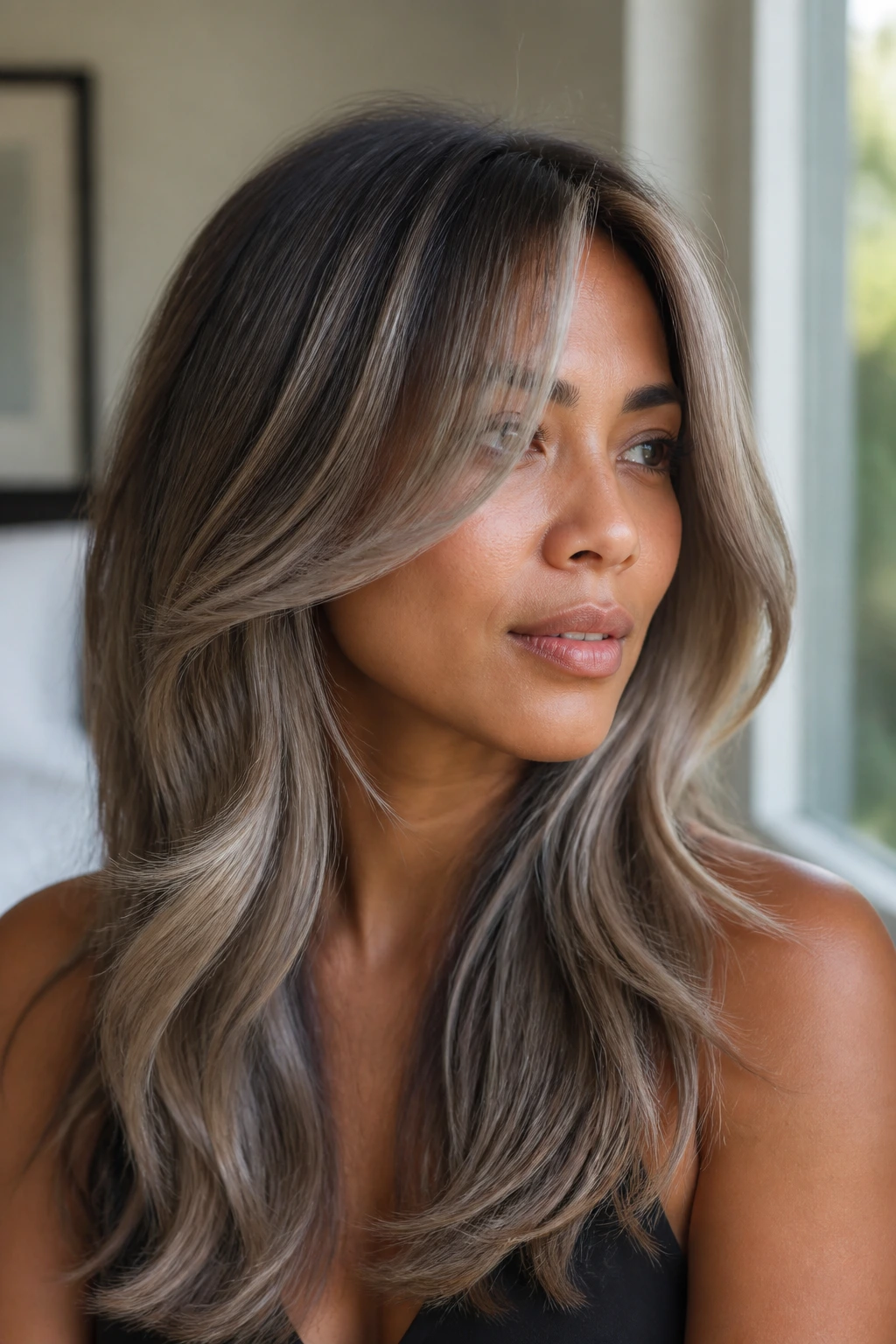
I like icy mushroom bronde when someone wants lightness but refuses to give up depth. Bronde already gives you that brown-blonde middle ground; the mushroom and icy notes push it into gray territory without making the whole head look like a silver sheet. On tan skin, that mix can be a sweet spot, especially if your undertones are warm but not too golden.
How It Reads
The hair looks brighter than taupe smoke and softer than full platinum. That in-between quality is why it wears so well with curtain bangs. The fringe can frame the cheeks in a cooler tone while the roots stay grounded.
A good version of this color keeps a few darker threads near the scalp and a brighter finish through the ends. If everything is lifted to the same level, the look loses shape. And shape matters here more than people think.
14. Pewter Balayage With a Soft Root Shadow
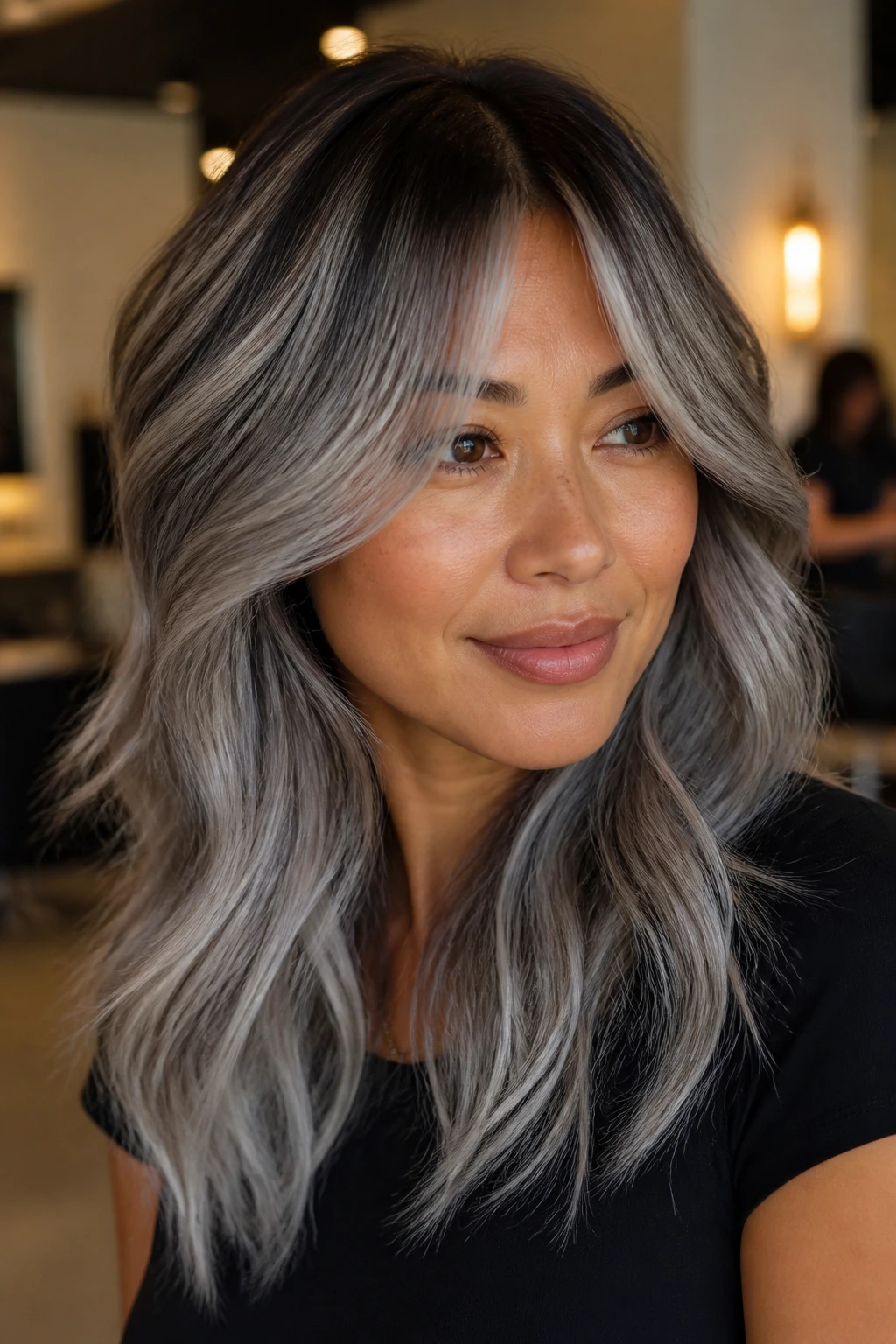
Pewter is gray with a metallic hush. Not shiny like chrome, not dull like ash. That middle tone is flattering on tan skin because it gives you coolness without stealing all the warmth from the face. Balayage lets it move through the hair in ribbons instead of blocks, which is the only way I’d do it.
The soft root shadow is doing real work here. It keeps the pewter from touching the scalp too harshly and gives the curtain bangs a place to fall into. If your hair is layered, the effect is even better. The pieces around the face catch the light, then disappear back into the darker base.
This is a strong option for people who like gray but hate upkeep that screams every five weeks. Pewter grows out more gracefully than sharper silver shades. That’s worth a lot.
15. Lavender-Gray Sheen
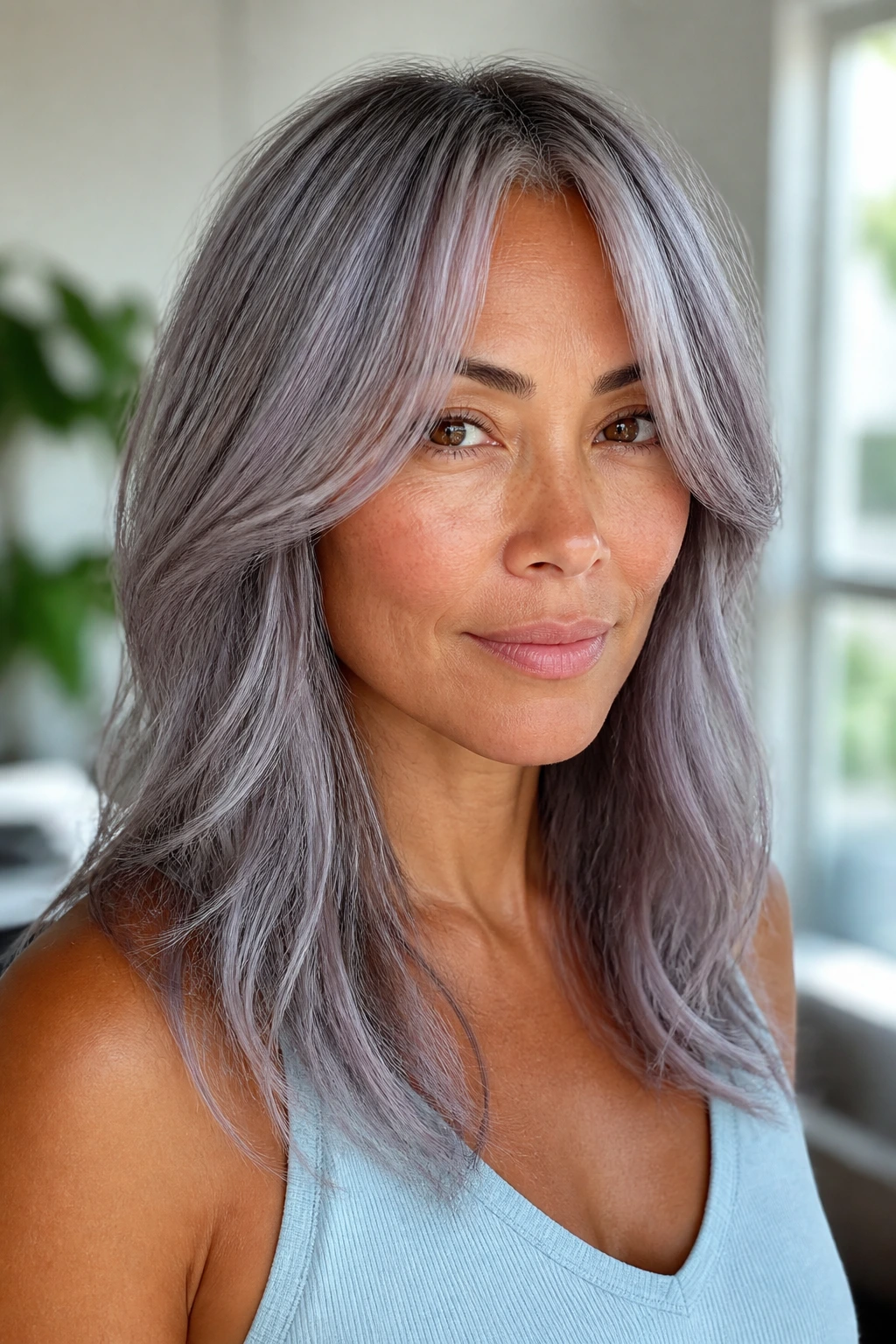
Lavender-gray sounds daring, but the version that works is understated. You’re not putting purple hair on tan skin and hoping for the best. You’re tinting gray with a whisper of lavender so the cool tone feels softer and more dimensional.
Why It Can Work
Neutral and olive tan skin can handle this nicely because the lavender edge keeps the gray from going flat or muddy. The curtain bangs are the place where the shade matters most. A little lift there gives the face a lighter frame, and the rest of the color stays muted.
How to Keep It Wearable
Don’t overdo the violet. One soft gloss is enough. If the lavender takes over, the look starts to feel costume-like fast, and that’s not the point. The best version is a gray that blushes slightly in daylight, then settles back into smoke indoors.
If you like creative color but still want something grown-up, this is the lane.
16. Champagne Silver Blend
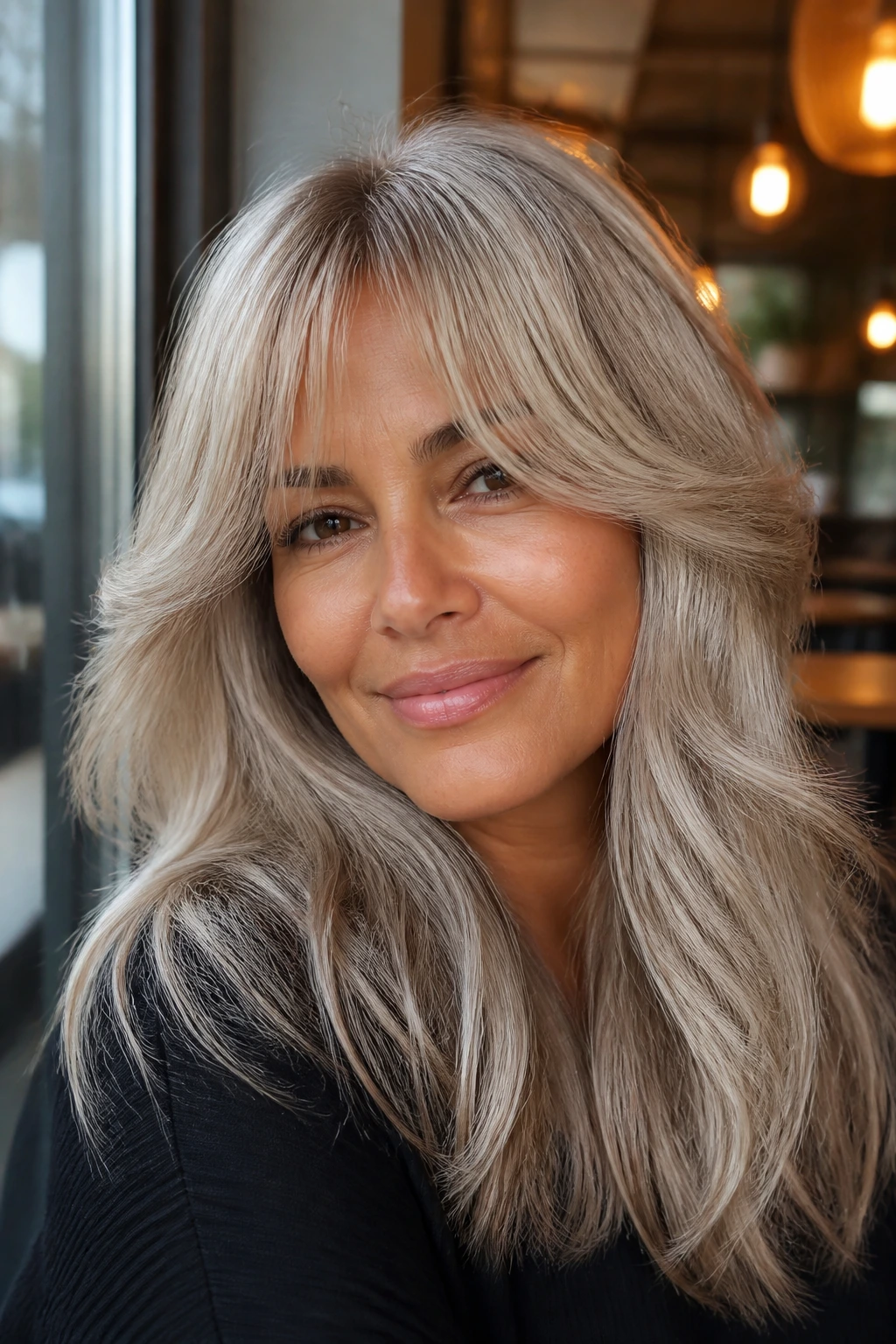
Champagne silver brings warmth back into the gray family, and that’s why it deserves a spot here. The tone has a faint gold-beige softness under the silver, which keeps tan skin from looking stark. It’s one of the easiest gray ideas to wear with a neutral lip, bronzer, and softly brushed curtain bangs.
I’d choose this if you want a light finish but hate the look of frosted, over-processed platinum. Champagne silver has shine. It also has dimension, which means the hair looks smoother and richer in motion.
Keep the bangs long enough to sweep along the cheekbone. If they’re too short, the face frame can start to feel sharp, and the champagne effect gets lost. With the right length, it reads polished without trying to be icy.
17. Slate Gray Dimensional Shag
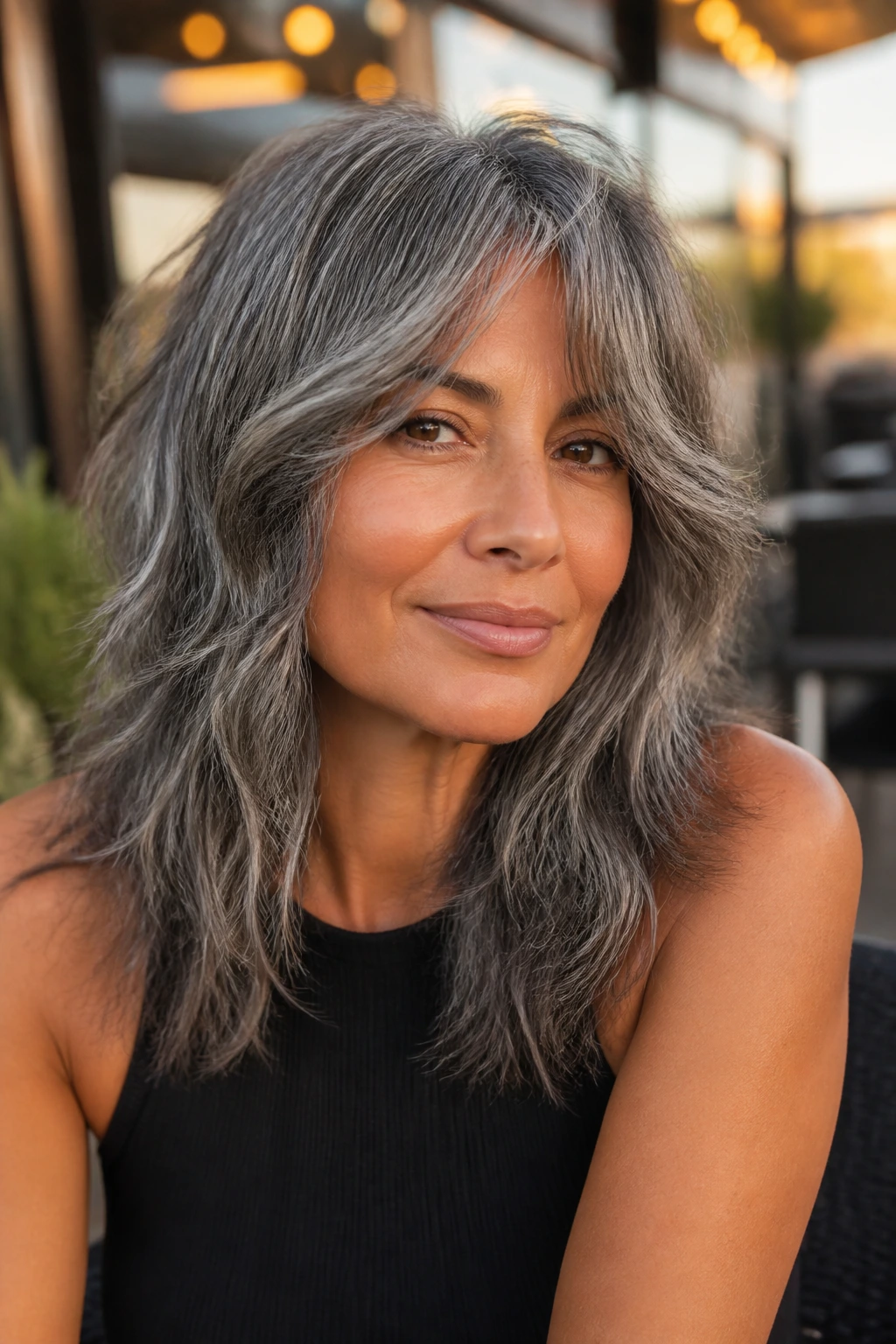
Slate gray and a shag cut have a very good relationship. The cut gives the color movement, and the color gives the cut weight. On tan skin, slate gray can look especially clean when it’s broken up with lighter ribbons and a curtain fringe that falls a little messier than the polished looks above.
This is a good choice if your hair has natural wave or a little body. The shag layers let the gray sit at different depths, which keeps the whole thing from becoming one flat cool sheet. Curtain bangs are almost required here, honestly. A blunt fringe would fight the cut.
If you like style with some edge, this is one of the more interesting gray options. It feels lived-in. It also hides grow-out better than a smoother, more precise cut.
18. Silver Fox Brunette Blend
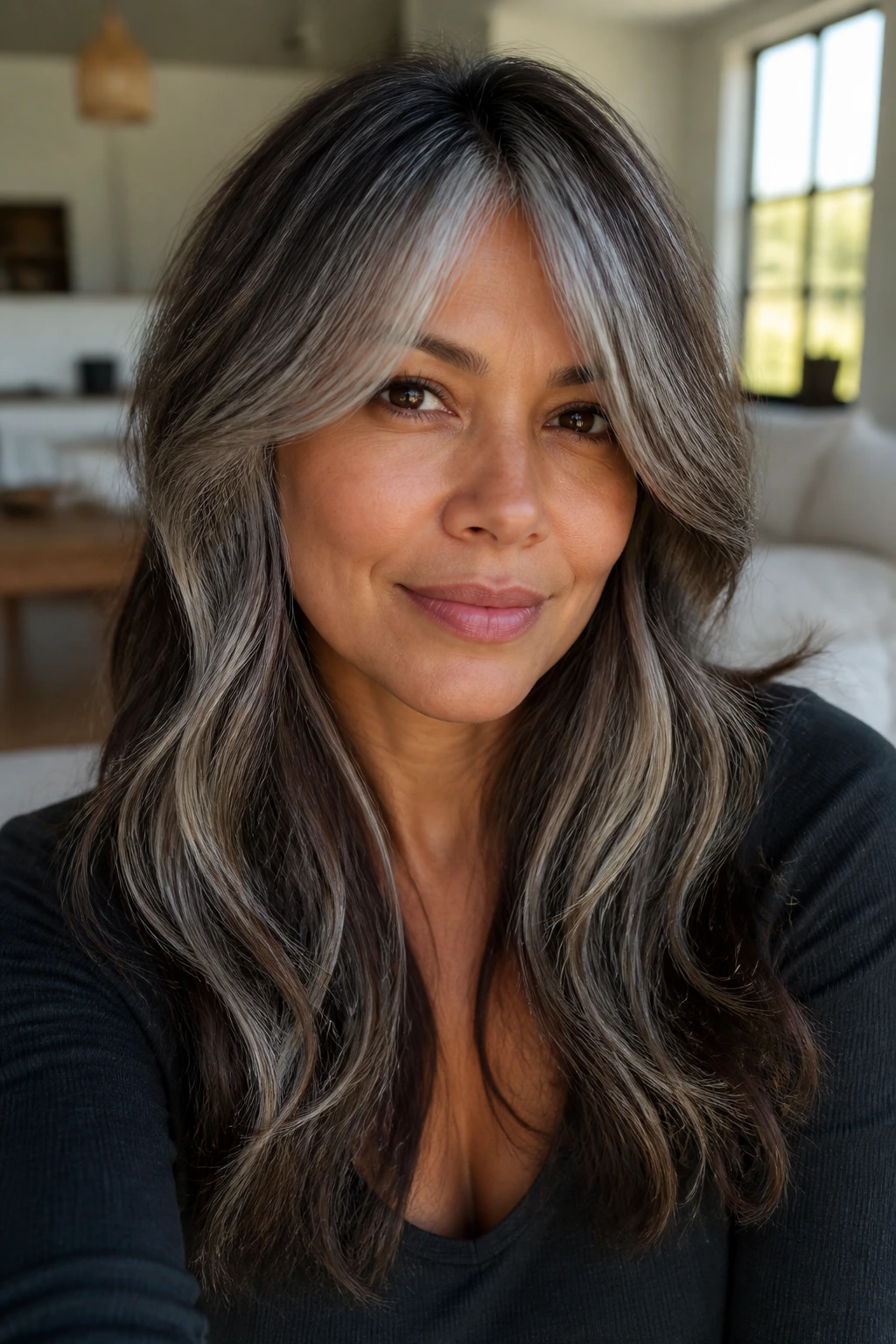
Silver fox brunette is the version people think of when they want gray without losing their dark base. You keep the brunette depth, then thread silver through the top layers, temples, and fringe. On tan skin, that balance is excellent because the brown keeps the complexion grounded while the silver brightens the whole shape.
Unlike a full-head silver, this blend doesn’t ask you to give up contrast. The curtain bangs are the bridge. They can be darker near the roots and lighter toward the ends, which makes the face frame feel intentional rather than patched together.
This is a smart choice for anyone transitioning from brunette to gray naturally. It lets you move in the right direction without forcing every strand to match. I like that. Hair looks more believable when it keeps a little depth.
19. Cool Beige-Gray Babylights
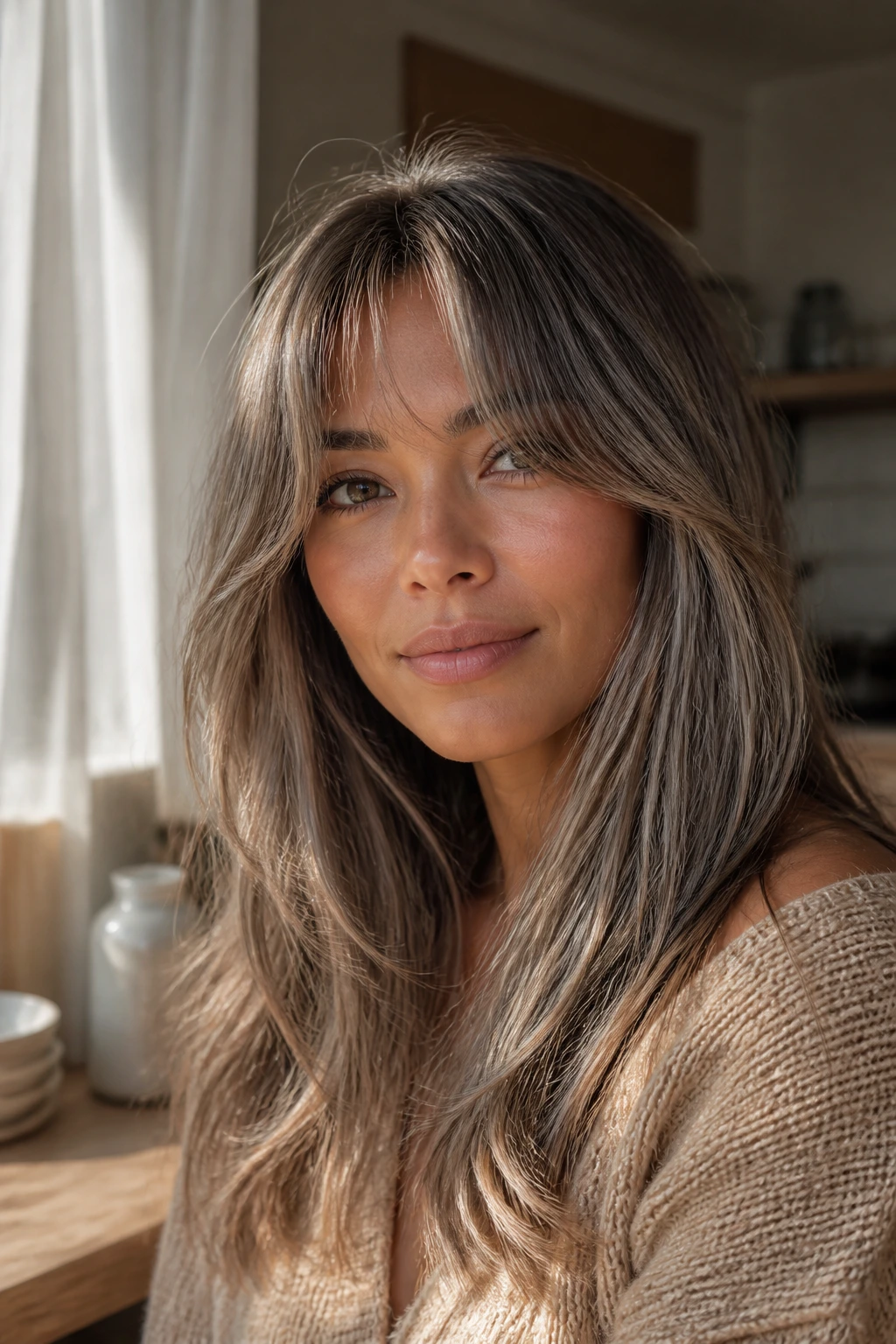
Babylights are the whisper version of gray. Instead of big chunks or bold ribbons, you get tiny, fine highlights that blur into a cool beige-gray finish. On tan skin, that subtlety is useful. It brightens the hair without making the face compete with the color.
Why It’s Sneaky Good
Because the highlights are so fine, the curtain bangs can hold the softest pieces near the face. You get brightness around the eyes and cheekbones, but it never turns stripey.
What To Ask For
- Very thin sections through the crown and fringe
- A beige-gray toner, not a bright white toner
- A soft root shadow to keep the grow-out clean
This is the answer if you want gray but don’t want anyone to clock it from across the room. It’s quiet. And it works.
20. Storm Cloud Gray With Curtain Bangs
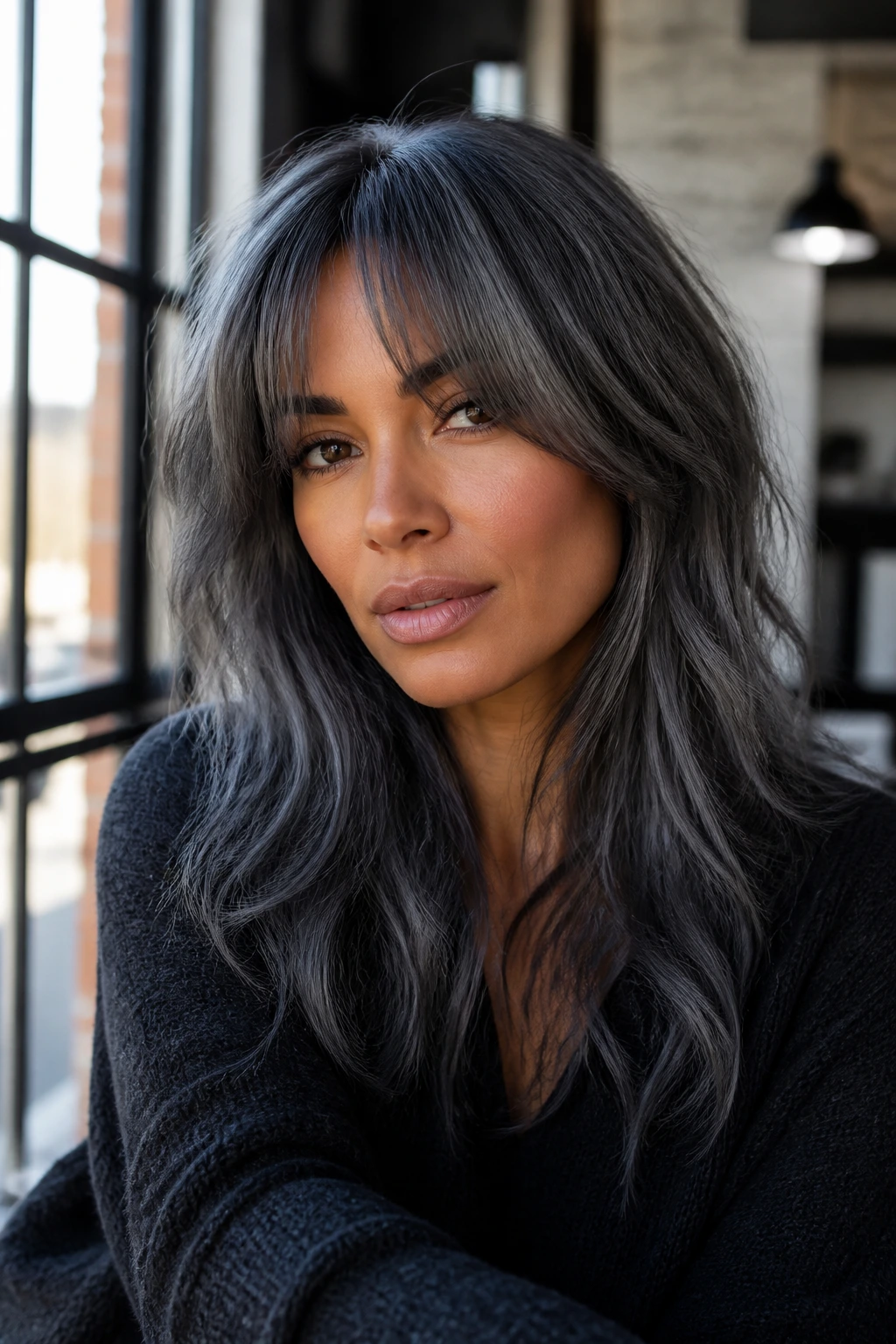
Storm cloud gray has some drama in it. The tone sits darker than silver and lighter than charcoal, which gives it that moody, rain-on-pavement feel. On tan skin, that kind of depth can look striking because the skin stays warm while the hair gets all the smoke.
The curtain bangs are what keep it from becoming too heavy. Without that opening at the front, storm cloud gray can close in around the face. With the fringe split and curved away from the cheeks, the color feels wearable and a little editorial.
This is one of the best choices if you like strong makeup, dark lashes, or a more structured wardrobe. It has attitude. It also behaves better on medium and thick hair than on very fine hair, which can lose the depth fast.
21. Soft Platinum Smoke
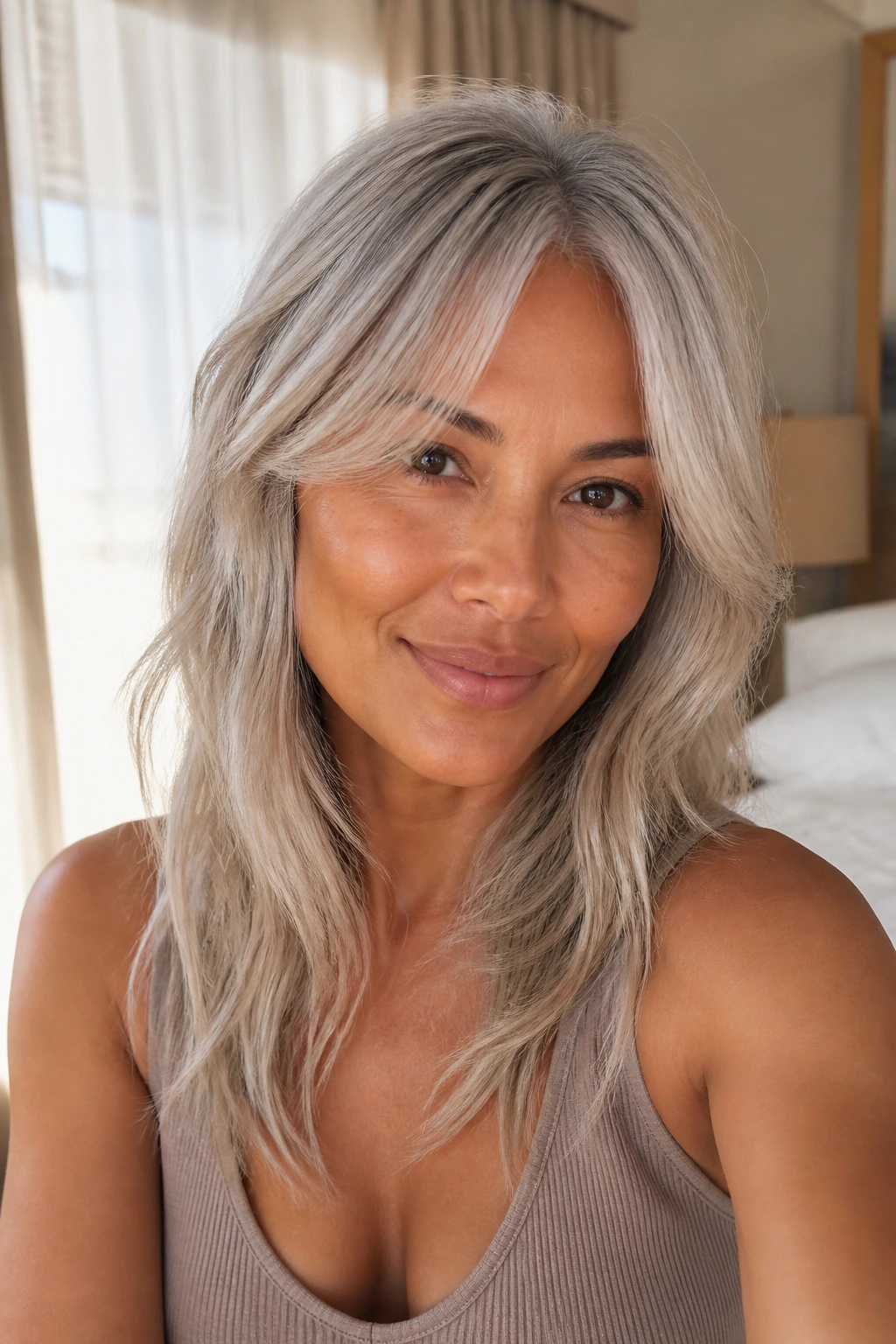
Can platinum work on tan skin? Yes, but only if it is softened. Soft platinum smoke is not the hard, bright, almost-white look that takes over every feature. It’s platinum with a gray veil over it, and that veil keeps the skin from looking stripped.
The curtain bangs are non-negotiable here. They need to be airy, swept, and lightly layered so the front of the face doesn’t become one pale block. A shadow root is also smart. Without it, the platinum can feel a little cut-out and severe.
This shade is best when you want the brightest gray family but still want movement and softness. It takes upkeep. No pretending otherwise. But on the right tan skin tone, it can look clean instead of icy.
22. Midnight Gray With Bright Fringe
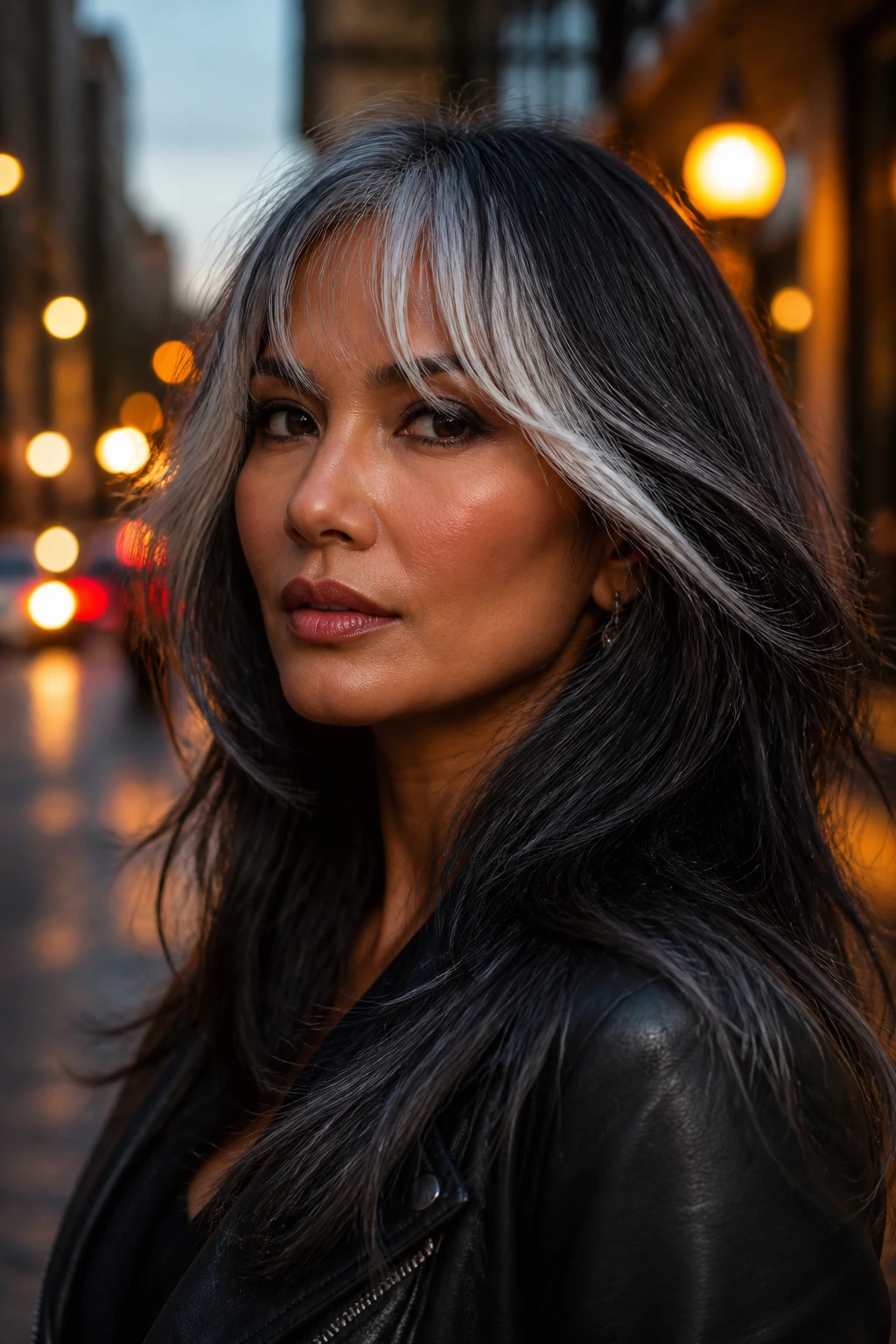
Midnight gray gives you the opposite of a washed-out finish. The base stays deep and smoky, almost black in some light, while the curtain bangs and front panels carry the brighter gray. That high contrast is gorgeous on tan skin when you want the face to pop.
This is especially strong if your natural hair is dark and you like a bold frame around the eyes. The fringe should be bright enough to catch light, but not so light that it looks disconnected from the rest of the cut. That little link between dark and light is what makes the whole thing feel expensive-looking.
I’d wear this with loose bends or polished waves, never poker-straight. Straight hair can make the contrast look too hard. Movement gives the midnight gray somewhere to breathe.
How to Style Curtain Bangs So the Gray Stays Visible
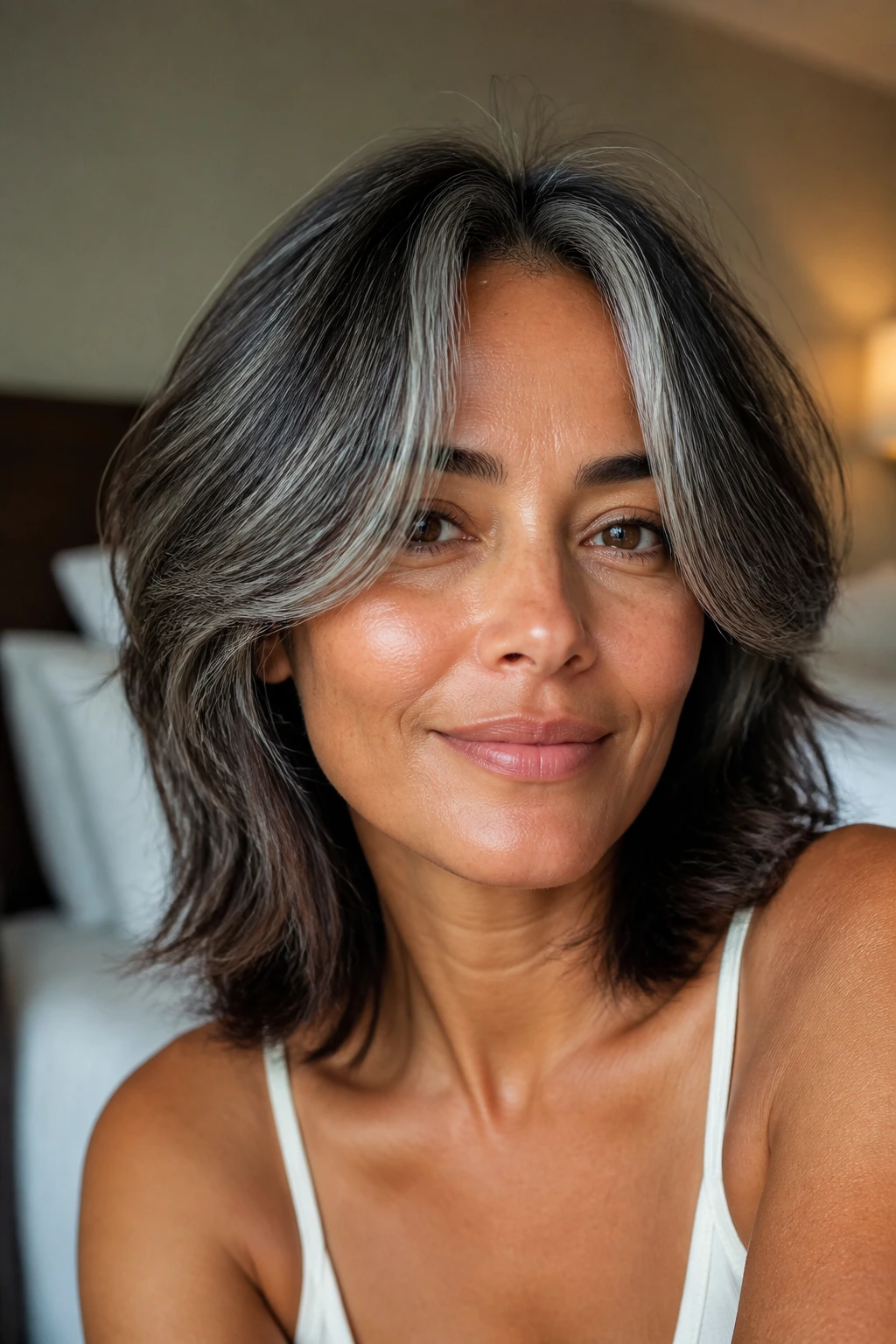
Curtain bangs can make a gray color sing, or they can hide half of it. The difference usually comes down to shape. If the bangs sit too flat against the forehead, the lighter face-framing pieces disappear into the rest of the hair. If they’re blown out with a soft bend away from the face, every ribbon shows up.
A 1.25-inch round brush is the sweet spot for most lengths. Dry the bangs forward first, then wrap each side away from the face for a few seconds of heat before letting them cool on the brush. That tiny cooling step matters. It sets the bend so the fringe doesn’t fall flat by noon.
What Helps Most
- Use a light mousse or root lift spray only at the roots, not through the ends.
- Keep serums off the fringe roots; too much slip makes curtain bangs split and hide the color.
- If your hair is stubborn, set the fringe in large Velcro rollers while you do makeup.
- Point the blow-dryer nozzle downward on the outer layer to keep gray ribbons smooth, not fuzzy.
Nope, you do not need a perfect blowout. You need a bend that opens the face.
Keeping Gray Tones Fresh Without Over-Washing
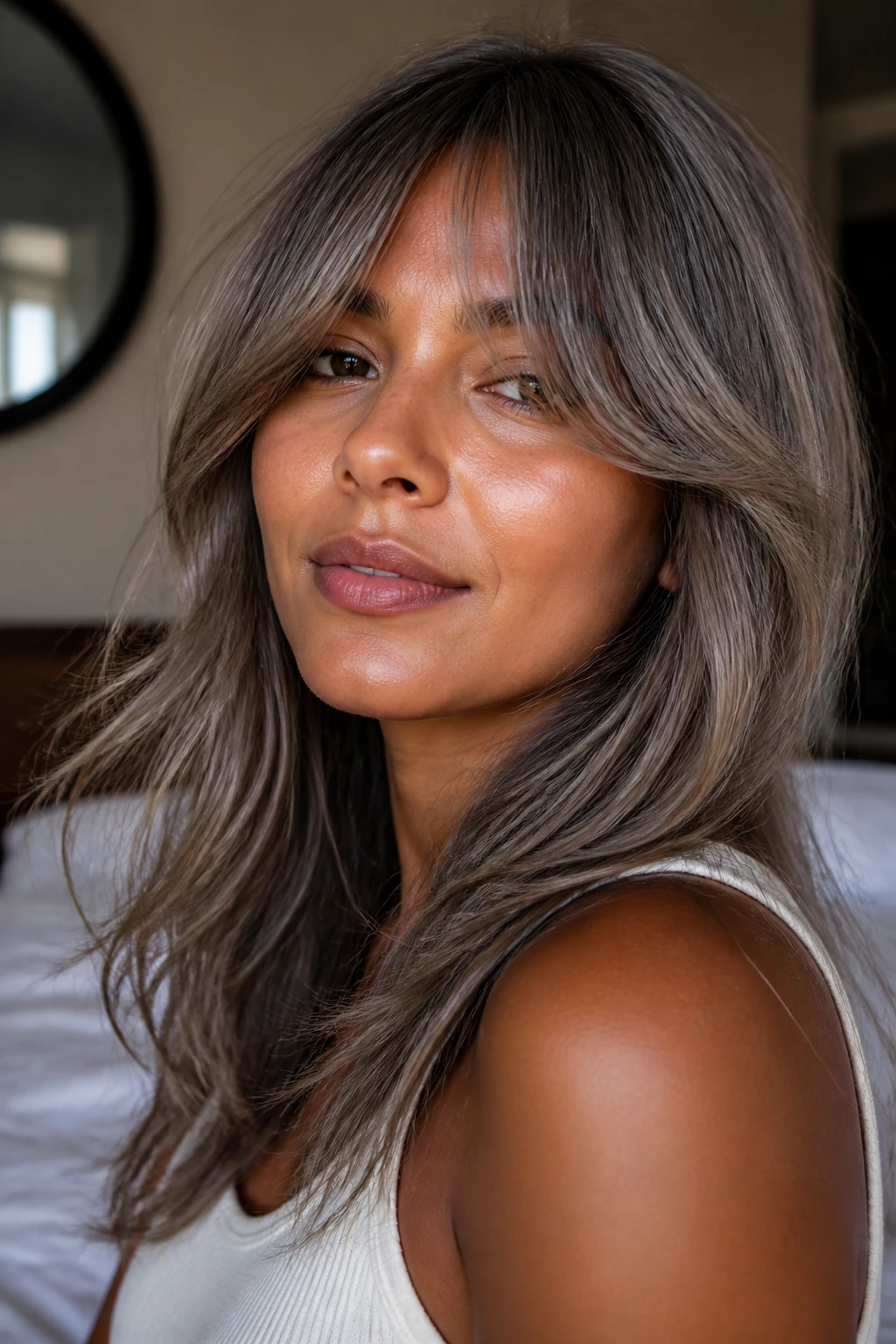
Gray hair gets tired fast if you treat it like regular brunette hair. Hot water, rough shampooing, and heavy clarifying products pull toner out quicker than most people expect. A gray gloss can start looking beige or yellow long before the grow-out is the problem.
Wash two or three times a week if you can live with it. Use lukewarm water, not hot. Hot water lifts the cuticle, and gray tones fade faster when the cuticle is open. If your water is hard, a shower filter can help more than another expensive mask ever will. That’s not glamour. It’s just practical.
A violet shampoo once a week is enough for most gray shades. More than that, and the hair can go dull or slightly lilac in a way that kills the dimension. For maintenance, think gloss every 4-6 weeks, root touch-up or blend every 6-8 weeks, and a trim for curtain bangs every 4-6 weeks so the fringe keeps its sweep.
Common Mistakes That Make Gray Hair Look Flat
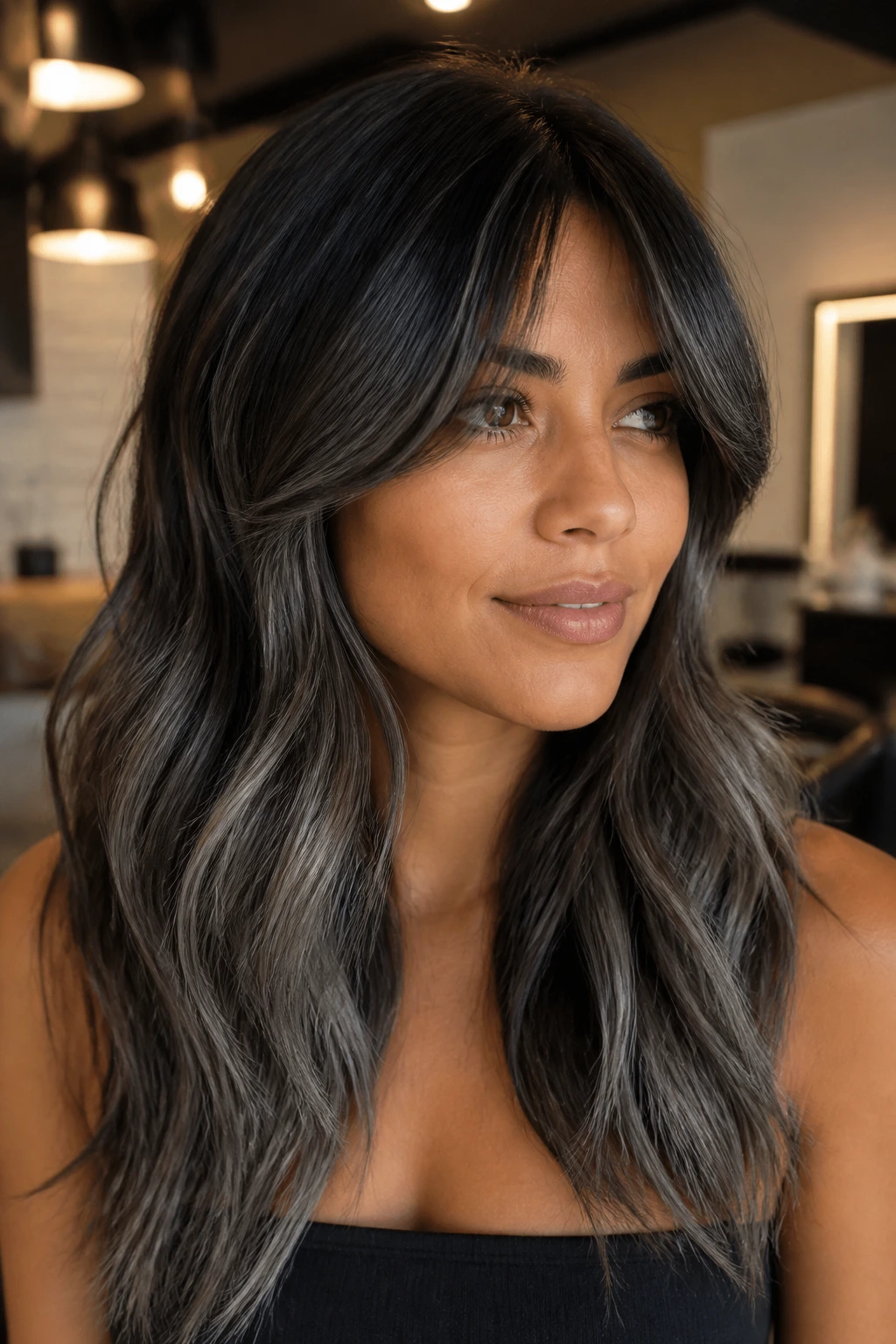
The first mistake is chasing pure ice too early. On tan skin, especially warm or peachy tan skin, very pale silver can erase warmth from the face and force the makeup to do all the work. If the skin starts looking more yellow by comparison, the gray is probably too cold or too light.
The second mistake is making the curtain bangs too thick. Heavy fringe blocks the face frame and hides the color placement you paid for. The fix is a softer center part, longer sides, and a little see-through movement near the cheekbones.
The third mistake is skipping the root shadow. Without it, gray hair grows out with a hard stripe that looks loud in photos and even louder in daylight. Ask for a root that sits one or two levels deeper than the mids, then let the lighter gray start where the light naturally hits.
And yes, overusing purple shampoo is a real problem. Gray turns muddy fast when every wash is a toning wash. Use it like a tool, not a religion.
Gray Variations You Can Save for Later
Warm Smoke Reset
If your tan skin reads golden, ask for a beige-gray glaze over almost any of these looks. The extra warmth keeps the gray from going chalky and softens the contrast around the face.
Cool Edge Finish
If your skin leans olive and you like a sharper result, try graphite, slate, or steel blue-gray with a cool toner. The color will look cleaner, especially near the fringe.
Low-Maintenance Rooted Gray
Keep the roots 1-2 shades deeper and let the gray live in the lengths and curtain bangs. This gives you a softer grow-out and fewer obvious touch-up lines.
Bold Face-Frame Gray
Lighten only the money piece and the front of the curtain bangs, then keep the rest of the hair darker. It’s a good choice if you want the gray to frame your face without committing to a full-head lift.
Natural Transition Blend
If you’re growing out natural gray, ask for babylights, lowlights, and a gloss that matches the in-between tones. This makes the grow-out look like a design choice, not a waiting period.
Tools That Make the Style Easier
- 1.25-inch round brush — gives curtain bangs the bend that keeps gray ribbons visible.
- Blow-dryer with a concentrator nozzle — directs airflow and smooths the fringe instead of puffing it up.
- Color-safe sulfate-free shampoo — helps gray toner last longer between washes.
- Purple shampoo — useful for brass control, but keep it to about once a week.
- Lightweight heat protectant — protects the fringe and the face-framing pieces, which get touched by heat the most.
- Sectioning clips — make balayage, blow-drying, and glossing easier to control.
- Wide-tooth comb — keeps wet gray hair from stretching and snapping.
- Satin pillowcase or bonnet — cuts down on bang creases and roughness at the hairline.
- Glossing mask or conditioner — adds slip and keeps the finish from looking dry or smoky in the wrong way.
Gray Hair Questions People Actually Ask
Does gray hair actually flatter tan skin?
Yes, but the tone matters more than the color family itself. Tan skin usually looks best with gray that keeps some depth—mushroom, graphite, taupe, pewter, or silver-beige—rather than a flat pale white. The wrong icy shade can drain the face. The right one gives structure.
Which gray shade works best on warm tan skin?
Mushroom gray, taupe smoke, champagne silver, and silver beige usually sit best on warm tan undertones. They keep enough softness in the formula so the skin still looks alive. If you go too blue or too white, the color can start fighting the warmth in the face.
Are curtain bangs better than blunt bangs with gray hair?
For this topic, yes. Curtain bangs keep the gray from turning into a solid block across the forehead, and they let the face-frame pieces blend into the rest of the cut. A blunt fringe can look strong, but it’s less forgiving when you’re balancing cool gray with tan skin.
How often does gray hair need toner or gloss?
Most gray shades need a refresh every 4-6 weeks, sometimes sooner if you wash often or use hot tools a lot. If the color starts drifting yellow, beige, or muddy, that’s usually your sign. A gloss is usually enough; you do not need a full redo every time.
Can you go gray without bleaching all the way to pale blonde?
Sometimes. Darker gray looks like graphite, storm cloud, or silver fox brunette can be done with less lift because they keep deeper pigment in the base. Very light silver and platinum smoke do need more lift, though, or they won’t read truly gray.
What should I do if gray hair turns yellow?
Use a violet shampoo once a week and cut back on hot water and heat styling. If the yellow cast is strong, a salon gloss or toner will work faster than trying to fix it with shampoo alone. Hard water can also be part of the problem, so a filter helps more than people expect.
Is this better on short hair or long hair?
Both can work, but the effect changes. Shorter cuts like bobs and lobs show the shape of the gray immediately, while longer layers and waves show the dimension better. If you want the curtain bangs to matter, keep enough length around the face for them to sweep, not sit stiffly.
How do I keep curtain bangs from looking oily or split?
Use less product at the roots than you think you need. A pea-sized amount of styling cream is plenty, and it should stay on the mid-lengths and ends, not the scalp area of the fringe. If the bangs split anyway, a quick blow-dry with a round brush fixes it faster than piling on dry shampoo.
The Gray That Fits
The best gray on tan skin is rarely the palest one in the room. It’s the one that keeps a little depth at the root, enough softness at the fringe, and enough contrast to make the face look awake instead of stripped.
Curtain bangs are what make these shades feel usable. They create movement right where the color needs it most, and they give silver, smoke, graphite, and mushroom somewhere graceful to land. If one of these looks keeps tugging at your attention, start there. The right gray tends to feel obvious once you see it.