



Curly fringe can look brilliant or a little chaotic, and the difference usually comes down to one stubborn detail: shrinkage. A fringe that seems perfectly grazed and tidy in the chair can spring up an inch, sometimes more, once it dries. On a square face, that can either soften the whole look or turn the forehead into a hard little shelf if the shape is wrong.
I like short fringe on curls because it respects the hair’s own movement instead of fighting it. The right cut makes the top of the face feel lighter, breaks up a strong jawline, and gives the eyes somewhere softer to land. The wrong cut? Too blunt, too dense, too short on the day it’s cut, and suddenly you’re wrestling a puffed-up line that needs constant correction.
Square faces need curve. Curly hair already gives it to you—if the fringe is cut with some thought. The best versions aren’t flat, exact, or heavily ironed. They’re piecey, arched, tapered, or deliberately uneven in a way that looks natural once the curls spring into place. That’s where this shape gets interesting.
Why This Collection Feels Different

- Shrinkage-Friendly: Every style here assumes curls will rise once they dry, so the ideas are built around real length, not wishful thinking.
- Jawline Softening: Square faces look better when the fringe bends, tapers, or breaks into pieces instead of sitting in one hard horizontal line.
- Low-Drama Options: Some of these are tiny and bold, while others are soft and easy to grow out without an awkward gap in the middle.
- Curl-First Thinking: These fringe shapes work with curl clumps, coil pattern, and density instead of asking the hair to behave like a flat sheet.
- Salon-Ready Language: Each style is easy to describe to a stylist, which matters more than people admit. A good bang picture means nothing if you can’t explain why you want it.
- More Than One Mood: There’s edge here, but also softness, romance, and a few shapes that read almost invisible until the curls settle.
1. Soft Curved Micro Fringe
A micro fringe on curls can look sharp in the best possible way. The trick is the curve. Not a ruler-straight line. A soft arc that sits just above the brow in the center and drifts a touch longer toward the temples keeps the face from feeling boxed in.
On a square face, that curve matters more than the length itself. It breaks the forehead into something gentler and stops the jaw from feeling like the loudest shape on the head. I’d choose this version over a blunt crop every time, because curls already bring texture. You don’t need more hardness.
Why It Works on Square Faces
The shortest point opens the center of the face, while the longer sides pull the eye outward in a soft sweep. That’s a smart move if your jaw is strong and your forehead is broad.
Best of all, the fringe reads intentional even when the curls separate a little. It doesn’t need perfect symmetry to work.
If your curl pattern is tight, ask for the fringe to be cut dry and left slightly longer than you think you want. A half inch means a lot here.
2. Airy Baby Bangs With Broken Ends
Can baby bangs work on curls? Yes, if they’re not treated like a stiff little curtain. The broken ends are the whole point. They keep the fringe from turning into a dense block across the forehead, which is the fastest way to make a square face look boxier.
This shape suits people who want something bold but not severe. The bangs sit high enough to show some forehead, then break into little curl pieces instead of one blunt line. It’s cheeky. A little punk. Also much easier to live with than a perfectly straight crop, because the texture does half the styling for you.
What Makes the Shape Softer
The tiny gaps between curl clumps let skin and forehead show through, which takes pressure off the top of the face. That’s useful on square faces because you don’t need more width across the brow.
Ask for point cutting at the ends, not heavy thinning. Heavy thinning on curls can turn the fringe fuzzy at the edges. A few controlled pieces look better than an over-scrubbed texture cloud.
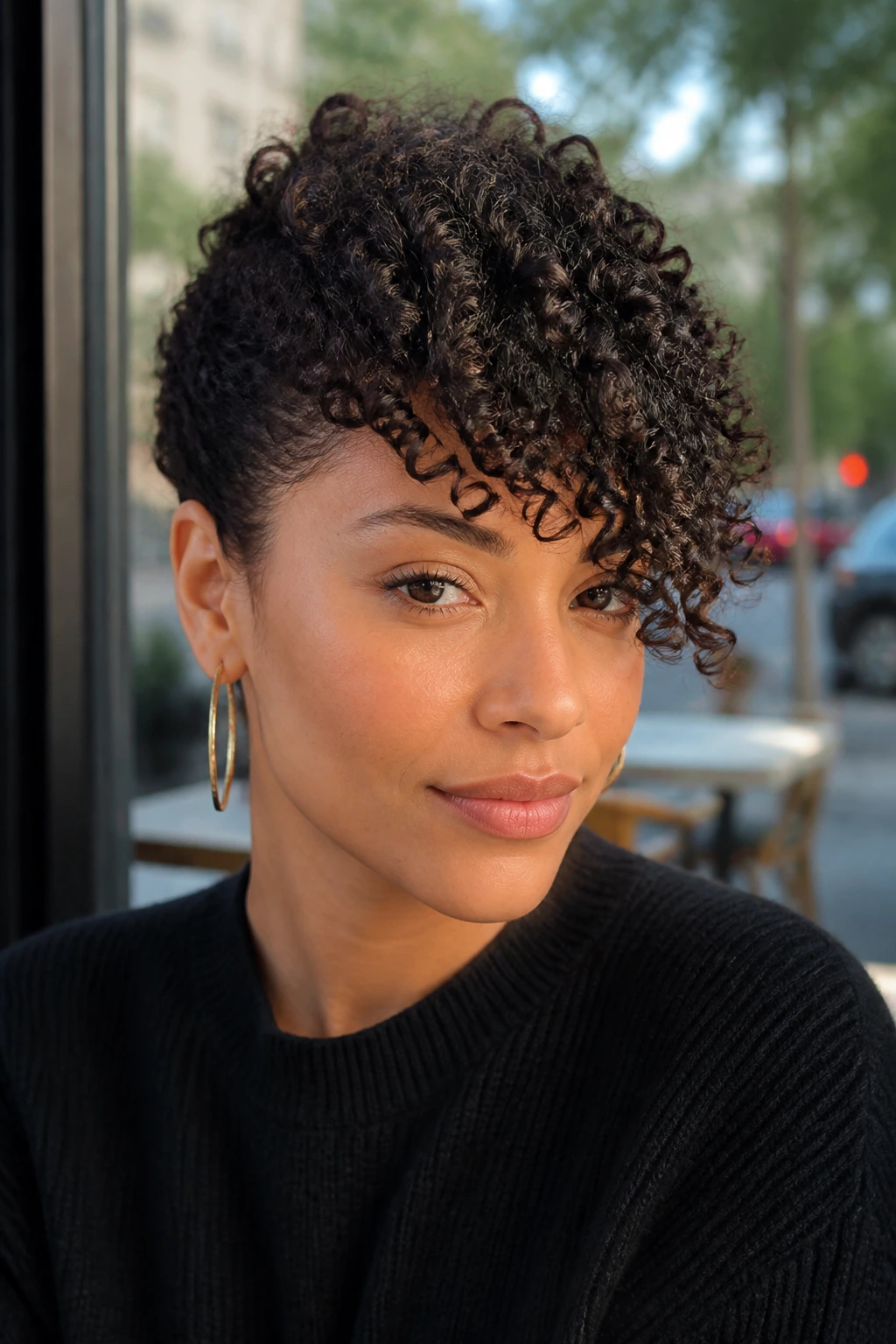
3. Side-Swept Coil Fringe
A side-swept fringe is the easiest way to sneak diagonal movement onto a square face. That diagonal line matters. It cuts across the straight lines of the jaw and forehead, and curly texture makes the sweep look softer than a brushed-over straight bang ever could.
The nicest versions don’t fight the part you already wear. They lean into it. If your hair naturally falls a bit to the left or right, let the fringe follow that direction and keep one side slightly longer so the sweep has somewhere to land. It’s a small thing. It changes the whole face.
Best Curl Patterns for This One
Looser curls and mixed textures handle this fringe well because they can be redirected without losing shape. Tighter coils can still do it, but the cut needs a little more length at the side so the sweep doesn’t spring up and disappear.
If you wear glasses, this is a good choice. The diagonal line keeps the fringe from stacking right on top of the frames, which can get fussy fast.
4. Brow-Skimming Choppy Fringe
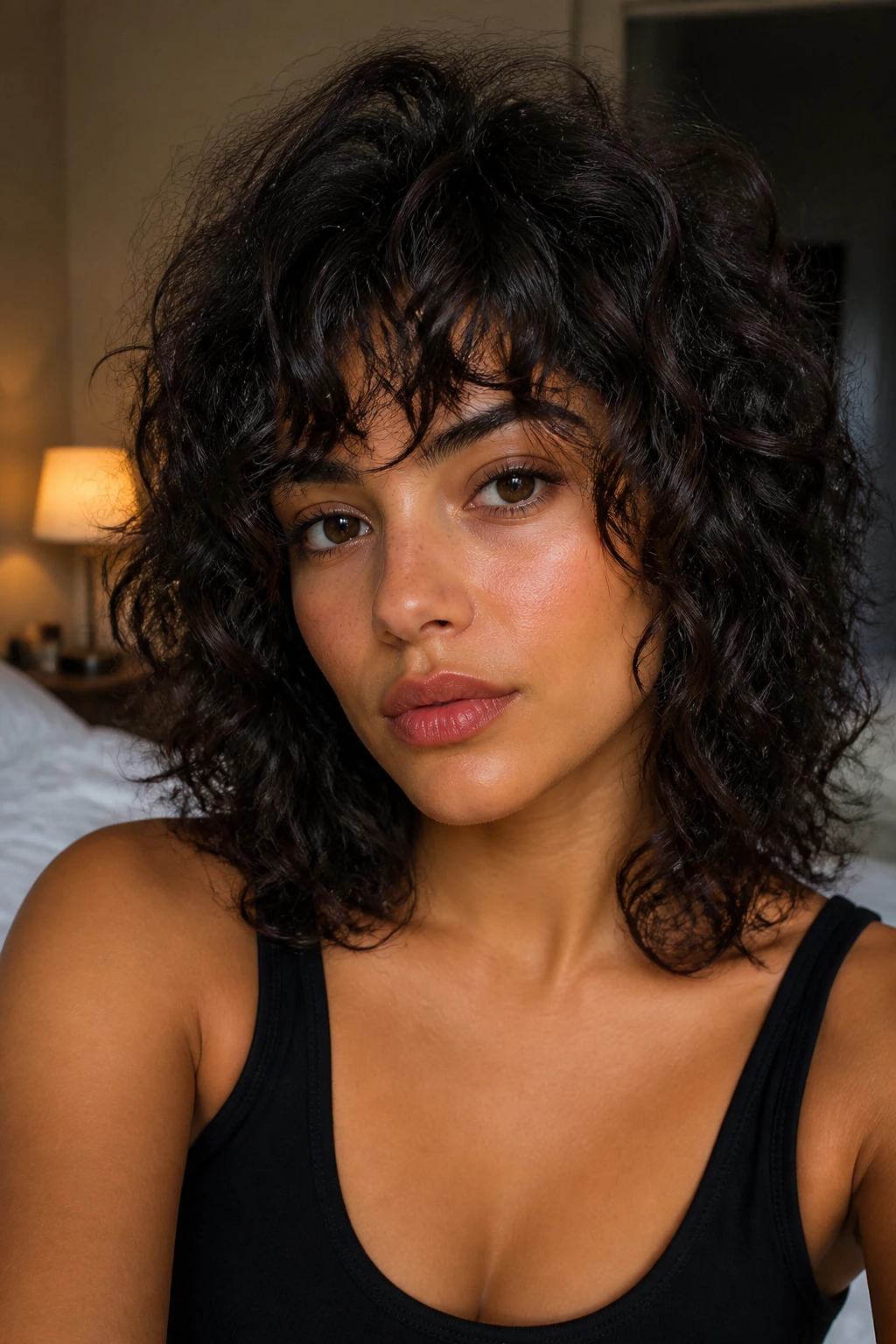
This is the safest short fringe in the bunch, and I mean that in a good way. Brow-skimming curls give you the feeling of bangs without burying the whole forehead. The choppy edges stop the line from looking severe, which is exactly what a square face needs.
A lot of people ask for “soft bangs” and then end up with something vague. This is the clearer version. The length sits around the brow when dry, with enough break in the ends that the fringe moves instead of freezing into a shelf.
How to Keep It From Looking Heavy
The weight has to be in the middle, not all the way across. If the temples are left just a touch longer, the fringe has a better chance of blending into the sides of the haircut.
A diffuser helps here, but don’t blast the fringe from underneath for too long. That’s how you get a puffed-up arch that looks bigger than the rest of the hair.
5. Rounded Arch Fringe

A rounded arch fringe is one of my favorites for square faces because it behaves like a soft frame. The center is shorter, then the line bends gently down at the sides. Curly hair makes that curve feel organic instead of staged.
The effect is subtle. That’s the point. You get softness at the forehead without turning the cut into a dramatic statement that needs perfect styling every morning. When the curls drop a little or separate a little, the arch still reads.
Who Should Pick It
If you like shape but not a lot of upkeep, this one sits in a sweet spot. It’s structured enough to look intentional, yet it’s forgiving when humidity gets involved or when the curls decide to sit higher on one side than the other.
This is also a good bridge shape if you’re growing out a blunt fringe. The curve makes the grow-out look planned instead of messy.
6. Bottleneck Fringe With Curly Temples
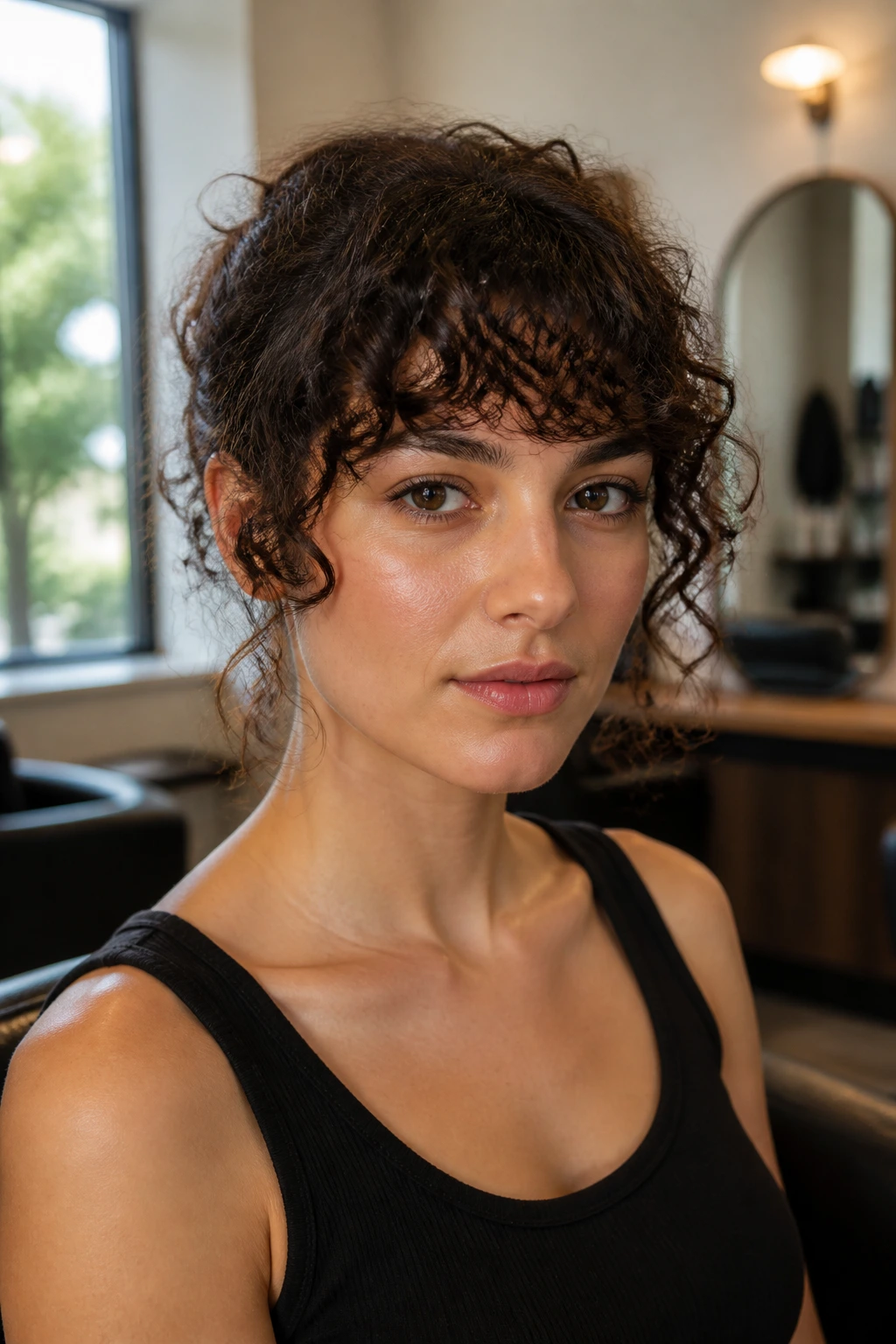
The bottleneck fringe has a narrow center and fuller sides, which is why it flatters square faces so well. It starts soft between the brows, then opens outward and blends into the temple area instead of stopping abruptly across the forehead. That shape does a lot of quiet work.
On curls, it feels even better because the sides can be left long enough to curl into the cheekbone area. That extra length pulls attention away from the corners of the jaw and into the middle of the face, where the eye can take a rest.
The Detail That Matters
Don’t let the center get chopped too short. If it sits above the brow before shrinkage, it can bounce too high and lose the whole shape. Leave room for the curl pattern to rise.
A dry cut is useful here, but a stylist who knows how to carve the shape curl by curl is even better. The bottleneck needs patience. Rushing it turns the whole thing into a lopsided bang.
7. Piecey Ribbon Fringe

Some curls fall in ribbons, and when they do, you should let them. A piecey ribbon fringe looks especially good on square faces because it breaks the forehead into several soft lines instead of one hard band. That kind of breakup is flattering in a way that’s hard to fake.
This style is less about uniformity and more about shape memory. The fringe should settle into 3 to 6 visible curl pieces, with small gaps between them. That’s enough to keep the look airy while still giving the eyes a focal point.
Why It Feels So Easy
Ribbon fringe doesn’t demand perfect symmetry, which makes it friendlier than people expect. If one curl is a little tighter or one piece sits higher, the whole thing still reads as deliberate.
Use a light curl cream and a tiny bit of gel at the roots. Too much product glues the pieces together and kills the ribbon effect. And that would be a shame.
8. Short Shag Fringe
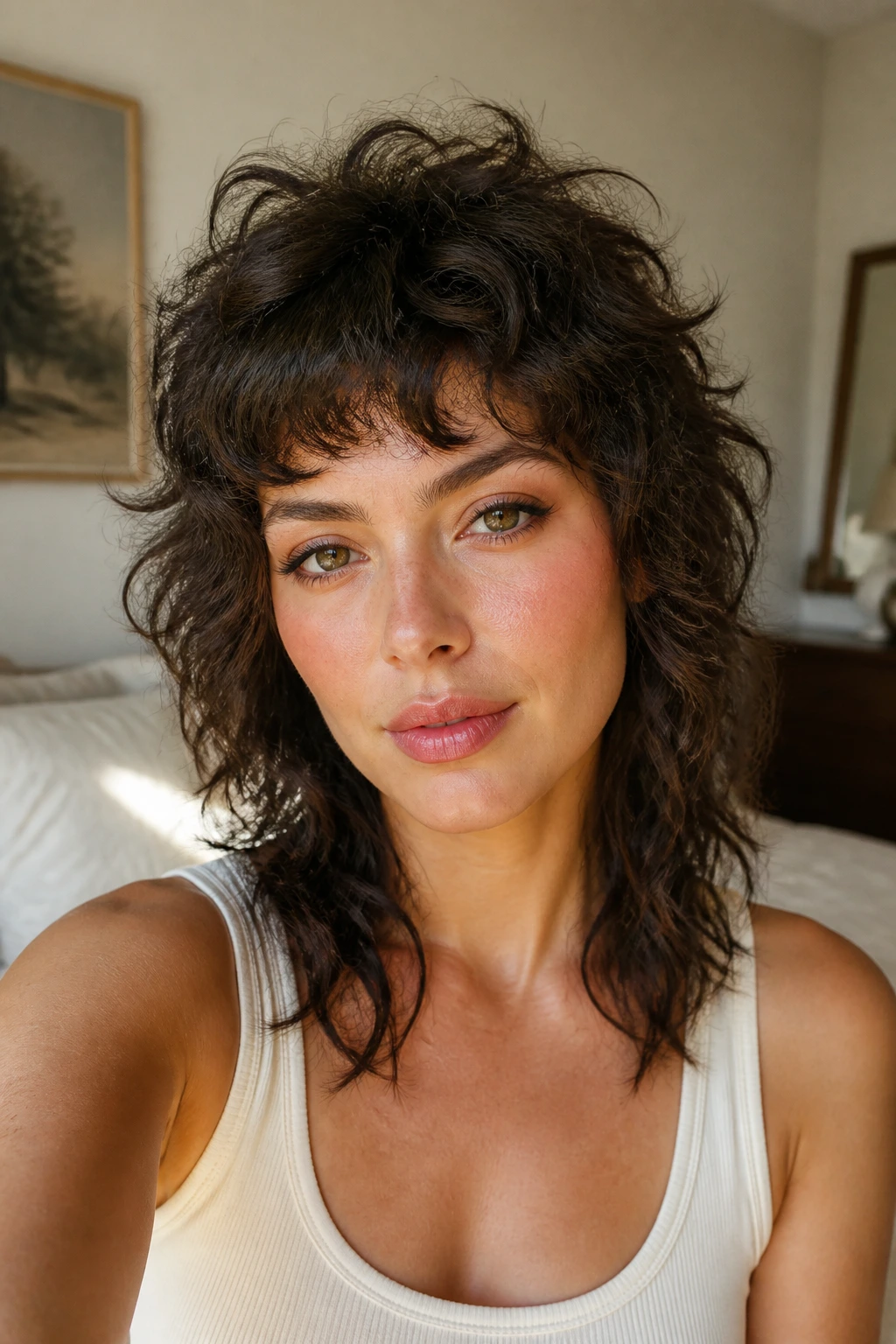
A shag and a short fringe are a natural pair. The cut already wants movement, so the fringe can be shorter without feeling severe. On a square face, the shag’s messy layers soften the jaw while the fringe keeps the top from feeling heavy.
Why It Works
The shag cuts a lot of hard geometry out of the haircut. Instead of one clean border, you get layers that break up the outline. That makes the fringe feel more integrated, especially if your curls are medium to thick and want to puff outward.
If you’re nervous about a very short bang, start here. The shag gives you a little visual cover, so the fringe can be bold without taking over the whole face.
Styling Note
Diffuse with the head tipped slightly forward so the fringe doesn’t collapse flat against the forehead. You want lift at the roots and a little mess in the ends. Not chaos. Just enough looseness to keep it from looking overworked.
9. Tapered Fringe With Longer Sides
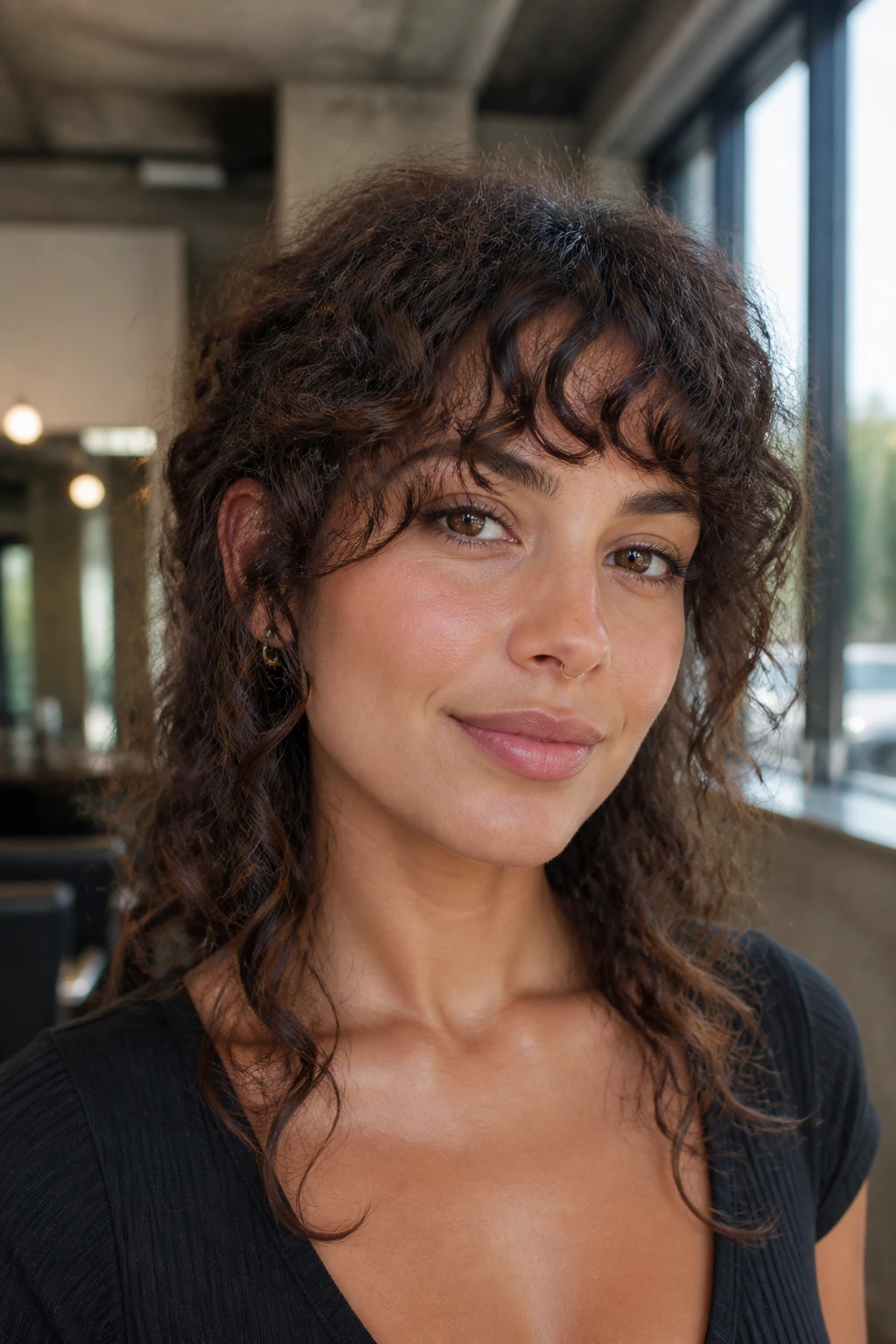
If I had to recommend one fringe shape to someone nervous about short bangs on curls, this would be near the top. It begins short in the center, then tapers gradually into longer pieces at the sides. That slope softens square faces fast.
The taper gives your eye a path to follow. Instead of hitting a blunt edge, the face moves outward and down. That’s kinder to a square jaw and a broad forehead, and it works on curls because the length changes give the pattern room to spring naturally.
Best for First-Timers
This fringe grows out cleanly. That is half the battle. You won’t hate it at week three, and you usually won’t feel trapped by it at week six.
Ask for the center to be cut with the curl’s dry length in mind, then keep the temple pieces long enough to tuck behind the ears if needed. That tiny escape hatch matters on busy mornings.
10. See-Through Fringe

See-through bangs are lighter than they sound. The goal is a fringe with enough spacing that your forehead still shows through a little, which keeps the face from feeling weighed down. On curls, this can be gorgeous. Airy. Slightly undone.
Square faces benefit because the fringe doesn’t create another heavy horizontal line. It softens, but it doesn’t cover everything. That makes the cut feel lighter around the brow and more open around the cheeks.
What to Ask For
Ask for a reduced density at the front, not a full thinning-out. There’s a difference. You want the stylist to leave wisps and pockets of space, not rake the fringe down until it frizzes.
This works best on fine to medium curls, or on thicker curls that separate well. If your curl pattern is very dense and springy, a see-through fringe can become too fluffy unless it’s shaped carefully.
11. Curly Curtain Fringe

Yes, curtain bangs can be short. Curly ones can look especially good because the center opens the face while the side pieces soften the square edges. The middle is shorter, the sides grow longer, and the whole thing falls away from the eyes in a gentle split.
This is one of the easiest fringe shapes to live with if you already part your hair in the middle. It gives you the softness of bangs without the commitment of a full line across the forehead.
Where It Lands Best
On curls, the center should sit at or just above the brows when dry, with the side pieces reaching toward the cheekbones. That length difference is what makes the shape work.
If the split looks too dramatic, pinch a tiny bit of product through the front and let the curls separate on their own. Don’t brush it flat. The texture is the reason this fringe looks good in the first place.
12. Dense Rounded Fringe
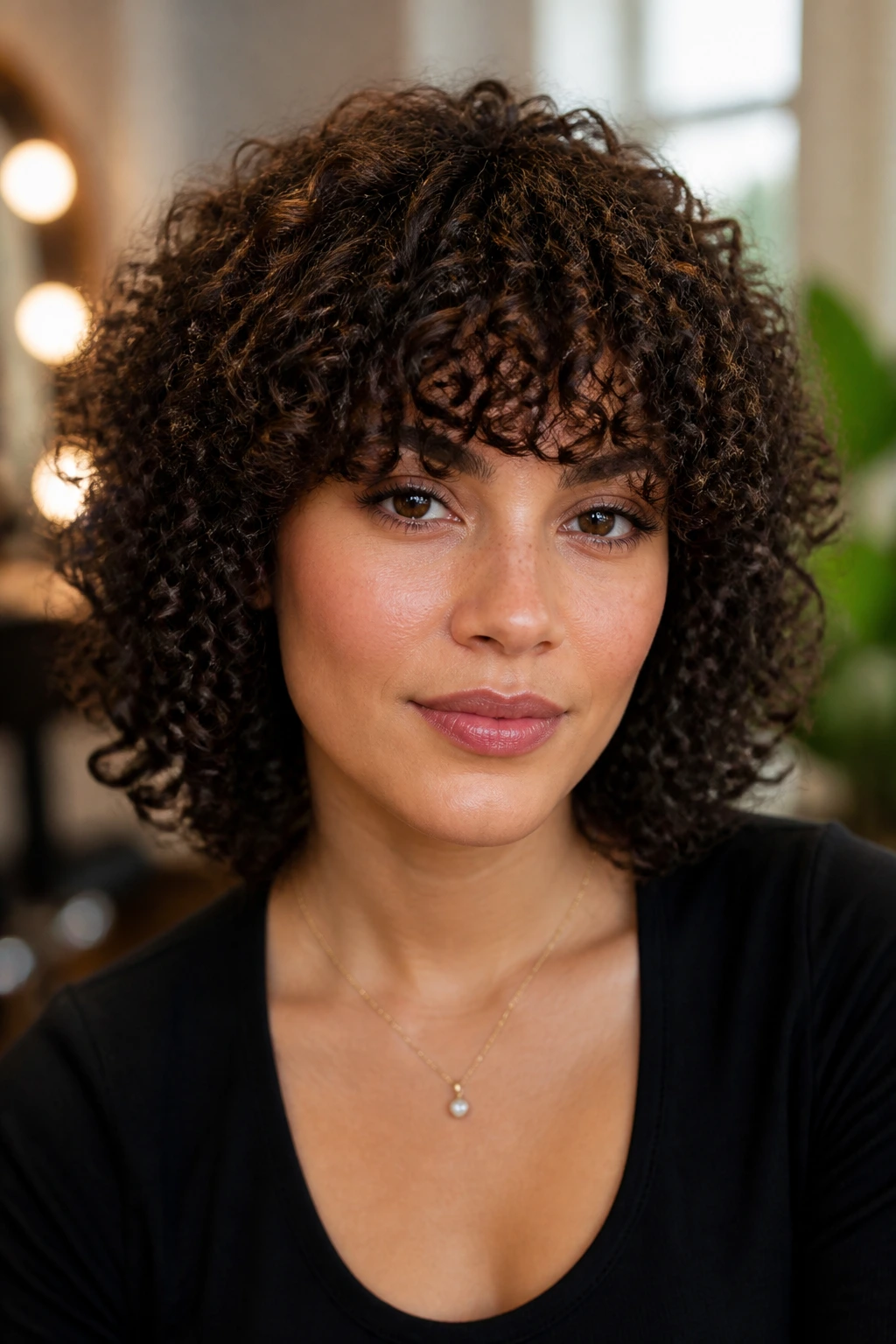
Thick curls can absolutely wear a fuller fringe. The mistake is cutting it straight across and calling it done. A dense rounded fringe gives you weight without harshness, which is ideal if your hair has enough body to support it.
The rounded edge keeps the look soft over a square face. Instead of a hard wall of hair, the fringe sits in a gentle curve that changes the whole mood of the haircut. It feels richer, yes, but not rigid.
When It’s the Right Call
This shape works best if your curls are dense enough that see-through bangs would vanish too fast. Some hair needs more substance to read as a fringe at all.
Ask for internal shaping and a little more length at the temples. That prevents the fringe from looking like a cap dropped onto the forehead. Nobody wants that. Not even for one day.
13. Asymmetrical Fringe

Asymmetry is useful on square faces because it breaks the face’s own symmetry. One side carries more weight, the other slips away more quickly, and the eye stops reading the forehead as a block. Curly hair makes that asymmetry feel softer than a sharp angled bang would.
This is the fringe for someone who likes a little tension in the cut. It can be subtle or obvious. The short side may sit at brow level while the longer side sweeps toward the temple. The shape feels deliberate, not fussy.
A Good Match for Side Parts
If your hair naturally falls off-center, this one fits like a glove. The part supports the fringe, instead of asking it to work against its own direction.
A square face often looks best when one side gets slightly more visual weight than the other. That doesn’t mean “uneven” in a sloppy sense. It means the haircut has movement, and movement is what softens hard edges.
14. Face-Hugging Fringe With Long Side Pieces
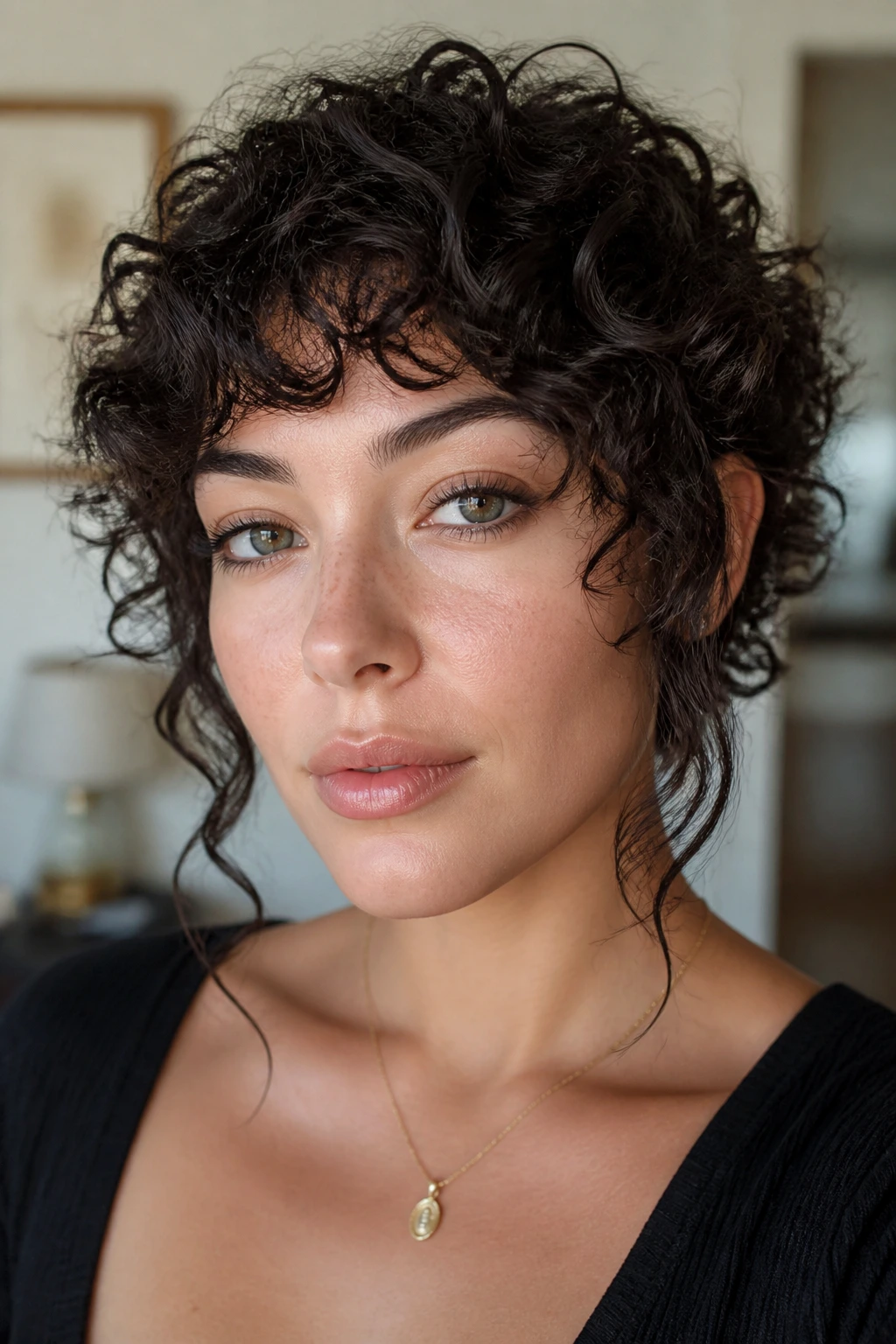
This is a lovely shape when you want the front of the haircut to melt into the sides. The fringe stays short enough to read as bangs, but the longer side pieces hug the cheekbone area and blur the line between fringe and face framing.
That’s useful on square faces because the jawline gets less attention. The eye stays up near the eyes and temples, where you can use curve and softness to your advantage.
Why It Feels So Balanced
The front doesn’t stop and start in a sudden way. It transitions. That makes the haircut look more expensive in the practical sense—the shape holds up even after a rough sleep, a windy walk, or a day with a clip holding one side back.
Ask for the side pieces to land around the top of the cheekbone, not the jaw. Jaw-length sides can box in the face again. Cheekbone length is the sweet spot.
15. Wispy Fringe on a Bob

A bob can look severe on a square face if the edges are too exact. Add a wispy fringe, and the whole thing softens. The fringe gives the haircut motion up front, while the bob keeps the silhouette neat.
I like this pairing when the curls are medium in density and hold a shape without sprawling too wide. The fringe should be light enough to float, not heavy enough to sit like a lid across the forehead.
Best Way to Cut It
Keep the fringe a little shorter in the middle and let the curls break apart at the ends. That way it doesn’t fight the bob’s clean line.
If the bob hits at the chin, the fringe becomes even more important because it changes where the eye starts. Without it, the face can feel like one straight line from forehead to jaw. With it, the shape breathes.
16. Layered Fringe With Mid-Length Curls
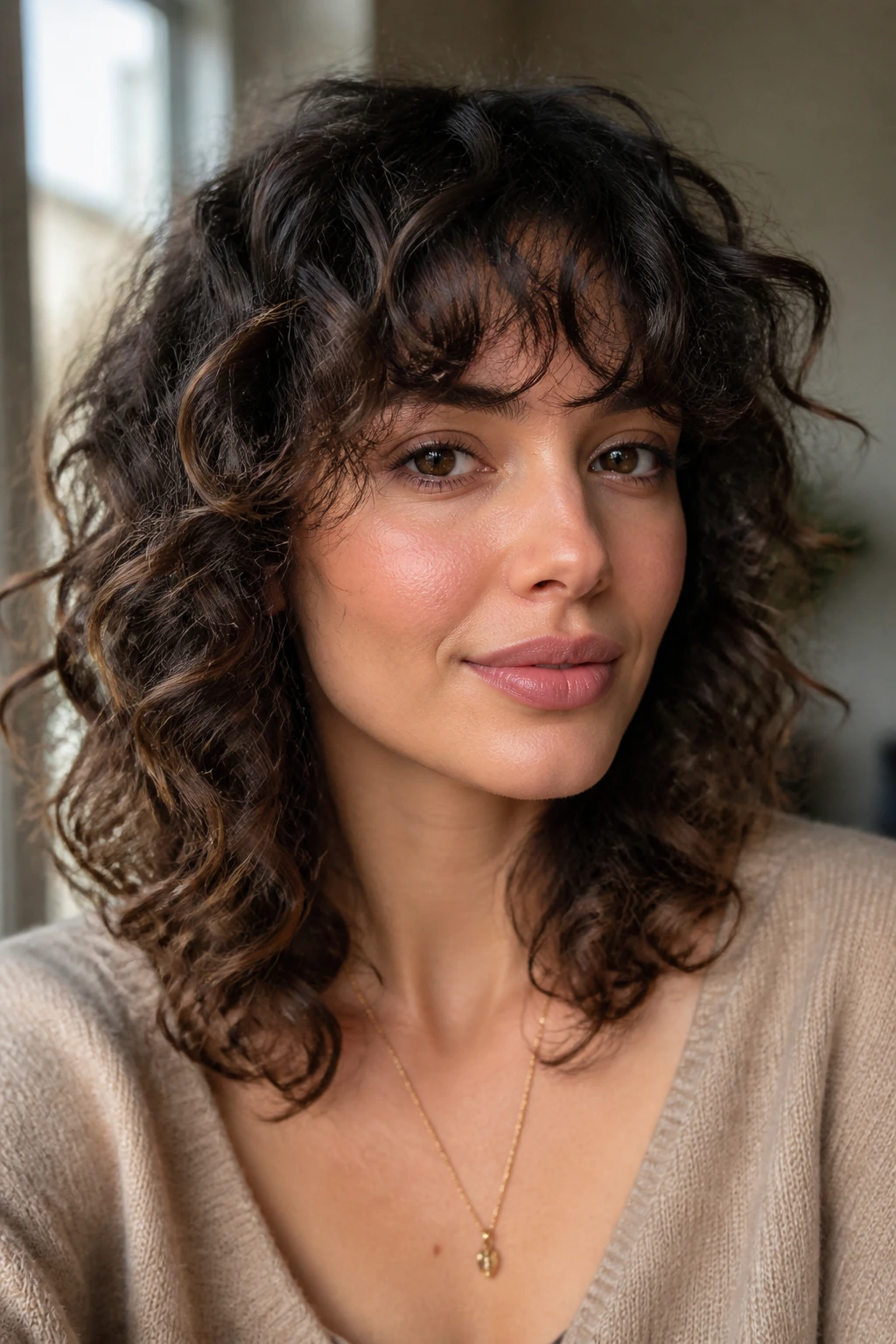
Layered fringe is the answer when your curls need movement more than they need coverage. The layers stop the bangs from sticking out as one thick block, which can happen fast with curly hair that has some density at the front.
Why It Moves Well
Each curl clump gets a little room to form. That keeps the fringe from feeling heavy at the root, and it helps the top of the face stay soft instead of squared off.
How to Style It
Use a small amount of curl cream, then a touch of hold gel near the roots. If the front blooms too much while drying, clip the top section up for 5 to 10 minutes, then release it once it has memory.
This is a smart choice for square faces because the layers create broken vertical lines. Those little interruptions matter. They keep the front from becoming a solid block.
17. Sculpted Finger-Coil Fringe
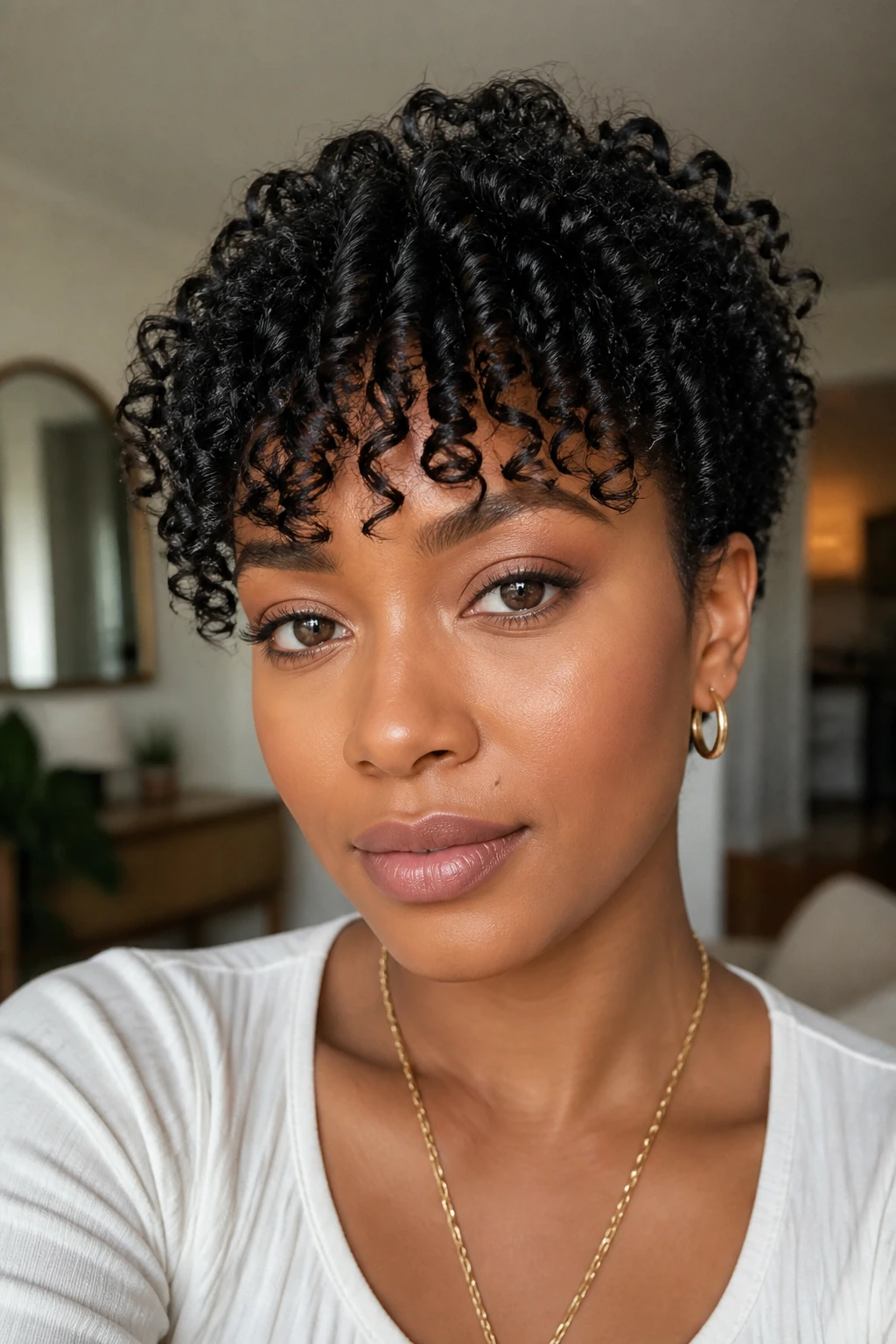
If you like the front of your hair to look intentionally shaped, finger-coil fringe is a strong choice. Each curl is encouraged into its own path, which gives the bangs a clean pattern without erasing the natural texture. It’s polished, but not stiff.
On a square face, the sculpted coils create roundness where the face needs it most. The forehead gets a softer border, and the eye line becomes the thing people notice first.
Where It Helps Most
This fringe shines when you want a more dressed-up finish for work, events, or days when you feel like being a little precise. It’s not the fastest shape to create, but it does hold a clear outline.
Use a tiny amount of gel on wet curls, then coil the front pieces around your finger in the direction they already want to turn. Don’t force a curl into a shape it hates. That never ends well.
18. Tousled Fringe With a Deep Side Part
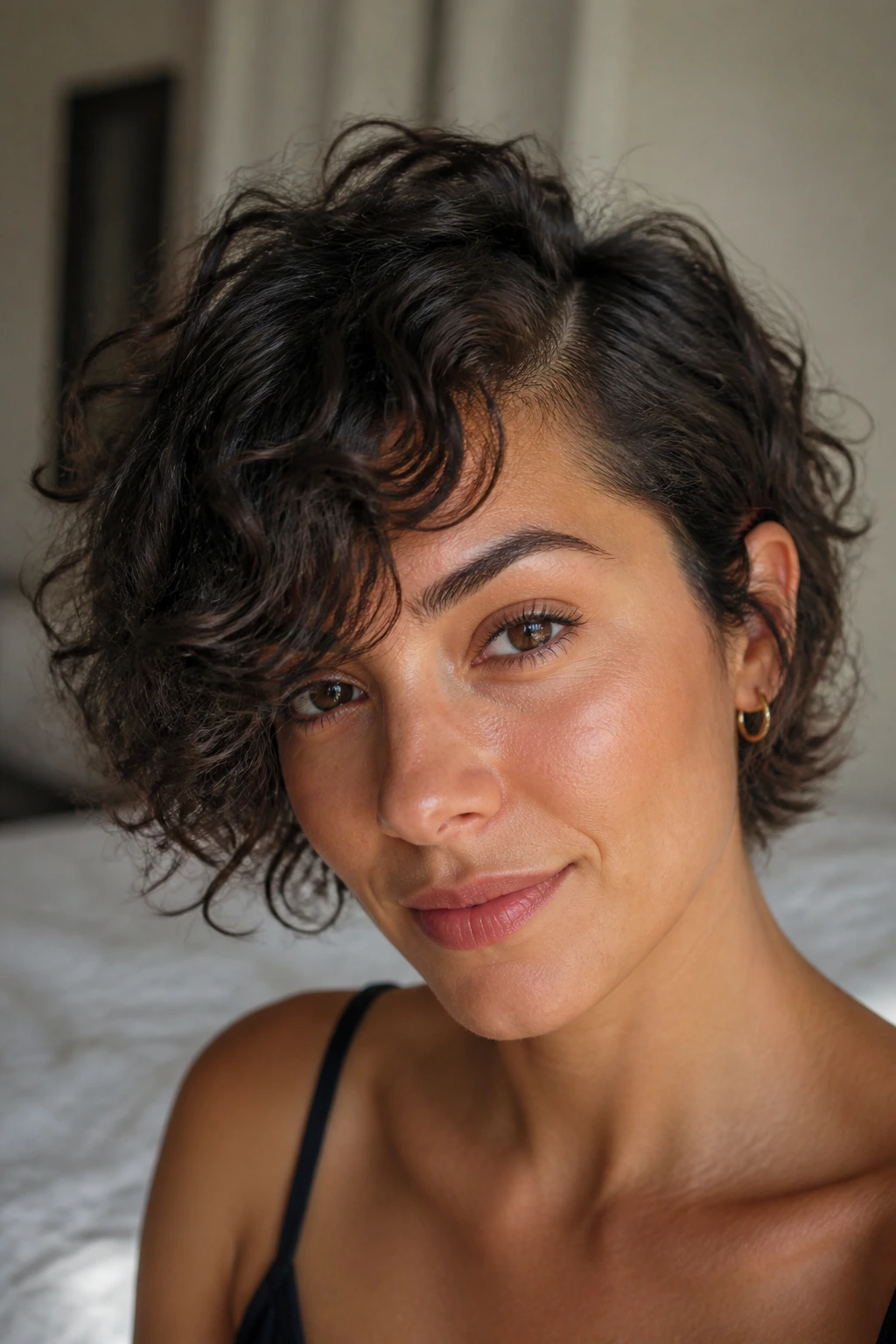
Messy can be smarter than polished. A deep side part with tousled fringe gives the face a diagonal break and keeps the forehead from reading as wide. On square faces, that angled shift can be more flattering than a centered bang.
The fringe should look a little wind-tossed, not neglected. There’s a difference. You want some lift at the root, some separation at the ends, and one side that naturally carries more hair than the other.
A Good Fit for Low-Maintenance People
This is the one for anyone who wants bangs but refuses to babysit them every ten minutes. The deep side part does a lot of the work, and the curls can fall where they want with only a little help.
If one side feels too full, tuck it behind the ear while it dries. That small move can shape the whole front without a brush. Handy. Almost annoyingly simple.
19. Halo Fringe With Crown Lift

A halo fringe is all about curve and height. The fringe wraps around the forehead softly, while the crown sits a touch higher so the face looks a little longer and less square. It’s a beautiful trick on curly hair because curls already know how to build a shape upward.
This is especially good if your square face feels widest at the temples. The lifted crown draws the eye vertically, and the curved fringe brings the line back down in a soft arc.
The Shape to Aim For
The center shouldn’t flatten the forehead. It should skim it. The side pieces then blend into the rest of the curls, creating a round outline rather than a boxy one.
A diffuser is your friend here, but use it lightly. Too much drying at the root can create a hard puff at the top. You want lift, not a helmet.
20. Defined Ringlet Fringe
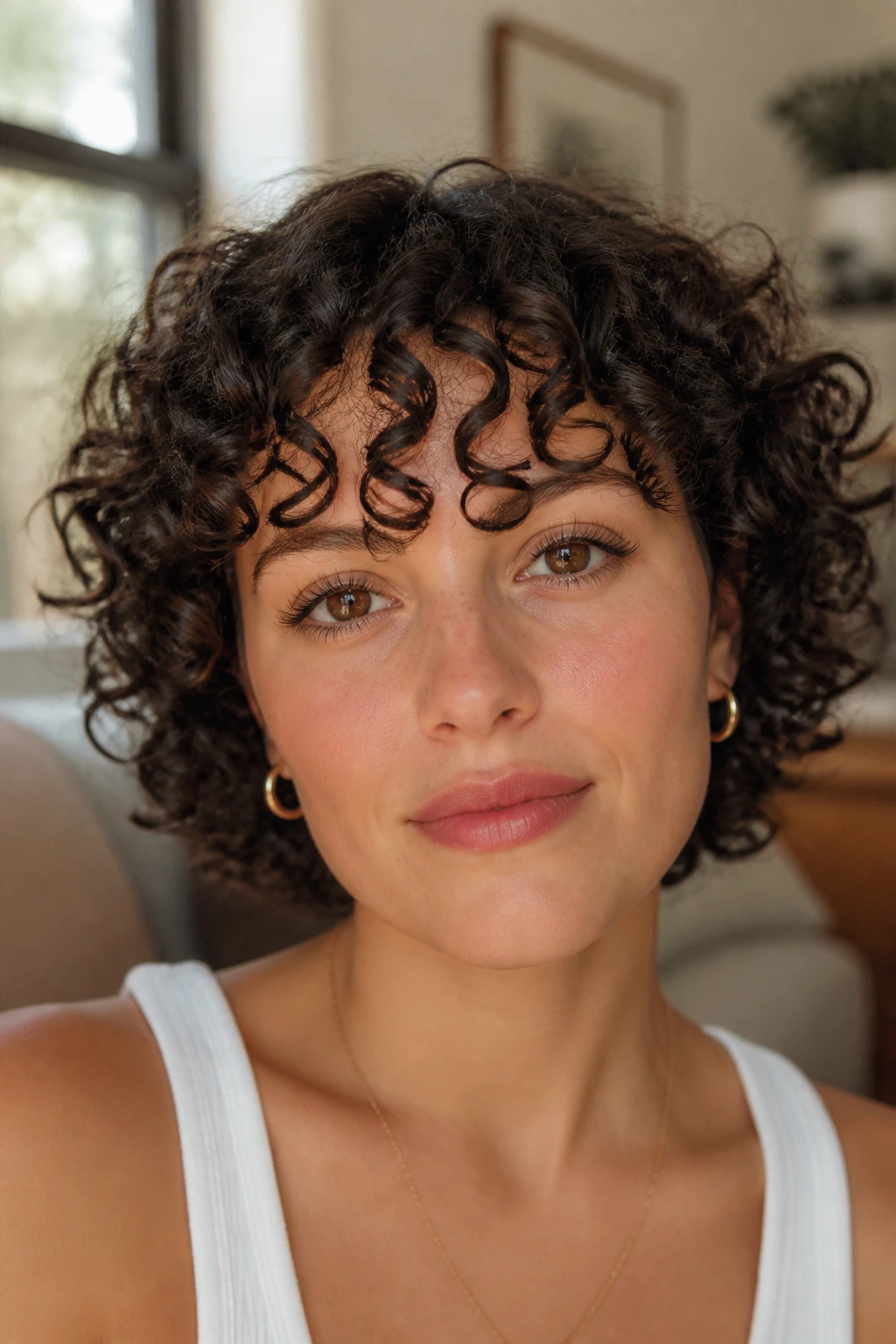
If your curls form clear ringlets, let them show. A defined ringlet fringe can be stunning on square faces because it turns the bangs into a cluster of soft circles rather than a straight line. That’s a nice counterweight to angular bone structure.
The key is separation. Each ringlet needs enough room to land. If they’re crowded together, the fringe gets dense and starts acting like a wall. If they’re separated too much, the front loses the feeling of fringe altogether.
Why It Looks So Good
The eyes land on the curve of the ringlets before they reach the jaw. That shifts attention upward in the best way.
Use a curl-defining product that gives hold without stiffness, then let the ringlets dry without touching them. Finger-combing the front too much breaks the shape. Leave them alone. Seriously.
21. Retro Rounded Fringe

This one has a little vintage flavor, but it doesn’t need to feel costume-y. The fringe follows a soft rounded line, fuller in the middle and slightly longer at the sides, with enough curl movement to keep it from looking helmet-like. Square faces tend to like this shape because it rounds out the upper half of the face.
What Keeps It Modern
The texture. If the curls are loose, broken, or softly separated, the fringe loses the stiff retro edge and becomes something more relaxed. That’s the sweet spot.
Styling Note
Dry the fringe with a diffuser and a light touch of tension at the root, then separate only the outermost clumps with your fingers. If you rake it too much, the round shape collapses.
This shape can look especially nice with glasses or a strong brow because the round line softens everything around it. Just keep the center from getting too wide.
22. Grown-Out Fringe That Still Looks Intentional
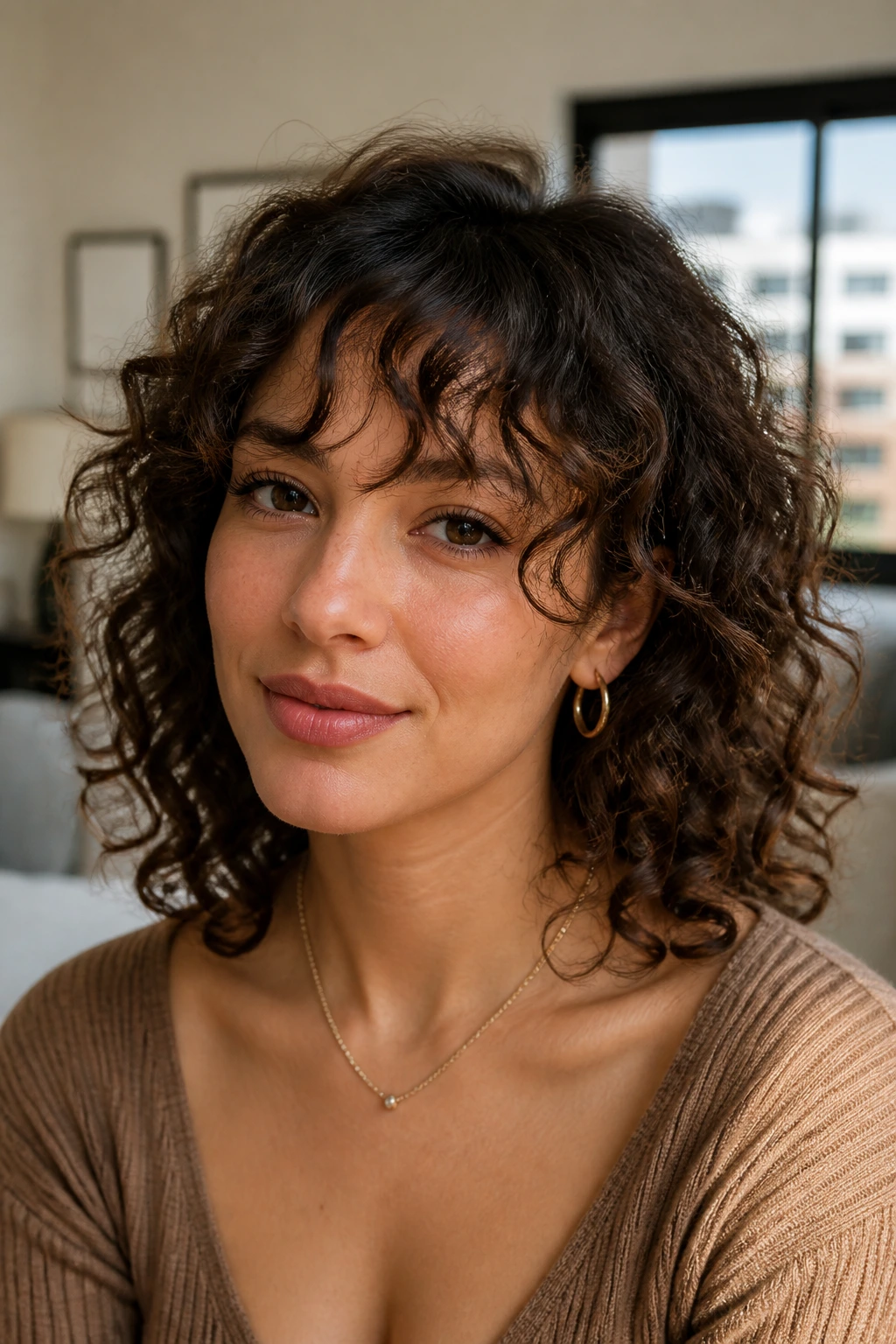
Not every fringe needs to stay short forever. Sometimes the smartest move is a grow-out shape that keeps the front looking styled while the bangs get longer. On curly hair, that transition can be surprisingly elegant if the side pieces and face framing are cut with intention.
For square faces, this is useful because it keeps softness around the forehead and temples while giving you more length around the jaw. The haircut doesn’t lose shape just because the fringe stops being obviously “bangs.”
Why It Deserves a Spot Here
People often think grow-out equals awkward. It doesn’t have to. A good curly fringe can move through several lengths without losing the softening effect on the face, as long as the temple pieces stay part of the plan.
Ask for a gradual blend into curtain territory. That way the fringe keeps working while it changes. Nice thing, too: it buys you time between trims.
Why Short Fringe for Curly Hair and Square Faces Works So Well

Square faces have strong edges. Broad forehead, defined jaw, clean corners. That structure is handsome and striking, but it can look even harder if the haircut adds more straight lines on top. Short fringe helps because it interrupts the top edge of the face and gives the eye a softer place to land before it gets to the jaw.
Curly hair does half the job for you. The bend, the spring, the slight irregularity at the ends—all of that softens the geometry. A blunt line on straight hair can read as severe. On curls, even a short fringe has movement built in, which keeps it from turning into a flat little wall across the brow.
The sweet spot is usually a cut that’s shorter in the center or at least curved at the bottom, with enough length at the temples to blend into the sides. That shape takes pressure off the forehead and helps the face feel a little more oval, a little less square. Not erased. Just softened.
What to Tell Your Stylist Before the First Snip

Dry hair. Every time I talk about curly fringe, that’s the first thing I want on the table. Bring your hair in the way you actually wear it, not stretched straight, not brushed into a fantasy version of itself. If you diffuse, say that. If you air-dry, say that too. The haircut should match the routine, not the other way around.
Tell your stylist how much your curls shrink. If the front jumps up a full inch, say it out loud. Better yet, point to where you want the fringe to land when it’s dry: above the brow, grazing it, or opening at the center. That tiny detail changes the whole result.
A few useful phrases
- “Keep the temples longer than the center.”
- “Cut this dry, curl by curl, please.”
- “I want softness, not a blunt shelf.”
- “My curls shrink about ___ inches.”
- “I wear my part here most days.”
Bring photos, sure, but bring language too. A picture shows mood. Words tell the stylist where the shape should live on your face. That matters more than the image people bring in from a screen.
Essential Tools for Curly Fringe Care
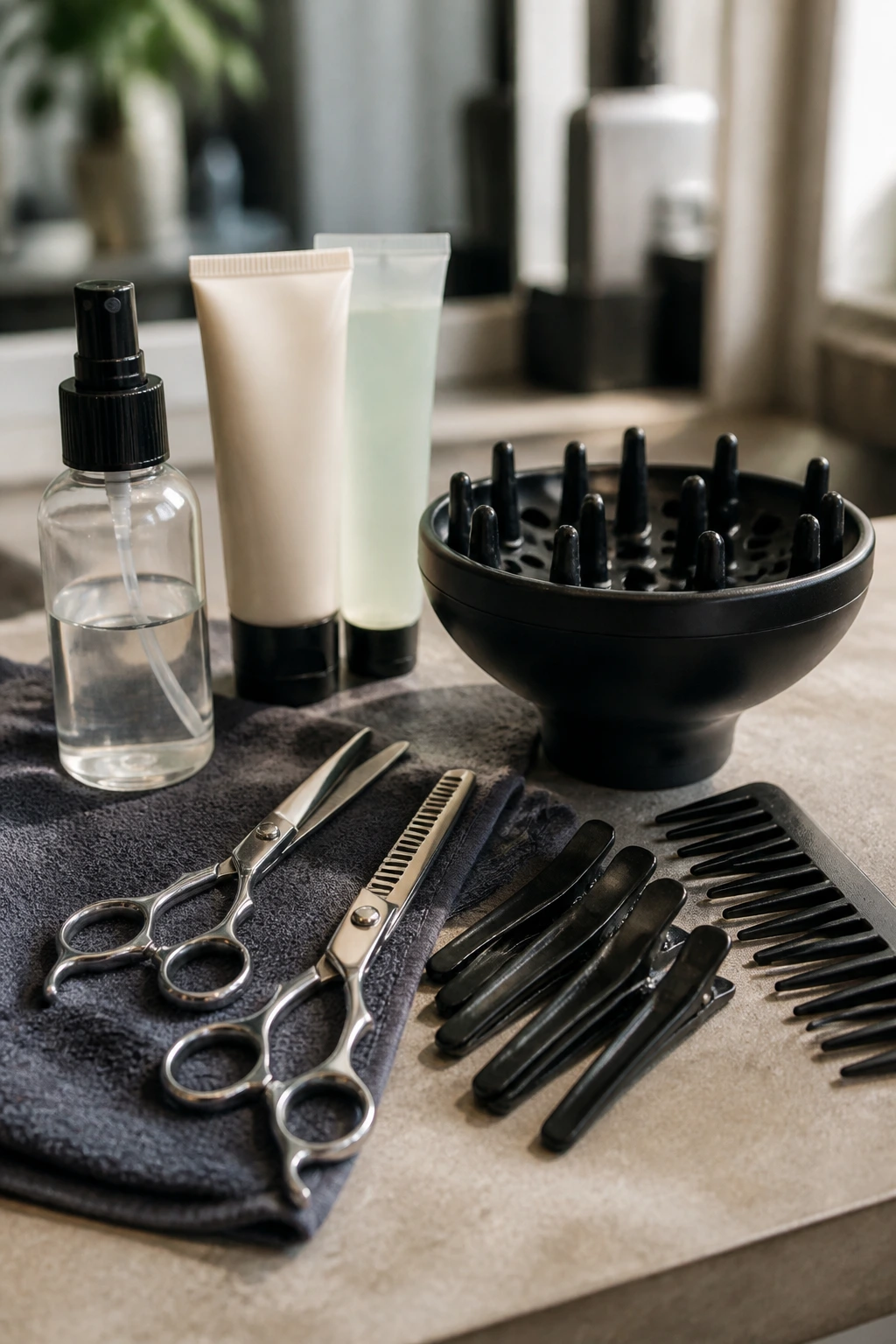
- Sharp haircutting shears: Dull scissors chew the ends and make curly fringe frizzier at the edge.
- Small spray bottle: Handy for re-wetting just the front section before styling or refreshing day-two curls.
- Duckbill clips or small sectioning clips: These help control the fringe while the rest of the hair dries.
- Diffuser attachment: Useful for drying the roots without blowing the curl pattern apart.
- Microfiber towel or soft cotton tee: Cuts down on rough frizz when you blot the fringe.
- Wide-tooth comb: Best used sparingly for detangling before product goes in.
- Curl cream or leave-in conditioner: Gives the fringe slip and soft control.
- Light-hold gel or foam: Adds shape memory so the bangs don’t puff out the second the air gets humid.
- Small round brush or edge brush, optional: Good for directing roots while drying, but not required if you prefer your fringe loose.
How to Style Short Fringe on Curly Hair
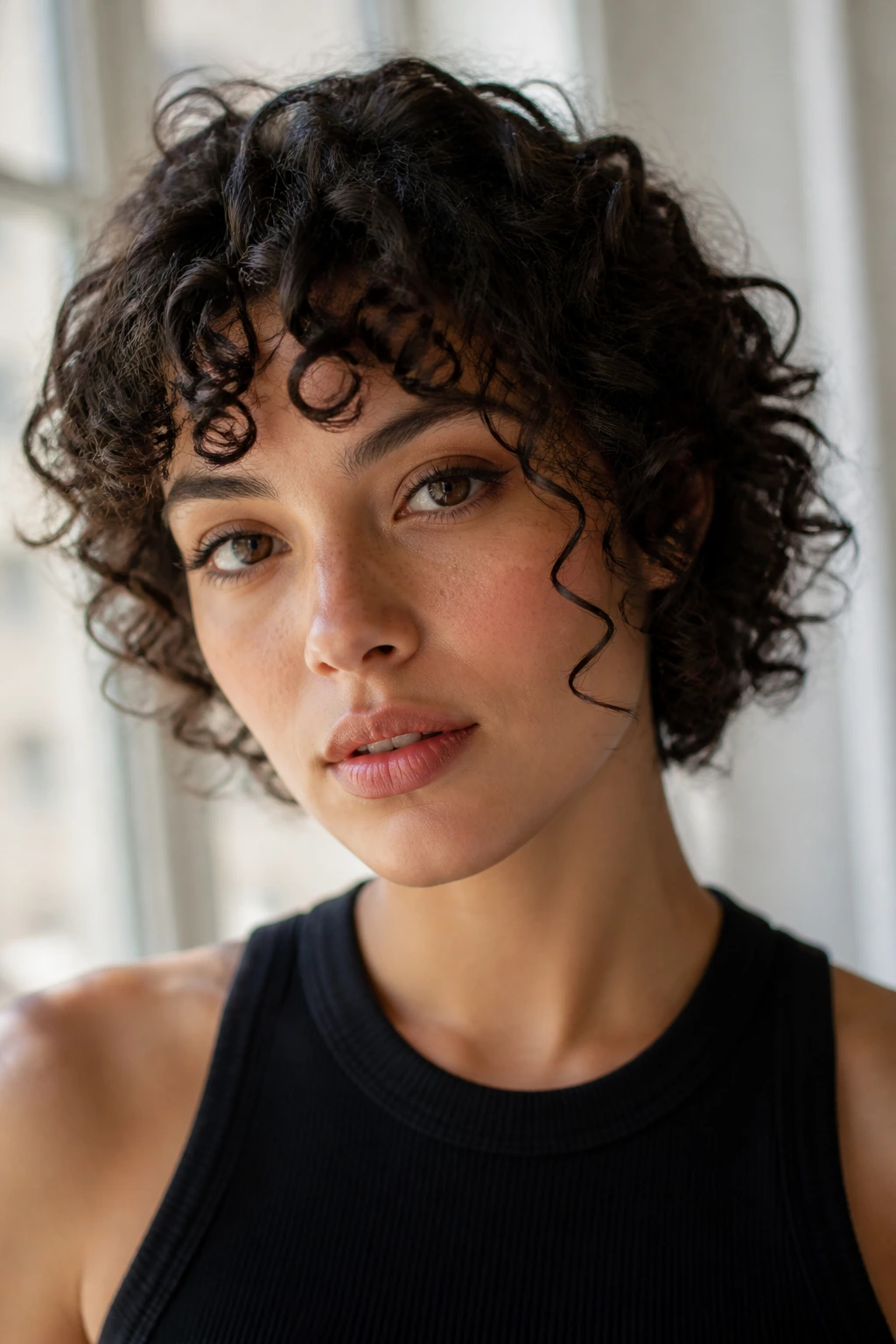
Air-Dry Routine: Start with soaking wet fringe, not damp fringe. Water helps curls find their pattern before the product sets. Smooth a small amount of curl cream through the front, then add a pea-size touch of gel if the curls need more hold. Scrunch once or twice, then stop touching it.
Diffused Shape: If your fringe tends to flip or puff, hover the diffuser around the roots first, then cup the ends for a few seconds at a time. Keep the heat low and the speed low. You want the curls to dry in place, not get blasted into frizz.
Parting Strategy: A center part suits curtain and rounded shapes. A deeper side part suits asymmetrical, tousled, and face-hugging fringe. Set the part while the hair is wet, because trying to move it once it’s dry is a losing game.
Fringe and Glasses: If you wear glasses, keep the shortest point of the fringe above the frame line. That little bit of clearance saves you from constant rubbing and gives the face room to breathe.
Small Adjustments That Make the Cut Easier to Live With
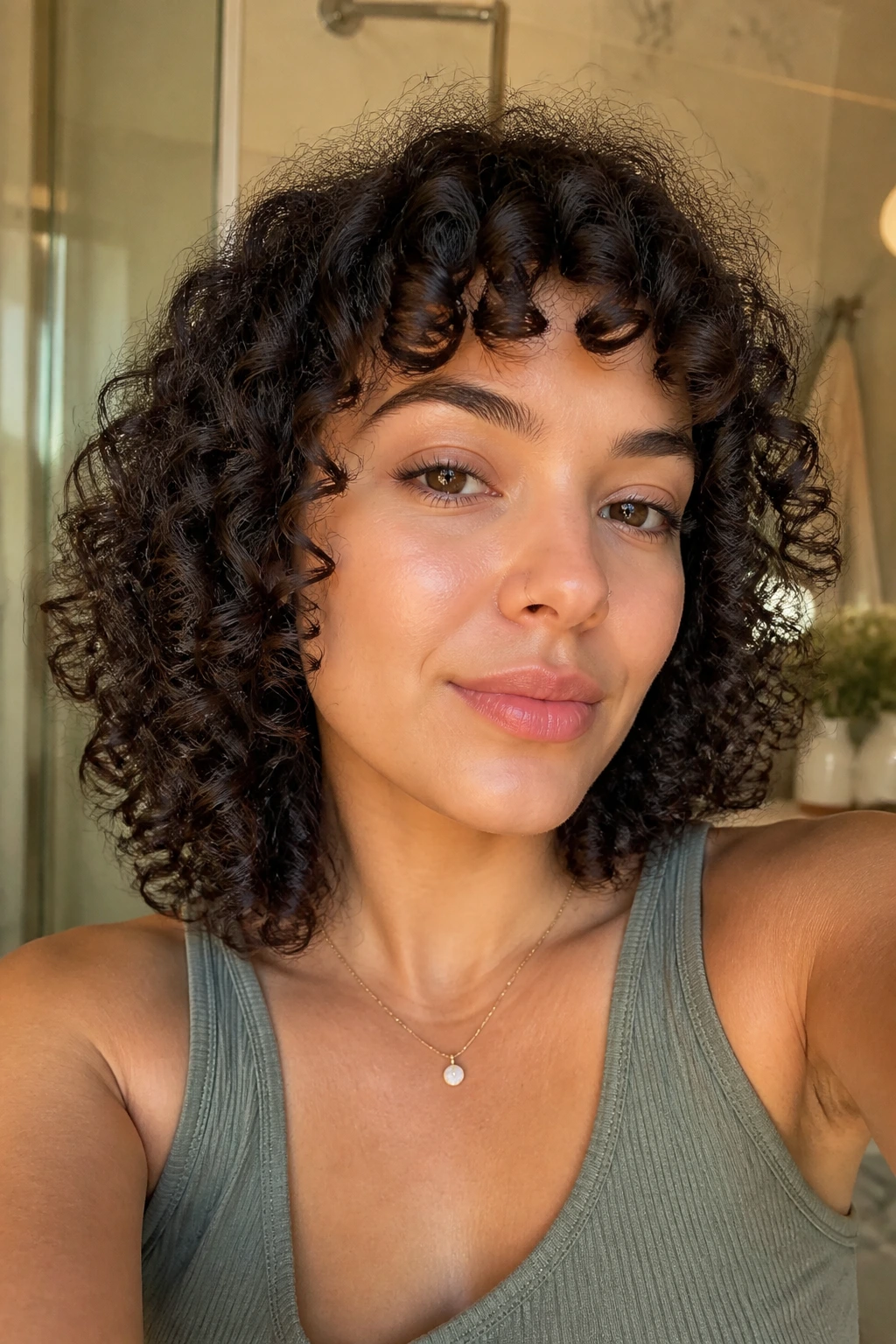
Shrinkage Check: Leave a little extra length if your curls spring up fast. Half an inch can be the difference between playful and annoyingly short.
Temple Balance: Keep the sides longer than the middle on most square faces. That one decision softens the jaw and makes the fringe feel like part of the haircut, not a bolt-on.
Product Load: Use less product than you think. Too much cream in the fringe turns clean curl clumps into greasy strings by noon.
Root Lift: Clip the front section up for 5 to 10 minutes while it dries if it wants to sit flat. That tiny pause helps the fringe keep a little height at the scalp.
Hands-Off Finish: Once the fringe is dry, stop fussing with it. Curly bangs get ugly when they’re overhandled. A finger or two is enough. A brush is often too much.
Keeping the Fringe Fresh Between Washes
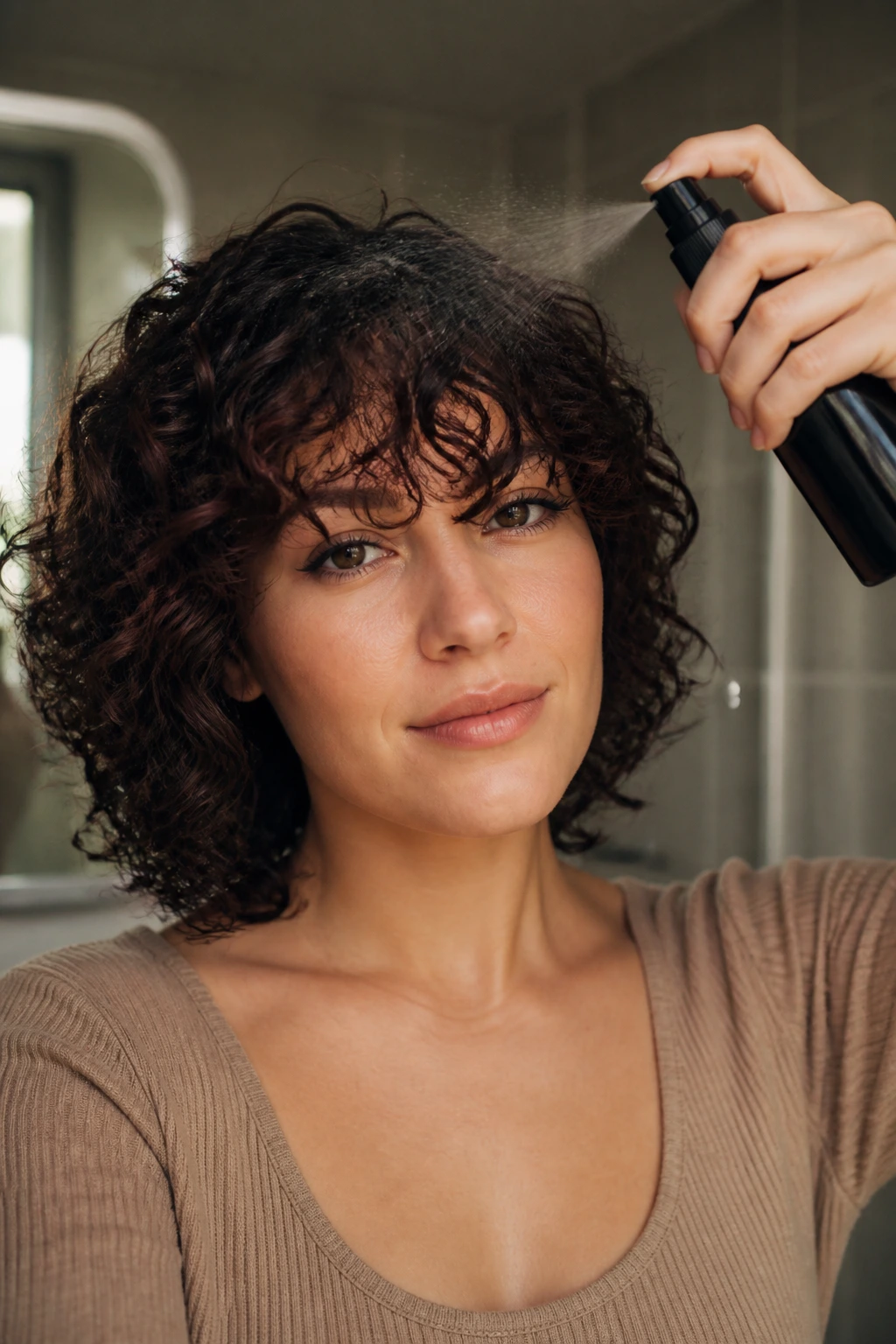
Curly fringe gets tired faster than the rest of the haircut because it sits on the forehead and picks up oil, sweat, and whatever else the day throws at it. That means the front often needs more frequent refreshing than the lengths. A tiny spray bottle and a little water usually fix most of it. Mist, scrunch, walk away.
If the roots start looking flat, use a dab of water and a bit of foam or gel, then clip the front upward while it dries for a few minutes. That resets the shape without soaking the whole head. If product buildup gets in the way, cleanse just the fringe more often instead of washing all your hair for one greasy front section.
For trimming, most short fringes need shaping every 4 to 8 weeks depending on how fast your hair grows and how short you keep it. I would not wait until the fringe is hanging in your eyes if the shape matters to you. Small trims keep the line clean. Big rescue cuts are harder to fix.
Sleep helps too. A satin pillowcase, a loose pineapple, or a small clip that keeps the fringe off your forehead can keep the front from getting crushed overnight. It sounds fussy. It isn’t. A sleepy bang can look ten times better with one minute of prevention.
Common Cutting and Styling Mistakes to Avoid
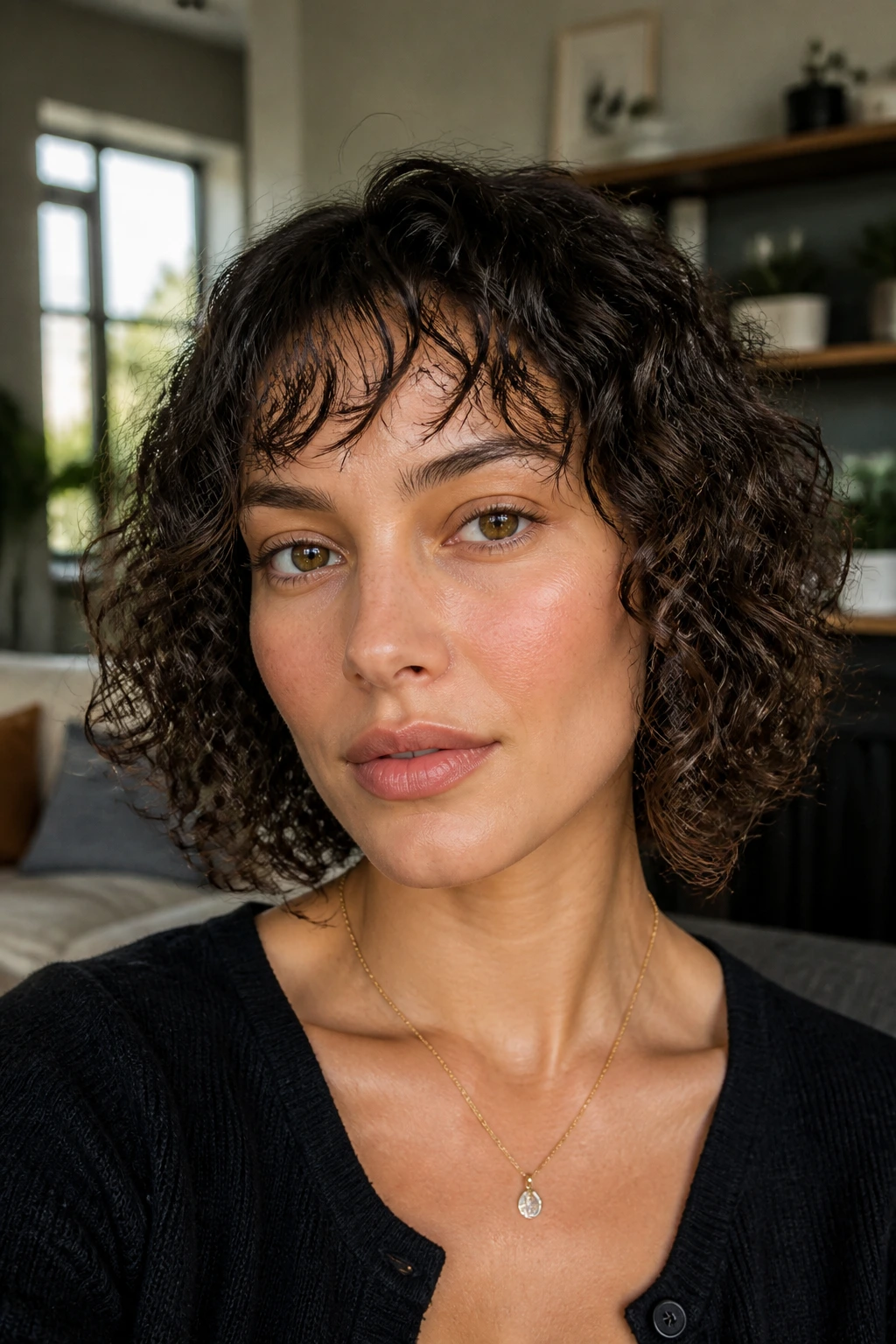
Cutting it too short on wet curls. Wet curls lie. They always do. If the fringe is cut to the final wet length, it may jump way above the brow once dry. Fix it by cutting dry or leaving deliberate room for shrinkage.
Making the fringe too dense. A heavy wall of curls across the forehead can overpower a square face and take ages to dry. The fix is simple: lighten the edges, keep some space at the temples, and let the shape breathe.
Using too much cream. The front ends up stringy and sticky, which is the opposite of the soft finish most people want. Use less product, then add a touch more water if the curls need help.
Ignoring the side pieces. Short fringe without temple length can make the face look wider. The fix is a longer edge on both sides so the fringe blends instead of stopping dead.
Trying to flatten the fringe every day. Curly bangs that are forced straight usually frizz up by lunch. Style them with the curl pattern they already have. That’s the whole point of the cut.
Variations and Adaptations to Try
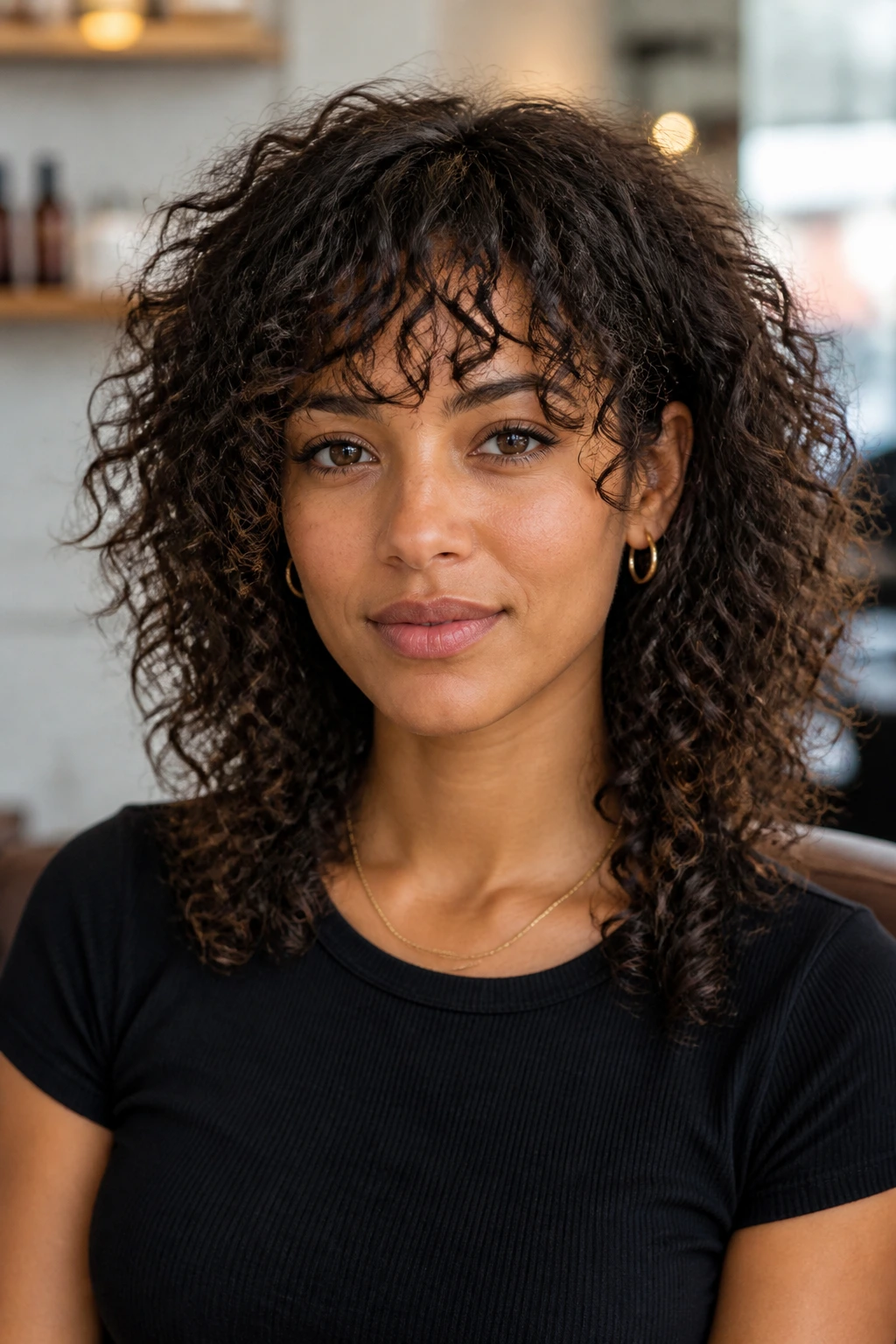
The First-Time Fringe: Ask for a softer, longer starting point with plenty of temple length. This gives you fringe shape without trapping you in a heavy bang if you change your mind later. Good for anyone testing the waters.
The Strong-Jaw Softener: Keep the center short, then let the sides sweep down and out. That combination is especially kind to square faces because it breaks the jawline’s straight edges.
The Curl-Cloud Version: Go a touch looser and lighter in density, then let the curls separate naturally. It suits fine to medium hair that would look bulky with a fuller fringe.
The Editorial Snap: Shorter, cleaner, more visible. This one has a bit of attitude and works best when you like the fringe to feel like a feature, not a whisper.
The Grow-Out Bridge: Let the center and temples stay long enough to move toward curtain bangs later. This is the one to choose if you want flexibility and hate awkward middle stages.
Frequently Asked Questions
Will short fringe make my square face look wider?
It can, if the fringe is blunt, dense, and cut straight across without any curve. The better versions soften the forehead and pull the eye down toward the curls, which balances the jaw instead of widening the face.
How short should curly fringe be when it’s cut?
Shorter curls need more caution than straight hair because they spring upward once dry. A good stylist will cut with shrinkage in mind and leave the fringe longer than the final target, especially at the center.
Can I wear short fringe if my curls are tight?
Yes, but the shape needs room. Tight curls often need a dry cut, more temple length, and less density in the front so the fringe doesn’t balloon into a block.
What if my bangs separate into weird clumps?
That’s usually a styling or product issue, not a deal-breaker. Use a little less cream, add water, and encourage the curls into 3 to 5 clearer pieces with your fingers while they’re wet.
Does this work with glasses?
It can work very well, as long as the fringe sits above the frame line or sweeps away from it. Side-swept, rounded, and face-hugging shapes tend to be the least annoying with glasses.
How often should I trim short curly fringe?
Most short fringes need shaping every 4 to 8 weeks, depending on growth rate and how much shrinkage your curls have. If the bangs start falling into your eyes or losing their curve, it’s time.
Can I cut curly fringe at home?
You can tidy the very ends at home if you’re careful, but the first cut is better handled by someone who understands curl shrinkage. If you do trim yourself, use dry hair, tiny snips, and cut less than you think you need.
What’s the easiest fringe shape to grow out later?
Tapered, bottleneck, and face-hugging shapes grow out more gracefully than a blunt line. They already have side length built in, so the transition into curtain or face-framing layers feels smoother.
A Softer Edge
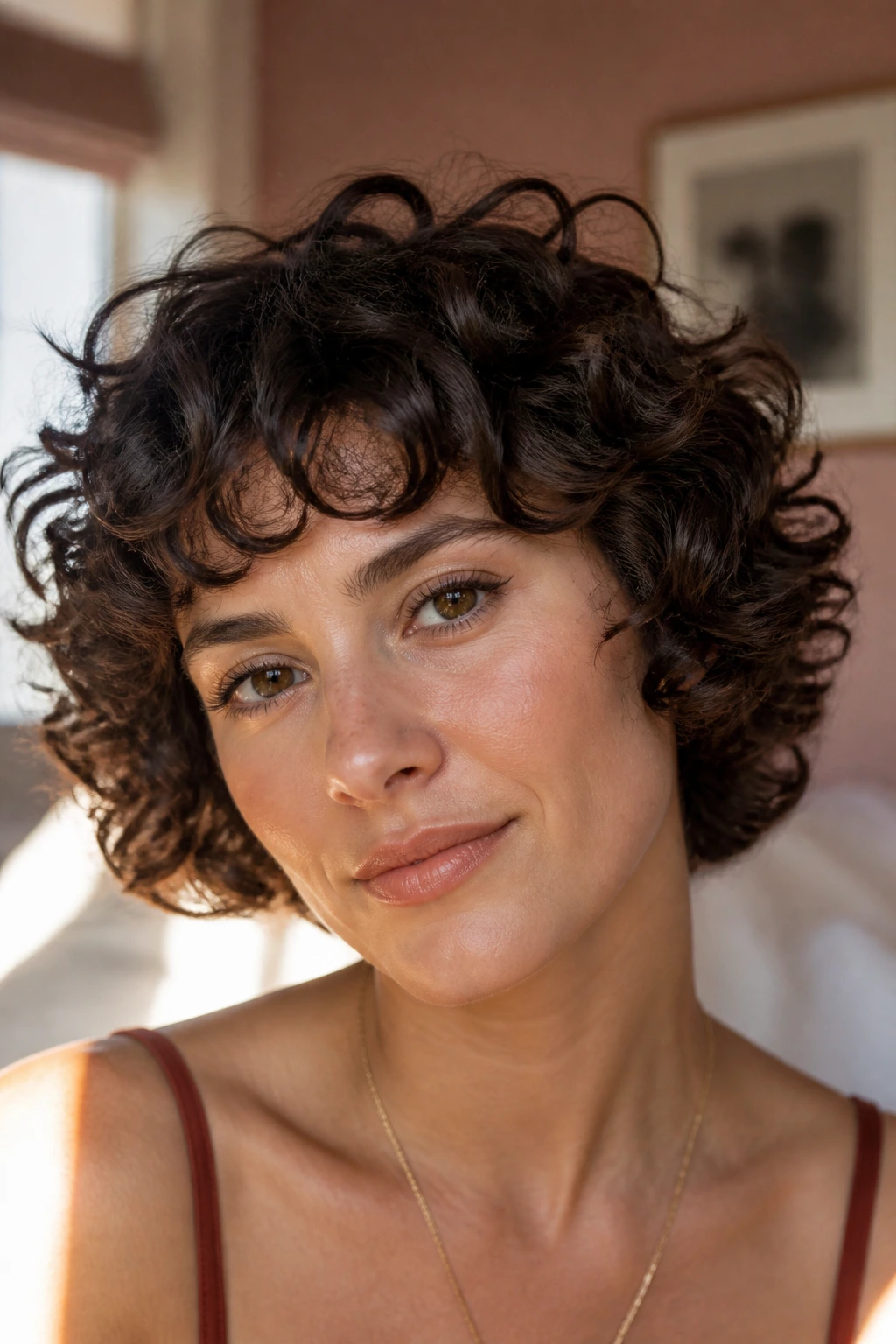
Short fringe on curly hair is never really about hiding the forehead. It’s about changing the frame. On a square face, that frame matters more than most people expect. A soft curve, a broken edge, or a slightly longer temple piece can take a haircut from boxy to balanced in one move.
The best versions don’t fight the curl pattern. They let it do the softening for you. Start with the shape that gives you a little length at the sides, respect the shrinkage, and keep the front light enough to move. The rest gets easier from there.