



Round faces do not need to be hidden. They need shape.
The wrong fringe can sit right across the widest part of the face and make your cheeks do all the talking. The right one changes the whole read of a haircut. Long layers with bangs for round faces work because they pull the eye downward, open up the cheeks, and keep the front of the haircut from turning into one heavy horizontal block.
That sounds simple until you sit in the chair and realize how many tiny decisions are hiding inside it. Where does the shortest layer start? How high should the fringe hit? Should the bang split at the brow, the cheekbone, or the temple? Those details matter more than the trend name on the inspo photo.
I have little patience for bangs that stop at the fullest part of the face and then sit there like a shelf. Give me movement. Give me a front piece that can tuck, bend, or fall in a broken line. Give me layers that start with a purpose, not a guess. The cuts below do exactly that, but each one handles texture, density, and styling habits in its own way.
Why These Cuts Earn Their Keep
-
They add length where a round face needs it most: The best versions keep the shortest front pieces below the cheekbone, so the haircut creates a vertical line instead of a wide one.
-
They keep bangs flexible: Curtain, bottleneck, side-swept, and soft fringe can all be pushed open or worn fuller, which matters on mornings when your hair refuses to cooperate.
-
They work with real hair, not only salon hair: Straight, wavy, curly, thick, and fine textures can all wear this shape if the layer placement matches the density.
-
They make second-day styling less annoying: A good long-layer cut still looks intentional after a quick round-brush bend, a flat-iron flip, or a rough air-dry.
-
They can be soft or sharp: You can go feathered and airy, or you can keep the ends blunt-ish and modern. The face still gets that lengthening effect.
-
They age well as they grow out: Long layers and longer bangs usually get better for a while before they get worse, which is a nice change from fringe that turns awkward after two weeks.
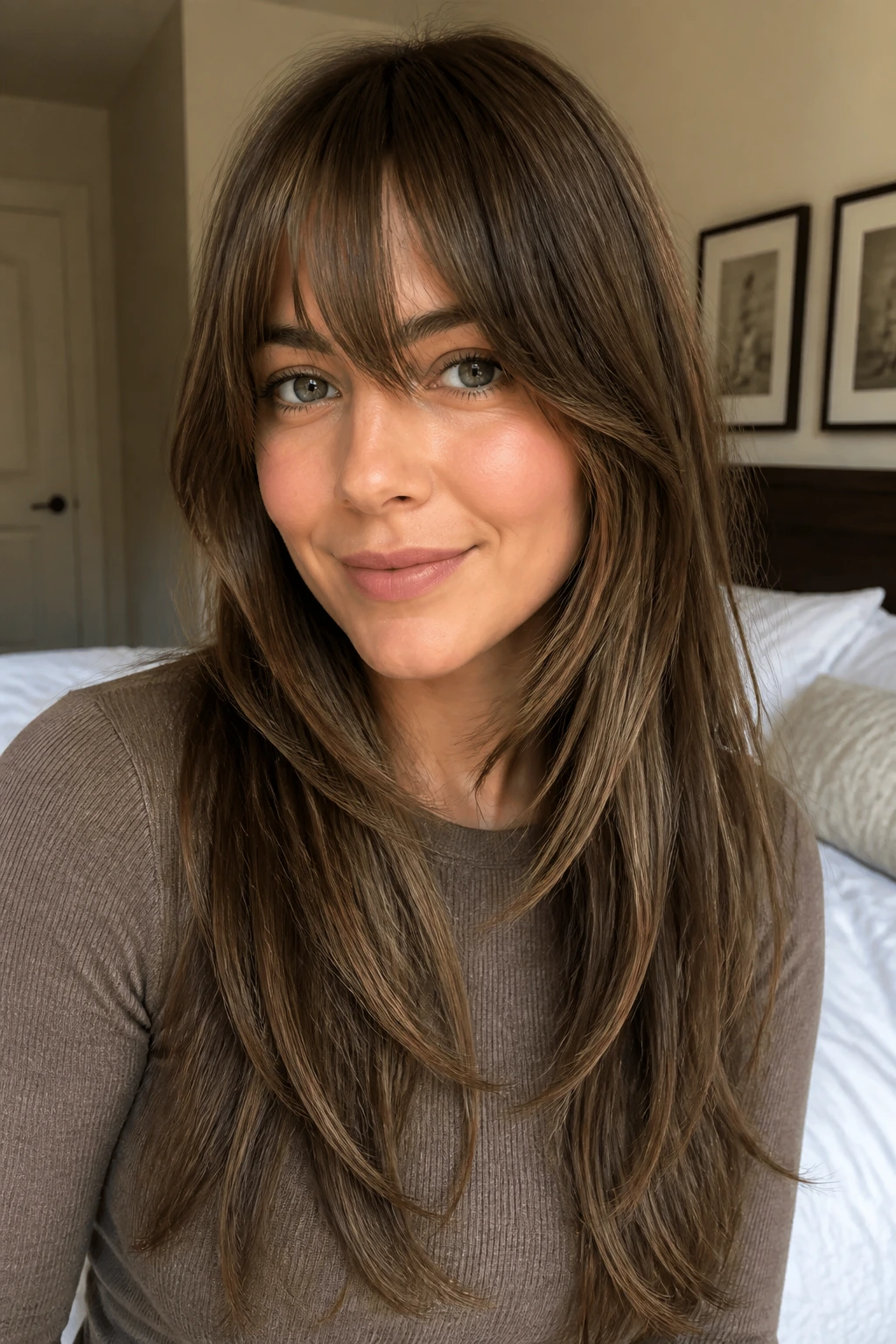
1. Curtain Layers That Split at the Cheekbone
A center part can be boring on the wrong cut. On this one, it does the opposite. The front pieces open just below the cheekbone, so the hair makes a clean vertical line through the face without flattening the cheek area. I like this shape on straight and loose-wavy hair because it keeps its line even when you do almost nothing to it.
Why It Works
The split is doing the heavy lifting here. Instead of one blunt bang line across the forehead, you get two soft panels that frame the face and leave space around the widest point. Ask for the shortest piece to land just under the cheekbone, then let the rest fall toward the jaw and chest.
A quick bend with a 1.5- to 2-inch round brush is enough. If your hair is fine, keep the layers longer so the ends don’t disappear. If it’s thick, ask for light internal removal so the front doesn’t puff out like a triangle.
2. Butterfly Cut with Light Curtain Bangs
What makes the butterfly cut so flattering on a round face? The answer is in the top layers. They lift around the crown and cheek area, then drop into longer lengths that keep the face from looking boxed in. Add a light curtain bang, and you get movement without losing the vertical line.
This one is made for someone who likes volume but hates heavy ends. The shortest layers usually graze the chin or lip, which helps stretch the face visually. I’ve seen this cut look especially good when the blow-dry has a little body at the root and a soft flip away from the cheeks.
Best For
- Thick or medium-thick hair that needs movement
- Wavy hair that wants a blown-out shape
- Anyone who likes a big, airy finish without a full shag
Styling note: Roll the front pieces away from the face, not under it. That small choice keeps the cheeks open.
3. Deep Side Part and Long Swooping Fringe
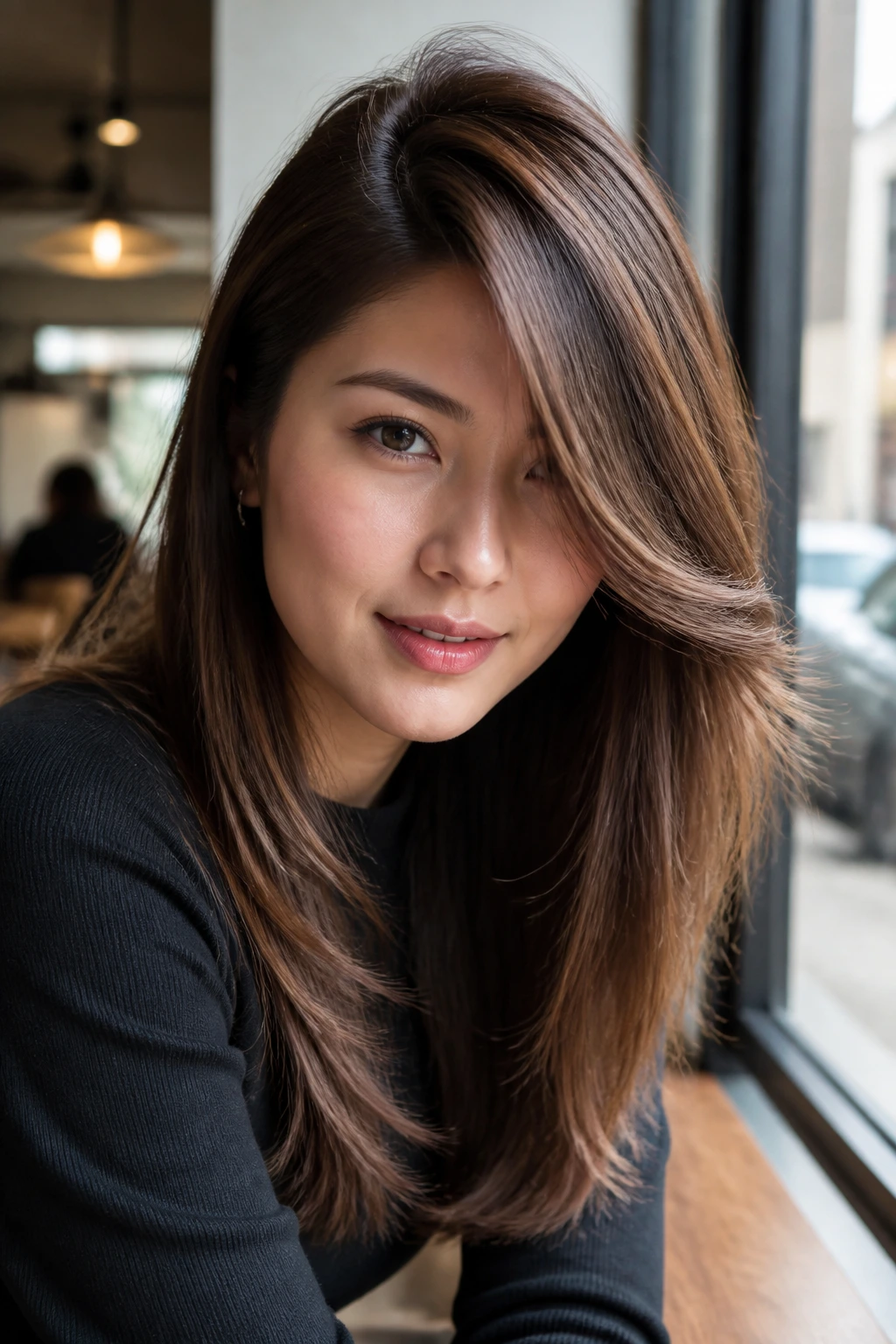
A deep side part does one useful thing very well: it breaks symmetry. On a round face, that diagonal line can be a lifesaver because it interrupts the width of the face and sends the eye across the forehead instead of straight out to the sides.
The fringe should stay long enough to sweep past the cheekbone, not stop at it. If it’s too short, you get a puffed side-sweep that adds width. If it falls lower and melts into longer layers, the whole cut feels slimmer and more elegant. Not fussy. Just directional.
I like this for people who do not love center parts. You can tuck the heavier side behind one ear, and suddenly the haircut looks planned instead of accidental.
4. U-Shape Layers with Brow-Skimming Bangs
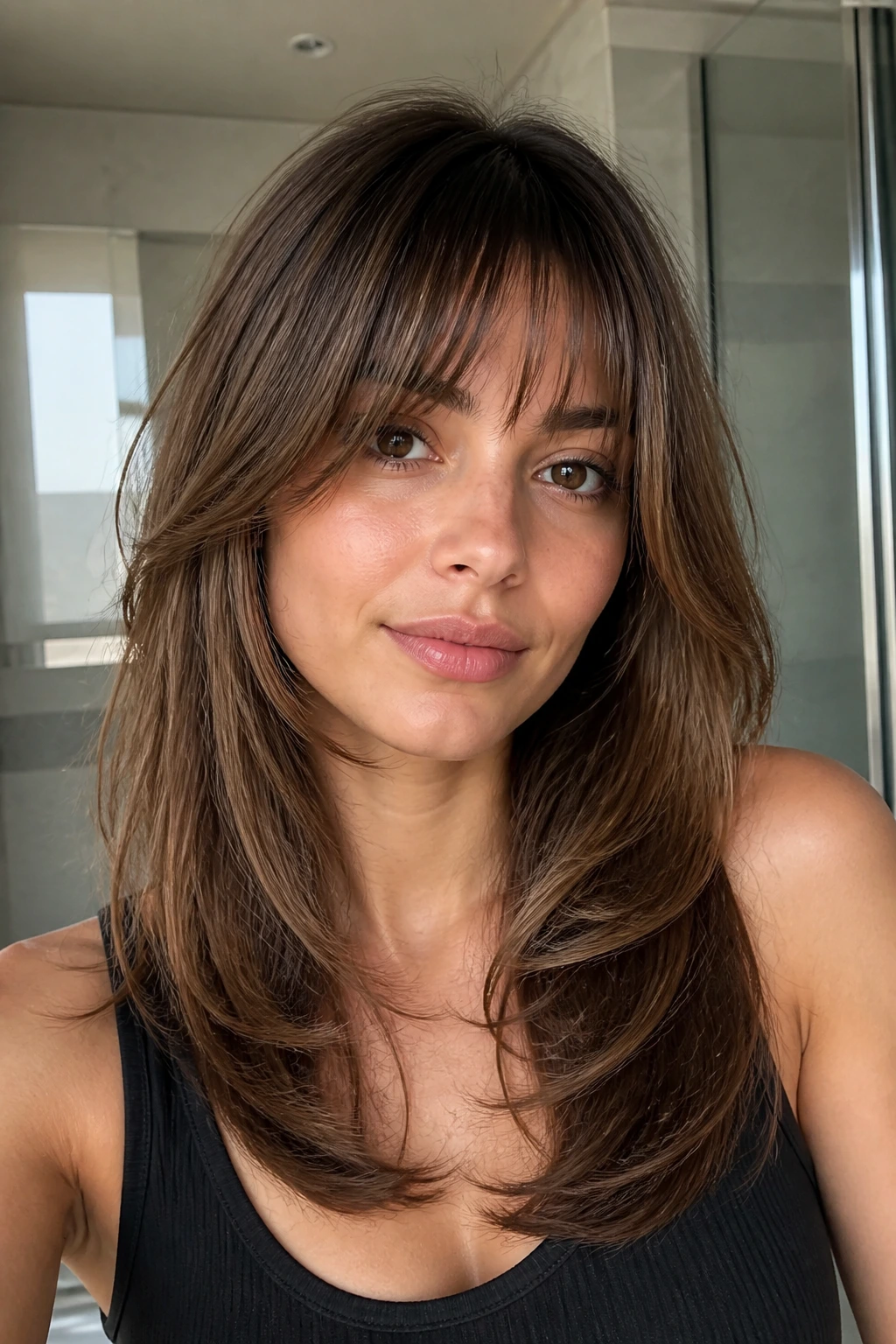
A blunt-looking base can still flatter a round face if the front is handled with care. That’s where the U-shape comes in. The length keeps a soft curve around the back, while the bangs stay airy enough to avoid that hard, boxed-in feeling across the forehead.
The brow-skimming fringe matters here. It should brush the brows, not sit like a shelf above them. Ask for the ends to be slightly shattered so the fringe breaks up when you move. On thick hair, that little softness saves the whole look from turning heavy.
This cut is a good fit if you want a more polished shape than a shag but still want some face framing. It has structure. It also has air. That matters.
5. Feathered Blowout Layers with Bottleneck Fringe
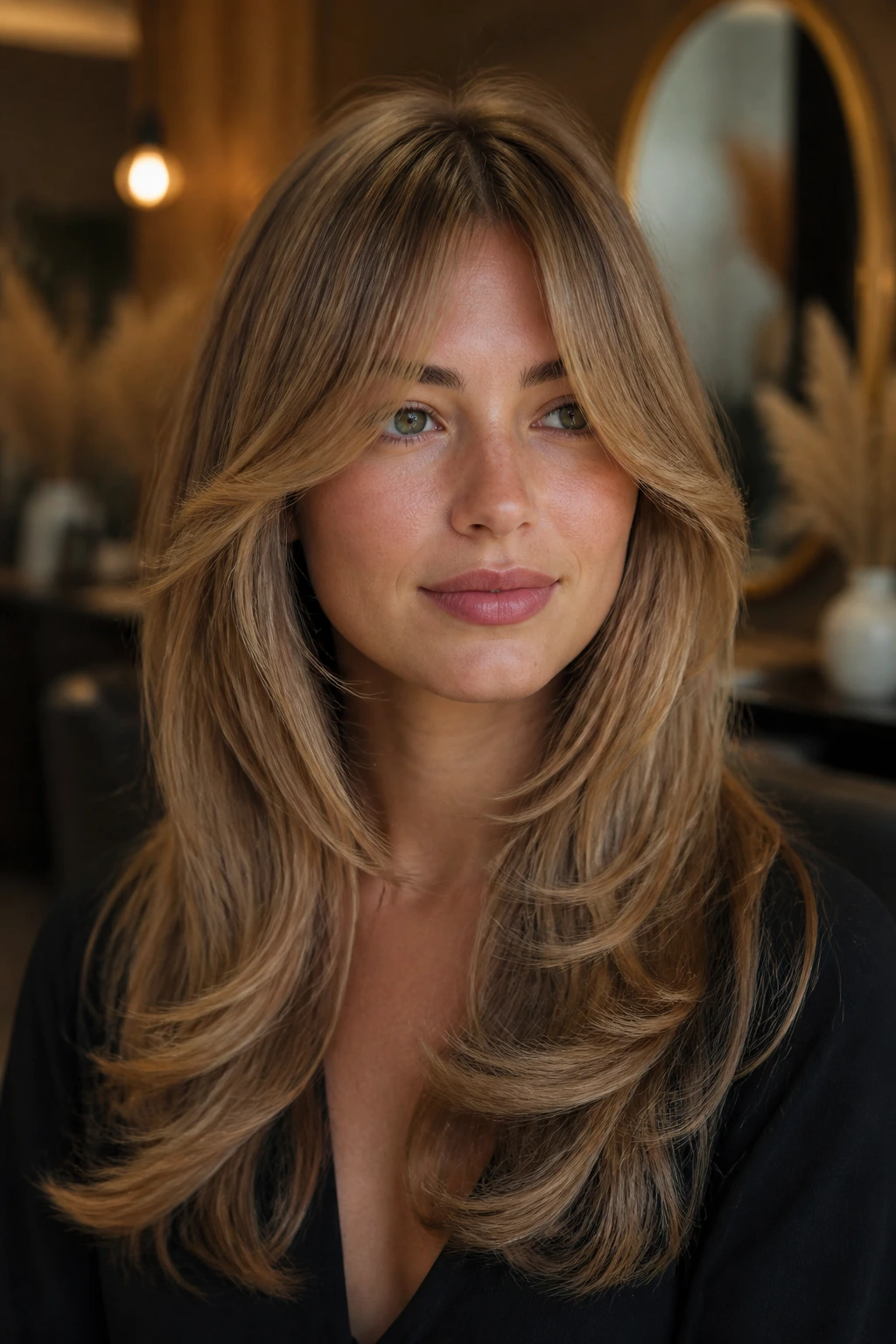
This is the haircut that looks like it has already been styled, even when it hasn’t. The layers are feathered away from the face, and the bottleneck fringe narrows in the middle before opening at the sides. That shape gives the face room through the center while keeping the cheek area soft.
The texture is the point. You want the ends to move, not sit stiffly. A medium round brush and a cool shot at the end will do more here than a heavy styling cream ever will. If your hair is dense, ask for feathering around the front so the fringe doesn’t melt into one dark curtain.
This is one of my favorites for anyone who wants a blowout shape without a lot of daily drama.
6. Piecey Face-Framing Layers with Wispy Bangs
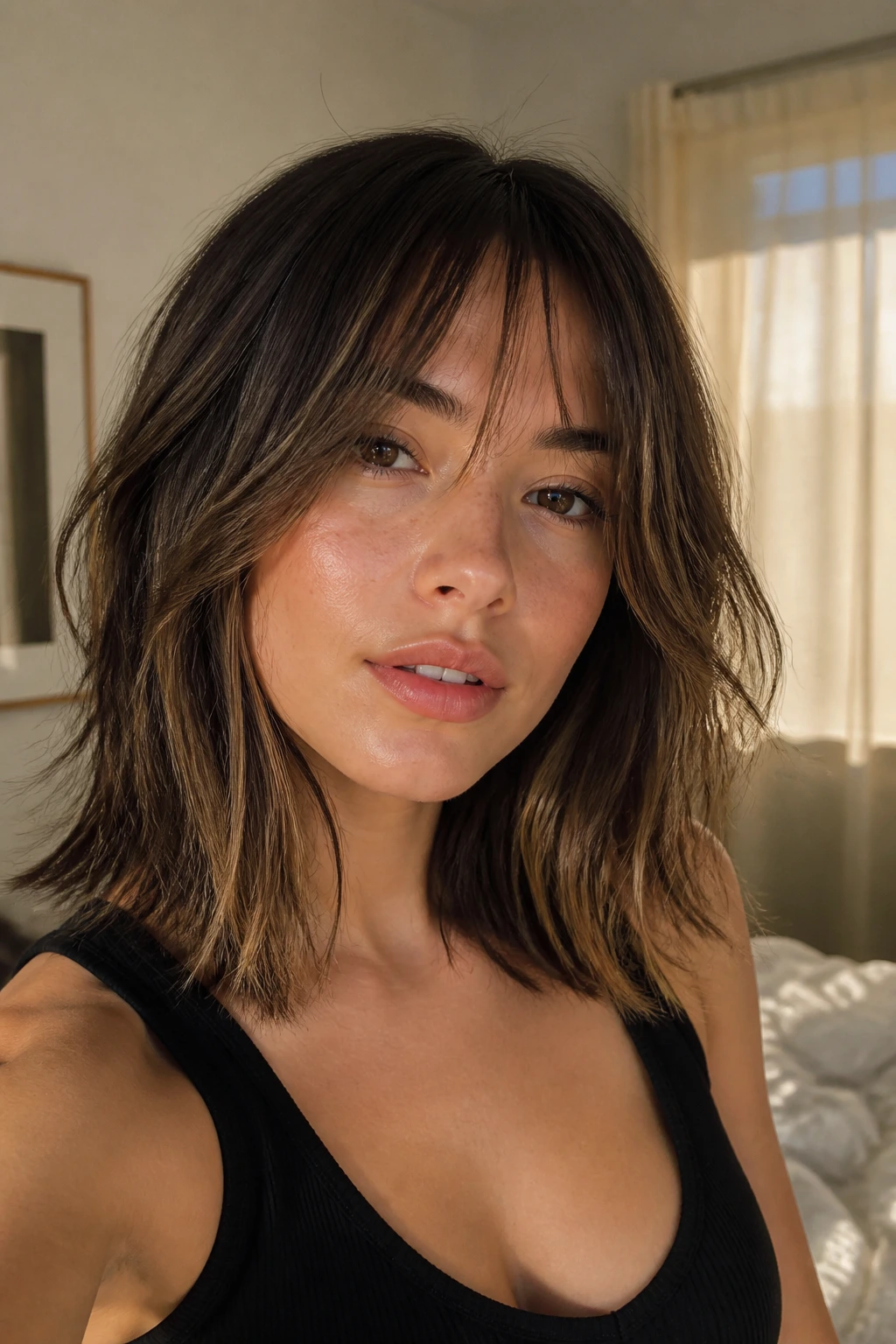
Sometimes the smartest answer is the lightest one. Piecey layers keep the front from building too much bulk, which helps on round faces that already read full through the cheeks. The wispy bang keeps the forehead open, and the whole thing feels easier than a cut with a lot of blunt edges.
The trick is restraint. You do not want every strand behaving like it got the same instruction. A few broken pieces near the temples, a softer band across the brow, and longer ends that graze the collarbone are enough. The haircut should look touched, not carved.
Good Match If You Want:
- A lighter fringe without a lot of maintenance
- Movement around the cheeks
- A cut that grows out without looking sloppy
My take: This is one of the best choices for fine hair, because it gives shape without stealing density from the ends.
7. Long Shag with Grown-Out Bangs

A long shag is not shy, and that is why it works. The layers are meant to separate, and that separation keeps the face from feeling boxed in. On a round face, the trick is to leave enough length in the fringe so it doesn’t widen the forehead. Grown-out bangs do that better than fresh, short ones.
This cut has a lived-in texture that forgives a little frizz and a little laziness. Good. Hair should be allowed to behave like hair sometimes. If your natural wave sits around the cheekbone, ask the stylist to keep the shortest pieces lower so the roundness doesn’t get emphasized right where the face is fullest.
8. Sleek Center-Part Layers with Face-Skimming Curtains
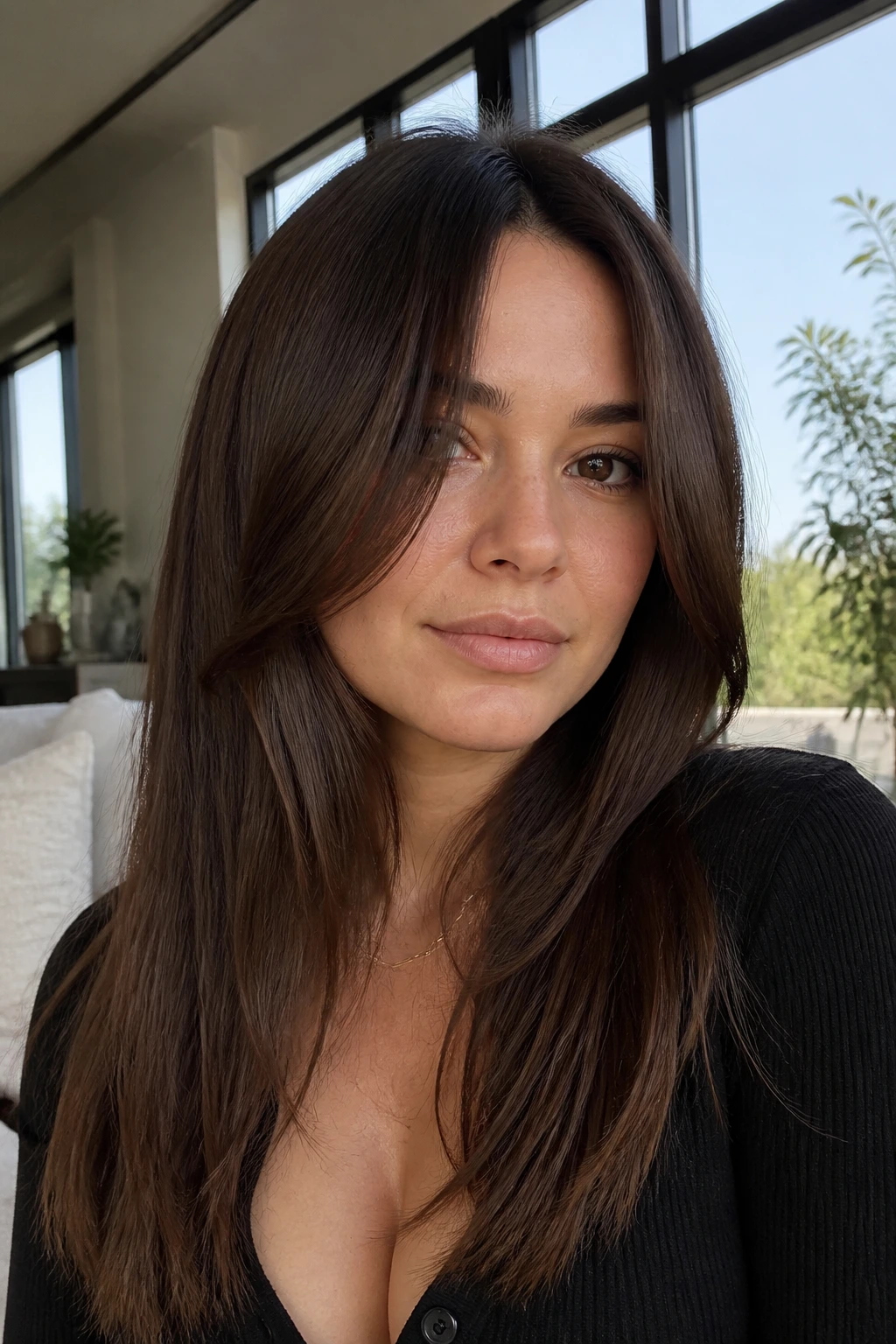
Can a center part work on a round face? Yes, if the layers are long enough to keep the face from reading wide. The key is that the curtain pieces must start low, then sweep past the cheeks instead of ending on them. That gives the center part a clean, narrow line without making the face feel exposed.
This one is for straight hair or hair that smooths easily. You want the finish to lie flat through the crown, then curve softly at the jaw and chest. A tiny bit of bend at the ends keeps it from looking severe. Too much volume at the side? Not good. Too much flatness at the top? Also not good. The middle path is the one here.
9. Bardot Waves with Broken Bangs
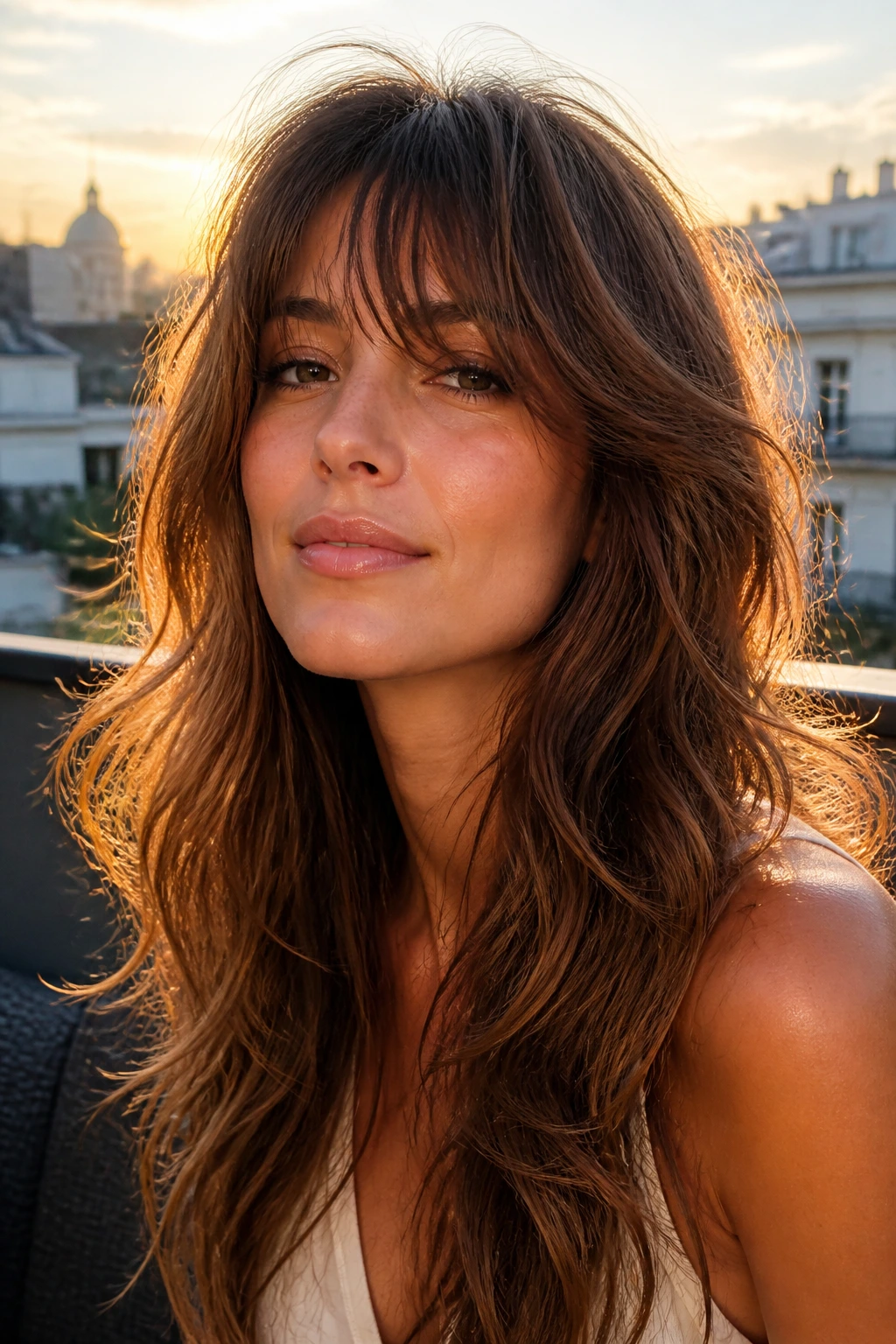
Soft, swept, and a little undone. That’s the whole point. Bardot-inspired bangs split slightly off center and sit long enough to open around the forehead, while the waves below keep everything moving. On a round face, the benefit is obvious: the hair frames the face without enclosing it.
This style likes a bend more than a curl. A wide-barrel iron or a round brush can create that easy wave that falls apart in a good way. Leave the ends a little irregular. If every section is polished to the same level, the haircut gets stiff. The broken texture is what keeps it flattering.
I like this on medium-density hair. It has enough body to hold shape, but it still moves.
10. V-Cut Haircut with Long Front Panels
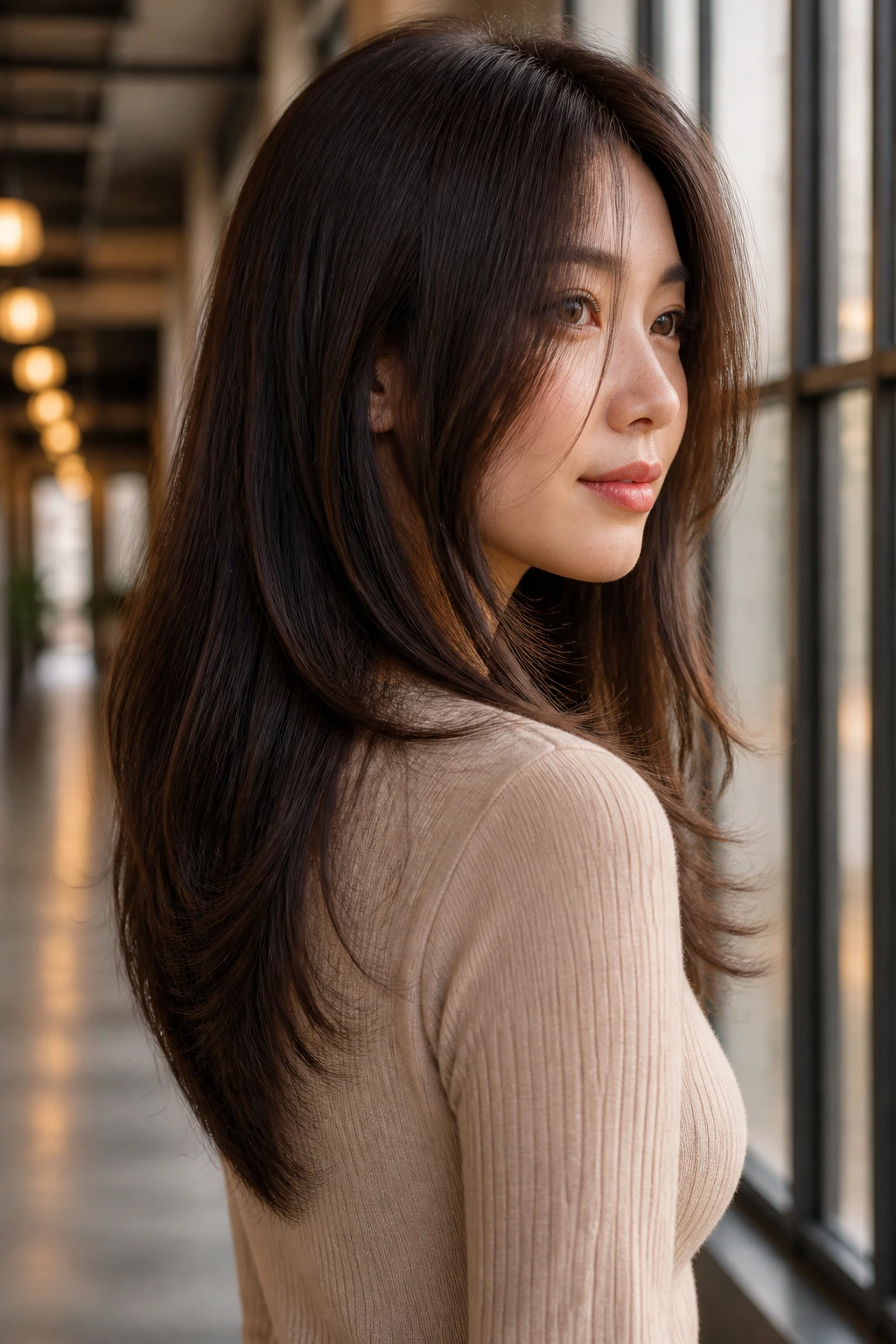
The V-cut is a sharper answer than the U-shape. The back tapers to a point, which makes the length feel longer, while the front panels stay heavy enough to frame the face. On a round face, that taper can be useful because it creates a sense of downward movement in the whole silhouette.
The bang area should stay long and soft. I would not pair a dramatic V with a short fringe here; that can pull the eye up too high. Keep the front pieces near the mouth or collarbone, and let them fall in a clean line. The result feels a little more dramatic, a little less soft, and that’s the appeal.
11. Razor-Cut Ends with Wispy Bangs
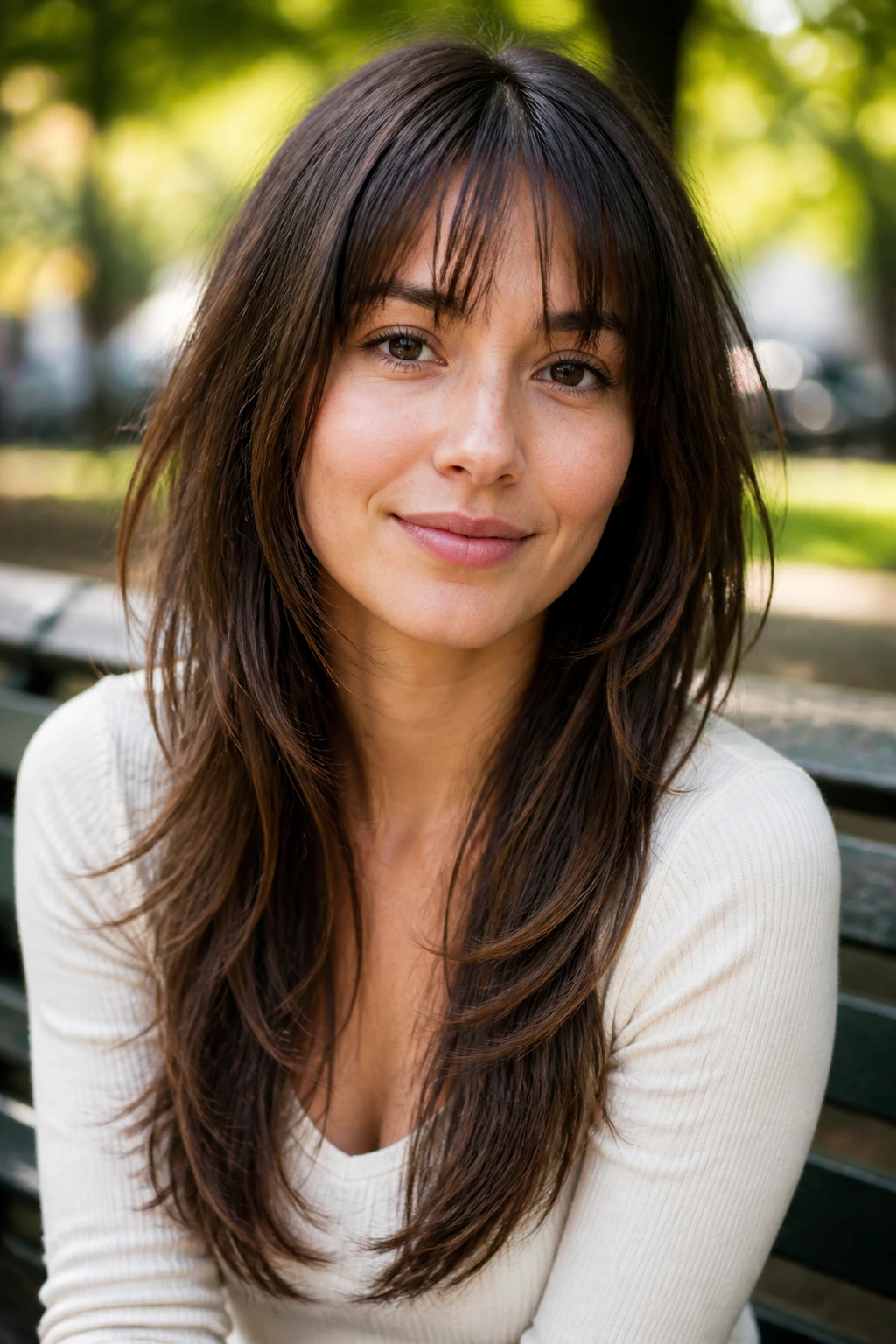
Razor-cut hair has a different mood. It looks lighter, more broken, and a little airy at the edges. On a round face, that can be helpful if your hair tends to puff out at the sides, because the soft ends do less visual widening than blunt, heavy lines.
The bangs should stay wispy and slightly separated. No solid curtain across the forehead. A little transparency works better here, especially if your hair is fine or naturally straight. The razor technique can be risky on very frizzy hair, though, so I’d only choose this if your texture already lies down fairly well.
What Makes It Different
The whole cut feels lighter at the perimeter. That means less bulk around the cheeks and more motion below them. It’s one of the cleaner choices for someone who wants edge without heaviness.
12. Voluminous Layers with Rounded Fringe
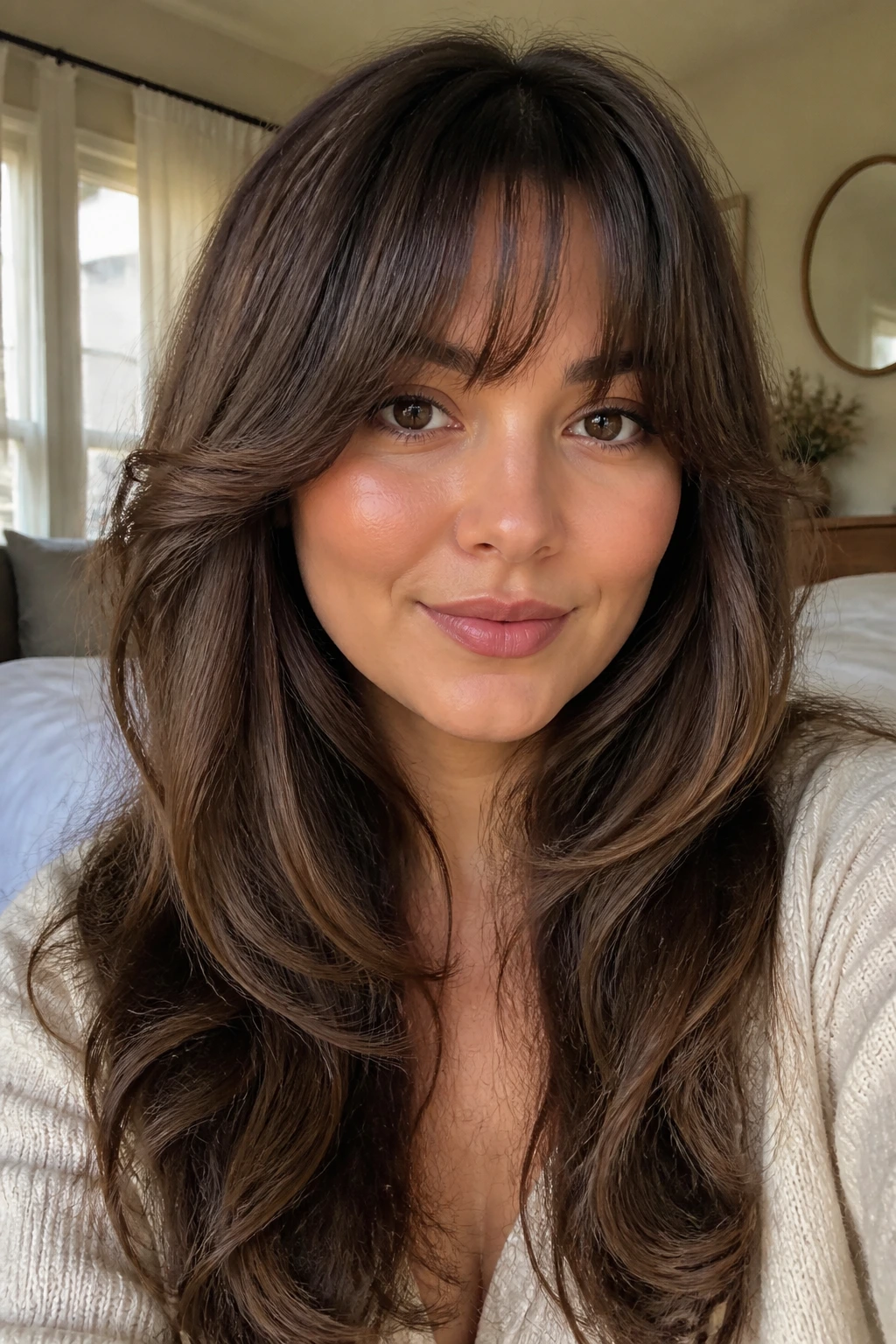
Some round faces look best with softness, not sharp angles. This is that haircut. The layers are built for volume, but the fringe curves gently at the temples so the widest part of the face doesn’t get boxed in. You get body at the crown and movement at the ends, which helps stretch the whole shape.
The mistake to avoid is cutting the fringe too blunt. Rounded fringe needs air, especially near the sides. If your stylist keeps the center a touch shorter and lets the edges lengthen toward the temples, the bang will open the face instead of compressing it.
This one loves a big round-brush blowout. It is not shy. It also doesn’t need to be perfect.
13. Long Wolf Cut with Soft Curtain Bangs
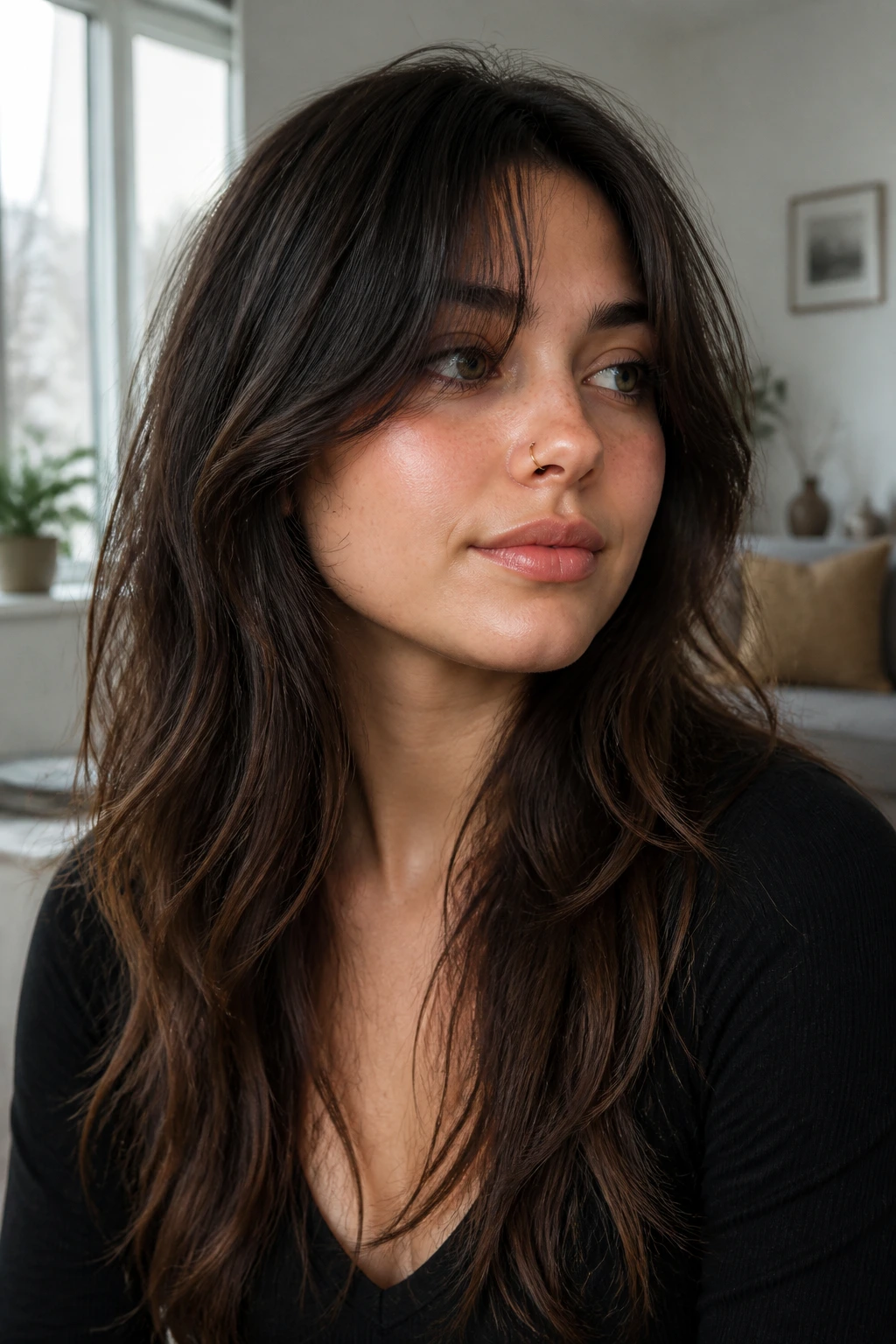
The wolf cut has enough texture to keep the hair from sitting flat against the face, which is useful on round faces. But the long version matters. If the layers get too high, the whole thing gets wide fast. Keep the length, keep the softness, and let the curtain bang stay longer than you think it should.
This is the cut for someone who likes a little edge. Not a lot of polish. A little edge. The crown can have lift, the ends can be shattery, and the bangs can separate into two pieces that skim the cheeks. The face reads longer because the eye keeps moving.
14. Curly Layers with Curly Fringe
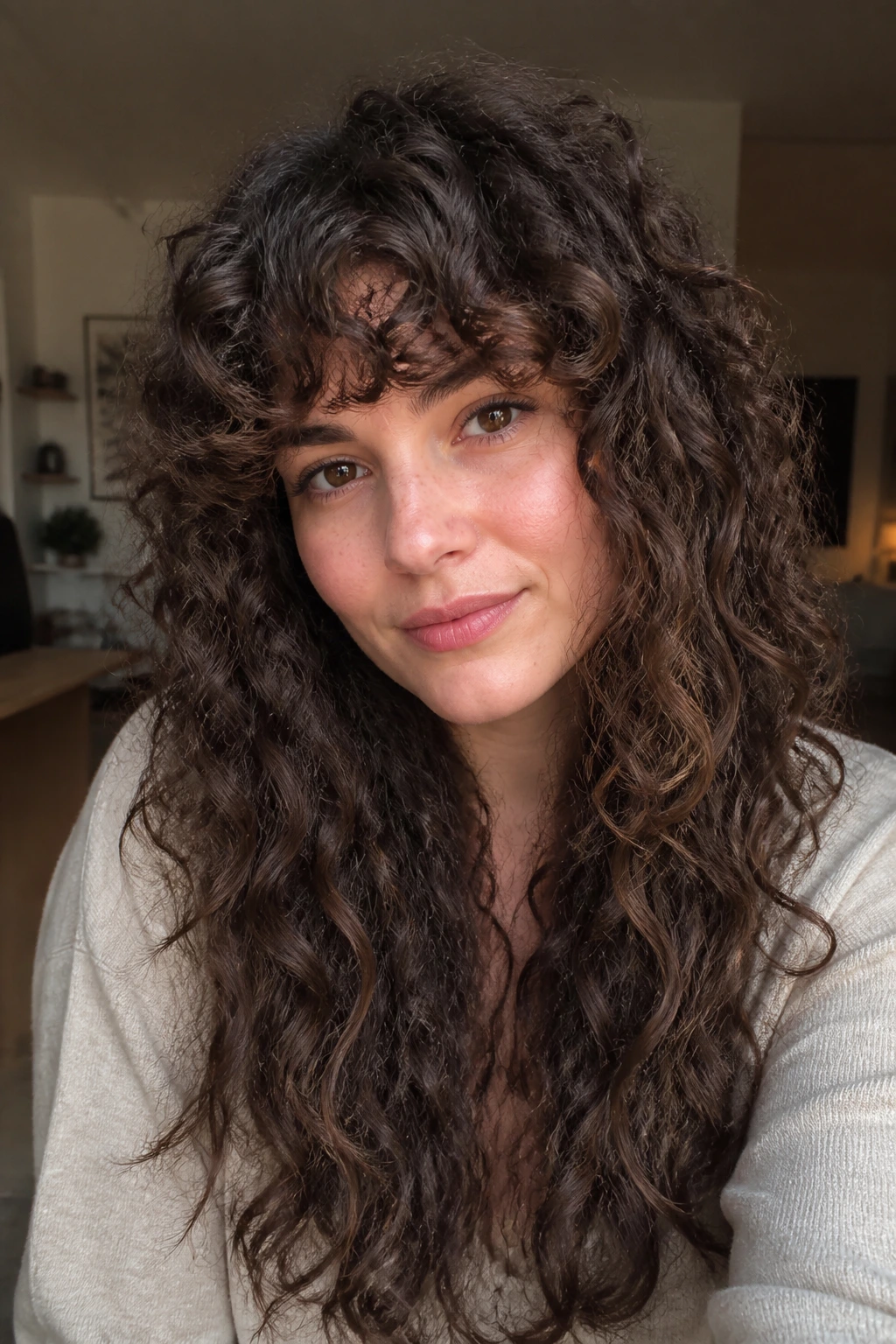
Curly hair and round faces are not a problem. Bad layering is the problem. When curls are cut too short on the sides, they expand outward and make the face look wider. Long layers solve that by letting the curl pattern drop instead of puff.
The fringe should be cut to live as curls, not as straight hair that happens to be curly. That means leaving enough length for shrinkage and shaping it dry or mostly dry. A curly fringe that lands around the brows when wet can spring up way too high. Been there, seen that mess.
How to Use It
Diffuse at low heat, hold the curls up rather than blasting them sideways, and let the fringe fall forward before you pin or clip it into shape. It’s a small thing. It changes everything.
15. Thick-Hair Tapered Layers with Long Bangs
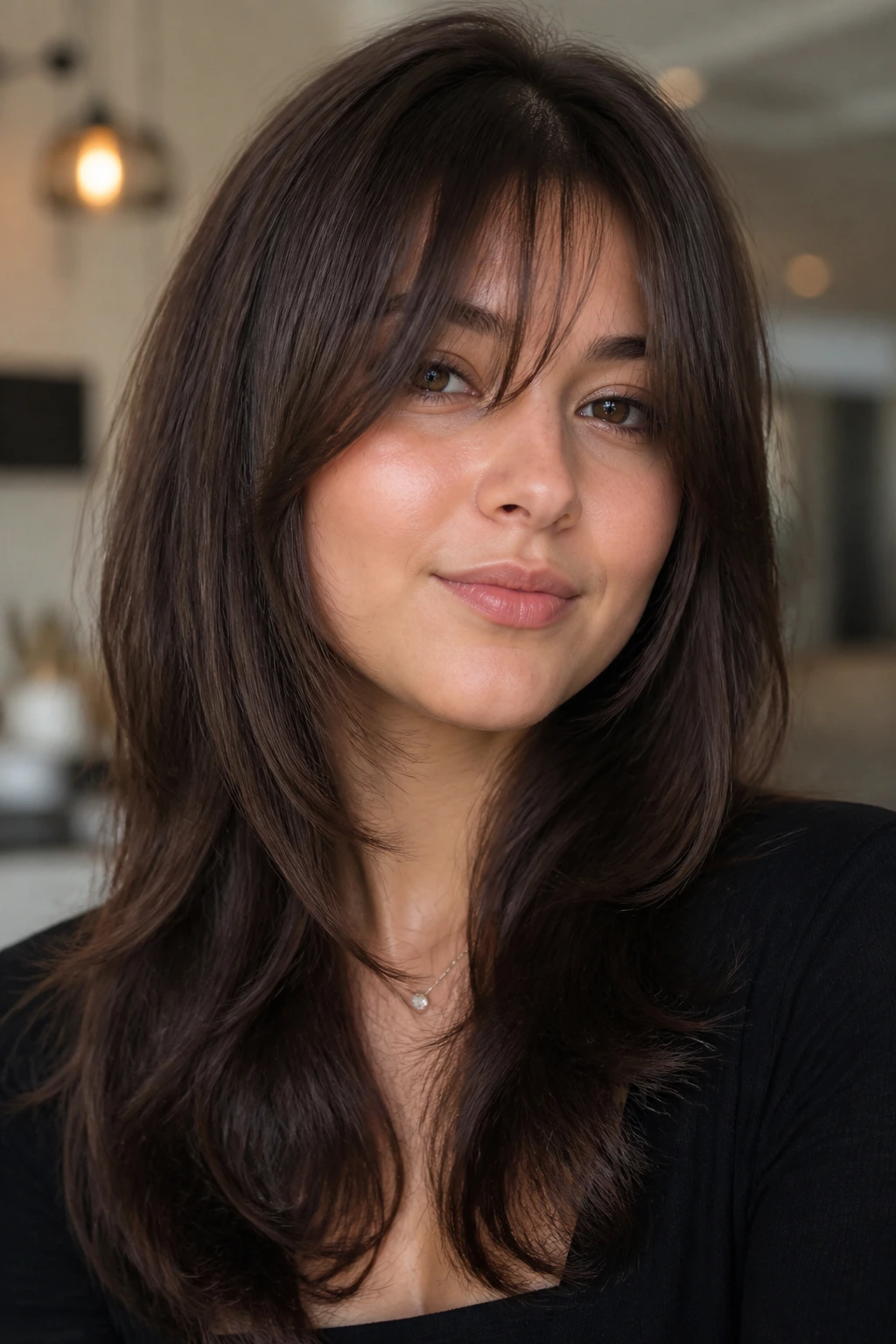
Thick hair needs a plan. Otherwise it builds weight right at the sides of the face, and a round face does not need extra width there. Tapered layers remove bulk through the ends while keeping enough density to make the haircut look full, not thin.
The bangs should stay long and soft, with the corners slightly longer than the middle. That gives the face a more vertical line and keeps the front from looking like one solid rectangle. If your hair is very dense, ask for internal debulking instead of aggressive surface thinning. That sounds picky, but it matters. Some thinning shears leave thick hair fuzzy at the ends. No one wants that.
16. Fine-Hair Airy Layers with See-Through Bangs
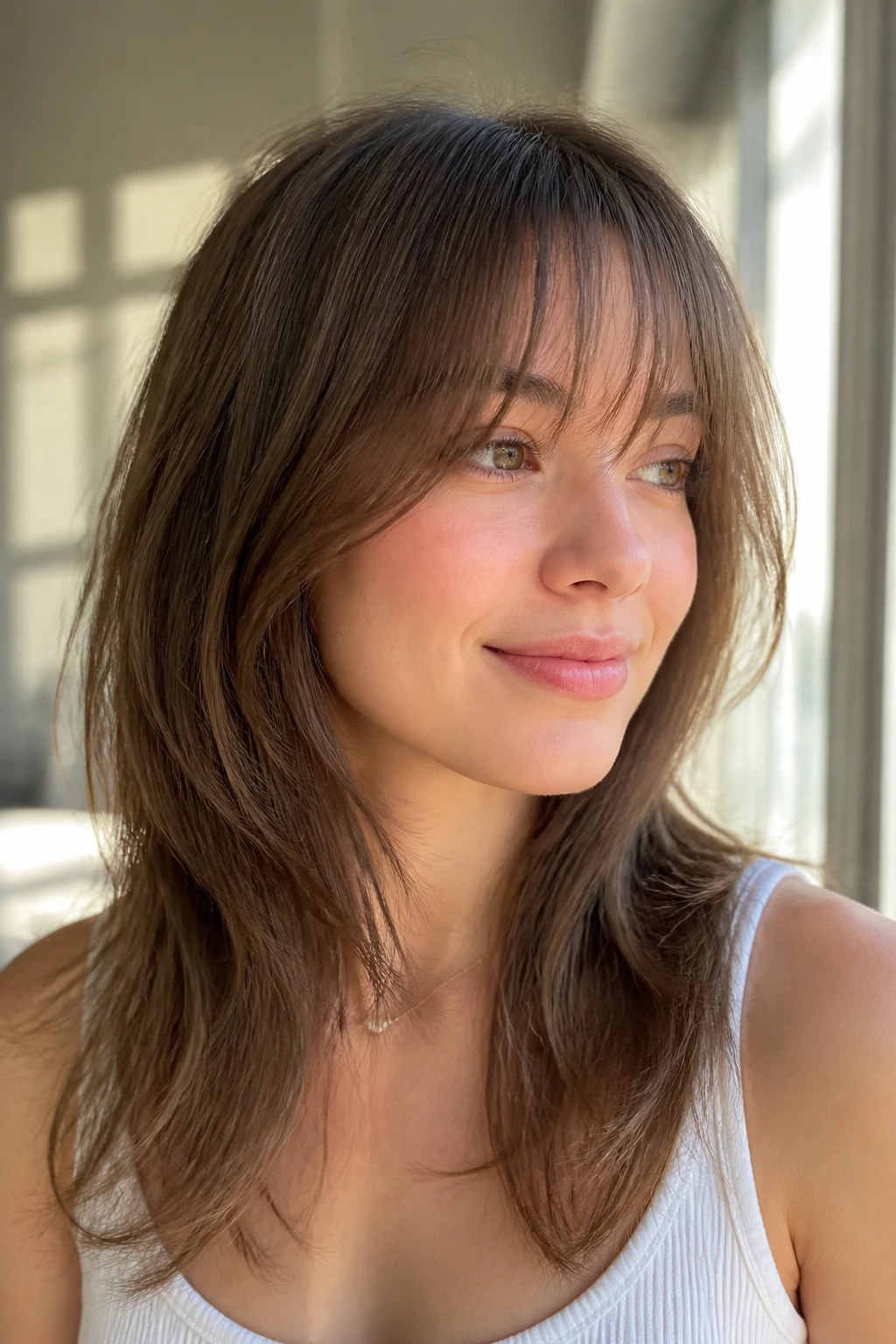
Fine hair is easy to overcut. Then it collapses. The better move is to keep the long layers subtle and let the fringe stay light enough to feel airy but not sparse. See-through bangs can work well on round faces because they don’t create a hard horizontal band.
What you want here is lift, not loss. The shortest layers should still have enough length to tuck behind the cheekbone, and the bangs should be soft enough to move with a small brush or even just your fingers. A root spray at the crown can help, but the real work happens in the cut.
This is a quiet haircut. It does not shout. It just keeps the face open.
17. Glossy Long Layers with Hidden Internal Movement
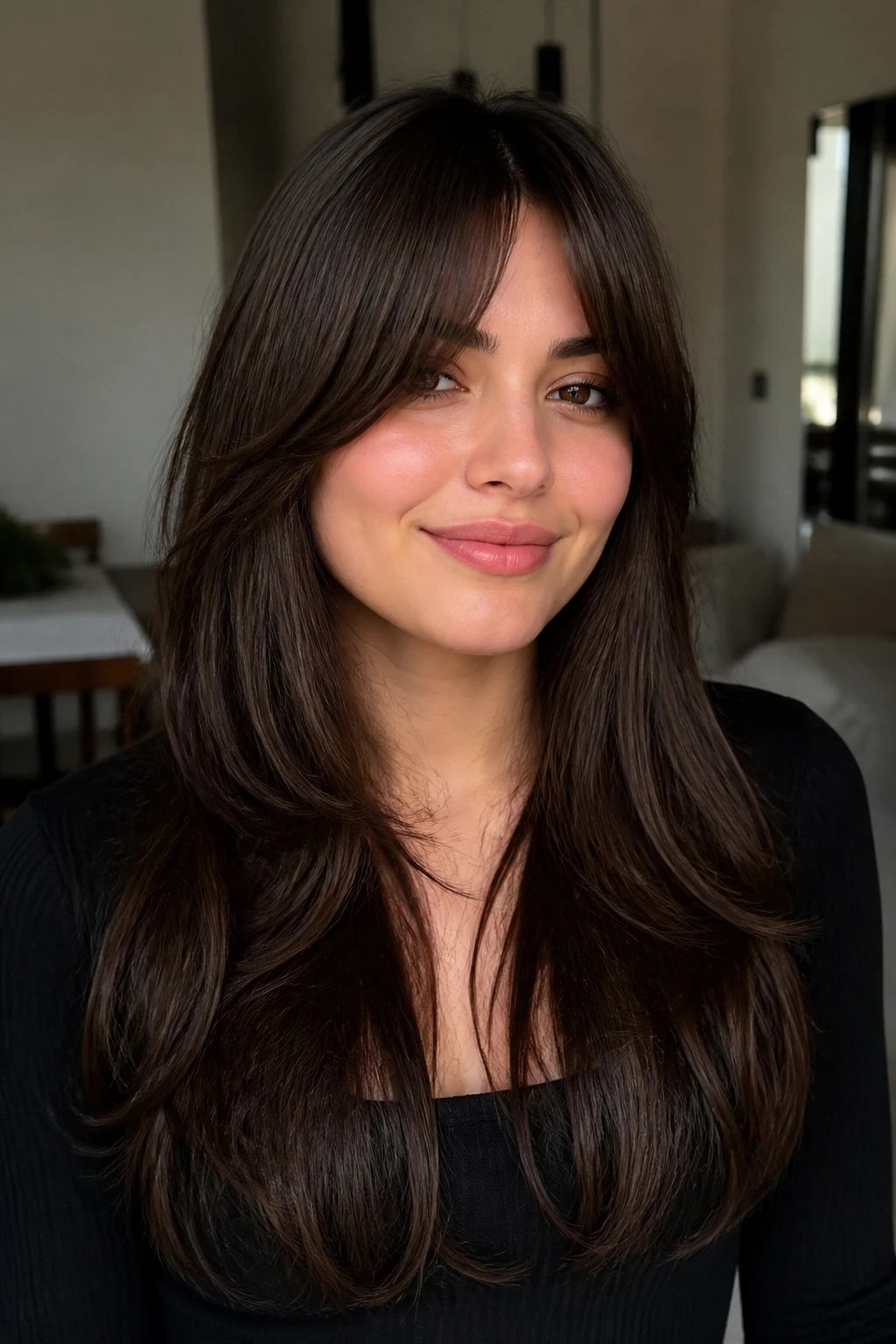
A lot of people think long layers have to look obviously layered. They don’t. Sometimes the cleanest answer is a mostly sleek shape with hidden movement cut underneath. On a round face, that can be a smart choice because it gives elongation without visible bulk around the cheeks.
The fringe stays long, polished, and slightly bent away from the face. If you like a neat finish, this is the version to ask for. It works especially well when you wear your hair smooth most days and only want a little swing at the ends. The layers are there. They’re just not waving a flag.
18. Old-Hollywood Blowout with Swoop Bangs
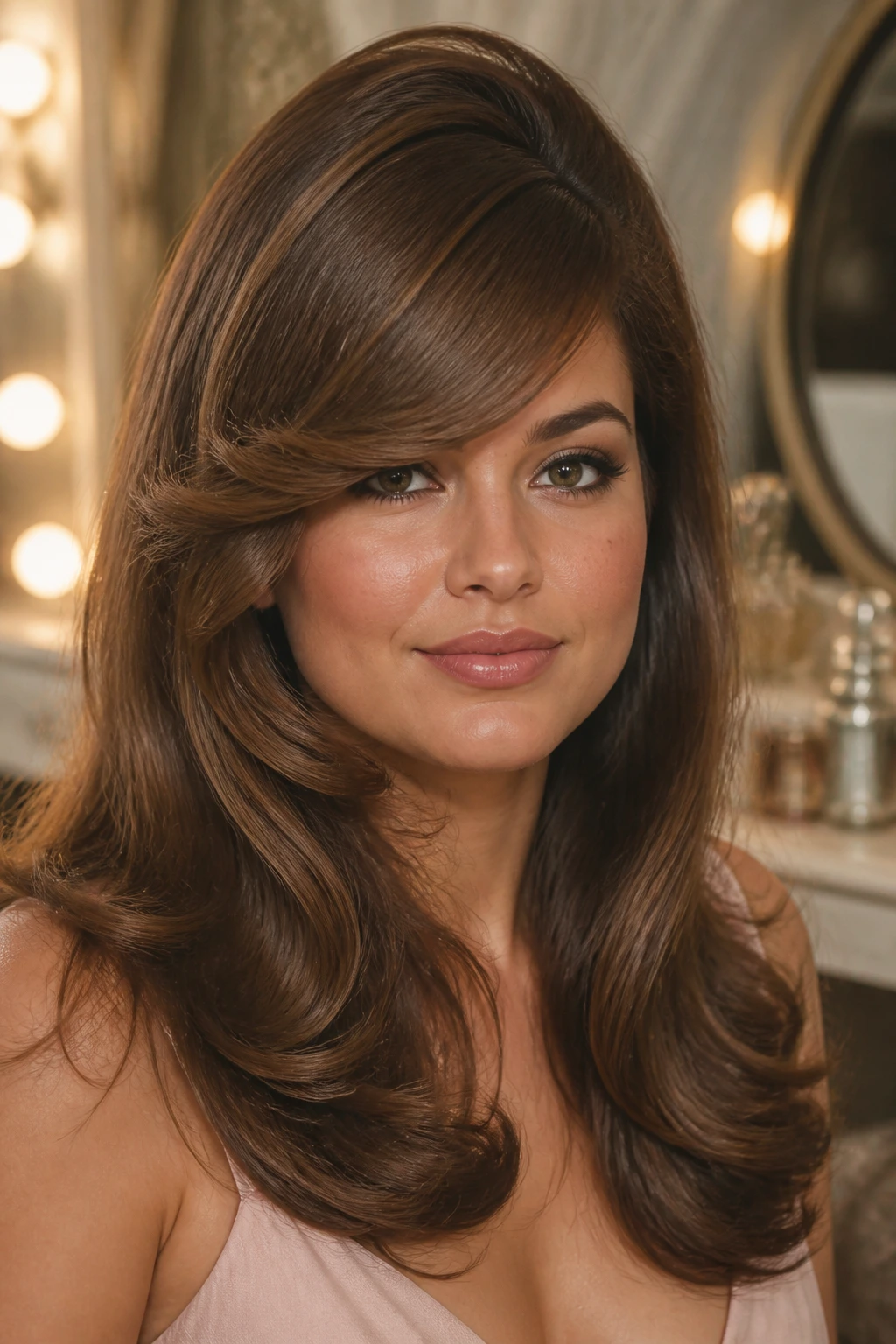
This one leans glamorous, and I mean that in the literal sense: brushed, lifted, smooth, and controlled. The swoop bang creates a diagonal line across the forehead, which is one of the fastest ways to break up roundness. The blowout adds height at the crown and curve through the ends.
The hair should feel soft but not loose in the bad way. Use a big round brush, set the bangs away from the face, and roll the front pieces under just enough to create shape. Too much curl and it starts looking costume-y. Too little bend and the whole point disappears.
It is a strong look. It also photographs well without needing perfect hair all day, which is a nice trade.
19. Beach Waves with Split Fringe

If your hair lives better with texture than polish, this is the move. Beach waves create vertical breaks through the length, and the split fringe keeps the forehead from feeling closed off. On a round face, that combination can be surprisingly good because it looks relaxed while still stretching the shape.
The trick is not to make the waves all the same size. A couple of larger bends near the front, then looser pieces through the rest of the length, keep the cut from going puffy. A center split or slightly off-center split works here; just avoid a heavy bang line that sits on the cheeks.
20. Collarbone-Opening Front Layers with Fringe
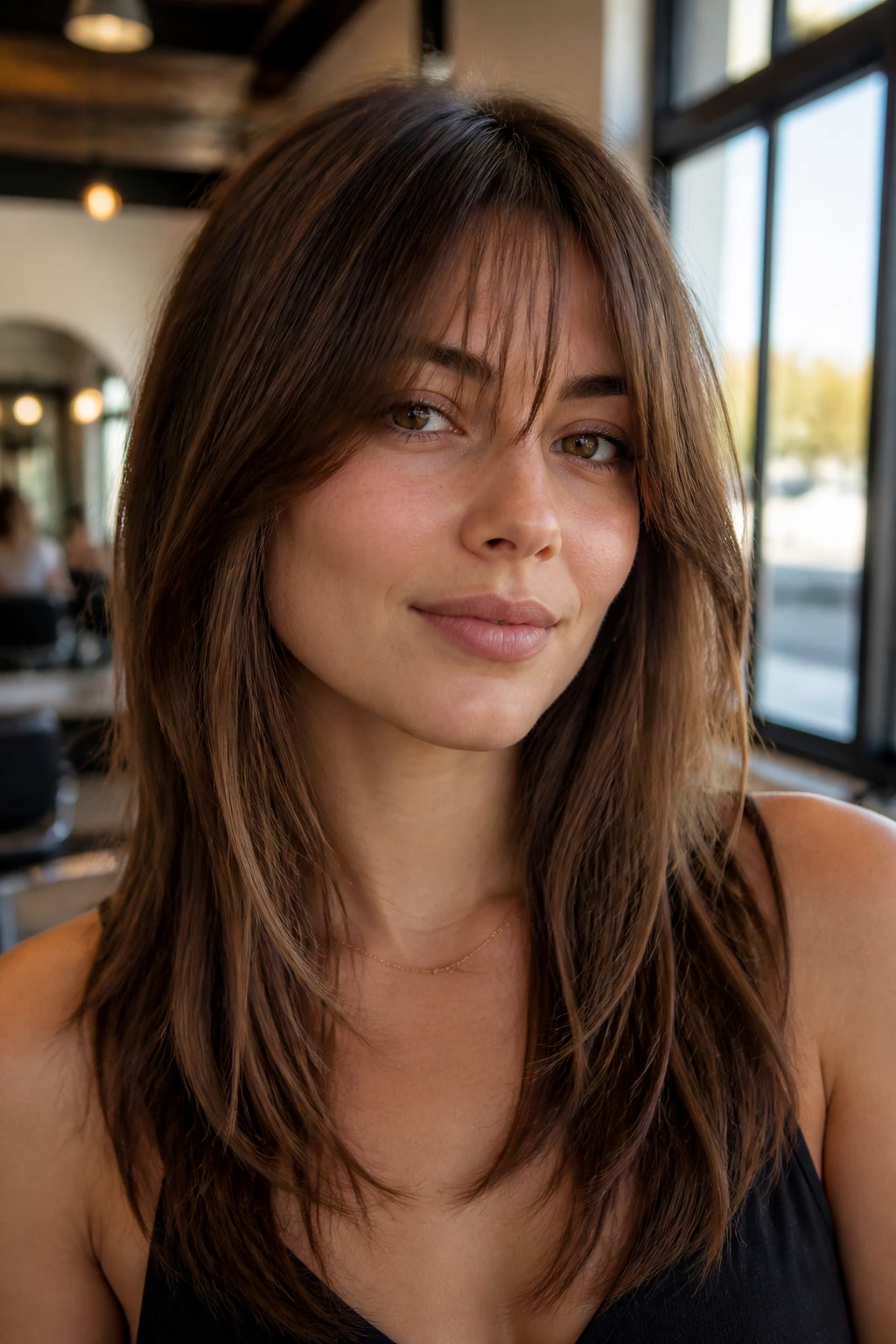
I like front pieces that hit the collarbone on round faces. They make the eye travel downward and give the haircut a longer outline. This version keeps the fringe soft, then lets the face framing drop low enough to open the neck and jaw area.
It’s one of the easiest ways to make long layers with bangs feel intentional. The shortest pieces are still long enough to tuck, which is helpful on busy mornings. If your hair is medium thickness, this shape tends to hold up well without constant restyling. If it’s thick, a bit of internal layering keeps the front from feeling heavy.
21. Rounded U-Layers with Chin-Skimming Bangs
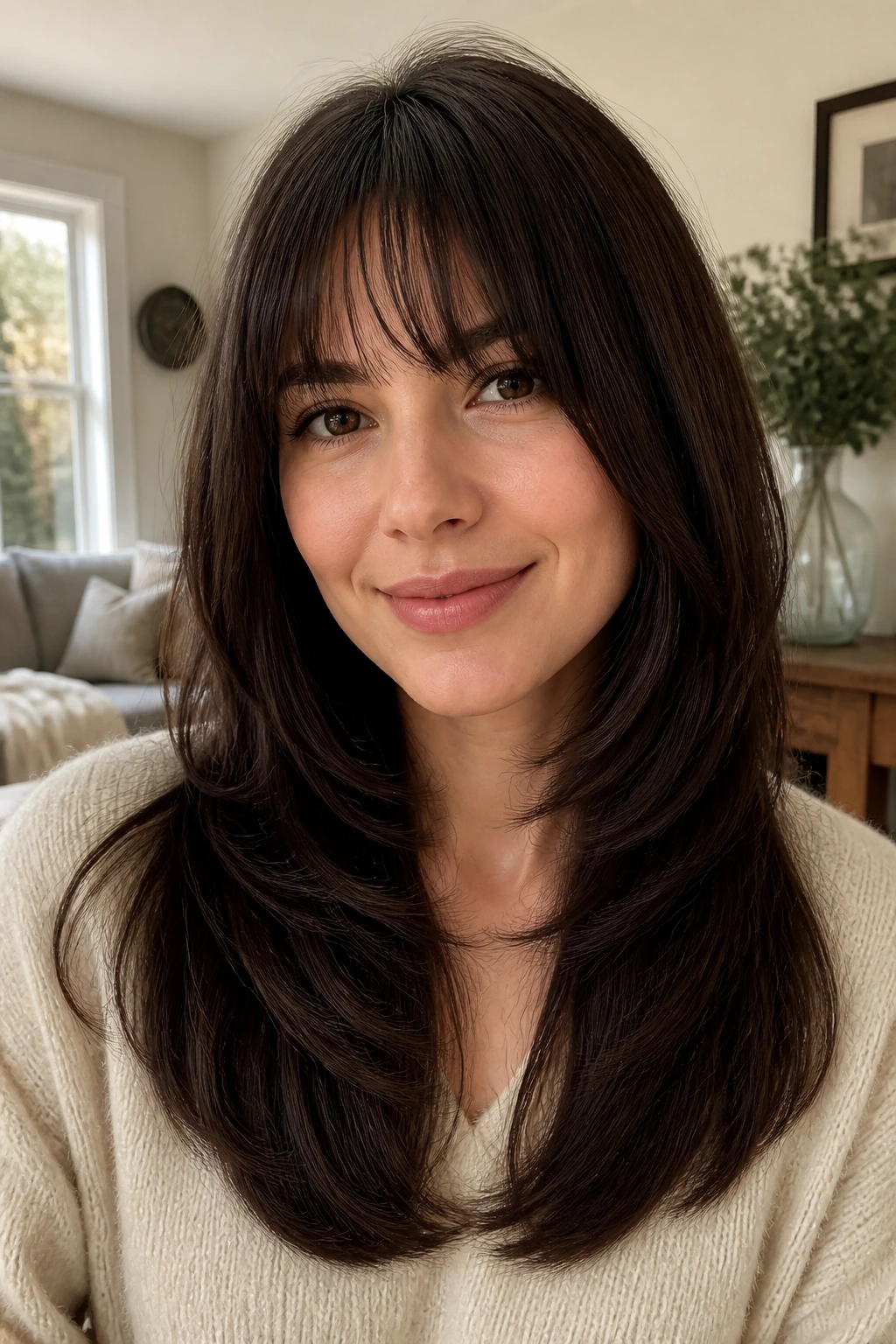
A rounded U-shape can look elegant on a round face if the front is handled with restraint. The chin-skimming front pieces keep the eye moving past the cheeks, while the gentle U outline keeps the length soft and continuous. Nothing abrupt. Nothing boxy.
The fringe should not stop high on the forehead. Let it stay longer, softer, and slightly broken at the ends. That gives the cut room to breathe. I’d choose this if you like softness more than sharpness and you want the style to work with a simple round-brush bend, not a lot of styling product.
22. Deep Side Fringe with Hidden Layers
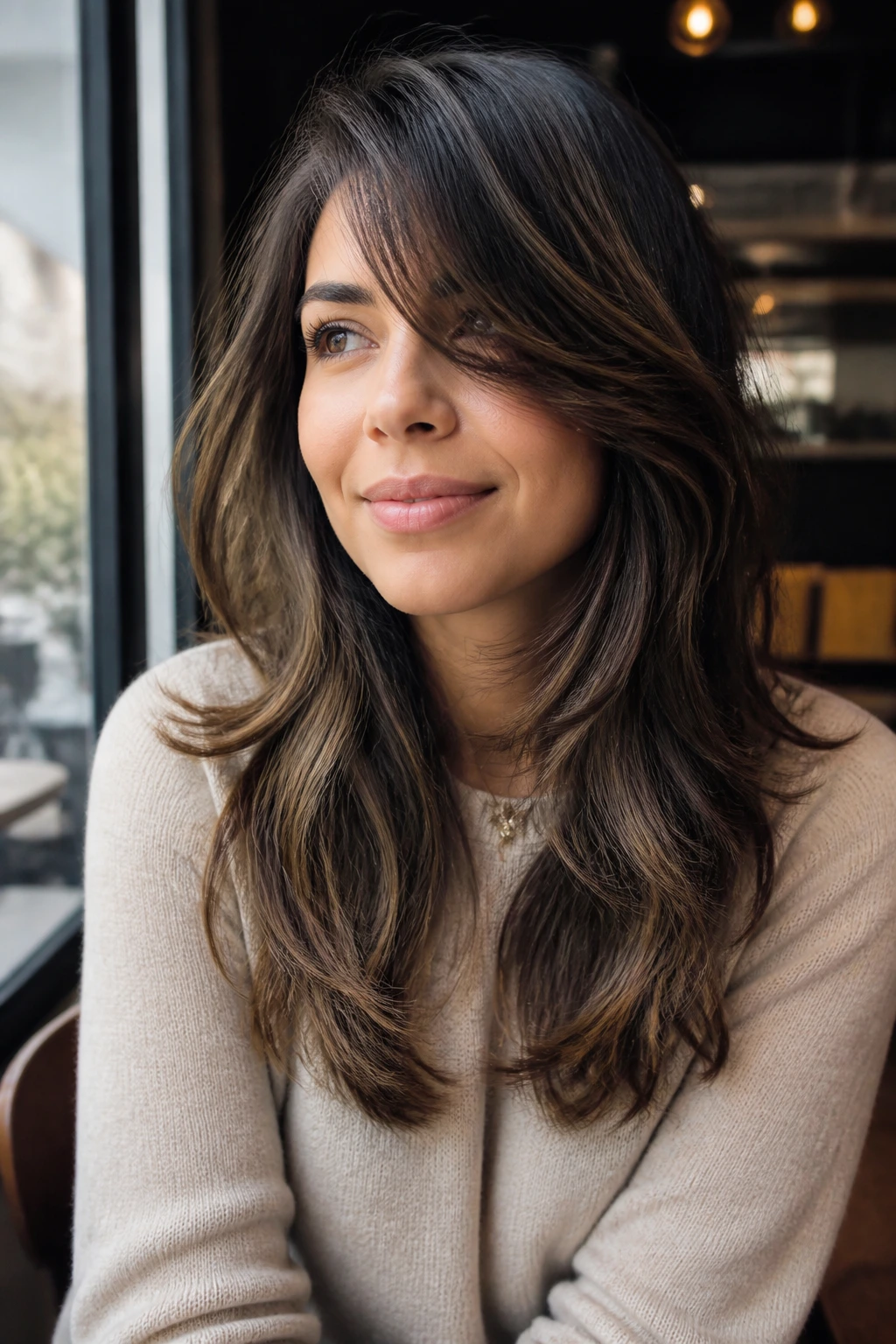
A deep side fringe is one of the strongest angle-breakers you can put on a round face. It cuts across the forehead diagonally, which immediately changes the geometry of the haircut. Pair it with hidden layers underneath, and you get movement without a lot of visual clutter.
This style feels especially good if you don’t want obvious layering around the face. The front can stay smooth, and the action happens lower down through the mids and ends. That makes it a nice choice for someone who likes a cleaner, more controlled look but still wants softness where it counts.
23. Invisible Layers with Curtain Bangs
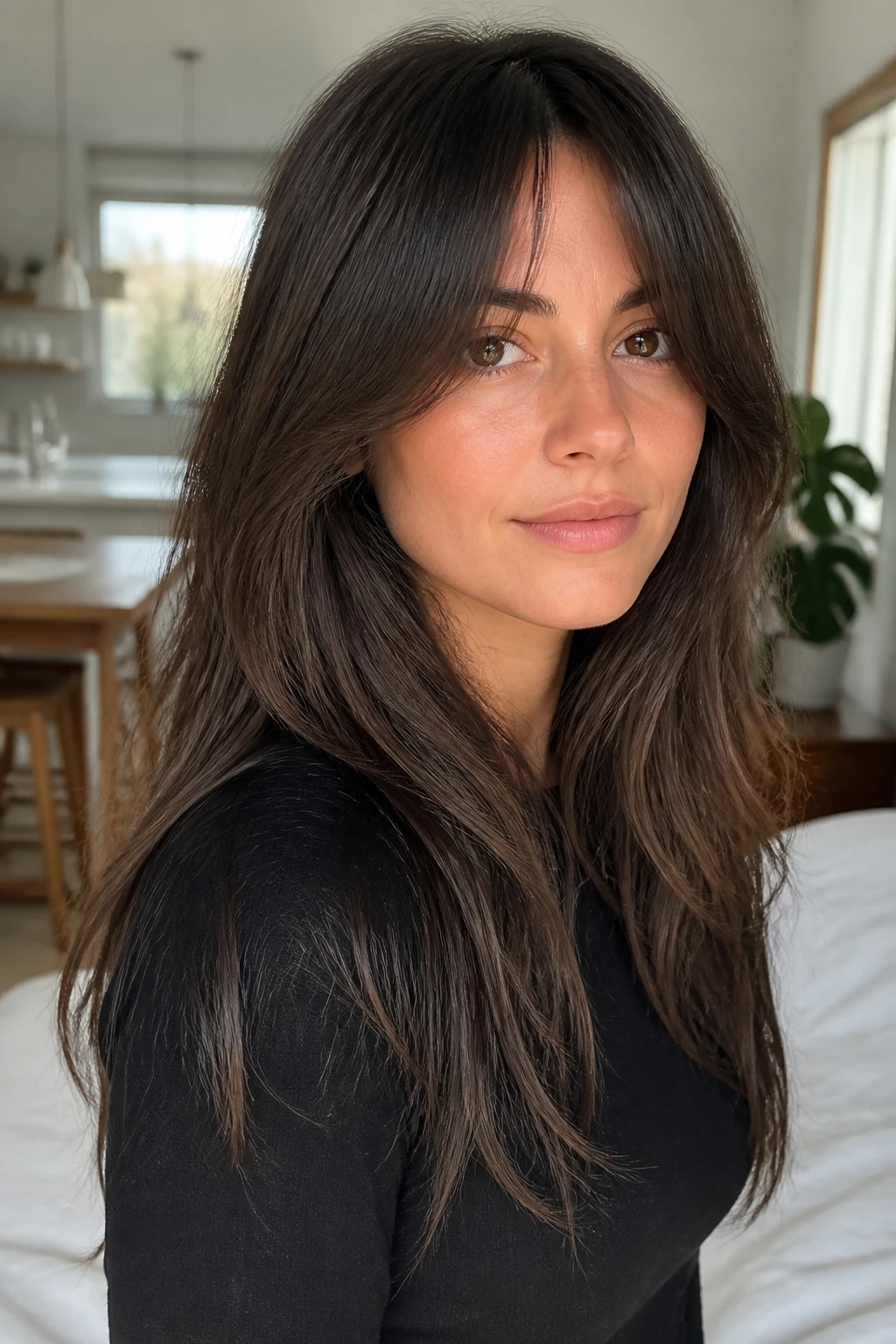
Invisible layers are the haircut equivalent of a low whisper. They’re there, but they don’t dominate the shape. On a round face, that can be smart if you want to keep the front from puffing out while still getting movement below the cheeks.
The curtain bangs carry the face-framing job, so ask for them to split and fall past the cheekbone rather than sit on it. The layers underneath do the rest. This is a good fit for thick hair that needs hidden weight removal, or for anyone who wants the shape to look polished even when air-dried.
24. Choppy Ends with Cheekbone Bangs
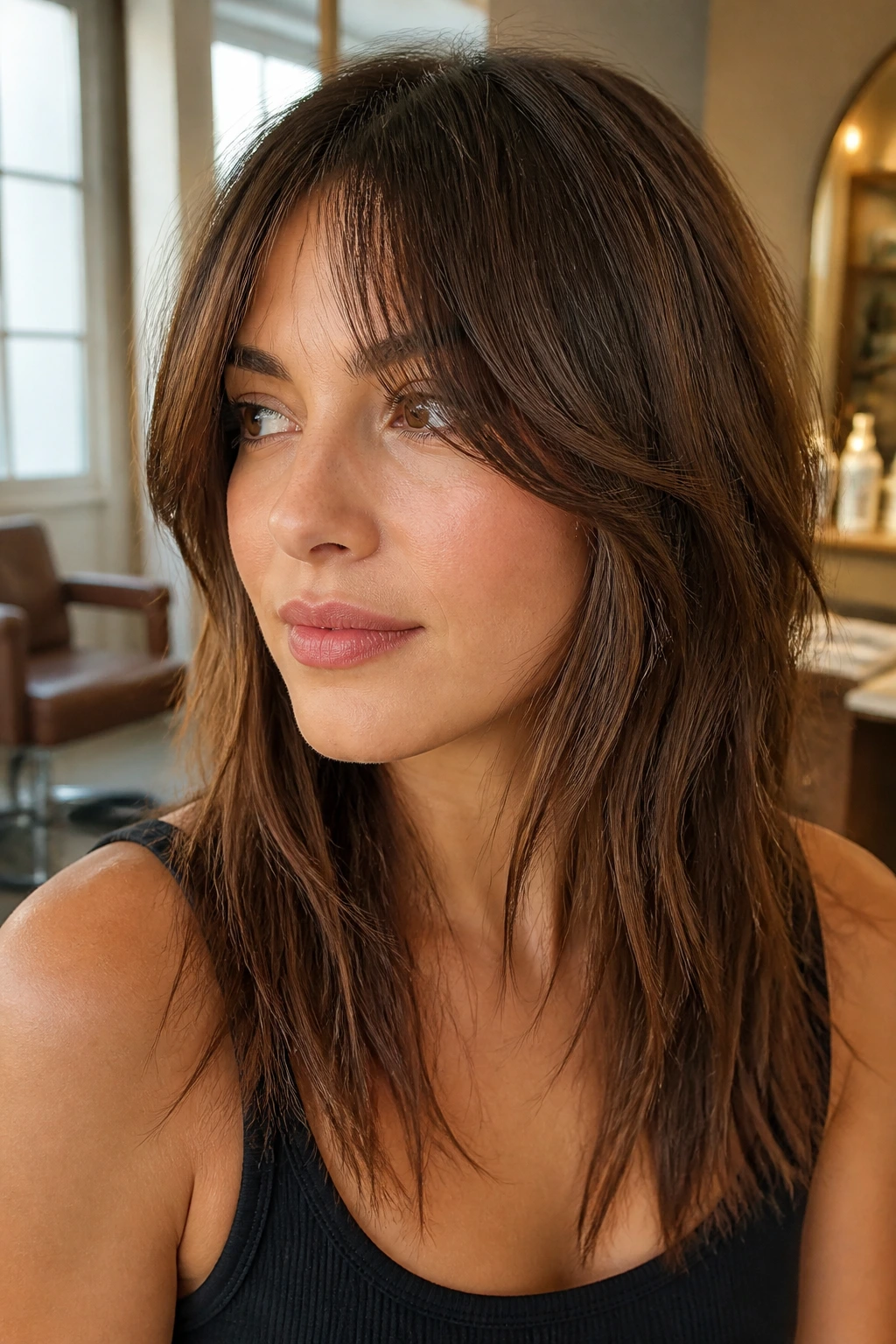
This is the sharper, more modern version of the long-layered cut. The ends are deliberately broken, which helps the hair move instead of sitting in one solid block. The cheekbone bangs should not be blunt; they need to split or soften at the temples so the front doesn’t widen the face.
The appeal is edge. Not chaos. Edge. If you want something that feels current without being overstyled, this sits in a good spot. It is especially strong on medium-density straight or wavy hair, where the choppy ends can show without turning frizzy.
25. Grown-Out Bangs with Long Length and Soft Ends
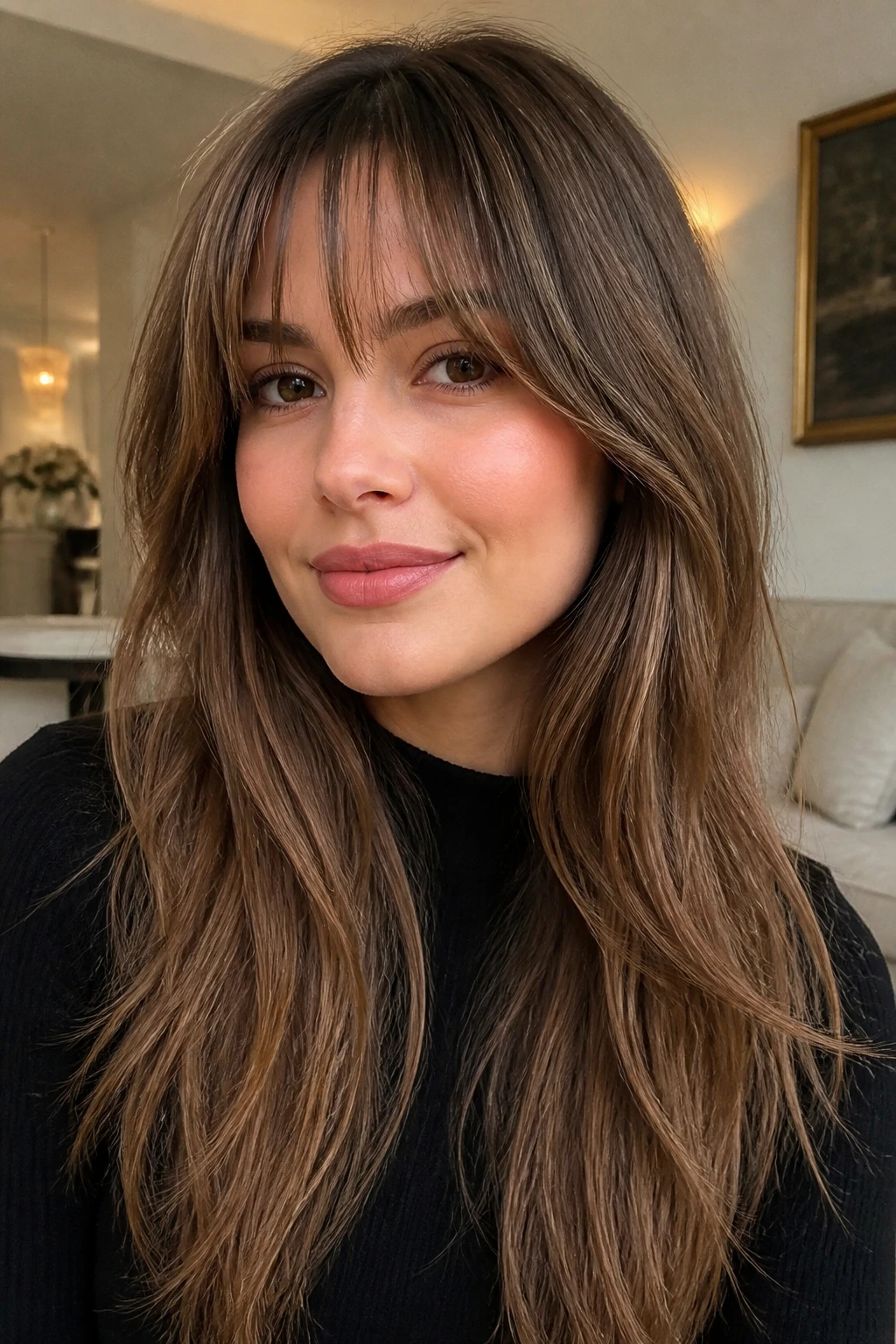
If you want a cut that doesn’t demand a salon appointment every time it starts to grow, this is the one. The bangs are intentionally long, soft, and easy to tuck, while the lengths stay below the shoulders and the ends are lightly softened rather than heavily chopped.
The face gets frame without a hard border. That matters. On a round face, grown-out bangs can actually look better than freshly cut ones because they fall lower and keep the eye moving. I’d ask for enough length to part them, pin them, or wear them across the brow without losing the shape.
Why Long Layers and Bangs Change the Shape of a Round Face
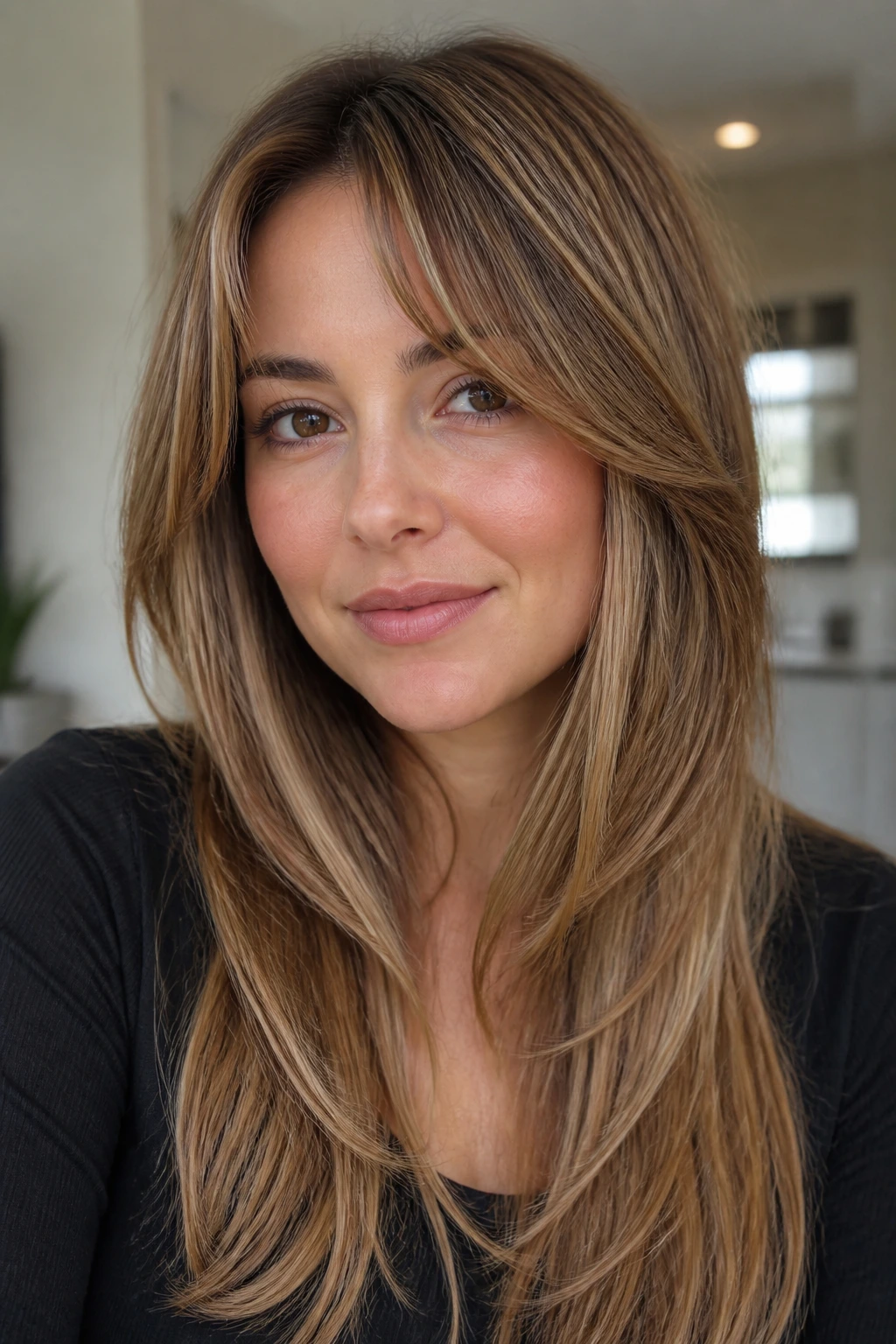
A round face usually reads widest through the cheeks, with the length and width sitting close together. Haircuts that stop right at that widest point can make the whole face feel broader than it is. Haircuts that pass it — especially through long front pieces and soft bangs — change that balance fast.
The best versions use three tools: vertical movement, off-center or broken fringe, and layer placement below the cheekbone. That combo keeps the eye moving down the haircut instead of getting stuck in one horizontal band. It’s why curtain bangs, side-swept fringe, and long face-framing pieces show up so often in flattering round-face cuts. They are not magic. They are geometry with better manners.
The other thing people miss is weight. If the front of the haircut carries too much bulk, the cheeks look fuller. If the layers are cut too high, the width jumps up the face. A good stylist will leave enough length around the front to stretch the outline, then remove weight where the hair wants to puff. Straight hair, wavy hair, and curly hair all need that idea. The details change. The principle doesn’t.
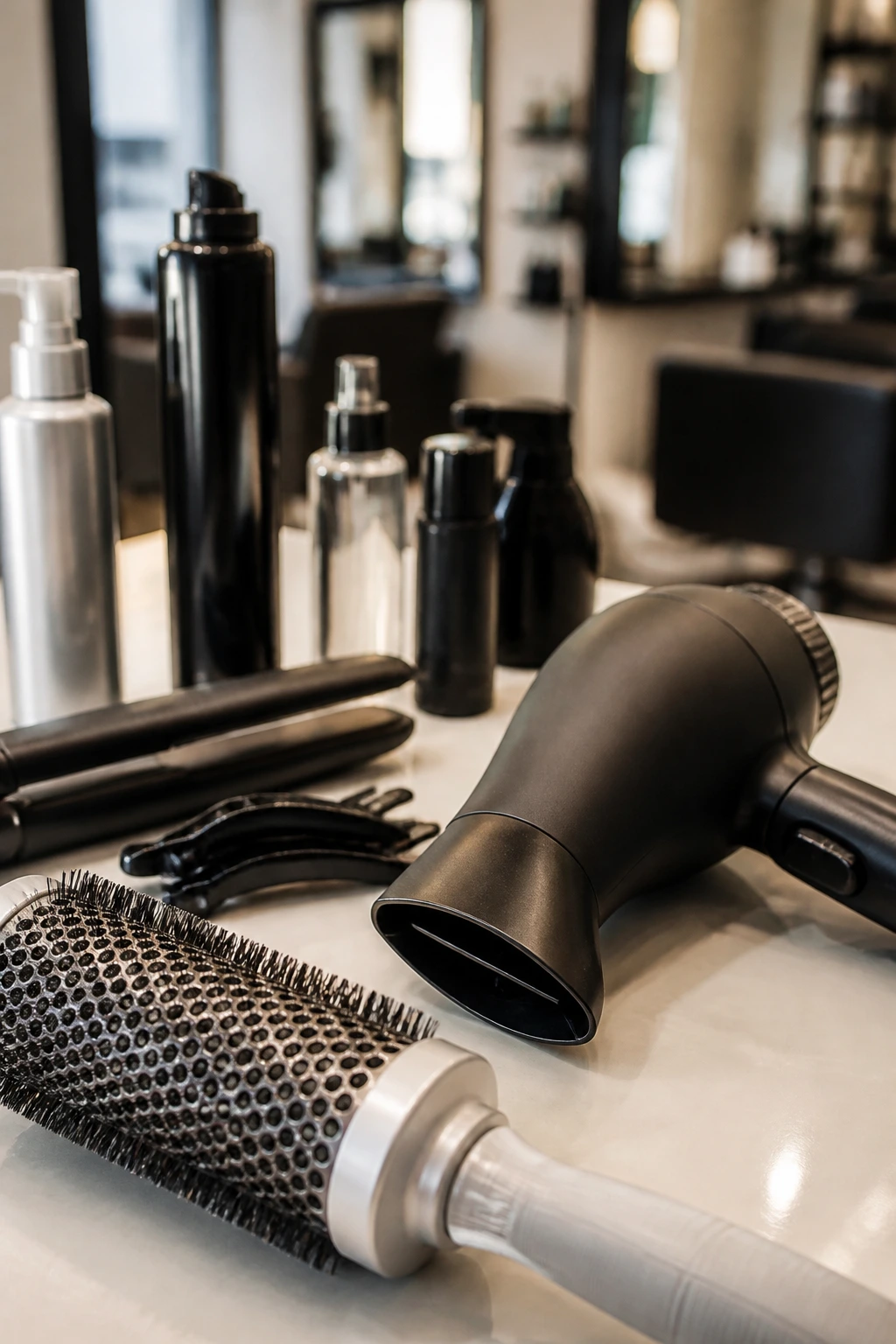
The Tools That Make These Cuts Behave
-
Round brush, 1.5 to 2.25 inches: Smaller brushes help shorter bangs and finer hair; larger brushes work better on long layers and thicker density.
-
Blow dryer with a nozzle attachment: The nozzle keeps air moving in one direction, which helps bangs lie where you want them instead of blasting sideways.
-
Heat protectant spray: Use this before any flat iron or round-brush blow-dry. Bangs sit against the face, so I never skip it.
-
Sectioning clips: Long layers are easier to style in clean sections, especially if the front pieces dry faster than the back.
-
1-inch flat iron: Good for turning the ends away from the face or bending a stubborn fringe.
-
Lightweight mousse or root lift spray: Useful when the crown falls flat and the front starts to cling to the cheeks.
-
Dry shampoo: A lifesaver for bangs. Use a little at the roots before they get greasy, not after they’ve already collapsed.
-
Texturizing spray or light finishing spray: Helps piece out shaggy, wolf-cut, and feathered versions without making them crunchy.
How to Style the Shape Without Fighting Your Hair
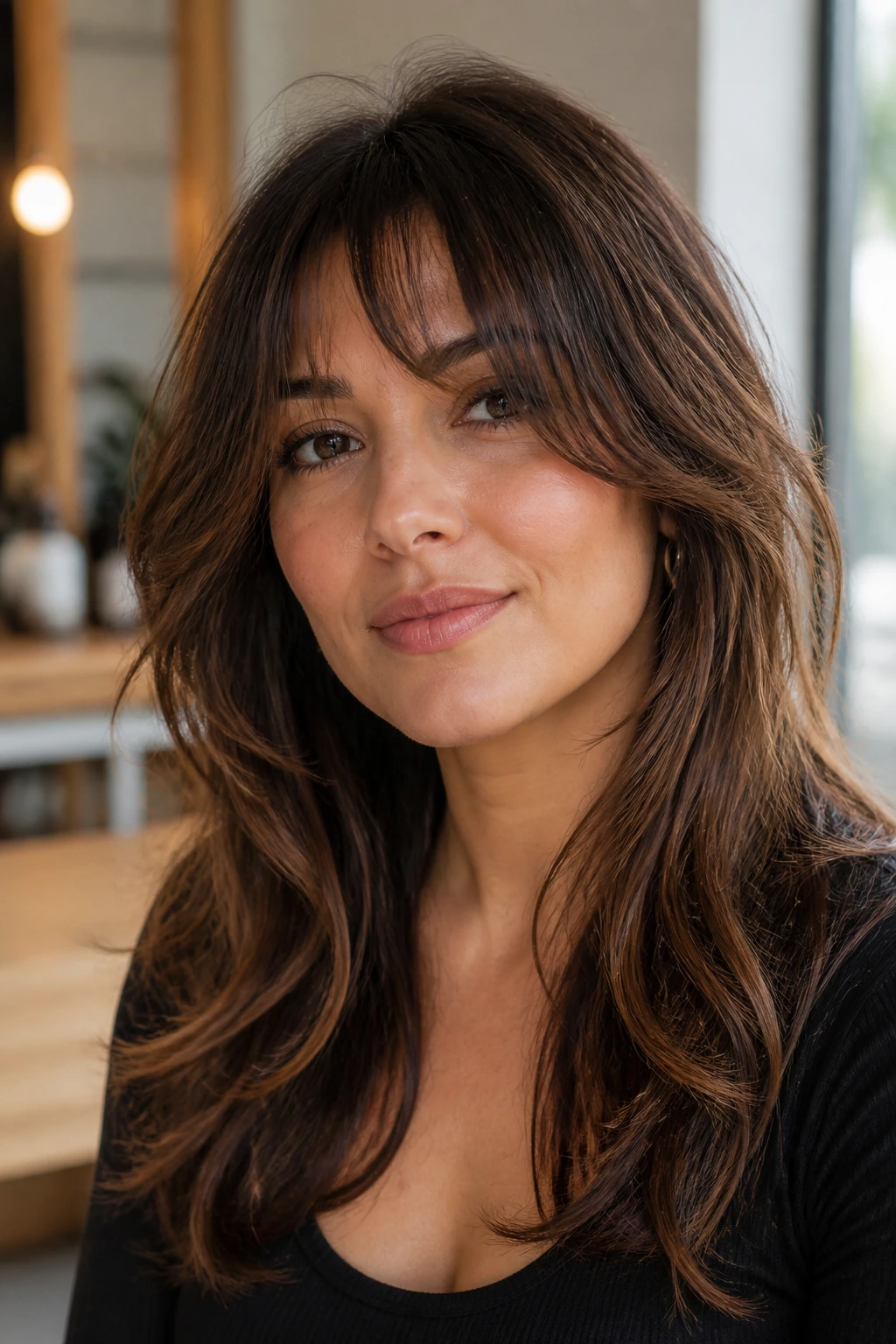
Start with the roots. Always. A round face haircut loses its shape fastest when the crown goes flat and the sides puff up, so lift at the top matters more than people think. If you’re blow-drying, dry the bangs first in the direction you want them to sit, then move to the front layers and finish the mids and ends.
Root Lift: If your hair is fine, a small amount of mousse at the crown can keep the shape from drooping by lunchtime. If your hair is thick, use less product and more directional drying.
Bang Direction: Dry bangs side to side for a minute, then settle them into their part. That helps avoid the hard crease that happens when fringe dries in one exact spot.
Ends and Movement: Long layers look better when the ends bend slightly away from the cheeks. A tiny outward curve at the front can make a big difference.
Second-Day Fix: Mist the fringe lightly, roll it under or away from the face with a brush, and hit it with warm air for 20 to 30 seconds. Do not drench it. Bangs hate that.
If your hair is curly or very wavy, the goal changes a bit. You are not trying to force it flat. You are trying to keep the front pieces from swelling at cheek level. That means long layers, a diffuser on low heat, and a bit of patience at the dry stage. Annoying, yes. Worth it, also yes.
The Mistakes That Make a Round Face Look Wider
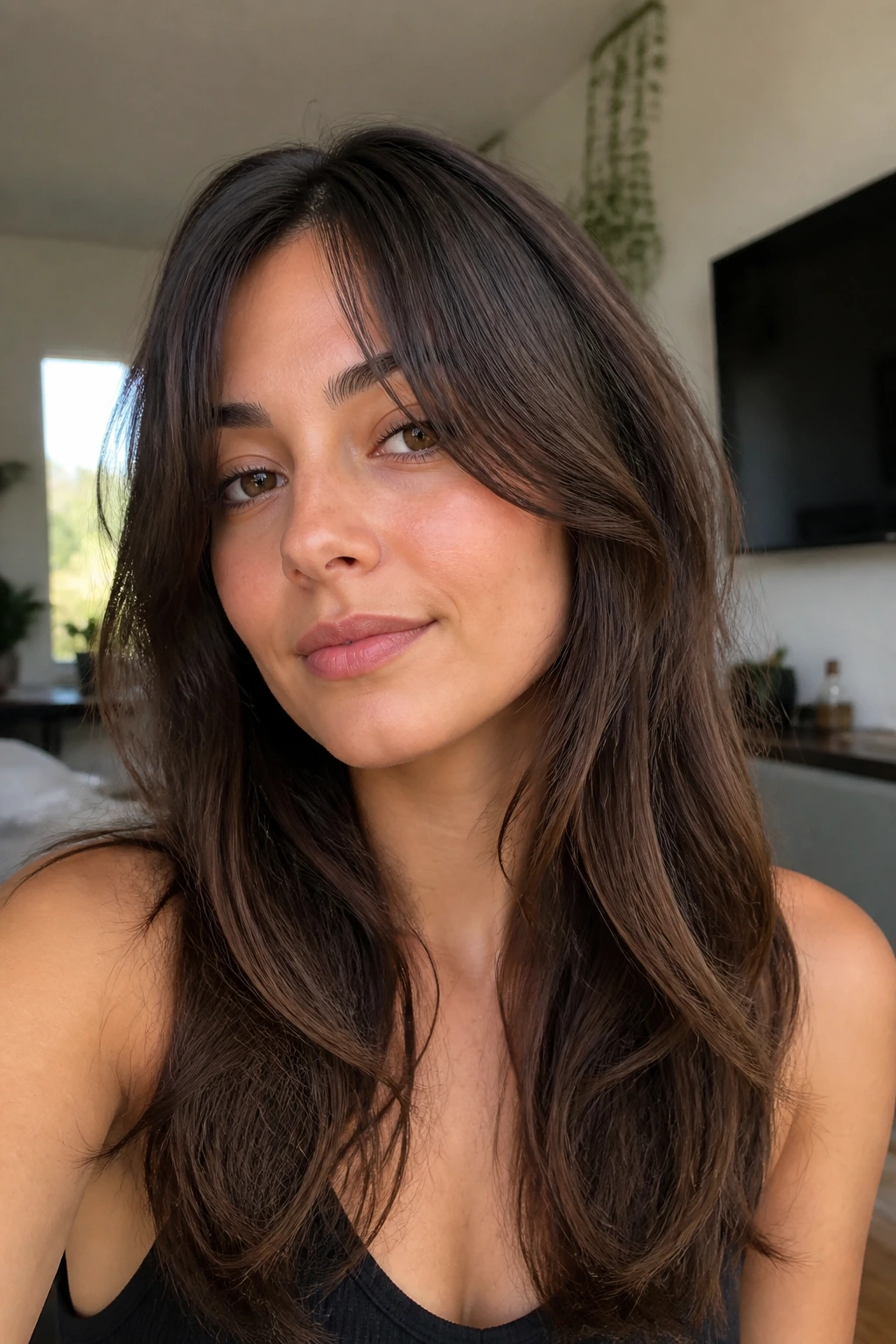
-
Cutting the bangs too short: Short bangs can lift the eye too high and leave the cheeks doing all the work. Keep the fringe longer if you want the face to look stretched.
-
Starting the first layer at cheek height: That is the danger zone. If the shortest face-framing piece lands right on the cheekbone, the haircut can add width instead of taking it away.
-
Over-thinning fine hair: Thin hair needs movement, not holes. Too much point cutting can make the ends stringy and leave the front looking limp.
-
Leaving too much bulk at the sides: If the haircut is wide at the jaw and cheek, the face reads wider. Remove weight carefully and keep the outline long.
-
Ignoring growth patterns and cowlicks: A bang that fights your natural bend will split, poof, or flip the wrong way. Work with the growth pattern, not against it.
-
Styling everything straight down: Hair hanging straight down from the temples can frame the cheeks in the least helpful way. A little bend away from the face goes a long way.
Variations and Alternatives to Try
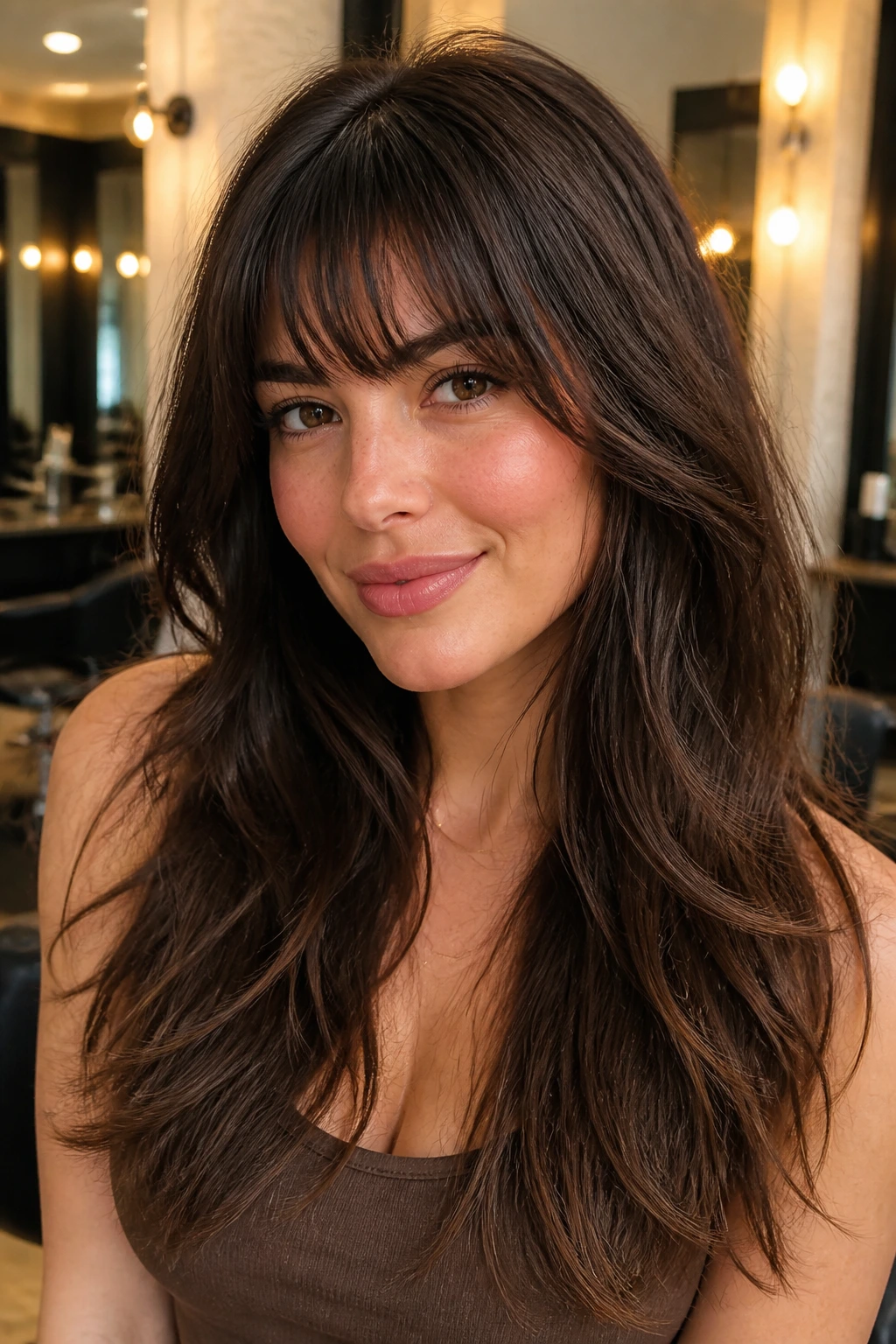
The Softer Salon Version: Keep every front piece a little longer and ask for minimal texturizing. This is the one to choose if you want movement but do not want the haircut to look choppy.
The Edgier Texture Version: Pair long layers with a shaggier finish and more separation around the bangs. It works best on wavy or slightly coarse hair that naturally holds piecey texture.
The Polished Blowout Version: Ask for longer face-framing layers and a smoother fringe that can be rolled with a round brush. This one looks strongest on straight hair or hair that blows out easily.
The Curl-Friendly Version: Keep the layers longer than you think and cut the fringe with shrinkage in mind. Curly hair needs room to spring, or it ends up too short at the center.
The Low-Maintenance Version: Choose longer bangs that can be tucked behind the ears and layers that start below the chin. The grow-out is kinder, and the cut stays wearable longer between trims.
Keeping the Shape Fresh Between Haircuts
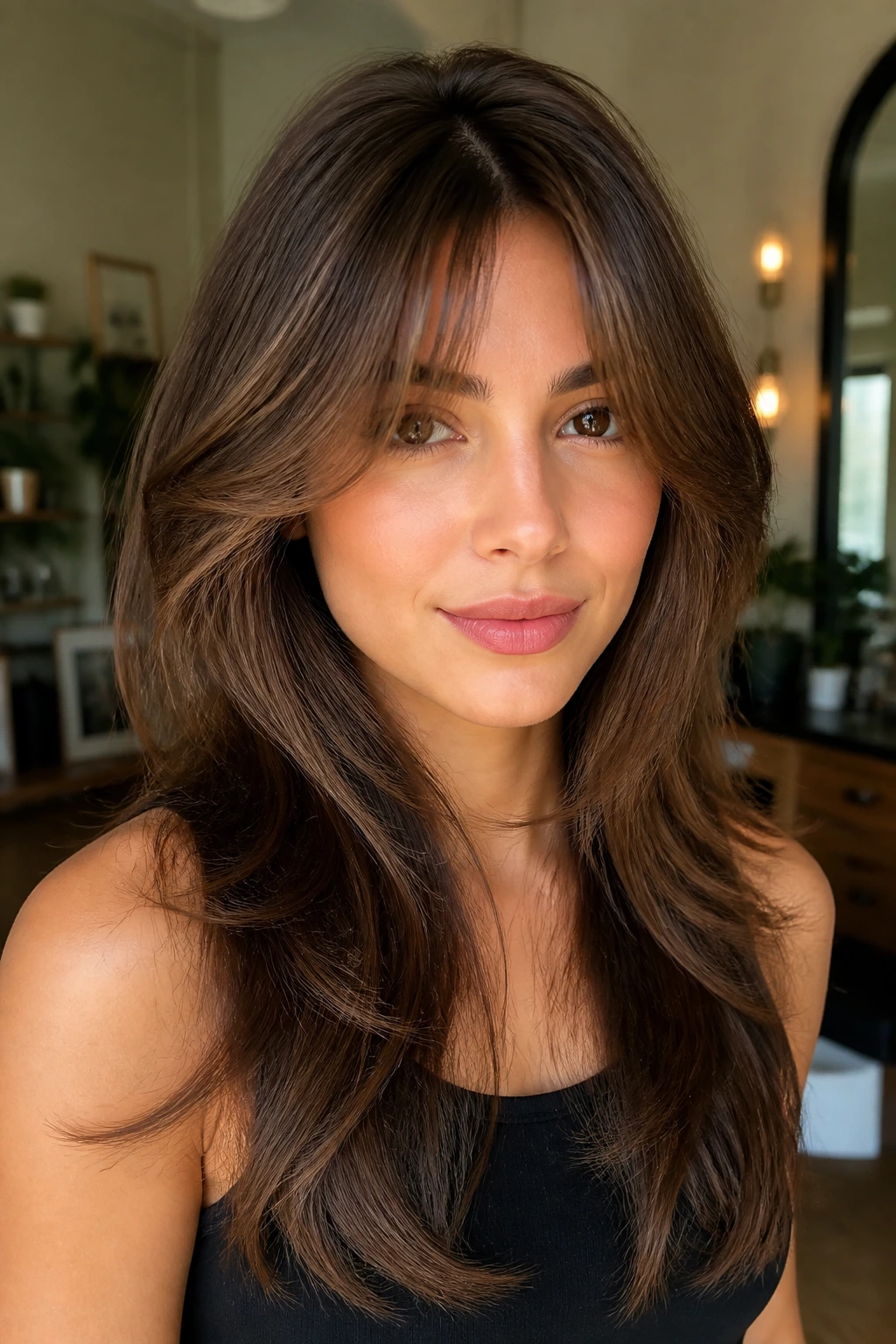
The fringe is the part that asks for the most attention. If you wear bangs straight, expect a trim every 3 to 5 weeks. Longer curtain bangs can stretch farther, sometimes 6 to 8 weeks, if you don’t mind a little extra length around the eyes.
The layers usually need a light dusting every 8 to 12 weeks to keep the shape from sagging. Thick hair may need a cleanup a little sooner if the front starts piling up at the cheekbones. Curly hair can go longer, but the shape still benefits from a check-in before the ends lose their movement.
At home, do not pile heavy cream into the fringe. That’s how bangs separate into greasy little ropes. Use product on the mids and ends, then keep the front light. If your bangs get sweaty or flat during the day, a tiny bit of dry shampoo at the roots and a quick brush-through is better than re-washing the whole head. And if you sleep badly on them? Clip the fringe loosely or set it on a soft roller for a few minutes in the morning.
Humidity can make the front pieces swell. In that case, a pea-sized amount of smoothing cream on the very ends — not the roots — keeps the shape from exploding.
Questions People Ask Before Sitting in the Chair
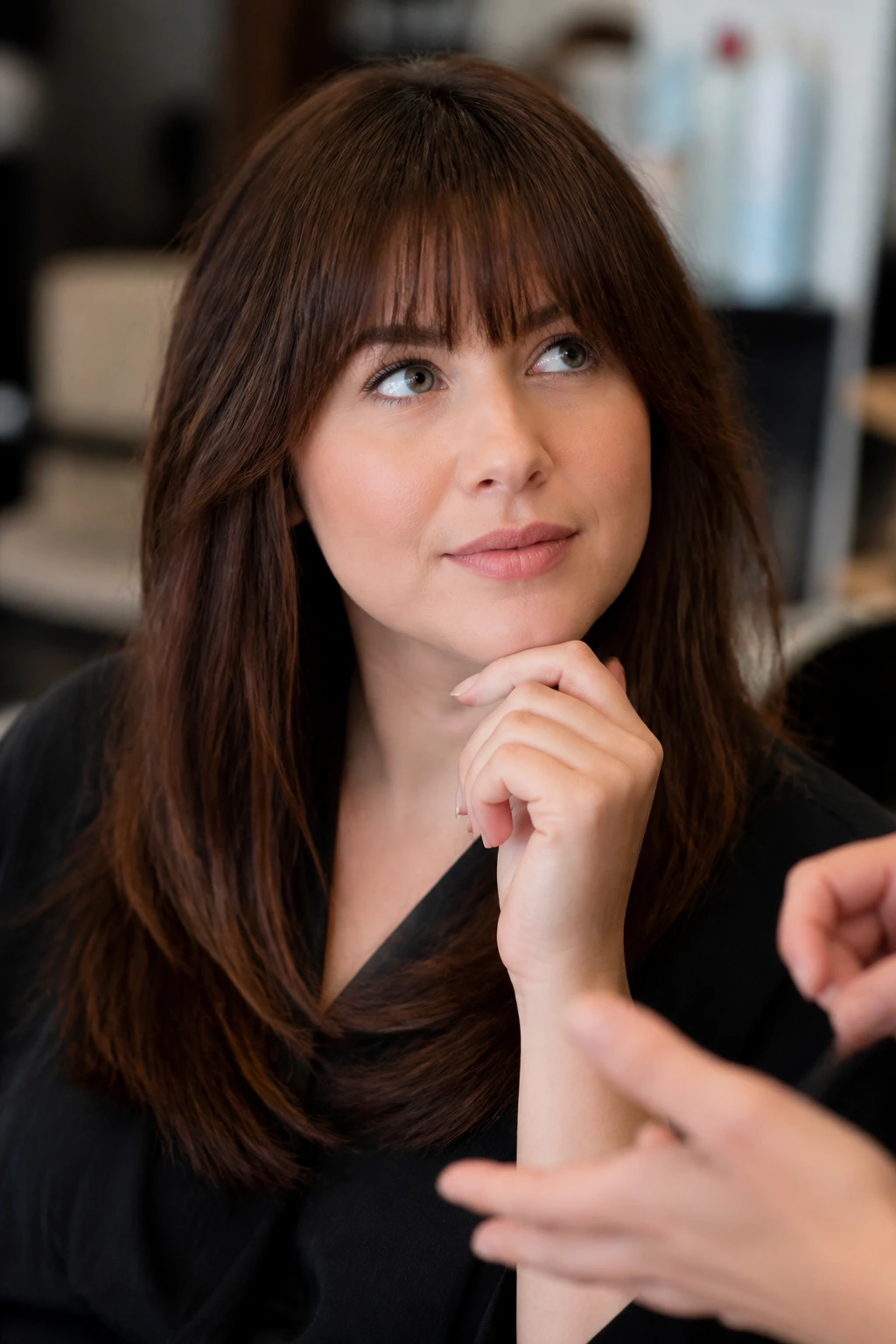
Do bangs make a round face look wider?
They can, if the fringe is short and blunt or sits directly across the widest point of the face. Longer bangs that split, sweep, or break around the cheeks usually do the opposite.
Are curtain bangs the safest choice for a round face?
They are one of the safest choices, yes, because they open through the center and frame the face from the sides. Still, the length matters. Too short, and they can puff at the cheeks.
Can I get long layers if my hair is fine?
Yes, but keep the layering subtle. Fine hair needs enough length to hold density, or it starts to look stringy. A wispy fringe and soft front pieces usually work better than heavy texturizing.
What if my hair is thick and puffy?
Then the cut should remove weight in the right places, not just add layers everywhere. Ask for internal debulking and a longer face frame so the sides don’t balloon.
Do side parts help a round face more than center parts?
Often, yes, because they create a diagonal line that breaks the width of the face. That said, a center part can still work if the front pieces start low enough and stay soft around the cheeks.
How do I handle a cowlick in my bangs?
Tell your stylist before the cut. A cowlick usually needs a little extra length and a strategic part, or the fringe will split in the wrong direction every time you wash it.
Will these styles work with curly hair?
They will if the cut respects shrinkage and the bang length is left longer than the wet shape suggests. Curly fringe needs patience, not optimism. Very different thing.
What should I ask for if I want the haircut to grow out gracefully?
Ask for bangs that can be parted and tucked, plus front layers that hit below the cheekbone or near the collarbone. Those two choices buy you a lot more grow-out time.
The Shape That Keeps Paying Off
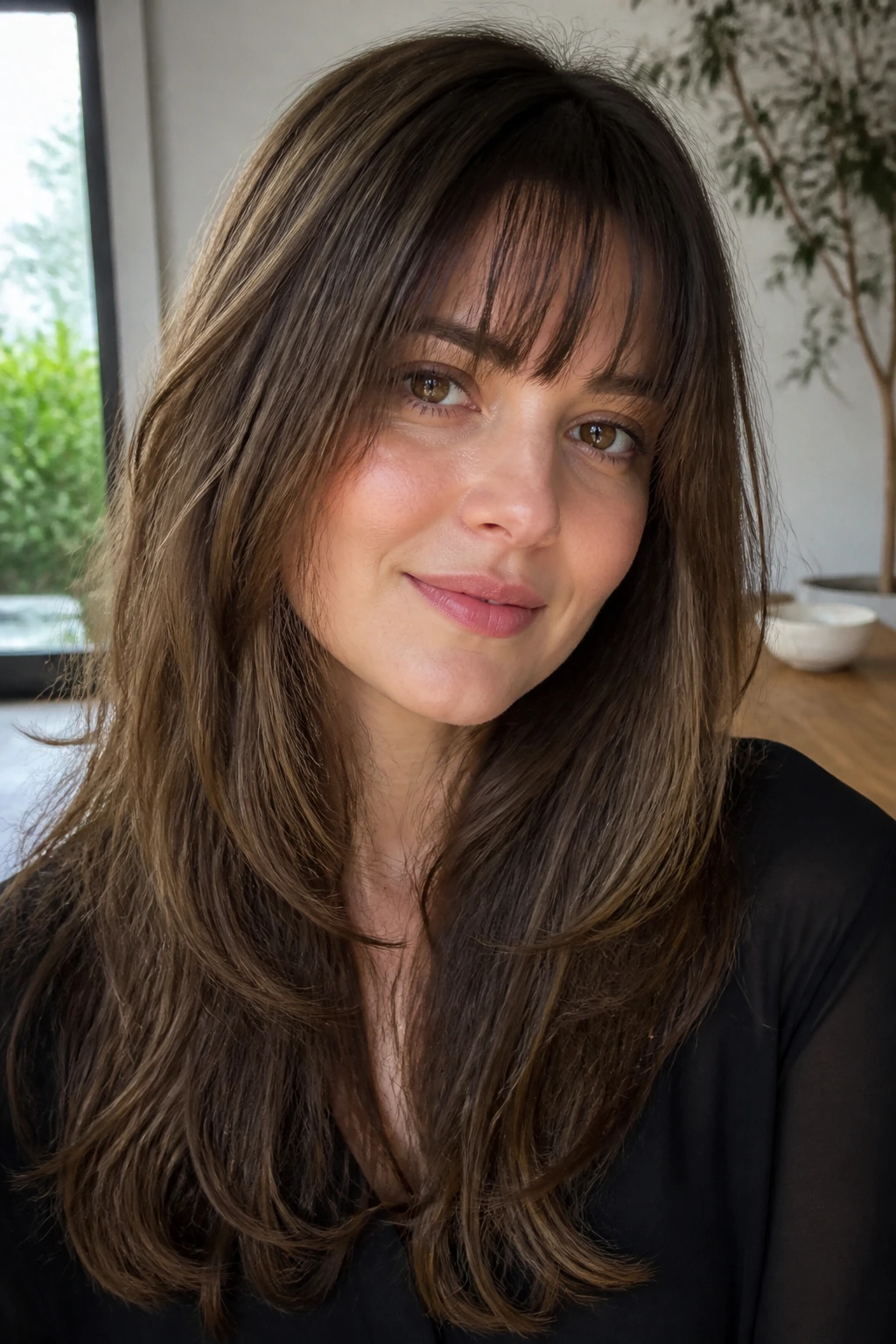
A good round-face haircut does not try to fight your face. It frames it with better angles. That is why long layers and bangs work so well when the front pieces are cut with purpose and the fringe stays soft enough to move.
The styles above prove there is no single answer. Some are sleek, some are messy, some are polished, and some are built for curls that do their own thing no matter what the brush says. The useful part is the same in all of them: keep the line long, keep the front pieces below the widest point, and let the bangs open the face instead of pinning it down.
If you walk into the salon with that in mind, the photo inspiration gets a lot easier to sort. And your hair? It has a much better shot at doing exactly what you wanted without a long argument in the bathroom mirror.