



Grey bobs for fine hair and round faces work best when the cut does the heavy lifting. A good bob does not just sit there and behave; it changes the way your hair falls, how your cheek line reads, and whether the whole style looks airy or dense. Get the line wrong and fine hair can go soft in the worst way. Get it right and the shape does half your styling for you.
Grey hair adds another layer. Silver strands can look gorgeous, but they also show weight, width, and movement in a more honest way than darker hair does. That means a bob with too many thin, feathery layers can vanish fast, while a clean perimeter, a smart part, or a little internal support can make the whole haircut look fuller without turning it into a helmet.
Round faces change the rules too. You usually want some visual length, some angle, and a bit of space around the widest part of the cheeks. Nothing fussy. Nothing stiff. Just enough structure that the eye keeps moving downward instead of stopping at the middle of the face.
Why These Grey Bobs Work So Well for Fine Hair and Round Faces
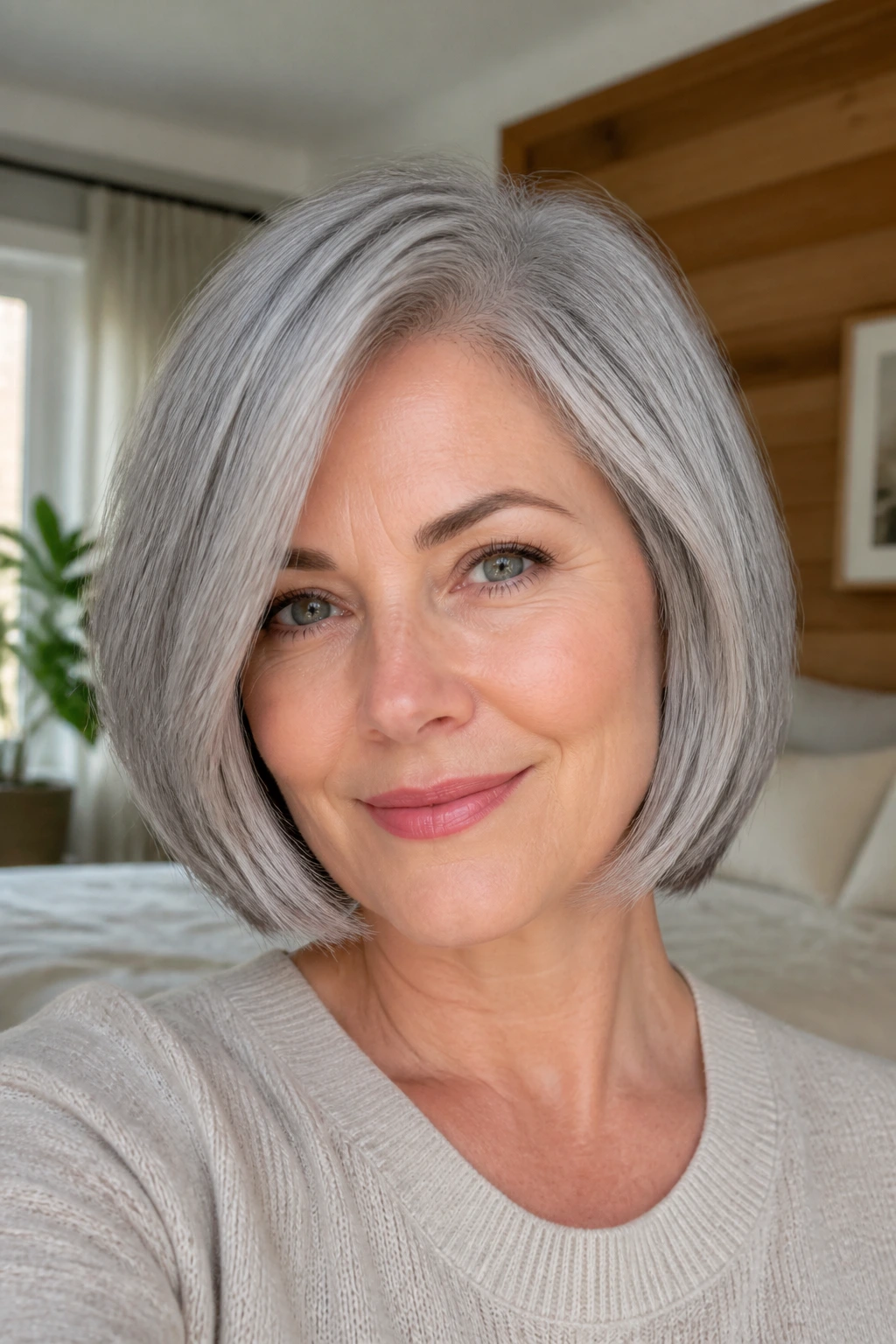
- They build the illusion of density: A blunt edge, beveled line, or tight graduation gives fine hair a stronger outline, so the ends look fuller instead of see-through.
- They lengthen the face without adding bulk: The best versions avoid sitting right at the fullest part of the cheeks, which keeps a round face from looking wider.
- They make grey hair look intentional: Silver, ash, and charcoal tones can go flat fast; a sharp cut keeps the color from reading dull or stringy.
- They style well with modest effort: A root-lift spray, a small round brush, and a quick bend at the ends can change the whole shape.
- They leave room for personality: Some can be sleek and polished, some airy and piecey, some soft and French-inspired. The basic structure stays friendly to fine hair either way.
- They work across ages and wardrobes: A grey bob can look crisp with a white shirt, a black sweater, or a leather jacket without needing a lot of extra styling drama.
1. Blunt Chin-Length Silver Bob
A blunt chin-length bob is the haircut that remembers fine hair needs a backbone. The clean hem makes the ends look thicker right away, and the length stops before the style gets dragged down by too much weight. On a round face, the key is placement: let the front skim the jaw, not the cheekbone.
A deep side part helps here. It breaks the circle of the face and gives the crown a little lift, which is the part fine hair usually loses first. I like this version best when the silver tone is bright and slightly cool, because the sharp line and the icy color play off each other instead of fighting.
Why it flatters round faces
The jawline becomes the visual anchor. That matters more than people think. A bob that lands right at the chin can frame the face nicely, but only if the front pieces are crisp and not puffed out with too much round brushing.
Best styling note: keep the ends straight or only softly tucked under. If they curl outward, the whole cut gets wider.
2. Softly Stacked Ash-Silver Bob
A softly stacked bob gives fine hair lift at the back without turning the silhouette into a mushroom. That’s the trick. You want a little graduation through the nape, just enough to push the crown up and create a cleaner slope toward the front.
Ash-silver tones suit this shape because the cut already has movement. The color doesn’t need to do extra work. Ask for a stack that is subtle, not severe, and keep the front a touch longer so a round face gets some vertical line through the sides.
The best part is how fast it wakes up with a brush and dryer. A few sweeps at the crown, a bend through the mid-lengths, and it goes from flat to lifted in minutes. No fancy routine. No sticky product cake.
3. Collarbone Grey Lob With Long Face-Framing Pieces

When a chin-length bob feels too tight, a collarbone lob gives fine hair room to breathe. The extra length creates a sleeker fall, and long face-framing pieces can start below the cheekbone, which is a smart place for a round face because it keeps the width from sitting right at the face’s fullest point.
This cut is also kind to grey hair that has gone a little wiry. The longer length lets the hair swing instead of springing out in odd directions. Ask for a soft bevel at the ends rather than a blunt shelf if your hair is thin and skims close to the scalp.
Good for: women who want movement more than volume.
Skip if: your hair is so fine that anything below the collarbone gets wispy fast. Then the shorter bobs on this list will carry more shape.
4. French Bob With a Soft Fringe

A French bob can be gorgeous on round faces, but only if the fringe is handled with care. I would not go for a heavy, short baby fringe here. That can make the face look shorter and wider. A soft, eyebrow-skimming fringe with a little separation is much kinder.
The body of the cut stays compact, usually around the jaw, which gives fine hair a neat perimeter. Grey tones bring out the texture in the fringe, so the hair doesn’t need to be perfectly uniform. In fact, a little bend in the bangs makes the whole thing feel less stiff.
This one has attitude, but not in a loud way. It looks especially good with black glasses, a knit top, or anything that leans a bit art-school without trying too hard.
5. Angled A-Line Bob
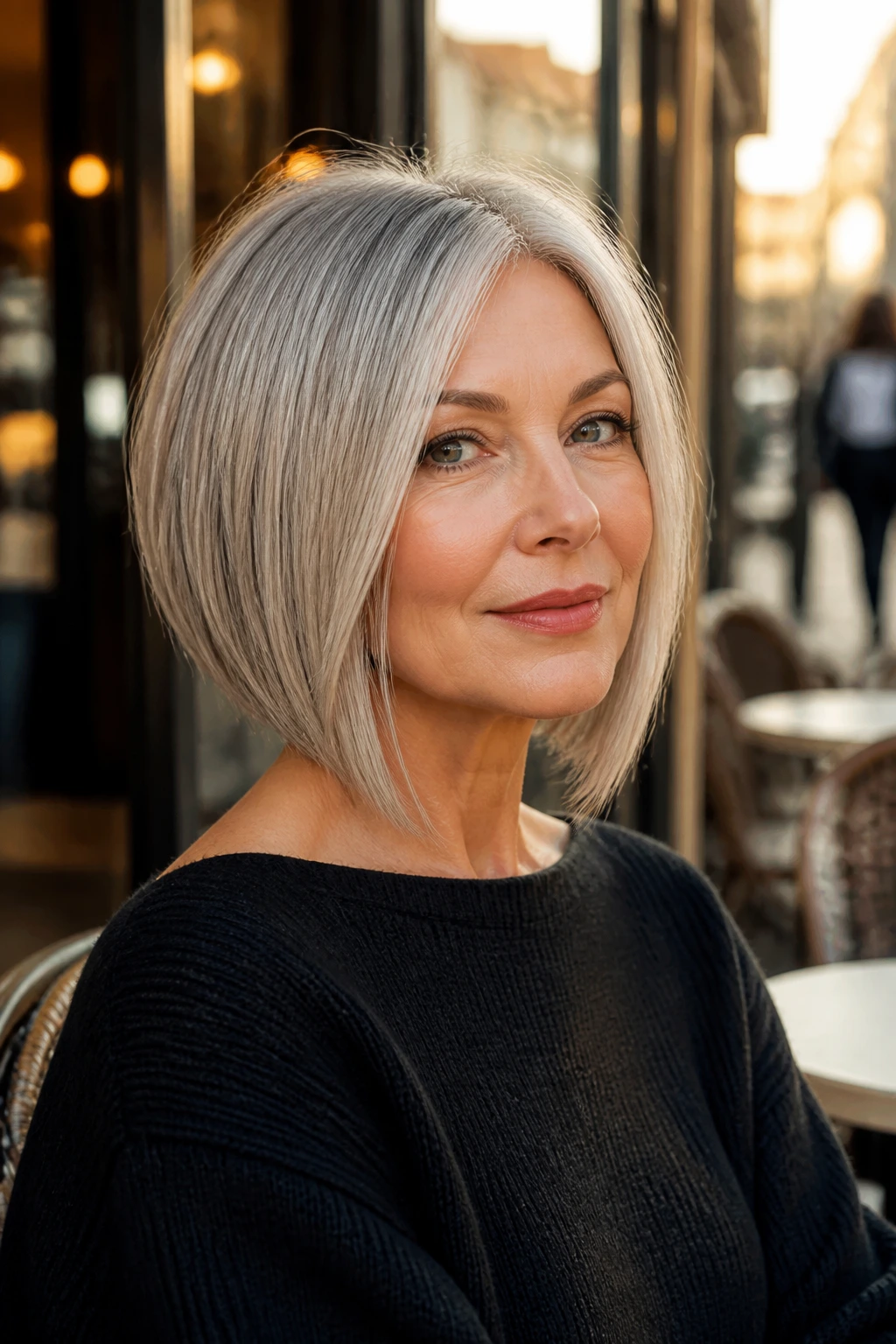
An A-line bob is one of the most reliable shapes for a round face because it moves the eye forward and down. Shorter at the back, longer in the front. That diagonal line matters. It creates length where fine hair often needs it most, especially if the sides tend to collapse into the cheeks.
The angle does not have to be sharp. A gentle A-line is often better for grey hair, because the softer transition keeps the cut from looking severe. Ask for the front to drop just past the jaw so the face gets a narrow visual frame rather than a box.
The look is strongest when the ends are kept smooth. A tiny bit of bevel through the front is enough. Too much curling under and the geometry starts to blur.
6. Choppy Textured Bob With Invisible Layers

This is the bob for people who want movement but hate the look of obvious layers. Invisible layers are cut inside the shape, not on the surface, so the perimeter still reads full. That matters a lot for fine hair, because surface layers can thin the whole cut out fast.
The texture gives grey hair a little separation, which keeps it from lying flat and dense in a dull way. You get bend, not fluff. On a round face, the choppiness works best if the longest pieces graze below the cheekbone and the shortest pieces stay away from the widest part of the face.
A mist of texture spray and a quick finger-rake is usually enough. If your hair looks best with some edge, this is the bob. If you want polished and tidy, keep scrolling.
7. Deep Side-Part Root-Lift Bob

A deep side part changes everything. Seriously. It lifts the crown, breaks the symmetry of a round face, and makes fine hair look like it has more natural body than it actually does. The cut itself can stay simple, which is nice because the styling does most of the visual work.
Ask for a bob that sits between the jaw and the top of the neck, with a slight bevel toward the front. Then train it with a root-lift spray at the part and a round brush only at the roots. The lengths do not need much heat. They need direction.
This one has a bit of old Hollywood logic to it. Not the big waves. The structure. And that’s why it keeps showing up in flattering bob lists: the part does the slimming, the cut does the densifying, and fine hair gets to pretend it has more business going on than it does.
8. Beveled Jaw-Length Bob

A beveled bob is all about the ends folding inward just enough to make the haircut look finished. On fine hair, that soft tuck creates a thicker edge than a dead-straight line sometimes can. On a round face, it keeps the silhouette close to the jaw instead of ballooning out from it.
The bevel should be subtle. If it curls too much, the cut can widen at the bottom and add width where you do not want it. I like this shape best with a side part and smooth crown volume, because the combination gives the face a little lift without forcing the hair into a stiff shape.
What to ask for at the salon
- A jaw-length perimeter
- Light internal support, not choppy surface layers
- Ends cut to fold slightly under when blow-dried
- Front pieces left a touch longer than the center back
That last part matters. It keeps the face from feeling boxed in.
9. Curtain-Bang Grey Bob
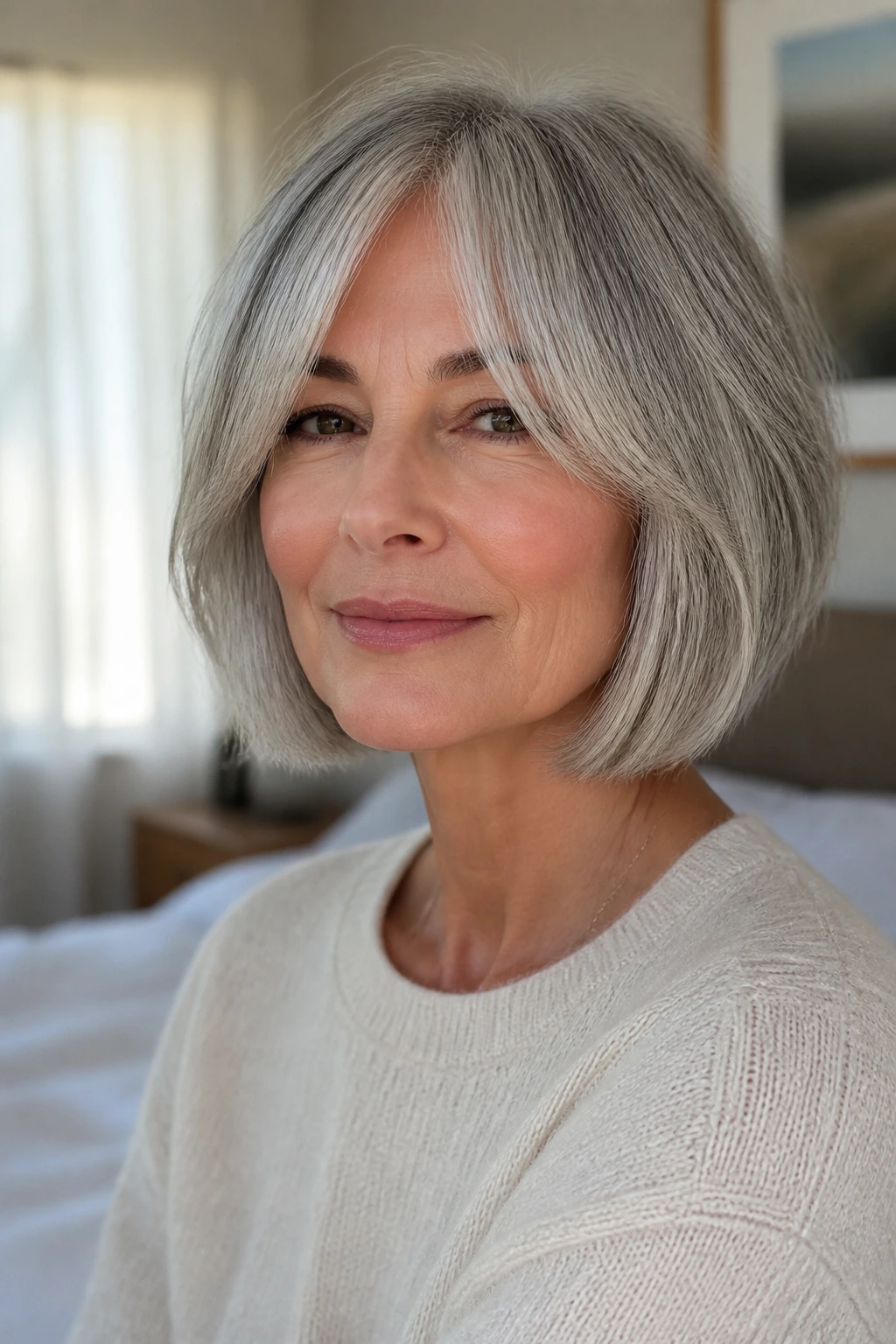
Curtain bangs are one of the easiest ways to make a round face look a bit longer without hiding it under heavy fringe. Split bangs open the center, then sweep down beside the cheekbones. That opening in the middle matters. It keeps the forehead from disappearing and gives the face a vertical line.
For fine hair, the bob underneath should stay light but not sparse. Think clean shape, not overly layered fluff. Grey hair looks especially nice here because the fringe catches the light in soft streaks, which keeps the whole style from feeling too hard.
This cut works with a loose blow-dry, a round brush, and about thirty seconds of setting the fringe each morning. If you like a style that can look casual one day and polished the next, this one earns its keep.
10. Wavy Silver Bob
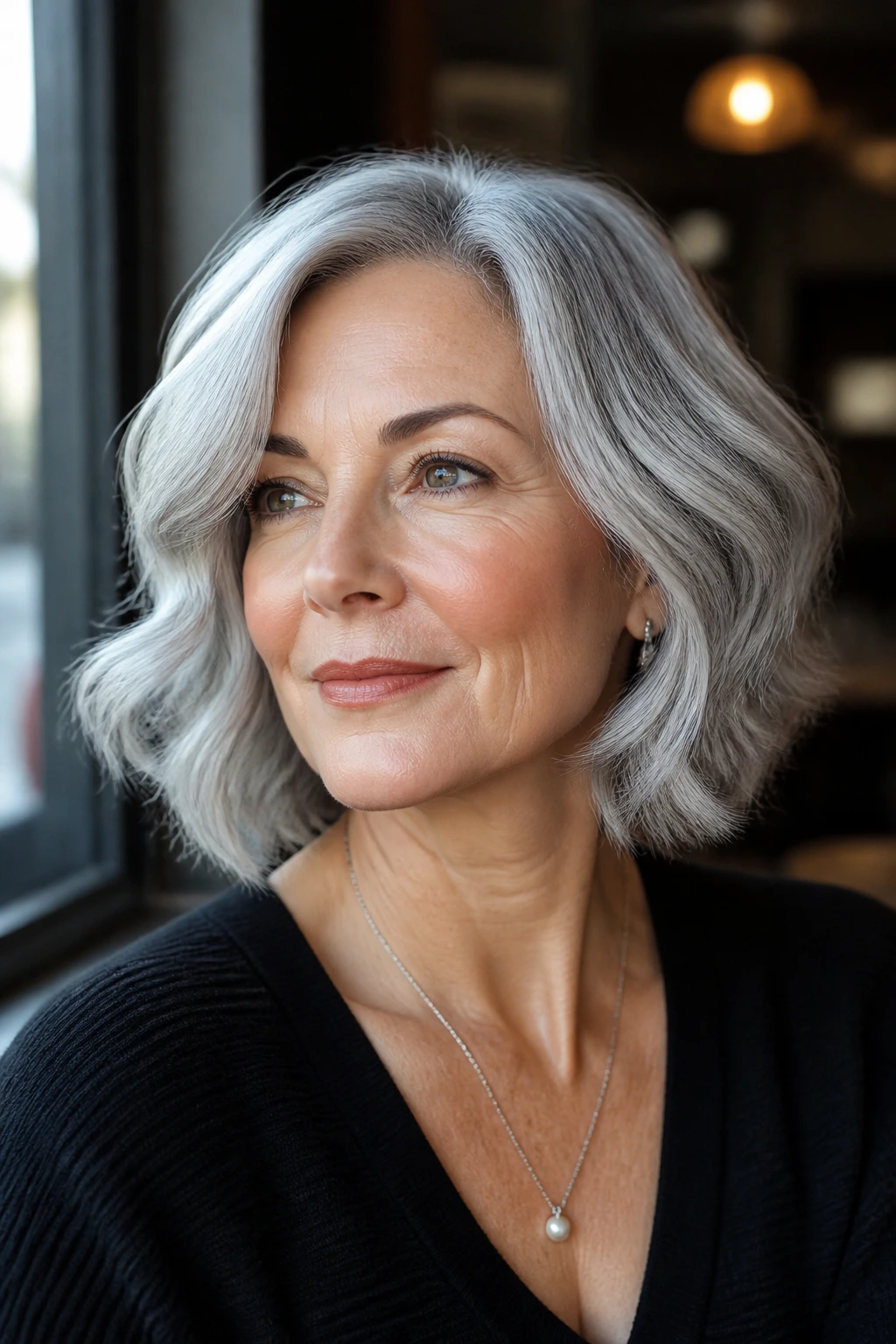
A wavy silver bob needs a lighter hand than people expect. The wave should look like bend, not curl. Too much curl can widen the face; a soft S-shape keeps the hair moving vertically and gives fine strands some texture without puffing them up.
A 1-inch iron or a flat iron used in small turns works well, but only on the mid-lengths and ends. Leave the roots smoother. That contrast keeps the crown from getting bulky. On round faces, the longest point should sit below the cheekbone so the wave falls down, not out.
This style looks best when it is a little undone. That does not mean messy. It means the shape has looseness, a bit of air between strands, and enough shine that the grey reads as deliberate, not faded.
11. Asymmetrical Smoke Bob

One side a little longer. One line a little more dramatic. That asymmetry gives a round face a sharper visual angle, which is exactly what can help when the face shape is naturally soft. Fine hair likes it too, because the stronger diagonal makes the haircut feel intentional even if the hair is not packed with density.
The smoke-grey color works well here because the darker shadow at the roots and the lighter silver through the ends emphasize the difference between the two sides. You do not need a wild asymmetrical cut. Even a small shift of half an inch to one side can change the read.
This bob feels modern without being loud. If a blunt chin cut is too neat for you and a shag is too messy, this sits right in the middle.
12. Stacked Pixie-Bob Hybrid
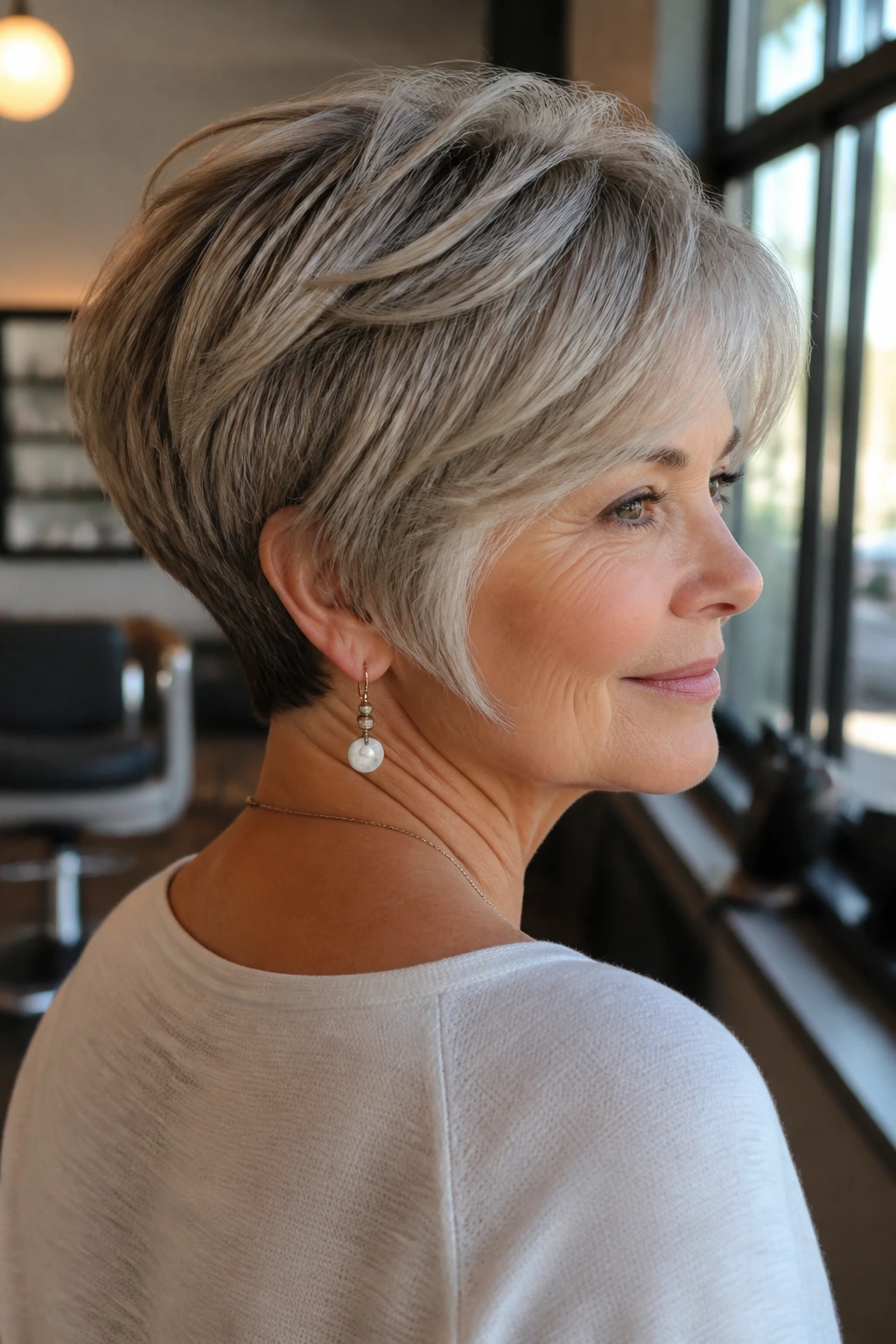
This is for the person who wants a shorter, livelier shape with more lift at the back. A stacked pixie-bob gives the nape a close, tucked feel while leaving enough length at the top and front to soften a round face. Fine hair usually loves this because the shorter back builds height where the crown often goes limp.
The caveat is simple: do not over-stack it. Too much graduation can make the sides puff out, and then the whole thing starts to widen the face instead of narrowing it. Keep the front pieces a little longer and let them sweep forward softly.
This one has energy. It reads neat, cool, and a bit sharper than the softer bobs on this list. If you like a haircut that shows off earrings and necklines, it’s a strong pick.
13. Feathered Pearl Bob

A feathered bob can go wrong fast on fine hair if the feathers are too wispy. The better version keeps the perimeter intact and just softens the interior so the cut moves without losing weight. Pearl-grey tones are lovely here because they give the layers a soft sheen instead of a harsh contrast.
The face-framing should stay low and quiet. Think cheekbone to jaw, not short pieces exploding near the eyes. That placement keeps the round face from getting wider at the middle. Blow-dry with a medium round brush and lift only at the roots.
It feels softer than a blunt bob, but not flimsy. That balance is the whole point. Fine hair needs structure first, decoration second.
14. Glass-Sleek Graphite Bob
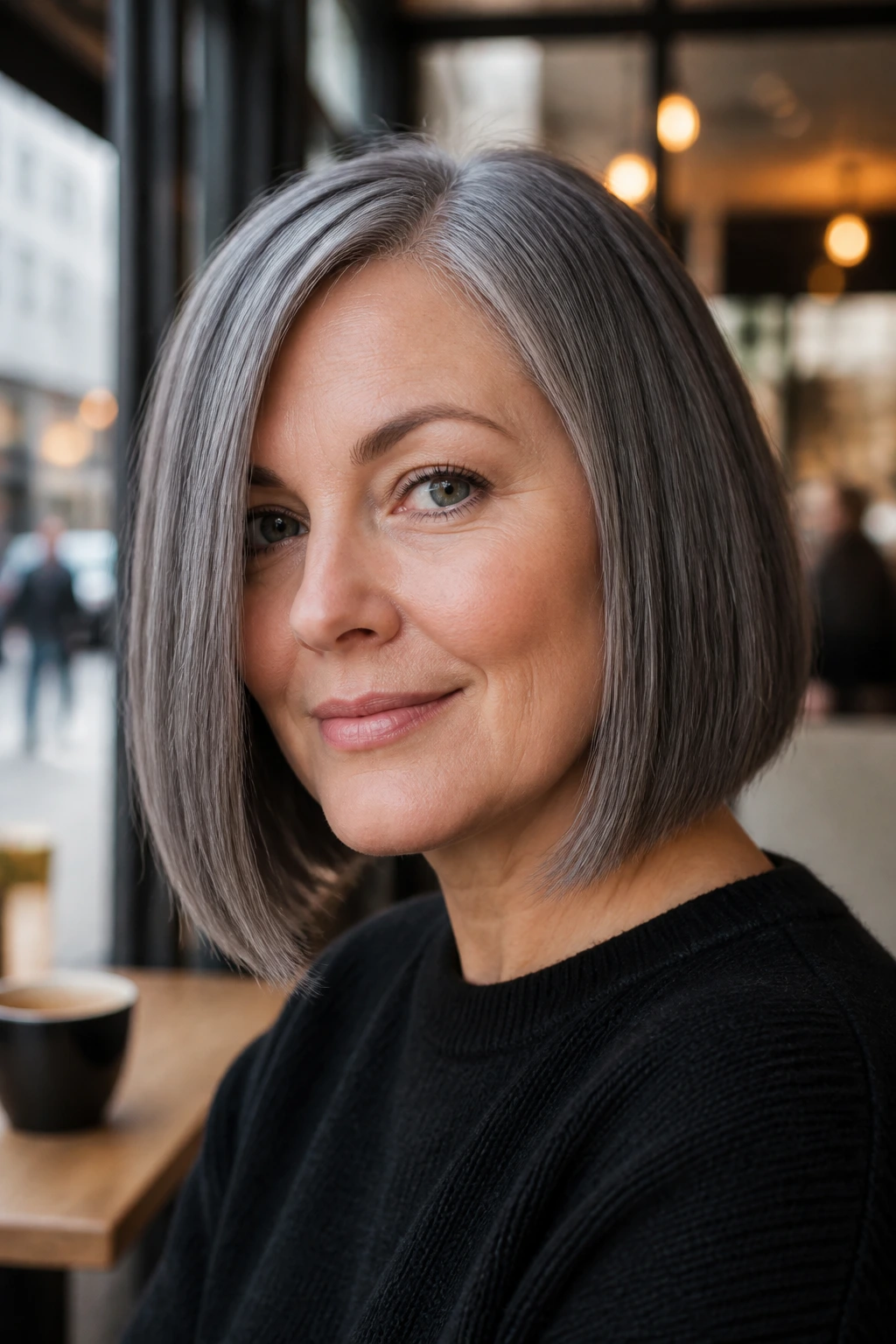
If your hair is naturally straight or only slightly bendy, a glassy bob can look stunning on fine hair because it turns lack of bulk into elegance. The sleek finish makes the edges look precise, and graphite-grey color adds depth so the shape doesn’t wash out in bright light.
A round face benefits when the length hangs just below the jaw and the part is off-center. The straight line should not hit the cheeks square on. Keep the ends polished with a heat protectant and a small amount of serum only on the final inch or two. Too much product and the hair separates into thin, shiny strings. Not the goal.
This cut is proof that fine hair does not always need volume tricks. Sometimes the clean line is the point.
15. Crown-Boost Side-Swept Bob

A side-swept bob with extra crown lift is a quiet cheat code for round faces. The front sweeps away from the face, the crown rises, and the overall shape feels taller without looking teased. Fine hair usually responds well to this because the lift is targeted, not sprayed everywhere.
The trick is in the blow-dry. Use a root-lift mousse, then dry the hair in the opposite direction of the part for the first few minutes. Switch sides once the roots have memory. That little reset gives the top more stand. Keep the ends smooth so the haircut still looks sharp.
It’s not a fussy style, but it rewards a bit of care. The shape looks especially good with glasses because the sweep gives the frames room instead of competing with them.
16. Bottleneck Bang Grey Bob
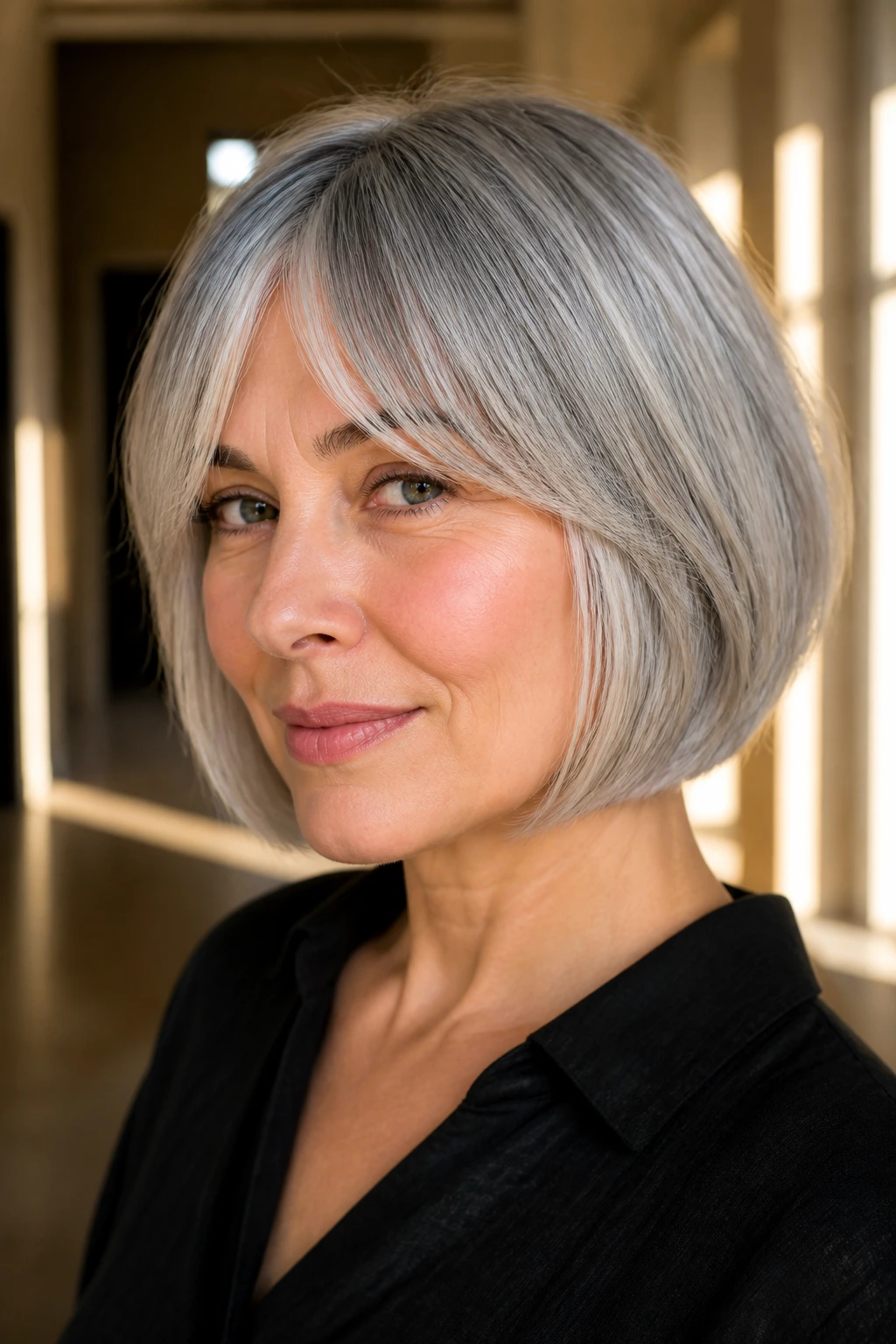
Bottleneck bangs are softer than blunt fringe and more controlled than curtain bangs. They start narrow in the center, then widen as they move toward the temples. For a round face, that shape creates a gentle frame without cutting straight across the widest part of the cheeks.
The bob underneath should be clean and compact, usually at the jaw or just below it. Fine hair likes the visual weight of the fringe because it adds interest up top, while the bob itself stays tidy. Grey hair also shows this fringe shape nicely; the blend of lighter and darker strands gives the bang texture without needing heavy styling.
This is a smart choice if you want bangs but fear commitment. They grow out better than blunt fringe, and they usually need less daily fuss than people expect.
17. Inverted Steel Bob
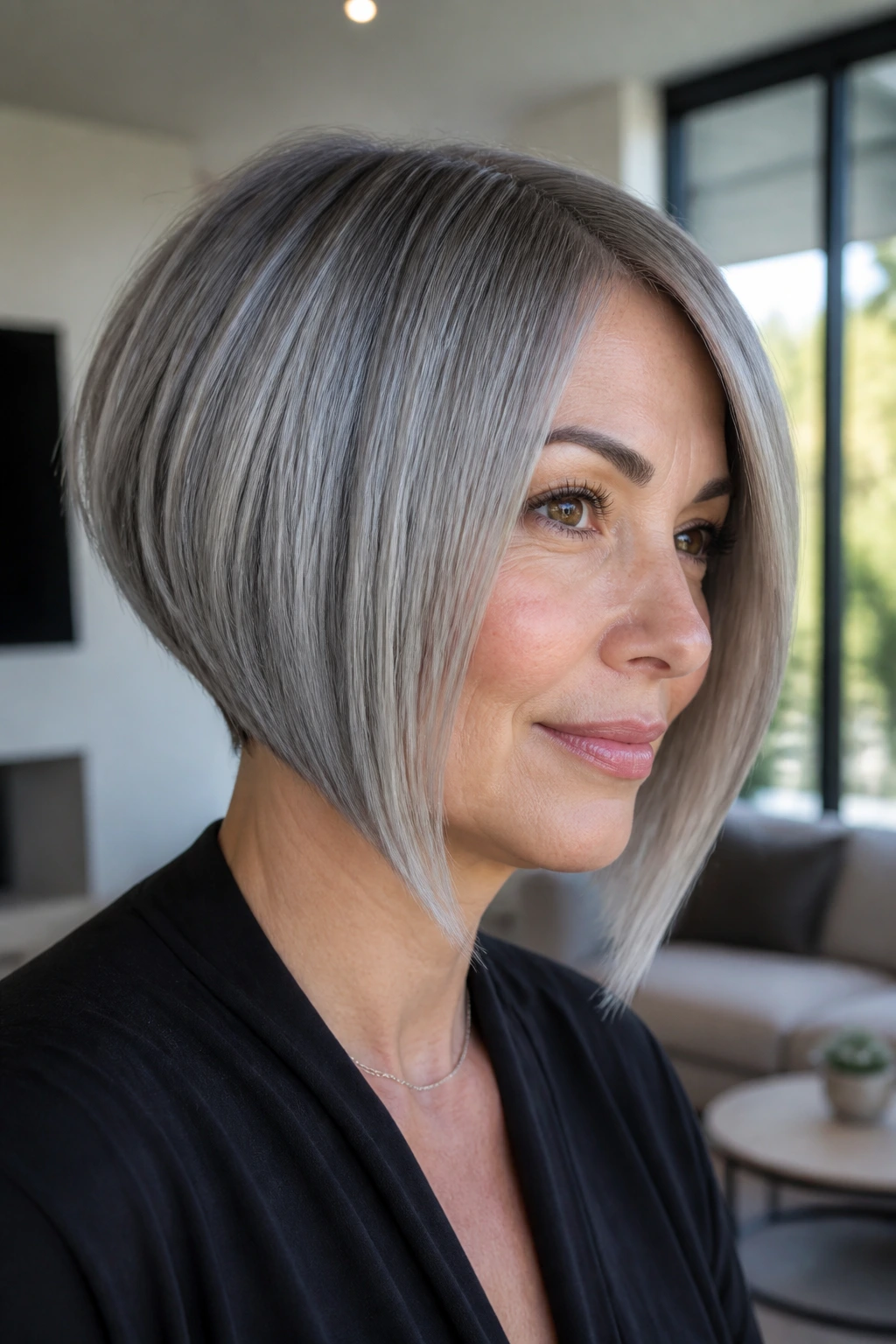
An inverted bob has a stronger front-to-back slope than a softly stacked version, and that angle can be flattering on round faces when the front pieces fall noticeably longer. The back stays compact, which helps fine hair hold its shape and keeps the silhouette from going boxy.
Steel-grey color suits the cut because the cool tone sharpens the line. That said, the cut should not be aggressive at the front. You want a clean slope, not an extreme wedge. A little curve toward the chin is enough to pull the eye downward.
This bob is one of those styles that looks more expensive when it is freshly trimmed. Once the nape starts to grow out, the shape loses its snap, so this is not a set-it-and-forget-it cut.
18. Tousled Air-Dry Bob
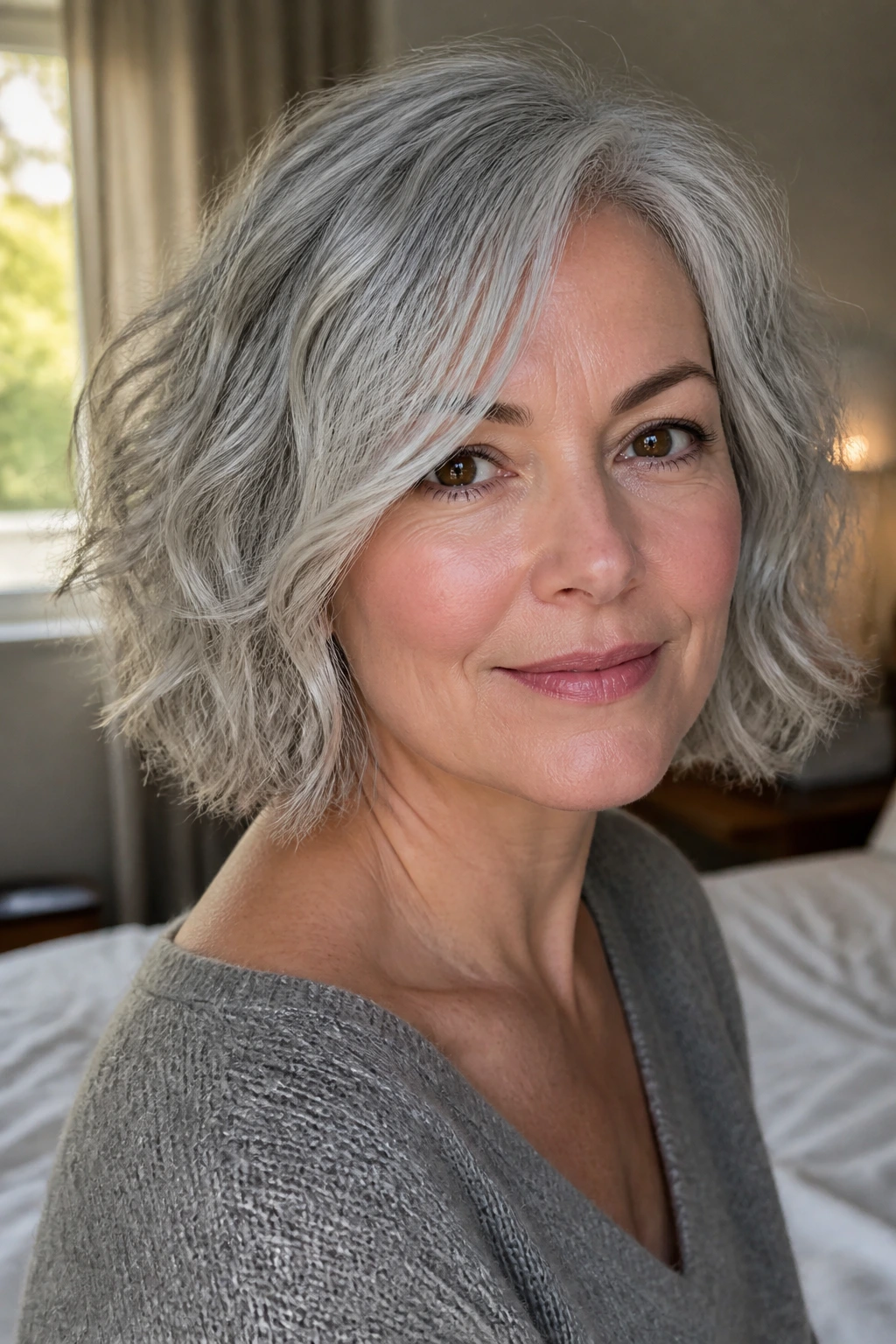
Not every fine-haired bob needs a blowout. If your hair has even a hint of bend, a tousled air-dry bob can be the most forgiving option in the bunch. The trick is to keep the cut controlled enough that the natural texture does not swell into width around the cheeks.
A little mousse, scrunched through damp hair, gives the silver strands separation. Then you let it dry without touching it much. On a round face, the length should stay below the cheekbones and the front should drape in a loose line rather than flipping out. That keeps the shape from opening sideways.
This is the bob for people who want texture without the salon-polished finish. It can look effortless, but only because the underlying cut is doing its job.
19. Retro Flipped-End Bob
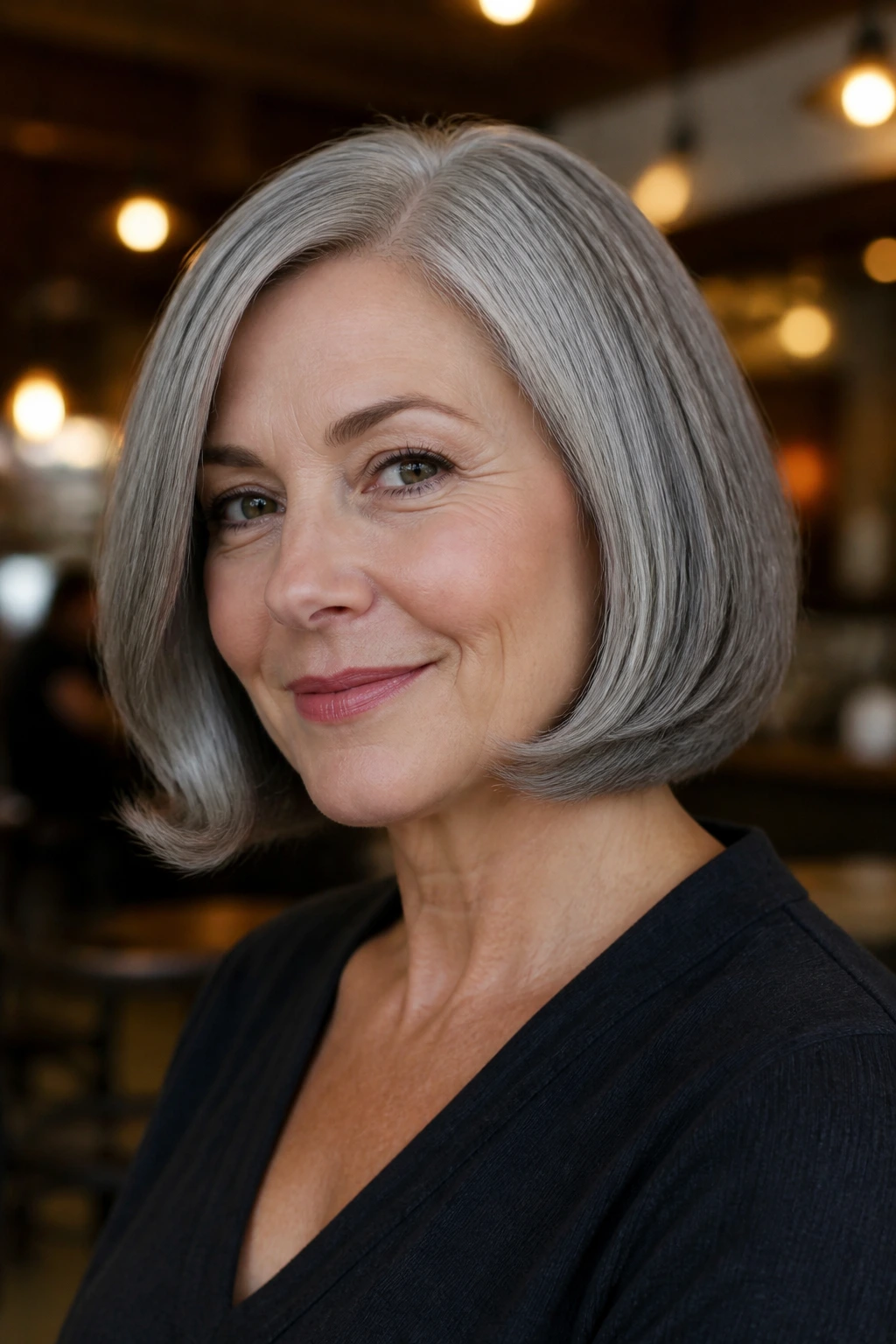
A retro flip sounds like a lot, but on fine hair it can be a clever way to create shape without teasing. The ends turn outward just a touch, which lifts the line away from the neck and gives the style some personality. The key is restraint. A tiny flip. Not a big bubble.
For round faces, the top should stay smooth and the flip should happen low, near the jaw or just below. That keeps the eye moving down rather than straight across the cheeks. Grey hair takes this look well because the flipped ends catch the light and make the cut read intentional instead of plain.
I like this style with a tidy side part and a clean lip or hoop earring. It has a little vintage energy, but not costume energy. That distinction matters.
20. Natural Wave Salt-Gray Bob

If your fine hair is also naturally wavy, do not fight it into a stiff shape. A salt-gray bob lets the wave stay in charge while the cut keeps the silhouette from expanding too much. The best version uses soft internal shaping and longer front pieces so the face gets length, not width.
A diffuser can help, but only on low heat and low air. High heat tends to separate fine waves too aggressively, and then you lose the soft curve you wanted. A creamier gray tone looks lovely with this cut because it amplifies the casual texture.
This one feels easy in the best sense. Not lazy. Easy. The hair has movement, the face gets some narrowing through the front, and the overall result looks lived-in rather than overworked.
21. Hidden-Layer Graduated Bob
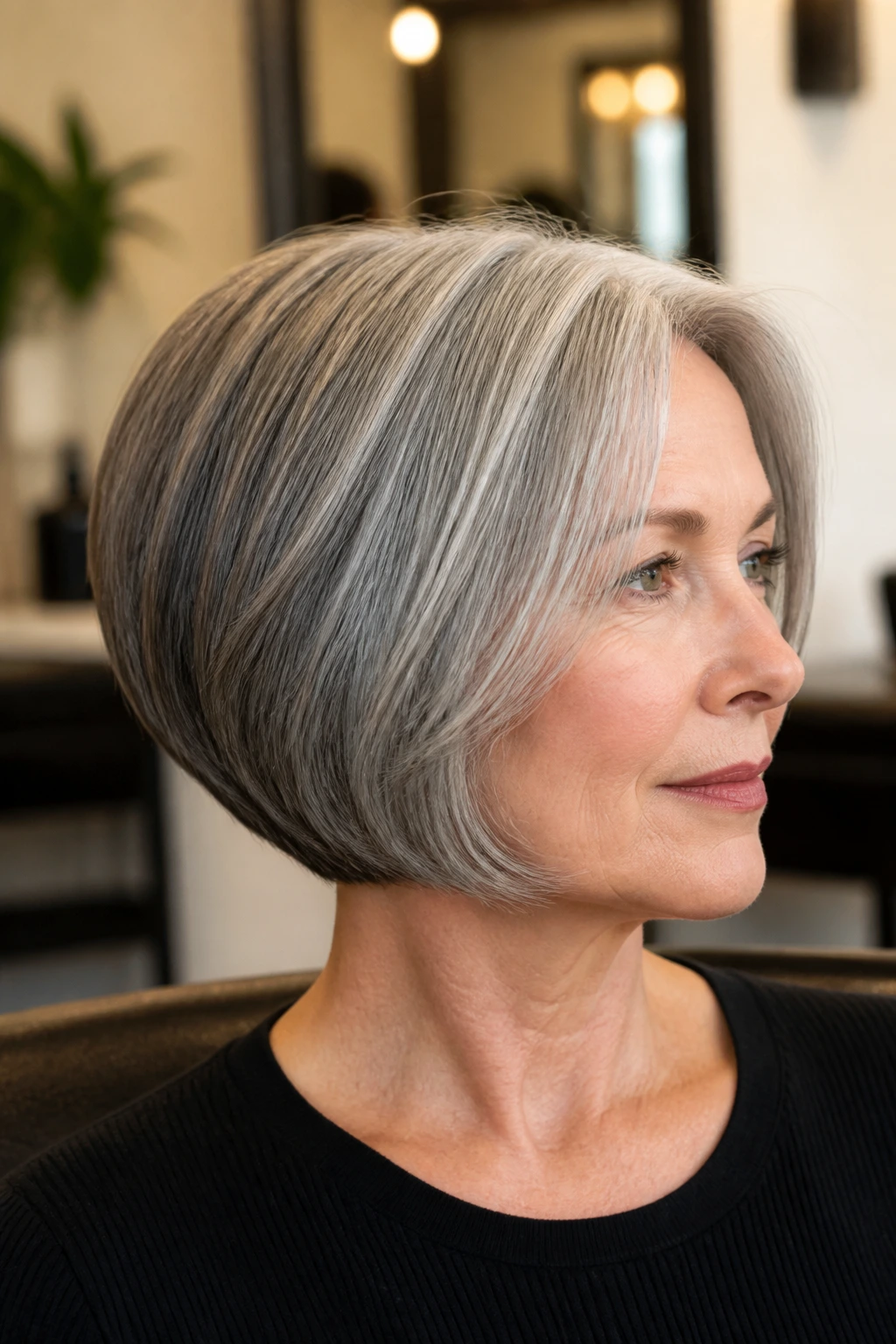
Hidden layers are the quiet workhorse of a great grey bob for fine hair. They add lift from underneath, where the eye does not see them, so the surface still looks full. That is a huge help for round faces because the cut can gain body without the side panels puffing out.
Ask the stylist to keep the perimeter strong and remove weight only inside the shape. That way the bob still looks thick at the edge, which is where thin hair often betrays itself. A neat side part or gentle off-center part works well here.
This is the haircut for someone who wants the best of both worlds: a clean outline and some movement under the surface. It is not flashy, but it lasts well between trims.
22. Long Center-Part Grey Lob
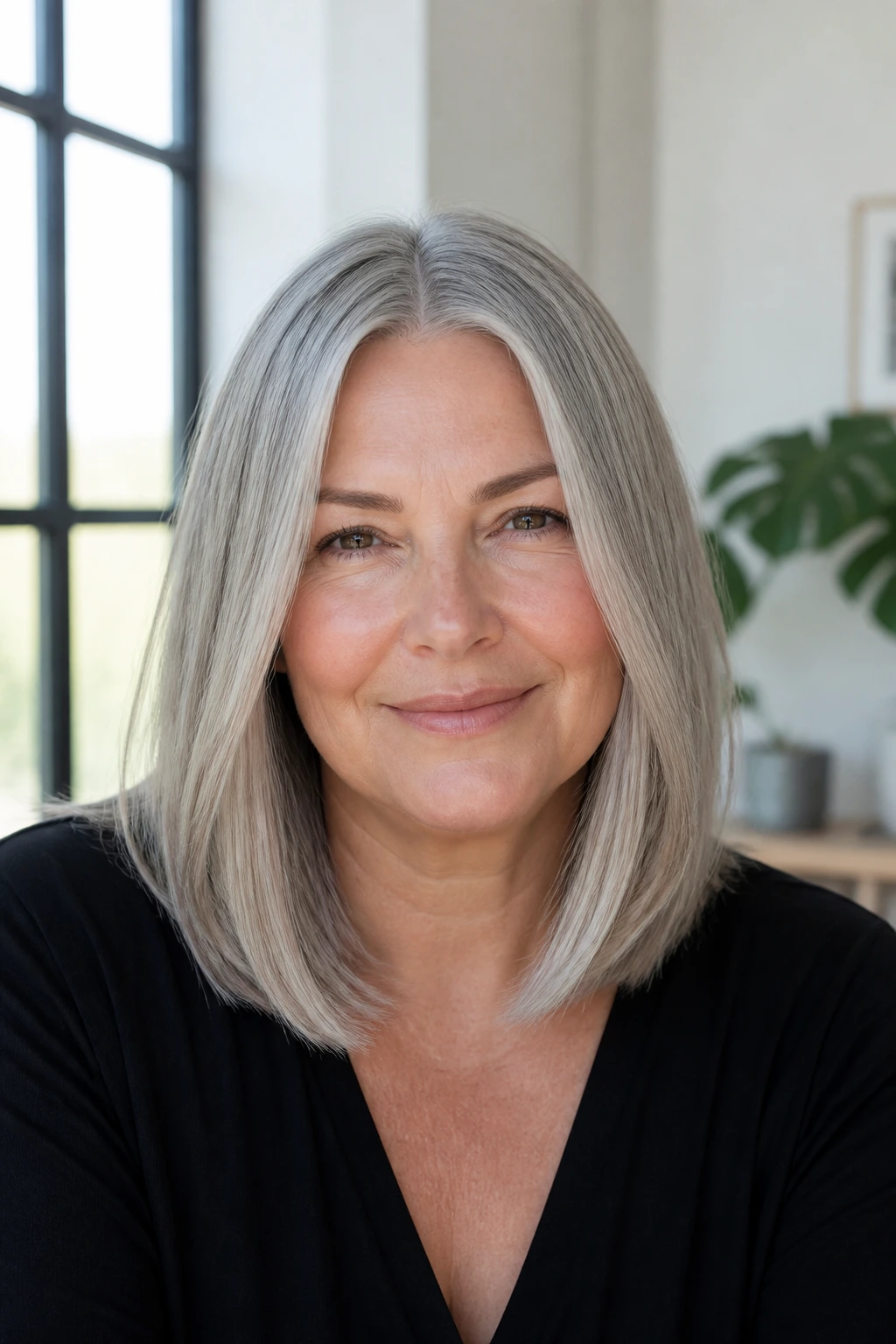
A center part is tricky on round faces, but a longer bob gives it room to work. The length matters. Once the cut reaches the collarbone, the part can create a nice vertical line without making the face feel wider. Fine hair benefits because the extra length lets the strands hang in one direction instead of puffing outward.
This cut looks best when the ends are lightly beveled or smoothed with a flat iron. Keep the center part crisp and let the front pieces start below the cheekbone. The grey color looks especially clean in this shape because the symmetry can show off the cool tones.
If you like minimal styling and a calm finish, this is a very good place to land. It is the bob version of a white shirt that fits properly.
23. Piecey Razor-Edge Bob
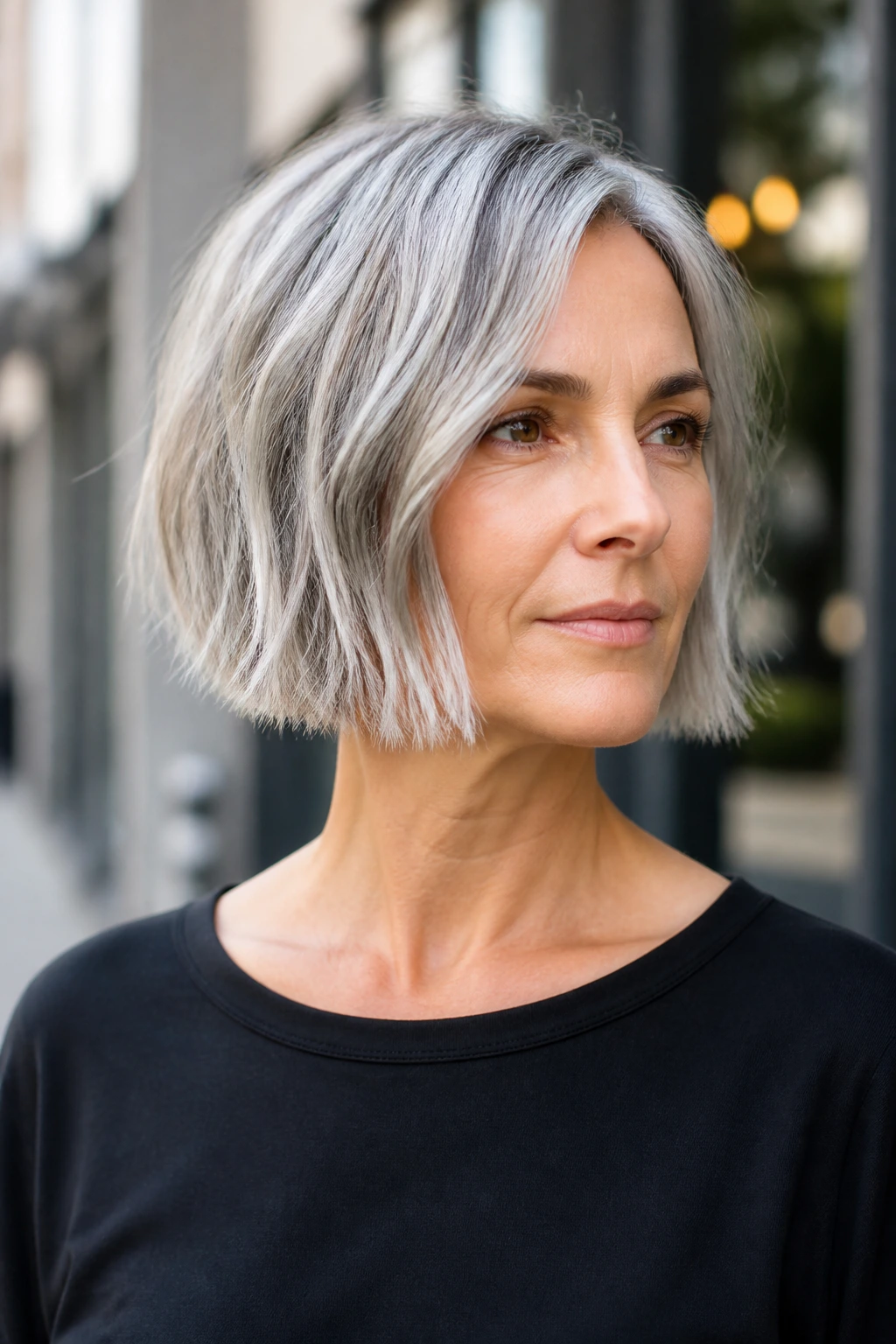
A razor-edge bob can add movement to fine hair, but it needs discipline. If the stylist thins too much, the cut can go stringy fast. Done well, the edge looks piecey and modern, with enough separation to keep grey strands from lying flat in one blank sheet.
The face shape rule still matters. Keep the longest pieces below the cheekbones and let the shorter pieces stay away from the widest point of the face. That keeps the style from spreading sideways. A lightweight texturizing spray works better than heavy wax here, because heavy products clump fine hair into sad little ropes.
This bob is sharp, a little edgy, and better on someone who likes texture in the finish. It is not the safest choice for the ultra-faint of heart, but it can look very current without trying too hard.
24. Sweeping Fringe Silver Bob

A sweeping fringe gives a round face the softest kind of correction. It moves diagonally, which lengthens the face without making the haircut look severe. Fine hair usually benefits because the fringe adds a second focal point, so the bob itself does not have to do everything.
Keep the bob itself simple and the fringe long enough to blend into the cheek line. That prevents the haircut from splitting into two separate shapes. Silver tones make the sweep stand out because the lighter front pieces catch the eye first.
This is a good one if you want softness, not drama. It looks polished on a workday and relaxed on a weekend, which is a nice place for a haircut to live.
25. Soft Rounded Cloud Bob

A cloud bob sounds fluffy, but the better version is controlled. Soft rounded shape, gentle movement, no heavy corners. It works for fine hair because it creates a fuller-looking outline, and for round faces because the volume sits lightly, not right out at the cheeks.
The key is to keep the top smooth enough to avoid poof and the ends tucked just enough to define the shape. Think airy, not inflated. A pale grey or smoky silver tone suits this style especially well because the color and the curve both feel soft without becoming shapeless.
If you want a bob that feels kind and easy to wear, this is it. It is one of the most forgiving cuts in the whole group, and on the right face shape, it has a lovely, calm sort of polish.
Why Grey Bobs Need a Sharper Outline on Fine Hair
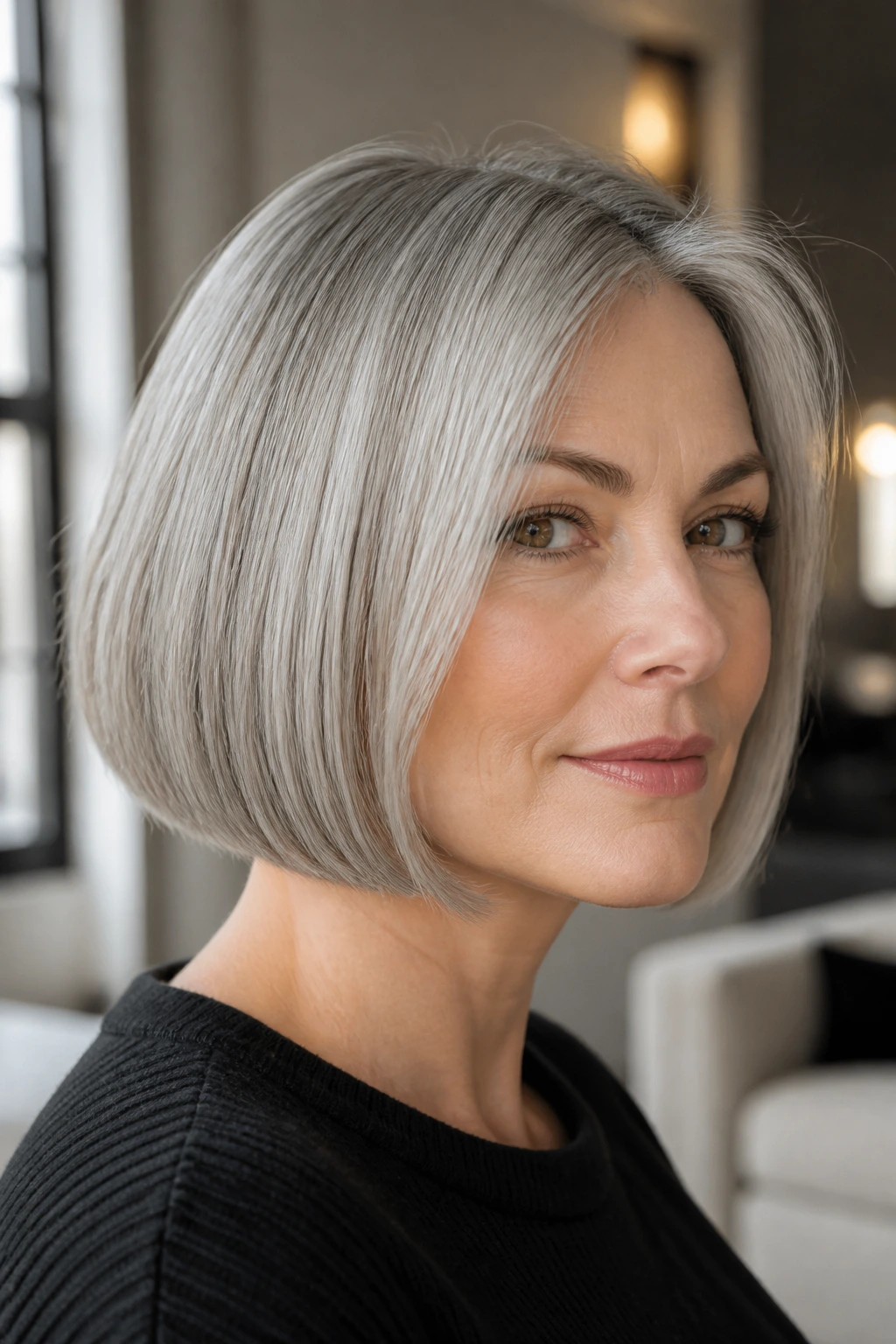
A bob for fine hair lives or dies by the line. Heavy layering can make the ends disappear, and a soft, rounded silhouette can flatten at the sides exactly where a round face does not need more width. A sharper outline fixes both problems at once. The eye reads thickness at the edge, and the face gets a cleaner frame.
Grey hair changes the picture because silver and salt-and-pepper strands show shape more clearly than darker hair. That sounds good, and it is, but it also means a bad cut looks sloppier faster. If the perimeter is weak, the style can read scrappy instead of soft. If the perimeter is strong, the haircut holds together even on day two.
The other thing people miss is weight distribution. Fine hair often needs weight at the ends and a little lift at the crown. Not everywhere. Not with a thousand layers. Just enough strategic structure so the bob does not collapse into the cheeks by lunchtime.
Essential Tools for Styling Grey Bobs
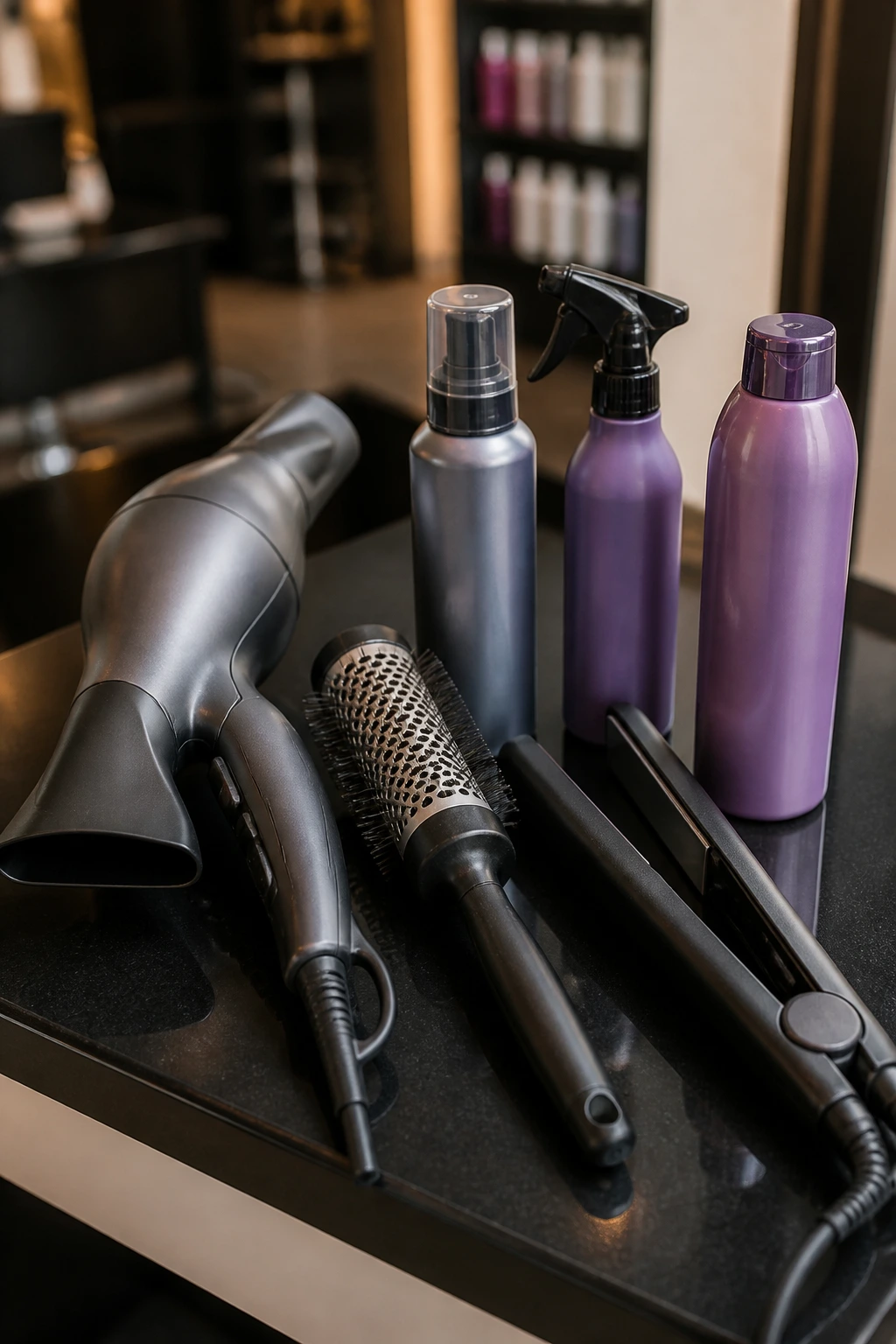
- Blow dryer with a concentrator nozzle: Directs air at the roots so fine hair lifts instead of frizzing.
- Small to medium round brush: A 1.25-inch brush is a sweet spot for beveling ends on short bobs.
- Root-lift mousse or spray: Adds support at the crown without coating the lengths.
- Lightweight heat protectant: Helps grey hair, which can run dry, handle heat without roughing up the cuticle.
- Purple shampoo: Useful for keeping silver and ash tones from drifting yellow, but use it sparingly so the hair does not go dull.
- Texturizing spray: Gives piecey separation to choppy or wavy bobs without the heaviness of wax.
- Flat iron with narrow plates: Best for sleek, beveled, or flipped-end looks.
- Velcro rollers or clips: Handy for setting the crown while makeup or clothes go on.
- Microfiber towel or T-shirt: Cuts down on rough drying, which can make fine grey hair look fuzzy.
- Wide-tooth comb: Helps detangle wet hair without pulling out the little bit of density you have.
How to Choose the Right Cut, Part, and Grey Tone
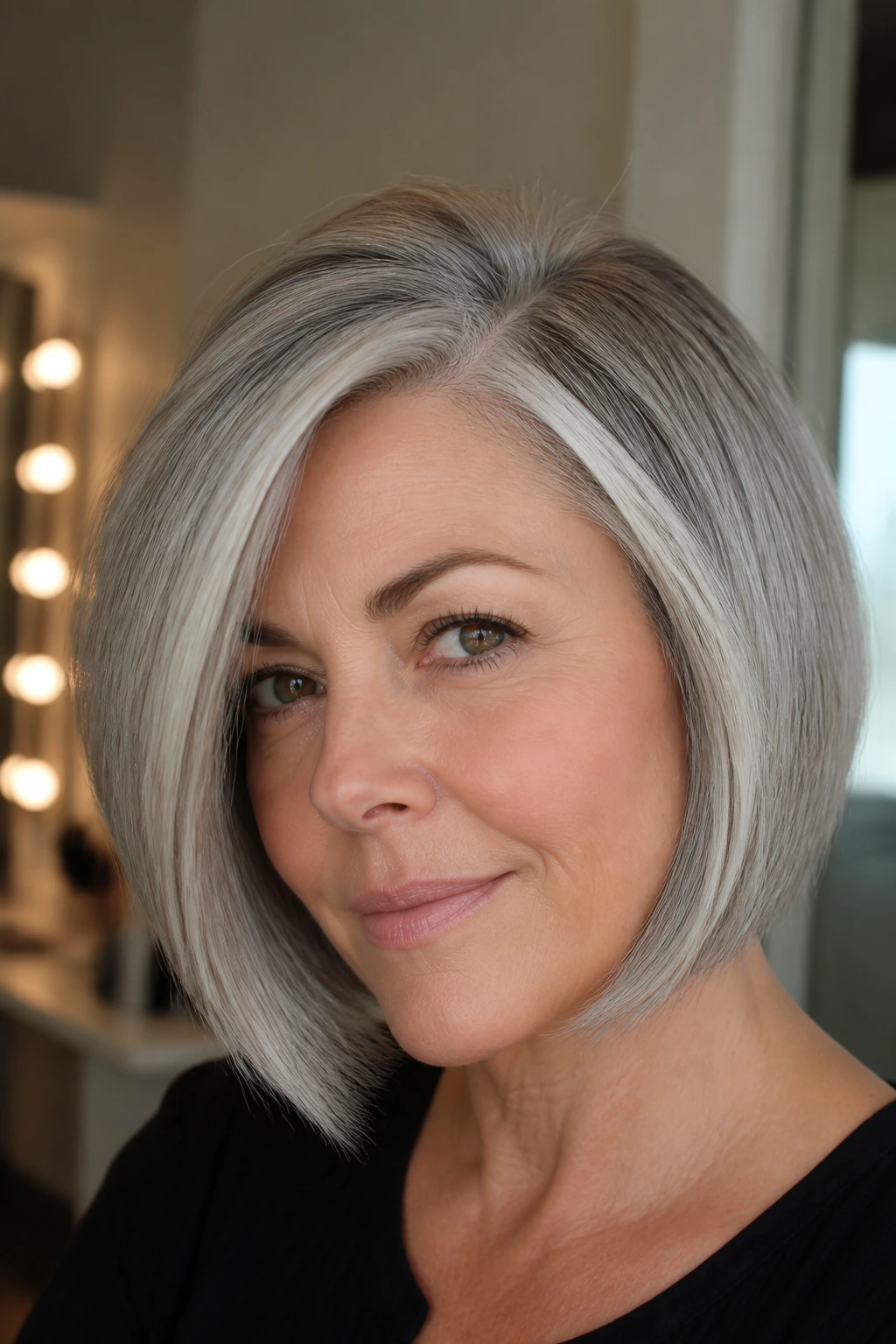
The right grey bob starts before the scissors. Length comes first. If your face is round and your hair is fine, the safest zone is usually the jaw to collarbone range, because that space gives the cut enough length to narrow the face without dragging the ends into stringy territory. Very short bobs can work, but they need more precision and more upkeep.
Parting matters more than people admit. A deep side part adds lift and breaks symmetry. A center part can work if the bob is longer and the front pieces fall below the cheekbone. If the hair naturally splits in one spot, fight it only if you enjoy a daily wrestling match. That fight gets old fast.
Grey tone is worth thinking about too. Smoky silver, ash, graphite, and pearl all read differently on fine hair. Cooler tones show the shape clearly, while a slightly deeper root shadow keeps the crown from flattening visually. If you color your hair, ask for dimension instead of one flat sheet of silver. That tiny bit of depth keeps the bob from looking paper-thin under indoor light.
How to Wear These Bobs From Morning to Night
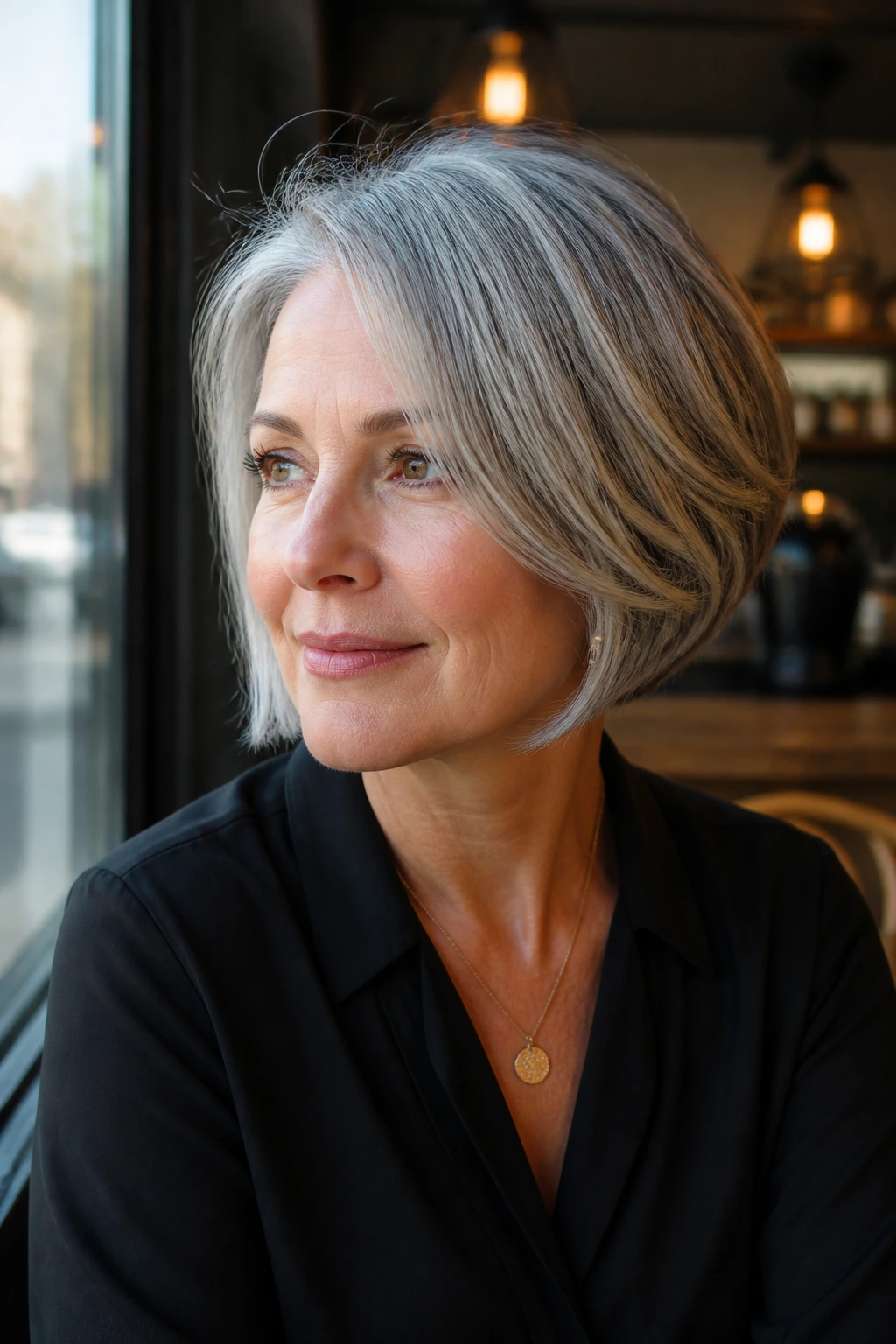
Presentation: Keep the silhouette clean at the roots and decide whether you want the ends tucked, straight, or softly bent. A neat outline usually does more for a grey bob than a mountain of styling products ever will.
Outfit Pairings: Round necklines tend to echo a round face, so V-necks, open collars, and sharp lapels often look better with these cuts. Earrings matter too. A bob that sits at the jawline loves a slim hoop or a small drop earring because it keeps the eye moving down.
Best For: Some of these bobs lean polished, some lean casual, and some can do both. The sleek styles suit office days and more tailored clothes. The tousled or wavy versions handle denim, knitwear, and softer fabrics without losing their edge.
Maintenance Rhythm: If the shape starts to puff at the cheeks or collapse at the crown, it is time to reset it. Grey bobs show growth faster than people expect, especially when the neck line gets fuzzy.
Extra Styling Moves That Make Fine Hair Look Fuller
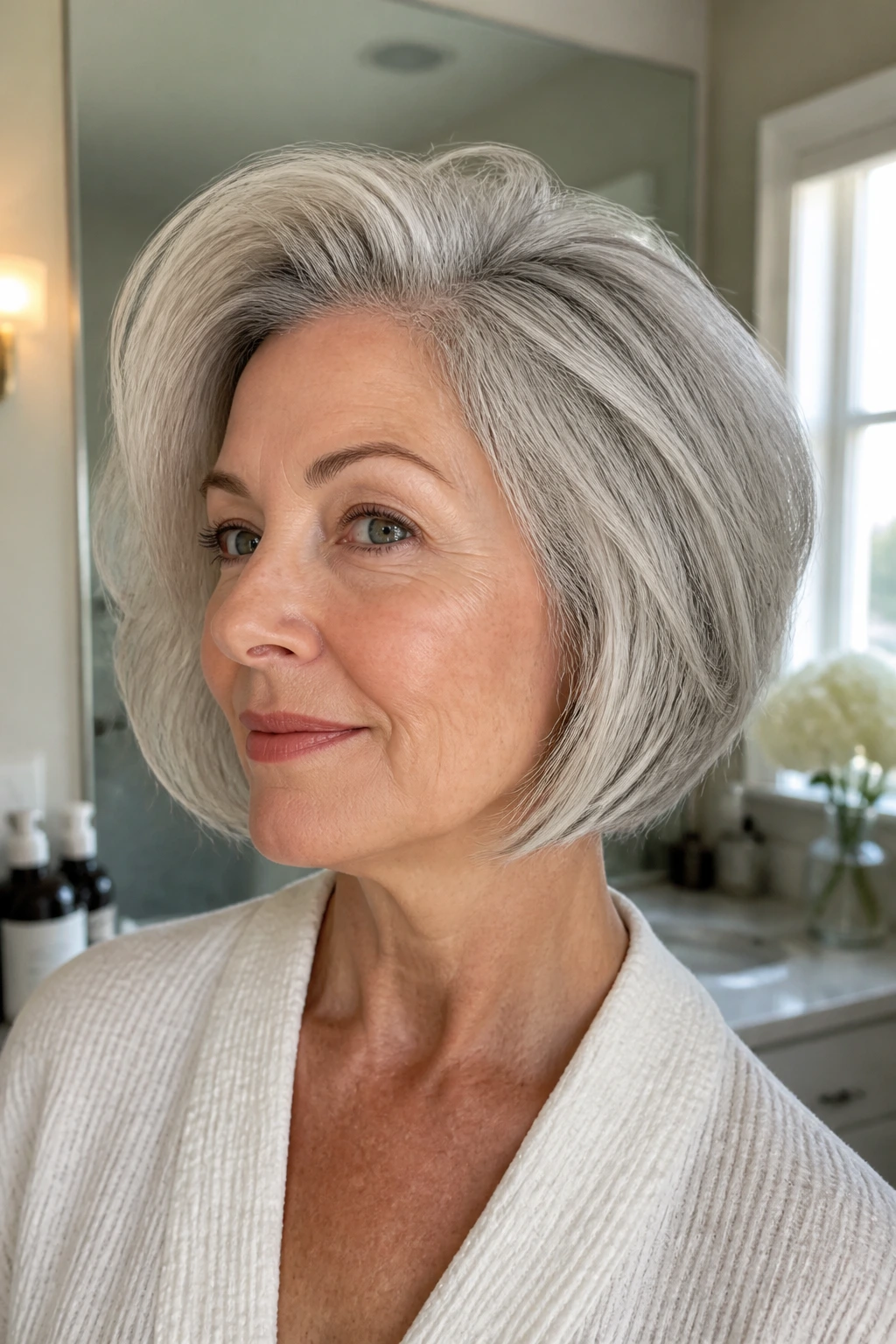
Root Lift: Dry the roots in the opposite direction of your part for the first few minutes, then switch back. That little detour gives the crown memory and keeps the style from falling flat before lunch.
Texture Boost: Use a light texturizing spray only on the mid-lengths and ends. Fine hair does not need a heavy cloud of product. It needs separation in the right places.
Tone Boost: If your silver starts to yellow, a purple shampoo once every one to two weeks usually keeps the grey reading clean. Leave it on too long and the hair can look dull, so watch the tone, not the clock alone.
Quick Refresh: On day two, mist the bob with water, reheat the front pieces with a brush or flat iron, and lift the crown with clips for ten minutes. That is often enough to bring the shape back without a full wash.
Common Mistakes That Shrink the Shape
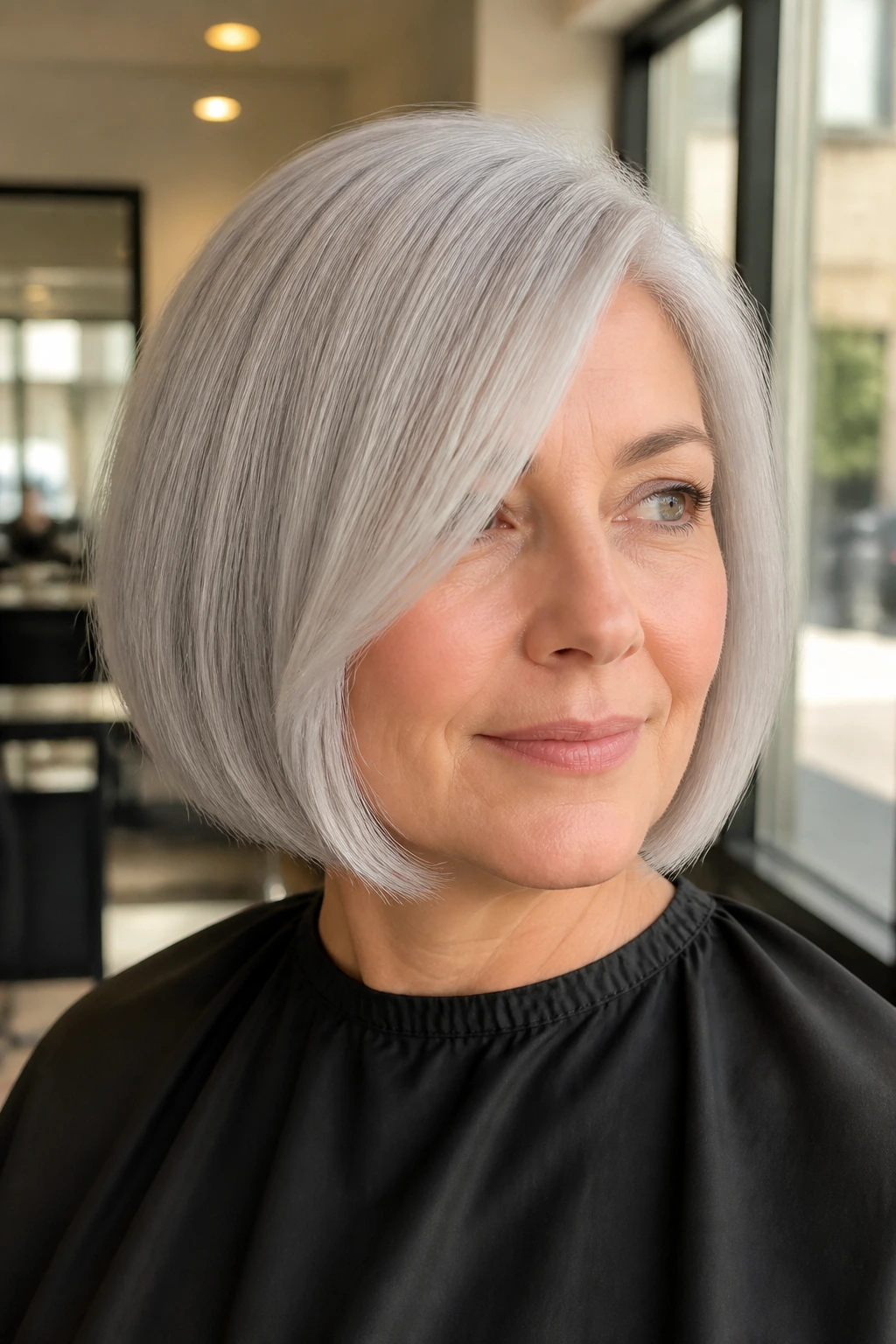
The biggest mistake is over-layering the top. Fine hair can go see-through fast, and when the layers start too high, the bob loses the edge that makes it look full. The symptom is a fluffy crown and thin ends. The fix is a stronger perimeter and lighter internal shaping.
Another trap is cutting the bob too short right at the widest part of the cheeks. That can make the face look wider than it is. If you want a short bob, keep the front pieces a little longer than the cheekbone, or angle the cut forward.
Heavy products cause trouble too. Thick oils, sticky creams, and too much serum make fine grey hair separate into little greasy sections. The hair may look shiny for five minutes, then flat and stringy. Use less product than you think you need.
And please, do not let the ends flip out in every direction unless that is a deliberate retro look. Random flipping reads as lack of control. A slight inward bend or a clean straight finish usually flatters the face more.
Variations and Adaptations for Different Vibes

The Soft Silver Cloud: Keep the cut rounded and airy, then add a light root lift and a whisper of bend through the ends. This suits people who want softness first and structure second.
The Graphic Charcoal Line: Go for a blunt perimeter, deep side part, and sleek finish. The result is sharper and cleaner, which works especially well if your wardrobe leans simple and tailored.
The Low-Fuss Air-Dry Shape: Choose a bob with hidden internal support and let the natural wave do the rest. A little mousse and a microfiber towel are enough for many hair types.
The Face-Slimming Sweep: Add curtain bangs or a long side fringe that starts below the brow and falls past the cheekbone. This is the easiest way to make a bob feel lighter around a round face without losing style.
The Silver With Shadow Root: Leave a soft root melt or shadow at the base, then brighten the mid-lengths and ends. That depth keeps fine hair from looking flat and makes the grey tones feel richer.
Trim, Tone, and Ongoing Maintenance

Grey bobs hold their shape best when they are trimmed on a regular rhythm. For most fine hair, every 6 to 8 weeks is the sweet spot. If you wait too long, the perimeter starts to fray, the back loses lift, and the whole cut can turn soft in a not-so-good way.
Color maintenance matters if your grey is tinted, toned, or blended. A silver glaze, toner refresh, or gloss every 4 to 6 weeks keeps brass away and stops the tone from turning muddy. If your hair is naturally grey and you do not color it, a violet shampoo once every week or two is usually enough to keep the brightness clean.
Heat styling can be light. That is the nice part. A quick root lift, a brush through the ends, maybe a flat iron on the front pieces. Fine hair does not need three rounds of heat to look alive, and grey hair usually looks better when it keeps a little softness.
Frequently Asked Questions
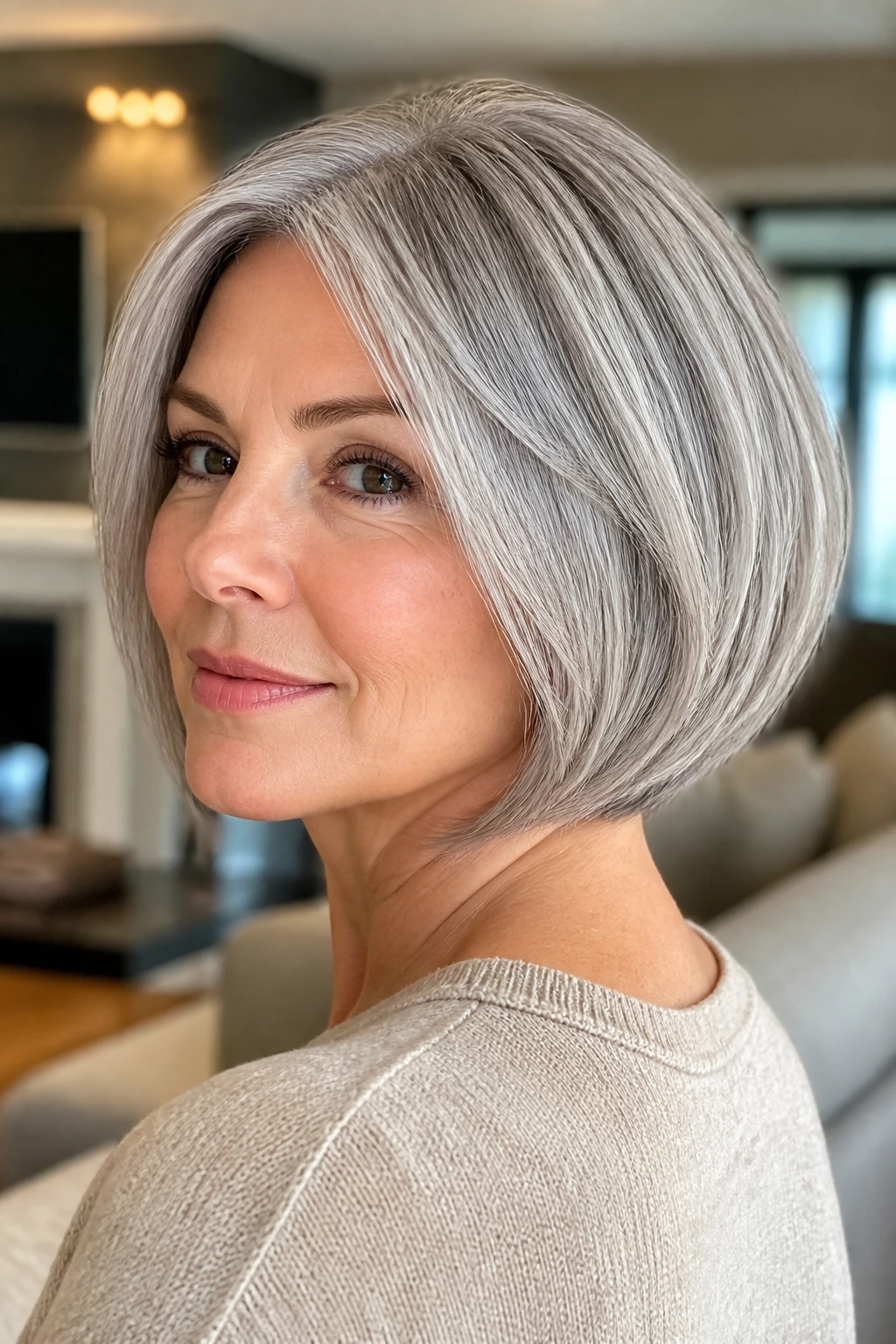
Can a grey bob make a round face look wider?
Yes, if the cut stops at the widest part of the cheeks and the sides puff out. A better version drops below the jaw, keeps the crown lifted, and uses a side part or diagonal fringe to create length.
Is fine hair too thin for a bob with layers?
Not if the layers stay inside the shape. Surface layers can make the cut look sparse, but hidden internal layers or light graduation can add movement without killing the density at the perimeter.
Should I choose a center part or side part?
A side part is usually safer for round faces because it creates asymmetry and lift. A center part can work on longer bobs or lobs, especially if the front pieces fall below the cheekbone.
Do bangs help or hurt on this face shape?
They can help a lot, but the wrong fringe can shorten the face. Soft curtain bangs, bottleneck bangs, or a sweeping fringe are much friendlier than a blunt, straight-across bang that ends too high.
What grey shade looks best with fine hair?
Cool silver, ash, and smoky graphite all work well because they sharpen the line of the cut. A small shadow at the roots can also give the hair more depth and keep the crown from disappearing visually.
How do I keep the bob from going flat by midday?
Lift the roots while drying, keep product light, and use clips or rollers at the crown for ten minutes after styling. A short refresh with water and a brush can bring the shape back without starting over.
Can these bobs work if my hair is naturally wavy?
Absolutely. The cut just needs to respect the wave pattern. A soft textured bob or a longer lob usually works better than a very blunt short bob if your wave tends to expand at the sides.
What if my hair grows out fast and the shape falls apart?
Choose a bob with a longer front and a softer stack so the grow-out stays tidy. Very precise cuts look gorgeous but ask for more frequent trims, while softer versions hold their line longer.
Is a grey bob hard to style every day?
Not if the cut matches your hair texture. The right bob can take five to ten minutes with a blow dryer or even less with air-drying and a little product. The wrong one can eat up half your morning.
The Shape Worth Keeping
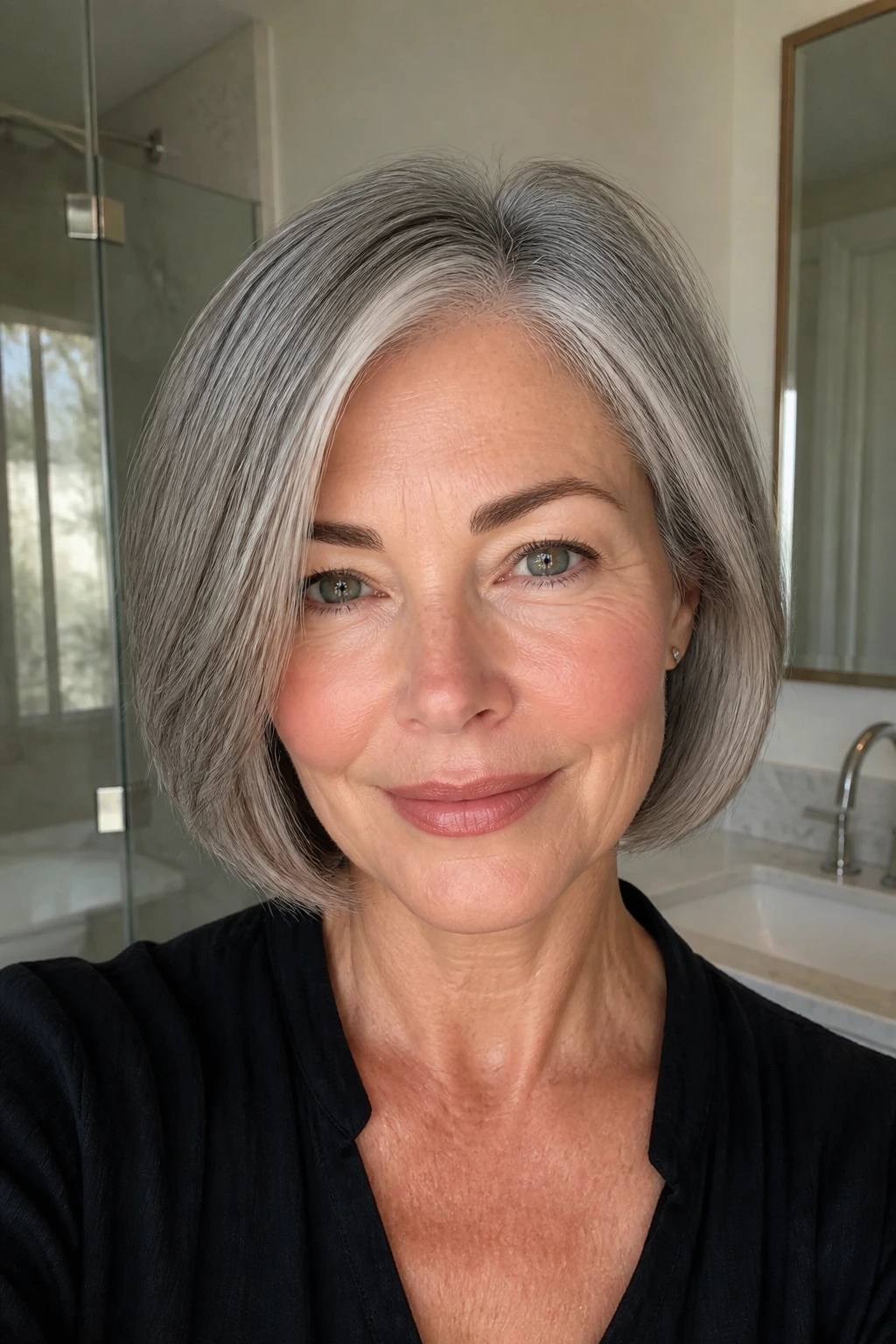
A good grey bob does something quietly clever. It gives fine hair a stronger outline, gives a round face a cleaner frame, and makes silver or ash tones look like a decision rather than an accident. That combination is why these cuts keep working, year after year, in salons and in real bathrooms with mediocre mirrors and one tired round brush.
The sweet spot is not the flashiest style on the list. It is the one that gives your hair enough structure to look full, enough length to flatter your face, and enough ease that you do not resent it on a rushed morning. Pick that version, and the bob will pull its weight for a long time.