



Feathered bangs for thin hair and heart-shaped faces work because they trade one hard line for a dozen soft ones. That matters. Thin strands can go limp the second a heavy fringe is cut straight across them, and a heart-shaped face can look top-heavy fast if the bang line sits too wide at the forehead. Feathering changes that math by breaking the edge into soft points and little bends, so the fringe still frames the face without turning into a flat shelf.
Heart-shaped faces usually bring more width through the forehead and cheekbones, then taper narrower at the chin. That shape is gorgeous with the right bang, but a blunt, dense fringe can fight it. The better versions land somewhere between airy and deliberate: enough softness to blur the hairline, enough shape to keep the eyes from disappearing under a curtain of hair, and enough length at the sides to echo the cheekbones instead of boxing them in.
Thin hair has its own rules. It needs a cut that respects density, not one that shreds it to bits in the name of “texture.” A good feathered fringe should move when you blink, bend when you brush it, and still look like an actual style at the end of the day. The 25 looks below cover the range—from barely-there, see-through shapes to fuller, cheekbone-skimming versions—so you can match the fringe to your face, your hair line, and how much time you want to spend in front of a mirror.
Why These Feathered Bangs Work So Well
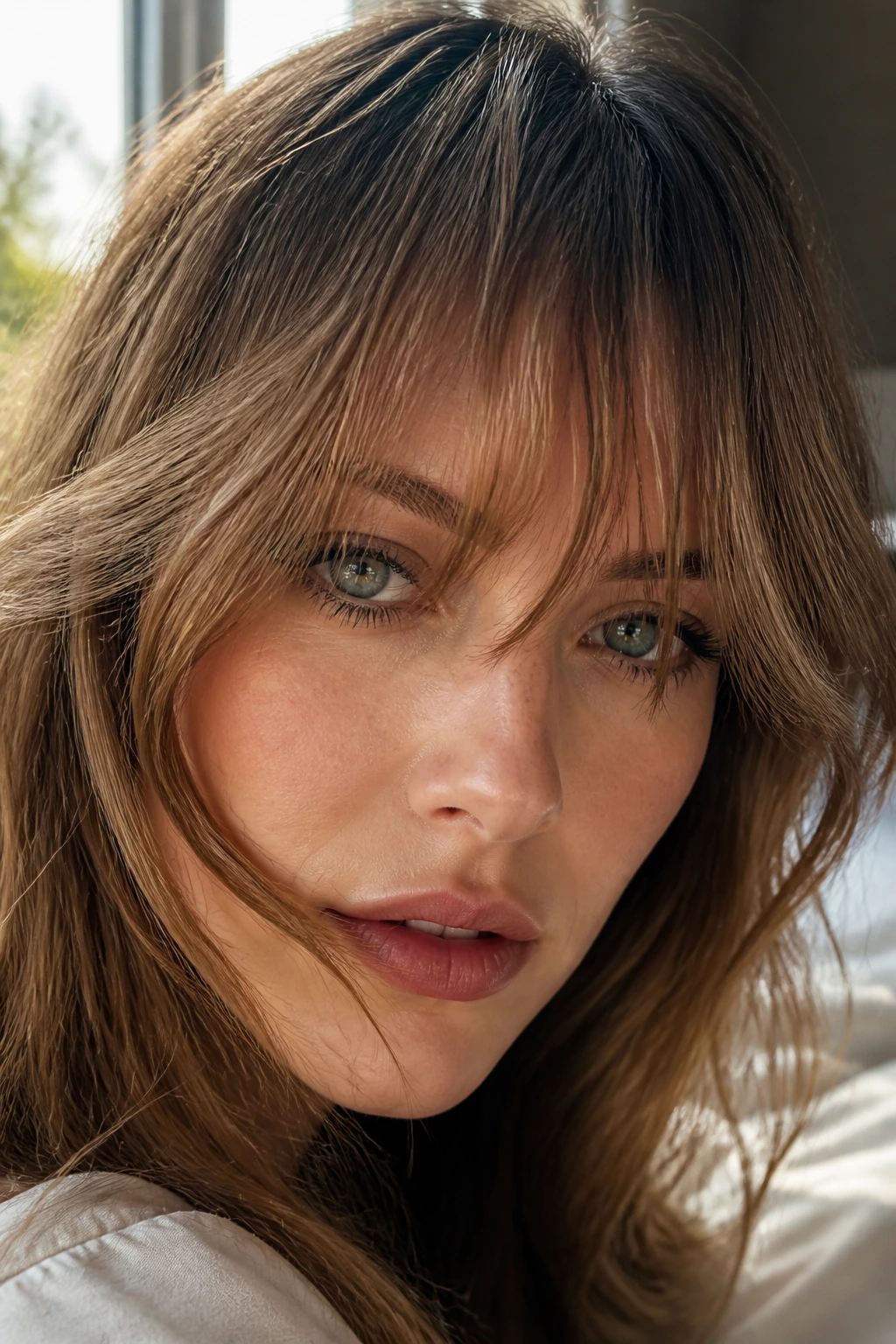
-
They keep the forehead soft without loading it with weight: The best feathered bangs skim the widest part of a heart-shaped face instead of sitting in a single thick band, which keeps the top half of the face from looking crowded.
-
They give thin hair movement without carving out too much density: Point-cut ends and longer side pieces create motion, but the body of the bang stays intact. That’s the difference between airy and stringy.
-
They make the cheekbones do useful work: A heart-shaped face already has strong bone structure. Feathered fringe can lead the eye down and out toward the cheekbones instead of letting the forehead dominate.
-
They grow out more cleanly than a blunt cut: A cleanly feathered fringe can slide into curtain pieces or face-framing layers instead of hitting that awkward, helmety stage.
-
They’re easier to style on lazy mornings: A quick round-brush bend or a few passes with a small flat iron usually gives enough shape. You do not need a salon-grade blowout to make them behave.
1. Soft Curtain Feathered Bangs
Soft curtain feathered bangs are the cleanest starting point if you want movement without drama. The center opens just enough to show a little forehead, then the sides taper down toward the cheekbones, which is exactly where a heart-shaped face tends to look strongest.
Why It Works for This Face Shape
The middle part keeps the fringe from building bulk right across the widest part of the forehead. Thin hair likes that split because it avoids a heavy block that can collapse by noon. The feathered ends are what save it from looking too neat; they blur the line so the bangs feel part of the haircut, not pasted onto it.
A good version ends around the brow bone in the center and drops to the cheekbone at the sides. That gives you a little vertical lift without making the forehead look boxed in.
- Keep the center pieces light and touchable.
- Ask for longer sides that can tuck into face-framing layers.
- Use a round brush only at the very ends; root lift matters more than polish here.
Best tip: dry the fringe forward first, then sweep the last inch away from the face. That tiny change stops the bangs from splitting into two flat panels.
2. Side-Swept Feathered Fringe
Side-swept feathered fringe is the safe bet when you want coverage without the commitment of a full curtain. The diagonal line softens a broad forehead and gives thin hair a stronger-looking shape because the eye reads one clean sweep instead of scattered strands.
This style works especially well if your part naturally falls to one side already. Fighting the grain is how bangs end up puffing in the wrong direction and then going limp twenty minutes later. Let the cut follow the way your hair already wants to move, and the result looks calmer and thicker.
I like this version on heart-shaped faces that need a little extra balance near the temples. The sweep draws attention downward toward the eyes and cheekbones, which helps the chin feel less narrow by comparison.
A long side-swept bang also buys you room to grow it out. If you get tired of the style, it slides into layers instead of sitting there like a mistake you have to wait out.
3. Bottleneck Feathered Bangs
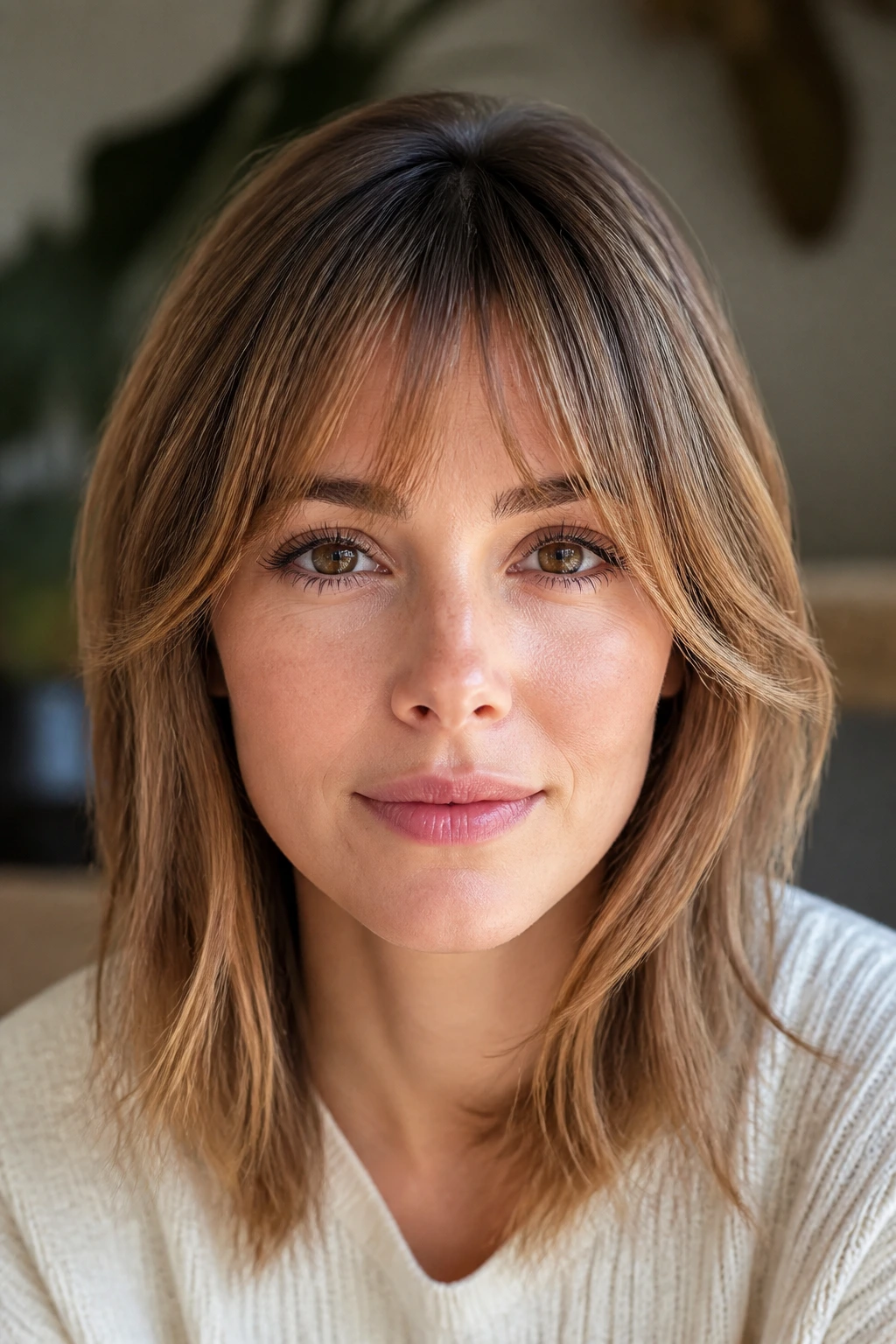
Do you want a fringe that feels sculpted but still soft? Bottleneck feathered bangs do that job well. They start narrower in the middle, then open out toward the temples, which quietly mirrors the shape of a heart face in reverse.
How to Ask for It
Tell your stylist you want the shortest point near the center of the forehead and longer sides that graze the cheekbones. That “narrow then wide” shape is the bottleneck part. On thin hair, the feathering keeps the transition from looking chunky.
What to Watch For
- The middle should not be chopped too short.
- The sides need enough length to blend into the rest of the cut.
- Point cutting is better than heavy razoring if your strands are fine.
This is one of the best options if you want a fringe that feels current without being trendy in a way that dates itself fast. It wears well because the shape does some of the work for you.
4. Brow-Skimming Airy Bangs
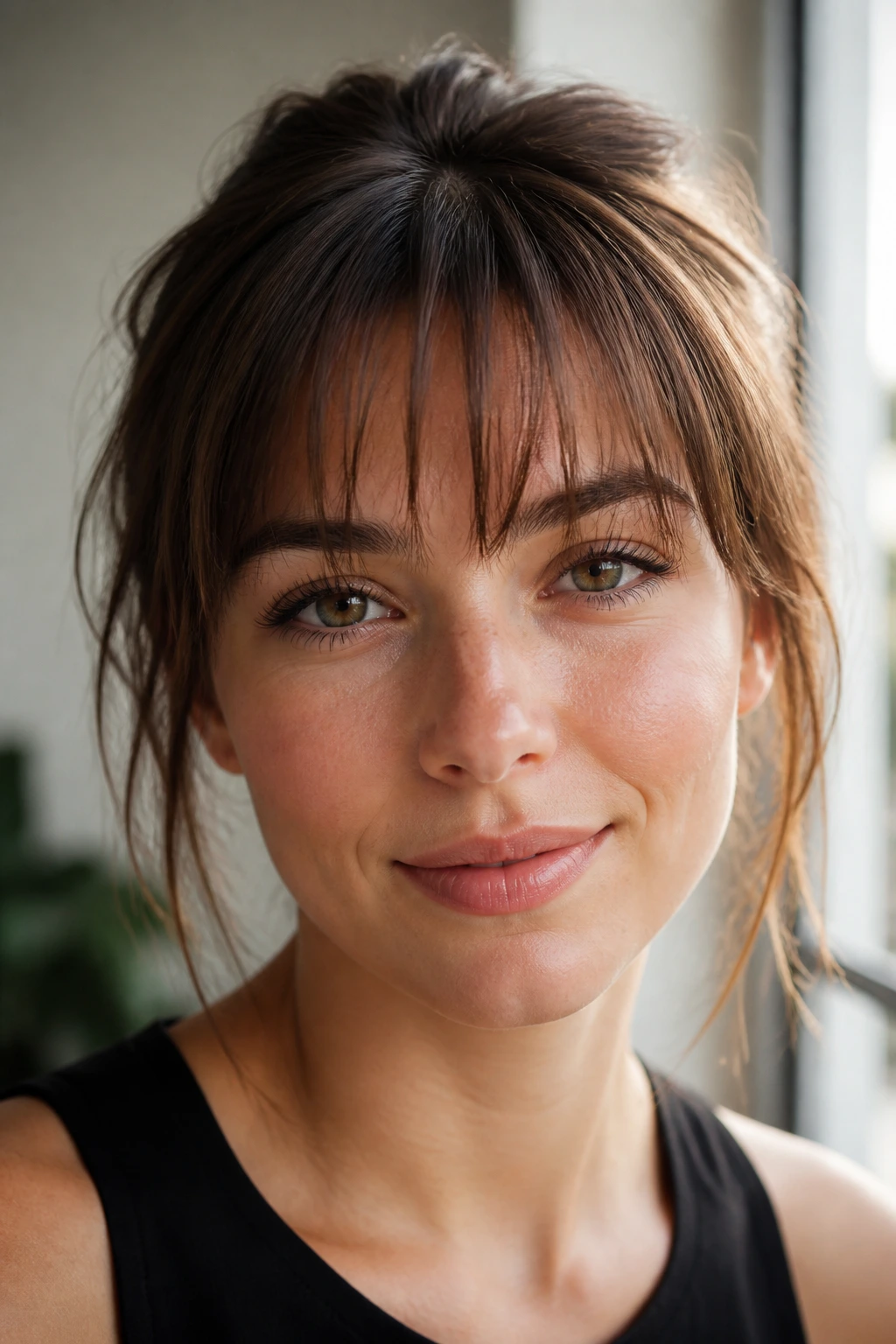
Picture a fringe that lands right at the brows, then breaks up into soft, wispy ends instead of a hard line. That is the whole appeal here. It gives the face some definition without hiding the forehead or swallowing thin hair in too much fabric.
The beauty of this style is that it reads fuller than it is. The eye sees a band across the forehead, but the little gaps between feathered pieces keep it from feeling heavy. On a heart-shaped face, that matters because the style can sit across the broadest part of the forehead without making it look wider.
This one is good if you like bangs that feel like bangs. Not a whisper, not a full curtain—something in the middle with enough shape to show up in a mirror and enough lightness to move when you turn your head.
If your hair tends to separate, use a pea-sized amount of mousse before blow-drying and stop there. Heavy creams are the enemy.
5. Cheekbone-Length Feathered Fringe
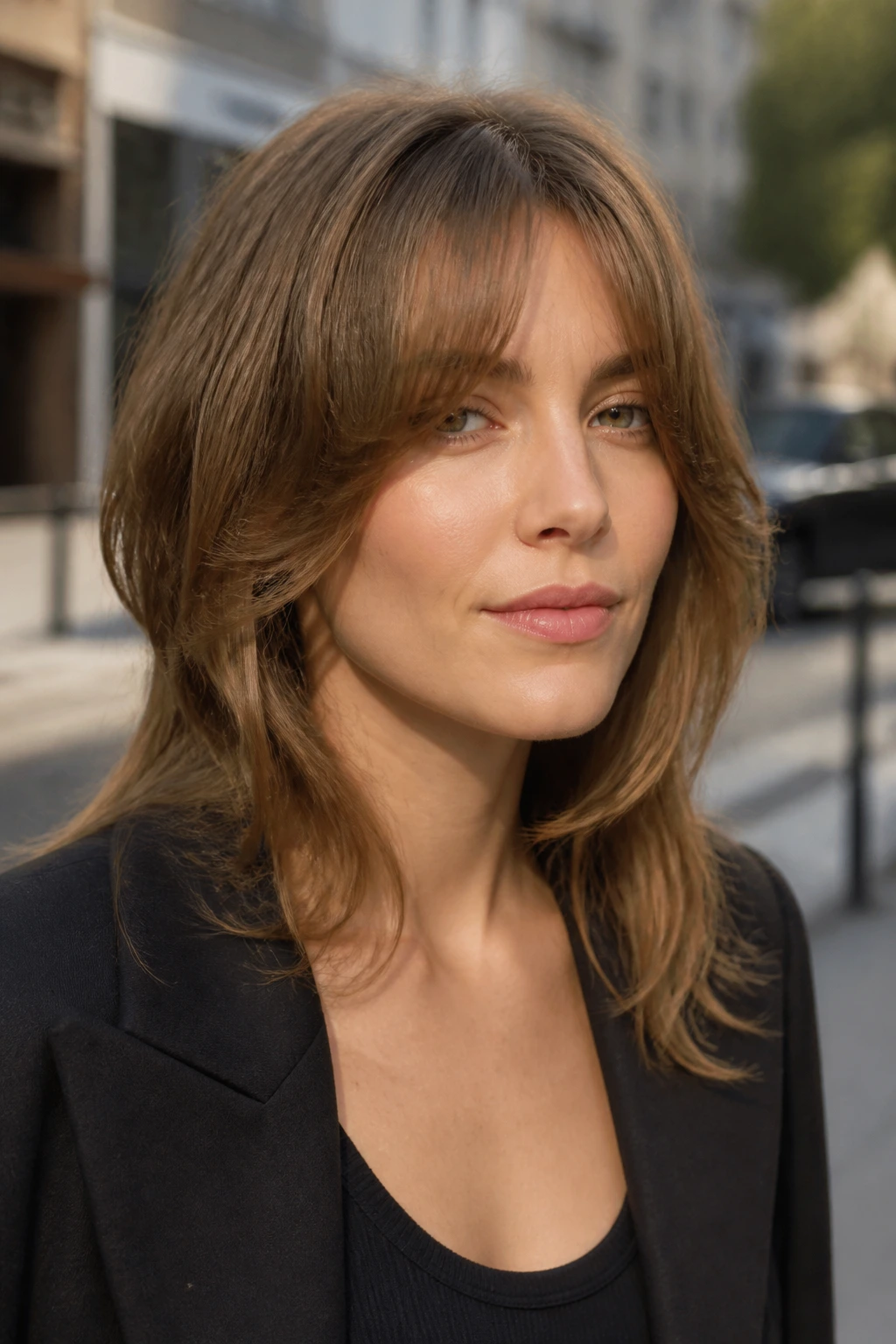
Cheekbone-length feathered fringe is the version I reach for when the face needs length more than width. The longer side pieces create a diagonal that points straight to the cheekbones, which is flattering on a heart-shaped face because it keeps the eye moving instead of stalling at the forehead.
Thin hair benefits from the extra length too. Short bangs on fine strands can look sparse fast, especially if the hairline is light. A longer fringe has more real estate, so it reads fuller even when the density is modest.
There is a nice bonus here: the style can be brushed forward, swept aside, or bent into a curtain shape depending on your mood. That flexibility helps if you do not want one fixed look every day.
The only catch is maintenance. Longer fringe needs a little direction, or it starts to drift into your eyes. A quick bend with a round brush or flat iron solves that in under two minutes.
6. Wispy Baby Feathered Bangs
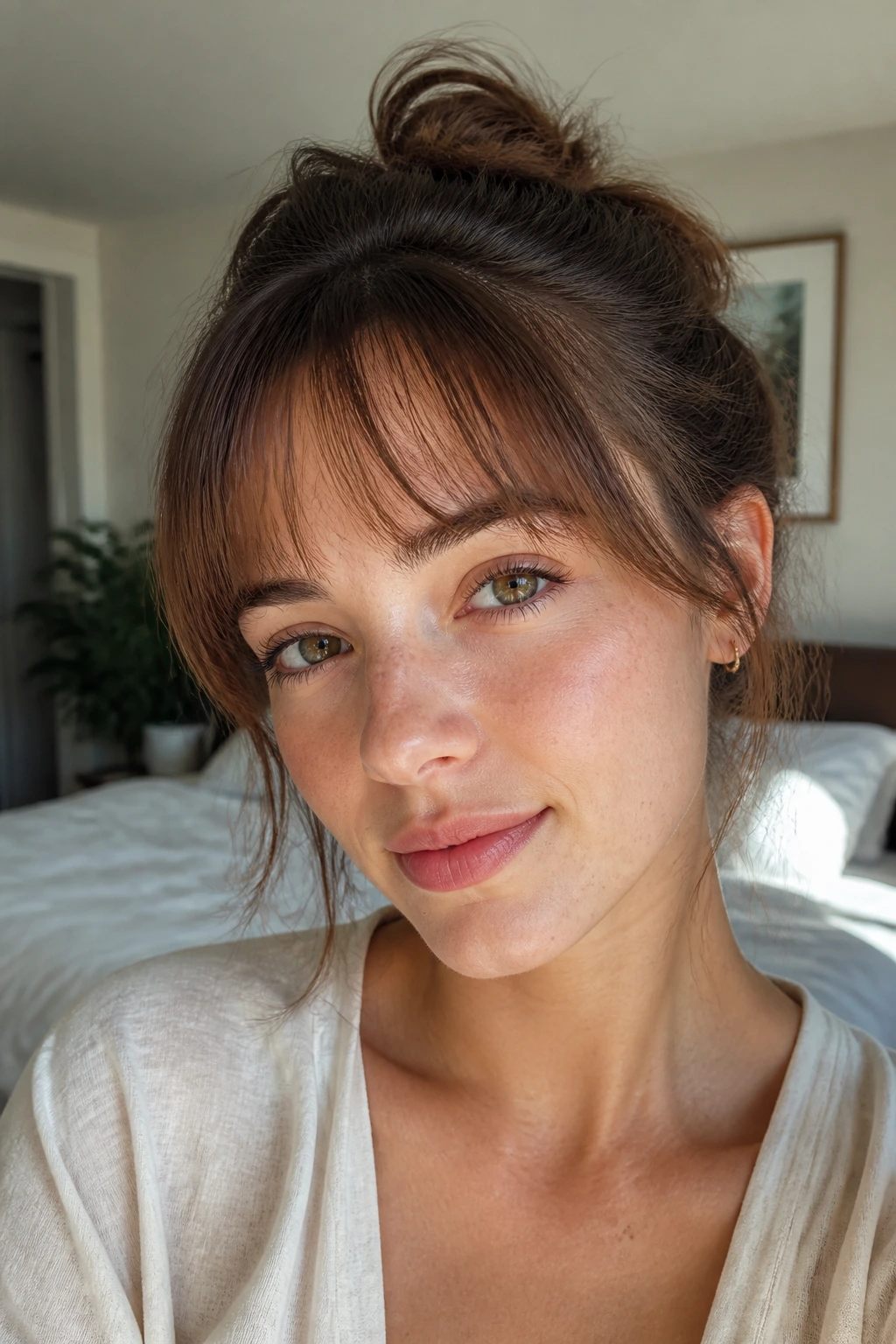
Wispy baby feathered bangs are the boldest pick in the group, and they are not for everyone. They sit shorter, show more forehead, and lean heavily on separation and texture. On thin hair, that can be tricky if the cut gets too sparse.
But when they are done well, they sharpen the eyes and lighten the whole face. A heart-shaped face can wear this style because the cheekbones already hold visual weight; the short fringe becomes a little accent instead of the main event.
The key is softness at the edges. You want a broken line, not a chopped edge. Think small pieces that float across the brow rather than a straight micro fringe.
This style works best when the rest of the haircut has some body. If your lengths are pin-straight and flat, baby bangs can look disconnected. Give them a cut with movement below, or they start to feel like a separate idea.
7. Feathered Fringe With a Lob
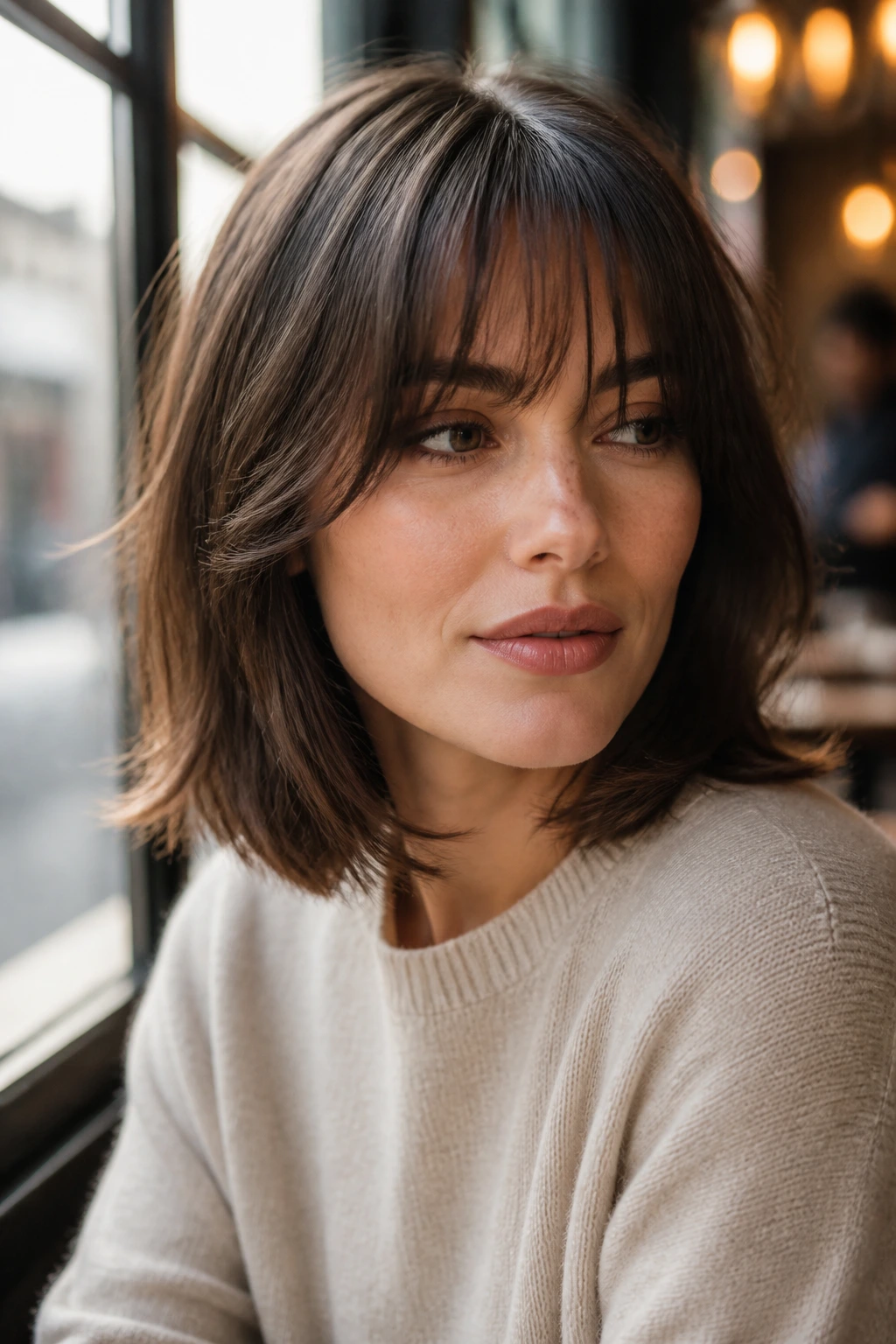
A feathered fringe paired with a lob is one of those combinations that looks more expensive than it should. The lob keeps the outline of the haircut solid, and the fringe adds the soft motion that thin hair usually needs at the front.
Best With
- Chin-length to collarbone-length cuts
- Slight under-bends at the ends
- A side part or loose middle part
The reason this pairing works is simple: the lob supplies visual density at the perimeter, while the bangs stay light and directional. That stops the front from looking like the only thin part of the haircut. On a heart-shaped face, the longer shape also balances the narrow chin without adding width where you do not want it.
If you blow-dry the ends under just a touch, the fringe and the lob start talking to each other. That little connection is what makes the haircut feel intentional rather than accidental.
8. Shaggy Feathered Bangs
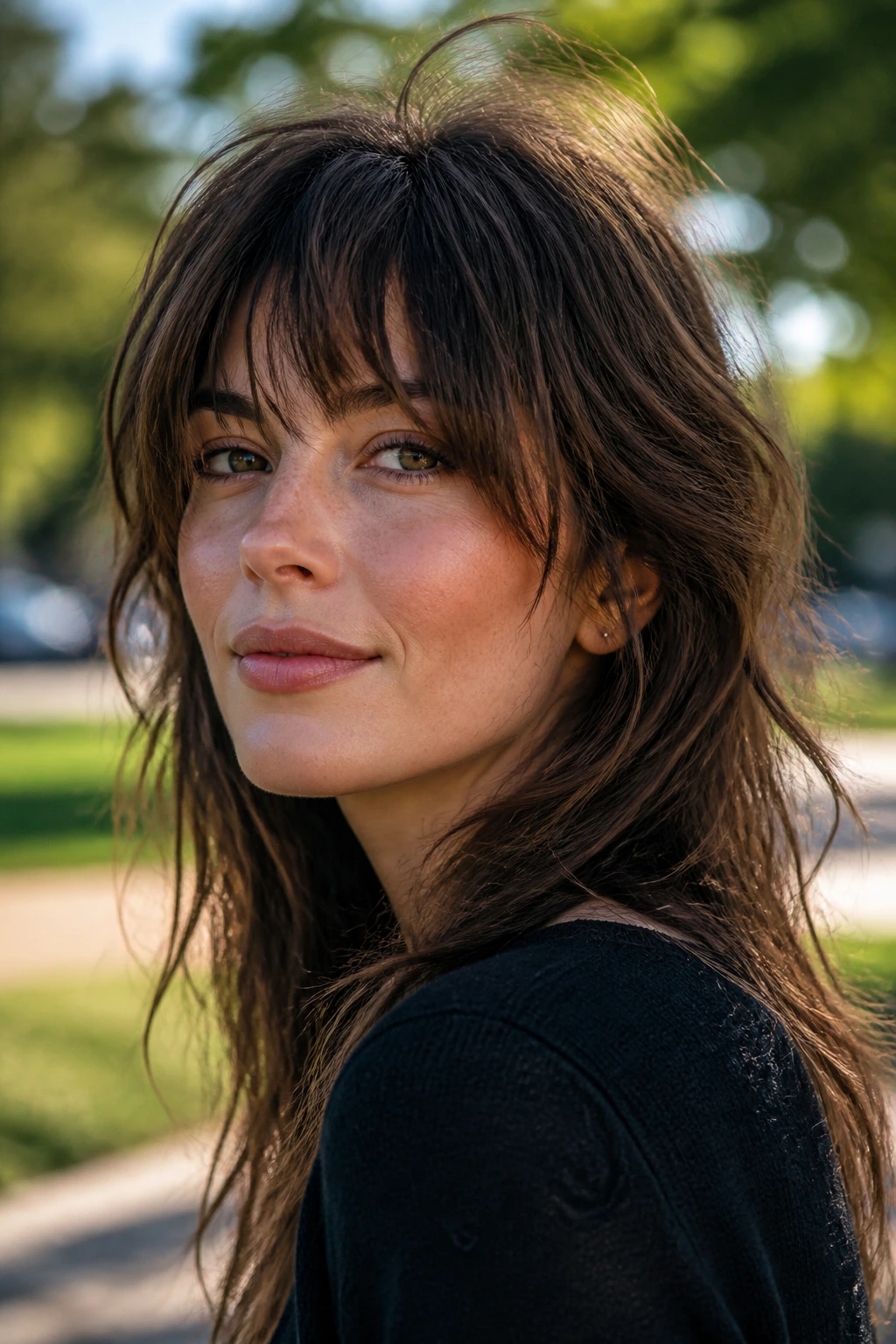
Shaggy feathered bangs are for people who like a little mess in their hair, but not chaos. The texture is the point. Thin hair often looks better with movement than with strict lines, and a shaggy fringe gives you that movement right around the eyes.
Heart-shaped faces can wear this look best when the layers are kept softer around the temples and a touch longer through the sides. Too much layering near the crown can make the forehead feel wider than it is. You want lift, not a triangle.
The appeal here is that the bangs never sit too perfectly. They break apart in a way that looks lived-in, which is handy if your hair has a slight bend or if you prefer air-drying. A little texture spray at the roots helps, but don’t drown it in product. That turns airy into greasy fast.
9. Piece-Y Split Fringe
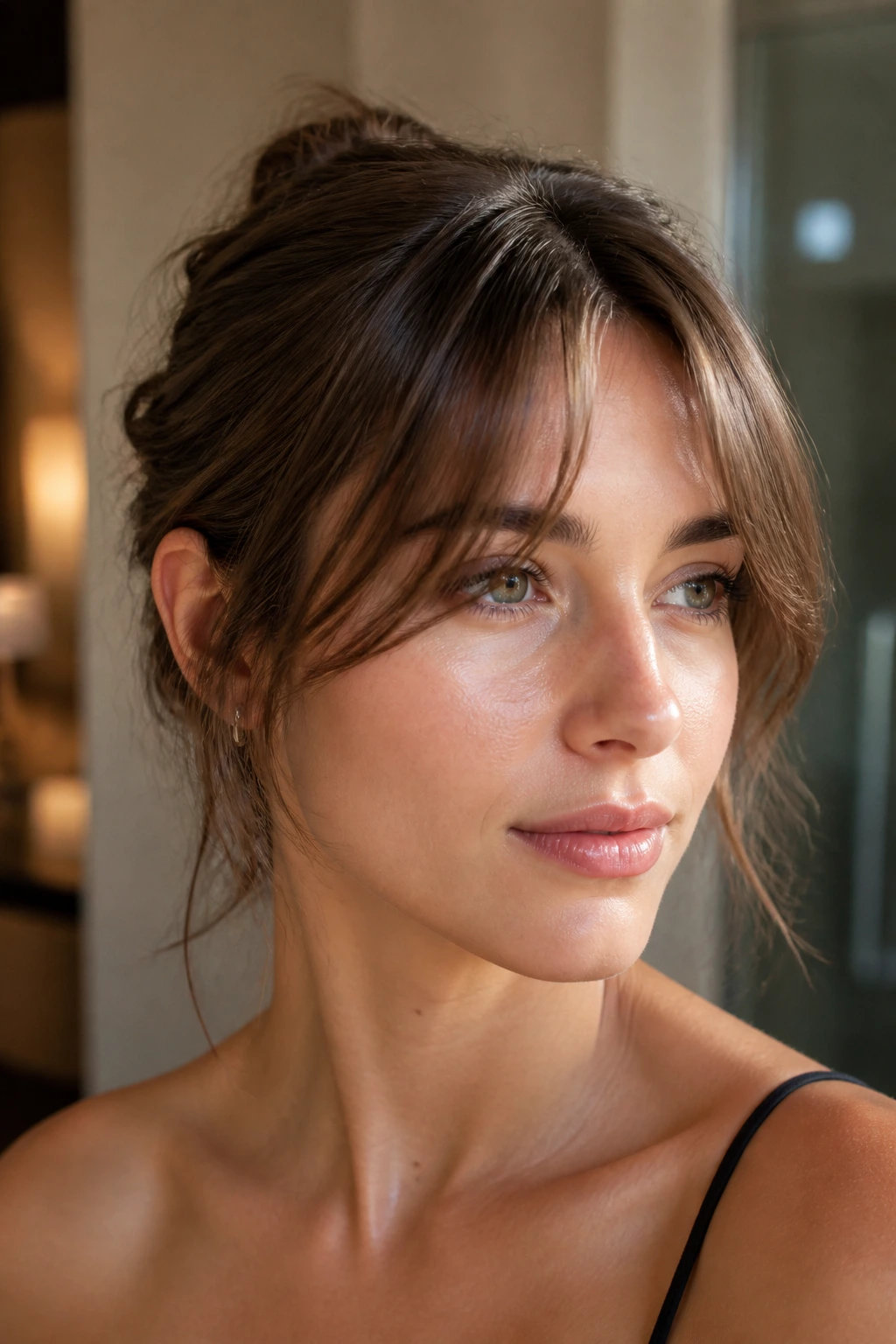
Why does a split fringe work so well on fine hair? Because it lets the forehead breathe while still framing the face. The center part creates two softer panels, and the feathered ends stop those panels from looking heavy or obvious.
This style is especially good if your hair naturally separates down the middle. Instead of fighting the split, you design around it. That makes morning styling easier and keeps the fringe from fighting itself every time humidity shows up.
A piece-y split fringe also gives the illusion of thickness because the eye fills in the gaps. The trick is not to make the pieces too skinny. You still need enough hair in each section to read as a shape, not a stray thought.
A matte texture spray helps here more than shine serum does. Shine can flatten the separation and make fine hair look limp.
10. Center-Part Feathered Curtain Bangs
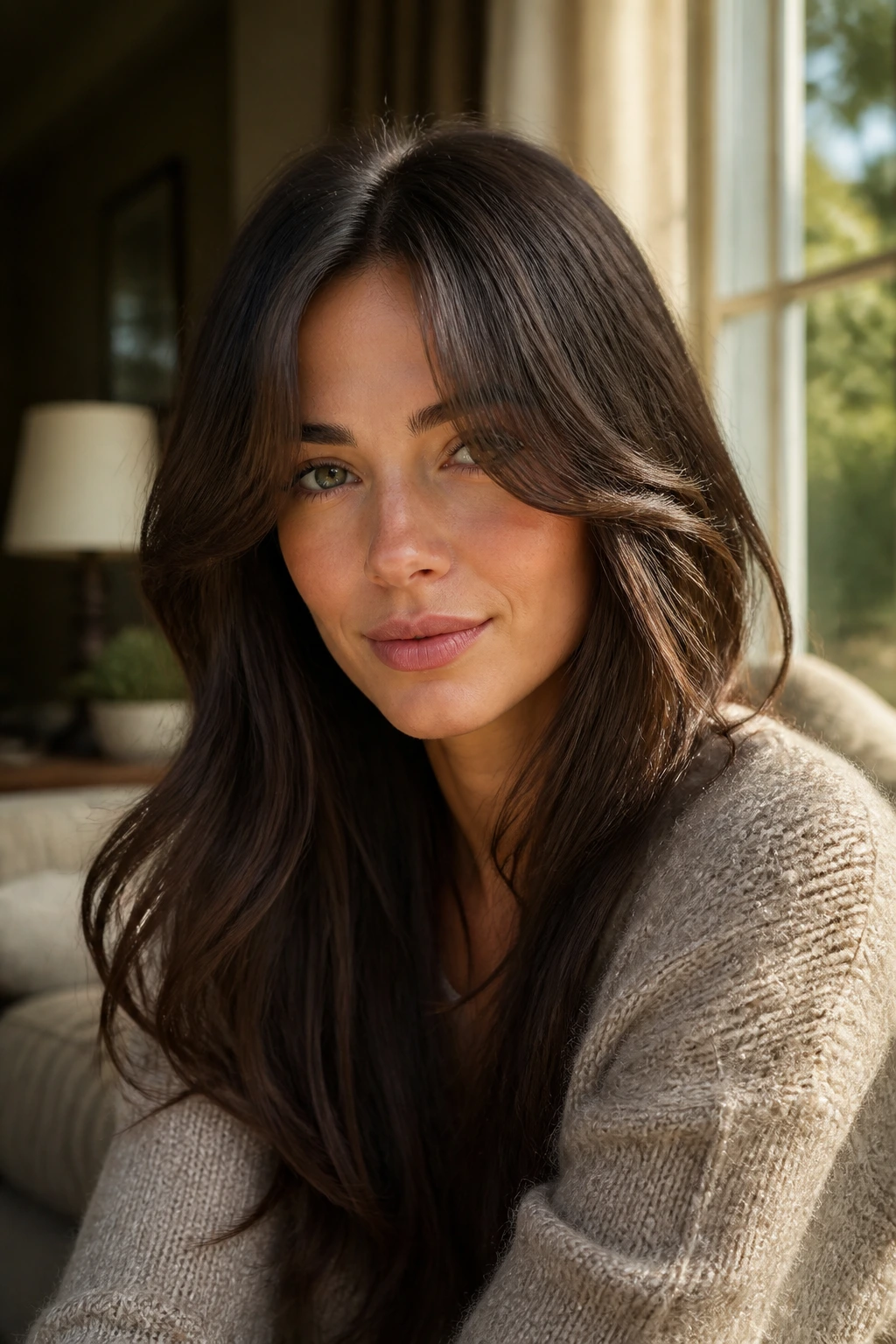
Center-part feathered curtain bangs are a cleaner, more polished cousin of the soft curtain fringe. The center line is more defined, and the sides fan out in a way that frames the face without crowding it.
Styling Cue
Blow-dry the center forward first, then twist each side away from the face around a medium round brush. Stop before the ends get too polished. You want a bend, not a curl.
This shape works because it creates width where a heart-shaped face needs it and space where thin hair needs it. The fringe is long enough to feel substantial, but the feathered finish keeps the shape from sitting like a curtain rod.
It is also one of the easiest bangs to grow out. When they get too long, they just become face-framing pieces. That is the kind of low-drama maintenance more people should ask for.
11. Arched Feathered Fringe
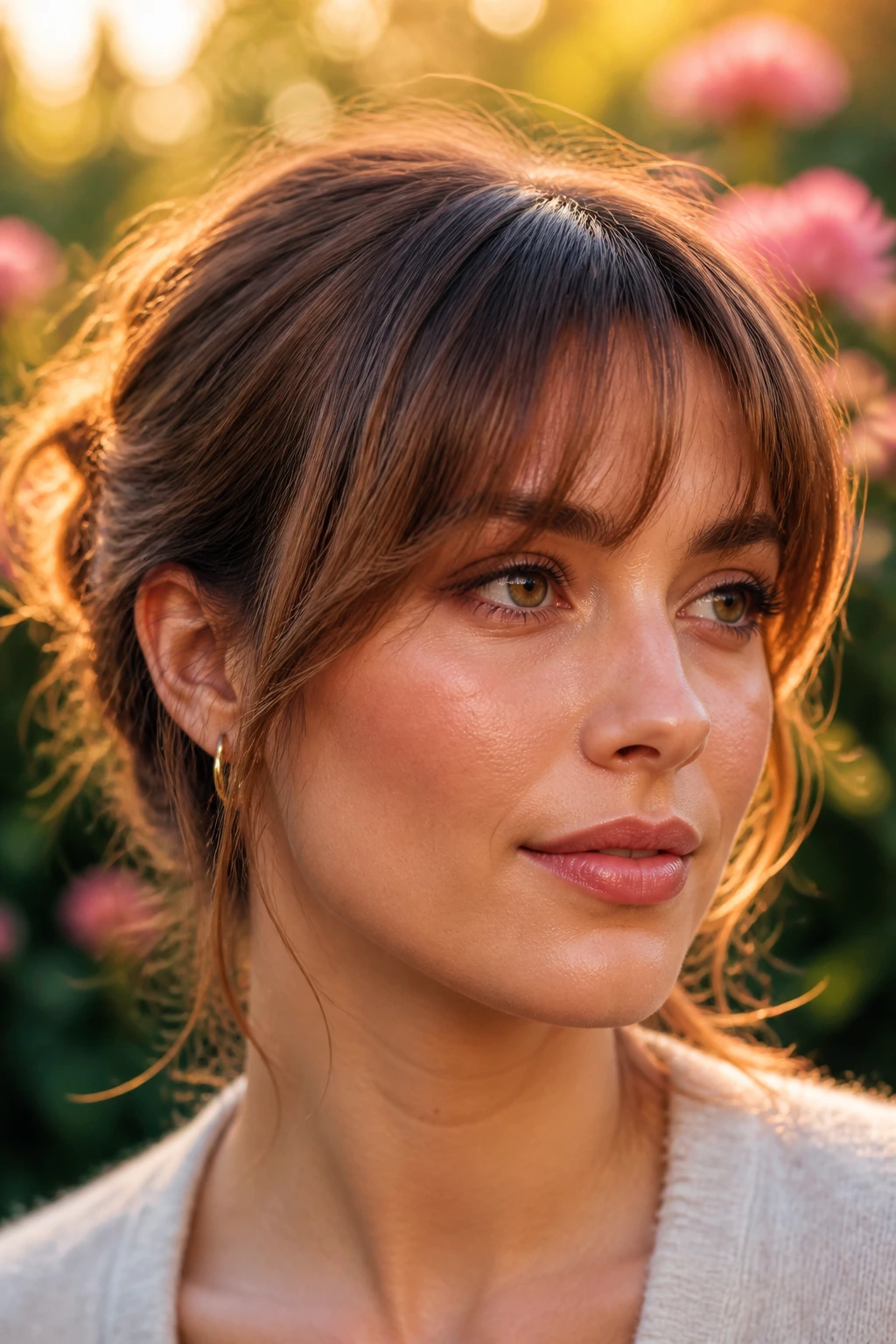
Arched feathered fringe gives a little structure back to the face. The center is slightly shorter, the sides are a touch longer, and the overall line curves gently across the forehead instead of cutting it straight across.
That arc is useful on heart-shaped faces because it softens a high or broad forehead without burying it. Thin hair benefits because the curve creates the illusion of density, especially if the bang is styled with a slight lift at the root.
This is the style for someone who wants the fringe to look deliberate from the front, not just convenient from the side. It has shape. It has purpose. It also behaves better than people expect once it is cut correctly.
The danger is over-arching it. If the center gets too short, the whole thing jumps up and feels dated fast. Keep the shortest point just above the brows, not halfway to the hairline.
12. Feathered Bangs With a Pixie Bob
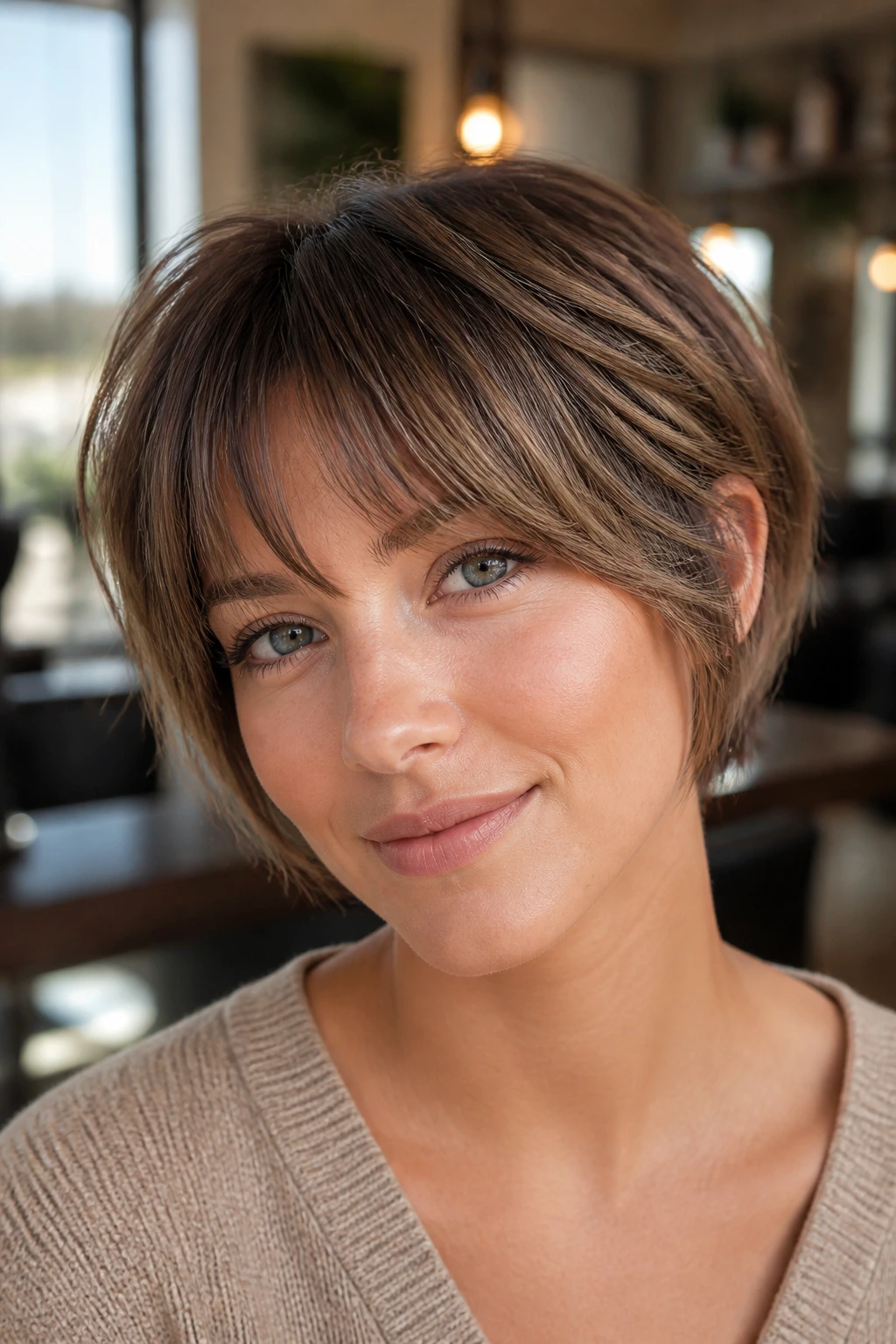
A pixie bob with feathered bangs is a strong move when thin hair needs a little attitude. The short cut keeps the perimeter neat, and the bangs become the focal point instead of one more thing to manage.
On a heart-shaped face, the shorter length can actually be flattering because it exposes the cheekbones and jawline while the feathered fringe softens the forehead. The contrast is nice. Sharp cut below, airy motion above.
This look is not for people who want zero styling. Short hair with bangs needs direction, even if that direction takes five minutes. A small round brush, a blow-dryer nozzle, and a touch of mousse are enough most days.
The good news is that the style holds up well if your hair is fine but dense. You are working with shape more than bulk, which is exactly where feathering helps.
13. Feathered Bangs With Soft Wolf Layers
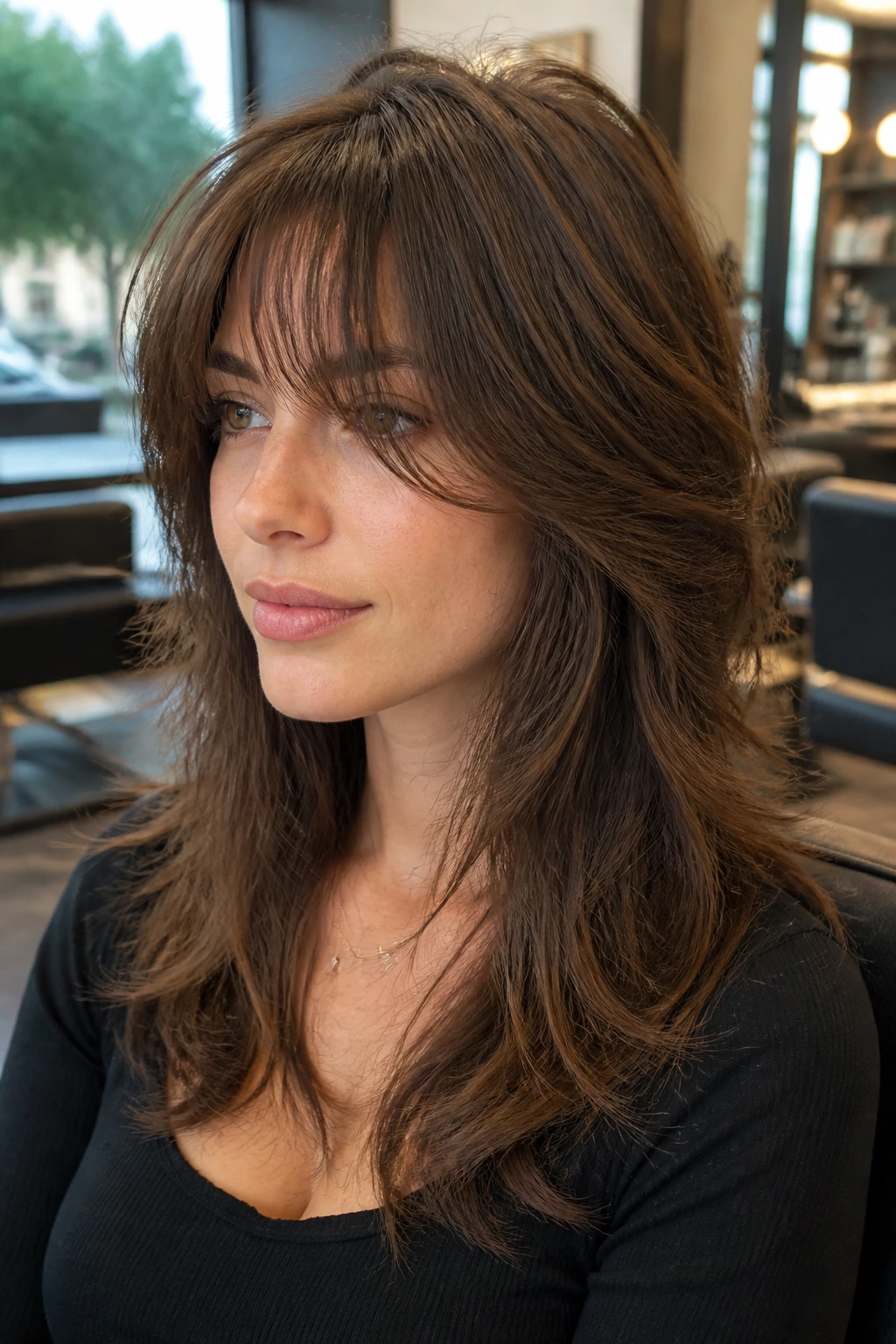
Soft wolf layers can be a smart match for feathered bangs, but only if the cut stays restrained. Too much choppiness on thin hair makes the whole head feel airy in the wrong places. Softness is the goal, not an exploded outline.
The fringe ties the haircut together by giving the front a clear starting point. That matters on heart-shaped faces because the wolf shape can otherwise widen the top half of the head. A feathered bang keeps the emphasis forward and down, closer to the eyes.
I prefer this version when the layers start below the cheekbones instead of right at the temples. That keeps the face frame intact and leaves enough hair at the top to avoid a wispy gap. If you like texture but hate looking over-layered, this is the safer version.
A dab of styling cream on the ends is enough. Do not overdo the product or the whole thing flattens.
14. Feathered Bangs and Blunt Ends
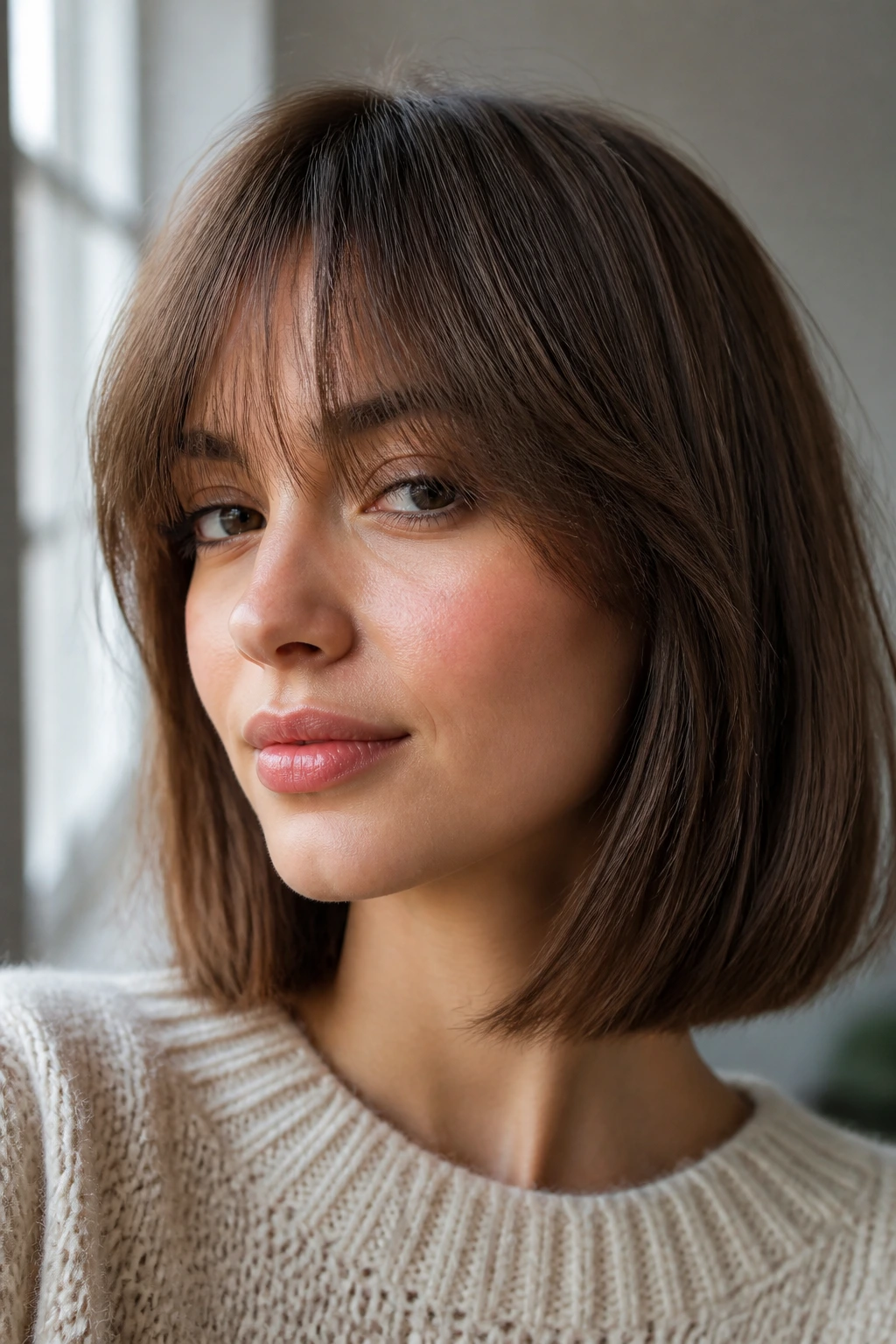
This is a strong combination: soft at the forehead, solid at the ends. The blunt perimeter gives thin hair a denser outline, while the feathered bangs keep the front from feeling heavy or stiff.
That contrast matters on heart-shaped faces. The soft fringe reduces forehead width visually, and the blunt ends bring the eye back down toward the jawline and shoulders. It is a tidy balance. Not fussy. Not fragile-looking.
If your hair tends to look stringy when layered all over, this is one of the better solutions. You keep the weight where it helps and feather only the area that needs movement. That usually means the fringe and maybe a few face-framing pieces, not every strand in sight.
It is also a practical choice if you want to make the haircut look thicker in photos and in real life. Blunt ends do more of that work than people think.
15. See-Through Feathered Fringe
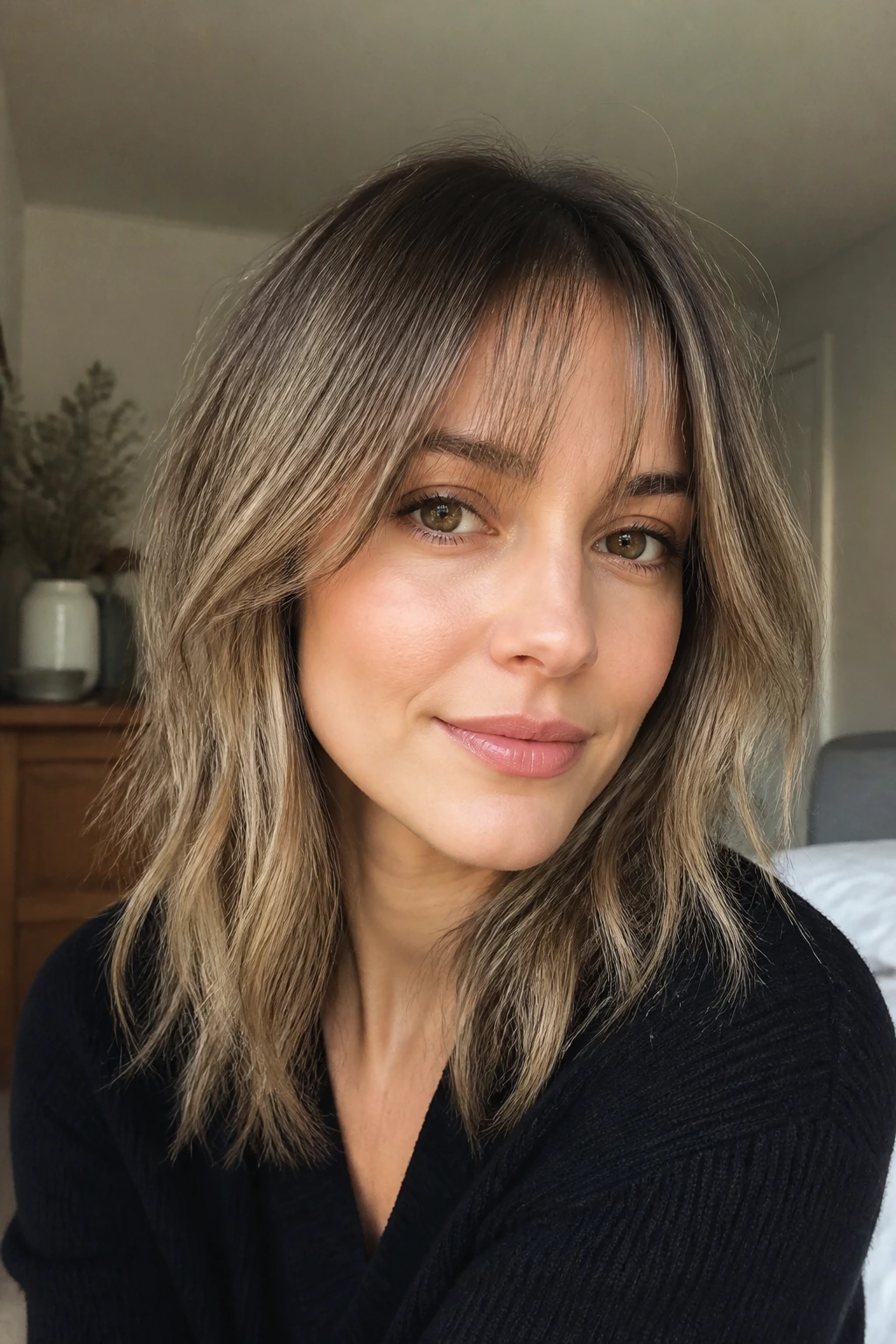
See-through bangs can look lovely on thin hair when they are cut with intention. The trick is to keep the fringe light enough to let some forehead show through, but not so light that it looks forgotten.
What to Watch For
- Keep the central section soft but present.
- Avoid chopping the ends too short.
- Ask for feathering that breaks the line, not one that strips the density away.
This style is especially good for heart-shaped faces that need a little forehead coverage without losing openness. The see-through effect keeps the look airy, which means the bangs do not fight with cheekbones or a strong jaw.
It is one of the easiest styles to flatten if you use too much product. A tiny amount of lightweight mousse or root spray is enough. Anything richer tends to close up the spacing and make the fringe droop.
16. Off-Center Feathered Bangs
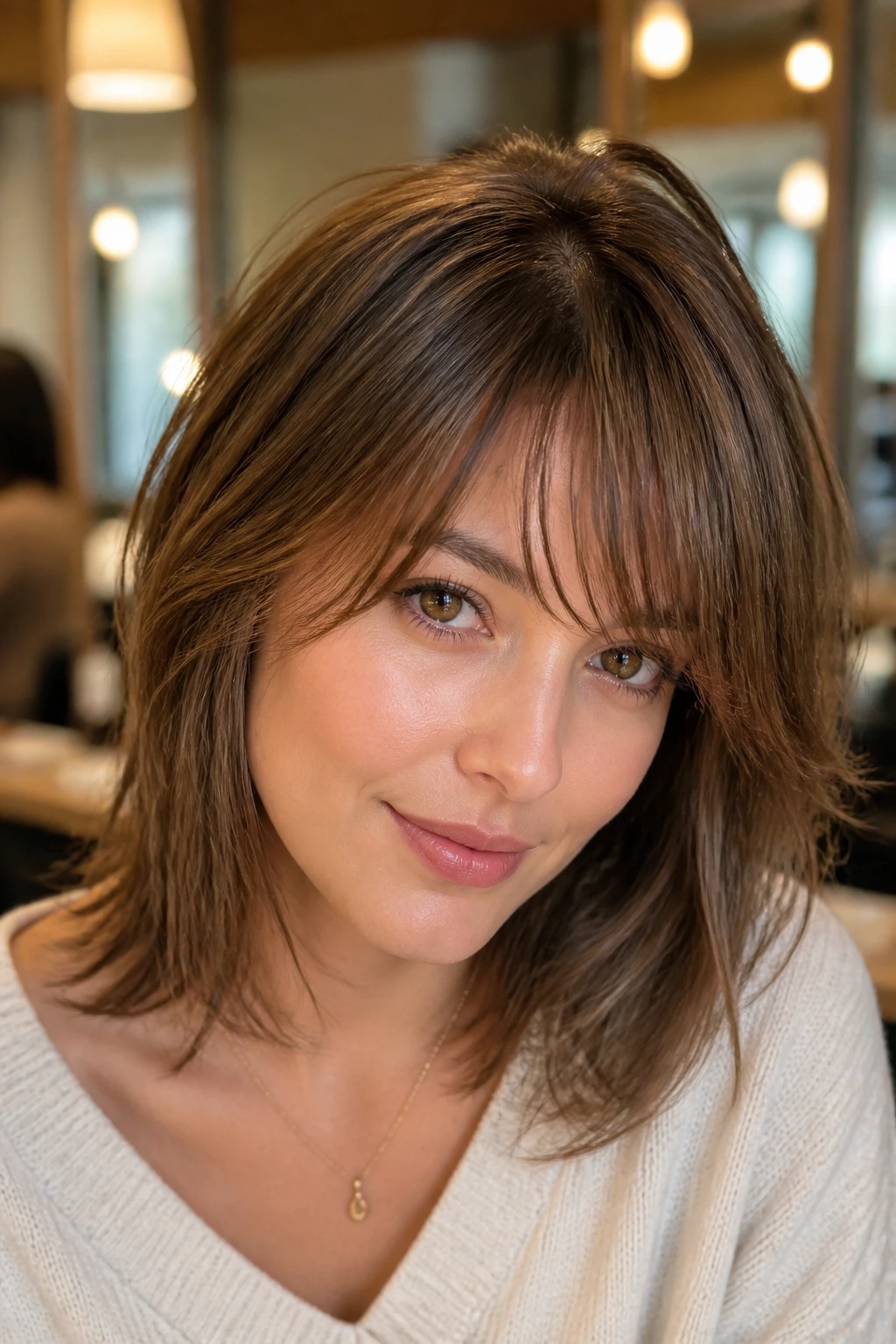
An off-center part can save the whole cut when a true middle part feels too exposed. The slight shift breaks up the forehead line and gives the fringe a softer, less rigid fall.
Thin hair often likes this because a center part can make the scalp show more than you want. Moving the part just an inch or so to one side gives the bang a bit of direction and makes the density look more even. It is a small change with a big visual payoff.
On heart-shaped faces, the off-center line can also soften symmetry in a flattering way. It keeps the fringe from calling too much attention to the widest part of the forehead. The face reads calmer, less top-heavy.
If your hair has a stubborn cowlick, this is the version I would try first. Fighting the cowlick is a waste of time. Working with it is faster and usually looks better.
17. Flipped-Under Feathered Bangs
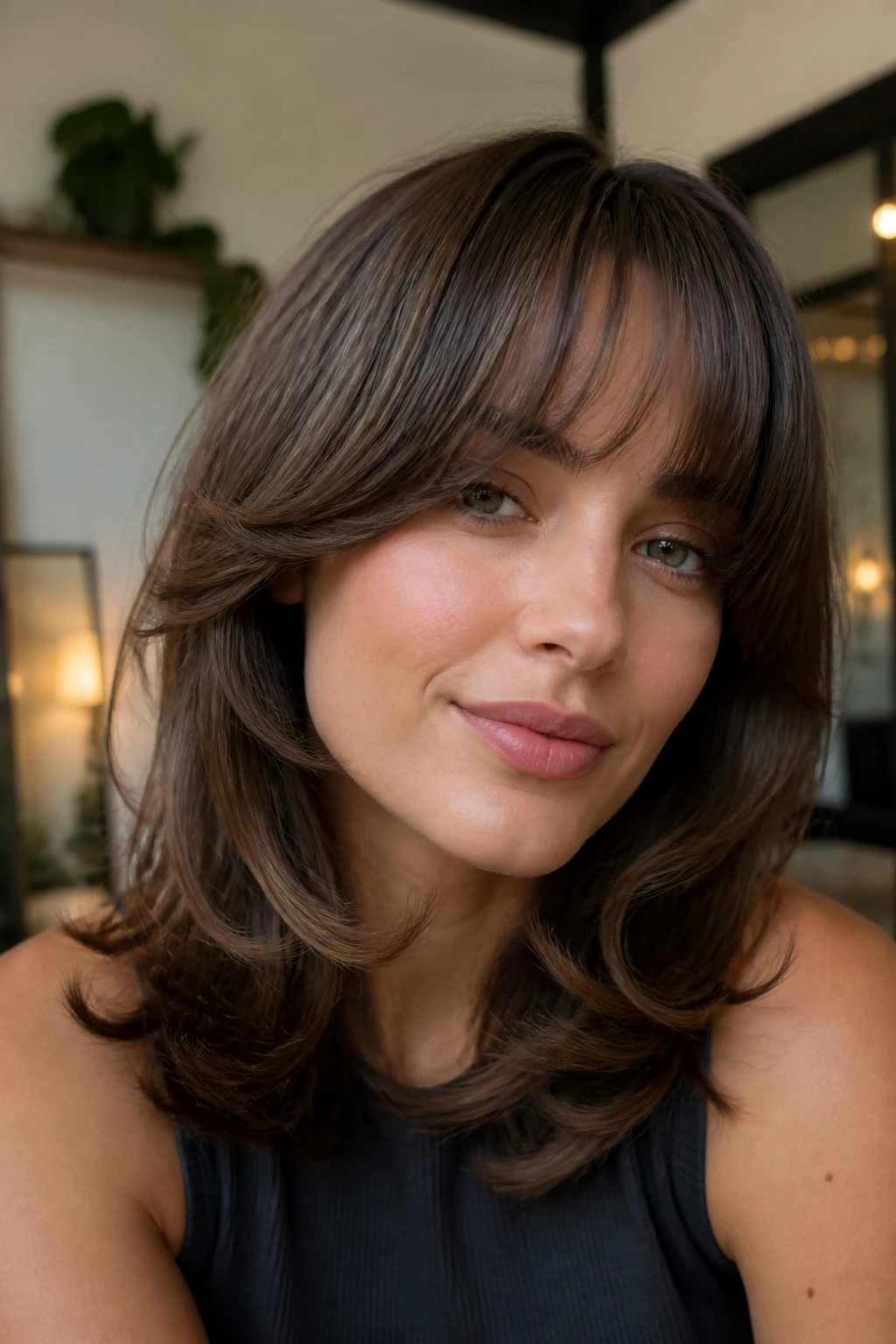
Flipped-under feathered bangs have a little vintage charm, but the modern version is softer and lighter. The ends bend inward just enough to give the fringe shape, and that bend can make thin hair look fuller because it creates a more defined edge.
The effect is subtle. It is not a pageboy. It is a gentle hook at the ends that keeps the bangs from lying flat against the forehead. On a heart-shaped face, that bend brings attention back toward the center of the face and softens the upper width.
A small round brush or a quick pass with a flat iron does the trick. Turn the tool only at the last inch or so; if you bend the whole bang, it can look too styled. The goal is a soft curve, not a stiff curl.
This style works best when the rest of the haircut has some movement too. If the lengths are dead straight, the fringe can feel disconnected.
18. Feathered Bangs for Glasses

If you wear glasses, feathered bangs need a little more strategy. The fringe should clear the frames without sitting so high that your forehead takes over the whole look.
A good glasses-friendly fringe usually starts a touch longer in the center and stays lighter at the sides. That keeps the bangs from collapsing onto the lenses, which is one of the fastest ways to make thin hair look flat and fussy at once.
You also want to think about frame shape. Thick frames can handle a little more bang; thin metal frames usually look better with a lighter, more broken fringe. That balance keeps the face from feeling crowded.
Bring your glasses to the salon if you can. Stylist math is easier when the real frame is right there, not imagined from memory.
19. Feathered Bangs on Wavy Hair
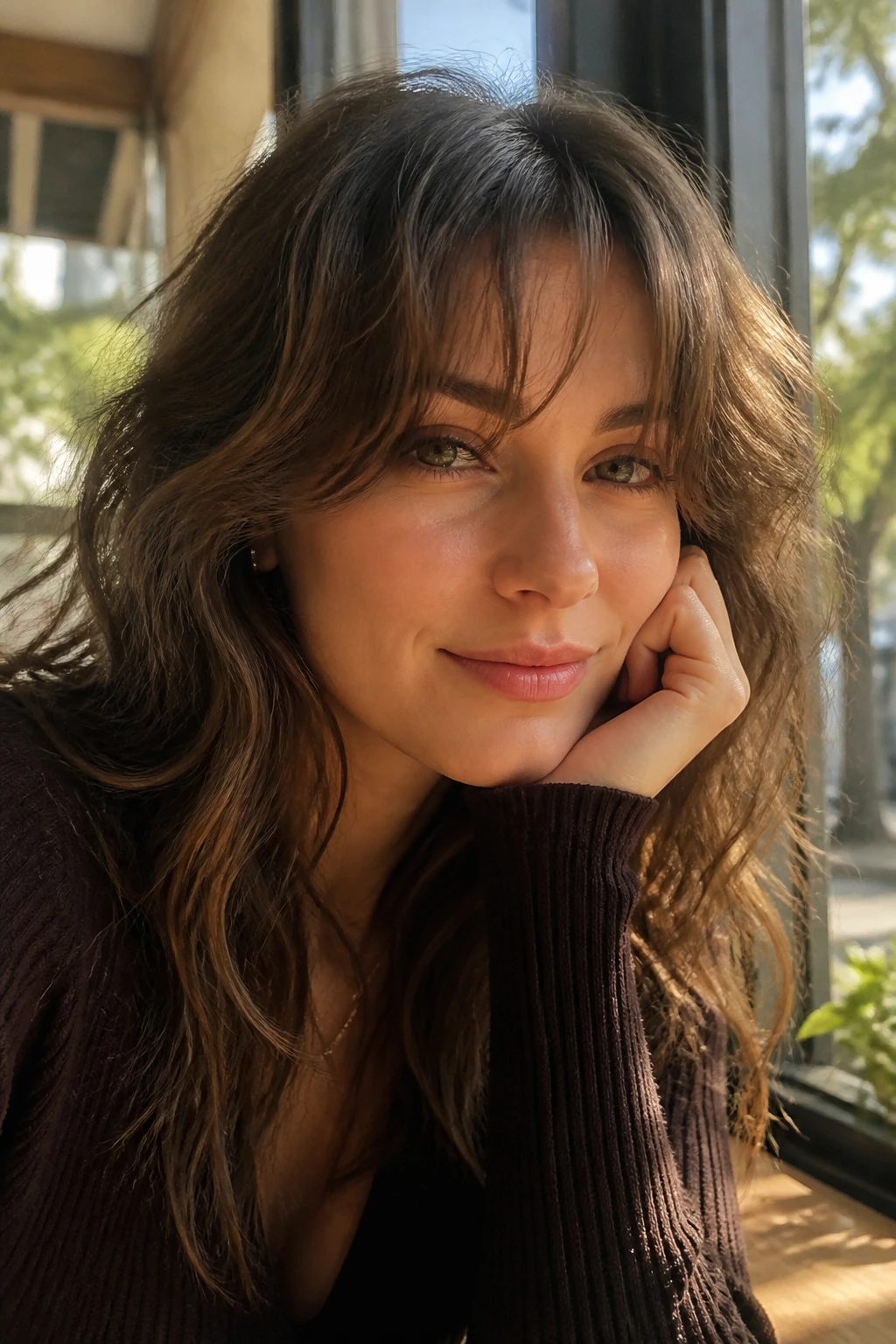
Wavy hair gives feathered bangs a head start. The bend is already there, which means the fringe can look full without needing a lot of round-brush work.
The danger is overworking the wave out of it. If you blow-dry wavy fringe bone straight, it often ends up limp at the root and frizzy at the ends. A diffuser or a low-heat dry with a small brush usually works better. Let the wave keep some of its texture.
Heart-shaped faces get a lot of softness from this combo. The fringe breaks up the forehead, and the wave keeps the edges from feeling sharp. It is an easy, flattering shape if you do not mind a little natural movement.
A light cream is enough. Heavy oils can make the wave clump and expose the scalp between pieces.
20. Feathered Bangs on Pin-Straight Fine Hair
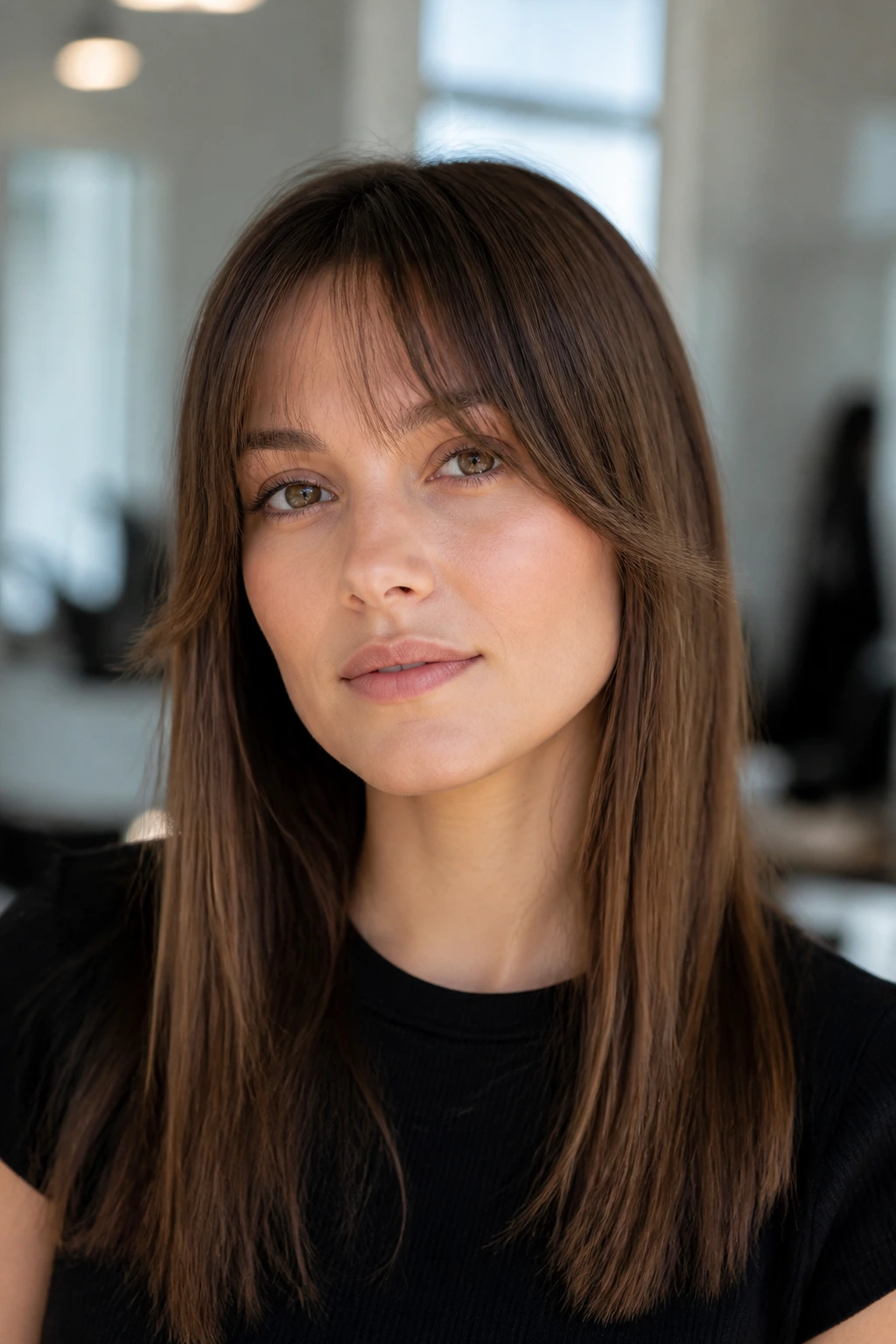
Pin-straight fine hair is the hardest version of this look, and also the one that benefits most from smart cutting. Straight strands show every blunt line, every missed angle, every overly-thinned patch.
The answer is not to chop more hair away. It is to build a shape that bends slightly at the ends and keeps enough density in the middle to read as a fringe. A stylist who point-cuts with care can make straight hair look softer without creating holes.
For heart-shaped faces, this type of fringe works best when the center stays modest and the sides sweep outward. That keeps the forehead from looking too broad. It also prevents the bangs from sitting like a flat strip across the face, which is the usual failure mode.
Drying direction matters here more than on any other texture. Blow the roots forward first, then guide the ends slightly to the side so the fringe doesn’t hang straight down all day.
21. Feathered Bangs That Balance a High Forehead
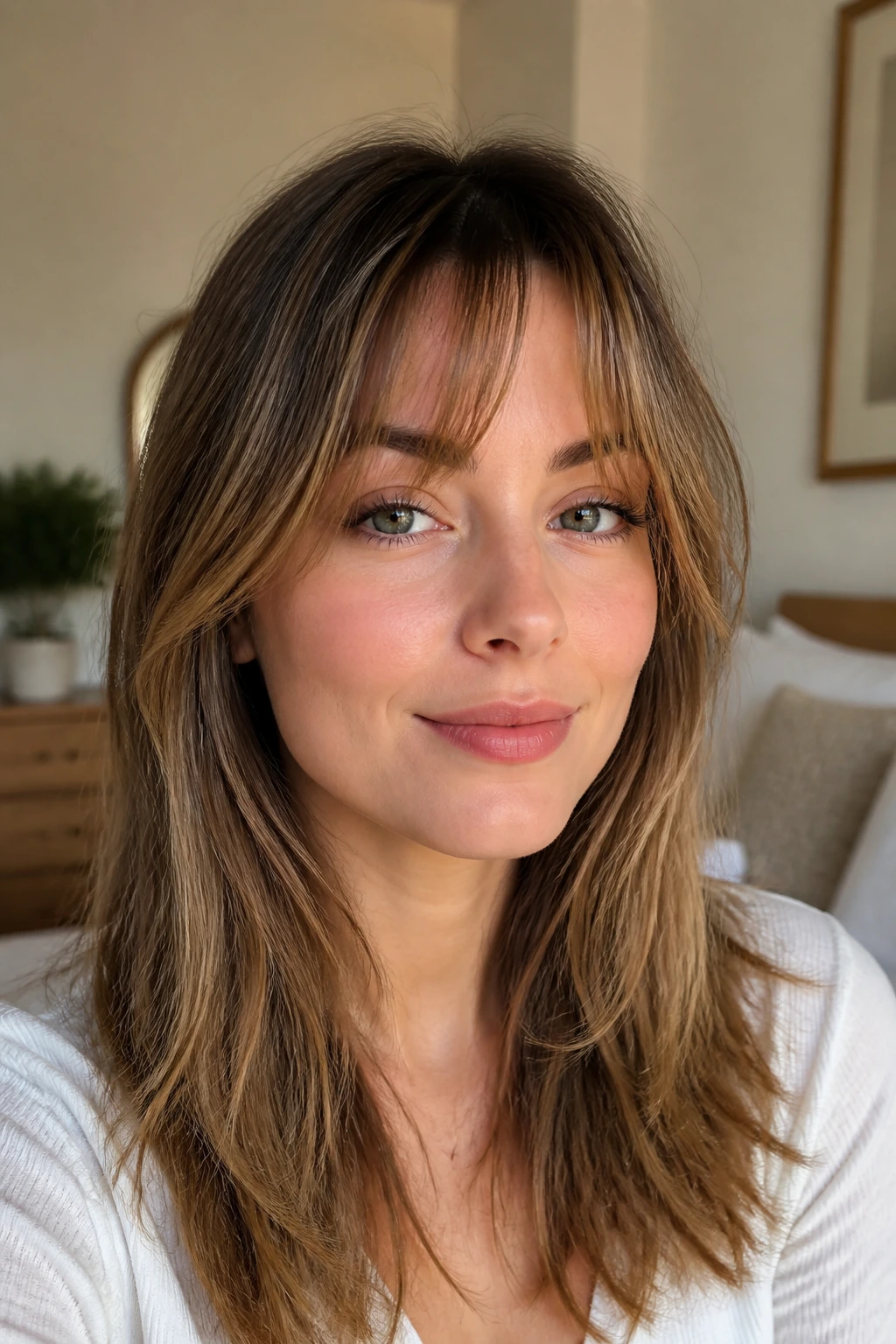
A high forehead changes the game a bit. You need enough coverage to soften the upper face, but not so much that the bangs become the whole haircut.
Feathered bangs handle that balance well because they let you keep some forehead visible while still shortening the visual distance between the hairline and the eyes. On a heart-shaped face, that can be especially helpful. The top half gets a little less emphasis, and the cheekbones regain control of the composition.
I like this shape longer in the center and fuller at the outer edges. That way it doesn’t create a shelf. It creates a frame.
If you are unsure about length, err on the side of slightly too long. Thin hair can be trimmed shorter; too-short bangs are a different problem, and they are annoying in humid weather.
22. Feathered Bangs That Sit on the Cheekbones
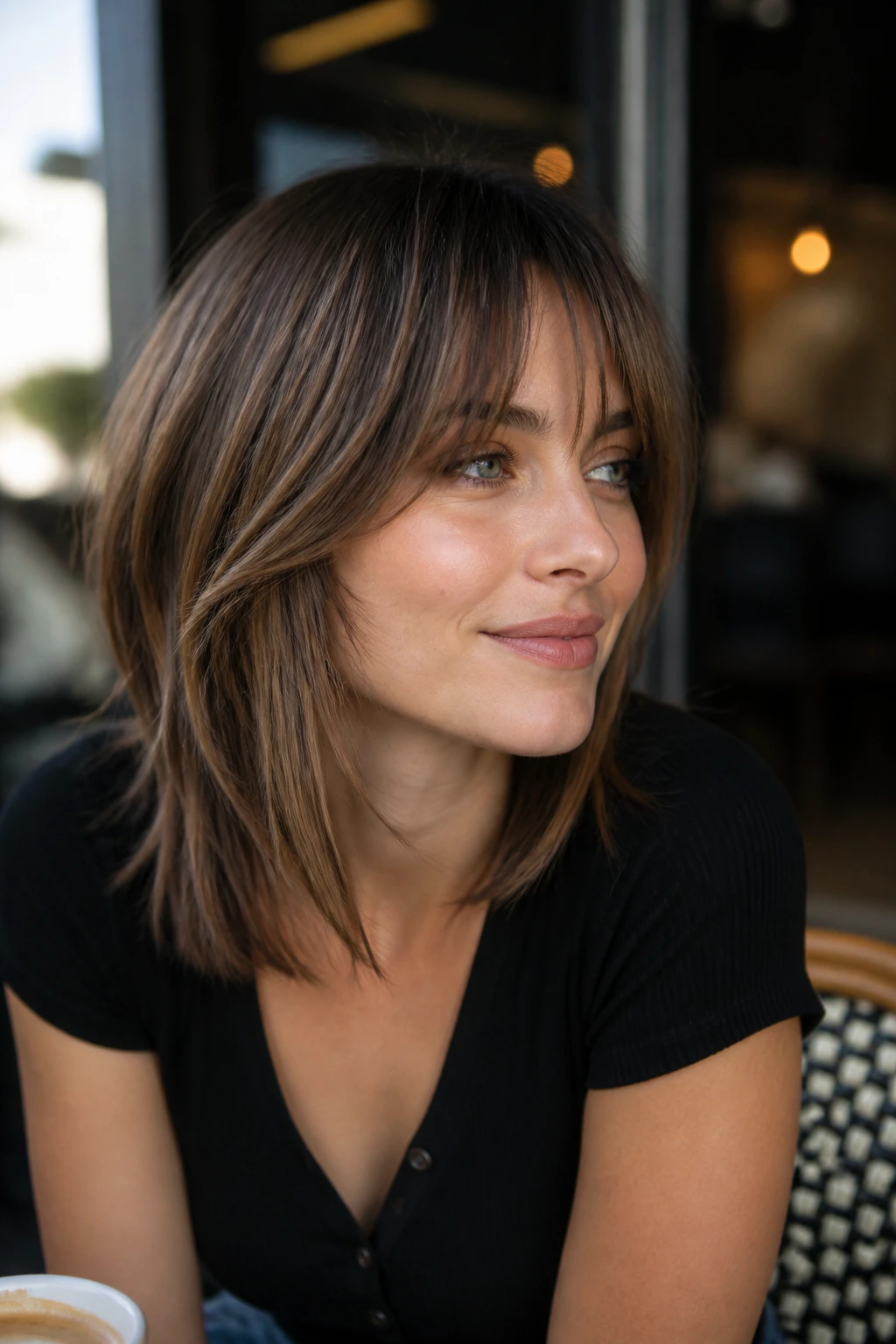
Some bangs are about the forehead. These are about the cheekbones. The fringe starts soft, then travels outward so the ends rest near the bone structure that already makes a heart-shaped face interesting.
That placement is useful because it gives the face a diagonal line to follow. Thin hair often benefits from diagonals; they feel more dynamic than a blunt horizontal edge. The fringe also blends more easily into longer layers, which keeps the cut from looking disconnected.
This is one of the most flattering options if you have strong cheekbones and want to show them off a little. The bangs do not hide them. They point to them.
The best styling trick is to lift the roots first and bend the sides away from the face. If you curl the fringe too hard inward, you lose the open shape that makes this version work.
23. Half-Up Styles With Feathered Fringe
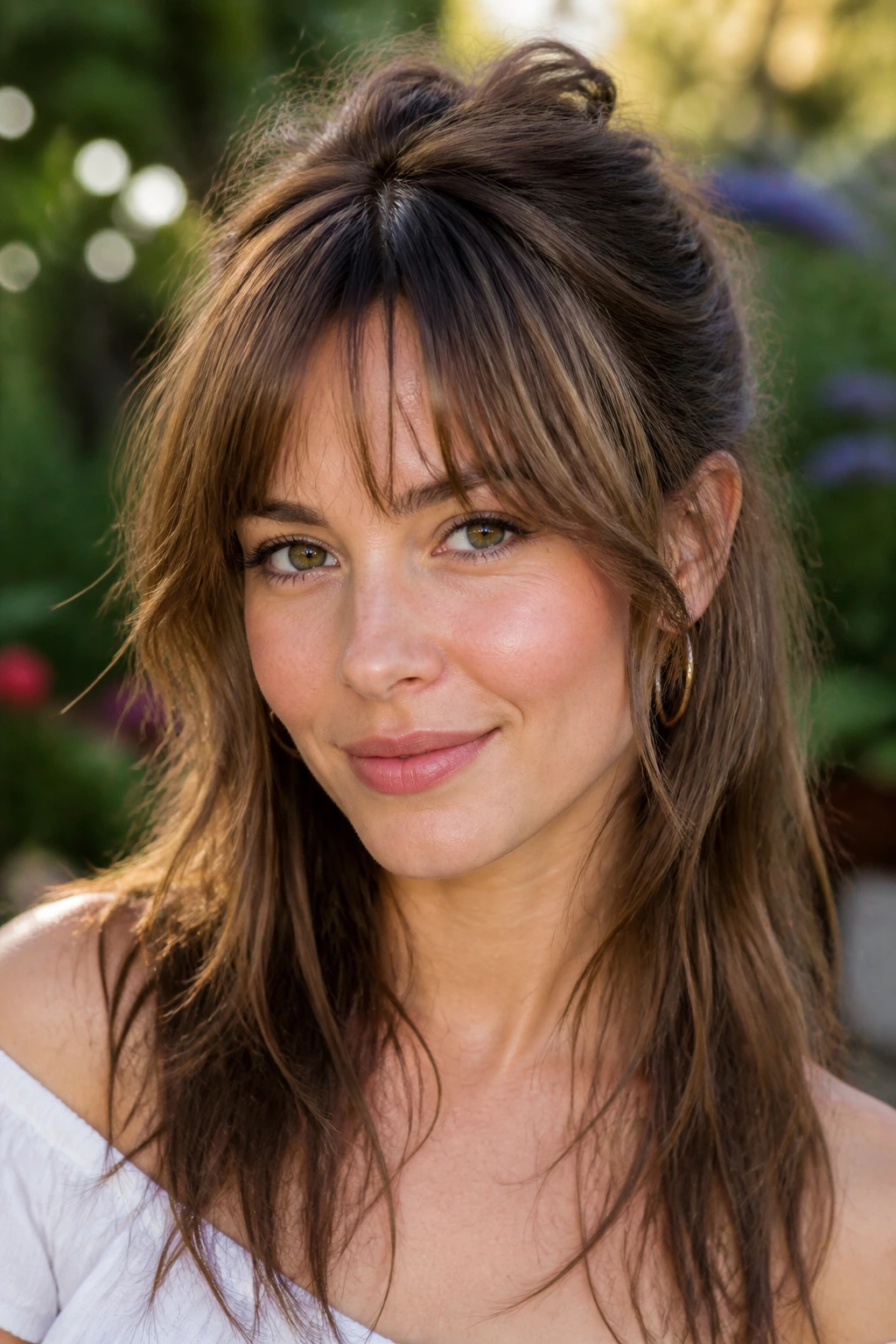
What happens when you need your hair out of your face but still want the fringe to do something useful? A half-up style solves that, and feathered bangs make it look deliberate instead of thrown together.
The fringe softens the front while the pulled-back section gives the crown a bit of lift. Thin hair usually likes that because the top can go flat fast. A half-up shape adds height without teasing the life out of the roots.
This is also a smart match for heart-shaped faces on days when you want to keep the forehead balanced but not hidden. The bangs frame the front, the half-up section keeps the profile clean, and the cheeks stay visible.
Keep the half-up section low enough that it doesn’t fight the bangs. If you pull too high, the style starts competing with itself. Low and loose wins here.
24. Grown-Out Feathered Bangs
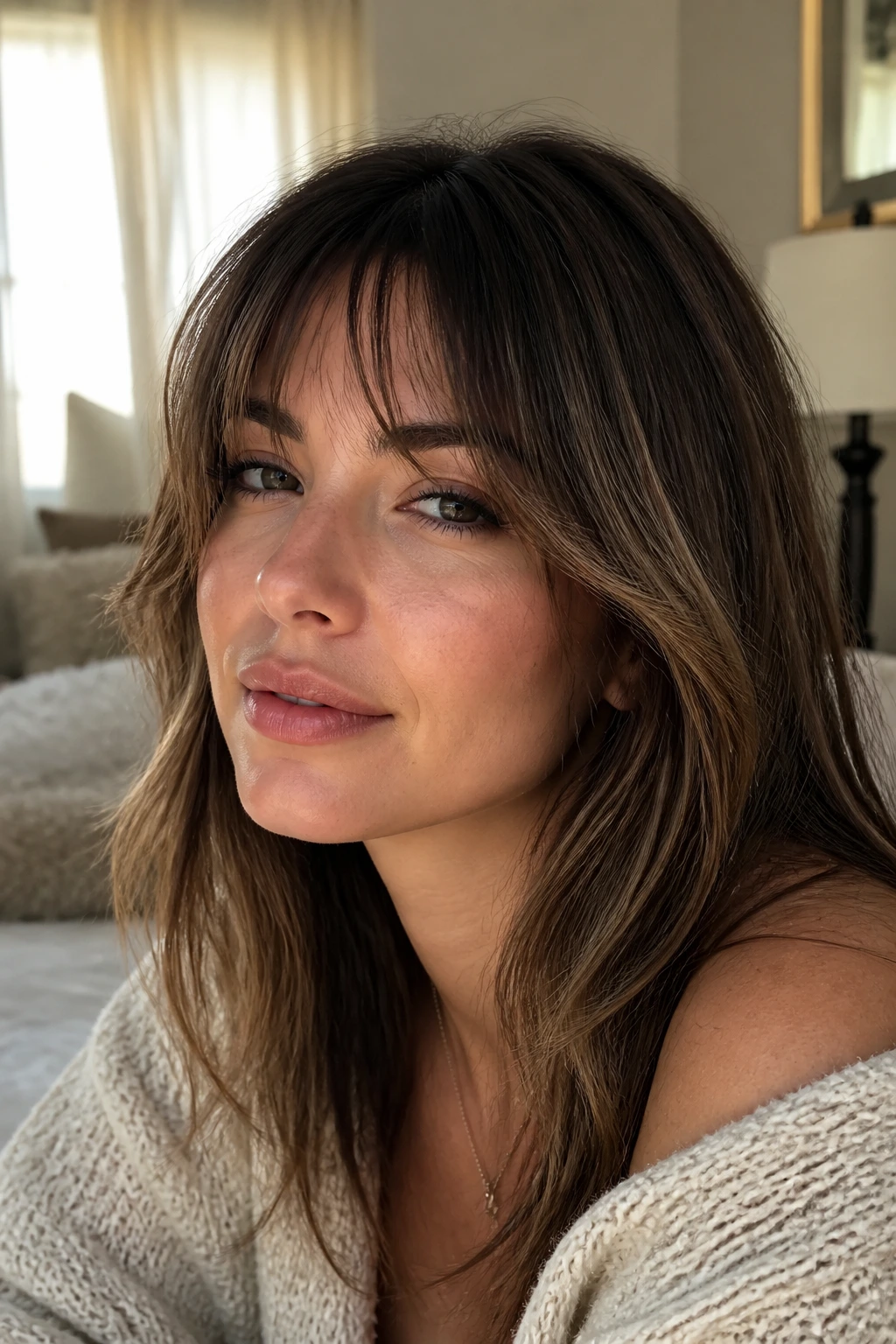
Grown-out bangs are where feathering really earns its keep. A blunt fringe that passes the brow line can look bulky and awkward. Feathered pieces, by contrast, start to melt into face-framing layers in a way that feels intentional.
That makes this a smart option if you know you do not want constant trims. The shape can live at brow length, eyelash length, and then cheekbone length without losing its point of view. Thin hair likes that gradual shift because the fringe never suddenly looks heavy.
Heart-shaped faces usually do well with this longer phase. The forehead gets softened, the cheekbones stay visible, and the narrow chin is still balanced by the side pieces.
If you are growing your fringe out, ask for a little more length at the outer corners during each trim. That keeps the transition smooth instead of creating a shelf in the middle.
25. Low-Maintenance Feathered Fringe
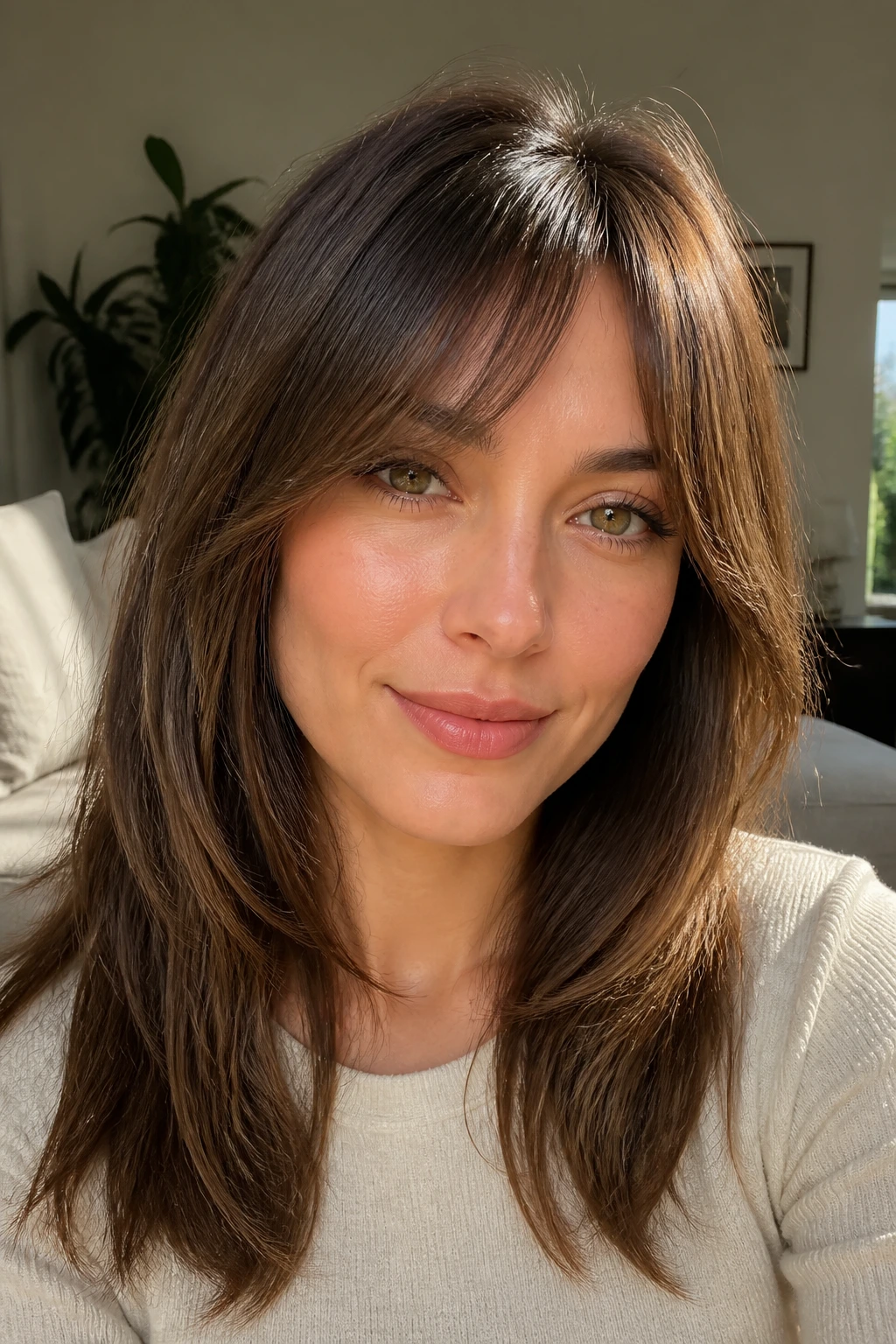
Low-maintenance feathered fringe is the one for people who want the look more than the ritual. It sits a little longer, stays lightly textured, and does not need a full round-brush performance every morning.
Thin hair benefits from that restraint. The longer length keeps the fringe from separating too hard, and the feathered ends prevent the front from looking blunt or heavy. On a heart-shaped face, it softens the forehead while leaving enough openness around the eyes.
This version is especially good if you air-dry often or if you are not in the mood to own a dozen styling tools. A touch of mousse, a side part, and a quick finger twist at the front can be enough.
If you hate maintenance, this is the safest place to land. It is the least fussy of the bunch, and that makes it useful in real life, not just in the chair.
Why Feathering Beats a Blunt Fringe on Thin Hair
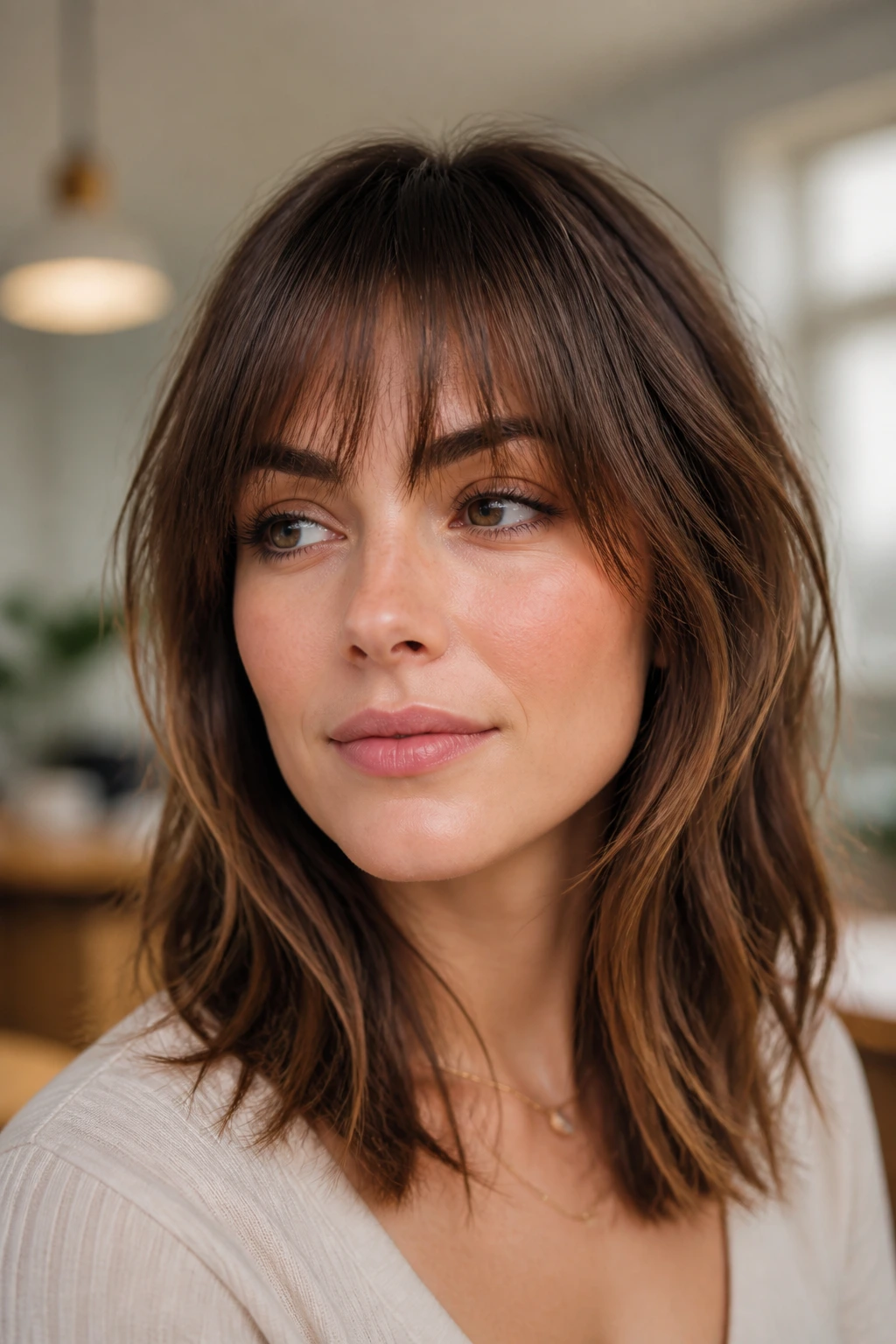
A blunt fringe on thin hair can look clean for about ten minutes. Then gravity gets involved. The line starts to separate, the ends show through, and the whole thing reads as a little too neat for the amount of hair available. Feathering solves that by breaking the edge and giving the fringe a bit of internal movement.
There is a second reason it works on heart-shaped faces. A blunt line across a wider forehead can feel heavy, almost like it’s drawing a ruler across the top of the face. Feathered ends soften that boundary. They blur the forehead line and let the eye move toward the cheekbones, which is where a heart shape usually looks strongest.
Where Stylists Should Be Careful
The mistake people make is over-texturizing. Fine hair does not need to be shredded to look light. It needs careful point cutting, a controlled length map, and enough bulk left in the middle to read as a fringe.
The Shape You Actually Want
- A little lift at the root
- Softness around the temples
- Enough density at the center to show up in profile
That mix is why feathered bangs look better in motion than in a still photo. They are built to move.
Essential Tools for Styling Feathered Bangs
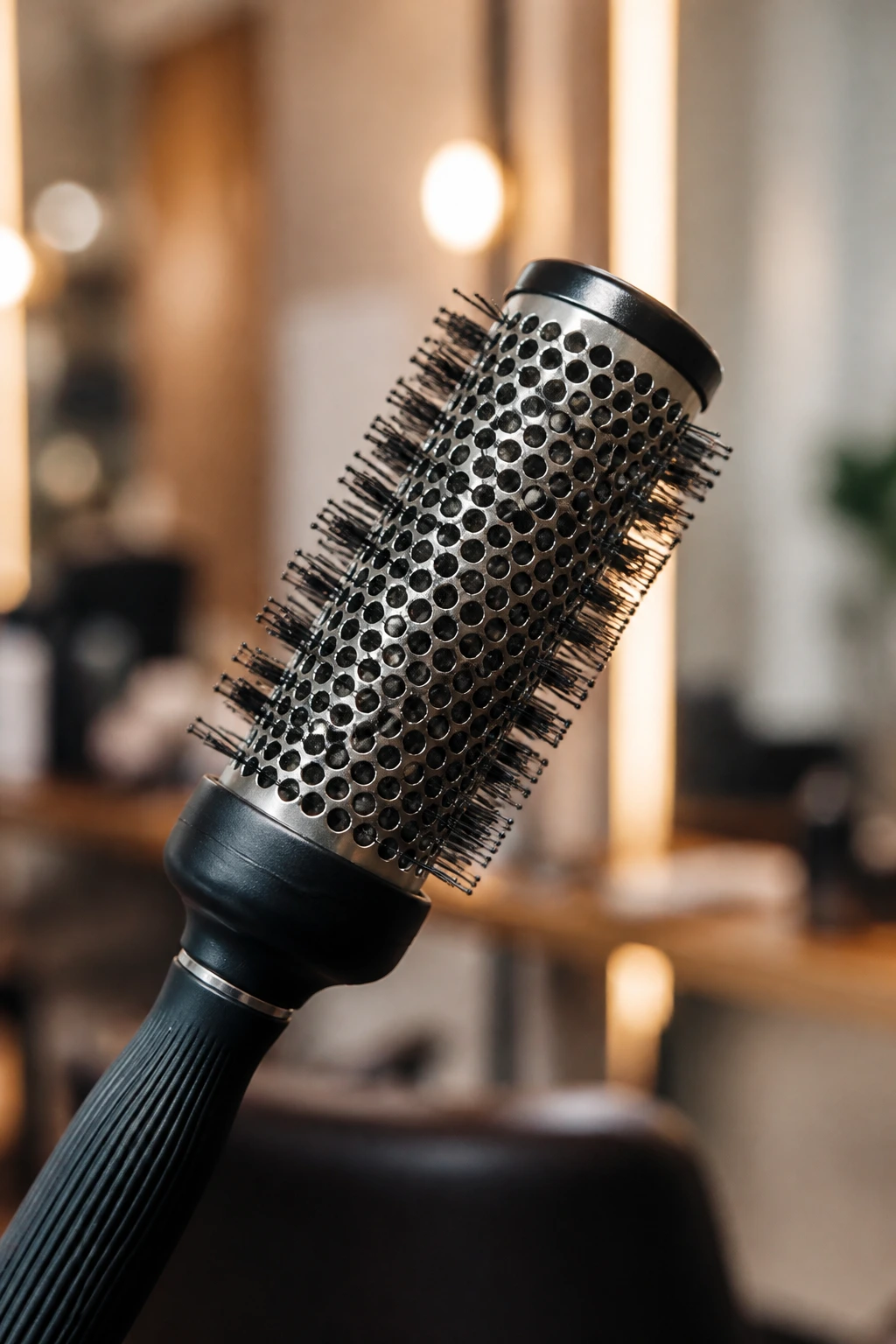
- A small round brush, 1 to 1.5 inches: This gives you bend without making the fringe curl too hard.
- A blow-dryer with a narrow nozzle: Air direction matters more than heat here, especially on fine hair.
- Lightweight mousse: A golf-ball amount at the roots can help the fringe keep shape without feeling crunchy.
- Heat protectant spray: Fine hair can scorch quickly, and fried ends show up fast in a feathered cut.
- Texturizing spray or dry shampoo: Use a tiny bit to separate pieces and keep the fringe from collapsing.
- A 0.5- to 1-inch flat iron: Handy for a small wrist turn at the ends.
- Sectioning clips: Bangs style better when the rest of the hair stays out of the way.
- Hand mirror: Useful for checking symmetry, cowlicks, and part direction from the side.
- Fine-tooth comb: Good for setting the front before drying, though a soft brush works too.
- Optional velcro rollers: Not essential, but they can give thin bangs a little root lift while you do makeup.
What to Ask for at the Salon
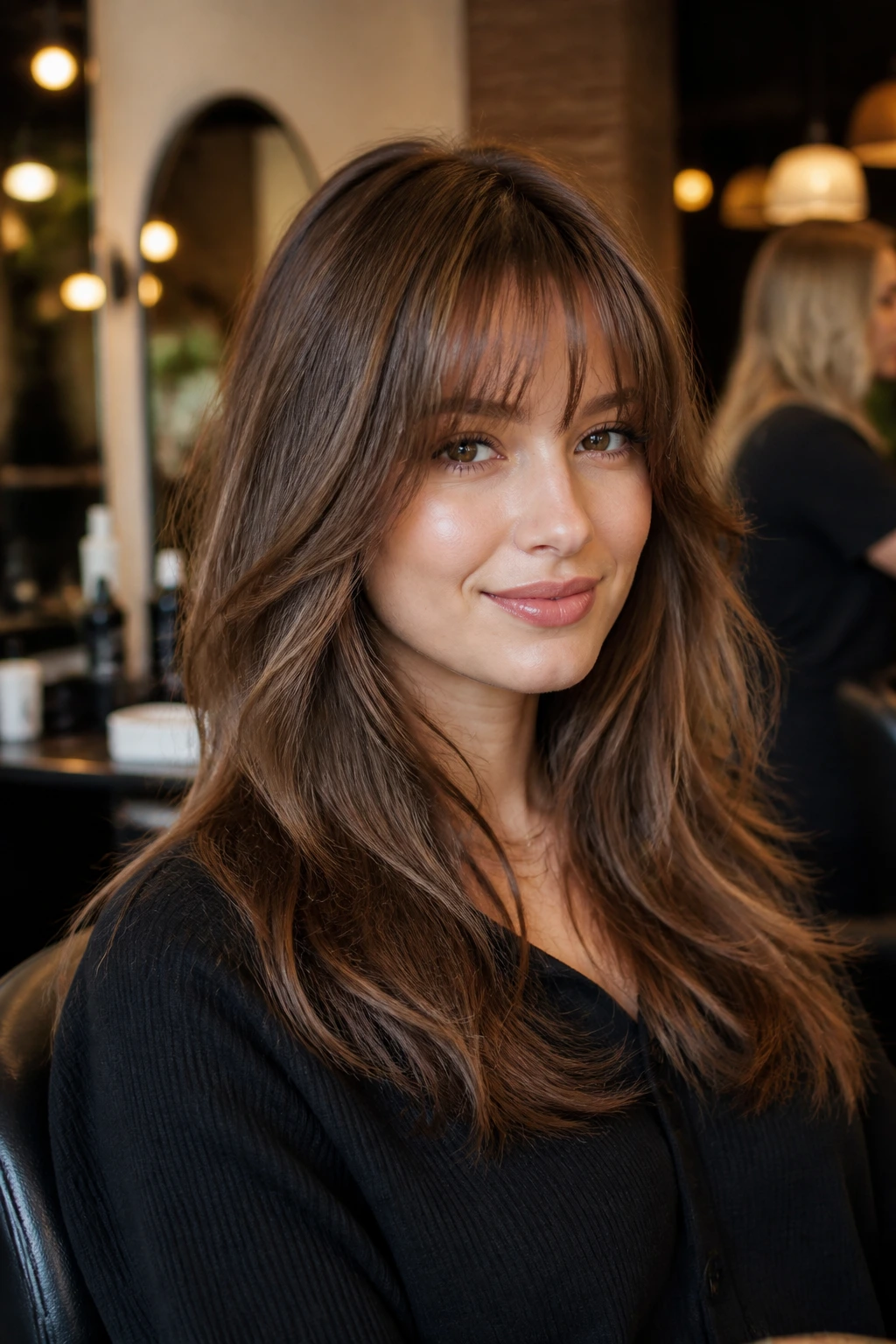
- Ask for point cutting, not a heavy razor job: Fine hair can turn sparse fast if the stylist removes too much from the ends.
- Show the shortest and longest points you want: A heart-shaped face usually looks best when the center is softer and the sides are a little longer.
- Tell them how much forehead you want to keep visible: That one sentence saves a lot of regret.
- Mention your parting habit and any cowlicks: Those details change how the fringe sits more than most people realize.
- Ask where the bangs will land when dry: Wet hair lies. Dry hair tells the truth.
Bring photos, sure, but bring a plain explanation too. Say what you want the bangs to do: soften the forehead, add movement, grow out cleanly, or work with glasses. That is the useful part.
How to Wear Feathered Bangs Day to Day
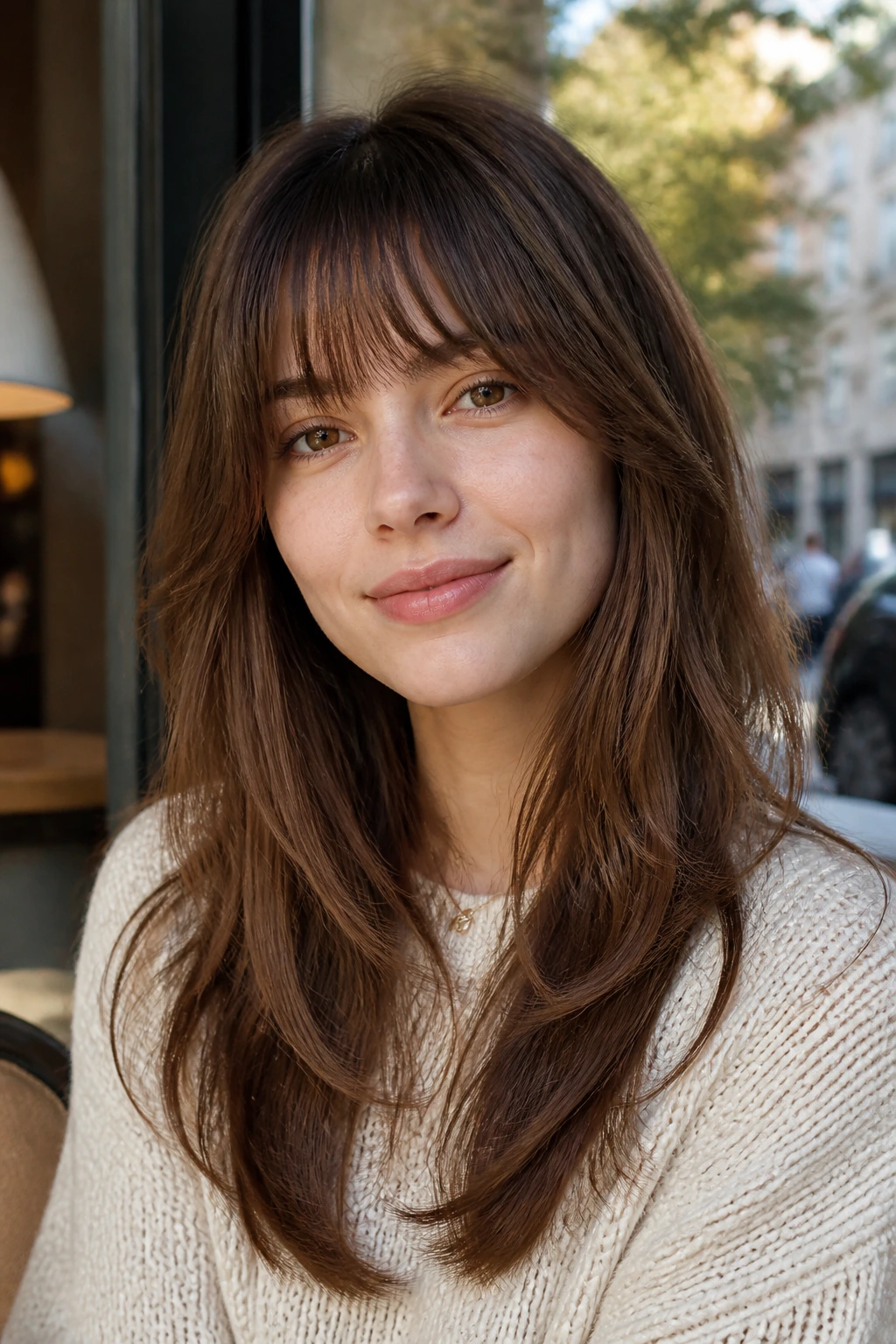
Placement: Keep the fringe sitting just at or slightly above the brows at the center, then let the outer pieces drop lower toward the cheekbones. That preserves softness across the forehead while giving the face some vertical stretch.
Drying: Blow-dry the roots first, pointing the nozzle forward and then slightly to the side. If the roots dry in the wrong direction, the ends will keep trying to rescue the shape all day, and they usually lose.
Pairings: Feathered bangs work best with face-framing layers, a lob, a bob with movement, or longer lengths that carry the softness forward. A totally blunt haircut below can still work, but the contrast needs to be intentional.
Finish: Use only enough product to keep the fringe separated. If you can feel the product from across the room, it is too much for thin hair. A light mist or a pea-sized amount is usually enough.
If You Wear Glasses: Keep the center a touch longer and the sides light so the fringe doesn’t land on the frames. The goal is a soft line above the lenses, not hair stuck to plastic.
Small Styling Tweaks That Make Them Look Fuller
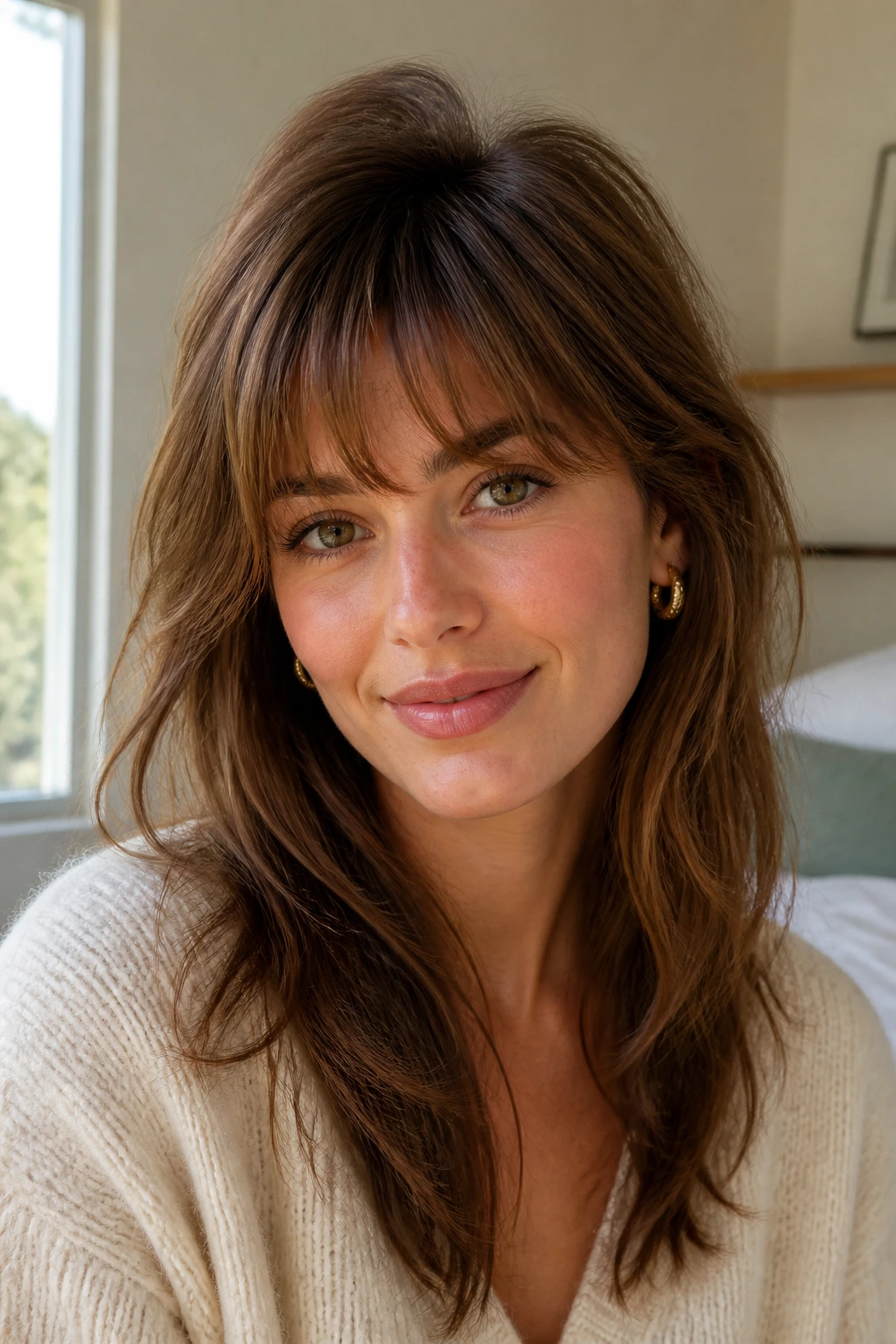
Lift: Mousse at the root beats heavy serum every time. Apply it to damp bangs, then direct the hair forward while blow-drying so the base dries with a little memory.
Texture: A pinch of dry shampoo at the roots can make thin fringe look denser by roughing up the cuticle just enough to hold separation. Use it sparingly. Too much and the bangs get dusty.
Polish: If the ends look too fuzzy, run a flat iron through only the last inch and bend the wrist away from the face. That gives you shape without flattening the top.
Make-It-Yours: For a softer look, keep the pieces longer and air-dry with finger twisting. For a sharper look, set the fringe with a small brush and a side sweep so the line feels cleaner.
If your hair is oily at the front, clean only the fringe between washes with a tiny washcloth and cool water, then re-dry the roots. It’s a boring fix. It also works.
Common Mistakes That Make Bangs Fall Flat
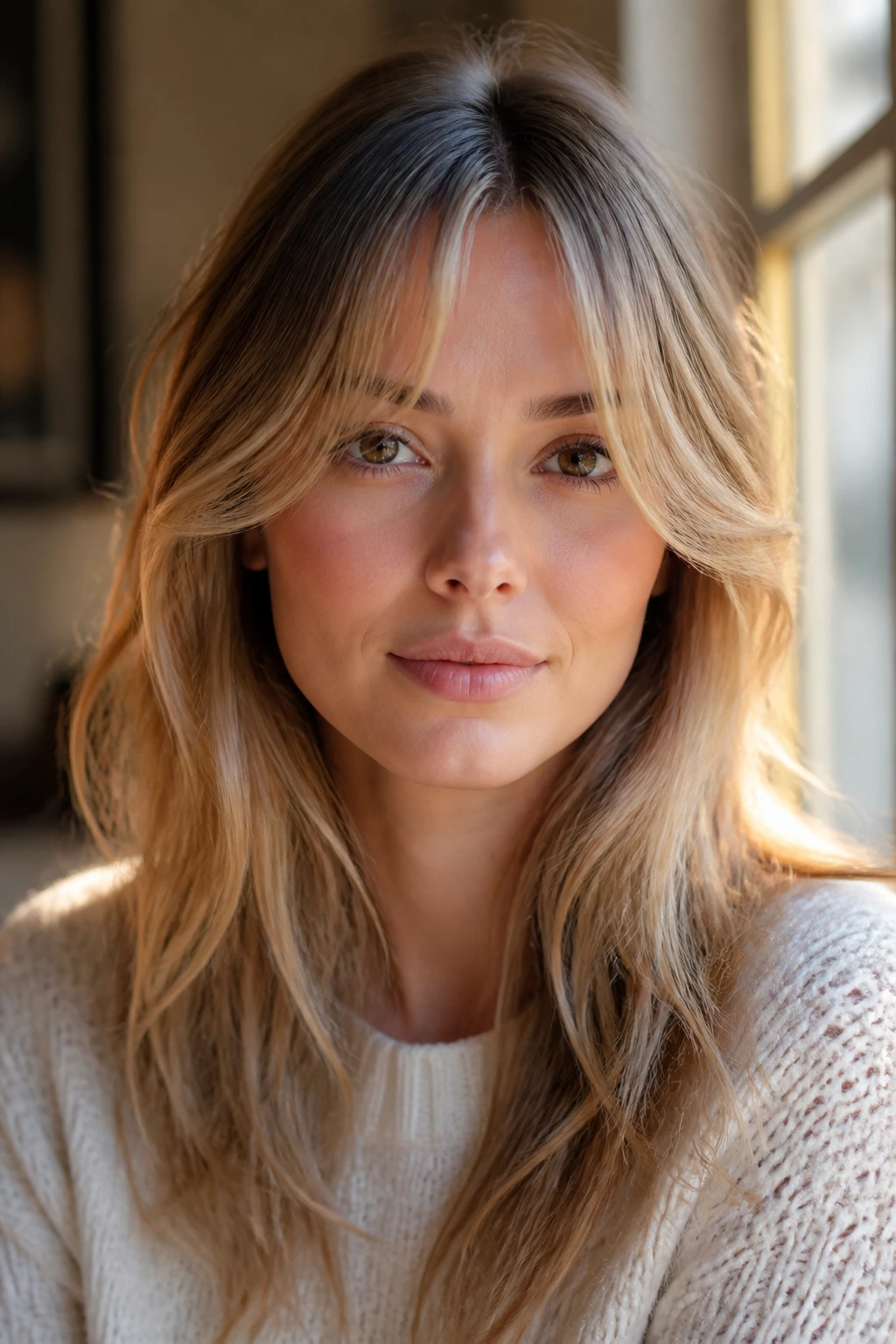
Over-thinning the fringe: If the bangs start looking see-through in patches, the cut removed too much weight. The fix is to keep more density in the center and use feathering only at the edges.
Cutting them too short at the center: Thin hair can spring up more than expected, and a too-short center makes the forehead look wider. Leave a little extra length so the fringe can settle after drying.
Using rich creams or oils on the front: Heavy product pushes fine bangs flat and makes the separation look greasy instead of airy. Switch to mousse, a light spray, or nothing at all if your hair already holds shape.
Ignoring the natural part: If the fringe is cut against a stubborn cowlick, it will split, buckle, or cling to one side. Work with the part your hair already wants, then refine from there.
Blow-drying straight down and walking away: That is how flat bangs happen. Dry the root in the intended direction first, then shape the ends.
Letting the ends sit too wide at the temples: On a heart-shaped face, too much width at the sides can make the forehead read even broader. Keep the taper soft and controlled.
Variations and Alternatives If Feathering Is Not Your Only Option
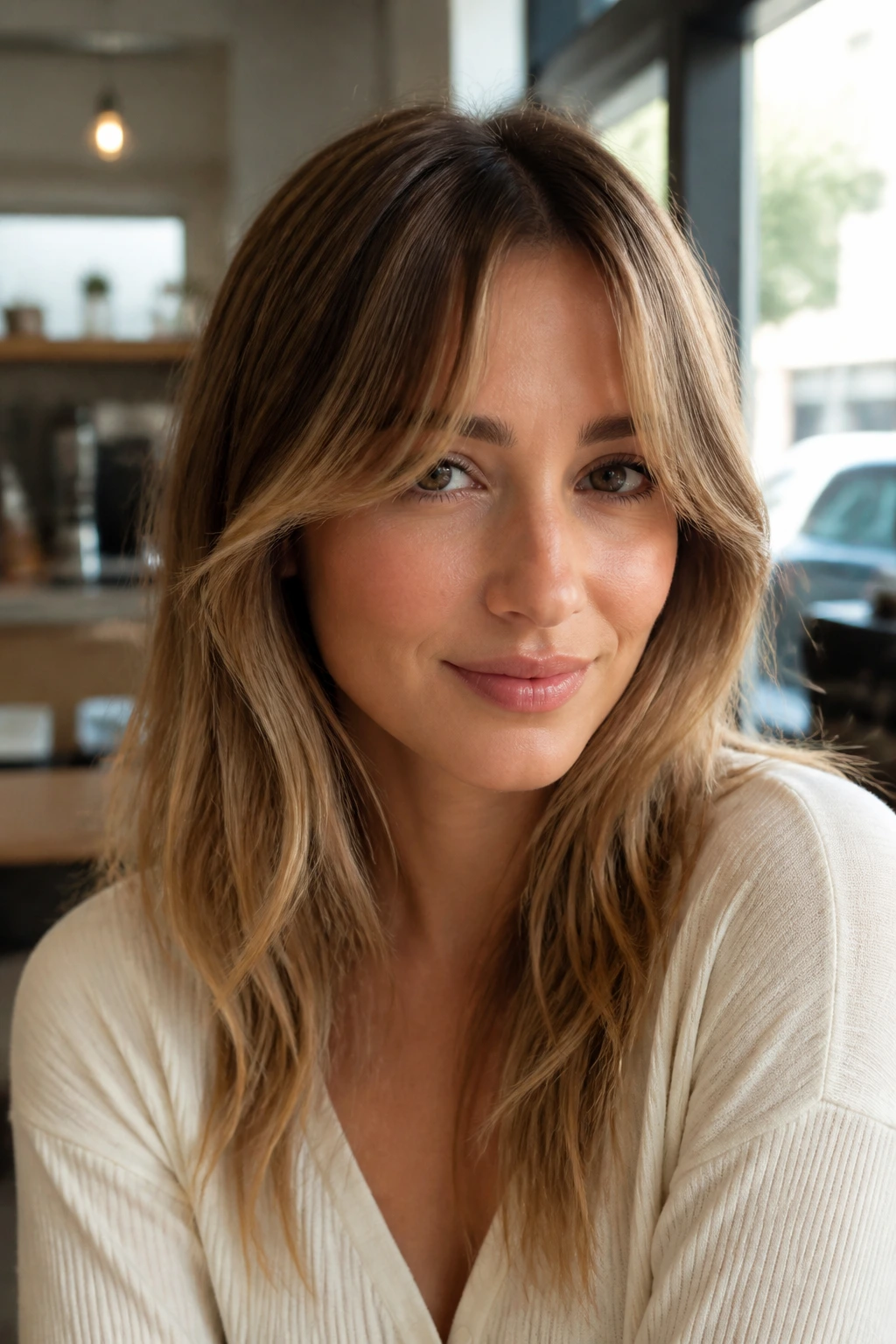
Curtain-to-Bottleneck Hybrid: If you want the softness of curtain bangs with a little more structure, keep the center shorter and let the sides open wider. This is a smart middle ground when you want movement but not too much forehead exposure.
Soft Side Sweep: If you are not ready for bangs that sit across the forehead, keep everything long and swept to one side. It gives the same face-softening effect with less maintenance and less risk.
Face-Framing No-Bang Cut: Sometimes the best answer is not a bang at all. Long layers starting at the cheekbones can create the same frame around a heart-shaped face while leaving the forehead fully open.
Air-Dry Fringe: For wavy or slightly textured hair, cut the fringe long enough to dry into its own curve. You get the feathered look with less brush work, which is a win if mornings are messy.
Mini Fringe With Length Around the Sides: If you want something bolder, keep the center a little shorter but leave the sides longer and feathered. That keeps the shape from looking severe.
Keeping the Shape Between Salon Visits
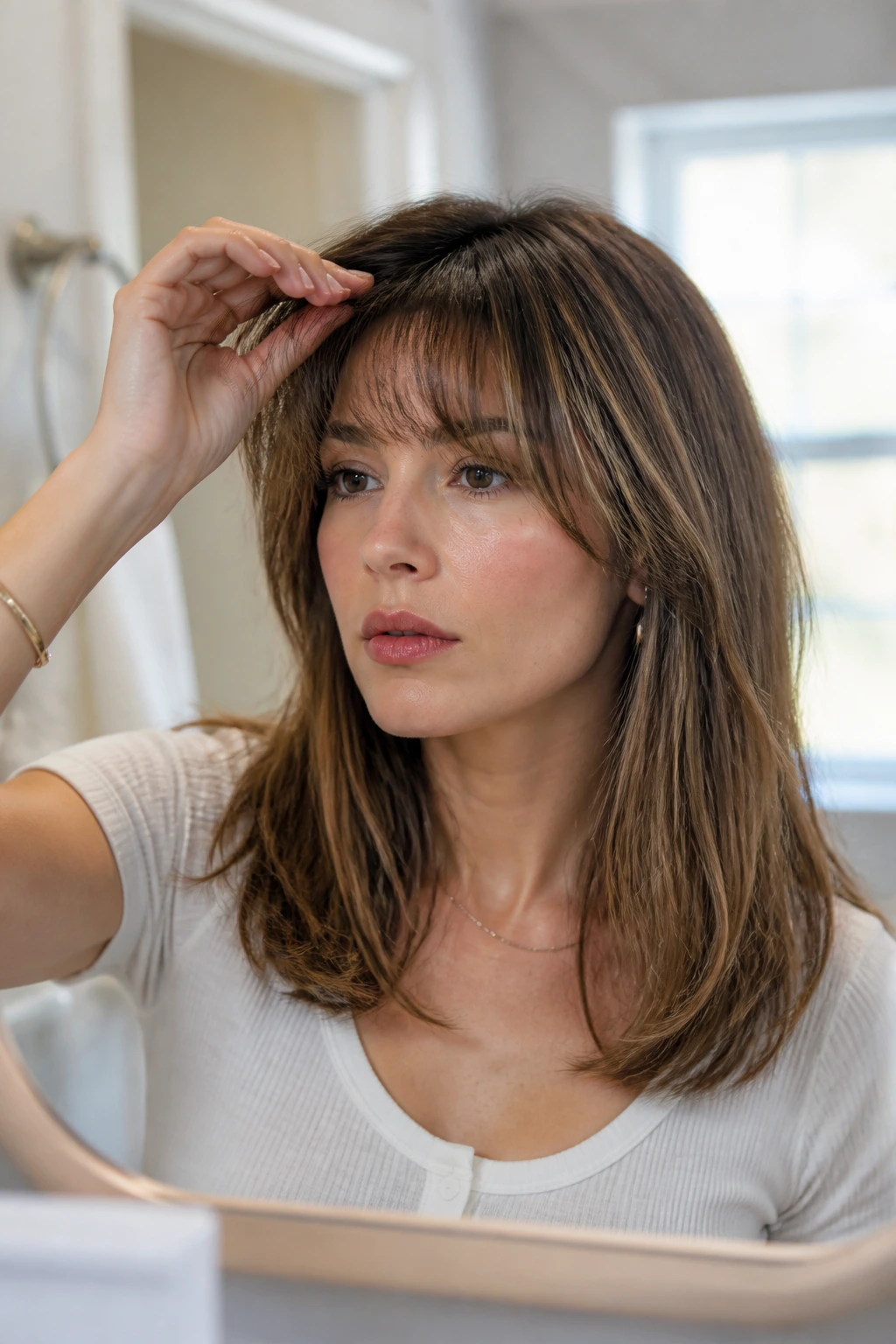
Feathered bangs need trims more often than people think, especially if they sit at brow length. A good rhythm is every 4 to 6 weeks for shorter fringe and every 6 to 8 weeks for longer curtain shapes. Wait much longer than that, and the soft edge starts turning into a curtain with no plan.
At home, keep the front from getting weighed down. Wash or at least rinse the bangs more often than the rest of the hair if they get oily fast, because the front goes flat first. A tiny amount of dry shampoo can buy you another day, but if the roots are visibly slick, it is worth refreshing them with water and a quick blow-dry.
Sleep care matters too. Feathered bangs will crimp if you sleep on them wet. Dry them completely before bed, then clip them gently away from your forehead or tuck them into a loose bend with a soft roller. It sounds fussy. It is less fussy than fixing a dent at 7 a.m.
If you are growing them out, ask your stylist to leave the outer pieces longer each trim. That keeps the line from suddenly turning blunt. And if the shape starts to drift, that is not a failure—it is the fringe telling you it wants to become layers.
Frequently Asked Questions About Feathered Bangs
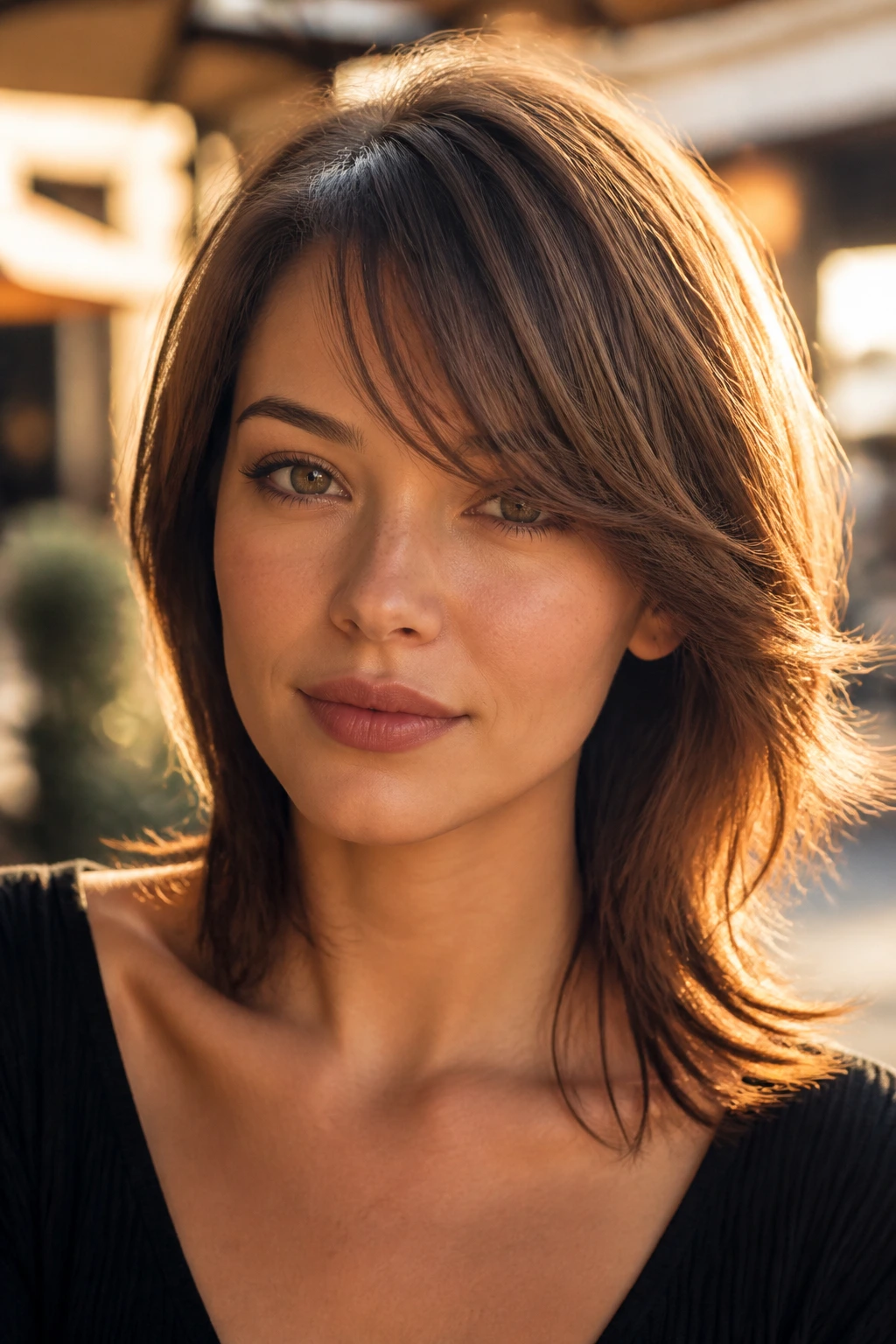
Do feathered bangs make thin hair look thinner?
Not when they are cut with restraint. The trick is to keep enough density in the center and feather only the edges and lower lengths, so the fringe still reads as a shape instead of a scattering of hairs.
Are curtain bangs or side-swept bangs better for heart-shaped faces?
Curtain bangs usually give more balance across a wider forehead, while side-swept bangs are easier if you want less maintenance. If your hair is very fine, side-swept can be simpler because it hides separation better.
Can I get feathered bangs if my hair is pin-straight?
Yes, but the cut needs careful length control. Straight fine hair should stay a touch longer and be styled with root lift, or the fringe can fall flat and expose too much forehead.
What if my bangs split right down the middle?
That usually means the part or cowlick is stronger than the cut. Blow-dry the roots in the opposite direction first, then sweep them back into the intended shape while they are still warm.
How often should I trim feathered bangs?
Shorter versions usually need a trim every 4 to 6 weeks. Longer curtain-style fringes can go a little longer, but once the pieces start landing in your eyes all day, they are ready for a clean-up.
Can I wear feathered bangs with glasses?
Yes, and they often look better than blunt bangs because the broken edge keeps the frames from feeling crowded. Keep the center slightly longer and the sides light so the fringe clears the lenses.
Should I ask for a razor cut?
Not by default. On fine hair, a razor can remove too much and leave weak ends. Scissors with point cutting usually give you more control, especially if you want the fringe to stay fuller.
Do feathered bangs work on wavy or curly hair?
They can, but they usually need to be cut longer than straight hair. The wave or curl will shorten them once dry, so the stylist has to leave room for the shrinkage.
A Softer Frame
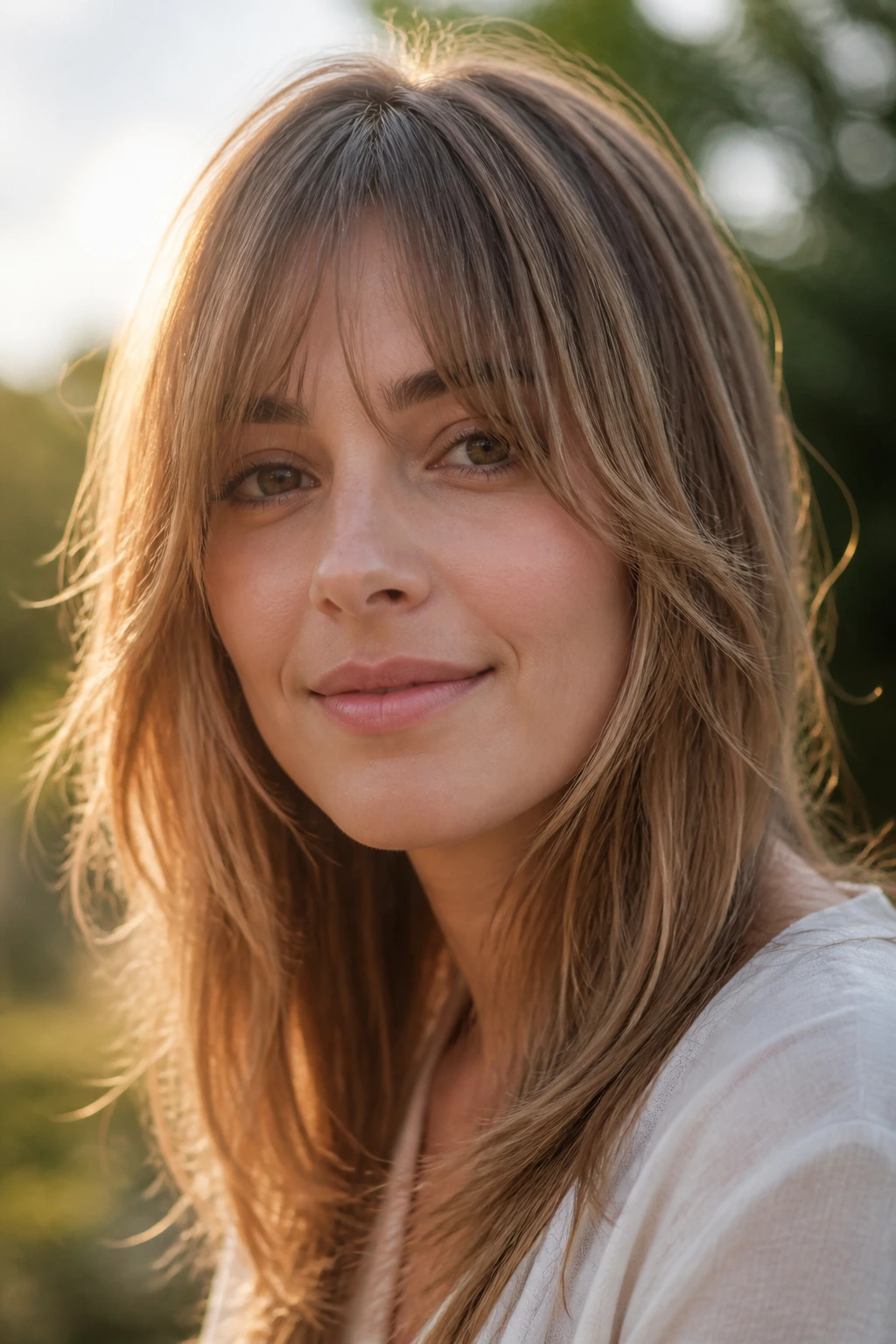
The best feathered bangs do not shout. They soften the forehead, keep thin hair from looking stripped bare, and give a heart-shaped face a little more balance without hiding what makes it interesting in the first place. That combination is the whole point: shape, not fuss.
If you are standing between two versions, choose the one with the cleanest grow-out and the least chance of looking overcut. Hair that is fine will thank you for the restraint. Bring a photo, ask for the softest edge that still shows up, and let the fringe do its quiet work.