



Side-swept bangs are charming right up until the clock starts shouting. One side behaves, the other side flips into your eye, and the rest of your hair either backs the fringe up or betrays it. That is why fluffy hairstyles for busy mornings with side-swept bangs make so much sense: they give the fringe a place to land, keep the crown from collapsing, and look deliberate even when you had six minutes and one working hand.
Fluffy does not mean teased into a brittle lump. It means lift at the roots, a soft bend through the lengths, and enough movement around the face that the bangs sweep instead of sticking. The styles that work here are the ones that accept a little natural mess—slight bends, airy texture, a touch of lift at the cheekbone—rather than fighting every strand into obedience.
Some of these looks take a brush and a dryer. Some need only a clip, a pin, and a quick shake. A few lean on old-school blowout tricks because those tricks still earn their keep. If your bangs flatten the moment you step away from the mirror, this is the sort of collection that gives them a second chance.
Why These Styles Earn a Spot by the Bathroom Mirror
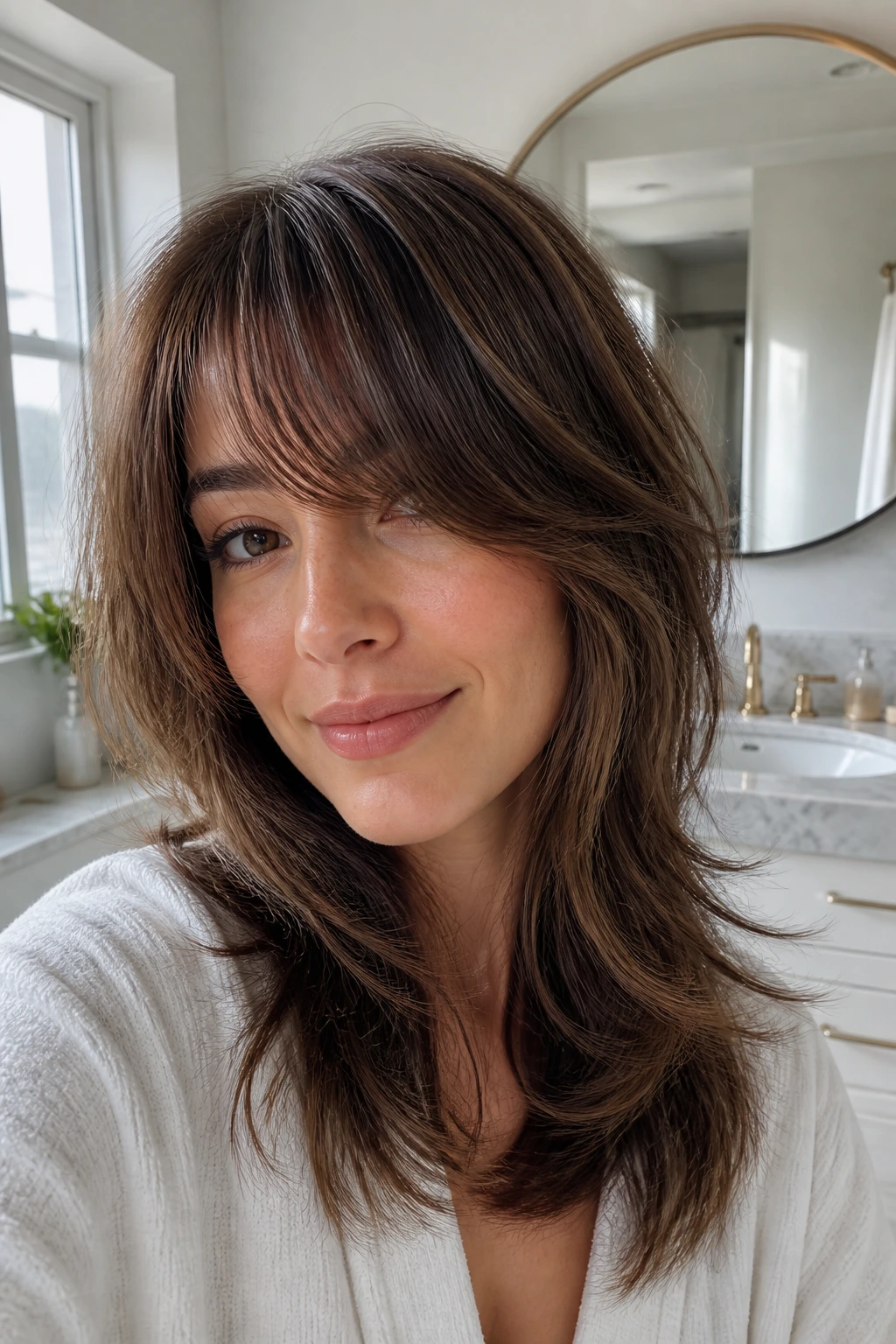
- They keep the fringe moving: Side-swept bangs look best when they can arc across the forehead instead of sitting in a stiff, straight line.
- They forgive second-day hair: A little texture at the roots gives grips to pins, braids, and clips, which means less fighting and less heat.
- They work with ordinary tools: A brush, a few bobby pins, a claw clip, and maybe a curling iron are enough for most of these.
- They scale with your morning: The same idea can be dressed up with a smoother finish or stripped down to a five-minute rescue.
- They hide the rough spots: Flat roots, a cowlick, or a frizzy side panel can disappear inside a twist, bun, or lifted ponytail.
- They don’t trap the bangs: Every style here leaves room for the fringe to sweep, which matters more than perfection.
What Makes a Style Look Fluffy Instead of Frizzy
Fluffy hair has shape. Frizzy hair has noise. That’s the difference, and it’s a useful one.
A fluffy style usually starts with a little root lift and ends with soft movement through the mid-lengths. The crown should rise an inch or two, not three. The ends should bend, not puff out in every direction like they’ve had a bad morning too. Side-swept bangs fit into that picture because they soften the front edge of the face and keep the haircut from looking boxy.
Product placement matters more than product quantity. Put the heavier stuff on the mid-lengths and ends. Keep the bang area light. If the fringe is loaded with cream or spray, it lies down and separates; if the roots are flat, the whole style collapses by lunch. A small amount of dry shampoo, mousse, or texturizing spray near the scalp usually does more than a full palm of anything else.
One more thing.
Fluffy styles are rarely built in one pass.
They hold up better when you let the hair cool in the direction you want it to go—especially the bangs. That little pause is boring, but it’s the difference between a sweep that lasts and one that slides back into your face the moment you grab your keys.
1. Side-Parted Blowout Bounce
The cleanest way to make side-swept bangs behave is to give them a proper path. A side-parted blowout bounce does exactly that. The root gets lifted, the fringe curves across the forehead, and the rest of the hair falls with enough movement to look styled without looking stiff.
Why it works on a busy morning
This one is built for medium or fine hair that tends to collapse at the crown. A round brush and a dryer do most of the work. The part gives the bangs direction, and the curved ends stop the whole look from going flat at the cheekbones.
- Best for: Fine to medium hair, layered cuts, grown-out fringe.
- Tool: A 1¼-inch round brush or a medium barrel brush.
- Time: About 8 to 12 minutes if you only focus on the top layer.
Set the side part while the hair is still damp, not after it dries into its old habit. Pull the bangs over the brush, aim the dryer down the hair shaft, and let the last inch bend gently under. That little turn keeps the front from hanging straight like a curtain.
One sharp tip: Clip the bang section forward while you do the rest of your hair. It gives the roots time to cool in the right direction, which sounds fussy until you try it once and stop arguing with it.
2. Low Side Ponytail With Crown Lift
A side ponytail stops looking childish the minute the crown gets a little air. Keep the band low, loosen the top by half an inch, and let the side-swept bangs do the face framing. Suddenly it looks intentional instead of rushed.
The trick is tension. Pull the ponytail snug enough to stay put, but not so tight that the crown goes slick. If your hair is fine, a tiny bit of backcombing at the crown gives the elastic something to grab. If your hair is thick, finger-lift the top after securing the ponytail and stop there. No need to turn it into a bird’s nest.
A wrapped elastic helps. Take a small strand from under the ponytail, wind it around the band, and pin the tail underneath. That one move hides the hair tie and makes the whole style look cleaner. The bangs can sweep across the forehead and fall into the pony without getting pinned down.
Best move for this style: leave one thin face-framing strand on the heavier side of the bangs. It breaks up the line and keeps the pony from looking too neat.
3. Half-Up Twist With Loose Bangs
Why does a half-up twist work so often on a rushed morning? Because it takes the flat spot at the crown and turns it into the anchor. The top layer gets lifted, the rest of the hair keeps its softness, and side-swept bangs slip into the front with very little negotiation.
Twist a section from each temple toward the back of the head and secure them together with a pin or small clip. Keep the twist loose. If you pull it tight, the style loses the airy lift that makes it useful in the first place. A little slack in the twist gives the crown room to puff.
How to wear it when the bangs are stubborn
If the fringe wants to separate, mist it lightly with water and brush it once in the sweep direction. Not twice. Once. Then let it dry for 30 seconds before you touch it again. That small pause helps the bang remember where it belongs.
A half-up twist is also one of the few styles that looks better on second-day hair. The roots have a bit of grip, the twists hold, and the fringe can be nudged into place without needing a full wash.
4. Messy Low Bun With Face-Framing Bend
Your hair is dry at the ends, the roots are doing something unhelpful, and the mirror is being rude. That is exactly when a messy low bun earns its keep. The bun hides the uneven parts, while the side-swept bangs and front pieces keep the face from looking boxed in.
Quick details
- Best for: Medium to long hair, especially hair that has a little wave.
- Placement: Low at the nape, not centered high on the head.
- Finish: Leave the bangs loose and pull one or two thin strands at the temples.
Start with a loose ponytail at the nape, twist it into a bun, and pin it in place. Then tug the crown and the bun edges just enough to soften the shape. If you yank too much, the bun falls apart; if you tug too little, it looks too neat for the rest of the day.
The bangs matter here. Sweep them across the forehead with a bit of bend at the ends, not a straight fall. That curve makes the bun feel balanced, especially if the bun sits slightly off-center.
Fluff belongs around the bun, not inside it.
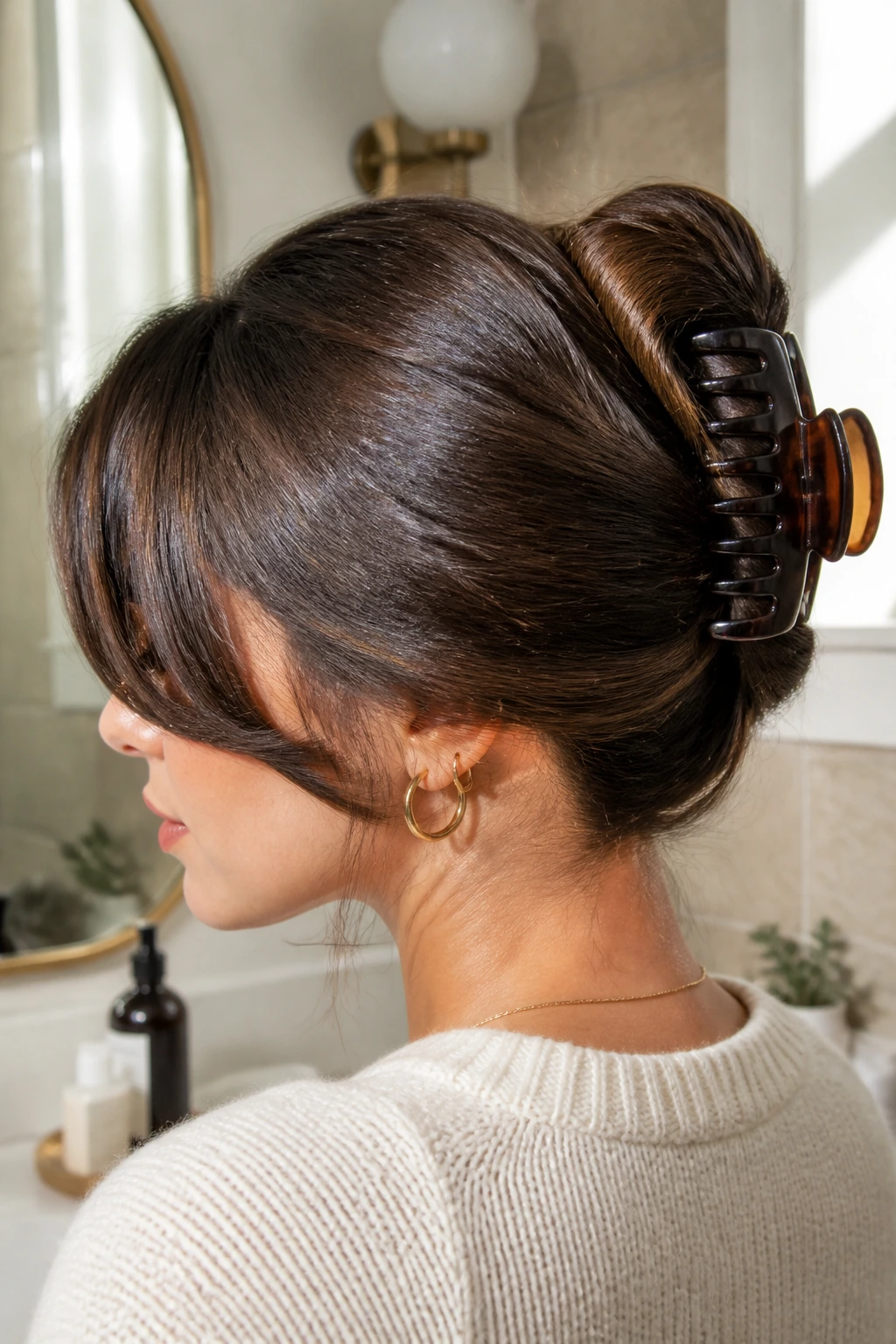
5. Claw-Clip French Twist Lite
A claw-clip twist is the fastest path to looking like you made an effort. The hair goes up, the ends tuck in loosely, and the side-swept bangs stay out where they can do their job. It looks tidier than a messy bun and takes less time than a proper updo.
Use a medium or large claw clip with teeth that actually grip. Gather the hair as if you were making a low ponytail, twist it upward once, and fold the ends back down. Clip the twist vertically. If the clip is too small, the twist will sag in an hour. If it’s too slick, the hair slides right out.
I like this one for thick hair because it handles bulk without forcing the style to look sleek. The front can stay soft. The crown can stay airy. The bangs can sweep across the forehead and sit right against the twist without being swallowed by it.
A couple of bobby pins under the clip help if your hair is heavy. One pin is often enough. Two if your hair has a habit of escaping.
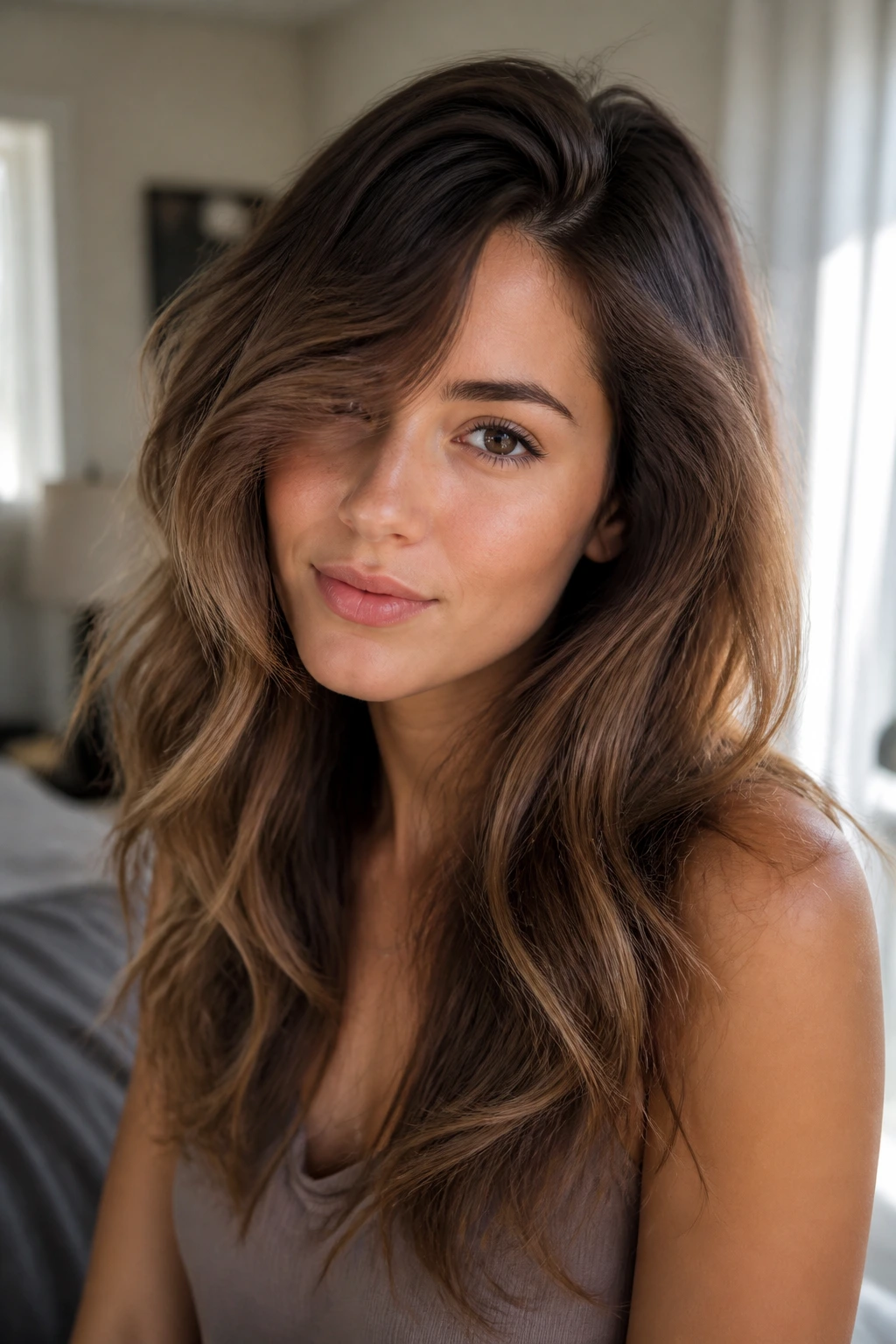
6. Brushed-Out Waves With a Deep Side Part
Unlike tight curls, brushed-out waves give the fringe room to fall. That’s the appeal here. You get shape, movement, and enough softness that the side-swept bangs don’t have to fight the rest of the style for attention.
Set the hair in large bends—either with a curling iron, a flat iron turn, or overnight rollers—then let it cool before brushing. Once the curls are cool, brush them out with a paddle brush or wide brush until they settle into broad waves. The deep side part creates a heavier side, which helps the bangs blend into the rest of the shape.
This is the best version for layered hair that tends to puff out at the ends. The brushed-out wave keeps the volume from stacking in one place. It also looks better after 20 minutes of wear, which is a nice trait when your morning includes coffee, a jacket, and a little air outside.
My recommendation: keep a tiny bit of texture spray at the mid-lengths, not the roots. That keeps the waves airy and gives the bangs something to hook into.
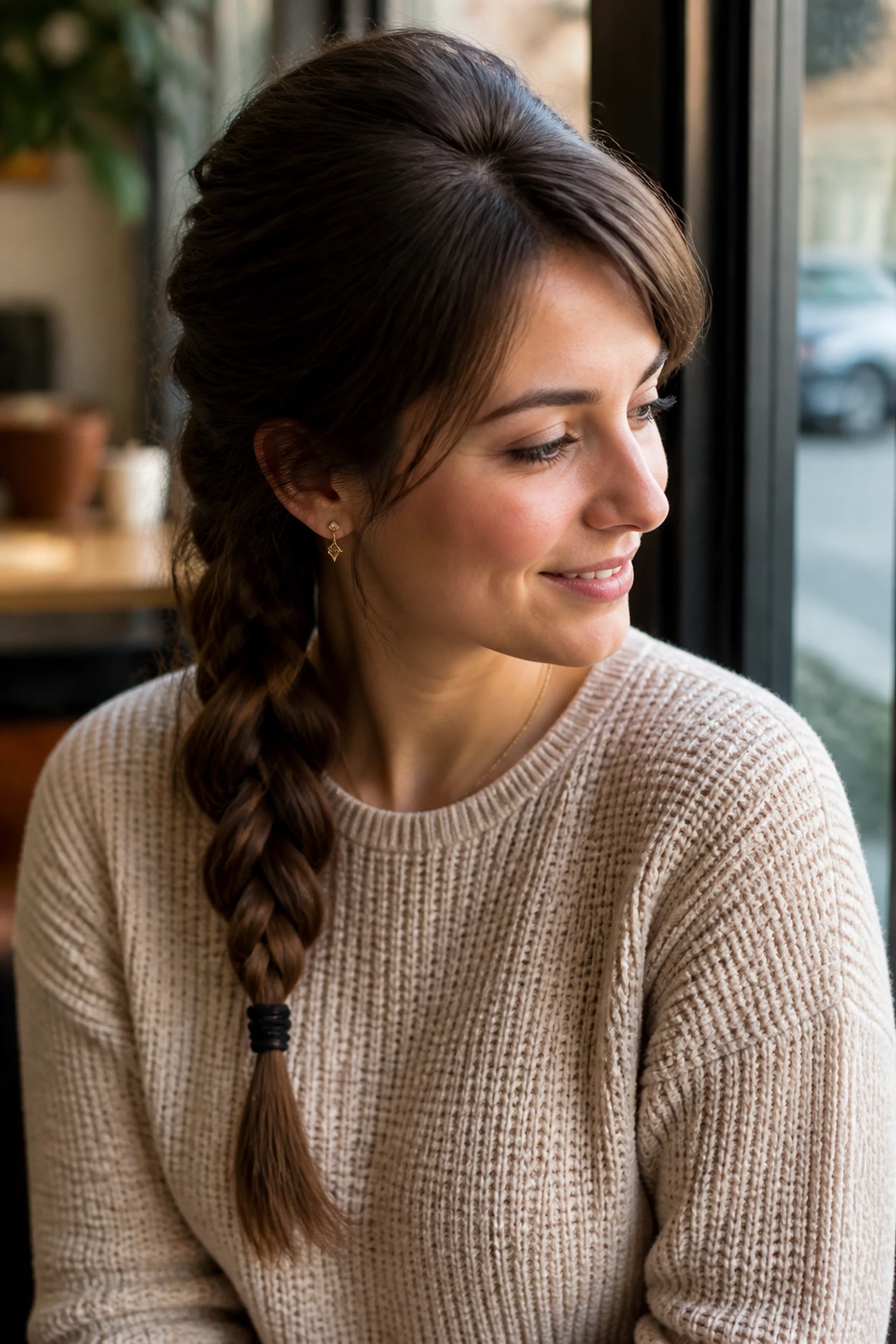
7. Side Braid With Puffed Roots
A side braid can look sleepy unless the crown gets lift. That’s the whole game here. Build volume at the top, sweep the side-swept bangs into a soft arc, then braid the rest loosely over one shoulder.
The braid itself does not need to be perfect. A three-strand braid works fine. A Dutch braid gives more shape if you want the braid to show from the front. After you tie it off, tug the outer edges of the braid a little at a time so it widens. People call that pancaking. I just call it the part that keeps the braid from looking like a tight rope.
What makes it useful
- It keeps the front of the hair off your face without pulling the bangs too far back.
- It works on hair that is a little rough or textured already.
- It pairs well with second-day roots because the hair holds a braid better when it’s not slippery.
A side braid is especially good when you want the fringe to stay soft and the rest of the hair to behave. The braid gives structure. The bangs keep it from feeling severe.
8. Rope-Twist Half Pony
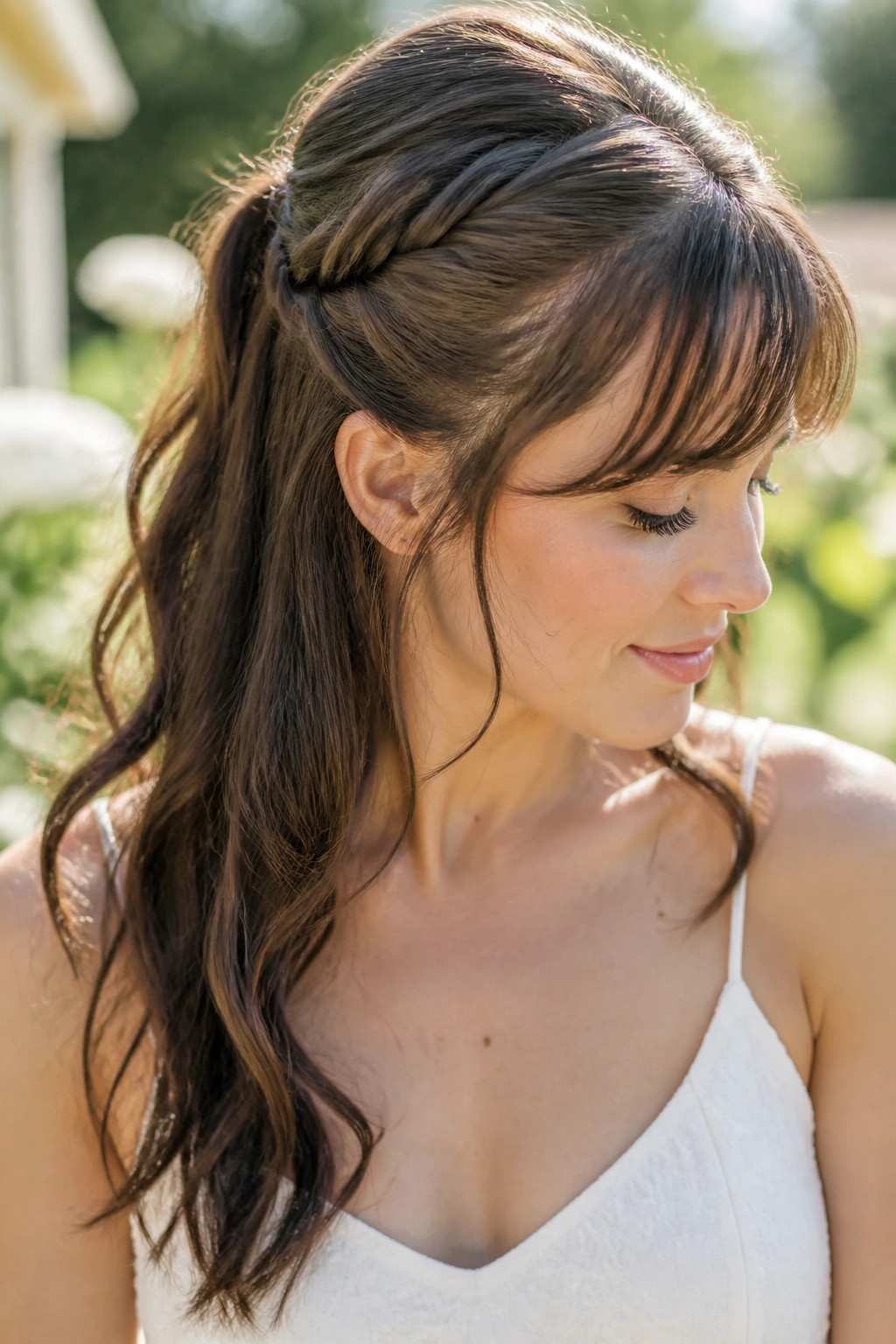
If you want polish in under five minutes, rope twists do more than people expect. Two twisted sections at the temples pull the hair back, the half pony in the center adds lift, and the side-swept bangs soften the front so the style doesn’t feel stiff.
Part off two front sections, twist each one away from the face, and join them at the back with a small elastic. That’s the whole framework. Pull the twist edges slightly to widen them. A rope twist works best when it looks a touch loose. If it’s perfect, it starts looking dated. If it’s a little messy, it looks alive.
This one is good for medium-length hair that sits between too short for a full pony and too long for leaving loose. The bang can either blend into the twist or stay free, depending on how dramatic you want the sweep to be.
Best detail: twist the hair in the same direction on both sides. If one side turns inward and the other turns outward, the shape loses that clean line.
9. Flipped-Out Lob
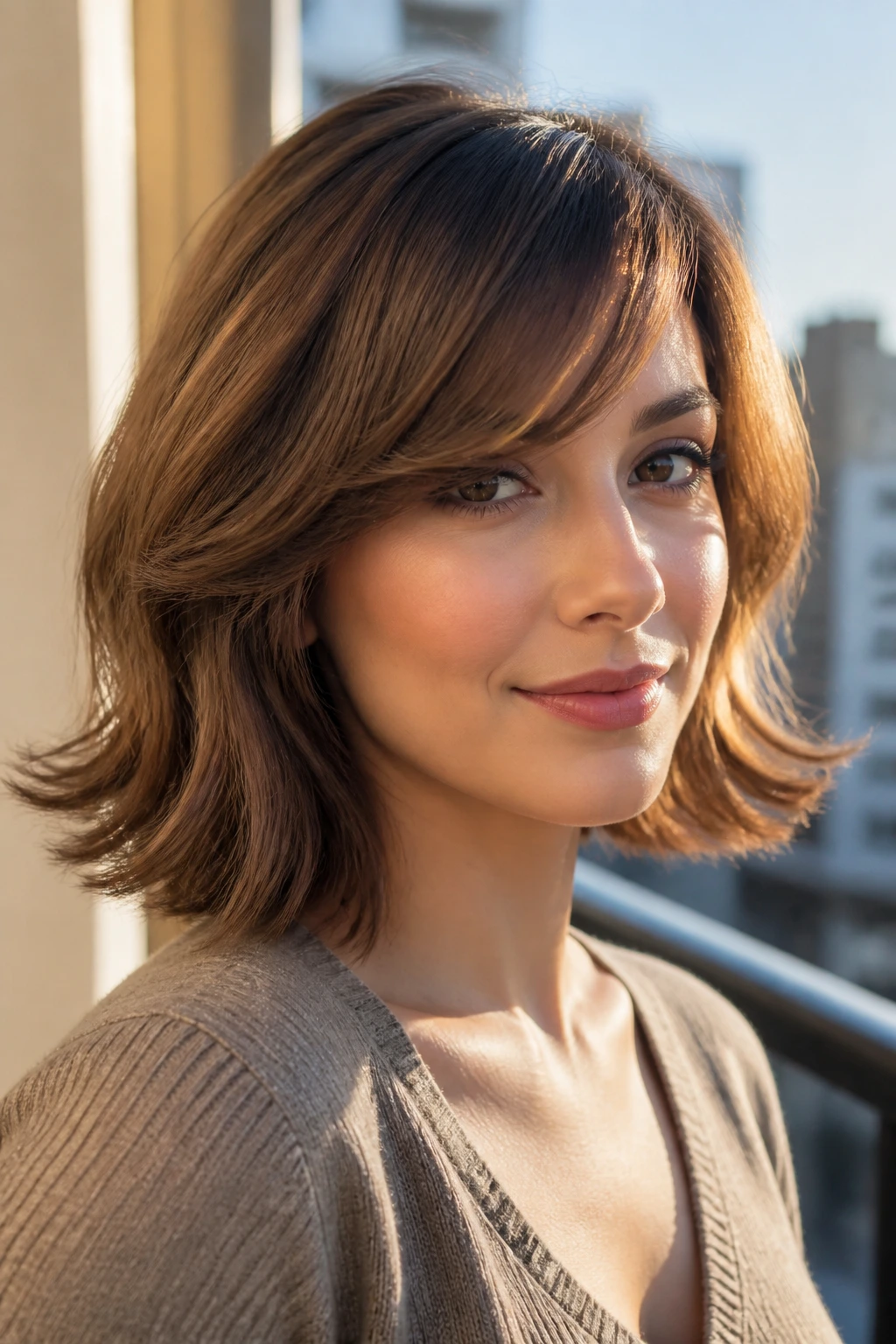
Can a lob look fluffy without a curling-iron marathon? Yes, if the ends flip the right way. The whole trick is to keep the roots soft, the part slightly off-center, and the ends turned outward just enough to give the cut shape.
A flat iron or a small barrel iron works well here. Run it through the mid-lengths, then turn the wrist at the final inch so the ends flick out. The side-swept bangs should curve across the forehead and blend into the shortest layer. That connection is what makes the cut look deliberate instead of chopped off.
How to use it
- Blow-dry the roots forward and then sweep them into the side part.
- Flip the ends on alternate directions so the lob doesn’t form a single stiff line.
- Mist the bang area lightly, then brush it across the face and let it cool.
This style suits blunt or lightly layered lobs. If the cut is heavy, the flip keeps it from looking like a block. If the cut is already airy, the bend just sharpens the outline a little.
10. Mini Top Knot With Airy Lengths
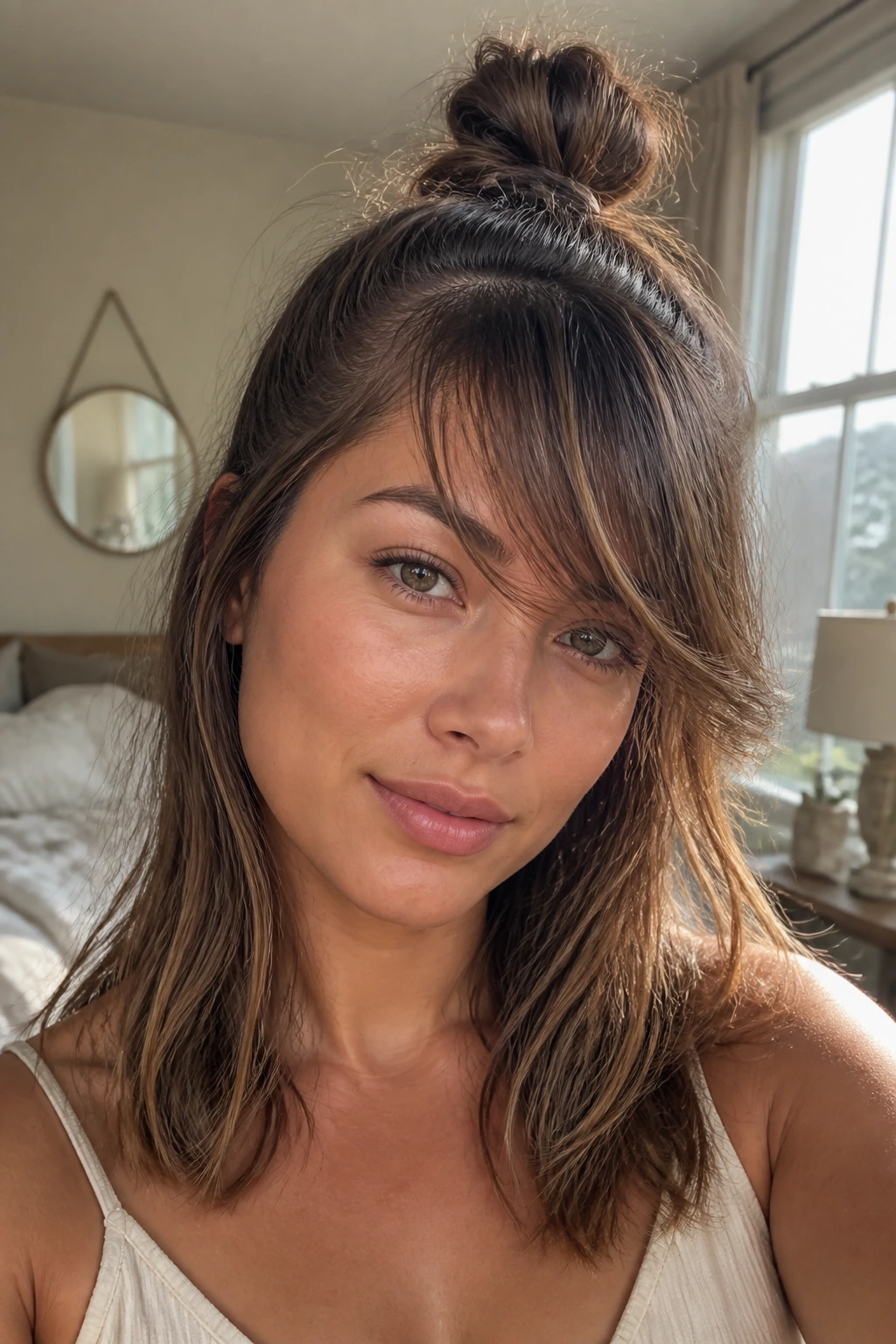
A small top knot gives the illusion that you planned the whole thing, even when the rest of the hair says otherwise. It lifts the crown, keeps the neck free, and lets the side-swept bangs soften the front. The lengths left down do the rest.
The knot should stay small. If it gets too large, the look turns top-heavy and the bangs start competing with it. Gather the top section only, twist it once, coil it into a tiny knot, and pin it. Leave the lower half loose or half-clip it if your hair is thick.
This style works especially well when the hair is a day or two past washing. There’s enough grip for the knot to hold, and enough softness in the lengths that the whole look doesn’t read as severe. A little texturizing spray at the crown helps, but don’t soak the front. The bangs need movement, not stiffness.
A mini knot is one of those styles that looks better if you stop adjusting it. Put the pins in, smooth the fringe once, and walk away.
11. Bubble Ponytail With Soft Texture
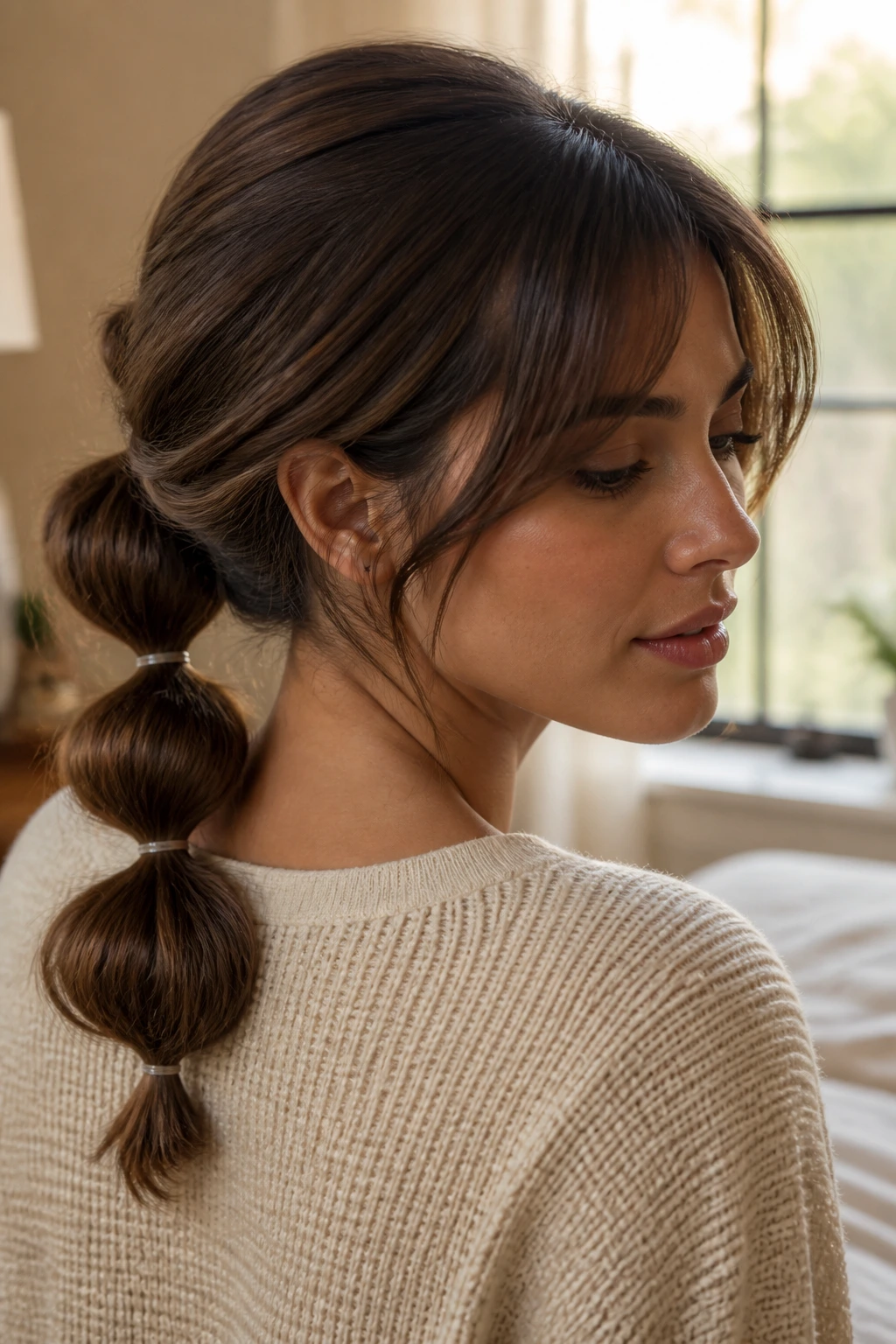
A bubble ponytail looks playful, but the side-swept bangs keep it from feeling loud. That’s the nice balance here. The ponytail gets shape from a few elastics placed down the length, and each section is tugged just enough to puff out.
Start with a low or mid ponytail. Add small clear elastics every 2 to 3 inches. Then gently pull each section apart until it rounds out. The hair should look full, not stretched. If the bubbles are too spaced out, the style gets weird fast. Keep them even and stop before the ponytail turns ragged.
The fringe should stay soft across the forehead, with a slight bend at the ends. That soft front line calms the bubble pattern, which can look a bit geometric on its own. This style works especially well on straight or slightly wavy hair that needs shape fast.
One thing I like here: it survives a commute. The bubbles may loosen a little, but they rarely collapse in a dramatic way.
12. Scarf-Tied Ponytail
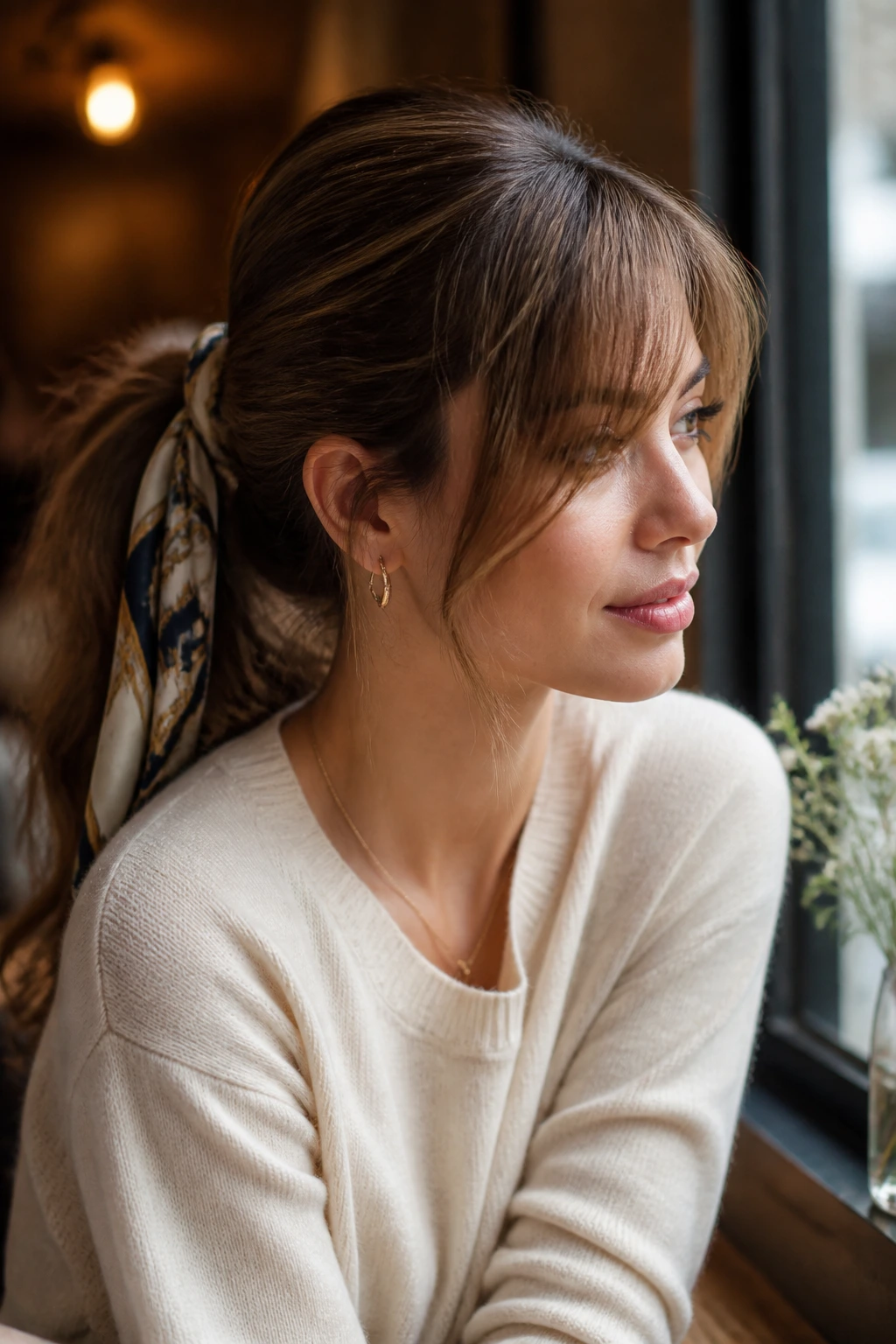
A plain ponytail is fine. A scarf-tied ponytail has more control over the shape. The scarf adds color or texture, but more important, it helps the style read as finished even when the pony itself is loose and airy.
Unlike a thick hair wrap, a skinny silk or cotton scarf won’t swallow the ponytail. Tie it around the elastic, let the ends hang, and keep the crown softly lifted. Side-swept bangs fit this style well because they soften the line where the scarf starts. If the bangs are straight and flat, the scarf can make the whole thing feel too tidy. With a soft sweep, it looks balanced.
This is best for second-day hair or hair that has a little natural wave. If your hair is slippery, secure the pony first with a sturdy elastic, then add the scarf. Don’t use the scarf as the only support unless you like chasing your ponytail around all morning.
The scarf also gives you a way to hide uneven ends. That’s a small mercy, and a useful one.
13. Tucked Side Roll
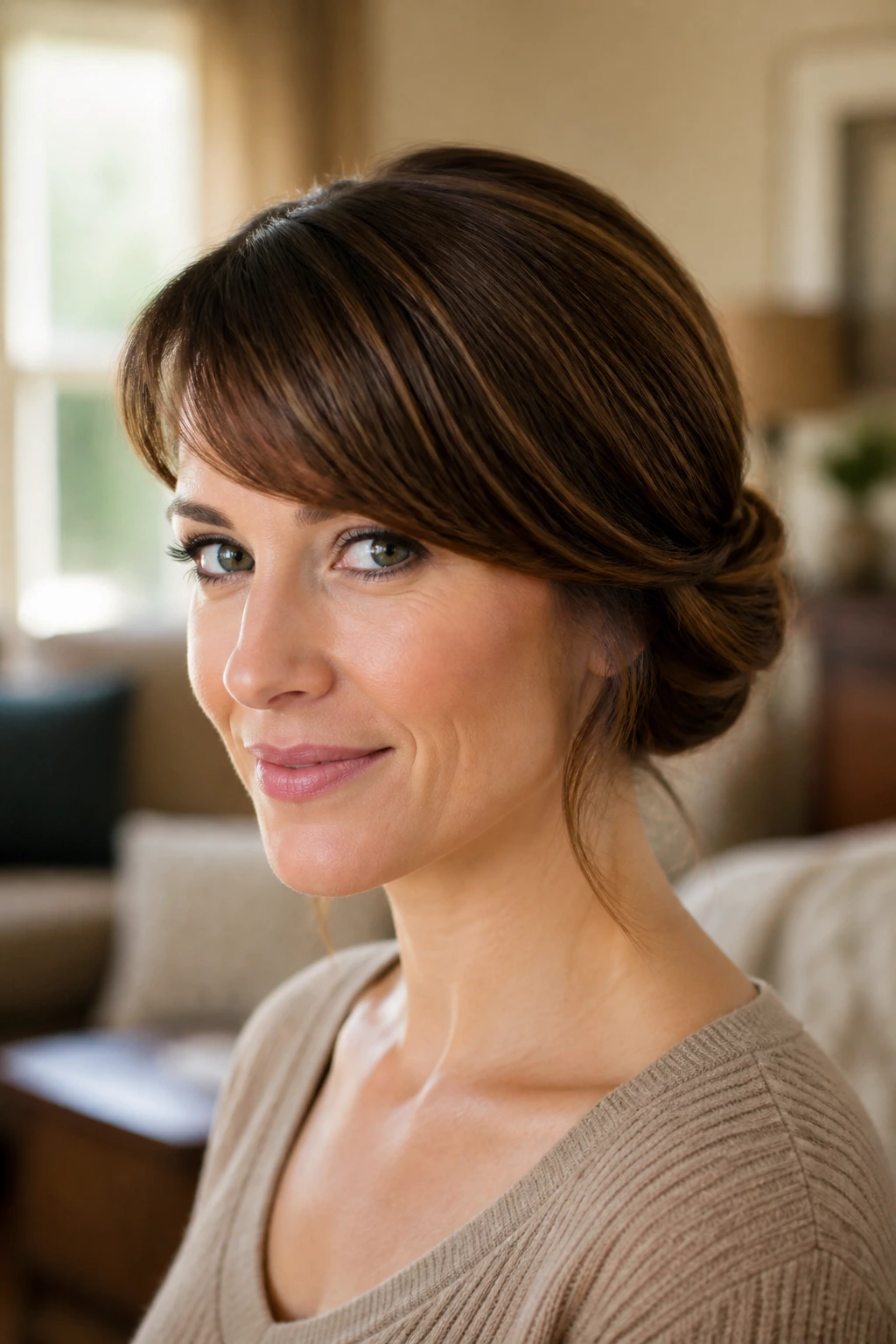
A tucked side roll has that old-fashioned shape that somehow still feels practical. You roll the hair in toward one side, pin it low, and let the bangs do the visible work at the front. The whole look stays soft because the roll hides the ends and the side-swept fringe handles the face framing.
This one is nicest on shoulder-length or longer hair that isn’t cooperating with loose waves. A little bend in the mid-lengths helps, but you do not need perfect curls. Start by gathering the hair slightly off-center, roll it toward the nape on one side, and pin it flat. The shape should hug the head, not sit on top of it.
The bangs should curve gently over the brow and blend into the roll. If the front pieces are too straight, the style loses its softness. A tiny bit of mousse on damp hair helps the roll hold without becoming stiff.
Good to know: this style is better with fewer pins than more. Too many pins make the roll bulky and obvious.
14. Loose Chignon With Lifted Roots
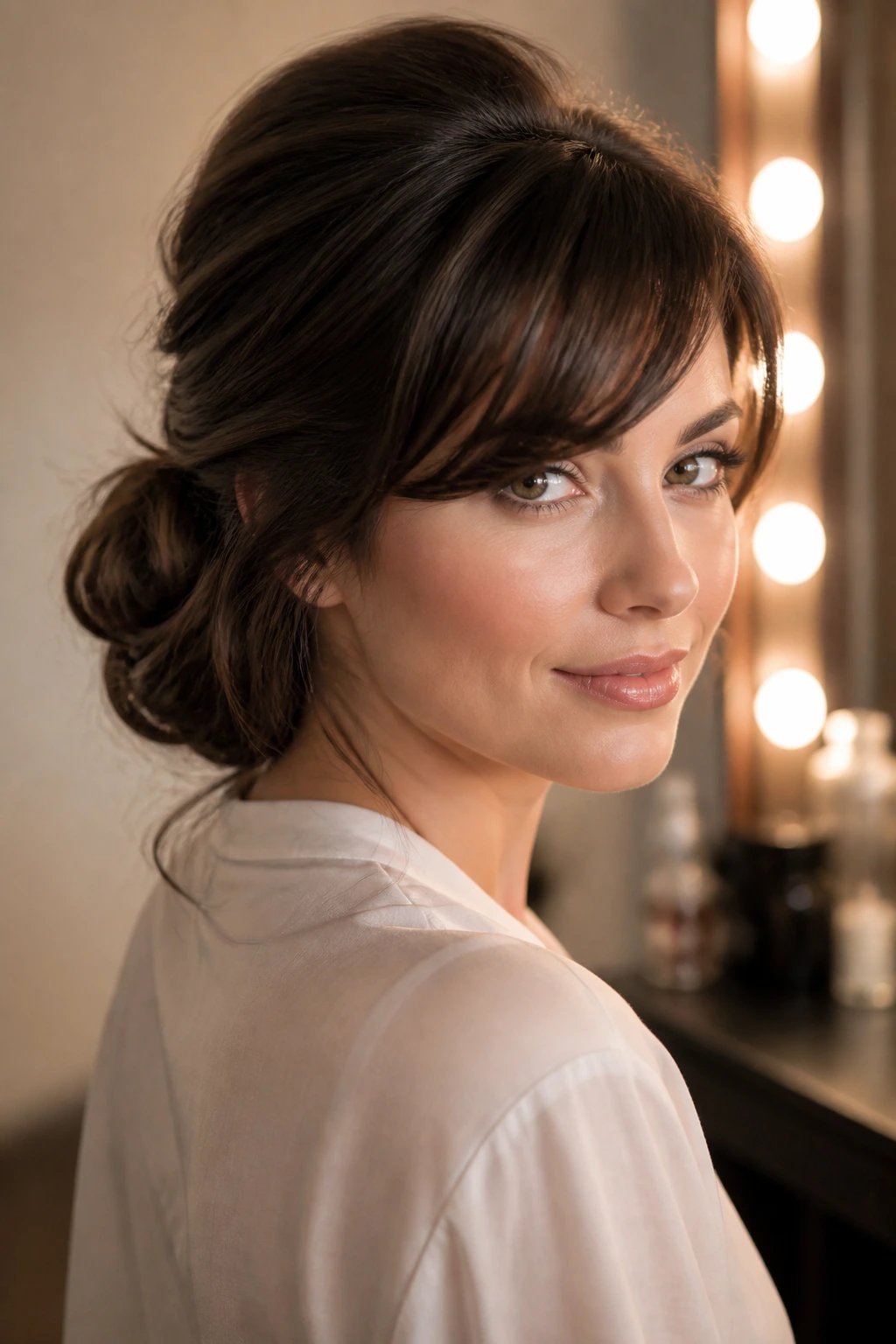
A chignon stops feeling severe the moment you stop trying to smooth every flyaway. Leave the roots with a little air, keep the bun low and loose, and let the side-swept bangs fall where they want to. The result is softer, fuller, and much easier to live in.
The bun should sit at the nape or just below it. Gather the hair into a low ponytail, twist, wrap, and pin. Then tug the crown lightly with your fingertips until you get a small rise. That lift is what keeps the style from flattening the head shape. If you have very thick hair, split the ponytail in two before wrapping so the bun stays compact.
This is one of the better styles for dressier mornings when you still need speed. It works with a blazer. It works with a sweater. It even handles earrings without fighting them, which is more useful than it sounds.
The fringe should sweep across the forehead and stop short of the bun. That keeps the face open and prevents the whole style from feeling locked down.
15. Heatless Curl Brush-Out
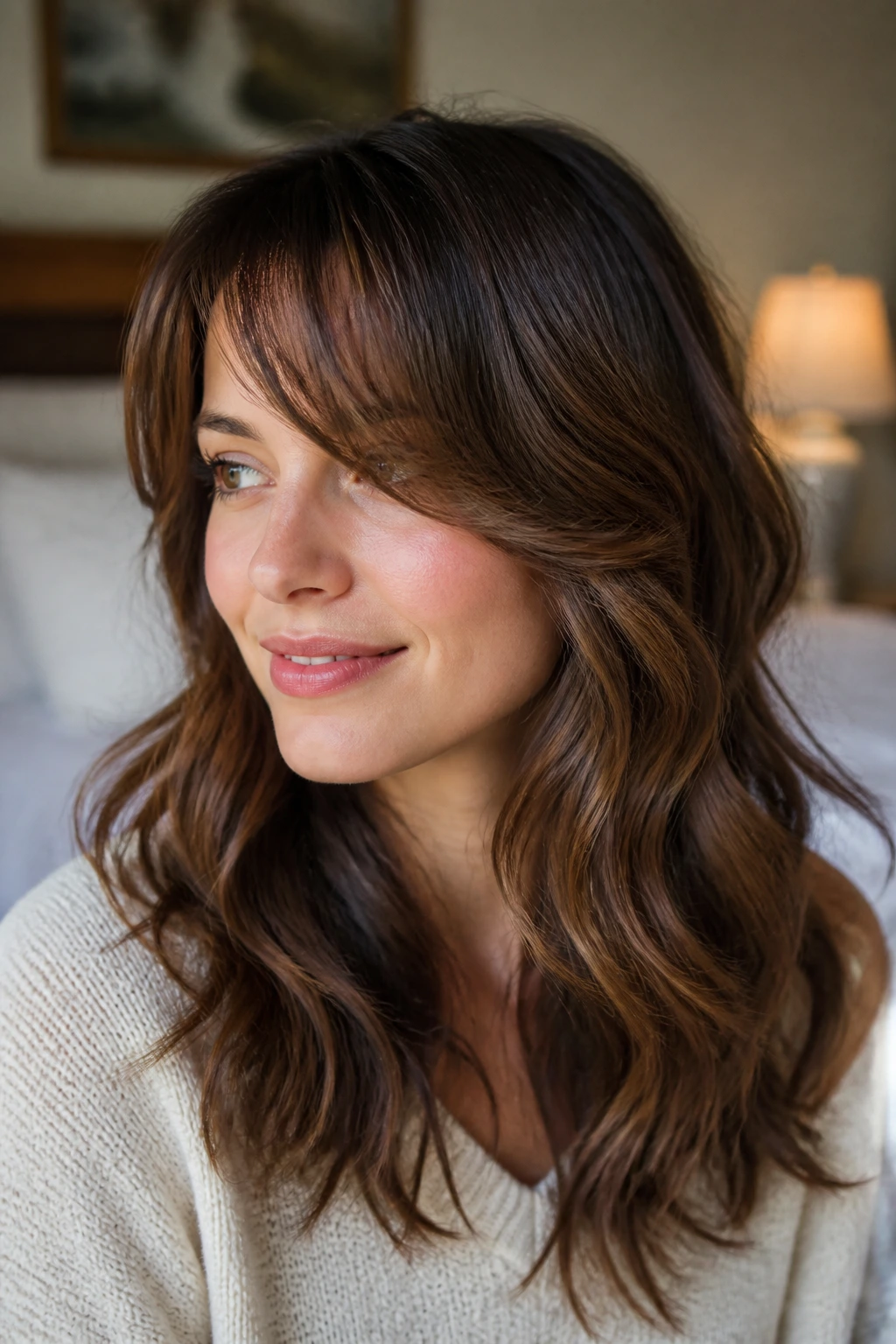
Why do heatless curls sometimes look better than iron curls on a busy morning? Because they start with bend, not control. The wave is softer, the ends aren’t scorched into a hard curve, and the side-swept bangs can be brushed into the style instead of sitting on top of it.
Use braids, flexi-rods, satin rollers, or large foam rollers the night before. In the morning, take them out, separate the curls with your fingers, and brush lightly through the mid-lengths until the waves settle. Don’t brush the bangs too aggressively. They need a few strokes, not a full detangling session.
How to wear it
- Leave the crown a touch lifted so the fringe doesn’t collapse.
- Angle the bangs toward the heavier side of the part.
- Stop brushing once the waves turn soft and broad.
This style is excellent when you want softness with almost no morning heat. It’s not ideal if you sleep like a tornado, because the set can loosen unevenly. Still, when it works, it works with very little drama.
16. Sleek Roots, Puffy Ends Ponytail
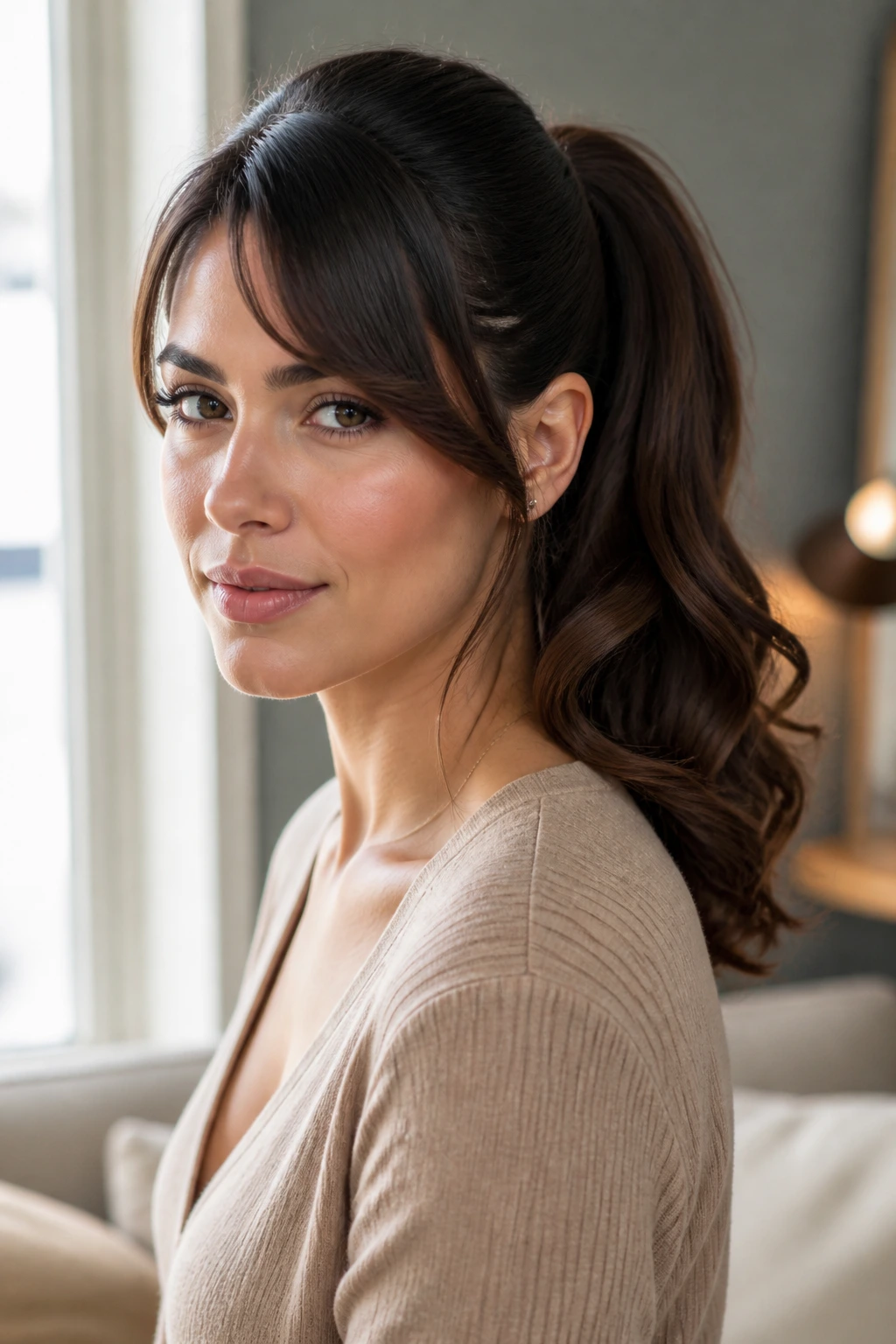
A sleek-root ponytail with puffy ends is a nice trick for hair that is too flat at the top and too bulky at the bottom. Smooth the roots close to the scalp, then give the ends a bend or a curl so the bottom half has body. The side-swept bangs keep the front from reading too severe.
This style looks especially good on fine hair because it creates contrast. The smooth top makes the face look cleaner, and the fuller ends make the ponytail appear thicker than it is. If your hair is thick, the same shape helps control the crown while leaving some softness below the elastic.
Use a toothbrush or small smoothing brush on the hairline, not a heavy layer of gel. Then curl or flip just the last few inches of the ponytail. That little puff at the end is the whole point. Without it, the style turns into a plain ponytail with a hard part.
The bangs should curve down and across, not cling to the scalp. That balance keeps the look from becoming too sleek for the rest of the hairstyle.
17. Braided Crown With Swept Fringe
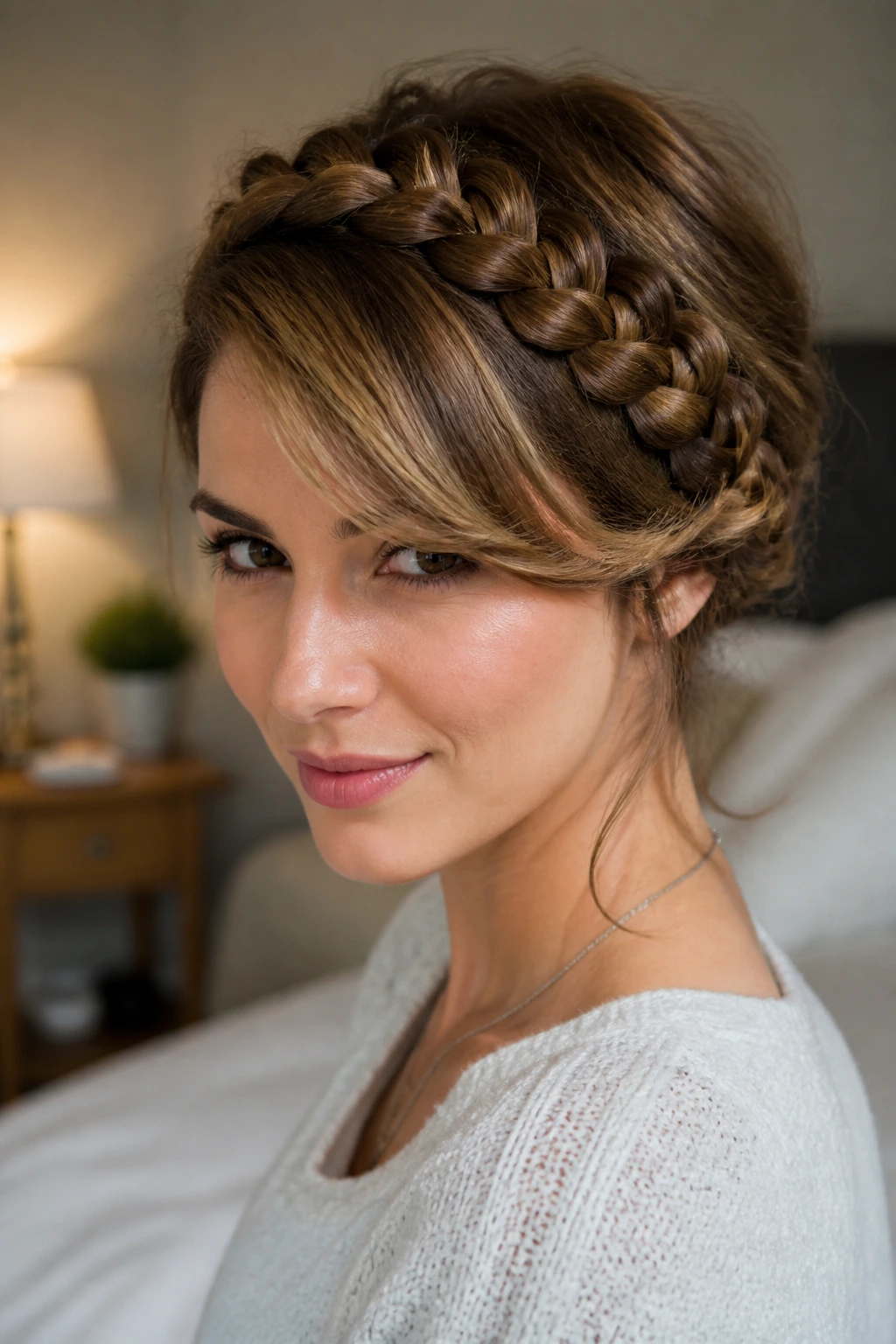
A braided crown can look like too much if every strand is tight. Loosen the braid, keep it low across the top or around the hairline, and let the side-swept bangs break up the shape. That’s what makes it wearable in the morning instead of costume-like.
You can braid from one temple to the other, or start near the part and wrap the braid back like a headband. Pin it behind the ear or at the nape. The crown should sit lightly, not dig into the scalp. A few loose pieces near the ears soften the line and stop the style from looking formal in a heavy way.
This works particularly well on wavy hair, because the braid and texture feed each other. Straight hair can do it too, but it helps to rough up the roots first with dry shampoo or texture spray. If the hair is freshly washed, the braid may slide. Day-old hair tends to hold better.
The bangs should sweep across the open side of the face, not disappear into the braid. That contrast gives the style some air.
18. One-Pin Side Sweep Updo
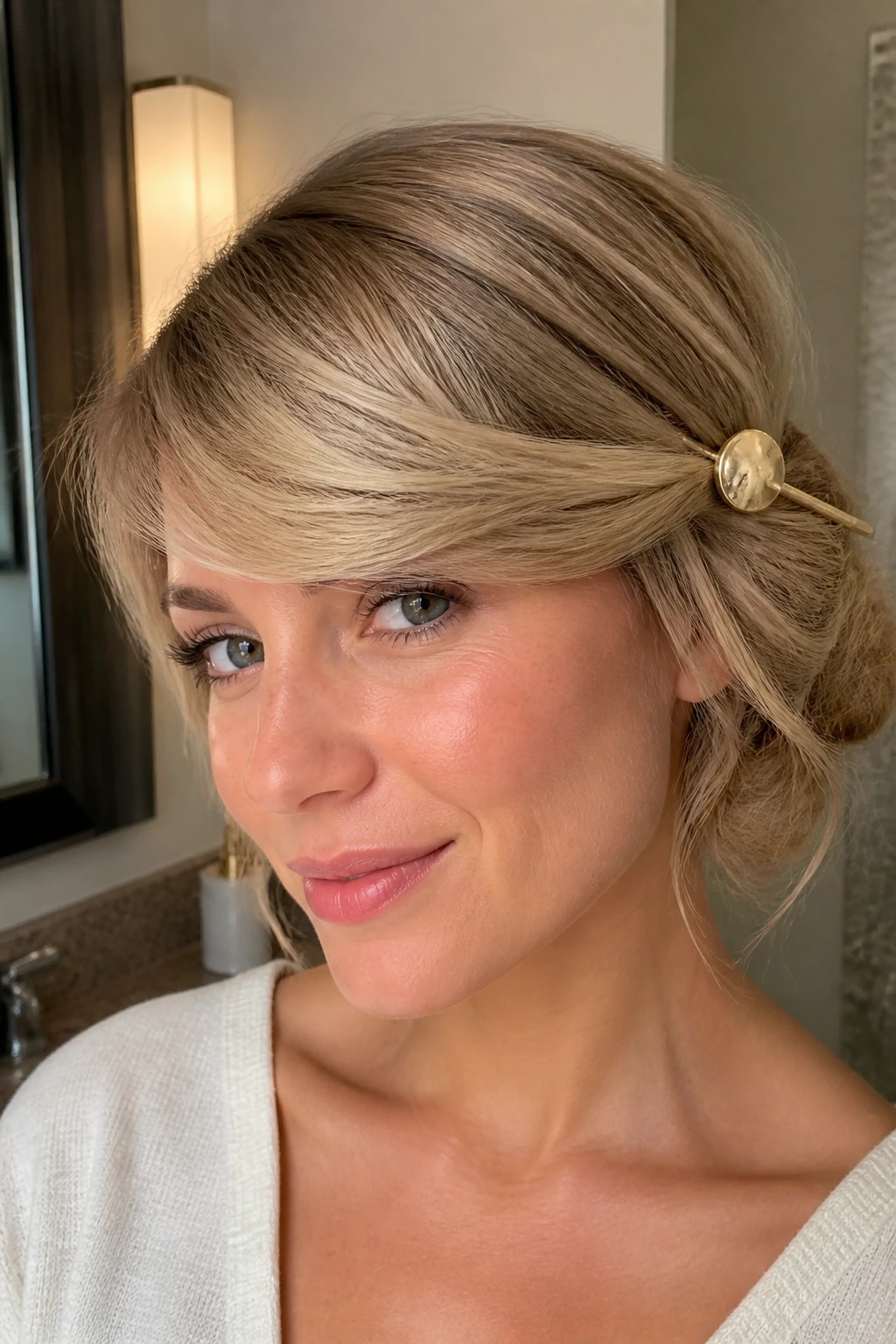
Unlike a full updo, this one uses the smallest number of pins and still holds shape. Hair goes to one side, twists upward, and gets anchored with a single oversized pin or two sturdy bobby pins. The side-swept bangs stay loose and visible, which is what keeps the style from feeling overdone.
This is the one I’d pick for shoulder-length hair that resists tidy buns. You don’t need perfect sections. You need direction. Sweep the hair toward one side, twist it loosely, and tuck the ends where they belong. If the twist sits low and slightly off-center, the front looks softer and the bangs sit naturally against it.
The best part is how fast it resets. If it loosens by afternoon, you can twist it again in under a minute. No complicated rebuilding. No separate styling tools.
A single pin works if your hair is light. For heavier hair, use one pin to hold the twist and a second pin to lock the loose end under it. That second pin is boring. It also saves the whole style.
19. Soft Pin Curls for Short Hair
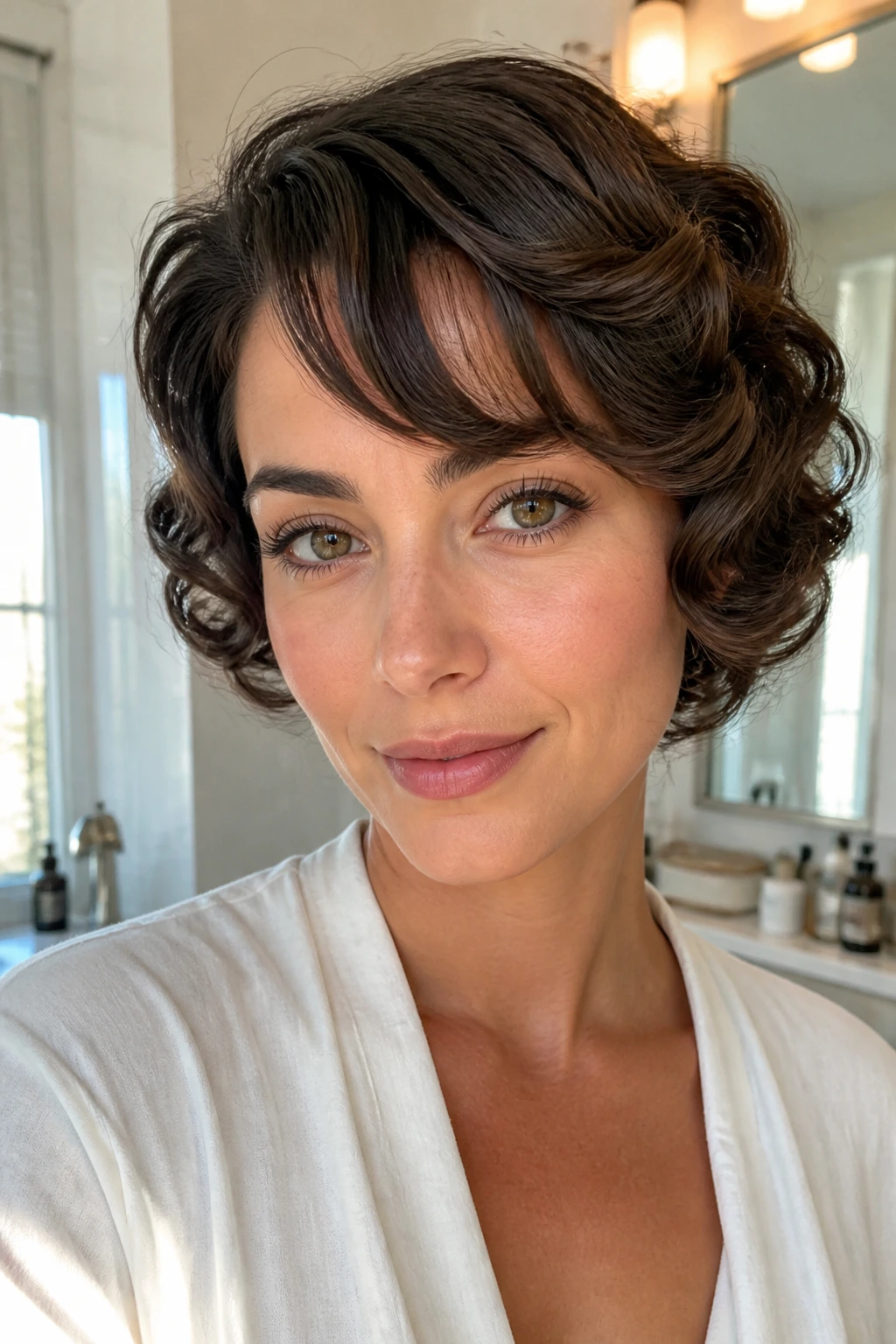
Short hair needs shape more than length. Soft pin curls give it that shape without forcing the cut to sit flat. Wrap the front sections away from the face, pin them in place for a few minutes, and let the side-swept bangs become part of the curve instead of fighting against it.
This works well on pixies, short bobs, and cropped layers that need a little bend around the face. Set the curls while you do makeup or brush your teeth. Ten minutes is enough for a quick set if the hair is warm and lightly damp. Longer is better if you’ve got the time, but you do not need an hour.
Best use cases
- Hair that flips out at the ends and needs direction.
- Bangs that are in the awkward grow-out stage.
- Short cuts that look too flat after sleeping.
When you remove the pins, separate the curls with your fingers, not a brush. A brush turns the shape fuzzy. Fingers keep the ends soft and the bangs manageable. It’s a small distinction, and it matters.
20. Layered Lob With Undone Flicks
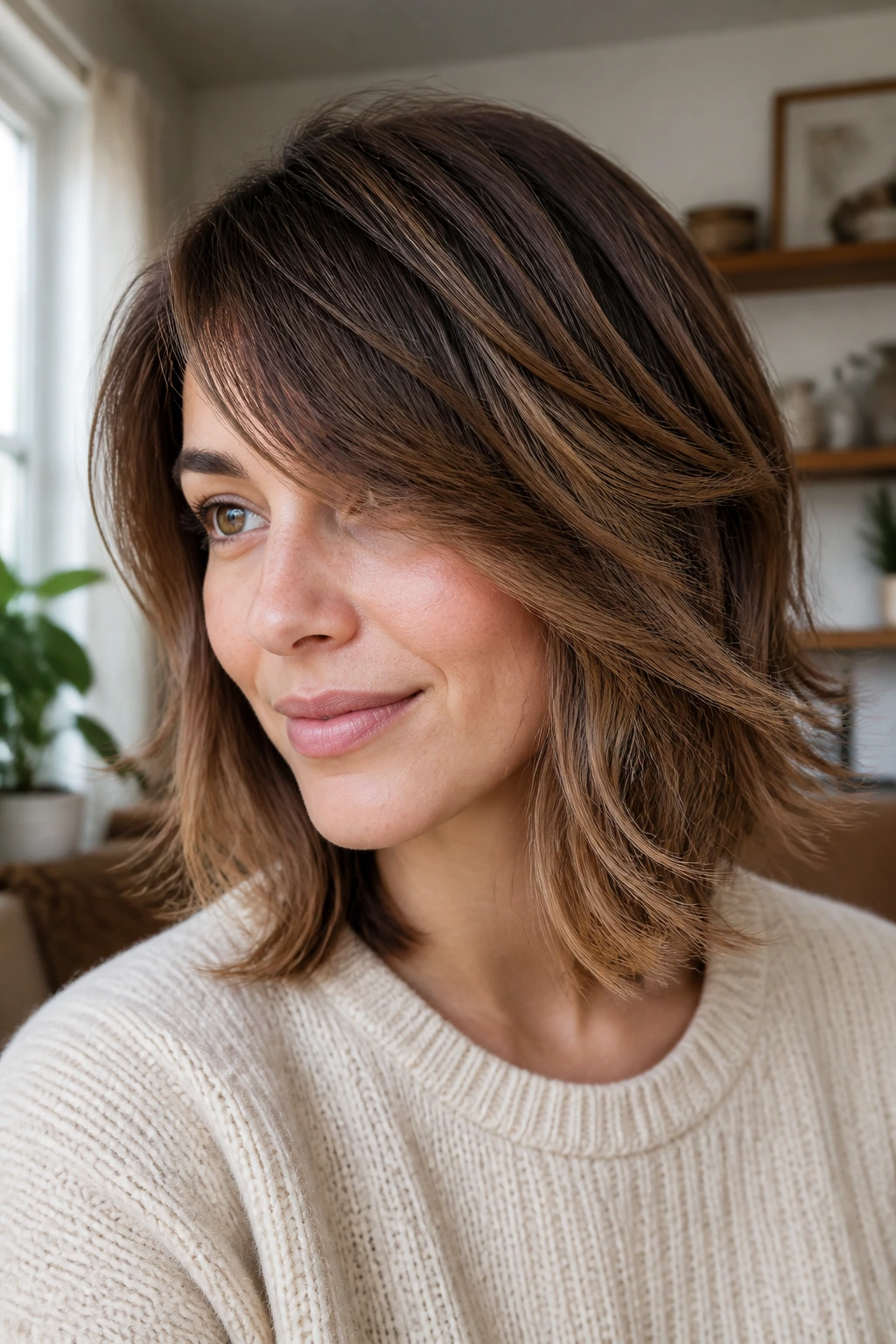
Layered lobs do half the work for you if the ends are allowed to flick instead of lie flat. That’s the whole charm here. The cut already has movement. You just need to wake it up.
Use a blow-dryer brush, a medium curling iron, or a flat iron to turn the ends in alternating directions. Keep the roots lifted at the side part so the bangs can sweep across the front without dropping straight down. The layers should move in different directions by a little, not a lot. Too much mismatch and the style starts to look messy in the wrong way.
This is one of my favorite low-effort looks for hair that falls just below the chin or onto the collarbone. It frames the face fast, and the side-swept bangs soften the whole outline. If the bangs are longer, they can blend right into the top layer. If they’re shorter, they can sit above the cheekbone and still feel connected.
A tiny bit of lightweight cream on the ends keeps the flicks from fraying. Not much. A pea-sized amount, warmed between the palms, is enough for most lob lengths.
21. Fishtail Side Knot
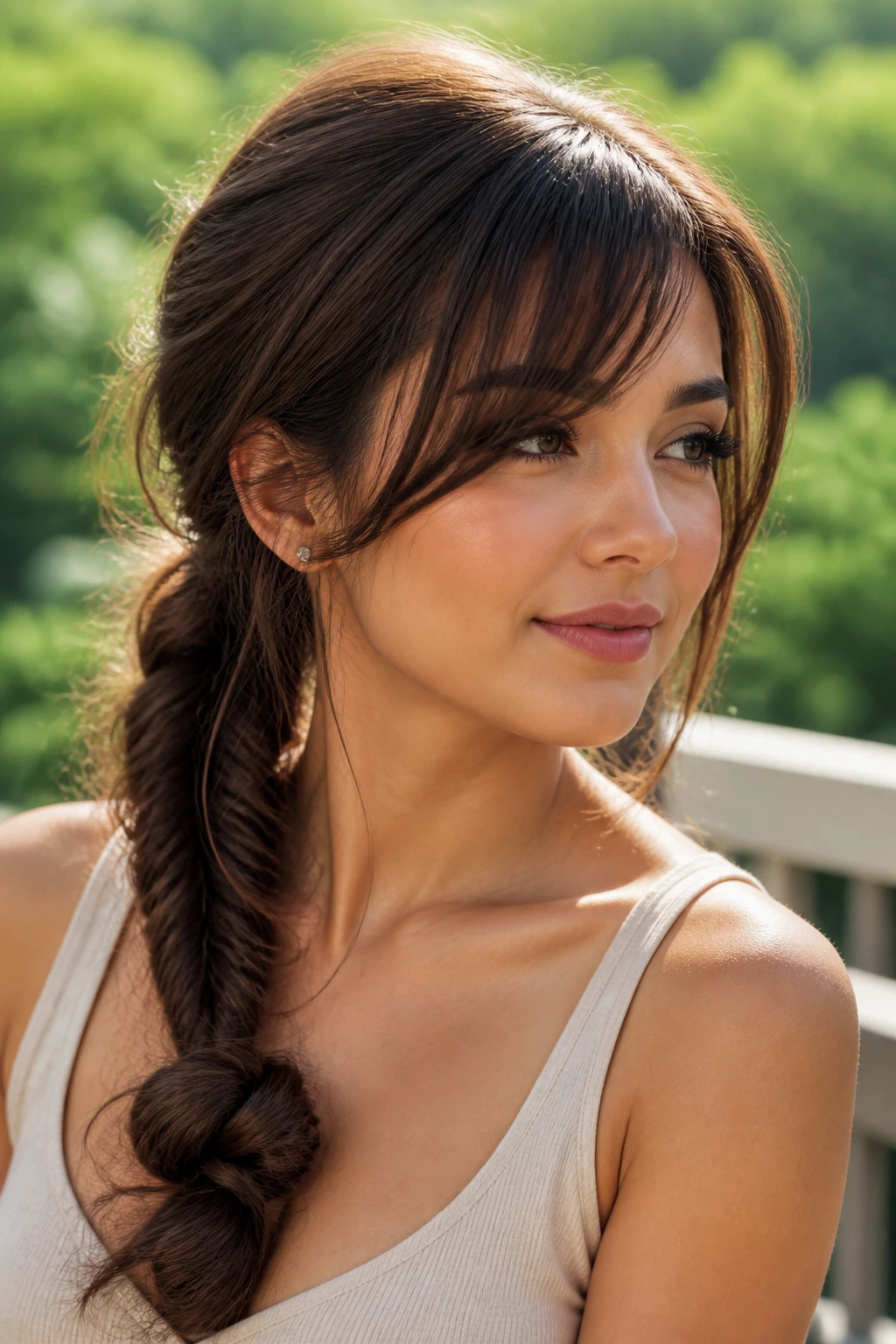
Why does a fishtail make a side-swept fringe feel more polished than a standard braid? Because the weave is smaller, tighter in appearance, and more textured. Even when it’s loose, it reads as considered. Then the side-swept bangs break the symmetry and keep it from looking too neat.
Gather the hair over one shoulder and fishtail braid it loosely, then twist the braid into a knot at the end and pin it low. That knot gives the style a little weight, so it doesn’t slide off the shoulder. If your hair is slippery, add a touch of dry shampoo first. If it’s thick, keep the braid broad so it doesn’t become stiff and narrow.
How to keep it from looking overworked
- Pull the braid apart slightly after it’s secured.
- Leave the bangs soft and curved.
- Keep the knot low and a bit off-center.
This style is best when you want texture with a small amount of shape. It has more character than a plain side braid and less fuss than a full braided updo.
22. Headband Puff Style
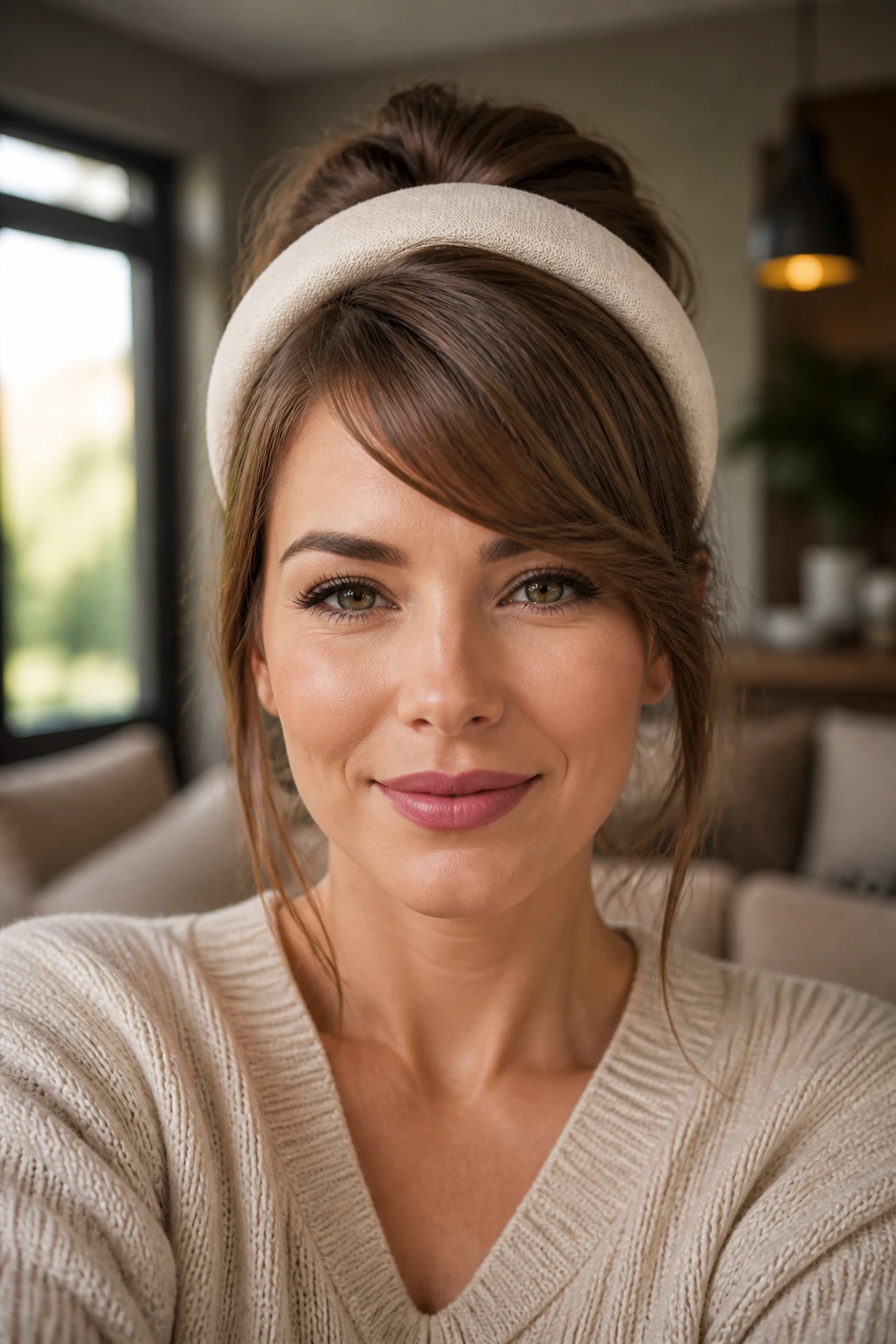
A headband puff style is basically a rescue mission with a good-looking finish. The headband lifts the front, the hair gets a little body behind it, and the side-swept bangs drape around the band instead of disappearing under it. It’s practical. It’s fast. It keeps the hair from getting shoved into a hat-shaped helmet.
Pick a wide cloth or padded headband that sits comfortably behind the hairline. Tease the crown lightly if your hair is flat, then slide the band on and push a bit of volume forward. The bangs should fall over one edge of the band or sweep just under it, depending on how much forehead you want to show.
This style works well when hair is freshly washed and too slippery for clips. The band gives the roots a visual lift, which is half the battle on a rushed morning. It also saves you from redoing the front half of your head every time the bangs split.
One small warning: too narrow a band can pinch the shape. Wider is kinder here.
23. Double-Twist Half-Up
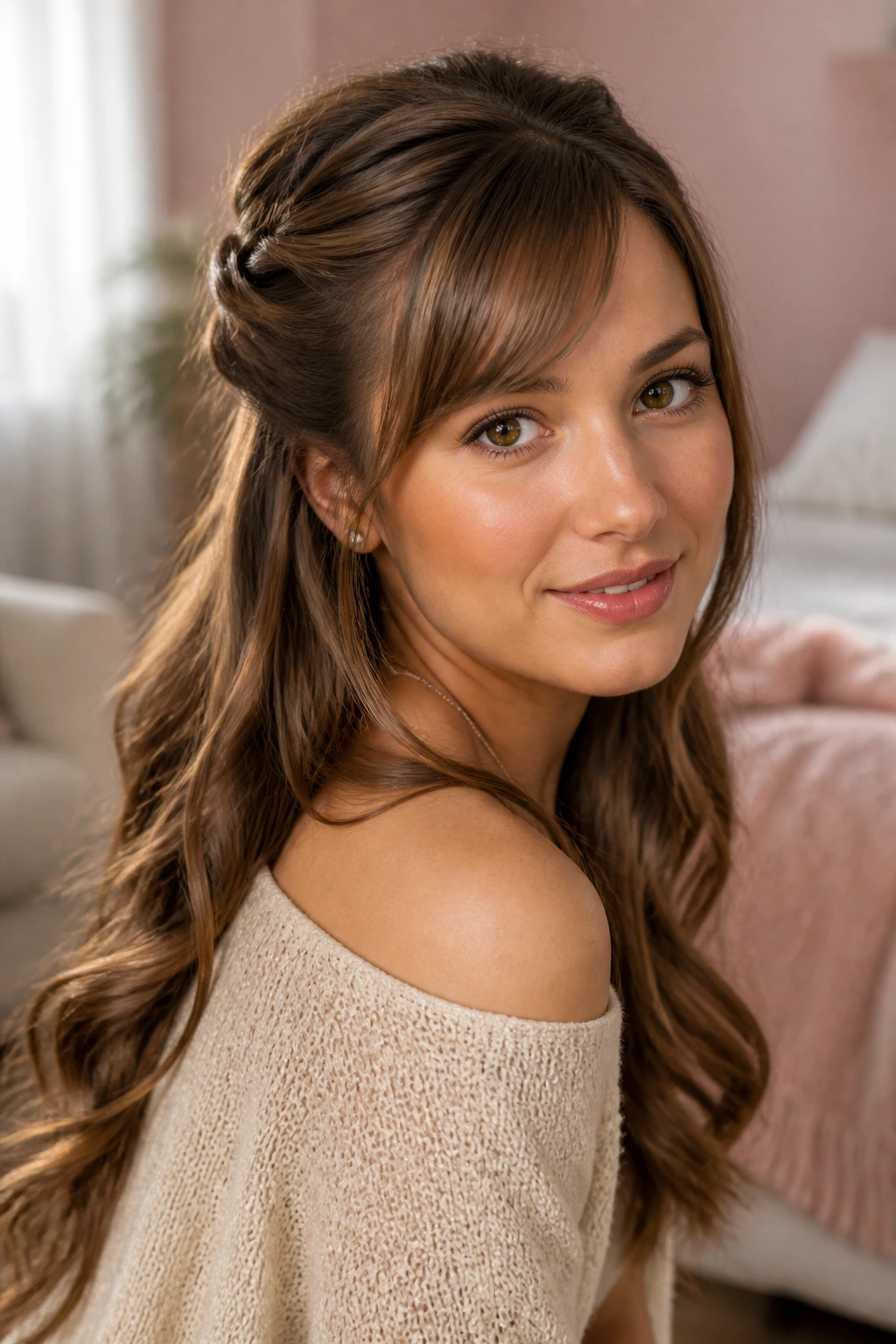
A double-twist half-up style has enough structure to last through a day and enough softness to keep the bangs from looking pasted on. Twist each side from the temples back, pin them under the top layer, and let the lower half hang with a little movement.
This one is especially good for medium hair and grown-out layers. The twists keep the top from collapsing. The lower half stays airy. Side-swept bangs should sit just in front of the twists, not tucked too tightly behind them. That spacing matters. It gives the face room and keeps the style from feeling compressed.
If your hair is straight, add a slight bend to the lower lengths with a curling iron or a quick braid set. If it’s wavy, let the texture do its thing and focus on the twist tension instead. The style is forgiving, but it does look better when the twists are even in size.
A little texture spray at the twist section helps. It also means fewer pins.
24. Loose French Braid Bun
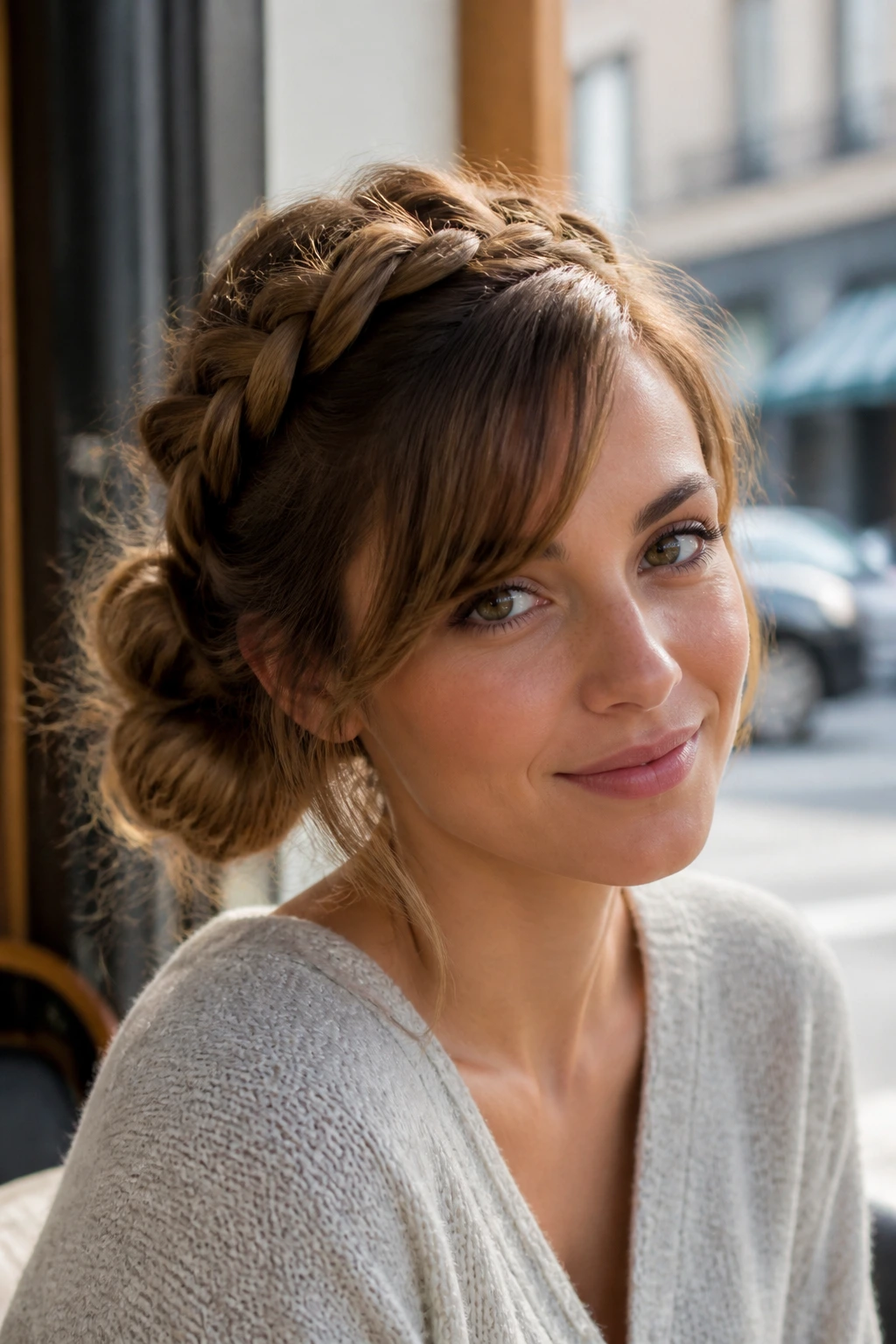
Unlike a tight French braid, this version keeps the braid wide and the bun soft. You start the braid high enough to give the crown lift, then stop once you reach the nape and wrap the rest into a low bun. The side-swept bangs stay free, which keeps the style from turning severe.
It’s a smart choice for thick hair because the braid takes some bulk out of the top while still keeping everything anchored. If your hair is fine, a little texturizing spray at the roots helps the braid hold its width. The bun at the bottom should stay loose. No tiny pretzel knots here.
The bang sweep should be visible from the front. That’s what gives the braid-and-bun combination some softness. Without that fringe, the whole look can feel too tidy for a morning style. With it, the braid reads as relaxed and the bun keeps the shape grounded.
I’d use this on mornings when you need the hair to stay put for hours. It’s not the absolute fastest style in the list, but it pays back the extra minute.
25. Five-Minute Clip-and-Go Sweep
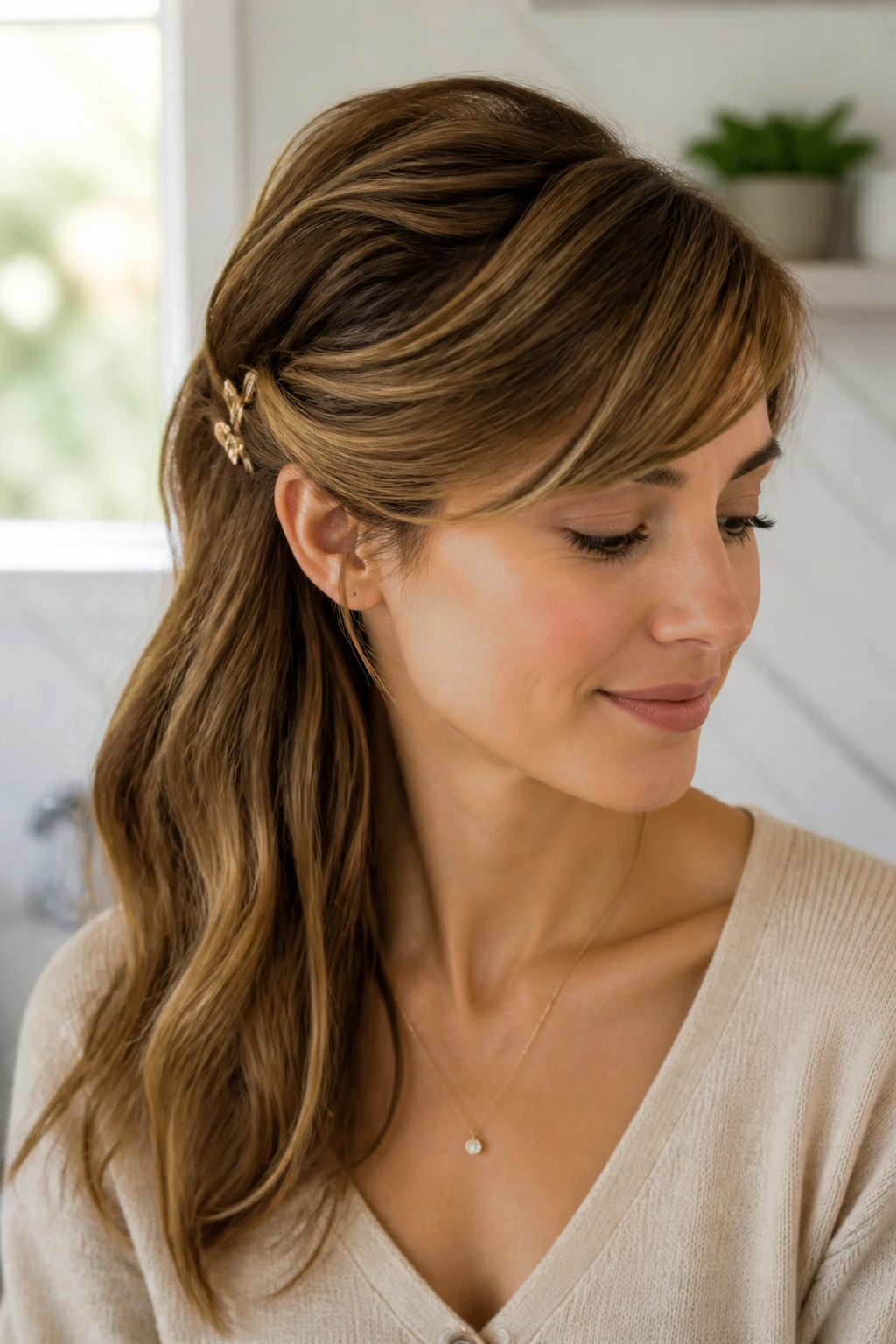
This is the rescue style. The one you reach for when the mirror is not negotiating. Gather the front and mid-sections toward one side, twist them once, clip them low, and let the side-swept bangs finish the job. That’s it. Done well, it looks airy and intentional. Done lazily, it still gets you out the door.
The fast version
- Part the hair on the heavier side.
- Twist the front section back just enough to create lift.
- Secure it with a claw clip or two crossed bobby pins.
- Sweep the bangs across the forehead and leave them soft.
This style works best when the hair has a little grit, which means it’s happier on day-two or day-three hair. Freshly washed hair can still do it, but you may need dry shampoo at the roots first. Don’t overthink the back. The front is the point.
If you keep one quick style in your pocket, make it this one. It’s not precious, and that’s exactly why it earns a place here.
Why Fluffy Styling Wins on a Rushed Morning
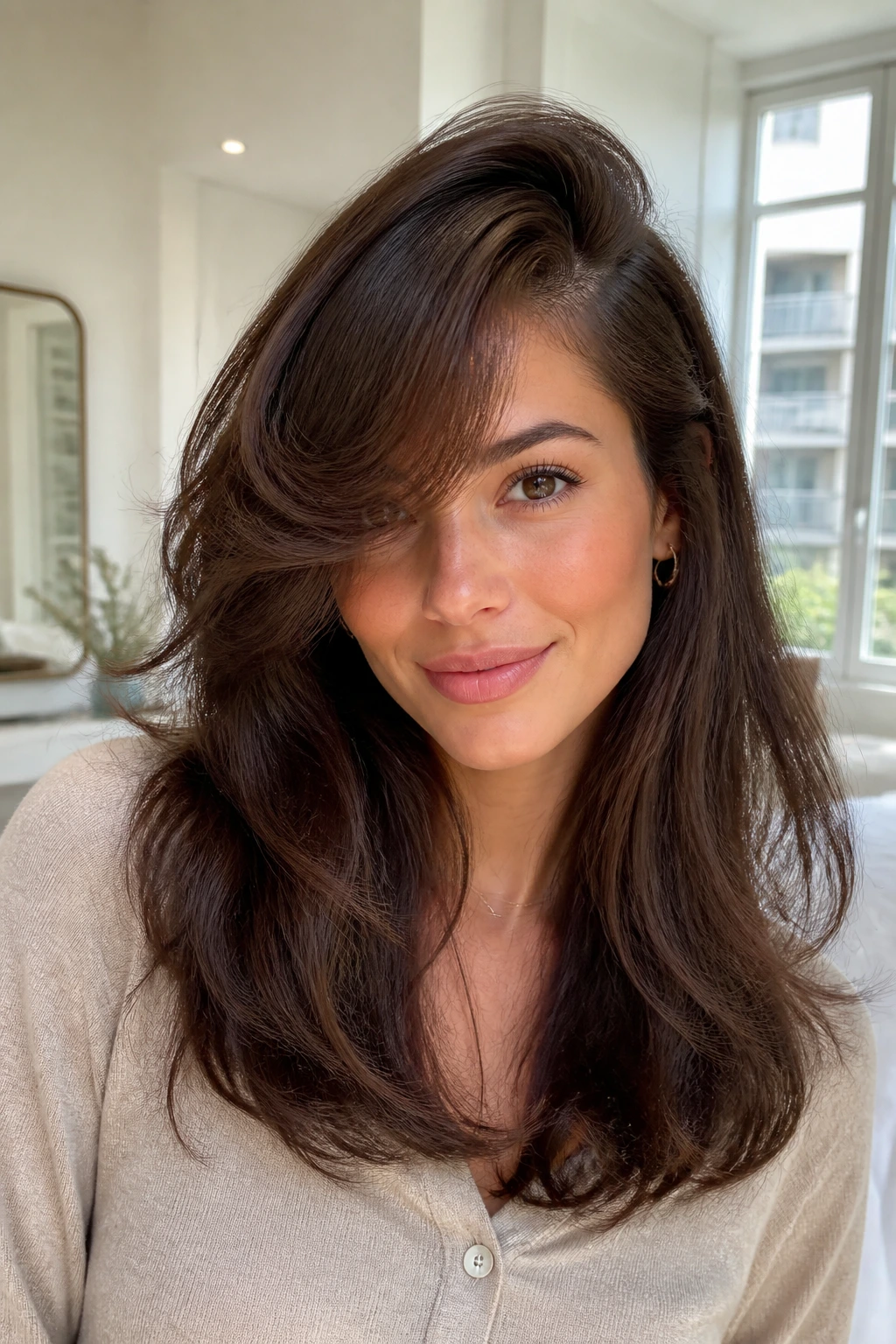
A rushed morning needs styles that can survive partial effort. That’s the whole truth of it. If a hairstyle falls apart the moment one section is imperfect, it doesn’t belong near your alarm clock.
Fluffy styling works because it uses shape, not precision, to do the heavy lifting. A little lift at the crown buys you room. A bent end makes the hair look finished. Side-swept bangs soften the front edge so the rest of the style can stay loose without looking sloppy. Once you understand those three pieces, a lot of the pressure disappears.
There’s also a practical benefit people skip past. Hair with a bit of texture holds pins better, which means you can use less product and fewer tools. That matters on mornings when you’d rather be brushing your teeth than wrestling a curling iron for the fourth time.
And yes, a fluffy style usually survives a little real life. A hood. A commute. A gust of wind. Not perfectly, but well enough that you won’t need to rebuild it from scratch.
Essential Tools for These Hairstyles
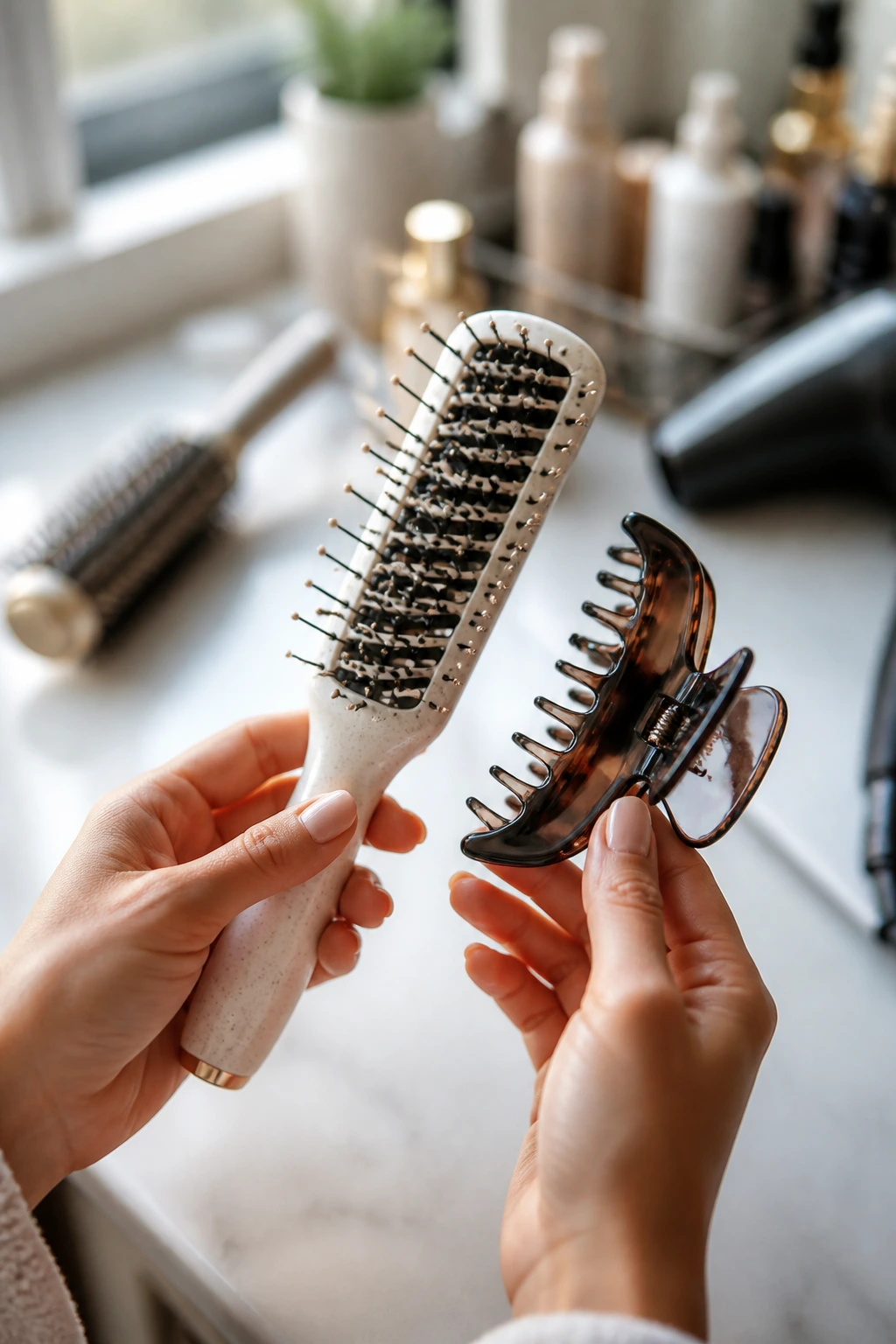
- A vent brush: Good for fast blow-drying and lifting roots without soaking the hair in product.
- A medium round brush: Useful for side bangs, flipped ends, and soft bend through the front.
- A 1-inch curling iron or flat iron: Handy for lob flicks, loose waves, and bang direction.
- Claw clips in two sizes: One medium and one large cover most of these styles; tiny clips slip more than they help.
- Bobby pins with a strong grip: Smooth pins glide out. Grippy pins hold twists, buns, and tucked rolls better.
- Small clear elastics: Better for bubble ponytails, half-up styles, and wrapped ponytails.
- Dry shampoo: Gives roots some bite and saves flat bangs from lying dead against the forehead.
- Texture spray: Helps second-day hair hold twists, braids, and lifted crowns.
- Light hairspray: Flexible hold matters more than stiffness. You want movement, not shellacking.
- Satin scrunchie or scarf: Nice for low ponies and styles that need less friction.
Picking Products for Lift, Bend, and Hold
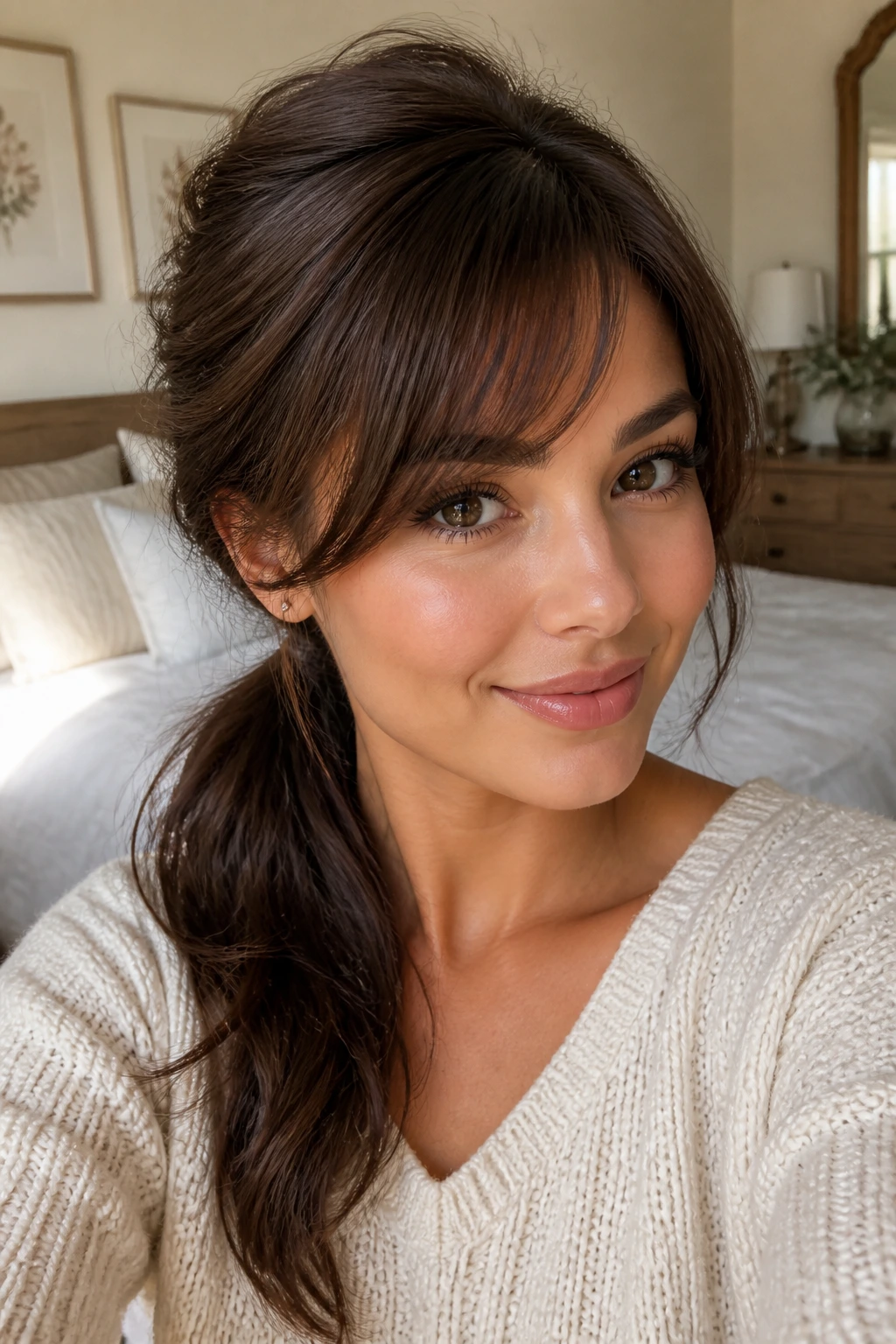
The fastest way to ruin a fluffy style is to use the wrong product in the wrong place. Heavy cream at the fringe. Sticky gel at the crown. Too much spray on the lengths. All of that pushes the hair toward flatness or crunch.
For fine hair: reach for mousse at the roots and a flexible spray at the end. Fine hair usually needs shape first and weight second. A root-lifting mousse gives the crown some backbone before the dryer even comes out.
For thick hair: use a small amount of smoothing cream on the mid-lengths and ends, then choose a stronger pin or clip. Thick hair needs control around the perimeter, but the roots still need air. Too much cream near the scalp makes the style collapse.
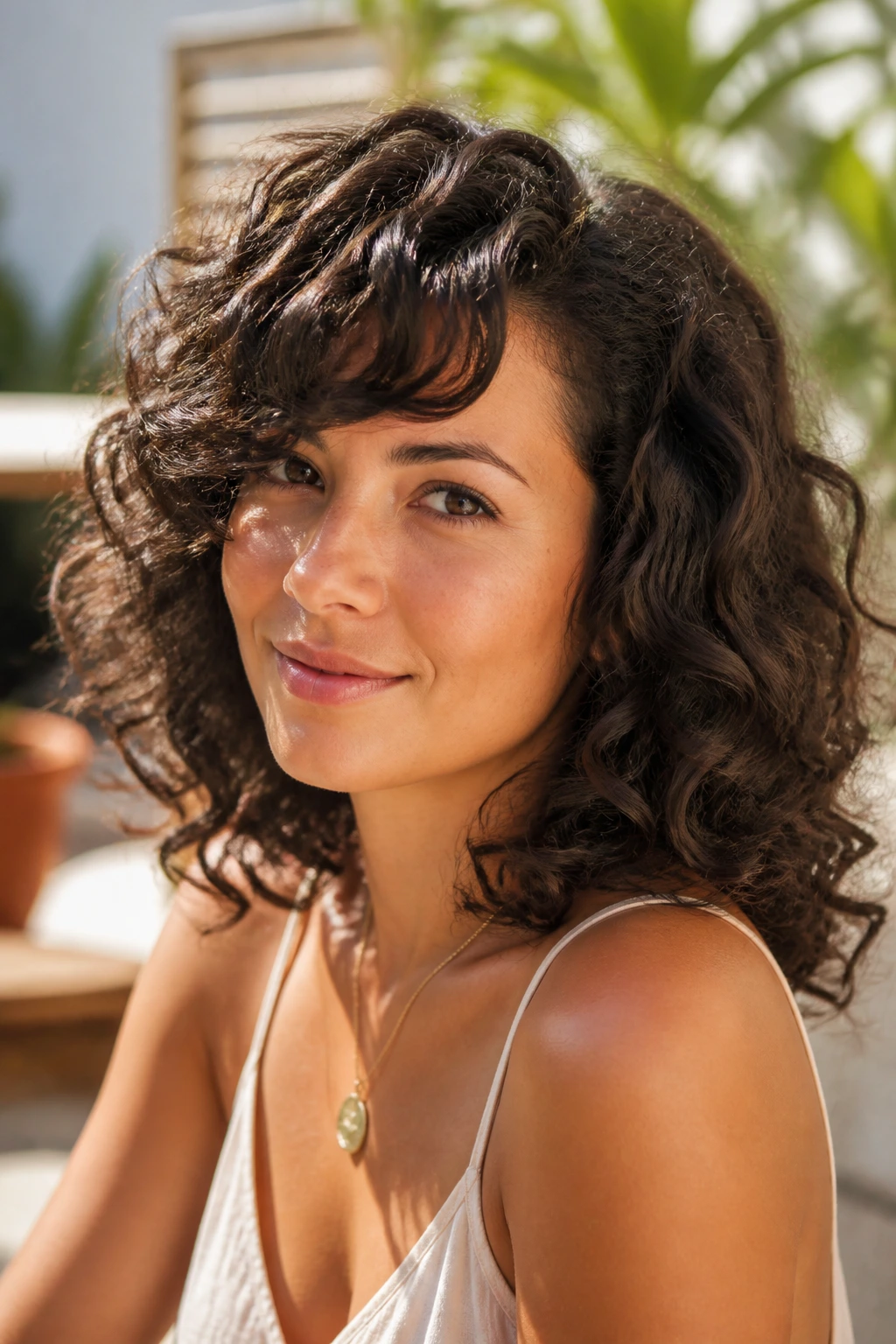
For wavy or curly hair: a curl cream or light leave-in works better than a stiff paste. Shape the fringe while the hair is damp, then let the texture settle where it wants to. Trying to fight the wave pattern usually wastes time.
For bangs specifically: dry shampoo is the workhorse. A tiny bit at the root gives the fringe lift without making it look dusty. If your bangs are stubborn, a small roller or brush set for three to five minutes can change the whole front section.
How to Wear These Styles From Errands to Evening Plans
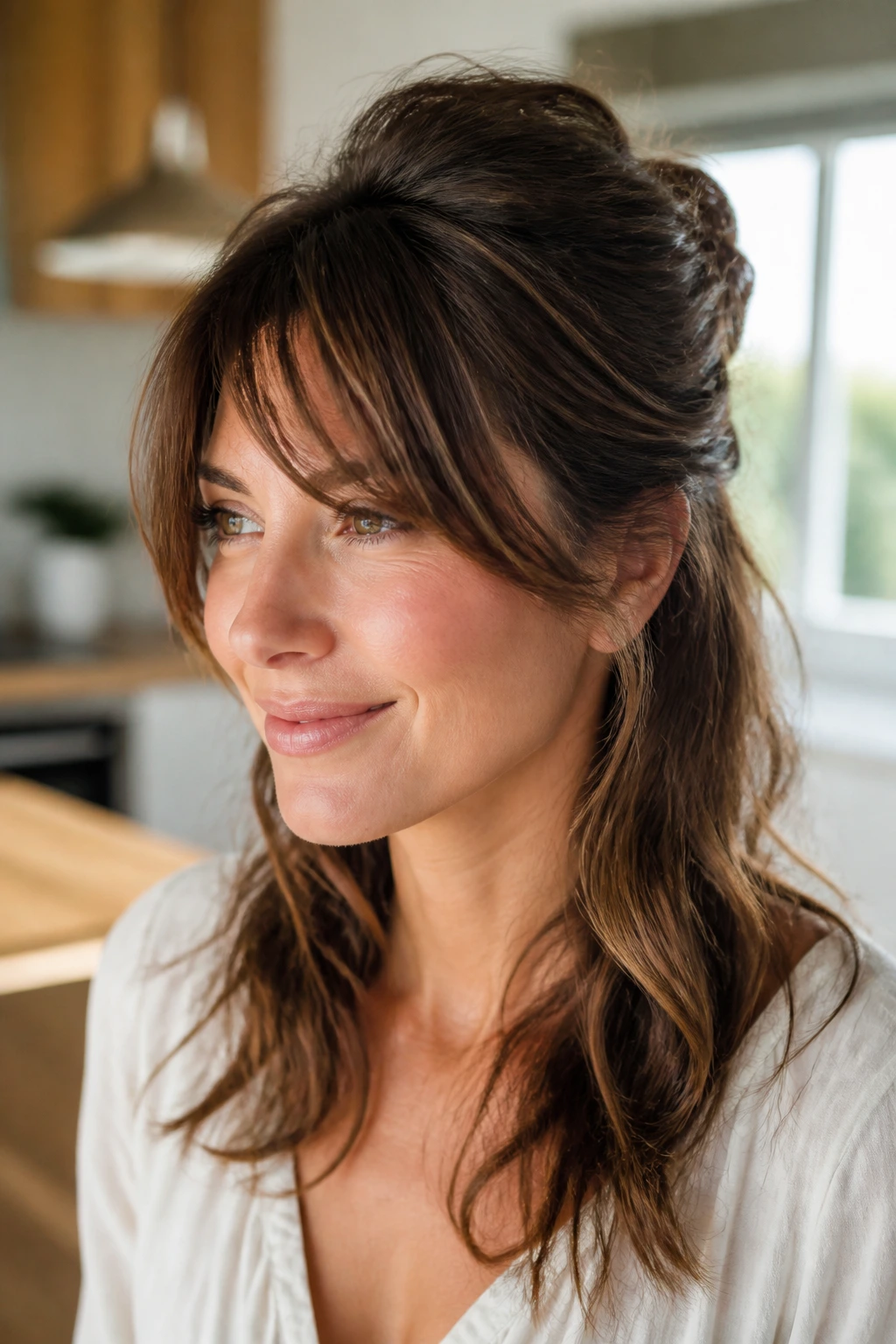
Presentation: Keep one clear shape in the front—side sweep, twist, braid, or lifted crown—so the style reads finished at a glance. If everything is soft everywhere, the look can slide into “I gave up.” One visible anchor solves that.
Errands and quick mornings: Choose the styles that can survive motion: the clip-and-go sweep, the mini top knot, the headband puff, or the low side ponytail. They stay put, and they don’t demand constant mirror checks.
Desk hours: The brushed-out waves, loose chignon, and side-parted blowout are the safest bets if you’ll be looking at screens or meeting people all day. They keep the bangs controlled without pinning the face shut.
Evening plans: If you want the hair to feel a little dressier, add one small upgrade—wrapped elastic, a scarf, a braid tucked into a bun, or a smoother finish around the crown. Don’t pile on every upgrade at once. One extra move is enough.
With glasses or a hat: A style with lift at the crown and a soft bang sweep usually behaves better than loose hair around the temples. Anything too tight around the ears starts to clash fast.
Extra Tricks That Make the Styles Behave
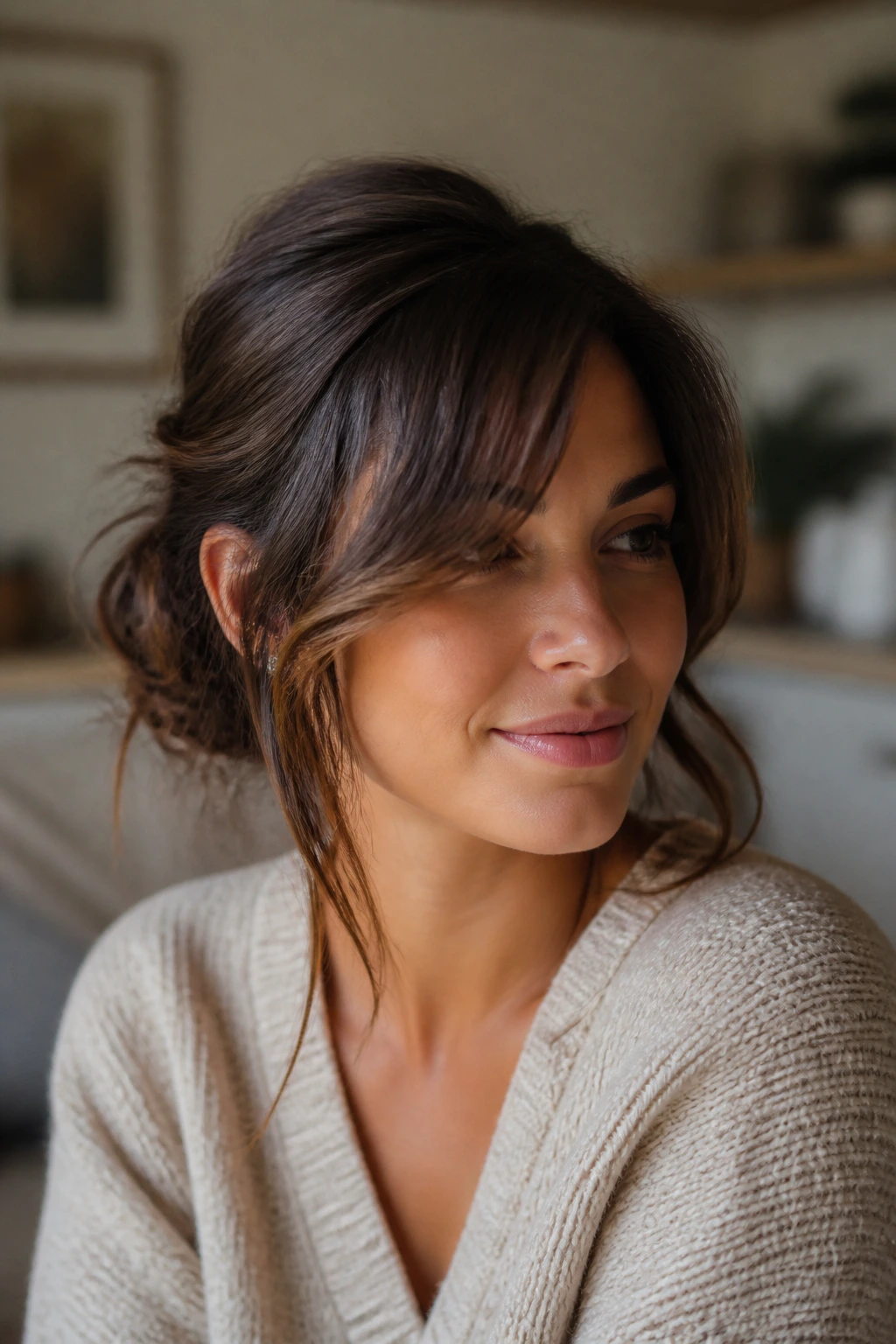
Root Lift: Clip the crown section up while you get dressed or do makeup. Even five minutes of set time helps the roots remember the shape you want.
Bang Direction: Blow-dry side-swept bangs across the forehead, then back the other way, then across again. That small back-and-forth stops them from sticking in one awkward line.
Time-Saver: Keep one claw clip, three bobby pins, and a small elastic where you can reach them without looking. Hunting for tools is what makes “quick” turn into “late.”
Finish: Spray hairspray onto a brush or your fingers, then smooth the bang area. Direct spray can make the fringe crunchy and separate the strands.
Texture Without the Crunch: If hair is too clean, use dry shampoo at the roots before you start styling. If it’s too dry, mist the lengths lightly with water and a drop of leave-in, then shape the front again. The front section often needs more moisture than the rest.
Common Mistakes That Flatten the Whole Look
- Smoothing the bangs too hard: If the fringe lies dead flat against the forehead, it loses its sweep and starts sticking. Fix it by lifting the roots with a brush or roller, then letting the bang cool in the side direction.
- Using too much cream near the scalp: Heavy product at the roots weighs the style down fast. Keep creams on the mid-lengths and ends, and use dry shampoo or mousse up top instead.
- Making every twist or braid too tight: Tight styling pulls the crown flat and makes the whole look look smaller. Looser sections hold shape better and keep the fluffy effect alive.
- Ignoring the cool-down time: Hair that’s still warm reshapes itself as it sets. If you pin or clip bangs in place for even a few minutes, they hold the direction better than if you keep touching them.
- Choosing a style that fights your haircut: A blunt, heavy cut wants different handling than a layered one. If your hair is thick, use styles that take bulk out. If it’s fine, lean into lift and soft ends.
- Over-spraying the front: Bangs turn stiff fast. A light mist is enough. Anything more and the fringe starts behaving like cardboard.
Variations and Adaptations to Try
Fine-Hair Float: Use mousse at the roots and a soft side part, then choose styles that add shape without adding weight—like the half-up twist, clip-and-go sweep, or side-parted blowout. Skip heavy creams and oversized buns. They flatten fine hair faster than they help.
Thick-Hair Tame-Down: Swap loose, wide styles for ones that control volume in layers: the low chignon, French braid bun, or claw-clip twist. Thick hair usually needs a little more pinning and a little less tugging. Leave the fringe soft so the front doesn’t fight the bulk in back.
Curly Sweep: Let the natural texture do most of the work. Shape the side-swept bangs with fingers and a bit of curl cream, then choose braids, buns, or twists that don’t demand a perfectly smooth finish. Curly hair looks best here when it keeps its bend.
Short-Bang Shortcut: If your bangs are shorter than the rest of the face frame, keep them moving with a small round brush, tiny roller, or side pin. Styles like the headband puff, pin curls, and one-pin side sweep work well because they don’t require the fringe to be long.
No-Heat Morning: Pick the styles that rely on set time instead of irons: heatless curls, bubble ponies, side braids, rope twists, and tucked rolls. A good overnight set plus a quick morning reshape saves more time than a rushed hot-tool session.
Keeping the Shape Going Between Washes
Fluffy styles usually hold better on hair that is not freshly washed every single day. That extra bit of natural grip helps the crown stay lifted and gives pins something to catch on. For most people, that means a usable style window of 2 to 4 days, depending on hair type and scalp oil.
At night, keep the bangs from being crushed. A small roller, a loose pin curl, or a soft clip at the front can help the fringe keep its direction. If you sleep on your side, a satin pillowcase cuts down on the weird flat patch that appears right above the ear. It’s not glamorous, but it saves time in the morning.
The morning reset can be fast. Mist the bangs lightly, blow-dry the roots for 20 to 30 seconds, and sweep them back into place with your fingers. If the crown looks flat, use dry shampoo at the roots before you brush. If the lengths look dull, a tiny amount of texture spray at the mid-lengths usually wakes them up.
When a style starts sliding by lunch, it’s usually one of two things: too much product or too little support. Add a pin, not more spray. Or change the part by an inch. That little shift can make the whole cut look refreshed without a full restyle.
Questions People Ask Before They Try These Styles
How do I keep side-swept bangs from falling in my eyes?
Give them direction while they’re still warm or damp, then let them cool that way. A small round brush, a side part, and a short blast of cool air usually does more than extra hairspray.
Can fluffy styles work on fine hair?
Yes, and fine hair often benefits the most. Use light mousse, root lift, and styles that don’t drag the hair down—half-up twists, side ponies, and clipped sweeps are safer than heavy buns.
What if my hair is too clean and slippery?
Dry shampoo at the roots helps right away. If the hair is still too slick, choose a style with more structure—like a braid, twist, or claw-clip look—so the hair has something to hold onto.
Do I need heat for these styles?
Not for all of them. Heatless curls, braids, twists, headbands, and clip styles work with no heat at all. For the blowout looks, though, a little heat is what gives the bangs their bend.
How do I stop the crown from going flat by lunch?
Start with root product, not mid-length product. Then avoid pulling the top section too tight. A small boost of dry shampoo and a fingertip lift at the roots can revive the shape in seconds.
Can curly hair use side-swept bangs like this?
Absolutely. Curly bangs just need a different approach. Shape them while damp, keep the product light, and choose styles that work with texture instead of ironing it away.
What style is fastest if I only have a few minutes?
The five-minute clip-and-go sweep wins on speed. The mini top knot and low side ponytail are close behind. If your fringe is behaving, even the headband puff can be done fast.
How do I make the style look less messy and more intentional?
Keep one part of the hairstyle clean—either the bang sweep, the crown lift, or the braid line. If everything is loose, the result can look unfinished. One controlled area gives the rest of the softness a job to do.
The Small Lift That Changes the Whole Morning
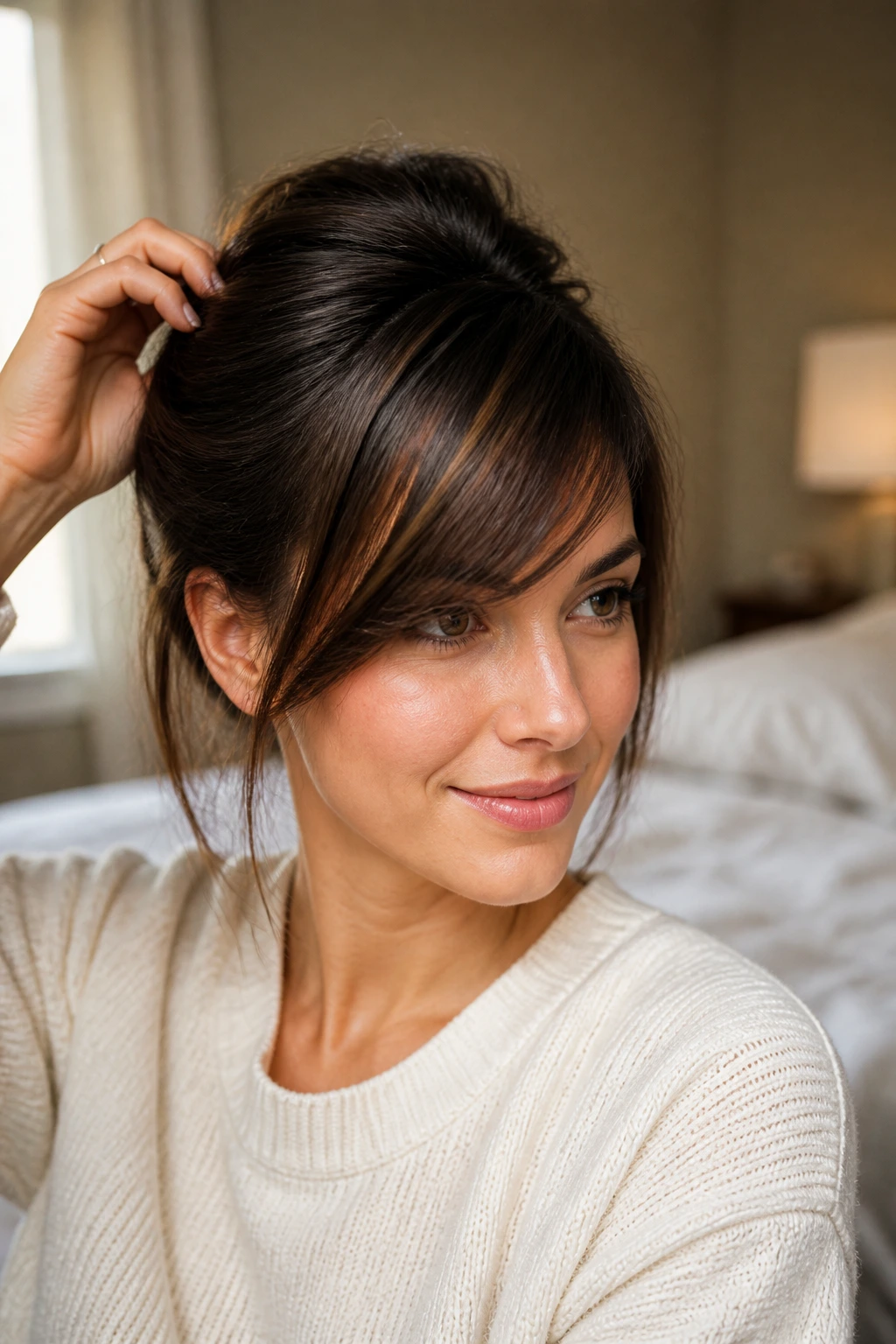
Side-swept bangs do not need a complicated routine. They need direction. A little lift at the crown, a bend through the front, and a style that leaves the fringe room to move can turn a rough morning into something that looks planned.
That’s the real appeal of these fluffy hairstyles: they don’t ask for precision where it won’t matter. They ask for a brush, a pin, a clip, maybe a quick blast of heat, and the sense to stop fussing once the shape is there.
Pick the one that fits your hair length and your patience level, then keep the tools within reach. The rest gets easier when the bang knows where to go.