



A full fringe for long hair and round faces can do something subtle that a lot of people miss: it gives the face a front-and-center frame while the length keeps the eye moving downward. That’s the whole trick. Not more hair. Better shape.
The mistake I see most often is a fringe that’s cut wide and heavy all the way into the temples, with no thought for what the rest of the haircut is doing. On a round face, that can make the cheeks feel even fuller. The better move is to let the center carry the weight, then soften the edges just enough so the fringe feels deliberate instead of boxy.
Some versions are sleek and sharp. Others are soft, curly, feathered, or a little lived-in, with the kind of bend that makes the whole haircut feel less precious. The good ones do not fight the face shape; they guide it. And once you see how many ways a full fringe can be tailored to long hair, the whole thing gets a lot more interesting.
Why This Collection Works for Round Faces
- Vertical length matters: The long hair below the fringe keeps the face from reading as wide, especially when the length falls past the collarbone.
- The fringe can control width: A dense center with softer temple edges narrows the face where it needs it most, right around the cheeks.
- Texture changes the whole mood: Straight, wavy, curly, and coily versions all work differently, which means you can choose shape without giving up your natural hair pattern.
- Crown volume helps more than people think: A little lift at the roots makes the face look longer in the simplest way possible.
- The cut should match your daily routine: Some of these looks need a round brush and a blow-dryer; others are better left a little undone.
- One fringe, many personalities: Full bangs can look polished, romantic, edgy, or soft depending on where the ends land and how much the temples are beveled.
1. Brow-Skimming Blunt Fringe with Sleek Length
A blunt fringe that sits just at the brows has a crisp, clean line that feels strong without swallowing the face. Paired with long, straight lengths, it gives round features a sharper frame and keeps the eye moving in one direction: down.
Why It Flatters a Round Face
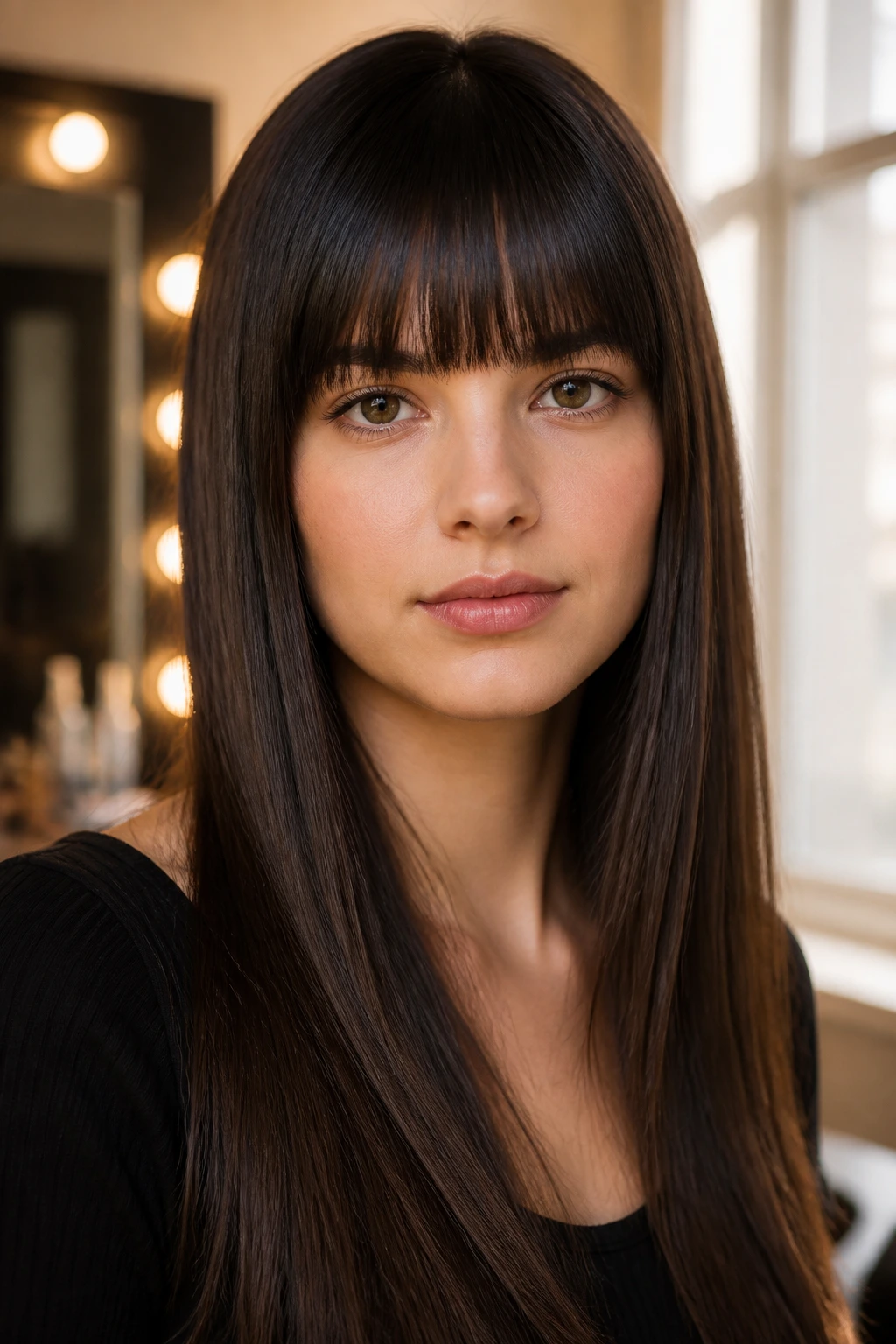
The line of the fringe is the point. If it lands right at the brow bone and the rest of the hair stays sleek past the shoulders, the face looks longer because nothing is competing with the forehead. I like this best when the ends are trimmed with a tiny bit of softness at the corners — not choppy, not wispy, just enough to keep it from looking helmet-like.
A flat iron, a light serum, and a center or near-center part on the length make this version look polished without trying too hard. If your hair is naturally straight, this is one of the easiest shapes to live with. If it’s wavy, you’ll spend more time smoothing the fringe than the rest of the style, so plan for that.
Best for: straight or lightly wavy hair
Fringe length: right at the brows
Best vibe: clean, sharp, face-framing
2. Soft French Fringe with Long Waves
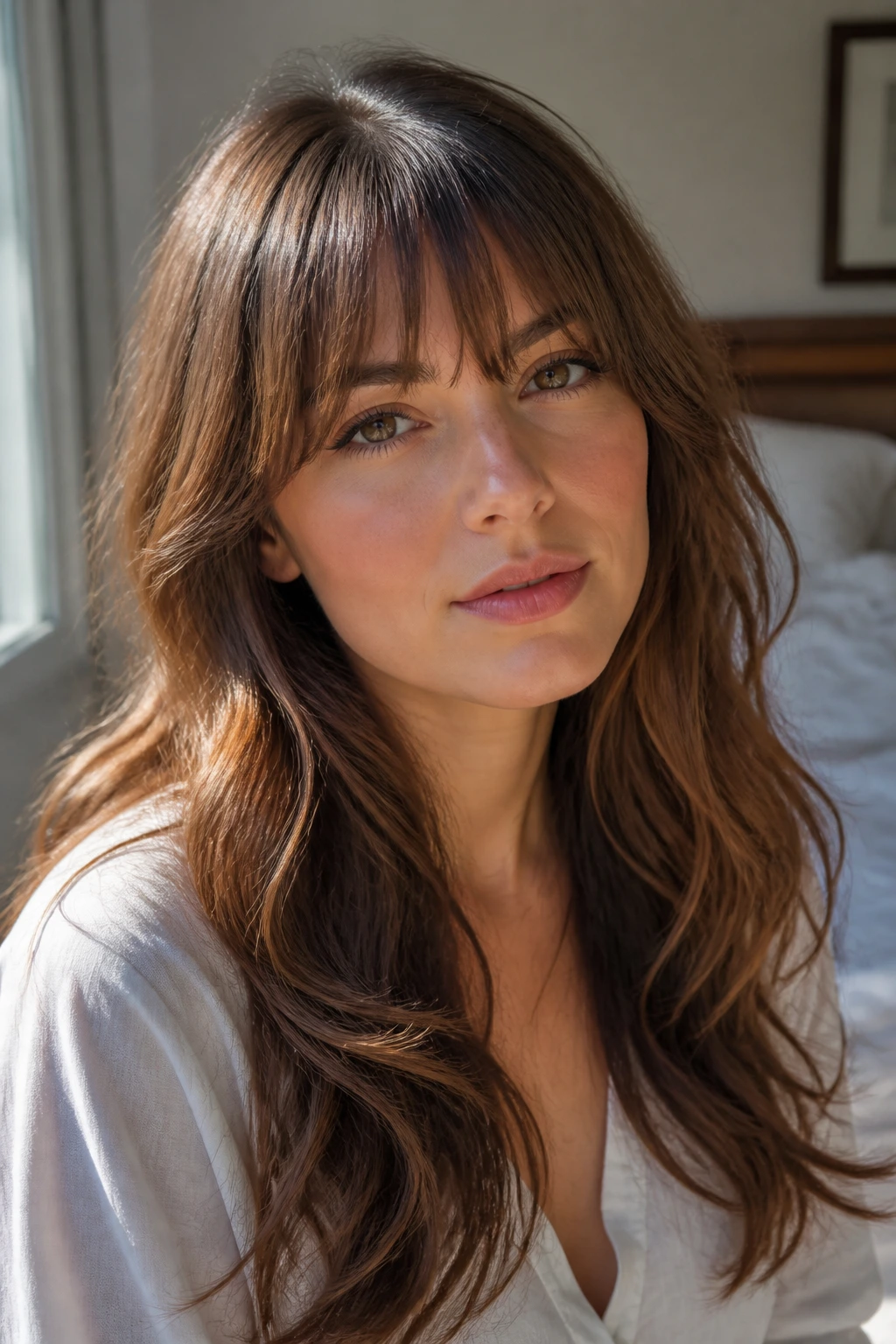
This version is a little gentler. The fringe is still full, but the line is softly rounded so it barely kisses the brows at the center and drifts a touch longer at the temples.
The waves below it do most of the balancing work. They break up the width of the face and keep the look from feeling too exact. I like this cut when someone wants a fringe that feels romantic but not fussy — the kind you can tuck behind one ear, let fall back, and still look put together.
A medium round brush gives the fringe a slight bend without making the ends flip up. The length should start moving somewhere below the jaw, not right at it. That’s the difference between “pretty” and “why is this widening my cheeks?”
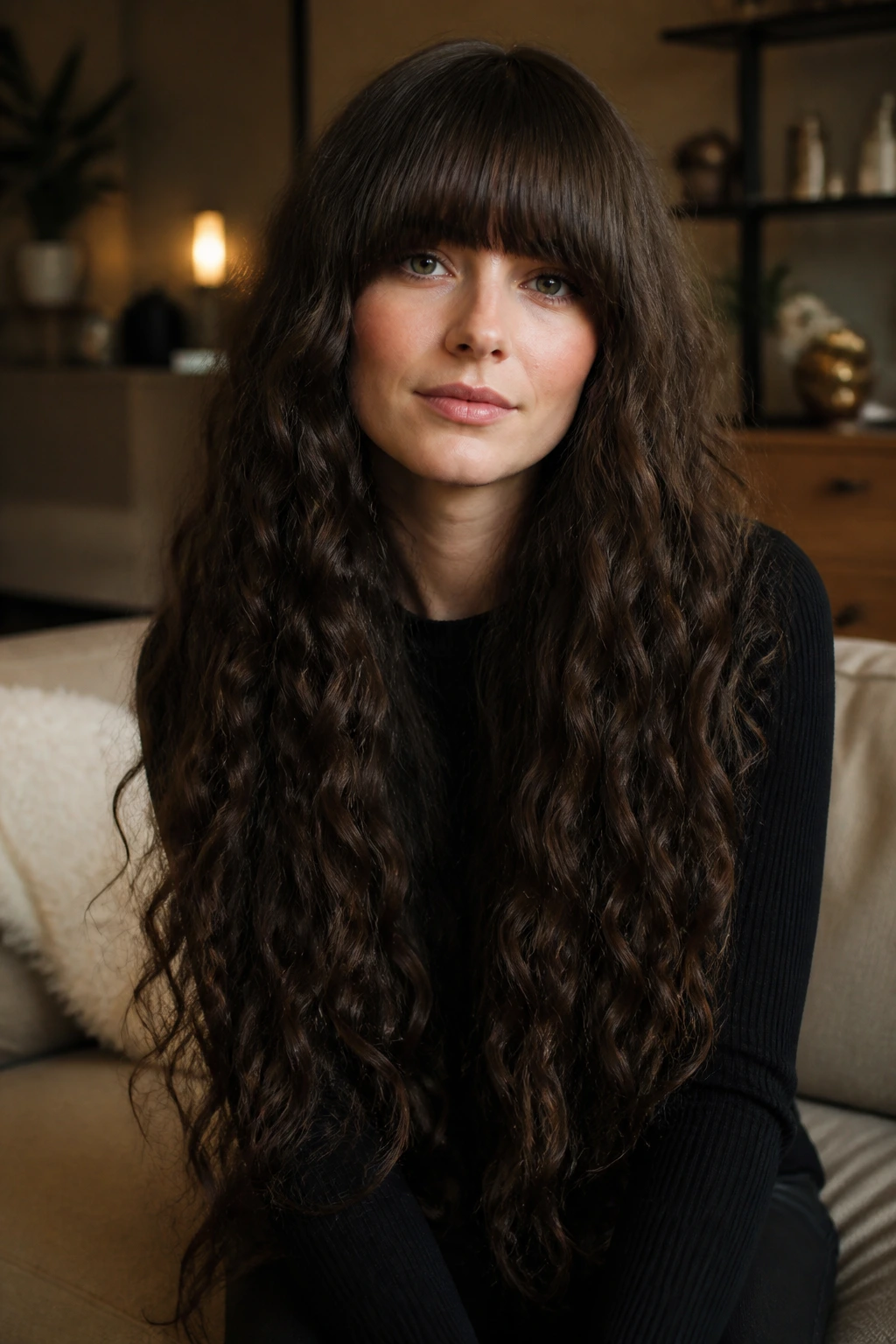
3. Heavy Fringe with Waist-Length Curls
A thick fringe against long curls is a strong look, and that strength is exactly why it works. The fringe sits dense across the forehead, while the length drops all the way to the ribs or lower, which gives the face a vertical line to lean on.
What Makes It Work
The curls need space. Tight curls cut too close to the chin can add width; curls that start below the cheeks do the opposite. That’s why I prefer this on hair that can stretch a little when dry and still keep its shape. The fringe itself should be cut with the curl pattern in mind, not straightened into a false line at the salon and hoped for the best.
Use a curl cream on the lengths and leave the fringe a touch lighter in product so it doesn’t collapse onto the forehead. A diffuser on low heat keeps the root from puffing up too much. The result is bold, yes, but also controlled. That matters.
4. Butterfly Layers with an Airy Full Fringe
Butterfly layers do something useful here: they take weight out of the sides without chopping the length off. With a full fringe on top, that keeps the face framed from above and below at the same time.
The fringe should stay full, but not heavy enough to sit like a curtain. A little internal texture around the center of the bangs makes them move when you do. That movement is what keeps the style from reading too square on a round face.
I like this cut on long hair that already has some bend. Blow-dry the fringe first, using a small round brush and directing the air from side to side. Then let the lower layers flip out just enough around the collarbone. It’s a softer shape than a blunt cut, but it still has enough structure to hold its own.
5. Glass-Hair Fringe with One-Length Ends
If your hair is naturally straight and you like a sharp finish, this is the cleanest version on the list. The fringe is cut dense and exact, and the length stays one length or nearly one length all the way down.
The reason it flatters a round face is simple: the shape is narrow at the face and long everywhere else. Nothing puffs out at cheek level. Nothing steals the line. It’s almost architectural, which sounds severe until you see it moving in real life.
This one does ask for upkeep. A blunt line needs trimming before it starts poking the eyes, and one-length hair shows split ends faster than layered hair does. But if you like a haircut that looks expensive from a distance and precise up close, this is hard to beat.
6. Curved Full Fringe with Loose Spiral Curls
Why does a curved fringe work so well? Because it mirrors the face without tracing it exactly. The center stays shortest, the corners fall a little longer, and the line bends softly into the curls below.
That shape takes the edge off roundness without trying to hide anything. The curls should start below the cheekbone, not around the cheekbone, or you’ll bring the widest part of the hair too close to the widest part of the face. That’s the part a lot of guides skip, and it’s the bit that matters.
How to Wear It
Use a diffuser and a curl cream with enough slip to keep the curl from frizzing out near the front. If your curls are springy, pin the fringe up for 5 to 10 minutes while it cools so the shape settles before you touch it. It’s a small thing. It changes everything.
7. Choppy Full Fringe on a Long Shag
A long shag gives you movement; a choppy fringe gives you attitude. Put them together and the face gets framed by texture rather than by a hard line.
That’s useful on a round face because the hair breaks apart visually. Instead of one solid horizontal band across the forehead, you get little shifts in length and direction. The eye keeps moving. The face feels less wide.
This is the version I’d choose for fine hair that needs lift or for anyone who hates a too-perfect fringe. Dry shampoo at the roots, a bit of texturizing spray through the ends, and a rough blow-dry are usually enough. If you over-smooth it, the whole point disappears.
8. Dense Fringe with a Soft U-Shaped Hem
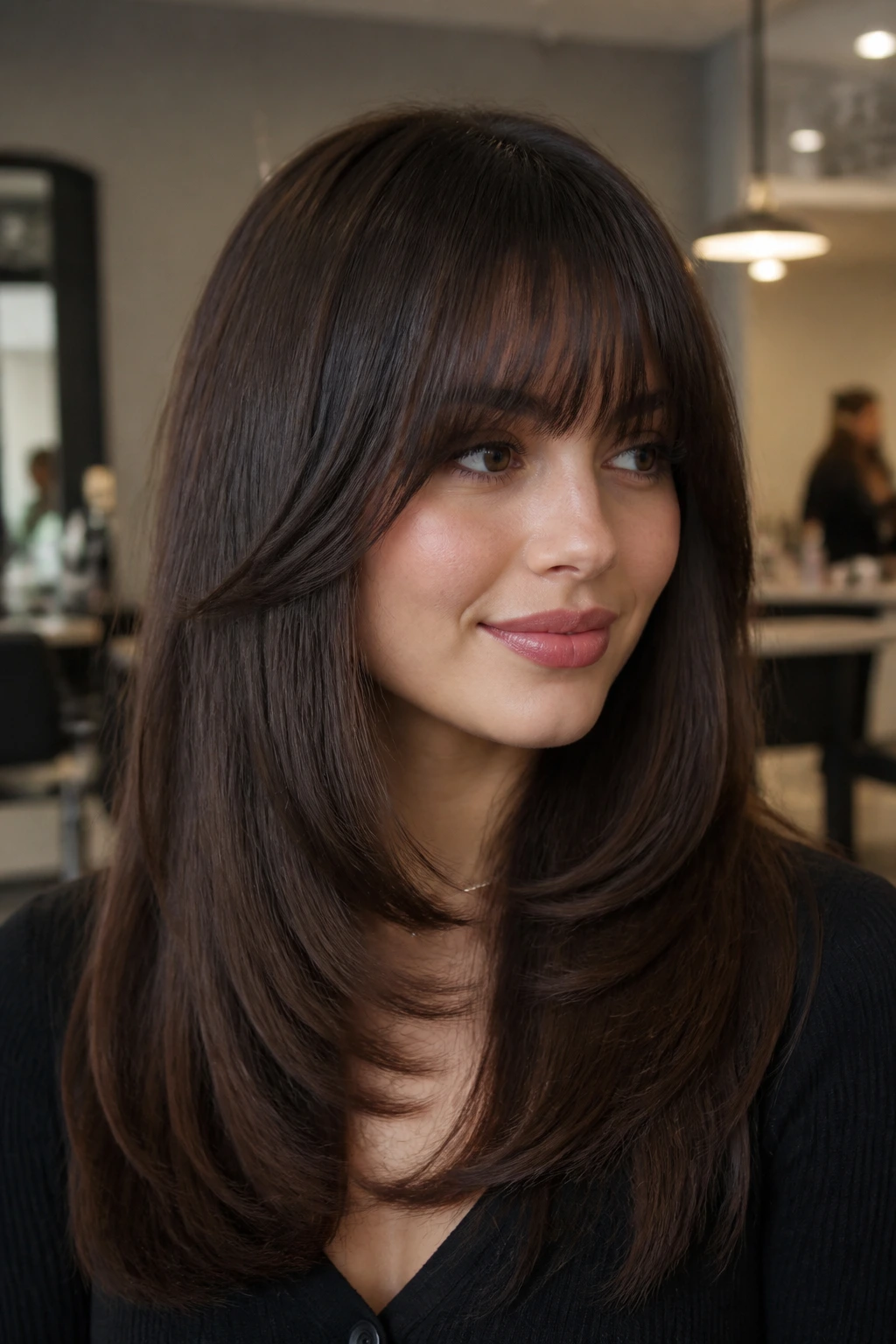
Here, the fringe is full and the rest of the haircut follows a soft U shape, with the longest pieces sitting at the back and the front staying slightly shorter. That shape draws the hair inward at the sides, which is useful when the face already has natural width.
The fringe should stay dense through the center and only soften a little at the corners. I prefer this on thick hair, because thick hair holds the U shape better and gives the fringe enough body to sit properly. Thin hair can do it, but it needs more root support and a careful blow-dry.
One small warning: do not let the front layers hit the cheeks. Keep them a bit lower. When the shortest pieces hover right at cheek level, the face can read fuller. Below the cheekbones is safer and usually prettier.
9. Air-Dried Fringe on Natural Waves
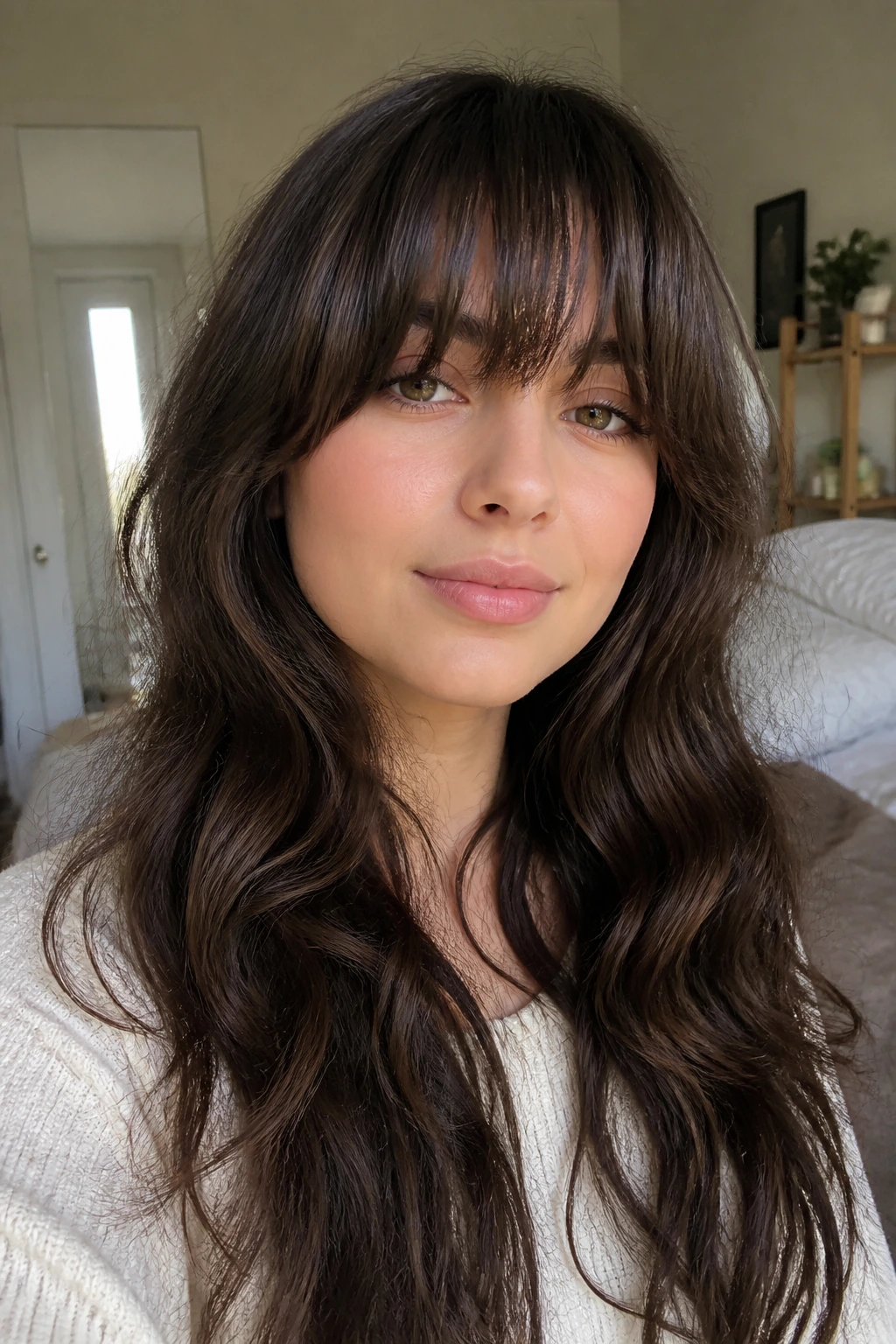
Not every fringe needs a round brush and a full production. A full fringe on natural waves can look relaxed and still frame a round face beautifully, as long as the fringe is cut with a little extra length for shrinkage and bend.
The important part is where the wave lives. If the fringe starts puffing at the temples, it can widen the face. If the wave sits mostly through the center and the hair falls longer at the sides, it creates a soft vertical path instead. That’s the quiet magic here.
Scrunch in a leave-in cream, let the fringe dry untouched for a few minutes, then separate it gently with your fingers. Don’t rake it too much. Raking makes the front look stringy, and stringy is not the same as light.
10. Deep Side-Bent Full Fringe with Long Layers
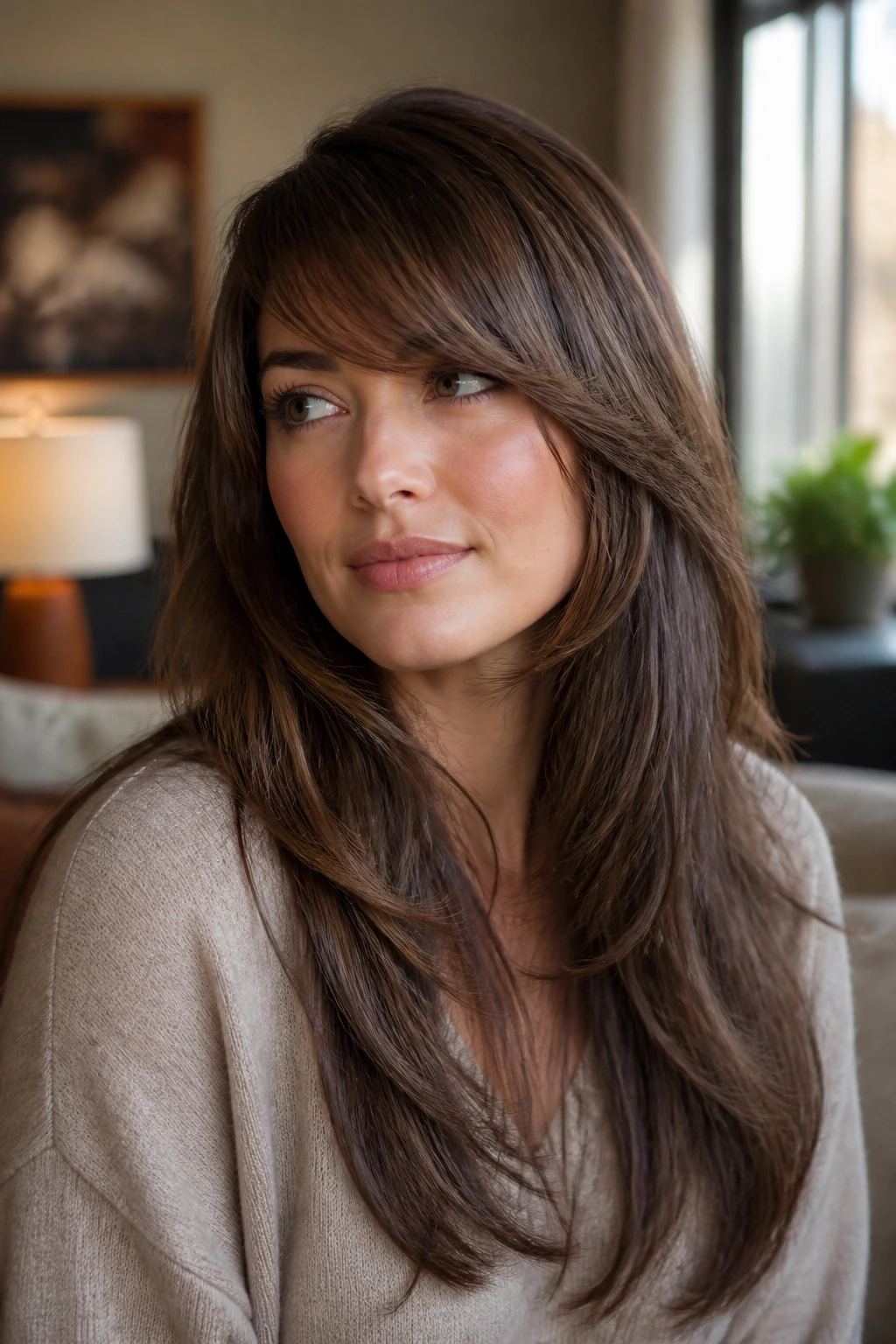
This one is for the person who wants the feeling of a full fringe but likes a little asymmetry. The cut still carries enough density to count as full, but the styling pushes the bangs diagonally across the forehead.
That diagonal movement is flattering because it breaks up the roundness of the face in a less obvious way than a dead-straight line. Long layers underneath keep the shape flowing so the fringe doesn’t feel detached from the rest of the haircut.
Best Styling Move
Blow-dry the fringe from the crown toward the side you want it to sit on, then finish with a cool shot to lock the bend. A tiny dab of lightweight cream on the ends is enough. If you use too much, the side sweep collapses and starts to look accidental.
11. Full Fringe with Money-Piece Highlights
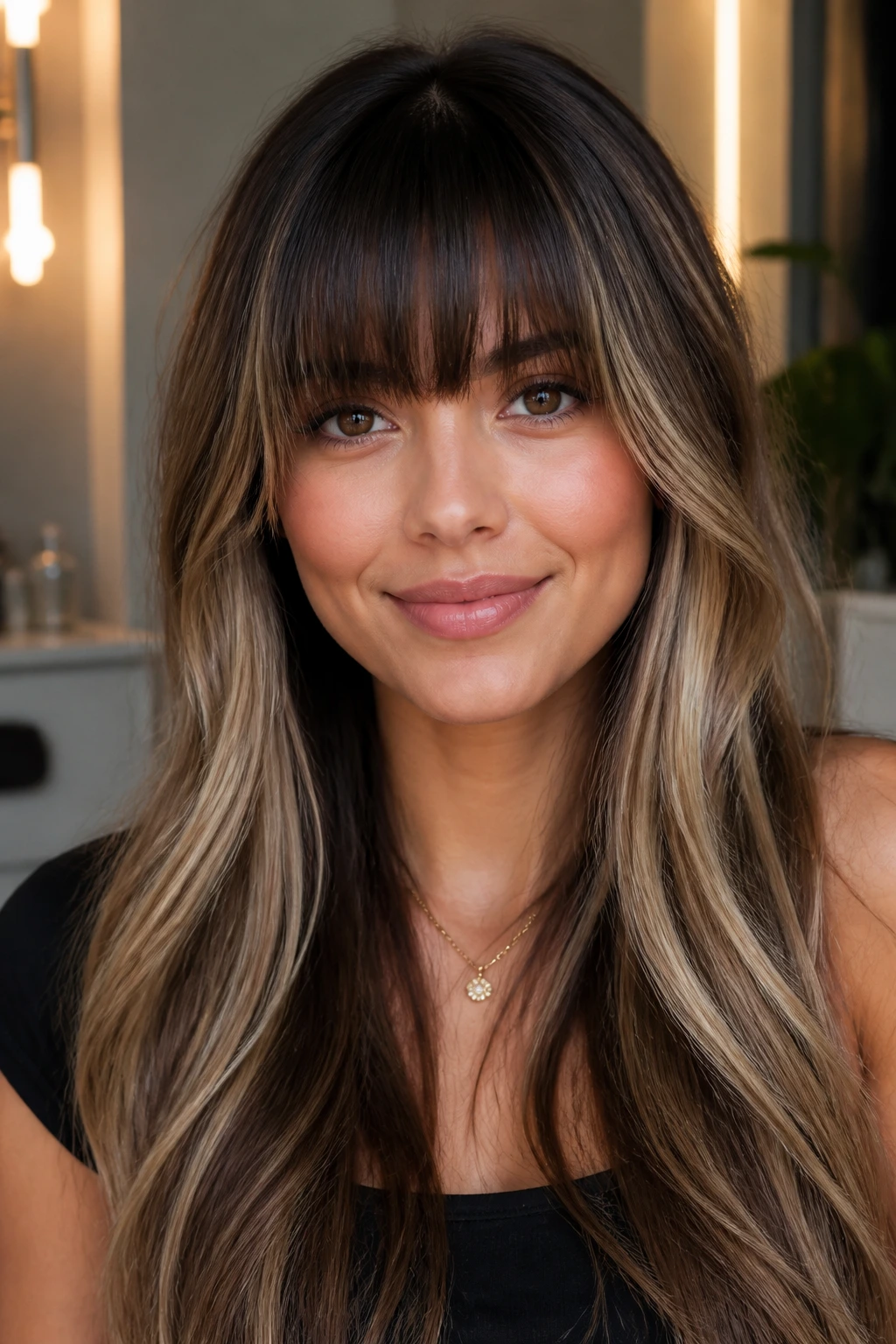
Color changes shape, too. A full fringe paired with brighter pieces around the face can lift the eyes upward and break up the width of a round face without changing the cut much at all.
The trick is restraint. A thick strip of light right at the temples can make the face look wider, so I prefer fine ribbons that start around the cheekbone and melt into the length. The fringe itself can stay deeper in color, which gives the forehead a neat frame.
This is a good choice if you want something noticeable but not loud. The highlights bring movement to the fringe when the hair swings, and that movement is half the reason the style works. Flat color can be beautiful. Flat color with no shape? Not so much.
12. V-Cut Lengths with a Straight-Across Fringe
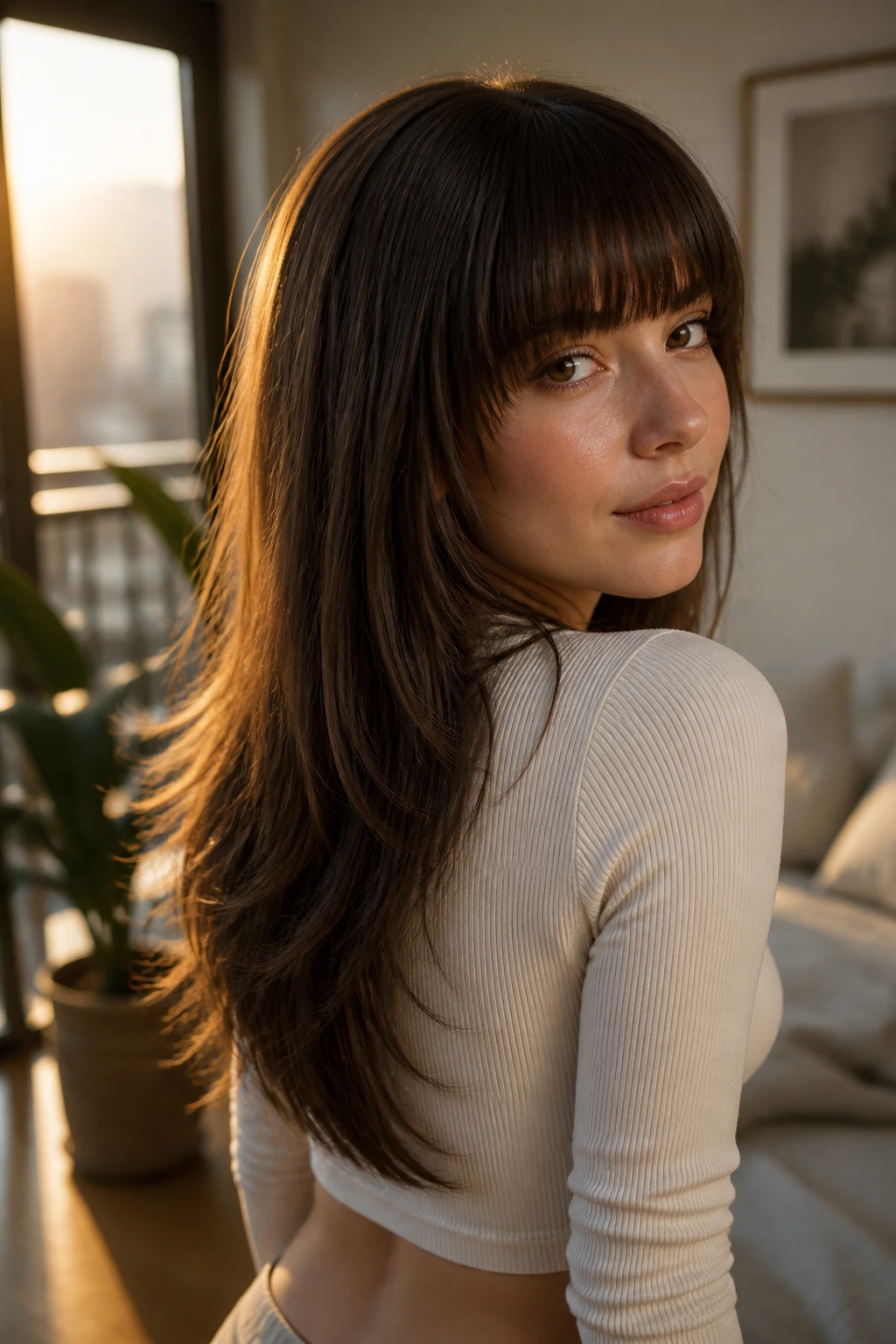
A V-cut gives long hair a tapered point in the back, which creates a nice counterweight to a straight, solid fringe in front. The contrast between the two shapes is what keeps the look from feeling boxy.
Round faces benefit from that taper because the longest point sits low and narrow. It stretches the silhouette. A full fringe at the brows or just below them finishes the frame at the top, so the haircut has a clear top-and-bottom rhythm.
This version likes heat styling. A smooth blowout or a pass with a flat iron shows off the V shape better than air-drying usually does. If your hair is thick, even better; the cut has enough substance to hold that pointed back line without collapsing.
13. Retro Blowout Fringe with Crown Volume
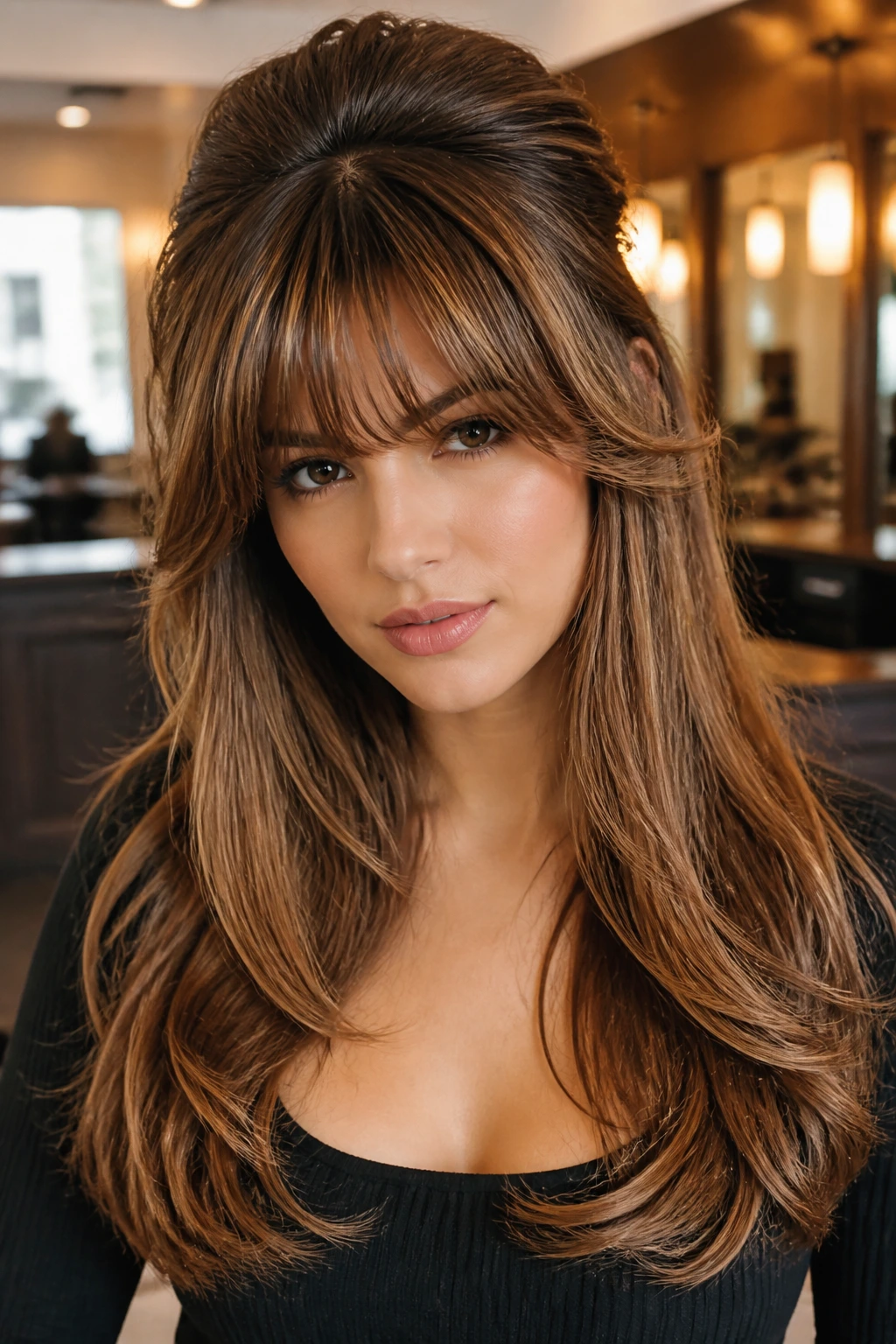
Big crown volume can be your friend. Really. A little lift at the top of the head gives a round face more length than people expect, and a retro blowout fringe is built to do exactly that.
The fringe is still full, but it’s blown under with a soft curve instead of left blunt and flat. The lengths sweep out around the shoulders, then turn in again at the ends. It’s polished without feeling stiff.
I like this look best with a large round brush, a root clip at the crown, and a cool set before you leave it alone. If the roots are flat, the style loses its lift. If the roots are lifted and the fringe sits neatly at the brows, the whole cut looks taller.
14. Minimal-Layer Full Fringe on One-Length Hair
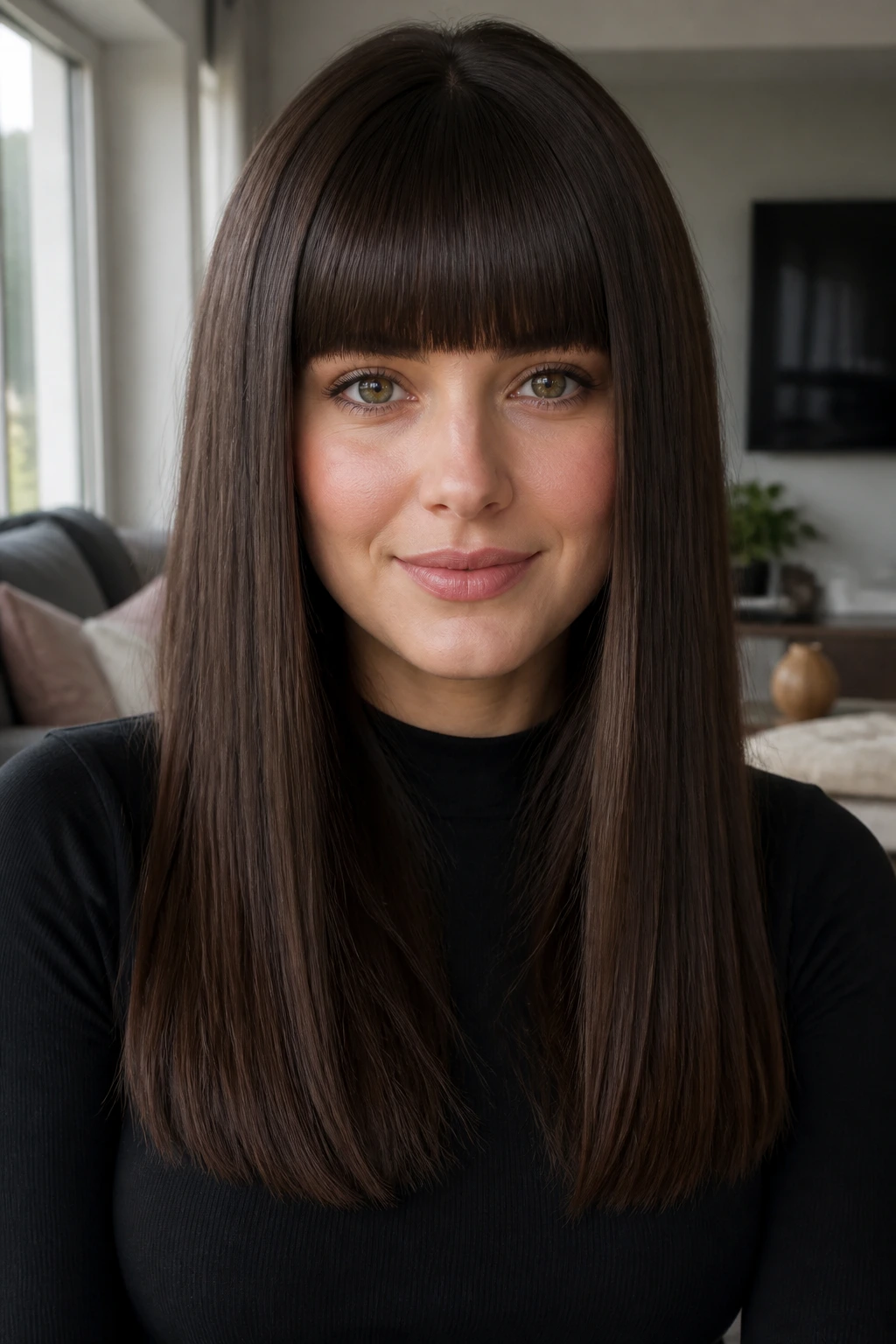
Some people want zero fuss. No feathering, no shaggy bits, no long layers sneaking around the jaw. A one-length cut with a heavy fringe gives you that clean block of hair, and on a round face it can look surprisingly chic.
The reason is proportion. The fringe frames the forehead; the long length draws the eye down. Because the rest of the cut stays solid, the face doesn’t get chopped up into smaller pieces. That keeps the shape tidy.
This style does best when the ends are kept blunt and healthy. If the hem starts to fray, the whole haircut loses its authority. A trimming schedule matters here more than in layered styles, because the line is doing all the work.
15. Full Fringe with a Low Bun

Not every style in this collection has to wear the length loose. A low bun with a full fringe leaves the forehead framed while letting the back disappear cleanly, which is a neat way to keep a round face from feeling too wide at the sides.
A few face-framing strands can stay loose, but keep them below the jaw. That’s the part that counts. Pieces ending at cheek level make the face look broader than it is.
This style is good when you want the fringe to carry the look and the rest to behave. Pull the bun low and a little loose, not high and tight. Tight pulls the face open in a way that can emphasize roundness. Low keeps things calmer.
16. Full Fringe with a High Ponytail
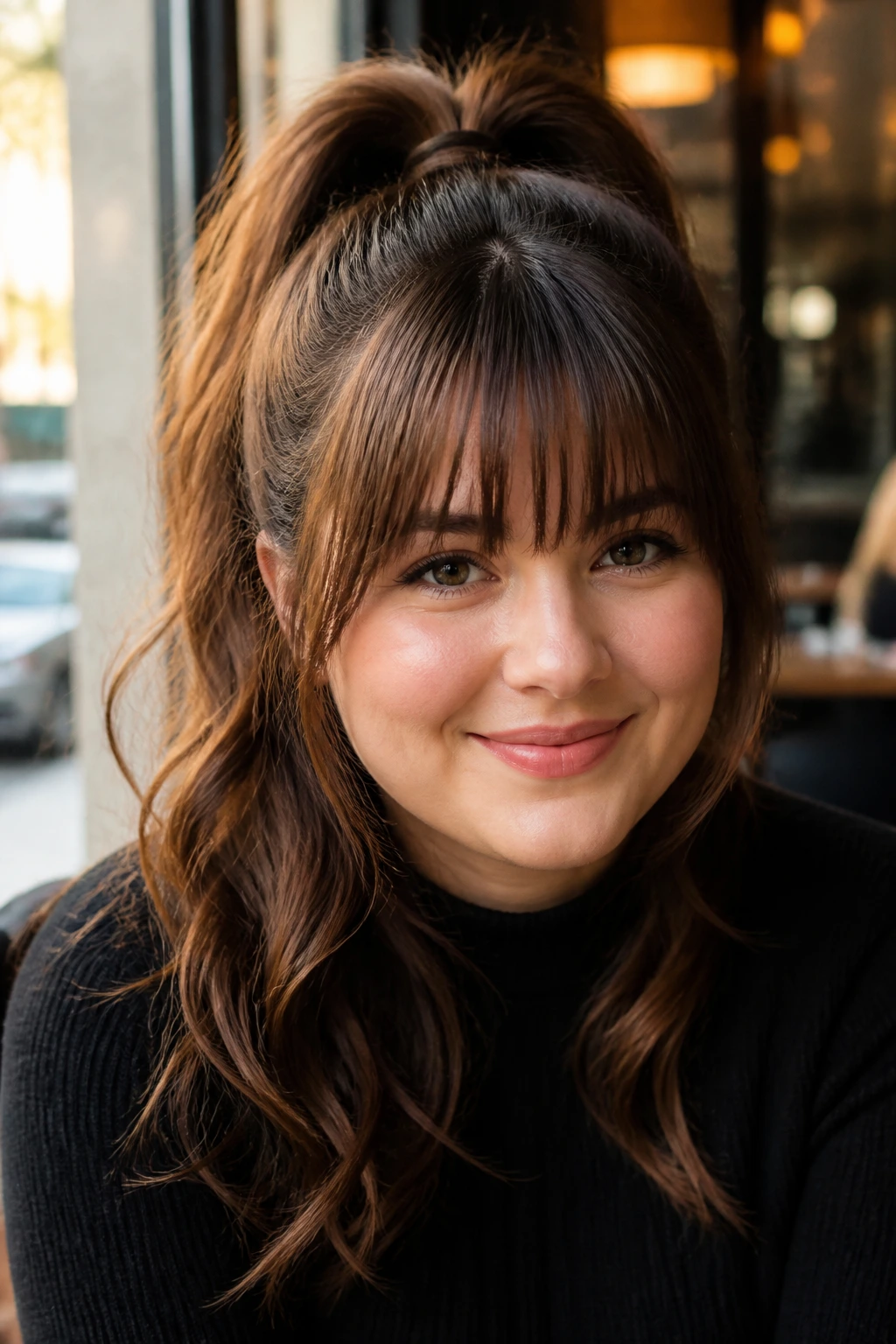
A high ponytail gives the face lift, and a full fringe keeps the front grounded. That contrast is why this combo works so well on round faces: the pony adds height, the fringe adds structure.
You want the ponytail to sit high enough that the crown lifts, but not so high that it pulls the face upward into a harsh shape. A slight bend in the fringe softens the whole look. Straight fringe with a high pony can feel severe; a lightly curved fringe tends to be kinder.
Use a soft brush to smooth the top, then leave a tiny bit of volume at the crown. Don’t slick everything flat. A little air up top is the point.
17. Braided Crown with a Heavy Fringe
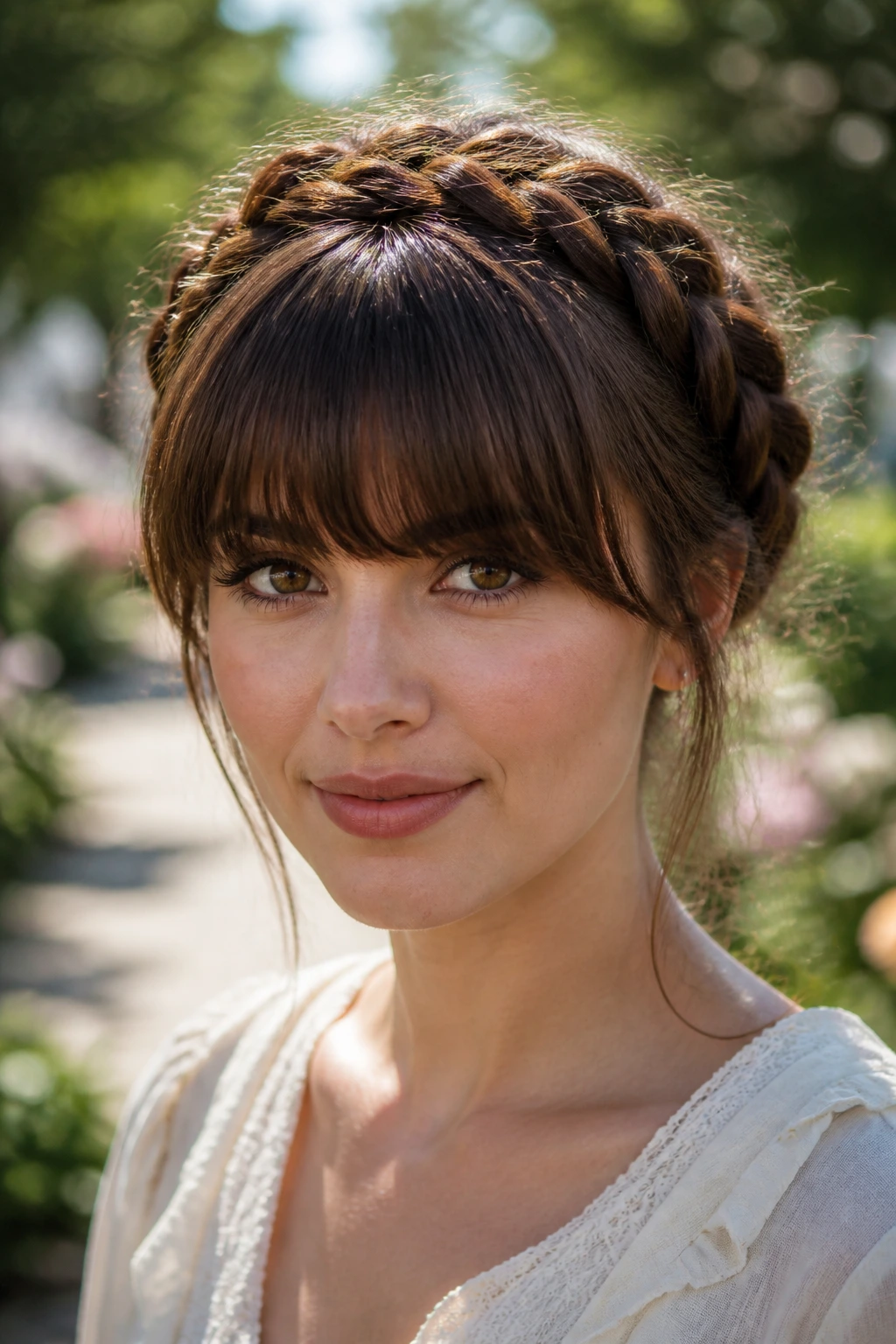
This style is about contrast. The braid keeps the hair away from the sides of the face, and the fringe brings the focus right back to the eyes and brows.
On a round face, that side control matters. Braids can add width if they sit too close to the cheeks, so a crown braid or a braided halo that stays higher on the head is usually more flattering. The fringe then gives the style a solid front edge so it doesn’t float away.
I’d keep the braid slightly loose and the fringe dense. Too-tight braiding can make the face feel exposed, and too-thin fringe can make the whole thing lose its balance. This works best when the hairline around the temples stays soft.
18. Full Fringe with Tucked-Behind-Ear Waves
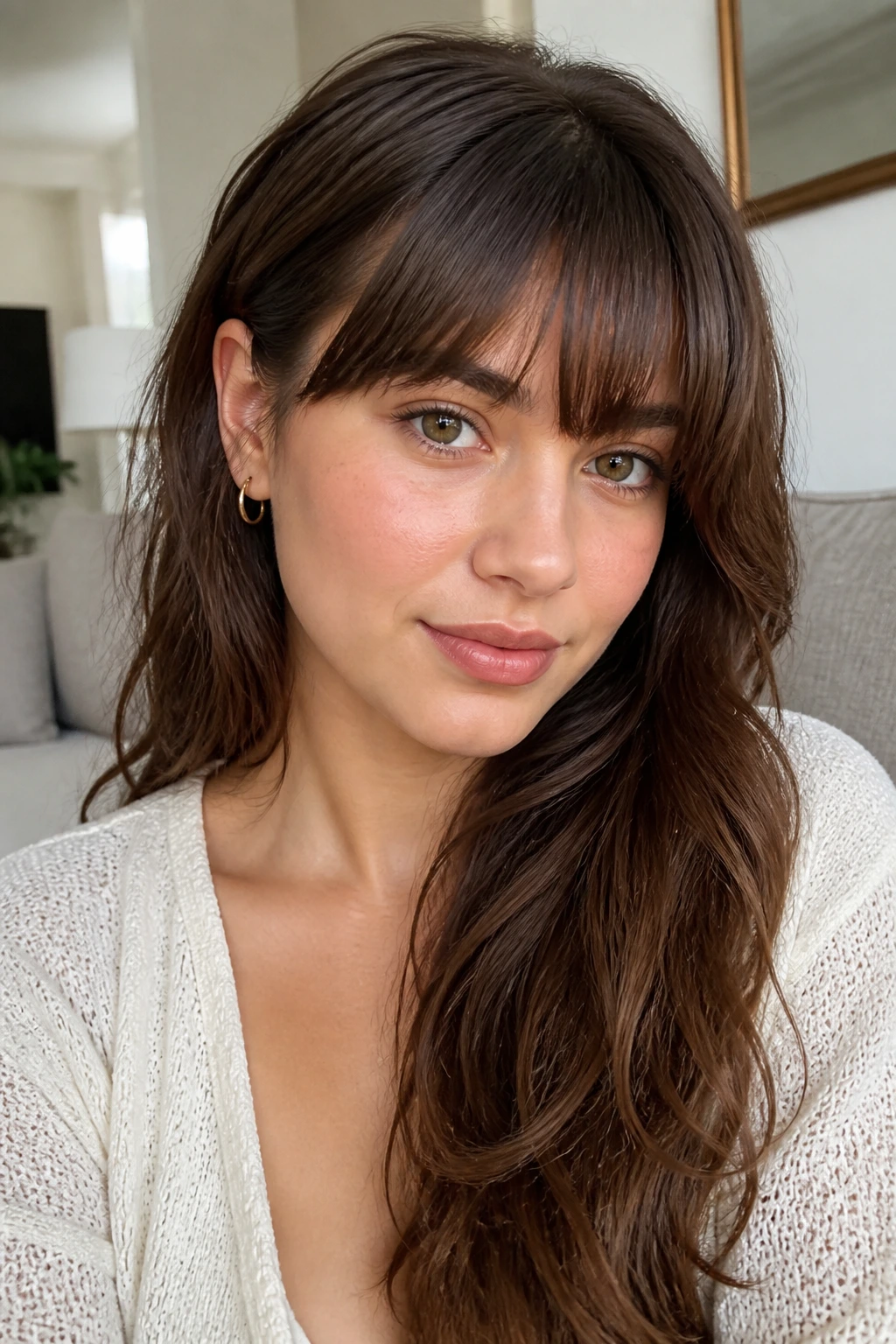
Here’s a small styling trick that changes the shape fast: tuck the waves behind the ears and let the fringe stay full in front. It opens the jawline without sacrificing the softness of long hair.
That works especially well on round faces because the exposed jaw gives the illusion of length. The hair is still long, but the side width is reduced. It’s a neat little cheat, and I use it often for styles that need a quick fix between washes.
The waves should be loose, not crunchy. A medium-hold spray and a few swipes with your fingers are enough. If the tuck is too tight, the style looks forced. If it’s soft, it looks intentional.
19. Curly Full Fringe with Spiral Length
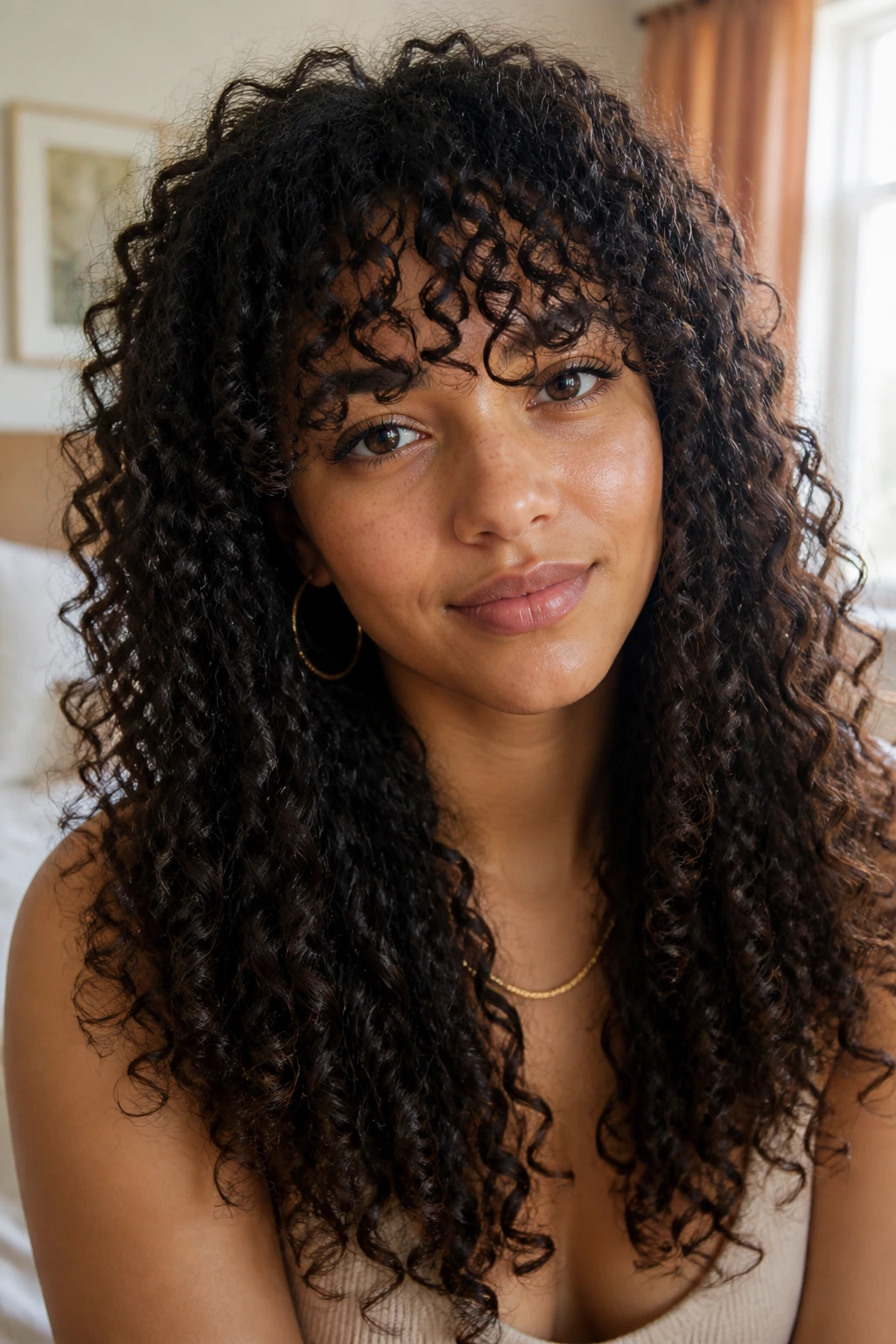
Curly fringe can be gorgeous on a round face because it adds movement without needing a hard cut line. The trick is to respect the curl pattern and let the fringe sit where it wants to sit after drying.
The curls in front should be cut with enough length that they don’t spring too high and sit right on the forehead like a shelf. That’s the mistake. When the fringe ends just a little longer than you think, it lands better after it shrinks.
Use a curl cream at the front and don’t overload it with oil. Heavy products make the bangs separate in odd places. A soft, even curl across the forehead looks much better than a clumpy one.
20. Coily Full Fringe with Stretched Ends
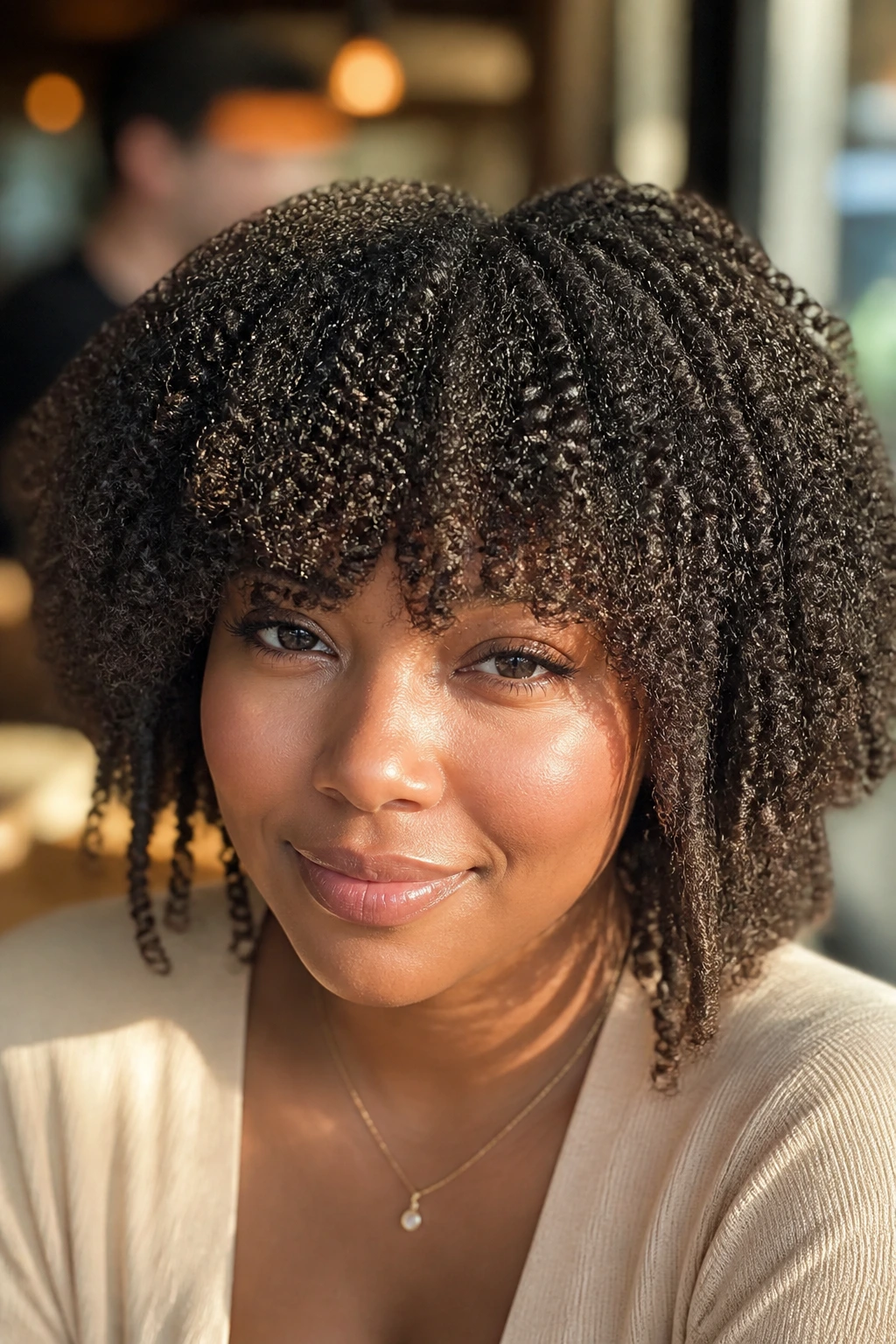
For coily hair, a full fringe works best when you plan for shrinkage instead of fighting it. The fringe can be worn stretched, blown out, or set in a twist-out so it keeps enough length to frame the face instead of bouncing too high.
That stretched shape gives a round face a vertical line, which is the whole point. The length below should stay long and full, but not overly bulky at the cheeks. A shaped silhouette around the jaw and collarbone keeps the style from feeling square.
Best approach
Use a heat protectant if you blow-dry, then stretch the fringe with tension and a paddle brush or diffuser attachment. If you prefer no heat, a twist-out can work well, but it needs a careful separation when dry. Pull it apart too much, and the front gets wide fast.
21. Razor-Soft Fringe with Feathered Tips
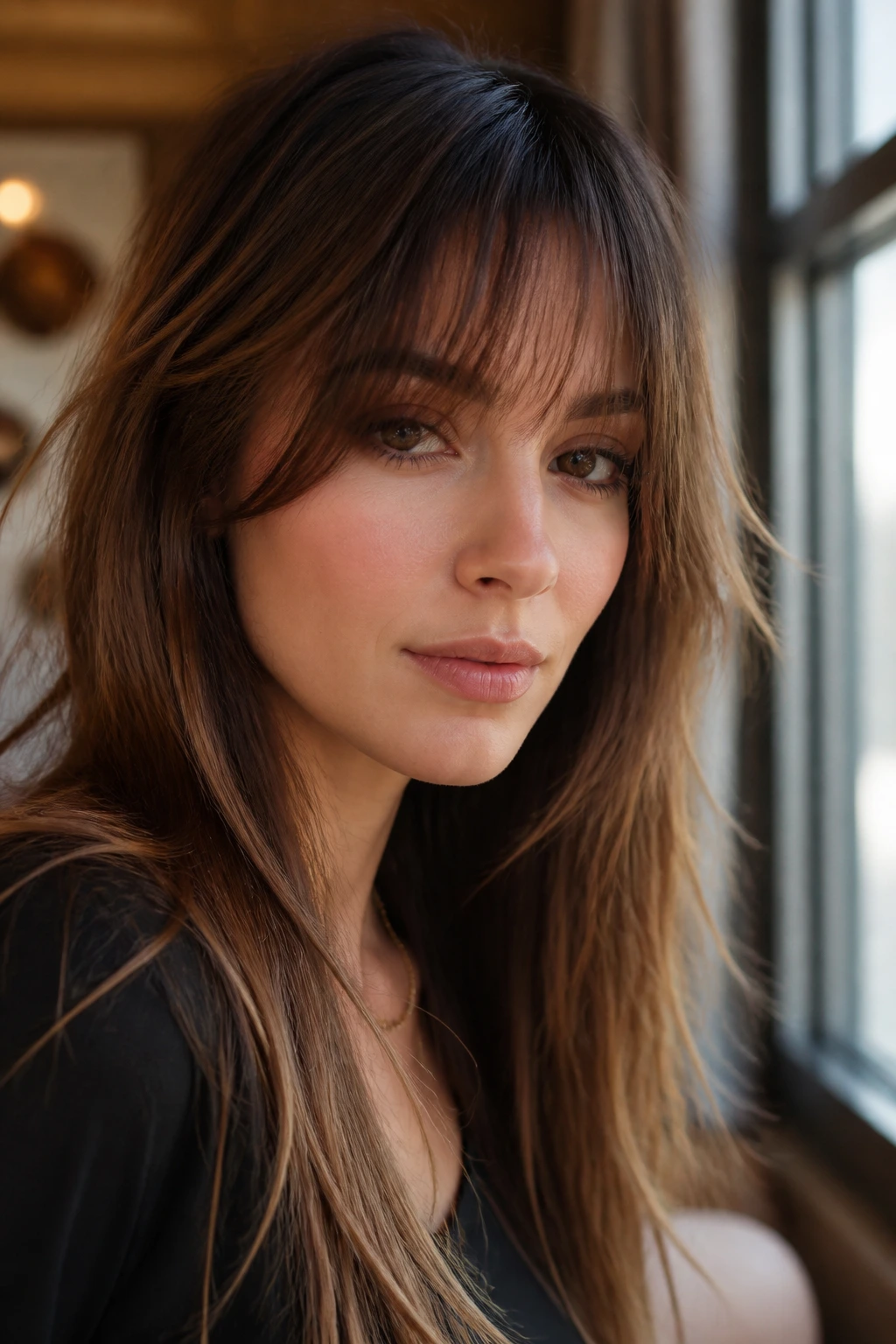
A razor-soft fringe takes the edge off a heavy bang. The line still counts as full, but the ends are feathered enough to move instead of sitting like a block.
That movement is useful on round faces because it breaks up the width right at the forehead. The long hair underneath can stay smooth or slightly wavy, but the fringe itself should never feel blunt and heavy all the way across. The feathering is the point.
This is one of my favorite options for thicker hair. Thick fringe can go boxy fast; razor-soft ends keep it from looking like you cut a ruler across your forehead. Ask for the temples to be left slightly longer than the center. That small detail matters more than people think.
22. Face-Skimming Fringe with Polished Blowout
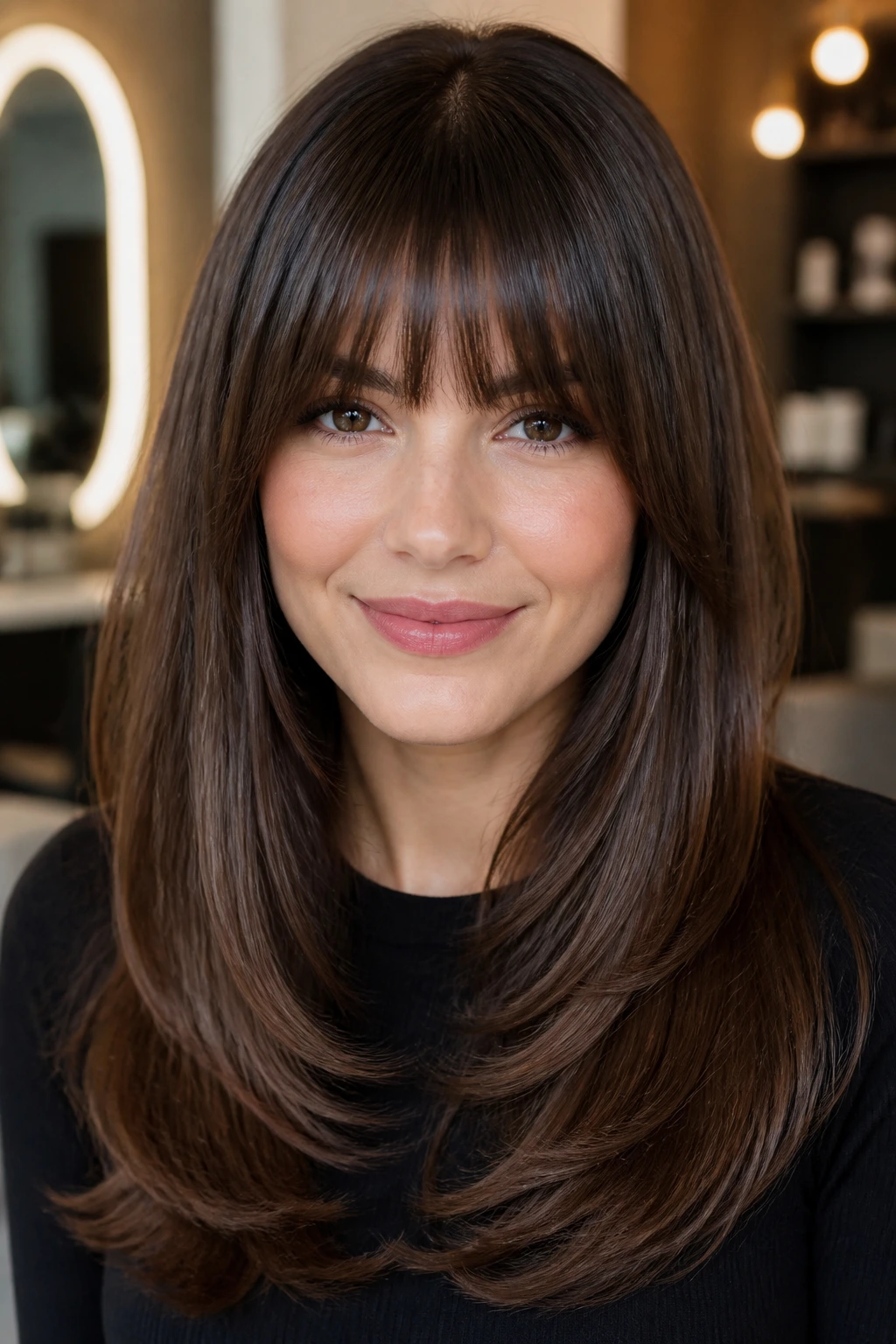
If you like a polished finish, this version gives you a full fringe that sits just above the brows, with longer side pieces that skim the upper cheek. It’s a smooth, controlled look, and it reads especially well on long hair.
The side-skimming pieces are doing real work here. They create a narrow frame around the face without cutting the length short. That makes the roundness feel softer rather than hidden.
A round brush and a nozzle on the dryer will get you most of the way there. The key is tension. Pull the fringe straight while drying, then bend only the ends. Too much curve at the front turns it into a helmet. Too little, and it loses the polish.
23. Center-Parted Lengths Under a Solid Fringe
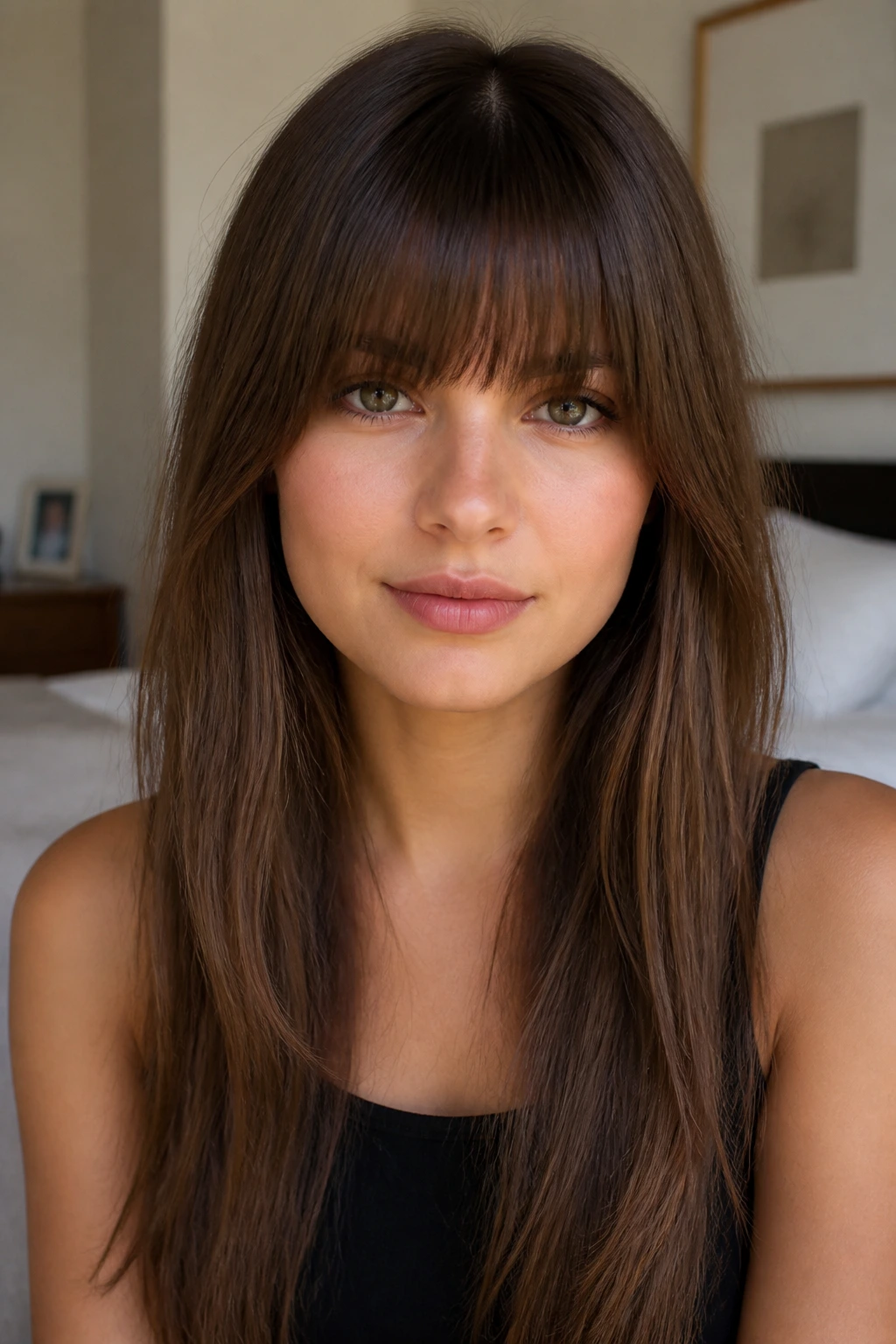
This is a neat little contradiction, and I mean that in the best way. The fringe is full and forward, but the long hair behind it parts in the center and falls straight down, which gives the whole cut a longer line.
On a round face, that center part in the lengths pulls the eye vertically. The fringe still delivers a clear frame up top, so the face gets both definition and elongation. It’s a smart shape when you want something clean but not severe.
The center part should stay neat and narrow. If the part gets too wide, the hair can fall away from the face too much and make the fringe feel disconnected. Keep the roots smooth through the top, then let the lengths drop in a steady line.
24. Feathered Full Fringe with Soft U-Shape
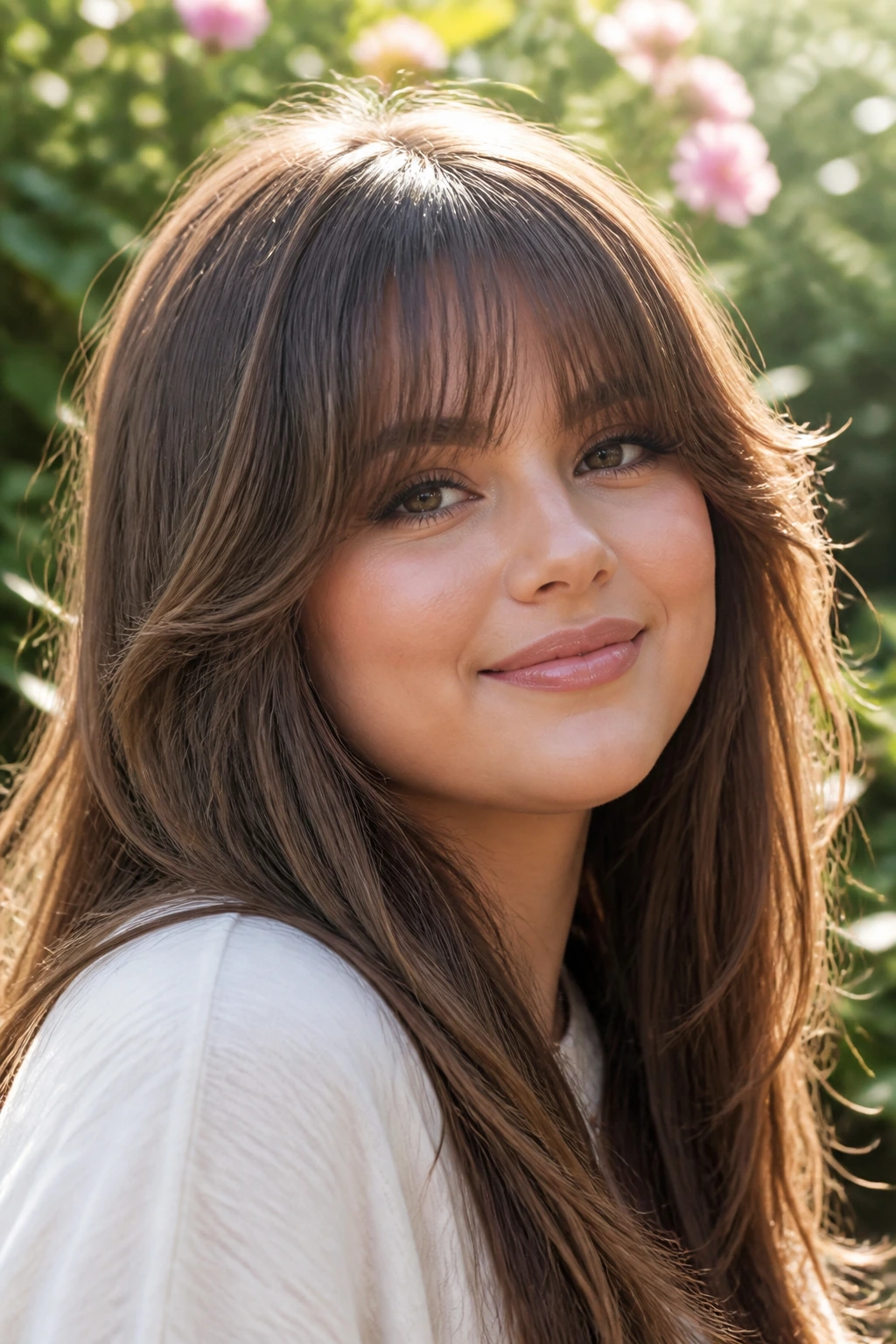
This version takes the structure of a U-shaped cut and loosens it a bit. The fringe stays full, but the edges are feathered enough to blend into the face-framing pieces without a hard break.
That soft blend is useful because it keeps the face from feeling boxed in. The U-shape lengthens the silhouette; the feathered fringe keeps the forehead area light. Together, they make a round face feel a touch more oval without looking overworked.
I’d use this on hair that holds movement well. Fine hair can wear it, but thick or medium-thick hair really lets the layers show. A quick bend with a round brush at the ends is enough. No need to chase perfection. The shape already does the heavy lifting.
25. Thick Blunt Fringe with Sleek Waist-Length Hair
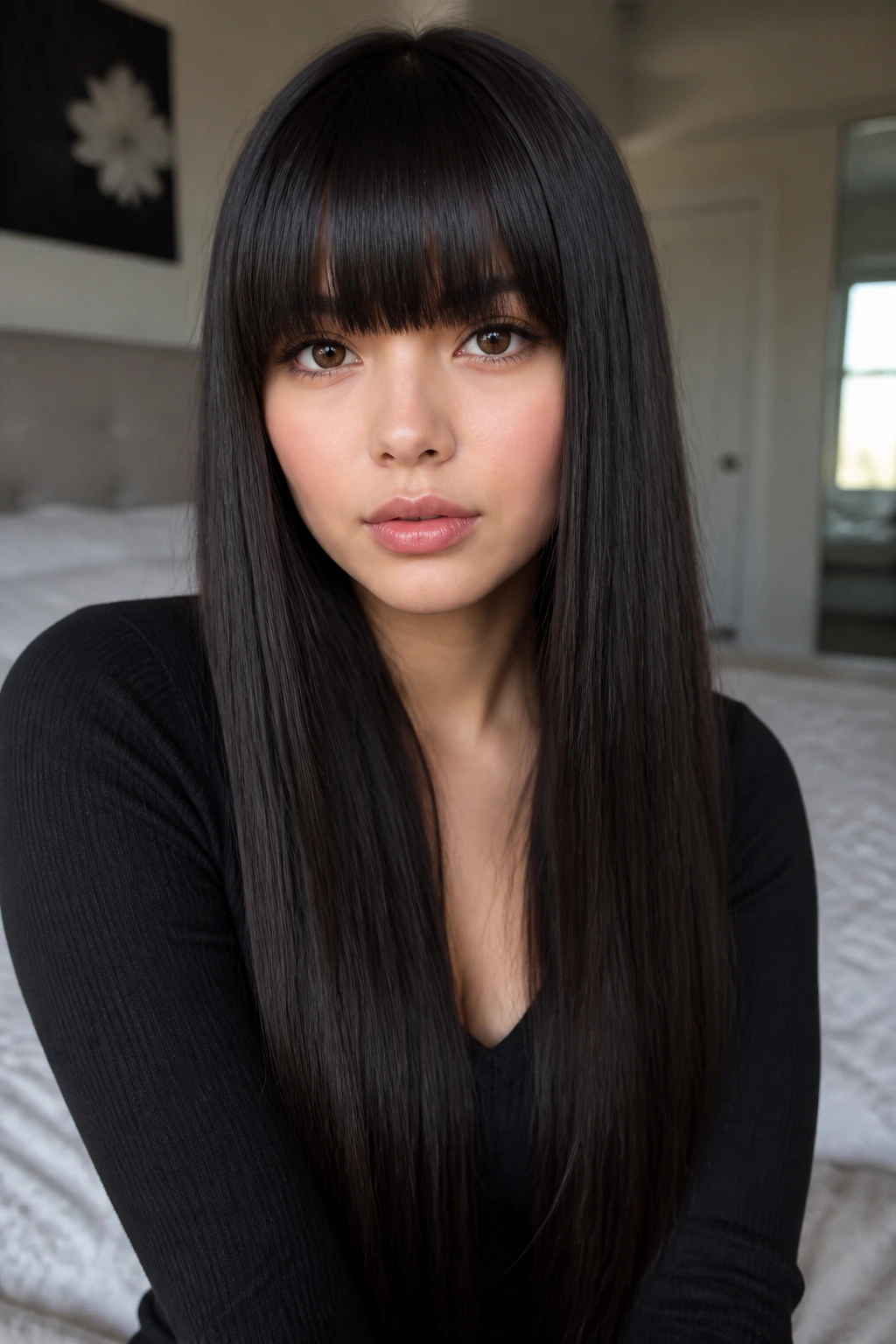
A thick blunt fringe is not shy. That’s the point. It sits straight across the forehead with a lot of density, then the waist-length hair drops in one long line that keeps the face from feeling short.
This works on round faces when the length is truly long. Not shoulder long. Not collarbone long. Long enough that the fringe becomes the focal point and the rest of the hair becomes the vertical line. If the hair stops too high, the width of the fringe can dominate the whole face.
Keep the temples clean and the fringe width controlled. You want fullness, not bulk. A little sheen serum on the lengths makes the whole cut look expensive, while the fringe stays crisp. If you like a haircut with presence, this is the one that walks in first.
Why Full Fringe Changes the Shape of a Round Face

A round face has soft curves through the cheeks and jaw, which is exactly why the wrong fringe can throw the balance off. A full fringe works when it creates structure at the top and length below it. That means the eye gets a clear starting point, then a clear exit path.
The best fringe shapes for round faces are usually the ones that keep the center dense and the sides a little softer. That small shift changes everything. Instead of adding width all the way across the forehead, the fringe gives the face a frame that feels more vertical, more deliberate, and less blunt.
Color, texture, and density matter here more than people admit. A straight, heavy fringe on sleek hair reads differently from the same fringe on curls or waves. One is graphic. One is soft. One asks for a round brush; another wants a diffuser and a little patience. That’s why this subject can’t be reduced to “get bangs or don’t.” The shape has to match the hair.
Essential Tools for These Looks
- Blow dryer with a nozzle attachment: Directs air at the fringe so it doesn’t puff up in the wrong places.
- 1-inch to 1.5-inch round brush: Small enough to shape the fringe without forcing too much curl into it.
- Flat iron with narrow plates: Useful for smoothing a blunt fringe or taming a cowlick near the front.
- Heat protectant spray: Keeps the fringe from drying out, which happens fast because bangs get heat-styled more often than the rest of the hair.
- Dry shampoo: Helps the fringe stay fresh between washes, especially if your forehead gets oily fast.
- Sectioning clips: Make it easier to dry the fringe first, which is the part that usually needs the most control.
- Wide-tooth comb or styling comb: Better than a brush for separating waves or curls without stretching them too much.
- Lightweight hairspray or texturizing spray: Holds shape without turning the fringe stiff.
- Microfiber towel or soft cotton T-shirt: Useful for gently blotting fringe if you wash it separately in the sink.
- Satin pillowcase or bonnet: Keeps the fringe from flattening into odd bends overnight.
What to Tell Your Stylist Before the Cut
Bring photos, yes, but bring the right ones. Show a front view and a side view if you can, because a fringe that looks perfect head-on can sit completely differently from the side. If your hair has a cowlick, say so early. Do not leave that detail until the cape is already on.
Tell your stylist where you want the fringe to hit when it’s dry, not when it’s wet. Wet bangs always look longer. If you want them at the brows, ask for a bit more length than that so they don’t spring up too high. If you wear glasses, mention that too. A fringe that sits beautifully bare-faced can annoy you the second frames go on.
Ask for the temple area to stay slightly softer than the center if your face is round. That sentence alone can save you from a cut that looks too wide. And if you like to tuck your hair behind your ears, say it. Stylists notice the front. They do not live in your daily routine. You do.
How to Wear These Looks Without Fighting Your Face Shape
Presentation: Let the fringe sit where it has a clear job to do — usually at the brows or just below them — and keep the rest of the hair moving down the body, not out to the sides. On round faces, that direction matters more than a lot of people think.
Accompaniments: Earrings, necklines, and parting all change the read of the haircut. Long earrings and a narrow neckline can make a fringe feel sharper; a wide collar or big side volume can make the face look fuller. If you wear glasses, a fringe that clears the frames by a fraction of an inch usually looks cleaner than one that lands directly on the top edge.
Proportion: Fine hair usually needs a lighter, less boxy fringe with some movement through the ends. Thick hair can carry a denser center and still look soft if the corners are beveled. Curly hair needs enough length to account for shrinkage, and coily hair often looks best when the fringe is cut with the real end shape in mind, not the stretched version alone.
Finish: Sleek, glossy hair makes the fringe read precise. Air-dried texture makes it feel casual. A blowout gives the whole cut height. Pick the finish that matches how often you want to style it, because a fringe is not the place to pretend you’ll do a 20-minute routine on a day you only have five.
Extra Tips for More Lift, Movement, and Shape
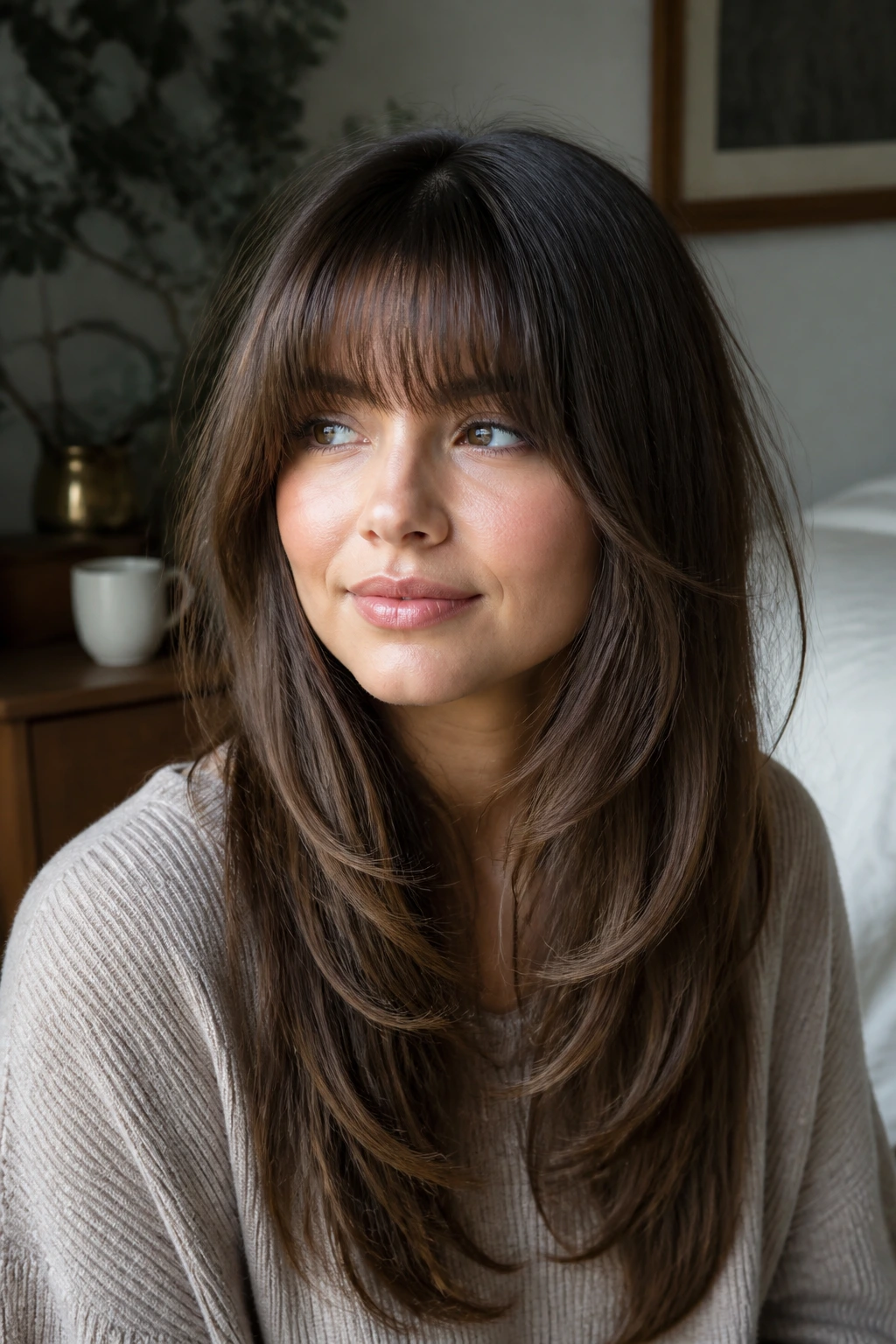
Lift at the crown: A root clip or a quick blast of heat at the crown gives the face more length than adding more layers ever will. I like this with full fringes because it keeps the front from feeling too low and heavy.
Texture near the temples: If your face is round, a little softness at the outer edges of the fringe helps more than a hard blunt line from temple to temple. Ask for the corners to be point-cut or feathered slightly.
Color placement: Tiny highlights around the cheekbone, not just at the fringe, can make the style feel lighter. The brightness should travel downward a few inches so the eye follows it.
Make-It-Yours: Fine hair needs less fringe density and more root lift. Thick hair usually wants internal texture so the bang doesn’t sit like a block. Curly and coily hair need length for shrinkage. Straight hair can handle the crispest line, but it also shows every uneven snip, so trim quality matters.
Keeping a Full Fringe Fresh Between Washes
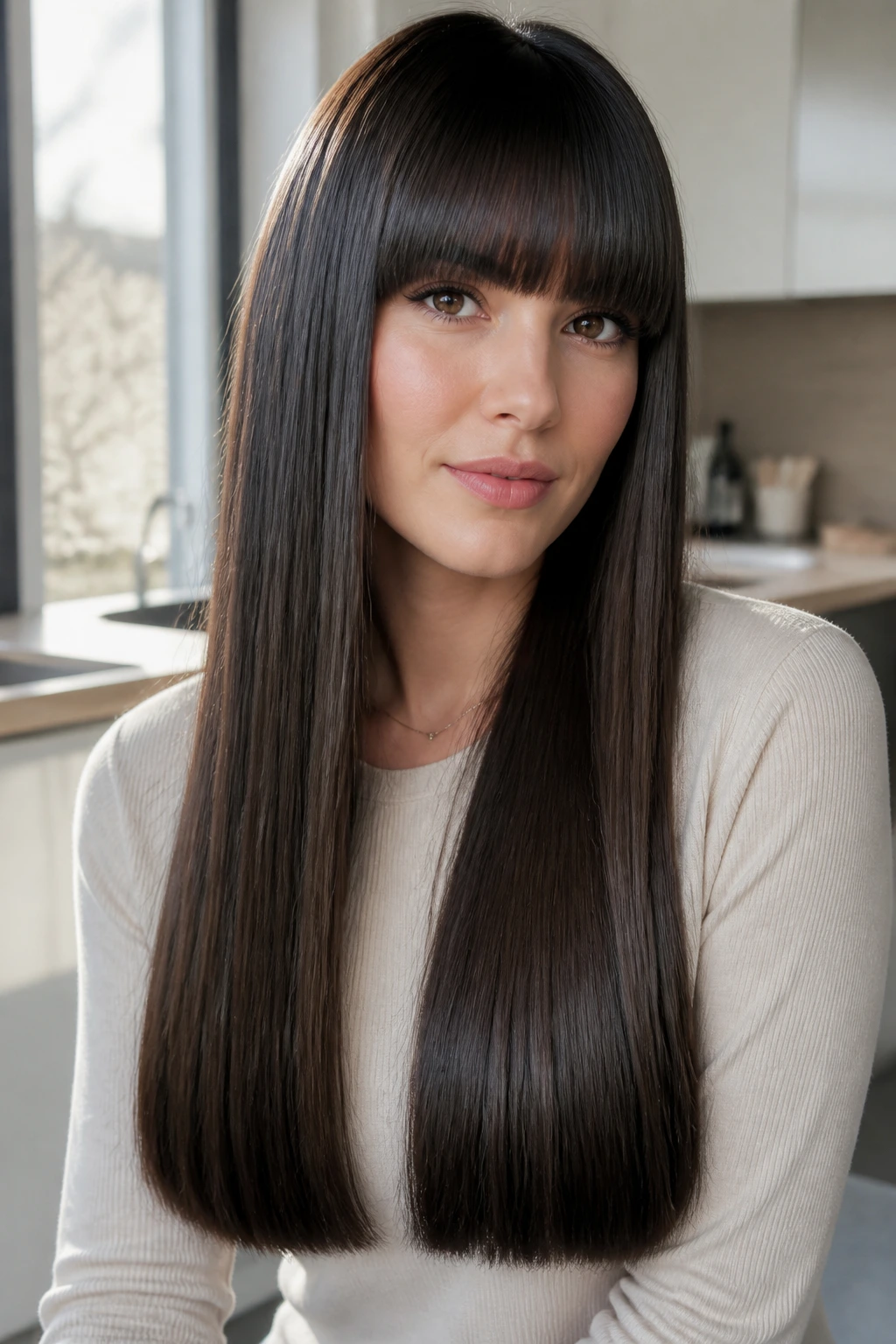
A fringe gets oily faster than the rest of the hair because it sits on your forehead all day. That means it often needs a different routine from the length. I think that’s annoying, and also unavoidable.
Between washes, dry shampoo at the roots is your first line of defense. Spray it from about 6 inches away, wait a minute, then press it in with your fingers or a soft brush. If you blast it on and keep moving, you’ll get a chalky patch near the center of the fringe, and that looks worse than a little oil.
If the fringe bends oddly overnight, mist it lightly with water, reshape it with a round brush or fingers, then dry it for 30 to 60 seconds with warm air. You do not need to wash the whole head every time the fringe misbehaves. A quick sink rinse of just the bangs can buy you another day or two, especially if you dry the roots right away.
Trims matter too. Most full fringes need touching up every 3 to 6 weeks, depending on how fast your hair grows and how short the front sits. If the bangs start brushing your lashes in a way that makes you squint, they’re overdue.
Variations and Adaptations to Try
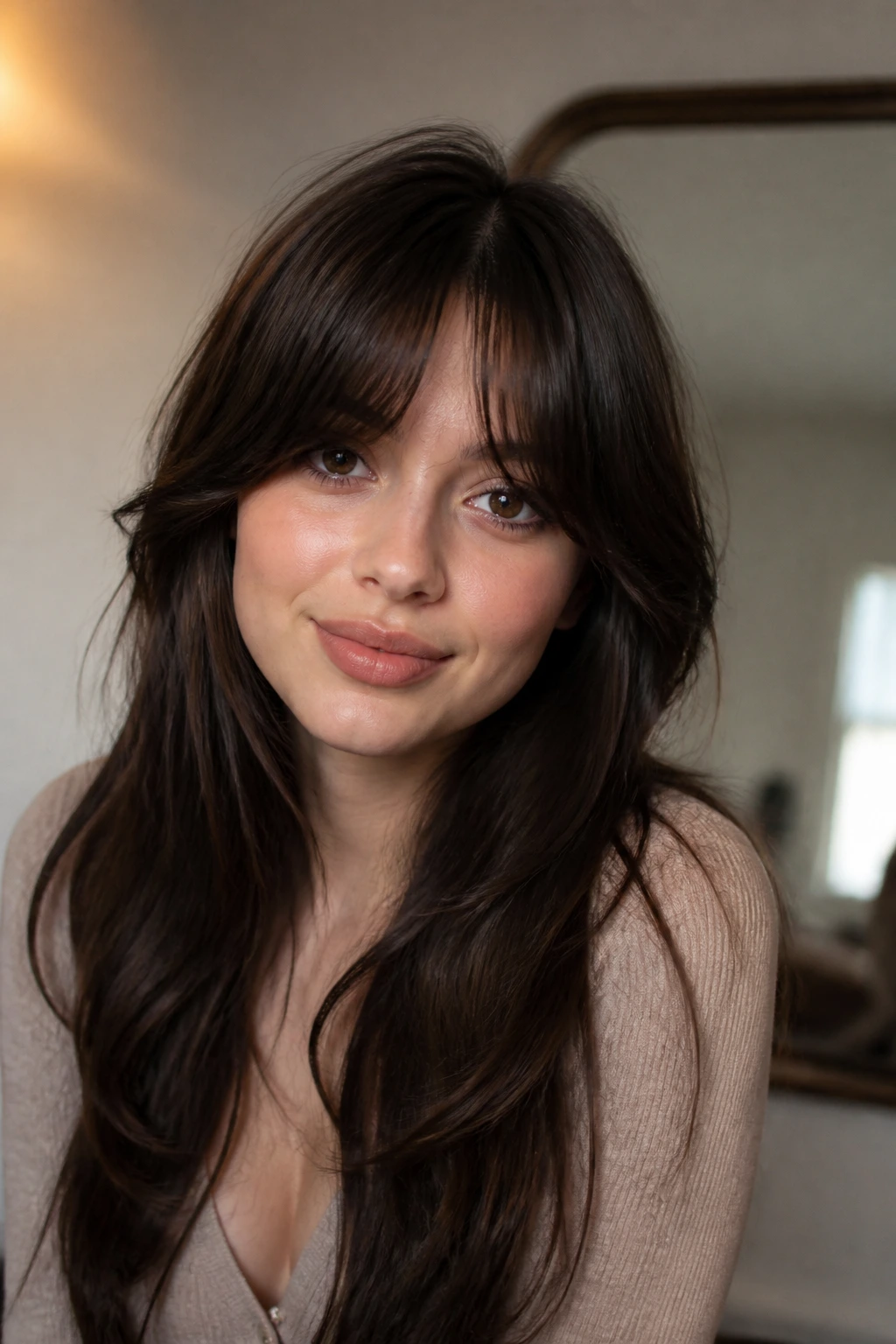
The Cowlick-Friendly Version: Keep the fringe a little longer in the center and slightly heavier at the side where the cowlick pushes hardest. That extra weight helps the hair settle instead of springing apart the second it dries.
The Fine-Hair Version: Ask for a dense-looking fringe that still has a bit of internal layering, then keep the rest of the hair long and smooth. Fine hair can go limp fast, so the fringe needs shape without too much bulk.
The Thick-Hair Version: Remove a touch of weight inside the bang and leave the corners a shade longer. That keeps the fringe from sitting like a shelf and gives the hair room to move.
The Curly-Hair Version: Cut the fringe dry or nearly dry, and keep it long enough to account for shrinkage. The best curly fringe is the one that looks a little too long in the chair and exactly right once it springs up.
The Glasses-Friendly Version: Let the fringe graze just above the frames, not directly into them. A soft center and slightly longer temples help the hair move around the glasses instead of fighting them.
The Low-Maintenance Version: Choose a fringe that can live with a soft bend, not a razor-straight line. When the style still looks good on day two, you’ll actually wear it instead of resenting it.
Common Mistakes to Avoid
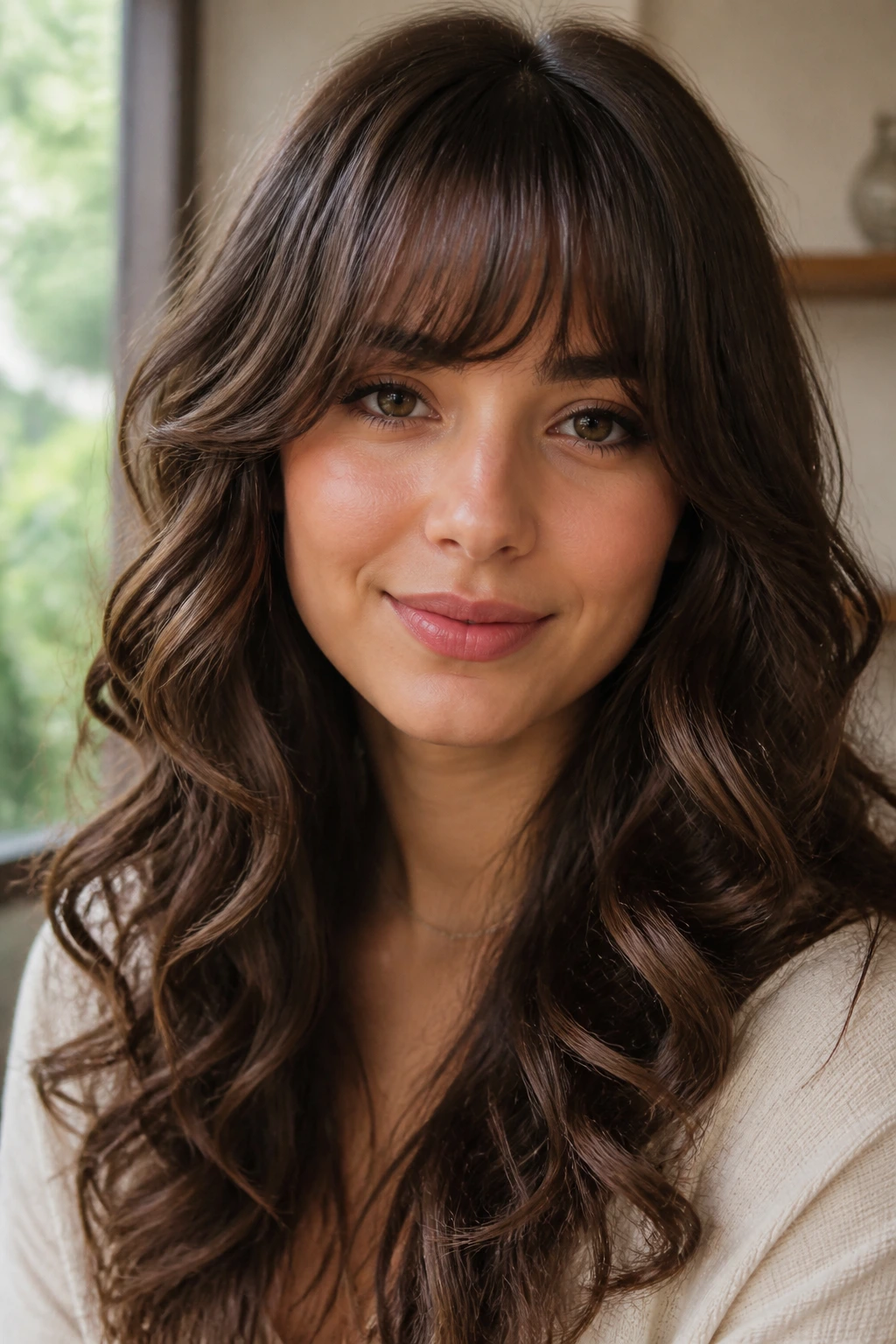
A fringe that is too short is the fastest way to make a round face feel wider. When the bangs stop too far above the brows, they pull the eye upward in a harsh way and leave the cheeks exposed. Keep the length closer to the brows unless your stylist has a very specific reason not to.
Another problem is making the fringe too wide from temple to temple. That adds horizontal space right across the face, which is exactly what you do not want if you’re trying to lengthen the shape. Ask for a denser center and softer edges instead.
People also forget about root volume at the crown. Flat roots can make the whole style sit low and heavy, especially when the fringe is full. A little lift up top keeps the face from looking compressed.
The last common mistake is cutting bangs without checking shrinkage, cowlicks, or natural bend. Curly and coily hair springs up. Straight hair can split at the front if the cowlick isn’t respected. Dry the fringe the way you actually wear it before making the cut final.
Frequently Asked Questions
Will a full fringe make my round face look wider?
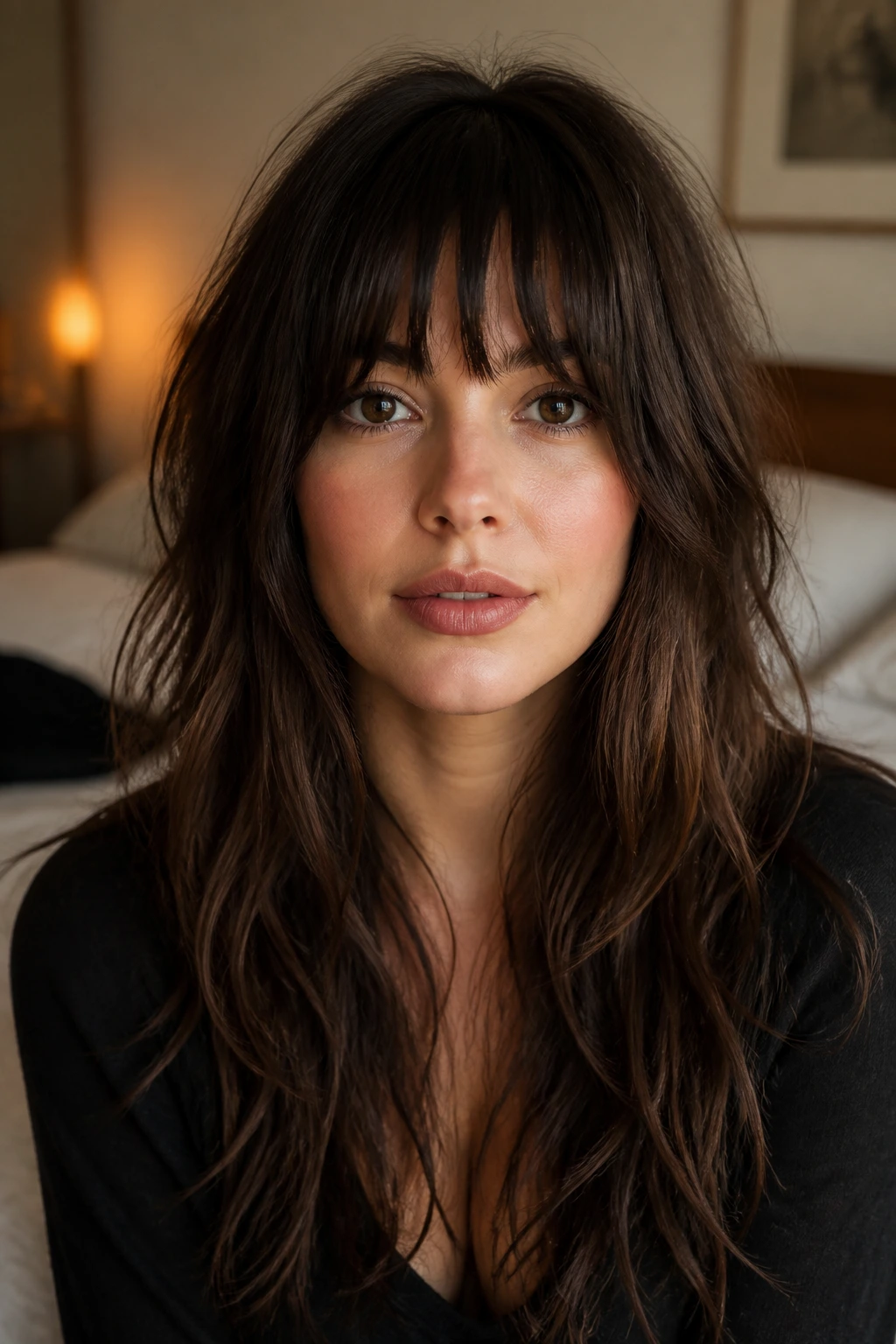
It can, if the fringe is cut too wide and too blunt. A better version keeps the center full, softens the temples a bit, and pairs the bangs with long hair that falls below the shoulders.
Is a full fringe better than curtain bangs for a round face?
Not always better, just different. Curtain bangs open the face more, while a full fringe gives stronger structure at the forehead. If you want more frame and less forehead exposure, full fringe usually wins.
How short should the fringe be?
I’d aim for brow-skimming or just barely below the brows for most round faces. Shorter can work, but it takes a very specific texture and styling habit to pull it off cleanly.
Can I wear full fringe if my hair is curly?
Yes, but it should be cut with shrinkage in mind. The fringe usually needs to be longer than you expect, and the shape should follow the curl pattern instead of forcing a straight line.
How often does a full fringe need trimming?
Most need a trim every 3 to 6 weeks. If the bangs start sticking into your eyes or losing their line, they’re due.
What if my fringe keeps splitting in the middle?
That usually means a cowlick or too little weight at the center. A stylist can leave the center slightly denser and adjust the drying direction so the split doesn’t keep coming back.
Can I style a full fringe without heat every day?
Sometimes. If the cut has enough softness, you can reshape it with water, fingers, and a dab of cream. If you want a crisp blunt finish every morning, some heat is usually part of the deal.
Do full fringes work with glasses?
They can, and they often look sharp with glasses. The key is keeping the fringe just above or just brushing the frames so the two lines don’t crash into each other.
The Fringe That Changes the Frame
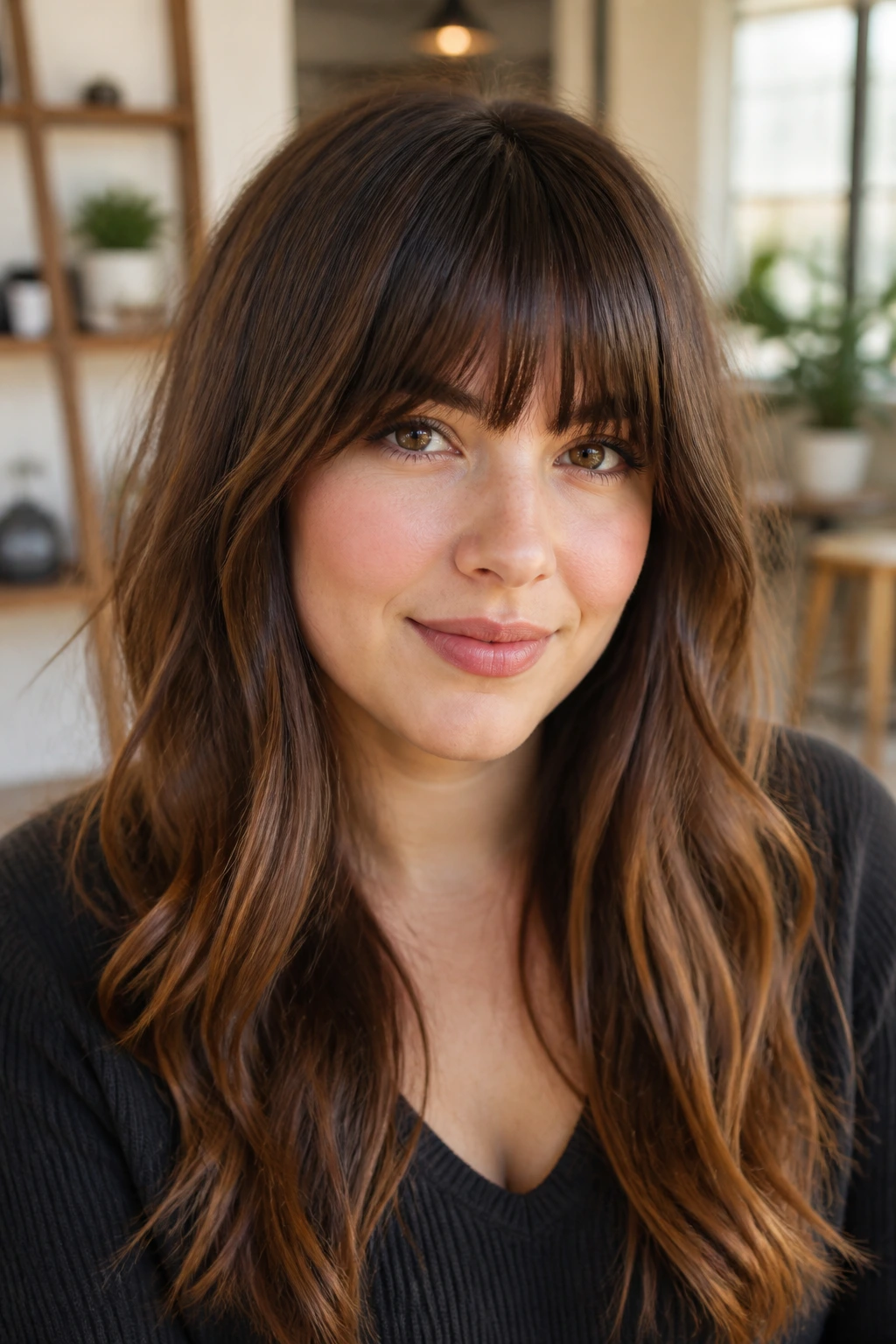
A full fringe on long hair isn’t about hiding a round face. It’s about directing it. The right cut adds shape at the forehead, length through the body of the hair, and just enough softness at the edges to keep everything moving.
What I like most about these looks is how different they can feel with only small changes in length, density, or texture. A few millimeters at the temple. A little lift at the crown. A softer curve at the corners. That’s often the difference between a fringe that sits there and a fringe that actually does something.
Pick the version that matches your hair, not the version that looks best on a screen for six seconds. That’s where the good cuts live, and they tend to wear better the second week than they did on day one.