



A good Asian lob for round faces and thick hair has one job: keep the face open and the ends under control. If the cut sits too short at the cheeks, thick hair starts to puff sideways and the whole shape gets wider than it should. If the layers are hacked too high, the perimeter flips out and suddenly the style looks busy instead of clean. That’s the trap.
The sweet spot is usually somewhere between the chin and the collarbone, with enough length in front to pull the eye downward and enough weight left in the bottom to keep thick hair from blooming into a triangle. I like cuts that borrow a little from Korean and Japanese salon styling — soft bends, tidy lines, face-framing pieces that start low, and just enough internal shaping to let the hair move. Not too much. Not too little. Thick hair does not need to be fought; it needs to be arranged.
What makes a lob so useful here is that it can lean sleek, airy, tucked, wavy, blunt, or softly layered without losing its shape. Round faces tend to look best with a little vertical line and a little asymmetry. Thick hair tends to look best when the weight is controlled where it matters and left alone where it gives the cut its body. Those two needs sound different, but they meet in the lob more often than people expect. And once you start comparing the options side by side, the differences get obvious fast.
Why These Asian Lobs Work on Round Faces and Thick Hair
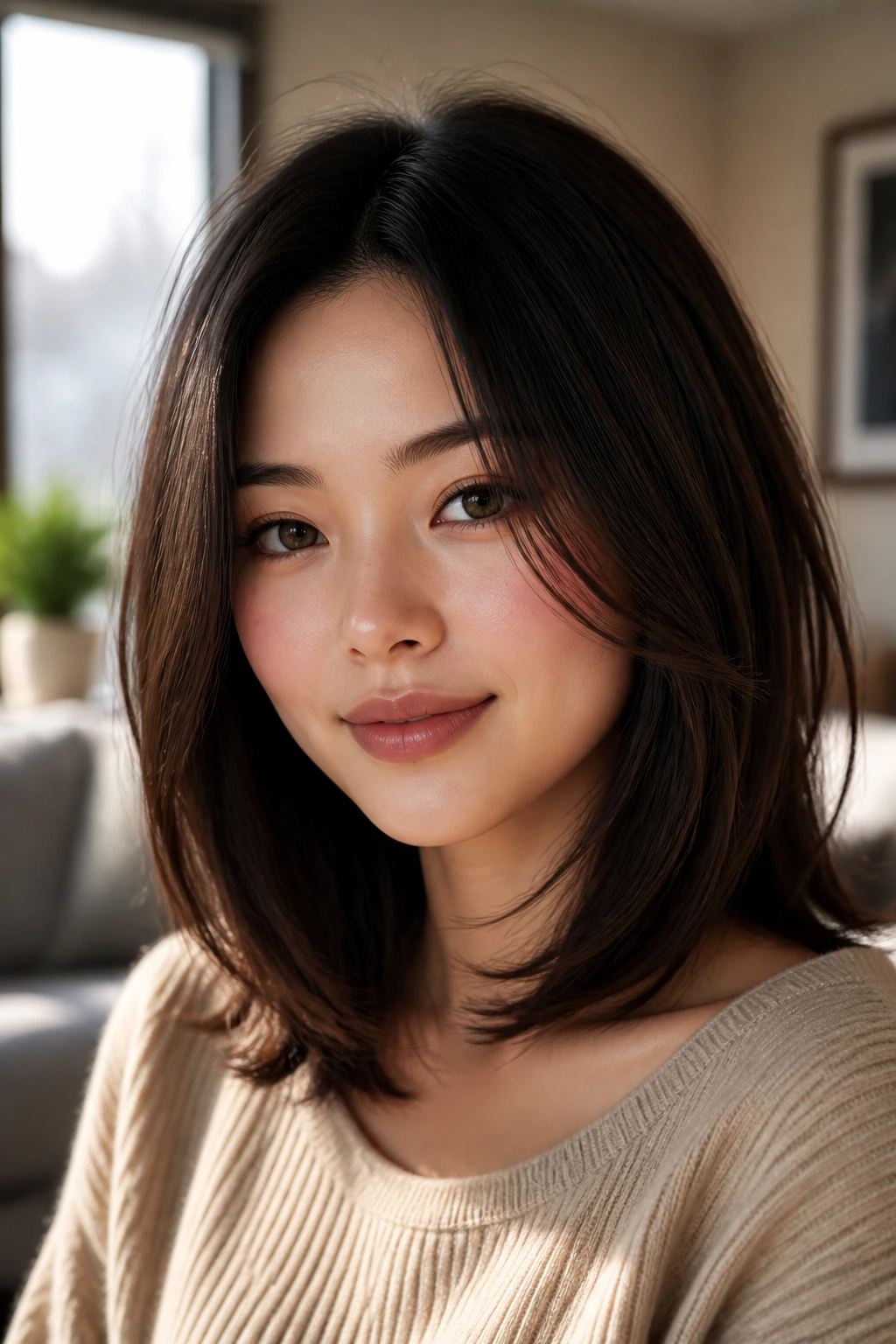
Longer front pieces change the whole read of the face. A lob that sits just below the jawline draws the eye down instead of letting the width sit right at the cheeks, which is exactly where a round face can look broadest.
Thick hair needs shape, not shrinkage. The cuts in this collection rely on internal weight removal, beveling, or long layers so the perimeter stays clean while the inside loses some of the bulk that causes puffiness.
Soft movement beats hard volume at the sides. A little lift at the crown, a low-starting face frame, or a side part works far better than adding extra fullness at cheek level, where round faces already have enough width.
These cuts grow out with manners. A lob that is cut well can look intentional at collarbone length, shoulder length, and the messy in-between stage that usually sends people back to the salon.
They’re easy to style in more than one direction. You can wear these lobs sleek, bent, tucked behind one ear, or softened with waves, which matters when thick hair refuses to behave the same way twice.
1. Center-Part Collarbone Lob with Softly Flicked Ends
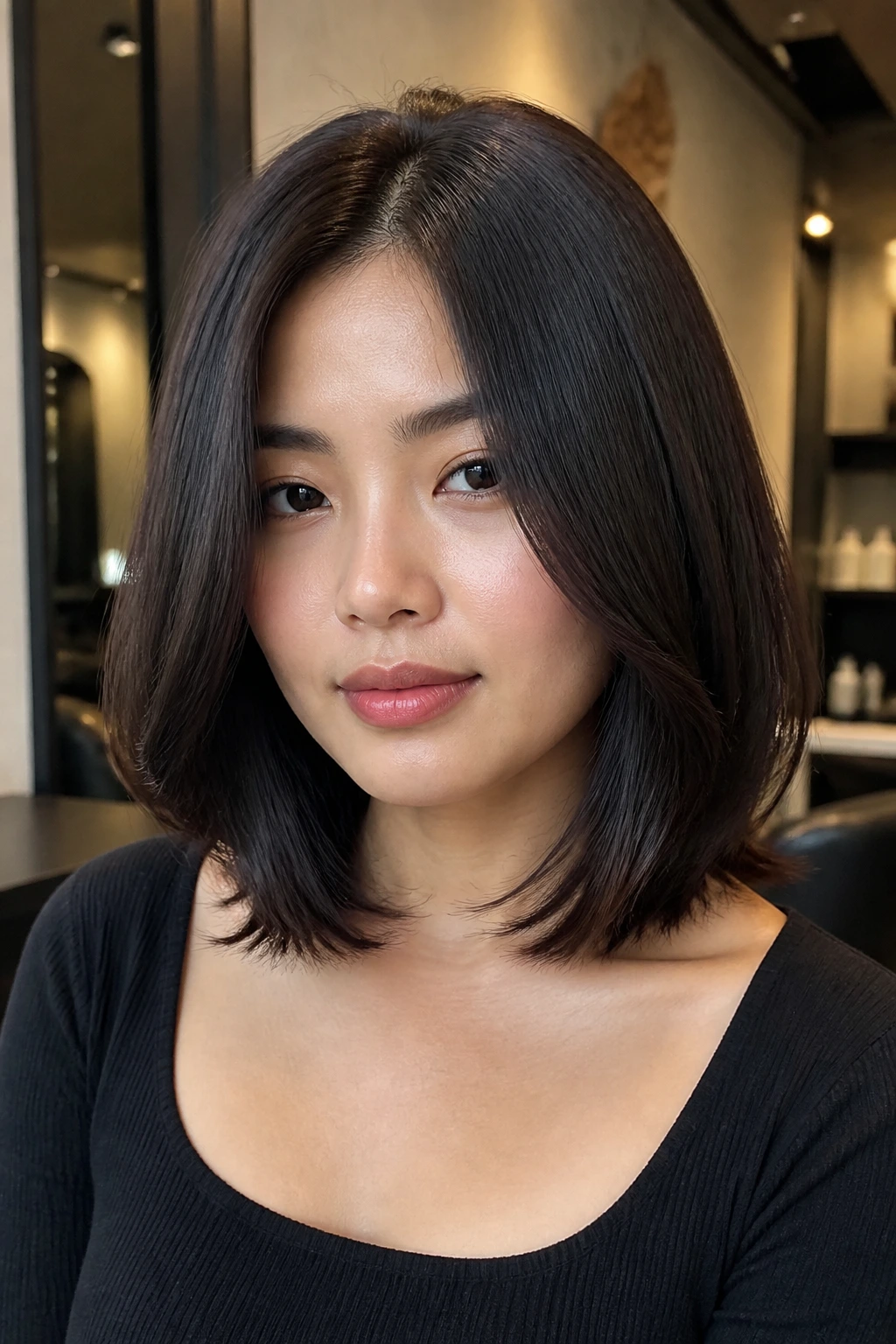
A center-part collarbone lob is the cleanest place to start if you want the face to look longer without making the haircut feel severe. The magic is in the placement. When the ends skim the collarbone and the front hangs a little below the jaw, thick hair gets enough weight to stay smooth, and a round face gets a vertical line that keeps everything from spreading outward.
Why It Works on Round Faces
A center part can be tricky on round faces if the length is too short. Here, though, the length does the heavy lifting. Keep the front at least 1 to 2 inches below the jaw, then add the tiniest inward flick at the ends so the cut doesn’t flare out at the shoulders.
- Ask for a soft bevel, not a sharp curve.
- Keep the top layer long enough to avoid a shelf.
- Style with a 1.25-inch flat iron or a paddle brush blow-dry.
- Finish with a drop of lightweight oil on the ends only.
Best for: thick, straight or slightly wavy hair that wants a polished outline without a lot of fuss.
2. Curtain Bang Lob with Soft Side Swoops

Curtain bangs can do a lot of face-slimming work, but they have to start in the right place. On a round face, I like them longer than people expect — usually opening around the cheekbone and tapering down toward the jaw so they frame instead of widen. With thick hair, the extra density gives those front pieces enough body to drape instead of sticking out like two little wings.
The rest of the lob should stay calm. No choppy explosion at the sides. No high-short layers near the cheeks. The bangs are the feature, and the length underneath needs to act like a quiet support system.
If your hair is heavy at the front, ask your stylist to keep the bang section narrow and the sides longer. That keeps the fringe from swallowing the forehead. Blow-dry the bangs forward first, then sweep them open with a round brush so they fold away from the center cleanly.
What to watch for: curtain bangs cut too short on thick hair can spring up and make the face look wider. Longer is safer here.
3. Blunt Lob with Tucked Ends
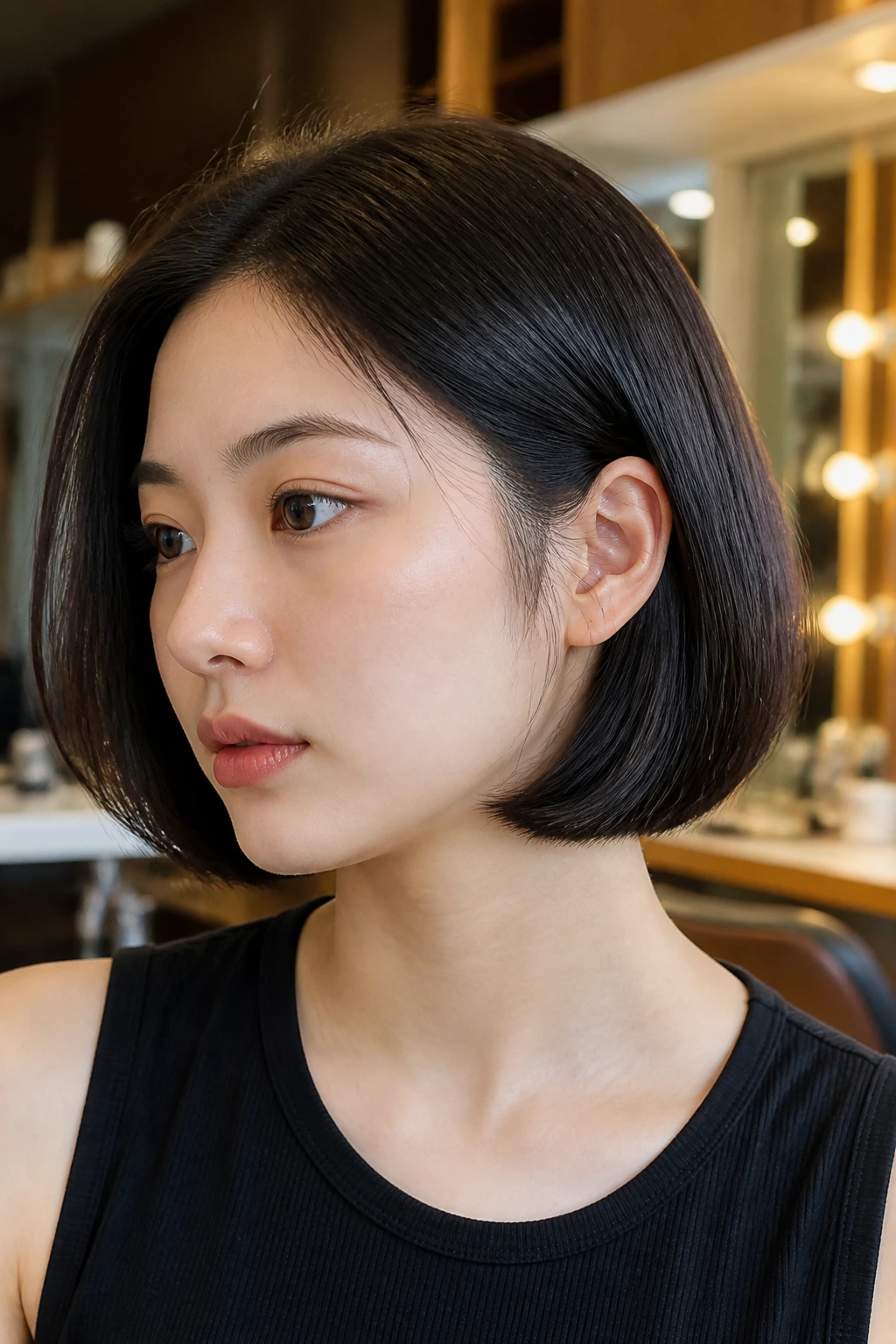
A blunt lob sounds severe until you see it on thick hair. Then it makes sense. All that density gives the cut a rich, full line, and the blunt edge keeps the bottom from fraying into a puffy cloud. On a round face, the trick is to leave enough length so the line sits below the widest part of the cheeks, then tuck the front pieces behind the ears for a little side narrowing.
The Shape Trick
The cut itself is almost one-length, with only a tiny bit of interior debulking if the hair is very thick. The styling is where the face shape changes. Tucked ends create a cleaner frame around the jaw and make the neck look longer.
Best for: people who want a neat, modern look that still has body.
Salon note: ask for the perimeter to stay solid and for the stylist to avoid over-thinning the ends. Thick hair looks better with a firm edge here than with wispy damage-control layers.
4. Korean C-Curl Lob

This is the lob that lives on that soft inward bend you see in many Korean salon cuts. The ends curl under in a gentle C shape, not a hard flip, and that small curve makes thick hair sit close to the neck instead of mushrooming out. For round faces, the bend should happen below the chin, not at cheek level, or you’ll add width where you’re trying to lose it.
The style works because it is controlled but not rigid. You can blow-dry it with a medium round brush or use a flat iron to nudge the last inch inward. The important part is restraint. A big, bouncy curl is a different haircut. This one is about soft geometry.
Best for: straight or slightly coarse hair that holds shape well and wants a tidy finish.
My opinion: this is one of the most wearable lob shapes on thick hair because it looks intentional even when it’s not perfectly styled.
5. Deep Side-Part Volume Lob
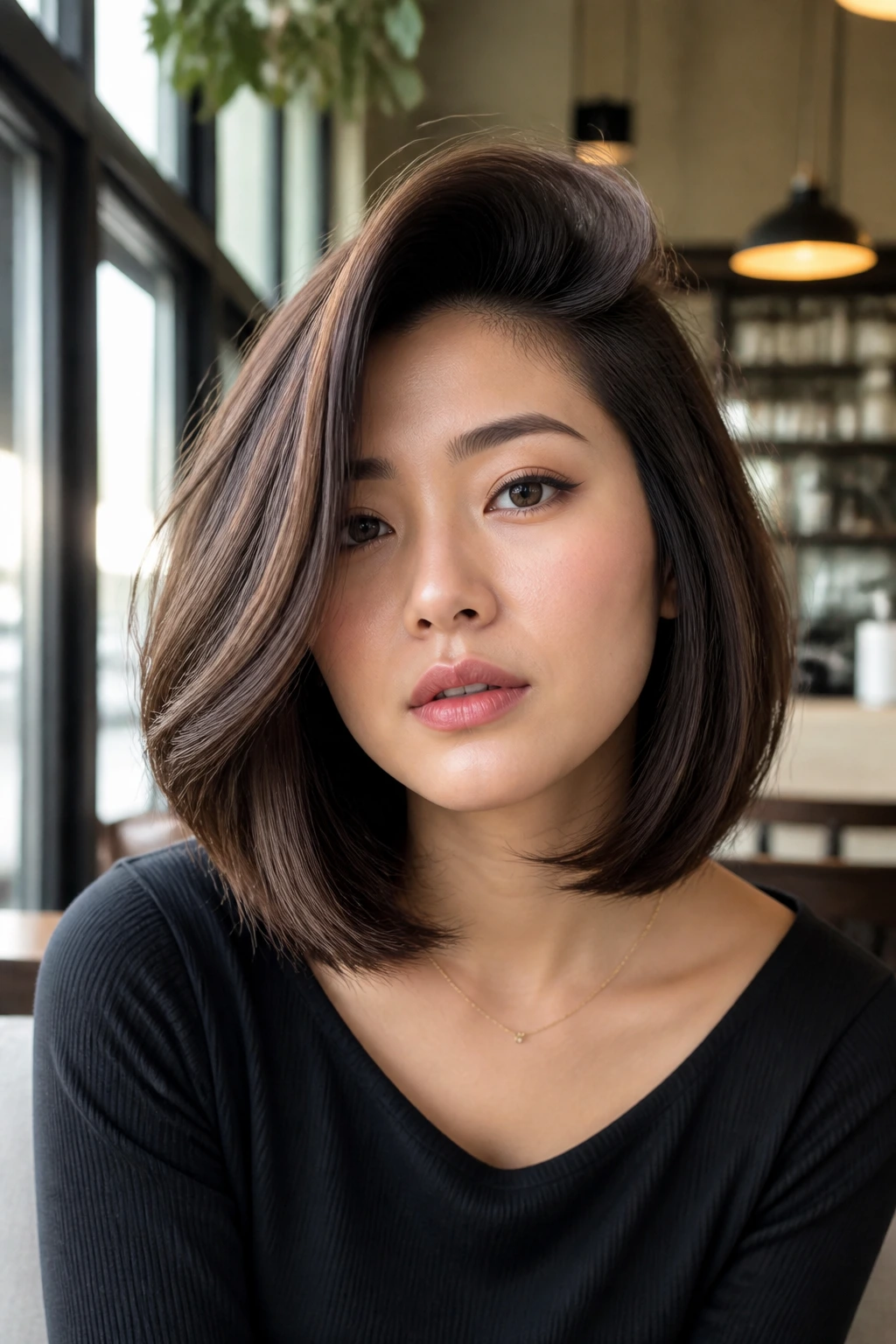
If your face feels widest right at the cheeks, a deep side part is a fast fix that doesn’t require a dramatic chop. The part creates an off-balance line that pulls the eye up and down instead of side to side. On thick hair, that asymmetry also helps the cut move instead of sitting like a box.
A side-part lob works best when one front section is tucked back and the other falls diagonally across the cheek. That diagonal line is the whole point. It breaks the roundness without making the haircut look harsh.
Use a root-lift mousse at the crown, not all over. Then blow-dry the top in the opposite direction of the part first, flip it back, and finish with a cool shot. That tiny bit of extra lift at the roots makes the whole style feel lighter.
Best for: people who like a little drama but do not want bangs.
6. Shaggy Textured Lob with Long, Broken Ends
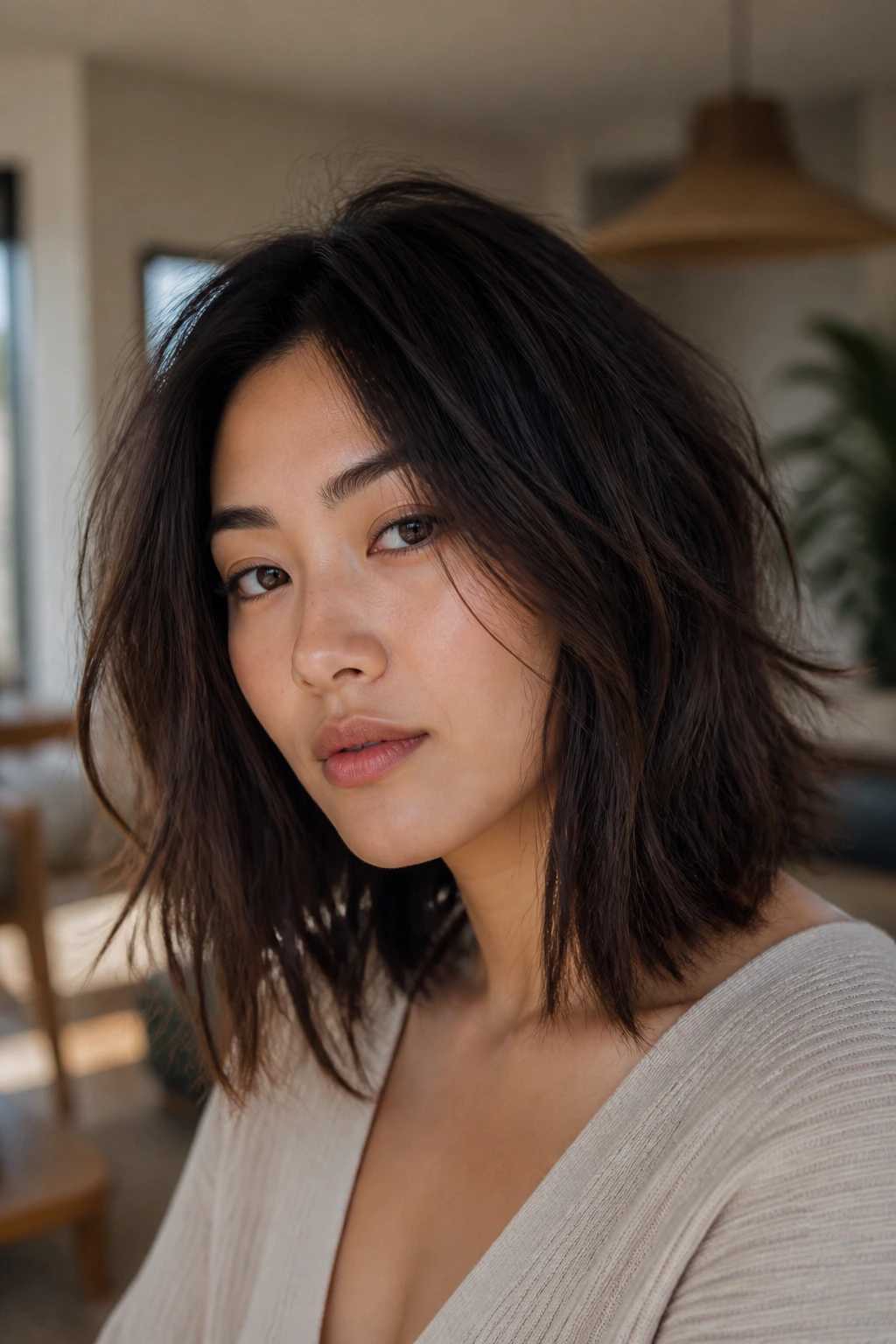
If thick hair has a tendency to sit in one heavy block, a shaggy lob can be the release valve. The cut uses broken ends and long internal layers to keep the outline loose. The face stays open, the bulk drops away, and the style gets a bit of that easy, piecey movement that never looks too polished to breathe.
Why It Works
The shaggy version is not about wild layers. It works because the shortest layers still stay long enough to avoid widening the cheeks. Round faces need the movement to fall lower, around the jaw and collarbone, not right beside the cheekbone. Thick hair can carry this because it has enough density to keep the ends from looking thin or shredded.
- Ask for long layers only.
- Keep the shortest face frame below the cheekbone.
- Use texture spray on dry hair, not wet hair.
- Skip heavy creams that make the cut collapse.
Best for: thick hair that gets puffy when it’s one-length and boring when it’s overworked.
7. Face-Framing Lob with Cheekbone Pieces
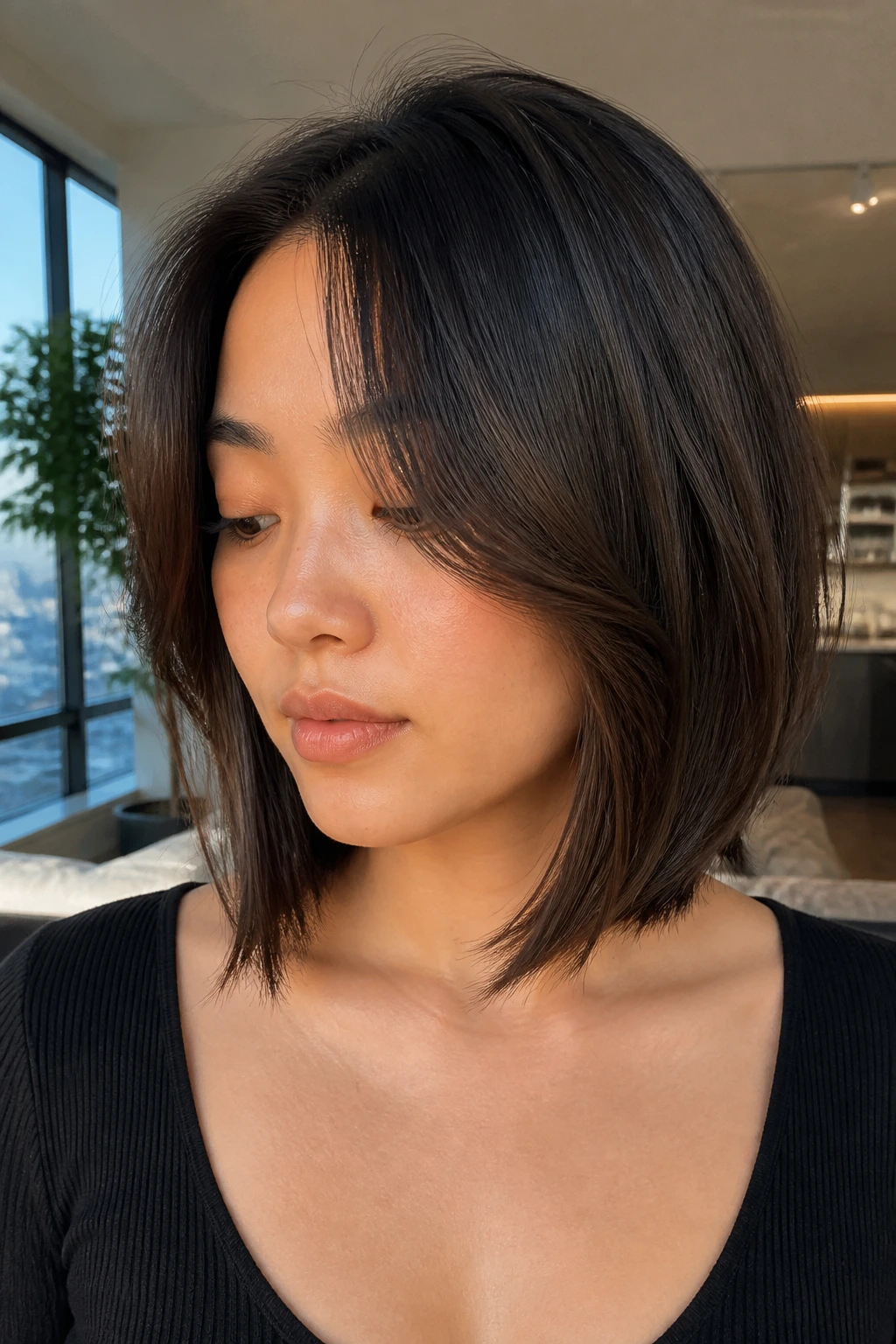
The best face-framing lob does something subtle: it starts the frame low enough to narrow the face, but high enough to keep the cut from feeling flat. On a round face, the frame should usually begin below the cheekbone, then slide down toward the jaw. That downward direction matters. It gives the eye a path to follow.
Thick hair makes this look better, not worse, because the front pieces keep their shape. Thin hair can end up looking stringy with too much framing. Thick hair holds the drape.
What to Ask for at the Salon
Ask for front sections that open softly, not harshly, and make sure the interior of the haircut is debulked so the front doesn’t get dragged down by the rest of the hair. If the layers start too high, the cheeks get more attention than they deserve.
This is one of those cuts that looks quiet in a mirror and expensive in motion. That’s the right outcome.
8. Glass-Sleek Lob
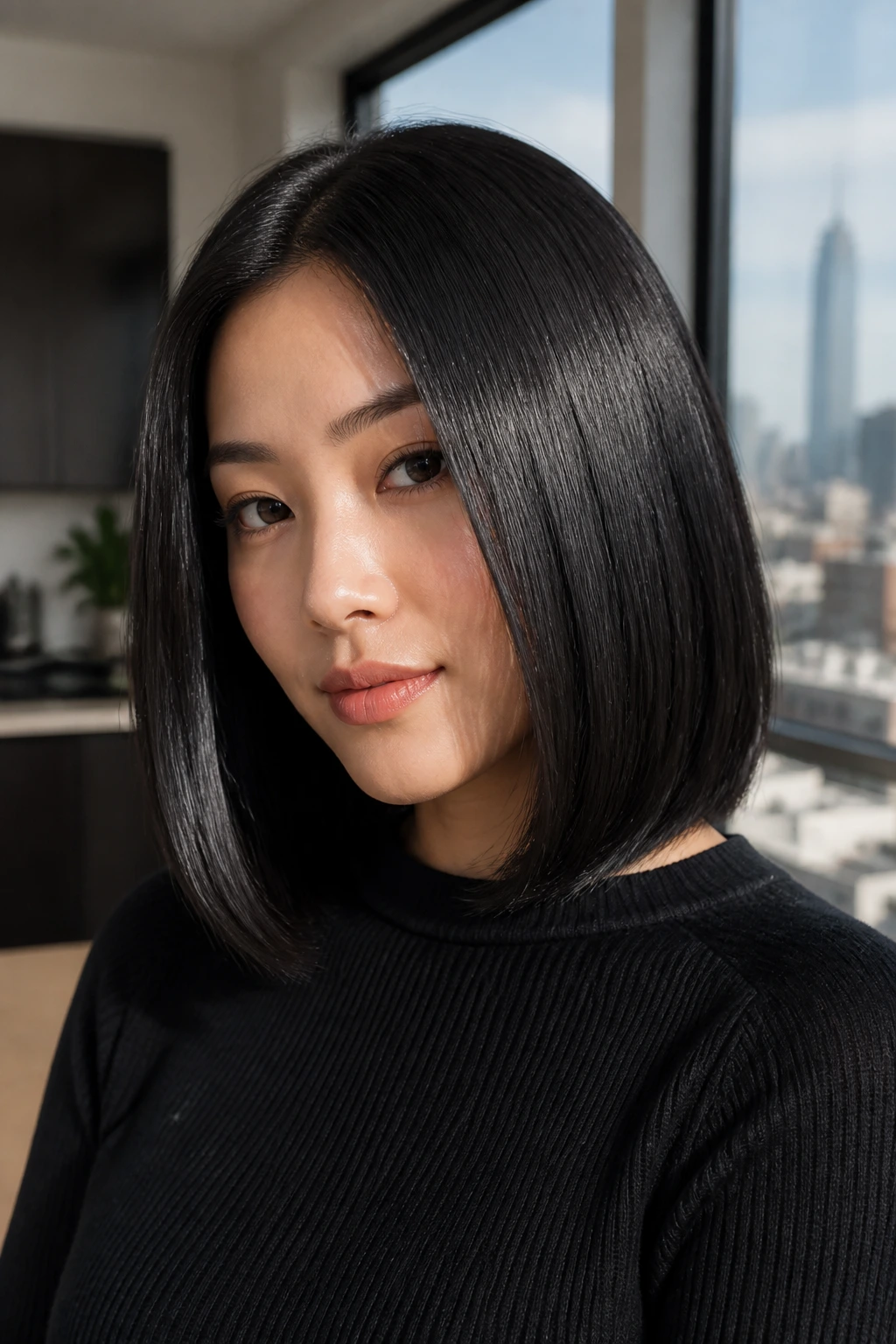
A glass-sleek lob is all about shine, straightness, and a line so clean it almost looks drawn. Thick hair is perfect for it because the density helps the style look rich instead of flat. The key is keeping the length low enough to lengthen the face and the ends softly beveled so the cut doesn’t stick straight out at the shoulders.
The Styling Equation
You need heat protection, a strong blow-dry, and a flat iron with rounded edges. Start by drying the hair smooth with a nozzle attachment, then go over the mid-lengths in small sections. The final pass should be a gentle bend, not a pin-straight harsh edge.
Best for: people who like polished hair and don’t mind taking 15 to 20 minutes to finish it properly.
Avoid this mistake: too much serum at the roots. Thick hair can handle shine, but oil at the scalp makes the style droop fast.
9. Invisible-Layer Lob
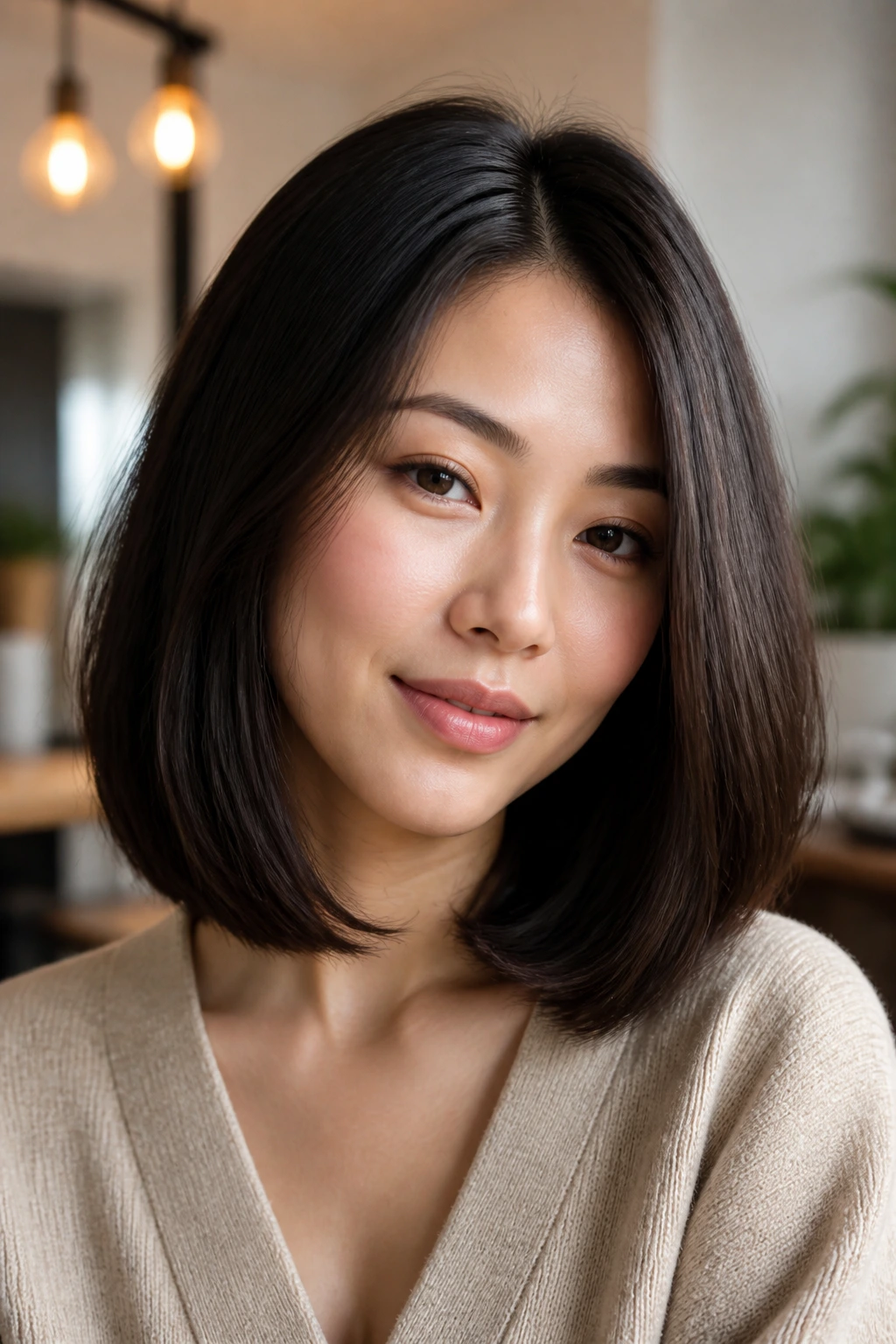
This one looks deceptively simple. At first glance, it reads like a one-length lob, but the movement comes from hidden layers inside the shape. For thick hair, that’s gold. You keep the outside line full and clean while taking weight out of the interior, which stops the hair from folding out like a stack of cards.
Round faces benefit because the perimeter stays low and steady. The eye sees a long, smooth line, not a bunch of choppy pieces around the cheeks. That makes the face look less wide without making the haircut feel thin.
Ask for internal layering, not obvious steps. If your stylist starts carving too much into the top layer, the cut can lose its quiet shape. A good invisible-layer lob feels lighter when you swing your head, but it should still look solid when you pull it forward.
10. A-Line Lob with a Longer Front

An A-line lob gives you a built-in diagonal, which is exactly the kind of line a round face can use. The back sits a little shorter, the front drapes longer, and that angle pulls the eye down toward the collarbone. On thick hair, it also keeps the bulk from gathering at the nape and turning into a dense shelf.
Keep the angle modest. A dramatic A-line can look sharp in a photo and awkward on a daily basis, especially if the front starts fighting your shoulders. One to 2 inches of difference from back to front is enough for most people.
This cut works especially well if your hair naturally wants to sit full at the back. The shorter nape helps remove that weight without sacrificing the length you need around the face. It’s tidy. It has shape. It doesn’t try too hard.
11. Feathered Lob with Soft Fringe
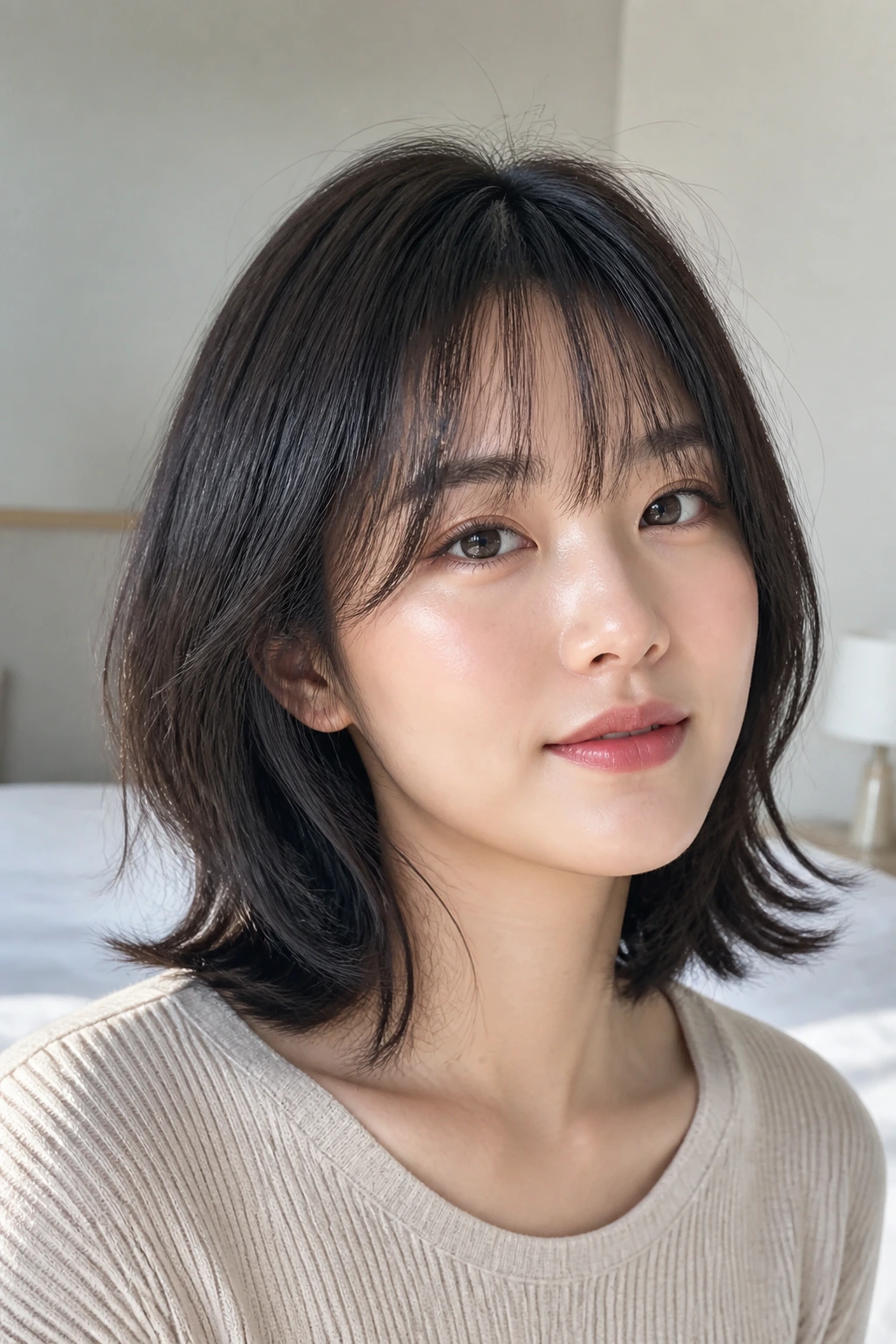
A feathered lob can go wrong fast if the ends are sliced too aggressively. The modern version is softer than the old-school haircut people picture. The ends are lightly feathered, the fringe is airy, and the whole thing stays below the cheekbone so it doesn’t widen a round face.
Why It Still Works
Feathering takes the edge off thick hair without stripping away all the body. That matters. Thick hair needs some weight to stay neat, but it also needs broken-up movement so it doesn’t sit like a block.
- Keep the fringe brow-skimming, not short.
- Ask for soft edges around the temples.
- Use a medium round brush to direct the front pieces outward first, then inward.
- Finish with a flexible spray, not a stiff one.
Best for: anyone who wants softness around the forehead and a less severe outline.
12. Chin-Skimming Bent Lob
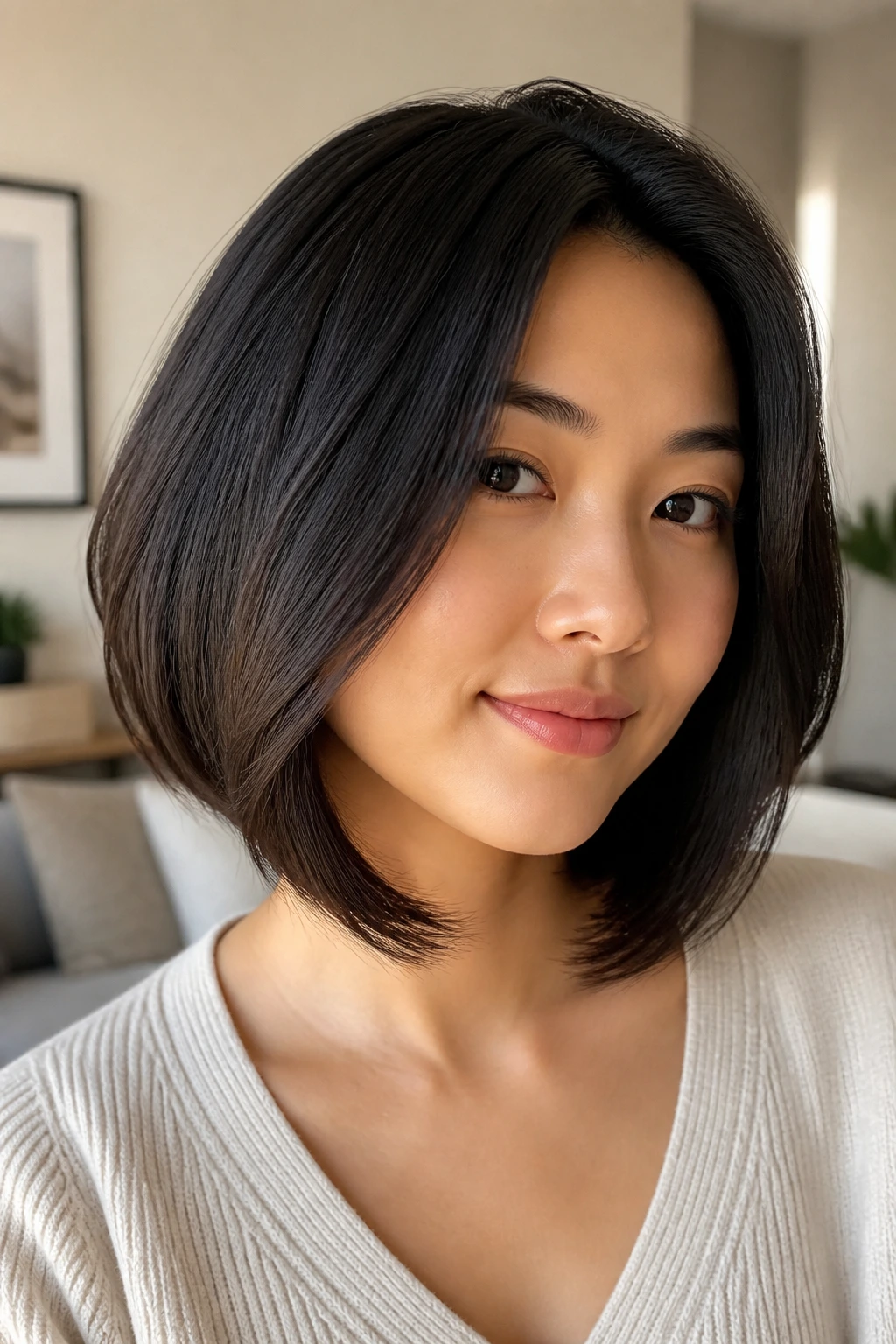
Can a lob that sits near the chin work on a round face? Yes, but only if the front pieces are longer than the chin line and the ends bend away from the cheeks. Otherwise, the cut lands right on the widest part of the face and the whole thing starts to feel boxy.
The best version of this look is not chin-length all around. It’s a lob that grazes that zone while the front continues downward toward the collarbone. Thick hair helps because it keeps the bend from collapsing. The shape holds.
I like this cut when it has a deliberate bend under the jaw, almost like the hair is being nudged into place rather than curled for decoration. The result is neat and slightly sharp. Not harsh. Just clear.
13. Bouncy Blowout Lob
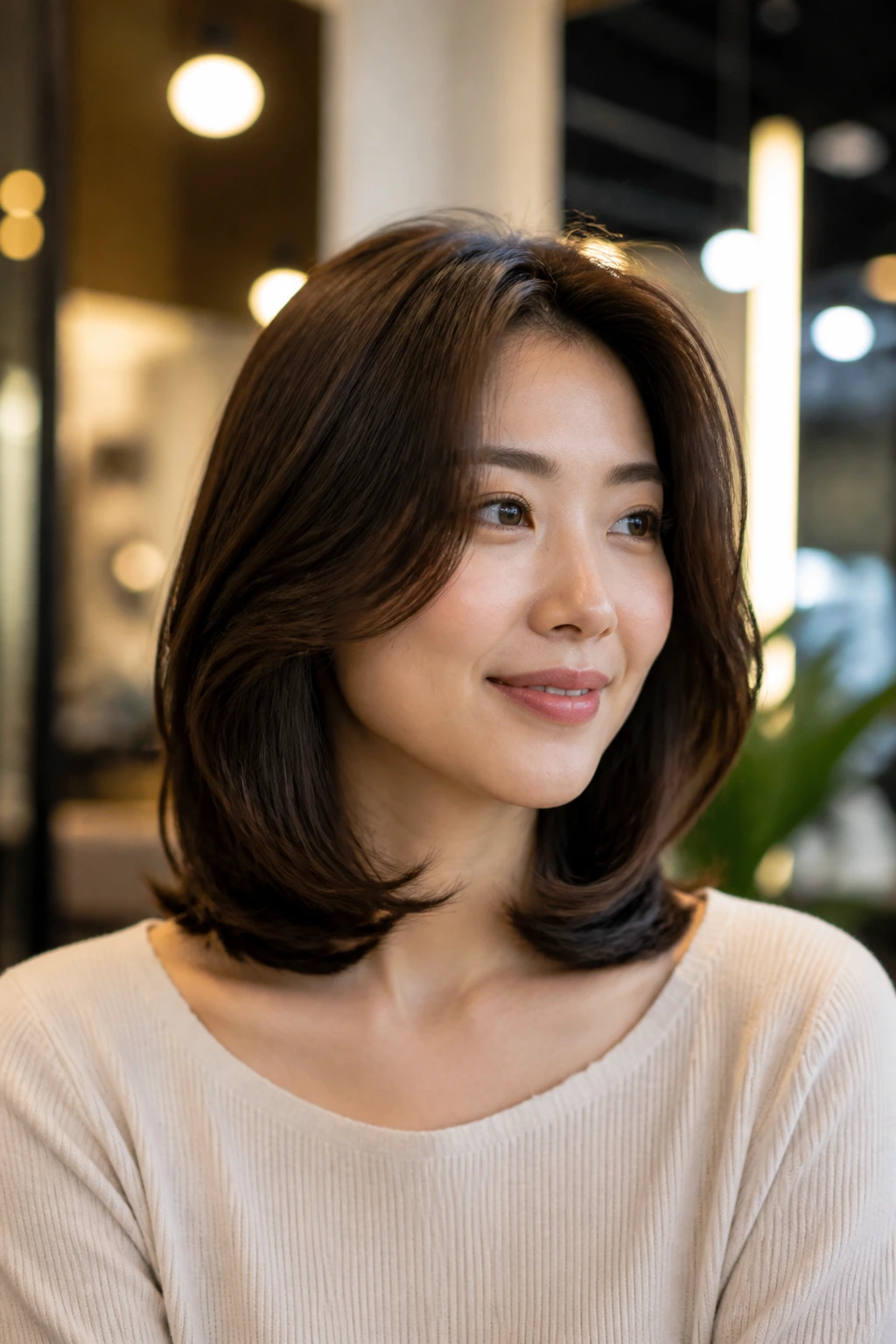
A bouncy blowout lob is all about movement that starts at the roots and softens toward the ends. Thick hair gives you a lot to work with here, which is exactly why this cut looks richer on dense hair than on limp hair. The crown gets a little lift, the mid-lengths curve, and the perimeter still sits low enough to keep the face from reading wide.
You want a round brush with enough grip to get tension through the mid-lengths. A 2-inch brush usually works well on thick hair that is shoulder length or shorter. Rough-dry first, then shape the front pieces away from the cheeks and tuck the ends slightly under.
This is a cut that likes a little polish. If you air-dry it half-heartedly, the body can fall in random directions. If you finish it with some intention, it looks expensive without needing a special occasion.
14. Razor-Softened Lob
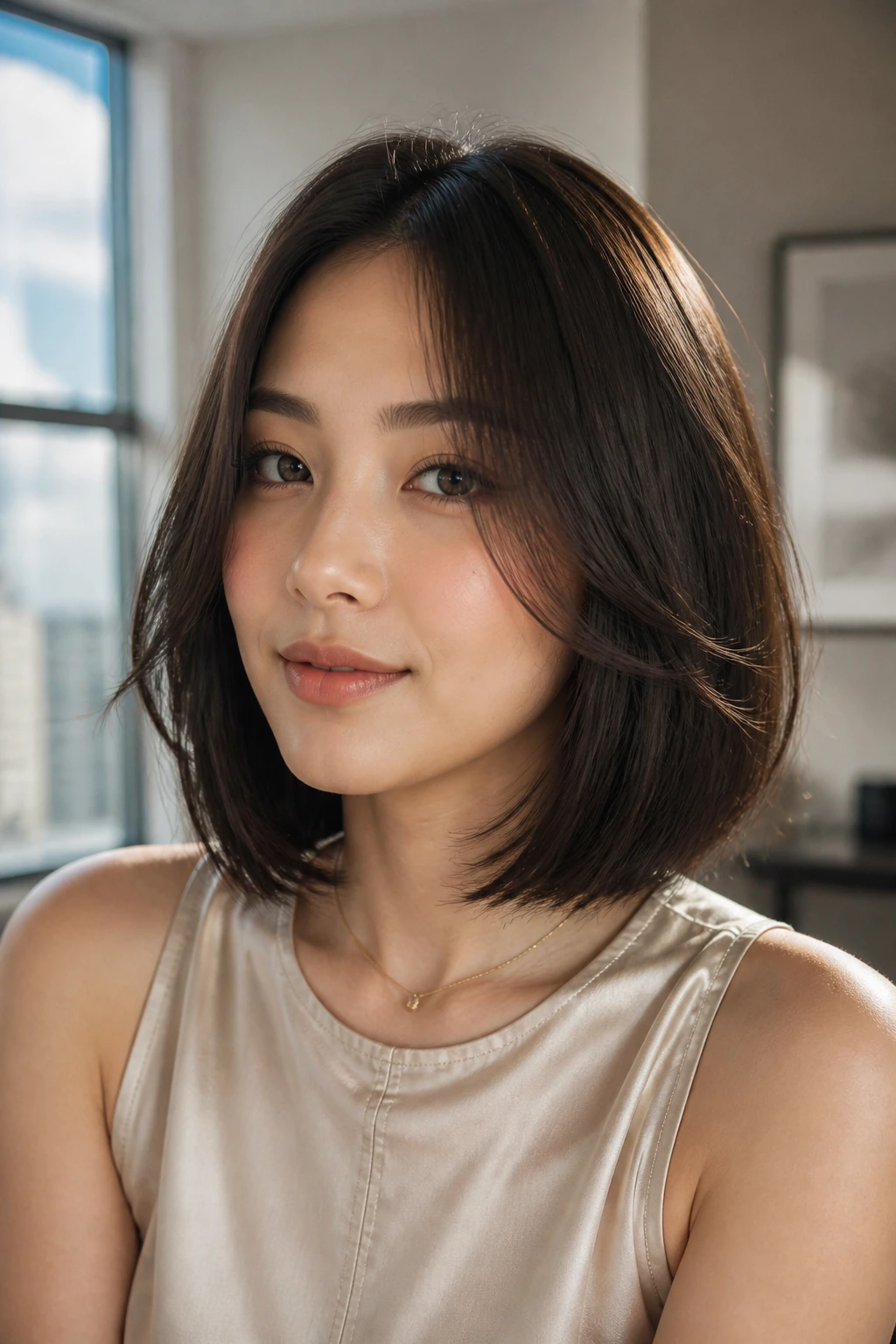
A razor can be a good tool on thick hair, but only in the right hands. The goal is not to shred the ends. It’s to remove some of the bulk from the interior so the hair stops pushing outward. On a round face, that creates a gentler outline that still keeps length around the cheeks and jaw.
What Makes It Different
A scissor-cut lob can look too dense if the hair is coarse and full. A razor-softened version breaks the line just enough to make the style move. The trick is to keep the perimeter strong and let the interior carry the texture work.
Use this if: your hair feels heavy even right after a cut.
Skip this if: your ends are already fragile or frayed. Then you need precision, not more slicing.
A good razor pass feels like breathing room, not damage.
15. Air-Dry Lob That Still Holds Shape

The best air-dry lob is built for real life, not for magazine lighting. It sits low enough to lengthen the face, uses long layers to avoid a triangle shape, and keeps the front pieces soft so they dry into something flattering instead of puffy. Thick hair can air-dry beautifully, but only if the cut respects where the hair wants to move.
Use a leave-in conditioner through the mid-lengths and a small amount of curl cream or smoothing cream if your hair bends. Then rake it through with your fingers and leave the roots alone. If you keep touching the hair while it dries, it frizzes.
This cut does not need much. That’s the point. It should look deliberate without demanding a blowout every morning.
16. Long-Side-Bang Lob
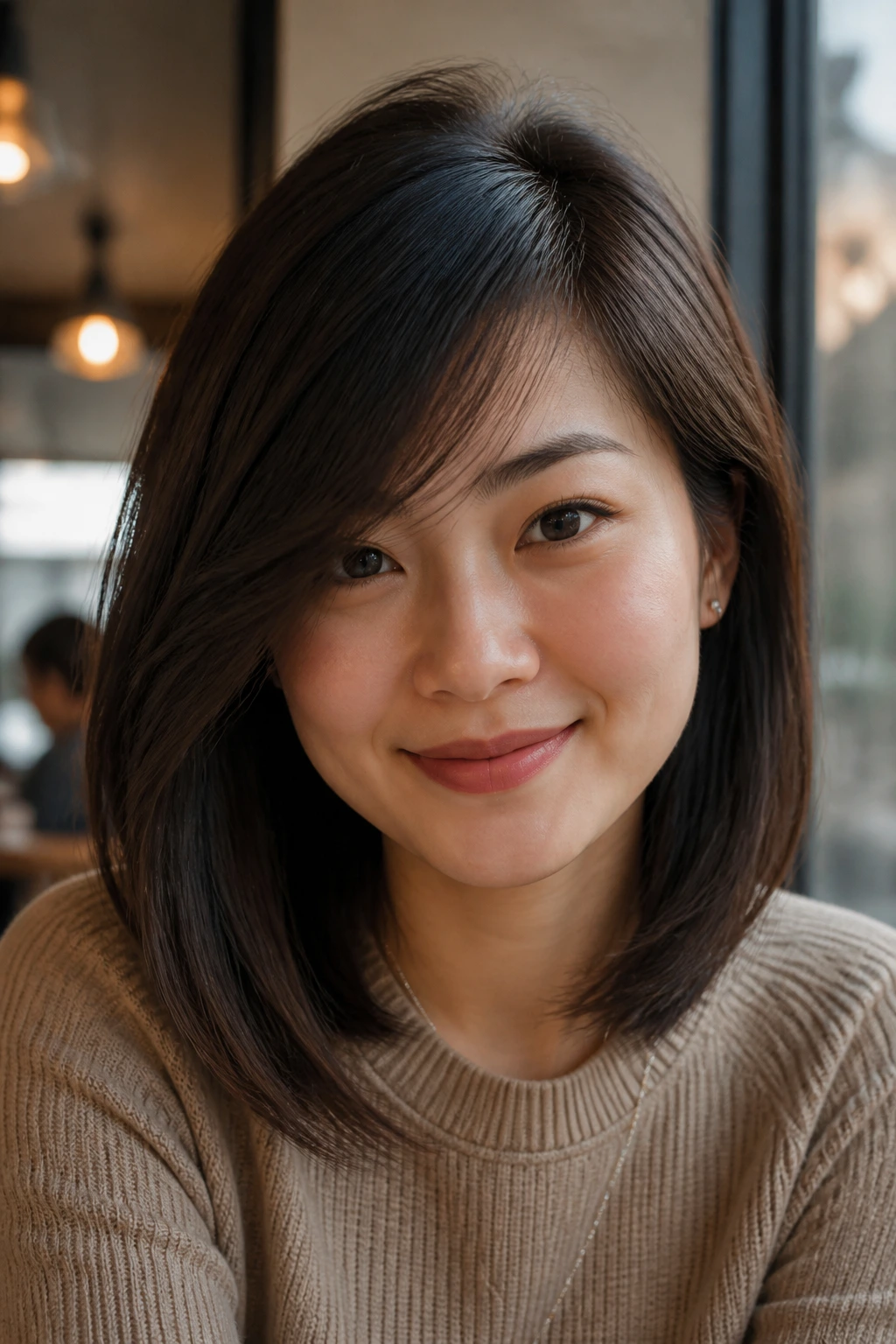
A long side bang is one of the quickest ways to narrow a round face without cutting full fringe. The bang sweeps across the forehead and lands near the outer cheekbone, which creates a line that cuts diagonally through the face. On thick hair, it has enough weight to stay in place instead of floating up.
How to Wear It
The side bang should be long enough to blend into the front length, not stop abruptly above the eyebrow. That transition matters. Short side bangs can look cute, but they don’t do much for elongation.
- Blow-dry the bang section in the opposite direction first.
- Set it with a cool shot.
- Keep the rest of the lob smooth so the fringe stays the focus.
- Trim every 4 to 6 weeks if you want the shape to stay neat.
Best for: people who want face framing without committing to curtain bangs.
17. Wolf-Lite Lob

The wolf-lobe hybrid can be messy in a good way, but only if you keep the wolf part on a leash. Thick hair handles this cut well because the layers get to move without collapsing. Round faces need the shortest layers to stay below the cheekbone, or the volume lands in the wrong place.
The right version has crown texture, a longer perimeter, and a little fringe or face frame that opens downward. It should look lived-in, not over-styled. If your hair is already coarse, you do not need much product to make it work. A touch of texturizing mist and a quick scrunch are enough.
This is a good cut for people who like a little attitude. Not every lob needs to be polite.
18. Under-Curved Lob
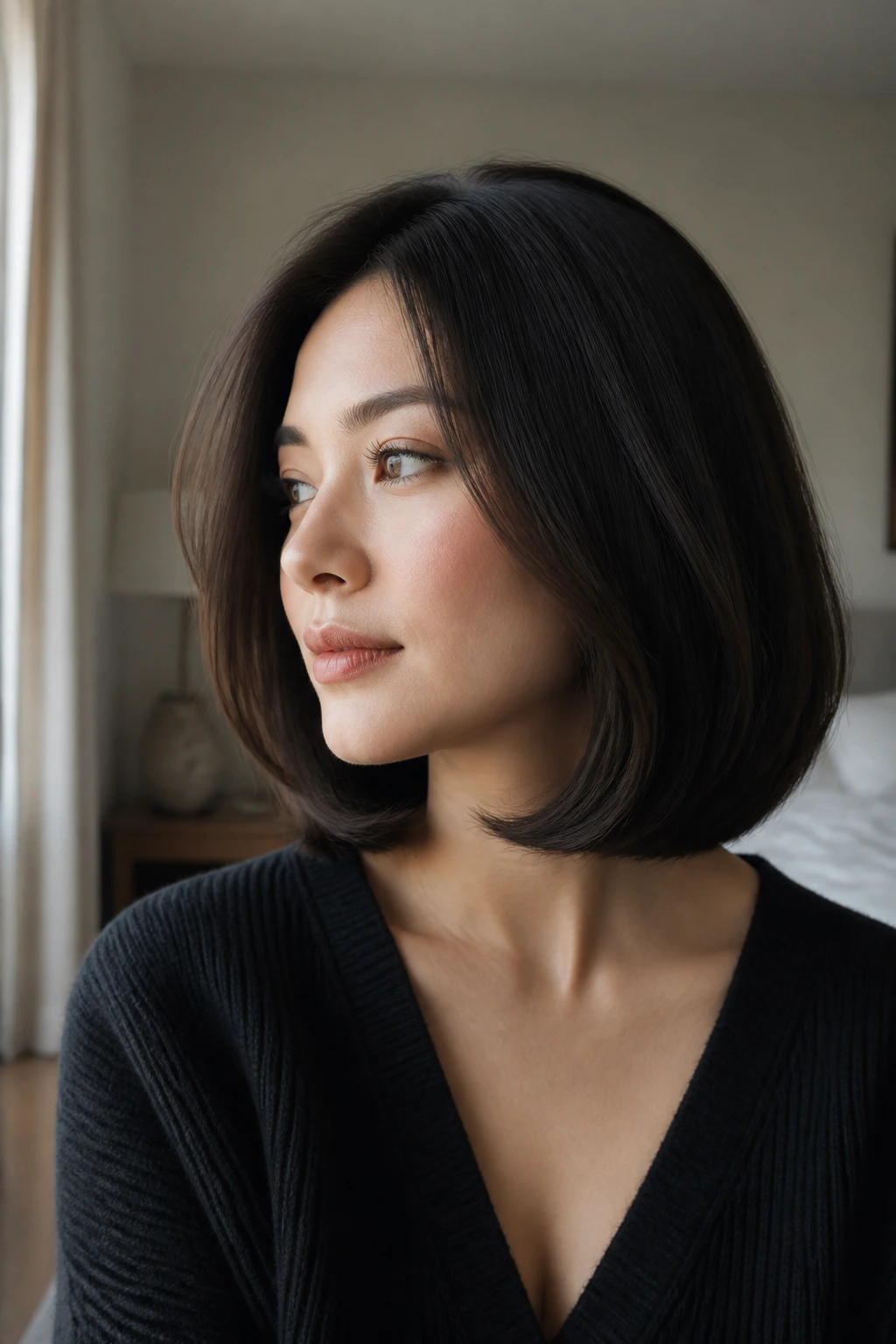
An under-curved lob is the quiet sibling of the C-curl style. The ends turn inward softly, almost like they’re being tucked under the jaw. On thick hair, that slight curve keeps the bottom from flaring out. On a round face, it gives a clean lower line that pulls the gaze downward.
The cut should not be too short at the sides. The curve needs room to happen below the jawline. If the hair kicks out instead of curving under, the problem is usually in the cut, not the styling. Ask for a softer bevel and a bit of interior debulking if the ends feel heavy.
This is one of those cuts that looks calm. Not plain. Calm. And there’s a difference.
19. Piecey Wave Lob
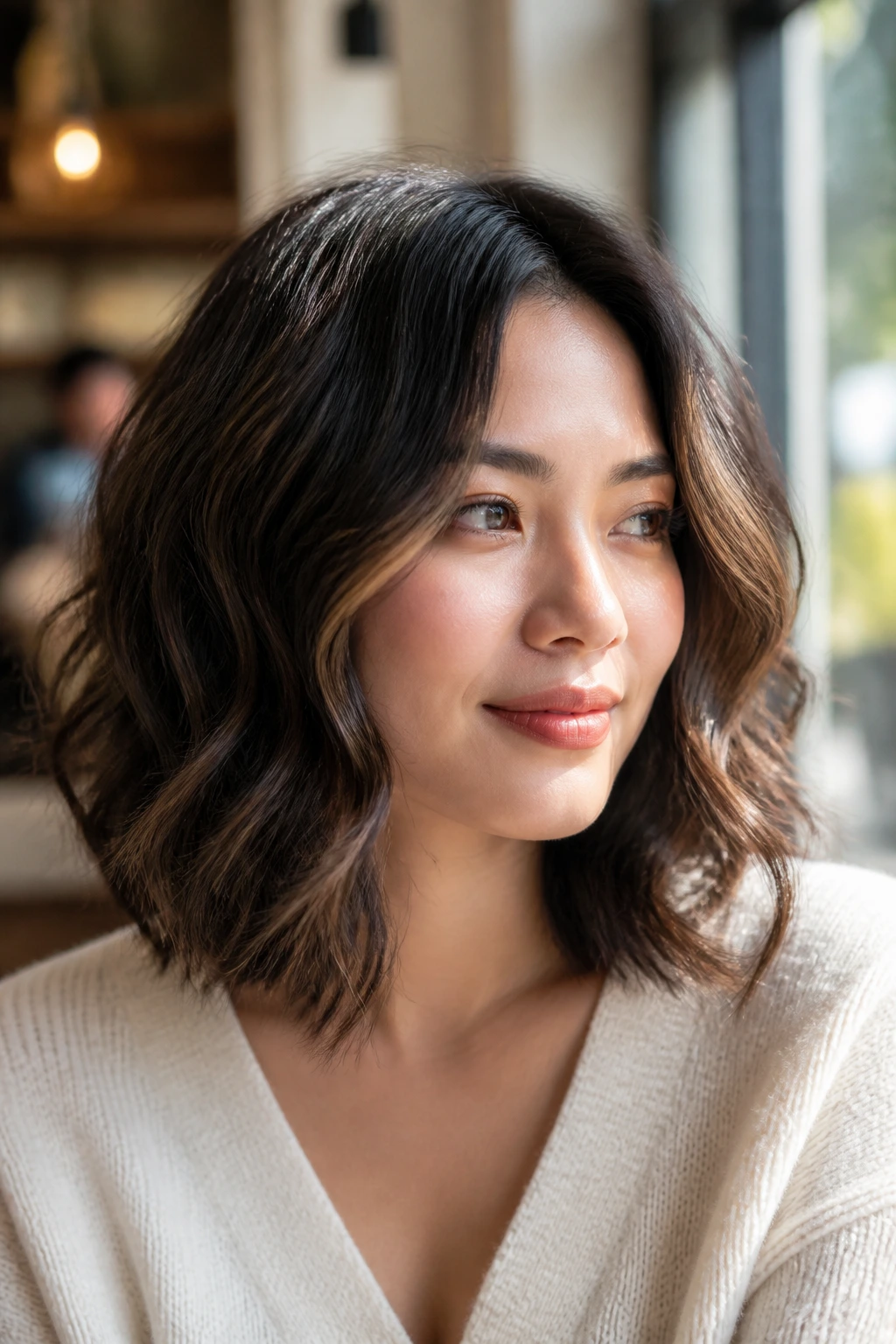
A piecey wave lob is what happens when thick hair is given enough length to bend but enough structure to avoid looking puffy. The waves should feel separated, not crunched into one big pattern. That separation is what keeps the face from feeling rounder.
Use a 1.25-inch curling iron and wrap sections away from the face, leaving the last inch out. Alternate directions in the back so the pattern breaks up naturally. Then rake through with your fingers, not a brush. You want loose movement with visible ends.
This style is especially good if your hair already has some natural bend. If it’s pin-straight, you’ll need a little more effort. Still worth it.
20. Minimal Japanese Lob
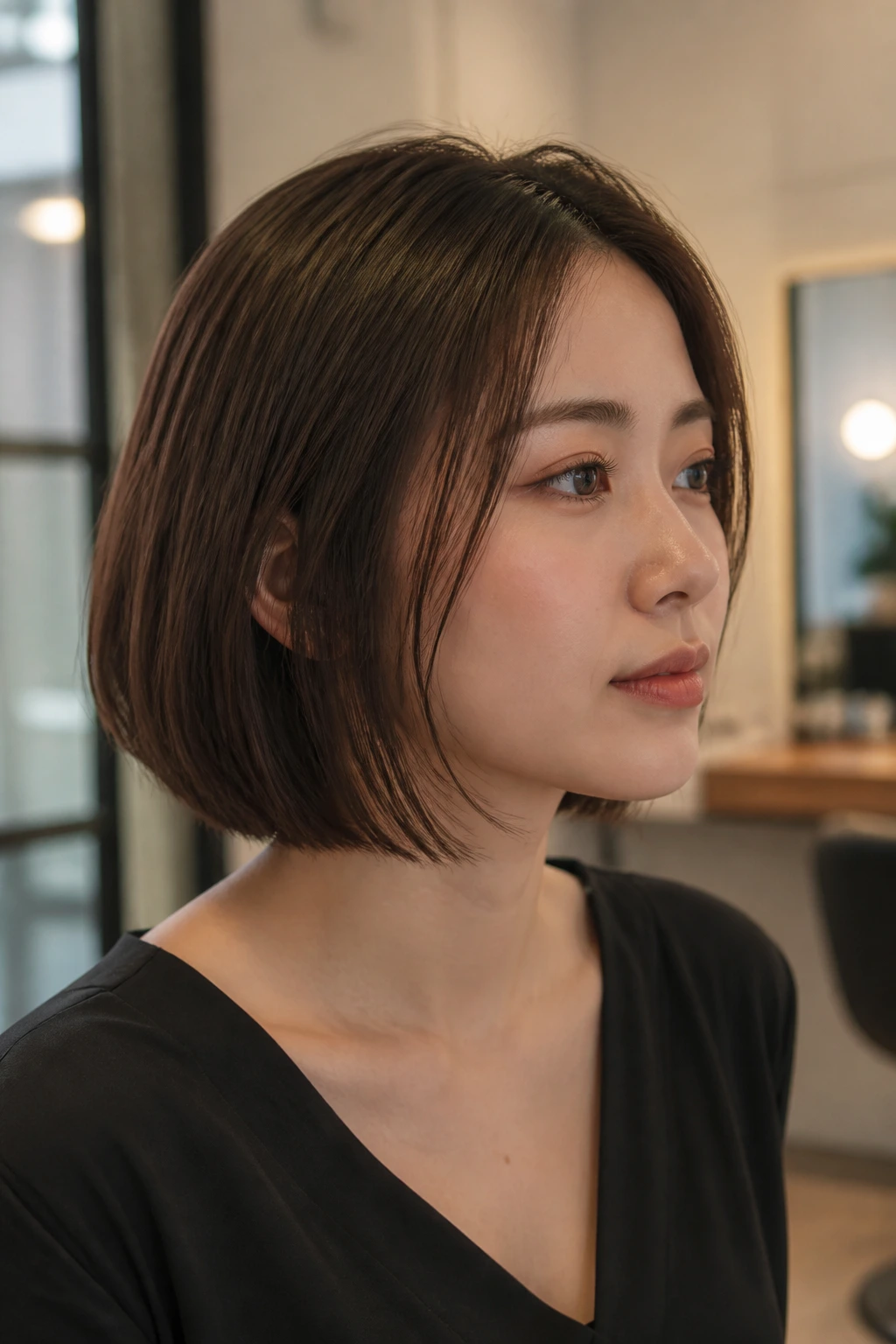
The minimal Japanese lob is all about precision. The line is clean, the layers are restrained, and the finish is smooth rather than flashy. For round faces, that simplicity is powerful because it lets the length do the slimming work without extra width at the sides.
Thick hair benefits from the discipline. If the cut is too airy, the density can make it feel fluffy. If the line is too heavy, it can feel helmet-like. The middle ground is a neatly controlled perimeter with just enough internal shaping to let the hair fall well.
This is a haircut for people who like their hair to look calm even when they haven’t spent an hour on it. The shape does the talking.
21. Bottleneck Bang Lob
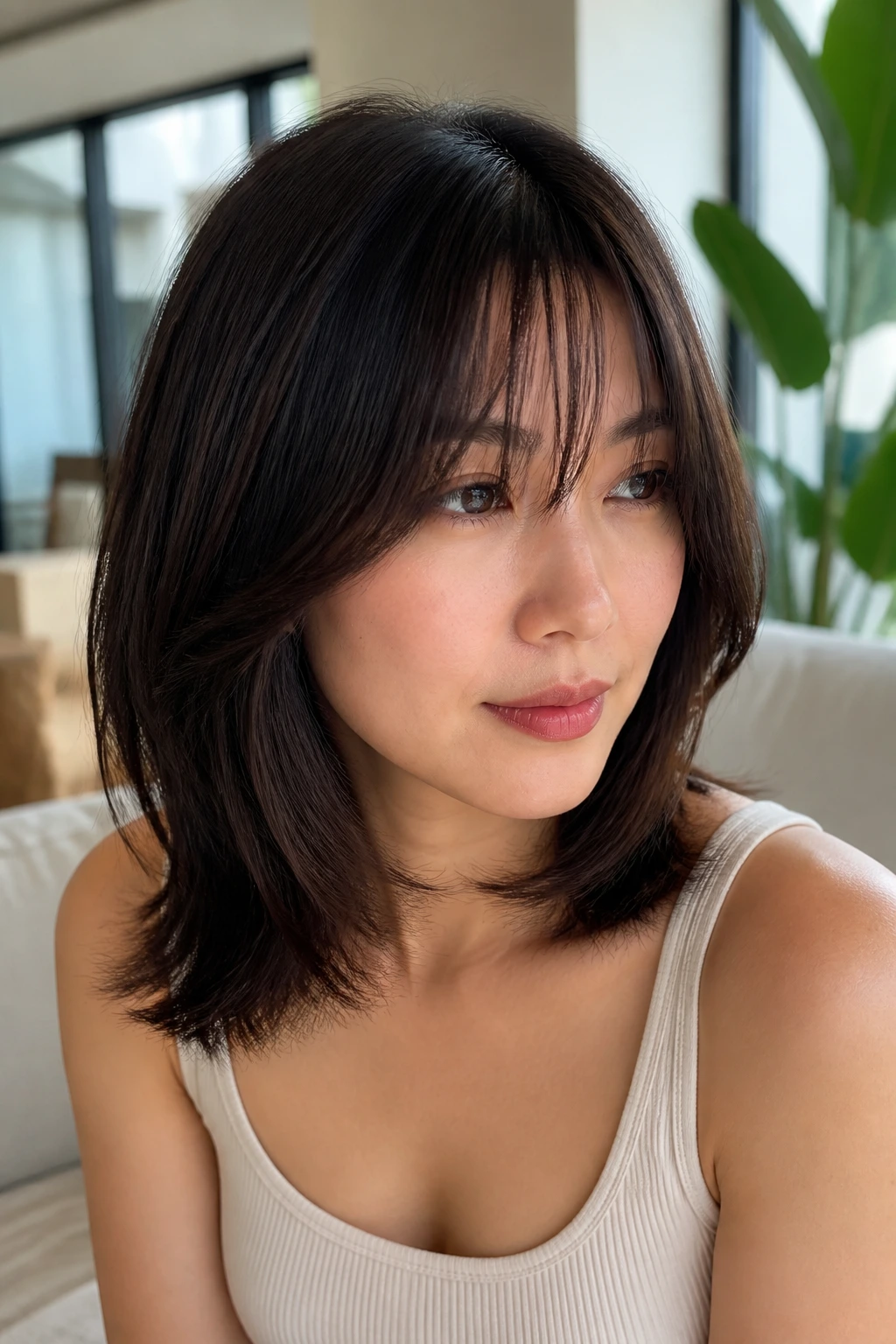
Bottleneck bangs are named well: narrow in the center, wider as they open toward the temples. That shape works beautifully on round faces because it creates a soft vertical channel before the eye moves out toward the sides. Thick hair gives the bangs enough density to stay structured without splitting apart.
Why It Flatters
The center is short enough to feel like a bang, but the temple pieces are long enough to blend with the lob. That blend is what keeps the face from looking chopped up.
Ask for: a fringe that opens around the cheekbone and blends into the front layer.
Style with: a round brush or a small Velcro roller at the front to set the curve.
If curtain bangs feel too wide and a full fringe feels too blunt, this is the nicer middle road.
22. Internal-Weight Lob
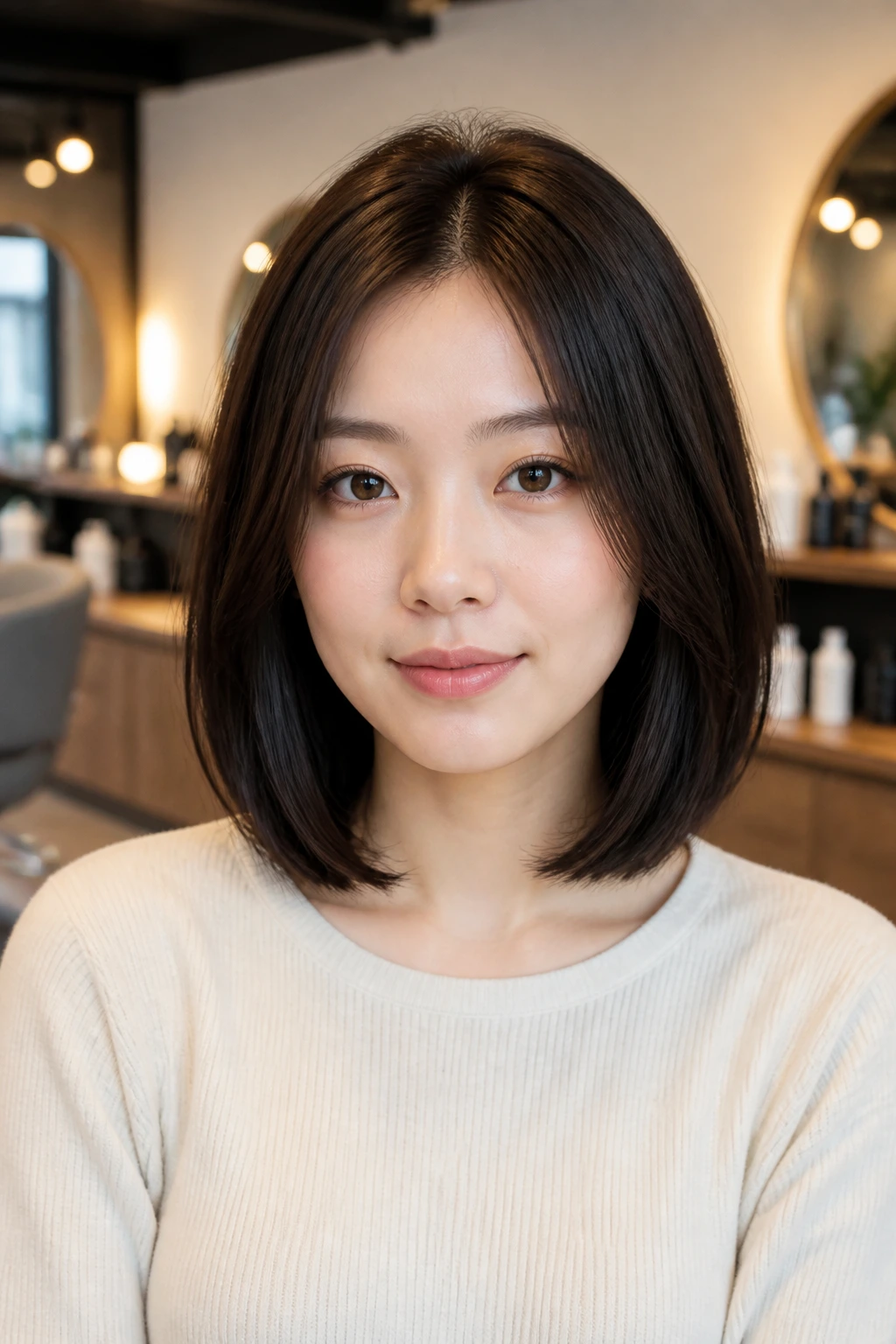
An internal-weight lob is one of the smartest cuts for thick hair because the outside looks full and the inside loses the extra mass that causes swelling. It’s the haircut version of cleaning out a closet without throwing the house away. The perimeter stays strong. The movement gets better. The face gets less width to compete with.
Round faces benefit because the shape remains low and elongated. You’re not adding layer after layer around the cheeks. You’re simplifying the interior so the front pieces can fall in a cleaner line.
This is the cut I’d point someone to if they keep saying, “I want to keep my hair thick, but I’m sick of it feeling heavy.” That’s exactly what it solves.
23. Tucked Lob with Ear-Hugging Sides
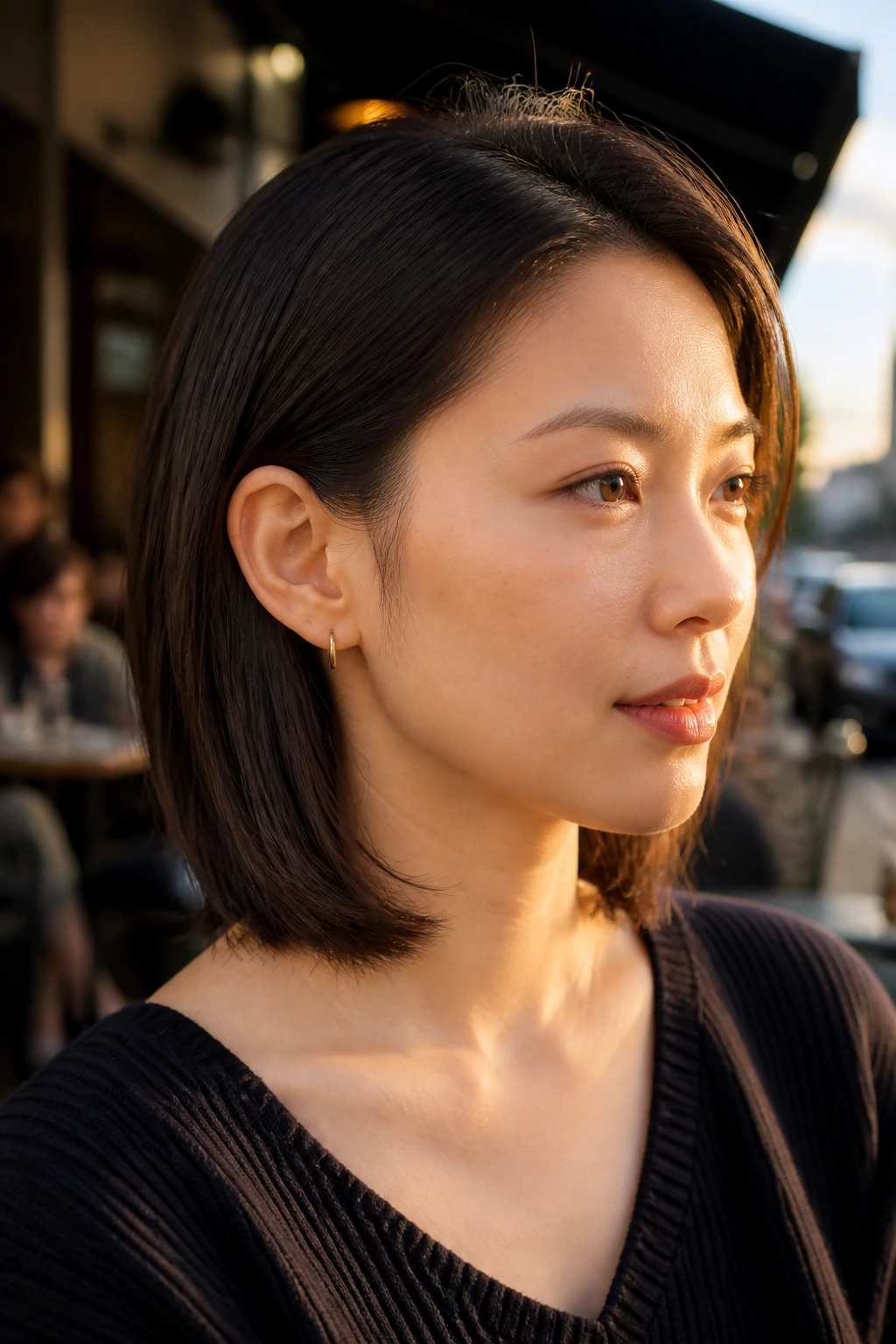
If you tuck your hair behind your ears more often than not, make that habit part of the haircut. A tucked lob keeps the sides long enough to skim the ears without exploding outward when you move. On a round face, that little tucked area visually narrows the side width and gives the jaw a cleaner edge.
The trick is in the side length. Too short, and the pieces pop out. Too long, and they drag down the whole look. Ask for sides that can sit neatly behind the ear while the rest of the cut stays at collarbone level.
Thick hair needs a touch of smoothing cream here. Nothing greasy. Just enough slip to let the side pieces lie flat instead of puffing.
24. Off-Center Swoop Lob
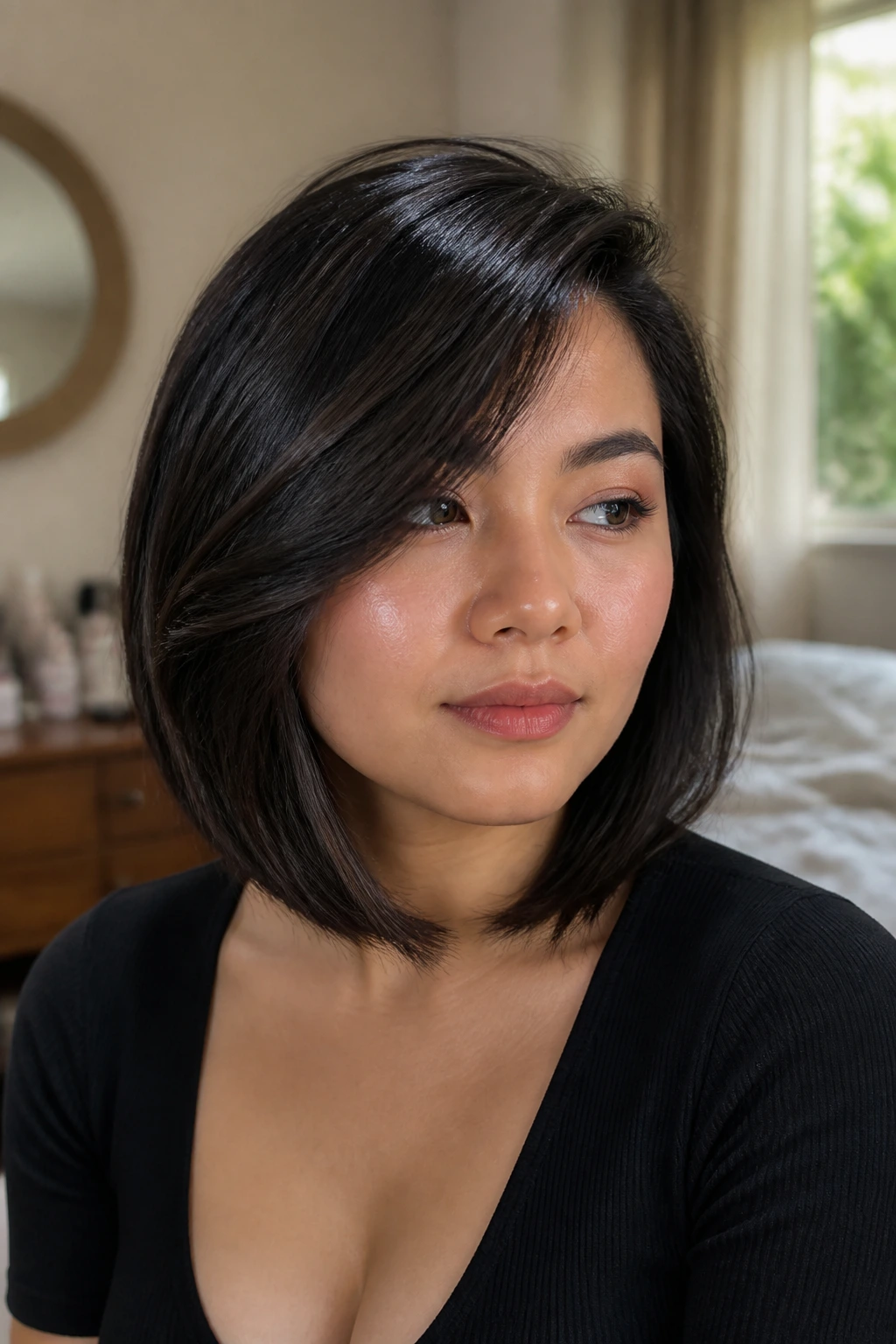
A slight off-center part is one of the most underrated moves for round faces. It gives you some of the slimming effect of a side part without the drama of a deep one. The front pieces can sweep softly across the forehead and fall diagonally toward the collarbone, which breaks up the face in a gentler way.
This lob works especially well when the ends are softly beveled and one side is tucked back. That asymmetry keeps thick hair from looking too uniform. Uniform is the enemy here. A little imbalance makes the cut feel alive.
I’d pick this over a strict center part when the hair is very full around the jaw. It creates motion without trying to make a statement every morning.
25. Growth-Friendly Transition Lob
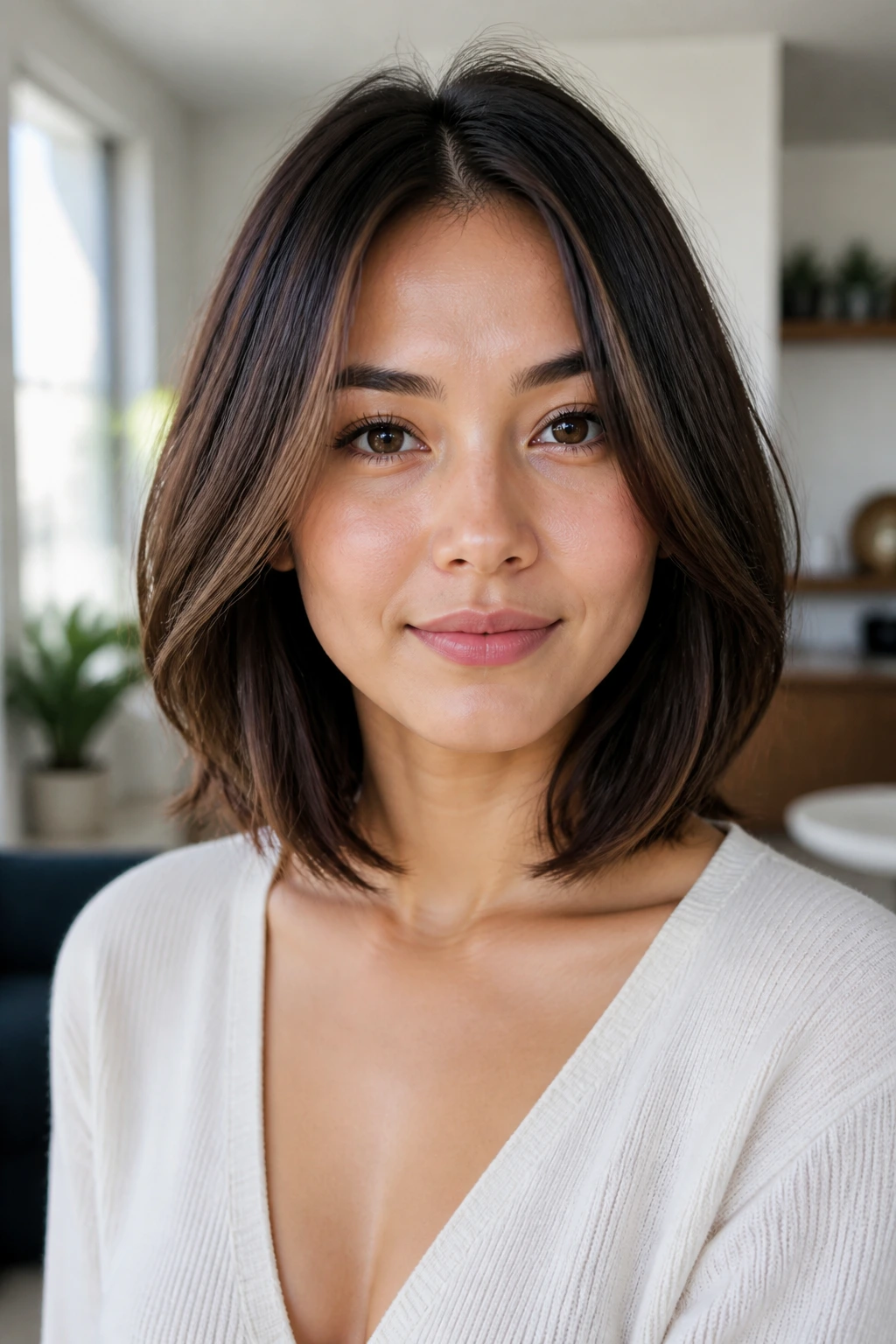
A growth-friendly transition lob is what you ask for when you want a shape that still behaves six weeks later. The length should start around the collarbone, the face frame should stay long and soft, and the layers should live below the chin so they don’t turn into a shelf as the hair grows. Thick hair benefits because the extra length keeps the bulk grounded.
Round faces like this cut because the shape only gets a little longer and more flattering as it grows. There’s no ugly stage where the haircut suddenly balloons out or loses its outline. That matters more than people admit.
If you hate frequent salon visits, this is the safest option in the bunch. It has enough structure to look deliberate and enough softness to survive a little neglect.
Why the Lob Geometry Matters More Than the Trend Label
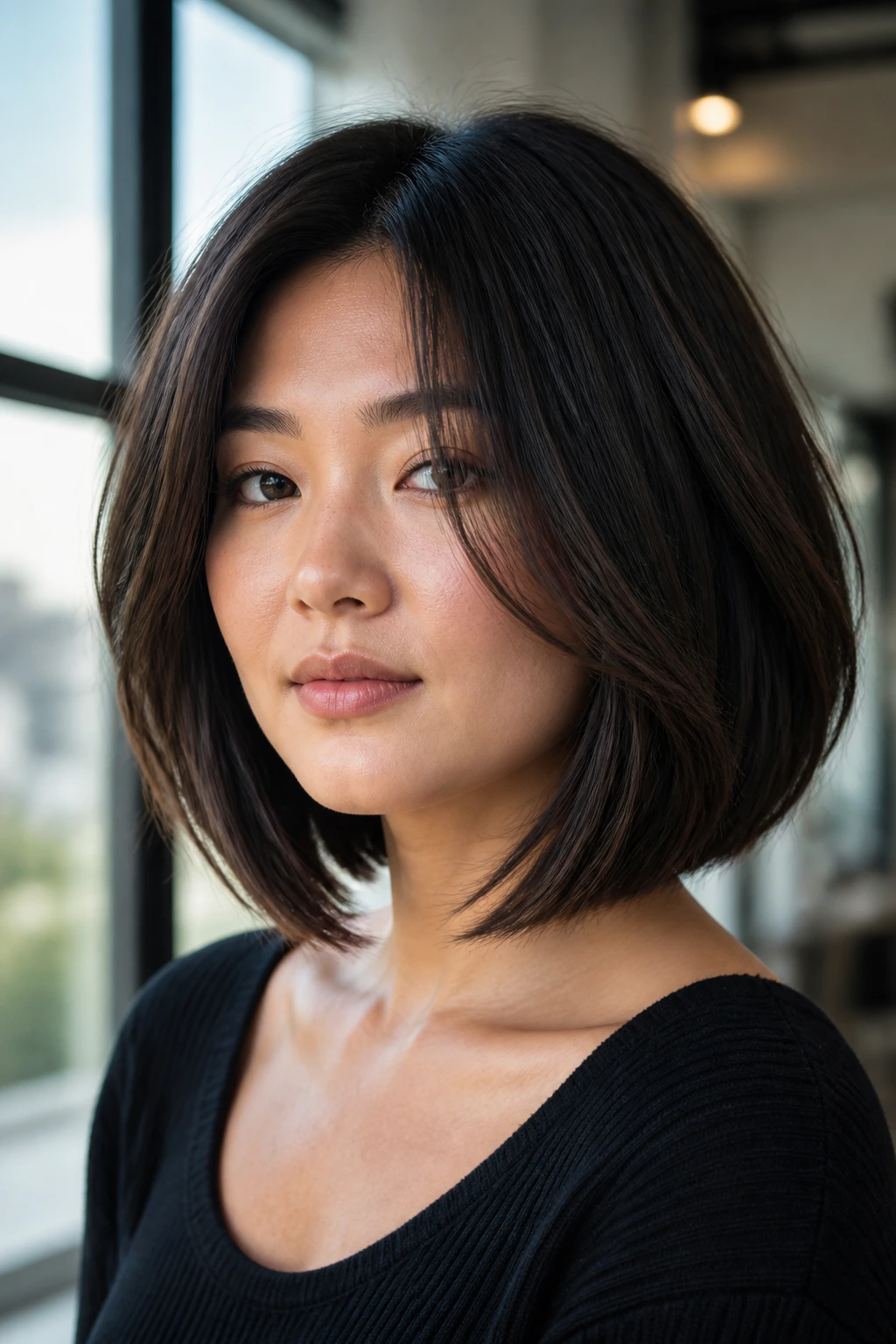
The label on the haircut is the least interesting part. The geometry is the part that matters. Round faces usually read widest at the cheeks, and thick hair naturally wants to spread, so the haircut has to solve both problems at once. That means the best lob is usually doing three things at the same time: lowering the visual center of the hair, keeping volume away from the sides, and creating a line that makes the face feel a little longer than it is wide.
The easiest mistake is to ask for a lob that sits too high and too full. That’s how you get the pyramid effect. Hair springs out at the sides, the length stops at the jaw, and the face gets more emphasis than you wanted. The better move is to keep the perimeter low, let the front drift toward the collarbone, and save the width for the crown or the back of the head.
A stylist who knows thick hair will usually talk about weight. A stylist who knows round faces will talk about length and line. The best lobs sit in the overlap between those two ideas. You want enough internal shaping to stop bulk, but not so much that the ends look thin and nervous. You want enough face-framing to lengthen the face, but not so much that the cheeks are framed like a spotlight.
That balance is why these cuts keep showing up in Korean, Japanese, and other East Asian salon references. The hair is often dense, straight, or softly textured, and the solution is rarely aggressive. It’s a little bend here, a little weight removal there, and a perimeter that knows exactly where it wants to sit.
Essential Tools for Styling These Lobs
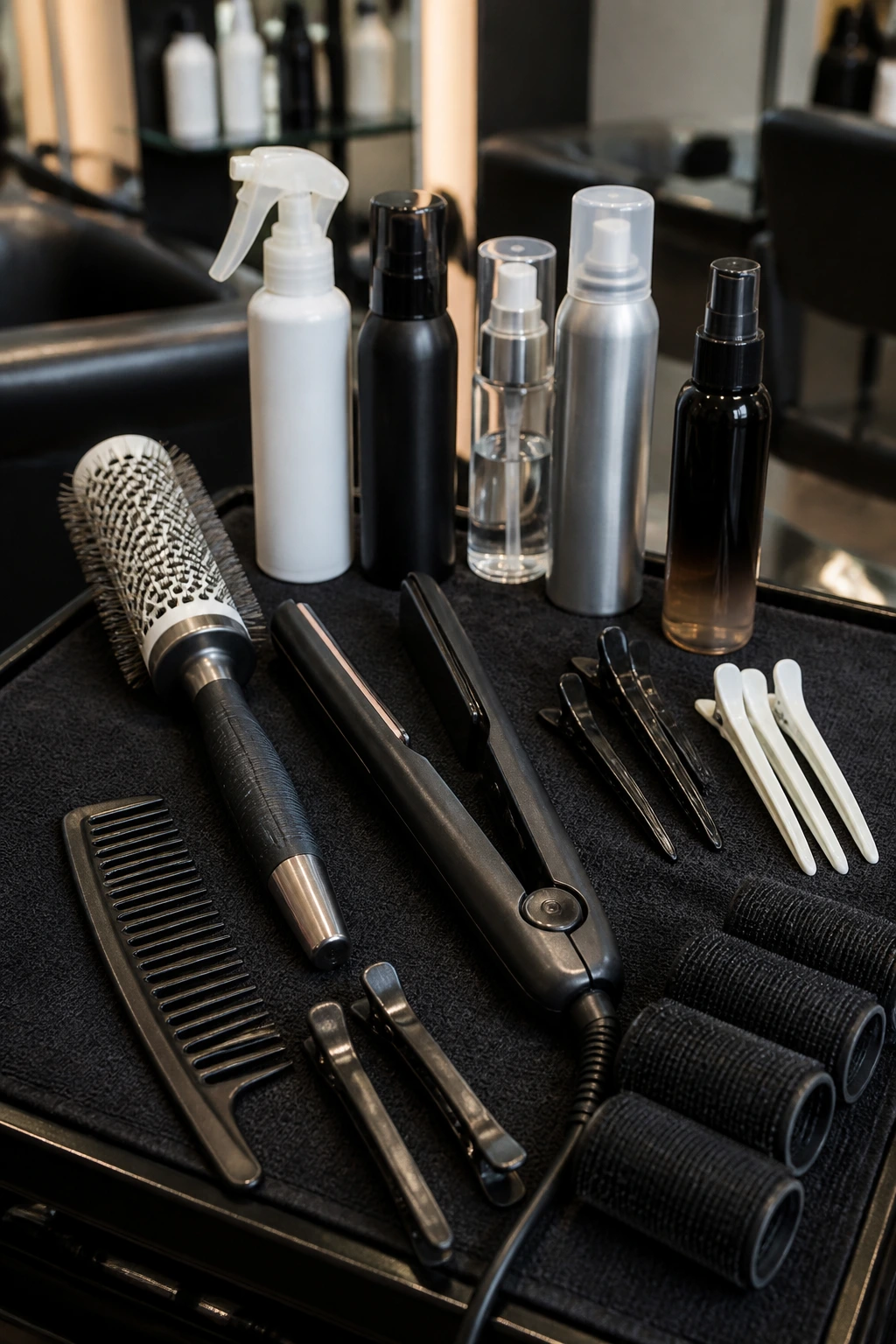
- Blow dryer with a concentrator nozzle: The nozzle helps direct thick hair smooth instead of blasting it everywhere.
- 1.25-inch round brush: A good all-purpose size for collarbone-length hair and soft inward bends.
- Flat iron with rounded edges: Best for glass-sleek lobs and gentle C-curls without harsh creases.
- Sectioning clips: Thick hair needs clean sections or the top layer gets overworked while the underlayer stays damp.
- Heat protectant spray or cream: Use it every time you heat style; thick hair is not immune to damage.
- Root-lift mousse: Handy for side parts, blowouts, and any lob that needs volume at the crown rather than the cheeks.
- Lightweight smoothing serum: A pea-sized amount on the ends keeps flyaways down without flattening the cut.
- Texturizing spray: Useful for piecey waves and shaggy lob styles when you want separation, not stiffness.
- Wide-tooth comb: Better than a fine comb for detangling thick hair without puffing it up.
- Duckbill clips or Velcro rollers: Small tools, big payoff when you want to set the front bend or keep a blowout in place.
Smart Salon Prep and Product Choices
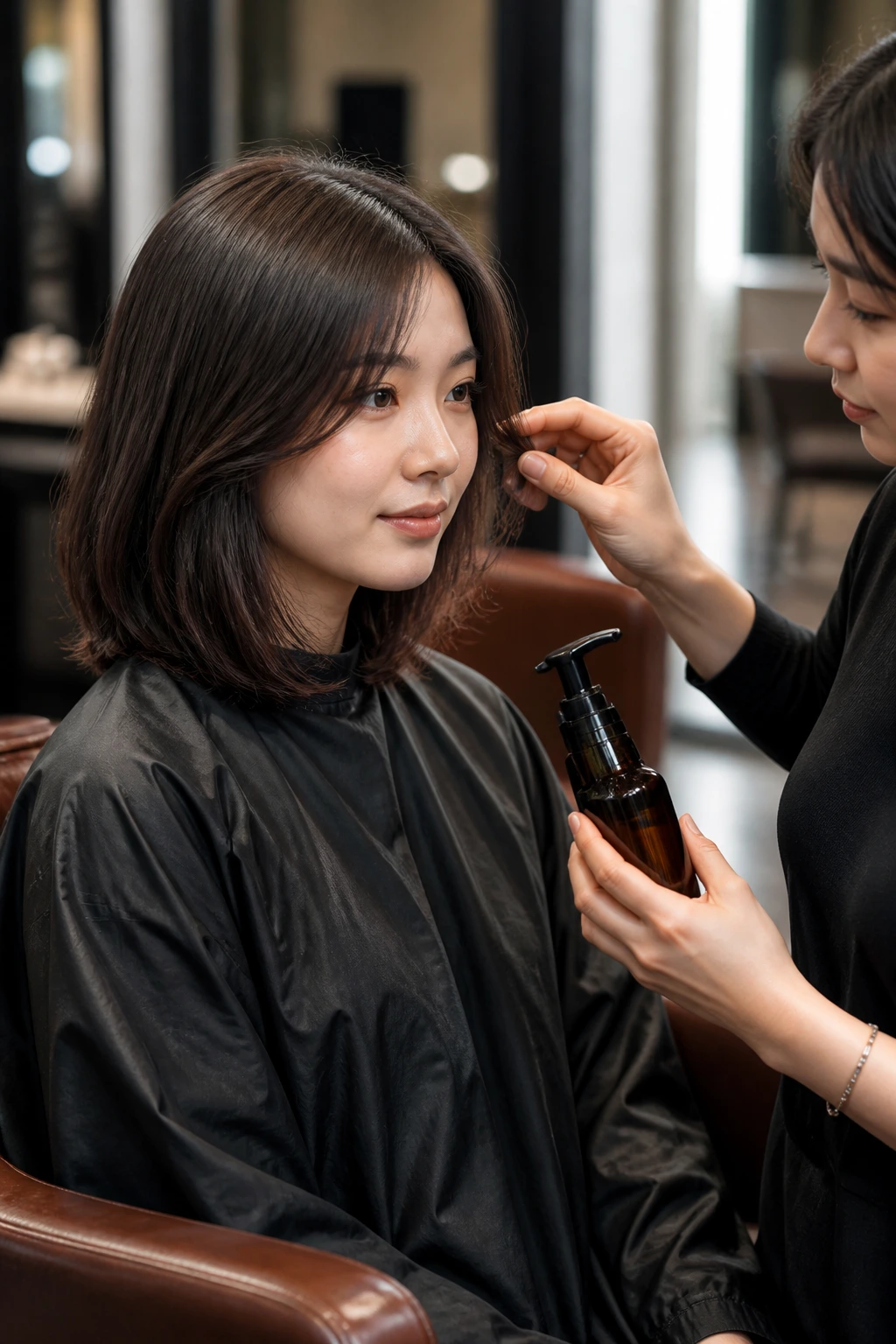
Bring photos, but bring the right photos. A picture of a lob on fine hair will not help much if your hair is dense and yours tends to sit fuller at the sides. Look for examples where the hair has the same kind of body, the same front length, and the same amount of movement you want. That one habit saves a lot of disappointment.
At the salon, use plain language. Say whether you want the perimeter blunt, softly beveled, or lightly layered inside. Say where the shortest front pieces should land — below the cheekbone, at the jaw, or grazing the collarbone. If you have thick hair, mention whether you want bulk removed from the interior or whether you need the shape kept heavy at the bottom. Those are different cuts.
Product choice matters just as much. Thick hair often behaves better with medium-hold mousse, heat protectant, and lightweight serum than with heavy creams piled everywhere. If your hair gets fluffy, look for smoothing products that control the cuticle without turning the roots greasy. If your hair is coarse and dry, a cream through the mid-lengths can help, but keep it away from the scalp or the lob will lose lift.
A clarifying shampoo before a fresh cut can help too, especially if your hair gets coated with leave-in products and dry shampoo. Clean hair gives the stylist a better read on how the lob will sit. Dirtier hair can hide bulk in the chair and then surprise you the next day.
How to Style These Lobs in Daily Life

Presentation: Choose the part based on where your face feels widest. Center parts are clean and lengthening when the front is long enough; side and off-center parts help break up cheek width and are often easier to live with on thick hair.
Best Matches: Pair sleeker lobs with sharper necklines, small hoops, and more structured makeup. Softer, layered lobs work nicely with relaxed collars, open necks, and a little more texture around the face so the style does not look too stiff.
Volume Placement: Keep the lift at the crown or back of the head. If you add volume right at the cheeks, the face can look broader no matter how good the cut is.
Accessory Pairing: Tucking one side behind the ear, adding a small barrette, or using a slim clip at the back can change the whole shape in 30 seconds. Glasses also matter; if you wear them, a lob with longer front pieces usually avoids crowding the frames.
Additional Tips and Finishers
Shape Boost: If your lob looks flat at the front, wrap the first inch around a medium round brush and hold it for 10 seconds with the dryer on low heat. That tiny bit of set is often enough to keep the hair from flipping outward.
Texture Swap: Thick hair that feels puffy with cream can sometimes look better with mousse or a light foam instead. Cream smooths, but mousse gives body control without the slip that can make a cut collapse.
Fast Upgrade: A one-pass bend with a flat iron through the lower third of the hair is often better than trying to curl the whole head. You keep the length visible, and the cut looks intentional instead of overstyled.
Make-It-Yours: If you like polish, go sleeker and tuck the sides. If you like movement, add soft waves only from the ear down. If your hair is coarse, ask for a little more internal removal so the style does not balloon by midafternoon.
How to Keep the Shape Between Washes and Cuts
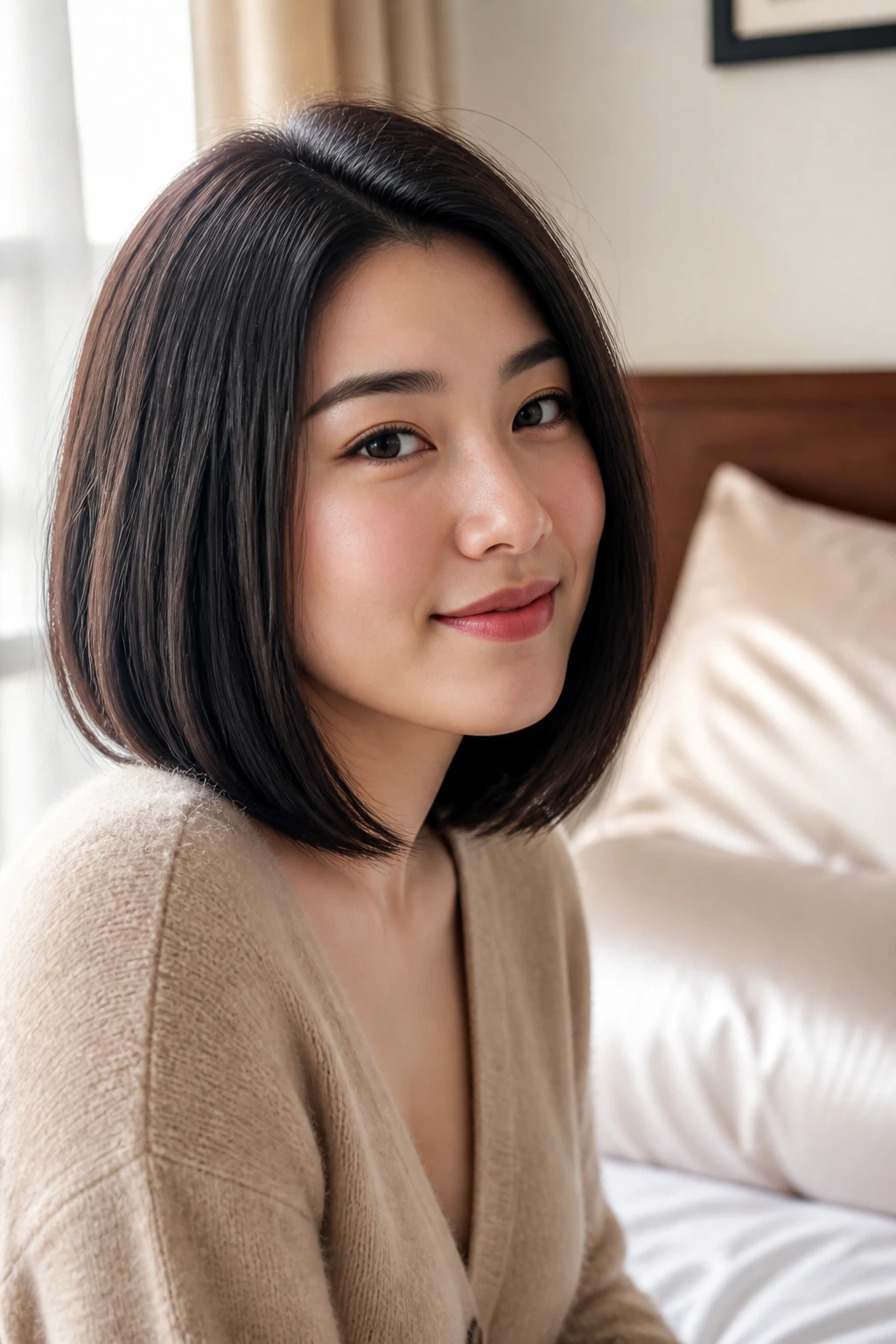
Most of these lobs look best on day one or day two, not day five with three kinds of product sitting on the ends. Thick hair can hold a shape well, but it also collects weight fast. If your roots get oily, use dry shampoo on the scalp only, then brush it through lightly so the ends stay smooth. A heavy second layer of dry shampoo just makes the hair feel dusty.
Night care matters more than people think. Sleep on a satin or silk pillowcase if you can, or at least pin the front pieces loosely behind the ears so they do not kink in odd places. If you wear a blowout lob, let the hair cool completely before bed. Warm hair bends where it lands.
For trims, most blunt or beveled lobs need a shape check every 6 to 8 weeks if you want the line to stay crisp. Textured or growth-friendly versions can go 8 to 12 weeks before they start losing the plot. If you are growing it out, ask for micro-trims around the perimeter instead of taking off the whole shape.
Refreshes are simple. Mist the front pieces with water, add a touch of smoothing cream or mousse, and re-bend the ends with a brush or flat iron for 3 to 5 minutes. That is usually enough. No full wash required.
Variations and Adaptations to Try
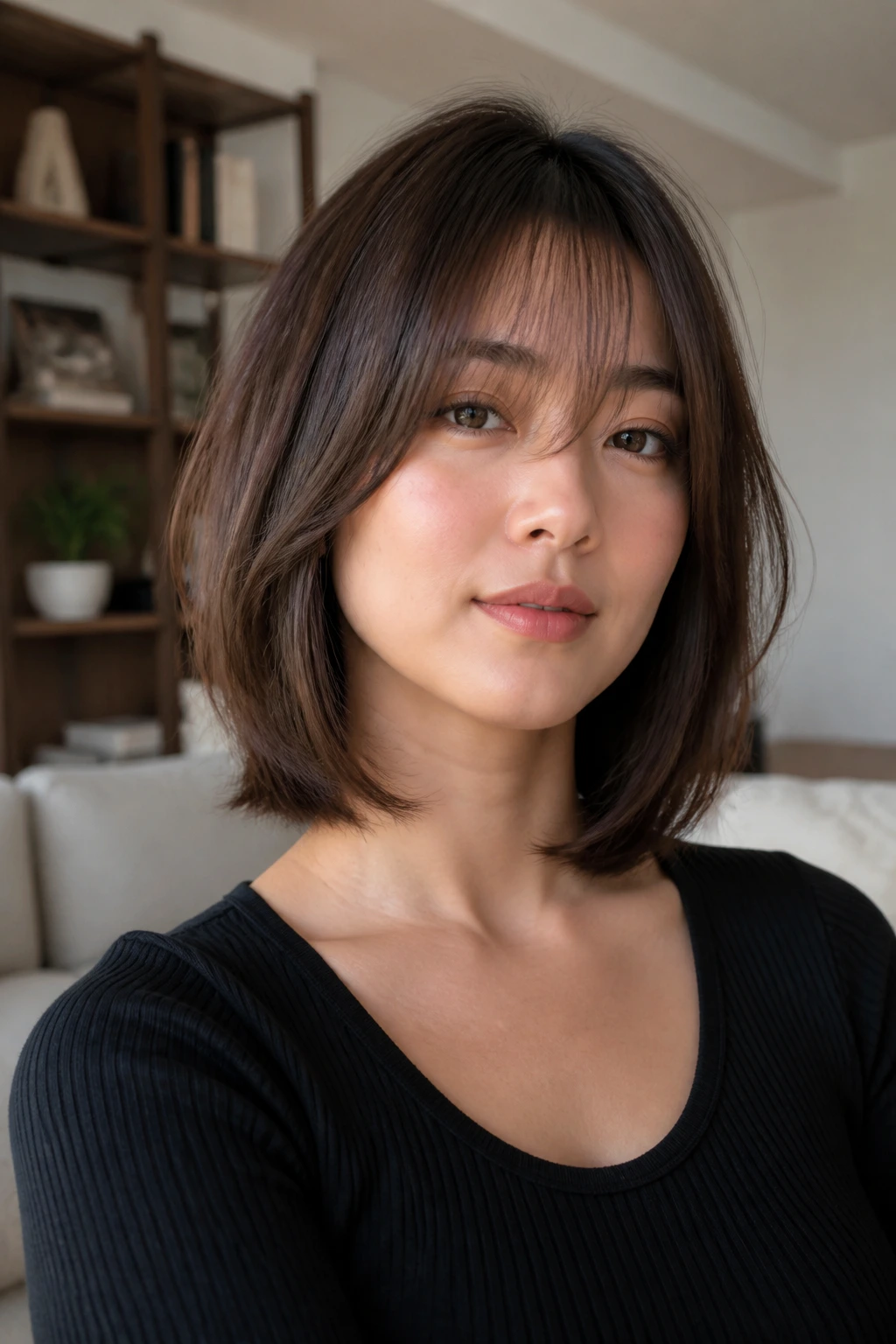
The No-Heat Lob: This version leans on a cut that air-dries well, with long layers and low face framing. Use leave-in conditioner and a dab of curl cream, then clip the front sections while they dry so the hair falls away from the cheeks.
The Glass Finish Lob: Best for people who like the hair polished and reflective. Ask for a sharper line, keep the layers minimal, and use heat protectant plus a flat iron to smooth the lengths into one clean sheet.
The Fringe-Forward Lob: Add curtain bangs, bottleneck bangs, or a long side fringe if your forehead feels heavy on a round face. The bangs should open downward, not out to the sides, or the face can look wider.
The Low-Fuss Growth-Out Lob: This is the softest version of the cut, with longer front pieces and very restrained layers. It’s the one I’d pick if you hate trims and don’t want the haircut to lose shape between appointments.
The Texture-First Lob: Good for thick, wavy hair that wants movement. The cut gets a little more internal shaping, and styling relies on wave cream or texture spray rather than a round brush.
Common Mistakes to Avoid
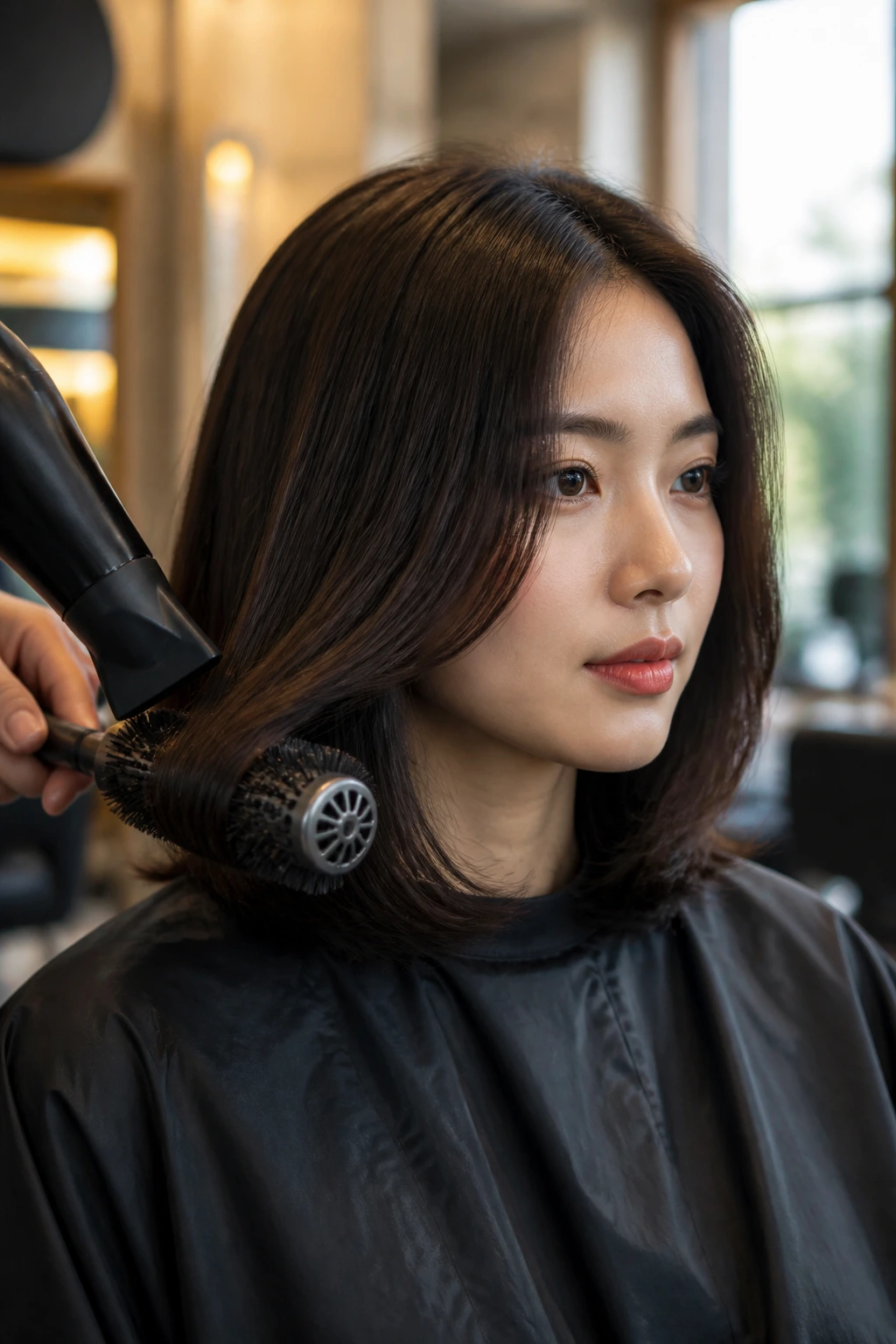
The biggest mistake is cutting the length too high. If the lob ends right at the jaw or cheekbone, a round face can look wider because the hair stops at the exact point you’re trying to soften. Keep the front longer, and let the cut work below the widest part of the face.
Over-layering is another problem. Thick hair does need bulk removed, but too many short layers create a shelf or a triangle. The symptom is obvious: the top looks flatter, the bottom sticks out, and the whole haircut seems to have two personalities. Ask for internal shaping instead of a pile of short exterior layers.
A third mistake is using too much product. Thick hair loves a little control, not a slick helmet. When serum, cream, and oil all land in the wrong place, the lob collapses and the movement disappears. Keep heavy products off the roots and use them sparingly on the ends only.
People also forget how much parting changes the shape. A center part can look elegant, but if it exposes too much width at the cheeks, switch to a soft off-center part and watch the whole cut feel slimmer. Small change. Big difference.
Finally, do not style volume at the sides if the goal is to flatter a round face. Volume belongs at the crown, the back, or the ends with direction. Side fullness is what gives you the puffed-out look nobody asked for.
Questions People Ask Before Choosing a Lob
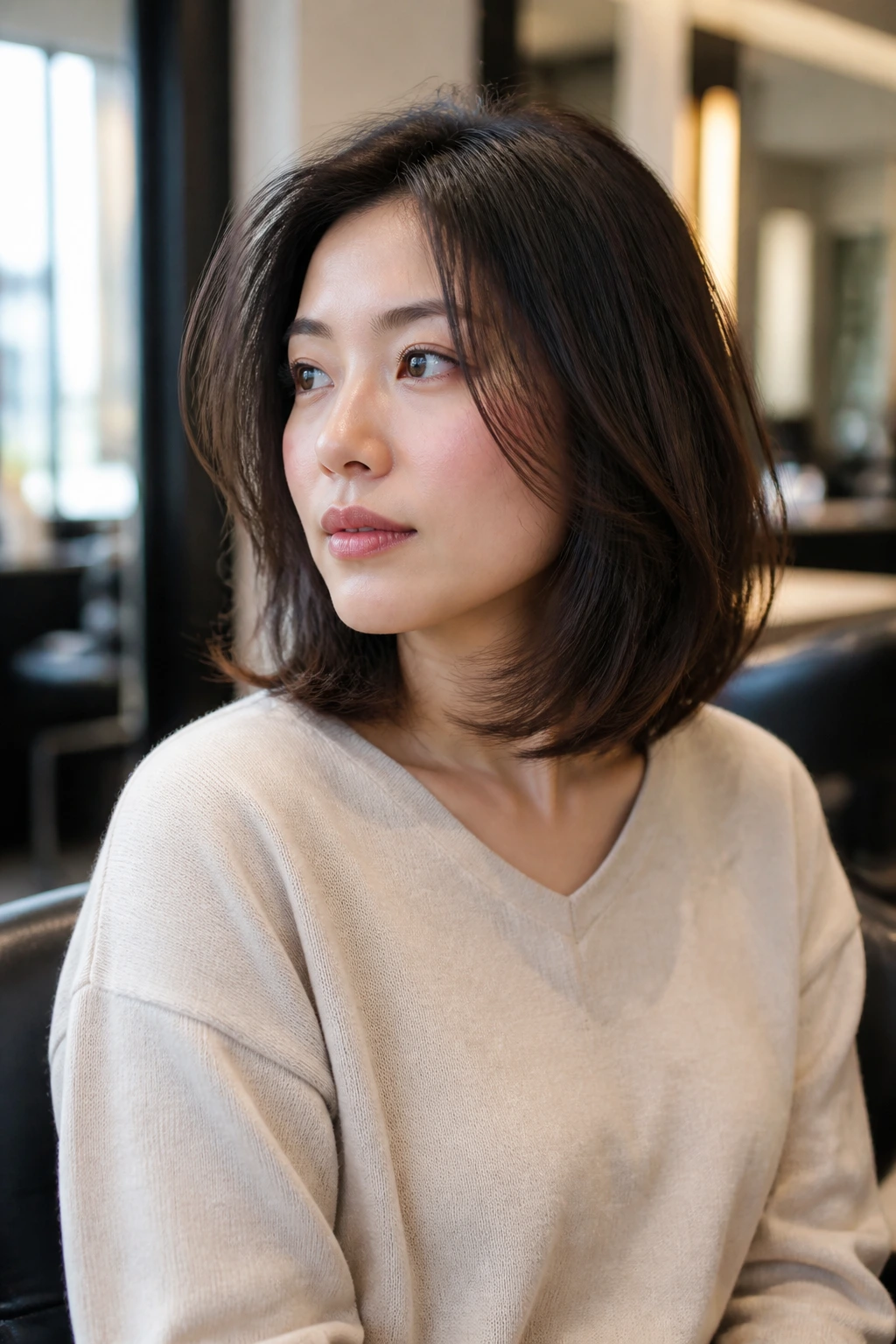
What lob length is best for a round face?
The safest length usually lands between the collarbone and a little below the jaw. That range keeps the face from looking wider while still letting thick hair hold its shape. If you want more slimming, make the front slightly longer than the back.
Can thick hair really work with a blunt lob?
Yes, and often better than fine hair can. Thick hair gives blunt cuts a strong outline, but the interior usually needs a little weight removal so the ends do not flare out. A blunt perimeter with hidden shaping is the sweet spot.
Are curtain bangs good for round faces?
They can be, if they’re long and open low enough. Short curtain bangs can widen the face, but longer ones that start around the cheekbone create a vertical frame that feels softer. Thick hair helps them sit well.
Should I ask for layers or one length?
That depends on how much bulk your hair carries. If your thick hair feels heavy and triangular, ask for long internal layers. If your hair already behaves well and you want a sleek line, one length or a very subtle bevel may be enough.
How often should a lob be trimmed?
Most lobs need a trim every 6 to 10 weeks to keep the outline clean. Blunt versions drift out of shape faster. Textured versions can stretch a bit longer, but once the ends start flipping in odd directions, it’s time.
What if my lob puffs out at the sides?
That usually means the cut is too short around the cheekbone or the product is too heavy at the root. Try moving the part, using less cream, and styling the ends inward or downward instead of outward. If the problem keeps coming back, the cut likely needs more length in front.
Can I wear these lobs if my hair is wavy?
Absolutely. Wavy thick hair often looks especially good in lob shapes with long layers and soft bends. You may need less heat and more smoothing through the top, but the overall shape still works.
Do these cuts still look good with glasses?
Yes, as long as the front pieces are long enough to avoid crowding the frames. A tucked lob, off-center lob, or curtain-bang lob usually works well with glasses because it opens the face without piling hair around the temples.
A Clean Finish
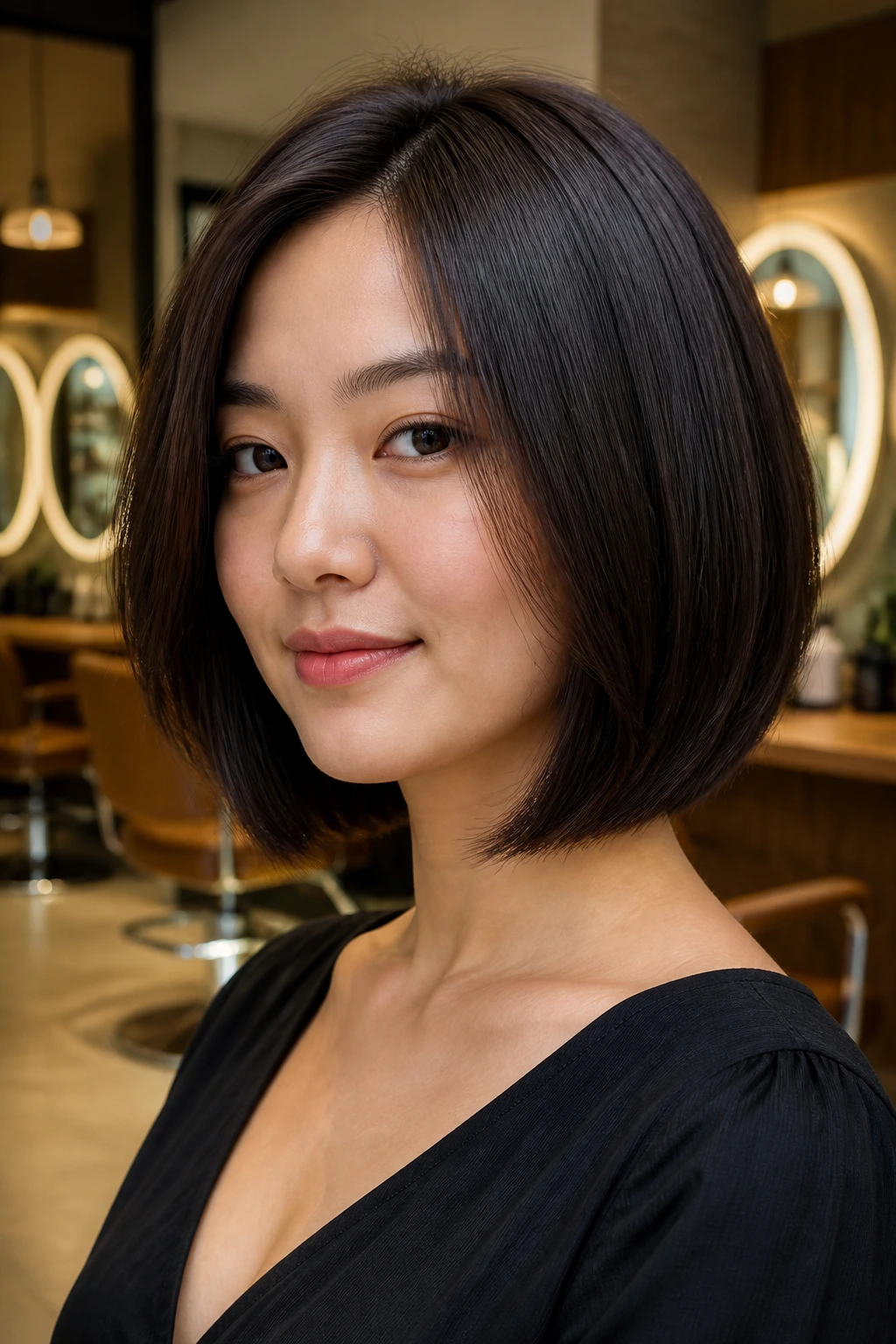
A good lob does not fight thick hair. It gives it a lane. That’s the whole reason these shapes work so well on round faces too: they use length, line, and controlled movement instead of brute-force layers or blunt width where you don’t want it.
If you’re choosing between cuts, look at where the shortest front pieces land and ask one blunt question in the salon chair: does this make my face look longer, or just make my hair shorter? The answer tells you almost everything.
Pick the version that fits how you actually style your hair, not the one that only looks good after a perfect blowout. That’s where the best lob lives.