



Ash black highlights on warm skin tones live or die by the undertone. Get the shade wrong, and the hair can land heavy, chalky, or a little too blue for the face sitting underneath it. Get it right, and the whole effect turns sharp in a good way — like someone quietly cleaned the edges of your features without touching your makeup.
That’s the part people miss. Ash black is not jet black. It isn’t the inky, flat kind of darkness that can swallow warmth. It’s charcoal, smoked espresso, graphite, the color hair gets when it’s cooled down but still has depth. On golden, peach, olive, and caramel complexions, that difference matters a lot. It decides whether the color looks polished or like it was dropped on the head in one hard block.
The looks below lean into that balance. Some are whisper-soft, with fine babylights and barely-there ribbons. Others bring in bolder stripes, face-framing panels, or smoky ends that read a little more editorial. Warm skin doesn’t need to be hidden from cool color. It just needs the coolness placed with a steadier hand.
Why Ash Black Highlights Work So Well on Warm Skin Tones
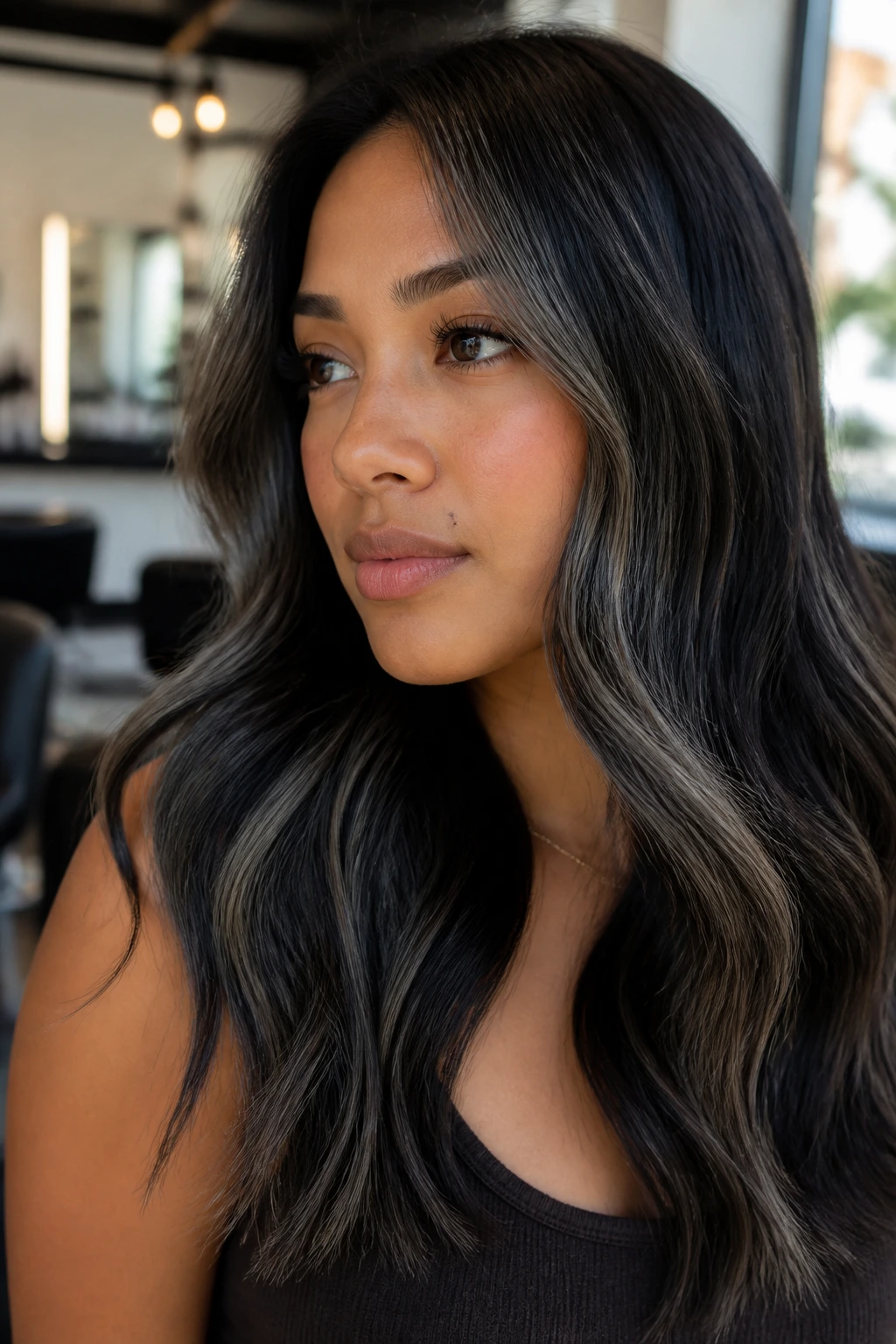
Soft contrast: Ash black gives warm skin a cleaner edge than jet black, which can sometimes look too dense around the face. The smoky finish keeps the hair dark without turning the complexion sallow.
Brass control: On brunette bases, ash-black pieces can calm orange or red lift in the mid-lengths, especially if your hair tends to pull copper in sunlight. The result is cooler, not muddy.
Shape without harshness: A few charcoal ribbons around the cheekbones or jawline can make the face look more defined without the blocky effect of a solid dark dye job. That matters on warm skin, where too much darkness at the hairline can feel severe.
Works with dimension: Balayage, babylights, money pieces, and peekaboo panels all let the ash live in different places. That means the color can be subtle on weekdays and more noticeable when light hits it from the side.
Grows out cleaner: When ash black is blended with your natural brunette base, the regrowth line stays softer. You’re not dealing with a hard stripe every time your hair moves into a ponytail.
Looks richer in daylight: A good ash-black highlight isn’t obvious indoors and flat outdoors. It should shift between soft smoke and deep graphite as the light changes, which is exactly what keeps it from looking painted on.
Ash Black Is Not Jet Black, and That Small Difference Changes Everything
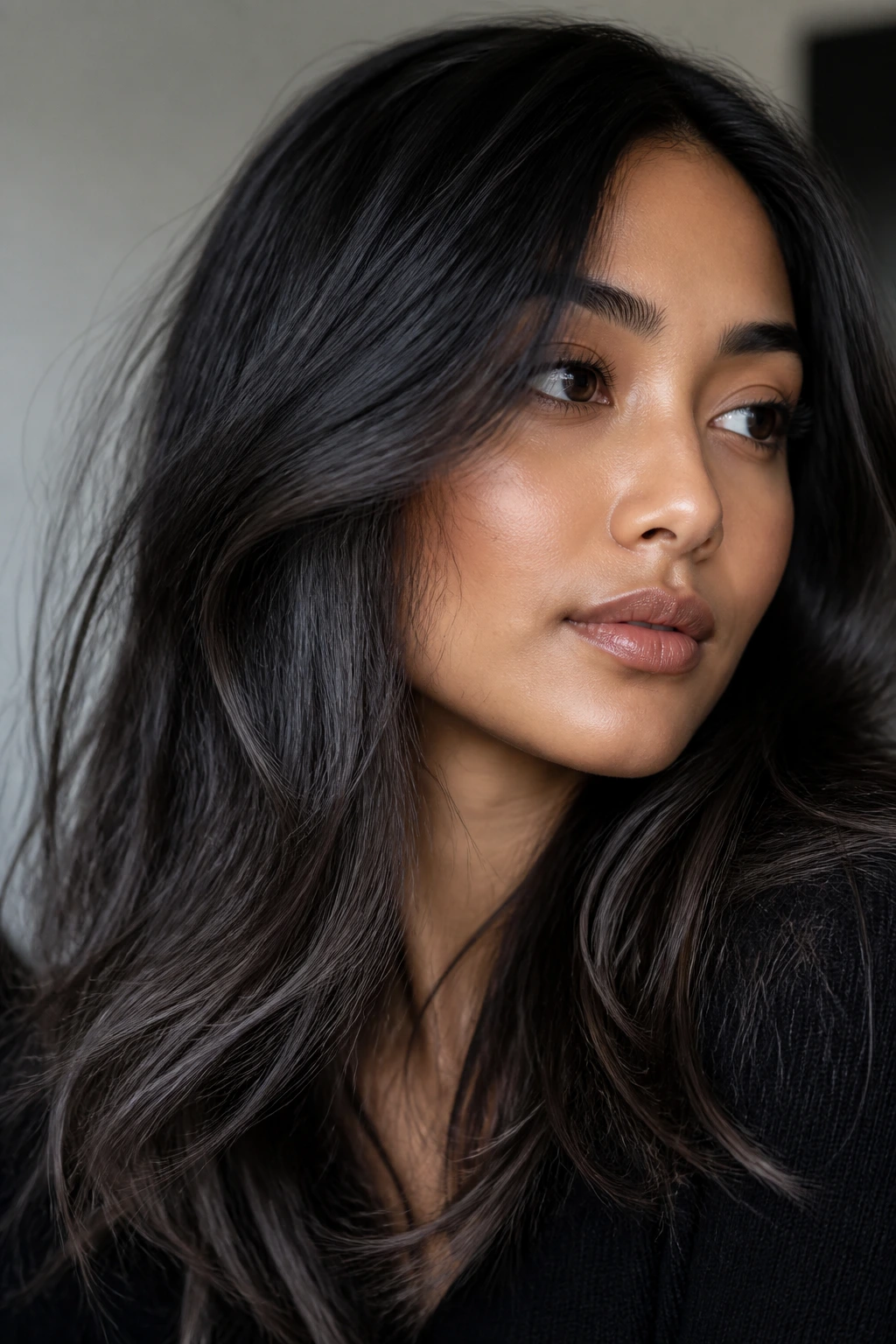
Ash black sits in a strange little pocket between black and brown. It has less warmth than espresso, less glare than blue-black, and more breathing room than a pure black dye. That’s why it behaves so differently on warm skin tones.
If you’ve ever seen a harsh black strip near a warm complexion and thought, that hair is wearing the face, you already know the problem. Jet black can be beautiful, but it has a blunt edge. Ash black softens the edge. It keeps the hair dark while leaving room for the skin to stay alive.
What ash actually means
Ash usually points to a cool, muted finish with gray, blue, or green-based reflect. In hair color, that doesn’t mean icy silver. It means toned-down warmth. A good ash-black piece should look like smoke over brown, not shoe polish.
What to avoid
Too much blue-black near the face can make golden skin look tired. Too much green-leaning ash can go dull on porous hair. The safest sweet spot is usually a smoky brunette base with controlled depth, not a hard black overlay from root to tip.
Golden, Peach, and Olive Undertones Need Different Placement
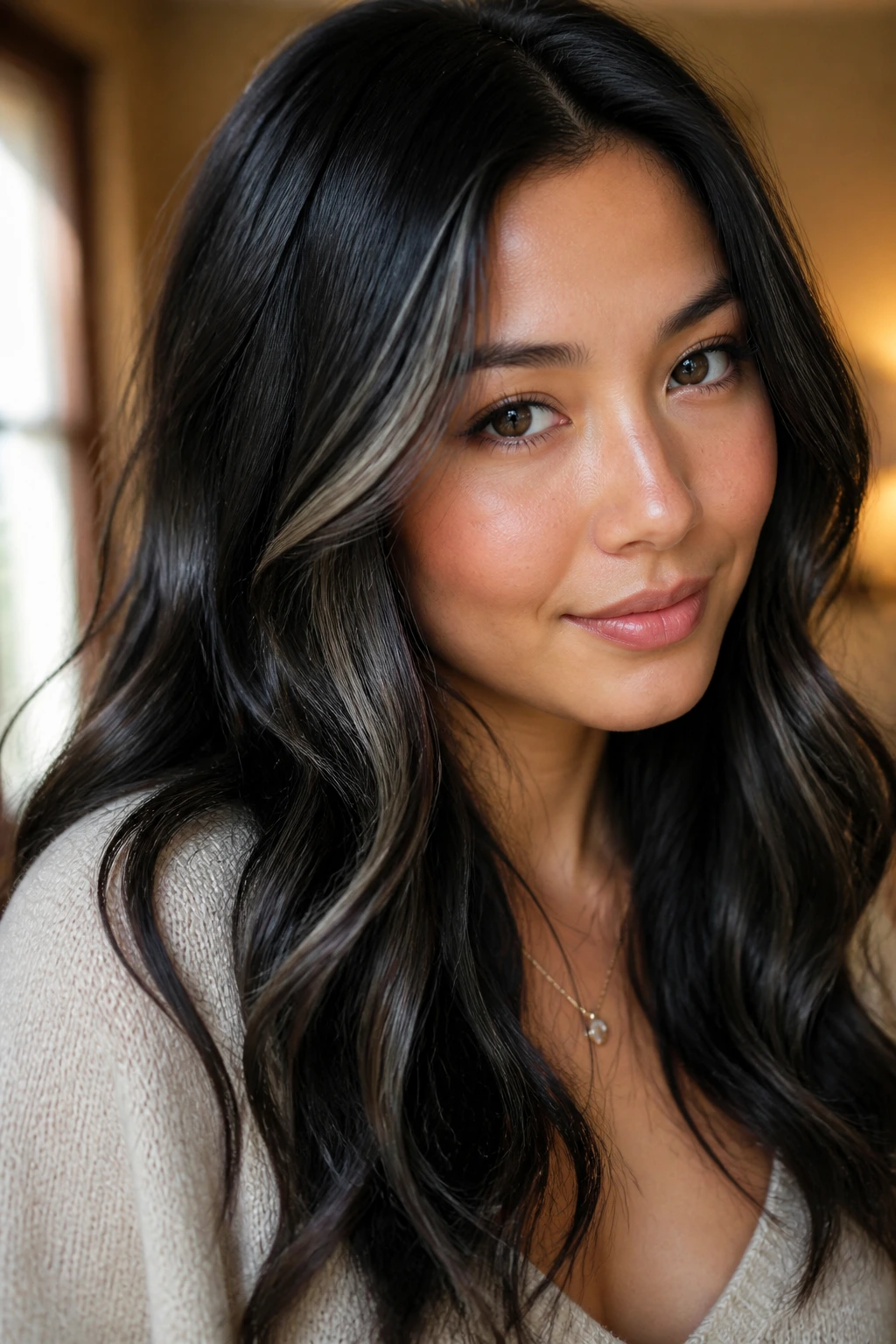
Warm skin is not one thing. Golden skin can take a little more depth near the face. Peach skin often needs softer ribbons and less root-to-end contrast. Olive-warm skin can handle charcoal better, but usually looks best when the cool pieces are broken up instead of packed together.
Golden undertones usually like smoky ribbons that sit just off the face. Peach undertones tend to look best with a softer root and cooler ends rather than a heavy fringe of dark pieces. Olive undertones can carry more ash, but if the hair gets too flat, the complexion starts to do the work the color should have done.
A good stylist reads this the way a tailor reads a shoulder seam. Same fabric. Different cut.
The easiest shorthand
- Golden skin: softer ash ribbons, more brown left in the base.
- Peach skin: fine placement, no harsh root darkness at the hairline.
- Olive skin: stronger charcoal pieces, but spaced out.
- Deep warm skin: more contrast is fine, especially with glossed ends and shine.
How to Ask for the Right Smoky Pieces at the Salon
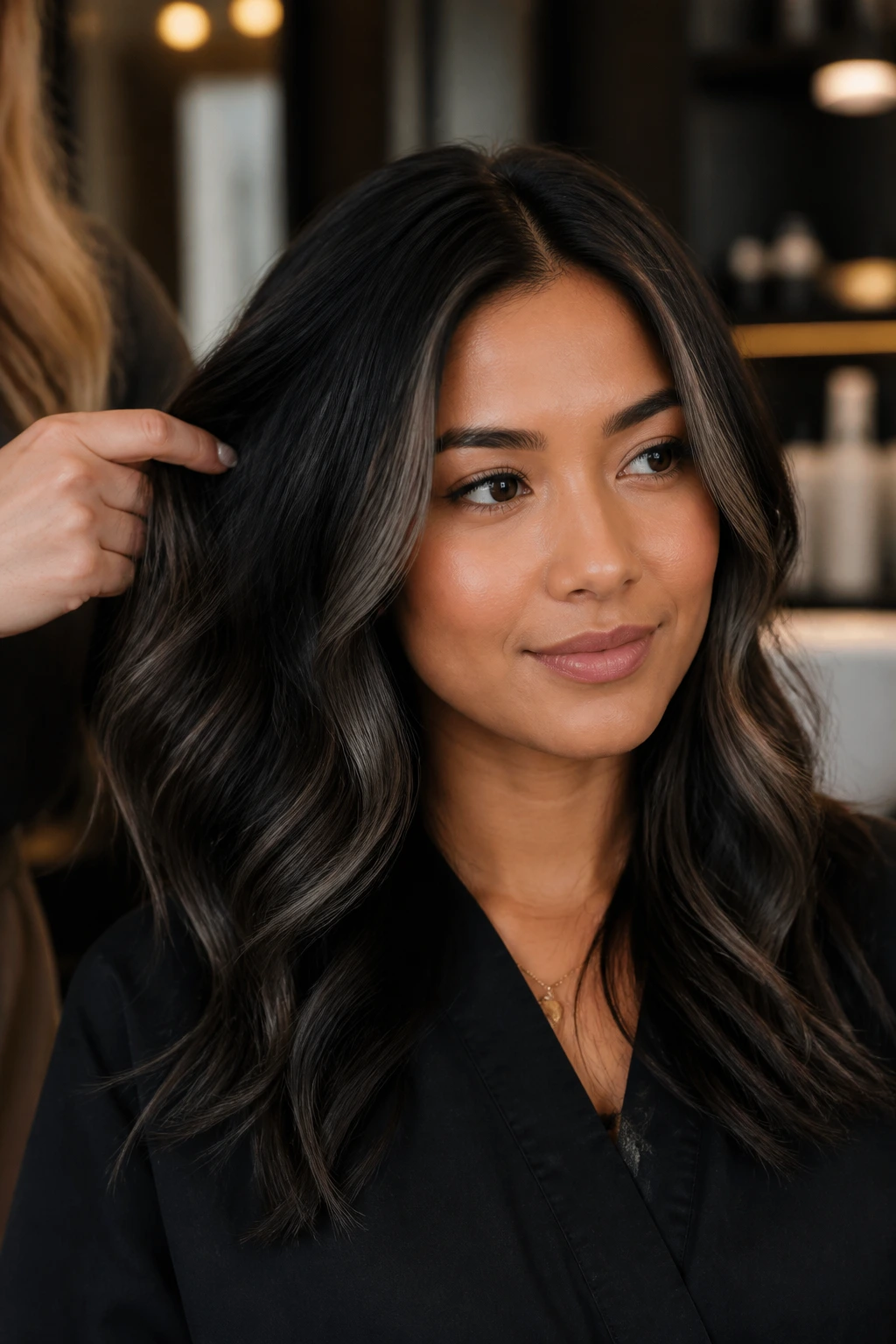
The cleanest appointment starts with a picture, a level chart, and one clear sentence about contrast. Tell your stylist whether you want the ash to read as a whisper, a ribbon, or a statement. Those are three different jobs, and they need different placement.
For subtle dimension: ask for fine babylights or micro-weaves one to two shades cooler than your base, then finish with a soft gloss rather than a hard toner. That keeps the color wearable if your hair is naturally warm.
For more visible contrast: ask for hand-painted ribbons around the crown and cheekbones, with the darkest pieces tucked underneath or closer to the ends. The face stays bright; the rest of the hair does the smoky work.
For low-maintenance grow-out: request a shadow root and blend the ash-black through the mid-lengths only. If the cool pieces start three to four inches below the root, the grow-out line stays gentler.
And say one more thing. Mention whether your hair tends to go orange, red, or green when lightened. That detail saves more bad color jobs than all the inspirational photos in the world.
1. Feathered Ash Black Face-Framing Pieces
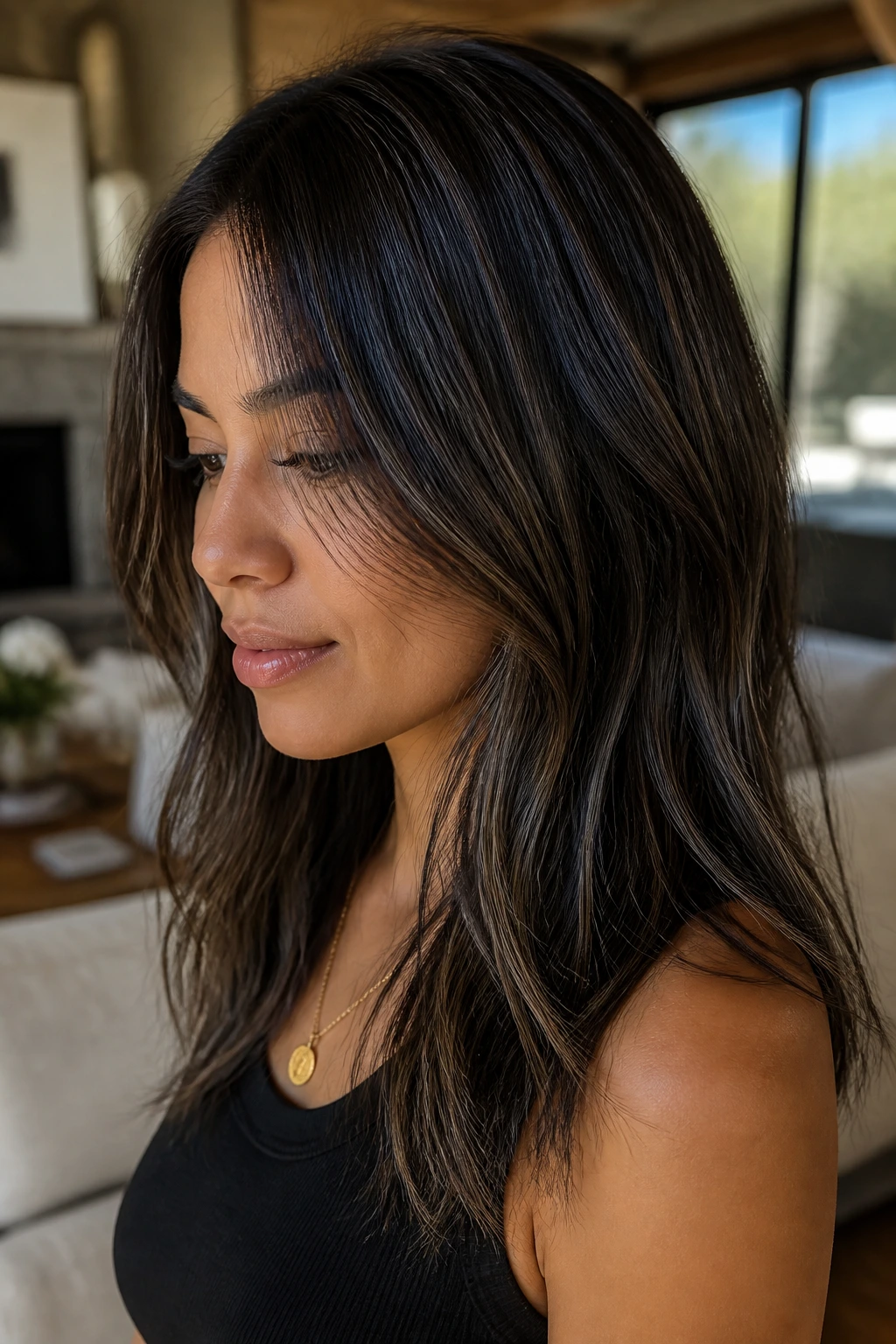
A soft face frame is the easiest way to test ash black on warm skin without diving in too deep. The pieces should be thin enough to move, not stripe the face like a marker line. On chestnut, caramel, or deep brown hair, they land as graphite ribbons that sharpen the cheekbones and leave the skin looking warm rather than washed out.
Ask for pieces around 1/2 inch to 1 inch wide, placed from the temple down through the jawline. That’s enough to matter in a mirror, but not so much that the front goes heavy. If your skin leans peachy, keep the frame slightly thinner and leave a little warmth near the part.
2. Smoky Balayage Through Chestnut Brown
This one lives in the sweet spot between obvious and quiet. The stylist paints ash-black ribbons through chestnut brown hair, usually starting below the eyes and letting the color fall through the mid-lengths and ends. Warm skin gets the benefit of movement, and the chestnut base keeps the overall look from turning cold.
It works especially well on wavy hair, because each bend catches a different piece of smoke. Straight hair can wear it too, but the ribbons should be a little wider and a touch more irregular so they don’t look like evenly spaced stripes.
3. Ultra-Fine Ash Black Babylights
Babylights are for people who want the ash to whisper, not speak. The strands are tiny — think 1/16 inch to 1/8 inch sections — and they’re woven so finely that the result looks more like shimmer than streaks. On warm skin, that subtlety matters. The color cools the hair without crowding the face.
This is a good choice if your complexion already has a lot of color on its own and you don’t want the hair to compete with it. The look turns especially pretty around the crown, where the light picks up tiny graphite threads instead of one heavy block of dark.
4. Charcoal Ribbon Highlights on Loose Waves
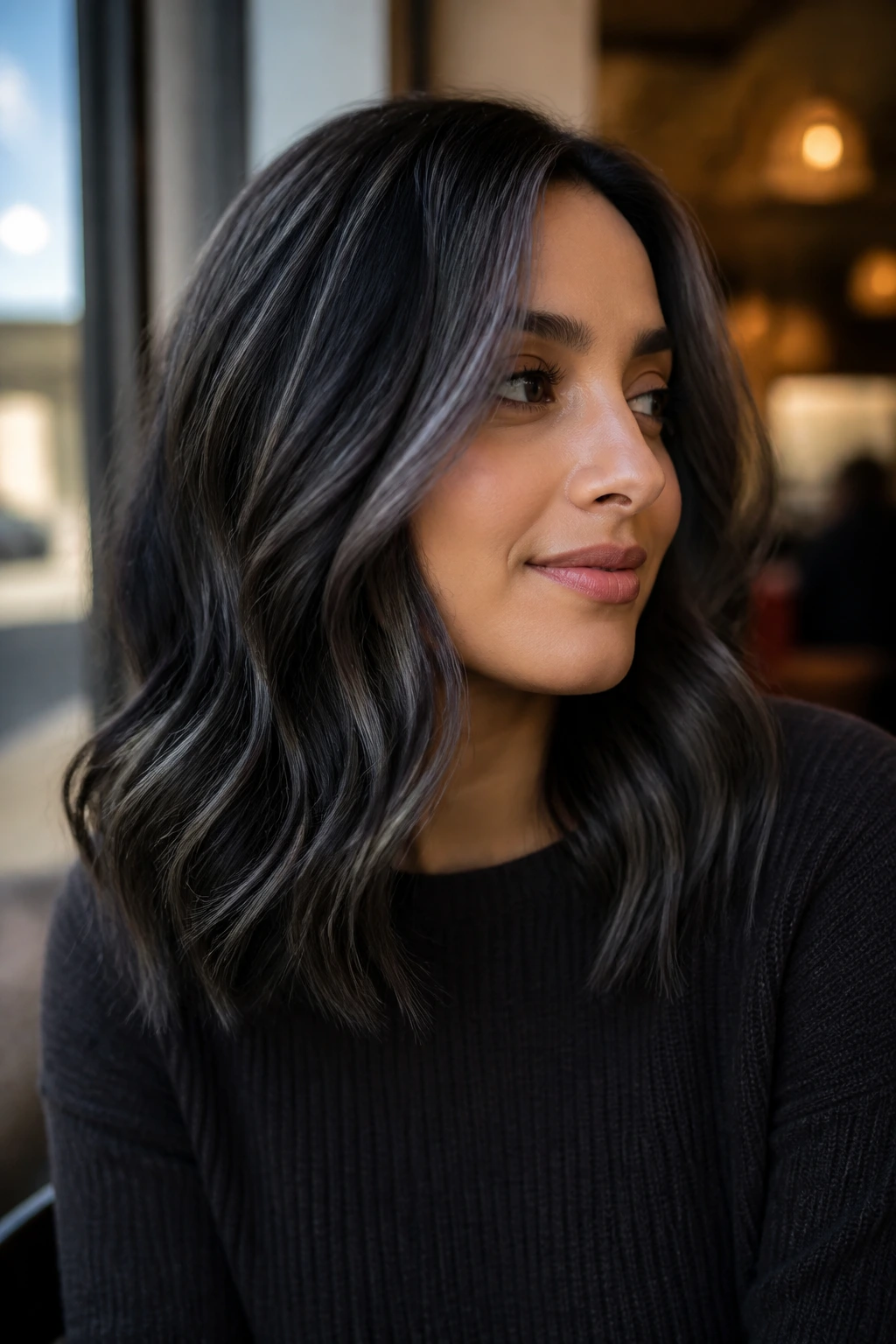
Need the hair to move? Ribbon highlights do the job. These are broader than babylights but softer than chunky streaks, and on loose waves they read as long ribbons of smoke that snake through the bends. The warm skin stays central because the dark pieces sit farther back in the hair, not all around the face.
I like this style on medium-density hair because it keeps the waves visible. Too much darkness on fine hair can make it look flat, but a few charcoal ribbons through the lower half give the texture something to hold onto.
5. Peekaboo Ash Black Underlayers
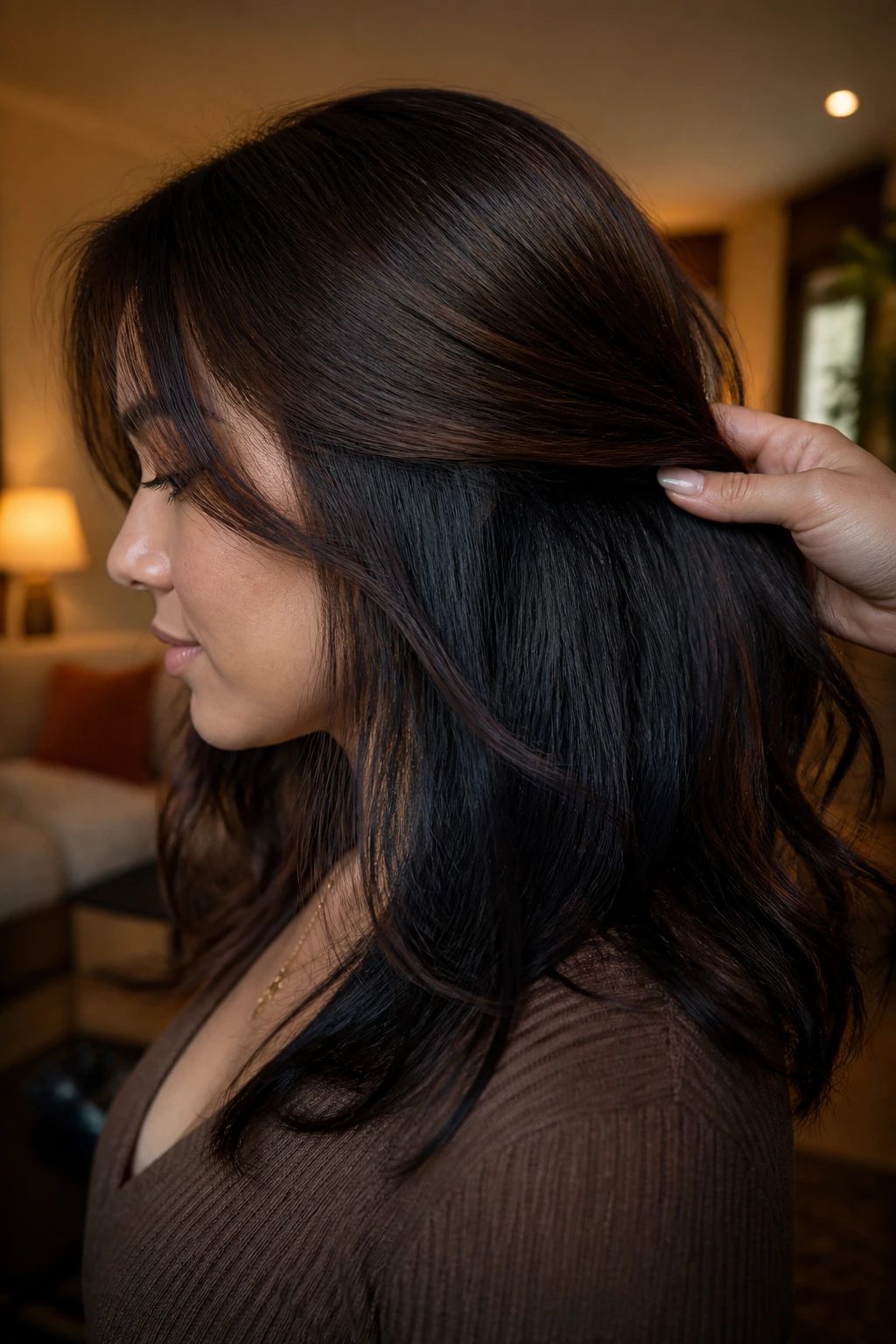
Peekaboo color is the sly one in the group. From the front, the hair can look mostly brunette with just a little cool depth. Then the head turns, or the hair goes into a half-up style, and the ash-black underlayers flash through underneath. Warm skin gets to keep its brightness while the hair has a darker underside.
This is one of the best choices if you work in a conservative setting or you just don’t want the color shouting before coffee. It also holds up well on layered cuts, where the underlayers already have room to show.
6. Soft Ash Money Piece with Curtain Bangs
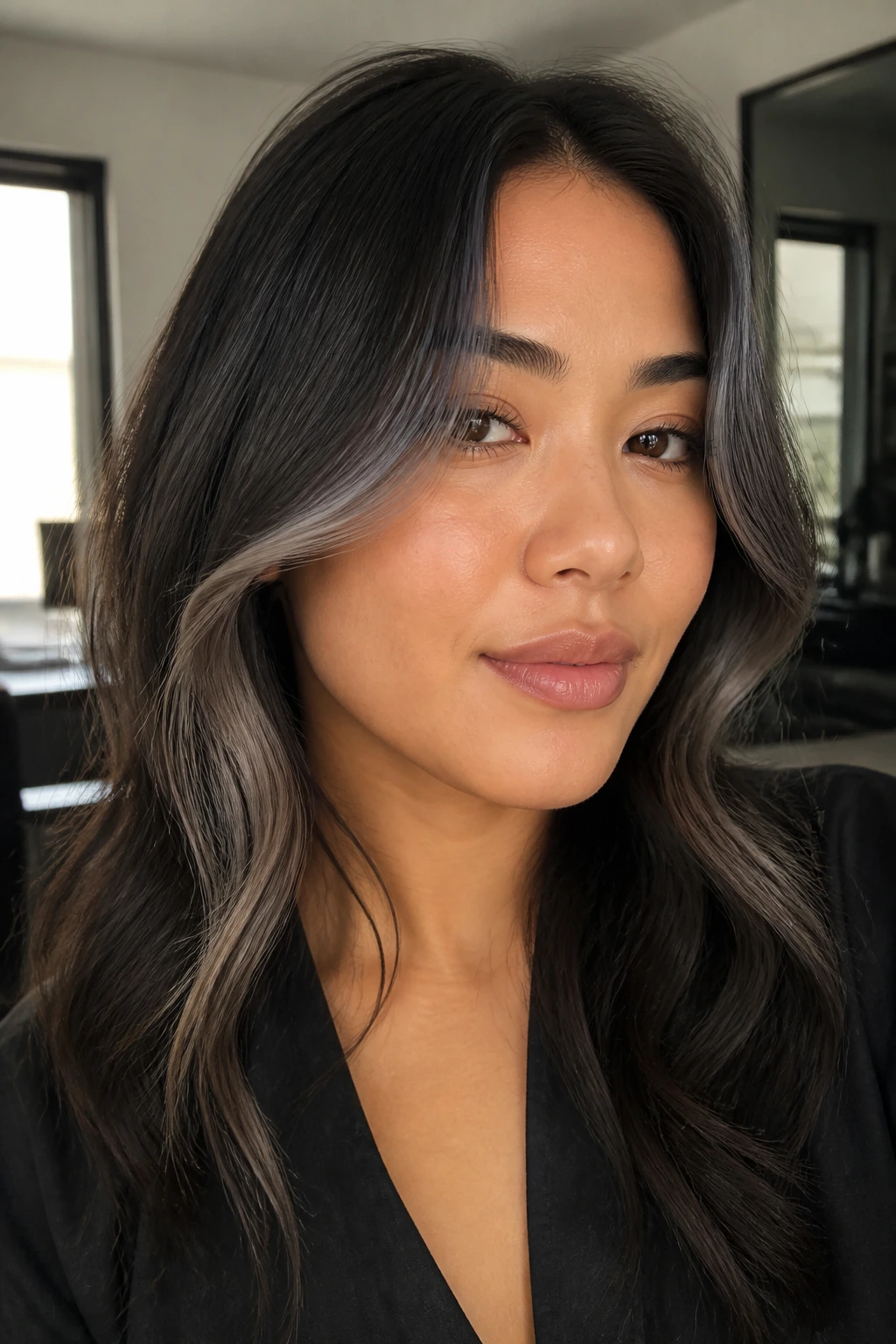
A money piece around curtain bangs can do a lot of work very quickly. The trick is keeping it soft. You want the front pieces to be ash-black, yes, but not harsh enough to pull the eye away from the face. On warm skin, that means the dark should be broken up with a touch of brown at the root and a smoky glaze at the ends.
Keep the highlight zone about 2 inches wide on each side, then blend it into the rest of the fringe. If the money piece gets too wide, it stops looking expensive and starts looking painted on. Thin it out. Let the bangs breathe.
7. Contour Highlights at the Cheekbones
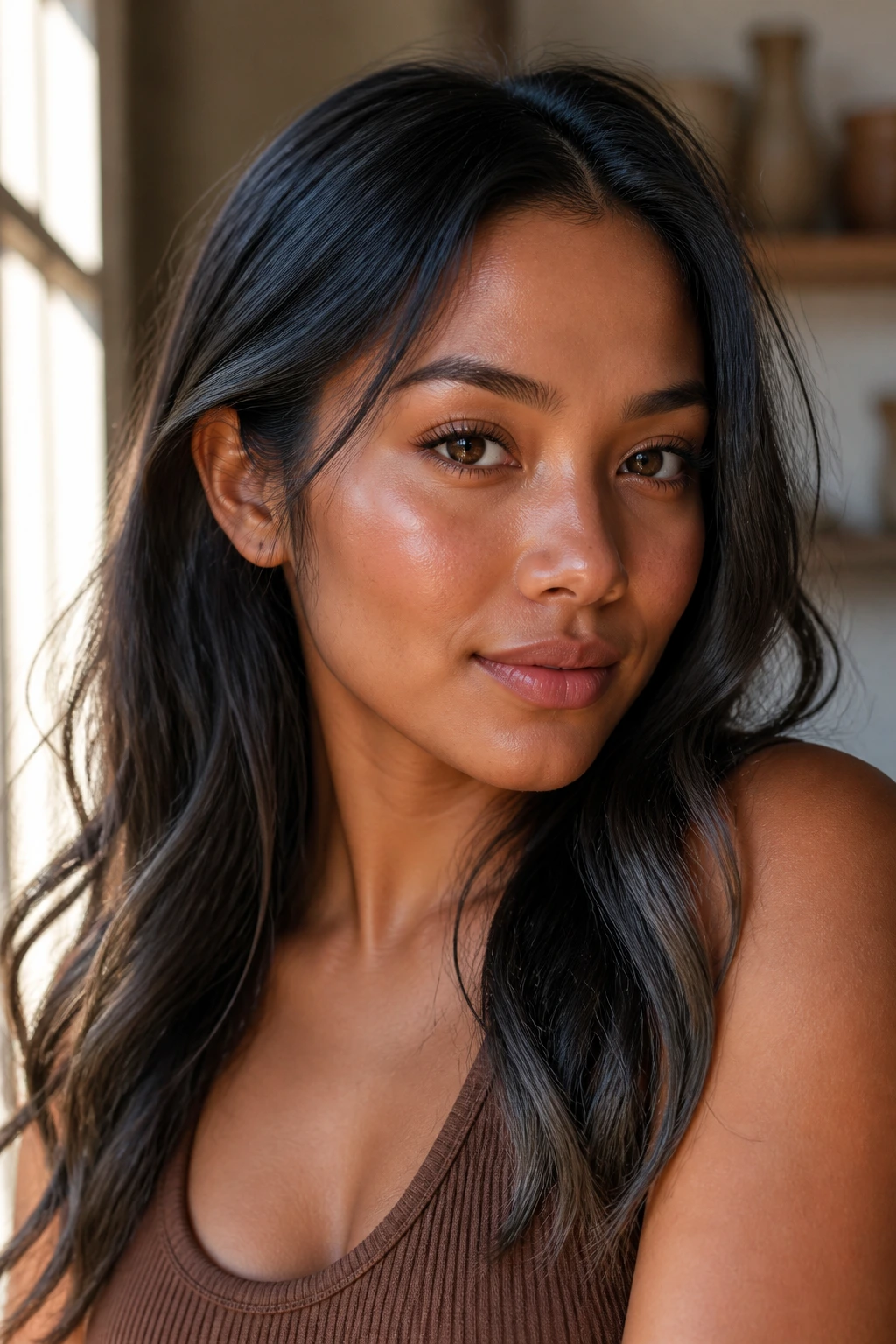
Think of this one as hair contouring. The ash-black pieces sit where shadow naturally falls — just below the cheekbone, around the temples, and slightly behind the jawline. The effect is subtle but smart. Warm skin looks more sculpted, and the hair takes on a quieter, more tailored shape.
This works well if your face is rounder or you like a little structure without going full contrast. The key is not to run the coolest pieces right on the front edge of the hairline. Place them a bit back, where the face can keep its warmth.
8. Rooted Ash Melt into Dark Espresso Ends
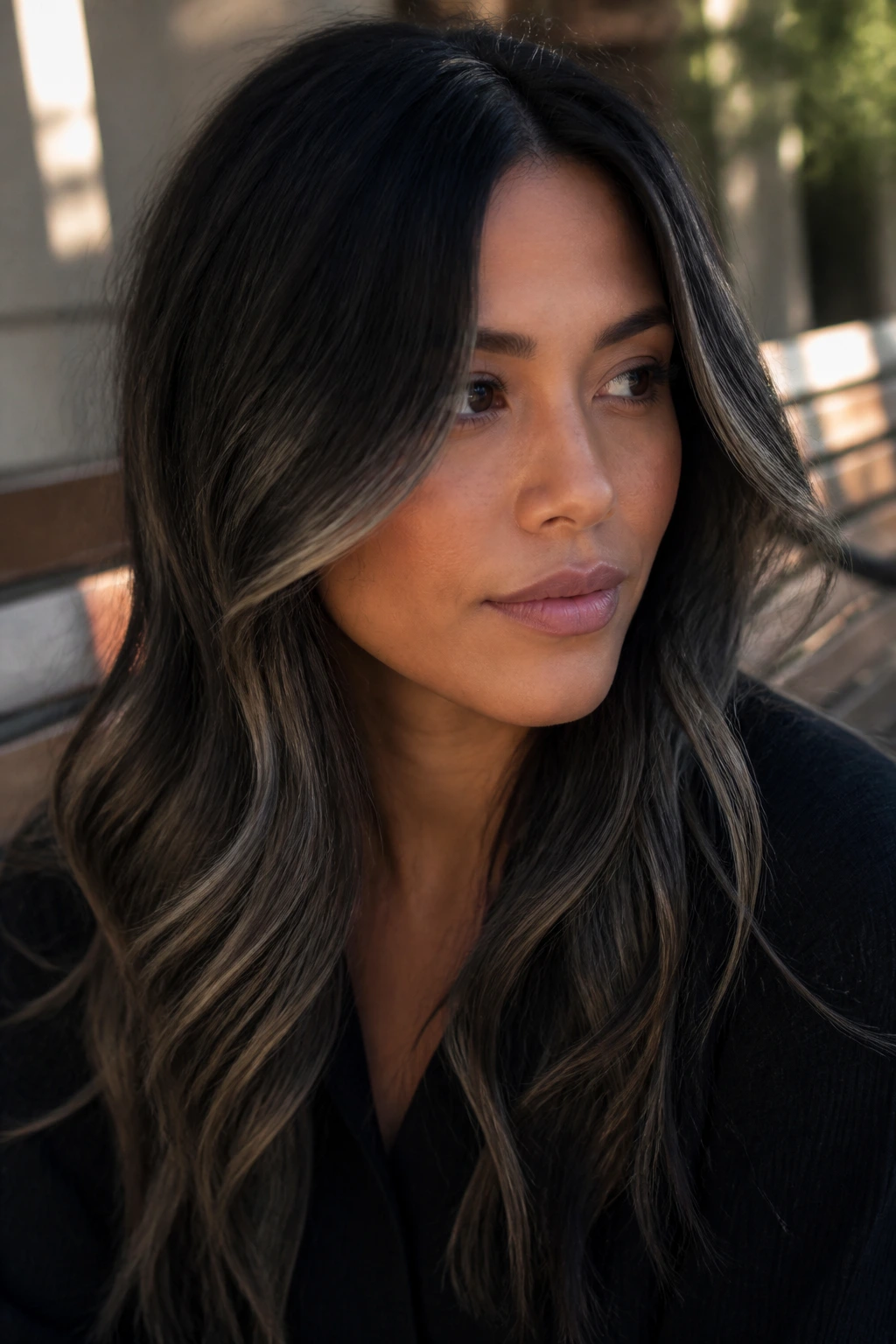
A rooted melt gives ash black a softer entry point. The root stays deep espresso or dark brunette, then the color moves into smoked charcoal through the mid-lengths and ends. On warm skin, the darker root keeps things grounded while the smoky finish adds lift and texture.
This is one of my favorites for straight hair, where every shift in tone shows more clearly. It also grows out neatly because the root and highlight are already working together instead of fighting each other. If your hair likes to show every line, this one is worth a look.
9. Woven Ash Slices on Straight Hair
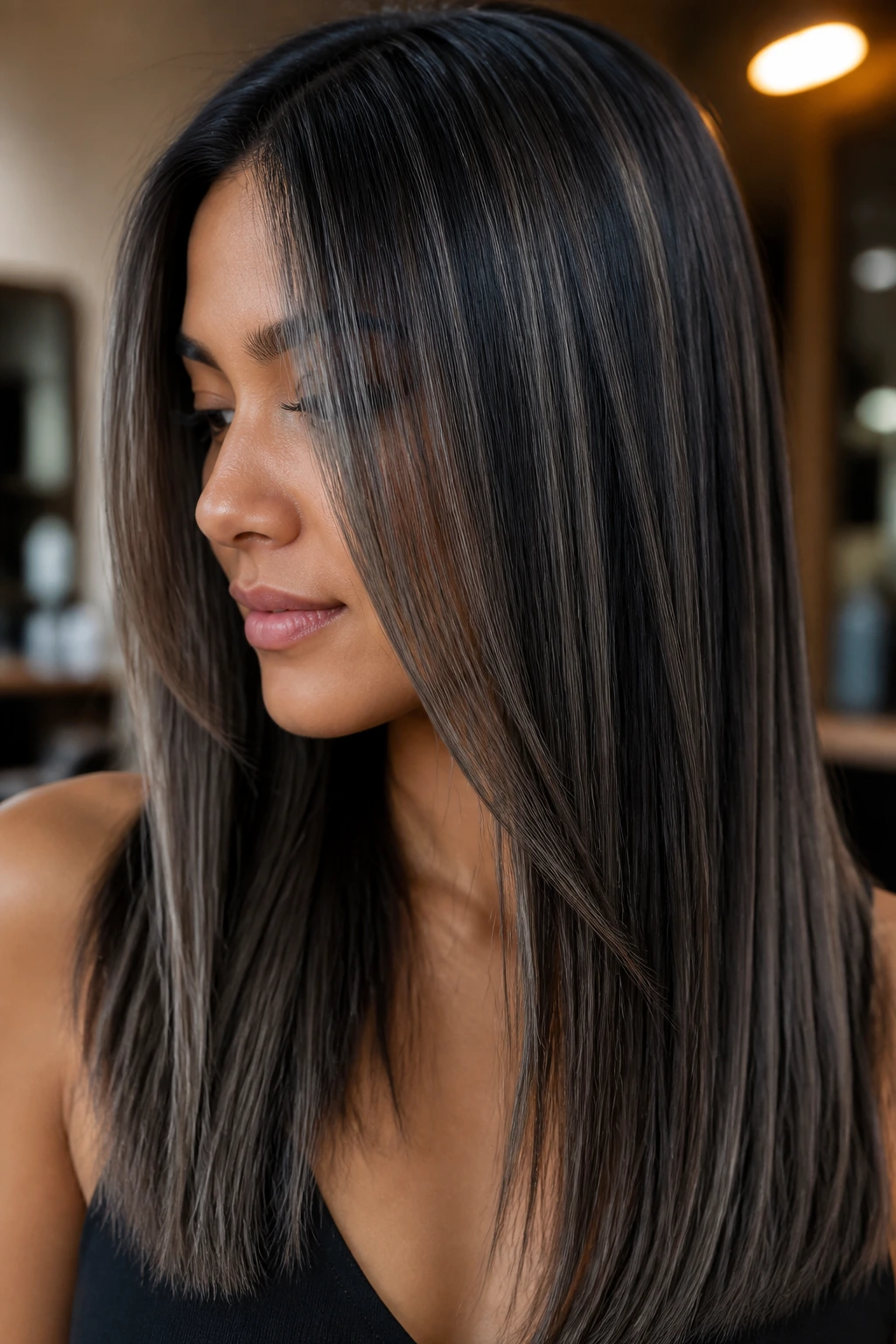
Straight hair can be picky. Too much ash-black color placed in broad panels and it starts looking like wallpaper. Woven slices fix that by cutting the dark pieces thin and precise, so the shine appears in long vertical lines instead of wide blocks.
Ask for slices that are slightly thicker at the crown and finer near the front. That keeps the hair from dragging the face down. Warm skin gets a crisp, modern edge, and the straightness gives the ash a chance to look polished rather than fuzzy.
10. Mushroom Brunette with Ash Black Veils
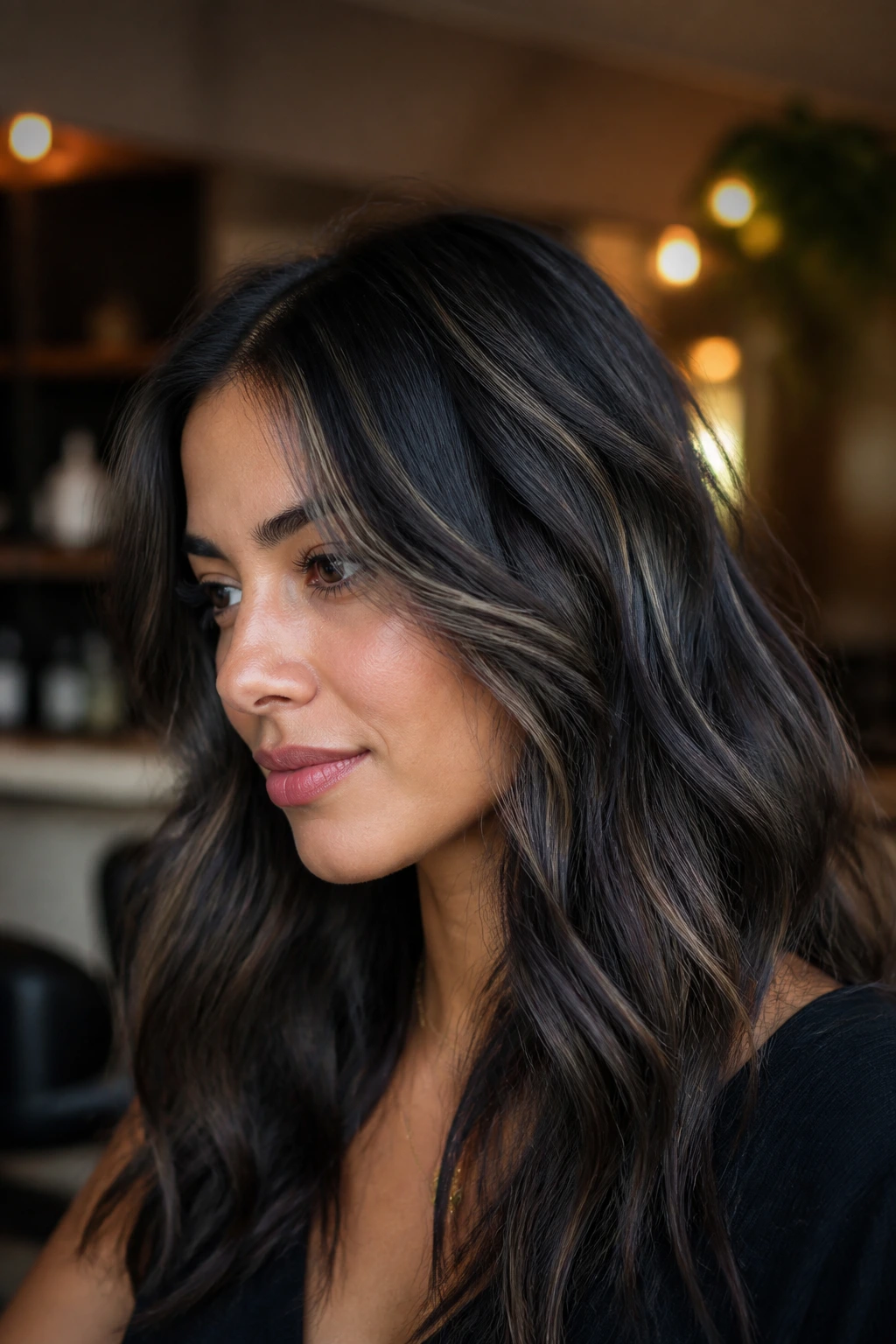
Mushroom brunette lives in that cool, earthy zone that loves warm skin more than people expect. The ash-black veils in this version sit lightly over a brown base, giving the hair a dusty, velvety finish. It’s not shiny black. It’s more like smoke brushed through wet bark.
The important thing here is restraint. If the veils get too thick, the whole look turns flat. Keep some brown visible at the surface and save the darkest pieces for the interior and lower half. Warm skin will thank you for the breathing room.
11. Ash Black on a Cinnamon Brown Base
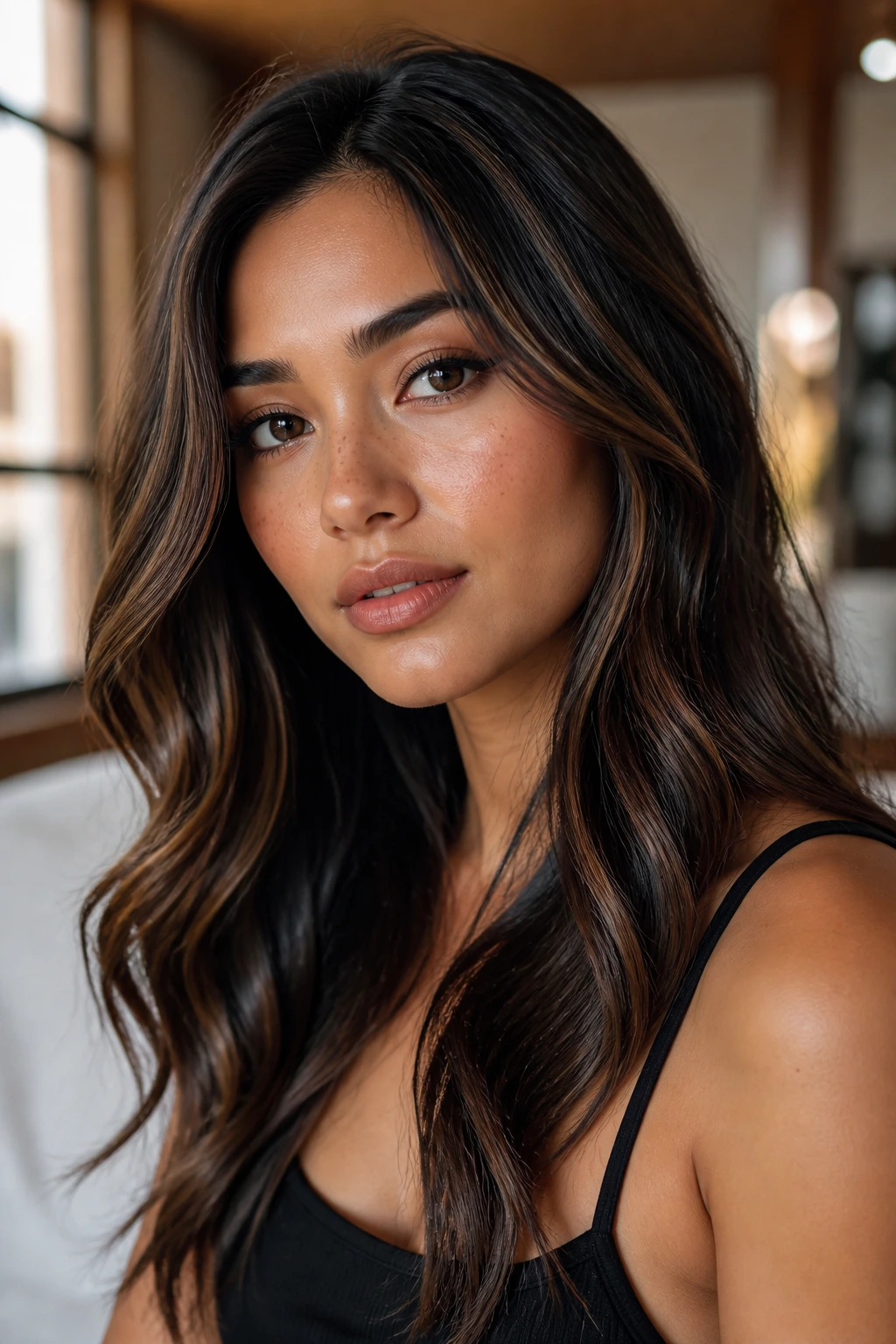
Cinnamon brown brings heat; ash black calms it down. That combination can be gorgeous on warm skin because the base keeps the complexion glowing while the cool ribbons stop the hair from going redder than you want. It’s a balancing act, not a contradiction.
This works especially well on naturally auburn-leaning brunettes who want to cool the overall tone without losing depth. The stylist should leave enough cinnamon around the crown and part so the ash has something rich to sit against. Pure smoke on a cinnamon base can look flat. A little warmth under it keeps the color alive.
12. Smoky Ombre on Medium Brunette Hair
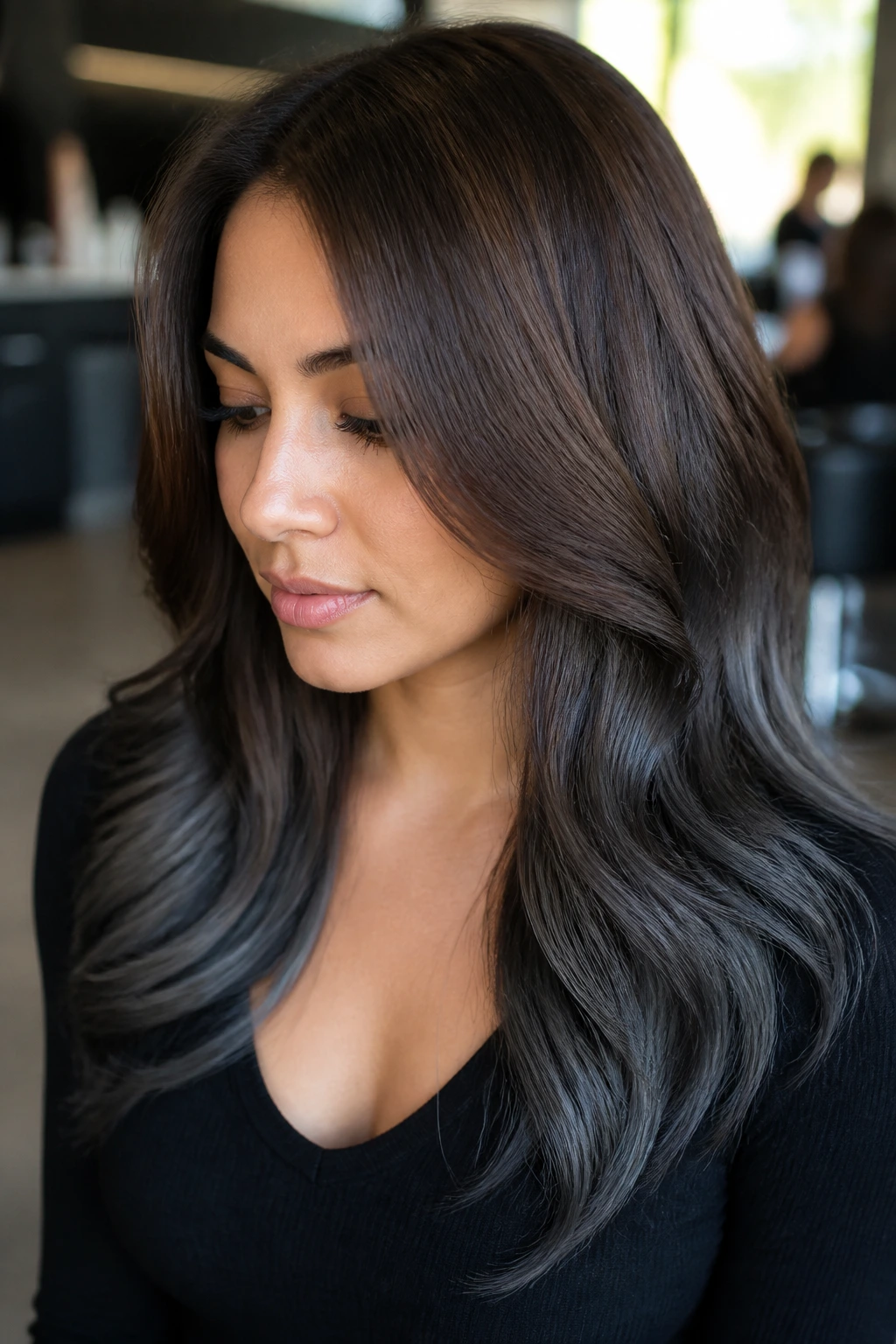
Ombre sounds dramatic, but a smoky version can be surprisingly soft. The root and upper mid-lengths stay medium brunette, and the ash-black color builds gradually toward the ends. On warm skin, that keeps the darkness away from the face and lets the cool tone work where it won’t compete with the complexion.
It’s a good choice if you like longer hair and don’t mind a little contrast at the bottom. The fade should begin below the ear, not right under the cheekbone. Otherwise the entire face starts to feel boxed in. Keep the transition slow.
13. Ash Black Lowlight-Heavy Dimension
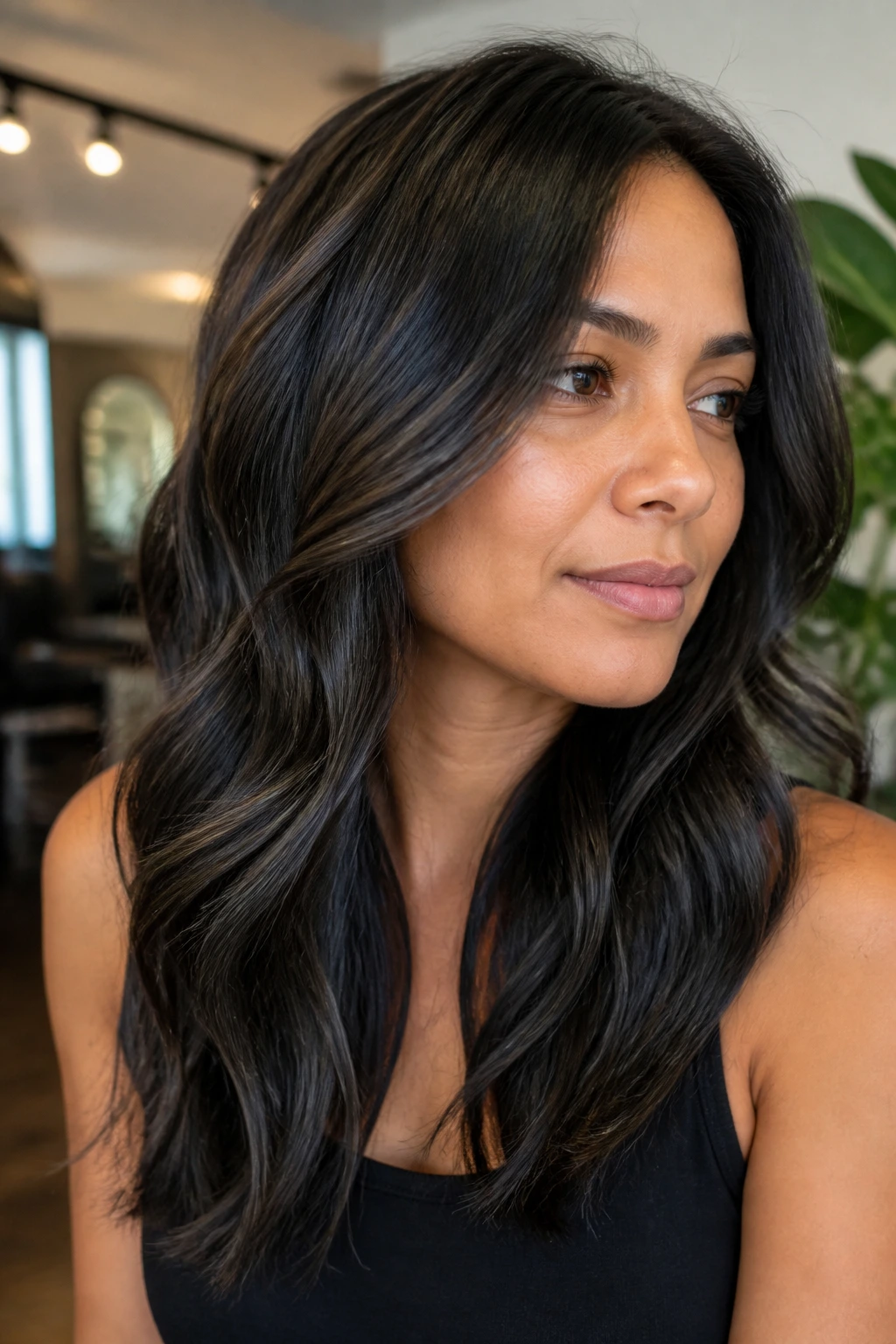
Not every warm-skinned brunette needs more brightness. Sometimes the best move is shadow. Lowlights in ash black can build depth inside the hair while leaving the outer surface softer and warmer. That makes the color look layered, not striped.
This is especially useful if your hair already feels too light or too orange in spots. Ask for lowlights that are one to two levels deeper than the base, placed in the interior and through the nape. It gives the hair weight without stealing color from the skin.
Best for
- Dense hair that needs shape.
- Brown hair that goes brassy fast.
- Warm skin that looks better with depth than with high contrast.
14. Deep Smoke Panels for Thick Hair
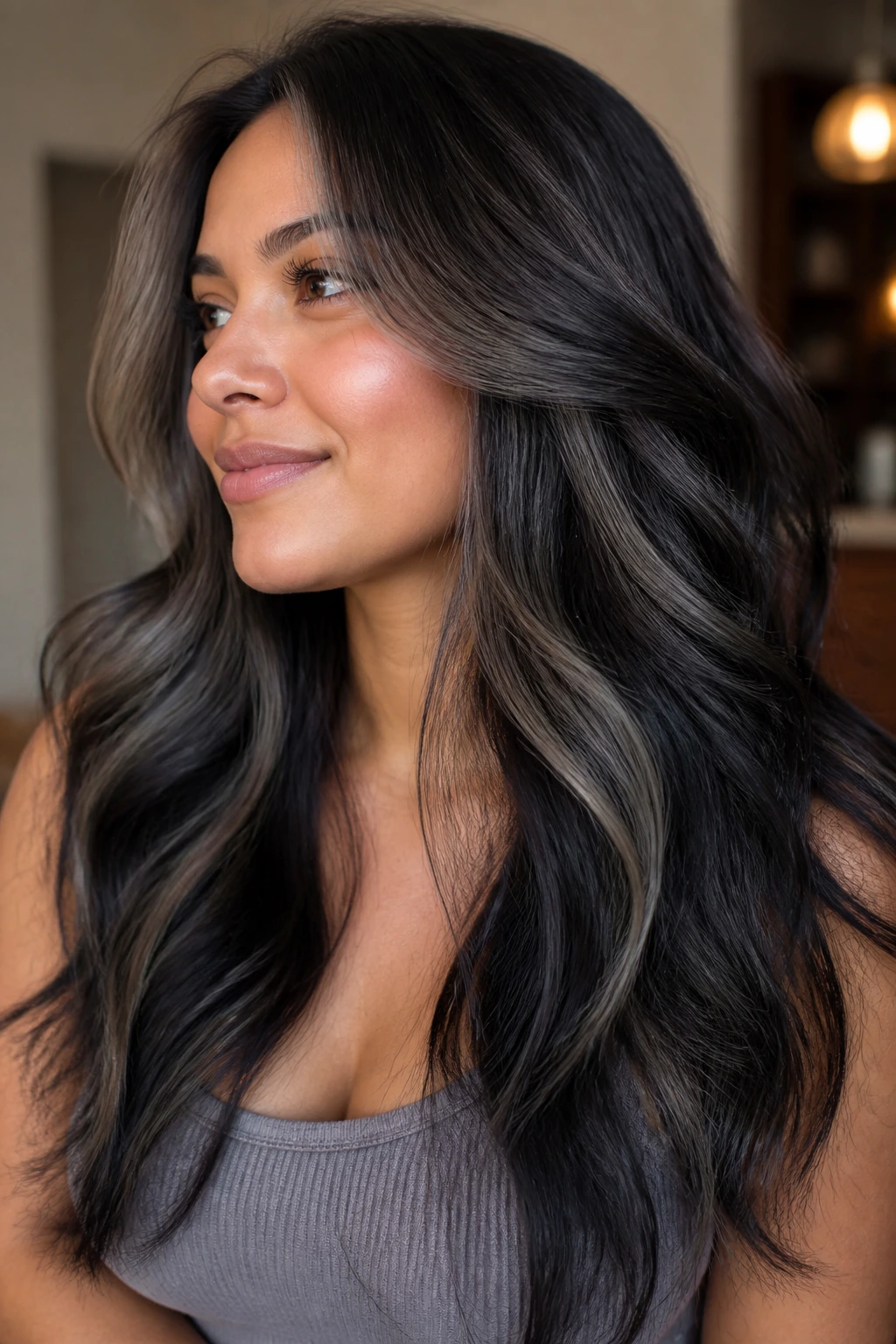
Thick hair can swallow fine highlights if the placement is too timid. Smoke panels solve that by giving the color enough width to show through the volume. The trick is keeping the panels hidden under surface layers so they don’t fight the shape of the cut.
Warm skin does best when the darkest panels live under the crown or through the lower back half of the hair. That way the face stays open. If the front gets too dense, thick hair starts to feel heavy. With this one, a little strategic darkness goes farther than a whole head of black pieces.
15. Soft Halo Highlights for Curly Hair
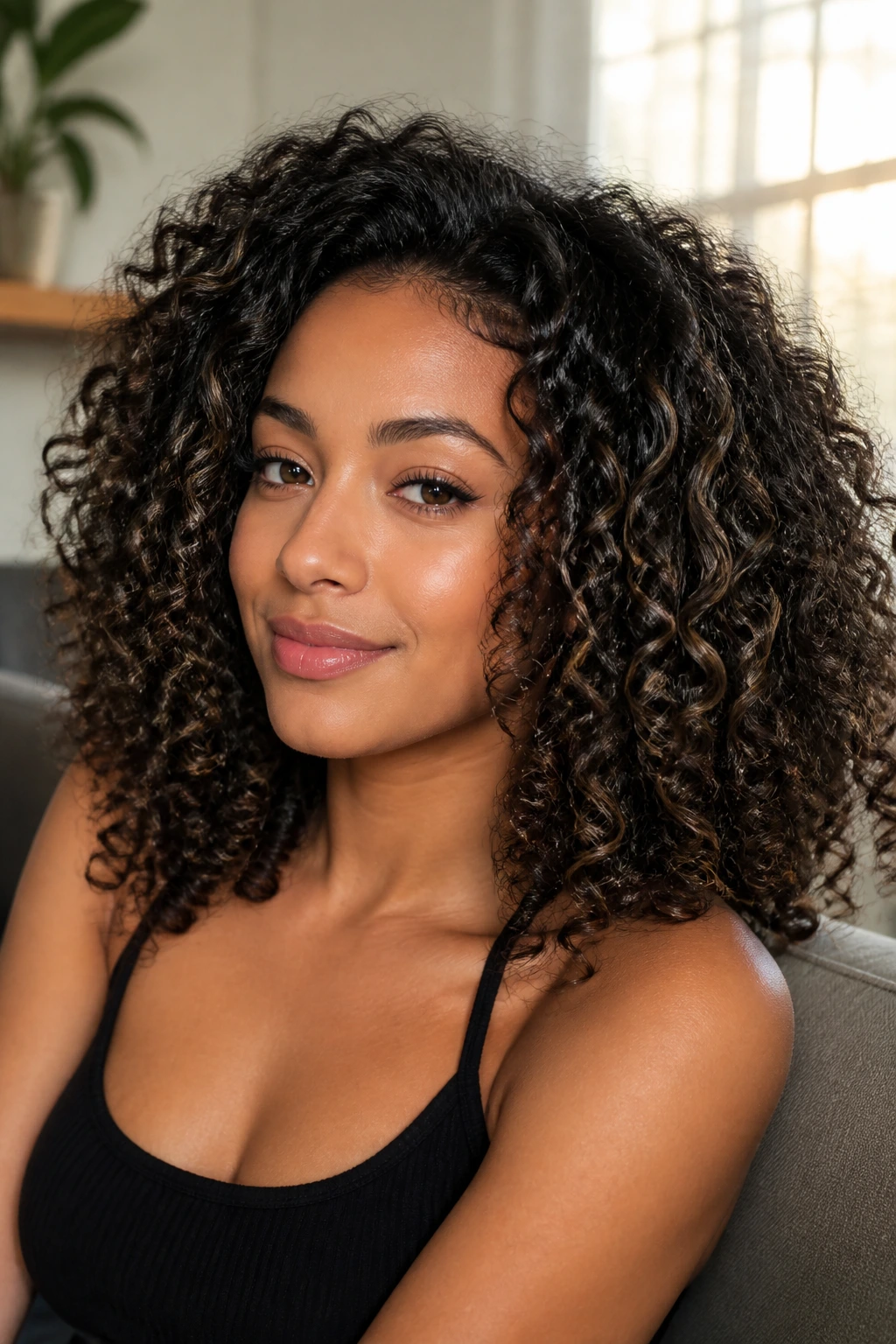
Curly hair needs its color placed where the curl can actually show it. A halo of ash-black highlights around the outer shape lets the pieces sit on the curl pattern instead of disappearing inside it. The result is soft smoke around the perimeter, not random streaks.
On warm skin, this can look especially nice because the curls keep their bounce while the color adds depth at the edges. Ask for pieces that follow the curl’s natural fall, not straight-line foils. Curly hair hates being forced into a grid. Let it bend where it wants.
16. Ash Black on a Long Lob
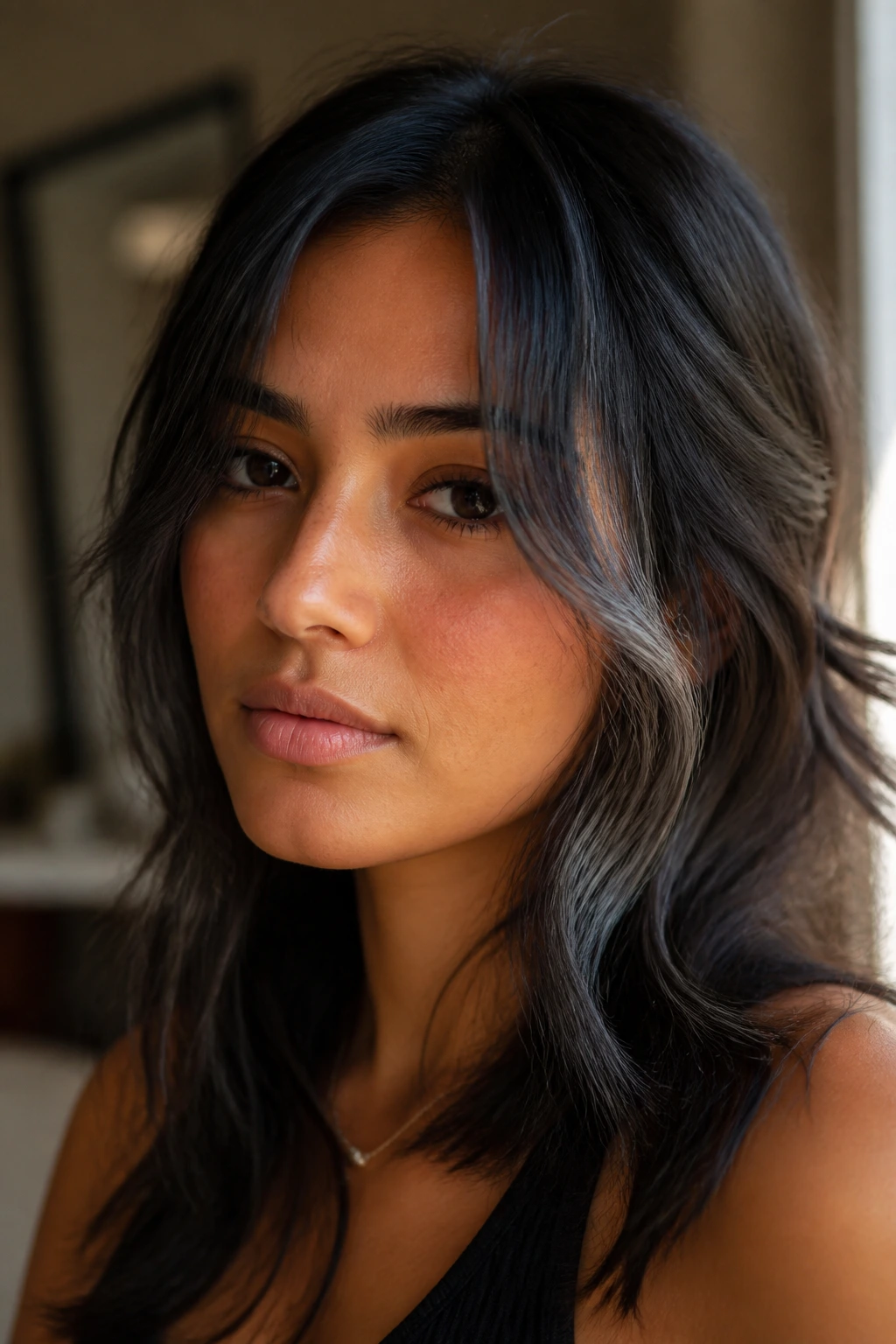
A lob gives ash black a clean stage. There’s enough length for the smoky pieces to move, but not so much that the color disappears into the bottom half of the hair. On warm skin, a lob with ash-black ribbons reads polished and a little sharp around the jawline.
I’d keep the darker pieces from the ears down, then add a few finer threads near the part to prevent the top from looking too dense. A long lob can go flat fast if the contrast sits only underneath. Bring the smoke up a little, but not too much.
17. Charcoal Fringe and Face Framing
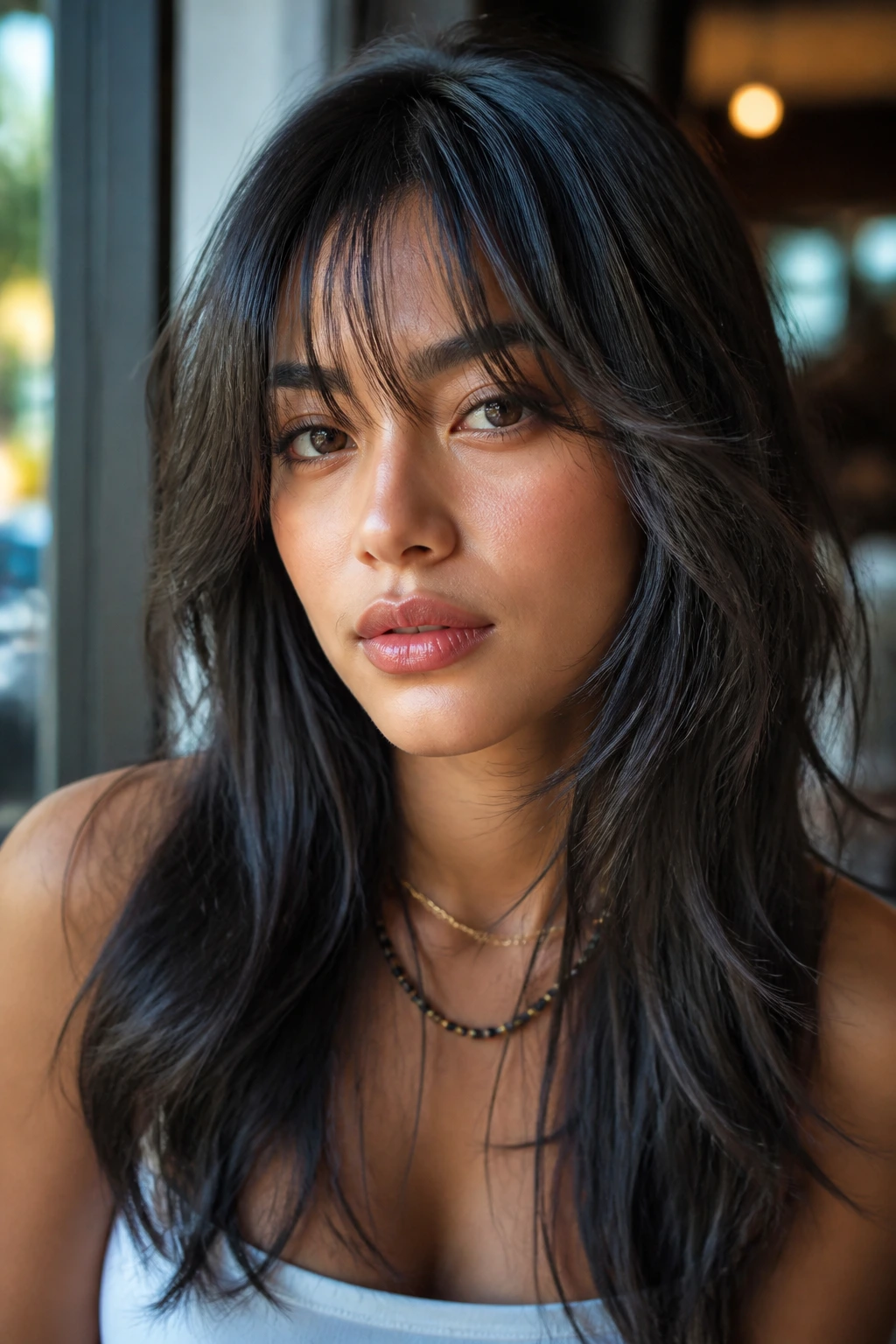
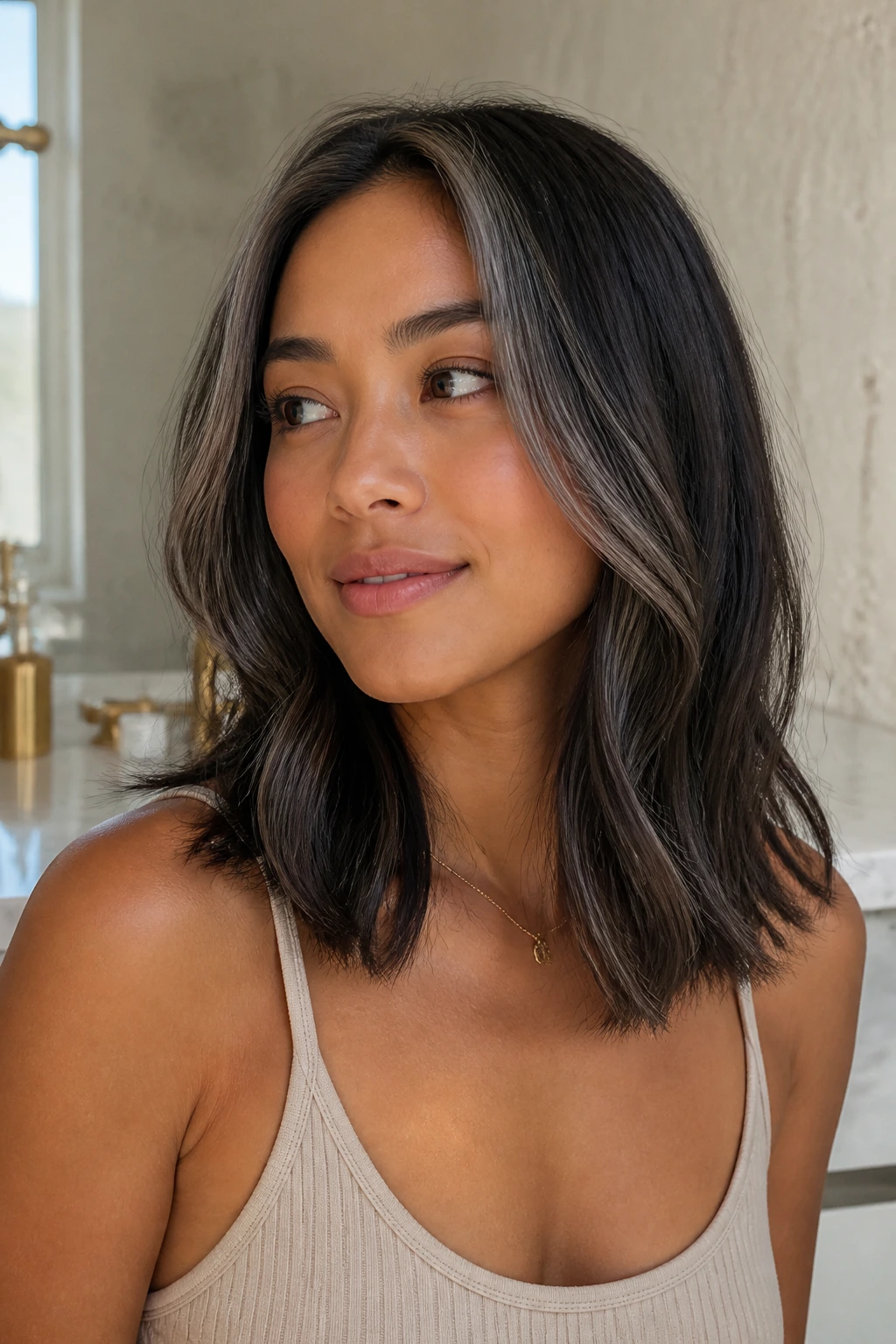
A charcoal fringe is for people who want the front of the hair to do something interesting. It works best when the bangs are feathered, not blunt, so the ash-black color can move with the fringe instead of sitting like a solid curtain. Warm skin stays friendly because the fringe is broken up by texture.
If you wear glasses, this can be especially nice. The ash-black line echoes the frames without swallowing the face. Keep the darkest part under the surface of the fringe and let the ends remain a little lighter. That tiny bit of softness makes the whole thing easier to wear.
18. Smoke-Tipped Layers on Midlength Hair
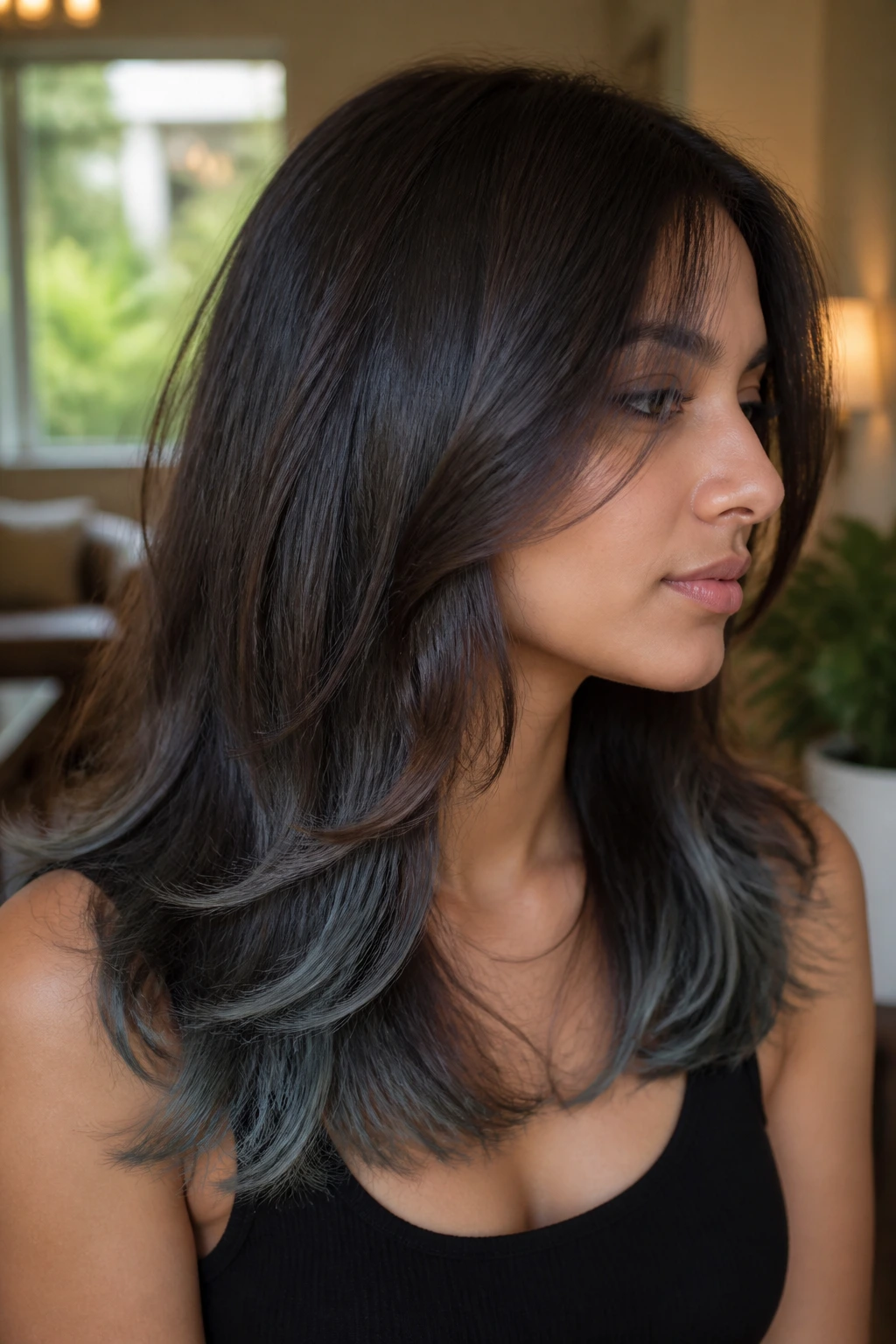
This is the sneaky version of ash black. The top stays mostly brunette, then the layers pick up smoky ends, usually on the last 3 to 4 inches. Warm skin gets all the lift of contrast without the commitment of dark pieces near the root.
The effect is better on hair that has obvious layers, because the smoked ends show when the pieces fall over one another. On one-length cuts, the look can feel too blunt. If the haircut has movement, though, this is a clean way to wear ash black without making the whole head feel cool.
19. Ash Black Around Warm Copper Brown
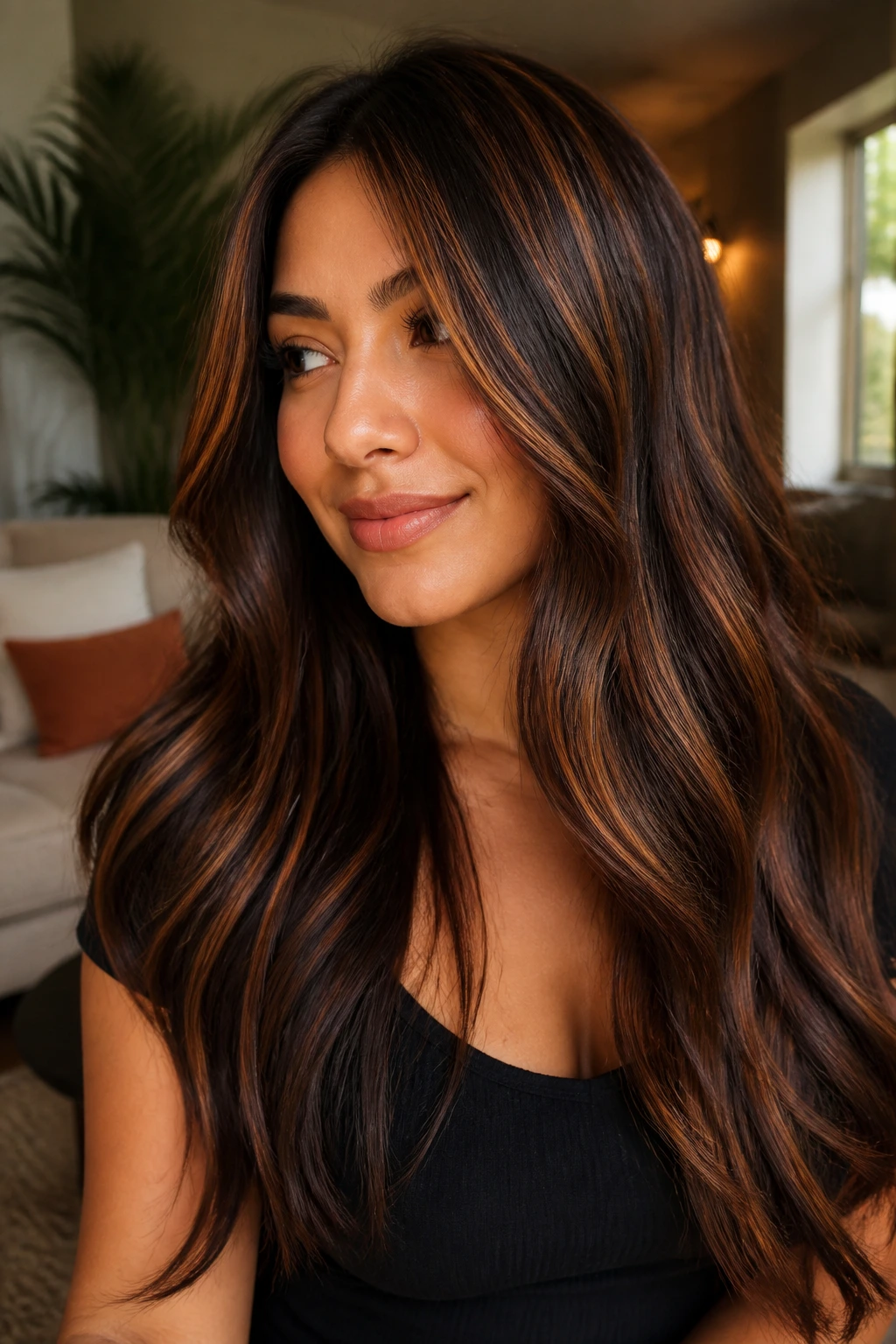
Putting ash black against copper brown sounds risky, and honestly, it can be. But if the copper stays mostly in the base and the ash is used in controlled ribbons, the result has depth that reads expensive rather than confused. Warm skin gets the benefit of the copper glow while the charcoal quiets the loudest red notes.
This one works best when the ash is not trying to erase the copper — just frame it. Think of it as dimming the lights rather than changing the room. The pieces near the face should be thinner than the ones through the back, or the color balance tips too cold.
20. Shadow-Rooted Ash Balayage for Grow-Out
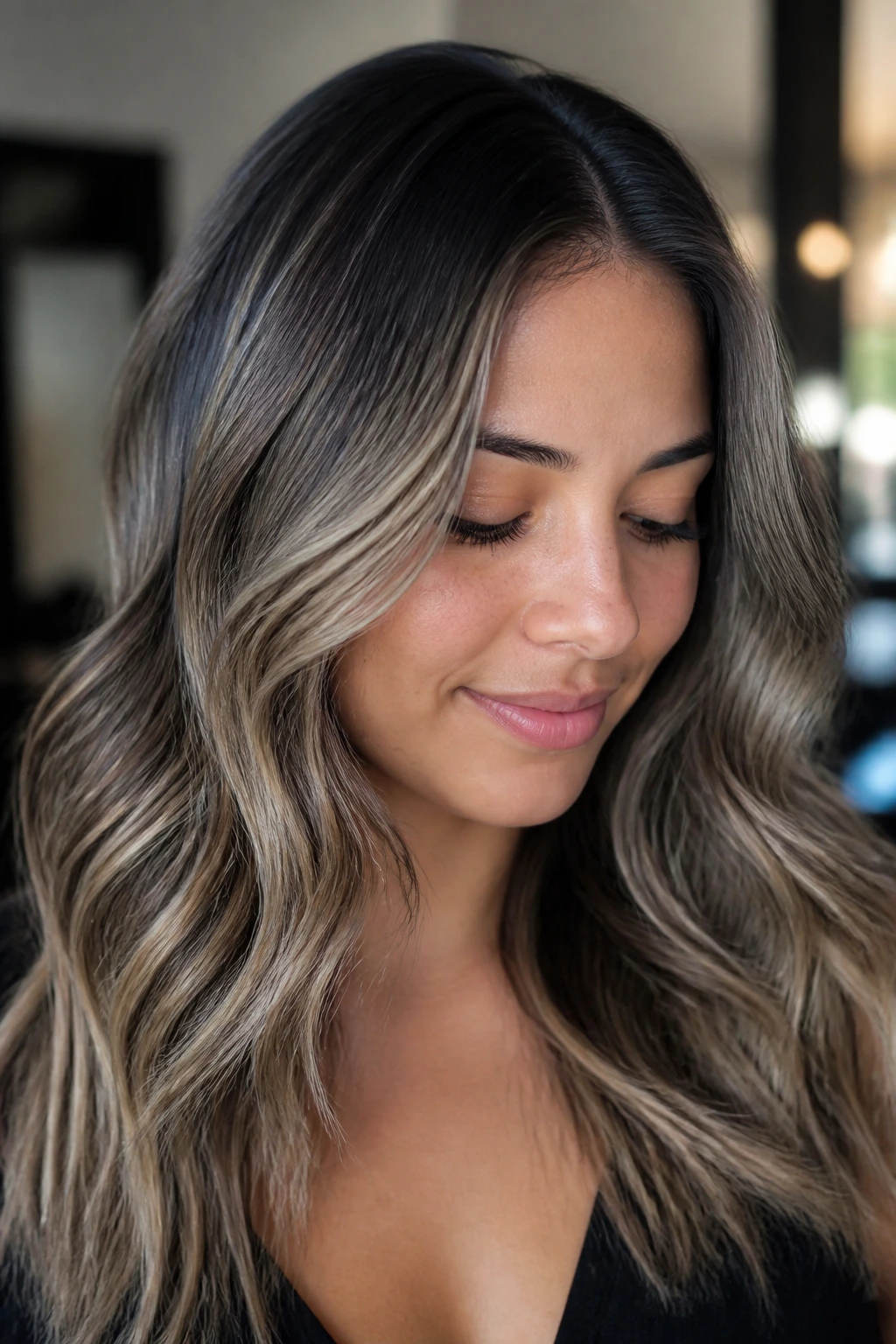
If you hate obvious regrowth, this is the workhorse. A shadow root softens the transition from the natural base into ash-black balayage, so the color fades rather than breaks. Warm skin benefits because the root stays close to the natural tone instead of going inky and hard at the hairline.
This is a smart pick if you want to stretch salon visits. The grow-out stays tidy for weeks because the contrast begins lower and melts higher. Ask for the root to stay only one shade deeper than your natural color. Anything darker starts reading like a block, and that defeats the point.
21. Precision Ash Slices on a Bob
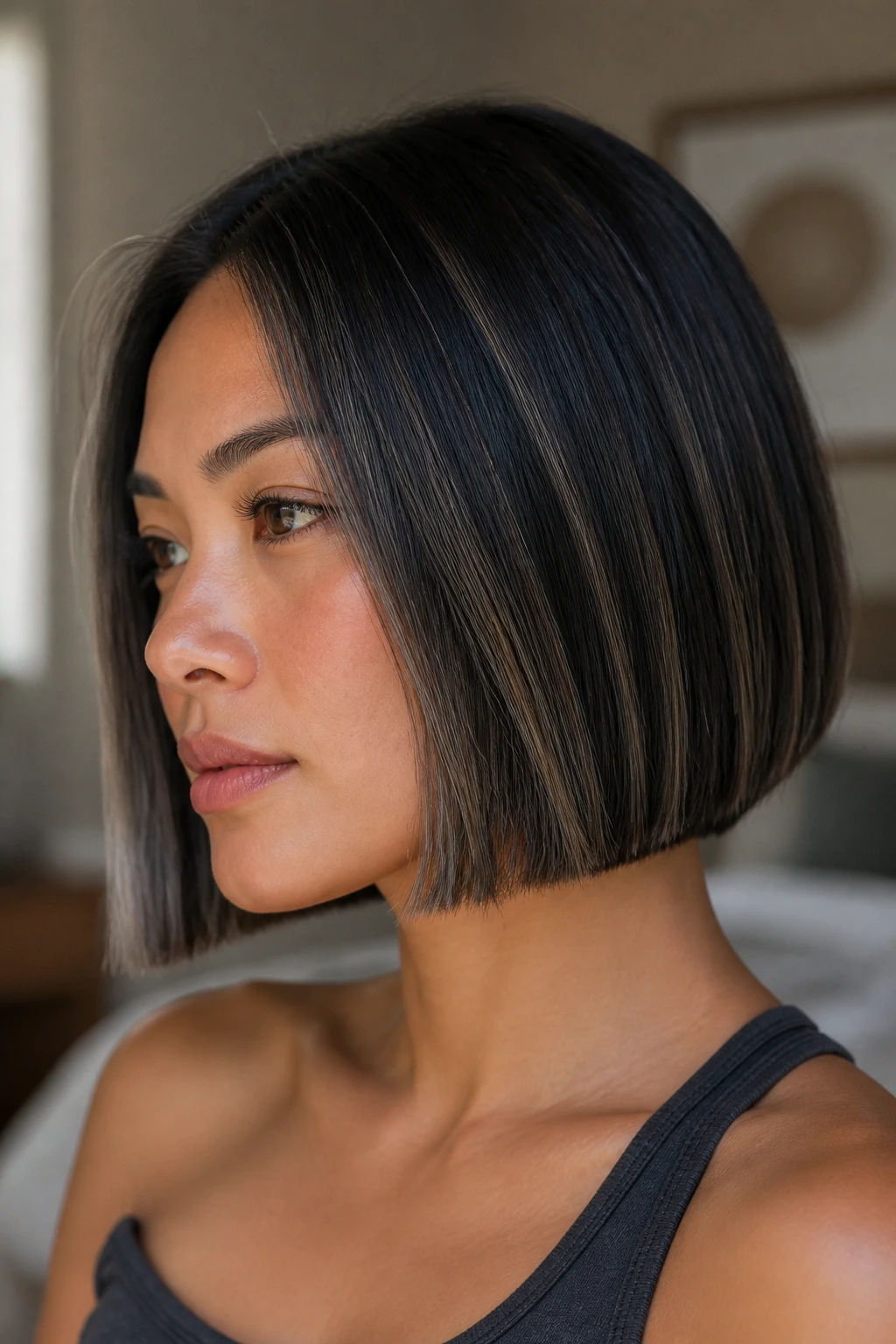
A bob can handle precision, and precision is exactly what ash black needs here. Fine sliced highlights tucked under the top layer keep the cut looking sharp without creating a harsh stripe across the face. Warm skin gets clarity, not clutter.
This is one of the best styles for straight bobs or blunt shapes. A few well-placed slices near the temple and crown are enough. Too many and the bob loses its clean line. Too few and the ash disappears. The balance is narrow, which is why this cut works so well with a stylist who’s patient.
22. Cool Underlights for Dark Brunette Hair
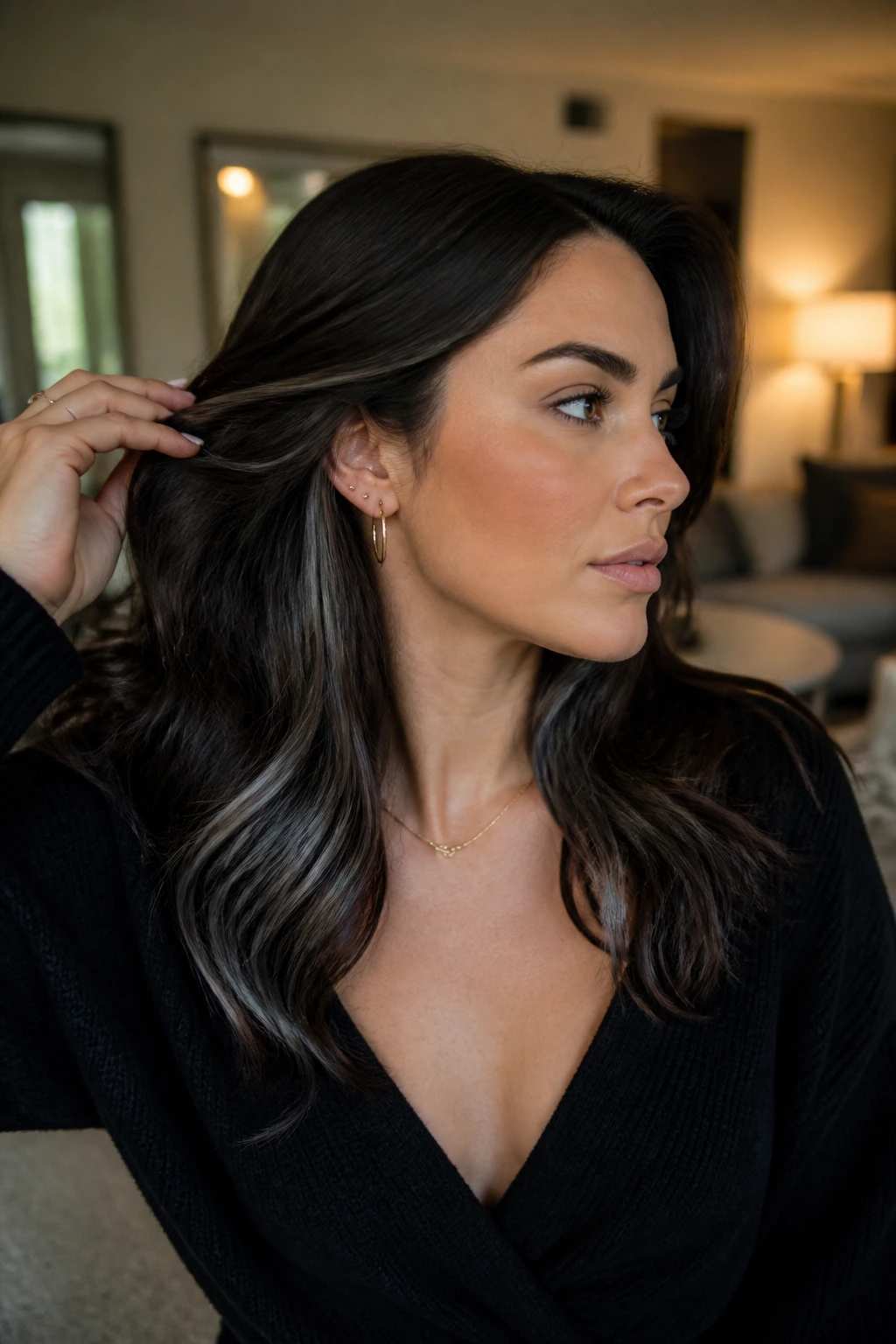
Dark brunette hair doesn’t always need to be lightened to show dimension. Cool underlights can sit in the nape, behind the ears, or under the top layers, giving the hair a smoky base that moves when it’s styled up. Warm skin stays in charge because the cool color stays mostly out of sight until the hair shifts.
This style is a quiet one, but not boring. It’s especially nice if you wear ponytails, buns, or half-ups often. The underlights show just enough to make the movement feel deliberate. If you want the ash black to whisper from the sides instead of shouting from the front, this is the safer bet.
23. Ash Black on Sandy Brunette
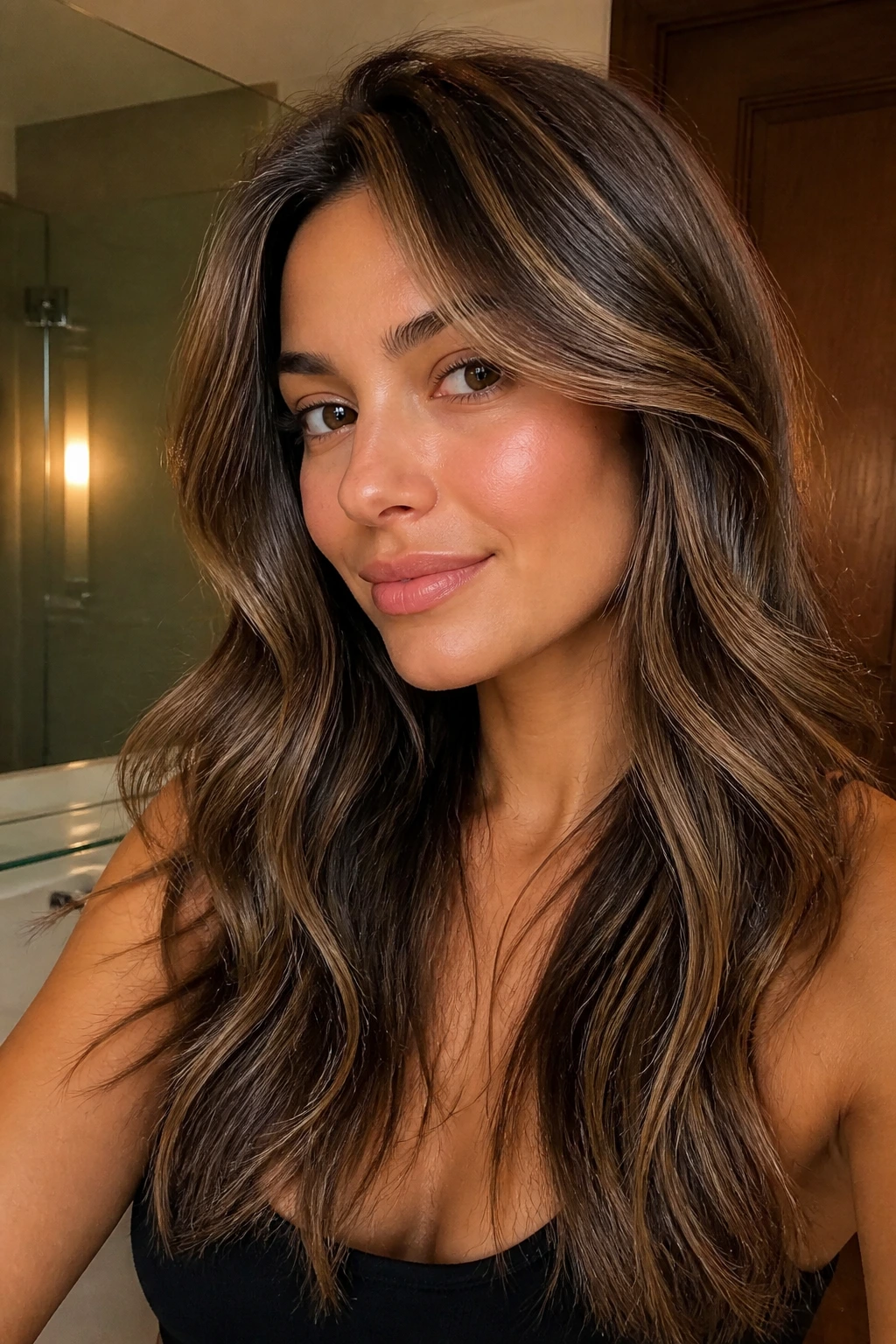
Sandy brunette already sits near the border of warm and cool, which makes it a good canvas for ash black. The cool pieces don’t need to be heavy. A few fine weaves or softly painted ribbons can shift the tone without wiping out the warmth that makes the skin glow.
Why it works
The sandy base gives the ash something soft to rest on, so the result doesn’t turn muddy. Keep the highlights thin — about 1/4 inch at most — and glaze the whole head with a beige or smoky brown toner to blend everything back together. On warm skin, that blend is the difference between “nice color” and “why does this suddenly work so well?”
24. Bold Smoke Stripes for High Contrast
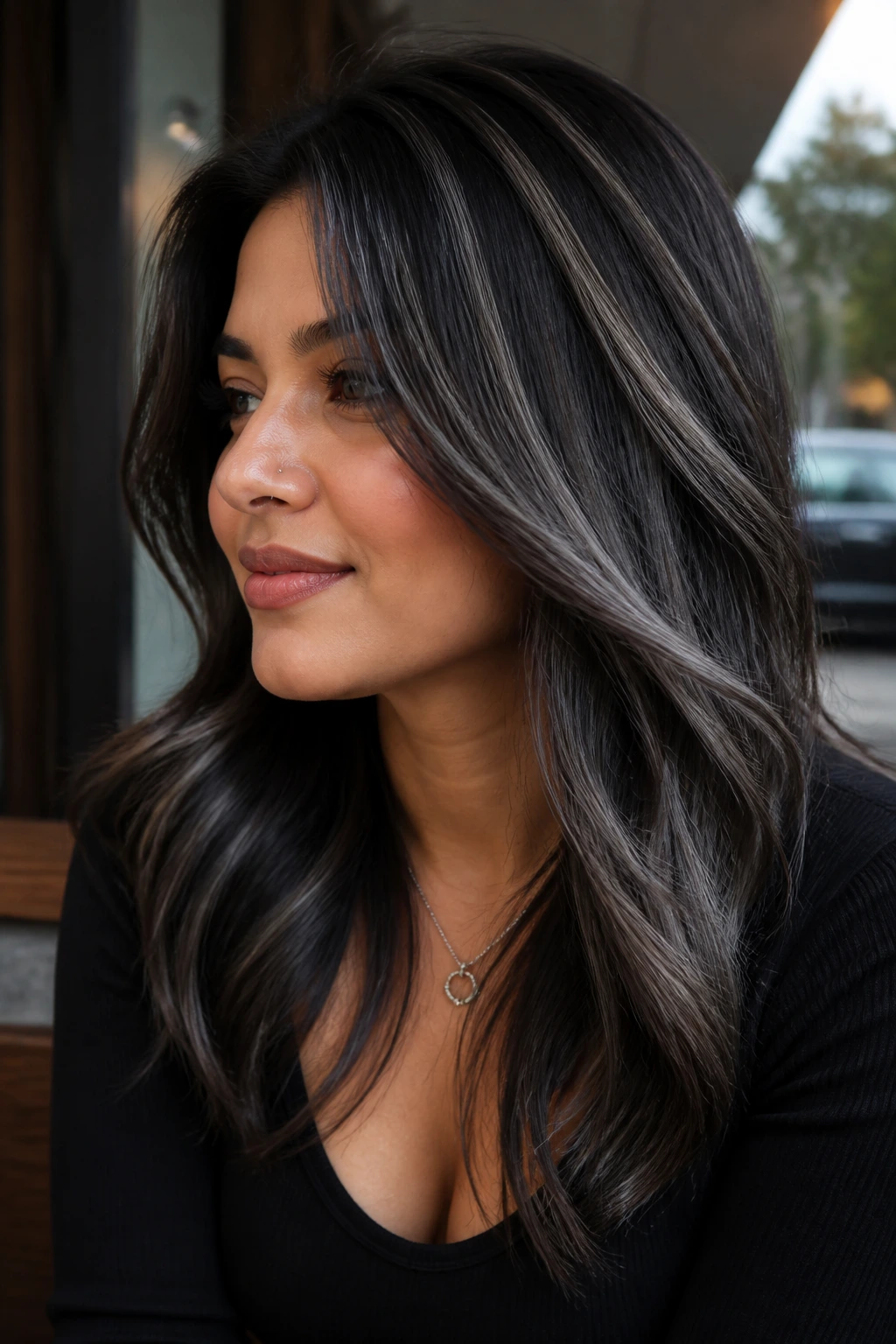
This one is for people who know they want to be seen. Wider ash-black stripes create a sharper pattern, especially on dark brunettes with enough warmth in the skin to keep the contrast from feeling severe. The trick is keeping the stripes intentional, not scattered.
Use this look if your style already leans dramatic and your brows, lashes, or makeup carry some depth. On warm skin, too many stripes near the face can get loud fast, so I’d keep them in the mid-lengths and crown rather than all around the hairline. Under 15% of visible hair is usually plenty. More can start to look busy.
25. Soft Ash Black Ends on Long Layers
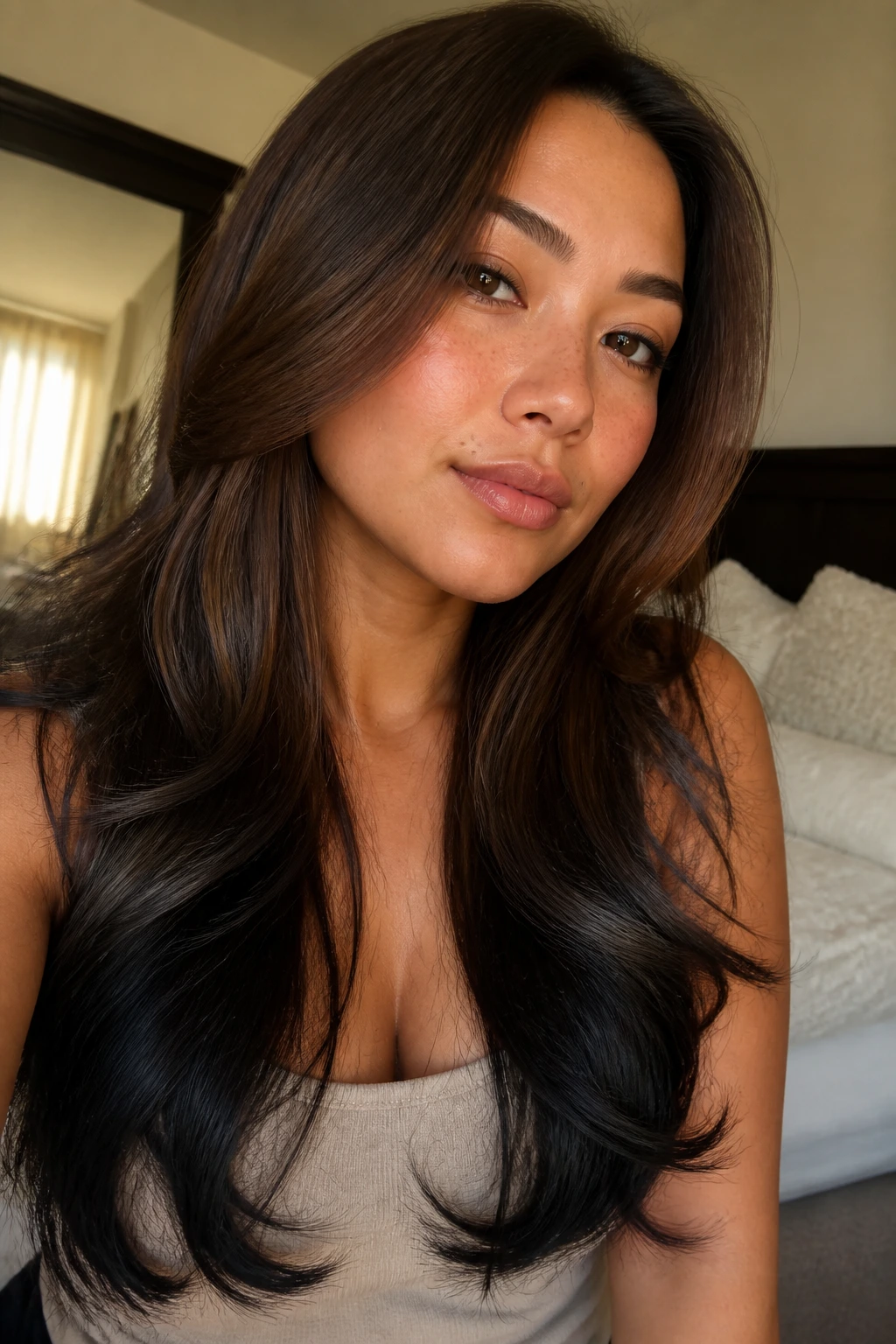
Long layers give the ends room to do something interesting. A soft ash-black finish on the bottom few inches makes the hair look fuller and more dimensional without touching the warmth at the face. It’s the least aggressive way to wear the shade, and maybe the easiest to live with.
This style works best when the ends are healthy enough to hold tone. If they’re porous and see-through, the ash can look thin instead of smoky. Keep the top layers a touch warmer so the final look doesn’t drift toward flatness. The contrast should happen at the bottom, where it can move.
Practical Ways to Keep Ash Black Looking Smoky, Not Flat
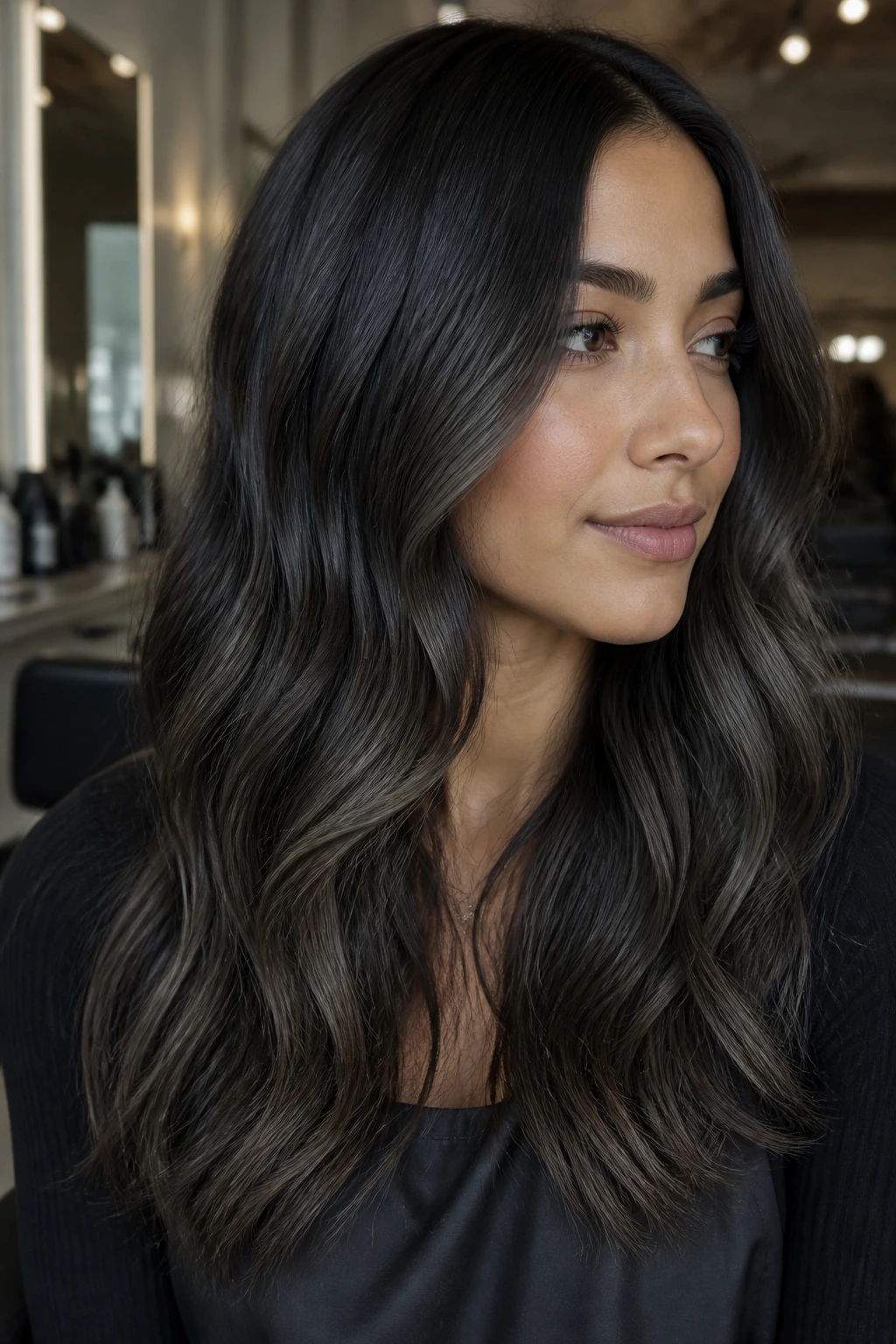
Placement: Put the darkest pieces where the hair already gathers shadow — under layers, around the mid-lengths, or just behind the face frame. If the ash-black color sits too heavily at the front edge, warm skin can lose its glow in a hurry.
Glossing: Ask for a demi-permanent gloss or toner every 4 to 8 weeks, depending on how much fade your hair takes on. Ash tones lose their crisp edge faster than brown tones, so a quick gloss does more than a full repaint. It keeps the smoke in the smoke.
Texture: Waves, bends, and curl memory make ash black look more expensive than pin-straight hair does. If you wear your hair straight, leave some tonal variation in the ribbons so the color doesn’t flatten into one sheet.
Heat control: High heat pulls color dull fast. Use a protectant before blow-drying or flat-ironing, and don’t drag hot tools over the same section five times. Two passes is enough. Three is usually a waste.
Makeup balance: Warm skin with ash-black highlights often looks best with brows that have a little depth and blush that stays peach, terracotta, or rose-gold rather than icy pink. The hair and face should feel like they belong in the same room.
Mistakes That Make Ash Black Look Muddy or Harsh
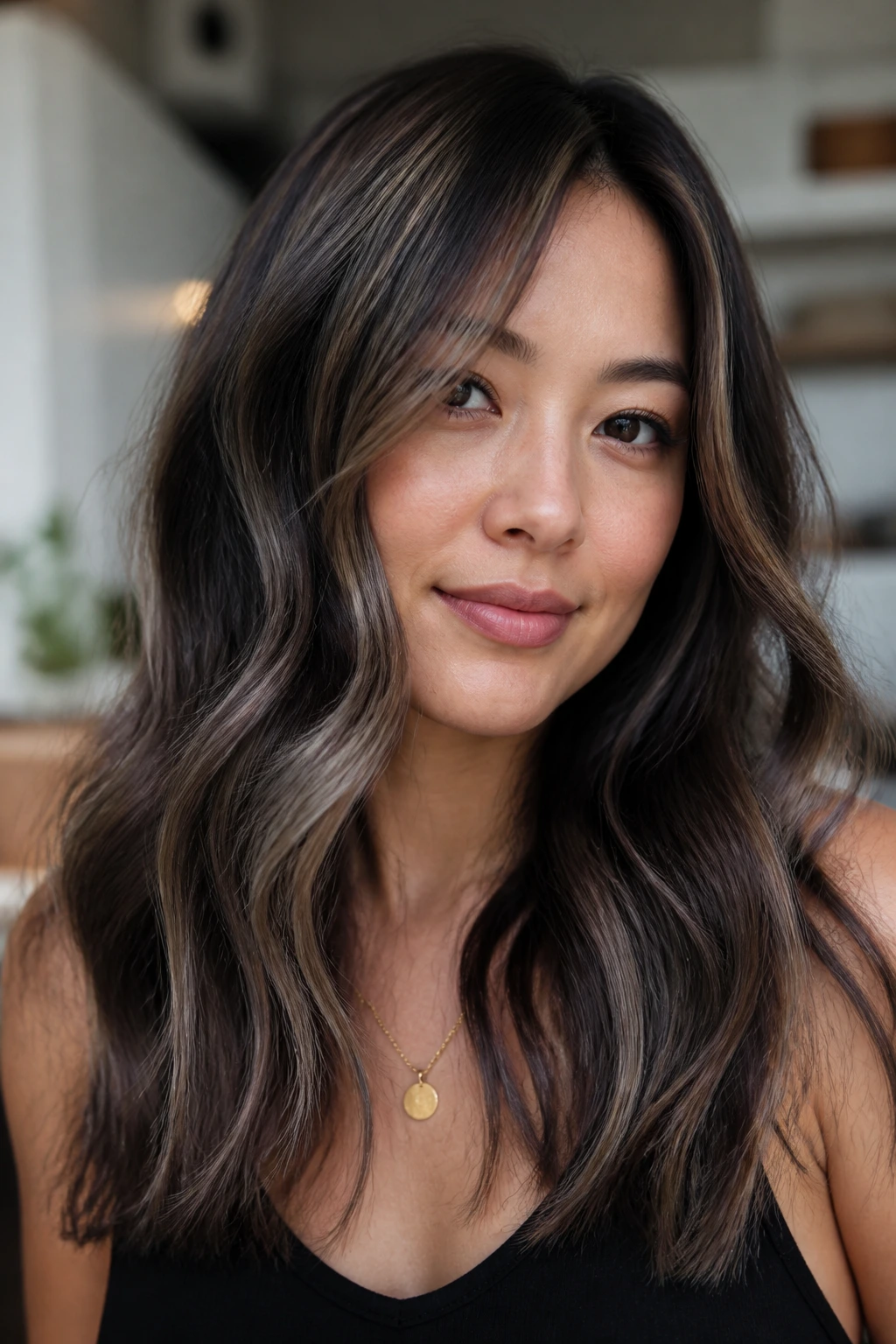
-
Choosing jet black instead of ash black: The symptom is a hard, inky stripe that makes warm skin look flatter. The fix is asking for smoky brunette or graphite-brown, not pure black.
-
Placing dark pieces too close to the hairline: If the front looks heavy or your eyes disappear behind the hair, the placement is too aggressive. Move the coolest pieces back a half inch to an inch and leave more brown near the face.
-
Over-toning porous hair: Hair that’s been lightened too far can grab ash toner and turn dull, greenish, or hollow. A softer gloss and a shorter processing time keep the tone breathable.
-
Skipping the root shadow: Without a soft root, ash-black highlights can look like they’re sitting on top of the hair instead of melting through it. The grow-out line turns obvious fast.
-
Trying to make every strand cool: Warm skin usually needs some brown, copper, or chestnut left in the mix. If the whole head goes cold, the face has to do too much work.
-
Using purple shampoo like it’s regular shampoo: Once or twice a week is plenty for most ash-brunette looks. More than that can mute shine and make the color feel dusty.
Variations if You Want Softer, Bolder, or Lower-Maintenance Color
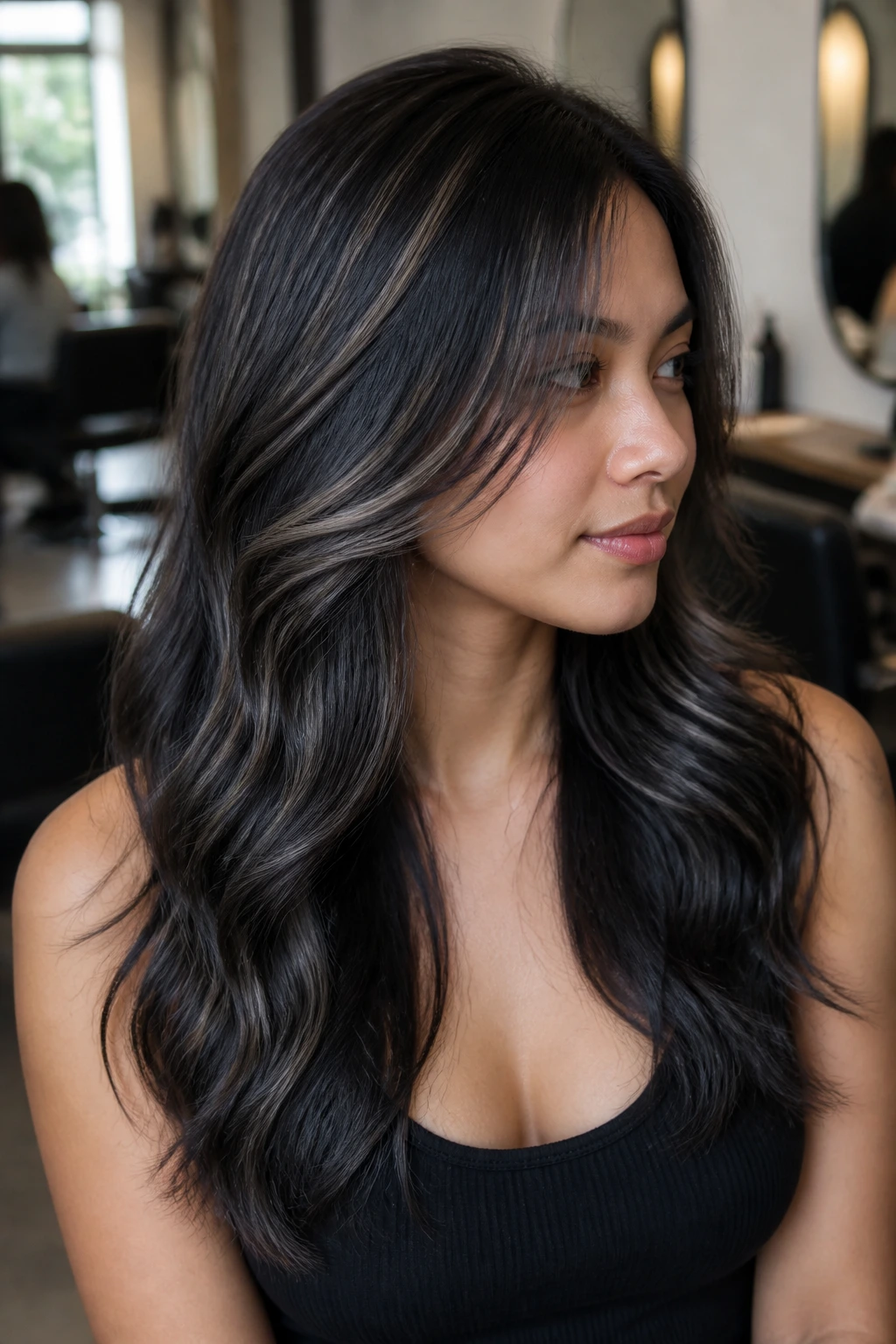
Soft Smoke Melt: Keep the ash black to the lower half of the hair and use fine babylights near the crown. This is the easiest version for warm skin that only wants a cool hint, not a full makeover.
High-Contrast Graphite: Use wider ribbons or bold stripes through the crown and cheekbone area. It suits warm skin best when the complexion already has enough depth and the haircut has strong shape.
Warm-Edged Ash: Blend the ash black with chestnut, cocoa, or cinnamon in the same placement. The hair stays cooler than the base, but the warmth near the face keeps everything friendly.
Curly Smoke Halo: Put the ash on the outer ring of curls and skip the heavy front panels. The texture does the work, and the warm skin stays open and bright.
Shadow-Grown Brunette: If you want the least maintenance, keep the root close to natural and let the ash live through the mid-lengths only. That way the grow-out stays soft for longer, and the color doesn’t need frequent correction.
Tools, Swatches, and Color Care Products to Bring Along
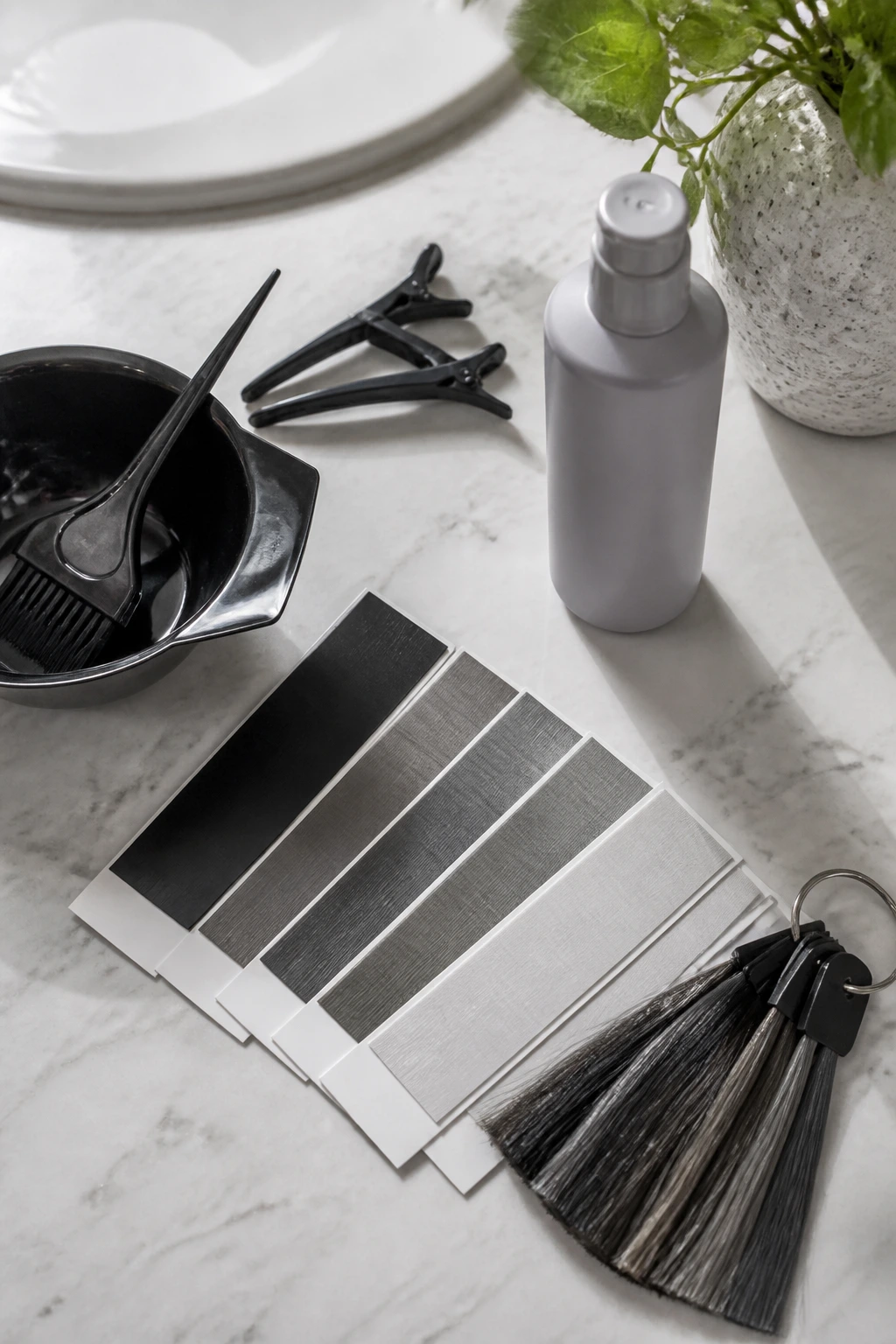
- Reference photos in daylight and indoor light — ash black shifts a lot, and you want to show your stylist the version you actually like.
- A level chart — helpful if you know whether your hair sits around level 3, 4, or 5, which changes how dark the ash should be.
- Color-safe shampoo and conditioner — the less stripping, the better the smoke stays in the strand.
- Blue-violet shampoo — use sparingly to keep brass from creeping back into the mids and ends.
- Deep conditioning mask — ash tones look better on hair that reflects light instead of sucking it in.
- Heat protectant — flat irons and hot brushes are color-fade accelerators.
- Wide-tooth comb and clips — useful if your hair is curly or thick and needs sectioning without breakage.
- Microfiber towel or T-shirt — less friction means less roughness on the color-treated ends.
- Silk or satin pillowcase — keeps the ends from getting fuzzy between washes.
Keeping Ash Black Highlights Fresh Between Appointments
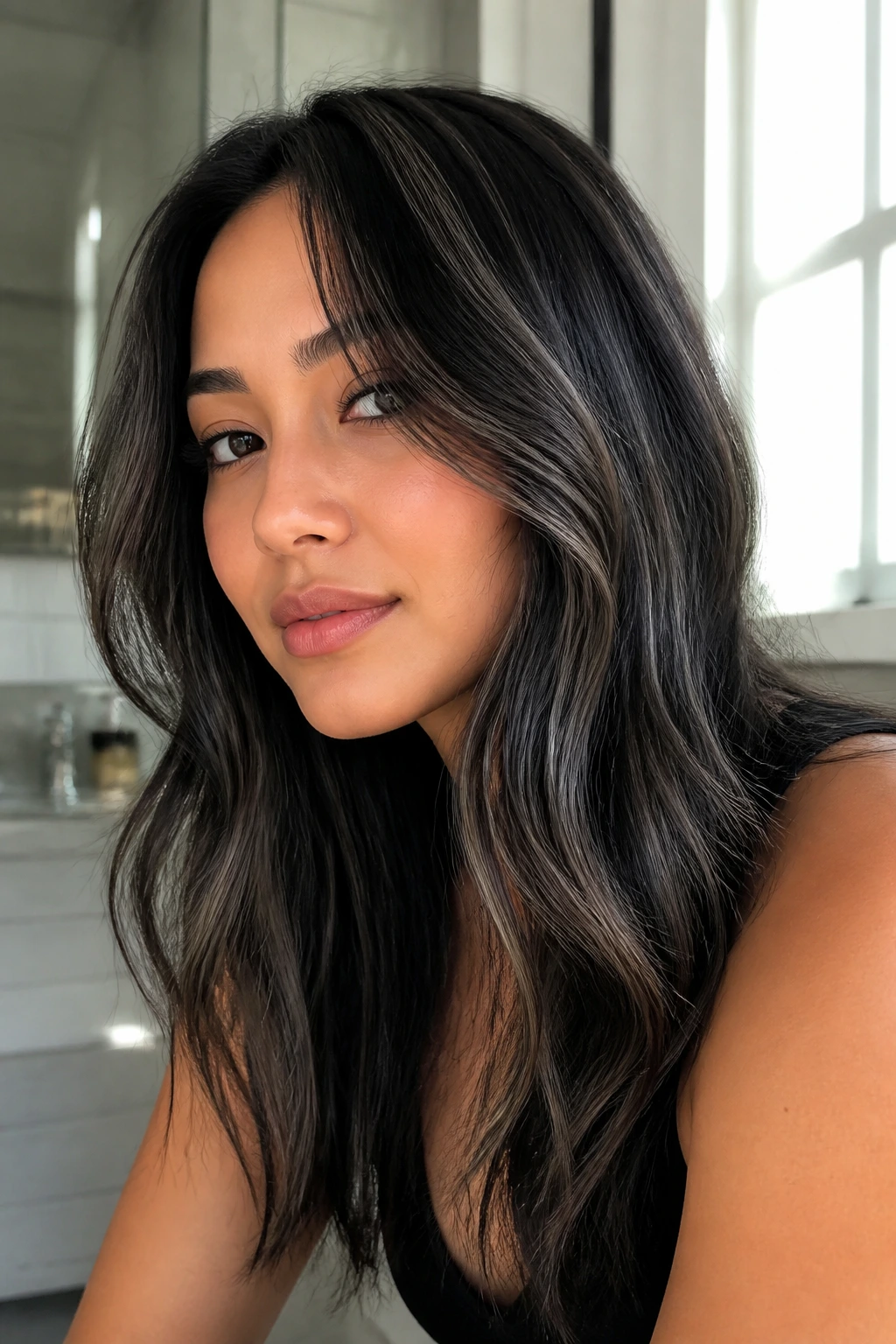
Ash black fades faster than a lot of people expect, and not always in a pretty way. The cool edge can soften into a brownish haze, especially if your hair is porous or you wash it often. A gloss every 6 to 8 weeks usually keeps the tone crisp, while a root shadow can stretch the space between full highlight appointments out to 8 to 12 weeks if the grow-out is soft.
Wash less than you think. Two or three shampoos a week is enough for most people with highlighted brunette hair, especially if you’re using a sulfate-free formula. On the off days, a rinse or a light conditioner refreshes the ends without stripping the toner. If you blow-dry daily, the color will need more care; if you air-dry or diffuse, the ash stays cleaner longer.
Cool water helps. Not freezing, just cooler than the shower water most people like. Hot water opens the cuticle fast and lets the tone slip out with it. If your hair starts to look flat or dusty instead of smoky, that’s usually a sign it wants a gloss, not another round of purple shampoo.
One more thing: the ends tell the truth first. If the bottom four inches start looking transparent, don’t panic and reach for a stronger shampoo. Use a conditioning mask, trim the dry part if needed, and let the colorist refresh the mid-lengths with a softer toner. That usually fixes the problem faster than fighting it at home.
Common Questions About Ash Black Highlights
Will ash black highlights wash me out if my skin is warm?
Not if the placement is soft and the base keeps some brunette or chestnut in it. The problem usually comes from jet-black density at the hairline, not from ash-black color itself.
What base color works best for warm skin tones?
Level 3 to 5 brunette bases are the easiest starting point. They hold ash-black ribbons without needing heavy lift, and they let the skin stay bright.
Can I get ash black highlights if my hair is already very dark?
Yes, but the effect will be subtler. On near-black hair, ash usually reads as cool sheen or hidden panels rather than obvious streaks.
Will ash black turn green on my hair?
It can if the hair is too porous or the toner is too strong. A good stylist will adjust the formula and sometimes use a softer brown-gray glaze instead of a harsh cool toner.
How often do I need toner?
Most ash-black looks need refreshing every 4 to 8 weeks, depending on how fast your hair fades and how often you wash it. If the color is mostly peekaboo or underlayers, you can usually stretch it longer.
Can I wear ash black if I have curly hair?
Absolutely. Curly hair often looks better with ash black placed in halos, ribbons, or underlayers because the texture breaks up the cool tone and keeps it from looking like one heavy sheet.
Is ash black more maintenance than regular brunette highlights?
Usually, yes. Cooler tones fade faster than warm browns, and they need more glossing to keep the smoky finish. The grow-out can still be gentle, though, if the root is blurred.
What should I tell my stylist if I want subtle color?
Say you want ash-black dimension, not a full dark transformation. Ask for fine babylights or soft ribbons one to two levels cooler than your base, with warmth left near the face.
Where the Smoke Sits Best
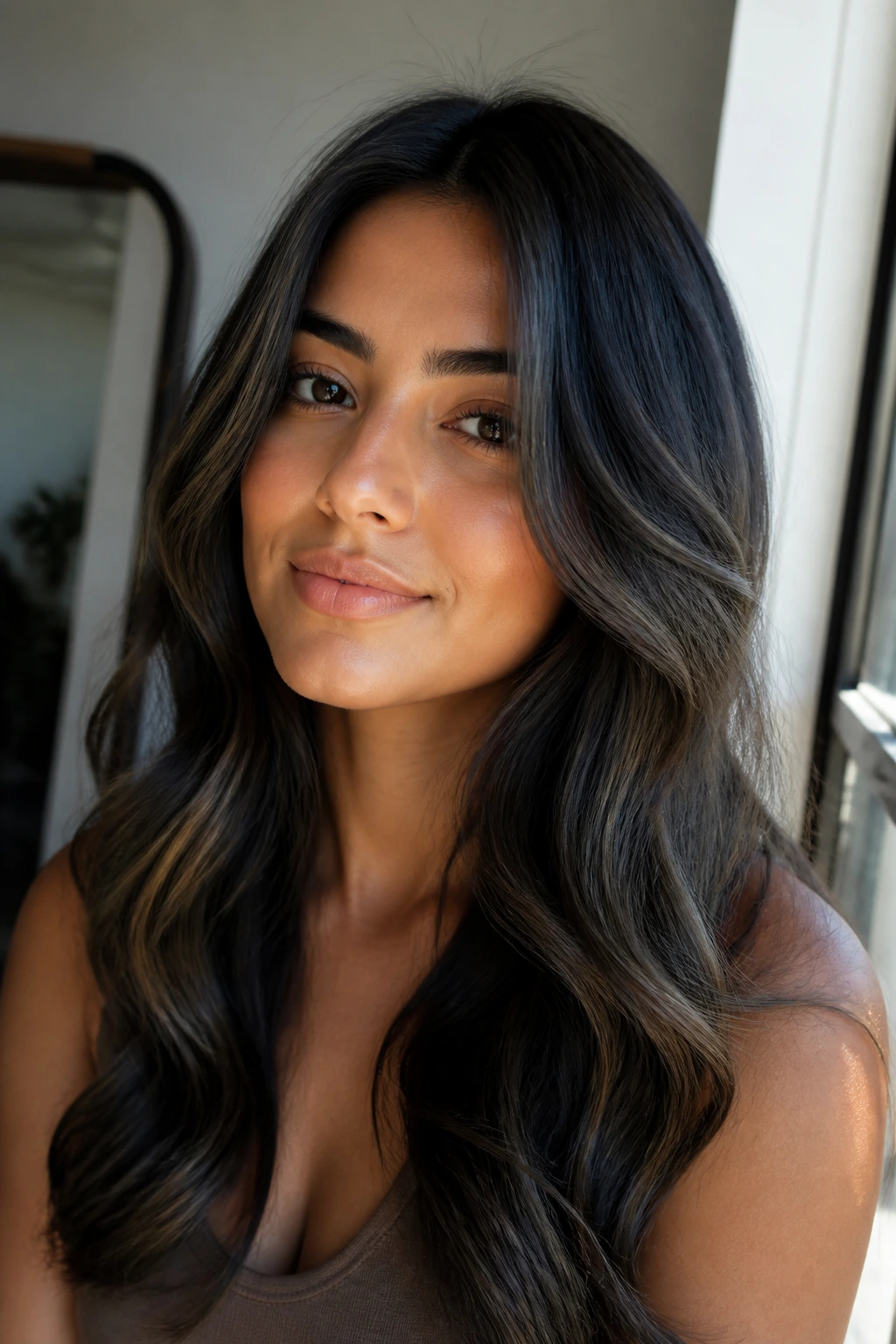
Ash black highlights have a narrow margin for error on warm skin, which is exactly why they’re interesting. Place the cool tone with care, leave some brown warmth where the face needs it, and the whole look starts to feel deliberate instead of dyed for the sake of it. The best versions don’t shout. They sharpen.
If you’re choosing between a dozen photos, trust the ones where the hair still looks like hair in daylight — not a solid sheet, not a blue-black helmet, not a muddy brown that forgot what it wanted to be. The smoky ones win because they move. That’s the whole trick, really.