



Thick hair can look expensive and feel like a brick on the same morning. That’s the tradeoff nobody warns you about. The right angled layers with bangs for thick hair change that balance fast: the cut stops hanging in one heavy block, the front gets shape, and the whole head starts moving instead of sitting there like a helmet.
The magic is not in taking off a ton of length. That usually goes sideways. It’s in cutting a line that gives the density somewhere to go — forward, downward, or away from the face — while keeping enough weight so the ends don’t puff out like a broom. Bangs matter here too. On thick hair, they are not a tiny garnish. They’re the piece that decides whether the cut feels sleek, shaggy, soft, or sharp.
And that’s why this family of cuts is worth paying attention to. A blunt one-length shape can make dense hair look wider. A badly layered cut can make it frizzy at the ends and heavy at the roots. Angled layers with bangs sit in the useful middle. The front gets motion, the perimeter stays controlled, and you can push the whole look in different directions depending on where you place the shortest pieces.
Why These 25 Cuts Earn Their Space
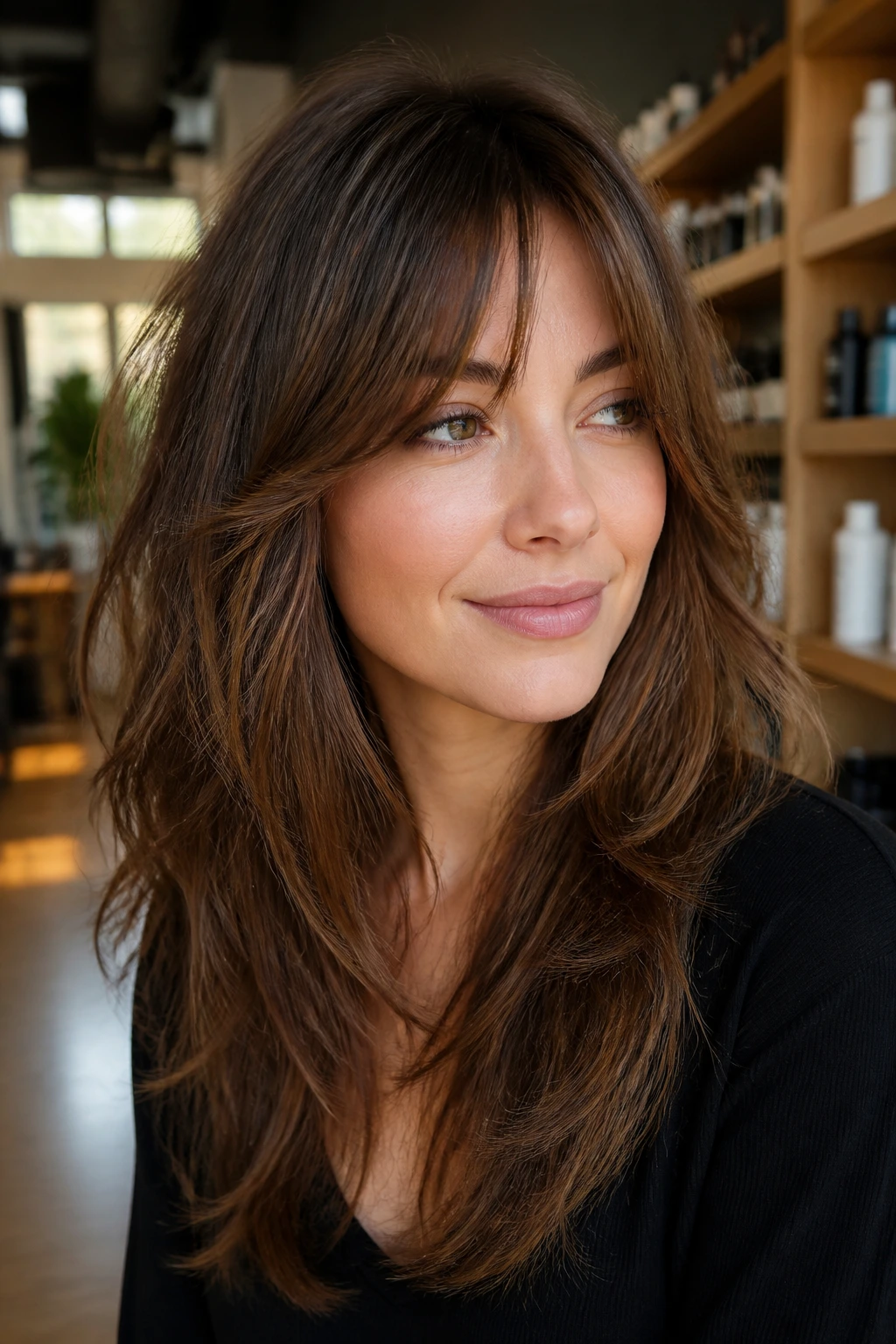
- Weight control: Angled layers remove bulk from the sides first, which matters because thick hair usually feels widest around the jaw and cheekbone.
- Face framing: Bangs break up a tall forehead, a long face, or a heavy curtain of hair without making the whole cut shorter.
- Styling range: Most of these shapes can be blown smooth, worn wavy, or air-dried with mousse, which is useful when dense hair behaves differently on different days.
- Grow-out grace: Curtain, bottleneck, and side-swept bangs usually soften as they grow, so the cut stays wearable longer between trims.
- Less triangle, more movement: The angled perimeter keeps thick hair from flaring out at the bottom, which is the complaint I hear most from people with dense hair.
- Salon clarity: These shapes are easier to ask for when you know where the angle starts and how heavy you want the fringe.
1. Chin-Length Angled Lob with Curtain Bangs
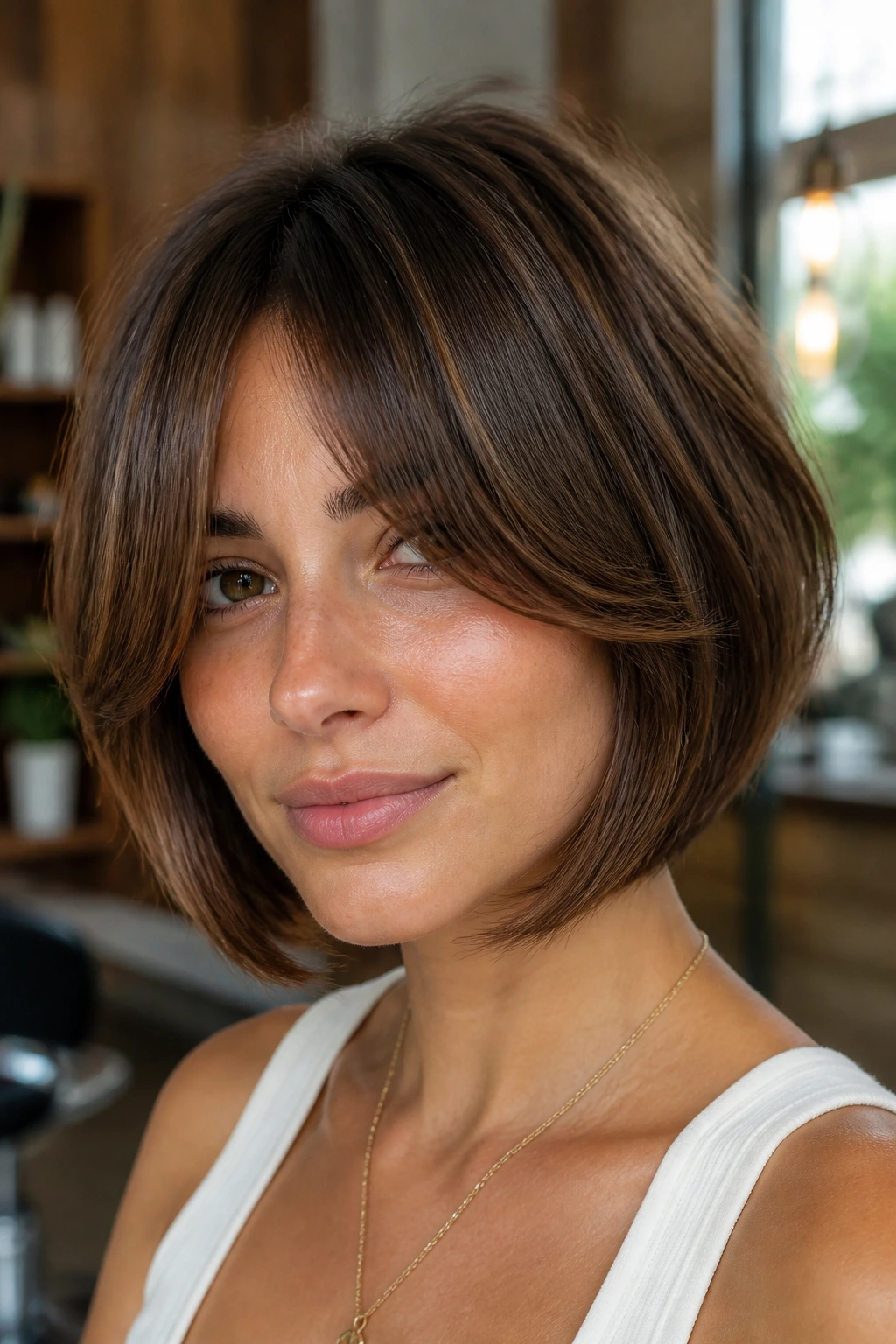
A chin-length angled lob with curtain bangs gives thick hair a job to do. The front pieces skim the jaw, the back stays just a touch shorter, and the curtain fringe breaks up the front without boxing in the face. On dense hair, that small difference matters. The whole cut feels lighter, but it still has enough weight to tuck behind one ear without exploding.
Why it works on thick hair
The angle pulls the eye downward while the curtain bangs split the width at the forehead. That keeps the shape from looking like a blunt shelf. Ask for a soft internal debulk, not a ragged thinning job, or the ends will fray and stick out.
Best for: straight or loose-wavy thick hair that needs jawline control.
Styling note: a round brush or a 1.25-inch curling iron bends the front pieces under just enough to keep the line clean.
Watch for: if the shortest pieces land too high on the cheek, the cut can start to mushroom.
Bold tip: keep the bangs long enough to graze the lashes when dry; thick hair shrinks upward more than most people expect.
2. Long Angled Layers with Bardot Bangs
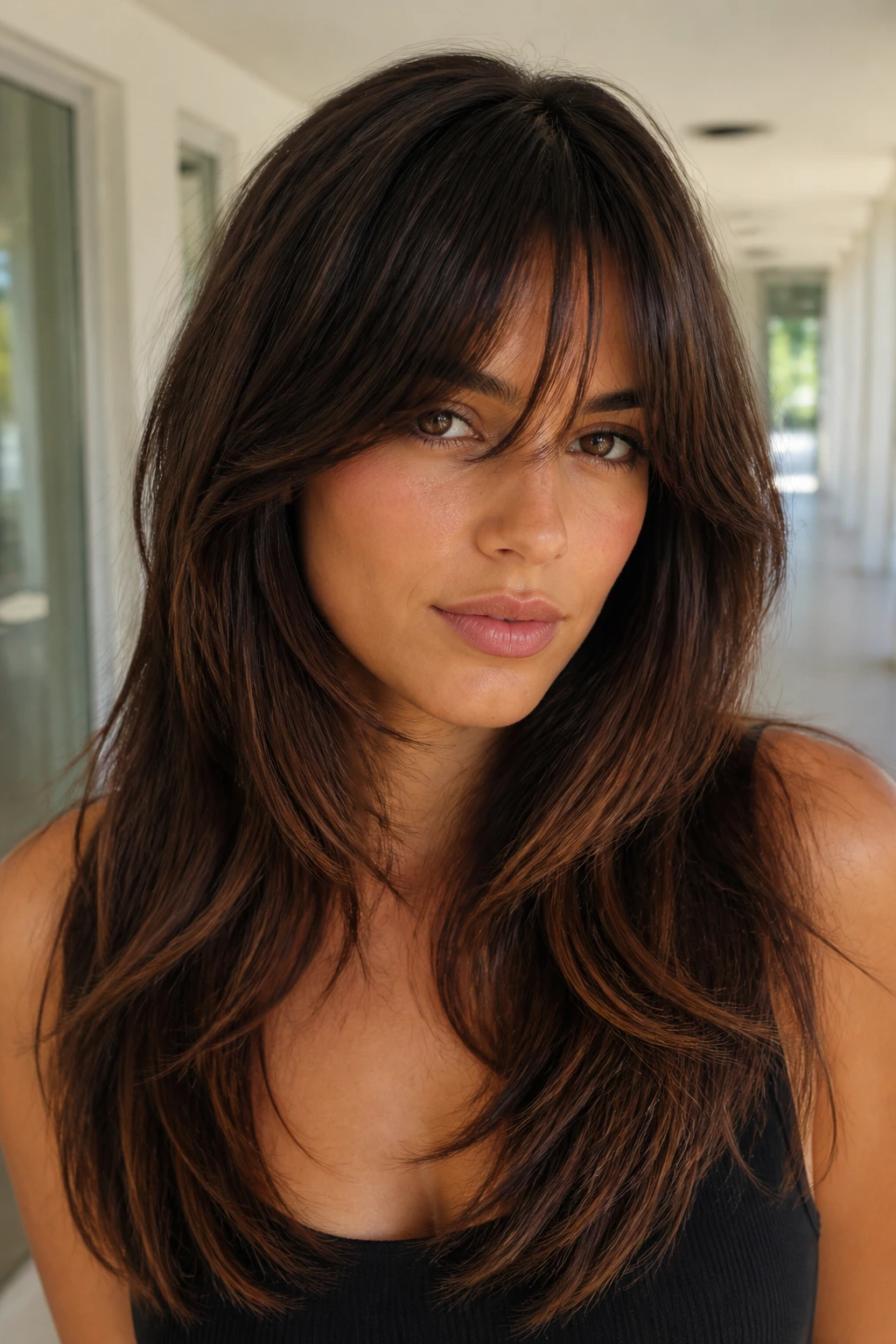
Long hair does not have to mean heavy hair. This cut keeps the length, but the angled layers carve a diagonal through the mass so the front doesn’t drag the whole style down. Bardot bangs — fuller in the middle, split softly at the sides — work well because they soften the forehead without swallowing it.
The part I like most is the way the front grows out. It never looks like you missed a trim by accident. It looks lived-in on purpose. That is a small thing, and a useful one.
If your hair sits below the chest, this shape keeps the ends from feeling like a single blunt curtain. Ask your stylist to leave the layers long enough that the perimeter still feels solid. Too much chopping here and the ends start to fray in humidity.
3. Shoulder-Grazing Layers with Side-Swept Bangs
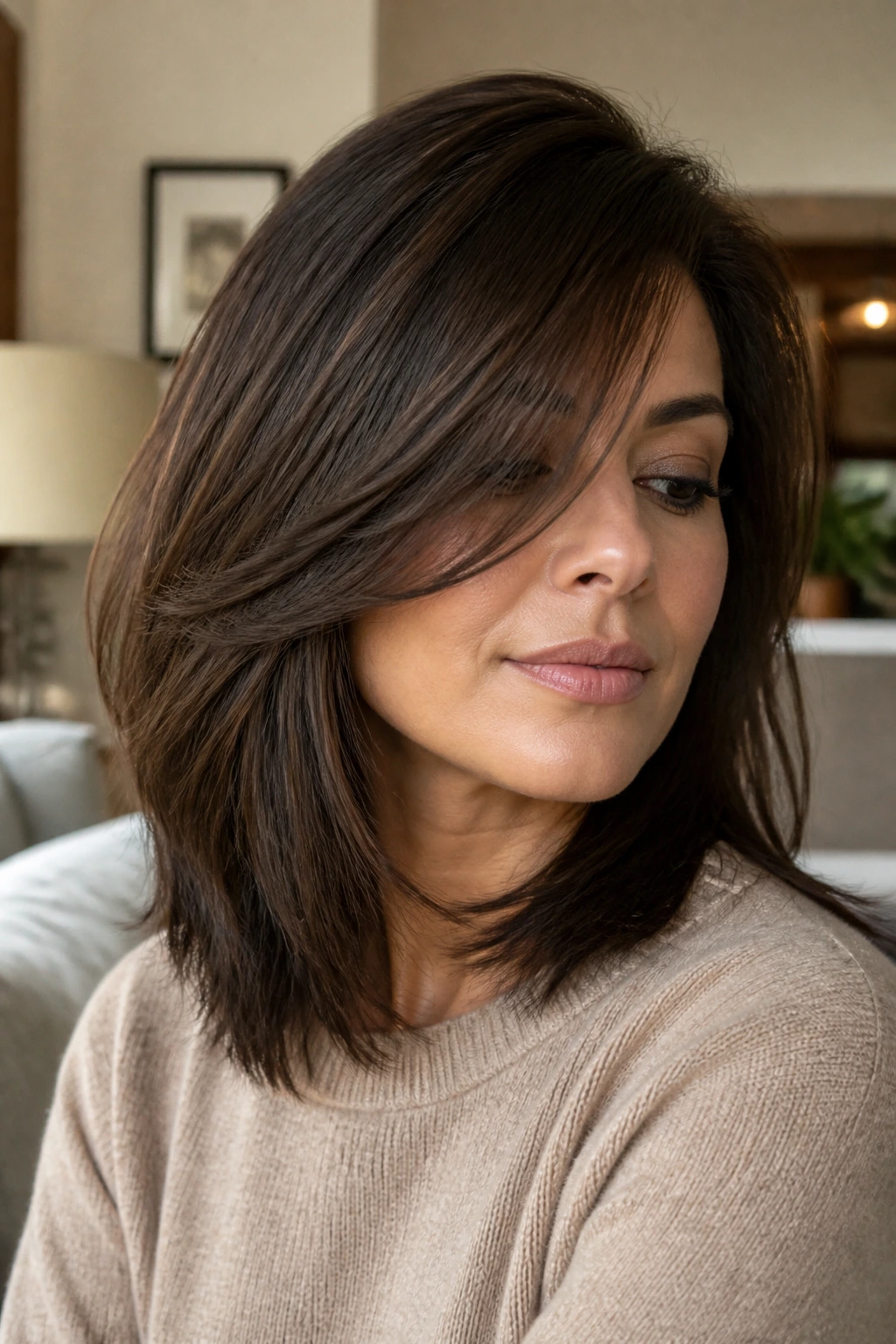
When thick hair hits the shoulders, it can flip out in two directions at once. Side-swept bangs calm that down. They move one side of the face frame forward and let the rest of the cut fall with a little more direction.
This is the cut I recommend to people who want shape without obvious “layers.” The angle is there, but it’s quiet. On straight hair, the front sweep can be blown smooth in under ten minutes. On wavy hair, a large round brush or a velcro roller at the bang helps the fringe settle instead of splitting in weird places.
What to ask for
- A diagonal front that starts near the cheekbone
- Soft layering through the mid-lengths
- A side fringe that blends, not one that ends in a hard step
- Enough weight at the hem to keep the silhouette grounded
4. Deep U-Shaped Layers with Bottleneck Fringe
Why does a U-shape work so well on dense hair? Because it keeps the perimeter from feeling like a brick while still holding a strong outline. The center is longest, the sides lift a little, and the whole cut moves with the head instead of against it.
Bottleneck fringe is the smart companion here. It starts a bit fuller near the center, then opens around the temples. That keeps the forehead from feeling crowded, which can happen fast when thick hair is all one texture from root to end.
Styling cue
Blow the fringe forward first, then split it with your fingers while it is still warm. If you let it dry flat and separate it later, it can clump and sit too straight.
5. Razor-Soft Angled Layers with Wispy Fringe
This is for thick hair that needs air between the strands. A razor-soft edge can be beautiful on the right texture — especially medium-thick hair that wants movement more than polish. The wispy fringe keeps the front light, so the face isn’t buried under a heavy block of bangs.
I would not push this on coarse, puffy hair without caution. A razor can rough up the ends if the texture is already dry or frizzy. When it works, though, it gives a swingy, feathered finish that looks almost weightless at the tips.
Keep the shortest layer around the cheekbone or upper lip. Any shorter and the front can start to kick out instead of falling.
6. Butterfly Layers with Full Bangs
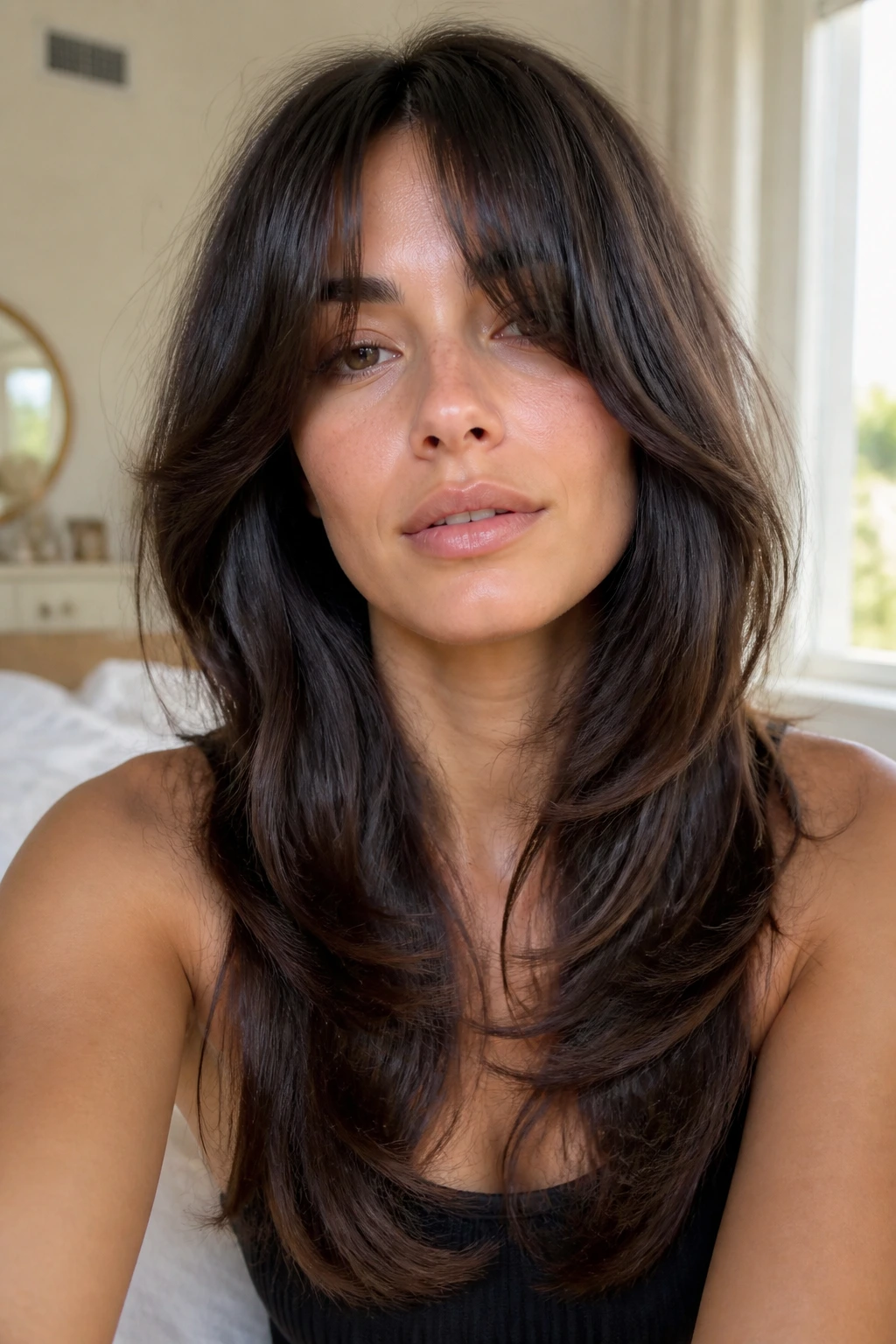
This cut has attitude. The butterfly shape lifts the crown, then drops longer face-framing pieces around the jaw and collarbone, which is a nice trick for thick hair because it redistributes the bulk instead of stripping it away. Full bangs anchor the top, so the crown doesn’t puff while the ends stay heavy.
The result is a lot of hair — but with direction. That distinction matters. Dense hair looks best when it has a plan.
If your hair dries flat at the roots, this shape gives you room to rough in volume with mousse or a root lift spray. If your bangs grow fast, book trims on the front every few weeks. Full bangs on thick hair can lose their shape quickly, and then they just sit there.
7. Collarbone Cut with Blended Curtain Bangs
This one looks easy, but the details are doing the work. The collarbone length gives thick hair a place to stop before it gets too wide at the chest. The curtain bangs slide into the front layers so the whole haircut feels connected instead of chopped into parts.
Why it works
The cut is long enough to tie back, but short enough to show the angle. That makes it a sweet spot for people who want shape without losing hair they can still put in a clip. The bangs are the part that sell it. If they’re blended well, they make the layers look deliberate even on days when the rest of the style is a little messy.
Good for: people who air-dry often.
Better with: a leave-in cream that controls frizz at the front.
Skip if: you want a sharp, blunt edge. This cut is about softness.
8. Shaggy Angled Layers with Choppy Bangs
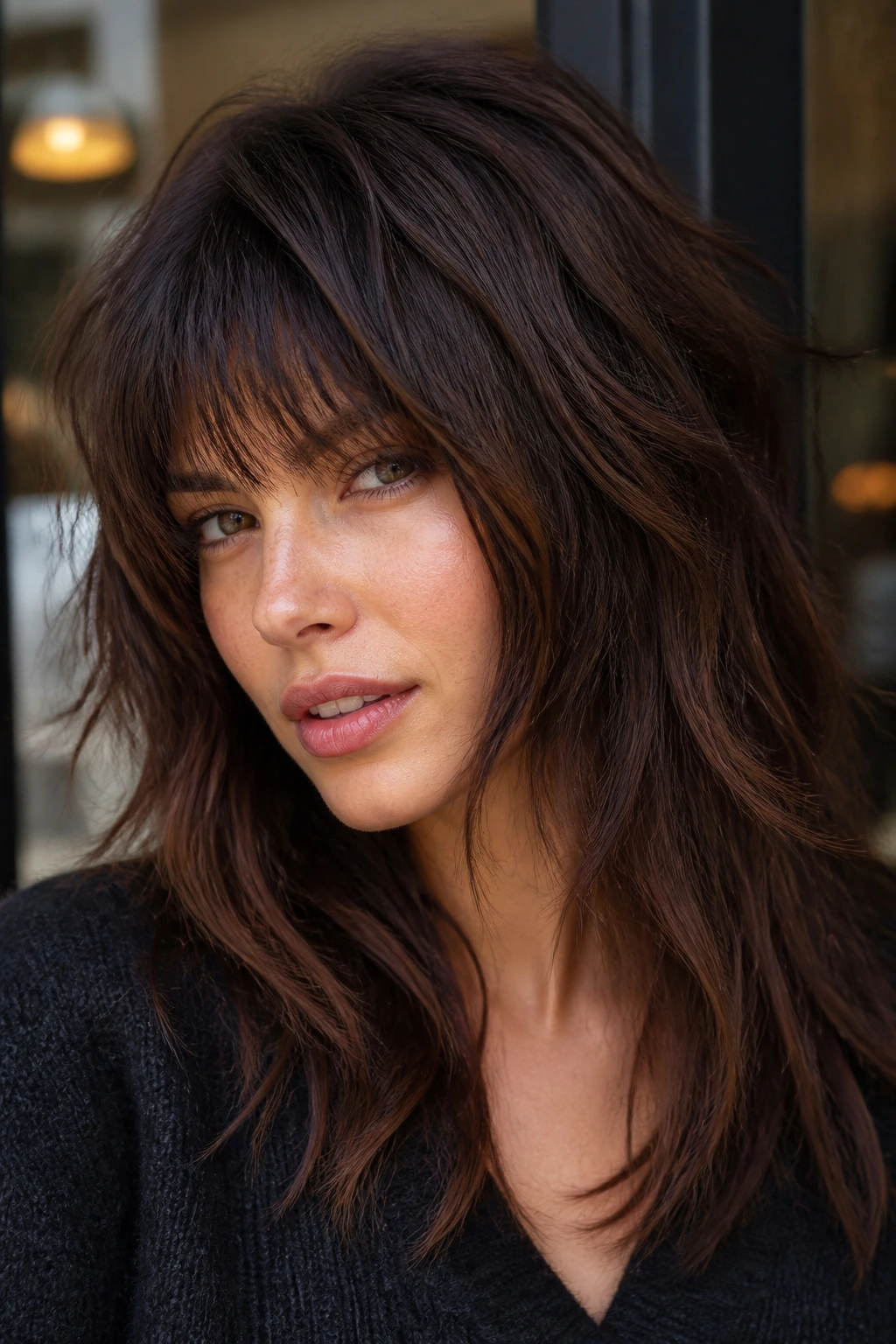
A shag is not a lazy haircut. It’s a haircut that wants movement baked into the shape, which thick hair often needs. The choppy bangs keep the front from becoming too heavy, and the angled layers stop the crown from ballooning out like a triangle.
This is one of the best cuts for thick hair that gets frizzy when it’s overstyled. Scrunch in mousse, diffuse for a few minutes, and stop before the hair gets too dry. The texture is part of the point. If you keep smoothing it into submission, you’ll lose what makes the cut work.
Use this when: your hair has natural wave or a bit of bend.
Avoid this when: your hair is very coarse and you hate texture. The shaggier the cut, the more honesty it asks of you.
9. Sleek Angled Layers with Blunt Bangs
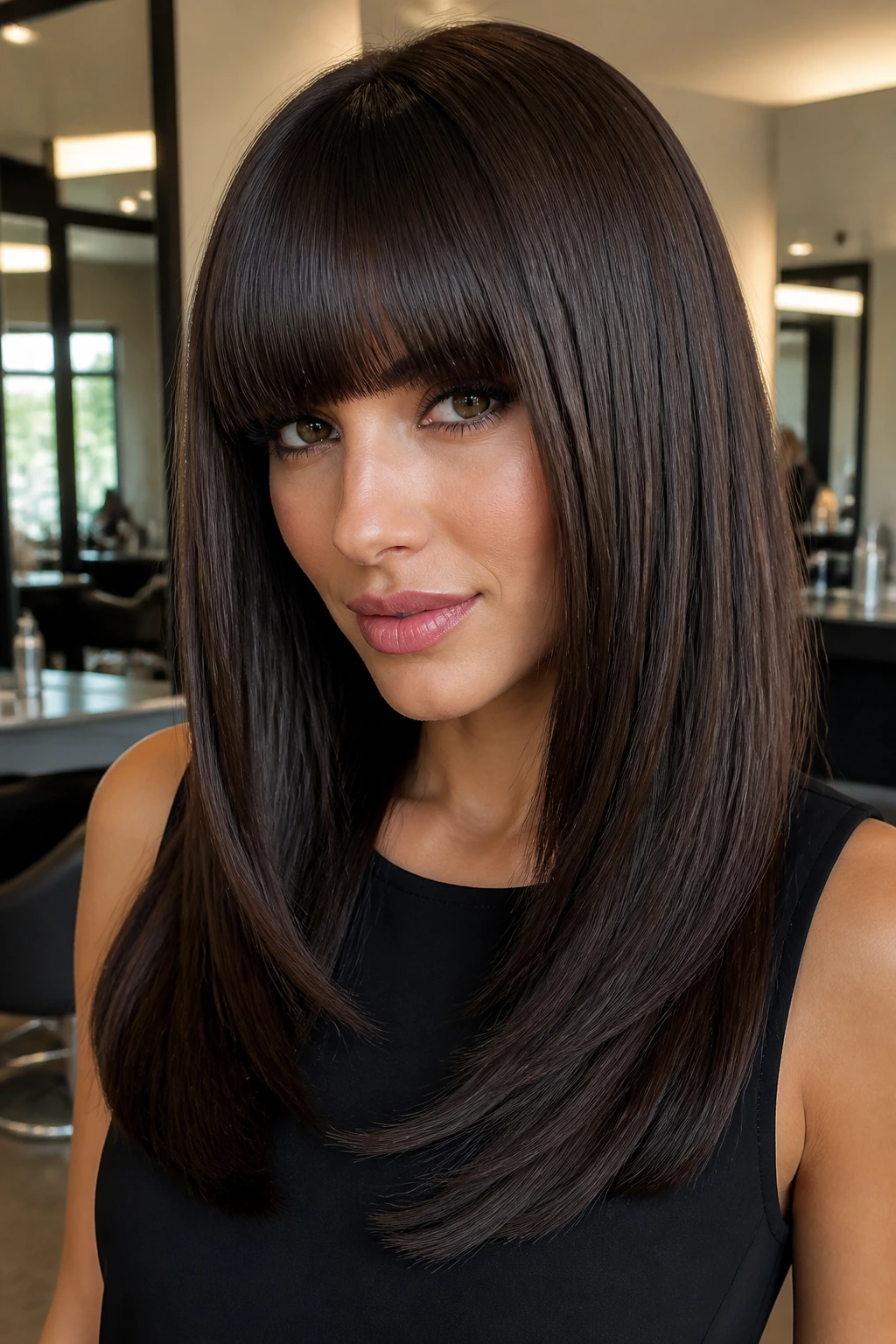
Not every dense head of hair wants softness. Some hair looks best when it is cut into a line and then polished until it shines. Sleek angled layers with blunt bangs give thick hair a strong shape, especially if the hair is straight or can be flat-ironed easily.
The blunt fringe is a statement. It shortens the face and pulls attention to the eyes. The angled layers keep that statement from turning into a heavy block. If the layers are too short, the cut will puff. If the fringe is too thin, it will look accidental. This one needs precision.
A smoothing cream and a concentrator nozzle matter more here than fancy products. And a trim matters fast. Blunt bangs on thick hair can lose their clean edge in a couple of weeks.
10. Wavy Angled Layers with Arched Bangs
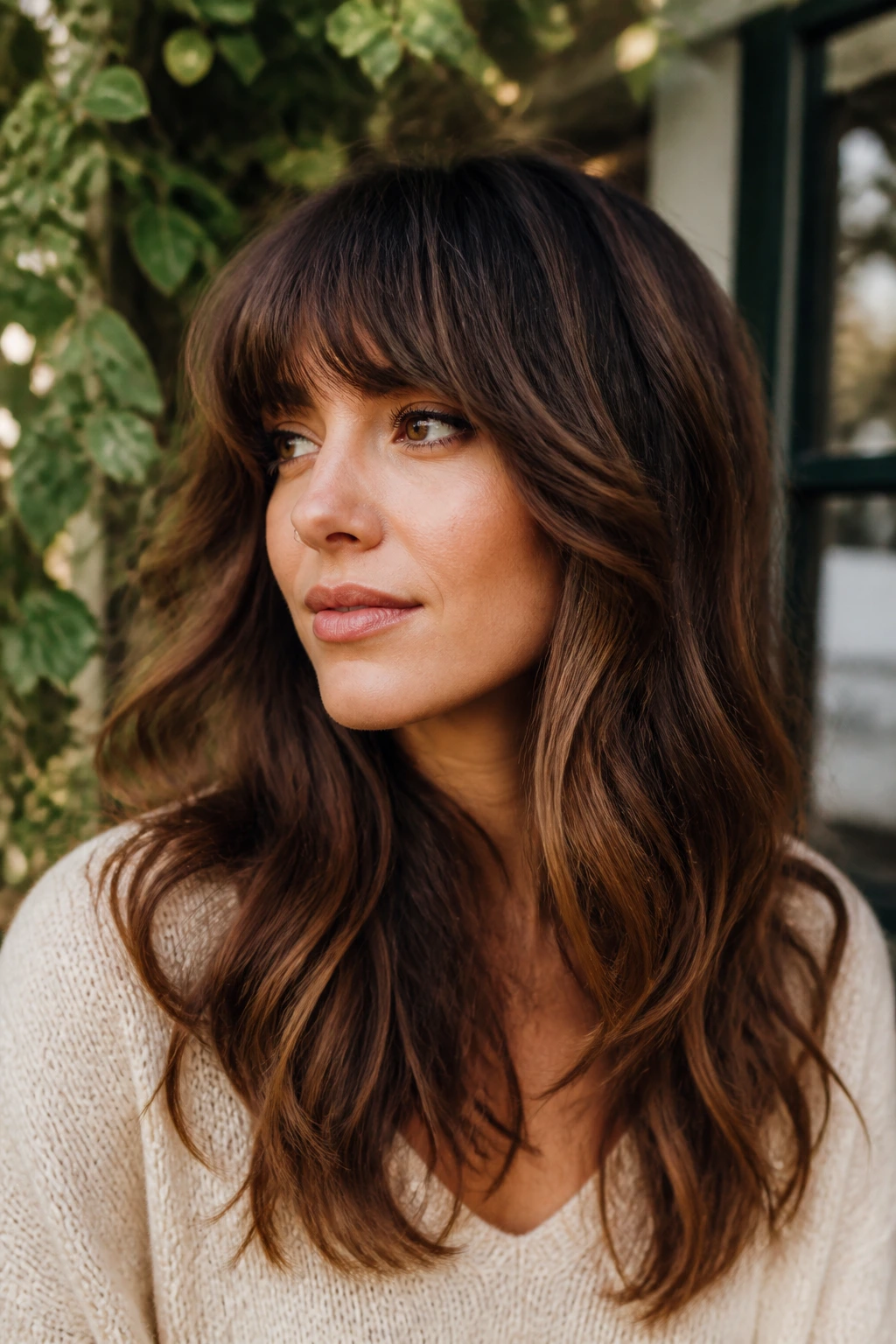
There’s a soft bend to this cut that thick hair really likes. Arched bangs follow the shape of the brow line, and the angled layers echo that curve through the rest of the cut. On wavy hair, it looks easy. On straighter hair, it looks polished without seeming stiff.
The face frame matters most here. If the shortest pieces hit the cheekbone and then slide into longer layers, the hair feels like it’s moving away from the face instead of sitting on it. That’s useful for thick hair because it keeps the sides from feeling too wide.
Let the fringe dry with a little tension from your fingers, not a brush that pulls it flat. Thick bangs can separate in awkward little ridges if you rush the dry.
11. Long Voluminous Layers with Piecey Bangs
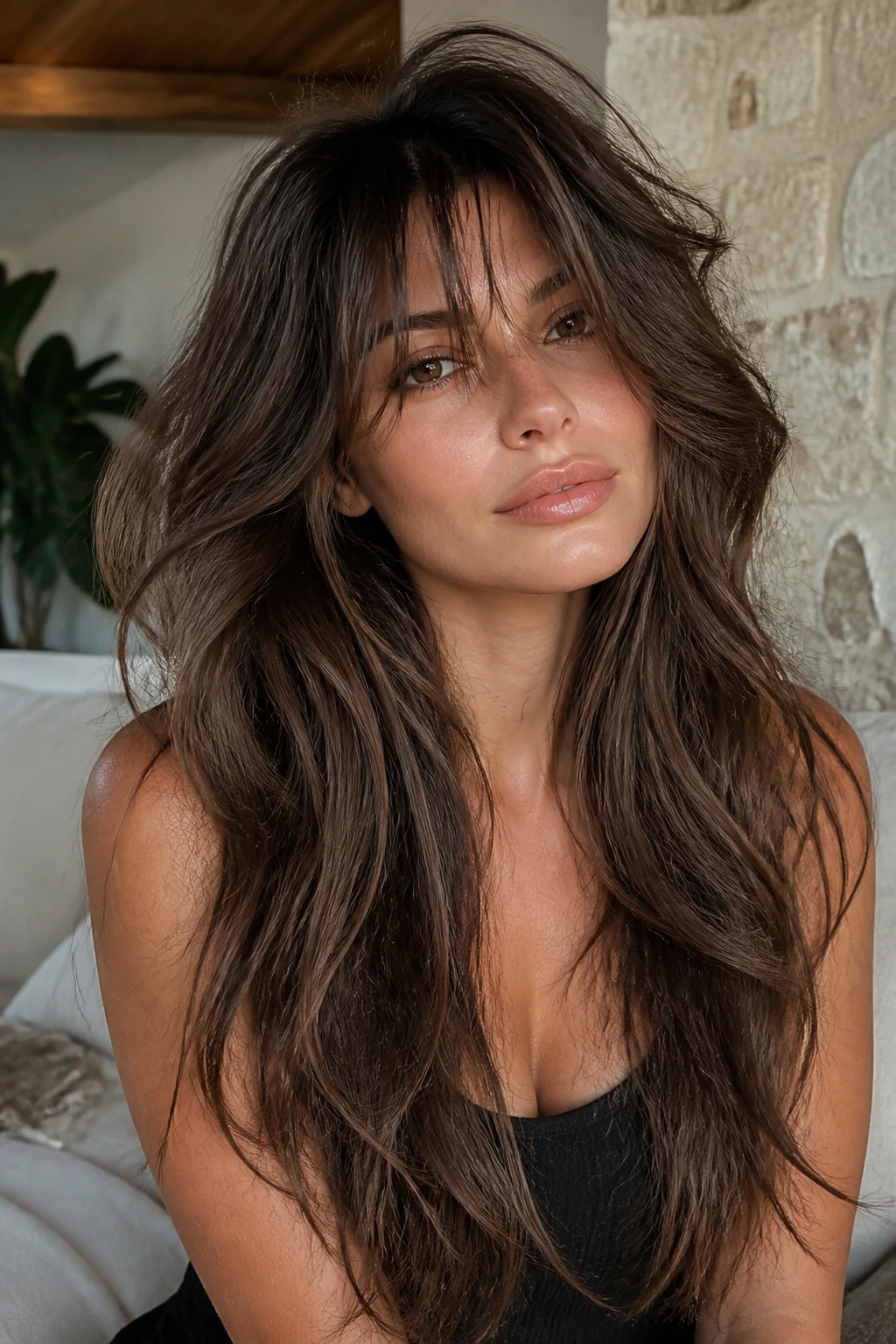
This cut leans into the fact that thick hair has presence. Long layers keep the length, while piecey bangs break the front into smaller sections so the shape doesn’t swallow the face. The result is full, but not blunt. That difference shows up most when the hair is loose around the shoulders.
I like this for people who wear their hair down more than up. It gives the front enough interest that you do not need to curl the whole head to make it look finished. A little texture spray through the mid-lengths and a quick bend at the ends usually does it.
The one thing to watch is over-layering the crown. Too much lift at the top and the cut can start to stack upward instead of flowing down.
12. Mid-Length Cut with Micro Fringe
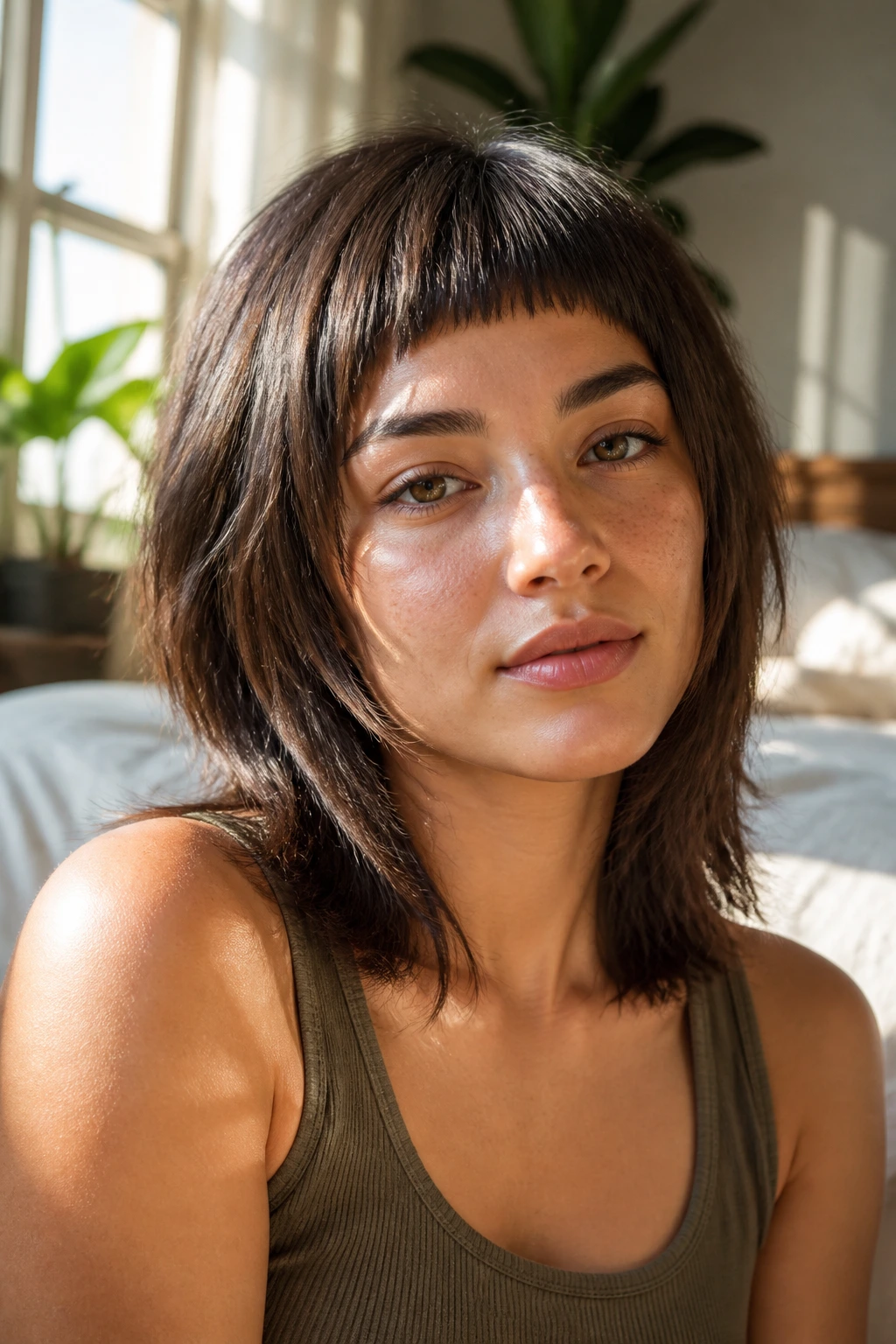
Micro fringe on thick hair is not for everyone. It is for someone who wants a sharper, more editorial edge and does not mind more frequent trims. The mid-length cut keeps the bulk from getting too heavy around the chest, and the micro fringe opens the face in a way that feels deliberate.
The trick is balance. Because the fringe is short, the rest of the cut needs enough movement to keep the whole thing from feeling severe. I would leave some softness around the temples and cheekbones so the shape has a little give.
If your forehead is very short or your hairline is irregular, this may be a fight you don’t need to have. Thick hair can support the fringe. Your face has to carry it too.
13. Rounded Angled Layers with Curved Bangs
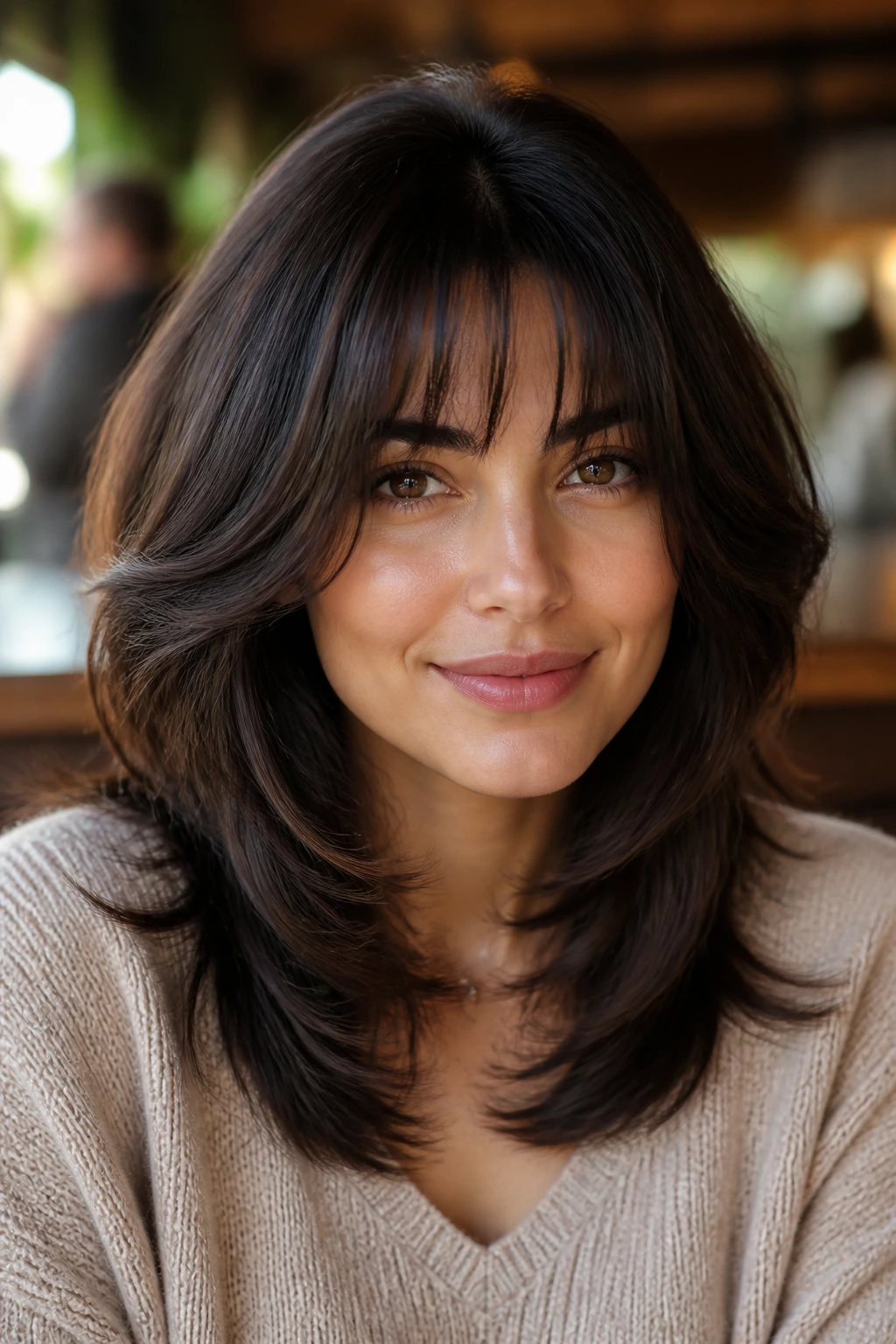
A rounded silhouette can be a relief when thick hair is naturally boxy. The curved bangs echo the shape of the layers, so the whole cut flows in one direction instead of bouncing off the jaw in hard angles. It looks tidy, but not stiff.
This shape is especially good if you wear glasses. The curved bang line can sit above or around the frames without crashing into them. Ask your stylist to leave enough length in the front to tuck behind the temples when needed. That tiny bit of flexibility makes the cut easier to live with.
Best on: dense hair with a mild wave.
Less ideal for: hair that sticks straight out at the sides after drying. In that case, the round shape can add width instead of removing it.
14. Feathered Layers with Side Bangs
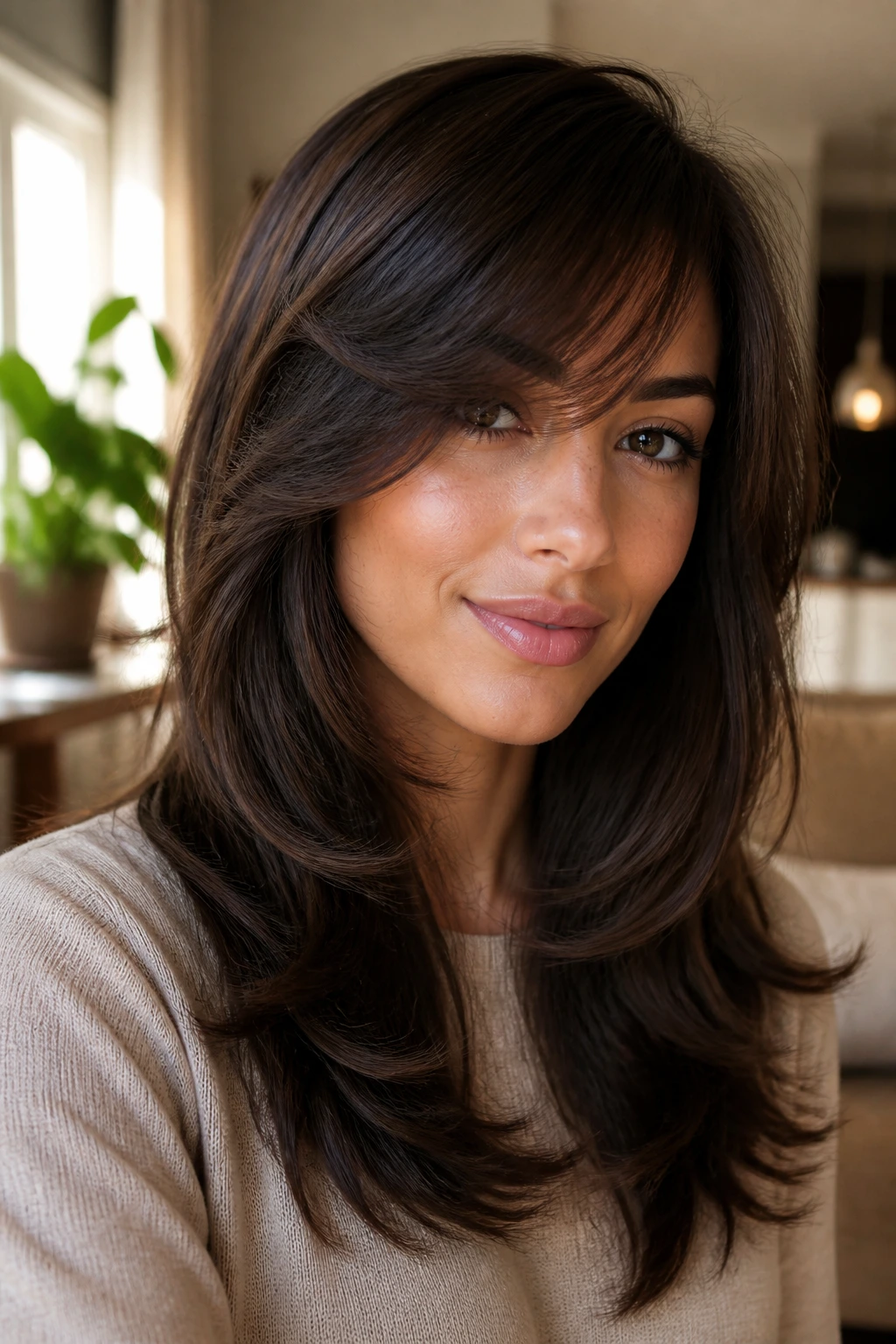
Feathered layers do the opposite of blunt cutting. They let the hair swing. On thick hair, that swing matters because it breaks up the heavy fall you usually get through the back and sides. Side bangs tie the whole thing together and keep the front from looking flat against the forehead.
This is one of the easiest cuts to style into a loose blowout. Use a medium round brush, direct the bangs across the forehead, and turn the front pieces away from the face at the ends. That small bend changes the whole mood.
If you have a strong cowlick near the front hairline, side bangs are usually easier to live with than straight-across fringe. They give the growth pattern somewhere to go.
15. Curly Angled Layers with Curly Bangs
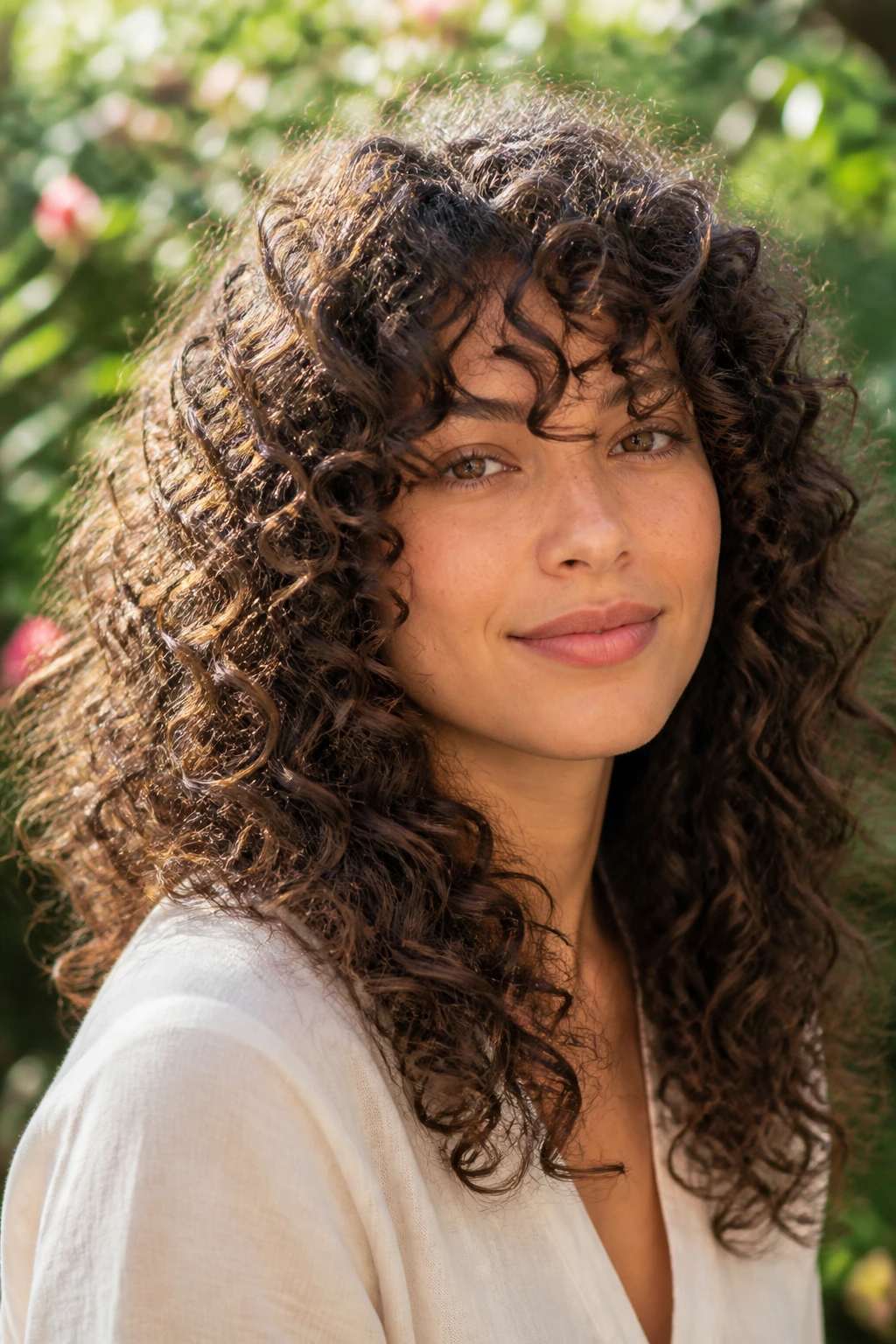
Curly thick hair needs a different kind of honesty. You cannot cut it the same way you cut straight hair and expect the same result. The angled layers here are cut to respect the curl pattern, and the curly bangs are left long enough to spring up when dry.
Dry cutting helps here. Wet curls lie. They stretch, then bounce, then surprise you when they shrink back. The best version of this cut keeps the shortest fringe pieces well below the final target so the curl has room to shrink.
Use a curl cream that gives slip but not too much weight. Heavy products can drag the bangs down and make the front look limp while the rest of the head keeps its body.
16. Wolf-Cut Angled Layers with Fringe

This is the loudest shape in the group, and I mean that in a good way. The wolf-cut angle keeps the crown short enough to create lift, then drops into longer lengths that hang with edge. Fringe finishes the look with a little grit.
It works on thick hair because thick hair can handle extreme contrast better than fine hair can. The danger is overdoing the internal cuts. If the layers are too short and too high, the shape becomes fluffy in the wrong places. You want movement, not a mushroom cloud.
This cut is for people who like their hair a bit unruly. If you want something polished and neat every day, skip it.
17. Polished Angled Layers with Bottleneck Fringe
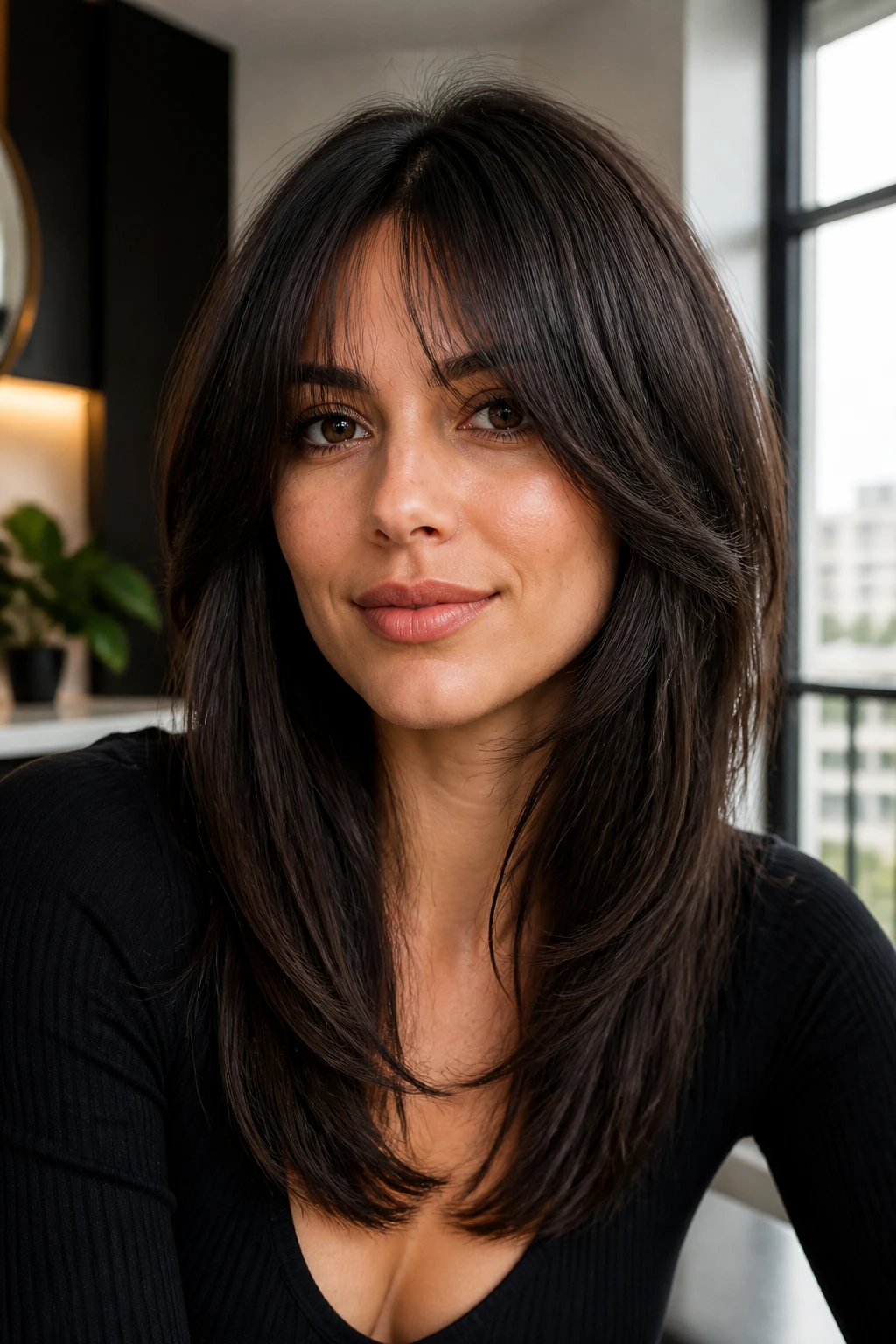
Why do bottleneck bangs keep showing up on thick hair? Because they solve a common problem: too much fringe weight in the middle, too much emptiness at the temples. The shape opens where it should and stays fuller where it needs to.
The angled layers underneath keep the polish from feeling severe. You get a smooth outline with just enough face frame to soften it. On straight hair, this cut can look expensive with almost no effort. On slightly wavy hair, a quick pass with a blow dryer and a round brush keeps the front from splitting.
If your forehead is broad, this is a smart one. It narrows the top without making the cut look cramped.
18. Bouncy Layers with Soft Baby Bangs
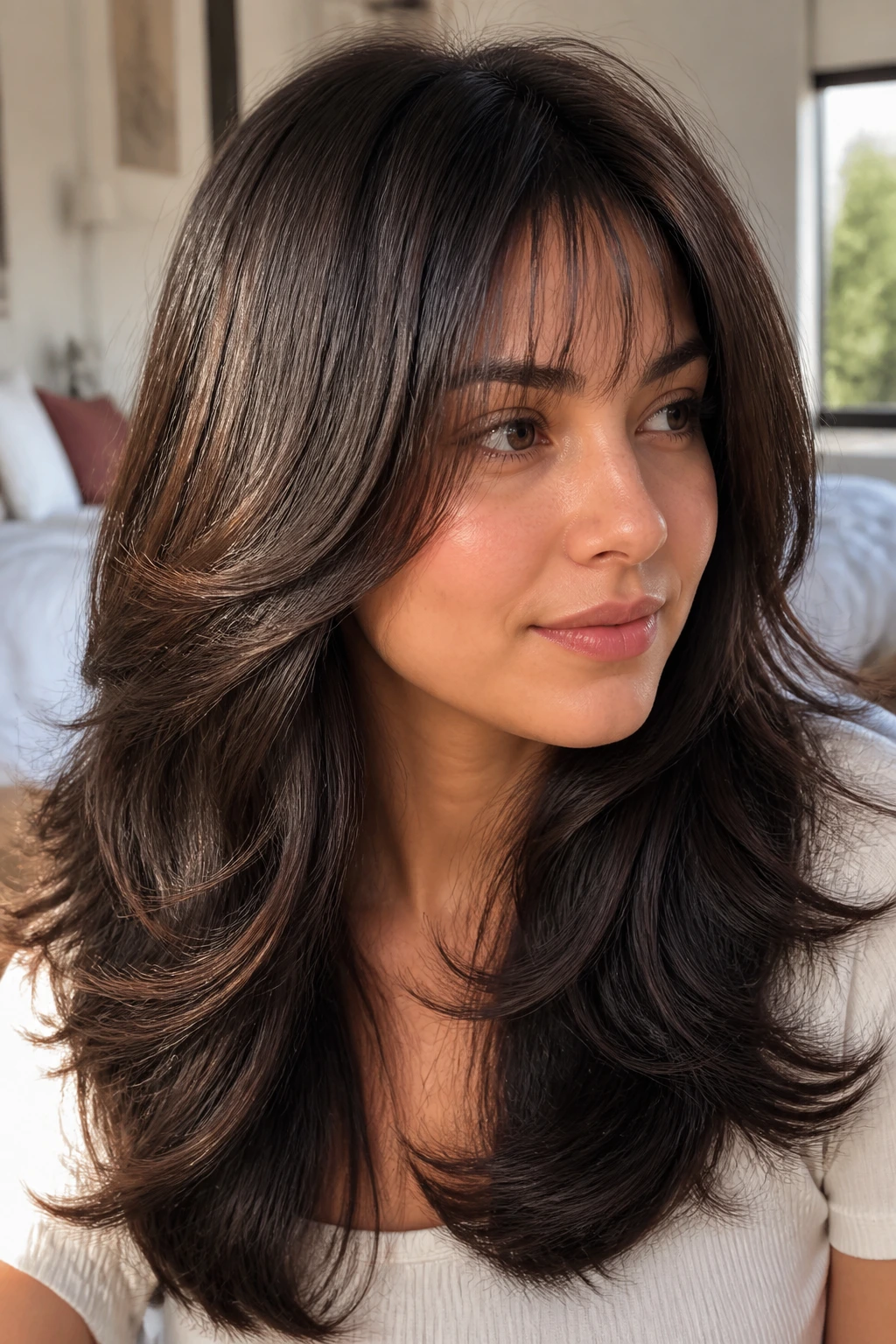
Baby bangs are a choice. A real one. They show a little more forehead and a little more confidence, which is why they work best when the rest of the cut has plenty of bounce. Thick hair can support that contrast. The layers carry the volume while the fringe stays short and light.
I would keep the baby bangs soft, not razor-hard. On dense hair, a hard short fringe can look severe fast. A slightly textured edge gives the front a bit of air and keeps the cut from feeling theatrical in a bad way.
This is a good match for people who style their hair often and don’t mind frequent bang trims. It is not a lazy haircut. Nothing about baby bangs is lazy.
19. Cascading Layers with Curtain Fringe
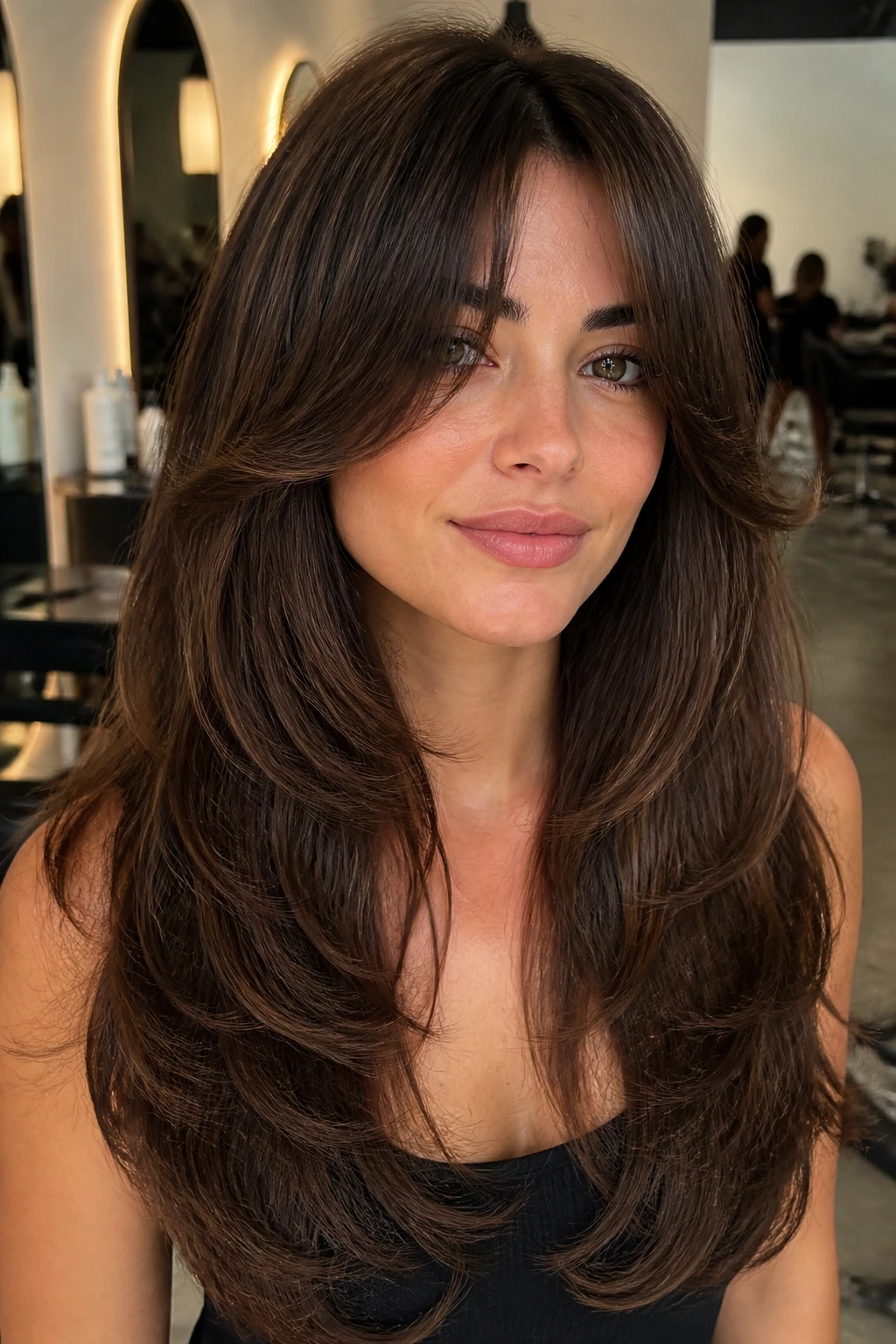
This version is all about flow. The layers cascade down the back and sides, and the curtain fringe starts the movement at the front before blending into the rest of the cut. Thick hair looks good in this shape because the density becomes part of the drape.
The key is where the shortest pieces land. Around cheekbone level usually works best. If they start too high, the front can puff. If they start too low, the whole cut loses the face-framing effect and turns into a long shape with bangs tacked on.
A large barrel or a blow-dry brush helps the front pieces fall away from the face. That little outward bend makes the cut feel open instead of crowded.
20. Flipped-Angle Layers with Side Bang Sweep
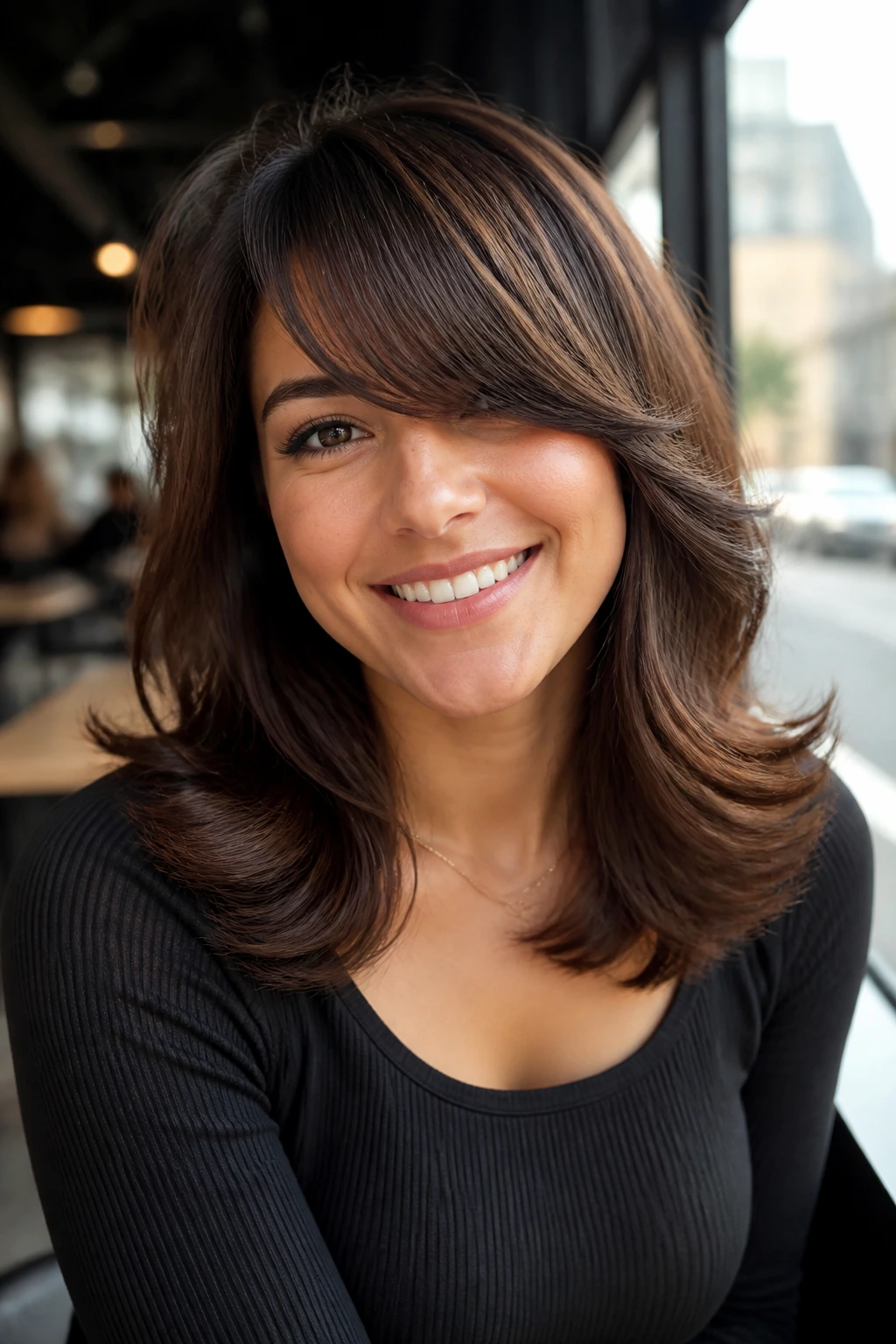
This cut has a bit of retro swing to it. The ends flip outward, the layers angle through the body of the hair, and the side bang sweep gives the front a soft diagonal line. On thick hair, that flip helps the perimeter avoid looking heavy or square.
It is a strong choice if your hair already has a little natural bend. The flip feels easier when the strands want to move on their own. If your hair is very straight, use a round brush and let the ends cool in the flipped position before touching them.
There is something cheerful about this shape. Not cute. Cheerful. That matters if your thick hair tends to feel heavy in darker, rainy months or whenever your blowout starts looking tired by lunchtime.
21. Heavy Crown Layers with Sparse Fringe
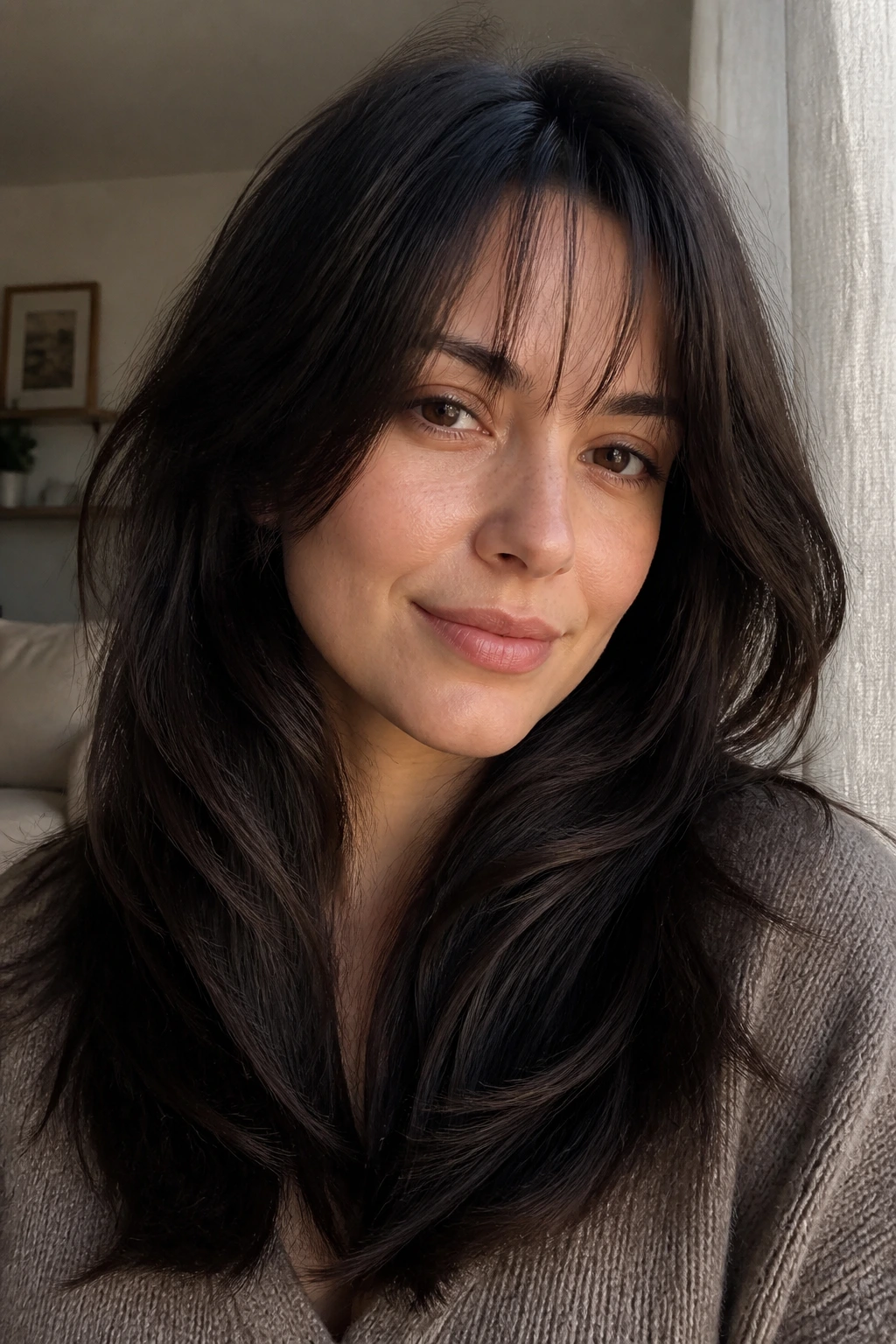
Sometimes less fringe is the smarter move. Thick hair already brings a lot to the forehead and temples, so a sparse fringe can create breathing room without making the cut look bare. The heavy crown layers keep the silhouette from going flat up top while the front stays light.
This is a good answer for people who hate the feel of a full bang on dense hair. The fringe is there, but it does not dominate the face. It can be tucked, split, or swept aside depending on the day.
Quick reality check
- Best if your hairline is uneven and you want softness
- Better if you dislike bang trims every few weeks
- Less useful if you want a strong, graphic fringe line
22. Rounded Butterfly Cut with Long Bangs
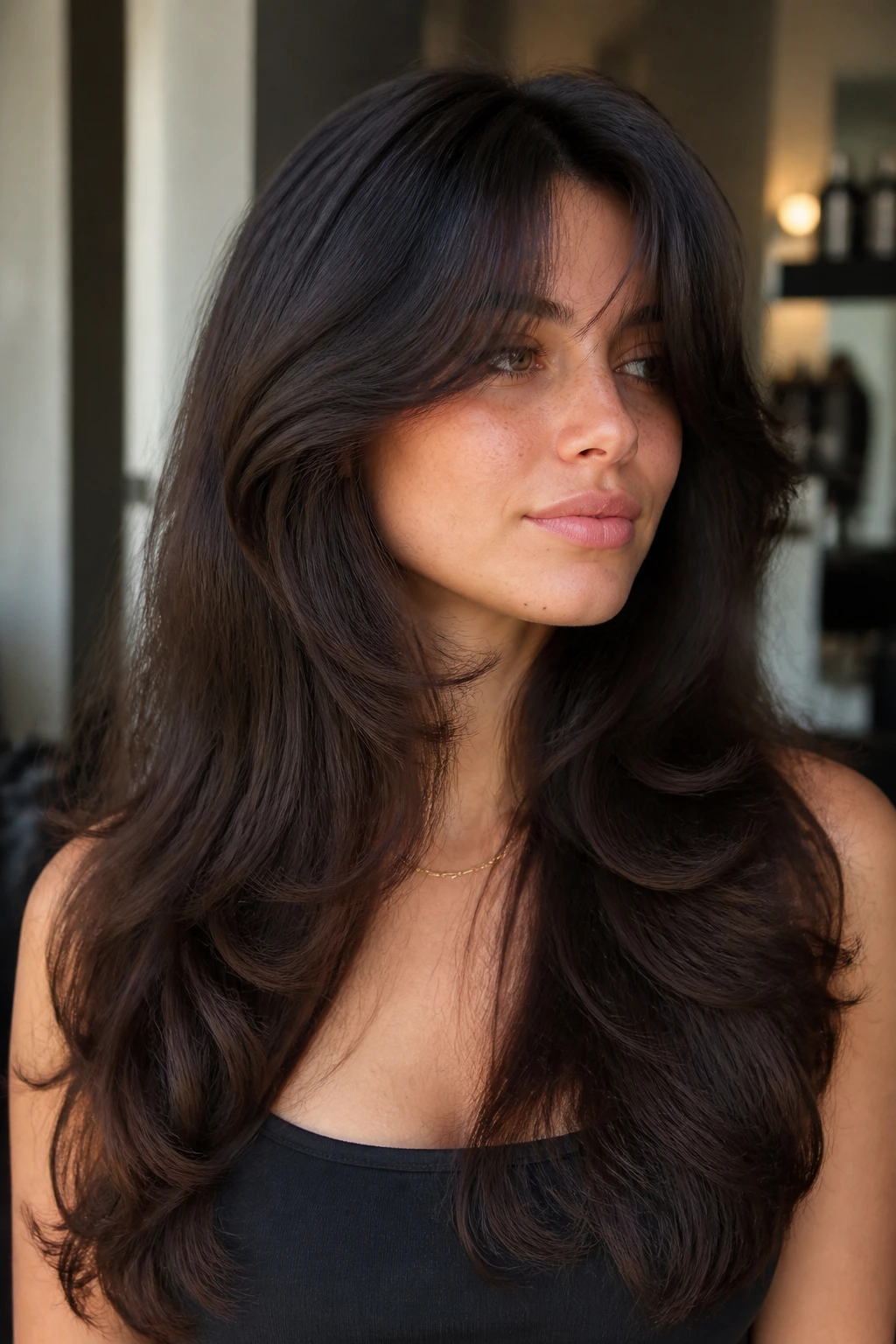
The rounded butterfly cut lifts the crown and keeps the shape soft through the sides, which is a nice fix for hair that grows wide before it grows down. Long bangs keep the forehead covered enough to change the proportions, but not so much that the whole front feels boxed in.
This cut looks best when the longest front pieces skim the collarbone and the shorter layers sit around the cheekbone. That range gives thick hair a graceful drop. If the transition is too abrupt, the butterfly shape turns choppy instead of airy.
A smooth blowout helps this one a lot. So does patience. If you rush the front, the bangs can split and the round shape loses its curve.
23. Thick Curly Angled Layers with Longer Fringe
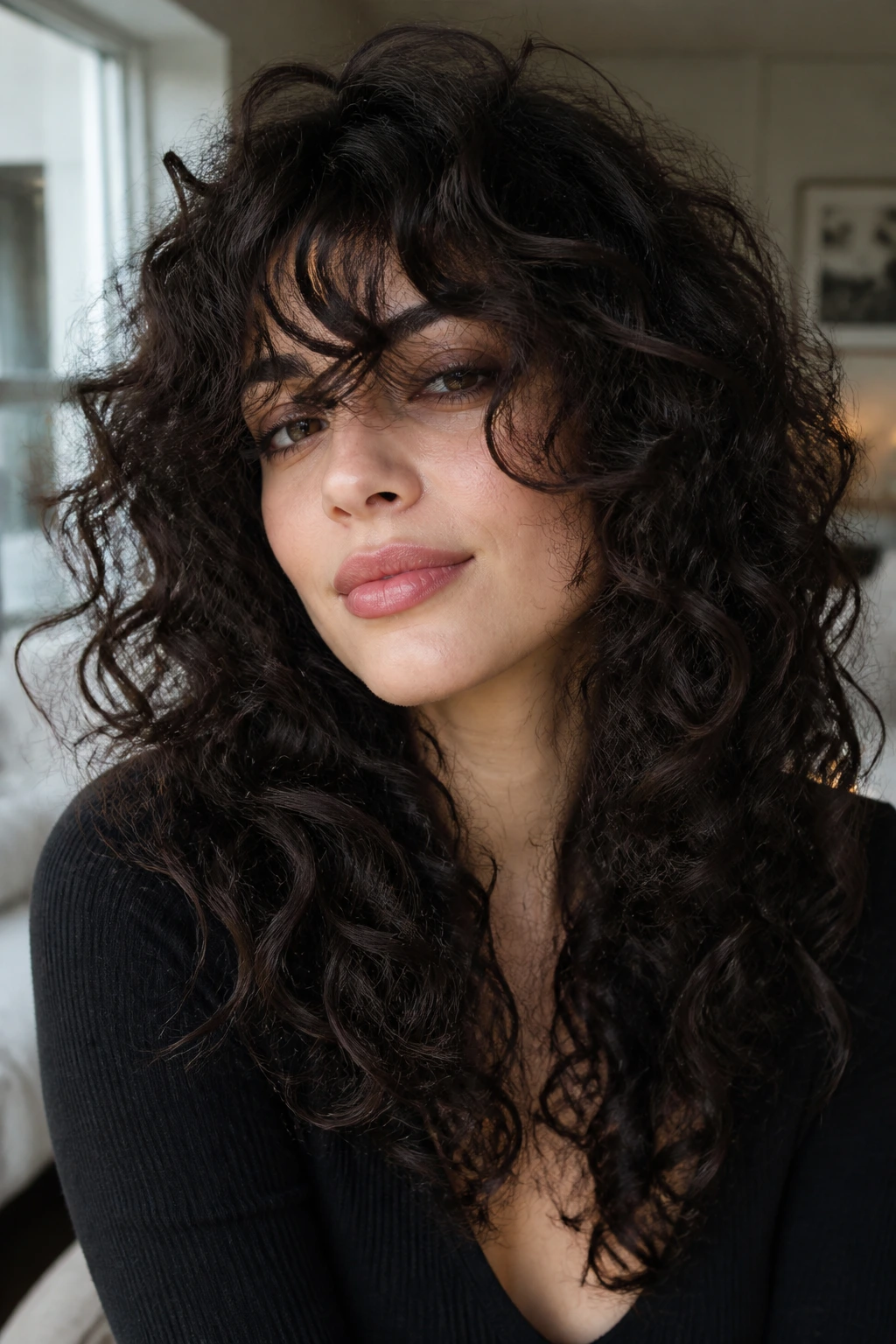
Very thick curls need room to spring. This cut leaves the fringe longer than you think, because shrinkage is not a theory here — it is the whole story. The angled layers are cut to shape the curl cloud without making the ends look thin or separated.
The fringe should be cut in the same dry state it will live in most of the time. That way the shortest pieces do not pop up an inch too high after the first wash. Ask for the front to connect into the layers around the temples, or the bangs will sit like a separate wiglet.
This shape is strong. It does not apologize for volume, which is exactly why it works.
24. Angled Layers for Thick Coily Hair with Sculpted Fringe
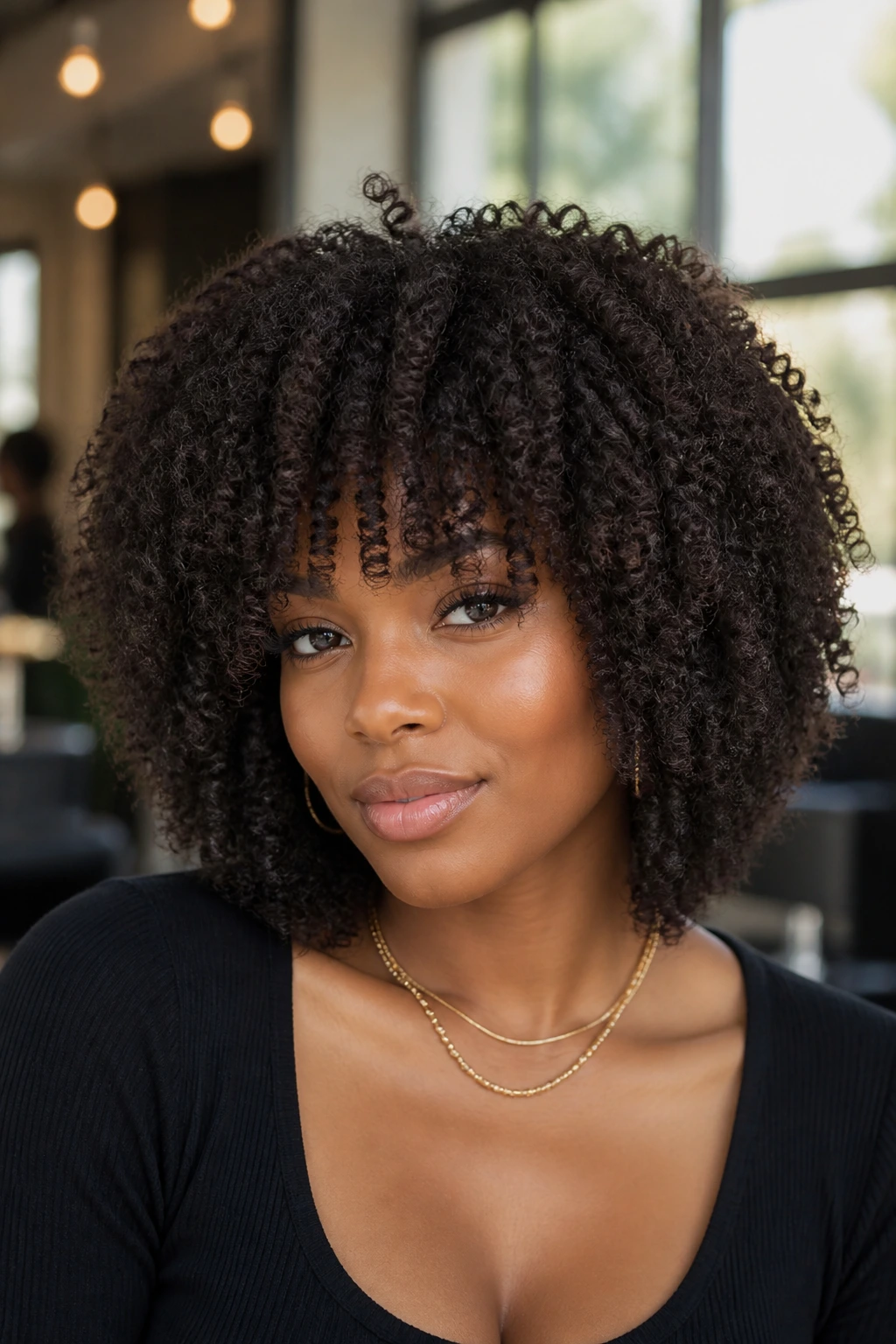
Coily hair can wear angled layers beautifully, but the cut has to respect shrinkage, density, and the way coils stack on themselves. A sculpted fringe gives the forehead shape without creating a block across the front. The layers then taper the outline so the hair has a rounded edge instead of a square one.
This is a salon cut that benefits from sectioning, tension, and a dry-shape check before the final snip. If the fringe is cut too short while wet, the shrinkage can make it sit halfway up the forehead. Leave it longer than feels safe. Thick coily hair rewards caution.
Best fit
- Twist-out styling
- Defined wash-and-go routines
- People who want shape without losing fullness at the sides
25. Long V-Cut Layers with Wispy Curtain Bangs
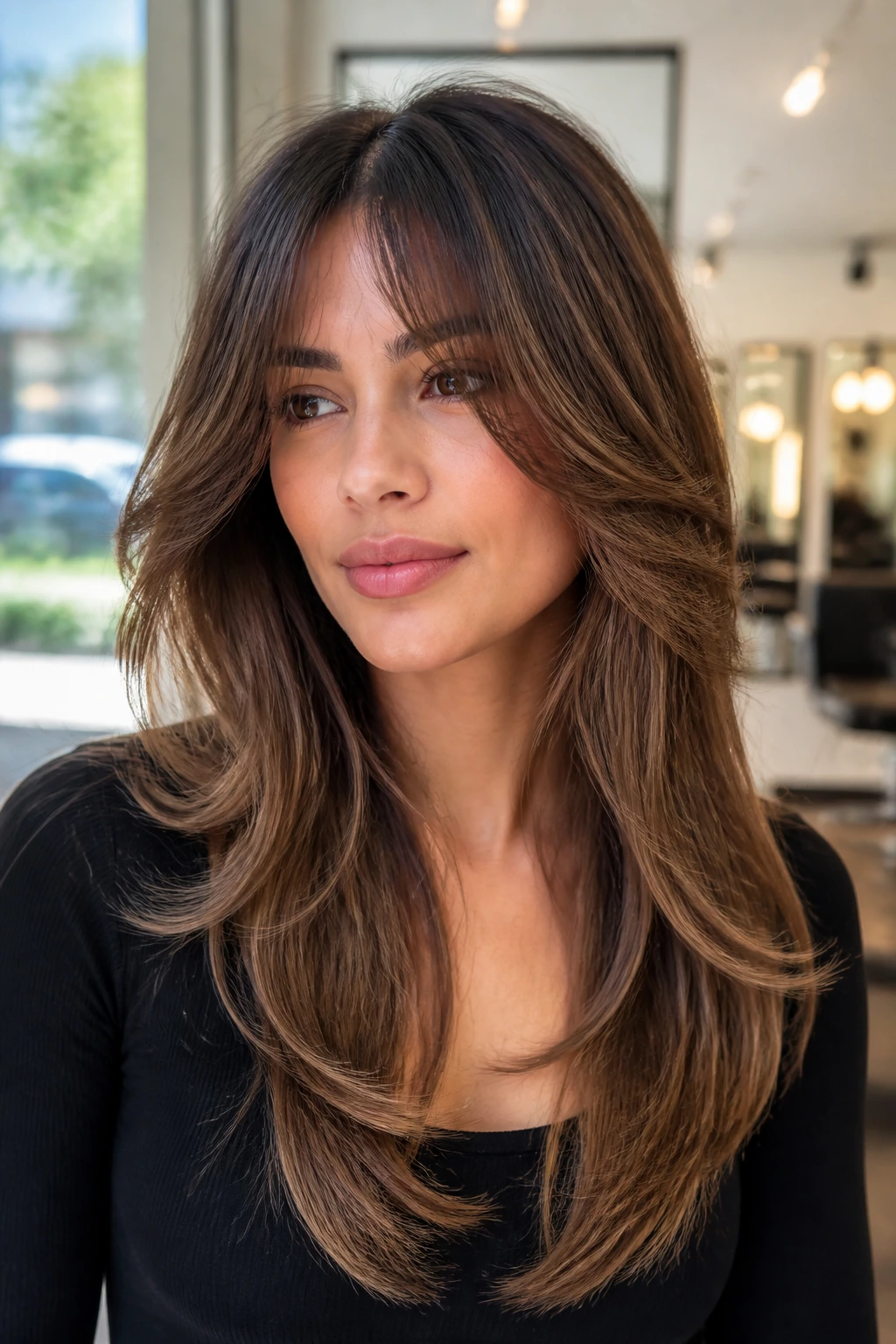
The V-cut is the quiet answer for someone who loves length but hates heaviness. The center back hangs longer, the sides angle in, and the overall shape narrows the bottom without taking away the weight that makes thick hair feel rich. Wispy curtain bangs keep the front soft and easy to part.
This is one of my favorite options for dense hair that lives in a ponytail most days. It looks good down, but it also pulls up without leaving a heavy block at the nape. The bangs can be swept open or allowed to fall forward, depending on how much face frame you want.
If you want a shape that still feels like hair, not an abstract haircut, this is the one to end on.
Why Angled Layers Calm Down Thick Hair
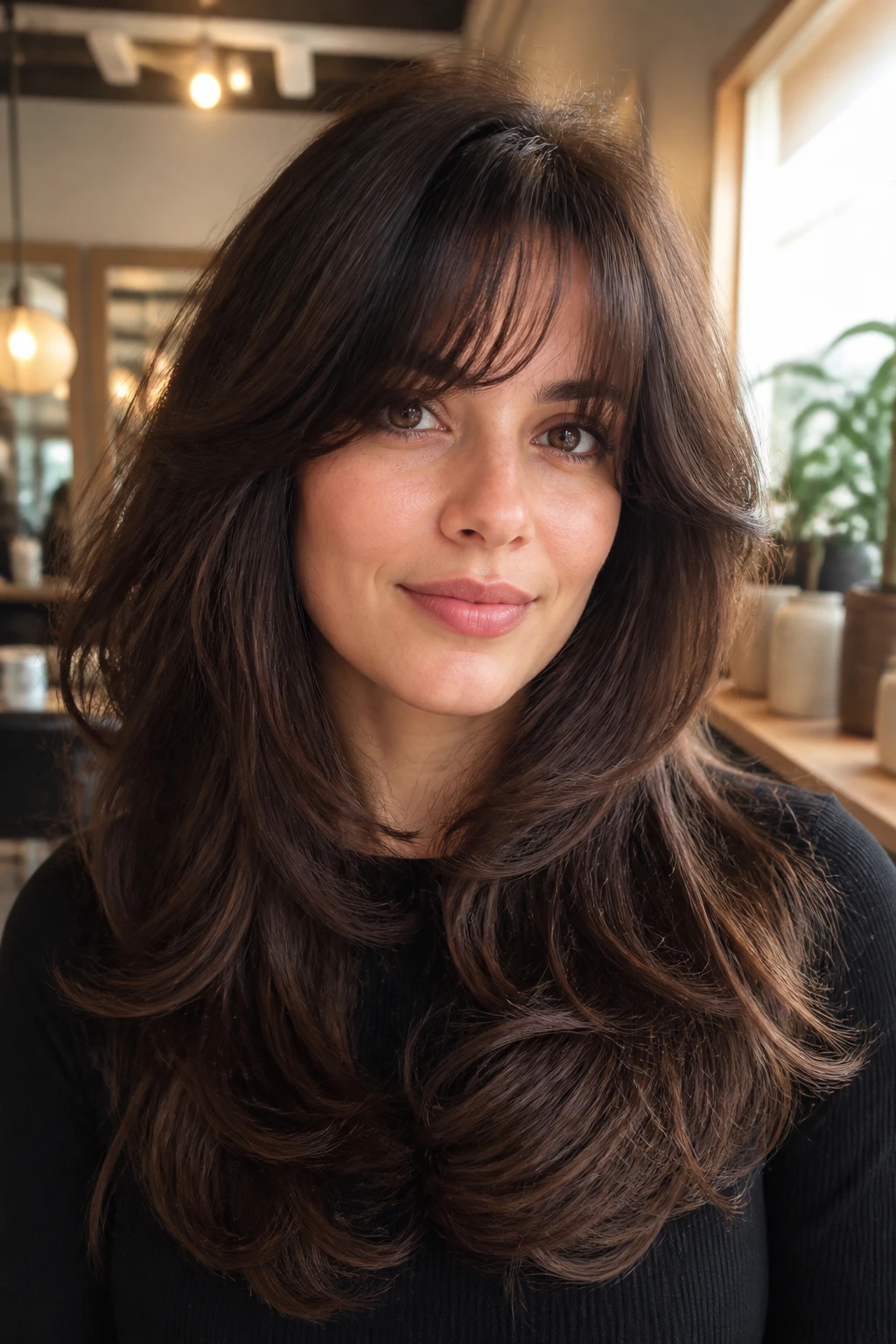
Thick hair is not the problem. A bad shape is.
The reason angled layers work so well is simple: they move weight from the width of the head into a line the eye can follow. Dense hair tends to spread outward at the sides and stack up around the ends. An angle interrupts that. It creates direction, which makes the hair look lighter even when you have not taken off much length.
Bangs change the front of the story. A full fringe shortens the visual length of the face. Curtain bangs split the density and give the forehead some breathing room. Side bangs push hair off the width of the face. In other words, the front pieces do more than decorate the cut — they steer it.
A good angled cut also respects the fact that thick hair dries with a little personality. It frizzes. It bends. It expands. If the cut has too many blunt edges, those quirks turn into bulk. If the cut has soft graduation and a clear perimeter, the same hair looks intentional.
That is the whole game. Not less hair. Better shape.
Essential Tools for Styling These Cuts at Home
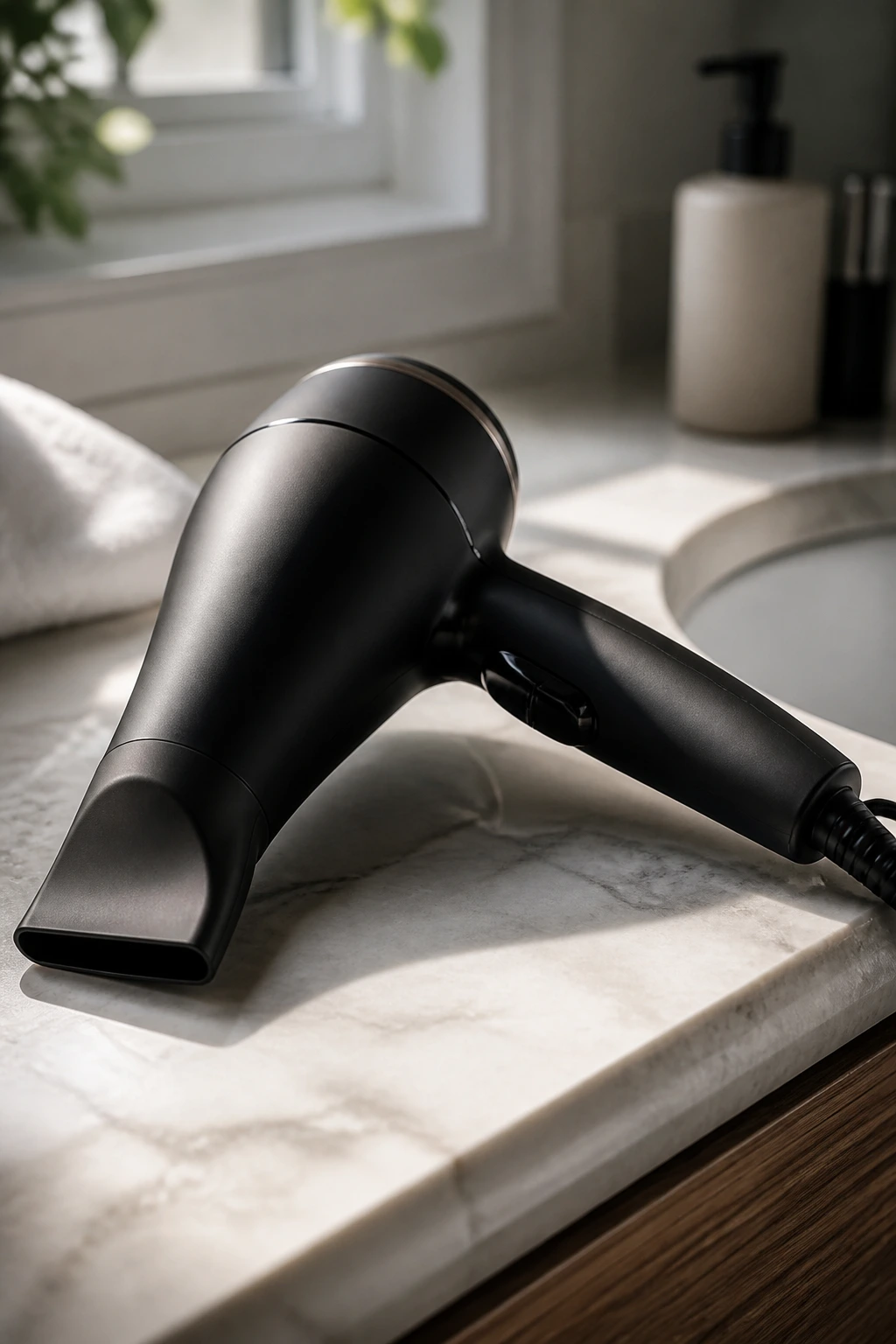
- Blow dryer with a concentrator nozzle: Keeps the airflow pointed where you want it instead of blasting the fringe apart.
- Medium or large round brush: Useful for bending curtain bangs, flipping ends, and smoothing the front without flattening the crown.
- Heat protectant spray: Thick hair can hide damage for a while, then suddenly feel dry and rough; spray it before any hot tool.
- Lightweight mousse: Best for adding lift at the roots without making dense hair sticky or stiff.
- Styling cream or smoothing lotion: Helps the mid-lengths stay calm, especially on blunt or polished versions of these cuts.
- Dry shampoo: Great for bangs that get oily first and for giving the front some grip on day two.
- Texturizing spray: Useful on shag, wolf-cut, or piecey fringe versions where a little separation looks better than a perfectly smooth finish.
- Flat iron or curling wand: You do not need both. Pick the one that matches your finish — sleek bend or soft wave.
- Sectioning clips: Thick hair is easier to blow-dry when you stop trying to handle it all at once.
- Wide-tooth comb: Better than ripping through wet curls or heavy wavy hair with a fine brush.
Picking Products That Let Thick Hair Move
The biggest mistake with thick hair products is reach for heavy cream after heavy cream because the hair feels dry. Then the cut goes limp. Bangs collapse. The layer shape disappears under product weight. That’s a fast way to ruin a good haircut.
Choose shampoo and conditioner that clean the scalp well but do not leave a waxy coat behind. If your hair is straight or fine-dense, a lightweight volume formula can help the angled layers show their shape. If your hair is coarse, choose smoothing products that soften the cuticle without turning the hair greasy by noon. For curly or coily thick hair, slip matters more than shine; a leave-in with decent glide makes the fringe behave.
Styling products should match the finish. Mousse for lift. Cream for control. Spray for hold. Oil only on the ends, and not much of it. The front fringe especially needs restraint. If you put rich oil near the bangs, they will separate into greasy strings and sit against the forehead in the worst way.
How to Tell a Stylist What You Want
Bring photos, but do not stop there. Photos show the shape you want; your words explain how your hair behaves. Thick hair can look wildly different from one head to the next, even in the same cut.
Say where you want the shortest face-framing pieces to land. Cheekbone, jaw, lip, or collarbone — those are not tiny choices. Tell the stylist whether you want the bangs to be worn straight down, split in the middle, or swept to one side. And say whether you want internal weight removed or just the perimeter shaped. Those are two different jobs.
If you hate puffy sides, say so. If your bangs split at the cowlick, say that too. A good cut on thick hair is built around the hair you actually have, not the one in the inspiration photo.
How to Wear and Show Off the Cut
Presentation: Start with the front. Dry the bangs first, then set the rest of the layers so the shape has a clean frame. A little bend at the ends goes a long way, especially on lob, butterfly, and collarbone cuts.
Accompaniments: Earrings, collars, and glasses change how angled layers read. Hoop earrings work well with curtain and side bangs. Turtlenecks make shorter lobs feel sharper. Glasses and blunt fringe need careful placement so the line of the bang does not fight the frame.
Portions: If your hair is very dense, keep the shortest layers around the cheekbone or lower unless you want a shaggy or wolf-cut feel. Shorter than that, and the cut can swell outward. Thicker hair usually looks better with a little extra length in the front than with too-short layers.
Best Pairing: Match the cut to your daily styling habit. If you air-dry, go for curtain, bottleneck, or side-swept bangs. If you love a blowout, blunt, feathered, and flipped shapes will make more sense. If you want texture, shag and wolf-cut versions give you the most payoff.
Small Styling Moves That Change the Whole Cut
Shape Enhancement: Lift the bangs at the root with a round brush or a blast from the dryer, then let them cool before touching them. That cooling step matters. Warm bangs fall flatter and split more easily.
Customization: Ask for point cutting at the ends if you want movement without losing the edge. Thick hair often looks too hard when the ends are cut blunt all the way across. A few angled snips soften the line without making it weak.
Serving Suggestions: A dab of shine spray on the mid-lengths and ends can make the angled layers look cleaner, but keep it away from the fringe. The bangs need lift more than gloss.
Make-It-Yours: Straight hair usually needs less layering through the crown. Wavy hair needs more face framing. Curly and coily hair need the layers cut with shrinkage in mind. One haircut shape does not mean one cutting method.
Mistakes That Make Thick Hair Look Boxy
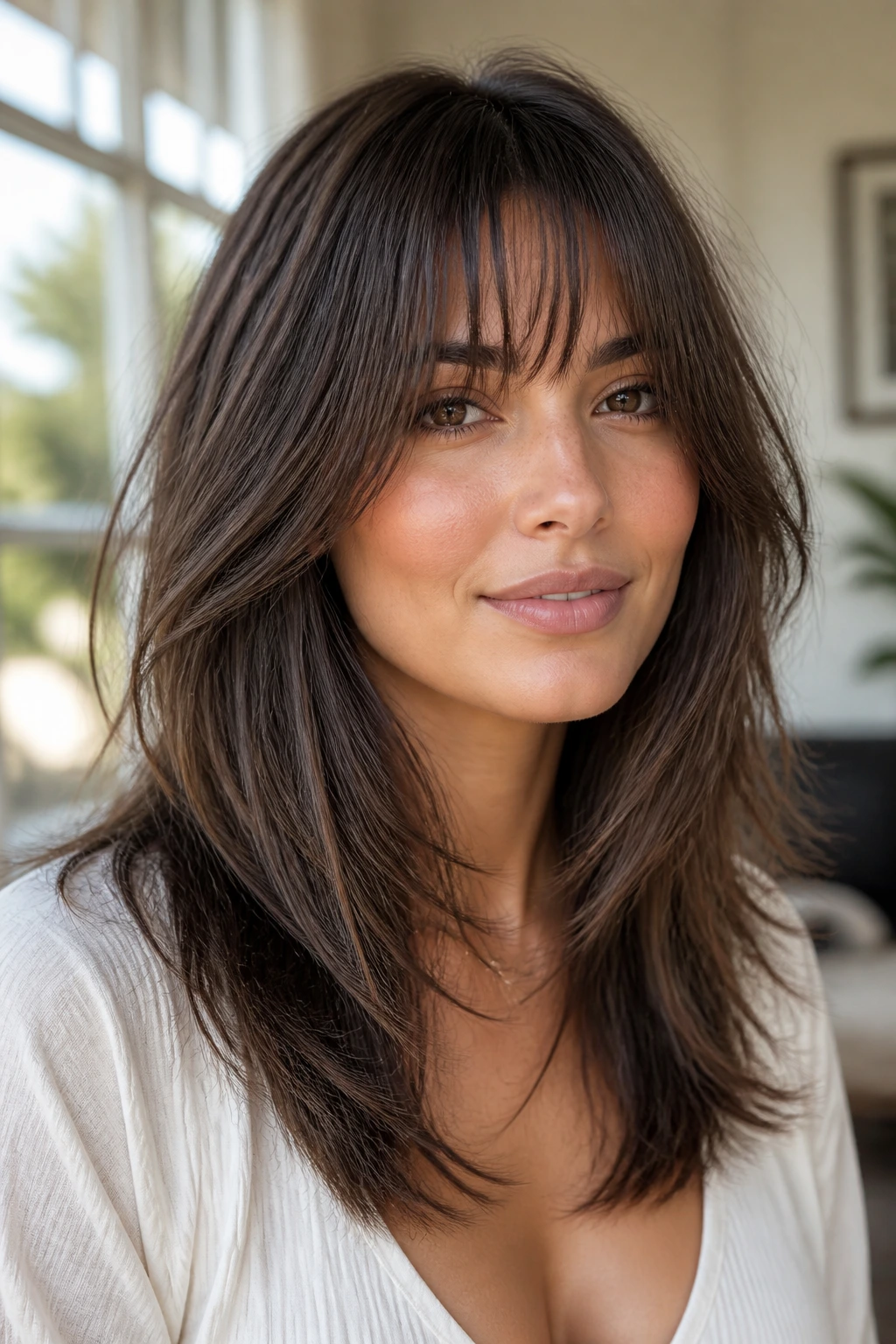
Cutting the shortest layer too high: The hair flips out near the cheeks and creates width where you wanted shape. The fix is simple: keep the front angle lower and let the first layer fall closer to the cheekbone or lip.
Over-thinning the bulk: When stylists use too much thinning shears or slice the interior too hard, thick hair can fray at the ends and puff in humidity. Ask for controlled weight removal, not a shredded finish.
Making the fringe too dense: Heavy bangs on dense hair can sit like a curtain that never opens. The fix is to leave some air at the temples or choose a bottleneck, curtain, or side-swept shape.
Ignoring growth patterns: Cowlicks and strong part lines can push bangs sideways. If that’s your head, you need a fringe that works with the pattern, not against it.
Skipping the perimeter check: A cut can look fine wet and then flare out dry. Always evaluate the hemline once the hair is dry and moving. That’s when the real shape shows up.
Variations and Adaptations to Try
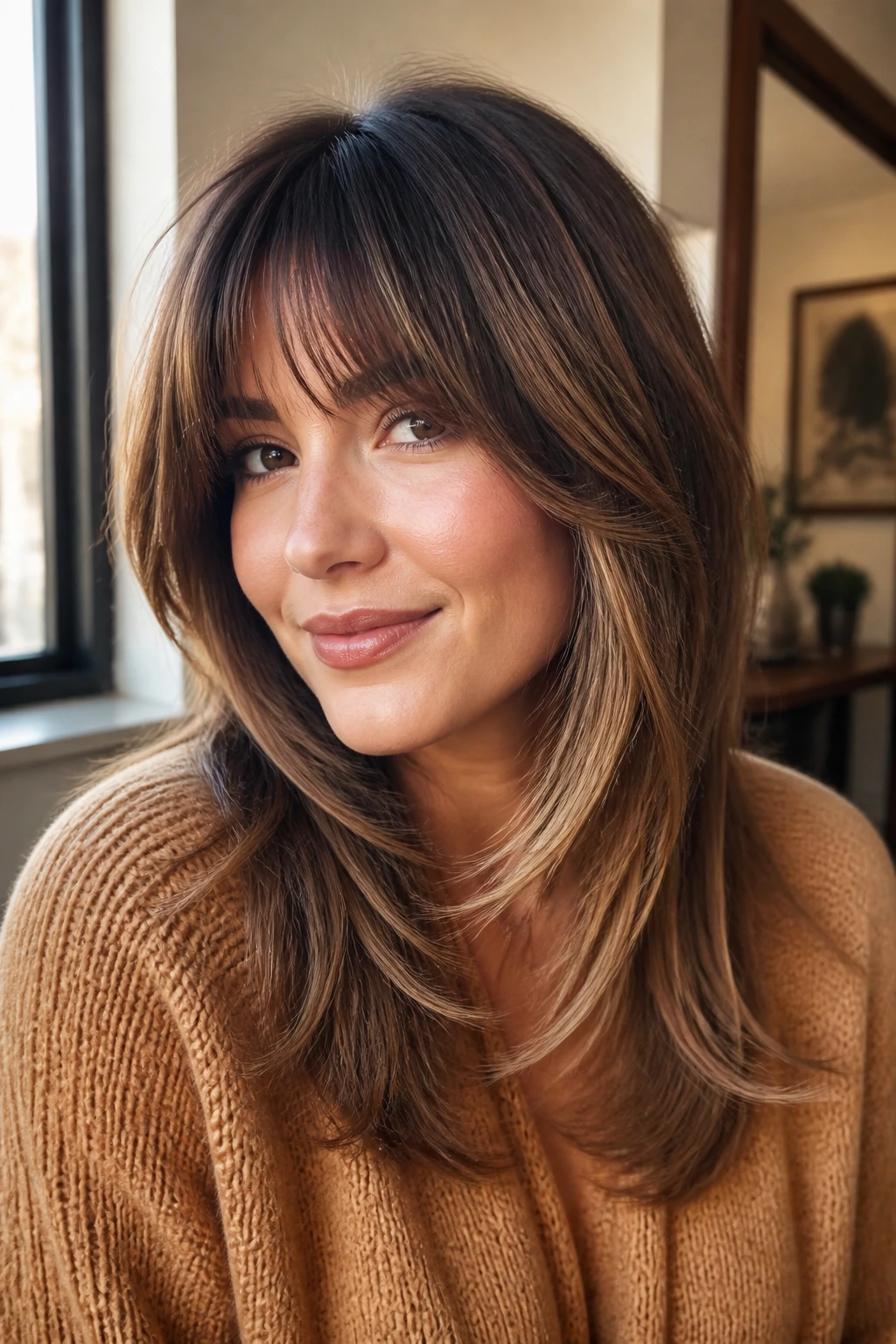
The Soft Grow-Out Blend
Keep the bangs long enough to sweep aside, then connect them into long layers around the cheekbone. This works if you want a shape that still looks decent six weeks later, not just on the first salon day.
The High-Texture Shag
Push the layers shorter, add a choppier fringe, and style with mousse or diffuser. It suits thick hair that already has wave or bend and looks better with a little disorder.
The Polished Blowout Version
Leave the layers longer and keep the fringe fuller. This is the one for people who like a clean edge and regular heat styling.
The Curly Halo Adaptation
Cut the bangs longer and let the layers follow the curl pattern. The goal is a rounded silhouette that stays soft when the curls shrink.
The Low-Maintenance Side Sweep
Choose side bangs instead of center-part fringe and keep the layers medium-long. It is the easiest option if you want to spend less time trimming the front.
Keeping the Shape Between Trims
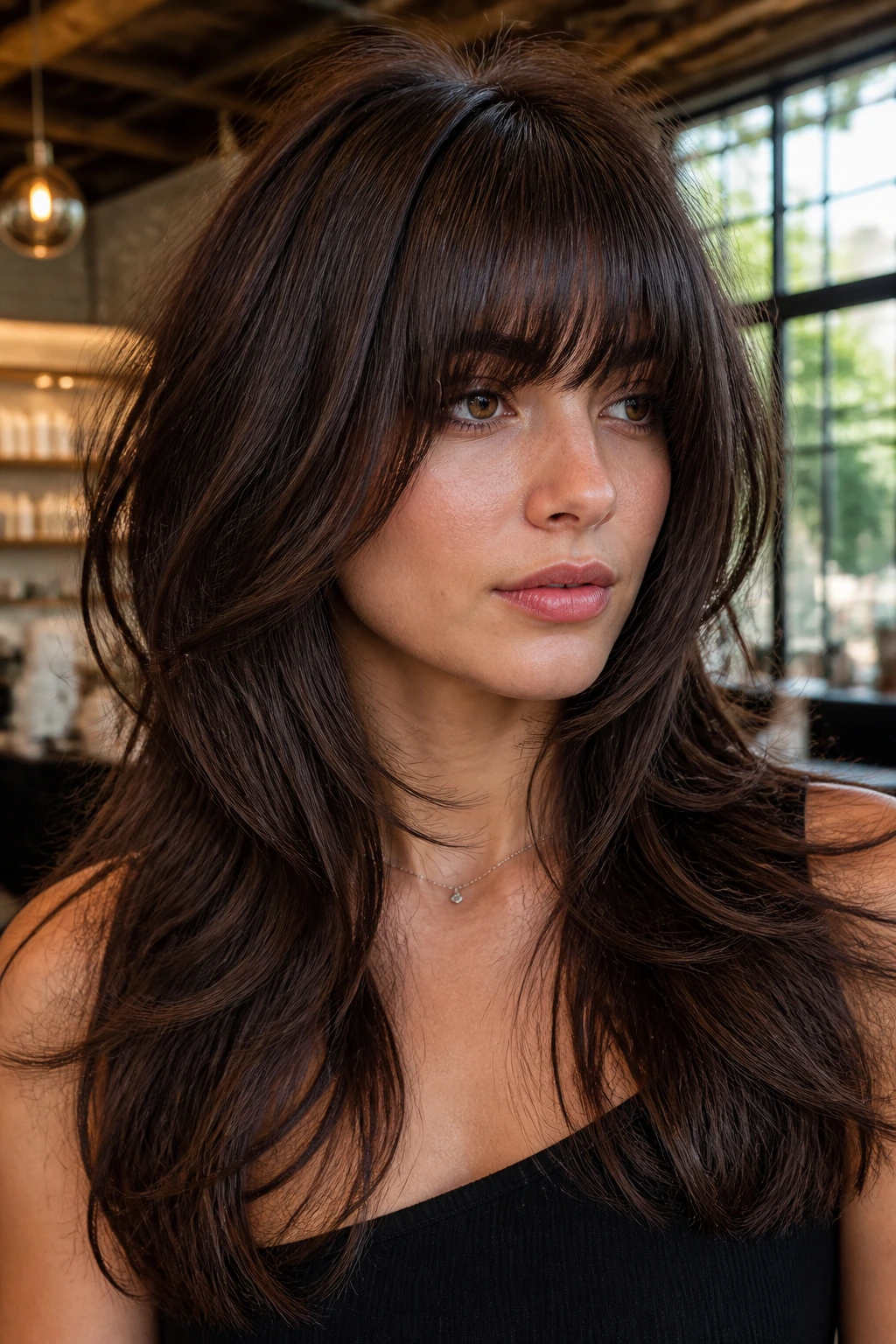
Thick hair holds its shape well, but the bangs usually go first. Plan on touching the fringe up every 3 to 5 weeks if you wear it straight or full. Curtain and side bangs can go a little longer, often 5 to 7 weeks, because they grow out into the rest of the cut instead of sitting as a hard line.
At home, sleep on a silk or satin pillowcase if the front gets frizzy overnight. If the bangs bend weird while you sleep, clip them loosely away from the face before bed and reset them with a quick blow-dry in the morning. A few seconds of heat is enough. You do not need a full wash every time the fringe misbehaves.
For longer cuts, trim the perimeter every 8 to 12 weeks to keep the angle from collapsing. The cut still grows nicely, but the line needs a little refresh or the heavy ends will start to spread again.
Frequently Asked Questions
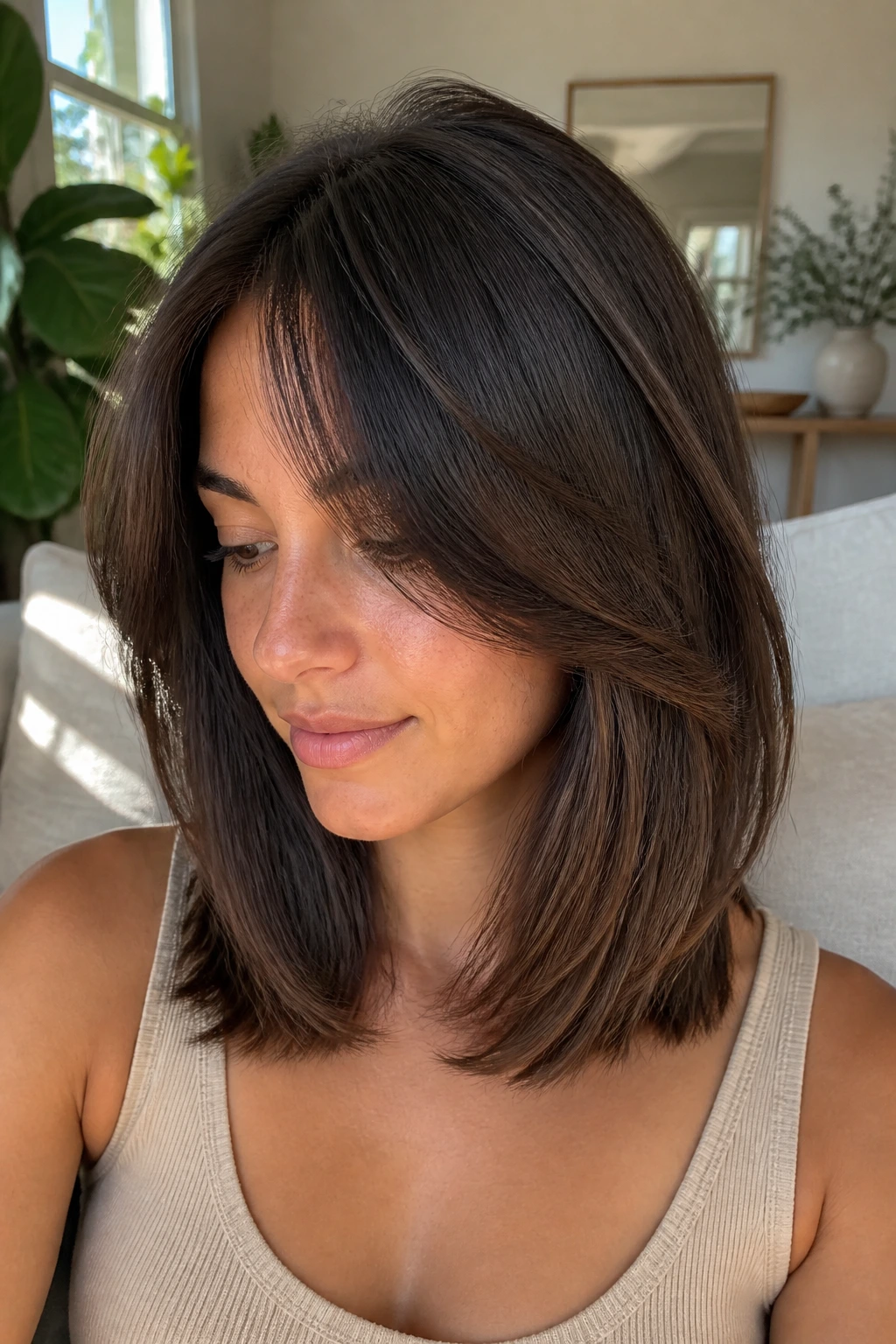
Are angled layers good for very thick hair?
Yes, if the layers are cut with a clear plan. The angle removes width from the sides and keeps the ends from feeling like one solid block, which is the main issue with dense hair.
What bangs are easiest to wear on thick hair?
Curtain bangs and bottleneck bangs are usually the easiest because they split the density and grow out more gracefully. Side-swept bangs are a close second if your part line is strong.
Will bangs make my thick hair feel hotter or heavier?
A full fringe can, especially if it sits too low and too dense. A lighter curtain or side shape usually gives the face frame without trapping as much warmth at the forehead.
Can I get bangs if my hair is curly?
Yes, but they should be cut with shrinkage in mind. Curly bangs need extra length at the start, and the stylist should shape them while dry or nearly dry so they land where you expect.
How often do I need to trim the bangs?
Straight, blunt bangs usually need attention every few weeks. Softer fringe can stretch longer between trims, especially if it blends into the layers.
What if my thick hair puffs out at the sides after a cut?
That usually means the shortest layers are too high or too short. A better cut starts the angle lower and keeps some weight at the hem so the side width falls instead of ballooning.
Can angled layers work on thick hair that is also coarse?
Yes, but the cut should be less shredded and more controlled. Coarse hair often needs smoother edges and a little extra length so the shape stays clean.
Which of these cuts is best if I wear glasses?
Curtain bangs, curved bangs, and softer side sweeps usually play nicest with glasses. Hard blunt bangs can fight the frame line unless they are cut with a lot of precision.
The Shape That Keeps Its Edge
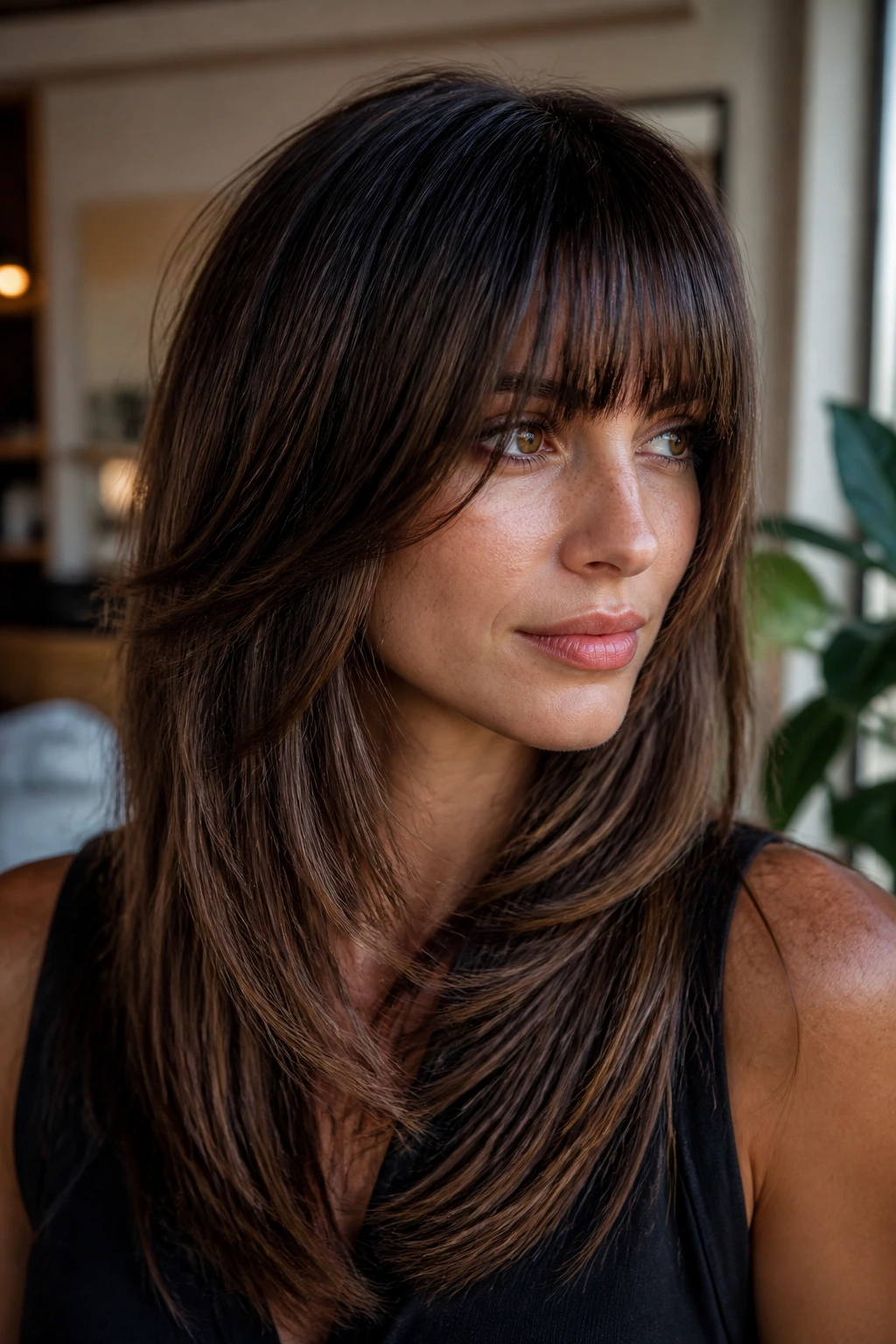
The best part about angled layers on thick hair is that they do not try to fight the density. They redirect it. That’s a much smarter move. The hair still feels full, the fringe gives the face a frame, and the whole cut has a sense of motion that one-length styles rarely manage.
If your thick hair has been sitting in that awkward place between too much and not enough, one of these shapes will usually pull it back into balance. Start with the version that fits your styling habit, not the one that looks most dramatic in a photo. The cut that survives real mornings is the one worth keeping.