



Fine hair can collapse before lunch, and an oval face gives you enough balance to wear a sharper outline without fighting your proportions. That pairing is exactly why stacked haircuts for fine hair and oval faces make so much sense together: the stack builds lift where the hair wants to lie flat, while the face shape leaves room for shorter backs, angled lines, and side parts without the whole look feeling squeezed.
The best versions don’t chase volume with fluffy layers that disappear after one wash. They use shape instead—graduation at the nape, a blunt edge at the perimeter, a little bend around the cheekbones—to make the hair read denser than it really is. That’s the trick. Not more hair. Better geometry.
The wrong version is easy to spot. It gets too airy at the ends, too puffy at the crown, and by the third wash it looks like someone took the weight out in exactly the wrong places. A good stacked cut feels deliberate from the first snip, and it still looks like a haircut when you tuck one side behind your ear or skip a full blowout.
Why These Stacked Cuts Work So Well on Fine Hair and Oval Faces
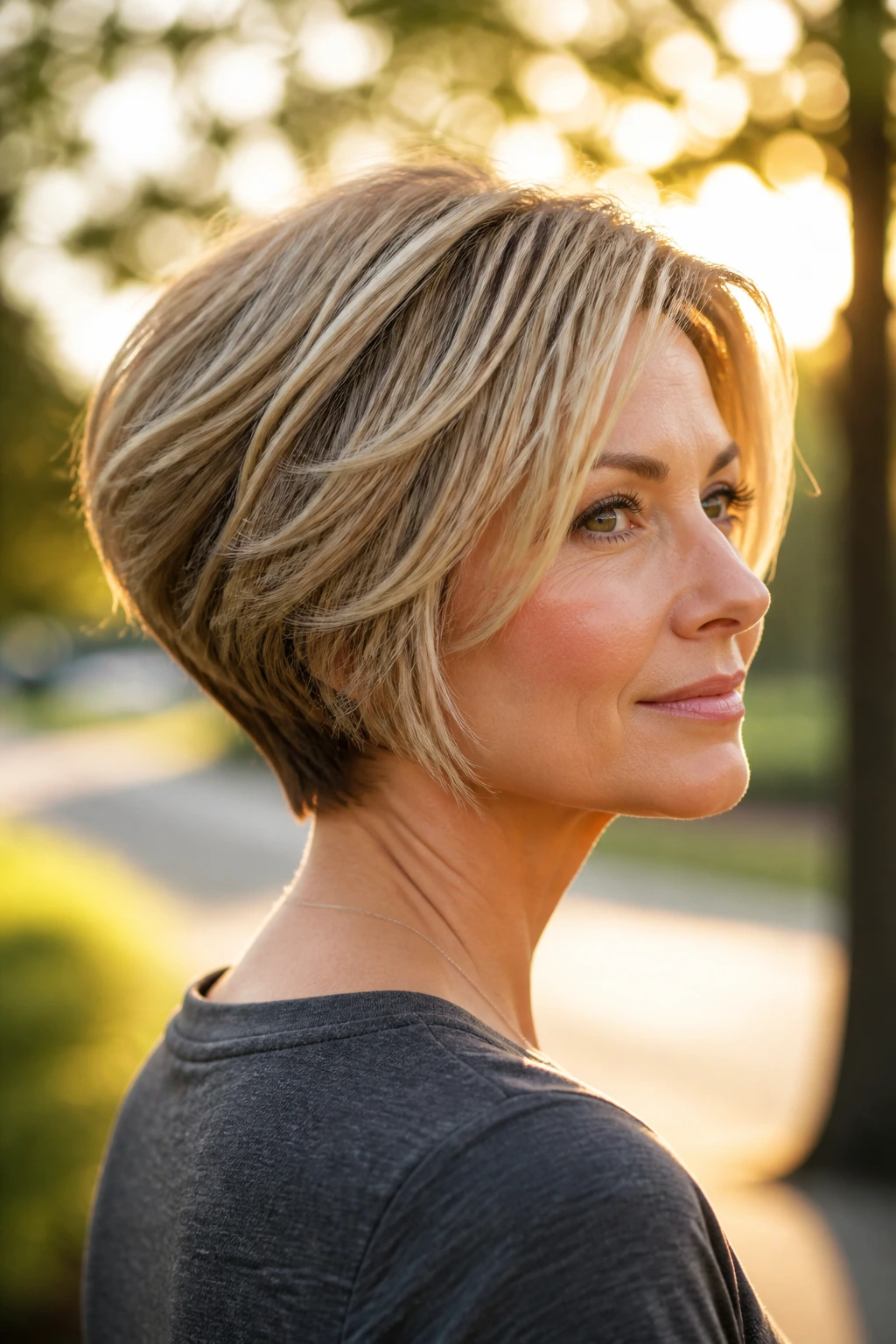
- Built-in lift: A stacked back removes weight at the nape, so fine strands stop clinging to the head and start showing a cleaner silhouette.
- Oval-face friendly: Oval faces don’t need heavy correction at the jaw or forehead, which means you can wear chin lengths, side parts, and shorter backs without throwing off the balance.
- Thicker-looking ends: A blunt or lightly beveled perimeter keeps wispy tips from separating into see-through strands.
- Less daily rescue work: These cuts keep their shape better with rough-drying, mousse, or a quick round-brush pass than long, layered hair does.
- Room for mood changes: One cut can look sleek, piecey, or softly bent depending on how you finish it, and the outline still holds.
1. Chin-Length Classic Stacked Bob
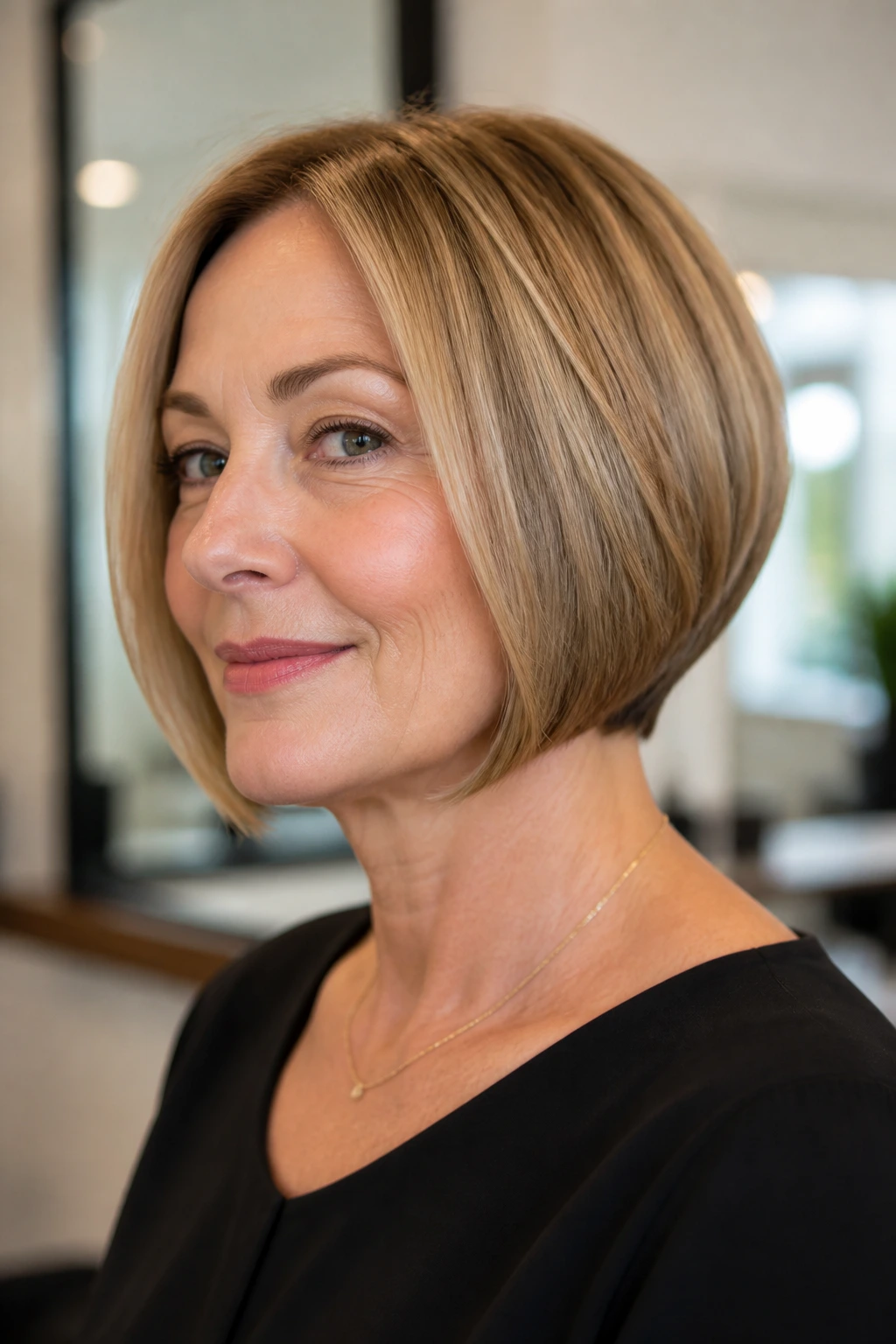
A chin-length stacked bob is the haircut I reach for when someone wants shape without committing to short-short hair. The nape sits snug against the head, the back lifts just enough to stop the cut from drooping, and the front hits around the chin so the ends still look solid.
Why this cut flatters fine hair
Oval faces can carry the clean line at the jaw without needing extra width or a heavy fringe. That matters, because fine hair looks better when the perimeter stays crisp and the weight is controlled rather than thinned away.
- Ask for a soft graduation in the back, not a razor-heavy chop.
- Keep the front length at the chin so the ends don’t look sparse.
- Style with a 1-inch round brush or a flat brush and a quick undercurve.
- Best when the hair is straight to slightly wavy.
Pro tip: Skip aggressive texturizing at the ends. On fine hair, that usually creates the see-through fray people spend weeks trying to grow out.
2. Soft Angled Bob with a Tucked Nape
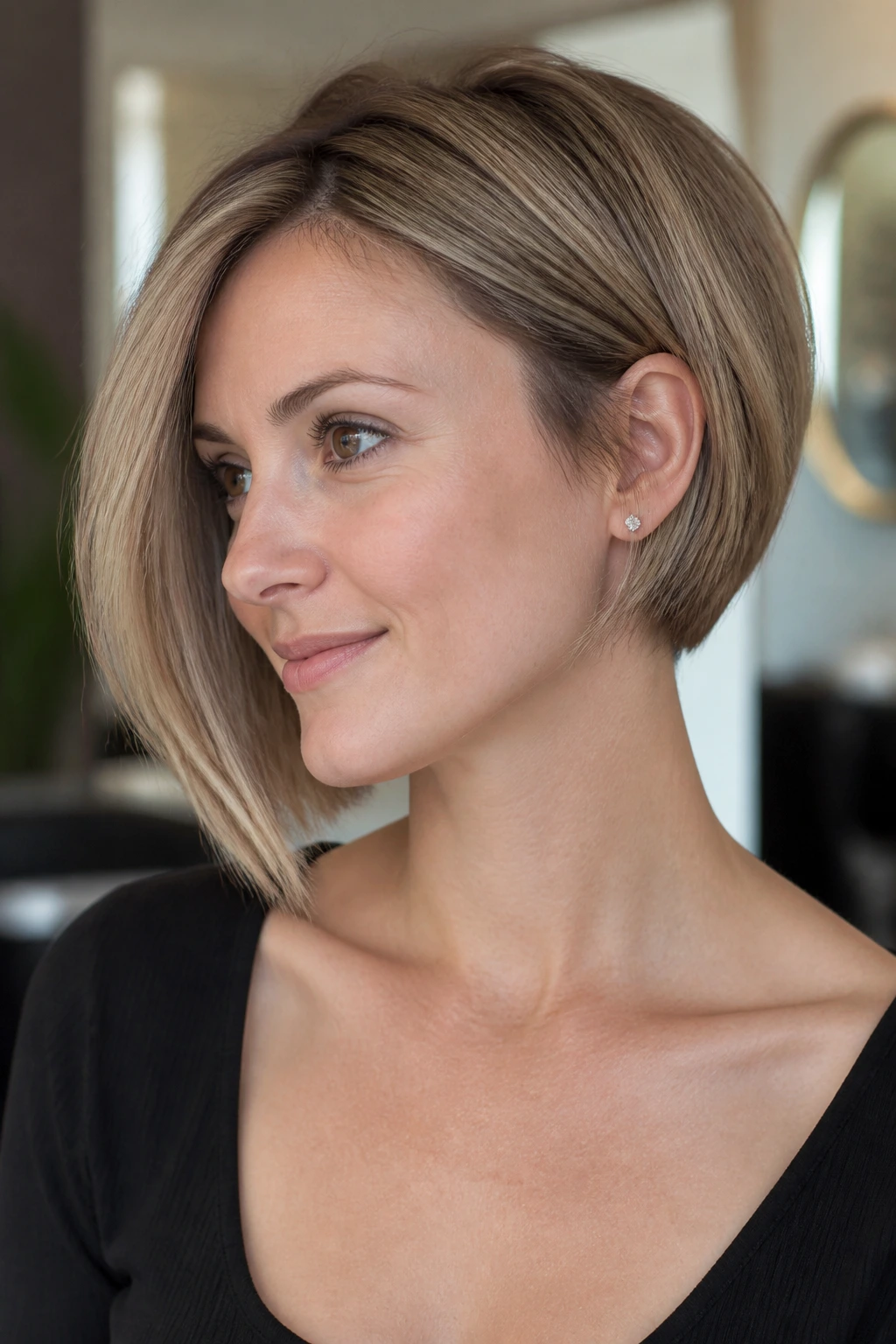
A soft angled bob gives you the clean fall of an inverted cut without the hard wedge some people hate on themselves. The front drifts a little longer than the back, but the angle stays gentle, so the hair still reads full instead of sharp.
The reason it works is simple: the shorter nape gives fine hair somewhere to “sit,” while the longer front keeps the silhouette from turning boxy. On an oval face, that diagonal line tends to skim the cheekbones nicely, especially when the ends are just touched under with a brush.
This is the cut for someone who tucks hair behind one ear a lot. It looks intentional when the back is short and the front has a soft, clean sweep. If your hair is too flat for dramatic layers but you still want some movement, this is a safer bet than a shaggy shape.
3. Collarbone Stacked Lob
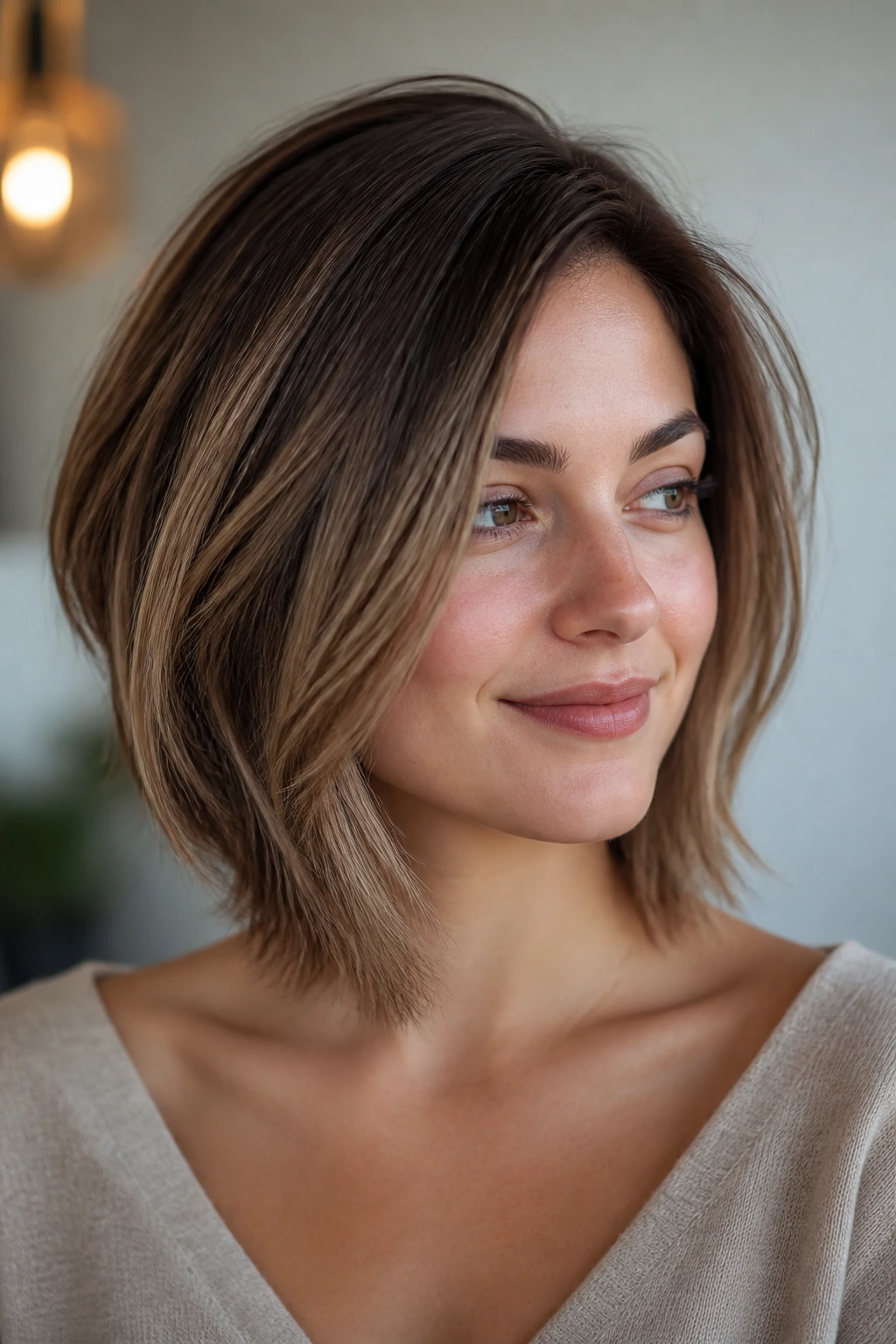
Why do people keep coming back to the collarbone lob? Because it gives fine hair a little extra length without dragging the crown down like a longer cut can. The stack lives in the back, the front brushes the collarbone, and the whole shape feels lighter than it sounds.
How to wear it
- Blow-dry the top first so the roots don’t collapse under the length.
- Leave the ends blunt or only lightly beveled.
- If you like a bend, wrap the front sections away from the face for 10 seconds with a medium iron.
- Keep the parting slightly off-center for more lift.
Oval faces do not need much help with proportion, so this length can breathe. It’s a good middle ground if you want something that still moves when you walk but doesn’t swallow your neckline. And because the stack is tucked into the back, you get a fuller-looking shape without giving up the security of length in front.
4. Rounded Bob with a Deep Side Part
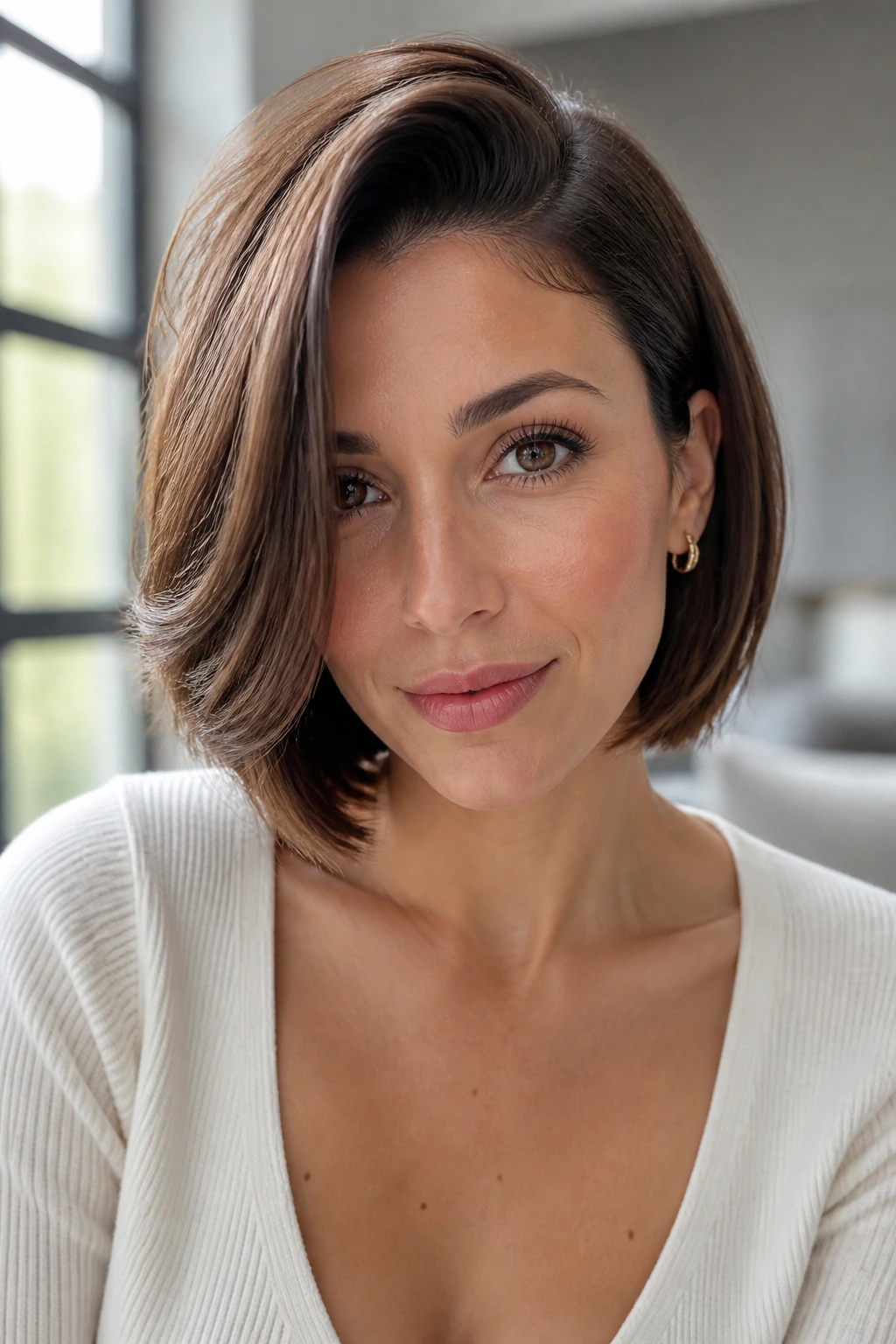
A deep side part is cheap volume. I say that with affection. Shift the part over an inch or two, and fine hair suddenly has a lifted front side, a softer crown line, and a little drama that doesn’t require teasing or a can of spray lacquer.
The rounded bob shape matters here because the curve keeps the cut from looking sharp in a bad way. On an oval face, that roundness sits comfortably around the cheekbones and softens the jawline without burying it. The stack in back keeps the base from looking flat, which is the whole reason this version works better than a one-length bob on light-density hair.
If your hair dries with a natural bend, this cut can look especially good with a quick brush under at the ends and a small tuck behind one ear. It’s neat, but not stiff. That balance is the appeal.
5. Piecey Bixie Bob
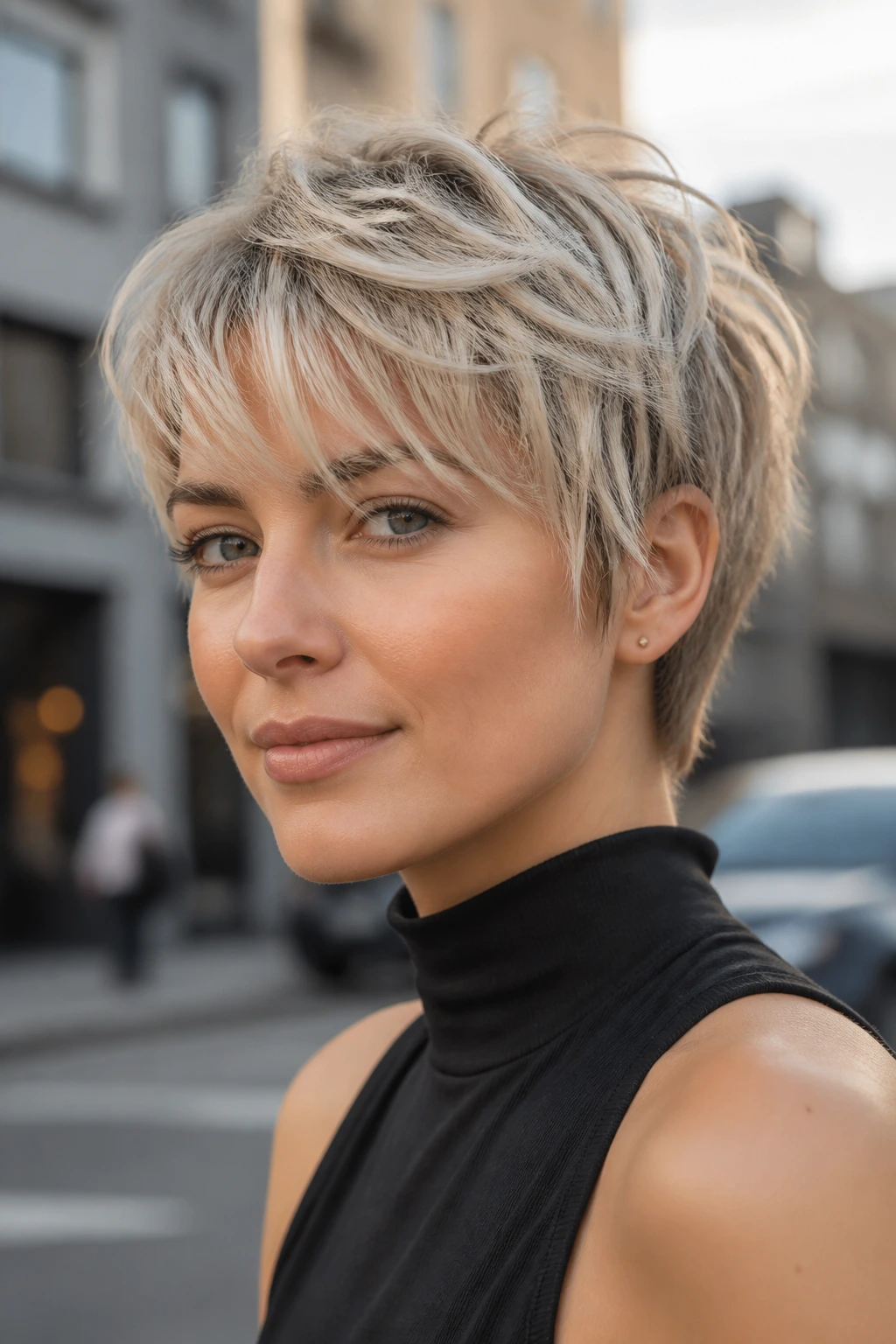
This is the cut for someone who wants less hair on the neck and more attitude around the face. A bixie bob lives between a pixie and a bob, which means the nape can be tight while the top and front stay long enough to move.
Fine hair likes this shape because the shorter length gives it lift almost by default. You are not asking wispy strands to hold up a long outline. You’re giving them a compact shape with a little texture on top, and that usually reads fuller from every angle.
An oval face can wear the shorter sides and still keep the proportions calm. The trick is to leave enough softness around the temples so the cut doesn’t go too hard. A dab of light paste or cream wax is enough; heavy pomade turns fine hair into little separated noodles, and nobody needs that.
6. Blunt Inverted Bob
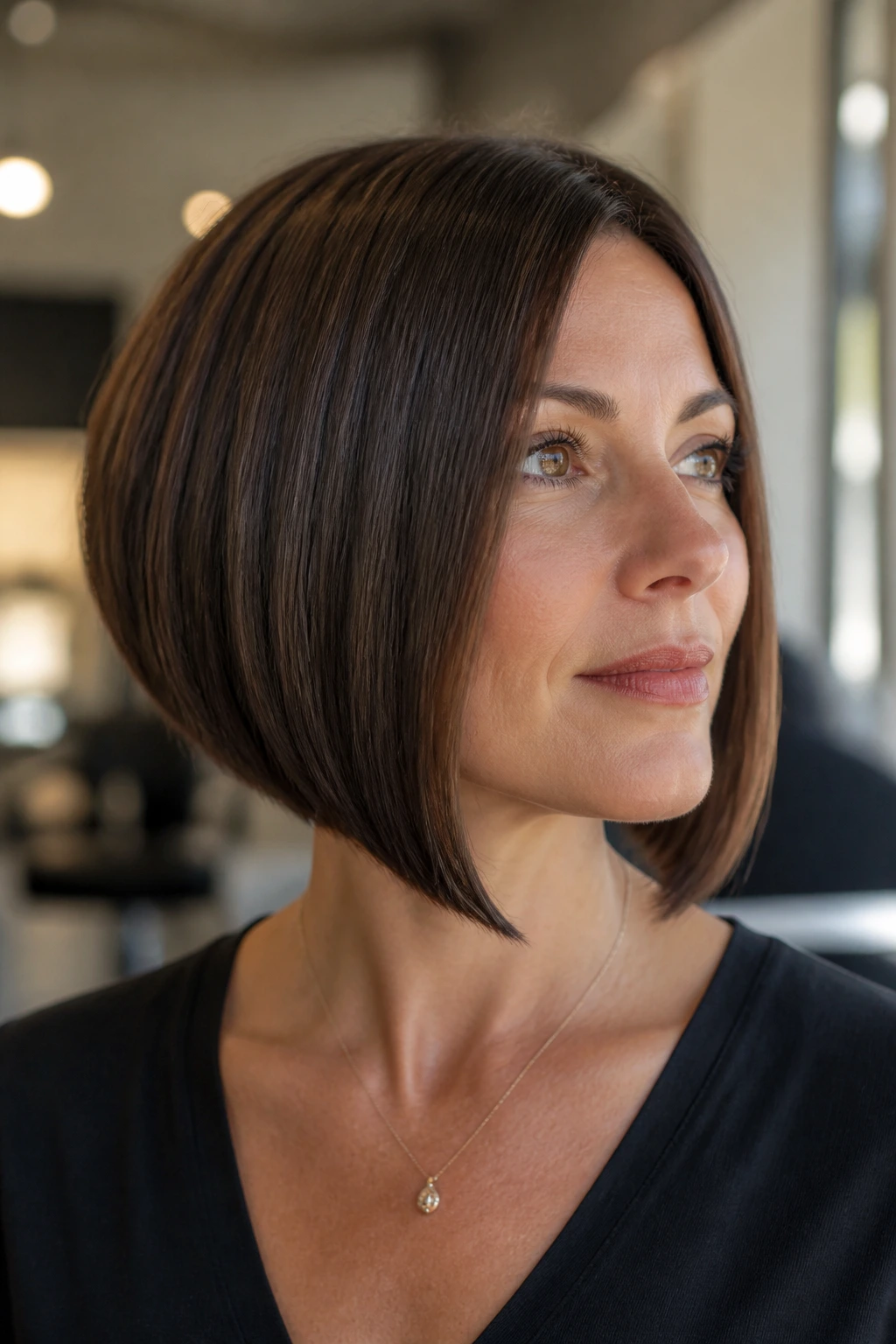
A blunt inverted bob is the no-nonsense choice. The back is shorter, the front is longer, and the edges are kept clean so the hair reflects light in one smooth line instead of a frayed edge.
That blunt perimeter does a lot of work for fine hair. It makes the ends look denser, and density is the whole game here. Oval faces can wear the shape without needing extra softness at the jaw, so the cut can stay crisp without feeling severe.
This one is best if your hair falls straight and you like a polished finish. It can look almost tailored with a center part, or a little more relaxed with a side part and the front tucked behind one ear. If your stylist starts talking about “just a bit of texturizing,” ask where, exactly. On this cut, too much thinning at the perimeter ruins the point.
7. Feathered Lob with Interior Graduation
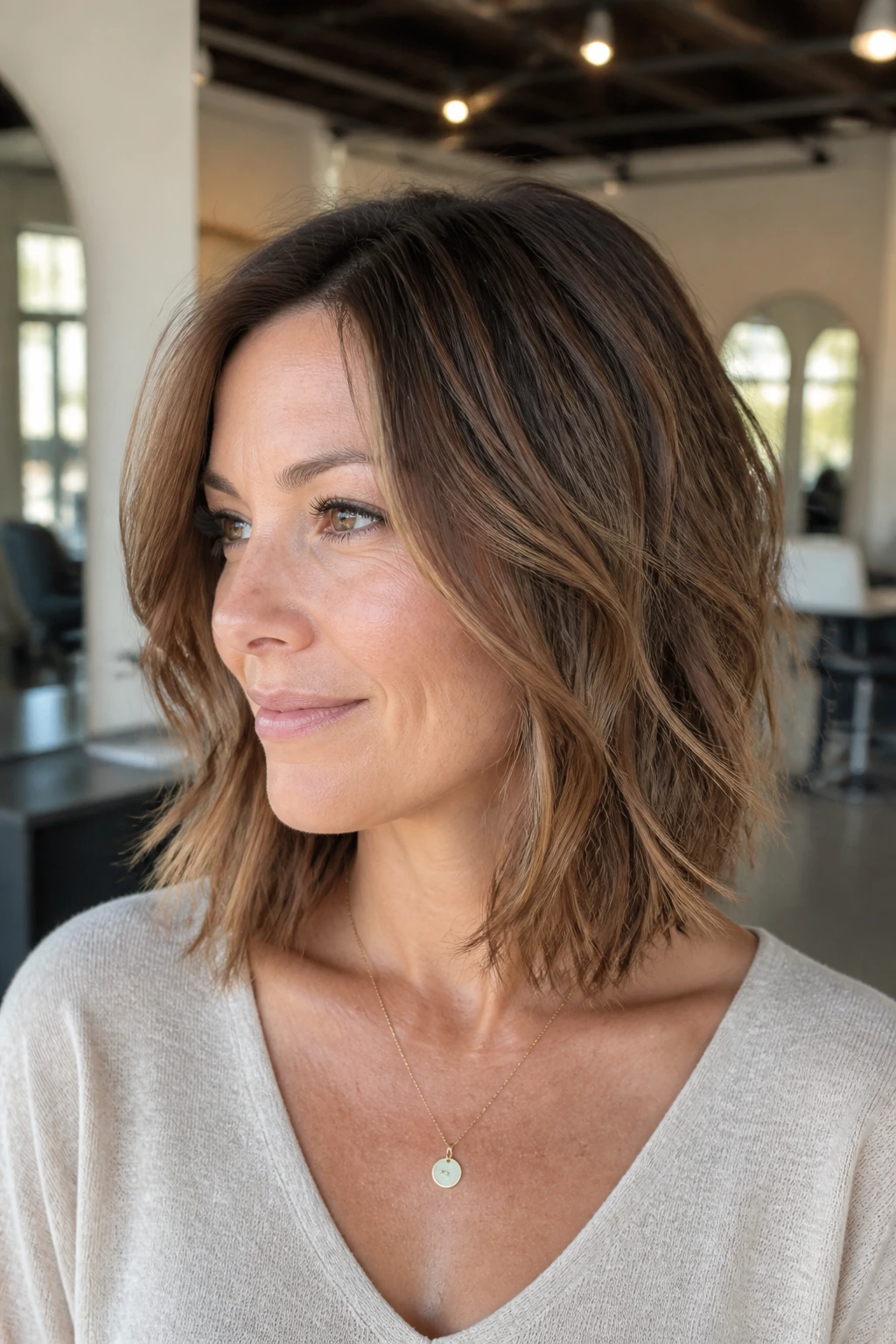
A feathered lob gives you movement without that shredded, airy look that makes fine hair disappear at the ends. The shape sits longer than a bob, but the graduation lives inside the cut, not on the outside line, so the perimeter still looks solid.
That’s the difference. A lot of people ask for layers when what they really want is lift. Layers can help, but on fine hair they need to be handled with a light hand. Here, the stylist keeps the bulk in the right places and feathers only enough to let the hair swing.
Oval faces make room for this kind of softness. The front can open away from the face without turning into a triangle, and the collarbone length keeps the cut grounded. If you wear your hair mostly air-dried, this is one of the easiest ways to get a shaped result without a full styling session.
8. Wavy Curved-Under Stack
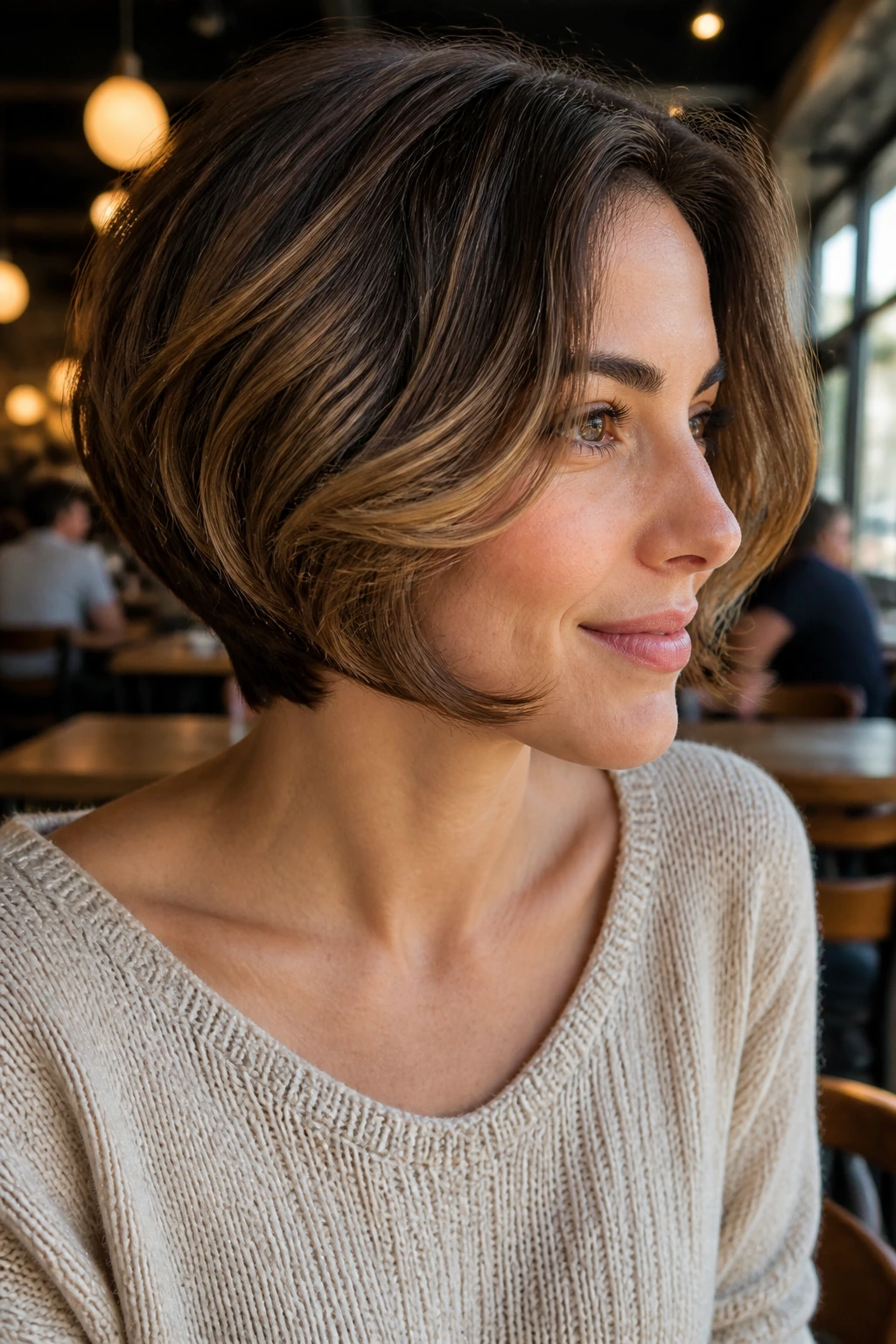
If your hair has even a little natural wave, a curved-under stack can be a gift. The ends want to turn in anyway, so the cut gives them a place to land instead of fighting them all day.
The nape stays short, the back is stacked enough to show lift, and the front curves under just enough to hug the jaw or neck. Fine hair with a wave pattern often looks fuller when it isn’t forced into a pin-straight finish, and this haircut plays into that. Oval faces can wear the softness around the face without losing structure.
What to ask for
Ask for a stack that keeps the perimeter thick and a little weighty. That last part matters. If the stylist thins the ends too much, the wave starts to separate in weird ways and the whole thing turns puffy instead of rounded.
9. Micro-Stacked Pixie Bob
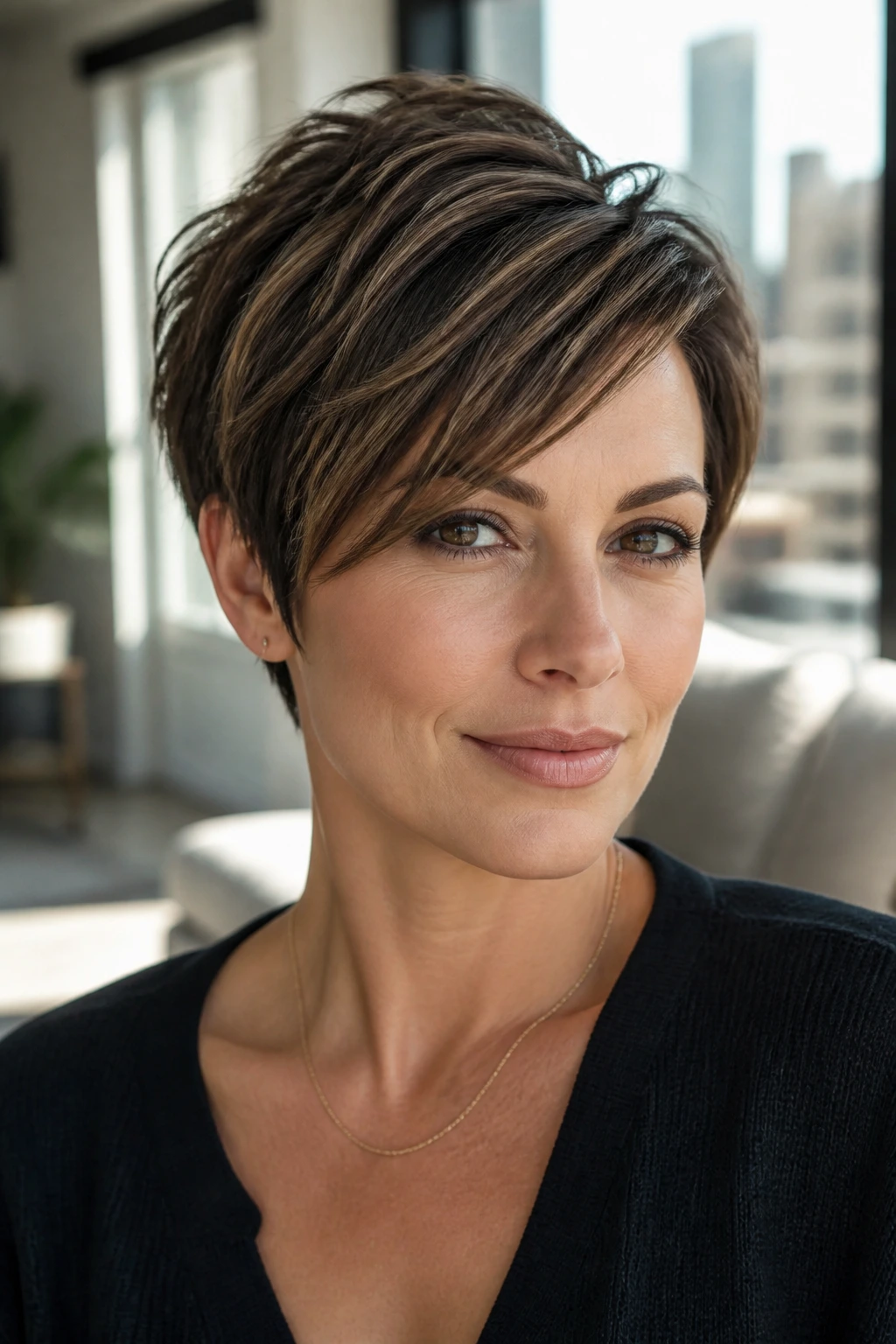
A micro-stacked pixie bob is the shortest cut in this lineup that still feels like a bob, not a cropped pixie. The nape is tight, the crown has a little height, and the top stays long enough to sweep, spike, or smooth down depending on your mood.
Fine hair often looks better shorter than people expect. Once the hair stops dragging itself into a long shape, it can look fuller almost immediately. Oval faces can wear the short outline without needing bangs to “fix” anything, which makes the cut cleaner and easier to read.
This one does ask for regular styling. A fingertip amount of paste or lightweight cream, plus a quick blow-dry at the roots, is usually enough. If you want a cut that looks intentional even on lazy mornings, this is not a bad place to start.
10. Asymmetrical Side-Sweep Bob
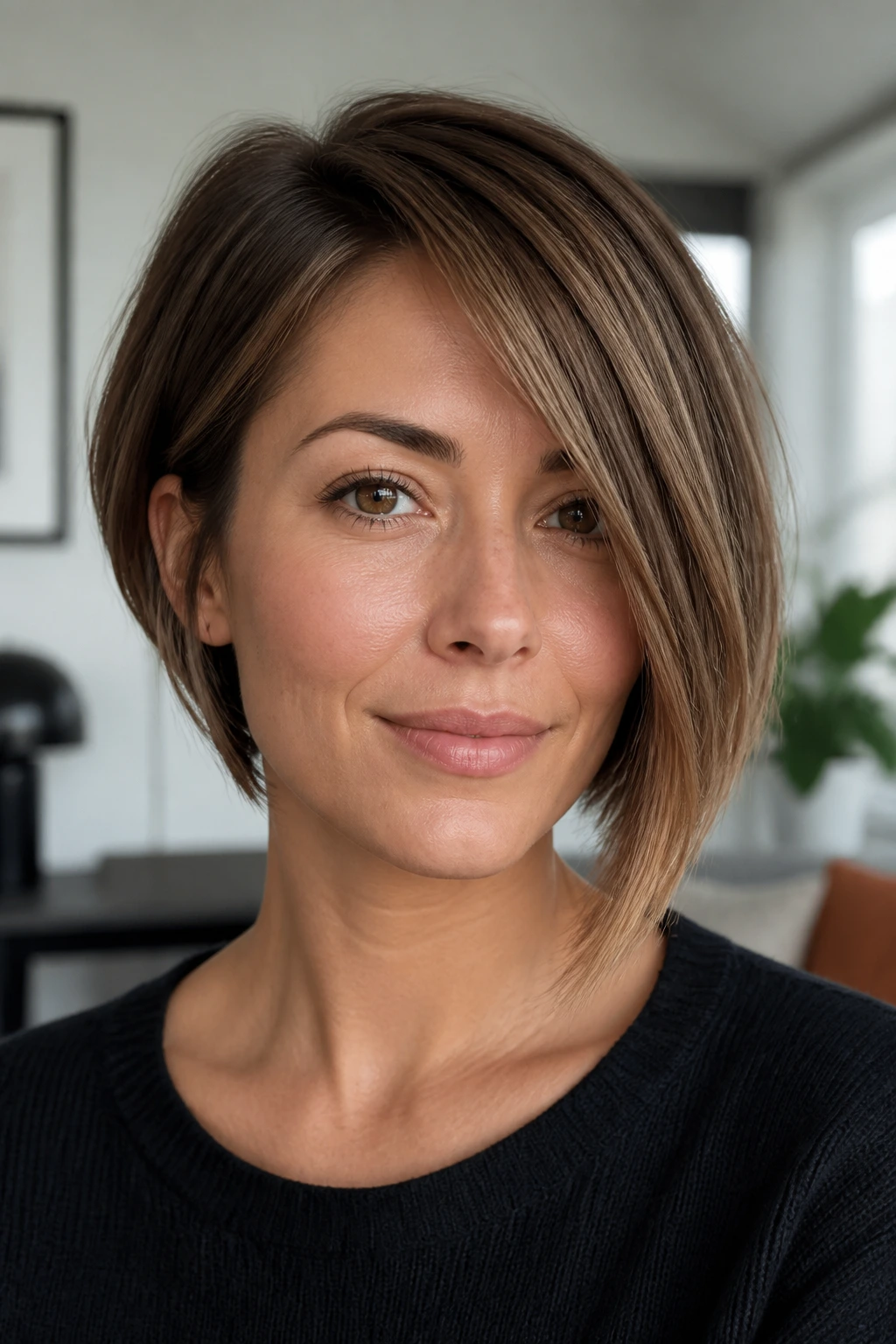
An asymmetrical bob sounds dramatic, but on fine hair it can be a smart distraction. One side stays a touch longer, the part is pushed off center, and the eye moves across the cut instead of stopping at the lack of bulk.
Oval faces are good candidates because asymmetry doesn’t need to “correct” anything. It just adds direction. The shorter side can open the face, while the longer side gives the illusion of thicker weight where the hair normally feels skimpy.
This cut shines when the ends are kept clean. The side that hits lower should still look full, not straggly. If the angle gets too steep, the longer side starts to look like it belongs to a different haircut. Keep the difference subtle unless you want the shape to read bold from across the room.
11. Curtain-Bang Stacked Bob
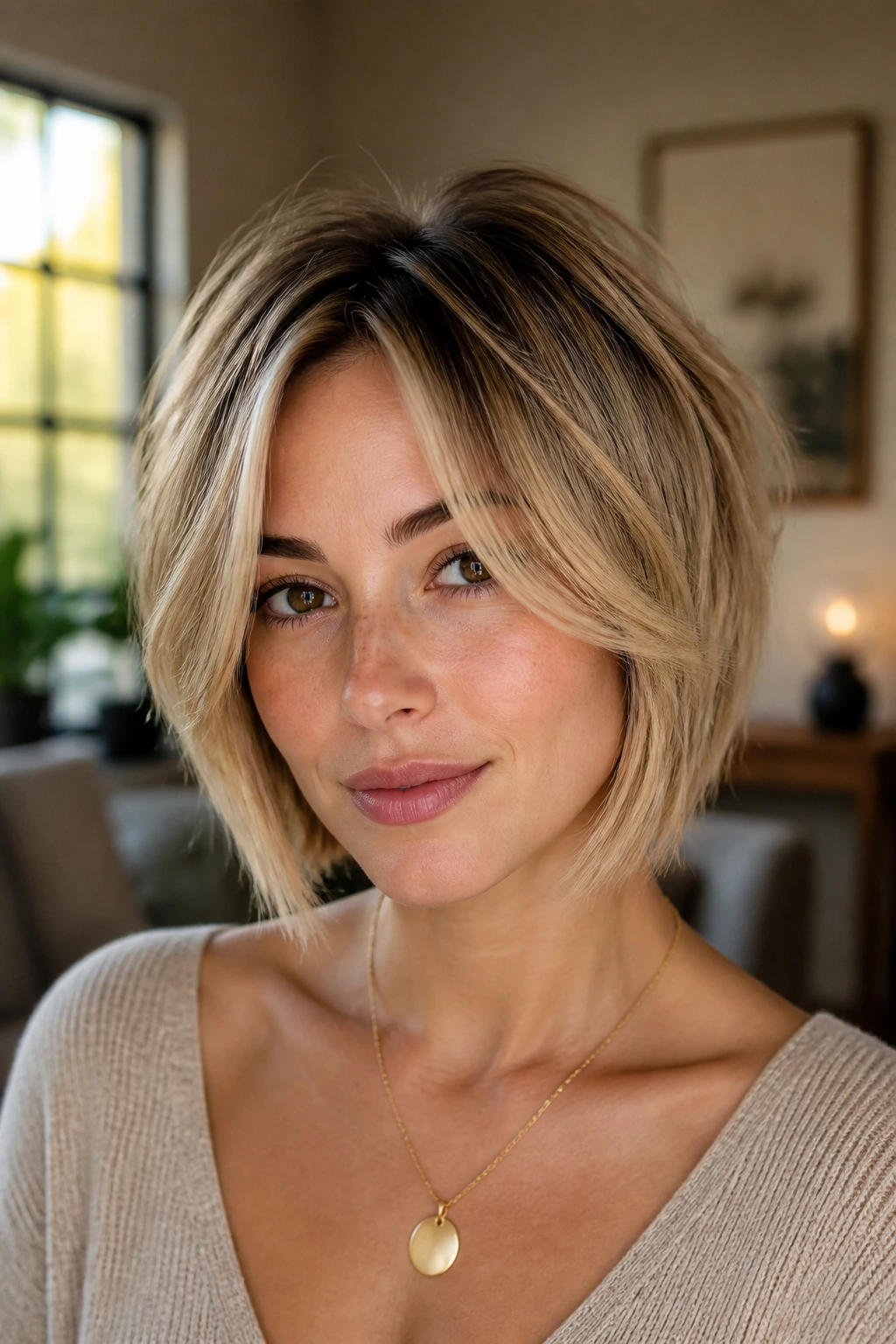
Bangs can help fine hair, but only if they don’t chew through too much density. Curtain bangs are the safer version here. They split at the center, drape along the cheekbones, and let the stacked bob keep doing its work in the back.
The nice thing about this combo is that it gives the front some life without boxing in an oval face. The center split keeps the forehead open, and the longer sides create softness where you might want it most. Meanwhile, the stack at the back stops the cut from going flat and stringy.
I’d ask for the fringe to stay long enough to tuck behind the ear on a bad day. That tiny bit of extra length saves a lot of trouble later. If the bangs are cut too short and too full, they can make fine hair look sparse everywhere else.
12. Hidden-Crown Lift Bob
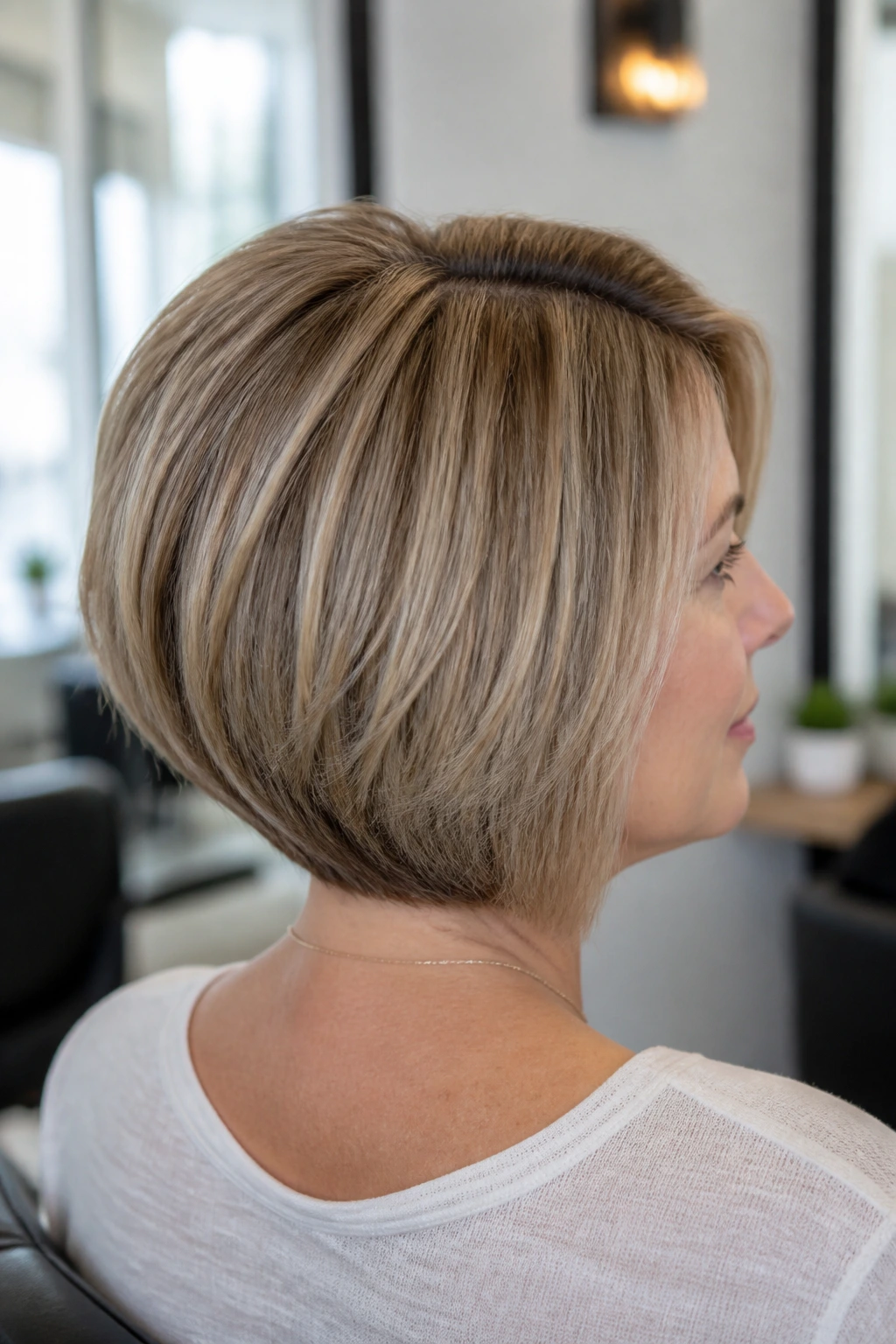
This is the cut for people whose crown lies down no matter what product they use. The lift is built into the top-back section, not left to a round brush and a prayer, which is why it can be so useful on fine hair.
The front stays fairly clean, but the crown gets strategic interior shortening so the hair doesn’t pancake. On an oval face, a little extra height at the top can look elegant instead of top-heavy, as long as the sides stay balanced and the ends remain thick.
A good stylist will check how the crown falls when the hair is wet and again when it’s dry. That matters more than most people think. Fine hair often shifts two inches once it settles, and the wrong crown layer can disappear entirely.
13. Shag-Stack Hybrid
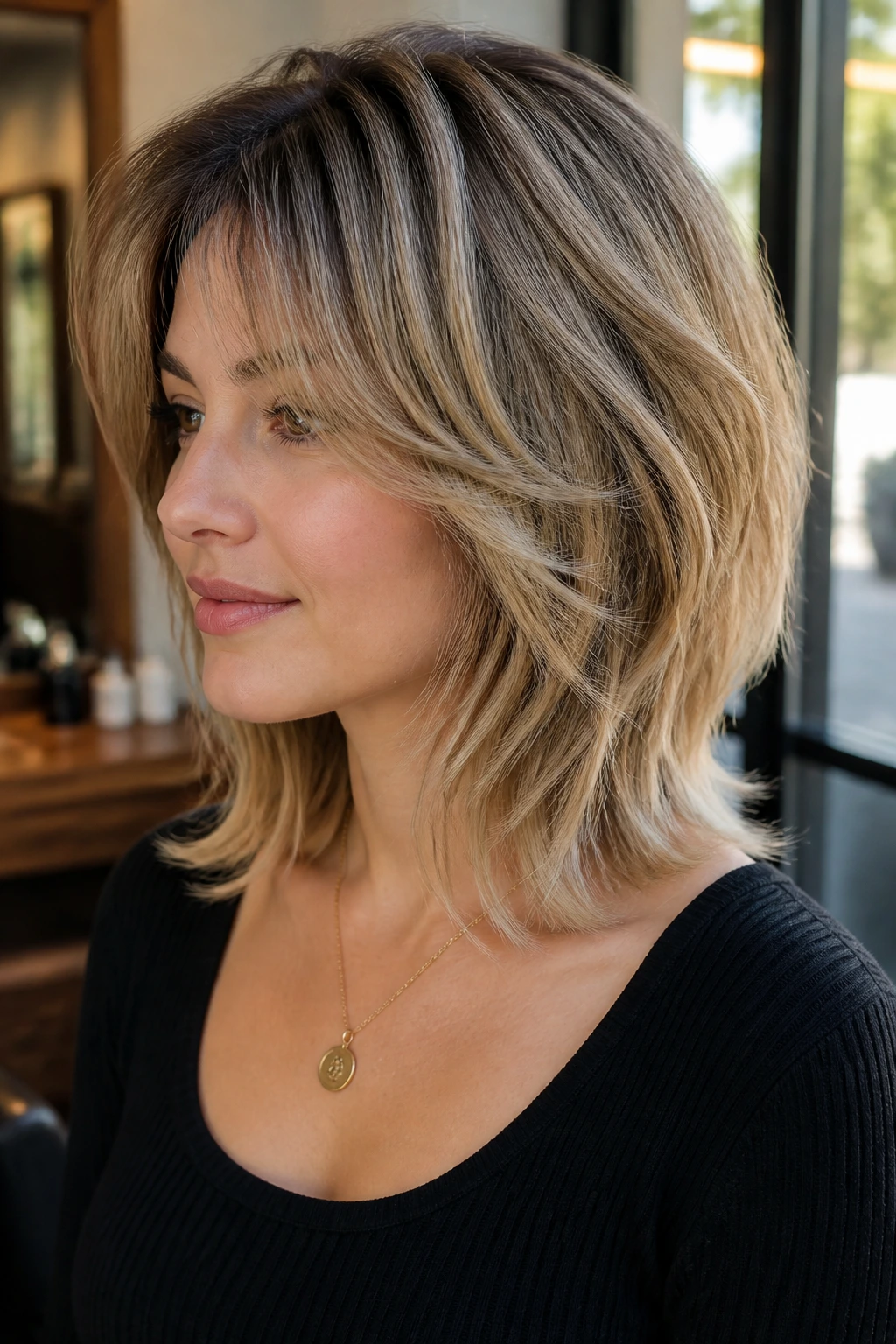
A shag can be too wispy on fine hair if it’s cut with a heavy hand. A shag-stack hybrid keeps the movement but protects the ends, which is the part most people forget about. The stack gives the back shape, while the shaggy bits stay controlled around the upper lengths.
That makes it a nice match for oval faces that can wear a little looseness without losing definition. The front can curve away from the cheekbones, the top can be lightly broken up, and the bottom line still looks thick enough to matter.
Good for, not good for
- Good for: soft waves, easy air-drying, and people who want some texture without a full mullet vibe.
- Not good for: ultra-straight hair that already looks thin at the ends, unless the perimeter stays blunt.
14. French Bob with a Low Stack
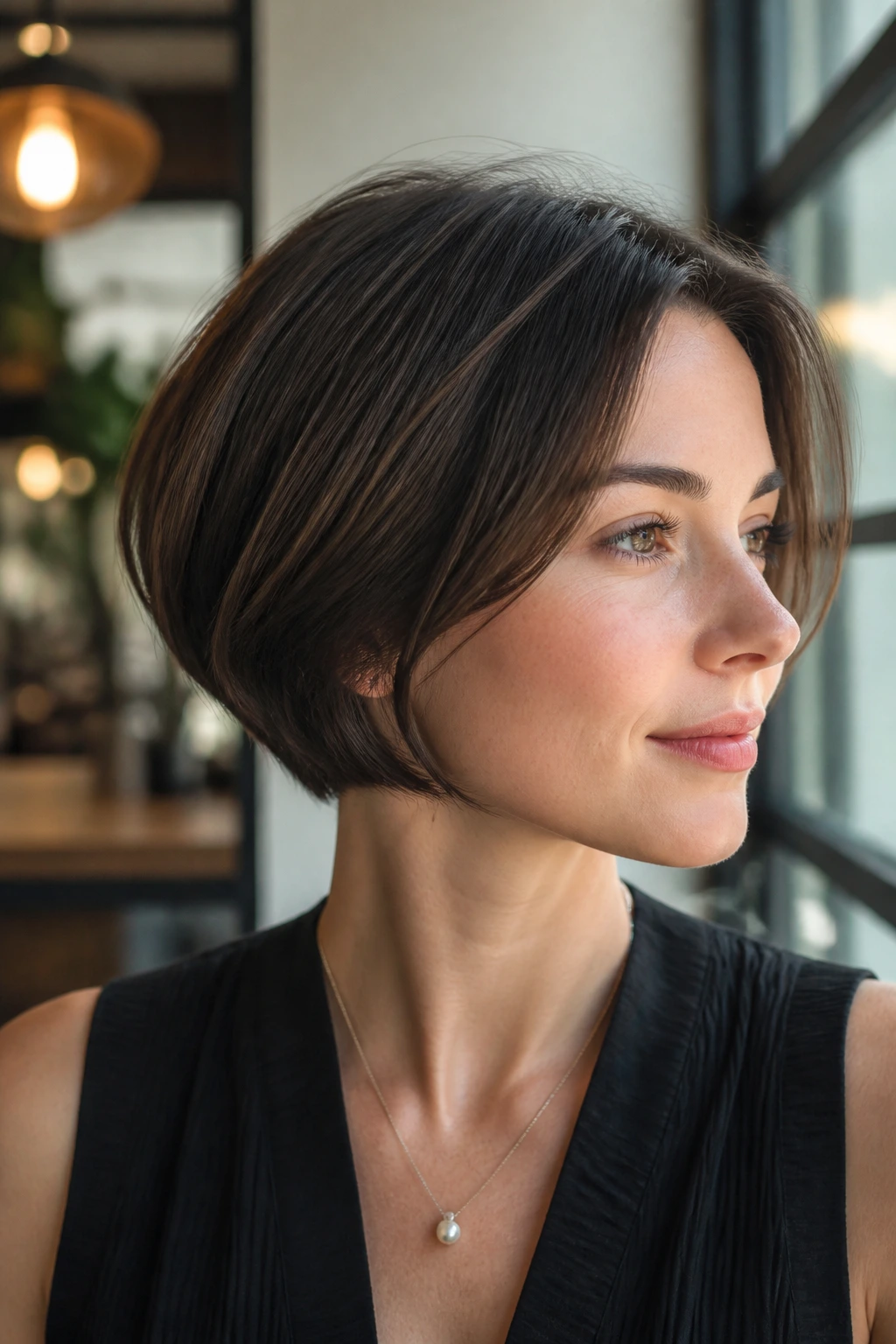
The French bob gets a reputation for being artsy, but the low-stack version is just practical. It sits shorter than a lob, often near the jaw or just above it, and the nape is tucked in so the whole shape feels tidy.
Fine hair benefits because the cut is compact. Nothing drags, nothing hangs too long, and the outline stays readable even on a day when you do almost nothing to it. Oval faces can wear the shorter length without needing side bangs to balance the forehead.
This version is especially good if you like the look of a small bend and a clean neckline. It has that slightly nonchalant feel that looks better when it is not overstyled. If you want polish without stiffness, this is one of the stronger options on the list.
15. Tapered Crop with Longer Top
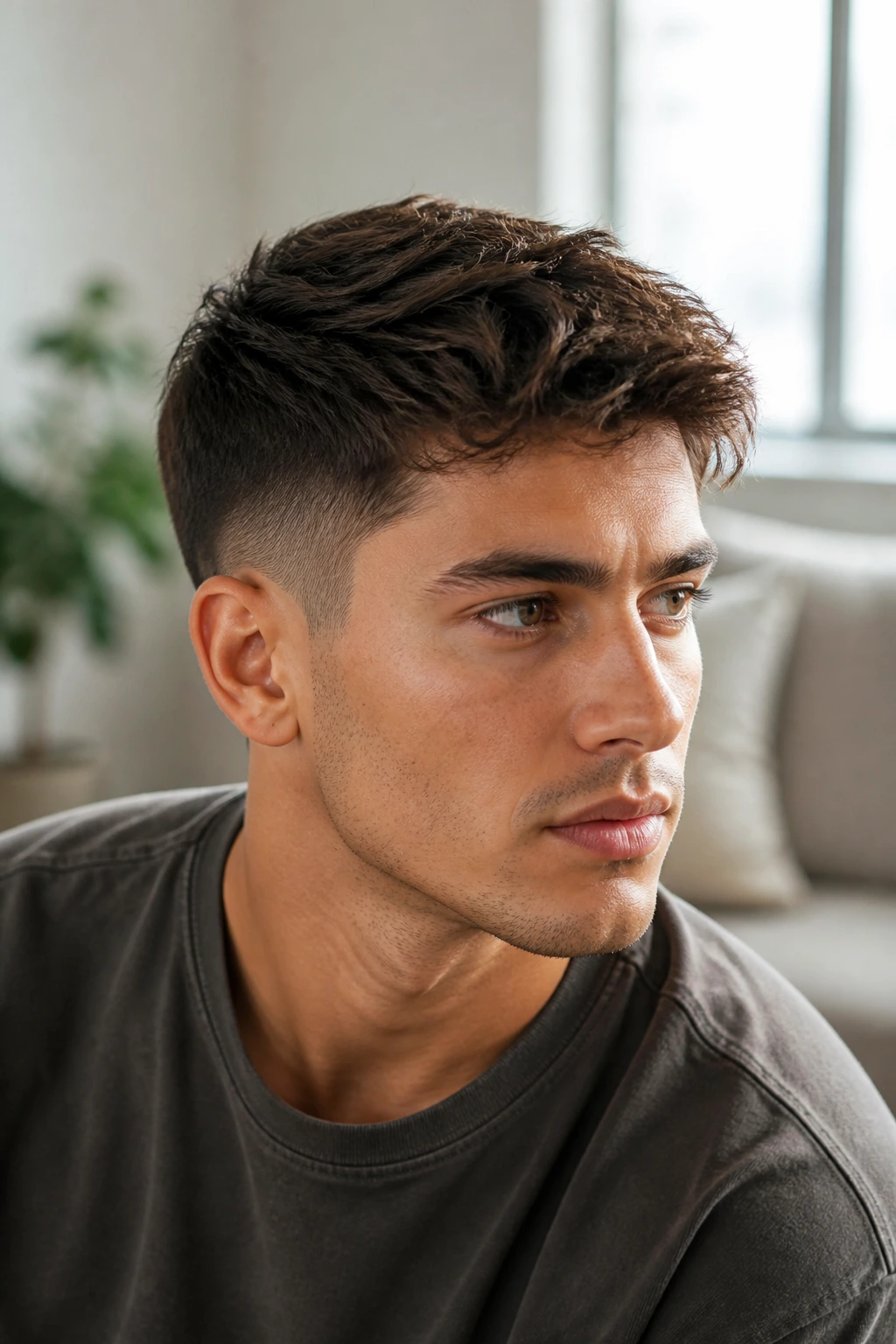
The tapered crop with a longer top is for someone ready to go short, but not all the way to a pixie. The sides and nape hug the head, while the top keeps enough length to push forward, sweep to the side, or lift with a blow-dryer.
Fine hair likes the reduced weight. A short taper stops the ends from looking frayed, and the longer top gives you a place to create volume instead of spreading thin strands across the whole head. Oval faces can carry the exposed shape well, especially if the top is styled with a little height and the sides stay close.
This is not the cut for ignoring maintenance. It needs neck cleanups and a hand with styling product. But if you enjoy a crisp outline and do not mind 5 minutes with the dryer, it can look sharp with very little fuss.
16. Blowout Bob with Rounded Ends
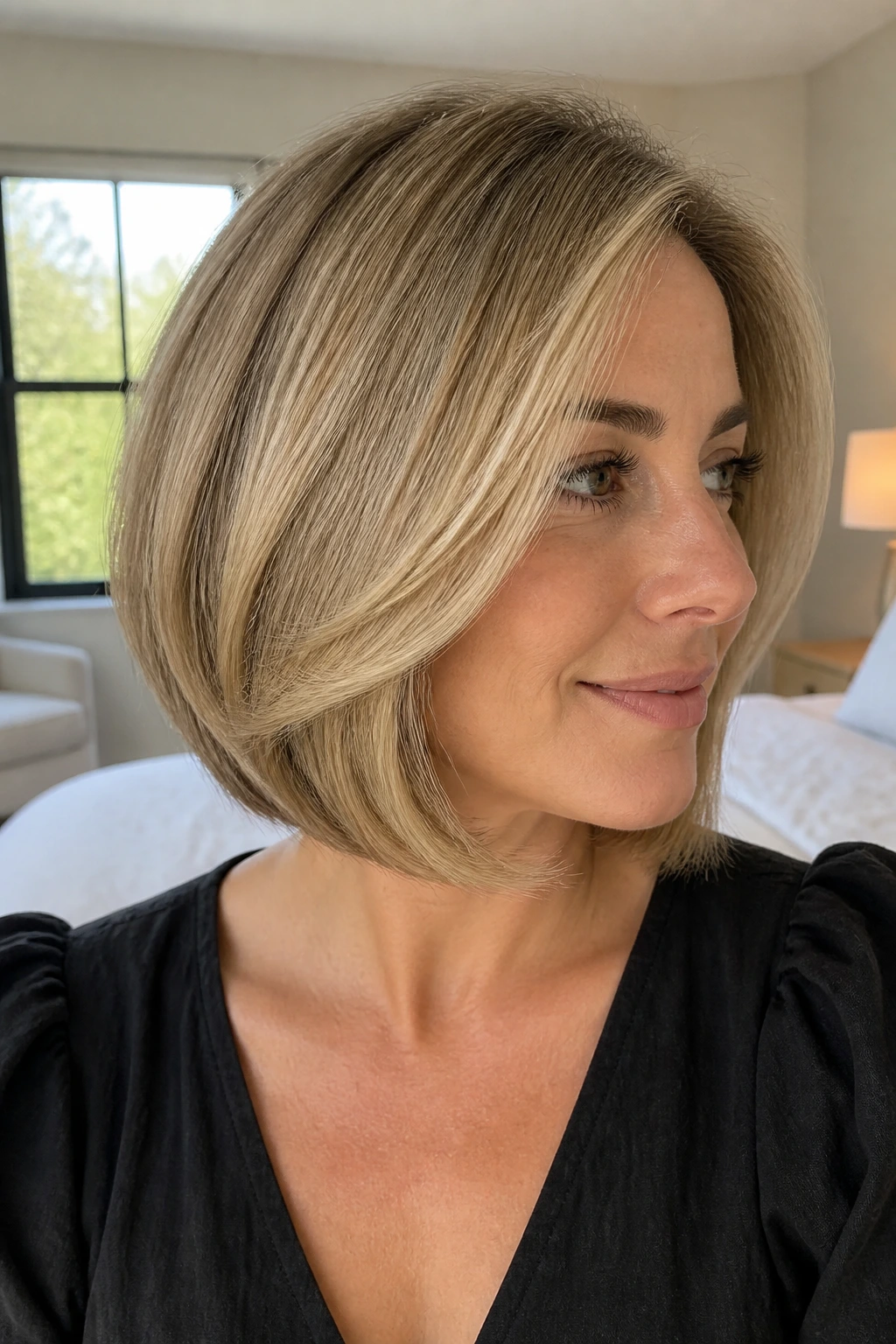
A blowout bob is all about shape that looks like it was set in a salon chair, even if you only spent ten minutes with a round brush. The ends turn under in a soft arc, the stack in back gives the haircut a base, and the whole thing looks fuller because the movement is controlled.
Fine hair loves this because rounded ends reflect light more evenly than ragged ones. The cut doesn’t need to pretend to be thicker than it is; it just needs to keep every strand pointed in the same general direction. Oval faces can wear the rounded frame without needing extra fringe or width.
If you like that “fresh blowout” feeling, this is the version to ask about. Velcro rollers at the crown help. So does a light mousse at the roots before drying, not after.
17. Air-Dried Choppy Stack
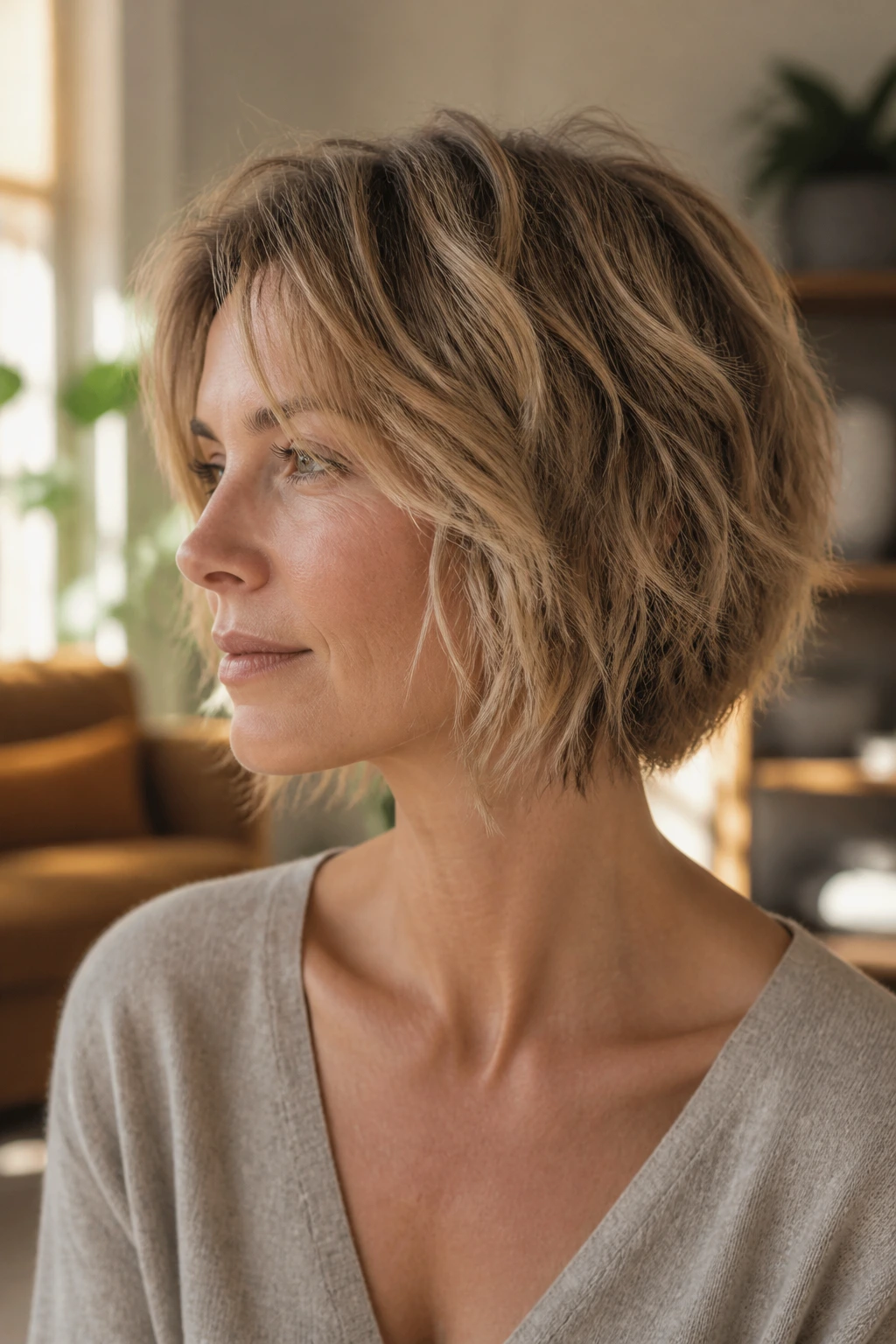
Not every stacked cut has to be brushed into obedience. An air-dried choppy stack keeps the outline strong but lets the ends break into little pieces that work with natural texture instead of fighting it.
The key is restraint. The stack should still be visible in the back, but the stylist should keep the perimeter full enough that the hair doesn’t turn into a wispy cloud. Fine hair can handle texture when the base line is strong. Oval faces tend to wear that casual movement well because the shape doesn’t have to carry the whole job.
This cut is best when you can accept a little imperfection. A pea-size amount of mousse, scrunched into damp hair, goes a long way. If you’re used to flat ironing every strand smooth, this may feel messier at first. It’s still controlled mess, which is the part that matters.
18. Sleek Deep Side-Part Stack
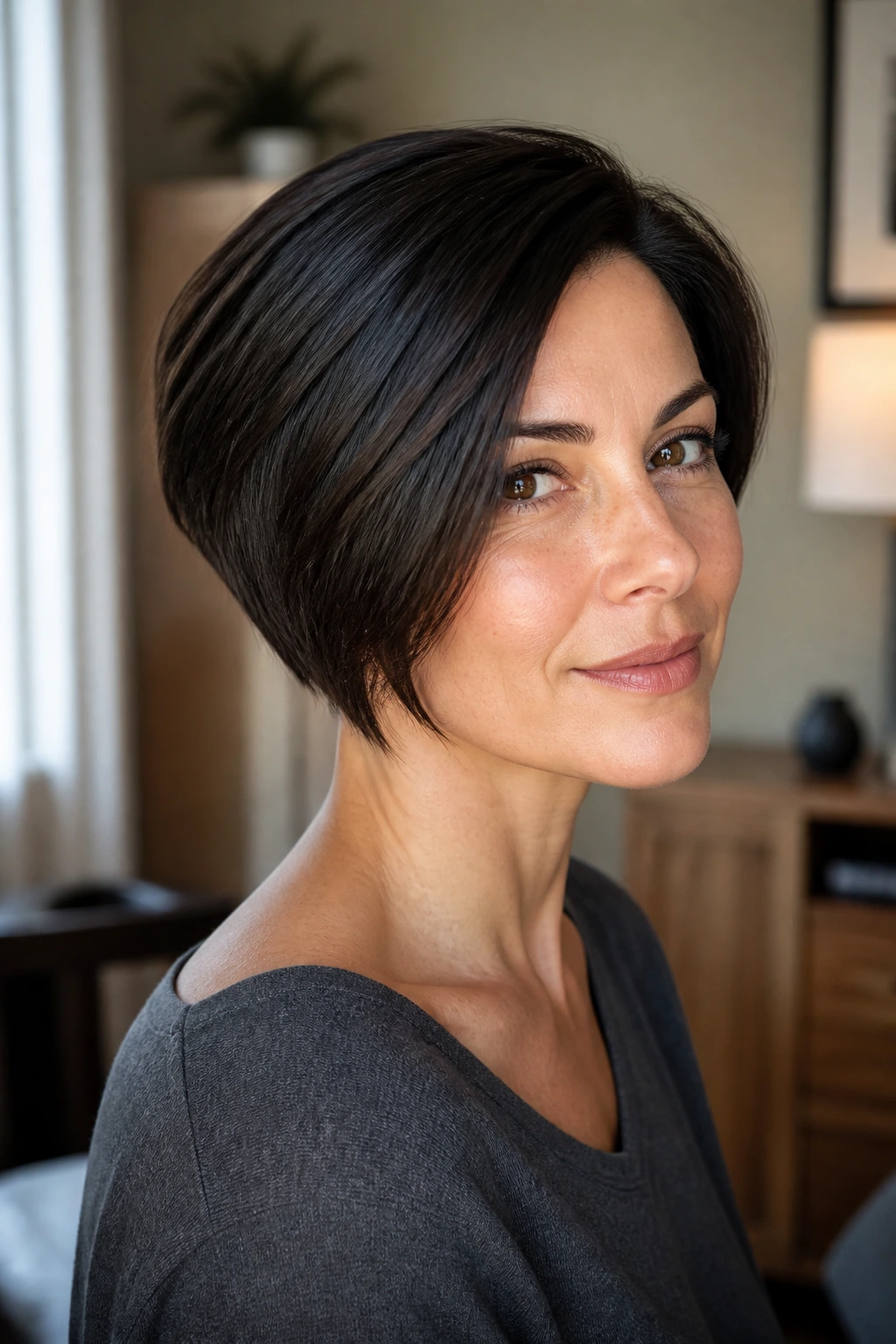
A sleek deep side-part stack is the polished sibling of the rounded bob. The part goes lower, the front sweeps across the forehead, and the back stays stacked so the head doesn’t lose shape once the surface is smoothed down.
That deep part is doing a lot. It gives fine hair visible lift on one side, which makes the style look richer than a center part can on the same density. Oval faces usually tolerate this asymmetry nicely because the face already has balanced proportions.
This one is for straight hair or hair that can be straightened easily without puffing up. Keep the finish smooth, but not oily. A tiny amount of serum on the ends is fine; anything near the roots will flatten the whole thing faster than you’d expect.
19. Soft Mushroom Stack
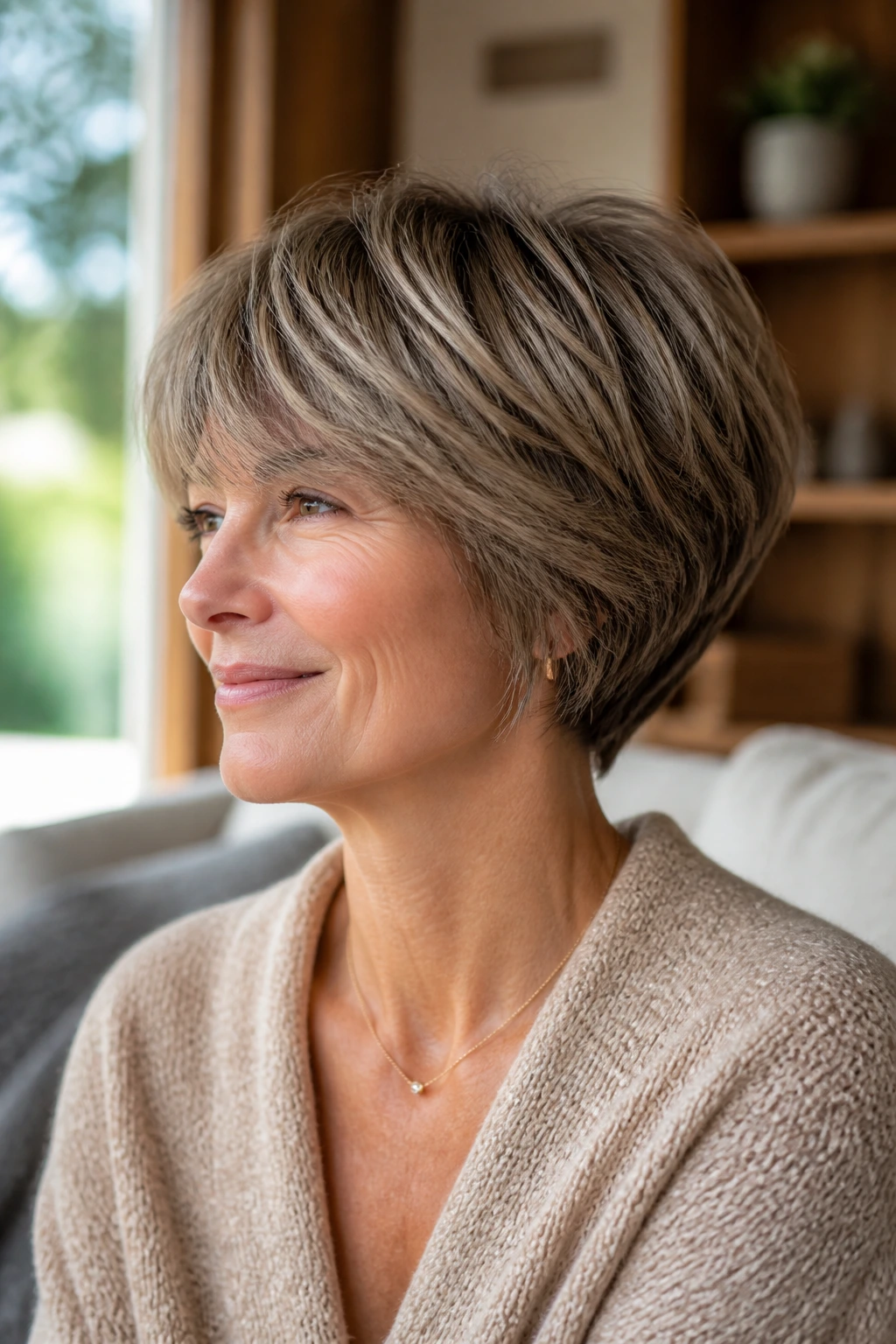
The word “mushroom” scares people because they picture a helmet. Fair enough. The soft mushroom stack is nothing like that. It keeps a rounded silhouette, but the edges are broken enough to move, and the nape is tight enough to give the cut shape instead of bulk.
Fine hair can look fuller in a rounded shape because the eye reads the curve as density. Oval faces can wear the soft dome without looking over-framed, especially if the sides are not cut too wide. The trick is to keep the crown controlled and the perimeter slightly beveled.
This is one of those cuts that looks better in real life than in flat photos. It moves when you turn your head. If you want something a little different but still easy to manage, it deserves a look.
20. Long Stack with Low Graduation
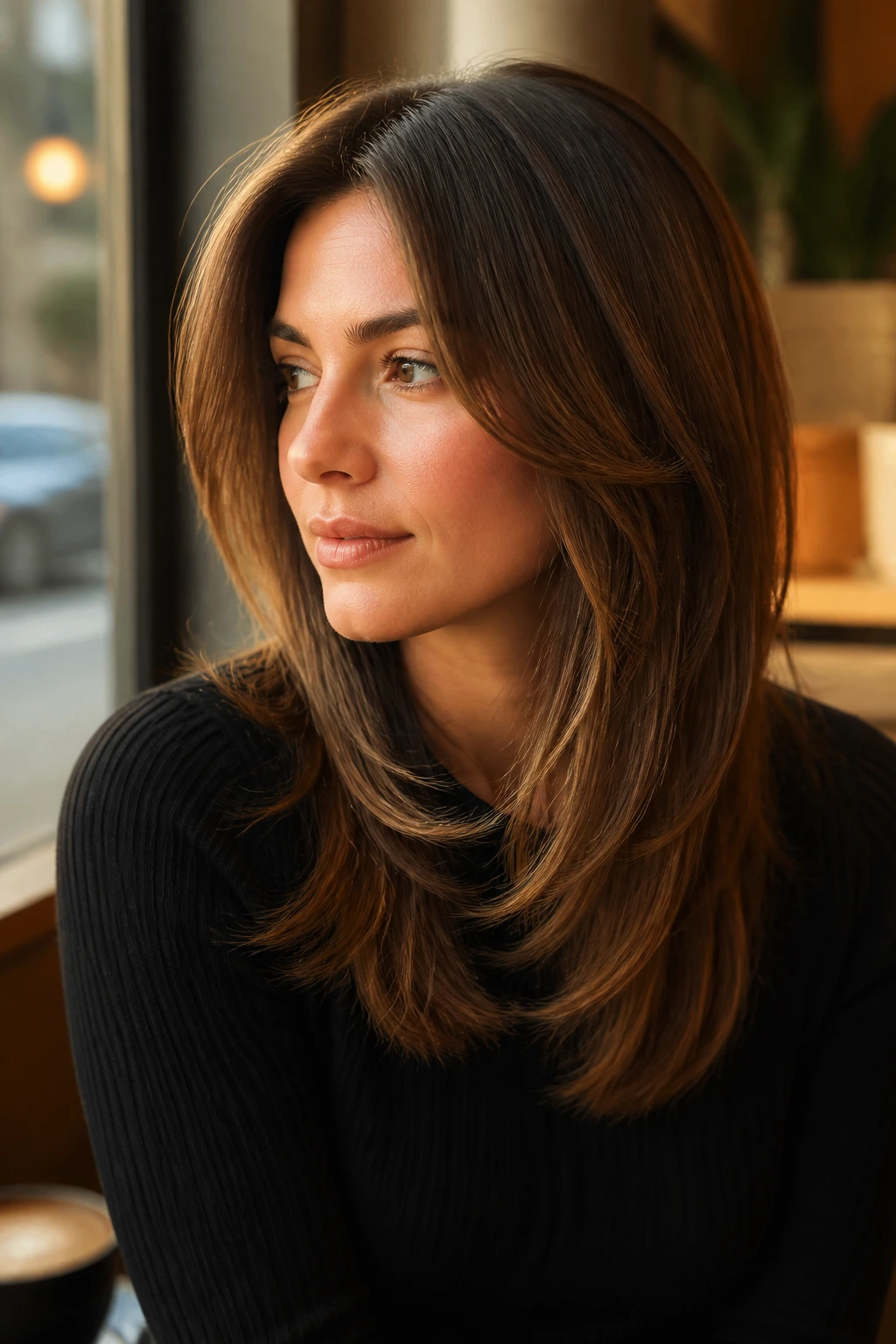
If short hair still feels like a hard sell, start here. A long stack with low graduation keeps the length below the jaw or even near the shoulders, but the back is still shaped so the hair doesn’t hang like a curtain.
That low stack matters for fine hair because it adds form without stripping away too much length. The ends stay visible and thick, and the crown gets a little support from the architecture underneath. Oval faces can wear the longer outline without losing the clean line through the middle of the face.
This is a good bridge haircut. It lets you test the stack before going shorter. If you hate it, you can grow it out without a rough transition. If you like it, the cut can later move into a bob or lob without much drama.
21. Undercut Nape Stack
This is the most specific cut in the group, and it only works when you have a clear reason for asking for it. A hidden undercut at the nape removes some bulk from the very bottom, which lets the rest of the stacked shape sit closer to the head.
Fine hair can benefit if the lower section grows strangely puffy or sticks out while the top stays flat. Oval faces can wear the clean neckline nicely, especially when the upper layers still have enough density to look full. But this is not a default choice. If your hair is already very sparse, an undercut can take away too much.
I’d only choose this if you want a super neat neckline and you know your hair behaves better when the bottom is lighter. It grows out fast enough to need maintenance, so don’t ask for it if you dislike regular trims.
22. Tucked-Back Bob with Soft Ends
A tucked-back bob is the haircut that plays well with earrings, collars, and a quick push behind one ear. The ends stay soft, the stack in back keeps the shape lifted, and the front is long enough to tuck without falling apart.
That softness matters on fine hair. Hard edges can make the cut feel severe, while a gentle perimeter keeps the outline from looking too carved. Oval faces can wear the tucked-back look easily because the face shape can handle a bit of exposure at the jaw and cheek.
This is the one I’d pick for people who want a bob that behaves. It looks neat when you need it to, and a little undone when you don’t. That mix is the whole selling point.
Why Stacked Haircuts for Fine Hair and Oval Faces Keep the Back Looking Full
The stack is not magic. It’s just good weight distribution, and that matters more on fine hair than most people think. When the hair is shorter at the nape and gradually longer higher up, the cut naturally lifts away from the scalp instead of hanging straight down and showing every bit of density loss.
Where the shape does the work
The back of the head carries the visual load. If that area is too long, fine hair goes limp fast. If it is too aggressively thinned, the ends go see-through. The sweet spot is a compact graduation that lets the hair sit in a controlled curve.
Why oval faces make this easier
Oval faces already have balanced width through the forehead, cheeks, and jaw. That means the haircut does not need to “fix” the face shape with heavy fringe or extra volume at one side. You can use the haircut to build style and fullness instead of correction, which is a much better job for a stack.
The most common mistake is treating fine hair like thick hair and asking for aggressive layering everywhere. That usually leaves the perimeter weak and the crown too fluffy. A better haircut keeps the outside line honest and uses the inside of the shape for support.
What to Tell Your Stylist and Which Products Earn Their Shelf Space
Bring photos, but bring the right kind. One picture of the front is not enough for a stacked cut. You want at least one front view, one side profile, and one back shot so the stylist can see where the weight line sits and how much neck exposure you actually want.
Say the words graduation, perimeter, and stack if you know them. Those are more useful than saying “more volume,” because volume can mean fluffy, puffy, or lifted depending on who’s listening. If you have fine hair, tell them you want the ends to stay thick and that you do not want the bottom shredded into airy pieces.
What to ask at the salon
- Keep the perimeter blunt or only lightly beveled.
- Build the stack in the back without over-thinning the crown.
- Avoid heavy razor work if your hair already looks soft at the ends.
- Mention your real routine: air-dry, blow-dry, round brush, or heat-free.
What’s worth buying
- A lightweight mousse for roots and mids.
- A root-lift spray if your crown lies flat.
- A heat protectant that doesn’t leave residue.
- A dry shampoo that adds grip, not chalk.
If your hair gets oily fast, the product choice matters as much as the cut. Heavy creams can flatten the whole shape by the second day, and fine hair rarely forgives that.
The Tools That Make a Stacked Cut Easier to Live With
- 1-inch round brush: Small enough to lift the roots and bend the ends without fighting the cut.
- Blow-dryer with a nozzle: Directs the air so the stack doesn’t puff out in every direction.
- Tail comb: Useful for making a clean part and lifting sections at the crown.
- Sectioning clips: Keep the top out of the way while you dry the back first.
- Vent brush: Fast, practical, and decent for rough-drying fine hair.
- Heat protectant spray: Keeps the ends from getting brittle, especially on shorter stacked shapes.
- Lightweight mousse or foam: Gives roots a little body without the sticky feel of heavy gel.
- Dry shampoo: Helps the style stay lifted on day two or three.
- Mini flat iron or curling wand: Optional, but handy for flipping a front corner under or adding a slight bend.
How to Wear These Cuts With Glasses, Earrings, and Everyday Clothes
Parting: A deep side part builds height at the crown, while a center part makes the shape look cleaner and more symmetrical. If your hair is very fine, I’d try both before deciding; sometimes the part matters more than the cut itself.
Accessories: Small hoops, studs, and narrow frames work well because they don’t compete with the stacked back. Big earrings can be fun, but they start to crowd the neckline if the bob is already short and rounded.
Texture: Sleek finishes make the graduation read sharp. Loose bends make the same cut feel softer and a little less formal. On busy days, rough-drying with mousse is enough if the perimeter is strong.
Clothes: Higher necklines and collars tend to work better with shorter, tighter stacks, while longer front pieces balance out turtlenecks and button-downs. If you wear a lot of chunky sweaters, a collarbone lob or longer bob usually behaves better than a very short crop.
Styling Moves That Add Lift Without Turning Hair Crunchy
Root Lift: Put mousse or root spray on damp hair, then clip the crown up while it cools. That little bit of setting time makes more difference than piling on extra product after the fact.
Movement: Wrap only the front pieces and ends around a round brush or iron. Leave the roots alone. Fine hair collapses when every inch gets heat and tension.
Finish: Use serum sparingly, and only on the last inch or two. If it touches the top half of the head, the volume disappears fast.
Make-It-Yours: If you hate hot tools, ask for a cut that lands a bit shorter at the nape and a bit fuller at the ends. Then rough-dry upside down for a minute, shake it out, and stop. If you like polish, use a round brush to bend the front away from the face and the back under.
Common Mistakes That Make Fine Hair Look Thinner
The biggest mistake is over-layering. People ask for “movement” and end up with see-through ends that separate into little feathers after one wash. The fix is to keep the perimeter solid and let the stack do the work in the back.
Another problem is too much thinning with razors or shears. That can make the hair feel light for a day, then frayed for weeks. Fine hair already has a soft edge; it usually needs structure, not reduction.
A third mistake is letting the front get too long while the back gets too short. That can pull the whole shape downward and make the face look longer than the style wants. If you’re after balance, keep the front in dialogue with the jaw or collarbone, not halfway down the chest.
- Too much product at the roots: The cut goes flat before noon. Use mousse first, then a small amount of dry shampoo later.
- Skipping trims: The stack grows into a lopsided triangle. Book the cut back in before the nape loses its line.
- Using heavy oils on day one: Fine hair drinks them up and turns limp. Save oils for the ends only, and use very little.
Variations and Adaptations to Try
Air-Dry Bend: If your hair leans wavy, ask for a softer stack and a blunt perimeter. A light cream and a scrunch is enough to let the shape settle without a full blowout.
Glass-Sleek Finish: For straight hair that holds a line well, keep the angle cleaner and the ends polished. This version shows off the stack with shine instead of texture.
Curtain-Fringe Version: If you want some forehead coverage, add longer curtain bangs that split at the center. They soften the face without burying the density at the sides.
Longer Grow-Out Version: If you’re nervous about short hair, start with a collarbone-length stack and low graduation. You’ll keep more security at the shoulders while still getting lift in the back.
Extra-Lift Crown: If your crown goes flat no matter what, ask the stylist to concentrate the graduation slightly higher in back. Just keep the silhouette balanced; too much lift can make the top look perched.
Keeping the Shape Between Salon Visits
A stacked cut holds up best when you treat the neckline like part of the haircut, not an afterthought. For shorter versions, plan on a trim every 6 to 8 weeks. Longer lobs can usually stretch to 8 to 10 weeks, but the back will start to lose its line before the front feels obviously long.
Wash rhythm matters too. Fine hair often looks better with a lighter conditioner used only from mid-length to ends. Put anything heavy near the scalp, and the stack collapses. If your hair gets oily quickly, a small amount of dry shampoo applied before the roots go greasy can help the shape last another day.
Night care is underrated. A loose clip, a soft scrunchie, or a silk pillowcase keeps the back from kinking up in odd places. If the ends kick outward in the morning, a quick pass with a round brush or a flat iron bend at the bottom usually resets them in under five minutes.
Bangs, if you have them, need their own schedule. Curtain bangs can often go a few weeks longer than a blunt fringe, but they still benefit from a small trim before they start hanging into the eyes. Keep the fringe light. Heavy bangs and fine hair do not always get along.
Questions People Ask Before They Commit to a Stack
Is a stacked haircut good for very fine hair?
Yes, if the cut keeps a strong perimeter and uses graduation instead of aggressive thinning. Fine hair tends to look better when the shape is built with structure, not stripped apart.
Will a stacked bob work on an oval face?
Usually, yes. Oval faces can wear shorter backs, side parts, chin lengths, and even asymmetric lines without needing the haircut to correct much of anything.
What length is best if I don’t want to go too short?
A collarbone stack or a long bob with low graduation is the easiest entry point. You still get lift in the back, but the front gives you the feeling of length.
Can I air-dry a stacked cut?
You can, especially if your hair has some wave. The cut needs a solid base, though, so ask for a perimeter that keeps its line even when you skip heat.
How often should I trim it?
Shorter stacks usually need cleanup every 6 to 8 weeks. Longer versions can last a bit longer, but the nape will lose shape first.
Do bangs help or hurt fine hair?
They can help if they stay light and don’t eat too much density from the front. Curtain bangs and soft side-swept pieces are safer than a heavy blunt fringe.
What if my hair is fine but also very straight?
Then a blunt edge matters even more. Straight fine hair shows every uneven cut line, so ask for clean ends and a stack that isn’t over-chopped.
What should I do if the back flips out too much?
That usually means the nape is too long or the ends were cut too pointy. A quick salon tidy-up and a round brush bent slightly under at home usually solves it.
The Shape That Keeps Its Own Lift
A stacked cut should do one thing well: keep its shape after the first shampoo, the second, and the rushed morning when you have six minutes and a dry shampoo can. On fine hair, that means protecting the perimeter, choosing the right amount of graduation, and letting the back carry the lift instead of asking every strand to work overtime.
Oval faces make the whole idea easier because the proportions already give you room to play. Shorter backs, longer corners, side parts, curtain bangs, a deeper angle—those choices can all work. The real decision is how much maintenance you want and how much length you’re willing to trade for shape.
Bring the photos, say what you actually do with your hair, and ask for the outline to stay thick at the edges. That one move changes a stack from merely short to genuinely useful, and it’s the difference you keep noticing every time you pass a mirror.