



Medium length black hairstyles for round faces have one job: give the eye somewhere to travel. Up, down, diagonally — anywhere but straight across the fullest part of the cheeks. When the shape is right, the face looks balanced without looking hidden, and that’s the sweet spot most people are chasing without naming it.
Black hair makes this even more interesting, because texture changes everything. A style can look sleek in a salon mirror and then blossom into a different silhouette once it meets humidity, shrinkage, or a little too much product at the roots. That is not a flaw. It is the whole game. Medium length gives you room to work with that movement instead of fighting it.
The best looks here tend to land somewhere between the jaw and the collarbone, with enough lift at the crown, a little softness around the face, and no hard line sitting right at the cheekbone. I’m partial to styles that create shape without turning stiff. A good medium-length style should move when you turn your head.
The styles below do that in different ways — some by adding height, some by narrowing the sides, some by keeping the ends loose and directional. The trick is not to hide a round face. It’s to steer it.
Why These Styles Earn Their Place
-
They add length where it matters: A collarbone-skimming finish pulls the eye down instead of letting the widest part of the face do all the talking.
-
They work with Black hair texture instead of against it: You’ll see silk presses, braids, twists, curls, and protective styles that respect shrinkage, density, and shape.
-
They give you options beyond one type of look: Some are salon cuts, some are at-home sets, and some sit in the middle if you want a style you can keep for a while.
-
They avoid the worst round-face trap: None of these lean too hard into a blunt line at the cheekbone, which is where a lot of medium cuts go sideways.
-
They can be polished or easygoing: You can wear most of these sleek for work, then let them loosen a little on the weekend without the style collapsing.
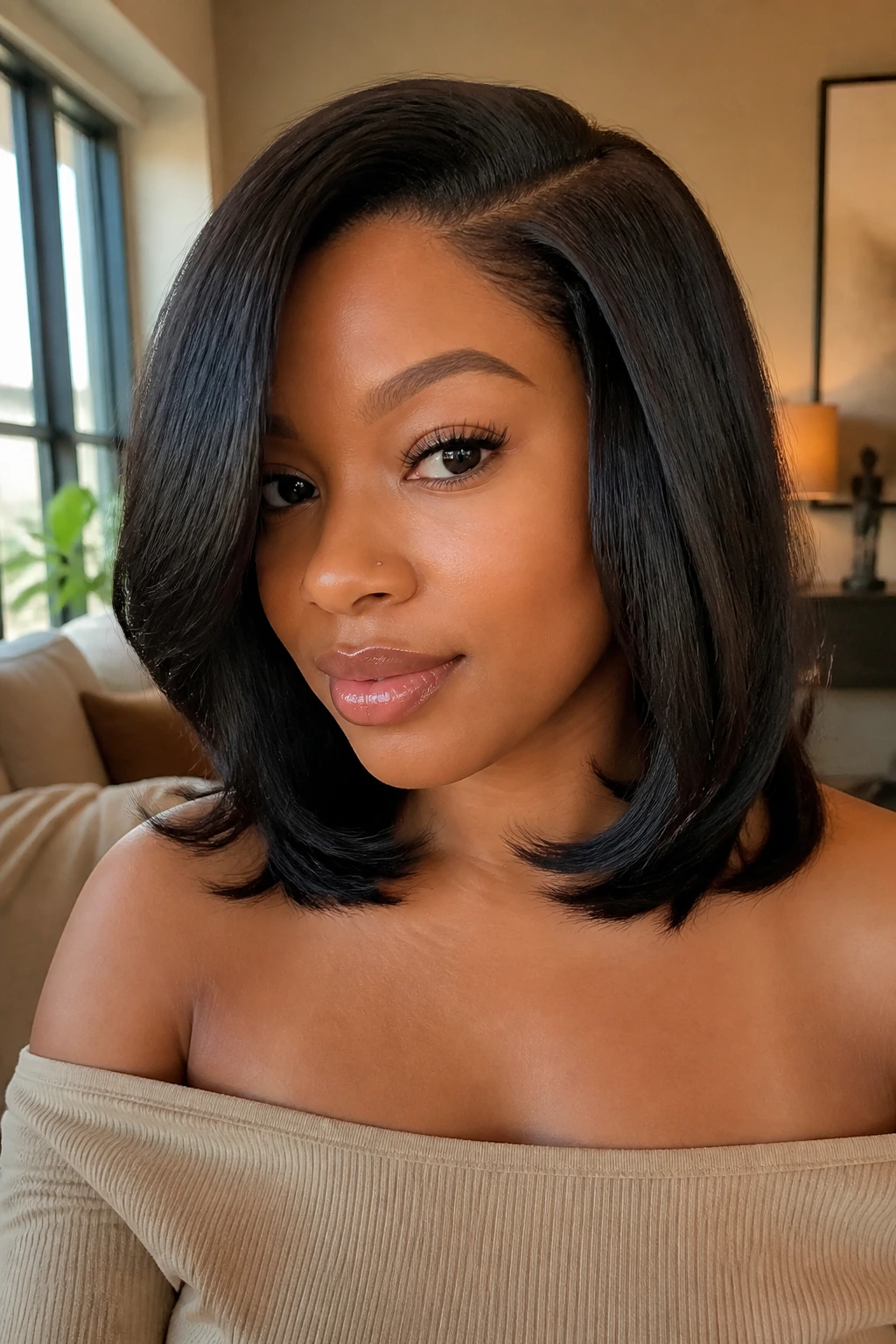
1. Collarbone Silk Press with Soft Layers
A collarbone silk press is one of the cleanest answers to a round face, and I say that as someone who has watched a lot of styles become more flattering the second the ends stop at the right point. The shine helps, sure, but the real win is the line: long enough to narrow the silhouette, soft enough not to feel severe.
Why It Works
The shortest layer should sit below the cheekbone, not on it. That matters more than people think. If the cut brushes the cheek, the face can look wider; if it drops to the jaw or collarbone, the eye travels downward instead. Ask for a gentle bend at the ends, not a poker-straight sheet.
Quick Shape Notes
- Best part: Off-center or deep side part.
- Layer start: About 1 to 2 inches below the cheekbone.
- Finish: Slight inward curve at the ends, not a stiff flip.
Best tip: keep the front pieces a touch longer than you think you need. Too short, and the whole cut starts arguing with your face.
2. Side-Parted Curly Lob
A side part changes the geometry. That’s the whole story, really. On a round face, a centered curl pattern can sit like a halo; a side-parted lob breaks that circle and lets one side fall a little lower, which gives the face room to breathe.
The nicest version lands around the collarbone and uses layered curls, not one heavy block. If your curls are loose, let them fall in ribbons. If they’re tighter, stretch the roots a little at the crown so the style doesn’t puff wide at the temples. I like this one because it feels soft without looking round.
A little root clipping while the hair dries helps more than a lot of people expect. Cheap trick? Maybe. Effective? Absolutely.
3. Knotless Braids with Face-Framing Pieces
If you want a protective style that doesn’t widen the cheeks, knotless braids with face-framing pieces are the safe play. The magic is in the front: two slim braids or a few loose braiding pieces that sit a little shorter than the rest and pull the eye downward.
What to Ask For
- Braid size: Medium-small, not chunky at the temples.
- Length: Shoulder-grazing to upper chest.
- Front pieces: Leave 1 to 2 braids slightly shorter near the face.
- Ends: Curled or sealed so they do not stop in a blunt line.
A round face can handle braids just fine. The issue is bulk at the widest point. Keep the perimeter neat, keep the front soft, and do not let every braid end at the exact same place. That is how you get shape instead of a box.
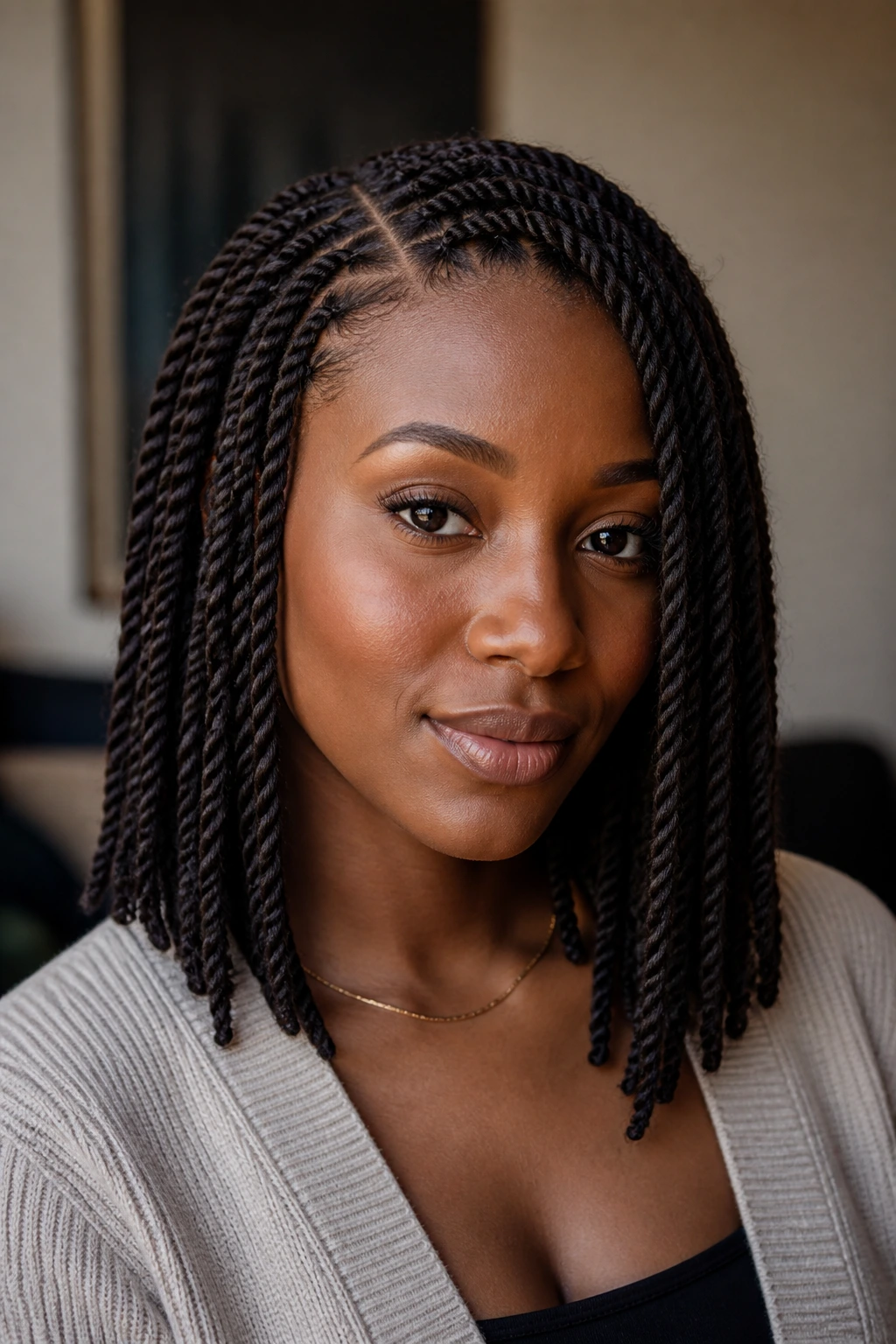
4. Shoulder-Length Senegalese Twists
Shoulder-length Senegalese twists are all about clean vertical lines. When the twists are too short or too thick, they can sit like a block around the jaw. When they graze the shoulders and the part is slightly off-center, the whole style feels longer and lighter.
I like medium twists here — not pencil-thin, not rope-thick. The twist pattern itself already gives enough texture, so the shape needs to stay simple. If you want a little softness, curl the ends with rods or let them taper naturally rather than cutting them blunt.
This is one of those styles that looks especially good when the crown is slightly flatter and the length does the work. Too much height on the sides, and you lose the point.
5. Layered Braid-Out with a Side Sweep
Why does a braid-out work so well on a round face? Because the braid pattern gives you stretch, and the side sweep breaks the symmetry. The result is soft, textured, and just a little directional — which is exactly what a medium-length style needs here.
Braid the hair in 6 to 10 sections depending on density. Keep the front sections a bit looser so the roots don’t puff in a wide halo. Once dry, separate carefully with a little oil on the fingers and sweep the front pieces across the forehead or toward one side. That diagonal line is doing real work.
If you want this style to last more than a day, set it fully dry. Half-dry braid-outs look fuzzy fast.
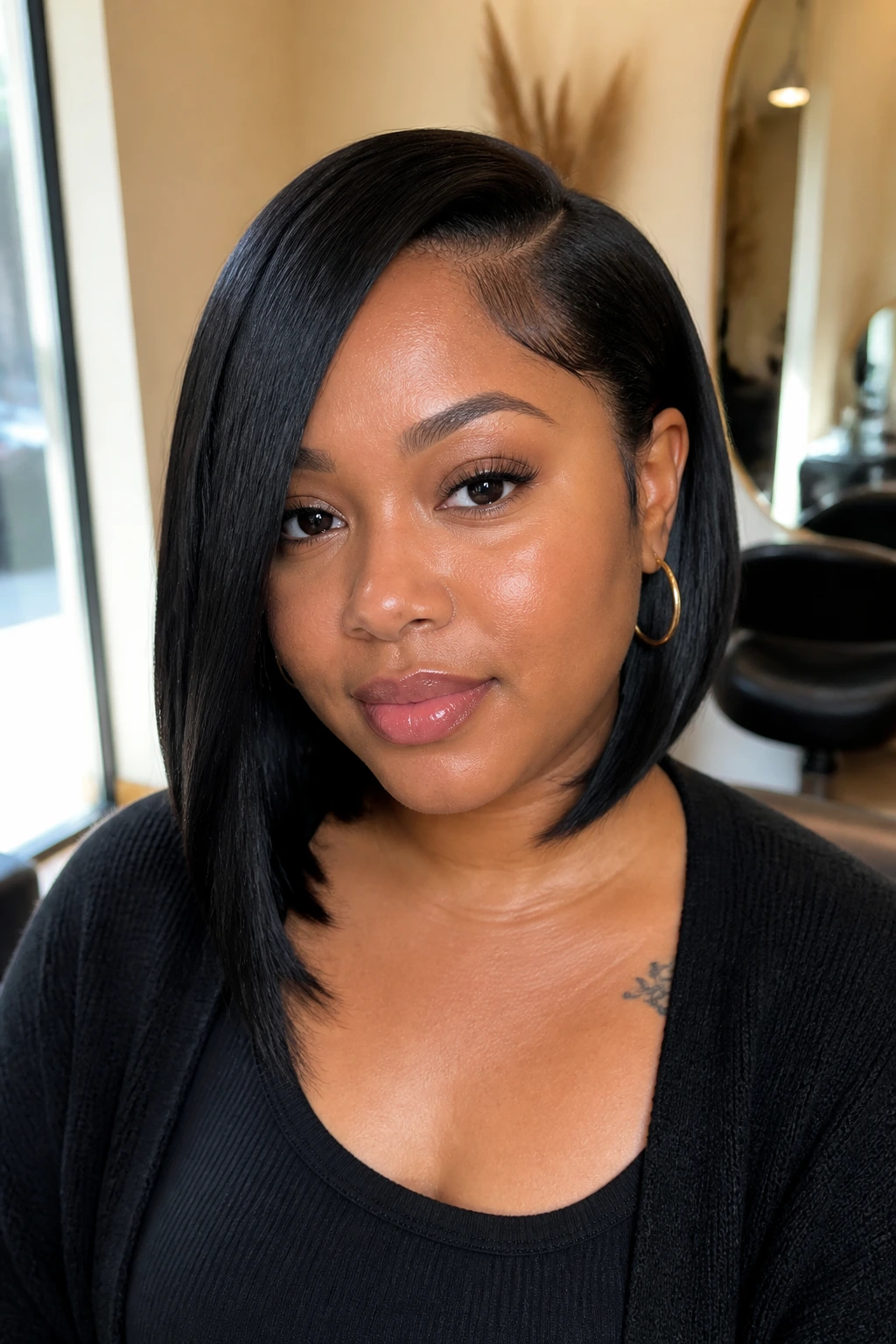
6. Angled Bob with a Tucked Side
A blunt bob can be a trap on a round face. An angled bob fixes that by putting length in the front and a little more lift or control in the back. Tuck one side behind the ear, and the face instantly looks more open.
The cut doesn’t need to be dramatic. Even a subtle angle — one side an inch or two longer — changes the whole feel. On Black hair, this works beautifully with a silk press, a blown-out texture, or a relaxed finish. The key is that the front pieces should glide past the jawline instead of stopping there.
If you like sharp lines, this is the one. If you like soft edges, ask for the angle to be gentle, not severe.
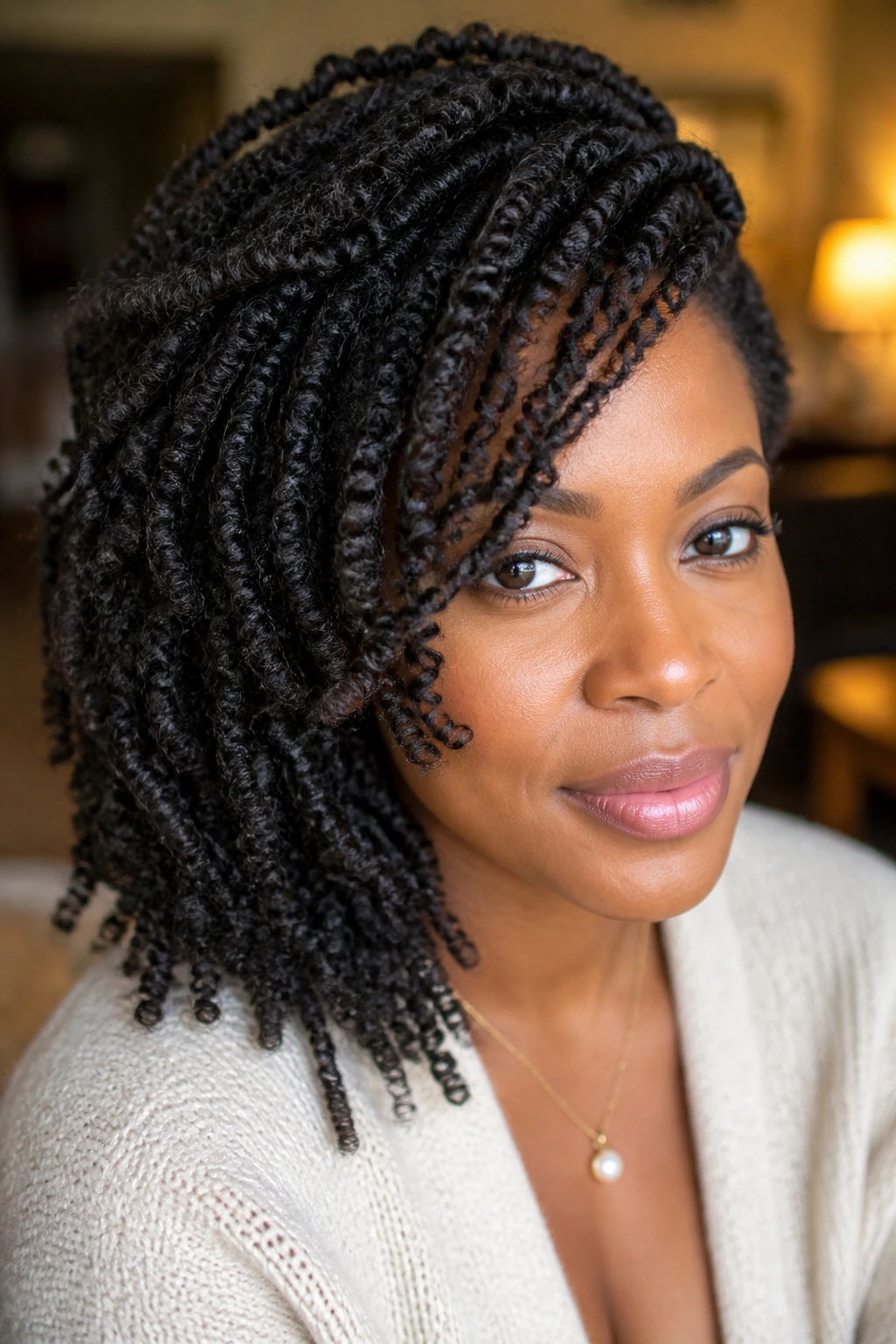
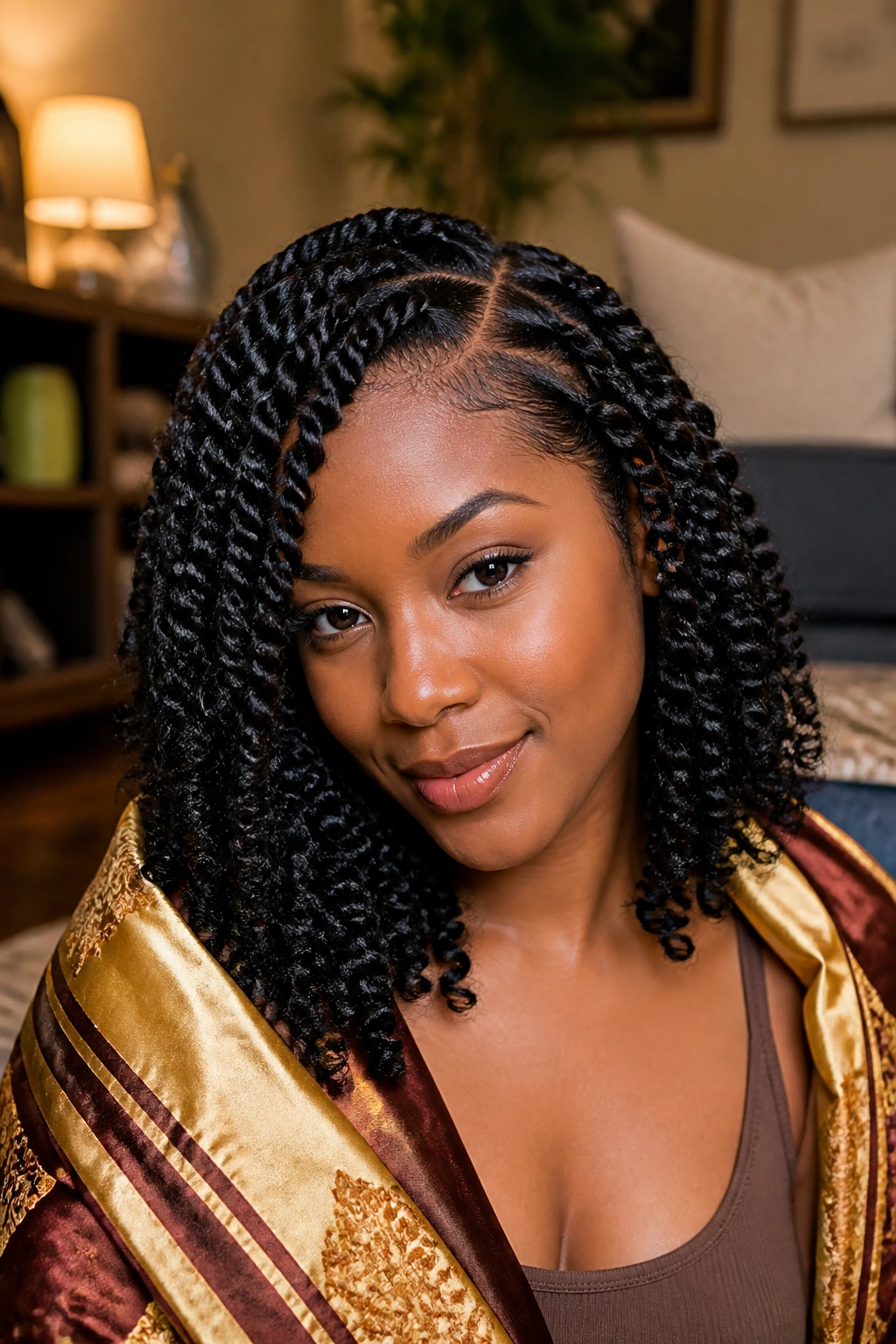
7. Deep Side-Part Passion Twists
Passion twists sit in a sweet spot: they have movement, but the spiral pattern is loose enough not to build a hard wall around the face. On a round face, the deep side part makes the whole style feel longer and more sculpted.
Keep the twists medium in thickness. Too chunky, and the profile gets boxy fast. Too tiny, and you lose the airy texture that makes passion twists flattering in the first place. Shoulder length is the place I’d start — long enough to swing, short enough to stay light.
A satin scarf at night matters here. The twists look best when they keep their shape, not when they frizz into a puffball around the temples.
8. Half-Up, Half-Down Curls
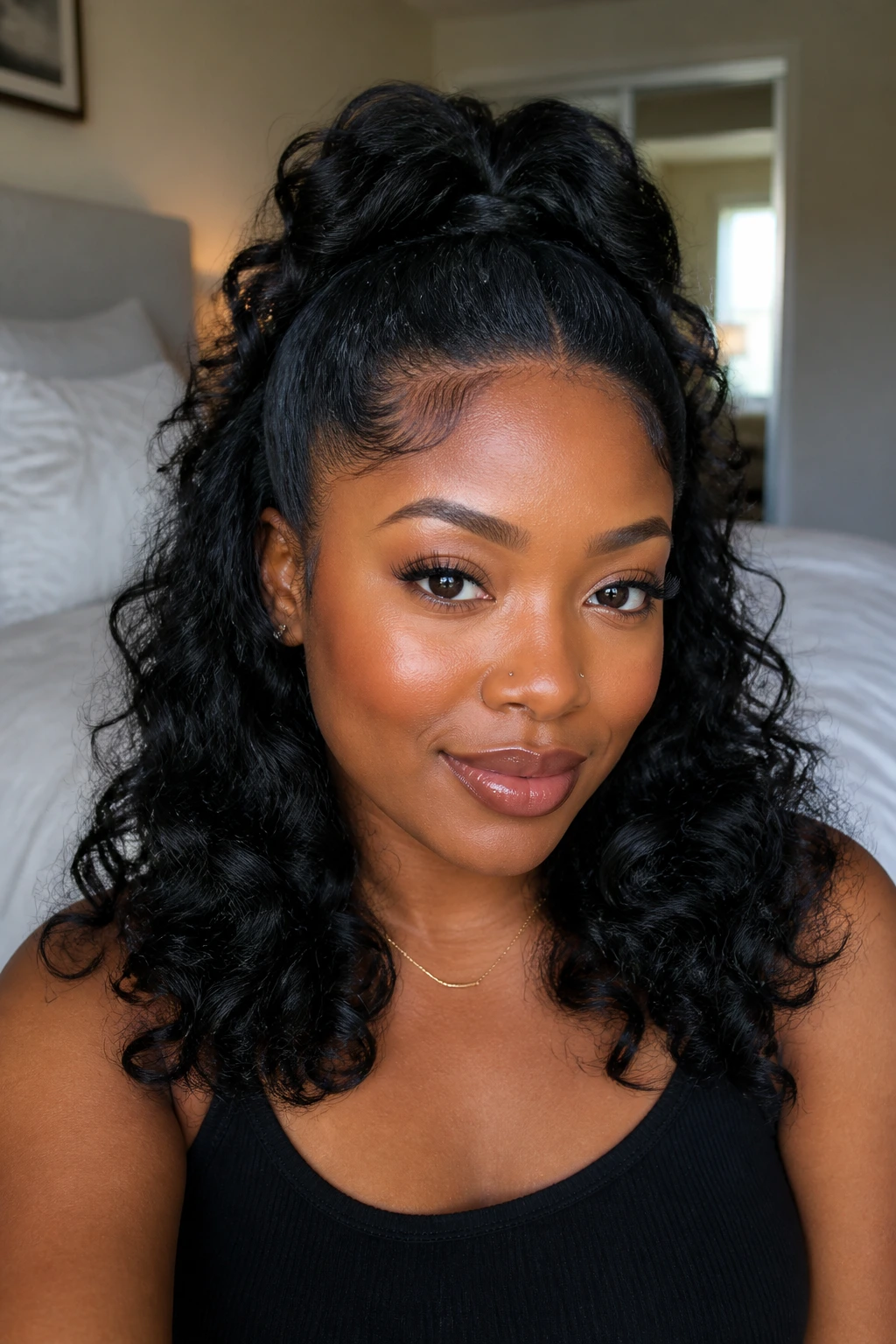
Half-up, half-down is a cheat code when the top needs height. The lifted top section gives the face some vertical space, and the loose curls below keep the style from feeling stiff or overworked.
This works especially well when the half-up section is small and the crown is not pulled flat. A loose puff, a twisted knot, or a braided crown all work. Leave the lower curls shoulder length or a bit longer, and let the front pieces fall softly instead of pinning them back tight.
The mistake here is making the top too slick. A little fullness at the crown is the point. Flat roots at a round face can make the whole style read wider than it is.
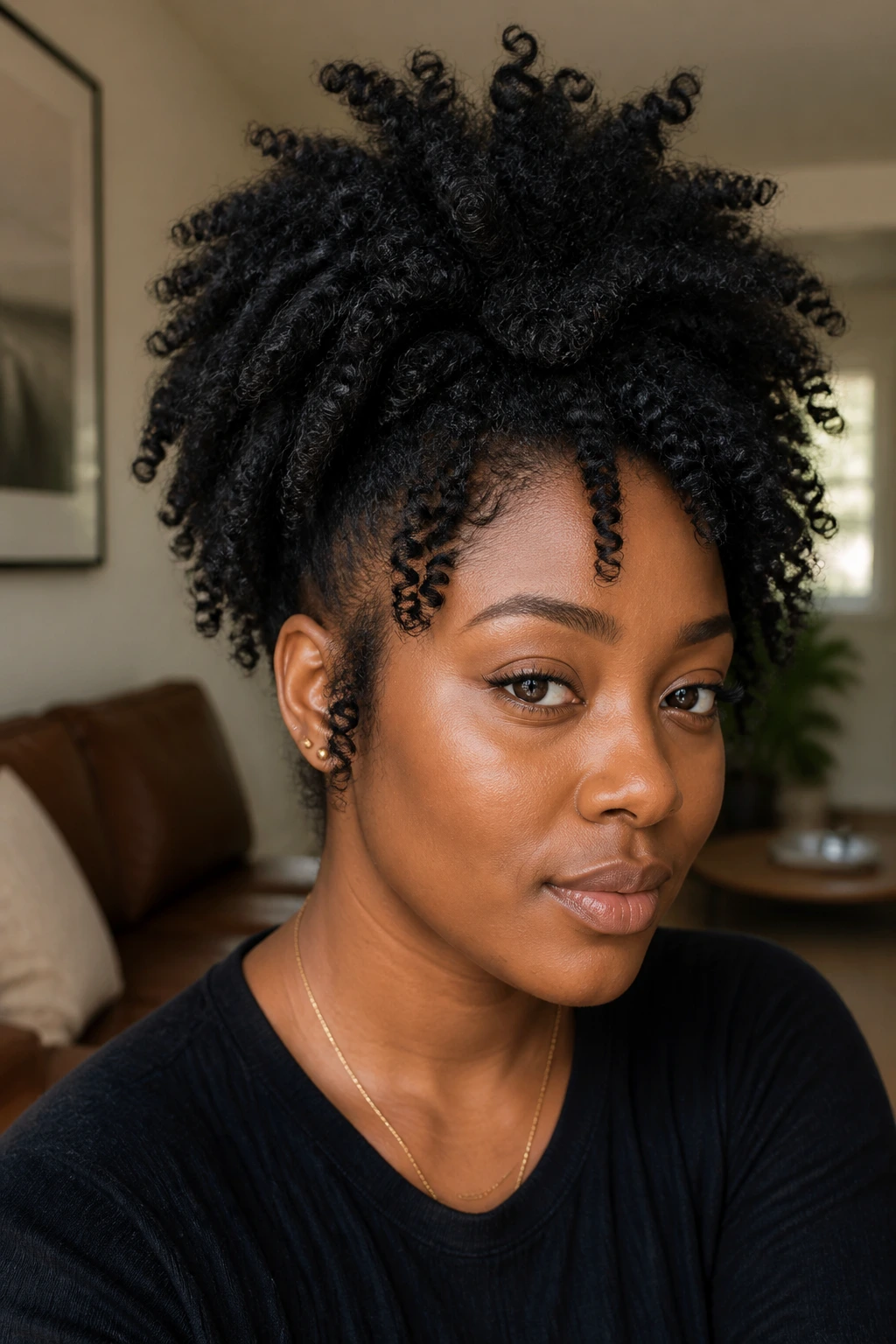
9. Crown-Height Twist-Out
A twist-out with crown volume works because it puts lift where the face can use it most. The sides stay controlled, the top rises a little, and the ends sit below the cheekbones instead of ballooning across them.
Best Way to Set It
- Make smaller twists near the temples.
- Keep the crown sections slightly lifted at the root.
- Separate only after the hair is fully dry.
- Pick the crown, not the sides, if you need more height.
This style is one of my favorites for dense coils because it keeps texture without turning the whole head into one round shape. The silhouette matters more than the curl pattern here. A good twist-out should feel shaped, not fluffy for the sake of fluff.
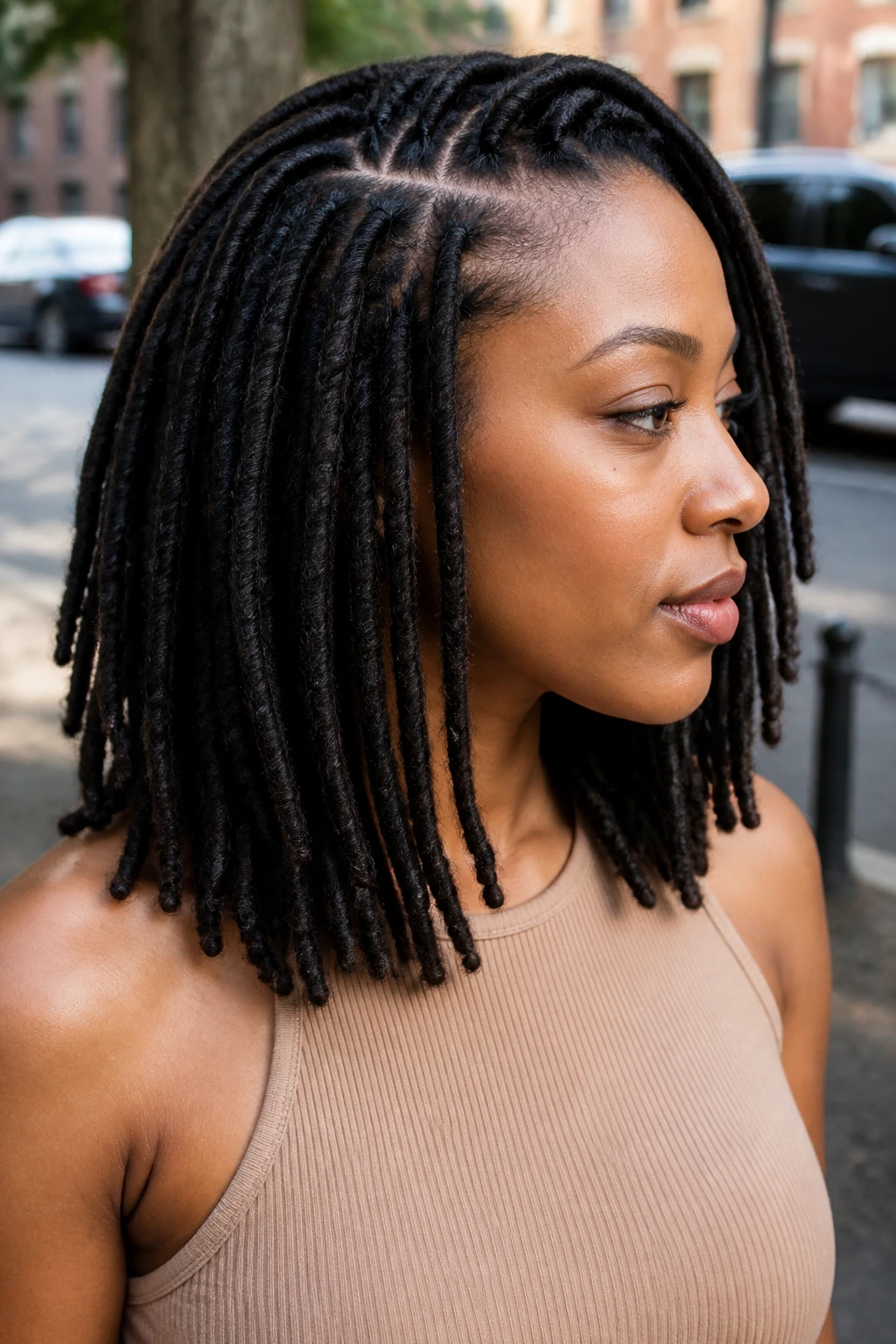
10. Shoulder-Grazing Faux Locs
Faux locs can look heavy or airy, and the difference is all in length and parting. Shoulder-grazing locs keep the weight off the jaw, which helps a round face look longer without losing the protective-style payoff.
A side part is usually kinder than a sharp center part here, though a soft center part can work if the front locs are slim and not too dense. I also like locs with slightly tapered ends or wrapped tips, because blunt tips at the chin can feel boxed in.
This is a style where the profile matters more than the front view. Turn your head in the mirror. If the locs spread wide at the cheeks, shorten the front pieces next time.
11. Medium Box Braids with Curtain Pieces
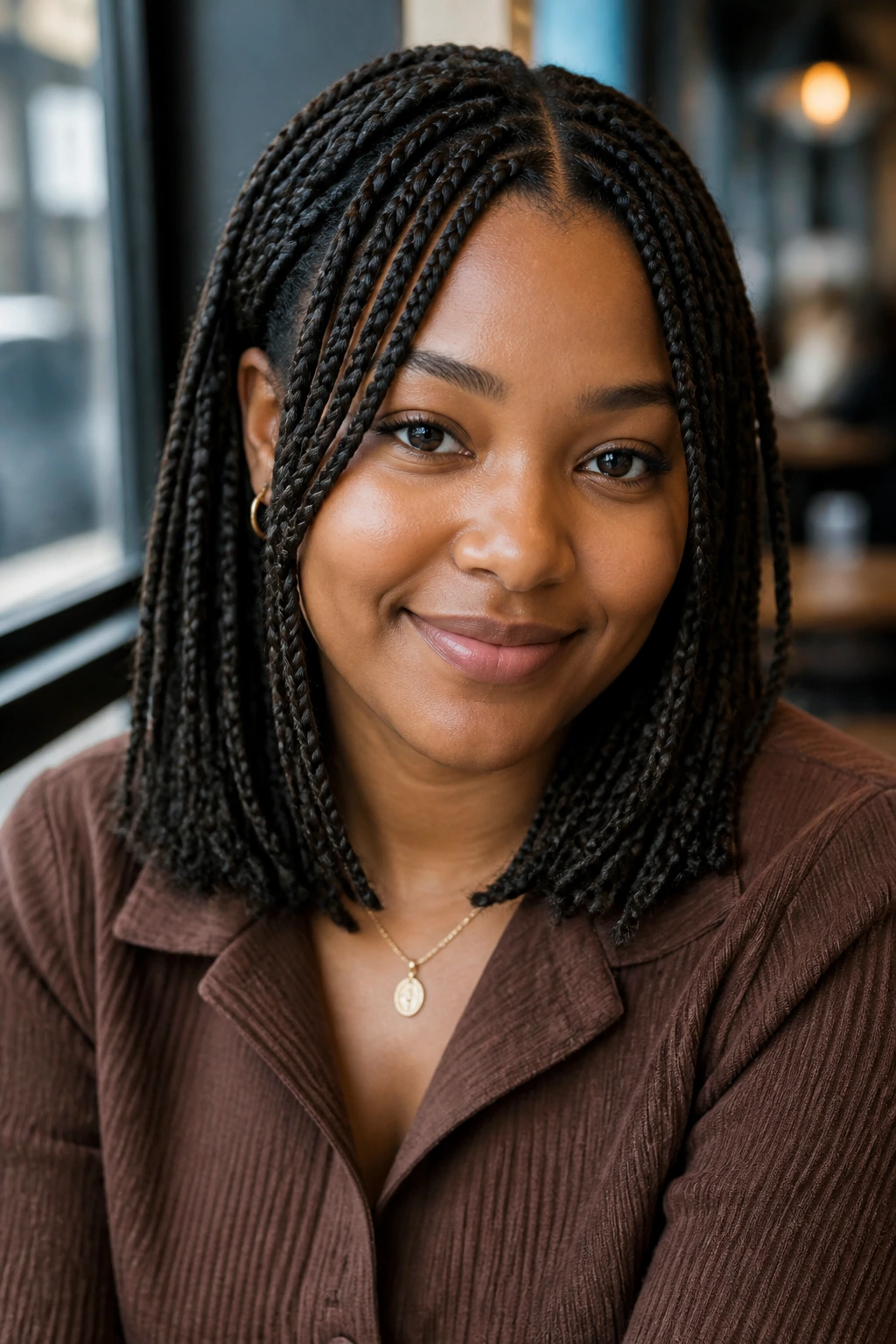
Box braids are not one shape. Shoulder-grazing braids with a few curtain pieces around the face feel lighter than the waist-length version everybody knows, and that lighter shape suits a round face better than people expect.
The curtain pieces should be intentional, not accidental. Leave the front braids a little shorter or layer the very front pieces so they fall in front of the cheek rather than beside it. That tiny shift keeps the eye moving down.
If you want a cleaner finish, use medium-sized parts and avoid packing too much braiding hair into the perimeter around the temples. A little restraint at the front saves the whole look.
12. Curly Sew-In with Face-Framing Layers
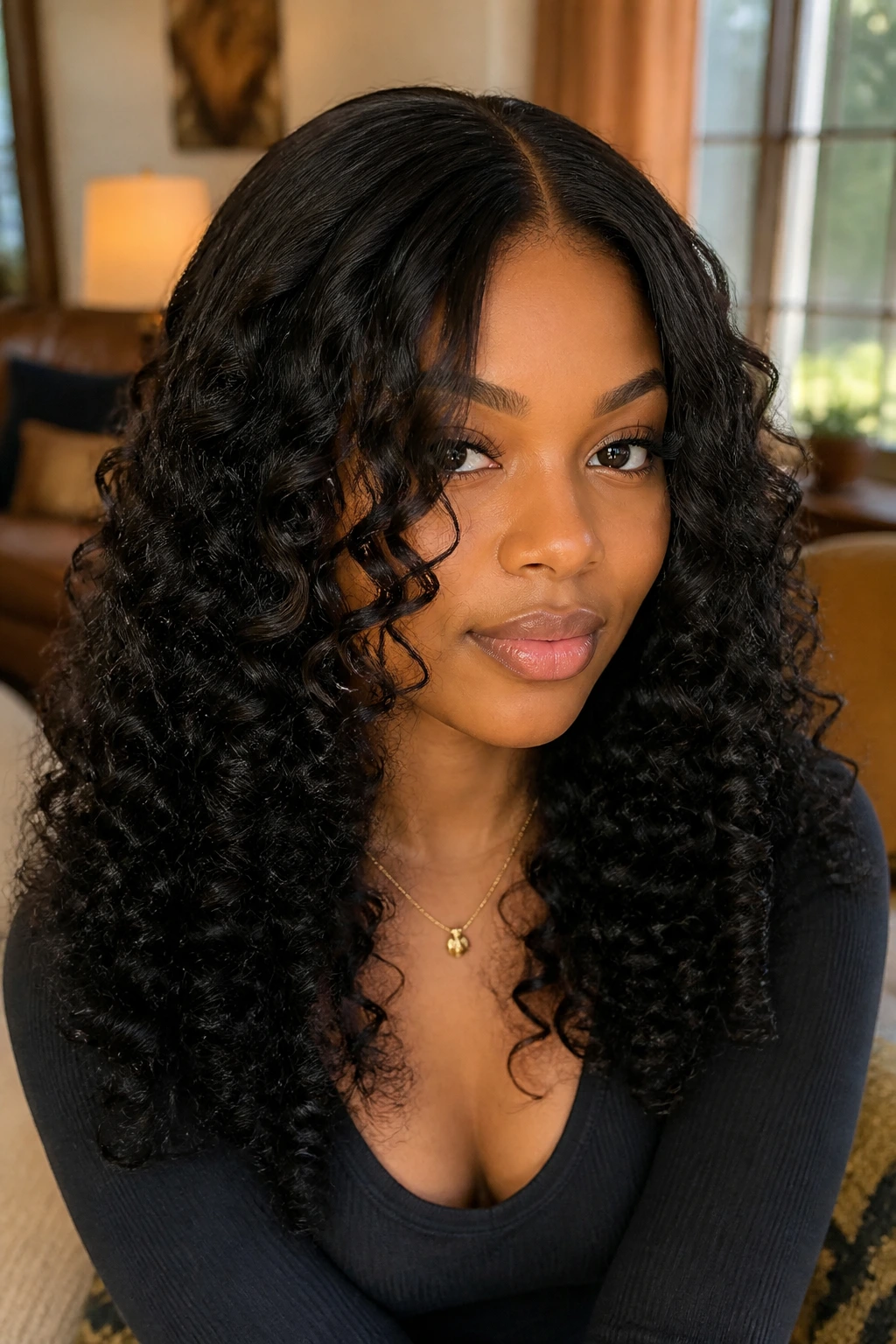
A curly sew-in is only flattering if the layers do their job. One blunt row of curls sitting at the cheeks can make the face look wider, while layered curls that start below the chin create the long line you want.
I like this style when the curl pattern has bounce but not too much bulk at the sides. Ask for face-framing layers that start lower than you think — around the mouth or jaw, not at the widest point of the face. A closure or leave-out can both work, depending on how much blending you want.
This is polished hair, but it should still move. If the curls sit stiffly, they’re too dense.
13. Flipped-Out Blowout Ends
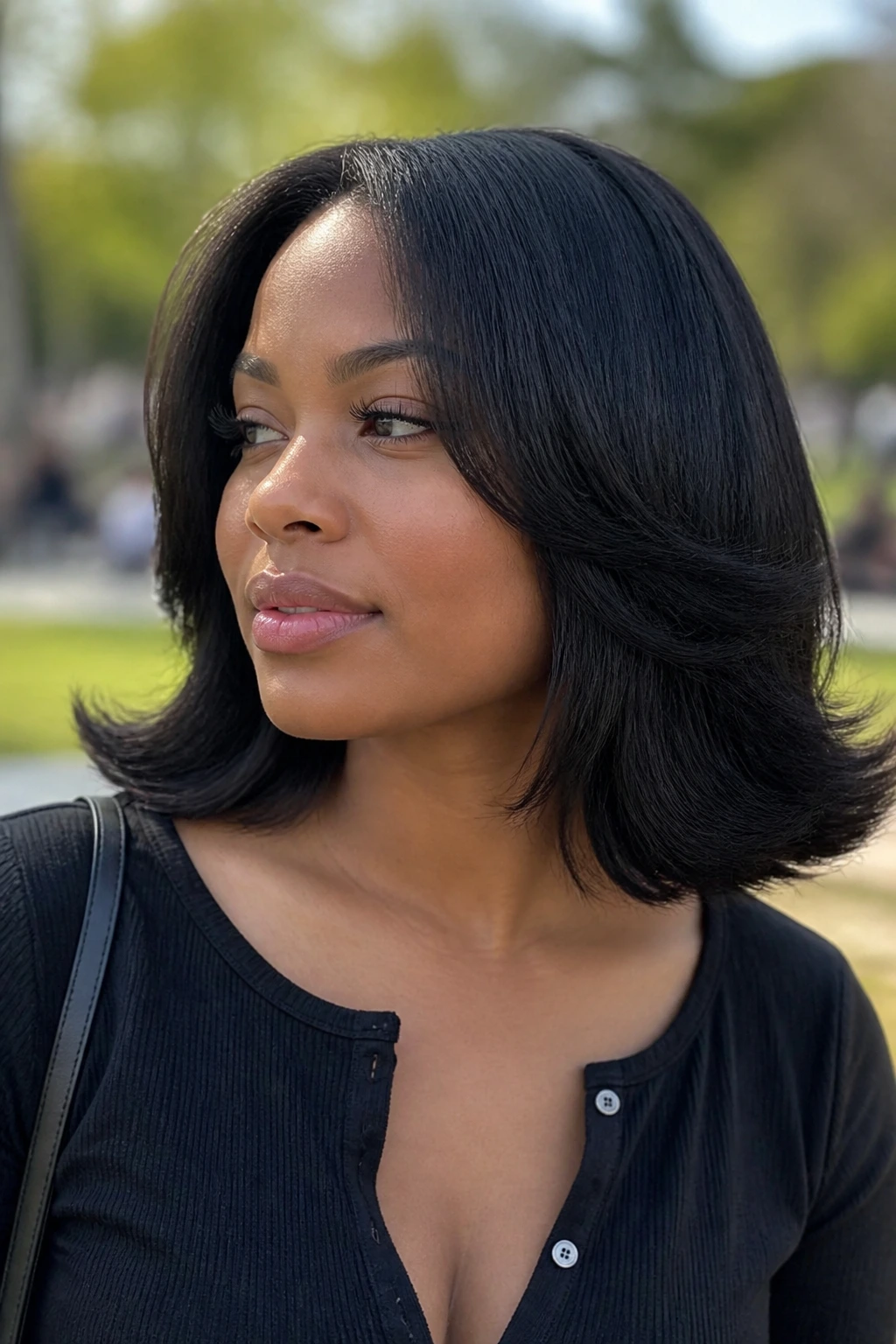
Flipped-out ends sound small, but they change the silhouette. A medium blowout with the ends turned away from the face draws attention down and outward in a way that softens roundness without hiding the hair’s shape.
The key is where the flip begins. Keep the turn-out below the jawline or near the collarbone, not at the cheek. If the ends flick out too high, the face can look wider. A round brush or a flat iron with a gentle wrist turn does the job.
This is one of those styles that looks crisp in motion. It catches wind well. Not in a dramatic way — just enough to make the shape feel alive instead of fixed.
14. Soft Curly Shag
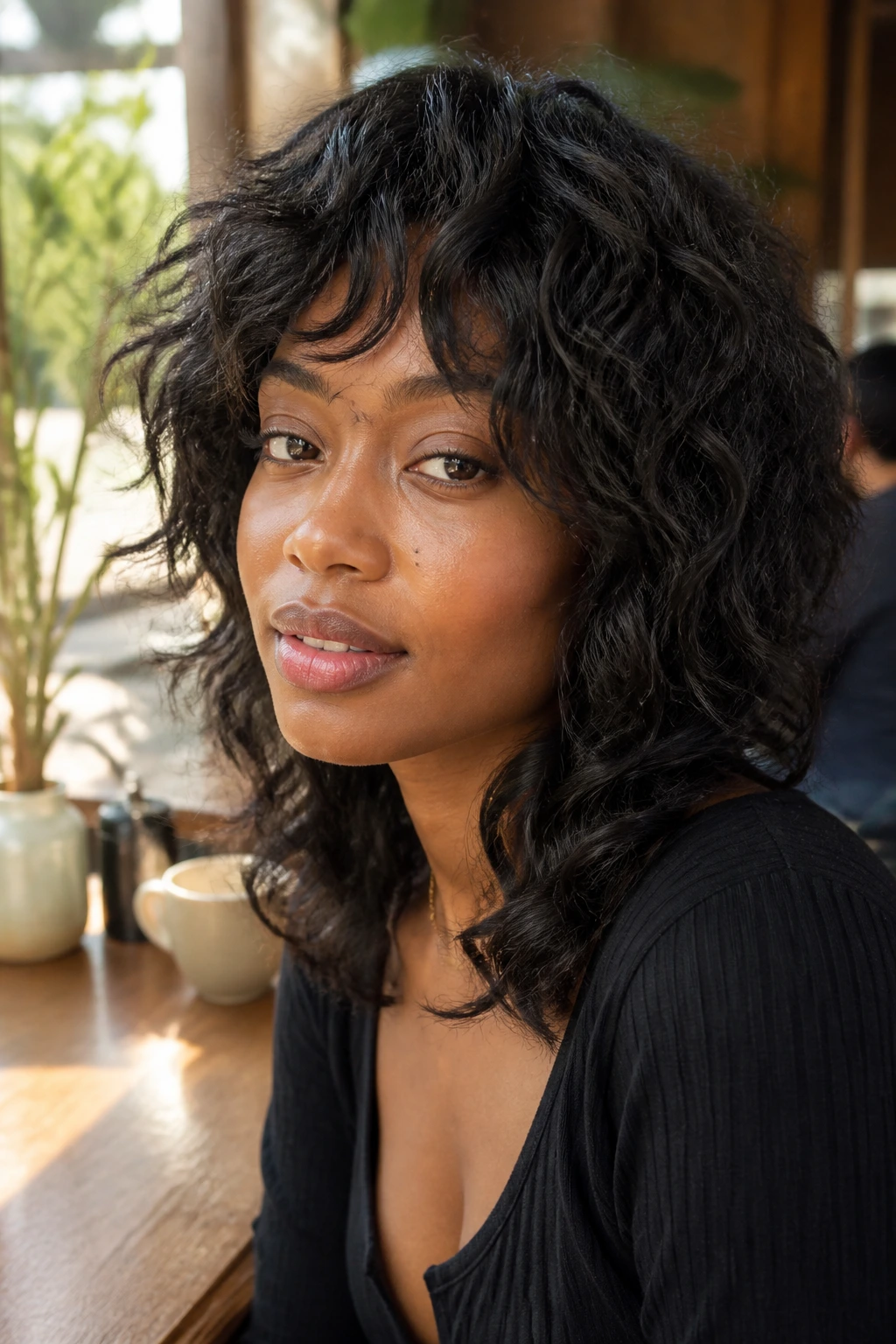
A shag on Black hair works when the layers start in the right place. Too high, and you get width at the cheeks. Too low, and the style loses its swing. The sweet spot is somewhere below the cheekbone with a soft fringe or side-swept front.
I like this on natural curls, blown-out textures, or even a silk press with bend. The whole point is movement, not exactness. A shag can look a little messy in the best way, which is useful if you do not want to babysit every curl.
If your face is round and your hair is dense, ask for a shag that keeps the sides lighter than the crown. That little imbalance is doing the flattering.
15. Side-Swept Crochet Curls
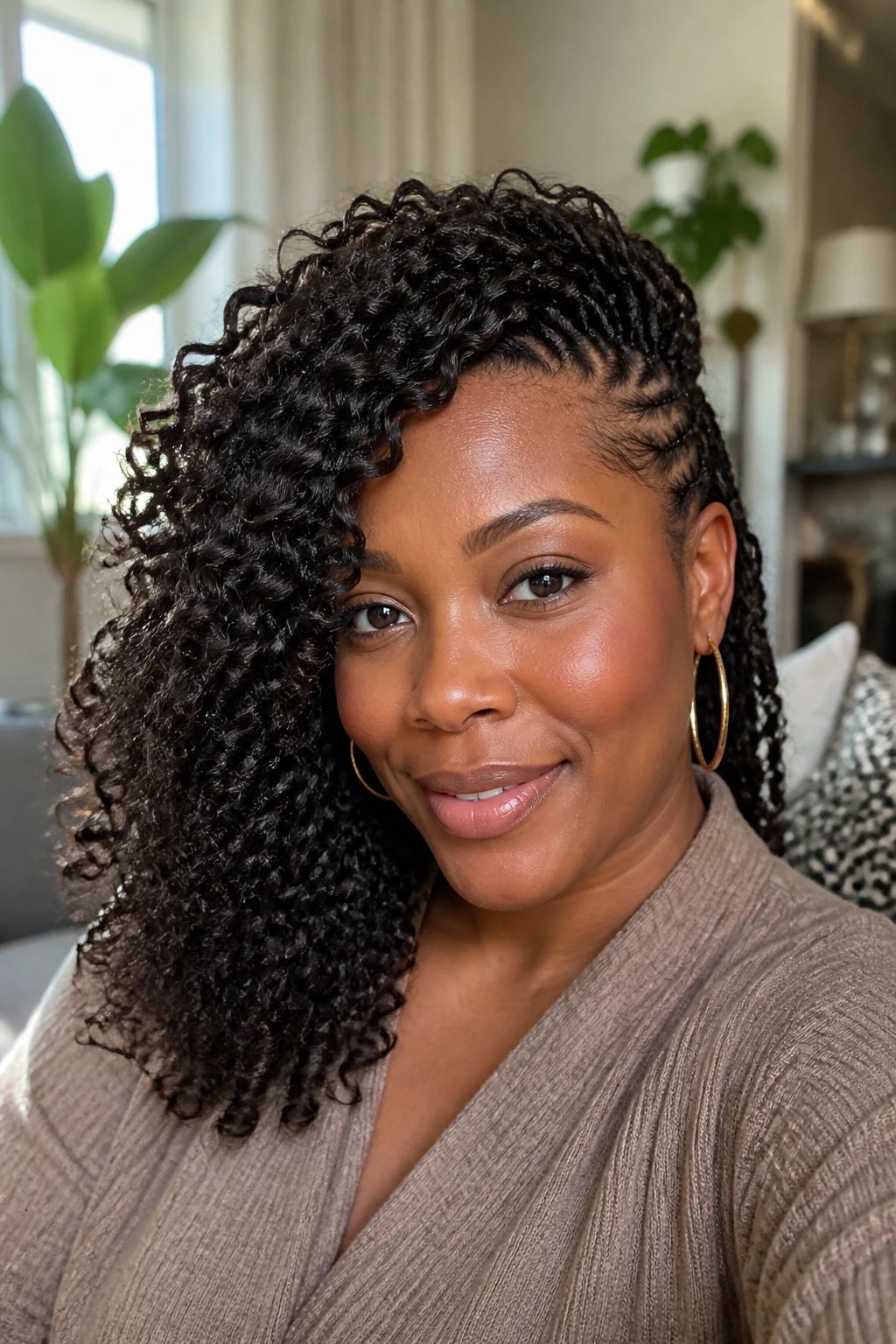
Crochet curls can feel bulky if the part is wrong. A side-swept version fixes that by moving the visual weight off center and letting the curls fall in a softer column instead of a puff around the face.
This style is best when the front is customized a bit. Leave the temple area lighter, and pick a curl pattern that bends rather than balloons. Medium length keeps the style from taking over the face, which is half the battle with crochet installs.
The nice thing here is that you can get a lot of texture without a lot of daily work. The bad thing is that dense curls near the cheeks will show up immediately. Be picky about that part.
16. Low Puff with Stretched Length
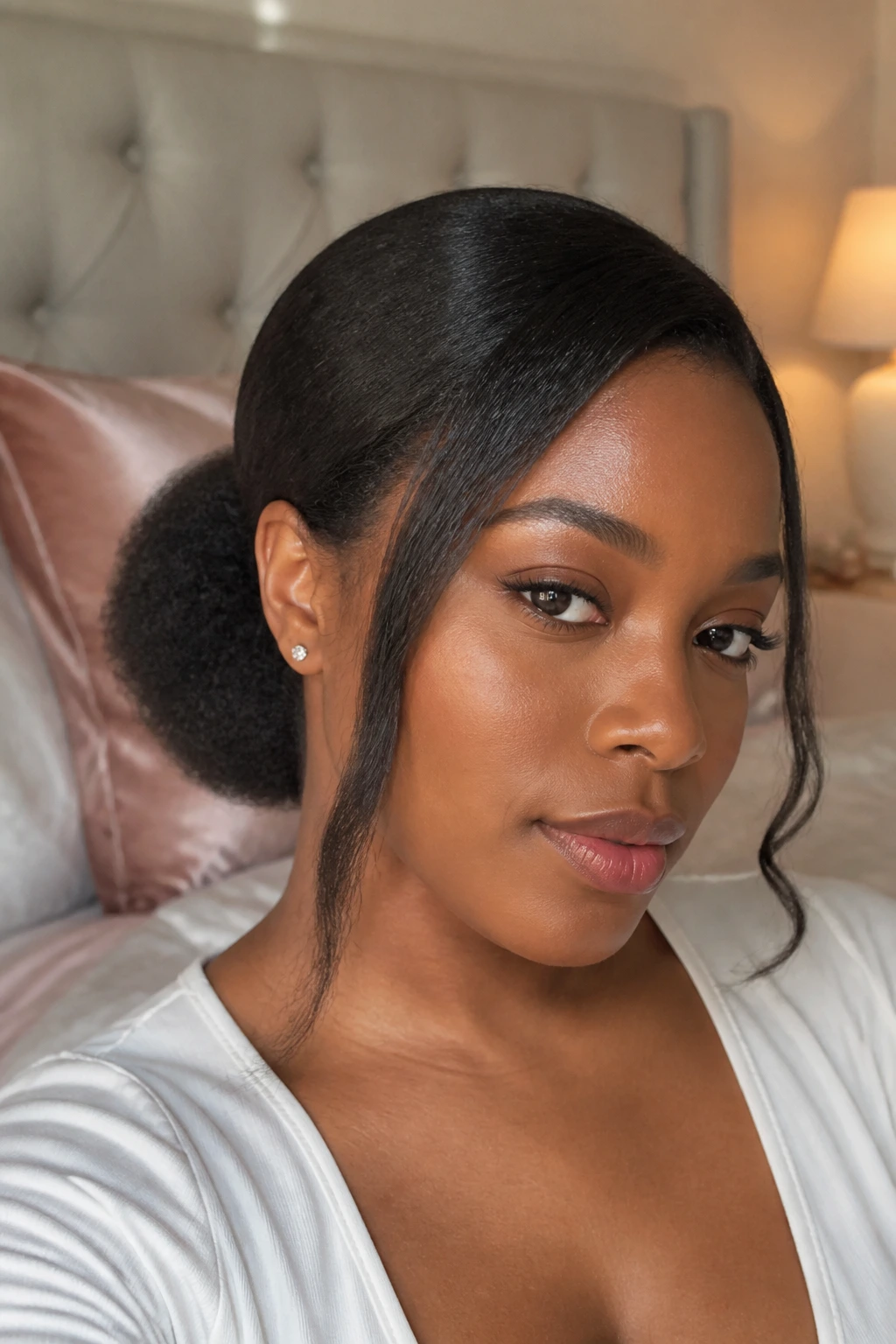
A low puff can work if the hair is stretched first. That’s the detail people miss. When the hair is left too shrunken, the puff sits right around the cheeks and the face looks wider. When the length is banded, twisted, or stretched, the puff drops lower and the shape gets cleaner.
I like this version with a soft side part or a few loose front pieces. Keep the puff at the nape or just below it, not high at the crown. That keeps the width low and the profile long.
This is one of the easiest styles in the group, but it still rewards a little care. A satin tie and a light hand at the edges make the difference between casual and sloppy.
17. Flat-Twist Crown with Hanging Ends
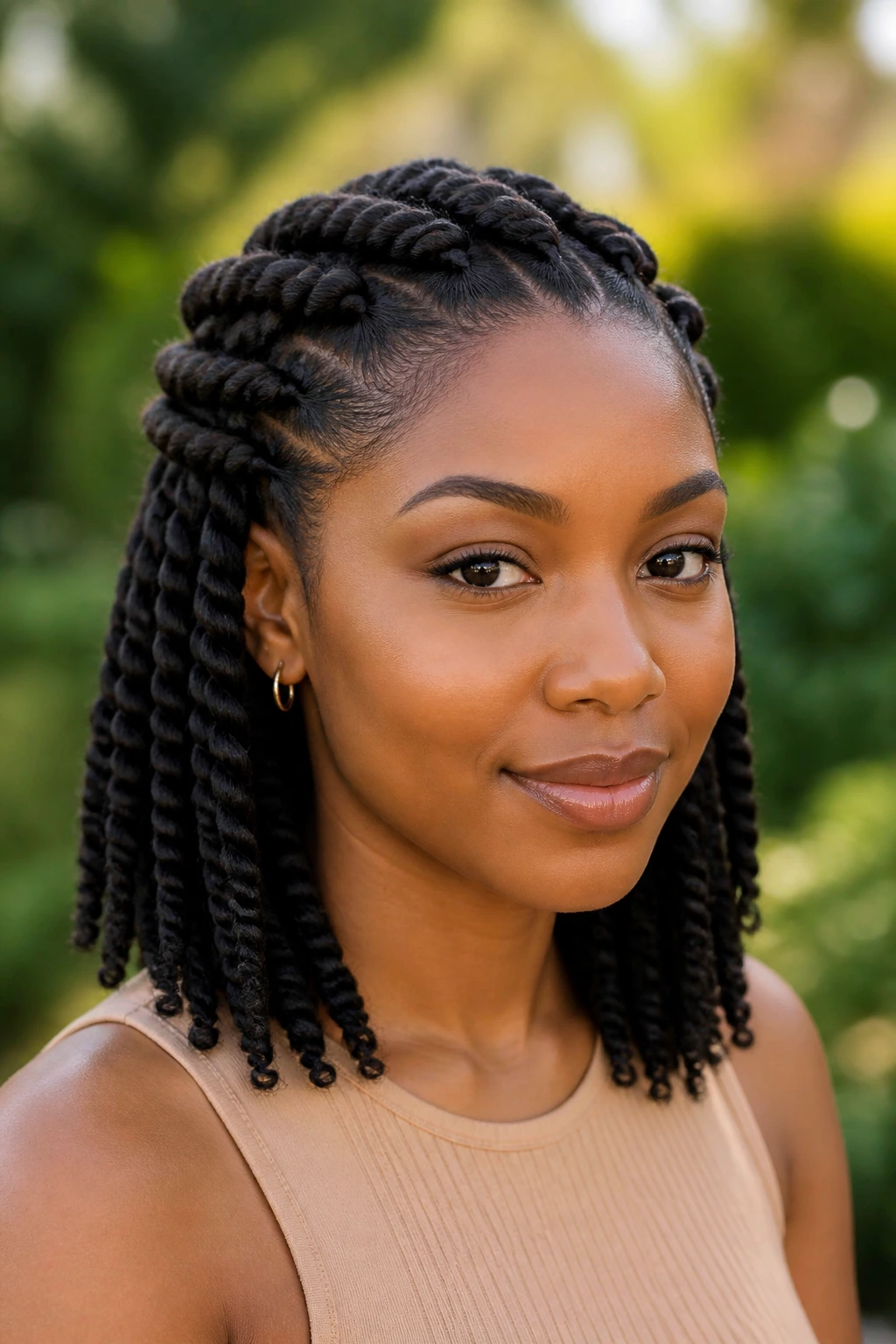
Flat twists do more than protect. When they wrap across the hairline and release into hanging ends at the shoulders, they create a vertical line that a round face really benefits from.
The crown twist should stay neat, but not tight. That part frames the face, so it needs to feel deliberate. Let the hanging ends stay medium length, and do not fluff them so much that the sides widen. A little texture is enough.
This style is good when you want something low-tension but still shaped. It reads polished without being fussy, which is a pleasant combination.
18. Flexi-Rod Set with a Side Bang
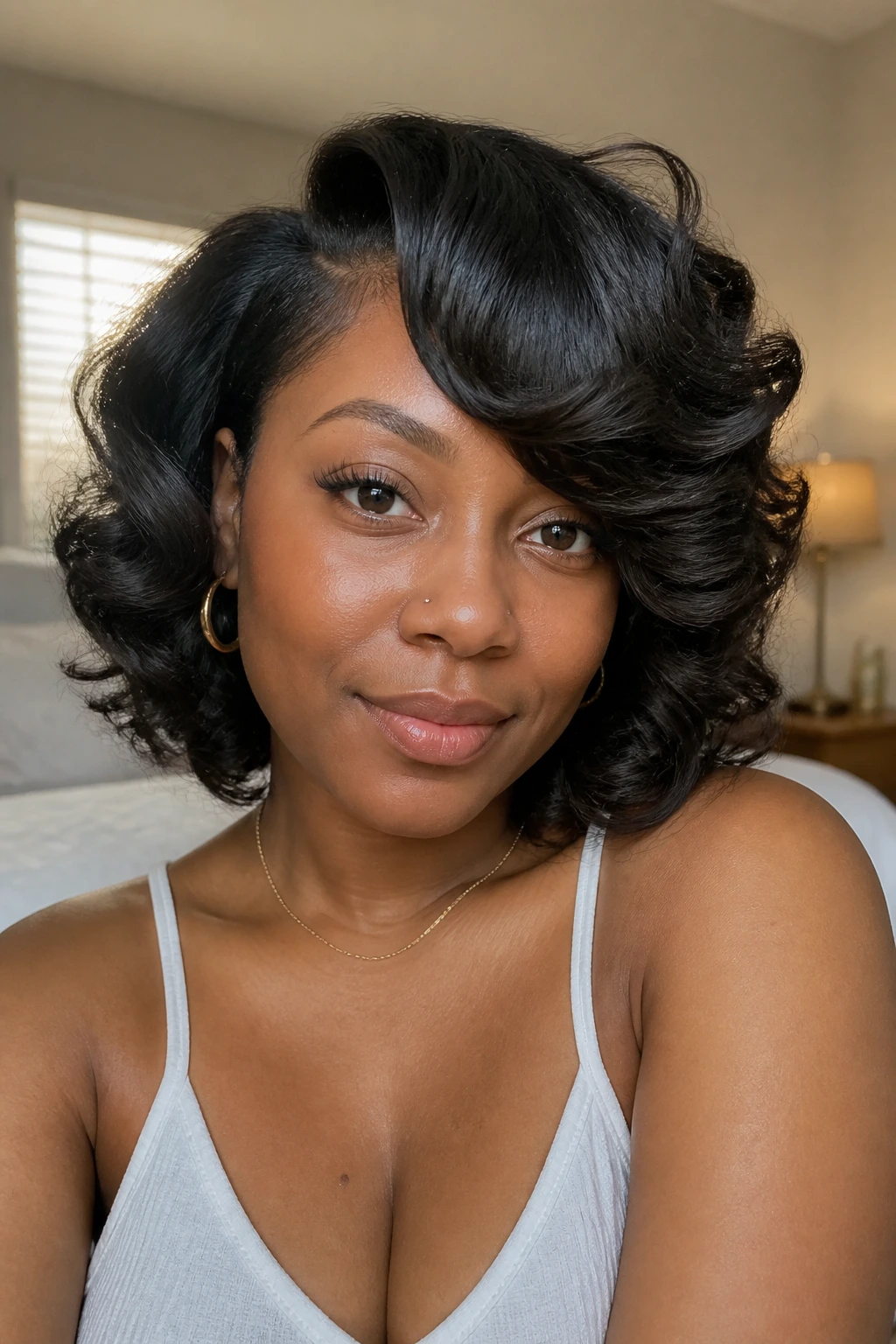
Flexi-rods give you movement without a hard curl pattern, and that softness is why they work so well here. A side bang shifts attention off the widest part of the face and gives the whole style a slight diagonal line.
Use rod sizes that match the finish you want. A 3/4-inch rod gives a tighter curl; a 1-inch rod gives more bend and less spring. Either way, dry the set completely. Half-dry flexi-rod hair is the fastest route to puff and frizz.
This one looks especially good when the curls are separated just enough to move, not so much that they turn into a cloud. Shape first. Volume second.
How Round Faces and Medium Length Hair Play Off Each Other
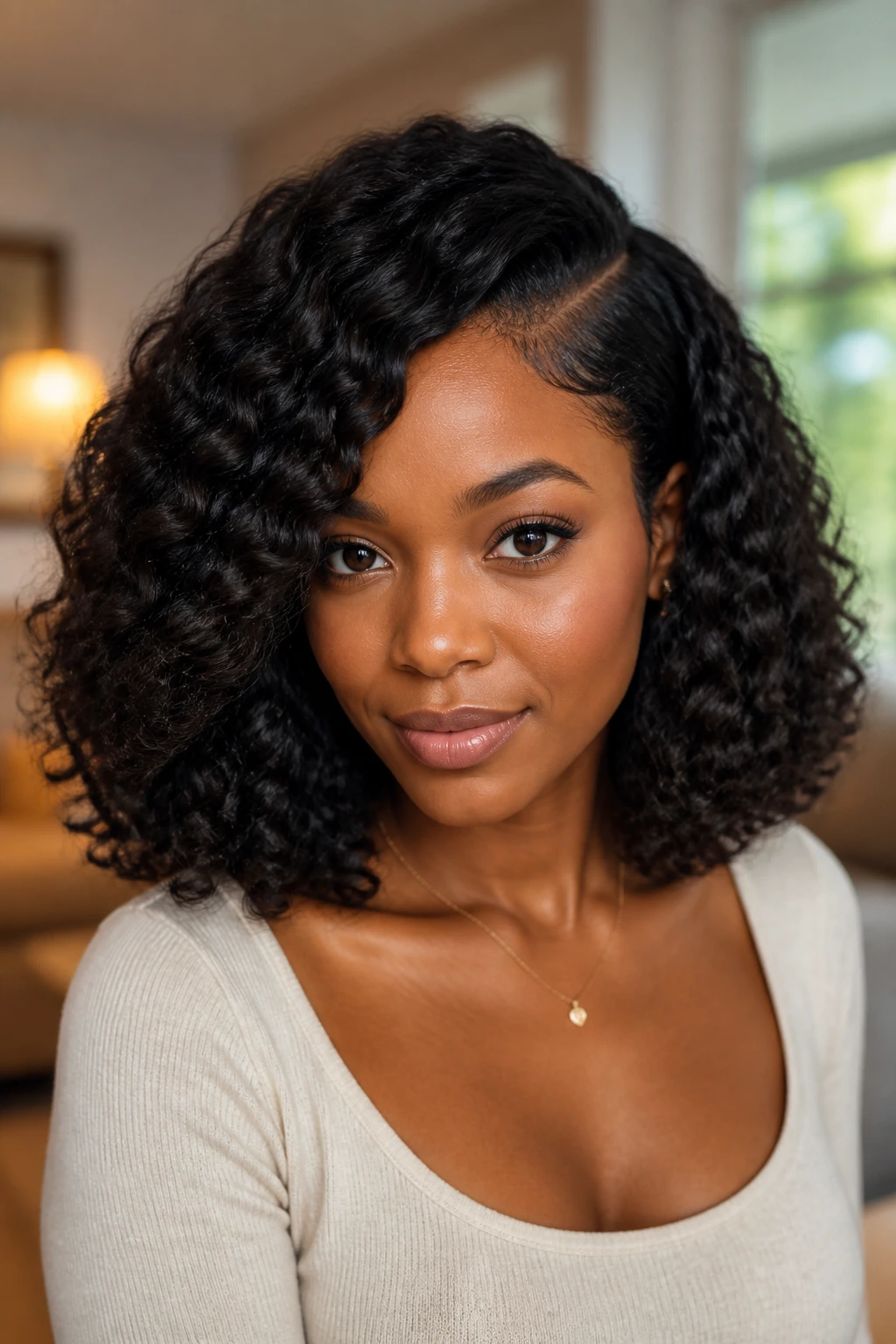
A round face is all about balance, not hiding. The face tends to have similar width and length through the cheeks, which means the wrong hairstyle can put all the attention in the middle instead of stretching the eye where you want it to go. Medium length helps because it lands in that in-between zone where the hair can still move.
The best styles usually do at least one of three things: add vertical line, create asymmetry, or keep the volume lower than the cheekbones. If a style hits at the exact widest point of the face and then flares out, it makes the face look fuller. If it drops below that point or shifts to one side, the shape looks cleaner almost immediately.
Where the Eye Should Go
A side part. A collarbone. A bit of crown height. Those small details matter more than a lot of people want to admit.
Where Things Go Wrong
Chin-length blunt ends, wide sides, and dense volume at the temples. That combination is a recipe for a boxy silhouette, even when the hair itself is beautiful.
The Styling Kit I’d Keep Nearby
- Rat-tail comb: Clean parts matter, especially for side parts and braided looks.
- Wide-tooth comb: Best for detangling curls and twist-outs without tearing them up.
- Sectioning clips: Small clips keep layers or braids separated while you work.
- Mousse or foam wrap: Useful for curls, twist-outs, and flyaway control.
- Lightweight oil or serum: A few drops smooth silk presses and braid-outs without making them greasy.
- Edge brush: Helps shape the hairline when the style needs a cleaner finish.
- Satin bonnet or scarf: Non-negotiable for preserving shape overnight.
- Hooded dryer or diffuser: Handy when you need a style to dry fully before separating.
- Flexi rods or perm rods: Good for rod sets, curled ends, or a little bend at the front.
- Heat protectant spray: Needed for silk presses, blowouts, and flipped-out styles.
- Braiding gel or styling cream: Helps parts stay neat and roots stay smooth.
- Spray bottle with water: Useful for refreshing curls or reactivating product in twist-outs.
How to Choose the Most Flattering Version for Your Hair Texture
The right style depends on both your face and your hair’s behavior. Fine hair and dense coils do not need the same thing, and that matters more than the name of the haircut. A medium-length look can be gorgeous on paper and wrong in practice if the hair won’t hold the shape you’re asking for.
If Your Hair Shrinks Hard
Choose styles that get a little longer than you think they need to be. Twist-outs, braid-outs, shoulder-length braids, and layered loc styles usually handle shrinkage better than blunt cuts. Ask for the shortest point to sit below the cheekbone, not at it.
If Your Hair Is Fine or Low-Density
Go lighter on the sides. Too much braid hair, too many curls, or oversized twists can overwhelm the face and the hair itself. Side parts, curtain pieces, and angled shapes keep the style from feeling heavy.
If You Wear Heat Often
Silk presses, flipped-out ends, and soft lobs look sharp, but they need a heat protectant and a real nightly wrap. No shortcuts here. If you want the style to stay smooth, pin-curl the ends or wrap them around the head before bed.
If You Want the Least Daily Work
Protective styles win. Knotless braids, Senegalese twists, faux locs, and crochet curls hold their shape longer, and you can refresh the front pieces without starting over. The trade-off is installation time, but the shape usually lasts longer too.
Mistakes That Make a Round Face Look Wider
-
Stopping the shortest layer at the cheekbone: That’s the fastest way to add width where you do not want it. Move the shortest layer lower or add a side sweep so the eye travels diagonally.
-
Picking a dead-center part every time: A center part can work, but on a round face it often needs some lift or softness to avoid making the face look broader. An off-center part is the easier win.
-
Letting braids or twists get too thick near the temples: Heavy sides press the shape outward. Ask for slimmer front sections or a little less density around the face.
-
Packing all the volume on the sides: Big hair is not the enemy. Side-heavy big hair is. Keep the crown or the lower lengths doing most of the work.
-
Skipping nighttime care: A style can look great for six hours and sloppy by morning if it is not wrapped, pinned, or covered. Satin is not optional if you want the shape to last.
Ways to Change the Mood Without Changing the Cut
-
Soft Off-Center Version: Shift the part just two or three inches off the middle and keep the front pieces loose. This is the easiest way to make almost any style feel more face-friendly.
-
Big Crown Version: Add lift at the roots with clips, root setting, or a small teased section at the top. Use this when you want a little more drama without widening the cheeks.
-
Protective-Style Version: Turn a braid-out or twist-out into knots, braids, locs, or crochet if you want the same silhouette with less daily styling. The shape stays similar; the upkeep changes.
-
Heat-Free Texture Version: Use braid-outs, twist-outs, flexi-rods, or shingled curls instead of pressing the hair straight. You keep movement and skip the flat-iron schedule.
-
Glossy Salon Version: Silk press the hair or smooth the curls with a soft serum and a clean edge. This is the polished route when you want the style to read crisp and deliberate.
Keeping the Shape Between Wash Days
Medium-length styles hold best when you care for them before they start looking tired. Silk presses usually need the most discipline: wrap them at night with a satin scarf, keep the ends pinned or curled, and avoid piling on heavy oils that make the shape collapse. If humidity is brutal, a quick cool blow-dry at the roots can revive the body without adding frizz.
Twist-outs and braid-outs like moisture, but not too much. Mist lightly with water, add a small amount of leave-in or foam, and re-twist or re-braid the front pieces every couple of nights if the shape starts to spread. Dry styles hold longer when you stop touching them so much. That part is boring. It also works.
Protective styles need scalp care more than restyling. Use a nozzle bottle to clean the scalp every 1 to 2 weeks, and wipe buildup along the part lines before it gets crusty. Faux locs, braids, and twists can usually stay neat for 4 to 8 weeks depending on tension and hair growth, but the front pieces often need attention sooner.
Curly sew-ins and crochet curls do best with a satin bonnet, a light mousse refresh, and a reminder not to drown the roots in product. A little maintenance keeps the profile slim. Too much product makes the sides puff out, and that is the opposite of what you want on a round face.
Common Questions People Ask Before They Pick a Style
What medium length is most flattering on a round face?
Collarbone to upper chest is the sweet spot for most people. That length gives you movement without stopping at the jawline, which is where many round faces lose the advantage. If you like shorter styles, keep some angle in the cut.
Are middle parts bad for round faces?
Not bad, just less forgiving when the hair has a lot of width. A middle part can work if the layers are long, the crown has lift, or the style stays narrow at the sides. Otherwise, a slight side part is easier.
Can I wear bangs with a round face?
Yes, but side-swept or curly fringe usually works better than a blunt straight-across bang. A heavy bang can cut the face horizontally, which tends to make the roundness feel stronger. Keep the fringe soft and a little longer.
What if my hair shrinks and the style ends up shorter?
Plan for shrinkage before you leave the chair or finish the set. Ask for the cut or style to land lower than your actual target, and stretch the roots with banding, rollers, or a blow-dry if needed. Shrinkage is normal. Ignoring it is the mistake.
Do braids and twists make a round face look bigger?
They can, if they’re too thick at the sides or all stop at the same length. Shoulder-grazing lengths, face-framing pieces, and a softer front line keep the style from spreading outward. Shape matters more than category here.
Which styles are easiest to maintain?
Protective styles usually win: knotless braids, Senegalese twists, faux locs, and crochet curls. If you want daily flexibility, a silk press or curly lob looks great but needs more upkeep and nighttime care.
Can these styles work on relaxed hair?
Absolutely. Silk presses, lob cuts, flipped-out ends, and soft curls all sit nicely on relaxed hair, and a side part still helps a round face either way. The main thing is keeping the ends from landing right at the cheekbone.
How often should I trim a medium layered cut?
Every 8 to 12 weeks is a good rhythm if you want the shape to stay clean. Curly and coily textures can stretch that a bit depending on the style, but once the layers lose their shape, the face-framing advantage disappears fast.
A Shape That Knows Where to Go
The best medium-length styles for a round face do not fight the face’s softness. They guide it. A side part, a collarbone finish, a little lift at the crown, or a face-framing layer that starts below the cheekbone can change the whole feel of a style without making it look forced.
What I like most about this group is the range. You can go sleek, curly, braided, twisted, or fully protective and still keep the silhouette working for you. That makes the whole thing easier to live with, which is the part people usually care about after the photo is taken.
Pick the style that matches your texture and your patience, then wear it long enough to see how the shape behaves in real life. That tells you more than any mirror ever will.