



Shag haircuts for round faces and wavy hair work because they draw the eye up and down, not out to the sides. A blunt cut on wavy hair can look neat for one mirror check and then puff out at the cheeks by lunchtime. A shag, when it’s placed well, takes that same wave pattern and turns it into movement instead of bulk.
That placement part matters more than people admit. If the shortest layer lands at the cheekbone, the face can read wider; move that same layer lower, keep the crown soft, and the whole cut suddenly feels longer, lighter, and less fussy. The hair still has body. It just stops fighting you.
I keep coming back to shags because they can look finished without looking stiff. Some days they sit airy and piecey. Other days they collapse into something softer after a scarf, a car ride, or a damp breeze — and they still look like they were meant to do that. The 22 cuts below cover the full spectrum, from quiet collarbone-length versions to wolf-cut hybrids with a little bite, so you can pick your level of edge without guessing.
Why These 22 Cuts Work on Round Faces and Wavy Hair

-
Face length comes first: The best shag layers sit below the cheekbone, which keeps the eye moving downward instead of stopping at the widest part of the face.
-
Waves get room to breathe: Wavy hair wants separation, not a hard shelf, and a shag gives that texture somewhere to live without turning into a triangle.
-
Bangs are optional, not mandatory: Curtain bangs, bottleneck fringe, and side-swept pieces all work here; the right one depends on how much forehead you want to show and how much upkeep you’ll tolerate.
-
The grow-out is kinder: Softly sliced layers usually blur into a longer style instead of leaving a blunt line that you start resenting six weeks later.
-
Styling stays flexible: Most of these cuts can be air-dried with mousse, shaped with a diffuser, or touched with a 1-inch iron on only the front pieces.
-
Edge level is adjustable: The list runs from office-safe and quiet to wolfy and choppy, so you can keep the shag shape without jumping straight into something dramatic.
The part people miss is this: a shag is not automatically flattering just because it has layers. The shortest pieces, the fringe, and the crown all have to land in the right places. Get those three things right and the haircut starts doing the hard work for you.
1. Collarbone Shag with Curtain Bangs
This is the safest place to start if you want movement without a haircut that announces itself the second you walk into a room. Collarbone length stretches a round face in a way shorter cuts often don’t, and curtain bangs break up the front without boxing in the cheeks. On wavy hair, the bend shows up right where you want it — at the face frame, not in a puff at the sides.
Why it flatters
Ask for the shortest face-framing pieces to sit below the cheekbone, then slide toward the jaw and collarbone. That keeps the width away from the widest part of the face, which is the whole trick here. The fringe should split cleanly at the center and fall in a soft curve, not a blunt curtain.
- Best parting: A clean center part or a slight off-center part.
- Best texture: Loose 2A to 2C waves that don’t need a lot of rebuilding.
- Styling note: A little mousse at the roots and a few bends with a 1.25-inch iron are usually enough.
My take: If you’re nervous, start here. It’s the least likely to fight back.
2. Jaw-Skimming French Shag
Want the French-girl attitude without the bob problem? Keep the outline soft and the front pieces a touch longer than the jaw. A jaw-skimming shag can go wrong fast on a round face if the ends stop exactly where the face is widest, so the better version cheats a little lower and stays airy around the cheeks.
The wave pattern matters here. If your hair bends easily, you want the layers broken up with point cutting, not turned to dust with too much razoring. The cut should feel piecey, not shredded. That difference is huge once the hair dries and starts moving on its own.
This one works best when you’re willing to let it look slightly undone. That’s not a flaw. That’s the point.
3. Bottleneck Lob Shag

Why do bottleneck bangs keep showing up with round faces and wavy hair? Because they’re narrow near the brow and widen only as they drop toward the cheekbones, which helps the face read longer without a hard line. Pair that fringe with a lob that lands at or just below the collarbone, and the whole shape gets cleaner.
The lob length keeps the waves from springing outward too much. Too short and the bend gets wide; too long and the face frame loses its job. Right in that middle zone, the cut looks intentional with almost no effort. It’s a nice place to live.
How to wear it
Tell your stylist you want the fringe to open at the center and the layers to fall past the cheeks. That one detail prevents the cut from sitting too high on the face. If you wear glasses, this is a smart choice too — the bangs can skim above the frames without crowding them.
4. Long Shag with Layers Below the Cheekbones

Long hair does not have to turn heavy to behave. A long shag with layers below the cheekbones keeps the length while moving the bulk lower, where it stops widening the face. This is the cut for anyone who likes their hair long but can’t stand the helmet effect that happens when wavy hair gets trimmed into one block.
The best version starts the shortest front pieces around the mouth or chin, then lets everything melt into longer lengths. You keep the length line, but the face gets breathing room. That’s the whole win.
I like this cut for people who want to wear their hair down most days. It still works in a claw clip, still makes a braid look fuller, and still has enough layer to show off a wave without turning fuzzy at the ends.
5. Soft Wolf Cut with a Rounded Crown

A wolf cut can look a little too eager on a round face if the crown is cut too high or the sides get too short. The softer version fixes that by keeping the crown lifted but not spiky, and leaving the front long enough to skim the face instead of flare out from it. That’s the difference between edgy and unwearable.
Wavy hair helps this shape because the uneven length gives it a lived-in finish almost automatically. You’re not forcing it to be perfect. You’re letting it be a little wild in a controlled way, which is much harder than it sounds.
If you like texture with some attitude, this is one of the strongest options in the whole list. It has the shag spirit, but it reads a little bolder around the nape.
6. Side-Part Razor Shag

A deep side part does a lot of quiet work on a round face. It breaks symmetry, lifts one side of the hair away from the face, and keeps the cut from sitting like a perfect circle. Add razor-soft ends and the whole shape gets lighter at the bottom, which helps wavy hair move instead of puff.
I’d use this one carefully on fine hair. A razor can create nice separation, but if your ends are already thin, too much can make the haircut look wispy in the wrong way. Point cutting is safer there. On denser waves, though, the razor can remove a bit of heaviness that would otherwise sit at the cheeks.
This is one of my favorites when the hair has some texture and the face needs a little asymmetry. It feels modern without trying too hard.
7. Invisible-Layer Midi Shag
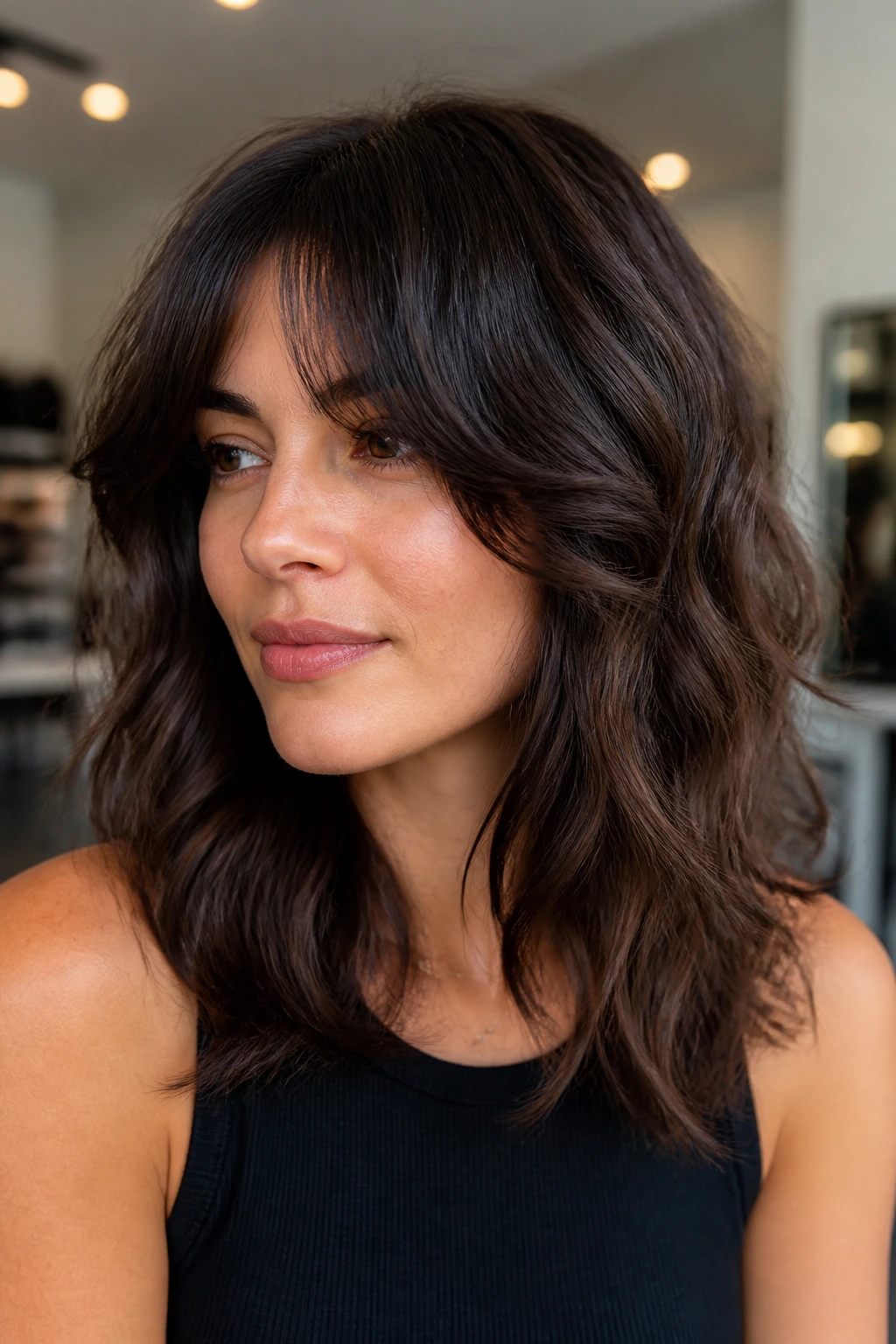
This is the haircut for people who say they want layers, then panic the second they see a choppy perimeter. Invisible layers live under the top surface, so the shape moves without advertising every snip. On wavy hair, that means the waves can separate and bend, but the outline still looks smooth.
For round faces, the midi length matters. Hitting somewhere between the jaw and collarbone gives the silhouette enough length to counterbalance cheek width. The layers do the softening work from underneath.
It’s also a smart choice if you wear your hair both straight and wavy. Straight, it reads clean. Wavy, it gets a little texture and swing. That flexibility is worth something.
8. Piecey Curtain-Fringe Shag

If you want the front of your haircut to do some talking, this is the one. The curtain fringe stays long enough to split and drift away from the cheeks, and the rest of the shag is cut in broken pieces so the texture shows rather than hiding under one smooth surface. On wavy hair, the separation looks natural fast.
The key is not to over-style the fringe. A small round brush or even finger-drying at the center is enough. Once the bangs are too polished, the rest of the cut can look flat by comparison, and that kills the easy shape.
This version sits nicely on round faces because it opens the center and keeps the side pieces from crowding the widest part of the face. You get softness without losing direction.
9. J-Cut Shag with Chin-Length Pieces
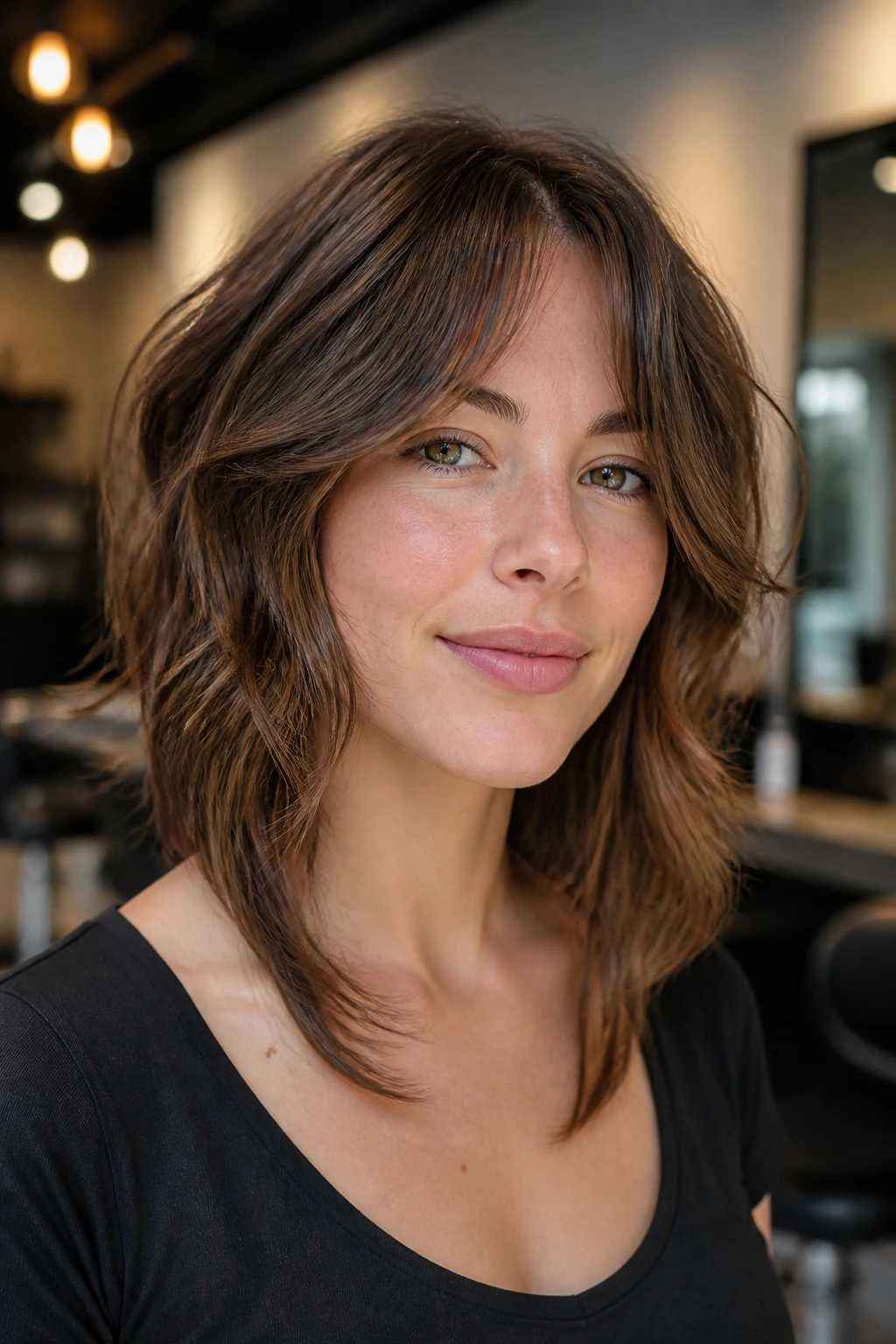
A J-cut is one of those small salon phrases that pays off big. The front pieces curve inward, then slide down and away, which makes the face look longer without a hard angle. On a round face, that little J shape matters because it keeps the cheeks from being the loudest part of the haircut.
The chin-length pieces need to be soft, not blunt. If they stop with a hard edge, they can widen the lower half of the face. If they’re textured and slightly undercut, they draw the eye down instead. That’s the move.
What to ask for
Say you want the front to curve toward the collarbone, not sit straight across the jaw. If your hair is thick, ask for the interior to be relieved so the front doesn’t balloon. If it’s fine, keep the layers longer and lighter.
10. Tapered Nape Mullet Shag
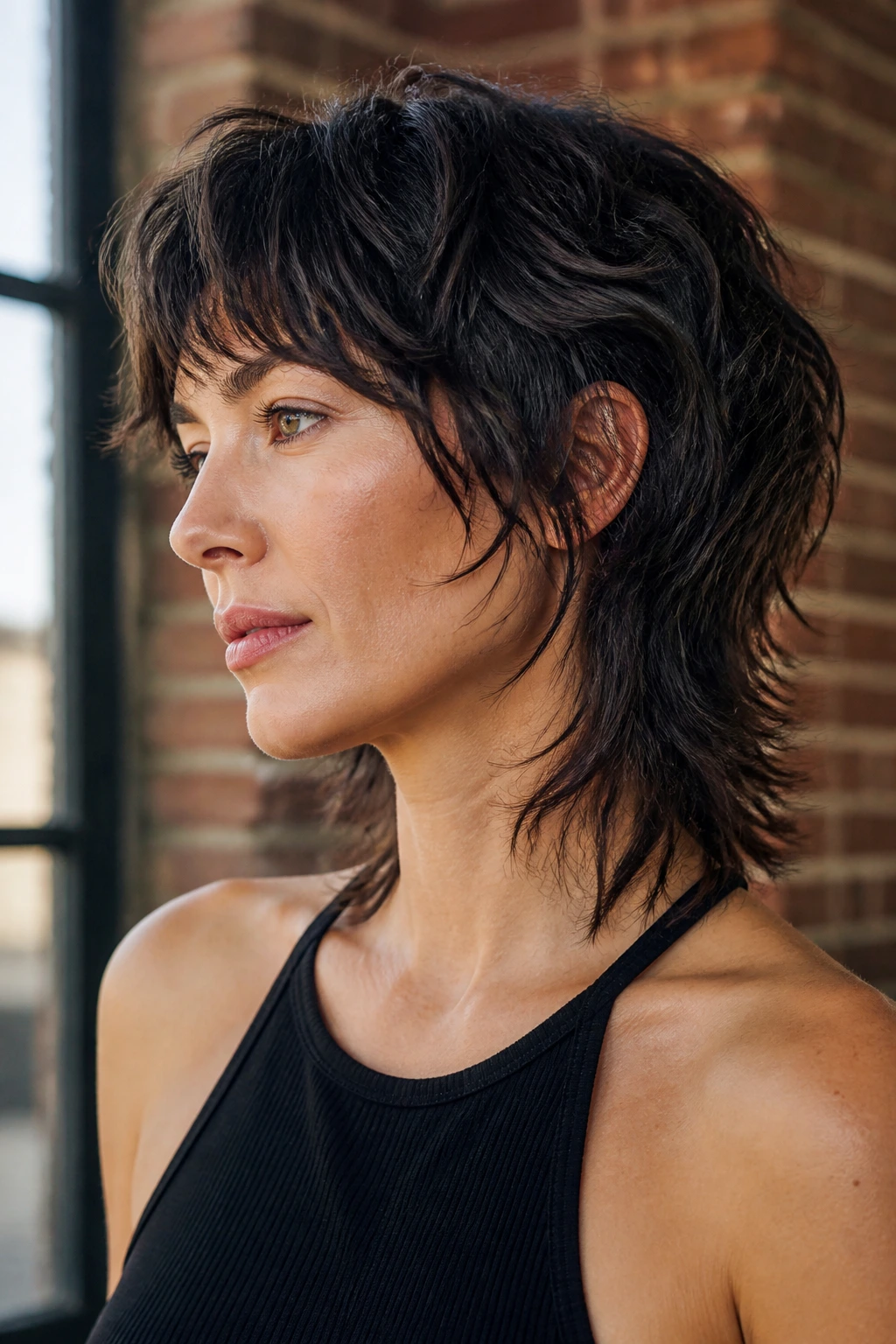
This one has a little more attitude, and I’m not pretending otherwise. The tapered nape gives the back some bite, while the sides stay long enough to keep the face from looking broad. For round faces, the mistake is usually too much height on top without enough length around the temples. Keep the crown soft and the front slightly longer, and the cut starts making sense.
Wavy hair gives this shape texture before you even touch a styling tool. The nape can sit close and neat, while the top and sides keep that broken, shaggy feel. That contrast is what makes it work.
If you like clothes with structure — sharp jackets, boots, a plain tee that somehow looks better than it should — this cut has a nice edge. It does not whisper.
11. Full Fringe Shag with Long Sides

Can a heavier fringe work on a round face? Yes, if the sides stay long and the fringe is broken enough to move. The point is not to hide the forehead under one solid slab. The point is to pull attention up while the long sides stretch the face downward.
This version suits people who like the feeling of bangs but don’t want to lose all softness around the cheeks. The long side pieces stop the fringe from making the face feel compressed. On wavy hair, the fringe should be cut with enough texture that it splits a little on its own.
I’d keep this one away from very short, very dense bangs unless you enjoy styling them every morning. A little length gives you options. Short fringe gives you obligation.
12. Thick-Hair De-Bulk Shag

Thick wavy hair can wear a shag beautifully, but only if the bulk is removed in the right places. If the layering happens too high, you get a rounded puff at the cheekbones. If it happens too low and too blunt, you get a heavy sheet. The sweet spot is the interior — where the stylist takes weight out underneath and leaves the outline long enough to hang.
This is one of the rare times I think a good haircut matters more than a good product. If the shape is wrong, no amount of cream will fix the triangle. If the shape is right, you can air-dry with a little mousse and walk away.
A thick-hair shag should swing, not sit. That’s the test.
13. Crown-Lift Shag for Fine Waves

Fine wavy hair needs a different kind of help. It doesn’t usually need more thinning; it needs a little more lift at the crown and a cleaner perimeter so the ends don’t disappear. A crown-lift shag gives the roots some support while keeping the front soft enough to frame a round face without squeezing it.
The trap with fine hair is over-texturizing. Too much slicing and the ends go see-through, which makes the whole head look smaller. Better to keep the layers a touch longer and let mousse, blow-drying, and a light root spray do some of the heavy lifting.
This cut looks best when the top has a little height but not a ton of volume at the sides. That distinction matters. Height is good. Side ballooning is not.
14. Shoulder-Length Interior-Layer Shag

This is the everyday version, the one that tends to behave in real life. The shoulder-length outline gives round faces a longer frame, and the interior layers keep wavy hair from turning into one thick block. Nothing screams. Nothing collapses. It just sits.
The interior layers are the quiet hero here. They keep the silhouette soft without chopping the ends into pieces that stick out at the cheeks. If you want a haircut that still looks decent when you don’t blow-dry it perfectly, this is a strong pick.
I also like it for people who work in places where a wild cut feels like too much. It has shape, but it doesn’t have to be loud.
15. J-Curve Lob Shag

A J-curve lob shaves off some of the boxiness that can happen with a straight lob on wavy hair. The front bends inward, then drops away from the jaw, which makes the face look longer from the side. It’s a subtle fix, but it changes the whole mood of the haircut.
The lob length is doing real work here. It gives the wave somewhere to live without bouncing straight out from the face. Pair that with a soft fringe or a side part and the shape stays light around the cheeks.
If you’re the kind of person who wants one haircut to feel polished enough for work and relaxed enough for a weekend, this lands nicely in the middle.
16. Micro-Bang Wavy Shag

This is the bold one. Micro bangs on a round face can absolutely work, but they need the rest of the haircut to stay long enough to balance the forehead and keep the cheeks from taking over. The cut gets its charm from contrast: tiny fringe up top, broken shag lengths through the sides and back.
I would not do this cut if you want a hair routine that disappears in the morning. Micro bangs need a quick restyle, and on wavy hair they can shift faster than the rest of the cut. Still, if you like a little art-school energy, this is a real statement.
The secret is not to make the back short too. Keep the sides and nape longer, and the fringe stops looking like a mistake.
17. Shattered-Edge Shag

A shattered-edge shag is what happens when the ends are broken up enough to move but not so much that they go fuzzy. It’s good for wavy hair that tends to expand when it dries, because the point-cut ends separate instead of building one bulky line. On a round face, that broken edge keeps the cut from sitting as one wide shape.
I like this version when the goal is texture first and polish second. It has that slightly lived-in finish that makes waves look expensive in the casual sense — not shiny and perfect, just healthy and deliberate.
If your hair gets puffy in humidity, this cut helps, but only if the layers stay below the cheekbone. That piece matters more than the product list.
18. Air-Dry Shag with Soft Root Lift

If you like to wash, scrunch, and leave the house, this is your lane. An air-dry shag should be cut to work with the bend you already have, not against it. The root lift keeps the top from flattening, and the softer ends stop the cut from ballooning around the cheeks.
The best version uses a lightweight mousse at the roots, a small amount of cream only on the mids, and a microfiber towel before the hair has a chance to swell. That’s enough. Anything more starts weighing the waves down.
This cut is especially good for people who hate heat styling. The shape does the job. Your hands just help it along.
19. Long Grow-Out Shag

Some haircuts look great on day one and weird by week six. This is not one of them, if it’s cut well. A long grow-out shag keeps the front pieces long enough to stay useful as the hair gets longer, and the layers are placed so they blur instead of breaking into obvious steps.
It’s a nice choice if you’re cautious about change or if you know you won’t want to trim every month. The round face gets the benefit of length, the waves get movement, and the grow-out doesn’t turn into a frustration project.
Ask for the front to stay below the cheekbone and the longest pieces to hold their line. That way the haircut still makes sense when it starts to grow out.
20. Asymmetric Side-Sweep Shag

Center parts are not the only answer. A deep side sweep can be a very clean way to break up the width of a round face, especially if your waves naturally fall heavier on one side. The asymmetry pulls the eye diagonally instead of straight across, which is a quiet but useful trick.
This shape also lets you keep more length on one side without the cut feeling lopsided in a bad way. The shag texture softens the difference, so it looks intentional rather than accidental. That’s the line you want.
If your face feels especially round at the temples or cheeks, this is one of the smartest ways to shift the balance without going shorter.
21. Softly Curved Shag with Graduated Ends

Not every shag needs to look sharp. A softly curved version with graduated ends keeps the perimeter smooth while the interior layers carry the movement. For round faces, that lower curve helps the haircut feel elegant rather than choppy, and wavy hair gets to stay wavy instead of being forced into neat little pieces.
This is a good cut for people who like shape but don’t want the hair to look deliberately messy. The ends still move. They just do it with less drama.
I’d call this one quietly useful. It works at the office, on a weekend, and three days after wash day when the wave has settled into something softer.
22. Minimal Wolf-Shag

For people who like the idea of a wolf cut but don’t want the full attitude, this is the calmer version. The crown has a bit of lift, the nape tapers gently, and the front stays long enough to keep a round face from feeling boxed in. The result is a shag with just enough edge to feel current, but not so much that it starts wearing you.
Wavy hair is perfect for this because the texture fills in the cut without making it look overworked. Keep the layers soft, keep the front pieces longer, and do not let the top get too high. That’s where the line gets lost.
It’s the closest thing here to a “try a little wolf, but keep the door open.”
What to Tell Your Stylist Before the First Snip

Bring photos, yes, but bring the right ones. A photo of someone with pin-straight hair and a round face can be misleading if your wave pattern is heavier, looser, or more compact. Show at least one front view and one side view, and point to the exact length where you want the shortest face-framing pieces to land.
Say these things out loud
- “Keep the shortest layers below my cheekbone.” That one sentence does a lot of work on a round face.
- “I want movement through the interior, not a blunt shelf at the jaw.” The words matter because they tell the stylist where to remove weight.
- “My hair air-dries wavy, so I need the cut to sit well without brushing it out.”
- “Please keep the fringe long enough to split or sweep.” Short bangs can shrink the face fast.
- “I’d rather have soft texture than a lot of thinning at the ends.” Over-thinning is where many shags go off the rails.
If your hair grows in a strong cowlick or your part always falls to one side, say that too. A shag cut on a round face only works if the natural part and the shortest layers agree with each other. They do not have to be identical. They do have to stop fighting.
The Tools and Products That Keep a Wavy Shag in Place
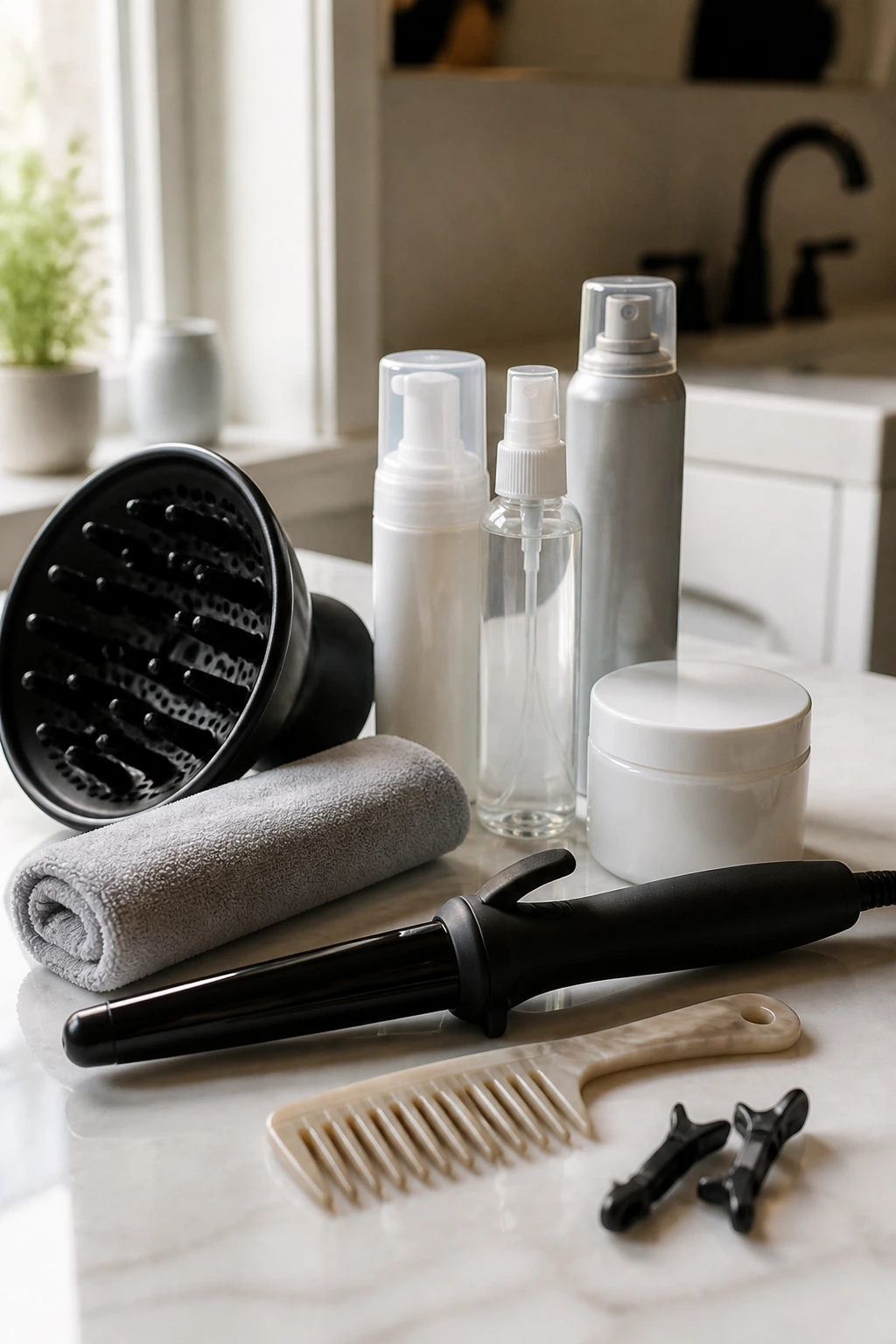
The cut matters more than the styling products, but the right tools make the shape easier to live with. You do not need a drawer full of gadgets. You need a few things that help waves keep their bend without turning into frizz or collapse.
- Diffuser attachment: Dries waves without blasting them apart and helps the crown stay lifted.
- Microfiber towel or cotton T-shirt: Removes water gently so the hair doesn’t start frizzing before styling even begins.
- Light mousse: Gives roots a small amount of support, which keeps shag layers from falling flat at the cheeks.
- Heat protectant spray: Non-negotiable if you use a wand or flat iron on the front pieces.
- Texturizing spray: Useful on day two when the cut needs separation more than hold.
- Lightweight cream or serum: Tames the halo around the face; use a pea-size amount, not a palmful.
- 1-inch wand or curling iron: Best for touching only a few front sections, not rebuilding the whole head.
- Wide-tooth comb and clips: Helpful for parting, pinning the fringe, and letting the top cool in the right shape.
Product overload is the enemy here. Two creams, a heavy oil, and a thick spray will make even a good shag collapse. Start light. Add more only where the hair truly needs it.
How to Style These Cuts Without Fighting the Wave

A wavy shag looks better when you stop trying to make every strand obey. That’s the whole rule. Some bends should stay loose. Some ends should flip a little differently. The cut has texture built into it; your job is to keep the shape from flattening.
Air-Dry Base
Blot the hair with a T-shirt or microfiber towel until it’s damp, not dripping. Work a light mousse through the roots and a touch of cream through the mids. Scrunch once or twice, then leave it alone. The more you touch it while it dries, the more likely it is to puff.
Diffuse the Crown
If you want more lift, dry the roots first with low heat and low speed. Cup the hair at the crown and side sections, but do not hover one spot for too long. You’re aiming for about 80 percent dry, not a crisp finish. The wave should still feel a little soft when you stop.
Touch the Front Only
The smartest heat move is usually the smallest one. Bend only the front two or three pieces away from the face with a 1-inch wand, then leave the rest natural. That keeps the haircut looking textured, not curled into one uniform pattern.
Make Day Two Work
A little water mist at the roots, a quick scrunch, and a touch of texturizing spray at the mids can reset the shape fast. Dry shampoo belongs at the crown, not the ends. If the fringe has gone flat, clip it up for ten minutes while you get dressed. It wakes back up faster than most people expect.
Practical Tweaks for Fine, Thick, and Dense Hair

Fine waves need weight left behind
Fine hair likes movement, but not too much removal. Keep the layers longer and ask for texture that lives inside the cut, not at the ends. If the stylist goes too short or too thin, the hair can go see-through and the face ends up looking broader, not slimmer.
Thick waves need the bulk relocated
Thick hair usually needs weight removed from the interior and around the ears, not hacked off at the surface. That stops the mushroom effect. If the ends are too blunt, they’ll sit heavy; if they’re too thinned, they’ll fray. The middle ground is point cutting and a lower weight line.
Dense hair needs a longer outline
Density is not the same as thickness, and this is where people get tripped up. Dense wavy hair can hold a shag shape beautifully, but it needs enough length in the perimeter to keep from flaring out at the cheeks. Keep the outline long and let the texture happen underneath.
Loose waves need a little more structure
If your wave is soft and lazy, the haircut has to carry more of the visual shape. That usually means slightly shorter crown layers, a stronger face frame, and styling that gives the roots a small lift. Nothing severe. Just enough to keep the whole thing from drooping by noon.
Common Mistakes That Make the Shape Wider

-
The shortest layer lands at the cheekbone. That’s the fastest way to widen a round face because the eye stops right at the broadest part. Fix it by pushing the shortest front layers lower, often closer to the mouth or chin.
-
The ends get too blunt. Wavy hair with a hard perimeter can flare out like a triangle, especially when it dries. Ask for point cutting or soft internal layering instead of a clean shelf.
-
Too much thinning happens at the bottom. The symptom is wispy ends and a frizzy halo that shows up the minute humidity rises. Better to remove bulk from the inside, not shred the ends to pieces.
-
The fringe is too short and too heavy. Short bangs can make a round face feel compressed, especially if the rest of the hair is full. Keep the fringe long enough to split, sweep, or soften around the eyes.
-
The waves get brushed dry. A brush can turn loose bend into puff in about thirty seconds. Use fingers, a wide-tooth comb when wet, and stop brushing once the hair is dry.
-
The photo reference doesn’t match your texture. If the model has straight hair and yours bends hard, the same cut will sit differently. Bring photos with similar density and wave pattern, not just similar length.
Variations and Alternatives If You Want More or Less Edge

-
The Softer-Than-Wolf Swap: Keep the nape long, soften the crown, and leave the front pieces below the cheekbone. It gives you some of the wolf-cut energy without the sharper silhouette.
-
The Fringe-Free Version: Skip bangs entirely and let the front layers start around the mouth or chin. This works especially well if you wear glasses or if your forehead doesn’t love bangs.
-
The Bigger-Front, Smaller-Back Cut: Add a little lift around the face and keep the back calmer. That’s a good fix if your hair tends to collapse around the jawline.
-
The Thick-Hair Relief Version: Ask for interior debulking and a longer perimeter. It keeps the shape from ballooning while still letting the waves move.
-
The Fine-Hair Lift Version: Keep the layers long, add root support, and avoid aggressive texturizing. Fine waves need shape, not emptiness.
-
The Long Grow-Out Version: Hold the shortest layers below the chin and keep the outline soft. It buys you more time between trims and makes the cut easier to live with as it grows.
Trim Timing, Grow-Out, and Day-Two Refresh

Shag cuts are forgiving, but they are not immortal. Fringe usually needs a touch-up every 4 to 6 weeks if you want it to sit cleanly. The full shape can often go 8 to 12 weeks, depending on how short the shortest layer is and how much movement you want to keep.
If you prefer a softer grow-out, tell your stylist that before the cut is made. Longer face-framing pieces and a less dramatic crown make the haircut age more gracefully. A shag that starts too short around the cheeks can become awkward fast. One that starts lower usually just gets softer.
At home, sleep on a satin pillowcase if your waves get rough overnight. Clip the fringe away from your face if it tends to bend in the wrong direction. On day two, a little water mist and a scrunch is often enough; you do not need to rebuild the whole head unless humidity has done a number on it.
Frequently Asked Questions

What makes a shag haircut flattering on a round face?
It’s mostly about where the layers start. A good shag keeps the shortest pieces below the cheekbone and uses movement to stretch the silhouette vertically instead of adding width at the sides.
Are curtain bangs or side-swept bangs better for round faces?
Both can work. Curtain bangs are better if you want balance and softness through the center, while side-swept bangs are useful if your face feels widest at the temples or you prefer a more diagonal line.
Can wavy hair take a shag without turning frizzy?
Yes, if the cut removes bulk in the right places and you don’t over-handle it while drying. A microfiber towel, a little mousse, and either air-drying or a diffuser usually keep the texture controlled.
Should I choose a shag, a wolf cut, or a mullet if I want more edge?
Pick the shag if you want the safest shape, the wolf cut if you want more crown and nape contrast, and the mullet if you want the front-to-back difference to be obvious. The softer versions of all three are easier on a round face.
How often should I trim a shag haircut?
Fringe can need attention every 4 to 6 weeks, while the full shape often stays clean for 8 to 12 weeks. If you’re growing it out, ask for longer layers so the cut doesn’t lose its line too fast.
What if my hair is fine and a shag usually falls flat?
Ask for longer layers, not more of them, and keep the texturizing light. Fine hair needs root support and a cleaner perimeter more than it needs a lot of snipping.
Will a shag work if I always air-dry my hair?
That’s one of the best ways to wear it, honestly. Just make sure the cut is built around your real wave pattern, because an air-dried shag depends on the layers falling into the right place on their own.
What if my stylist cuts the layers too short around my face?
The fastest fix is to let the front grow a little and ask for the next trim to keep the shortest pieces lower. In the meantime, shifting the part and using a small amount of styling cream can stop the face frame from sitting too high.
The Cut That Still Holds Up Tomorrow Morning

A good shag does not demand a perfect blowout to make sense. That’s why it works so well on round faces and wavy hair: the shape gives the wave somewhere smart to go, and the wave keeps the haircut from looking flat or formal.
The best version is the one that keeps its line when you move, when the weather shifts, and when you do not have time to fuss with it. If you want movement without losing control, that’s the lane to stay in.