



A wedding morning has a way of exposing every lazy hair decision. The curls that looked fine in the bathroom mirror at home can fall flat under hotel lighting, and a short cut can go from crisp to awkward in about ten minutes if it’s treated like an afterthought. Mother of the groom hairstyles for short hair work best when they respect the cut instead of pretending it’s longer than it is.
That’s the upside, really. Short hair gives you shape fast. It shows the jawline, frames the earrings, and keeps the neckline clean when you’re wearing lace, satin, a jacket, or anything with a collar that would fight a full head of hair. A good short style doesn’t need to shout. It needs line, shine, and a little backbone.
I’ve always liked short wedding hair more than people expect me to. A bob with the right bend looks expensive even when the products are simple. A pixie with crown lift can outclass a fussy updo that’s been pinned into surrender. The trick is choosing the version that fits your face, your dress, and the kind of evening you’re actually going to live through — hugging, photos, dessert, dancing, and all.
Why These Looks Earn Their Keep
-
Short hair stays readable in photos: A clean part, a shaped fringe, and the edge of a bob show up clearly from the front, the side, and the back, which matters when every picture is taken at a slightly unforgiving angle.
-
The styles hold without feeling armored: You can get serious polish from a few bobby pins, a curling iron, and the right spray; you do not need a helmet of lacquer to survive dinner.
-
They work with real wedding clothes: High necks, bateau collars, off-the-shoulder dresses, shawls, and tailored jackets all sit better when the hair isn’t swallowing the neckline.
-
Each cut can swing in more than one direction: The same short bob can look soft, vintage, sleek, or airy depending on the part, the brush-out, and whether the ends curl in or flick out.
-
They’re easier to manage during a long event: Less hair on the neck means less flattening, fewer tangles from hugging, and fewer moments spent checking whether a long curl has snagged on a zipper.
-
Accessories actually matter here: With short hair, one comb, one clip, or one headband has room to do real work instead of disappearing into length.
1. Soft Side-Parted Blowout Bob
A side-parted blowout bob has the kind of polish that looks calm rather than constructed. The crown carries a little lift, the sides skim the cheekbone, and the ends bend under or outward just enough to show that the style was finished on purpose. It’s one of those wedding looks that works because nothing is fighting for attention.
What makes it especially useful for a mother-of-the-groom role is the balance. It softens a tailored dress or jacket, but it does not lean so romantic that it competes with the rest of the room. A 1.5-inch round brush, a nozzle on the dryer, and a light smoothing cream are enough to build it.
If your hair is fine, keep the root product only at the crown. If it’s thick, work in small sections and let the ends cool on the brush for a few seconds before dropping them. That tiny pause matters. It’s the difference between shape and collapse.
A soft side part also flatters most faces because it breaks up symmetry without looking severe. If you wear earrings, let the fuller side fall just above the shoulder line and tuck the other side lightly behind the ear.
2. Sculpted Finger Waves
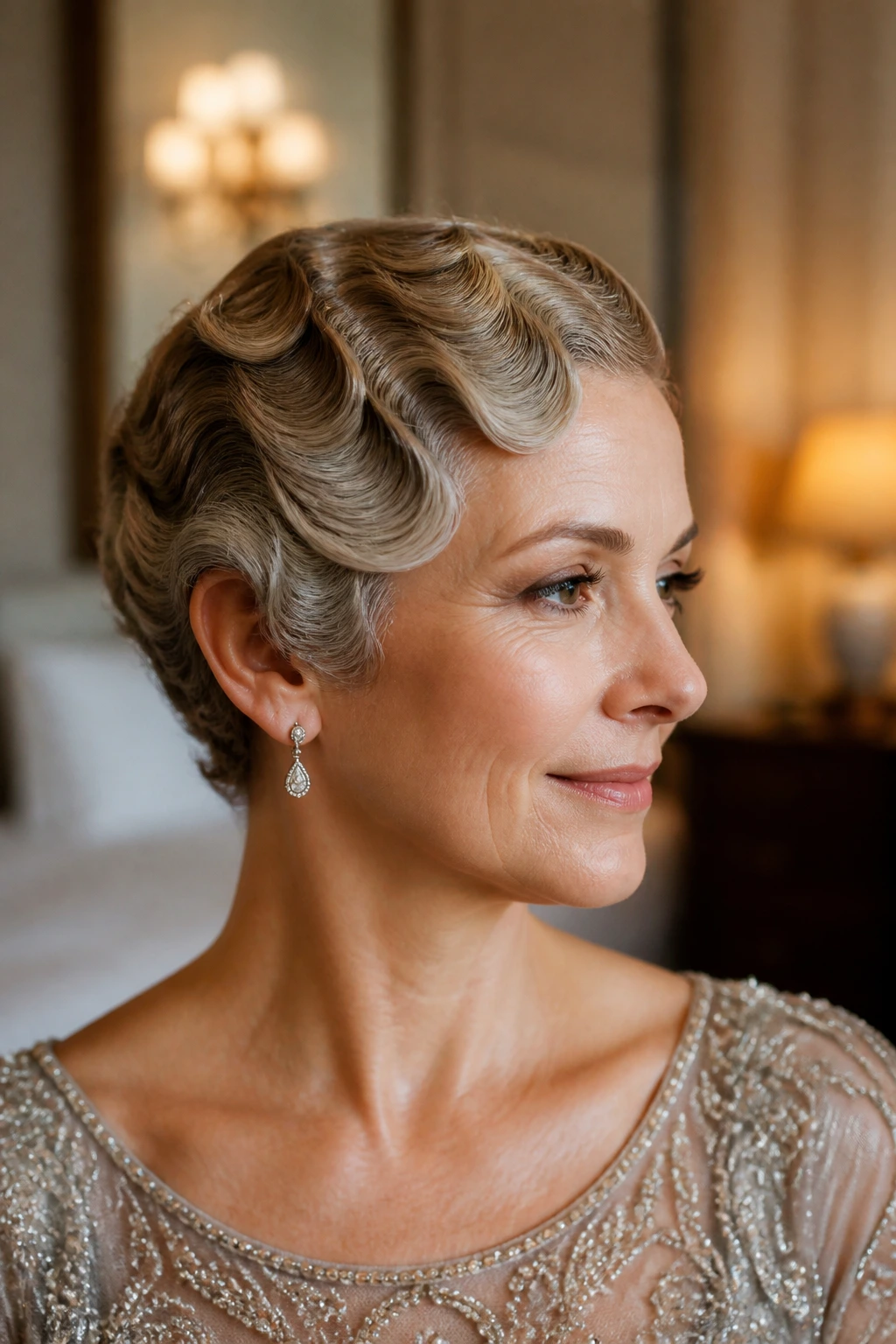
Finger waves read formal in a way that loose curls never quite do. They sit close to the head, ripple in a controlled pattern, and give short hair a quiet kind of drama. If the dress is smooth, sleek, or slightly vintage, this style makes sense immediately.
Why does it work so well on short hair? Because there’s less length to tame, and finger waves thrive on control. Gel, a fine-tooth comb, duckbill clips, and a diffuser or hood dryer are the real tools here. The shape needs time to set, which means this is not a rush job.
What to watch for
The pattern can go stiff fast if you use too much gel and keep combing after the wave has been formed. Stop fussing once the ridges are in place. Let it dry untouched, then mist a light spray over the top when it’s fully set.
Finger waves are especially nice if the groom’s mother wants a polished look that stays close to the head all night. They won’t bounce around, and they won’t compete with a statement necklace. They do, however, ask for a little patience.
3. Feathered Pixie with Lift at the Crown
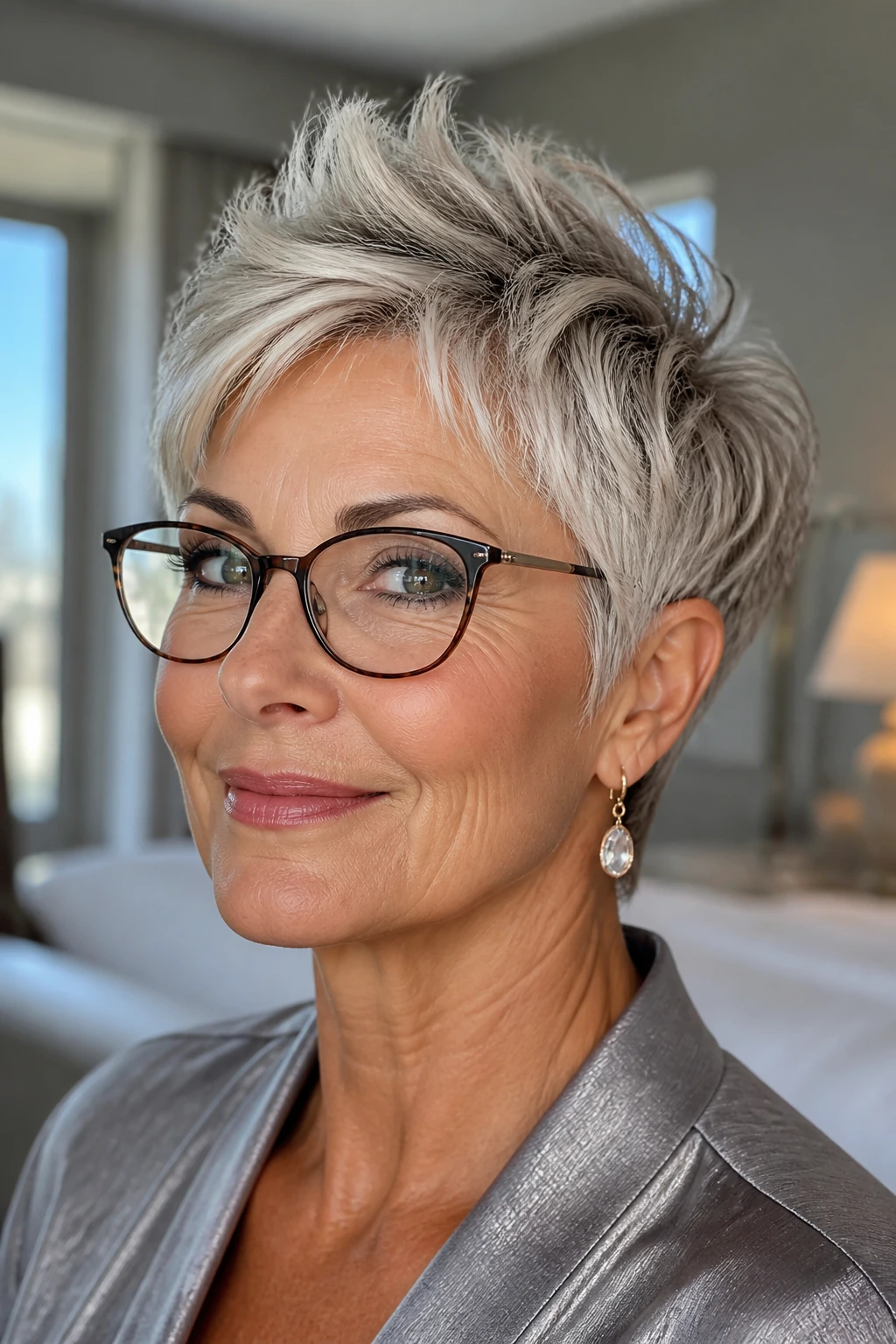
A feathered pixie with crown lift is a lifesaver when the cut is short and the hair wants to lie flat by noon. The shape is airy at the edges, a touch fuller at the top, and piecey enough to look soft rather than overstyled. It gives the face room, which is exactly what short hair should do at a formal event.
The best version starts at the roots. A little mousse at the crown, blow-dried upward with fingers or a small round brush, creates height without puffing the whole head into a cloud. A pea-sized amount of pomade on the ends can keep the layers separated so they don’t blur together.
Quick notes:
- Keep the lift centered slightly behind the hairline, not right at the front.
- Use your fingers to break up the top once it cools.
- Leave the fringe a little softer than the crown.
This style is especially good with earrings, because the pixie reveals the ears and the line of the neck. It also behaves well with glasses, which some updos don’t.
4. Tucked-Behind-the-Ear Bob with a Jeweled Clip
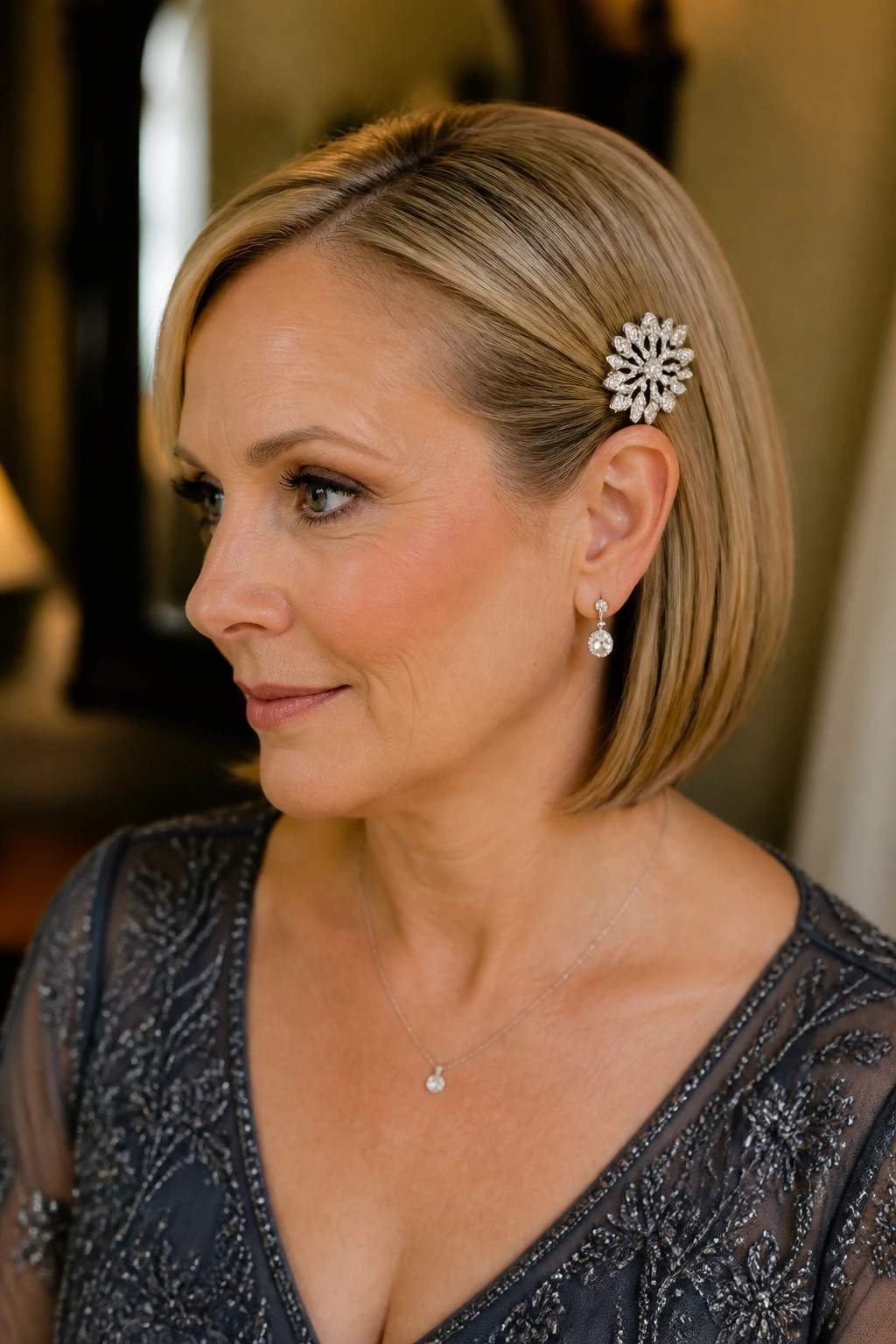
A tucked bob sounds simple, and that’s exactly why it works. One side slides neatly behind the ear, a jeweled clip pins the section in place, and the rest of the bob falls in a smooth line around the jaw. There’s no awkward business, no overbuilt curl pattern, no pins poking through from the inside.
This is a strong choice when the dress or suit has a neckline that deserves room. It also lets the earrings do their job. Place the clip just above the widest part of the cheekbone, not too far back toward the crown — that’s where it catches the eye without looking like an afterthought.
I like this style with a side part and a subtle bend through the ends. If the hair is too flat, the tuck can look abrupt. A quick pass with a flat iron or a round brush gives the section some shape so the pinning feels intentional.
The best part? It’s easy to refresh. If the clip shifts, you can fix it in thirty seconds. That matters more than people admit.
5. Loose Barrel Curls on a Chin-Length Bob
Loose barrel curls on a chin-length bob give movement without turning the hair into a cloud. The curls are wide, soft, and brushed just enough to relax the spiral. You still see the shape of the bob, which is the point. You’re adding texture, not hiding the cut.
Why it flatters short hair
A shorter bob can get swallowed by tiny curls. Bigger ones keep the silhouette clear and help the style look grown-up instead of prom-ish. Use a 1-inch curling iron, curl away from the face, and pin each section for 10 to 15 minutes while it cools if you want the bend to last.
Then brush gently. Not aggressively. A paddle brush or even fingers can soften the ringlet into a cleaner wave. If the ends flip out a little, leave them. That looseness keeps the style from feeling too done.
For a wedding, this is lovely with a soft dress or anything with lace at the bodice. It’s also a kind option for hair that doesn’t love high heat; one pass, a cool-down, and a light spray are usually enough.
6. Mini French Twist for Short Hair
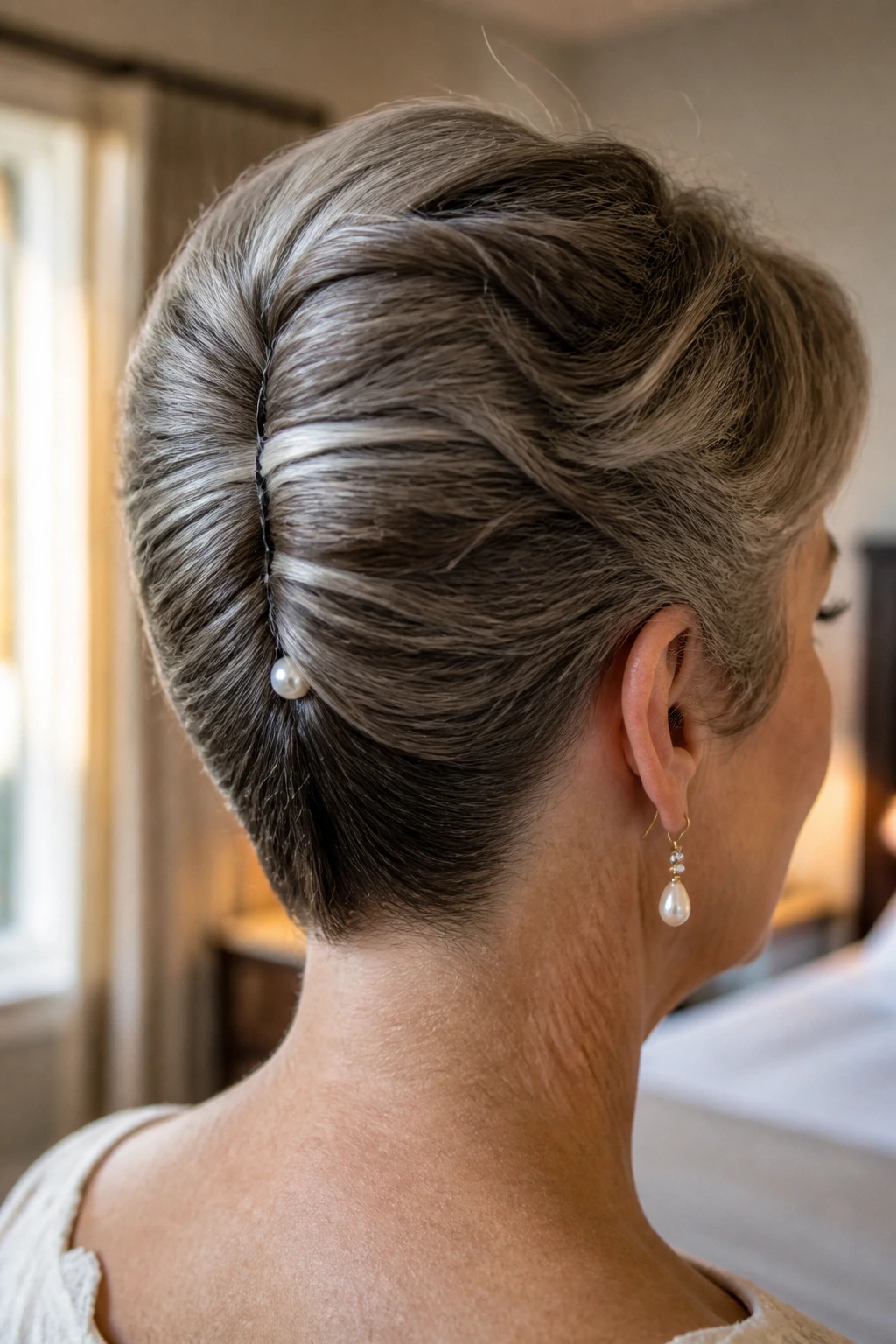
A mini French twist is one of those styles that sounds like it needs more length than it actually does. It doesn’t. On short hair, the trick is to build a narrow roll at the nape and tuck the ends upward in a compact line. Think of it as a French twist that has learned restraint.
It works best when the hair reaches the nape or slightly below the ear. Very short pixies won’t cooperate, and that’s fine. The shape depends on hidden pins placed vertically along the roll, not on trying to fold every strand into the same path.
This style feels formal without getting heavy. It’s especially nice with satin, crepe, or anything structured. A tiny comb or pearl pin near the seam of the twist is enough. Do not pile on extras; the roll is the ornament.
If you’ve got thick hair, this can be one of the most dependable options. If your hair is fine, rough up the roots a little first so the pins have something to hold.
7. Sleek Asymmetrical Bob with a Deep Side Part
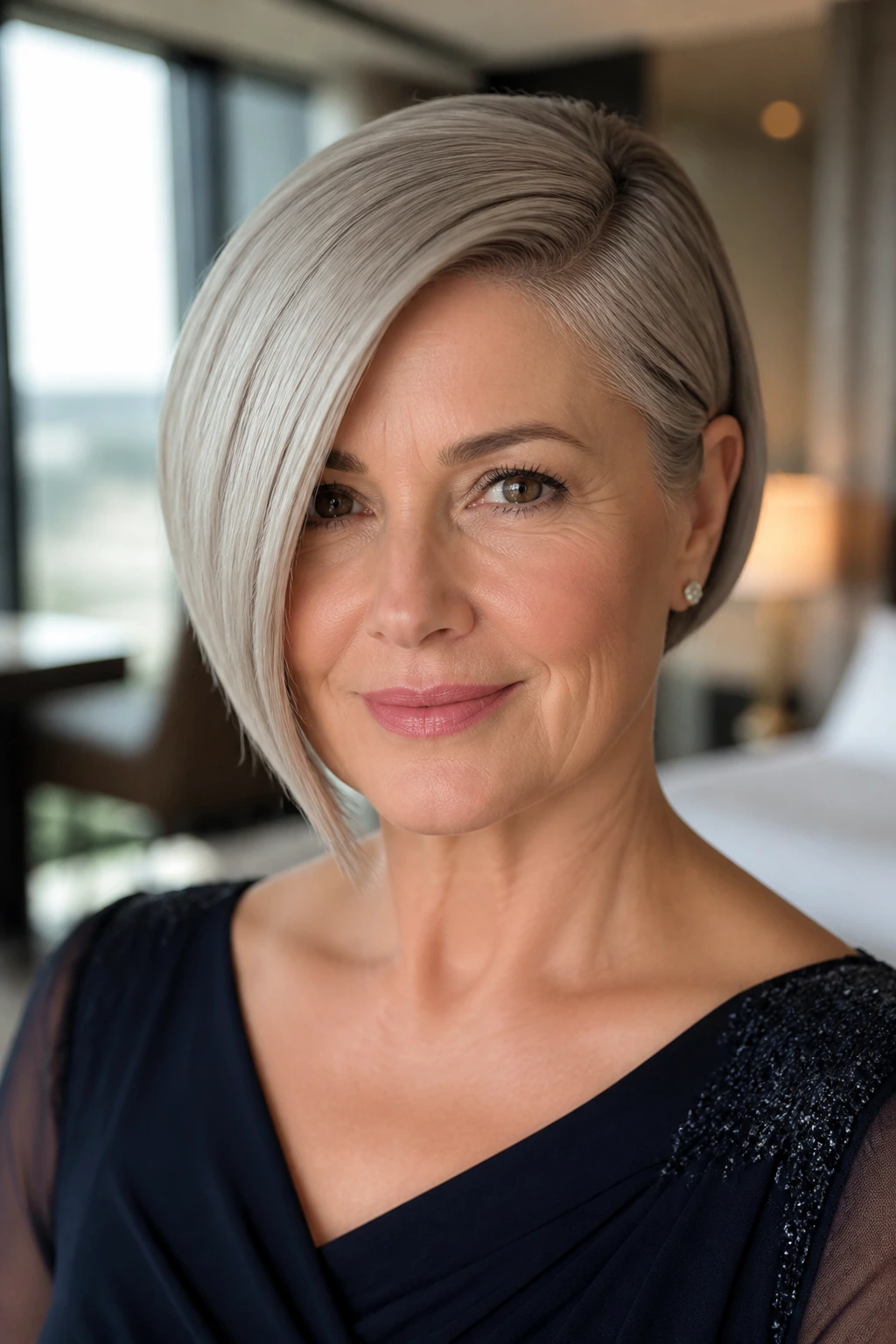
An asymmetrical bob already has attitude. Give it a deep side part and a smooth finish, and it starts looking almost architectural. One side sits slightly longer, one side stays tucked or close to the cheek, and the whole style feels deliberate from every angle.
The shape is especially useful when the dress has strong lines. Square necks, sharp lapels, and clean satin all like a bob with edge. A smoothing cream at the mids and ends, plus a flat iron used in one clean pass, keeps the finish sleek without making it greasy.
This is not the place for fluffy volume. Let the cut do the talking. If one side wants to kick out, pin it briefly while it cools and then remove the pin when the shape has set. That usually solves the problem faster than more heat.
I’d choose this for a groom’s mother who likes modern clothes and hates fussy hair. It feels direct. That’s the charm.
8. Half-Up Twist on a Layered Lob
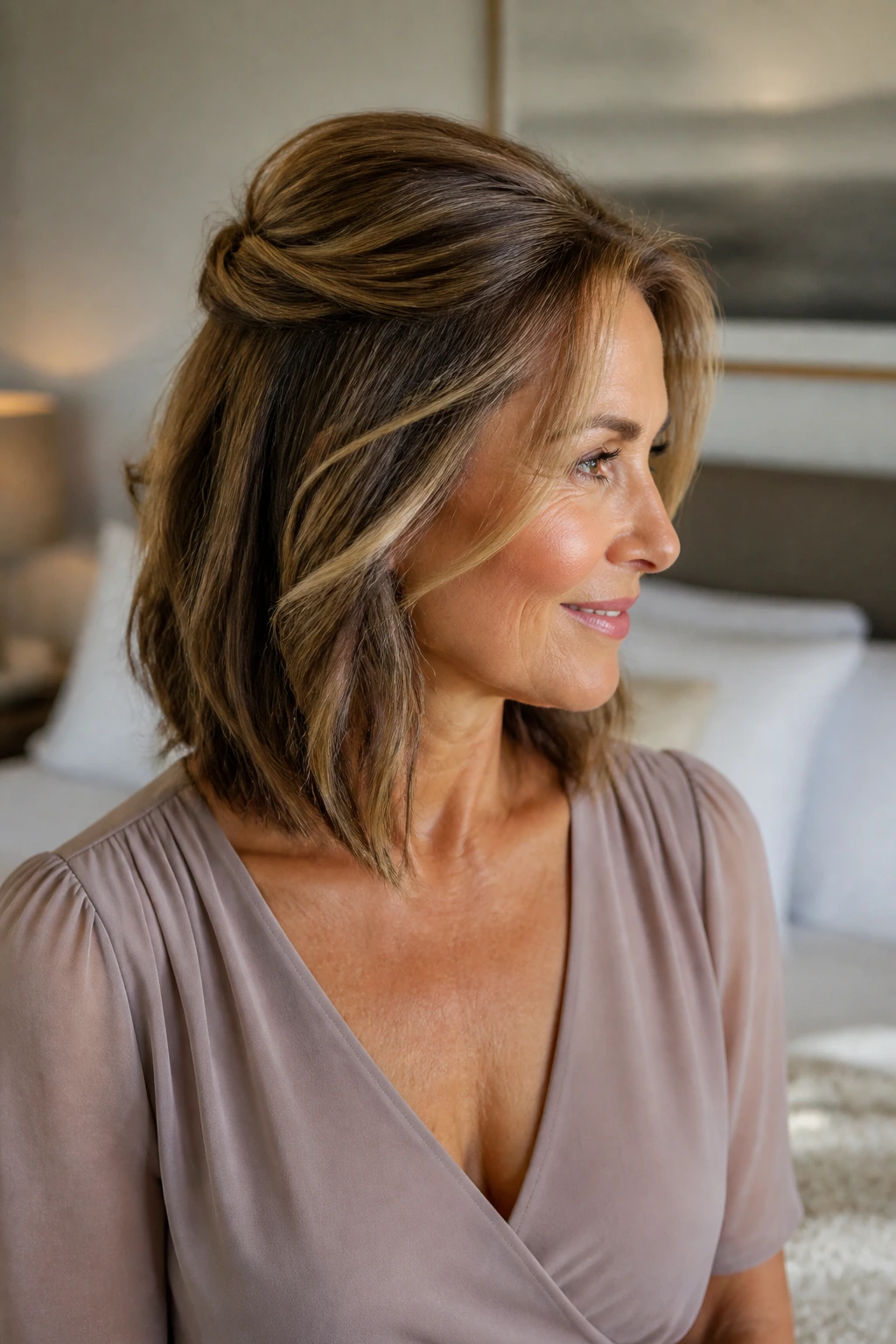
A layered lob gives you just enough length for a half-up twist without pretending to be long hair. Two slim sections from the temples, twisted back and pinned at the crown, create a tidy lift while the rest of the hair stays loose. It’s light, flattering, and less predictable than a standard pinned-back look.
This style works because it keeps the face open and gives the top half of the head a little height. The lower layers move when you walk, which is pleasant in photos and less rigid than a full updo. A couple of small clear elastics and four to six bobby pins are usually enough.
How to keep it clean
Twist the sections away from the face, not toward it. That small detail changes the whole line. If the layers are too short to hold a twist, braid each side once before pinning; the braid buys you grip.
A lob with a half-up finish pairs nicely with soft makeup and a necklace that sits a little below the collarbone. The hair stays out of the way, but it still looks like hair, which sounds obvious until you see how many formal styles forget that.
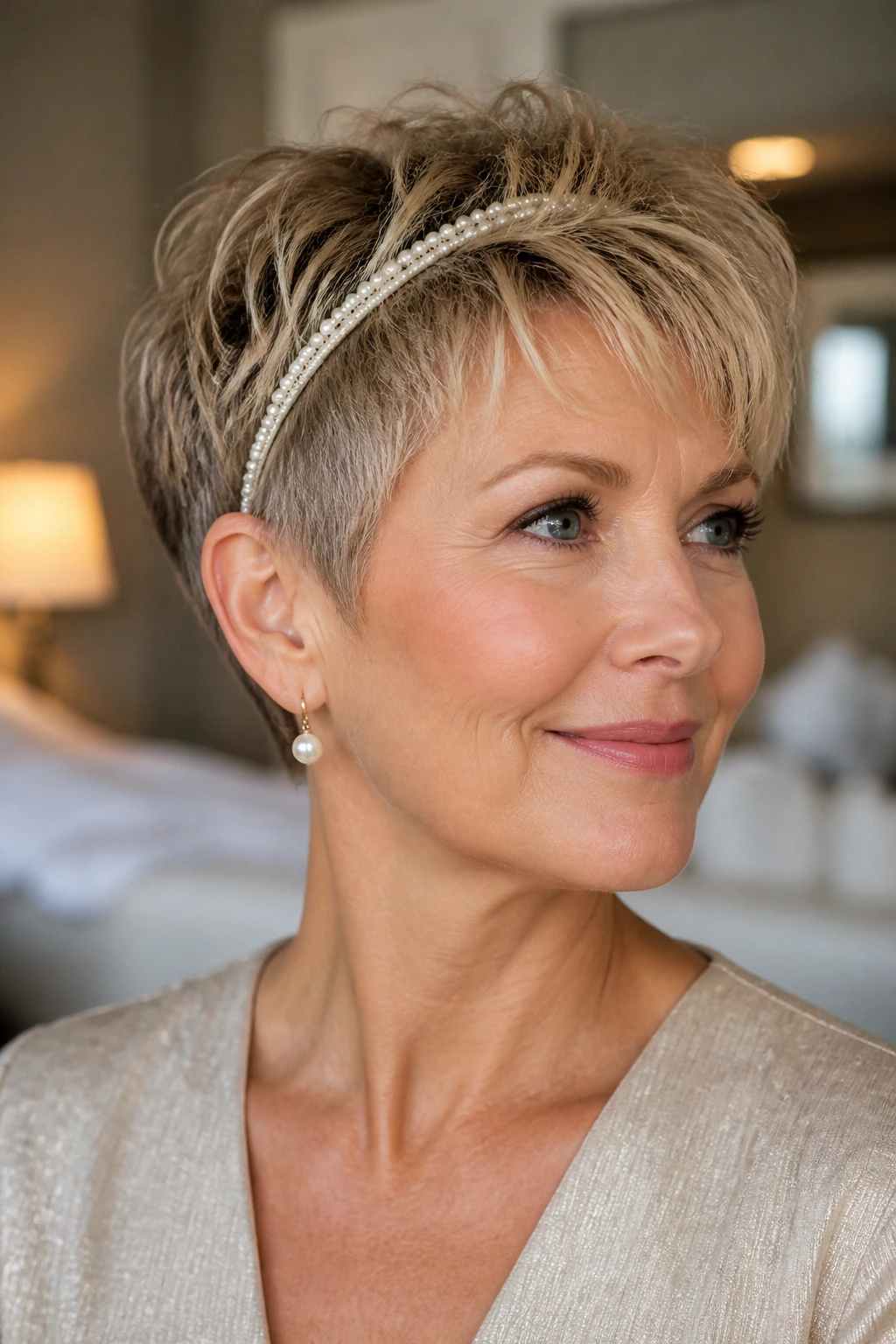
9. Textured Crop with a Pearl Headband
A textured crop can look astonishingly dressed up with the right headband. Not a giant one. A slim pearl band, placed a half-inch behind the hairline, is enough to make the whole style read as wedding-ready. The hair itself can stay airy, slightly piecey, and easy.
This is one of my favorite options for short, layered cuts because the accessory does some of the heavy lifting. The style does not need length; it needs polish. Texturizing spray at the roots and a tiny bit of smoothing cream at the temples keep the texture from drifting into frizz.
The pearl headband is best when the dress is fairly clean and the jewelry is not already doing too much. If the bodice is beaded, choose a matte band or a softer pearl finish. Too many shiny things near the face can start to look busy.
If you wear glasses, this is a smart choice. The band sits high enough to avoid the arms of the frames, and the texture keeps the look from feeling too stiff.
10. Flipped-Out Ends with Polished Volume
Flipped-out ends give a bob or short layered cut a little swing. The root stays smooth, the midlengths stay tidy, and the ends flick outward in a way that feels playful without getting casual. It’s a nice answer for anyone who wants movement but not curls.
The shape has a retro note, but it doesn’t have to scream a decade. A round brush or a flat iron can turn the ends out by a quarter-inch to half-inch, which is enough. Keep the crown smooth and the side panels controlled so the flip stays the point instead of turning the whole head into a mess.
This style shines with square or bateau necklines because the outward movement echoes the line of the shoulders. It also frames the face well if your jaw is angular. There’s a little lift, a little motion, and no extra weight.
If the hair falls back in under a humid room, pin the sides while they cool. That’s the boring part. It works.
11. Side-Swept Curls with One Statement Earring
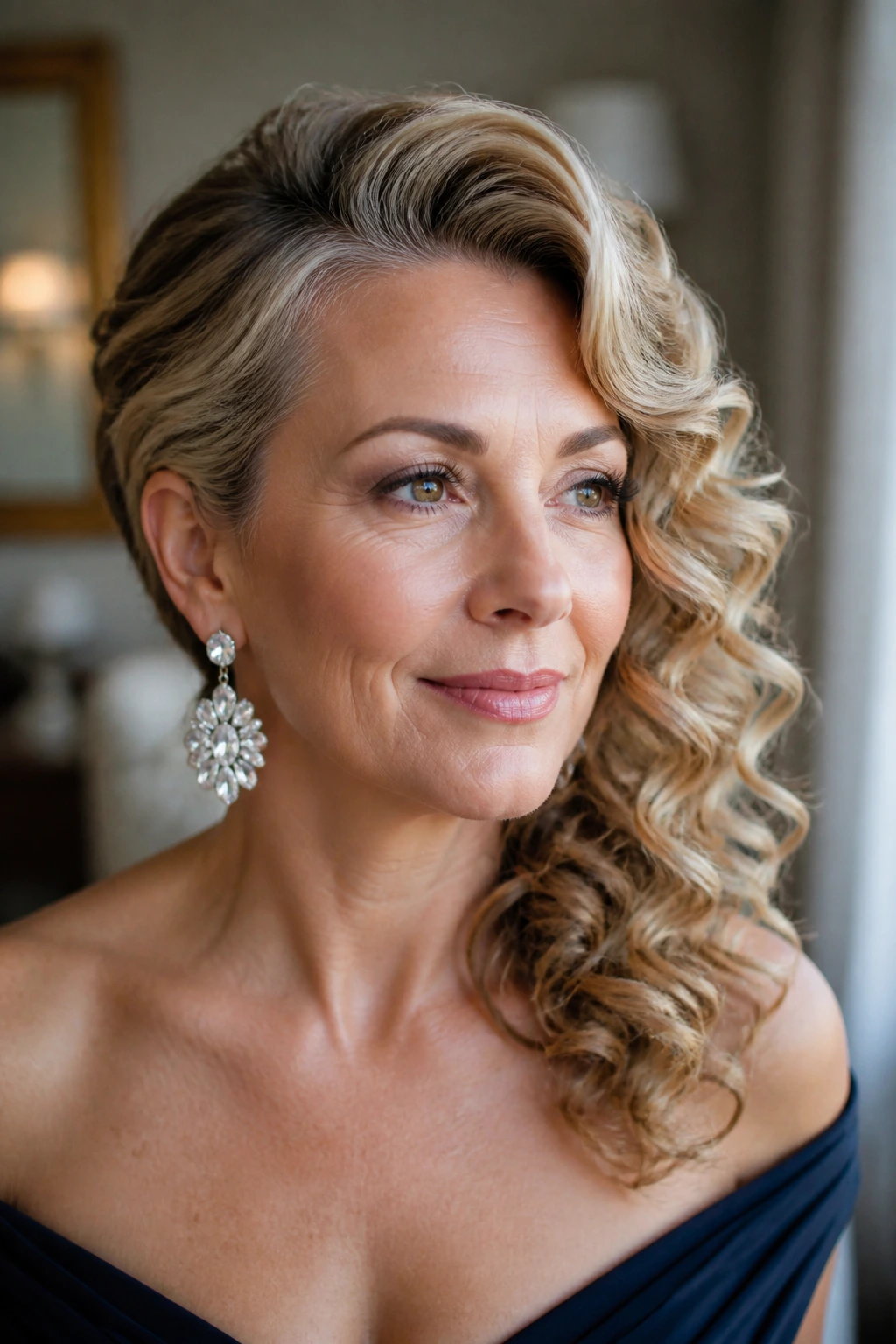
Why bother with symmetry when one good earring can do the job? A side sweep pushes the hair over one shoulder or keeps it close to one side of the face, while the other side stays more open. The whole look feels polished and slightly dramatic.
It’s especially useful if you’ve chosen one oversized earring or a bold drop style. The hair becomes a frame, not the headline. Curl the sections away from the face, then brush them into a soft sweep and pin the back side under the top layer so the whole shape holds.
This look can be as formal or relaxed as you want. If the waves are loose and brushed, it feels soft. If the side sweep is tight and glossy, it feels sharper. That flexibility makes it one of the most wearable ideas on the list.
You do need to think about the shoulder line of the dress. A one-shoulder gown and a side-swept style can be beautiful together, but only if the hair isn’t fighting the same side seam.
12. Faux Bob with Hidden Pins
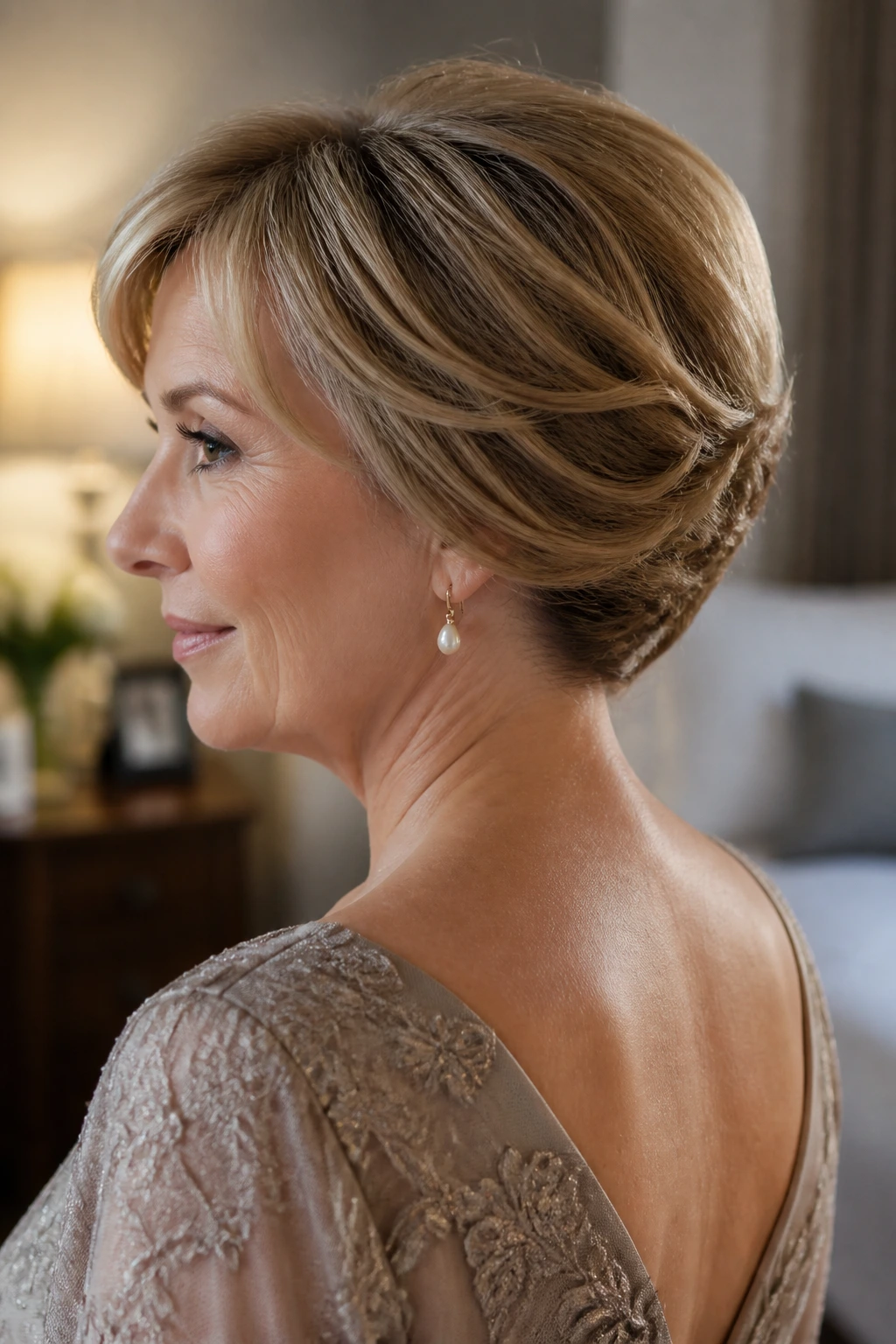
A faux bob is one of the smartest tricks for short-to-mid-length hair that needs to look more compact for a wedding. The ends are tucked under and pinned beneath the top layers, creating the illusion of a shorter, neater cut. It’s formal, a little vintage, and very useful when you want the neck clear.
What makes it work
The magic is in the fold. You roll the bottom under in sections, pin the roll close to the scalp, and then let the top layer fall over the hidden work. The result looks clean from the outside and gives you the shape of a bob even if the hair starts longer.
It’s best done on hair that has some bend already, because pin-straight strands can slip. A light mousse before drying helps. So does a little dry shampoo at the roots for grip.
This style is worth a rehearsal. Once you know where your hair wants to fold, the real day gets much easier. If the ends stick out, don’t keep stuffing them in; smooth them and try a smaller roll.
13. Braided Crown Accent on Short Layers
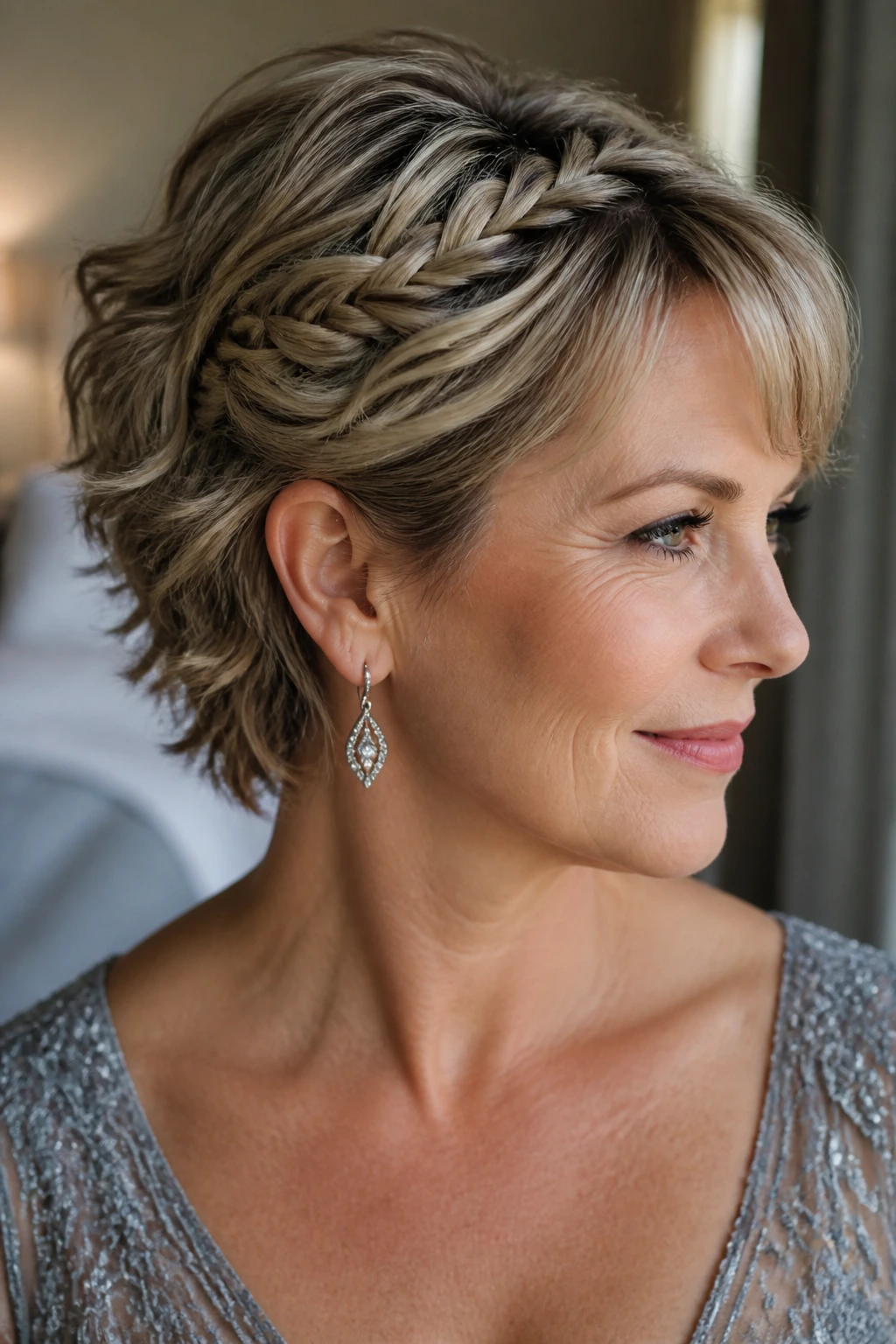
A full braid crown can be too much for short hair. A braided accent, though, is another story. One side braid or a thin braid pulled from the hairline and pinned behind the ear gives short layers a bit of detail without forcing them into a shape they don’t have.
This is a good answer for layered cuts that need help staying controlled. The braid acts like a built-in anchor, and it also keeps the style from looking flat at the sides. A loose braid holds better than a tight one because it lets the pins grip the hair beneath it.
If the rest of the hair is softly waved, the braid gives the whole look a little contrast. If the rest is smooth, the braid becomes the detail. Either way, it keeps the style from feeling plain.
I’d reach for this when the dress is simple and you want the hair to carry a little interest near the face. If you have a cowlick at the temple, this also helps hide it. Convenient. Quietly so.
14. Old-Hollywood Waves on a Short Cut
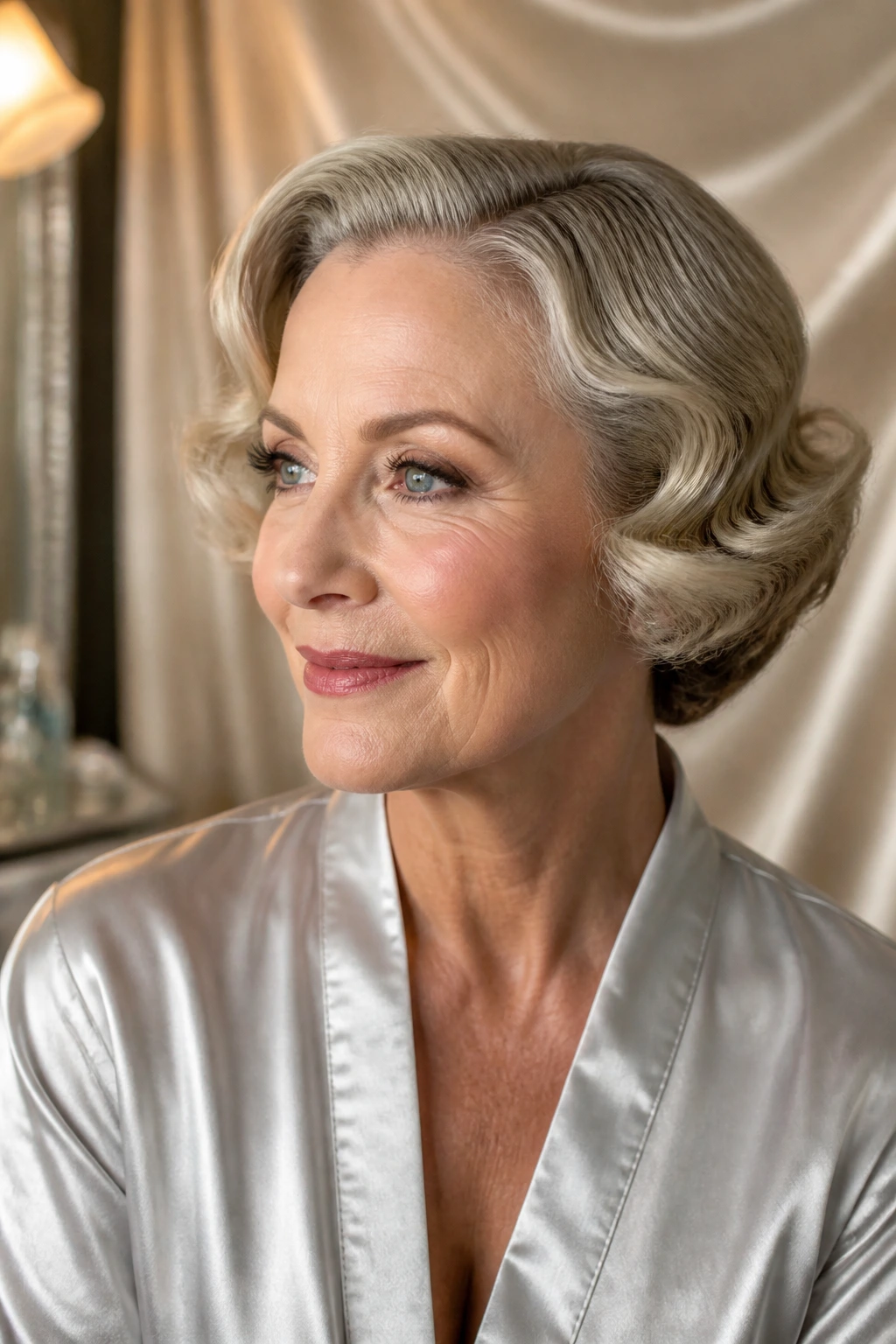
Old-Hollywood waves have a crispness that suits formal events beautifully. They’re smoother than beach waves, more controlled than curls, and far more elegant than the word “glam” usually deserves. On a short cut, the wave pattern wraps around the face in a way that looks expensive without trying too hard.
The key is set and brush-out. Wrap sections around a 1.25-inch curling iron, pin them flat while they cool, and then brush them into a continuous wave. The comb should move with the wave, not against it — otherwise you break the pattern and end up with soft lumps instead of clean bends.
This style is especially strong with satin, velvet, or dresses that have a little shine. It likes earrings. It likes lipstick. It likes a groom’s mother who wants to look finished in a way that feels timeless, not trendy.
I’d avoid it on very humid days unless you’re ready to re-spray the set once or twice. Waves this smooth can open up if the air is damp.
15. Soft Pompadour Pixie
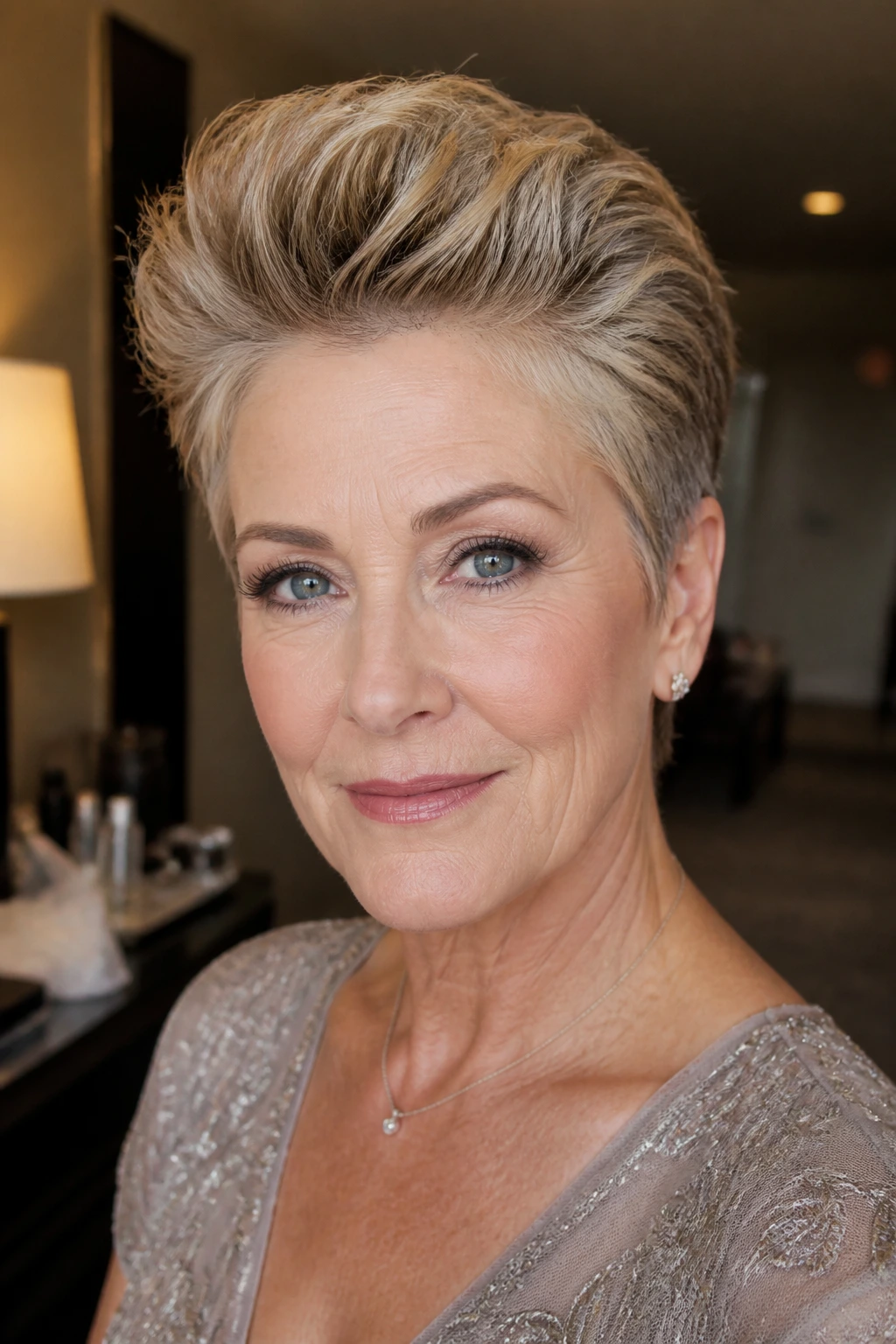
A soft pompadour on a pixie cut gives you height right where short hair often needs it most. The front lifts back from the hairline, the sides stay neat, and the top has enough shape to read as intentional instead of flattened. It’s a sharp look, but not a hard one.
This style is strongest on cuts with some length at the top and fringe. Work a little volumizing mousse into the roots, blow-dry the front upward with a round brush, and smooth the sides close to the head. Keep the product off the crown ends or the lift will sag.
Best when you want a little structure
The pompadour gives the face definition and creates room for a necklace or high collar. It can also soften strong brows or a straight fringe by redirecting the eye upward. That’s a small thing. It matters.
For a groom’s mother who likes polish with a bit of edge, this is a smart choice. It doesn’t whisper. It also doesn’t yell.
16. Low Rolled Tuck at the Nape
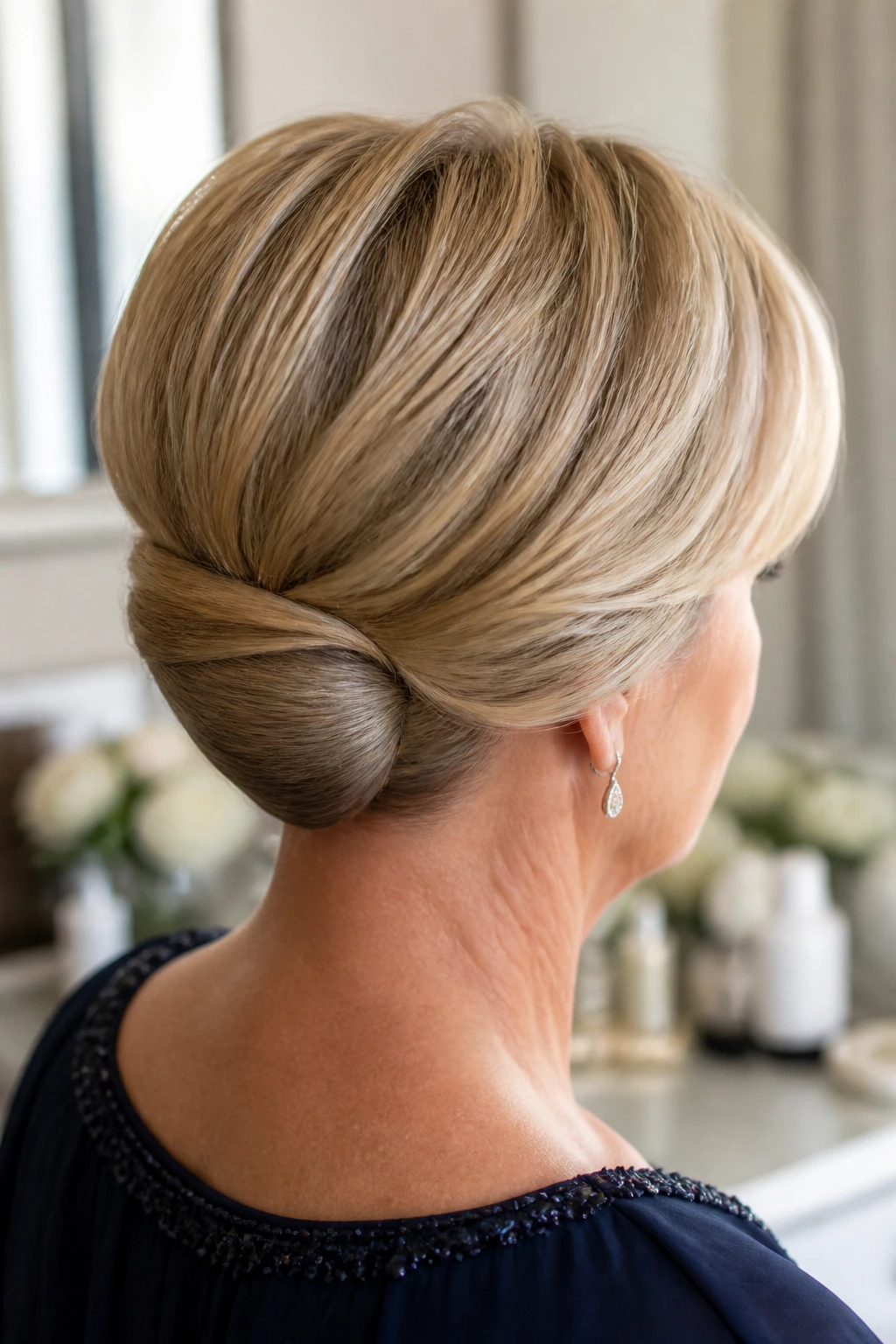
A low rolled tuck is the kind of style people see and assume took far longer than it did. The hair is rolled inward at the nape, pinned flat, and left smooth through the top so the silhouette stays neat. On short hair, it can mimic the look of a mini chignon without needing real length.
This is one of the best choices for high necklines and jackets because the hair stays below the collar line. The pins should go in crisscrossed, with the open end facing the direction of tension; that’s what keeps the tuck from slipping when you turn your head.
If your hair is layered, leave the shortest front pieces a little loose around the face. That softens the style and keeps it from looking severe. A small amount of shine spray can help, but keep it off the roots if your hair is fine.
The result is understated in the best sense. It looks tidy from every side. That matters when you’re being photographed from three feet away all evening.
17. Airy Curled Shag with Face-Framing Pieces
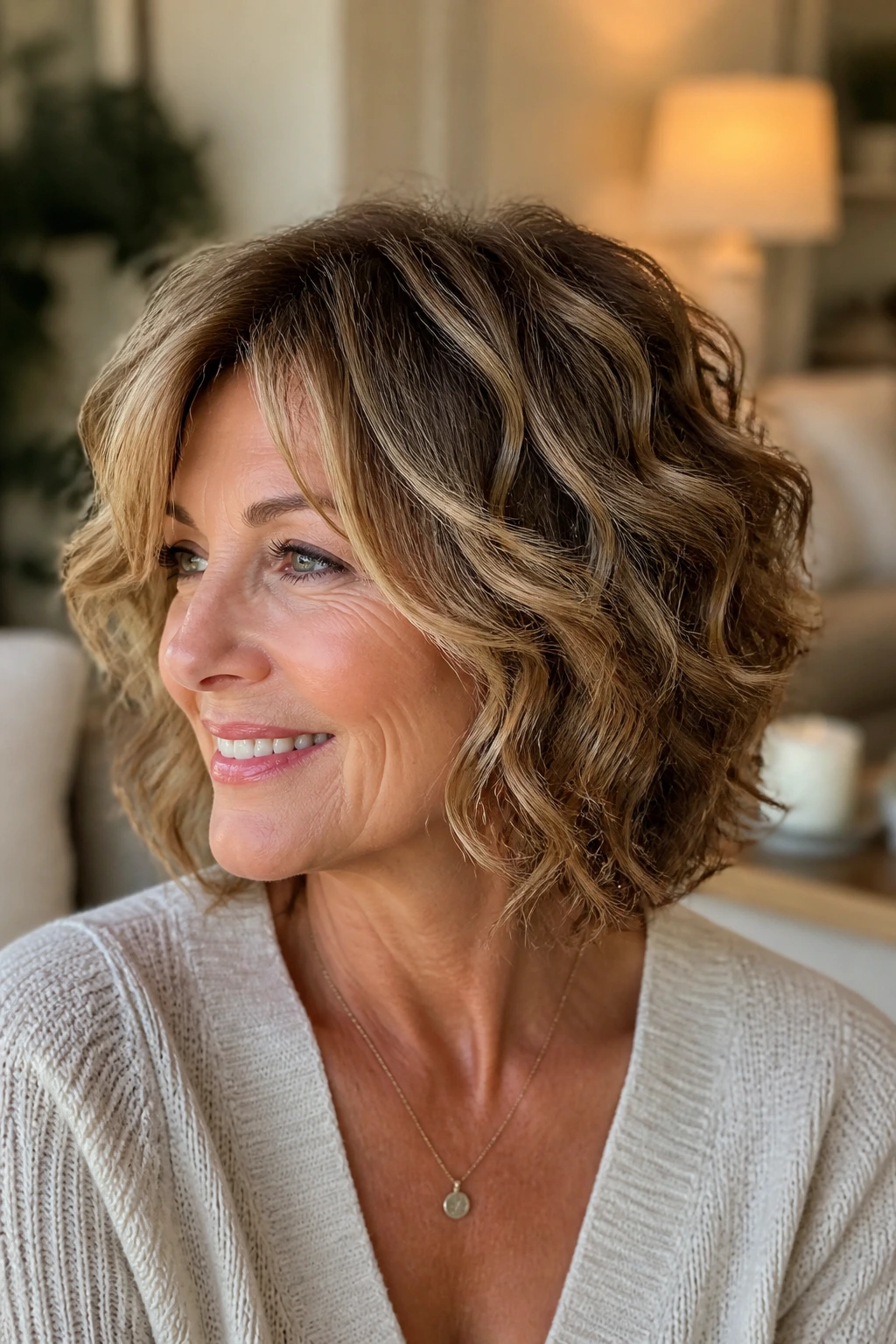
A shag cut does not need to be smoothed into obedience for a wedding. In fact, that often ruins the point of the cut. Airy curls through the body, with the front pieces left a little softer and more open, make the style feel alive and flattering.
This works especially well if your hair already has a natural bend. Use a small wand or iron to encourage the pieces, then separate them with fingers rather than a brush. A light mist of flexible spray beats a heavy lacquer here because the layers need movement.
The face-framing bits are the part I’d protect most. Keep them glossy and soft around the cheekbones, then let the rest of the cut carry more texture. That contrast is what keeps the shag looking modern.
It’s a good pick for a less rigid wedding outfit or a dress with a relaxed neckline. If the whole event feels warm and lively, this style fits that mood without seeming casual.
18. Smooth Rounded Bob with a Subtle Bend
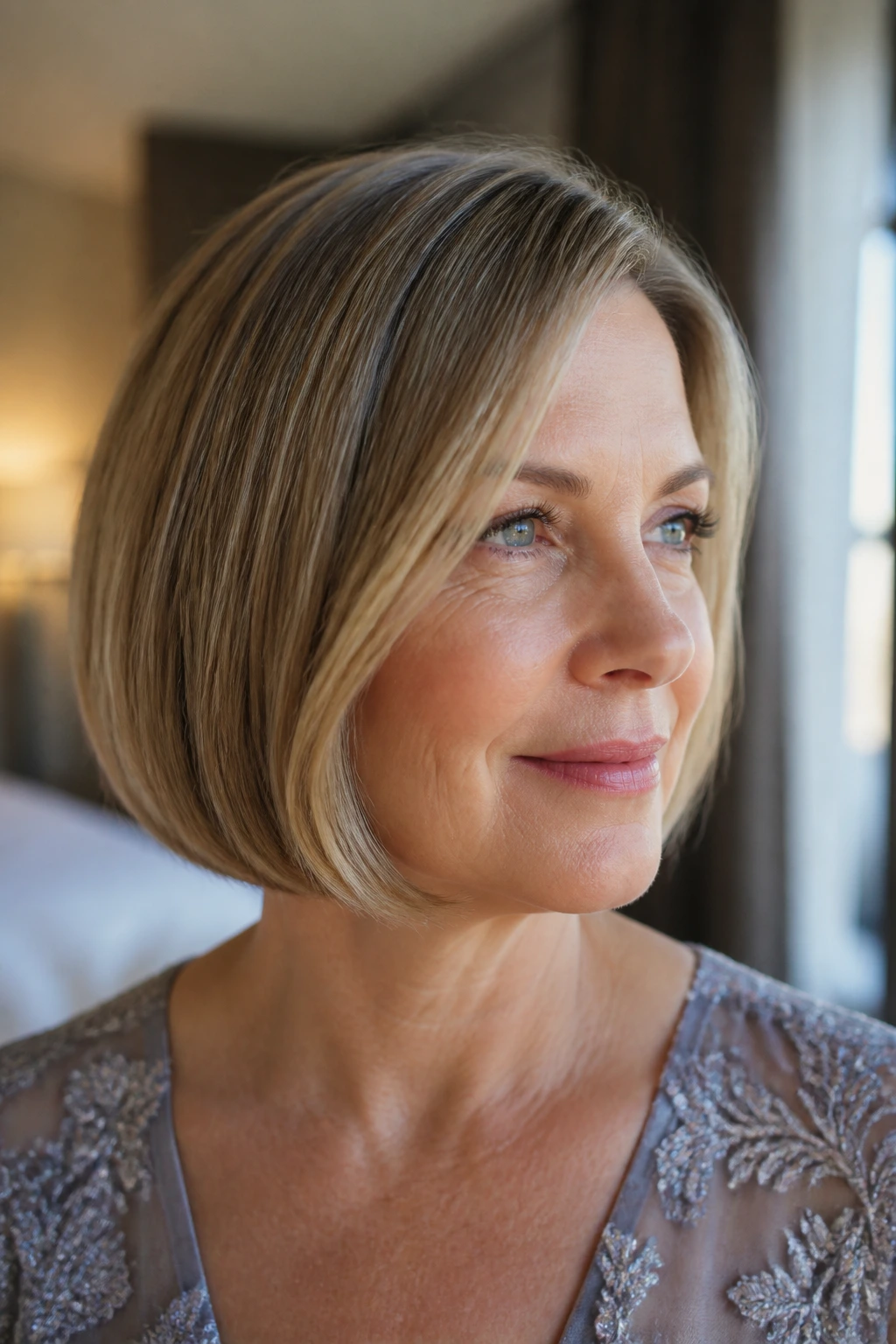
A rounded bob with a subtle bend is one of the most elegant short styles because it doesn’t ask for attention. It simply sits well. The line curves inward around the jaw, the top stays smooth, and the ends do enough to show shape without curling into a hard shape.
This is the haircut-style style, if that makes sense. It looks best when the blow-dry is clean and the finish is glossy. A medium round brush and a careful pass with the dryer under the ends are enough if your cut already has good shape.
Why I trust this one
It works with nearly any dress neckline and keeps the profile neat in photos. It also ages well across the evening; even if the volume drops a little, the silhouette stays intact. That’s more useful than a style that starts dramatic and then turns plain.
If the hair is naturally straight, this can be the easiest option on the list. If it’s naturally wavy, you’ll need to smooth the surface more carefully so the curve doesn’t break.
19. Twisted Side Sweep with a Hair Comb
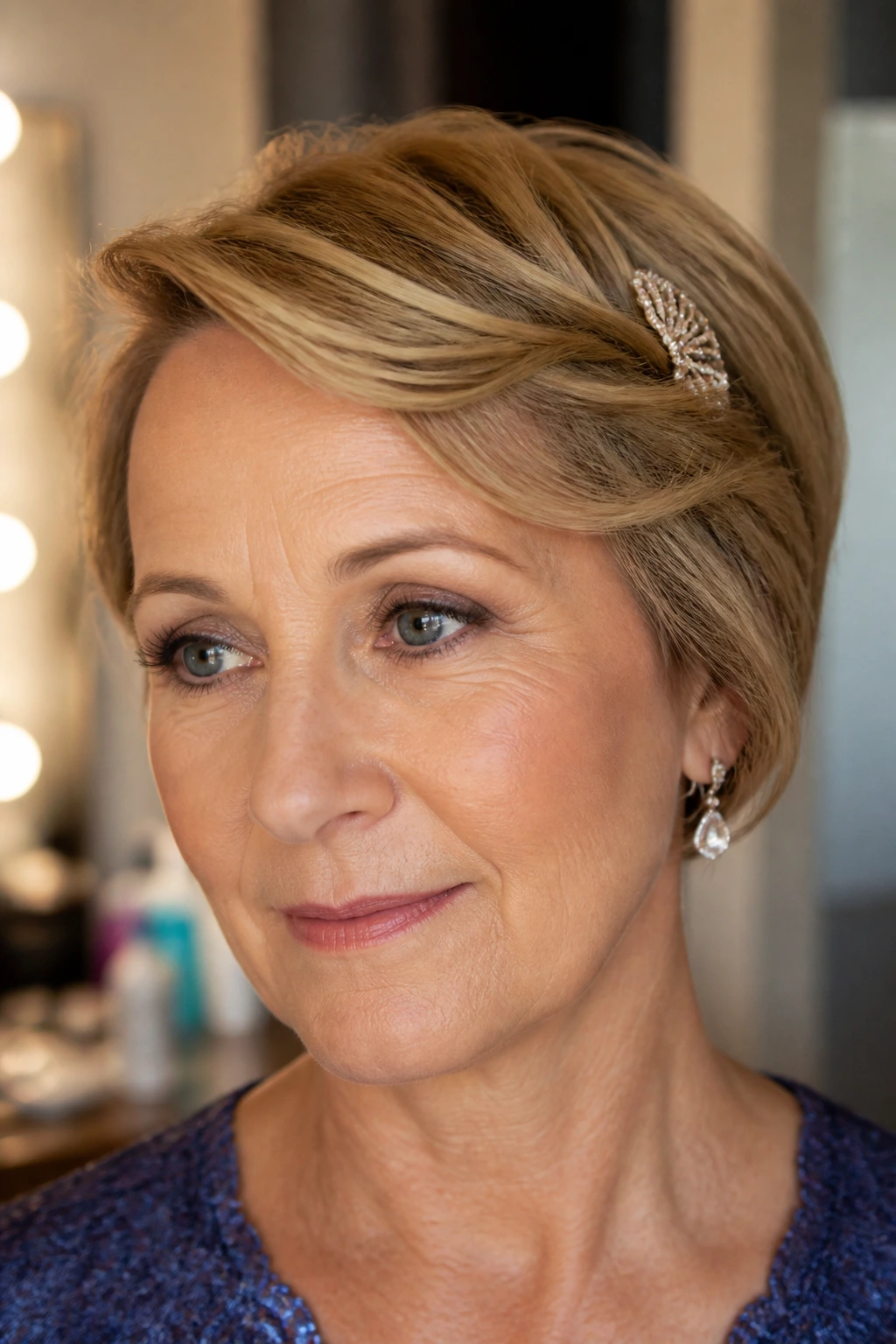
A twisted side sweep is the hairstyle version of a good edit. You gather a front section or two, twist them back toward one side, and secure them with a comb or decorative pin. The remaining hair falls in a controlled line, and the face stays open.
This works especially well on second-day hair because the texture gives the pins something to hold. It also suits bob-length cuts that won’t stay tucked behind the ear on their own. Use the comb as an anchor, not just decoration — slide it into the twist and then pin underneath if needed.
The twist can be loose and romantic or tighter and cleaner, depending on the dress. If the outfit has beading or embroidery, I’d keep the hair calmer. If the outfit is plain, the comb can do more visual work.
It’s a very practical choice for a long wedding day. You can refresh the twist by tightening one pin and smoothing the top layer with a little serum.
20. Glossy Wet-Style Pixie
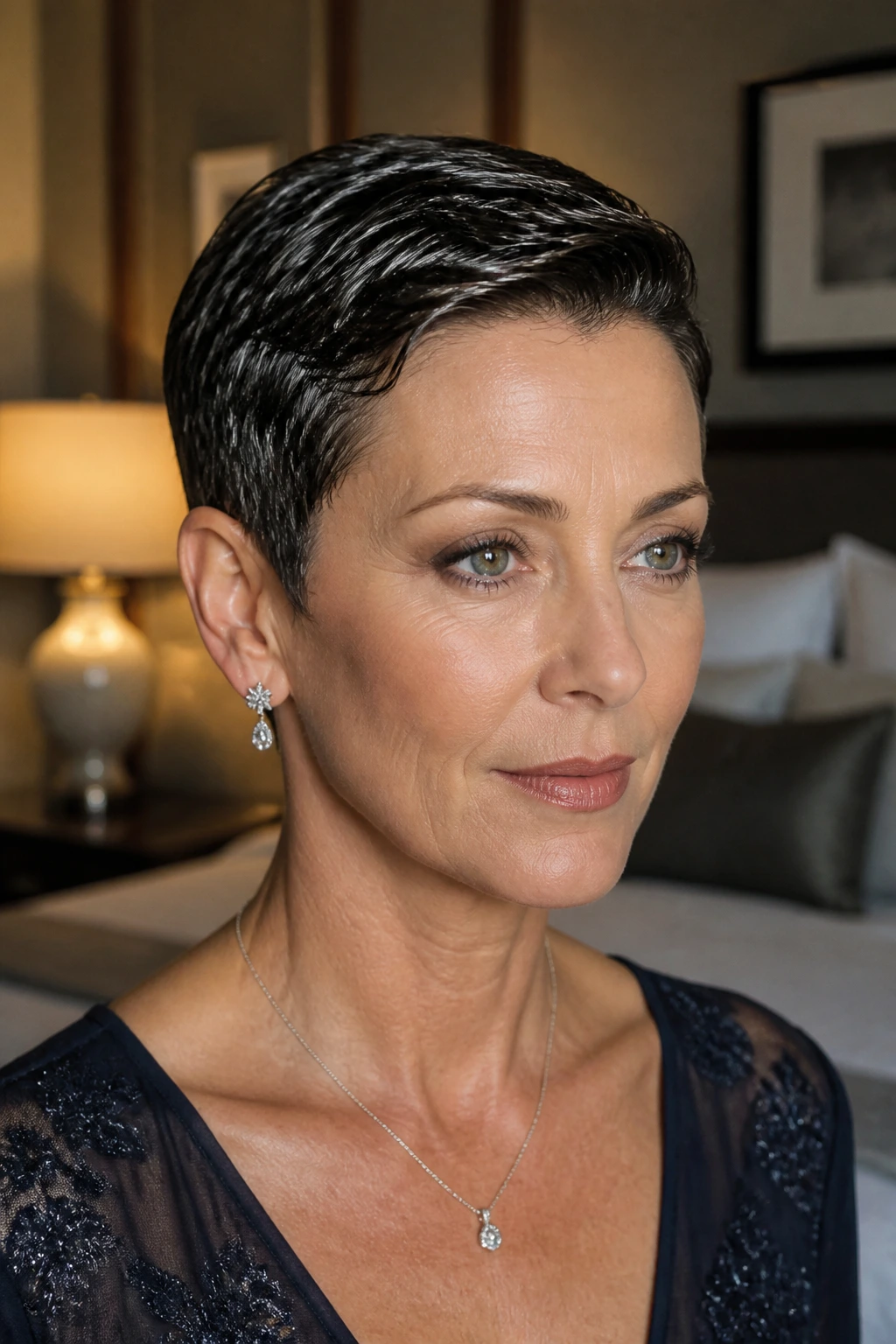
A glossy wet-style pixie is not for everyone, and that’s exactly why it can look so good when it fits. The hair is combed back or to the side with gel or pomade, the finish is shiny, and the shape stays close to the head. It has edge, but it also has discipline.
This style loves a sharp outfit. Think sleek necklines, tailored jackets, or a dress with very little fuss. Use less product than your instinct tells you; start with a dime-sized amount, build slowly, and stop once the hair looks glossy rather than soaked.
The real risk is overdoing it. Too much gel and the style shifts from polished to sticky. Too little, and the piecey sections fall apart. You want a controlled sheen, not a shine that looks like you ran in from the rain.
If you wear this to a wedding, the makeup can be soft or bold. The hair already makes a statement, which is half the appeal. It doesn’t need any extra help.
21. Chignon Illusion for Short Hair
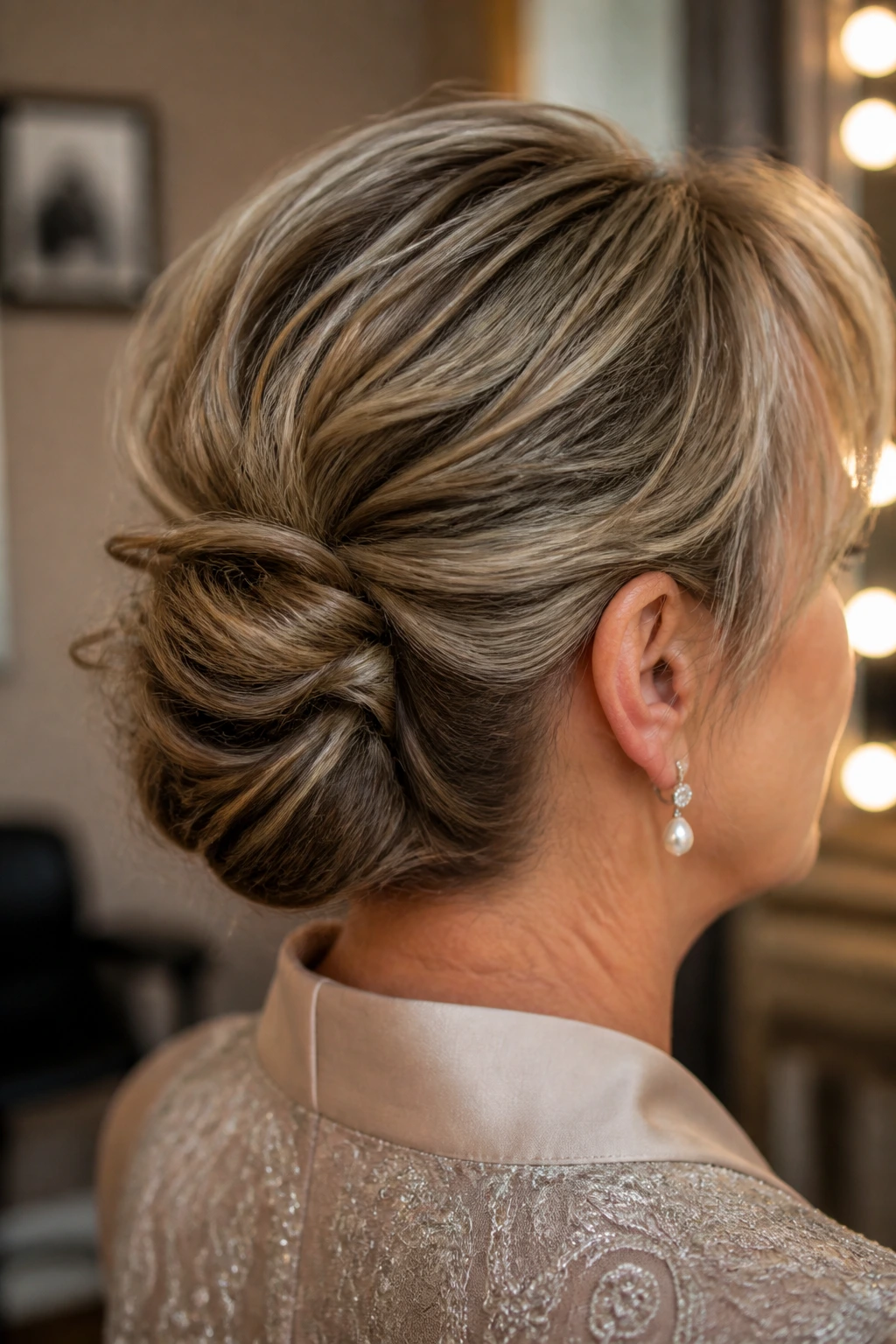
A chignon illusion is what happens when short hair borrows the spirit of a low bun without pretending it can be a real one. The ends are rolled, tucked, and pinned close to the nape until the silhouette suggests a knot or compact coil. It’s tidy, elegant, and smarter than most people expect.
This is a very good option for hair that reaches the collarbone or sits just above it. The illusion depends on small sections and patient pinning, not on brute force. A few flat pins and one or two U-pins often hold better than a dozen bobby pins jammed in at random.
The shape works well with structured dresses and with outfits where the back of the neckline matters. It also keeps the hair from competing with a veil edge or a jacket collar.
If the ends are a bit slippery, rough them with dry shampoo before you start. That simple move gives the pins something to catch.
22. Romantic Pin-Curled Finish
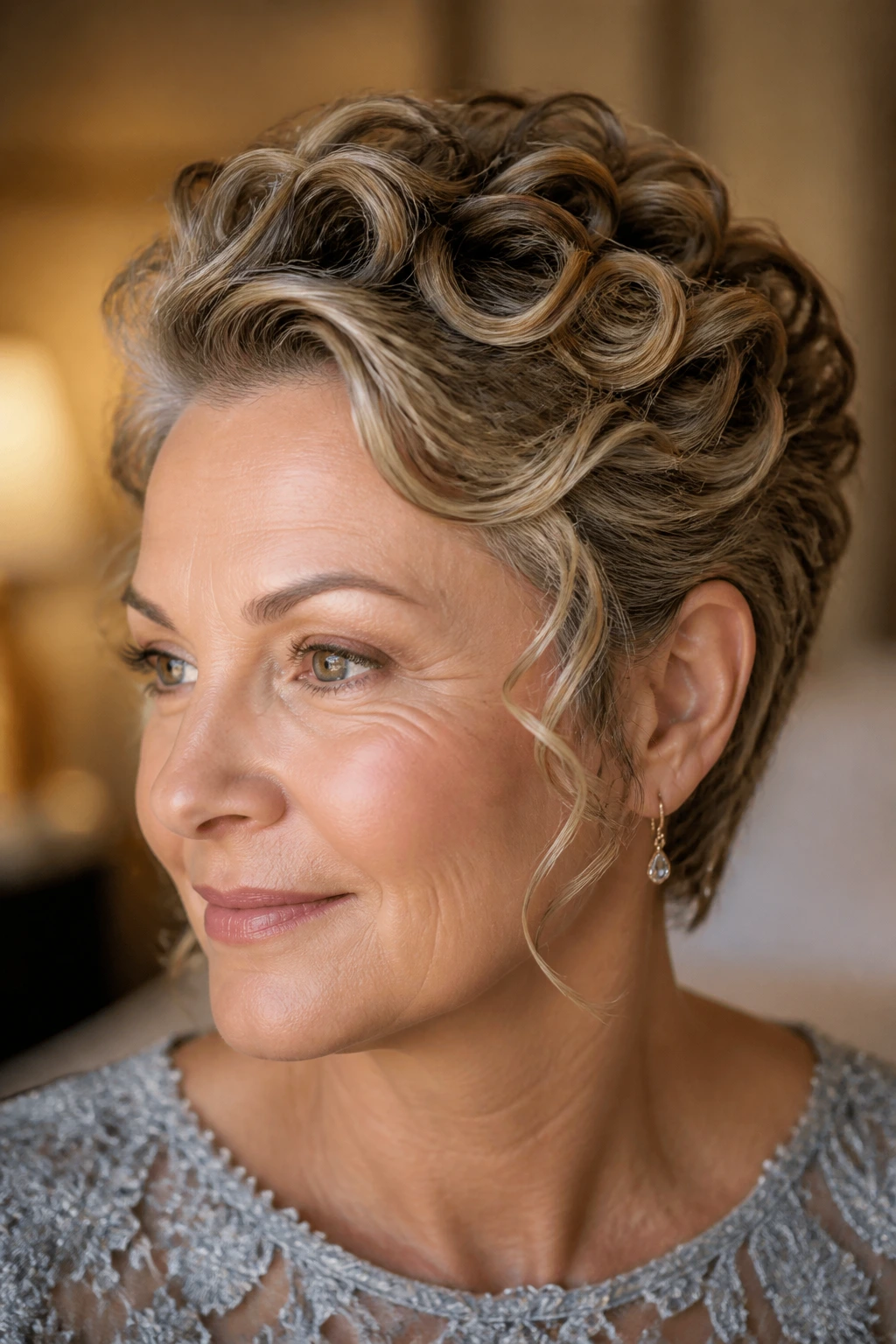
Romantic pin curls feel especially right for short hair because they turn a modest cut into something visibly deliberate. The hair is set in small loops or curls, cooled, and then brushed lightly so the wave pattern stays soft. It has texture, but not chaos.
I like this one for fine hair and for cuts with a little layering around the face. It creates body without needing a huge amount of length. The curls should be pinned while they cool for at least 10 minutes if you want them to hold their shape and not collapse into a limp wave.
How to wear it well
Leave a couple of pieces loose around the temples if you want the style to feel gentler. If you want it more formal, keep the front secure and let the ends follow the curve of the head. That tiny choice changes the entire mood.
This is one of those styles that can look soft from across the room and detailed up close. That’s a nice thing to have on a long wedding day.
Why Mother of the Groom Hairstyles for Short Hair Hold Their Shape
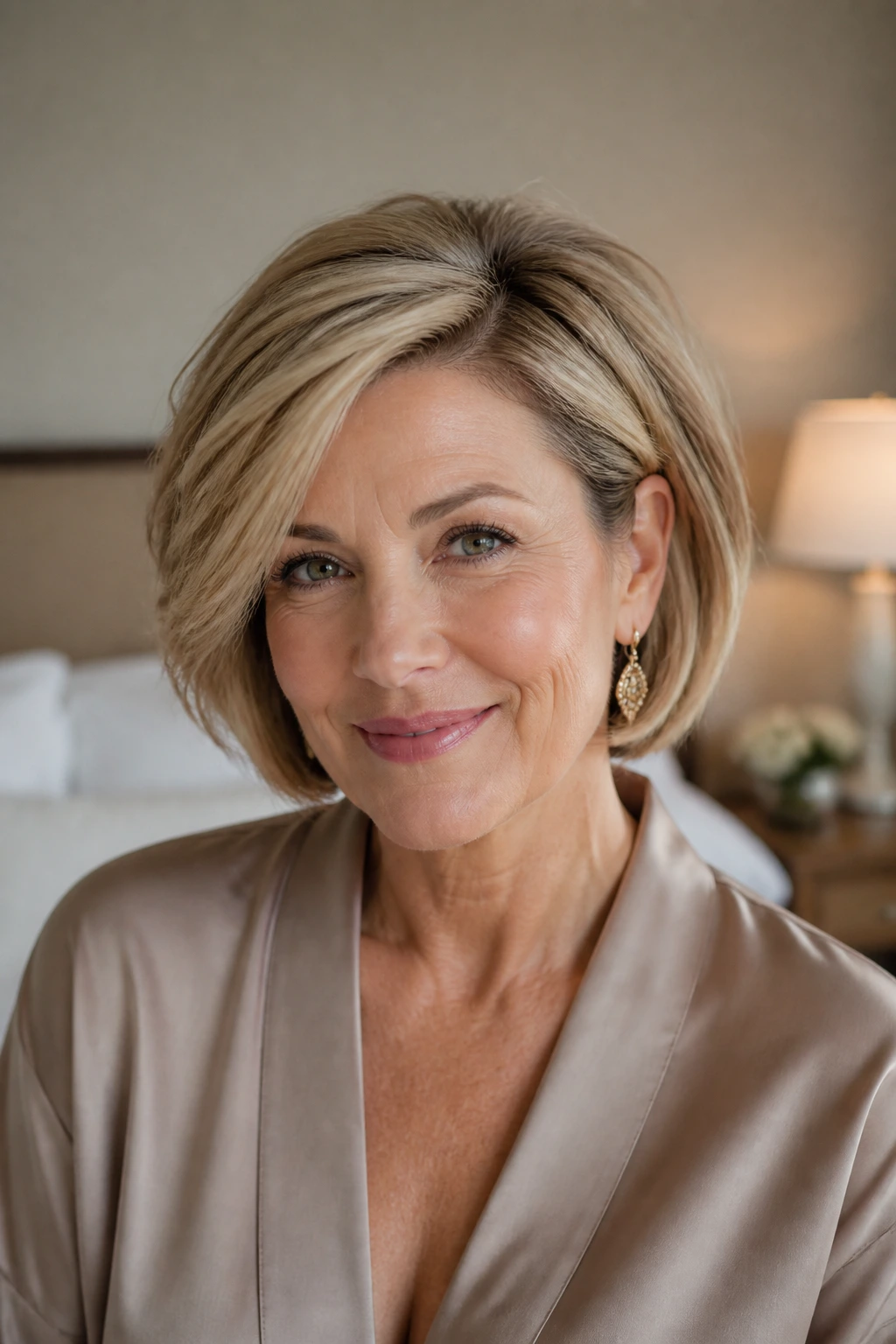
Short hair behaves better when it has a plan. That sounds obvious, but the difference between a polished style and a fussy one usually comes down to three things: where the roots are lifted, where the ends are directed, and how much product sits on the hair. If those three details are balanced, the style holds. If they’re not, the cut starts arguing with itself.
The groom’s mother usually has a different styling problem than the bridal party. She wants enough formality to feel dressed for the day, but not so much that the hair becomes the whole conversation. Short cuts make that easier. They can be tidy, graceful, and comfortable all at once, which is more useful than any trend-driven hair trick.
The other reason these styles work is that they keep the face open. You see the smile, the earrings, the neckline, the expression. That matters in family photos, where the camera catches every line and every piece of jewelry at once. A well-shaped short style can make the whole outfit feel considered.
Essential Tools for These Looks
-
1-inch curling iron or wand — Best for soft bends, barrel curls, and brushed-out wave patterns on bobs and lobs.
-
1.25-inch curling iron — Better for Old-Hollywood waves and looser sculpted movement when you do not want tight spirals.
-
Flat iron with rounded edges — Useful for sleek bobs, flipped ends, and smoothing a pixie without harsh lines.
-
Blow dryer with concentrator nozzle — Helps direct volume at the crown and keeps the finish smoother through the mids and ends.
-
Small round brush, 1.5 to 2 inches — Ideal for blowout bobs and rounded shapes around the jaw.
-
Fine-tooth comb — Necessary for finger waves, smooth side parts, and any style that needs a clean line.
-
Bobby pins and U-pins — U-pins hold rolled tucks and faux-bob shapes better than people expect; bobby pins do the day-to-day anchoring.
-
Duckbill clips — Handy for setting wave patterns and cooling sections in place while they hold their shape.
-
Mousse or root-lift spray — Gives fine hair enough grit to hold a crown lift or a twist without collapsing.
-
Texturizing spray — Helps layered cuts, pixies, and second-day styles keep a little separation instead of going flat.
-
Flexible-hold hairspray — Better for movement-heavy styles; it supports the shape without making the hair crunchy.
-
Shine serum or smoothing cream — Best used sparingly at the ends and temples to stop flyaways from stealing attention.
-
Decorative comb, clip, or slim headband — The right accessory can rescue a simple short style and make it feel formal in one move.
Smart Product and Shopping Tips
If your hair is fine, keep weight off the roots. Heavy creams, rich oils, and too much conditioner can make a bob slide flat before the ceremony even starts. Choose mousse or root spray for lift, then use the cream only on the last inch or two of the hair. That’s enough to tame frizz without killing shape.
Thicker hair needs a different hand. A smoothing lotion before blow-drying helps the brush move through the sections, and a stronger spray on the finished shape keeps the style from puffing up when the temperature changes. If the hair is coarse or naturally dry, a little shine serum on the outer layer can make it look much better under indoor lighting.
Accessories deserve real thought. A pearl clip looks soft against lace. A crystal comb can be too bright if the dress already has beading. A matte metal pin often works better with tailored clothes because it doesn’t fight the fabric. Buy one accessory that has enough visual weight to show up in photos, not five tiny things that disappear from three feet away.
And buy extra pins. Seriously. A wedding day eats bobby pins faster than anyone expects.
How to Match the Hair to the Dress, Jewelry, and Photos
Dress Necklines: High necks and jackets usually look best with tucked styles, smooth bobs, or a low roll that clears the collar. Strapless and off-the-shoulder dresses can take more crown height, side sweep, or soft movement around the face because the hair has room to breathe above the neckline.
Jewelry: If the earrings are the star, keep one side tucked or swept back so the metal can show. If the necklace is doing the work, avoid heavy hair at the collarbone; a smooth bob or a low tuck lets the necklace sit cleanly instead of fighting a stray curl.
Photos: Front-facing pictures reward crown lift and a soft side part. Side shots reward a clean tuck behind the ear or a shape that shows the jawline. Back-of-head photos care about pin placement more than anything else, so hide the anchors and keep the finish smooth where the camera will catch it.
Venue and weather: Outdoor ceremonies need a little more grip than ballroom hair. If there’s wind, choose a tighter silhouette, more pins, and less loose curl. The style can still be soft. It just needs a backbone.
Small Tweaks That Make the Style Look Finished
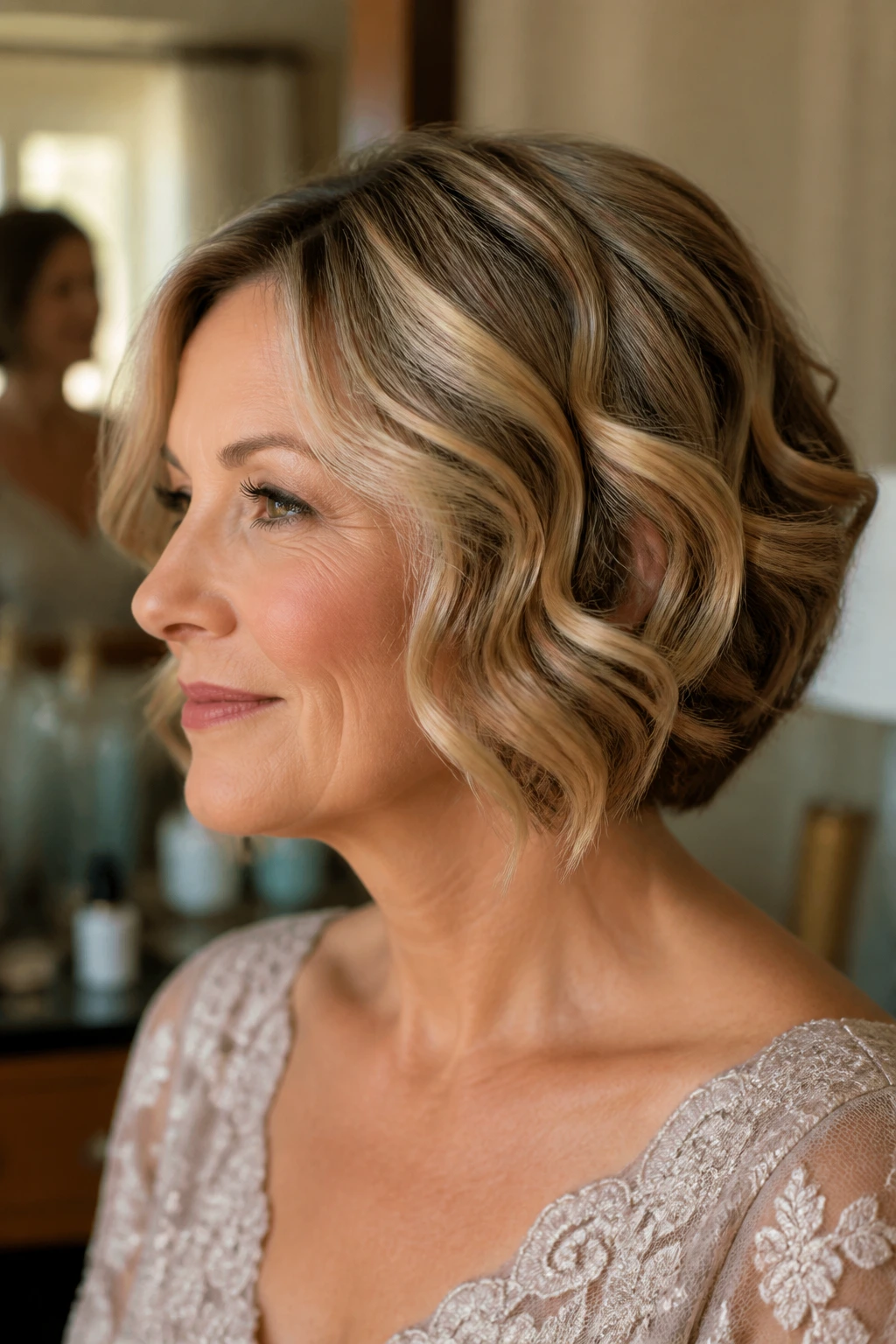
Root Lift: A small strip of root-lift spray at the crown gives short hair more shape than adding product everywhere. Lift the section with your fingers, spray under it, and blow-dry it upward for a few seconds.
Texture Control: If the hair is too soft to hold, rough-dry it first and set a few sections around a roller or clip until they cool. That extra memory helps a bob keep its line after you walk outside or sit through dinner.
Accessory Placement: Put clips slightly above the ear or a bit off-center, not dead in the middle of the head. Off-center placement looks more natural and avoids the “sitting on top” problem that cheap accessories often create.
Finish: A pea-sized amount of serum warmed between the palms and smoothed only over the ends can fix flyaways without flattening the style. Use more on coarse hair, less on fine hair. The line matters.
Common Mistakes to Avoid
The most common mistake is using too much product too early. When hair is drenched in spray or cream before the shape is set, it stops moving, then falls in a heavy lump. Start light. Add more only where the style needs support, and keep shiny products away from the roots if your hair is fine.
Another easy error is choosing a style that fights the cut. A chin-length bob can’t always become a low chignon. A very short pixie can’t always hold a soft roll at the nape. If the pins have to work like machinery, the hairstyle is probably asking too much. Pick a style that uses the length you have instead of arguing with it.
Accessory placement trips people up too. A comb that sits too low can look accidental. A headband that sits too far forward shortens the face. A clip shoved into the back without a clear part can look like a fix, not a choice. Place the accessory where it changes the silhouette.
Skipping a trial run is the mistake that causes the most stress. You do not want to discover on the wedding morning that your bangs split wrong or your crown collapses when you laugh. Test the style once, take side photos, and see how it behaves after an hour.
And do not brush out waves before they cool. Warm hair forgets its shape fast.
Variations and Adaptations to Try
Humidity-Guarded Finish: If the ceremony is in damp air, set the style with a stronger spray at the end and pin any loose sections for ten extra minutes before removing the clips. A slightly tighter shape will usually survive the weather better than soft, airy curls.
Fine-Hair Lift: For fine hair, choose styles that depend on root lift, tuck, or accessory support rather than heavy curl. Mousse, dry shampoo, and a small round brush give more body than thick creams ever will.
Thick-Hair Control: Thick hair benefits from cleaner lines and smaller sections. Smooth bobs, low rolls, and tucked styles usually look better than loose wave styles because they keep the shape from expanding as the day goes on.
Natural Curl Version: If your short hair already curls, work with the pattern instead of flattening it. Define a few pieces with cream or gel, pin one side back, and let the rest keep its natural bend. That usually looks more graceful than forcing a straight finish.
Hat or Fascinator Version: If the outfit includes a hat, fascinator, or statement headpiece, keep the crown lower and the sides smoother. A tucked bob, side sweep, or cropped shape with a clean part lets the accessory sit securely without competing with the hair.
Make-Ahead, Holding, and Touch-Up Guidance
Short wedding styles usually hold best when the hair is washed the day before, not the morning of. Freshly washed hair can be too slippery, especially if it’s fine or straight. A little natural oil gives pins and product something to grip, which is one of those dull little truths that saves the whole style.
If your hair gets greasy fast, wash it the morning of and dry it fully before styling. If it’s very dry or coarse, the night-before wash often helps the cuticle lie smoother. Either way, let the hair cool completely after styling. Rushing the cool-down is how curls fall and rolls loosen.
For hold during the event, keep a tiny touch-up kit nearby: a few bobby pins, a travel spray, a comb, and a slim tissue or blotting paper for the forehead. If the style starts to separate at the sides, smooth the section with your hands first, then pin. Don’t keep layering spray over a problem spot. That usually makes it worse.
Overnight prep can help if there’s a rehearsal dinner or an early start. A loose pin-curl set or a clipped crown twist can be worn under a silk scarf and refreshed the next morning with a quick re-heat or brush-out. Short hair also tends to recover well from light pinning, so use that to your advantage.
The best styles here do not need to survive a hurricane. They need to survive greetings, photos, a meal, and a little dancing. That’s a much better test.
Frequently Asked Questions
What is the easiest short hairstyle for the mother of the groom?
A side-parted bob with a soft blowout is usually the easiest place to start. It works with most hair textures, takes less pinning than an updo, and can be refreshed quickly if a section falls flat.
Can a pixie cut look formal without extensions?
Yes, and honestly, a well-shaped pixie often looks sharper than a forced long style. Crown lift, a clean fringe, and one accessory like a comb or headband are usually enough to make it feel dressed for the day.
Should I wash my hair on the day of the wedding?
Not always. Hair that was washed the day before often holds pins and curls better, but very fine or oily hair may need a same-day wash. The goal is grip, not squeaky cleanliness.
How do I keep short hair from going flat during the reception?
Use root lift at the crown, cool the style fully before leaving, and carry a few pins plus travel spray. If the hair starts to lose shape, lift the roots with your fingers first, then pin or mist only the area that needs support.
What if my hair is too short for an updo?
Choose a rolled tuck, side sweep, faux bob, or tucked bob instead. Those styles borrow the feel of an updo without requiring the length that a real chignon needs.
Can I wear a headband or comb with short hair?
Absolutely. In short hair, an accessory can carry more of the visual weight than it does on longer hair. Just make sure it’s anchored well and sized to the cut, not so large that it swallows the style.
Which styles work best with glasses?
Smooth bobs, tucked sides, soft pixies, and crown-lifted crops usually sit well with frames. Avoid bulky side volume right where the glasses arms rest, or the whole look starts to feel crowded.
How far ahead should I get a trim?
Usually one to two weeks before the wedding is safest. That gives the cut time to settle and keeps the outline fresh without leaving it so new that tiny slip-ups show more than they should.
Will humidity ruin a short formal style?
It can soften the shape, but it doesn’t have to ruin anything. A slightly tighter set, a flexible but firm spray, and a style with a clear outline — like a tuck, bob, or wave pattern — will handle moisture better than loose, over-brushed curls.
What if one side keeps flipping out?
Pin that section while it cools, then remove the pin and mist lightly. If the flip keeps coming back, it’s probably the cut itself, not your styling, so work with the bend instead of trying to erase it.
A Calm, Polished Finish
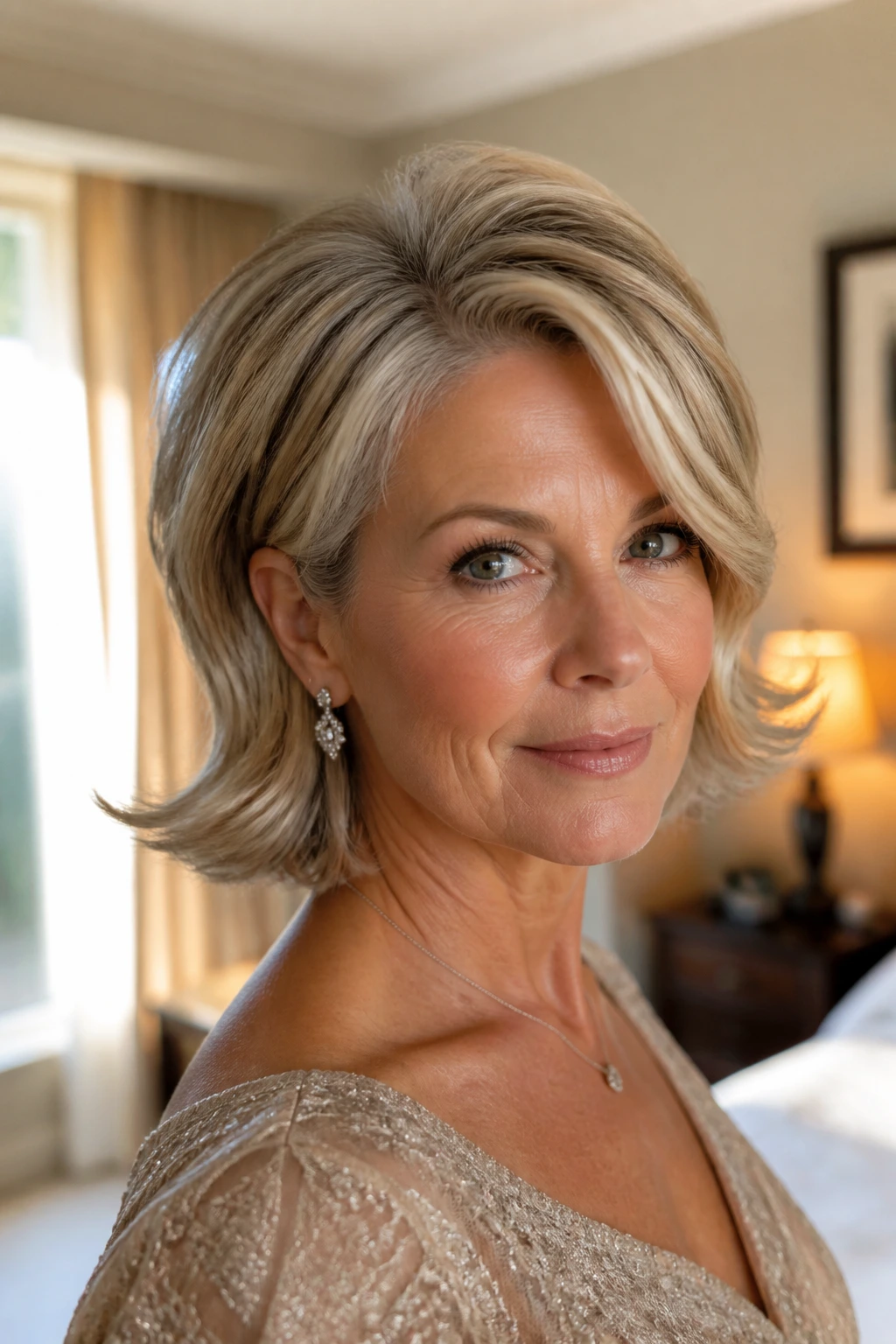
Short hair has a nice advantage at a wedding: it tells on itself. If the part is right, if the crown has shape, if the ends are clean, the whole look feels composed without a lot of drama. That’s a gift on a busy day.
Pick the version that fits the neckline, the jewelry, and the way you actually move. A groom’s mother does not need a style that behaves like a costume. She needs one that looks good at the first greeting, the family photos, and the last round of hugs.