



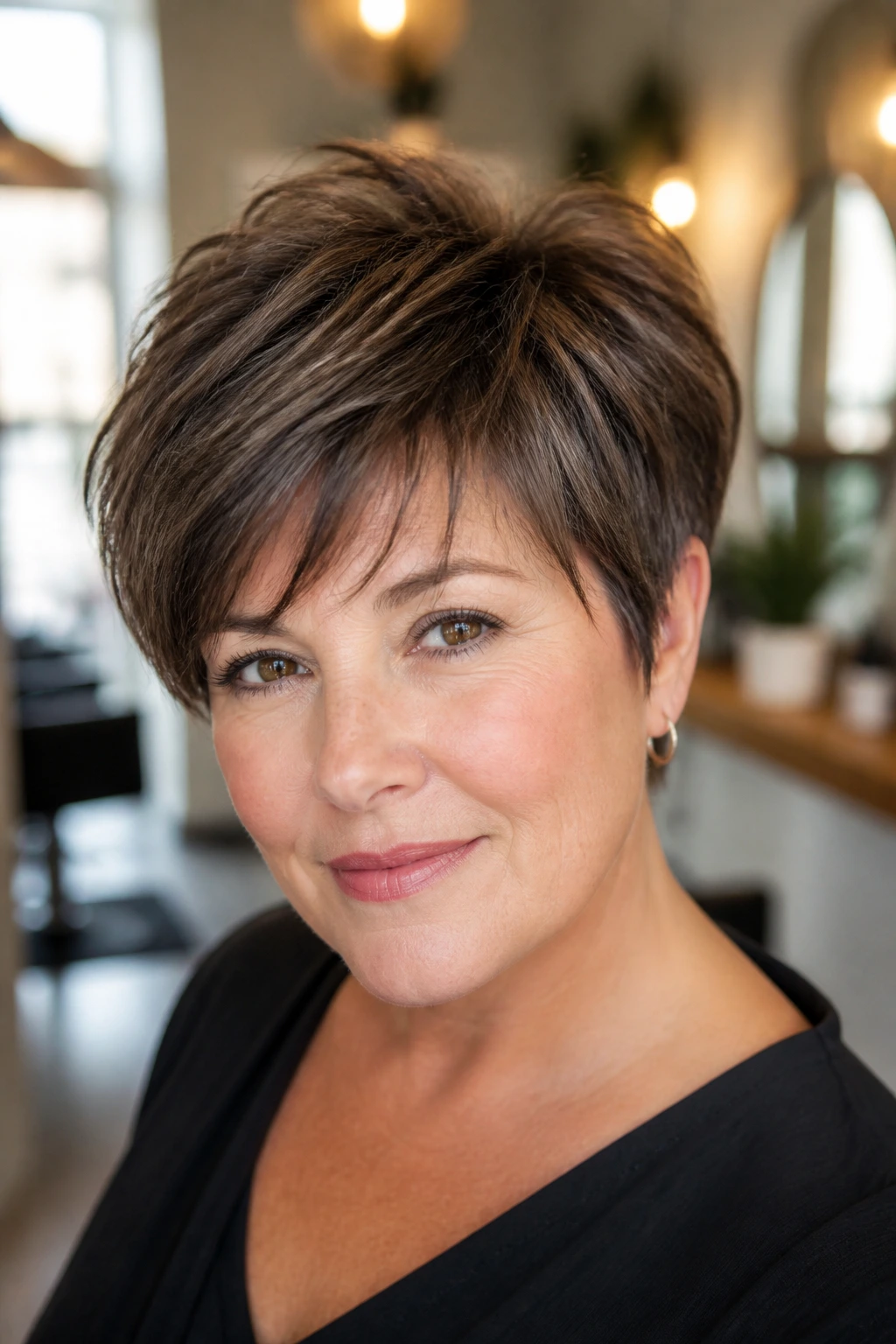
Pixie cuts for round faces and thick hair can look sharp, playful, or quietly elegant — but only when the cut knows where to put the weight. Too much width at the cheeks and the face reads broader. Too much bulk through the crown and the whole shape turns boxy, like the hair is wearing the haircut instead of the other way around.
Thick hair changes the conversation. It can hold a short cut with real structure, but it also has a habit of pushing outward at the temples, swelling at the nape, and swallowing detail if the layers are lazy. A good pixie for dense hair removes weight inside the shape, keeps the sides lean, and leaves just enough length on top to create lift instead of helmet.
Round faces usually need a little line and a little contrast. A side sweep. A tapered sideburn. A fringe that lands at the eyebrow or cheekbone instead of stopping dead across the middle of the face. None of that means hiding your features. It means giving them edges. And the cuts below do that in different ways, from soft and wearable to bolder and more sculpted.
Why These Pixies Earn Their Place
-
Crown lift: Short styles with height at the top pull the eye upward, which keeps a round face from reading too wide across the middle.
-
Bulk control: Thick hair needs interior debulking, not just a trim on the ends, or the sides puff out by lunch.
-
Fringe options: Side-swept, feathered, and broken bangs all shift attention away from the widest part of the face without hiding it.
-
Easy shaping: A tapered nape and slim temples make the haircut look intentional even when it grows out a little.
-
Room to style: These pixies can be air-dried, roughed up with paste, or smoothed down with a brush, which matters when your hair has its own opinions.
-
Less daily wrestling: A cut that fits your density behaves better in humidity, on second-day hair, and on mornings when you do not feel like becoming a full-time stylist.
What Pixie Cuts for Round Faces and Thick Hair Need from the Crown
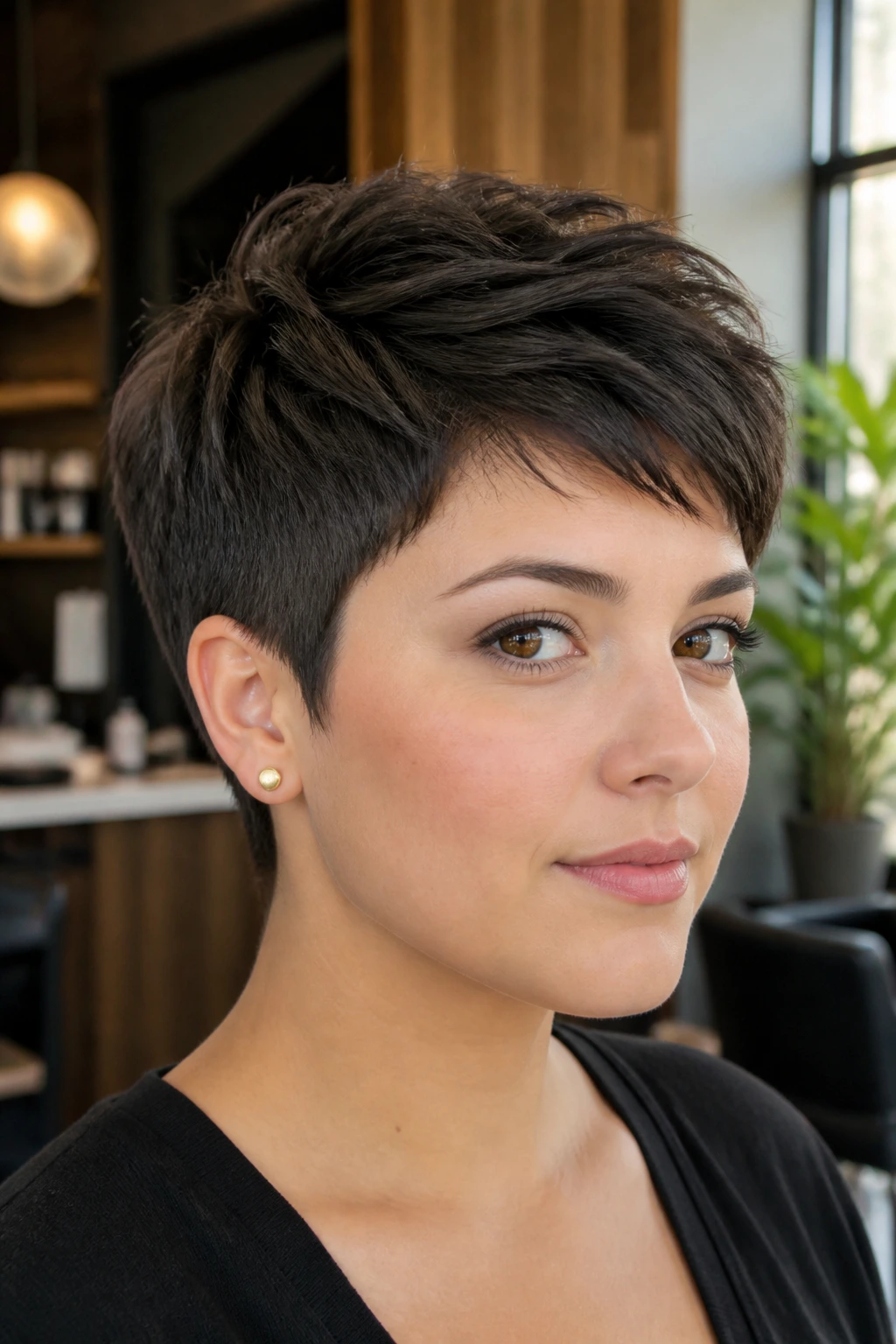
A flattering pixie on this face shape is not about going shorter everywhere. It’s about building a vertical line where the eye can travel upward, then keeping the sides close enough that the face doesn’t look padded out at the widest points. That usually means the top is a little longer than you expect, the temples are trimmed with purpose, and the nape is neat enough that the back never turns into a puff.
Keep the Eye Moving Upward
Round faces look strongest when the haircut leads the eye from the chin area toward the crown. That can happen with 2 to 4 inches on top, a side part, or a soft fringe that angles down instead of sitting straight across. The trick is not dramatic height. It’s controlled height.
Thin the Interior, Not the Outline
Thick hair can lose half its bulk and still look full. That’s because the weight has to come out from underneath, especially around the occipital area and behind the ears. Point cutting, slicing, and careful debulking keep the surface soft while the silhouette stays clean.
Fringe Length Changes Everything
A fringe that ends exactly at the widest part of a round face tends to stop the eye right where you do not want it stopped. A better bet is a broken fringe, a side sweep, or a wispy piece that lands just above or just below the cheekbone. Small shift. Big difference.
1. Classic Tapered Pixie
A classic tapered pixie is the haircut version of a crisp white shirt: nothing loud, nothing fussy, and a lot of shape if it’s cut well. The sides stay close to the head, the nape hugs the neck, and the top carries enough length — usually around 2 to 3 inches — to keep thick hair from reading like one solid block.
Why It Works
The taper is doing the heavy lifting here. It narrows the lower half of the haircut, which matters on a round face because the eye stops lingering at the cheeks and jaw. Thick hair behaves better too, because the bulk gets reduced at the bottom where it tends to flare out first.
This is the cut I’d hand to someone who wants short hair without a lot of styling homework. Blow-dry the top forward, then lift it back with a round brush or your fingers. A pea-sized dab of matte paste is enough. More than that and the shape starts to look sticky.
What to Ask For
- What to use: A tapered nape, close sides, and 2 to 3 inches of length on top.
- Preparation: Bring photos that show the side and back, not just the front.
- Substitutions: If your hair is very curly, keep the top slightly longer so shrinkage does not eat the shape.
- Tips: Ask the stylist to remove bulk inside the crown, not only at the perimeter.
Styling Cue
If your hair sits flat after drying, mist the roots with a little water and rework the top with your fingers. You do not need a full wash. You need movement.
2. Long-Top Pixie
If you want short hair but not a severe chop, the long-top pixie is the safe bet that still looks deliberate. The top stays around 3 to 4 inches, sometimes a bit more at the fringe, while the sides are kept shorter and sleeker so the face doesn’t widen at the temples.
Round faces do well with this shape because the extra length on top creates a vertical line. Thick hair likes it because the top can be sculpted and directed; it has enough body to hold a swoop without collapsing into a flat sheet.
I like this cut on people who tuck one side behind the ear a lot. That tiny habit changes the whole silhouette. It gives the haircut a diagonal line, and diagonal lines are your friend when your face already has a soft, circular shape.
Practical Notes
- Keep the fringe long enough to sweep, not poke straight forward.
- Ask for weight removal through the interior so the crown doesn’t balloon.
- Use a blow dryer with a nozzle and brush the top forward first, then back.
- Finish with a light paste or cream, not a heavy wax.
3. Asymmetrical Pixie
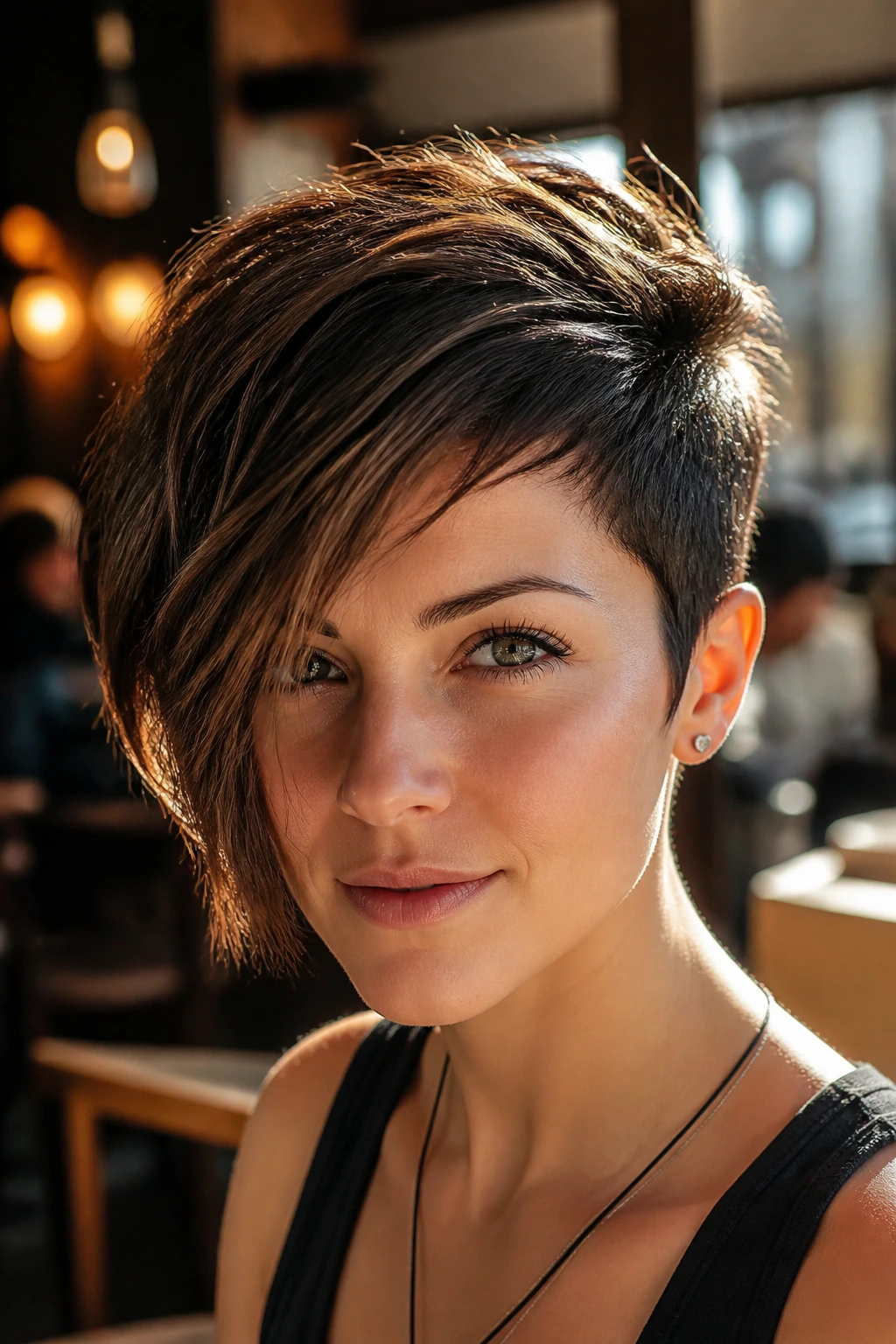
Want the face to look a touch longer without losing the short-cut feeling? Go asymmetrical. One side stays tighter, the other side carries a little more length, usually grazing the cheekbone or slipping just below the ear. It sounds small. It isn’t.
That diagonal line breaks the roundness fast. The eye follows the longer side and stops treating the face like a full circle. Thick hair can handle this beautifully because the density keeps the longer side from looking limp or stringy. You get shape, not scraps.
How to Wear It
A deep side part makes the asymmetry feel even more intentional. If the longer side is the one that falls over the forehead, keep the ends softly texturized so they do not land as one hard block. A little pieceiness matters here. Without it, the cut starts to feel costume-y.
This is a smart pick if you want something with attitude but not full drama. It’s still a pixie. It just has a slant.
4. Choppy Textured Pixie
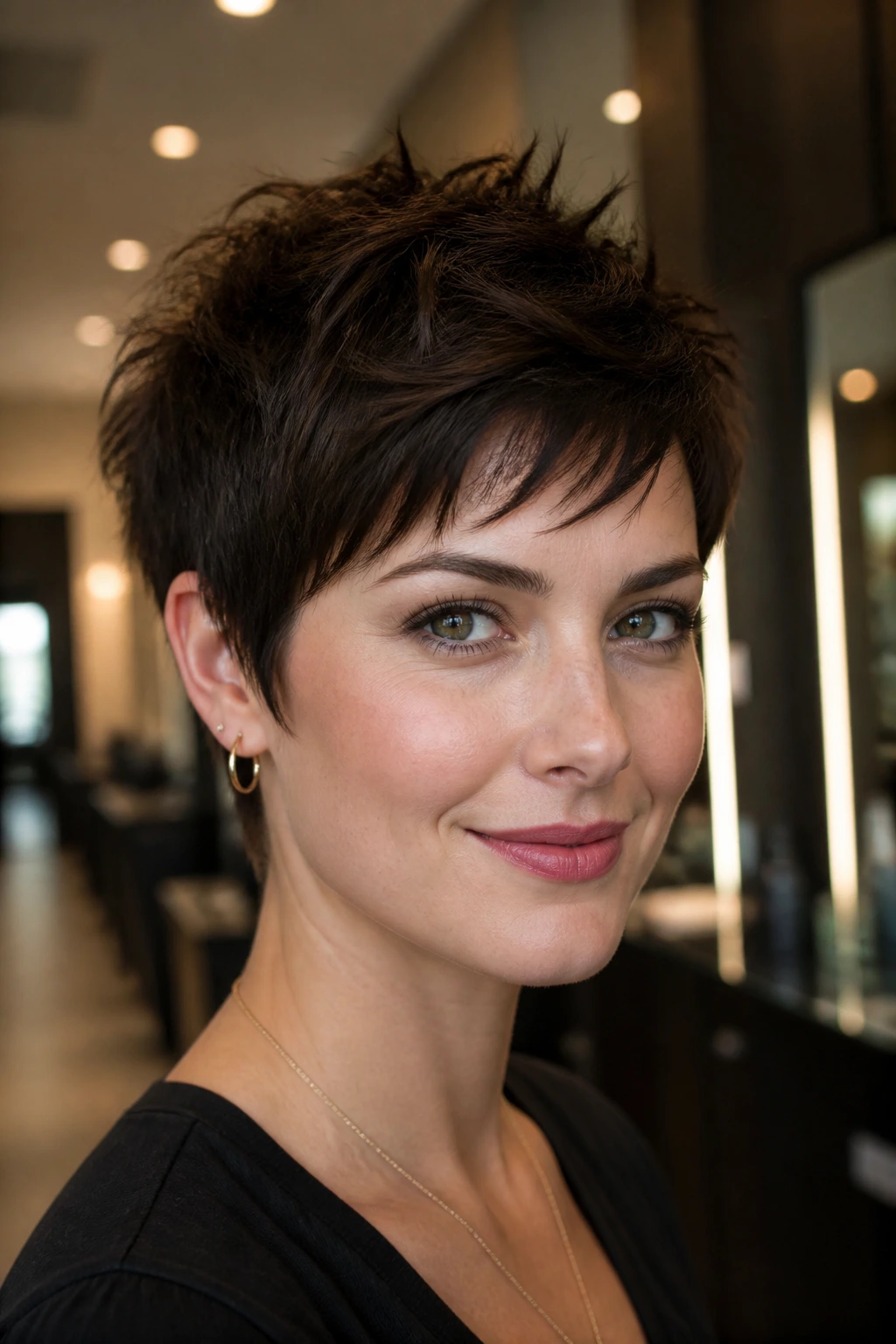
A blunt pixie on thick hair can turn into a little mushroom before you’ve even finished your coffee. Choppy texture fixes that. The ends are broken up with point cutting, the layers are staggered, and the whole style reads lighter because it’s not trying to sit as one smooth shell.
For round faces, the benefit is simple: texture creates interruption. The eye lands on movement instead of width. That means the sides can stay close while the top looks lively, which is exactly the balance thick hair needs. Dense hair often benefits more from shape removal than from length removal, and this cut does both.
What Makes It Different
Why the Texture Matters
The piecey finish keeps the style from looking heavy at the temples. You want separation, not fluff. A dab of matte clay warmed between your palms and pushed through the top is enough to show the layers.
Best For
- Hair that puffs up at the sides
- People who like a messy finish
- Dense straight hair that needs movement
- Anyone who hates a polished, helmet-like outline
5. Curly Pixie with Soft Fringe
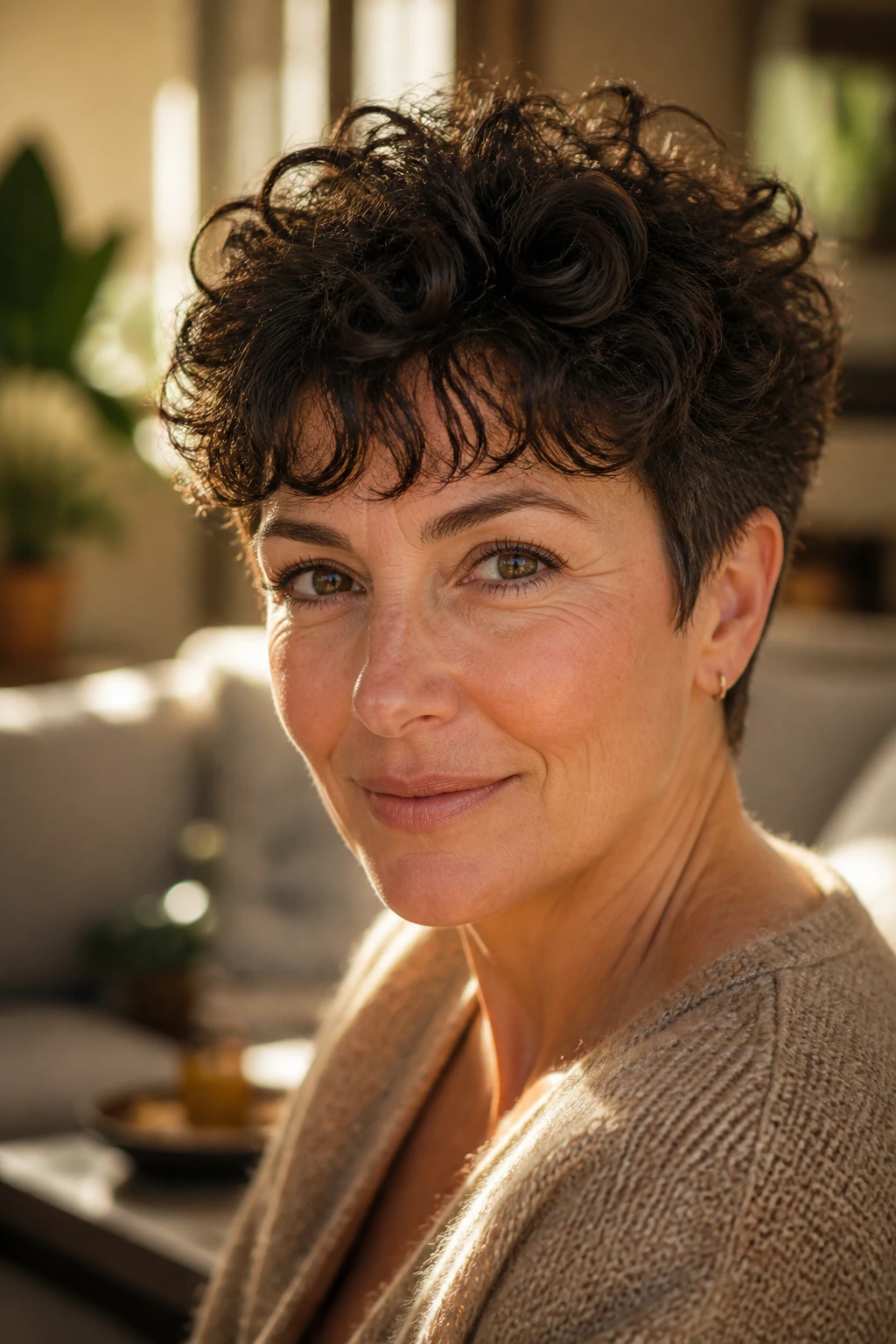
Curly hair and thick hair are not the same thing, but they show up together often enough that this cut deserves its own spot. A curly pixie works on a round face when the curls are given room on top and the sides are tapered in close enough to stop the width from spreading out at cheek level.
Cut this one dry if you can. Wet curls lie to everybody.
A soft fringe keeps the front from turning into a hard shelf. It can land just above the eyebrows or curve off to one side, depending on how much forehead you want to show. The goal is not to flatten the curl pattern. It’s to guide it. That matters more than people think.
A Good Curl Rule
Keep the top slightly longer than you think you need. Curls spring up, especially once they dry. If the stylist cuts too short, the face can end up looking wider because the volume sits too high with nowhere to go.
Use a diffuser on low heat, then stop touching it. Curly pixies get frizzy fast when they’re fussed with after drying.
6. Undercut Pixie
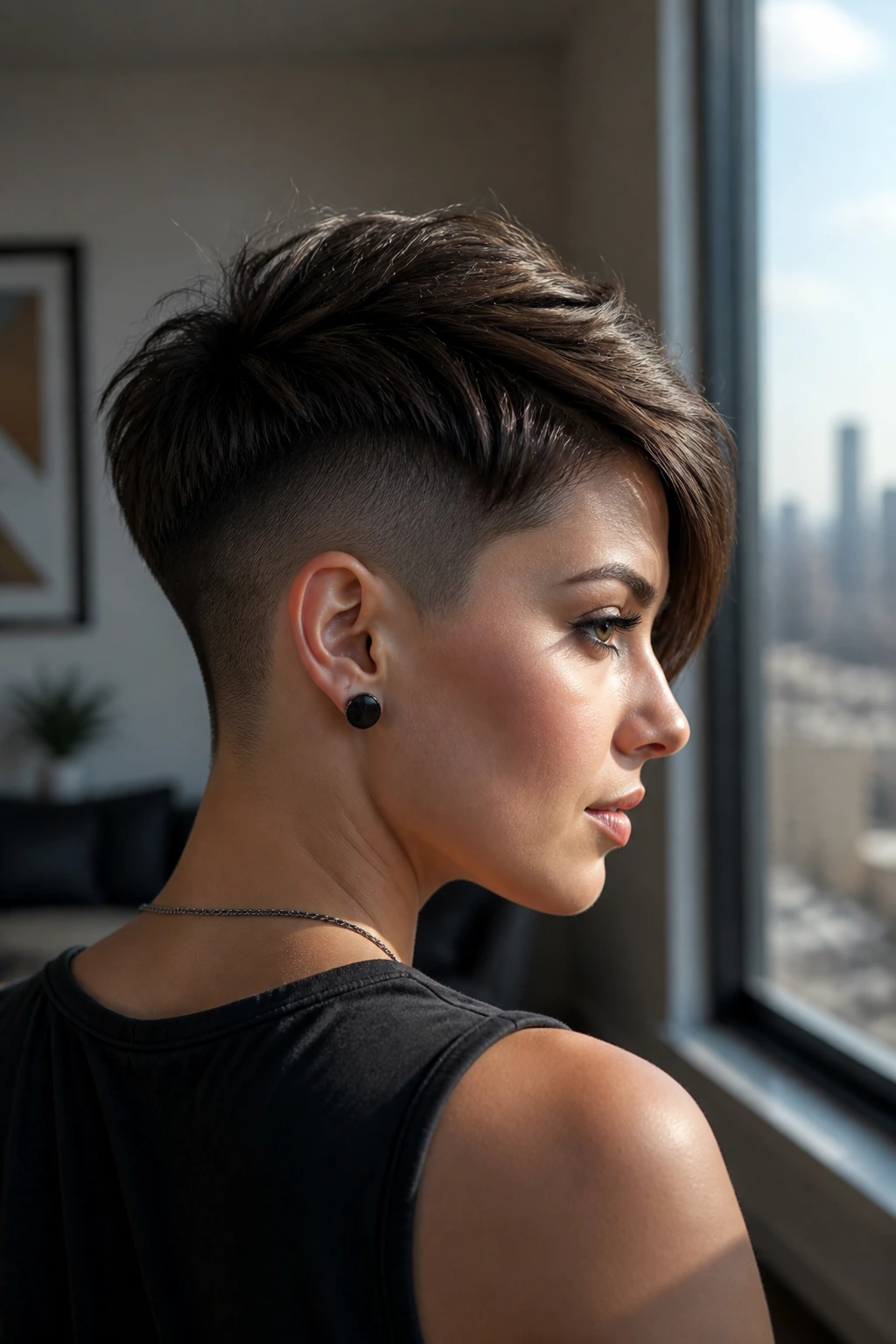
The undercut pixie is for thick hair that refuses to stay polite. One section — usually the nape and sometimes the area behind the ears — is clipped shorter or even shaved, while the top and front keep enough length to shape the face. It’s practical, but it also has bite.
On a round face, the undercut earns its keep by deleting bulk where it does the most widening. The shape gets slimmer at the bottom, which makes the top feel taller by comparison. Thick hair loves this because the hidden underlayer removes all the extra weight that tends to mushroom out under helmets, hats, or humid air.
Do not take the undercut too high if your face is round. Keep it tucked below the parietal ridge so you don’t expose too much width through the upper sides. That one detail changes the whole balance.
A tiny warning: this cut grows out visibly. If you like crisp lines, you’ll want regular cleanup around the nape.
7. Feathered Pixie
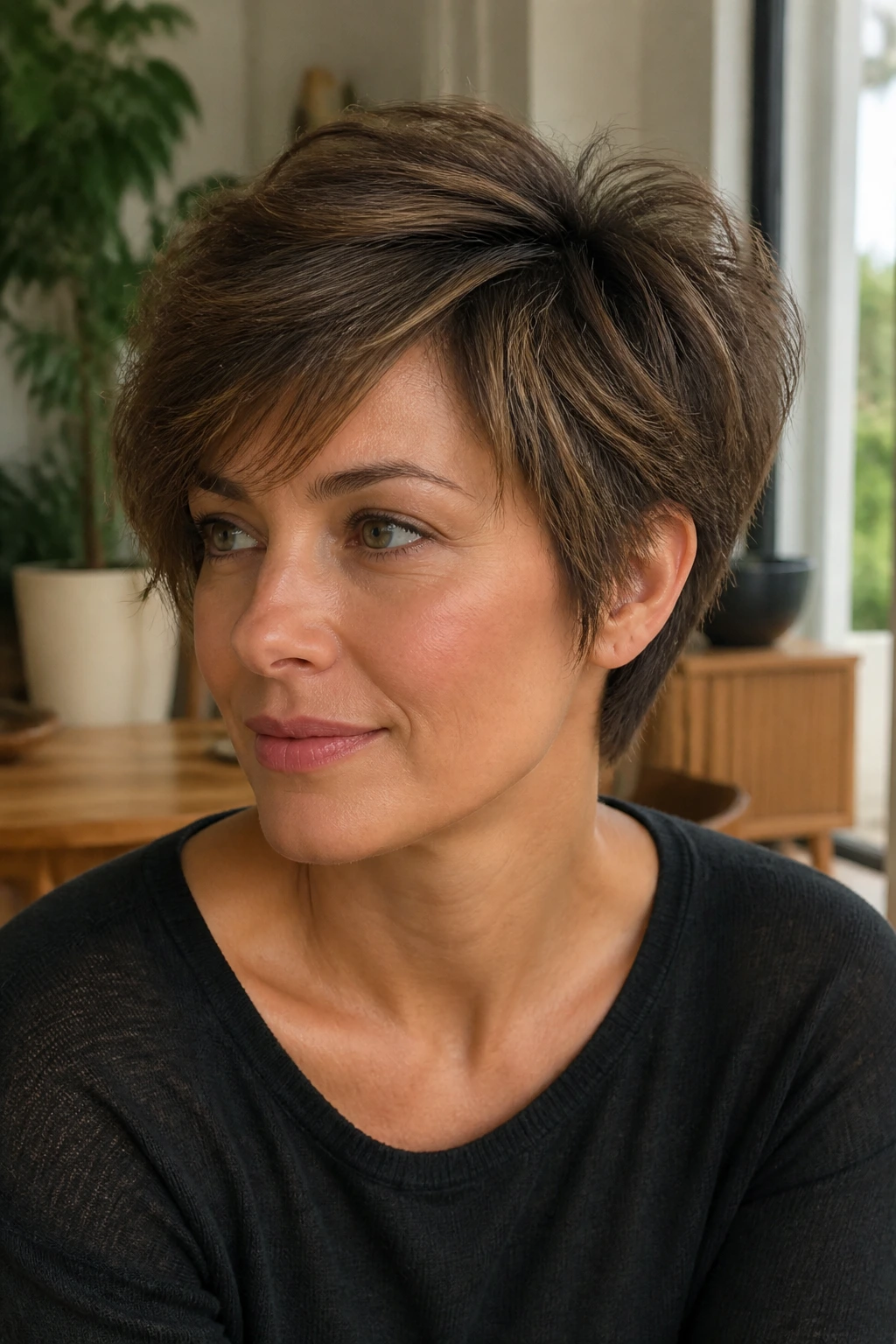
Feathered layers make short hair breathe. Instead of blunt ends sitting like a block around the face, the hair is cut into soft, directional pieces that move away from the cheeks and across the forehead. That’s why this cut works so well for round faces with thick density.
The softness keeps the haircut from feeling severe. The shape still has structure, but the edges blur just enough to avoid a hard circle around the face. Thick hair benefits because feathering removes visual heaviness without making the cut look thin or hollow.
The Part That Matters Most
Feathering only works when the ends are controlled. If the stylist razors coarse hair too aggressively, the ends can fray and puff. Point cutting or a gentle slide through the top is usually safer. You want airy, not fluffy.
I also like this shape on people who wear minimal makeup. It frames the face without demanding a lot of styling polish, which is useful on ordinary mornings.
8. Pixie with Curtain Fringe
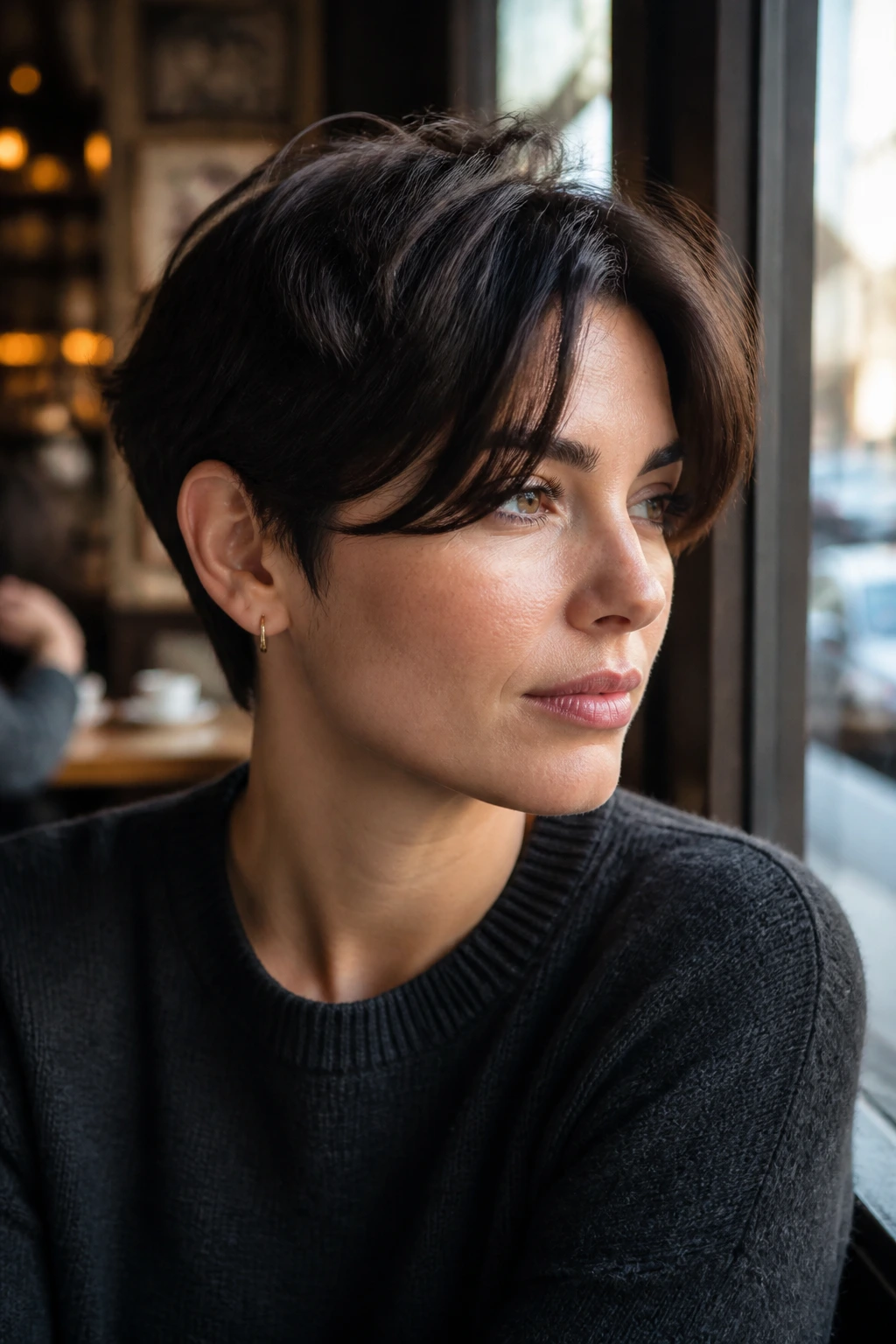
A curtain fringe on a pixie sounds slightly unlikely until you see it on thick hair. Then it makes sense. The fringe splits or drapes off-center, touching the temples and giving the face two soft vertical lines instead of one straight-across band.
That’s useful on a round face because the eye gets a longer path to follow. The cheeks feel less central. The forehead gets broken up. The haircut has a little swing to it, which helps keep the overall look from turning boxy.
How to Ask for It
Keep the fringe light enough to part naturally, but not so thin that it disappears. A stylist should leave enough weight for the curtain effect while softening the center with texturizing. If your hair is dense, the fringe may need to be cut a little longer than you expect so it doesn’t spring up and sit too high.
This is one of those cuts that looks especially good when the hair is tucked behind one ear and left loose on the other side. Slight asymmetry. Little work. Big payoff.
9. Micro-Bang Pixie

Micro bangs are not for everyone, and I’m glad someone finally said it plainly. They can be sharp and a little unexpected, but on a round face they need the rest of the cut to do the balancing. That means close sides, a narrow outline, and some height through the top so the fringe doesn’t shorten the face too much.
Thick hair can make micro bangs look strong instead of wispy. That’s the upside. The downside is that they can go blunt fast if the hair is too dense or the fringe is cut too wide. Keep the bangs narrow, slightly broken, and textured at the ends. A straight block across the forehead is usually too much.
Best When
- You like a graphic look
- Your face has enough vertical length already
- You’re okay with regular trims
- You want the haircut to feel edgy, not sweet
If your forehead is short, leave the bangs a bit softer. A half-inch can change the whole feel.
10. Swept-Back Pompadour Pixie
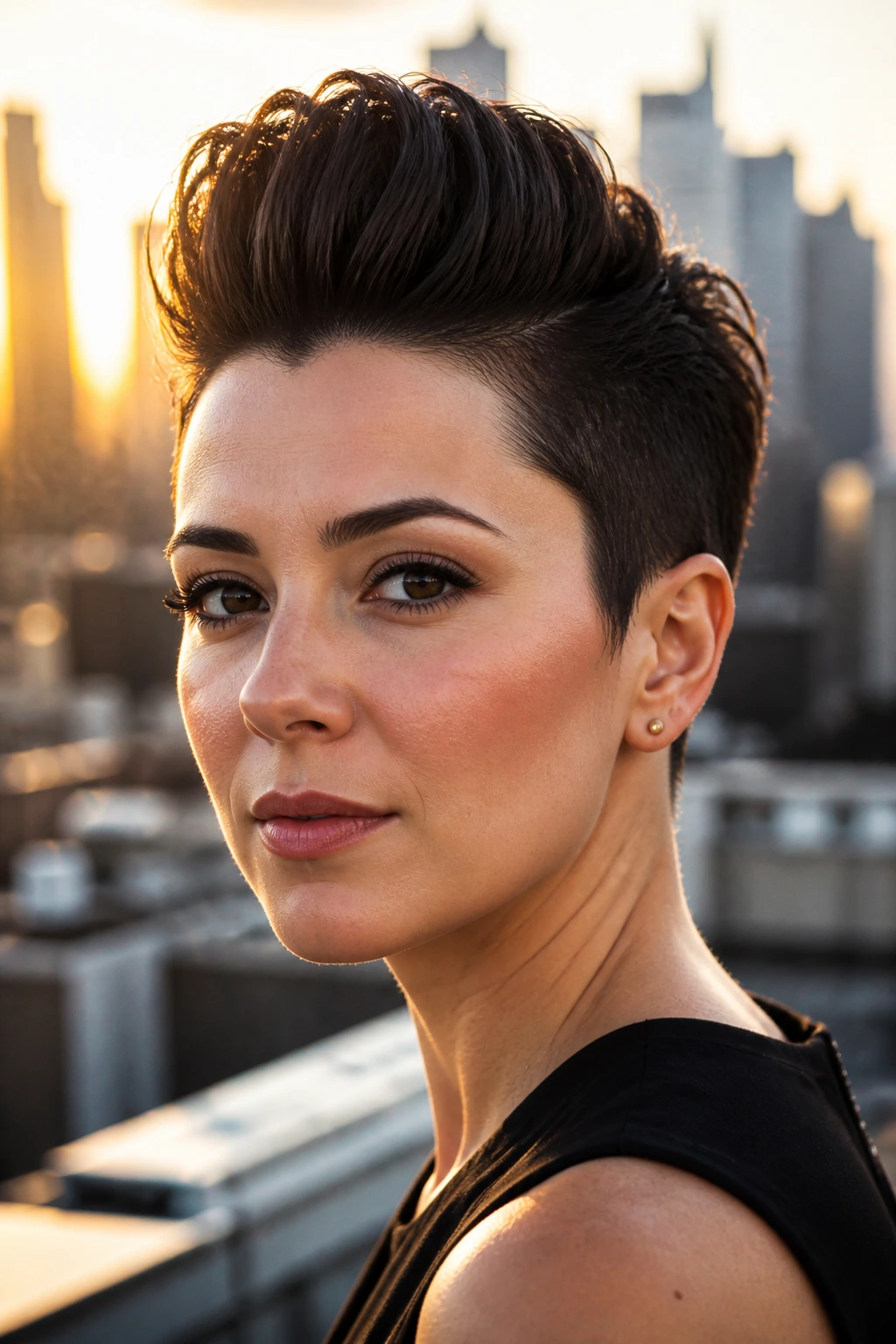
This one has presence. The hair is lifted up and away from the forehead, then swept back with a little height at the front, almost like a mini pompadour. For a round face, that upward movement is gold. It adds length without adding width.
Thick hair actually helps here because it has enough density to hold the lift. Fine hair often needs a lot more product and teasing to get the same shape. Dense hair can do it with mousse, a round brush, and a blow-dryer aimed at the roots.
Keep It from Looking Too Round
The trick is to keep the sides close while the top rises. If the sides stay too full, the pompadour effect turns into a dome, and domes are not the move on round faces. A slight side part keeps the top from feeling too centered.
Use a firm-hold mousse at the roots, then brush the top up and slightly back. Finish with a matte spray if you want the style to stay lifted without shine.
11. Shaggy Pixie
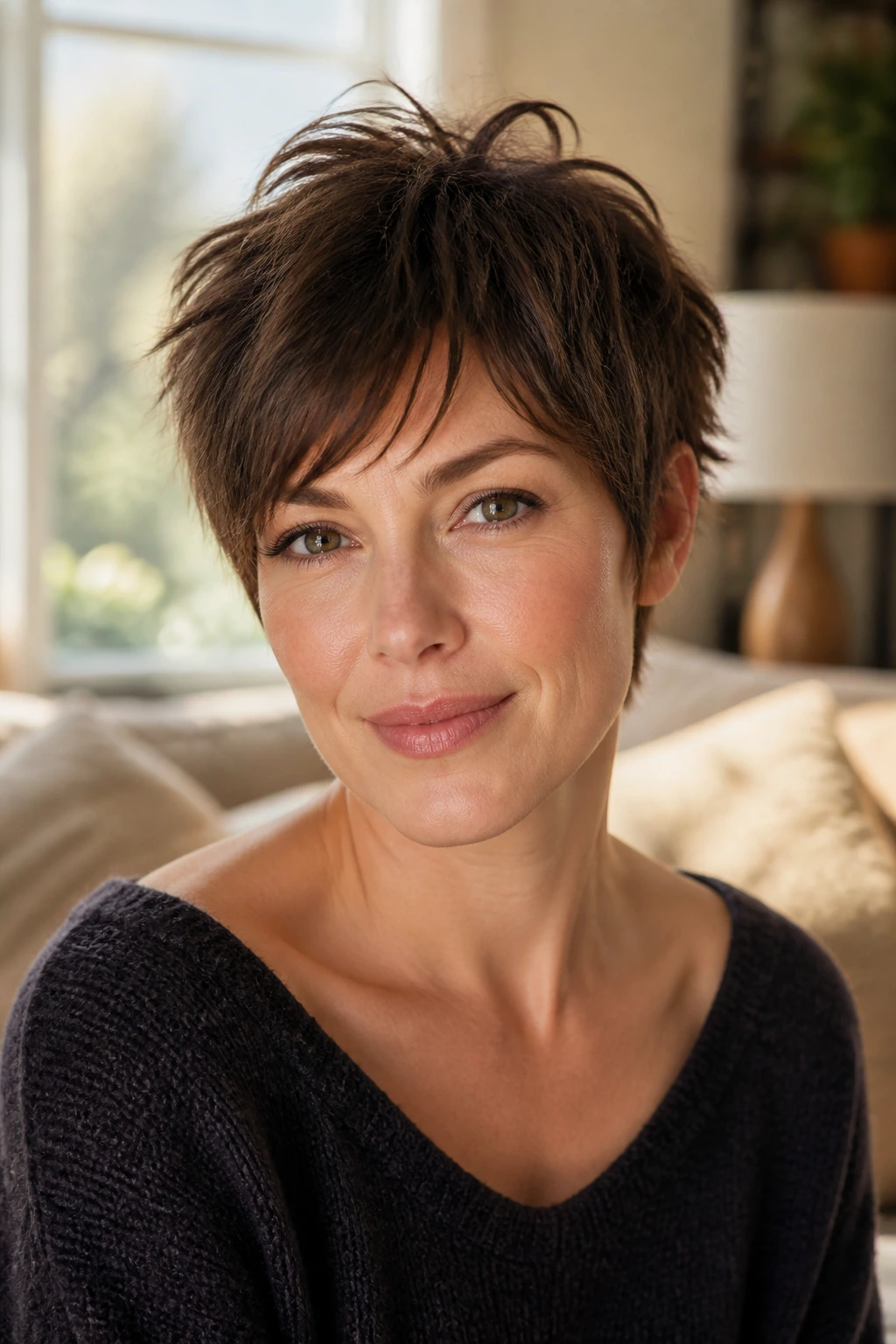
A shaggy pixie is the one I recommend when somebody says, “I want short hair, but I still want it to look like hair.” The layers are uneven in a good way, the ends have texture, and the whole cut feels a little lived-in without looking sloppy.
Round faces benefit from the broken lines. Thick hair benefits from the layered interior, which keeps the top from sitting as one compact cap. The cut is especially useful if your hair has some wave, because the wave adds movement for free.
What to Watch For
Shaggy does not mean bulky. If the stylist leaves too much width around the temple area, the cut loses the whole point. Ask for the shape to stay narrower through the sides and fuller through the crown and fringe.
A light texture spray on dry hair is enough here. I would skip anything sticky. The charm of this cut is that it looks as if you touched it once and moved on with your life.
12. Ear-Hugging Crop
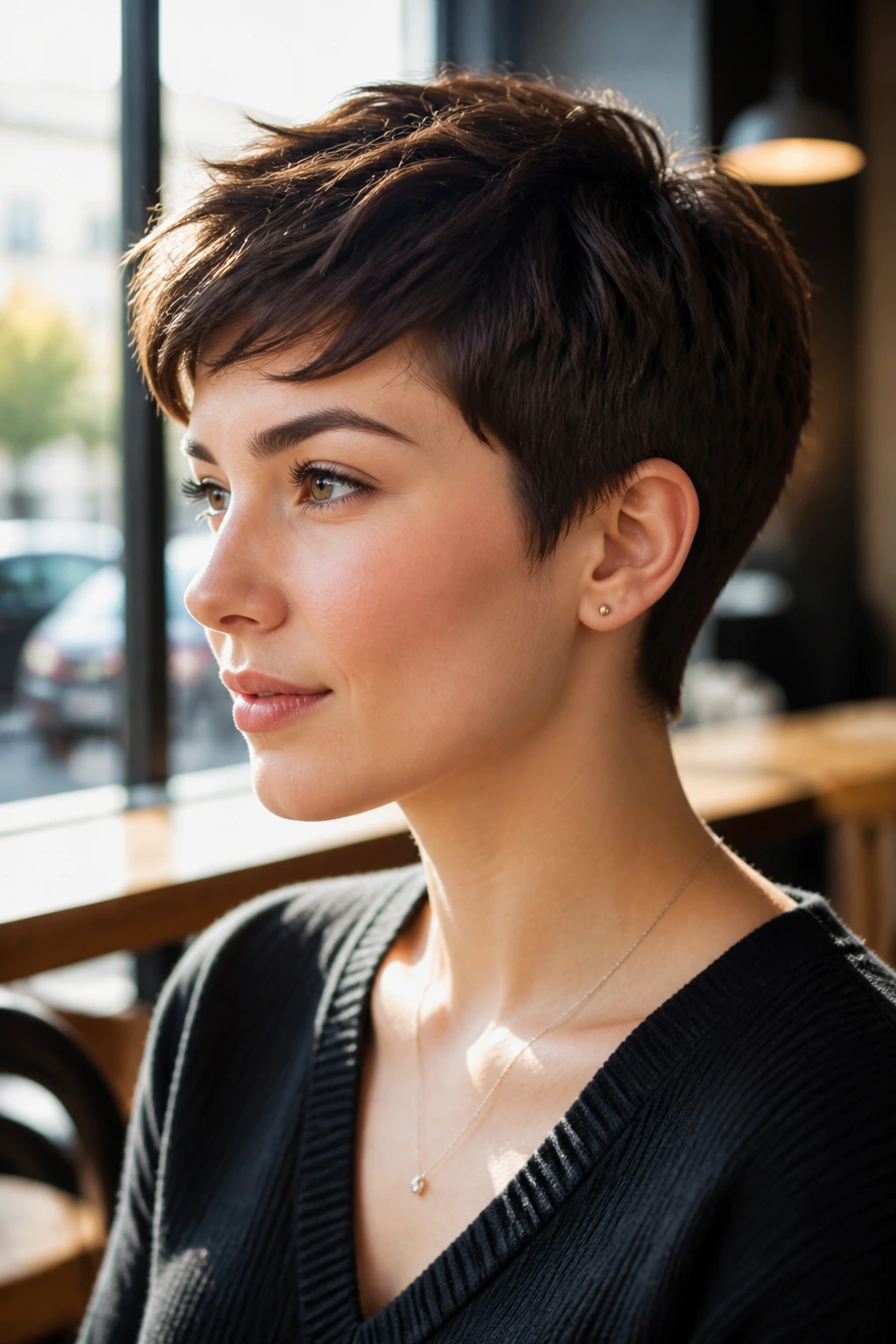
When thick hair keeps exploding around the ears, an ear-hugging crop can be a relief. The sides are cut close enough to sit neatly around the ear, and the top stays soft and slightly longer so the whole haircut doesn’t feel severe.
This shape is quietly good for round faces because it removes side bulk where the face tends to read widest. It also works well with glasses and earrings, which is a nice bonus. Exposing the ear and temple area gives the face cleaner edges.
Tiny Detail, Big Result
The crop has to be truly close at the sides. If the stylist leaves too much length there, thick hair will push outward and create that little shelf that sits right at cheek level. That shelf is what makes a round face look broader.
If you like a polished finish, comb the top over with a drop of cream. If you prefer it rougher, pinch the ends with your fingers and leave the front slightly broken.
13. Deep Side-Part Pixie
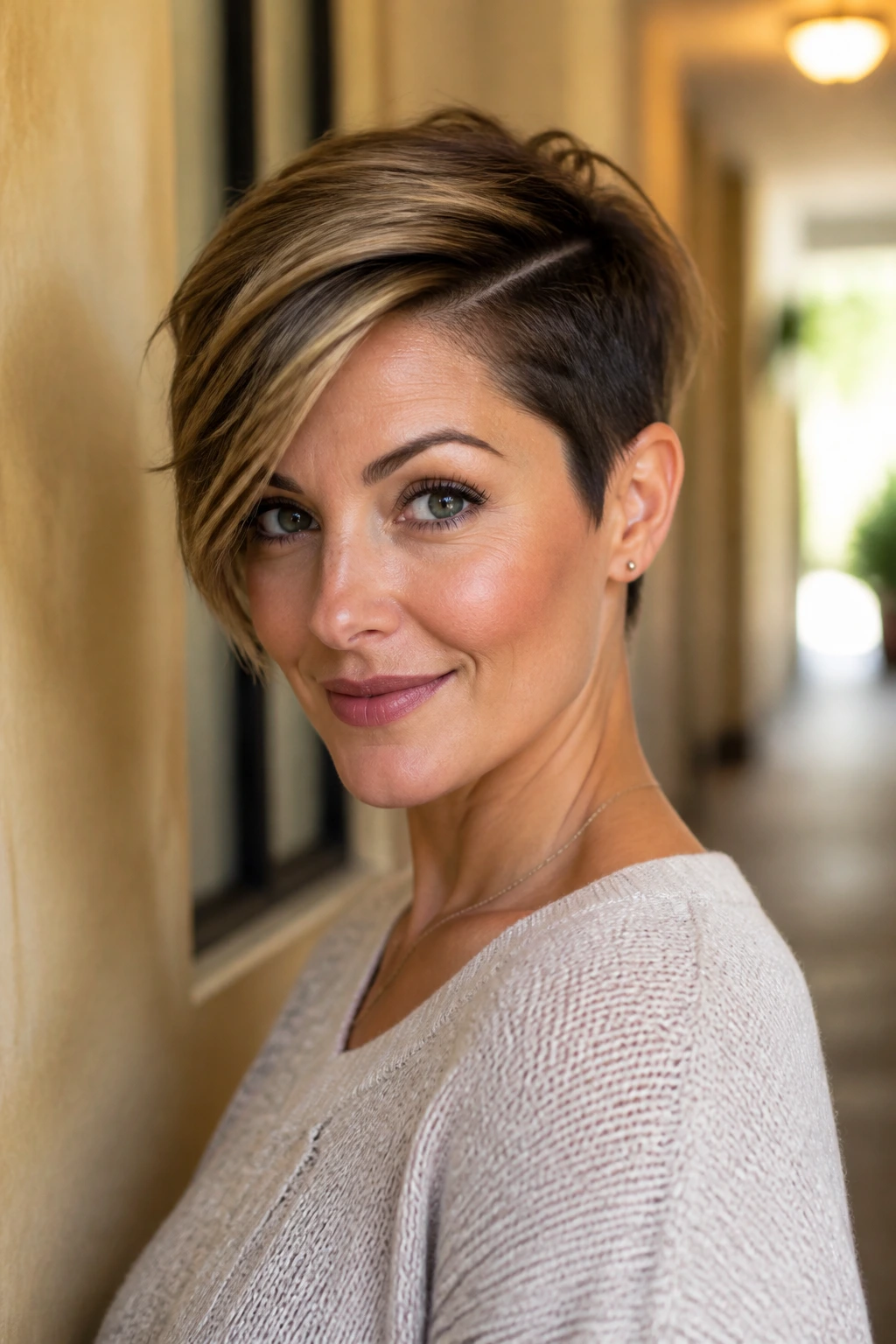
A deep side part is one of the easiest tricks in the short-hair book, and it still works because it changes the geometry. The longer sweep across the forehead interrupts the circle of a round face, while the short side keeps the haircut light and tight.
Thick hair usually holds a side part better than finer hair, especially if the roots are trained in that direction for a few days. Blow-dry the part first. Don’t fight your growth pattern unless you enjoy losing.
Why It Flatters
The diagonal line of the part makes the face look longer from brow to jaw. The longer front section can touch the cheekbone or slide just below it, which creates a slimmer visual path. Keep the part low and deep rather than shallow. A little asymmetry is the point.
If your hair has a stubborn cowlick, clip the part in place while it cools. That small habit keeps the front from flopping back into a center part by noon.
14. Razor-Textured Pixie
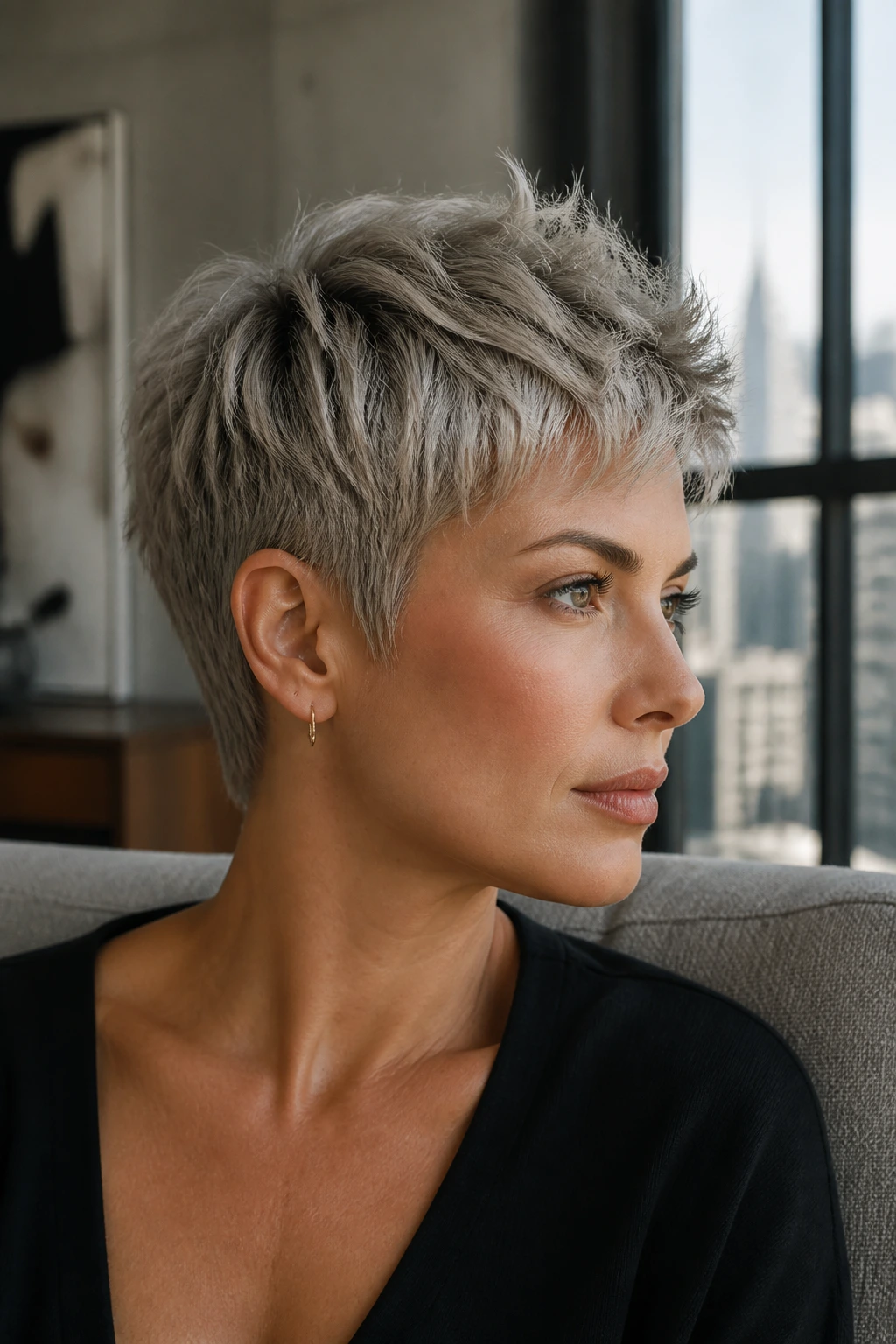
A razor-textured pixie can feel airy and modern when it’s done right. The ends are softened so the haircut doesn’t sit in one hard shell, and thick hair loses enough visual weight to move instead of puffing.
But this is one of those cuts that depends on the hair itself. Straight, dense hair often handles razor texturizing well. Very coarse or very curly hair can fray if the razor is used too aggressively. In that case, scissors and point cutting are safer.
Where It Helps Most
The top and fringe. Those are the places where heavy hair tends to collect and puff outward. Softening those sections gives the face a narrower frame without making the overall shape look sparse.
If you want this look, ask for texture that preserves the silhouette. That sounds fussy, but it matters. You want the style to feel lighter, not thinner.
15. Tousled Piecey Pixie
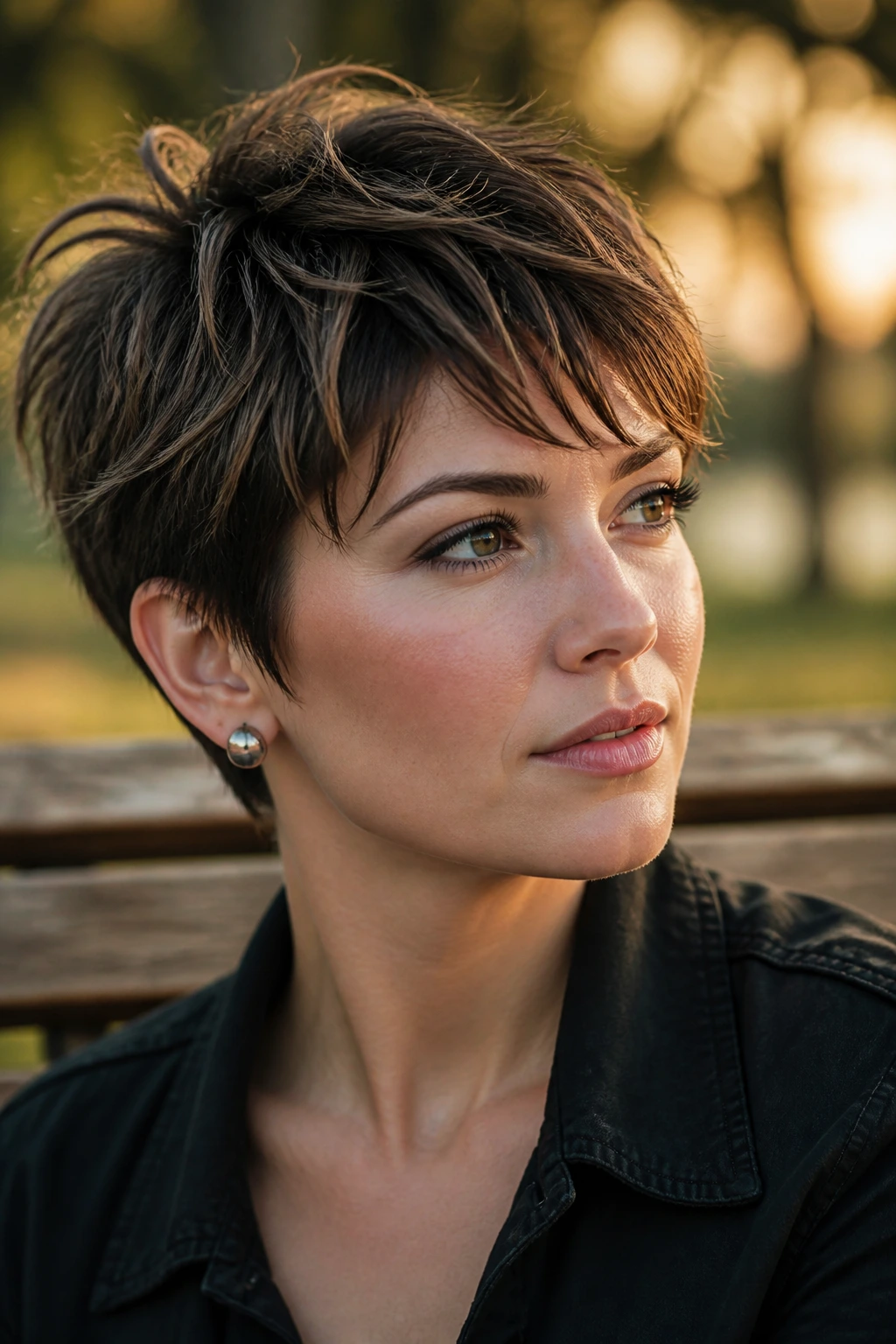
This is the pixie for people who don’t want the haircut to look too done. The pieces are defined but not polished, and the finish leans casual rather than sleek. Thick hair makes this easier because there’s enough body to separate into visible strands instead of falling flat.
Round faces usually like a piecey finish because it breaks up width. The lines don’t read as one round shape; they read as several small, angled shapes. That’s a useful trick when you want softness but still need definition.
A little matte paste goes a long way. Warm it in your palms, tap it through the ends, and stop before the hair starts clumping. Clumps are the enemy here. Separation is the goal.
16. Tapered Nape Pixie
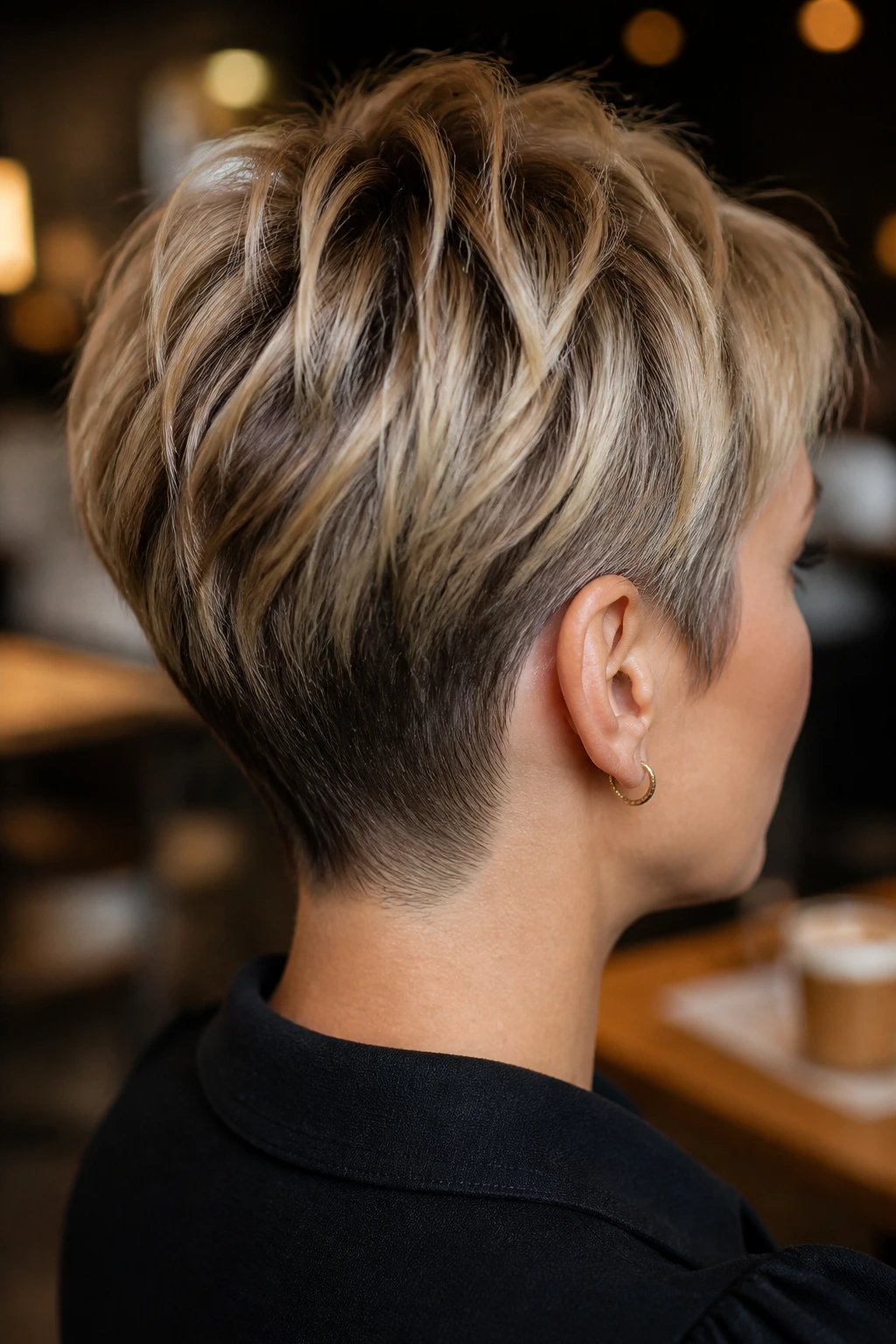
The nape is where thick hair often gets rude. It expands, flips out, and makes the back of the haircut look heavier than the front. A tapered nape pixie deals with that by keeping the back tight and neat, then letting the top and front carry the personality.
On a round face, this clean back section helps the haircut feel lean overall. The eye doesn’t get stuck on a bulky lower shape. It moves upward, which is exactly what you want.
Why It’s Worth Asking For
The taper should be gradual. Too abrupt and it can look like a fade with no transition. Too soft and it won’t control the bulk. The sweet spot is a back that hugs the neck, then opens gradually into the crown.
This cut needs upkeep if you want it to stay sharp. The nape is where growth shows first. No surprise there.
17. Volume-Crown Pixie
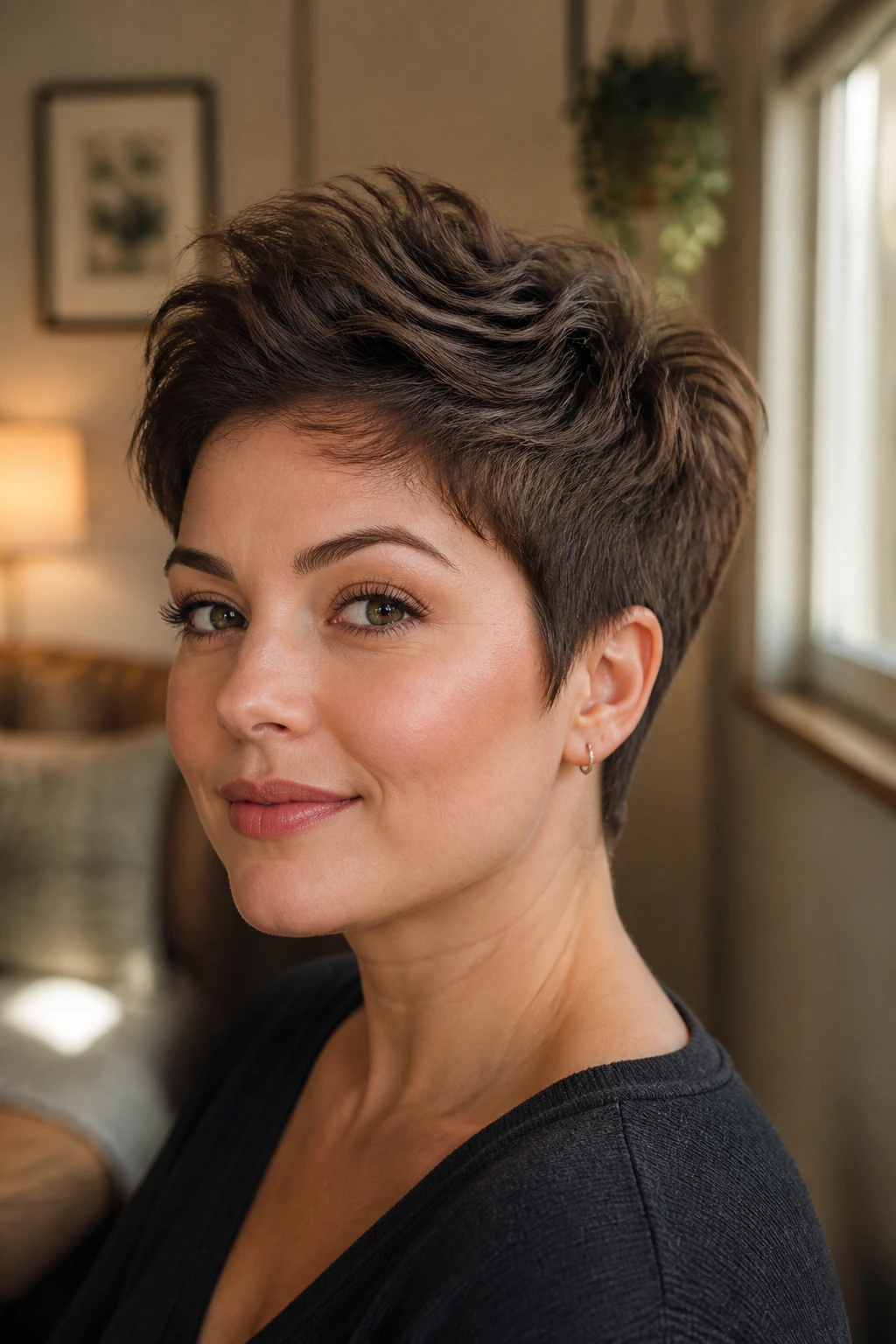
Some people hear “volume” and picture a poof. That’s not what this is. The volume-crown pixie keeps the sides slimmer and uses the top and crown to create a lifted shape, not a round bubble. On a round face, that upward push can be a lifesaver.
Thick hair has enough body to support the crown without a ton of teasing. A root-lift mousse, a round brush, and a quick blast of heat usually do the job. The trick is to keep the lift centered slightly behind the hairline so it feels sculpted, not front-heavy.
Best Feature
This cut gives you height where the face needs it most. The sides stay in check. The top gives the silhouette a longer line. It’s a useful balance if your hair tends to flatten at the crown while puffing out at the cheeks.
Use a touch of dry shampoo at the roots on day two. It adds grip and keeps the crown from falling limp.
18. Wispy Side-Sweep Pixie
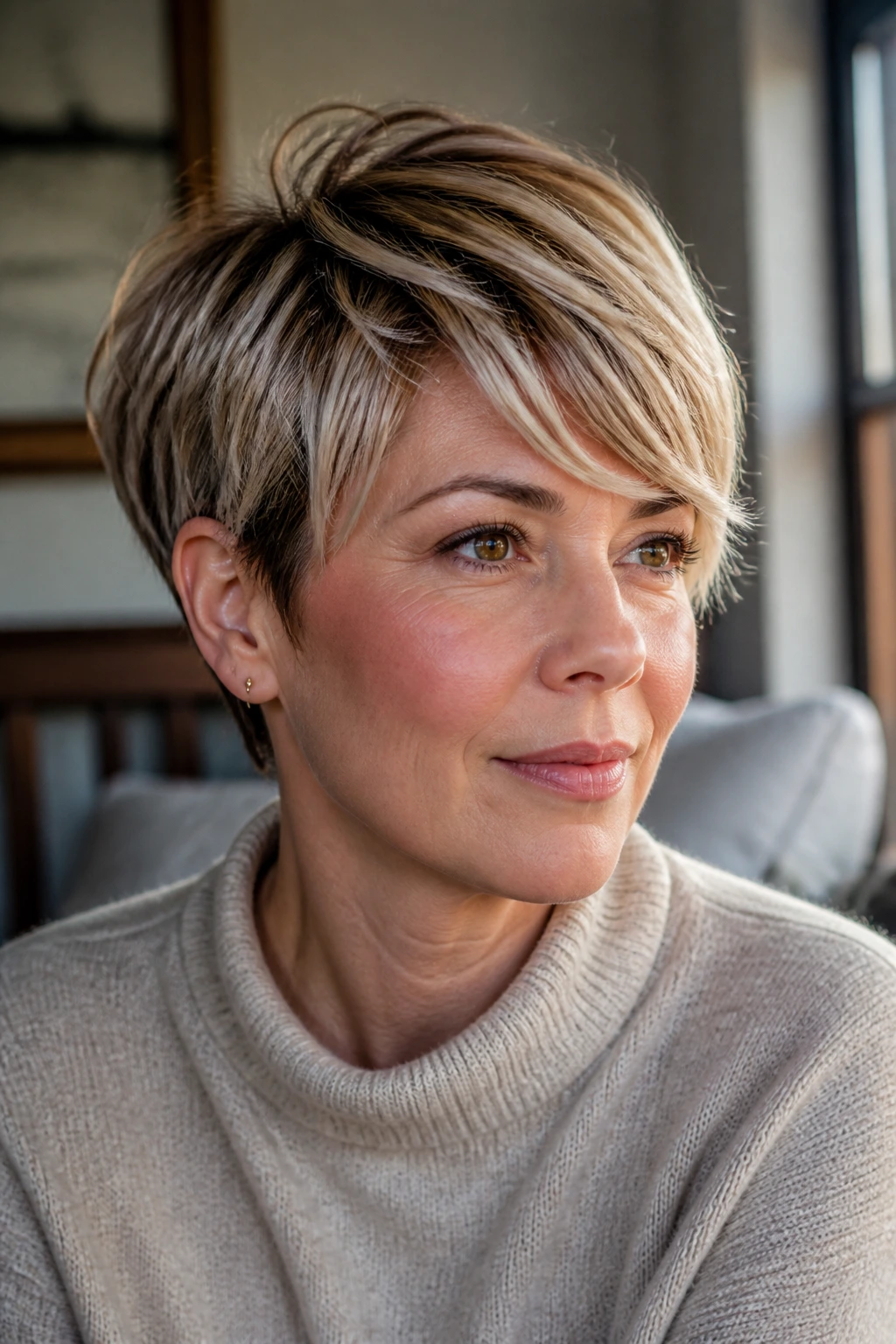
A wispy side-sweep is softer than a hard asymmetrical cut and easier to live with than a heavy fringe. The front pieces skim across the forehead and taper at the ends, so the face gets movement without a block of hair sitting on it.
Round faces usually look better when the fringe has a little air in it. Thick hair can make that hard, which is why the stylist has to remove weight carefully through the fringe rather than hacking a straight line across it. The best version lands just above the cheekbone on one side and opens the face on the other.
Good For
- Softening a broad forehead
- Keeping the haircut light around the eyes
- Making thick hair feel less dense at the front
- People who want a feminine finish without a lot of styling
A small bend with a flat iron can help the sweep sit away from the face. Nothing dramatic. Just enough curve to keep it moving.
19. Soft Mohawk Pixie
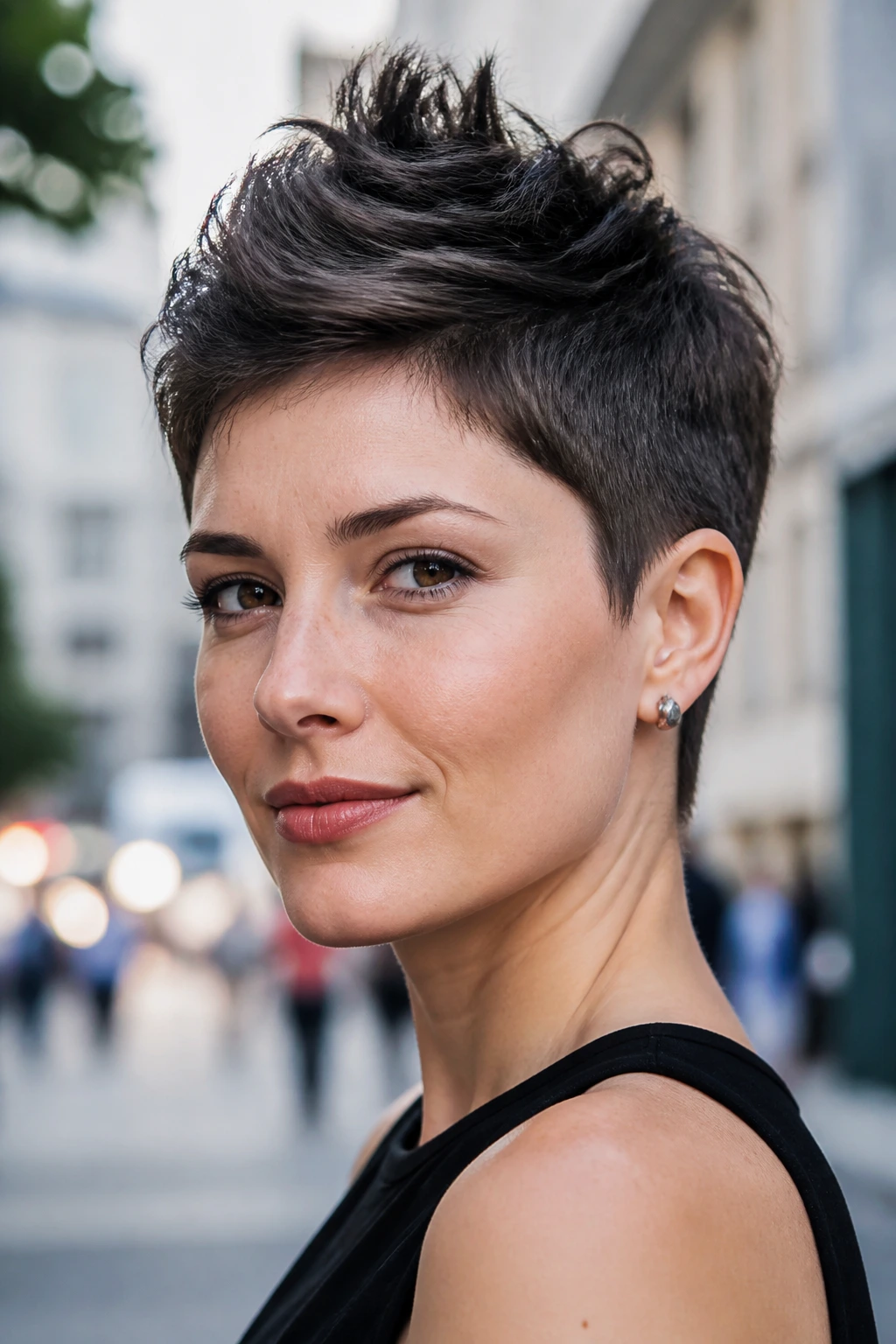
A soft mohawk pixie sounds bolder than it usually feels in real life. The sides are cropped close, the top forms a gentle ridge from front to crown, and the whole cut keeps its edge without going full punk.
For a round face, that central ridge is useful because it creates vertical length. Thick hair helps again, because the shape needs body to stand up in the middle. The style can be polished or messy depending on the product, which is part of the appeal.
A Small Warning
Do not let the ridge get too wide. If it spreads too far across the crown, it starts to widen the face instead of lengthening it. Keep the top narrow and focused.
A little paste at the roots and a pinch of texture spray through the tips are enough. This is not a style that needs a mountain of product. It needs direction.
20. Pixie Bob with Tapered Back
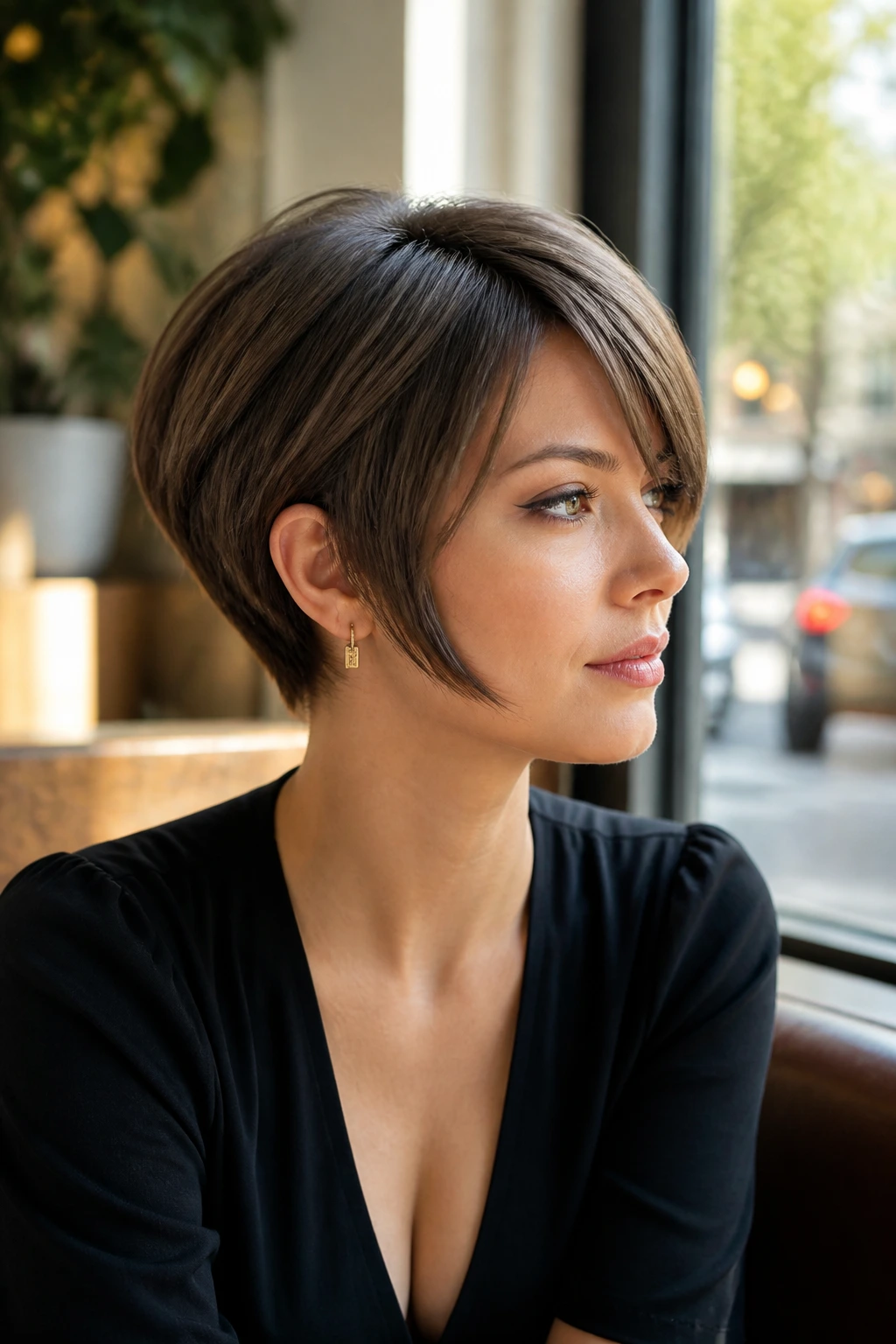
If you want the feel of a pixie but you’re nervous about going ultra-short, the pixie bob with a tapered back is the compromise that doesn’t feel like one. The back stays neat and snug, while the front and top carry enough length to brush the jawline or skim the cheek.
Round faces like this cut because the front can angle downward and create a longer outline. Thick hair gets a practical bonus: the tapered back removes the heavy lower mass that usually makes short cuts flare out. The result looks softer than a classic bob and less severe than a cropped pixie.
I’d call this the best bridge cut on the list. It gives you room to see how you feel about short hair without jumping straight into a close crop.
What Makes a Pixie Stay Flattering When Thick Hair Has a Mind of Its Own
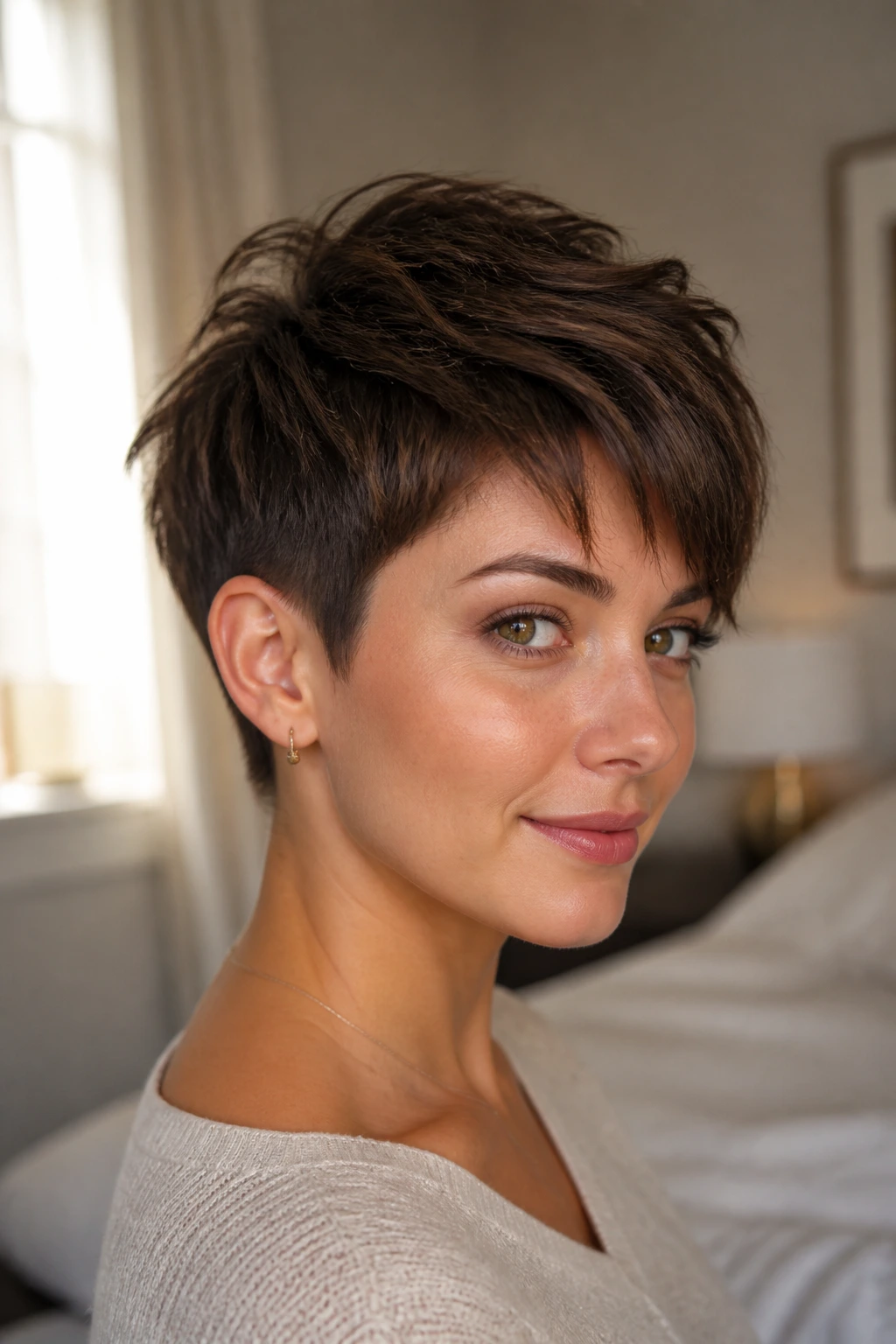
The haircut matters more than the styling product, and that’s not a popular thing to say when everyone wants a quick fix. Thick hair can be tamed, but it has to be cut with its density in mind. A stylist who removes weight from the interior of the cut — not just the outline — gives you shape that bends instead of bulging.
Round faces do best when the silhouette has a little rise, a little diagonal movement, and less emphasis at the widest part of the cheeks. That’s why side-swept pieces, tapered napes, and crown lift show up again and again in good pixies. They’re not random choices. They’re shape tools.
The Part That Pays Off
If you remember only one thing, remember this: short hair on thick hair should lose bulk where it grows outward, not where it frames the face. The best cuts are tidy at the sides, a little longer on top, and smart about the fringe. That’s the whole game.
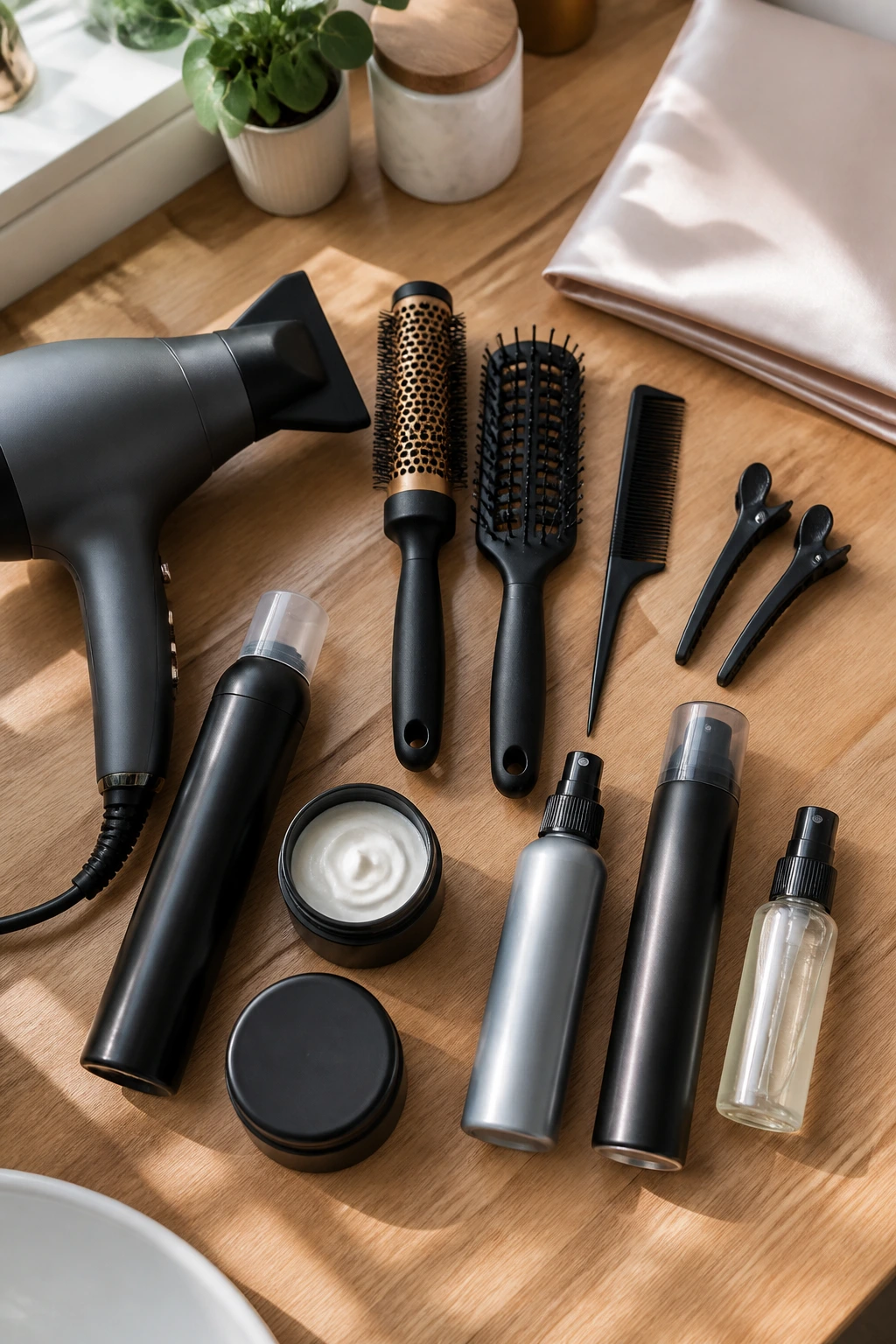
Essential Tools for Styling These Cuts
-
Hair dryer with a concentrator nozzle: Gives you control at the roots, which matters when you need lift instead of puff.
-
Small round brush, about 1 to 1.5 inches: Useful for shaping the top and bending the fringe away from the face.
-
Vent brush or paddle brush: Good for quick drying when you want the cut smooth but not flat.
-
Fine-tooth comb: Helps with deep side parts, neat sectioning, and clean lines around the fringe.
-
Duckbill clips or sectioning clips: Handy when you want to dry the top separately from the sides.
-
Lightweight mousse or root-lift foam: Adds body at the crown without making thick hair sticky.
-
Matte paste or styling clay: Gives separation and texture to piecey pixies and choppy cuts.
-
Texturizing spray or dry shampoo: Useful for day-two grip and soft lift at the roots.
-
Heat protectant: Non-negotiable if you use a dryer or flat iron more than once a week.
-
Silk pillowcase or bonnet: Keeps the crown from getting crushed flat overnight.
What to Tell Your Stylist Before the First Snip
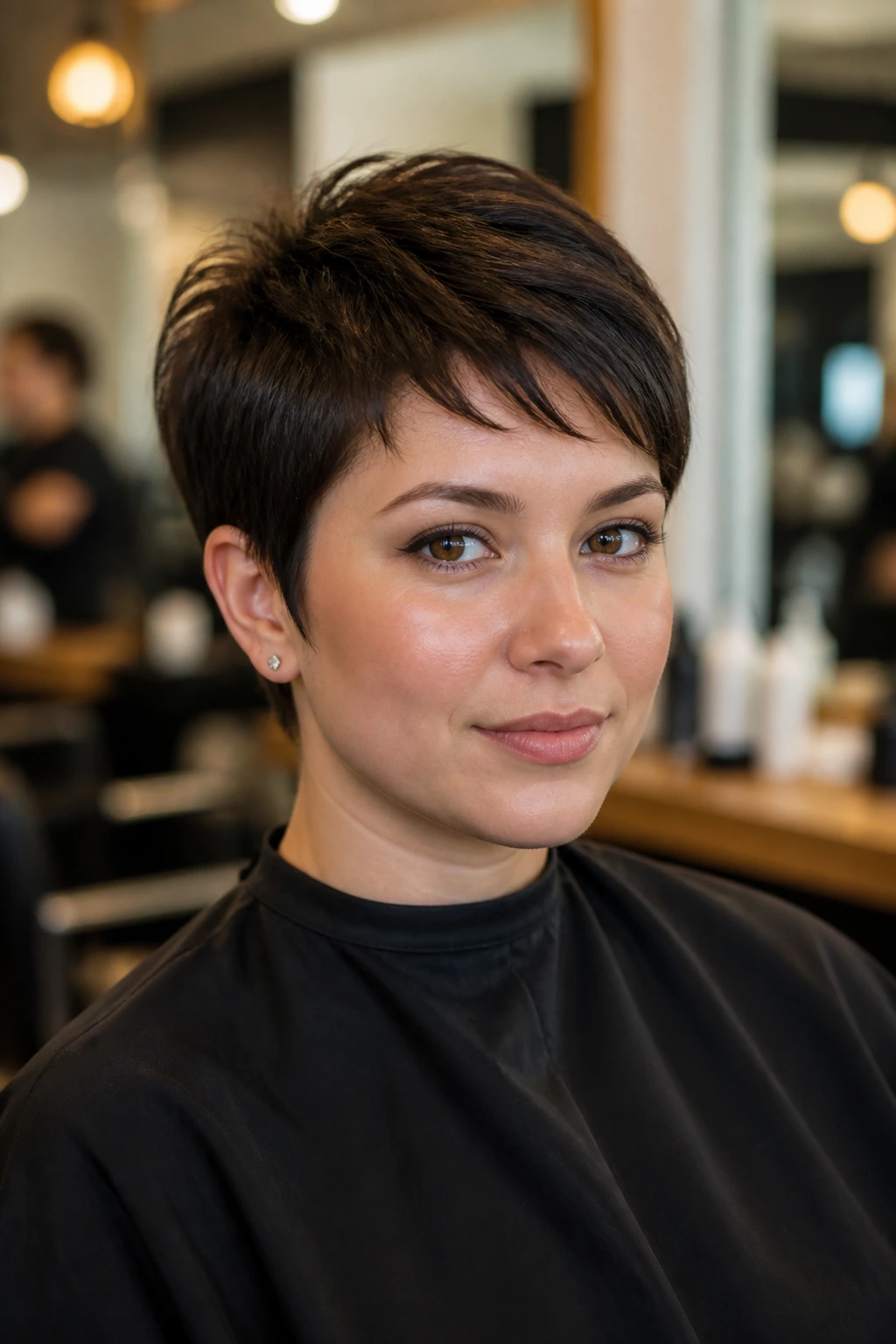
Bring photos, yes, but bring the right photos. You want front, side, and back views of the same haircut if possible, because a pixie lives or dies by its silhouette. A front view alone can hide a chunky nape or a temple that’s cut too wide.
Say how your hair behaves when it dries. Thick hair is not one thing. Some thick hair is straight and heavy. Some is coarse and springy. Some has a wave that appears only after the first wash. That changes where the weight should come off, and it changes whether the stylist should cut it wet, dry, or somewhere in between.
Good Phrases to Use in the Chair
- “I want the sides slimmer, but I don’t want the top thinned out too much.”
- “Please keep the nape tight so it doesn’t puff out.”
- “My hair expands at the temples, so I need bulk removed there.”
- “I wear my part on the side and want the fringe to work with that.”
- “I’m okay with texture, but not fraying.”
That last line matters more than people think. Thick hair can be textured into softness or shredded into fuzz. Those are not the same result.
Product Picks Worth Asking About
A light mousse, a flexible paste, and a root-lift spray are the main players. If your hair is coarse, a cream with a bit of slip can tame the front without flattening it. If your hair is dense and straight, a matte product usually gives better separation than a shiny one.
How to Style and Wear These Cuts in Real Life
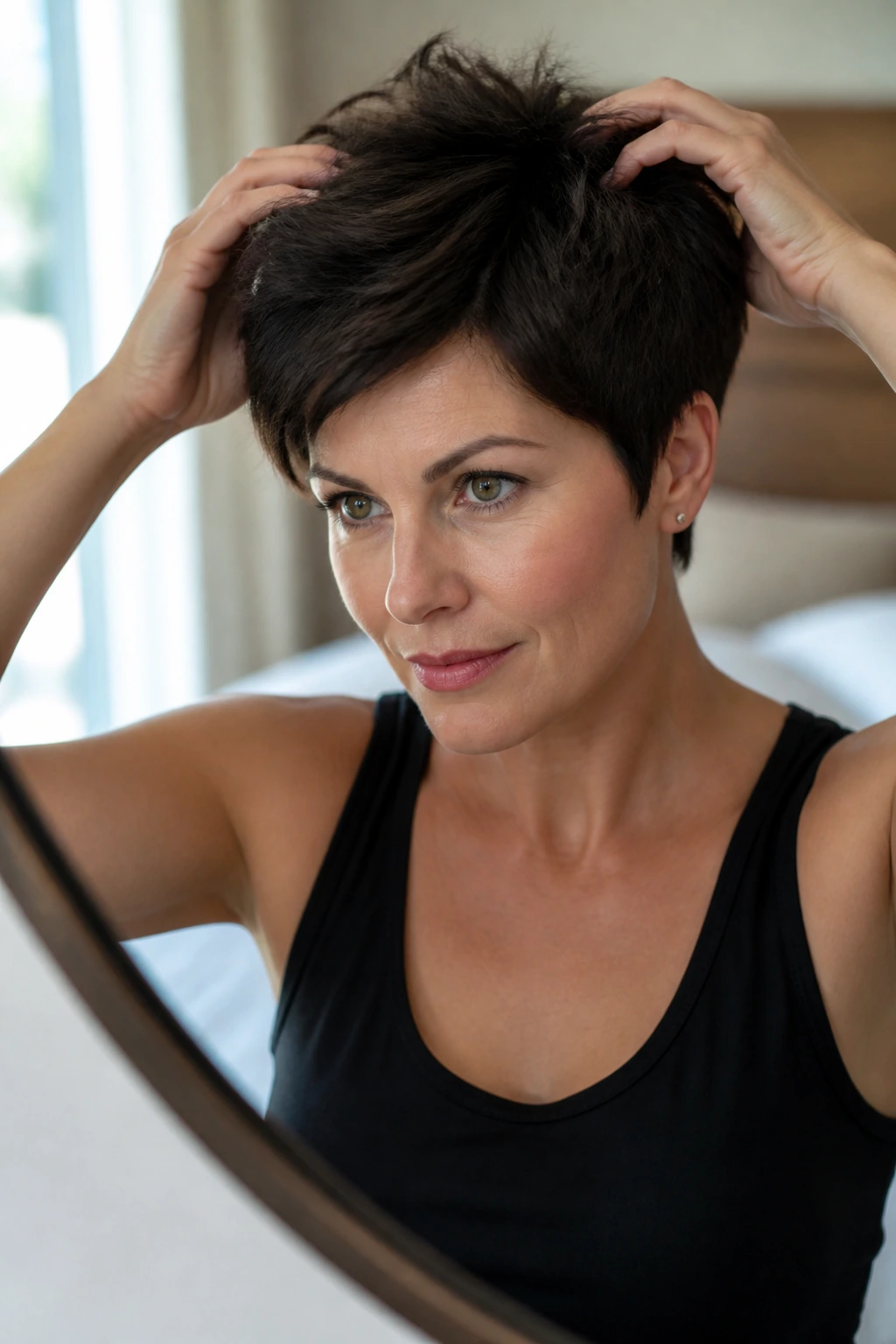
A pixie on thick hair should not demand a full production every morning. If it does, the cut is wrong or the products are too heavy. The easiest routine starts with damp hair, a dab of mousse at the roots, and a blow-dry that lifts the crown while keeping the sides tight.
Everyday shape: Use fingers and a little paste. Rough-dry the roots first, then pinch the fringe or top pieces into place. Leave the finish slightly undone. That works better on round faces than a perfectly smooth shell.
With glasses: Keep the temples a little narrower and the fringe a little lighter. Frames already sit at the center of the face, so the haircut should create room around them instead of crowding them.
For a polished finish: Use a round brush to bend the front away from the cheeks and tuck one side behind the ear. That tiny asymmetry makes the whole style look considered.
For a casual finish: Mist the hair with water on day two, reactivate the product with your hands, and stop there. Thick hair usually does not need more product — just a little shape reset.
If you wear earrings, let them show. Short hair has no business hiding good jewelry.
Additional Tips and Texture Boosters
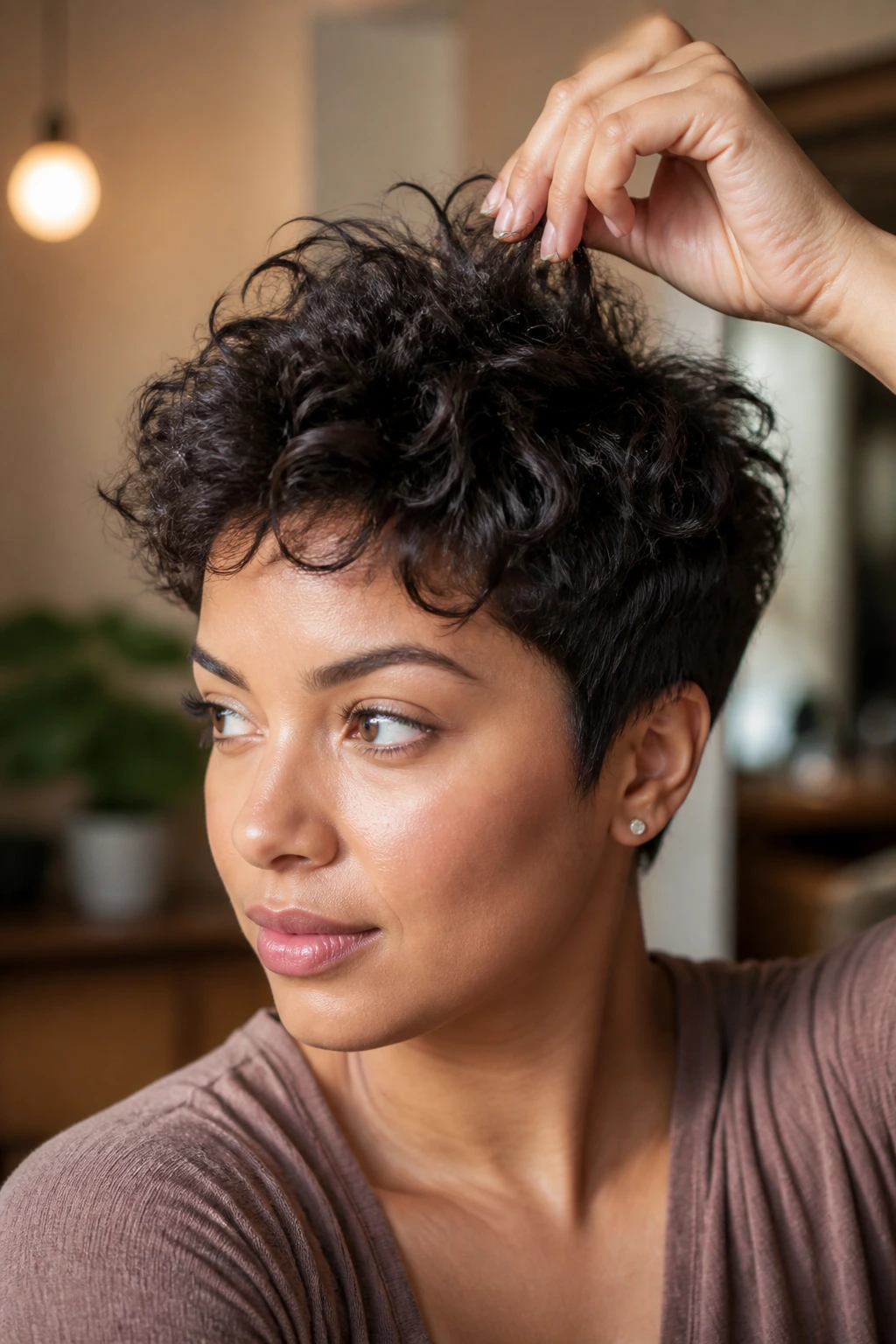
Lift Boost: Put mousse at the roots while the hair is still damp, then blow-dry the crown in the opposite direction of your part for 20 to 30 seconds before setting the part back. That little trick gives the top enough lift to outlast a normal commute.
Customization: If your face is very round, keep more length at the fringe and temples. If your cheeks are soft but your jaw is strong, you can go a bit shorter on the sides and let the top do more of the work. One haircut does not fit every round face.
Finish: Matte paste gives separation and a little grit. Cream gives softness and sheen. Use the first when you want a choppy, modern look; use the second when you want the cut to feel smoother and less textured.
Humidity Fix: A drop of anti-frizz serum on the mid-lengths and ends helps, but keep it away from the roots. Thick hair can go limp fast if you smear oil all over the crown.
Color Trick: A few subtle highlights around the top and fringe can make the layering read more clearly. Not streaky. Just enough to show the movement that’s already in the cut.
Trims, Wash Days, and Grow-Out Care
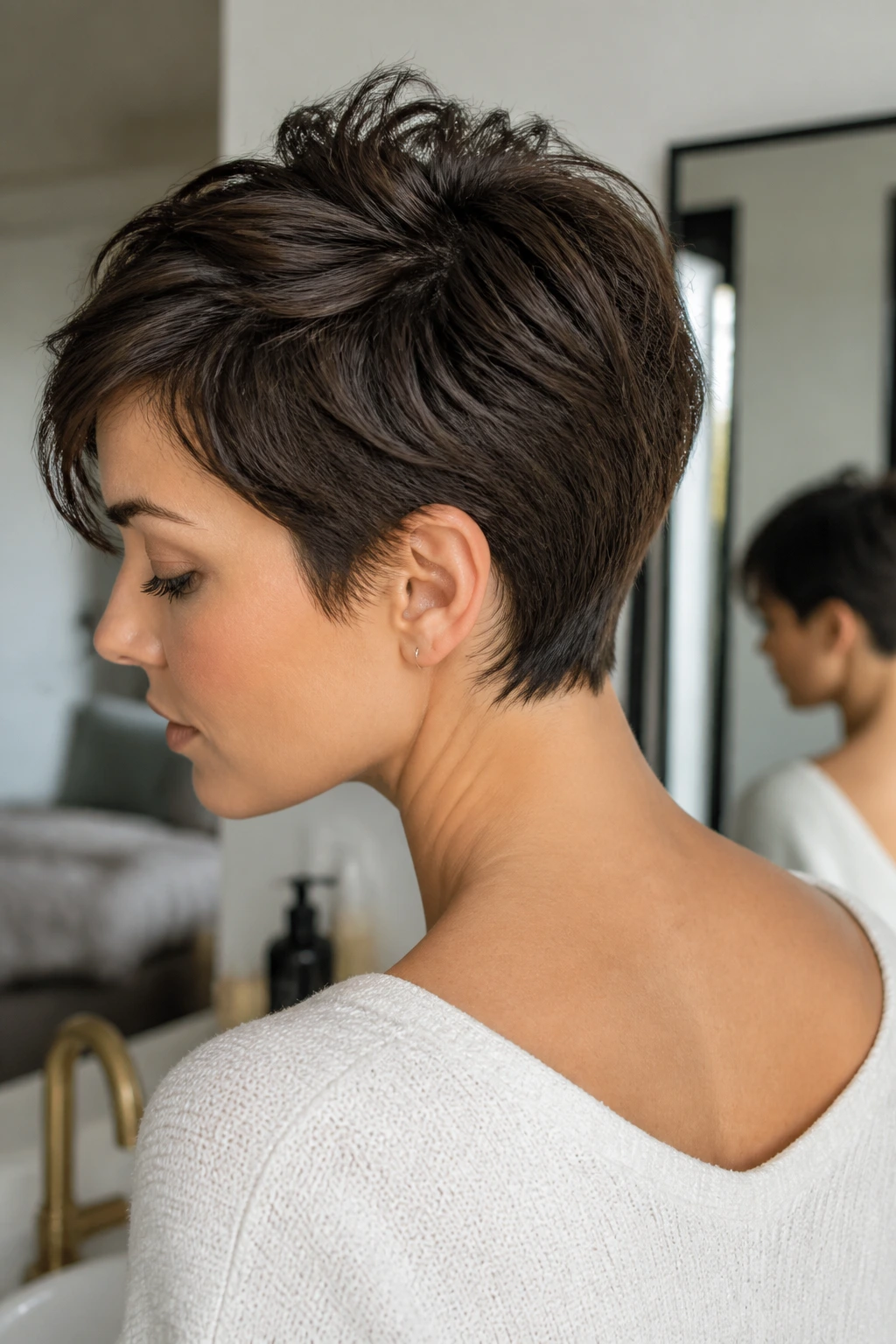
Pixies on thick hair hold their shape for a while, then the edges start to argue with you. The nape grows first. The temples follow. If you like a crisp outline, plan on a trim every 4 to 5 weeks. If you prefer a softer, slightly shaggy finish, 6 to 8 weeks can be fine.
Wash days depend on your scalp and product load, but thick hair often does well every 2 to 3 days. Use conditioner mainly on the mid-lengths and ends, not at the roots, or you’ll flatten the exact lift you’re trying to keep. On second-day hair, dry shampoo at the roots adds grip and keeps the crown from sliding downward.
Night Care That Actually Helps
Sleep on a silk pillowcase or wear a light bonnet if you hate waking up with one side smashed flat. If the top is trained to one side, a soft pin or loose clip at night can keep it from flipping the wrong way. In the morning, a few spritzes of water and a quick finger-style usually revive the shape.
If You’re Growing It Out
Ask your stylist to preserve the front and clean up the nape, rather than chopping everything evenly. That keeps the grow-out looking intentional. The halfway stage is much easier when the back is neat and the front still has length to tuck, sweep, or bend.
Variations and Adaptations to Try
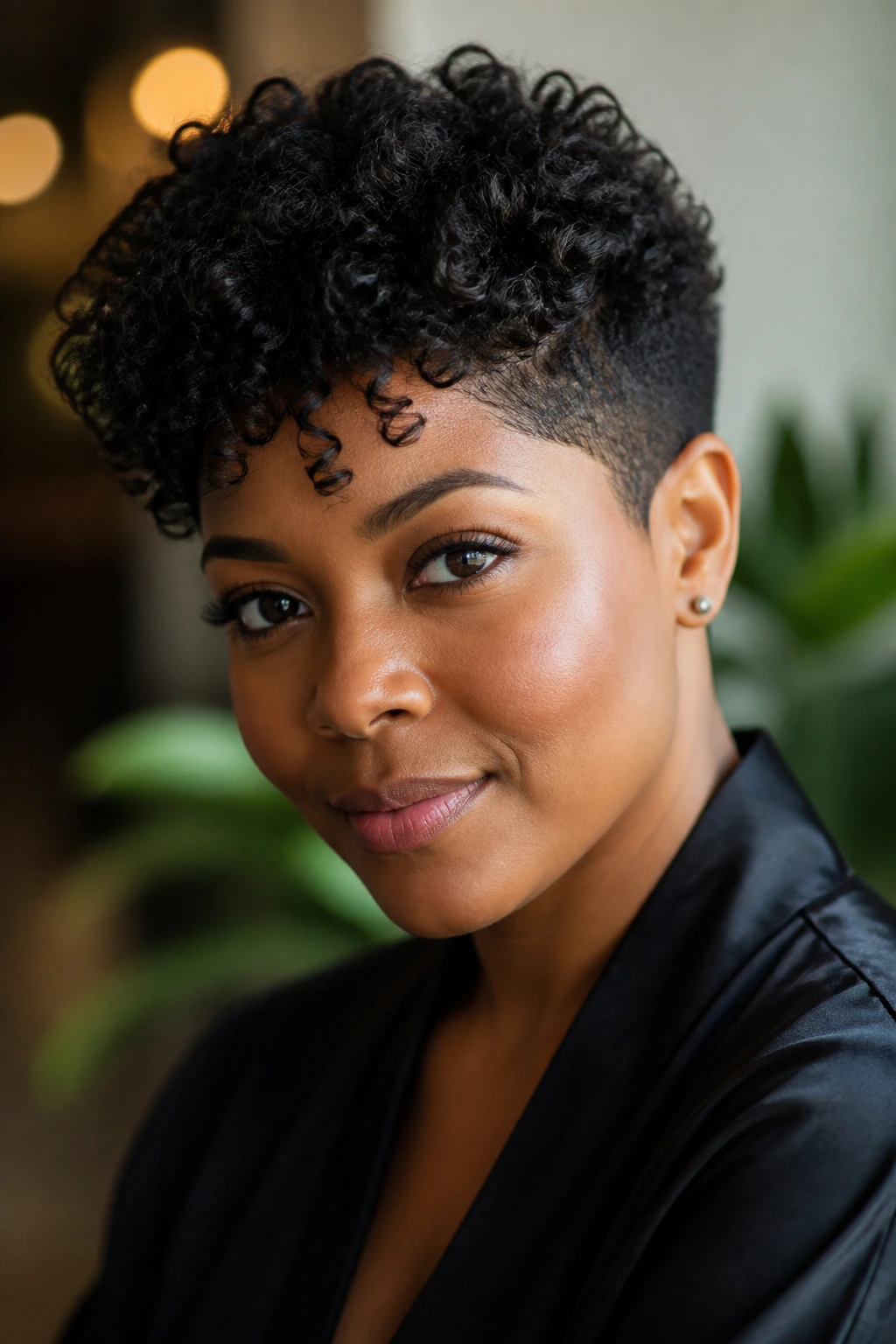
Curly-Coil Pixie: Keep the top longer and the sides tapered close, then cut the curls dry so shrinkage doesn’t wreck the shape. This version is best when you want the texture to stay visible instead of flattened.
Glasses-Friendly Taper: Leave the temple area slim and the fringe soft so your frames and haircut stop fighting for space. A little extra length at the sideburns helps the face look balanced, not crowded.
Polished Side-Part Pixie: Use a deep part, smooth the top with a brush, and keep the edges crisp. This one works well if you like neat hair that still has movement around the forehead.
Edgy Under-Nape Version: Add a tighter undercut at the nape and behind the ears, but keep the top soft. The effect is sharper and cooler, and thick hair usually benefits from the hidden bulk removal.
Grow-Out Pixie Bob: Leave the front pieces 1 to 2 inches longer and keep the back tapered. If you’re not ready for a full bob, this is the easiest bridge.
Common Mistakes to Avoid
-
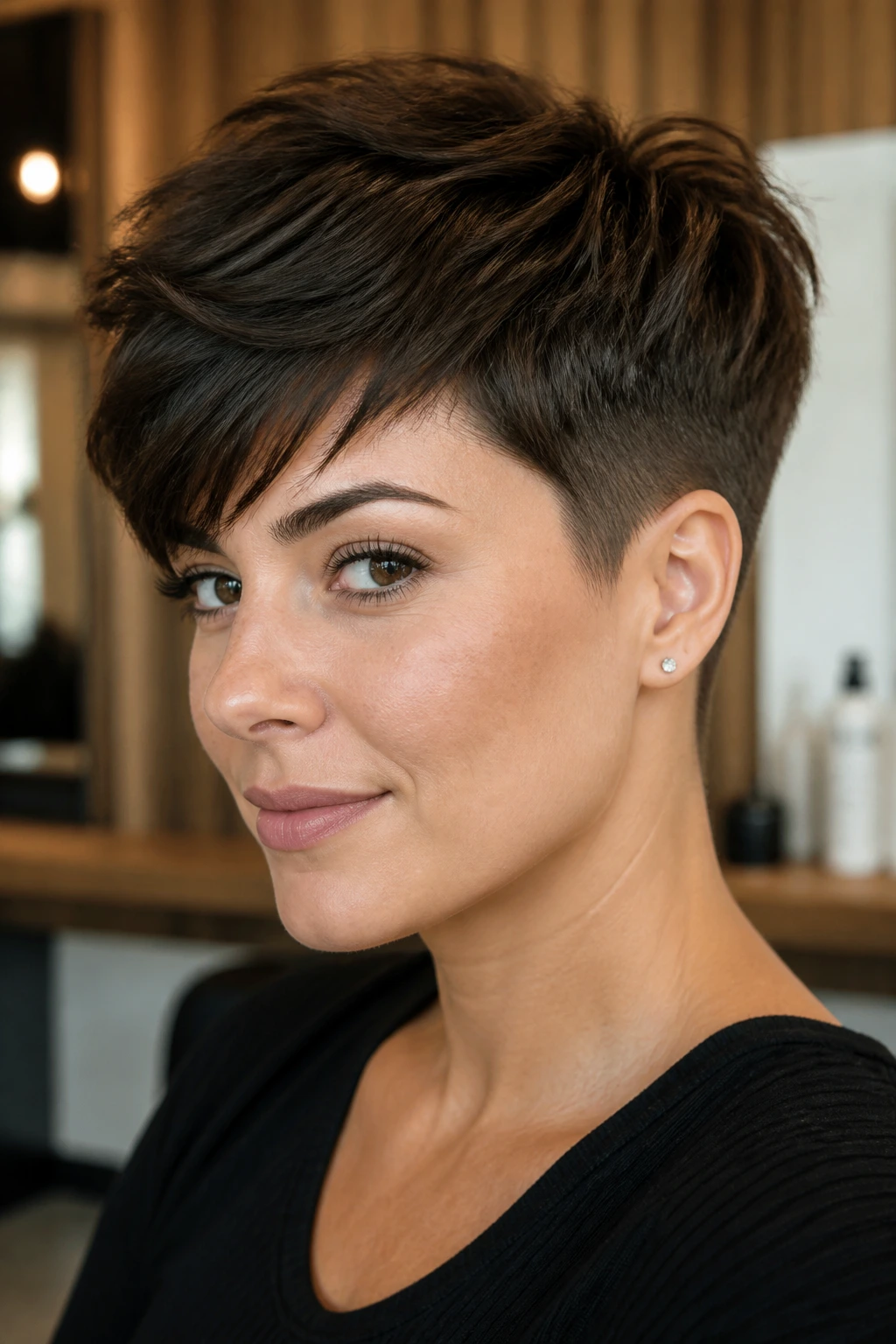
Keeping the sides too wide: If the hair sits full at the temples or cheek level, a round face will look broader. Ask for tapering and check the side profile before you leave the chair.
-
Cutting blunt bangs too high across the forehead: A heavy straight fringe can shorten the face and make thick hair feel bulky. Soft, broken, or side-swept bangs usually work better.
-
Over-thinning coarse hair: If the ends fray, stick out, or feel wispy at the surface, the hair was texturized too hard. Thick hair needs internal weight removal, not shredding at the perimeter.
-
Using too much product: Thick hair can hold more paste than fine hair, but that doesn’t mean it should. Too much product turns the top greasy and makes the cut collapse at the roots.
-
Ignoring the nape: A pixie can look good from the front and terrible from the back if the neck area is left too heavy. Clean up the nape regularly or the whole shape loses its edge.
Questions People Ask Before They Go Short
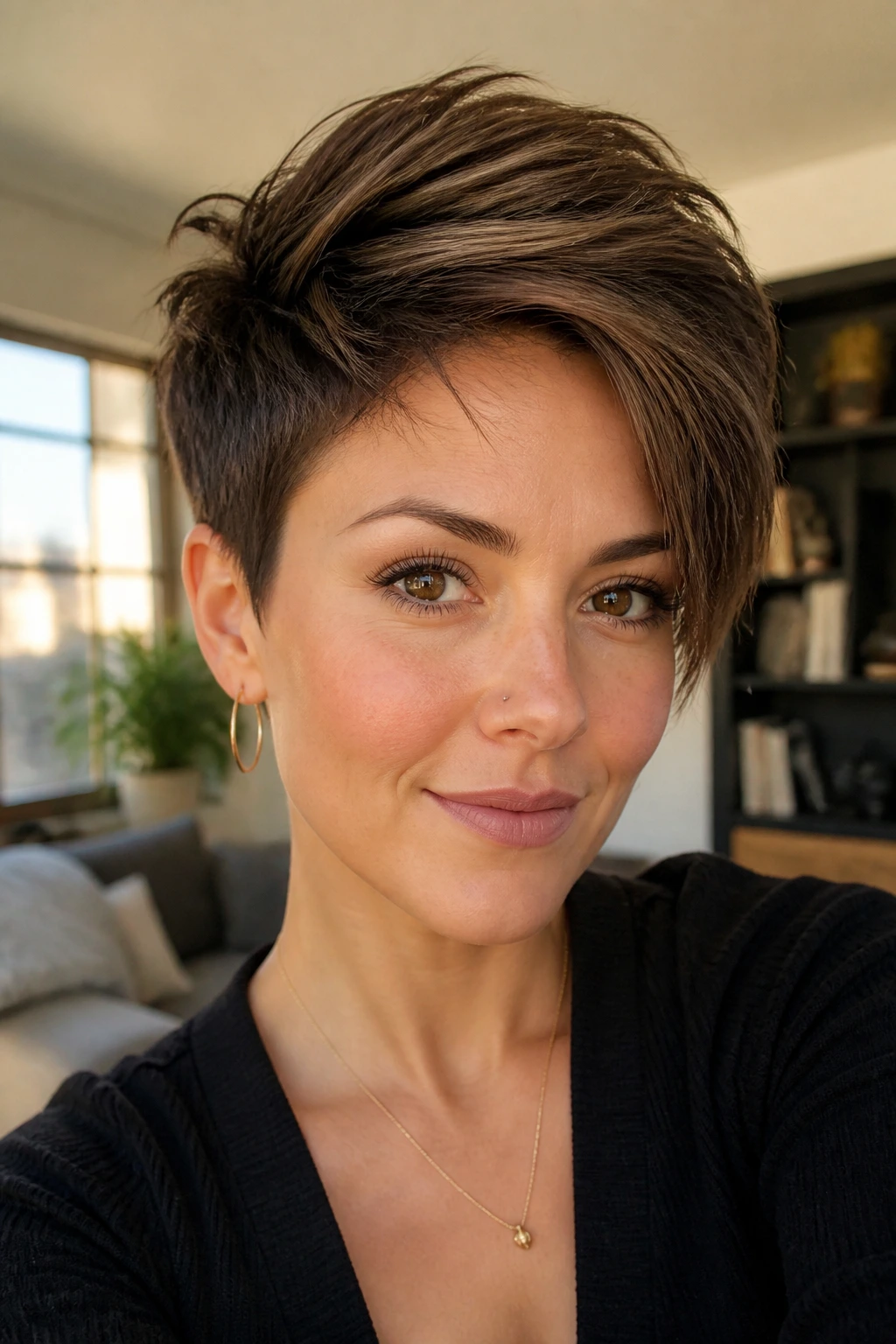
Will a pixie cut make a round face look wider?
Not if the shape is cut with some height on top and less bulk at the sides. The problem is usually a blunt, side-heavy pixie, not the length itself. A good pixie adds lines, not width.
How short can thick hair go before it starts puffing out?
Shorter than many people expect, but only if the haircut removes weight in the right spots. If the sides are left dense and the nape is bulky, puffing starts almost immediately. A tapered perimeter matters more than the exact length.
Can curly thick hair wear a pixie without turning triangular?
Yes, but it needs a dry or curl-by-curl cut and a little more length on top. Triangle shape usually comes from leaving the sides too full or cutting the crown too short. Shape the interior, not just the outline.
What kind of bangs work best on a round face?
Side-swept, curtain, broken fringe, and soft wispy bangs usually do the most for balance. A blunt, straight-across fringe can work on some faces, but it needs careful length and enough side control to keep the cut from feeling heavy.
How often should I get a pixie trimmed?
Every 4 to 5 weeks if you want it crisp. Every 6 to 8 weeks if you like a softer grow-out. Thick hair shows shape changes faster than people expect, especially at the nape.
What if my hair sticks out at the ears?
Ask for more taper around the temple and behind the ear, and keep product light there. That area is where thick hair often creates little wings. A close crop or undercut can solve it fast.
Can I grow a pixie into a bob without an awkward stage?
Yes, if the front stays longer than the back and the nape gets trimmed with restraint. The awkward stage happens when everything is cut to the same length and then grows out in a blunt block. Preserve the shape and it gets much easier.
A Short Cut That Keeps Its Shape
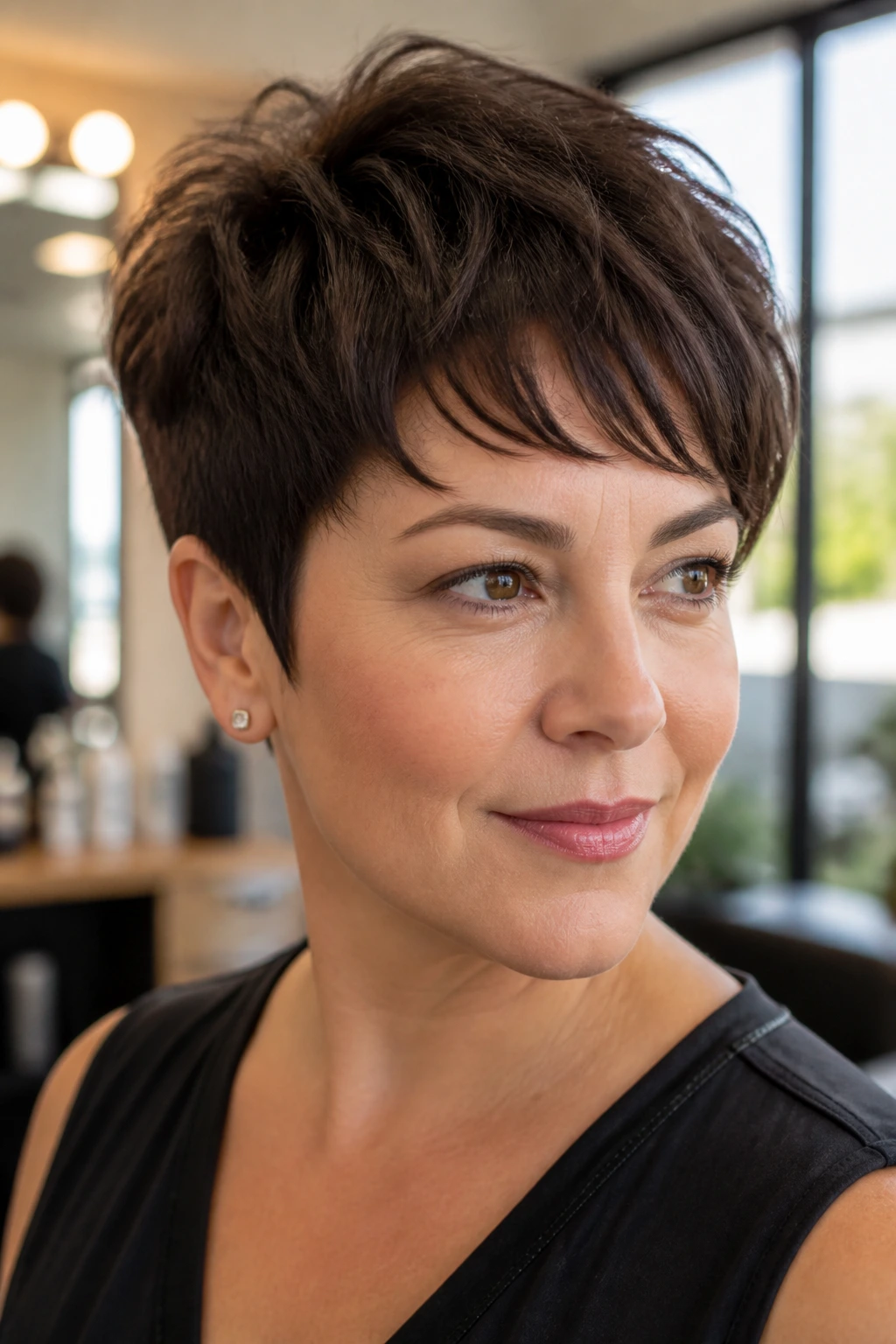
The best pixie on a round face does not try to hide the face. It sharpens it. It gives the cheeks some breathing room, keeps the sides under control, and leaves enough lift on top that thick hair works with you instead of against you.
That’s the part people forget when they’re scrolling through haircut photos. The most flattering short cuts are not the loudest ones. They’re the ones with clean sides, smart fringe placement, and enough texture that the whole thing moves when you do.
Bring that to the salon, and the cut has a fighting chance from day one. Bring it to the style chair at home, and it gets even better.