



A round face doesn’t need hair that hides it. It needs hair that keeps the eye moving.
That’s the part people miss when they search for medium length haircuts for round faces with wavy hair. The goal is not to make your face look smaller in some vague, magical way. The real job is more practical: create vertical lines, keep the widest part of the cut away from the cheeks, and let the waves fall with enough shape that they don’t puff out like a bell.
Medium length is the sweet spot because it gives waves room to bend. Too short, and the texture can spring outward at the sides. Too long, and a lot of wavy hair gets heavy, then limp, then frayed at the ends — which is a miserable combination if you’re trying to keep a round face looking balanced. The best medium cuts sit between the collarbone and the top of the chest, then use layers, parting, or fringe to steer the shape.
The styles below all work from one of three angles: they stretch the face, break up width, or add lift in the places that matter. A few are soft and low-maintenance. A few are sharper and more styled. One or two are for people who want a cut that looks almost accidental in the best way.
Why These Cuts Earn Their Keep
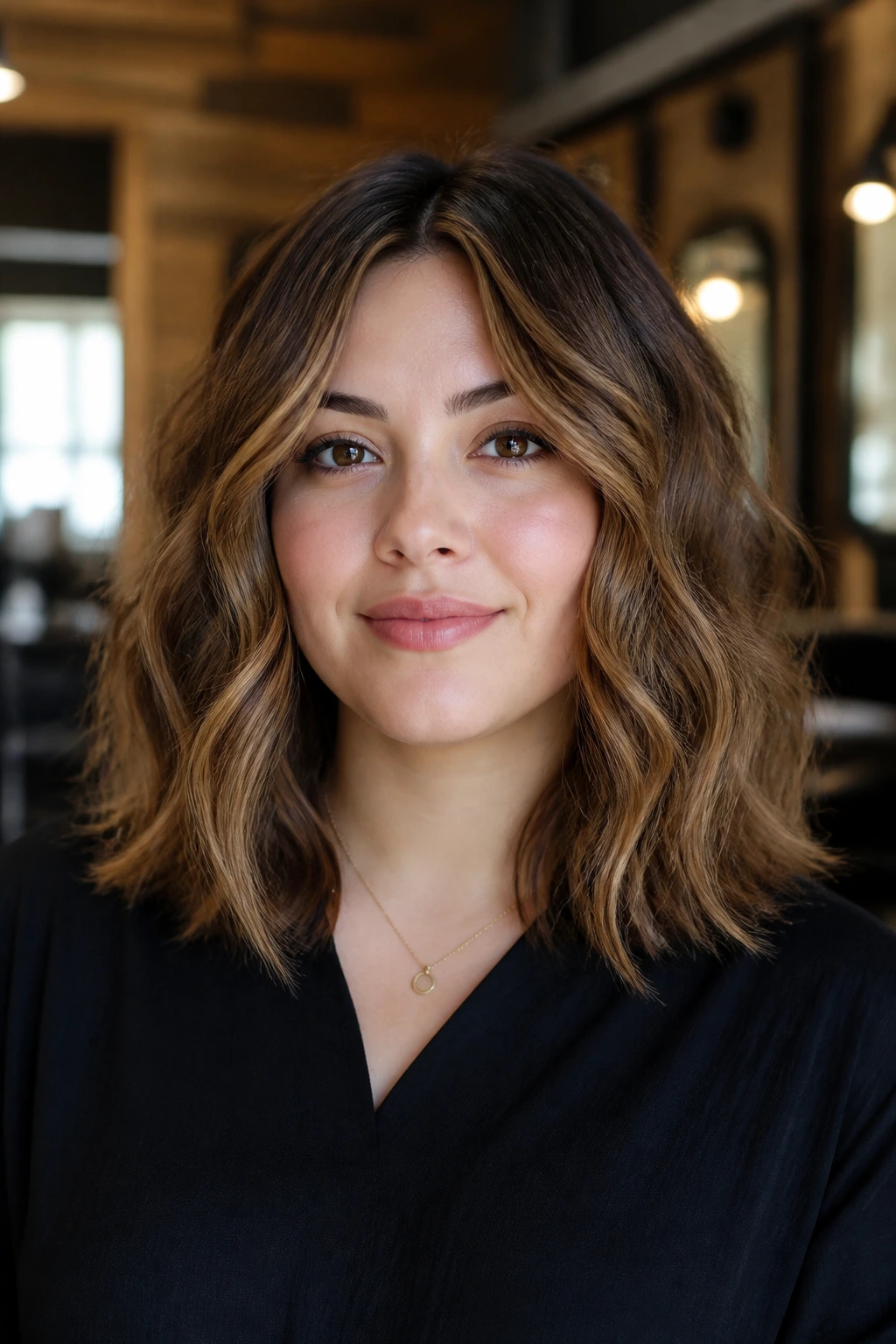
- They break the horizontal line: Round faces read wider when hair stops at the cheeks or jaw, so these cuts keep the fullest weight lower or higher than that point.
- They work with waves instead of fighting them: Wavy hair wants bend, not a stiff perimeter, and these shapes let the texture do the flattering part.
- They give you a side view worth keeping: A good medium cut changes shape in profile, which matters more than most salon mirrors admit.
- They grow out with some dignity: Long layers, curtain pieces, and soft angles stay wearable for weeks after the trim line stops looking fresh.
- They still style fast: Most of these cuts can be air-dried, diffused, or rough-blown in 10 to 15 minutes without turning into a project.
- They give the stylist a clear target: A chin-grazing mystery cut is how people end up disappointed. These options come with a shape, a length, and a reason.
1. Collarbone Lob with Long Layers
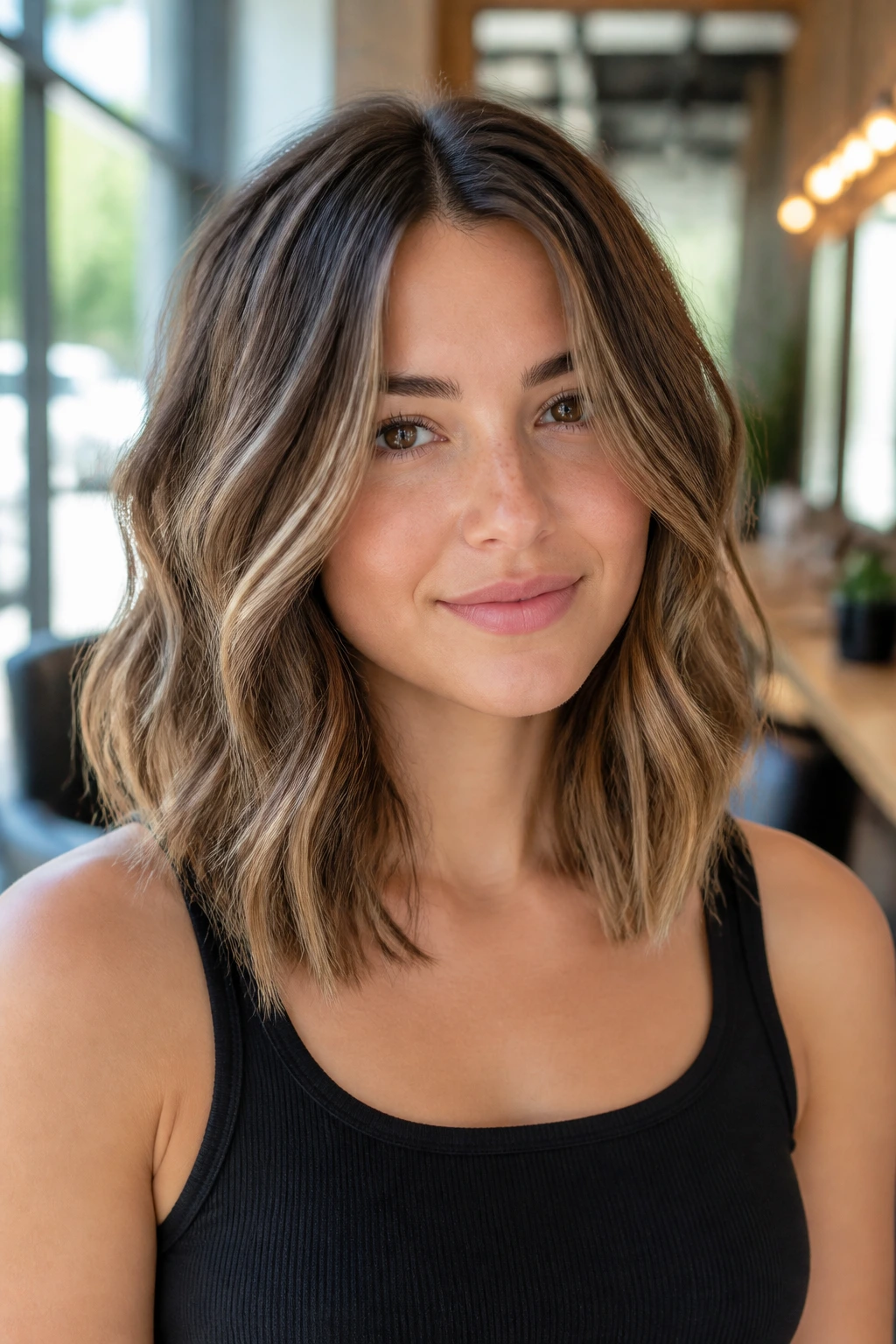
The collarbone lob is the calm, sensible answer — and I mean that as a compliment. It lands below the cheeks, which is the whole point, and the long layers keep wavy hair from turning into one blunt, puffy block. The shape is clean enough to look intentional, but soft enough that the waves still move.
What I like here is the margin for error. If your waves are loose, the cut hangs in a smooth bend. If your waves are fuller, the layers stop the sides from flaring out too wide. Ask for the longest pieces to kiss the collarbone and the front to stay a little longer than the back. That tiny difference matters.
Keep the part slightly off center. Dead-center parting can flatten the top and make the width sit right where you don’t want it.
2. Off-Center Shag with Curtain Bangs
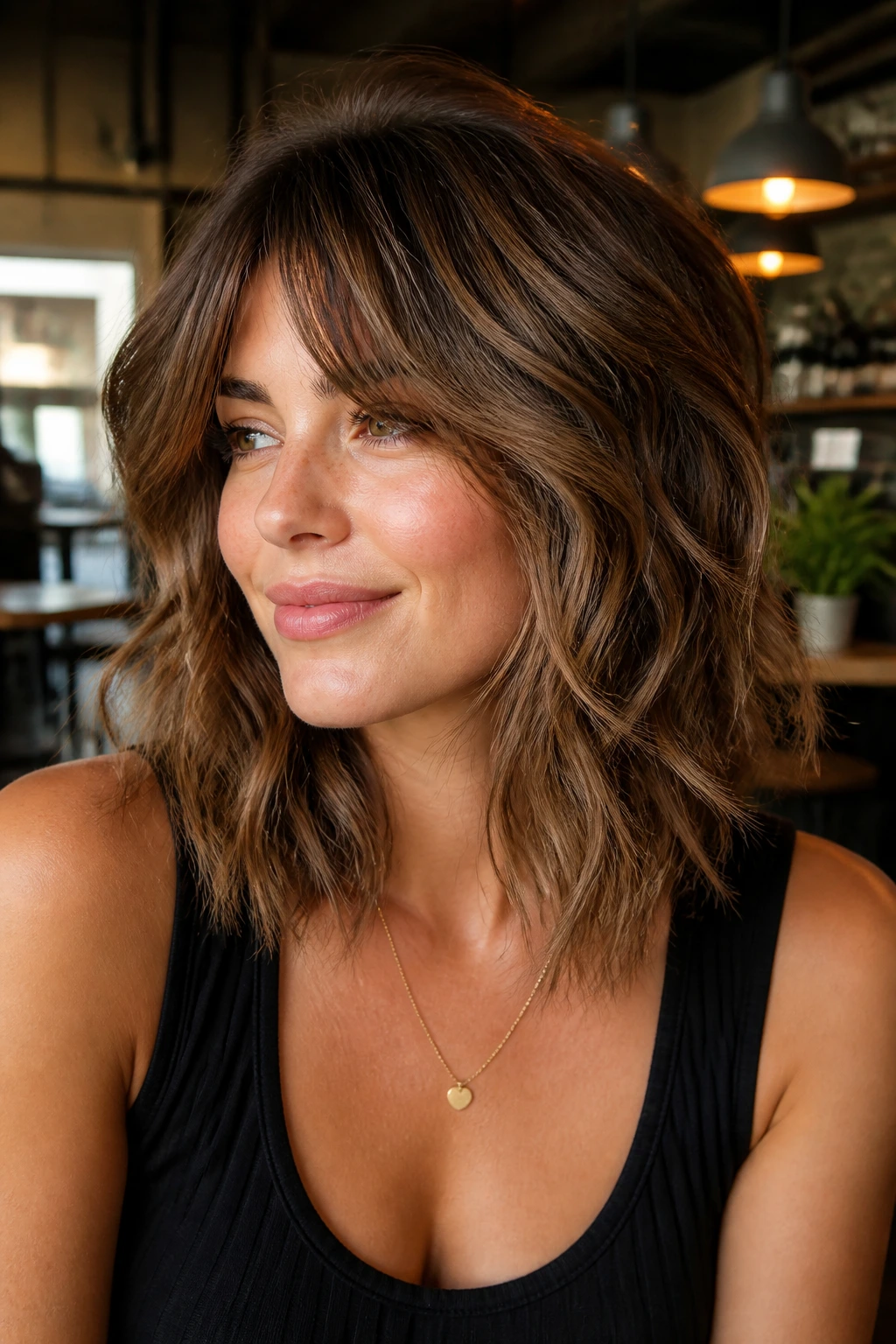
A shag can be a mess, or it can be the smartest thing in the room. The difference is where the weight lands. On a round face, the winning version keeps the shortest pieces away from the widest part of the cheeks and lets the curtain bangs fall open instead of hanging like a sheet.
Why the Off-Center Part Helps
An off-center part creates a diagonal line across the forehead and breaks the circle that round faces can pick up from symmetrical hair. Curtain bangs then split the front softly, which adds movement without locking the face into a square frame.
The shag part works best when the layers are feathered, not hacked. You want piecey separation through the crown and around the jaw, not a stack of short ends that fan out at the cheeks. On wavy hair, the shape gets a little better as it air-dries, which is one reason this cut has real life in it.
Best for medium to thick waves.
Skip the super-short fringe if your hair swells at the temples.
3. Butterfly Cut at the Collarbone
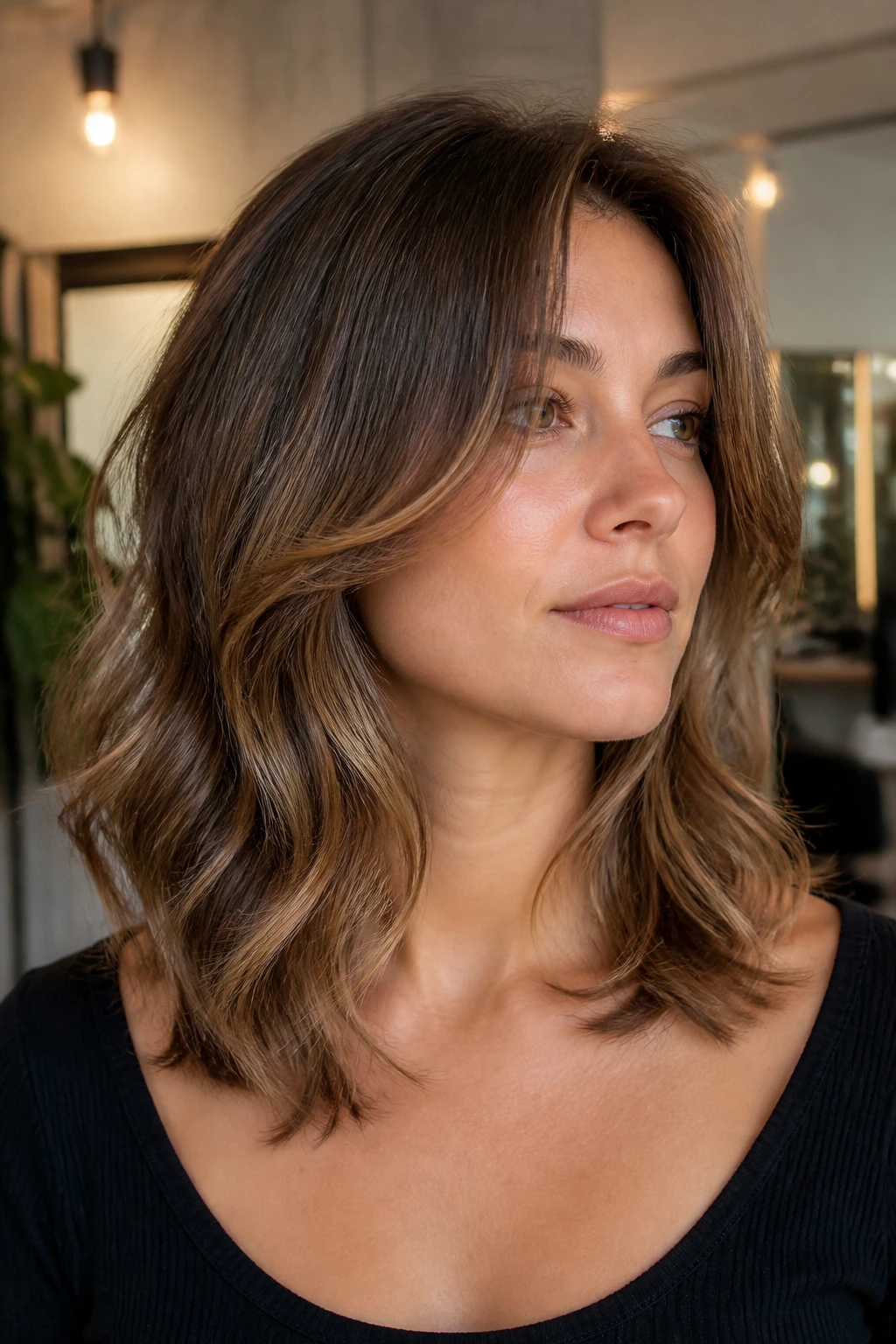
Why does the butterfly cut keep showing up in flattering medium haircuts? Because it gives you two levels of movement without making the whole head look layered to death. The shorter top layers lift around the cheek and chin, while the longer perimeter stays down near the collarbone.
That separation is useful on a round face. The eye sees motion above and length below, and the middle part of the face doesn’t get trapped under one heavy line. If your waves are soft, this cut gives them a floaty bend. If they’re strong, it keeps the shape from feeling bulky.
Ask the stylist to keep the shortest face-framing pieces below the cheekbone, not right on it. That’s the detail that keeps the cut from widening the face.
4. Side-Parted Textured Lob
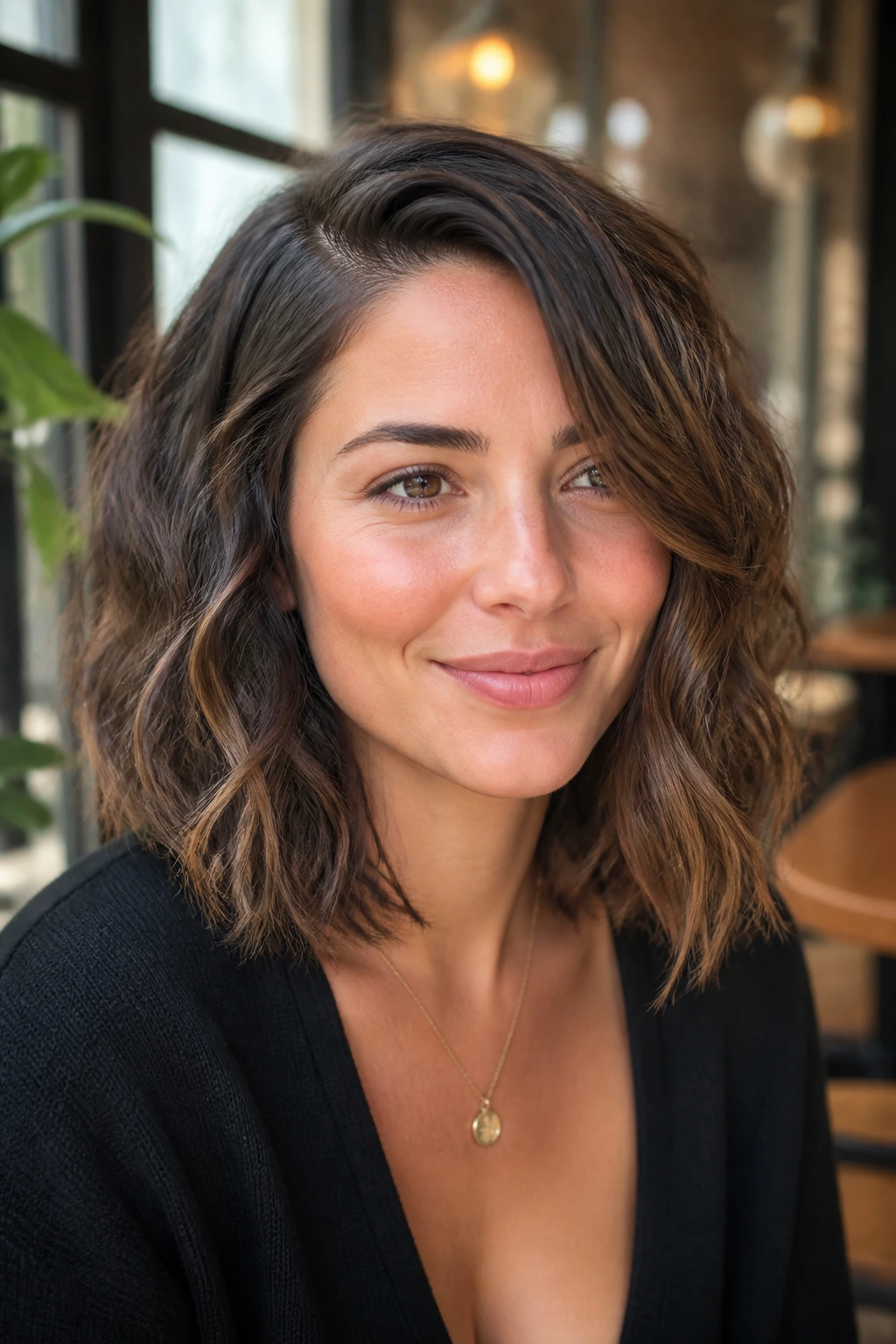
If your face looks widest when your hair is parted in the middle, the side-parted lob is a small fix with a big payoff. The part moves the visual line off the center of the face, and the textured ends stop the cut from hanging like a slab.
This one is especially good if your waves naturally fall to one side anyway. Don’t fight that. Lean into it. A side part with a few long, broken-up pieces around the front can make the entire shape feel longer, even when the actual length stays the same.
I’d choose this over a blunt shoulder cut almost every time for round faces. The texture gives the lob some air, and the side part keeps the width from settling right across the cheeks.
5. Soft A-Line Lob
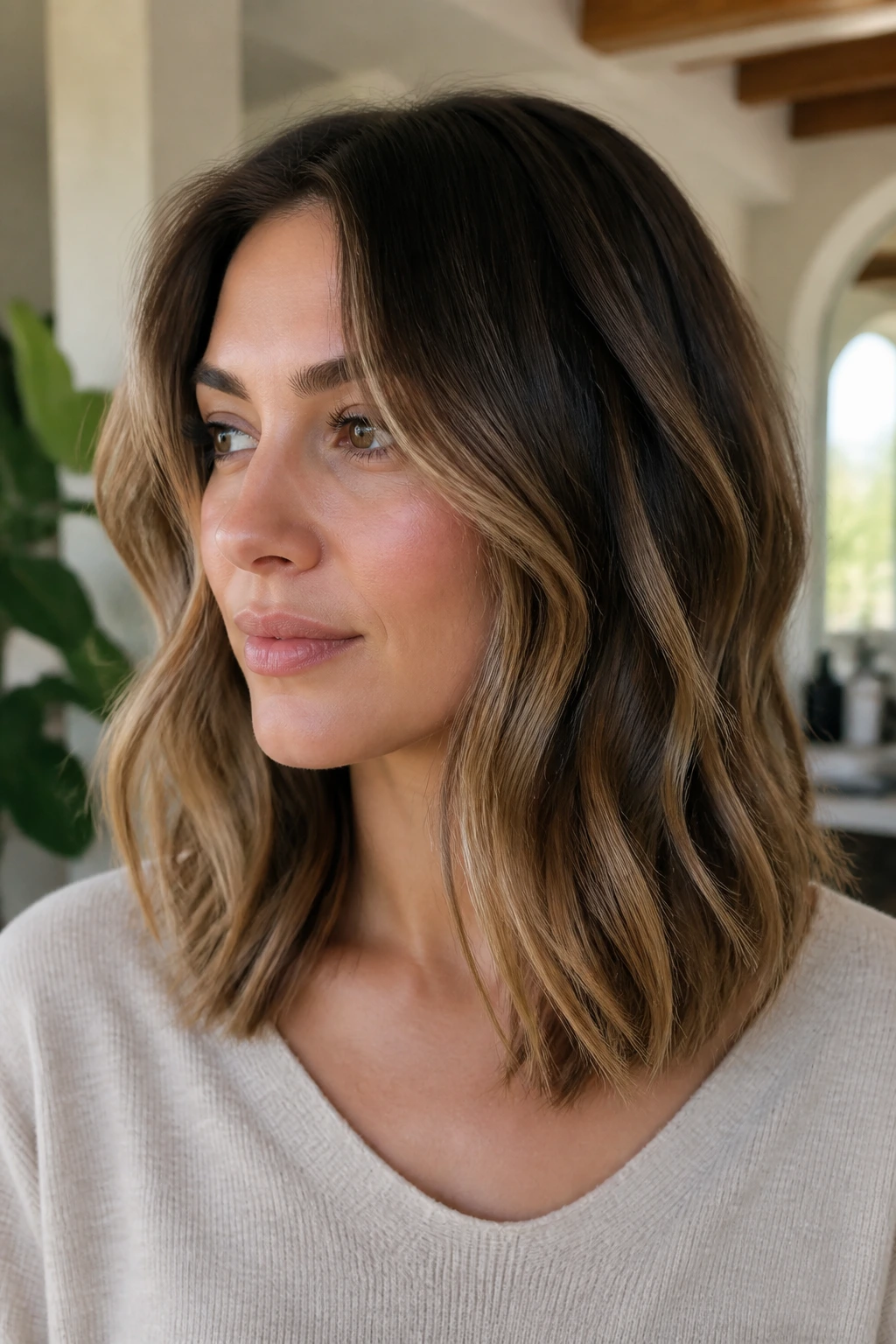
A soft A-line lob is one of the few angled cuts I trust on a round face. The front pieces sit a little longer than the back, which pulls the eye forward and down. The trick is to keep the angle subtle. If the front is much longer, the shape can start looking dated fast.
The back should still touch the shoulder area, not hover too high. That keeps the haircut in medium-length territory and avoids the stiff triangle effect. On wavy hair, the A-line reads best when the ends are point-cut lightly so the line doesn’t look too hard.
This is a nice choice if you want structure without going full shag. It behaves. Which, sometimes, is exactly what you want from a haircut.
6. Face-Framing Layers with Invisible Ends
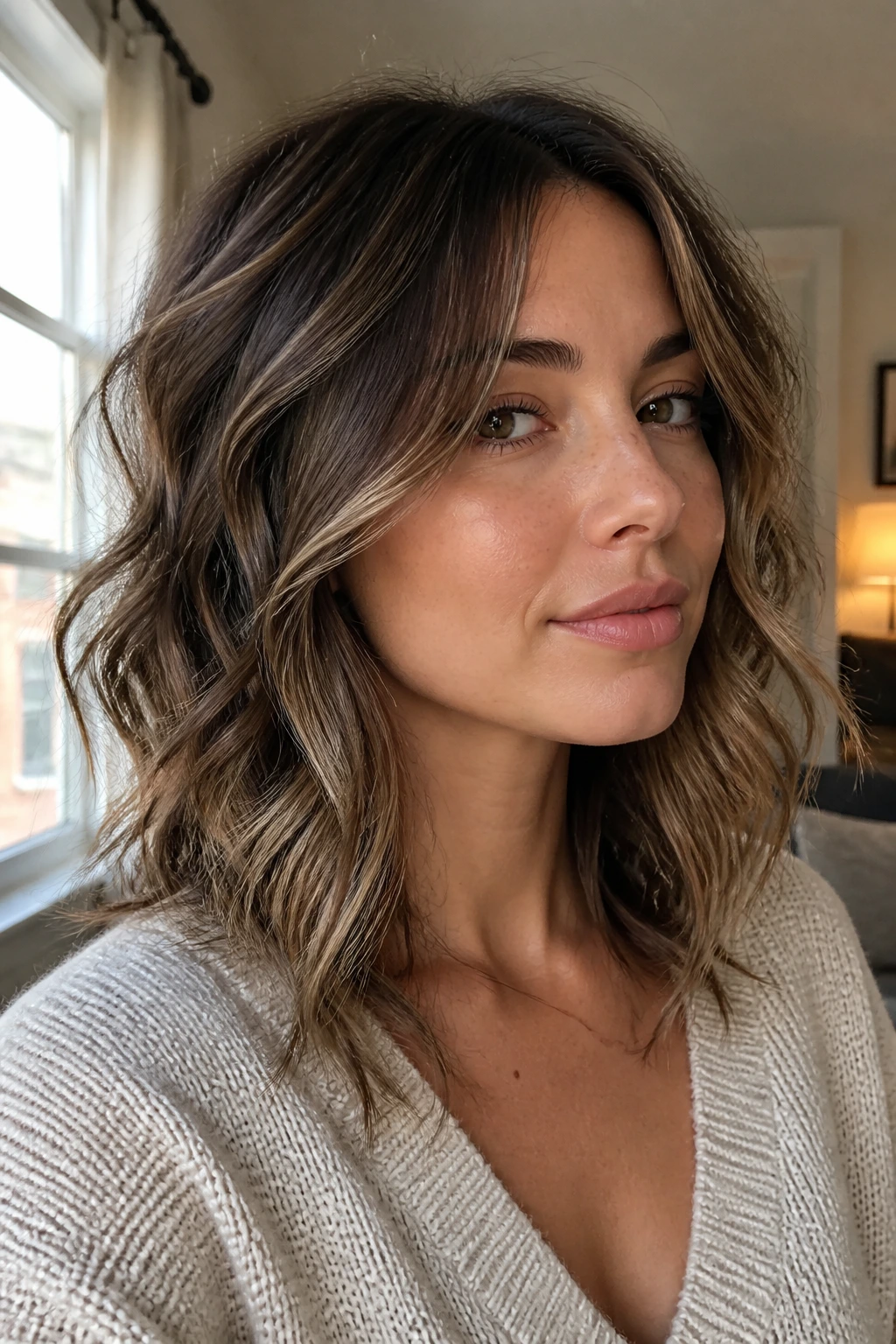
This is the cut for people who want movement without obvious steps. The perimeter stays fairly clean, but the inside gets softened with invisible layers that remove bulk and let the waves bend. The result is smoother than a shag and less strict than a blunt lob.
On a round face, that matters because the fullness can be controlled without carving too much width around the cheeks. The face-framing pieces should start low — around the mouth or just below the cheekbone — and taper toward the collarbone. If they start too high, the face can feel busier than before.
I like this style for dense wavy hair. It keeps the ends from swelling, especially when your hair dries in humid air or if your waves tend to stack on top of one another.
7. Bottleneck Bangs on a Wavy Midi
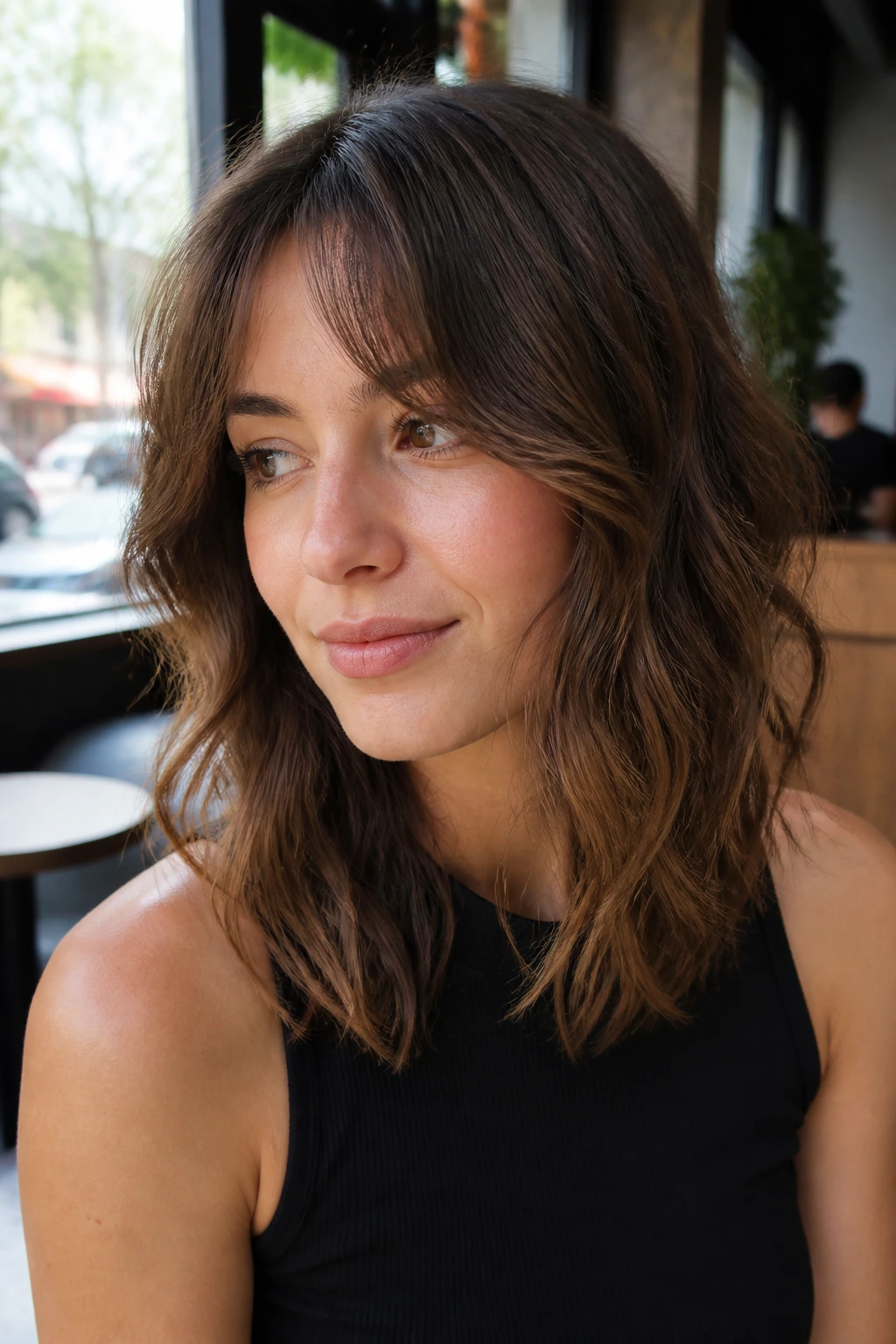
Bottleneck bangs are one of the better fringe choices for round faces because they don’t act like a hard wall across the forehead. They’re narrower in the center, then open out around the cheekbones, which gives the face room and adds a soft vertical cue.
What Makes the Fringe Work
The shortest center pieces should sit around the brow or just above it, depending on your wave pattern when dry. The sides need to fall longer, blending into the front layers rather than stopping abruptly. That open shape avoids the heavy, helmet-like look that blunt bangs can create on fuller cheeks.
This cut works best on medium-length hair that has a little bend and memory to it. If your waves are very loose, a round brush at the front makes the fringe sit better. If your waves are fuller, let the bangs separate a little. That separation is not a flaw; it’s the point.
A little crown lift helps too. Flat roots make bangs look heavier than they are.
8. Blunt Mid-Length Cut with Softened Ends
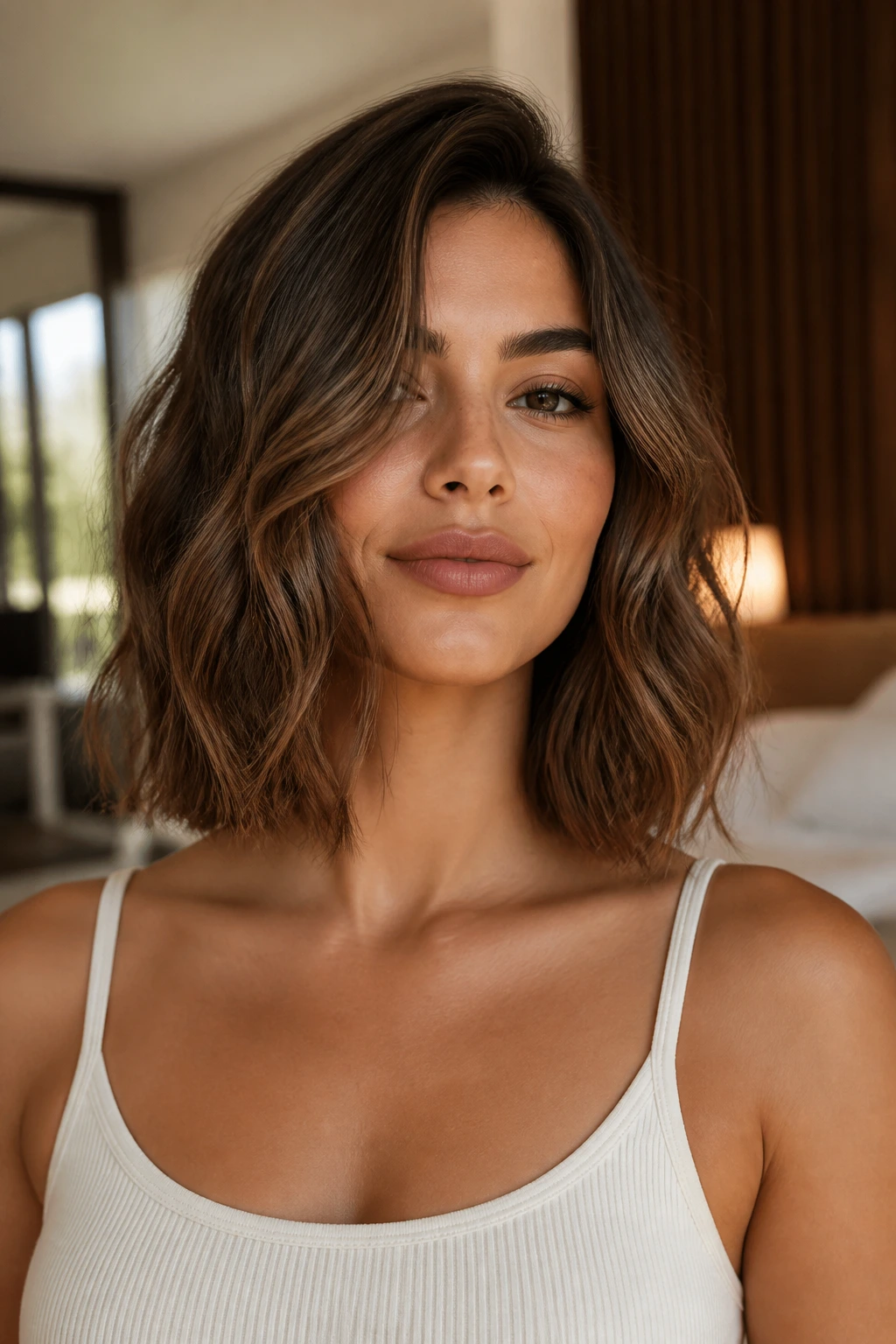
A blunt cut on a round face sounds like a bad idea until you see it on fine or loose wavy hair. Then it starts making sense. The blunt perimeter gives the hair a solid line, which can be useful if your waves are too airy and keep flaring out into nothing. The softened ends stop the edge from looking severe.
The key is placement. The line should not land right on the cheek or jaw. Better to keep it closer to the collarbone, where the straightness works as a lengthener instead of a width-maker. A side part helps a lot here.
I’d call this a good option for people who want a clean shape more than a layered one. It’s tidy. It has manners. And when your hair is fine, that clean edge can look fuller than a heavily layered cut ever will.
9. French-Girl Lob with Cheekbone Pieces
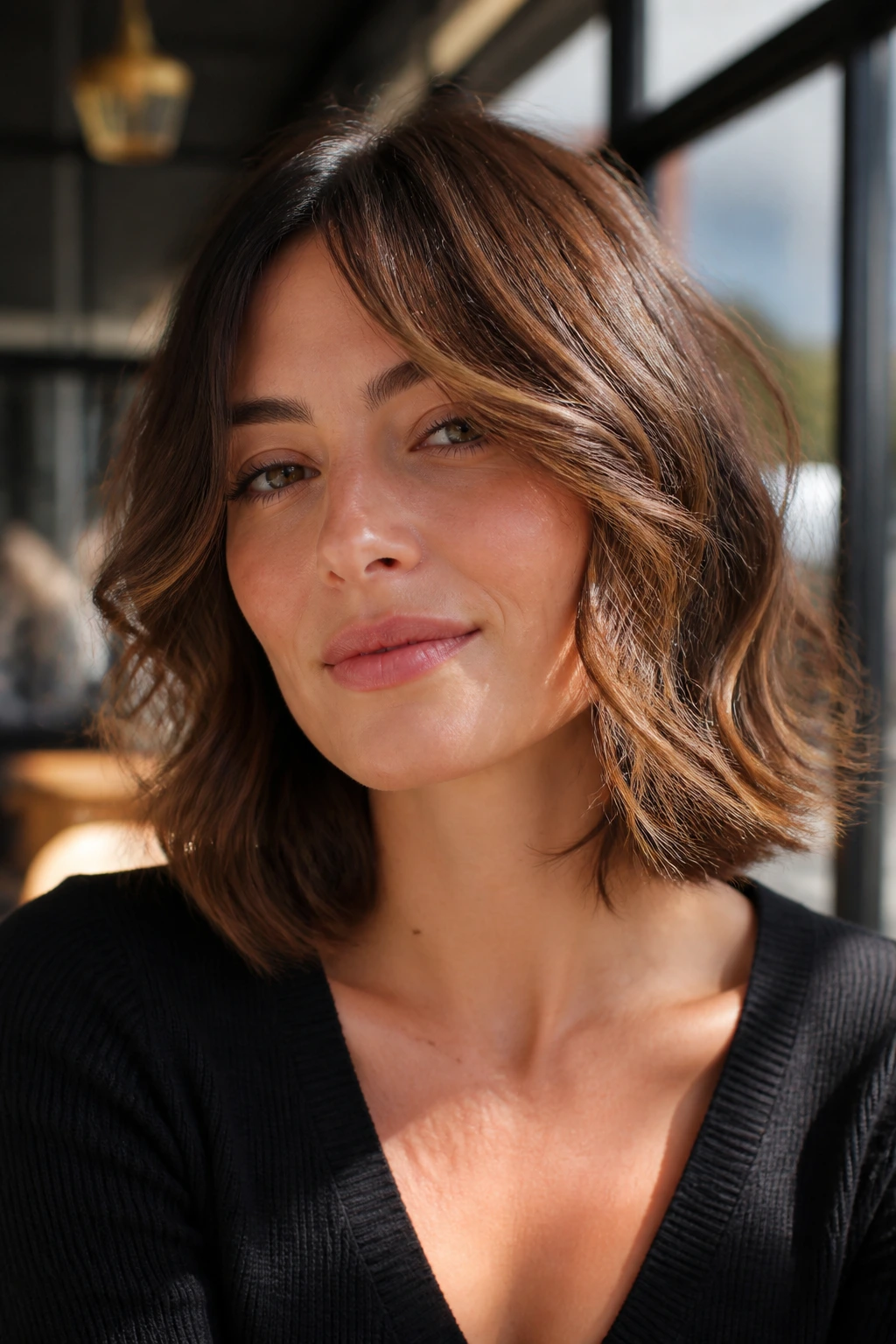
This one is for the person who likes hair that looks a little undone after a rough dry — in a good way. The French-girl lob usually sits at the collarbone or a touch above it, with face-framing pieces that brush the cheekbone and soften into the rest of the cut.
On a round face, the cheekbone pieces matter because they create a small shadow line instead of a flat wall of hair. That line changes the shape of the face in profile and head-on. Wavy hair gives this cut the right amount of casual movement without needing much styling.
I wouldn’t push this too short. The charm is in the slight slackness, not in a cropped look that keeps riding up toward the jaw.
10. Shoulder-Grazing Razor Cut
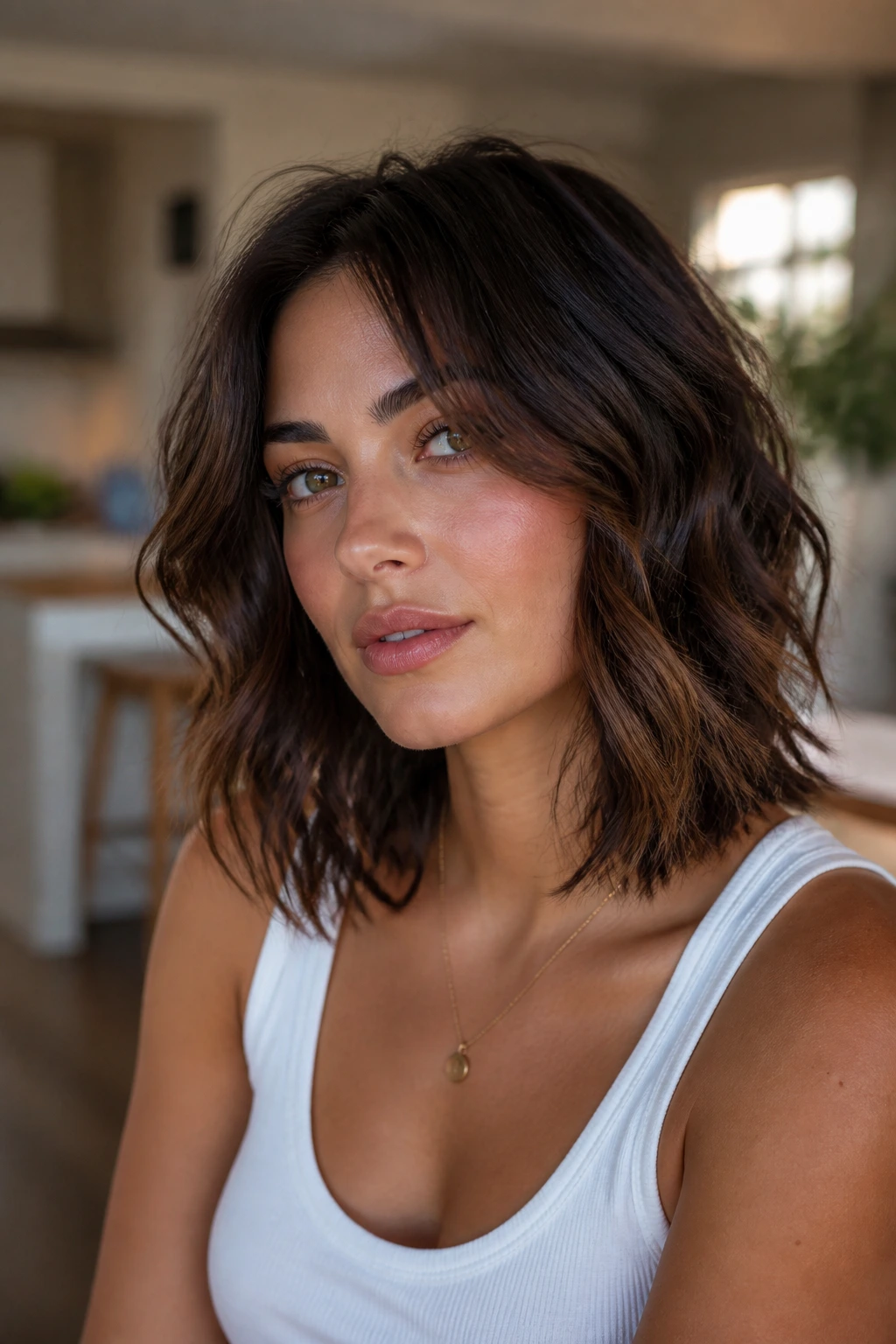
A razor cut can be gorgeous on wavy hair, but only when the hair can handle it. Thick or medium-thick waves usually love this shape because the razor softens the ends and gives the movement a more broken-up finish. That makes the cut feel lighter around the face, which is useful when you’re trying not to widen a round shape.
The shoulder-grazing length is important. Too short and the ends can flip outward at the cheek line. Too long and you lose the airy effect that makes the razor work. The best version hits just below the shoulders and lets the waves collapse into separated pieces instead of one big wave wall.
Use this one if you like a lived-in finish and don’t mind a little styling cream at the ends. If your hair is dry or fragile, though, a razor can make the perimeter look frayed fast.
11. U-Shaped Medium Cut with Long Front Pieces
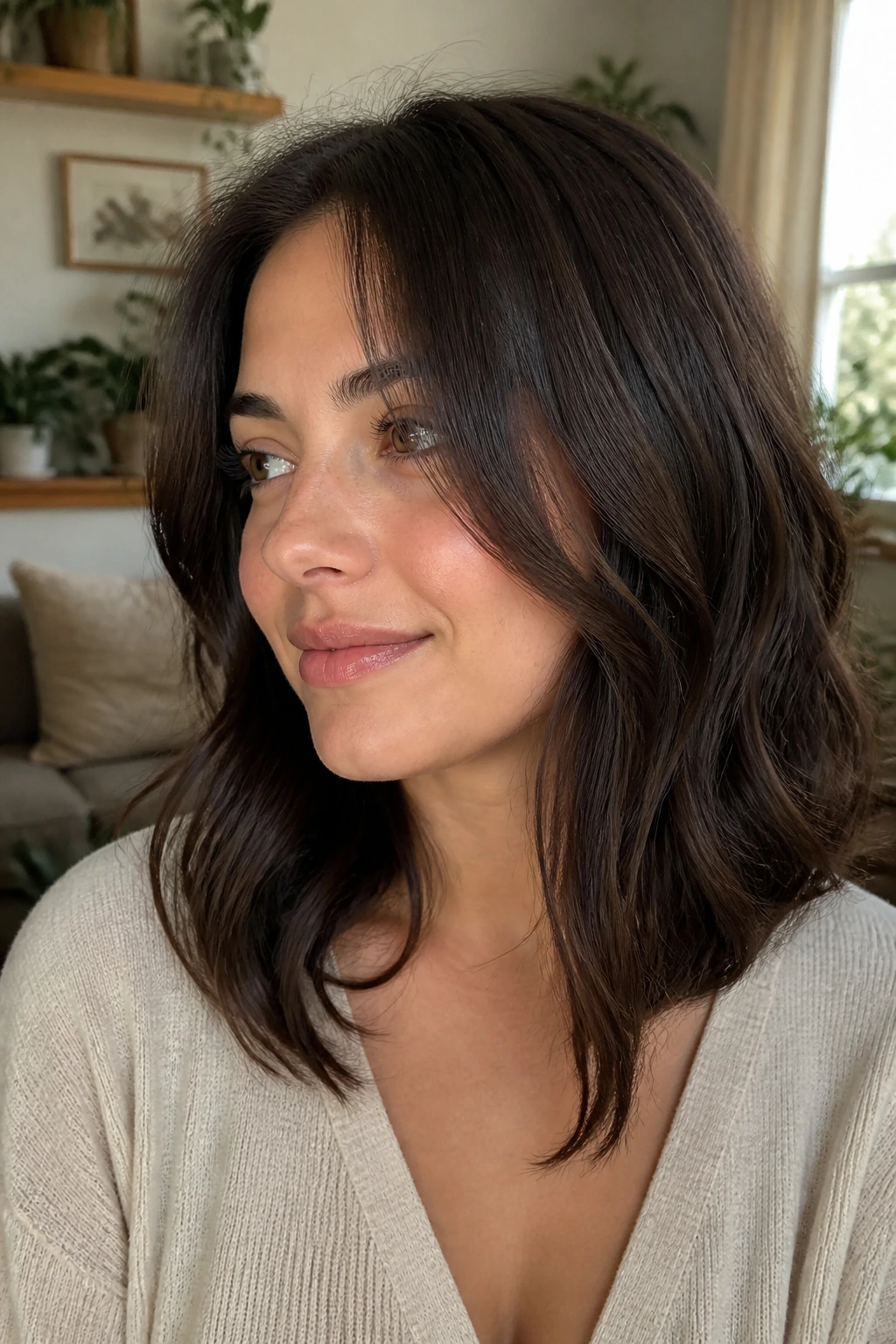
The U-shaped cut is quietly flattering because it changes the silhouette without screaming about it. The back sits slightly shorter, then the sides sweep longer toward the front, making a gentle curve that pulls the eye down. On a round face, that curve helps the haircut feel elongated.
The front pieces should be long enough to graze the collarbone, or even a touch below if your hair springs up a lot when it dries. The shortest layer should still stay well away from the cheeks. That’s the part people forget when they ask for a “soft shape” and end up with a puffball.
This is one of my favorites for wavy hair that gets heavy in the back. The U shape gives structure without making the haircut boxy.
12. Modern Rachel Layers
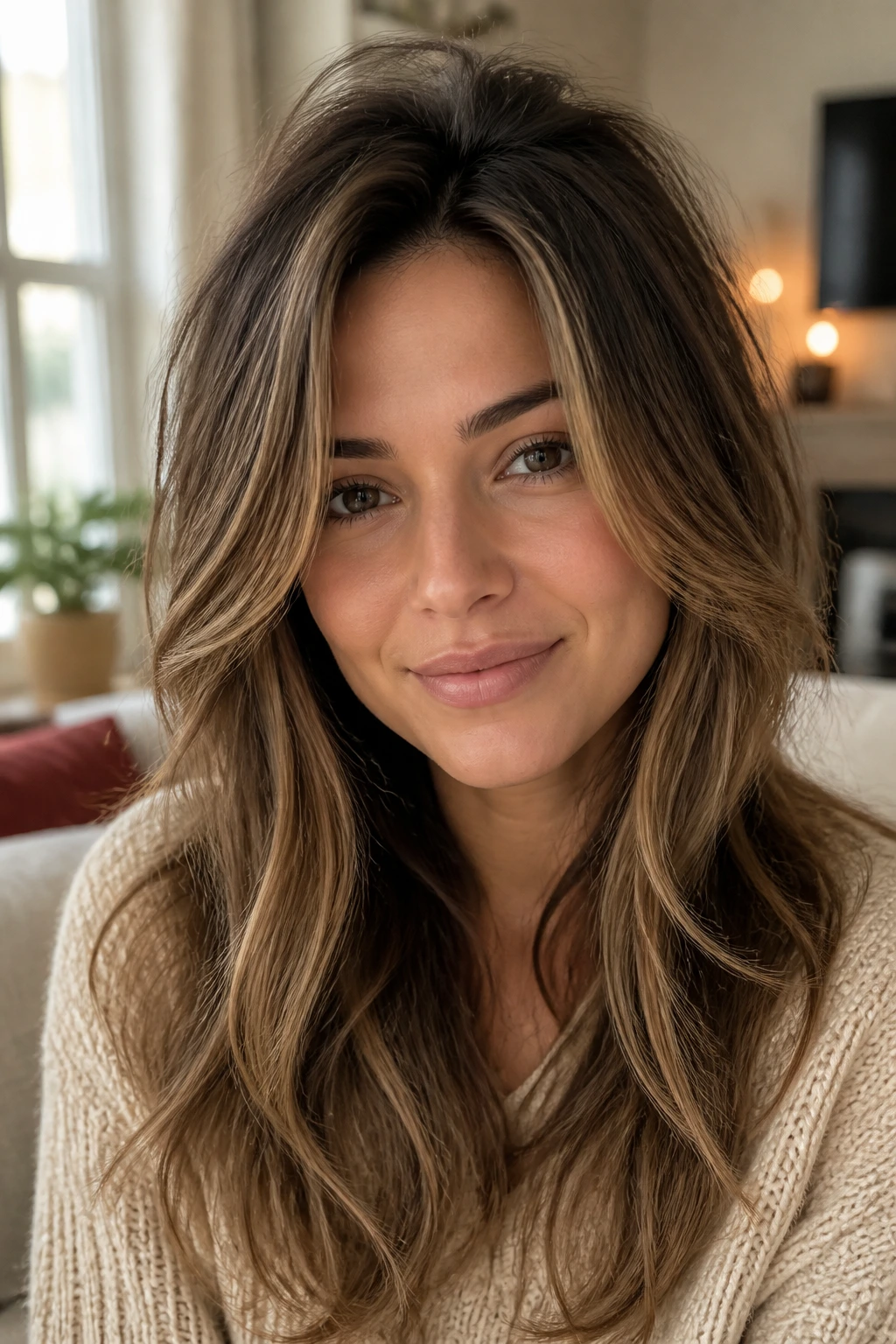
A modern Rachel cut is not the old, flipped-out haircut from the TV rerun era. It’s the smarter version: long, face-opening layers, a little crown lift, and enough movement to keep wavy hair from sitting flat. On a round face, the layered front pieces help create a longer line while the top gets a bit of air.
The best version starts the shortest layers below the cheekbone and keeps the ends soft. If the layers start too high, the whole cut can puff around the temples and make the face feel wider. That’s the old mistake.
This cut works best when you like a little blow-dry time. A round brush at the crown and a soft bend through the front pieces make the shape look finished instead of fluffy.
13. Soft Wolf Cut at Mid-Length
A wolf cut can go wrong on a round face if the crown is too high and the sides explode. The soft version avoids that mess. It keeps the attitude of a wolf cut — texture, separation, lift — but lowers the volume a little and keeps the front pieces long enough to frame, not crowd, the cheeks.
Wavy hair helps a lot here. The natural bend blends the layers, so the cut doesn’t need as much styling to look deliberate. I’d keep the shortest layers below the cheekbone and let the top stay a little longer than you might with a more dramatic wolf shape.
This is a good choice if you want edge without losing wearability. It’s not a haircut for someone who wants every strand in its place.
14. Deep Side-Part Lob with Swept Volume
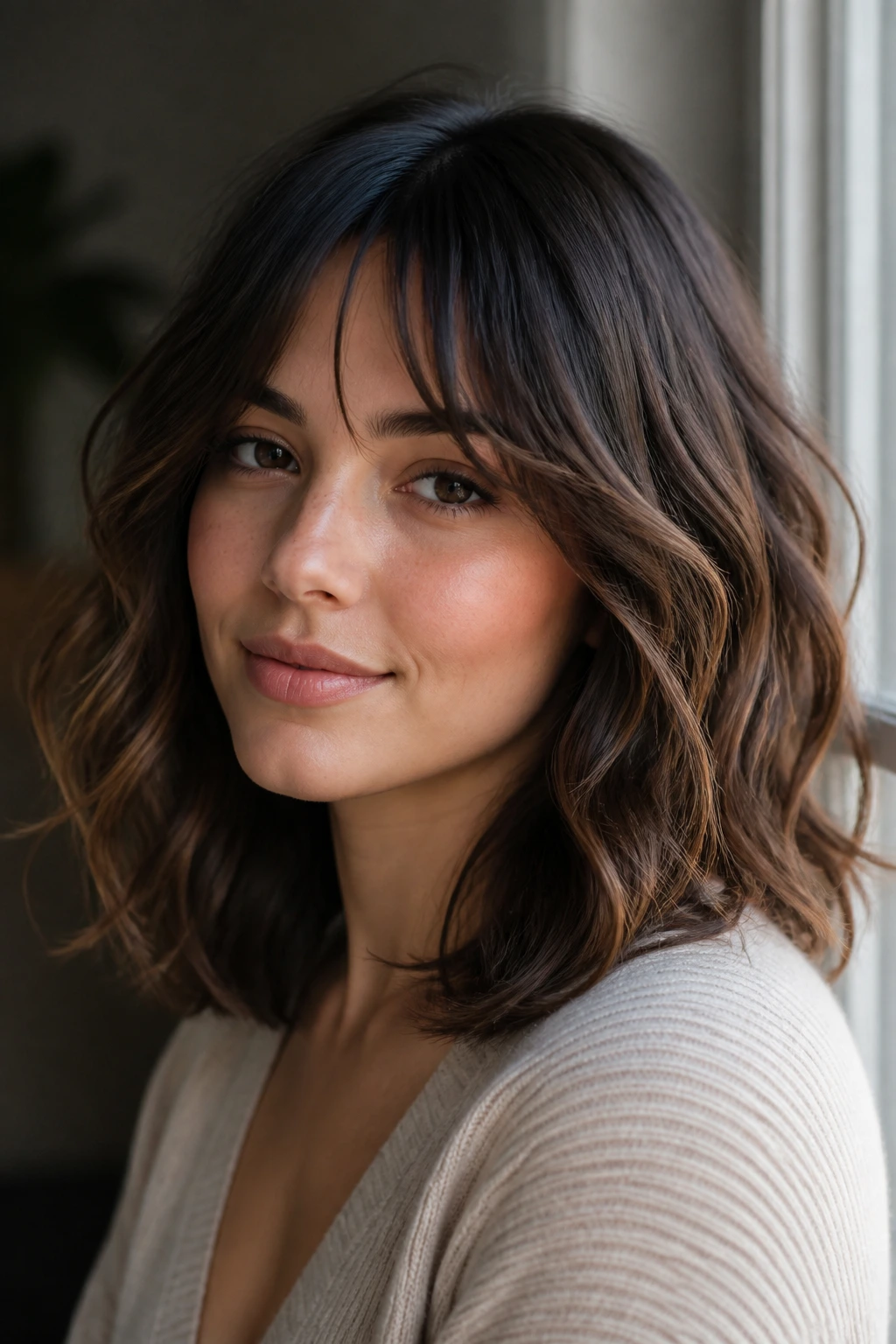
A deep side part is one of the easiest ways to cheat a little length into a round face. It creates lift at the root on one side and a long sweep on the other, which changes the geometry of the whole cut before the length even gets involved.
The lob itself should stay textured and medium. If it’s too blunt, the asymmetry can feel forced; if it’s too layered, the volume can spread sideways. You want the shape to move from crown to shoulder in one clean line.
This is a sharp choice for people who like hair that looks a little more styled. Not fussy. Styled. There’s a difference, and it shows.
15. C-Shaped Mid-Length Cut
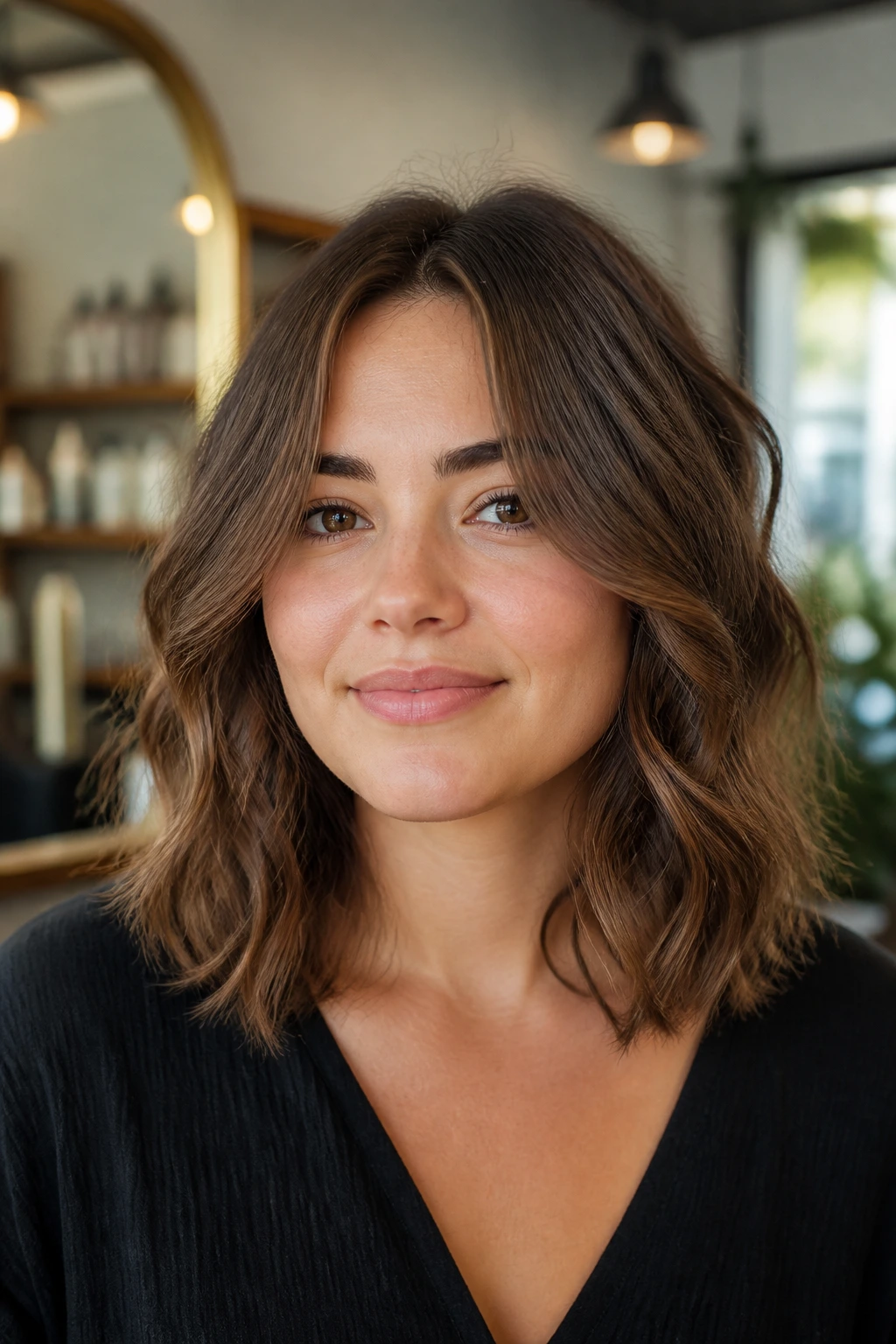
A C-shaped cut has a curved front that wraps softly around the face, then opens out toward the collarbone. On a round face, the curve has to start low enough that it doesn’t sit at the widest part of the cheeks. That’s the rule. Start the movement below the cheekbone, not across it.
When it lands right, the shape feels soft without being puffy. The waves arc inward, then drop, which gives the face a gentle frame and keeps the sides from looking too wide. It’s a nice middle ground between a blunt lob and a heavy shag.
I like this shape for people who want their hair to look polished after a simple blow-dry, but still want a little softness when it air-dries.
16. Air-Dried Wavy Lob with Barely-There Fringe
Some cuts are built for styling. This one is built for not styling, which is a different kind of skill. The air-dried wavy lob keeps the length around the collarbone, uses light internal shaping, and adds a fringe that’s so soft it doesn’t steal the show.
The fringe should be long enough to separate on its own — think brow-skimming at the center, longer at the sides, and easy to tuck behind the ears. That keeps the face open and avoids the boxed-in look that fuller bangs can create.
A little mousse at the roots and cream through the mid-lengths usually does enough. Then leave it alone. Wavy hair often looks better when it’s not being bullied.
17. Jaw-Skimming Textured Bob-Lob Hybrid
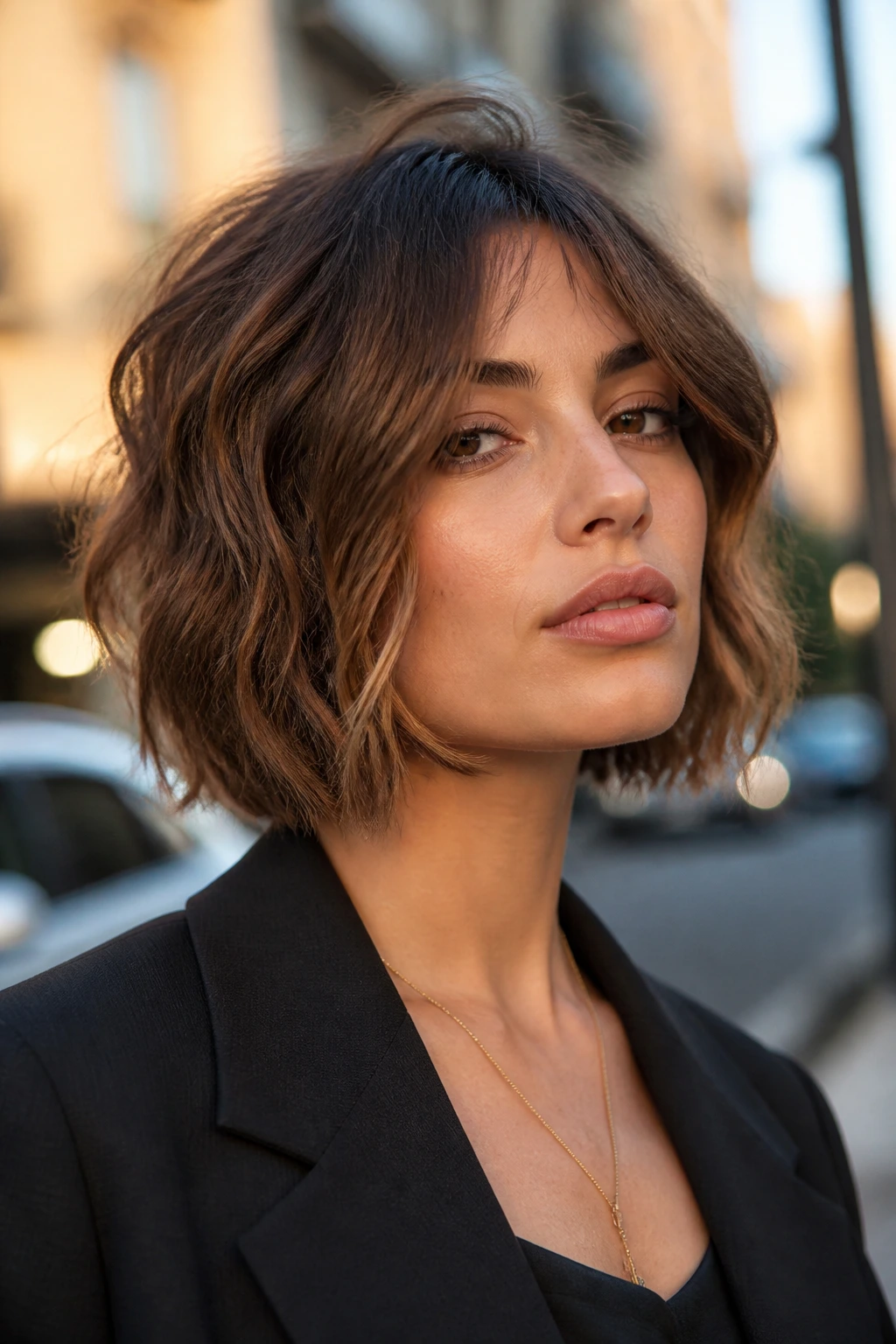
This is the shortest cut I’d put on the list, and it needs to be handled carefully. The idea is not to park the line right on the jaw. That would widen the face. The idea is to keep the perimeter just below it, then break up the ends with texture so the shape doesn’t look heavy.
The hybrid feel comes from how it sits between a bob and a lob. You get the freshness of a shorter cut, but enough length to avoid the hard roundness that a true jawline bob can create on a round face. With wavy hair, the piecey ends make a big difference. They keep the lower edge from reading like one thick rim.
This is best if you like a haircut with a little bite to it. Not soft. Just controlled.
18. Layered Cut with Long Curtain Fringe
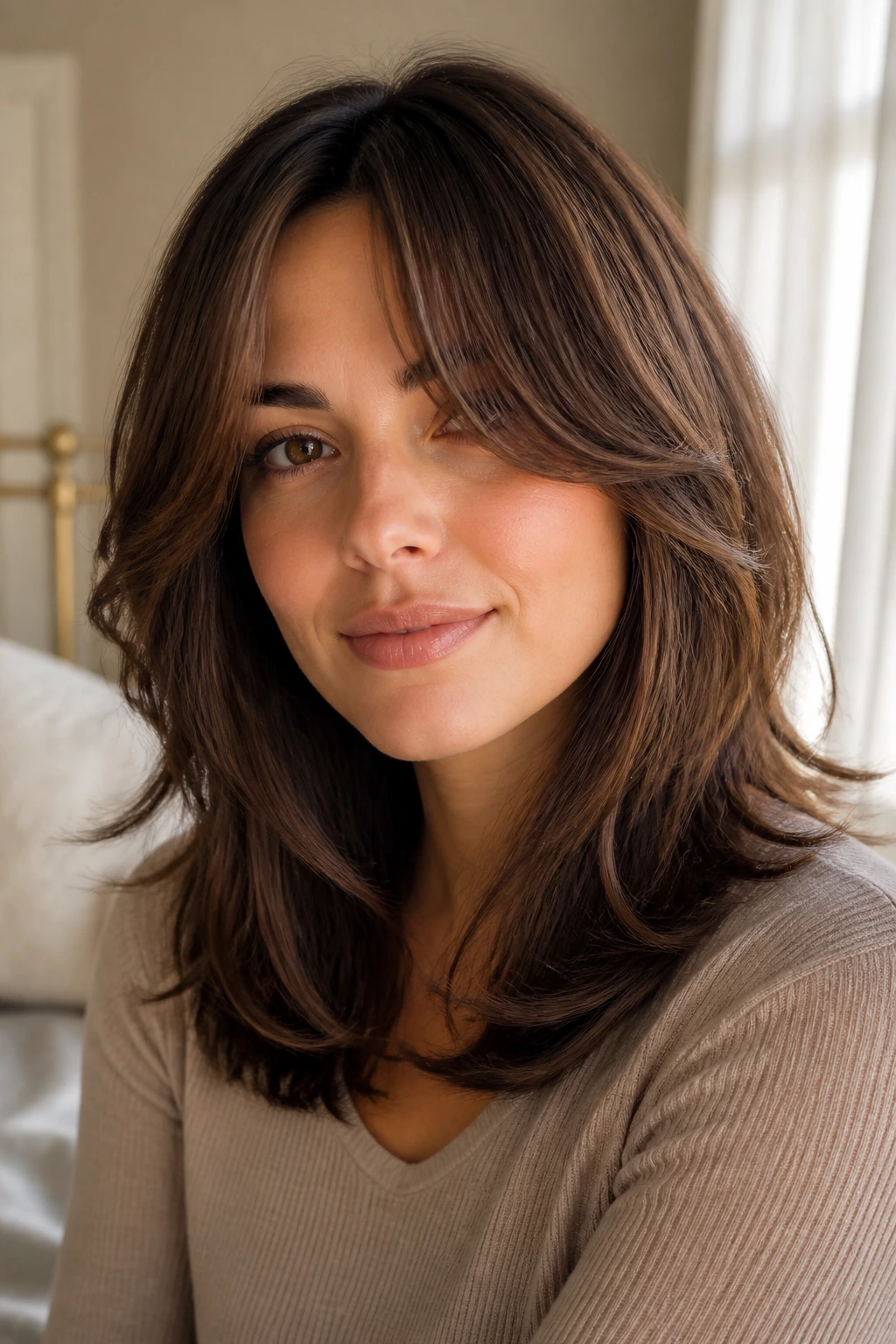
Curtain fringe is familiar, but the long version is the one that behaves best on round faces. The fringe opens from the center and drops into the side layers, which gives you a vertical center line and a soft frame at the same time.
The important part is length. Keep the shortest point around the bridge of the nose or lower, then let the sides blend into the cheekbone pieces. That keeps the fringe from sitting like a little wall across the forehead. Wavy hair usually makes this easier, because the bend helps the fringe split on its own.
If you want face-framing without full bangs, this is probably the smartest move on the list.
19. Glossy Mid-Length Cut with Hidden Internal Layers
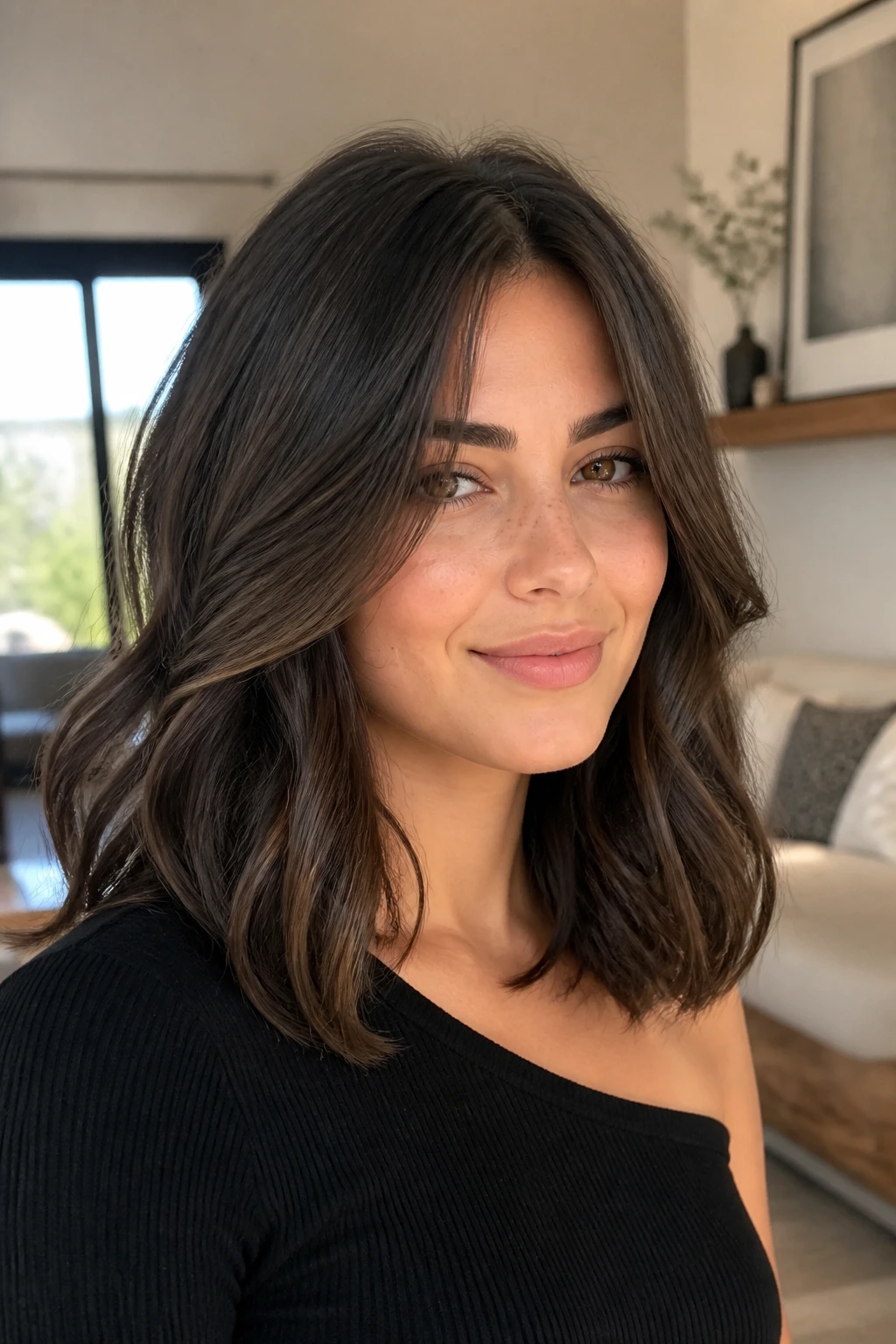
This cut is for people who want the outside to look clean and the inside to do the work. The outer line stays smooth, which gives the haircut a polished look, but hidden internal layers remove bulk and let the waves fall instead of puffing out.
On a round face, that smooth exterior matters. It avoids adding extra visual width around the cheeks, and the hidden structure keeps the hair from becoming too triangular at the bottom. It’s a good choice if your hair is fine to medium and you want a shape that still looks neat after a long day.
Use a lightweight leave-in and a round brush just on the front pieces if you want the gloss to show. That’s enough. Don’t overcomplicate it.
20. Beachy Mid-Length Cut with Piecey Ends

Beachy does not have to mean frayed or salty. The good version of this cut uses medium length, layered ends, and enough separation that each wave can show its own line. On a round face, that separation matters because a single, heavy wave mass can feel wider than necessary.
The best beachy medium cut keeps the fullness away from the cheek line and lets the ends break apart naturally. A little piecey texture at the bottom is better than soft fluff. That difference sounds small, but on wavy hair it changes the whole read of the haircut.
I’d choose this for hair that already wants to bend and clump in a nice way. It rewards that texture instead of fighting it into a smooth finish.
21. Collarbone Cut with Side-Swept Bangs

Side-swept bangs are underrated on round faces because they create a diagonal, and diagonals are kind. They move the eye from one side of the forehead to the opposite cheek, which helps the face feel longer. The collarbone length keeps the rest of the shape grounded.
The bangs should start high enough to build a sweep, not low enough to become a heavy fringe. That’s the whole game. Wavy hair gives the bangs a little softness, so they don’t look like they’ve been pressed into place. Good. They shouldn’t.
This is a reliable choice if you want some forehead coverage but don’t want the commitment of curtain bangs or a full fringe.
22. Open-Front Midi with Soft Crown Lift
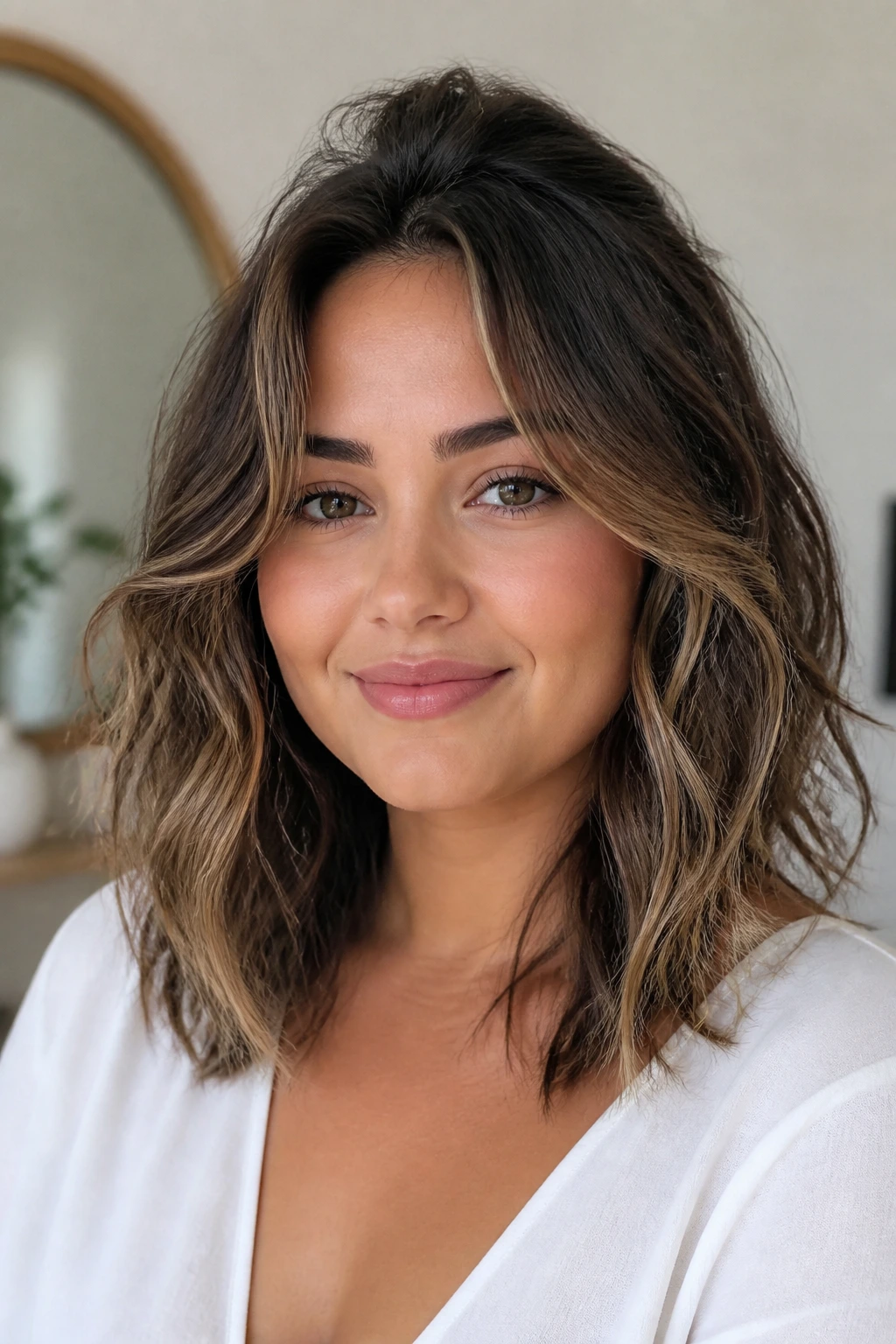
This is the cut I’d hand to someone who wants the face fully visible and the styling as easy as possible. The front stays open, the length hangs at the collarbone or just past it, and the crown gets a little lift so the eye starts higher before it travels down.
That lift is what keeps the shape from feeling flat. Without it, the mid-length can spread sideways and make a round face look broader. With it, the haircut looks light but not flimsy. The waves can air-dry, diffuse, or be rough-blown with a big brush — the silhouette still holds.
It’s a strong finish to the list because it proves something simple: on round faces, the best medium cut is rarely the most dramatic one. It’s the one that knows where to place its weight.
Why Round Faces and Wavy Hair Need a Different Shape
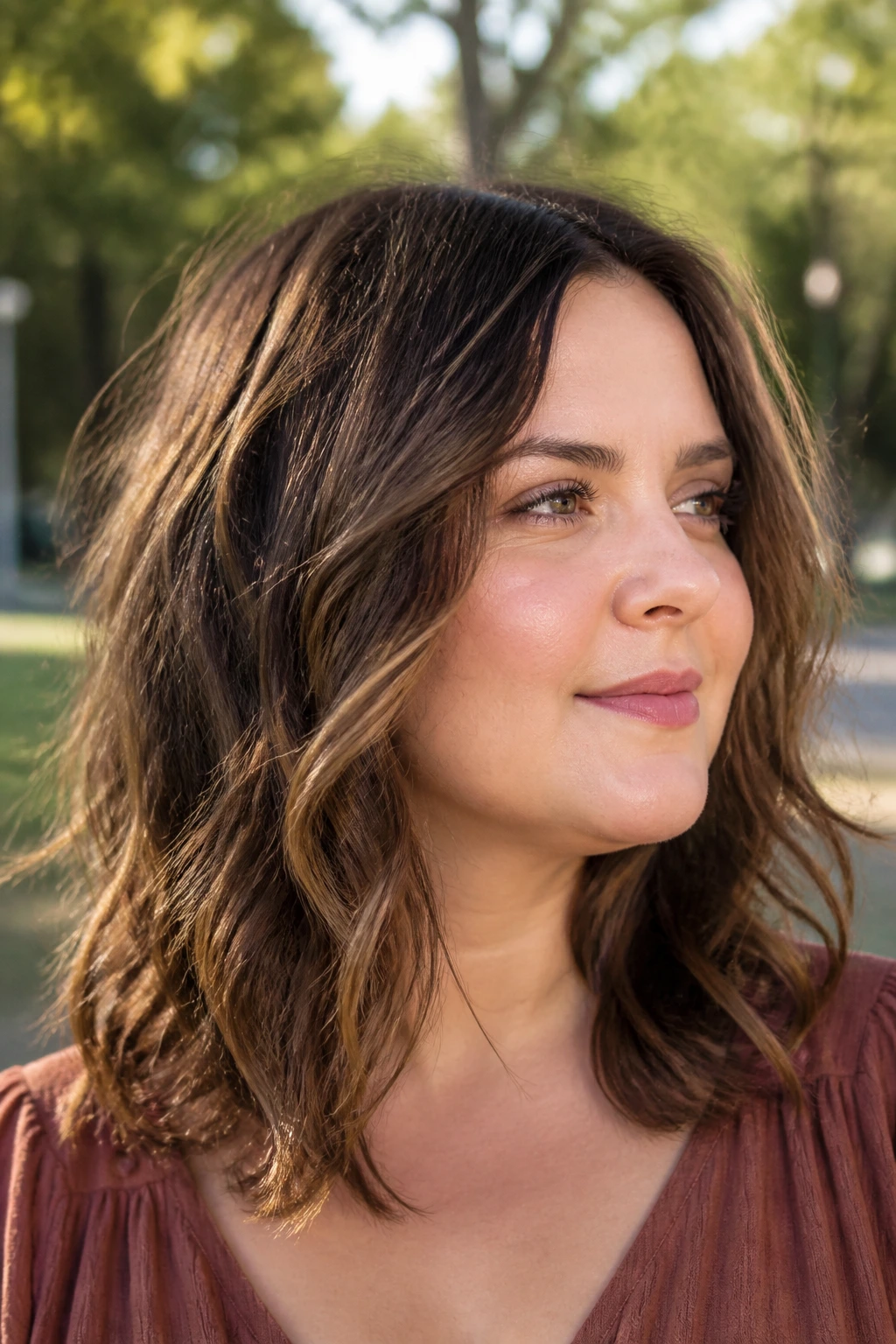
Round faces and wavy hair need the same thing from a haircut: a plan.
The face wants lengthening lines, especially around the sides of the cheeks and jaw. The hair wants room to bend without piling into a triangle. Put those two needs together and you get a clear rule: the best medium cut gives you shape without stacking too much width at the same height as the widest part of the face.
Keep the Fullness Out of the Cheek Zone
That’s the big one. If the heaviest part of the cut lands right around the cheeks, the face reads wider. If the weight starts lower — near the collarbone or upper chest — the eye sees a longer line before it sees volume. That’s a better trade.
Let the Top Do Some Work
A bit of root lift at the crown changes everything. You do not need a huge pouf. Even a small rise at the top draws the eye upward, which helps balance the natural width of a round face. Wavy hair can do this on its own if the cut isn’t too heavy.
Break Up the Edge
A single blunt perimeter can be useful on fine hair, but wavy hair usually looks better when the ends are softened or lightly textured. That keeps the haircut from spreading sideways in one thick block.
The best medium-length haircuts for round faces with wavy hair are never random. They’re built around these three moves.
Tools, Brushes, and Products That Make These Cuts Behave
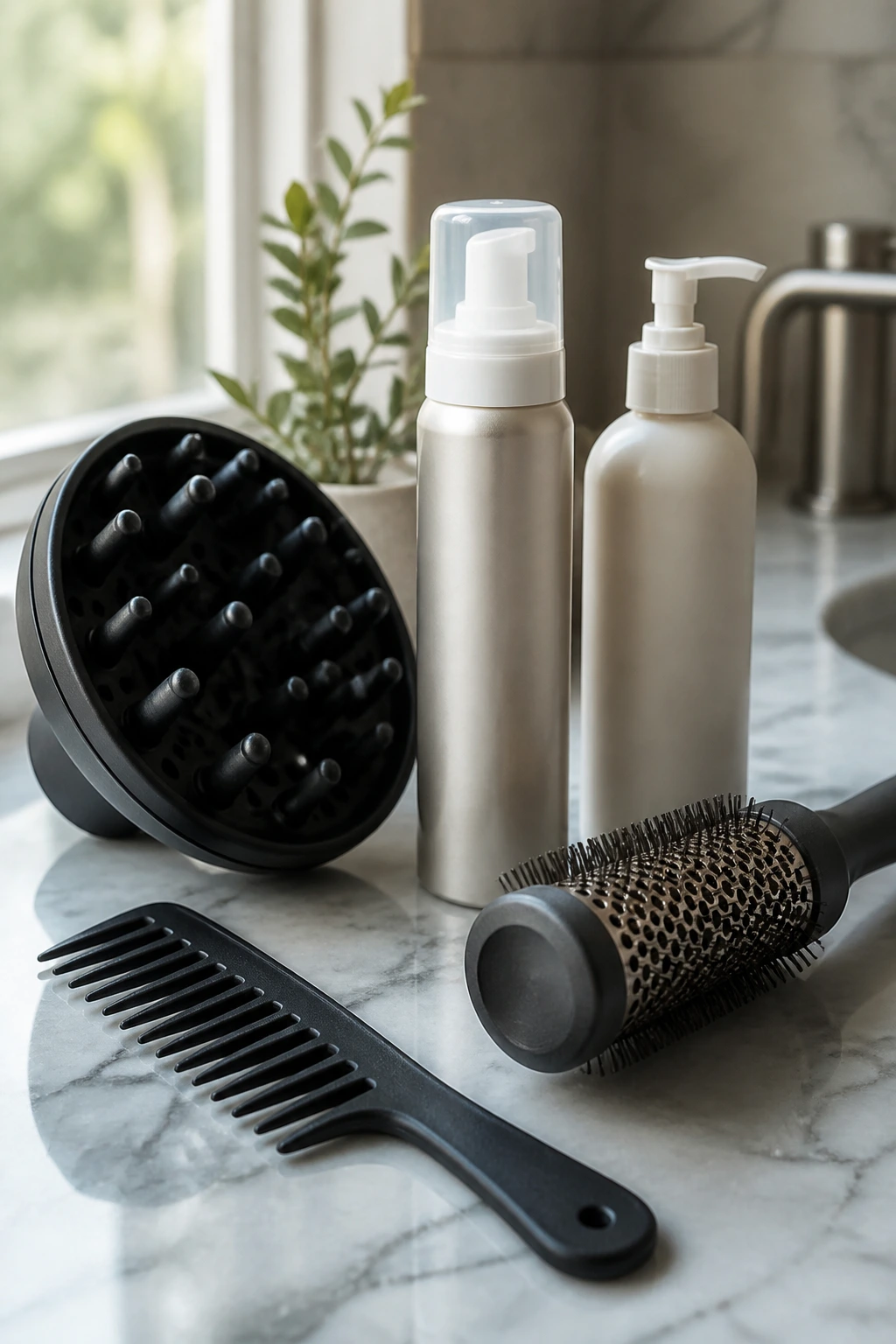
- A wide-tooth comb: Good for detangling wet waves without pulling them straight and frizzy.
- A diffuser attachment: Useful if you want the wave pattern to dry with less collapse at the roots.
- A 1.5- to 2-inch round brush: Best for lifting the crown, smoothing curtain bangs, and bending the front pieces away from the cheeks.
- Light mousse: Gives wavy hair enough hold to keep the shape from puffing out.
- Leave-in conditioner: Helps the ends stay soft, especially on layered cuts.
- Heat protectant: Non-negotiable if you blow-dry or touch up the front with a brush and dryer.
- Duckbill clips or sectioning clips: Handy for setting root lift at the crown while the hair dries.
- Microfiber towel or cotton T-shirt: Better than a bath towel for squeezing out water without roughing up the wave.
- Texturizing spray or dry shampoo: Useful on day two when the roots need a little lift and the ends need separation.
What to Tell Your Stylist So the Cut Lands Right
Bring photos, yes, but bring the right kind. A picture of a gorgeous cut on a straight-haired oval face tells your stylist almost nothing about how that same shape will behave on your waves and your cheek line. Look for photos with a similar wave pattern, similar density, and a face shape close to yours.
Say where you want the shortest front piece to land when the hair is dry. That one sentence saves a lot of confusion. If you want movement, ask for layers that start below the cheekbone. If you want a cleaner line, ask for a blunt perimeter with light point-cutting at the ends. Point-cutting means snipping into the ends at an angle so the edge breaks up a little instead of sitting like a shelf.
If your hair expands when it dries, ask for a dry detail pass. That lets the stylist check the real shape, not the wet version that can lie to everyone in the chair.
And do mention your styling habit. Air-dry only, diffuser only, round-brush sometimes, a five-minute routine every morning — all of that changes the haircut.
Styling Moves That Keep Waves Below the Cheeks
The fastest way to ruin a flattering cut is to dry it in the wrong direction. Waves remember where they were pushed, and if you force all the volume out at the sides, the haircut will bloom there whether you want it or not.
Start with product on damp hair, not soaking hair. A walnut-sized amount of mousse at the roots and a smaller squeeze of leave-in through the mid-lengths is usually enough. If you use too much cream on wavy hair, the ends can go stringy while the top goes flat. That is a bad bargain.
Lift the roots at the crown with clips if you air-dry, or diffuse with your head slightly tipped to one side. Don’t hover the diffuser too long near the cheeks. Keep the airflow moving and stop around 80 percent dry, then let the last bit settle naturally. That keeps the wave from becoming puffy.
For the front pieces, use a round brush or finger-twist them away from the face while the hair is still damp. That creates the long diagonal line that round faces need. One small bend in the front changes the whole silhouette.
Day two is easier than people think. A little water mist, a pea-size touch of cream, scrunch, and a few minutes with the diffuser usually bring the shape back without turning it into wet hair all over again.
Common Mistakes That Make the Face Look Wider
- Ending the shortest layer at the cheeks: That puts bulk right where round faces already have width. Push the shortest point lower, usually at or below the mouth.
- Letting the sides puff out untrimmed: Wavy hair can balloon sideways after a blunt cut. Ask for soft internal shaping or point-cutting to break that edge.
- Using a dead-center part with no crown lift: A center part can work, but only if the top has some height. Flat roots make the face read wider and shorter.
- Cutting bangs too short: Short fringe can be cute, but on a round face it often draws attention horizontally. Curtain bangs or side-swept bangs usually give a better line.
- Over-layering fine waves: Too many short layers on fine hair can make the ends look thin and the top look messy. Keep the structure lighter.
- Skipping the dry check: A wet haircut can look fine in the chair and then expand in the mirror at home. Wavy hair changes shape as it dries. Always check the finished form.
Five Ways to Adapt These Cuts to Your Hair
Fine-Wave Ease: Keep the perimeter a little blunter and the layers longer. Fine hair loses body fast, so too much thinning can leave the ends wispy and the face looking wider than planned.
Dense-Hair Balance: Ask for internal weight removal, not short layers everywhere. Thick wavy hair needs space to move, but the outer shape should stay controlled so the sides do not balloon.
Fringe Without the Fight: Choose curtain bangs or side-swept bangs if you want forehead coverage. They open and close with the wave pattern more naturally than a blunt line.
Air-Dry Friendly: Stick to collarbone or shoulder-grazing lengths with soft face-framing pieces. These cuts can air-dry without needing a brush to make the front behave.
More Drama, Less Width: Use a deep side part, a soft A-line, or a long U-shape. Those moves give you more visual length without forcing the haircut into a harsh angle.
How to Keep the Shape Between Trims
The trim schedule changes with the shape, but medium wavy hair usually stays nicest when you don’t let it grow for too long without a cleanup. Layered cuts and curtain fringe usually need a trim every 8 to 10 weeks. Blunter lobs can stretch to 10 to 12 weeks if the ends stay tidy. If your bangs are the whole point of the cut, they may need a small touch-up sooner.
At home, protect the shape at night. A silk pillowcase helps, but so does a loose clip or a soft scrunchie that keeps the crown from getting mashed flat. If your waves knot easily, a small amount of leave-in on the ends before bed saves you from that dry, fuzzy triangle that shows up by morning.
Between washes, refresh the front and crown more than the ends. That’s where the haircut shows its shape first. A light mist of water, a touch of mousse or cream, then a few scrunches is usually enough. Don’t drench the whole head unless you want to restart from scratch.
Frequently Asked Questions
Will medium length haircuts make a round face look wider?
Not if the cut is placed well. The problem is usually where the volume sits, not the fact that the hair is medium length. Keep the fullness below the cheeks, add some lift at the crown, and the cut will work with the face instead of against it.
Are curtain bangs a good idea for round faces with wavy hair?
Yes, as long as they open at the center and don’t stop too high on the forehead. The sides should blend into the cheekbone area so the fringe softens the face instead of boxing it in. Wavy hair tends to make curtain bangs look better, not worse, because the split feels natural.
What if my waves puff out at the sides?
That usually means the cut is too blunt at the widest part of your face or the styling product is too heavy at the ends. Ask for soft internal layers and use a lighter mousse at the roots instead of loading up the mid-lengths with cream.
Is a center part bad for a round face?
No, but it needs help. A center part without root lift can flatten the top and make the face feel shorter and wider. If you love the center part, keep the crown lifted and make sure the front pieces drop below the cheekbone.
How short can I go with wavy hair and still keep balance?
You can go fairly short, but the line needs to land below the jaw or be broken up with texture. A cut that stops right at the jaw or cheek usually adds width. Just a little more length often changes the whole thing.
Can fine wavy hair handle layers?
Yes, but not too many. Fine waves usually do better with long layers or invisible internal shaping so the ends don’t go see-through. If the cut gets chopped too much, the hair can lose the body that makes a medium style flattering in the first place.
Should I ask for a dry cut?
If your waves change a lot from wet to dry, a dry cut or a dry finish pass can help a lot. It lets the stylist see where the hair expands and where it collapses. That matters more on wavy hair than on straighter textures.
Which is better for a round face: layers or a blunt cut?
Neither wins every time. Layers are better when your hair is dense or wide through the sides; a blunt line can work better when your hair is fine and needs fullness. The placement of the line matters more than the label on the cut.
The Shape That Lands Right
The best medium cut for a round face with wavy hair is the one that knows where to stop. Not at the cheeks. Not at the jaw. Lower, higher, or broken up enough that the face keeps its length and the waves keep their movement.
That’s why the best styles on this list don’t all look the same. Some lean soft and curtain-framed. Some use a side part or an angled front. Some keep the perimeter clean and let the texture do the work. Different routes, same goal.
If you’re standing in front of a stylist with one photo and one question, start with the shape that gives you the most room around the cheeks and the most movement below them. That’s usually the haircut that grows out well, behaves on ordinary mornings, and still looks like you when the wind gets involved.