



Flat roots and a round face can gang up on each other. If the cut lands at the wrong spot — right at the cheeks, right at the jaw, right where your hair already wants to collapse — you get width instead of shape. That’s the trap with hairstyles for round faces with thin hair: too much fullness in the middle, not enough lift where the eye wants to travel.
You do not need a dramatic chop to fix that. You need angles, a little height, and ends that move instead of sitting like a shelf. A haircut can be short, long, blunt, wispy, polished, or messy; what matters is where the line lands and how much weight it leaves around the cheeks.
The styles below all play that game a little differently. Some stretch the face with a side part. Some build lift at the crown without turning the top into a helmet. Some keep the perimeter clean so fine strands do not collapse into a fuzzy halo by lunch. Start with the shape that matches how much styling you actually do. That matters more than the label on the cut.
Why These Hairstyles Work for Round Faces and Thin Hair
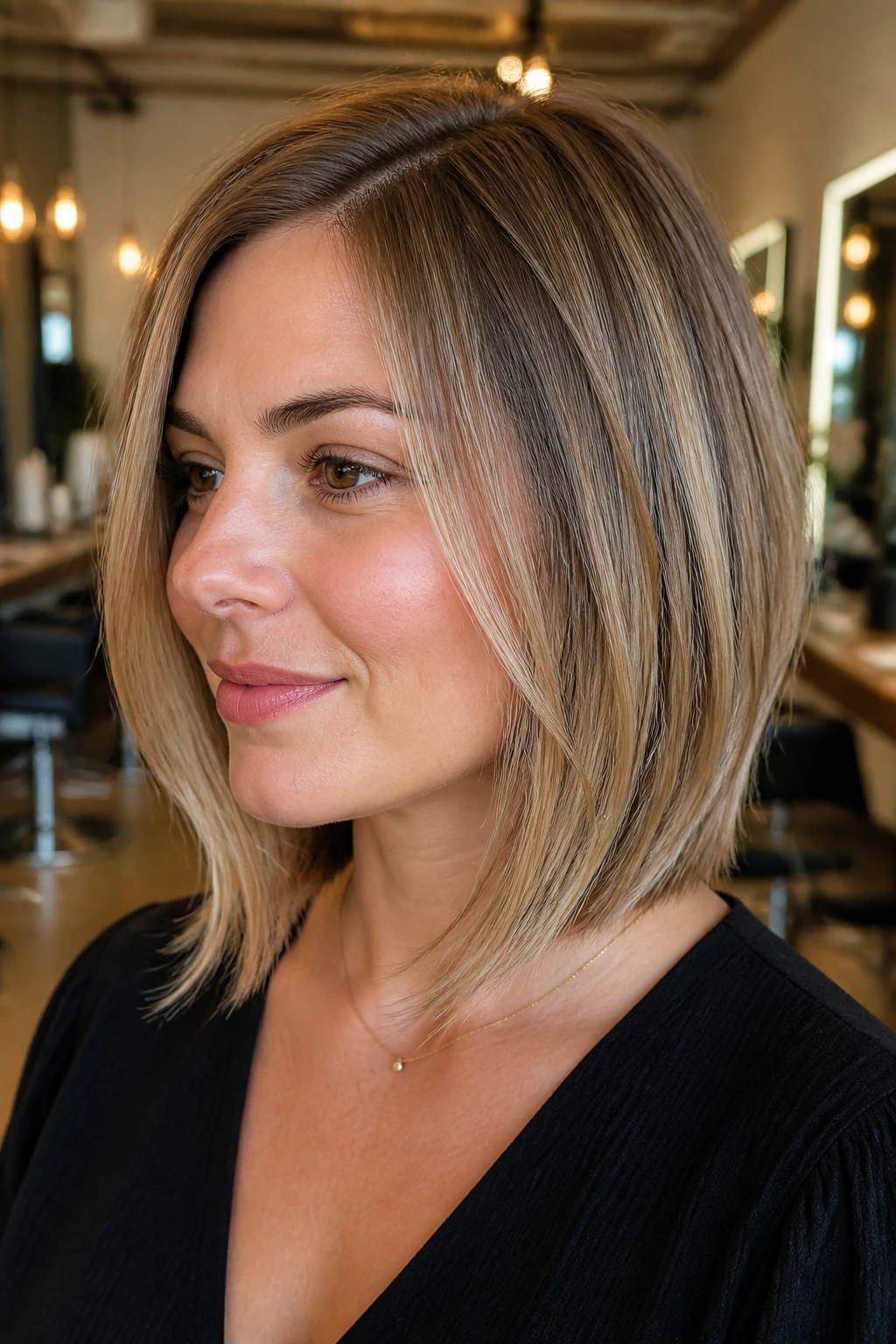
- Vertical balance: These cuts pull the eye up and down instead of letting it camp out at the widest part of the cheeks, which makes the face read a little longer.
- Strategic weight removal: Fine hair needs less bulk in the wrong places, not more layers everywhere; the best cuts remove weight where it drags and keep density where it counts.
- Crown lift: A small bit of height at the top does more for a round face than a pile of product, especially when the roots lie flat by nature.
- Soft face-framing: Pieces that start below the cheekbone tend to slim better than bangs or layers that hit right at the cheek.
- Low-maintenance movement: Thin hair looks fuller when the shape has motion, but too much choppy layering can leave the ends stringy and tired.
- Flexible styling: These are cuts you can air-dry, blow-dry, or rough style in five minutes without needing the hair to be perfect.
1. Angled Lob With Soft, Tucked Ends
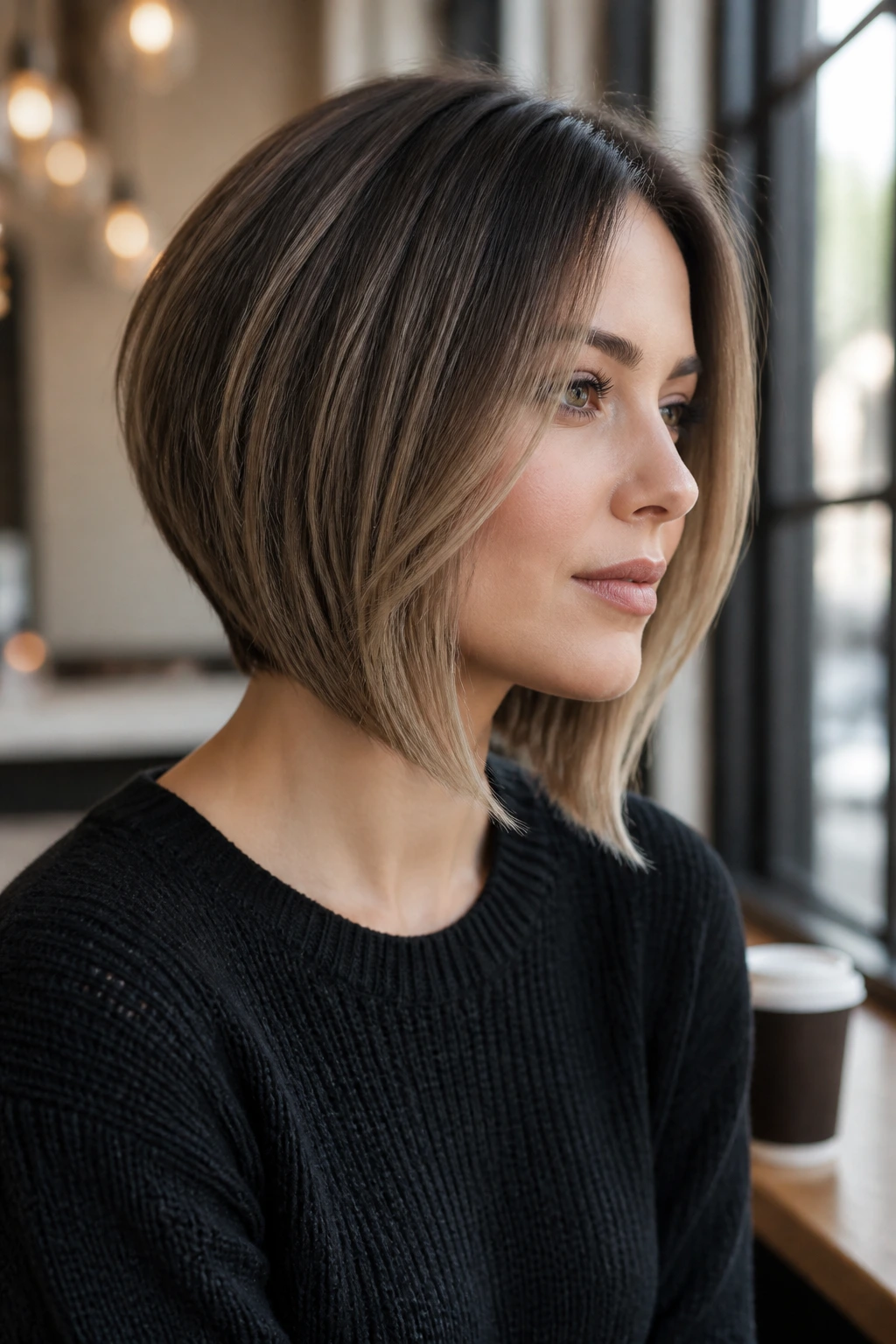
An angled lob is the haircut equivalent of standing a little straighter. The shorter back removes drag, while the longer front slices downward past the cheeks so the face reads narrower. On thin hair, that forward slope matters. It keeps the whole shape from turning into a flat line at the jaw.
Why It Works
The angle does half the flattering for you. A cut that lands a little shorter in the back and a little longer in the front creates a diagonal line, and diagonals are kinder to round faces than blunt horizontals. The trick is to keep the ends soft — not shredded — so the perimeter still looks full.
- Best length: Nape to collarbone keeps the shape light without losing the hairline.
- Best part: A soft off-center part gives the crown a little lift.
- Best finish: A one-inch bend at the ends keeps the line from looking stiff.
Best move: Ask for the front pieces to drop just below the chin if your cheeks are full; that half-inch makes a bigger difference than people expect.
2. Chin-Length French Bob With a Side Part

A chin-length French bob can work on a round face, but only if it stays airy. The cut feels sharper than a shag and less fussy than a long layer style, which is useful when thin hair needs shape fast. The side part keeps the line from sitting directly across the widest part of the face.
The danger is obvious: if the bob is too blunt and too exact at the cheeks, it makes the face look wider. The fix is simple. Keep the nape close, let the front graze the jaw rather than stop in the middle of the cheek, and use a bit of bevel at the ends so the cut has a soft curve.
This style works best if your hair has some natural body but not much density. It looks crisp with a quick blow-dry and a slight tuck behind one ear. If your hair is ultra-fine, skip heavy cream products here; they flatten the whole shape before you’ve even left the bathroom.
3. Deep Side-Part Pixie With Piecey Height
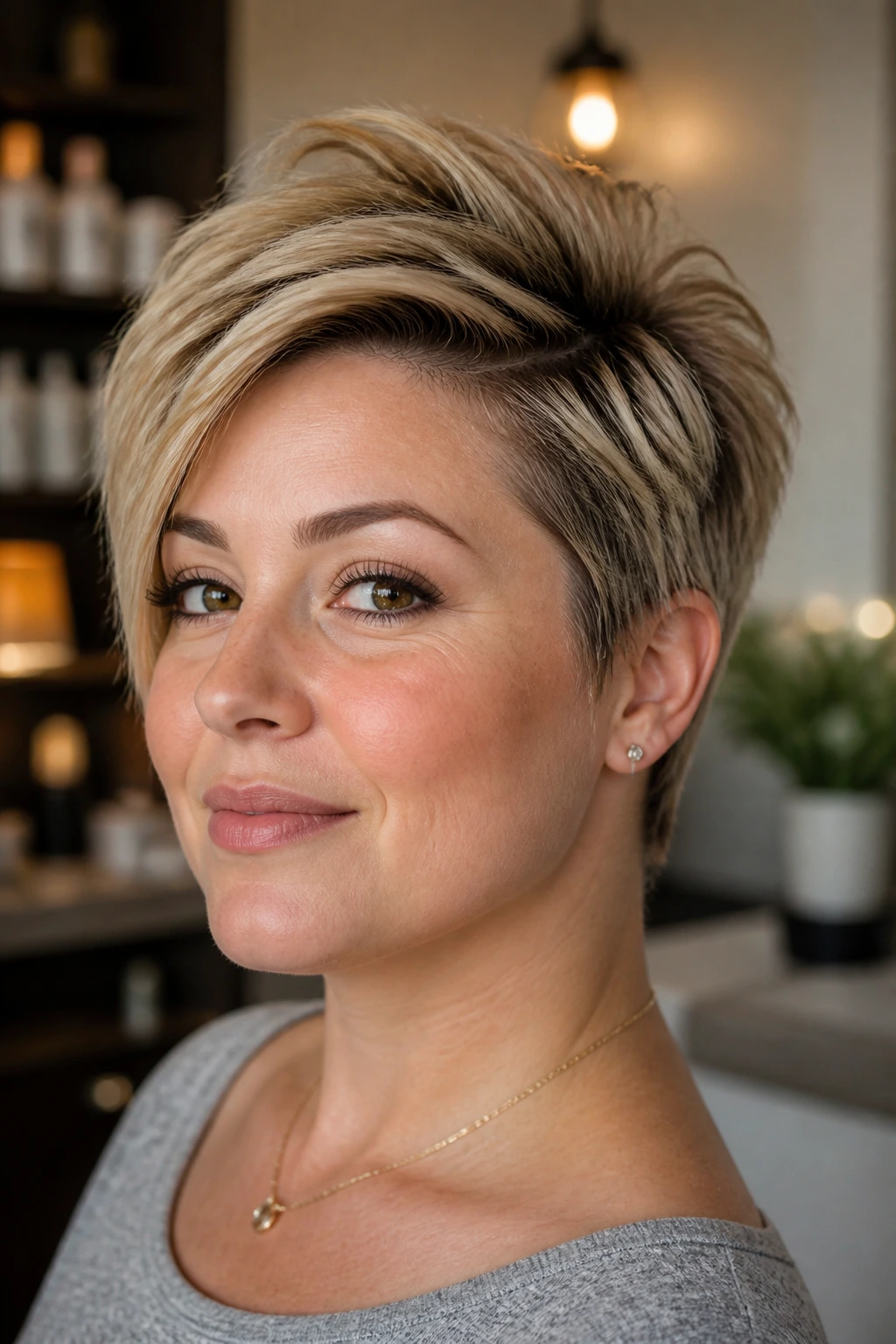
Can a pixie make a round face look longer? Yes — if the top is left piecey and the sides are kept snug. A deep side part gives instant vertical lift, and that matters when thin hair tends to lie low against the scalp. Short cuts can be sneaky that way; the right one makes the face look open, not wide.
How to Style It
Dry the top forward first, then sweep it up and over with your fingers while the hair is still warm. A matte paste or light clay works better than a shiny wax because you want separation, not a greasy cap. Keep the sideburn area neat and the crown slightly longer so the top has somewhere to go.
If you wear glasses, this cut is especially clean. The hair stays above the frames instead of fighting them.
4. Curtain-Bang Shag With Airy Ends

Picture hair that moves when you turn your head, but never sprawls out at the cheeks. That is the sweet spot here. Curtain bangs are one of the few fringe styles that genuinely help a round face because they split in the center and open away from the sides of the face instead of closing it in.
The layers need discipline. Start them low enough that the top does not puff out like a triangle. If the shortest face-framing piece begins around the cheekbone, the face can look broader. If it begins nearer the lip or chin, the whole shape lengthens.
- Ask for: soft curtain bangs that blend into layers below the cheekbone.
- Avoid: heavy, blunt bangs that sit straight across the forehead.
- Use: a round brush or a large barrel brush to push the fringe away from the face.
The shag part should stay light, not ragged. Too many short pieces on thin hair can look frayed by midday.
5. Collarbone Clavicut With Barely-There Layers
If you want the safest haircut in the bunch, this is it. A clavicut lands at the collarbone, which is long enough to slim the face and short enough to keep fine hair from collapsing under its own weight. It is a clean shape, and clean shapes do a lot of work when your hair is thin.
The best version has a blunt-looking edge with just enough internal movement to keep it from feeling heavy. That means the bottom line stays full, while the inside loses a touch of bulk so it bends well around the shoulders. The face looks longer because the line drops below the widest part of the cheeks.
This is also one of the easiest cuts to live with. Air-dried, it looks soft. Blow-dried, it looks sharp. Pinned back on one side, it looks polished without trying too hard. If you like hair that can move from office to dinner without a full reset, this cut earns its keep.
6. Textured Shoulder-Length Waves That Start Below the Cheeks
Why do some waves make a face look wider? Because they flare out at the wrong height. Shoulder-length waves are useful for round faces only when the bend starts below the cheekbone, not right beside it. Thin hair gets a bigger-looking silhouette when the movement sits lower.
This cut works best with a loose, irregular wave rather than a tight curl. Use a 1.25-inch iron, wrap mid-lengths, and leave the ends straighter. That little contrast keeps the hair from becoming a puffy cloud. If your strands are fine, a light mousse at the roots and a texture spray through the mid-lengths usually beats a heavy curl cream.
The shoulder line is handy too. It gives the hair something to rest on without building width at the cheeks. That makes this one of the better styles if you want movement but not a lot of layers.
7. Long Layers With Face-Framing Pieces
Keeping length is fine. The mistake is keeping all the weight. Long layers solve that by removing enough bulk to make the hair swing, while the face-framing pieces pull the eye down the sides of the face. On a round face, that downward pull matters.
The face frame should start low. Lip, chin, or just below the chin are good spots. Anything shorter can widen the cheek area, especially if the hair is very fine and falls forward. The rest of the layers should stay soft and blended so the ends do not look stringy.
This is the kind of cut that rewards a proper blow-dry. A quick lift at the roots, then a round-brush bend through the front pieces, and the whole style looks more deliberate. If you do not style it at all, it can still work — but a little movement near the face is what keeps it from going limp.
8. Tapered Crop With Crown Lift
A crop can be a smart move when thin hair needs help at the roots. The whole point is to keep the sides closer to the head while leaving enough length on top to create height. That vertical lift makes a round face look a touch longer, and the tapered edges stop the cut from spreading out sideways.
This is not a cut for a heavy wax finish. It needs separation on top and clean shape around the ears and nape. If you have fine hair, ask for texture that is built into the cut, not shaved in afterward. Over-texturizing can make the top look see-through, which is the last thing you want.
Best when:
- Your hair falls flat within an hour of styling.
- You want short hair that still looks modern, not puffy.
- You can spend two minutes finger-styling the top each morning.
A tapered crop looks sharp with earrings, too. The short length gives the face room.
9. Soft Wolf Cut With Low Contrast

A wolf cut can go wrong fast on thin hair. Too many short layers, and the ends start looking like they were chewed off. The softer version keeps the shape loose and low-contrast, which means the top has some lift without the whole cut disconnecting into separate chunks.
That low-contrast shape is the useful part. The crown gets a little height, the mid-lengths get movement, and the perimeter stays long enough to hold the illusion of thickness. On a round face, that extra lift at the top helps, but the real win is keeping the widest part of the cut below the cheeks.
This is a good pick if you want texture and a slightly undone feel. It needs less precision than a bob and less commitment than a pixie. If your hair is very straight and very fine, you will still need a styling product with grip — otherwise the short layers flatten out and the whole thing loses its shape.
10. Side-Swept Lob With a Long Front
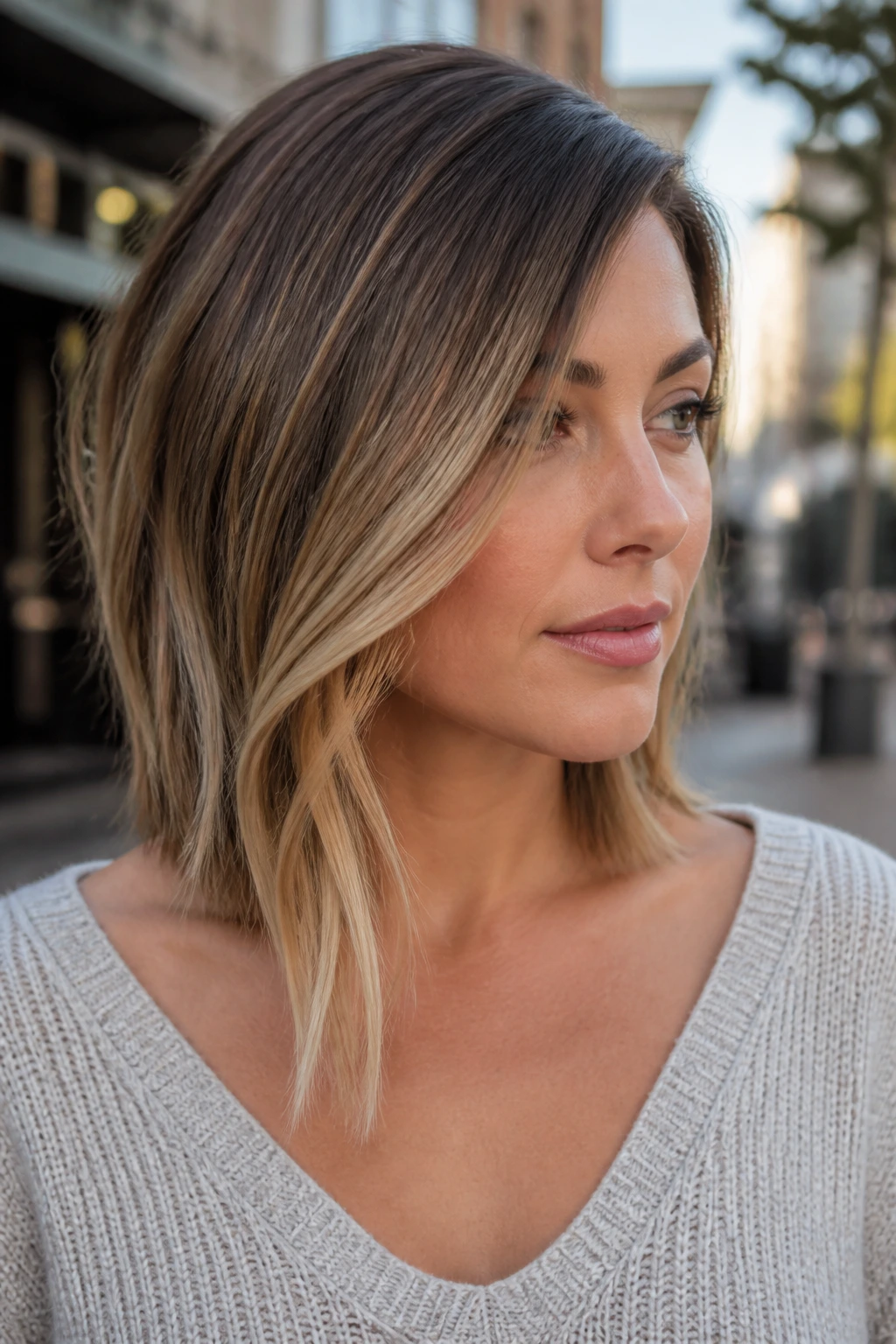
A side-swept lob changes the face without changing the haircut much, which is why I like it. The longer front piece creates asymmetry, and asymmetry breaks up the roundness in a flattering way. One side drapes down; the other side opens the face. That contrast does a lot.
The cut itself should sit around the collarbone or slightly above it. If it stops too high, it can widen the cheeks. If it goes too long without any shape, thin hair often hangs. The side-swept front gives you the best of both worlds: enough length to slim, enough movement to keep the ends from disappearing.
This style also gives you options. You can wear the front tucked behind one ear for a cleaner line, or you can let it fall across the cheekbone for a softer finish. Either way, the parting does the lifting work.
11. Stacked Bob With an Airy Back
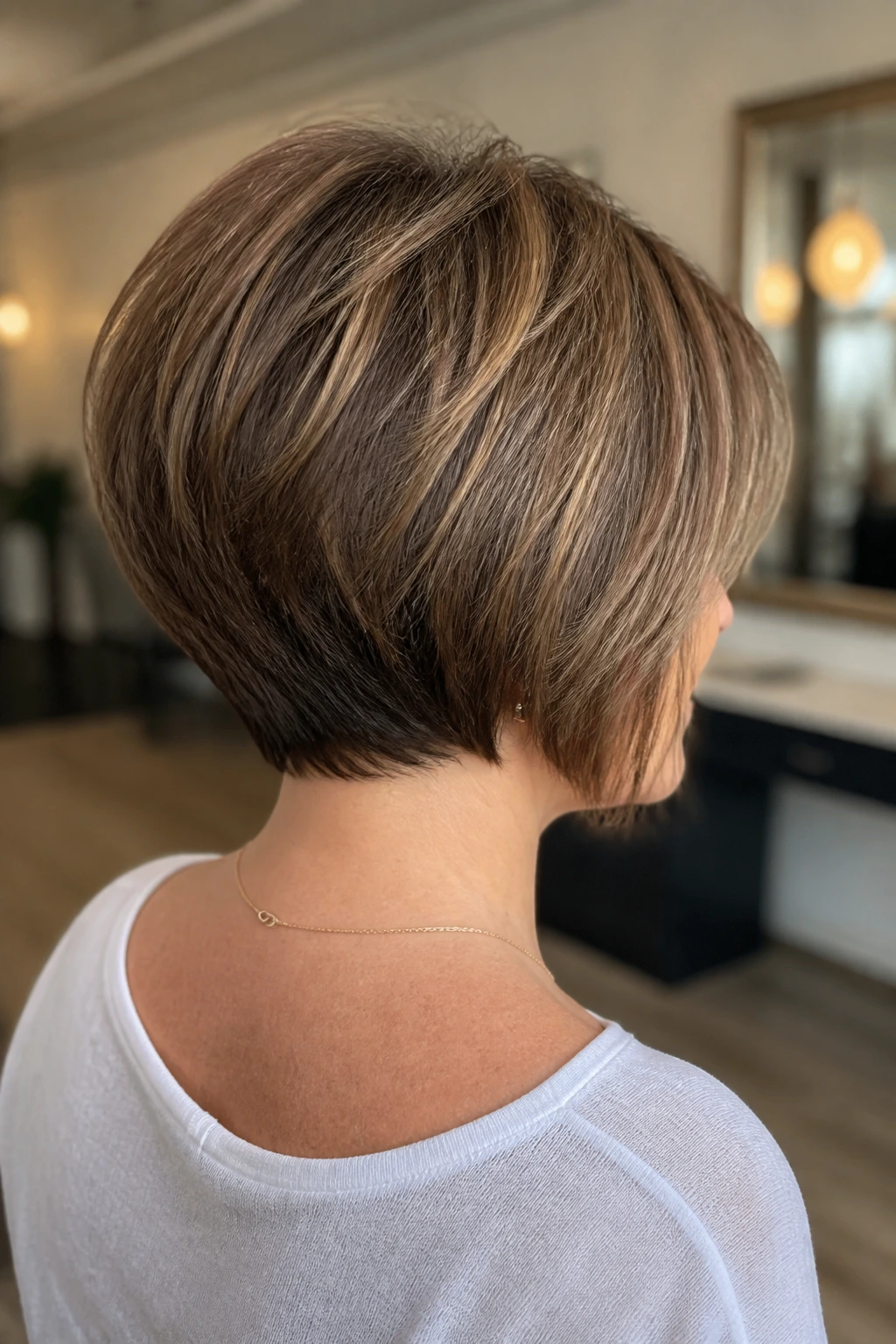
A stacked bob earns its place when the back of the head is flat and the sides need a little more structure. The stacking builds volume at the nape, which can make thin hair look fuller from behind and give the head a more balanced outline. On a round face, the trick is to keep the stack controlled.
Too much stacking pushes the widest point of the hairstyle upward and outward. That can make the face look boxy. A lighter stack keeps the back lifted while the front stays longer and sleeker, which is where the slimming effect comes from. It is a small adjustment, but it changes the whole silhouette.
This cut needs regular trims. Short stacked bobs lose their lines fast, and thin hair shows the grow-out sooner than dense hair does. If you hate fuss, this may not be your cut. If you like shape and crispness, it is a strong one.
12. Bottleneck Bangs and Long Shaggy Layers
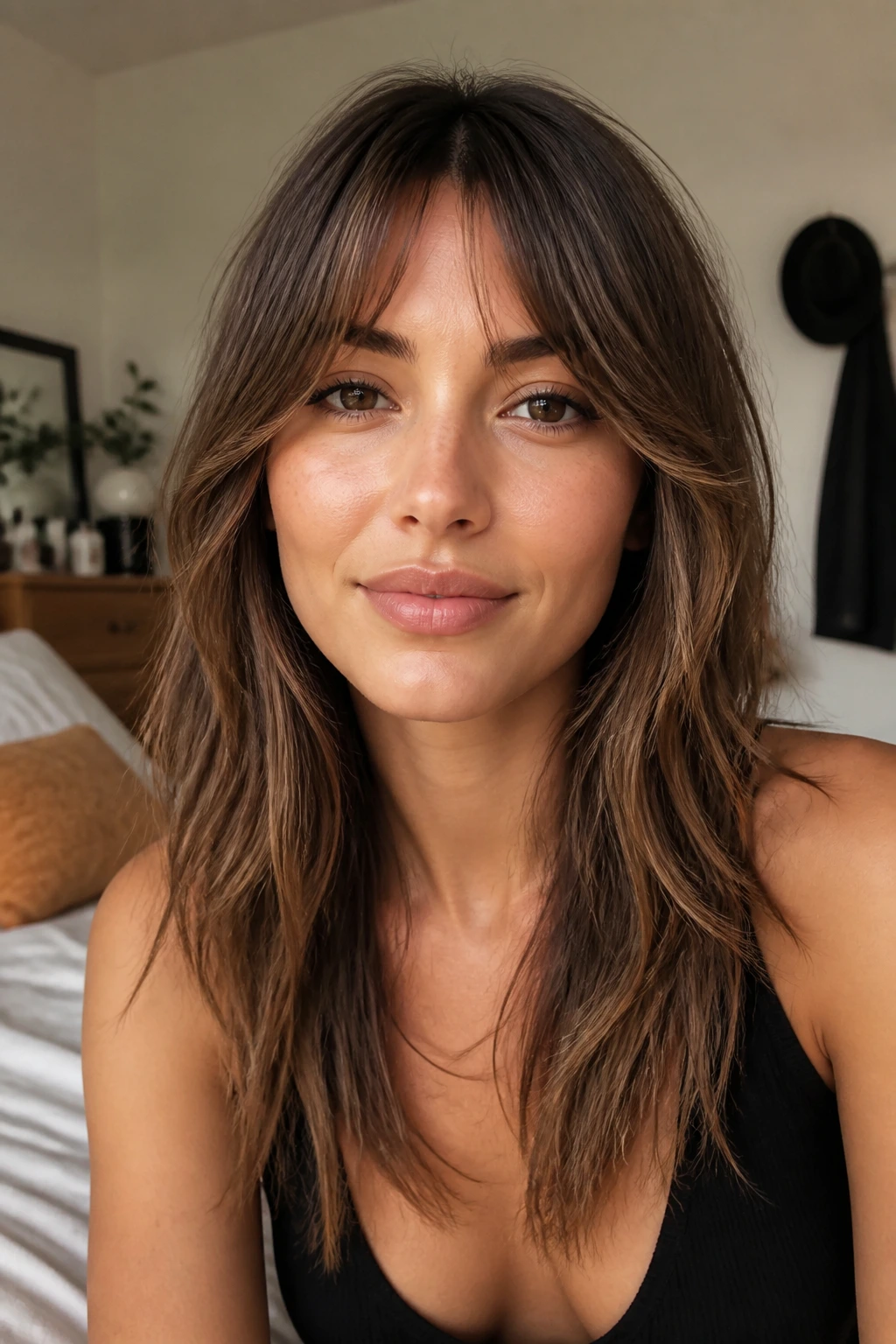
Can bangs work here? Yes — if they split open before they hit the cheeks. Bottleneck bangs are narrow at the top and wider near the temples, so they frame the forehead without drawing a hard horizontal line across the face. That opening shape helps a round face look a little leaner.
The shaggy layers should stay long and blended. You want movement, not a chopped-up halo. If the shortest layers live around the temples and upper cheek, the cut can widen the face. If the fringe stays lighter and the layers stretch down the body of the hair, the whole look keeps its length.
This is one of those styles that looks better with a bit of mess. A perfect, sleek finish can flatten the fringe; a soft bend with a little texture makes it come alive. If you already have a natural wave, you are in good shape. If your hair is pin-straight, plan on a round brush or a flat iron bend at the front.
13. Sleek Center-Part Lob With Tucked Ends
A center part is not the enemy. The problem is a center part with no lift, no length, and no shape. Put that same part on a lob that reaches the collarbone, then tuck one or both sides behind the ears, and the face suddenly reads longer and cleaner.
The sleek finish helps thin hair more than you might think. When every strand is flying around, the face can look wider. A smooth lob keeps the outline tidy, and that neat outline is flattering on round faces because it adds visual length. The ends should still have a tiny bend or tuck so the style does not fall dead straight.
This cut suits people who like a polished look and do not want layers messing with the perimeter. It also works well with a deep side tuck for a slightly softer effect. If your hair is very fine, skip heavy serum near the roots. Put any shine product only on the last inch or two.
14. Feathered Shoulder Cut With Soft Movement
Feathering has a bad reputation because so many older versions looked too wispy around the face. The modern version is calmer. It keeps the ends soft and the internal movement light, which is exactly what thin hair needs when it starts to hang around the shoulders.
The shoulder length matters. At that point, the hair has enough weight to move but not so much that it drags the face down. Feathering through the mid-lengths makes the shape swing instead of sitting in one stiff block. On a round face, that movement helps shift attention outward and downward.
This is a good choice if you want to keep things feminine and easy to brush into place. It looks best with a little bend from a round brush or large hot brush. Straight-out-of-bed feathering can look flat. A quick pass with heat is usually worth the two minutes.
15. Bixie With a Piecey Fringe
A bixie sits between a bob and a pixie, and that in-between space is useful. You get enough length around the ears to soften a round face, but the crown stays light enough to build volume on fine hair. The result is short without being severe.
The piecey fringe helps a lot here. Instead of one flat bang line, the fringe breaks into small sections that keep the eye moving. That interrupts the width of a round face in a subtle way. The top should stay a little longer so you can sweep it forward, up, or slightly sideways depending on the day.
If you want short hair but worry that a full pixie will show every bit of scalp, start here. It gives shape without stripping too much density from the silhouette. The only catch is upkeep: a bixie grows into a different cut fast, so trims matter.
16. U-Shaped Cut With Invisible Layers
The U shape is a smart way to keep length without letting thin hair fall like a curtain. The back stays longer, the sides curve forward gently, and the overall outline gives softness without widening the cheeks. It is especially useful if you want hair that still fits into a ponytail.
Invisible layers are the quiet part of the cut. They remove bulk inside the shape without making the ends look broken or thin. That matters on fine hair. You get movement, but the perimeter still looks full enough to hold its own.
This cut is not loud. It does not shout for attention. It just makes the hair behave a little better, which is often the better deal. If you like hair that can air-dry and still keep a shape by afternoon, this one deserves a look.
17. Wavy Midi Cut With Mid-Length Layers
The midi cut sits in that useful stretch between the collarbone and upper chest. For a round face, that extra length adds vertical line, and the mid-length layers keep the hair from turning into a flat slab. It is one of the friendliest options if you like movement but do not want to lose the ability to throw your hair up.
The waves should start mid-shaft, not at the roots. That keeps the crown from getting bulky and the cheeks from getting wider. A little looseness through the body gives the hair some life. Too tight a wave can bunch up and make the style look shorter than it is.
This is a strong choice for people who air-dry part of the week and blow-dry on the rest. It can handle both. If your hair is very thin, keep the layers long and the finish soft. Choppy ends will show too much scalp.
18. Tousled Pixie With a Longer Top
A tousled pixie is the casual cousin of the deep side-part crop. The difference is the top has a little more length, so you can push it forward, sweep it sideways, or fluff it with your fingers. That movement creates vertical interest, which helps a round face more than a flat, even cut.
The top should be long enough to catch light and hold shape, but not so long that it falls into your eyes all day. The sides stay close to the head. That contrast keeps the face open. Thin hair tends to look fuller here because the haircut is doing the volume work, not the strand thickness.
This style looks good with a matte paste or powder at the roots. Avoid heavy cream. It can turn the top into a soft helmet, and that is never a good outcome on fine hair.
19. Razored Lob With a Loose Flip
A razor cut can be useful on fine hair, but only if the stylist is careful. The goal is not to shred the ends. The goal is to lighten the line so the lob flips a little at the bottom instead of hanging dead straight. That soft flip keeps the shape lively.
On a round face, the loose flip should happen below the jawline. If it kicks out right at the cheeks, the width comes back. Keep the length around the collarbone and let the ends turn just enough to show movement. That little flip is one of those things that looks tiny in the chair and matters a lot in real life.
This works best when your hair is healthy and has a bit of natural bend. If the ends are already fragile, a razor can make them too wispy. In that case, a scissor-cut lob with a soft bevel is safer.
20. Butterfly Layers for Fine, Low-Density Hair
Butterfly layers can be a great idea for thin hair when they are kept light. The face-framing pieces lift around the chin or lips, while the longer back keeps the overall length. That shape gives the illusion of more body without turning the ends into a sparse mess.
The mistake is going too aggressive with the shorter layers. Thin hair does not need a dramatic cascade of disconnect. It needs a few carefully placed pieces that support the face and keep the perimeter from looking heavy. A good butterfly cut should still let you pull the hair into a ponytail without exposing every layer.
This one is best if you like styling with a round brush or hot brush. The lifted front pieces matter. Air-dried, it can still look soft, but the shape really shows when the face frame has a bend.
Why the Right Cut Beats More Product
A round face needs length cues, and thin hair needs structure cues. Those two problems overlap more than people think. When the hair is fine, extra cream or oil rarely fixes the real issue. It just makes the roots slip faster and the ends hang heavier.
The better solution is shape. A side part can give the crown some lift. A collarbone length can stretch the face. Face-framing pieces that start below the cheekbone can pull the eye downward. That is the whole game, honestly. You are not trying to trick anyone. You are just placing the weight in better spots.
Think in lines, not volume
A round face usually looks best when the haircut creates a little vertical line. That can come from length, from a longer front, or from a part that opens the forehead. Volume has to be controlled. Too much on the sides turns into width.
Think in weight, not layers
Thin hair does not need a thousand layers. It needs a few good ones. Internal layers, soft bevels, and pieces that move are much more useful than aggressive thinning. If the ends start looking see-through, the cut has gone too far.
What to Ask for at the Salon
The conversation matters. A stylist can only shape the haircut you actually ask for, and “something that makes my face look slimmer” is too vague to help much. Bring a photo, yes, but bring a few notes too. Say where your hair falls flat. Say whether your strands are fine but dense or fine and sparse. Those are not the same thing.
- Keep the shortest face-framing piece below my cheekbone. That one line prevents a lot of accidental widening.
- Leave the crown long enough to lift. If the top gets overcut, the style can collapse in an hour.
- Point-cut the ends instead of heavily razoring them. Fine hair can turn wispy fast when the edges are too thinned out.
- Use internal layers, not stacked bulk everywhere. You want movement inside the shape, not a choppy outline.
- Make the part flexible. A cut that only works on one exact part gets annoying fast.
If you wear glasses, say so. If you hate blow-drying, say that too. A cut that needs a salon-level finish every morning is a bad deal if your actual life is a towel, a comb, and ten minutes.
Essential Styling Tools That Keep Fine Hair From Going Flat
- Lightweight volumizing mousse: Adds memory at the roots without turning thin hair stiff or sticky.
- Root-lift spray: Good for the crown and the part line, where round faces need a little extra height.
- Blow dryer with a concentrator nozzle: Helps direct airflow so the cut stays smooth instead of frizzy.
- Round brush, 1 to 1.5 inches: Small enough to create bend, big enough not to curl the hair into a ring.
- Velcro rollers or root clips: Useful for setting lift at the crown while the hair cools.
- 1-inch flat iron or curling wand: Handy for soft bends at the ends and face-framing pieces.
- Dry shampoo: Keeps day-two roots from collapsing and gives thin hair a little grit.
- Texturizing spray: Best on mid-lengths and ends, not the scalp.
- Heat protectant: Non-negotiable if you use hot tools more than once a week.
- Microfiber towel or T-shirt: Cuts down on friction when your hair is wet and fragile.
Smart Product Picks for Thin Hair and Round Faces
Lightweight is the name of the game. Heavy masks, thick oils, and buttery creams can be lovely on coarse hair, but they tend to flatten fine hair at the roots and leave the ends looking stringy. A mousse or foam at the crown usually does more for these cuts than a shelf full of rich styling creams.
Look for products that say root lift, volume, or light hold without making the hair crunchy. A decent heat protectant matters too, especially on styles like the angled lob, clavicut, or curtain-bang shag. You want a little memory in the strand, not a sticky shell. If your scalp gets oily fast, dry shampoo can stretch the style by a day or two, but it works best when you use it before the roots go greasy, not after they’ve already collapsed.
Conditioning is still necessary. Just keep it below the ears unless your ends are very dry. Fine hair often behaves better with less product, not more. That sounds too simple to matter, but it’s the difference between a cut that lifts and one that slumps by noon.
How to Wear These Cuts With Glasses, Earrings, and Necklines
Presentation: The finish should support the shape you want, not fight it. For round faces, that usually means a side part, a little height at the crown, and one side tucked back if the style feels too wide at the cheeks. If your hair is short, keep the top piecey and the sides neat so the outline stays clean.
Accompaniments: Glasses with a bit of angle — cat-eye, rectangular, or softly upswept frames — pair well with these cuts because they add lines the face can use. Medium hoops, drop earrings, and V-necks or scoop necks also help pull the eye downward. Crew necks can work, but they often make the upper face feel more crowded unless the haircut is long enough to compensate.
Portions: If your hair is very fine, keep the volume concentrated at the crown and the front pieces, not all the way around the head. Too much puff at the sides makes a round face look wider. A collarbone cut, a chin-length bob with a side part, or a pixie with height usually gives the cleanest proportion. Longer cuts can go a little fuller, but they still need a narrow shape near the cheeks.
Beverage Pairing: A quick coffee routine suits the shorter cuts; a slow second cup fits the longer layered ones. That sounds silly, but it is true in practice — if a style needs 25 minutes you do not have, it will not stay in your regular rotation for long.
Small Styling Boosts That Change the Finish
Flavor Enhancement: A pea-sized amount of mousse at the roots on damp hair gives more lift than three extra spritzes of random texture spray. Work it in at the crown, then rough-dry for 30 seconds before you start shaping the rest.
Customization: Shift the part by half an inch and the whole face changes. For a round face, a slightly off-center part usually feels softer than a dead-center line, but a center part can work if the length is long enough to stretch the silhouette.
Serving Suggestions: Tuck one side behind the ear, clip back a front piece, or add a small barrette at the temple. Those little adjustments matter because they break up width and make fine hair look purposeful. Dry shampoo at the roots and a whisper of texture spray at the ends are often enough.
Make-It-Yours: If you air-dry, choose the lob, clavicut, or long-layered cuts. If you like heat styling, the pixies, bixie, and shags give you more shape for the effort. If your hair is very straight, ask for more bluntness at the ends; if it has bend, ask for softer internal layers.
How to Keep the Shape From Falling Flat Between Washes
Shorter cuts tend to need a refresh every morning. That does not mean a full wash. It means a quick mist of water at the crown, a blast of warm air for 20 to 30 seconds, and a little lift at the roots with your fingers or a small brush. Pixies, bixies, and stacked bobs usually look best within 24 hours of styling, then need a root reset.
Lob-length and shoulder-length styles are more forgiving. They can usually stretch to two or three days if you sleep on a silk pillowcase or use a loose clip that keeps the roots from getting smashed. Dry shampoo at the part line on day two helps a lot. Use it before the scalp gets oily, not after. That timing matters.
For longer layered cuts, a light top refresh with a curling wand or flat iron is often enough. Re-bend only the front pieces and the ends; do not reheat the whole head unless you want to spend your morning on it. Trims matter too: every 4 to 6 weeks for very short cuts, 6 to 8 weeks for bobs and lobs, and 8 to 10 weeks for longer layered looks. Fine hair shows ragged ends fast.
Variations and Adaptations to Try
Air-Dry Version: Ask for softer layers and a perimeter that still looks full when dry on its own. A light mousse and a scrunch through the mid-lengths will usually be enough for waves, lobs, and shoulder cuts.
Glasses-Friendly Version: Keep the fringe lighter and the front pieces a touch longer so they sit above or beside your frames instead of crashing into them. Pixies, bixies, and side-swept lobs tend to work well here.
Extra-Full Crown Version: If the top of your head is especially flat, ask for root lift built into the cut and not just the styling. Tapered crops, stacked bobs, and deep side-part pixies usually give the most help.
Soft Grow-Out Version: U-shapes, clavicuts, and long layers are the easiest to live with if you hate frequent trims. They lose their shape more slowly and do not become awkward the second they pass the salon chair mark.
Curled Finish Version: If your hair bends easily, the textured shoulder cut and the razored lob can look fuller with a loose wave. Keep the curl pattern broad and irregular so the sides do not puff out.
Low-Effort Workday Version: The collarbone clavicut is the quiet winner here. It can be tucked, clipped, air-dried, or blow-dried depending on the morning, and it still reads tidy.
Common Mistakes to Avoid
- Cutting the face frame right at the cheekbone. That is the fastest way to widen a round face, especially if the hair is fine and falls forward. Ask for the shortest piece to land below the cheekbone, usually around the lip or chin.
- Over-layering thin hair. Too many short layers leave the ends wispy and the crown flat. The fix is lighter internal layering and a fuller perimeter.
- Using heavy oils at the roots. Fine hair does not forgive that. If you want shine, put it on the last inch or two only.
- Choosing a blunt, exact center part with no crown lift. The result can be flat and wide at the same time. Shift the part slightly or build lift at the roots.
- Skipping trims until the ends look ragged. Thin hair shows split ends early, and ragged ends make the whole style feel tired. Keep a schedule, especially with bobs and pixies.
- Trying to force big volume everywhere. Round faces do better with controlled height, not a puff ball on top of the head. Concentrate the lift at the crown and keep the sides tidy.
Frequently Asked Questions
What haircut makes a round face look slimmer when hair is thin?
Cuts that add length cues and crown height usually work best. Think angled lobs, clavicuts, long layers with low face-framing, or a pixie with lift on top and snug sides.
Are bangs a bad idea for round faces with thin hair?
Not if they’re the right kind. Curtain bangs and bottleneck bangs can work because they open at the center and soften near the temples, while blunt straight-across bangs tend to shorten the face and flatten fine hair.
Is a bob too short for thin hair and a round face?
Not at all, but the shape matters. A chin-length or collarbone-length bob with a side part, soft bevel, or slight angle usually works far better than a wide, blunt bob that stops right at the cheeks.
Should I avoid a center part?
No. A center part can work if the haircut has enough length and a little lift at the roots. On a very short or very flat style, though, a slight off-center part usually looks softer.
Can thin hair wear layers without looking stringy?
Yes, if the layers are controlled. Invisible layers, long layers, or low-contrast shags keep movement without carving the hair into wisps. The trouble starts when the layering gets too short and too aggressive.
How often should these styles be trimmed?
Short cuts usually need a trim every 4 to 6 weeks. Bobs and lobs can stretch to 6 to 8 weeks, while longer layered styles often hold shape for 8 to 10 weeks.
What if my hair is straight and refuses to hold volume?
Ask for a cut that builds shape into the outline, not just the styling. Then use a root-lift spray, a round brush, and a quick cool-shot to set the crown. Straight hair often needs structure more than product.
Will texturizing spray make thin hair look fuller?
Yes, but only if you use it in the right place. Spray it through the mid-lengths and ends, not the scalp, or you may end up with sticky roots and flat crown volume.
A Better Shape, Not Just More Hair
The best cuts for round faces and thin hair do not fight the face. They guide it. That means a little lift at the top, a smarter line through the front, and ends that still look full enough to hold their own when the wind hits or the afternoon wears on.
Pick the style that fits your life, not the one that needs a perfect blowout to make sense. If you want the most forgiving option, start with the clavicut or the angled lob. If you want more edge, go for the bixie or the soft wolf cut. Either way, the right shape gives you more than volume — it gives you room.