



A round face can feel tricky until you stop treating it like a problem and start reading it like a shape. With natural hair, that shift matters. Coils, curls, twists, braids, puffs, and stretched styles give you more control over the outline of the hair than straight textures usually do, which means you can build height, carve angles, and change the way the face reads without flattening your texture into submission.
The mistake most people make is reaching for a style that sits widest at the cheeks and then wondering why the mirror feels off. That’s not a hair failure. It’s a silhouette issue. The smartest hairstyles for natural hair and round faces either lift at the crown, break the face with a side part, or keep the bulk below the jawline so the widest point isn’t stacking on top of the widest part of the face.
You do not need to hide your face. You need to give it some architecture. A clean puff, a slanted twist-out, a tapered fro, a high bun with loose front coils — those are not random favorites. They’re the kinds of styles that change where the eye lands first, which is the whole game.
Why These 22 Styles Work So Well for Round Faces
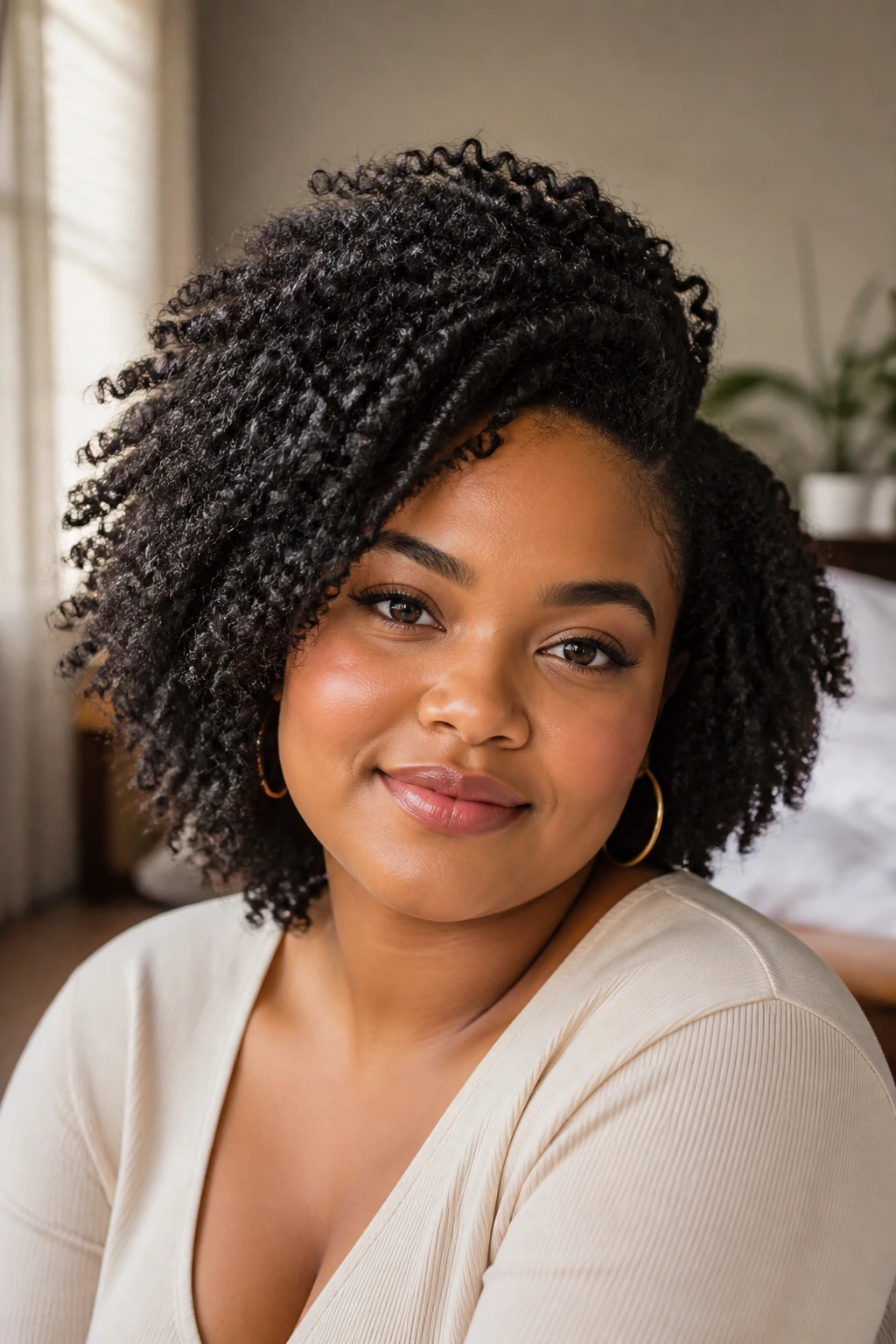
- Height without heat: Most of these styles put lift at the crown or top third of the head, which lengthens the face without forcing you into a flat-ironed shape.
- Texture stays in charge: Shrinkage, coils, and braid patterns are used as part of the silhouette, not something to fight off with a brush and a prayer.
- Short, medium, and long lengths are all covered: You’ll find options for a TWA, shoulder-length curls, stretched twist-outs, protective styles, and longer loc or braid looks.
- Sides don’t do all the work: Several styles pull weight inward with tapering, sweeping, or asymmetry so the cheeks don’t become the widest point in the frame.
- Low-manipulation choices are built in: A few styles give your scalp a break while still keeping the face line sharp and clean.
- They work in real life: These are styles you can actually wear to work, brunch, a wedding, the grocery store, or that one event where you don’t want to spend an hour standing in a bathroom mirror.
How Height, Angles, and Texture Change the Face Line
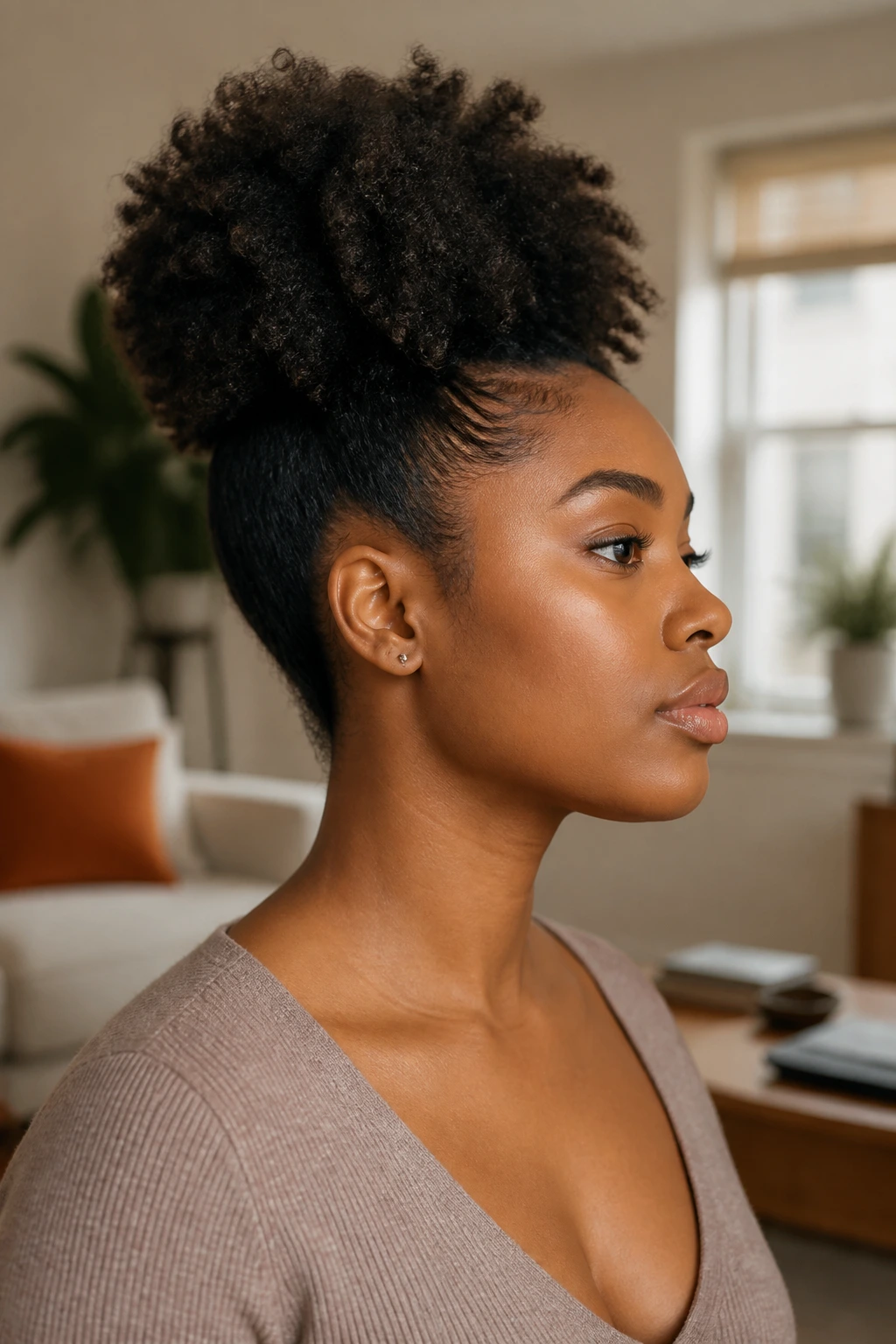
A round face usually has similar width and length, plus fuller cheeks and a softer jaw. That does not mean every style has to be “slimming.” I’m not a fan of that word anyway. What matters is where the eye goes first. If the hair starts low and wide, the face reads fuller. If the hair starts high, tilts to one side, or drops below the jaw, the face reads longer.
Crown lift does the first job
Lift at the top changes more than people expect. A puff set at the crown, a bun placed high, or even clipped roots on a wash-and-go create a vertical line before the eye gets to the cheeks. That vertical line is doing silent, useful work.
Side parts break the circle
A deep side part or even a slightly off-center part cuts across the face and interrupts roundness. Straight down the middle can work, but only when the rest of the shape is pulling upward. Without height, a center part can make the face look wider than it is.
Length below the jaw keeps the shape from ballooning
Hair that ends exactly at the cheekbone or jawline can sit on top of the face shape instead of balancing it. That’s why shoulder-length coils, layered lobs, braid-outs with movement, and styles with loose ends often look more flattering than blunt shapes that stop right at the widest point. Natural hair gives you enough body already. You do not need to add more bulk where the face is fullest.
1. High Puff With a Clean Side Part
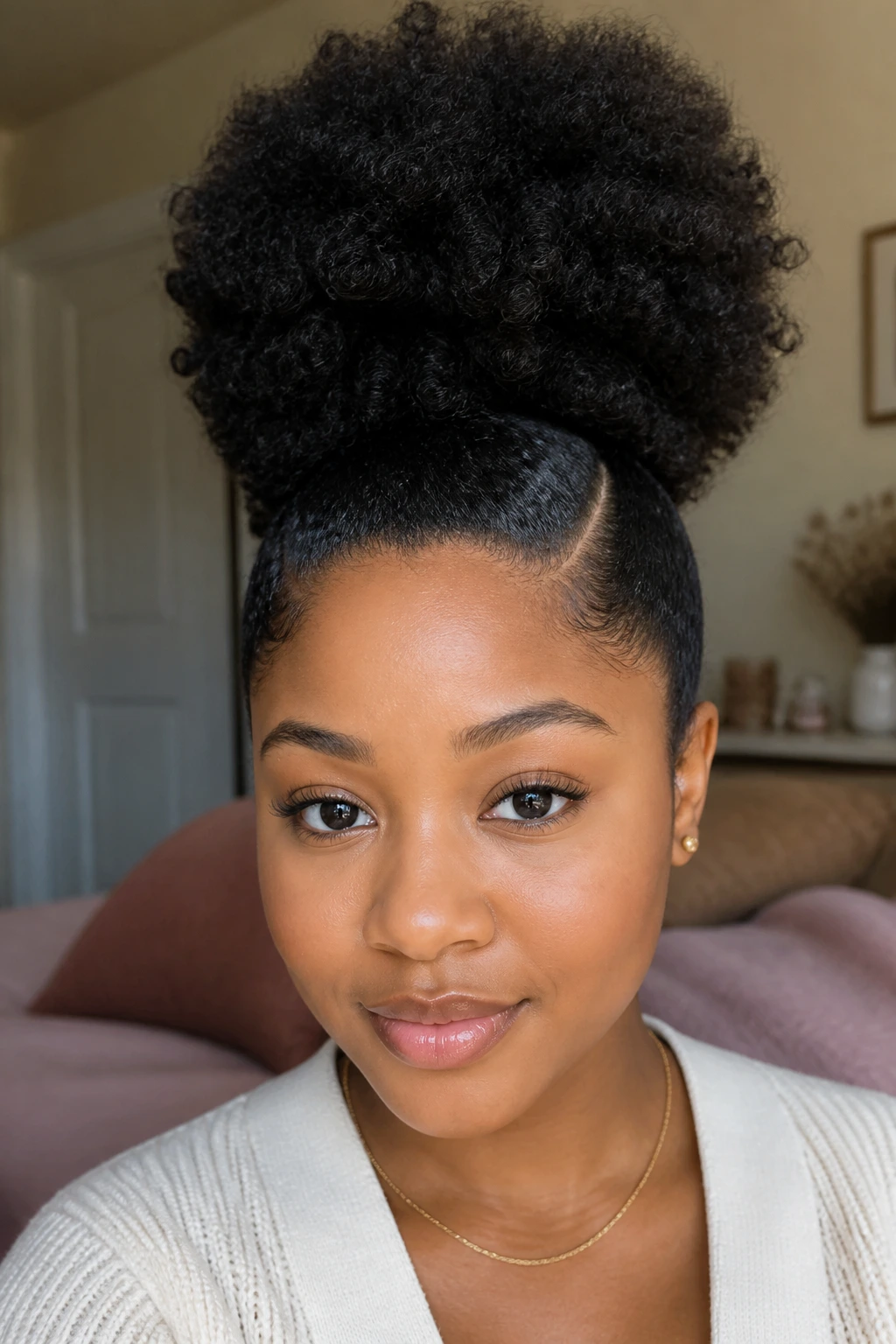
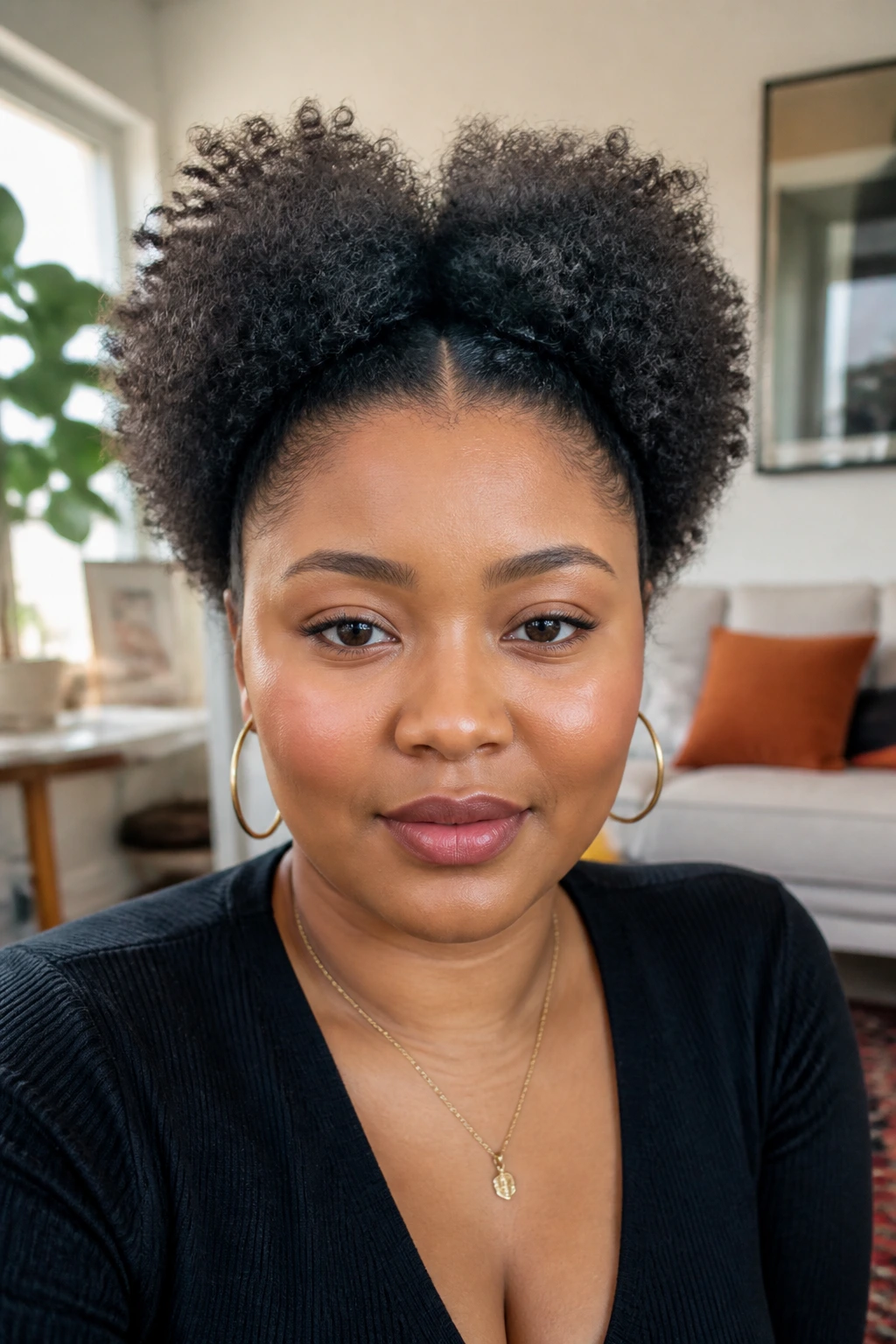
A high puff is one of those styles that looks simple until you see what it does to the face. Put the puff high enough, and the first thing people notice is the lift, not the width. That matters on a round face, because the whole style starts above the cheeks instead of sitting beside them.
The side part is the part people overlook. A clean, deliberate part — not a fuzzy line made with your fingers in the dark — gives the front a diagonal that breaks up the roundness. I like this best when the sides are smoothed with a light gel and the puff itself stays full and soft, not stretched into a tight ball.
If your hair is tightly coiled, band the roots overnight or stretch them with a blow-dryer on low before gathering the puff. That little bit of elongation helps the puff sit up instead of out.
2. Side-Parted Twist-Out
Why does a side-parted twist-out flatter a round face so fast? Because it gives you softness and direction at the same time. The twist pattern brings texture, while the part sends the eye diagonally instead of straight across the widest part of the face.
This is one of the better options when you want movement around the cheeks but do not want the hair to sit like a perfect halo. Keep the twists stretched enough that the finished set falls below the cheekbone, and separate them only after they are dry. If you rip them apart too early, the style gets big in the wrong places.
For 3c to 4b hair, a side-parted twist-out often reads cleaner than a center part because the asymmetry does the shape work for you.
3. Curly Shag With Face-Framing Layers
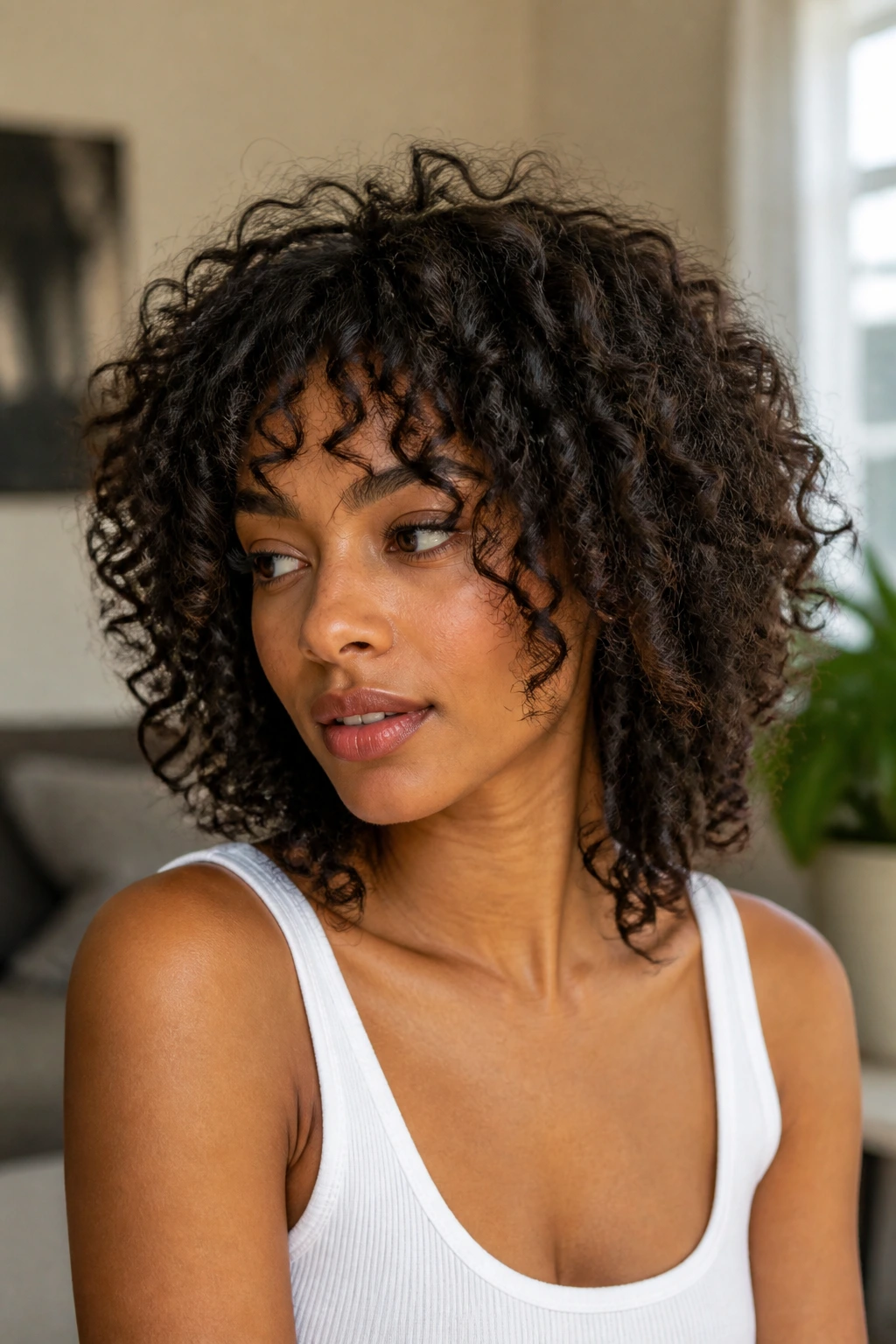
The curly shag earns its place here because it does the opposite of a blunt shape. Instead of one heavy line, it gives you layers that start near the temple or above the brow and drop from there. On a round face, that creates movement around the edges without creating a shelf at the cheeks.
I like this cut on natural hair that has enough length to show the layers without collapsing into one round cloud. Ask for the shortest layer to land higher than the cheekbone if you can; that keeps the frame open. If the shortest pieces hit right at the fullest part of the face, the whole haircut can start to feel boxy.
A good shag should move when you turn your head. If it only looks good frozen in a selfie, something’s off.
4. Half-Up Pineapple With Loose Front Coils
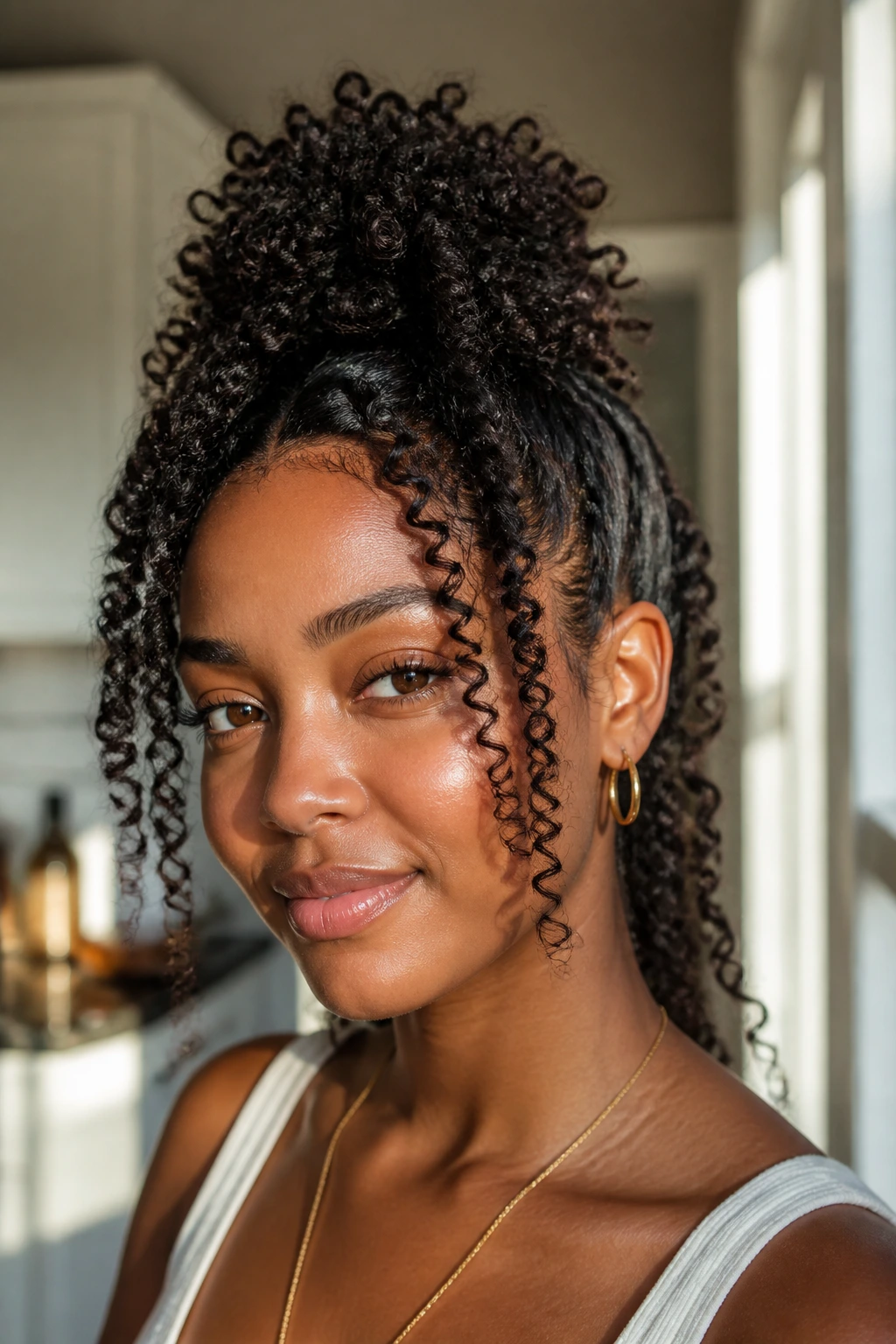
The half-up pineapple works because it leaves the top lively and the front soft. You pull the crown up and back, which opens the face, then you let a few coils or curls fall along the temples and jaw. Those front pieces are not decoration. They’re the reason the style doesn’t read as top-heavy.
This is a smart day-two style when the curls have a little memory left but need a shape reset. Keep the loose front pieces long enough to land near the lip or chin; if they stop at the cheeks, they can add width right where you do not want it.
A messy, slightly imperfect pineapple looks better here than a polished one. Too neat, and it can start to feel rigid. A little softness keeps the balance right.
5. Tapered Frohawk
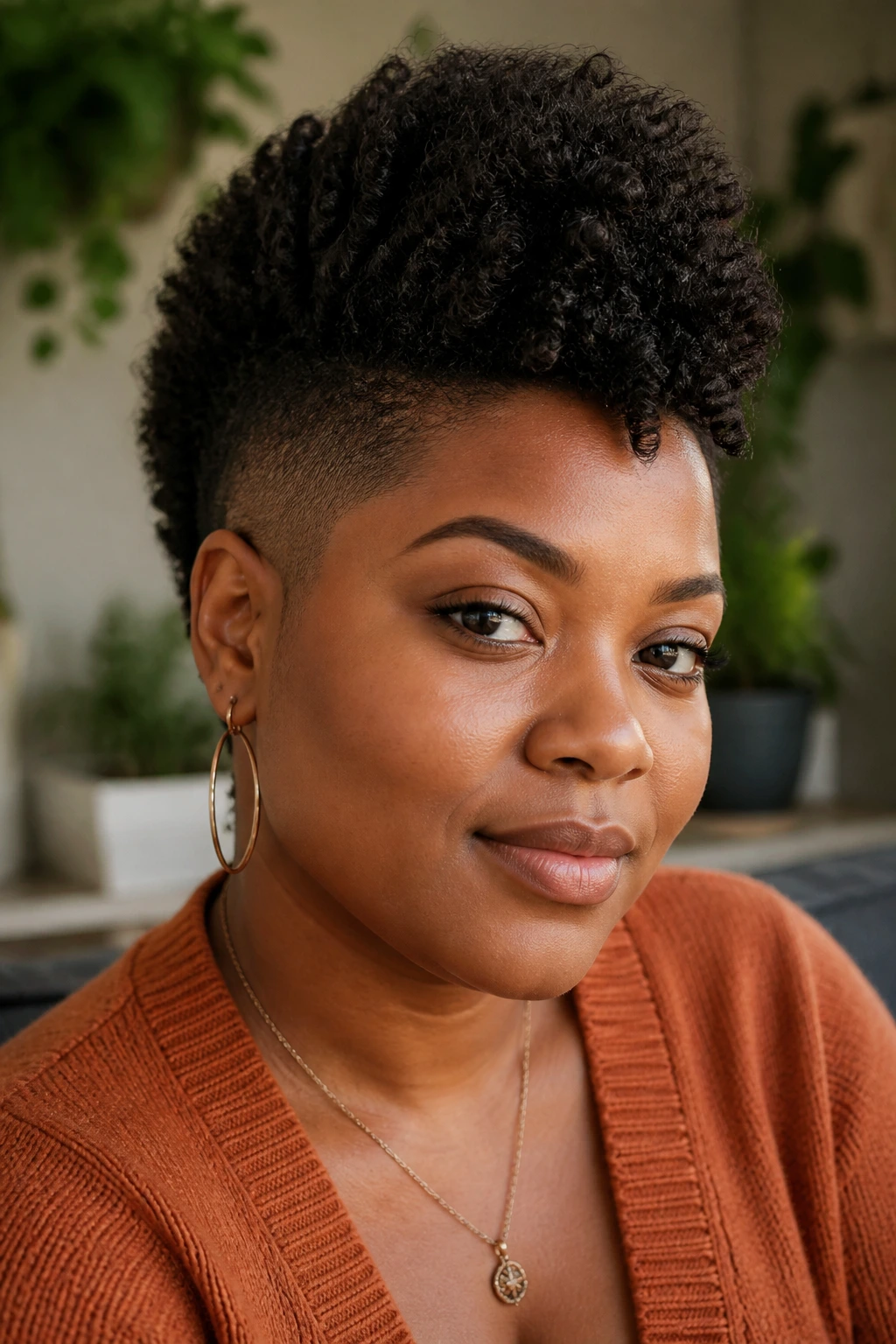
If you want a look with attitude, the tapered frohawk is hard to beat. The short or closely tapered sides narrow the silhouette, while the center ridge of curls runs from forehead to crown and gives you that vertical line round faces love.
This style does a lot of the work in the cut itself. You are not relying on a part or a pin to fake shape later. The center section can be defined with mousse or cream, and the sides should stay neat so the frohawk doesn’t spread outward near the cheeks.
I like this especially on short natural hair because it makes the face look longer without hiding the texture. It’s blunt, in a good way. No apology needed.
6. Braided Crown With Loose Ends
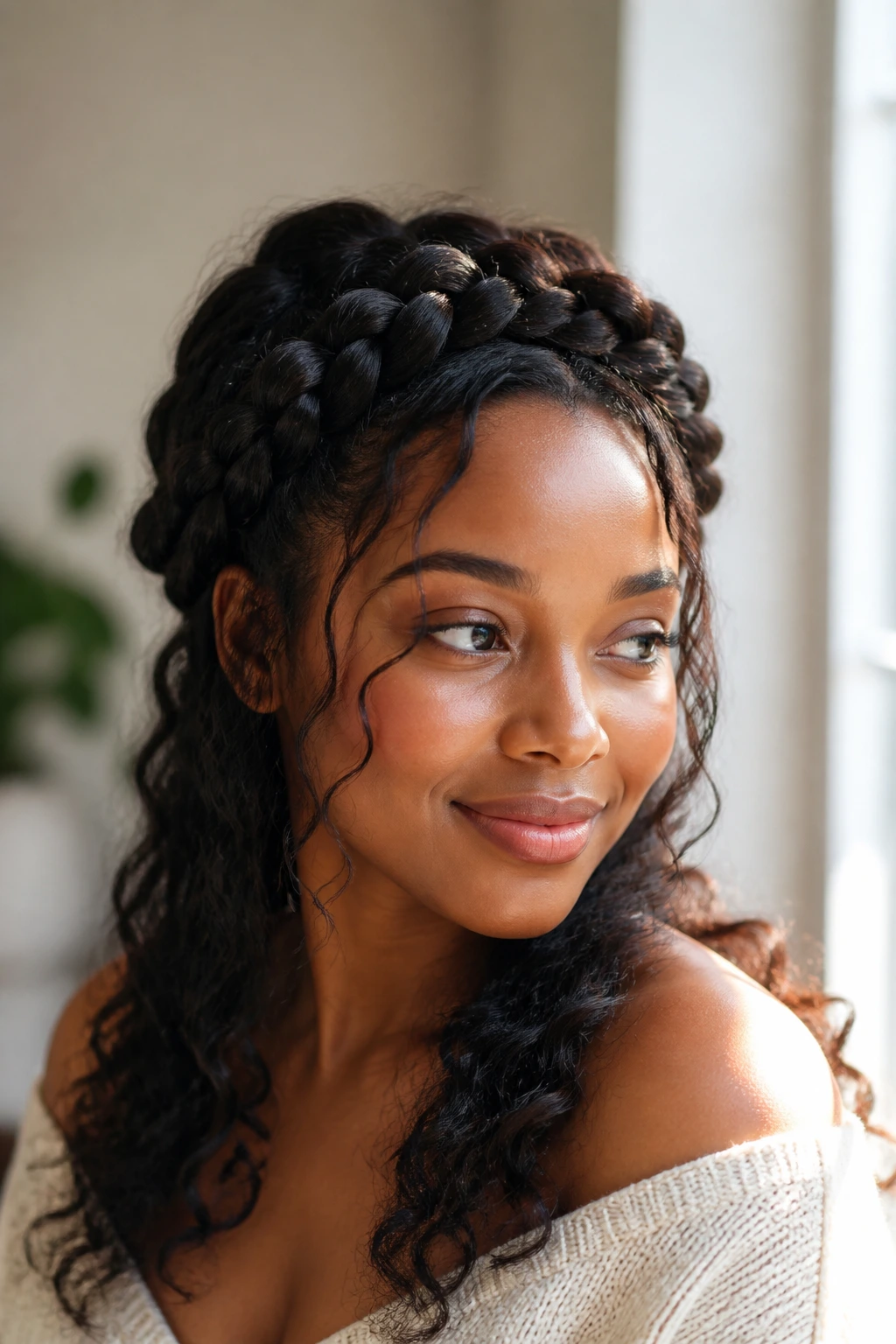
A braided crown frames the face without boxing it in, which is a small miracle on a round shape. The braid curves around the top half of the head, then the loose ends drop lower and stretch the whole look downward.
The trick is placement. Keep the crown braid slightly above the temples, not low on the forehead. A low braid can press the face inward and make the top look heavy. A slightly higher braid gives the style air.
If your hair is thick, make the braid a little slimmer so it does not become a dense band across the head. That band effect can add width faster than anyone expects.
7. Deep Side-Part Wash-and-Go
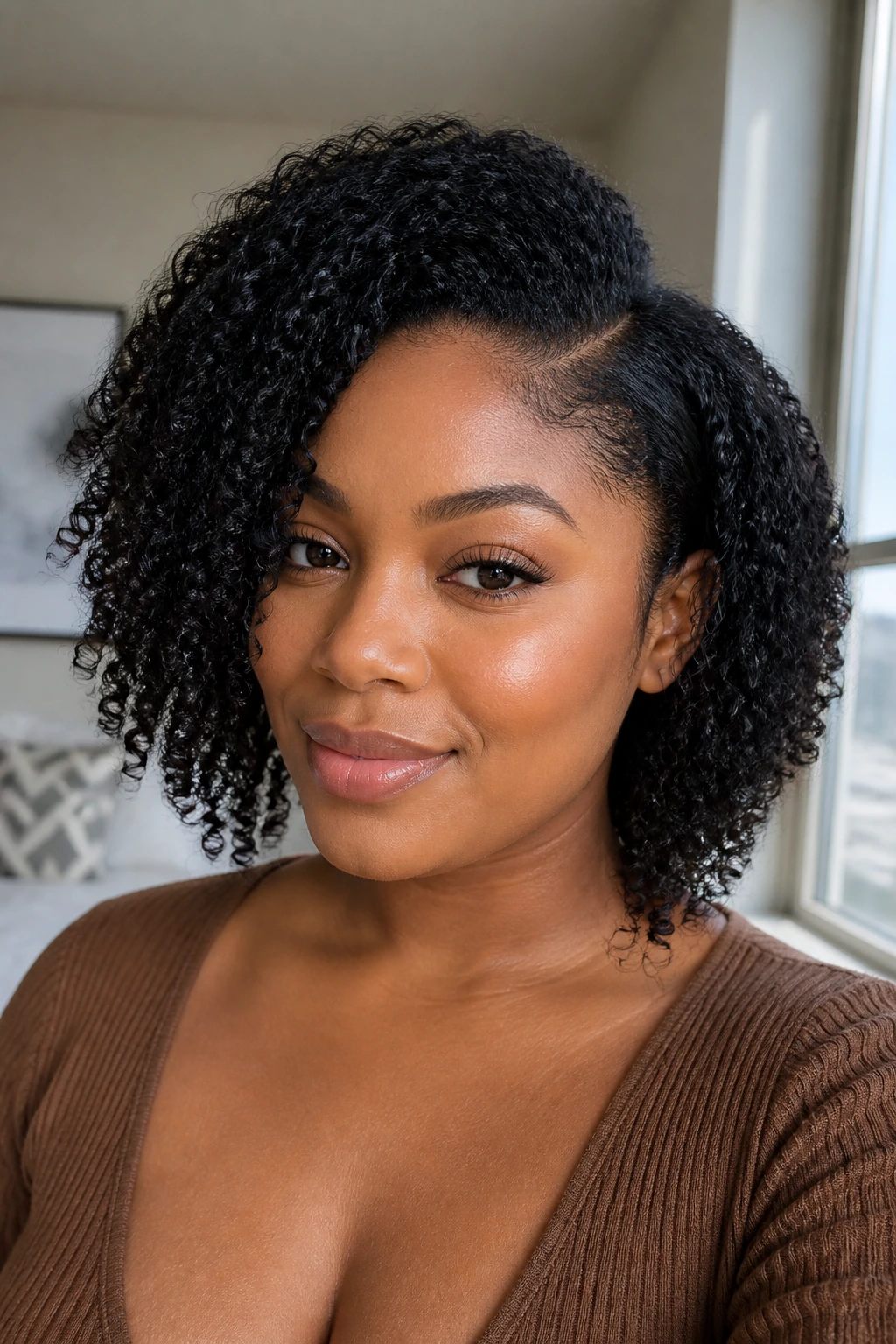
A wash-and-go can absolutely flatter a round face, but only if the roots have some lift and the part has intention. A deep side part shifts the weight away from the center, and that alone changes the read of the face.
I’m picky about the crown here. If the top stays flat while the curls flare wide at the cheeks, the style will make the face look fuller. Root clips, a diffuser, or a quick blast with a hooded dryer can give the crown enough height to keep the balance sane.
- Root lift: Clip the roots on the high side of the part while the hair dries.
- Shape control: Keep the cheek curls defined instead of puffing them out with too much picking.
- Finish: Use a light oil only on the ends if they look dry; heavy oil at the roots will flatten the whole shape.
8. Top Knot With Face-Framing Coils
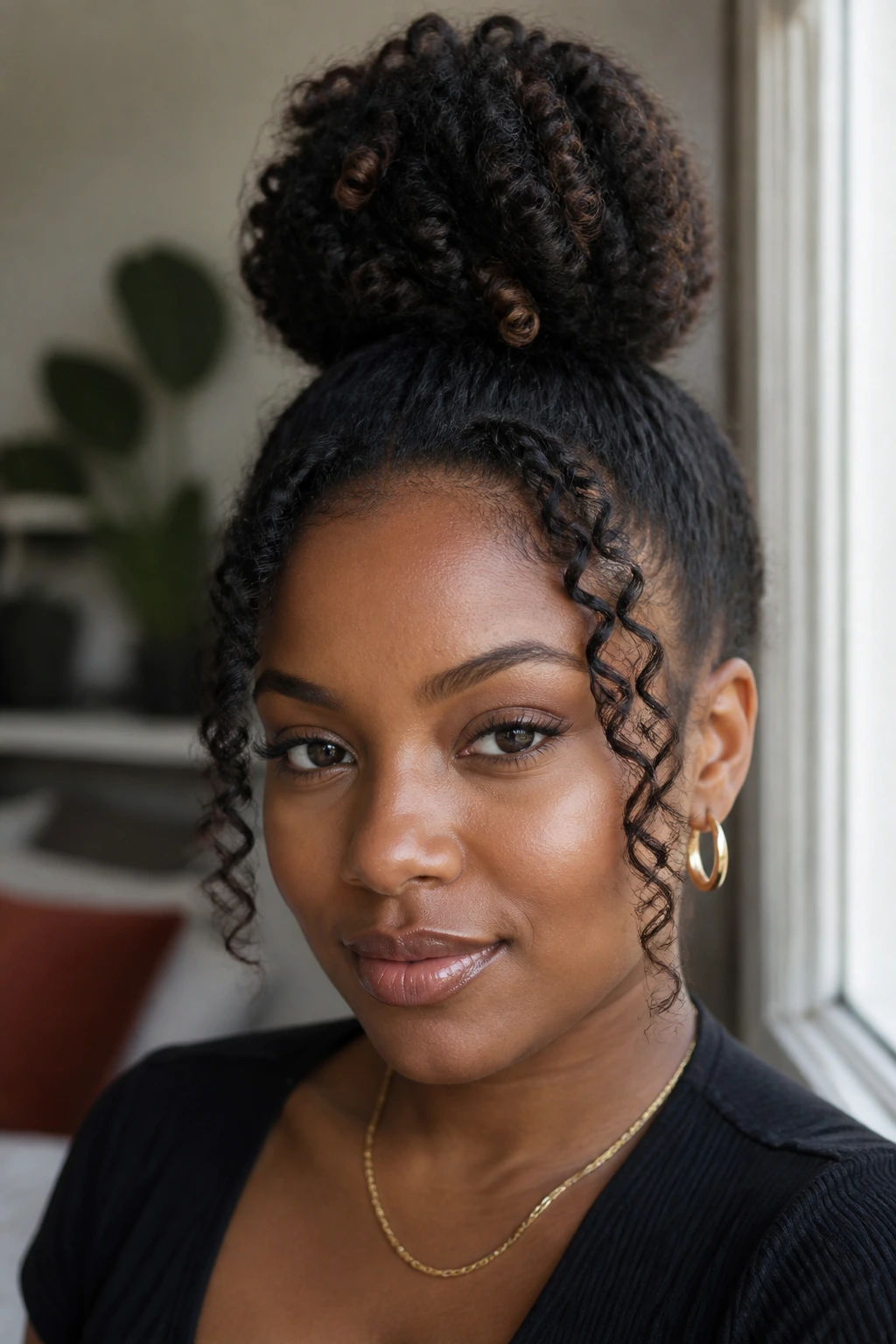
A top knot can look severe if it sits too low or too tight. Put it high, leave a few coils out in front, and it becomes a cleaner, friendlier shape for a round face. The knot creates the vertical lift, and the loose coils soften the forehead and temples.
I prefer this on thicker natural hair because it gets the bulk off the neck without making the silhouette wide. If your knot feels like it’s turning into a heavy sphere, flatten the base a little with pins before wrapping the length around it. That tiny adjustment keeps the bun from sitting like a helmet.
The front pieces should graze the temples or jaw, not cling to the cheeks. That’s the line worth watching.
9. Angled Twist Bob
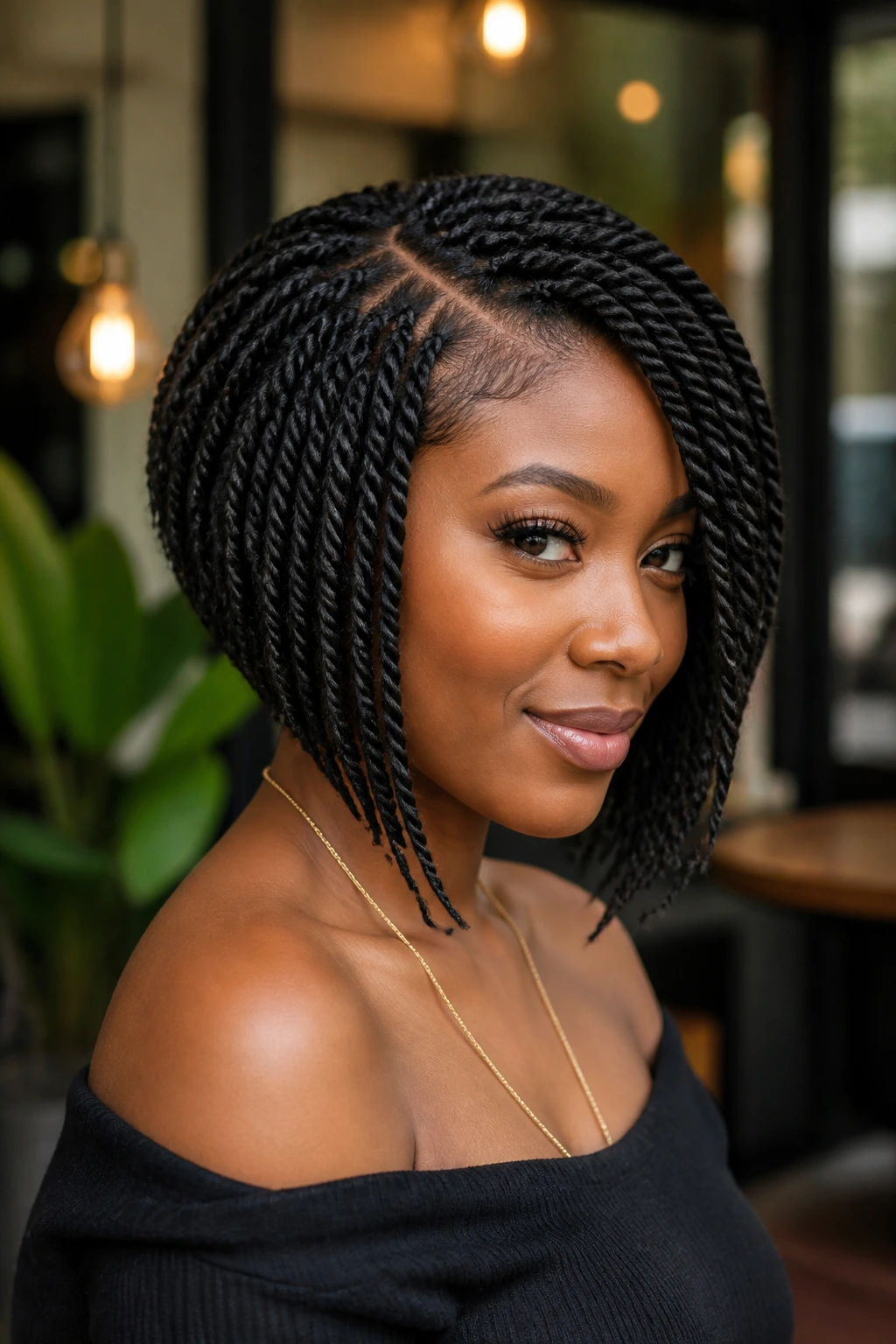
Why do angled bobs keep showing up in face-shape conversations? Because the line itself does half the styling. A front section that sits a little longer than the back creates a visible slope, and that slope is useful on a round face.
With twists, the bob gets texture and structure at once. Keep the front pieces just under the jaw and let the back sit a touch higher, and the style starts to lengthen the face visually. If the twists are too tiny, the look can get busy and lose that clean angle.
This one works well when you want neatness without stiffness. It reads polished, but not sealed shut.
10. Fulani Braids With Curly Ends
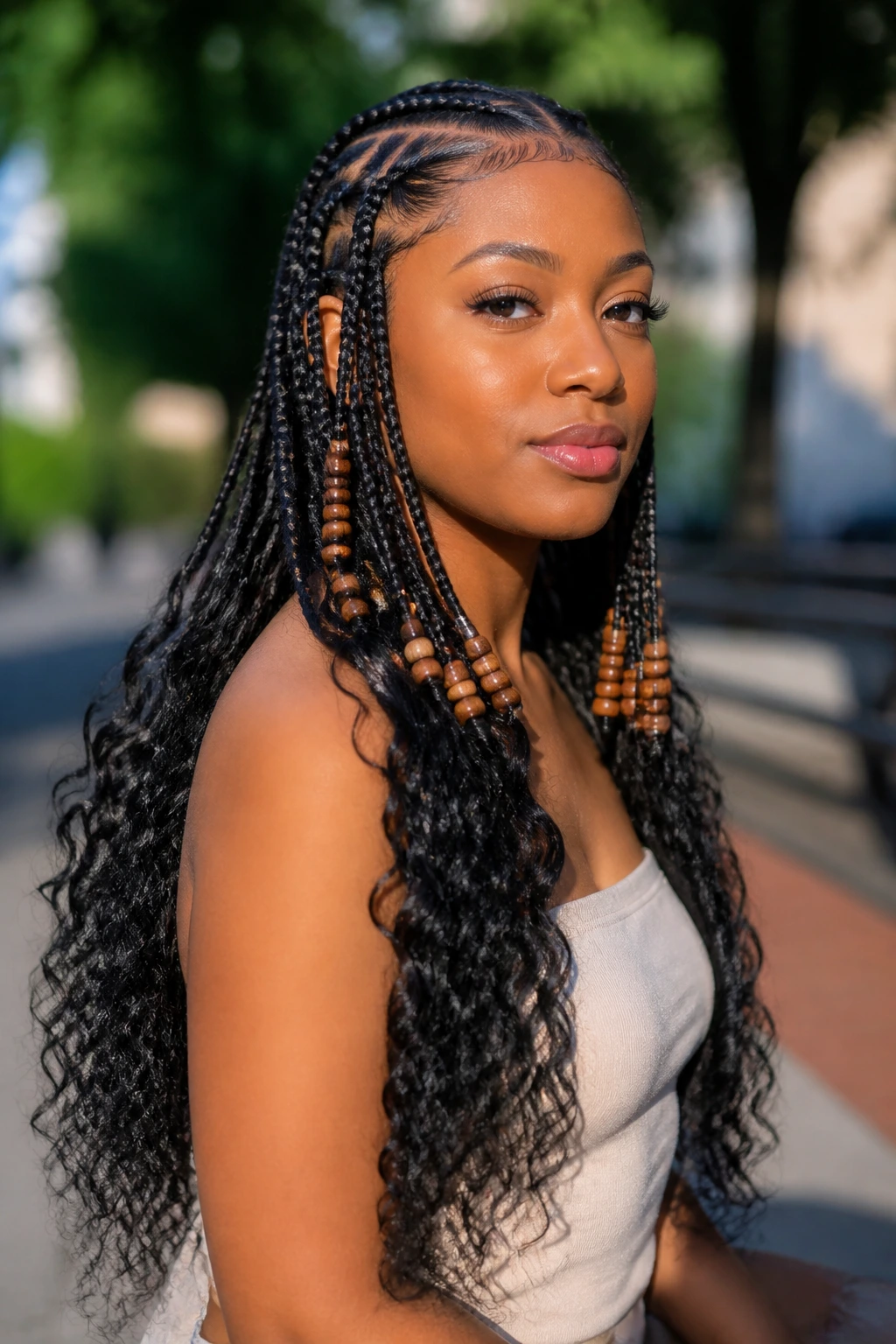
Fulani braids can be a very good fit for round faces when the sides stay slim and the styling details live higher up. A center braid or softly off-center braid pulls the eye up the middle, then the curly ends continue the line below the shoulders.
The curly ends are what save this from feeling too rigid. Straight braids alone can sit visually heavy along the face, but soft ends add movement and keep the outline from going blocky. Beads are fine, but I’d keep them toward the upper half of the braid instead of clustering them near the jaw.
If you like braids and want length without a lot of daily handling, this is a strong option.
11. Low Puff With a Deep Side Sweep
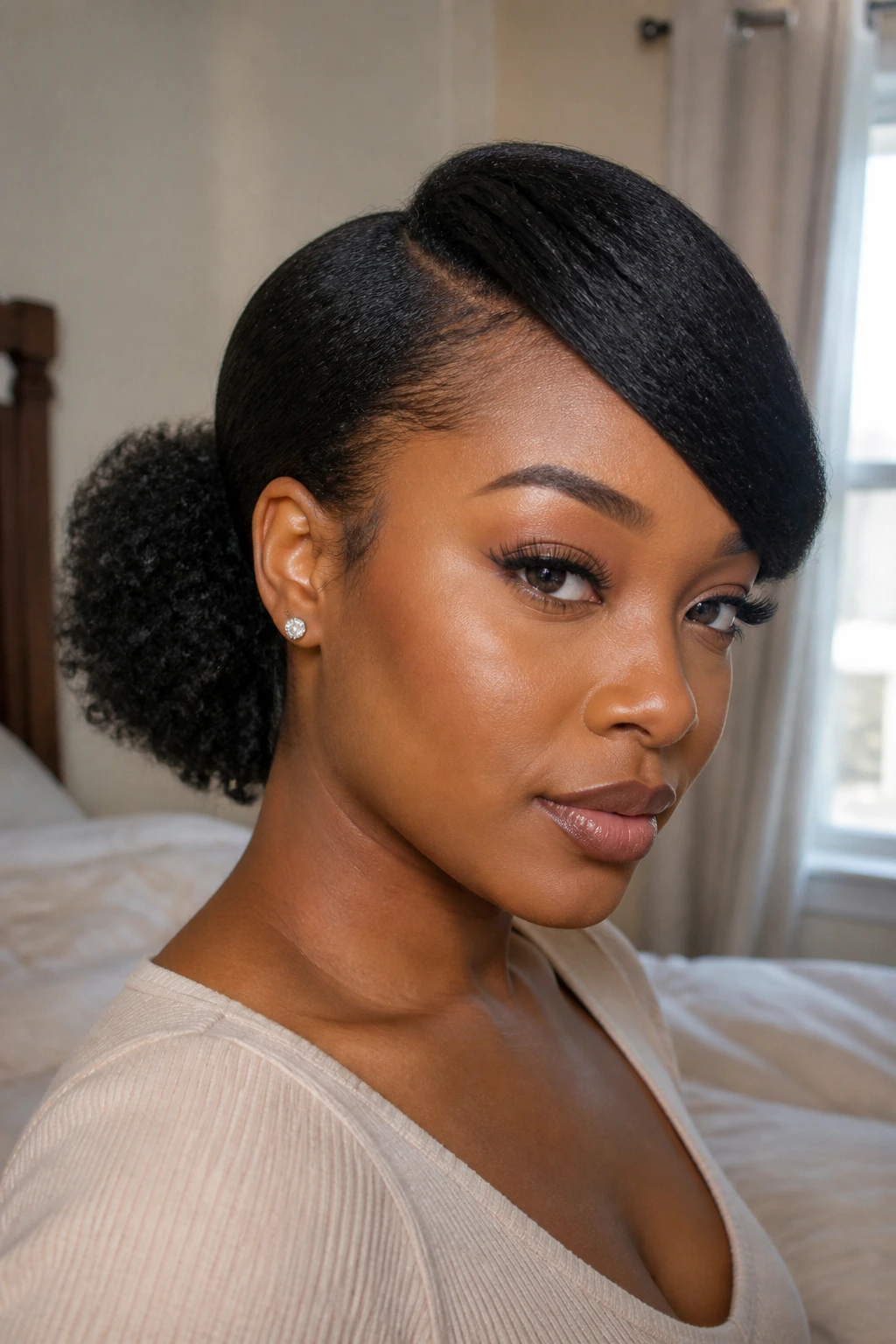
A low puff can work on a round face if you give it enough direction. The side sweep does that job. It cuts across the forehead at an angle and keeps the style from becoming one even, circular shape.
The puff itself should sit below the cheekbone, but not so low that it drags the face downward. Think of it as a controlled low shape with a clear line at the front. That one sweep at the top makes all the difference.
I reach for this style when I want my hair gathered but not flattened. It feels calmer than a high puff, but it still keeps the silhouette from spreading at the sides.
12. Flat Twists Into a High Bun
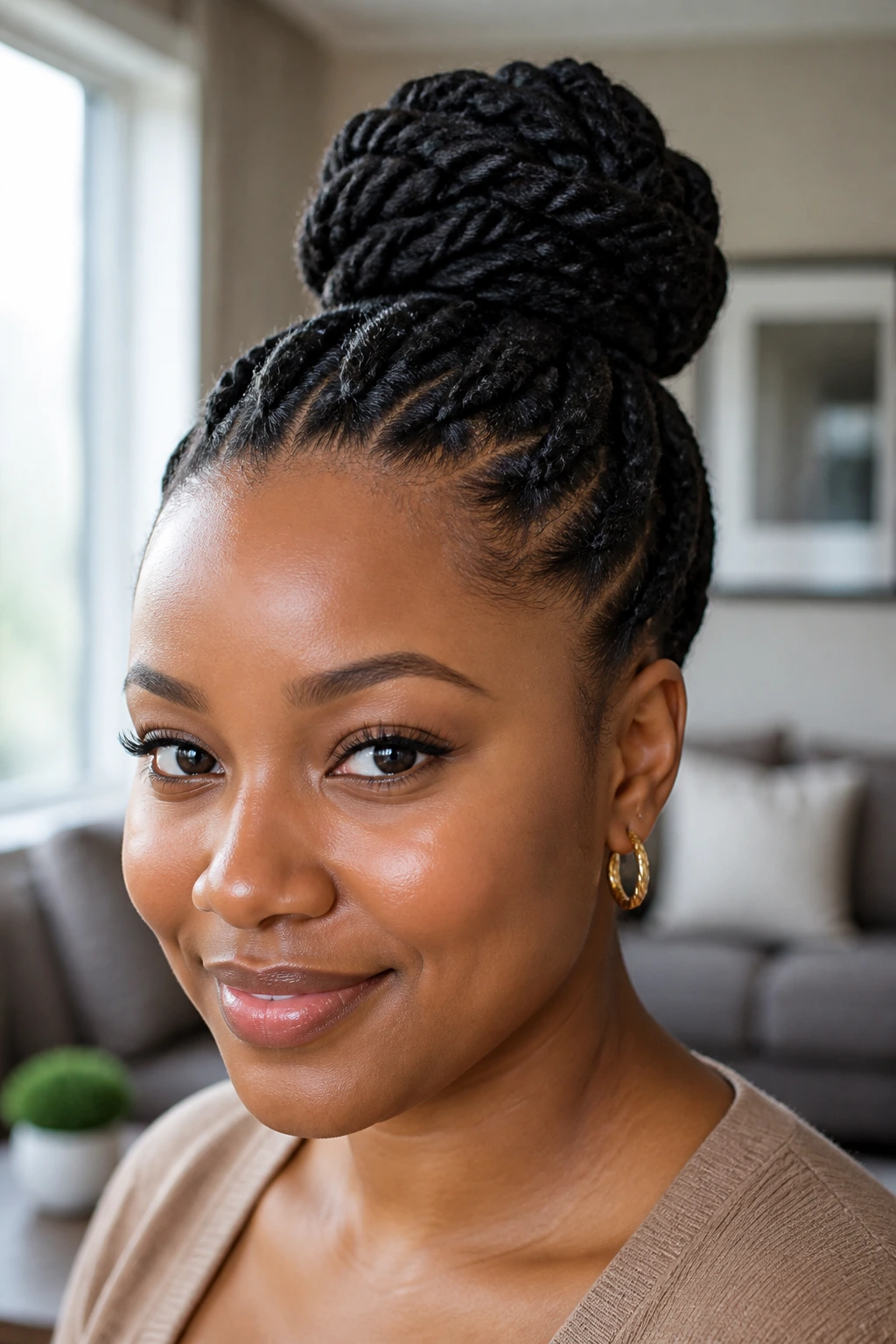
Flat twists are underrated because they can be both protective and sharp-looking. When they’re twisted back into a high bun, the whole style pulls the eye upward before it gets anywhere near the jawline.
This matters more than people think. A bun parked low at the back can make a round face look shorter. A bun sitting higher on the crown adds lift and keeps the face line clean.
If your hair is short, the bun can be compact. If it’s longer, you can make it fuller, but keep the base neat. Loose ends around the temples can help soften the style, though I would not let them spread wide at the cheeks.
13. Lifted Afro With Tapered Sides
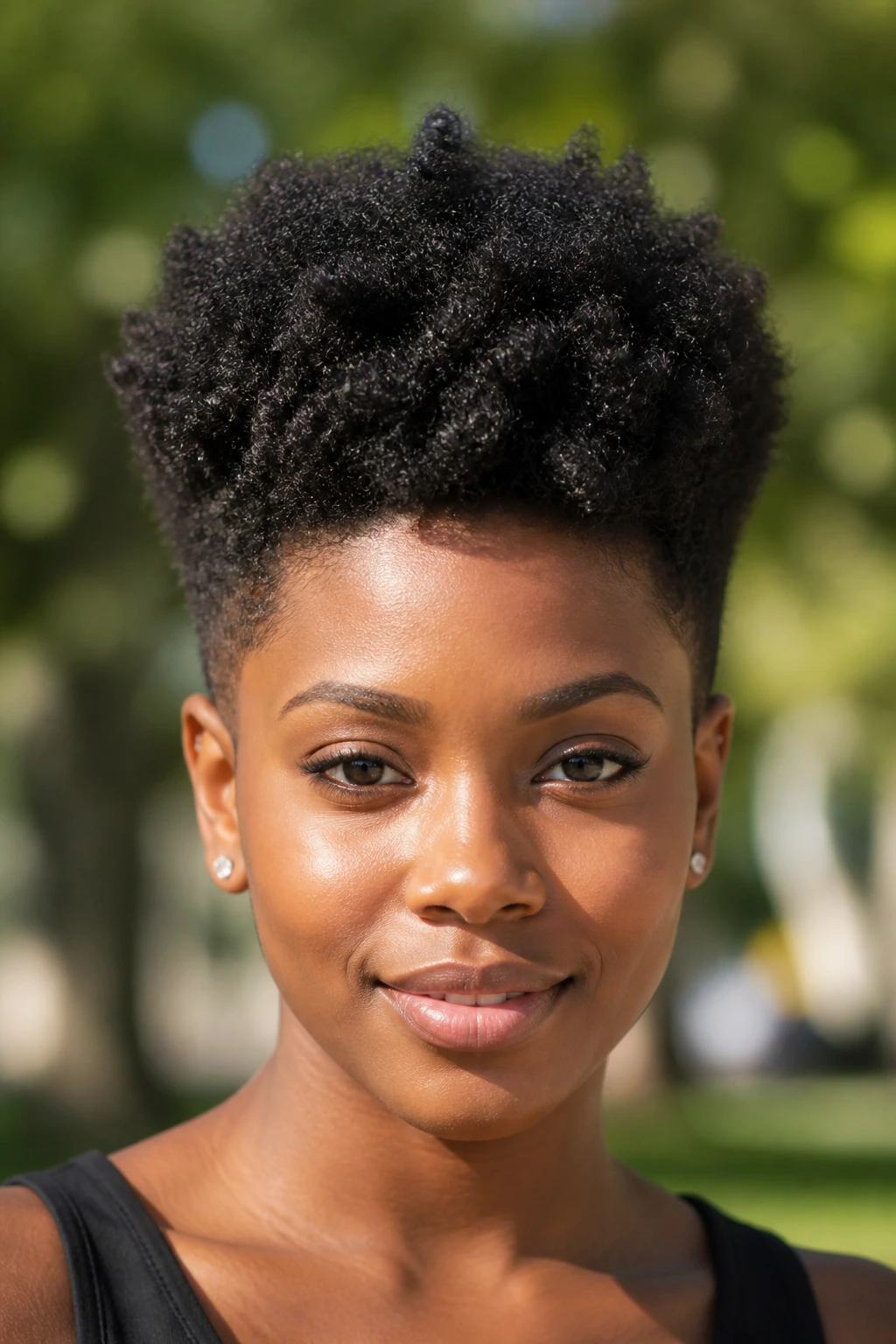
There’s a real difference between a fro that spreads and a fro that rises. The lifted version wins here. Tapered sides and a bit of shape around the nape keep the width under control, while the crown gets the height.
This is one of the best styles for people who want to wear their natural texture openly but still want the face to feel longer. Use a pick at the roots, not all the way through the body of the hair. That keeps the top airy without blowing out the sides.
- Best on: Dense curls and coils that can hold shape at the root.
- What to ask for: Tapered sides with more fullness at the crown.
- Watch for: A perfectly round outline. That shape is the enemy here.
14. Shoulder-Length Mini Twists With Volume at the Ends
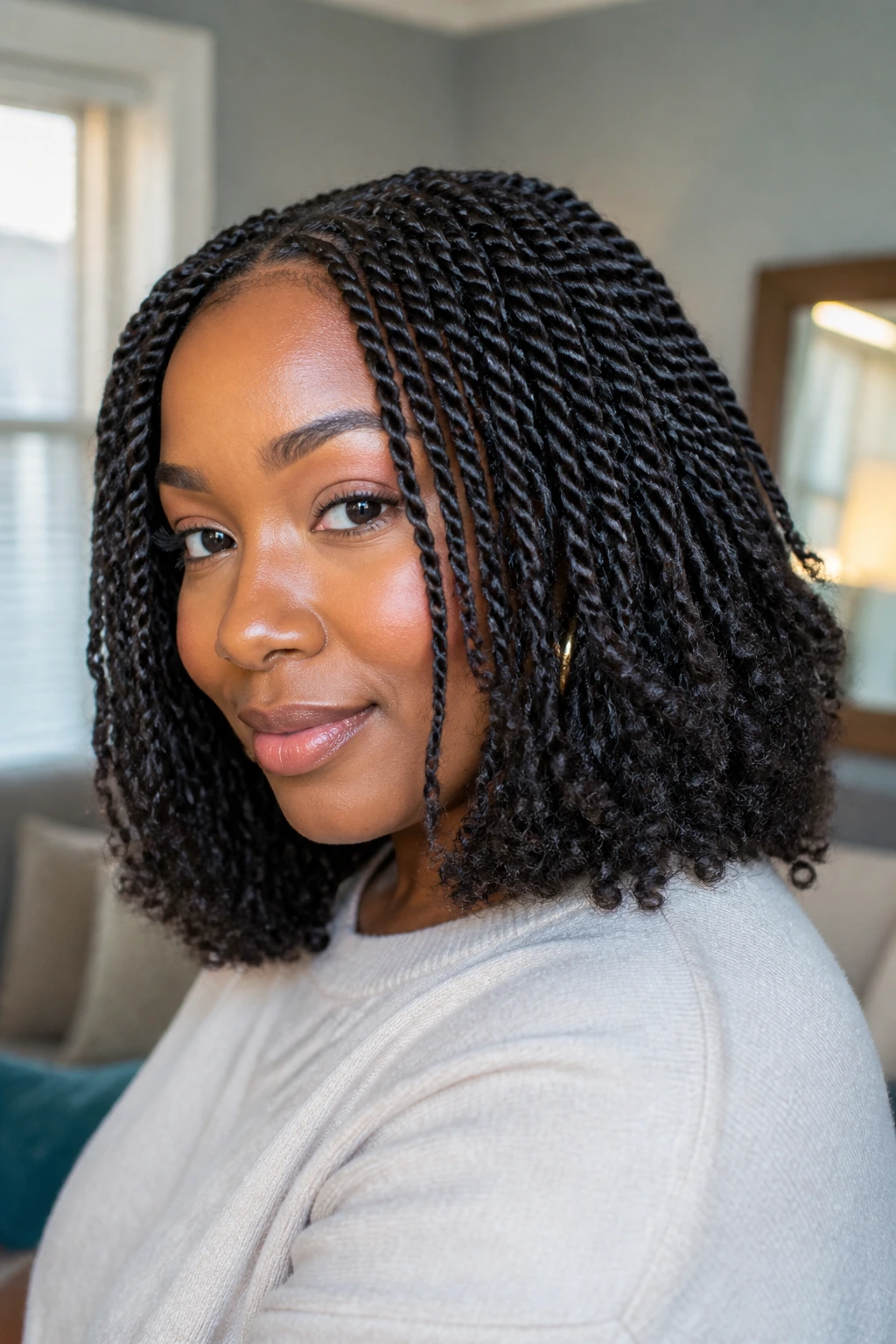
Mini twists can go flat fast if the roots are too tight and the ends too thin. Keep some volume at the shoulder line, and the style starts working with the face instead of against it. Shoulder length is useful because it drops below the cheekbone and gives the eye somewhere to go.
I like mini twists on round faces when they are installed on stretched hair. That helps them hang instead of puffing out at the sides. The ends should feel soft and a little separated, not sealed into one blunt line.
This is a calm, useful style. It doesn’t scream for attention, which is part of why it works.
15. Bantu Knot-Out With an Off-Center Sweep
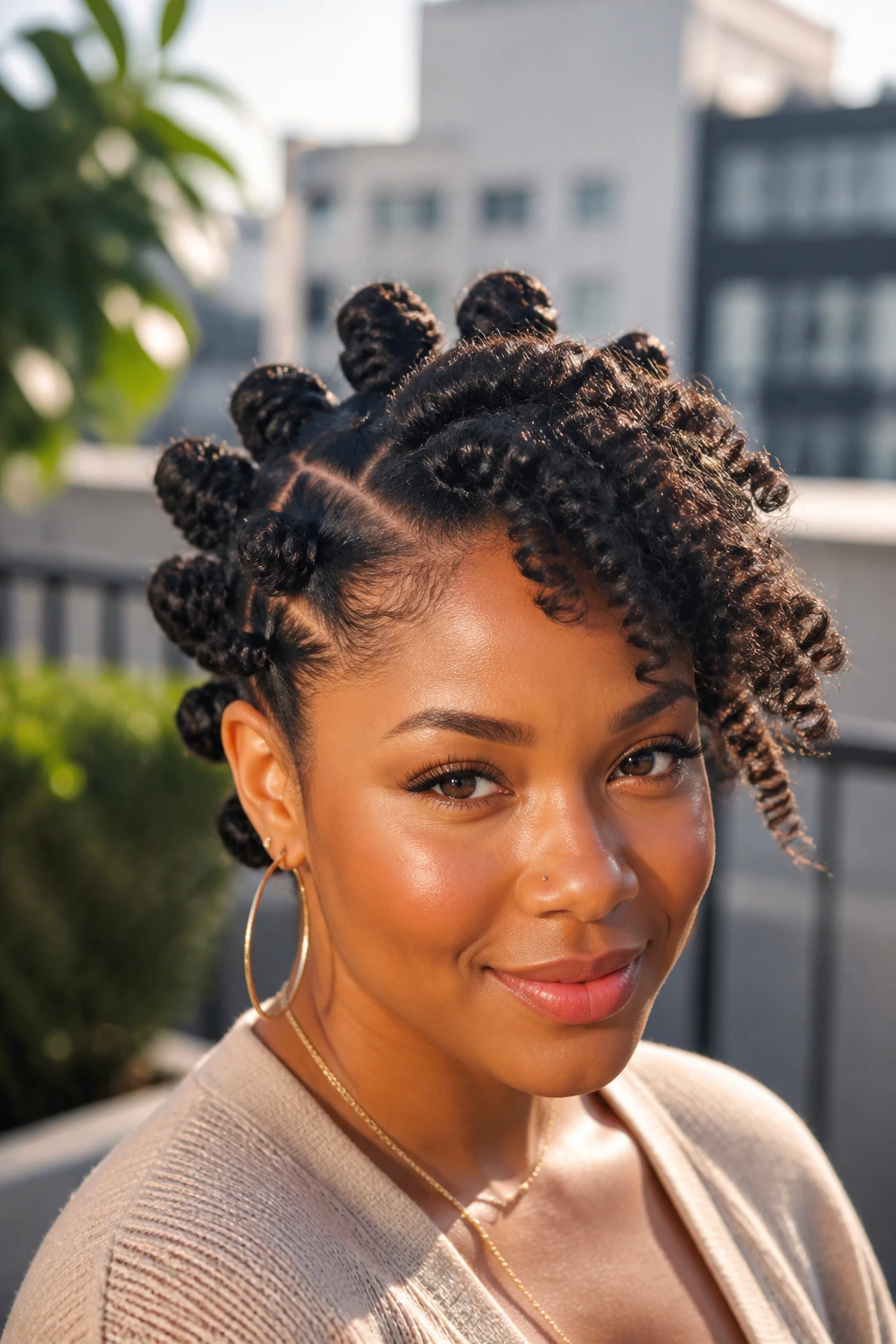
A Bantu knot-out can go from cute to crowded if the curls form a perfect ring around the face. Off-center is the fix. Sweep the front a little to one side, and the style stops reading as circular.
The knots themselves matter, too. Smaller, even knots give you a cleaner curl pattern and more lift at the root. When you take them down, separate the curls only enough to open them up. If you fluff too much, the style gets wide around the cheeks.
This is one of those looks that rewards patience. Let the hair cool and set fully, and the curl pattern will hold shape instead of swelling sideways.
16. Tapered Cut With Defined Coil Fringe
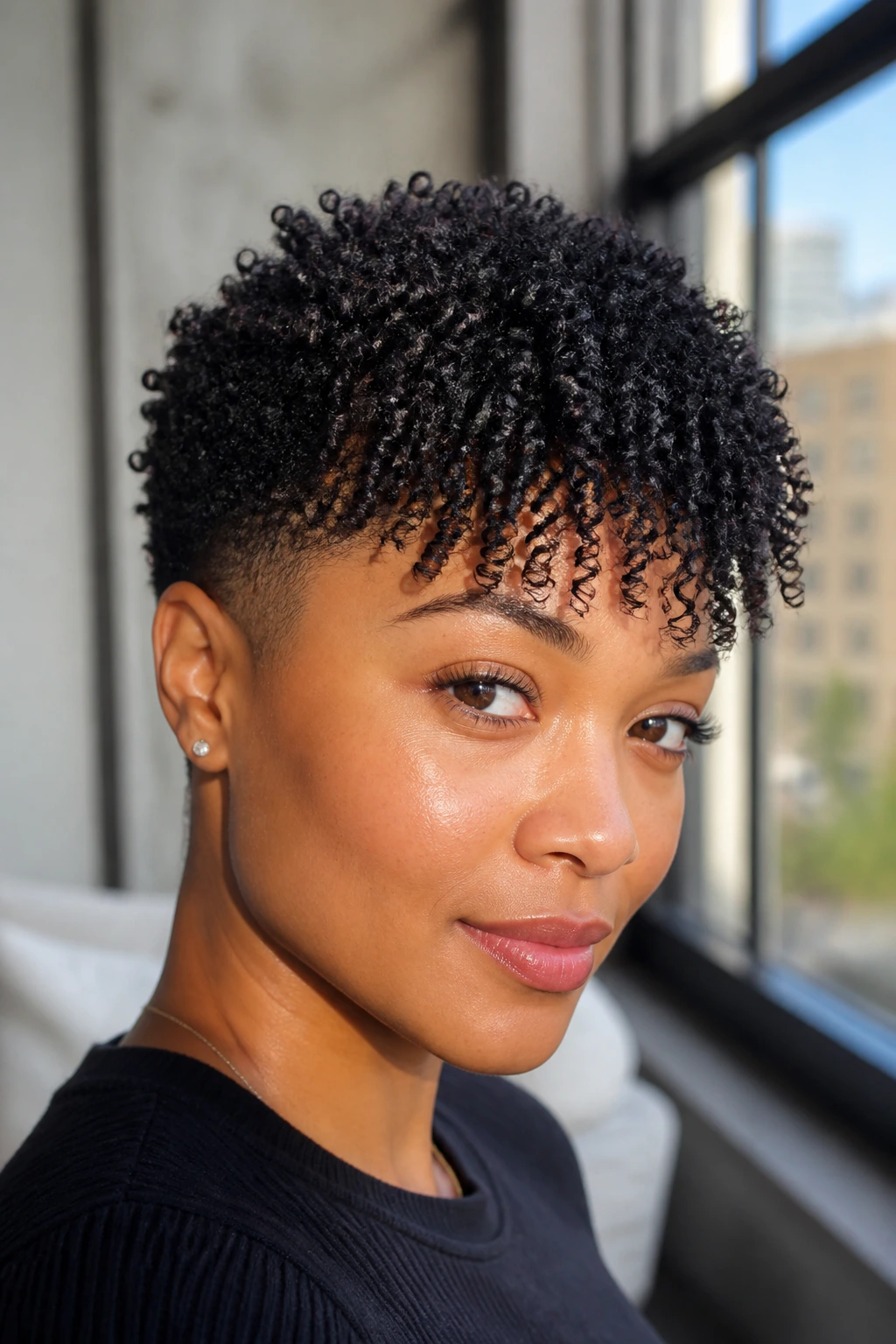
Short natural hair can be the most flattering option of all when the shape is right. A tapered cut keeps the sides tidy, which narrows the lower half of the head, and a coil fringe adds detail near the brow without creating a blunt line.
That fringe should be broken up. If it hangs in one solid wall across the forehead, the face can look shorter. If it’s made of small, defined coils, it softens the top and keeps the style lively.
This cut looks sharp in a way that feels clean, not severe. That’s a hard balance to fake with longer hair.
17. Box Braids Pulled Into a High Ponytail
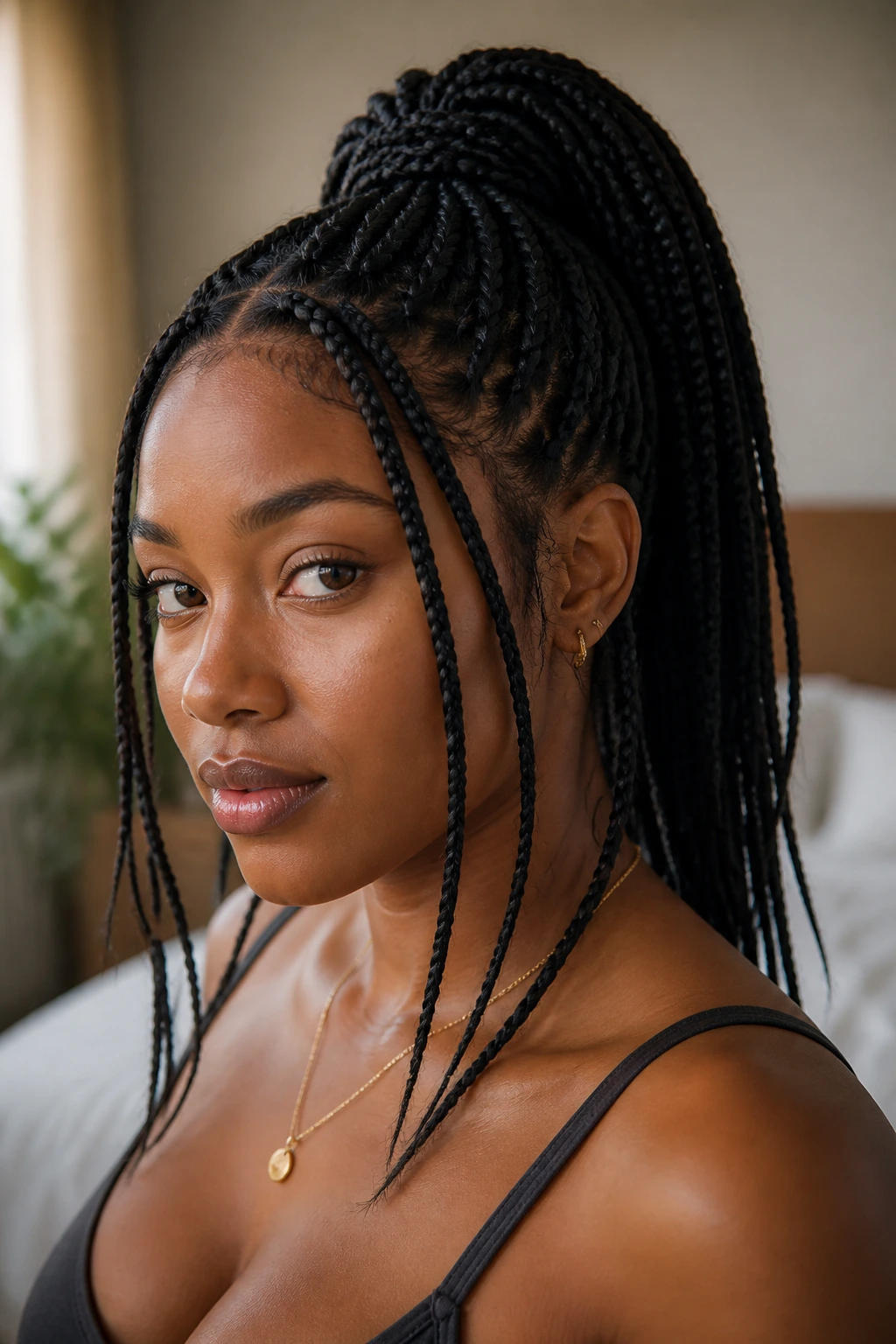
Box braids can add width if they hang heavy at the sides, which is why the high ponytail is such a useful fix. Pull the braids up, let the pony sit above the ears, and the silhouette changes fast.
The ponytail keeps the neck open and the face line cleaner. A few braids left loose near the hairline can soften the front if the style feels too tight, but do not overload the front with extra bulk. That just adds weight where you were trying to lose it.
- Good move: Wrap one braid around the base to hide the elastic.
- Better move: Keep the pony high enough to create lift.
- Skip this: A low pony that sits at the jawline.
18. Side-Swept Cornrows and Loose Curls
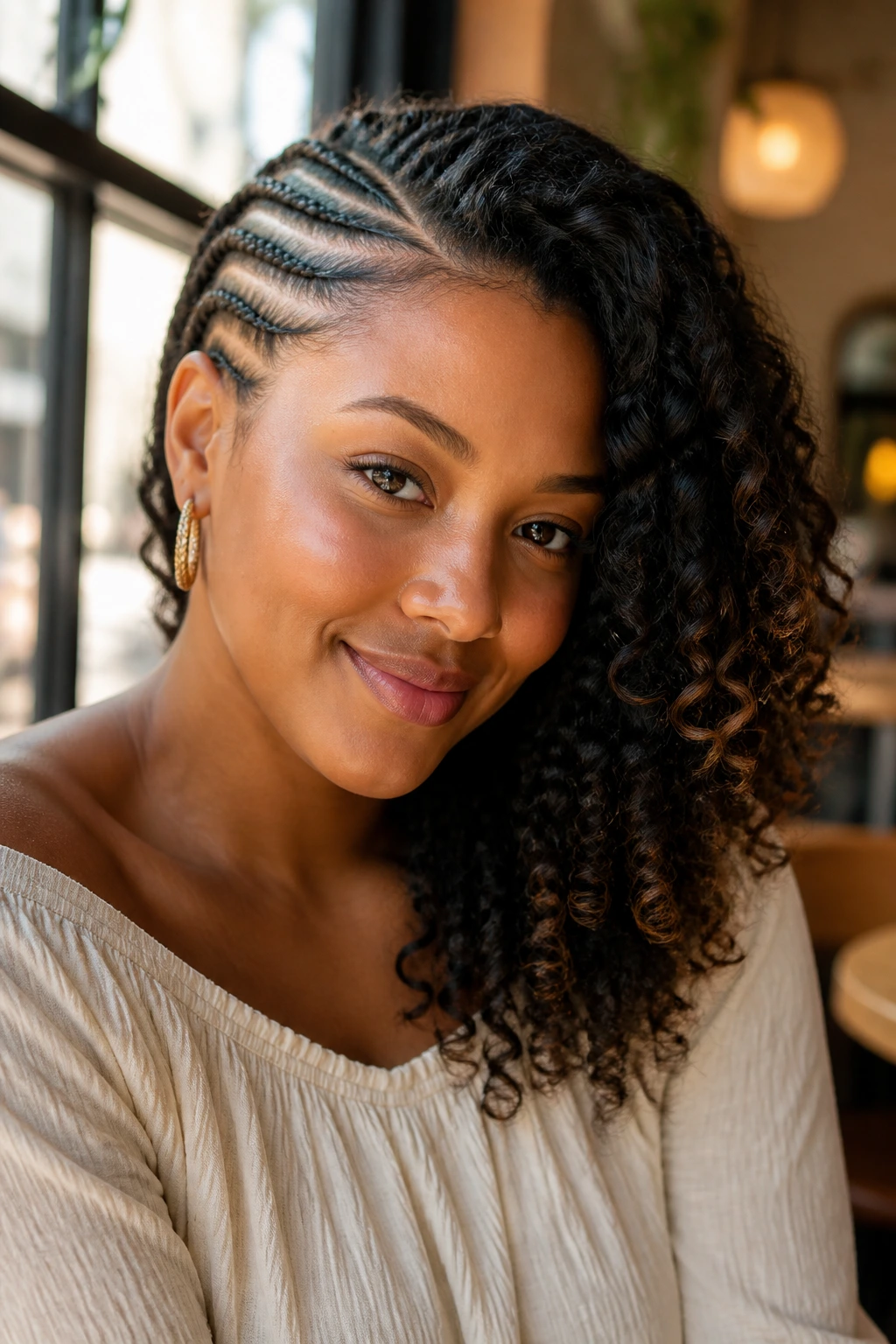
Side-swept cornrows paired with loose curls create a strong diagonal, and diagonals are the best friend of a round face. The braids keep one side neat and close to the scalp, while the curls on the other side add softness below the cheekbone.
I like the curve of the cornrows to be gentle, not straight and severe. A slight arc makes the whole style feel less angular. The loose curls should live low enough to lengthen the face rather than sit right at the cheeks.
This is a smart choice when you want something structured but not stiff. It also plays well with earrings, which is never a bad thing.
19. Twist-Back Headband Style
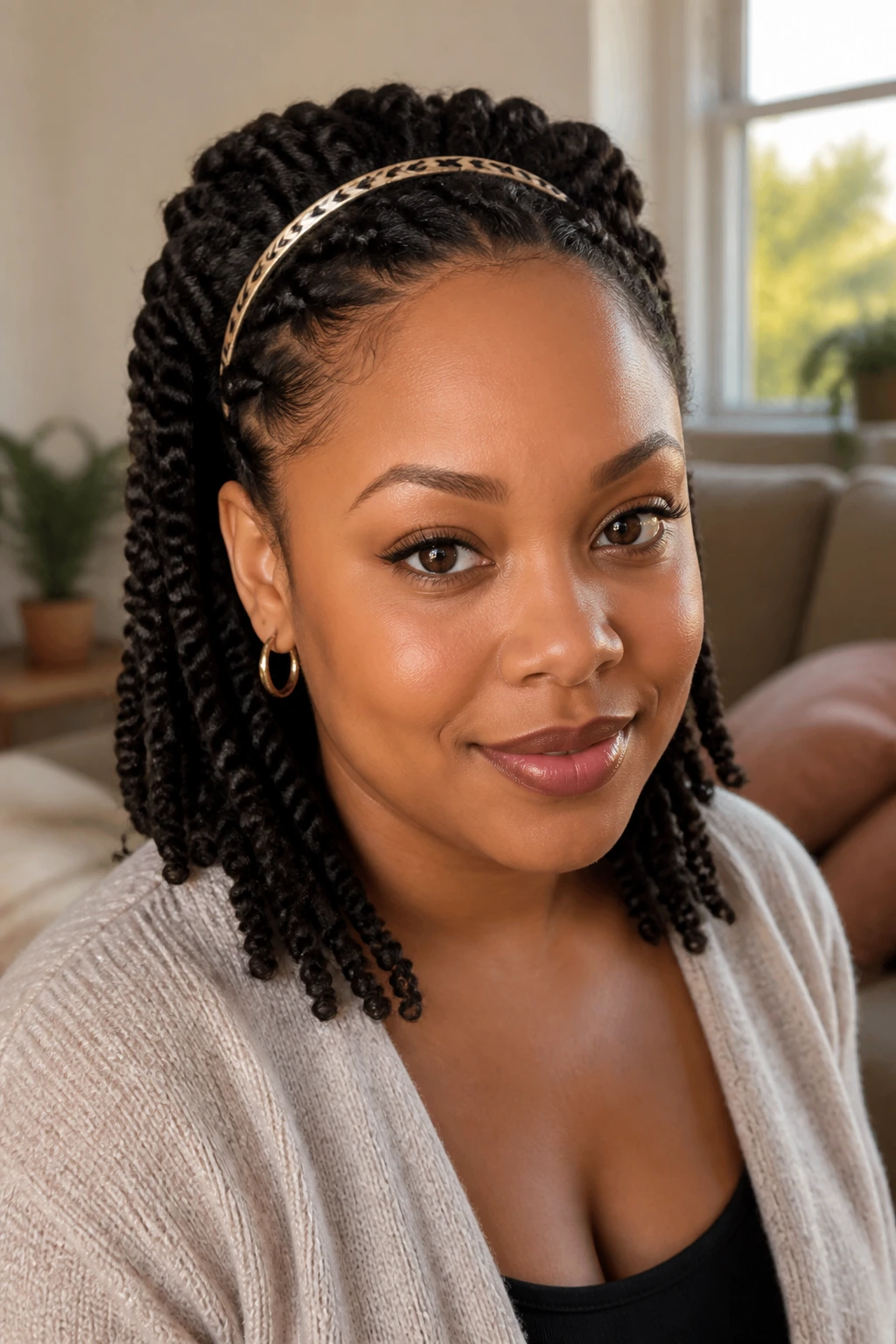
Sometimes the right answer is the style you can do before the kettle boils. Twist the front sections back, pin them high enough to clear the temples, and leave the rest of the hair curly or stretched. The result is tidy, face-opening, and low-drama.
What makes this shape work is the exposed center front. It gives the face room without stripping away texture on the sides. If the twists sit too low, they squeeze the face visually, so keep them up and back.
This is one of my favorites for glasses, too. It keeps the frames from fighting with the hair at the temples.
20. Long Loc Updo With Height at the Crown
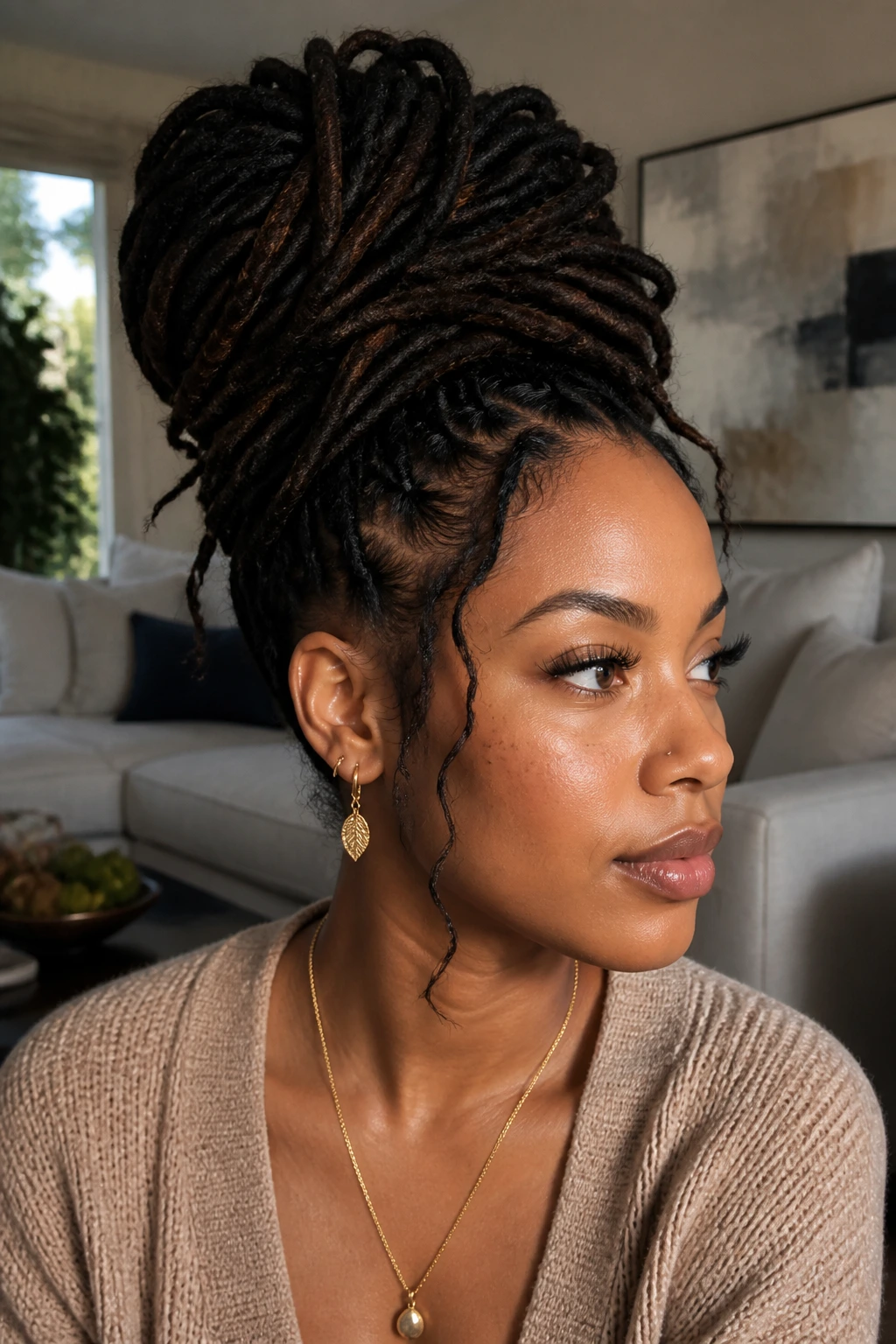
Locs have enough weight to flatten a silhouette if you let them hang everywhere, which is why crown height matters so much here. A high updo keeps the face open and gives the locs a place to gather that does not crowd the cheeks.
I like a little lift at the front and some softness near the temples. The style should feel sculpted, not pinned into submission. If the locs are heavy, use pins from several angles so the updo stays in place and does not sink backward by lunchtime.
This is a strong option when you want polish without losing texture.
21. Stretched Braid-Out With Lifted Roots
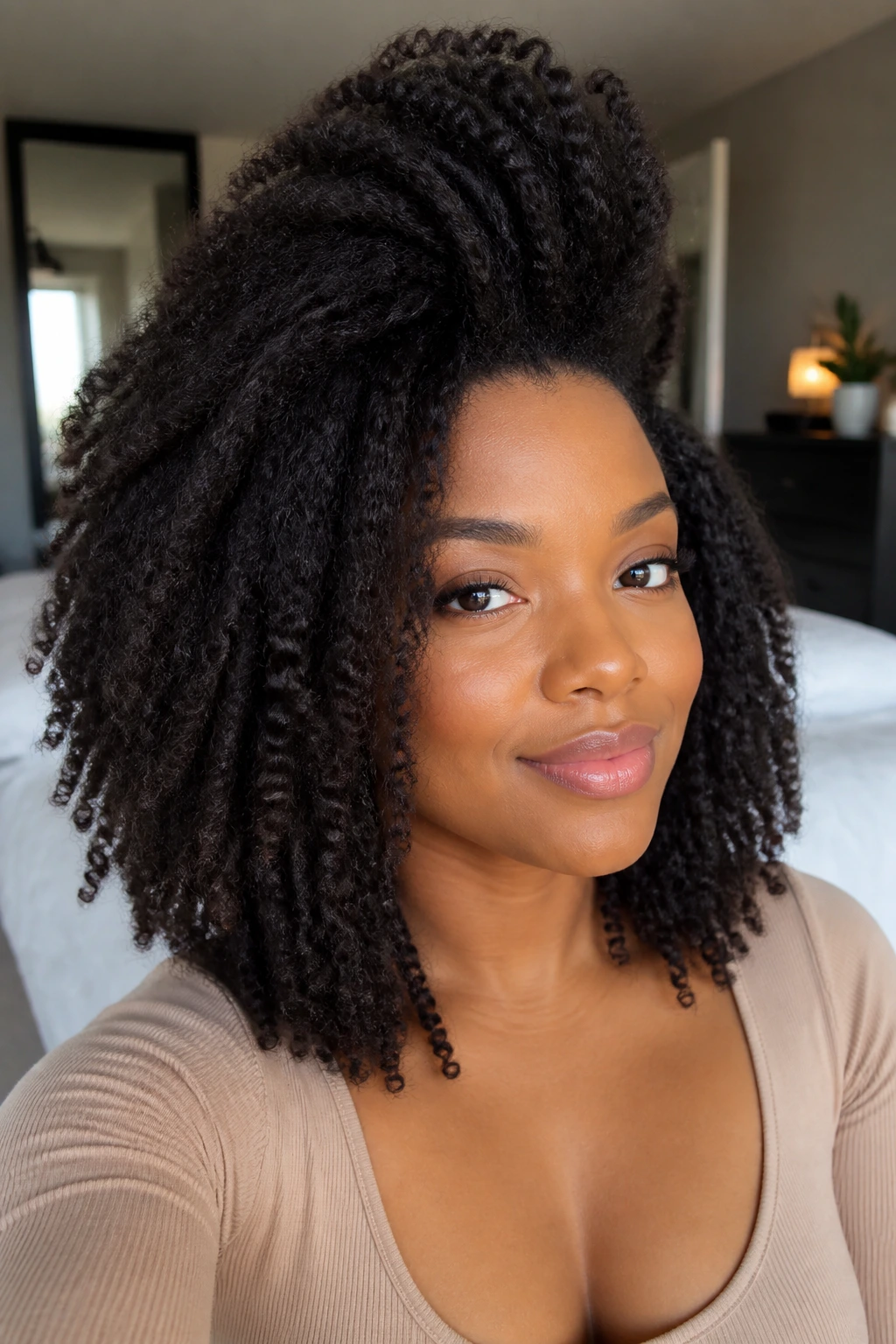
A braid-out does not have to be fluffy everywhere. If you stretch the hair well and lift the roots at the crown, the style can look long, broken up, and flattering on a round face.
The lifted root section is the important part. It keeps the top from collapsing while the lengths fall lower and create a vertical line. That shape is more useful than a wide, even cloud of curls sitting right at the cheeks.
- Stretch first: Band or braid the hair while damp so it dries longer.
- Lift the top: Clip the roots while they set, then release gently.
- Finish lightly: A touch of oil on the ends is enough; too much product at the root makes the braid-out sag.
22. Curly Lob With Invisible Layers
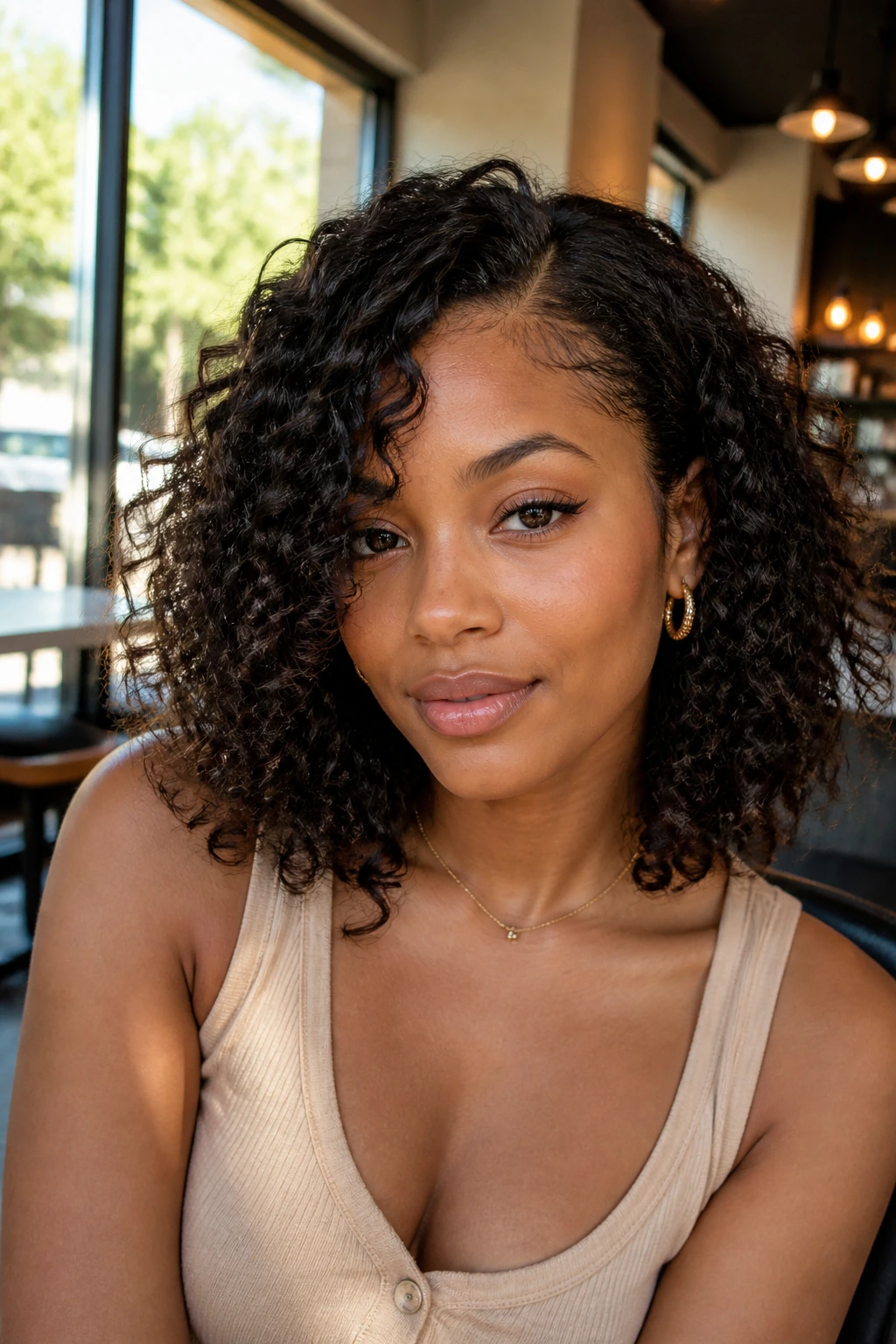
A curly lob can be one of the easiest lengths to wear on a round face, as long as the layers are doing some quiet work. Invisible layers take bulk out of the sides so the curls do not sit like a shelf, and the collarbone length keeps the shape from stopping at the jaw.
A deep side part helps here, too. It adds a little asymmetry without stealing the softness of the curls. If the hair looks too symmetrical, the face can feel wider. If the crown has a touch of lift and the ends move a bit, the whole cut feels longer and lighter.
This is the kind of haircut that works hard without looking like it’s trying to.
Essential Tools and Products You’ll Actually Use
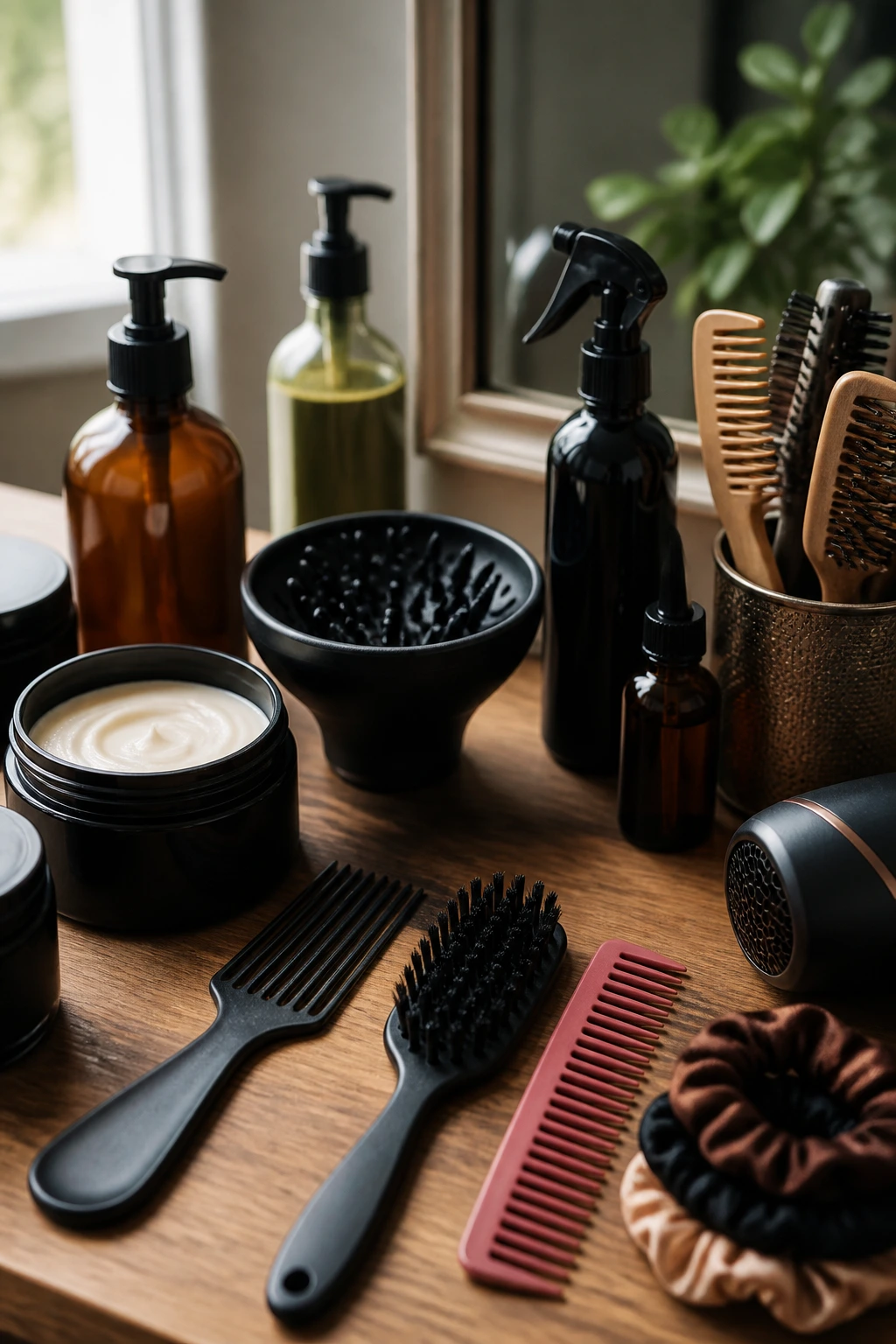
- Rat-tail comb: Best for clean side parts, sectioning twists, and making sure your braid lines are straight where they need to be.
- Spray bottle with water or diluted leave-in: Useful for refreshing curls and loosening sections before styling without soaking the whole head.
- Edge brush: Good for smoothing perimeters on puffs, buns, and braided styles without dragging product everywhere.
- Duckbill clips: These hold roots up while they dry, which is one of the easiest ways to add crown height.
- Mousse or setting foam: Strong for twist-outs, braid-outs, bantu knot-outs, and wash-and-gos that need definition without a sticky finish.
- Styling gel with real hold: Useful for slicking sides on puffs, buns, and flat twists. Light-hold gel tends to lose the fight by midday.
- Leave-in conditioner: Helps keep natural hair flexible before braiding, twisting, or stretching.
- Satin bonnet or scarf: Keeps edges and curls from getting crushed overnight.
- Wide-tooth comb or pick: Best for lifting roots and opening an afro without shredding the curl pattern.
- Small elastics and pins: Necessary for high puffs, ponytails, buns, and twist-back styles that need anchoring.
- Flexi rods or perm rods: Handy for front coils, curly ends, or boosting a braid-out that needs more shape.
- Optional diffuser: Useful if you want faster drying with less shrinkage on wash-and-gos or twist-outs.
Smart Product and Shopping Tips
The product aisle gets messy fast, and most people buy too much of the wrong thing. For these styles, hold matters more than shine. A twist-out or wash-and-go needs enough grip to keep the silhouette in place, which means a mousse that dries with a cast or a gel that does not flake when you touch it.
If you’re buying braiding hair or extensions, weight is the first thing to check. Heavy synthetic hair can drag a style down and pull the shape wide at the sides. That’s especially annoying on round faces because it works against the whole point. Lightweight braiding hair, soft loc extensions, and hair that matches your texture loosely — not perfectly — usually look better than stiff, shiny strands.
For natural styling products, read the texture first. Thick creams are useful for twists and puffs, but they can flatten a wash-and-go if you pile them on. Mousse is cleaner for braid-outs and bantu knot-outs. Gel belongs on the perimeter or the style surface, not buried everywhere in the roots.
One thing I’d never skip: a light leave-in that lets the hair stay flexible before you manipulate it. Dry, rough hair frizzes the second you start parting and twisting. Slightly damp, conditioned hair behaves better and gives cleaner parts, especially around the temples where the face shape matters most.
How to Wear These Styles With Glasses, Earrings, and Necklines
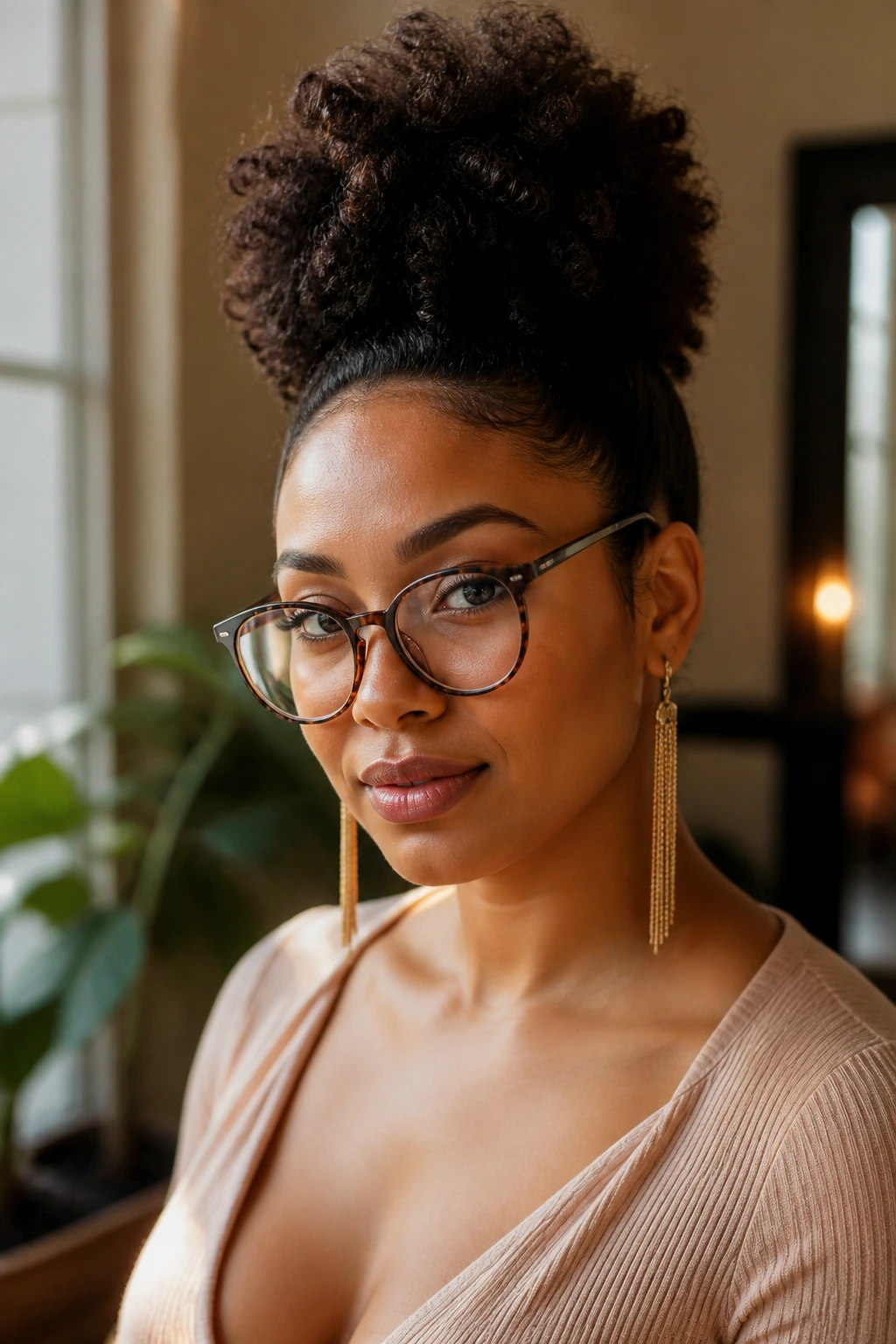
Presentation: Keep the highest point of the style above the cheek line whenever you can. That might mean a higher puff, a lifted crown, or a side part that throws the shape off balance in a good way. If the hair sits at the exact width of the face, you lose the whole trick.
Accompaniments: Long earrings, slim hoops, and open necklines work better than crowded collars with these styles. Glasses are fine, but if the frames are thick, keep the hair from building too much at the temples. A twist-back style or tucked side can keep the frame and the hair from competing.
Scale: On shorter hair, you do not need huge volume to get the effect. A tapered cut, a lifted fro, or a small puff with a part can do the job. On longer hair, keep the width from spreading too far at the cheeks and let the length fall lower so the face looks longer.
Occasion Match: High puffs, frohawks, and crown braids feel sharp enough for weekends or events. Flat twists, low puffs, and twist-back headband styles are the quiet workhorses for the office or a day when you want less fuss. Choose the shape first, then the vibe.
Practical Tips for More Lift, Less Bulk, and Better Shape
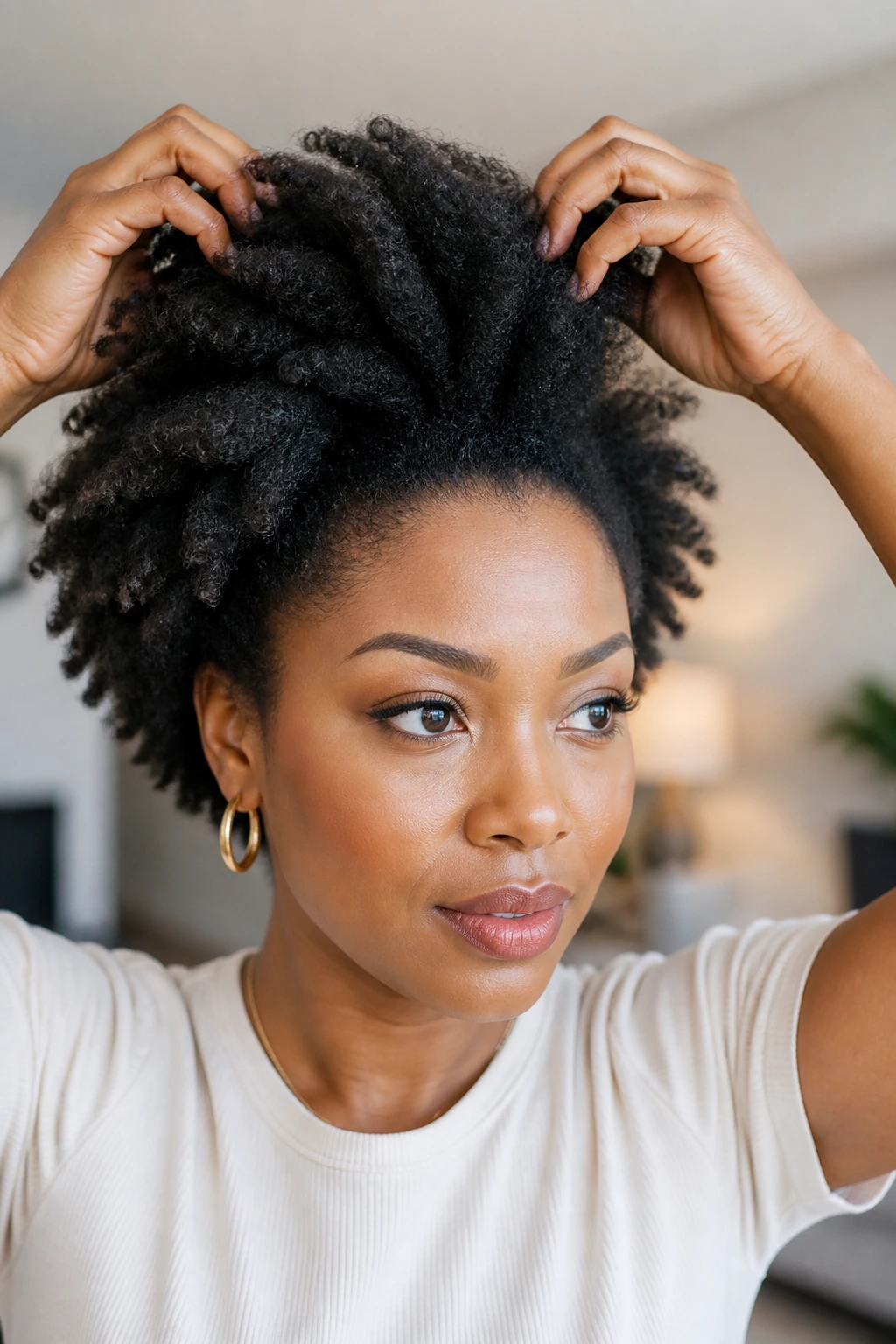
Root Lift: Clip the crown while your hair dries. If the roots dry flat, the style usually reads wider than it should, especially on wash-and-gos and braid-outs.
Parting Habit: Shift your part even half an inch off center. That tiny move changes the visual line enough to break the roundness without making the style look dramatic.
Stretch Before Styling: Banding, threading, or a low-heat stretch with a diffuser can keep twists, puffs, and braid-outs from puffing sideways. It’s a small prep step with a big payoff.
Finish With Intent: Put the bulk where you want it. High on the crown, lower at the ends, or off to one side. Random volume is what makes a style feel bulky. Planned volume looks sculpted.
Keep the temples clean: The temple area is where round faces can get crowded fast. A little exposed skin there — even just one tucked side — gives the face room to breathe.
Common Mistakes That Flatten a Round Face
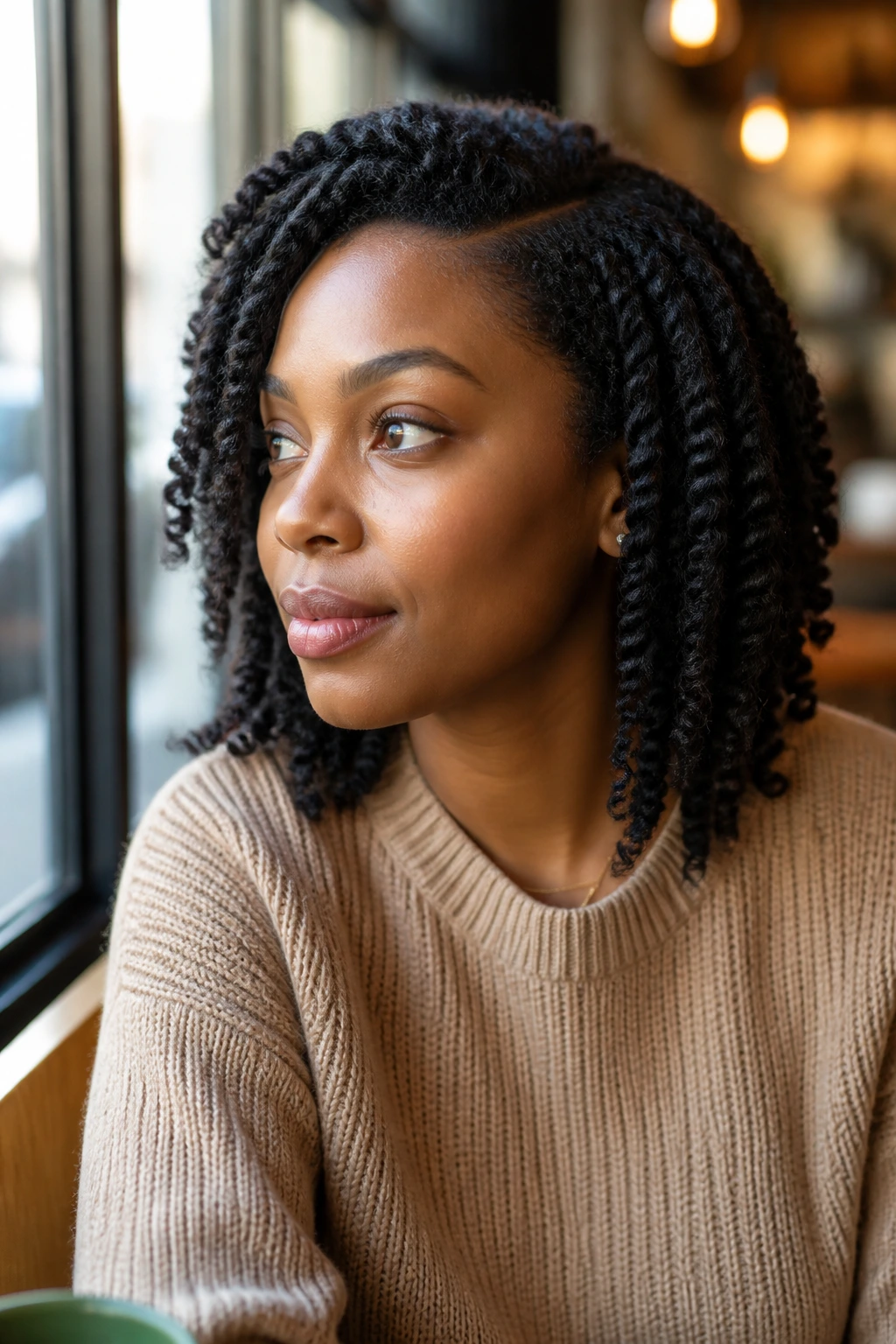
- Putting all the volume at cheek level: The style gets widest exactly where the face is widest, and the result looks broader than intended. Fix it by moving the lift upward or dropping the length below the jaw.
- Using a dead-center part on a flat crown: A middle part can work, but only with height. Without crown lift, it creates a straight line that makes the face read wider. Shift the part off center or clip the roots.
- Choosing braids or twists that are too thick at the sides: Thick sections near the temples can make the head look wider and heavier. Break them up, tighten the side placement, or move the bulk higher.
- Over-slicking the perimeter: Too much gel on the edges flattens the front and leaves the top heavy. The style loses shape and starts looking pasted down.
- Cutting curls into a blunt line at the jaw: A blunt hem at chin height can stop the eye right at the face’s widest point. Layers, length, or a softer angle usually work better.
- Ignoring shrinkage: Hair that seems long when wet may shrink to a puff that sits much wider once dry. Stretch first if the final shape needs to stay narrow.
Variations and Alternatives for Different Lengths and Textures
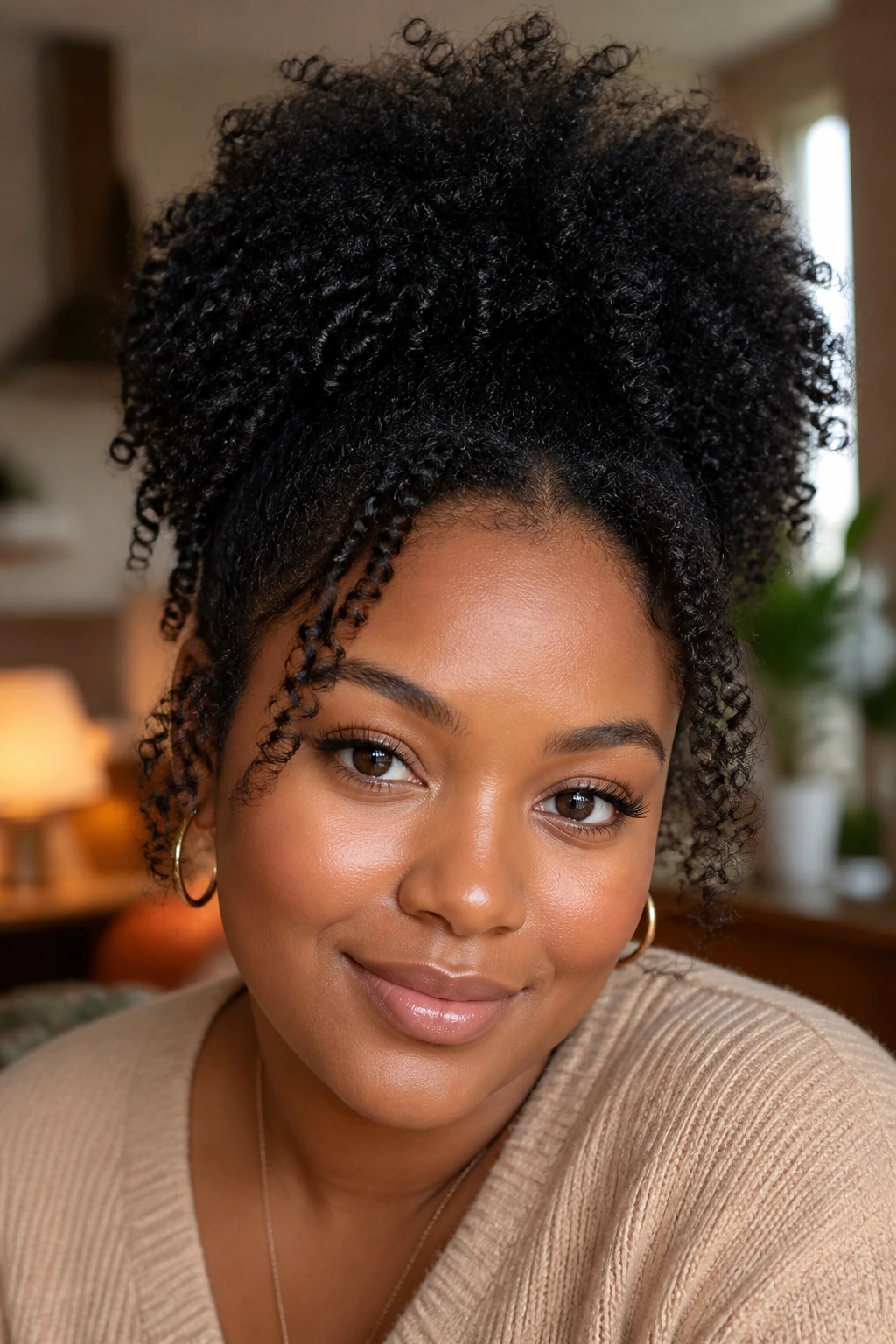
The Short-Coil Edit: If your hair is in TWA territory, choose styles that rely on root height rather than length — tapered cuts, mini puffs, finger coils, or a lifted frohawk. The face-shaping trick is still the same: height up top, less bulk at the cheeks.
The Stretch-It-First Version: For tighter coils that shrink hard, a braid-out, banded twist-out, or lightly stretched wash-and-go keeps the silhouette longer. This is the better choice when the hair tends to spread out once it dries.
The Protective-Style Week: Box braids, flat twists, loc updos, and braided crowns give the scalp a break while keeping the silhouette neat. Choose styles that lift the crown or pull the hair back from the cheeks so the face stays open.
The Glasses-Friendly Shape: Side parts, twist-back headbands, and higher puffs keep the temples clear. If your frames are bold, keep the hair from sitting heavy right beside them or the whole look starts to feel crowded.
The Soft Evening Version: Add curly tendrils, looser front pieces, or a side sweep to a bun, puff, or braid style. It softens the look without losing the vertical line that helps a round face.
How to Keep the Style Fresh Between Wash Days
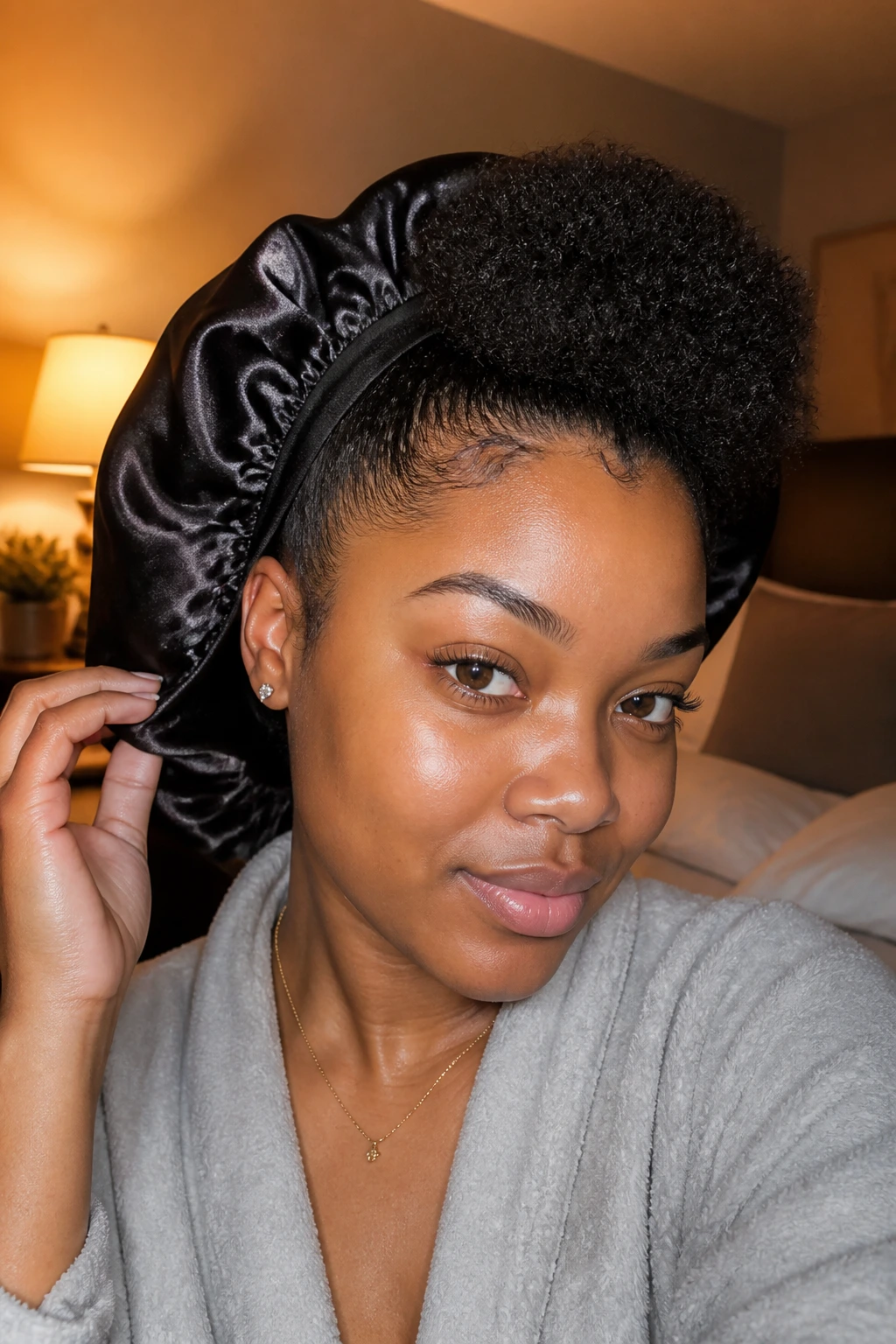
A style lasts longer when the shape is preserved overnight instead of rebuilt from scratch every morning. For puffs, buns, and twist-back styles, a satin scarf or bonnet keeps the front from puffing up unevenly. For braid-outs and twist-outs, a loose pineapple or a few large sections pinned up at night helps the curls keep their length and stop them from flattening across the cheeks.
Refresh curls with a light spray of water or diluted leave-in, then let a little mousse dry into the shape if the ends have gone limp. Do not soak the hair again unless you’re ready to restyle. Too much water can push the curls back into a wide, frizzy cloud.
Protective styles need a different rhythm. Braids and twists often look best for a couple of weeks when the parts are still clean and the roots have not turned fuzzy. If your scalp feels tight, the style is tugging, or the front pieces have started slipping forward and crowding the face, take that as your cue. Tension does not get better if you ignore it.
Wash-and-gos usually need the quickest refresh cycle. A little root lifting, a small amount of mousse, and a diffuser can stretch the style out another day or two. Once the crown collapses and the sides widen, it’s time for a full reset.
Questions About Round Faces and Natural Hair Styles
Can a round face wear a center part?
Yes, but the rest of the style has to carry some height or length. A center part on flat, chin-length curls can make the face look broader, while a center part on a lifted afro, layered shag, or long braid style can work fine.
Do bangs work on round faces with natural hair?
They can, if they’re broken up and not cut into one blunt wall. Soft curly fringe, side-swept pieces, or a wispy coil fringe usually flatter a round face better than a heavy straight-across bang.
What if my hair is short?
Short hair is not a disadvantage here. A tapered cut, high puff, mini coils, or a frohawk can create the same vertical effect that long hair would, sometimes with less effort.
Are protective styles good for round faces?
Yes, as long as they are placed with shape in mind. Braids, twists, loc updos, and crown styles work best when they lift the crown or keep the bulk from sitting at the cheeks.
How much volume is too much?
Volume becomes a problem when it sits widest at the middle of the face and stays flat at the top. You want the first high point to live above the cheekbones, even if the ends are full.
Do these styles work on 4c hair?
Absolutely. In fact, 4c hair gives you some of the strongest shape options because shrinkage, twist definition, and puff height can all be used on purpose. The main thing is stretching where you want length and avoiding too much width at the temples.
Can I still wear a low bun?
You can, but make it work for you. Add a side part, leave a few front coils out, or keep the bun compact and slightly asymmetrical so it doesn’t sit like a circle at the base of the head.
What’s the fastest style if I’m in a rush?
A high puff with a side part or a twist-back headband style usually gives the best return for the least time. Both open the face fast and keep the silhouette from spreading wide.
The Styles That Hold Their Shape
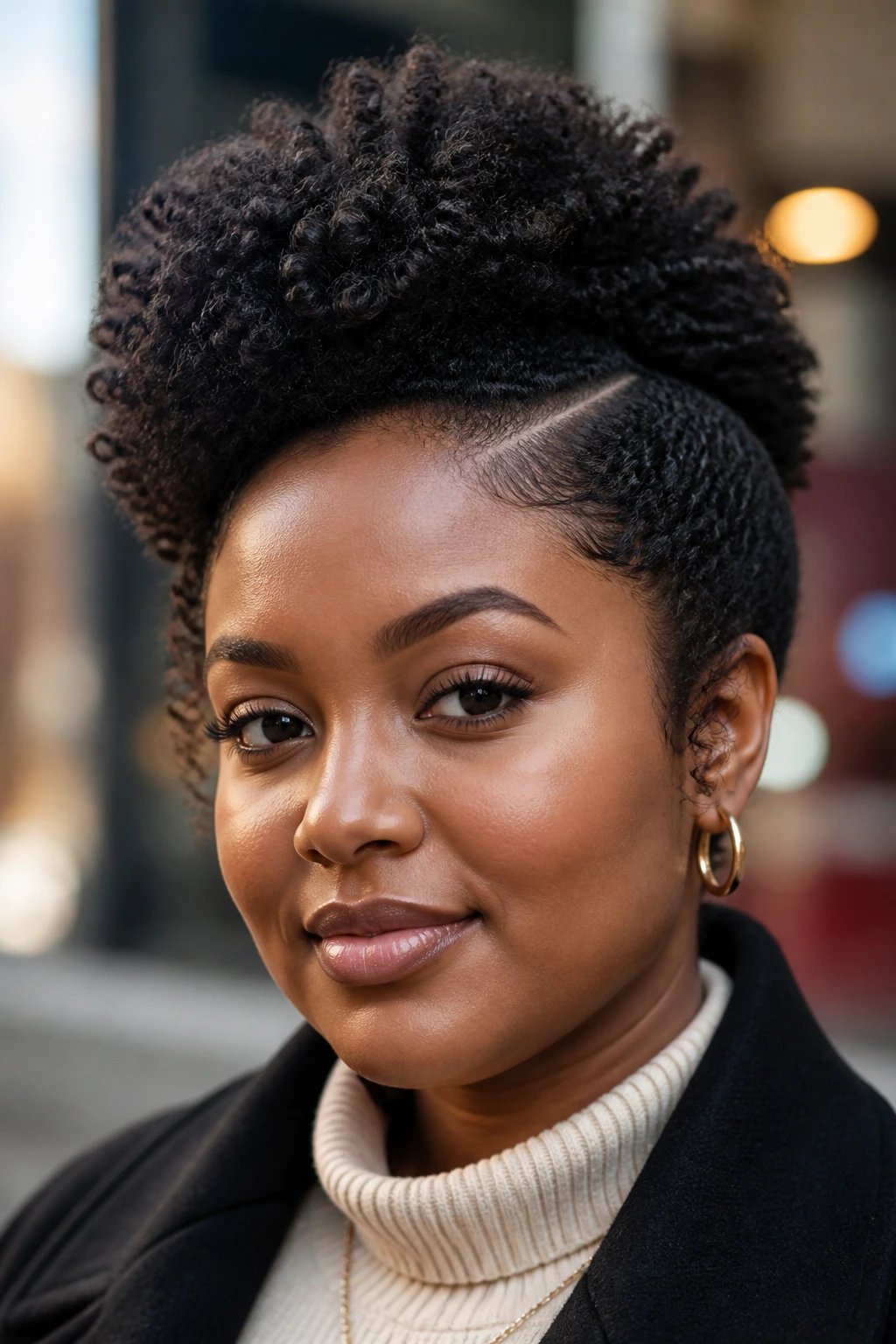
The best looks for a round face are not the ones that try hardest. They’re the ones that understand where the eye is going to land and change that path a little. Height at the crown, a clean side part, a tapered side, or a few soft coils at the temples can do more than a whole cabinet of styling products.
Natural hair gives you room to be strategic. That’s the part I love. You can wear shrinkage one day, stretch it the next, and use braids, puffs, twists, or layers to change the outline without abandoning your texture.
Pick the styles that add lift where you want it and leave the cheeks alone. The rest is just deciding whether you want to look polished, soft, bold, or somewhere in between — and on a good hair day, you get to choose that part on purpose.