



Thick Black hair has a way of telling the truth. If the part is crooked, you see it. If the moisturizer is too heavy, you feel it. If the style depends on limp strands doing all the work, the whole thing starts to slip before lunch.
That’s why hairstyles for Black women with thick hair need a different kind of thinking. Not more fuss. Better shape. The styles that work best tend to respect density, make room for shrinkage, and give the scalp a little breathing room instead of trying to flatten everything into obedience. My bias is obvious: I’d rather see a puff that looks alive, a braid set with clean lines, or a twist-out with real body than a style that spends all day fighting the hair it’s sitting on.
There’s also a practical side people miss. Thick hair can hold a shape like nobody’s business, but it can also take forever to dry, swell at the roots, and punish rough detangling. So the smartest looks are the ones that plan for that reality. They start with sectioning, good tension, and a finish that can survive humidity, motion, and a long day without turning into a frizzy negotiation.
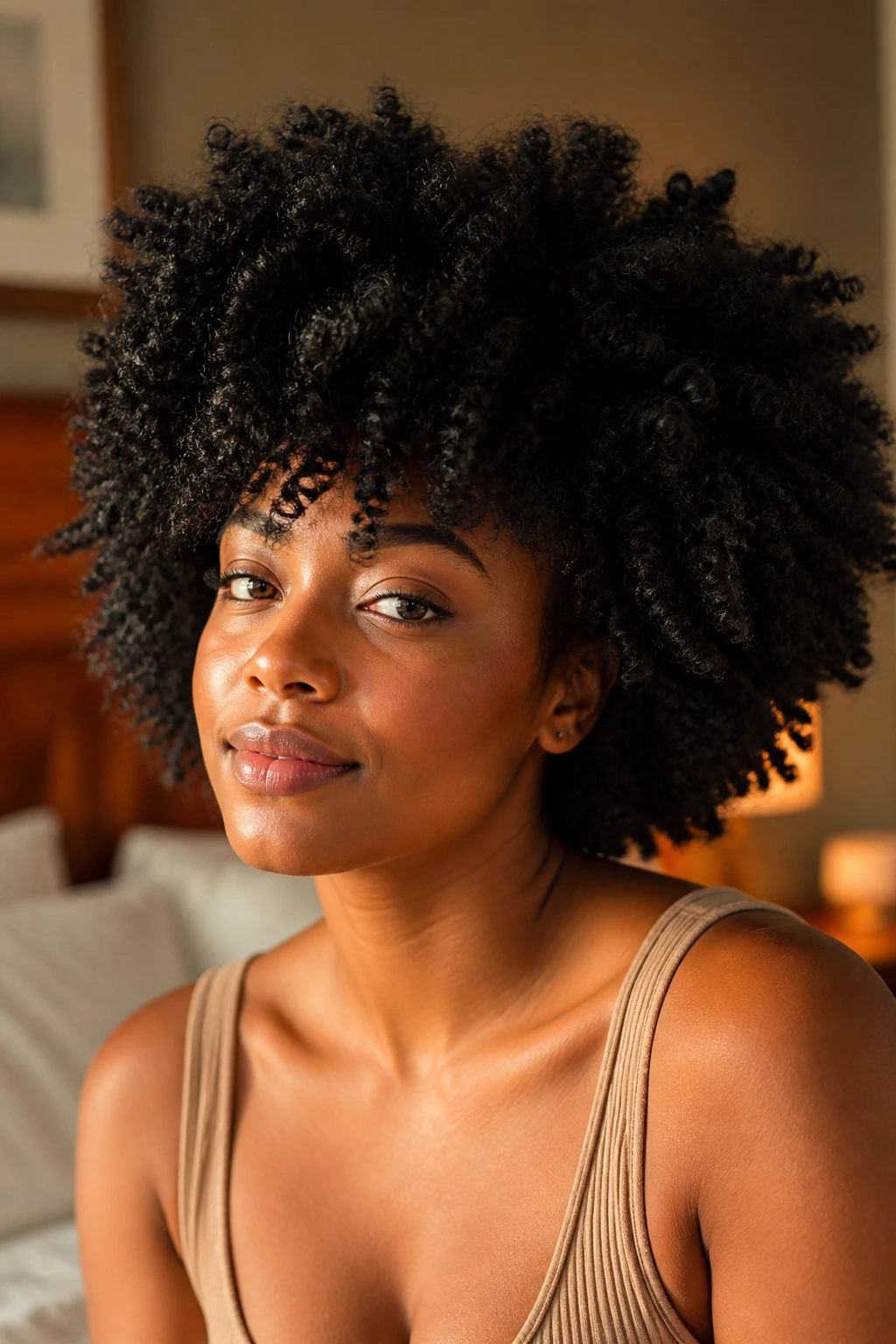
Why These Styles Work on Dense Coils
-
They use volume as structure: A dense head of hair can support high puffs, buns, and braids that would collapse on finer textures, which is why these styles hold their silhouette longer.
-
They leave room for shrinkage: Several of these looks start on stretched hair or use set styles, because thick coils can lose a lot of visible length the minute moisture hits them.
-
They protect the edges: The best options here spread tension out instead of yanking one fragile spot, which matters if your hairline gets sore fast.
-
They buy you time: A good protective style, twist set, or braid set can save you from daily detangling and product layering, which is where thick hair starts to feel like a part-time job.
-
They look intentional fast: Clean parts, a strong shape, and one good finishing product can make a style look finished even when you spent less time than you expected.
1. High Puff with Defined Edges
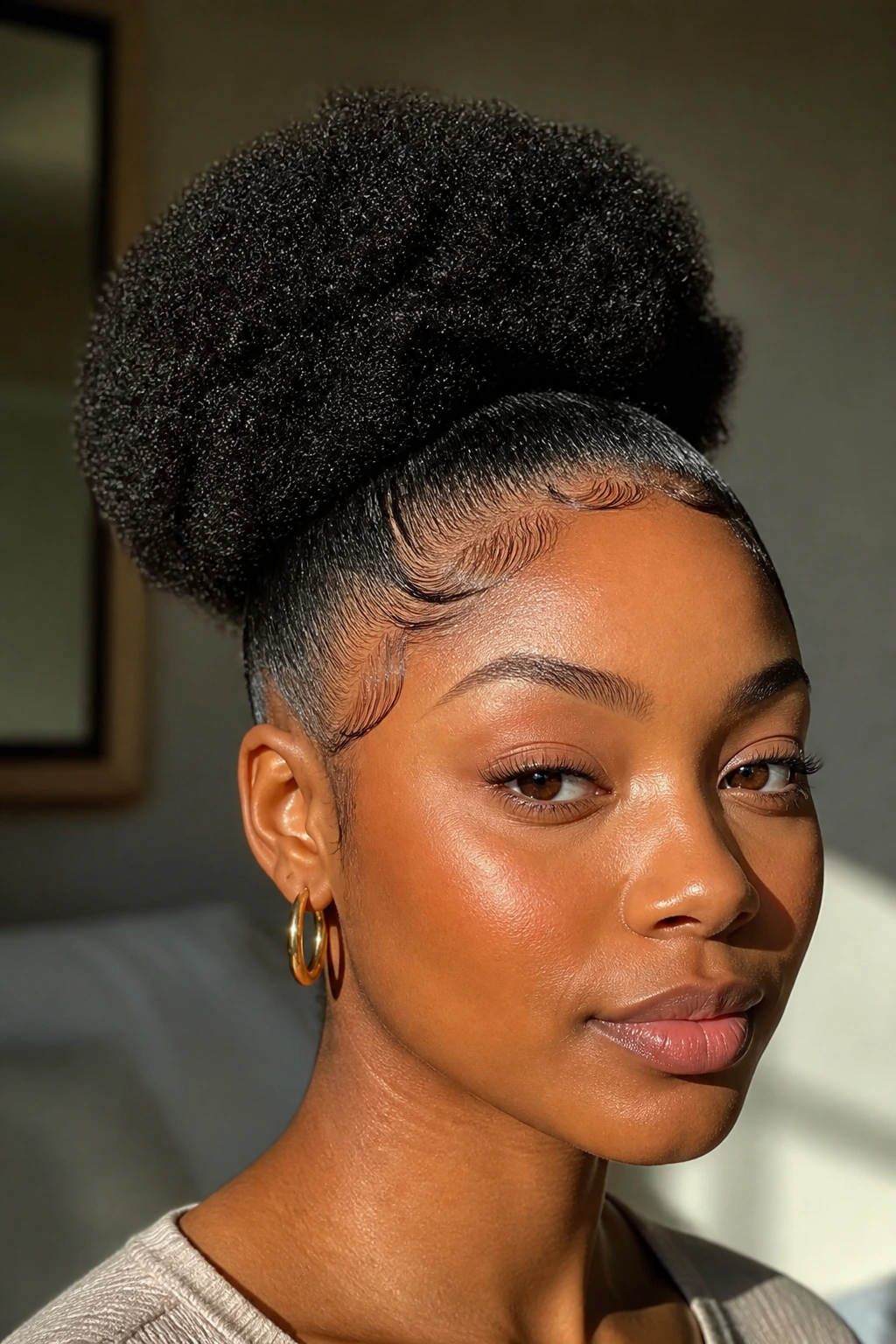
A high puff is one of those styles that makes thick hair look exactly like itself, which is the point. Pull the hair up, smooth the base, and let the fullness sit high enough to show off the density instead of hiding it. On thick hair, the puff has presence. It does not need decoration to work.
The trick is the foundation. Stretch the hair first if you can, then gather it with a soft band or a snag-free puff cuff so you don’t create a dent at the back. I like a small amount of gel or edge control at the hairline, but not a helmet. Too much product around thick edges turns chalky by noon.
Best for: day-two curls, stretched coils, and mornings when you want shape without a full set.
What to watch: If the base feels tight enough to give you a headache, it’s too tight. The style should sit high, not pinch.
A puff also works well when you want your face to stay open. Add hoops, gloss, and a clean brow, and it reads polished without trying too hard. That combination does a lot of work.
2. Stretch-and-Go Wash-and-Go
A wash-and-go on thick hair works best when you stop pretending the hair has to be dripping wet to count. I prefer it on hair that has been lightly stretched first—banded, blown out on cool air, or plaited overnight—because that gives the curls room to settle instead of shrinking into a dense halo before they dry.
Use a leave-in that doesn’t feel sticky, then layer a gel with enough hold to keep the curl clumps from merging into one fuzzy sheet. Sectioning matters here. Small sections. Not giant ones. Thick hair hides uneven application until the back dries and you notice one side is smooth while the other looks like it got skipped.
The part most people miss
Drying is the whole game. If you air-dry thick hair from the inside out with no help, the roots can stay damp for hours while the surface looks done. A diffuser on low heat or a hooded dryer cuts that down and keeps the curl pattern clearer.
This style suits people who want curls to look soft, not rigid. It’s not the fastest option, but the finish can be gorgeous when the product load stays light and the roots are dry.
3. Two-Strand Twist-Out
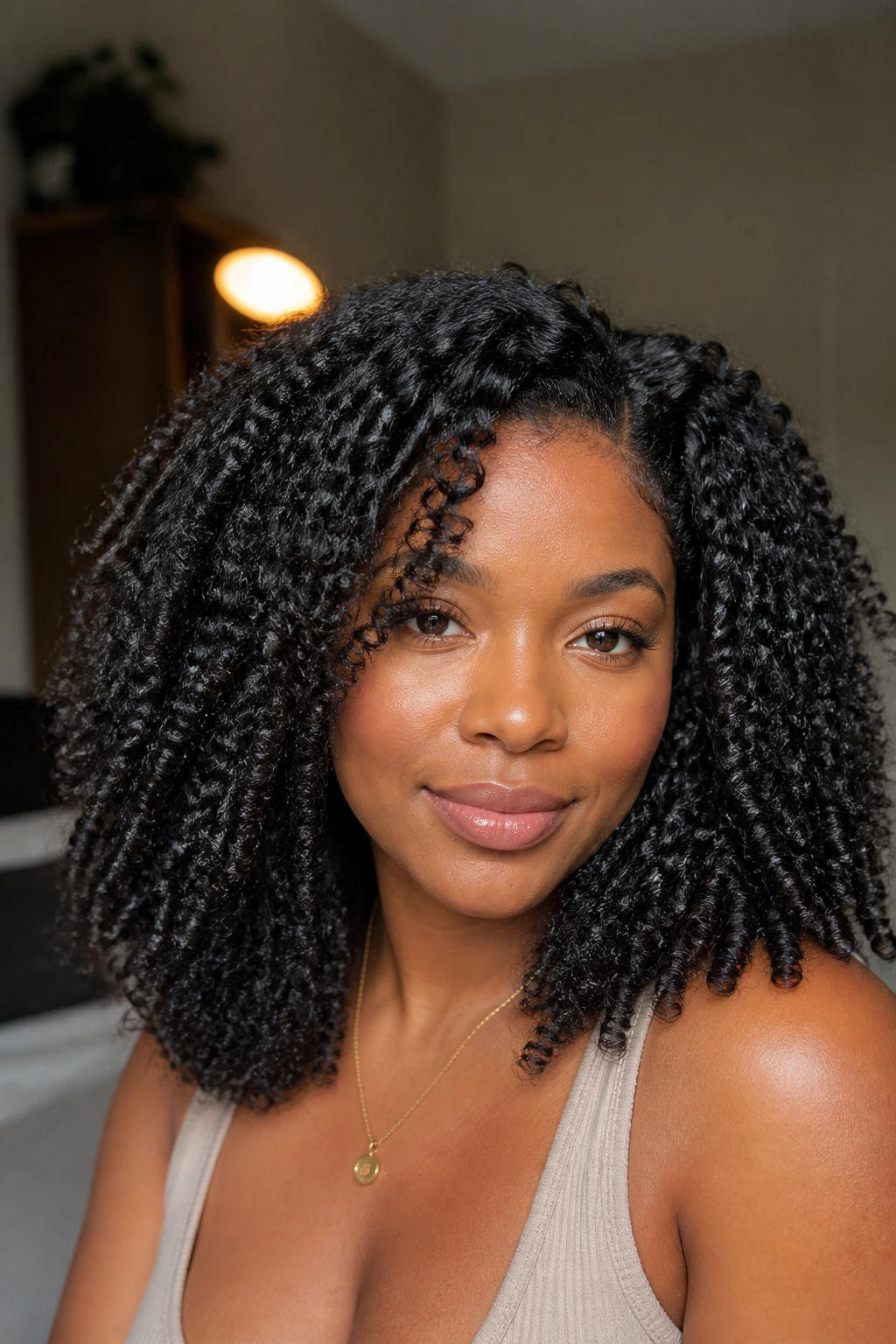
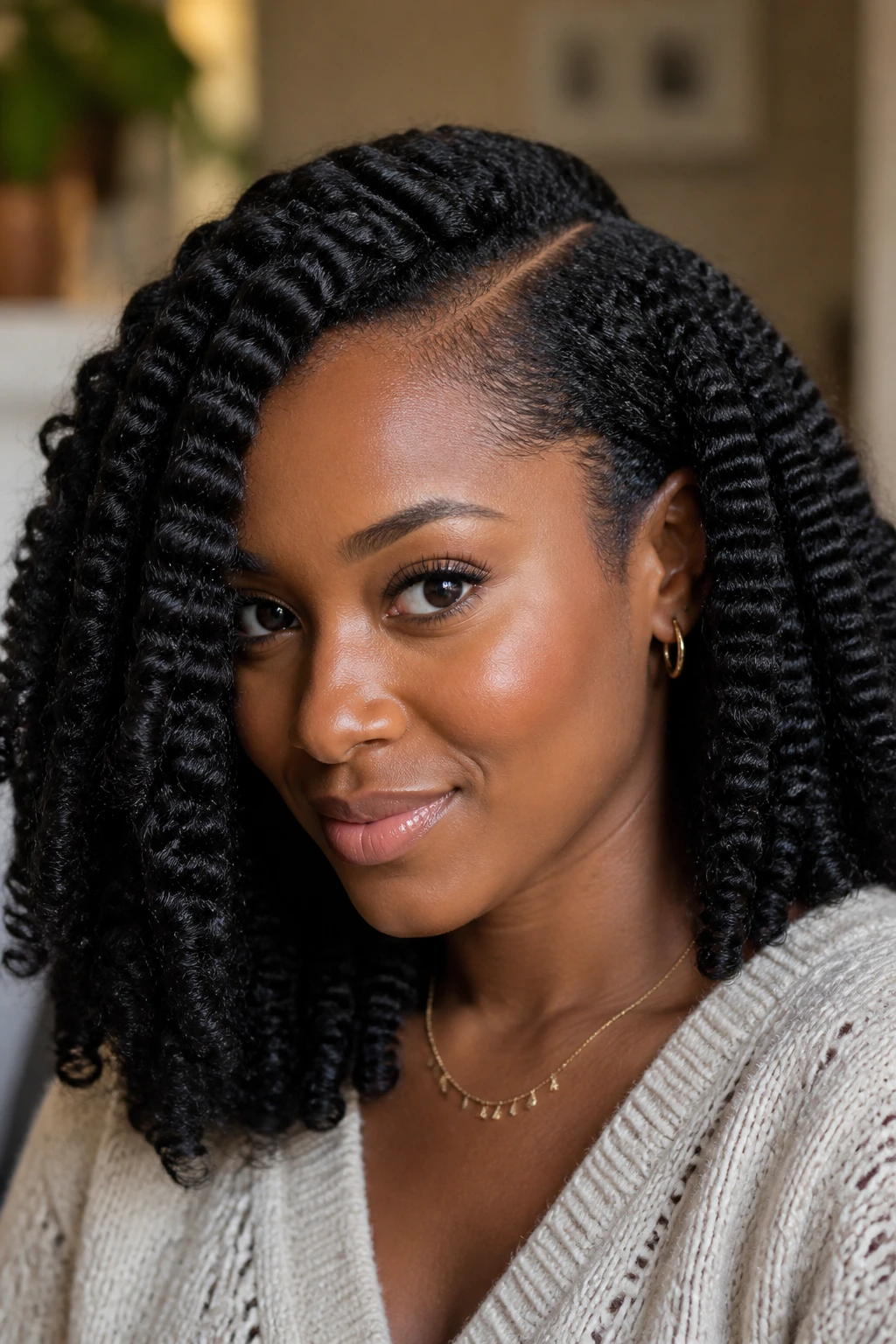
A good twist-out on thick Black hair has a very specific feel: plush at the roots, stretched through the mid-lengths, and softly outlined at the ends. It’s one of my favorite styles for density because it uses the hair’s bulk to build definition. The twists do the organizing for you while you sleep.
Start on damp hair, not soaking wet hair. Work in sections, then apply leave-in and a cream that gives slip without turning greasy. The twists should be snug, but not tiny unless you enjoy spending your evening with your arms overhead. Thick hair usually behaves better with medium-sized twists, because they dry more evenly and separate with less frizz.
When the hair is fully dry, coat your fingertips with a drop of oil and separate the twists gently. Separate too soon and you’ll get puffy ends before the shape has set. Too much pulling, same problem.
A twist-out is the style I choose when I want body that moves. It looks good with a side part, a middle part, or pushed back with a clip. The main thing is dryness. If the twists are still cool inside, leave them alone.
4. Braid-Out with a Side Part
A braid-out gives thick hair a longer, ribbed shape than a twist-out, which is why I like it when someone wants softness but doesn’t want the style to mushroom immediately. The braid pattern creates a little more tension in the curl, so the result usually looks a touch more elongated and a little less puffy at the ends.
The side part matters. On dense hair, a clean part can change the whole look from “I braided my hair” to “I meant this.” I’d braid on stretched or freshly detangled hair, then let the style dry overnight or under a dryer if the sections were medium to large. Small braids hold more detail; bigger braids create looser waves.
Don’t unravel too early. That’s where a lot of braid-outs go sideways. The outside can feel dry while the center still holds a little humidity, and once you separate it, the shape breaks apart fast. Wait until every braid feels cool and light.
This style sits somewhere between casual and polished. It works with gold cuffs, a barrette on one side, or nothing at all. The braid pattern gives the hair enough architecture that it does not need much else.
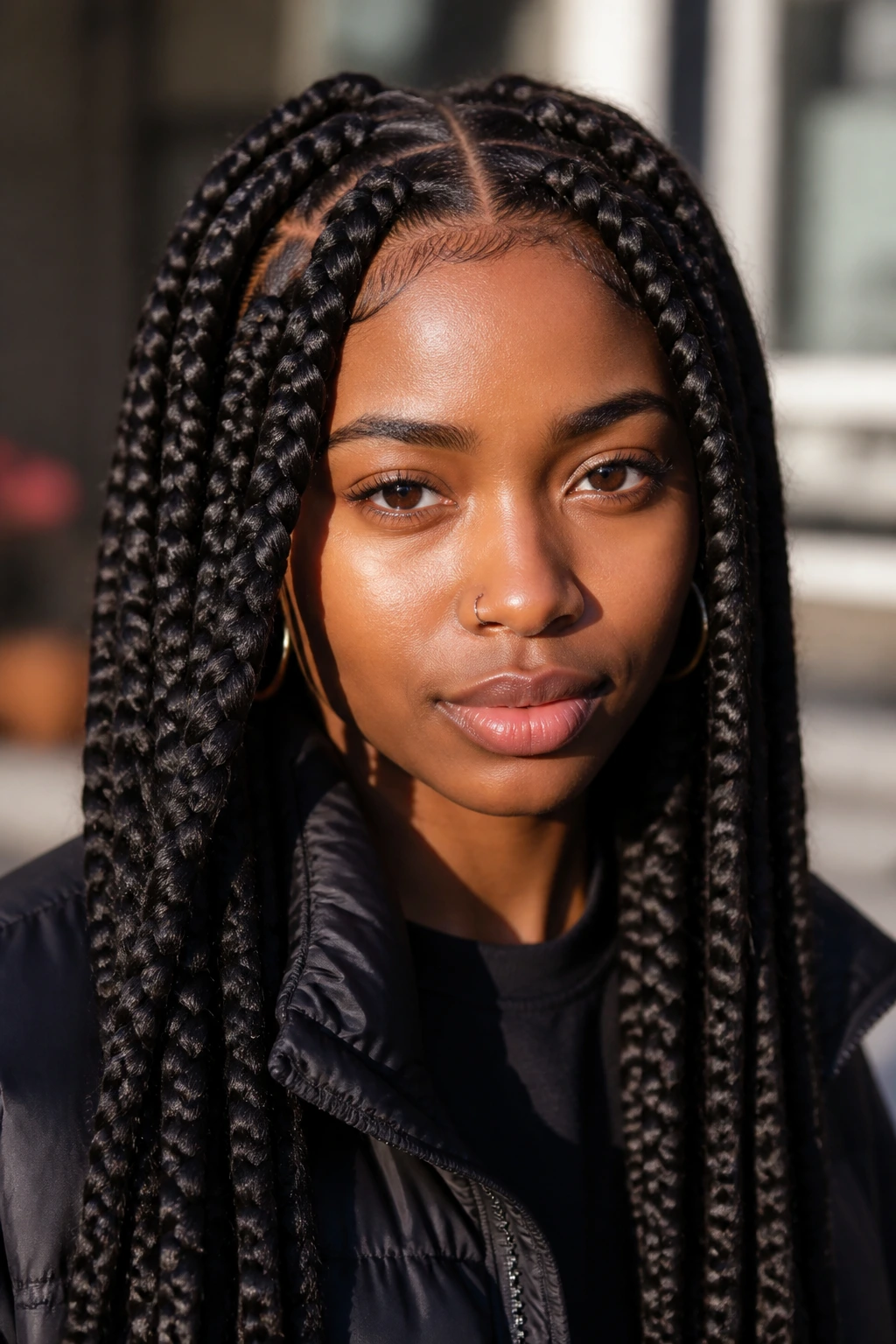
5. Jumbo Box Braids
Jumbo box braids make thick hair look powerful in the best way. The style is quick compared with smaller braids, the parts are easier to keep clean, and the result has enough weight to lie neatly without flattening the whole head. That weight is a feature, as long as the braids aren’t too heavy at the front.
Use pre-stretched braiding hair if you’re adding extensions. It saves time and cuts down on that blunt, plastic-looking end that can make braids feel stiff. Keep the parts neat, but don’t obsess over tiny sections if your hair is already dense. Clean, even parts matter more than microscopic perfection.
Jumbo braids are a strong pick when you want a protective style that still looks finished with a simple lip gloss and earrings. They last well when the scalp is kept clean and the edges are not over-smoothed every day.
A small warning: if the braids pull when you move your head, they’re too heavy. Thick hair can carry a lot, but your neck should not have to work overtime.
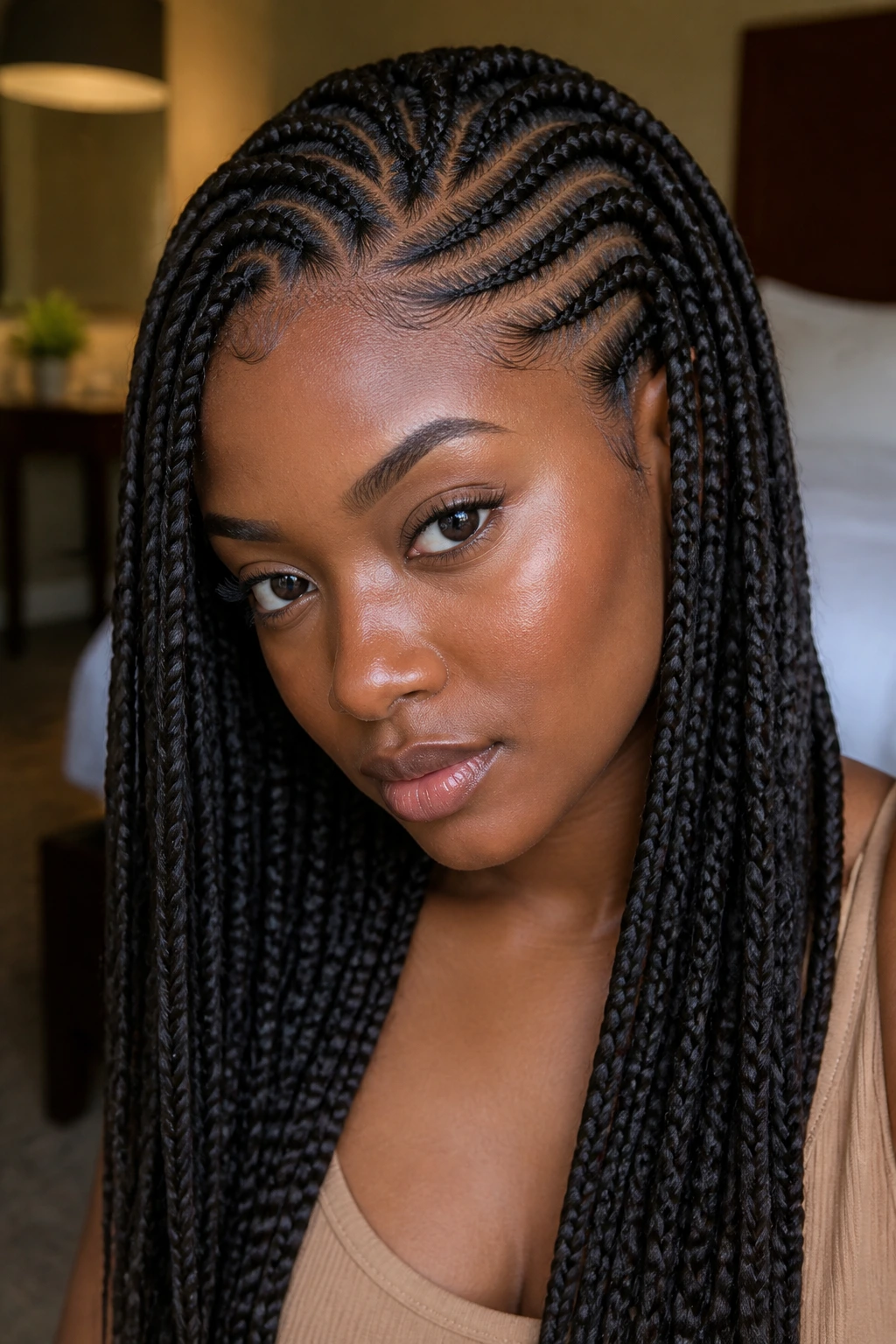
6. Knotless Braids with Curved Parts
Knotless braids are kinder to the scalp than traditional box braids, and thick hair benefits from that softness. The braid starts with your own hair and gradually feeds in the extension hair, which removes that chunky knot at the base and gives the whole style a smoother fall. On dense hair, that means less stress around the hairline and a cleaner drape.
Curved parts make the style feel more modern without becoming fussy. I like them when the goal is to keep the scalp looking intentional but not stiff. Straight parts can look sharp, sure. Curved ones move better with braids that are worn loose or tucked into a bun.
The downside is time. Knotless braids take longer than the old-school version, especially if you like medium-to-small sections. But the payoff is real: less tugging, a lighter feel, and a style that usually sits more comfortably for long wear.
If your hair is very thick at the roots, make sure the feed-in process stays smooth. A bad feed-in creates bumps that show up every time you turn your head.
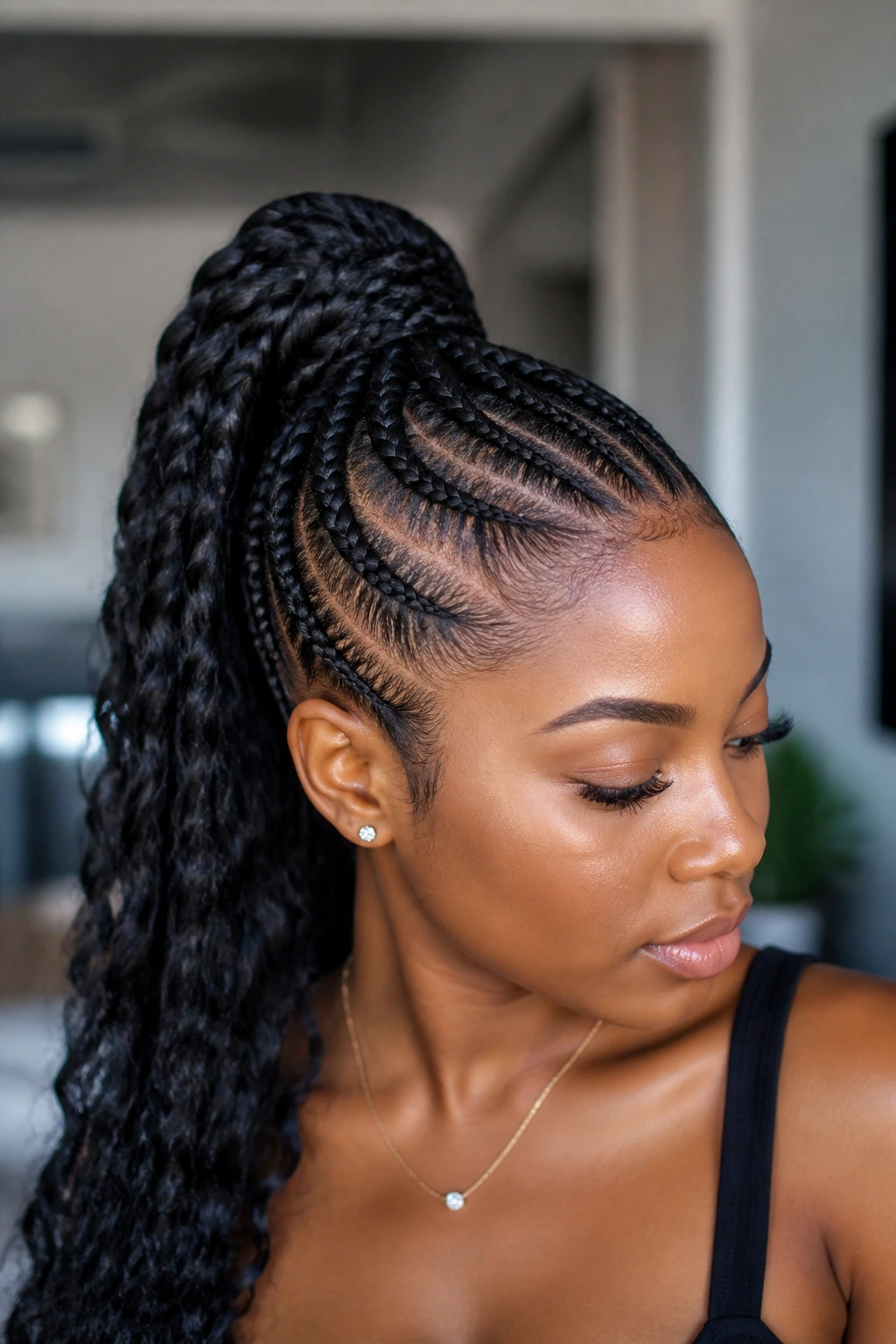
7. Feed-In Cornrow Ponytail
A feed-in cornrow ponytail is what I reach for when thick hair needs to be sleek without looking stuck down. The braids start small at the scalp and gradually gain hair, which keeps the base neat and lets the ponytail have real volume once it’s gathered at the crown or nape.
This style loves a freshly stretched base. If the hair is too fluffy at the roots, the cornrows can look bulky before you even gather the ponytail. Blow-dry on low heat if that’s your method, or do a solid banding stretch the day before. Clean scalp, clean part, clean finish. That’s the whole trick.
The ponytail itself can be braided, curly, or left in a thick puff of extensions. I prefer a braided ponytail when the goal is structure. If you want movement, curl the ends with hot water or rods, depending on the hair used.
It’s a sharp style. Not soft, not sleepy. Sharp. Wear it with hoops, a blazer, or a plain tee and let the hair do the talking.
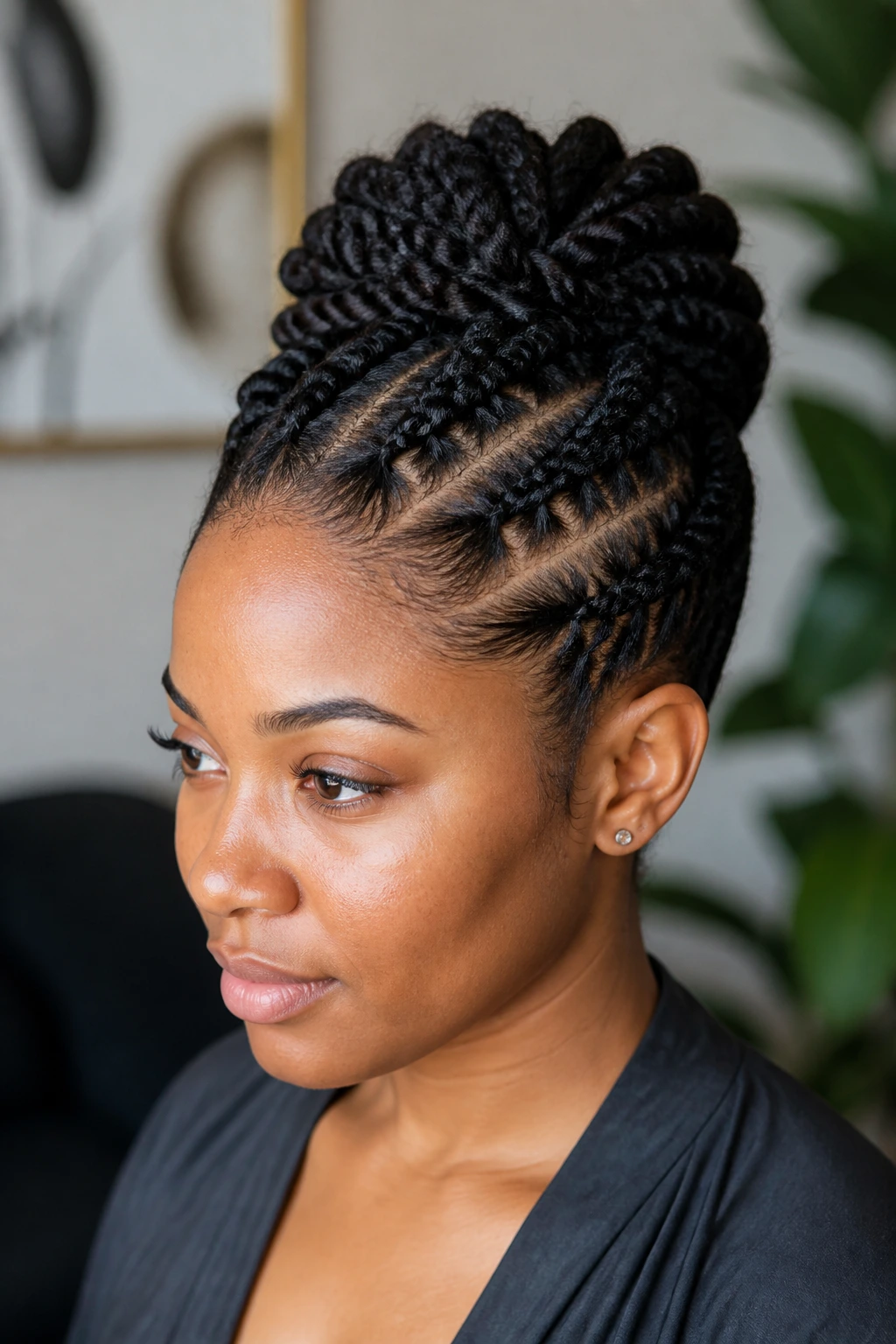
8. Flat Twist Updo
Flat twists are one of those styles that make thick hair behave without forcing it into a straight line. A flat twist updo keeps the scalp neat while building texture upward or toward the back, and that lift is where the style starts to look expensive, even if you only used a jar of cream and a handful of pins.
I like this better than a slicked bun when the hair is dense and a little dry, because flat twists need less product to stay put. You can route them into a tucked chignon, a rolled shape, or a pinned crown. The hair stays close to the head, but it doesn’t lose its texture.
Why it works
The twist pattern anchors thick hair in sections, so the style holds shape without needing heavy gels. That matters if your scalp gets irritated by strong hold products or if your hair puffs up the minute you blink.
A flat twist updo is the sort of style that can go from church to dinner to next-day errands with only a quick scarf wrap at night. Practical. Clean. A little regal, honestly.
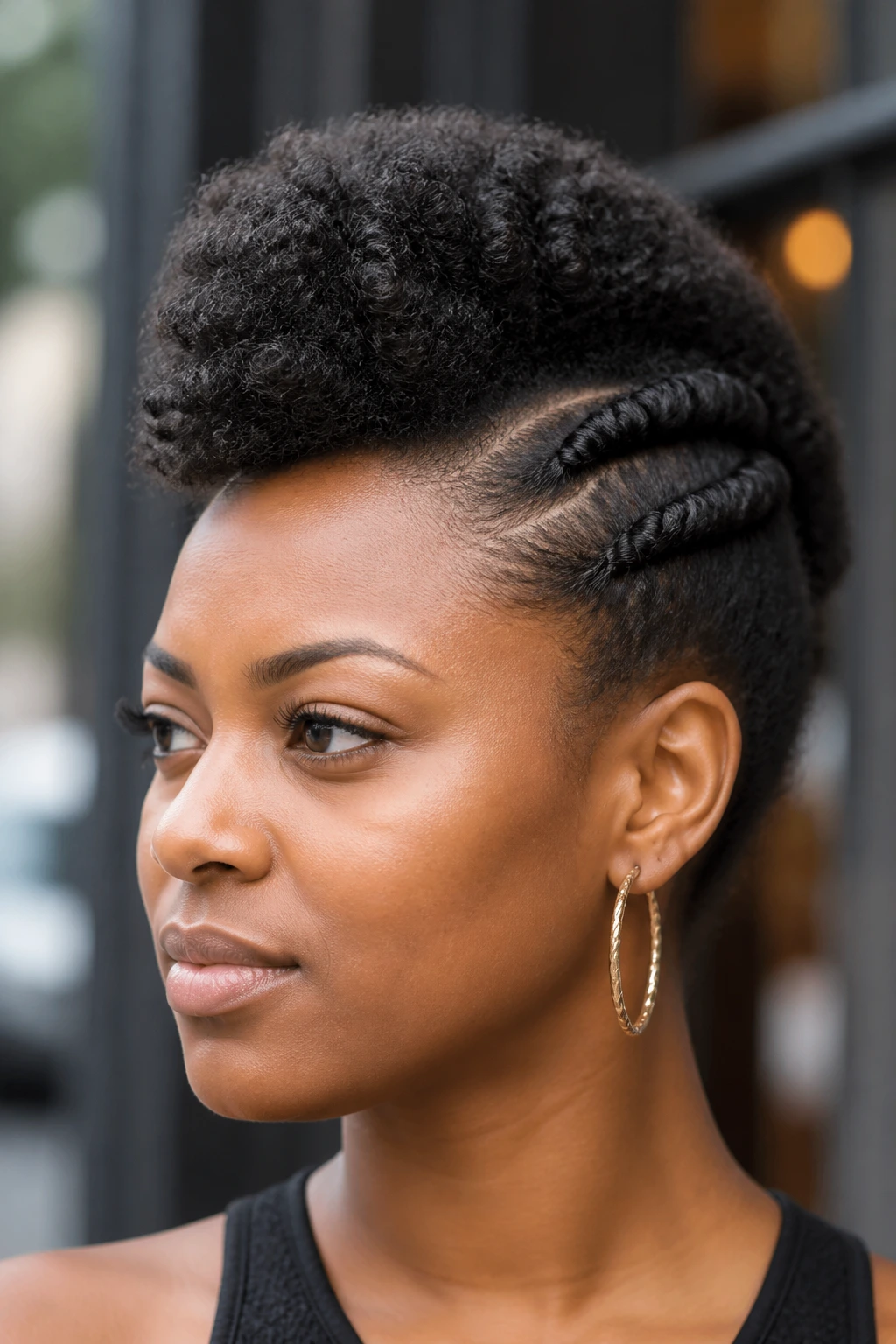
9. Faux Hawk with Two Flat Twists
A faux hawk on thick hair has attitude, and two flat twists on the sides make it look deliberate instead of accidental. The middle section stays full and lifted, while the sides stay close enough to the scalp to keep the shape sharp. It’s an easy way to turn density into height.
This style works well when you want something playful but not chaotic. The center can be a puff, a stretched roll, or a cluster of curls pinned into place. The sides should stay smooth, so use a gel that gives hold without leaving flakes. Nothing ruins a faux hawk faster than little white lines at the temples.
It’s also a good choice for short-to-medium lengths because the contrast between the tight sides and the fuller middle gives the illusion of length. You don’t need waist-length hair to make the shape read.
I’d wear this with a bold earring and a clean neckline. The style already has movement. Let it.
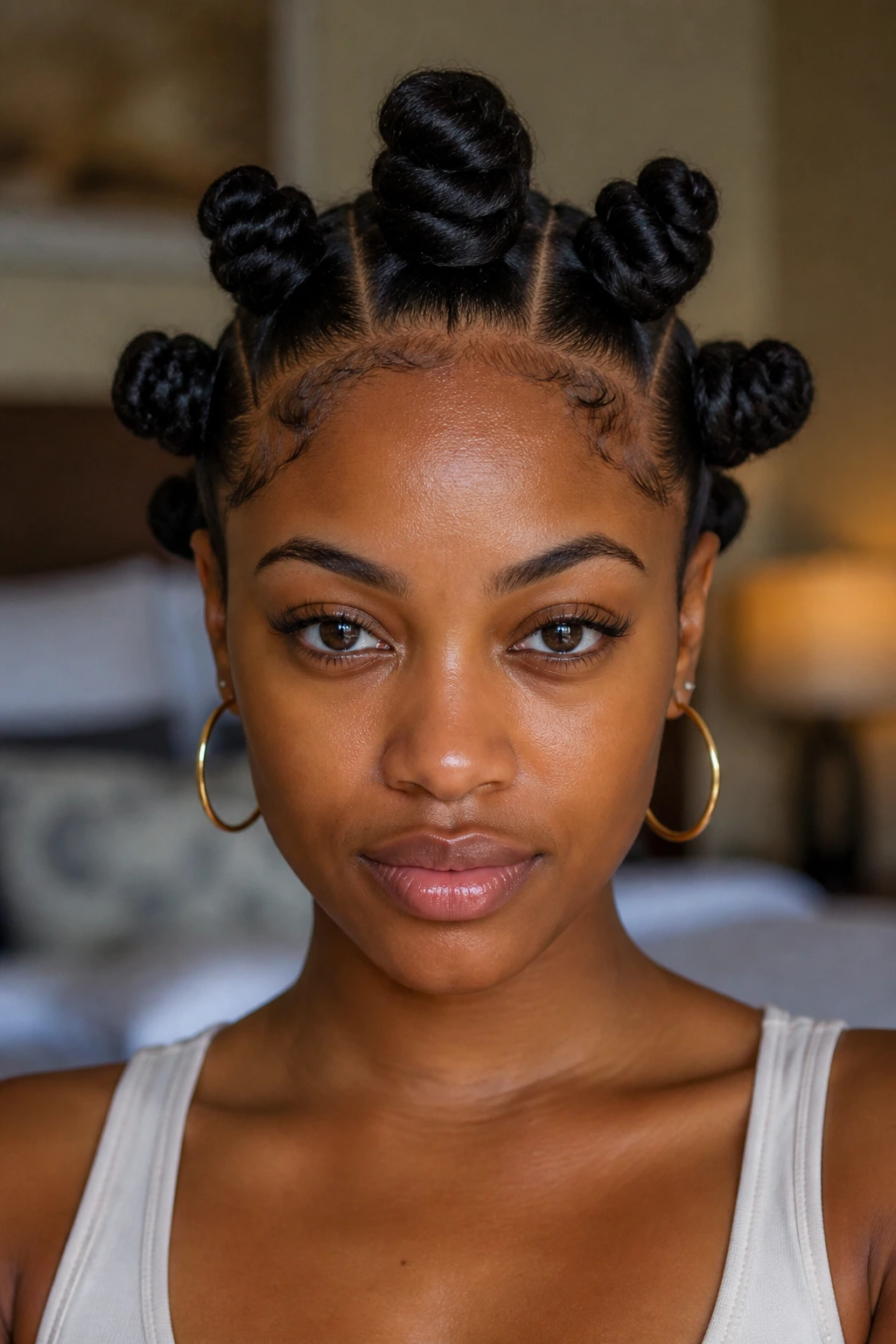
10. Bantu Knot Set
Bantu knots are doing two jobs at once: they’re a style and a set. That makes them especially smart for thick hair, because the knots can dry the hair into a defined curl pattern or just sit as sculptural little buns if you want the look itself. Either way, they use the hair’s density to create shape.
The size of the knots changes everything. Small knots mean tighter curls. Larger knots give you a softer, more rounded pattern when you take them down. On thick hair, parting cleanly matters more than making every knot exactly the same size. Close enough is not good enough here; the sections need to be balanced so the shape doesn’t lean in one direction.
I like this style when I want something that feels intentional even before it’s taken down. It’s a strong protective style overnight, and the unraveling process is half the fun if the hair is fully dry.
One caution: don’t make the knots so tight that your scalp starts protesting. Bantu knots should sit firmly, not painfully.
11. Tapered Afro
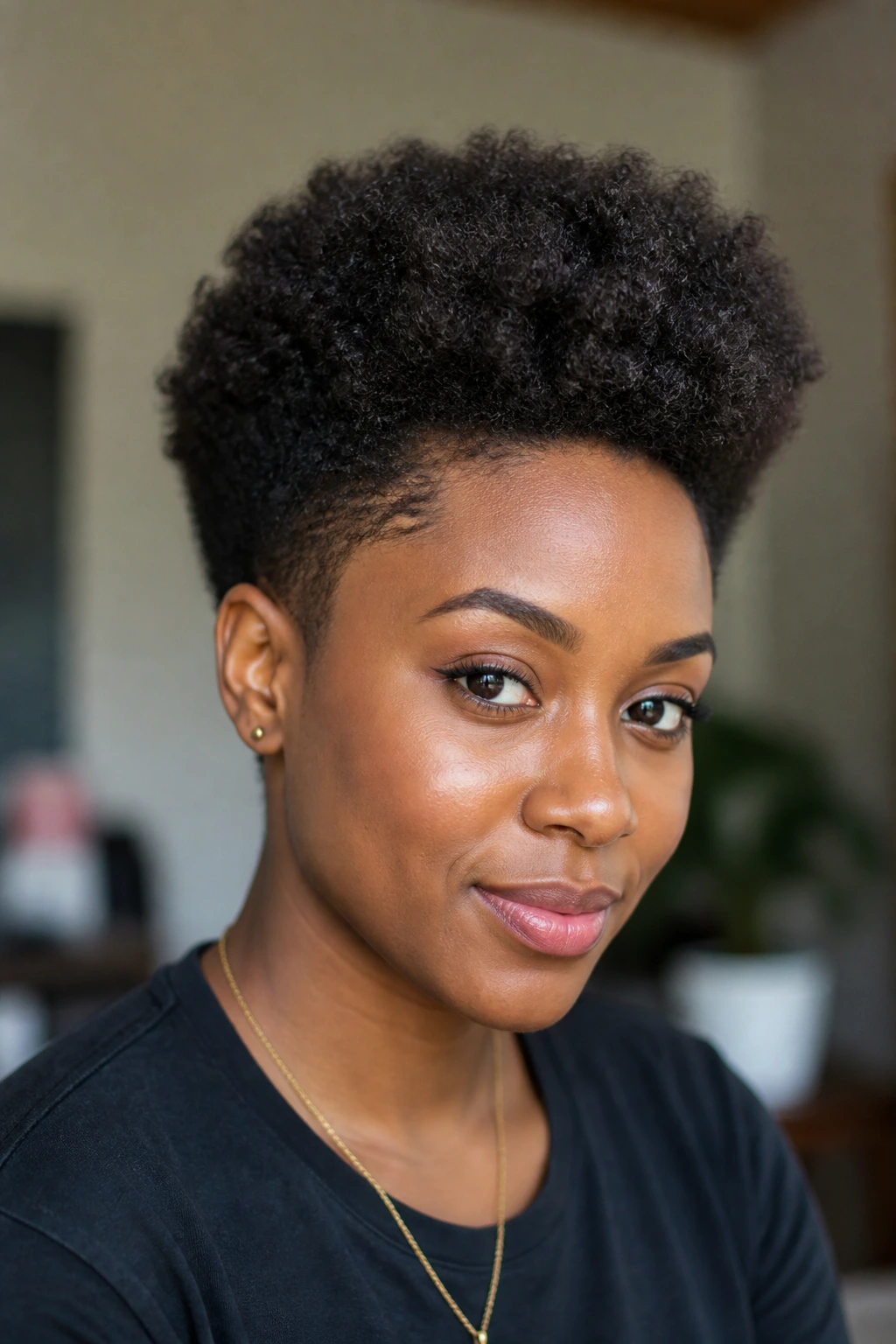
A tapered afro is one of the cleanest answers to thick hair that wants shape without all the pulling and pinning. The sides and nape are kept shorter, while the crown stays fuller and rounded. That contrast makes the hair look styled even when the routine is simple: moisture, pick, shape, done.
The cut does most of the work, which is why a good tapered shape can be such a relief. Thick hair tends to balloon outward if no one gives it a frame. Here, the frame is the haircut. A little fluff at the top is welcome; it gives the style personality. The edges stay neat because the silhouette is already doing the heavy lifting.
I’d choose this if daily styling needs to stay light. You can stretch the crown a little with a diffuser, define the front with a touch of cream, or leave it soft and airy. It wears well with glasses, statement earrings, or a plain turtleneck in cooler weather. The shape gives the whole look a backbone.
12. Halo Braid Crown
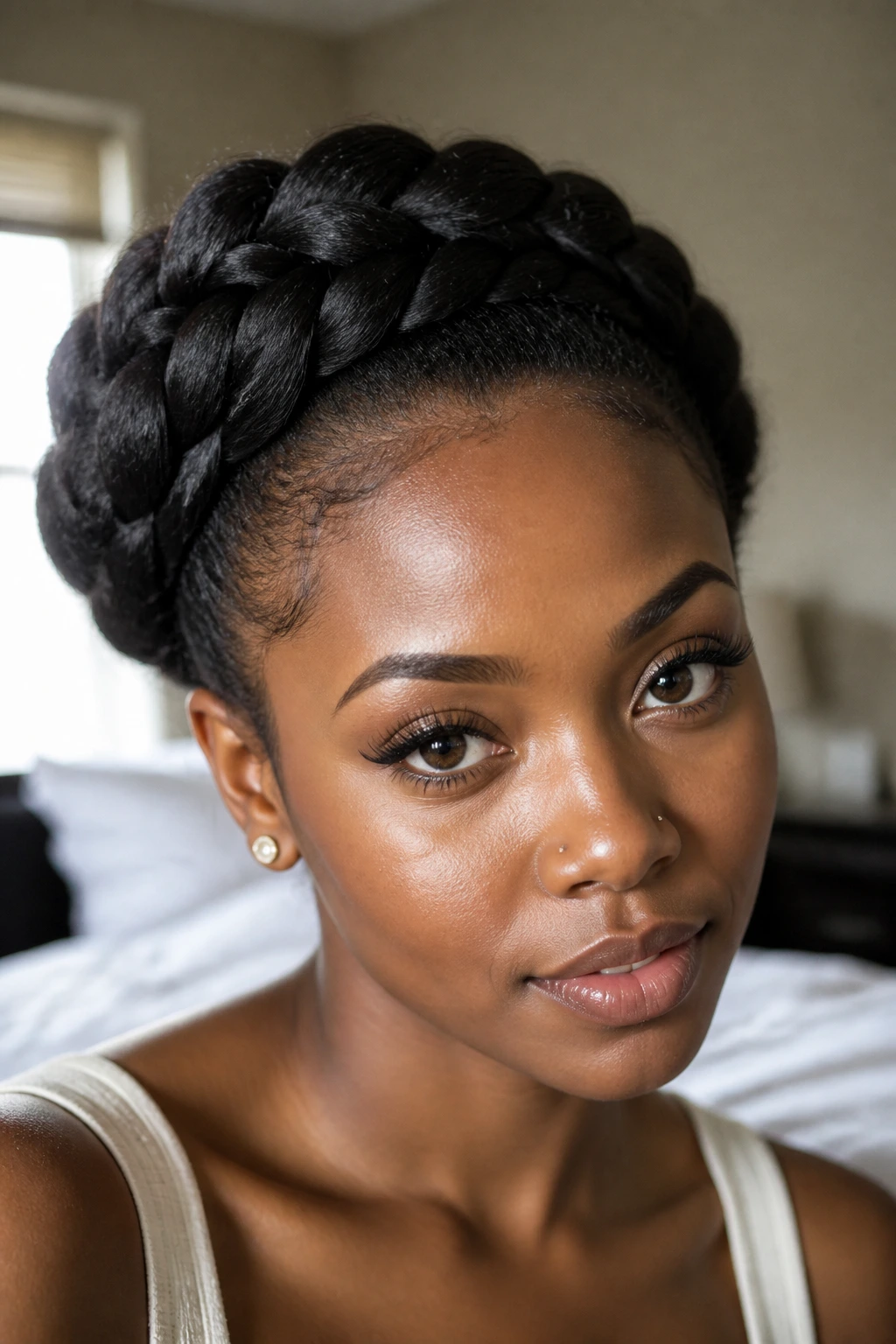
A halo braid crown uses thick hair like trim. That’s the best way I can describe it. The braid curves around the head, and the density gives the crown a full, plush look that fine hair often has to fake with padding or extra hair. On thick hair, the braid feels substantial on its own.
This style works best on stretched or lightly blown-out hair because the braid needs enough length to wrap cleanly. Once the braid is laid around the head, tuck the ends securely and pin them where they won’t poke through the finish. Clean pins matter. So does patience.
The halo braid is one of my favorite formal styles because it gives polish without making the head look slick or severe. It frames the face in a way that feels soft but controlled. If you want a little more drama, leave a few curls out near the front. If you want crispness, keep every strand tucked.
It’s the sort of style that makes thick hair look like a crown instead of a challenge. Which, frankly, it is.
13. Half-Up Pineapple
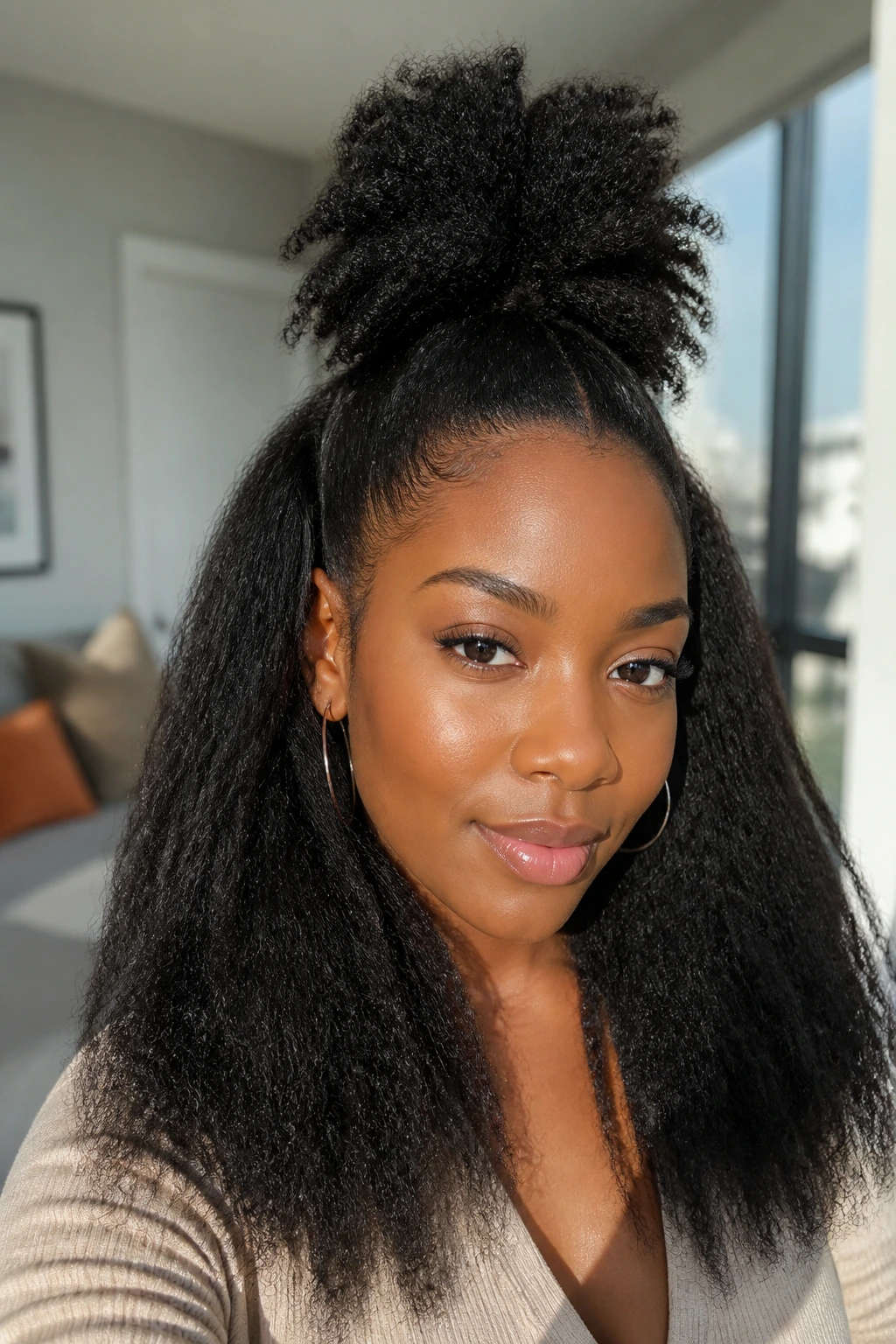
The half-up pineapple is the lazy-day style that still knows what it’s doing. Pull the top half of the hair into a high gather and let the rest spill down, and suddenly thick hair has height, softness, and a little bit of movement without needing a full manipulation session.
It works especially well on stretched curls or old twist-outs. If the hair has already settled into a shape, the pineapple keeps that shape on display instead of crushing it at the back of the head. Use a loose scrunchie or a puff cuff so the top doesn’t get dented.
The real appeal is balance. You get the visual lift of a puff with the ease of leaving part of the hair down. That makes the style useful for errands, casual lunches, and any day you don’t feel like deciding between “up” or “down.”
A satin scarf at night keeps the root from frizzing out. Without it, the top can wake up looking like a small storm cloud.
14. Marley Twists
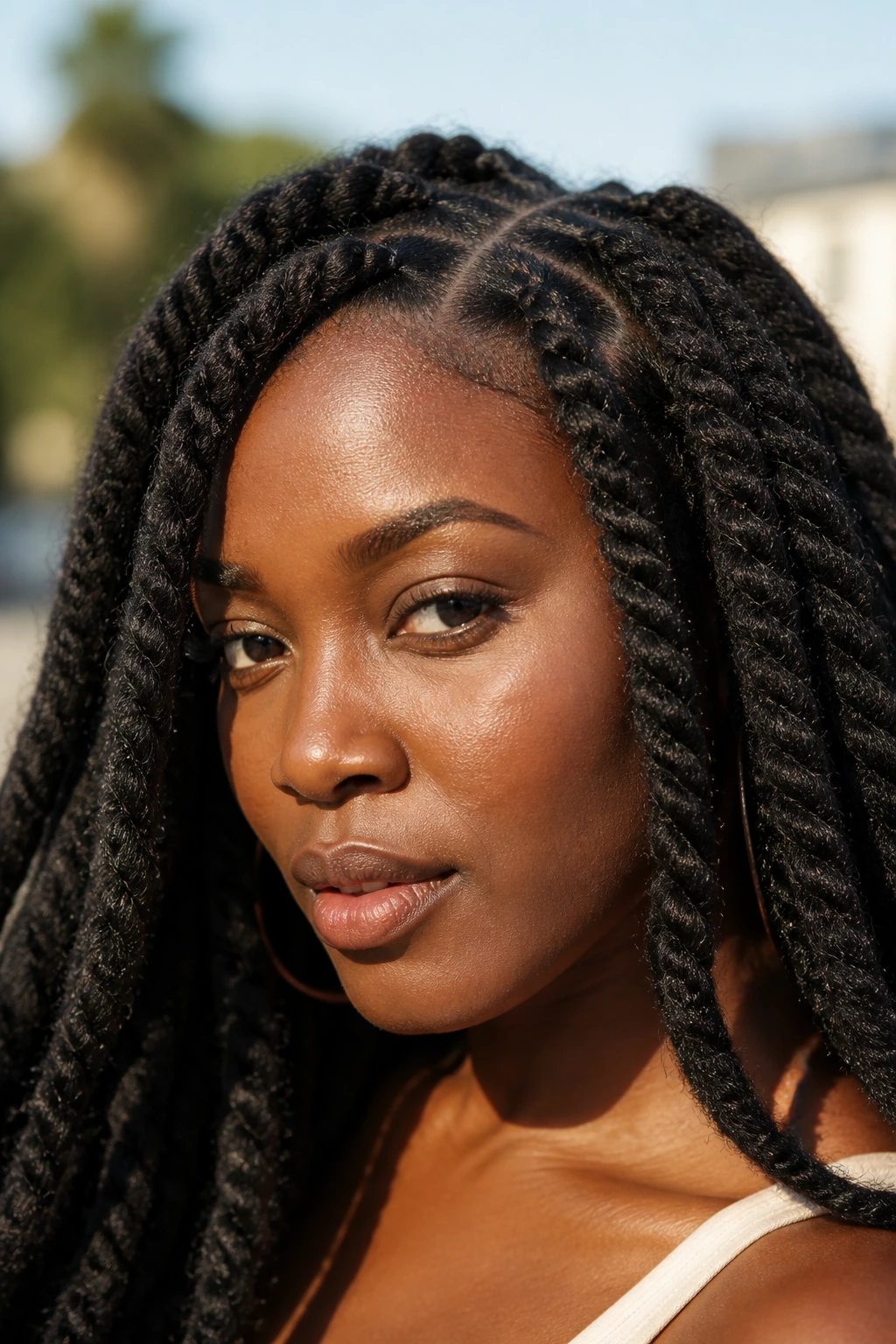
Marley twists have a matte, rope-like texture that works beautifully with thick hair because they don’t try to look silky or hyper-perfect. They look a little earthy, a little bold, and very deliberate. The thickness of the twist itself helps the style sit with weight, which can be a blessing on dense natural hair.
The installation is slower than jumbo braids, but the finish is softer around the face. Marley hair gives the twists a fuller, more organic look than shiny braiding hair, and that texture can hide minor irregularities in parting. I like that. It feels less precious.
These twists are a good option when you want a protective style that still has movement. They can be worn loose, pinned back, or gathered into a low bun without losing the shape. The only real caution is weight. Long twists made with too much hair can tug at the scalp by the second week.
Keep the parts clean and the base secure, then leave the ends alone. Marley twists look better when they’re allowed to sit naturally.
15. Passion Twists
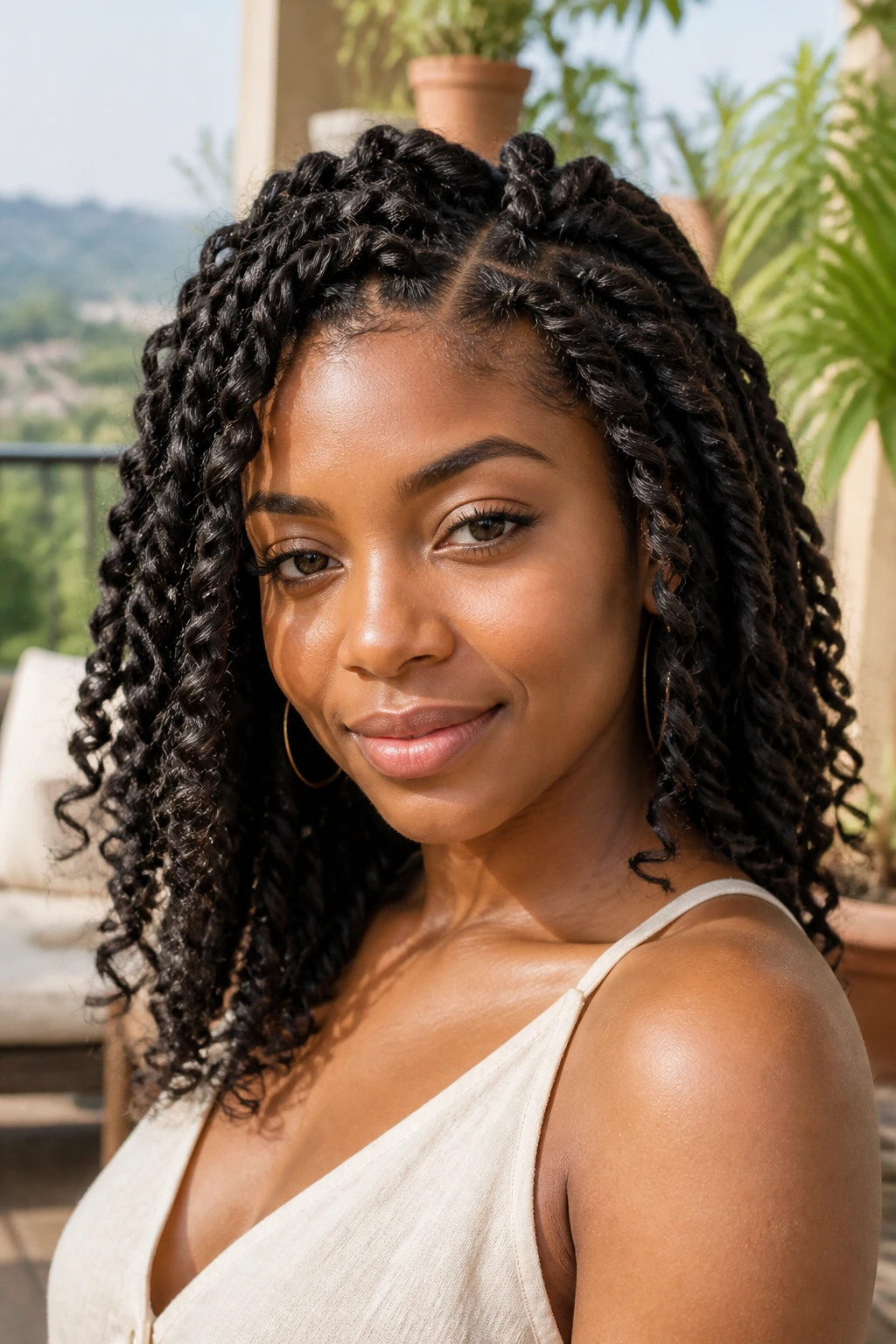
Passion twists have a softer, springier finish than Marley twists, which makes them a nice choice if you want a curlier rope texture without the stiffness of a traditional twist. On thick hair, they can create a lot of volume without turning boxy, and that shape is half the appeal.
The installation usually calls for a light hand. Too much tension at the roots and the style loses the easy drape that makes it work in the first place. I prefer medium lengths for thick hair because they keep the curl bounce visible without dragging the style down.
Passion twists are especially good when you want movement around the face. They don’t sit as rigidly as braids, so they feel a touch more relaxed. That makes them useful for vacations, long weekends, and days when you want your hair to look styled without looking sealed in place.
One small note: the twist pattern likes moisture, but not too much product. Heavy cream at the root will slow drying and make the base feel gummy.
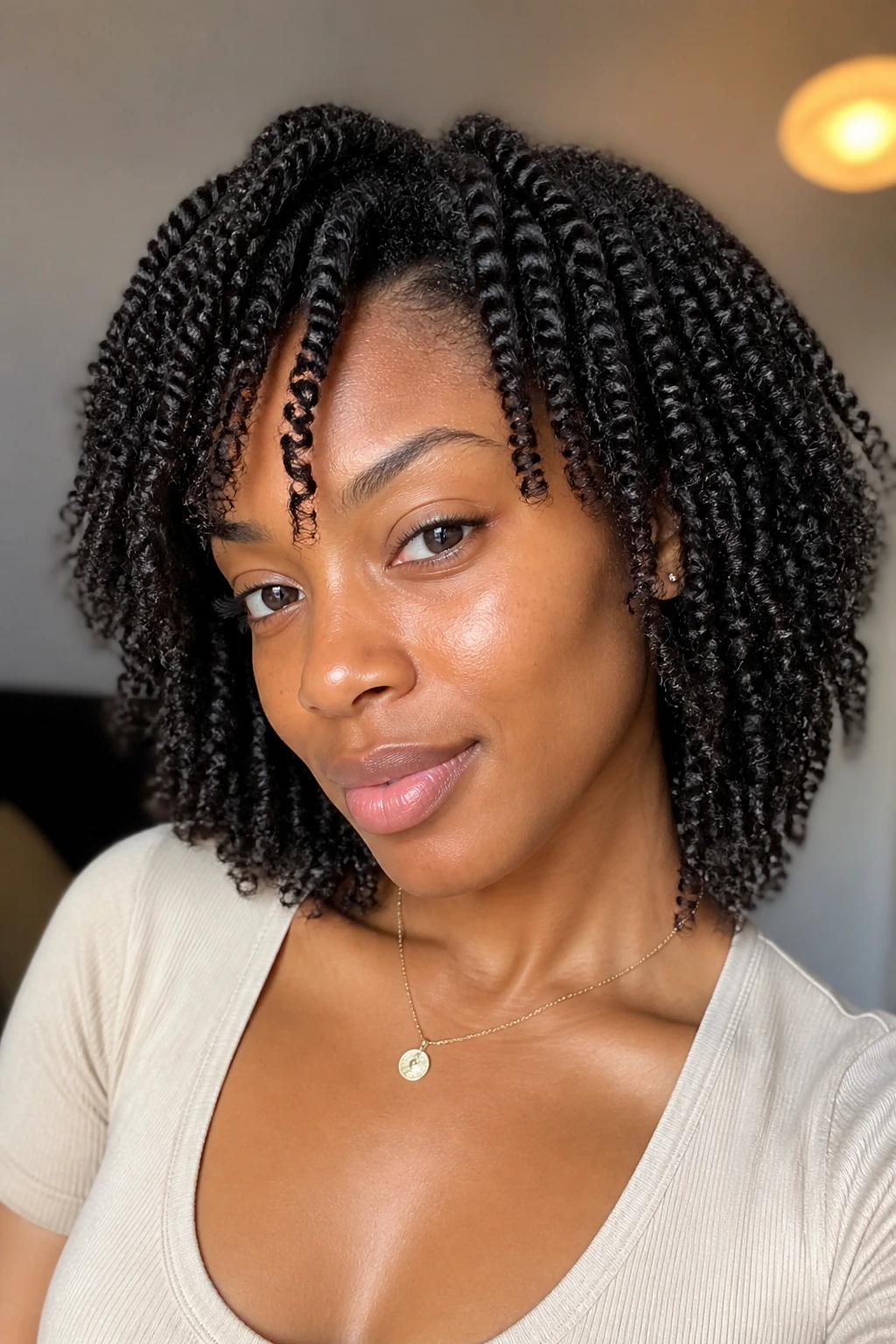
16. Mini Twist Bob
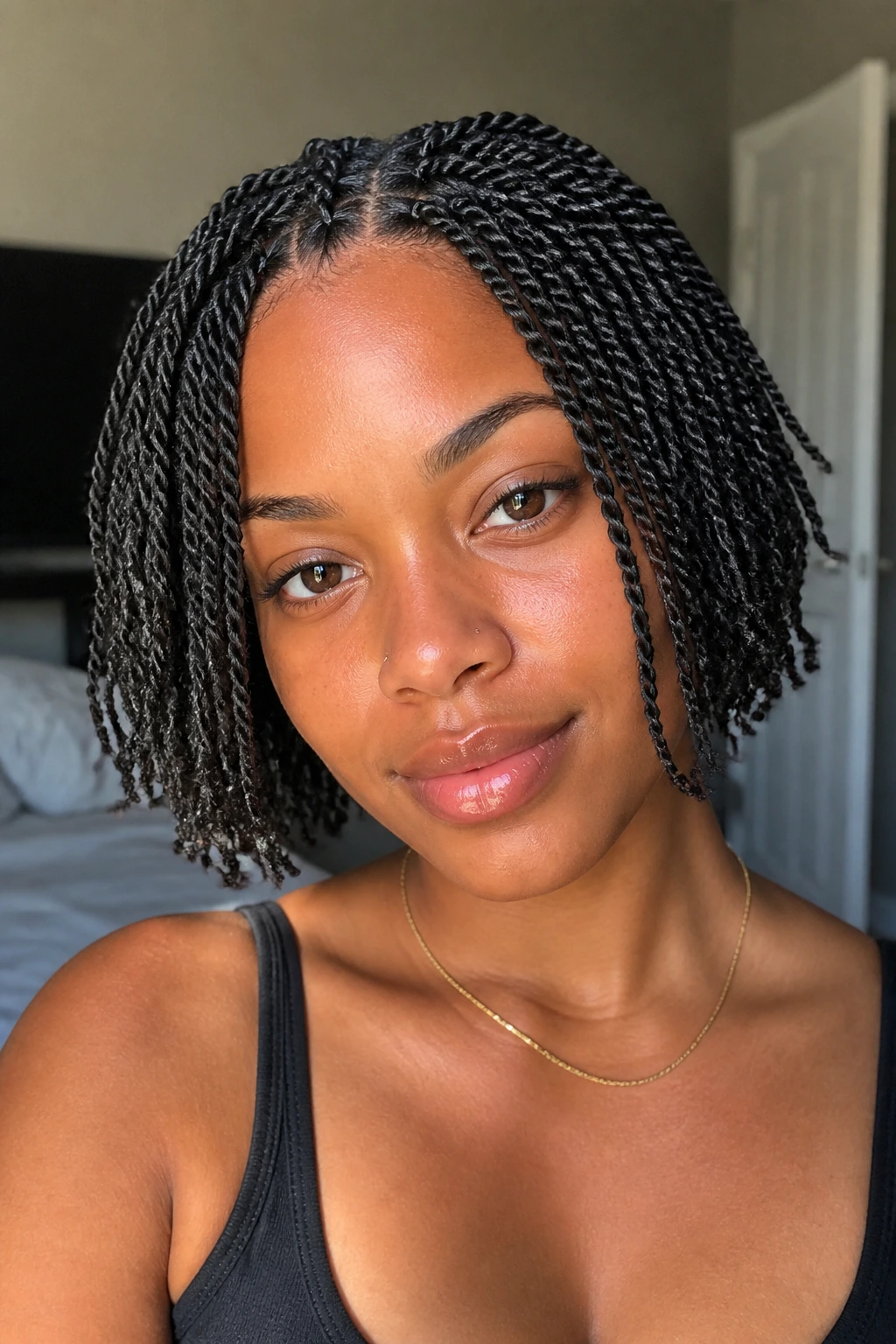
Mini twists at bob length are a patience style. They take time to put in, but they pay you back with a neat, low-manipulation shape that can last for weeks if you protect it at night. Thick hair gives mini twists a satisfying fullness, which means the bob doesn’t collapse or go sparse at the ends.
This style is one of the best answers for people who hate redoing their hair every morning. The twists sit close enough to the head to stay tidy, but they still move. The bob length keeps them from feeling too heavy, which matters when the density is already doing plenty.
I like mini twists when the goal is to give the hair a break from daily combing. They can be styled into side parts, tucked behind the ears, or pinned up for a quick shift in shape. And yes, they look good a little older. That softens the twist pattern in a way that can be very flattering.
Just make sure the hair is dry all the way through before bed the first night. Wet mini twists at the center are a bad surprise.
17. Space Buns on Stretched Hair
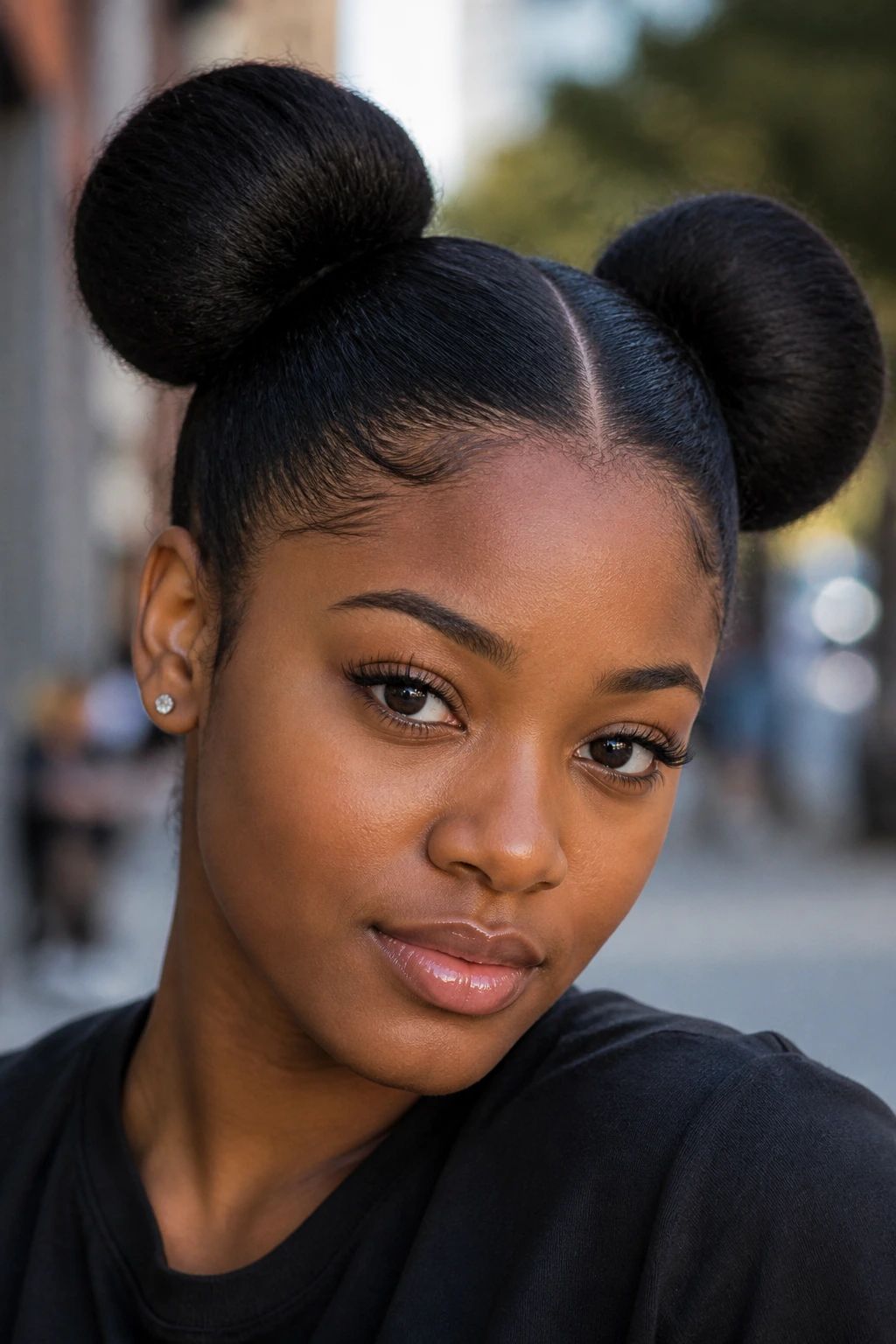
Space buns can look playful or sleek, depending on how much you smooth the roots and how much texture you leave in the buns themselves. Thick hair is a perfect candidate because the buns actually have enough material to look round instead of tiny and apologetic.
I would not do this style on hair that is freshly washed and ultra-fluffy unless you want a lot of shrinkage around the base. A stretched prep gives the buns a cleaner line and keeps the sections from swelling out at odd angles. Part the hair neatly down the center, gather each side, and twist or wrap the sections into buns that sit evenly.
This style is fun, but it’s not childish unless you want it to be. Tighten the line of the part, leave the ends slightly textured, and it can feel sharp rather than cute. Add earrings and a clean lip, and the style shifts immediately.
If one bun is larger than the other, don’t ignore it. Thick hair makes symmetry more obvious.
18. Roller Set on Thick Natural Hair
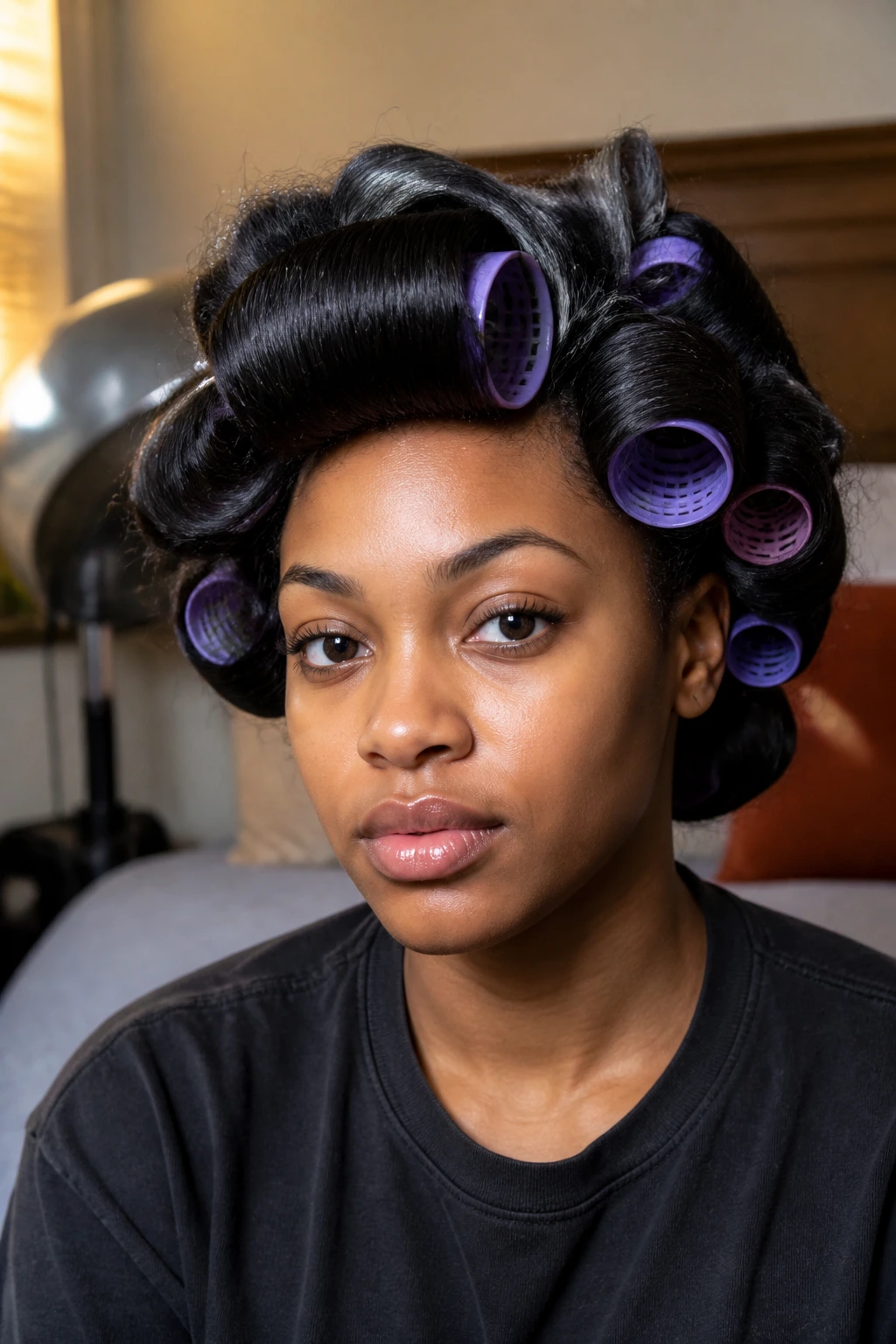
A roller set is one of the most underrated styles for thick hair because it gives body without roughing up the cuticle. The set can be soft and bouncy or full and sculpted, depending on the roller size and the amount of tension you use when rolling. Thick hair tends to hold the shape well once it’s dry.
The important part is drying. A roller set on dense hair can look done on the outside and still be damp near the roots. That’s why a hooded dryer or plenty of dry time matters. If you take the rollers out too soon, you lose the crispness and gain puff.
I like roller sets when the goal is a clean, glossy finish. They’re especially good for shoulder-length and longer hair, though shorter thick hair can still take smaller rollers and look fantastic. The shape has a little old-school polish that never feels stiff when it’s done right.
Use a setting lotion or mousse that leaves the hair touchable, not crunchy. The bounce should come from the set, not from product armor.
19. Flexi Rod Set
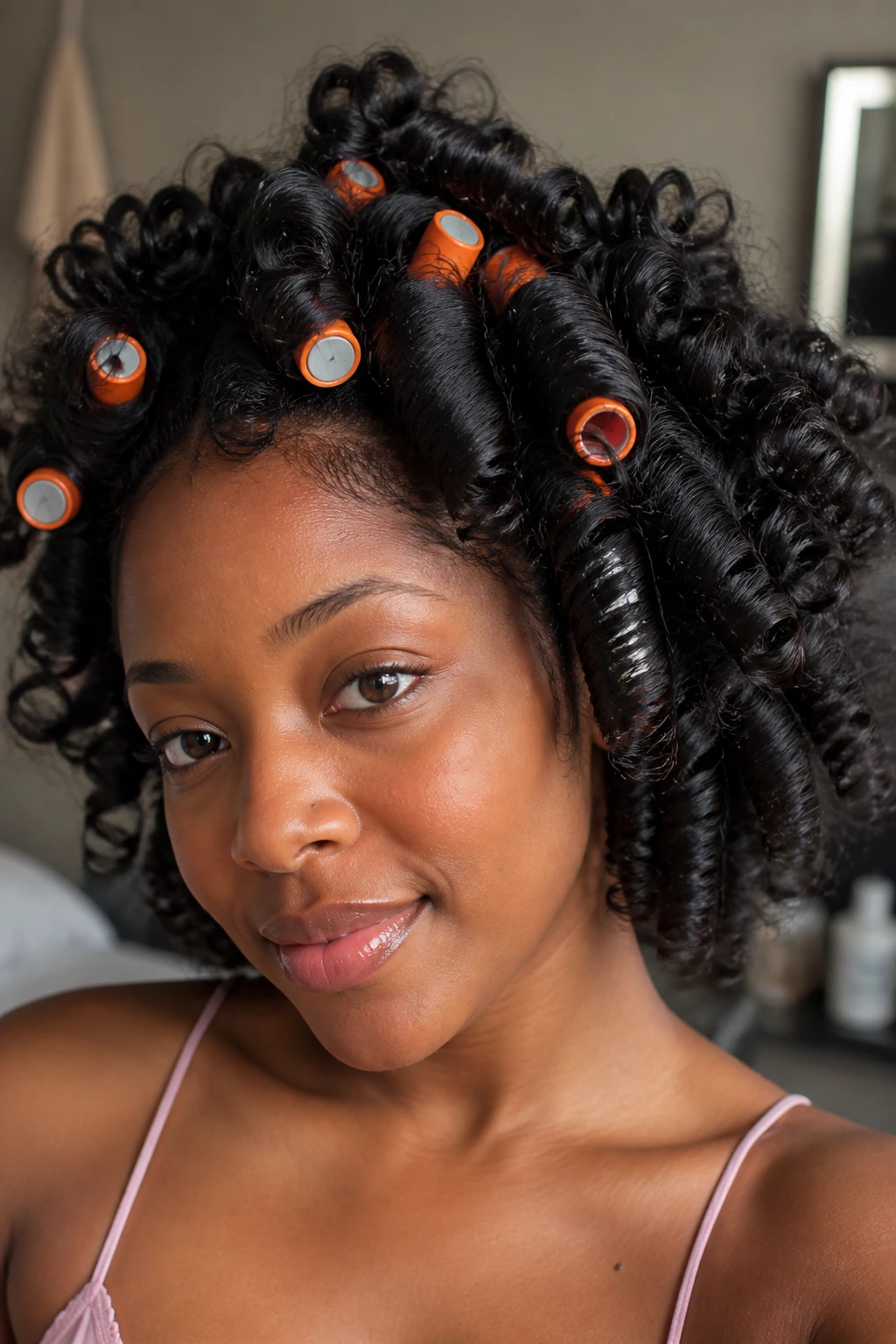
Flexi rods give thick hair a tighter, springier curl than rollers, and that difference matters. A rod set can look airy and defined at the same time, with spirals that hold their shape without feeling hard. On dense hair, the curl pattern stacks beautifully, which gives the style a plush, almost layered finish.
I’d choose flexi rods when I want curls that look deliberate from root to end. Medium rods usually give the nicest balance for thick hair; tiny rods can turn into a long drying session, and jumbo rods can lose definition. The setting product should be light enough to spread evenly, because too much cream clumps the curl and slows drying.
The set itself needs patience. Rods don’t forgive damp centers. If you rush the takedown, the curl starts fraying before it even gets a chance to settle. That’s why I prefer to set this style when I know I can leave it alone for a full dry.
A flexi rod set can be worn loose or pinned back into a half-up shape. It has enough curl on its own that you do not need much else.
20. Layered Curly Afro
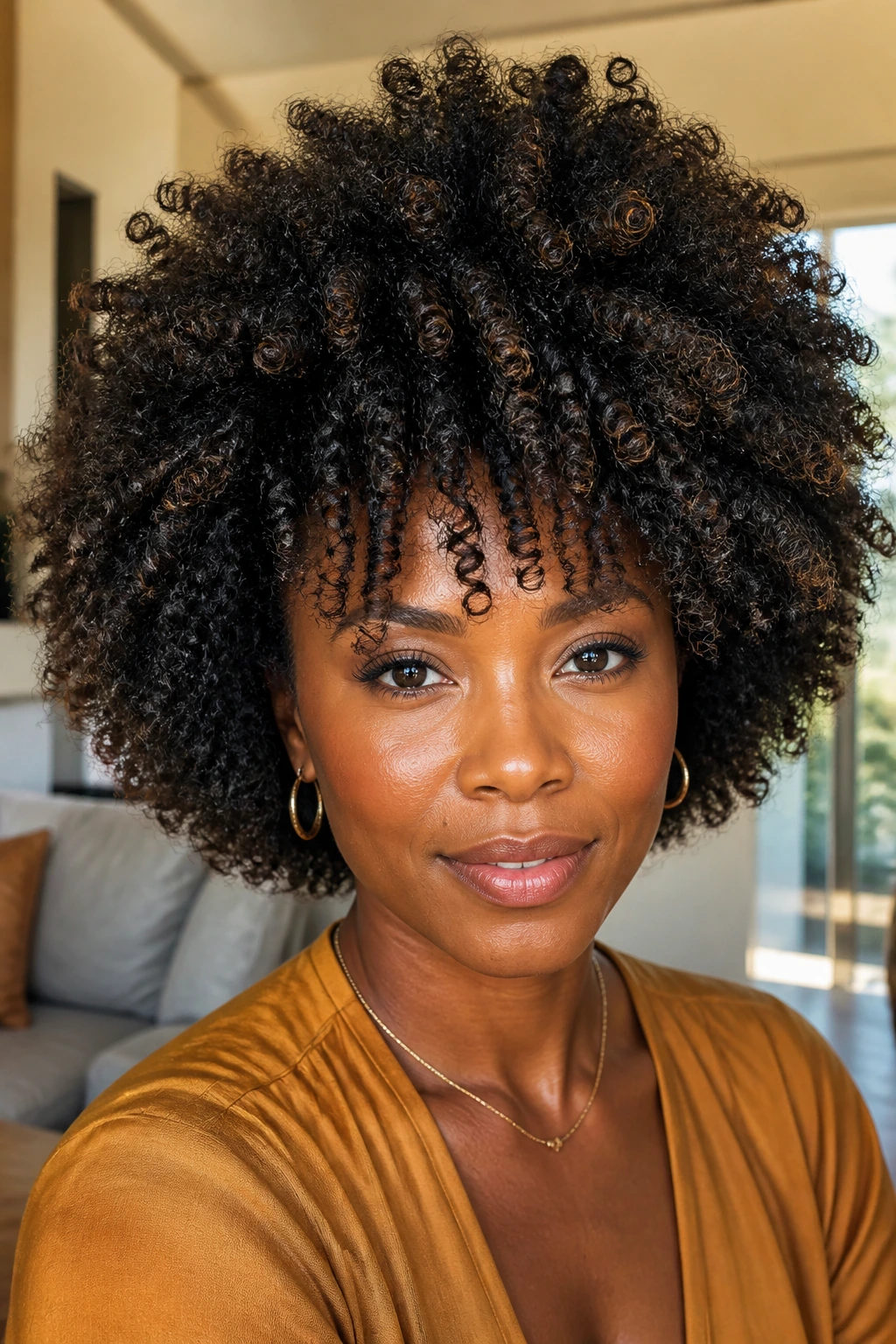
A layered curly afro is what happens when the cut and the styling work together instead of fighting for attention. Thick hair loves layers because they stop the shape from becoming a perfect sphere. The hair can still be big, but the silhouette moves. That movement is what makes the style feel alive rather than heavy.
You do not need a lot of product here. A moisturizing cream, a light gel at the perimeter if needed, and a pick at the roots can be enough. The layers do the rest. If the hair is cut well, the crown sits higher and the sides fall where they should, which keeps the profile balanced.
This style is especially good if you want volume with intention. It flatters round, oval, and heart-shaped faces in different ways depending on where the layers sit. And since thick hair already has density, you’re starting with a built-in advantage.
The mistake people make is trying to overdefine it. A layered afro looks best with softness around the edges and a little lift near the roots. Overworking it kills the shape.
21. Headwrap Tuck and Roll
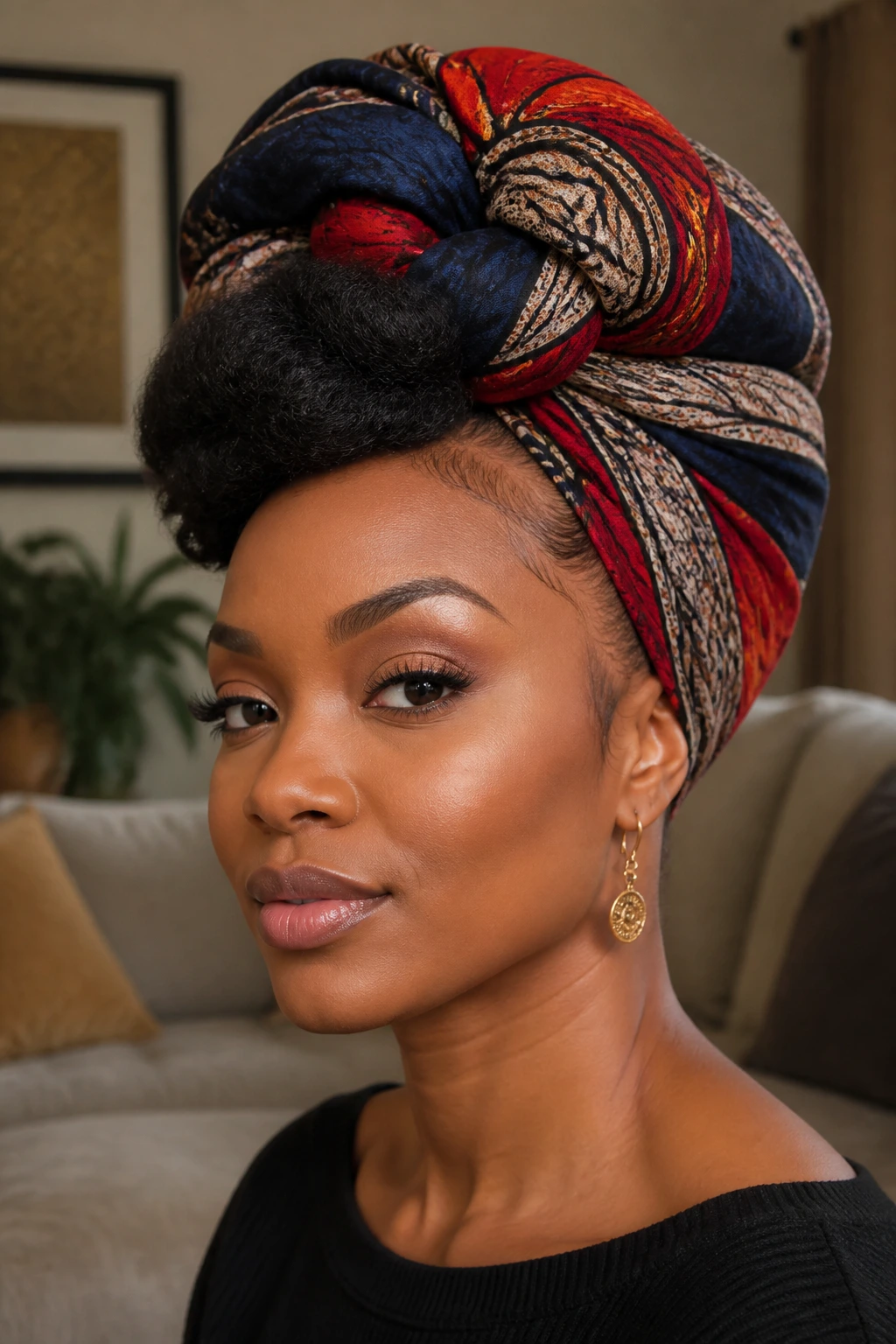
A headwrap tuck and roll is the style I reach for when the hair needs a break but I still want the look to feel finished. Thick hair gives the wrapped shape a nice base, because the roll has something substantial to sit on. There’s a real difference between a scarf perched on the head and a scarf arranged around a strong puff or tucked bun. The second one looks intentional.
This is not a backup plan in the way people sometimes treat it. It can be the whole outfit. Tuck the hair into a low bun, smooth the front lightly, then wrap the scarf around the crown or side in a way that leaves a little structure showing. The wrap should frame the hair, not swallow it.
I like this style for in-between days, travel days, and any time the scalp wants less handling. It can also rescue an older twist-out or puff that has started to frizz at the perimeter.
Choose a scarf with enough grip to stay put. Silk slips. Cotton bites harder. The sweet spot depends on the fold and your hairline.
22. Sculpted Low Bun with Side Cornrows
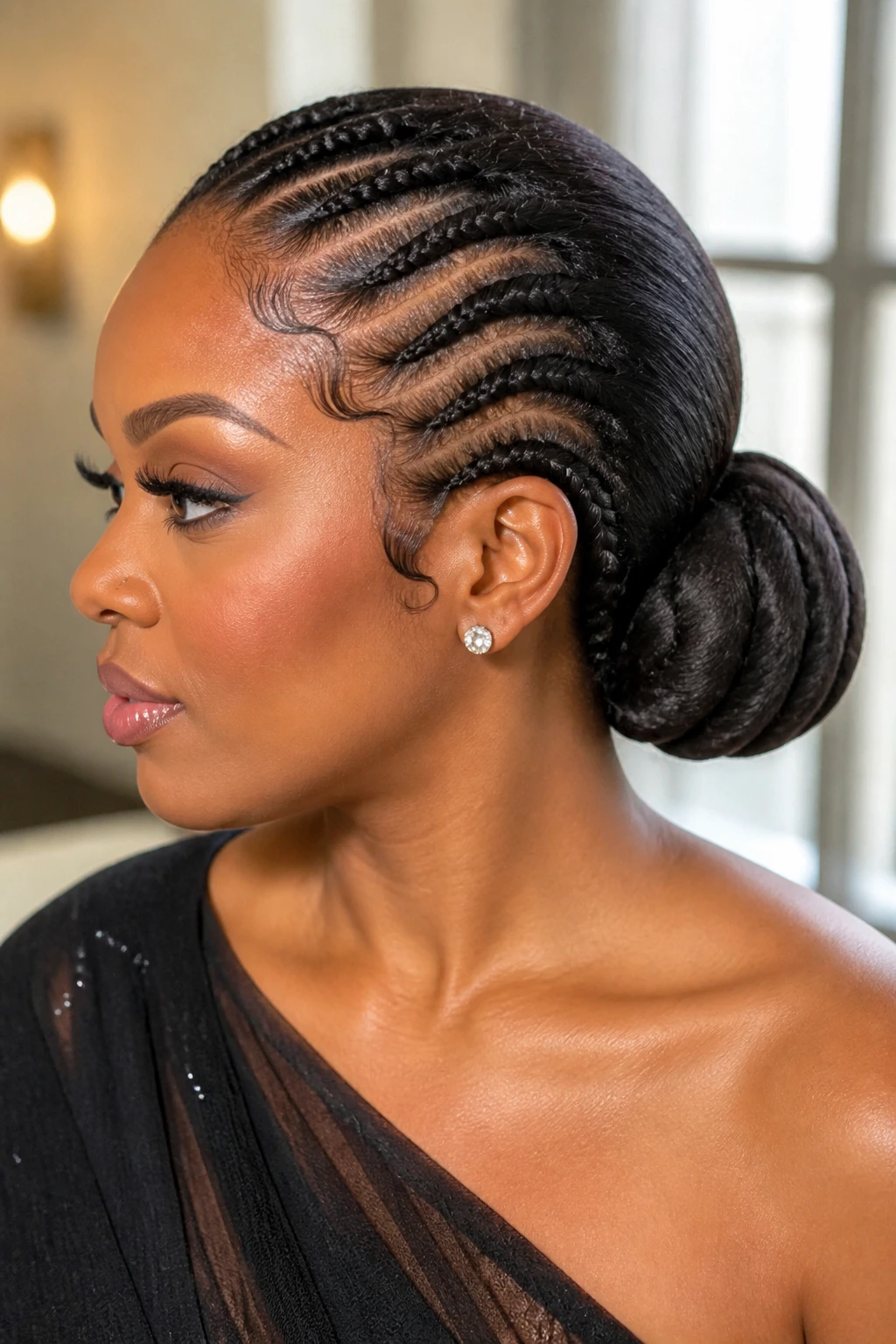
A sculpted low bun with side cornrows is one of the cleanest formal looks thick hair can wear. The cornrows draw the hair back with control, while the bun gathers the length into one polished shape at the nape. It’s tidy, yes, but not flat. Thick hair keeps the bun substantial, which is exactly why the style reads so well.
The sides need to be smooth before you start pinning. A little gel helps, but too much can leave the hairline crunchy. I prefer to braid or cornrow the sides first, then twist the remaining hair into a bun that sits low and secure. If the bun feels lopsided, pin from the underside, not just the top.
This is the style I’d choose for weddings, interviews, or any day when the hair needs to look calm and expensive without being boring. It pairs well with a deep side part, a center part, or a side cornrow pattern that adds a little geometry.
It also lasts. A good scarf at night and a quick edge touch-up in the morning can carry it for several days.
Why Thick Hair Needs Its Own Styling Math
Thick hair is not just “more hair.” That’s the lazy version. What actually changes is density, surface area, drying time, and the amount of friction happening every time you comb, braid, or smooth a section. Those things matter.
A style that looks simple on paper can turn into a half-day project if the hair is not prepped the right way. That is why stretched bases, sectioning clips, and intentional product use show up again and again with these styles. The goal is not to fight the hair into submission. It’s to give it a lane.
The other thing thick hair needs is respect for the scalp. Heavy styles, tiny parts, and too much edge control in the same week can make the front feel raw. I’d rather see one well-shaped puff or bun than a style that looks neat for two hours and then starts biting back. Comfort shows.
The Tools That Make Thick Hair Easier to Handle
-
Rat-tail comb: Clean parts make braided and twisted styles look deliberate, and the pointed end helps map sections without tearing through the hair.
-
Wide-tooth comb: Better for detangling thick hair in the shower or after conditioning, especially when the curls are stretched and fragile.
-
Sectioning clips: Thick hair gets unruly fast; clips keep the rest of the head out of the way so each part is actually neat.
-
Spray bottle: A light mist of water or leave-in helps reshape sections without soaking them and restarting the entire drying process.
-
Edge brush: Useful for smoothing hairline details on puffs, buns, and ponytails without dumping product everywhere.
-
Soft scrunchies or puff cuffs: They hold volume without snapping strands or flattening the back of the style.
-
Bobby pins and U-pins: A must for buns, wraps, and halo styles; the longer pins grip thick hair better than tiny decorative clips.
-
Hooded dryer or diffuser: Not mandatory, but they save a huge amount of time on twist-outs, rod sets, and wash-and-gos.
-
Silk or satin bonnet: Keeps the style from rubbing itself loose overnight, which is half the battle with thick hair.
-
Pre-stretched braiding hair: If you’re adding extensions, this is cleaner, lighter, and easier on your hands than cutting and stretching hair yourself.
Smart Product Picks and Ingredient Notes for Thick Hair
Thick hair usually does better when the product list stays short and the hold stays clear. A heavy cream layered under a heavy gel under an oil can turn into a sticky cap that never dries. I’d rather see one good leave-in, one styling cream or mousse, and one hold product chosen for the style at hand.
For twist-outs and braid-outs, look for a leave-in with slip and a cream that helps the hair clump without turning greasy. For wash-and-gos, a gel with enough hold to keep the curl pattern separated is worth its weight. For sleek buns and cornrows, a stronger gel or edge control can help, but only if it dries clean. Flaky black residue is not a style. It’s a warning.
Synthetic braiding hair is another place where a little shopping care matters. Pre-stretched hair saves time and tends to lay flatter at the base. Marley hair gives a matte finish with more texture. If you want a softer twist, passion-twist hair is lighter and springier. Match the hair to the look you want, not the cheapest bag on the shelf.
And no, you do not need to buy every product under the sun. Thick hair usually wants fewer products used more deliberately.
How to Wear These Styles in Real Life
Presentation: A high puff, halo braid, or sculpted bun reads cleanest when the edges are neat and the shape has one obvious focal point. Big styles look best when the silhouette is clear from the front and the sides.
Best pairings: Gold hoops, a satin scarf, a bold lip, or a simple blazer can change the mood fast. I’d pair flat twists and low buns with sharper outfits, then save twist-outs and puffs for softer clothes that can handle movement.
Wear time: Protective styles like braids, twists, and cornrows can stay in longer, while twist-outs, braid-outs, and rod sets need refreshing sooner. The style should match your week, not your wishful thinking.
Where they fit: A wash-and-go or half-up pineapple is easy for errands and casual days. A low bun, halo braid, or feed-in ponytail makes sense for work or formal settings because the shape stays steady even after a long day.
Additional Tips and Small Fixes That Matter
Shrinkage control: Start with stretched hair when you want length to show. Banding, twisting, or a low-heat blow-dry gives styles like puffs, buns, and twist-outs a cleaner outline from the start.
Shape control: Use the back of your hand or a pick to lift from the root instead of shredding the ends. Thick hair looks better when the base has lift and the ends stay defined.
Finish: A tiny amount of shine spray or light oil on the outer layer can calm fuzz, but don’t flood the style. A little goes a long way on dense hair.
Refresh plan: Keep a spray bottle nearby for twist-outs and braid-outs, then re-twist or re-braid the front sections at night if they start to swell. That keeps the style looking chosen instead of worn out.
Common Mistakes That Make Thick Hair Harder Than It Needs to Be
-
Starting with hair that isn’t detangled properly: The symptom is snagging, uneven parts, and a style that looks lumpy before you’re even halfway done. Work in sections and detangle with conditioner or leave-in so the hair glides.
-
Using too much product at the root: Thick hair can hide product buildup for a while, then suddenly turn dull, heavy, and flaky. The fix is to use thinner layers and let each one settle before adding more.
-
Making parts too small for the style: Tiny sections can be beautiful, but they also mean more time, more tension, and more chance of uneven drying. If you’re not committed to the maintenance, go a little larger.
-
Pulling too hard on the hairline: Sore temples and tender edges are the giveaway. A style should feel secure, not punishing. Loosen the base, use softer bands, or choose a lower-tension option.
-
Taking twist-outs, rod sets, or braid-outs down too early: If the inside still feels cool or damp, the shape will puff apart fast. Wait until every section is fully dry, then separate gently.
-
Skipping nighttime protection: The style looks fine at 7 p.m. and rough by breakfast because it rubbed against cotton all night. Satin and silk are not extra here. They’re part of the style.
Easy Variations and Swaps to Try
Short-Hair Puff Version: If your hair is shorter, keep the puff lower and use a soft band that sits close to the crown. The style still works; it just reads more compact.
Heat-Free Stretch Set: Swap the blow-dryer for banding, plaits, or twists and let the hair set overnight. This is the version I’d choose when the scalp wants a break from heat.
Office-Ready Version: Pick a low bun, halo braid, or sculpted ponytail with clean parts and minimal flyaways. The style stays calm without looking severe.
Weekend Big-Hair Version: Loosen the part, pick out the roots, and let twist-outs or layered afros live a little bigger. This is the right move when you want volume on purpose.
Humidity-Heavy Version: Choose knotless braids, Marley twists, or a tucked headwrap style. These handle swelling better than anything that depends on perfect curl definition.
Edge-Sensitive Version: Skip tight ponytails and ultra-snug cornrows. Flat twists, loose buns, and puffs with gentle bands are safer when the hairline needs rest.
Make-It-Last Care for Thick Hair Styles
Protective and stretched styles can last a long time, but only if you stop treating nighttime like an afterthought. A satin bonnet or scarf should go on before bed, not after you wake up and notice the style has already flattened at the crown. For puffs, pineapples, and twist-outs, a loose wrap keeps the root from frizzing into a halo.
Twist-outs and braid-outs usually look best for about 3 to 5 days before they start asking for a refresh. A light mist, a finger re-twist on the front pieces, and a quick fluff at the roots can buy you another day or two. Rod sets often hold 4 to 7 days if the weather stays kind and you don’t keep touching them.
Braids, twists, and cornrow styles can last 4 to 8 weeks, but that range is not a dare. If your scalp gets sore, itchy, or visibly built up, wash it. A diluted shampoo or scalp cleanser every 1 to 2 weeks helps keep the base from getting grimy. Leave the scalp drenched? No. Clean and dry at the roots is the goal.
Sleek buns and low ponytails need more frequent refreshes because the edges and nape take the hit first. A quick touch-up every 2 to 3 days keeps them neat without piling on more gel.
Questions People Actually Ask About Thick Hair Styles
Which styles hold up best when my hair gets puffy fast?
Knotless braids, Marley twists, mini twists, and sculpted buns usually handle puffing better than styles that depend on perfect curl definition. If your hair swells at the roots quickly, start with stretched hair and choose a shape that already has structure.
Can these styles work on short thick hair?
Yes. A high puff, mini twist bob, tapered afro, halo braid crown, or space buns can all work on shorter lengths if the sections are balanced and the shape is planned around the cut instead of against it.
How do I keep my edges from getting tired?
Stop pulling the front tighter every time you style it. Rotate between low-tension looks, loosen the base of ponytails, and skip heavy edge control every single day. The hairline likes restraint.
What if my twist-out turns frizzy on day one?
Usually the hair wasn’t fully dry, the sections were too large, or the product layer was too heavy. Dry it all the way through next time and separate only when the set is completely cool.
Are braids always better than loose styles for thick hair?
No. Braids are excellent when you need low manipulation, but a well-cut afro, a roller set, or a puff can be easier on the scalp and easier to live with. The right answer depends on how much time you want to spend touching your hair.
How often should I wash thick hair when it’s in a protective style?
Every 1 to 2 weeks is a solid rhythm for many people, especially if the scalp gets itchy or product starts to build up. Use a gentle cleanser and make sure the style dries fully after washing.
Do I need heat to get thick hair to lay down?
Not always. Banding, plaits, twists, roller sets, and good tension can stretch the hair enough for most styles. Heat can help, but it is not the only route, and it’s not worth chasing if your hair does better without it.
How do I choose between a twist-out and a braid-out?
Pick a twist-out when you want softer, rounder curls and a little more volume. Pick a braid-out when you want the hair to lie a bit longer and hold a smoother wave pattern.
A Better Fit for Dense Coils
Thick hair needs styles that know what they’re dealing with. Not flatter. Not smaller. Smarter. The best looks in this lineup work because they respect density, dryness, shrinkage, and the real-world fact that Black hair often wants structure before it wants decoration.
I’d start with one style that matches your actual routine, not the fantasy version of your routine. If you need speed, go high puff or low bun. If you want days of wear, pick twists, braids, or a set. If you want shape with personality, a tapered afro or halo braid gives you that without making the hair feel boxed in.
Pick the style that fits your next three mornings. That’s usually the one you’ll keep coming back to.