



Thick hair has a way of making the morning feel shorter than it is. One minute you’re looking for a brush; the next, you’re negotiating with a crown full of volume, tangles, and a part that has opinions. Enby hairstyles for busy mornings with thick hair need one thing above all: a shape that looks chosen before coffee, not after a full wrestling match with your own head.
The sweet spot lives between sharp and soft. Too much polish can feel stiff. Too much looseness can turn thick hair into a fluffy triangle by 9 a.m. The styles that work best here do a sneaky little trick: they use the weight of the hair, the density, and the texture instead of fighting them. That’s why a low knot can look cleaner on thick hair than on fine hair, and why a braid with a little width reads more intentional than one that’s fussed over for twelve minutes.
The best part is that none of this has to be precious. You do not need a salon blowout, a drawer full of hot tools, or a personality transplant. You need a few dependable shapes, a couple of sturdy accessories, and the willingness to pick the style that matches the day instead of the fantasy version of the day.
Why These Styles Earn a Spot in a Thick-Hair Morning Routine
-
They work with weight, not against it: Thick hair stays put better in braids, knots, and clipped styles, so you spend less time redoing the same section three times.
-
They read androgynous without looking forced: Clean parts, low buns, tucked ends, and simple twists land in that middle space many people want from enby hairstyles.
-
They survive a rushed morning: Most of these can be done with fingers, one elastic, and a clip you can find even half-awake.
-
They hide second-day chaos well: Dense hair can look intentional even when the roots are a little bent and the ends have decided to do their own thing.
-
They scale across texture: Straight, wavy, curly, and coily thick hair can all use the same basic shape with a few small changes.
-
They keep the neck clear when you need it: That matters more than people admit. Thick hair on a warm day can feel like wearing a scarf you did not choose.
1. Low Knot with a Center Part
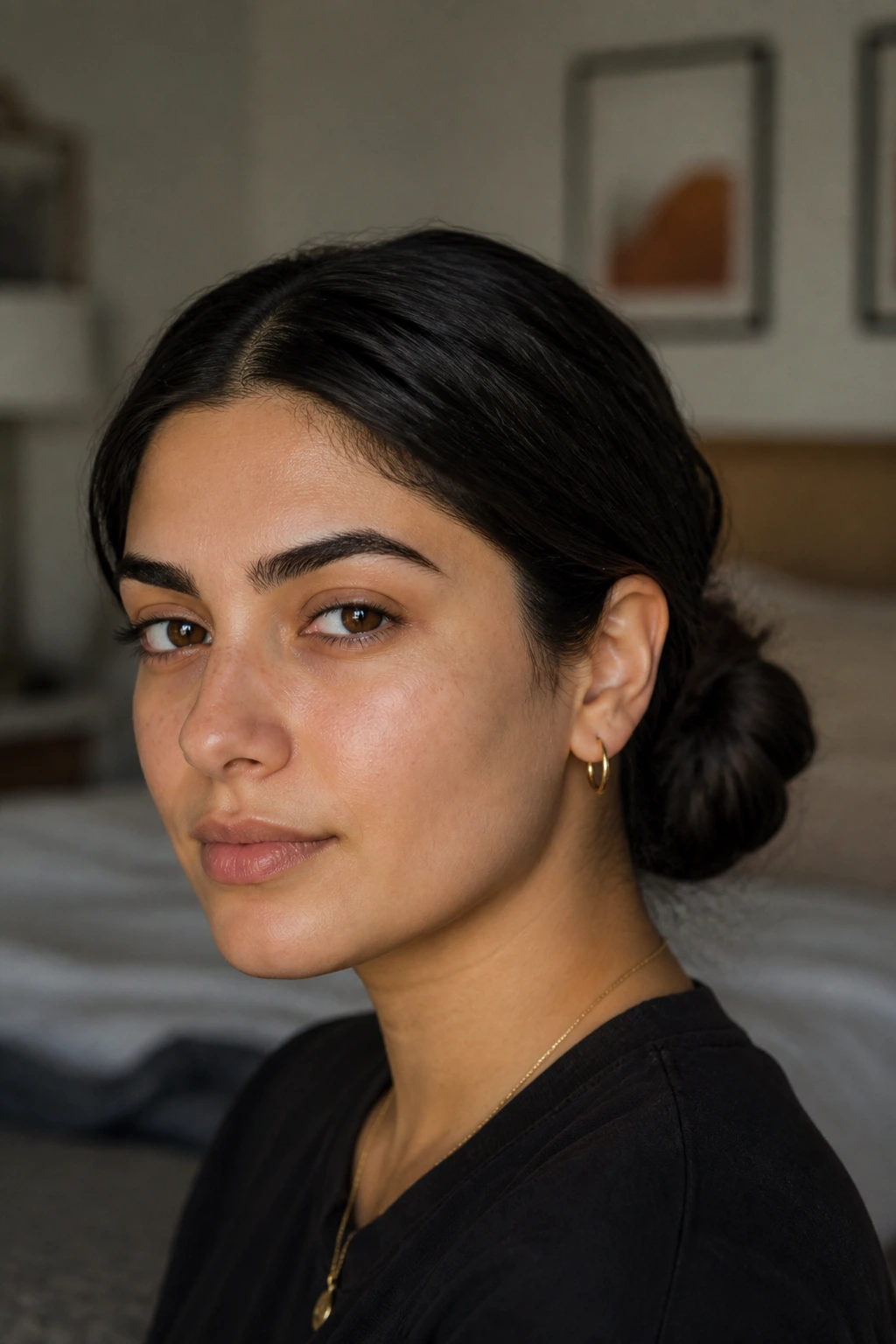
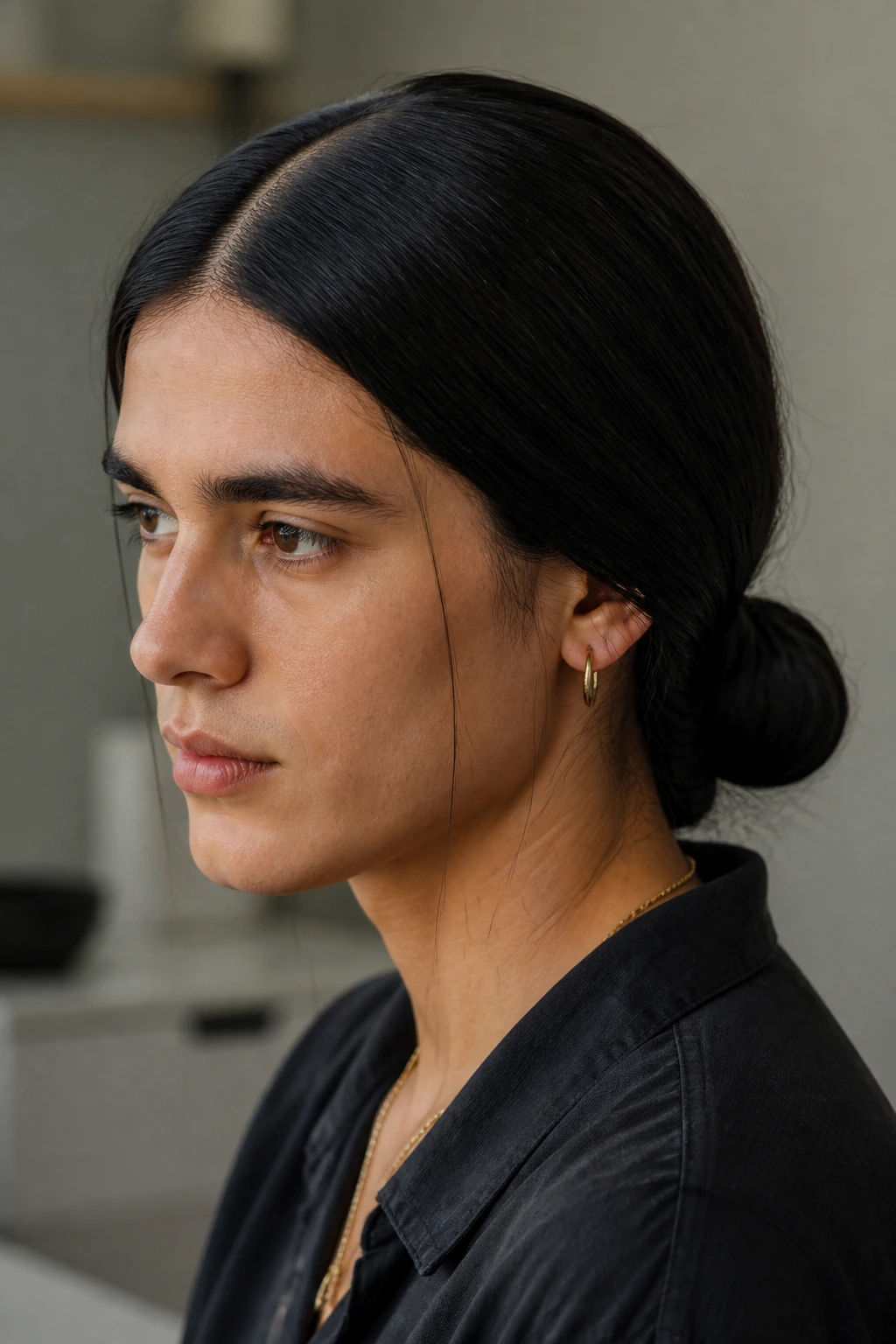
A center part gives this style its backbone, and the low knot does the rest. Thick hair sits neatly at the nape here, where the weight feels controlled instead of puffed out at the crown. It’s one of those styles that looks deliberate even when you made it in four minutes and a haze.
Start by drawing the part straight back with the tail of a comb, then smooth the top with your hands or a paddle brush. Gather the hair low, twist it once or twice, and wrap it into a compact knot. If your hair is very dense, split the ponytail into two sections and cross them over each other before tucking—one knot becomes two smaller anchors, and the style holds better.
Use two bobby pins in an X shape if the knot feels like it wants to slide. That tiny extra step saves the whole look.
2. Claw-Clip French Twist
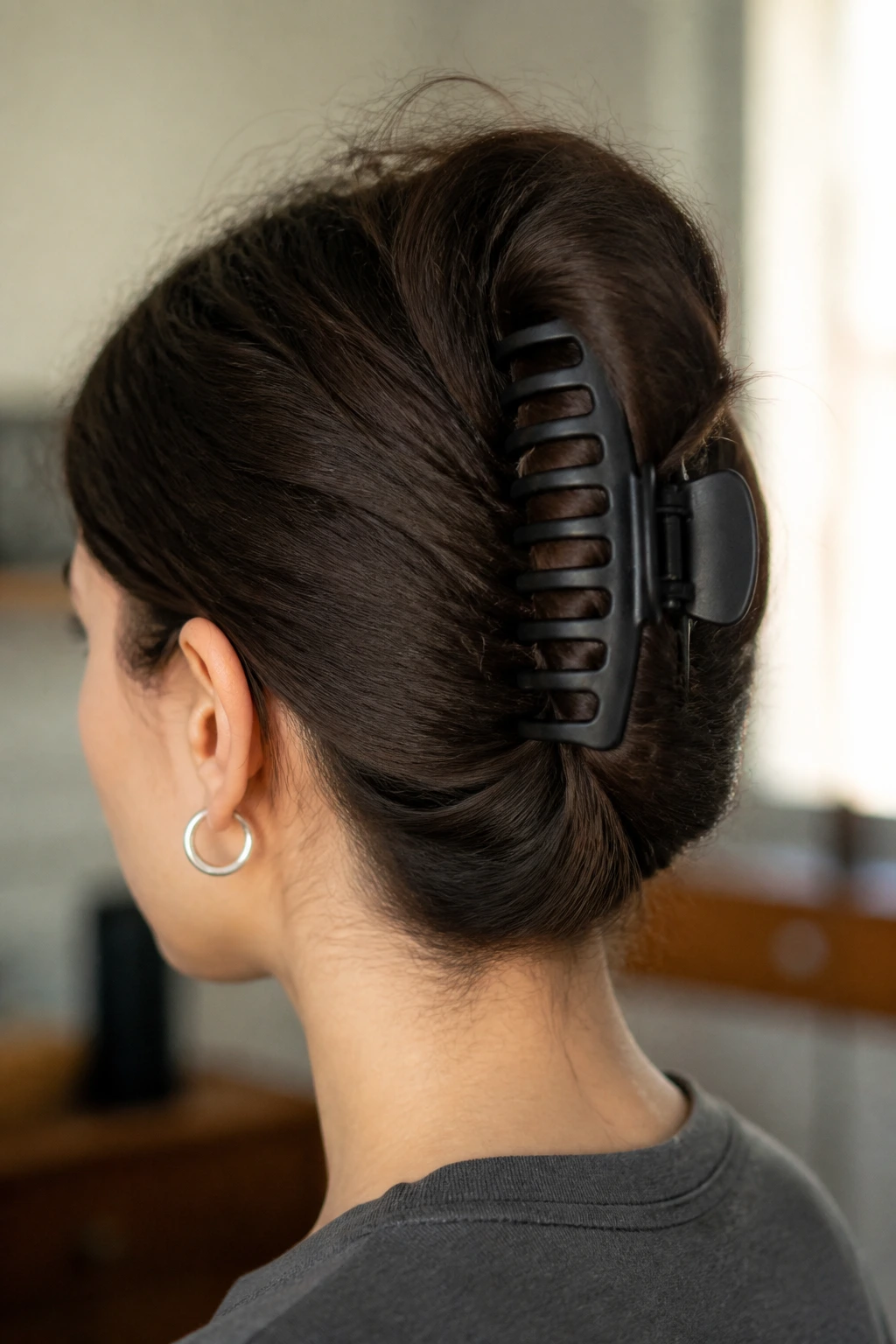
This is the lazy person’s polished style, and I say that with respect. A big claw clip can hold thick hair shockingly well if the twist is tight before the clip goes in. The silhouette is clean at the top and softly folded at the back, which gives it that slightly sharp, slightly undone read a lot of enby looks live in.
Brush the hair back, gather it at mid-back, and twist upward until the ends fold inward. Then slide a large clip vertically over the twist so the teeth catch both the twist and the hair underneath. If you have shoulder-length dense hair, leave a little tail out at the bottom; it keeps the twist from becoming a flat blob.
Best detail: pick a claw clip with long teeth and a strong hinge. Decorative clips with shallow jaws look nice for photos and fail by lunch.
3. High Puff with Clean Edges
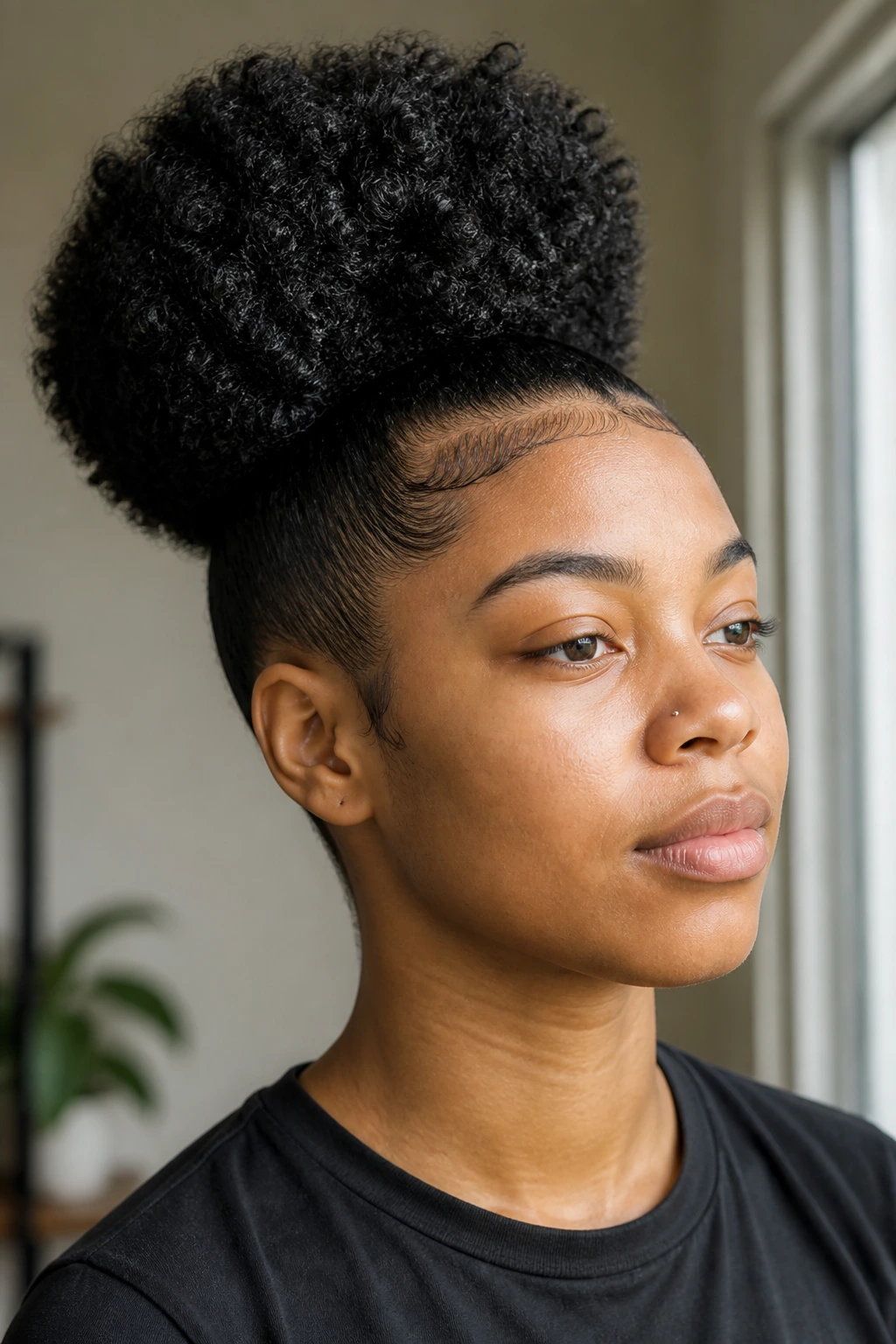
For curly and coily thick hair, this is one of the fastest ways to get shape without flattening the texture. The puff gives height and balance, while the edges keep the front from looking fuzzy or unfinished. It can read masculine, soft, or somewhere in the middle depending on how much you smooth the hairline.
Mist the roots lightly, then use a gel or styling cream at the front and temples. Gather the hair high with a soft band, not a tight rubber band, and let the puff bloom where it wants to. If you want a more compact outline, stretch the base a little tighter and smooth the sides with a brush; if you want a looser read, leave the puff fuller and skip the hard edge work.
Thick hair does the hard work for you here. The shape comes from volume, not precision.
4. Double Dutch Braids into Low Ends
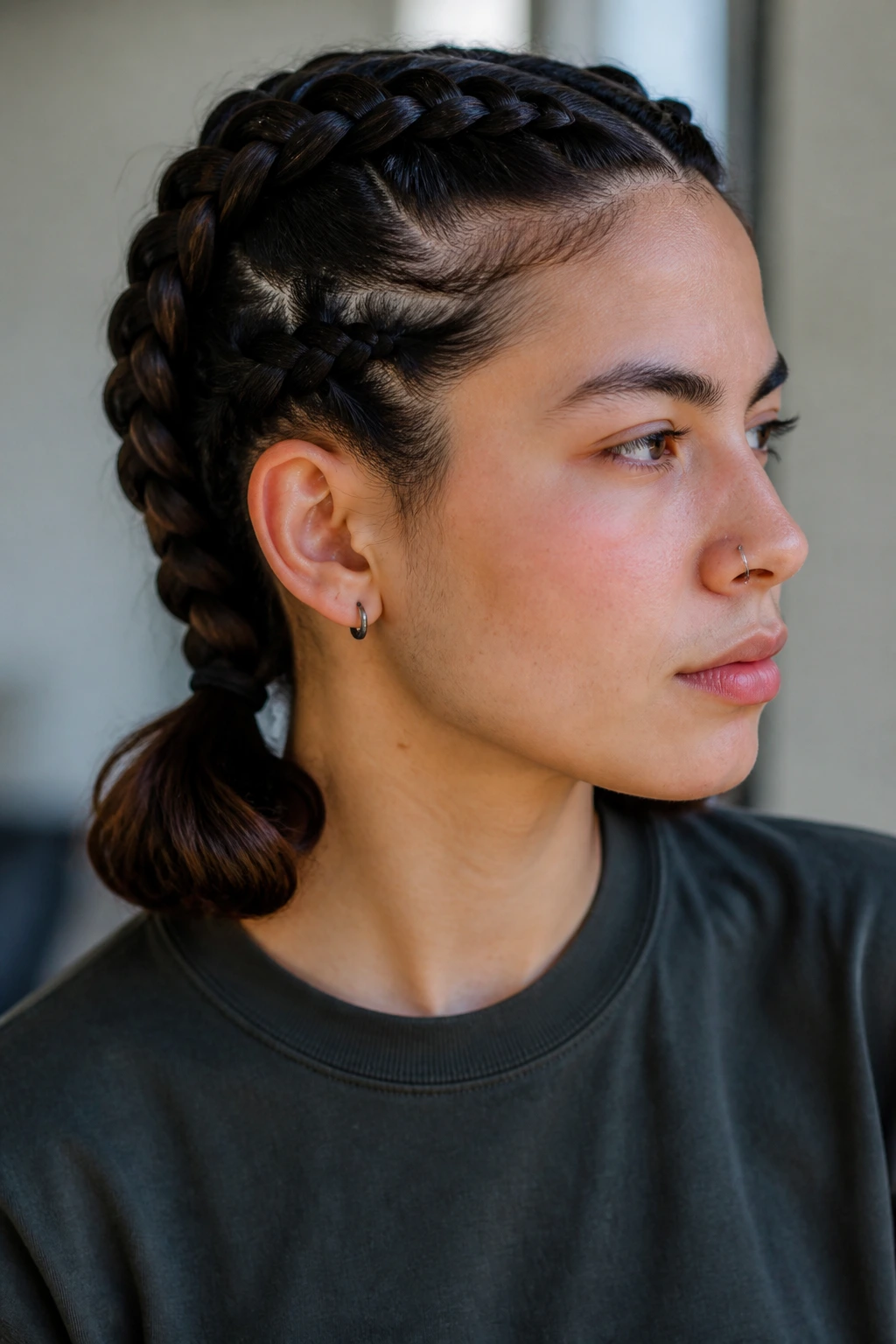
Two braids divide the weight, and that alone makes this style a favorite on thick-hair mornings. It keeps the bulk close to the head, which means fewer flyaways at the sides and less of that wide, triangular finish thick hair can get when it’s left loose. Once the braids are in, you can leave the ends hanging, tie them off low, or tuck them into tiny buns.
Part the hair down the center and braid each side tightly along the scalp. If your hair is extremely dense, use larger sections rather than tiny ones; tiny sections sound neat in theory and turn into a slow, frustrating mess in practice. After the braid reaches the nape, keep going normally and secure the ends with snag-free elastics.
This style is especially good on days when you want the face and neck clear but still want something with structure. It survives a hoodie well. So does a bike helmet, which is not nothing.
5. Bubble Ponytail
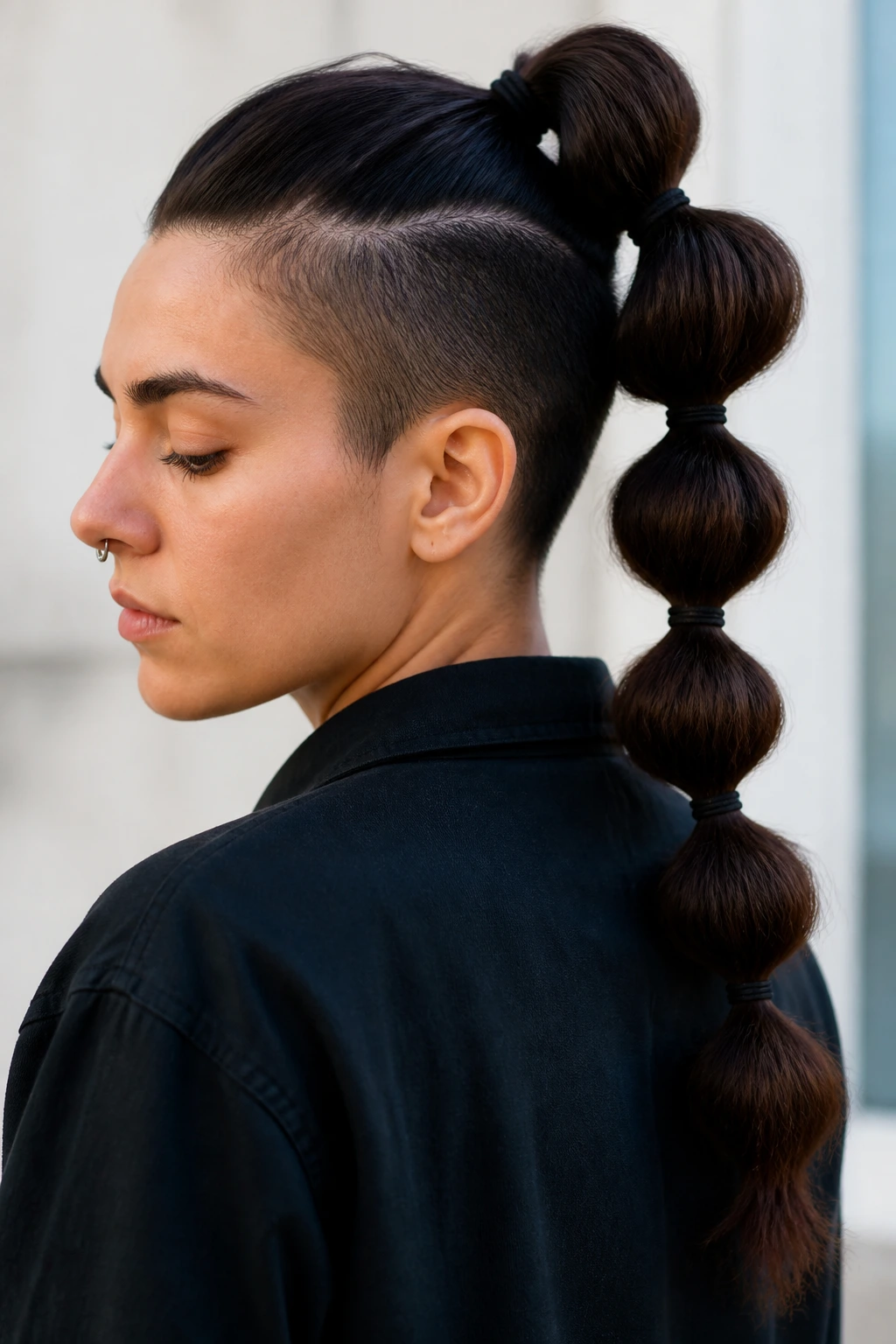
A bubble ponytail gives thick hair a shape that regular ponytails rarely manage. Instead of one long lump of hair hanging from a single elastic, the sections break the length into rounded shapes that actually look intentional. Thick hair makes the bubbles fuller and more defined, which is half the appeal.
Gather the hair into a low or mid ponytail and secure it firmly. Add another elastic about 2 to 3 inches down, then another, until you run out of length. Tug gently on each section between the elastics to puff it out into bubbles. Don’t yank the hair apart like you’re trying to make it bigger on purpose; just pull the sides evenly until the shape looks rounded.
If you want the look to lean softer, leave a few front pieces out. If you want it sharper, slick the top first and keep the bubbles crisp.
6. Half-Up Top Knot
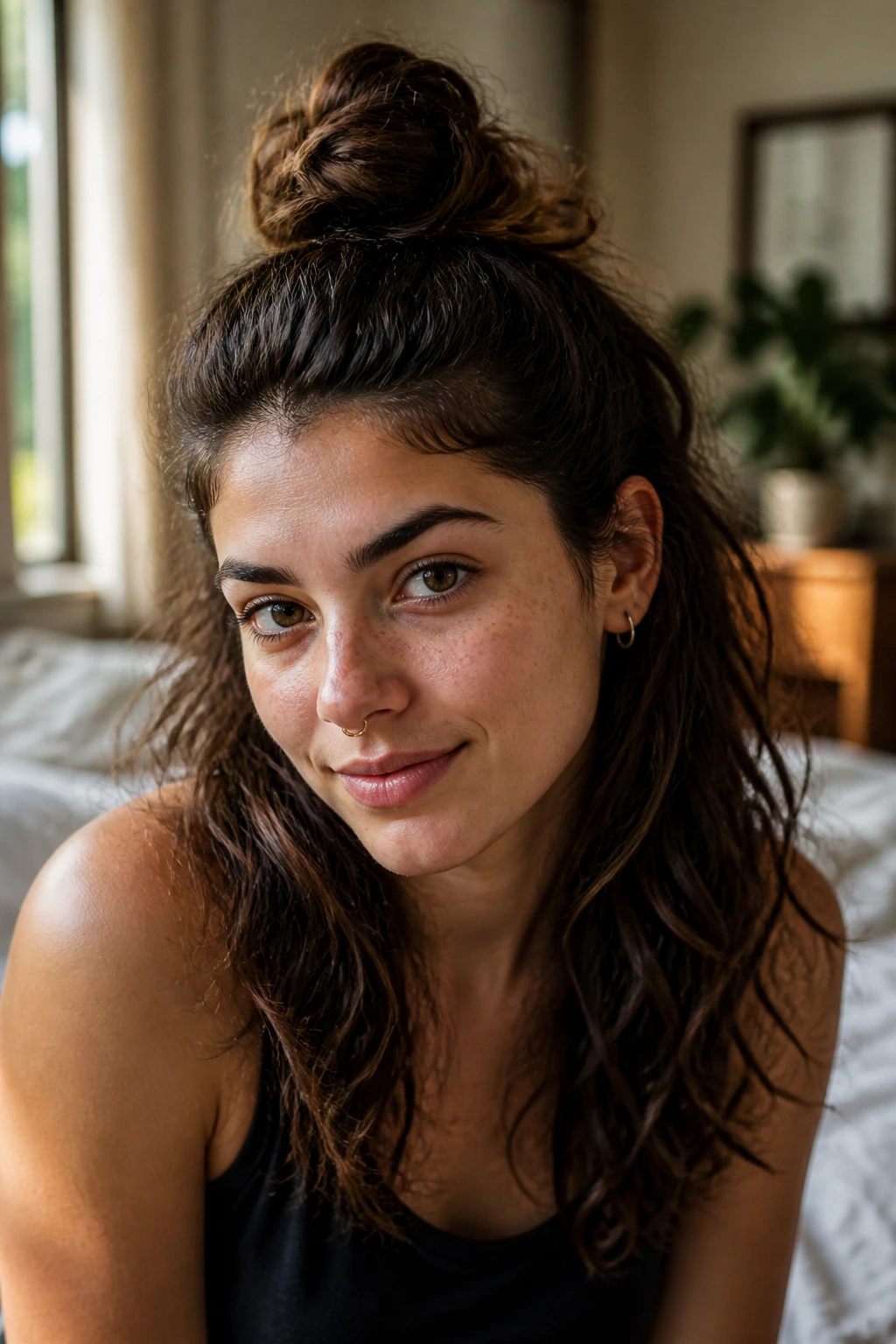
This one is a gift on mornings when you can’t deal with all the hair, but you also don’t want it fully pinned away. The half-up top knot gives you control up front while letting the weight of the rest of the hair stay down. Thick hair makes the knot look substantial instead of scrappy.
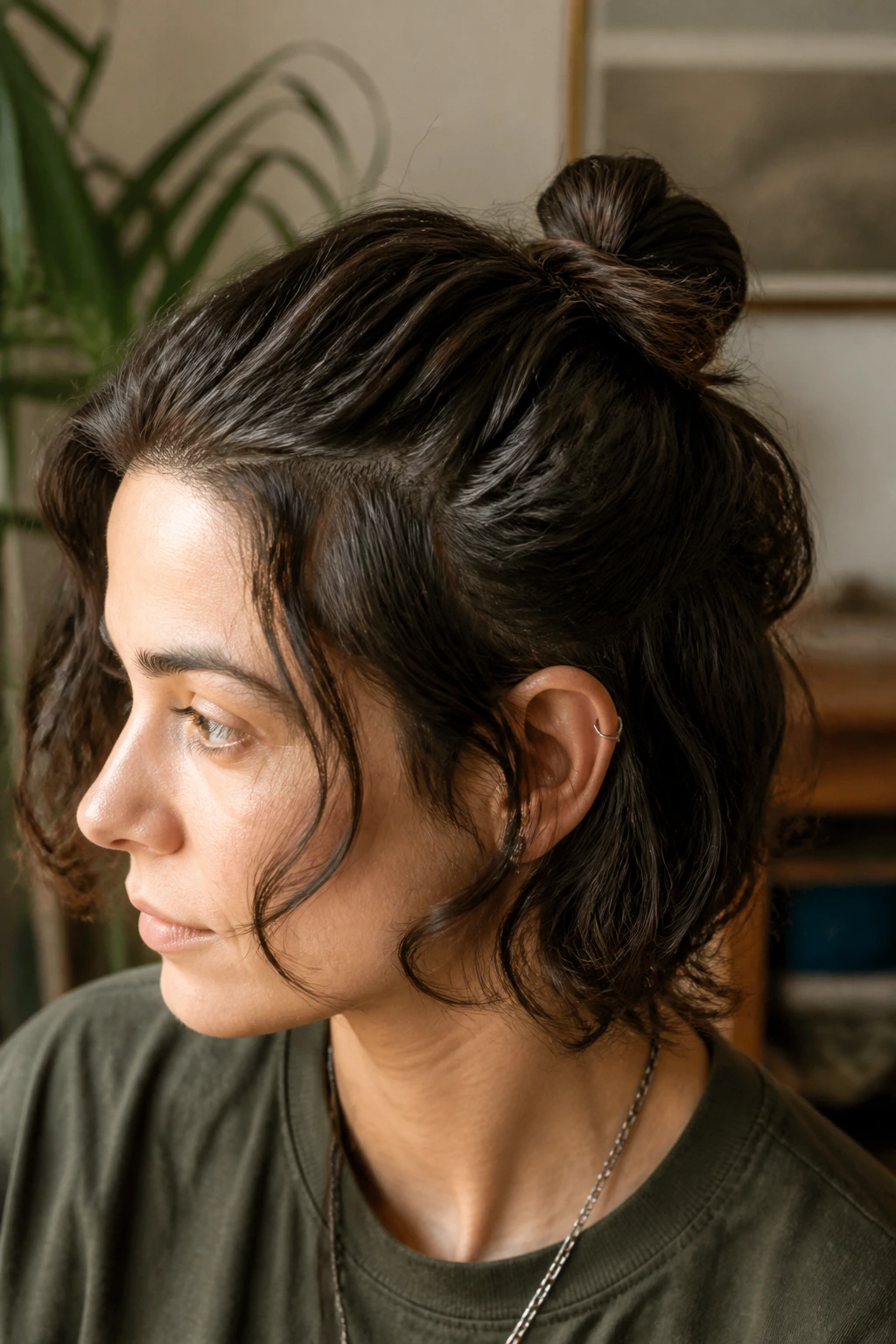
Take the top third of your hair—from temples to crown—and gather it high. Twist it into a knot and secure it with an elastic, a pin, or a small clip depending on how heavy the section is. If your hair keeps slipping, wrap the knot once more and pin it from both sides.
What I like here is the balance. The top stays out of your face, the bottom keeps some movement, and the whole thing has a clean outline without looking overworked.
7. Rope-Braid Ponytail
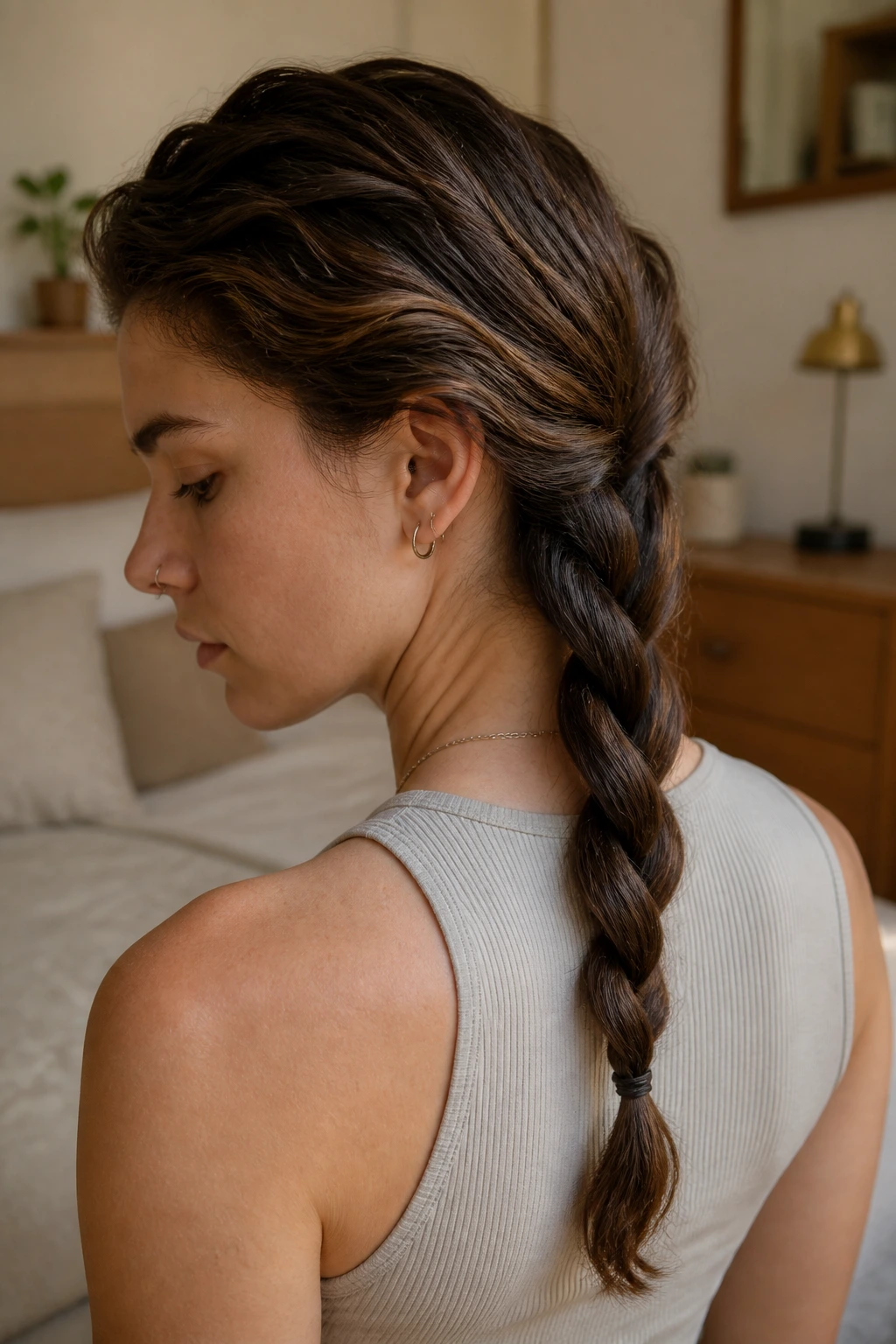
A rope braid is one of the most forgiving styles for thick hair because it doesn’t require perfect finger work. Two twisted sections wrapped around each other create a tidy rope-like line that holds well and looks more detailed than it actually is. If your hair is layered or a little slippery, this style still behaves.
Pull the hair into a low or mid ponytail. Split the pony into two sections, twist each section in the same direction, then wrap them around each other in the opposite direction. Secure the end with a small elastic, and gently pinch the braid to loosen it if you want a fuller shape.
It’s a nice middle-ground style: neither too plain nor too fussy. And it takes less time than most people assume, which is always pleasant news at 7:15 a.m.
8. Slicked-Back Low Ponytail
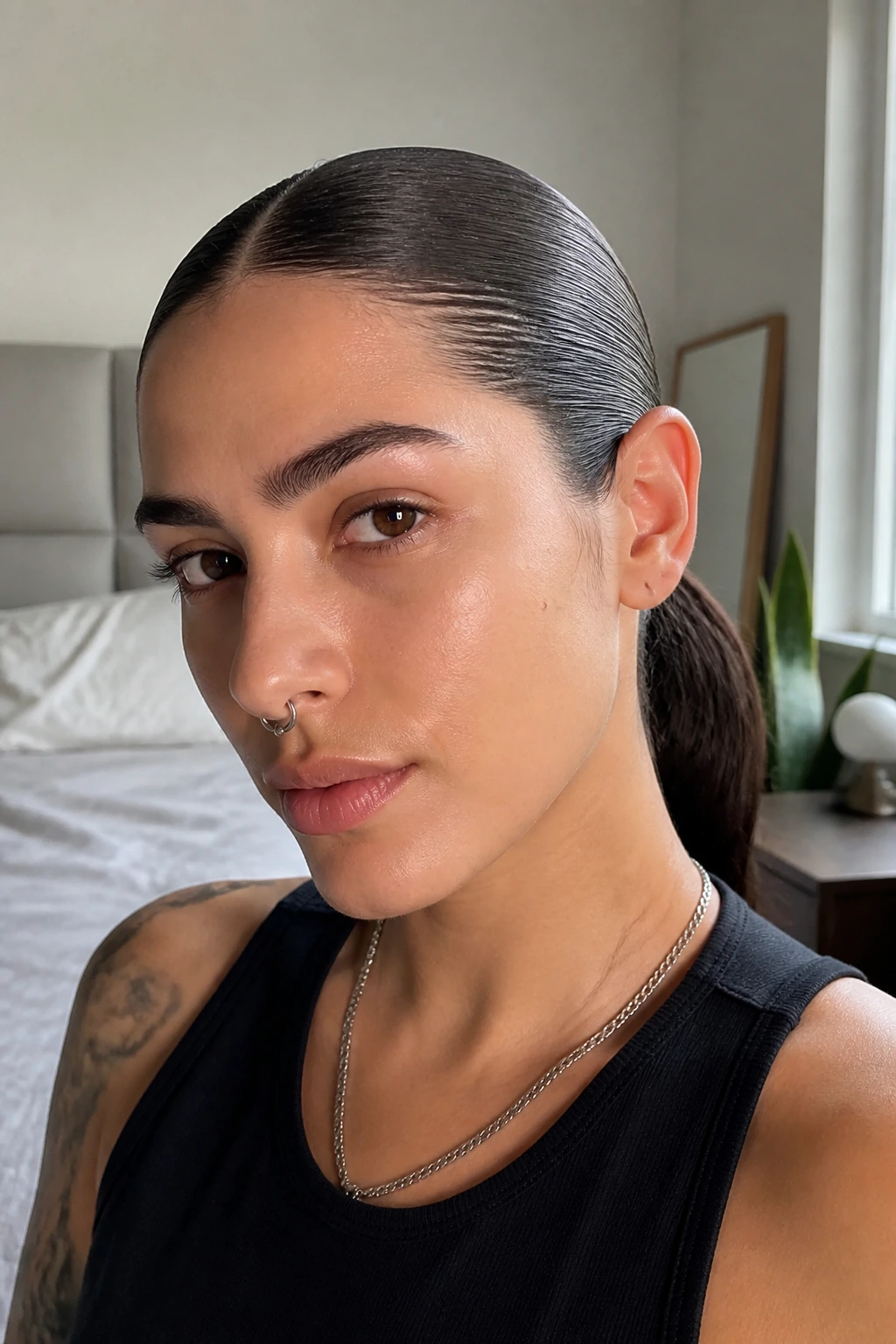
This is the cleanest look in the group, and it can be stunning on thick hair when the top is smoothed down properly. The trick is not to flatten everything into submission. You want controlled roots and a ponytail that still has body and shine.
Use a little gel or styling cream at the front and along the part, then brush the hair back to the nape. Secure it low, and wrap a thin strand around the elastic if you want the finish to look more deliberate. Thick hair often benefits from a strong brush here—something with enough stiffness to guide the top layer without breaking your patience.
A low pony like this works well with sharp collars, earrings, and glasses. It reads crisp. Not severe. Just crisp.
9. Loose Side Braid with a Tucked End
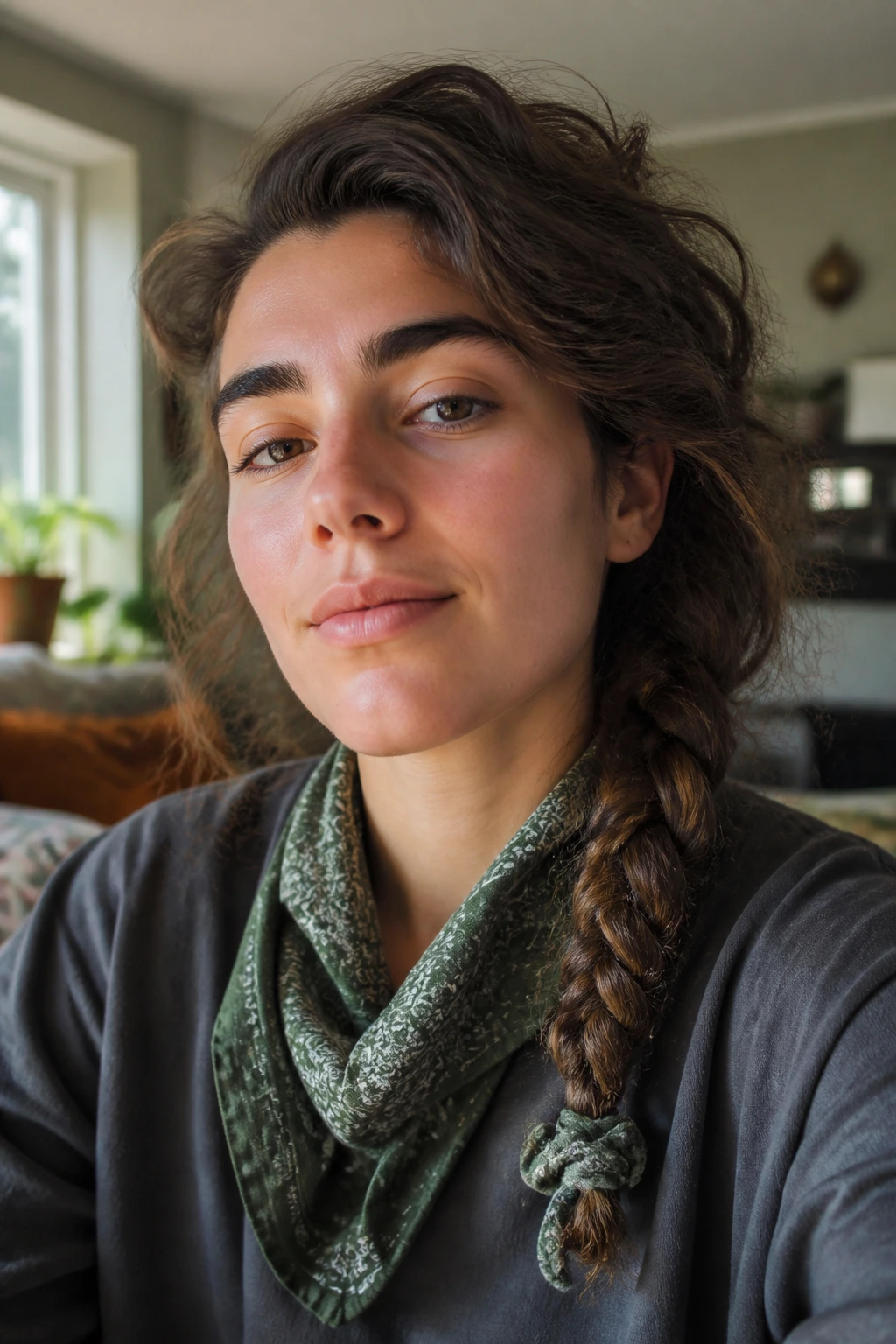
Side braids can go very soft, very quickly, which is why the trick is keeping the braid low, loose, and a little dense. Thick hair gives the braid enough body that it does not need to be overworked. You get shape, movement, and a quiet asymmetry that feels easy without looking sloppy.
Sweep the hair to one side and braid it loosely over the shoulder. Secure the end low, then tuck the tip into a scarf, jacket collar, or under the braid itself if the length allows. If the braid starts to balloon too much, stop pulling on it—thick hair tends to widen on its own, and that’s usually enough.
This style is a good choice when you want your face open but don’t want to do a full updo. It also tends to look better on day-two hair than on squeaky-clean hair, which is a useful little bonus.
10. Space Buns with a Center Part
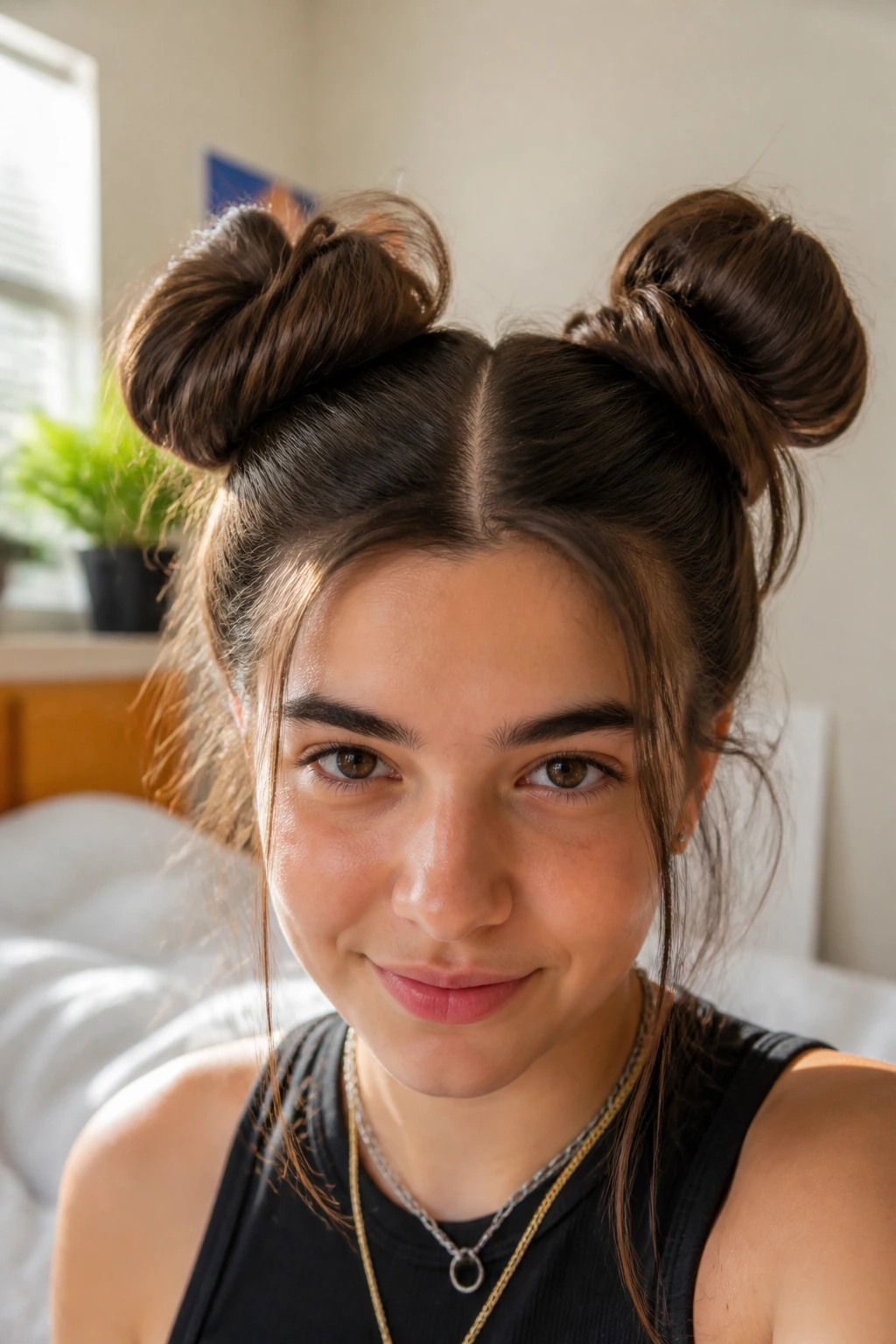
Space buns can read playful, sharp, or very neutral depending on how you finish them. On thick hair, they look best when they’re not tiny. Tiny buns get swallowed by the volume. Bigger buns, set with a center part, give the head a clean, balanced shape.
Part the hair down the center and split it into two equal sections. Twist each side into a bun at the height you like—high for a more visible shape, mid-height for a calmer one. If the ends are long, wrap them around the bun; if they’re shorter, let them peek out for texture. Secure with pins or elastics, then check the back in a mirror because the back of this style matters more than people think.
If you want the look less playful and more polished, keep the parts straight and the buns tight. If you want it softer, loosen the edges a little and leave a few pieces around the ears.
11. Flat Twists into a Low Bun
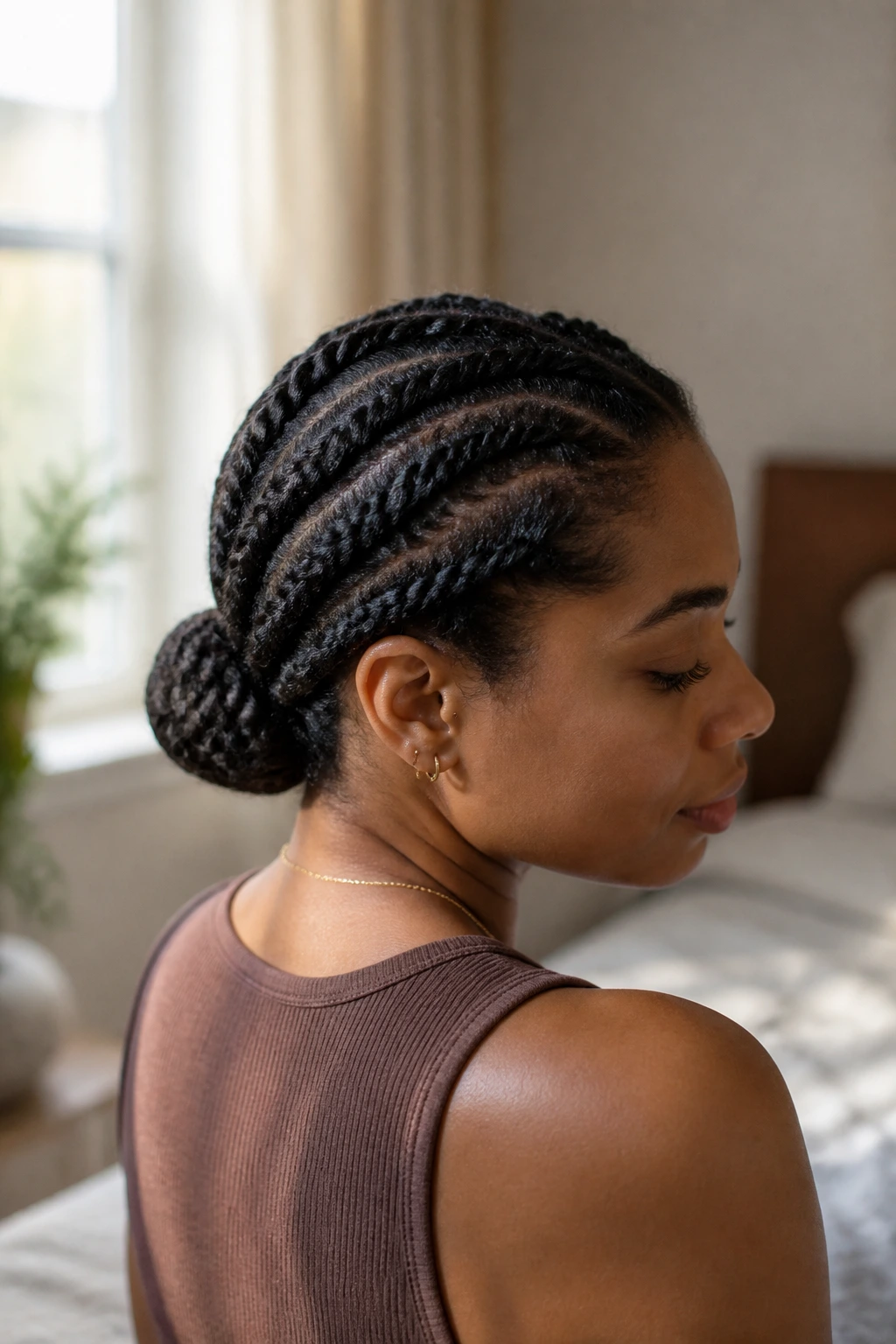
Flat twists are a smart answer for thick curly or coily hair that needs to stay tucked and neat. They sit close to the head, which means less bulk around the face, and they protect the ends by folding them into a low bun. This is the kind of style that makes day three hair look planned.
Section the hair into two, three, or four rows depending on how much control you want. Twist each row close to the scalp, then bring the ends together into a low bun at the nape. A twisting cream or leave-in with good slip makes the whole thing easier, especially if your hair gets dry at the roots.
The finished look is tidy without being stiff. It’s practical. It also buys you time between wash days, which is one of the main reasons to learn it.
12. Half-Up Claw Clip Sweep
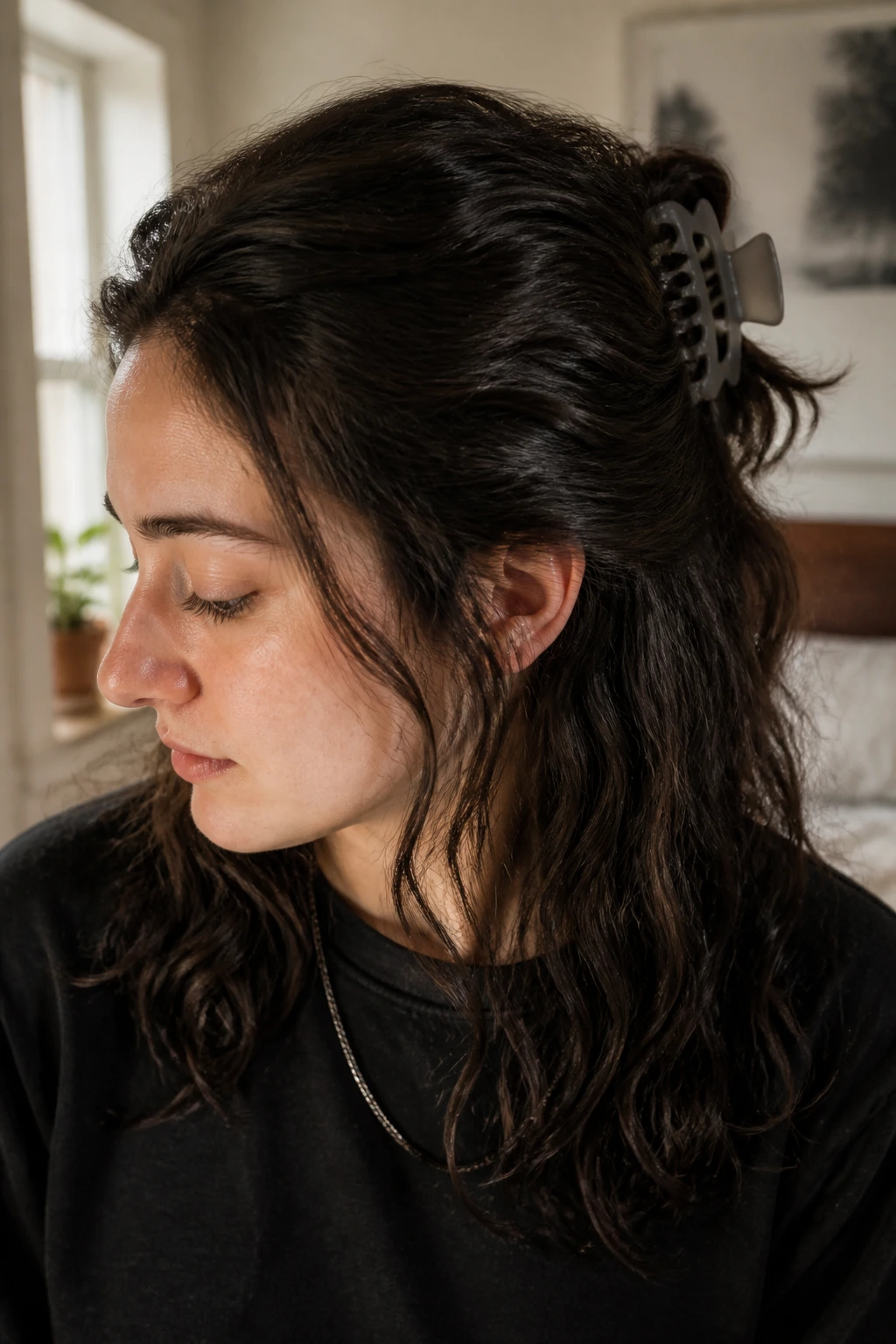
If you’ve got thick hair and not enough time to negotiate with every strand, this is the move. A half-up sweep gets the top and sides out of your face while leaving the length down, which is the kind of compromise a weekday morning usually asks for. The clip does not need to be decorative. It needs to hold.
Gather the top section from temple to temple, twist it backward, and clip it at the back of the head. Thick hair often needs a larger clip than people expect—something with deep teeth and a hinge that closes with a little force. If the clip only grabs the top layer, it will drift down by lunchtime.
The appeal here is that it works whether the hair is blow-dried, air-dried, or somewhere in between. It also looks better the less you fuss with it.
13. Headband Tuck with Soft Volume
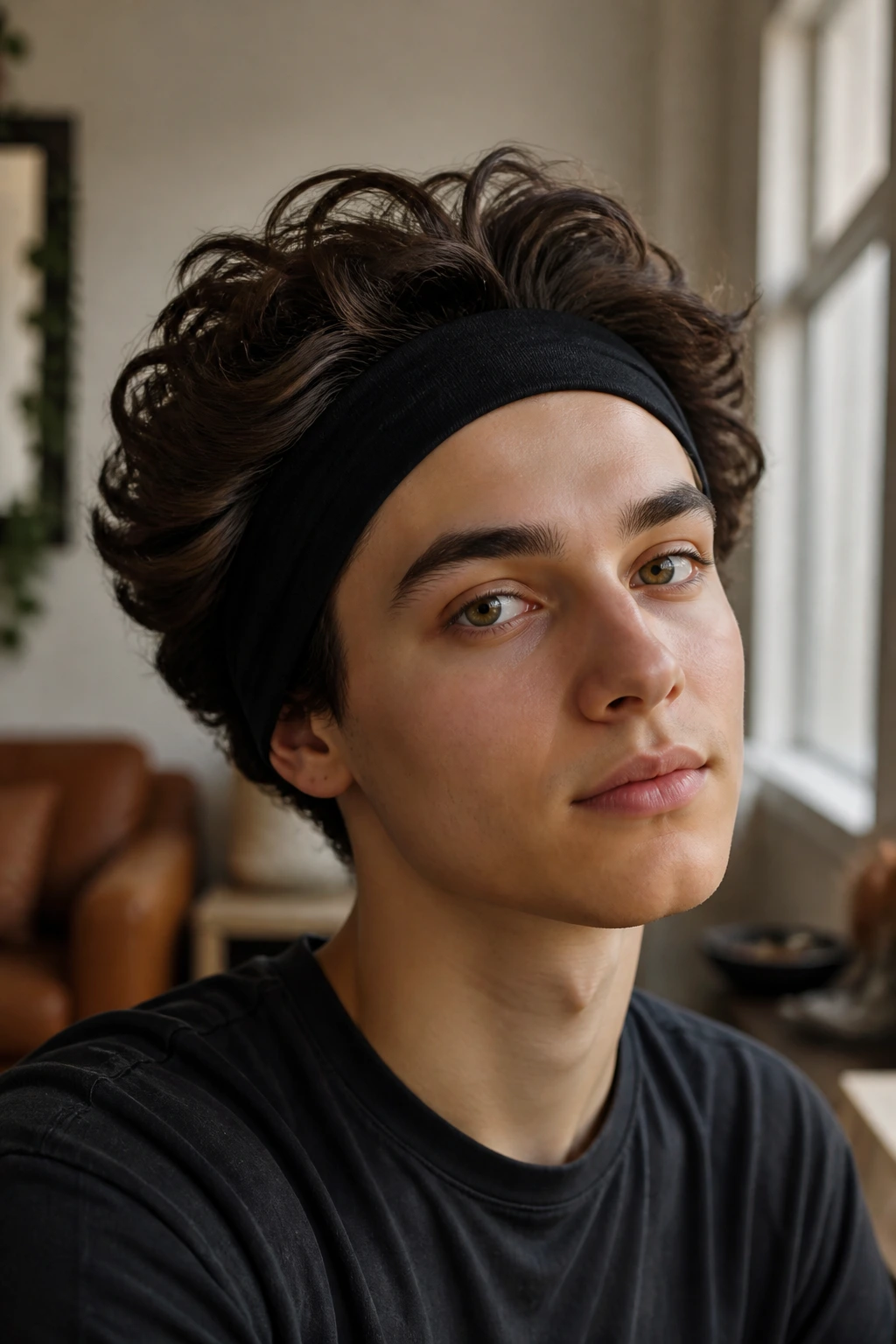
This one is especially useful when the hair is shoulder-length or a little longer and you want the neck clear without forcing the whole mass into a bun. A headband tuck takes thick hair and folds it inward so the result feels calm, not collapsed. There’s something a little old-school about it, but in a good way.
Put on a stretchy headband or scarf, then tuck the lengths up and under the band in sections. Leave a little crown volume if you want the style to feel less compressed. If your hair is too thick to stay tucked on its own, pin a few pieces near the nape before you wrap the rest.
It’s a nice style for sweaters, big earrings, and days when you want softness around the face. It also handles second-day texture well, which is worth repeating.
14. Faux Hawk Pony with Mini Elastics
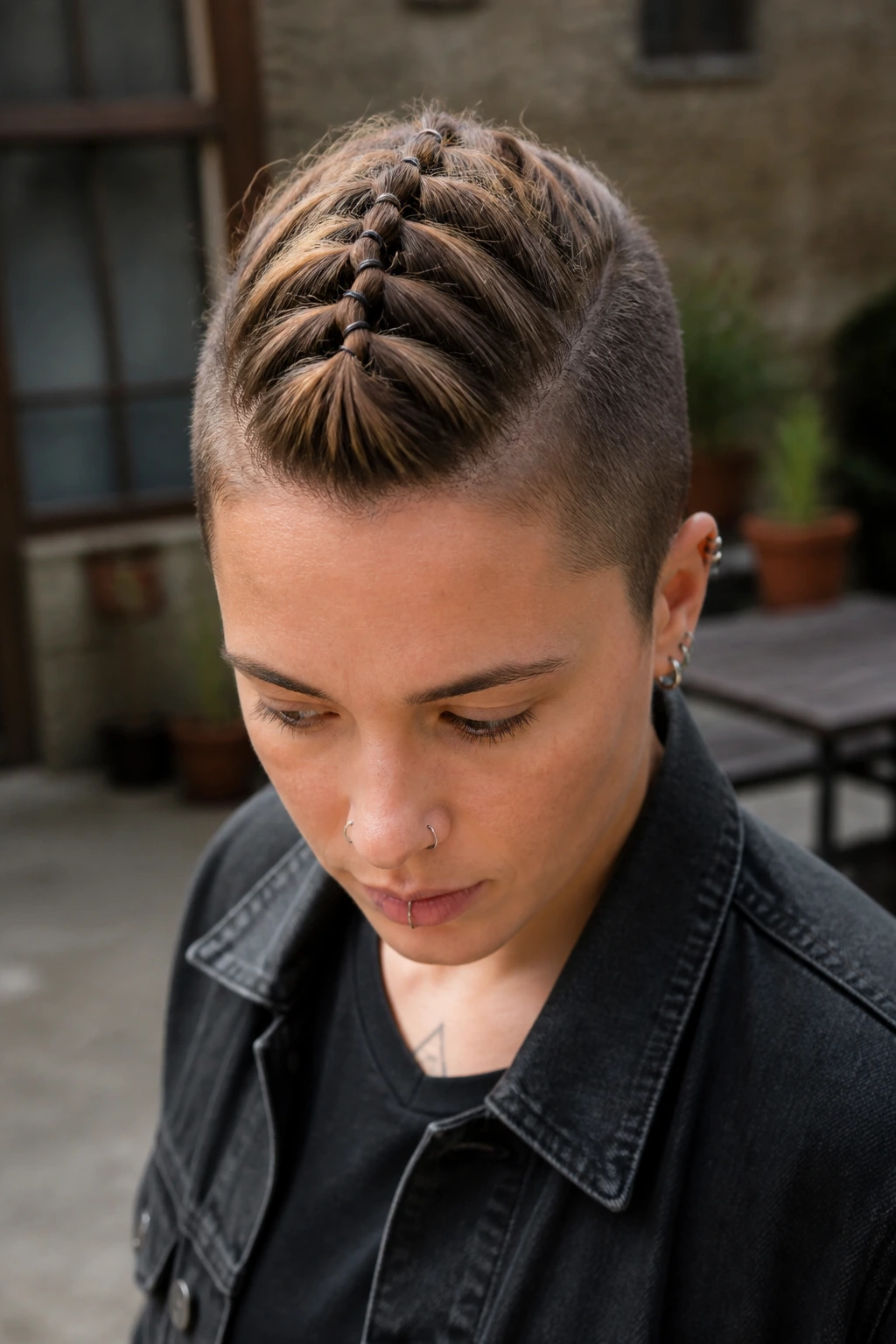
This is the style for when you want a little edge without committing to a full dramatic shape. A faux hawk built from tiny ponytails creates a central ridge that thick hair fills out nicely. The sides stay flatter, the center gets the attention, and the whole thing reads clean in a slightly bold way.
Start at the hairline and make a line of small ponytails down the middle of the head. After each section is secured, puff it gently before moving to the next one. You can leave the sides brushed back or pin them if they keep escaping. Five to seven mini elastics are usually enough, depending on length.
It works especially well on textured hair because the sections give the style structure without requiring perfect smoothness. A little mess is fine. A lot of texture is fine too.
15. Folded Loop Ponytail
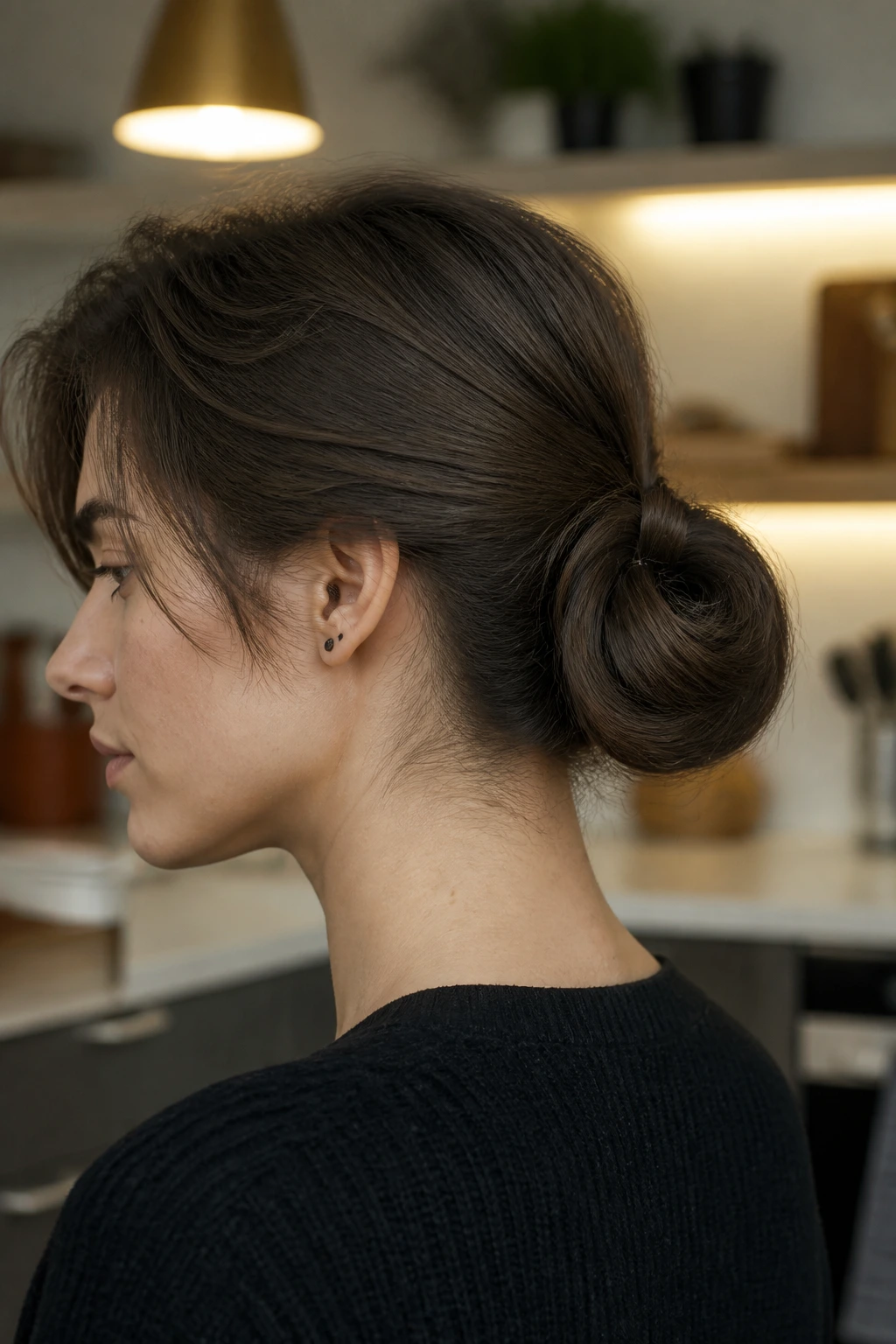
This is one of those styles that looks like you put effort in when, honestly, you mostly just changed the last three seconds of a ponytail. Tie the hair into a low or mid ponytail, then pull the ends halfway through on the final wrap so a loop forms. The shape sits somewhere between a bun and a pony, which is a useful place for thick hair to live.
The loop gives the style volume without the weight of a full knot. If your hair is very long, the loop may want to droop a little; fix that with a couple of pins at the base. For a cleaner finish, smooth the top before you tie it. For a looser one, leave the crown a bit airy and let the loop be the main event.
It’s fast, practical, and not fussy. Those three traits matter more than people admit.
16. Halo Braid Headband
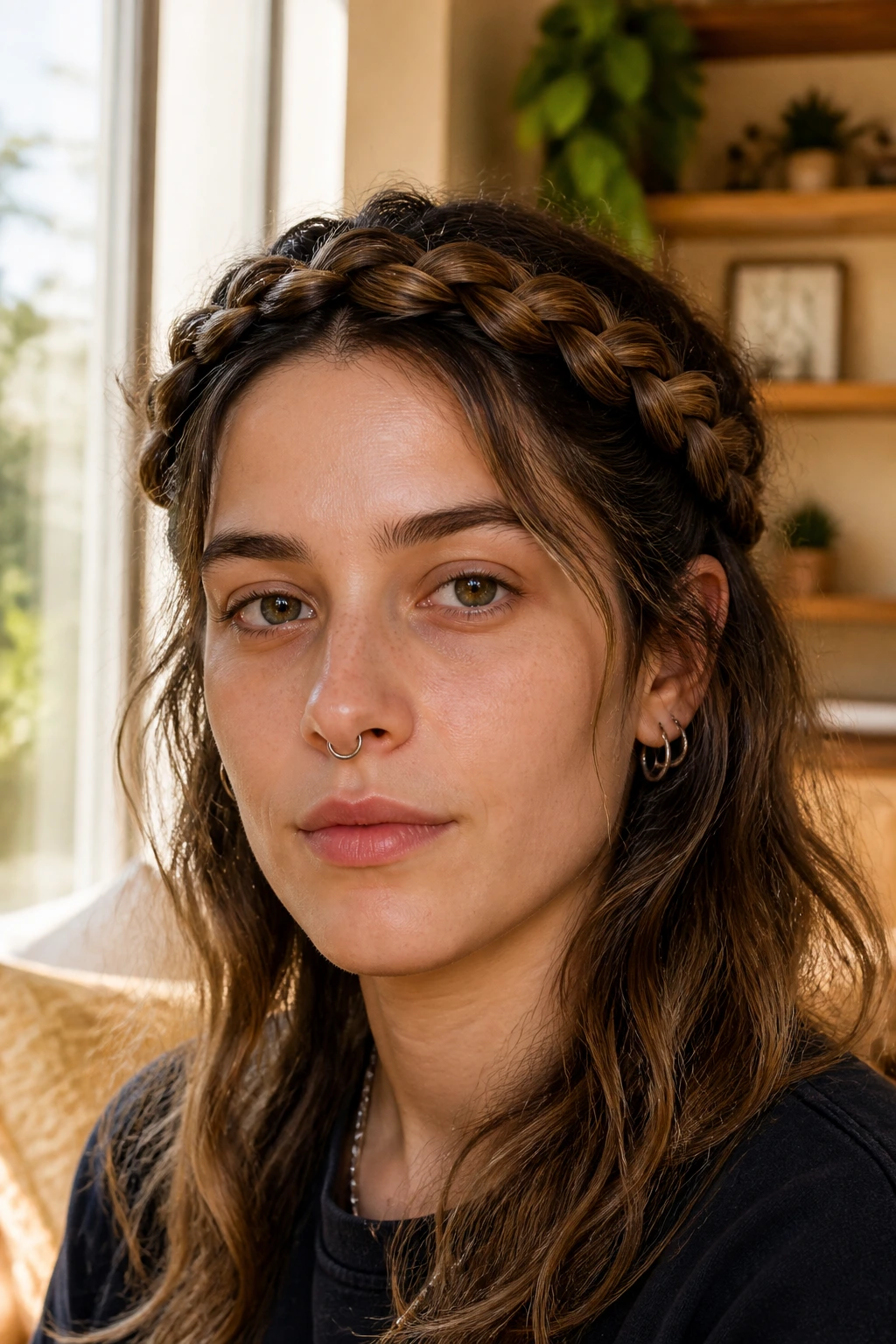
A halo braid keeps the front tidy and leaves the rest free, which makes it one of the smartest thick-hair styles for mornings that start badly. It also has a built-in shape that sits nicely around the face, almost like a headband made from your own hair. The braid gives enough detail that you do not need much else.
Take a section near one ear, braid it across the front hairline toward the other side, and pin it behind the opposite ear. If your hair is dense, a one-inch to one-and-a-half-inch section is usually enough to make the braid visible. Keep the braid loose on top so it does not pull the scalp or look too severe.
This is a style that works with glasses, earrings, and collars because it keeps the front controlled without crowding the face. It reads finished without eating your morning.
17. Top Knot with Face-Framing Pieces
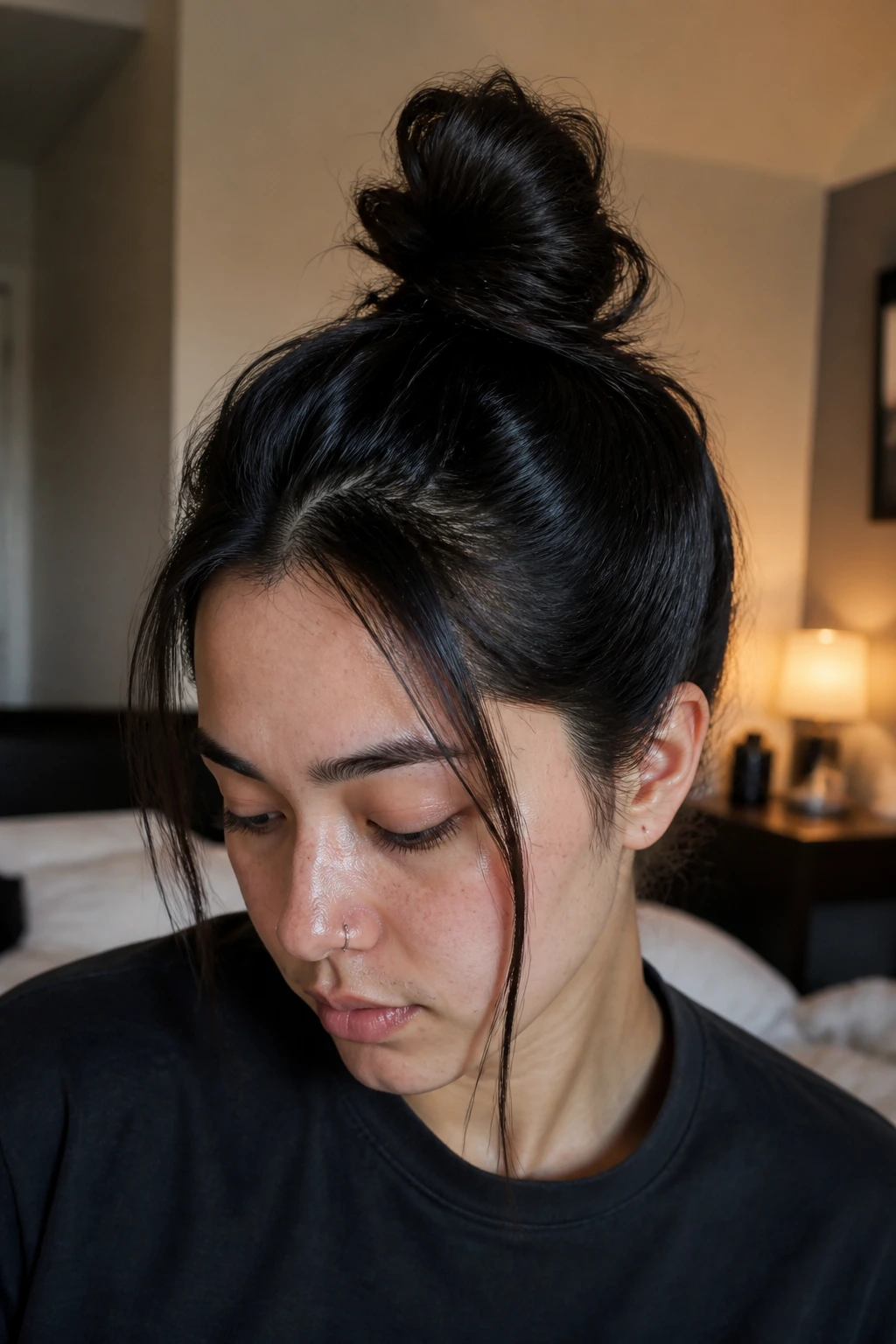
A full top knot can be a lifesaver on the days when thick hair wants to occupy every inch of your shoulders. Leaving two slim face-framing pieces softens the shape just enough that it does not feel harsh. That small detail changes the whole mood.
Gather all the hair high, twist it into a knot, and secure it well. Pull out two narrow pieces in front—one on each side—or one longer piece if you like a more lopsided look. If those pieces are stubborn, bend them with a little water and product or a quick pass of heat.
The knot itself should be secure and compact. Thick hair can support a solid top knot, but it needs enough anchoring that it does not lean to one side by noon.
18. Tucked-In Scarf Bun
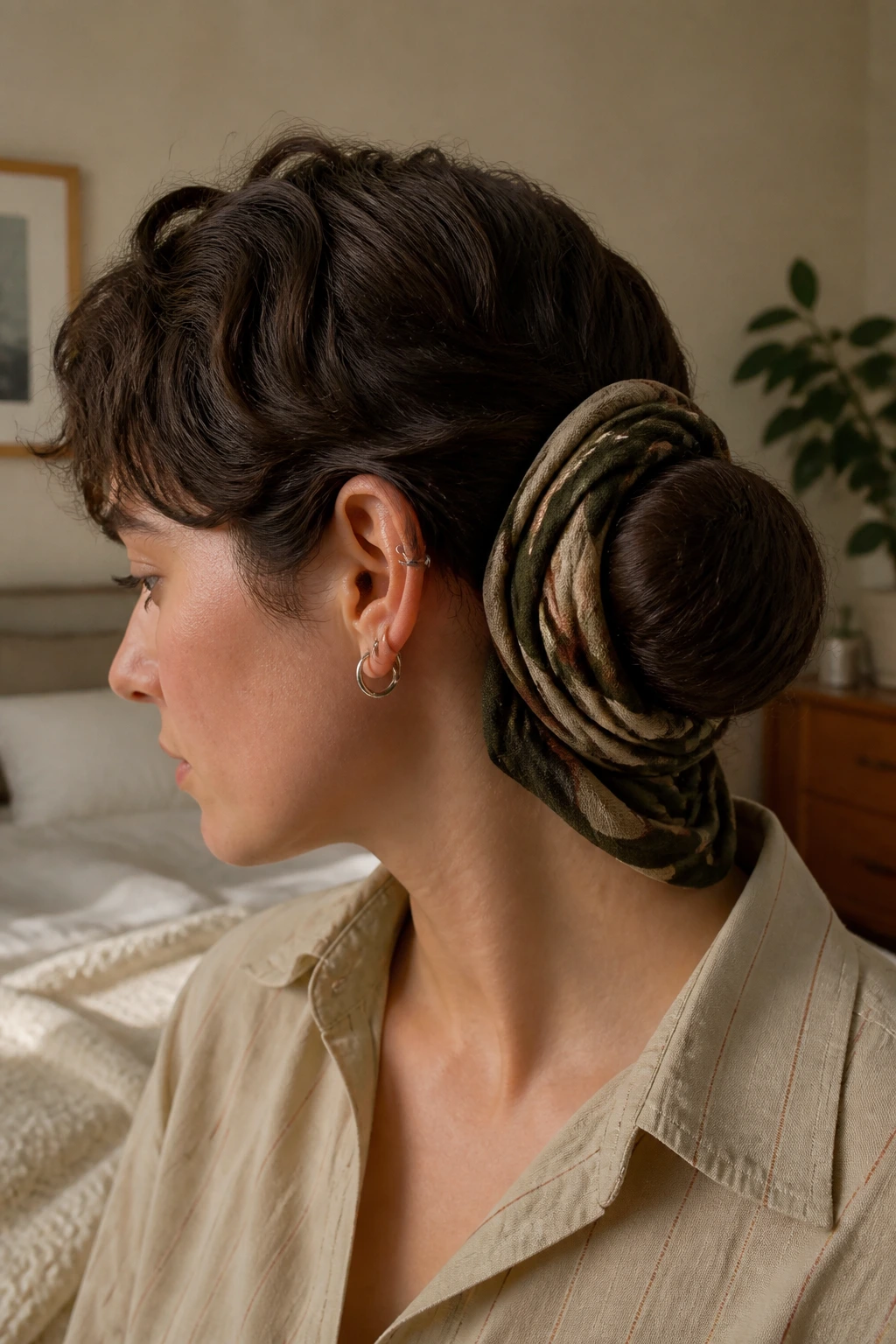
A scarf bun gives you control, texture, and a little bit of personality in one shot. It’s especially useful when thick hair is frizzy, second-day, or determined to expand the second it sees air. The scarf acts like a frame, not a cover-up.
Gather the hair into a low bun or low ponytail and wrap a square scarf or long bandana around it. Tuck the ends of the scarf in or knot them low at the nape. A silk scarf slides more; cotton grabs more. Pick the one that matches how slippery your hair is and how much control you want.
This style can look soft, sharp, or somewhere in between. It depends mostly on how neat you make the base. A clean bun under a scarf reads polished. A looser one feels more relaxed.
19. Pull-Through Braid
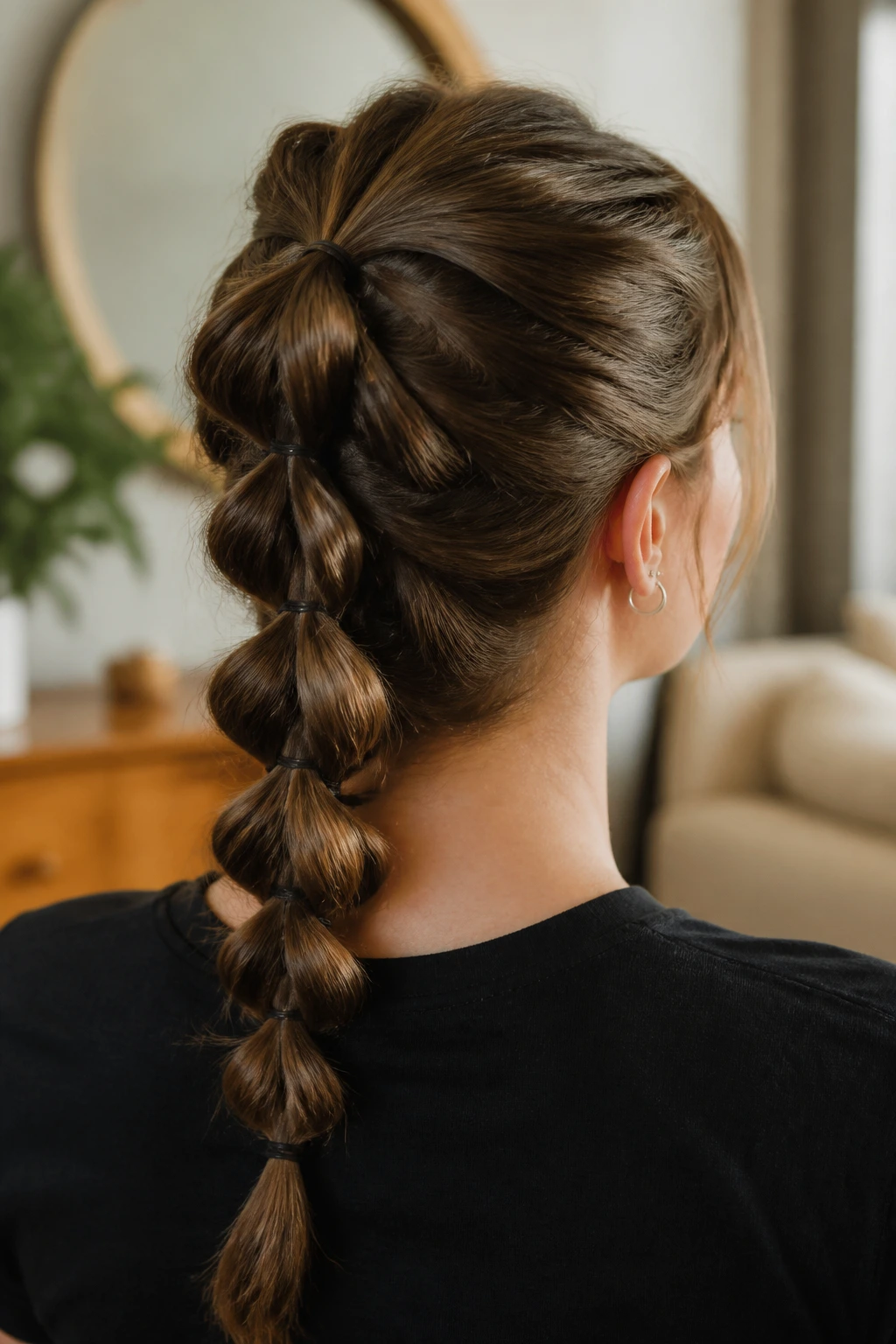
If regular braiding feels fiddly before coffee, the pull-through braid is your friend. It gives you the look of a complex braid without requiring the same finger gymnastics. Thick hair makes the sections look full and rounded, which is half the visual payoff.
Make a series of small ponytails down the back or along one side, then split and loop each section through the one below it. Secure each new section with a small elastic about 1 to 2 inches apart. Gently tug the sides of each segment to widen them a little once the chain is finished.
This style is especially good for layered hair that escapes a normal braid. The elastic-based structure keeps everything in place, and the finished braid has a more built-up, architectural look than a standard plait.
20. Mini Buns Along the Crown
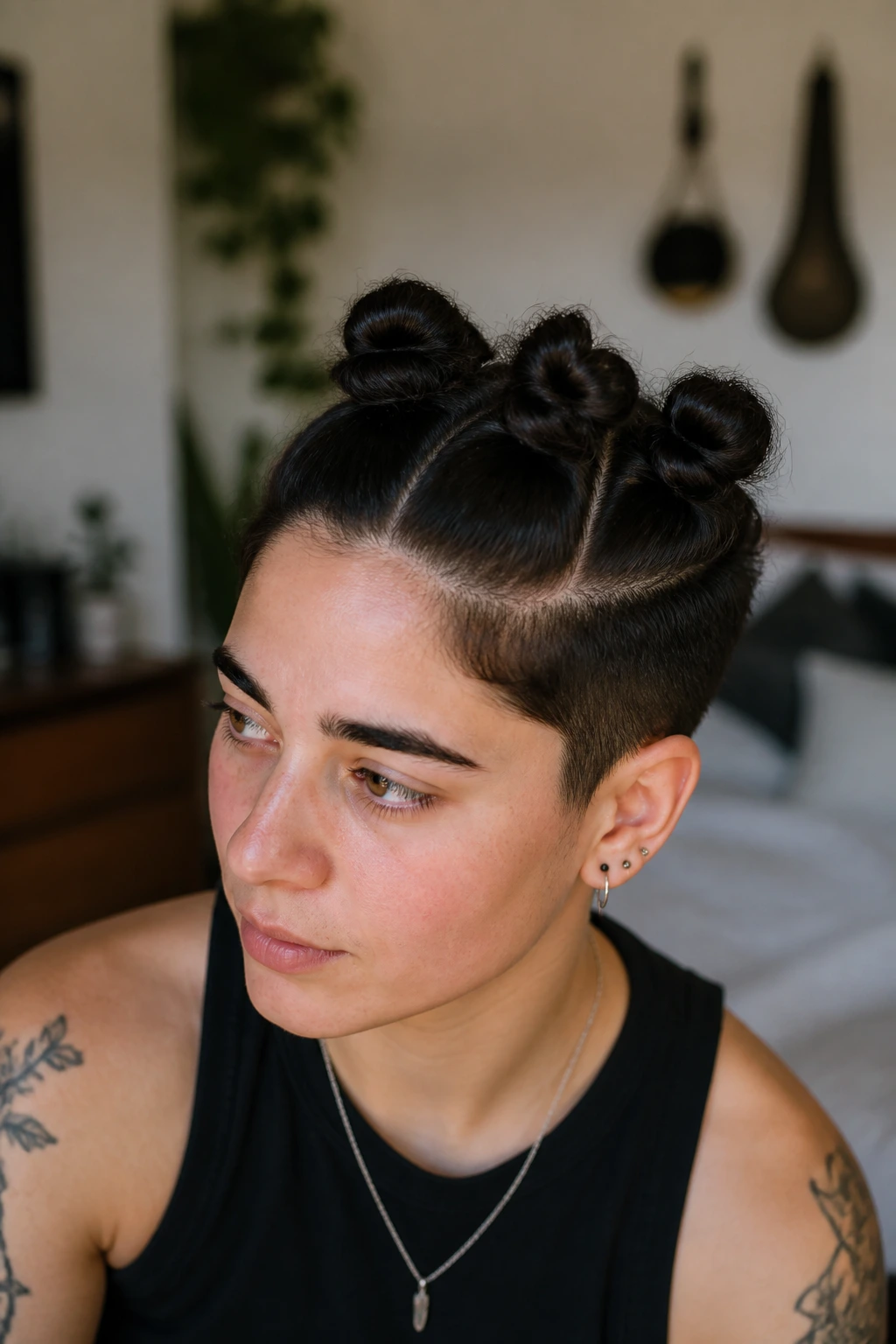
Three or four mini buns along the crown can solve the “too much hair, nowhere to put it” problem without forcing everything into one giant knot. Thick hair works beautifully here because each bun has enough volume to hold its own. Spread out the weight and the style gets easier on your scalp too.
Section the hair into horizontal bands or clean little squares, then twist each section into a small bun from front to back. Secure with pins or small elastics. The more evenly you section it, the more balanced the final shape will look.
This style can be playful, edgy, or practical depending on how tight you make the buns. Keep them neat if you want a cleaner read. Let them sit a bit looser if you want something softer and more casual.
21. Side-Parted Gel Sweep
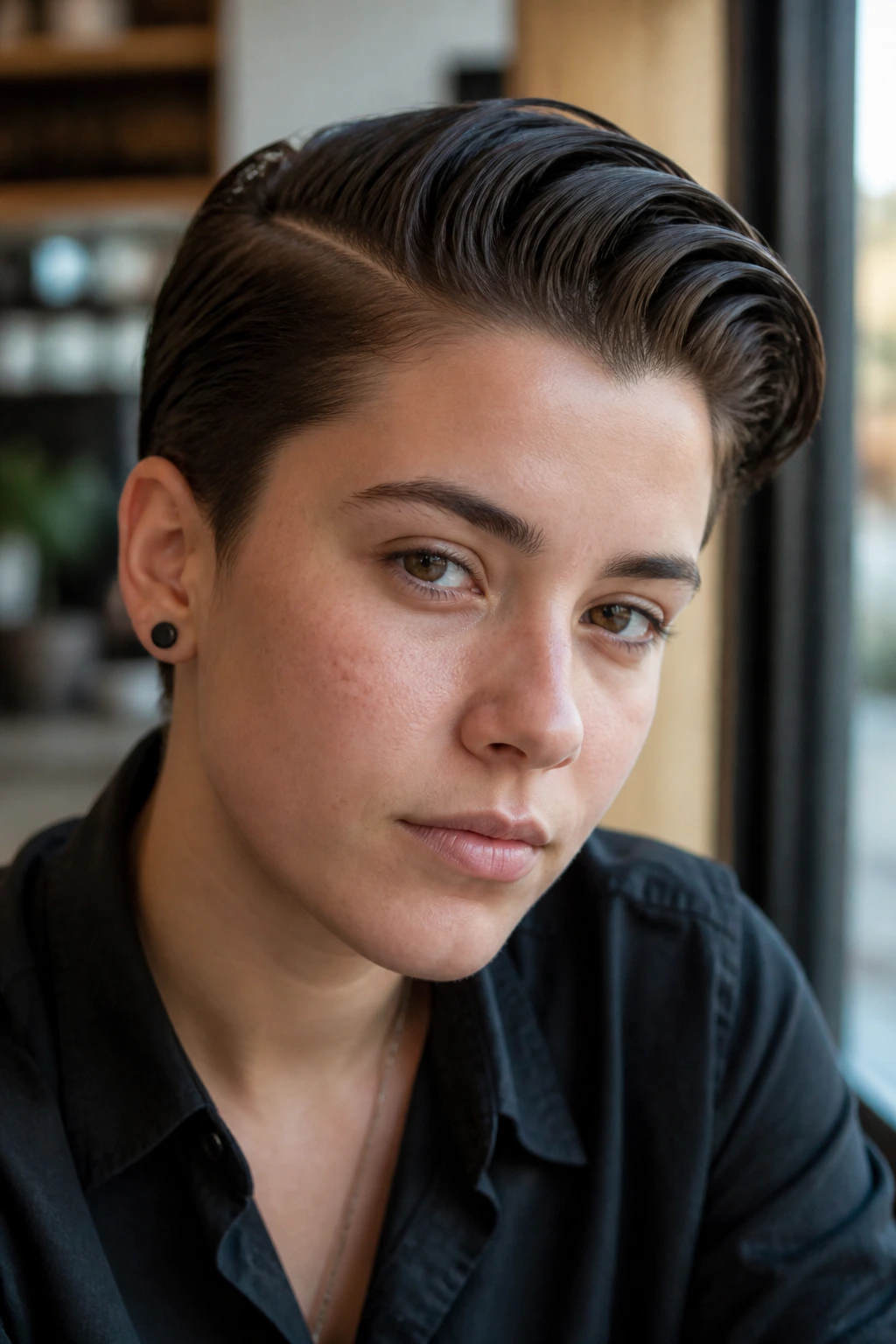
A deep side part and a strong sweep can do a lot for thick hair, especially if you want something short, clean, and a little severe in a good way. The sweep gives the hair direction, and the side part adds shape without needing a full updo. For shorter thick hair, it’s one of the fastest ways to look on purpose.
Make the part deep, then smooth the larger section across the front or back with a bit of gel or cream. Tuck one side behind the ear or pin it flat if the hair keeps springing loose. If the top still puffs too much, press it gently with the back of a comb rather than re-wetting everything.
This style is useful when you want the face open and the outline sharper. It works especially well with strong earrings, glasses, and jackets with a higher collar.
22. Short-Crop Coil Lift
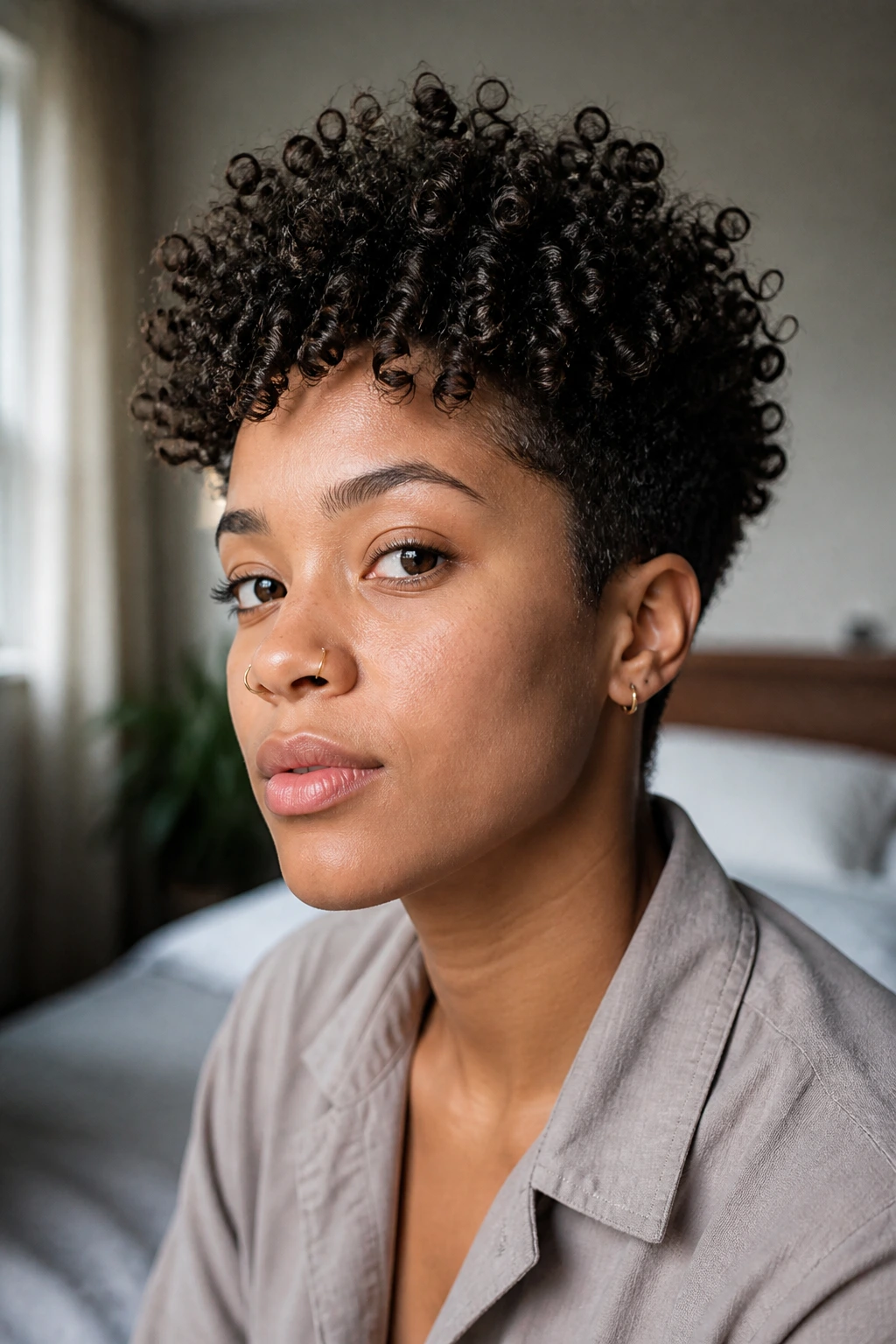
Short thick curls and coils need a slightly different strategy. You’re not trying to pile them up or drag them back into something they’re not. You’re trying to give the cut lift at the root and keep the shape from collapsing at the sides.
Mist the hair lightly, work in a small amount of cream or leave-in, then lift the roots with your fingertips or a small pick. If you diffuse, use low heat and stop before the hair gets fully rigid; if you air-dry, keep your hands off it until it sets. A tiny amount of product goes a long way here. Too much and the hair will look weighed down before breakfast.
This is the short-hair answer to thick-hair mornings: keep the shape controlled, not flattened. It’s clean, fast, and has room for texture, which is usually the better deal anyway.
Why Thick Hair Needs a Different Morning Plan
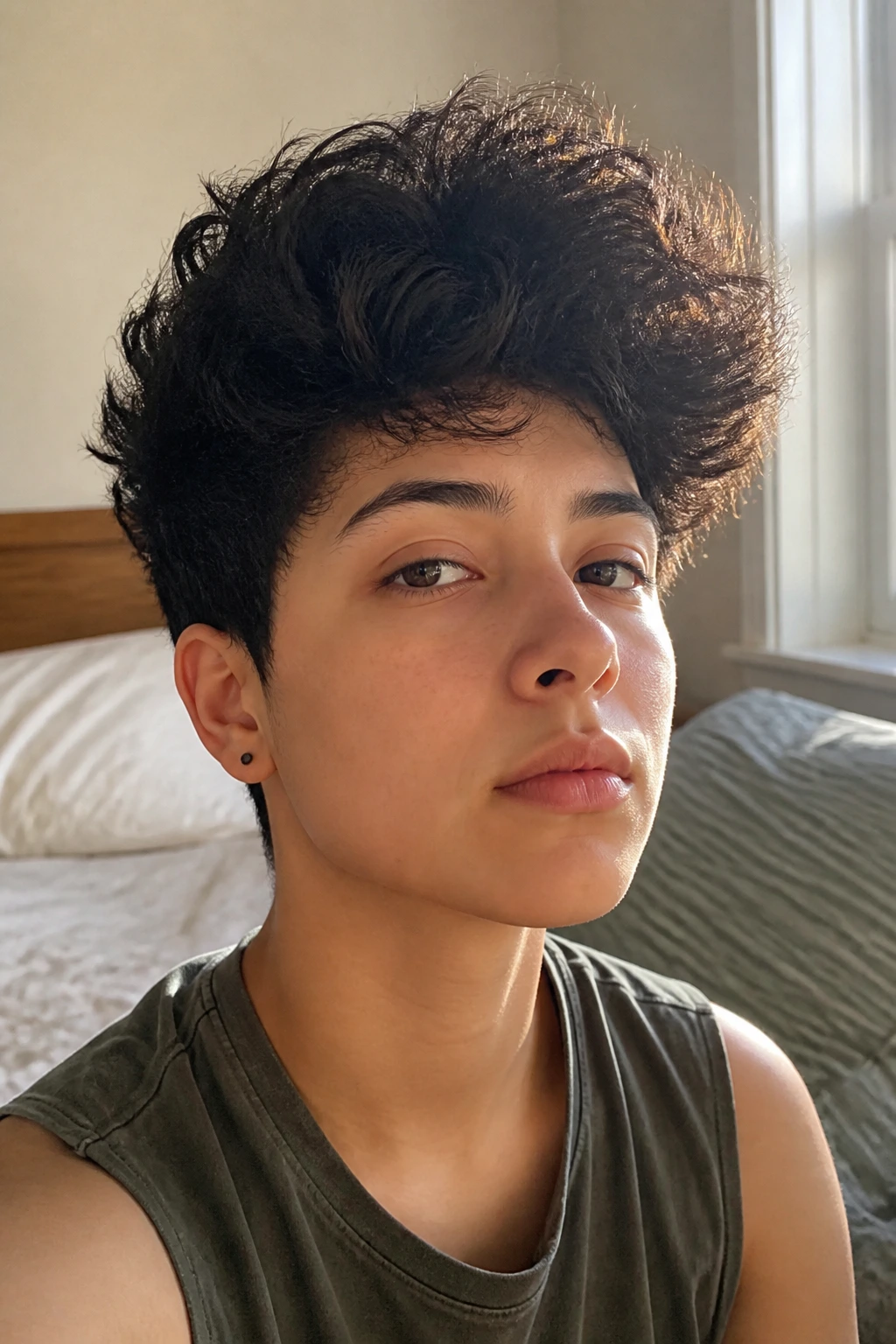
Thick hair is not hard. It is heavy, and that’s a different problem.
A lot of advice for quick hairstyles quietly assumes the hair is light enough to bend, pin, or clip with almost no effort. Thick hair doesn’t play that game. It pulls harder on elastics, escapes shallow clips, and can puff up at the crown the second you stop paying attention. If you try to smooth it the same way you’d smooth fine hair, you often end up with a flat top and a thick, bulky bottom. That shape can feel lopsided fast.
The trick is to distribute tension instead of concentrating it. Low buns, divided braids, tucked twists, and half-up shapes work because they move the weight around. They also let you use the natural thickness as part of the look instead of treating it like a flaw to flatten. That’s why these enby hairstyles for busy mornings with thick hair tend to have clean lines, strong anchors, and enough structure to survive a commute.
Sectioning matters more with dense hair. So does choosing the right accessories. A tiny clip that looks adorable on a store hook can be useless on a head full of volume. Use tools that match the amount of hair you actually have. That alone cuts the morning fight in half.
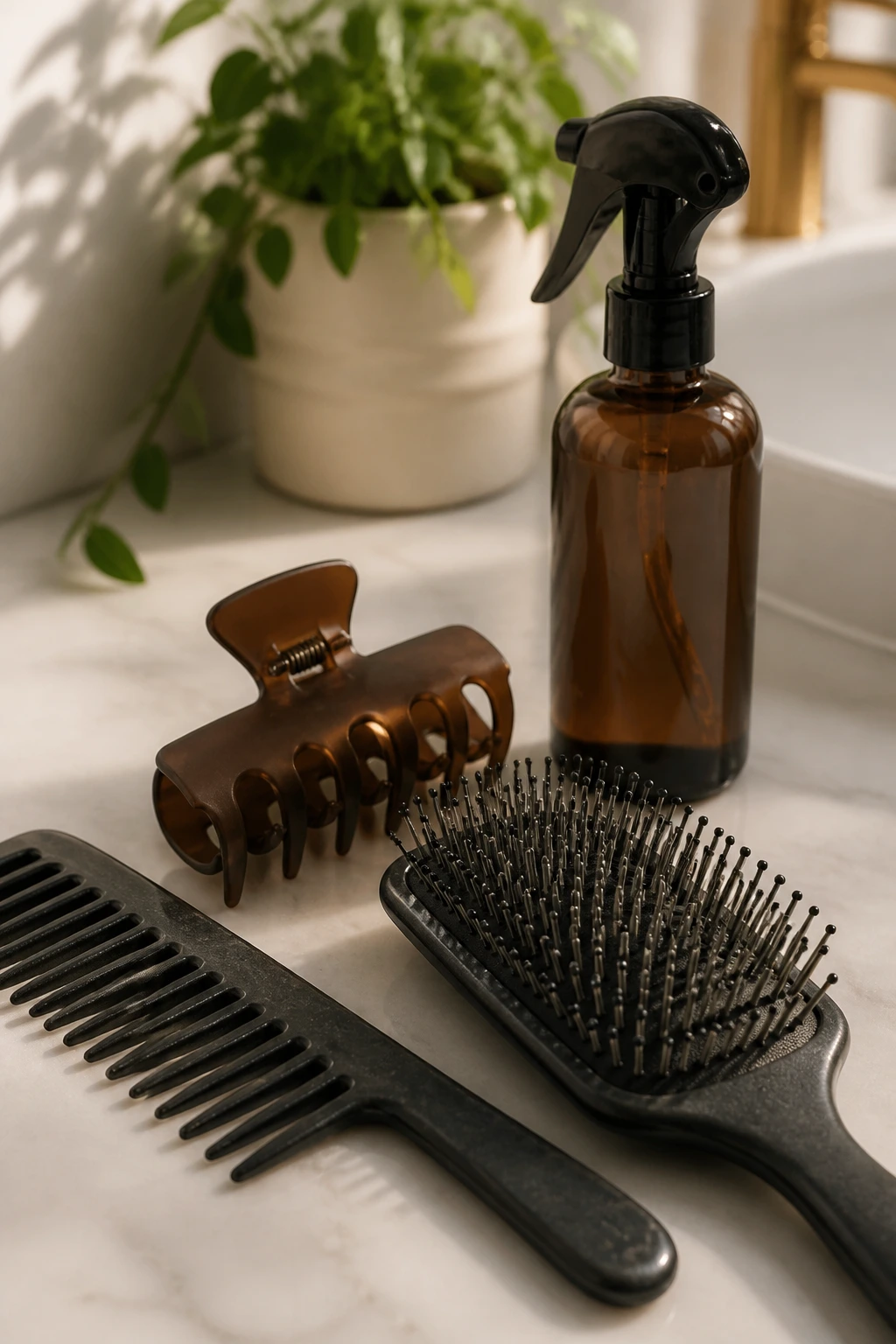
Essential Tools That Make Thick-Hair Styling Faster
-
Wide-tooth comb: Good for detangling without snapping through dense ends, especially if your hair is curly or wavy.
-
Paddle brush with flexible bristles: Helps smooth the top layer of thick straight or wavy hair without making it feel overbrushed.
-
Spray bottle with water: A light mist relaxes the front and crown before slick styles; don’t soak the whole head unless you’re planning to dry it.
-
Large claw clip, 4 to 5 inches long: Small clips slide out of thick hair fast. A deeper clip with long teeth holds better.
-
Snag-free elastics in two sizes: Thin ties for braids and mini sections; sturdier ties for ponytails and buns.
-
Bobby pins with a grippy finish: Smooth pins are cute until they slip. Crimped or textured pins hold thick hair better.
-
Tail comb: Useful for parts, sectioning, and pulling out precise face-framing pieces.
-
Edge brush or small toothbrush reserved for hair: Keeps baby hairs and hairline smoothing clean without using your main brush.
-
Satin scrunchies: Gentler than regular elastics and easier to remove from dense hair.
-
Satin bonnet or pillowcase: Helps preserve braids, buns, and twists overnight so the style doesn’t explode before morning.
-
Dry shampoo or texture powder: Handy for roots that need grip before a clip or knot.
-
Hair-safe styling cream or gel: Pick one that gives hold without turning your hair into a crunchy helmet.
Smart Product and Fabric Picks for Thick Hair
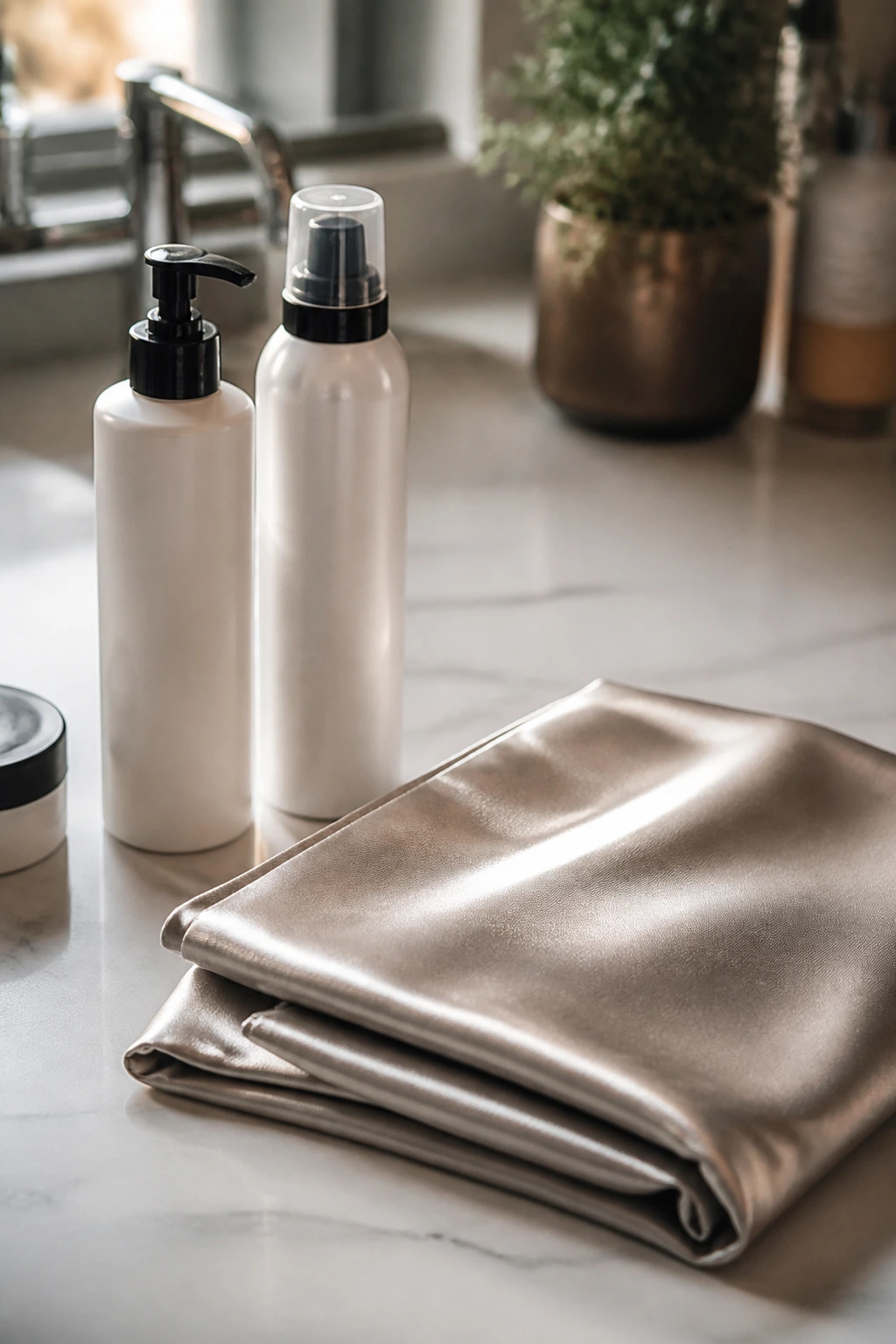
The best products for thick hair are the ones that help the hair obey without making it feel stiff, greasy, or sticky. That sounds obvious. It is not obvious when you’re standing in front of a mirror with three bottles and no clear winner.
If your hair is coarse or dry, start with a leave-in cream or lightweight styling lotion on the mids and ends. If your hair is dense but the strands are fine, a mousse or foam often gives better control without weight. For slick looks, choose a gel that dries cleanly and does not flake when you comb it back a second time. If flakes have betrayed you before, test the gel on a small section first.
Fabric matters too. A satin pillowcase reduces friction, which means less frizz and fewer awkward bends at the back of the head. A silk or satin scarf can help with tucked styles and wrapped buns. If you wear hats often, choose ones with enough depth to sit over thick hair without crushing the sides flat and causing a mushroom effect when you take them off.
One more thing: not every strong-looking product is right for every head of hair. Thick hair can hide too much product until it suddenly looks heavy and dull. Start with a small amount, build only if the style needs it, and leave the ends less coated than the roots.
How These Styles Read With Glasses, Earrings, and Clothes
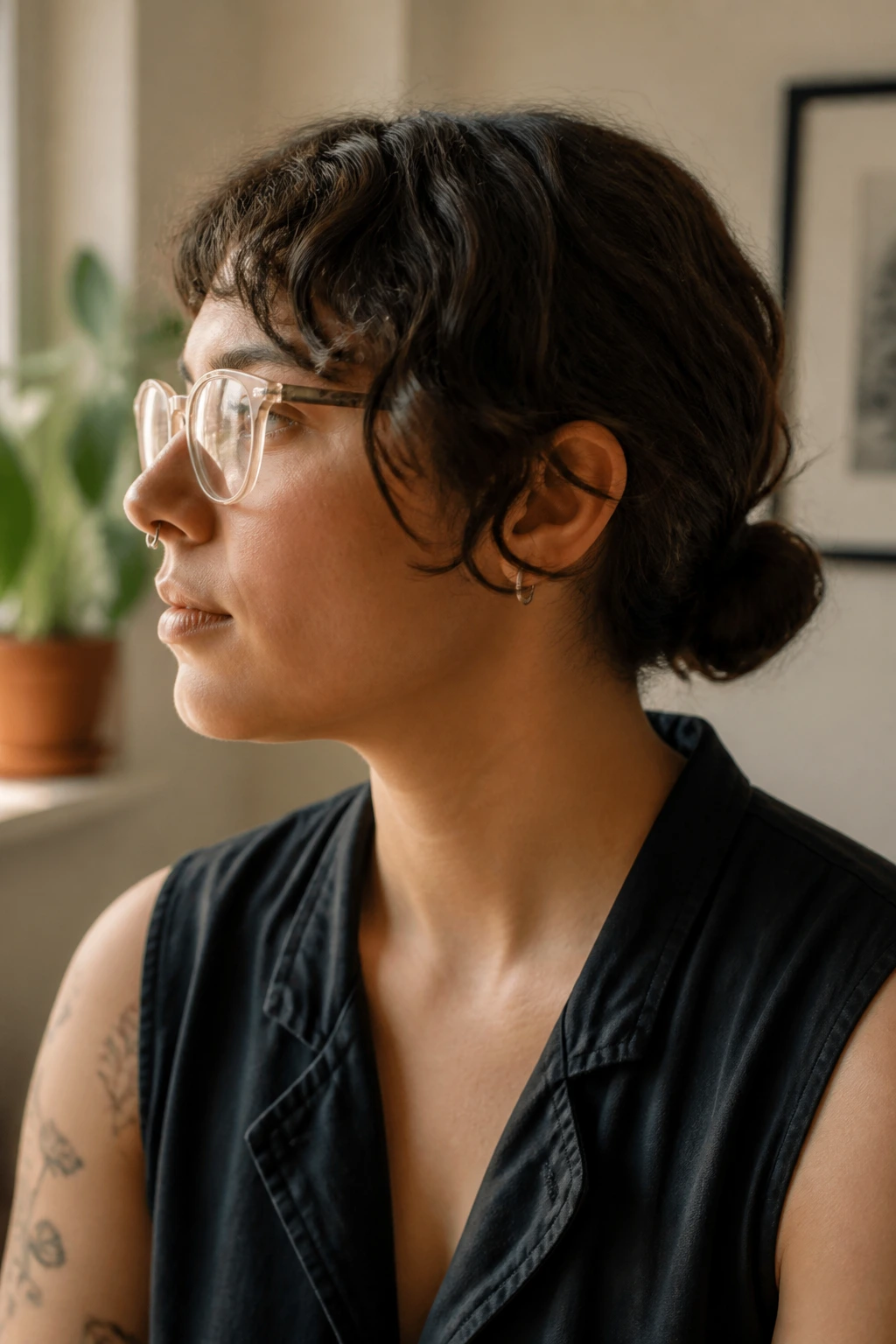
Hair does not exist by itself. It sits next to glasses, collars, hoodies, earrings, scarves, and whatever else you put on before walking out the door.
Low styles—low knots, slick ponies, tucked buns—pair well with glasses because they keep the temples from fighting the sides of your head. You do not want a thick ponytail and a pair of frames competing for the same space. That gets annoying fast. High styles, like puffs, top knots, and space buns, work better when you want the face open and the neck free, especially if your shirt has a higher collar.
Earrings change the feel too. Small hoops, studs, and ear cuffs look sharper when the hair is swept back or braided close to the head. Bigger earrings can stand out more when the sides are tucked and the front is clean. If you wear a scarf or bandana, keep the knot low so it doesn’t crowd the earlobes.
Outfit-wise, hoodies and tees usually like more movement: half-up knots, puffs, loose braids, or a clip sweep. Button-downs and jackets tend to look better with cleaner lines: low knots, slicked-back ponies, side parts, or wrapped buns. The style does not have to match the clothes perfectly. It just needs to sit in the same neighborhood.
Tiny Tweaks That Make the Style Hold Longer
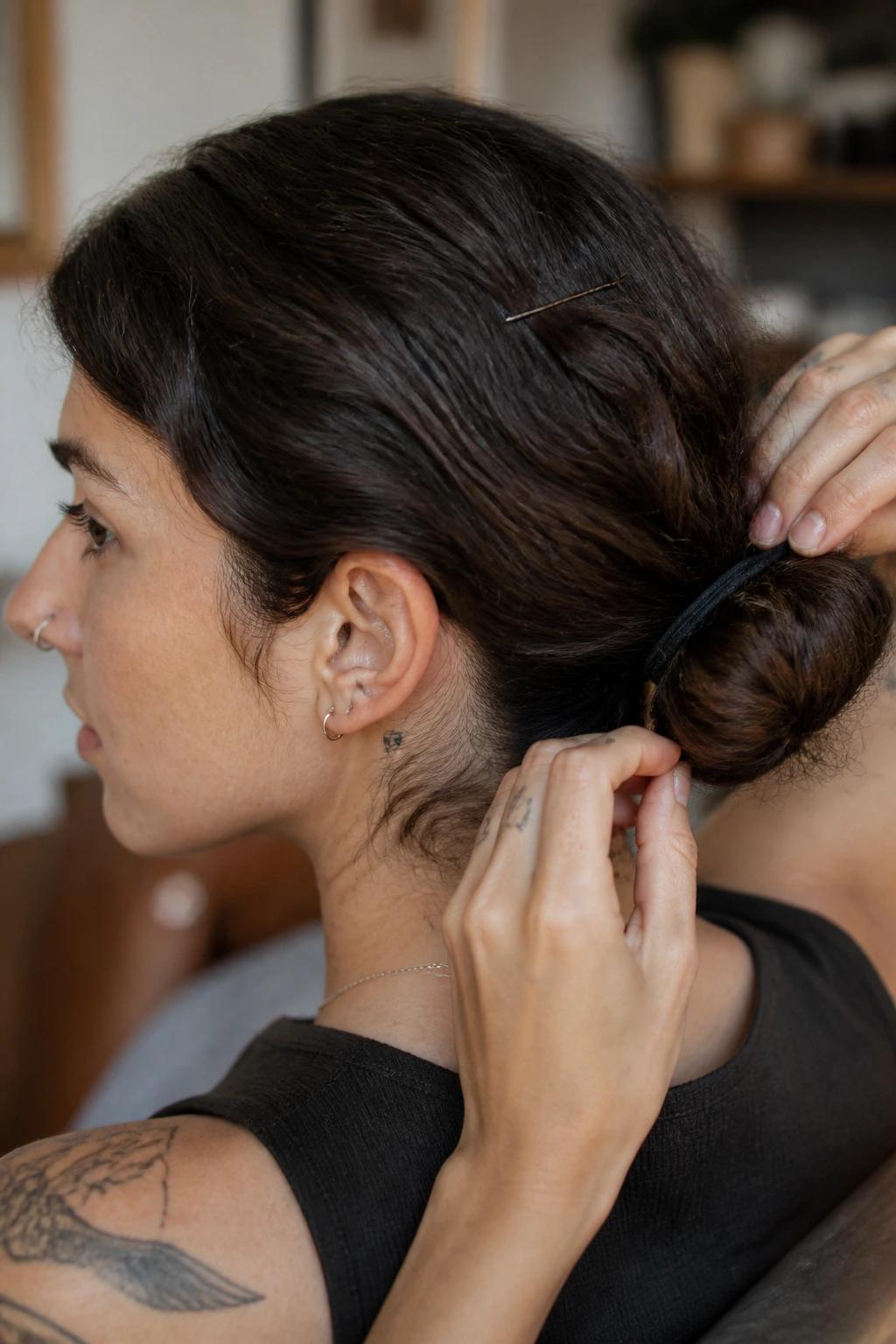
Section first, style second: Thick hair behaves better when you part or clip it before you start gathering. A clean section gives you cleaner tension, which means less rework later.
Anchor at two points: One elastic is often enough for fine hair, but thick hair usually likes a second point of support. That might be an extra pin, a second tie, or a clip over the elastic.
Stop before the hair is too flat: There’s a difference between controlled and crushed. Smooth the top, yes. Iron it down, no. Thick hair looks better with a little shape left in the crown.
Use the back of a comb for precision, fingers for the rest: Fingers are faster. A comb is better for the first line of the part or the final pass at the hairline. Mixing the two keeps the style from looking overworked.
Let the ends tell the truth: If the hair is curly, let the curls show. If it’s straight, keep the ends tucked or wrapped cleanly. Fighting the texture burns time and usually makes the result worse.
If a style fails, change the placement, not the concept: A low knot that slips might work at mid-height. A side braid that balloons might behave better as a center braid. Thick hair often just needs a different anchor point.
Common Mistakes That Make Thick Hair Fight Back
-
Using a tiny elastic on a lot of hair: The base slips, stretches, or snaps loose by midday. Use a stronger tie, or double up the elastic if the ponytail feels heavy.
-
Flattening the crown too hard: The style starts looking tight at the top and huge at the bottom. Smooth the top layer, then stop.
-
Putting all the weight in one spot: High buns and tight crown ponies can cause headaches on thick hair. Spread the weight with a lower placement or two sections instead of one.
-
Loading on too much cream or oil before a slick style: The hair starts to look separated and oily instead of smooth. Use a small amount near the hairline and keep heavier product off the roots.
-
Skipping sectioning for braids or twists: The result gets lumpy and uneven. A minute spent sectioning saves ten minutes of irritation.
-
Sleeping on a style that isn’t fully dry: Thick hair holds moisture longer, and that can leave weird bends, frizz, or a flat patch in the morning. Dry it to at least 90 percent before you go to bed.
Variations and Adaptations to Try
Soft Masc Clean-Up: Keep the lines low and the finish matte. A low knot, slick pony, or side sweep works well here, especially with button-downs, tees, and blazers. Use less shine and fewer face-framing pieces if you want the shape to read sharper.
Curly Coil Control: Lean on puffs, flat twists, halo braids, and tucked buns instead of brushing your texture into submission. Coils look better when they’re guided, not erased. A light cream and a soft band do more than heavy gel ever will.
Short-Crop Workarounds: If your hair is too short for a bun, use a side-parted gel sweep, mini twists, or a lifted coil shape at the crown. Short thick hair can still read intentional. It just needs a line, not a knot.
Humidity Armor: Braids, tucked scarves, and low buns handle damp air better than loose styles. If the weather is doing the most, keep the ends contained and use a product that dries without puffing up. A satin scarf at night helps too.
Desk-to-Gym Switch: Half-up top knots, claw-clip twists, and bubble ponies move easily from errands to movement. They come down fast and do not leave your scalp angry. That matters if your day changes shape every three hours.
Night-Before Prep and Day-After Refresh
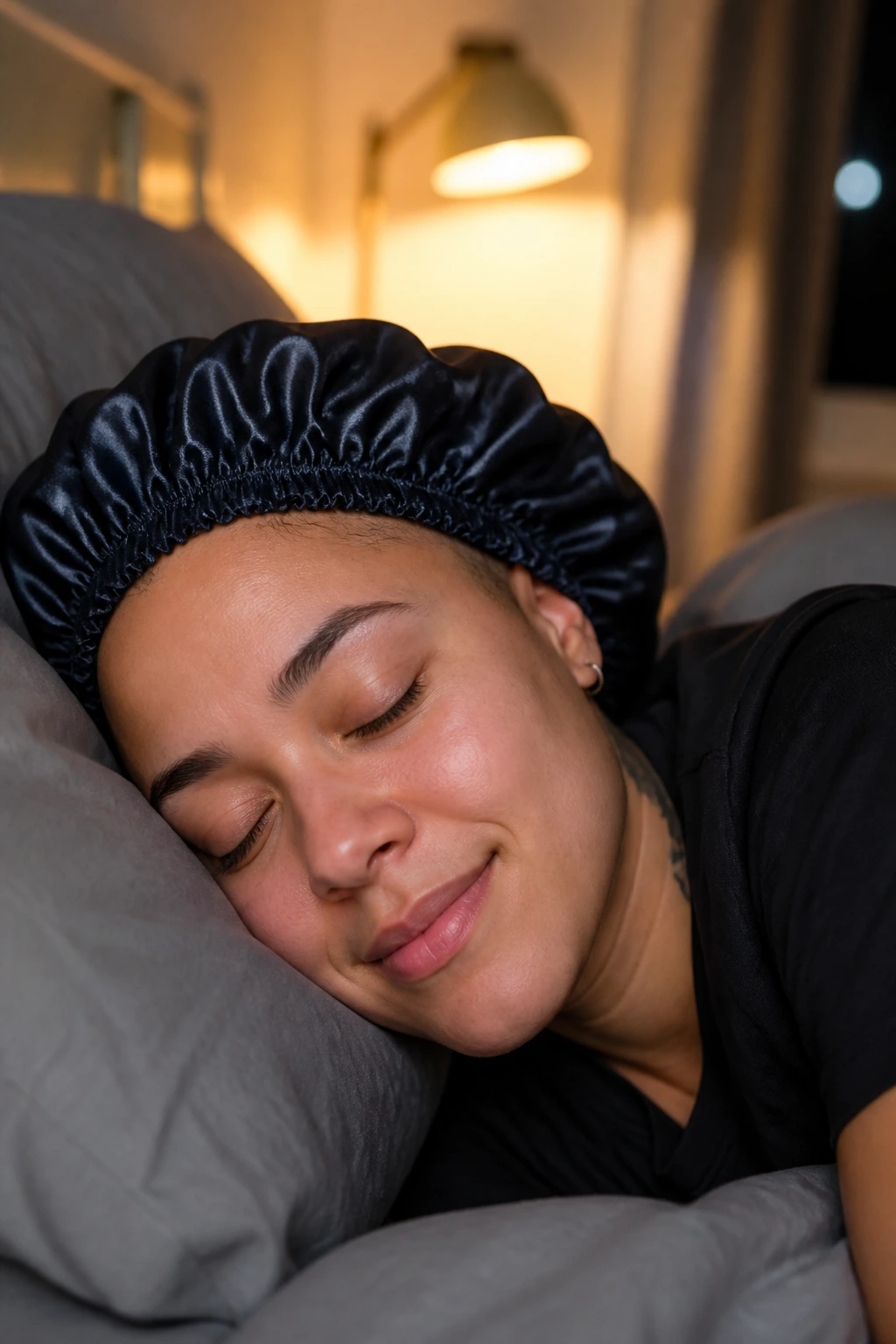
The easiest morning wins usually happen the night before. Thick hair keeps its own memory, which means it remembers dents, bends, and frizz if you let it sleep any old way. A satin bonnet or satin pillowcase cuts the friction down, and that alone makes a huge difference in how much styling you have to do before leaving the house.
If you wear braids, buns, or twists often, sleep with them loose enough that the scalp is not pulling but secure enough that they don’t unravel. A low pineapple works well for curls. A loose braid or two can keep thick straight or wavy hair from tangling into a knot at the back of the neck. If your hair is still damp when you sleep, don’t assume it will behave in the morning. Thick hair can stay damp deeper inside than it looks from the outside.
For the morning refresh, mist the crown lightly and use your hands before you grab a brush. Hands let you change the shape without tearing apart the texture. Add a pea-size amount of cream or gel only where the style needs control—usually the hairline, the ends, or the part. Braids and buns often last 1 to 3 days with a fast refresh. Slick styles usually need a reset sooner. The trick is to fix the shape that is off, not restart the whole head.
If the style has gone a little sideways, take the elastic out and rebuild only the base. Thick hair usually does not need a full redo. It just needs the right anchor again.
Frequently Asked Questions About Enby Hairstyles for Thick Hair
What’s the fastest style if I have less than five minutes?
A low knot, a half-up claw-clip sweep, or a slicked-back low pony are the quickest options. Thick hair already brings body, so you do not need to over-style it. Use one clean part, one strong hold, and stop there.
How do I keep a ponytail from looking huge at the base?
Place it lower, smooth the top layer before you tie it, and wrap a small strand around the elastic to clean up the finish. If the base still puffs, split the hair into two lower sections or switch to a braid. Thick hair usually looks better with divided weight than with one overloaded pony.
Can these styles work on curly or coily hair without heat?
Yes, and several of them work better without heat. High puffs, flat twists, halo braids, tucked buns, and mini twists all play well with texture. The main thing is to use enough slip in the product so you’re not yanking the hair while sectioning.
What if my hair is too short for a bun or braid?
Go smaller with the shape: side parts, clipped-back sweeps, mini twists, a short-crop coil lift, or a half-up knot if the top layer is long enough. Short thick hair has good structure on its own. You usually need less product and more direction.
Do I need gel for every style?
No. Gel helps the slick looks and the hairline, but braids, knots, and clips often need only a little cream or no product at all. If your hair is already cooperative, skip the gel and save time.
How do I stop headaches from tight styles?
Do not pull everything to the crown and call it a day. Lower the placement, use a softer elastic, and spread the tension with pins or two sections instead of one. If your scalp hurts, the style is too tight.
Which styles hold up best in humidity?
Braids, flat twists, tucked scarves, and low buns usually do the best job. They keep the hair close to the head and reduce the chance that the shape will expand into a frizz halo. Slick styles can work too, but they need stronger product and more touch-ups.
Can I wear these with a fade or undercut?
Yes. In fact, a fade or undercut can make high puffs, top knots, and side-parted sweeps easier because there’s less bulk at the sides. Just adjust the section size so the style sits evenly and doesn’t pull from one patch too hard.
How do I make day-two hair look intentional instead of messy?
Choose a shape that likes a little texture—braids, bubbles, tucked buns, or clipped sweeps. Then clean up only the part, hairline, or base. Thick hair rarely needs to be made perfect; it needs to be framed.
The Quiet Win of a Good Thick-Hair Routine
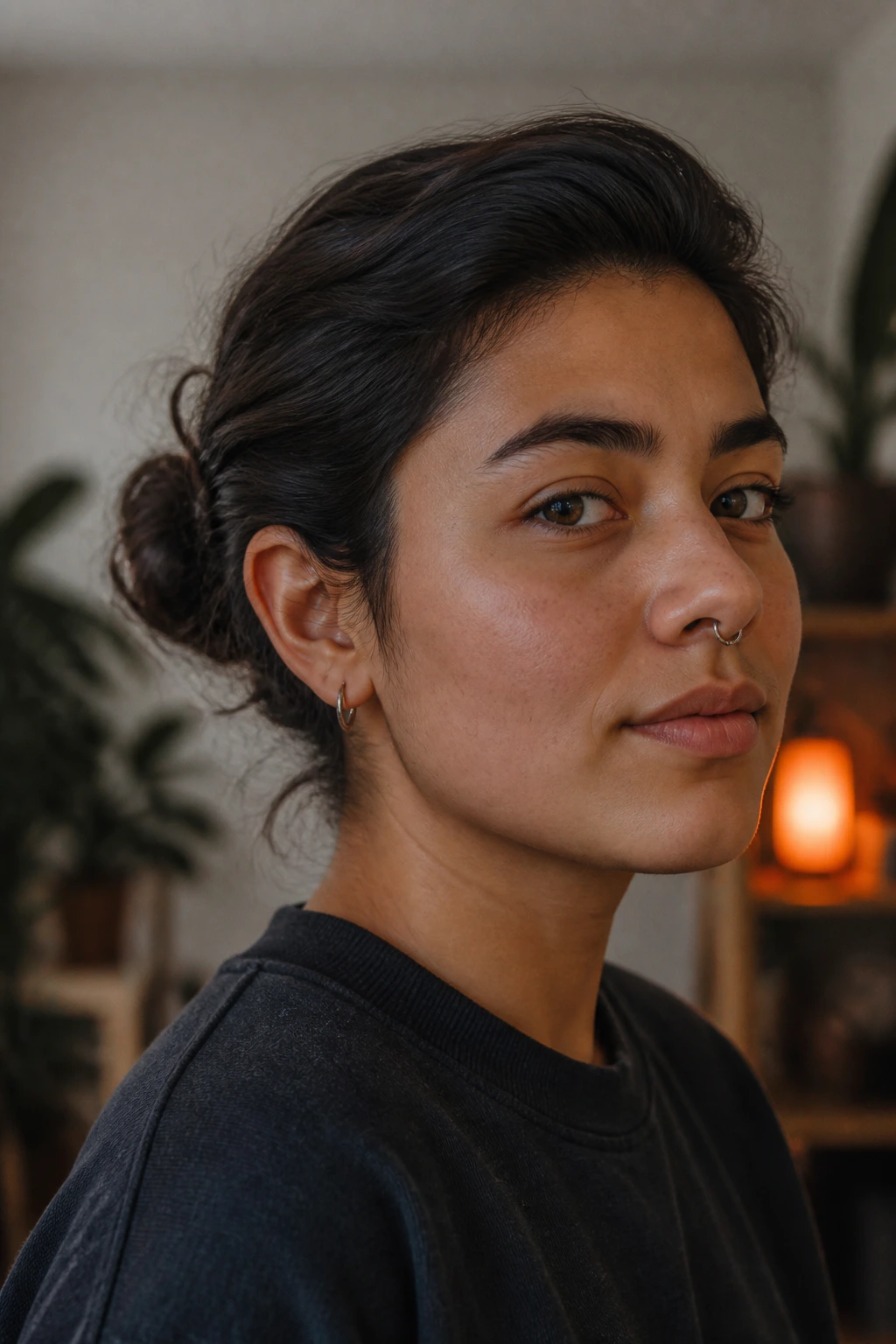
The best enby hairstyles for busy mornings with thick hair do not try to shrink your hair into something it isn’t. They give it a shape that makes sense before you’ve had time to overthink it. That’s the real win: less tugging, less restarting, fewer mornings spent staring at the mirror and muttering at a clip that couldn’t hold on.
Pick two or three styles that match your texture, your length, and the amount of effort you can spare before breakfast. Learn those first. Once they’re in your hands, the rest of the list becomes a menu instead of homework.