



Thick hair after 65 can feel like a blessing and a small daily negotiation. It has presence. It has body. It also has opinions, and some mornings those opinions show up before you’ve had coffee. The best hairstyles for busy mornings with thick hair do not try to flatten all that personality out of the picture. They give it a shape, a direction, and a place to sit so you are not standing at the mirror wrestling with a brush and muttering at the clock.
That matters more once the hair gets heavier through the crown, drier through the ends, or a little more stubborn around the temples. Silver strands can be gorgeous, but they also show every crooked part and every bulky section that wasn’t cut with a plan. If you wear glasses, if your neck gets hot easily, if your hands do not want a ten-step styling routine before breakfast, you want looks that cooperate fast and still feel finished.
The good news is that thick hair has a real advantage here: once it’s shaped properly, it usually holds a style better than finer hair does. A clipped twist stays put. A bob keeps its line. A short crop keeps its lift. The trick is choosing styles that use the weight instead of fighting it.
Why These Styles Make Thick Hair Easier Before Coffee
-
They turn bulk into structure: Thick hair looks its best when the weight is guided into a bob line, a soft wave, or a pinned shape instead of being left to puff in every direction.
-
They respect your hands and your time: A style that needs six bobby pins and one minute of finger-combing is a better morning choice than a look that needs perfect sections and curling-iron heroics.
-
They work with glasses, earrings, and necklines: The right cut keeps the temples clear, keeps the nape from overheating, and stops hair from swallowing your face.
-
They handle silver and white strands well: Light-colored hair shows movement and shape beautifully, which means a good cut does more for the whole look than a shelf of products ever could.
-
They grow out with less drama: A strong silhouette still looks intentional when it’s a few weeks past a trim. That matters when salon visits are not something you want to plan your life around.
-
They stay friendly on second-day hair: Thick hair often looks better the day after washing, once the root lift settles and the ends stop squeaking against each other.
What Busy-Morning Hair Actually Needs
Thick hair does not need more effort. It needs better geometry.
That sounds fancy, but it’s not. A good cut removes weight where the hair balloons, adds shape where the hair collapses, and leaves enough length or lift in the right spots so you can style in five minutes instead of fifteen. A blunt one-length cut can be lovely, but on dense hair it can also turn into a triangle if the ends are too heavy and the crown has no room to breathe. The fix is often internal layering, soft graduation, or a beveled edge that lets the hair sit instead of sit on you.
For women over 65, the real issue is usually not whether the hair is “too much.” It’s whether the hair cooperates with daily life. Can you tuck it behind one ear without it popping back out? Can you clip it up without the clip sliding? Can you wear it with glasses without the sides bulking up around the temples? Those details matter more than a trend photo ever will.
I’d rather see a cut that works with a real hand, a real scarf, and a real schedule than a perfect style that only behaves under salon lights. Thick hair is generous. Give it direction, not punishment.
Where the weight should come out
The best thick-hair cuts usually lose bulk around the jaw, the nape, or the underlayers of the crown. That keeps the top from standing up like a helmet and stops the ends from sticking out like a broom. Ask for internal shaping, not aggressive thinning all over the head. Thinning shears used carelessly can leave the surface fuzzy and the ends weak.
What the front has to do
The front sections are the whole game in busy mornings. If the fringe, side pieces, or temples are cut to work with your glasses and your face shape, the rest of the style can be simple. If the front is awkward, the whole style feels unfinished even when the back looks neat.
Why the hands matter too
A lot of older styling advice assumes perfect grip strength and endless patience. That’s not real life. Styles that rely on one clip, one elastic, or a few pins you can place by feel are worth more than a complicated braid that takes three tries and a sore shoulder.
1. The Soft Chin-Length Bob That Tucks Behind One Ear
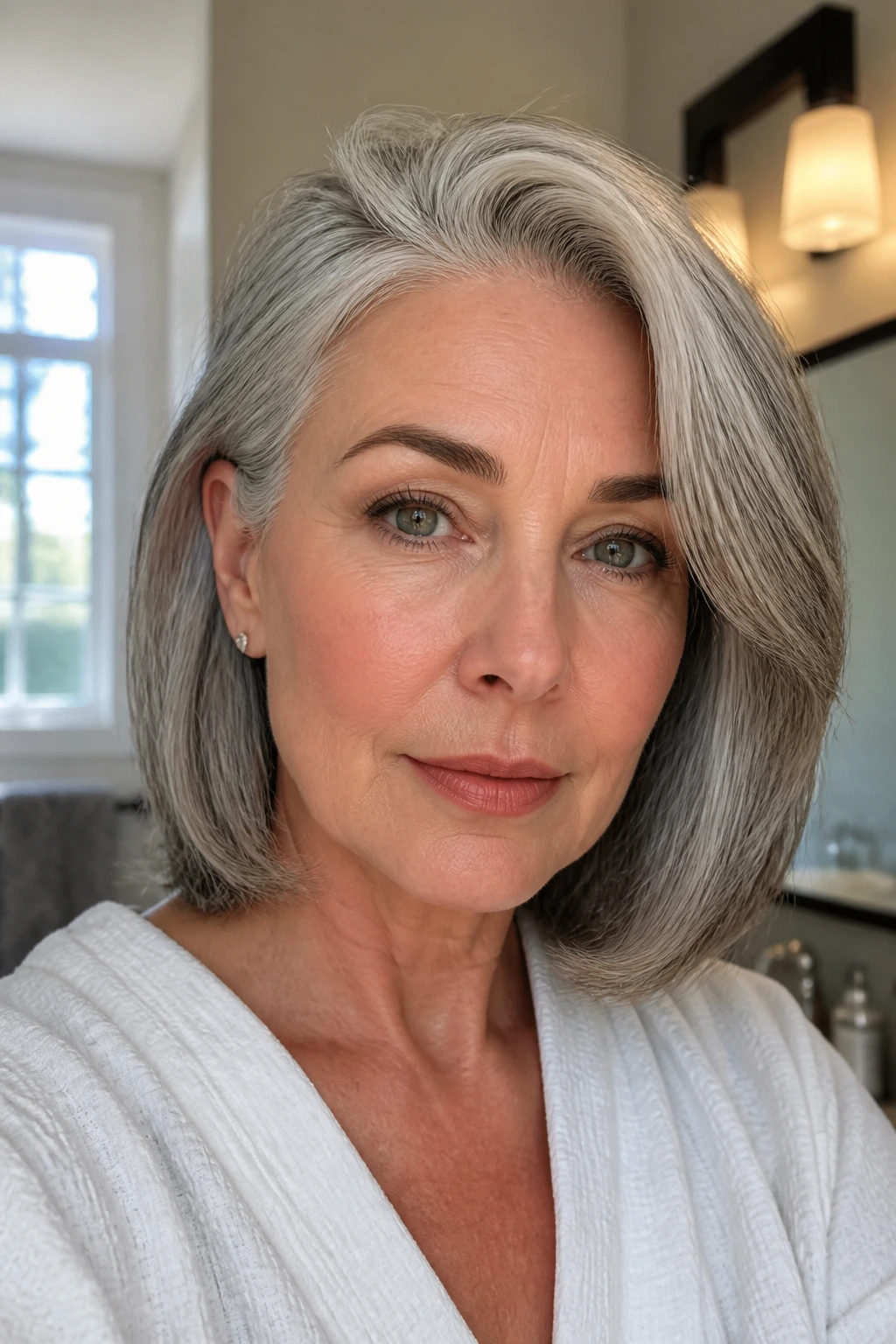
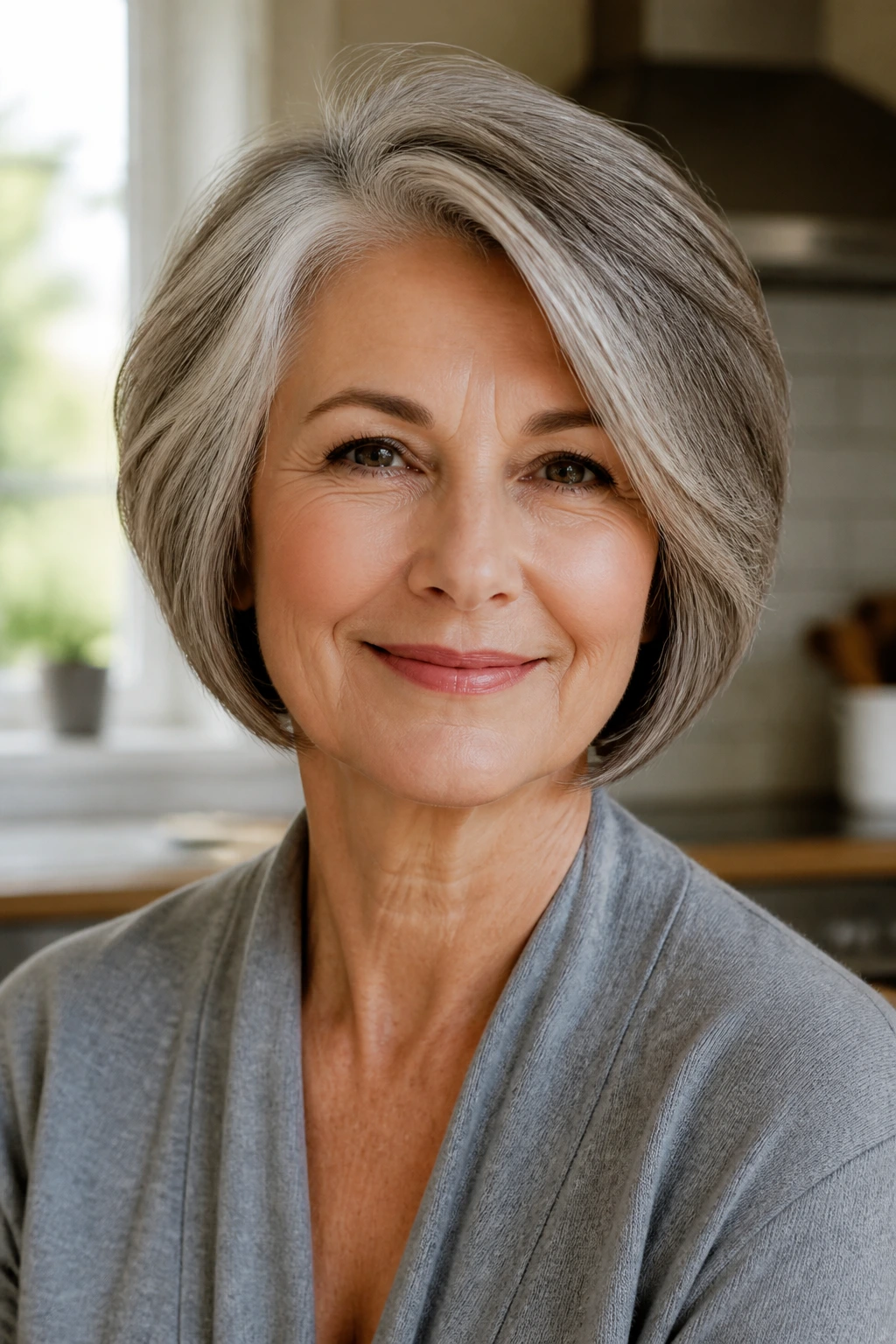
A chin-length bob is one of those cuts that makes thick hair look deliberate instead of heavy. It lands right where the jaw can support it, and that means the hair doesn’t drag the face down or collapse into the neck. When the ends are lightly beveled and the front sits just a touch longer than the back, the whole shape feels tidy in a way that needs very little help.
Why It Works on Thick Hair
The weight of thick hair becomes the architecture here. Instead of fighting volume, the cut uses it to keep the bob smooth and compact. That matters on mornings when you do not want to round-brush every inch of your head. A quick tuck behind one ear gives the style a finished edge, especially with glasses or a small hoop earring.
A little internal layering keeps the bottom from sitting like a shelf. I like this more than a heavily thinned bob, which can fray at the ends and look puffy by noon.
- Best for: straight to softly wavy thick hair
- Fastest finish: 2 to 4 minutes with a paddle brush
- Small detail that helps: keep the front ½ inch longer than the back
- Watch for: a blunt perimeter that flips out too hard
Quick tip: blow-dry the front sections down and then curve the ends under for the last 15 seconds. That tiny bend is what makes the bob look intentional.
2. The Long Pixie That Saves the Most Minutes
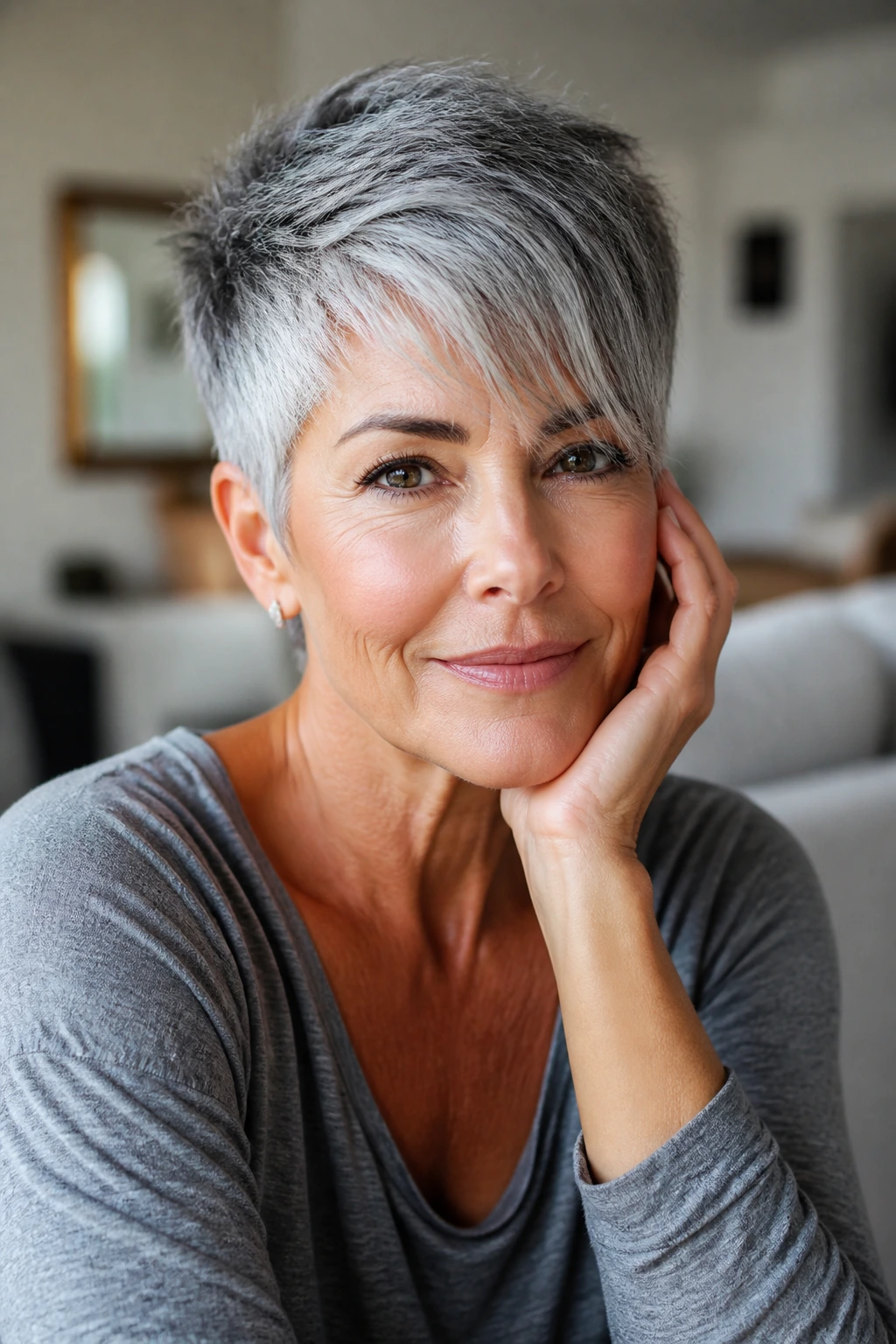
This is the style I’d choose for someone who wants movement on top and less hair touching the neck, ears, and collar. A long pixie takes thick hair and cuts out the daily drama. The top stays soft and touchable, the sides stay close enough to behave, and the fringe can sweep across the forehead instead of sitting there like a hard line.
The big win is speed. Towel-dry, add a pea-sized amount of cream or mousse, finger-comb the top, and you’re done. No sectioning. No round brush theatrics. If your hair naturally pushes forward at the front, keep the fringe long enough to follow that direction instead of trying to force a short, stiff piece into obedience.
I like this cut most when the hair around the ears is trimmed neatly but not shaved tight. That tiny bit of length keeps the look softer and older-friendlier. Sharp, close sides can feel severe fast.
It also plays nicely with silver hair, which often shows texture beautifully in this shape. The catch is that a pixie needs regular trims to stay clean at the edges. Let it grow too far and the shape disappears. Every 4 to 6 weeks keeps it crisp.
3. The Feathered Crop That Lifts at the Crown
Want height without teasing your hair until it feels like a nest? A feathered crop does the work with less fuss. The layers are short enough to lift, but they are cut in a way that lets the ends move softly instead of sticking straight out. On thick hair, that matters a lot.
The crown gets a little lift, the sides stay light, and the face is framed by softer pieces that don’t crowd the cheeks. If your hair is dense near the top, ask for texture that starts below the root area, not right at it. Too much texture near the scalp can leave the top frizzy and hard to calm down.
How to Style It Fast
Blow-dry only the crown and front for 2 to 3 minutes with a small round brush or your fingers. Lift the roots, aim the dryer at the hair from above, and let the back air-dry if you can. A small dab of styling cream on the fingertips smooths the edges without flattening the lift.
A feathered crop works well with naturally thick, slightly coarse strands because the cut already does the heavy lifting. You are not trying to force shine and perfect swing into every strand. You are trying to make the silhouette neat. That’s a different job.
4. The Shoulder-Length Shag That Doesn’t Need a Perfect Blowout
A shoulder-length shag is what happens when thick hair gets permission to move. The layers take weight out of the sides, curtain fringe softens the front, and the ends don’t all land in one hard line. It’s a forgiving shape. If the wave pattern is uneven one day, the cut still looks intentional.
This one is especially useful if you want some length but you are tired of spending half the morning on the back of your head. Scrunch in a light mousse, twist a few sections while the hair is damp, and let it dry with a little chaos. Good chaos, not the kind that makes you want to hide under a hat.
The shag works because it refuses to be over-controlled. Thick hair often looks best when it isn’t pressed into one flat idea. A little volume at the crown and softness around the face keeps the whole thing from turning boxy.
If your ends are dry, use a leave-in cream on the last 2 to 3 inches only. Keep it off the roots. That keeps the lift intact and avoids the greasy look that shows up fast on silver or white hair.
5. The Blunt Lob With Hidden Internal Layers
A blunt lob looks polished, but the real trick is what happens underneath. On thick hair, a completely one-length lob can feel too heavy. Internal layers — the kind you don’t see from the outside — remove enough bulk that the hair falls in a smoother line.
This is one of my favorite shapes for women who want a neat finish without a lot of daily styling. The surface reads as sleek. The inside has room to move. That combination means you can air-dry it with a little cream or give it a quick pass with a flat brush and still look put together.
The length is useful too. It sits above the shoulders or right at the collarbone, which means it doesn’t bunch into sweaters and coat collars quite as much as longer hair does. That sounds small. It isn’t. Coat-season hair is a thing, and thick hair absolutely knows how to fight knitwear.
Keep the ends sharp, not wispy. A lob with too much feathering at the perimeter loses its shape fast and can start to look fuzzy. A clean edge gives thick hair a more expensive feel, even if you’ve spent exactly six minutes on it.
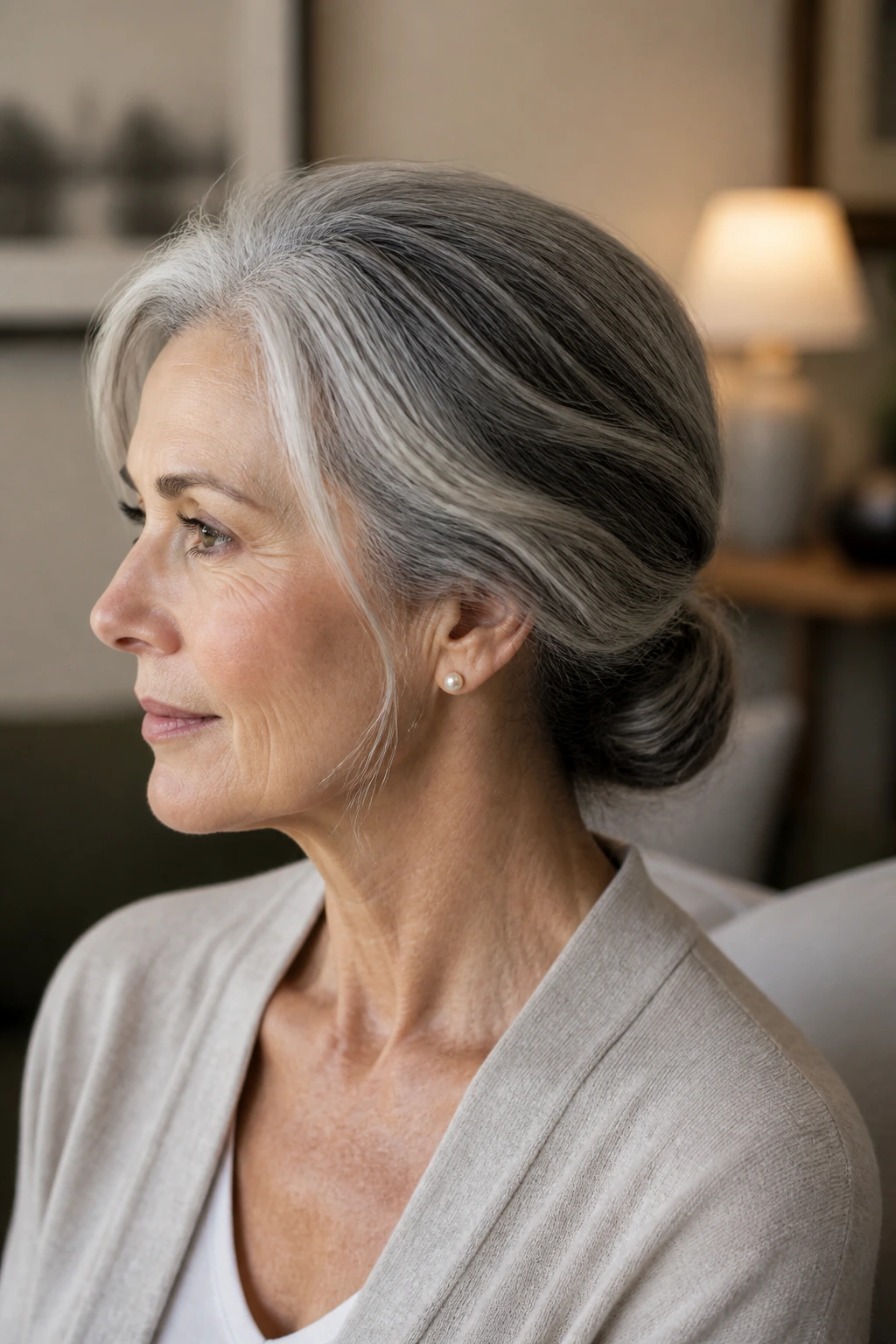
6. The Low Twisted Chignon That Outsmarts a Bad Hair Day
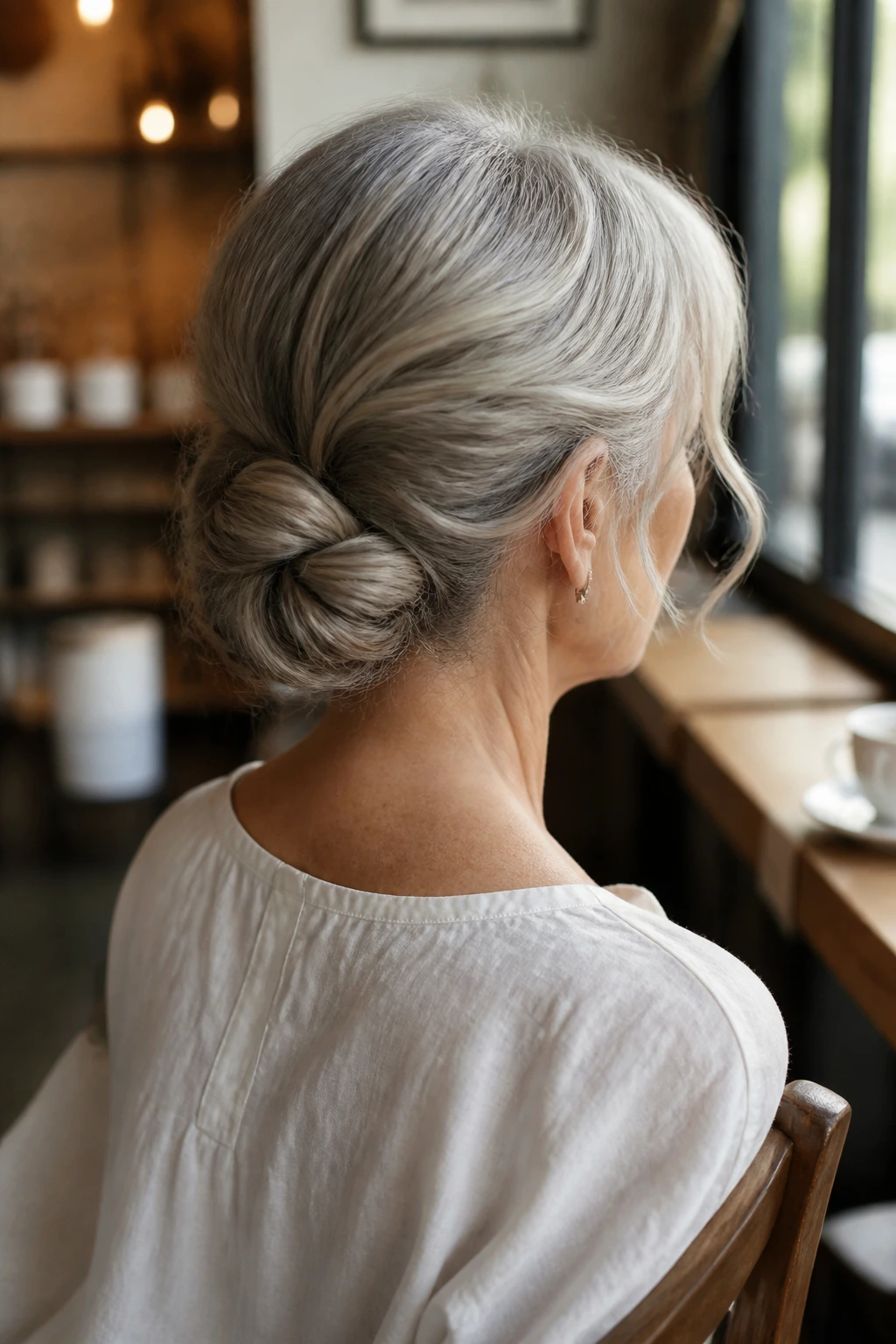
A low twisted chignon is the style you reach for when the morning goes sideways and you still need to look calm. Thick hair is actually perfect for it. You have enough density to build a shape that stays in place, and enough bulk to make the twist look full without padding.
Compared with a high bun, this sits lower and feels kinder on the neck. Compared with a loose knot, it looks more finished. That’s why I like it for dinners, appointments, church, or any day when you want the hair off your shoulders but don’t want to look stern.
The Easy Version
Gather the hair at the nape, split it into two loose sections, twist them together, and coil the twist upward. Pin with U-pins or strong bobby pins, placing them into the base, not just through the top. If the front wants to escape, leave a few face-framing pieces out on purpose.
It works best on hair that has a little grit, so if your hair is freshly washed and slippery, add a touch of texturizing spray first. That gives the pins something to grip.
7. The Half-Up Claw-Clip Twist That Buys You Time
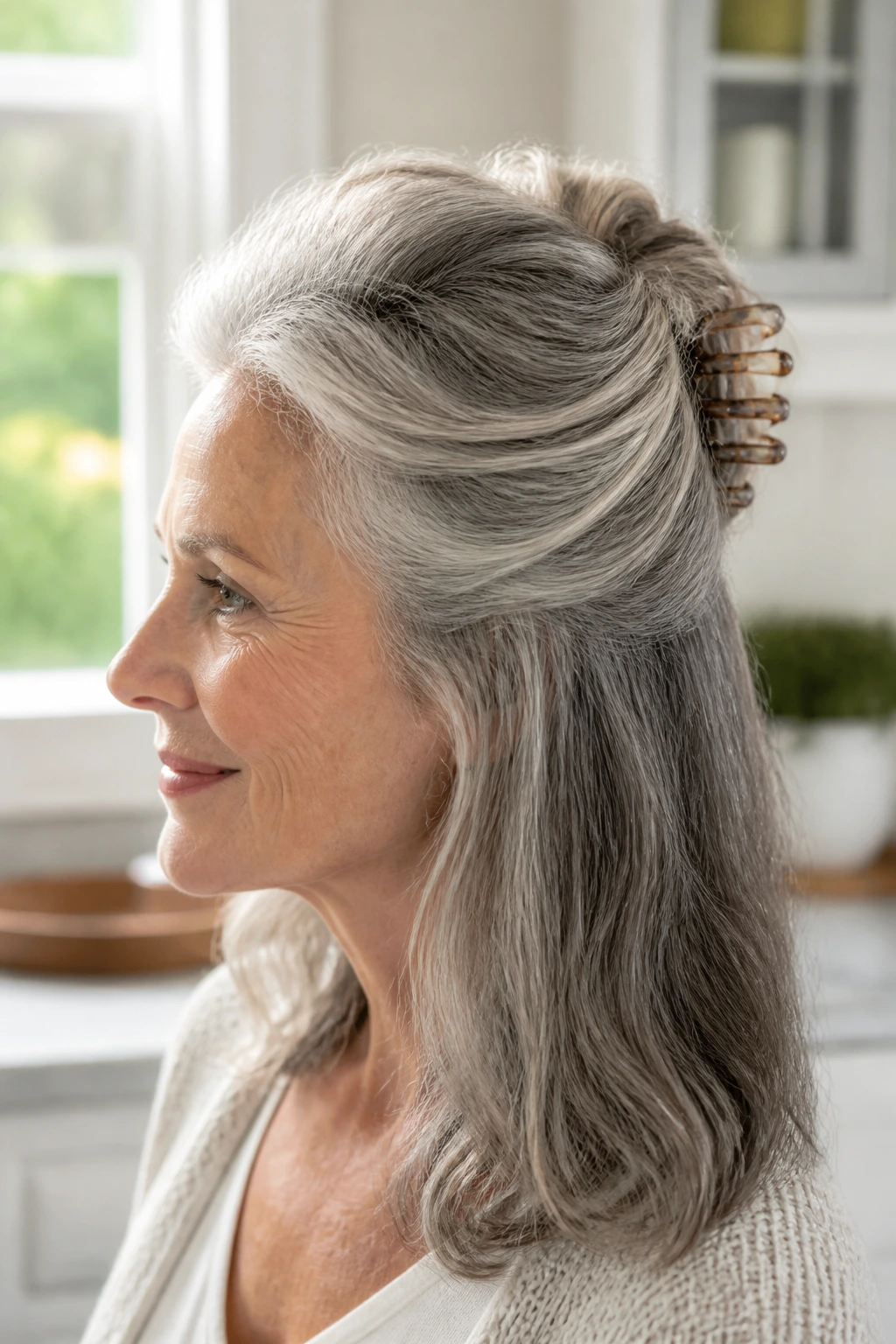
A half-up claw-clip twist is one of the easiest ways to calm thick hair without pretending you have time for a full style. The top section gets lifted and pinned, the bottom section keeps its movement, and the whole thing looks relaxed rather than rushed. It also keeps hair off the face, which is worth a lot on a humid day or during a long breakfast that turns into a long morning.
The trick is section size. Too much hair in the clip and it slides. Too little and the style feels flimsy. I like to take the top half from temple to temple, twist it once or twice, and clamp it with a medium or large claw clip that has real teeth, not a decorative joke of a clip that would surrender to a breeze.
This works especially well when the ends are a little bendy from sleeping or from air-drying. The contrast between the pinned crown and the loose lengths gives the style some shape. If your hair is very thick, leave the underside loose and let the clip do the visual work. You do not need to force the lower half into obedience too.
A small side note: this is one of the few styles that still looks decent when you remove the clip later and shake it out. That makes it a practical choice for a day that starts at home and ends somewhere less predictable.
8. The Braided Crown Into a Low Knot
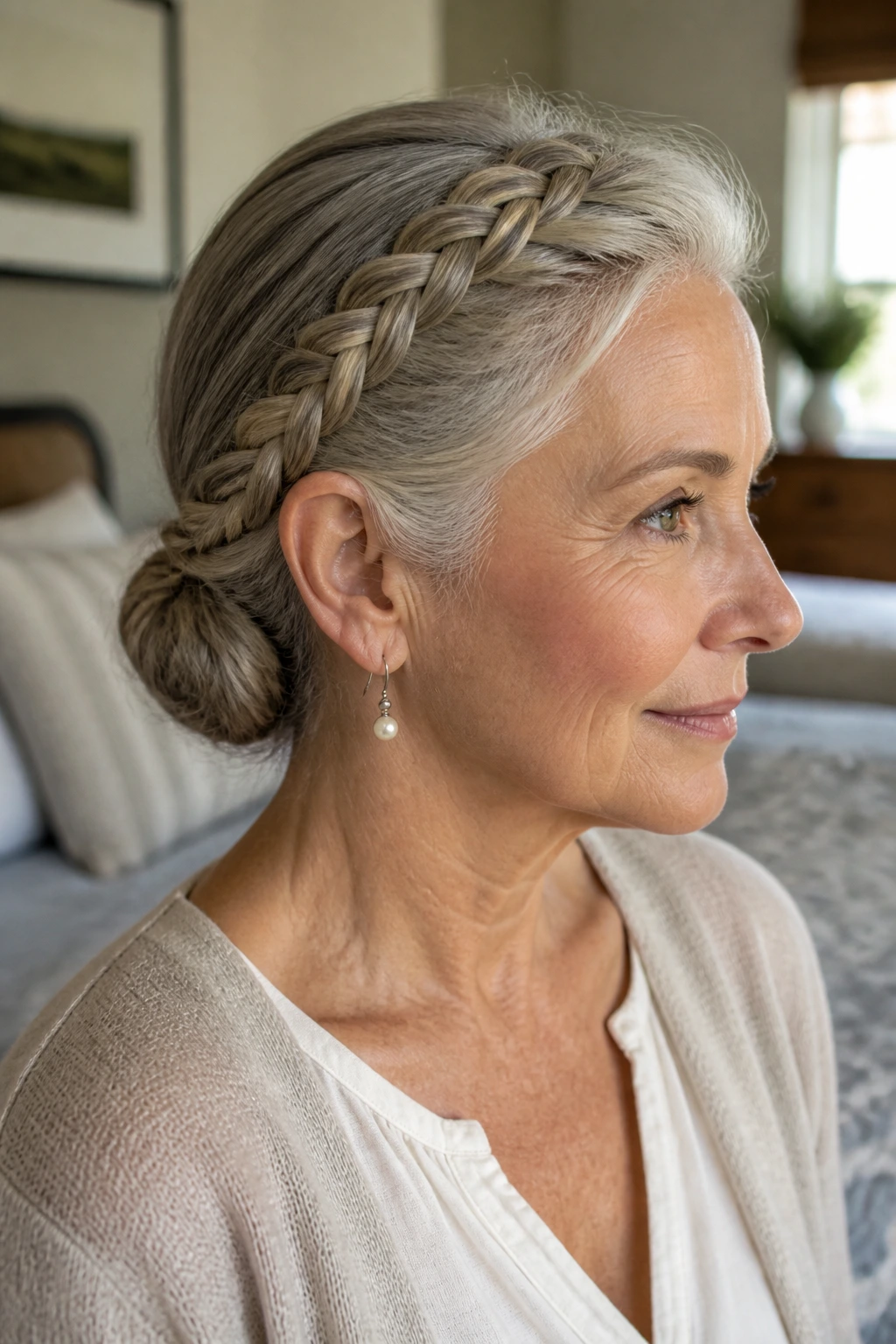
A braided crown into a low knot gives thick hair a little theater without much labor. It’s more secure than a loose bun and softer than a tight braid all the way down. The braid at the front also helps control hair around the temples, which is a blessing if those pieces always slip loose by lunchtime.
If your hair is dense, the braid will look lush rather than skinny. That’s half the charm. Split the front sections, braid them back along the hairline, and meet them at the nape where the rest of the hair can be twisted into a knot or tucked into a bun. Pin close to the scalp. Loose pins get lazy.
What Makes It Different
The crown braid keeps the front clean while the knot takes care of the rest. That balance matters on older hair because the front often needs a little more help than the back. One small braid can make the whole style feel contained without turning it severe.
This is a good pick if you want to look dressed with almost no heat. Damp hair, a little cream, and a few pins will do most of the work. The only real mistake is pulling the braid too tight. Thick hair already has enough heft. Let the braid sit soft against the head.
9. The Sleek Low Ponytail With a Wrapped Base

A low ponytail sounds plain until you put it on thick hair and realize how clean it can look. The wrapped base is what changes the mood. Instead of a school-gym elastic showing in the middle of the style, one thin strand hides the band and makes the ponytail look finished.
I like this style when the hair is long enough to feel heavy but not so long that it needs to be hidden. Smooth the top with a brush, secure the ponytail at the nape, then take a slim section from underneath and wrap it around the elastic. Pin the end underneath the ponytail so it disappears.
How to Keep It from Sagging
Thick hair can pull a low pony down by midday if the elastic is weak. Use a firm elastic and secure it twice if needed. If the hair is slippery, mist the roots with a little dry texture spray before you gather it. That gives the base enough grip to stay where you place it.
This is also one of the easiest styles to pair with earrings. The ears stay clear, the neckline opens up, and the face gets a clean frame. If your hairline is more sensitive than it used to be, avoid pulling the pony too tight. A low pony should look tidy, not strained.
10. The Loose French Twist That Never Looks Too Formal
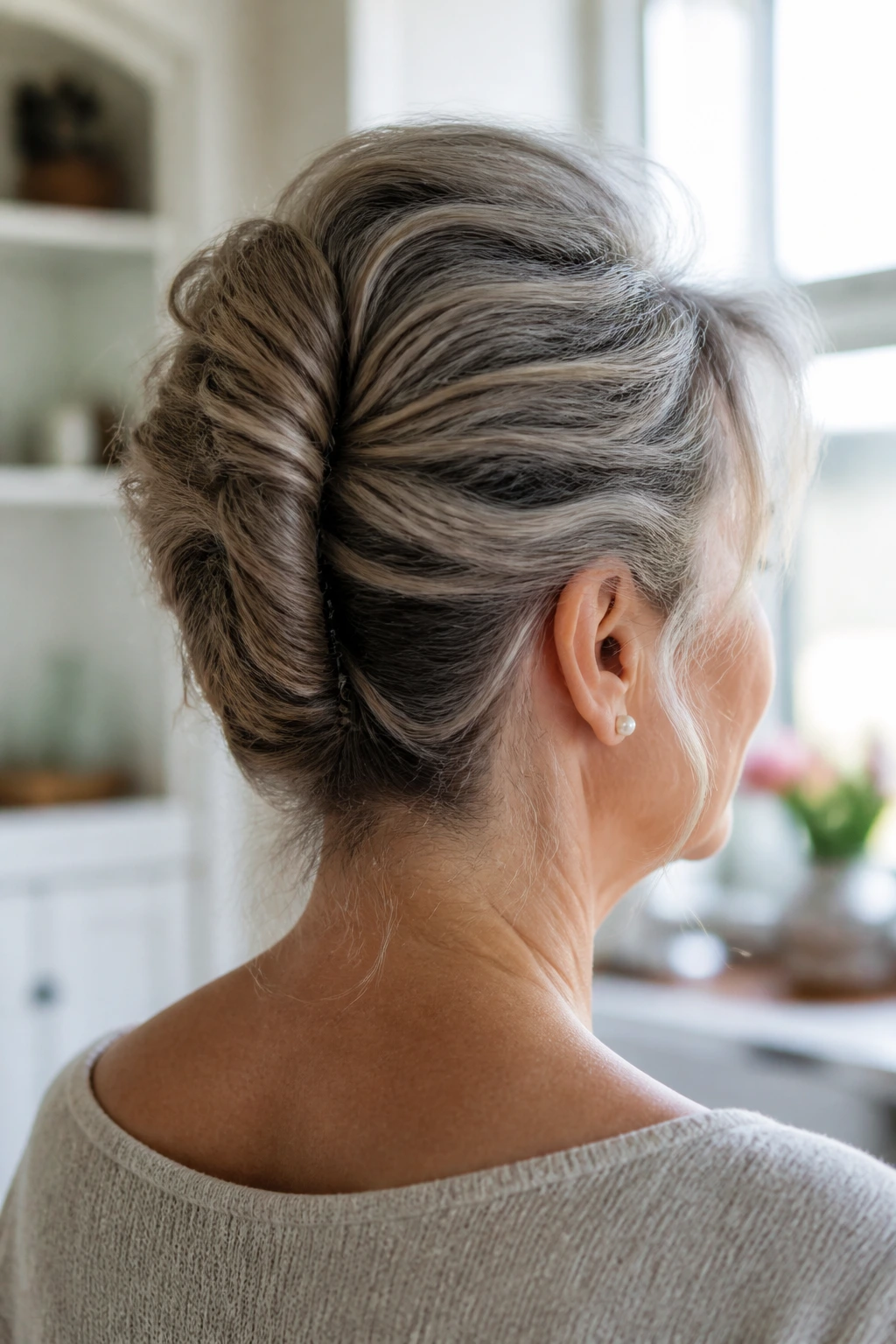
A French twist can sound fussy, but a loose version on thick hair is one of the fastest ways to look pulled together. It works because the density gives the twist substance. Thin hair often needs padding or teasing. Thick hair just needs a bit of direction and a handful of pins.
This is the style I’d reach for if I wanted to look as though I had plans, even if the plans were only errands and lunch. Sweep the hair back, roll or fold it upward, and secure the length vertically along the center with pins. Leave a soft piece at the temples if you want the face to feel less severe.
The best French twists on mature hair are not tight, glossy shells. They are a little airy, with a few pieces escaping on purpose. That softness suits silver and salt-and-pepper strands especially well. Shine shows up on the twisted surfaces, and the shape reads clearly from a distance.
If your hair is very thick, pin the twist in stages. Don’t wait until the end and hope one pin can save it. It cannot.
11. The Collarbone Cut With Soft Waves
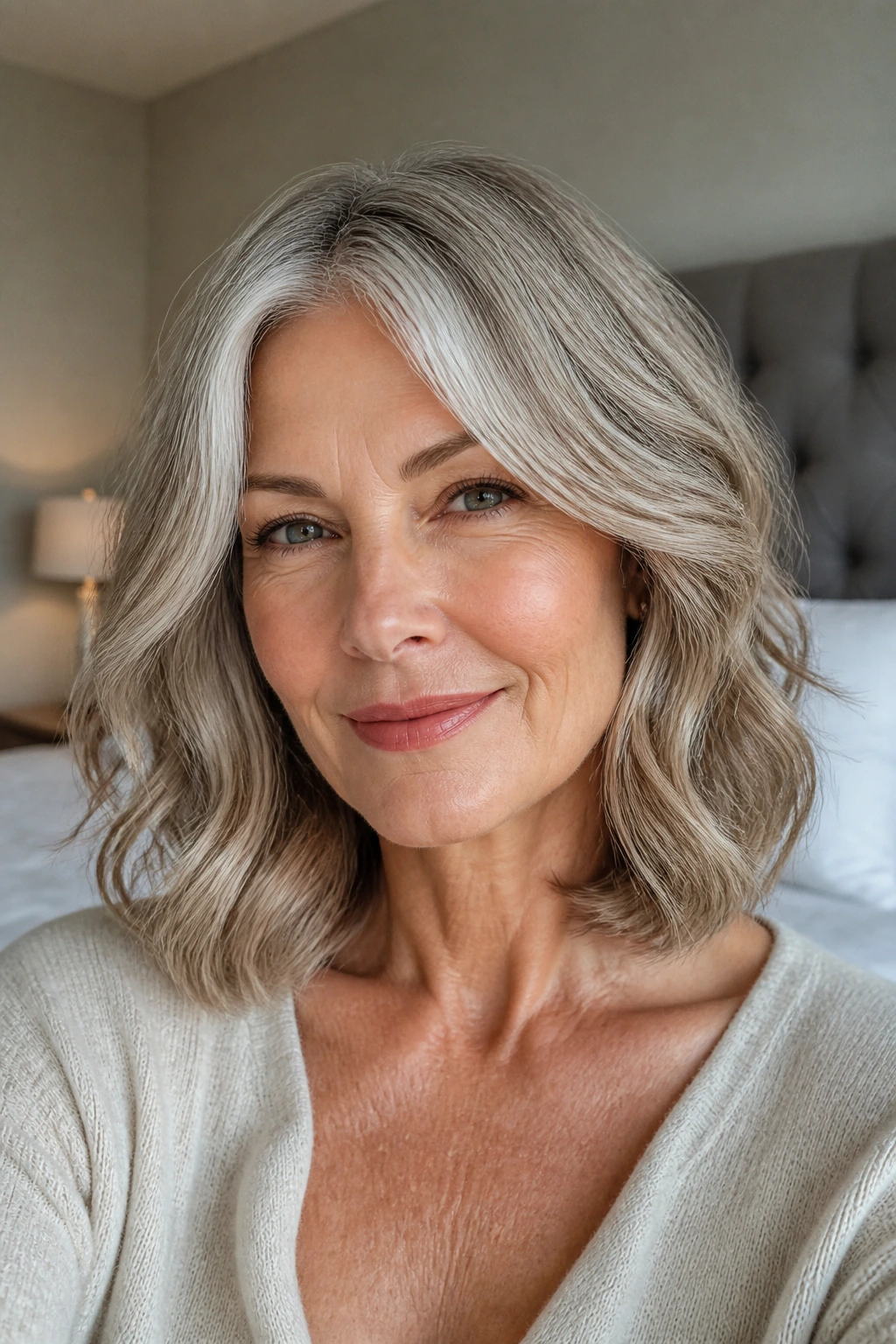
The collarbone cut is the middle ground a lot of busy people end up loving. It’s long enough to pull back, short enough not to drag on the shoulders, and flexible enough to wear smooth or waved. On thick hair, the shape matters more than the length. If the ends sit right at the collarbone, they move instead of flopping.
Soft waves keep this cut from feeling too blunt. You can create them with a 1¼-inch curling iron, but you do not need a full set of perfect curls. Bend only the mid-lengths, leave the last inch straighter, and finger-comb the waves apart. That keeps the style modern and easier to live with.
I like this cut for women who want options. You can tuck it behind the ears one day, clip one side back the next, or tie the whole thing into a low knot if the morning turns messy. Thick hair gives the cut enough body that it doesn’t need heavy styling lotion to survive.
The only thing I’d watch is thickness at the ends. If the perimeter is too blunt and too heavy, the collarbone cut can start to feel square. A little bevel solves that.
12. The Stacked Bob That Gives the Back Some Lift
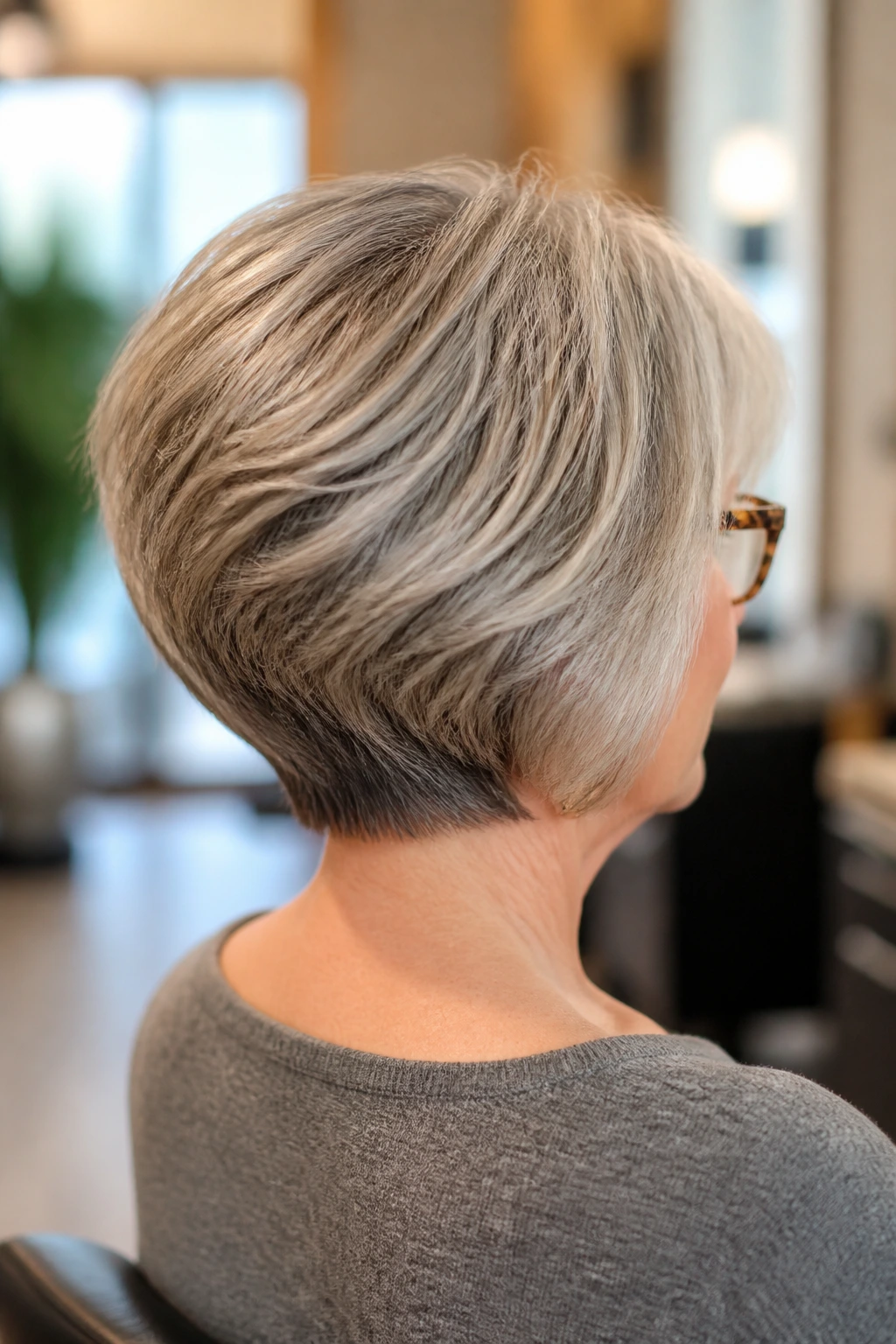
A stacked bob is the cleanest answer when the back of the head feels too heavy and the neck wants a break. The shorter layers at the nape lift the hair away from the collar, while the longer pieces on top maintain shape and softness around the face. On thick hair, that stacked angle makes a huge difference.
Unlike a flat bob that can sit like a ledge, this one has built-in movement at the back. That means less blow-drying and less collapse by midmorning. A round brush or a small vent brush at the crown and nape is enough for most days.
Why It Works Better Than a Plain Short Cut
A stacked bob takes the hair’s density and puts it where it helps, not where it annoys you. The back lifts. The sides taper gently. The front can still be long enough to tuck or sweep. That balance is hard to beat if you like shorter hair but hate a look that feels boxy.
It’s also friendly to glasses because the sides can be cut to sit just above the frames instead of puffing around them. The one caution is overstacking. Too much angle and the back can look sharp or dated. You want lift, not a hard shelf.
13. The Deep Side-Part With Barrettes That Fixes a Flat Morning
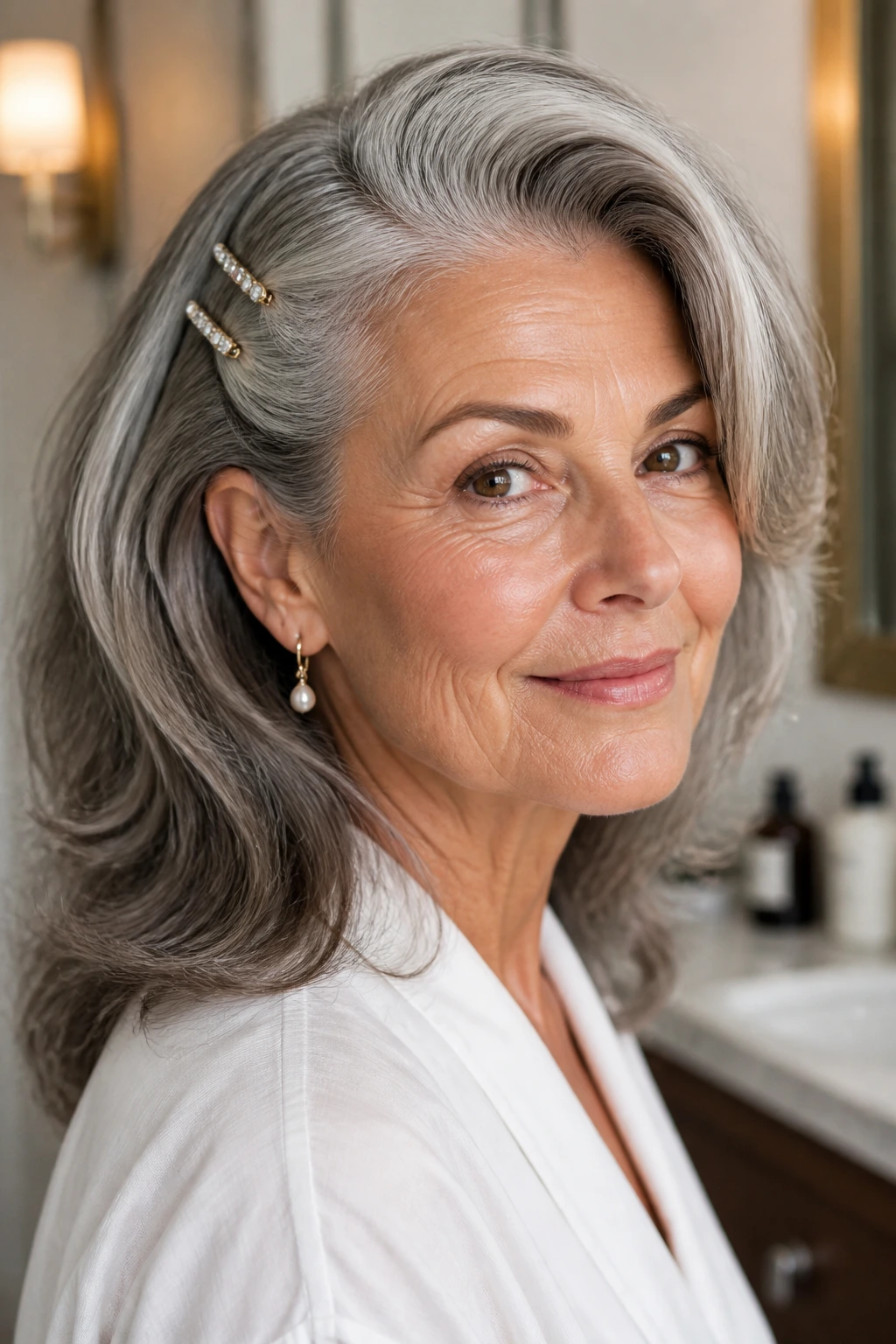
Need something that looks intentional in 90 seconds? Make the part do the work. A deep side part adds lift at the roots, shifts the weight off one side of the face, and gives thick hair a little sweep without demanding a full style change. Add two barrettes or one substantial clip, and the whole thing feels considered.
This works especially well on mornings when your hair has a cowlick, a dent from sleeping, or a front section that refuses to behave. A deep part changes the direction enough to reset the shape. That is often all thick hair needs.
How to Wear It
Brush the hair across from the natural part, then let it fall. Pin one side back at the temple, or use two smaller clips stacked slightly apart. That’s cleaner than trying to pin a huge section flat against the head. If the top needs a lift, mist the roots with a little dry shampoo before you part.
I’d choose this on days when you want your glasses, earrings, or lipstick to get more attention than the hair. It keeps the look simple and lets one strong line do the styling.
14. The Tucked-Under Bob That Looks Neat at the Neck
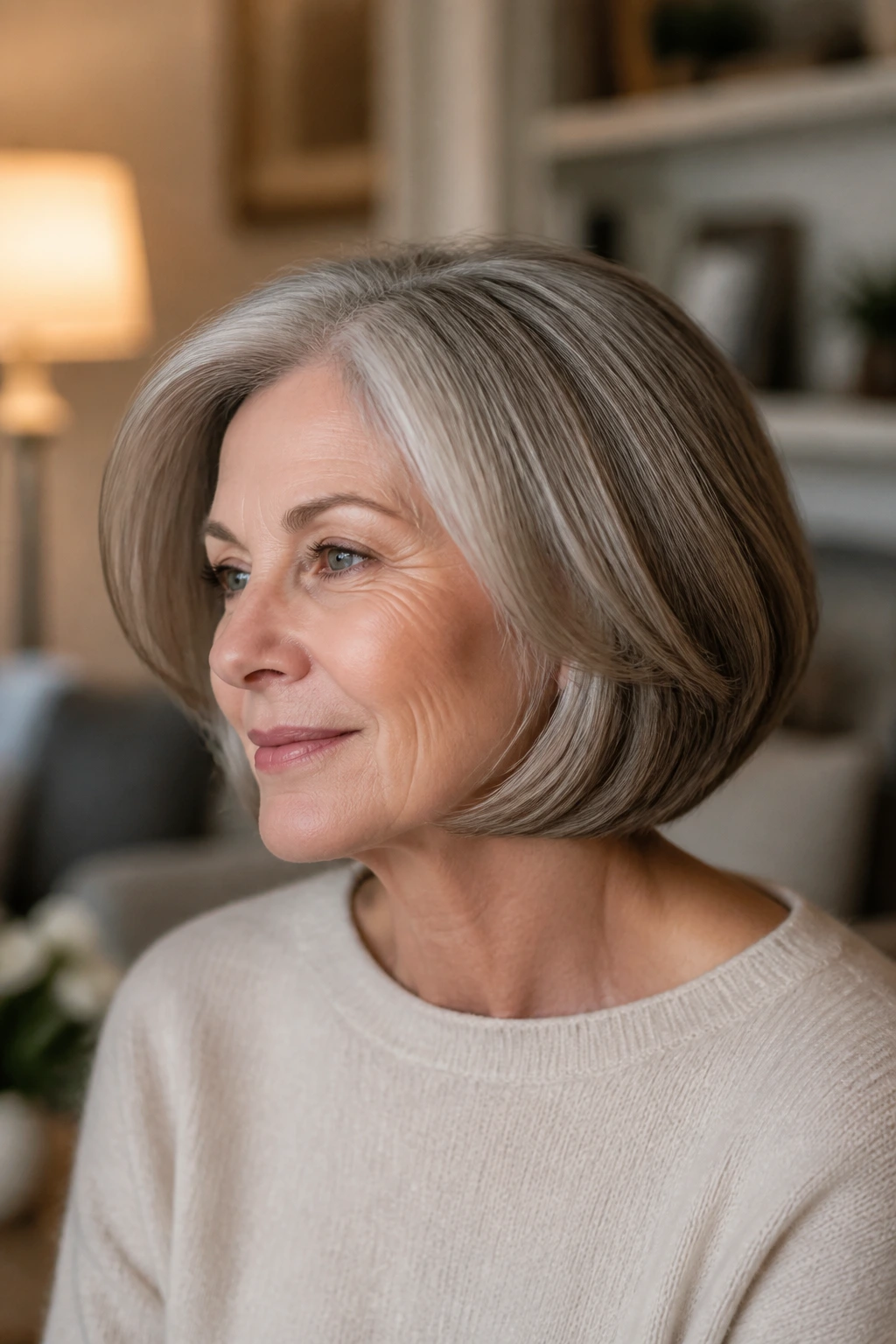
There is something satisfying about a tucked-under bob. It feels tidy. It behaves under coats. It does not poke out in odd directions when you turn your head. Thick hair especially likes this shape because the ends are trained inward instead of out, which can be a whole battle on its own.
Use a round brush or a paddle brush with a dryer for the last pass. Pull the ends under as you dry, then let them cool in place. That cooling moment matters more than people think. Hair sets as it cools, not just as it heats.
This is a good choice if you like a polished finish without looking overly styled. It sits neatly with turtlenecks and collared shirts, and it can make silver hair look almost architectural in the best way. Sharp, but not severe. Clean, but not stiff.
If the bob is cut too blunt, the under-turn can fight the shape. A slight bevel at the ends helps the hair fold inward without demanding a wrestling match from your brush.
15. The Top Knot With Loose Nape Pieces
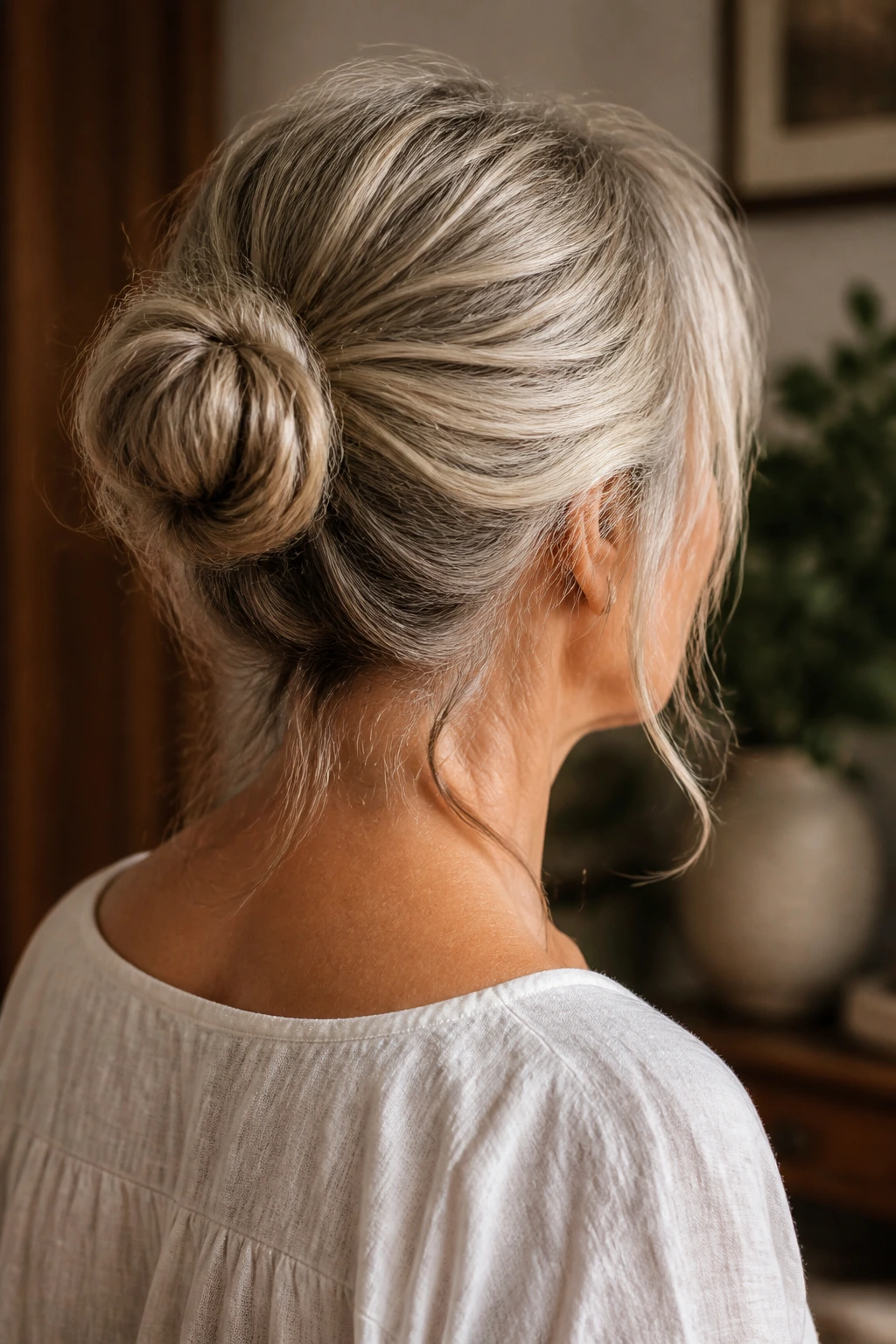
A top knot can go wrong fast on thick hair if it’s built too high and too tight. The better version sits a little lower than the crown and leaves a few soft pieces at the nape. That keeps it from reading as severe or strained. It also keeps the style from pulling on the scalp, which is not something to ignore.
I like this for days when you need the hair fully off your face and neck but still want a little softness around the edges. Twist the hair into a knot, coil it once, and pin or secure it with a sturdy elastic. Then pull out only a few thin nape pieces — not so many that the style falls apart, just enough to soften the line.
It’s a strong move for long, thick hair because the knot has enough body to look full even when it’s not perfect. And it doesn’t need perfect. That’s the point.
If your hair is extra dense, split the ponytail into two sections before you twist. That reduces the strain on one elastic and gives the knot a rounder shape.
16. The Headband Sweep That Keeps Fringe Out of the Way
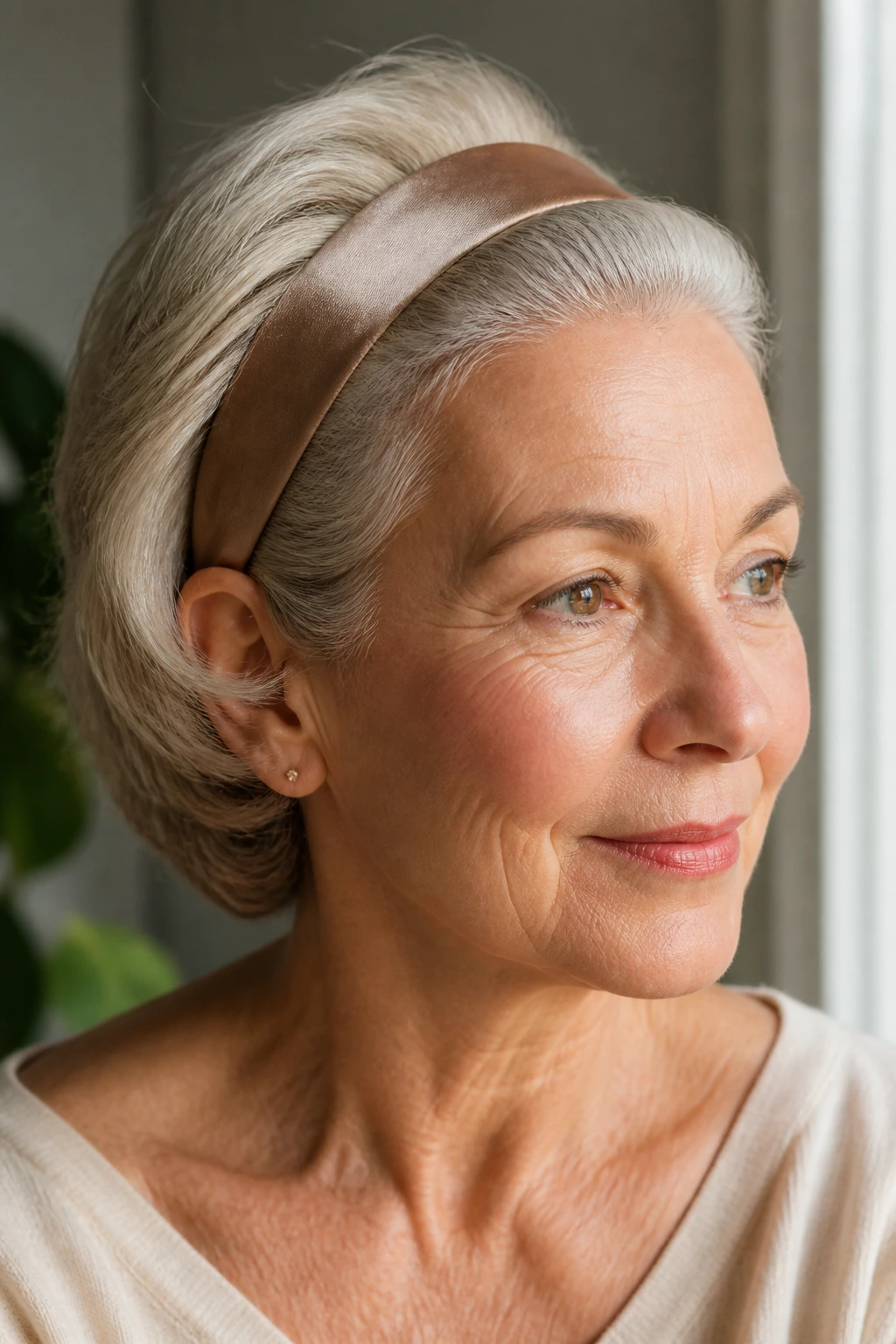
A wide headband is one of the easiest tools for thick hair, and it deserves more respect than it gets. It pushes the front back, controls shorter layers, and turns second-day hair into something that looks on purpose. On mature hair, that matters because the front often wants to separate or puff at the part line.
The best version is not the tight athletic band that digs into the scalp. Use a padded, satin, or fabric headband that sits comfortably behind the hairline. Sweep the front sections back, tuck them under the band, and let the rest fall in loose waves or a soft bob shape.
This is a smart option when you want to wear earrings or frames without hair crowding the face. It also works on wash days when the roots are a bit too fluffy for a sleek part. The band becomes the style, which is a nice little cheat.
If your hair tends to slide out of headbands, mist the front with dry shampoo first. That gives the band a dry, grippy surface to hold onto.
17. The Scarf-Wrapped Roll-and-Tuck Style
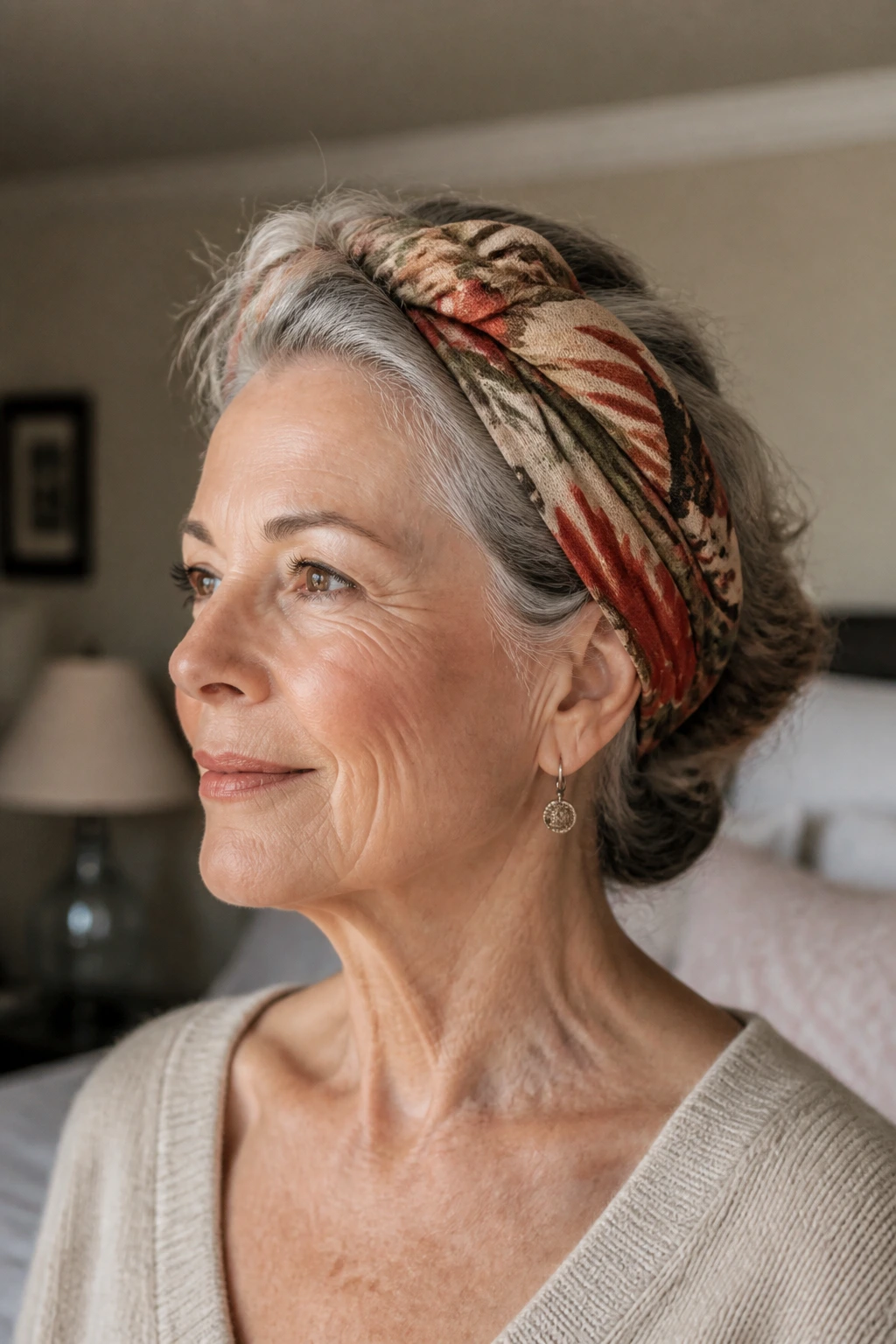
A scarf can save a morning. It can also make thick hair look more intentional than a ten-minute blowout that never quite settled. The roll-and-tuck style uses the scarf to keep the hair compact, tame the edges, and add a bit of color near the face without needing a separate accessory and styling routine.
Fold a silk or cotton scarf into a band, place it at the hairline, then roll the hair up or tuck it into a low shape under the scarf. You can leave some ends visible if you want a softer, more relaxed look. If you prefer a neater line, hide the ends completely and pin them under the roll.
This is especially handy for frizzy or weather-sensitive thick hair. The scarf acts like a shield. It also works well when the hair is in that awkward stage between washes where it’s not dirty enough to wash but not smooth enough to leave loose.
A scarf with a little structure stays put better than a slippery ribbon. Save the silky ones for when you can pin them properly.
18. The Loose Braid Into a Bun Hybrid
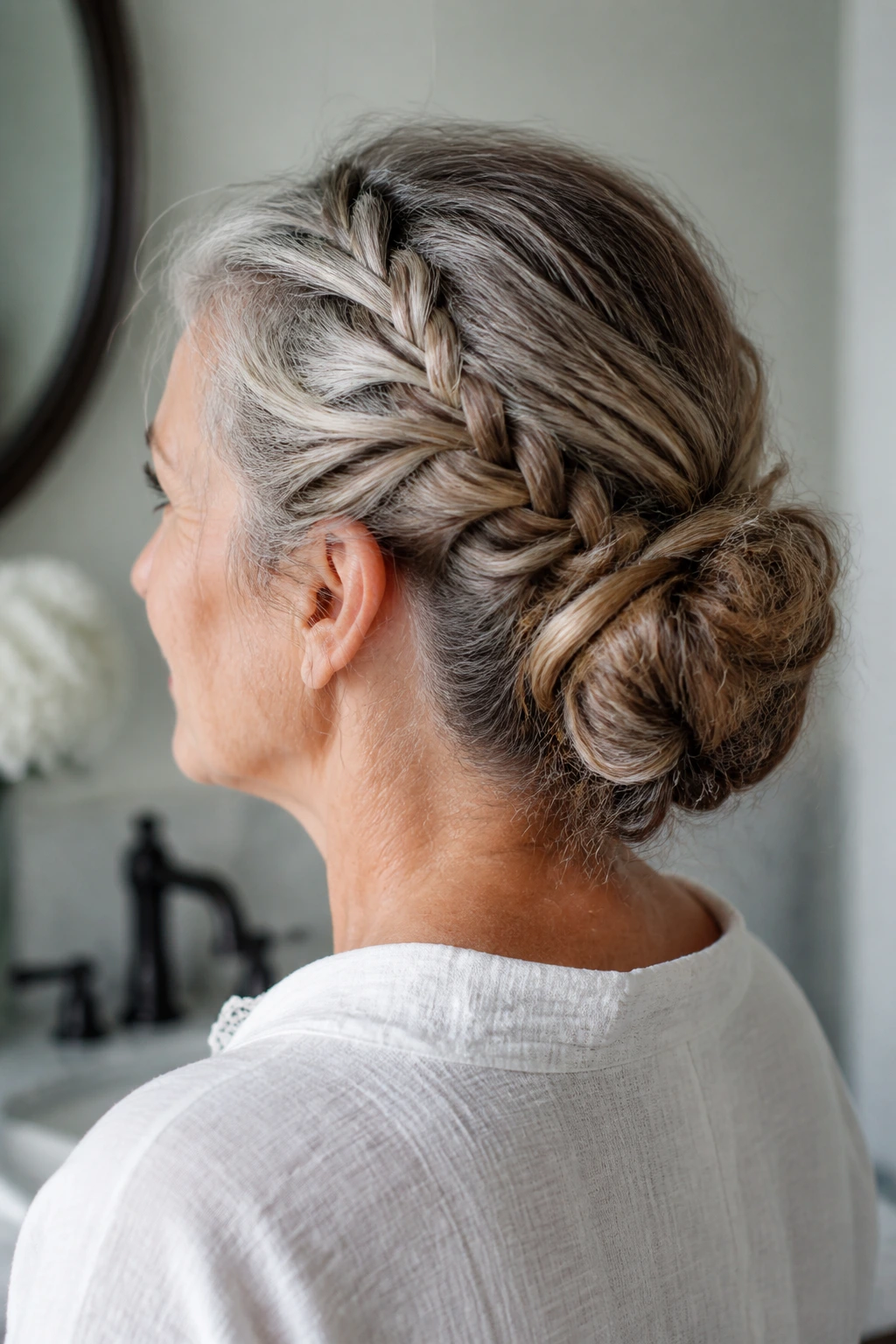
A loose braid into a bun is one of those styles that looks more complicated than it is. The braid gives thick hair control, and the bun keeps the length off the collar. Put them together and you get a shape that can survive errands, wind, and a long afternoon in a chair.
Braid the hair loosely down the back or slightly to one side, then coil the braid into a bun and pin it in place. Don’t braid it so tightly that the texture disappears. Thick hair has enough body to create a nice round braid without much effort, and that texture is what keeps the bun from looking flat.
Why I’d Pick It Over a Plain Bun
A plain bun can shrink on thick hair and leave the top looking bulky. The braid breaks up that weight and gives the style a visible line. It’s also easier to secure because the braid gives the pins something to catch. Plain coiled hair can slide. Braids grip.
This is a good choice for humid days or when you want a style that keeps the neck clear but still feels soft. Leave a little face framing if you want the look to stay gentle.
19. The Wash-and-Go Natural Wave Shape
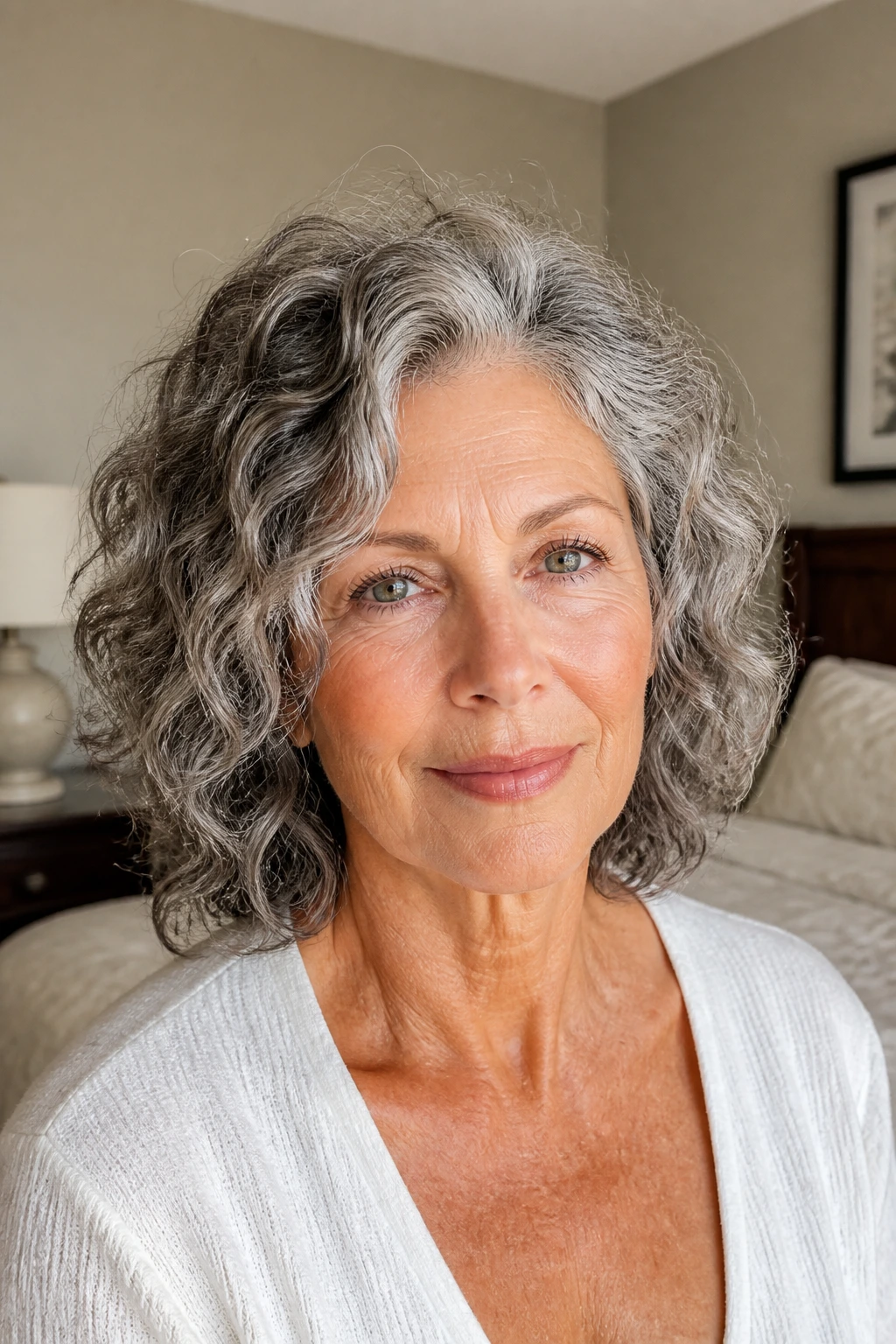
Sometimes the best style is not a style at all. Thick wavy hair can look its smartest when it’s cut to dry in a shape and left alone. That means a cut with enough internal movement to stop the ends from bunching, plus a leave-in cream or wave lotion that keeps frizz from taking over the top layer.
The key is restraint. Too much brushing breaks up the wave and creates puff. Too much product weighs the shape down and makes the top sit flat while the ends stay dry. A small amount of cream through the mid-lengths, a scrunch with a microfiber towel, and air-drying or diffusing on low heat is enough for most days.
This is a favorite of mine for thick hair because it respects texture instead of trying to polish it into submission. Mature hair often gets drier, not flatter. A wash-and-go shape lets the waves do the work while keeping the outline neat.
If you have a stronger wave pattern around the back than the front, clip the front sections lightly while they dry. That keeps the top from getting shorter-looking than the rest.
20. The Short Layered Cut That Flips Into Place on Its Own
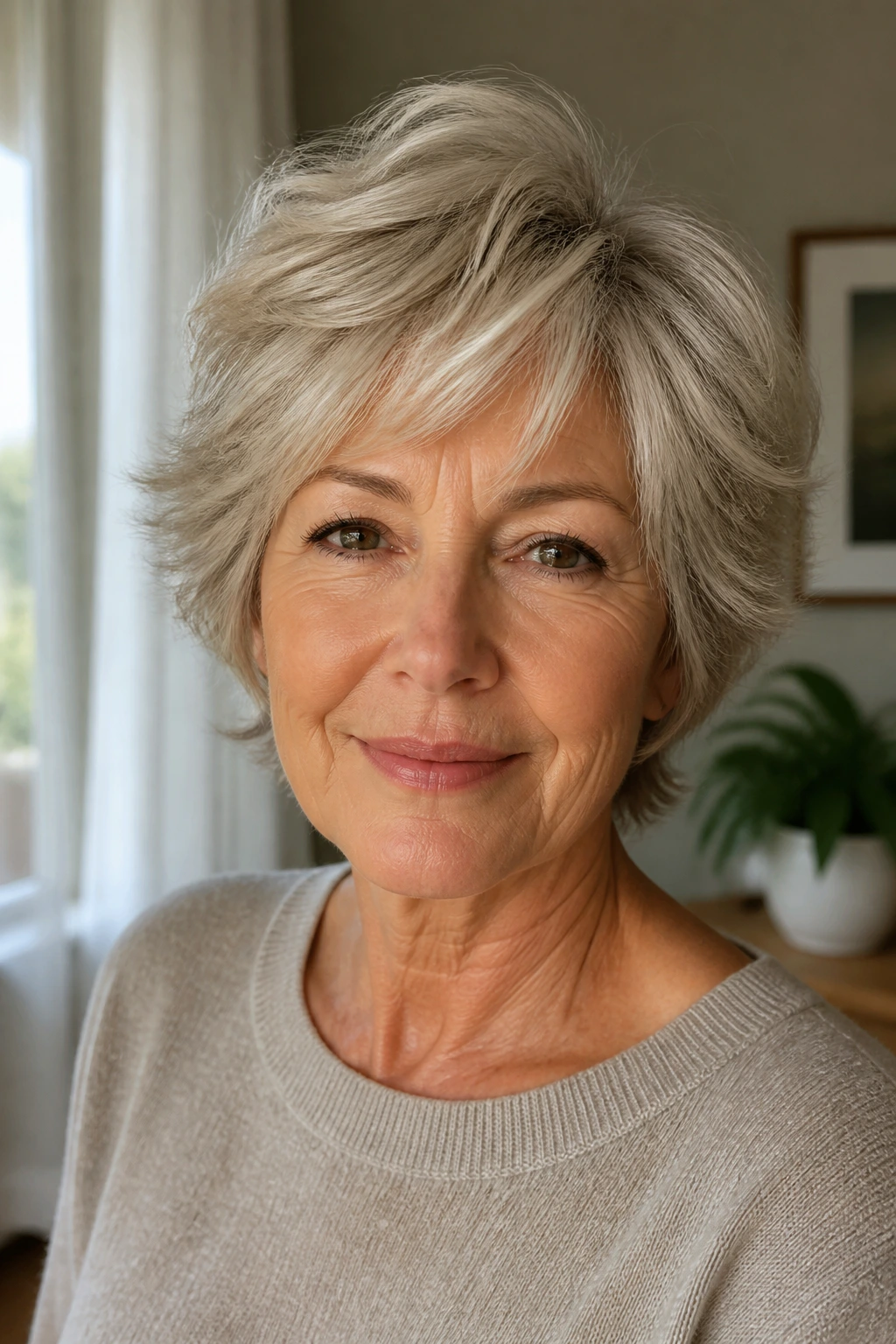
A short layered cut is the cleanest answer for someone who wants the least morning labor possible. The layers remove bulk, the shape sits close to the head without clinging, and thick hair gets enough air around it to move instead of bulking up in one block. Done right, it practically styles itself.
The best version is soft, not choppy. The layers should encourage the hair to flip, bend, or lift where it naturally wants to, not fight it. A quick blast with a blow-dryer and a fingertip of styling cream is usually enough. If your hair dries in odd directions, dampen just the stubborn sections and reset them for 30 seconds. That is often faster than starting over.
This cut is especially useful if your shoulders, neck, or hands are tired of long hair maintenance. It also wears silver beautifully because the layered movement shows up immediately. Thick hair looks lighter when it has room to breathe.
I’d choose this over a high-maintenance long style any day if the morning goal is simple: look neat, move on, and stop thinking about hair by 8 a.m.
How to Wear These Looks When You’re Already Late
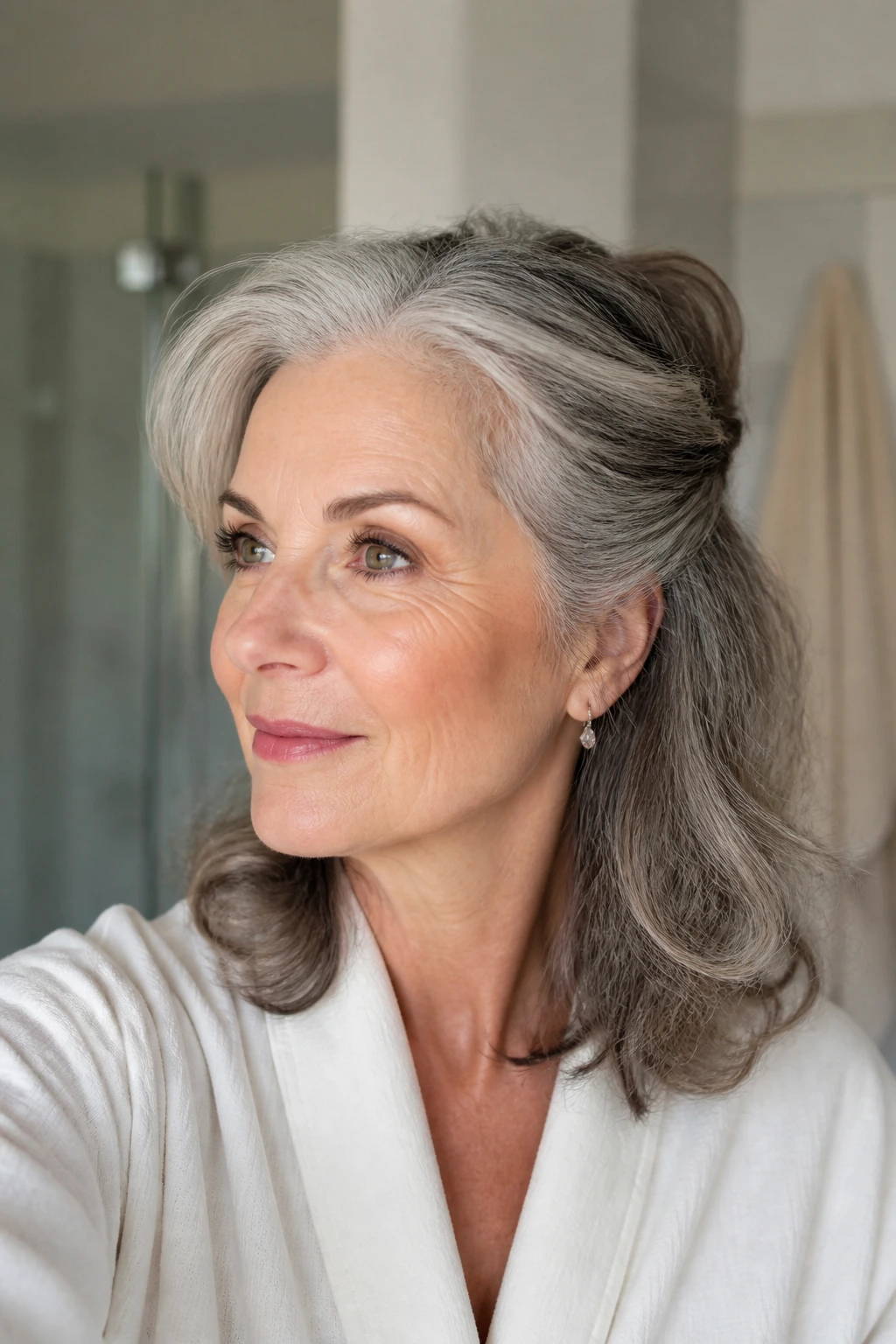
Glasses: The bob, the tucked-under styles, the side-part with barrettes, and the long pixie all keep the temples clear without making the face look crowded. If your frames sit wide, avoid huge side volume right at the temples. That’s where the whole look starts to feel clumsy.
Earrings: Updos and low twists show off earrings better than heavy hair left loose around the jaw. Hoops need a little clearance; studs can disappear behind waves unless you tuck one side back. If you like both, the half-up clip and the loose French twist give you room for either.
Necklines: Turtlenecks and high collars pair best with short crops, stacked bobs, or anything pinned up at the nape. Open necklines can handle more movement, which is where the shag, lob, and collarbone cut shine. Hair and clothing should not fight for the same space.
Quick lift: Keep one clip, one small brush, and a little spray at the sink. If a style can be fixed with a part shift and a clip, it is a winner on a rushed morning.
Small Tweaks That Save Five Minutes

Night-before prep: Put your hair in a loose braid, a low bun, or a silk scarf before bed. Thick hair keeps shape overnight better than fine hair does, but it still benefits from sleeping on smooth fabric. A satin pillowcase cuts down on the morning frizz halo that shows up around the hairline.
Root reset: If the crown looks flat, mist the roots lightly with water or dry shampoo and blow-dry only that area for 30 seconds. You do not need to restyle the whole head. Most mornings, the fix is local, not global.
Product choice: Use less cream than you think. Thick hair can hide too much product for about ten minutes, then it suddenly looks limp and separated. Start with a pea-sized amount, warm it in your hands, and add only if the ends still feel dry.
Part trick: Change the part by an inch or two on days when the front looks tired. That tiny shift makes the hair lift at the root and stops one flat spot from becoming a daily problem.
Hands-free help: Keep a medium claw clip and two strong pins in the bathroom. If your grip is shaky in the morning, the right clip saves more time than a drawer full of tools you do not want to use.
Mistakes That Make Thick Hair Work Against You
Thinning the whole head: This is the classic mistake. The hair looks good for about a week, then the ends start fraying and the surface goes fuzzy. Ask for weight removal where the bulk gathers, not a blanket thinning job that leaves the perimeter weak.
Using tiny elastics for big sections: They snap, slip, or create a dent that takes forever to smooth out. Thick hair needs firmer ties, spiral elastics, or a base wrapped with a strand of hair.
Overloading the roots with product: Thick hair can swallow a lot of cream before it starts looking greasy, which is dangerous. If the crown falls flat and the ends still look dry, the product is sitting in the wrong place. Use it on the last few inches first.
Forcing the wrong part: A part that fights the natural growth pattern will puff, separate, or collapse by noon. Move it a little off center or go deep on one side. The hair usually settles faster when it is not being argued with.
Skipping trims too long: Thick hair hides split ends for a while, then the damage shows as a puffed-out outline and ends that flip in odd directions. Short cuts need a trim every 4 to 6 weeks; longer cuts usually stay neat with 8 to 10 weeks.
Pulling styles too tight: A style should feel secure, not like a headache in progress. If the scalp feels sore, loosen it. Tight is not the same thing as polished.
Variations and Adaptations to Try
The Heat-Free Week: Lean on claw clips, braided crowns, headbands, and low twists for a full week without hot tools. Thick hair usually has enough texture to hold shape once it’s set with a little cream and allowed to air-dry.
The Silver Shine Edit: Keep the cut clean and the product light. Silver and white hair shows shape fast, so a bob, pixie, or tucked-under style often looks sharper with less effort than a heavily curled look.
The Glasses-Friendly Version: Pick styles that stay lower at the temples and leave the ears mostly clear. Soft bobs, side parts, and half-up clips work better than wide side volume that crowds the frames.
The Frizz-Control Version: Swap airy mousse for a smoothing cream and finish with a tiny amount of serum on the ends. This is the one to use when humidity turns thick hair into a cloud by midmorning.
The Dress-Up Version: Add a satin scarf, pearl pins, or a more polished twist at the nape. A simple cut looks much more deliberate with one well-placed accessory, and thick hair holds them better than most people expect.
Tools That Earn Their Place on the Counter
-
Wide-tooth comb: Best for detangling thick hair without tearing through damp strands.
-
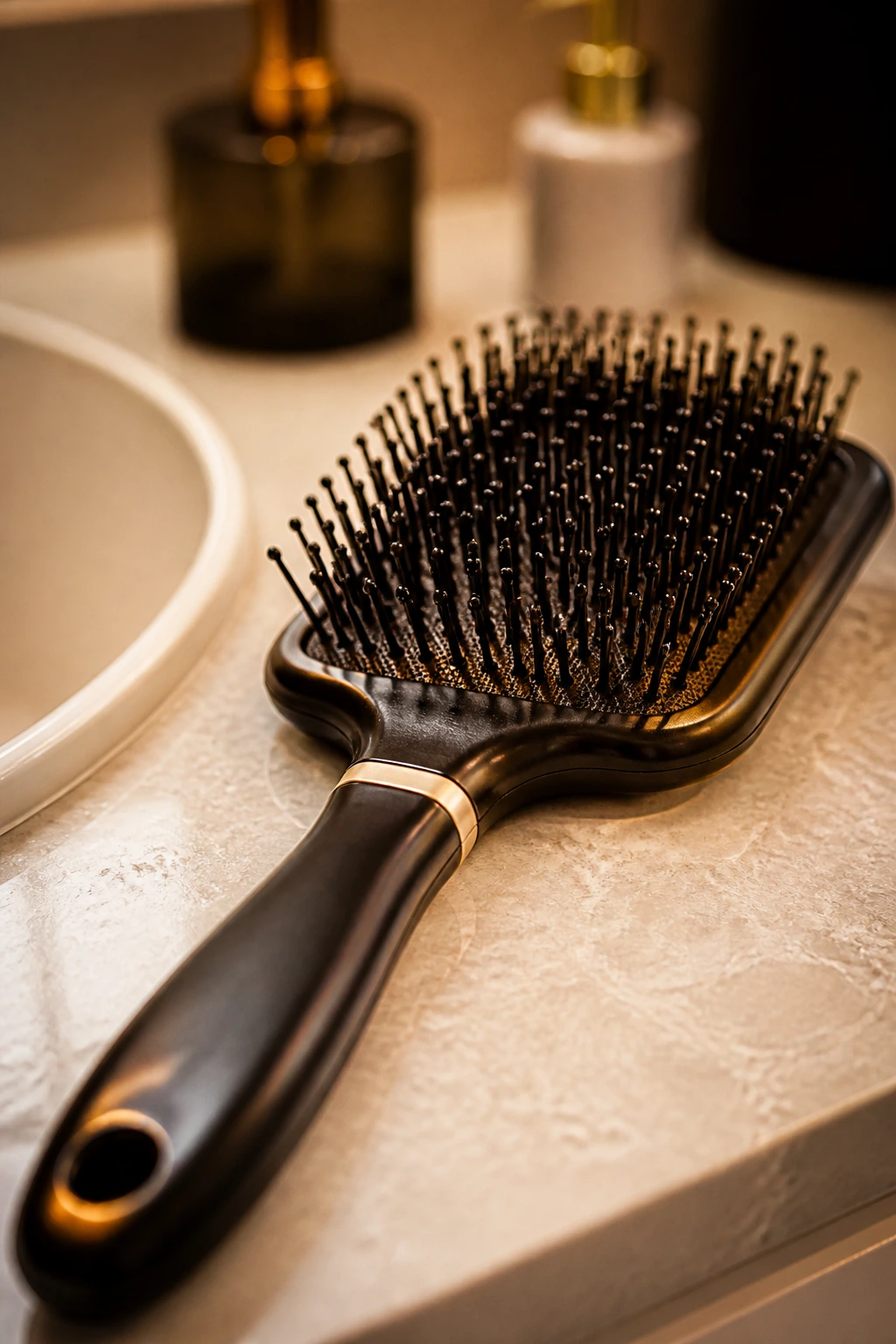
Paddle brush: Good for smoothing bobs, lobs, and low ponytails fast.
-
Small round brush: Useful for turning ends under and lifting the crown in short cuts.
-
Medium claw clip: Holds half-up styles and low twists better than dainty clips.
-
Strong bobby pins: Choose the grippy kind with a firm bend; slippery pins disappear fast in dense hair.
-
U-pins: Worth having for chignons and French twists because they anchor bulky sections with less bulk.
-
Dry shampoo: Helps the roots behave on day two or three, especially around the part line.
-
Light mousse or wave lotion: Gives shape without the heaviness of too much cream.
-
Smoothing cream: Useful on the ends of bobs, lobs, and pixies when the surface looks rough.
-
Heat protectant spray: Keep it around if you use a dryer, iron, or hot brush.
-
Hair ties with a fabric wrap: Better for thick hair than thin elastics that snap or dig in.
-
Satin pillowcase or scarf: Cuts down on frizz overnight and keeps styles from getting crushed.
Keeping Thick Hair in Shape Between Washes
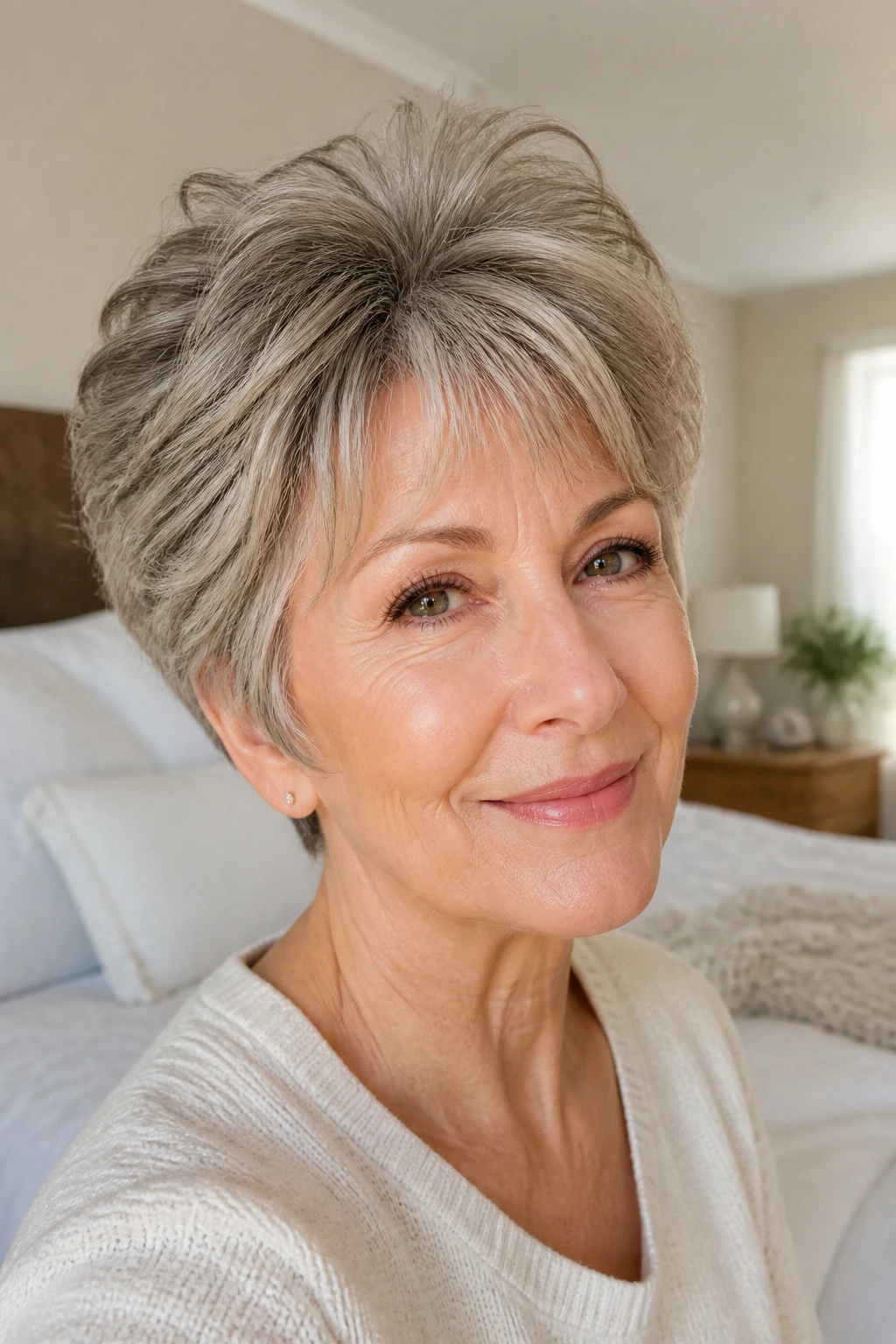
Thick hair usually behaves best when it is not washed every single day. A good starting point is every 2 to 4 days, then adjust based on scalp oil and how dry the ends feel. If your ends are coarse or color-treated, stretching the wash cycle a little can help the shape stay calmer. If the scalp gets oily fast, use dry shampoo at the part and around the crown on the off days.
Short cuts need more frequent trims to keep the edges clean. Pixies and stacked bobs usually want a trim every 4 to 6 weeks. Bobs and lobs can often go 6 to 10 weeks before the shape starts to lose its line. Once the ends start flipping outward on their own or the bulk starts gathering at the jaw, the cut is telling you it needs attention.
Overnight care matters more than a lot of people think. A loose braid, a soft clip, or a satin scarf keeps the top from puffing and the ends from bending into odd shapes. If you wake up with a dent, dampen that section only and reset it with a brush or fingers for 30 seconds. That tiny reset often saves a whole morning.
If a style has to survive a second day, refresh the front first. The part, the temples, and the nape show wear before the rest of the head does.
Questions People Ask About Thick Hair After 65

Which hairstyle is fastest when I’m really rushing?
The long pixie and the half-up claw-clip twist are the quickest. Both can be done in under five minutes once the cut is right, and neither one needs a full blowout to look finished.
Are layers or blunt ends better for thick hair?
Both can work, but they do different jobs. Blunt ends give a clean line, while internal layers remove weight and stop the hair from turning boxy. Thick hair usually looks best with a clean perimeter and some hidden shaping inside.
What if my hair is too thick for a clip?
Use a larger claw clip with real teeth, or twist the hair first so the clip grips something compact. If the clip keeps slipping, the section is probably too big. Split it into two smaller sections and pin them together instead.
How do I keep the crown from puffing up?
Dry the crown first, then let the rest air-dry or stay lightly damp while you finish the top. A small amount of mousse or dry shampoo at the roots gives the crown structure without making it stiff. Too much cream on the top will make the puff worse.
Can I wear these styles if I have glasses?
Yes, and some of them work better with glasses than without them. The chin-length bob, side-part styles, pixies, and tucked-under cuts keep the temple area neat, which stops the frames from fighting the hair.
Do I have to use heat every day?
No. Most of these styles are built to work with air-drying, finger styling, or a quick reset at the roots. Heat helps with a few looks, but it should be a tool, not the whole routine.
What if my hair is curly or wavy instead of straight?
That can help. Wavy and curly thick hair often needs less shaping than straight thick hair, as long as the cut respects the pattern. Ask for a shape that works when dry, not one that depends on stretching the curl flat.
How often should I trim thick hair?
Shorter cuts usually need trims every 4 to 6 weeks. Bobs, lobs, and longer layered cuts can often go 6 to 10 weeks. Once the silhouette starts widening at the ends, the haircut is asking for a clean-up.
The Morning Shortcut Thick Hair Deserves
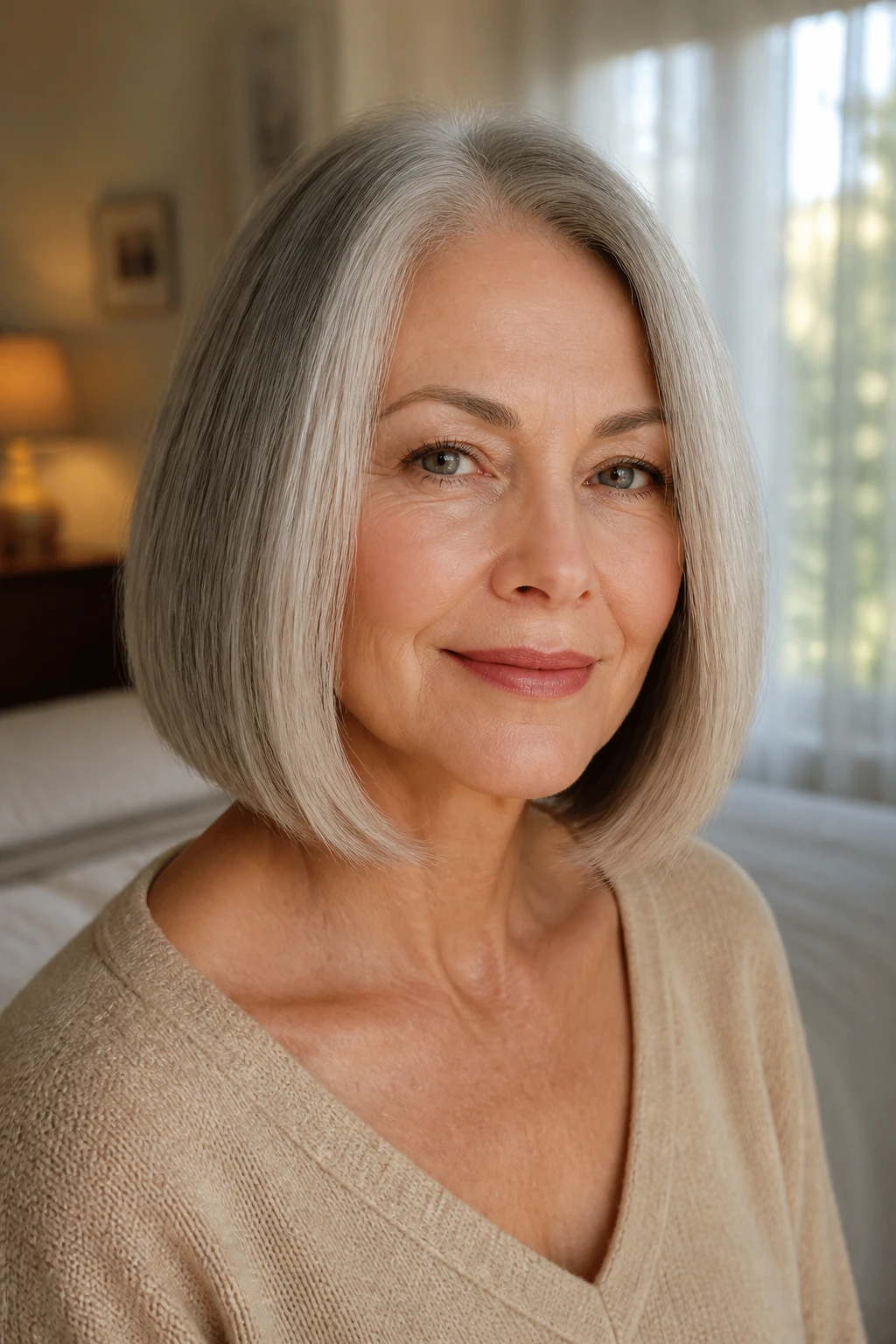
Thick hair after 65 does not have to become a daily project. Once the cut has the right shape, the morning routine gets smaller. A bob that tucks cleanly behind one ear. A pixie that wakes up with lift. A low twist that behaves without a fight. Those are not cosmetic luxuries. They are time savers.
The best part is that none of these looks asks you to pretend your hair is something else. They work because they respect the weight, the texture, and the way mature hair wants to move. That is the whole trick. Stop wrestling it flat. Give it a shape that can stand up to a clock, a pair of glasses, and a real day.
Choose the style that matches your hands, your neckline, and your patience level, then keep that one in rotation until it feels like second nature. The mornings get easier when the hair stops acting like a separate appointment.