



A ponytail can sharpen a heart-shaped face or soften it in all the wrong places, and the difference is usually only two inches of height and one loose strand near the cheekbone. With long hair, you’ve got enough weight and length to sculpt the shape instead of just yanking it back and hoping for the best. That’s the part most people miss. A ponytail is not one hairstyle here; it’s a whole set of small decisions about where the bulk sits, how much forehead you show, and whether the eye lands on the chin or gets pulled upward too hard.
Heart-shaped faces tend to have more width through the forehead and temples, then taper toward a narrower jawline and chin. That means a ponytail has to do a little balancing act. Too much height at the crown can make the forehead feel wider. Too much slick-back tension can make the chin look sharper. The sweet spot is usually somewhere between soft and structured: enough control to look intentional, enough movement to keep the face from feeling boxed in.
Long hair helps because it gives you weight, swing, and room for texture. A thin ponytail on a long length can look limp and top-heavy; a thick one with a wrapped base, a braid, or a few bends through the tail can feel much better. The styles below lean into that. Some are polished enough for work or dinner. Others are the kind you throw together when your hair needs to behave and you still want the shape to flatter your face.
Why These Ponytails Earn Their Keep
-
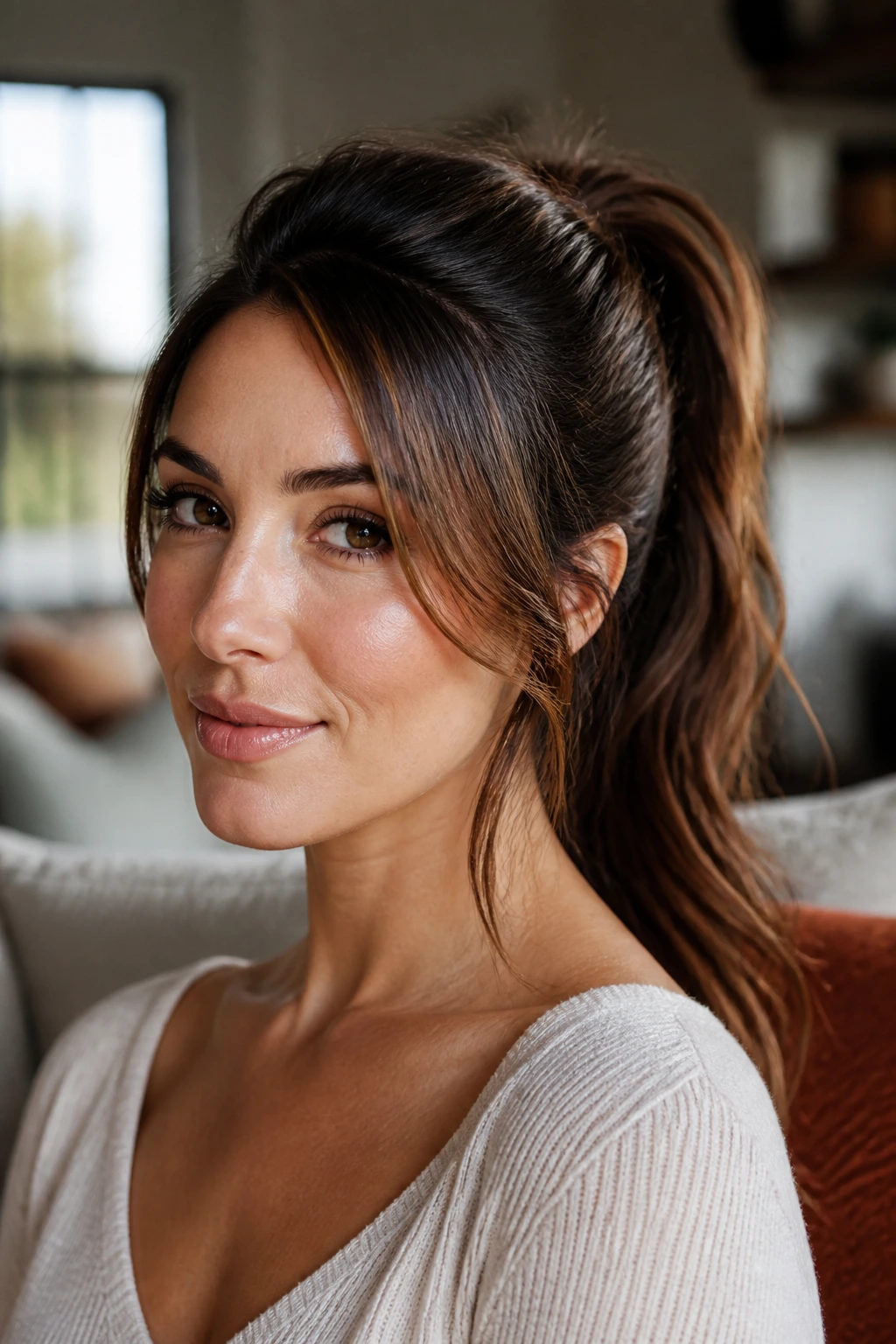
They balance the forehead first. The best styles here soften the upper half of a heart-shaped face with a side part, face-framing pieces, or a little lift that doesn’t start right at the hairline.
-
They keep long hair from dragging the look down. A long tail has weight, and these styles use that weight on purpose instead of letting it hang flat and lifeless.
-
They work with layers instead of fighting them. If you already have curtain bangs, cheekbone pieces, or long face-framing layers, these ponytails make those cut pieces work for you.
-
They give the jawline some breathing room. Several of the styles keep fullness away from the chin so the lower half of the face stays soft and open.
-
They don’t all demand hot tools. A good number of these can be done with a brush, an elastic, and five minutes of patience. That matters on mornings when the mirror is not your friend.
-
They still hold up when you move. Long hair can look gorgeous for exactly twelve minutes if the structure is wrong. These styles are built to survive errands, wind, and a long day.
1. Soft Low Ponytail with Face-Framing Pieces
A low ponytail like this is the first style I reach for on a heart-shaped face because it keeps the attention lower, where it can soften that narrow chin instead of fighting it. The trick is not the elastic. It’s the attitude. You want the top smooth, not flattened, and you want two small pieces left out near the temples or cheekbones so the face doesn’t feel pulled bare.
Why It Flatters This Face Shape
The low placement keeps the silhouette grounded. That matters because a heart-shaped face already has plenty of width at the top; stacking more volume there can feel lopsided fast. A smooth crown, a clean nape, and a bit of movement around the face do the balancing for you.
If your hair is very long, this version also helps the tail look thick instead of stringy. Gather the ponytail a touch below the occipital bone — that little bump at the back of the head — and let the tail hang with a slight bend rather than a rigid straight line.
How I’d Wear It
A middle part makes this look cleaner, while a soft side part pushes even more focus away from the forehead. If you want a little polish, wrap a 1-inch strand around the elastic and pin it under the ponytail. If you want it softer, curl just the front pieces away from the face with a 1-inch iron and leave the ends relaxed.
This one is not flashy. That’s the point. It does the balancing work quietly.
2. Sleek Mid Ponytail with a Clean Center Part
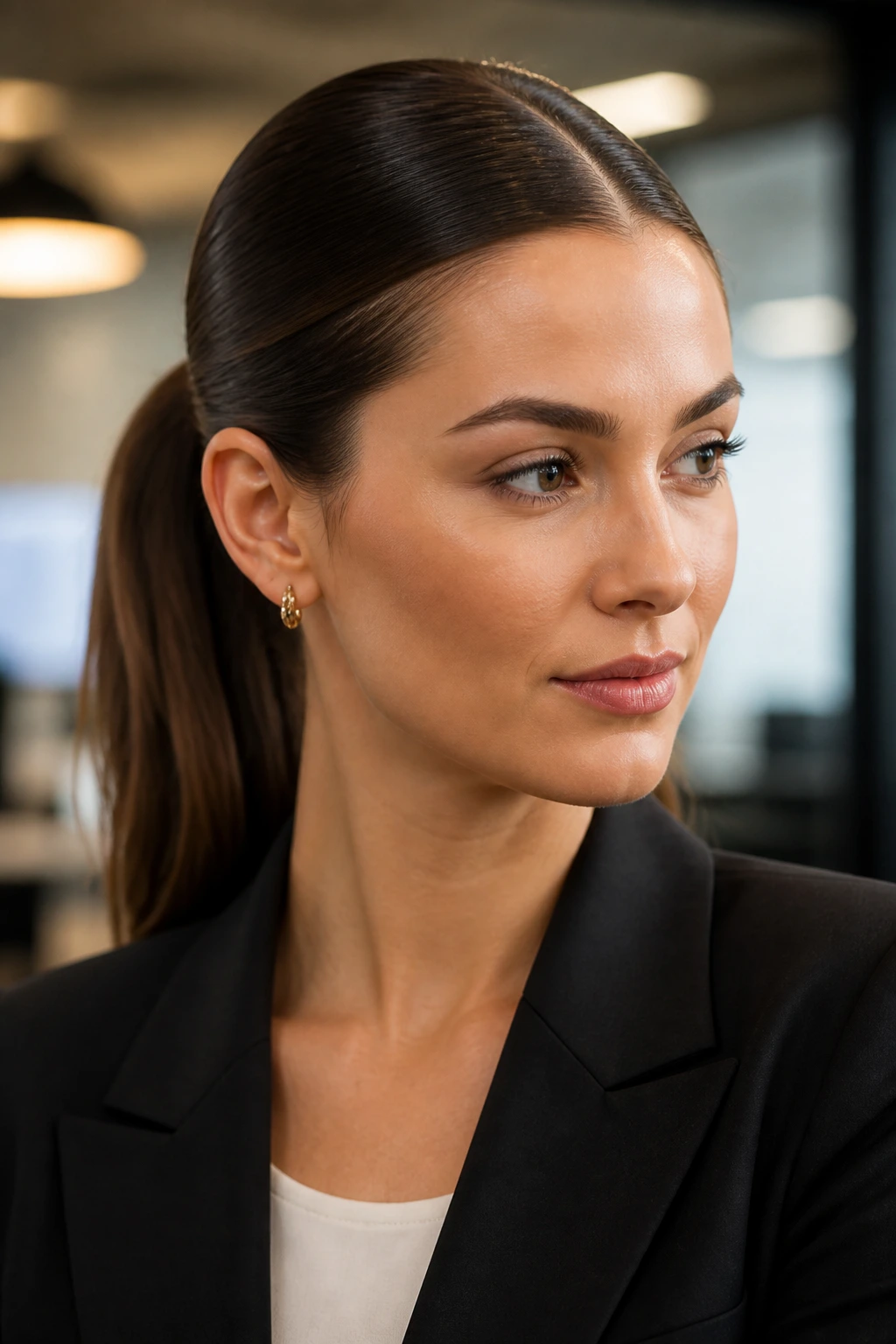
A sleek mid ponytail sounds plain until you see what it does to a heart-shaped face. Then it makes sense. The middle placement sits at a nice neutral point, neither too high on the forehead nor too low and heavy at the nape, and the center part adds a long vertical line that helps the face look more even from top to bottom.
The key is tension. Pull the hair tight enough that the top lies flat, but not so hard that the forehead becomes the whole story. A small amount of shine cream or smoothing serum on the surface keeps flyaways from making the style look rushed. Use it sparingly. A greasy ponytail reads as skipped-wash hair, not elegance.
This works well with long, thick hair because the tail has enough bulk to look deliberate even when it’s straight. If your hair is finer, tease the underside of the tail lightly at the base after securing it. Just a little. You’re building shape, not creating a puffed-up helmet.
I like this one with sharp collars, hoops, or a blazer. It has a clean line that looks better when the rest of the outfit has some structure too.
3. High Ponytail with Crown Lift and Soft Sides
Can a high ponytail work on a heart-shaped face? Absolutely, but only if you soften the edges first. The mistake is snapping the hair straight back and piling all the lift at the top. That can make the forehead feel wider and the chin feel even smaller. The better version starts with a loose crown and a few wispy pieces near the temples.
The point of this style is energy, not stiffness. Build a little height above the elastic, then smooth the sides just enough to keep the shape neat. If your hair is long, the ponytail itself will have enough swing to make the look feel lively. If you have layers, curl the ends under once or twice so the tail doesn’t break apart visually.
How to Make It Work
- Tease a small section at the crown before gathering the hair.
- Leave a thin veil of hair around the hairline if your forehead feels broad.
- Secure the ponytail at the upper back of the head, not at the very top edge.
- Wrap the base with a strand of hair for a finished look.
This version is best when you want lift without losing softness. It’s the high ponytail for people who hate the severe, cheerleader-ish version. Better. Cleaner. Less harsh.
4. Side-Swept Ponytail That Softens the Forehead
The side ponytail gets overlooked because people think it’s either childish or dated. Fine. Let them be wrong. On a heart-shaped face, a side-swept ponytail can be one of the easiest ways to move attention away from the widest part of the face and down toward the cheek and jaw area.
A deep side part is doing half the work here. It breaks up the forehead line, especially if you have a strong hairline or prominent temple width. Then the ponytail itself sits low on one side, often just behind the ear or slightly below it, where the weight feels more relaxed and less centered. The look is softer if the tail has a slight wave. If it’s poker-straight, it can feel a little severe.
I like this with a few tucked-back pieces on the heavier side of the part. Not much. One or two. Enough to keep the front from hanging in your face, not enough to make the style feel over-managed.
It’s a nice choice for long hair because the length drapes across the shoulder in a way that feels intentional, almost dressy. And no, it does not need giant volume to work. The asymmetry is the whole trick.
5. Bubble Ponytail with a Smooth Base
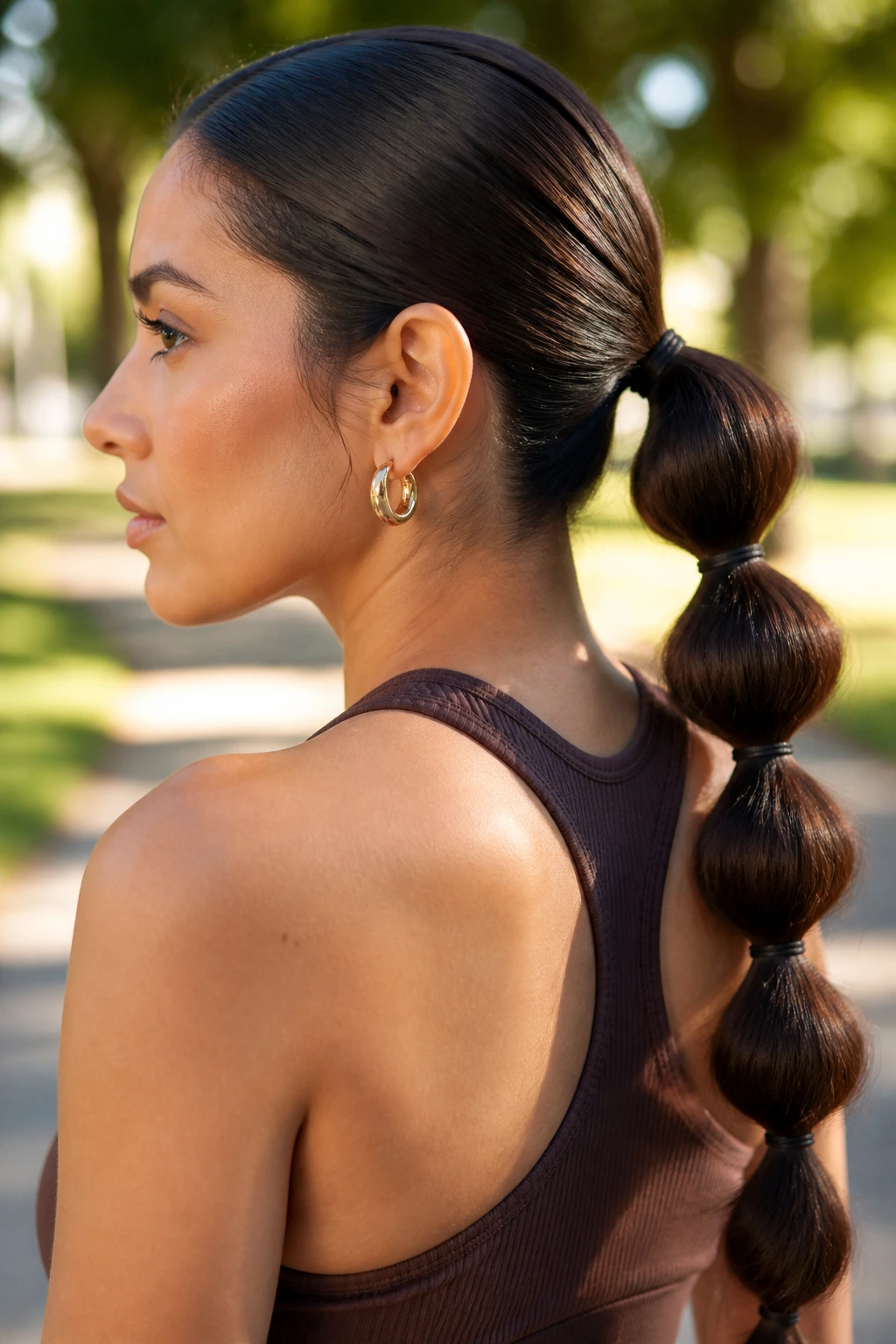
A bubble ponytail gives long hair structure without requiring much skill, and on a heart-shaped face it’s especially useful because the shape breaks up the length of the tail. Instead of one heavy column hanging straight down, you get a series of rounded sections that feel playful but still polished if the base is smooth.
Start with a low or mid ponytail and secure it tight. Then add small elastics every 2 to 3 inches down the length, gently pulling each section outward to create the bubble. The bubbles should be soft and rounded, not puffed until they look like tennis balls. That part matters.
The sleek base is what keeps this from looking messy. If the top is neat and the tail has volume, the eye reads it as controlled shape, not random frizz. On a heart-shaped face, that balance is useful because the face already has enough visual interest up top. The bubble sections give the lower half more presence without needing extra teasing near the forehead.
This is one of my favorite styles for long, layered hair that refuses to stay one solid shape. It gives the length a job. Finally.
6. Wrapped Low Ponytail with a Polished Finish
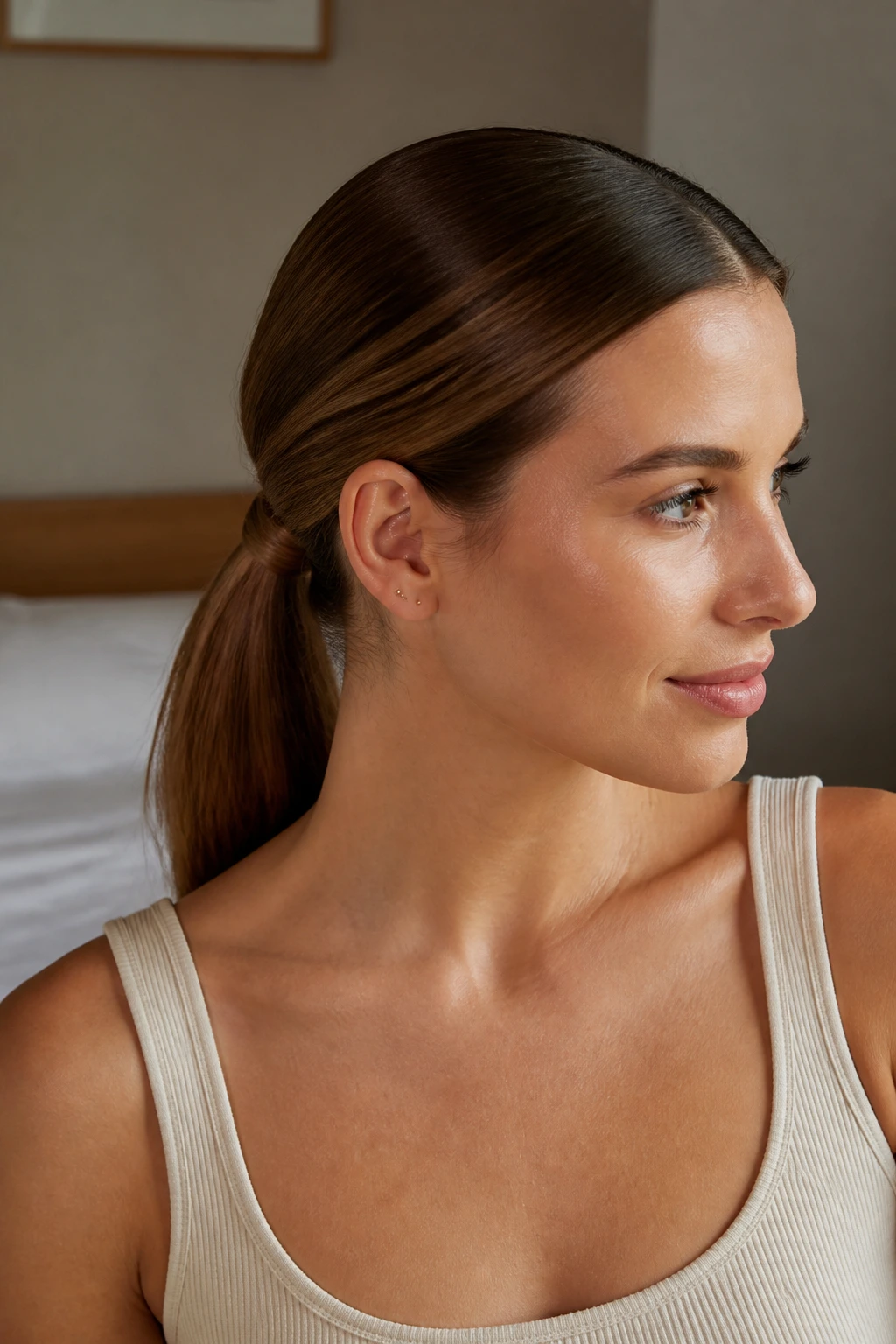
A wrapped low ponytail is the kind of style that makes long hair look expensive without shouting about it. The hair is gathered low, smoothed close to the scalp, and wrapped at the base so the elastic disappears. On a heart-shaped face, that low placement is quietly flattering because it keeps the whole focus below the width of the forehead.
What makes this one shine is the line from the part to the tail. Keep that part crisp. Use a tail comb if your hair likes to split and drift. Then smooth the sides with a light cream or a few drops of oil, but only on the top layer. If you put product everywhere, the whole thing collapses and the tail loses air.
This style works especially well when you want the face to look a little longer and the chin to feel less delicate. The wrapped base adds enough finish that you don’t need a clip or barrette unless you want one. And if you do want an accessory, choose something narrow — a slim metal cuff or a small tortoiseshell detail, not a giant scrunchie that steals the shape.
It’s tidy. It’s efficient. It’s one of those styles that looks better the more your hair naturally settles into it.
7. Wavy Low Ponytail with a Loose Part
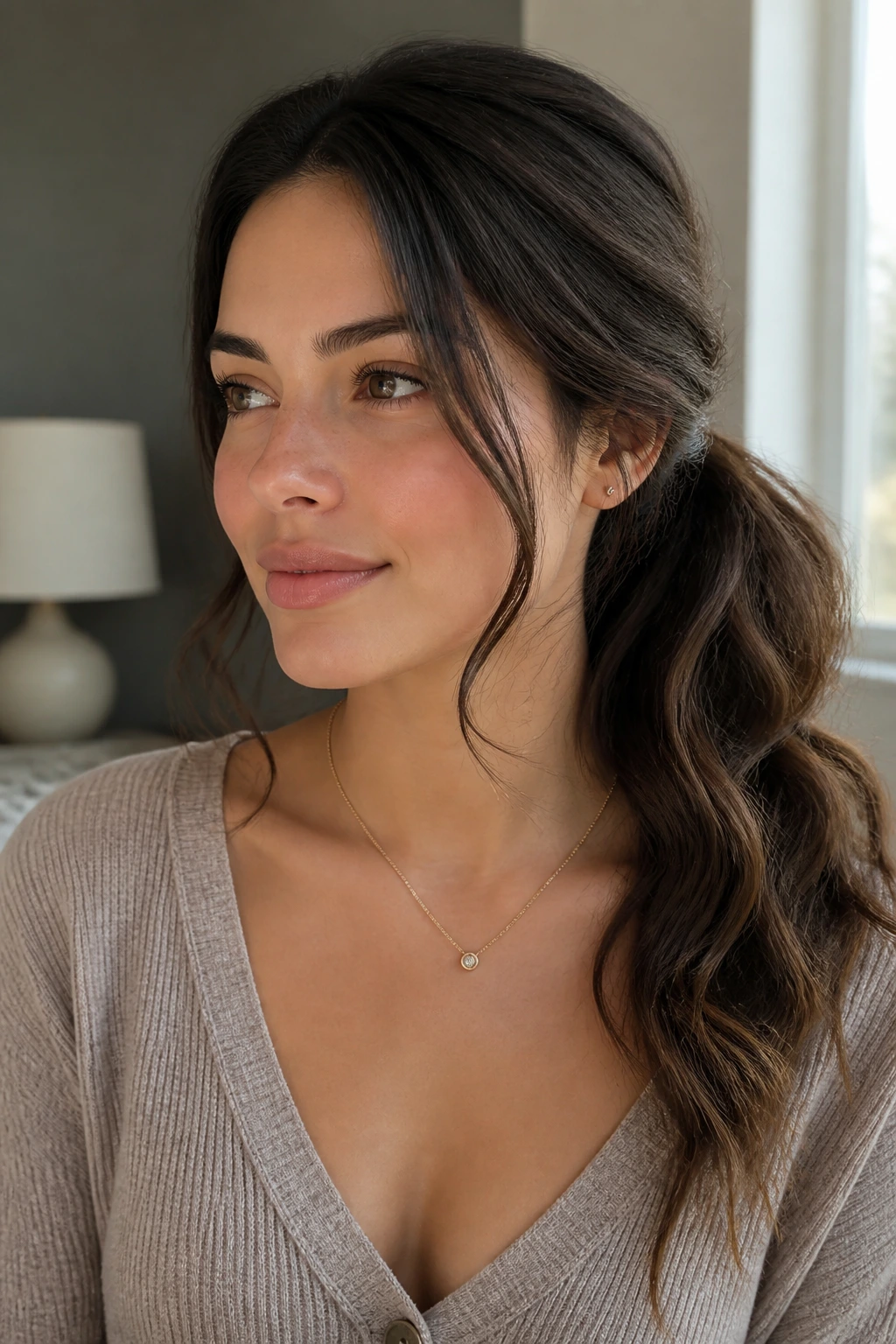
Straight, glossy ponytails get all the attention, but a wavy low ponytail often flatters a heart-shaped face better because the movement softens the narrow jawline and keeps the style from feeling top-heavy. The waves don’t need to be perfect. Actually, they shouldn’t be. You want bends and bends only, the kind that look like they happened after the hair was already up.
A loose side part works well here, though a middle part is fine if the front pieces are soft. Gather the hair low and secure it, then run a curling iron through the tail in a few large sections. Leave the ends slightly undone. If you curl every inch, the ponytail can start looking formal in a way that fights the relaxed face shape balance.
The nice part is how forgiving this style is. If your hair is long and layered, the waves help unify the lengths. If your hair is one blunt length, the waves keep it from hanging like a curtain. Either way, the softness around the face and the fullness in the tail create a better visual ratio.
I’d wear this with knit sweaters, slip dresses, or anything that can handle a little movement. It has enough polish for dinner and enough looseness for daylight.
8. Braided Base Ponytail with a Clean Crown
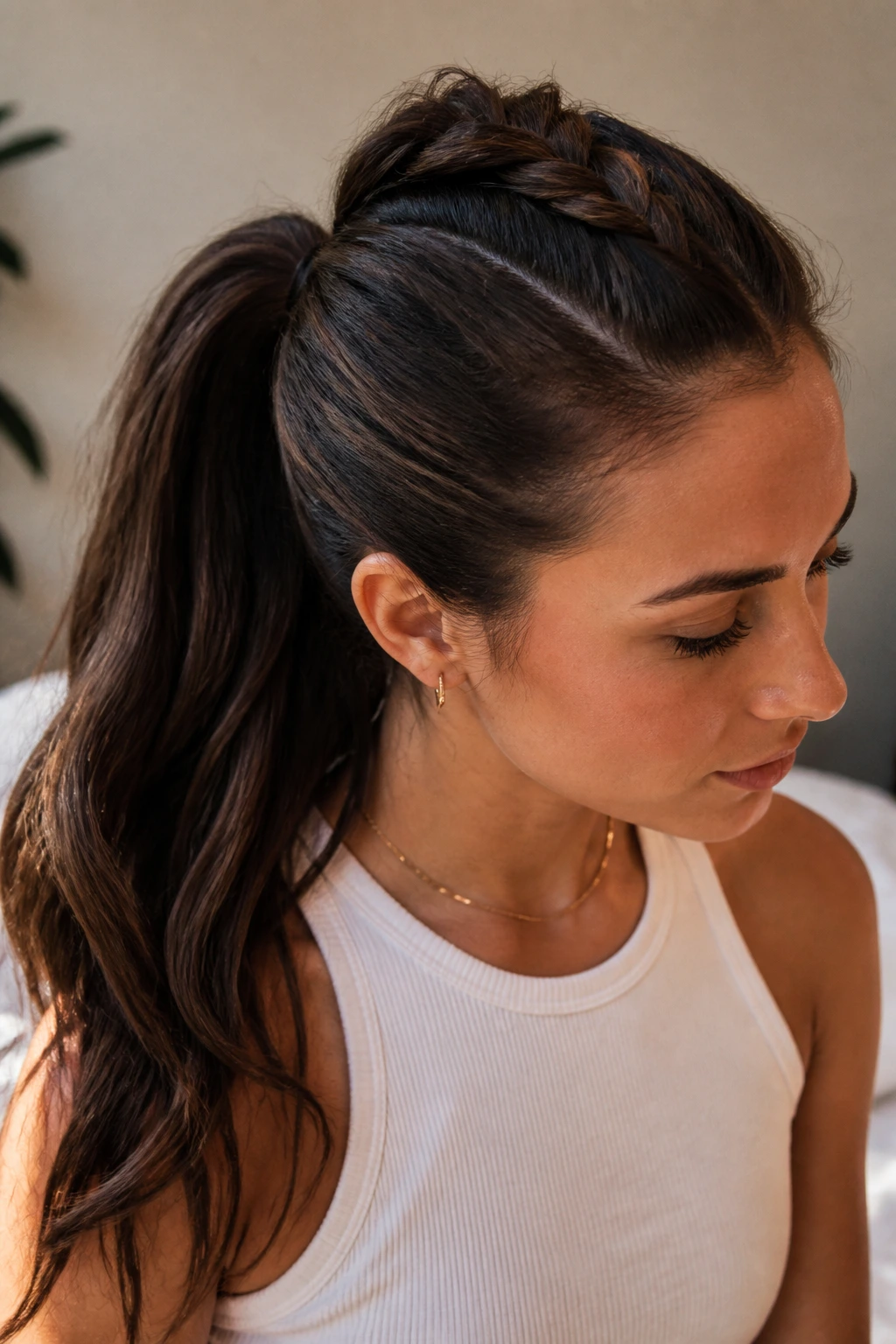
A braided base ponytail changes the silhouette in a smart way. Instead of starting with a plain elastic, you braid the hair at the base or along the side before tying the ponytail off. That small bit of texture near the head matters for heart-shaped faces because it breaks up the broad upper face line without adding bulk exactly where you do not want it.
The braid can be tiny — a narrow accent braid on one side is enough — or more obvious, like a Dutch braid leading into the ponytail. Either way, the texture gives the top of the style a bit of visual interest while leaving the face open. Long hair helps here because the ponytail can stay thick even after the braid takes a section of hair.
If your hair is slippery, prep the roots with dry shampoo or texture spray before braiding. Clean hair and neat braids are not always friends. The braid will collapse faster if the strands are too silky.
This style feels practical and a little architectural. It keeps the front tame, but not flat, which is a hard balance to get right. When the braid is tight and the tail is loose, the effect is clean without feeling stiff.
9. Half-Up Ponytail Cascade for Long Layers
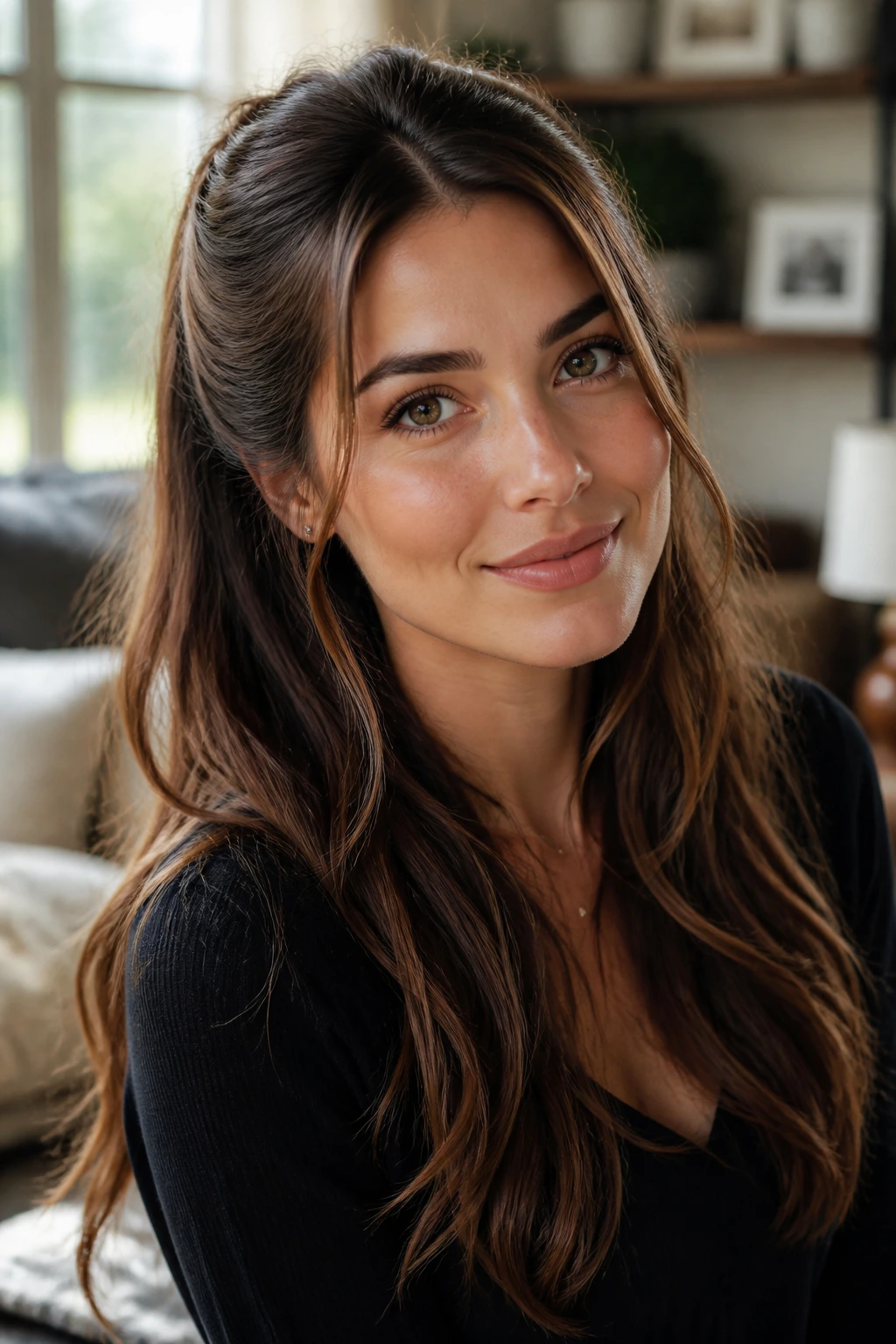
Half-up ponytails can be tricky on a heart-shaped face because they can accidentally add volume at the crown, which is the last place you want uncontrolled height. But when the upper section is kept slim and the lower hair does the heavy lifting, the result can be lovely. The face stays open. The length stays visible. And the top half gets a little lift without turning into a puff.
This works especially well with long layers. Pull back just the top third of the hair, not half in the literal sense, and secure it at the back of the crown. Let the lower section fall loose. If you want more softness, curl the loose hair in wide bends so the whole shape feels connected. If you want it more casual, keep the lower length straight and let the top part be the only polished piece.
The best thing about this version is the way it frames the face without trapping it. A heart-shaped face often looks best when the forehead isn’t fully exposed, and this style gives you some coverage while still letting the lower face stay soft.
I’d call this one the best compromise style on the list. Not because it’s boring. Because it solves a lot of problems at once.
10. Double-Elastic Ponytail That Makes Long Hair Look Fuller
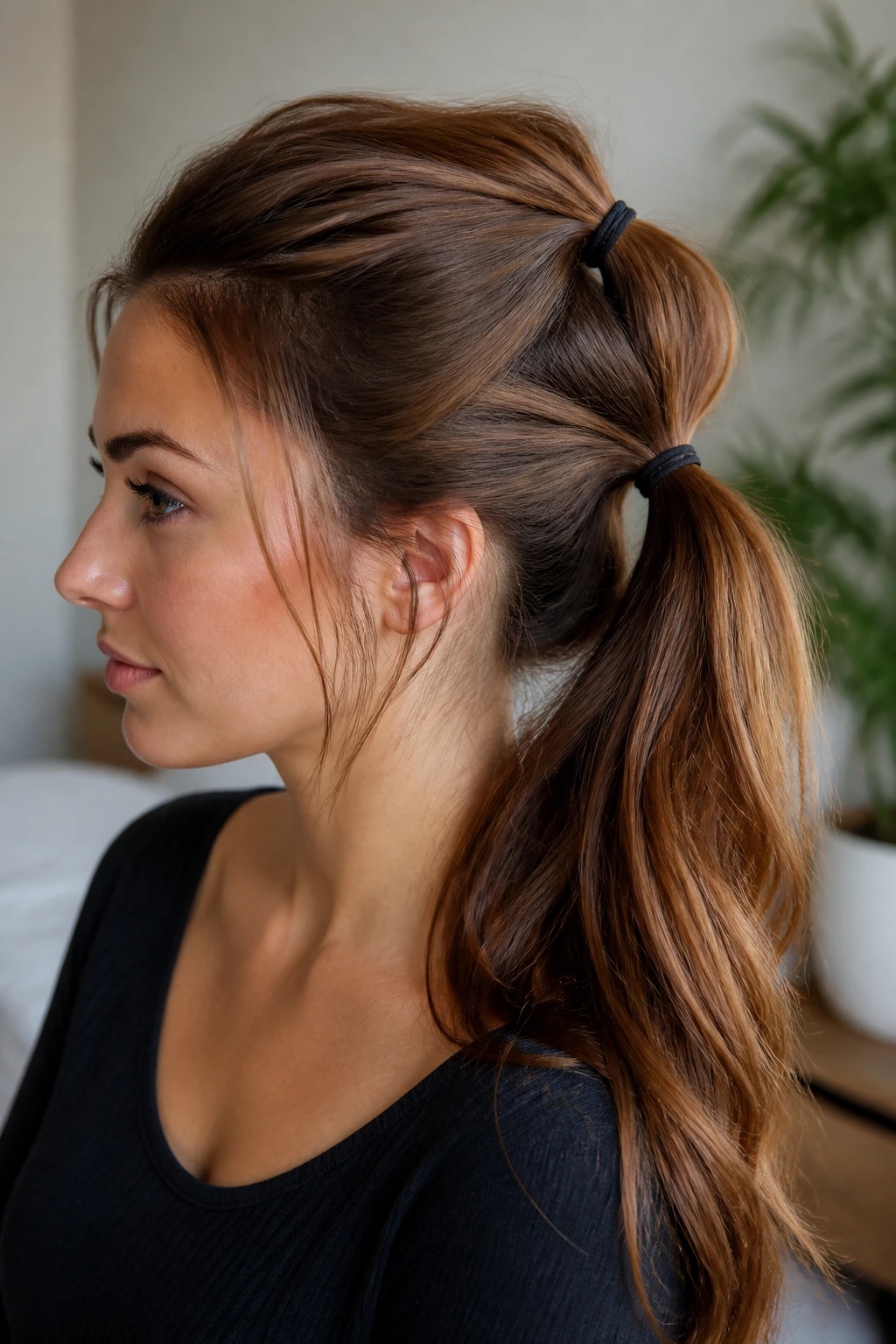
Two elastics, one ponytail, better shape. That’s the whole idea here. The double-elastic method uses one elastic near the crown or mid-back of the head, then a second one a few inches lower to support the tail and keep long hair from sagging. On a heart-shaped face, this matters because a sagging ponytail drags the eye downward in a tired way.
The upper section should stay smooth, especially around the temples. The lower elastic gives the ponytail a subtle lift and stops heavy hair from pulling itself flat by lunchtime. If your hair is long and fine, this trick can make a surprisingly big difference. If your hair is thick, it just keeps the style from slipping.
You can hide the second elastic by taking a thin strand of hair and wrapping it around both ties. Or leave it visible if you like the practical look. I’ve done both. The hidden version feels more polished; the visible one feels more street-style and less precious.
It is a small change, but it changes the shape of the whole ponytail. The tail sits better. The base holds better. The face looks a little more balanced because the weight distribution is cleaner.
11. Rope-Braid Ponytail with Soft Front Pieces
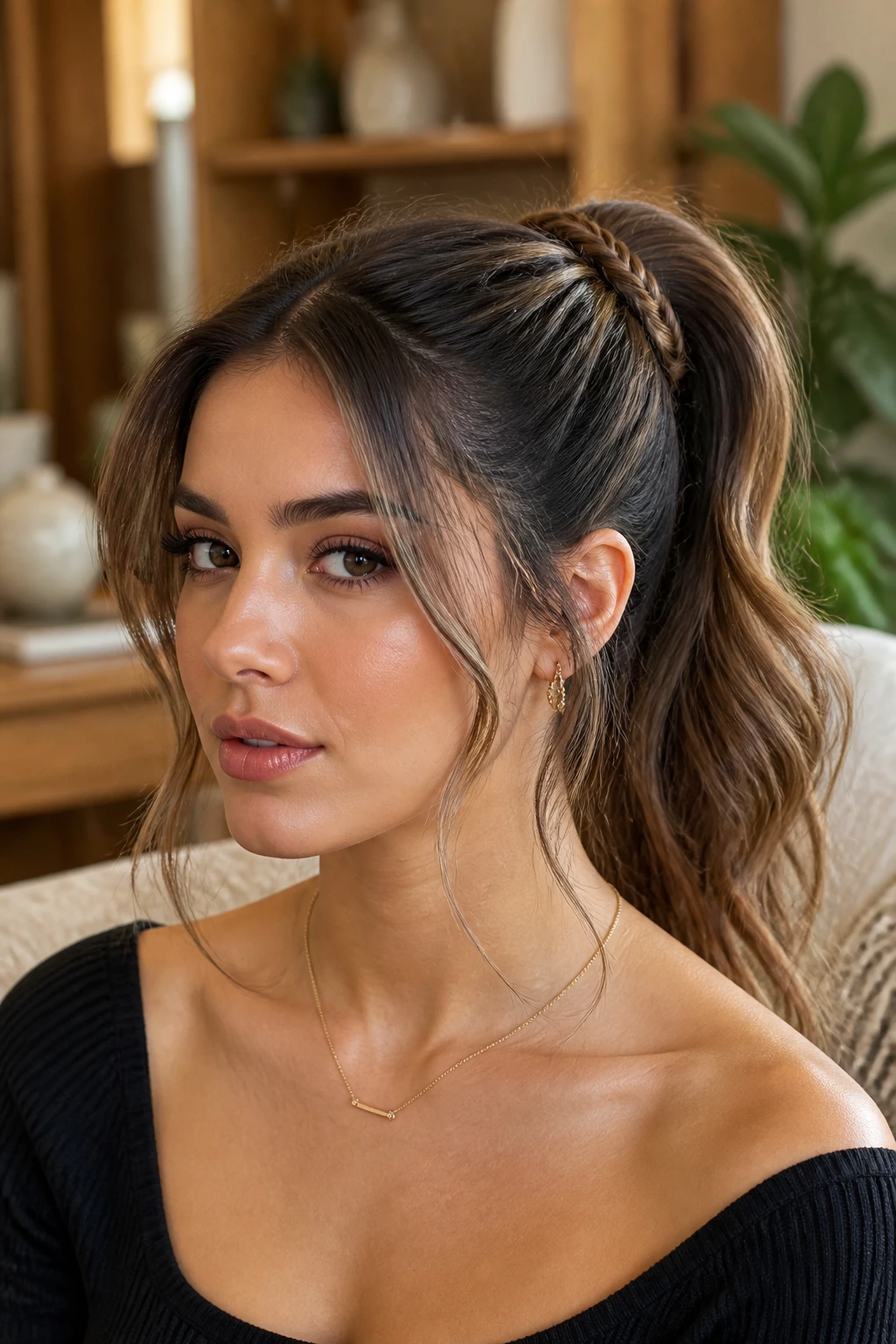
A rope braid brings a different kind of texture than a standard three-strand braid. It twists the hair into a spiral, which makes long hair look more controlled without looking tight or rigid. On a heart-shaped face, that spiral texture helps pull attention downward along the length rather than across the forehead.
The base can be low or mid-height. Once the ponytail is secured, split the tail into two sections, twist each section in the same direction, then wrap them around each other in the opposite direction. That opposite motion is what locks the rope braid in place. Secure the end with a small elastic. If you want the braid to look fuller, tug the outer edges gently once it’s done.
This style is a good pick when the hair feels too plain in a regular ponytail. It has movement, but not the fuzzy, undone kind that can make the head look bigger. A few face-framing pieces keep the front from feeling too strict, especially if your forehead is wider than your chin.
It’s one of those styles that looks harder than it is. Which, frankly, is a nice bonus.
12. Voluminous Ponytail with Curtain Bangs
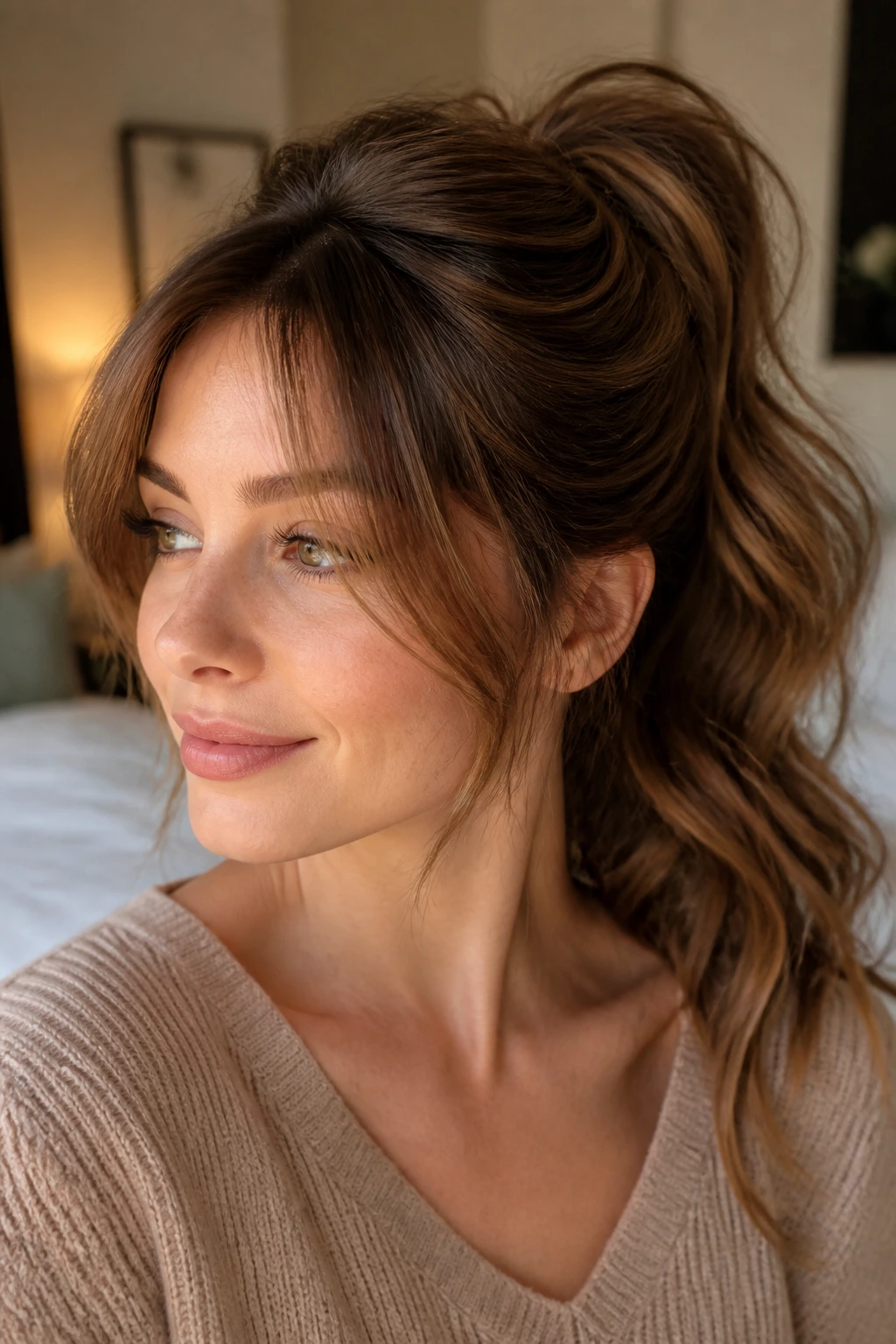
If you already have curtain bangs, this is the ponytail that makes them earn their keep. The bang curtain softens the forehead and breaks up the width that can make a heart-shaped face feel top-heavy. The ponytail itself can sit high, mid, or low, but the real point is the softness around the front.
Volume at the crown works here because the bangs carve out space at the hairline. Without them, a big ponytail can feel a little too dominant. With them, the look gets some shape and a less severe frame. The ponytail should still be full through the tail — backcombing the underlayer or using a lightweight volumizing spray helps — but the top can stay movable.
I like this best when the bangs are blended enough to skim the cheekbones instead of sitting as a blunt fringe. You want them to arc away from the center of the face, not fall straight down. If your bangs are shorter, keep the ponytail a little lower so the front doesn’t get visually crowded.
This is a flattering, useful style when you want volume and softness at the same time. It’s not subtle. It doesn’t need to be.
13. Messy Texture Ponytail with Loose Ends
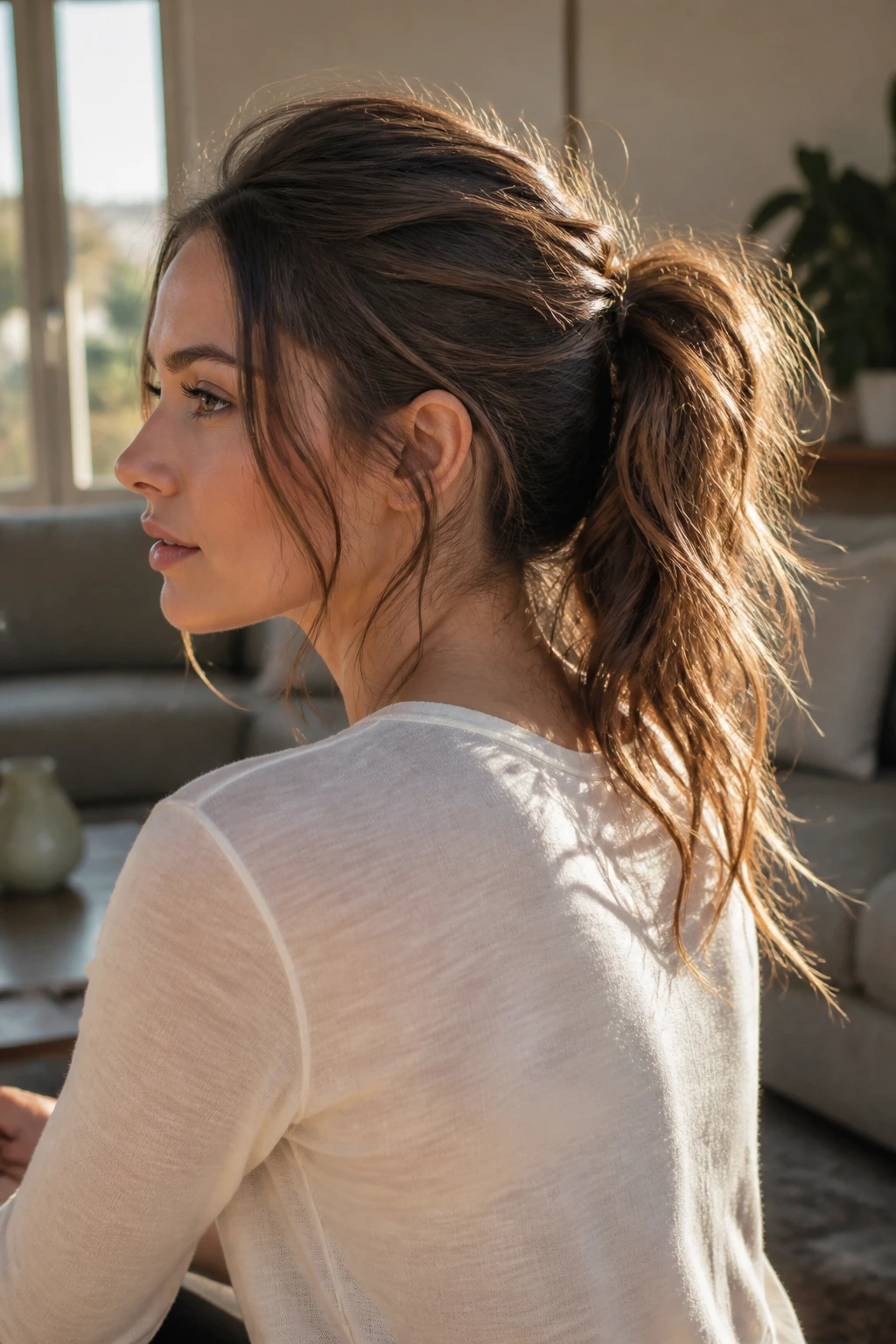
Messy can mean lazy, or it can mean controlled texture with a little breathing room. On a heart-shaped face, the second version is the one you want. The point is to keep the top from feeling too severe while letting the tail have bends, separation, and a touch of undone movement.
Start by rough-drying the hair or adding a bit of texture spray to dry lengths. Gather it loosely rather than pulling every strand taut. Leave some shorter pieces near the hairline and temples. Then tug gently at the crown and around the ponytail base to create a little lift. Not too much. You still want the face shape to feel intentional, not accidental.
This style is especially useful when your hair is layered and a sleek ponytail makes the shorter pieces stand out in a bad way. Texture blends everything together. It also hides the fact that your hair may not have been washed yesterday. Sometimes the better style is the one that works with the hair you actually have.
The ends can stay straight or get a few bends from a curling iron. I prefer the bends. Straight ends can drag the whole thing flat.
14. Flipped-End Retro Ponytail with a Smooth Root
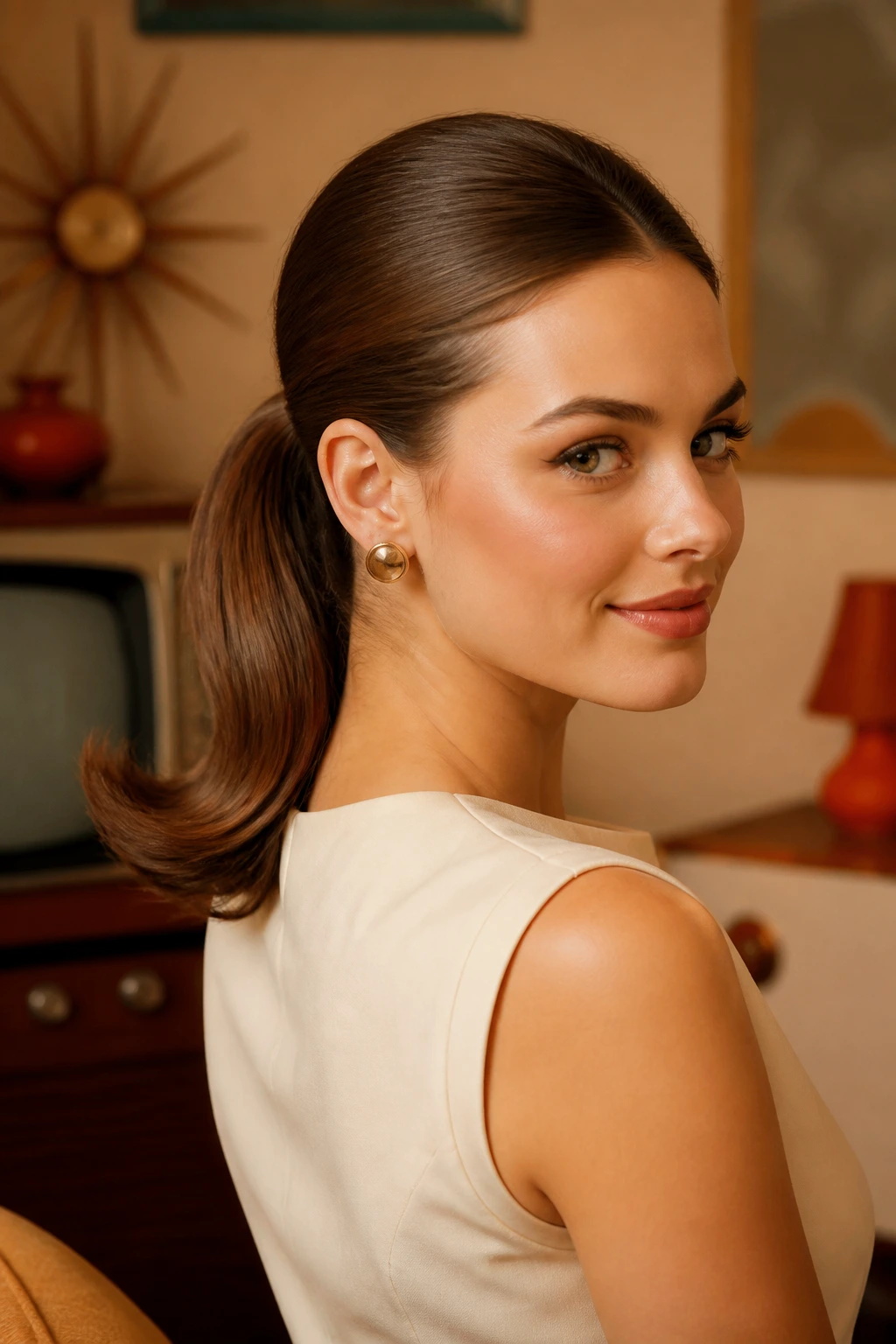
A flipped-end ponytail brings a little mid-century energy, but the face-shape reason it works is practical. The flipped ends add movement at the bottom of the style, which balances a heart-shaped face better than a limp tail hanging dead straight. The smooth root keeps the top tidy, so the forehead does not get extra attention.
To get the flip, secure the ponytail low or mid-height, then bend the last few inches under with a round brush and blow dryer or a flat iron. You only need enough curve to show the shape, not a dramatic roll. If the hair is very long, the flip can be just on the final 2 to 3 inches. That’s enough.
This style looks especially good with polished outfits, collarbones showing, or simple earrings. There’s something about the contrast between the neat root and the playful finish that suits long hair better than people expect. It keeps the ponytail from feeling one-note.
I’d skip heavy face-framing pieces here. A couple of tiny wisps is enough. The shape itself is already doing the talking.
15. Low Ponytail with a Deep Side Part
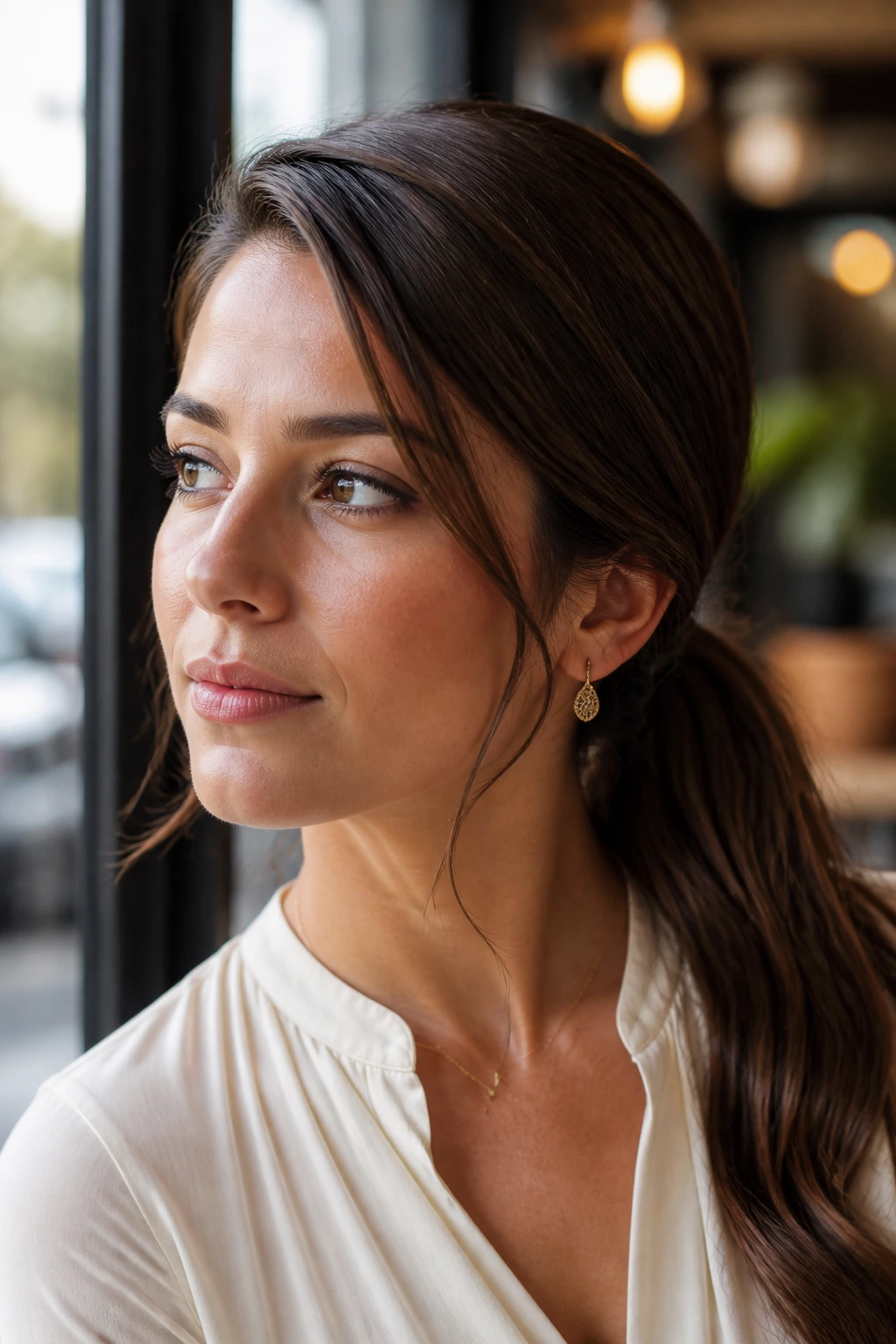
A deep side part changes the whole mood of a ponytail. On a heart-shaped face, it’s one of the easiest ways to break up forehead width without creating too much volume at the crown. The ponytail can sit low and calm, while the part does the visual balancing before the hair even reaches the elastic.
This works best when the heavier side of the part is smoothed diagonally across the forehead. You do not need to hide the forehead. You just want to interrupt the wide upper line enough that the face feels more oval. The ponytail at the nape keeps the bottom half open and soft.
If your hair is thick, this style can look almost luxurious because the sweep of the part gives the front some drama and the low tail gives it restraint. If your hair is fine, use a touch of root spray at the part line so it doesn’t flatten into the scalp.
I like this version when I want the ponytail to feel a little grown-up. Not severe. Just composed. There’s a difference, and the deep side part is the reason.
16. Sporty High Ponytail with Soft Side Strands
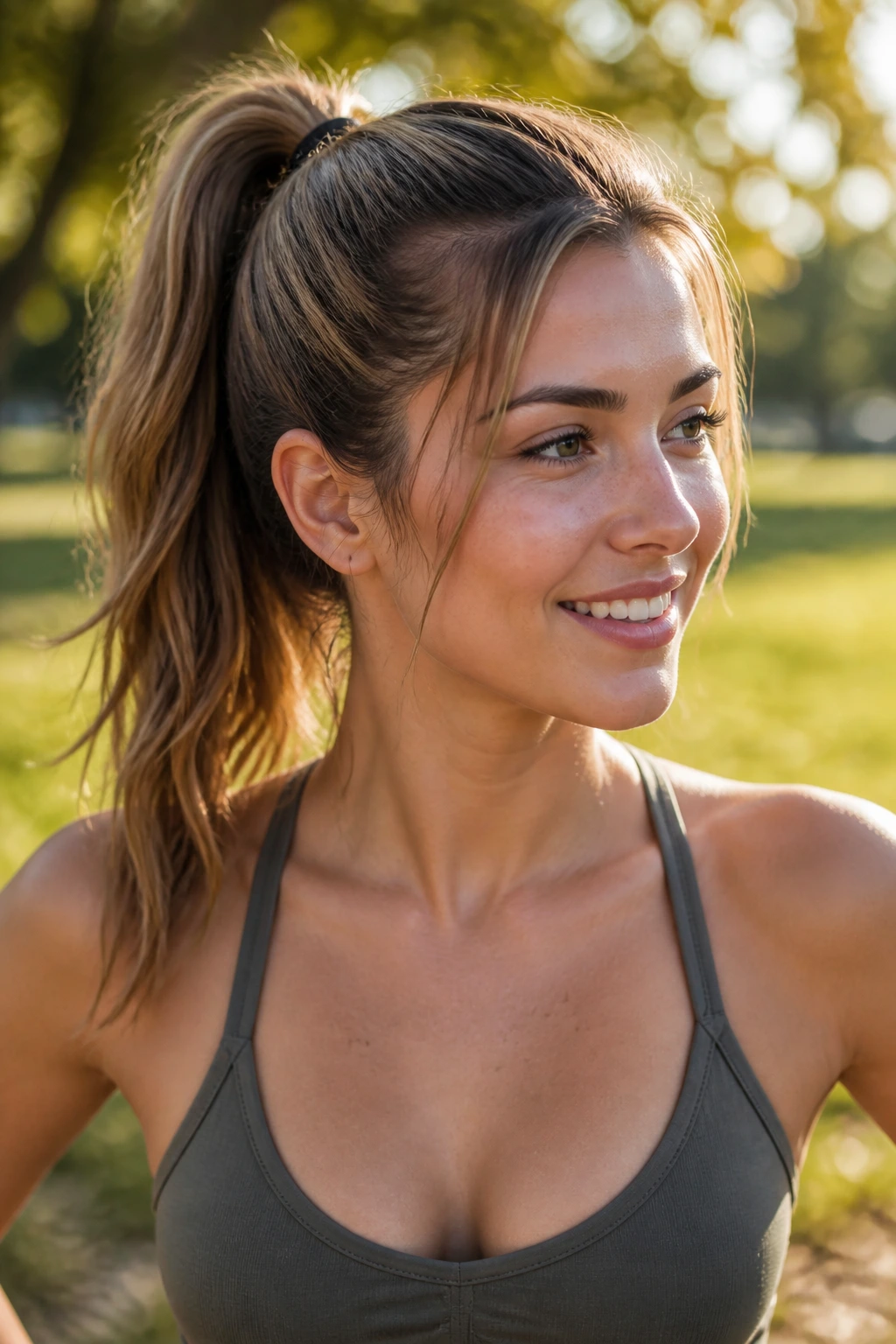
Sporty ponytails usually get treated like they’re only for the gym. That’s unfair. A high ponytail with softened sides can be one of the best shapes for a heart-shaped face because it lifts the eye without making the forehead feel boxed in. The side strands stop it from looking too pulled back.
The trick is not to make the style too tight. Leave a slight cushion at the crown, smooth the sides enough to control flyaways, and let a few narrow pieces fall near the temples. Those small pieces matter more than most people think. They keep the upper face from feeling overexposed.
This version is good for long hair because the tail has enough length to bounce and swing, which keeps the style from reading flat. If you want more drama, curl the tail in one or two loose sections. If you want it cleaner, brush it out straight but keep some texture in the ends.
It’s athletic, but not hard-edged. That balance is what makes it work on this face shape.
17. Mohawk-Inspired Ponytail with Soft Sides
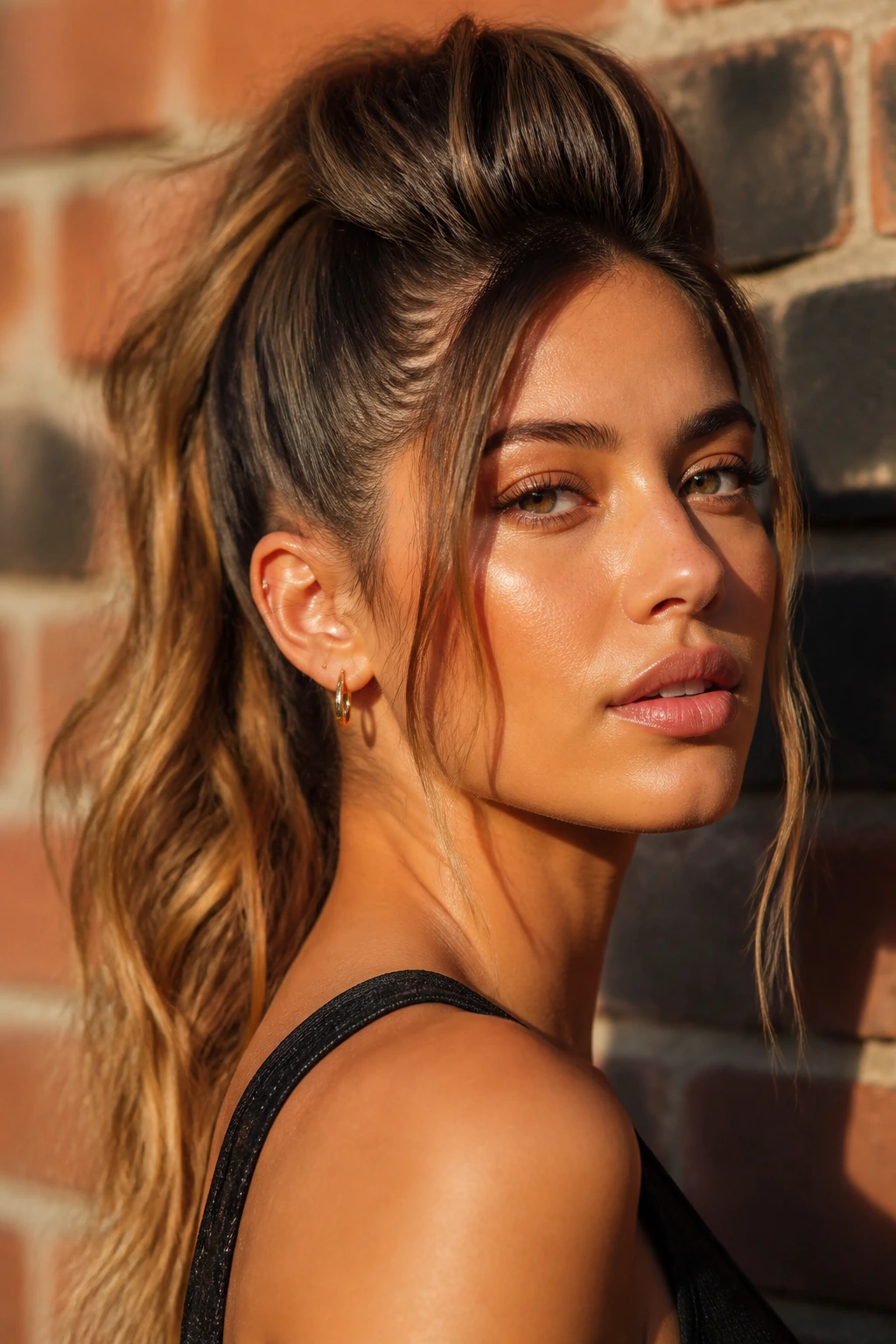
A mohawk-inspired ponytail sounds aggressive, and if you do it wrong, it is. But the softened version can be striking on a heart-shaped face because the height runs through the center instead of ballooning out at the sides. That leaves the forehead looking lifted, not widened.
Start by smoothing the sides close to the head and adding volume only through the center strip from the forehead back to the crown. Then gather that lift into a ponytail. The sides should stay sleek, but not flat like paint. A little texture at the roots helps the style hold. A lot of gel is not the answer unless you want helmet hair.
This is the boldest look in the group, and long hair helps keep it from feeling too severe because the tail gives the style motion. If the face feels extra narrow at the chin, leave one or two soft tendrils near the jawline. That little bit of softness keeps the center lift from dominating everything else.
It’s not the first style I’d hand someone for a conservative office. It is, however, the one I’d choose when I want shape and attitude without sacrificing the face balance.
18. Ribbon-Wrapped Ponytail with a Soft Base
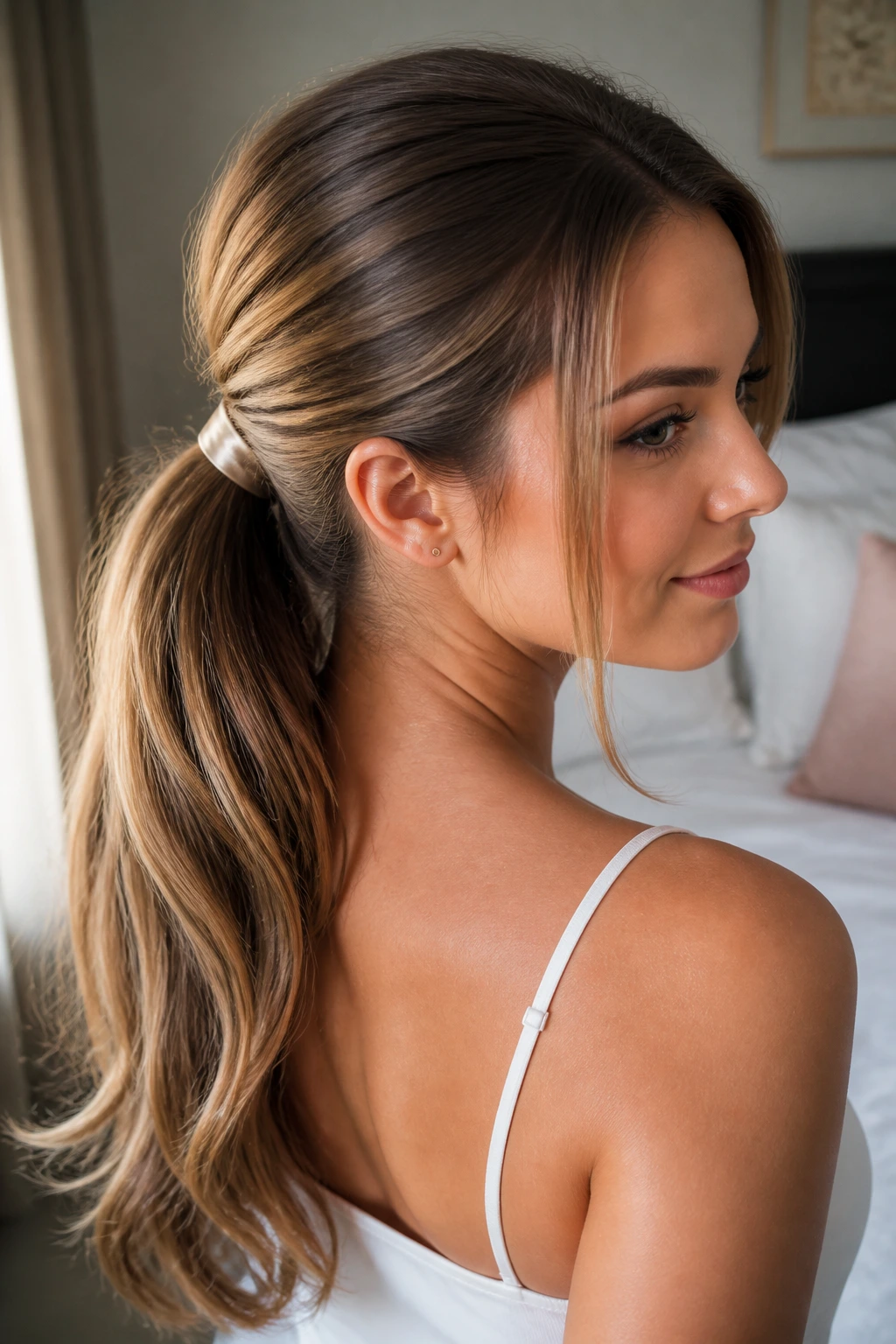
A ribbon can change a ponytail more than a lot of people expect. On a heart-shaped face, it’s useful because the eye drops to the ponytail base and the ribbon detail instead of hanging around the forehead. A narrow ribbon works best. Wide bows can get fussy fast.
Choose a low or mid ponytail and keep the top smooth. Then tie the ribbon over the elastic or weave it through a braid at the base. Satin, grosgrain, velvet — each one changes the feel. Satin looks sleeker. Grosgrain feels a little more structured. Velvet is richer, but it can be bulky on very thick hair.
The important thing is keeping the ribbon near the base, not up near the crown. You want the accent to support the face balance, not compete with it. If you have long hair, the tail can stay straight, wavy, or curled; the ribbon is the detail that carries the look.
This is one of those styles that makes a plain ponytail look finished in less than a minute. Nice trade.
19. Scarf-Woven Ponytail with Long Loose Lengths
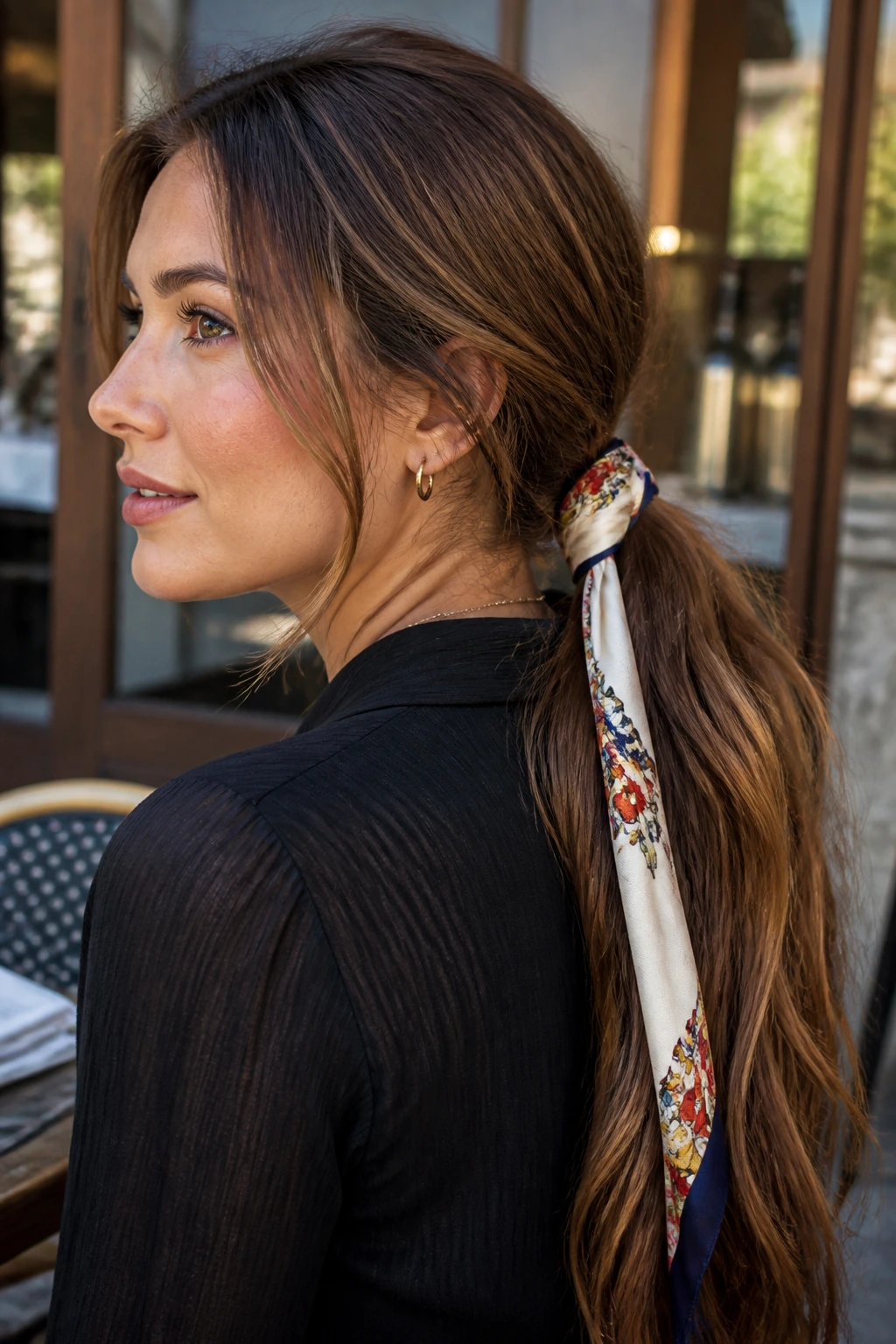
A scarf woven through a ponytail gives long hair movement and a little color without forcing the face to do all the work. For heart-shaped faces, the scarf acts like a visual anchor lower on the head, which helps redirect attention away from the forehead.
I prefer this with a low ponytail. Tie the hair first, then thread a thin scarf through the elastic or braid it into the tail. Keep the scarf long enough to drape naturally, not so long that it tangles at the collar. If you’re wearing a patterned scarf, let the rest of the outfit stay calmer. If the scarf is plain, the ponytail can have more texture.
The style works best when the hair around the face stays soft. A few loose pieces are enough. You do not need a full curtain of tendrils. In fact, too many can make the whole look feel overthought. One of the cleanest versions is a low, textured ponytail with a scarf tucked in at the base and the ends of the scarf blending into the tail.
It’s practical, pretty, and easy to change in about thirty seconds. Hard to complain about that.
20. Polished Low Ponytail with Tucked Ends
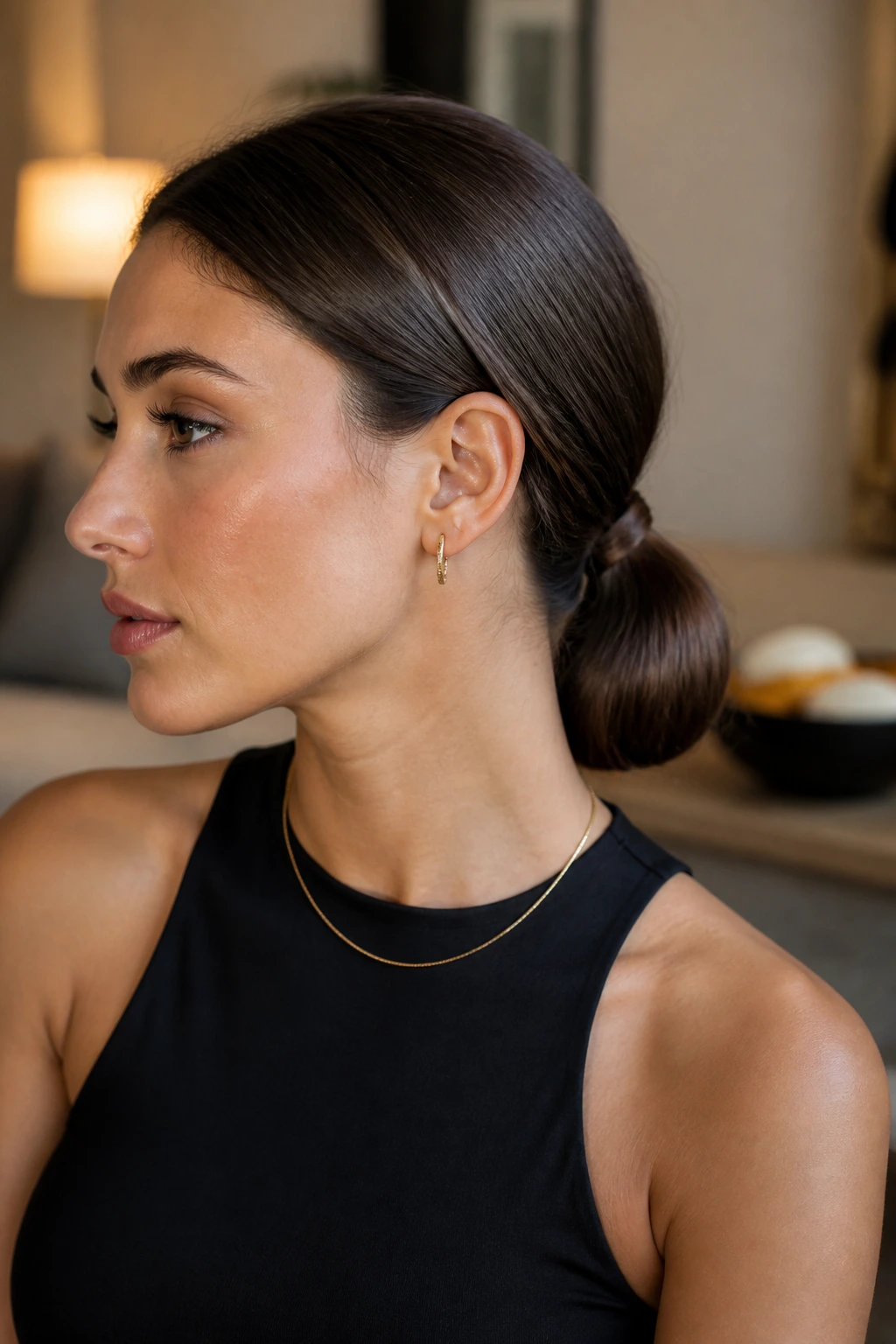
This is the version I reach for when I want a ponytail to look finished without a lot of extra shape. The hair is smoothed into a low tie, then the lengths are tucked under or folded slightly so the tail sits as a neat, controlled shape instead of hanging straight. On a heart-shaped face, that tucked finish keeps the eye lower and the silhouette clean.
The benefit here is proportion. A long, full tail can sometimes feel heavy on a narrower chin, especially if the top is already sleek. Tucking the ends changes the visual weight and keeps the style from overpowering the face. It also looks smarter with high-neck tops and sharper earrings.
A light serum on the ends helps them stay tucked instead of fraying out. If your hair is very long, secure the fold with a second hidden elastic or a couple of pins from underneath. You want the tuck to hold, not droop by the time you leave the house.
This is plain in the best way. It knows what it’s doing.
21. Twisted Side Ponytail with a Soft Sweep
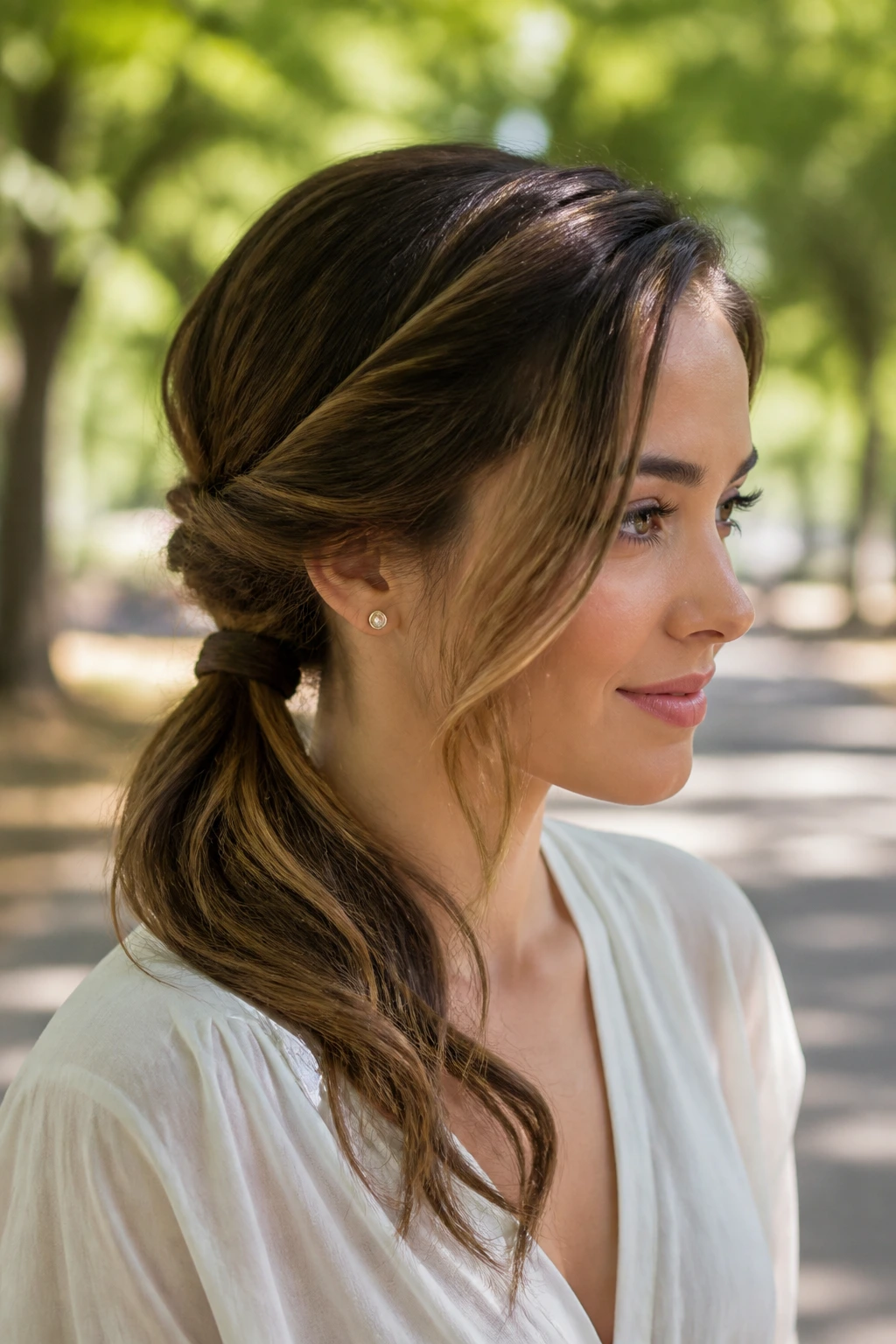
A twisted side ponytail has more texture than a plain side ponytail, and that texture helps break up the broad upper part of a heart-shaped face. Twist a front section on each side toward the back, or just twist one heavier side if your face likes asymmetry more than symmetry, then gather everything into a side ponytail.
The twists pull the hair away from the temples in a gentle way, which keeps the forehead from looking too wide. The ponytail itself should sit low enough that the jawline still has room to show. If your hair is long and thick, this style can look surprisingly romantic without going into prom territory.
A little bend through the tail helps. Flat ends make the twists feel disconnected from the rest of the style. If you’re using pins, hide them under the ponytail base so the front stays clean.
It’s a softer cousin of the braided base ponytail, and I think it works better when you want the face to look open but not bare.
22. Sleek Bubble Braid Ponytail with Controlled Volume
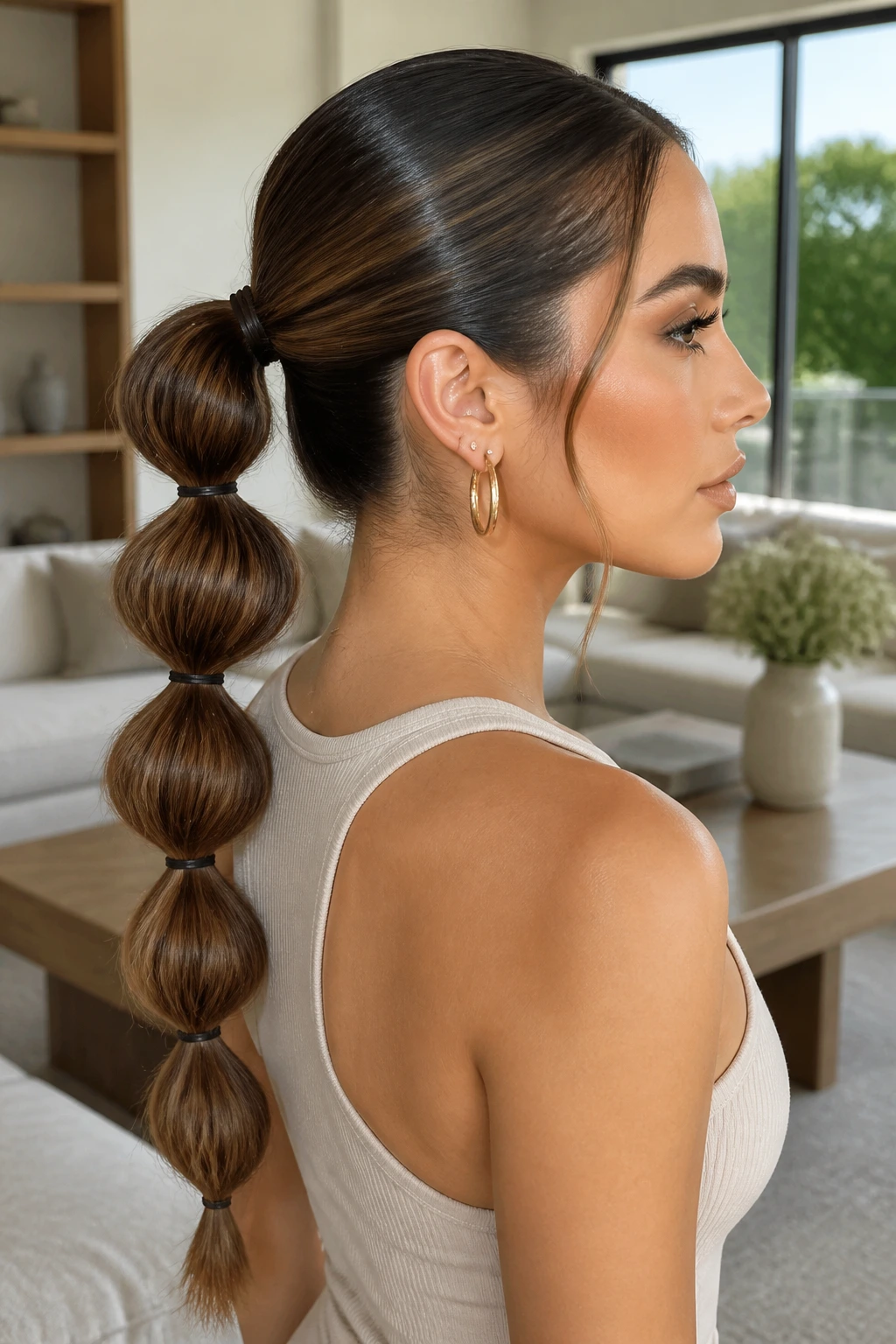
A sleek bubble braid ponytail is what happens when you want the fun of a bubble ponytail and the control of a smooth, polished base. For long hair and a heart-shaped face, that combination is strong because it keeps the upper face neat while giving the tail enough shape to balance the narrower chin.
Start with a low or mid ponytail and smooth the root with a brush and a tiny bit of cream. Add elastics every few inches down the tail, then tuck and separate each section so it reads as rounded bubbles or spaced braid-like segments. The result should feel sculptural, not puffy.
This style is good when plain hair feels too flat but a loose wave would feel too casual. It has a crisp outline, which helps the face look more even. If you want to lean softer, leave a couple of front pieces loose. If you want to lean cleaner, keep the hairline smooth and let the bubbles do the talking.
It’s a strong finish to the list because it proves a ponytail can have personality without giving up structure. That’s the whole game here.
Why Ponytail Placement Matters on a Heart-Shaped Face
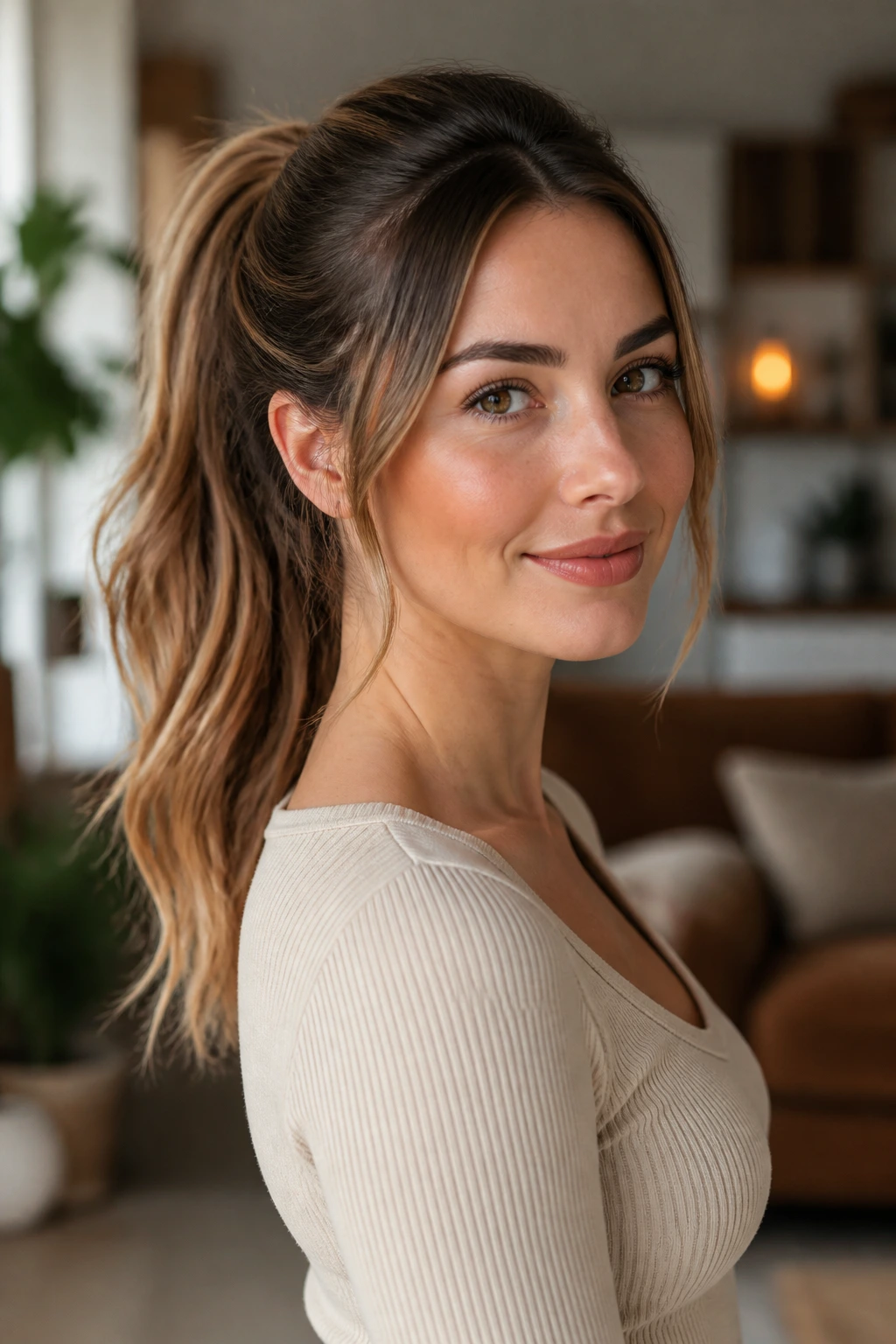
Placement changes everything. A ponytail at the highest point of the head creates vertical lift, which can be flattering in small doses but unforgiving if the forehead already has strong width. A low nape ponytail does the opposite: it settles the shape down and gives the jawline more space. Mid placement sits between the two and is usually the safest starting point if you’re not sure.
The face-framing pieces matter for the same reason. Two loose strands near the temples or cheekbones interrupt the broadest part of the face before the eye goes straight to the chin. They do not need to be thick. Thin, slightly curved pieces are usually enough. The goal is to soften, not hide.
Long hair helps because its weight can either help or hurt the final silhouette. If the ponytail is too slick and too high, the length drags attention upward. If the tail is thick, bent, or textured, it helps equalize the lower face and makes the whole thing feel intentional. That is why the most useful ponytails here are not the most dramatic ones. They’re the ones that understand balance.
Essential Tools and Products for These Styles
-
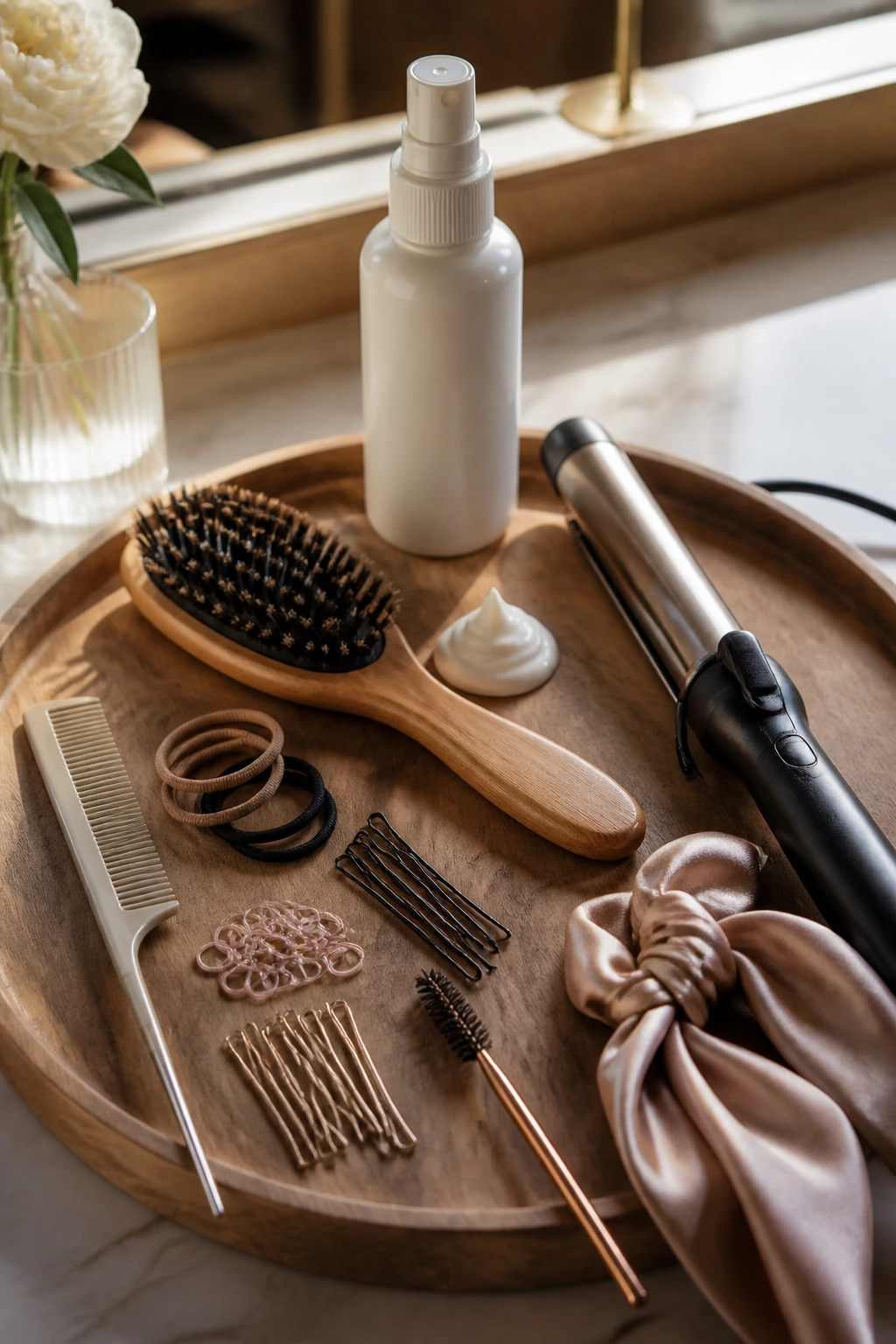
Tail comb: Useful for clean parts, sectioning, and smoothing the hairline without fuzzing up the top layer.
-
No-pull elastics: These hold long hair better than flimsy ties and are kinder when you need to redo a style more than once.
-
Bobby pins in your hair color: Handy for wrapping strands around the base, pinning loose pieces, and locking twists in place.
-
Soft bristle brush: Best for sleek styles because it smooths the surface without scraping the scalp raw.
-
Texturizing spray or dry shampoo: Gives grip to clean hair and keeps braids, twists, and bubble sections from slipping apart.
-
Lightweight smoothing cream or serum: Use a pea-sized amount on the top layer or the ends to tame frizz without flattening the whole style.
-
1-inch curling iron or flat iron: Enough to bend face-framing pieces or add soft movement to the tail without over-curling it.
-
Mini elastics: Useful for bubble ponytails, rope braids, and small sections where big ties would look clumsy.
-
Silk or satin scarf: Great for overnight protection and for scarf-woven styles that need a soft finish.
-
Edge brush or clean spoolie: Helps tame little hairs around the hairline when you want the front to look neat but not stiff.
Smart Styling and Hair Prep Tips
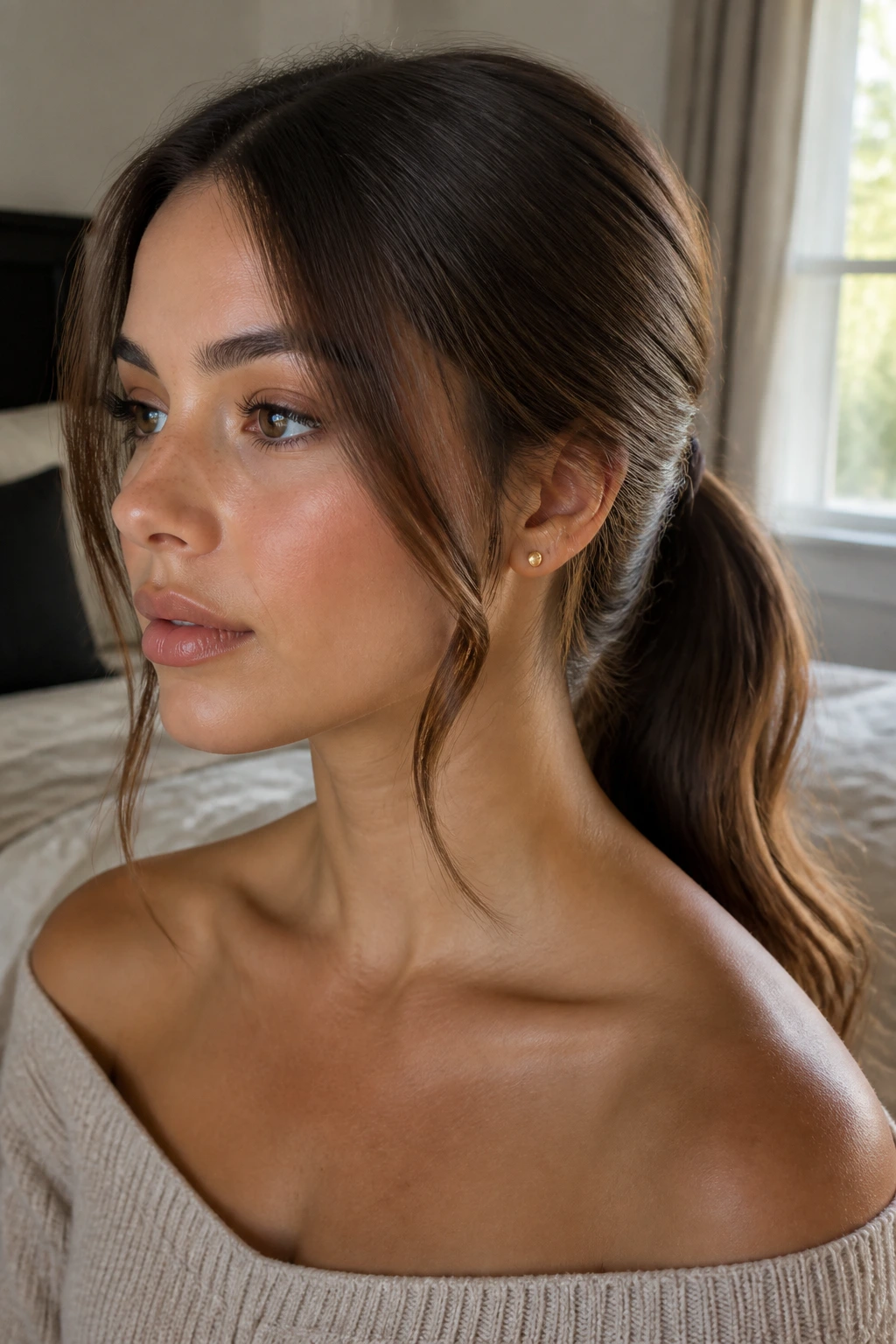
Start with the right texture. Freshly washed hair can be slippery, which is a nuisance for braided, twisted, or bubble styles. Day-one hair often works best for sleek ponytails, while day-two hair usually gives better grip for anything with texture. If the hair is too clean, a little dry shampoo at the roots solves more problems than people expect.
Watch the crown. A heart-shaped face can take some lift, but it rarely needs a skyscraper at the top. If you do add volume, keep it centered and controlled. The best lift sits behind the hairline, not on the forehead itself.
Use the ends on purpose. Long hair looks better when the tail has a job. Curl it, bend it, wrap it, braid it, or bubble it. Flat, straight ends can make even a good ponytail feel unfinished, especially if the top is polished.
Leave less hair out than you think. One or two face-framing strands can be enough. If you leave too much loose around the temples, the style loses shape and starts looking accidental.
Do the final check from the side. The front view can lie. A side view tells you whether the ponytail sits too high, too low, or too tightly against the skull. If the profile looks pulled back too hard, loosen the crown a touch and pull a little hair forward around the face.
How to Wear These Ponytails Without Fighting Your Outfit
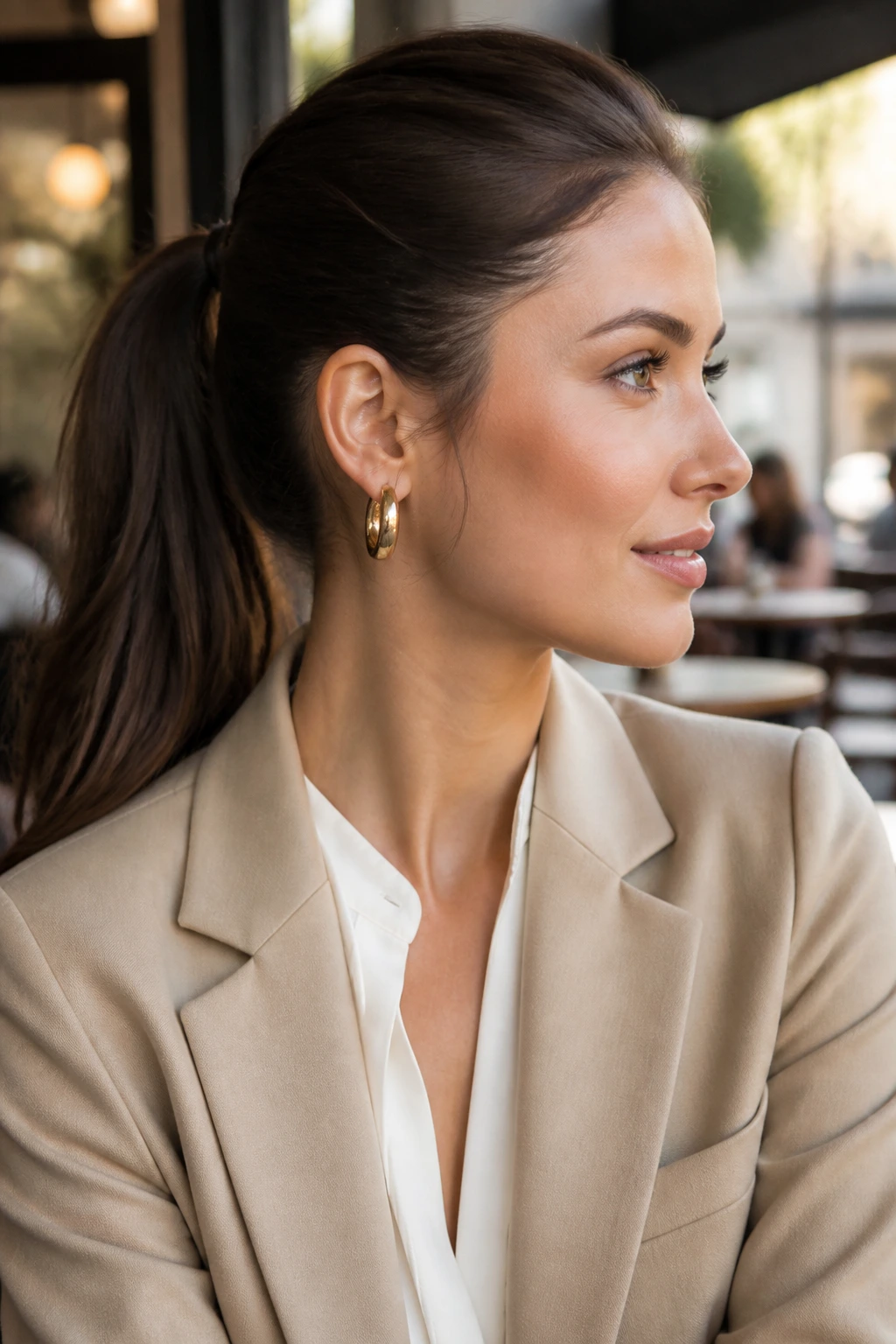
Best Placement: Low styles pair well with sharp collars, crew necks, turtlenecks, and anything that already gives the face some structure. Mid and high styles work better when the neckline is open, because the hair can be the main shape instead of competing with the clothes.
Outfit Pairings: Sleek ponytails look strongest with tailored jackets, earrings, and smooth fabrics. Textured ponytails fit better with knits, denim, linen, and anything that can handle a little movement. A braid, twist, or ribbon can change the whole tone of a simple outfit without making the hair feel overdone.
Face Balance: If your top is very wide at the shoulders, keep the ponytail a little lower and softer. If the outfit is narrow up top, a bit of crown lift helps keep the proportions even. That’s the part people forget — hair and clothes are one silhouette.
Accessory Note: Small hoops, a thin chain necklace, or a narrow headband can help, but oversized accessories near the temples can crowd a heart-shaped face fast. If the ponytail already has volume, keep the accessories lighter. If the hair is plain, one strong detail — a ribbon, a scarf, a wrap — is enough.
Additional Tips and Style Boosters
Flavor Enhancement: A tiny bit of shine spray on the tail, sprayed onto your hands first and smoothed over the surface, gives long hair a clean finish without coating the scalp.
Customization: If your hair is thick, use two elastics for support and keep the top section snug. If it’s fine, clip in a small hidden piece at the base or backcomb the underside of the ponytail for a fuller shape.
Softness Move: Curl face-framing pieces away from the face instead of toward it. That tiny direction change opens the cheekbones and keeps the front from folding inward.
Grip Trick: For slippery hair, mist the roots with dry shampoo before you gather the ponytail, then wait 20 to 30 seconds before brushing it through. The difference is not subtle.
Make-It-Yours: Straight hair can look crisp and modern, while waves and bends feel looser and more romantic. Neither is better. The better choice is the one that keeps the top balanced and the tail believable.
Common Mistakes That Make Ponytails Less Flattering
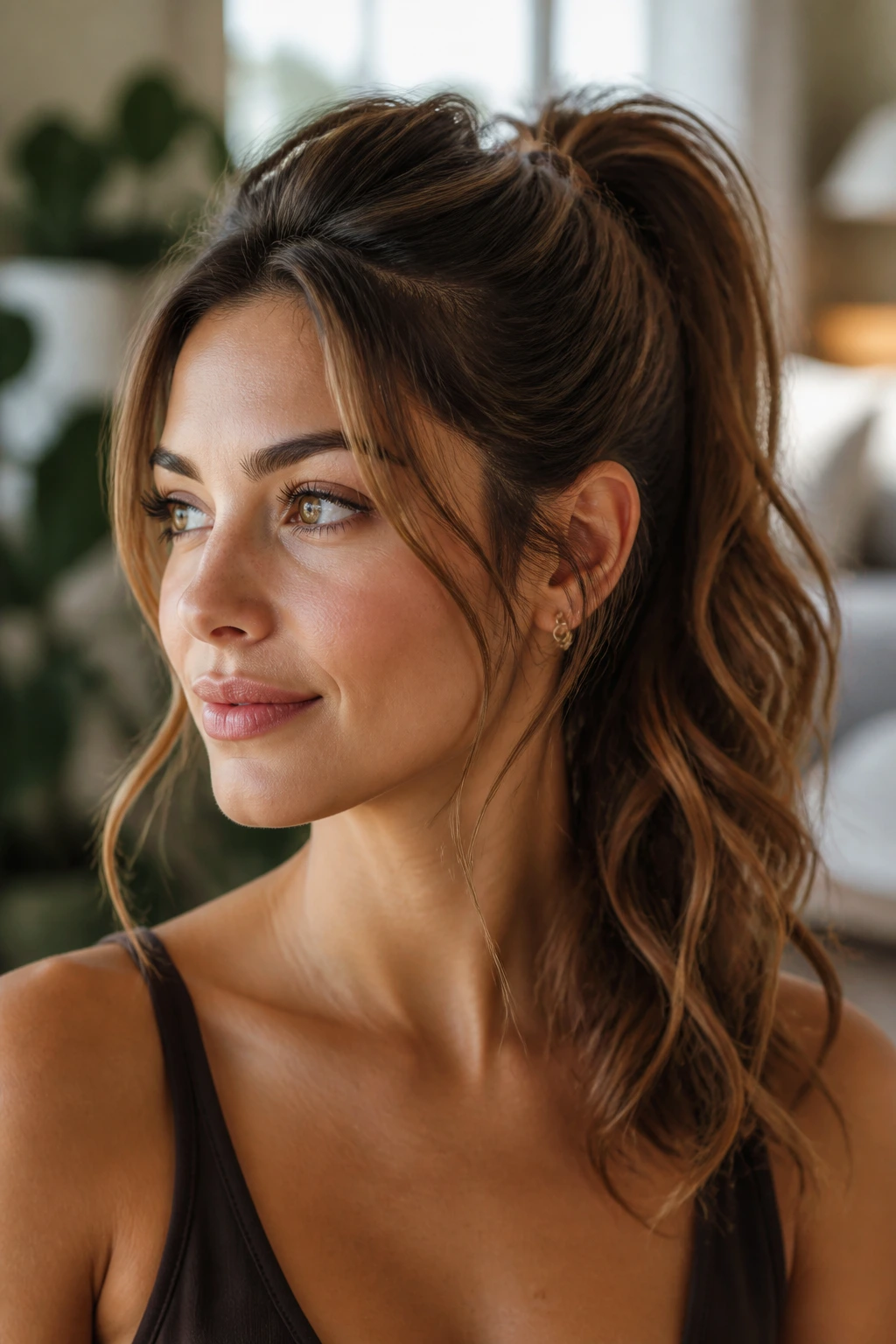
The first mistake is pulling everything straight back from the hairline. On a heart-shaped face, that exposes the widest part of the face all at once and can make the forehead look even broader. A side part, a slight middle part, or just a few softened front pieces usually fixes it.
The second mistake is putting too much bulk at the crown. A little lift helps. A teased mountain does not. If the top looks puffy and the chin looks small, you’ve gone too far. Smooth the surface, lower the placement, and let the tail carry the style.
The third problem is a limp tail. Long hair can look heavy if it hangs in one uninterrupted sheet. Add a braid, a wave, a bubble section, or even a tucked end so the lower half has shape.
A fourth mistake is overloading the style with product. Shine cream on the roots, hard gel around the temples, oil on the ends, then another spray on top — that’s how a ponytail turns greasy before lunch. Pick one hold product and one finish product, and use less than you think.
Finally, don’t forget the side profile. A style that looks balanced from the front can sit too high or too tight from the side, which is especially harsh on a narrower chin. Check the profile in a mirror before you leave. It saves a lot of regret.
Variations and Adaptations to Try
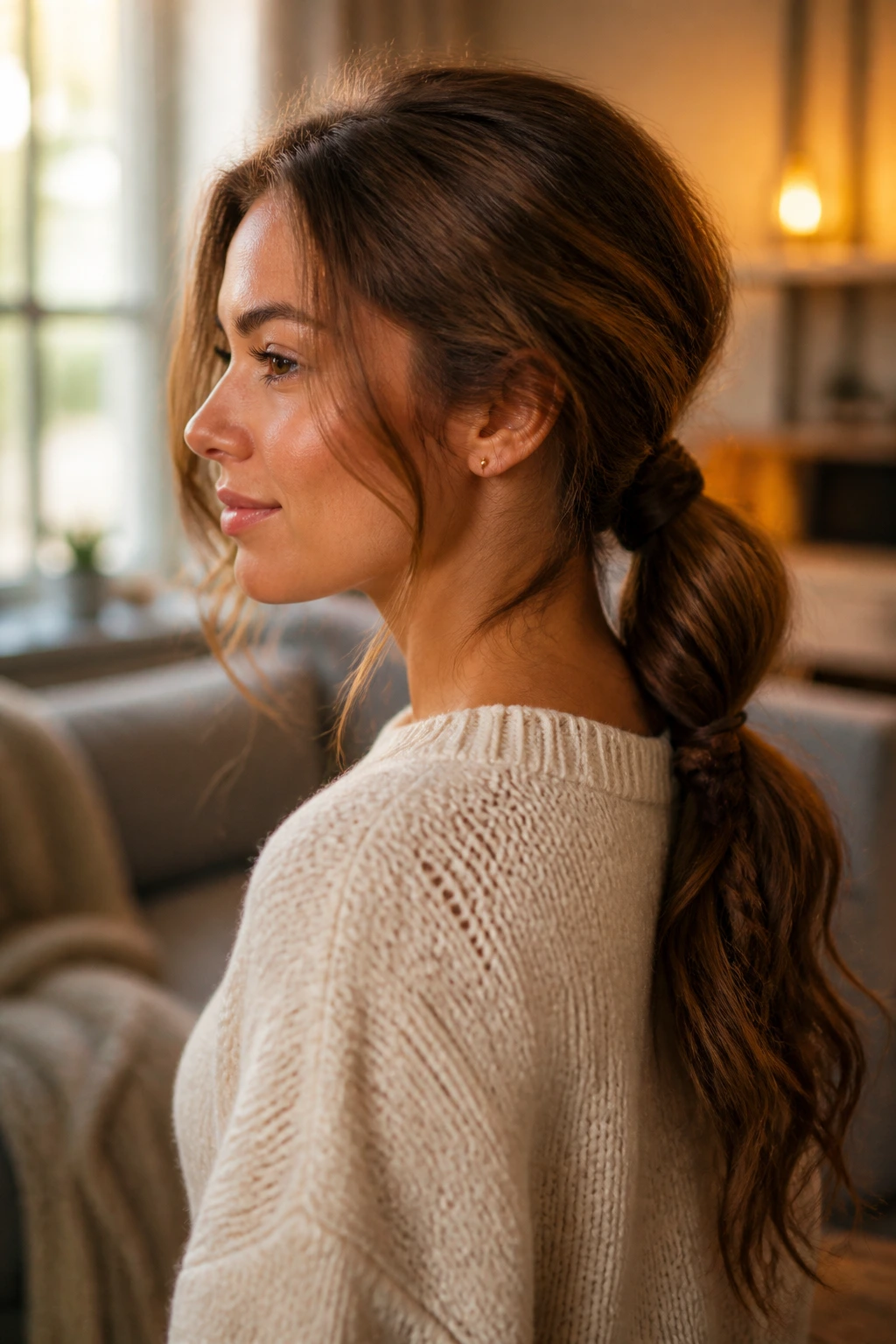
The No-Heat Version: Use a low or mid ponytail with strong texture spray, then braid the tail or add bubbles instead of curling it. This works well when your hair already has some bend or when you want to avoid extra damage.
The Office-Sleek Version: Choose a wrapped low ponytail or a clean mid ponytail with a center part. Keep the face-framing pieces minimal and use a tiny bit of serum on the top layer only. It reads polished without getting stiff.
The Soft Romantic Version: Add loose waves through the tail and leave a few tendrils around the cheeks. This is the version that looks best with long layers because the movement blends the cut into the style.
The Gym-to-Street Version: Go with a high ponytail that has softened sides and a secure double elastic. Afterward, pull out two thin front pieces and smooth the ponytail base with your hands. It can move from workout to errands without a full redo.
The Curly-Hair Version: Keep the curls intact instead of brushing them out. Gather the ponytail low or mid-height, preserve the curl pattern in the tail, and use a satin scrunchie or coil tie so the base doesn’t snag.
The Fine-Hair Version: Use the double-elastic trick, texture spray at the roots, and one small braid or twist near the base. Fine hair needs structure more than shine. Too much shine makes it look flatter than it is.
How to Keep These Styles Looking Fresh
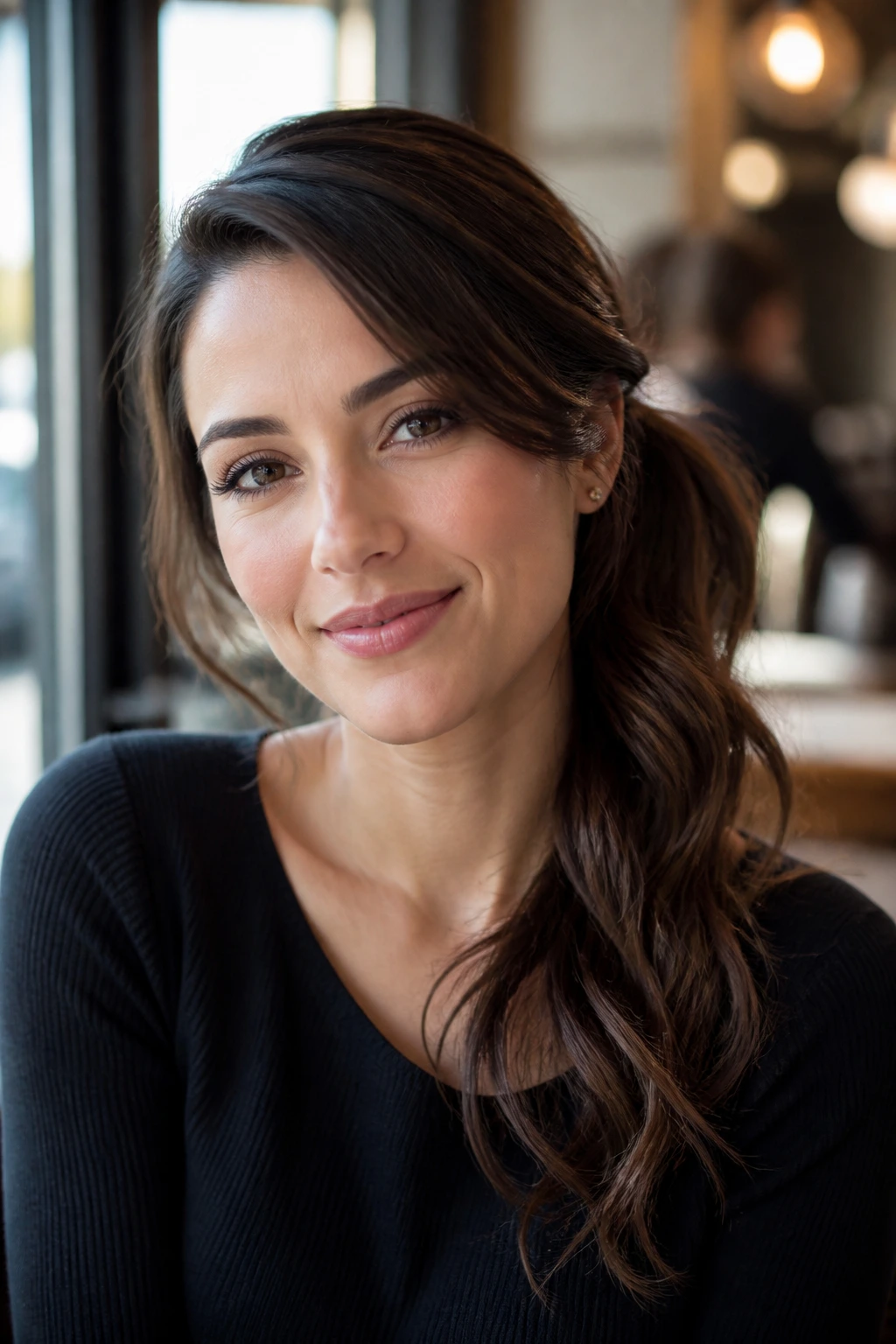
A ponytail lasts longer when the prep is right. If you know you’ll wear one through the day, start with dry shampoo or texture spray at the roots and a little smoothing cream on the ends. That gives the hair some grip and keeps the tail from puffing up at the wrong points.
Overnight, a loose silk scarf or satin pillowcase helps a lot, especially for sleek styles. If the ponytail is low, you can sometimes sleep in it loosely wrapped, but anything tight will leave a dent. Braided or twisted tails hold overnight better than straight ones. Bubble ponytails usually need a quick reset in the morning because the elastics shift.
If the roots start to look flat, lift the crown with your fingers and mist a touch of dry shampoo underneath the top layer. Don’t spray blindly over the whole head. That gives you a dusty finish and not much else. A little at the roots, a little at the sides, then a fingertip massage. Enough.
For next-day wear, refresh the face-framing pieces with a quick bend from a flat iron or by wrapping them around a brush and warming them for a few seconds with your dryer. It’s a small reset, but it makes the whole style look awake again.
Frequently Asked Questions About Ponytails for Long Hair and Heart-Shaped Faces
What ponytail height is most flattering on a heart-shaped face?
Low and mid ponytails are usually the safest bets because they keep the top of the face from looking wider. High ponytails can still work, but they need softened sides and a little face-framing movement so the forehead doesn’t dominate the whole shape.
Should I wear a middle part or a side part?
Both can work. A middle part gives a clean, lengthening line, while a side part softens the forehead and breaks up width at the temples. If your face already feels broad up top, side part. If your features are more evenly balanced, either one is fair game.
Do layers make ponytails harder to style?
They can, mostly because shorter front pieces escape the elastic and shorter crown layers create frizz. The fix is texture and control: use a little product, accept a few loose strands, and choose styles like wrapped lows, braids, or twists that make the layers look intentional.
How do I stop a ponytail from making my chin look smaller?
Avoid too much height at the top and too much slickness around the temples. Add softness near the face, keep some volume in the tail, and choose a placement that sits lower than the most prominent point of the forehead.
Can I wear a sleek ponytail every day?
You can, but the same tight tension every day is rough on the hairline and edges. Rotate between low, mid, and looser styles, and use soft elastics instead of hard ties whenever you can. Your scalp will thank you later.
What if my hair is fine and long, but the ponytail keeps falling flat?
Use a double-elastic setup, add texture spray before gathering the hair, and curl or wave the tail so it has body. Fine long hair usually needs support at the base and a shape in the lengths. Flat ends are the enemy.
Are bubble ponytails good for heart-shaped faces?
Yes, if the base is smooth and the bubbles stay soft. The sectioned tail balances the face by giving the lower half more presence, which helps offset a wider forehead and a narrower chin.
How do I make a ponytail look less severe around the hairline?
Loosen a few strands near the temples, soften the part, and avoid slicking the hair too tightly across the forehead. Even a little lift or bend near the front can change the whole expression of the style.
What’s the fastest ponytail to do when I’m in a hurry?
A low ponytail with a side part and a wrapped base takes almost no time and still flatters a heart-shaped face. If you have extra thirty seconds, pull out two slim face-framing pieces and bend the ends once with a flat iron.
A Ponytail Shape That Actually Flatters
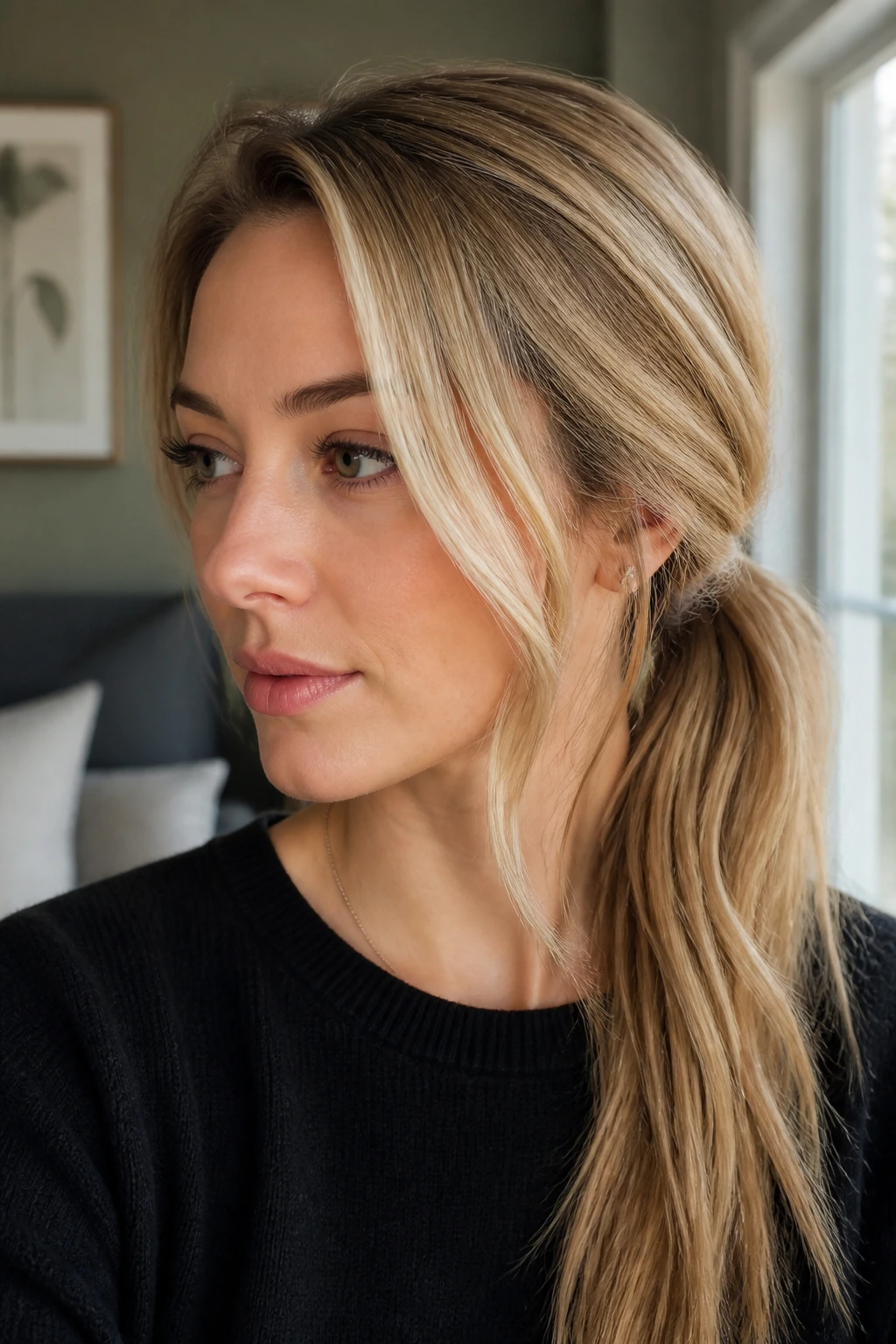
The best ponytail for a heart-shaped face is rarely the loudest one in the room. It’s the one that respects where your face is widest, where it narrows, and how long hair behaves when it moves. That’s why low wrapped styles, soft side parts, textured tails, and careful crown lift keep showing up here. They do more than decorate the hair. They change the outline.
Long hair gives you more room to work, which is both a gift and a trap. Too much weight in the wrong place can drag the whole style down. The right placement, a little softness near the temples, and a tail with some shape are what keep it balanced. Once you start thinking about ponytails that way, the options open up fast.
And honestly, that’s the fun part: you stop asking whether a ponytail is “just a ponytail” and start using it like shape, not habit.