



If thin hair has a bad habit, it’s this: it looks fine in the mirror after a blowout, then collapses into one narrow strip by lunch. An angled shag with bangs for thin hair solves that problem by changing the shape of the haircut itself, not by asking a mountain of product to fake volume. The front stays a little longer, the crown gets lift, and the bangs keep the eye moving instead of landing on the ends.
The nice thing about this family of cuts is that it gives you options without forcing a dramatic chop. You can keep it collarbone length and airy, go a little mullet-y, lean sleek, or push it toward wolf-cut territory. The wrong version looks stringy fast. The right one looks like the hair has more body than it actually does.
Thin hair is also not the same thing as fine hair, and that distinction matters. Fine hair means the strands themselves are small; thin hair means there’s less density overall. Some people have both, some have one, and the cut should be chosen with that difference in mind. The shape, the angle, and the bang choice matter more than some folks realize.
Why These Angled Shags Earn Their Place on Thin Hair

-
The angle gives you movement without length overload: Shorter layers in back and longer pieces in front stop the hair from hanging in one heavy sheet, which is exactly what thin hair does not need.
-
Bangs create a focal point: A fringe pulls attention up toward the eyes and cheekbones, so the eye reads shape instead of sparse ends.
-
The crown gets a lift built in: Good shag layers remove just enough weight near the top to stop that helmet-flat look that thin hair loves to develop.
-
You can control how soft or edgy it feels: Curtain bangs, side bangs, bottleneck bangs, micro fringe, and wispy bangs all change the mood without changing the basic structure.
-
The cut grows out in pieces, not a hard line: That matters more than people think. A shag that’s grown out a little still looks intentional; a blunt cut that’s grown out can look tired fast.
-
It works with rough styling: Most of these cuts look better with a little bend and separation than with one perfect, overbrushed finish. That’s a blessing on mornings when you do not have time for a full round brush production.
1. Collarbone Angled Shag with Curtain Bangs
This is the safest starting point if you want movement but don’t want to lose too much density. The front pieces graze the collarbone, the back sits a touch shorter, and the curtain bangs split softly at the center so the forehead doesn’t feel boxed in. On thin hair, that longer front line keeps the cut from looking too spiky.
Why it works on thin hair: Curtain bangs are one of the best bang choices here because they don’t eat up the whole front hairline. You get framing without making the fringe feel heavy or see-through.
Styling note: A 1-inch bend with a round brush or curling iron is enough. Don’t curl every section into a perfect wave; that kind of polish can make thin hair look smaller, not fuller.
Best for: Straight to slightly wavy hair that needs shape more than drama.
A tiny bit of root lift at the crown finishes the job. Not a lot. Just enough to keep the top from lying dead flat against the scalp.
2. Chin-Grazing Razor Shag with Wispy Bangs
Thin hair and blunt edges are not friends when the goal is movement. This version keeps the ends around the chin, then adds feather-light layers through the interior so the shape stays lively instead of blocky. Wispy bangs keep the front open and stop the cut from feeling heavy.
The trick is restraint. Too much razor work and the ends start looking frayed. Too little texture and the whole thing sits there like a compact bob that forgot to have fun. The best version has separation at the ends, but the outline still looks clean.
This cut suits people who like a little edge and don’t mind using a styling spray to rough up the surface. If your hair tends to go flat at the sides, the chin length is useful because it keeps the shape close to the face, where the eye notices it.
A quick blast with a dryer and a small paddle brush is usually enough. Then flip the ends out a little or tuck them under, depending on which side of the mirror you prefer.
3. Shoulder-Skimming Bottleneck Shag
Why do bottleneck bangs keep showing up in these cuts? Because they solve a sneaky problem. The fringe begins narrow near the center, then opens at the cheekbones, so the front doesn’t lose too much density all at once. That matters on thin hair, where a heavy bang can swallow the face and a too-sparse bang can look wispy in the wrong way.
The shoulder-skimming length gives the haircut a little more presence, and the angled layers keep it from collapsing into a blunt rectangle. It feels soft, but not weak. That’s the difference.
I like this version for someone who wants a shag but still needs the hair to tuck behind the ears, clip back for work, or sit neatly under a coat collar. It behaves better than the more aggressively layered versions.
How to style it
- Dry the bangs first, while they’re still damp, so they don’t split weirdly later.
- Use a medium round brush and direct the front pieces away from the face.
- Leave the ends slightly bent, not curled to a ringlet.
That little bend is doing more work than it looks like.
4. Pixie-Bob Shag with Micro Fringe
Picture this: the top looks lifted, the sides skim the jaw, and the whole cut moves when you turn your head. That’s the appeal of this shorter, sharper version. It has enough shag texture to keep thin hair from lying limp, but the perimeter stays compact so the strands don’t scatter all over the place.
Micro fringe is a bold choice. It also exposes the forehead, which means the rest of the haircut has to carry the weight visually. On thin hair, that only works if the layers are kept soft and the edges are not over-thinned. You want a neat outline with texture inside it, not a shredded silhouette.
This one is best when you like a slightly editorial look and you’re willing to style the fringe every day. It’s not a sleepy haircut. It wakes up fast, and if you ignore it, it goes weird just as fast.
A small dab of pomade on the bangs can keep them from standing straight up. Use less than you think. Micro fringe turns greasy faster than people expect.
5. Soft Wolf Shag with Long, Sweeping Bangs
A soft wolf shag sounds edgier than it feels. The top is still layered enough to create lift, the back stays a little longer, and the bangs sweep out toward the cheekbones instead of dropping straight down. On thin hair, that long bang helps maintain the illusion of fullness at the front.
This is the cut for people who want texture but do not want their hair to look chopped to pieces. The longer nape and softly disconnected layers keep the shape from turning into a jagged cloud. If the stylist keeps the ends clean and avoids over-thinning the perimeter, the result has movement without fragility.
It works especially well if your hair has a slight wave or a little natural bend. Straight hair can wear it too, but it needs a bit of product and some finger-tousling to keep the top from looking too neat.
The best part? It grows out in a forgiving way. A wolf-leaning shag can go a few weeks past its sweet spot and still look like a deliberate cut rather than a mistake.
6. Face-Framing Angled Shag with Side-Swept Bangs
The face-framing angled shag is the diplomat of the group. It gives you the shag shape, but the layers fall more softly around the face, and the side-swept bangs make the whole cut feel easy to wear. For thin hair, that matters. A severe shag can look like it lost its battle with a pair of scissors. This version doesn’t.
Side-swept bangs are useful if you have a cowlick at the front, a low-density temple area, or a forehead you’d rather not expose all at once. They slide over the face instead of stopping abruptly, which keeps the front from looking sparse.
This cut is also one of the easiest to style in a hurry. Blow-dry the fringe in the opposite direction first, then sweep it back across. That little bit of cross-drying creates lift at the root. It’s a small trick. It changes the whole haircut.
If you hate center parts, start here. It plays nicely with a deep side part and doesn’t demand perfect symmetry.
7. Airy Layered Shag with Piecey Fringe

Airy pieces around the forehead can do more for thin hair than another inch of length ever will. This cut keeps the layers light and separated, then lets the fringe break into little piecey sections instead of one solid curtain. The result feels soft, active, and not overly styled.
The key is spacing. You want visible difference between the top layers and the longer face-framing pieces, but you don’t want a stylist to keep carving until the ends look see-through. Thin hair can handle texture. It cannot always handle enthusiastic thinning shears.
Why it flatters thin hair
The fringe is broken up enough to add interest, yet it still gives the face a frame. That framing matters because it pulls attention away from the fact that the hair itself is not dense. The eye sees movement first.
I like this on shorter to medium lengths where the ends can flick a little. It’s the kind of cut that looks good with a dry texture spray and a quick scrunch, which is useful if you’re not married to a full blowout every morning.
8. Rounded Shag with Feathered Bangs

Feathered bangs change the silhouette fast. They soften the forehead line, and the rounded shape of the cut keeps the sides from flaring out like a triangle. For thin hair, that roundness is a smart choice because it creates the feeling of thickness around the face without making the bottom too bulky.
This version is more polished than the messier wolf-leaning cuts. The layers are still there, but they’re blended enough that the haircut feels smooth when brushed. If your hair tends to snag and separate in dry weather, this is a calmer option.
The best styling move here is a soft roll under at the ends. Not a big curl. Just enough movement to keep the perimeter from sticking straight out. Feathered bangs also look better when they’re cut with some softness around the edges, not hard across the brow.
It’s a good pick for someone who wants shag texture but doesn’t want to look like they’ve committed to a full-on indie cut.
9. Mullet-Lite Shag with Curtain Fringe

The mullet-lite version has a little bite, but the neckline stays light. That is the whole point. Thin hair often looks best when the back is not overloaded with length, and this cut keeps the rear slightly longer while the top and sides carry the shape.
Curtain fringe softens the edge so the cut doesn’t tilt too hard into mullet territory. It gives you the face-framing benefit without making the hairline look chopped. If your hair is fine and tends to lose volume at the crown, the short top layers help lift that area without asking the back to do all the work.
This is one of those cuts that looks better with a bit of mess in it. A tiny wave, a little separation, maybe a dry texture spray at the roots — those things matter. Slicking it down kills the point.
If you’re nervous about a bolder shag, this is the compromise. It has attitude, but it still behaves.
10. Sleek Angled Shag with Bottleneck Bangs

A sleek shag is the cleanest option if your hair is fine but straight as a ruler. Instead of leaning hard into rough texture, it uses the angle of the cut to make the silhouette interesting. The bottleneck bangs add shape around the eyes and temples, and the rest of the hair stays smooth.
This one is a good reminder that a shag does not need to look chaotic to work. Thin hair often looks better when there is some control in the outline. If you cut it too ragged, the ends can look frayed before they ever look full.
What to watch for
- Keep the layers soft around the crown.
- Ask for clean ends, not shredded ones.
- Blow-dry with a nozzle and a flat brush so the hair falls in a tidy bend.
A little shine serum on the ends is fine here. Just don’t put it at the root, where it will flatten the lift you paid for.
11. Choppy Lob Shag with Eyebrow-Grazing Bangs
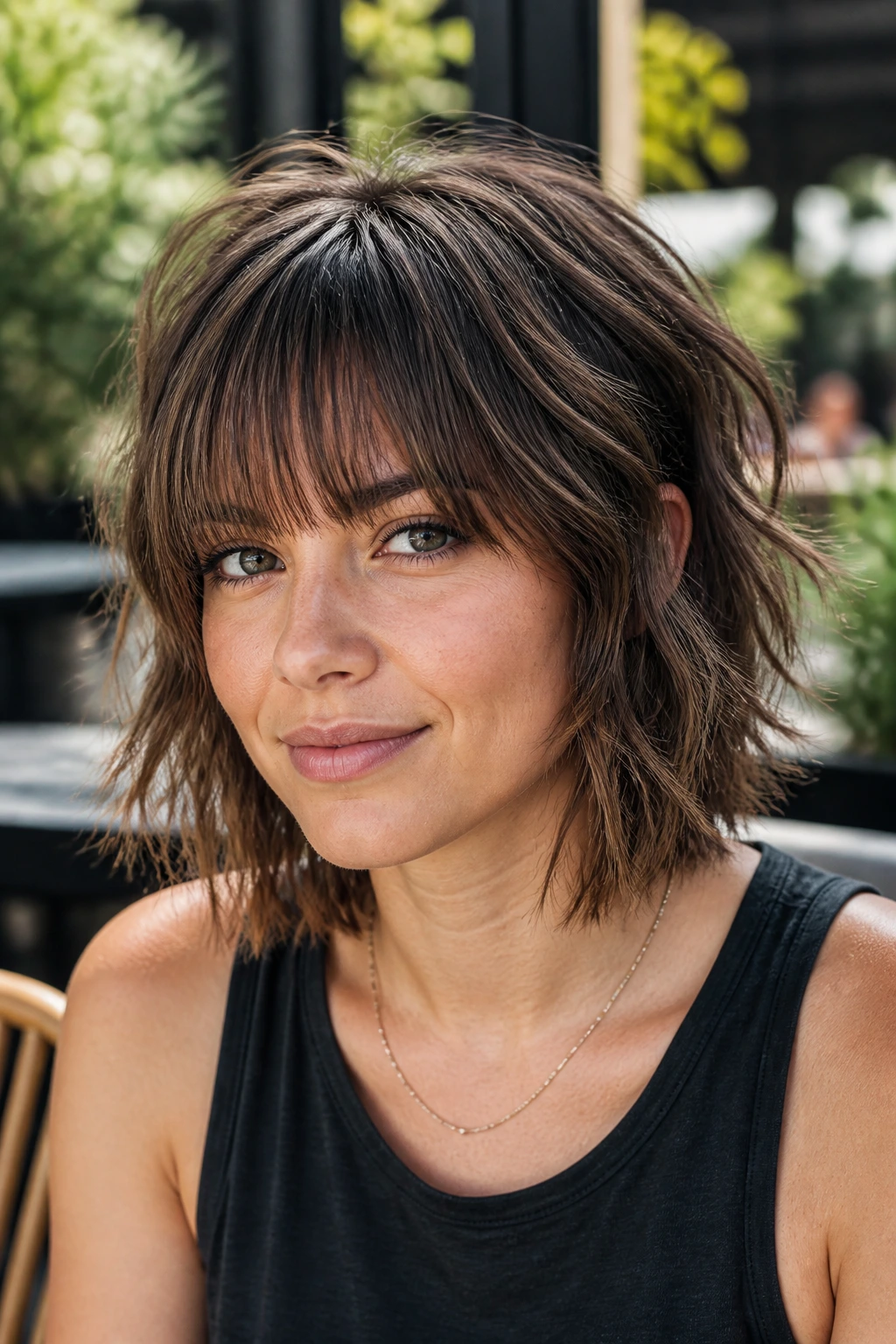
Eyebrow-grazing bangs are the point where the cut starts to feel deliberate instead of accidental. They’re short enough to show off the eyes, but long enough to keep some density in the fringe. On thin hair, that’s a useful balance, especially if your forehead area is the sparsest part.
The lob length gives the cut room to breathe. It stops at a point where the hair still feels substantial, while the choppy layers inside it create the shag effect. If you keep the interior layers close to the outline, you get movement without losing too much bulk at the ends.
This cut has a small warning attached to it: bangs that skim the brows need regular trims. Once they drop too far, the whole face can look tired. Keep them clean, and the haircut looks sharp with almost no effort.
A light dry shampoo at the roots and a quick pass with a round brush are usually enough to revive it after sleep.
12. Textured Lob with See-Through Fringe

See-through fringe is one of those terms that sounds delicate because it is. The bangs are soft, separated, and light across the forehead instead of packed in as a dense block. That makes the style a natural fit for thin hair, especially if you want to keep the front from looking heavy.
The textured lob adds just enough movement through the ends to keep the line from going flat. It is not wildly layered. Good. Thin hair rarely needs wild layering. It needs smart layering.
This is a nice choice if you want a shag influence but you still like a little neatness. The outline stays readable, which helps if your hair is sparse at the sides or if you wear it tucked behind one ear. It can look elegant without getting stiff.
The fringe is easiest to style when it’s dried from side to side with your fingers, then lightly separated with a comb. No need to overthink it. Overthinking bangs is how people end up with a helmet.
13. Curly Angled Shag with Soft Bangs

Curly thin hair needs a different conversation. Cut too short, and the curls spring up and expose too much scalp. Leave it too long, and the curl pattern stretches flat. The angled shag sits in the middle and gives the curls a place to stack without turning into a pyramid.
Soft bangs work here because curly fringe can shrink more than you expect. A stylist should usually leave them longer than the finished length, then shape them while the hair is dry or nearly dry. That keeps the bangs from bouncing above the eyebrow line by mistake.
How to make it work
- Ask for dry cutting if the curl pattern is loose to medium.
- Keep the shortest front layers at cheekbone length or longer.
- Use a light curl cream, not a heavy butter or paste.
The result should look buoyant, not bulky. That difference matters. Curly thin hair can absolutely wear a shag, but it needs room for the curl to live.
14. Blunt-Edge Shag with Softened Fringe

A blunt edge under shag layers sounds contradictory, and that is exactly why it works. Thin hair often looks fuller when the perimeter has a clean line, even if the interior is lightly textured. The blunt bottom gives the eye something solid to land on.
The softened fringe keeps the cut from feeling boxy. If you pair a blunt edge with a dense bang, the whole style can get heavy and closed-off. So the better route is a wispy or softly feathered fringe that breaks up the front just enough.
I like this for people who want movement but still hate the way ultra-layered cuts make their ends disappear. It’s a smart compromise: structure below, texture above.
If the hair is very fine, the blunt edge should be cut with care. A rough, choppy bottom line can look thick in theory and stringy in practice. Clean scissors, clean line, light layering. That’s the formula.
15. Asymmetrical Angled Shag with Side Bangs
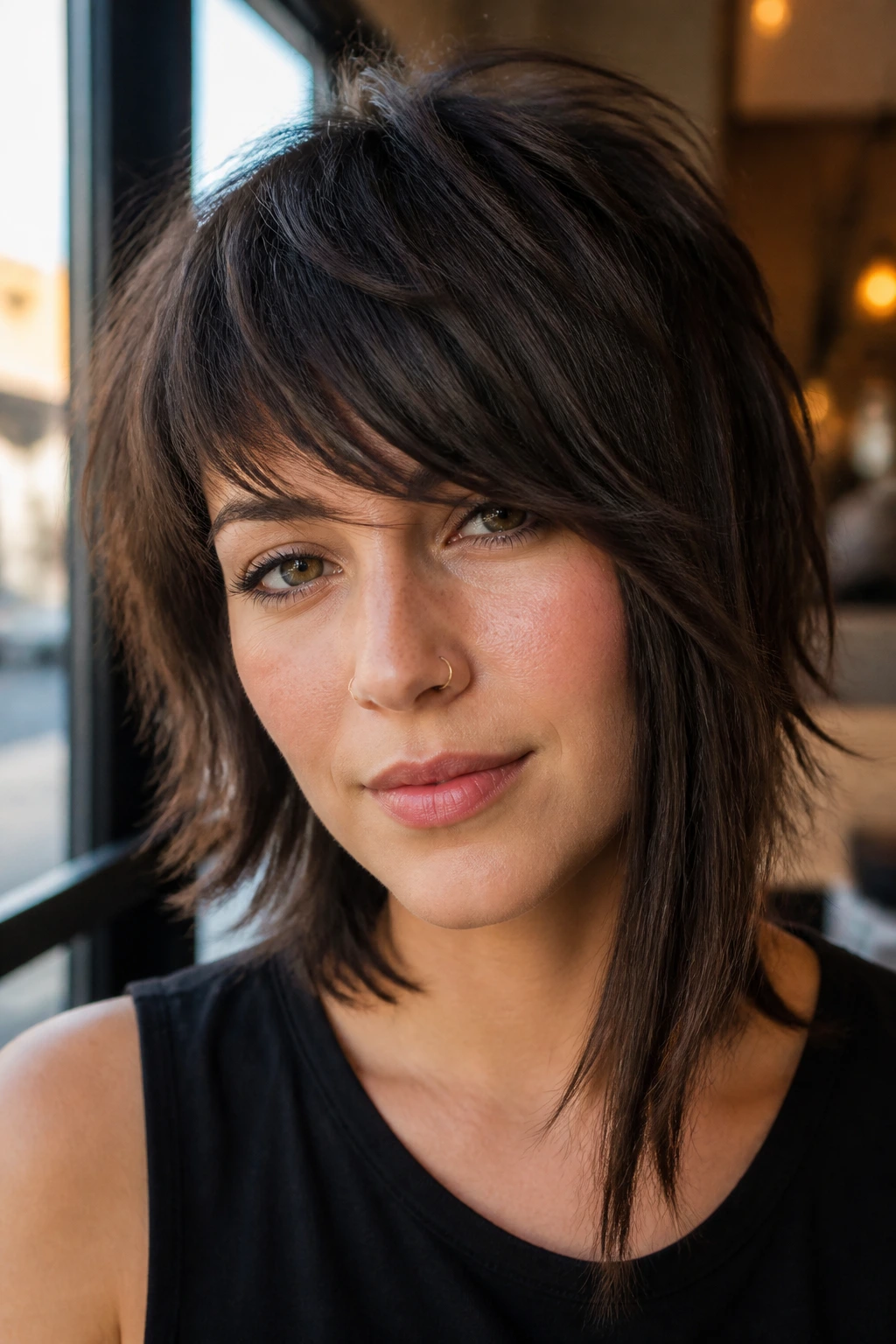
Asymmetry can rescue hair that loses more density on one side. Maybe you part your hair there. Maybe a cowlick keeps pushing it. Maybe one temple is thinner than the other and you’re tired of pretending not to notice. An asymmetrical angled shag gives you a shape that works with that unevenness instead of fighting it.
Side bangs help the cut lean gracefully to one side, and the longer front panel can balance a narrow face or a stronger jaw. The angle should feel intentional, not lopsided. That’s the part many cuts miss.
This style has a little attitude, but it’s wearable. If you like visual tension — hair that doesn’t sit perfectly centered — this is a satisfying option. If you prefer symmetry, skip it. No shame there.
A flat iron can sharpen the longer side just a touch, while the shorter side stays softer. That contrast makes the asymmetry look polished instead of accidental.
16. Chandelier Bang Shag
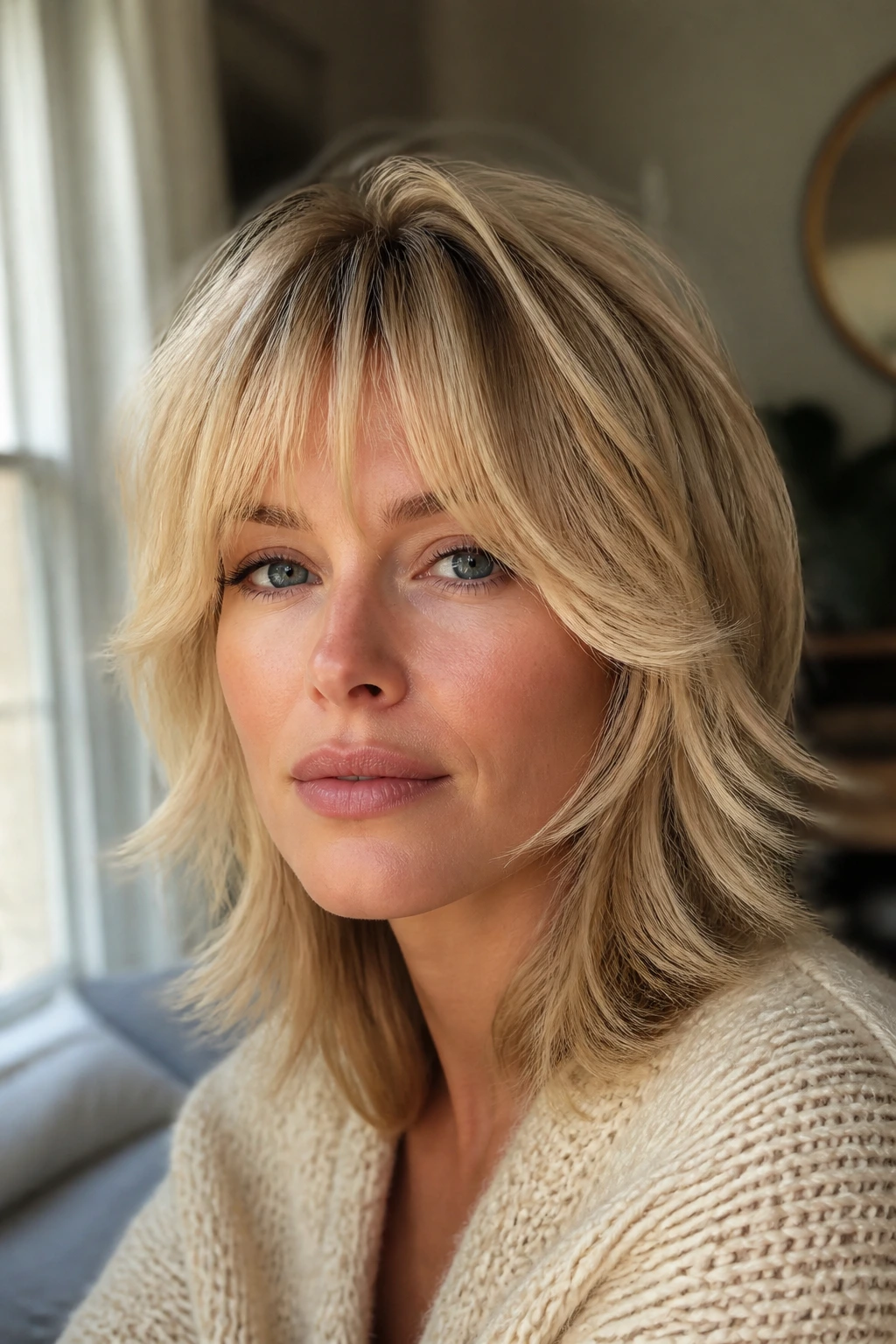
Chandelier bangs are for people who want face framing without a heavy curtain on the forehead. The center stays shorter, then the pieces open out around the cheeks and jaw. On thin hair, that shape is clever because it uses a little bit of hair to frame a lot of face.
The shag underneath should stay light and blended. Too much layering turns the whole cut into feathers gone loose. Keep the crown lifted, let the sides taper, and give the fringe space to breathe.
I like this cut more on shoulder-length hair than on very short hair. The extra length keeps the bang shape from looking abrupt. It also gives you more styling range. You can sweep the front pieces away from the face, tuck them behind an ear, or let them hang as a soft frame.
If you have a long face, this shape is useful because the bang width opens the middle of the face while still leaving light at the forehead. It’s a quiet trick. Quiet tricks are often the best ones.
17. Root-Lifted Shag with Long Curtain Pieces
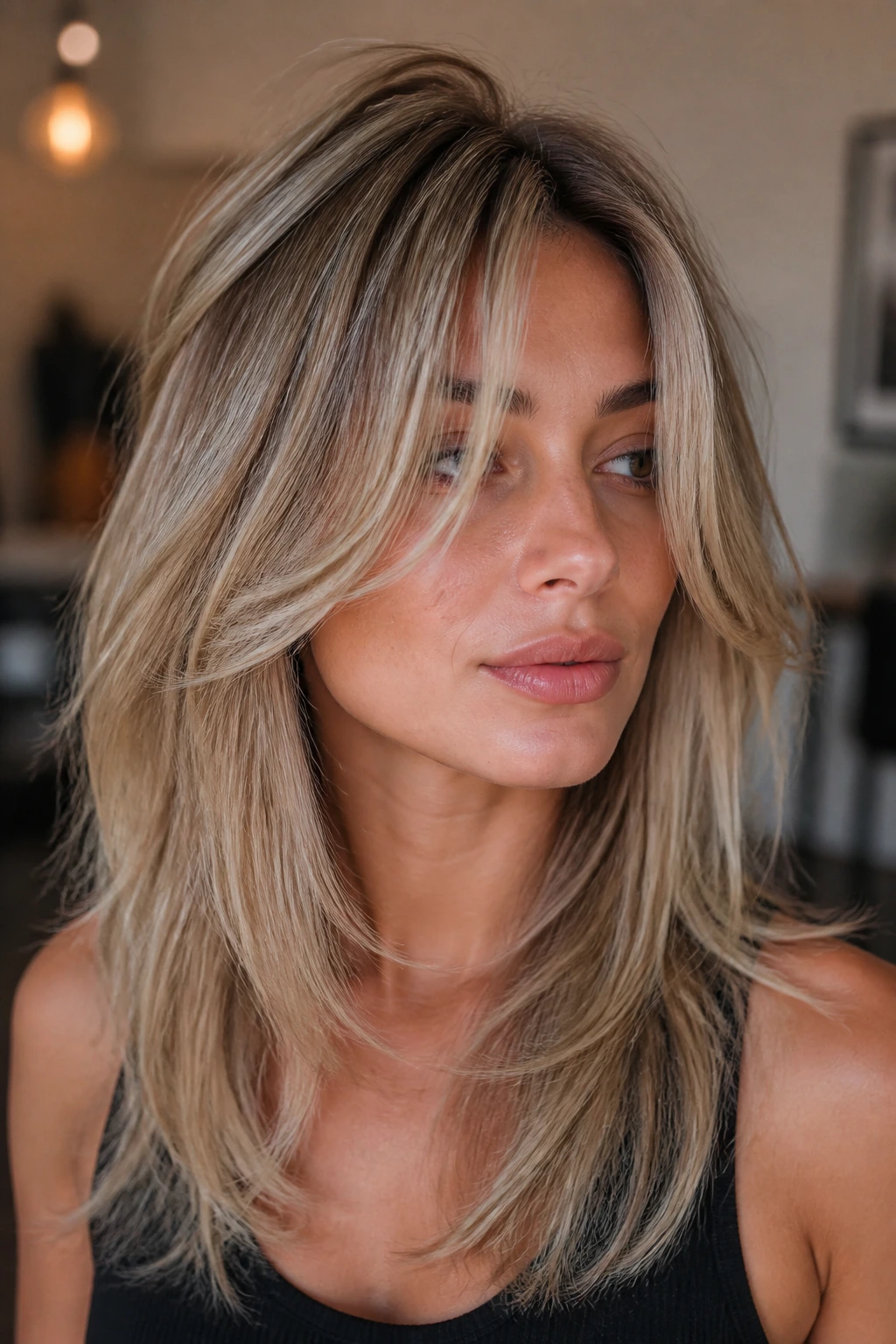
Root lift is not a bonus here; it’s the whole point. This version relies on crown volume and longer curtain pieces in front to create a taller silhouette, which is useful when thin hair tends to settle low and flat. The length in front keeps the haircut soft, while the lifted top stops it from sinking.
The cut should not be too layered at the ends. If the perimeter gets too sparse, the whole style reads as wispy instead of full. The goal is height, not fray.
Best styling habit
Flip the head forward for a quick dry at the roots, then lift sections at the crown with clips for a few minutes while they cool. That little pause helps the hair remember shape.
This version is especially good if you wear glasses or if you dislike bangs landing directly on the brow. The curtain pieces can be tucked, pushed back, or bent away from the face. Flexible haircuts are underrated.
18. Sliced-Ends Shag with Wispy Fringe
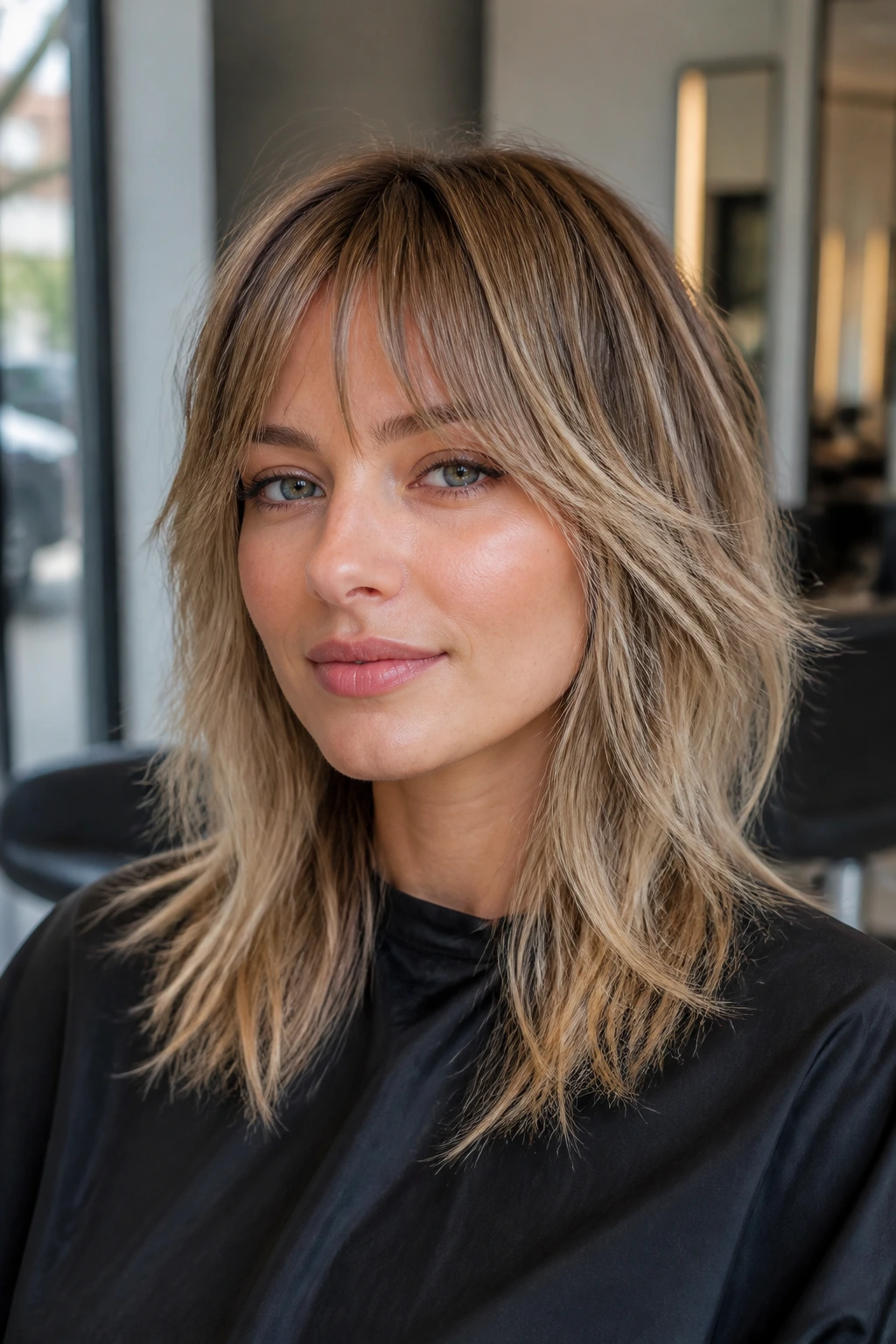
Sliced ends bring movement, but they need discipline. If the stylist slices too much, the ends can look shredded. If they’re too cautious, you lose the soft, airy effect that makes this cut interesting. Thin hair sits right on that edge.
Wispy fringe keeps the top light and prevents the haircut from feeling dense at the front. It’s a good match for hair that is naturally straight or only slightly wavy, because the separated ends show best when the texture isn’t fighting the shape.
This is one of my favorite versions for people who want something modern without a lot of visible bang weight. It looks easy. It isn’t accidental. There’s a difference.
A texture spray at the ends helps define the sliced pieces. Don’t spray the crown like a firehose. A little mist is enough.
19. Air-Dry Shag with Tapered Bangs

Air-drying works when the cut is shaped for it. This is that cut. The layers are tapered so the hair can settle into a controlled bend as it dries, and the bangs narrow slightly at the center before widening at the sides. For thin hair, that means less collapse and fewer awkward flat spots.
You’ll want a lightweight foam or mousse on damp hair, nothing greasy. Then scrunch or twist the front pieces just enough to coax the shape into place. If your hair dries in a straight, slippery line, this version can still work — but only if you keep the layers light and the bangs long enough to survive the dry-down.
The nicest thing about this cut is that it doesn’t demand perfection. Air-dry hair usually has a little unpredictability. The tapered layers turn that into texture instead of mess.
If you hate hot tools, start here. It’s the least fussy shag in the bunch, which is saying something.
20. Tousled Shag with Grown-Out Fringe

Grown-out bangs have a reputation for looking lazy; on the right shag, they look deliberate. The fringe sits a little longer, usually somewhere between brow and cheekbone, and blends into the front layers. That makes it a smart move if you want the softness of bangs without the upkeep of a strict fringe.
The tousled finish helps thin hair look fuller because the pieces are separated just enough to show movement. You don’t need a full wave pattern. A soft bend and a bit of root lift will do the job.
This is a good choice if you’re between salon appointments or if you’re growing out a previous bang. It buys you flexibility. Tuck the fringe behind one ear, split it down the middle, or let it fall forward on slower mornings.
A dry shampoo at the roots and a tiny bit of texture cream at the ends can make it look like you meant to do all of this. Helpful. Sometimes that’s the whole game.
21. Layered Shag with Arched Bangs
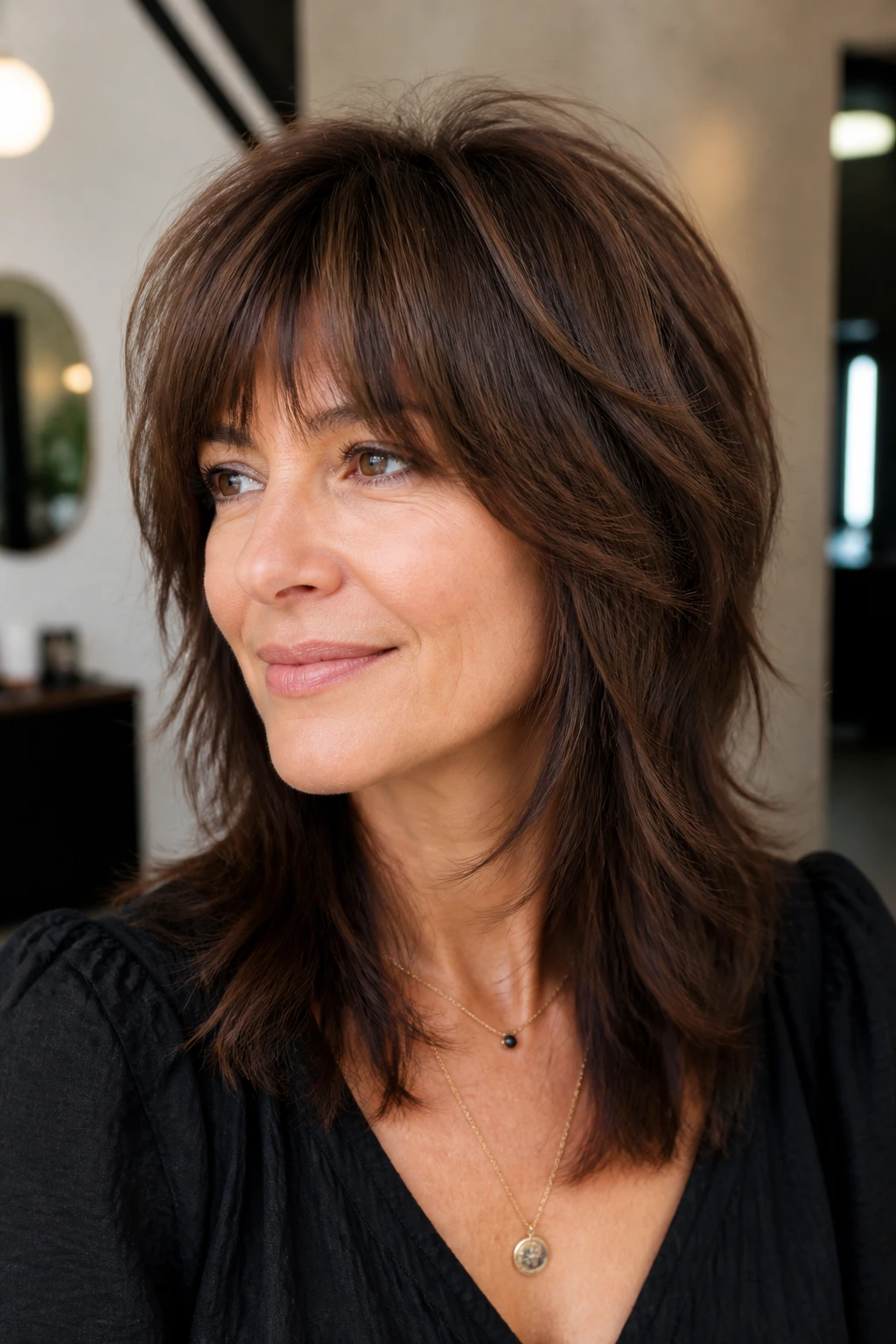
Arched bangs are the quiet fix for a flat top. They curve gently across the forehead, a little shorter in the middle and longer at the sides, which gives the face structure without creating a heavy fringe. On thin hair, the arch keeps the bang shape visible even when the overall density is low.
The layered shag underneath should stay soft and controlled. If you add too many choppy layers here, the arch loses its calm shape and the haircut starts to look busy. Busy is not your friend when the hair itself is sparse.
This version suits people who want polish more than edge. It reads neat from a distance and textured up close. That combination is harder to get than it looks.
If you wear your hair straight most of the time, this is one of the easiest shags to maintain. The shape remains legible even when the styling is minimal, and that saves you from fighting your own hair every morning.
22. Chin-Length Shag with Flyaway Fringe

A chin-length shag gives thin hair the least room to look stringy. That’s the blunt truth. Shorter lengths keep the ends close to the face, where the eye reads movement and shape before it notices density. Flyaway fringe softens the forehead line and stops the cut from looking too compact.
This is a good final stop if you are ready to cut off limp length and start over with a lighter silhouette. It feels fresh without needing to be severe. The layers should be light enough to move, but not so broken up that the ends vanish.
I like this cut with a side bend or a slightly off-center part. It keeps the shape from becoming too symmetrical, which can make thin hair look more obvious. A little irregularity helps.
Use a small round brush or even your fingers to lift the fringe at the root, then leave the ends a little tousled. Perfectly smooth defeats the point. The slight flyaway texture is what gives it life.
What to Tell a Stylist Before the First Snip
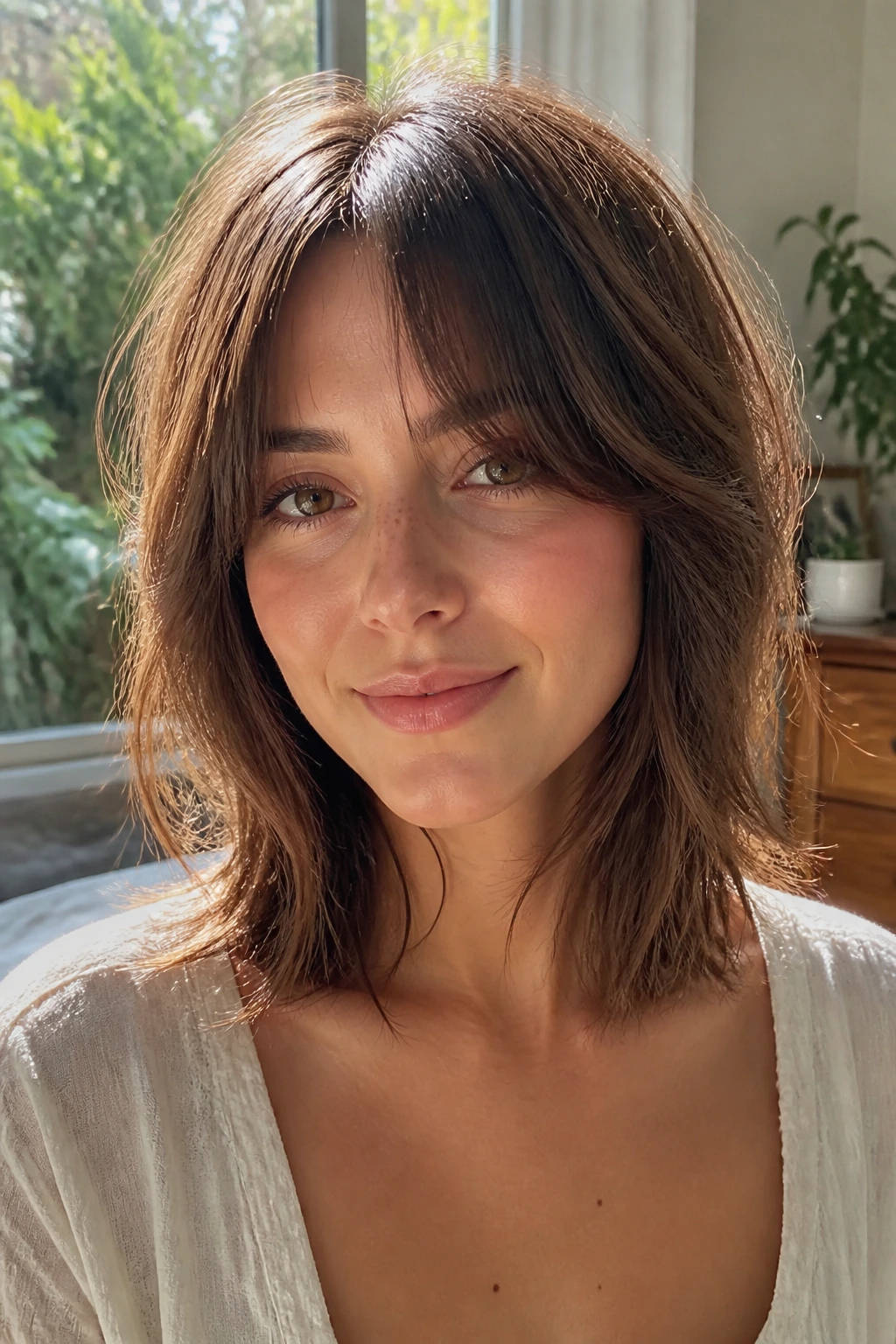
Bring one reference photo with hair that looks like yours in texture and density. Two photos are fine if they agree with each other. Five is chaos. Your stylist does not need a collage of conflicting bangs.
Say where your hair is thinnest. Temple area? Crown? Through the ends? That detail changes where the layers should start and how much weight should stay at the perimeter. If you have a cowlick or a strong part, mention that before the scissors come out.
Ask for shape first, thinning second. On thin hair, too much removal at the ends can make the cut look sparse within a week. Point cutting and light interior texturizing are safer than a heavy razor pass on fragile strands.
A few phrases that help
- “I want the front to stay fuller than the back.”
- “Please keep some weight in the perimeter.”
- “I want movement, not wispy ends.”
- “My fringe needs to sit soft, not dense.”
That kind of language is useful because it gives the stylist a target without over-directing the method.
The Tools That Actually Help This Cut Look Intentional

A shag on thin hair does not need a drawer full of products. It needs a few things that work hard and don’t leave a greasy film.
-
A blow dryer with a concentrator nozzle: This helps direct the root lift instead of blasting the hair into random directions.
-
A 1-inch or 1.25-inch round brush: Good for bending the front pieces and shaping curtain or bottleneck bangs.
-
Lightweight mousse or root lift spray: Put it at the roots while the hair is damp. Mid-length product tends to drag thin hair down.
-
Dry texture spray: A light mist at the ends gives piecey separation without the sticky feel of old-school hairspray buildup.
-
Small flat iron or curling iron: Useful for giving the front a soft bend, not a formal curl.
-
Duckbill clips or root clips: These are underrated. Clip the crown up while it cools, and the lift lasts longer.
-
Wide-tooth comb: Better than brushing rough-dry thin hair into static.
-
Silk scrunchie or soft clip: Handy for keeping the shape from getting crushed while you sleep or wash your face.
If you only buy one thing, buy the root clips. Cheap, simple, and annoyingly effective.
Getting the Most Out of an Angled Shag Consultation

The biggest mistake people make is asking for “more layers” and hoping the stylist reads their mind. Thin hair needs clearer instructions than that. Layers can help, yes. Too many layers in the wrong place can also remove the last bit of structure the haircut had.
Say where the hair is thin
If the crown is sparse, say it. If the temples are weaker, say that too. A good cut for thin hair places the visual weight where the hair still has density, which usually means leaving enough length at the sides and not over-opening the top.
Ask for a perimeter that still matters
The outline is the anchor. Even a shag needs one. If the stylist removes too much from the bottom, the haircut starts to look like it floats apart. That may sound airy in theory. In practice, it often just looks tired.
Match the bang to your morning routine
Curtain bangs, bottleneck bangs, side bangs, micro fringe — they all ask for different levels of effort. If you never style your fringe, don’t choose the one that needs round-brush attention every morning. Pick the one you can live with when you’re half awake.
Use product lightly
A pea-sized amount of mousse can do more than a palmful of cream. Thin hair gets weighed down fast, and once the root collapses, the whole shag loses its point.
Where Thin Hair Gets Flattened or Chopped Too Hard
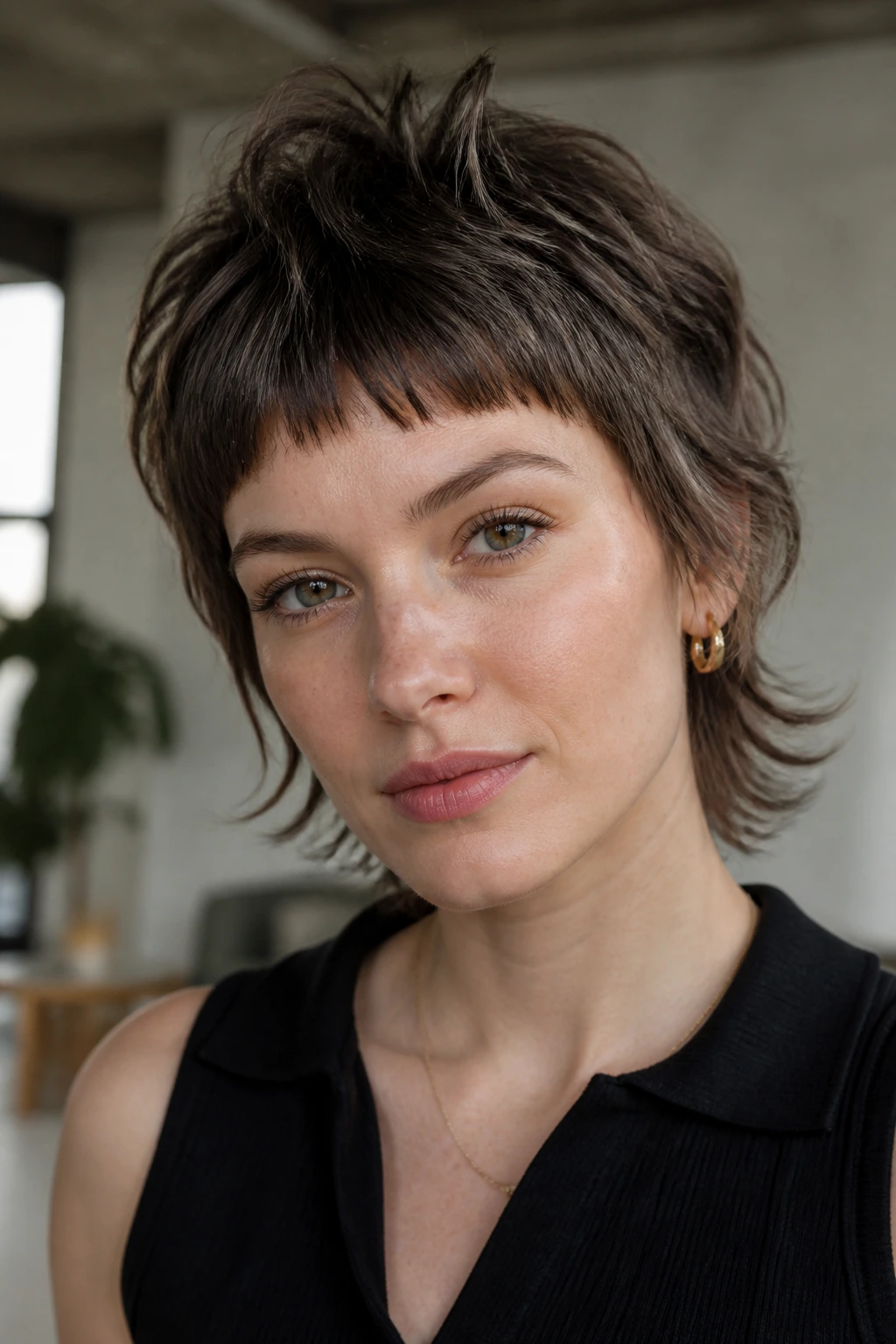
The mistakes are rarely subtle. Usually, they show up as one of three things: a flat crown, see-through ends, or bangs that seem to have their own bad mood.
Over-thinning the perimeter: This is the classic error. The ends look airy for a day, then they start reading as sparse. The fix is simple: keep some weight at the bottom so the haircut has a base.
Cutting the bangs too dense: Thick bangs on thin hair can swallow the face and expose the fact that the rest of the hair is less full. A lighter fringe usually reads better and feels easier to style.
Using too much razor work: Razor texture can be beautiful, but thin hair is not always the place to go wild with it. If the ends start looking frayed, the cut loses substance. A softer point cut often works better.
Styling only the lengths: If the root stays flat, the shag loses its shape by noon. Lift the crown first. Always.
Waiting too long for trims: Bangs grow fast, and the angle disappears sooner than people expect. Once the front pieces drop too low, the whole cut gets sleepy. A trim every 8 to 10 weeks keeps the line readable.
Shag Variations for Straight, Wavy, and Curly Hair
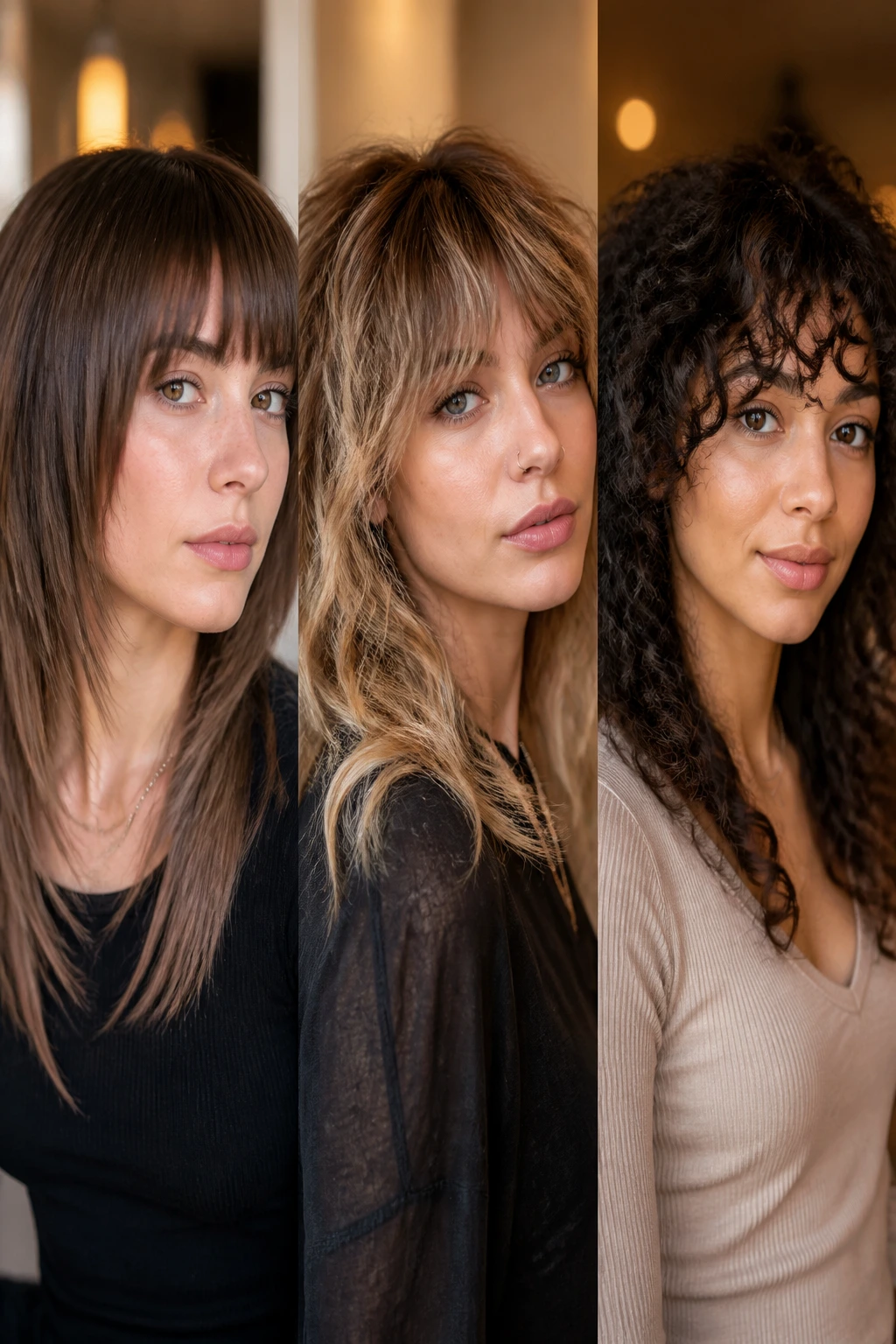
Straight hair, wavy hair, curly hair: the same silhouette behaves three different ways. That’s why one shag photo can be misleading if you do not look at the texture under it.
For straight hair: Choose sleeker versions like the bottleneck shag, the rounded shag, or the sleek angled shag. These use shape, not chaos, to build movement. A bend at the ends matters more than a lot of curl.
For wavy hair: You can go a little softer and messier. Curtain bangs, airy fringe, and the soft wolf version tend to sit well because the wave supports the texture instead of fighting it.
For curly hair: Longer bangs and dry cutting are your friends. Keep the front longer than you think, or the curls will spring up and leave the fringe too short.
For very fine hair: Favor cleaner edges and lighter internal layers. Too much slicing or razoring can make the cut disappear at the ends.
For hair that grows out fast: Pick one with a forgiving fringe, like grown-out bangs or side-swept bangs. Strict micro fringe demands more maintenance than most people want.
Keeping the Shape Between Washes and Haircuts

A shag survives on a little maintenance, not a lot. That’s the nice part. But if you ignore it completely, the crown drops and the bangs split, and the whole thing looks like a rough draft.
On wash day, put mousse or root lift spray into damp roots, not dry hair. Dry the front first so the bangs don’t twist into strange directions while the rest is still wet. If you let thin hair air-dry with no direction, it often dries in the exact wrong shape and stays there.
Between washes, dry shampoo at the roots can buy you a day or two of lift. Use it early, before the scalp gets greasy, so it doesn’t turn chalky. For the ends, a tiny amount of texture spray is enough. Heavy serum will flatten them fast.
Sleep matters too. A silk pillowcase or a loose clip keeps the fringe from getting smashed into a flat crease. If your bangs are short, a quick mist of water and a few seconds of blow-drying in the morning can reset them without a full wash.
The haircut itself usually needs a clean-up every 8 to 12 weeks, depending on how short the bangs are and how precise you want the angle to stay. The shorter the fringe, the more often it needs help.
Frequently Asked Questions
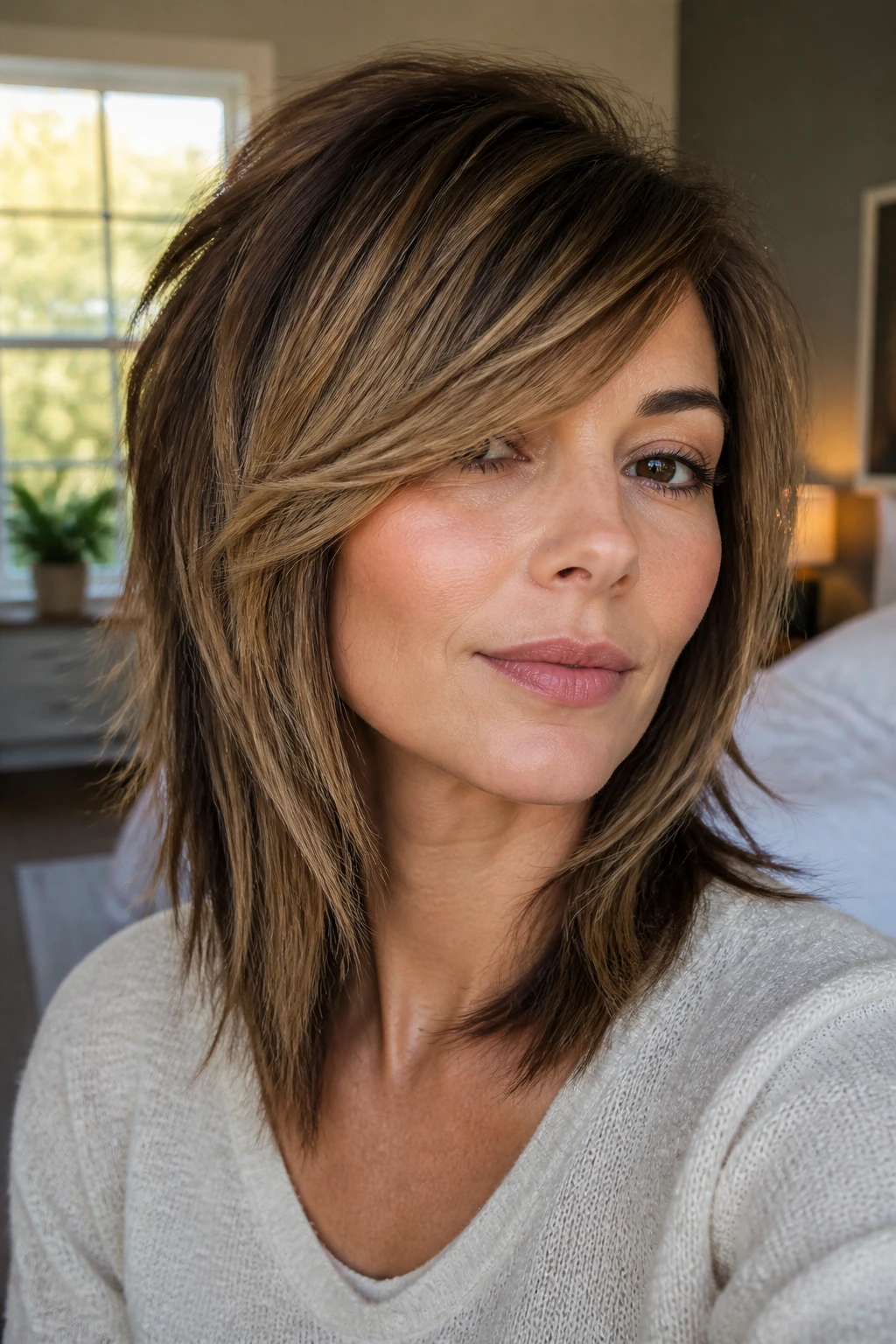
Is an angled shag good for very thin hair?
Yes, if the cut keeps some weight at the perimeter and doesn’t over-thin the ends. Thin hair usually looks better with a shape that builds lift in the crown and movement around the face, not with aggressive slicing everywhere.
Are curtain bangs better than blunt bangs for thin hair?
Most of the time, yes. Curtain bangs spread the hair across the forehead in a softer way, so the fringe doesn’t need as much density to look full. A blunt bang can work, but it usually needs more careful trimming and styling.
Should I ask for razor-cut layers?
Only if your hair is healthy enough to handle it and the stylist uses the razor sparingly. A razor can create nice softness, but on fragile ends it can also make the cut look frayed. Scissor-cut texture is often safer for very thin hair.
Can I wear one of these cuts if my hair is straight?
Absolutely. Straight hair often does well with sleeker angled shags, bottleneck bangs, and rounded layers. The trick is to create bend and lift at the roots so the cut doesn’t sit flat and shiny in a way that exposes every strand.
How often should I trim the bangs?
Usually every 3 to 5 weeks if the fringe is short, and every 8 to 12 weeks for the rest of the cut. Bangs show growth faster than layers do, so the front may need attention before the shape as a whole does.
What if my layers look stringy after the cut?
That usually means too much weight was removed from the ends, or the styling was too heavy. Ask for a small correction trim if needed, then use a lighter mousse at the root and a texture spray only on the mid-lengths and ends.
Can I side-part an angled shag with bangs?
Yes, and in some cases it works better than a center part. A side part can hide a sparse temple area, soften a strong hairline, and give the bangs a little sweep without making them look dense.
Will this haircut work if I have curly bangs?
It can, but the bangs should be cut longer than the finished length because curls spring up as they dry. Dry cutting or shaping on mostly dry hair usually gives a better result than cutting curly fringe wet and hoping for the best.
A Cut That Keeps the Movement Going
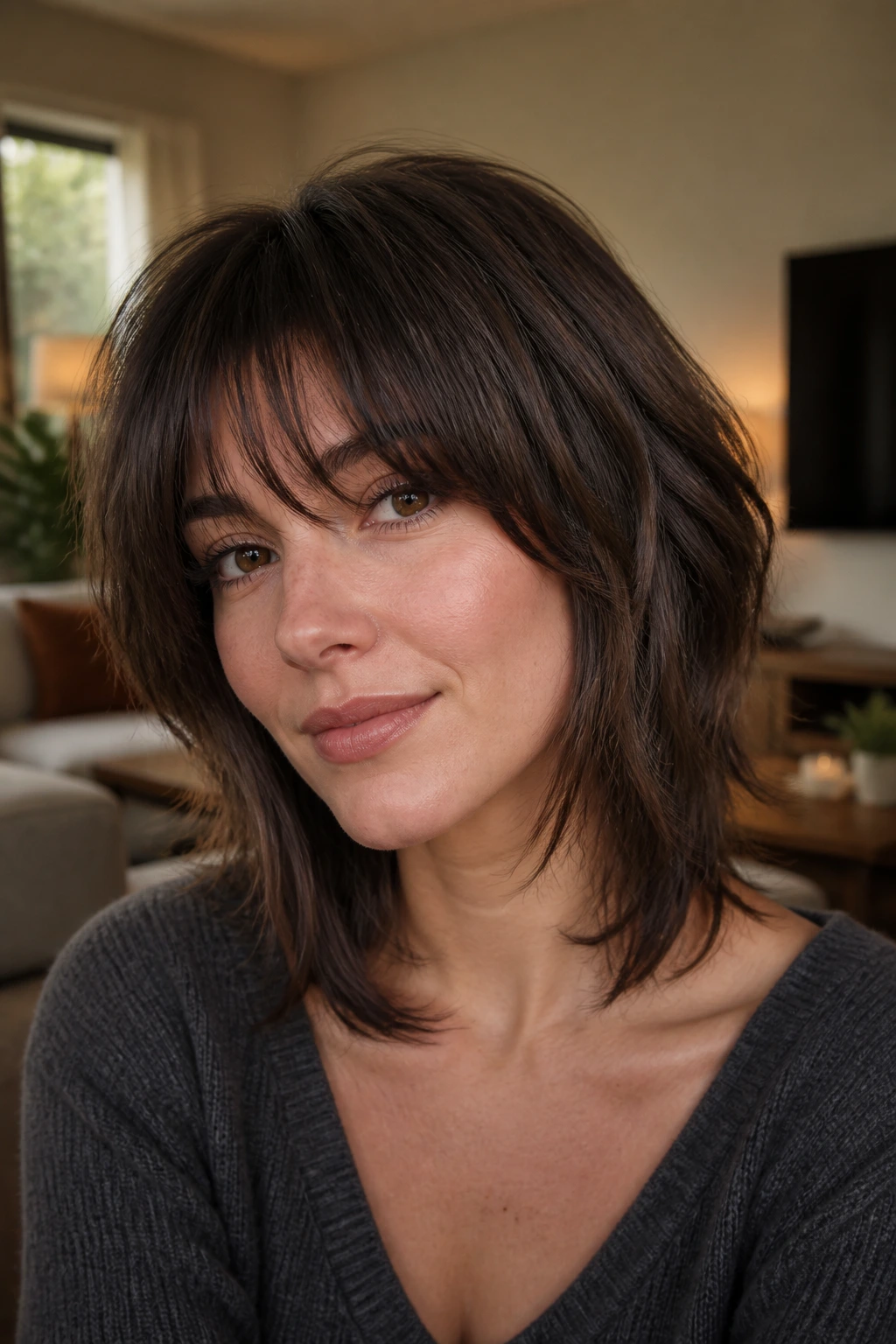
The best angled shag for thin hair is not the loudest one in the room. It is the one that gives the hair a backbone. A good bang shape, a clean perimeter, and just enough layering to keep the crown alive can do more than a drawer full of styling products ever will.
What I like about this whole family of cuts is how honest it is. It doesn’t pretend thin hair is thick. It works with the density that’s actually there, then uses angle, framing, and a little movement to make the hair look fuller than the raw numbers suggest.
If your current cut hangs limp by midday, start with the version that matches your texture and your patience level. The right angled shag should feel lighter around the face, not skinnier at the ends — and once you get that balance, the rest of the styling gets a lot easier.