



The wrong short cut on a round face does two annoying things: it spreads sideways at the cheeks or collapses into a limp cap by lunchtime. Short hairstyles for round faces with thin hair have to fight both problems at once, which is why a lot of standard bob advice falls apart the moment you look in the mirror.
Thin hair needs shape more than bulk. A little lift at the crown, a side part, or a front section that drops below the jaw can change the whole read of the cut. And if your hair is fine as well as sparse, weight matters even more; a heavy blunt line can look neat in the chair and flat by dinner.
That is the trick with these cuts: they do not try to hide the face. They use angles, movement, and a bit of controlled mess to pull the eye upward and keep the width from landing right across the cheeks. Some of the styles here are polished. Some are gloriously choppy. All of them are built to give thin hair more life without turning your head into a helmet.
Why These Cuts Earn Their Keep
-
Crown lift changes the whole silhouette: A little height on top pulls the eye upward, which makes a round face read a little longer without needing extra length everywhere.
-
Diagonal lines beat a straight line: Side parts, angled bobs, and long fringes break the circle of the face in a way a blunt, even edge does not.
-
Airy ends look fuller than heavy ends: Thin hair often looks thinner when every strand lands in one flat line; soft texture makes the ends appear denser.
-
The right length sits away from the widest point: Styles that stop at the cheekbone tend to widen the face, while cuts that graze the jaw or fall just below it feel cleaner.
-
Short hair can still move: A lot of people hear “short” and think “stiff.” The better versions here bend, tuck, or flip just enough to keep the cut from going boxy.
-
Low-maintenance does not have to mean boring: Several of these styles air-dry with personality, which matters when your hair refuses to hold a big styling routine.
1. Angled A-Line Bob That Skims the Jaw
The angled A-line bob is the one I reach for when someone wants structure without that hard, helmet-like bob line that can make a round face look wider. The back sits a little shorter, the front drifts longer, and that front edge should skim past the jaw rather than land right on it.
What makes it work on thin hair is the angle itself. A slight drop in the front creates length, while the shorter back gives the cut some internal lift so the whole shape does not collapse. Ask your stylist for a clean perimeter with light internal layering, not a stack of choppy pieces that will make the ends look wispy.
A side part helps this cut a lot. So does a quick bend with a flat iron on the front pieces — one gentle curve, not a curl. I like this style because it looks deliberate even when you barely style it, and that is a very useful thing on mornings when hair is being difficult.
2. Long Pixie With a Side-Swept Fringe
A long pixie can look softer than a bob if the fringe does the work. Keep the top around 3 to 4 inches, let the fringe sweep across one eye or just graze the brow, and taper the nape so the whole cut stays light.
This is one of the smartest short hairstyles for round faces with thin hair because it builds height where you want it and removes weight where you do not. The side-swept fringe creates a diagonal line over the face, and diagonal lines are your friend when cheeks are full. If you wear glasses, this cut can be excellent, because the frame and fringe don’t fight each other.
What to ask for
- Longer top layers that can be pushed up or over
- A soft, side-swept fringe rather than a blunt bang
- Tapered sides and nape so the cut hugs the head
Use a pea-sized dab of paste or cream wax, not a palmful. Thin hair gets greasy fast, and this cut only needs a little separation at the ends.
3. French Bob With Airy Bangs
Why does a French bob work when so many short cuts make a round face look wider? Because the good version is not a perfect bowl. It sits around chin length, the edges are soft, and the bangs are feather-light instead of packed dense across the forehead.
On thin hair, the secret is to keep the line clean but not severe. A blunt edge can work if the ends are softly beveled and the interior has enough movement to keep the shape from feeling heavy. If your hair has a tiny wave, even better. That slight bend keeps the cut from reading too neatly.
How to wear it
- Blow-dry the bangs side to side so they separate a little
- Keep the sides tucked or curved inward with a small round brush
- Leave the ends slightly undone rather than ironing them pin-straight
This cut has personality. It also has a catch: if the fringe gets too thick, it can shorten the face fast. Airy is the word you want to keep repeating to your stylist.
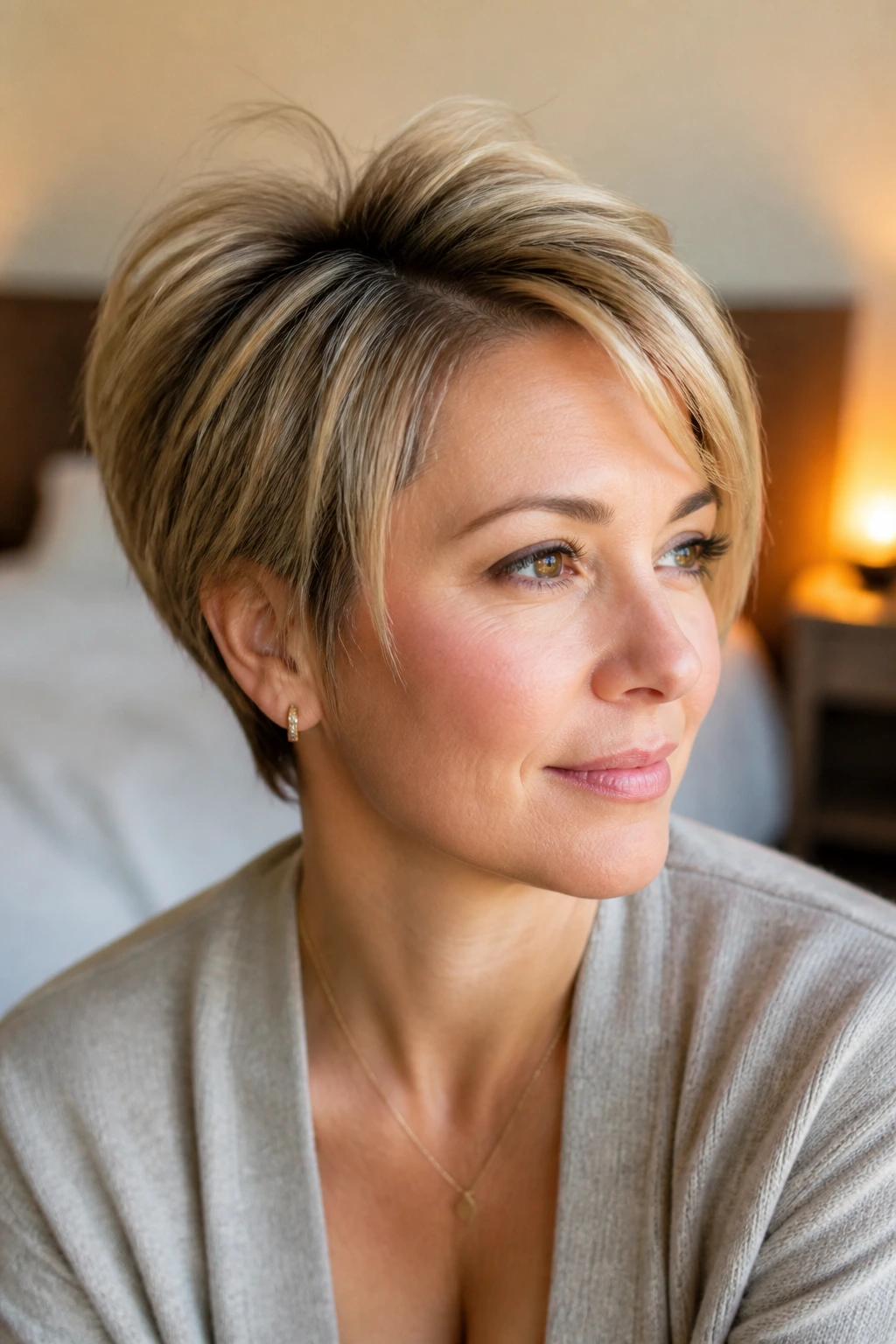
4. Bixie Cut With Crown Texture
The bixie is the hybrid that makes people say, “Wait, is that a bob or a pixie?” Usually the answer is yes. It carries more length than a pixie, more lightness than a bob, and that middle ground is exactly why it suits thin hair so well.
For a round face, the top needs texture and a little lift, while the sides should stay soft enough to avoid puffing out at the cheeks. Ask for piecey layers on top, a narrow nape, and just enough length near the temples to keep the face from feeling overexposed. Too much fullness around the ears is the fastest way to lose the shape.
This cut loves a messy finish. A little mousse at the roots, rough-dried hair, then a fingertip twist through the top is usually enough. It’s one of those cuts that can look expensive even when the styling took six minutes.
5. Shaggy Crop With Wispy Ends
The shaggy crop is not a haircut for someone who wants every strand lined up like a ruler. It is for the person who likes movement, a little edge, and the kind of finish that looks better once hair has lived in it for an hour.
On a round face, the shag works when the shortest layers stay higher on the head and the face-framing pieces start below the cheekbone. That keeps the bulk off the widest part of the face. Thin hair actually benefits from this kind of controlled mess because the wispy ends spread out and make the cut look fuller than a solid, blunt block.
A center-ish part can work here if the fringe is long enough to angle outward. If your hair is very fine, do not let the layers get too short around the crown. The shag should feel feathered, not see-through.
6. Asymmetrical Bob With a Deep Side Part
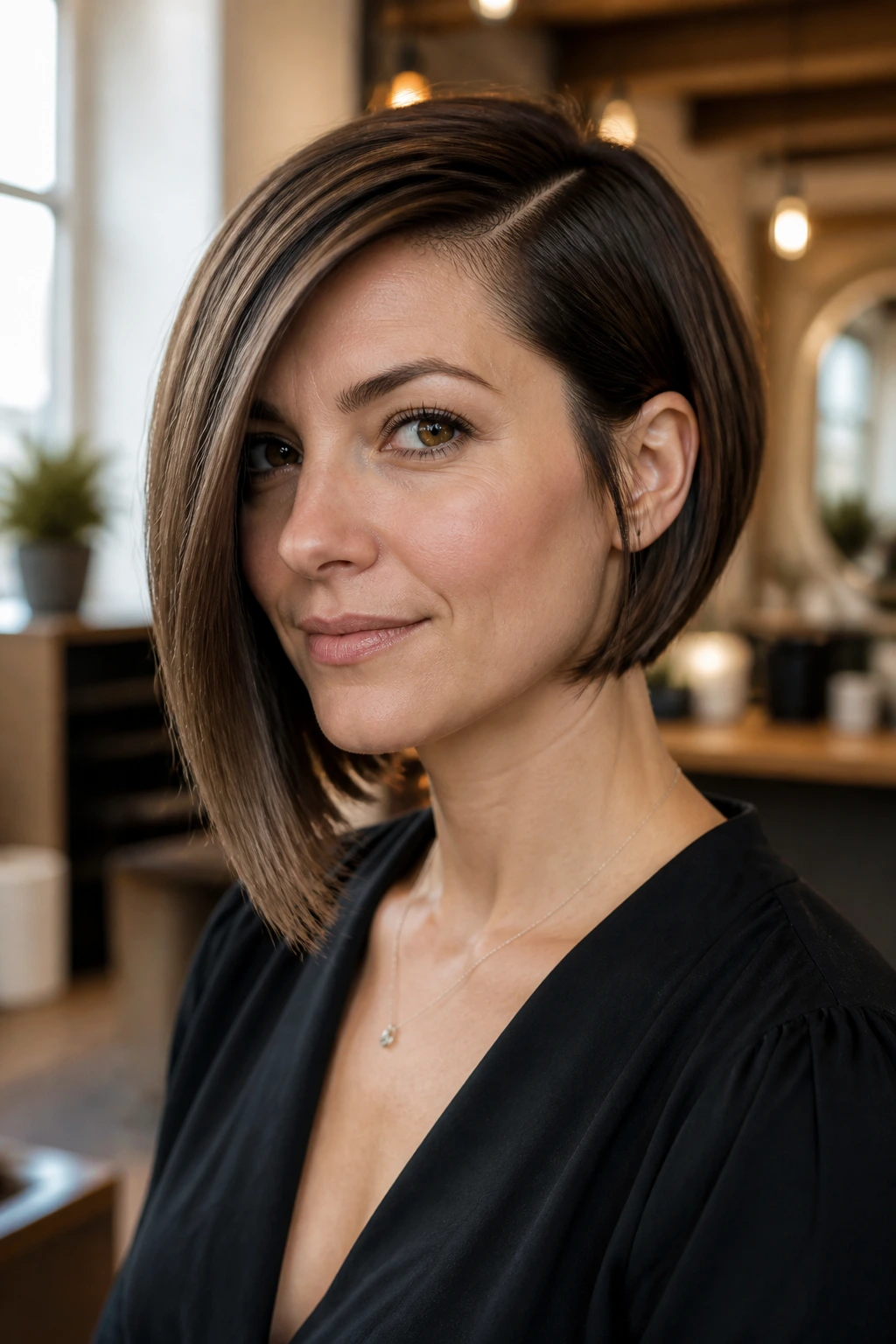
A little imbalance goes a long way. That is the whole point of an asymmetrical bob.
When one side is a bit longer — even half an inch can matter — the face stops reading as a perfect circle. Add a deep side part, and the lift at the top creates more vertical line, which is exactly what a round face benefits from. This cut also makes thin hair look more intentional because the asymmetry creates movement even when the hair is smooth.
Best details to request
- One side slightly longer than the other, not wildly uneven
- A side part placed above the arch of the eyebrow
- Internal weight removal so the cut does not balloon at the cheeks
It’s a sharper look than a soft bob, and that’s the appeal. If you like neat clothes, simple earrings, or a strong lip, this cut sits nicely with that kind of styling. If you want softness, keep the ends beveled and avoid a super-stiff blowout.
7. Tapered Pixie That Lifts at the Crown
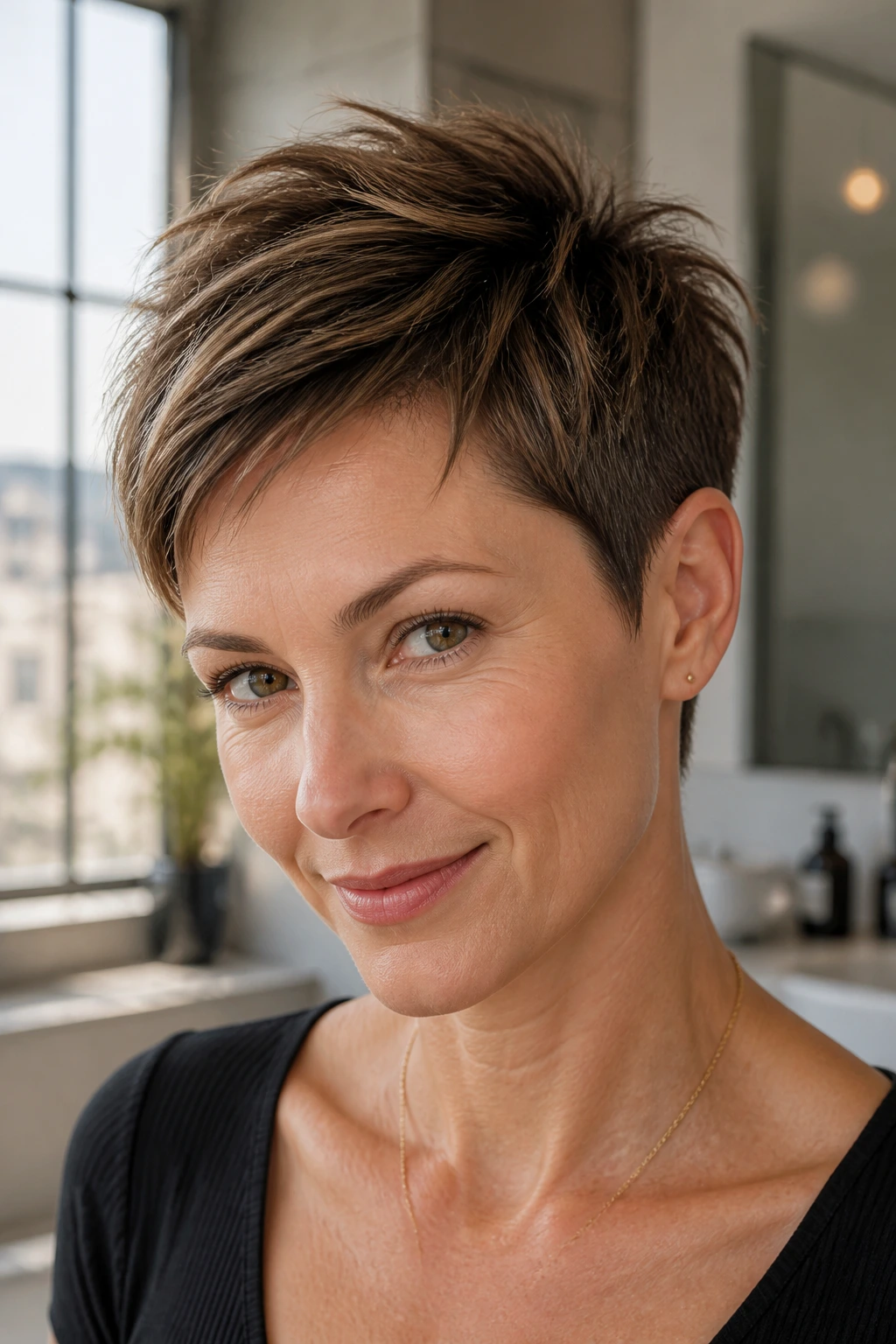
This is the pixie for people who are tired of hair sitting flat on their head. The sides are tapered close, the back hugs the nape, and the crown keeps enough length to stand up with a little help from a blow-dryer or root-lift spray.
The height matters. Not a huge, 1980s helmet of lift — just enough lift to pull the eye upward and stretch the face a little. On thin hair, the taper makes the head shape look cleaner, while the crown layers give the illusion of density where the scalp usually shows first.
How to style it
- Mist the roots with a light volumizing spray.
- Blow-dry the crown in the opposite direction of your part.
- Finish with a small amount of matte paste, pinching the top into soft spikes or pieces.
If your hair whips around at the crown, this cut can be a blessing or a pain. A good stylist will cut around the cowlick instead of fighting it. That detail matters more than people think.
8. Jaw-Length Wavy Bob With Soft Layers
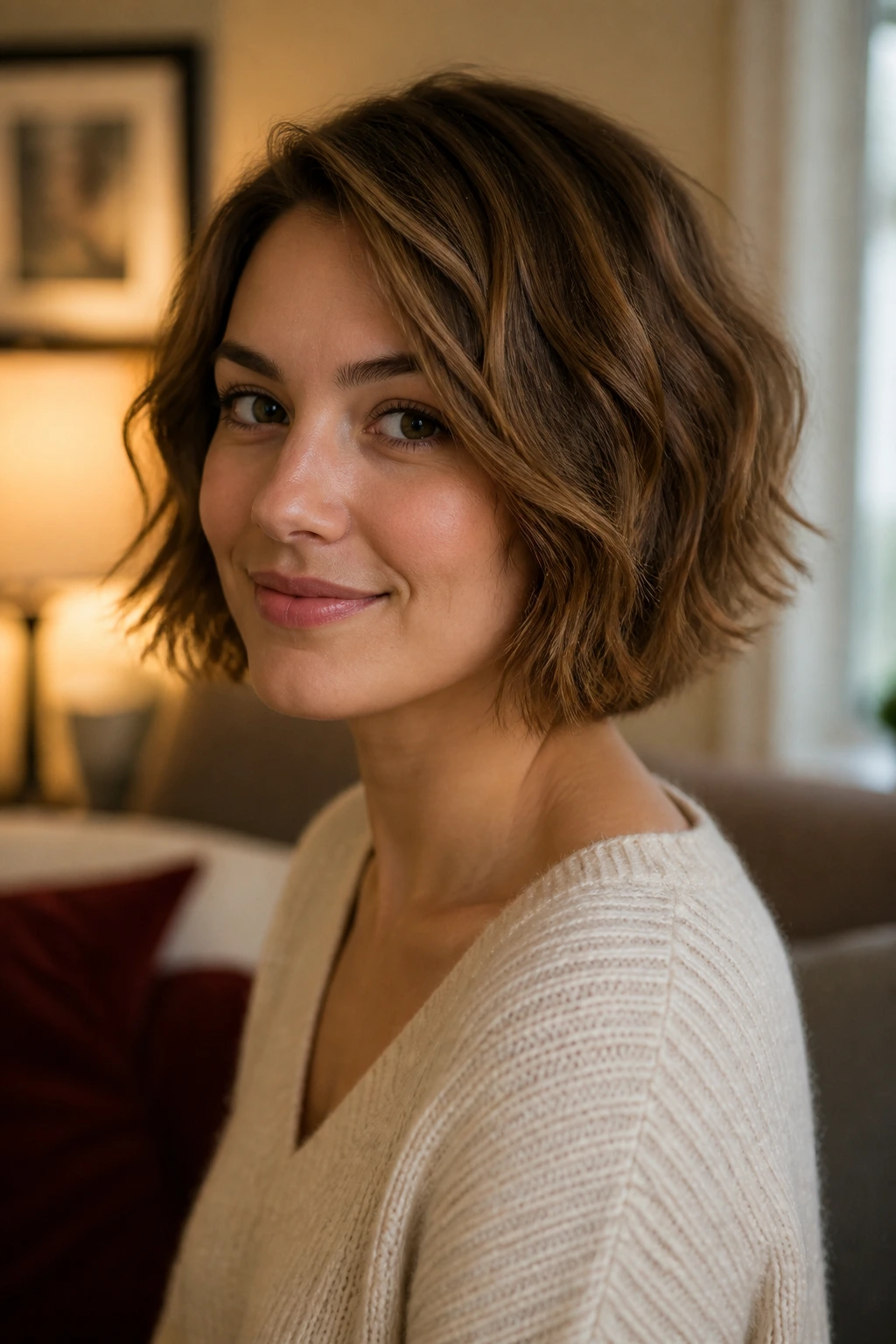
A jaw-length bob can be risky on a round face, but the wavy version changes the math. The wave breaks up the circle, the soft layers stop the ends from sitting like a brick line, and the jaw-length shape gives the face a little frame without hugging the cheeks too tightly.
Thin hair likes this cut if the wave is built in lightly rather than hammered in with a lot of product. A 1-inch curling iron or flat iron bend is enough. Alternate the direction of the wave as you go, then leave the last half-inch of the ends out so the bob does not curl into itself.
I’d avoid making this too rounded. The trick is softness, not puff. The perimeter should still have some line so it looks tidy, but the interior movement is what keeps it from feeling severe.
9. Feathered Crop That Moves Instead of Puffing
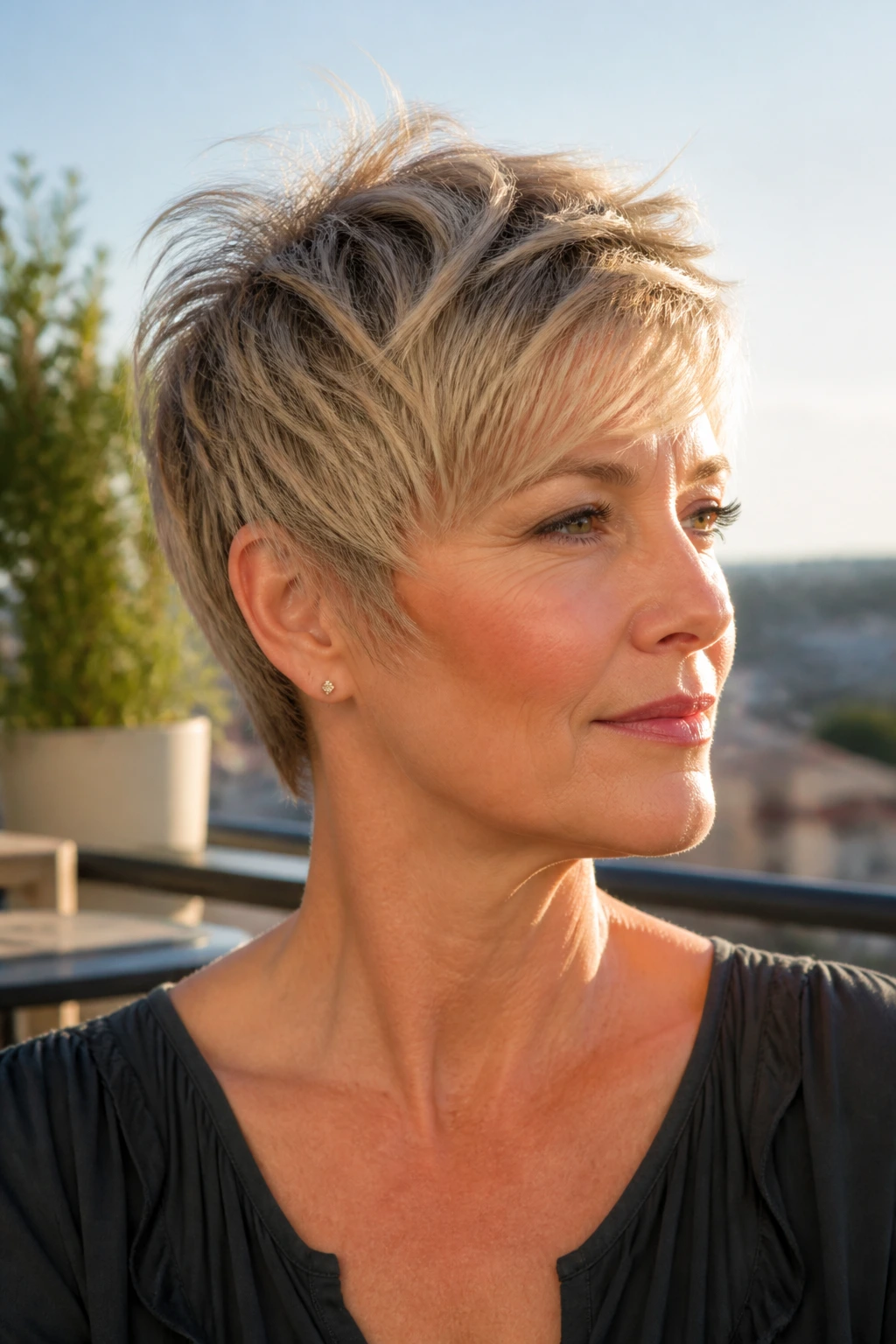
A feathered crop is one of those cuts that can look old-fashioned in the wrong hands and sharply modern in the right ones. The difference is in the feathering: the pieces should be carved to move away from the face and nape, not fan out like a puffy triangle.
On thin hair, feathering can be a gift because it spreads the hair visually without leaving the bottom looking stringy. On a round face, the soft pieces around the temples and cheekbones create vertical motion, which helps the face feel less compact. This is especially nice if your hair has a little natural bend.
Skip heavy creams. Use a lightweight mousse and a vent brush or paddle brush while drying. The goal is air and separation, not slick shine. If you like a little polish, finish with a mist of flexible hairspray, then scrunch the ends once with your hands. That tiny bit of break-up matters.
10. Side-Parted Chin-Length Bob With Invisible Layers

A side-parted chin-length bob sounds simple, almost plain, and that is why people underestimate it. Done well, it becomes one of the most useful short hairstyles for round faces with thin hair because the internal layers do the work while the outside stays smooth and easy to wear.
The chin length creates a frame that sits just under the widest part of the face. The side part shifts the weight off-center. Invisible layers remove bulk inside the cut so the ends look fuller than they would in a one-length bob, which can sometimes go flat and form a little shelf.
This cut is good for people who like neat hair but do not want a severe edge. It can be dried straight, tucked behind one ear, or given a tiny bend at the front. If you wear it too rounded under the chin, though, it will read softer and wider than you probably want.
11. Choppy Crop With a Light Fringe
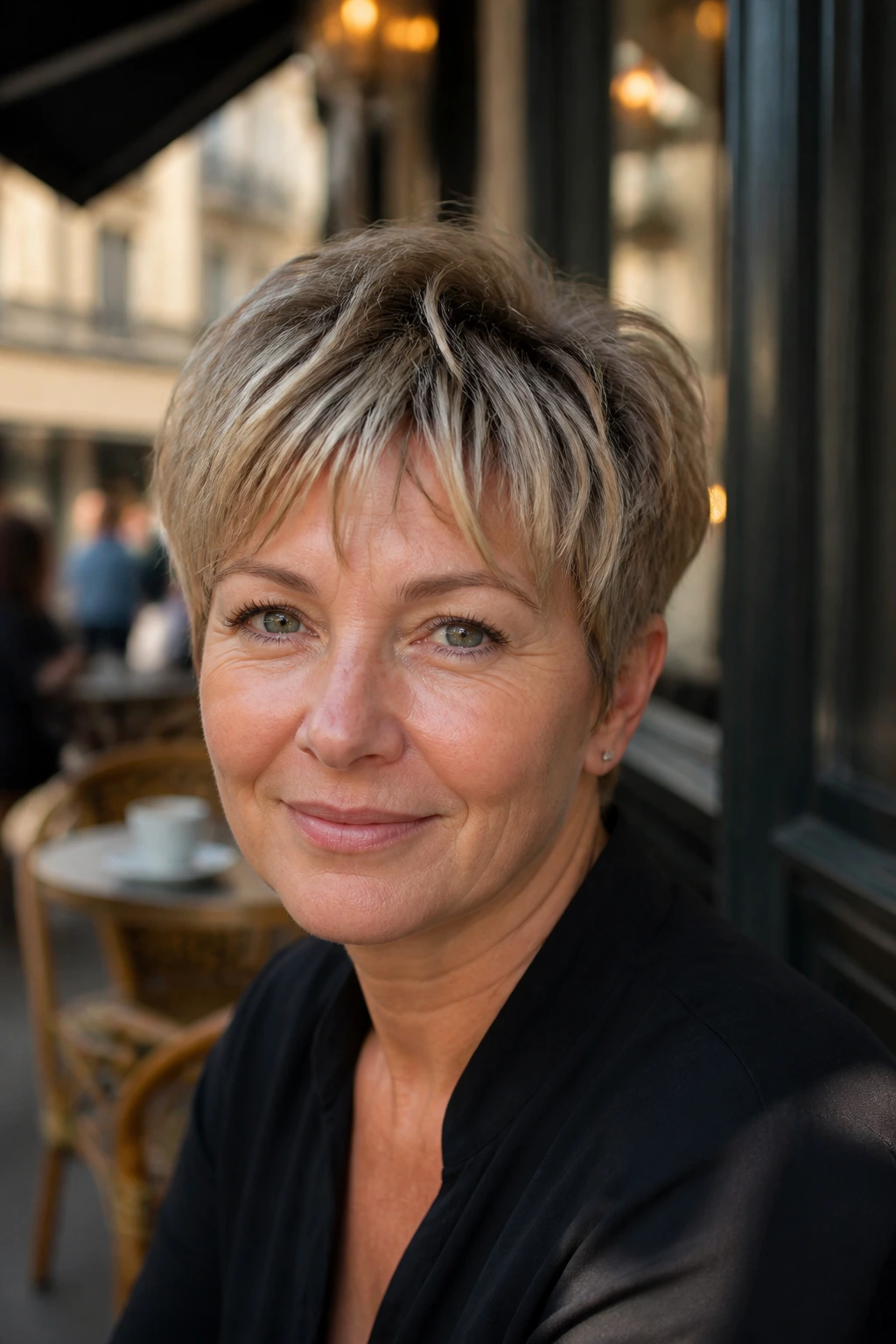
A choppy crop is the haircut version of “I want style, but I don’t want to spend 40 minutes on it.” The texture is the point. The fringe stays light, broken, and slightly irregular so it doesn’t become a heavy block across the forehead.
For a round face, this cut needs balance: shorter pieces on top to build lift, but enough length through the front to keep the face from feeling boxed in. Thin hair can look fuller here because the piecey ends create little shadows and separation. That makes the cut read denser than a smooth, flat crop.
I’d style this with a matte paste or dry texture spray. Finger-comb it, don’t brush it into obedience. If the fringe starts drifting too thick, it’s time for a tiny trim around the eyes and temples. That tiny bit of maintenance keeps the whole thing from sliding into “grown-out in a bad way.”
12. Undercut Pixie With Extra Top Length
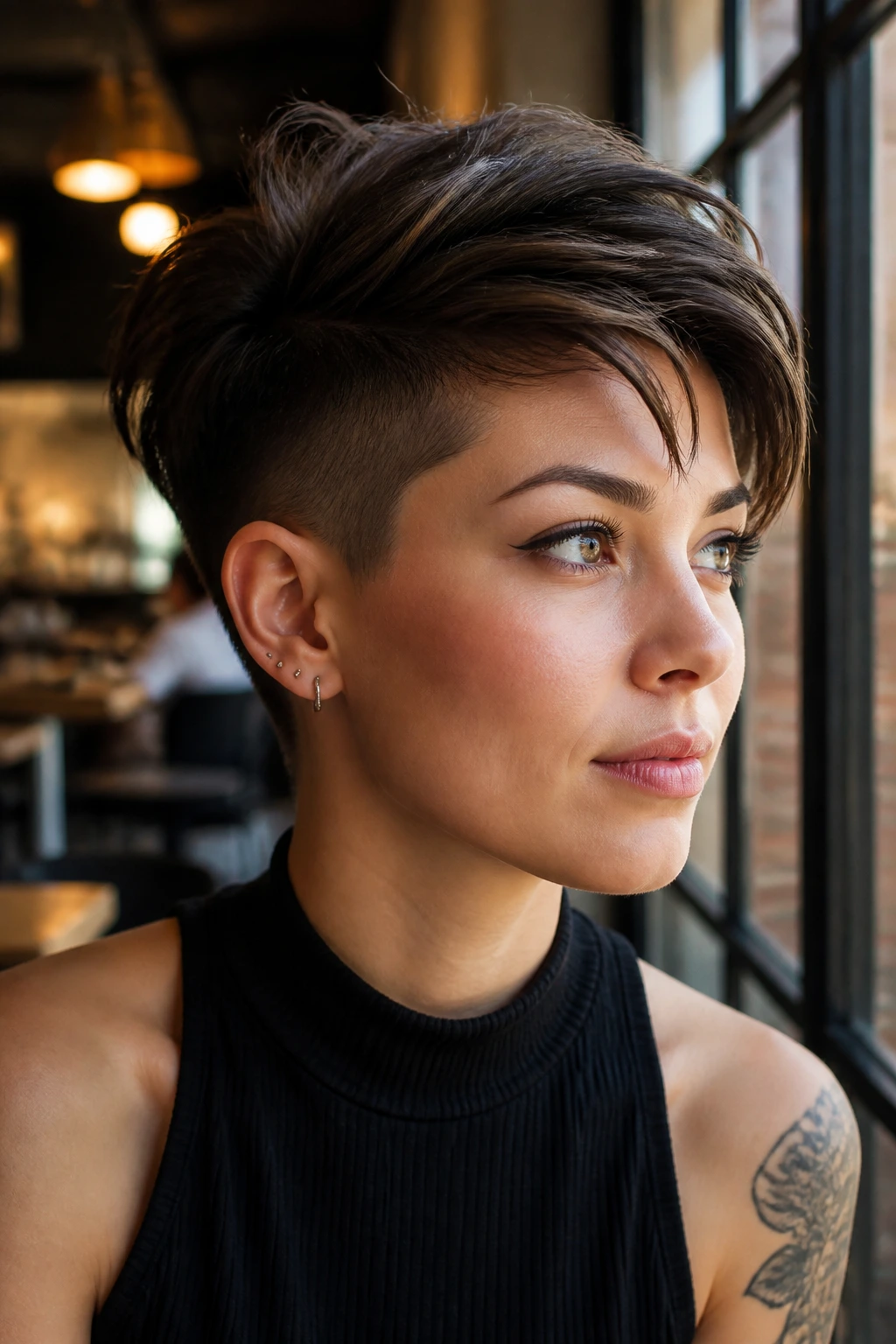
The undercut pixie is for someone who wants the top of the haircut to do the talking. The sides and nape are clipped or cut very close, while the top stays long enough to sweep, spike, or fall forward in pieces.
Why it works on thin hair is simple: removing bulk underneath makes the top feel fuller. That gives you a stronger silhouette without asking the hair to be something it isn’t. On a round face, the extra height on top and the narrowness around the ears and neck create a long, clean line.
This cut has an edge to it, but it is not automatically harsh. Keep the top soft and slightly messy, and it reads modern instead of severe. If you want a more subtle version, ask for a hidden undercut only at the nape. That gives you the lift without making the sides look too shaved.
13. Piecey Short Shag With Curtain Bangs
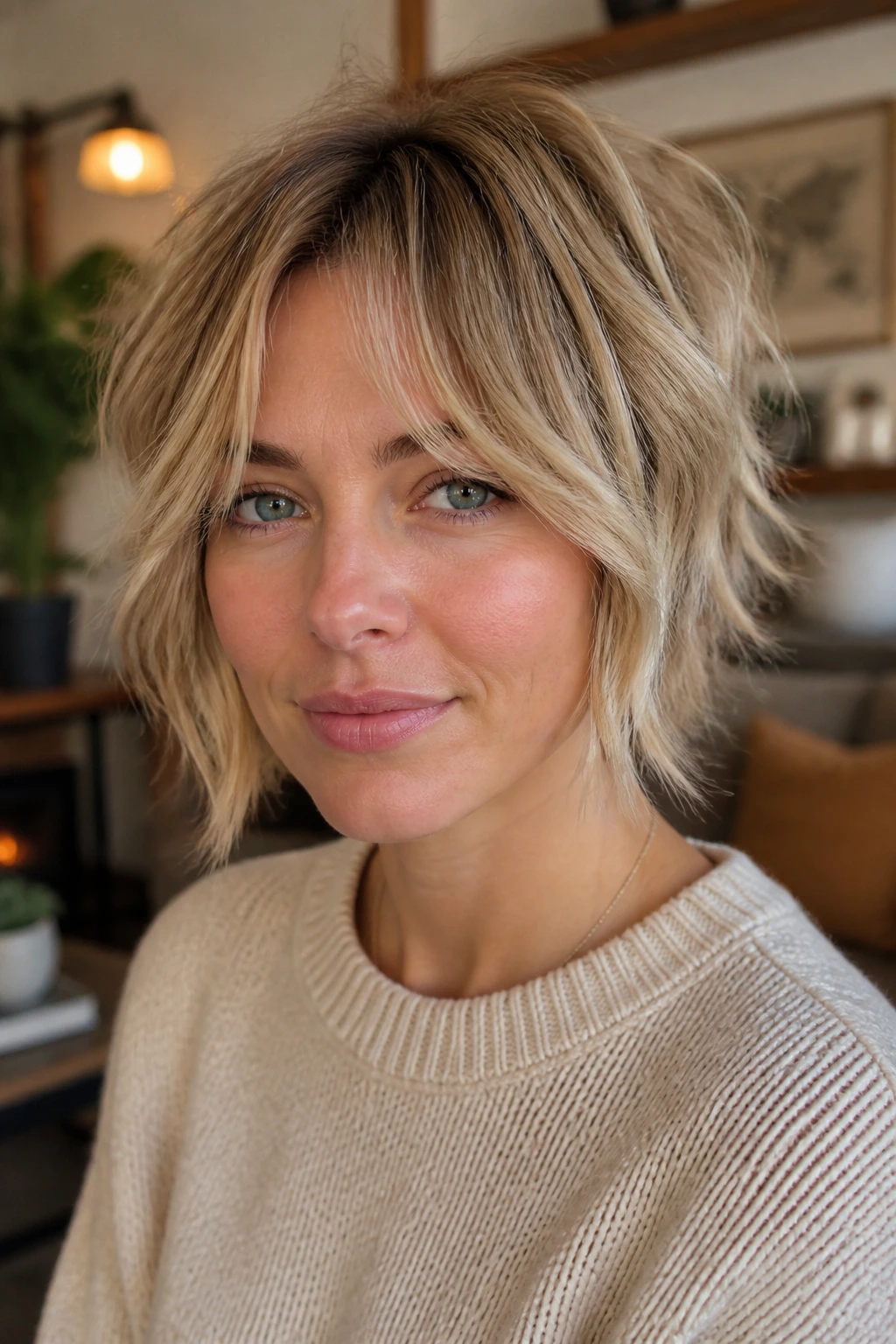
Curtain bangs are one of the easiest ways to make a round face feel a little longer without going all the way into fringe territory. They open from the center and sweep out toward the temples, which creates a vertical line down the middle of the face and softens the cheek area at the same time.
On a short shag, the curtain bangs pair nicely with layered sides and a textured crown. Thin hair gets a boost from the layers, but the shape still needs restraint. If the pieces around the cheeks get too short, the face can look wider instead of narrower. So the front lengths should angle down, not stop mid-cheek like a blunt curtain.
This style is happiest with a little bend — wave it with a round brush, twist it with your fingers, or give it a loose pass with a small iron. Too much uniform curl turns it fluffy. That’s not the goal.
14. Soft Wedge Bob With a Tucked Nape
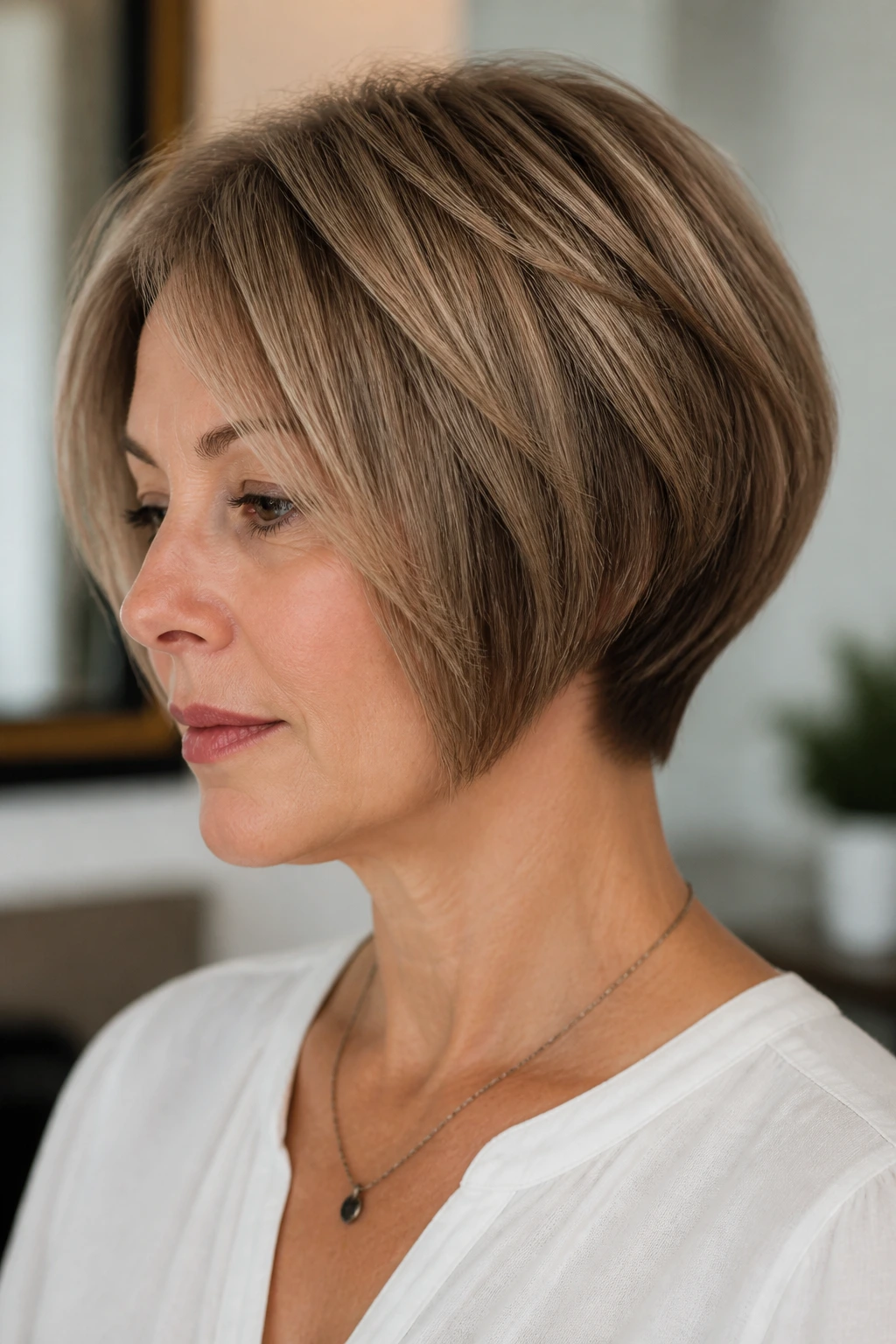
A wedge bob can go very wrong on a round face if the back is too high and the sides puff out. But a soft version, with a tucked nape and a longer front, can be a strong choice for thin hair because it creates shape where there usually isn’t enough of it.
The back supports the volume. The front keeps the face from widening. That’s the whole deal. When the graduation is subtle, the cut feels neat and intentional; when it’s too steep, it starts to look dated fast. I prefer a wedge that leans modern — smooth underneath, not stacked to the point of drama.
This cut looks best when the ends are polished but not flipped under like a pageant bob. A flat brush or a medium round brush is enough. If your hair is very fine, this one can hold shape surprisingly well because the shorter back gives the cut something to stand on.
15. Grown-Out Pixie With Long Sideburns
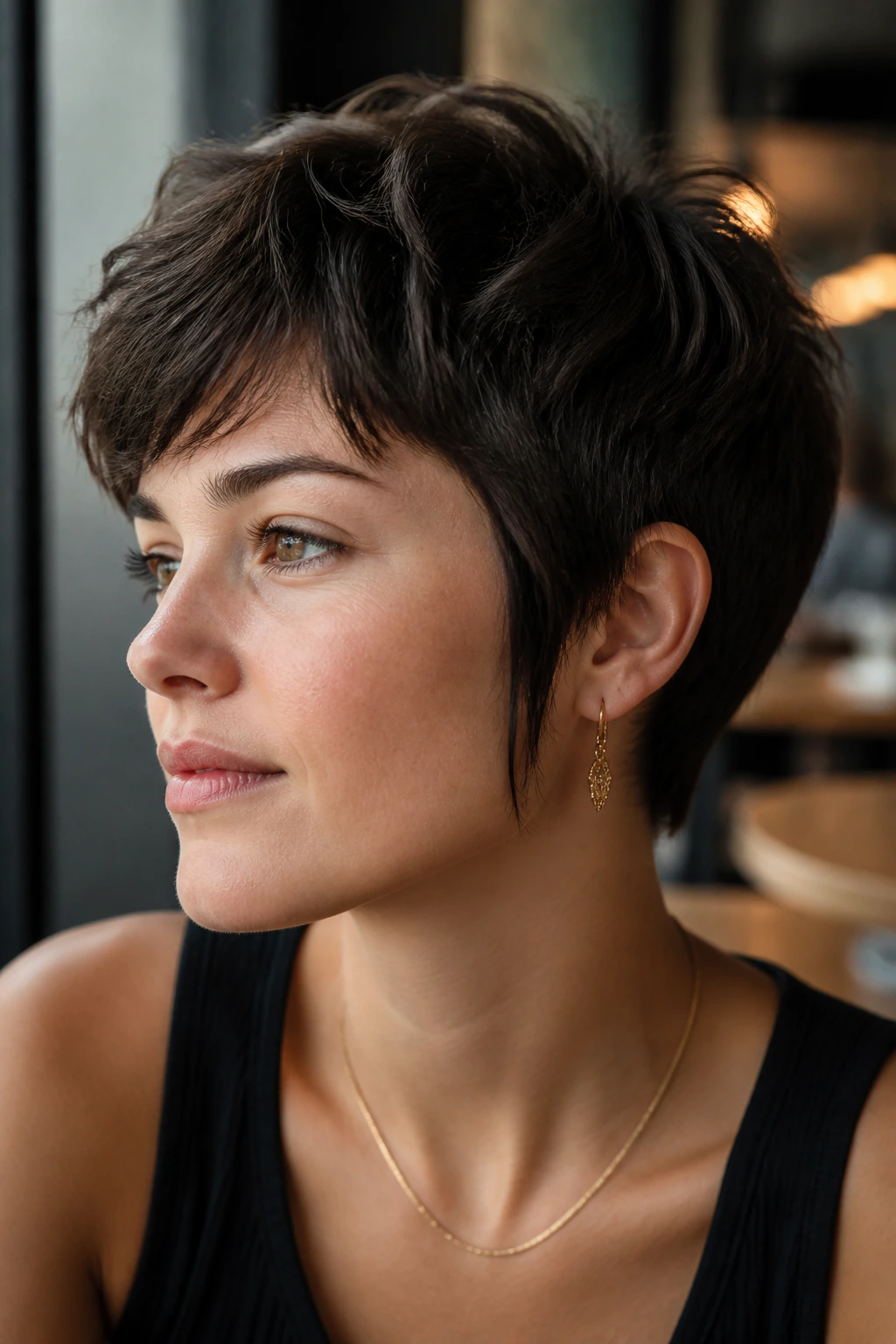
Not every flattering short cut has to look crisp and newly cut. A grown-out pixie with longer sideburns and soft top length can be one of the easiest shapes to live with, especially if you want something that slides between pixie and bob as it grows.
The long sideburns matter more than people think. They create vertical lines near the face, which helps a round shape feel less wide at the cheeks. The top can stay a little messy, the nape can be neat, and the whole cut still reads intentional.
Ask your stylist for
- A soft taper at the neckline
- Longer sideburns that brush the jawline
- Enough top length to tuck, sweep, or lift
This is also a good cut if you don’t want to rush back to the salon every three weeks. It grows out with a little grace, which is rarer than it should be. The shape becomes less sharp, not less useful.
16. Layered Mini Bob With a Rounded Back
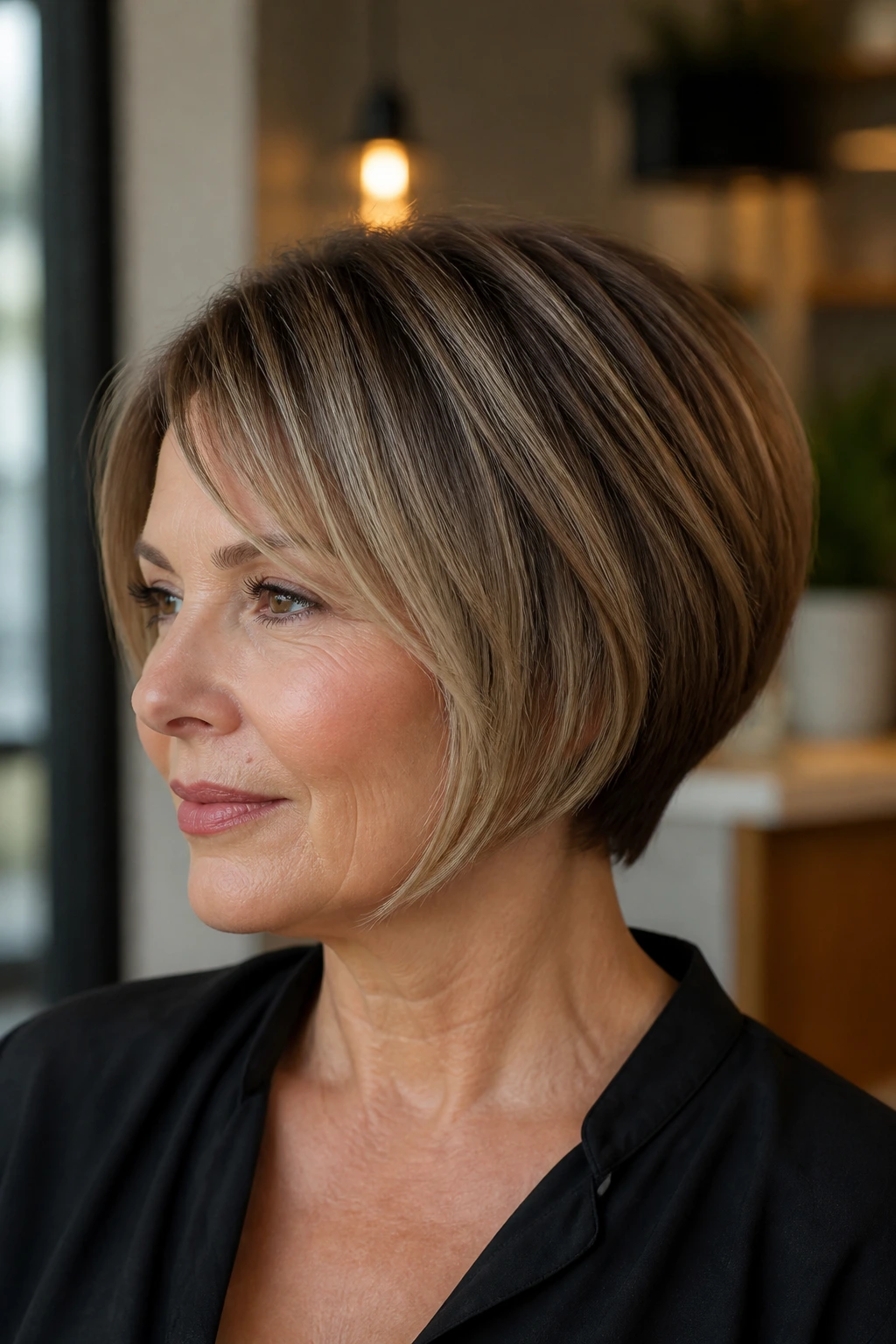
A mini bob can be tricky territory for a round face, and I’m going to be blunt about that. If it turns into a puffed-up mushroom, walk away from it. If the layers are placed with restraint and the front stays longer than the back, though, it can work beautifully on thin hair.
The reason is body. Thin hair often needs some lift at the back to avoid hanging flat against the neck, and a mini bob gives you that without adding a ton of length. The front pieces should still skim below the cheekbone or at least angle past it, because that keeps the face from feeling boxed in.
This cut is especially good if you like a clean neckline and a little polish. It feels neat, but not stiff. The danger is over-rounding the silhouette. Ask for internal layering and a soft edge rather than a bulbous curve.
17. Short Cut With a Face-Framing Bend
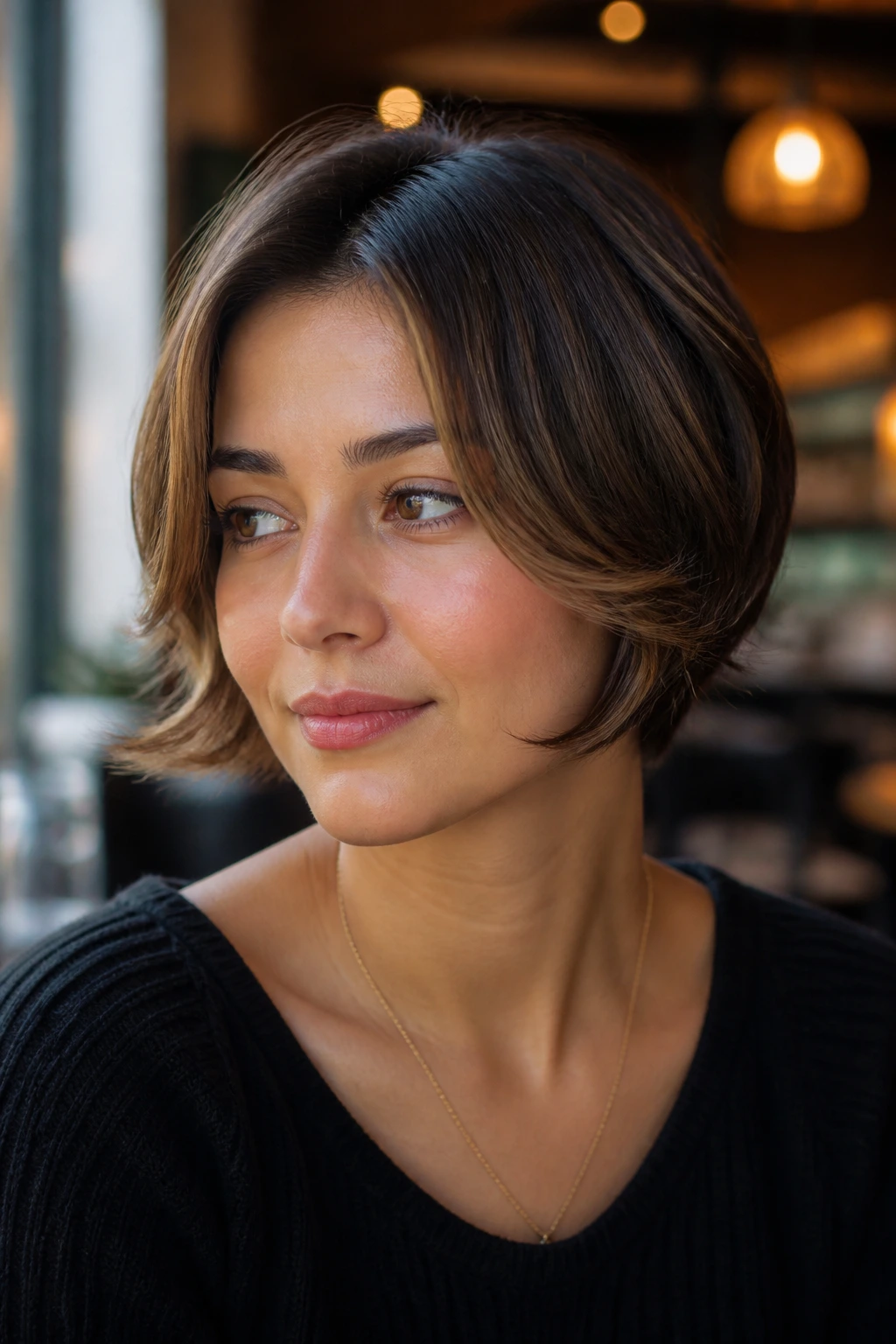
Some cuts are really about the styling trick more than the haircut itself, and this is one of them. A short, smooth bob or crop can flatter a round face when the front pieces are bent away from the cheeks instead of tucked inward.
That small change opens the face. It also helps thin hair look more intentional because the bend creates a visible shape at the front, which gives the illusion of more movement. The best way to do it is with a flat iron or small round brush — a slight outward flick near the jaw, not a big flip.
This approach works best when the cut has enough length around the chin or neck to catch that bend. Too short, and it just looks accidental. Too much curve inward, and you’re back to widening the face. Tiny angle. Clean line. That’s the whole trick.
18. Textured Crop With Micro-Bangs
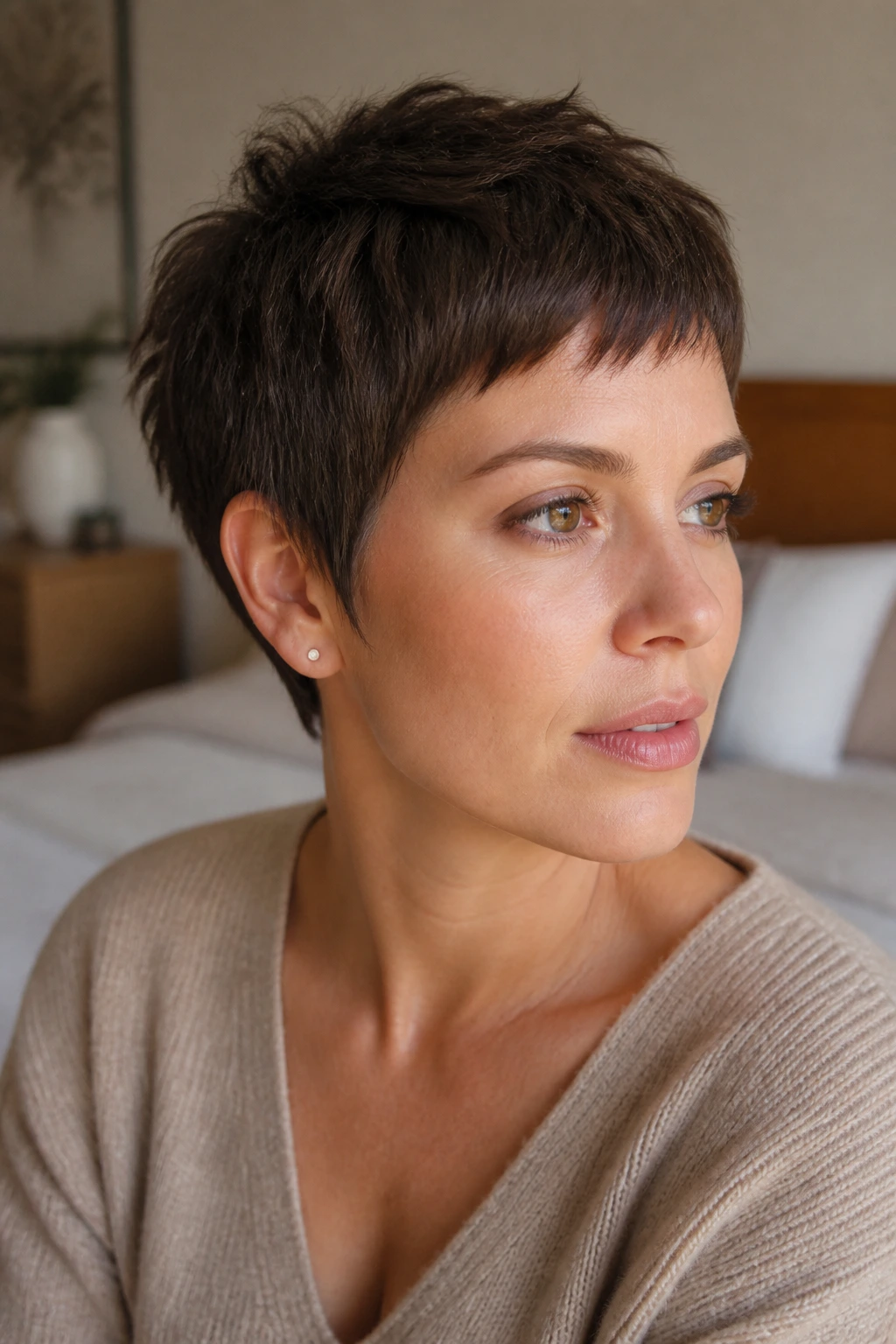
Micro-bangs are not for everyone. They can be a bad idea on a round face if the fringe is thick and heavy, because that much shortness across the forehead can make the face feel broader. But paired with a textured crop, a narrow side, and some height on top, they can look sharp and a little unexpected.
Thin hair helps here because the bangs don’t need to be dense. They can be soft, broken, and lightly separated. That keeps the forehead visible, which is part of why the style works. You want the bangs to frame the eyes, not build a wall.
This is one of the more opinionated cuts in the bunch. I like it when the rest of the head stays lean and the top has lift. I do not like it when the fringe gets too blunt or too full. If you have a strong cowlick at the front, think twice before going too short.
19. Stack-Back Bob With a Thin-Hair Boost
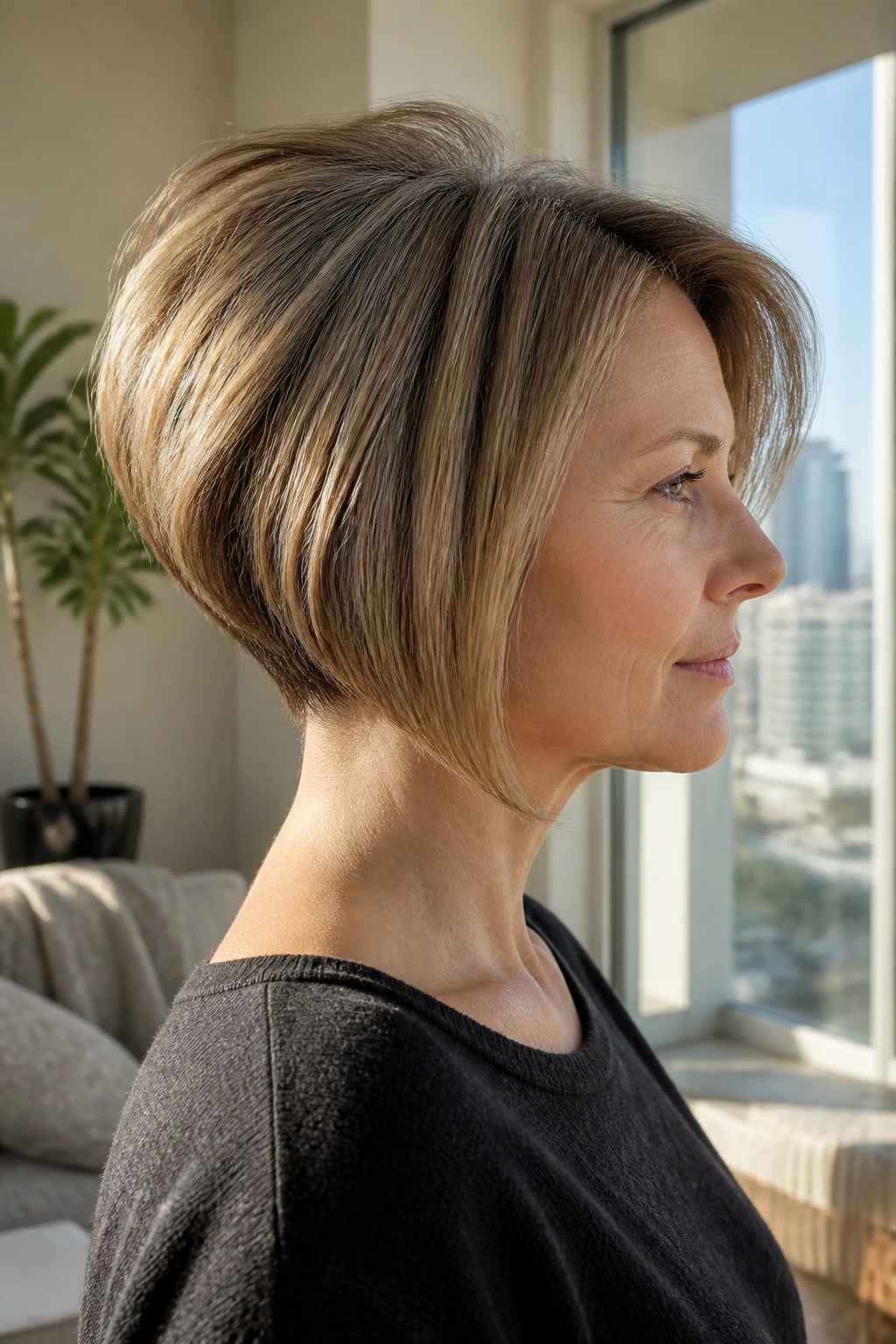
The stack-back bob has a reputation for being a little old-school, but the shape still earns its keep when it is cut with a lighter hand. The back is stacked enough to create lift, the front stays longer, and the overall outline narrows the sides while building body where thin hair usually falls flat.
A round face needs the stack to stay disciplined. Too much width at the back or too much curve around the cheeks will make the whole cut feel rounder than you want. The stylist should carve the back into a gentle slope, not a balloon.
This cut works especially well if your hair dries with almost no shape on its own. The architecture is built in. A round brush at the crown, a little root spray, and a soft finish are usually enough. If you want to see the difference immediately, compare it to a one-length bob. The stack-back version gives you more lift with less effort.
20. Modern Mullet Lite With Soft Edges
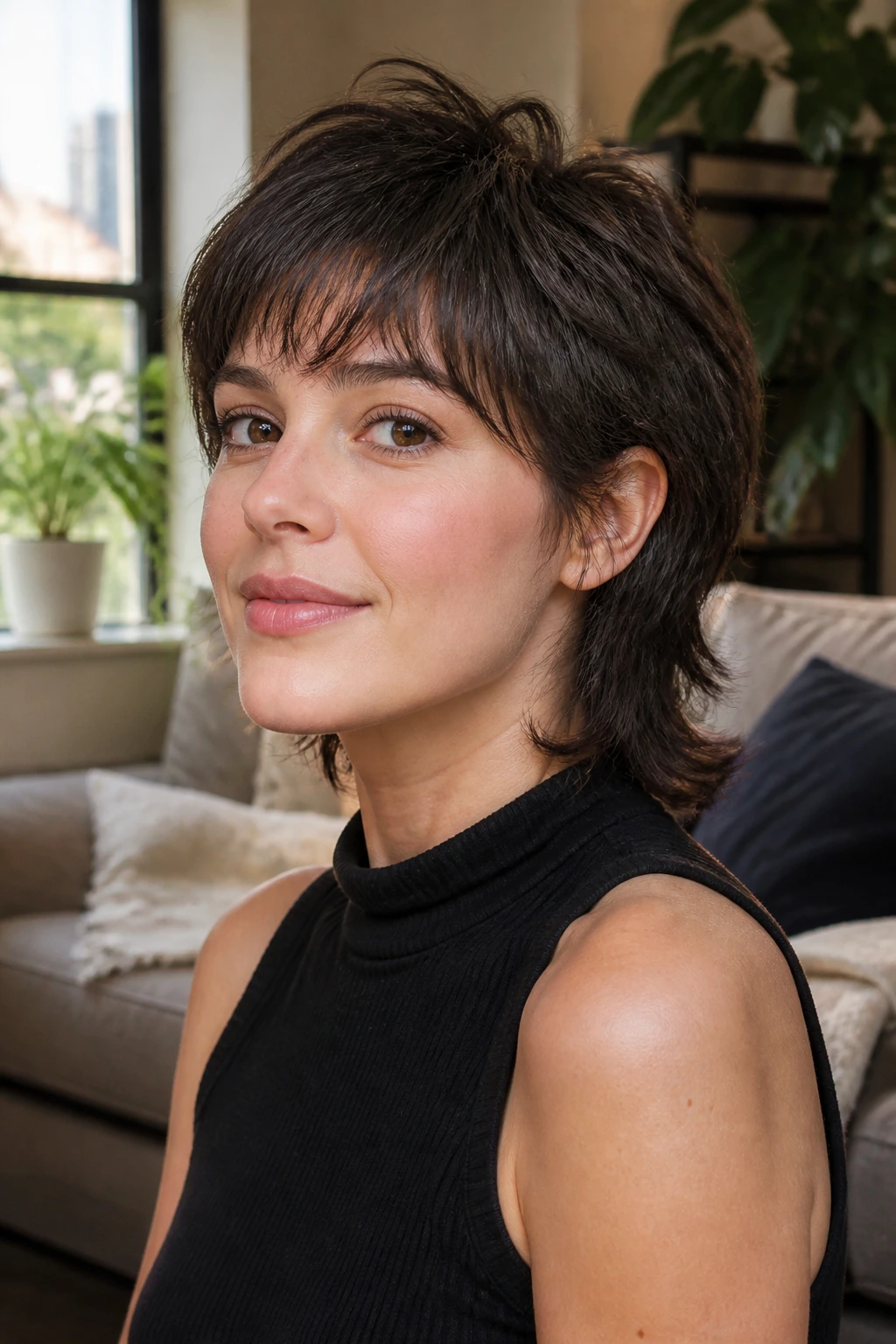
A modern mullet-lite is not a joke haircut. Not the soft version, anyway. It keeps the top and crown a little shorter, leaves more length in the back, and uses gentle face-framing layers to keep the front from looking heavy.
For round faces, that front framing is the reason it works. The cut builds vertical line through the crown and nape, while the softer side pieces skim past the cheeks instead of wrapping around them. On thin hair, the shape can look fuller because the layers are not trying to create one big block of hair. They move separately, which creates the illusion of density.
I like this cut when someone wants personality but not fuss. It grows out in an interesting way, too, which is more than I can say for a lot of trendy crops. Keep the edges soft, or it turns into a mullet with commitment issues. Keep them soft, and it reads modern, not costume-y.
Why Short Haircuts Can Flatter Round Faces and Thin Hair
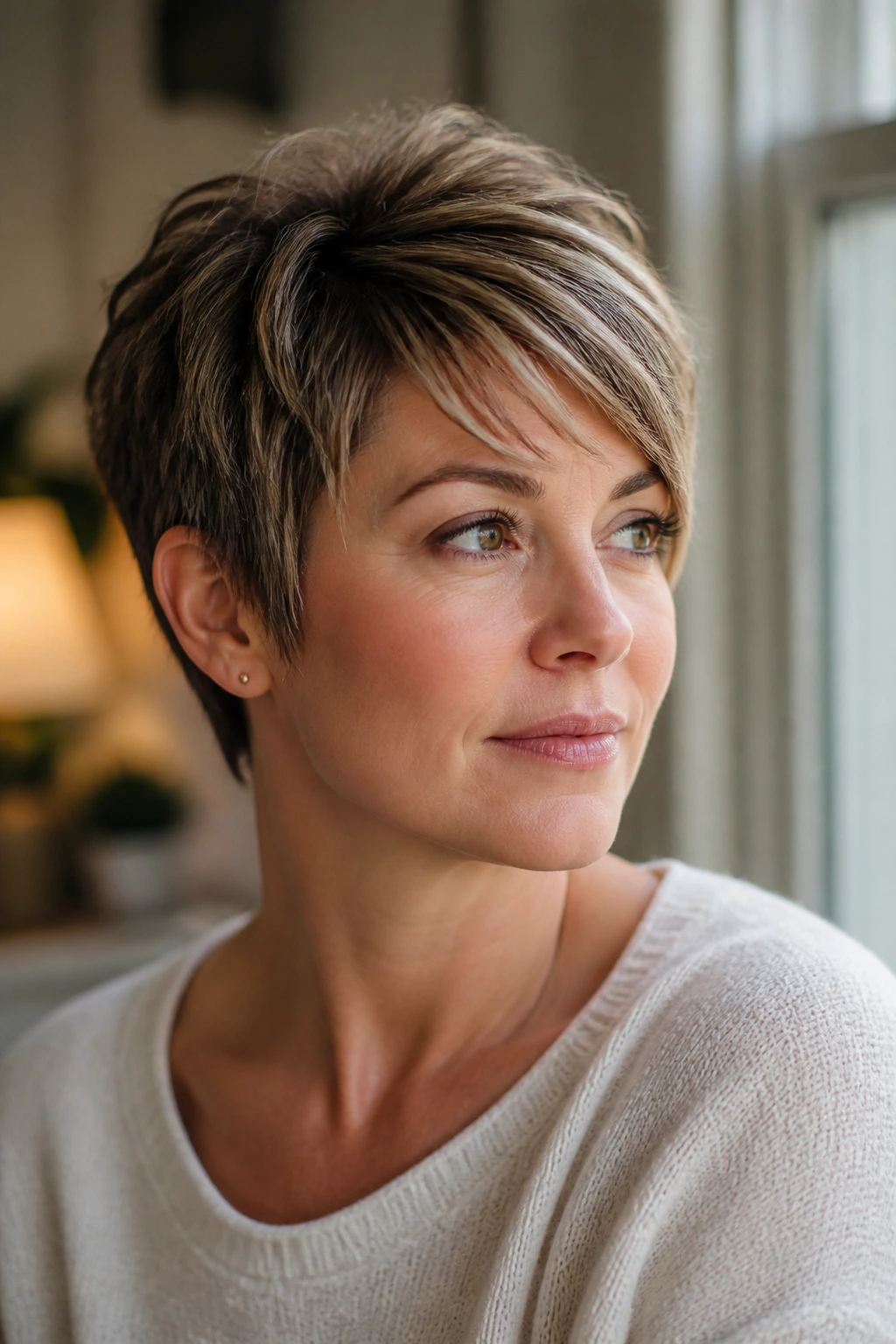
A round face usually has similar width and length, with the fullest part sitting somewhere around the cheeks. That does not mean short hair is off-limits. It means the cut has to do a little shape work.
The easiest way to change the face’s outline is with vertical movement. Crown height, side parts, diagonal fringe, and length that falls just below the jaw all help stretch the eye line. What you want to avoid is a wide, even shape that lands right on the cheeks and then puffs outward. That’s the haircut equivalent of pressing the same button twice.
Thin hair adds another wrinkle. It tends to show every choice: too much layering and the ends get see-through, too little layering and the cut goes flat. The sweet spot is often a haircut with enough structure to hold itself, but enough soft texture to keep the perimeter from looking sparse.
If I had to reduce it to one sentence, I’d say this: shape first, fullness second. Chasing bulk alone usually backfires. A good short cut on a round face with thin hair makes the hair look a little more awake.
The Tools That Make Thin Hair Look Fuller
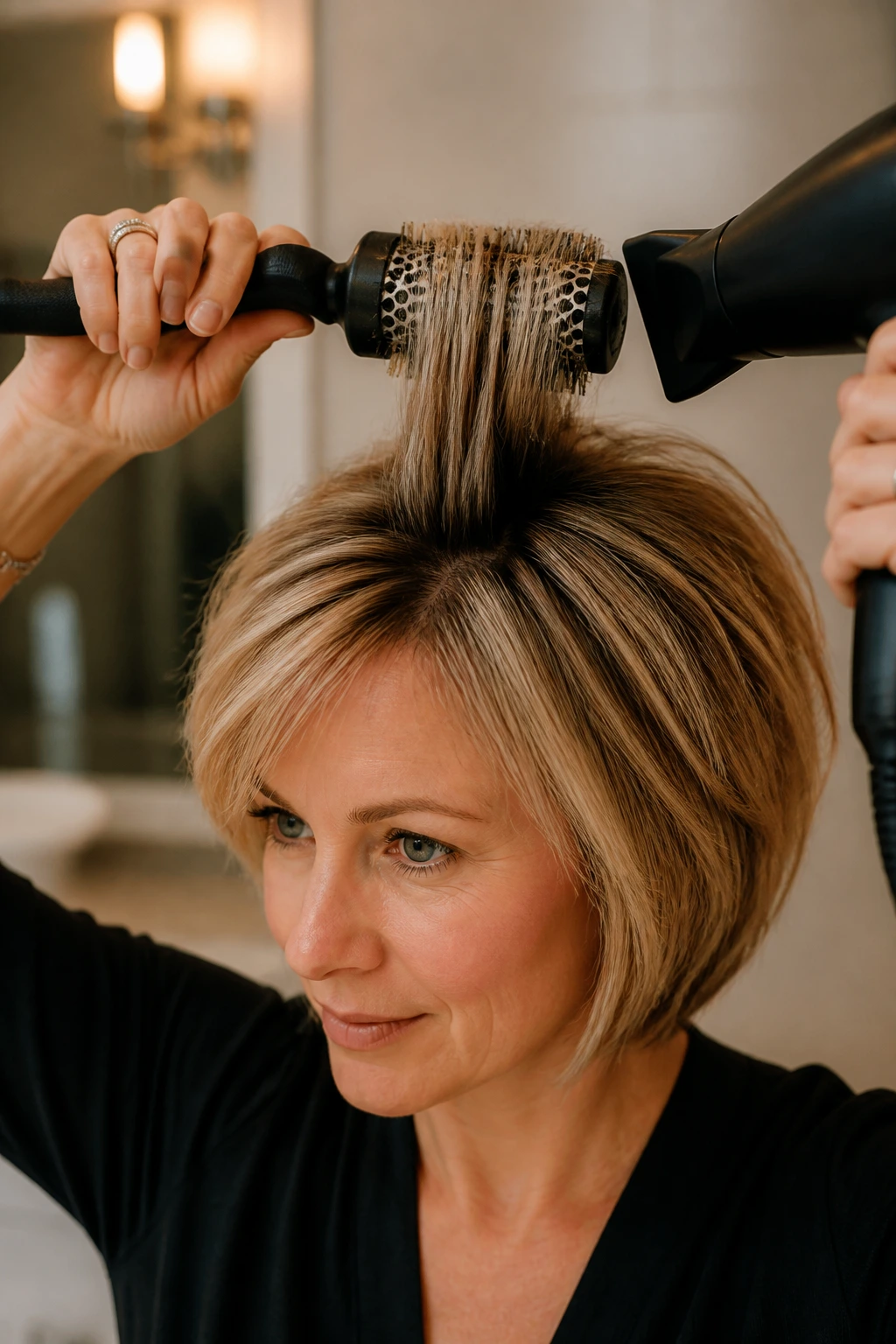
You do not need a drawer full of gadgets, but a few well-chosen tools make a real difference.
-
Blow dryer with a nozzle: The nozzle narrows airflow so you can direct the roots where you want them instead of blasting the cut into frizz.
-
Small round brush, 1 to 1.5 inches: Best for lifting the crown and bending the front pieces without making them curl too hard.
-
Vent brush or paddle brush: Good for rough-drying fine hair fast, especially on pixies and crop cuts.
-
Flat iron with slim plates: Handy for a slight bend at the front or a tiny flick around the jaw.
-
Root-lift clips: Cheap, useful, and underrated. Clip the crown while hair cools, and it keeps the lift longer.
-
Texturizing spray or dry shampoo: Adds grit to thin hair, which gives short cuts more hold and a fuller look.
-
Light hairspray: Flexible hold beats hard shellac every time on fine hair.
-
Point-cutting scissors, if you trim bangs at home: Only for tiny cleanups. Not for a full haircut. Be sensible.
What to Ask a Stylist So the Cut Doesn’t Turn Boxy
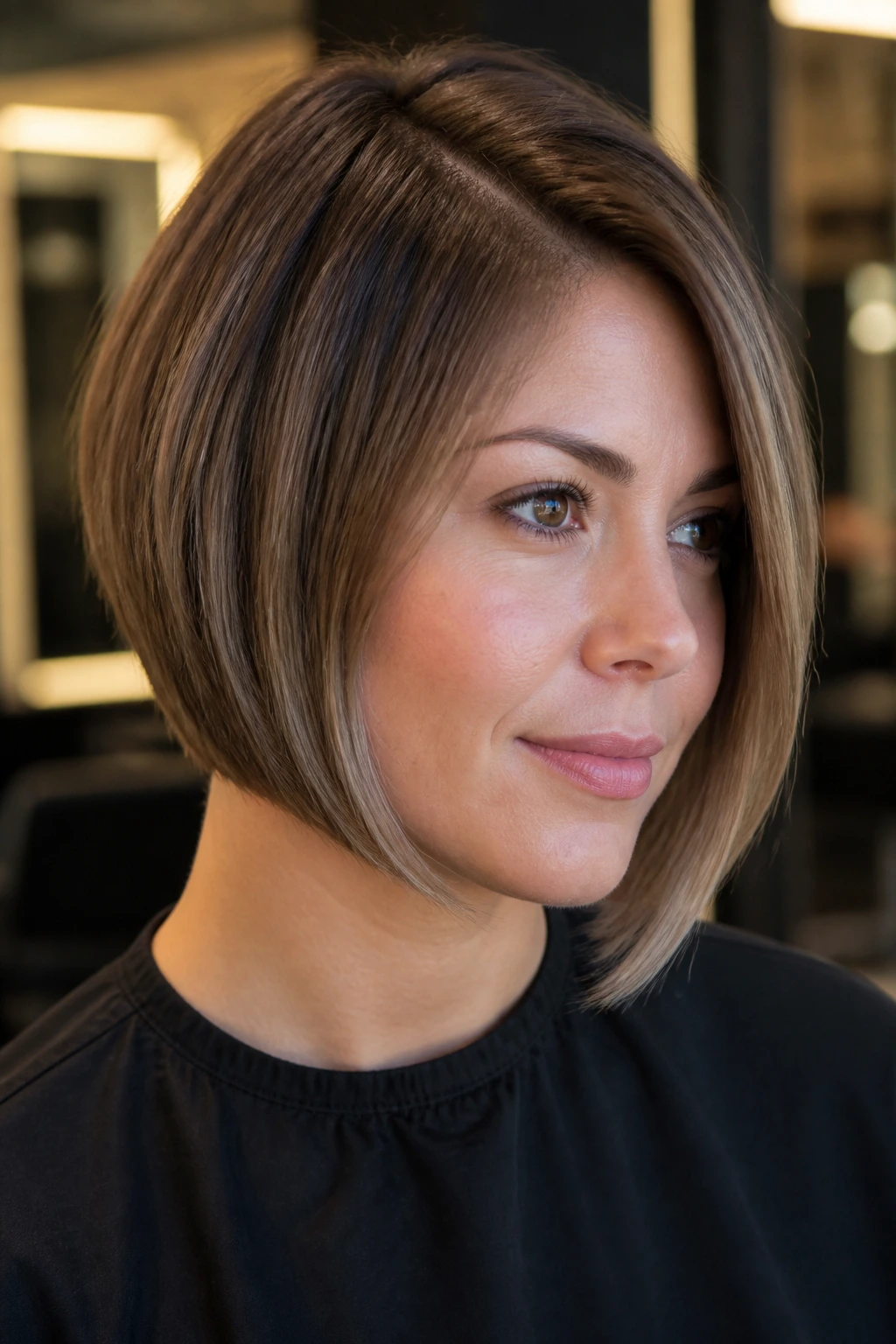
The best haircut photos fail when the person in the chair says, “just make it shorter.” That is how you end up with width in the wrong place.
Bring photos that show the side and back, not just the front. For round faces with thin hair, the profile matters as much as the smile shot. Tell your stylist whether you want lift at the crown, softness around the cheeks, or a more polished line at the jaw. Those are different jobs, and they need different cutting choices.
Be direct about weight removal. Ask for internal layers, light texturizing, or tapered sides if the cut risks puffing out. If you want bangs, say whether you want them airy, side-swept, curtain-style, or barely there. Bangs can help a lot here, but only if they’re cut with the right density.
One more thing: tell them how much time you actually spend styling. A good cut for thin hair is not the same thing as a high-maintenance fashion crop. If you usually air-dry, say that. If you’ll use a brush and dryer, say that too. The difference is real.
How to Style These Looks Without Crushing the Roots
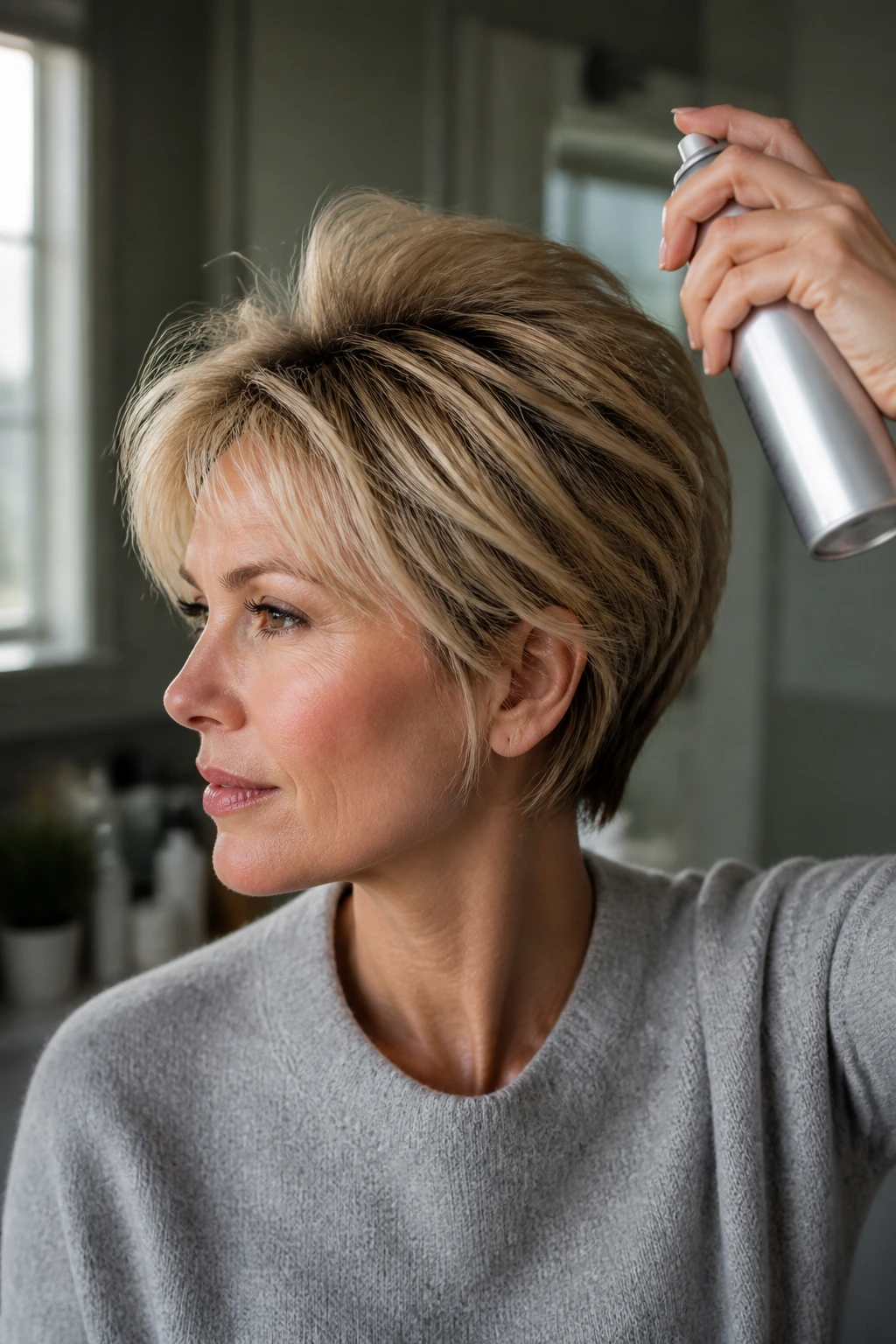
Thin hair is easy to overwork. Too much cream, too much oil, too much heat, and the roots drop before you’ve left the bathroom. The goal is lift first, polish second.
Start with a lightweight volumizing mousse or root spray on damp hair. Focus it at the crown and around the part, not through the ends where it can make hair sticky. Then rough-dry until the hair is about 80 percent dry before you start shaping. That small pause matters because soaking-wet hair will not hold a bend well.
For bobs, direct the front pieces away from the cheeks or slightly under the jaw, depending on the cut. For pixies and crops, dry the crown in the opposite direction of the part first, then reset it once the roots cool. That gives you a little lift that survives longer than a straight blast of air.
Finish with dry shampoo or texture spray at the roots, then a light hairspray over the top. If the hair still feels too soft, pinch a few ends with paste. Do not coat the whole head. That’s how fine hair turns limp and shiny in the worst way.
Small Tweaks That Add Lift and Texture
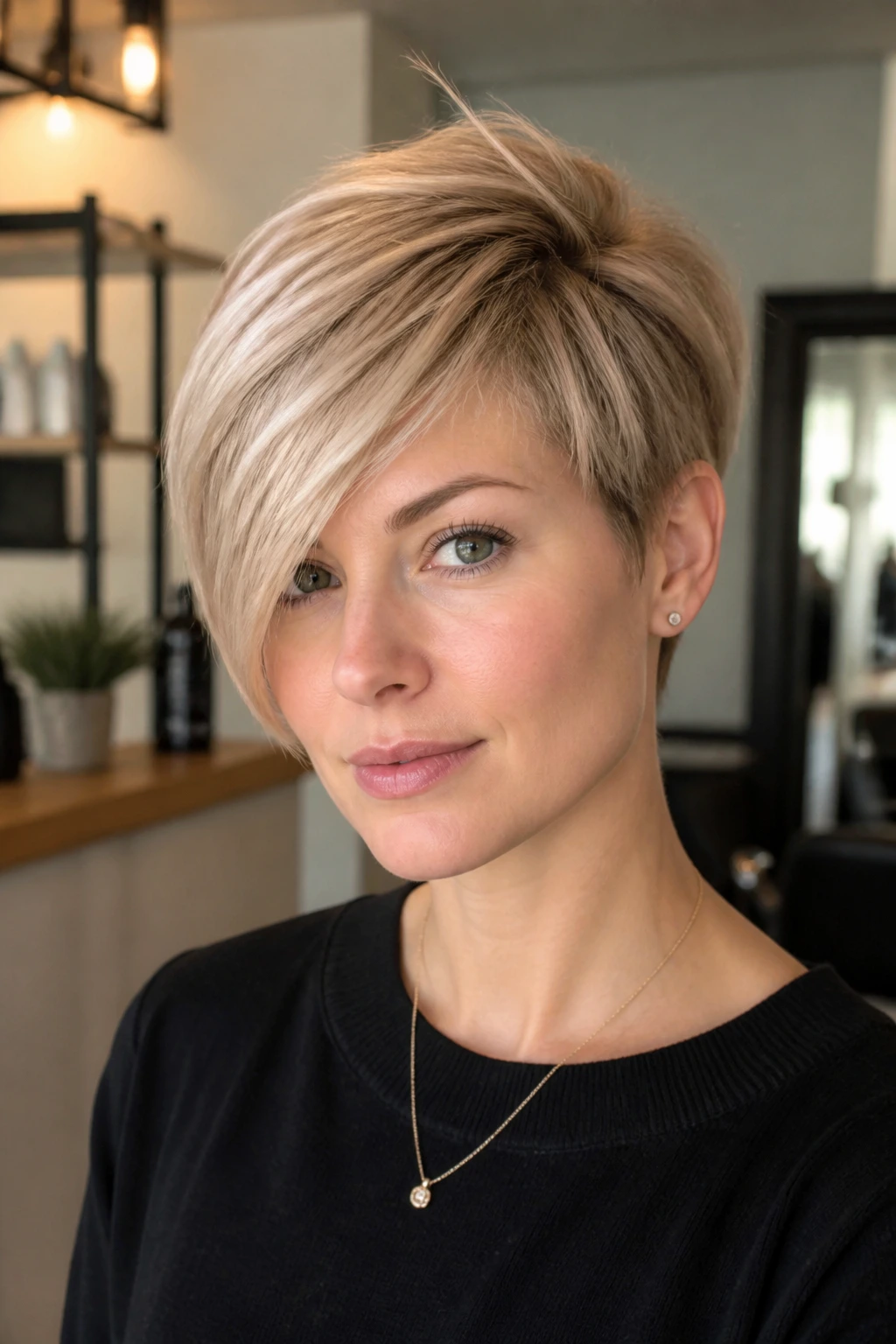
Part shift: Moving your part half an inch off center can change the whole balance of a short cut. It adds instant height on one side and stops the style from settling into a flat middle.
Root cooling: After blow-drying, clip the crown up for five minutes while you do makeup or dress. When the hair cools in a lifted position, it keeps more shape.
Texture at the ends: A tiny bit of dry texture spray at the last inch of hair gives thin ends some grip. The cut looks denser because the pieces stop sliding into each other.
Fringe control: If your bangs are too heavy, mist a little water on them and separate them with your fingers, not a brush. Brushes can make fine bangs lie too flat and too close to the forehead.
Gloss, not grease: A drop of lightweight serum on the very ends can make the haircut look healthier. The trick is one drop, rubbed between the palms, then pressed just on the tips. If it touches the roots, you’ve gone too far.
Common Mistakes That Make Round Faces Look Wider

Cutting the front at cheek level: This is the fastest way to widen a round face. If the shortest front pieces land right across the cheeks, the eye stays there. Ask for lengths that start above the cheekbone or fall below the jaw.
Over-thick bangs: Heavy bangs can chop the face in half and make the forehead-to-cheek distance feel shorter. The fix is a lighter bang, a side sweep, or a curtain shape that opens in the middle.
Too much roundness in the silhouette: A bob that curves inward at the sides and under at the chin can look sweet on paper and boxy in real life. Keep some angle or asymmetry so the shape doesn’t echo the face too closely.
Heavy conditioner near the roots: Fine hair clings to product fast. If conditioner sits at the scalp, the cut loses volume and the crown goes limp. Put conditioner from ears down, then rinse well.
Ignoring the crown: Thin hair needs something to happen on top. If all the action sits at the bottom, the haircut spreads outward instead of upward. A little crown lift changes the balance.
Using too much heat with no direction: Flat ironing every strand straight can make thin hair look sparse and outline every section line. Bend only the front pieces or create a soft wave where the shape needs help.
Variations and Adaptations to Try
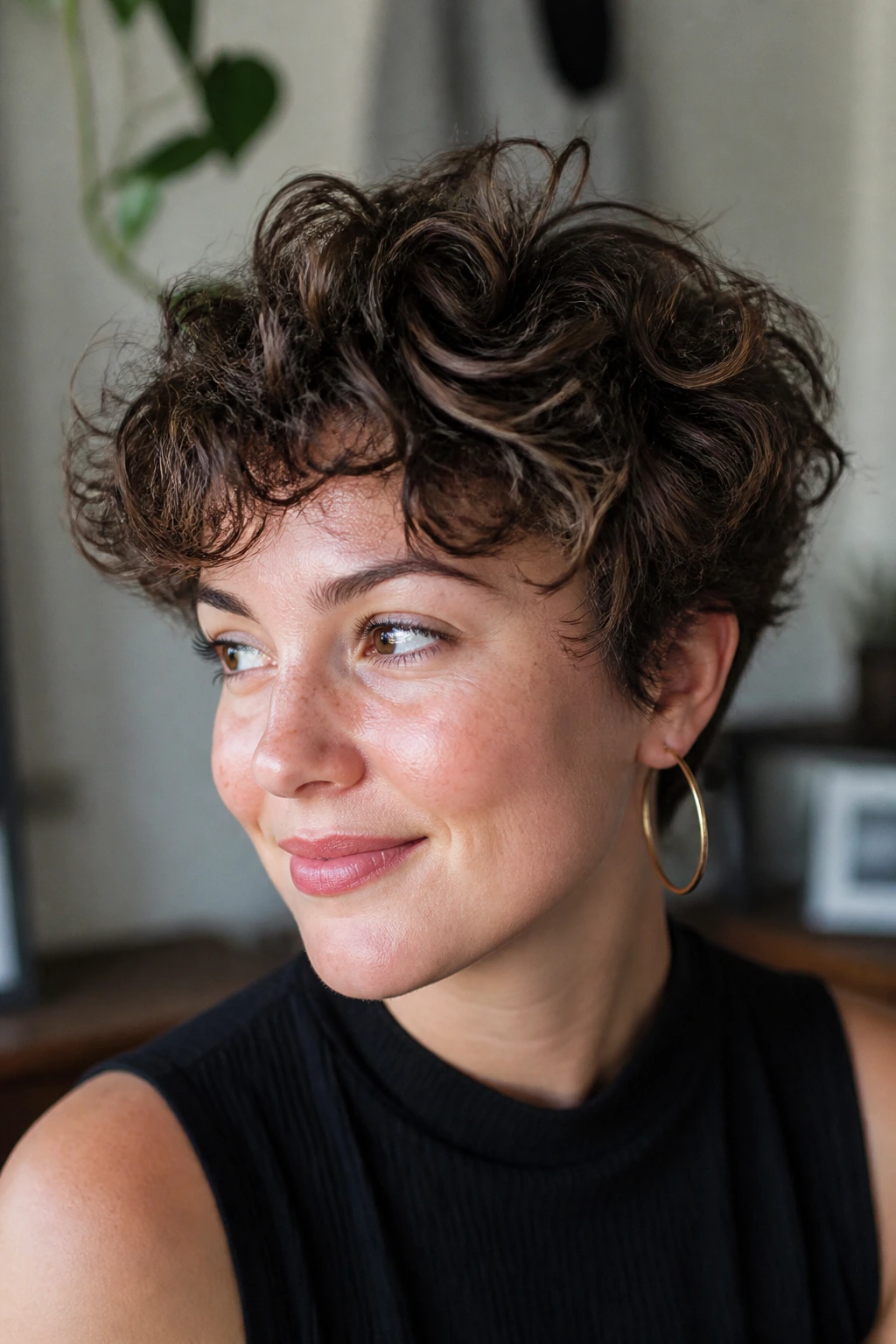
Curly-Fine Shortcut: If your hair is fine but naturally curly or wavy, keep the perimeter a touch longer and leave the layers soft. A tiny amount of curl cream on damp hair can help, but skip thick butters that weigh the shape down. The best version keeps the crown lifted and the cheek area loose.
Glasses-Friendly Fringe: Wear glasses? Go for side-swept bangs, curtain bangs, or a fringe that stops just above the frames. That keeps the hair from colliding with the lenses and stops the face from feeling crowded. The frame and the cut should talk to each other, not argue.
Low-Maintenance Grow-Out: If you do not want a strict trim schedule, choose a grown-out pixie, soft shag, or long-pixie shape. These keep looking intentional as they lengthen, which matters if salon visits stretch out a bit. They also hide regrowth better than a blunt bob.
Sleek Office Version: Prefer a cleaner finish? Pick a side-parted bob, wedge bob, or a polished A-line cut. Blow-dry smooth, then curve the front pieces slightly away from the face. It reads crisp without turning severe.
Edgy Texture Version: Want more attitude? Add an undercut, choppy fringe, or micro-bangs to a crop or bixie. Keep one element soft so the whole look doesn’t go too hard. A little edge ages better than a full commitment to a trend.
Soft and Feminine Version: If you like a gentler look, ask for feathered ends, airy bangs, and face-framing pieces that begin below the cheekbone. Soft does not mean flat. You still need crown lift and a side part if you want the face to feel longer.
The Maintenance That Keeps These Cuts Looking Intentional
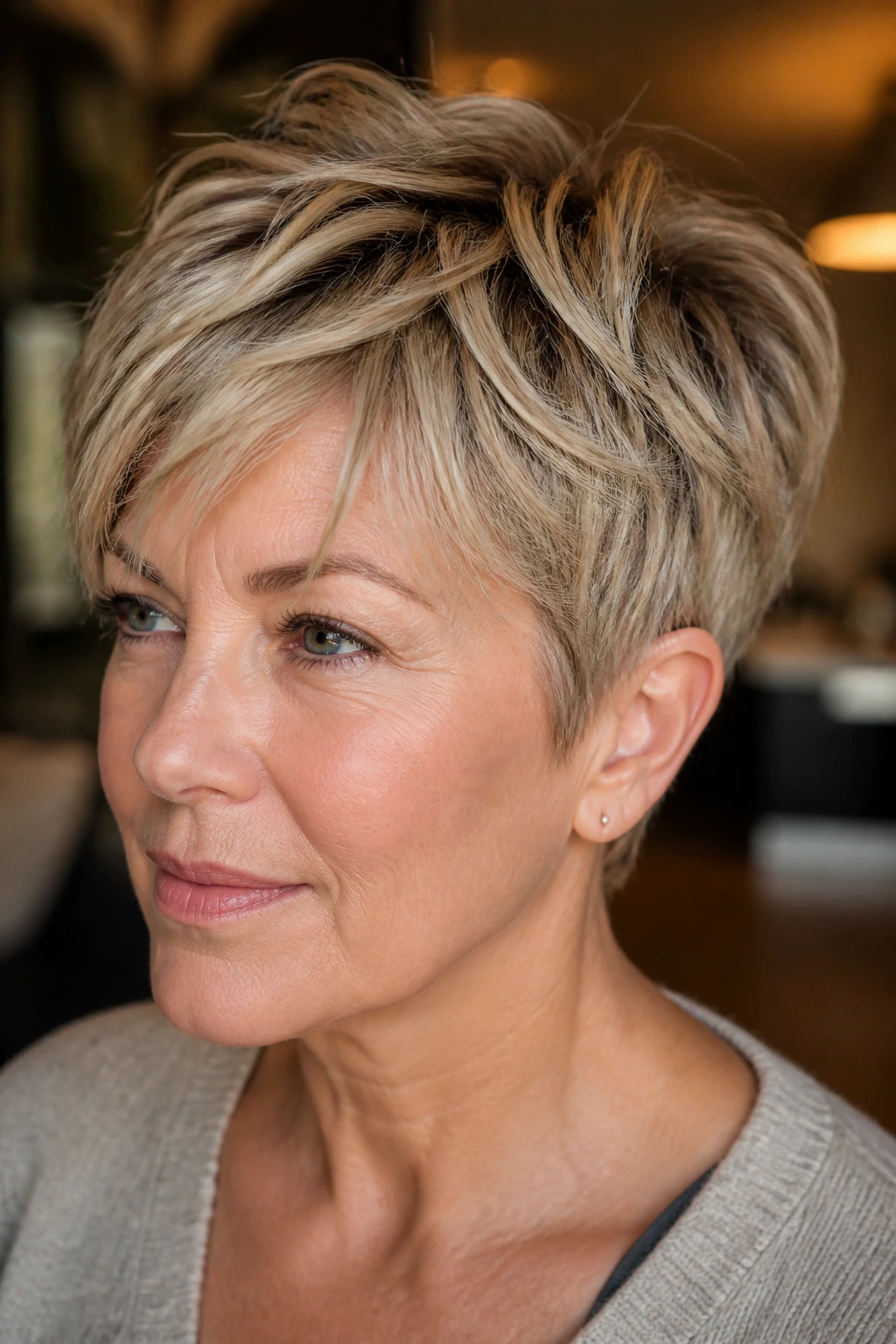
Short hair exposes growth fast. A pixie can lose its shape in four weeks. A bob may give you six to eight, depending on how precise the line is and how fast your hair grows. That is not a flaw. It is the trade-off for a cut that does something useful.
If you have a pixie, crop, or undercut, plan a trim every 4 to 5 weeks. For bobs and bixies, 6 to 8 weeks is a more realistic window. Fringe trims may need their own little touch-up sooner, especially if the bangs sit near your eyes.
Day two can be better than day one on these cuts, but only if the roots are not oily. A little dry shampoo at the crown, finger fluffing, and a quick refresh with the dryer are usually enough. If the hair starts to look puffy at the ends, skip more product and use a tiny bit of water to reshape the front instead.
Sleeping on a silk or satin pillowcase helps thin hair keep less friction and fewer kinks. It is not magic. It just saves you from starting the day with dents in the exact wrong place.
Common Questions About Short Hairstyles for Round Faces with Thin Hair
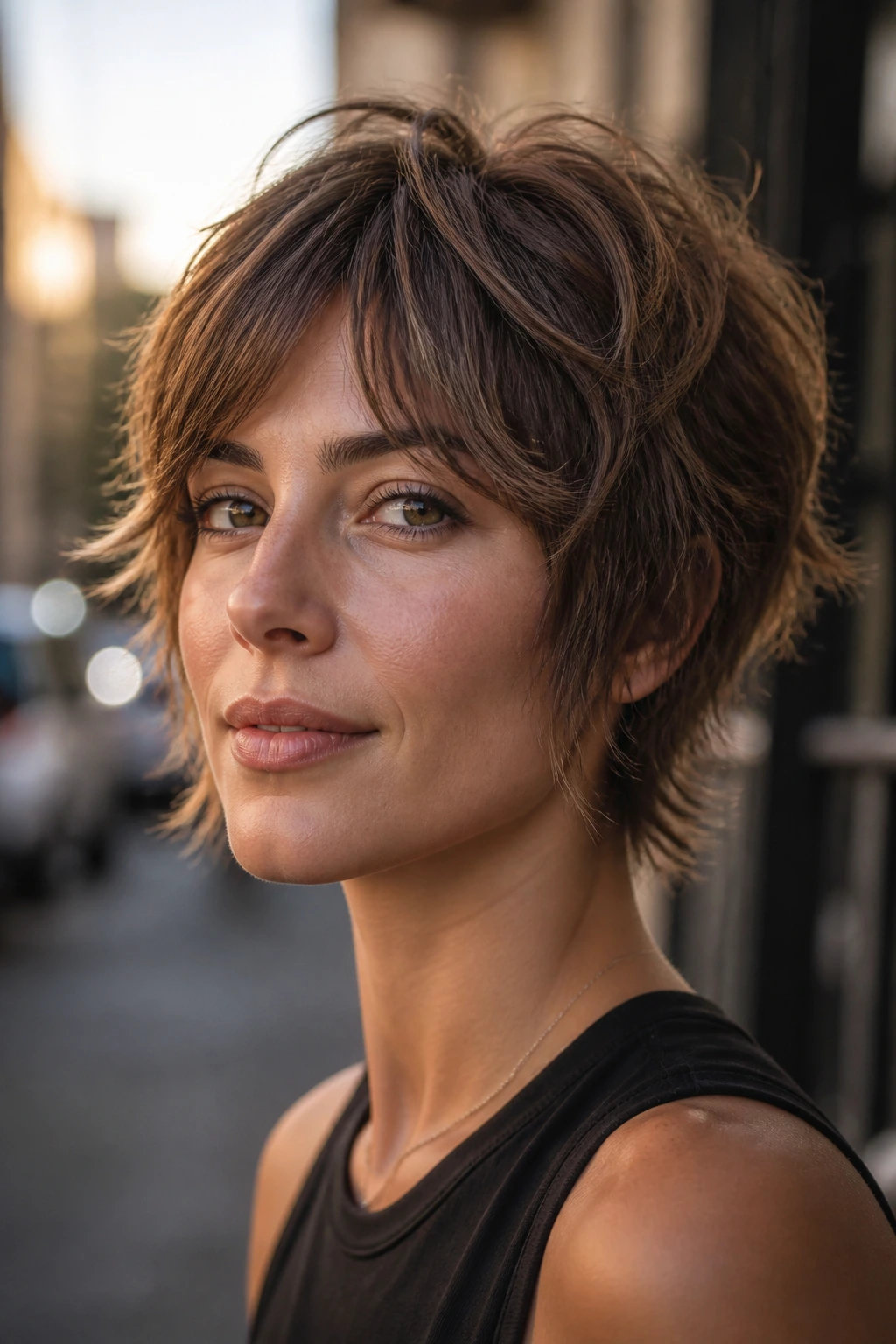
Will short hair make a round face look wider?
Not if the cut has shape. The problem is not short length itself; it is a short cut that stops at the cheekline and spreads out on the sides. Angles, crown lift, and a side part usually solve that.
Is a blunt bob a bad idea for thin hair?
Not always, but a blunt bob needs careful placement. If it lands right at the cheeks, it can widen the face. If it sits a little lower or has hidden internal layers, it can look thicker and cleaner.
Can I wear bangs with a round face and thin hair?
Yes, but density matters. Airy bangs, curtain bangs, and side-swept fringe tend to work better than a thick, heavy fringe. The goal is to frame the face, not shut it in.
What if my hair falls flat no matter what I do?
Then the cut has to do more of the work. Ask for stronger crown shape, shorter supporting layers underneath, and a style that does not depend on all-over volume. Products help, but the haircut is the main event.
Are pixie cuts good for thin hair?
They can be excellent, because less hair means less weight pulling the style down. The catch is that the top needs enough length to show texture and the sides must be tapered cleanly. A pixie with no shape on top will just sit there.
How do I ask for a style that makes my face look longer?
Use plain words: “I want height on top, softness around the cheeks, and length that doesn’t stop right at the widest part of my face.” That sentence does more work than a stack of vague inspiration photos.
Should I avoid layers completely if my hair is thin?
No, but the layers need a purpose. Too many short layers can make the ends look scraggly, while invisible layers and face-framing cuts can add movement without losing density. Think controlled, not chopped to pieces.
Can curly hair use these same ideas?
Yes. The shape rules stay the same, even if the texture changes. Keep fullness off the cheeks, build a little height at the crown, and let the front pieces fall in a way that opens the face.
The Cuts That Earn Their Keep
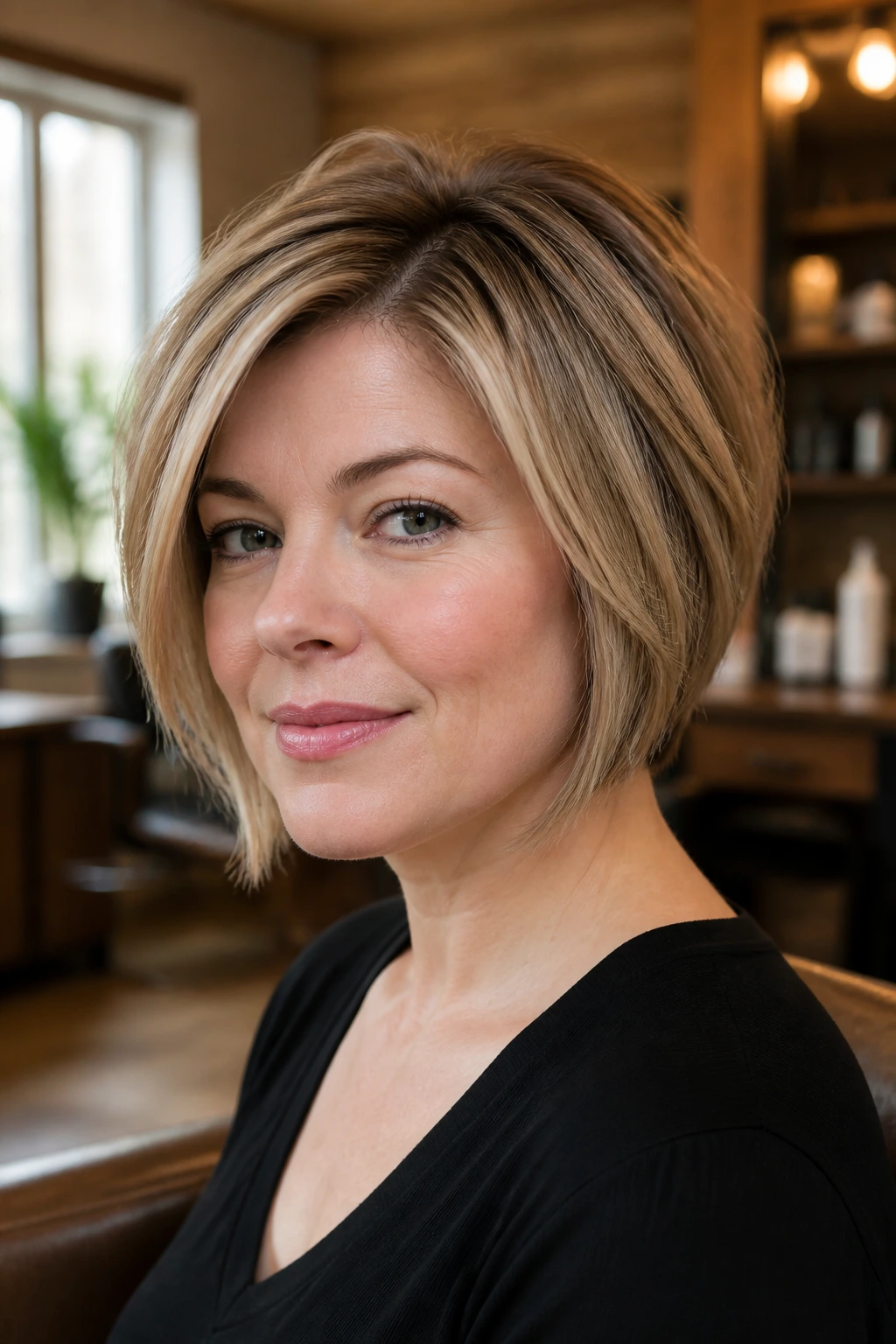
The short cuts that matter most here are the ones that solve two problems at once: they make thin hair look fuller and keep a round face from reading wider than it is. That’s why I keep coming back to angled bobs, side-swept pixies, airy fringe, and anything with a little lift at the crown.
If you want the safest place to start, think in terms of movement, not volume. Movement is easier to control. It looks better on day two. And it keeps the haircut from going stiff, which is usually where thin hair gets into trouble.
Choose the shape that fits your maintenance habits, then ask for the details that keep the width in check. A good cut should feel like it belongs to your face, not like it’s sitting on top of it. Once you get that balance right, the whole thing gets easier — and you stop fighting your hair every morning.