



Gray hair changes the rules of a pixie cut. The strands often feel drier and a little coarser, so the outline shows up fast; on a heart-shaped face, that outline has to do some geometry work, softening a broader forehead while keeping the chin from disappearing into the background.
I prefer a pixie that keeps a little movement at the temples. Too much height at the crown can make the face feel top-heavy, and a blunt little fringe cut straight across the forehead can look stiff on silver hair, which already has enough character of its own.
The sweet spot is a cut that lets the gray shine without turning boxy or severe. That usually means side-swept pieces, feathered edges, and a bit of weight where the face needs it most — near the jaw, around the ears, or in a longer fringe that breaks up the width at the top.
Why These Pixies Earn Their Keep
-
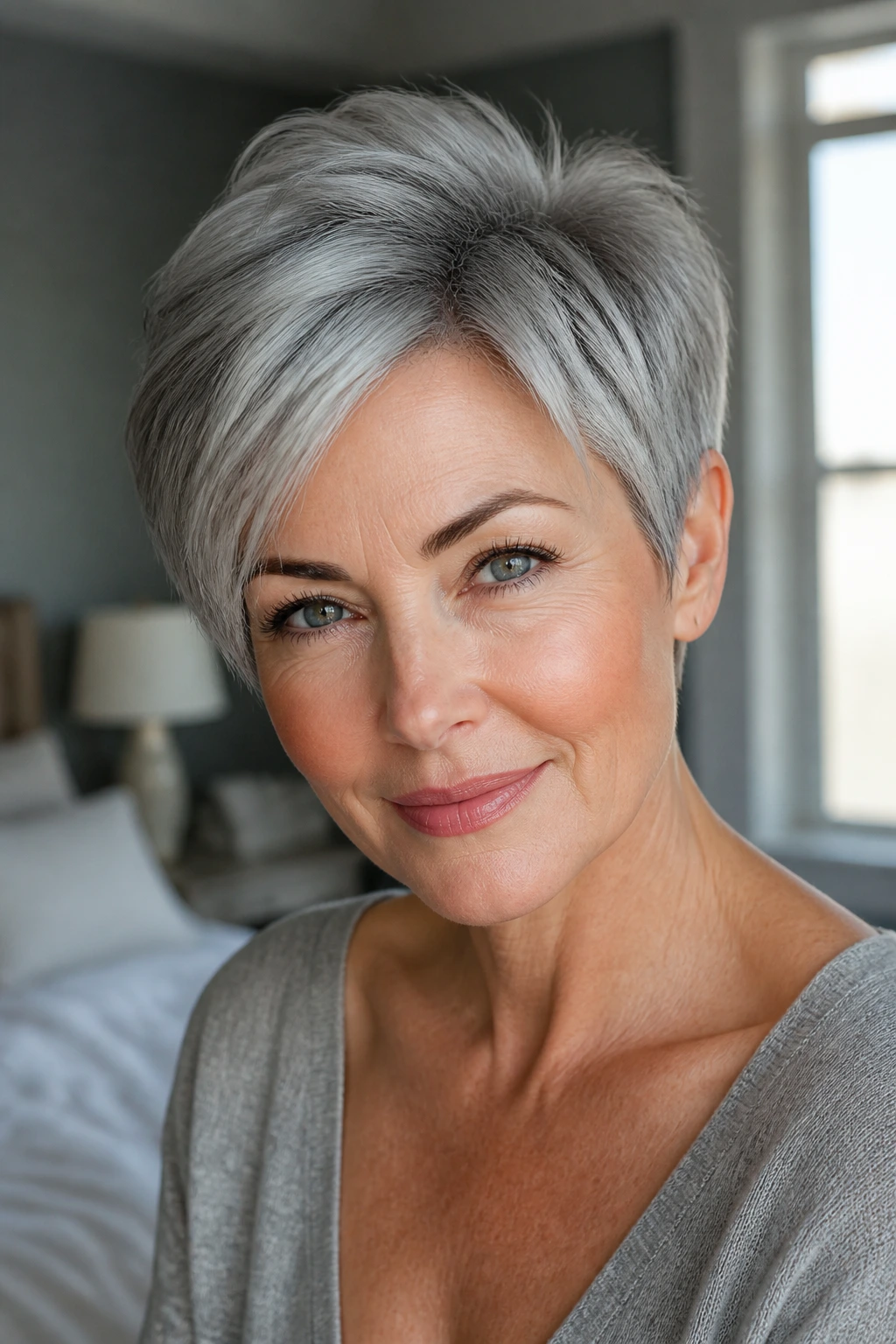
Temple-softening shape: Heart-shaped faces usually carry width through the forehead, so the best pixies leave movement near the temples instead of stacking all the volume at the crown.
-
Gray-hair friendly texture: Gray strands often behave drier and show line work more clearly, which makes feathering, choppiness, and soft layering look deliberate instead of harsh.
-
Less forehead emphasis: The cuts here lean on side parts, wispy bangs, and diagonal lines, which pull the eye away from the widest part of the face.
-
Easy salon upkeep: A well-built pixie can hold its shape for weeks if the nape and sideburns stay tidy, even when the top starts to grow a little.
-
Works with fine or coarse hair: Some of these cuts lift fine silver hair without making it float away; others remove bulk from thick gray hair so it doesn’t puff out at the sides.
-
Modern without trying too hard: The point is not to look edgy for the sake of it. The point is to make the face look balanced in daylight, which is where bad pixies always tell on themselves.
What Gray Hair and a Heart-Shaped Face Ask of the Same Cut
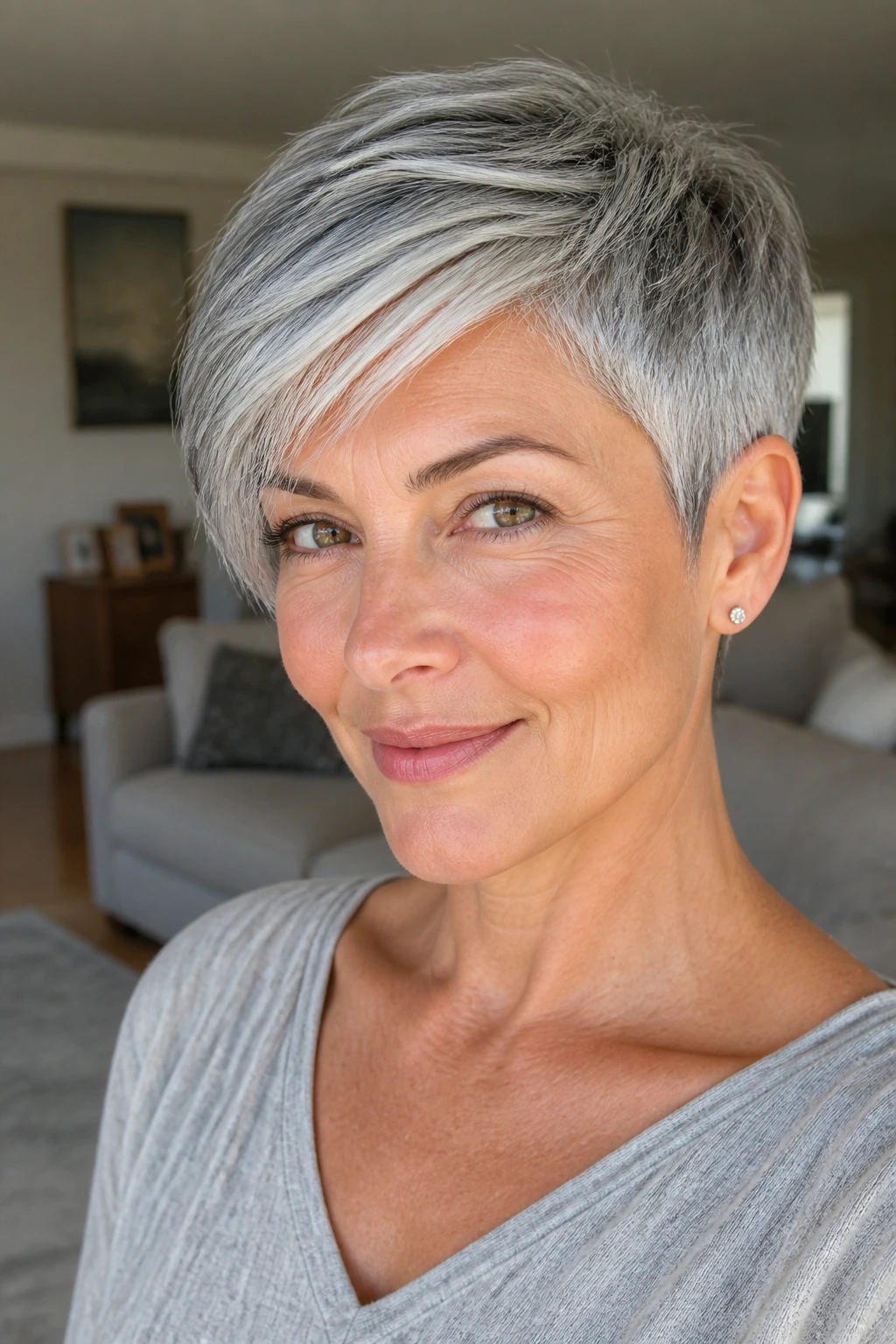
A heart-shaped face has a wide forehead, fuller upper cheeks, and a narrower jaw. That shape loves a pixie that creates a gentle diagonal line, not a straight-up-and-down block. If the top is too tall and the fringe is too short, the face can start to feel like a triangle turned upside down.
Gray hair adds its own rules. It can be wiry, fluffy, silky, or all three before noon, and it tends to show every blunt edge. A good cut respects that texture. It doesn’t fight the silver; it gives the silver a shape that makes sense from every angle.
The best-looking pixies here usually do one of three things: soften the forehead, add a little visual weight near the jaw, or break up the top with movement. Sometimes all three show up in the same cut. That’s the sweet spot, and once you start looking for it, you’ll spot it in a mirror across the room.
1. Side-Swept Pixie with Long Temple Fringe
A side-swept pixie lives on diagonal lines, and that diagonal is doing real work on a heart-shaped face. The long temple fringe breaks up the width at the forehead, then slides the eye down toward the cheek and chin. On gray hair, that soft sweep reads polished instead of severe, especially if the strands have a little bend to them.
Why it works
The longer fringe gives you coverage where the face is widest, but it doesn’t hide the forehead completely. That matters. A heavy curtain can swallow the whole face; a side sweep leaves air around the eyes and keeps the cut light.
I like this one most on straight-to-wavy silver hair that needs shape without a ton of styling. A quick blow-dry with a small round brush, then a dab of light cream on the fringe, is enough. If your gray hair sticks up at the roots, this cut behaves better than a blunt crop because the top is guided, not chopped.
2. Tapered Pixie with Feathered Crown
This is the pixie for someone who hates helmet hair. The crown is lightly feathered, the sides hug the head, and the nape stays neat so the whole shape looks crisp instead of puffy. On a heart-shaped face, that taper keeps the upper half from getting too wide.
The trick is not to overbuild the top. Gray hair already reflects light, and too much crown height can look like you’re wearing a little silver cloud. Feathering gives movement without bulk, which is exactly what a lot of coarse gray strands need.
If your hair dries in stubborn directions, ask for point-cutting instead of a blunt snip. The ends blend better, and the cut grows out with less of that awkward shelf at the back. This one is especially good if you wear earrings, because the close nape and soft crown leave room for the face and neck to do the talking.
3. Wispy Bang Pixie
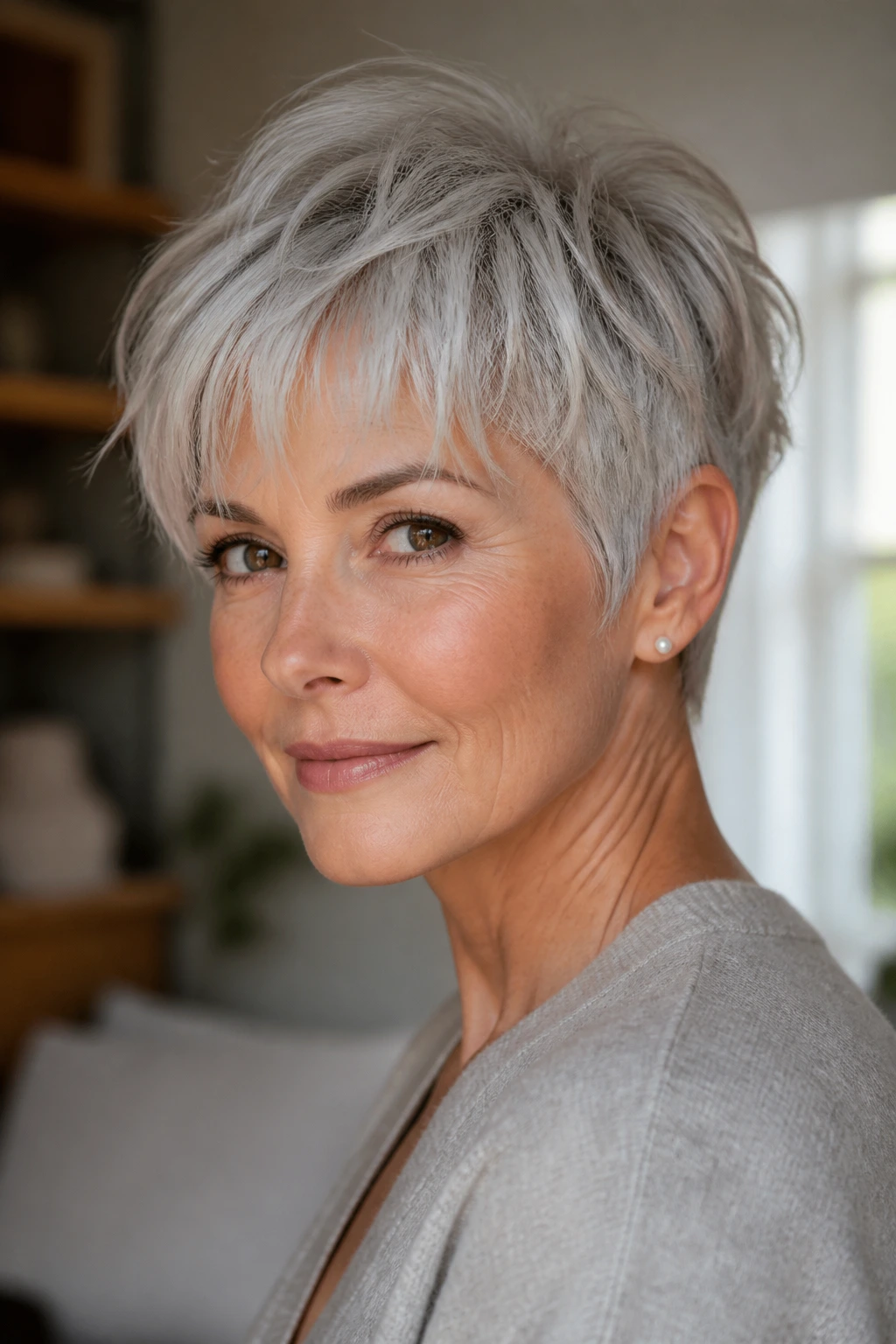
Why do wispy bangs work so well here? Because they break the forehead into smaller pieces. A heart-shaped face doesn’t need more emphasis on the upper third, and wispy bangs soften that space without boxing it in.
This version is kinder to fine gray hair than a thick fringe. Thick bangs can separate and spike the wrong way as the hair gets drier; wispy bangs move more naturally, especially if you finish them with a light blow-dry and a touch of flexible spray. They also make glasses easier to wear, which is a small thing until it isn’t.
How to style it
- Blow-dry the bangs first, from side to side.
- Use a pea-sized amount of cream or balm.
- Pinch the ends while they cool to keep the fringe airy.
- Avoid heavy oils at the front; they collapse the shape fast.
4. Asymmetrical Pixie with a Deep Side Part
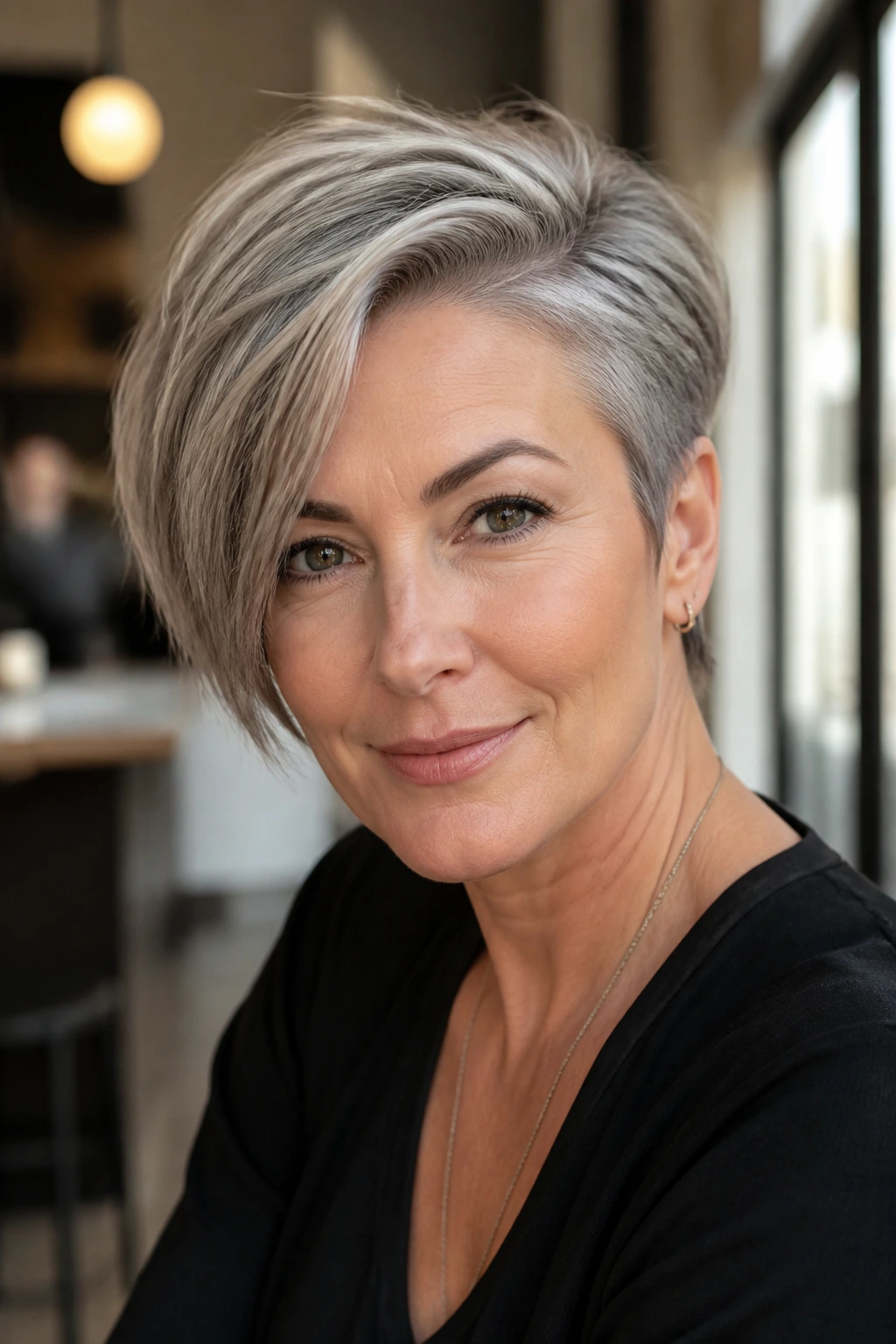
A deep side part changes the whole conversation. Instead of staring straight at the widest part of the forehead, the eye follows the longer side across the face. That makes this cut one of the better choices for heart-shaped faces that want a little drama without extra height.
The asymmetry also helps gray hair look intentional. One side can graze the cheekbone while the other stays tighter and cleaner around the ear. That contrast gives the cut dimension, and dimension is what stops short gray hair from reading flat in photos or under bright bathroom light.
I’d pick this for someone who likes a sharper silhouette but still wants softness at the edges. If your hair is straight, the line looks sleek. If it has wave, the longer side gets a little swing when you turn your head, which is half the fun.
5. Curly Silver Pixie with Lift at the Crown
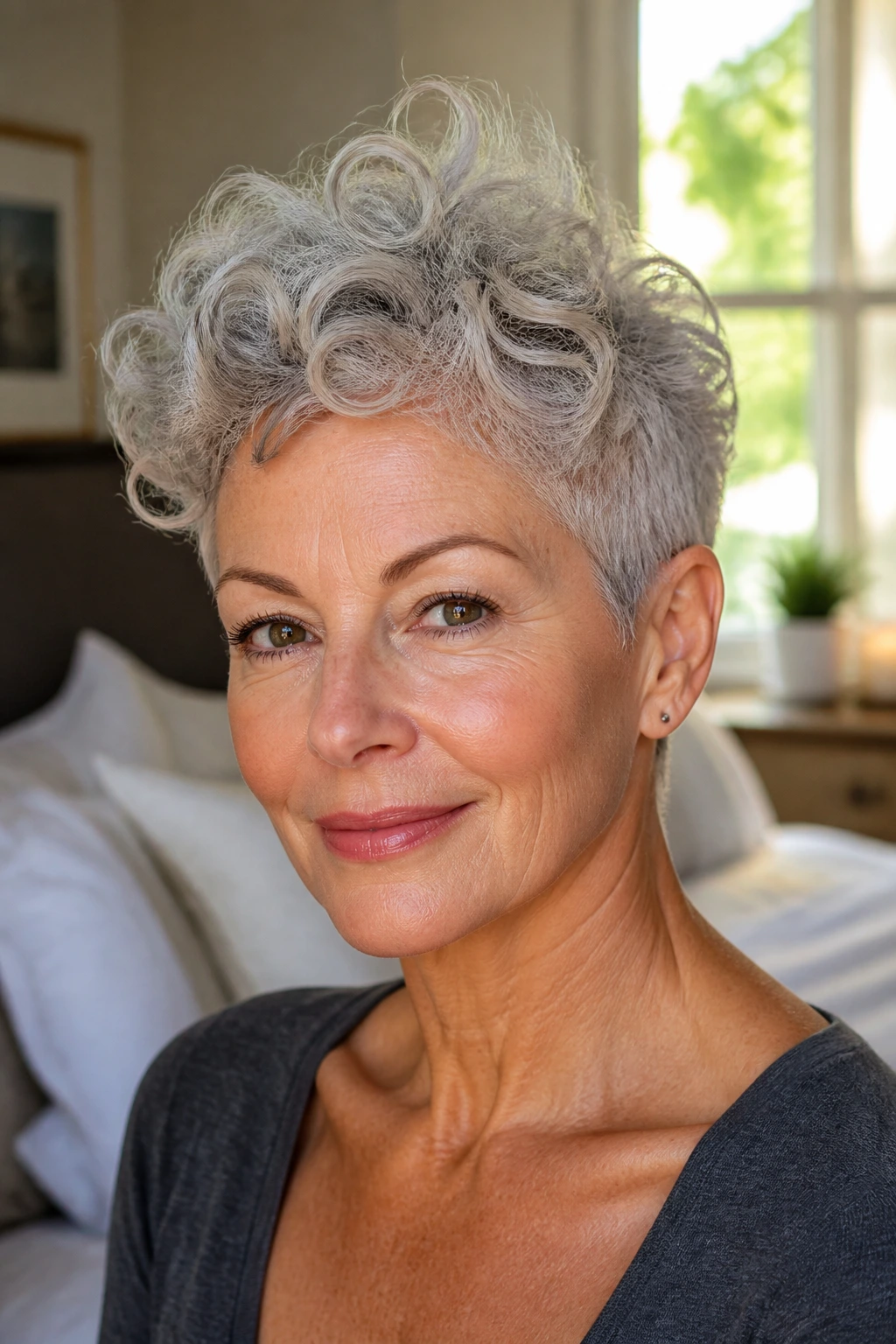
Curly gray hair can be glorious in a pixie, but only if you respect the curl pattern. The crown needs enough length to spring up, while the sides stay trimmed so the face doesn’t widen too much through the cheeks. On a heart-shaped face, that keeps the curl energy up top without turning the whole head into a puff.
A soft curl on silver hair catches light in a way straight hair never quite does. The trick is moisture and restraint. Use a leave-in that doesn’t weigh the curls down, then scrunch and let the shape dry where it wants to. If you fight the curl too hard, the cut goes triangular fast.
What to ask for
Ask for curl-by-curl shaping or light point-cutting. Heavy razoring can fray gray curls and make them look fuzzy instead of defined. You want spring, not fluff. There’s a difference.
6. Choppy Piecey Pixie with Temple Length
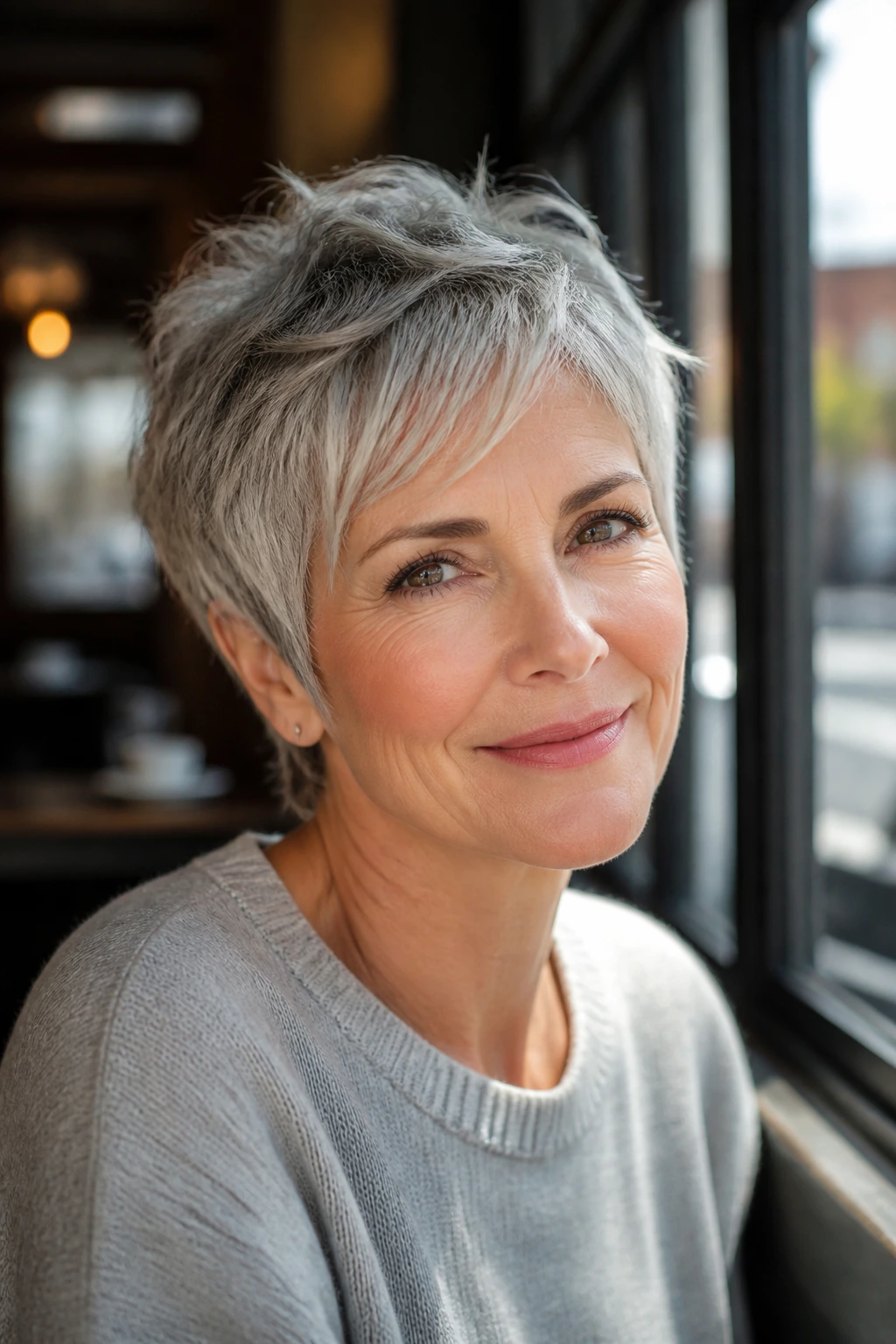
This cut has attitude, but not the messy kind. The pieces are separated, the temple length keeps a little softness around the forehead, and the crown stays textured rather than stacked. That combination keeps a heart-shaped face from feeling too top-heavy.
Piecey gray hair looks good because the texture is visible. Every little broken edge catches light. Use a matte paste or a dry texture cream, then pinch out a few strands around the fringe and sides so the cut doesn’t sit in one solid mass.
I like this one for hair that gets flatter on day two. A mist of dry shampoo at the roots and a quick finger-scrunch bring it back without a full wash. It’s a little less polished than the side-swept styles, but in the right silver tone, that looseness is the charm.
7. Undercut Pixie with a Soft Sweep
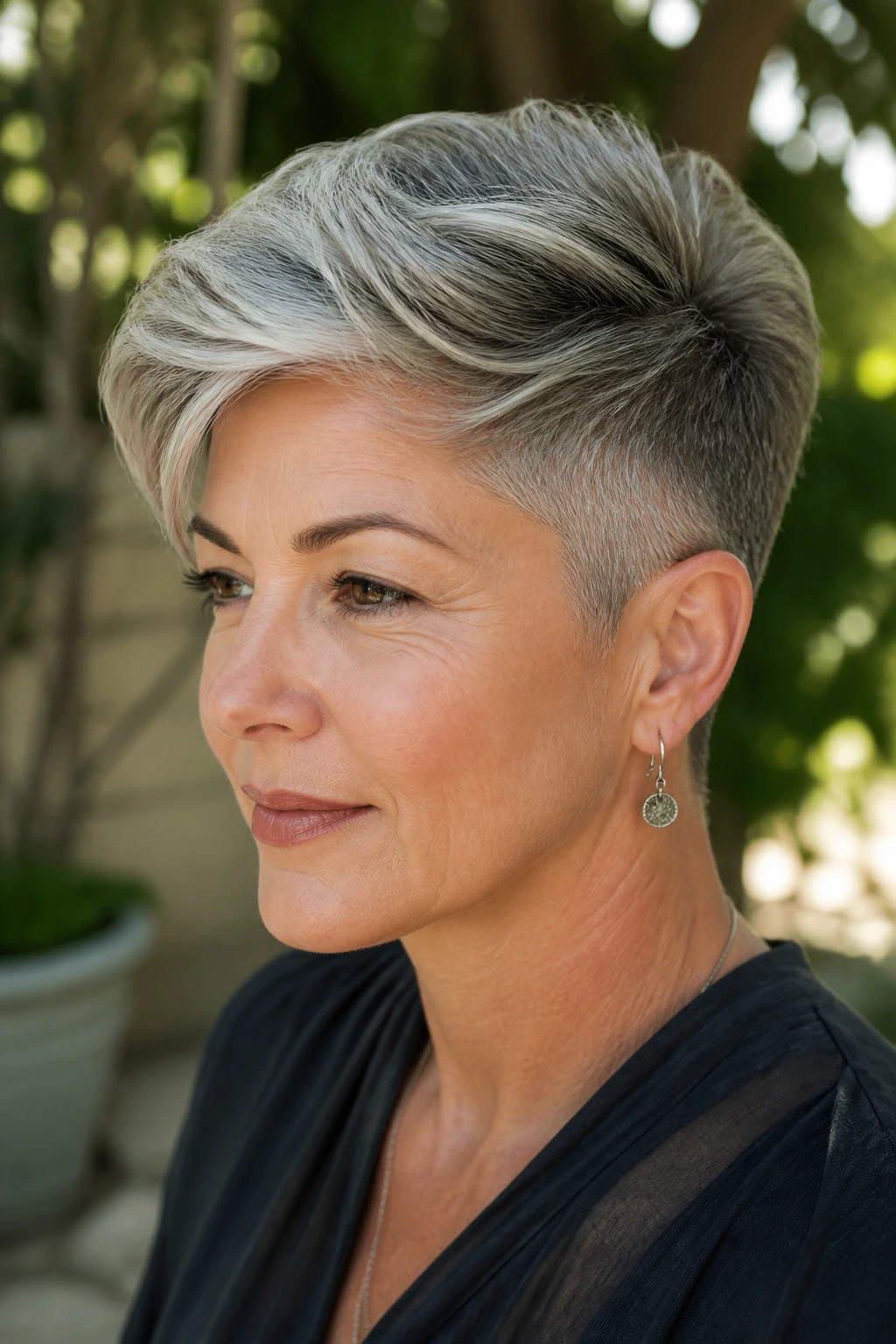
An undercut sounds bold, and it can be, but the soft sweep keeps it from feeling severe. The shaved or clipped section removes bulk where thick gray hair often balloons, while the longer top can sweep across the forehead and stay flattering on a heart-shaped face.
This is one of those cuts that solves a practical problem and a visual one at the same time. If your hair sits heavy around the nape or behind the ears, the undercut takes away that weight. If your forehead needs a little gentleness, the top length gives it. Clean, simple.
The catch? You need to be okay with upkeep. Undercuts show regrowth fast, especially on silver hair, where the contrast between skin and hair can show more easily. If you don’t mind a regular trim, though, the shape stays sharp for a long time.
8. Feathered Pixie Bob Hybrid

This is the in-between option for people who want pixie energy but don’t want the hairline cut too high. The front pieces skim the jaw, the back stays shorter, and the whole thing feels a little softer than a traditional crop. On a heart-shaped face, that extra length near the lower face is useful. It gives the chin some visual company.
Why it flatters
- The longer front blunts the width at the forehead.
- The feathered ends keep gray hair from sitting in one blocky sheet.
- The nape stays short enough to feel like a pixie, not a mini bob.
- It grows out gracefully, which matters if you hate frequent reshaping.
I’d pick this if you want a cut that can move between tucked-behind-the-ear neatness and loose, brushed-forward texture. It’s polite when you need it to be, and a little cheeky when you don’t.
9. Brushed-Forward Pixie with Airy Fringe
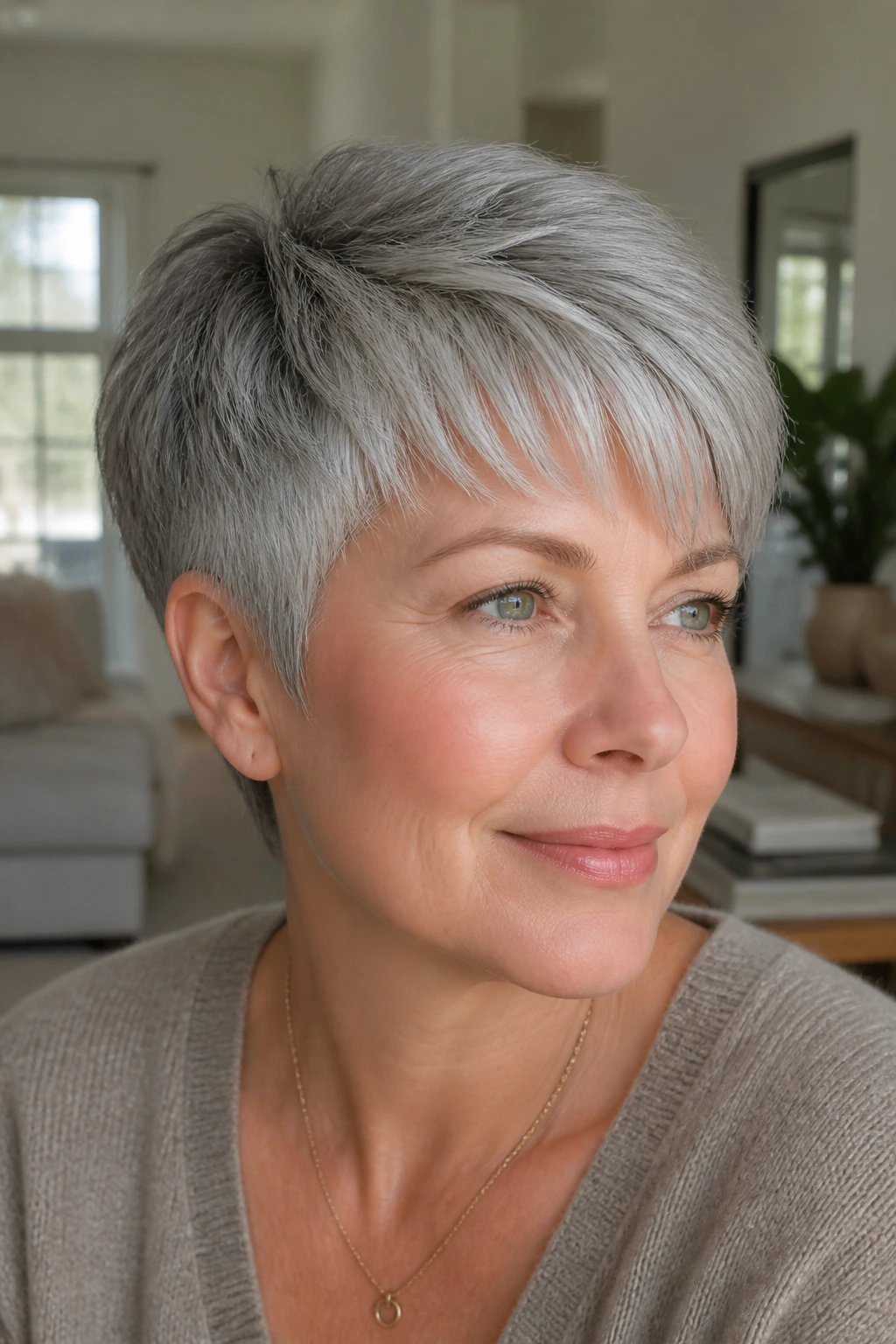
A brushed-forward pixie changes the silhouette in a very useful way: it shortens the look of the forehead by bringing the weight forward. That is a nice trick on a heart-shaped face, especially if your forehead feels broad in proportion to your chin.
The airy part matters. You do not want a thick, flat curtain parked on the brow. You want a soft forward sweep that has space between the strands. Gray hair can make that look particularly sharp, because the lighter color shows texture so well. A light mousse at the roots and a quick forward blow-dry are usually enough.
This cut also has a nice everyday quality. It looks a touch undone on purpose, which keeps it from feeling too fussy. If you’re the kind of person who likes to run a hand through your hair and be done with it, this one earns its place.
10. Grown-Out Taper Pixie
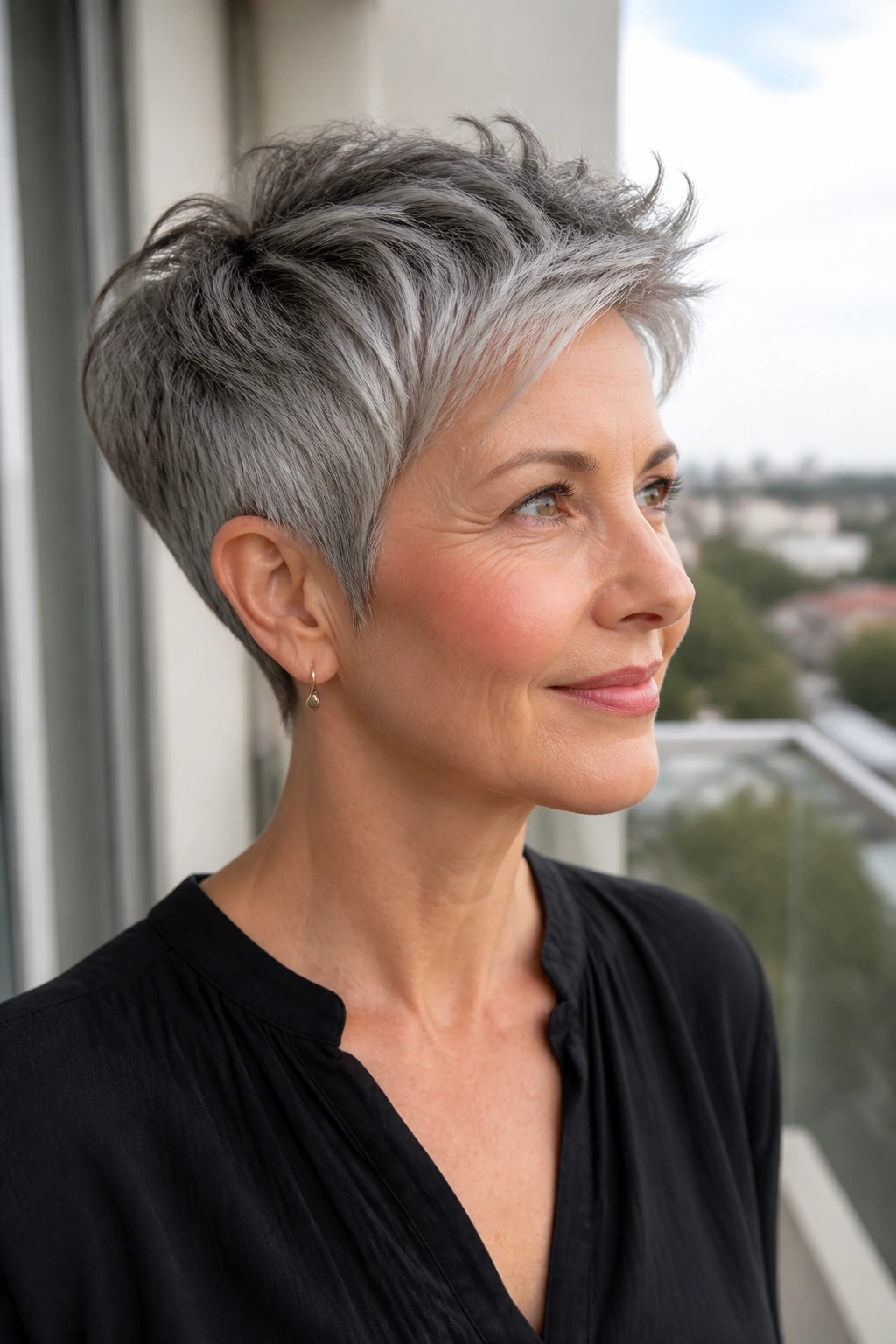
Some pixies are made for the in-between stage, and this is one of them. The nape stays tapered, the top grows a bit longer, and the front lands somewhere between a crop and a short bob. On a heart-shaped face, that longer top gives you room to soften the forehead while the tapered back keeps the neck clean.
I like this cut because it doesn’t scream for perfection. It looks good with a little growth, which is handy if you want fewer salon visits. Gray hair often loses a bit of pigment and can show uneven cutting more easily, so a shape that forgives a few millimeters is a relief.
If you’re growing out a shorter pixie, this is usually where the cut wants to go anyway. Lean into it instead of fighting the transition.
11. Micro Pixie with Soft Edges
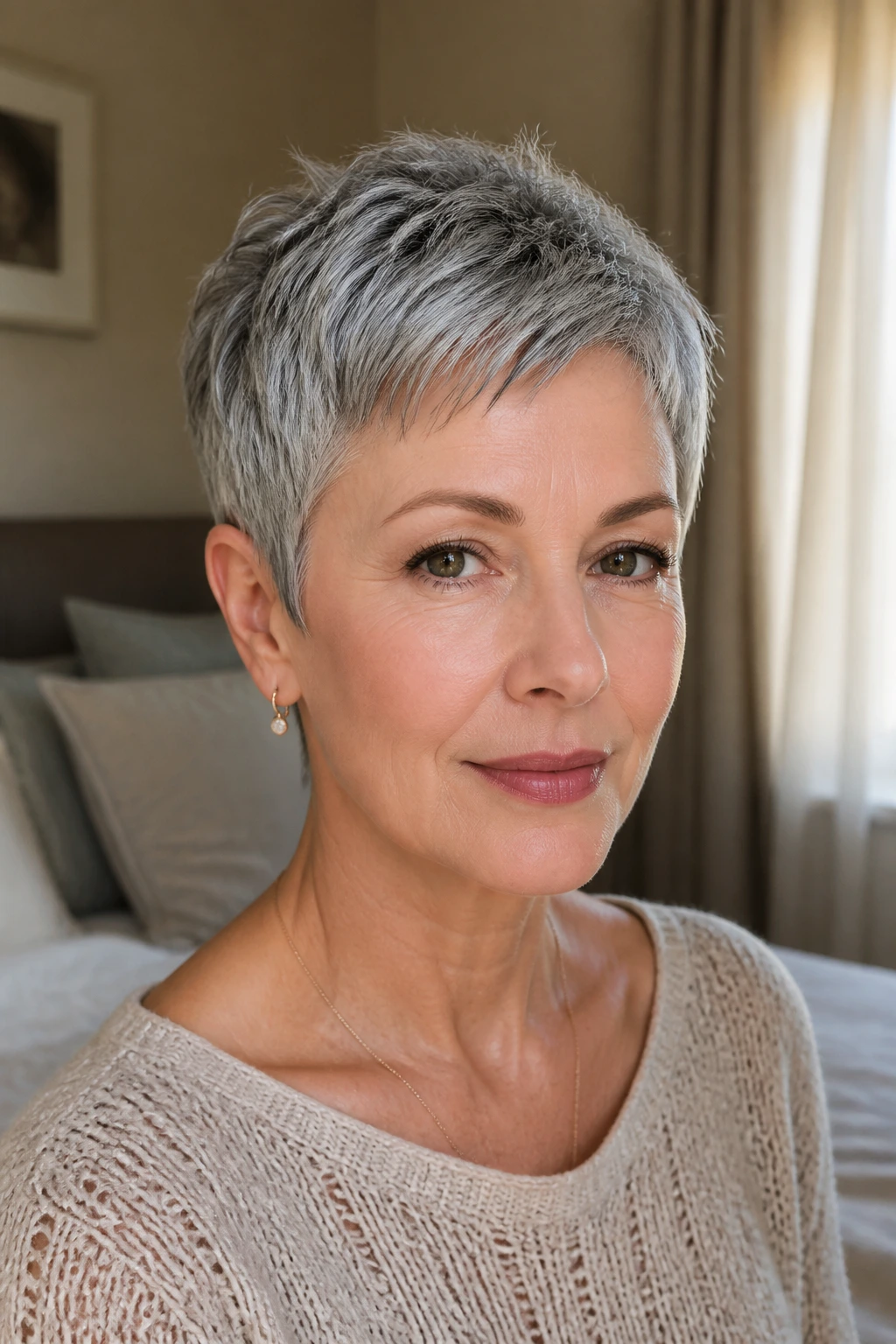
Can a very short cut work on a heart-shaped face? Yes, but only if the edges are soft. A micro pixie with hard lines can make the forehead look wider and the chin look smaller. So the answer is not “no,” it’s “not like that.”
This version keeps the sides snug while leaving just enough softness at the temples and around the ear. On gray hair, the short length shows off the color beautifully, especially if your silver has streaks of white or peppered charcoal. It’s a clean, almost architectural look.
The maintenance is real. You’ll see growth sooner than you expect, and a tiny bit of unevenness shows fast. But if you like a crisp outline and don’t mind regular trims, the shape has a sharp, modern edge that still feels feminine because the lines are eased, not chopped.
12. Shaggy Pixie with Crown Movement
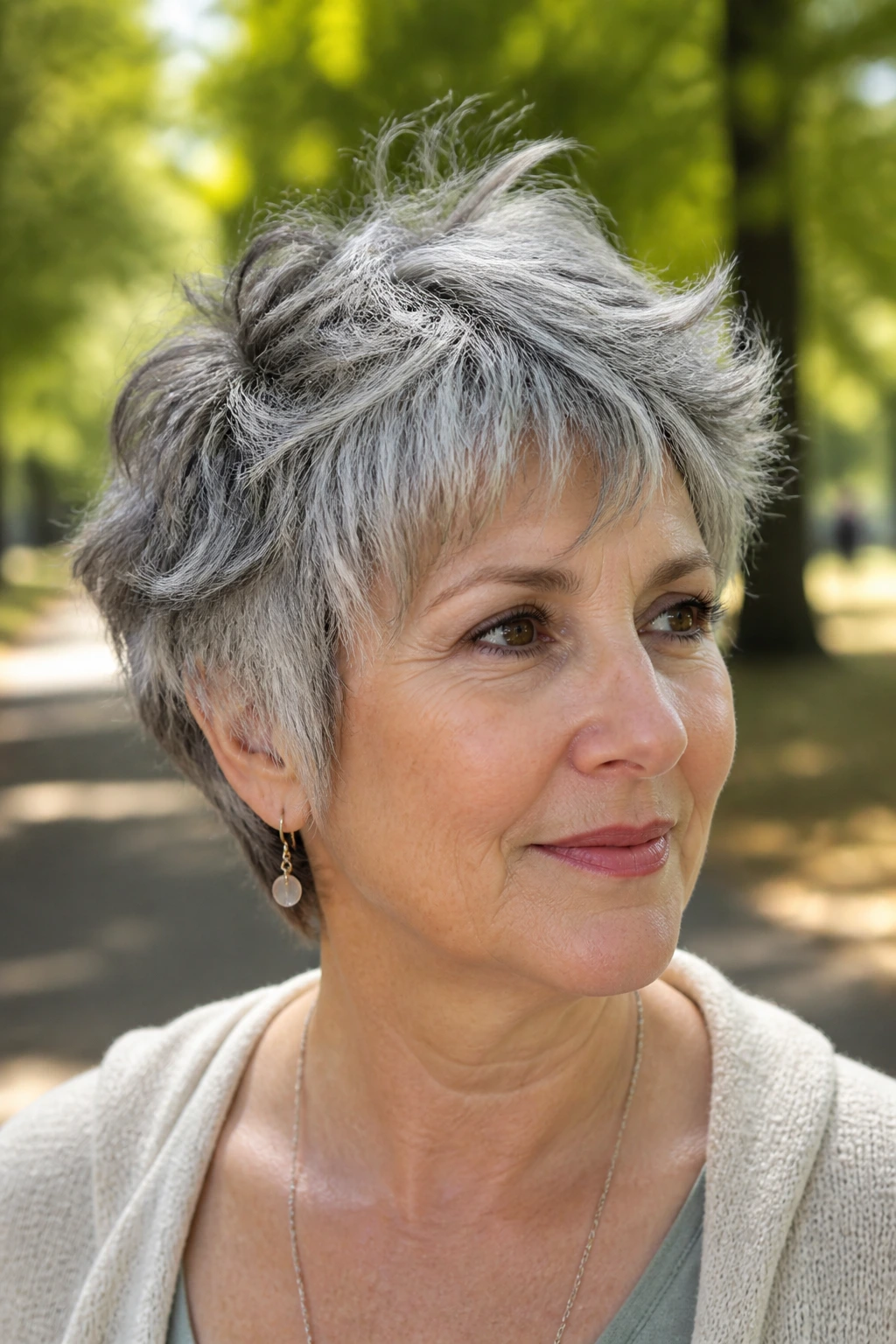
This one belongs to the people who hate stiff hair. A shaggy pixie uses airy layers to keep the crown moving, which helps gray hair avoid that fixed, helmet-like shape that can happen with a blunt crop. On a heart-shaped face, the broken layers keep the eye moving instead of sitting on the forehead.
The best part is the looseness. Gray hair often has enough personality on its own, and a shaggy pixie lets that texture breathe. If your hair waves a little, even better. Let the layers dry naturally, then pinch a few strands with a tiny bit of paste so the ends separate.
Styling note
Do not overbrush this one. You’ll iron the shape flat and the cut will lose its point. Fingers are better than a brush once the hair is dry. A little mess is the whole appeal.
13. Sleek Sculpted Pixie with Side Tuck

A sleek pixie can be a smart choice if your gray hair is naturally straight or likes to lie close to the head. The side tuck clears one side of the face, the top keeps a clean sweep, and the shape looks deliberate from every angle. On a heart-shaped face, that side tuck creates the diagonal you want.
This cut works because it uses restraint. No big volume, no choppy over-texturing, no trying too hard. A light serum, a blow-dryer with a nozzle, and a comb can get you there fast. It also plays nicely with earrings and glasses, which matters more in real life than most salon photos admit.
If your gray hair tends to frizz at the ends, keep the length just long enough to tuck. Too short and it will kick out; too long and the tuck gets bulky. There’s a narrow sweet spot here.
14. Platinum Spiky Pixie with Gentle Height
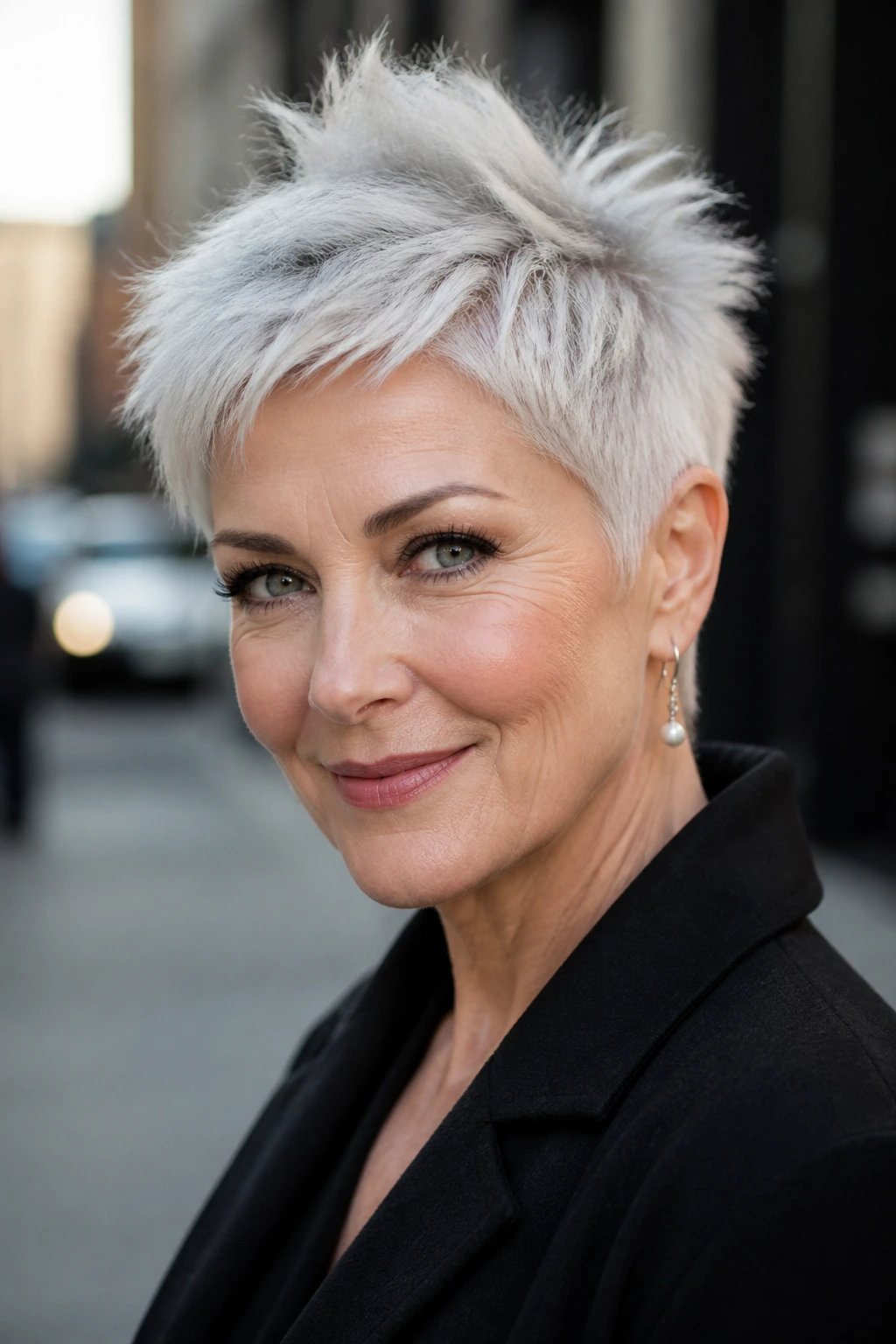
Spiky pixies can go wrong fast. Too much height, and the forehead looks wider; too much product, and gray hair goes crunchy. But with gentle height and soft sides, this cut can look lively without turning harsh.
The point is not a punk spike. The point is lift. A little root volume at the crown and a few separated tips at the top give the silver dimension, especially if the color is a bright white or icy platinum. On a heart-shaped face, I’d keep the sides close and the temples soft so the height stays centered.
This style suits people who like to see a bit of edge in the mirror. If you wear it with a matte finish, it reads modern and light. If you load it with gel, it looks older and stiffer than it needs to.
15. Rounded Pixie with Side Volume
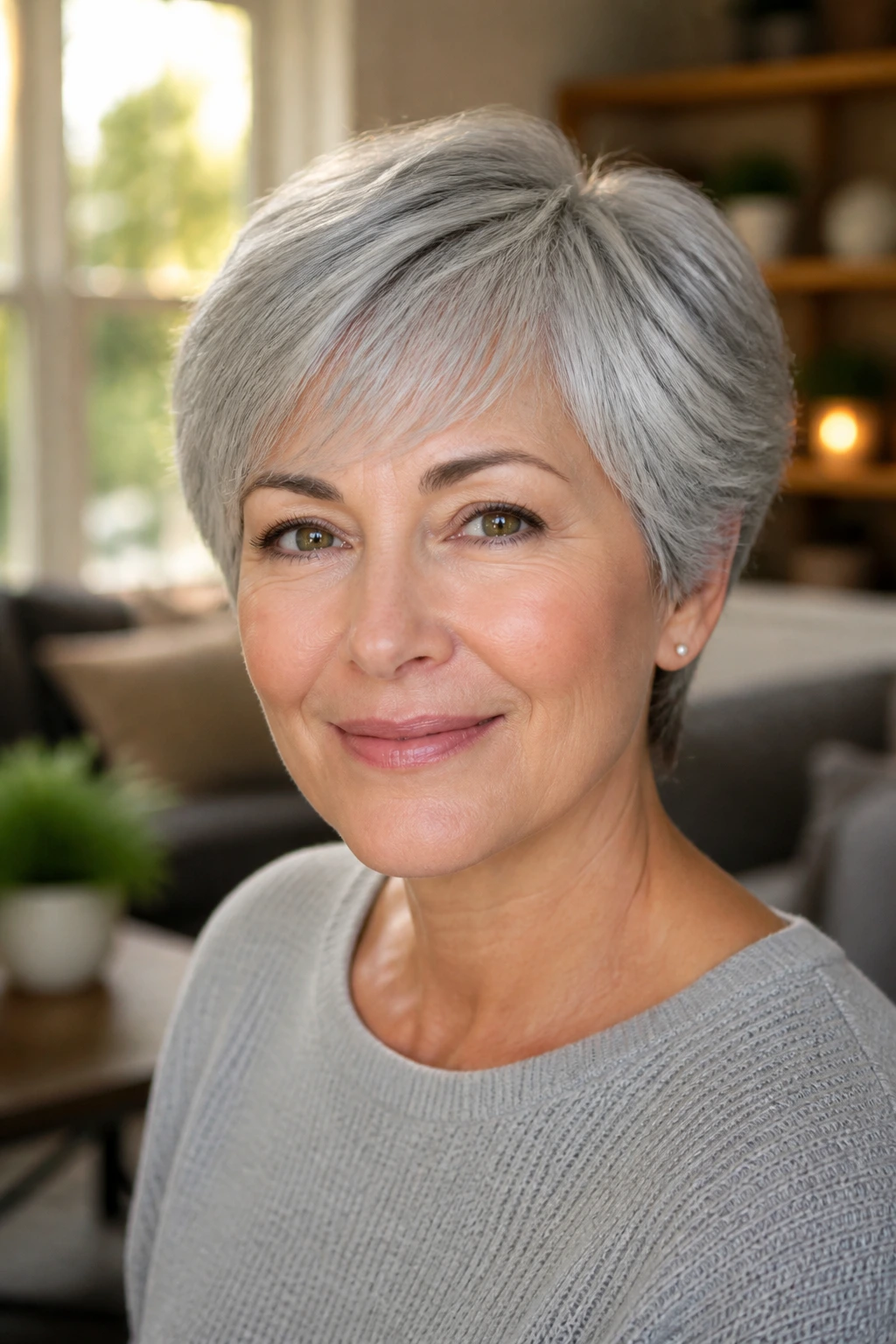
Most people think they need height on top. Often they need width at the sides instead. A rounded pixie builds a little fullness around the ears and upper cheek area, which balances a narrow chin and brings harmony back to a heart-shaped face.
That side volume can be subtle. Think of it as a soft curve, not a puff. Gray hair that’s fine or medium in density does well with this shape because the curve gives the illusion of thickness without demanding a lot of product. A round brush and a low heat setting are enough.
I like this version for people who want their face to look softer, not sharper. It has a gentler feel than the undercut or spiky looks, and that softness is a strength. Not every pixie needs to look daring.
16. Ear-Grazing Pixie with Longer Top Layers
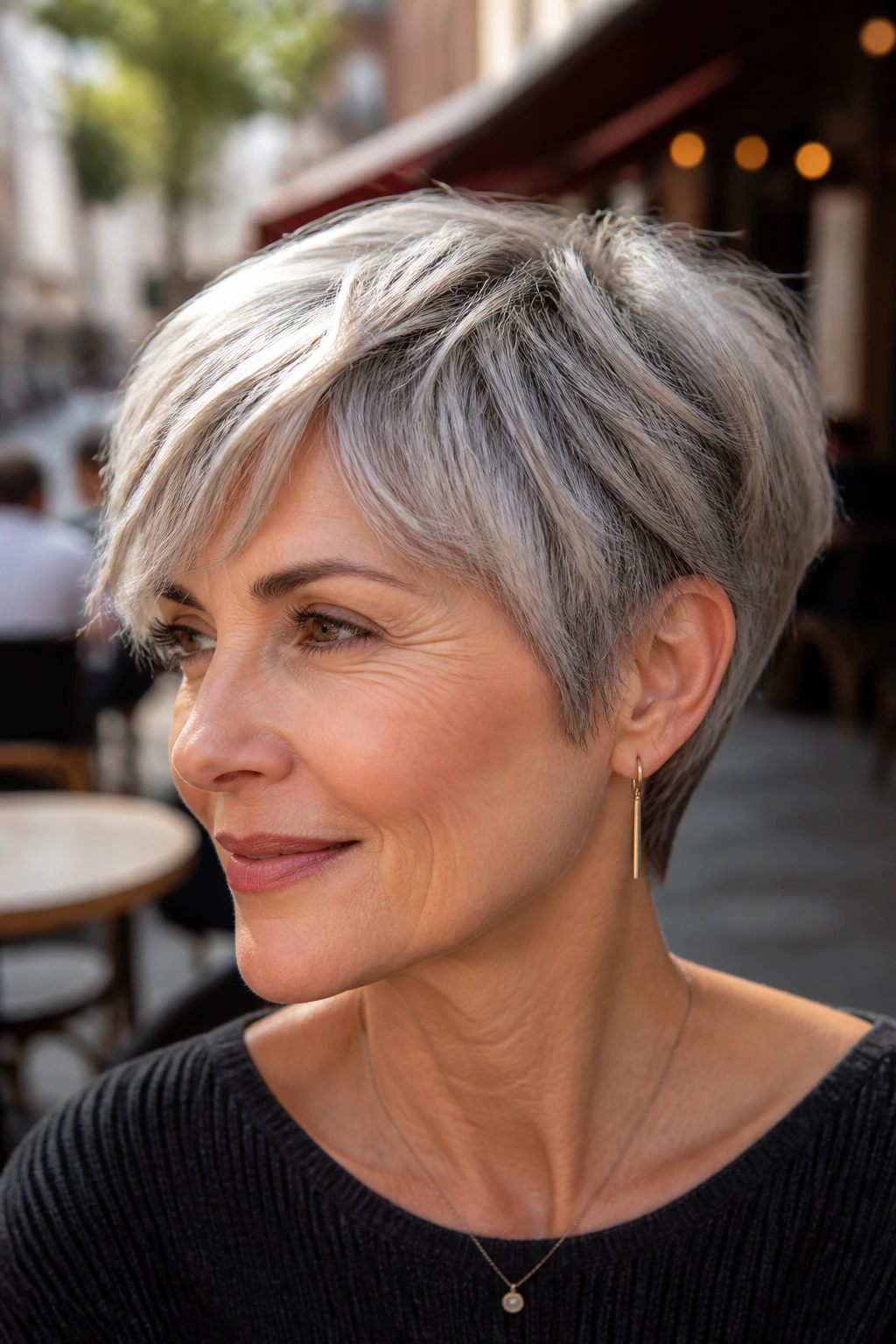
This is one of those cuts that looks chic without looking busy. The hair grazes the tops of the ears, the top layers stay longer, and the whole thing can be tucked, flipped, or brushed forward depending on your mood. On a heart-shaped face, the longer top helps the forehead, while the ear-grazing sides keep the lower face from getting lost.
The shape also works well on gray hair with a little natural bend. The ear line gives the cut a feminine outline, and the top layers stop it from feeling flat. I’d call this a quiet workhorse of a pixie. It behaves. It also grows out with less drama than something heavily shaved.
Best for
- Women who want a softer pixie, not a severe crop
- Hair that needs a little extra side coverage
- People who wear small hoops or studs and want the cut to frame them
- Anyone moving away from a bob but not ready for a micro crop
17. Layered Crop with a Curtain Fringe
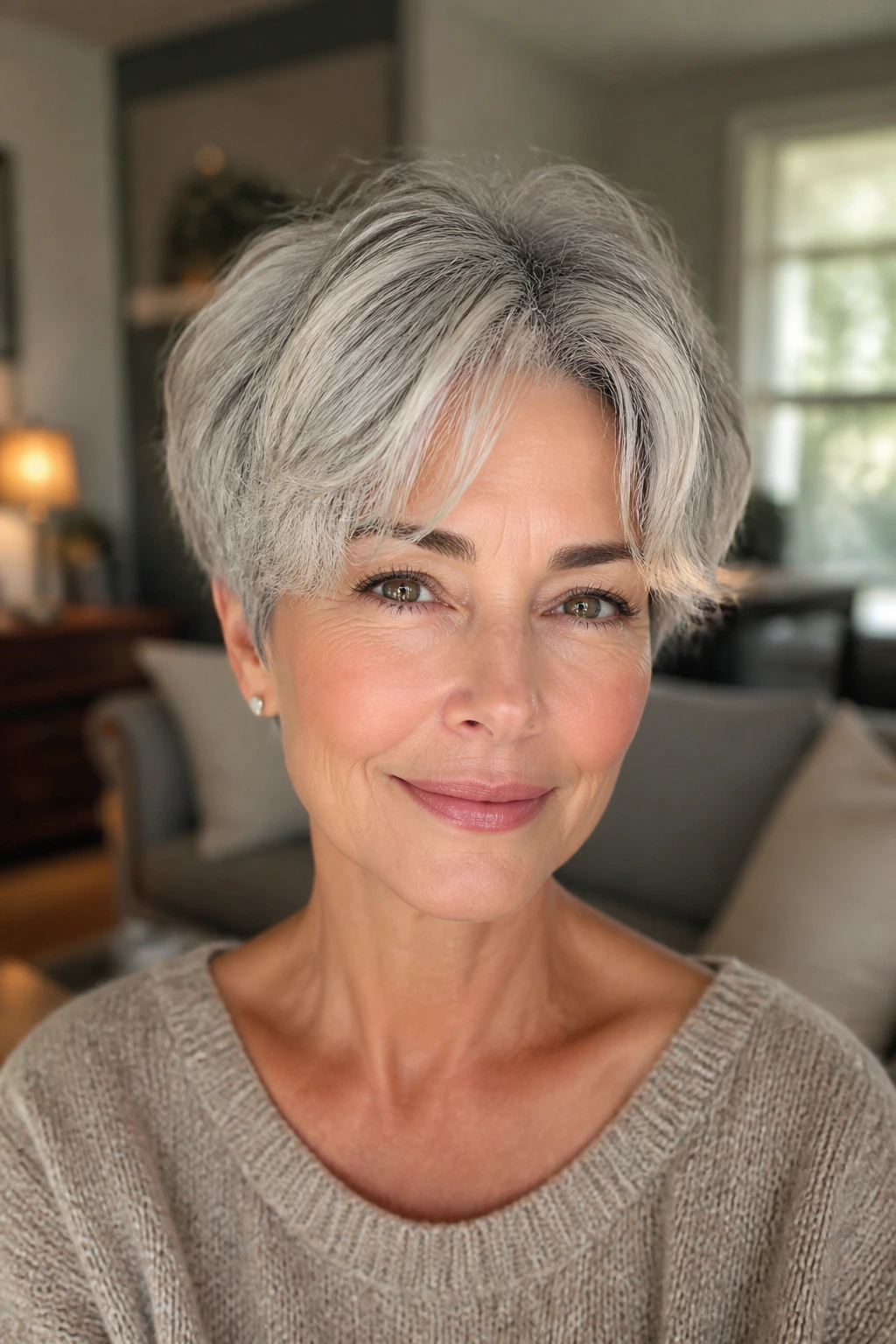
A curtain fringe on a short crop sounds a little unexpected, which is why it works. The fringe splits gently in the middle, opens the forehead in a soft way, and creates a little face-framing movement that a heart-shaped face can use well. It’s especially nice if your silver hair has a bit of wave.
The layers need to be light. A thick curtain fringe on gray hair can collapse into the eyes or separate awkwardly. But a narrow, airy split fringe gives you the forehead-softening effect without boxing the face in. It’s a good option if you want the cut to feel current without leaning too hard into trend language.
This is one I’d recommend to someone who likes the idea of a pixie but still wants a touch of romantic softness around the brow. It has a little more charm than the sharper cuts.
18. Wavy Silver Pixie with Piecey Ends
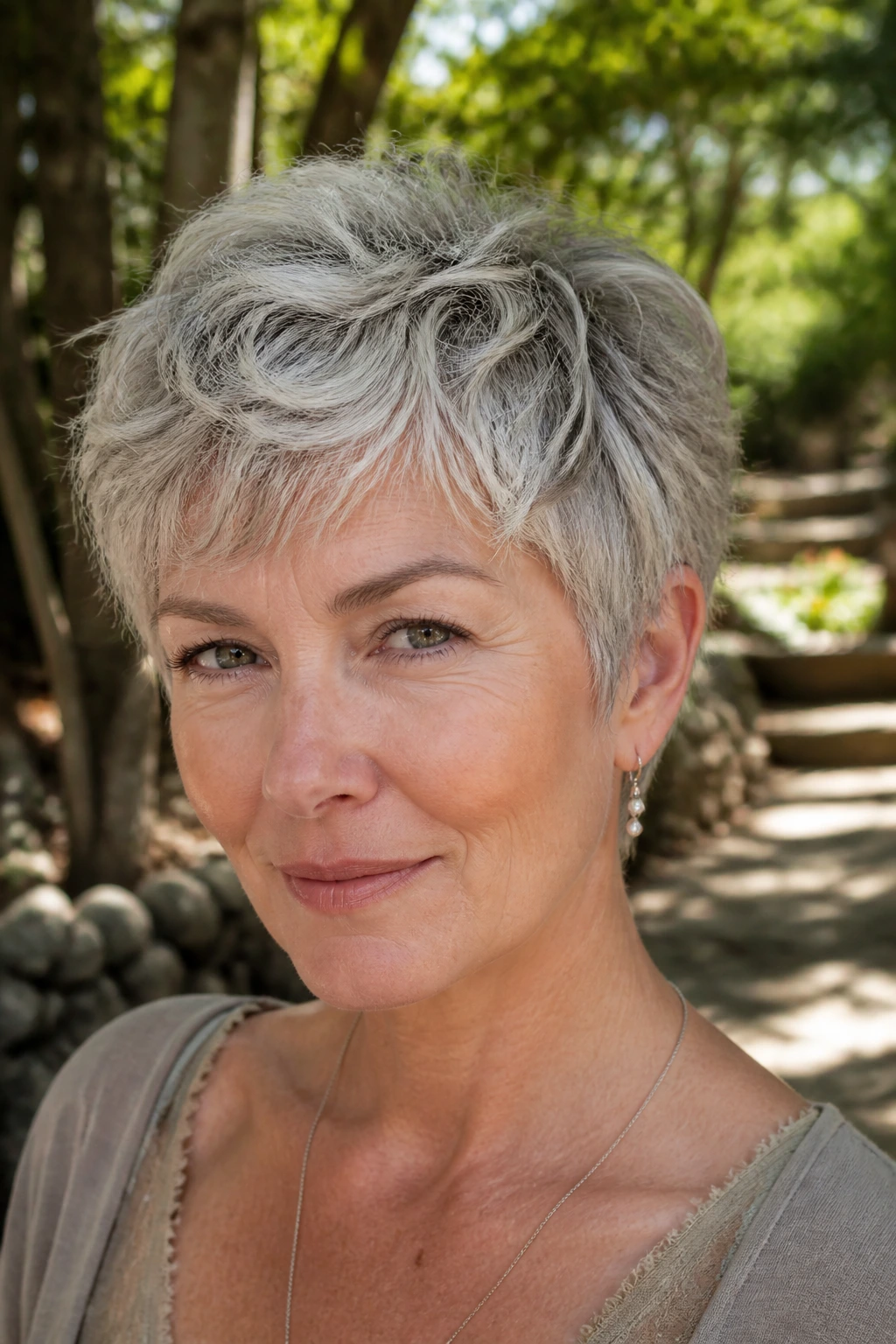
If your gray hair already bends, do not spend all your time trying to flatten it. A wavy pixie with piecey ends works with the natural wave instead of cutting it out. On a heart-shaped face, the trick is to keep the top airy and the sides close enough that the face doesn’t widen too much at the cheeks.
The piecey ends keep the wave from turning helmet-like. A small amount of styling cream, scrunched in while the hair is damp, usually beats heavy brushing. I like this on silver hair because the texture reads clearly in daylight, and clear texture is half the appeal of a short cut.
The more I see this shape, the more I think gray wave should be celebrated, not ironed into obedience. It’s livelier that way.
19. Glasses-Friendly Salt-and-Pepper Pixie

Glasses change the math. The frames already sit across the upper third of the face, so the fringe and temples need to cooperate instead of competing. A glasses-friendly pixie keeps the fringe light enough to clear the frames and the sides clean enough that nothing bunches behind the temples.
Salt-and-pepper color makes this shape especially interesting. The mix of gray, white, and darker strands gives the cut depth, and a neat pixie lets that pattern show instead of hiding it under too much texture. On a heart-shaped face, a tidy side sweep keeps the forehead balanced while the frames anchor the look.
I’d avoid a bang that lands right on the top of the glasses. That gets annoying fast. A little lift or a side drift is much easier to live with.
20. Feminine Tapered Pixie with Swooped Bangs
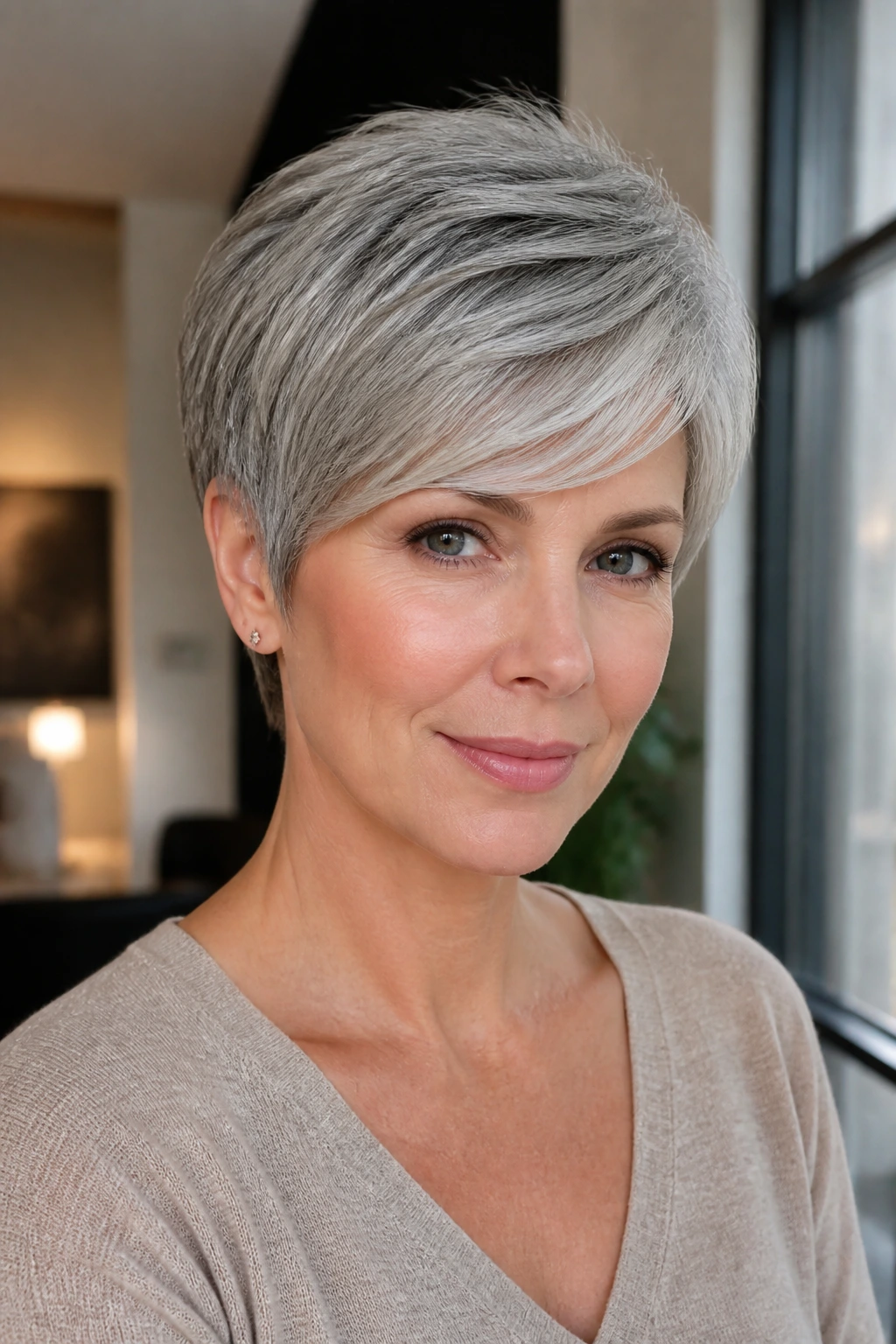
This is the cut I’d hand to someone who wants softness first, but still wants structure. The nape is tapered, the bangs swoop across the forehead, and the top has enough length to move. On a heart-shaped face, that swoop does a lot of visual work, carrying the eye diagonally and reducing the width of the upper face.
Gray hair loves this shape when it has a bit of shine. The tapered back keeps the silhouette neat, while the swooped bangs make the whole look feel less abrupt than a micro crop. It’s polished without being stiff.
If you like a cut that looks tidy with minimal effort, this is a strong choice. It also grows out kindly, which is the sort of thing you appreciate three weeks after a salon visit.
Small Tweaks That Change the Whole Look
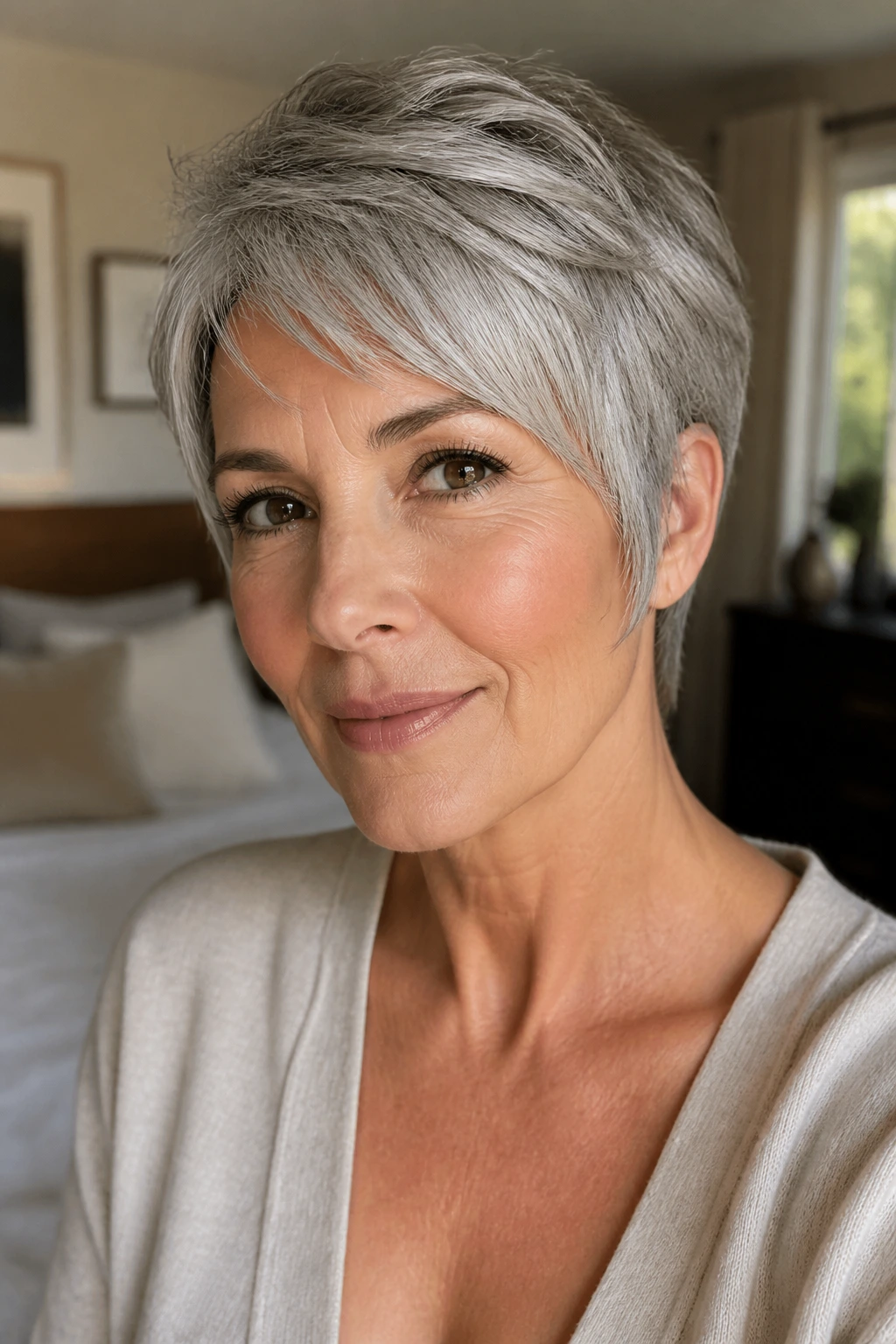
Fringe control: If your forehead feels wide, ask for longer temple pieces or a side-swept fringe that starts at the brow and drifts toward the cheekbone. That one detail changes the balance more than a lot of people expect.
Texture boost: Gray hair can go limp at the roots and puffy at the ends. A light volumizing mousse at the crown plus a pea-sized dab of paste on the ends keeps the cut separated without turning it crunchy.
Color play: Silver highlights, brighter white streaks, or a soft salt-and-pepper blend all change how the cut reads. A sharper haircut can handle a brighter silver; a softer, feathered cut usually suits mixed tones better.
Heat-saving trick: If your hair is coarse, rough-dry it to about 80 percent first, then finish with a brush only where the shape needs help. Full round-brush styling from soaking wet hair usually creates more fluff than control.
Ask for the shape, not the length: “Short” doesn’t tell a stylist much. Say you want softness at the temples, less bulk at the crown, and a tapered nape, then show where you want the longest pieces to land.
The Mistakes That Break the Balance
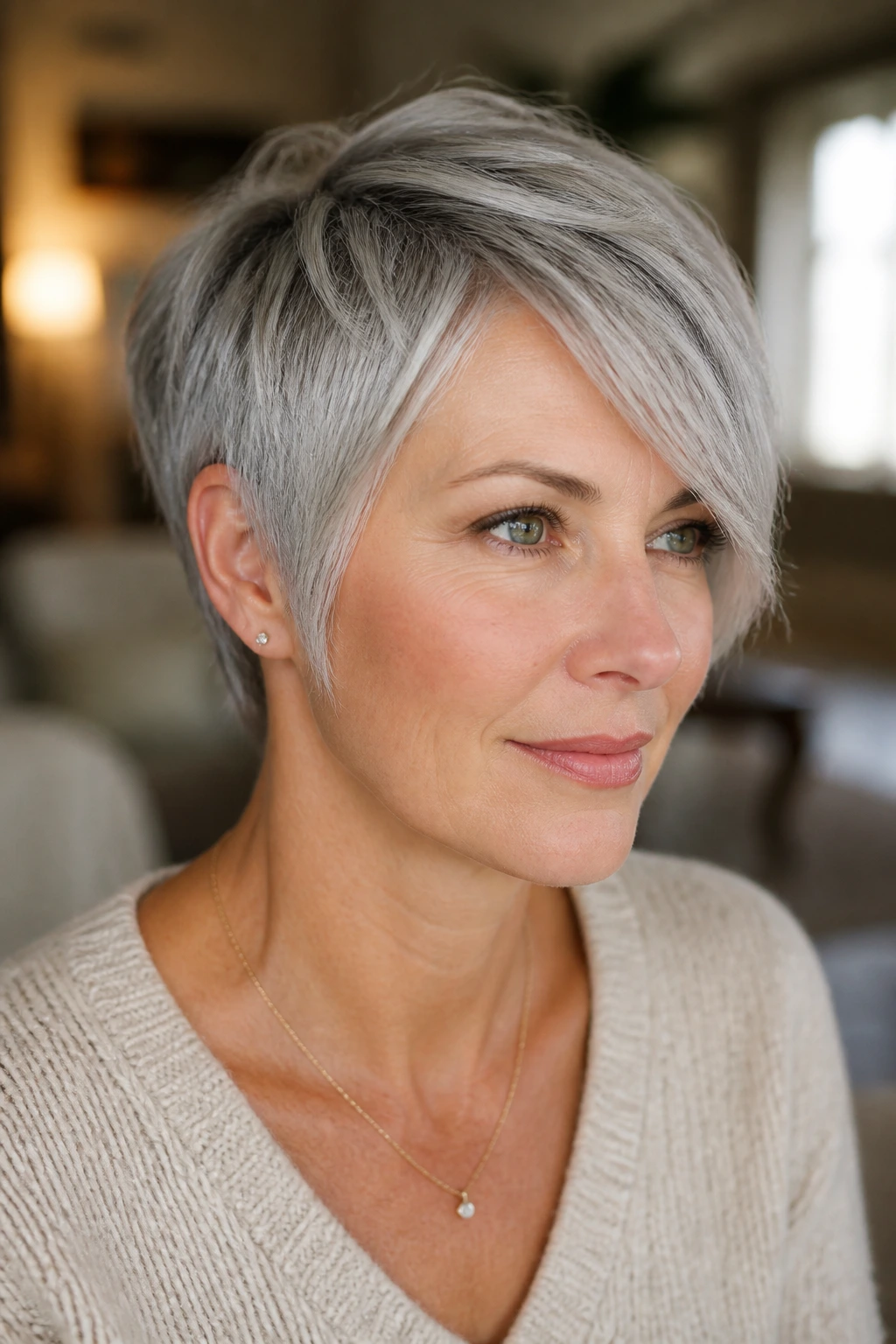
The biggest mistake is piling too much height on the crown. On a heart-shaped face, that can make the forehead feel even wider and throw the whole shape off. The fix is simple: keep the lift controlled, not sky-high, and leave some softness at the sides.
Another common miss is a blunt fringe cut too short. On gray hair, blunt lines can look harsh fast, especially if the strands are dry or wiry. A softer, broken bang or a side sweep usually looks better and grows out more gracefully.
Over-thinning is another trap. When the ends are razor-light, gray hair can frizz and separate in awkward little hooks. Ask for texture, yes, but not so much that the cut loses its body.
Skipping trims is the quiet killer. Pixies don’t forgive a grown-out nape as kindly as longer cuts do. Once the back starts to swell, the whole outline loses its shape.
Other Ways to Wear the Same Idea
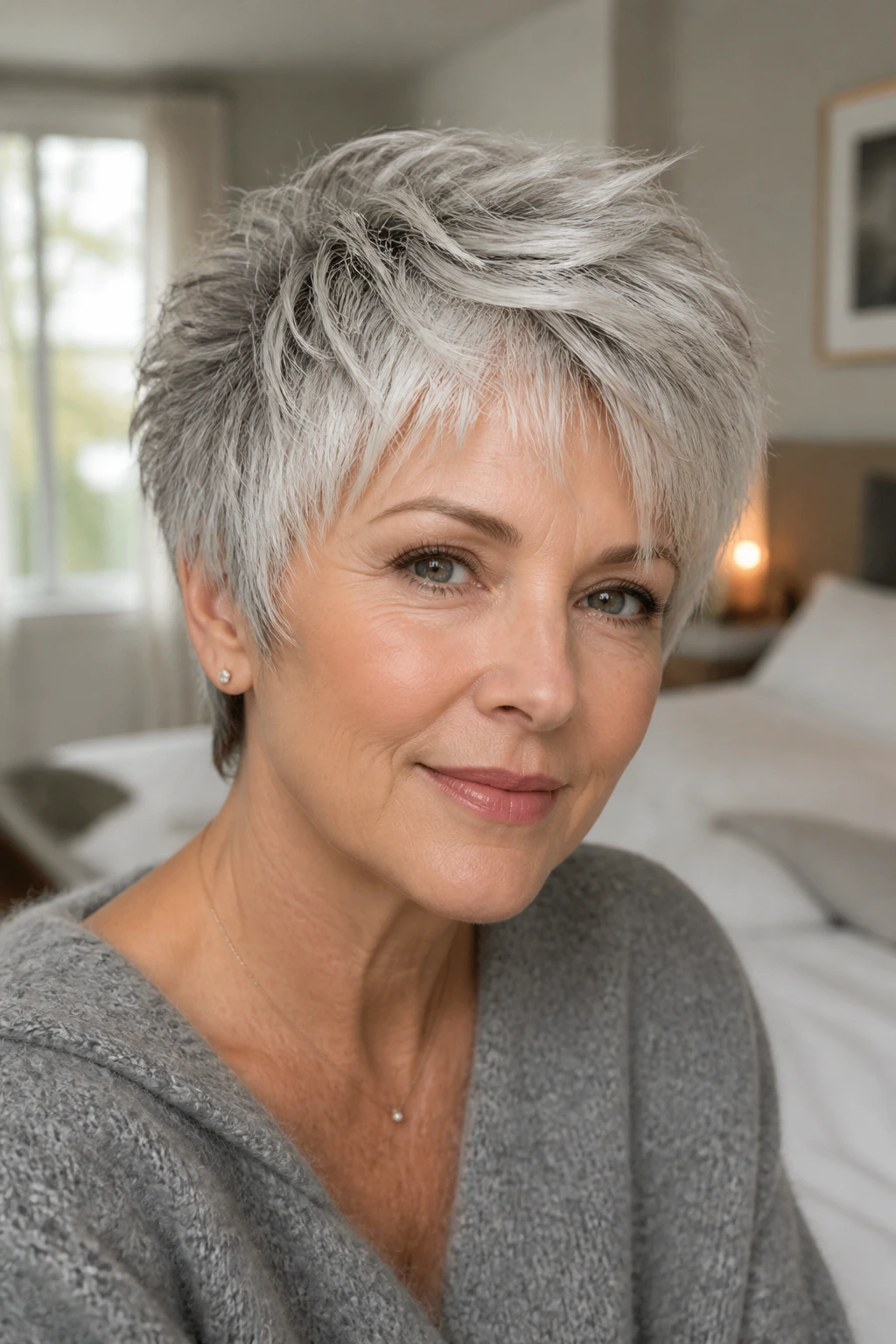
Soft Air-Dry Pixie: Keep the cut feathered and let the natural texture do most of the work. This suits gray hair that bends on its own and doesn’t need much heat.
Sharp Silver Crop: Go cleaner at the sides and keep the top neat for a more polished finish. This works well if your hair is straight and you like a crisp outline.
Curly Crown Pixie: Leave the top a little longer for curl spring and trim the sides close enough to protect the heart-shaped balance. It’s a strong choice if your curl pattern is the star.
Grown-Out Pixie Bob: Let the front skim the cheekbones and the back stay tapered. This is the easiest adaptation if you’re moving away from a shorter crop.
Bold Undercut Version: Keep the undercut hidden or visible depending on how much edge you want. The important part is still the same: soft front movement for the face, neat sides where the hair gets bulky.
The Tools That Keep Short Gray Hair Moving
-
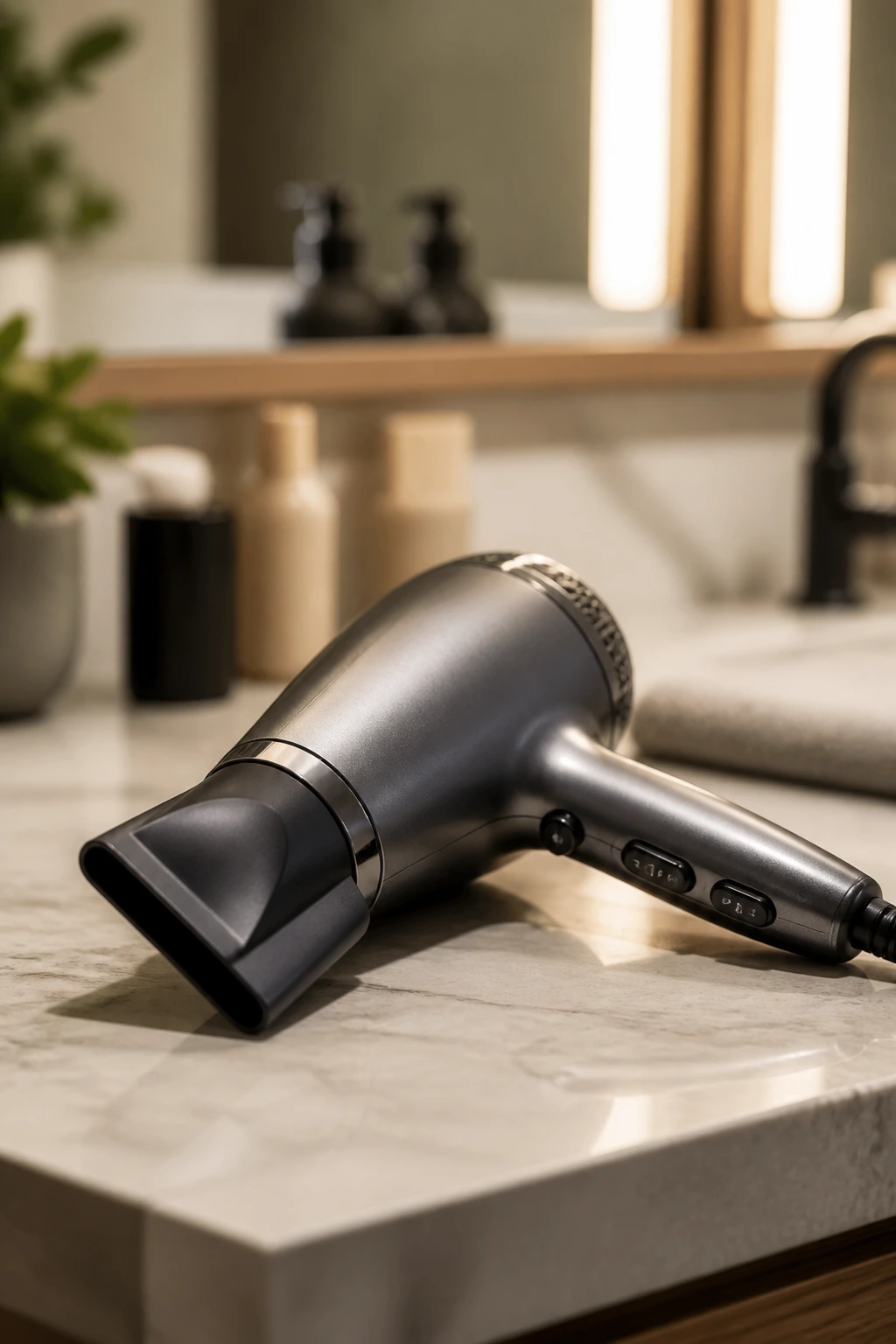
Blow dryer with concentrator nozzle: Directs airflow so the fringe and crown don’t puff out in every direction.
-
Small round brush: Best for lifting the roots and curving a side-swept fringe without overworking the ends.
-
Vent brush or paddle brush: Good for quick rough-drying when you want shape but not salon polish.
-
Lightweight mousse: Adds root support to fine gray hair without the sticky feel of old-school foam.
-
Texture paste or matte cream: Helps piece out choppy or shaggy pixies; a little goes a long way.
-
Flexible-hold hairspray: Keeps the shape in place while still letting the fringe move when you turn your head.
-
Purple shampoo, used sparingly: Useful if your silver picks up yellow warmth from water, sun, or product buildup.
-
Wide-tooth comb: Safer than a brush for curly or wavy gray hair when it’s damp and most fragile.
How to Ask for the Cut So It Actually Flatters You
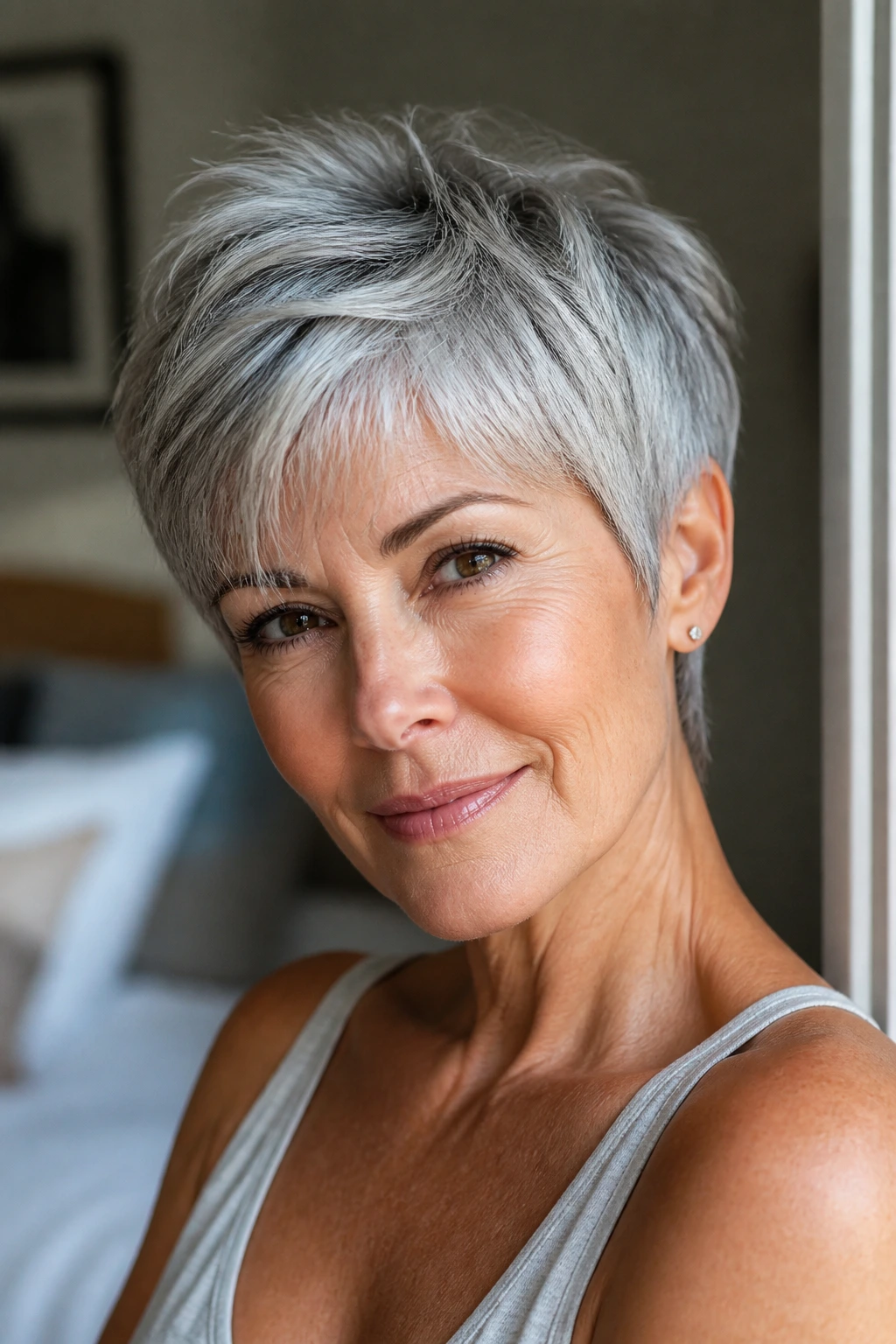
Bring photos, but do not stop there. Say which part of each photo you like: the fringe, the nape, the temple softness, the crown height, or the amount of side volume. That helps a stylist build something useful instead of copying a picture that may belong to a totally different face shape.
Use plain words. “I want less width at the forehead and a softer piece near the cheekbone” tells the story better than “I want something cute.” Cute is a feeling. A stylist needs landmarks.
If your gray hair is coarse, say that up front. If it’s fine and collapses by lunch, say that too. Those two hair types need different weight distribution, and they do not behave the same once they’re cut short.
Keeping the Shape Sharp Between Salon Visits
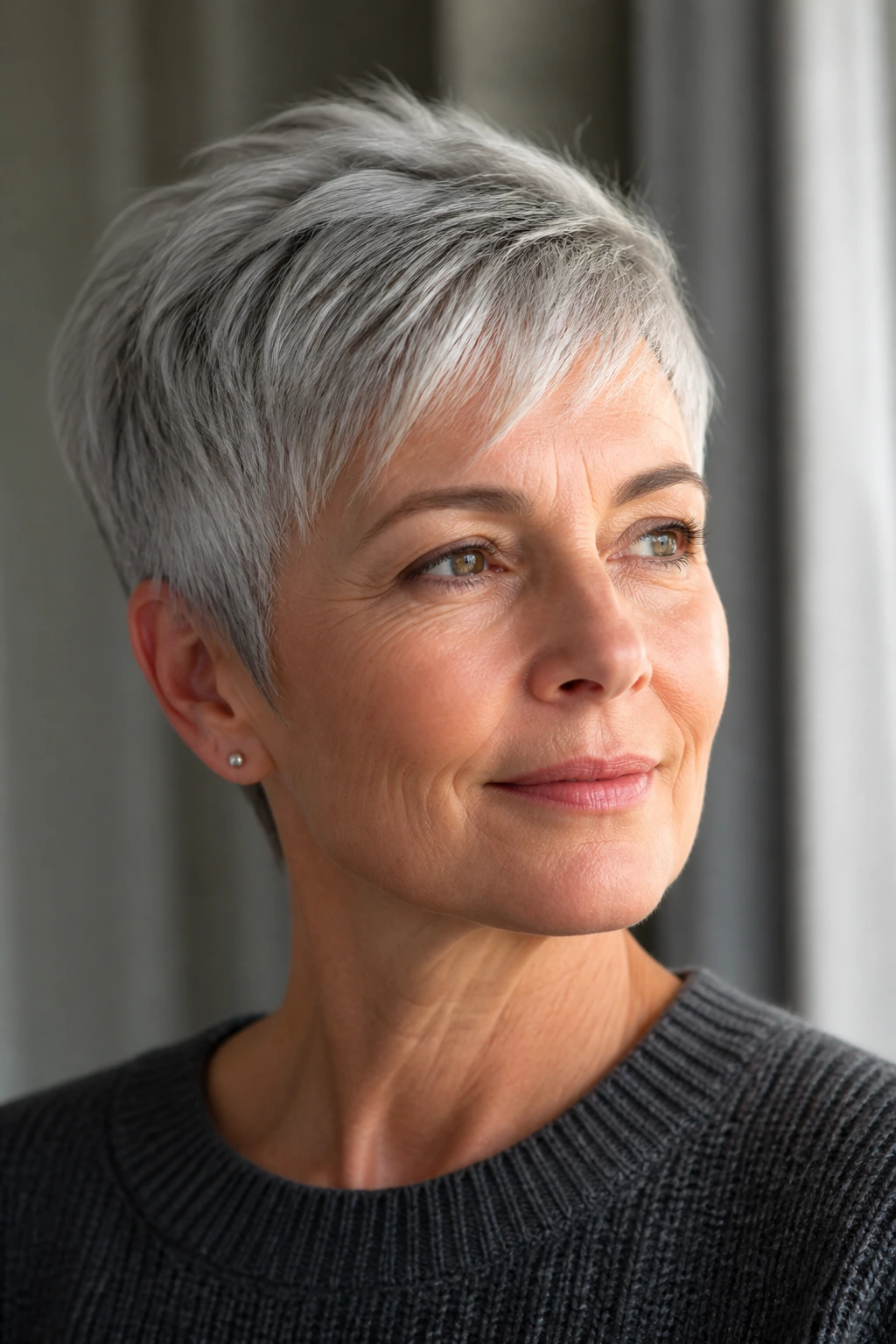
A gray pixie looks best when the outline stays fresh. For a tight crop, plan on a trim every 4 to 6 weeks. If the cut is slightly longer or more feathered, you can sometimes stretch that to 6 to 8 weeks, but the nape and sideburns will tell on you first.
Washing rhythm matters too. Gray hair often does better with less frequent shampooing and more careful conditioning at the ends. If the scalp is oily, wash more often; if the hair is dry and fluffy, shift to a gentler cleanser and use conditioner only where the hair needs it. That alone can make the cut sit better.
Purple shampoo is useful, but it is not something I’d reach for every wash. Once every 1 to 2 weeks is enough for most people unless the silver is pulling yellow from hard water. Too much can leave a chalky cast, and nobody needs that.
Sleep can mess with a pixie more than people expect. A silk or satin pillowcase reduces friction, which helps the crown and fringe keep their shape. If the top flattens overnight, a quick mist of water and a finger-dry with a blow dryer usually brings it back in under 3 minutes.
Frequently Asked Questions
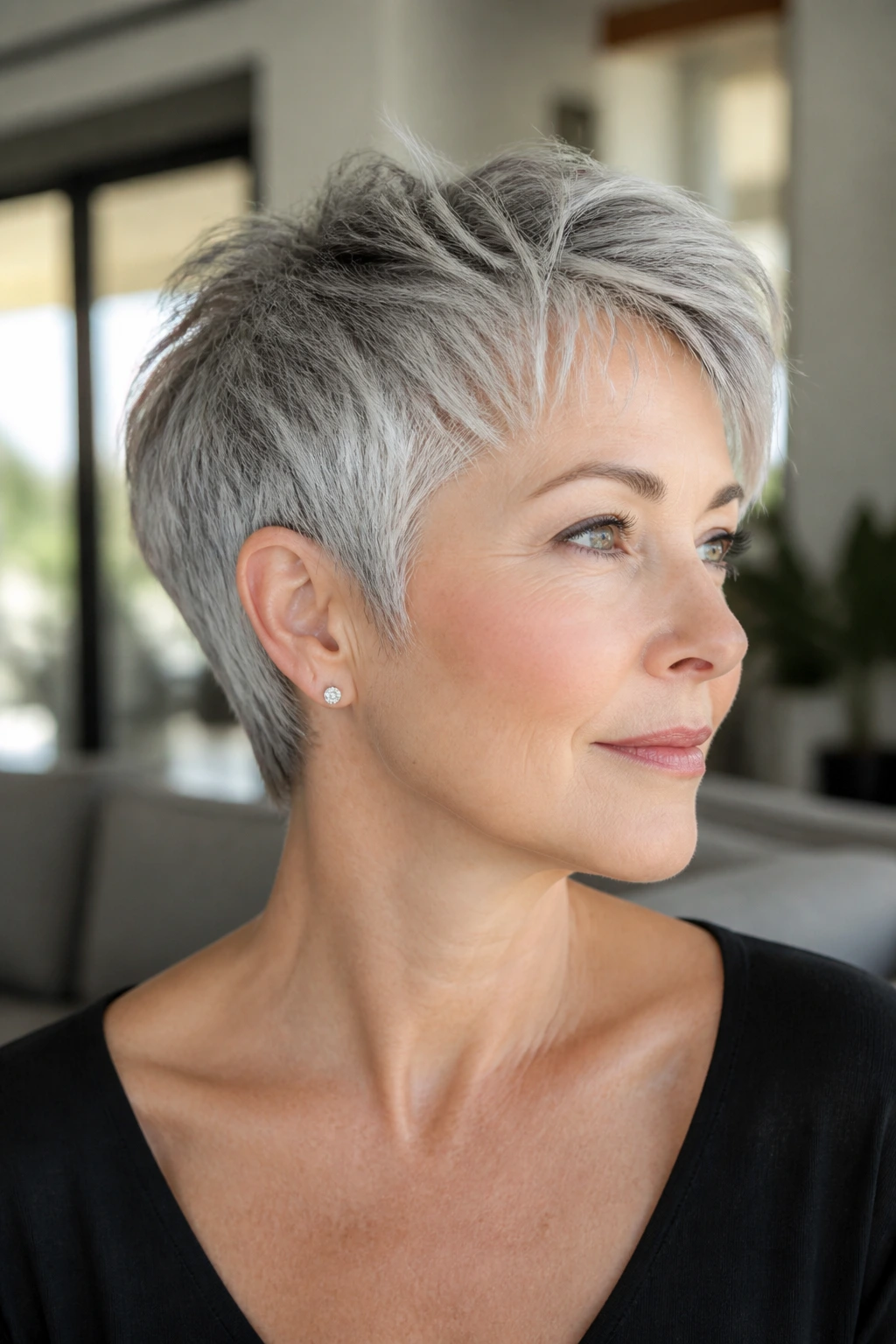
What makes a pixie flattering on a heart-shaped face?
The best versions keep the forehead from looking too wide and avoid adding all the volume at the crown. Side-swept fringe, temple softness, and a little weight near the jaw usually create the nicest balance.
Should gray hair be cut shorter or longer in a pixie?
It depends on texture more than age or color. Coarse gray hair often behaves better with a bit more length on top so it can be directed; fine gray hair may need shorter, layered sections to avoid lying flat.
Can coarse gray hair work in a pixie without looking puffy?
Yes, if the cut removes bulk in the right places. Ask for tapering at the nape, controlled layering through the crown, and softness at the temples rather than heavy texture all over.
Do bangs make a heart-shaped face look better or worse?
They can do either. A wispy or side-swept fringe usually helps by softening the forehead, while a blunt, super-short bang can exaggerate width if the face already has a broad upper third.
How often should a gray pixie be trimmed?
Shorter crops usually need reshaping every 4 to 6 weeks. If the style has more length and feathering, you might stretch it a little longer, but once the nape loses its taper, the whole cut starts to feel unkempt.
Is purple shampoo necessary for silver hair?
No, but it can help if your gray goes yellow from sun, water, or product buildup. Use it sparingly; too much can leave the hair flat or slightly dull, which is the opposite of what silver hair needs.
What if my hair is fine and flat at the crown?
Choose a pixie with root lift, not one with too much thinning. A small amount of mousse at the roots and a layered top cut can give the crown enough support without making the ends disappear.
Can I grow a pixie out without looking awkward?
Yes, if the initial shape has a soft fringe and a tapered nape. Those two things are what make the grow-out look intentional instead of lopsided.
The Shape That Lets the Silver Do Its Job
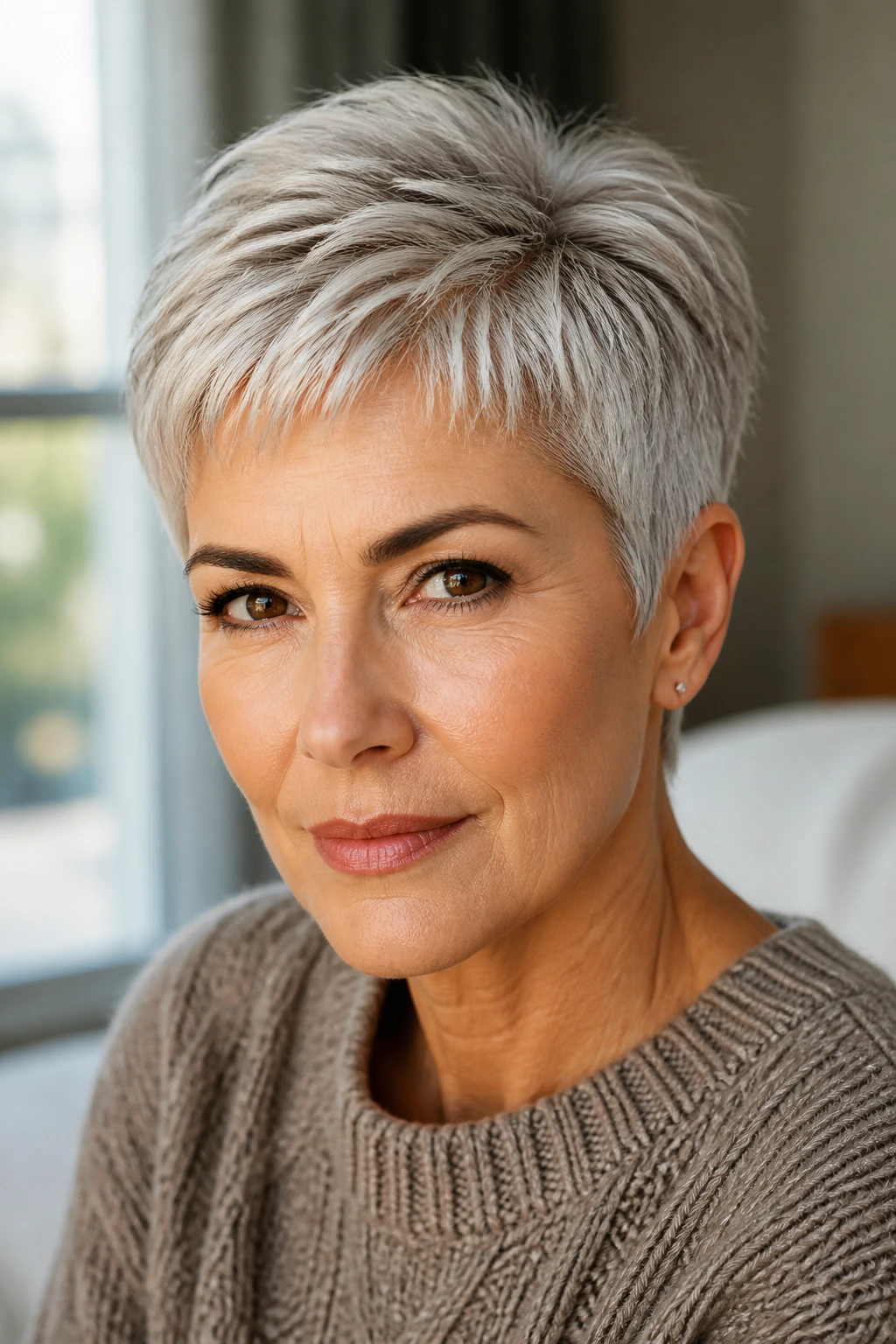
A good pixie on gray hair does not hide the color, and it does not fight the face. It gives the forehead less power, gives the jaw a little help, and keeps the silver moving instead of sitting there like a helmet. That balance is the whole trick.
I’d choose softness over severity almost every time with a heart-shaped face. Leave a little room at the temples, keep the crown under control, and let the fringe land where it can do actual work. That’s the part most salon photos miss, and the part that makes the cut worth living with.
The best pixie is the one that still looks right when you’ve had a long day, not just when you step out of the chair. If the shape holds in daylight and the silver still feels like yours, you’re in the right neighborhood.