



A round face doesn’t need camouflage. It needs structure.
Short hairstyles for men and round faces work when they do two jobs at once: they pull the eye upward and keep the width from spilling out at the temples and cheeks. If the sides puff out or the fringe lands in a straight line across the forehead, the face reads wider. If the top has lift, direction, or a little broken texture, the whole shape changes fast.
That’s why some short cuts look sharp on one guy and oddly soft on another. The haircut itself may be fine. The proportions are off. A round face usually has similar width through the cheekbones and jaw with softer corners, so the trick is not to chase length for its own sake. It’s to create angles, exposed skin at the sides, and a stronger vertical line where the eye lands first.
A short beard can help. So can a clean temple fade or a side part that sits a little off-center. But the real difference comes from the silhouette, not the hype around the cut name. Get the shape right and even a simple crew cut starts looking deliberate.
Why These Cuts Work for Round Faces
- Height beats bulk: A little lift at the front or crown changes the whole outline, while extra width at the sides makes a round face look wider than it is.
- Tight sides matter more than most people think: A fade or taper exposes the temple and ear area, which gives the face cleaner edges.
- Texture breaks up the circle: Choppy ends, piecey fringe, and finger-styled movement keep the haircut from reading like one smooth dome.
- Short can still be sharp: You do not need a long top to add shape; 1 to 3 inches, styled the right way, is usually enough.
- Barber-friendly cuts age better: These styles grow out in a way that still looks decent for 2 to 4 weeks, which matters if you hate constant maintenance.
- They work with a beard or without one: Some faces use facial hair to add jawline definition; others look cleaner with a close shave and stronger hair shape on top.
1. Textured Crop with a Mid Fade

The textured crop with a mid fade is one of the easiest ways to give a round face more line and less softness. Keep the top around 1.5 to 2 inches, let the fringe sit forward in broken pieces, and take the sides tight enough that the ear line shows. The point is not severity. It’s shape.
Why It Works on a Round Face
The crop gives you a flat, controlled top line while the fade removes bulk at the widest part of the head. That matters. If the hair grows outward at the temples, your face looks fuller; if it drops straight down or gets textured forward, the eye reads the haircut as longer and narrower.
A barber can cut this with scissors on top and a mid fade that starts around the temple area. Ask for point cutting or razor texture through the front so the fringe doesn’t form one blunt shelf. A little unevenness is the whole trick here. Clean edges, rough top.
Best for: Straight to slightly wavy hair.
Style it with: A pea-sized amount of matte clay worked into damp hair, then pushed forward and pinched at the ends.
Skip if: Your fringe naturally splits and refuses to sit forward. In that case, another cut below may behave better.
2. Ivy League with a Soft Side Part

If you want a cut that looks tidy without flattening your face, the Ivy League is hard to beat. Keep the top long enough to sweep, usually 1.5 to 2.5 inches, and ask for a soft side part rather than a hard, shaved line. The sides should taper close, not puff out around the ears.
The reason this works is simple: it gives the face a diagonal line. Round faces need angles, even gentle ones, and the side part does that without turning the haircut into a formal office helmet. A lot of guys overdo the shine here. Don’t. A matte cream or light paste keeps the top movable and avoids that slick, flat look that can emphasize width.
This cut also plays well with glasses and light stubble. The part, the taper, and the frame of the glasses work together instead of fighting each other. It’s one of the cleanest short hairstyles for men and round faces when you want a grown-up finish that still feels easy.
3. French Crop with a Choppy Fringe

Why does a French crop work on a round face when a blunt fringe can be such a disaster? Because the choppy version breaks the forehead line into little pieces instead of drawing one obvious horizontal stripe across the face. That stripe is what makes everything look wider.
Keep the fringe just above the brows or let it sit slightly over them, but have your barber texture the front so the ends are irregular. The sides should stay tight with a low or mid fade, and the top should keep enough density to look like hair, not fuzz. On thick hair, that usually means asking for weight removed from the interior so the front doesn’t sit like a block.
How to Ask for It
Bring a photo with a fringe that looks soft, not bowl-shaped. Say you want “short sides, textured top, and a broken fringe that doesn’t sit heavy on the forehead.” That sentence matters. It keeps the barber away from the blunt, heavy crop that can make a round face look shorter.
A French crop also hides a high forehead or a slightly uneven hairline without turning into a long fringe situation. Clean. Controlled. No puff.
4. Buzz Cut with a Skin Fade

If your morning routine is already busy, the buzz cut with a skin fade gets to the point fast. But here’s the catch: a one-length buzz all over can make a round face look even rounder. The fix is a fade. Tight sides. Slightly more length on top if your barber knows what they’re doing.
A #2 or #3 on top with a skin fade at the sides usually gives enough contrast to keep the head from looking like one smooth shape. That little difference is doing the heavy lifting. On a round face, contrast creates structure. Without it, the cut can feel too uniform.
- Best version: Slightly longer on top than the crown.
- Best for: Thick hair, active routines, or anyone who wants almost no styling time.
- Watch for: A fade that climbs too high on fine hair. That can expose too much scalp and leave the top looking isolated.
The buzz cut looks especially good if your beard line is clean, because the face gets definition from more than one place. A sharp neckline and a tidy temple fade keep the whole thing from drifting into chaos.
5. Crew Cut with Tapered Sides

The crew cut has lasted forever for a reason. It is short enough to be practical and shaped enough to do real work on a round face. Keep the front a little longer than the crown — usually around 1 to 1.5 inches in front and a touch shorter as you move back — then taper the sides closely so the width at the temples drops off.
This is one of those cuts that looks plain in a barbershop mirror and better in real life. The subtle front lift matters. So does the gradual taper. No harsh shelf, no mushroom outline, no heavy side volume.
A crew cut also behaves well when your hair gets a little lazy by midday. That’s useful. If your hair tends to collapse, a small amount of matte paste worked through dry hair will keep the front from lying flat. If your hair is dense, you may not need product at all. Just towel dry, push the front slightly upward, and go.
6. Short Quiff with a Taper Fade

A short quiff is the haircut for guys who want height without a giant wall of hair. On a round face, that height matters because it pulls the eye upward and breaks the horizontal emphasis at the cheeks. Keep the top around 2 to 3 inches, shorter if your hair is thick and stubborn, and use a taper fade or low fade on the sides so the top stays the focus.
Unlike a full pompadour, the short quiff doesn’t need drama. It needs direction. Blow-dry the front up and slightly back with a vent brush, then finish with a matte paste or lightweight clay. If the hair flops forward, the face loses the line you were trying to build. If the top stands too stiff, it starts looking dated. Soft lift is the sweet spot.
This is a good cut if your hairline is decent and your hair has some natural body. It also works nicely with a short beard, because the beard gives the lower face a little more structure while the quiff lengthens the upper half.
7. Caesar Cut with Texture

A Caesar cut can go bad in a hurry on a round face. The flat, heavy version has a blunt fringe and almost no shape change at the sides. That’s the one to avoid. The textured Caesar is different. It keeps the fringe short but breaks it up so the forehead line doesn’t read like a ruler.
Ask for a short top, usually around 1 inch or a touch more, with the front point-cut into a rough edge. The sides should be tapered tight, and the front should not sit perfectly straight. A slight irregularity — just enough to look casual — keeps the cut from widening the face.
This one is useful if your hairline is receding a little or if you want to keep the forehead covered without going full fringe. It also works on coarse hair because the cut doesn’t depend on smoothness. In fact, the rougher texture often helps. Use a small amount of matte paste, not gel. Gel makes the fringe clump and that clumped line is exactly the kind of thing that can make a round face look more circular.
8. Brush-Up with a Low Fade

Can a short haircut add height without looking overstyled? Yes. The brush-up does exactly that when it’s cut short enough to stay controlled. Keep the top around 2 inches, maybe a little more if your hair is thick, and ask for a low fade that leaves enough weight below the temple to support the shape.
The styling is simple, but the direction matters. Dry the hair upward with a blow dryer while lifting the front with your fingers or a vent brush. Then pinch the ends of the top so it doesn’t form one smooth ridge. You want lift, not a helmet. The low fade keeps the lower sides neat while the brushed-up top creates that vertical line round faces need.
This cut is good for guys who like a modern shape but don’t want a slick finish. It’s also one of the better options if your hair is naturally straight and a little resistant to movement. A matte clay or texture powder can help the front stand without becoming crunchy. Use less than you think. Too much product kills the lift fast.
9. Curly Top with Tight Sides

If your hair curls, do not fight it into a flat style just because the face is round. That’s a losing battle. A curly top with tight sides works because the curl creates natural height and texture on top while the fade or taper removes side bulk where it matters most.
Keep enough length up top — usually 2 to 4 inches, depending on curl tightness — so the curls can stack a little. If they’re cut too short, they puff outward instead of upward. The sides should be clean, usually with a low or mid fade, and the temple area needs to stay neat. That temple line is doing more work than people realize.
- Best for: Wavy to curly hair with decent density.
- Best styling move: A curl cream or light mousse on damp hair, then a diffuser on low heat.
- What to avoid: Heavy gel that turns the curls into one shiny mass.
- Strong bonus: A short beard can echo the texture and make the whole face look more balanced.
A good curly top has movement. Not frizz. Movement. That difference is the whole game.
10. Short Pompadour with a Taper

The short pompadour is a controlled version of height, which is exactly why it works on round faces. A big pompadour can swamp the head if the sides are too full. A short pompadour with a taper keeps the shape crisp. Leave enough length in front — usually 2 to 3 inches — so the hair can sweep up and back, then taper the sides tightly.
The front should rise first, then curve back. If it goes straight back from the hairline, the face can look wider because the top loses its vertical emphasis. Use a round brush if your hair is stubborn, or just a blow dryer and fingers if it already has some memory. Matte cream usually looks better than high-shine pomade here. Shine can make the top look flatter, and flat is not the move.
This cut suits thicker hair and stronger hairlines best. It can be tricky on very fine hair unless you get some help from blow-drying and a light volumizing spray. Still, when it’s cut properly, it gives a round face enough length to change the profile without feeling fussy.
11. Side-Swept Crop with a Hard Part

A side-swept crop gives a round face a diagonal line, and diagonal lines are your friend. A hard part can sharpen that effect, though you do not need to carve the line in if you prefer a softer look. Keep the top around 2 inches and sweep it across the forehead so it lands slightly off-center.
Unlike a centered fringe, this cut breaks symmetry just enough to stop the face from looking like a perfect circle. The side-swept motion also works well with thick hair because it lets the hair lie in one direction instead of bouncing outward. Keep the sides tight with a taper or fade, and do not let the top grow too wide over the temple. That turns a useful cut into a wider one.
This is a strong office haircut if you want polish without a shiny comb-over. Use a medium-hold matte paste and comb once, then mess it up a little with your fingers. That tiny bit of irregularity keeps the cut from looking too formal.
12. Faux Hawk with a Soft Drop Fade

A faux hawk sounds louder than it is. The good version is slim through the sides and a little higher through the center, which is exactly why it flatters a round face. The middle strip pulls the eye upward while the drop fade curves around the head and cuts down on side width.
Keep the top shorter than a true mohawk — often 1.5 to 2.5 inches — and let the center be the tallest point. The sides should not vanish into one giant exposed patch unless your face shape and beard can handle it. A soft drop fade is the smarter choice because it follows the shape of the head instead of drawing a harsh horizontal line.
This cut works best with dense hair that can stand up without falling apart. Style it with a matte paste and pinch the center into soft spikes, not sharp points. Sharp points look dated fast. Soft texture keeps the shape modern and easier to wear.
13. Close Crop with a Line-Up

Is there a clean cut that still gives edge without adding width? The close crop with a line-up says yes. Keep the top short — about an inch or a little less — and let the barber clean the hairline with a subtle line-up rather than a boxy outline. The sides should stay faded low and tight.
What matters here is restraint. A square, overdrawn hairline can make a round face look wider at the forehead. A softer line-up keeps the edges crisp without turning the whole head into a block. The crop itself should be textured enough to avoid a solid cap of hair. If your hair is thick, some interior weight removal helps a lot.
This cut is especially good if you like a sharp, neat look with very little styling. A quick brush forward and a touch of matte product is enough. If your hair grows fast at the temples, expect to clean this one up every 2 to 3 weeks to keep it from blurring.
14. Short Afro with a Temple Fade

For coily hair, the question is not whether a short style can work on a round face. It can. The question is how much shape you keep on top and how clean the sides stay. A short afro with a temple fade does both jobs well.
Keep the top rounded but slightly taller than it is wide. That sounds obvious, but it gets missed constantly. If the sides are left too full, the face gets wider. If the top is flattened, you lose the vertical line that makes the shape work. A temple fade or low taper helps carve away side bulk while leaving the natural texture up top.
Use a moisturizing cream or curl sponge if the hair is short enough for it. The goal is definition, not crunch. A sharp neckline and neat temple area make the haircut look intentional even when the top has plenty of texture. This is one of those cuts where the barber’s outline matters as much as the length.
15. Slick Back Taper with Short Length

The slick back taper works on a round face when the hair is kept short and the sides stay narrow. Let the top sit around 2 to 3 inches, enough to move backward without collapsing, and taper the sides cleanly so the head keeps a slim outline. If the sides get bulky, the slicked-back shape starts reading wide.
This cut is more forgiving on straight or wavy hair than on curls, and it looks best when the top has enough density to stay in place. Use a light pomade or cream with a little hold and a little sheen — not the wet, greasy stuff that makes the scalp show through in ugly patches. Comb the top straight back from a point slightly above the forehead, then stop before the hair lies flat against the crown.
A slick back is not the first cut I’d hand to every round face. Still, when it is short and tight, it can look clean and grown-up without adding width. The key is restraint. Too long, too shiny, too full at the sides — and the whole thing turns heavy.
16. Messy Fringe with a Low Taper

A messy fringe is the friendlier cousin of the blunt crop. It keeps the hair forward, but it doesn’t draw one hard horizontal line across the forehead. That makes it useful for round faces because the fringe creates some coverage while the broken edges keep the face from feeling boxed in.
Keep the fringe around 1.5 to 2 inches, enough to move but not enough to droop into the eyes. The low taper should clean up the neck and sides without making the fade too dramatic. If the fade climbs too high, the contrast can get loud in the wrong way. The messy fringe works because it feels light and a little undone.
This cut is good for fine hair that needs a little help looking fuller. Dry shampoo or a dusting of texture powder at the roots can give the fringe more lift. Then use your fingers, not a comb. A comb tends to flatten the irregularity that makes this haircut work in the first place.
17. High and Tight with a Textured Top

A high and tight can be a brutal haircut or a smart one. On a round face, the smarter version keeps the sides very short and the top short but not bare. That tiny bit of texture on top is what keeps the shape from looking too severe. Without it, the head can read almost coin-shaped.
Keep the top roughly 0.75 to 1.5 inches, depending on your hair density, and texture the front slightly forward or upward. The sides should be clipped tight enough that the temple area is clean. This cut works well for guys who like a sharp, athletic look and do not want to fuss with styling in the morning.
It also pairs well with a beard, especially if the beard has a clean cheek line and a little length at the chin. That extra lower-face structure balances the short top. Use a tiny amount of matte product if the hair stands up too stiffly; otherwise, leave it alone. This cut usually looks best when it’s not trying too hard.
18. Short Comb Over with a Loose Finish

A comb over only looks tired when it’s too neat, too shiny, and too scared to move. Keep the short version loose and it becomes one of the better short hairstyles for men and round faces. The top should stay around 1.5 to 2.5 inches, long enough to sweep, and the part should sit slightly off-center so the hair falls diagonally.
The sides need to be tapered or faded closely, not left puffy. That’s the part people skip, then wonder why the face looks wider. The loose finish matters too. Instead of a hard shell of product, use a light cream or paste and comb the hair just enough to show direction. Then break the line with your fingers so it doesn’t look painted on.
This style fits office settings, dinners, and everything in between. It’s also a good choice if your hair is thinning on top, because the sweep can soften the look without turning into a desperate cover-up. Keep the part soft, the sides clean, and the front lifted just a touch.
Why Height, Taper, and Texture Matter on a Round Face
A round face reads wide first. That’s the basic geometry, and haircuts either fight it or help it. The styles above all share the same logic: they add some vertical line, remove side bulk, and avoid a blunt edge sitting right across the widest part of the face.
Height does not have to mean a tall pompadour. Sometimes it’s just 1 inch of lift at the front. Sometimes it’s a brush-up that stands for 30 seconds after the blow dryer. Small changes matter because the eye is quick. It notices the outer shape before it notices the details.
Taper is the other piece people ignore. A close side without a fade can still look heavy if the hair puffs around the temples. A taper exposes a little skin, narrows the silhouette, and gives the top room to matter. Texture comes last, but it’s the thing that keeps the haircut from going flat and circular.
Round faces also benefit from asymmetry. A side part, a diagonal fringe, a slightly swept top — those little off-center moves stop the haircut from settling into symmetry. Symmetry can be neat. It can also be boxy. Hair does not need to be perfect to look good. It needs the right lines in the right places.
Essential Tools for the Cuts and Daily Styling

- Hair clippers with guards 0, 1, 2, 3, and 4: These let you keep the sides tight and control how much length stays on top.
- Detail trimmer: Useful for necklines, sideburns, and cleaning the edge around the ears between cuts.
- Blow dryer with a nozzle attachment: This is what gives a quiff, brush-up, or pompadour its shape without overloading it with product.
- Vent brush or round brush: A vent brush is quick for lift; a round brush helps guide the front back and up on denser hair.
- Matte clay or paste: The safest styling product for most of these cuts because it adds hold without the greasy shine.
- Light cream or mousse: Good for wavy, curly, or finer hair that needs movement more than grip.
- Sea salt spray: Helps rough up straight hair so the top doesn’t sit flat and wide.
- Hand mirror: Sounds basic. It isn’t. You need one to check the back and the taper line at home.
- Wide-tooth comb: Best for curls or wavy hair that needs direction without being crushed.
- Towel or microfiber towel: Cuts down on frizz when you’re styling damp hair.
How to Ask Your Barber for the Right Shape

The fastest way to get the wrong haircut is to point at a photo and say, “Like this, but shorter.” That sentence leaves too much to guesswork. Instead, describe the shape. Tell the barber you want the sides tight, the top left with enough length to push upward or forward, and the overall silhouette narrower through the temples.
Bring two photos if you can — one from the front and one from the side. A front shot shows the fringe, but the side shot tells the truth about the fade and how much bulk is left above the ear. Mention your styling routine too. If you never use a blow dryer, don’t ask for a quiff that needs one. If you hate product, a textured crop or crew cut will treat you better than a polished side sweep.
Guard numbers help. A lot. Saying “mid fade, starting around a 1 or 1.5 at the bottom” gives the barber a clean target. For the top, ask for specific length ranges: 1 inch, 2 inches, or 3 inches depending on the style. If you have a cowlick, say where it sits. If your hairline is receding, say that too. A good barber can adjust the cut to work with the growth pattern instead of fighting it.
One small thing that saves a lot of disappointment: mention whether you want the haircut to look neat immediately after a fresh cut or slightly lived-in after a week. Those are not the same shape. Not even close.
How to Wear These Cuts in Real Life

Presentation: Keep the neckline, sideburns, and temple area tidy. A clean outline makes even the messier cuts look deliberate, and on a round face that detail is doing real work. If the edges blur, the whole style looks softer than it should.
Daily Styling: Most of these cuts need one of three moves — a finger-styled forward push, a brush-up, or a side sweep. Use a pea-sized amount of matte product for short crops, a dime-sized amount for longer tops, and blow-dry first if you want lift that lasts through the day.
Facial Hair Pairing: Light stubble can sharpen a soft jaw, while a short boxed beard adds a stronger lower line. Keep the cheek line clean. A beard that balloons out at the sides fights the haircut and makes the face read wider.
Best Settings: The cleaner cuts — crew, Ivy League, close crop — work well for offices and events where you want hair off your face. The textured crop, messy fringe, and curly top are easier for casual days because they grow out without looking too polished.
Scale It Up or Down: If your hair is very thick, ask for more weight removal inside the top. If it’s fine, keep the top a touch shorter and use texture powder or sea salt spray instead of heavy clay. Same haircut. Different handling.
Additional Tips for Texture, Lift, and Clean Edges
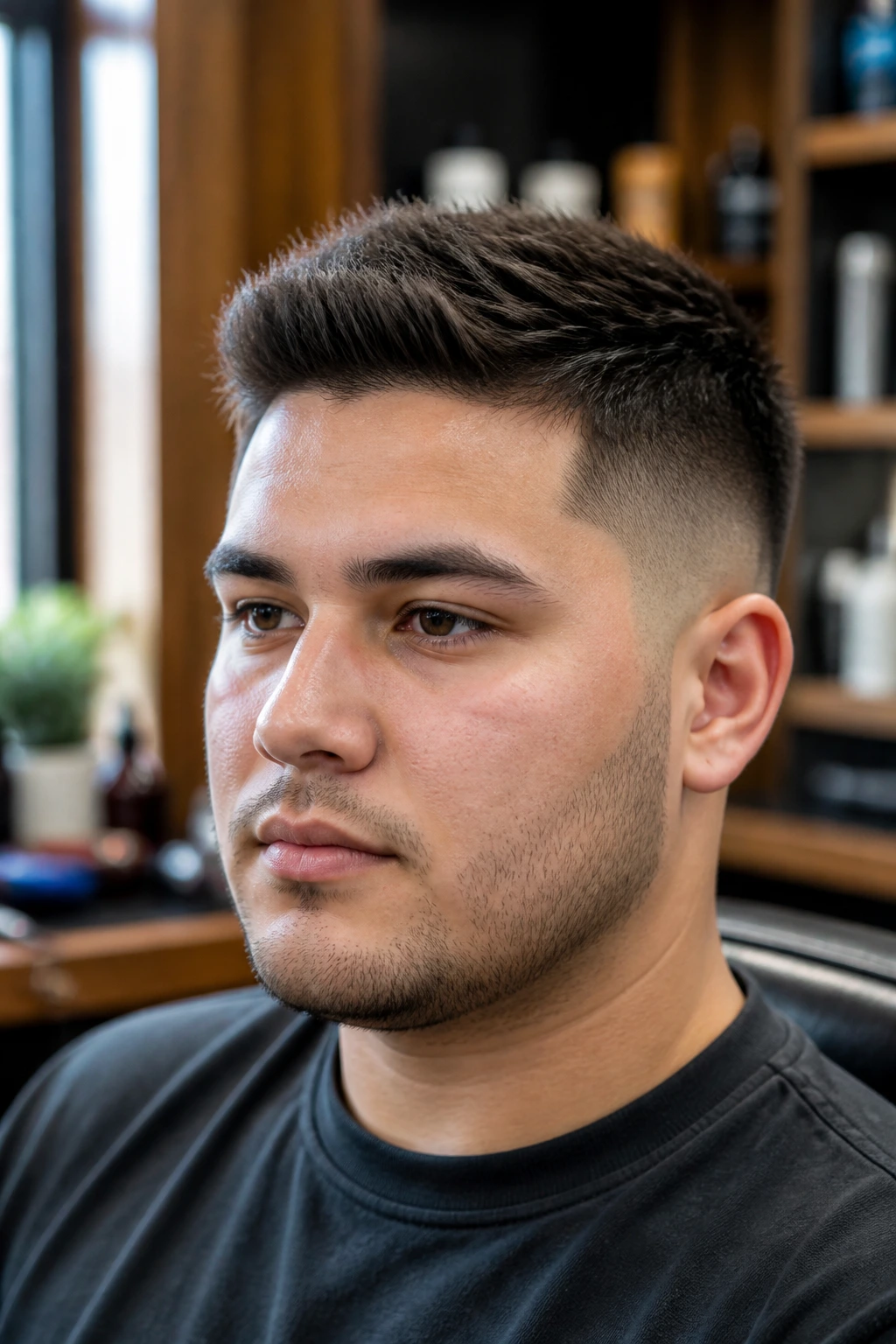
Volume Boost: Dry the top in the direction you want it to go, not in every direction at once. A 60-second blow-dry with the nozzle pointing at the roots can change the whole haircut. Lift at the front. Let the crown stay calmer.
Texture Control: Use matte product sparingly. Start with a pea-sized amount, rub it between your palms until it vanishes, then work it into the mid-lengths and ends. If you start at the roots with too much product, the hair clumps and the roundness comes back fast.
Shape Tweaks: A slightly off-center part is often better than a dead-center one. It breaks symmetry and keeps the face from looking like one smooth circle. Same idea with fringe: a broken, diagonal fringe does more for shape than a heavy straight cut across the forehead.
Edge Control: Keep the sides neat every 10 to 14 days if your hair grows fast around the ears. That tiny cleanup keeps the silhouette narrow. If the temples puff out, you’ll feel it before you can see it.
Make-It-Yours: Straight hair usually wants texture spray and matte paste. Wavy hair wants a light cream and a bit of air-drying. Curly hair likes moisture and a diffuser. The haircut can be the same, but the finish should match the hair’s natural behavior.
Common Mistakes That Make a Round Face Look Wider
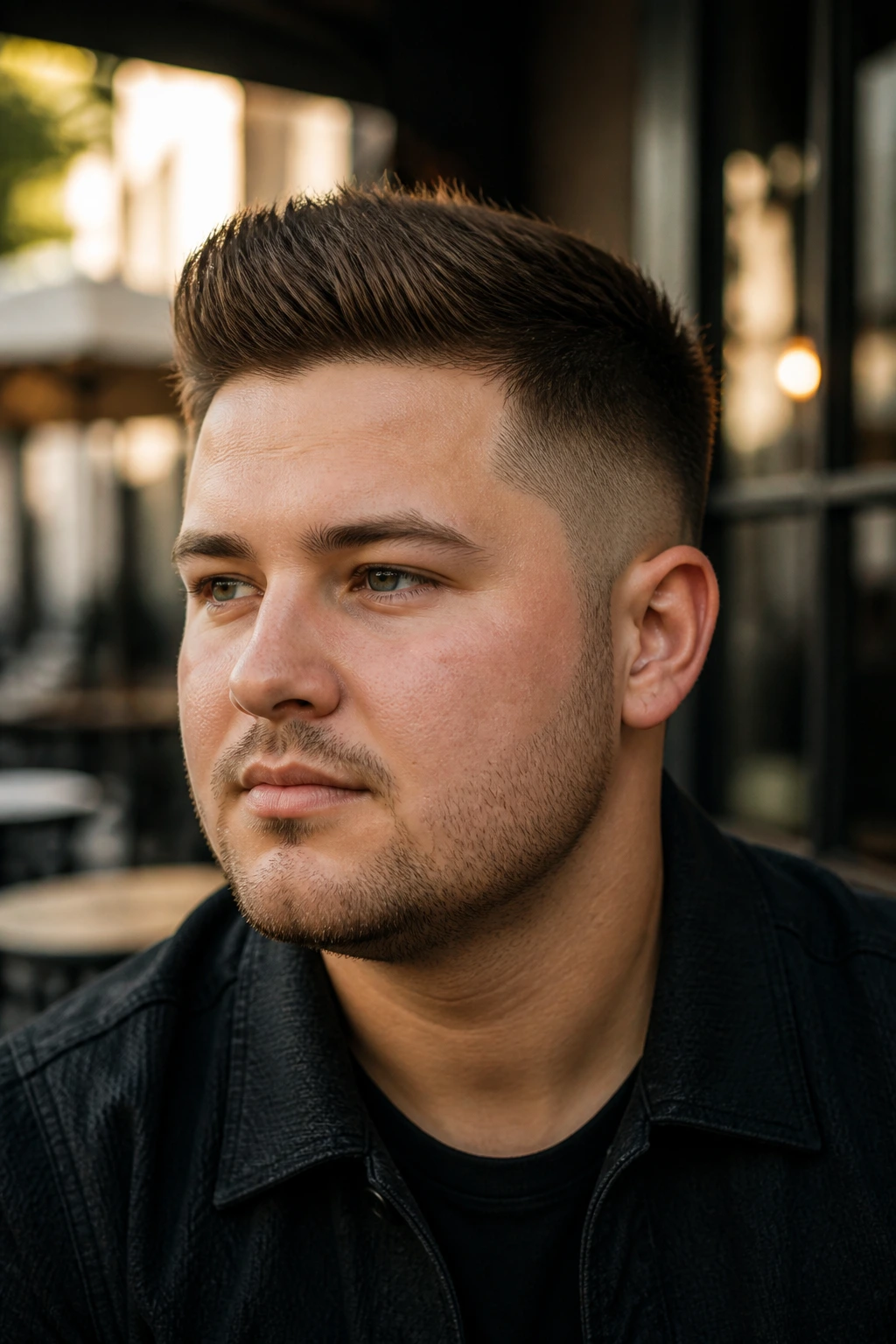
The first mistake is keeping the sides too full. It’s the easiest one to spot. The haircut looks fine from the front, then from the side it bulges around the temples and turns the face into one broad shape. The fix is a taper or fade that actually removes width, not just a polite trim.
The second mistake is a blunt fringe that ends in one straight line. That line cuts the forehead horizontally and makes the face look shorter and wider. A better choice is point-cut texture, side sweep, or a broken fringe with small gaps between the strands.
Shiny gel is another offender. It clumps the hair together and reflects light off one smooth surface, which flattens the top and makes the haircut look heavier. Matte paste, clay, or cream almost always reads better for round faces because the texture creates shadow and shape.
Watch the crown too. If the top grows outward instead of upward, the whole cut starts to balloon. That’s why even good haircuts need shaping every few weeks. The fix is simple: keep the top shorter than you think you need, and style it with direction instead of volume all over.
Last one. A beard that gets wider at the jaw can backfire. If the facial hair flares out, it adds to the roundness instead of balancing it. Keep the beard tighter on the cheeks and a little fuller at the chin if you want it to help the haircut, not compete with it.
Variations and Adaptations for Different Hair Types

Straight-Hair Precision: Straight hair shows every line, which means it also shows every mistake. Go for a textured crop, Ivy League, or short quiff with a matte finish, and keep the top cut in layers so it does not sit like one flat sheet. The rougher the top, the better.
Curly-Hair Height Builder: Curly hair adds width if it’s cut too short at the sides and too long at the temples. Keep the sides tight with a fade and leave enough length on top for the curls to stack upward. A diffuser and curl cream will do more for shape than a heavy pomade ever will.
Thinning-Hair Short Strategy: If the hair is getting finer, shorter is often smarter. Crew cuts, close crops, and textured buzz styles reduce the contrast between dense and thin areas, which keeps the scalp from showing in strange patches. Avoid the long comb-over that tries too hard to hide everything.
Beard-Balanced Shape: If your beard is strong, you can get away with a cleaner, shorter top because the lower face already has definition. Keep the cheek line neat and the sideburn blend soft. That way the beard frames the jaw without turning the head into one wide block.
Low-Maintenance School or Work Cut: For guys who want almost no fuss, a short crew cut or close crop with a taper is the sweet spot. It grows out evenly, needs little product, and still keeps the sides narrow enough to help a round face. The haircut looks calm, which is useful when you do not have time for a 10-minute styling routine.
Keeping Short Hairstyles for Men and Round Faces Sharp Between Barber Visits
The shape starts slipping faster than most people expect. Around the second week, the sides begin to puff, the temples soften, and the top loses the crisp line that made the haircut work in the first place. That does not mean you need a full cut every time. It means you need a cleanup rhythm.
A quick morning routine helps a lot. Wet the top slightly, work in a pea-sized amount of matte product, and lift or sweep the front with your fingers. If the cut depends on height, a 60- to 90-second blow-dry is enough to reset the shape. If the style is a crop or fringe, use your hands, not a comb.
Weekly: Trim sideburns, neckline, and stray ear hairs.
Every 2 to 3 weeks: Get the fade or taper cleaned up if your hair grows quickly.
Every 4 to 6 weeks: Refresh the full cut so the top does not lose its shape.
After sweating or sleeping badly: Rinse the roots, towel dry, and re-style from damp hair instead of stacking more product on yesterday’s mess.
Night matters too. If your hair gets crushed on one side while you sleep, a quick mist of water in the morning can reset it. Not glamorous. Effective.
Frequently Asked Questions About Short Hairstyles for Men and Round Faces
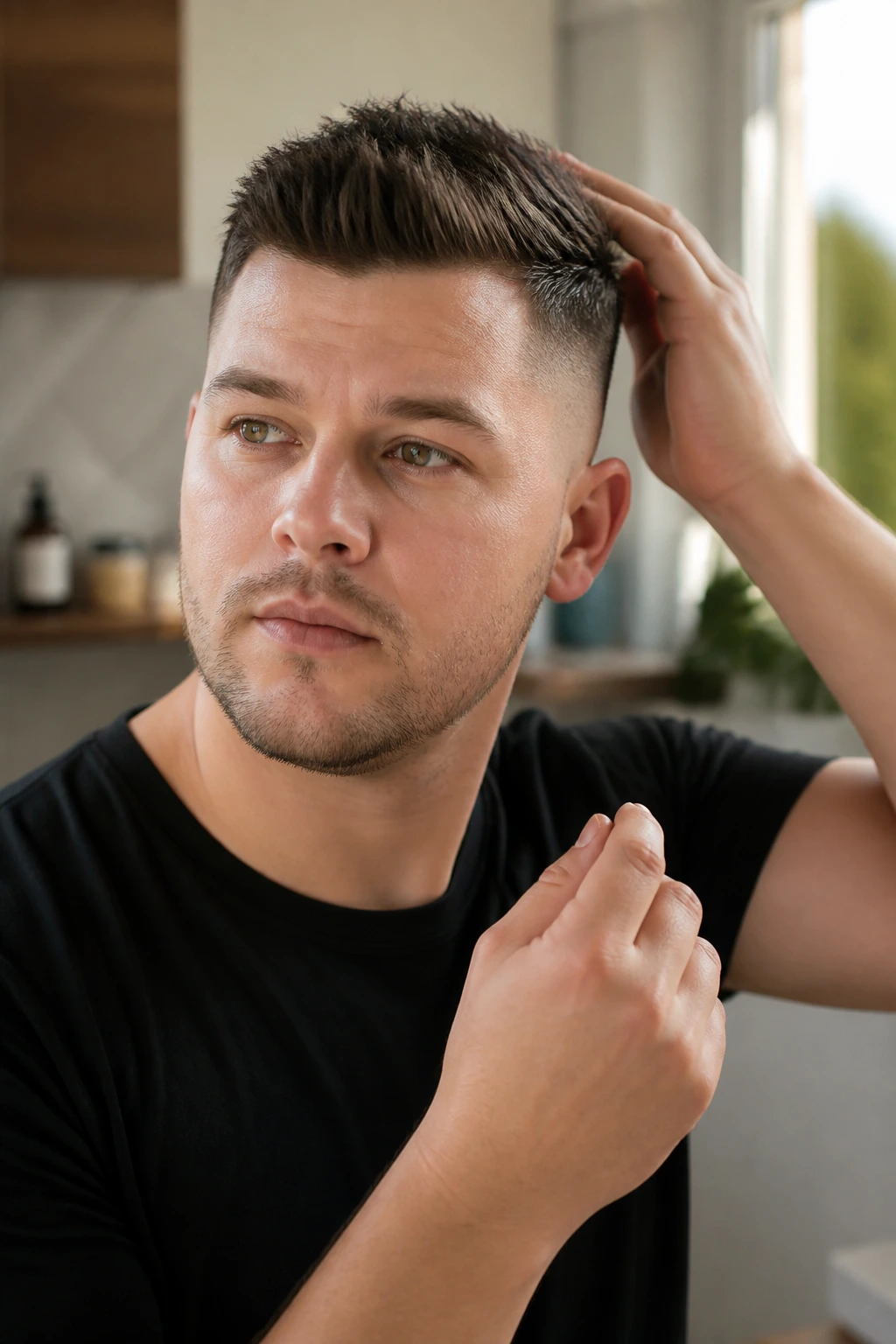
What short haircut makes a round face look slimmer?
Cuts that add height and narrow the sides usually work best. A textured crop, short quiff, Ivy League, or crew cut with a taper will generally create more vertical line than width, which changes how the face reads.
Is a skin fade good for a round face?
Yes, if the top has enough shape to balance it. A skin fade removes side bulk and makes the head look cleaner, but if the top is flat or too short, the contrast can feel harsh. The cut needs some lift, texture, or direction up top.
Should round faces avoid bangs or fringe?
Not entirely. Blunt bangs are the risky version because they draw a horizontal line. A textured fringe, messy fringe, or French crop with broken ends can work well because it keeps the forehead from looking boxed in.
Can I wear a buzz cut with a round face?
You can, and it often looks best with a fade or slight taper rather than one length all over. A little contrast at the sides helps keep the head from looking too circular. A beard can add extra balance if you like that look.
What should I ask my barber for if I want height without looking flashy?
Ask for short sides, a bit more length on top, and texture through the front. Tell the barber you want the hair to sit up or sweep slightly, not lie flat. That keeps the cut practical instead of overstyled.
Do curly or wavy hair types change the rules?
The rules stay the same, but the execution changes. You still want tighter sides and some vertical shape on top, but curls need room to stack and wavy hair needs product that encourages movement instead of stiffness. Heavy gel usually works against you.
How short should the sides be on a round face?
Short enough to narrow the temples, but not always bare skin. A low or mid fade usually works better than a too-high fade unless the top is strong and textured. The sides should support the shape, not steal attention from it.
What if my hair is thinning on top?
Shorter cuts are usually safer. A close crop, crew cut, or textured short quiff can reduce the contrast between fuller and thinner areas, which makes the hair look more even. Long comb-overs often look more obvious than people expect.
The Cuts That Give a Round Face Some Edge

A round face does not need to be hidden. It needs a haircut that gives it edges, direction, and a little lift where it counts. The best short styles do that without turning every morning into a styling project. Tight sides. Controlled top length. Texture when the hair needs movement. That’s the whole formula, and it works because it respects the shape instead of fighting it.
Pick the cut that matches your hair type, your routine, and how much time you’re willing to spend in front of a mirror. If you want the safest place to start, choose one of the textured crops, crew cuts, or side-swept styles and ask your barber to keep the temples narrow. That alone changes more than most people think.
Bring one good photo, a clear idea of how much styling you’ll actually do, and a willingness to keep the sides tidy. The haircut gets easier from there.