



Fine hair on boys is sneaky. One minute it looks neat; the next, a backpack hood, a sweaty recess, or a quick nap on the couch has it lying flat like it gave up. The best hairstyles for boys with fine hair do not fight that texture. They work with it, trimming away weight in the wrong places and leaving enough shape up top to look intentional.
The mistake I see most often is simple: people ask for more length when the hair needs better structure. Fine strands do not automatically look fuller when you leave them long. Sometimes they look thinner, especially around the crown and temples, where the scalp shows through faster and the hair has less bend to hide it. A shorter crop, a careful taper, or a low-key fringe usually does more for the shape than a heavy bottle of gel ever will.
There’s also a practical side to this. Boys need cuts that survive school bells, PE class, helmets, hoodies, and the general chaos of being a kid. The good styles are the ones that still read clean when they’ve been touched, ruffled, or half-dried. That means texture, smart length, and a finish that looks soft rather than crunchy. Start with shape first, shine second — or skip the shine altogether.
Why These Cuts Work Better on Fine Hair
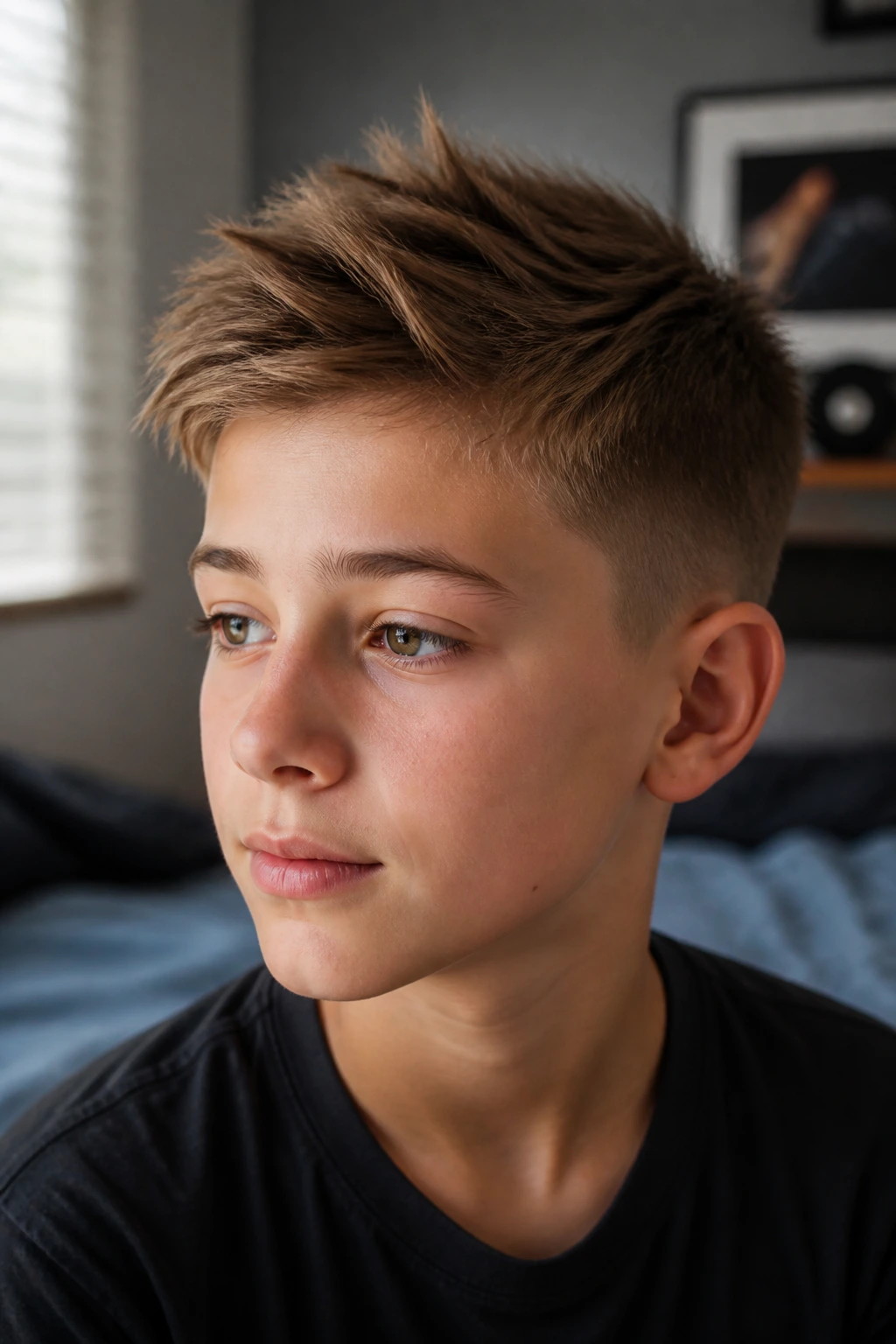
Weight matters more than volume. Fine hair tends to collapse when it carries too much length, especially near the front and at the crown. The cuts in this collection remove that drag and keep the top light enough to move without splitting apart.
Texture beats stiffness. A matte finish gives the hair a little grit, which helps each strand sit apart from its neighbor in a controlled way. That separation is what makes fine hair look fuller, not slicker.
The sides do a lot of the visual work. Clean tapers, low fades, and tight edges make the top look more deliberate. If the outline is sharp, the eye stops worrying so much about how much hair is actually there.
These styles grow out better than you’d think. Fine hair can look wispy when a cut gets old, so the best options here still hold their shape two or three weeks later. That matters when the next haircut isn’t happening tomorrow.
They’re easy to explain to a barber. Guard numbers, fringe length, and taper height are concrete. “Make it cool” is not.
- Low maintenance: Most of these cuts need a small amount of lightweight product, not a full styling session.
- School-friendly: They stay tidy after hats, backpacks, and long afternoons.
- Thicker-looking shape: Shorter sides and smart top length make fine hair read denser.
- Flexible finish: The same cut can look neat, messy, or dressed up depending on how you dry it.
- Better grow-out: The hair doesn’t fall into stringy, awkward pieces as fast as longer, heavy styles do.
1. Textured French Crop
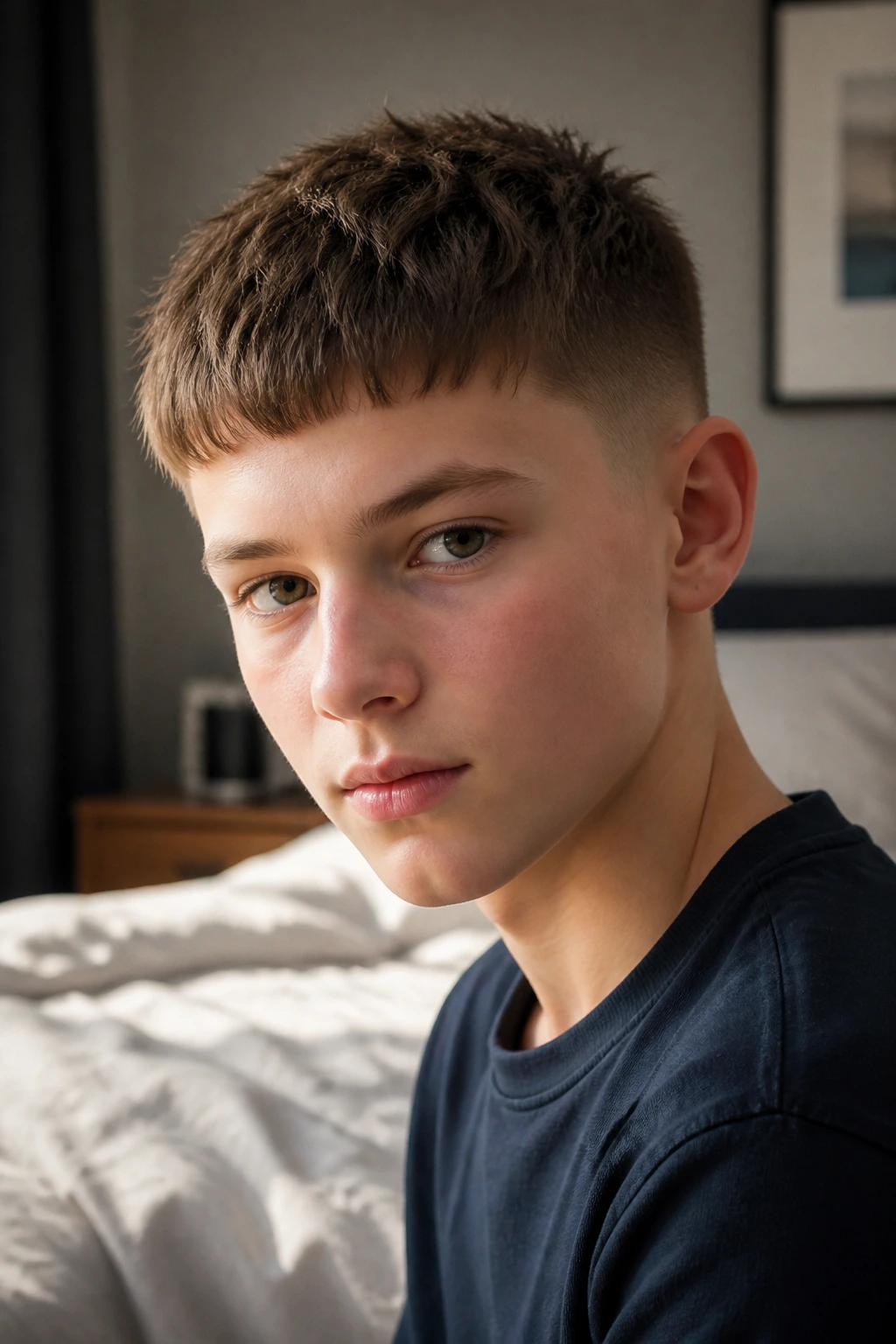
This is the cut I reach for first when a boy’s hair lies flat the minute you look at it. The textured French crop keeps the top short enough to avoid that limp, curtain-like fall, then adds a short fringe that breaks up the forehead line and gives the whole haircut a cleaner shape. It looks modern without trying too hard, which is exactly why it works.
Why it works: Fine hair tends to show gaps when it’s brushed straight back or left too long on top. A French crop solves that by putting the visual weight in the front, where the choppy fringe makes the hair look denser than it really is. It’s also forgiving if the hair grows fast around the temples.
What to ask for:
- Keep the top around 1 to 1.5 inches.
- Ask for a low taper or soft fade on the sides.
- Have the fringe cut just above the eyebrows, then point-cut for texture.
- Leave the crown short enough that it doesn’t split.
Best styling move: Work in a pea-sized amount of matte clay on towel-dried hair, then push the fringe forward with your fingers. Don’t comb it perfect. A little mess is the point.
Best for: Boys with straight or slightly wavy fine hair, especially if the front tends to fall into the eyes. It’s also a smart pick if the hairline is uneven, because the fringe hides more than it reveals.
2. Soft Crew Cut
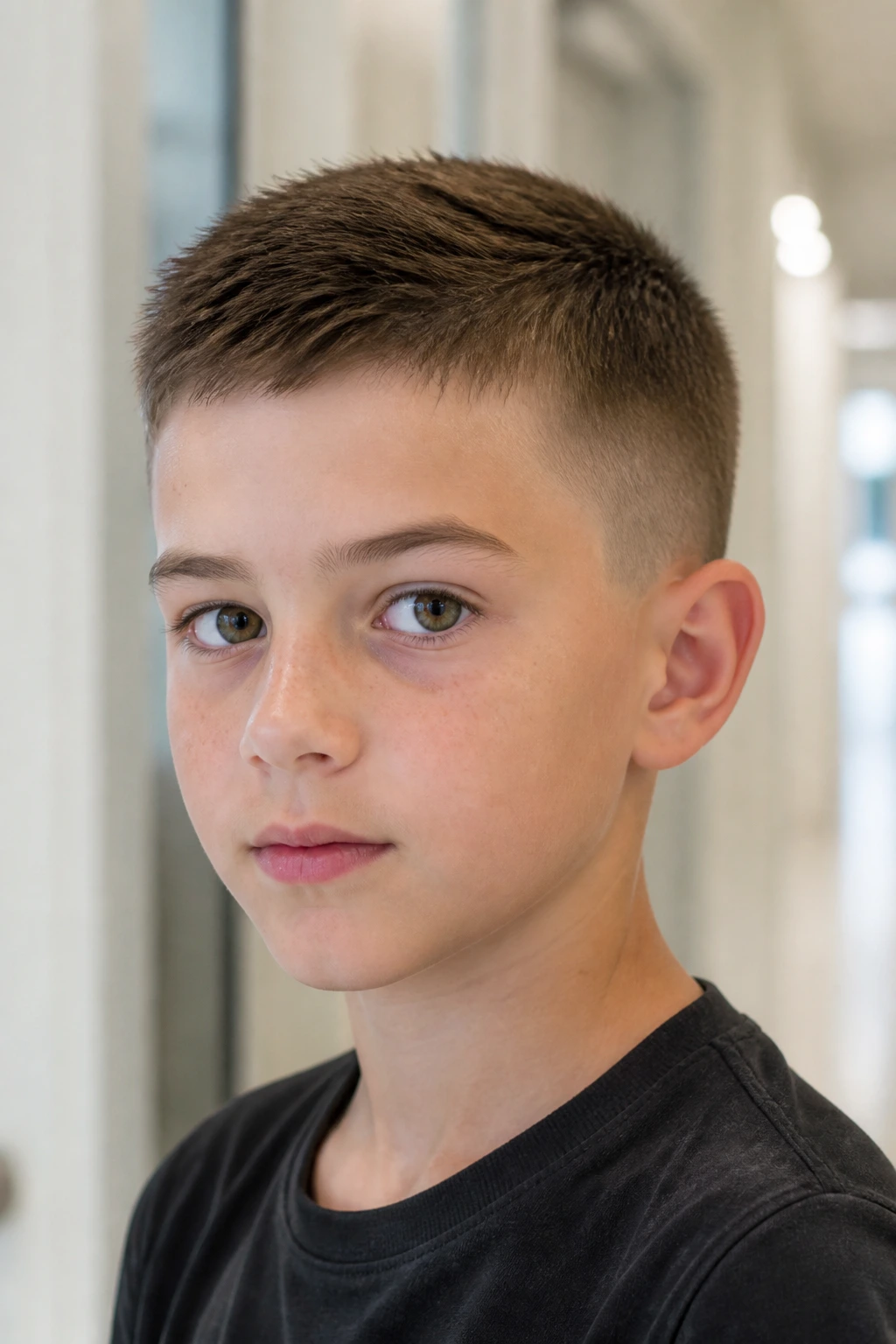
Can a crew cut look chic? Absolutely — if the fade is soft and the top isn’t chopped down to nothing. A soft crew cut is one of the cleanest answers for fine hair because it keeps everything short enough to stay controlled, but not so short that the head looks bare. It’s tidy, athletic, and calm.
Why it works: Short lengths make fine strands sit closer together, which gives the illusion of more density. The cut also avoids the awkward “fluff” zone that happens when fine hair gets medium length with no texture. If a boy sweats a lot or hates styling, this is one of the safest bets.
Barber notes that matter
- Ask for about 1 inch on top, a little shorter at the crown if needed.
- Use a low or mid taper rather than a high fade if the hair is sparse around the temples.
- Keep the sideburns soft so the cut doesn’t look too severe.
- If the scalp shows easily, leave a touch more length than you think you need.
A soft crew cut does not ask much from the morning routine. A quick towel dry, a fingertip rub of lightweight cream if needed, and you’re done. That’s the charm.
3. Side-Swept Taper
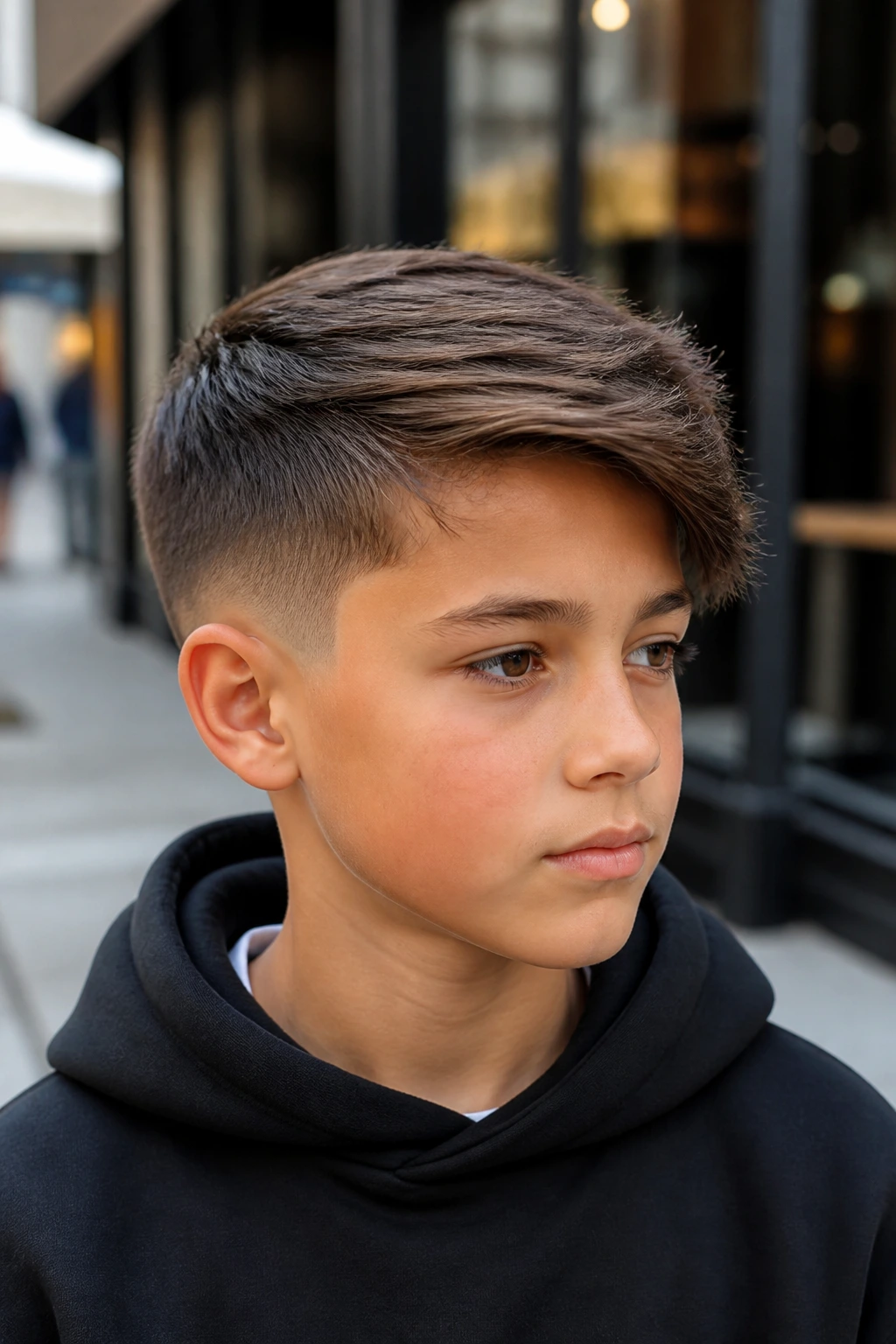
The side-swept taper is one of those cuts that quietly fixes a lot of fine-hair problems at once. It gives the top a direction, keeps the sides neat, and uses the diagonal line of the sweep to make the hair look fuller than a straight-down fringe would. It’s polished, but not stiff.
Picture a boy who hates hair falling into his eyes but also doesn’t want a hard, military-looking cut. That’s the sweet spot. The top should be long enough to move — usually 2 to 3 inches — while the sides stay tapered close to the ear.
How to style it: Blow-dry the top from the heavier side toward the lighter side using a vent brush or your fingers. A tiny bit of mousse at the roots helps the hair keep that bend. Finish with a light matte paste, not a glossy cream that separates the strands.
Small detail, big payoff: Part the hair while it’s damp, not after it’s fully dry. Fine hair sets faster when you catch it early, and you get cleaner direction with less product. That little timing trick matters.
4. Messy Ivy League

A messy Ivy League is what happens when a neat school cut gets a little edge. It still has the tidy backbone of a classic side part, but the top is left with enough texture to keep fine hair from looking flat. This is the cut I’d pick for a boy who needs to look put-together without looking buttoned-up.
The beauty here is restraint. The length on top usually sits around 1.5 to 2.5 inches, and the texture is done with scissors, not aggressive thinning. You want movement, not wisps. Too much razoring and the hair starts to look see-through.
Why it works: Fine hair often looks better when it’s asked to follow a shape instead of standing up on its own. The Ivy League gives it that shape, then lets a few loose pieces break the line so it doesn’t turn stiff. It’s one of the few cuts that can look tidy at school and still have personality when the top is finger-styled.
Best styling move: Use a small amount of lightweight cream or matte paste, then rake the top across with your fingers and let a few pieces fall out of place. That slight disorder is what keeps it from looking like a uniform.
5. Mini Quiff

A big quiff on fine hair can be a disaster. A mini quiff, though, is a different story. It gives the front enough lift to look styled, but keeps the height low enough that the hair doesn’t fold over by noon. The result feels current without becoming fussy.
This cut depends on shape at the front, not bulk everywhere else. You want the front section left a touch longer — usually around 2 to 3 inches — with the rest of the top slightly shorter so the quiff can sit forward and up instead of back and heavy. If the top is all one length, the quiff will just droop.
How to get the lift
- Towel dry until the hair is damp, not dripping.
- Blow-dry the front upward and slightly back with the nozzle pointed at the roots.
- Work in a tiny bit of matte clay once the hair has cooled.
- Pinch the front pieces together and leave the sides flatter.
The cut looks best when the quiff is soft, not towering. Think low-rise, not stacked. That gives fine hair a thicker front line without making the style look like it’s trying too hard.
6. Choppy Caesar
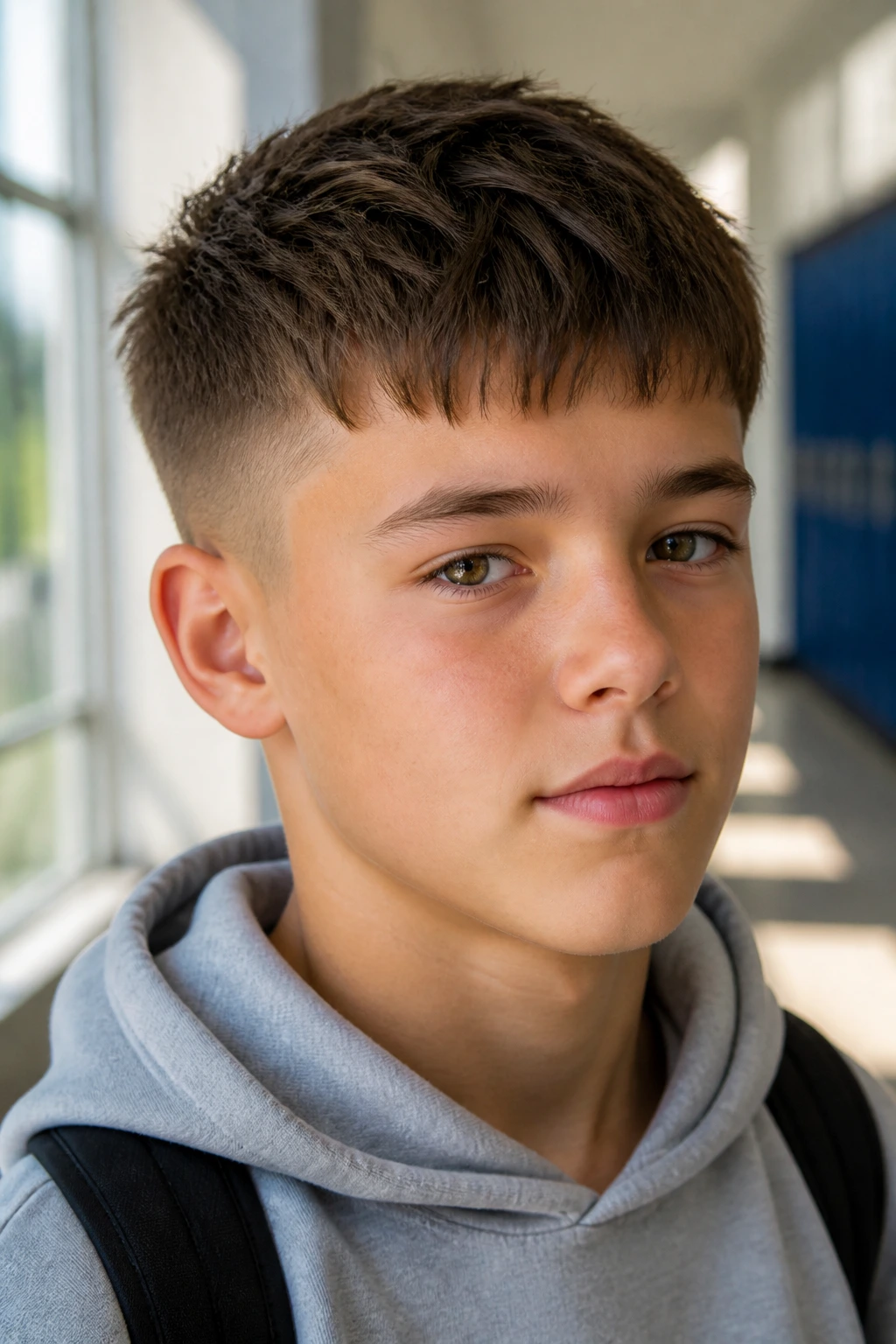
The Caesar cut has been around forever, and for fine hair that’s not a bad thing at all. A choppy Caesar keeps the fringe short, blunt-ish, and slightly broken at the ends, which makes the hairline look denser and the overall shape feel cleaner. It’s one of the sharpest fixes for a forehead that reads too open.
Why it works: Fine hair can look stringy when the fringe is too long or too soft. A Caesar turns the front into a feature. The horizontal line across the forehead brings the eye forward, and the choppy finish stops the cut from feeling heavy.
What to ask for:
- Keep the fringe around 1 inch, maybe a touch more if the hair is straight.
- Ask for texture with scissors, not aggressive thinning shears.
- Pair it with a low taper fade or a neat taper around the ears.
- Keep the top short and controlled through the crown.
This is one of those cuts that looks best with almost no product. A whisper of matte paste is enough. Too much shine, and the fringe starts to separate, which defeats the whole point.
7. Brushed-Up Taper Fade
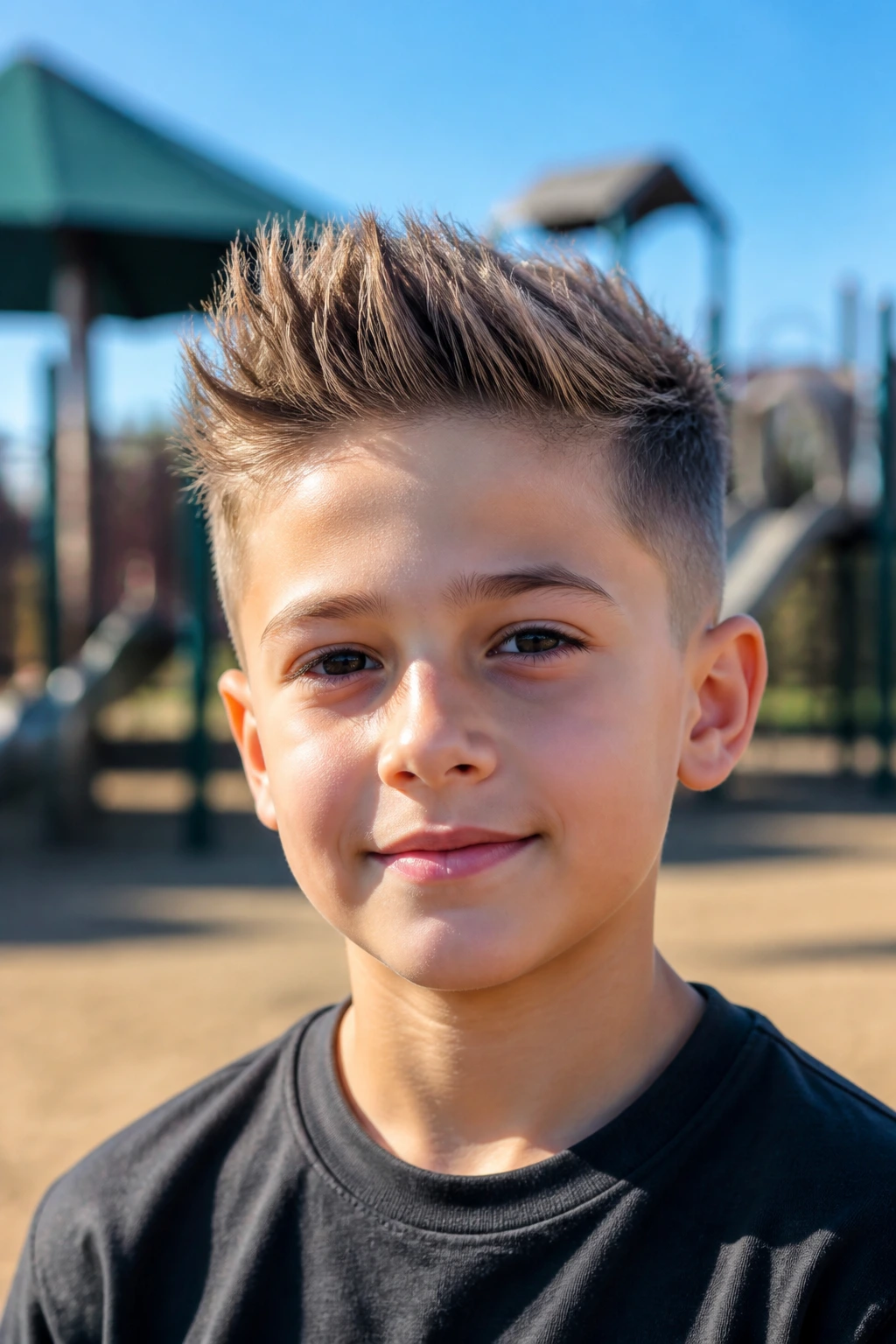
If you want a bit of lift without jumping into a full quiff, the brushed-up taper fade does the job. It gives fine hair a cleaner vertical line at the front, which can make the top look thicker from a distance. The taper keeps the edges soft, so the haircut still feels age-appropriate and neat.
The key is not to chase height for its own sake. Fine hair can fake a little volume, but it does not like being bullied. Keep the top around 1.5 to 2 inches and make the fade low enough that the contrast doesn’t expose the scalp too much.
A simple styling rhythm:
- Blow-dry upward at the roots.
- Use a small round brush or just your fingers.
- Add a grain of matte clay, then push the front up and slightly forward.
- Stop before the hair starts to crack into separate spikes.
A brushed-up taper fade works especially well for boys who want a sporty look that still feels styled. It’s sharper than a crew cut, but not as high-maintenance as a full pompadour. That middle ground is the whole appeal.
8. Curtain Fringe with Light Layers
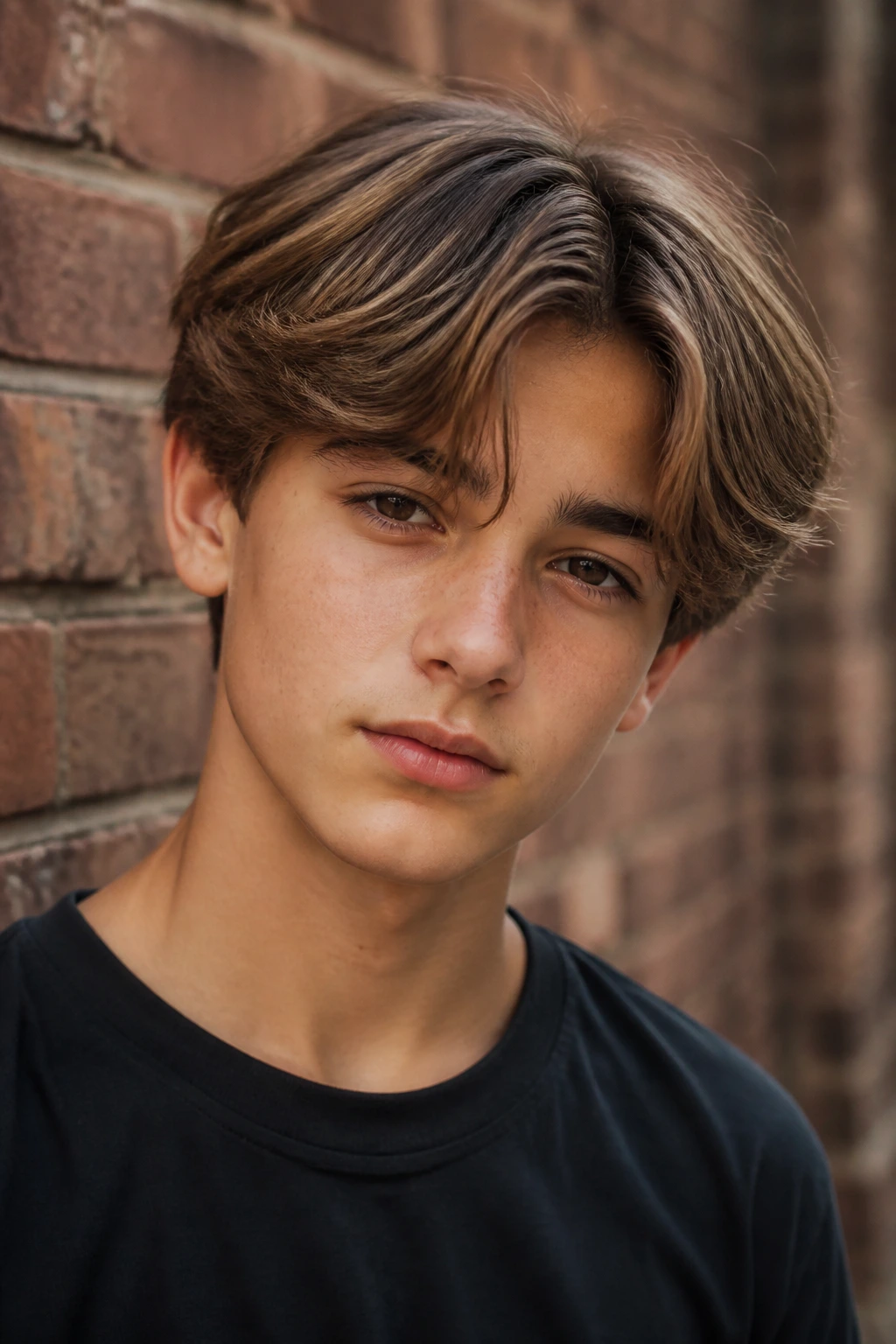
Curtain fringes can look dreamy on the wrong head of hair and excellent on the right one. For fine hair, the trick is light layering and careful length control, because too much weight on the sides makes the front split into sad little strings. Done right, though, the curtain fringe gives soft movement and a cool, relaxed shape.
This style needs a bit more length on top — usually 3 to 4 inches — but the layers should be feathered gently rather than hacked apart. The part sits near the center or slightly off-center, and the fringe falls away from the face in two soft panels.
What makes it work on fine hair: The style creates width at the front without needing a huge amount of density. That’s useful when the hair is straight and fine, because straight strands can look sparse if they’re forced into a heavy, flat middle part. Light blow-drying makes a bigger difference than heavy product here.
Use a mist of sea salt spray on damp hair, then direct the fringe away from the face with warm air. Let it cool before touching it. That cooling step matters more than people think; it locks the bend in place just enough to hold through the school day.
9. Long-Top Mop with Tapered Sides
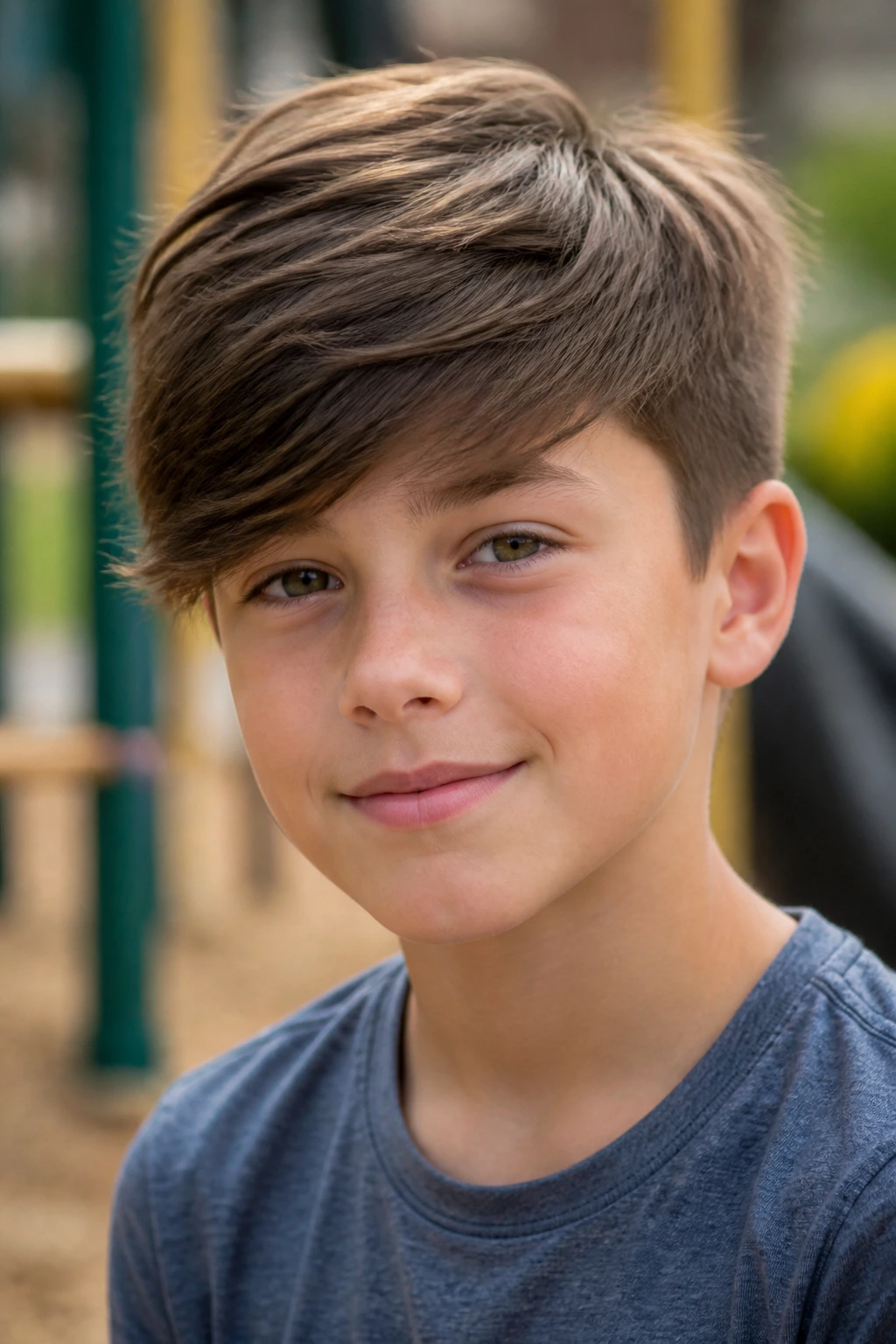
A long-top mop sounds messy by name, but the good version is surprisingly controlled. The sides stay tapered and neat while the top keeps enough length to fall naturally and move with a little softness. On fine hair, that softness can be an advantage — if the cut is shaped well, it reads relaxed rather than thin.
The top usually sits between 3 and 5 inches, with the longest pieces around the fringe and crown. The mistake is leaving everything one length. That makes the hair hang like curtains, and fine hair rarely survives that kind of weight. Layers should be light, almost invisible, just enough to stop the top from collapsing as one sheet.
Best for
- Straight, fine hair that has a little natural bend
- Boys who like a casual, skate-ish look
- Hair that can tolerate a quick scrunch with salt spray
A little leave-in cream can help the ends stay soft, but keep it away from the roots. Too much product there flattens the whole thing. I’d rather see a boy use less product and a better cut than the other way around. Every time.
10. Clean Side Part
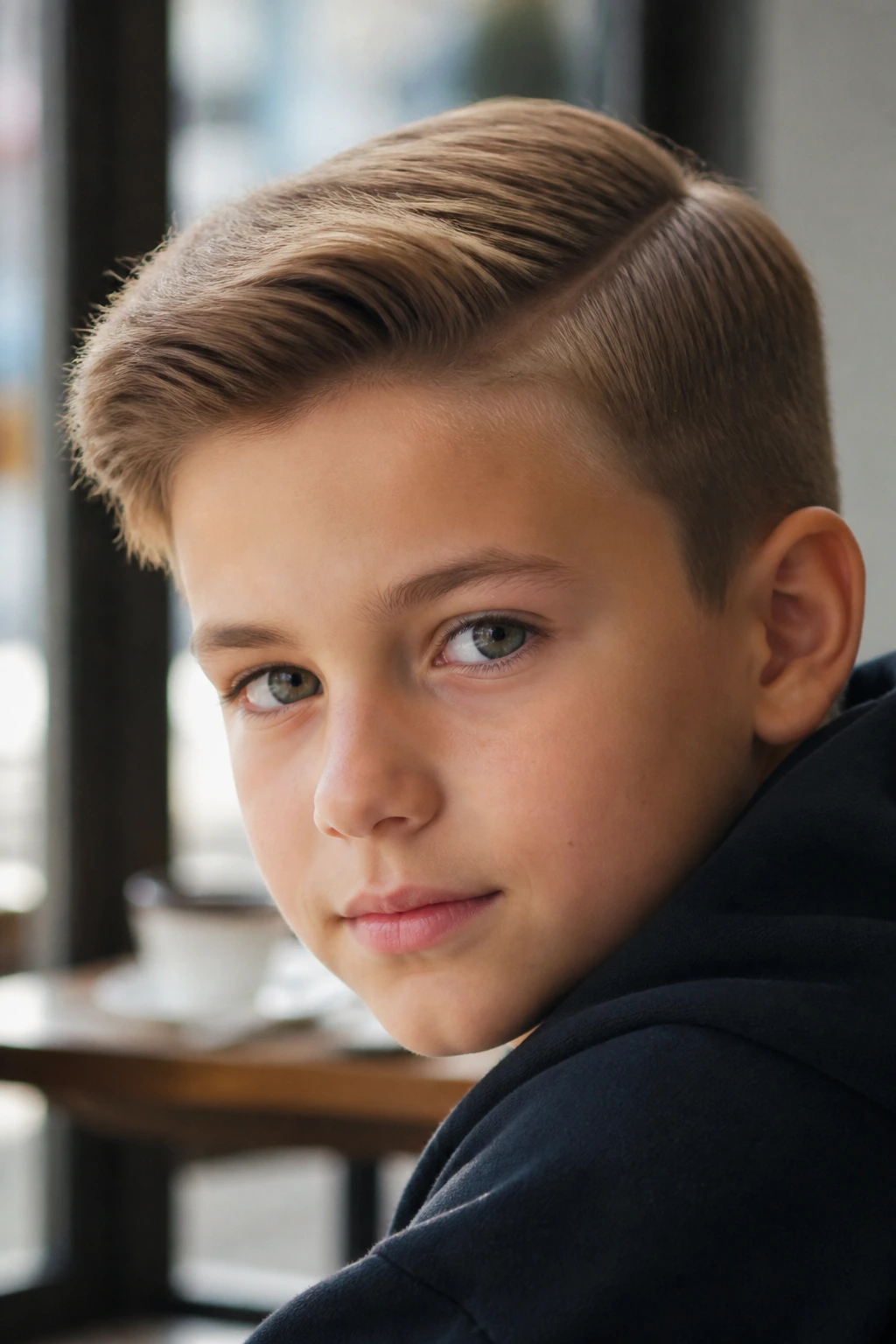
The clean side part is old-school in the best sense. It gives fine hair a direction, which is half the battle, and it makes the haircut look deliberate even when the hair itself is soft and slippery. The part line adds structure; the taper adds neatness; the side sweep gives the illusion of fullness.
This cut works especially well when the hair isn’t too long. Around 1.5 to 3 inches on top is plenty. If the part is too deep and the sides are too bare, the scalp can show more. A shallow, soft part is usually better on fine hair because it spreads the hair more evenly across the head.
A comb and a dab of light cream are enough. Comb the part while the hair is still damp, then let it dry with a little direction. If you want it to look more polished, finish with a few minutes of blow-drying along the part line. That one move can make the style hold much longer.
11. Brush Cut

The brush cut is the no-nonsense answer, and sometimes that’s exactly what fine hair needs. Everything stays short, the crown looks cleaner, and the haircut doesn’t depend on styling to make sense. There’s a reason this cut keeps showing up for active boys: it works, and it stays out of the way.
A brush cut usually leaves the top at a uniform short length — short enough to stay dense-looking, long enough to avoid the shaved-down look. The sides can be tapered softly or kept close with a low fade. Either way, the shape is simple and easy to maintain.
Why it looks good on fine hair: When strands are cut short and even, they don’t have space to separate into see-through pieces. That gives the head a more solid outline. It’s not flashy. It doesn’t need to be.
If a boy wants something that can handle sports, sleepovers, and a wash-and-go routine, this is a strong pick. No brush, no drama, no weird cowlick battles. Just clean lines and a cut that behaves.
12. Disconnected Undercut
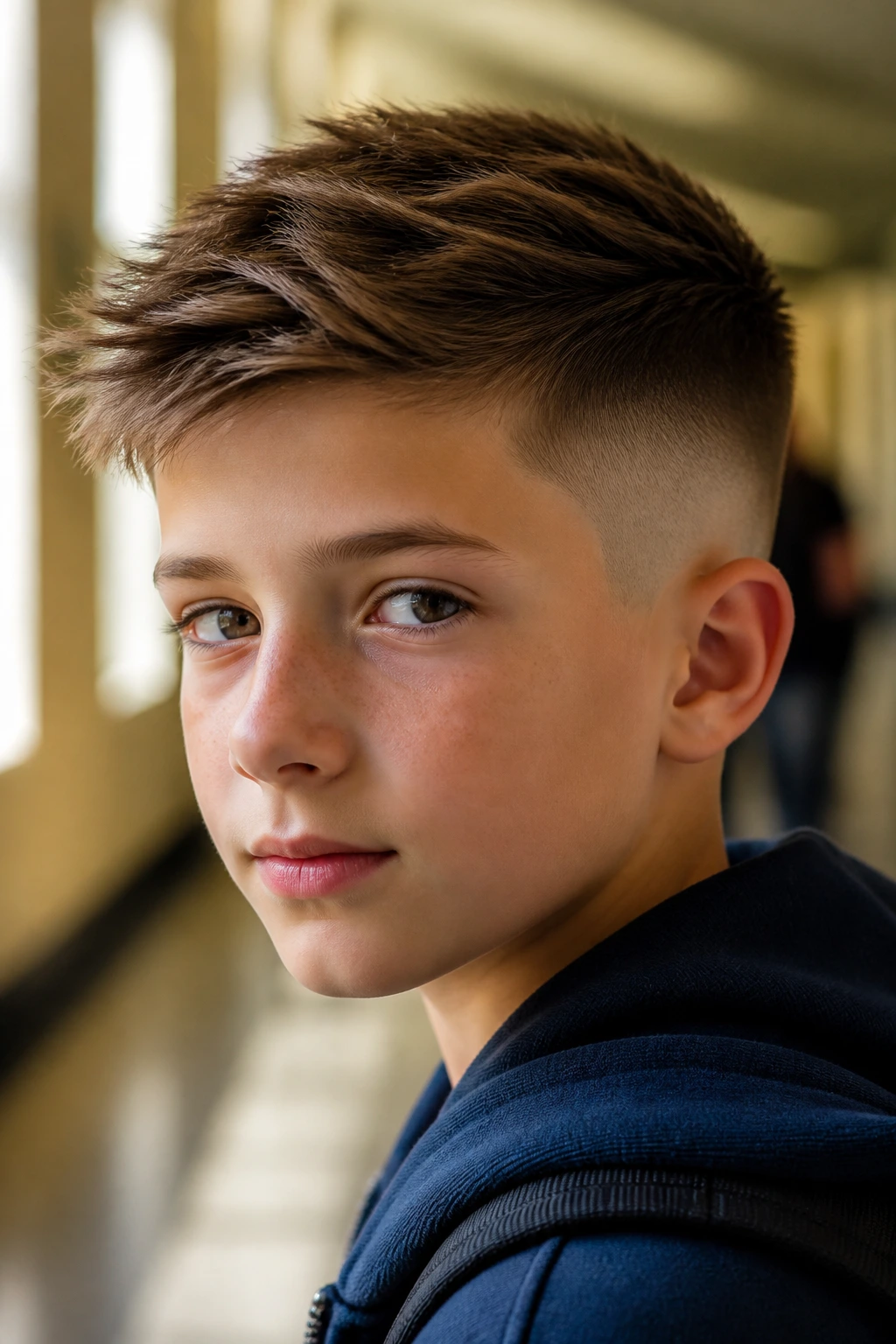
The disconnected undercut is for boys who want a sharper contrast and don’t mind a little edge. The sides are cut much shorter than the top, and the line between them is obvious. On fine hair, that contrast can be useful — it makes the top look fuller because the eye has a stronger frame to read against.
But here’s the catch: the top cannot be too long. If the hair gets heavy, it separates and the style loses its shape fast. Keep the top around 2 to 3.5 inches, and use texture instead of shine. Matte paste or clay works. Wet gel does not.
Where it shines
- Older boys who want a more defined silhouette
- Straight hair that can hold shape with a quick blow-dry
- Cuts where the barber is comfortable with clean disconnection
I like this style most when the top is styled forward or slightly to the side, not slicked flat. That gives the cut some motion and keeps it from looking severe. A disconnected undercut on fine hair is a statement, sure, but it still needs restraint. Too much length and it starts looking fragile.
13. Short Spiky Crop

Spiky hair can go wrong fast. You’ve seen it: stiff little points, too much gel, and a shine that looks plastic under classroom lights. A short spiky crop avoids that mess by keeping the spikes tiny, soft, and irregular. Think texture, not porcupine.
This works best when the top is short — around 1 to 1.5 inches — so the strands can stand with a little help but don’t flop around. Fine hair often has enough natural lightness to do this without much effort. A small amount of matte product and a few quick finger-pinches are usually enough.
The best version has spikes that lean a little different directions. That small unevenness keeps the style from looking frozen. If every strand points up the same way, the hair starts to look brittle. A little mess is what makes it modern.
For boys who want a playful style that still feels neat, this one has a lot going for it. It’s easy to fix in the mirror before leaving the house, and it doesn’t melt down the second a jacket hood comes off.
14. Two-Block Cut
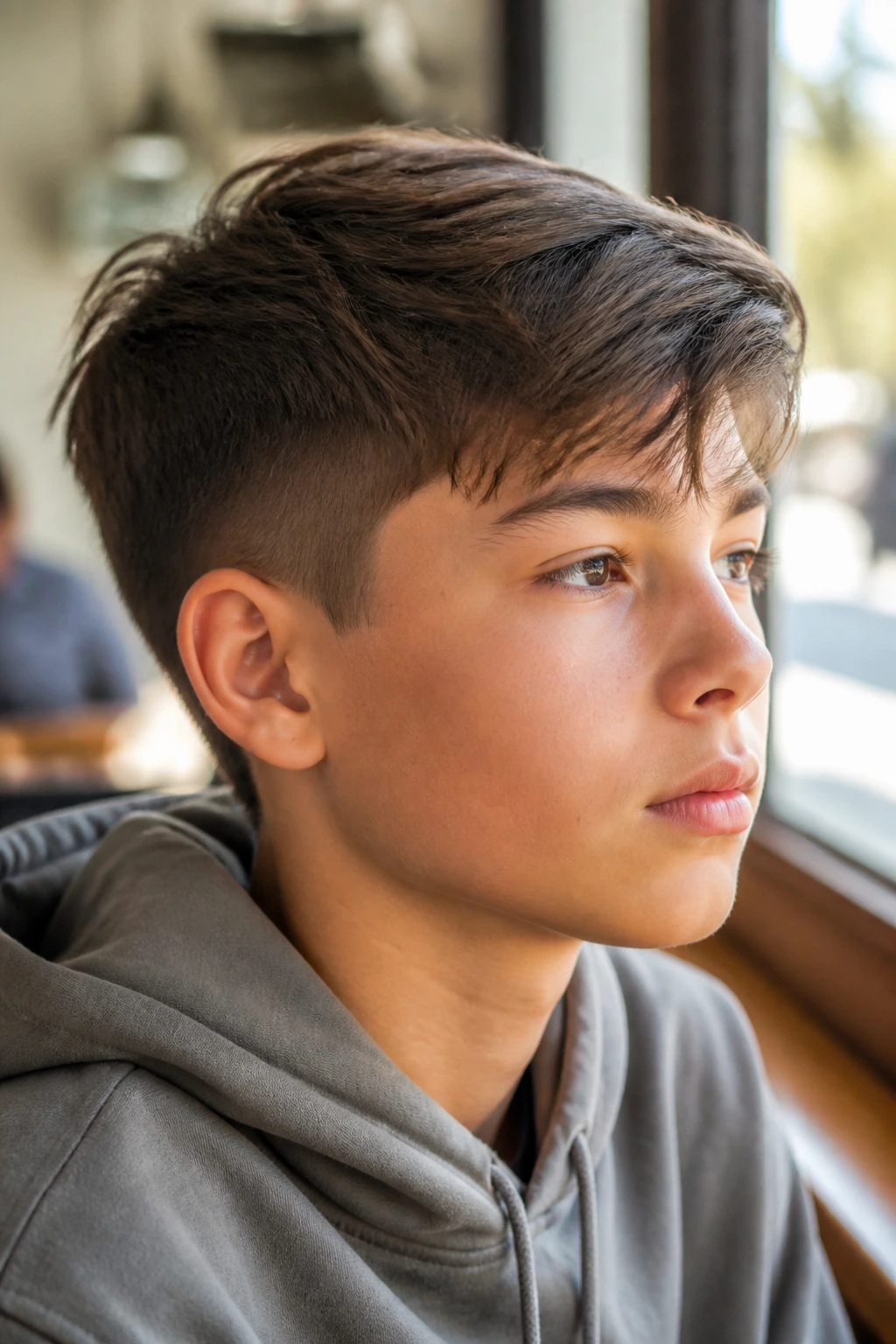
The two-block cut has a cleaner top and lighter sides, but it’s not as severe as a disconnected undercut. On straight fine hair, it can look sharp and a little fashion-forward without swallowing the face. The top sits longer and the lower section stays shorter, which gives the haircut a clear shape.
The reason it works is the silhouette. Fine hair often looks better when the outline does the talking. If the top has enough length to sweep forward, sideways, or into a soft curtain, the style gains width without needing bulky product. That’s a nice trade.
How to wear it well:
- Keep the top layered lightly so it doesn’t hang in flat strips.
- Ask for a shorter, softer underlayer around the ears and nape.
- Use a blow-dryer for bend, not volume.
- Skip heavy waxes that make the top clump.
I’d call this a good pick for boys who want something a little more style-aware than a basic taper, but not so sharp that it feels grown-up. The two-block can walk that line.
15. Short Shag
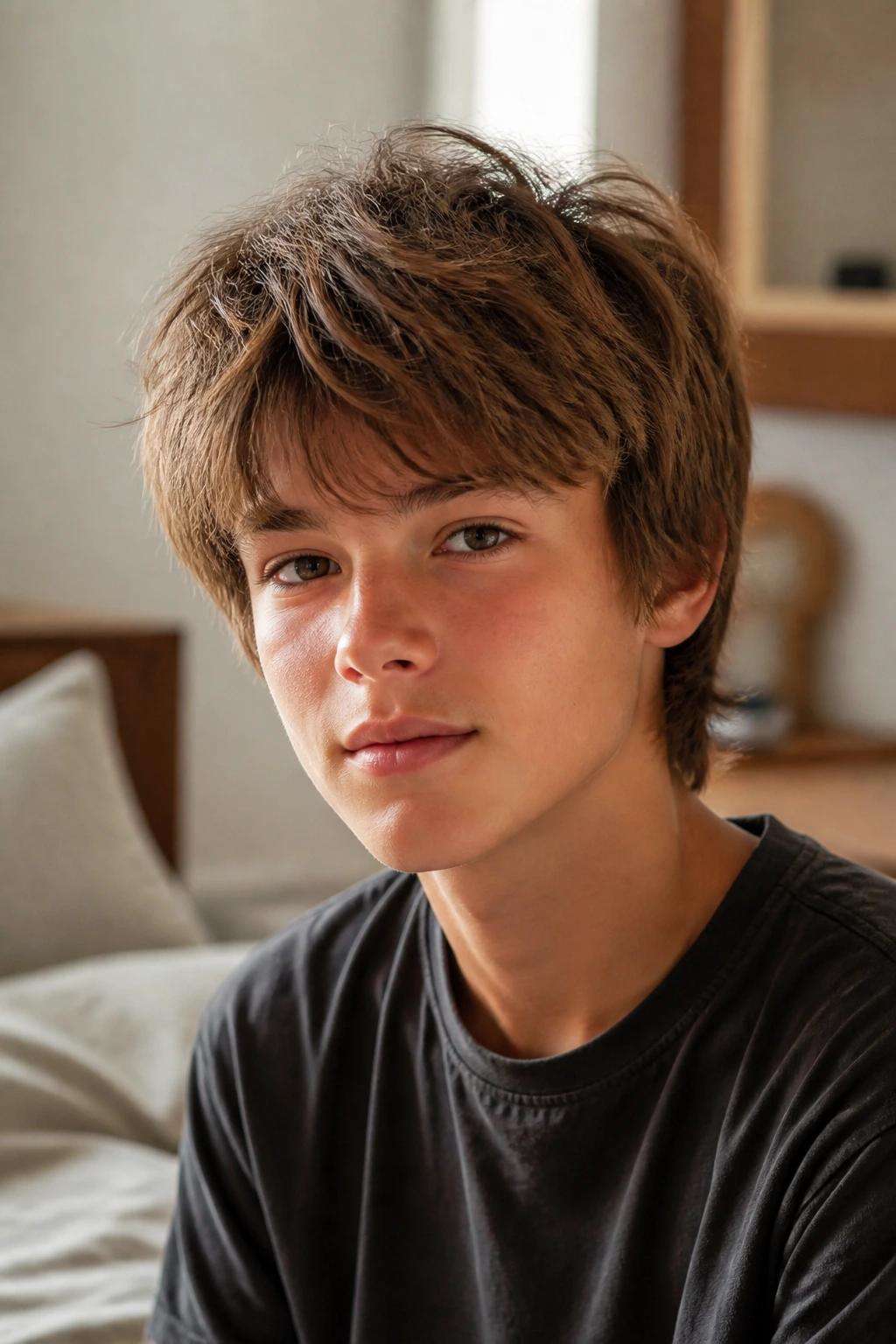
The short shag is the haircut for fine hair that likes a bit of movement and doesn’t want to sit still. It uses layers to create lift in a way that feels loose, not forced. If the top is cut in a blunt block, fine hair can look thin. If it’s layered too hard, it turns wispy. The short shag lives in the middle.
Why it works: The layers break up the outline without stripping too much weight. That matters because fine hair needs some bulk left behind to avoid that see-through look. The shag gives shape around the ears, soft movement through the top, and a little bend at the ends.
Watch the texture
- Ask for controlled layers, not aggressive thinning.
- Keep the nape clean so the cut doesn’t drift into mullet territory unless that’s the point.
- Use a dab of sea salt spray for separation, then scrunch lightly with your hands.
This cut suits boys who don’t want their hair to look “done” in the shiny, shellacked sense. It has a lived-in feel, but it still needs a barber who understands where to stop.
16. Slicked-Back Taper
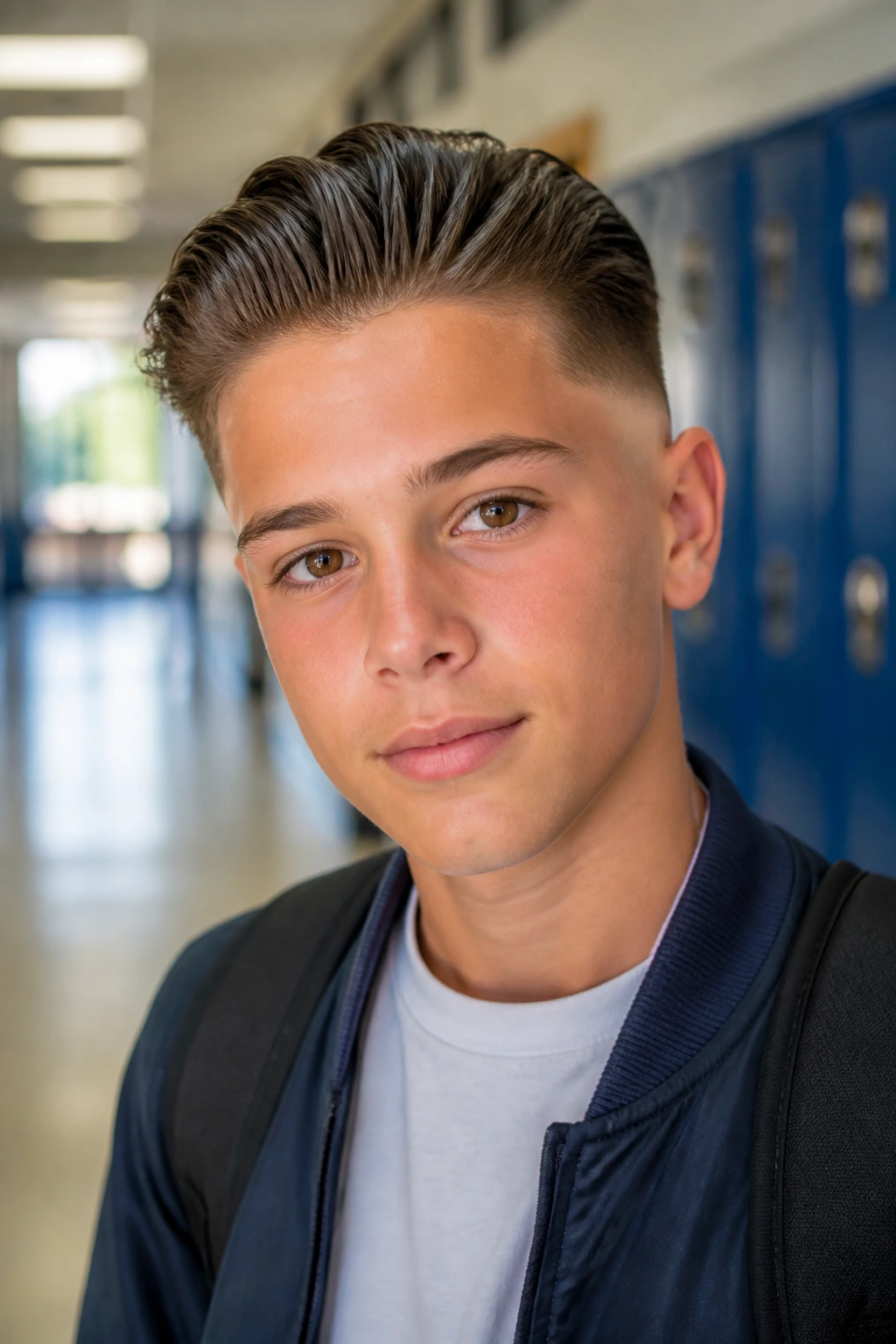
A slicked-back look can work on fine hair, but only if you keep it light. Heavy pomades and shiny gels make the hair split apart and expose the scalp. A soft slick-back with a taper keeps the line clean and lets the hair lie in one direction without turning greasy.
The top should stay modest in length — usually 2 to 3 inches is enough — and the sides should taper close enough to keep the outline crisp. The trick is using enough moisture or cream to move the hair back, but not enough to weigh it down. That’s a narrow lane, yes. It’s still worth it.
Best styling method:
- Towel dry until the hair is damp.
- Comb the top backward with a small amount of light cream.
- Blow-dry from front to back on low or medium heat.
- Finish with a fingertip pass to soften the hairline.
I like this style for dressier days, picture day, or older boys who want something neat without wearing a hard side part. It has polish. It also has restraint, which is the part most people miss.
17. Bro Flow Lite
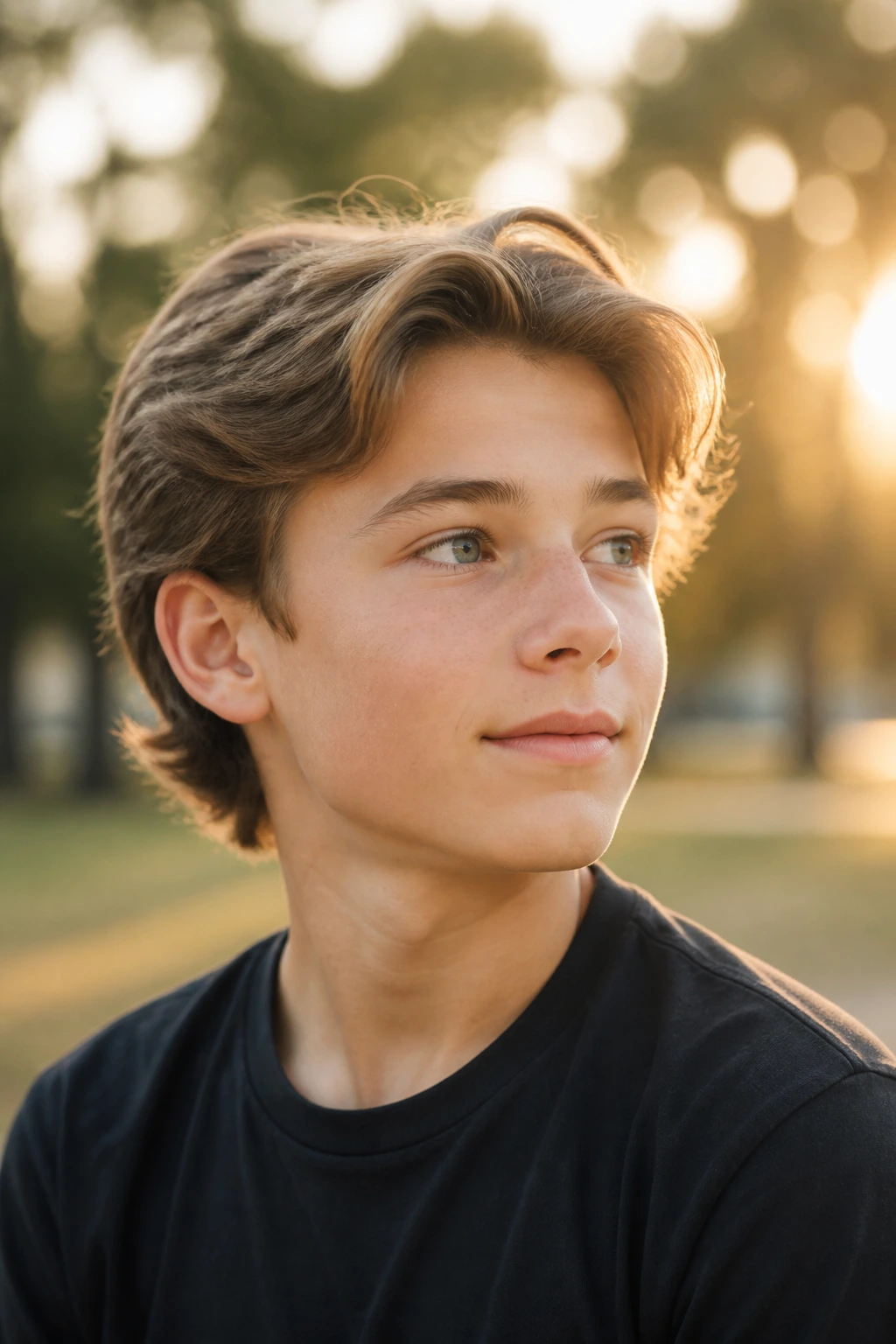
The bro flow usually gets associated with longer, heavier hair, but a lighter version can work for fine strands if the cut is smart. Bro flow lite keeps the neckline neat, the sides soft, and the top long enough to brush back or tuck behind the ears without becoming stringy. It’s a low-drama, easygoing style that still feels intentional.
What makes this version different is the shape control. Fine hair needs layers that encourage movement, not length that just hangs there. If the crown is too long, the whole style collapses. Keep the top around 3 to 5 inches, depending on density, and avoid blunt ends.
Good signs you’re on track
- The hair moves when you run your fingers through it, but doesn’t split into thin pieces.
- The outline at the neck stays clean.
- The front can fall back into place after a quick tuck or shake.
This is a nice option for boys who dislike the feeling of short hair but still want something manageable. It takes a little more care than a crop, and that’s the honest tradeoff.
18. Buzz Cut with Sharp Line-Up
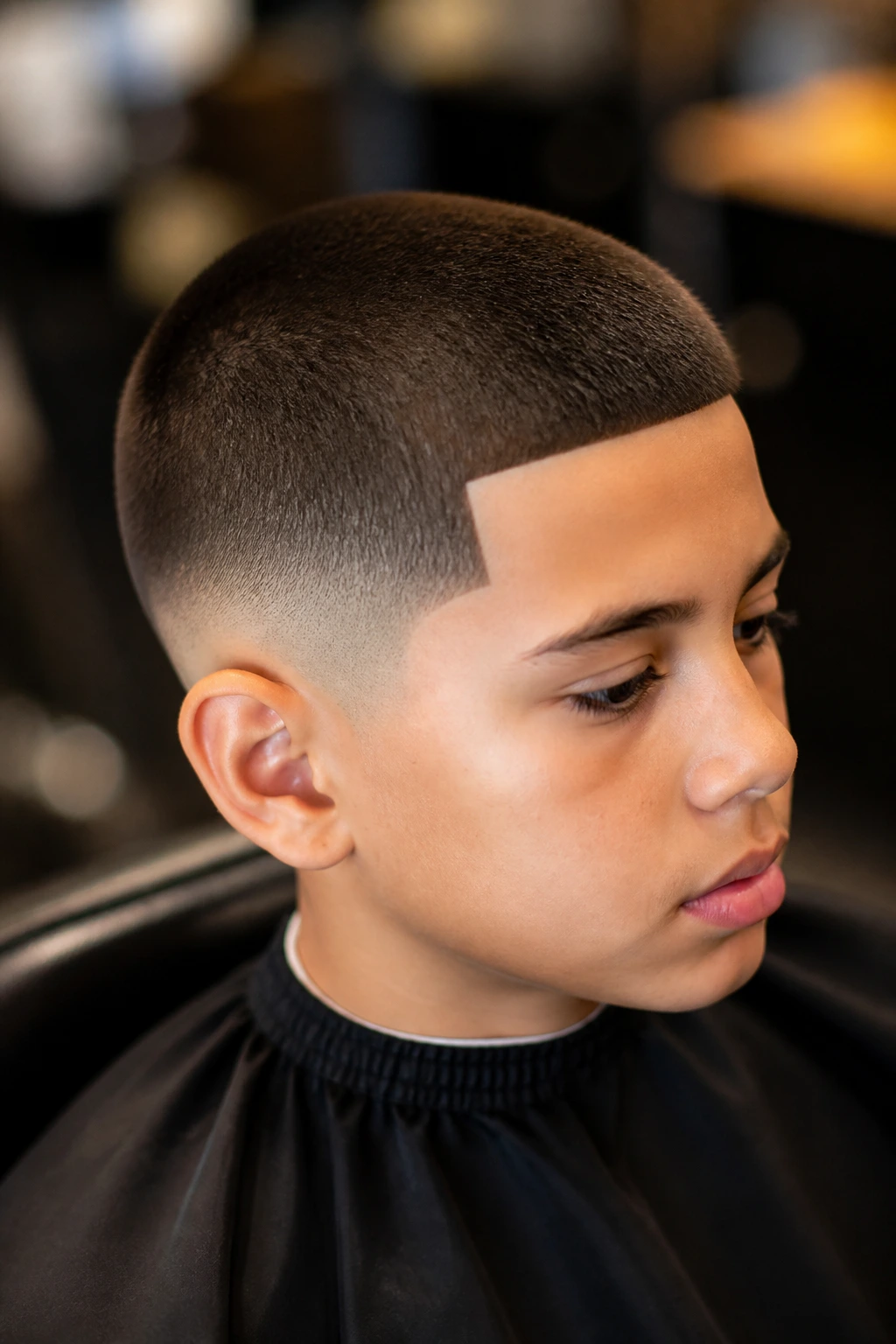
Sometimes the smartest answer is the shortest one. A buzz cut with a sharp line-up makes fine hair look denser because every strand is cut to the same short length, which removes the separation problem almost completely. The line-up adds definition around the forehead and temples, so the haircut doesn’t feel like a blank shave.
Why it works: Fine hair rarely looks thinner when it’s very short. Instead, it looks clean and even, and the scalp no longer competes with a lot of uneven lengths. That’s why a buzz cut can be surprisingly chic on boys who want something low-maintenance.
A careful barber will keep the edges soft enough that the line-up doesn’t look painted on. That matters. Too sharp, and the cut can feel harsh on a young face. A gentle edge with a tidy taper around the sides is usually the sweet spot.
This is the most practical cut in the set. It handles sports, hats, sleep, and busy mornings with almost no effort. Not every boy wants that. The ones who do usually keep coming back to it.
Why Fine Hair Looks Fuller When Shape Comes First
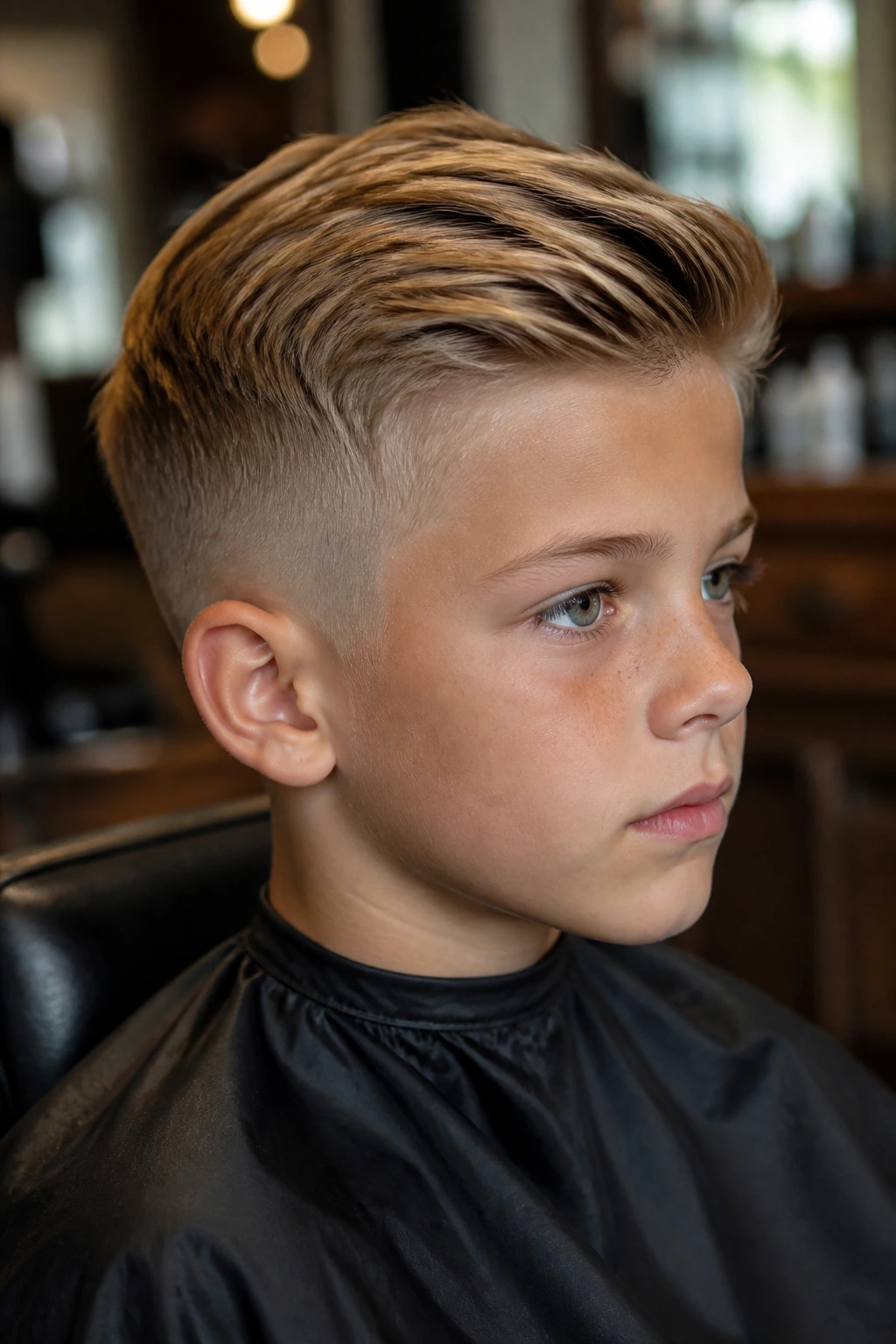
Fine hair has a reputation it does not always deserve. People see the strand size and assume the solution is volume, when the real fix is shape. A strong haircut gives the eye clean lines to follow, and that matters more than puffing the hair up with product. If the outline is right, the hair reads as fuller from across the room.
The crown is the first place I check. Fine hair there can split into a little whorl that exposes the scalp more than the rest of the head, especially when the length gets too long. That’s why these cuts either keep the crown shorter or add a controlled sweep that disguises the parting. You’re not hiding the hair. You’re helping it sit in a way that makes sense.
The sides matter too. A low taper or tidy fade gives the style a frame, and that frame makes the top look denser by comparison. A blunt, one-length cut with no structure tends to do the opposite. It makes fine hair look like it’s floating around on the head with nowhere to land.
What works best at the chair
A barber who understands fine hair will usually cut a little conservatively first. That means less bulk removal at the crown, no over-thinning, and texture added in small doses. Fine hair can look great with texture, but too much texturizing turns the ends into wisps. That’s the line to watch.
What to avoid from the start
Heavy creams, oily pomades, and sharp changes in length are a bad match for most fine hair. The hair needs movement, not drag. It needs clean edges, not a lot of weight sitting on top of itself.
Essential Tools for These Styles
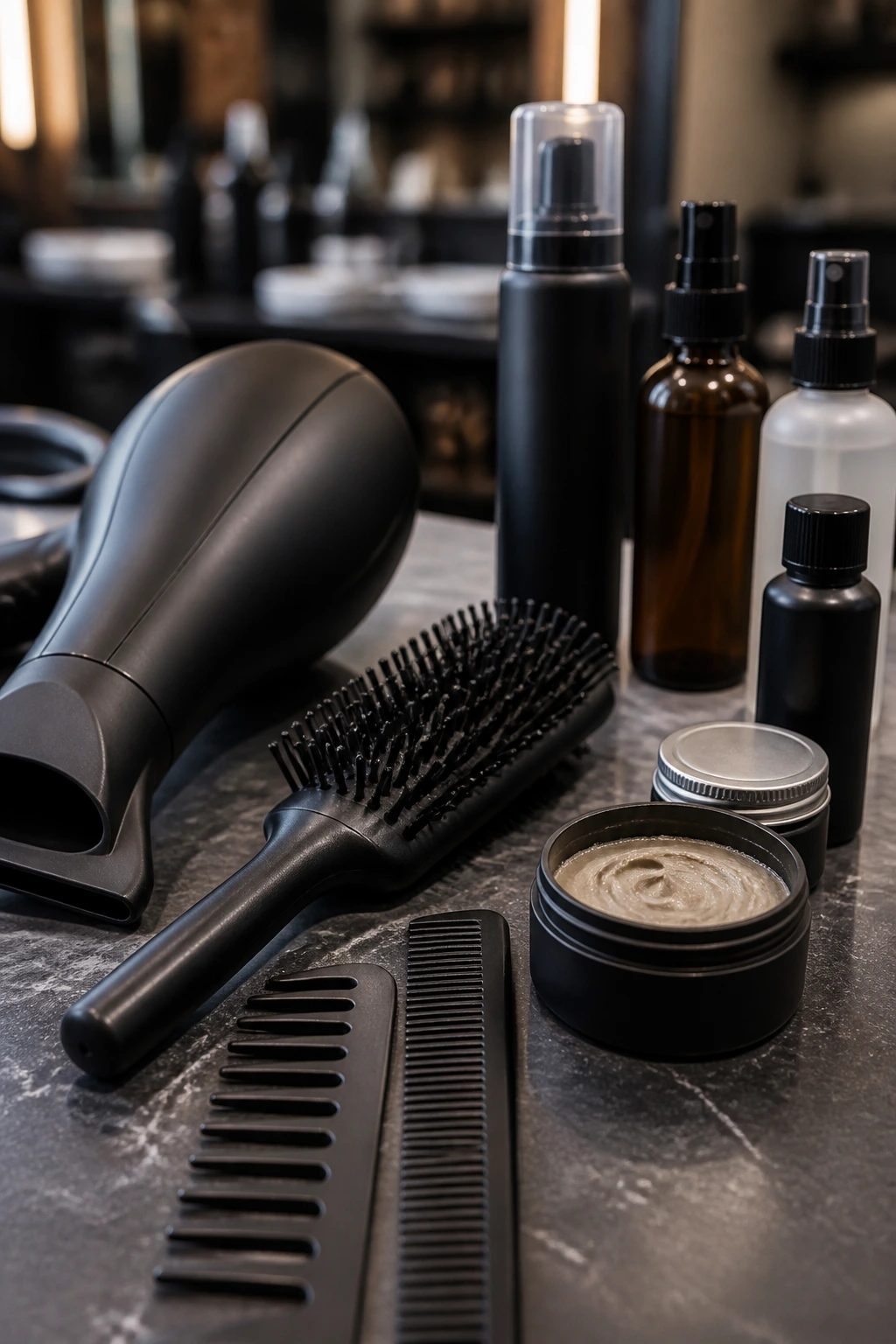
- Blow dryer with a nozzle attachment — Useful for lifting roots and directing hair without blasting it everywhere.
- Soft vent brush — Helps guide fine hair into shape without flattening it.
- Wide-tooth comb — Good for detangling wet hair before product goes in.
- Fine-tooth comb — Handy for clean side parts, slick-backs, and sharper outlines.
- Matte clay or matte paste — The best all-purpose product for fine hair because it adds grip without shine.
- Lightweight mousse — Great when you want a bit of support before blow-drying.
- Sea salt spray — Gives soft texture on towel-dried hair; use sparingly so it doesn’t dry the hair out.
- Root-lifting powder — Useful for mini quiffs, brushed-up tapers, and any style that needs a little extra lift at the scalp.
- Spray bottle with water — A quick way to reset a morning cowlick or reshape flattened hair.
- Handheld mirror — Useful for checking the crown and neckline after a haircut. That crown check matters more than people think.
What to Tell the Barber So the Cut Actually Works
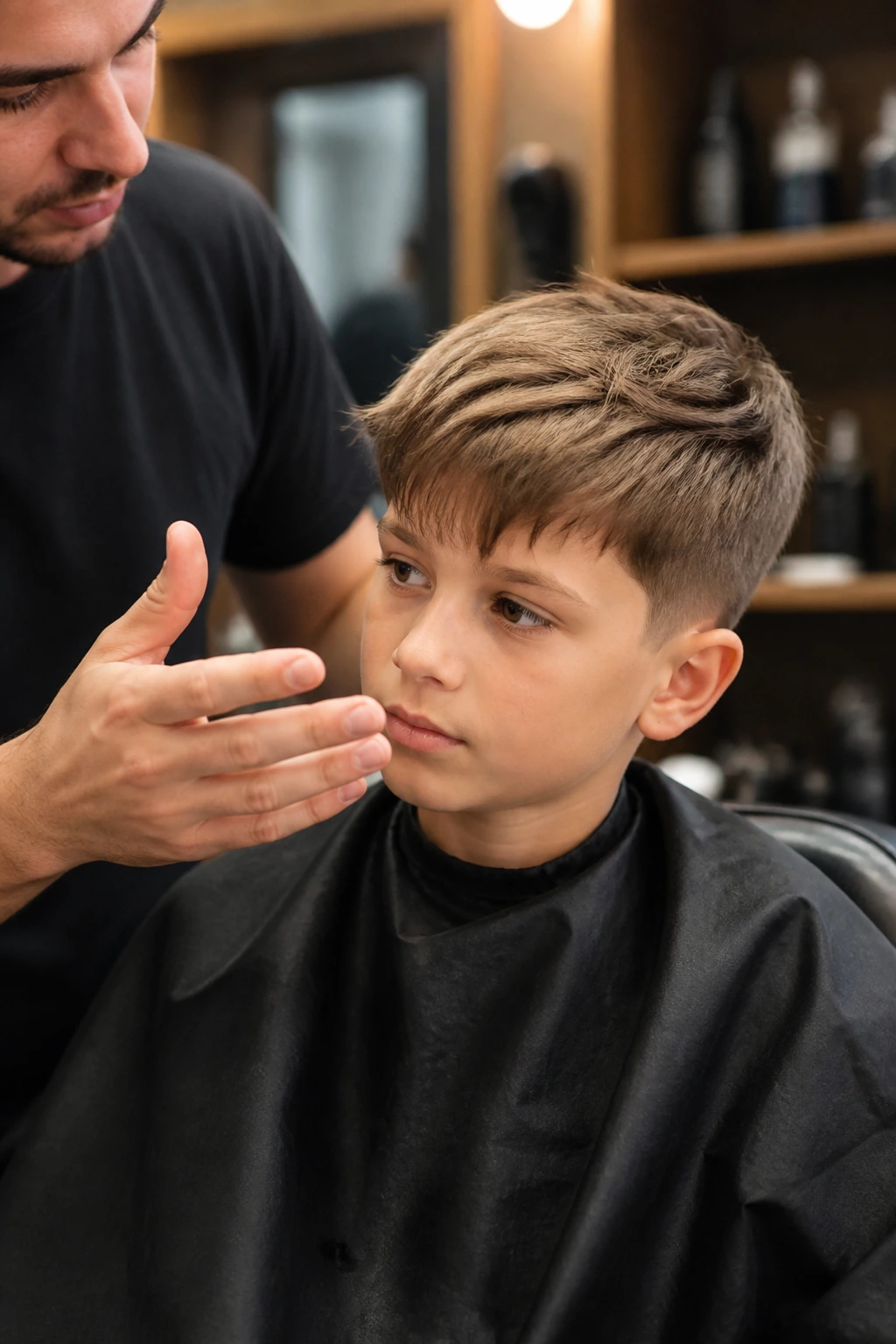
Fine hair needs clearer instructions than most people give it. If you say “short on the sides, longer on top,” you might get something vague, and vague haircuts are usually where the problems start. A good barber can work with thin density, but only if the shape is described well.
Ask for texture, not thinning everywhere. That’s the big one. Fine hair can be over-thinned in a hurry, and once that happens the ends start looking frayed. Point cutting is usually safer than aggressive razor work when the goal is controlled movement.
Be specific about the fringe. Say whether you want it above the brows, swept aside, or broken into a choppy line. That changes the whole haircut. On boys with a cowlick or a strong front swirl, the fringe length can make or break the style by itself.
Product matters, too. If the hair is soft and straight, show the barber that you plan to use a matte product or a light mousse, not a heavy oil. That helps them leave the right amount of length in the right spots. A barber who knows the finish you want will cut differently than one who assumes the hair will be slicked back.
I also like to mention the daily routine. If school mornings are rushed, say so. If the boy hates blow-drying, say that too. A cut that looks perfect with twenty minutes of styling but collapses in two minutes is not a good haircut. It’s a photo.
How to Wear These Cuts on School Days, Sports Days, and Picture Days

Presentation: For school, the safest look is tidy at the temples and not too tall on top. Fine hair that’s over-styled tends to fall flat halfway through the day, so a softer finish usually holds up better than a stiff one. Keep the front controlled and the crown short enough that it won’t split.
Pair With: The cleanest styles here work with uniforms, hoodies, and even a collared shirt without looking out of place. The French crop, side part, and crew cut are especially good when the day might include indoor class, gym class, and a hoodie on the walk home. They move through all of it without needing a reset.
Length Check: If the boy wants zero fuss, shorter top lengths win. If he wants some personality, leave enough length for a side sweep or mini quiff, but stop before the hair starts to feel heavy. Fine hair loses its nerve when it gets too much weight.
Daily Rhythm: For busy mornings, a towel dry and one product is enough. For picture day or events, use a blow-dryer for the front, then smooth the outline with fingers or a fine comb. That small difference changes the whole look. One version says “I got ready”; the other says “I meant it.”
Extra Tips for Fuller-Looking Fine Hair

Root Lift: Put your product close to the scalp, not only on the ends. A light mousse or root-lifting spray at the base gives the top a little push before it dries, which matters more than squeezing another dab of paste into the fringe.
Texture: If the haircut looks too clean, break it up with your fingers after drying. Fine hair usually looks better when a few pieces separate. Not a lot. Just enough to keep it from turning into one flat panel.
School-Rule Shortcut: If a school prefers neat hair, pick the side part, crew cut, or French crop and keep the line around the ears soft. Those styles look intentional even when they’re simple. No one needs a loud haircut to look well-groomed.
Make-It-Yours: A boy who likes edge can lean into a disconnected undercut or brushed-up taper. A boy who wants softer lines will usually be happier with the Ivy League, curtain fringe, or short shag. The cut should match the kid, not the other way around.
Keeping the Shape Fresh Between Haircuts
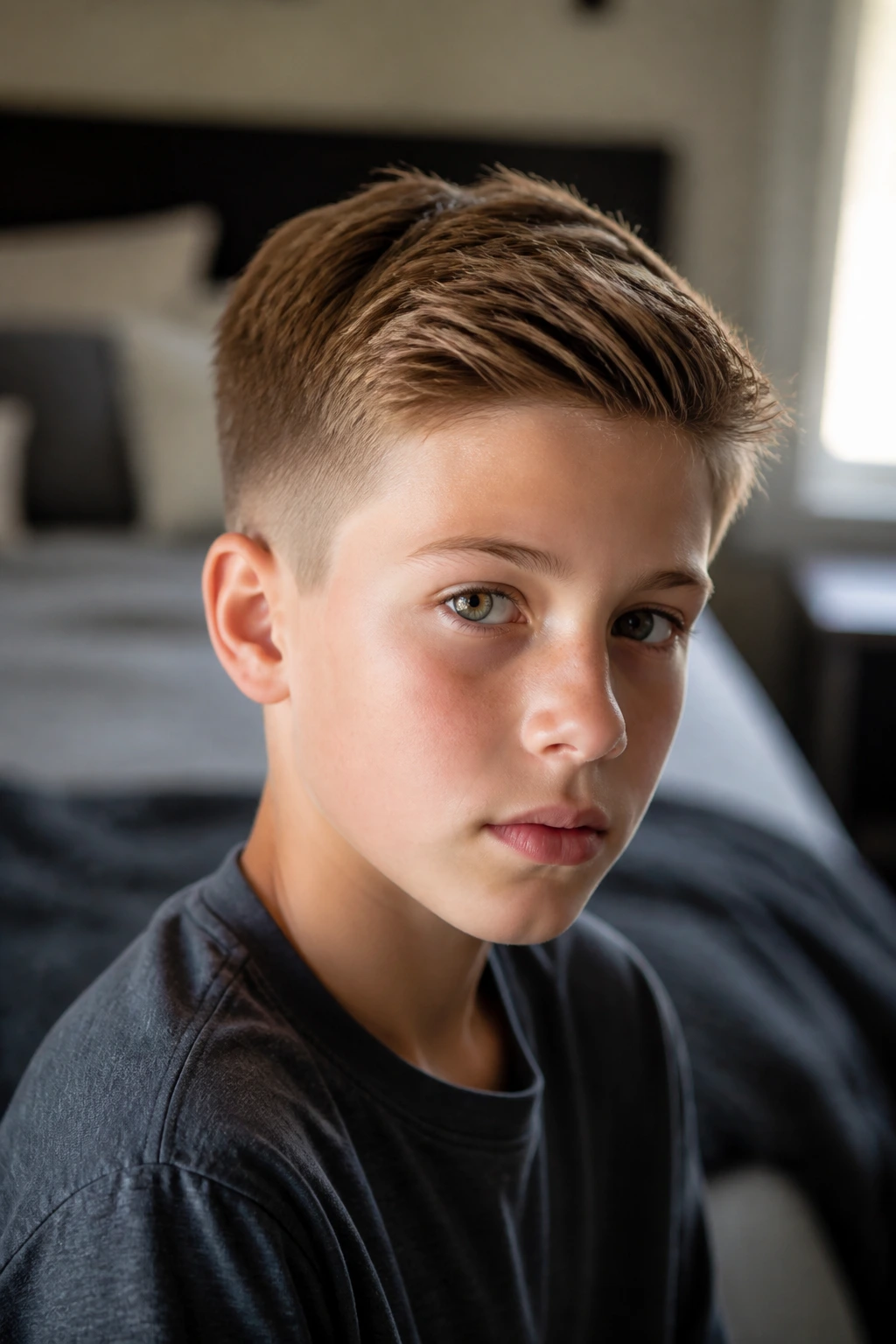
Fine hair grows out in a way that shows you everything. A fringe gets too long, and suddenly it’s in the eyes. The crown gets heavy, and the top splits. The sides grow out just enough to blur the outline. That’s why maintenance matters more here than on a denser head of hair.
For most of these styles, a trim every 3 to 5 weeks keeps the shape honest. Short crops and fades usually need attention sooner, especially if the edges are part of the look. A buzz cut or crew cut can stretch a bit longer, but once the neckline starts to fuzz out, the whole haircut loses its clean edge.
Washing is another place where people overdo it. Fine hair can get oily faster, yes, but daily harsh shampoo can leave it limp and squeaky in a bad way. A light shampoo a few times a week works for many boys, with a quick rinse on the off days if the scalp feels sweaty or product-heavy. If buildup starts to make the hair dull, a clarifying wash now and then clears the residue without needing a full reset.
Sleep matters, too. A hoodie, a cap, or a rough pillow can flatten fine hair hard overnight. If the style needs shape in the morning, dampen the front slightly and reshape it with fingers rather than soaking the whole head. That’s faster, and the result holds better.
Variations and Adaptations to Try
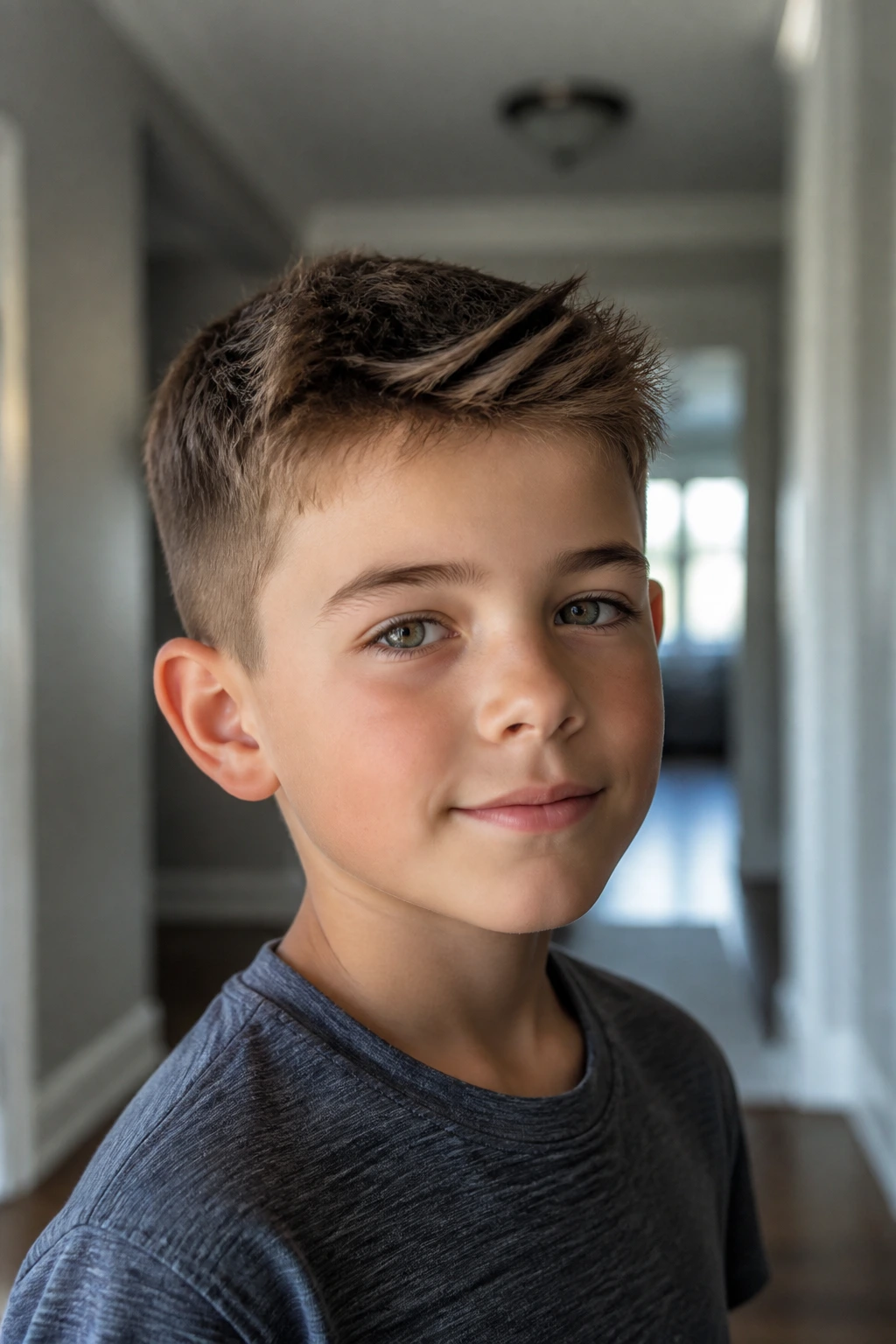
The No-Product School Version: Choose the crew cut, brush cut, or French crop and keep the top short enough to sit well on its own. This is the best route when styling time is practically zero and the school dress code wants hair to stay out of the face.
The Blow-Dry Boost: Mini quiff, brushed-up taper, and side-swept styles all get better with a two-minute blow-dry. Warm air at the roots, a quick cool blast at the end, and a matte product finish can make fine hair look noticeably fuller without feeling sticky.
The Soft Fringe Version: If the front of the hair feels weak or the forehead is long, use a Caesar, curtain fringe, or French crop. These cuts put the visual weight right where it helps most, and they hide sparse spots without looking like a cover-up.
The Clean-Edge Version: For boys who like sharp outlines, go for the slicked-back taper, disconnected undercut, or clean side part. Keep the sides neat and the top controlled. The haircut should look polished, not puffy.
The Sports-First Version: Crew cut, brush cut, buzz cut, and short spiky crop all survive helmets, sweat, and repeated headwear better than longer styles. They also recover fast after a rinse, which is a decent thing to say about a haircut, but here we are.
Common Mistakes to Avoid
-
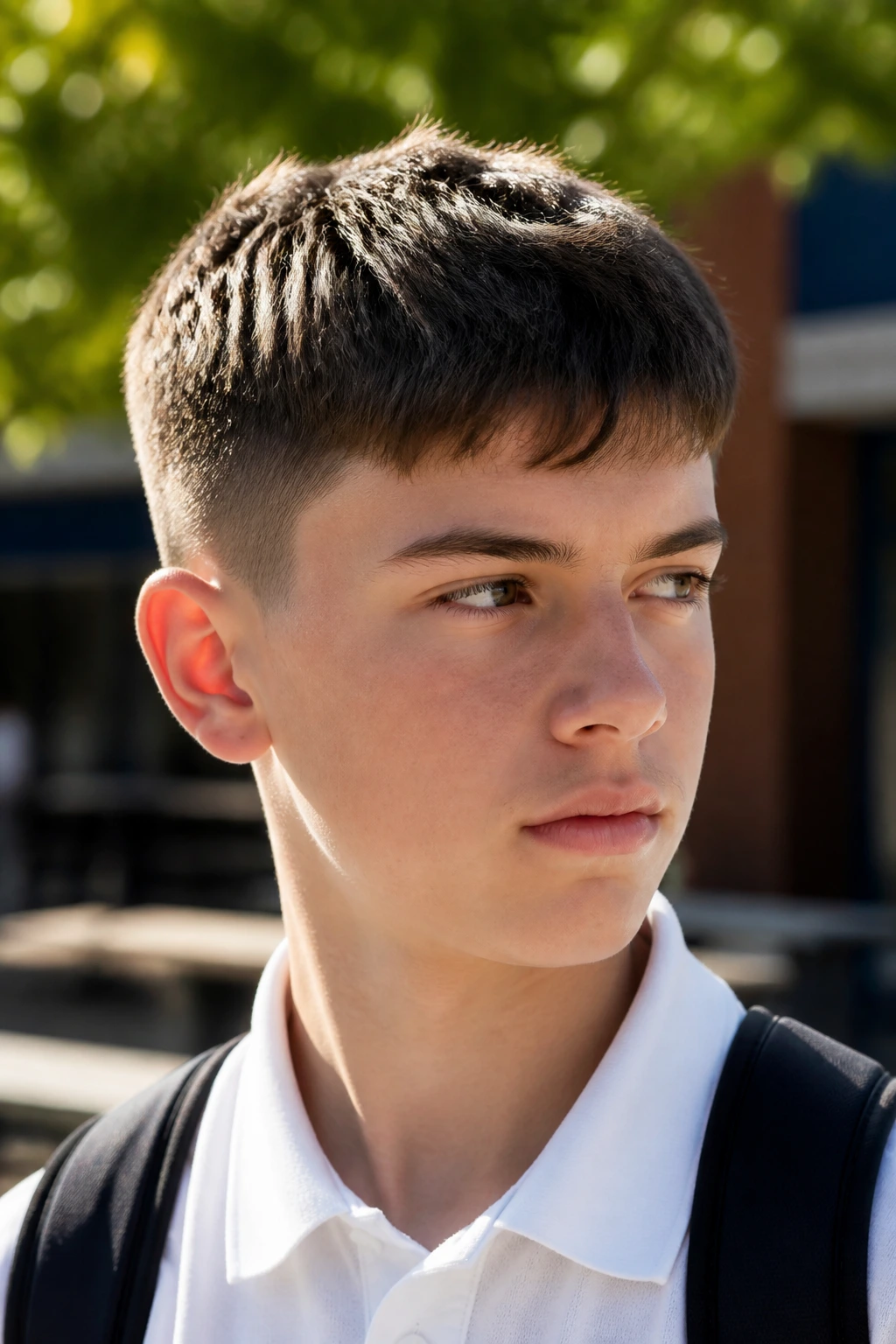
Leaving too much weight on top. Fine hair can look even thinner when it’s long and heavy. If the style collapses by midday or separates at the crown, the top likely needs to be shorter.
-
Using shiny gel or greasy pomade. Wet-looking product makes fine strands clump together, and that often reveals more scalp, not less. A matte clay, light cream, or mousse usually works better.
-
Cutting the fringe too long. Long fringe on fine hair can fall into the eyes and split into see-through pieces. Keep it above the brows or make it intentionally side-swept so the front has a clear job.
-
Over-thinning the ends. If the barber uses too much razoring or texturizing, the haircut can turn wispy and weak at the edges. Ask for texture in moderation, especially around the crown and front.
-
Trying for huge height. Fine hair can give a little lift, but not a skyscraper. If the quiff or brushed-up front needs half a bottle of product to stand up, the style is asking for more than the hair can give.
-
Ignoring the grow-out plan. Some cuts, especially fades and crops, need frequent touch-ups. If you want a style that still looks neat after several weeks, pick a soft taper or a cut with forgiving layers.
Questions Parents Ask All the Time

What haircut makes fine hair look thickest on a boy?
Short textured cuts usually do the most with the least trouble. A French crop, crew cut, or brush cut keeps the strands close together so the hair reads denser.
Is a fade good for fine hair?
Yes, as long as it’s not too high or too severe. A low taper or soft fade frames the top without exposing too much scalp around the temples.
Should boys with fine hair use gel?
Most of the time, no. Gel can separate fine strands and leave them looking wet and sparse; a matte clay, light paste, or mousse usually gives a better finish.
Can boys with fine hair wear longer styles?
They can, but the cut needs layering and control. A curtain fringe, bro flow lite, or longer side-swept style works best when the hair isn’t left heavy all one length.
How often should these haircuts be trimmed?
Short crops, fades, and buzz cuts often need a trim every 3 to 4 weeks. Longer layered styles can stretch a little farther, but once the top starts to split or the fringe gets into the eyes, it’s time.
What if my child has a cowlick in front?
Keep the front shorter or use a side-swept shape that follows the cowlick instead of fighting it. A barber can also cut around the growth pattern so the hair falls more naturally.
Does blow-drying really help fine hair?
It does, because warm air gives the roots a little lift before the hair dries flat. You do not need a long routine — even two minutes can change the shape.
Which of these cuts is easiest for school mornings?
The brush cut, crew cut, and French crop are the quickest. They need little more than a towel dry and a tiny bit of product, if any.
The Best Haircut Is the One That Holds Its Shape
Fine hair doesn’t need to be rescued. It needs a cut that knows where to put the weight and where to leave room. That’s the difference between hair that looks like it’s fighting gravity and hair that looks clean, modern, and easy to live with.
I’d start with the French crop, soft crew cut, or side-swept taper if you want the safest bets. If the boy wants a little more personality, the mini quiff, Ivy League, or brushed-up taper gives you that extra lift without making the style fragile. And if low maintenance is the whole goal, the buzz cut and brush cut are hard to beat.
The pattern is simple. Keep the product light, the outline tidy, and the top shaped with purpose. Fine hair behaves much better when the haircut does the heavy lifting.