



Thick hair and a short fade can be a gift or a fight. On the right head, the sides fall clean, the top keeps its shape, and the whole cut stays tidy even after recess, practice, or a hat that’s been shoved on and off three times. On the wrong cut, the sides puff, the crown sticks up, and the haircut grows into a rounded block before the week is out.
That is why short fades for boys with thick hair earn so much attention in the barber chair. They take bulk off the edges without flattening the top into something dead and helmet-like. The fade gives the haircut a border. The thick hair does the rest.
The trick is not finding one “best” cut and calling it a day. Thick hair behaves differently depending on whether it’s straight, wavy, coarse, or full of cowlicks, and a fade that looks perfect at the barber shop can look completely different after it dries. Some boys need a low fade that stays soft around the ears. Others need a high fade that clears the sides enough to stop the mushroom effect. A few need length on top so the hair can fall forward instead of sticking up like a brush.
Why These Cuts Calm Thick Hair So Well
Bulk Control: Thick hair gets heavy around the temples, ears, and neckline fast, and a fade removes that puff before it has a chance to build into a boxy shape.
Cleaner Grow-Out: A low or taper fade softens as it grows, which matters when hair grows quickly and you do not want a hard line showing after ten days.
Less Morning Fuss: Shorter sides mean the top is the only part that really needs attention, and most of these cuts can be fixed with water, a comb, and a small dab of matte product.
School-Ready Range: These fades can look neat enough for uniforms and photo day, then still work with hoodies, sports helmets, and messy playground hair.
Better Shape for Cowlicks: Thick hair often comes with stubborn swirls at the front or crown, and the right fade keeps those areas from turning into a little tower by lunchtime.
Room for Personality: You can keep the same fade family and change the top length, fringe, or part line, which makes this category much easier to tailor than one flat, all-over cut.
1. Textured Crop with Low Fade
The textured crop with a low fade is the move when thick hair wants to stand up and shout. The low fade clears the area just above the ears and around the nape, while the top stays short enough — usually around 1.5 to 2 inches — to fall forward instead of ballooning out.
Why It Works on Thick Hair
Thick hair likes this cut because the front gets some weight removed without losing shape. The barber can point-cut the top so it breaks into little pieces instead of sitting as one heavy sheet, and that matters more than people think. One blunt top on coarse hair can look like a lid. A textured top looks deliberate.
Ask for a low fade that starts soft and stays tight around the lower third of the head. The top should be slightly longer at the fringe than at the crown, which helps it settle forward when it dries. If the hair is straight and stubborn, a touch of matte clay is enough; if it’s wavy, a light cream keeps it from getting crispy.
- Top length: 1.5 to 2 inches
- Fade height: Low, beginning just above the ear
- Best for: Straight or slightly wavy thick hair
- Styling: Finger-comb forward with a pea-sized amount of matte product
- Trim cycle: Every 2 to 3 weeks
Best move: tell the barber to leave the fringe a touch longer than the crown. That keeps the crop from splitting open at the front.
2. French Crop with Skin Fade
The French crop is the cleanest way to put thick hair back in its place. The short fringe sits forward, the skin fade strips away the bulk on the sides, and the whole cut looks sharp even when a boy runs his hands through it a dozen times before lunch.
The reason this cut works so well is simple: thick hair can get bulky, but the French crop turns that density into a heavy, controlled front. The fringe can be blunt or lightly textured, depending on how much forehead coverage you want. If there’s a stubborn cowlick at the front, this is one of the best ways to work with it instead of fighting it.
A skin fade gives the strongest contrast, which suits thick hair because the top needs room to breathe. The fade also makes the fringe look longer than it is, so the cut feels styled without needing much product. That’s useful for boys who hate morning routines.
Use a matte paste or cream, not a shiny pomade. Shiny product makes the fringe separate in thin strands, and thick hair rarely needs help looking busy. It already has volume. The crop just puts that volume where it belongs.
3. Crew Cut with Mid Fade
Why does the crew cut keep showing up in barber chairs for boys with thick hair? Because it’s one of the few short styles that can be neat, sporty, and forgiving all at once. A mid fade removes weight through the sides while leaving enough top length — usually about 1 to 1.5 inches — to lie down instead of sticking out in every direction.
A crew cut is also honest. No fake height. No stubborn fringe. Just a clean top that follows the shape of the head and a fade that keeps the silhouette tight around the edges. Thick hair responds well to that sort of simplicity because the cut does most of the work.
How to Ask for It
- Keep the top short but not buzzed, roughly 1 to 1.5 inches.
- Start the fade around the midpoint of the head, not right at the temple.
- Blend the top with scissors so the crown does not become a shelf.
- Leave the sideburns neat and narrow if the boy wears glasses or sports gear.
A crew cut is the one I recommend when the goal is low drama and high reliability. It looks good after gym class. It looks good after a nap. It even looks decent when the cowlick refuses to cooperate.
4. Buzz Cut with High Fade
If you’ve ever seen thick hair puff up the second it dries, the buzz cut with a high fade is the blunt answer. There’s no pretending here. The sides go tight, the top stays uniform, and the whole thing works because there isn’t enough length left for the hair to argue with you.
This cut is especially good when the hair is coarse and dense, not because it hides that density, but because it puts it in its place. A #2 or #3 on top gives a little softness. A #1 can work too, though that starts to show head shape more clearly, which matters on some boys and not on others. The high fade keeps the sides crisp and makes the top look intentional instead of grown-out.
It’s the easiest style on this list to maintain. It also shows the scalp more, so if the skin gets dry or sunburned, a little care goes a long way. A light shampoo and occasional moisturizer around the hairline help more than people expect.
- Top guard: #1 to #3
- Fade start: High, above the temple
- Best for: Sports, hot weather, boys who hate styling products
- Watch out for: Uneven head shape or a very strong crown swirl
No fluff. No combing. Just a cut that says the hair is short on purpose.
5. Caesar Cut with Taper Fade
The Caesar cut does something useful for thick hair: it pushes the front forward and takes the pressure off the sides. With a taper fade around the ears and neckline, the look stays neat, but the top still has enough density to sit as a solid shape instead of a wispy fringe.
This is one of the better choices if the hair wants to fall forward naturally. A boy with a cowlick at the front can often wear a Caesar better than a side part because the short fringe works with the growth pattern instead of trying to force it away. Keep the fringe short and blunt, then ask for some texture through the top so it doesn’t look like a helmet.
The taper makes a difference here. A skin fade can feel a little severe on some younger boys, while a taper leaves the haircut softer around the edges. That gives the Caesar a more classic look and lets it grow out more gracefully.
It’s a practical cut, but not a boring one. The little bit of fringe gives the face a frame, and the taper keeps the cut from looking heavy around the ears.
6. Ivy League with Low Fade
Unlike a crew cut, the Ivy League leaves enough length on top to part and sweep, which is exactly why it works so well for thick hair. The low fade keeps the sides neat and lets the top stay slightly longer — usually around 1.5 to 2.5 inches — so the hair can be styled with a side sweep instead of lying flat.
This is the cut I’d pick for boys who need something tidy enough for school pictures but not so short that it feels military. Thick hair gives the Ivy League structure. Fine hair can sometimes look too soft in this style, but dense hair holds the part with almost no effort.
A low fade keeps the haircut balanced. Too high, and the top starts looking oversized. Too low, and the sides can keep too much bulk. Somewhere around the lower third of the head usually lands best.
Use a light cream or a small bit of matte paste. Too much product turns the part into a shiny stripe, and that never looks as good as people think it will. The better version has movement, not grease.
If the boy wears glasses, this is one of the nicest pairings in the group. The clean sides keep the frames from getting swallowed by hair.
7. Side Part with Drop Fade
A side part with a drop fade has one job: keep thick hair from exploding at the temples while giving the top enough direction to sit where it should. The drop fade curves lower behind the ear, which is handy when the head is rounder or when the hair grows wider through the sides.
Where the Part Should Sit
The part line should not be buried too far back. Put it just far enough over that the top can sweep without collapsing. If the hair is very dense, a hard part can look too sharp, so a natural part often works better. That’s especially true for younger boys who need the cut to look neat even after a day of rough play.
The top can stay around 2 to 3 inches, which gives enough room to comb it over or brush it sideways with a little cream. Thick hair has the mass to hold a side part without needing half a jar of product.
A drop fade is useful because it follows the shape of the head rather than cutting a straight band around it. That can make the whole cut feel smoother and less boxy. It also means the fade still looks good as it grows out, which is something parents notice fast.
If you want one word for this cut, it’s organized. Not stiff. Just organized.
8. Brush Cut with Burst Fade
The brush cut with a burst fade is what happens when thick hair needs shape but not too much polish. Picture a short top that’s brushed slightly up and forward, with the fade rounding out around the ear in a burst shape instead of dropping straight down.
That rounded fade matters. It opens up the side profile and keeps the haircut from looking square, which thick hair can do if the sides are left too heavy. The burst fade also gives the haircut a little motion, so it feels less severe than a skin fade that runs straight back.
This style works especially well on boys whose hair grows thick at the crown and front but lies flatter toward the back. The brush-up on top gives just enough lift without going full quiff. A vent brush and a quick blow-dry can set the direction in under two minutes.
- Top length: Around 1.5 to 2.25 inches
- Fade shape: Burst around the ear
- Best for: Wavy or coarse hair with strong density
- Product: Light matte cream or texture paste
- Good when: You want a sporty cut with some movement
The whole cut has a nice middle ground feel. It’s tidy, but not flattened. Styled, but not precious.
9. Quiff with Mid Fade
A quiff on thick hair can look fantastic, but only if the fade pulls its weight. A mid fade gives the sides enough control so the top can lift without the haircut turning into a mushroom. That’s the whole game here.
The quiff needs some height at the front, and thick hair has the body to hold it. The problem is that body can get too big fast. A mid fade trims the width out of the sides so the top becomes the focus. If the hair is coarse, leave a little more length than you think you need; if it’s soft but dense, blow-dry is the part that makes the shape.
A small round brush or vent brush helps direct the front up and back. Use heat, but don’t roast the hair. A minute or two is enough for most boys. Then work in a light matte clay so the front stays lifted without looking crunchy.
This is one of the more styled options in the group, so I’d choose it for boys who actually like doing their hair. If the routine will be ignored by Tuesday, pick something shorter.
10. Comb Over with Taper Fade

Why does a comb over work so well on thick hair? Because thick hair naturally wants to create a visible line of direction. The taper fade keeps the edges tidy while the top is left long enough — usually 2 to 3 inches — to sweep across without collapsing into the forehead.
The Shape That Keeps It from Puffing
The key is weight control. If the top is cut too blunt, it can sit like a slab. A barber should thin only lightly and mainly use scissors to soften the top’s edge. The taper fade around the ears and neck keeps the cut looking polished even when the part loosens later in the day.
This is a smart choice for boys who want something a little more dressed up than a crew cut but less fussy than a full pompadour. It works well with thicker straight hair, though a slight wave can give it even better movement. Just do not overdo the product. A light cream or low-shine paste is enough.
If the child wears a school uniform, this is one of the most flexible cuts around. It can look tidy in a classroom and still hold up after a soccer game.
11. High and Tight with Skin Fade
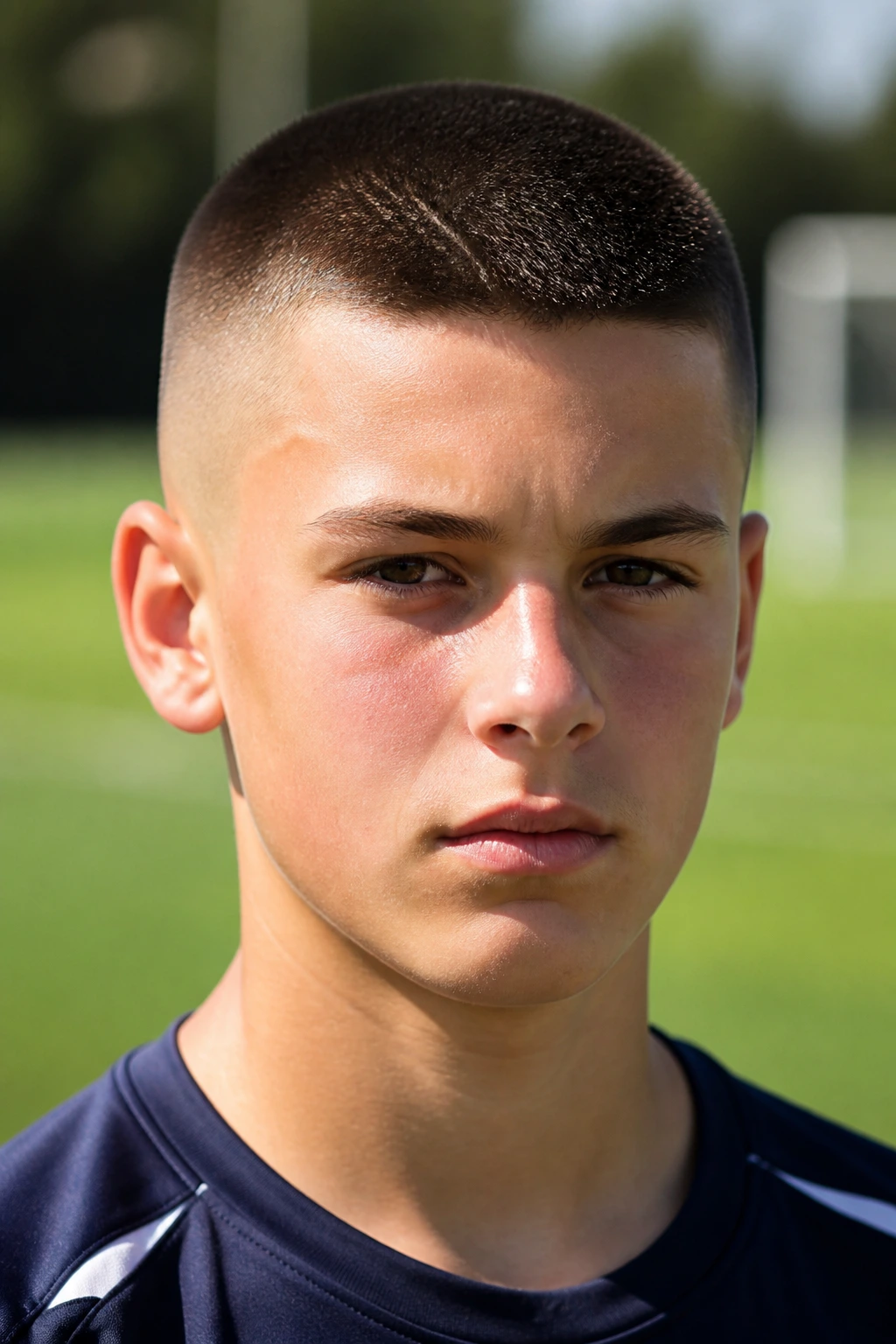
The high and tight does not pretend to be soft. It’s direct, cropped close, and built for thick hair that gets heavy fast. The skin fade takes the sides down nearly to the scalp, while the top stays as a narrow strip of slightly longer hair that follows the head shape.
That contrast is what makes the cut work. Thick hair can make a head look wide if the sides are left too full, and the high and tight fixes that immediately. It also gives a very clean neckline and ear area, which is useful when a boy wears a helmet or hates stray hairs tickling the sides of his face.
This is a strong choice for active kids, but it does show the shape of the head more than most other cuts here. If the crown has a stubborn swirl, the top may need to be left a touch longer so it lies properly. No heavy product needed. Most days, a damp hand and a quick brush are enough.
It’s a no-nonsense haircut. The kind that looks tidy even after a long, messy day.
12. Flat Top with Low Fade
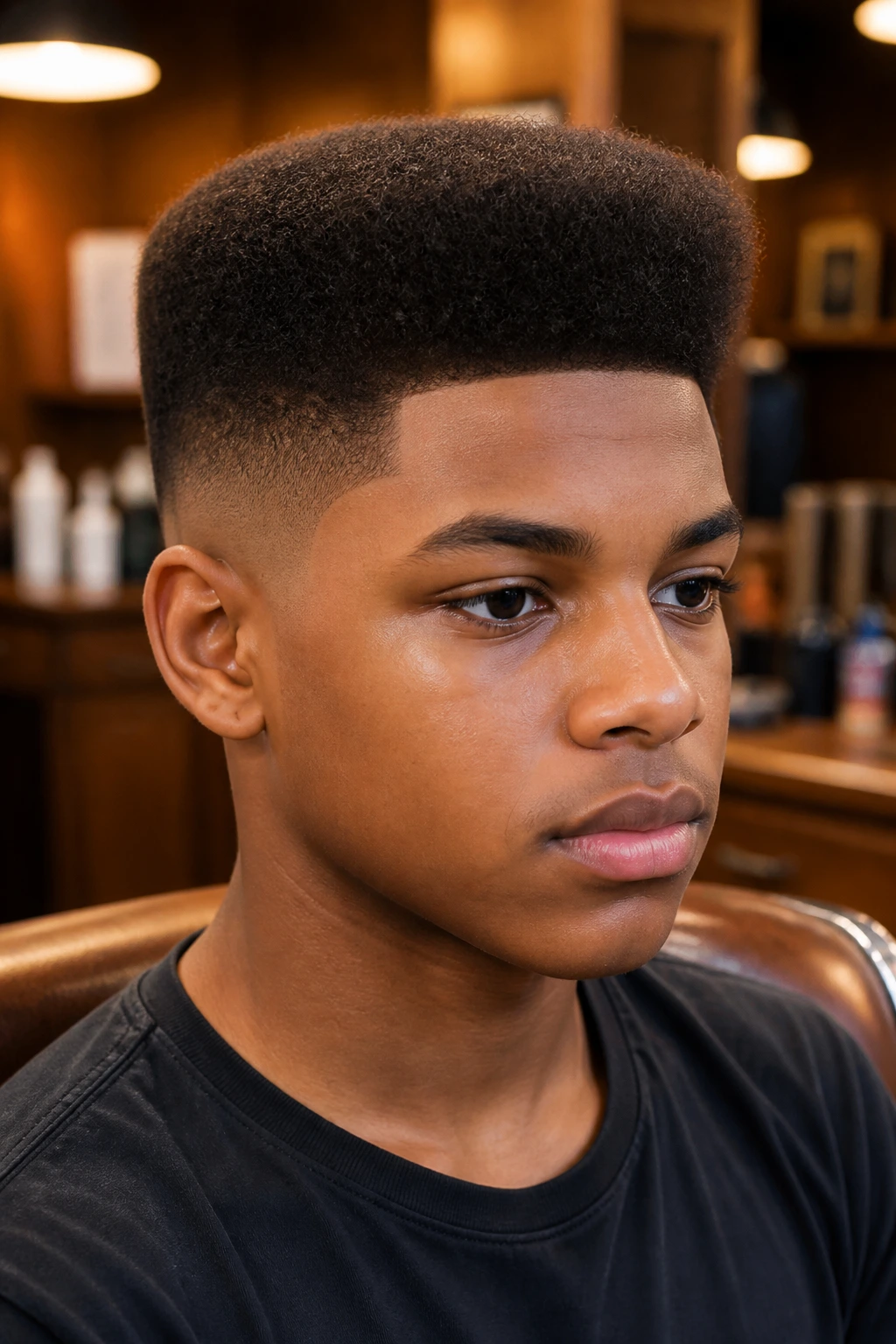
The flat top is a classic thick-hair cut for a reason: it uses density as an advantage instead of trying to hide it. When the top grows straight enough, the barber can square it off so it stands level, while the low fade keeps the bottom of the haircut clean and modern.
This cut is best when the hair is straight and strong. Wavy hair can fight the flat shape, and very fine hair won’t hold the line. Thick hair, though, gives the top enough substance to look like a deliberate platform instead of a soft bump. The trick is balance. Too much height looks dated. Too little and you lose the whole point.
A low fade stops the sides from turning bulky underneath the flat top. That matters because the top already brings visual weight. Keep the fade lower than you think, and let the squareness live up top.
- Best for: Straight, dense hair
- Top length: About 1.5 to 2 inches, depending on density
- Fade height: Low
- Style note: Blow-dry straight up before shaping
- Watch out for: Curved corners that make the top look lopsided
If you like crisp edges and a cut with attitude, this one earns its place.
13. Spiky Crop with Fade
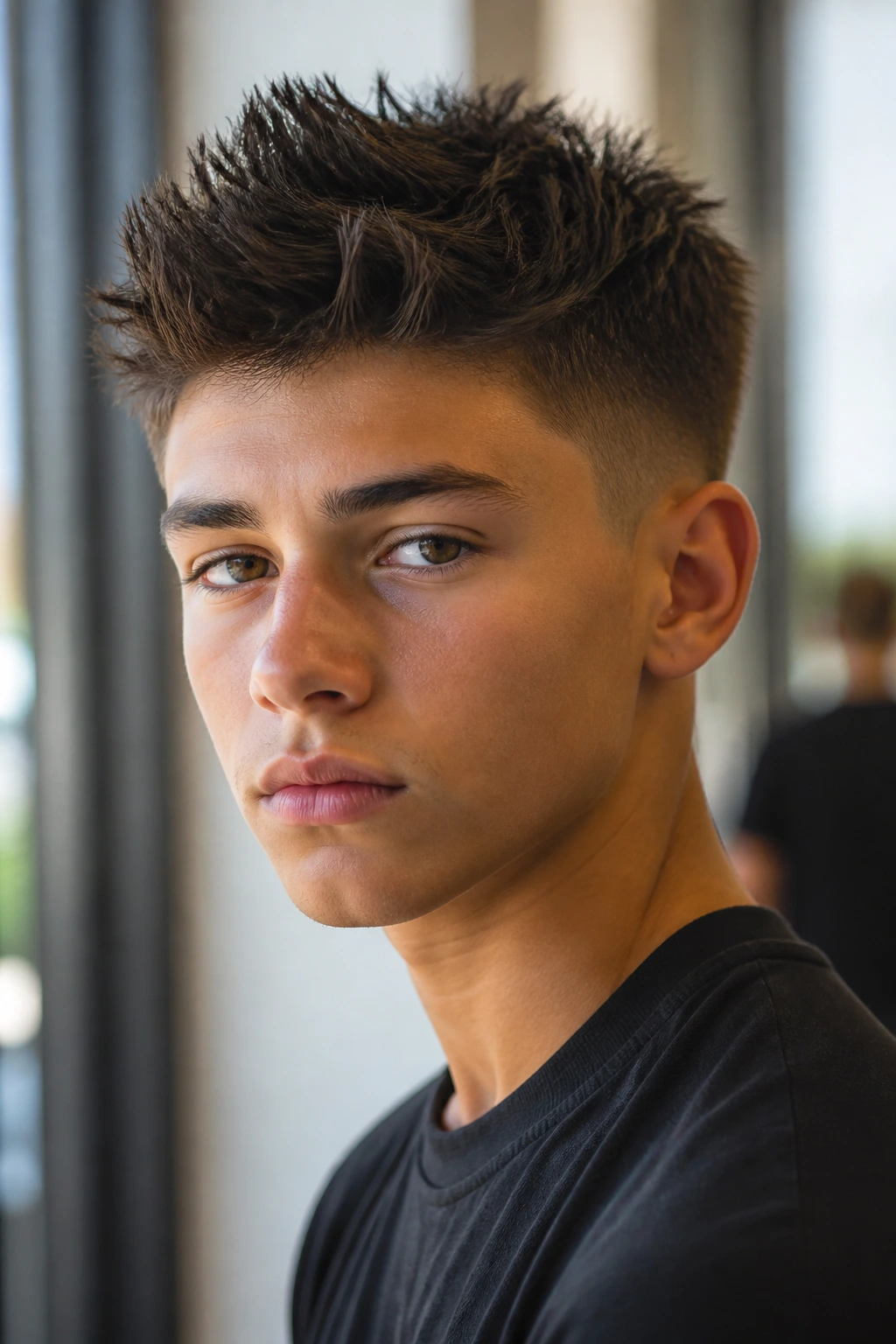
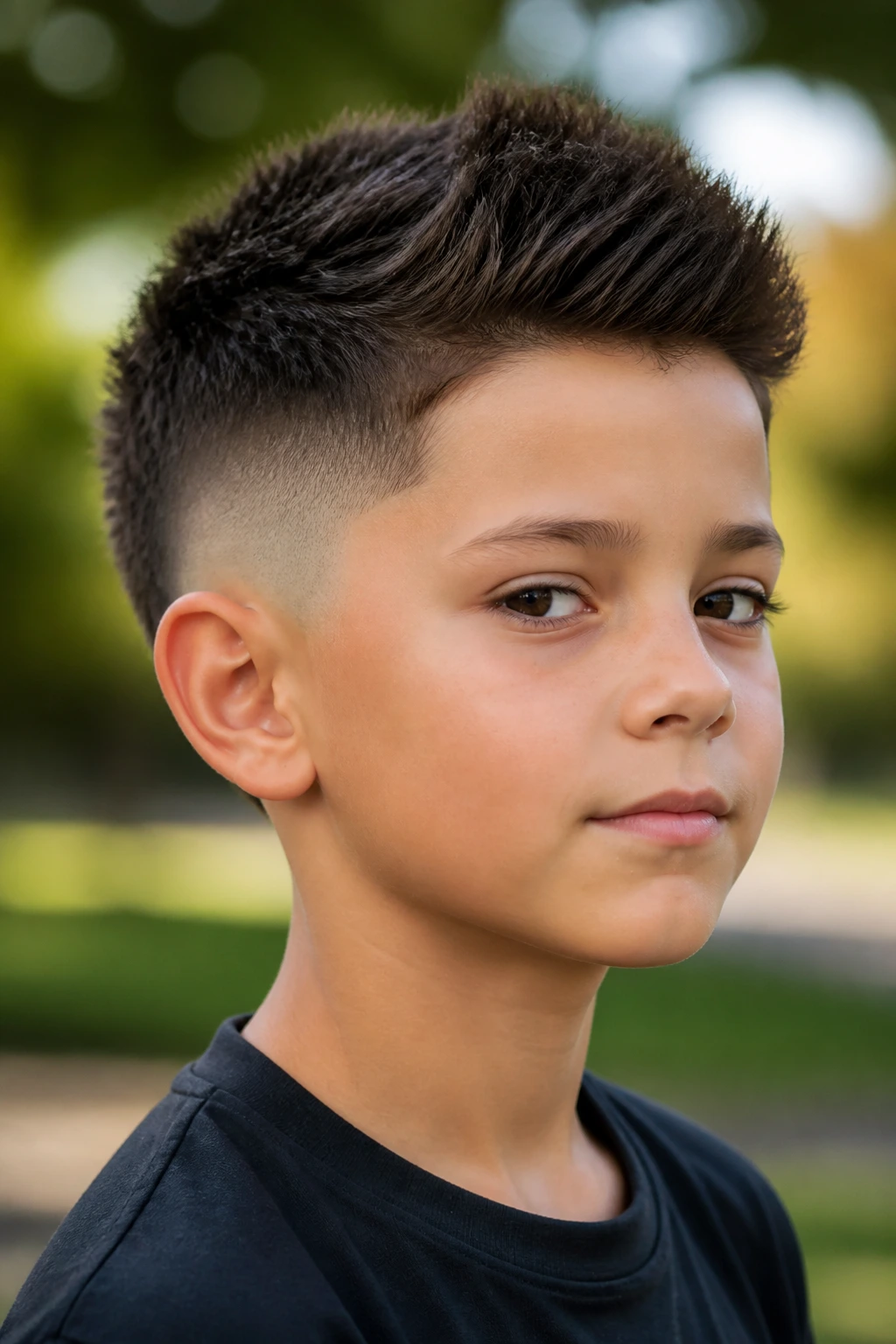
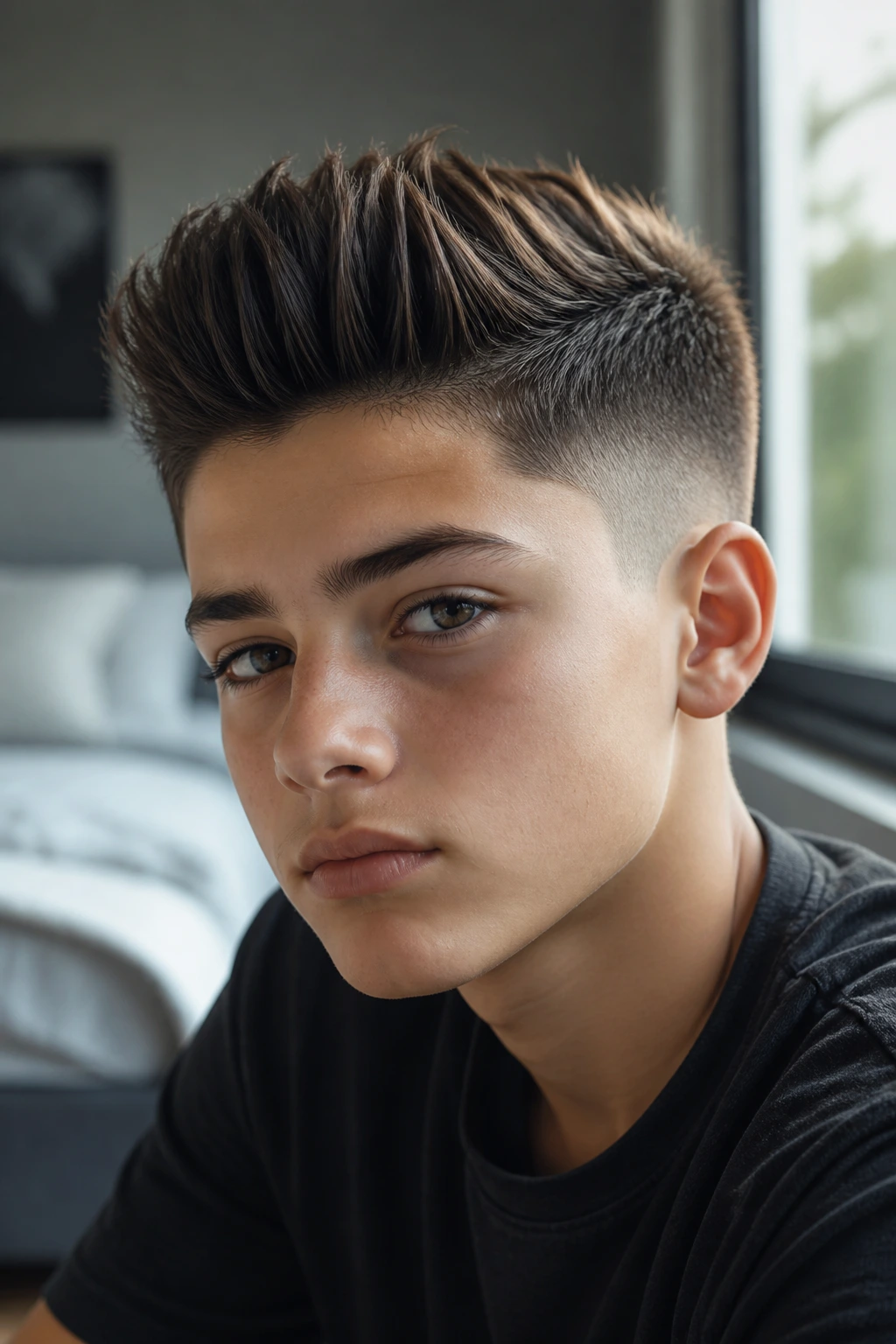
The spiky crop with a fade works because thick hair can hold little points without disappearing ten minutes later. A lot of spiky styles fail on thin hair because they collapse. Thick hair keeps the texture alive, especially when the top is cut short enough to stand up but not so short that it bristles like a broom.
A mid or low fade keeps the sides from widening the head. The top usually sits around 1 to 1.5 inches, with a little extra at the front if you want the spikes to lean upward. Use a matte clay, then pinch the hair into small sections with your fingers. The goal is separation, not a stiff shell.
This style can look playful on younger boys and sharper on older ones. It’s also forgiving if the top gets mussed during the day, because a quick wet-hand reset brings the shape back fast. That’s one reason parents tend to like it.
What to Tell the Barber
- Keep the top short enough to spike, not so short it lies flat.
- Leave texture on top with point cutting.
- Choose a low or mid fade so the sides do not overpower the top.
- Skip thick, glossy product. It turns spikes into clumps.
It’s a simple cut, but not a dull one. Thick hair gives the spikes enough life to matter.
14. Short Pompadour with Burst Fade
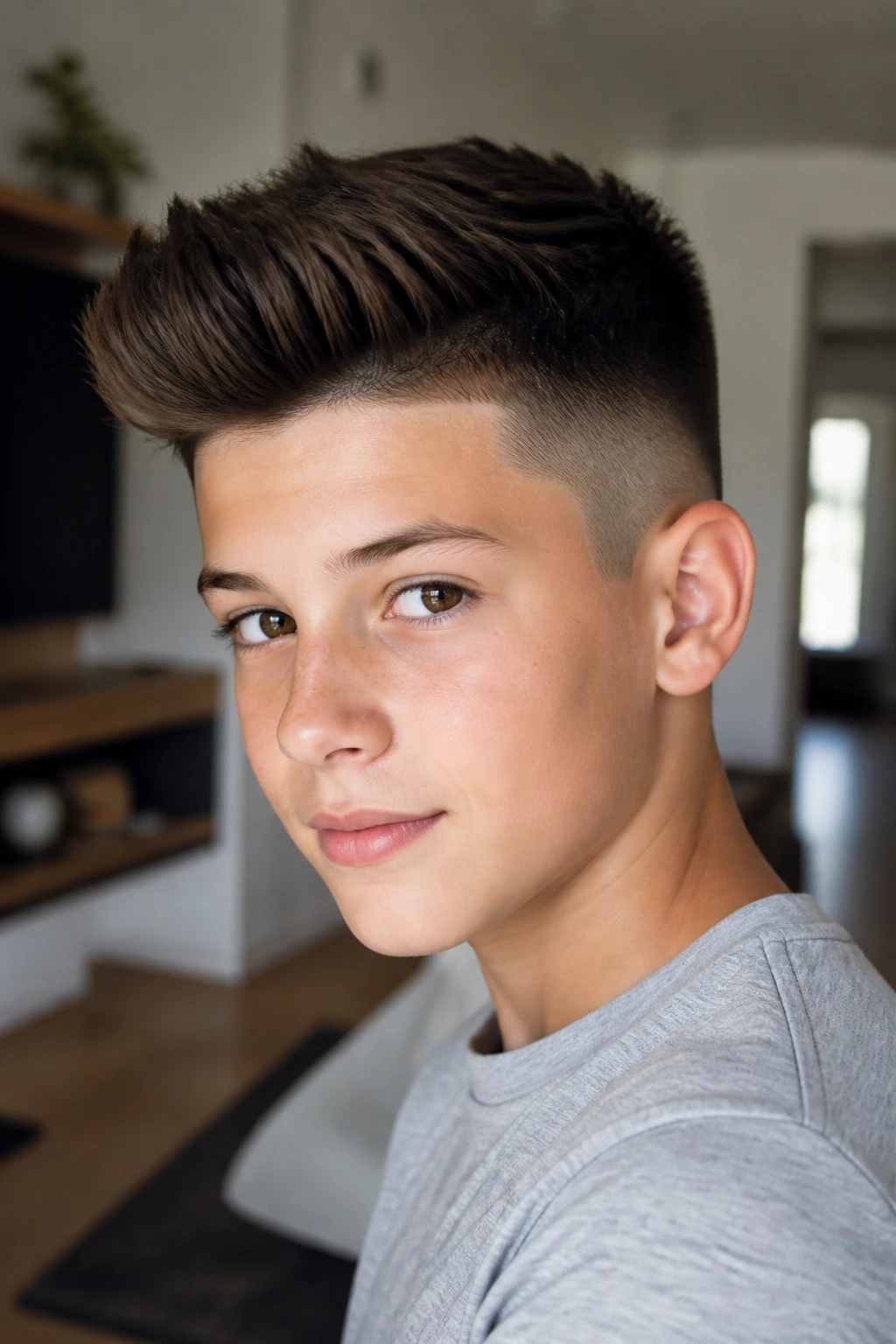
The short pompadour is the dress-up version of a thick-hair fade. It gives the front a bit of lift, keeps the sides tight with a burst fade, and leaves enough top length to shape without building a giant wall of hair on the forehead.
This is not the old-school, tall pompadour with heavy gloss. For boys, the better version is shorter, softer, and easier to reset after a school day. Thick hair helps the front hold its lift, but it also means you have to control the sides carefully. The burst fade rounds the area around the ears, which keeps the silhouette from turning square.
A little blow-drying goes a long way here. Push the hair up and back with a vent brush, then use a small amount of matte cream or a low-shine paste. The finish should still look touchable. If it looks shellacked, too much product went on.
This style suits boys who like a bit of shape on top and do not mind spending two minutes in front of the mirror. For younger kids, keep it short enough that the lift is natural rather than styled into a mound.
15. Regulation Cut with Taper Fade
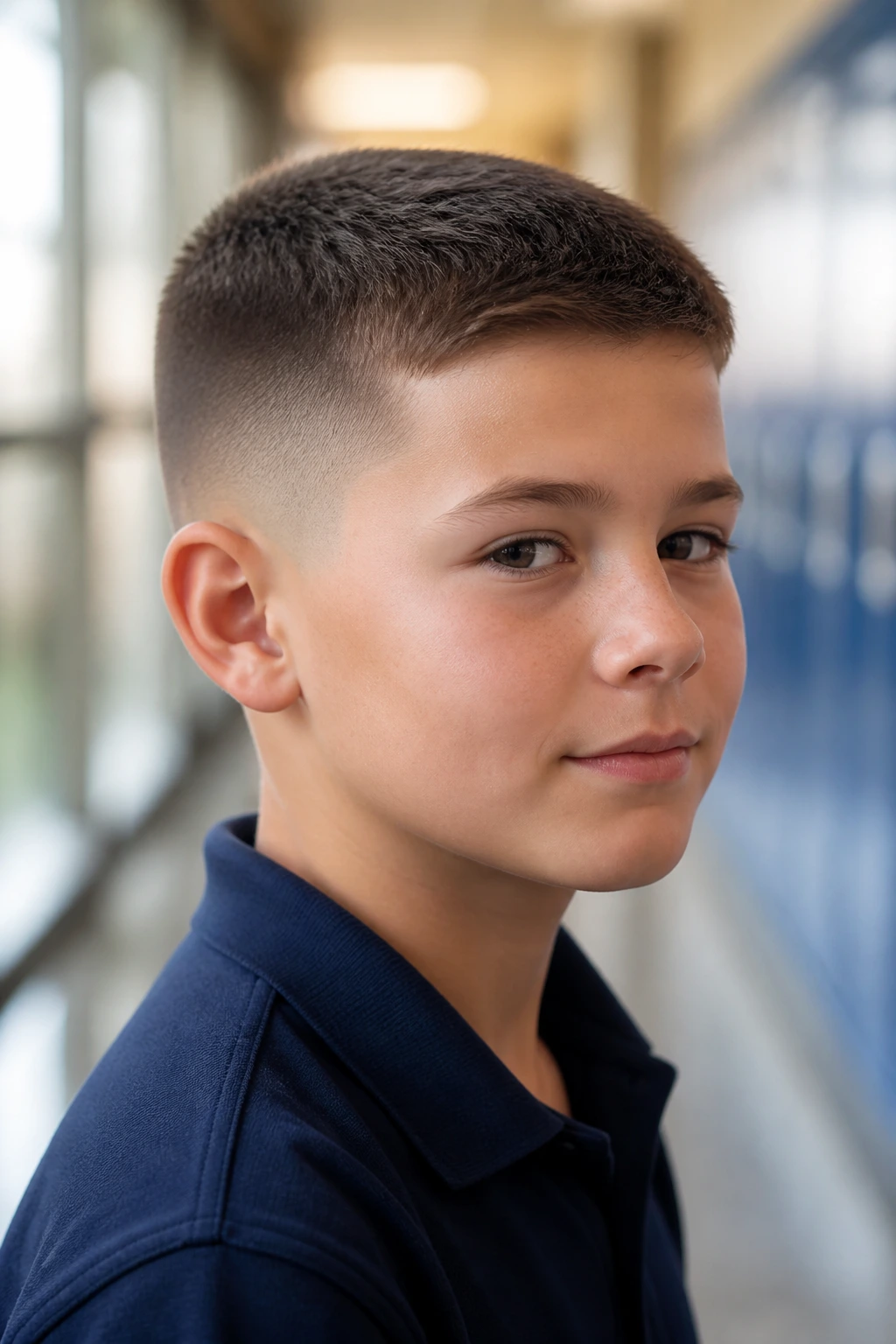
What makes a regulation cut so useful for thick hair is its restraint. The top stays short enough to behave, the taper fade cleans up the edges, and the whole haircut stays neat without needing a lot of product or daily coaxing.
A regulation cut sits somewhere between a crew cut and a side part. The top is usually left just long enough to comb to one side, but not long enough to flop over. That makes it a strong option for boys who need something tidy for school, church, or family photos, yet still want hair on top rather than a clipped-down buzz.
What the Barber Should Hear
Tell the barber to keep the top short and uniform, with just a little extra length at the front if the hair grows forward. Ask for a taper around the ears and neckline rather than a hard skin fade if you want the cut to grow out softly. Thick hair benefits from that softer edge because it avoids the shelf that can appear when the sides are cut too bluntly.
This is one of the calmest choices on the list. Not flashy. Not boring either. Just clean, dependable, and easier to live with than most cuts that try harder.
16. Mohawk Fade with Short Top
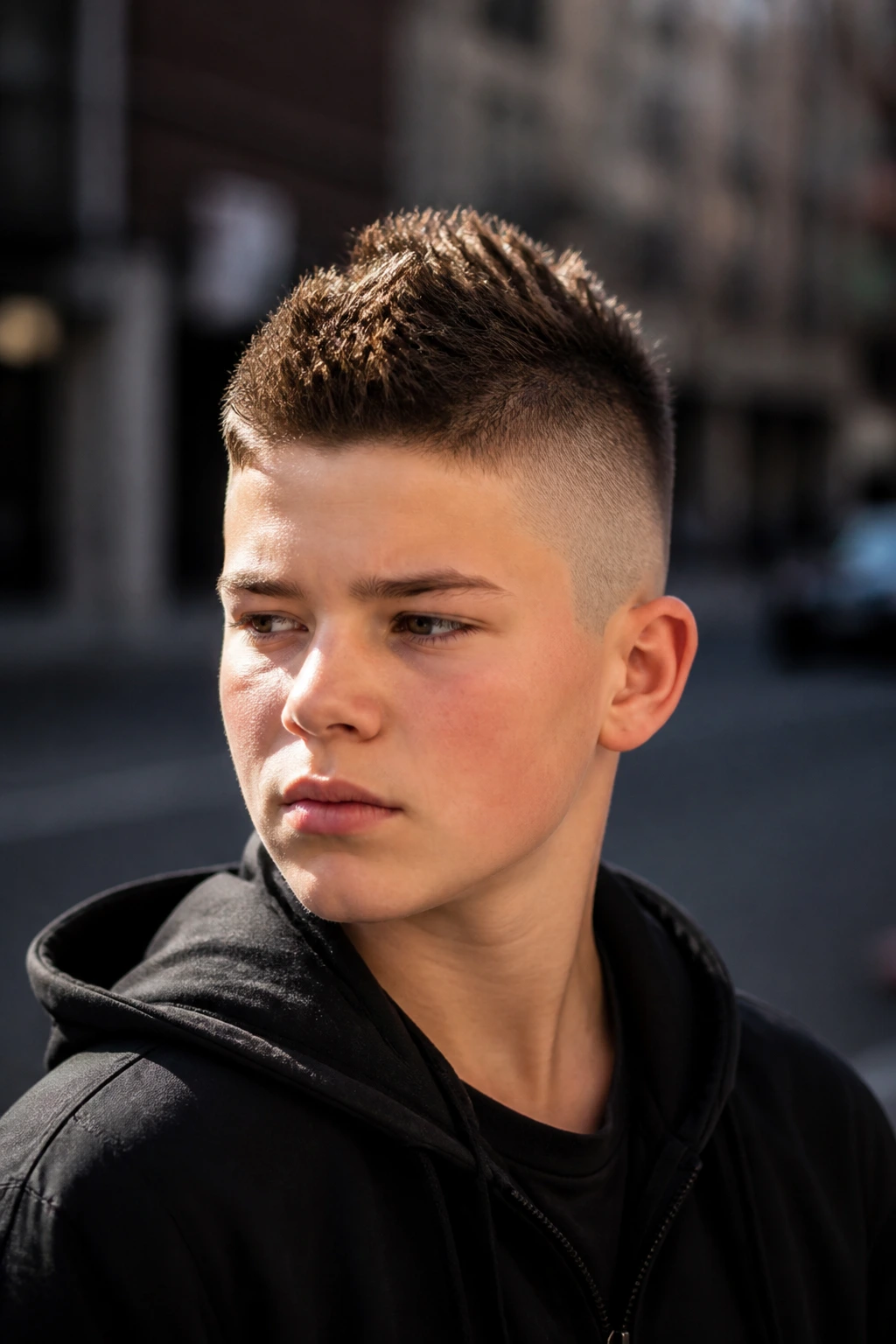
A mohawk fade sounds louder than it usually looks on a boy with thick hair. Keep the top short, keep the sides faded, and the result is more wearable than dramatic. The trick is to leave a defined strip through the center while trimming the sides tight enough that the shape reads instantly.
Thick hair gives this style its structure. The center strip does not need to be tall; even a subtle rise can show enough contrast if the fade is clean. A skin fade makes the shape bolder, while a low or mid fade softens it for school or everyday wear. If the boy is younger or the rules are strict, keep the top textured and short rather than pointy.
This cut works best when the top is styled upward with fingers, not sculpted into spikes. You want motion, not a hard ridge. A matte cream keeps the center section separated while still soft.
- Best for: Thick, straight hair with good density through the middle
- Fade choice: Skin fade for contrast, low fade for softness
- Top length: About 1 to 2 inches
- Styling: Fingers, not a comb
- Good warning: Keep the strip narrow or the cut loses its shape
A little edge goes a long way here.
17. Forward Fringe with Skin Fade
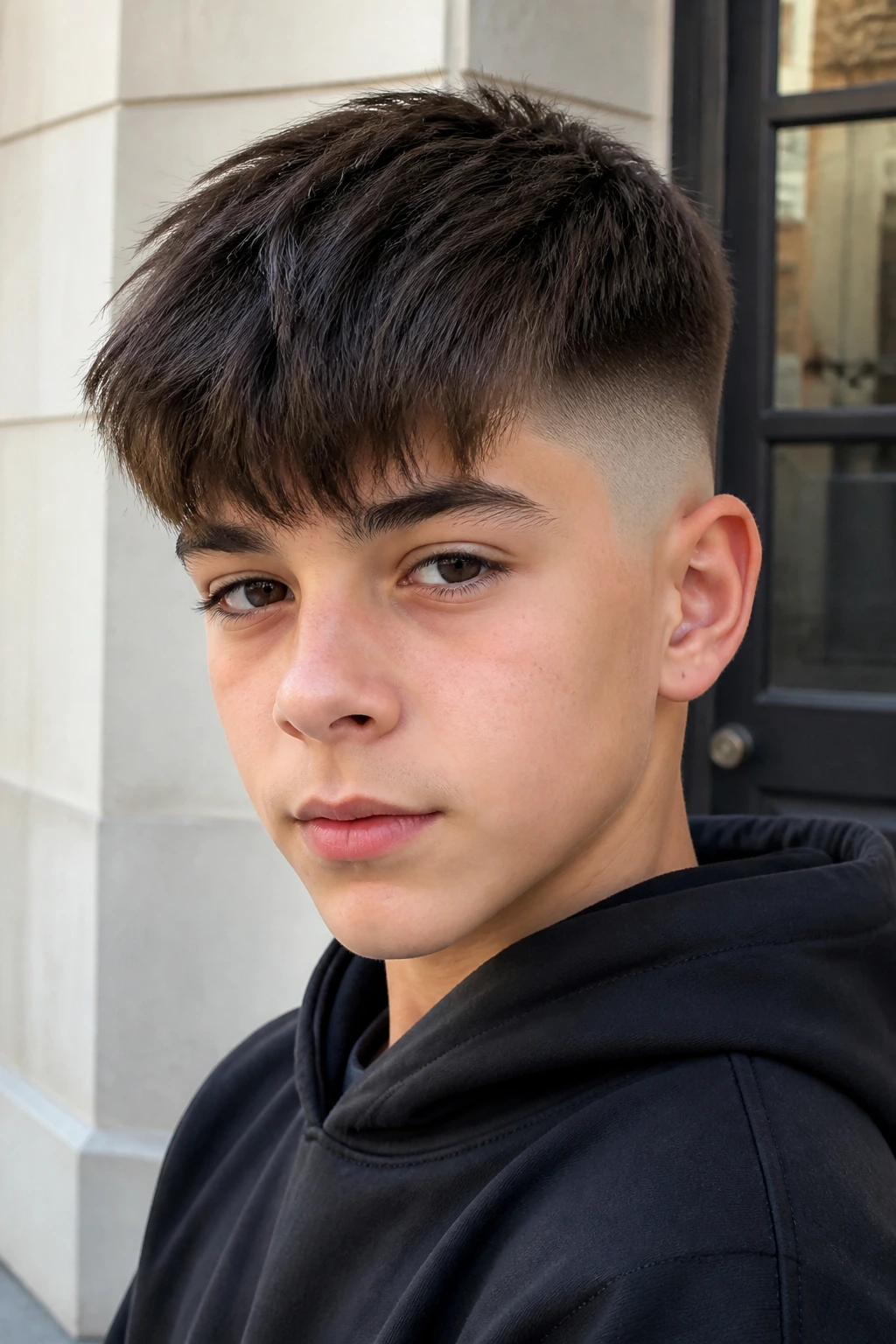
The forward fringe is one of the smartest ways to manage thick hair that likes to stand up at the front. Push the weight forward, keep the sides skin-faded, and the hair suddenly starts behaving like it has a plan. The fringe can be blunt or softly textured, depending on how much coverage you want.
This cut is especially useful for boys with a strong forehead swirl or a front cowlick that refuses to sit back. Instead of fighting the growth pattern, the fringe uses it. Thick hair creates a dense curtain, and the skin fade makes sure the sides do not compete with that front shape.
Use a small amount of cream or paste and keep the fringe piecey rather than heavy. If the top is cut too square, the look can get blocky fast, so ask for some point cutting through the front. The final shape should fall forward in a natural arc, not hang like a shelf.
One thing I like about this cut: it hides bad hair days better than most. A little extra movement in the front is usually all it takes to keep it looking intentional.
18. Disconnected Crop with Temple Fade
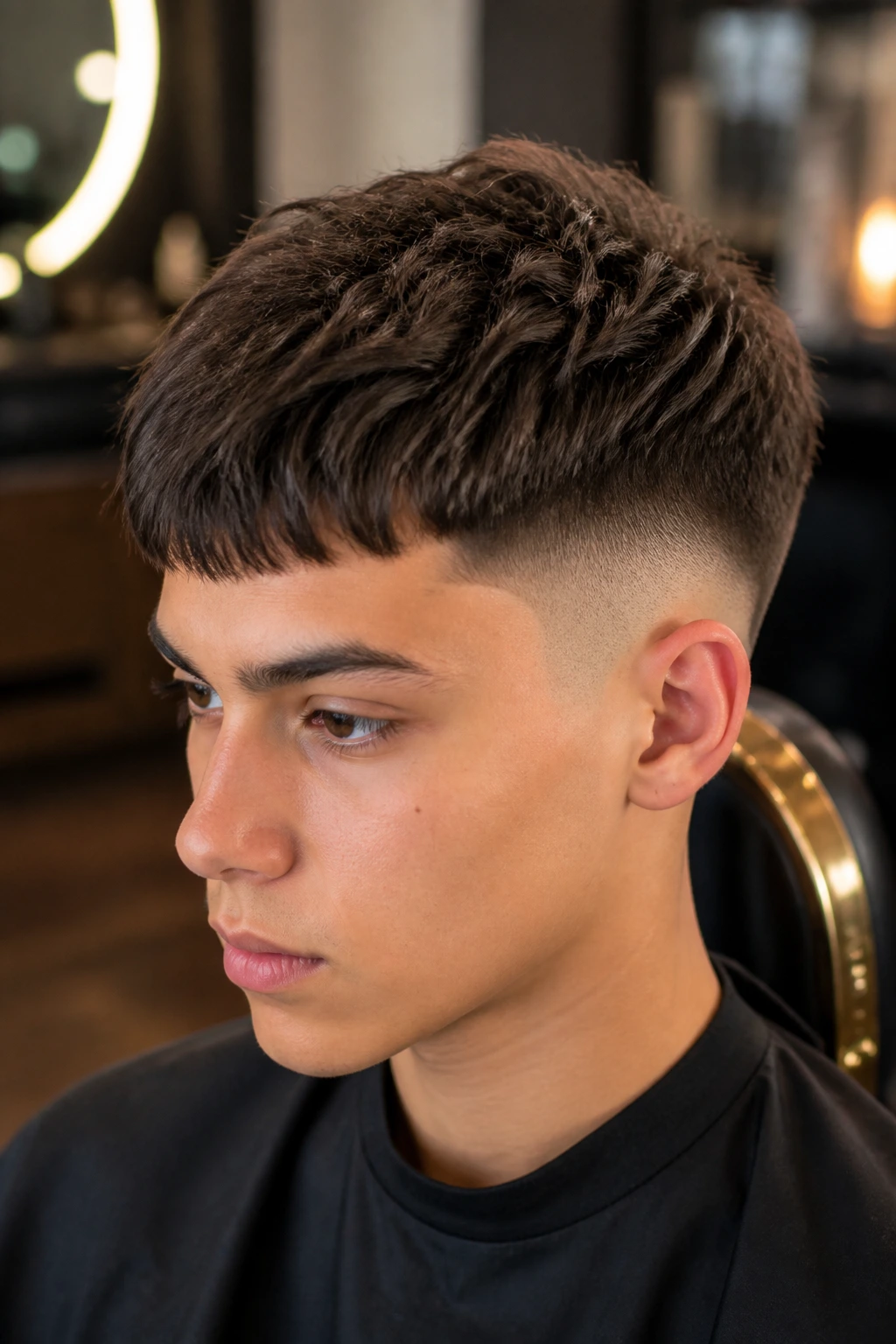
A disconnected crop with a temple fade is for boys who want a little edge without committing to a full dramatic cut. The top stays clearly longer than the sides, and the sharp disconnect makes thick hair look intentional instead of overgrown. The temple fade cleans the front corners so the haircut doesn’t look square or too heavy.
The disconnect is the point. It lets the top sit as its own shape, which can be useful when thick hair has a lot of density and the barber does not want to blur everything together. Keep the top textured and around 2 inches or a touch more, then let it fall forward or slightly to the side. It reads modern without needing a hard part or too much product.
Best way to wear it
Use a matte cream on damp hair, then push it where you want it with your fingers. If the top has a stubborn wave, do not flatten it too much; a little lift gives the cut life. The temple fade can be low or mid, depending on how much contrast you want.
This is a good cut for older boys who want something sharper than a simple crop. It’s also one of the better choices when the hair is thick enough to need serious shape control but not so short that the style gets lost.
Why a Barber’s Blend Matters More Than the Top
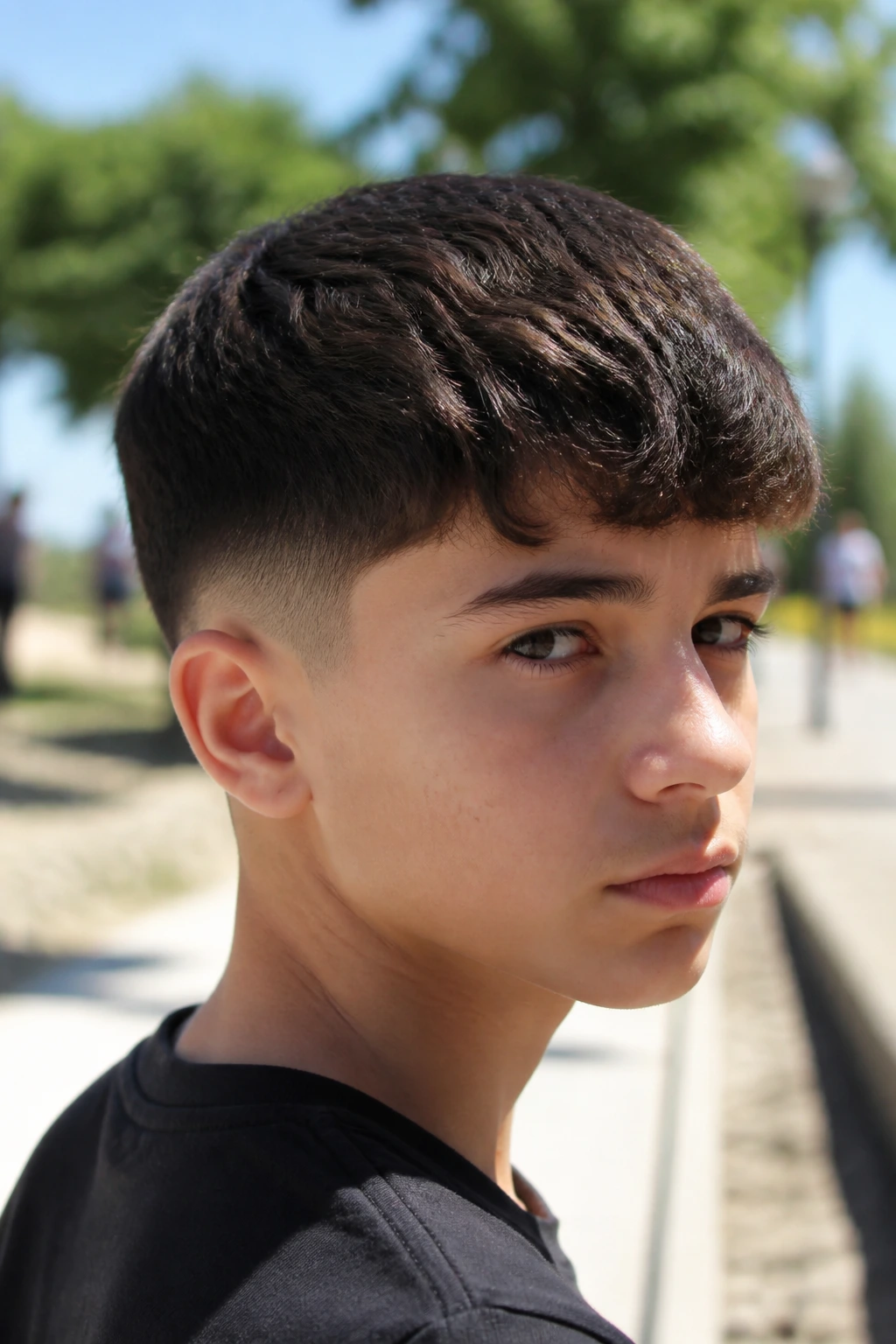
Thick hair can hide a sloppy fade longer than fine hair, which sounds nice until the cut starts growing out and the mistakes show up all at once. The difference between a good short fade and a forgettable one usually lives in the blend, not the top. If the barber removes bulk too quickly near the temples, the haircut can look like a shelf. If the fade stays too low and the top is left too wide, the head starts looking rounder than it should.
The cleanest fades on thick hair usually use a slow transition through the sides, not a jump from short to long. That’s why you hear barbers talk about guard steps and clipper-over-comb work. On dense hair, those small changes matter because the texture itself does some of the blending for you. A smooth fade on thick hair is less about making the scalp visible and more about getting the weight to disappear in the right places.
Thick hair also changes how light hits the haircut. A hard edge around the ears can look sharper than it does on thinner hair. A soft taper can look softer. Tiny details, big effect.
The Clippers, Combs, and Products That Earn Their Keep
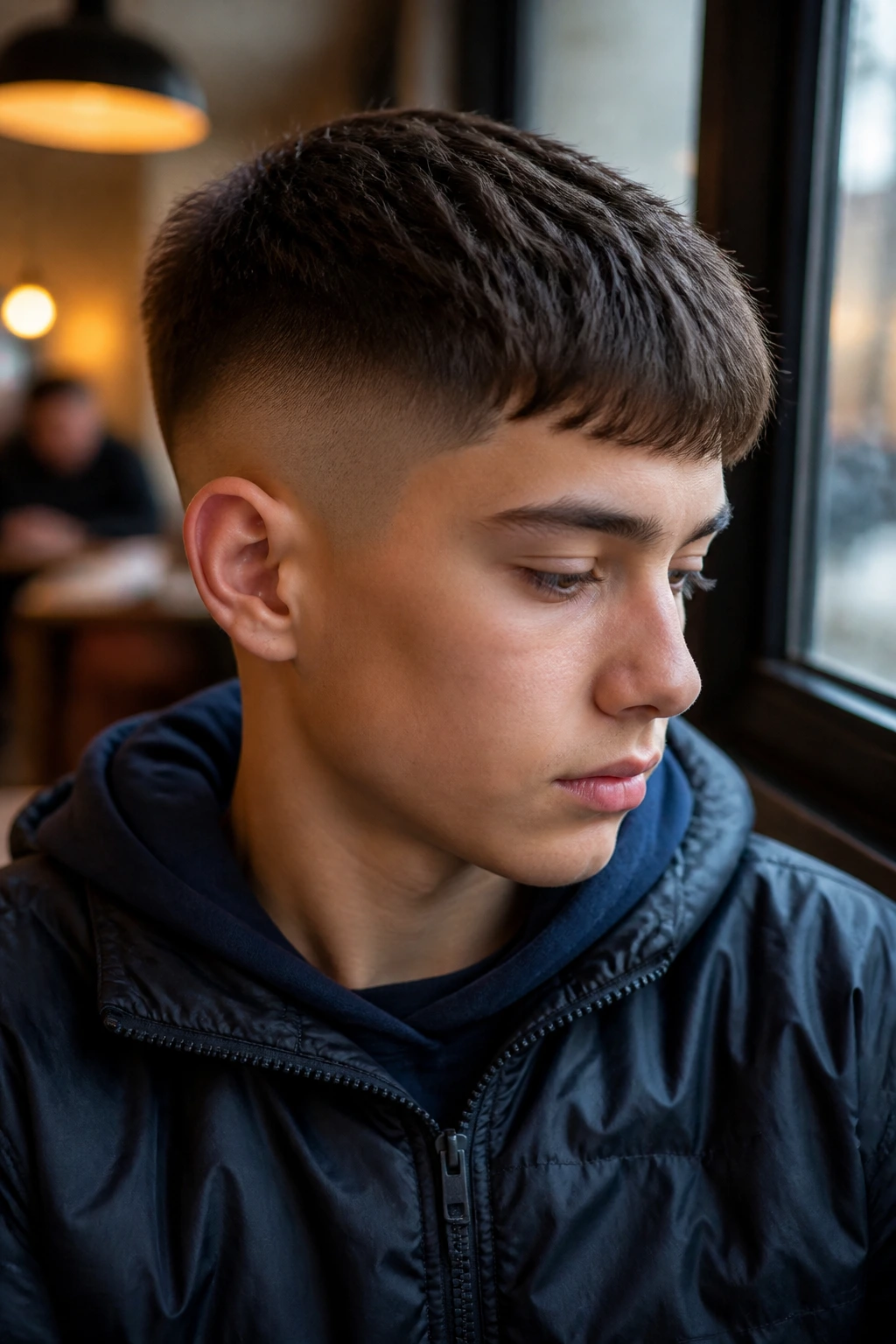
- Clippers with guards #0.5 to #4: These cover most low, mid, and high fade work, and the half-guard is especially useful for thick hair because it blends more smoothly than jumping straight from #1 to #2.
- Detail trimmer: Clean edges around the ears, neckline, and sideburns keep short fades from looking fuzzy after a few days.
- Barber shears, 6 to 7 inches: Better than clippers alone for taking weight out of thick tops without shredding the shape.
- Texturizing shears, optional: Helpful in small doses on very dense hair, but easy to overdo if the hair is already coarse or frizzy.
- Spray bottle with water: A damp top is easier to control while cutting and styling; a dry mop of thick hair can lie to you.
- Fine-tooth comb and clipper comb: Useful for parts, lifts, and clipper-over-comb blending.
- Blow dryer with nozzle: Gives shape to quiffs, pomps, side parts, and brushed crops without needing heavy product.
- Vent brush or small round brush: Good for directing thick hair forward or upward.
- Matte clay or light styling cream: Thick hair usually looks better with a dry finish than a glossy one.
- Hand mirror and cape: Handy for checking the back and keeping hair off school clothes.
How to Tell the Barber Exactly What You Want
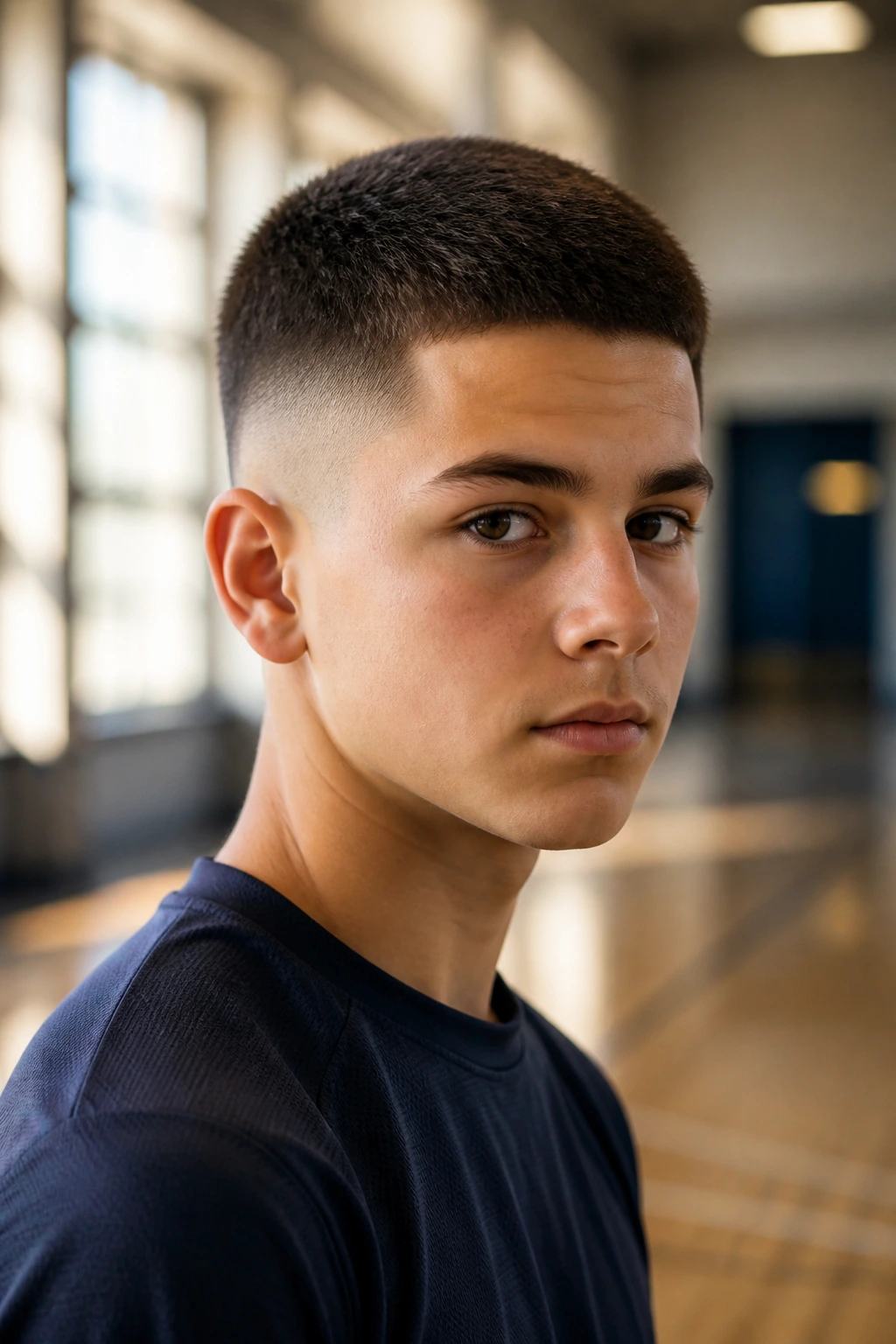
A good haircut starts before the clippers switch on. Thick hair needs specifics, not “short on the sides, longer on top.” That phrase can produce almost anything, from a tidy crop to a lopsided helmet. Bring a photo if you can, but bring one that shows the side and front, not just a filtered angle from someone’s best side.
Say the fade height out loud. Low, mid, high. Then say how short you want the first guard at the bottom. Skin fade? #0.5? Taper only? Those details matter because thick hair covers mistakes. A line that looks subtle at the chair can look bulky two days later if the blend is off.
The top needs its own number too. “About 2 inches on top” is useful. “Keep some length” is not. If the hair has a cowlick at the front or a strong swirl at the crown, say so before the cut starts. That lets the barber leave extra length where the hair resists and remove weight where it does not.
If the boy wears a helmet, has a school dress code, or hates product, say that as well. Those facts change the cut more than people realize.
How to Wear These Cuts for School, Sports, and Photos
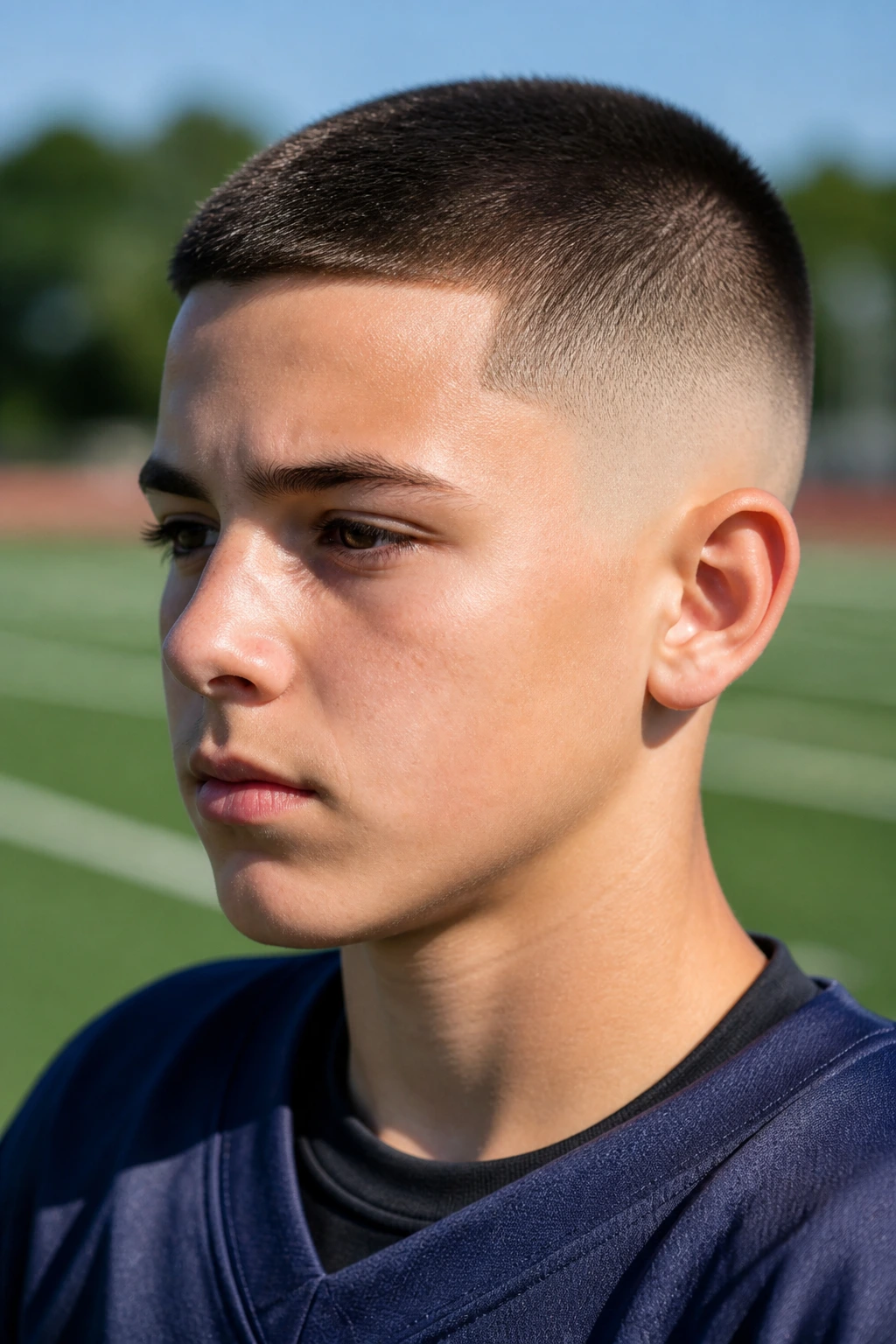
Presentation: Thick hair looks best in a short fade when the top stays matte and touchable. A glossy finish can make the top look separated and stiff, which is rarely better than a clean, soft hold.
Everyday routine: For crops, Caesar cuts, crew cuts, and buzzes, a little water and a comb usually beat heavy styling. For side parts, comb overs, quiffs, and pomps, use a blow dryer for 60 to 90 seconds before adding product. That small stretch of heat gives the cut shape that lasts through the day.
Athletics: Low fades and textured crops hold up well under helmets and sweat. High quiffs and tall pomps tend to flatten, then split, then get annoying. If practice is a daily thing, choose a cut that can be reset with damp hands rather than rebuilt from scratch.
Photos and special events: Ivy League cuts, side parts, and regulation cuts are the easiest to neaten up without making the child look overly styled. A quick comb, a pea-sized bit of cream, and a clean neckline go a long way.
Small Tweaks That Make Thick Hair Behave Better
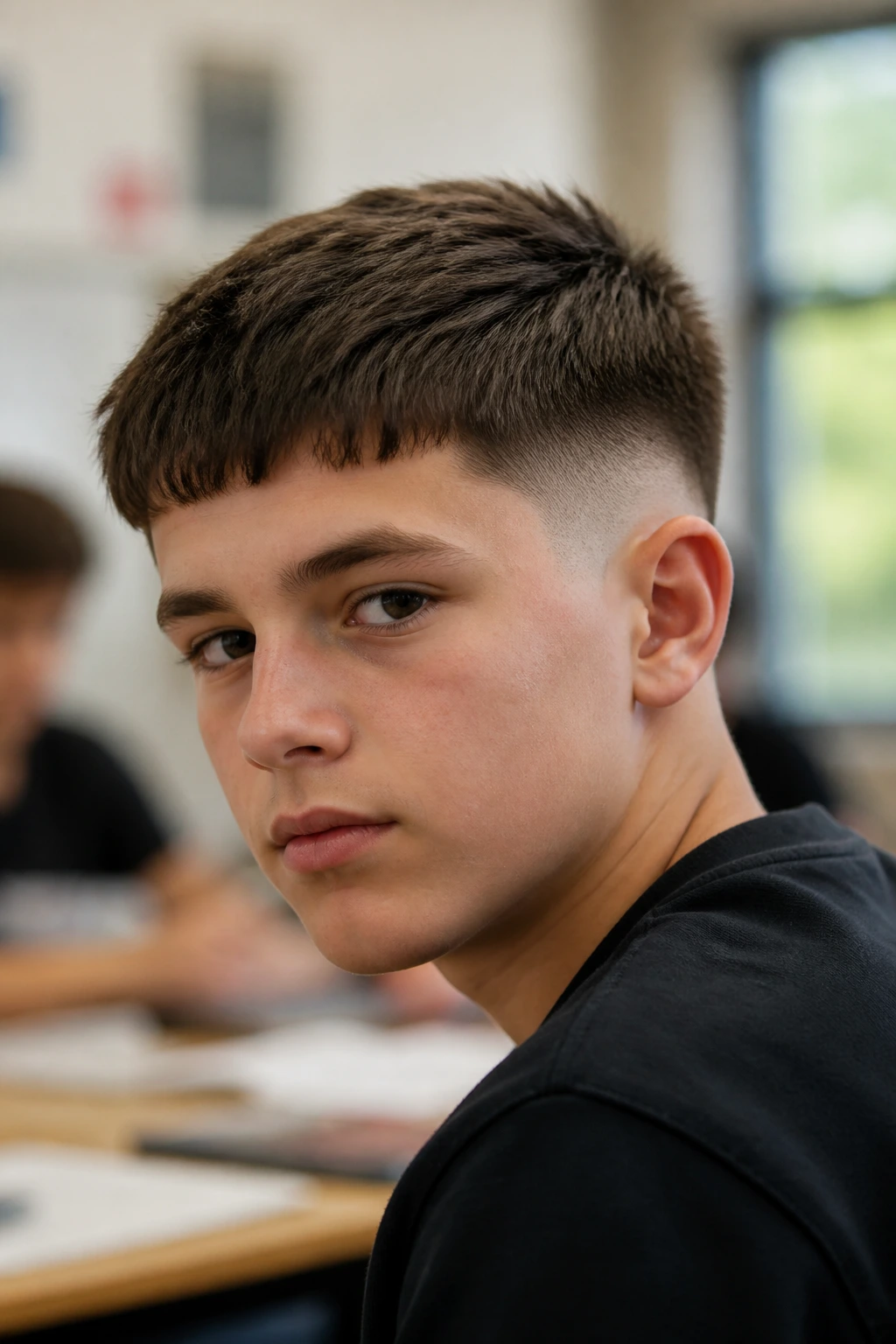
Texture Control: Ask for point cutting on the top if the hair is dense. It removes the blunt edge without creating the fuzzy, over-thinned look that some boys get from aggressive texturizing.
Drying Direction: Blow-dry thick hair in the direction you want it to settle. Forward for crops and fringes. Up and back for quiffs and pomps. Sideways for comb overs and Ivy League cuts. That one habit changes the haircut more than most products do.
Product Choice: Matte clay suits crops, crew cuts, and spiky cuts. Light cream works better for side parts, comb overs, and softer school cuts. Heavy wax is usually a bad idea on thick hair because it gathers in patches and makes the top look greasy instead of controlled.
Cleanup Timing: Thick hair grows fast enough that sideburns and neckline fuzz can make a tidy cut look tired early. A quick cleanup every 10 to 14 days can keep a low fade or taper looking fresh without booking a full haircut.
Crown Check: If the crown sticks up, leave a little more length there. Cutting it too short makes the hair stand harder, not softer. That’s one of those annoying truths that barbers know well and parents learn the hard way.
What Usually Goes Wrong With Thick Hair Fades
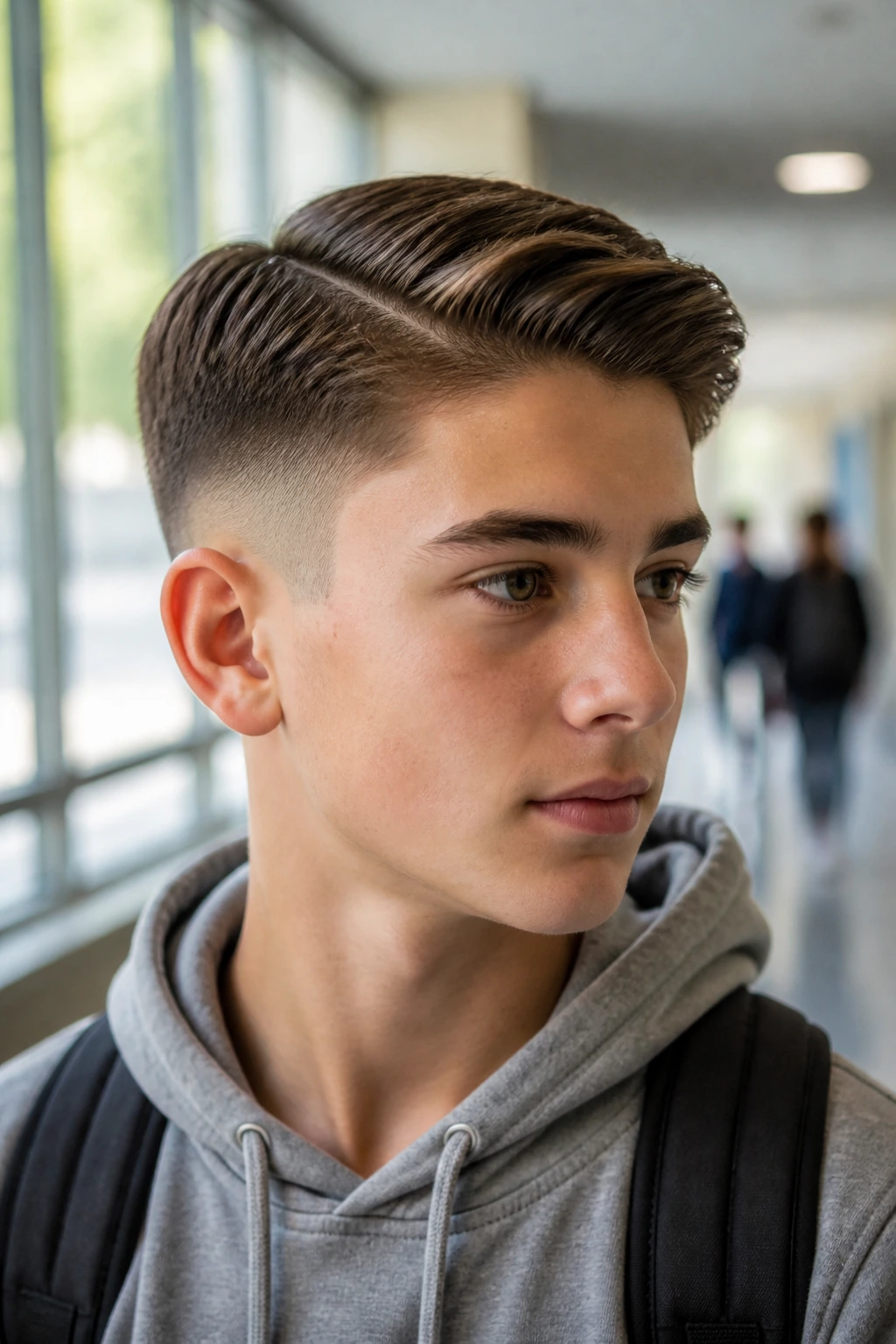
The fade is too high. The haircut suddenly looks top-heavy, and the head can seem wider than before. Fix it by keeping the next fade lower and allowing more side weight near the temple.
The top is thinned too much. Thick hair can turn frizzy or uneven when texturizing shears are used like a lawn mower. The fix is lighter debulking with scissors and more respect for the hair’s natural body.
The product is too heavy. Thick hair does not need a jar of shine to behave. Too much product clumps the top into sections and makes it look dirty by the afternoon. Use less than you think, then add a touch more only if needed.
The fringe fights the cowlick. A front swirl can wreck a crop or side part if the top is cut too short. Leave more length in the problem area and style the hair in the direction it naturally wants to go.
The cut grows out without cleanup. Thick hair shows fuzz fast around the neck and ears, and the fade loses its clean shape. A quick edge cleanup is often enough to stretch the cut another week.
The top and sides do not match. If the top is very long and the sides are too soft, the haircut turns puffier than planned. If the sides are too tight and the top is too short, the whole look can feel harsh. Balance matters more than extreme length.
Variations and Alternate Takes to Try
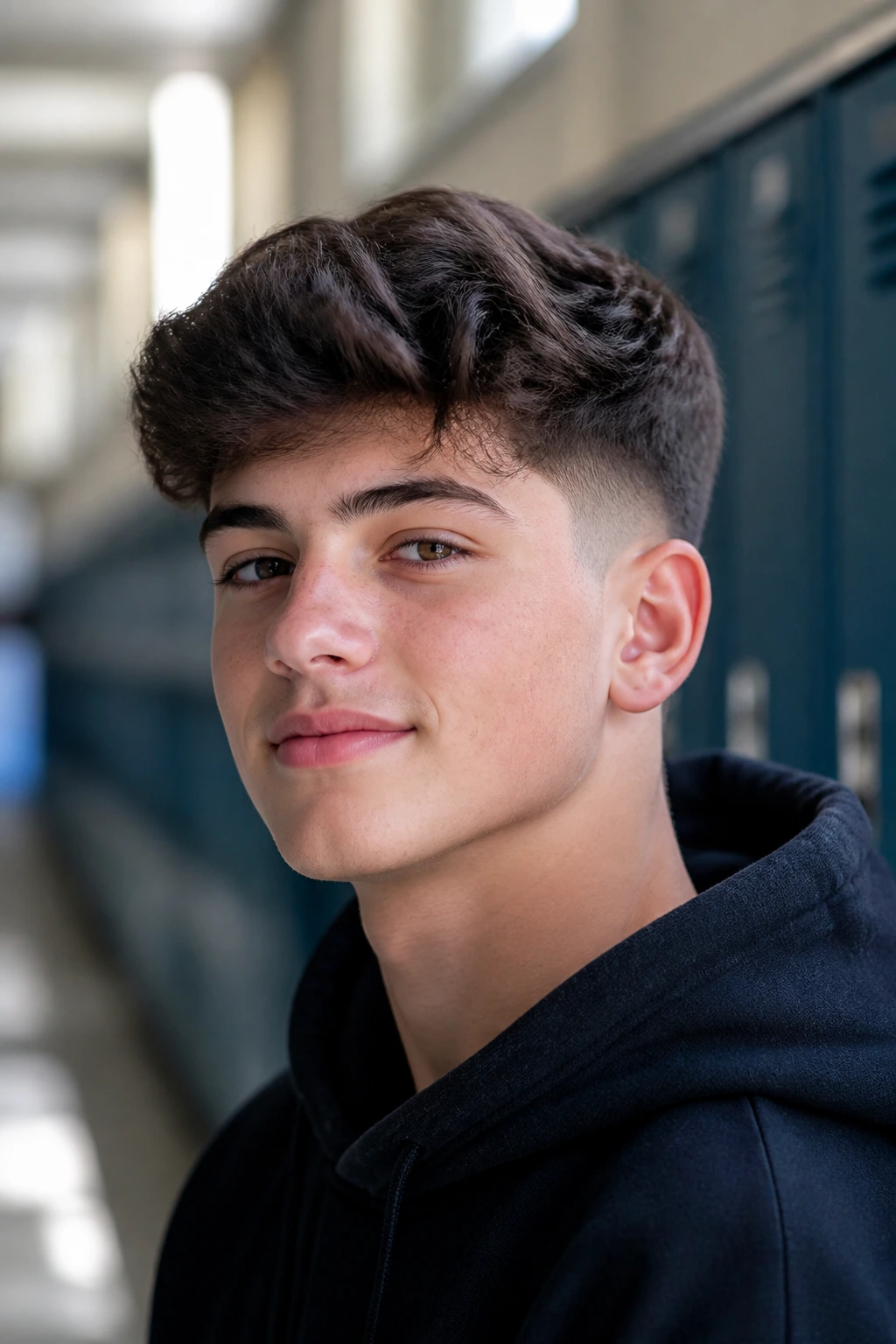
The Soft School Fade: Keep the fade low or just a taper, avoid a skin fade, and leave the neckline soft. This works well when the school rules are strict or when the haircut needs to grow out without looking sharp.
The Sports-First Crop: Trim the top to around 1 inch, keep the sides tight, and skip heavy product. Helmets, sweat, and naps are easier on this version than on anything with height.
The Thick-Wave Version: Leave a little more length on top — often 2 to 3 inches — and use a light cream instead of clay. The wave gets room to move, and the cut looks less rigid.
The Dress-Up Side Part: Pair a low fade with a longer top and a neat side part for family photos or events. It looks more polished than a crew cut but still stays simple enough for daily wear.
The Bold Short Mohawk: Narrow the center strip a touch, sharpen the fade around the ears, and keep the top short. This gives older boys a bit of edge without drifting into a full statement cut.
The Easy Grow-Out Version: Choose a taper fade instead of skin and keep the top blended rather than disconnected. It will look softer after three weeks, which saves time and arguments.
Keeping the Fade Fresh Between Visits
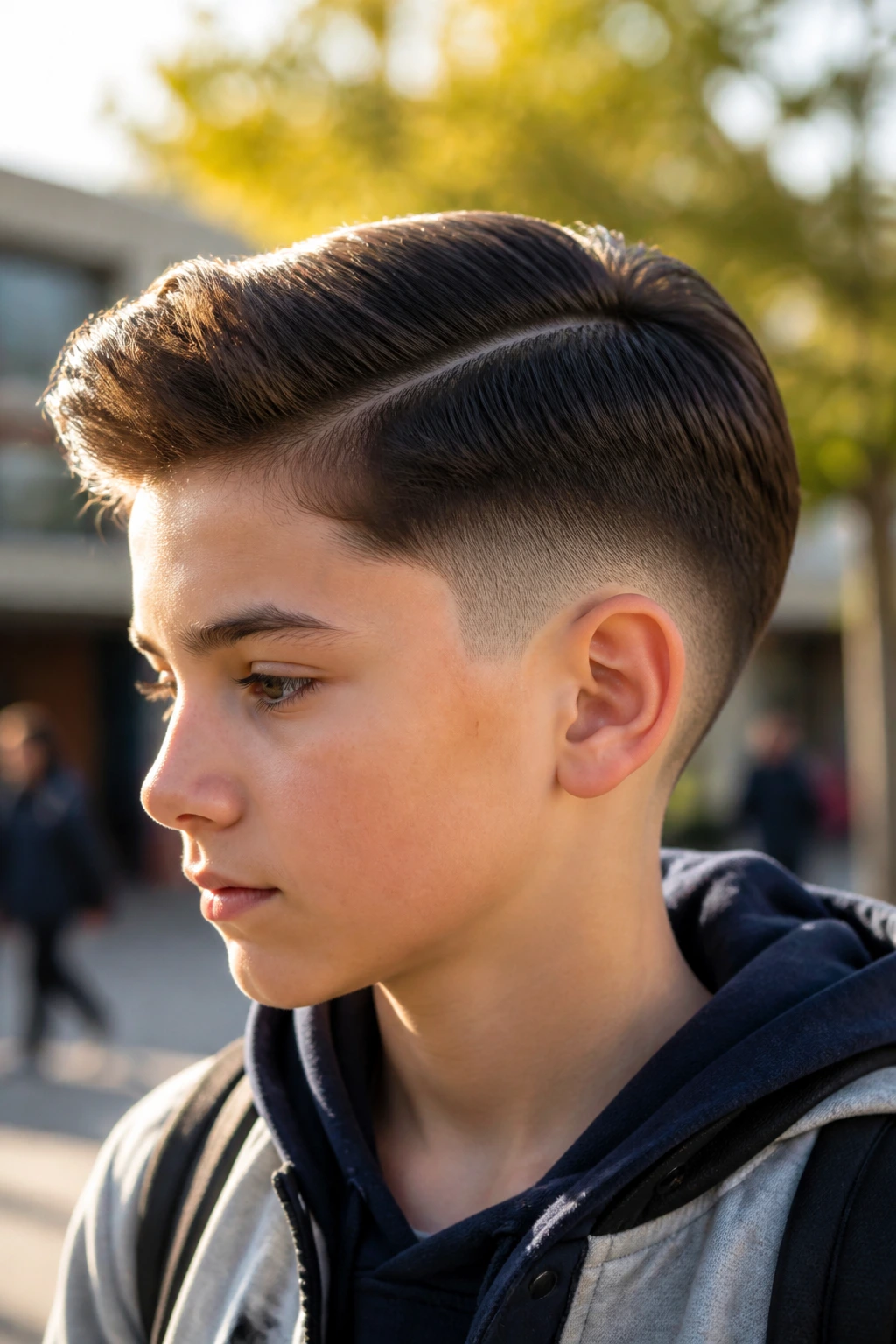
A short fade on thick hair usually looks its best in the first two weeks. After that, the edges start to blur, and the dense top can make the whole haircut feel heavier than it did on day one. Low fades and tapers tend to buy you a little more time. High fades and skin fades need more frequent cleanup.
Washing too often can dry out the scalp, especially with very short sides where the skin is exposed. Two to four shampoos a week is plenty for most boys, though sweaty sports days may call for an extra rinse. If the hair is coarse, a light conditioner on the top lengths helps keep the texture from feeling rough.
For styling, a damp hand and a comb are often enough in the morning. If the top gets flattened by sleep, mist it lightly and reshape it with your fingers. For crops and crew cuts, that takes under a minute. For side parts and quiffs, give it a quick blow-dry and a small amount of product so the shape holds.
High fades and skin fades benefit from a touch-up every 2 to 3 weeks. Low fades and taper fades can stretch to 3 or 4 weeks if the neck and around-the-ear area are kept clean. If the haircut is for a younger boy with very fast growth, plan closer to the shorter end of that window. Thick hair does not wait politely.
Questions Parents Ask Most
Which fade height is best for thick hair?
Low fades are the safest choice if you want a softer grow-out and less scalp exposure. Mid fades give a stronger shape, while high fades create the most contrast but also need more frequent upkeep.
Should thick hair be thinned out?
Sometimes, but lightly. A little point cutting can help remove bulk, yet aggressive thinning often leaves thick hair fuzzy and harder to control. The goal is shape, not hollowness.
Is a skin fade too much for younger boys?
Not automatically. It depends on the school rules, the child’s comfort level, and how often you’re willing to trim it. If you want a softer look, a taper or low fade is usually easier to live with.
What cut hides a cowlick best?
A forward fringe, Caesar cut, or textured crop usually handles a front cowlick better than a side part. The hair is directed with the growth pattern instead of fighting it.
How often should a short fade be cut again?
High fades and sharp skin fades often need cleanup every 2 to 3 weeks. Low fades and tapers can last longer, sometimes 3 to 4 weeks, depending on how fast the hair grows.
What product should thick hair use?
Matte clay works well for crops, spikes, and short textured styles. Light cream is better for softer side parts and comb overs. Heavy shiny pomade usually makes thick hair look stringy or greasy.
Do these cuts work on wavy or curly thick hair?
Yes, but the top length matters more. Wavy hair usually needs a little extra length so the wave can settle nicely, while curly thick hair often looks best with a crop, Caesar, or short fade that keeps the sides very controlled.
What if the haircut looks too wide after it dries?
That usually means the fade stayed too low or the top was left too bulky near the sides. Next time, ask for a little more debulking through the top and a clearer fade around the temples.
The Cut That Grows Out Gracefully
The best short fade for a boy with thick hair is the one that works with the hair’s density instead of pretending it isn’t there. Sometimes that means a low taper and a textured crop. Sometimes it means a high skin fade and a buzzed top. Sometimes it means keeping the front long enough to obey a cowlick that refuses to behave.
What matters most is balance. Thick hair needs enough structure at the sides to stop the puff, and enough thought on top to keep the shape from collapsing into one big block. Get that part right, and the haircut stops being a daily battle.
The good ones hold up after sleep, helmets, and a rough school day. The great ones still look decent when they grow out a little. That’s the kind of fade worth asking for next time the clippers come out.