



Fine hair can be a nuisance when it’s left too long on top. One minute it’s neat, the next it’s lying flat at the crown, sticking up in a front swirl, or puffing out around the ears in that soft, fuzzy way that makes a haircut look older than it is. A good crew haircut fixes a lot of that without turning the head into a helmet.
Crew haircuts for boys with fine hair work because they respect the hair’s natural limits. The top stays short enough to keep its shape, the sides stay tight enough to stop the outline from going soft, and the whole cut still leaves room for a little movement up front if that’s the look you want. Fine hair is not the same thing as thin hair, either. You can have plenty of it, but each strand still behaves like a straw instead of a rope, which means weight is the enemy.
The trick is choosing the right version of the crew cut for the child’s hair pattern, face shape, and routine. Some boys need a skin fade and a dry, choppy top. Others look better with a scissor cut and a soft taper that grows out cleanly. A few need almost no styling at all. That’s the nice thing here: the crew cut is not one haircut so much as a family of cuts, and the details matter.
Why These Crew Cuts Work on Fine Hair
-
Short Length Keeps It Upright: Fine strands collapse when they get too much length, so a shorter crew cut holds its outline better than a longer layered style.
-
Clean Sides Reduce Puff: Tight sides keep the silhouette narrow, which matters when the hair around the temples wants to fan outward.
-
Matte Texture Beats Shine: A dry finish makes fine hair look fuller because it doesn’t separate into shiny little strands that expose the scalp.
-
Most Versions Grow Out Gracefully: A good taper or fade keeps the haircut neat for weeks, not days, which is handy when you’re not booking barbershop visits every other weekend.
-
Easy Morning Routine: Most of these cuts need little more than a damp hand, a pea-sized bit of product, and 30 seconds of finger styling.
-
Cowlick-Friendly by Design: Shorter top lengths make stubborn growth patterns less dramatic, especially at the front hairline and crown.
1. The Classic Short Crew Cut
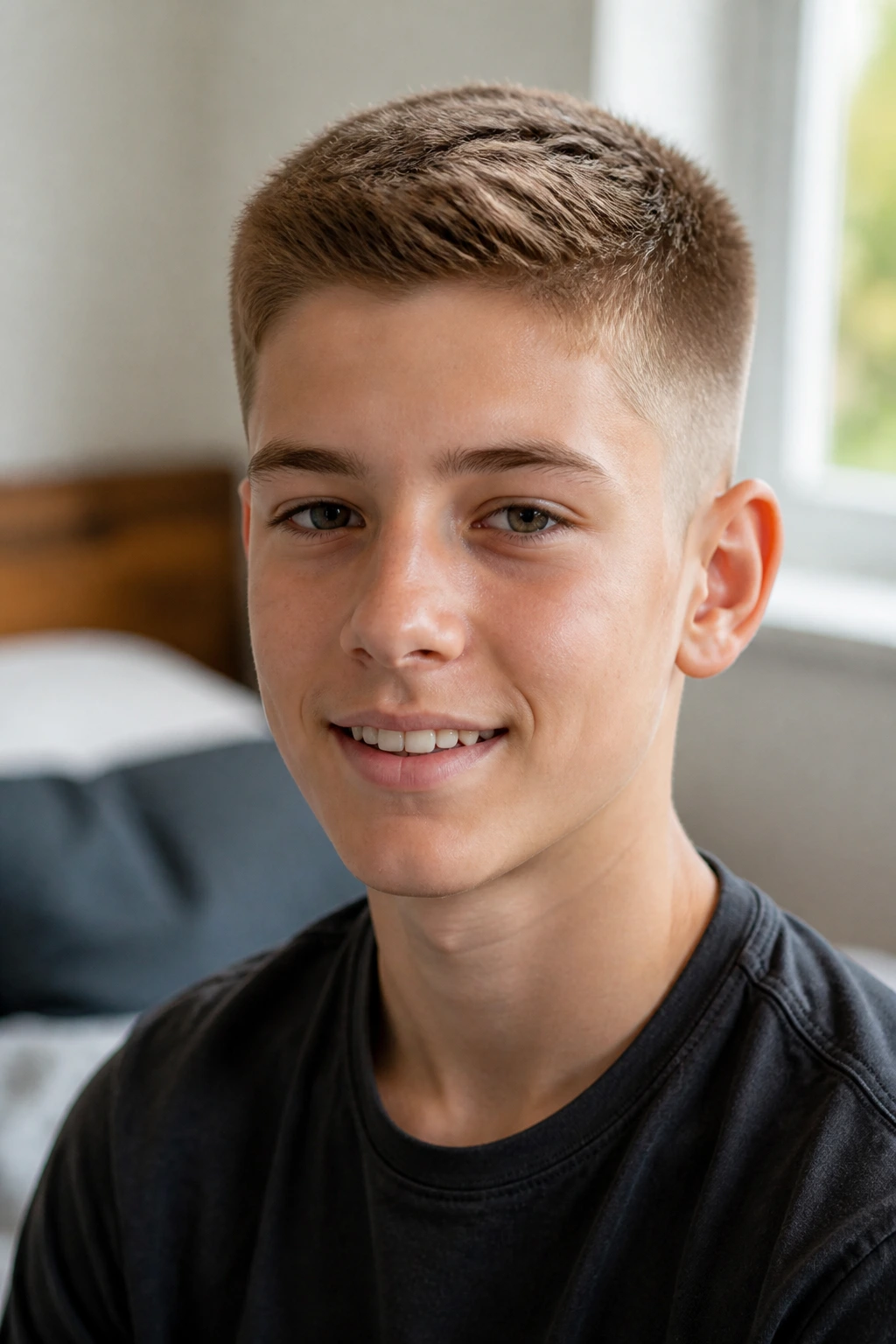
A classic short crew cut is the haircut that gets out of the way and still looks finished. The top stays neat, the sides stay close, and the whole shape sits squarely on the head without trying to do too much. On fine hair, that restraint is a gift.
Why It Stays Tidy
The top is usually kept around ½ inch to 1 inch, which is short enough that fine hair doesn’t flop over by lunchtime. I like this version for boys who want a cut that behaves on a school morning and still looks intentional after recess.
Quick Details That Matter
- Top length: ½ to 1 inch, usually blended with scissors or a longer guard.
- Sides: Tapered or clipped down to a #1, #2, or #3, depending on how neat you want the outline.
- Texture: Light point-cutting on top keeps the finish from looking too flat.
- Best for: Straight fine hair, active kids, and boys who hate combing.
Pro tip: Ask the barber to keep a tiny bit more length at the front than at the crown. That gives the cut a small lift without turning it into a messy style.
2. The Textured Crew Cut
Texture is the whole point here. When fine hair sits too smoothly, it shows every scalp line and every swirl. A textured crew cut breaks that up with short, uneven layers on top, so the hair looks fuller even when it’s still very short.
The barber usually cuts the top with scissors, then softens it with point-cutting or a clipper-over-comb pass. That creates tiny changes in length across the top, which helps the hair catch itself instead of lying in one flat sheet. For boys with fine hair, that little bit of irregularity matters a lot.
This cut works especially well if the hair has a slight bend or if the front likes to push forward. A matte paste rubbed between the palms and tapped through the top is enough. Don’t smear it on like frosting. That’s how fine hair goes limp.
3. The Low Taper Crew Cut
Why does the low taper version work so well on boys with fine hair? Because it keeps the haircut neat without making the sides look shaved to the skin. The taper starts just above the ears and at the nape, then fades out gently, which gives the cut a softer, more natural edge as it grows.
That softness matters. Fine hair can look harsh when the contrast is too sharp, especially if the top is short and the sides disappear too fast. A low taper keeps the shape polished while still letting the hairline breathe.
Barber Notes
- Keep the top around ¾ inch to 1¼ inches.
- Ask for a tapered neckline, not a blocked square edge, if you want slower grow-out.
- Use a light matte cream or nothing at all.
- Best on boys whose hair lies flat at the crown but gets fuzzy at the sides.
The low taper is one of those cuts that looks cleaner on day 14 than some haircuts look on day 2.
4. The Skin Fade Crew Cut
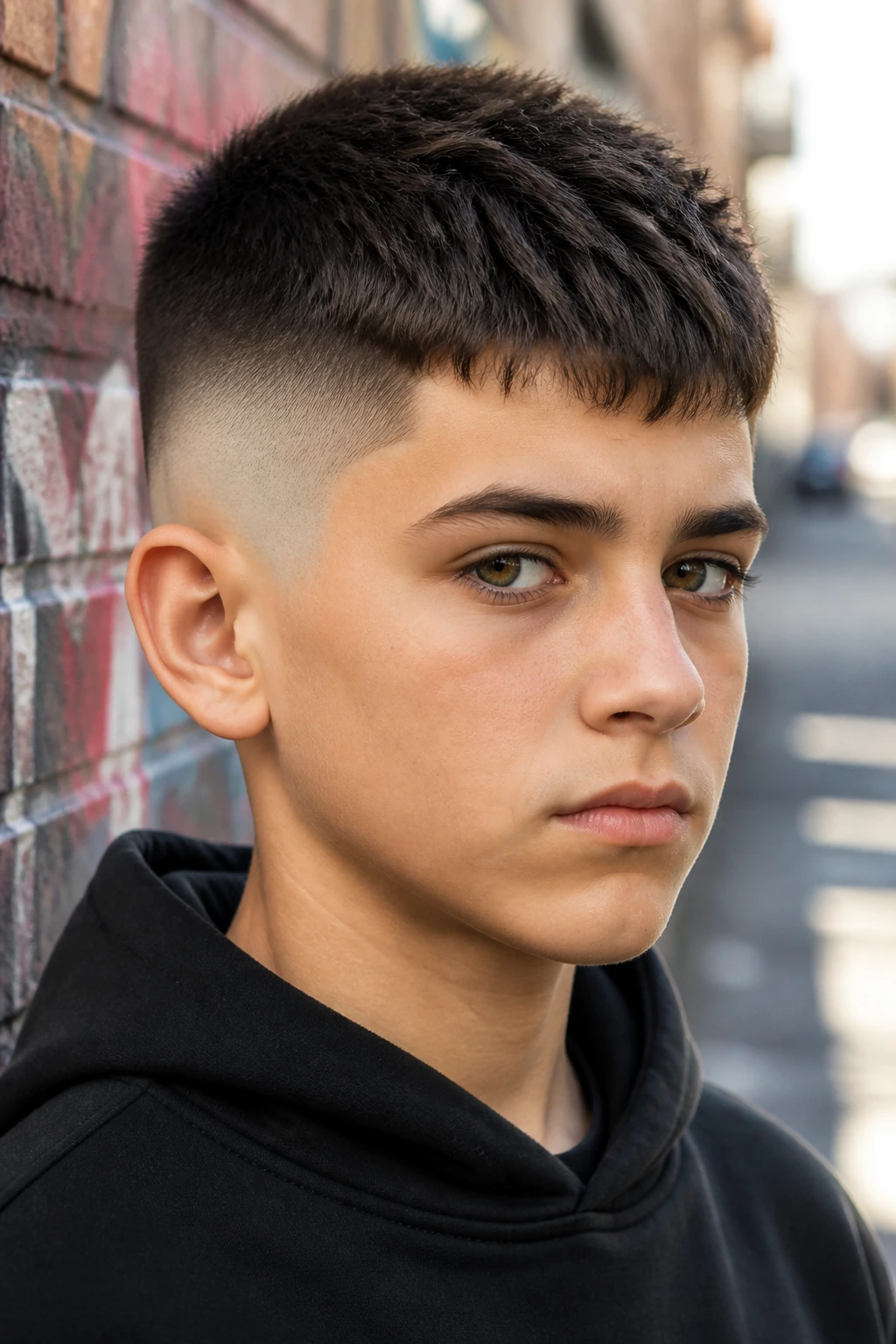
A skin fade crew cut is the sharper, more contrast-heavy version of the family. The sides drop all the way to skin near the bottom, then blend upward into short hair before meeting the top. On fine hair, that high contrast can be a smart move because it shifts attention to the shape instead of the strand thickness.
This cut is especially useful when the top is thin in density, not just fine in texture. Tight sides make the top look more deliberate, and the fade keeps the outline crisp around the head. It also pairs nicely with a front that wants to stand up a little.
- Top: Short, textured, and kept slightly longer than the other crew variations.
- Fade: Skin to #1 or #2 through the lower sides.
- Finish: Matte, not shiny.
- Best for: Boys who like a sporty, trimmed look and don’t mind a more noticeable barber visit schedule.
If the crown is sparse, don’t overextend the top. A skin fade with a top that’s too long only makes the weak spots louder.
5. The Ivy League Crew Cut

The Ivy League version is the polished cousin in the lineup. It still counts as a crew cut, but the top is left long enough to make a side part possible, usually around 1¼ to 2 inches. That extra length gives fine hair a bit more shape control without letting it sag.
I like this one for boys whose hair is fine but not fragile-looking. It has enough length to be brushed to one side for a neat school-day finish, yet it can still be tousled a bit if the goal is something less formal. The sides should stay taper-faded or neatly scissored so the top doesn’t look disconnected.
A small amount of lightweight cream can help here, but the goal is separation, not shine. If the product makes the hair look wet, it’s too heavy.
6. The Side-Part Crew Cut
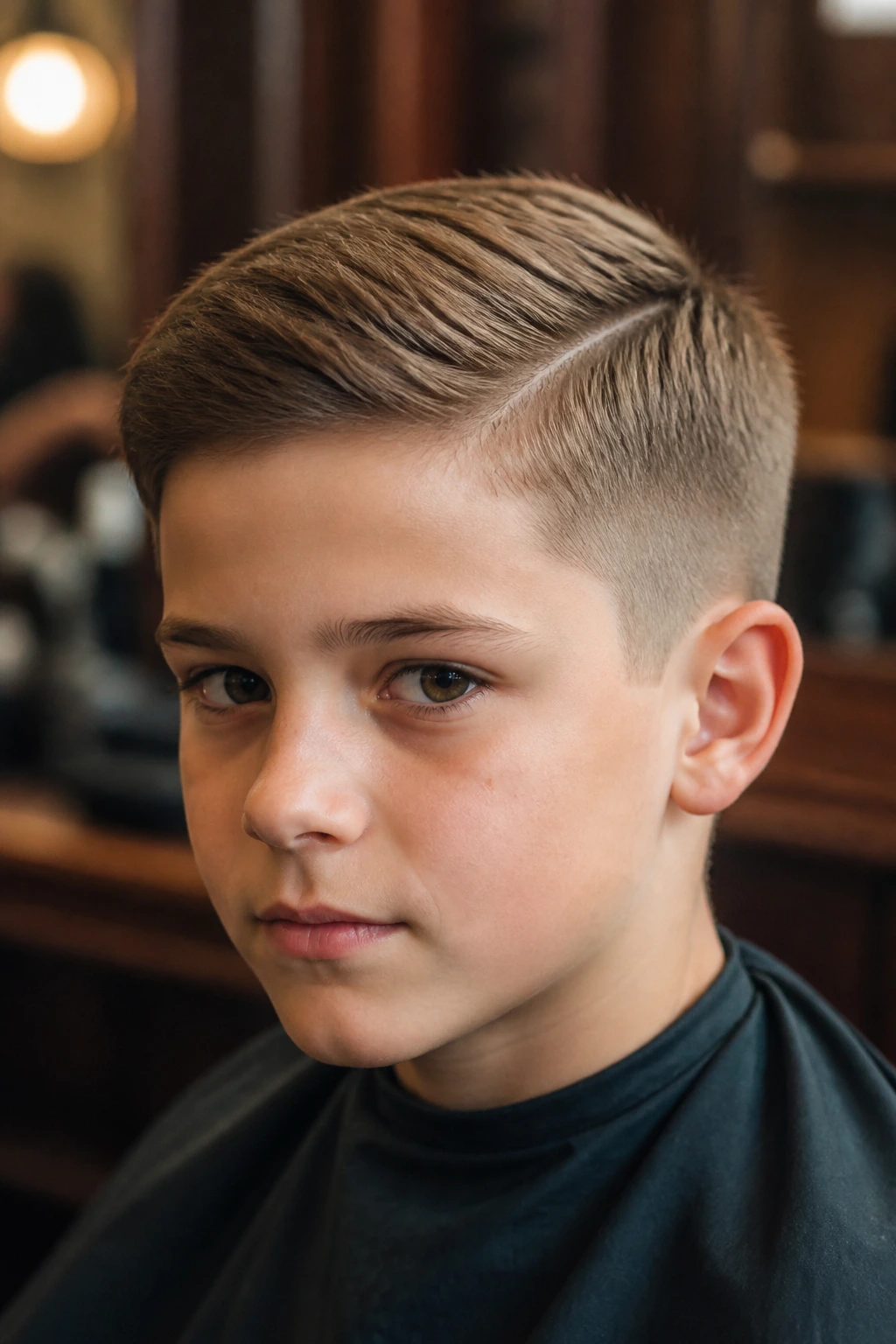
Compared with a classic crew cut, the side-part version feels a little more dressed up. The top is still short, but one side gets a gentle direction change that gives the haircut a more finished shape. Fine hair often looks better with structure, and a soft side part gives you that structure without needing much length.
The part should not be carved in like a hard business cut unless the boy specifically wants that sharper line. A subtle side direction works better on fine strands because it keeps the top from splitting into thin sections. Use a comb only if the hair is cooperative; fingers usually do the job faster and with less fuss.
This style fits boys with flatter crowns, because the side direction can disguise the spot where the hair wants to collapse. A tiny dab of matte paste at the front and along the part side is enough. More than that, and the hair starts looking stiff.
7. The Brushed-Forward Crew Cut

A brushed-forward crew cut works because it gives fine hair a place to go. Instead of fighting the natural tendency to fall forward, this version uses it. The top is kept short and slightly longer in the front, then brushed toward the forehead so the front edge looks soft instead of spiky.
That makes this cut a good pick for boys with a high forehead or a front cowlick that won’t sit still. The forward direction can make the hair look denser, especially when the barber adds a little texture near the fringe. Keep the sides shorter and the outline clean, or the whole style will drift into a bowl-cut shape, and nobody needs that.
A vent brush and a quick blow-dry on low heat help if extra lift is needed. If not, fingers are enough. The beauty of this cut is that it looks intentional even when it’s slightly messy.
8. The Brushed-Up Crew Cut
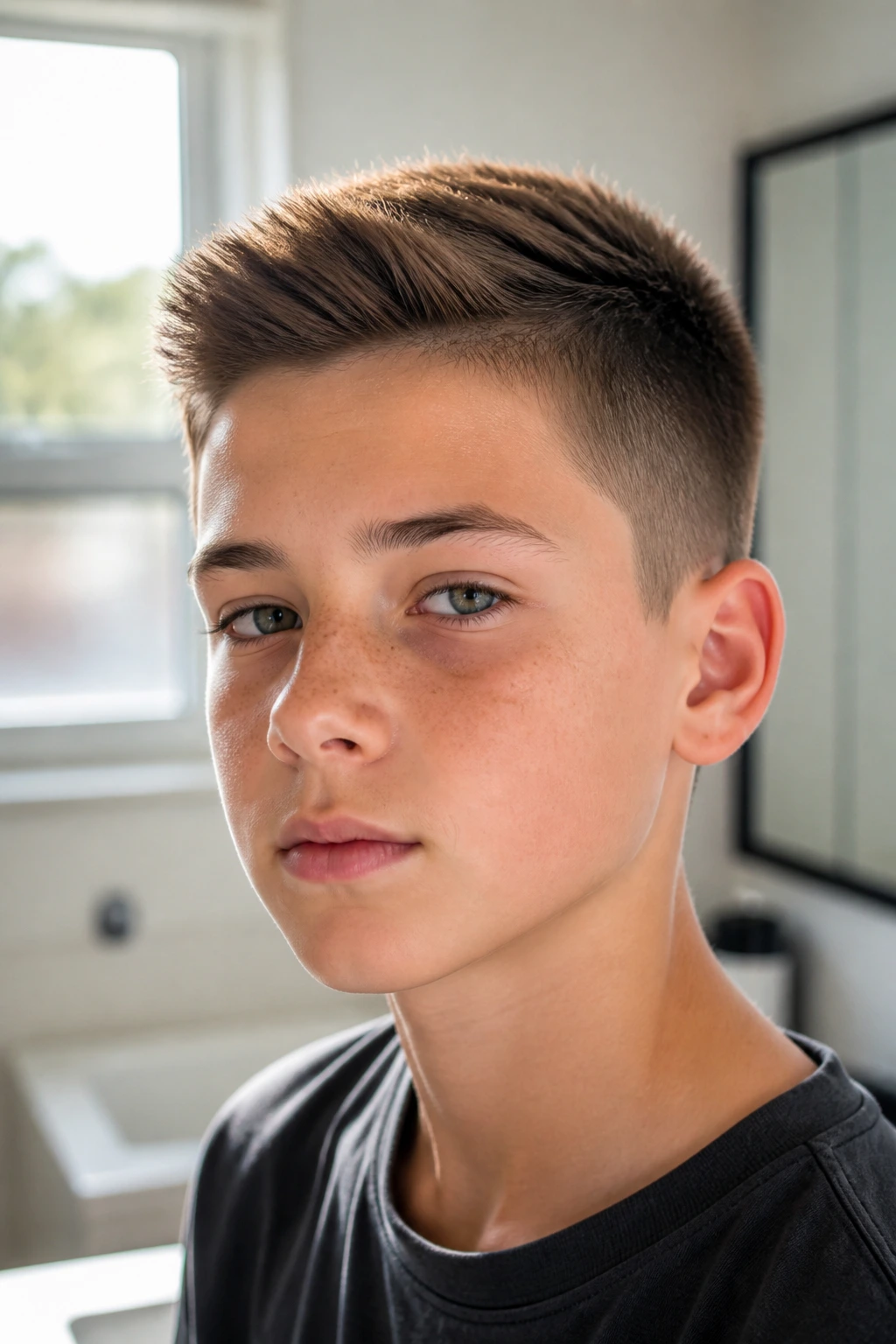
A brushed-up crew cut is for the kid who wants a little height without a full pompadour situation. The top is short, but long enough to be coaxed upward with a blow-dryer and a touch of product. On fine hair, that lift can make the top look fuller because the strands are standing apart instead of lying flat.
The barber should keep the front slightly longer than the center, then soften the top with scissors so it isn’t blunt. That small difference in length gives the hair a natural push upward. Use a lightweight matte paste or a dry texture spray, then blow-dry from the roots while lifting with the fingers.
Best for: straight fine hair that falls flat after washing.
Watch for: too much product. Fine hair goes stringy fast.
Good pairing: a low taper or mid taper on the sides, so the extra height on top doesn’t make the head look boxy.
9. The Messy Matte Crew Cut
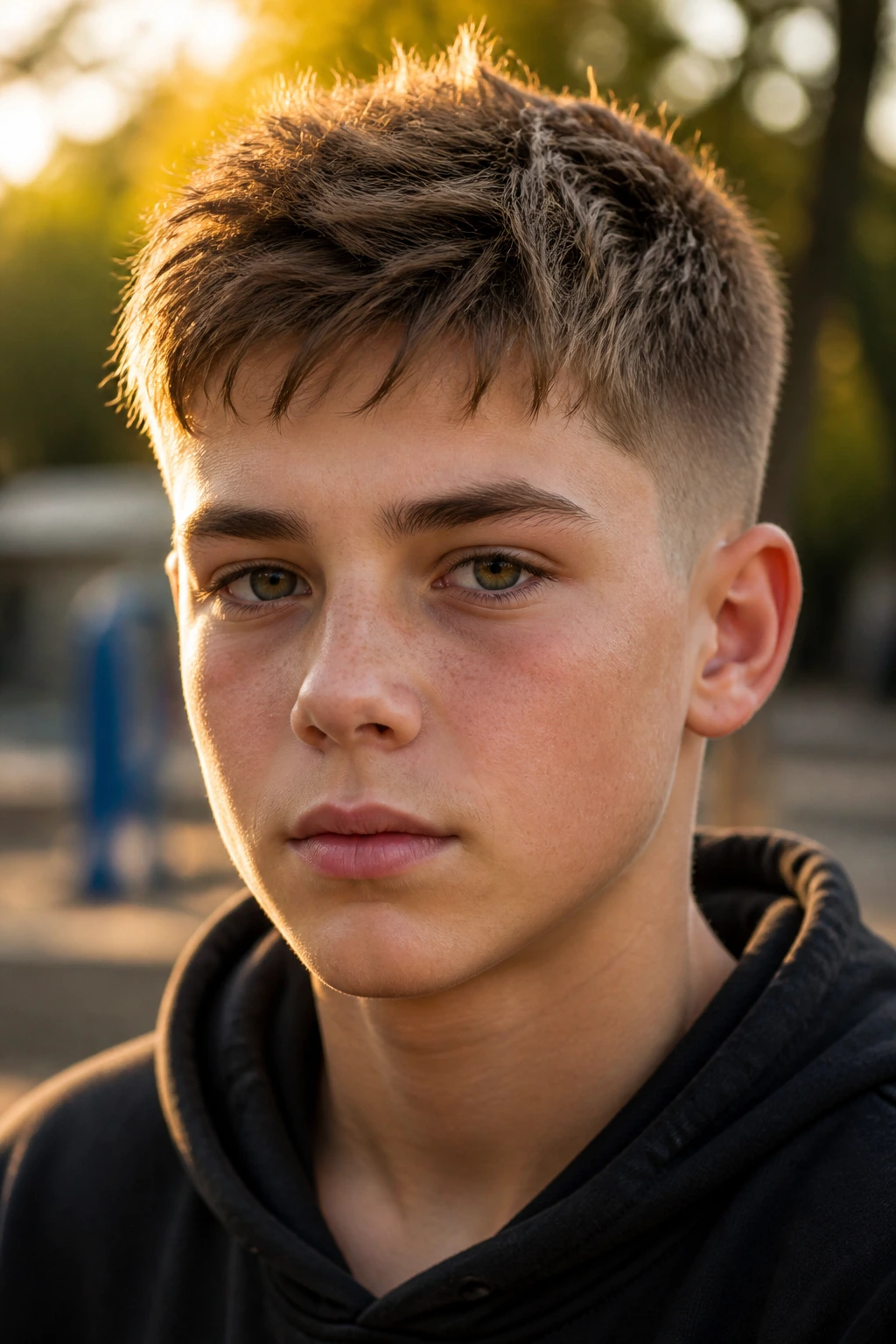
A messy matte crew cut sounds casual because it is, but there’s a method behind the mess. The top is layered short enough to break up the shape, then styled with fingers instead of a comb so it sits in separated pieces rather than one smooth sheet. Fine hair gains a little visual thickness this way.
This version works well on boys who don’t want a precise part or a stiff outline. It has that slightly undone look that still reads as a haircut, not bedhead. The key is keeping the sides tidy. Messy on top, clean on the edges. That balance keeps the style from turning sloppy by noon.
What Makes It Work
- Top length stays short enough to resist collapse.
- Texture is built in with point-cutting.
- Matte paste or powder adds grip.
- The neckline should still be clean, even if the top is loose.
Don’t chase a “messy” finish by using more product. That’s backward. The less you see the product, the better this one usually looks.
10. The Scissor-Only Crew Cut
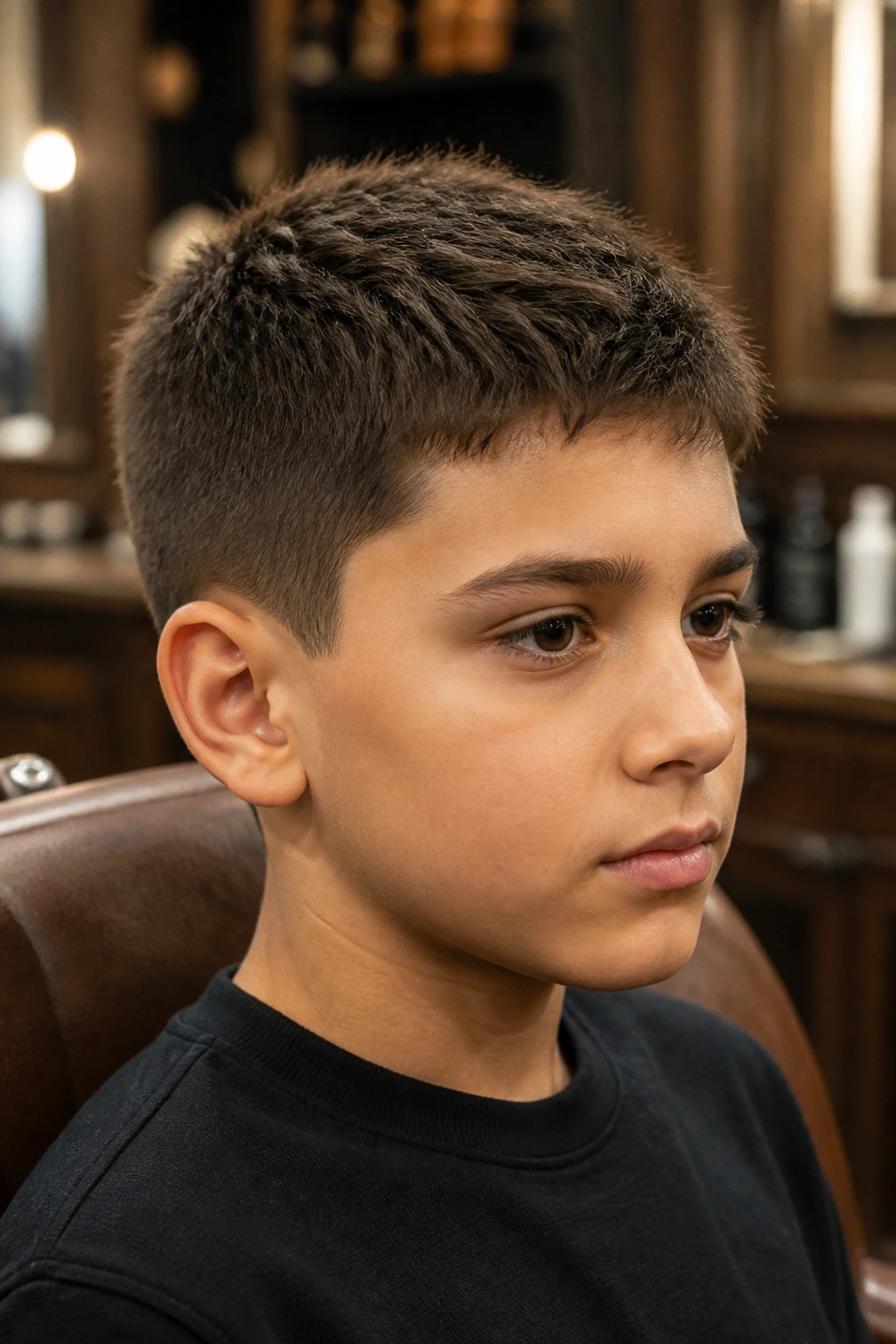
Some boys need a crew cut that grows out softly, and the scissor-only version does that better than a clipper-heavy cut. The barber trims the top and sides mostly with scissors, which leaves the line less severe and the grow-out less choppy. On fine hair, that gentler finish can look fuller because the cut keeps some softness at the edges.
This is the crew cut I’d point to for boys who have sensitive scalps or don’t like the feel of a tight fade around the ears. It’s also useful when the hair is fine but the density is even, so you don’t need a dramatic fade to make the shape work.
The downside? It needs a slightly more careful barber. Scissors can either create graceful texture or leave the top too wispy. A good cut will sit naturally even after a wash and finger-dry. A bad one will just look thin.
11. The High-and-Tight Crew Cut
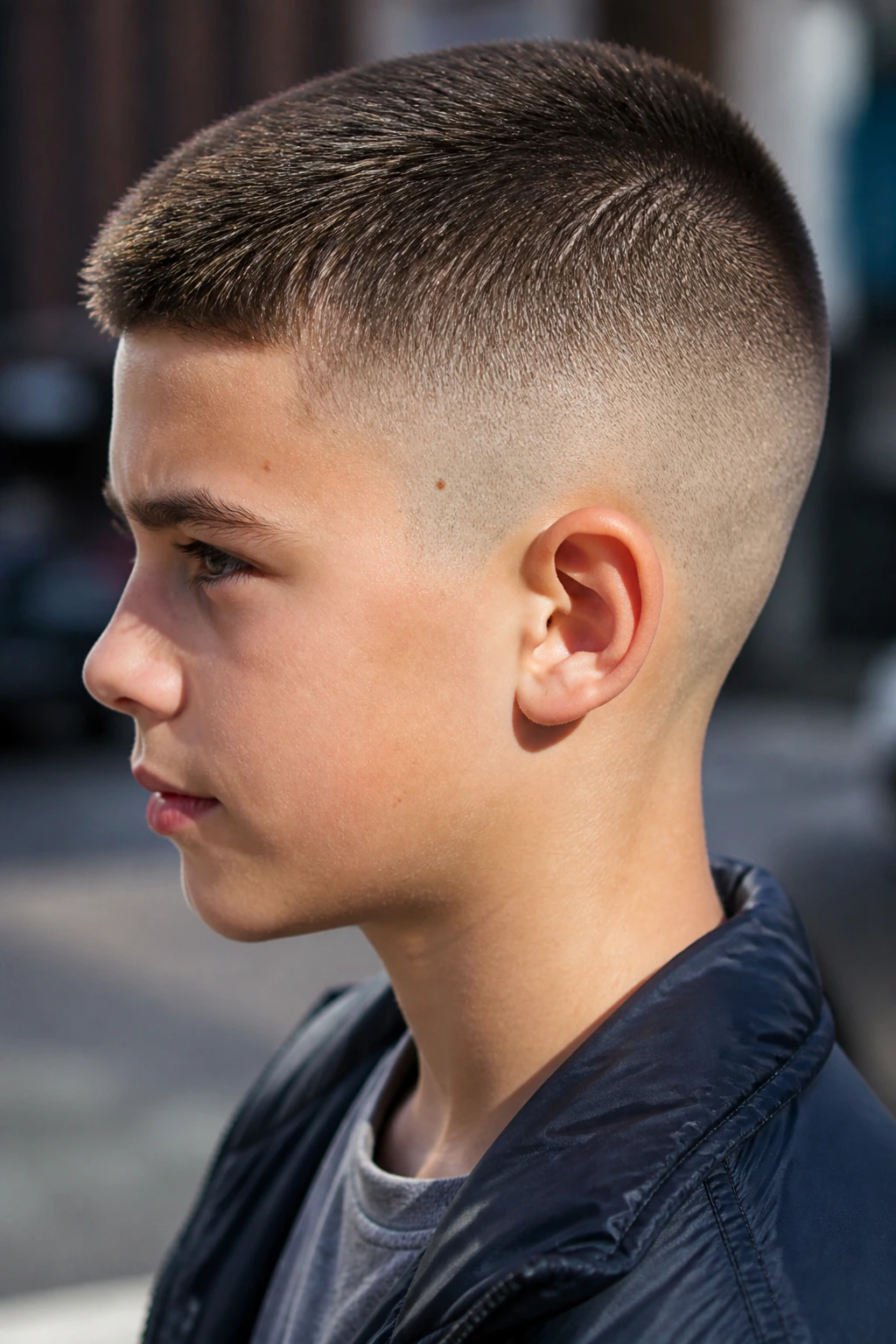
The high-and-tight leans military, and it does not apologize for that. The sides and back are clipped very short, sometimes with almost no blend at the bottom, while the top remains a tight strip of short hair. For boys with fine hair, this can be a smart choice when they want the smallest possible amount of fuss.
The shape makes the top look denser by comparison. There’s less hair to manage, less weight pulling it down, and fewer places for the hair to misbehave. It suits strong head shapes and boys who are fine with a more rugged, utilitarian look.
Not everyone likes the severity. Fair enough. But if the goal is a haircut that stays neat through sports, helmets, and sweaty afternoons, the high-and-tight earns its keep.
12. The Temple Fade Crew Cut
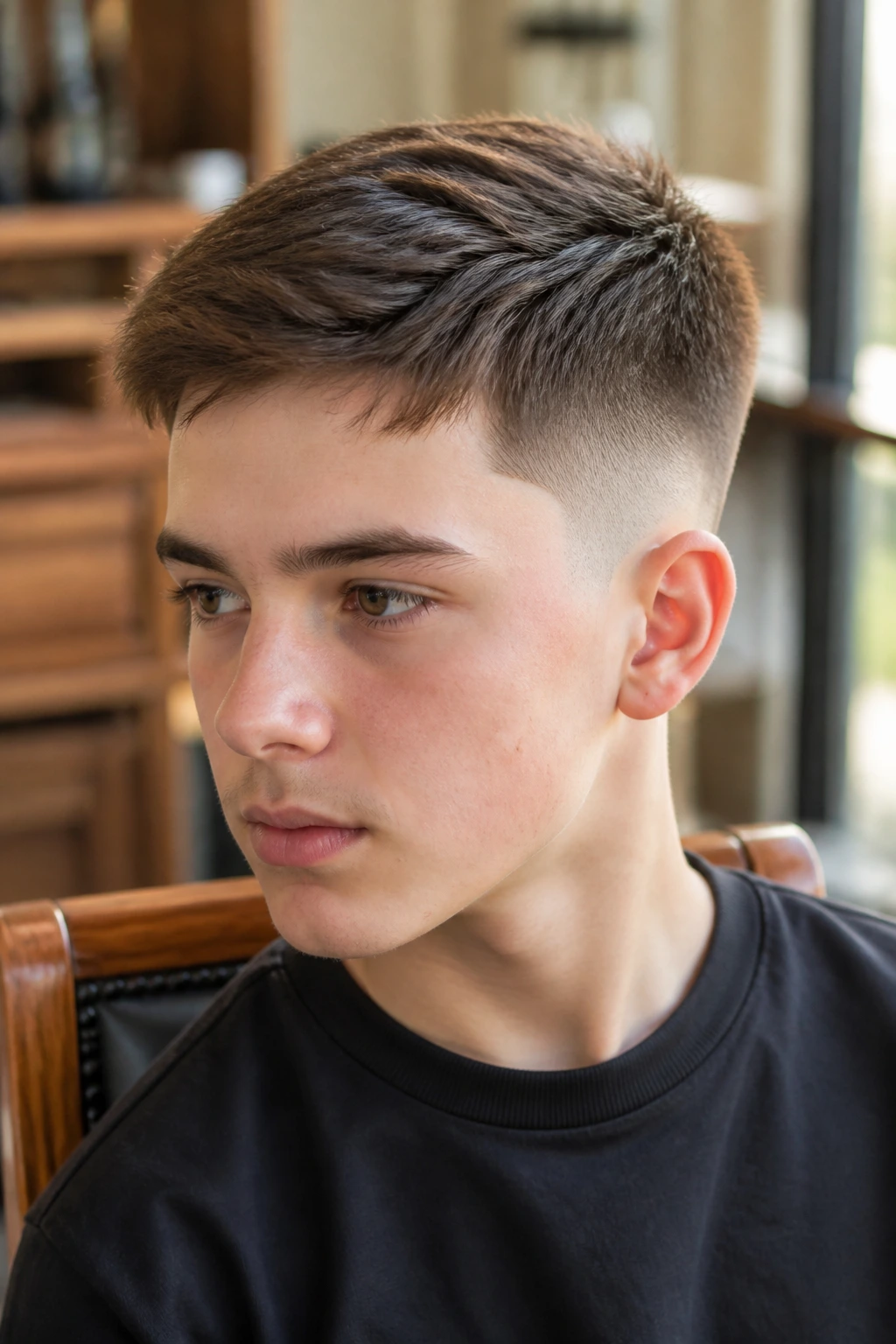
What happens when you want a crew cut that feels lighter around the face? The temple fade handles that nicely. It keeps more hair around the top and back, then drops the fade low around the temples so the haircut opens up near the sides of the forehead.
That shape can be useful for fine hair because the temples are often where softness turns into fuzz. A clean fade there keeps the whole outline sharp without forcing the top to be too short. It’s a nice middle ground between a skin fade and a softer taper.
How to Ask for It
- Keep the top short and textured, around ¾ inch to 1¼ inches.
- Fade the temples low and clean.
- Leave enough weight in the back to keep the crown from looking empty.
- Finish the neckline with a taper instead of a hard block.
This version grows out well, which matters more than people think. A haircut that looks decent on week three saves a lot of arguments in the bathroom mirror.
13. The Drop Fade Crew Cut
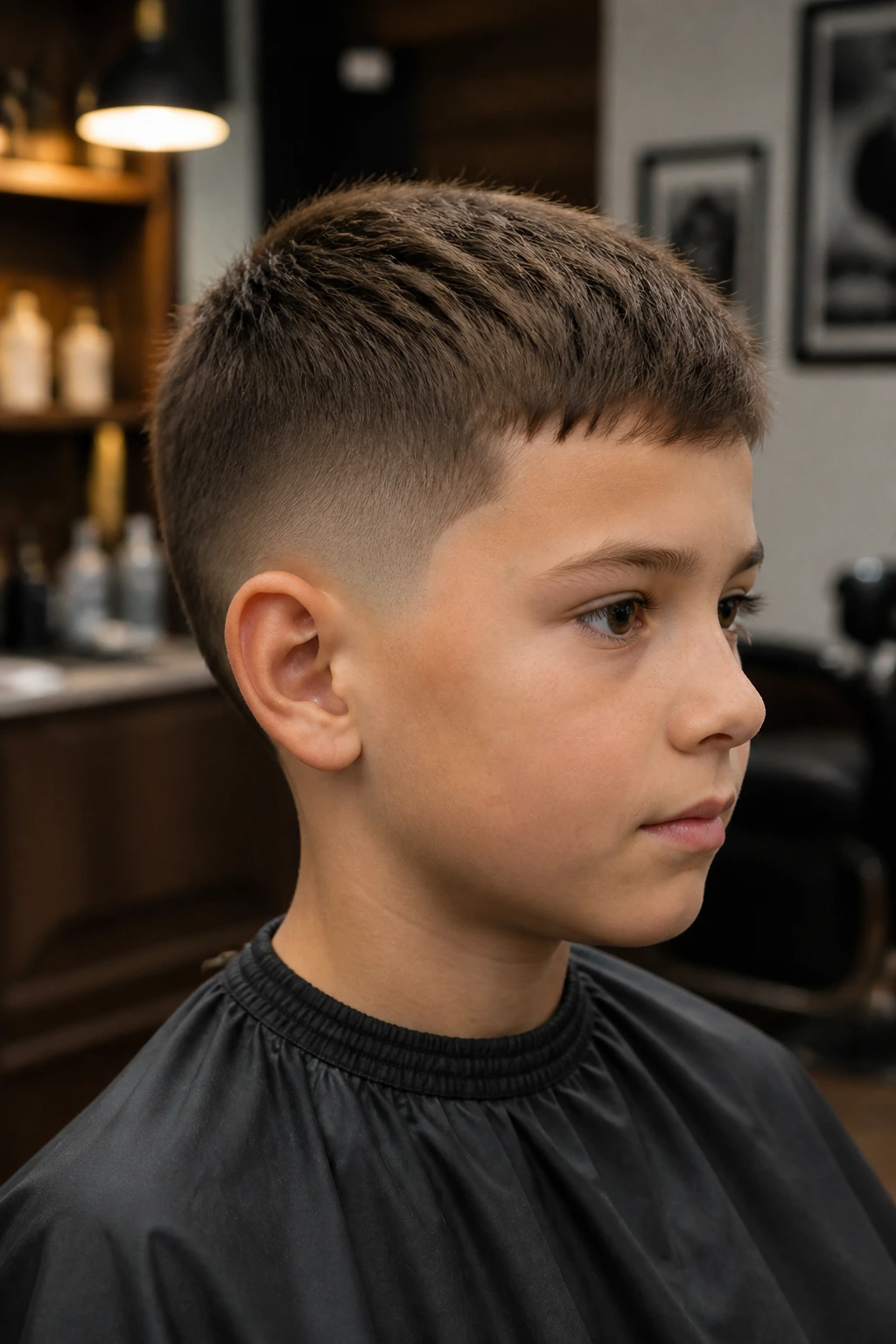
A drop fade crew cut curves downward behind the ear before it fades into the neck. That small dip gives the haircut more shape than a straight fade, and it works especially well on boys with fine hair because it helps the cut follow the head instead of hovering around it.
The top can stay short and textured, but the real advantage is the outline. Drop fades look clean without feeling too squared off. They’re a good match for boys with a rounder head shape, because the curve of the fade visually narrows the sides a little.
Keep the top simple. This is not the place for heavy styling or long fringe. A matte finish and a tidy neckline are enough.
14. The Hard Part Crew Cut
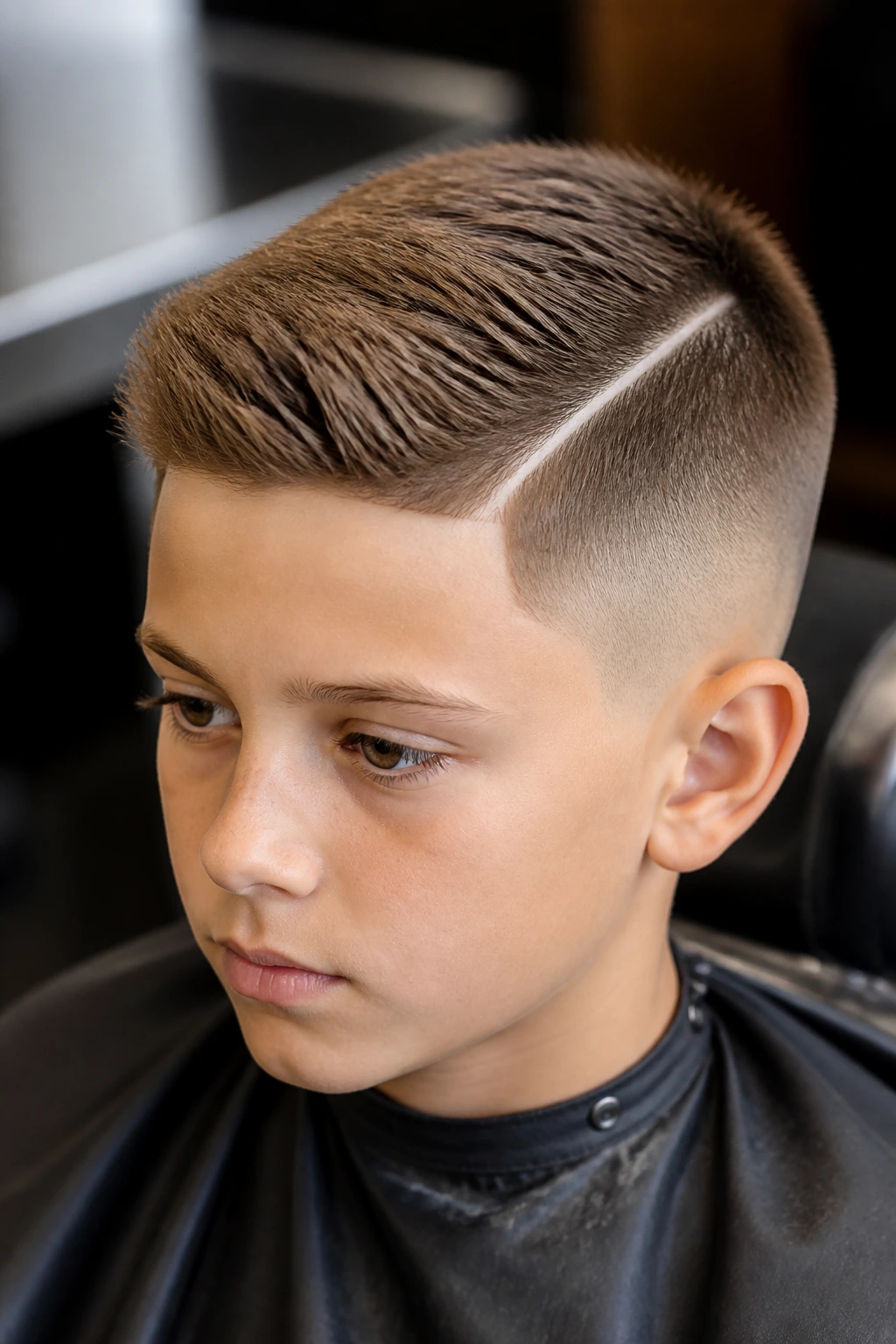
A hard part gives the crew cut one clear line to hang onto. The barber shaves or clips a visible part line into the top, then directs the hair away from it. On fine hair, that line can help the top look more intentional because it adds structure where the hair might otherwise fall apart.
I’d use this on boys who like a slightly sharper, older-kid look. The hard part works best with enough top length to show direction, but not so much that it starts flopping. A side fade or taper on the sides keeps the part from looking isolated.
It’s not the most forgiving option if the child hates upkeep. The part line softens as it grows, and the whole thing loses its crisp shape in a few weeks. Still, when it’s fresh, it has a clean, tidy edge that fine hair usually appreciates.
15. The Fringe-Forward Crew Cut
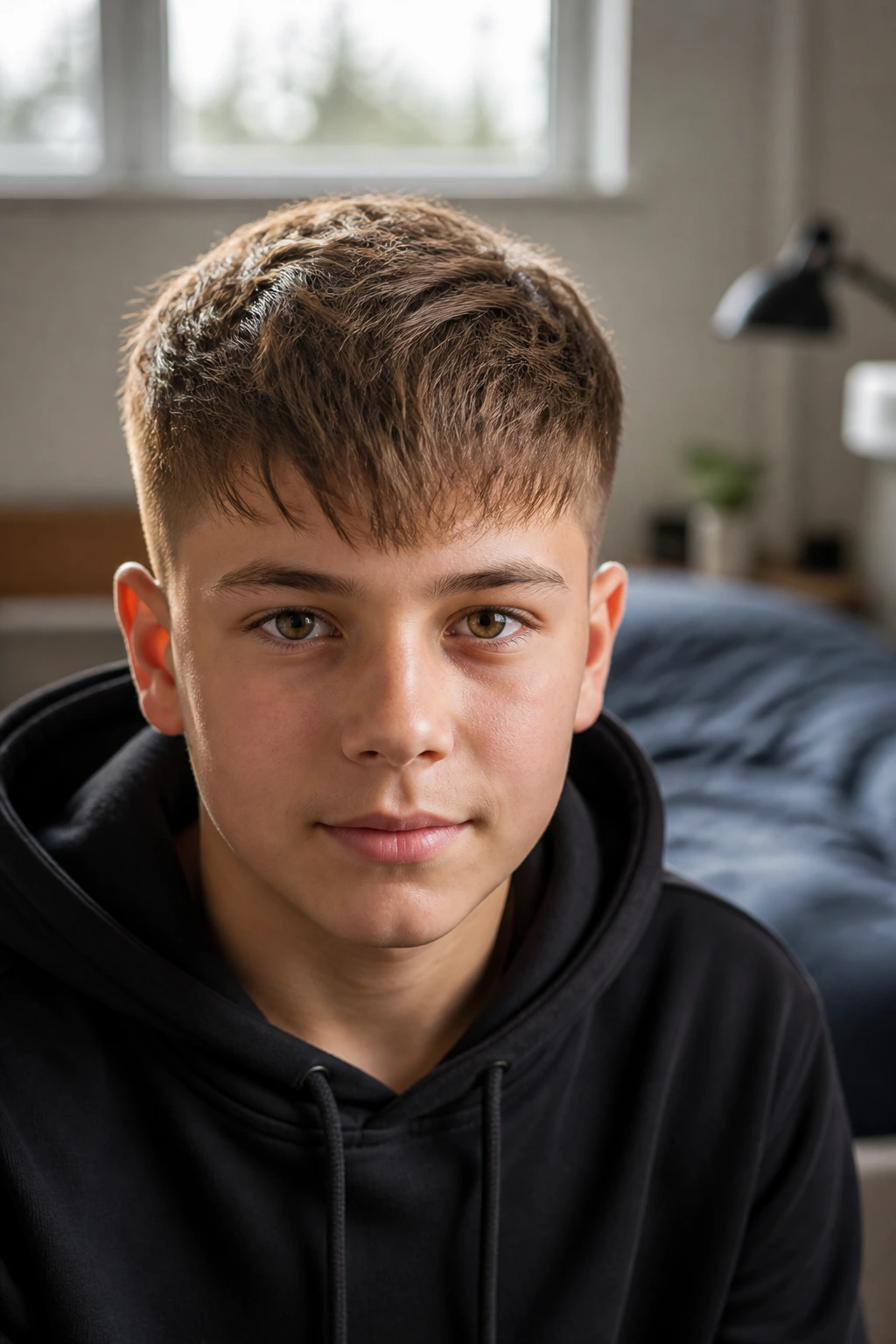
A fringe-forward crew cut pushes the front down a touch more than the classic version, which can be handy for boys with a stubborn hairline or a high forehead. The fringe is still short — this is not a long fringe style — but it sits forward enough to cover the front without looking heavy.
That forward movement helps fine hair look thicker right at the front, where a lot of boys notice thinness first. The barber should keep the fringe textured and avoid a blunt rectangle across the forehead. Blunt fringe on fine hair can make the cut look sparse at the corners. That’s the part nobody wants.
Use a light cream or nothing at all. Too much product causes the fringe to separate and show gaps. A damp finger comb is often enough to get it in place.
16. The Longer Crew Cut
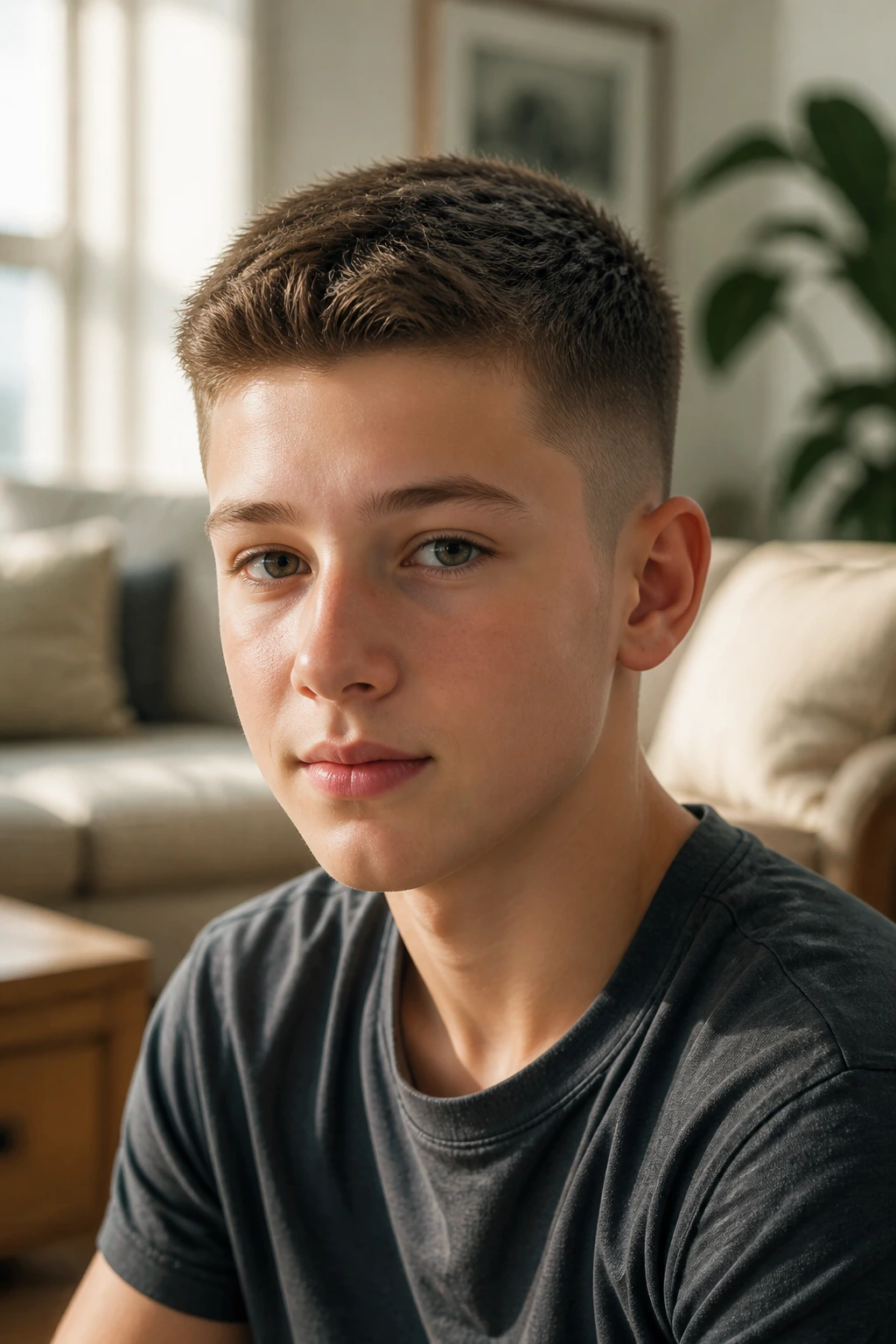
A longer crew cut gives fine hair a little more room, but not so much that the style starts to fall apart. The top might sit around 1½ to 2 inches, with the sides kept tight enough to preserve the crew-cut shape. This version is a nice bridge between a short crew and a short textured crop.
It works well when the boy’s hair is fine but dense enough to support some lift. The extra length can help the hair look fuller, especially if the top is cut with soft layers. But there’s a catch: too much length on fine hair will make it collapse. The haircut needs restraint.
A small amount of blow-drying at the roots can make a big difference here. And if that sounds fussy, it really isn’t. Thirty seconds of heat and finger-lifting usually does the job.
17. The Cowlick-Friendly Crew Cut

A cowlick-friendly crew cut is less about fashion and more about peace of mind. If the hair at the front or crown stands up, splits, or spins in one annoying direction, short length is your ally. The barber keeps the top short enough to control the swirl, then uses texture to avoid a blunt shelf.
Why does this work? Because fine hair doesn’t have much weight to fight a cowlick in the first place. So you stop trying to overpower the swirl and instead cut around it. Shorter lengths on top, careful blending at the crown, and a little texturizing near the trouble spot usually tame the mess.
Good Barber Moves
- Cut the crown to the direction of the swirl, not against it.
- Keep the front slightly shorter if it pops up.
- Avoid heavy layers that separate the cowlick.
- Use a matte finish, never a shiny gel.
This is one of those cuts that looks simple but saves a lot of frustration.
18. The No-Product Crew Cut

Not every boy wants hair product. Some don’t like the feel. Some forget. Some would rather run out the door with wet hair and call it done. A no-product crew cut respects that reality and still looks tidy because the shape does the work.
The barber has to be precise here. The top should be short enough to fall into place on its own, and the sides should be clean enough that the outline stays sharp even without styling. Fine hair is actually a decent match for this approach because it dries quickly and doesn’t need much help to settle.
I’d keep the top slightly textured and avoid too much length at the front. That way, a towel-dry and a quick finger rake are enough. If a child’s routine is chaotic, this is the cut that forgives it.
Why Crew Cuts Make Fine Hair Easier to Live With

Fine hair looks its best when the haircut does some of the heavy lifting. That’s really the whole argument for crew cuts. The short top gives the hair a little structure, the short sides keep the outline from ballooning, and the shape stays readable even when the morning starts in a rush. You do not need elaborate styling to get there.
The other thing crew cuts do well is hide the awkward middle ground. Fine hair often looks weird when it’s not quite short and not quite long. It sits flat, then frizzes at the edges, then separates in the worst spots. A crew cut skips that stage. The haircut has enough discipline that the child doesn’t have to.
What the Cut Is Doing for You
Balance: The sides stay neat, so the top can stay short without looking too severe.
Control: Cowlicks and flat spots lose some of their power when the hair is trimmed close.
Density: Small texture changes make fine hair look fuller than one blunt, uniform length.
Speed: Drying takes less time, which matters on school mornings and before sports.
There’s a quiet practical truth here. The best haircut for fine hair is often the one that needs the least explanation.
What to Ask for at the Barber Chair
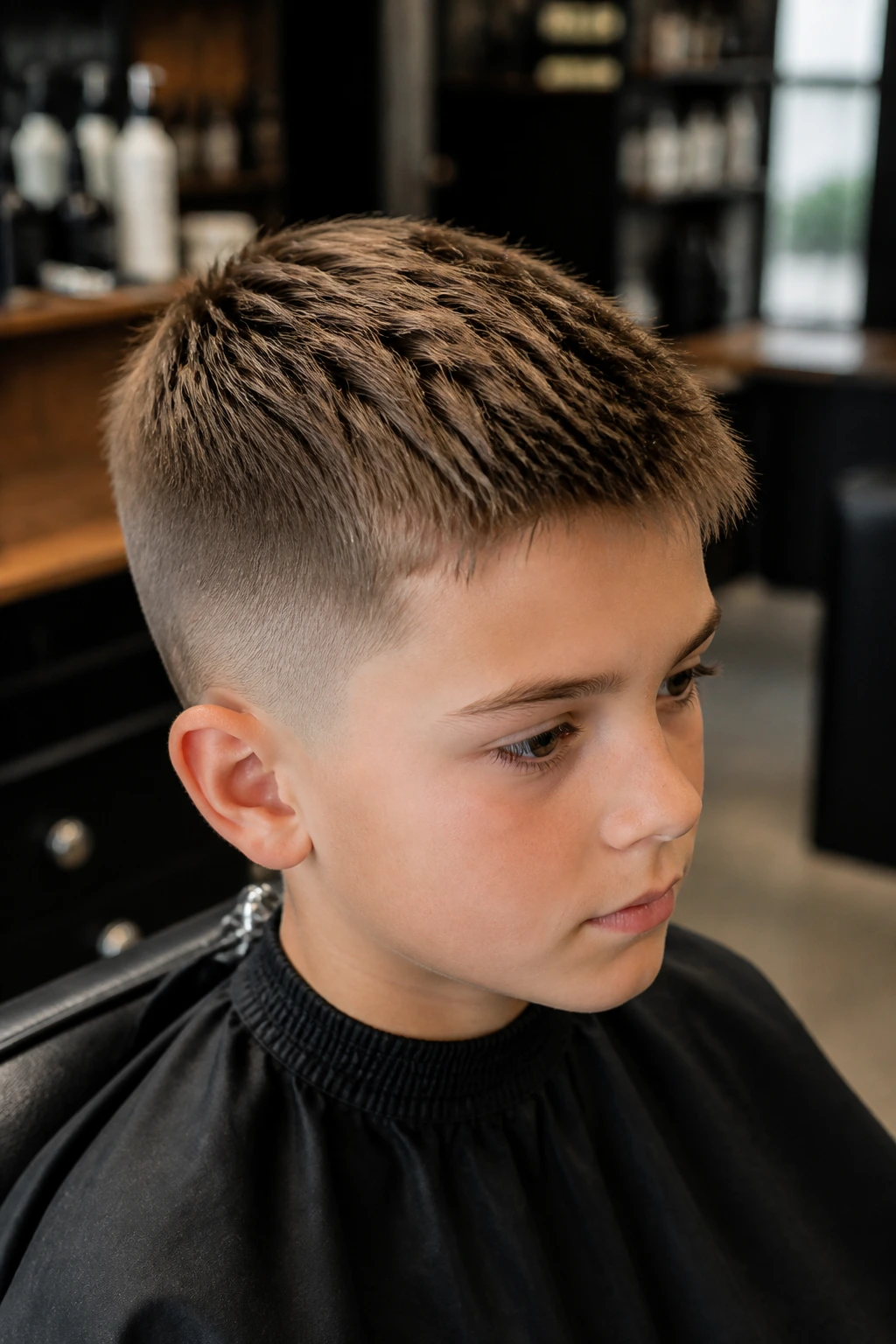
The best haircut in the world still falls apart if the request at the chair is vague. “Short on the sides, longer on top” can mean six different things to six different barbers. For a crew cut on fine hair, the details need to be sharper than that.
Start with the top length. If you want low maintenance, say ½ inch to 1 inch on top. If you want a little styling room, say 1 to 1½ inches. Then choose the side treatment: a low taper, a skin fade, a scissor blend, or a tight clipper cut. Those choices change the whole feel of the haircut, and the barber needs to know which direction you want.
If the hair has a cowlick, mention it before the cape goes on. Point to the exact spot. A good barber will cut with the growth pattern instead of fighting it, especially at the crown and front hairline. If you have a photo, even better, but the numbers still help. Guard length and top length are more useful than vague adjectives.
One more thing. Ask for texture on top if the hair is soft and flat. That usually means point-cutting or light texturizing, not thinning out the whole head with shears. There’s a difference, and it matters.
Essential Tools for These Haircuts
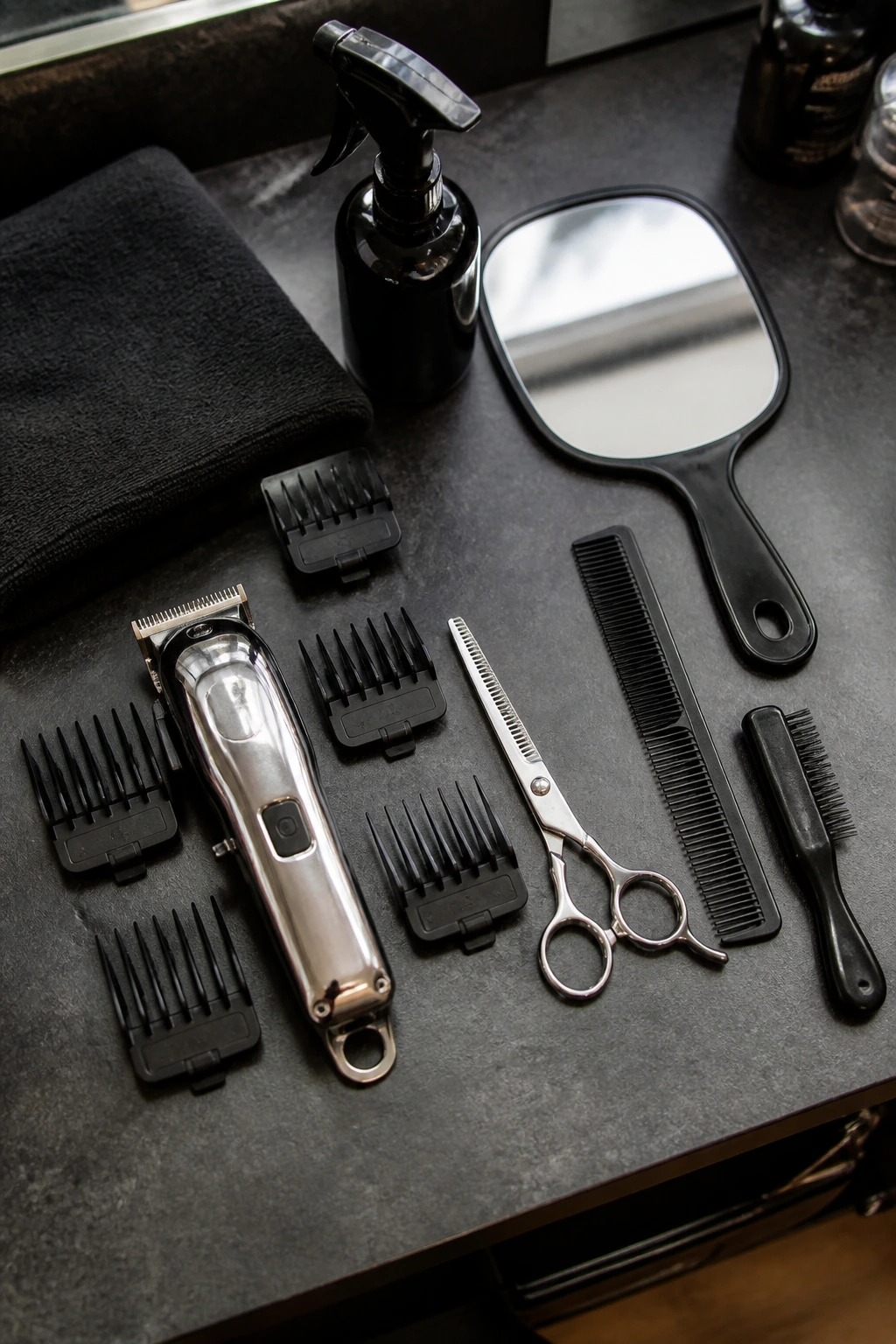
- Clippers with guard sizes #0.5 to #4: Useful for tapers, fades, and home maintenance between barber visits.
- Blending shears or sharp haircutting scissors: Better for scissor-only crew cuts and softening the top.
- Fine-tooth comb and wide-tooth comb: The fine comb helps with clean sections; the wider one is easier for quick styling.
- Handheld mirror: Handy for checking the back of the head and neckline after a trim.
- Blow-dryer with a nozzle: Not mandatory, but it helps lift fine hair at the roots without blasting it everywhere.
- Matte paste, texture cream, or texture powder: Pick one light product, not three.
- Spray bottle with water: A quick mist resets bedhead without needing a full wash.
- Soft towel or microfiber towel: Cuts down on rough towel rubbing, which can make fine hair puff.
Smart Product Picks for Fine Hair

Fine hair gets weighed down fast, so product choice matters more than product quantity. A lightweight shampoo is enough for most boys, especially if the scalp gets oily or sports sweat is part of the week. Conditioner should stay light too, and it belongs mostly on the ends if the top has any length. Piling conditioner onto the roots is one of those habits that sounds harmless and leaves hair flat for half the day.
For styling, matte paste is the safest starting point. It gives a little grip without making the hair shiny or sticky. Texture powder can work even better on very fine hair because it adds a dry, airy feel at the roots. A small amount goes a long way. Too much powder and the scalp starts looking chalky.
Avoid heavy pomades, greasy creams, and thick gels unless the hair is unusually coarse for a fine-hair kid. Those products can make the top separate into strings. And if the hair is freshly washed, use even less product than usual. Clean fine hair does not need much help to look overloaded.
How to Style It Without Flattening the Top
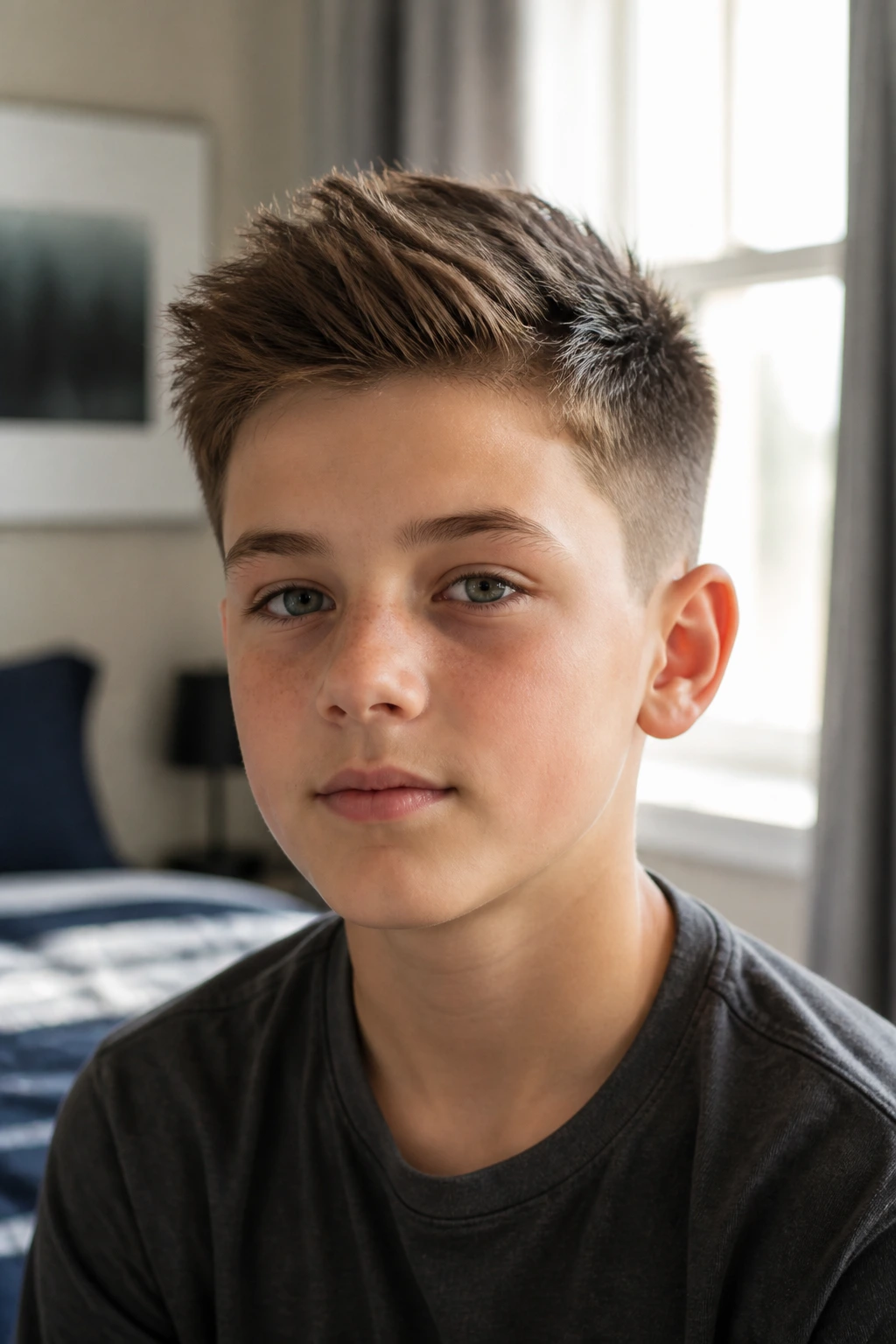
- Start with towel-damp hair: Blot the hair until it’s damp, not dripping. Fine hair dries fast, and product works better on slightly damp strands.
- Lift at the roots first: Use fingers or a vent brush and aim the blow-dryer upward from the scalp for 15 to 30 seconds at a time.
- Use a pea-sized amount of product: Rub it between the palms until it’s nearly invisible, then work it through the top only.
- Keep the sides clean: Don’t drag styling product down the temples and back. That’s where fine hair starts looking greasy.
- Stop while it still looks touchable: If the hair feels stiff, you’ve gone too far.
- Reset with a mist: A light spray of water in the morning can revive the shape without starting from scratch.
Common Mistakes That Make Fine Hair Look Flatter

The biggest mistake is leaving too much length on top. Fine hair can look fuller when it’s short, but once it gets past what the strand can support, it starts folding over itself. The fix is simple: keep the top within the barber’s target length and trim before the shape gets floppy.
Another mistake is using heavy product because the hair “needs something.” Usually, it needs less. Heavy creams and shiny gels can separate the strands and expose the scalp. If the hair looks wet after styling, switch to a matte paste or texture powder and use half as much.
A third one: letting the sides grow out too long. When the sides puff, the head looks wider and the top looks smaller. That’s bad math. A quick taper or fade every few weeks keeps the whole cut in balance.
Finally, don’t ignore cowlicks. Fine hair will not politely lie down just because you asked nicely. The barber needs to cut with the growth pattern, not against it.
Variations and Adaptations to Try
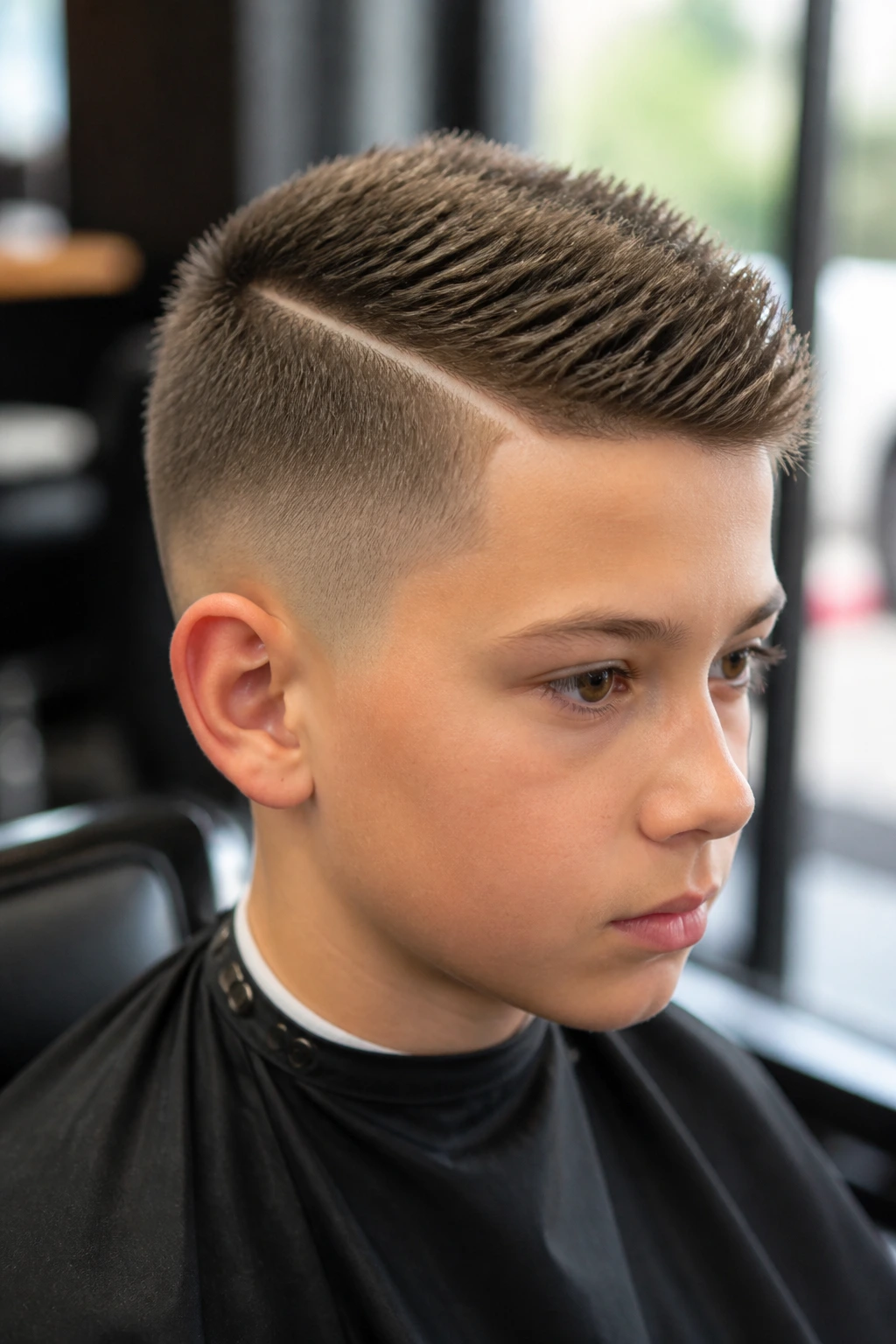
Sport-School Version: Keep the top at ½ to ¾ inch and ask for a tight low taper. This one holds up under sweat, helmets, and a rushed towel-dry.
Soft-Moody Version: Use a scissor-only top with a low taper and a little extra length at the front. It looks calmer and grows out with less edge.
Sharp-Barber Version: Choose a skin fade, a hard part, and a textured top. This is the most defined option, with the strongest contrast.
No-Fuss Version: Ask for a classic crew with a tapered neckline and no product at all. It’s the easiest cut to live with if styling time is basically zero.
Cowlick-Control Version: Keep the crown short and cut the front slightly shorter on the side that lifts. That small adjustment often fixes the whole problem.
How to Keep the Cut Looking Good Between Haircuts
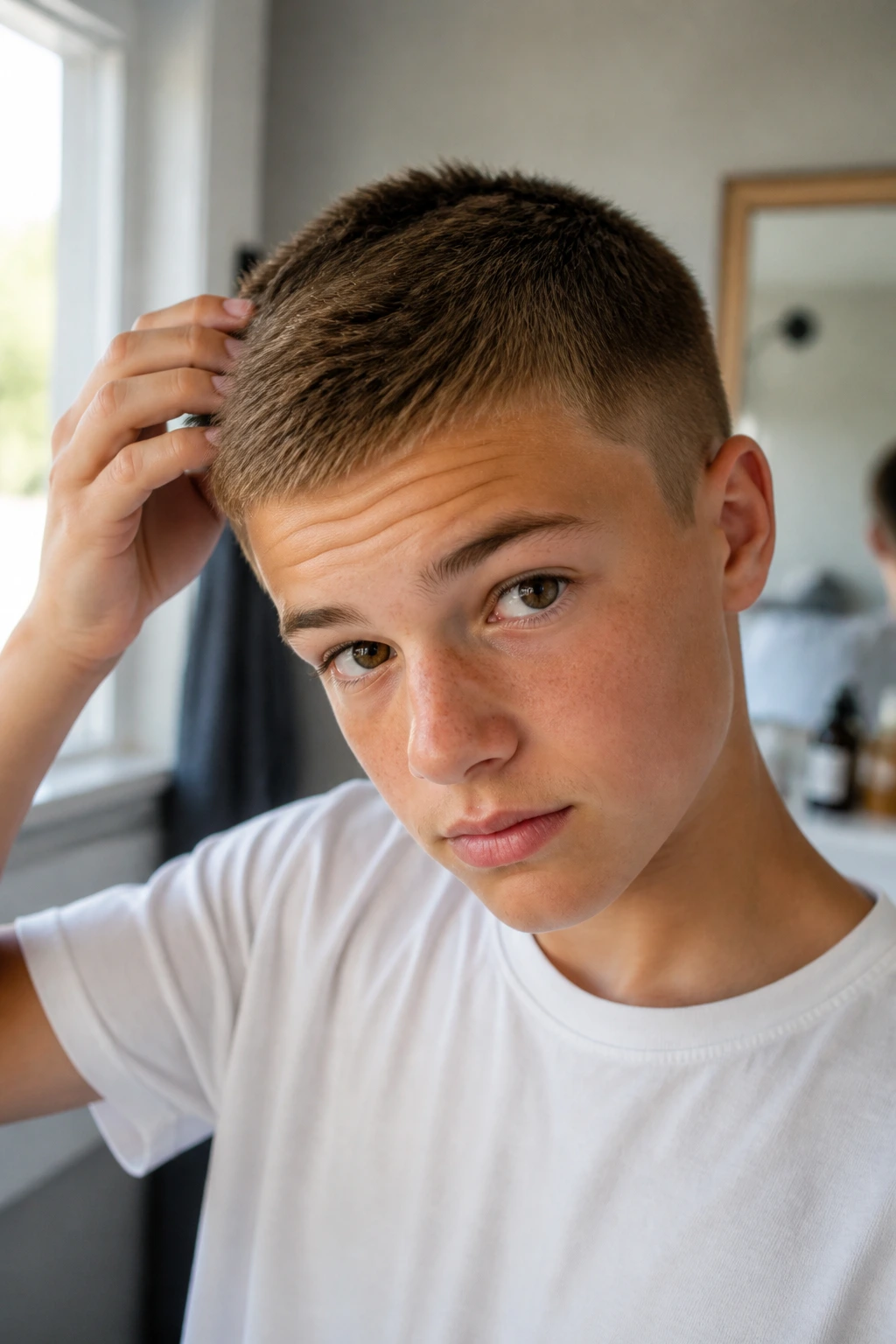
Crew cuts are forgiving, but they still need maintenance. Most boys with fine hair do well with a trim every 3 to 5 weeks. If the sides grow fast or the neckline starts fuzzing out early, move closer to 3 weeks. If the cut is softer and scissor-heavy, 5 weeks is usually fine.
Between cuts, wash frequency depends on sweat and scalp oil. Some boys need a rinse after sports; others only need shampoo a few times a week. Use conditioner when the hair feels dry or scratchy, but keep it light and mostly on the longer top sections. A dry scalp with fine hair can look even thinner if the strands are stripped raw.
At home, a quick edge cleanup around the ears and neckline can help, but only if the clippers are guarded and the hand is steady. If not, leave it alone. A crooked home taper is a terrible trade for saving ten minutes.
Sleep and friction matter too. Fine hair gets flattened by rough pillowcases and sweaty caps. A quick mist and finger reset in the morning usually bring it back. No drama needed.
Frequently Asked Questions

Is a crew cut the same thing as a buzz cut?
Not quite. A buzz cut is usually the same short length all over, while a crew cut keeps the top a little longer and the sides tighter. That extra shape on top is what makes the crew cut work so well for fine hair.
How short should the top be for fine hair?
Most boys do well somewhere between ½ inch and 1½ inches, depending on how much movement they want. Shorter lengths are easier to control; a slightly longer top gives you room for texture or a soft part.
Will a crew cut make fine hair look thinner?
Usually the opposite. Fine hair often looks thinner when it gets too long and separates into weak strands. A shorter, textured crew cut can make the hair appear denser because it keeps the shape compact.
What product works best on fine hair?
A matte paste or texture powder is usually the safest choice. They add grip without the shine and heaviness that make fine hair collapse. Start with less than you think you need.
Can a crew cut work if my son has a cowlick?
Yes, and sometimes it works better than longer styles. The key is cutting with the swirl and keeping the top short enough that the cowlick doesn’t have room to kick up and split apart.
How often should the haircut be trimmed?
Every 3 to 5 weeks is a good range. Tight fades need more frequent cleanup; softer scissor cuts can go a little longer before they start losing shape.
What if the hair lies flat no matter what?
Go shorter on top, lighten the product, and ask the barber for more texture near the front. If the hair is still stubborn, a low taper or skin fade on the sides can make the top look fuller by contrast.
Can this style be done without product at all?
Yes. A classic crew or no-product version can look tidy with nothing more than a towel-dry and a quick finger comb. That’s one reason the cut works so well for busy mornings.
Which crew cut is easiest for school days?
The classic short crew cut or low taper crew cut. Both grow out cleanly, need almost no styling, and stay neat even when the day gets rough.
Clean, Low-Fuss and Easy to Wear
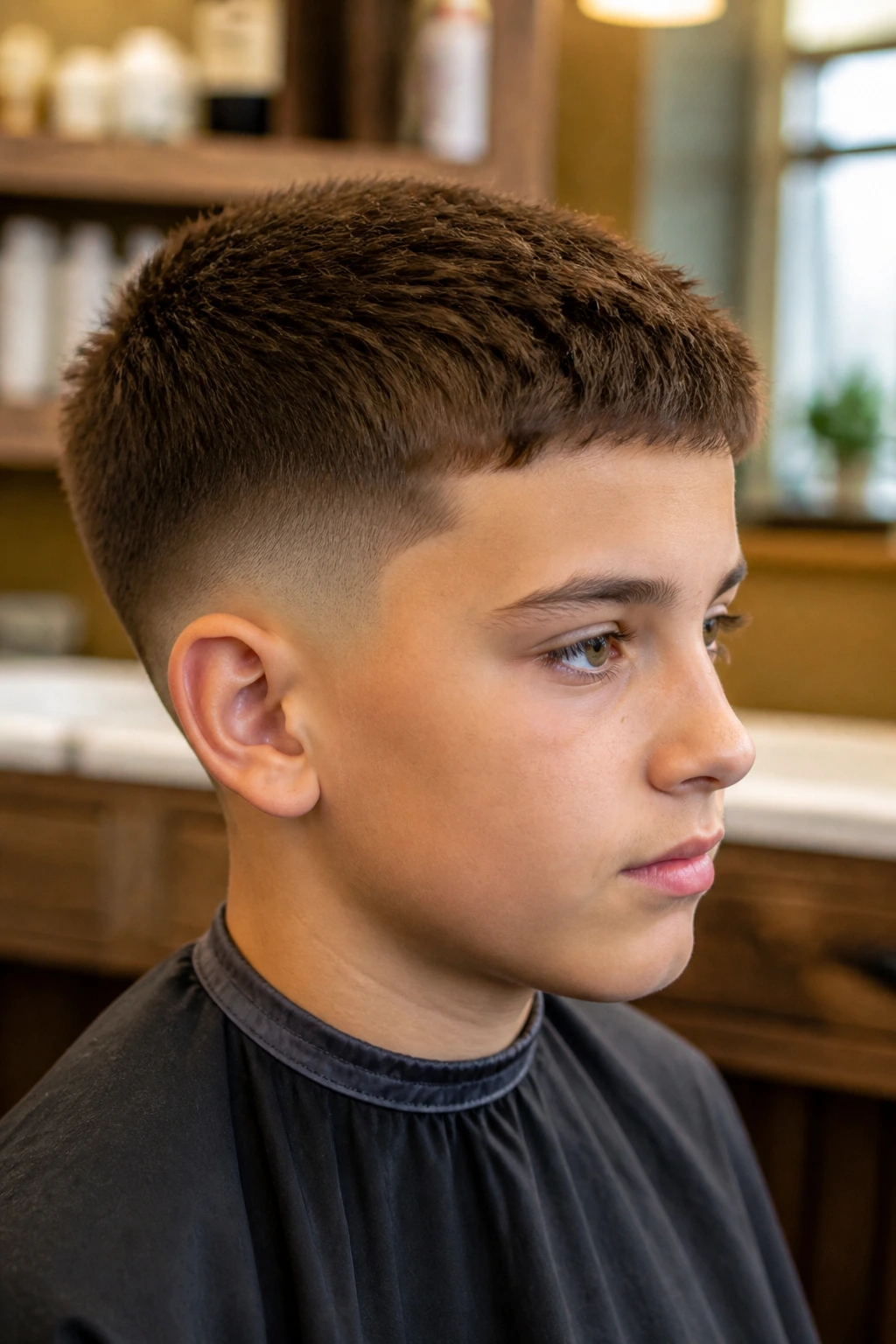
A good crew haircut on fine hair does three things at once: it gives the hair shape, it cuts down on daily fuss, and it grows out without looking messy too soon. That combination is hard to beat. You can keep it sharp with fades and product, or strip it back to a simple short cut that barely needs a mirror.
The real win is that these cuts work with the hair you’ve got instead of against it. Fine hair does not need a dramatic style to look good. It needs a smart shape, the right length, and a barber who understands that a little texture goes a long way. Pick the version that fits the child’s routine, and the haircut starts doing its job before breakfast.