



Thick hair on a boy can behave like it has its own weather system. Cut it too short, and it stands up in stiff little bristles. Leave it blunt and heavy, and it spreads wide at the sides by lunch, especially once a backpack strap, a hoodie, or a nap flattens one side and lifts the other.
Longer haircuts solve more than people expect. They give thick hair somewhere to go. A good scissor cut keeps weight in the right places, trims bulk where it makes the head look boxy, and leaves enough length for the hair to bend instead of sticking out like a broom.
The trick is not “more hair” for the sake of more hair. The trick is shape. And thick hair, when it’s handled well, can carry a shape better than fine hair ever could. The cuts below lean into that advantage instead of fighting it.
Why These Longer Cuts Work on Thick Hair
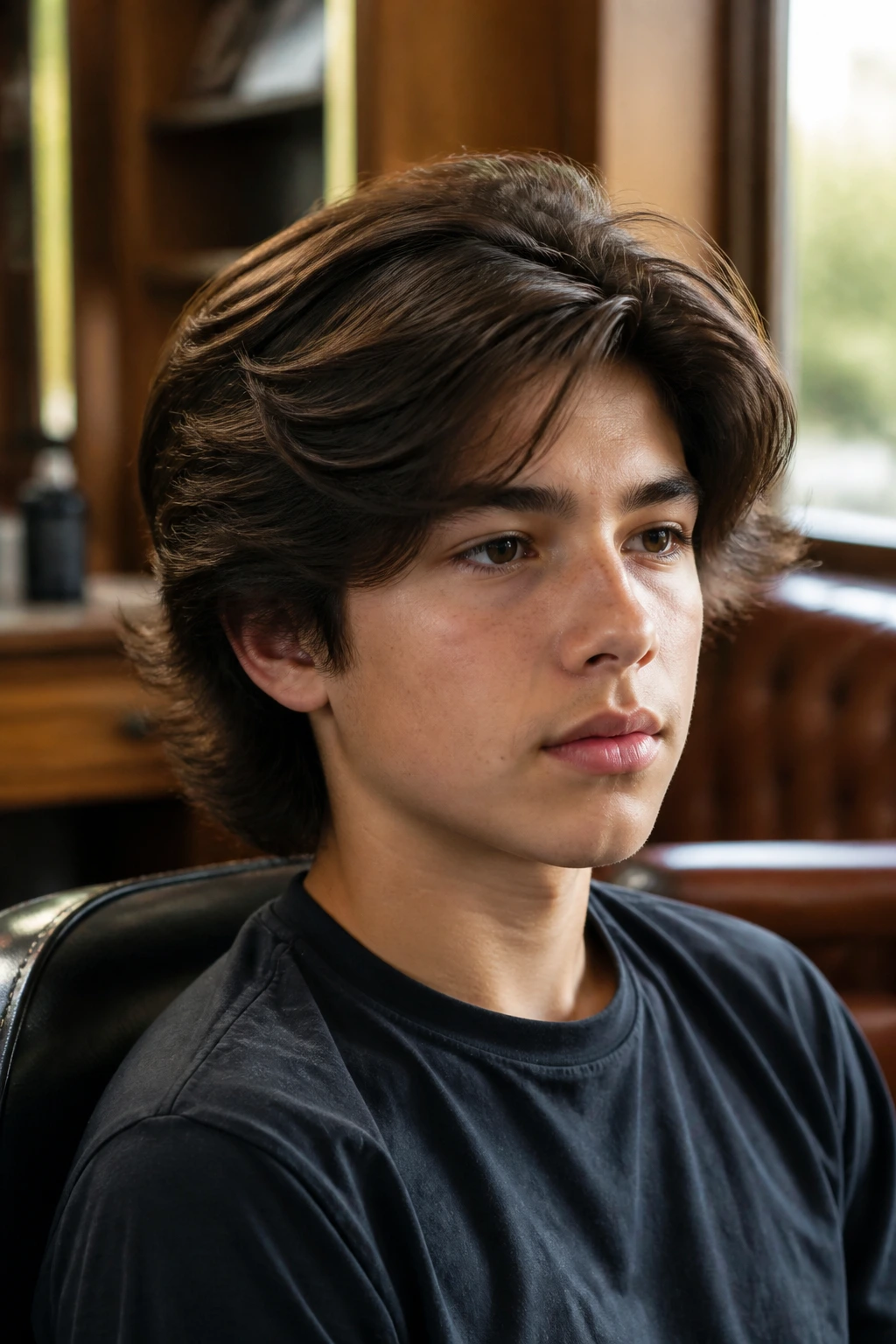
- Bulk control without the helmet effect: Thick hair looks calmer when a barber removes weight from inside the shape instead of hacking the surface short, because the top can stay long while the sides stop flaring out.
- Better grow-out: Longer boys’ haircuts usually grow out softer. A low taper and layered top stay neat for weeks, while a tight high fade can turn awkward fast once the hair starts pushing back.
- Less daily wrestling: When the cut already matches the hair’s natural direction, a pea-size amount of cream or paste is enough. You should not need a jar of product to get through a school morning.
- Cowlicks behave better with length: Thick hair with a front or crown swirl often settles more easily when the hair has a little extra length to weigh it down.
- The style can change with the day: One cut can be brushed back for a family photo, pushed forward for a casual day, or tucked behind the ears when the hair gets in the way.
- The face shape gets some help: Longer layers can soften a wide forehead, balance a round face, or take the edge off a strong jawline without making the haircut look overworked.
What to Ask the Barber Before the Scissors Start
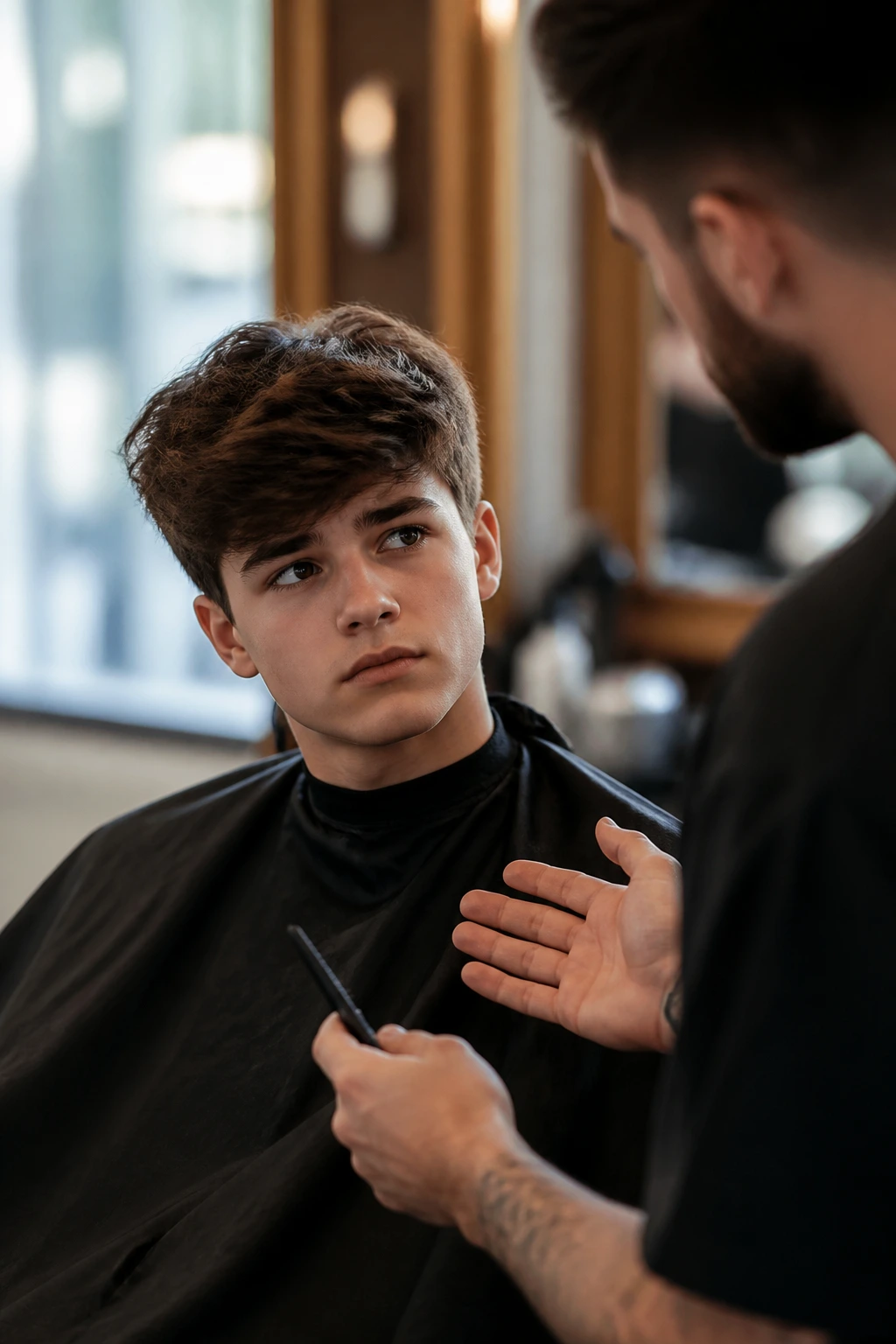
A lot of bad boys’ haircuts for thick hair begin with a vague request like “just clean it up.” That usually means the barber fills in the blanks, and thick hair is the last place you want blanks. Say how long you want the top in inches, not just “a bit longer.” If you like a curtain fringe, a bro flow, or anything that falls over the forehead, the difference between 3 inches and 5 inches is not minor. It changes everything.
Ask for scissor work on top and a low taper around the ears and neckline if you want softness. If the barber reaches for thinning shears, that’s not automatically wrong, but thick straight hair can go fuzzy if too much bulk is removed at the surface. I prefer point cutting and internal texture first. It keeps the silhouette cleaner.
Bring a photo, then describe the parts you actually want to keep. Say things like, “I want the front to fall to the eyebrows,” or “I need enough length to tuck behind the ears.” Those details matter more than the name of the cut. A curtain cut can look like a rock-star shape on one head and a floppy helmet on another if the length and taper are off by an inch.
Useful phrases at the chair
- “Keep the top long enough to move.”
- “Take bulk out without making it look choppy.”
- “Leave the front longer than the crown.”
- “Use a low taper, not a high fade.”
- “Check the crown dry if the hair swirls.”
1. Layered Bro Flow
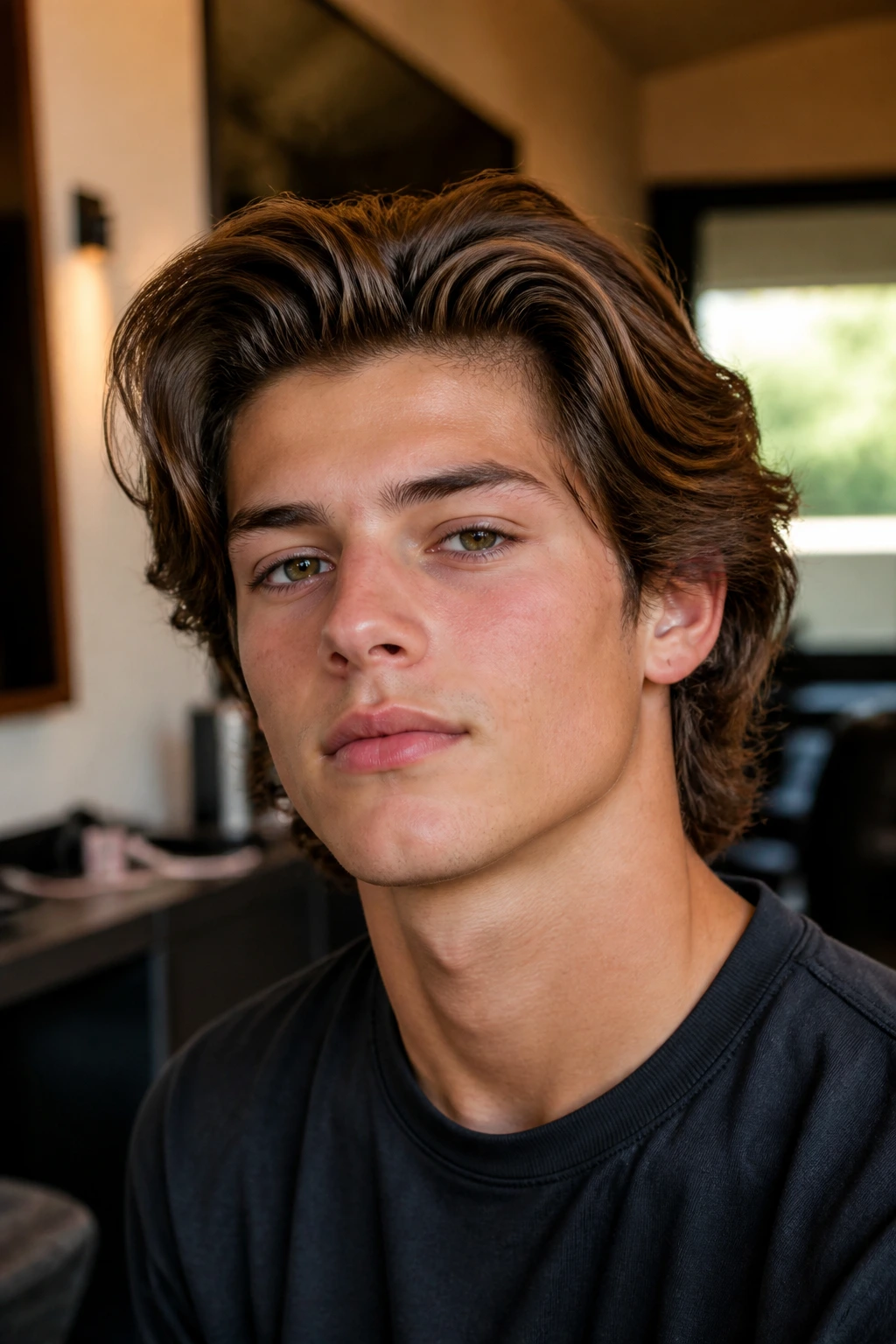
The bro flow is the cut that makes thick hair look like it belongs on purpose. It keeps enough length on top and through the sides that the hair can brush back instead of puffing outward. On boys with dense, straight-to-wavy hair, that extra length is the difference between “messy” and “easygoing.”
What I like most here is the grow-out. A layered bro flow can go six or seven weeks before it starts feeling shaggy in a bad way, and even then it usually just looks longer, not broken. Ask for soft layers through the crown, a low taper near the ears, and enough front length to push back with your fingers. The hair should sit, not stick.
If the hair is especially thick, a barber can remove weight underneath the top layer so the cut doesn’t balloon at the sides. That hidden work matters. The surface still looks full, but the head stops reading as square. A little matte cream on damp hair is enough. Too much product turns this style greasy fast.
2. Curtain Bangs with Length
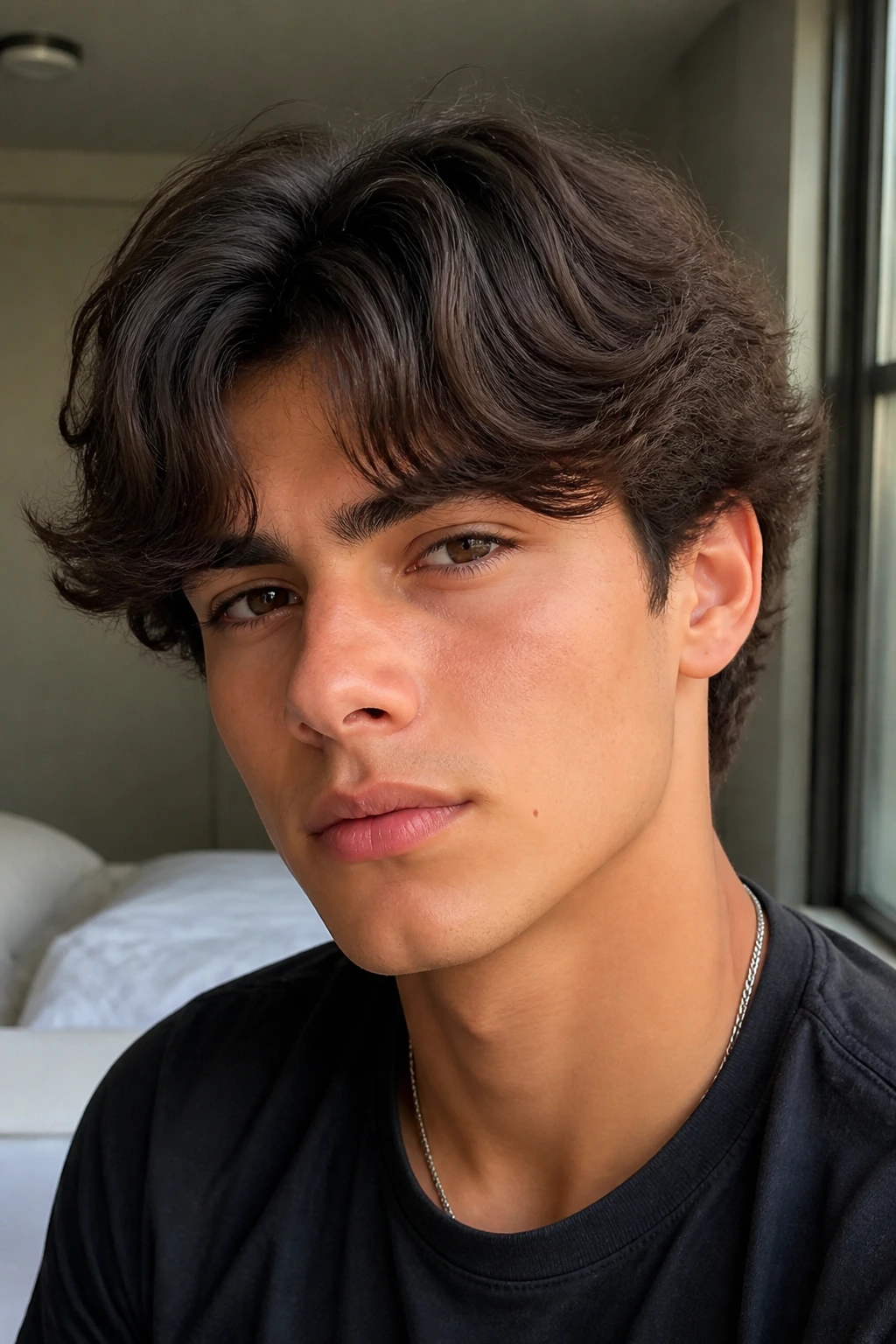
Curtains are one of the few middle-part styles that gets better when the hair is dense. Thin hair makes a curtain part look stringy. Thick hair gives it structure. The front falls away from the center, the sides sweep back toward the ears, and the face gets framed without looking fussy.
The best version keeps the front long enough to split and fall, usually somewhere around the eyebrows or just below them when dry. The barber should point cut the fringe so it breaks softly instead of hanging as one flat slab. That detail matters more than the exact part. If the front is blunt, curtains can look heavy in a hurry.
This cut fits boys whose hair already wants to separate at the center or slightly off-center. It also works well on square and round faces because the hair opens the forehead without adding width at the cheeks. A small amount of lightweight cream, worked through damp hair and pushed outward with fingers, keeps the curtain shape from collapsing into the eyes.
3. Soft Shag
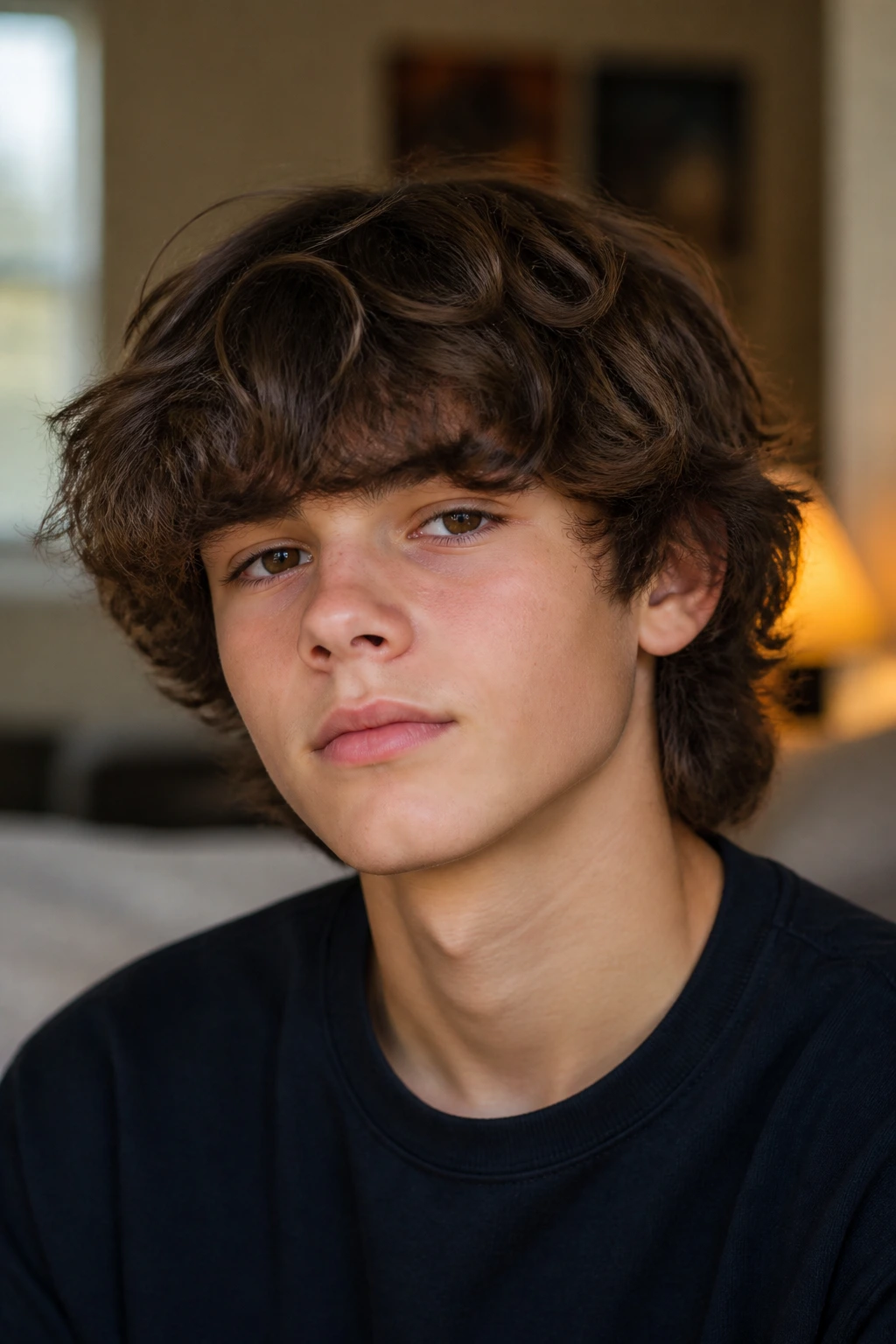
A soft shag is where thick hair finally gets to have some movement. Instead of fighting the bulk, the cut breaks it into layers that bend and fall in different directions. That means the head looks lighter without the barber stripping away all the density that gives thick hair its body in the first place.
This cut is especially good if the hair has a little wave or frizz to it. Those little bends help the shag look intentional. Ask for feathered ends, a looser shape around the ears, and enough length in back that the haircut does not turn into a puffed triangle. The crown should keep some weight, but not too much.
I would not do a shag this way if the goal is sharp neatness every day. It has a lived-in feel, and that’s the point. A dab of curl cream or a soft mousse can help on damp hair, then the whole thing can air-dry. Avoid glossy gel. It makes the layers look separated in the wrong way and drags thick hair down instead of giving it swing.
4. Long Textured Crop
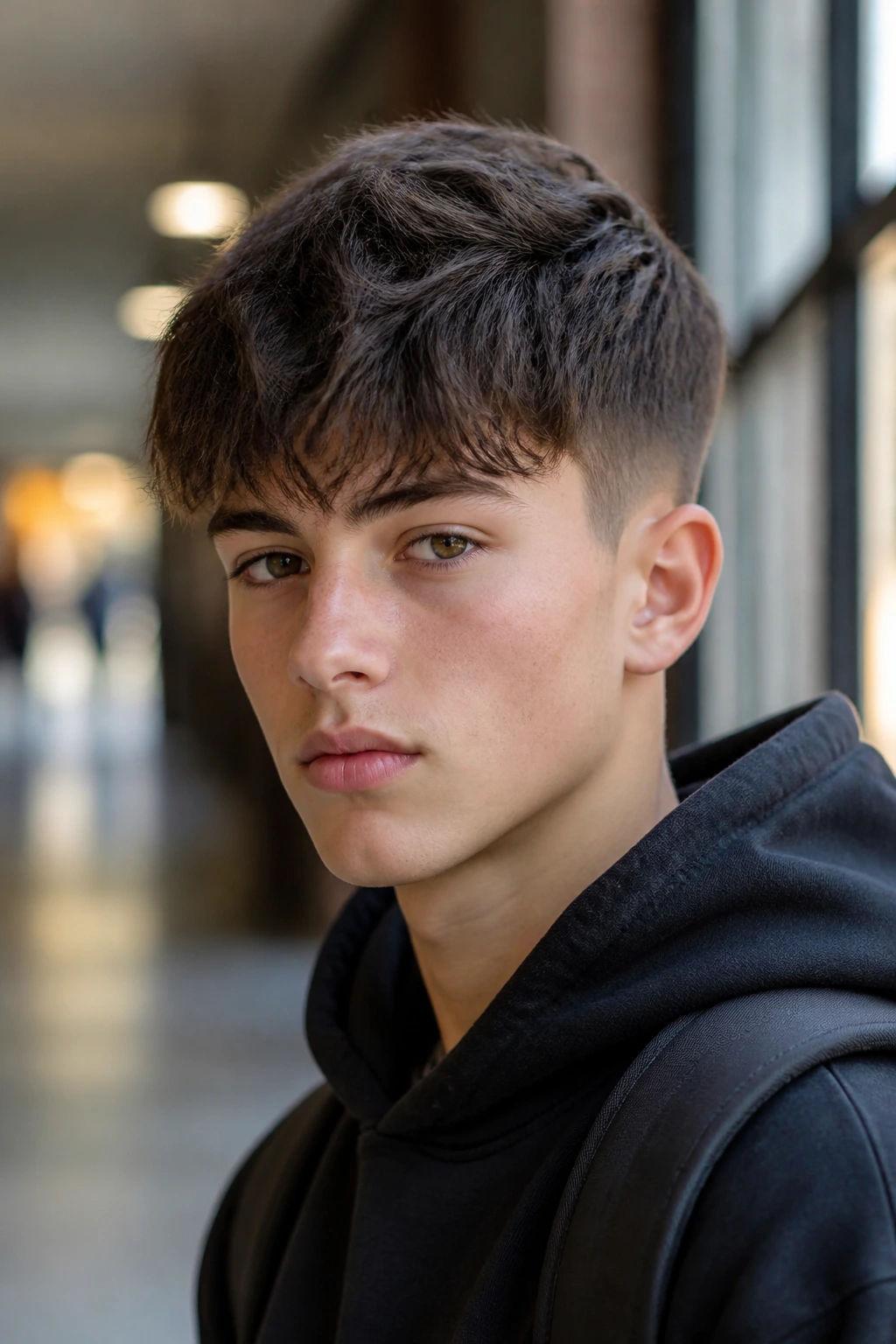
The long textured crop is the practical answer when a boy wants length but not enough length to get in his face all day. It keeps the top longer than a short crop, with the front piece textured and the sides trimmed close enough to control the bulk. It is one of the easiest cuts in this group to live with on school mornings.
This is a smart choice for thick hair that grows outward instead of down. Keep the top around 2.5 to 4 inches, depending on how much natural bend the hair has. The barber should avoid a hard shelf on the sides and should use point cutting through the fringe so the front does not sit like a flat wall. A low taper around the ears and nape keeps it clean.
What I like here is how little styling it needs. Dry hair with a towel until it is just damp, rub a small amount of matte paste between your palms, then push the top forward and slightly to the side. It should still look like hair, not a shell. If the cut looks too short, the whole balance is off. This style only works when the length on top is respected.
5. Swept-Back Scissor Cut
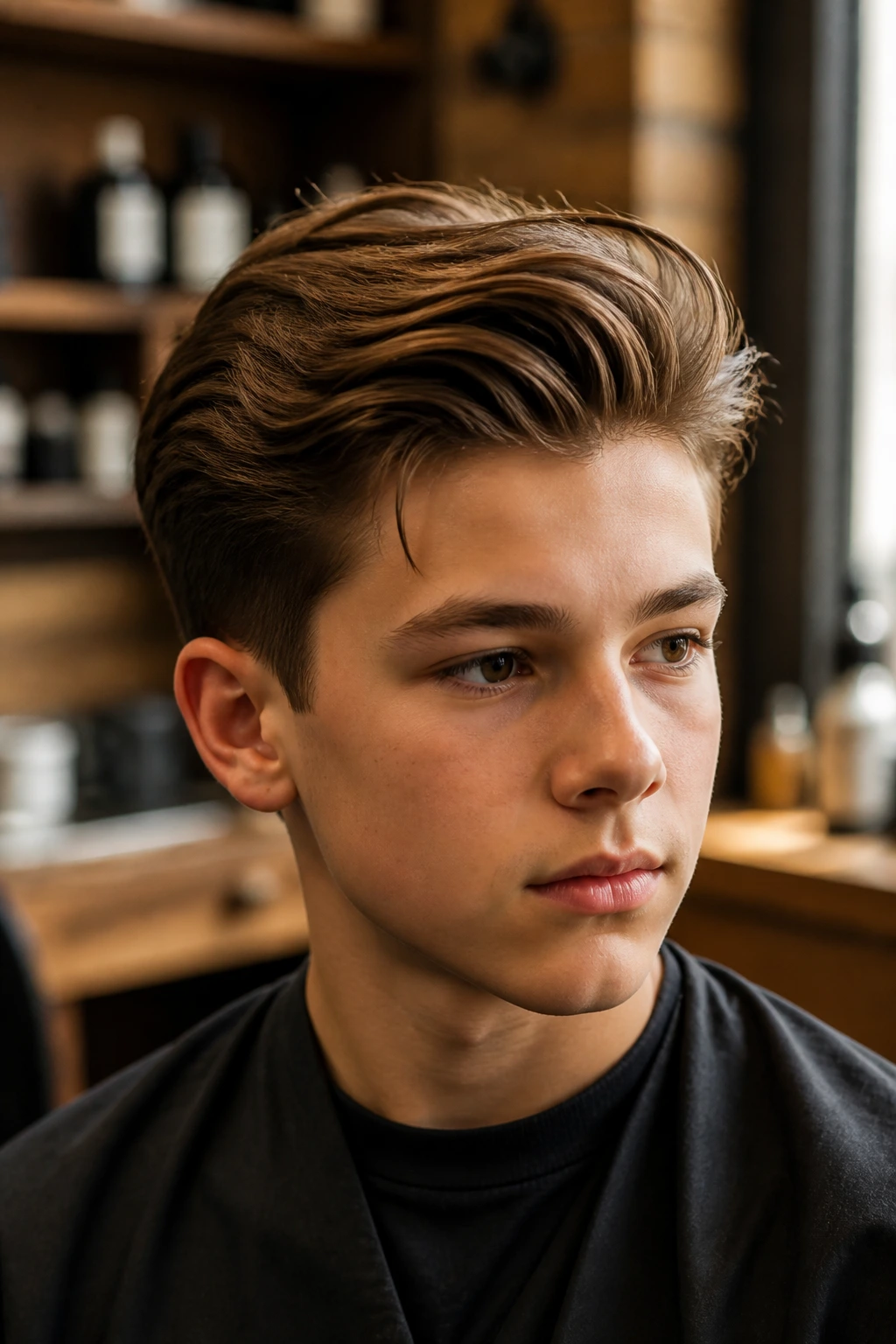
A swept-back scissor cut is the polished version of longer boys’ haircuts for thick hair. The sides stay softer and less severe than a skin fade, while the top has enough length to brush back with fingers or a comb. It looks neat without forcing the hair into a stiff shape.
The important part is control through the crown. Thick hair can pop up there first, especially around the whorl, so the barber should keep the top connected and remove weight in a way that follows the head. Scissor-over-comb on the sides usually works better here than aggressive clipper work, because the goal is softness, not a hard line.
This is the cut I’d pick for a family photo, a school event, or a boy who wants to look a little older without losing the ease of longer hair. A blow dryer helps. Aim it back from the forehead while the hair is still damp, then finish with a small amount of cream or matte paste. The result should look brushed back, not slicked back.
6. Side-Swept Fringe with Low Taper
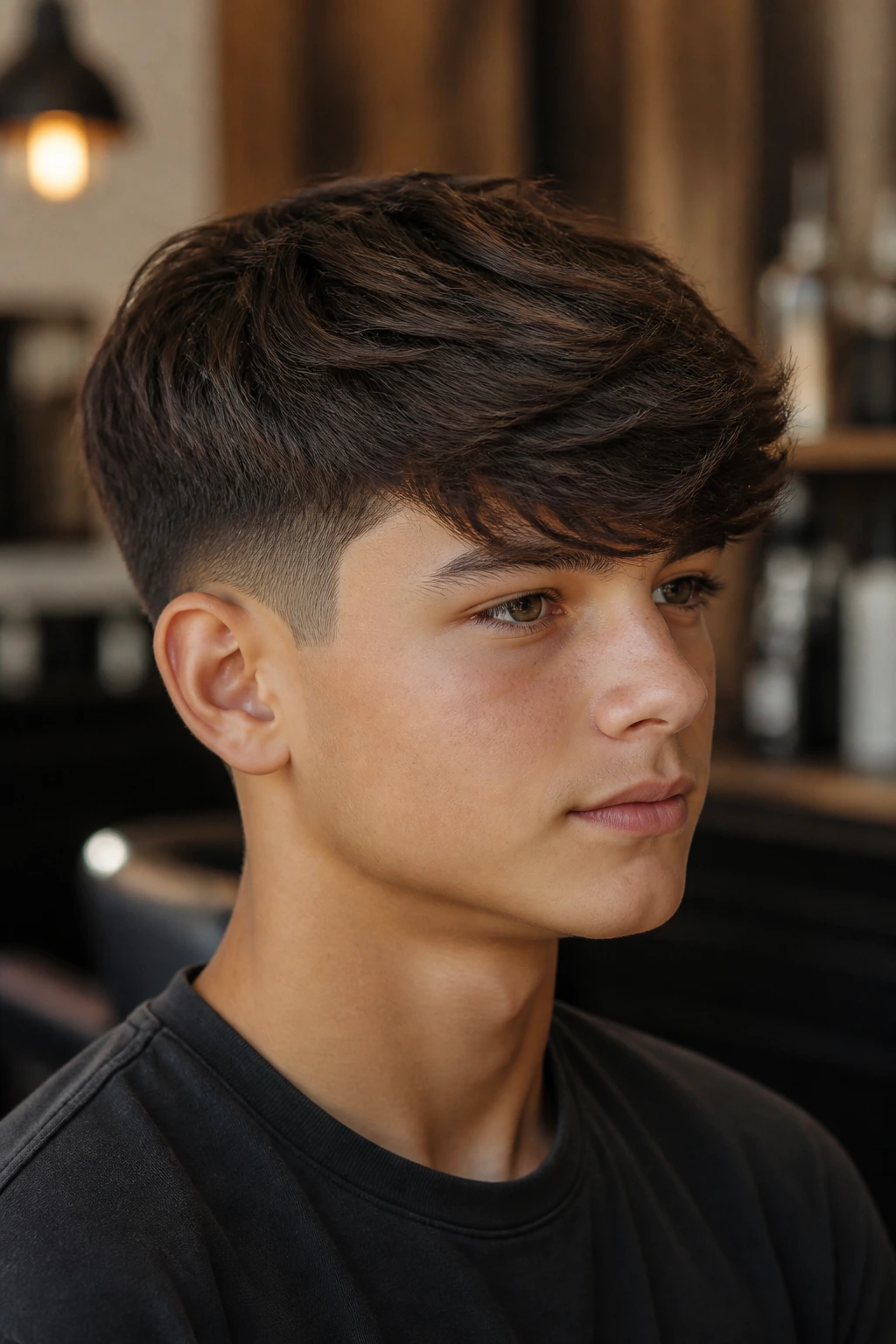
A side-swept fringe is a strong move for thick hair because it gives the front a job to do. Instead of hanging straight down and getting in the eyes, the hair moves diagonally across the forehead and softens the face. The low taper keeps the haircut tidy around the ears, which is where thick hair tends to explode first.
This style is especially useful for boys with a strong cowlick near the front or a forehead that feels a little too open with shorter cuts. The fringe should be long enough to bend, not so short that it springs up and fights the part. Ask the barber to keep the front heavier than the sides and to use point cutting so the fringe falls in pieces, not one block.
It’s a simple cut, but the direction matters. Comb the hair from the crown toward the side you want, while it’s still damp, and let it dry that way. If the hair flips back the wrong way, don’t drown it in product. Water and direction fix more than people think. Product should support the shape, not become the shape.
7. Chin-Length Mop
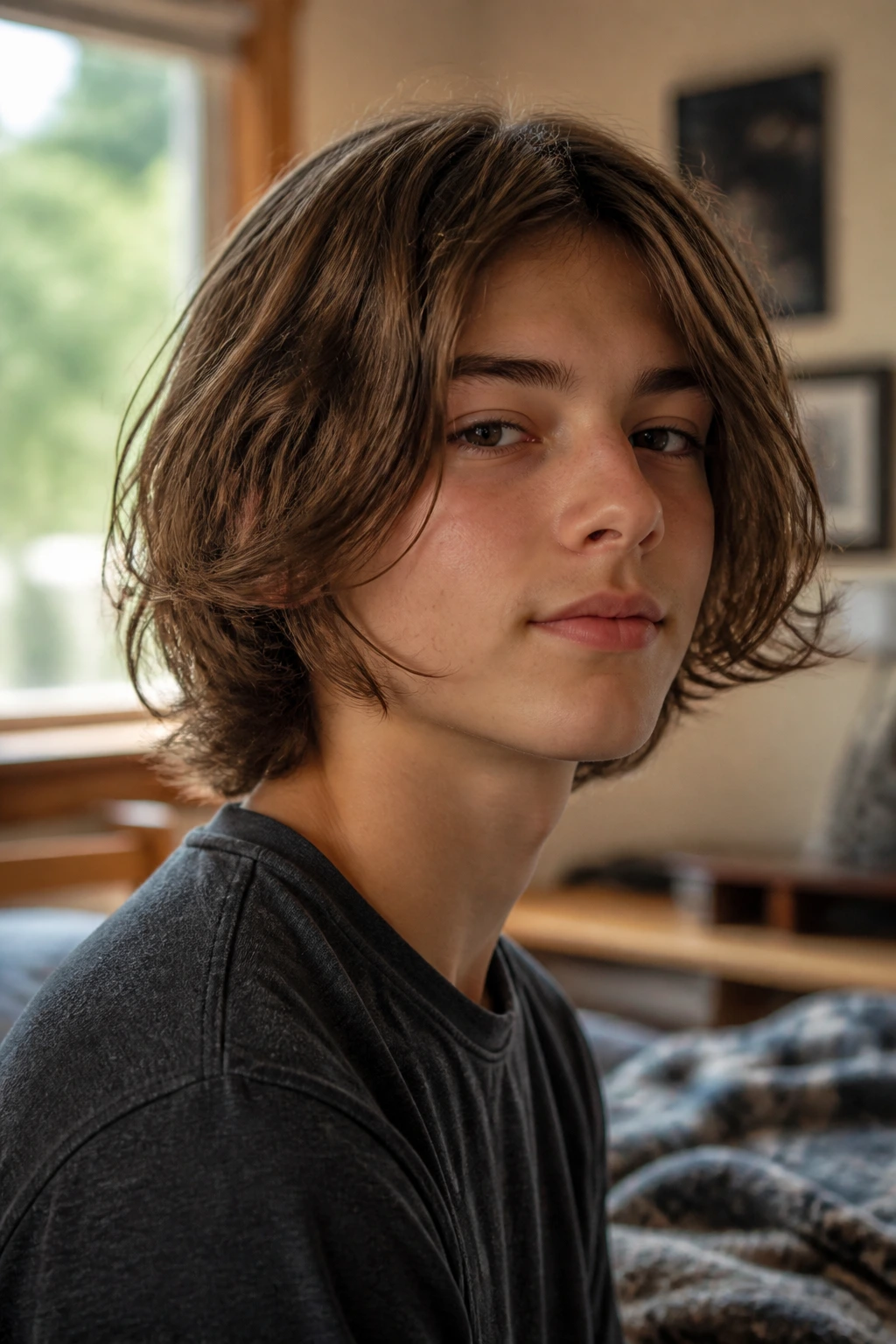
The chin-length mop is the cut people underestimate until they see it on the right head. Thick hair gives this shape its body, and the longer length keeps it from puffing into a rounded helmet. When it’s cut with soft layers and a little movement around the jaw, it can look relaxed rather than heavy.
This cut needs shape at the ends. If the perimeter is left one blunt line, thick hair will sit like a shelf and the whole thing feels square. The barber should soften the edges, keep the crown from getting too bulky, and make sure the sides do not flare out at cheek level. That’s the part that goes wrong most often.
It does take more care than a cropped style. Conditioner matters here, especially if the hair is coarse or gets dried out by swimming and sports. A wide-tooth comb after the shower keeps tangles from turning into a battle. If the hair falls into the eyes, tuck it behind the ears or push it back with a little leave-in cream. The cut has to move with the boy, not against him.
8. Long Fringe with Tapered Sides
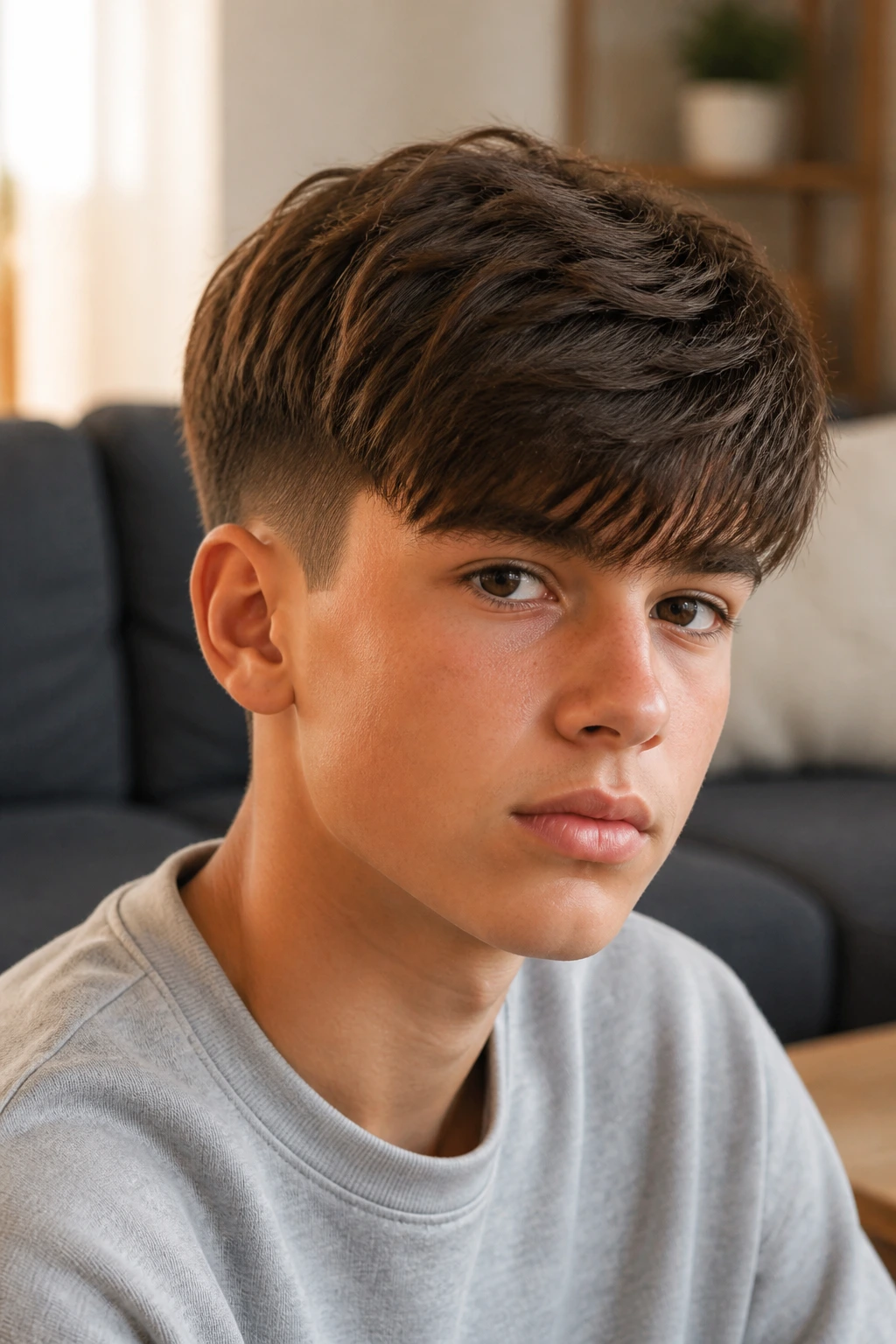
Some boys want the front to feel a little dramatic, and a long fringe does that without pushing the whole haircut into full shag territory. The fringe sits forward, the sides stay tapered, and the cut keeps enough length on top to make the shape readable. Thick hair helps here because it gives the fringe weight.
The barber should not cut the front into a blunt shelf. That’s the mistake that makes the fringe look like a plank. Ask for texture through the ends and a soft connection into the sides. The effect should be slightly messy, slightly polished, and easy to push aside when the mood changes.
This works well when the hairline sits high or when a boy wants to cover his forehead a bit more. It also grows out gracefully, which is rare for a fringe cut. A small amount of matte cream keeps the front separated; too much hold makes it stiff, and stiff fringe on thick hair is not flattering. Let it move. That’s where the charm is.
9. Modern Wolf Cut Lite

A wolf cut can get loud fast, so the boys’ version needs restraint. The lighter version keeps the shaggy movement and the longer nape, but it trims back the extremes. The crown is shorter than the perimeter, the layers are broken up, and the sides stay connected enough that the haircut still looks like one shape.
Thick hair is the right material for this because it can carry the layers without collapsing. Ask for internal texture rather than a chopped-up finish, and keep the difference between the top and back subtle. If the contrast gets too sharp, the haircut starts looking costume-y. That’s the wrong neighborhood.
I like this cut best on wavy or loosely curly hair. Straight thick hair can wear it too, but the styling has to be gentler, with a bit of salt spray or light cream to separate the layers. It’s the kind of haircut that looks best a little imperfect. If every piece is forced into place, it loses the whole point.
10. Shoulder-Grazing Surfer Layers
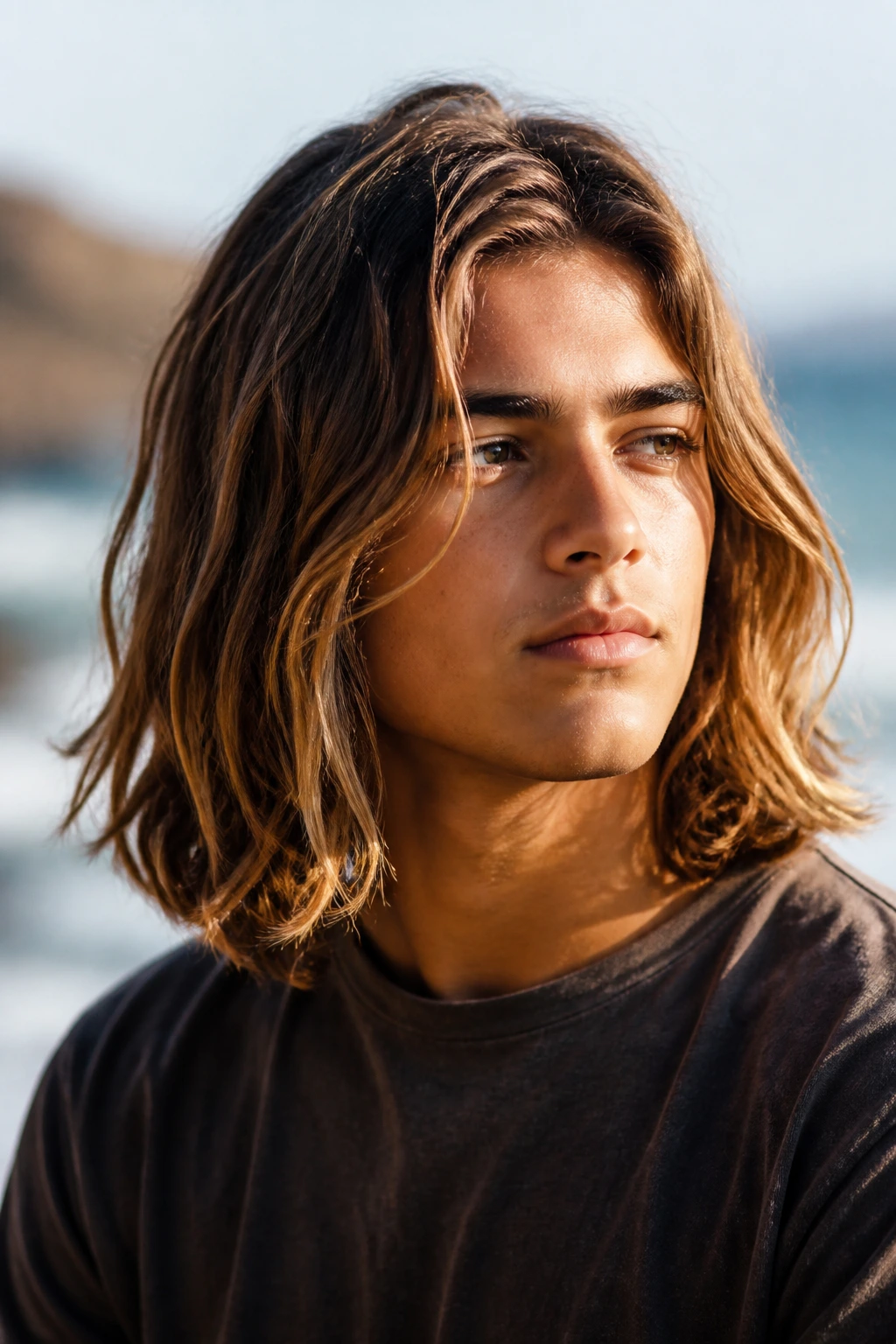
Shoulder-grazing hair on boys with thick hair is not for everyone, but when it’s done well, it’s hard to beat. The long length lets the hair fall under its own weight, and the layers keep it from turning into a triangle. The cut should feel loose, not dragged down.
The secret is not removing too much from the bottom. If the ends get thinned too aggressively, the hair frays and starts to look wispy. A better move is long internal layering through the mid-lengths, with enough thickness left at the perimeter to keep the shape strong. This is one of those cuts that looks easy and is not actually easy.
Surfer layers make sense for boys with natural wave, especially if they spend time in water or live with humidity. They can tuck behind the ears, half-pull back, or fall forward when needed. A leave-in conditioner and a tiny bit of sea salt spray are enough. I would skip heavy wax entirely. It crushes the movement that makes this cut work.
11. Rounded Mushroom with Texture
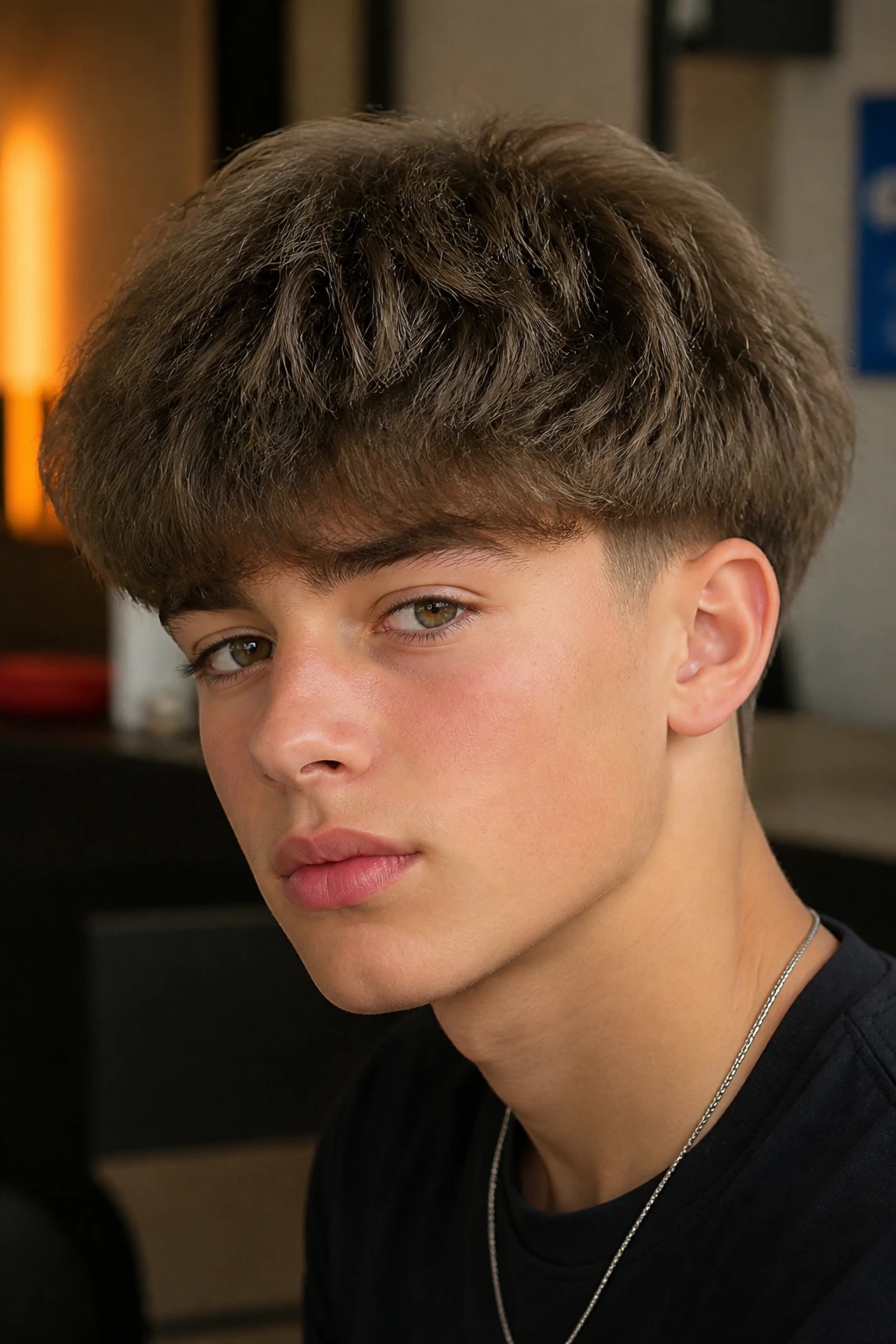
A mushroom cut gets a bad reputation when it’s cut as one hard bowl line. A rounded, textured version is a different animal. The shape still curves around the head, but the ends are softened, the top is layered, and the sides are controlled so the haircut looks deliberate instead of blunt.
Thick straight hair can be excellent for this shape because the density supports the round outline. The key is not letting the sides flare out too far. Ask for a soft taper around the ears and a textured perimeter that follows the head. That way the style reads clean, not bulky.
This is one of the best long-ish cuts for boys who like symmetry and do not want hair dangling all over their face. It has a tidy profile from the front and a calm shape from the back. A light cream or balm works better than a strong gel, because the goal is to keep the surface smooth while letting the body of the hair do the work. If you see a puff at the temples, the sides were left too heavy.
12. Long Top with Tapered Nape
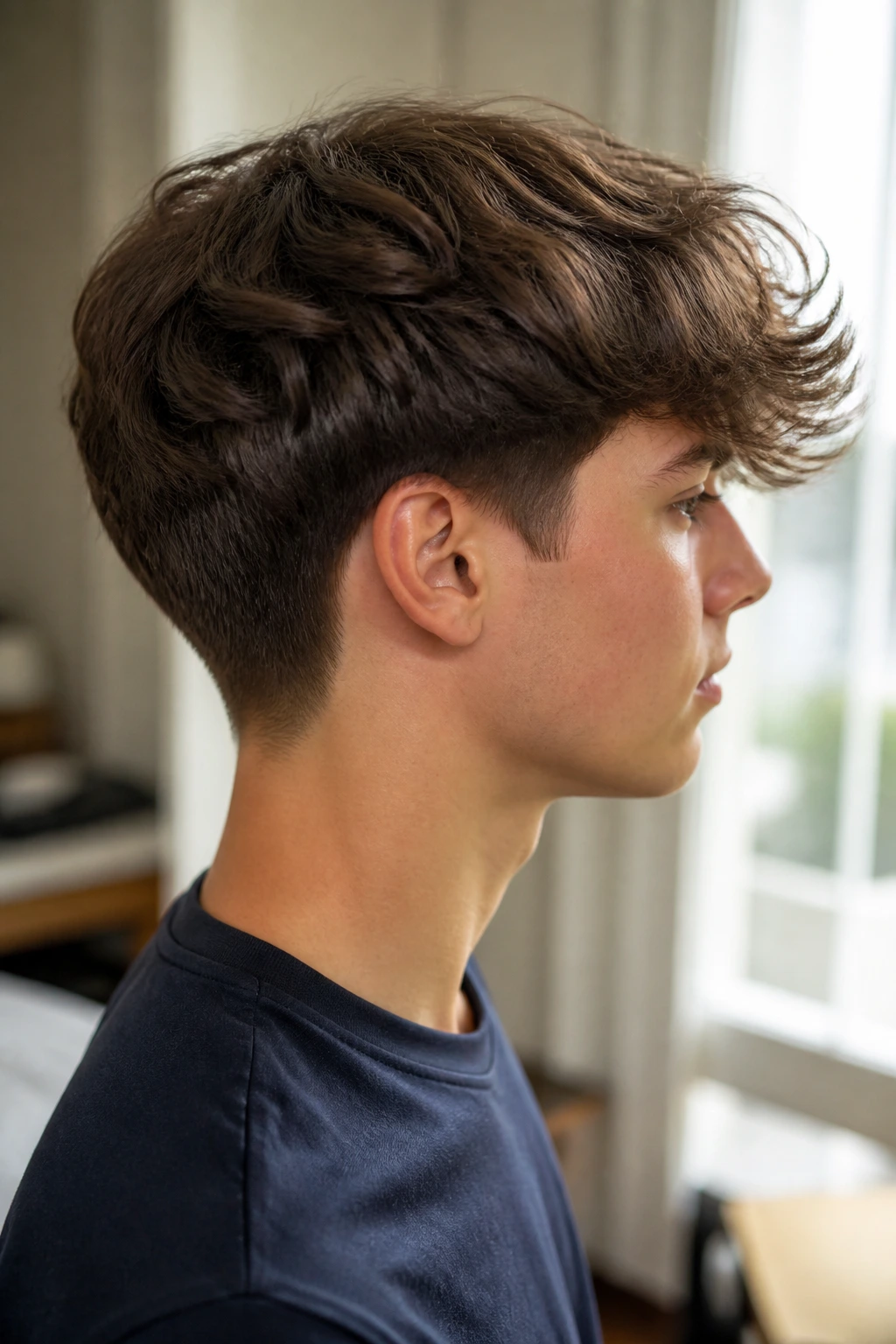
This cut is the practical barber’s answer to “I want it longer, but not wild.” The top stays the main event, the sides are cleaned up just enough, and the nape is tapered so the back does not brush the collar. Thick hair likes this kind of control because the shape stays readable even when it grows out.
A long top with a tapered nape works well for boys who wear helmets, backpacks, or school uniforms that rub the neck. It keeps the back neat without chopping the length off the crown. Ask for a soft blend at the ears and a little extra length in front if the hair tends to split or push up at the front. That extra inch matters.
Styling is simple. Brush or finger-comb the top where you want it while the hair is damp, then leave the sides alone unless they stick out. If the hair is coarse, a blow dryer aimed at the roots for 30 to 45 seconds can settle the top without flattening it. This is not the flashiest haircut in the list, but it earns its keep every single week.
13. Curly Flow Layers
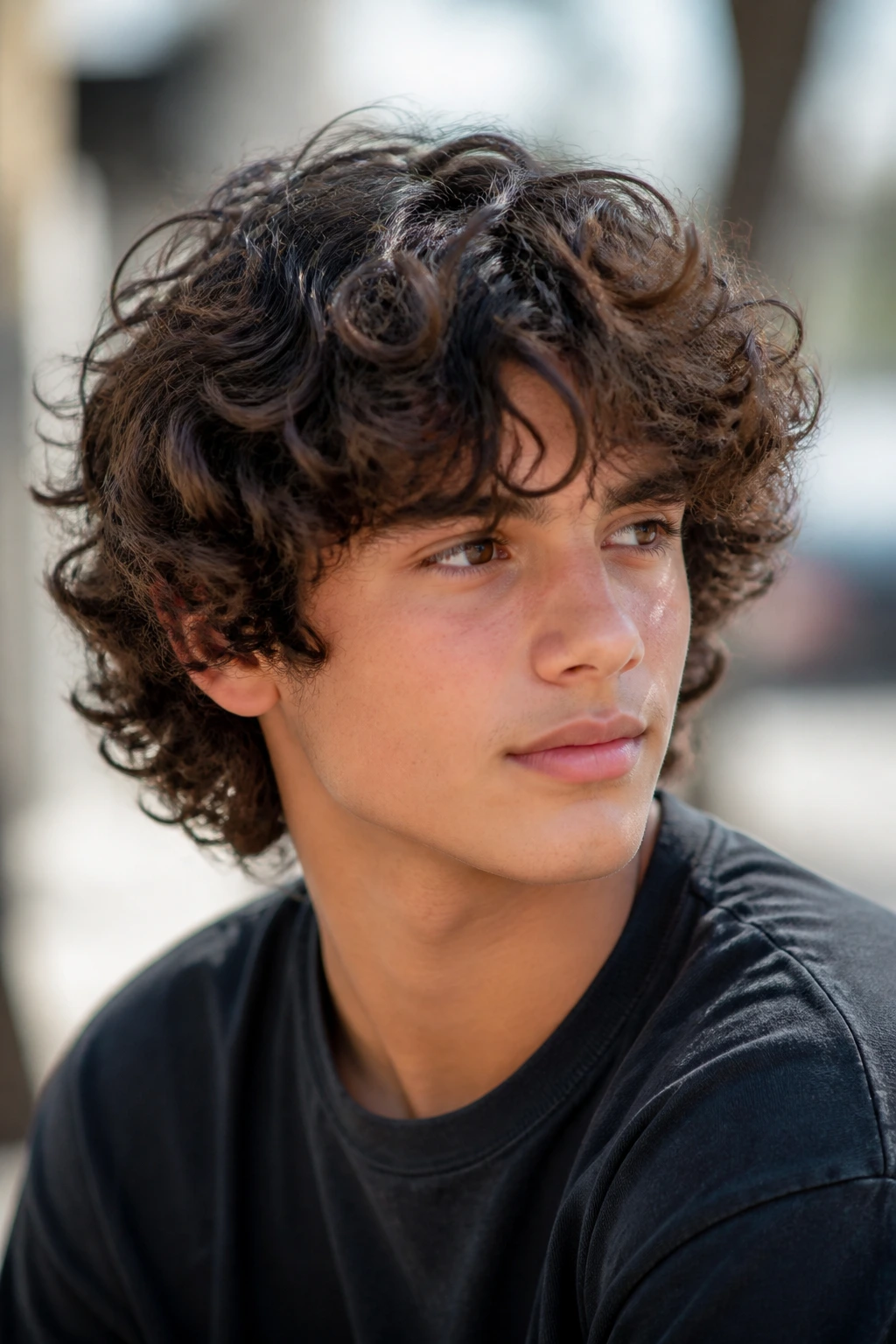
Curly thick hair needs a different logic. If it gets cut like straight hair, the curl pattern can bunch up, widen at the sides, or shrink more than expected around the forehead. Curly flow layers solve that by preserving length where the curls need weight and removing bulk where they need air.
The best versions are usually cut with the curls dry or at least checked dry before the barber finishes. That lets the shape be judged in its real state, not when the hair is stretched by water. Long layers keep the curls from stacking into one big dome, and a softer shape around the ears makes the cut sit better from every angle.
This cut does not like brushes when dry. Finger detangling, leave-in conditioner, and a curl cream with a light hold work better. Thick curly hair can look fantastic when the curls are allowed to form instead of being forced flat. One warning: if the front is cut too short, the shrinkage will surprise you. Leave the fringe longer than you think you need.
14. Ear-Tuck Side Part
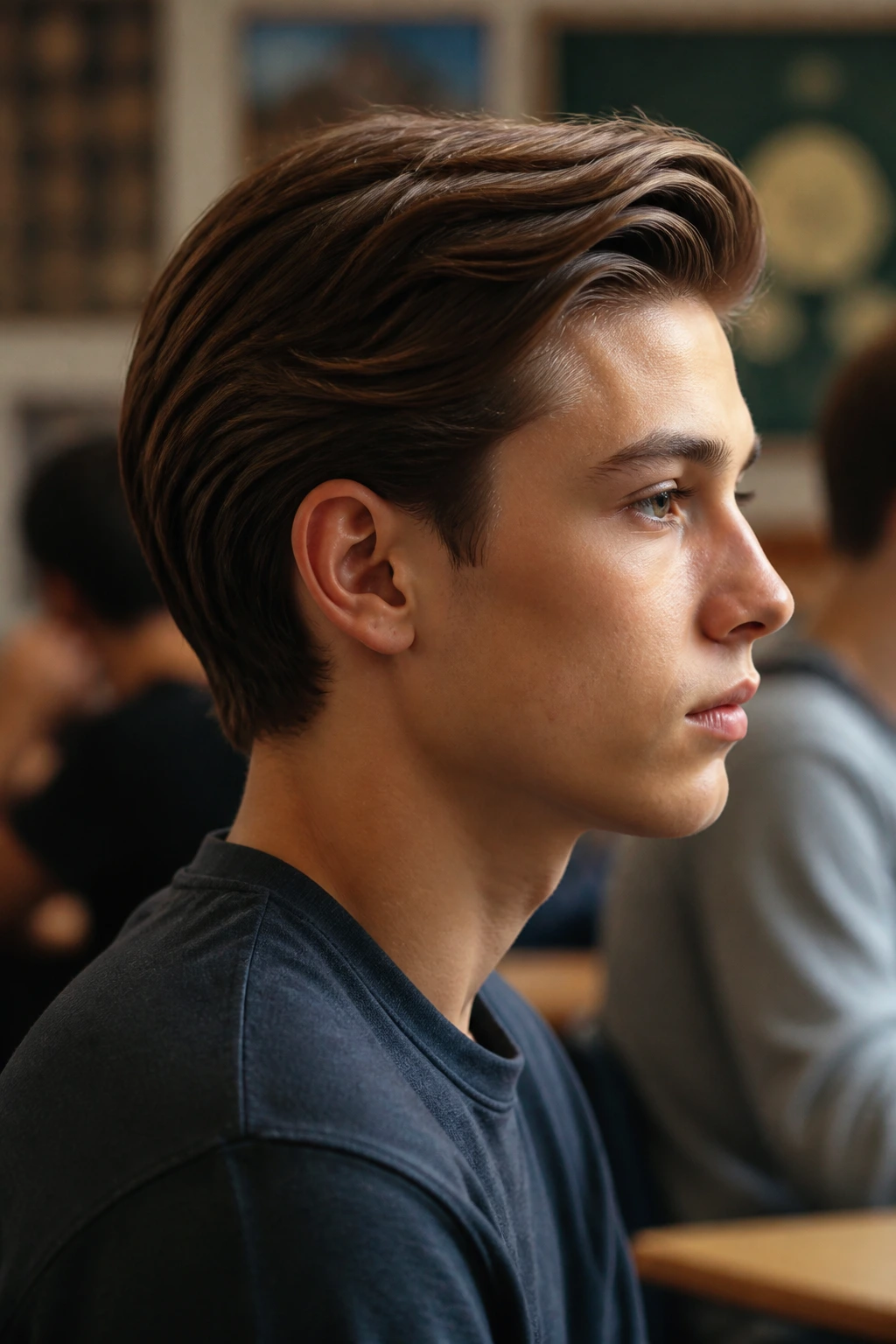
The ear-tuck side part is old-school in the best way. It keeps enough length to brush over and tuck behind the ears, but the low taper and side part stop it from looking too floppy. Thick hair gives this cut a neat, full line that fine hair just can’t fake.
What makes it useful is flexibility. On tidy days, the part is visible and the sides stay in place. On messy days, the hair can fall a little looser and still look shaped. Ask for enough length on top to sweep over naturally, and do not let the barber take the sides too high. A high fade can erase the calm, classic feel that makes this cut work.
This is a good match for school, photos, church, or any setting where “put together” matters more than “cool.” It also grows out cleanly because the side part gives the hair a direction to follow. Use a comb and a touch of light cream if the hair has a stubborn wave. If it’s pin-straight, a tiny bit of product goes a long way.
15. Ivy League Flow

Think of this as the Ivy League that was allowed to relax a little. The top is longer than a strict college cut, the part is softer, and the sides are trimmed with a low taper instead of a severe fade. On thick hair, that little extra length keeps the style from looking clipped too tight.
I like this cut for boys who need something neat but do not want a stiff, helmet-like shape. The top can be brushed to the side, lifted a touch at the front, or smoothed down with fingers. Thick hair gives it body, so the haircut does not need much product or much work. It just needs a sensible shape.
The barber should blend carefully around the temple and not over-thin the top. If the hair gets too light on the surface, the cut starts to separate in odd ways as it grows. A matte cream is enough for styling. If the front keeps falling forward, that means the top is too short or the crown has too much weight. Both are fixable, but they are easier to prevent.
16. Soft Mini Mullet
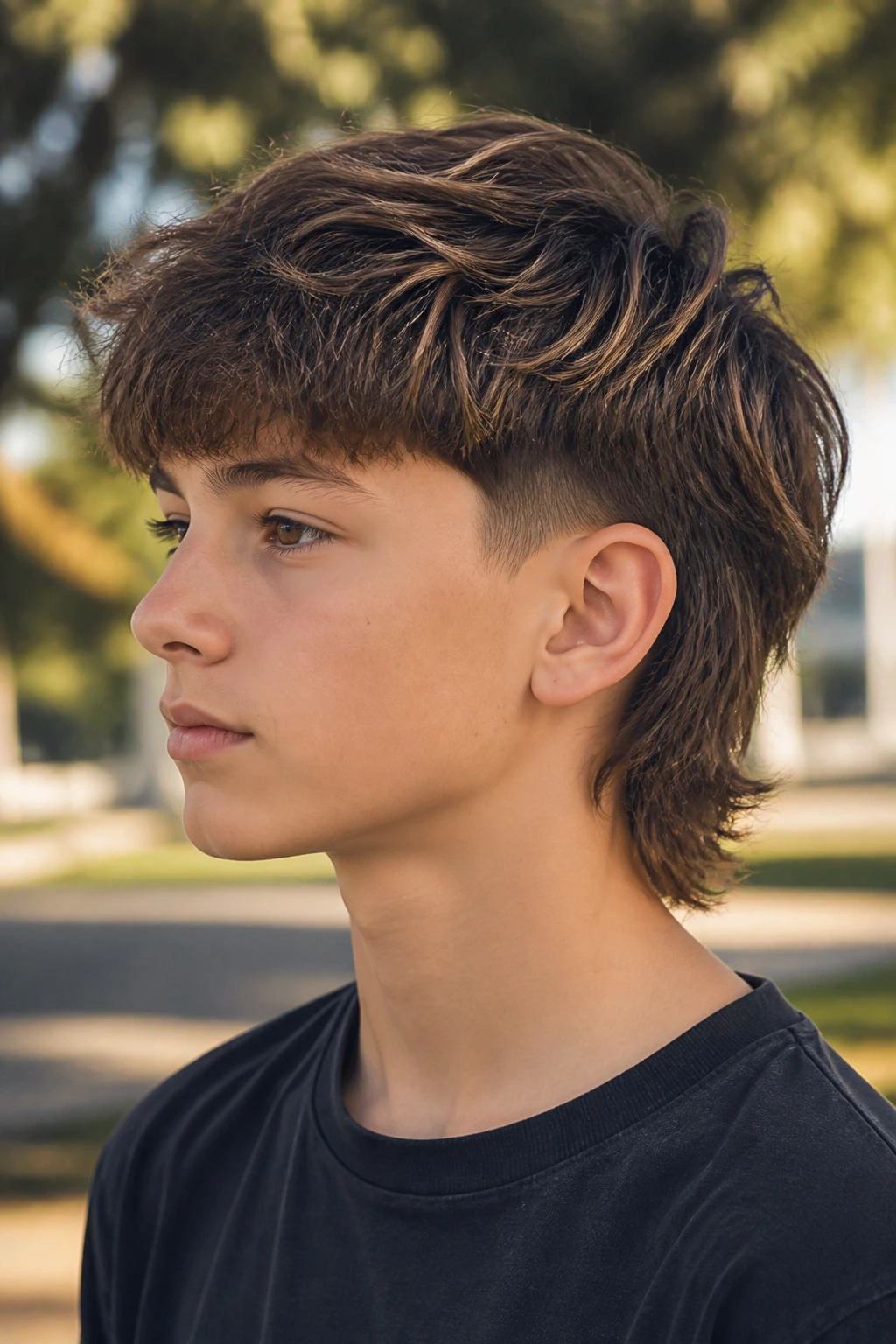
A mini mullet sounds loud on paper. In practice, a soft version can be surprisingly wearable for boys with thick hair. The back stays a little longer, the top and sides stay connected, and the whole thing has movement instead of a hard disconnect. That difference is everything.
This cut works best when the barber keeps the transitions gentle around the ears and does not carve the neck too sharply. Thick hair can make a mullet look bulky fast if the edges are too blunt. A soft taper around the sides and neckline keeps it from turning into a costume. The shape should feel modern and relaxed, not crunchy or forced.
It is a better fit for boys who like a little edge and do not mind a style with personality. Wavy thick hair wears this especially well because the back movement looks natural. If a school has strict grooming rules, this may not be the first pick. But in the right setting, it has real energy and grows out nicely when the back is trimmed on schedule.
17. Skate Cut with Choppy Layers
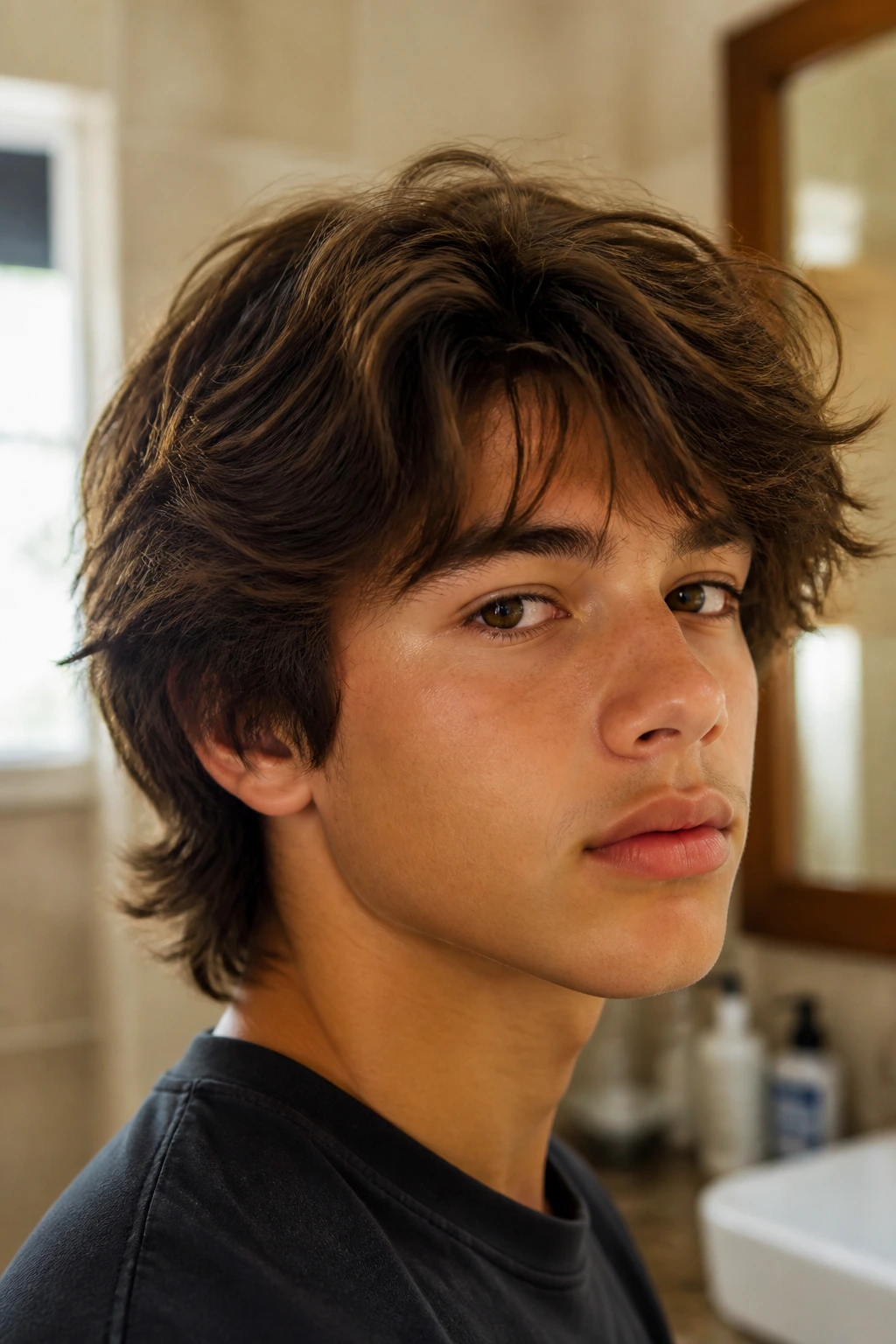
The skate cut is the one that looks like it has already been through a full day, even when it hasn’t. Choppy layers, a little face-framing length, and a loose part give thick hair that piecey, lived-in shape. It’s a strong choice for boys who don’t want anything too neat.
This cut is less about structure and more about movement. Ask for point-cut ends and visible layers through the top and sides, but keep the overall shape connected so it does not fall apart. Thick hair gives the layers enough weight to stay interesting instead of just fluffy. That’s the difference between styled chaos and actual chaos.
A sea salt spray or a light matte cream works well here. Scrunch the hair with your hands after towel-drying, then leave it alone. If it gets combed too much, the whole thing loses its character. This style is best when it looks like hair, not like a helmet that tried to be cool.
18. Long Caesar Sweep
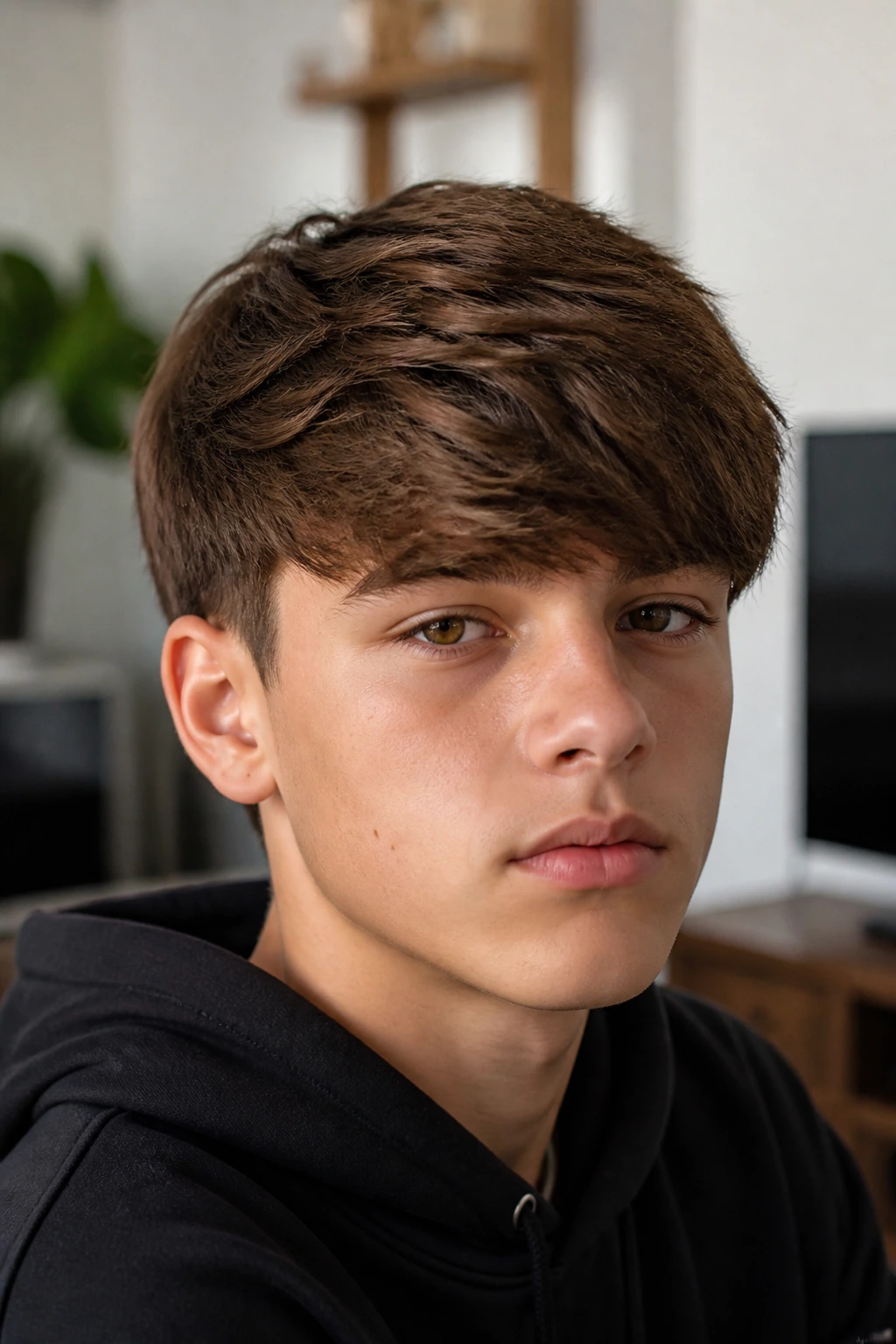
A long Caesar sweep keeps the fringe forward, but softens the line so it doesn’t feel severe. The top has enough length to sit across the forehead, the sides stay neat, and the thick hair gives the whole cut a dense, clean front. It’s a smart option when a boy wants some forehead coverage without full bangs.
The barber should texture the fringe so it breaks up instead of becoming one hard line. That matters more on thick hair than people think. If the front is too blunt, the haircut can feel heavy and old-fashioned fast. A soft sweep to one side gives it movement and keeps the eyes clear.
This style also handles growth better than shorter forward cuts. The fringe can be pushed slightly to the side as it lengthens, and the sides still look tidy if the taper is kept low. A tiny bit of cream is enough. If the boy’s hairline is strong and the hair grows straight down, this can be one of the cleanest-looking longer haircuts in the whole set.
Daily Styling Moves That Keep Thick Hair Under Control
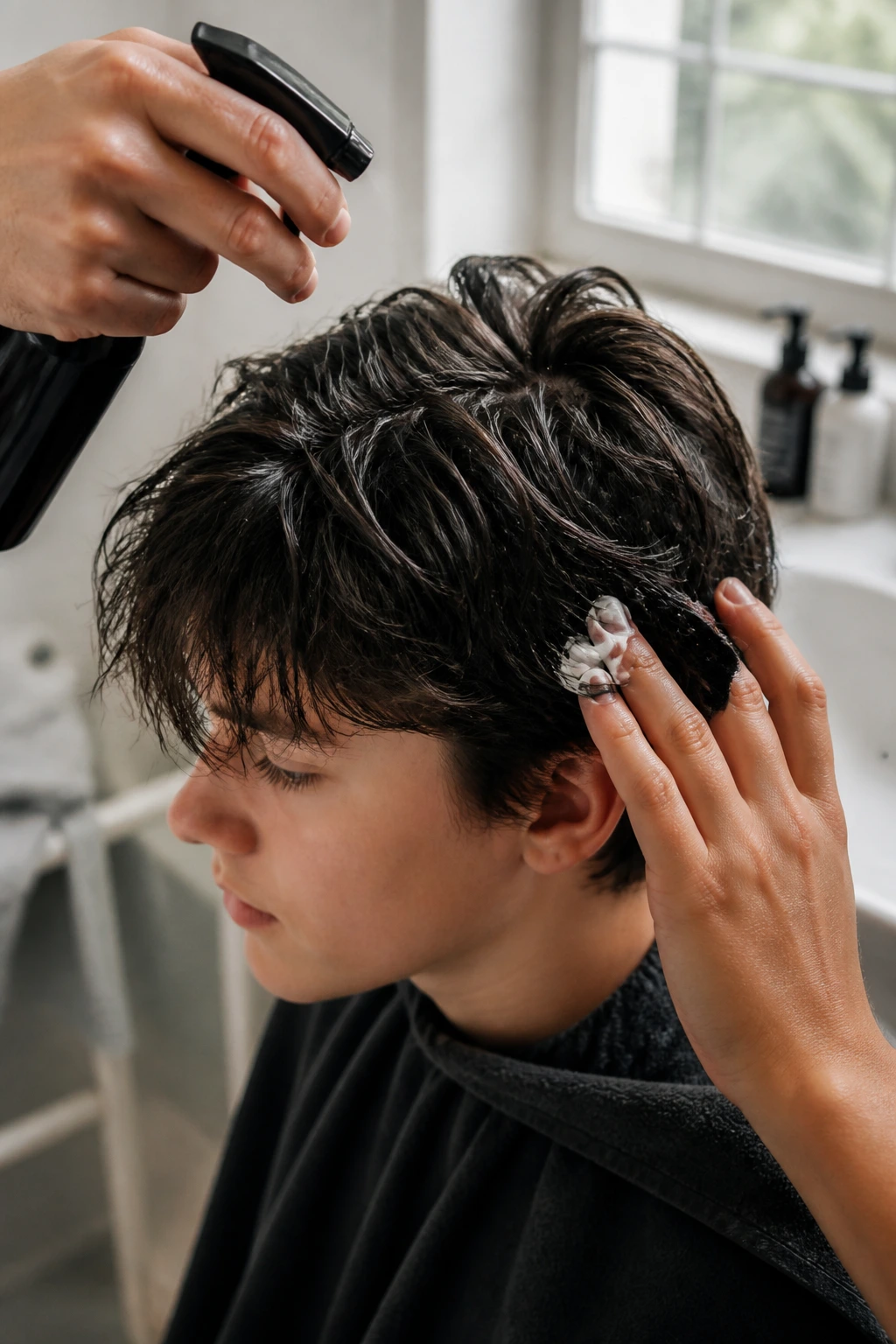
The biggest win with thicker boys’ hair is not some miracle product. It’s direction. Hair that is still damp will remember where you send it, and thick hair remembers stubbornly. Start there. After the shower, blot with a towel instead of rubbing, then comb the hair into the shape you want while it is still slightly cool and damp. If you wait until it is fully dry, you are fighting the hair’s memory.
Product should stay small. A pea-sized amount of matte cream or paste goes farther than most parents expect, and it usually belongs on the mid-lengths and ends, not the scalp. Thick hair gets greasy-looking fast at the roots, especially in longer cuts. If the style starts to collapse, add a touch more water or rework it with damp hands before you add more product.
My blunt opinion: too much shine rarely helps thick boys’ hair. Matte creams, light clays, and soft balms keep the texture visible. Heavy gel makes the hair look wet in the wrong way and can show every separate strand at the front. That is not a good trade.
The Mistakes That Make Thick Hair Puff or Collapse
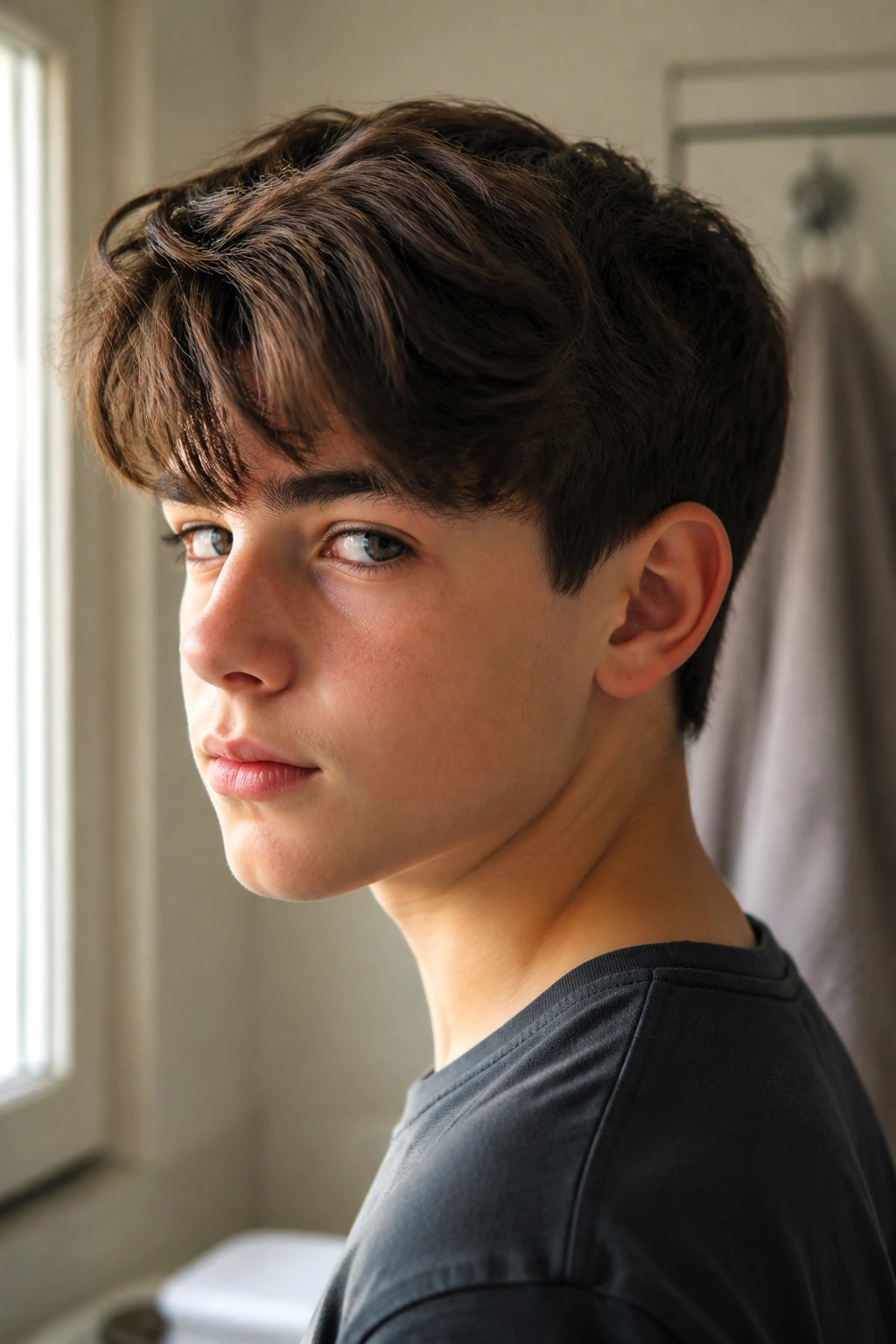
The first mistake is cutting the sides too high and too tight. Thick hair loses its shape when the perimeter is clipped away too aggressively, because the top keeps its weight and the sides grow out with a hard shelf. The symptom is a mushroom shape or a puff at the temples. The fix is a lower taper and softer blending near the ear.
The second mistake is overusing thinning shears. A little texture can help, but too much surface thinning leaves thick hair frizzy and strange at the ends. You see the shape disappear in daylight, especially if the hair is dry or a bit curly. Point cutting and internal weight removal are safer first choices.
Another one: cutting the fringe too short because it looks long when wet. Thick hair shrinks in its own way as it dries, and a fringe that seemed harmless in the chair can sit right in the eyes a week later. If the front needs to move, leave extra length and check it dry before the barber finishes. The crown is the same story. Ignore the swirl there, and the haircut will keep splitting in the same bad place.
Easy Variations for Straight, Wavy, and Curly Thick Hair
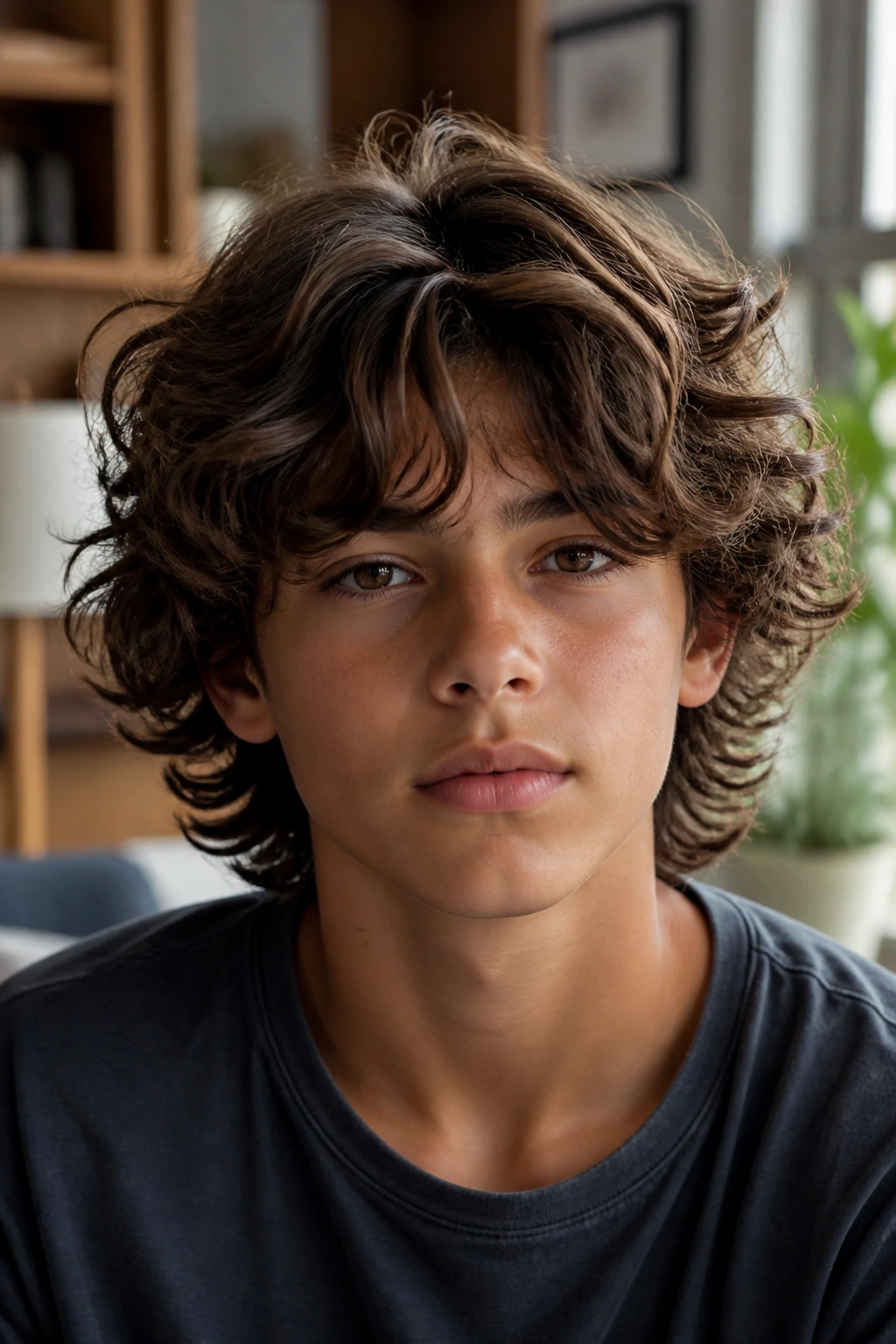
The School-Ready Version keeps the same long shape but trims the fringe a little higher and the sides a little cleaner. It’s a smart choice when a school wants tidy hair and nobody wants to argue about the collar or the eyes. The haircut still reads long, just controlled.
The Air-Dry Version leans into natural texture and skips heavy styling. Wavy and curly thick hair does especially well here, because the cut is built around the way the hair falls on its own. A leave-in conditioner and a touch of curl cream are enough. Anything heavier starts to flatten the movement.
The Sport-and-Helmet Version keeps the nape and sides shorter while leaving the top long enough to push back later. It works for boys who live in hats, helmets, or swim caps. The shape survives the squeeze better than a full-length flow, and it grows out neatly.
The Extra-Movement Version adds more internal layers and a little more texture at the ends. This suits boys who like a looser, shaggier look and do not mind a little mess. It’s good on thick hair that feels heavy unless some weight comes out.
The Calm Classic Version is for families that want the long hair to still look like a haircut. Less fringe drama, more side control, and a low taper around the ears will do that. It’s the least flashy route, and sometimes that’s the best one.
Tools and Products That Actually Help
- Spray bottle with plain water — Thick hair resets faster when it’s damp again; a few mist sprays can reshape the front without a full wash.
- Wide-tooth comb — Best for detangling longer thick hair without ripping through it and making the ends frizz.
- Vent brush or detangling brush — Handy for brushing a bro flow, curtain cut, or swept-back style into place while the hair is damp.
- Blow dryer with a nozzle attachment — Optional, but useful if you want to push thick hair back, down, or to one side without puffing it up.
- Lightweight leave-in conditioner — Helps long, thick hair feel softer and keeps the ends from getting dry and prickly.
- Matte cream or paste — Better than shiny gel for most of these cuts; it gives control without turning the hair crunchy.
- Microfiber towel or soft T-shirt — A rough towel roughs up the cuticle and can make thick hair frizzier than it needs to be.
- Barber cape or salon apron for home trims — Useful if you only clean up the neckline or bangs between appointments.
Keeping the Shape Between Cuts
Longer haircuts for boys with thick hair do not stay tidy forever, but they do stay presentable longer than a short clipper cut if you keep up with the edges. A good schedule is a full trim every 6 to 8 weeks for straight, dense hair, and closer to 8 to 10 weeks for wavy or curly hair if the shape is still holding. Fringe-heavy cuts may need a small front trim sooner, especially if the hair starts brushing the eyes every time the boy looks down.
The neckline and ears are the first places to drift. A tiny clean-up every 2 to 4 weeks can make a haircut look fresh without taking off real length. That matters a lot on thick hair, because once the outline gets fuzzy, the whole style feels bigger. If you are trimming at home, stick to the neck and stray bits around the ears. Leave the top alone unless you know exactly where the crown wants to sit.
Wash habits matter too. Thick hair often gets dry faster than people think, especially if there’s swimming, sports, or sun involved. A mild shampoo 2 or 3 times a week is enough for many boys, and conditioner should reach the mid-lengths and ends, not just the scalp. After a swim, rinse the hair right away. Chlorine left in thick hair has a way of making the ends feel rough and the style look puffier the next day.
Questions Parents Ask Before the First Trim
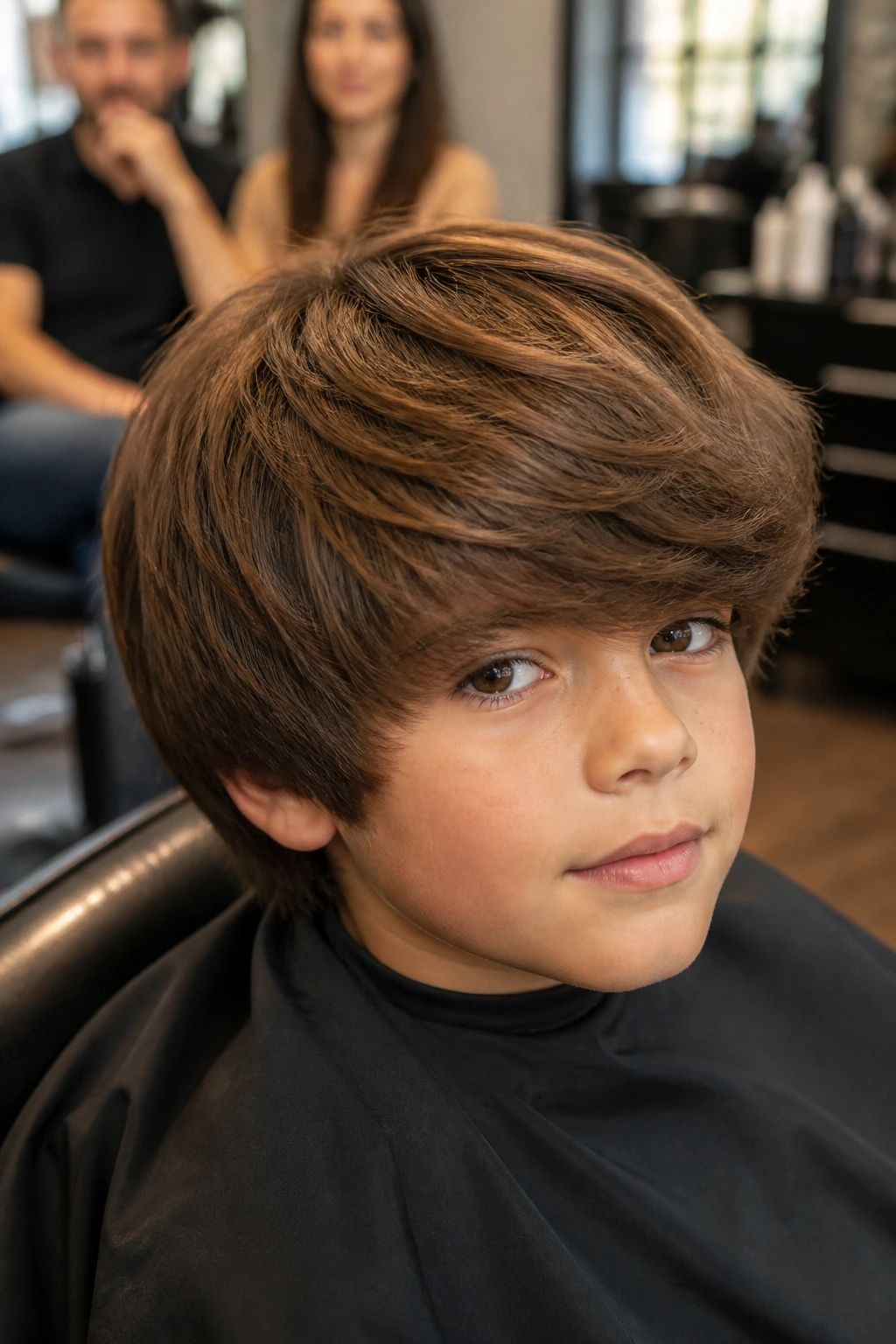
Will long hair make thick hair look too big?
Only if the cut is blunt and the sides are left too bulky. The right layers and taper can make thick hair look calmer, not bigger. The haircut should follow the head shape, not sit on top of it like a cap.
Should thick hair be thinned out with shears?
Sometimes, but not as a first move. Over-thinning can leave the surface frizzy and patchy, especially on straight hair. Point cutting and internal texture are usually safer because they remove weight without making the ends fuzzy.
What if my son has a cowlick at the front or crown?
Leave more length there. Thick hair with a swirl almost always behaves better when the barber respects the growth pattern instead of cutting it short and hoping it behaves. Cutting with the swirl, not against it, saves a lot of morning arguments.
Can these longer cuts work on curly hair?
Yes, and in some cases they work better on curls than on straight hair. The curl gives the style shape, but the cut needs to be done with shrinkage in mind. That means checking the shape dry or nearly dry before the barber calls it done.
How much product is enough?
Less than most people think. A pea-size amount for shorter styles or a dime-size amount for longer hair is usually enough to start. Add more only if the hair needs it, and work it through the ends rather than the scalp.
What if the hair keeps falling into the eyes?
Either the fringe is too long for the current cut or the hair is being dried in the wrong direction. Start with a light mist of water, comb the front where it should sit, and only trim the fringe if the length has truly become a problem. In a lot of cases, the fix is shape, not a dramatic cut.
Do these styles still work with sports helmets or hats?
They can, but some versions behave better than others. The long top with tapered nape, the textured crop, and the ear-tuck side part are the easiest to manage under gear. Very long fringe or heavier shag cuts may need a quick reset after practice.
What is the easiest cut to grow out?
The layered bro flow and the long top with tapered nape usually grow out most politely. They keep their shape as the hair gets longer, which means fewer awkward weeks between barber visits. That matters if the goal is to keep length without constant fuss.
The Shape Thick Hair Actually Likes
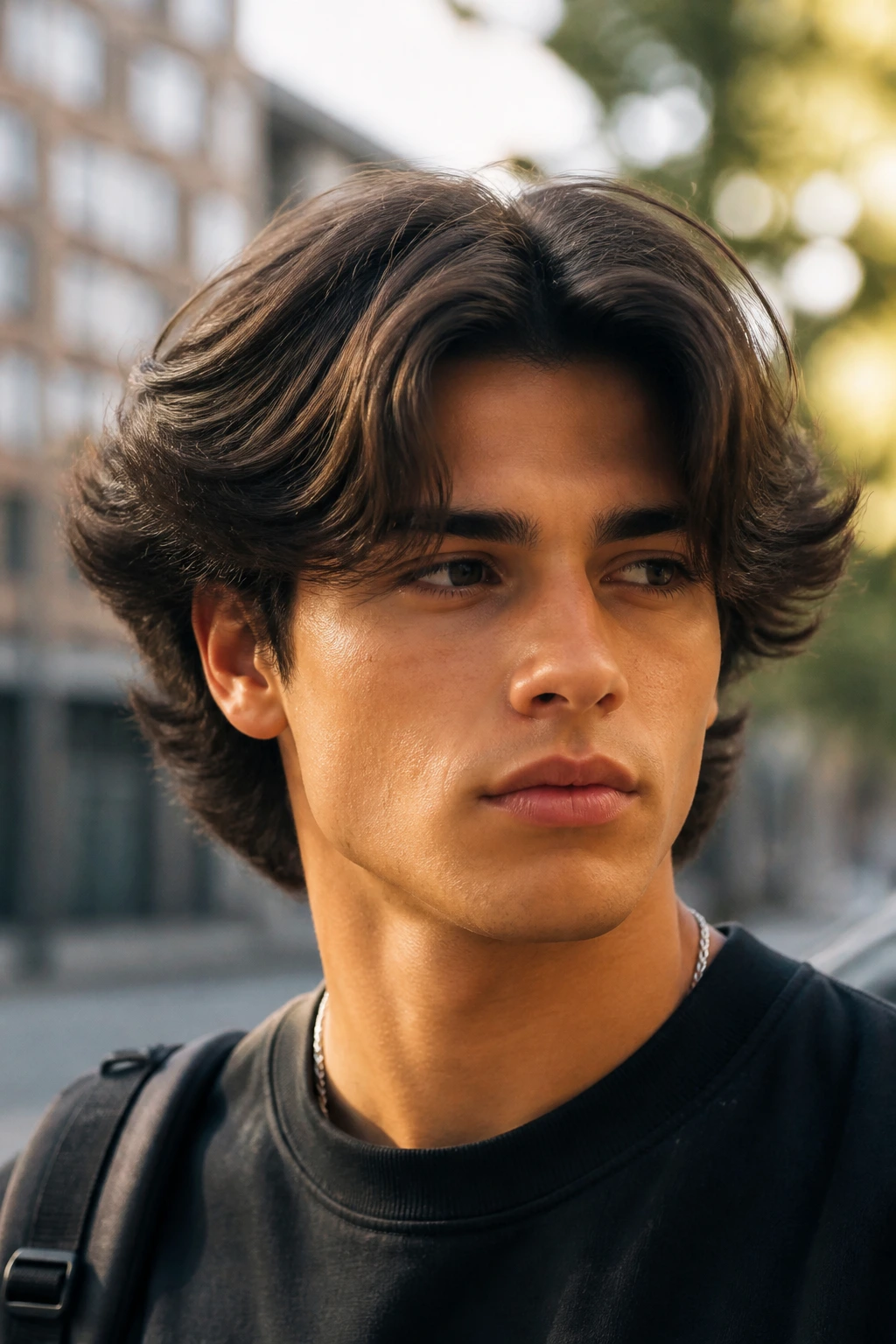
Thick hair on boys does not need to be bullied into submission. It needs room, direction, and a barber who understands that length can be a tool, not a problem. A good long haircut lets the hair sit where it wants, keeps the sides from flaring, and gives the front enough weight to behave instead of springing up every time the wind shifts.
The best part is how different these cuts can look while still solving the same basic problem. One boy may want curtains. Another will want a bro flow or a soft shag. Someone else needs a clean Ivy League flow that still has movement. The right choice comes down to the hairline, the crown, the school routine, and how much styling anyone in the house is willing to do before breakfast.
If thick hair has been fighting every short cut in the book, a longer shape may be the calmer answer. The right one tends to look better on day one and even better once it starts growing out.