



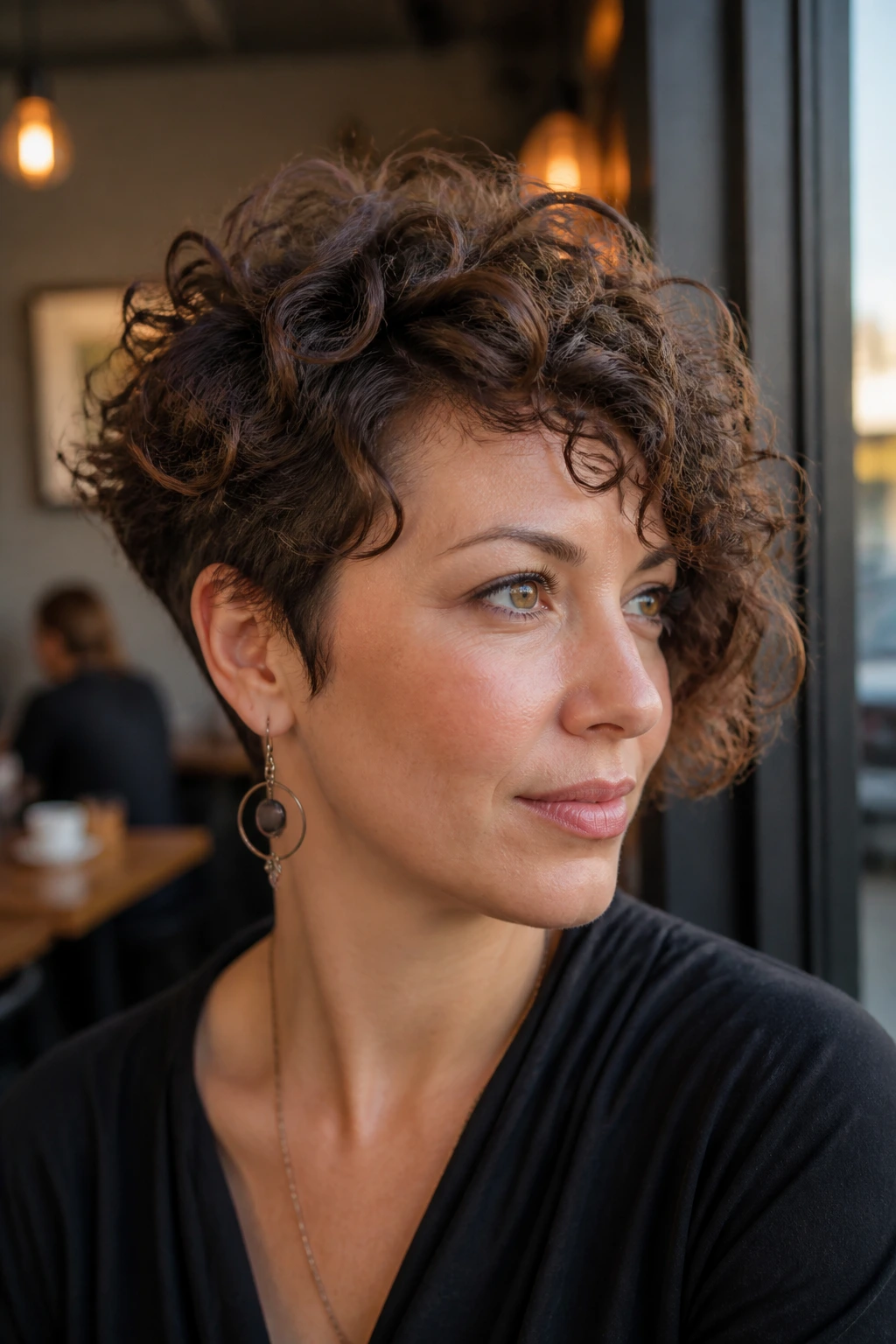
Asymmetrical bob short curly pixie cuts work because the shape gives curls a direction. Instead of letting every ringlet bloom in a neat little halo, the haircut builds a lane for the hair to travel in — one side higher, one side longer, the front often angled just enough to catch the eye before the back even enters the conversation.
That matters more than people think. Curly hair does not behave like straight hair with a little texture sprinkled on top. It shrinks, bends, expands, and changes its mind depending on humidity, porosity, how much weight is left in the corners, and whether the cut was refined wet or dry. A style that looks almost tame when it leaves the chair can turn into something sharper, lighter, or puffier once it dries. A good asymmetrical shape plans for that.
The best versions of asymmetrical bob short curly pixie cuts do not look overworked. They look like the curls were given a strong outline and then allowed to do their own thing inside it. That balance is the whole point here. One side can sit near the cheekbone while the other tucks closer to the ear. The nape can be clean, shaggy, soft, or clipped short. There’s room to be subtle. There’s room to be bold too.
Why These 15 Looks Earn Their Keep
-
The diagonal line does the flattering: A longer front corner and a shorter back corner create a slant that keeps curly hair from reading as round and boxy.
-
Curl shrinkage becomes part of the design: A cut that sits a little longer when wet can land exactly where you want it once the curls spring up.
-
One haircut can handle a lot of density: The same asymmetrical shape can be adjusted for fine waves, thick ringlets, or tighter coils by changing where the weight is removed.
-
Grow-out looks intentional longer: When the front has room to stay longer, the shape still reads as a style instead of “I missed my trim.”
-
The face gets more movement near the eyes: A diagonal fringe or side sweep gives the cheekbones and jawline something to work with, which matters more than people admit.
-
It plays nicely with real life: Glasses, collars, earrings, and scarves all sit better when one side has a little tuck and the other has a little swing.
What Asymmetry Does for Curly Hair
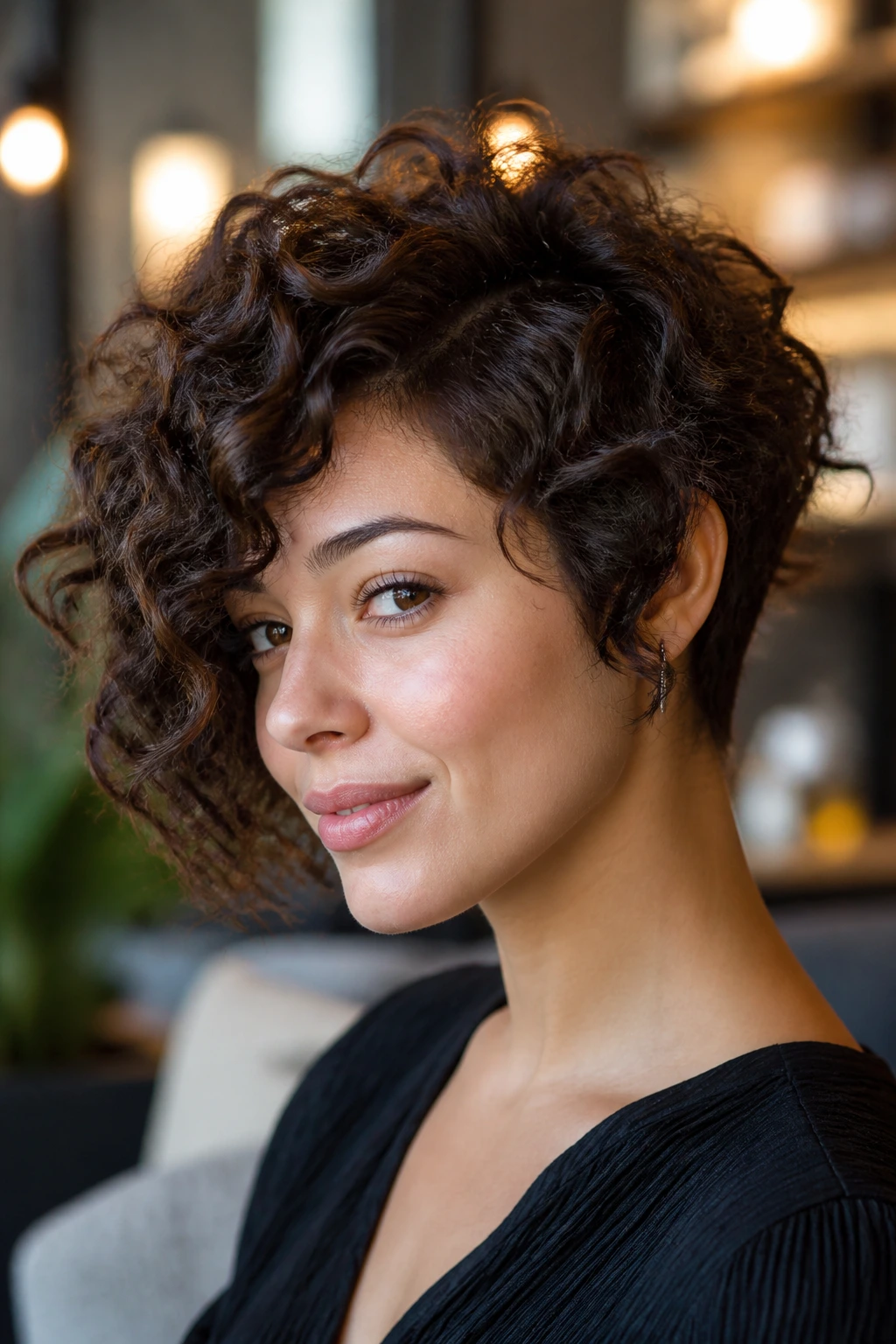
The straight-haired version of asymmetry and the curly version are not cousins. They’re more like distant relatives who show up to the same wedding. On curls, the line is softer, the edge is less exact, and the whole thing relies on contrast rather than precision.
The diagonal line matters more than the exact length
A lot of people fixate on whether the hair is “pixie short” or “bob short,” but on curly hair the diagonal is the star. If the shortest side stops at the ear and the longest side skims the jaw, the eye reads motion. That’s what keeps the haircut from collapsing into a puffball when the curls expand.
The line also gives you a place to control attention. If you want the eyes to move upward, keep volume near the crown. If you want to sharpen the jaw, let the longer side sweep across it. It’s a tiny bit of architecture, and curly hair loves that.
Shrinkage is not the enemy here
A curl can easily lose half an inch, sometimes more, once it dries. That is why short curly styles need a little extra room in the plan. A stylist who understands this won’t cut every piece to the finished length right away. They’ll leave a cushion, let the hair dry, then refine where the shape actually lands.
That approach matters even more in asymmetrical cuts. One side may look almost even in the chair and then dry several millimeters higher than the other. If the finish is rushed, the result can look lopsided in the wrong way. If the cut is refined carefully, the lopsidedness becomes the point.
Density changes the whole story
Fine curls need a different hand than dense coils. Fine hair usually looks best when the asymmetry comes from the outline, not from aggressive thinning. Dense hair often needs internal weight removal so the longer side doesn’t balloon out into a triangle by noon.
And porosity matters too. Hair that drinks product fast may need a lighter leave-in and a firmer gel. Hair that resists moisture tends to like a creamier base but still needs hold on top or the shape loosens too soon. That’s the part many haircut photos skip. Real hair is not a static shape. It has behavior.
1. Deep Side-Part Curly Pixie Bob
A deep side part gives this cut its edge. One side sits close to the ear or cheekbone, while the longer side sweeps forward and down in a soft curve that makes the whole shape feel deliberate. It’s the kind of asymmetry that looks strong without looking severe.
Why it flatters
The deep part pulls volume off the center line and sends it diagonally across the face. That helps round faces, heart-shaped faces, and anyone who wants a little more visual length through the cheeks. On curls, the part line does half the styling work before product even touches the hair.
I like this cut on medium-density curls because it keeps the silhouette readable. If the hair is too heavily layered, the side part can lose its clean line. If the hair is left too blunt, it can puff. The sweet spot is a soft perimeter with enough weight to hold the shape.
- Best for: 2C to 3B curls that need direction.
- Ask for: A longer front corner that lands near the jaw and a shorter side that can tuck behind the ear.
- Style with: A root-lifting mousse, then a medium-hold gel through the ends.
- Watch out for: A part that sits dead center. That kills the diagonal.
2. Tapered Nape with Long Fringe
Want the back off your neck but still want drama around your face? This is the one. The nape is tapered close — not shaved unless you want that — while the fringe stays long enough to sweep across the forehead and brush the lashes when it’s dry.
The contrast is the appeal. The back feels neat and cool against the neck, which is useful if your hair tends to hold heat or if you simply hate feeling bulk at the collar. Up front, the fringe adds softness, and on curly hair that softness has a little irregularity to it that reads as charm instead of fuss.
Ask for the taper to be clean but not stripped bare. A razor can be lovely here on the right texture, but coarse curls need a cautious hand or the ends fray. The fringe should be cut with the shrinkage in mind, especially if your curls spring upward near the temples.
3. Jawline Brush Curly Bob-Pixie
This cut lands right in the sweet spot between a short bob and a long pixie. The front pieces brush the jawline, the side lengths are uneven on purpose, and the back stays short enough that the whole thing feels lifted off the neck.
Why this shape feels so easy to live with
The jawline length gives you something to tuck, flip, or pin, which is useful on mornings when your curls refuse to cooperate. It also keeps the face-framing pieces from feeling too precious. They can fall where they fall and still look right.
This works especially well on finer curls that need visual fullness. The longer front catches the light and creates the impression of more hair than there actually is. That’s not cheating. That’s haircut math.
- Best for: Fine to medium curls that need body near the face.
- Ask for: A softly angled perimeter with the longer side grazing the jaw, not the collarbone.
- Style with: Curl cream through the mids, then a diffuser on low heat.
- Skip: Heavy oils near the roots. They flatten the lift you want.
4. Choppy French Curl Crop
Unlike a polished bob that wants every strand to obey, this crop looks better with a little roughness. The outline is short, the ends are piecey, and the asymmetry is subtle enough that it shows up most when the hair moves. Think of it as a French-girl crop with a curlier, less polished pulse.
It’s a smart choice if your curls don’t all do the same thing. A few bends can sit looser, a few tighter, and the haircut still works because the texture is meant to be uneven. A stylist can point-cut the ends so they don’t form a hard shelf, which is the fastest way to ruin this look.
I’d reach for this one if you want a cut that dries fast and asks for little more than a scrunch and a shake. It does not need a full blowout to make sense. In fact, too much polish takes away the charm.
5. Undercut Asymmetrical Coil Sweep
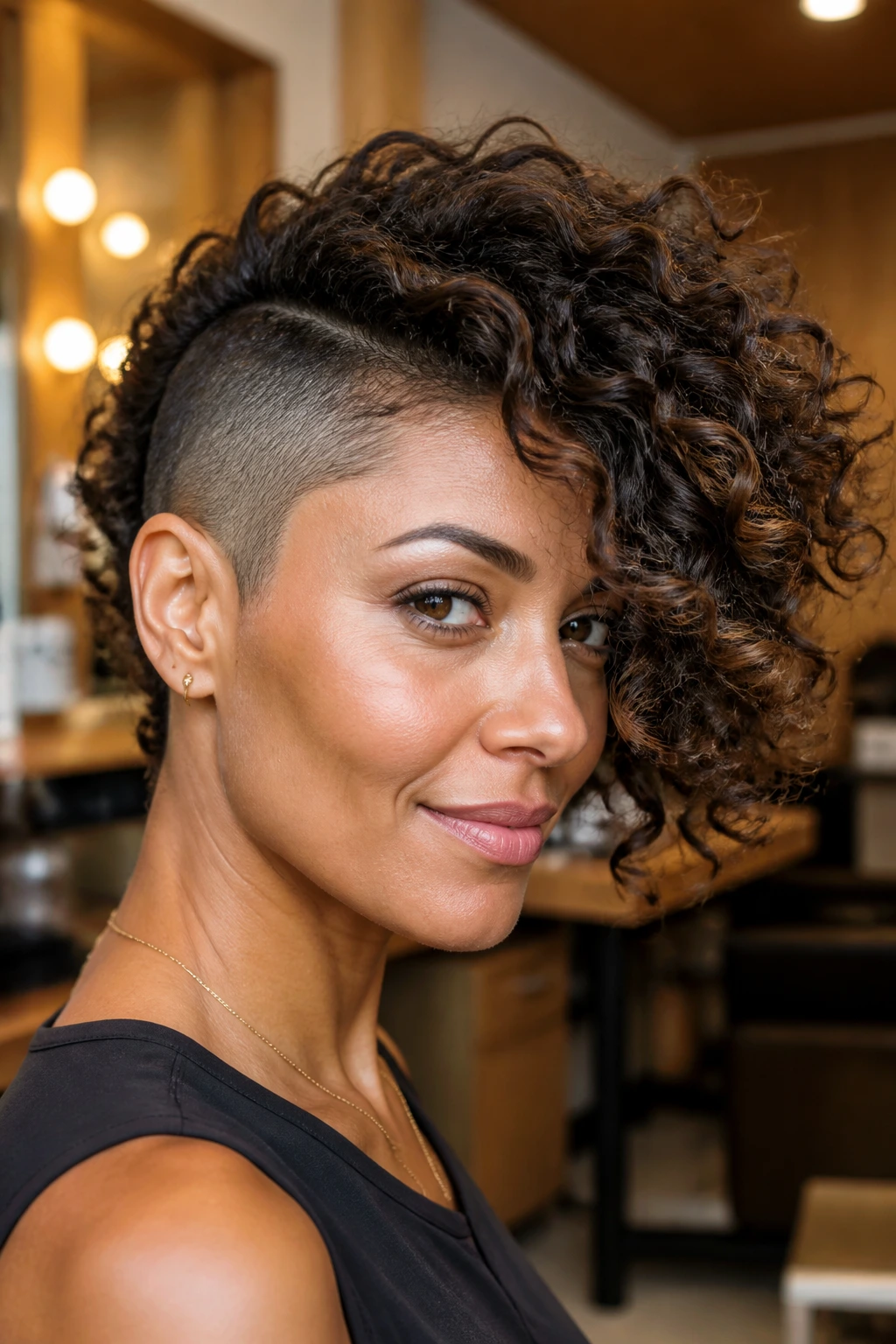
When the hair has too much bulk on one side, an undercut solves the problem with zero drama. One side or the nape is clipped shorter, while the top and opposite side are left long enough for coils to sweep over the shorter section. The result is sharp, but not hard.
This is especially good for dense type 3C and type 4 curls that need room to settle. Without some hidden reduction, the longer side can sit heavy and block the face. With the undercut in place, the top curls get to travel instead of stacking into a pyramid.
A lot of people think an undercut makes the cut look aggressive. Sometimes it does. That’s the point. But it can also be disguised under the top layers if you want the shape to feel quieter during workdays and more dramatic when you tuck one side back.
6. Stacked Crown with Tucked Side
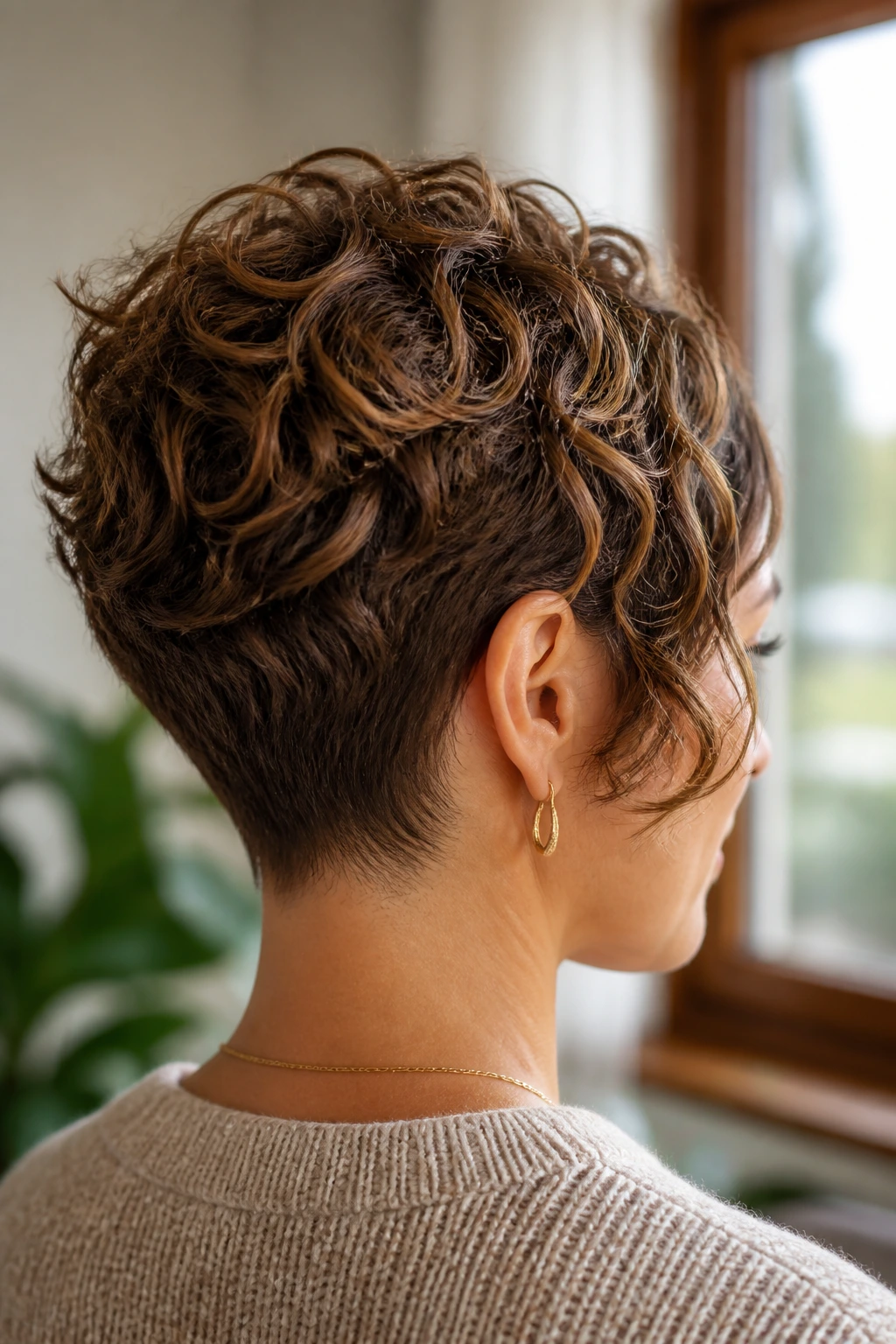
This is the haircut I’d point to if the crown goes flat by lunchtime. The back is stacked so the roots lift away from the scalp, while one side is left long enough to tuck behind the ear. The asymmetry comes from the contrast between upward structure and a smooth side sweep.
It works because curls need a place to sit. If the crown is cut too uniformly, the top can sag and the whole shape loses energy. Stacking the back gives you a hidden scaffold. You can feel it when the curls dry — the shape stands up instead of melting down.
A little mousse at the roots helps here, but the real trick is the cut. If the crown has no internal support, product can only do so much. That’s the part worth saying out loud.
7. Wet-Look Sculpted Evening Pixie Bob
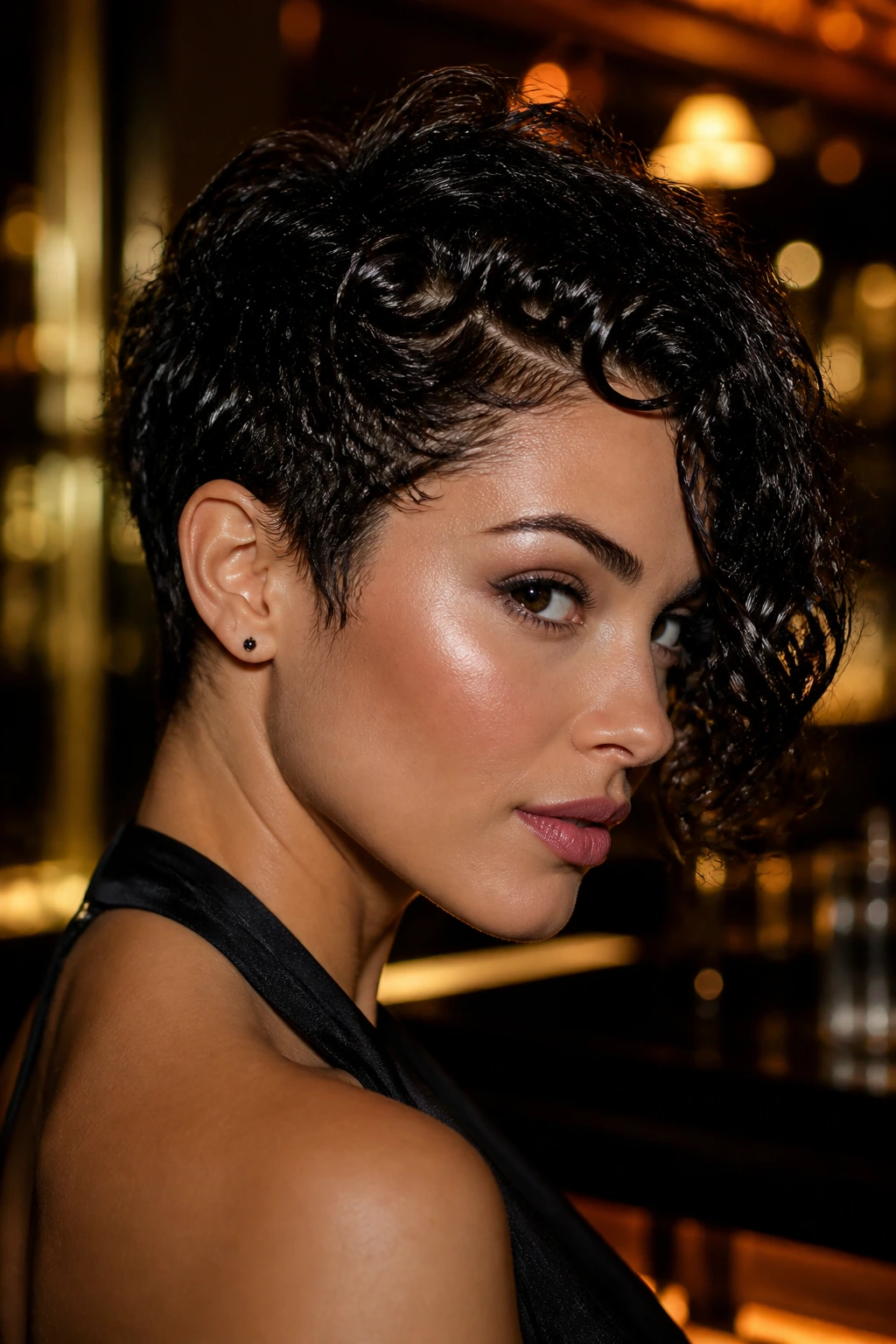
A lot of short curly cuts look better matte. This is the exception. The wet-look sculpted version uses gel or glaze to clump the curls into glossy ribbons, with the asymmetry made obvious by a deep side sweep and a tighter nape.
It’s a strong choice for nights out, events, or any moment when you want the haircut to look intentional from across the room. The shine exaggerates every curve in the shape, and the asymmetry becomes easier to read because the light catches the longer side first.
The key is restraint. Too much product turns the whole thing sticky. Too little and the curls dry in random directions. Work the gel through damp hair, rake it into place, then stop touching it once the cast forms. Let the diffuser do the rest if you want the crown to keep height.
8. Airy Ringlet Bob with Micro Fringe

Can a micro fringe work on curls without looking fussy? Yes, if the fringe is tiny and the rest of the cut has enough breathing room. This version keeps the front short and airy, with ringlets falling around it instead of fighting it.
The trick is to leave the fringe lighter than you think
Micro bangs on curls shrink fast. Sometimes startlingly fast. A fringe that looks eyebrow-grazing when wet can bounce up to the middle of the forehead once dry, so the stylist needs to leave a little extra length and shape it carefully after drying.
The rest of the bob should stay light too. If the perimeter gets too heavy, the micro fringe starts to look disconnected. A soft asymmetrical side balance helps the haircut feel playful instead of severe.
- Best for: Smaller faces, higher foreheads, or anyone who likes a little attitude at the front.
- Ask for: A fringe that sits slightly longer than the final target when wet.
- Style with: A light foam and finger-coiled front pieces.
- Beware: Overloading the fringe with cream. It clumps in a heavy way.
9. Copper Layered Pixie Bob
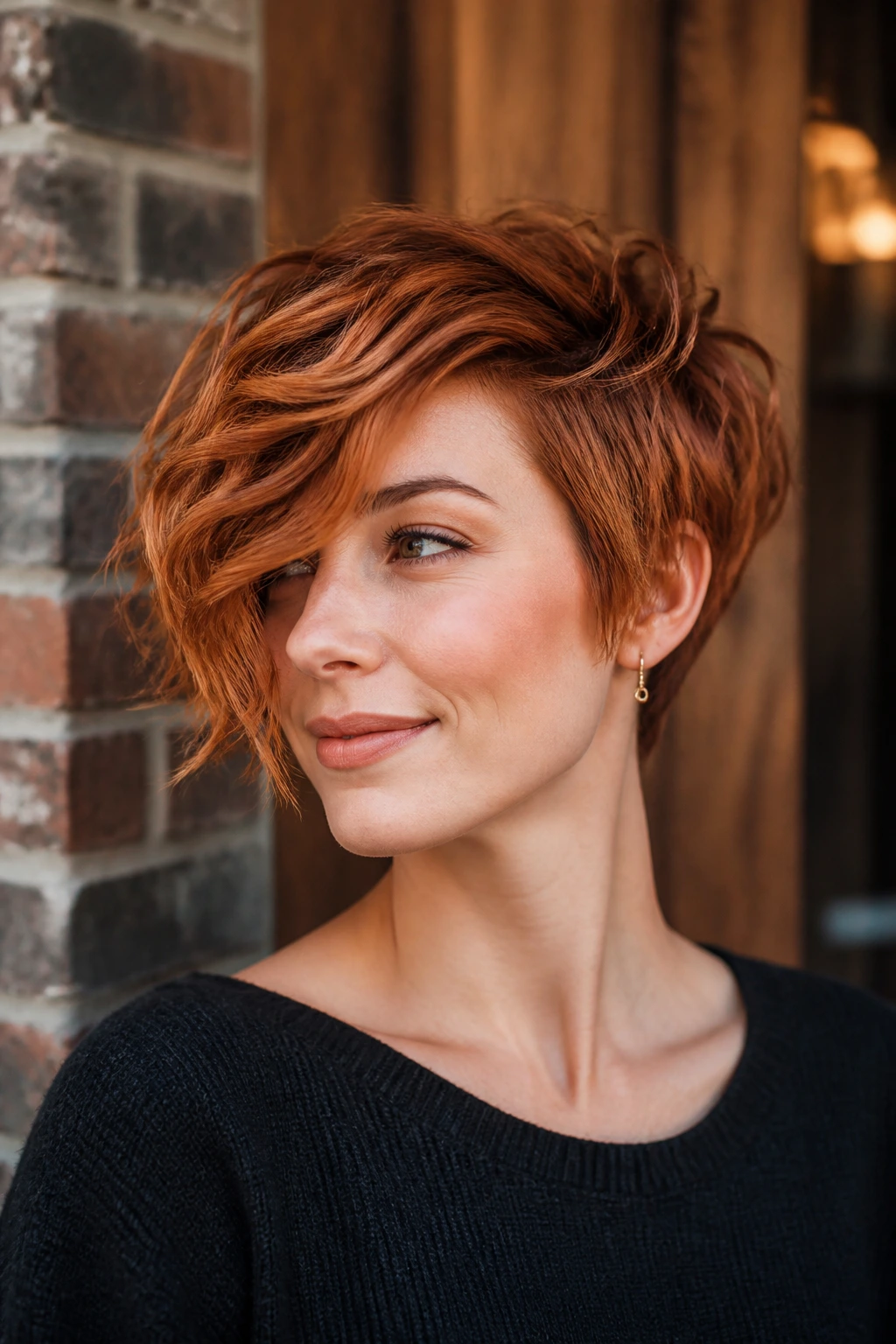
Color changes the way people read a haircut, and copper is especially good at showing off layers. On this asymmetrical bob short curly pixie cut, the warmth in the color catches on the lifted pieces first, which makes the shorter side and longer side easier to see.
That’s useful if you want the cut to read clearly even from a distance. A layered copper crop has a little sparkle to it without needing shine spray on the whole head. The shape can stay soft, but the hue gives it a firmer outline.
I’m partial to this version on curls that already have some spring. Copper loves movement. It also makes the ends look fuller, which helps if the hair is fine or if the perimeter tends to disappear in gray light. A gloss treatment every so often keeps the tone rich and the cut from looking flat.
10. Curly Shag-Bob Hybrid
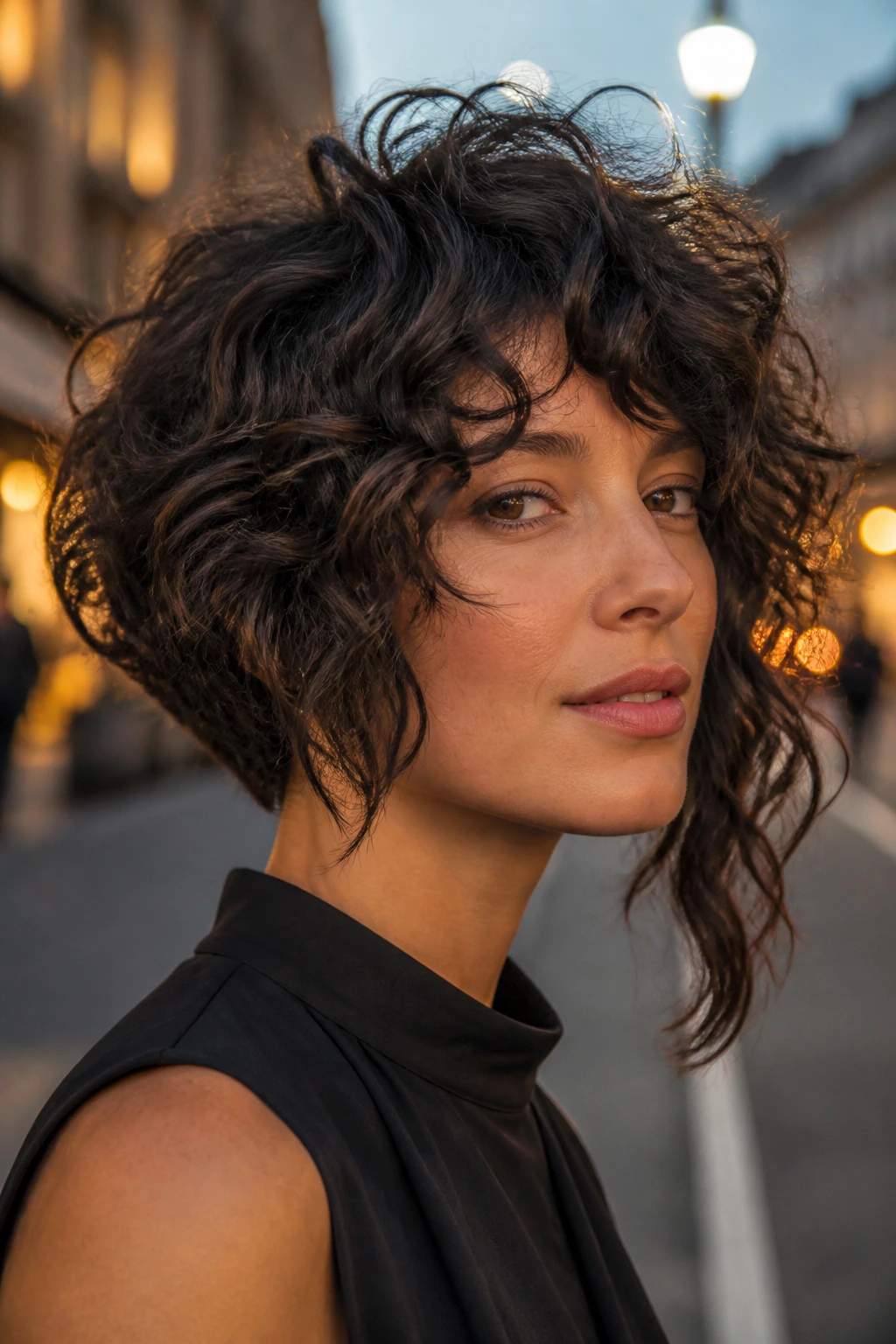
If a classic bob feels too neat and a pixie feels too severe, this hybrid lands in the middle and stays there. The front corners are longer, the interior is layered, and the back is short enough to keep the overall shape light. It has that slightly undone energy that curly hair often wears best.
Why this shape is a smart compromise
The shag influence gives the curls places to land at different heights, which means fewer heavy blocks and fewer awkward triangle moments. The bob influence keeps enough perimeter for the haircut to feel anchored. The pixie influence makes it fast to dry and easy to style.
This is the cut for people who want movement more than polish. It works especially well when the curl pattern changes from section to section. A few loose waves near the nape, tighter rings around the temples — the hybrid cut handles that without looking confused.
11. Ear-Length Asymmetrical Crop
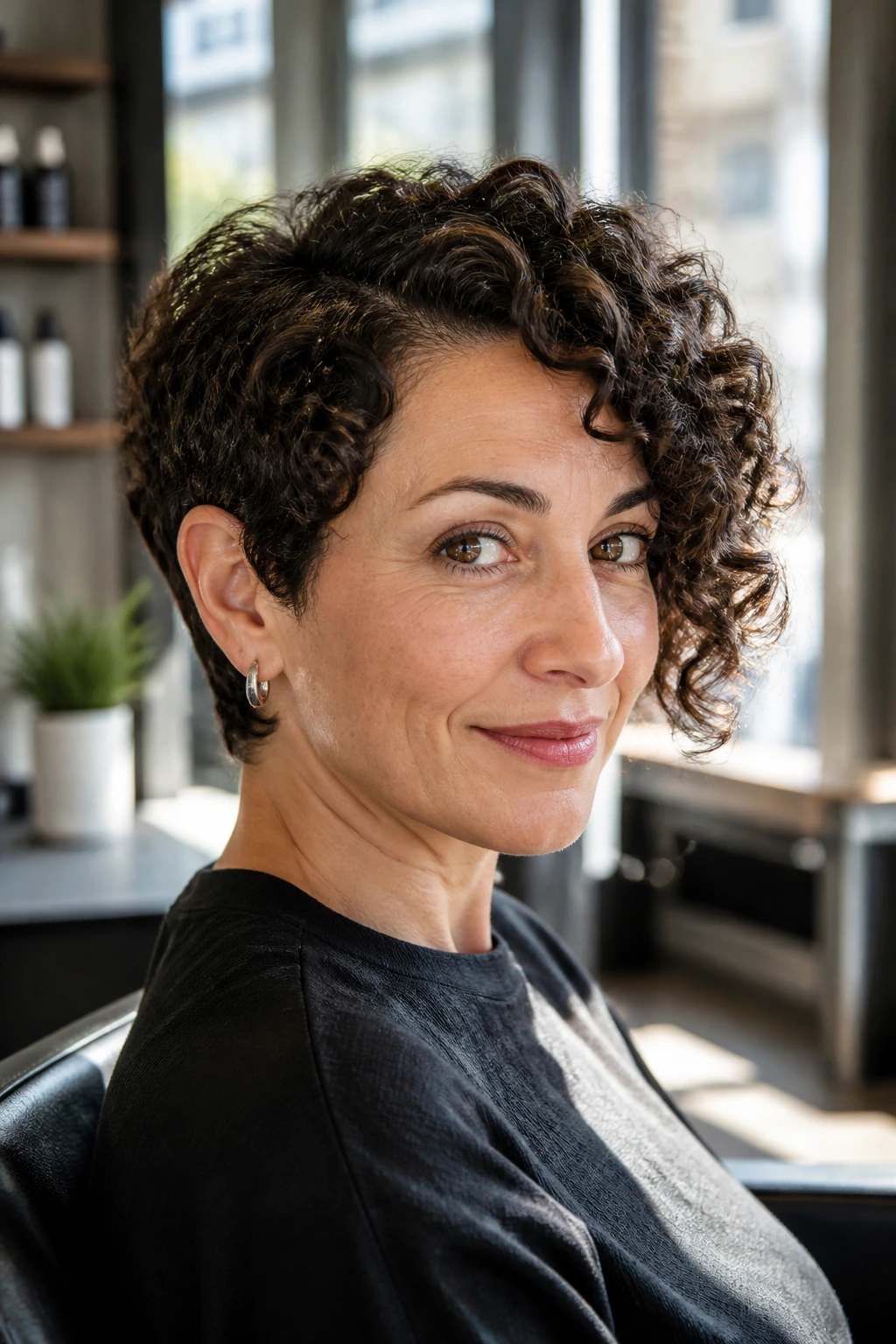
This is the most glasses-friendly cut in the group, and I mean that in the nicest way. One side sits right around the ear and can tuck cleanly under the arm of a frame, while the other side stays longer and softer near the cheek. The shape keeps your face visible instead of buried in hair.
It’s a good pick if you like earrings too. The exposed ear side gives you room for hoops or studs, and the longer side adds enough motion that the cut doesn’t feel clipped down. That balance is hard to get right. This version gets there with less fuss than you’d expect.
Why it stays wearable
The ear-length side keeps bulk off the sides of the head, which helps if your curls puff wide in humidity. The longer side keeps the haircut from reading as too cropped. Together they make the style look intentional without asking for a lot of daily grooming.
12. Salt-and-Pepper Sculpted Bob
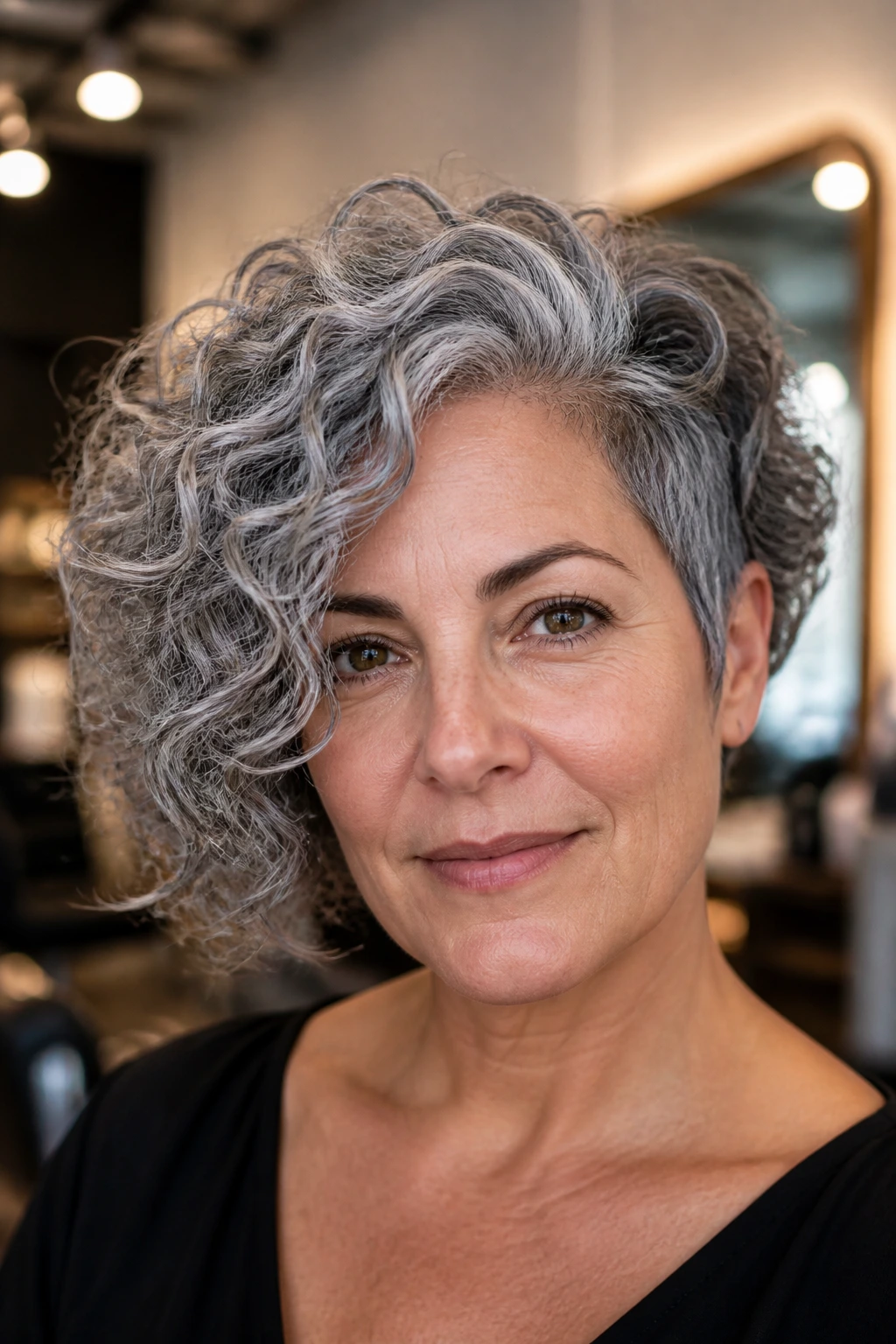
Gray curls deserve a shape with some backbone. The salt-and-pepper version uses asymmetry to keep the natural silver strands from looking soft in a blurry way. A little structure makes the color look deliberate, almost architectural.
Gray hair often has a different feel under the fingers — a bit wirier, sometimes drier, often more reflective. That means the cut has to work with both texture and tone. A gently angled front and a shorter nape keep the style from spreading out too wide, while a gloss or lightweight cream adds enough sheen to keep the silver pieces from turning dusty.
One thing I like here: the cut does not try to hide the gray. It shows it off. And that’s where the asymmetry helps. It gives the eye a shape to follow, so the color reads as part of the design instead of a thing happening in the background.
13. Extra-Short Tapered Temple Cut
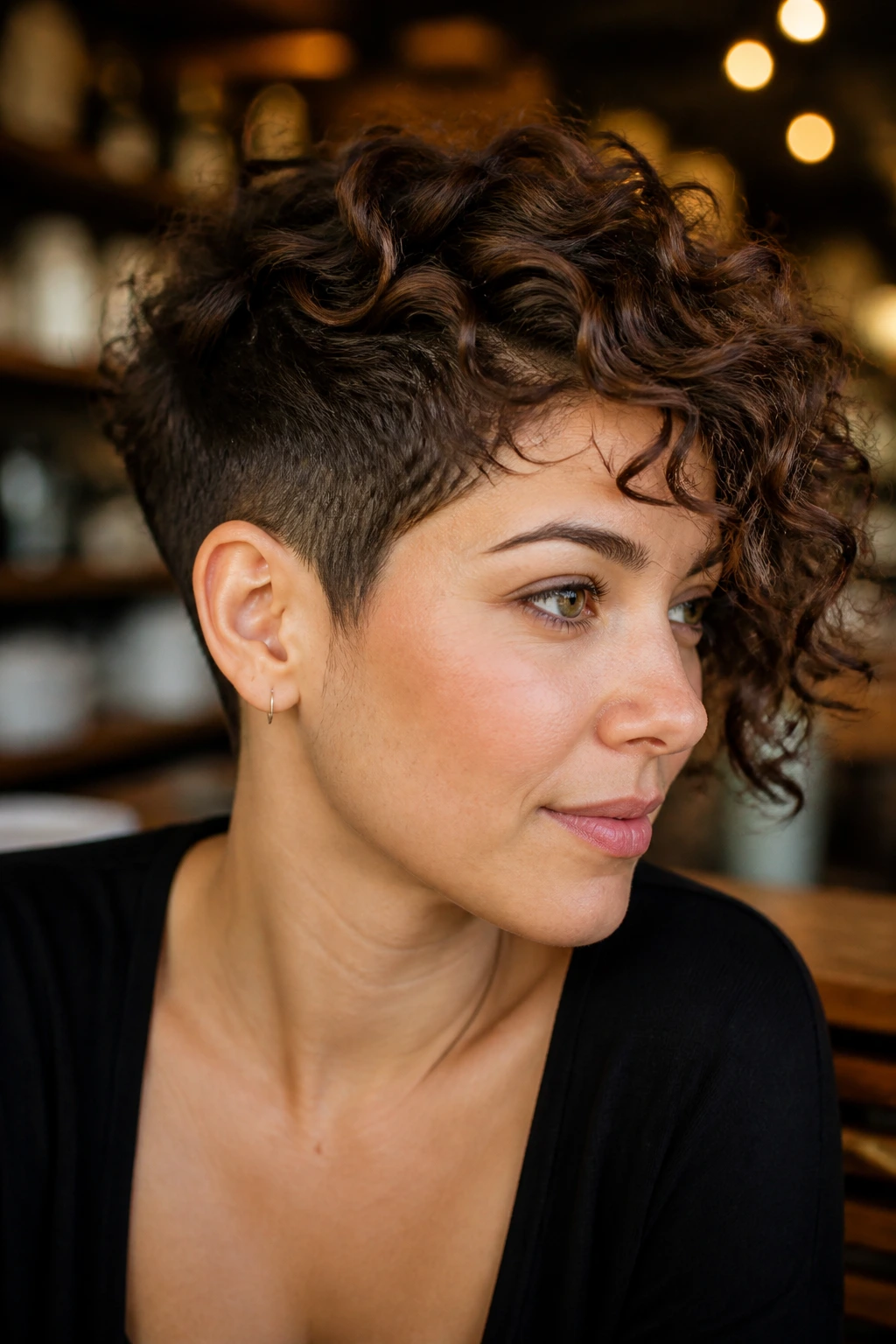
Need the sides shorter because you wear a scarf, mask, headphones, or just hate bulk near the ears? This one gets the job done. The temples and sides are tapered down, the top stays longer, and the asymmetry comes from the way the longer section spills over the shorter one.
It’s a bolder cut than some people expect, but not as high-maintenance as it looks. The short sides remove weight fast. That can be a relief if your curls grow thick around the face and start puffing into your glasses or along the jawline.
- Best for: Thick curls and anyone who wants less volume near the ears.
- Ask for: A taper that stays soft at the edge instead of a hard fade, unless you want the fade.
- Style with: A strong gel on the top and a little cream through the longer side.
- Watch out for: Over-trimming the top. You need enough length there to keep the asymmetry visible.
14. High-Volume Crown Sweep
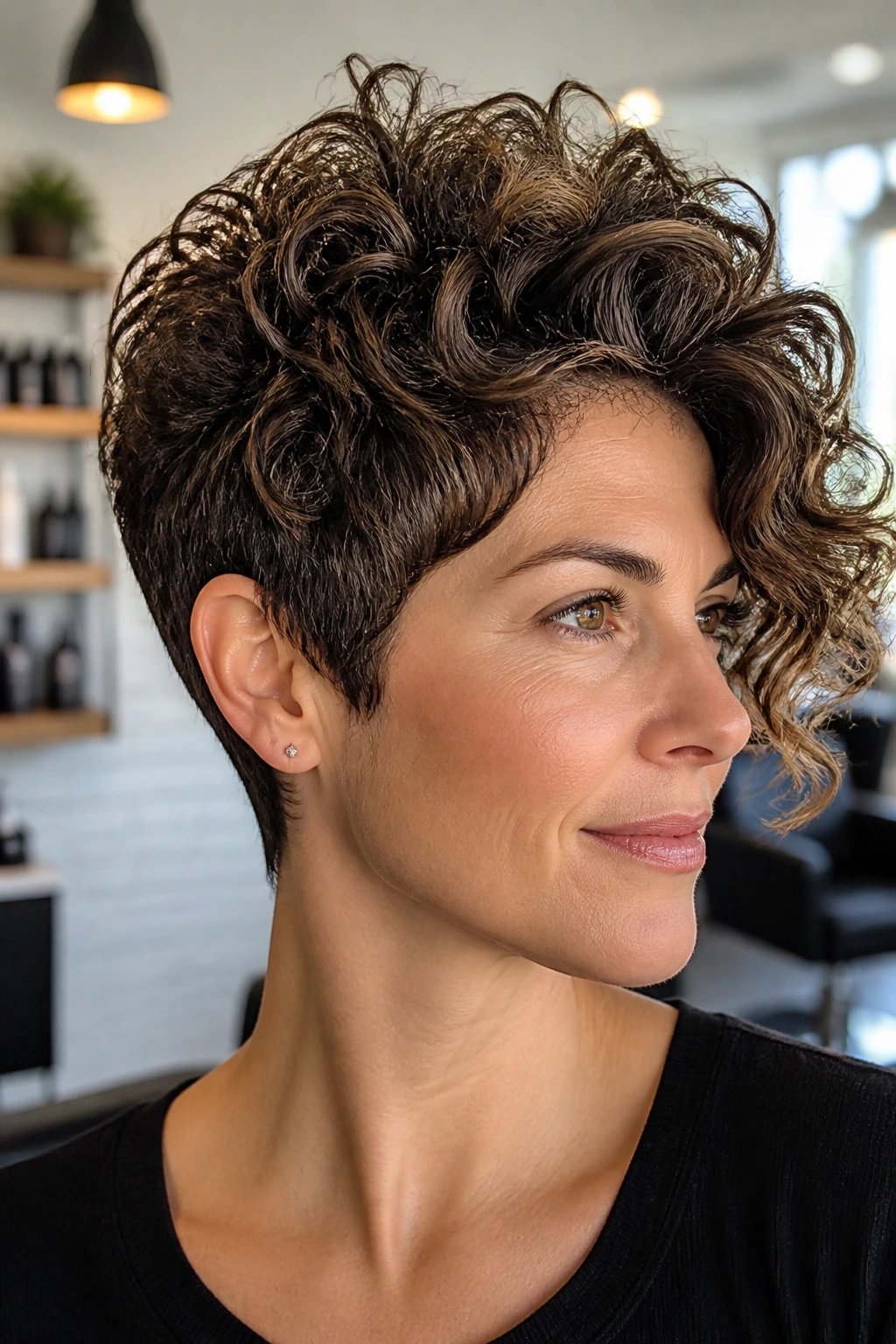
Unlike the stacked-crown cut, this one puts the lift where you can see it first: at the top. The crown is encouraged to rise, the longer side sweeps forward, and the shorter side stays cleaner so the height has room to read. It’s one of the best options for fine curls that fall flat when they’re left to their own devices.
The shape depends on root support. Clips at the crown during drying, a diffuser with a shallow cup, and a mousse with actual hold all matter here. If the roots collapse, the haircut loses its point. If the roots stand up, the asymmetry looks elegant in a very low-key way.
This is also a nice choice for longer faces. The volume sits higher, which balances the length of the face without adding width in the wrong places. Tiny difference. Big effect.
15. Face-Framing Long-Front Pixie Bob

This is the safest first step if you want to go shorter but are not ready to give up front length. The back and sides stay cropped enough to feel fresh, while the front corners remain long enough to brush the cheekbones and chin. The asymmetry is gentle, but it still gives the haircut personality.
It’s a strong option if you are coming from a lob or a longer curly bob. There’s enough length in front to pin back, tuck behind the ear, or let fall across the face on days when you want softness. And if your curl pattern changes from root to tip, the longer front hides that transition better than a hard pixie line would.
Where the safety net lives
The front length is the safety net. Keep it there if you want flexibility. You can always trim shorter later, but you cannot get that movement back once it’s gone.
How to Ask for the Cut Without Getting a Surprise
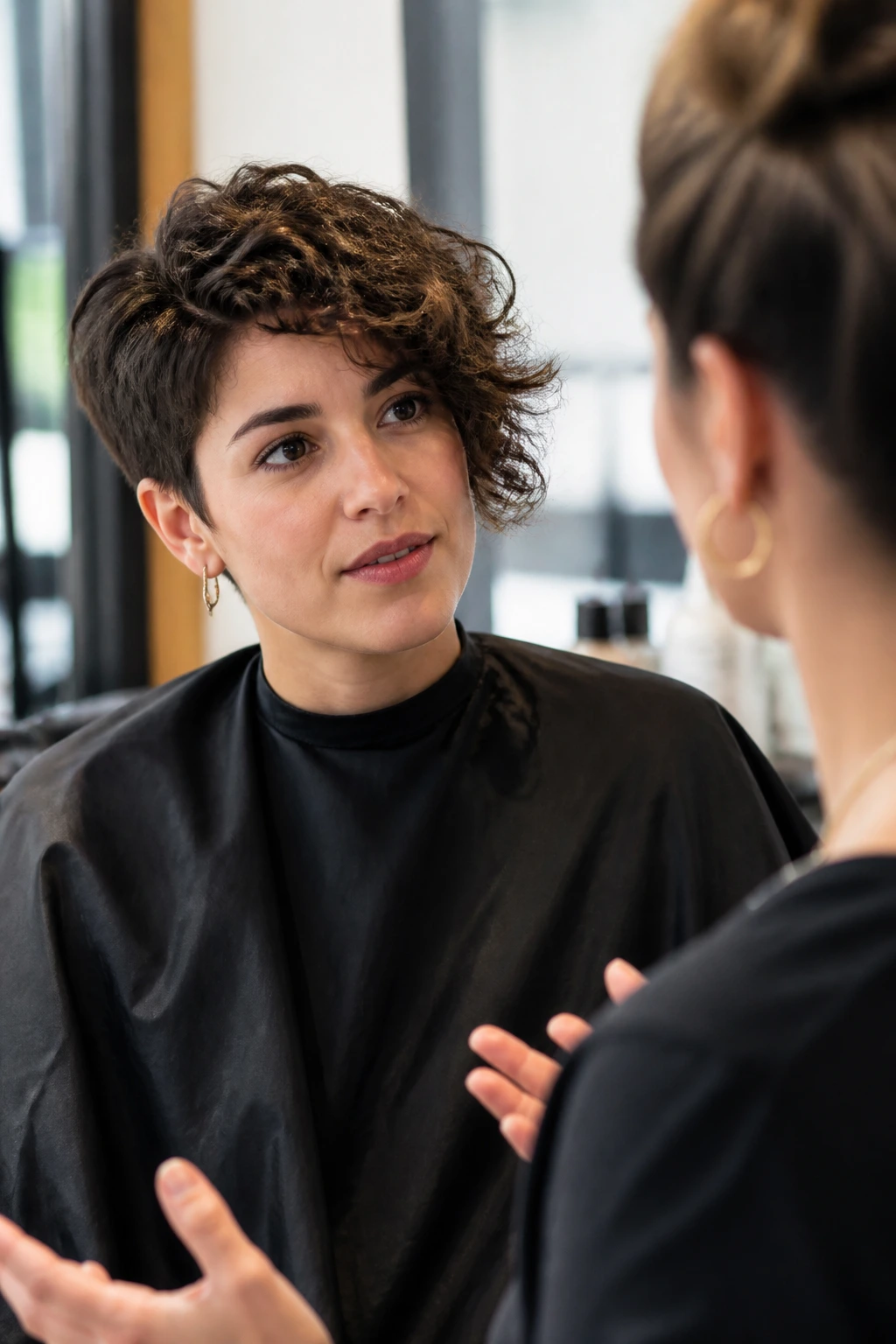
A chair conversation can save you from months of frustration. Bring more than one reference photo if you can. One front view tells the stylist almost nothing by itself; side views and back views matter just as much, especially for asymmetrical bob short curly pixie cuts where the angle is the whole point.
Say where you want the shortest side to land. Ear level and temple level are not the same thing, and the difference changes the whole shape. If you wear glasses, mention the arms of the frames. If you pin one side back often, say so. If you air-dry every wash and never diffuse, that needs to be said out loud too.
A few phrases help:
- “Leave the longer side at jaw length or just above.”
- “Keep the front corners longer than the back.”
- “Remove bulk without thinning the ends too much.”
- “Cut with my natural part in mind.”
One more thing. If your curls spring a lot, ask whether the stylist wants to refine the shape dry. That can make a huge difference. Wet curly cuts have their place, but the final line should be checked against the way your curls actually sit.
Styling Tools That Actually Matter
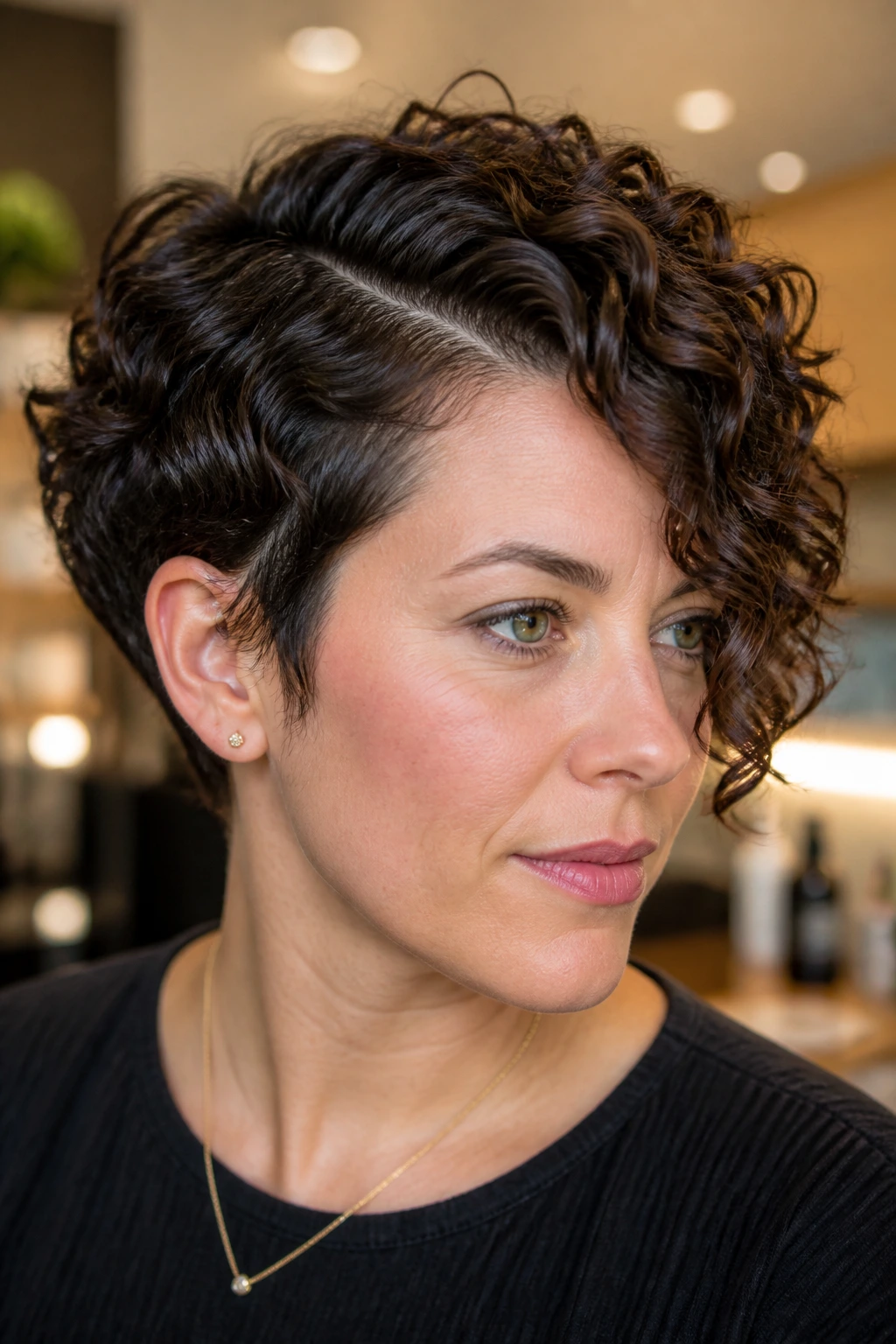
You do not need a suitcase of gadgets. You need a few tools that respect curl pattern and keep the asymmetry visible.
- Diffuser attachment: Helps curls dry with lift while keeping the shape from blowing apart.
- Microfiber towel or cotton T-shirt: Presses water out without roughing up the cuticle.
- Wide-tooth comb: Good for detangling in the shower after conditioner, not for dry brushing.
- Duckbill clips: Useful for setting a side part or clipping roots while they cool.
- Hand mirror: Lets you check the shorter side and the nape before you walk out the door.
- Small barber trimmer: Only if you maintain a clipped nape or undercut at home. Otherwise, skip it.
- Denman-style brush or tension brush: Handy if you want smoother curl clumps or a more controlled bend through the front.
- Pin curl clips: Good for lifting the crown while the hair dries.
If you only buy one extra thing, buy a diffuser. A good diffuser keeps the curls from stretching into fuzzy ends and helps the cut hold its shape at the roots. That is where the haircut earns its keep.
Curl-Friendly Products and Ingredient Clues to Look For
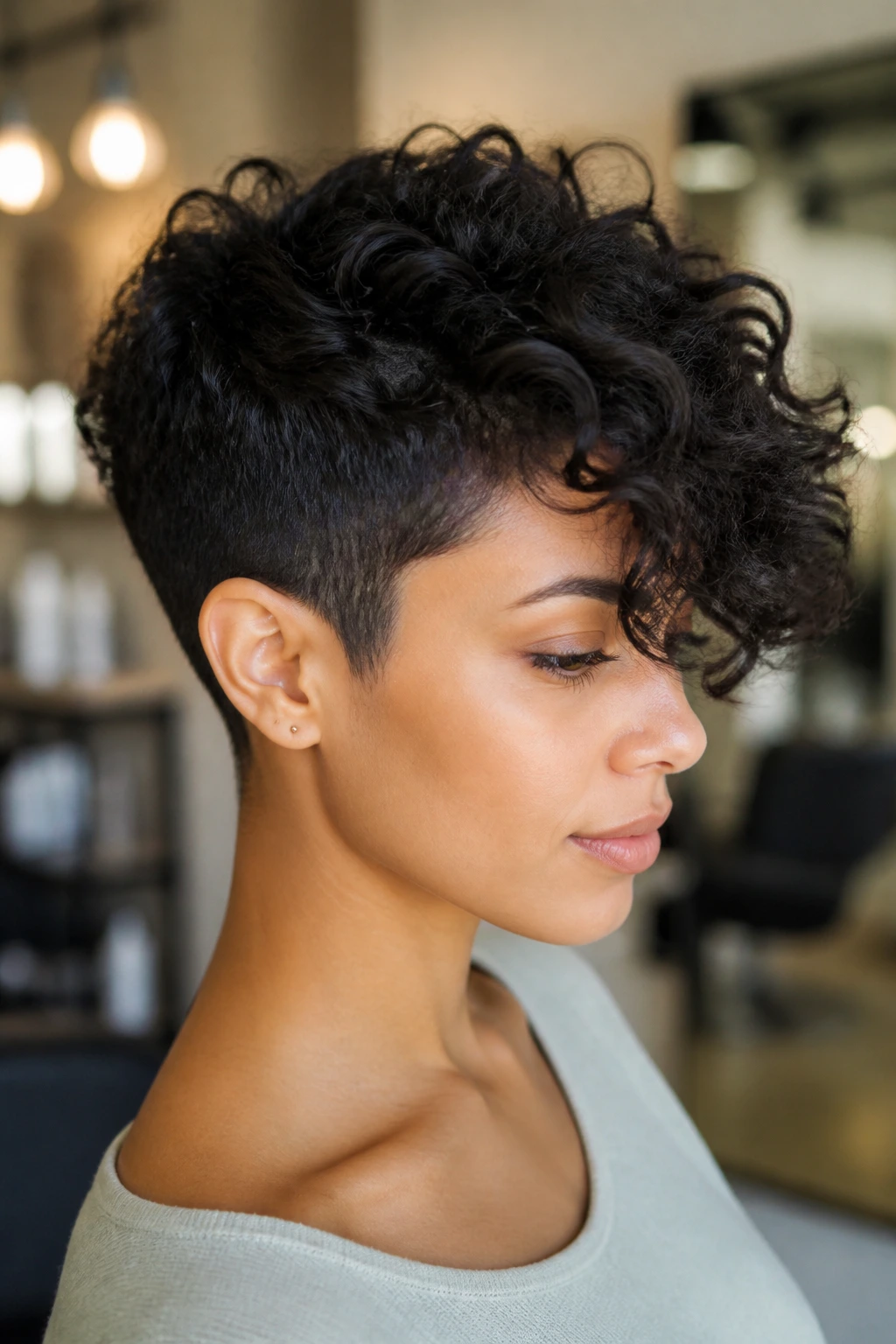
The product shelf can get noisy fast. Ignore the marketing language and look at what the hair actually needs: moisture, slip, hold, and not too much weight at the roots.
For finer curls, a light mousse or foam often beats a heavy cream. It gives body without turning the sides into a helmet. For thicker curls, a cream-gel combo usually works better because the cream adds glide and the gel helps the asymmetry stay in place once dry.
A few practical clues:
- If your hair collapses: Choose a lighter leave-in and more hold at the ends.
- If your hair frizzes fast: Look for a gel or custard with enough film-forming hold to keep the curl clumps together.
- If your hair feels coated: Ease up on oils and butters. They can sit on top and flatten the shorter side.
- If your hair is dry at the tips: Use a tiny bit of serum only on the ends, never the crown.
- If you color your hair: A gloss or color-safe cleanser helps the shape and the tone stay readable.
You do not need a dozen products. You need the right two or three. A good leave-in, a hold product, and maybe a light finisher are usually enough. More than that can turn the haircut into a rescue mission.
How to Keep the Shape Between Salon Visits
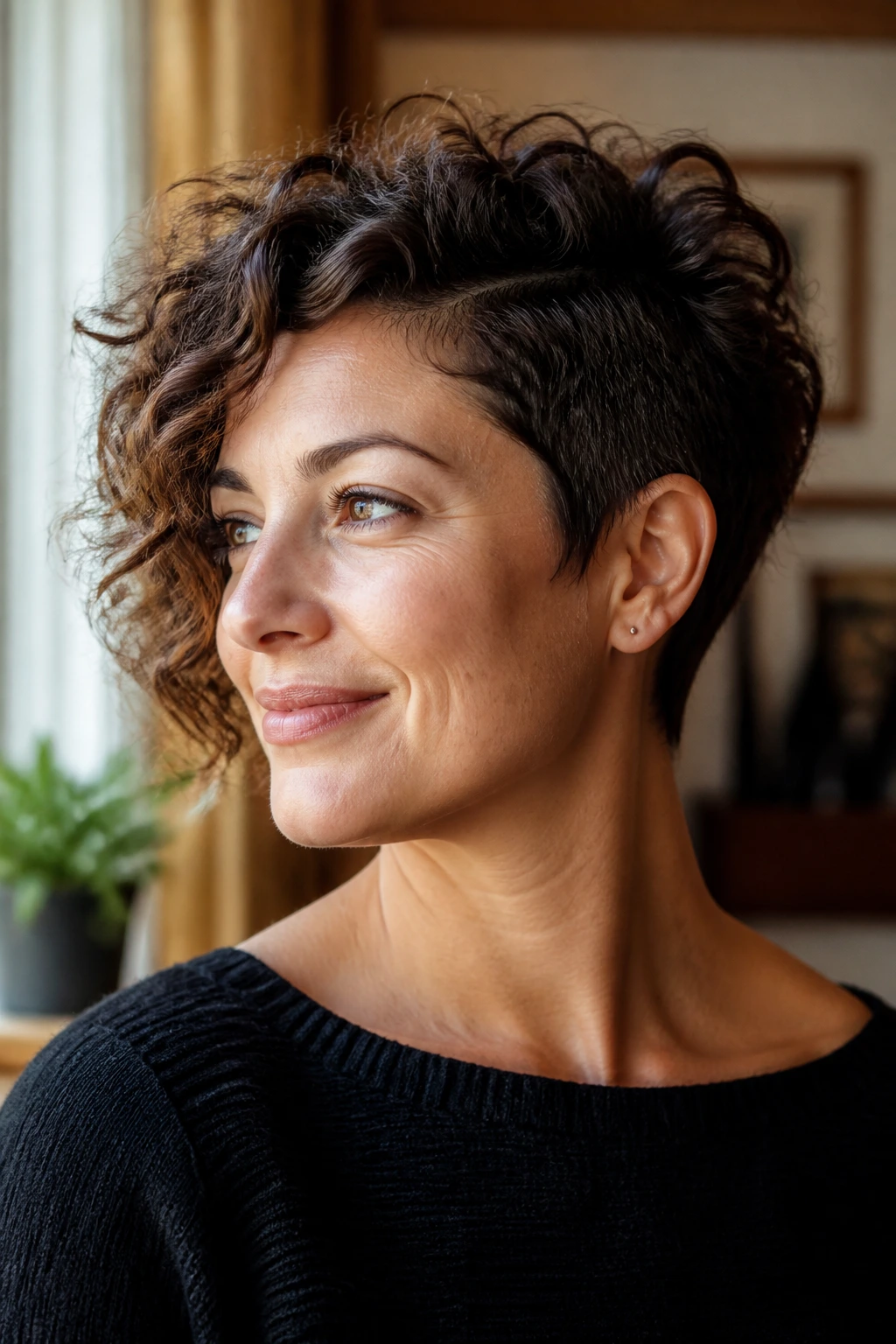
Short asymmetrical cuts show growth fast. That’s not a flaw. It’s the trade-off for having a shape with some attitude. The good news is that with a little care, the haircut can stay crisp much longer than people expect.
For sharply angled styles, plan on a trim every 4 to 6 weeks. Softer versions can stretch to 6 or 8 weeks before the line starts to feel blurry. If you have a clipped nape or undercut, a quick cleanup every 2 to 3 weeks keeps the back from creeping upward and wrecking the balance.
Night care matters too. A satin pillowcase or bonnet keeps the curls from getting flattened on the shorter side. If one side always wakes up flatter, clip it loosely at the root while damp and let it dry that way for a few minutes. Tiny thing. Big difference.
For refresh days, mist the hair with water, add a pea-sized amount of gel or foam to the ends, and scrunch just enough to wake the curl pattern back up. Do not soak the crown unless it needs it. Over-wetting the top can pull the volume out of the shape.
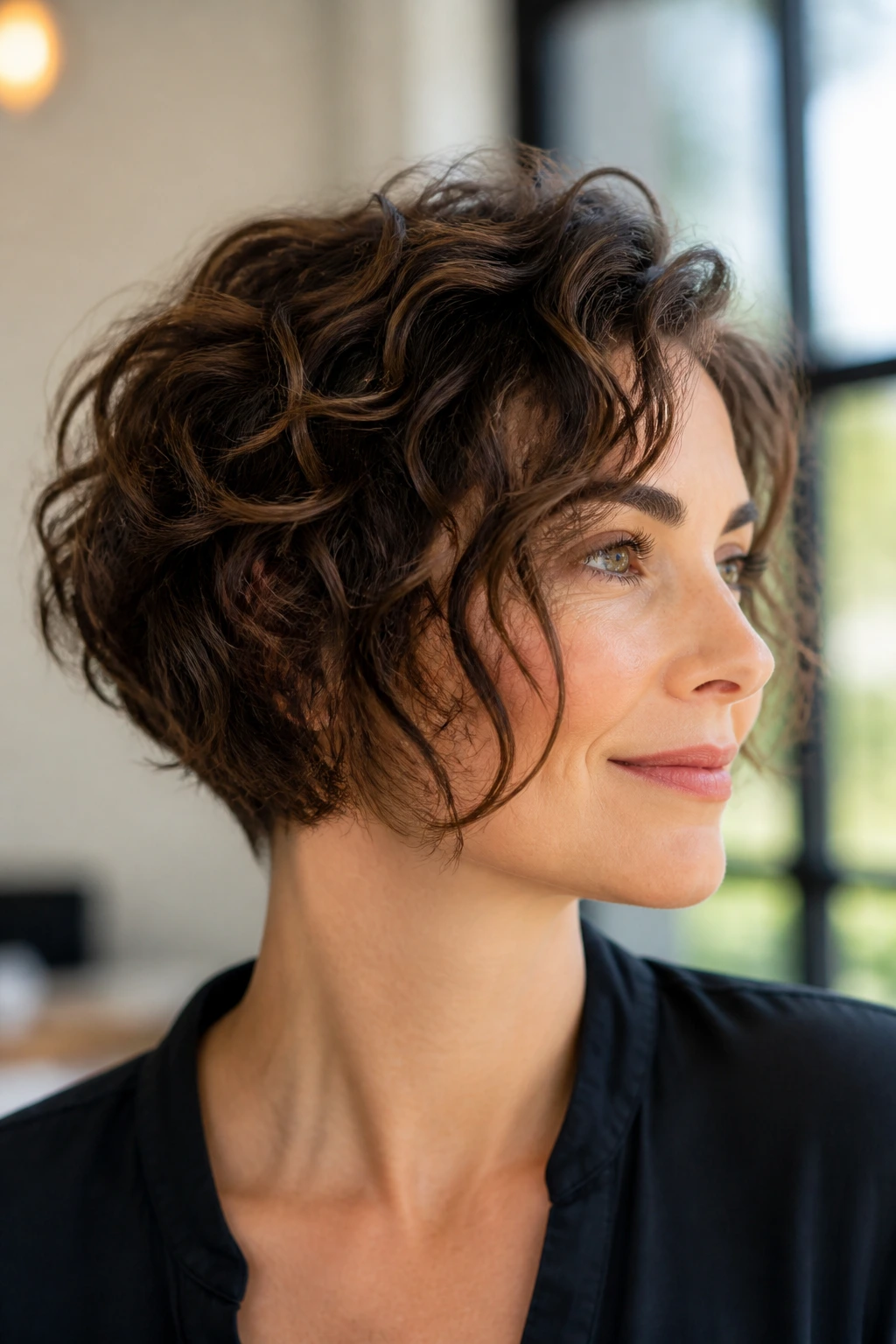
Common Mistakes That Flatten the Whole Idea
-
Making both sides too even: The haircut starts looking like a regular bob with a confused side part. Fix it by keeping a clear length difference between the front corners.
-
Thinning the ends too aggressively: The perimeter turns wispy and the curls separate into frizz. Ask for point-cutting or light internal removal instead of heavy razor work if your hair is coarse.
-
Loading the roots with cream: The crown collapses, the shorter side sticks to the head, and the asymmetry disappears. Keep richer products through the mids and ends only.
-
Ignoring the nape: A neat front with a shaggy back is a bad trade. If the nape grows fast, schedule a cleanup before the shape starts to mushroom.
-
Over-diffusing: You can rough up the curl clumps and make the ends crispy. Stop when the hair is about 80 to 90 percent dry, then let the rest air-finish.
-
Cutting without thinking about shrinkage: The front pieces end up too short, and the face-framing effect vanishes. Leave room for spring, especially if your curls are tight or highly elastic.
Smart Variations to Match Your Texture and Routine
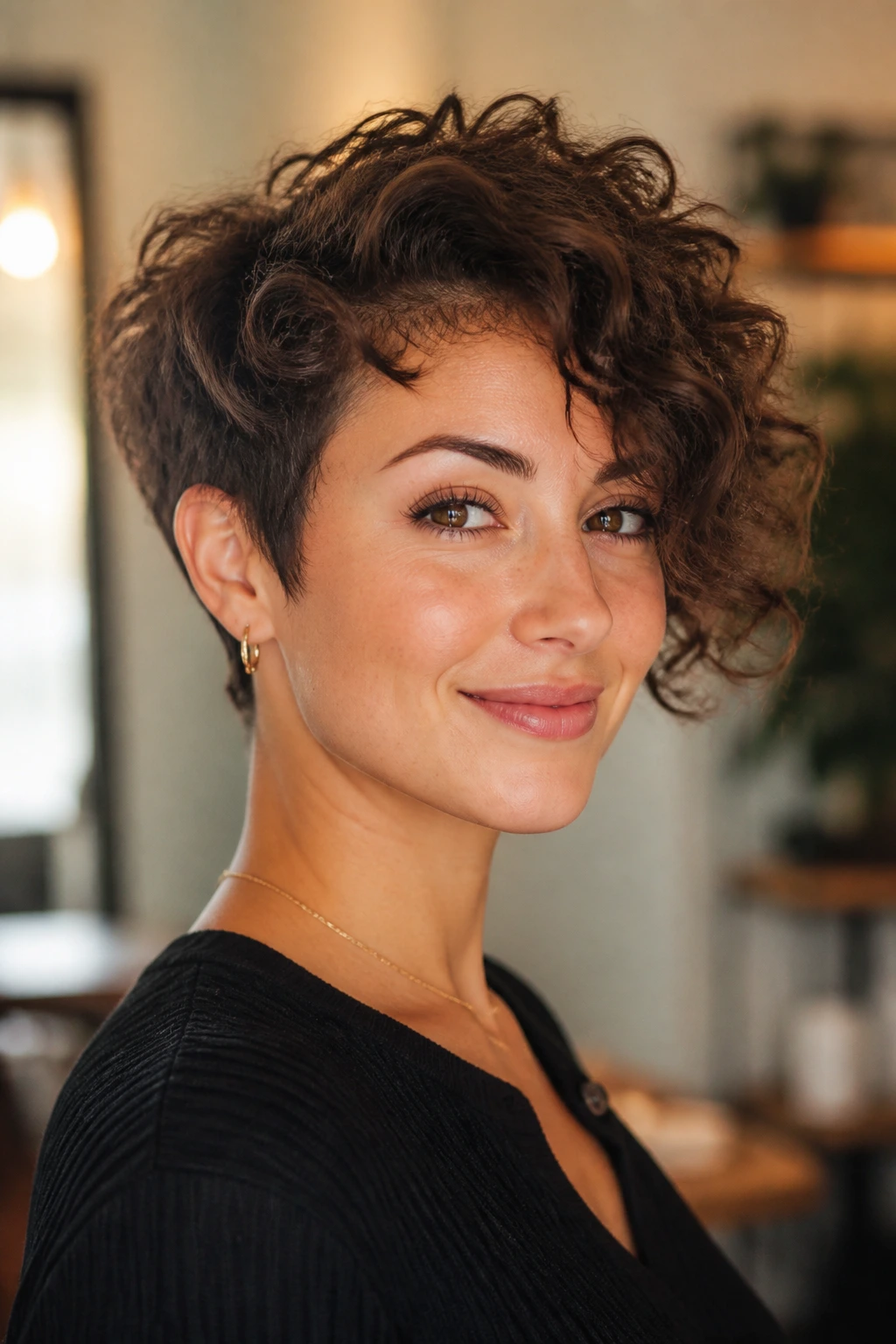
Soft-Wave Starter Version
Keep the length difference modest, with the longer side only about half an inch to an inch ahead of the shorter side. This is a gentler entry point for people with wavy hair or anyone nervous about a dramatic chop. It still reads asymmetrical, just quieter.
Coil-Forward Version
Lean into denser texture with a tighter nape and more internal layering through the top. This version gives coils room to stack without turning into a triangle, and it usually benefits from a stronger gel. If you wear your hair stretched, this one has a stronger outline.
Low-Styling Morning Version
Leave the front longer and reduce the number of short interior layers. The shape dries well with a quick scrunch and can survive an air-dry day without much help. Good if you want a cut that looks decent after a shower and a school run, not a styling session.
Gray-Glow Version
Use the asymmetry to frame silver strands instead of hiding them. Keep the perimeter soft and add a light gloss or shine cream so the gray doesn’t go matte or dusty. The color itself becomes part of the shape.
Bold Undercut Version
Go shorter under one side or at the nape and let the top travel over it. This is the most graphic option in the group, and it suits thick hair that wants to explode outward if left alone. It does need more frequent upkeep, but it pays you back in shape.
Questions People Ask Before the Chop
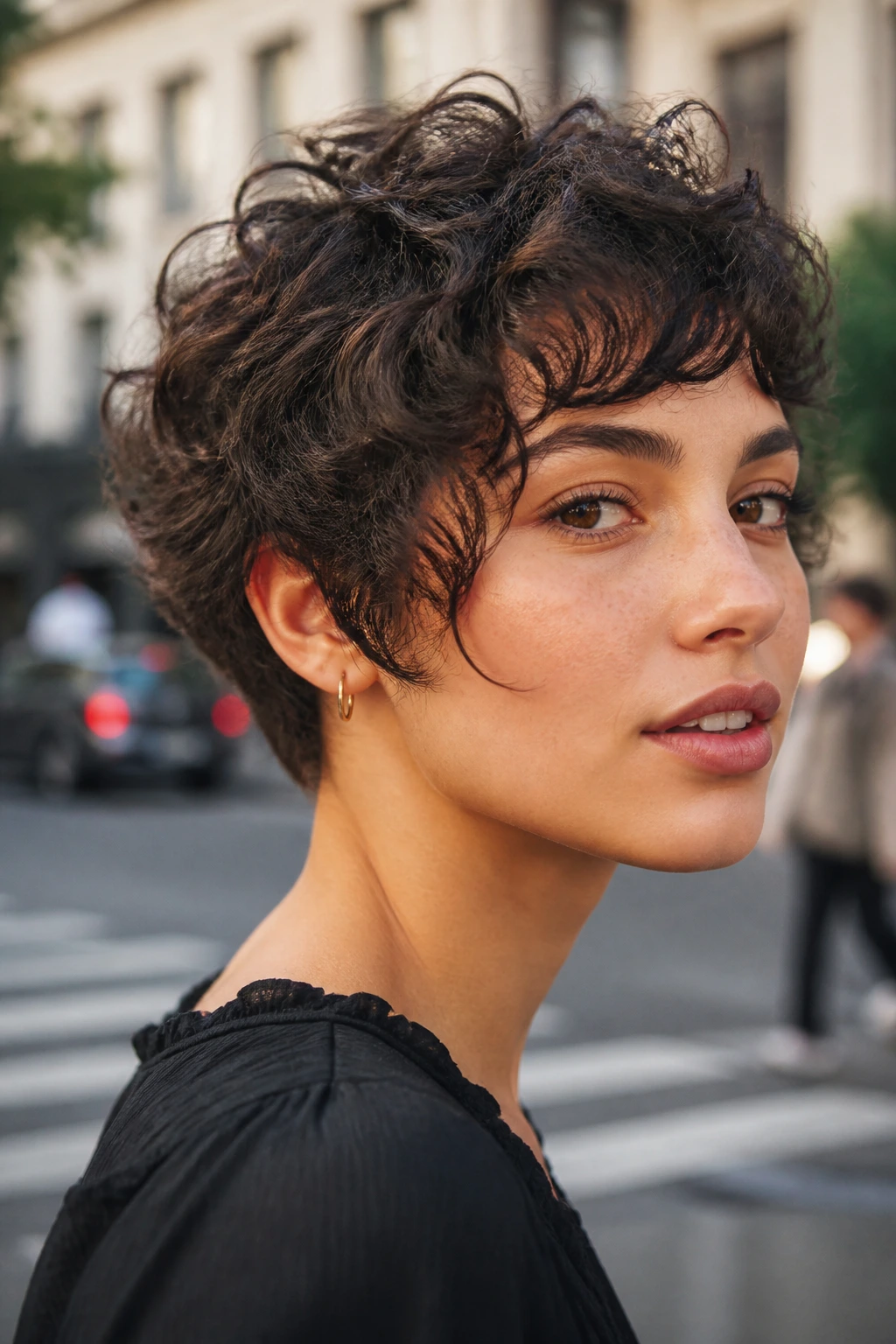
Will this work on wavy hair, or does it need tight curls?
Wavy hair can wear these cuts beautifully, especially the softer asymmetrical bobs and the face-framing versions. The trick is to keep the weight line visible enough that the waves still read as a shape, not just texture.
Should the stylist cut it wet or dry?
Dry or mostly dry refinement is a big help on curly hair, especially for the final outline. Wet cutting has its place for removing bulk, but the finish should match the curl pattern after shrinkage, not before it.
How short is too short on the shorter side?
That depends on density and curl spring, but if the shorter side is so short that it disappears into the temple, the asymmetry can get lost. Ear level or just above usually gives a better read unless you want something sharper.
What if one side of my curls is looser than the other?
That is normal. A good stylist can balance the cut by leaving a touch more length on the side that collapses faster and cleaning up the side that springs higher. Hair does not grow in perfect symmetry, so the cut should not pretend it does.
Can I wear this with glasses?
Yes, and some versions are especially good with frames. Ear-length sides, tucked napes, and longer front corners keep the glasses arms from fighting the hair every time you put them on.
What if the front puffs out too much?
That usually means the front is either too short, too dry, or loaded with too much product at the root. Try a lighter cream, use more gel through the ends, and ask for longer front corners at the next trim.
Do these cuts need a lot of heat styling?
No. A diffuser helps, but most of these shapes should work with air-drying or a short low-heat finish. If the haircut only looks good after a 30-minute blowout, it was probably cut wrong for the texture.
How often should I trim it if I want the angle to stay obvious?
Every 4 to 6 weeks is a good target for sharper shapes. Softer versions can stretch longer, but once the front and back lengths start blending into each other, the asymmetry loses its purpose.
The Shape That Keeps Its Edge
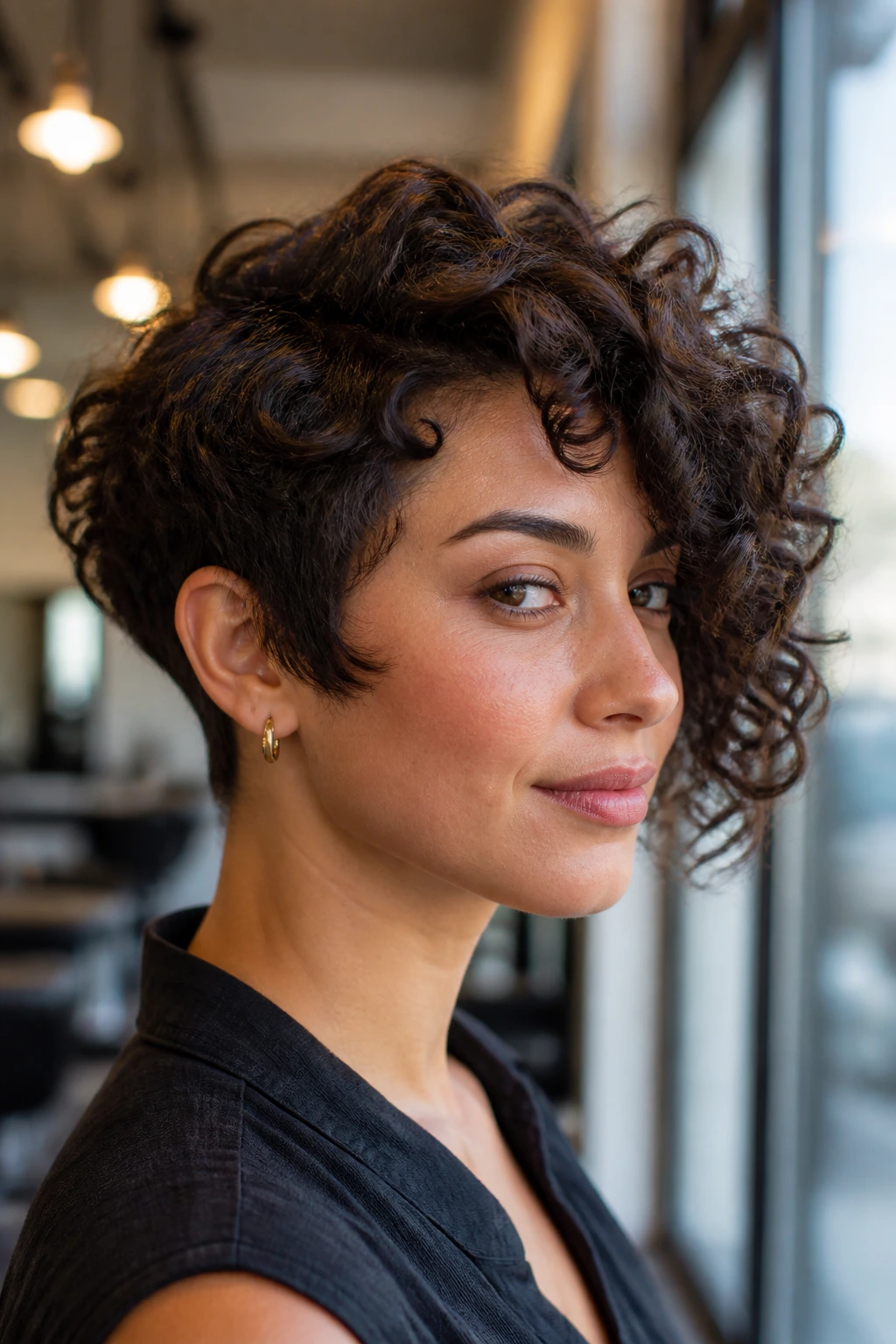
The best asymmetrical bob short curly pixie cuts do not fight the curl pattern. They give it a job. One side leads, one side supports, and the whole head gets a shape that feels alive even on a plain old Tuesday when the only styling tool you had time to use was your hands.
That is why these cuts hang onto their appeal. They can be sharp or soft, clipped or airy, high-volume or low-effort, and they still hold onto the same basic idea: curls look better when the haircut gives them direction. Bring the right reference photos, be honest about how much styling you’ll actually do, and choose the version that fits your texture instead of the fantasy version in your head. The haircut will do more of the work than you think.