



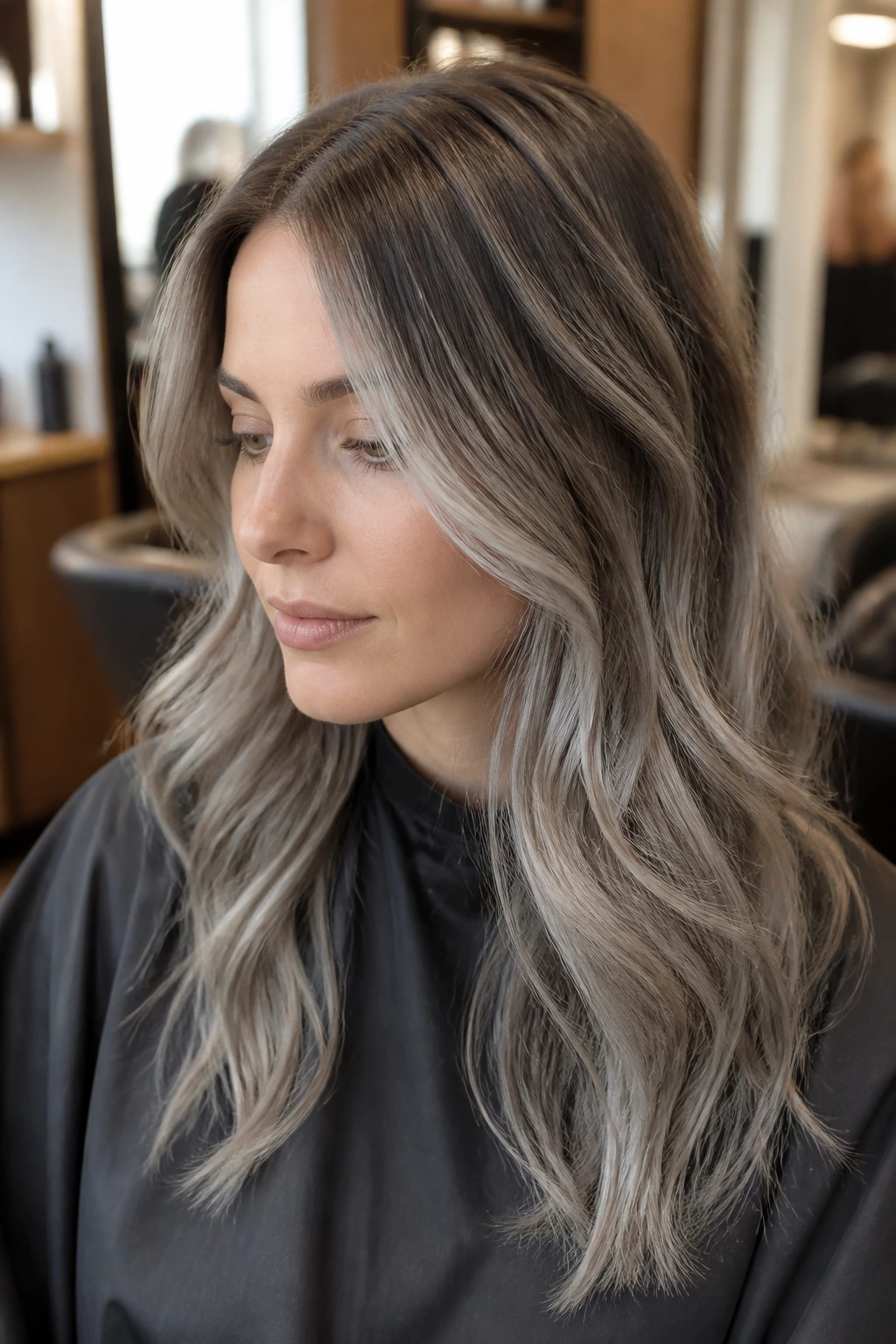
Grey-dark transition highlights for fair skin work best when the color doesn’t land in a hard stripe. The whole trick is the handoff: a deeper base near the roots, a smoky middle zone, and then silver, pearl, or graphite pieces that look like they’ve always lived there. When that shift is handled well, pale skin gets a clean frame instead of a washed-out halo.
I like these shades when they keep some shadow. Flat silver on fair skin can look a little airless unless there’s depth underneath it. Mushroom brown, slate, pewter, charcoal, and ash are the unsung heroes here; they give the eye something to hold onto before the light pieces start sparkling through the mids and ends.
And the range is wider than most people think. You can go soft and misty, or sharp and editorial, or somewhere in between with a money piece that has just enough brightness to wake up the face. The best versions don’t feel dipped in paint. They move.
Why These Grey-Dark Transitions Work on Fair Skin
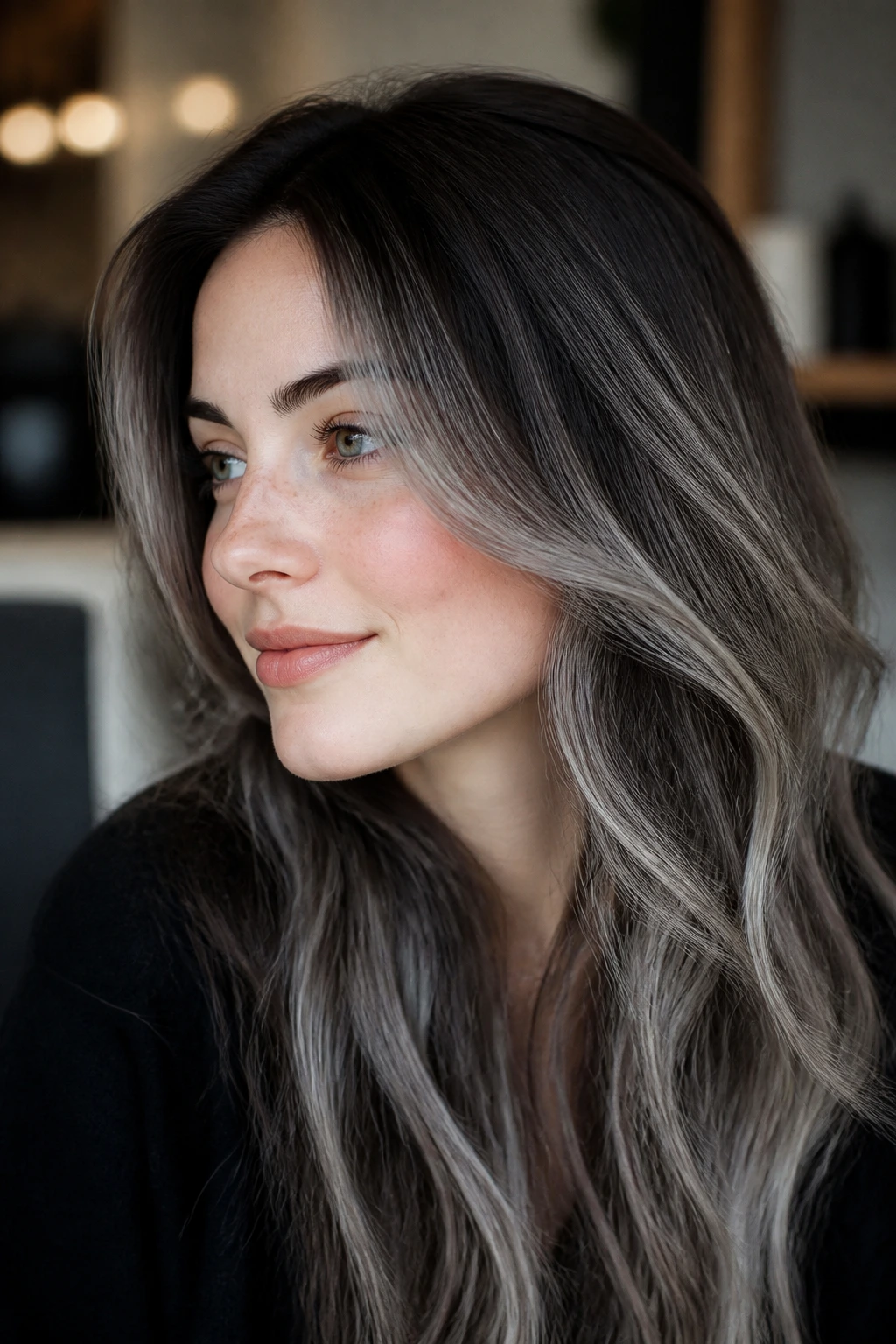
- Soft contrast: Fair skin shows contrast fast, so a smoky root melt keeps the look from turning into a blunt line that overwhelms the face.
- Cool-tone control: Ash, pewter, slate, and silver sit naturally against pale skin without dragging the complexion into yellow or orange territory.
- Better grow-out: A shaded root and diffused midsection mean the regrowth line stays softer for longer, which matters when you don’t want constant salon visits.
- Face-brightening placement: Lighter pieces near the cheekbones and temples lift the face, while darker interior ribbons keep the color from floating away.
- More dimension: Grey-dark transition color looks better when it has at least two depths, not one flat silver blanket from root to tip.
- More room for undertones: Cool, neutral, and rosy fair skin can each wear a version of this trend if the tone family is chosen with a little care.
1. Smoky Mushroom Balayage
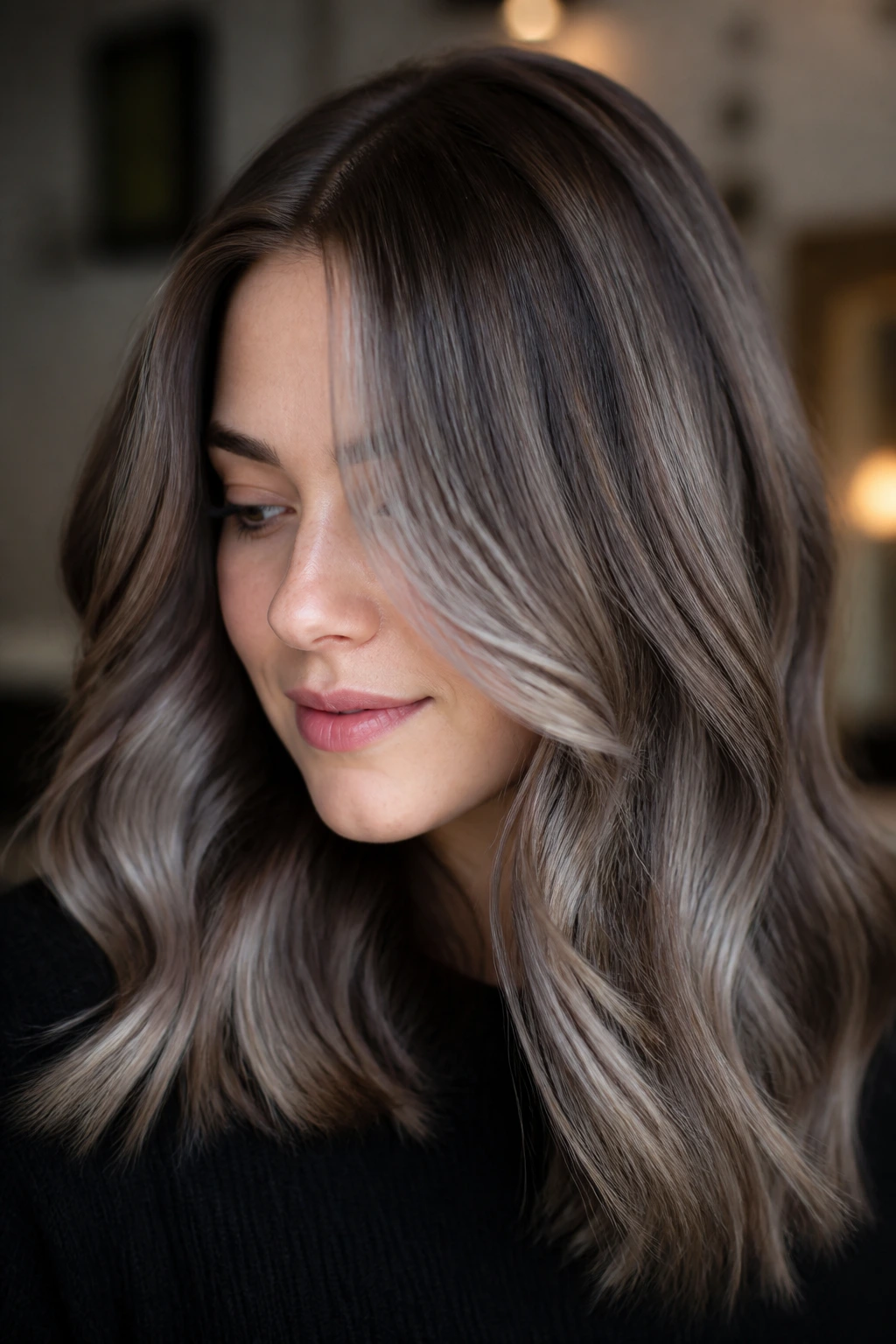
Mushroom brown is the quiet overachiever of this whole category. It sits in that sweet spot between taupe, ash, and soft brown, so on fair skin it reads deliberate instead of muddy. Add a few smoky grey balayage ribbons, and you get a transition that looks expensive even when the styling is plain.
What makes it work is the restraint. The darker base gives your complexion a frame, but the grey never gets so icy that it steals all the attention. On pale skin, that matters. A level 6 mushroom root melting into level 8 smoke through the mids gives you contrast without turning the hair into a helmet.
If you want this look, ask for hand-painted ribbons, not chunky stripes. That keeps the grey pieces soft enough to move when you curl or wave the hair. Straight hair can wear this beautifully too, but I think it looks best with a loose bend from mid-lengths down.
2. Ice-Blue Money Piece with Charcoal Base
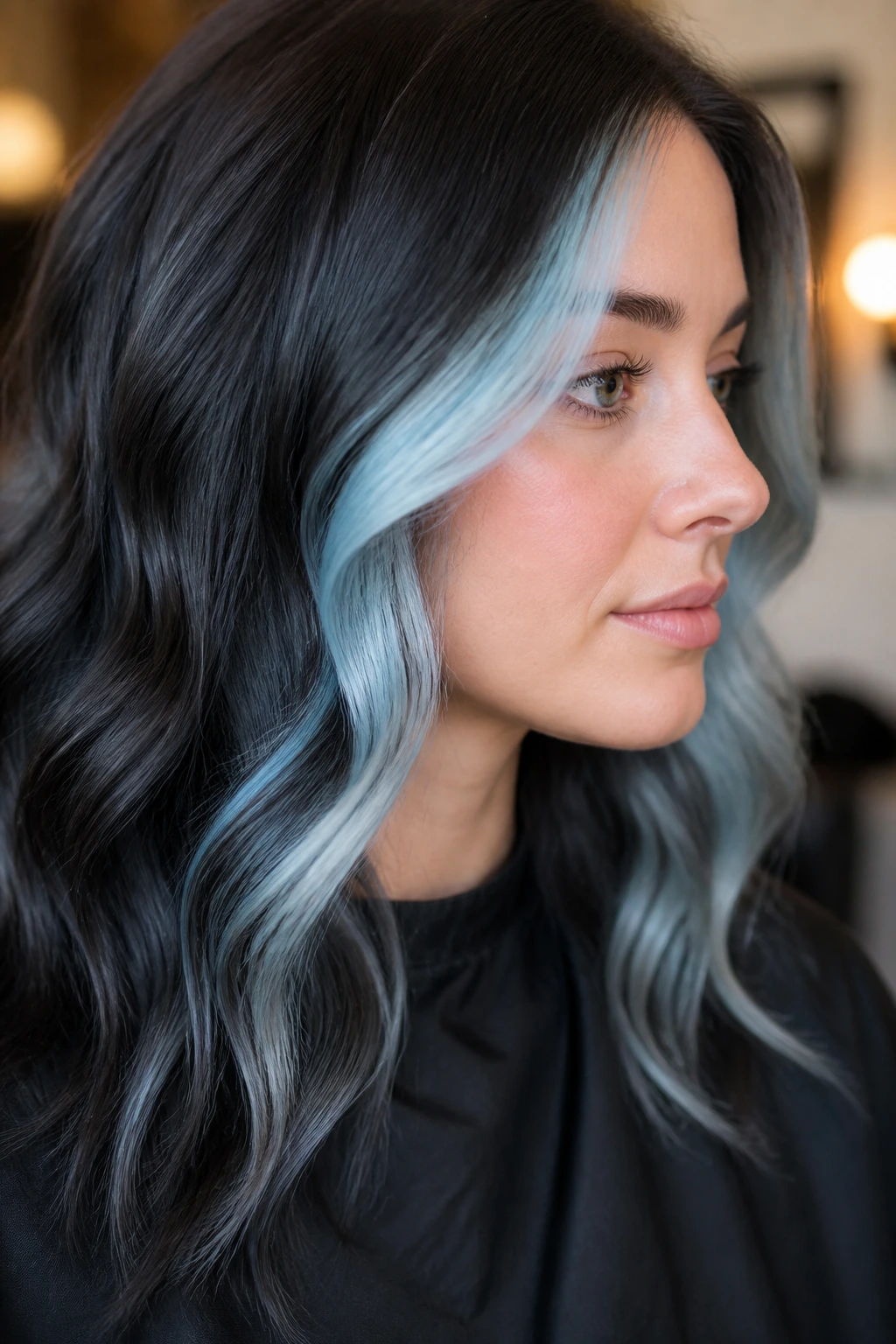
Can fair skin carry a cool front piece? Absolutely, if the rest of the hair has enough depth to anchor it. This version keeps the base dark charcoal and puts a pale ice-blue silver band right at the face, where it lights everything up. It’s dramatic, but the dark base stops it from feeling costume-y.
Why it flatters fair skin
The front money piece brightens the complexion without making the whole head look pale. That matters for people with very light skin, because too much all-over silver can drain the face. The charcoal behind it acts like eyeliner for the hair.
Best way to wear it
Loose waves show off the shift best. Straight styling makes the money piece look sharper, which is great if you want edge, but the softer bend gives it more movement. I’d ask for the lightest pieces to stop just past the cheekbone and then fade into a smoke glaze through the ends.
3. Pearl Grey Babylights
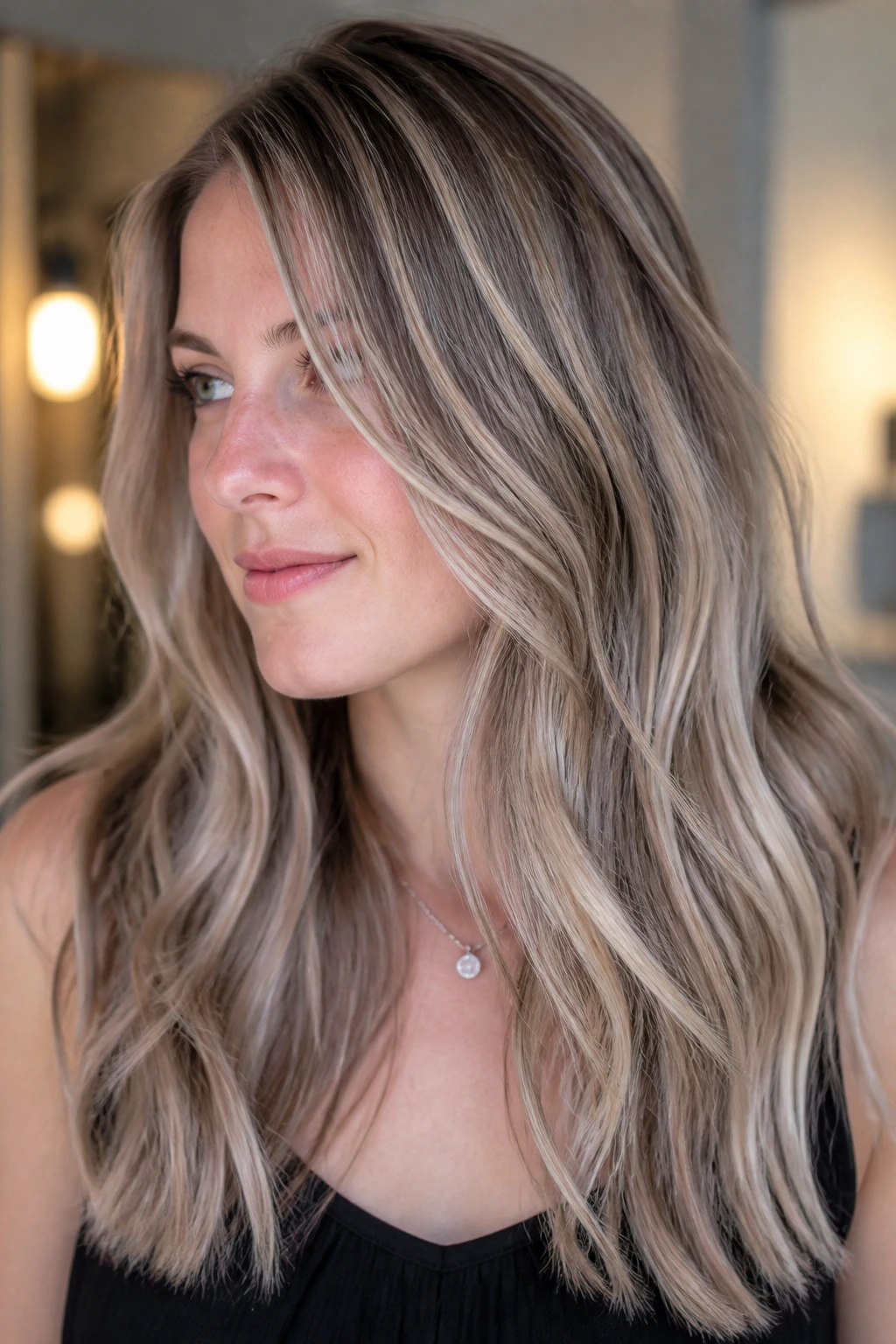
Picture a head full of whisper-thin strands that catch light in silver-pearl flashes instead of obvious streaks. That’s the charm here. On fair skin, babylights are a smart move because they soften the contrast and let the skin stay the star, not the hair color.
Pearl grey is especially kind to neutral and cool undertones. It has enough white in it to feel bright, but the pearl cast keeps it from looking flat. You also get less banding as the color grows out, which is a gift if you hate obvious maintenance.
- Best on: Fine to medium hair that needs texture without bulk.
- Ask for: Ultra-fine foils and a pearl gloss, not a blue toner.
- Maintenance: Gloss refresh every 5-7 weeks if you want the pearl tone to stay clear.
4. Graphite Root Melt
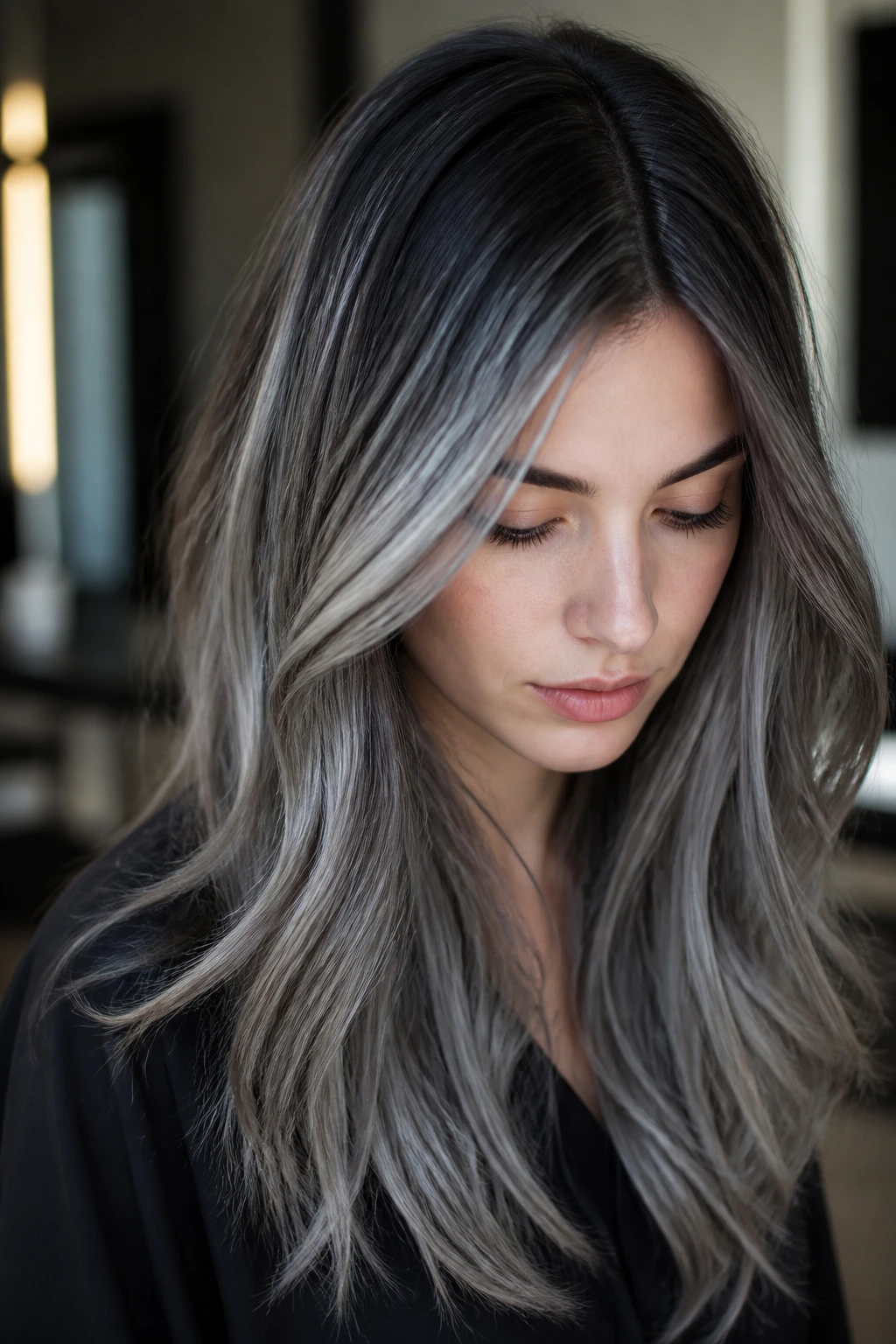
Graphite root melts are for people who want the grey to feel grounded. The root stays dark, often at a level 4 or 5, then eases into smoky silver through the mid-lengths. On fair skin, that contrast gives the face structure. Without it, the hair can disappear into the complexion.
I prefer this on longer cuts, because the fade has room to breathe. A bob can wear it too, but the transition needs to be very soft or it starts looking like a block of color. With graphite, the key is the melt — not the grey alone.
The best versions avoid a hard black root. Black can be too severe against pale skin and too unforgiving once it starts growing out. Graphite gives you the same shadow with a softer edge, and that’s the version I’d pick nine times out of ten.
5. Silver Ribbon Teasylights
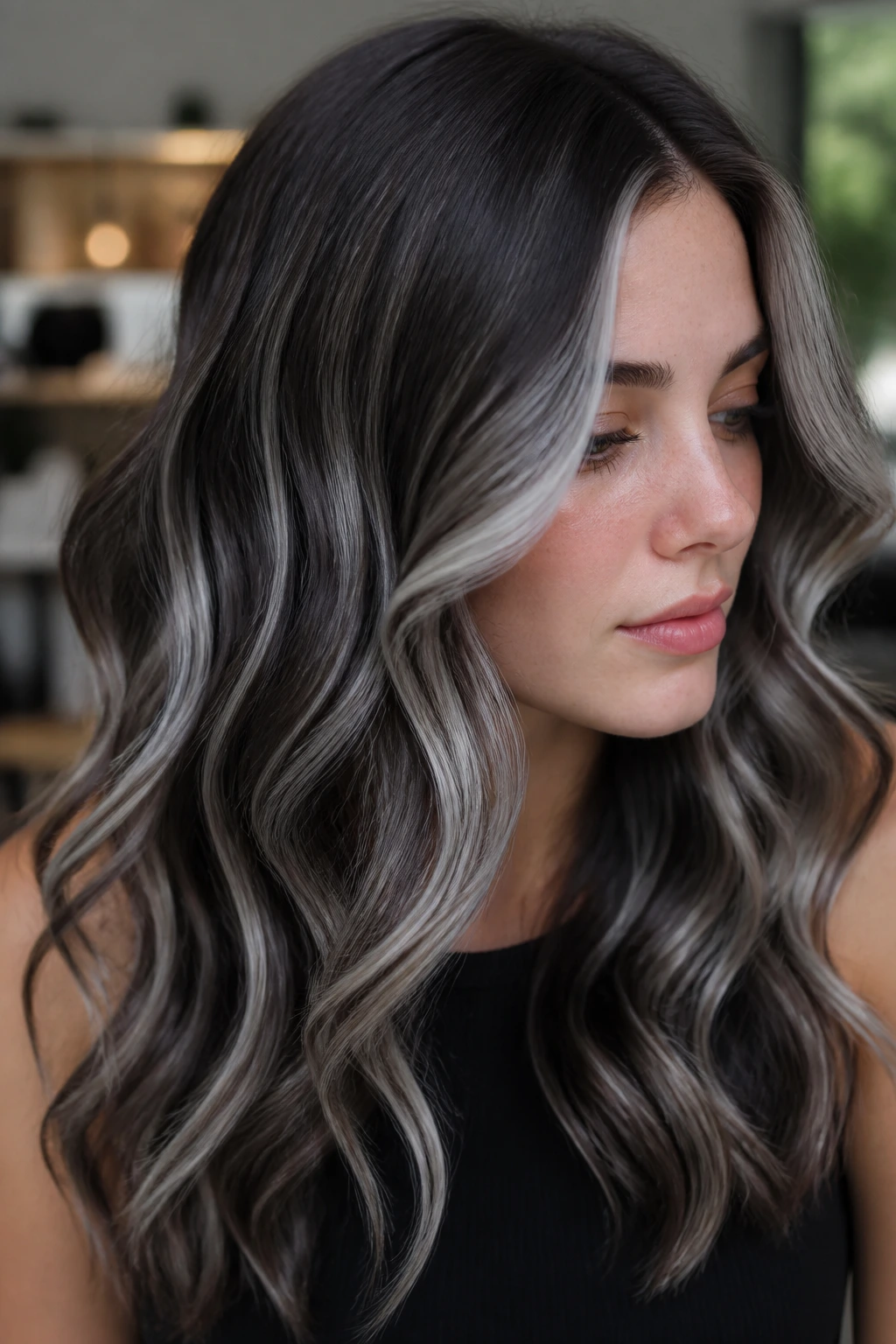
Teasylights are one of those salon techniques that sound fussy until you see what they do. The hair is gently teased before foiling, which leaves softer seams and less obvious line work. Add silver ribbons through a dark base, and the whole head gets movement without striping.
This works especially well on fair skin because the lighter pieces stay broken up. You’re not staring at one bright chunk near the face. You’re seeing flashes of silver as the hair moves, which feels much more natural than a solid block of brightness.
I’d choose this if your hair is thick or slightly coarse. The teased section helps the color sit where you want it instead of spreading too neatly. It’s also a good option when you want grey-dark transition highlights that look polished on day one and still believable four weeks later.
6. Smoke and Ash Face Frame
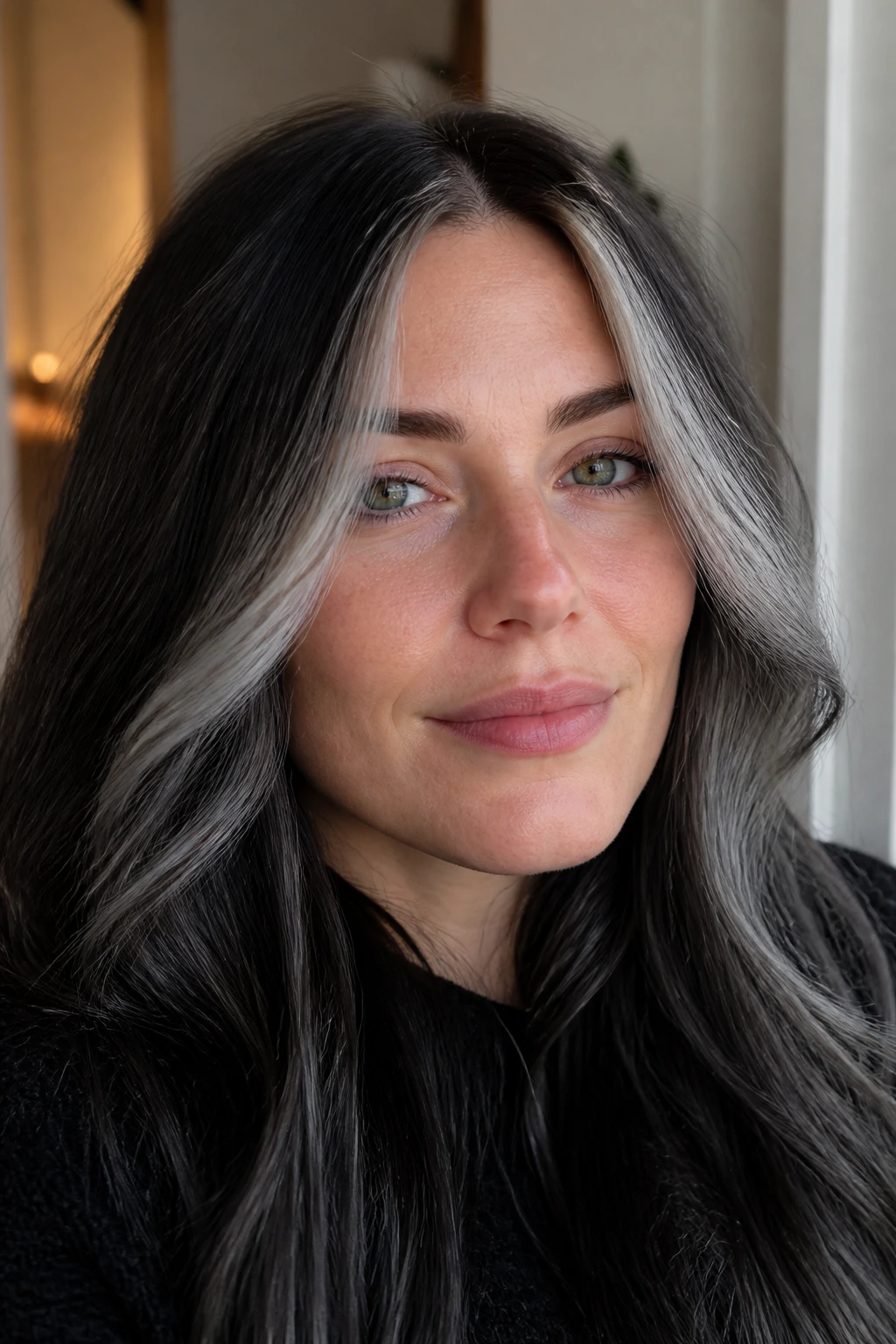
A smoky ash face frame is basically contouring, but for hair. The front pieces are light enough to brighten the skin, then the rest of the color stays deeper and cooler so the contrast doesn’t get noisy. On fair skin, that front brightness can make the cheeks and eyes pop without needing a dramatic full-head blonde effect.
What to ask your colorist for
Ask for the lightest pieces around the face to be one to two levels brighter than the rest of the hair. Then request a smoky gloss so the ends don’t go yellow or white-stark. I’d keep the interior sections darker than the face frame. That’s the part people often skip, and it’s why the look can fall flat.
Why it’s worth a look
It gives you the payoff of a bright color service without the upkeep of all-over silver. The face frame can be maintained separately, which saves time and money. And if you like to wear your hair tucked behind your ears, the lighter front bits still show off.
7. Slate Grey Ends on Dark Blonde
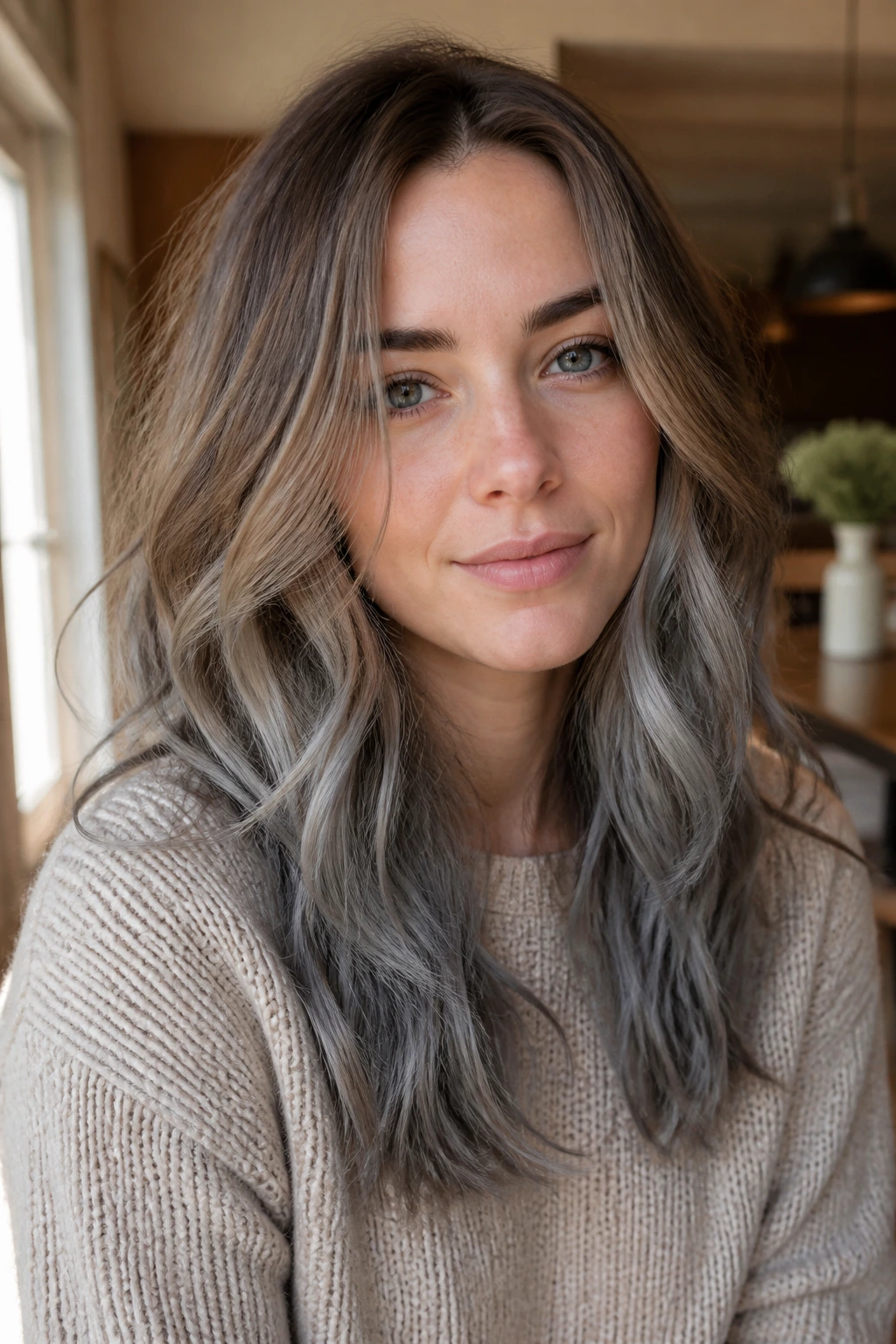
Why does this one work so well? Because the transition happens at the ends, where it can feel intentional instead of abrupt. A dark blonde root or base melts into slate grey tips, and the whole thing reads cool, grounded, and a little moody.
Fair skin usually handles this better than people expect. The darker upper half gives the face enough contrast, while the slate ends keep the length from looking too warm or brassy. If your natural color sits around level 6 or 7, this is a neat way to introduce grey without committing to a full silver head.
It’s also one of the easiest versions to style. A wave pattern brings the slate pieces forward; a straight blowout makes the ends look sharper and a bit more editorial. If you’ve been hesitating because full grey feels too stark, this is a good first step.
8. Frosted Brunette Lowlights
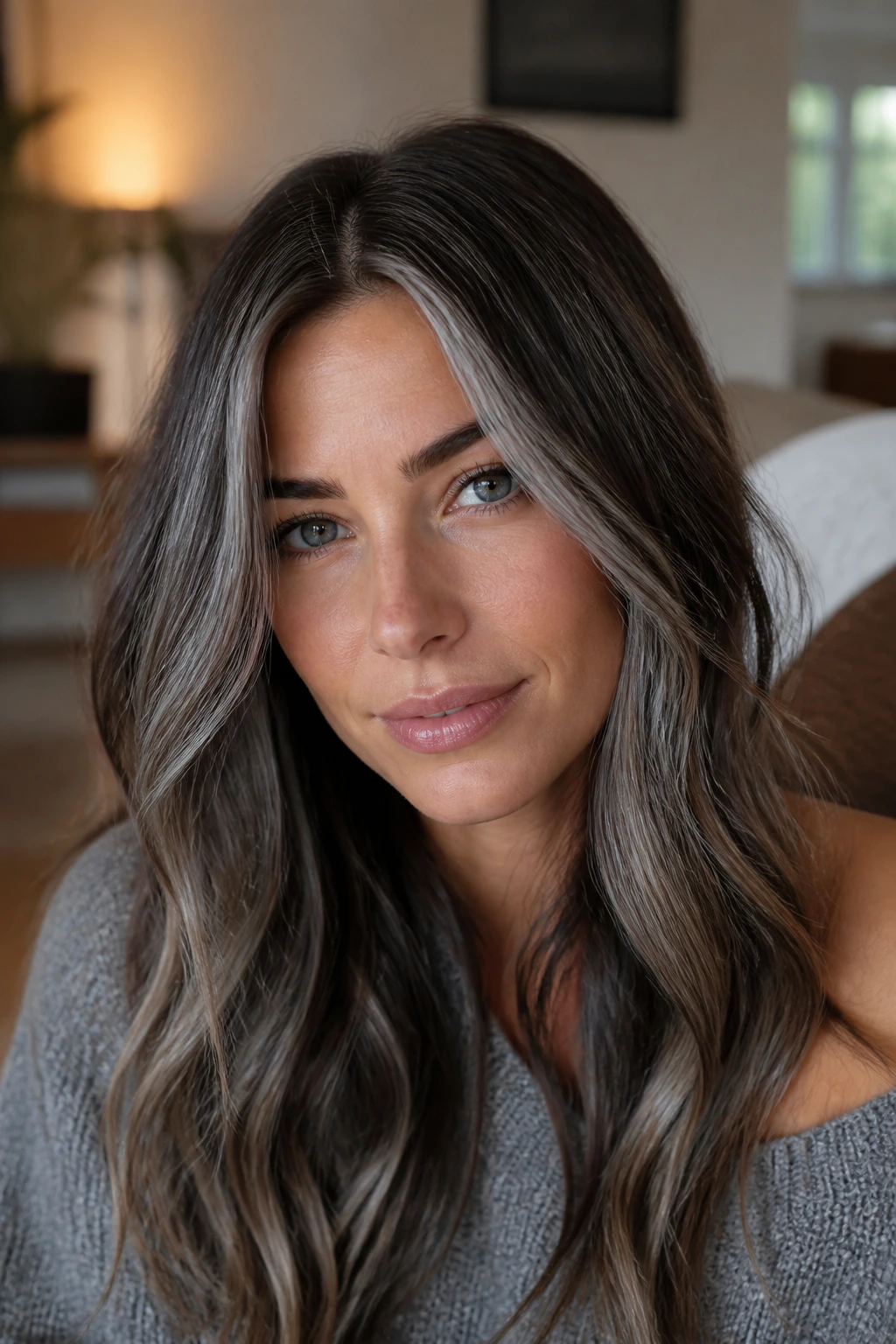
This one is a little sneaky. Instead of lightening everything, you tuck frosted grey lowlights into a brunette base and let the brighter pieces stay subtle. On fair skin, that extra depth keeps the color from floating away. It also makes the hair look denser, which is useful if your strands are fine and prone to looking see-through under strong light.
The best part? The lowlights create a soft frame around the face without fighting your complexion. I like this when the goal is “cool and expensive” rather than “look at my hair.” It has a calmer, less high-contrast mood than some of the more obvious silver looks.
If your hair is already light brown, this is a smart bridge toward full grey-dark transition color. You can keep lifting pieces over time instead of jumping straight to platinum.
9. Pebble Grey Balayage
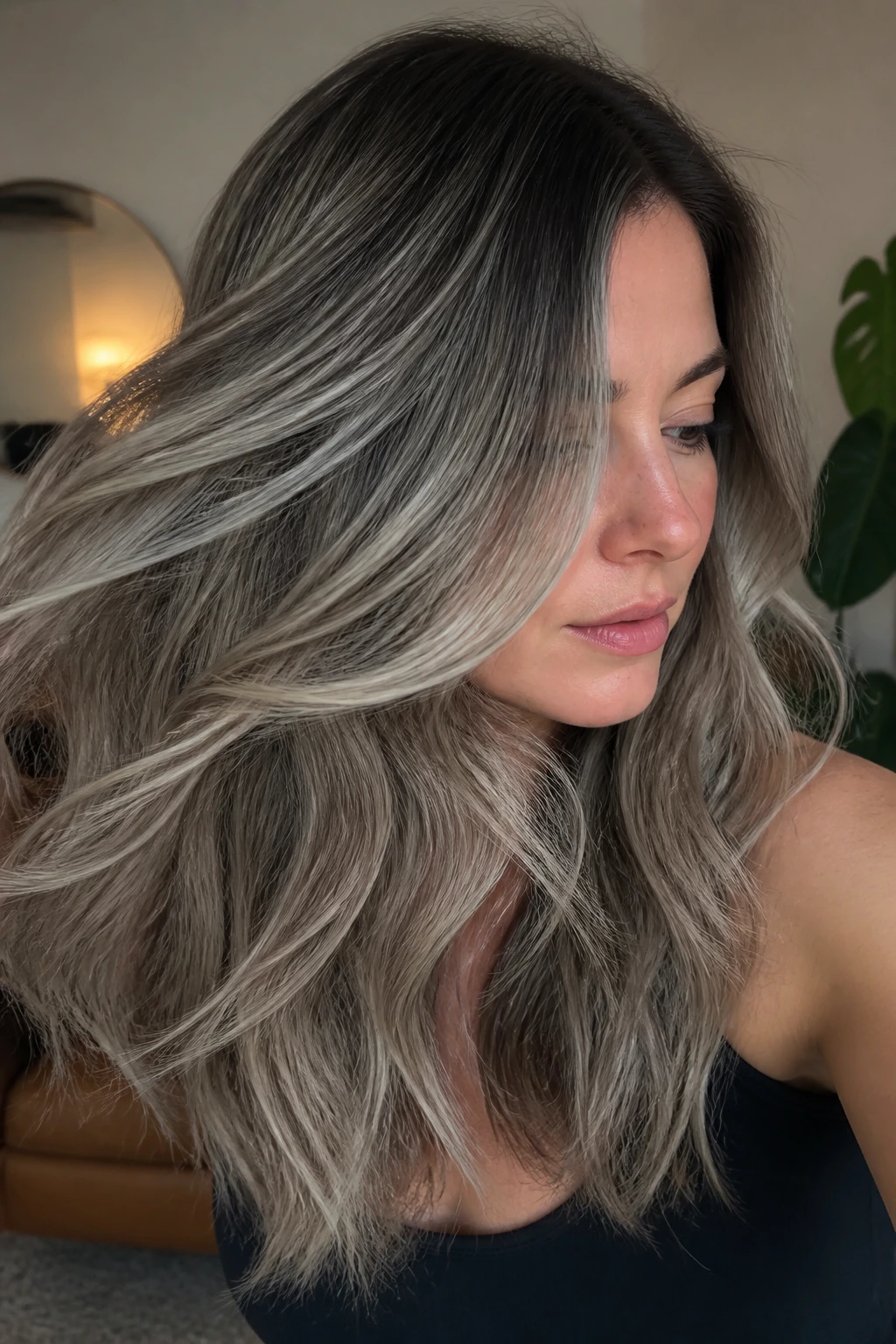
Pebble grey is one of the most wearable tones in the bunch because it mixes grey with a little taupe and stone. That tiny bit of warmth in the undertone keeps fair skin from looking too drained. The result is cool, yes, but not cold.
Balayage placement matters here. The darker pieces should stay near the root and interior, while the pebble grey shows up more through the surface ribbons and lower half. That creates the illusion of depth when the hair moves, which is half the point.
I’d call this a good middle-ground look. It’s softer than graphite, cooler than mushroom, and easier to wear than pure silver. If you want grey-dark transition highlights that feel grown-up rather than trendy, this is a strong pick.
10. Steel Grey Curtain Highlights
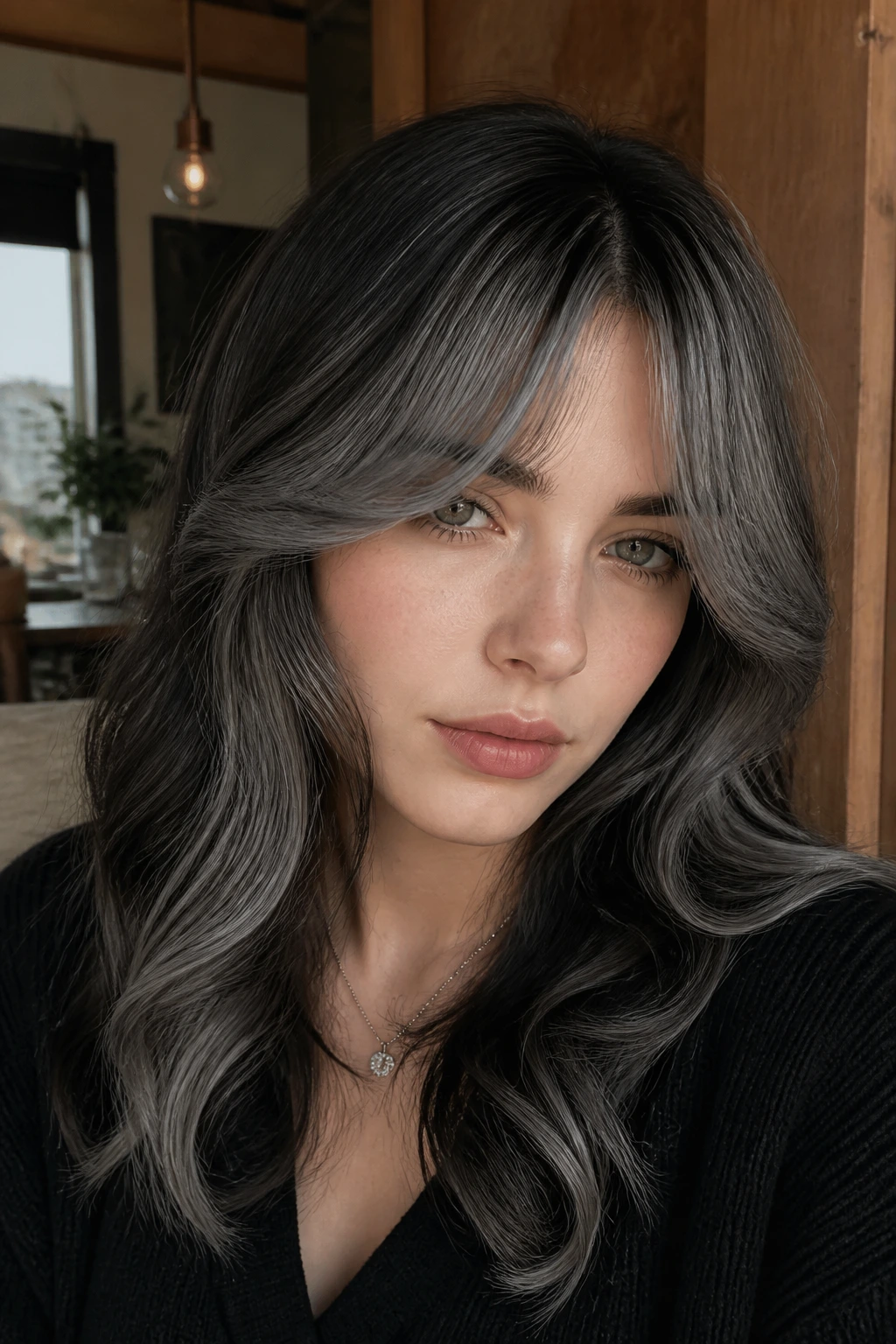
Curtain bangs change the whole mood of a color service. Put steel grey highlights around that center part and frame, and the face gets a neat, lifted look that works especially well on fair skin. The grey sits like a sheen rather than a stripe.
Why it looks cleaner on pale skin
Steel has enough blue-slate depth to stand up against lighter complexions. That means the color reads as intentional contrast, not accidental dullness. On very fair skin, that contrast can sharpen the eyes and cheekbones in a nice, crisp way.
Best styling move
Blow-dry the curtain fringe away from the face with a round brush, then finish with a touch of texture spray. The movement matters. If the front sits too flat, you lose the whole point of the highlight placement.
11. Lavender Smoke Transition
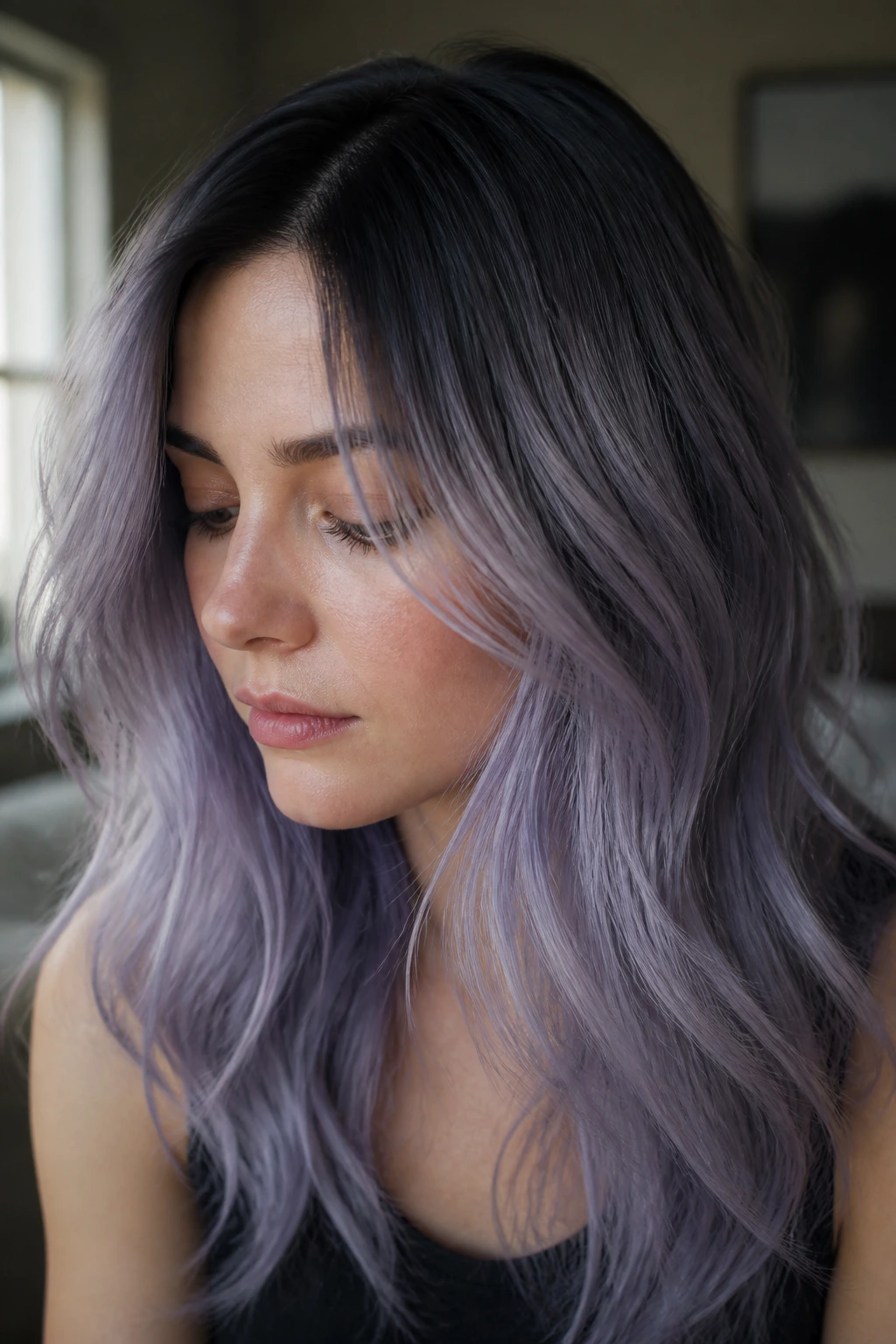
A little violet in the grey makes a big difference on fair skin. Lavender smoke has the same cool base as silver, but the faint purple cast softens the face and keeps the look from turning icy in a harsh way. It’s one of my favorites for people with pink or rosy undertones.
The transition should start darker at the roots — mushroom, ash brown, or charcoal — then slide into a muted lavender-grey through the mids and ends. If the purple is too bright, it reads playful instead of refined. The best version is the one you catch in daylight and think, wait, is that grey or lavender?
This is a good option if you want something with a little personality without tipping into fantasy color. It’s subtle enough for everyday wear, but it still has a point of view.
12. Dark Ash Ombre with Silver Veil
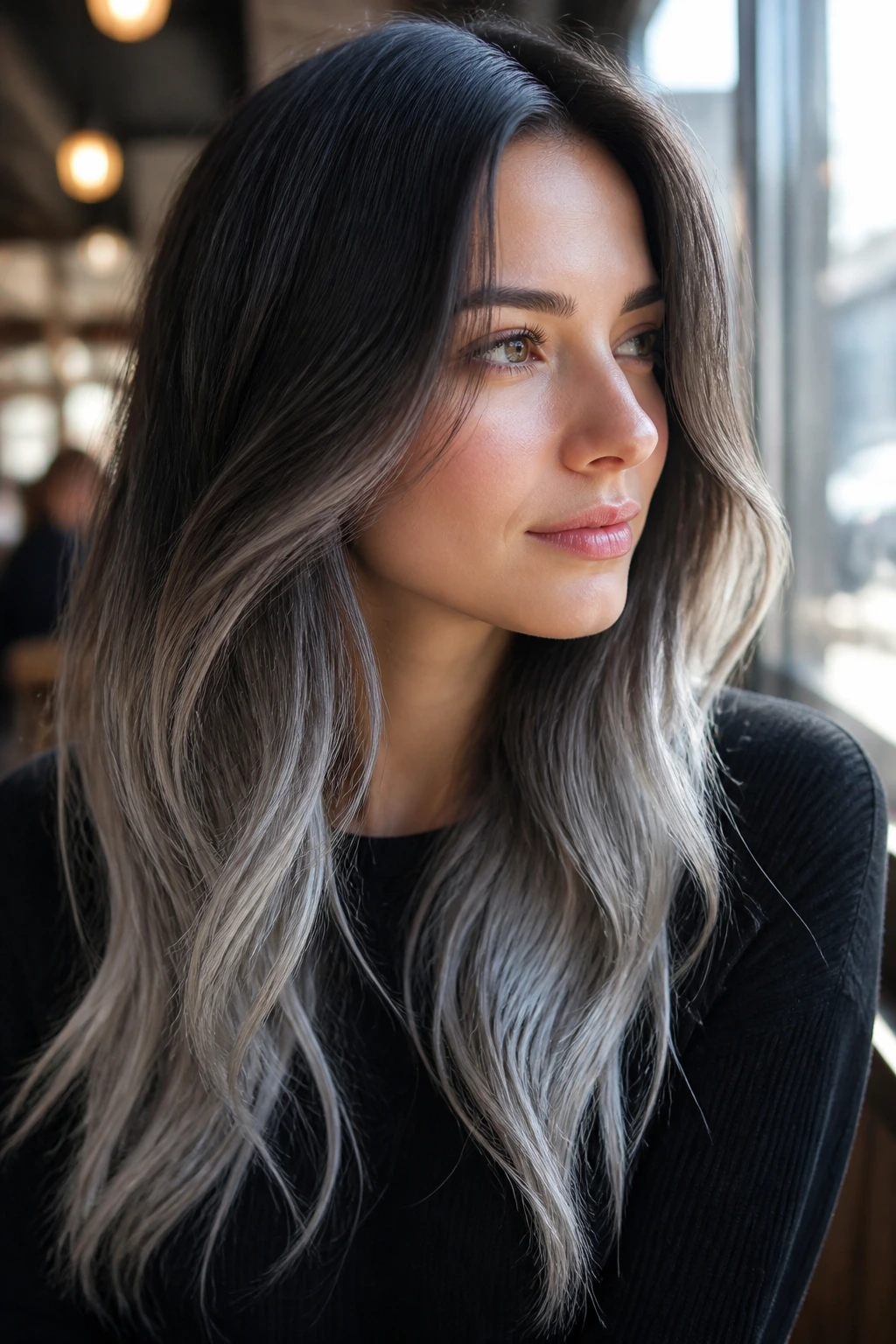
Would a blunt grey ombre be too much for fair skin? Usually, yes. But dark ash melting into a silver veil is a different story. The fade is gradual, which keeps the face from getting boxed in by a hard color line.
The silver shouldn’t start too high. Let the dark ash live near the roots and crown, then bring in the silver veil through the lower half where it can shimmer as the hair moves. That placement is what keeps the look from feeling heavy.
I like this on longer hair and on cuts with a bit of layering. Shorter hair can wear it, but the fade needs room. On fair skin, the contrast looks clean, and the silver veil gives the ends a lighter, airier feel.
13. Smoky Lilac Tips

Smoky lilac tips are for someone who wants the grey story with a small twist. The base stays darker and cool, then the ends shift into lilac-grey instead of plain silver. It’s playful, but not loud.
Fair skin can wear this because the smoky base keeps the color story connected. If the tips were bright lavender from root to end, they’d fight the complexion a bit. Here, the grey softens the lilac and lets the whole head sit in the same cool family.
This is especially nice on layered cuts or waves, where the ends flip and show the color off in different ways. It’s a small detail, but small details are often what make these color jobs feel personal instead of copy-pasted.
14. Charcoal Smoke Contour
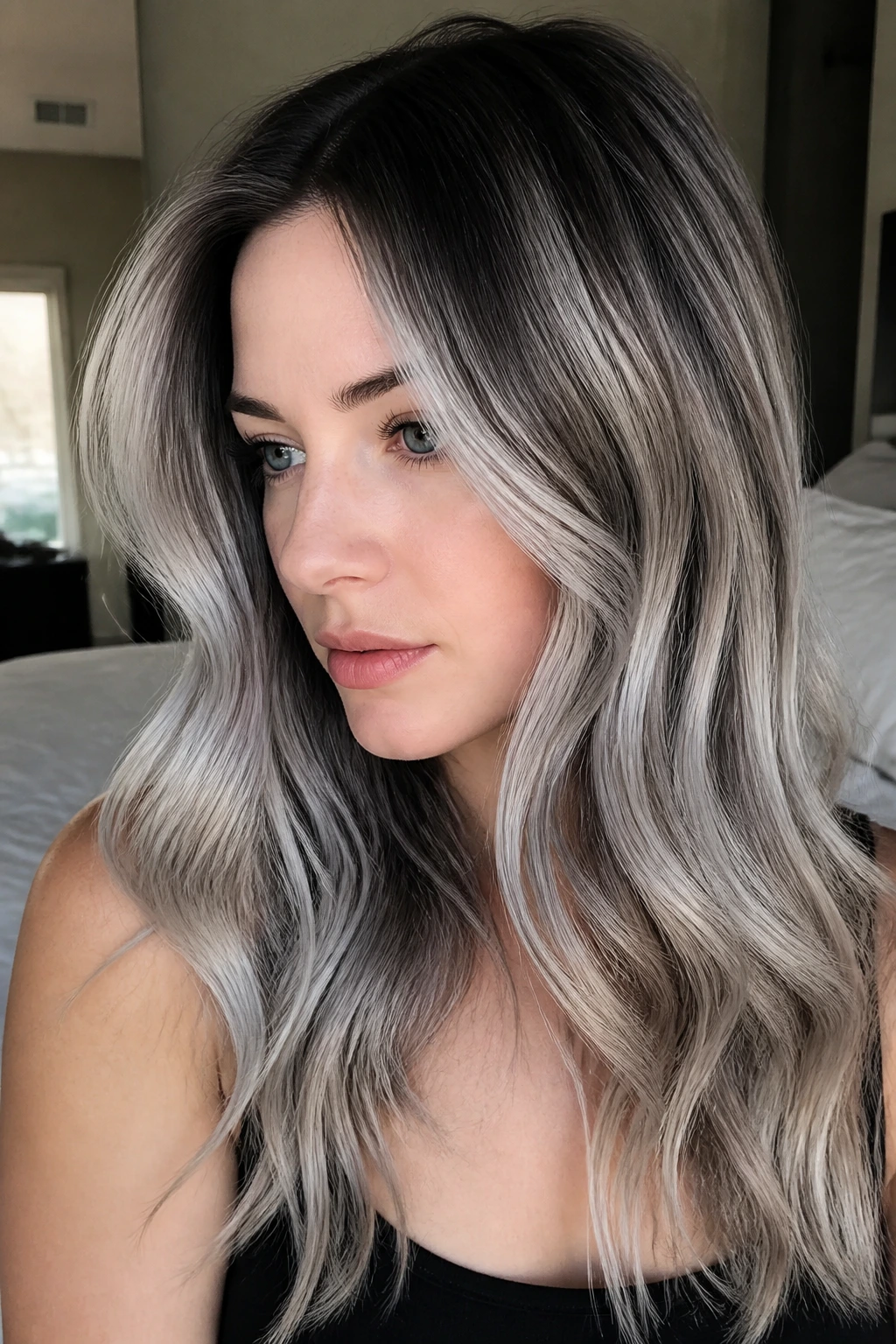
Contour coloring works the same way in hair as it does in makeup: darkness where you want structure, brightness where you want lift. Charcoal smoke contouring keeps the shadow around the outer edges and lightly brightens the top surface so fair skin doesn’t get swallowed by the color.
The movement here is subtle. You’re not chasing obvious silver streaks. You’re building a smoky frame with enough lightness to keep the face alive. On pale skin, that’s often smarter than going too pale too fast.
This version is especially useful if you wear your hair back a lot. The contour stays visible even in a low ponytail or bun, which means the color keeps doing work when the hair isn’t down. I like that. A color that only looks good in one pose is a weak investment.
15. Mink Brown to Grey Melt
Mink brown is one of those tones that does a lot with very little drama. It sits between brown and grey, which makes it ideal for fair skin that needs depth but not heaviness. Melt it into soft grey, and you get a transition that feels seamless instead of staged.
Why it stands out
Unlike a stark ash-black look, mink brown keeps the base soft and wearable. The grey can appear gradually through the mids and ends, so the skin stays bright instead of boxed in by color. If you’ve got neutral undertones, this is one of the easiest shades to wear.
When I’d pick it
Choose this if you want a color that looks polished at work and still has enough texture for off-duty styling. It’s not flashy. That’s the appeal. It reads expensive because the colors are blended so tightly.
16. Arctic Beige-Grey Blend
Here’s the thing with pure ice tones: on some fair skin, they can get too stark. Arctic beige-grey fixes that by folding a soft beige note into the grey so the complexion doesn’t look drained. It still feels cool, but there’s warmth at the edges.
How to keep it flattering
Ask for beige-grey ribbons rather than one all-over silver toner. The beige keeps the light pieces from going chalky, especially if your hair lifts quickly or your skin has a little natural rosiness. That balance matters more than people realize.
Best for
This is a strong choice for neutral fair skin, or for anyone who likes cool tones but doesn’t want the full icy effect. It also holds up nicely if you wear soft makeup shades like taupe, rose, or muted peach.
17. Wet Sand Ash Highlights
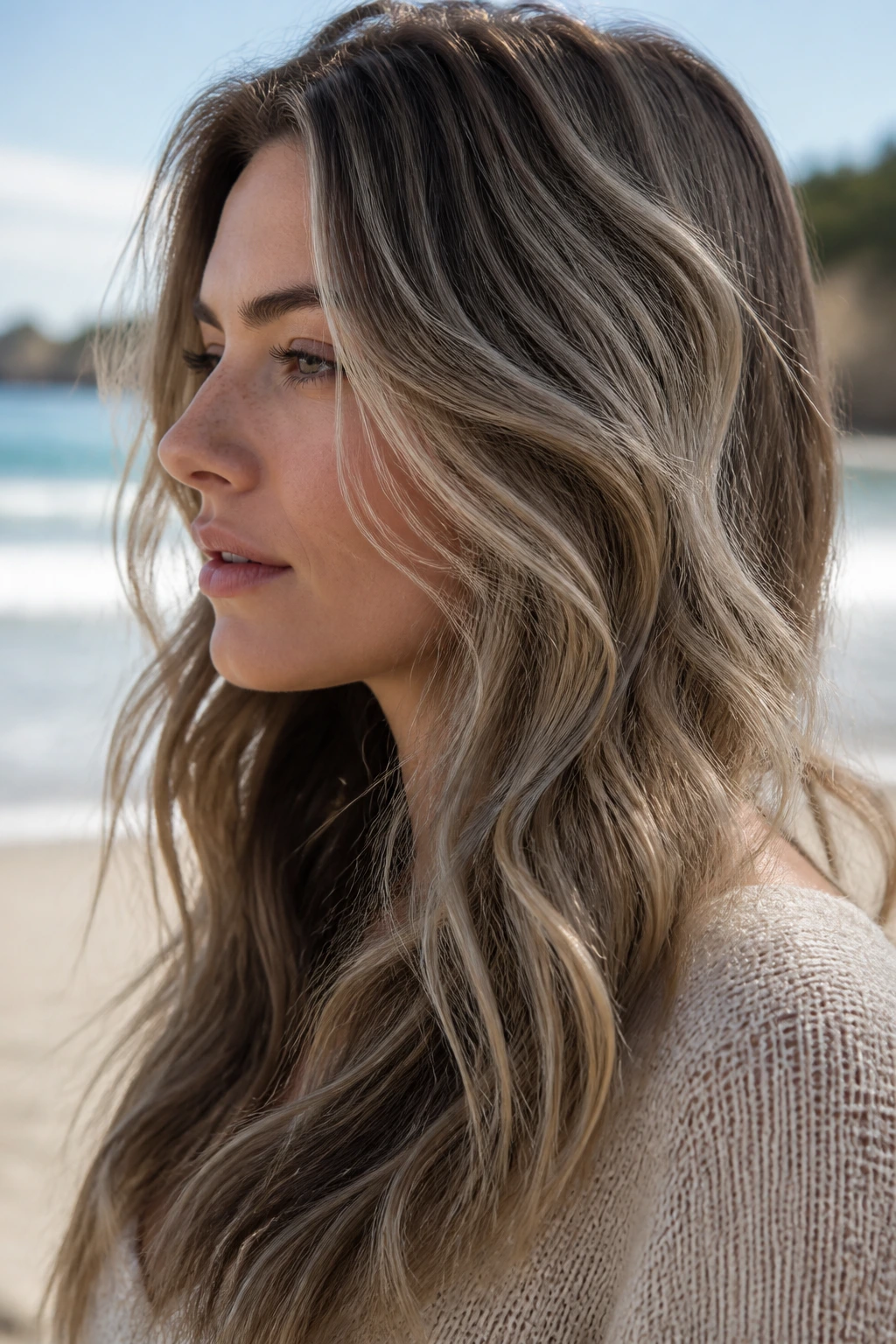
Can ash tones still feel soft? Yes, when they borrow a little from wet sand instead of pure steel. These highlights mix sand, taupe, and ash in a way that feels grounded. On fair skin, that keeps the look from becoming washed out.
The placement is usually more scattered than dramatic. Think ribbons that look caught by daylight rather than stripes that announce themselves from across the room. If you wear your hair in loose bends, the contrast becomes even more obvious, because the ash pieces break up the surface in a nice way.
This is one of those shades that looks calm in person and slightly richer in motion. That matters. A lot of grey looks good in photos and falls apart in real life. This one tends to hold up.
18. Porcelain Silver Layers
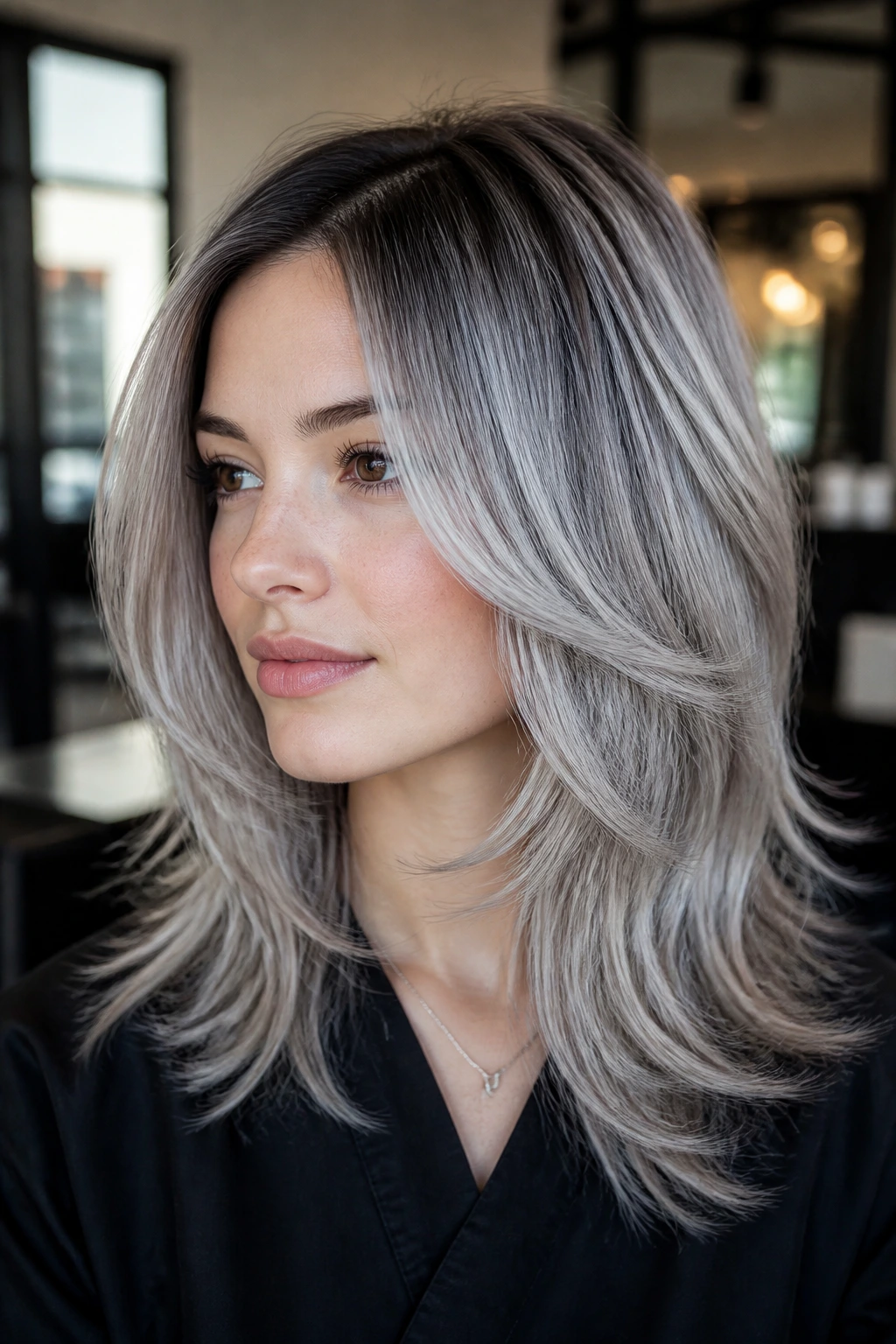
Porcelain silver is one of the most delicate versions on the list. It’s pale, yes, but the trick is keeping enough depth under the layers so the silver doesn’t wash the face out. On fair skin, that usually means a deeper root and a clean gloss through the lighter sections.
I’d use this on layered cuts, because the movement of the cut helps the silver catch in narrow bands rather than one solid sheet. That keeps the look airy. It also makes the hair feel lighter, visually, which is nice if your complexion is already very pale.
If you want an almost frosted result without losing dimension, this is the one to show your colorist. It’s not for everyone, but when it works, it really works.
19. Cool Taupe and Slate Lowlights
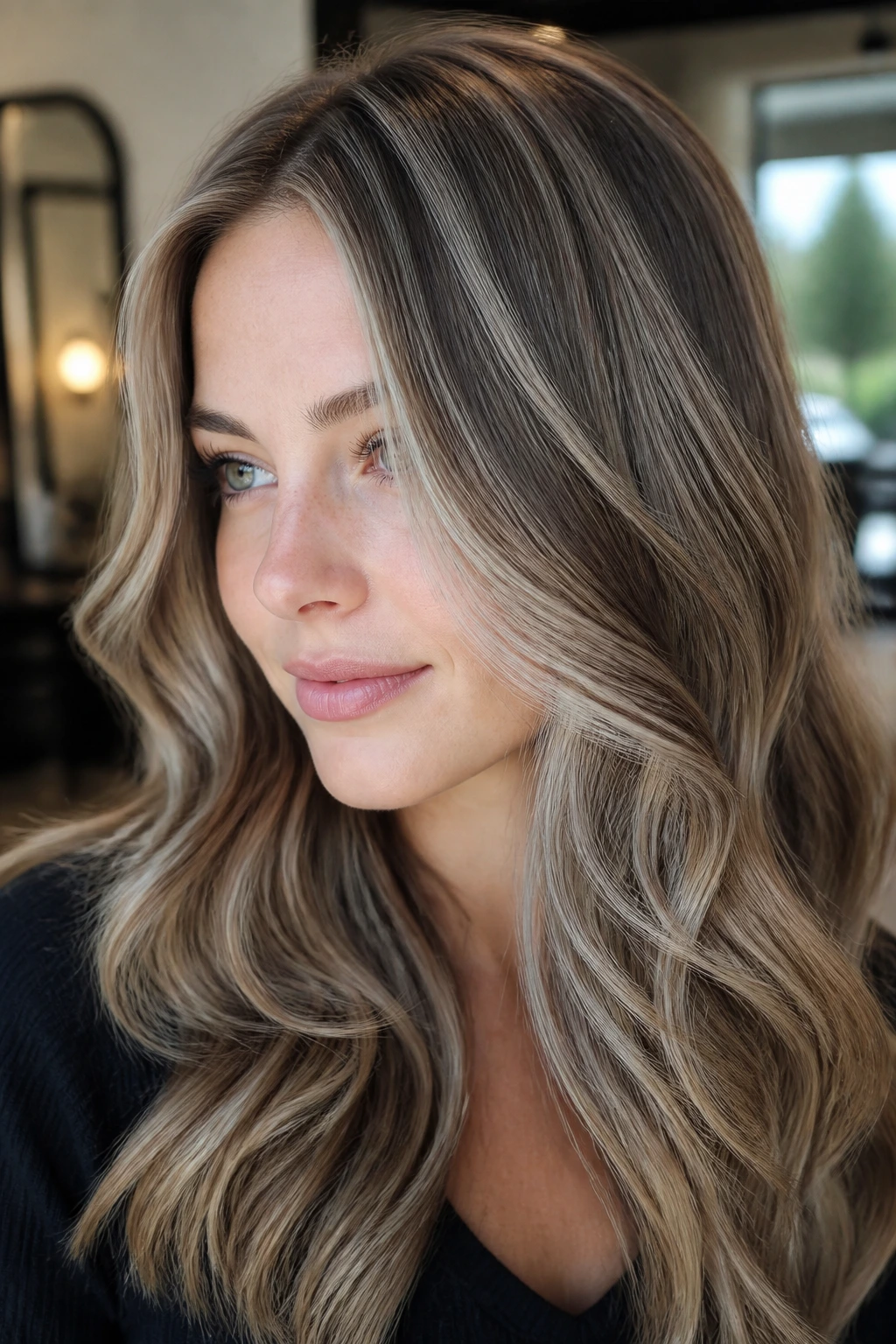
Not every grey-dark transition needs to be bright. Sometimes the best move is to tuck in cool taupe and slate lowlights so the lighter pieces have a darker neighbor to sit against. That creates depth, and depth is what keeps fair skin from blending into the hair.
This option is especially good if your base is already light brown or dark blonde. You don’t have to do a huge lift. The lowlights do the heavy lifting by giving the color more structure and a more natural grow-out line.
I like this when the client wants something quiet, not flashy. It gives the hair a smoked, lived-in feel. No drama. Just good shape.
20. Frosted Smoke Pixie Accent
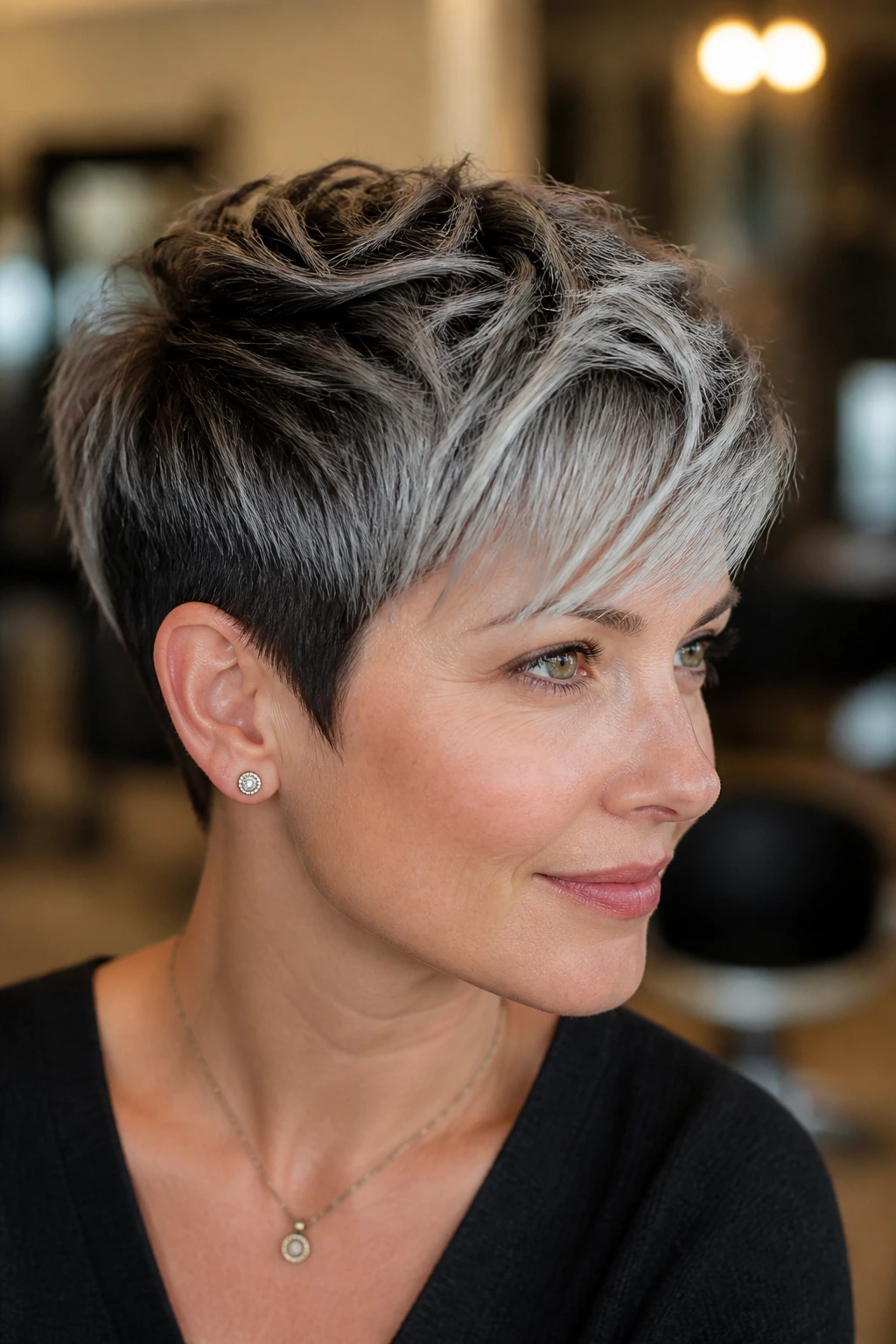
Short hair needs a different kind of color thinking. A pixie can’t rely on long ribbons or dramatic ombre, so frosted smoke accents have to do the talking. A few cool grey pieces near the crown, temple, and fringe can completely change the silhouette on fair skin.
What to watch for
The highlights should be small and placed with purpose. Too much lightness on a short cut turns busy fast. Keep the roots shadowed and the accents broken up. That gives the cut movement without making it look speckled.
Who it suits
This is good for anyone who wants a low-commitment grey-dark transition on a short style. It also works if your hair is fine and you want the illusion of texture. The smoky accents add shape where a pixie can sometimes look flat.
21. Storm Cloud Balayage
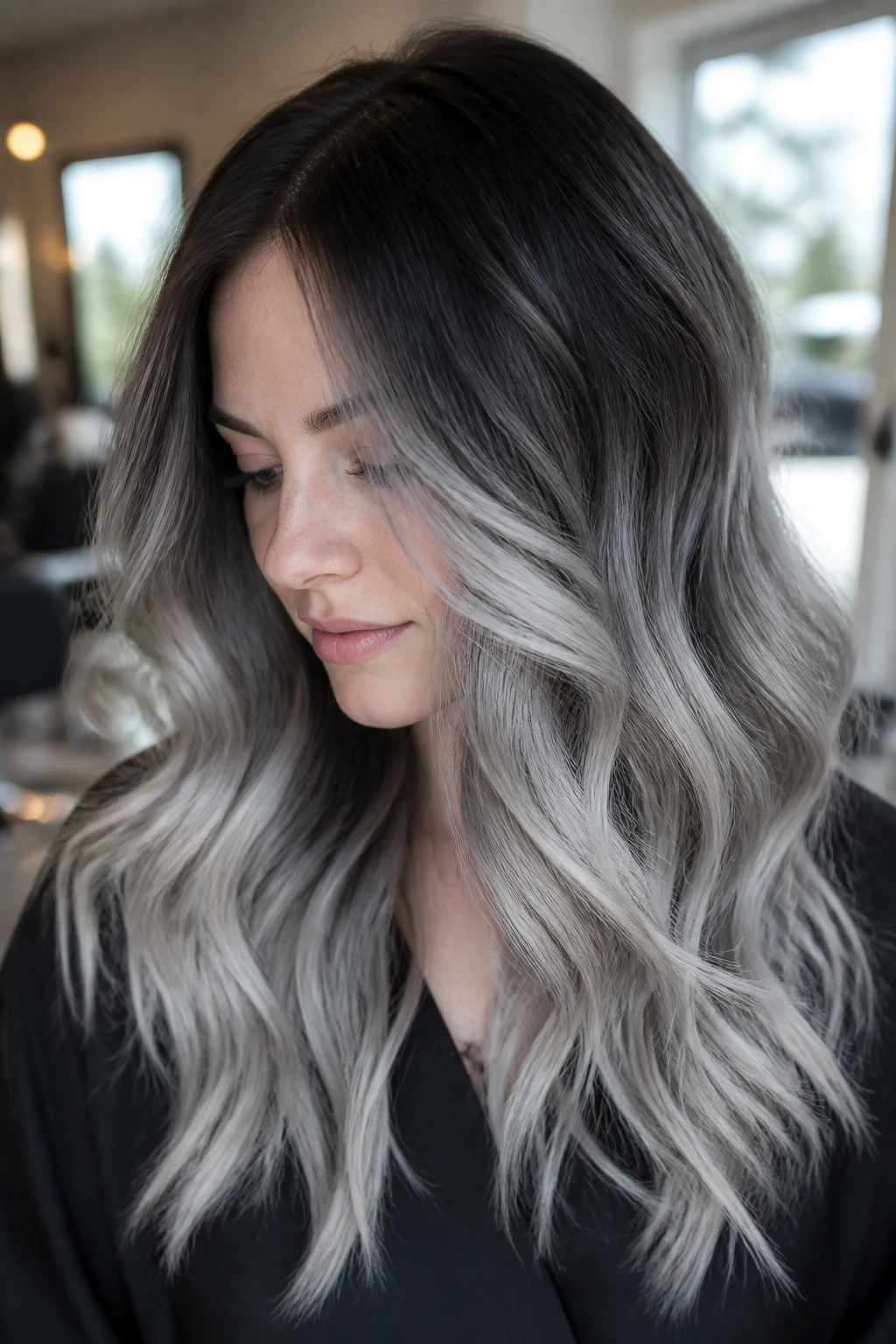
Storm cloud is one of the moodier looks here, and I mean that in a good way. The base stays deep, the mids turn smoky, and the ends drift into soft silver like weather rolling across the sky. On fair skin, that kind of depth can feel elegant instead of harsh because the light pieces are never left hanging alone.
Why it reads well on pale skin
The dark sections give your complexion enough contrast to stay lively. The silver sections then show up as a cool shimmer rather than a full bleaching event. It’s a controlled look, which is why I keep coming back to it for clients who want edge but not chaos.
Styling note
A loose wave or rough-dried texture suits it better than pin-straight hair. The movement helps the storm-cloud effect show up in pieces instead of one flat block of grey.
22. Carbon Ash Underlights
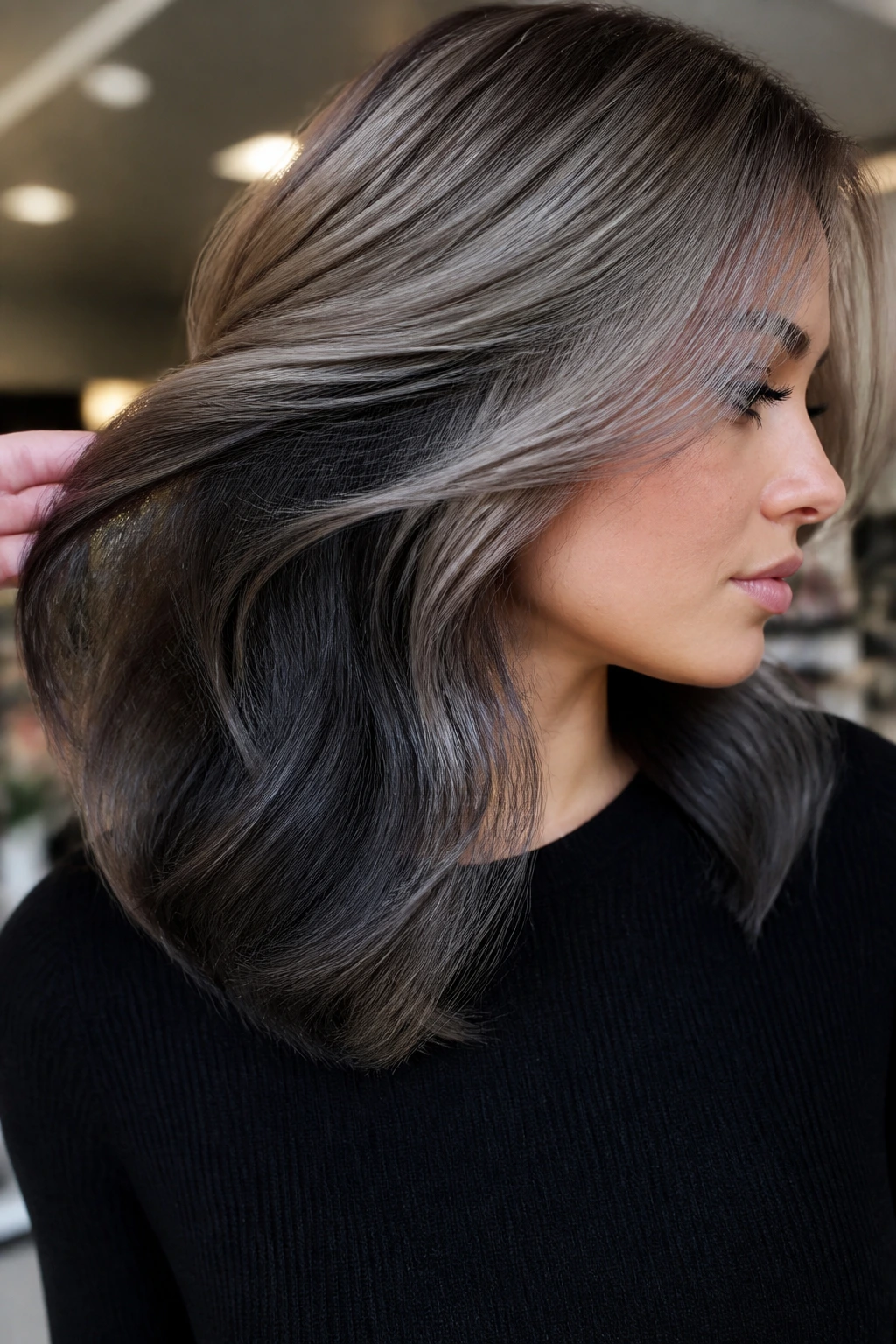
Underlights are underrated. Put carbon ash panels underneath a lighter top layer, and the color becomes visible when the hair moves, flips, or gets tucked behind the ears. On fair skin, the hidden depth helps the lighter pieces look intentional rather than bland.
Can this work on fine hair? Yes, and that’s part of the appeal. Because the darker color lives underneath, the visible surface stays brighter without losing structure. It’s a clever move if you want grey-dark transition highlights without going too high in contrast.
I also like this for people who wear updos a lot. The underlights show through braids, buns, and half-up styles in a way that feels modern without needing a lot of styling effort.
23. Satin Silver Peekaboo
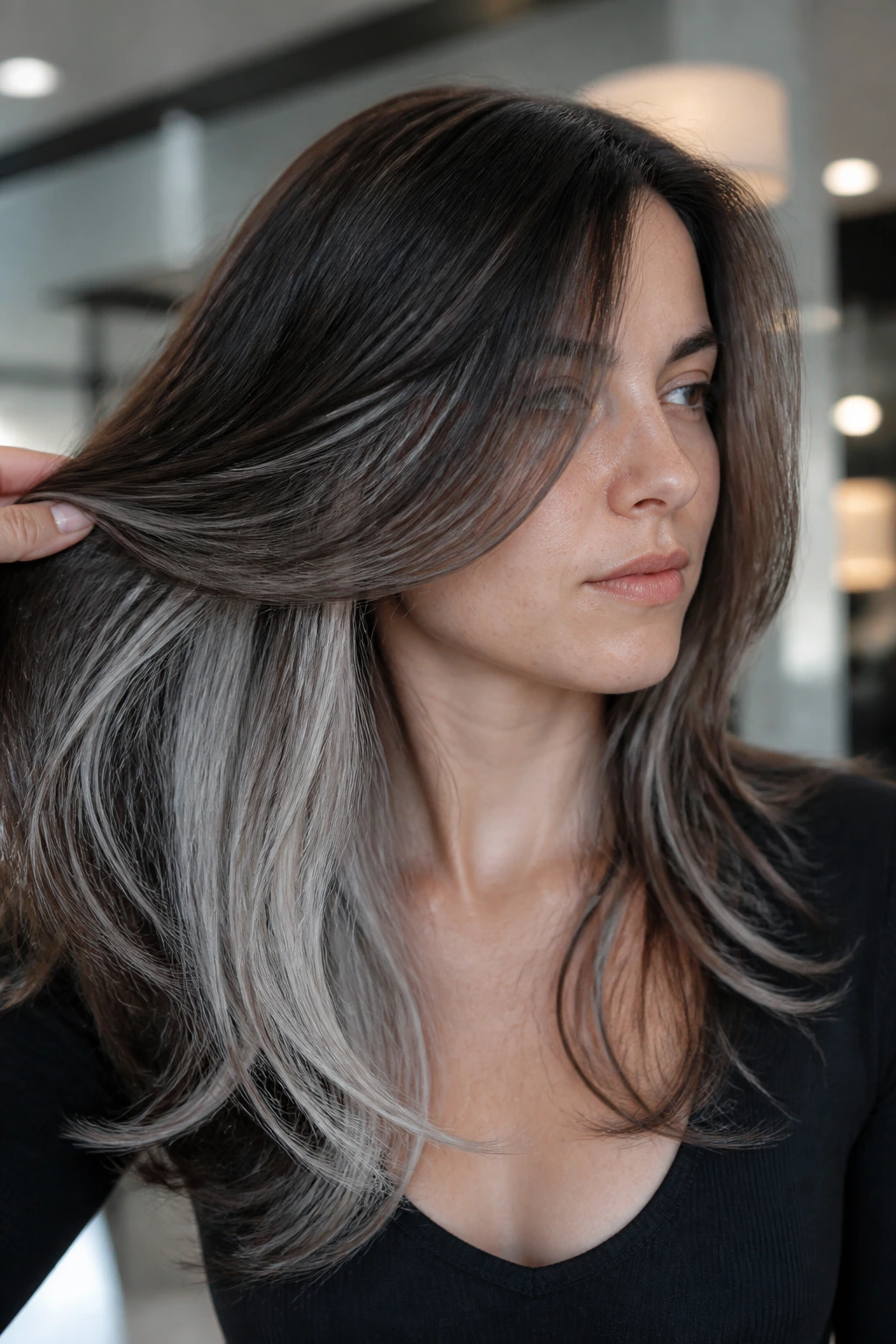
Peekaboo highlights are for people who like a surprise. The silver sits underneath the top layer, so it peeks out as the hair moves instead of announcing itself all at once. On fair skin, that can be a nice way to keep the look cool and fresh without overloading the face with brightness.
The top layer should stay darker — think mushroom, ash brown, or slate — so the silver has something to contrast against. That contrast is what gives the style its lift. Without it, the peekaboo effect disappears.
I’d recommend this if you want a low-key color that still has personality. It’s also easy to hide if you need a quieter look for certain settings. That flexibility is useful.
24. Dusty Lavender Balayage
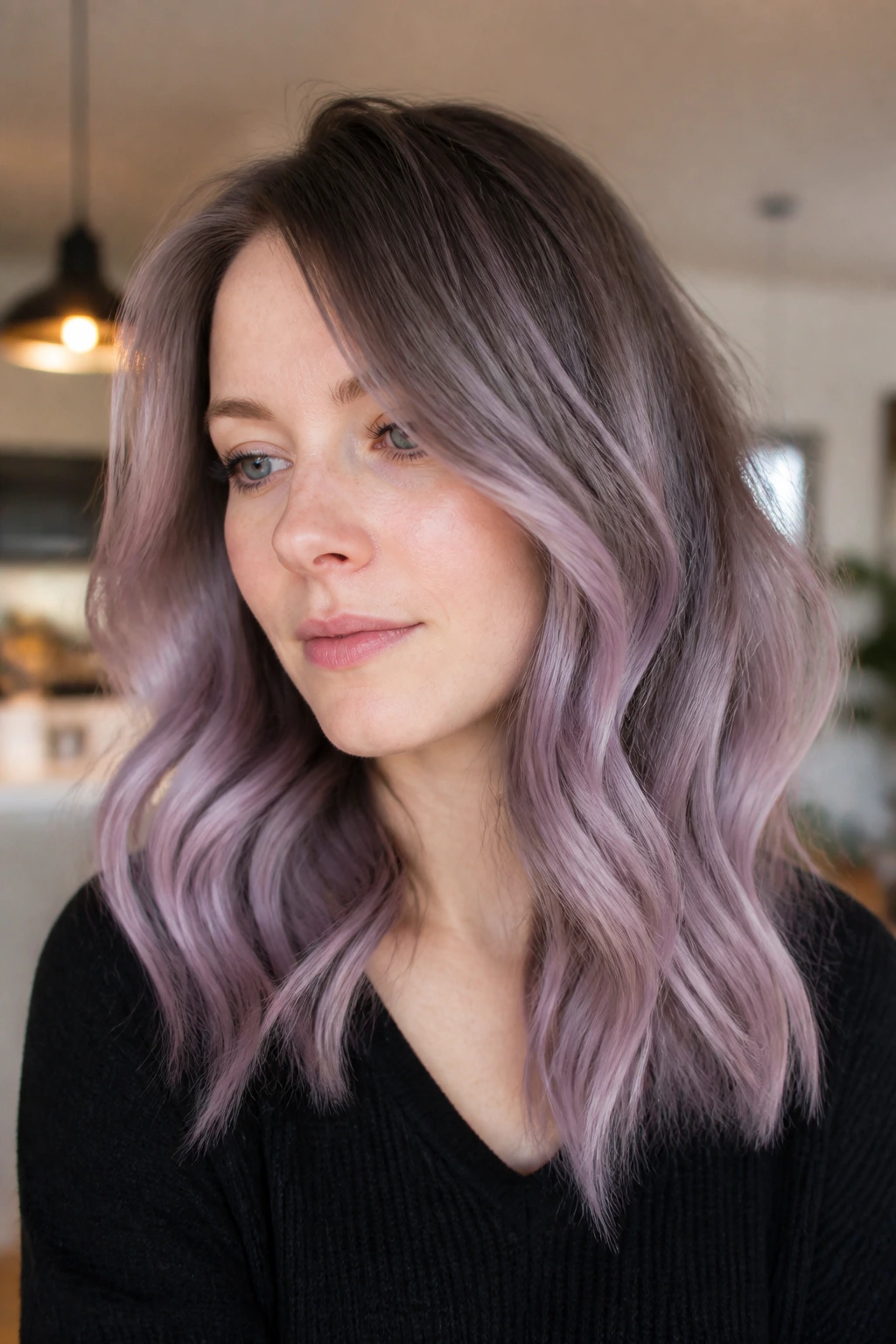
Dusty lavender is the softer cousin of vivid purple, and it behaves better on fair skin because it lives in the grey family. The muted purple through the mids and ends keeps the color cool, but it doesn’t tip into toy-like brightness. That’s the whole appeal.
This is a good look for someone who wants a little more softness than silver alone gives. The lavender note can make pale skin look calmer and less stark, especially if your undertone leans pink. It also pairs well with waves, because the bends show off the lavender-grey shift in little flashes.
I wouldn’t push this too pastel. The muted version is the one that stays elegant. Too much lilac can read playful; dusty lilac reads deliberate.
25. Glacier Grey Face Framing
A glacier-grey face frame is the bright, crisp cousin of the smoke frame. It uses pale, icy grey around the face, while the interior stays darker and grounded. On fair skin, that can be a striking look because the face-framing pieces act almost like a halo, but cooler.
The balance that matters
The front strands need to be light enough to pop, but not so white that they flatten the complexion. A little grey in the tone keeps them from going harsh. The darker underlayers do the rest of the work.
Best if you want
A high-contrast look that still feels polished. It’s especially strong on long layers and center parts. If you like a style that looks a bit different from every angle, this one has that quality.
26. Charcoal Pearl Slices
Charcoal pearl slices combine two ideas that play well together: depth and shine. The charcoal gives the color structure, and the pearl slices bring in a soft reflective sheen. On fair skin, the result is balanced. The face doesn’t get swallowed, and the color doesn’t disappear.
How it should be placed
The slices should be thin enough to move, but not so thin that they vanish. You want to see them when the hair falls naturally, not only when you part the sections with your fingers. That’s the sweet spot.
Why I like it
It works on straight hair, wavy hair, and even a looser curl pattern. The pearl note keeps the grey from looking dull, which is the biggest risk with darker transition shades. This is one of the more wearable options on the list.
27. Soft Pewter Waves
Can grey be warm enough to feel soft? Pewter answers that nicely. It has enough silver to stay cool, but enough depth to avoid the sterile look that some icy colors pick up on fair skin. On waves, it reads like a foggy shimmer through the bends.
I’d pick this for medium-length hair because the movement really matters. The pewter catches on each curve, which keeps the color from looking flat. If the hair is straight and pin-straight, the effect can lose some of its charm.
It’s also a smart choice if you don’t want to bleach aggressively. Pewter sits in a more forgiving zone than pure platinum or white silver, and that can matter when hair history is messy.
28. Noir-to-Silver Contrast Melt
This is the boldest look on the list, and it’s not subtle. Noir at the roots, silver through the lengths, and a full melt between the two gives fair skin a high-contrast frame that looks sleek instead of harsh when the transition is handled well. The darker root keeps the face from getting washed out, which is the main reason this style works at all.
If you want the drama, keep the silver pieces fine enough that they don’t turn into a flat panel. Movement matters. A few softer pieces through the front and around the ears stop the look from feeling like a single block of contrast.
I’d save this for people who like their hair to read from across the room. It’s the least quiet option here, and that’s the point. When it’s done cleanly, it has real presence.
Why Grey-Dark Transition Highlights Suit Fair Skin Best
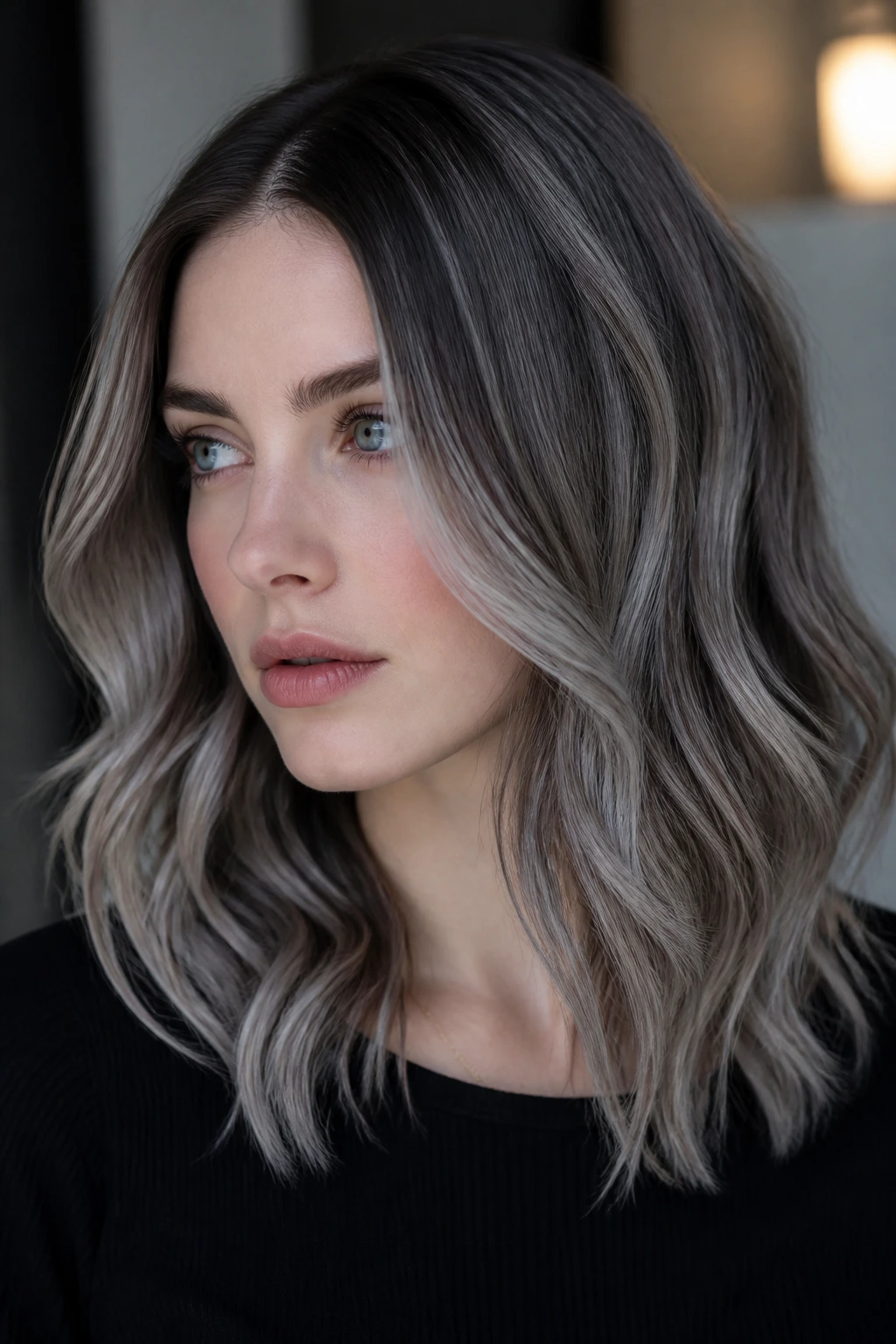
Fair skin can take contrast. It just needs the contrast shaped with some care. That’s why these looks lean on root shadows, smoky mids, and cool finishing tones instead of going straight to white-silver from scalp to end. The darker base gives the face a frame; the lighter pieces give it lift.
The shade family matters more than people think. Mushroom, slate, pewter, graphite, pearl, and taupe-grey all sit differently against pale skin, and the wrong one can make the face look drained. Cool undertones usually love ash and graphite. Rosy undertones often do better with pearl or beige-grey because those shades don’t sharpen redness.
There’s also the old salon truth that almost nobody says plainly enough: the cleaner the lift, the better the grey reads. If hair has too much leftover orange or gold in it, grey toner can go muddy. That’s why a good transition look is not just about choosing “grey.” It’s about getting the underlying canvas right and then shading it with intent.
Essential Tools and Products for These Looks
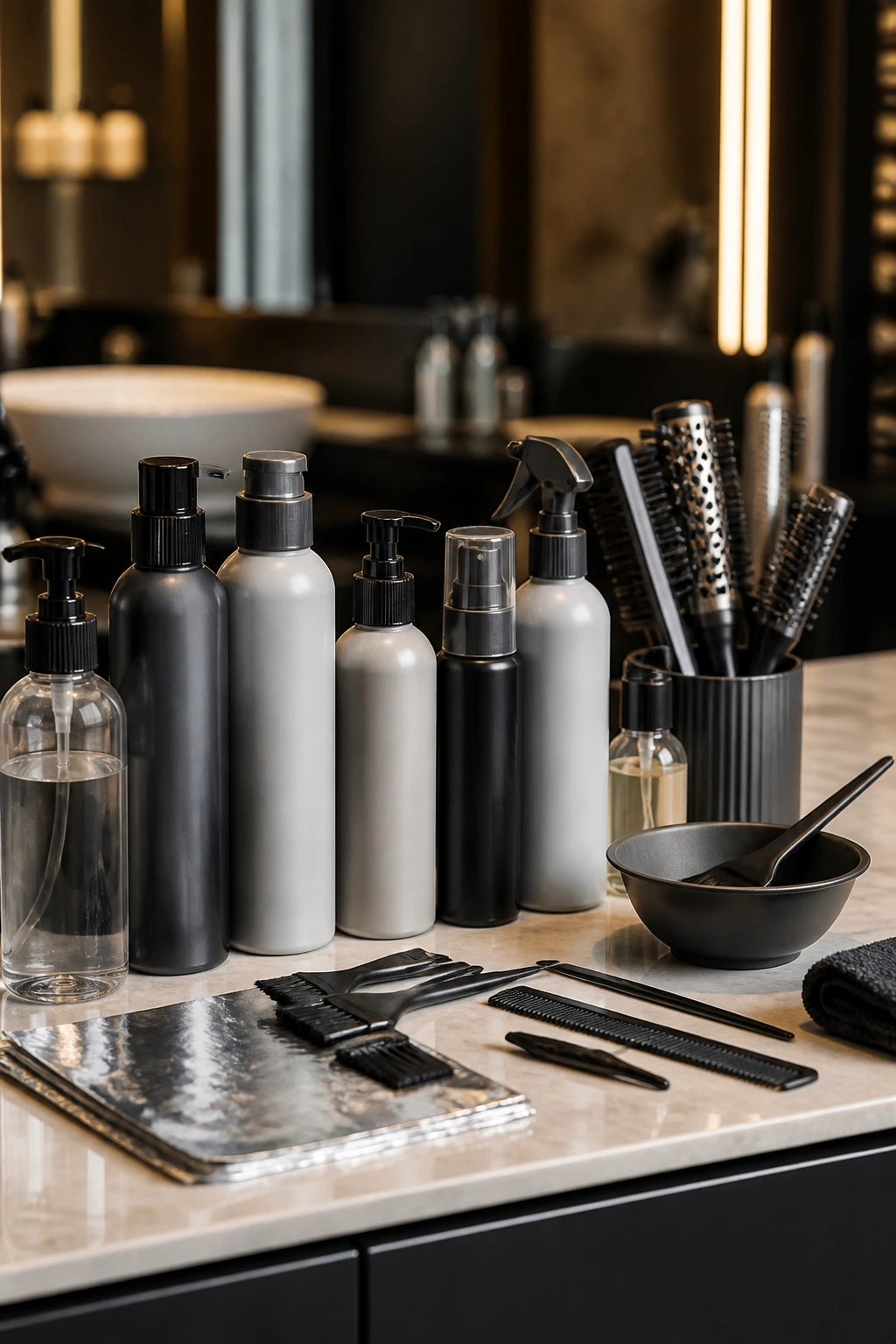
- Color-safe sulfate-free shampoo: Keeps smoky and silver tones from fading out too fast in the wash.
- Purple or blue-violet shampoo: Best for icy silver, pearl, and pale grey; use it sparingly so the hair doesn’t go chalky.
- Deep conditioner or mask: Grey and silver services can leave the hair thirsty, so a weekly moisture mask keeps the ends from feeling rough.
- Heat protectant spray: Use it before blow-drying, curling, or straightening. Grey tones show damage fast.
- Wide-tooth comb: Helps detangle without snapping fragile lightened hair.
- Microfiber towel or soft cotton T-shirt: Cuts down on frizz and roughness when the hair is wet.
- Gloss or color-depositing glaze: Useful between salon visits if the silver starts to dull or the smoke tone shifts too warm.
- Sectioning clips: Handy for at-home styling, especially if you’re trying to keep face-frame pieces separate.
- Boar-bristle or mixed-bristle brush: Good for smoothing the top layer once the hair is dry.
- Salon toner reference photo: Not a tool in the literal sense, but it matters. A picture in daylight and a picture in indoor light both help.
How to Ask for Grey-Dark Transition Highlights at the Salon
Bring photos, but bring the right kind. One screenshot in dim bathroom lighting tells the colorist almost nothing. Bring at least two or three images taken in plain daylight and, if you can, one under indoor light. Grey tones change fast depending on the light source, and a good colorist will want to see how much smoke, silver, or beige-grey you actually mean.
Say the words your stylist needs to hear: root shadow, melt, babylights, teasylights, money piece, lowlights, gloss. Those terms give shape to the request. If you only say “grey highlights,” you may get a tone that’s too flat or too icy for your skin.
The haircut matters too. A layered cut shows off ribbons and underlights better than a blunt line. A bob can still wear grey-dark transition color, but the placement has to be tighter so the color doesn’t look chopped off. On fair skin, I’d usually favor softer diffusion near the hairline and more depth under the top layer. That keeps the face bright without losing structure.
How to Wear These Shades So They Read Soft, Not Harsh
Parting: A center part is the easiest way to show off a face frame, curtain pieces, or a clean transition at the crown. A soft side part makes the color feel more relaxed and can hide a stronger root shadow if you want less contrast.
Styling: Loose waves are the safest bet for most of these looks because they break up ribbons and make the grey move. Pin-straight hair is sharper and more dramatic, which can be great, but it also exposes every seam in the color. If your transition is very subtle, a wave or bend helps the tones show up.
Makeup: Cool blush, taupe brows, soft berry lips, and a satin skin finish tend to sit nicely beside silver and ash hair. Heavy orange bronzer can fight the cooler tones unless your skin truly needs the warmth.
Clothes: Charcoal, denim, soft white, dusty plum, slate, and washed black all play well with grey-dark transitions. Bright neon warms can feel disconnected unless that’s the point.
Additional Tips and Tone Boosters
Gloss Boost: If the silver starts looking dusty, ask for a clear or smoky gloss instead of another full color service. A gloss refresh can keep the tone sleek without re-lightening the hair, which is kinder to the cuticle and usually faster in the chair.
Contrast Control: The brighter the front pieces, the more careful you need to be with the back and interior. I like a stronger money piece when the rest of the hair has noticeable shadow underneath. It keeps the face bright while the overall shape stays grounded.
Texture Shift: Fine hair usually looks best with babylights or thin ribbons. Thick hair can handle bigger slices and underlights. Curly hair needs softer placement because the curl pattern naturally compresses the color when it dries.
Make-It-Yours: If you want a lower-maintenance version, choose mushroom, taupe, or pebble grey. If you want more edge, add graphite, charcoal, or steel. If you like a softer finish, let pearl or beige-grey sit in the mix so the hair never gets too severe against fair skin.
Maintenance, Glossing, and Grow-Out Care
Grey and silver tones need a little babysitting, but not the kind that takes over your life. The biggest rule is simple: don’t wash them too often. Two to three washes a week is a good target for most people, especially if you’re using a sulfate-free shampoo and a moisture conditioner after each cleanse.
For icy shades — pearl, silver, porcelain, glacier — purple shampoo once every 7 to 10 days is usually enough. If your hair is porous or very lightened, even that can be too much, so watch the texture. If the hair starts feeling squeaky, chalky, or faintly lilac, back off. Smokier looks like mushroom, slate, or pewter often need purple shampoo less often, sometimes only every two weeks.
Salon glosses matter more than people expect. A high-contrast silver look may need a gloss every 4 to 6 weeks to keep the tone clean. Softer smoky blends can stretch to 6 to 8 weeks. If your root melt is intentional and you like the grow-out, you can often push the color service longer and just ask for a toner refresh or face-frame touch-up in between.
Heat is another thing to respect. Use a heat protectant every time you blow-dry or style with hot tools. If you use a flat iron often, keep the temperature lower than you think you need; silver and ash tones show heat damage fast, and damaged ends make the whole look feel dull. A trim every 8 to 10 weeks helps too. Grey hair color looks sharper when the ends are clean.
Variations and Adaptations to Try
Porcelain Pearl Melt: This version keeps the silver pale and luminous, then softens it with a pearl gloss so fair skin doesn’t look drained. It’s a better fit for cool or neutral undertones than stark white silver.
Mushroom Smoke Blend: A safe, wearable choice for people who want grey-dark transition highlights without much upkeep. Mushroom brown at the root and soft smoke through the mids gives you depth, shine, and a cleaner grow-out line.
Lavender Ash Fade: The grey carries a faint lilac cast from root to tip. This is the one I’d suggest for rosy fair skin, because the purple note stops the complexion from looking too red next to the hair.
Money-Piece Drama: Keep the front pieces icy and bright while the back stays charcoal or slate. It’s the quickest way to brighten the face without changing the whole head.
Curly Cloud Ribboning: On curls and coils, use softer, broken-up grey ribbons instead of hard foils. The color should follow the curl pattern, not fight it. That gives you a cloudlike effect instead of a striped one.
Common Mistakes to Avoid
- Going too blue-black at the root: On fair skin, a hard blue-black base can look severe and make the face look paler than you want. A charcoal or graphite shadow is usually safer.
- Choosing one flat grey tone: If every strand is the same silver, the hair can look dry and one-note. Add lowlights, a root melt, or a pearl glaze so the color has movement.
- Overusing purple shampoo: Too much purple shampoo can leave the hair chalky or faintly lilac. Use it sparingly and follow with a rich conditioner.
- Ignoring undertone: Cool silver can be gorgeous on cool fair skin, but rosy or peachy fair skin may need beige-grey or pearl to keep the face lively.
- Skipping the gloss plan: Grey shades fade fast if you never refresh the tone. A gloss schedule keeps the smoke clear and prevents brass from creeping in.
Frequently Asked Questions
Can grey-dark transition highlights work on very fair skin without washing it out?
Yes, if there’s enough depth in the root and midsection. The color should not be a single silver sheet from scalp to ends; mushroom, slate, graphite, or taupe understructure keeps the complexion from disappearing.
Do I need bleach to get these shades?
Usually, yes, if you want true silver, pearl, or icy grey. Darker smoky versions can sometimes be built with less lift, but clean grey tones almost always need a pale starting canvas.
What if my hair pulls yellow when it’s lightened?
That’s where toner comes in, but toner is not magic. The cleaner the lift, the better the grey will hold. If the hair is still yellow-orange underneath, ask for another lightening pass or a softer mushroom-grey tone instead of forcing silver.
Which version is lowest maintenance?
Mushroom smoke, pebble grey, taupe-slate lowlights, and a root melt tend to grow out best. They keep the regrowth line softer and don’t demand as many gloss appointments.
Can curly hair wear grey-dark transition highlights?
Absolutely, but the placement needs to follow the curl pattern. Fine stripes disappear inside curls and can look spotty, so softer ribbons, underlights, or contour pieces usually work better.
Will this look suit warm fair skin?
Yes, but the tone family matters. Warm fair skin usually does better with mushroom, beige-grey, pewter, or pearl than with an icy blue-grey that can fight the complexion.
How often should I get the color refreshed?
For a bright silver look, every 4 to 6 weeks is common. Smokier blends can often go 6 to 8 weeks before they need a gloss or toner touch-up.
Can I ask for a version that grows out softly?
Definitely. Ask for a root shadow one to two levels deeper than the mids, with babylights or teasylights instead of chunky foils. That gives you a softer line and fewer awkward weeks between appointments.
The Shade That Grows Out Clean
The best grey-dark transition highlights for fair skin are the ones that keep a little shadow in the picture. That shadow gives pale complexions shape. Without it, silver can drift into flatness, and that’s the fastest way to lose the whole point of the color.
What I like most about this group is how many directions it can go. You can stay smoky and quiet, or push toward icy contrast, or sneak in lavender, pebble, or pearl so the shade feels more like yours. The common thread is balance. Depth first. Light second.
If you take one thing from all of this, let it be that the transition matters more than the grey. Nail the fade, and the whole look starts behaving.