



Blending gray hair for tan skin with thick hair works best when you stop trying to erase every silver strand and start thinking in layers. Thick hair eats color in a strange way: a shade that looks soft on a swatch can turn muddy once it’s spread through dense sections, and a highlight that seems bright in the bowl can disappear the second it’s surrounded by all that bulk.
Tan skin adds another wrinkle. Warm tan, olive tan, and neutral tan all play differently with beige, caramel, mushroom, bronze, and ash, which is why the same formula can look expensive on one person and oddly harsh on another. The trick isn’t chasing the lightest blond pieces possible. It’s choosing tones that make the gray feel intentional, then placing them where thick hair actually shows movement.
Depth matters. So does restraint. The best blends here usually look less like “cover everything” and more like “build a color map the eye can follow.”
Why These Blends Work on Tan Skin and Thick Hair
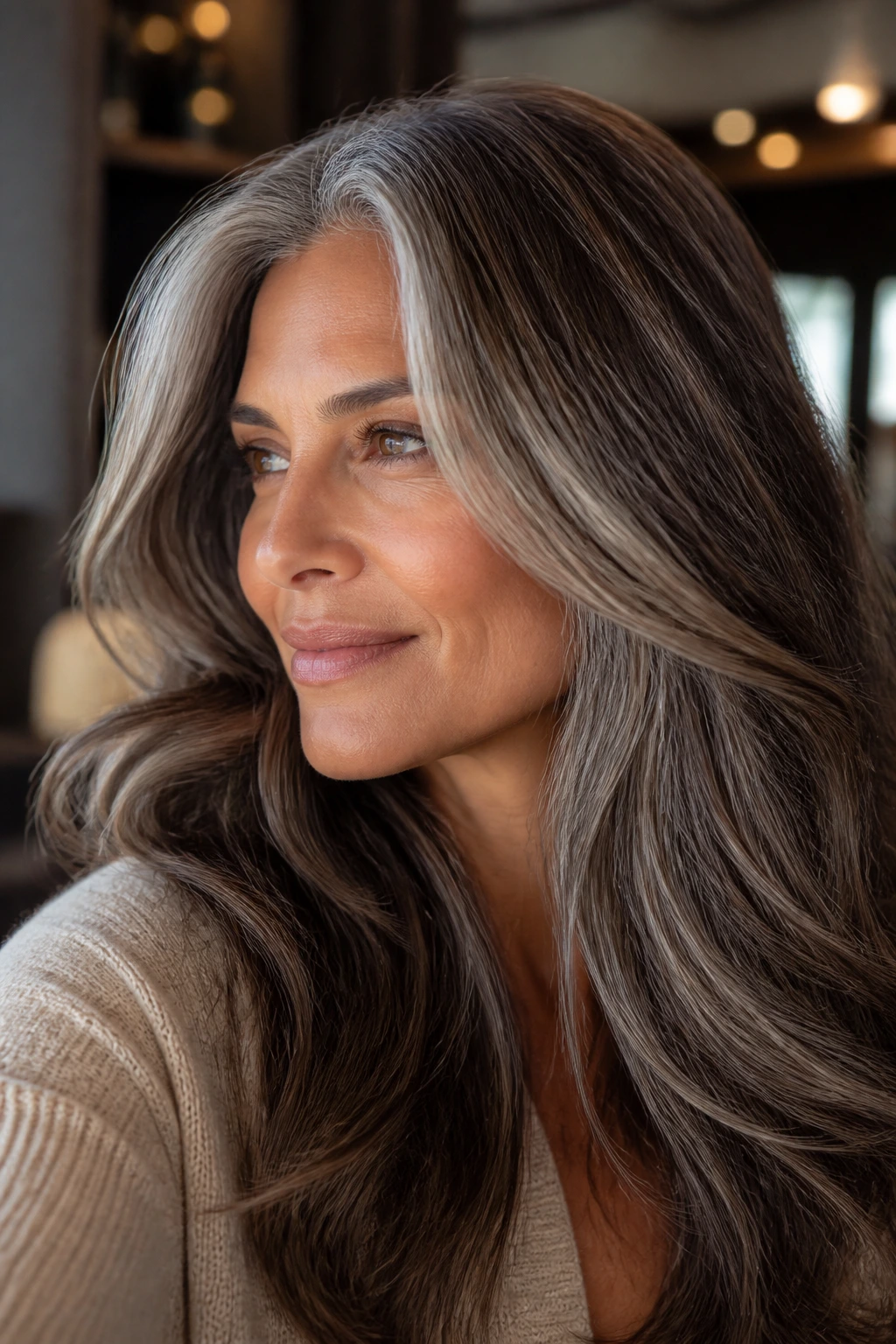
Warmth has to be edited, not erased: Tan skin can take caramel, bronze, honey, and chestnut, but those tones need a little smoke or beige so they do not drift orange against gray.
Thick hair needs interior color: Dense hair hides surface-only highlights, so the best blends push lowlights and ribbons into the middle of the hair, not only the top layer.
Gray looks softer when it shares space: Instead of hiding every silver strand, a good blend lets some gray live beside mushroom brown, taupe, or pearl beige so the regrowth line never turns into a hard stripe.
Grow-out matters as much as the day you leave the salon: Root smudges, shadow roots, and demi-permanent glosses keep the line at the part from looking like a neon ruler.
Movement shows the work: Waves, bend-dry styling, and layered cuts reveal dimension in thick hair; pin-straight styling can flatten even a very good color job.
1. Mushroom Brown Balayage
Mushroom brown is one of my favorite places to start when tan skin and thick hair need a gray-blending reset. It sits in that sweet spot between cool and warm, so the gray doesn’t jump out as stark white, but the hair also doesn’t take on the flat, muddy look that can happen with too much ash.
This works because thick hair can hold onto multiple brown levels without looking busy. Ask for balayage pieces that are only 1 to 2 levels lighter than your base, with a soft beige-brown gloss over the top. If your gray is concentrated at the temples or part line, keep those pieces slightly brighter and let the interior stay deeper.
The finish should look like smoke, not stripe. On tan skin, mushroom brown keeps the face from going ruddy the way a pure copper or gold highlight can.
2. Mocha Root Smudge
Why does a mocha root smudge work so well on thick hair? Because it takes the brightest part of gray—the root line—and turns it into a shaded transition instead of a hard border.
Use a demi-permanent mocha or soft neutral brown at the scalp, then melt it into lighter mid-lengths. On tan skin, mocha reads rich and grounded, especially if your undertone leans golden or olive. The key is to keep the root smudge thin and soft. If the root area spreads too far down, the color can look heavy and cover the face.
I like this for people who wear their hair up a lot. Thick hair pulled into a ponytail shows the regrowth line more than most styles, and a root smudge keeps that area from looking patchy.
3. Caramel Ribbon Lights
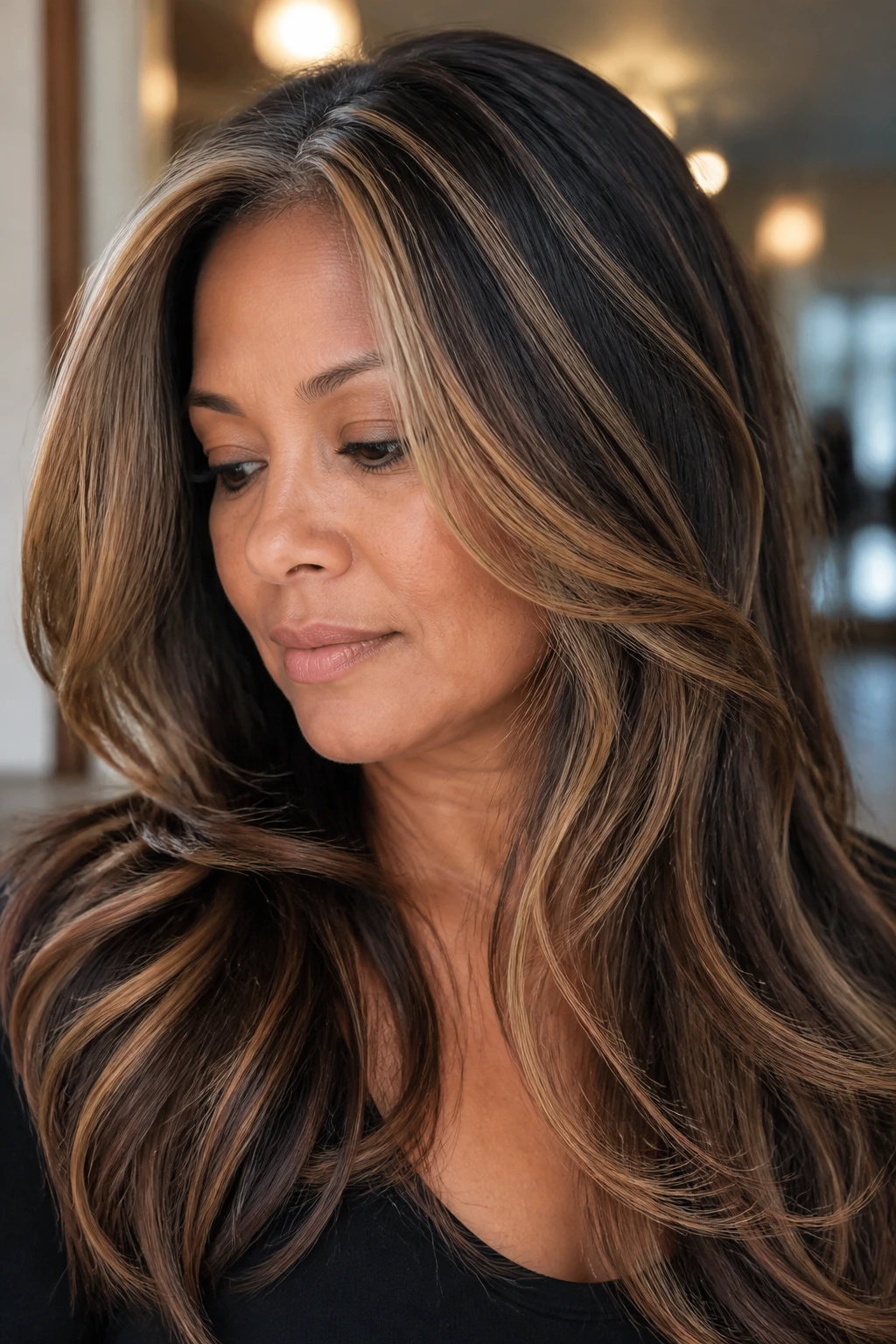
Caramel ribbon lights are the move when you want the gray to disappear into warmth instead of smoke. Think of wide, deliberate ribbons of caramel woven through thick hair, not tiny little sparks that vanish once the hair dries.
On tan skin, caramel can be gorgeous, but it has to be tempered. A beige caramel or honey-caramel formula usually beats a yellow blond one, which can turn brassy fast. The best placement is around the front, the crown, and the outer layers where the hair actually swings. Thick hair needs those ribbons a little wider than fine hair does.
A few well-placed caramel pieces can soften gray at the hairline, especially if your silver is clustered near the face. Keep the root area deeper so the ribbons have somewhere to land.
4. Ash Brown Lowlights
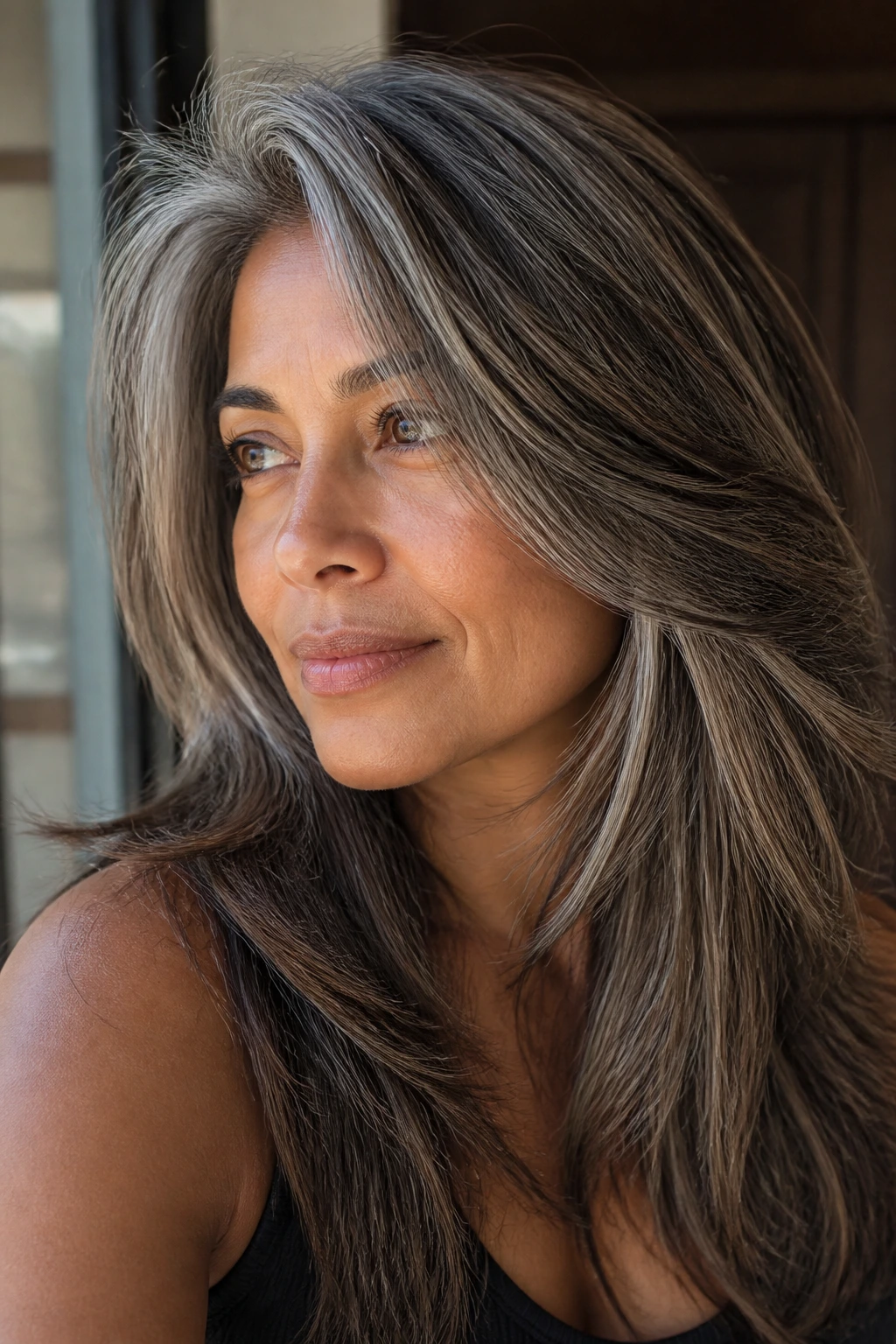
Ash brown lowlights sound like a small move. They are not. On dense hair, they can change the whole shape of the color by making the gray look like part of the design instead of an interruption.
This is the fix for hair that has too many bright pieces already. If the hair is mostly gray with a few warm tones left, ash lowlights add structure. Tan skin can handle ash brown as long as it isn’t dragged too cool. I prefer ash used in pockets, not as an all-over blanket. A few cool strands near the crown and underlayers give the eye a place to rest.
Best when:
- Your gray is bright and patchy.
- Your hair feels bulky after lightening.
- You want less warmth and more contrast control.
Skip the blue-black route. That goes harsh fast.
5. Beige Blonde Babylights
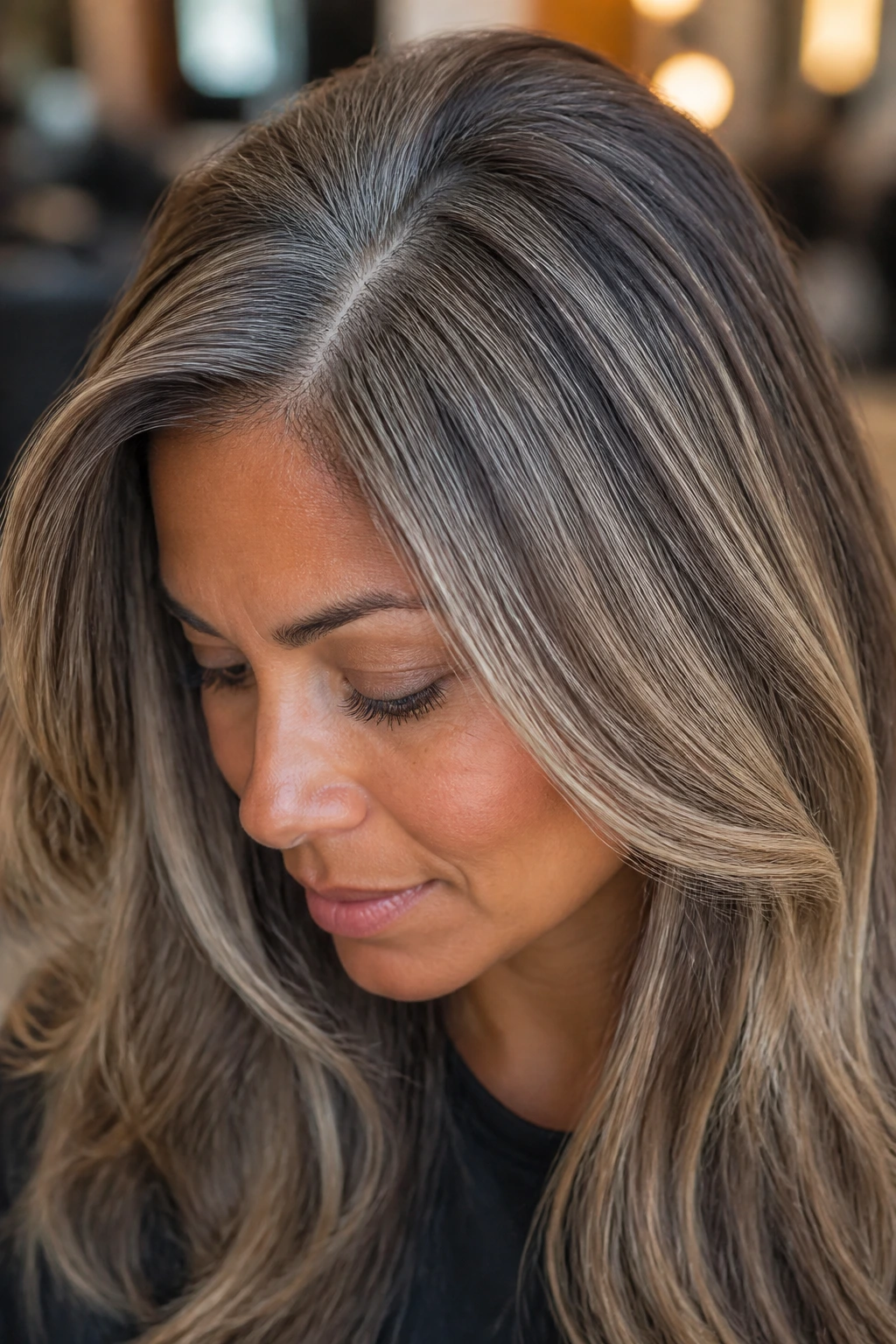
Beige blonde babylights are the polite answer to gray blending. Tiny foils, fine placement, soft beige tone. Nothing loud. Nothing chunky.
They work especially well on thick hair because dense hair can swallow delicate highlights unless the sections are truly fine. The point is not to go platinum. The point is to create enough pale beige movement that the gray reads as part of a soft weave. On tan skin, beige is safer than icy blonde because it doesn’t bleach the warmth out of the complexion.
I’d use this for scattered gray that appears around the part and crown, not for a fully silver base. A gloss every 4 to 6 weeks helps keep the beige from getting too yellow.
6. Chestnut Shadow Root
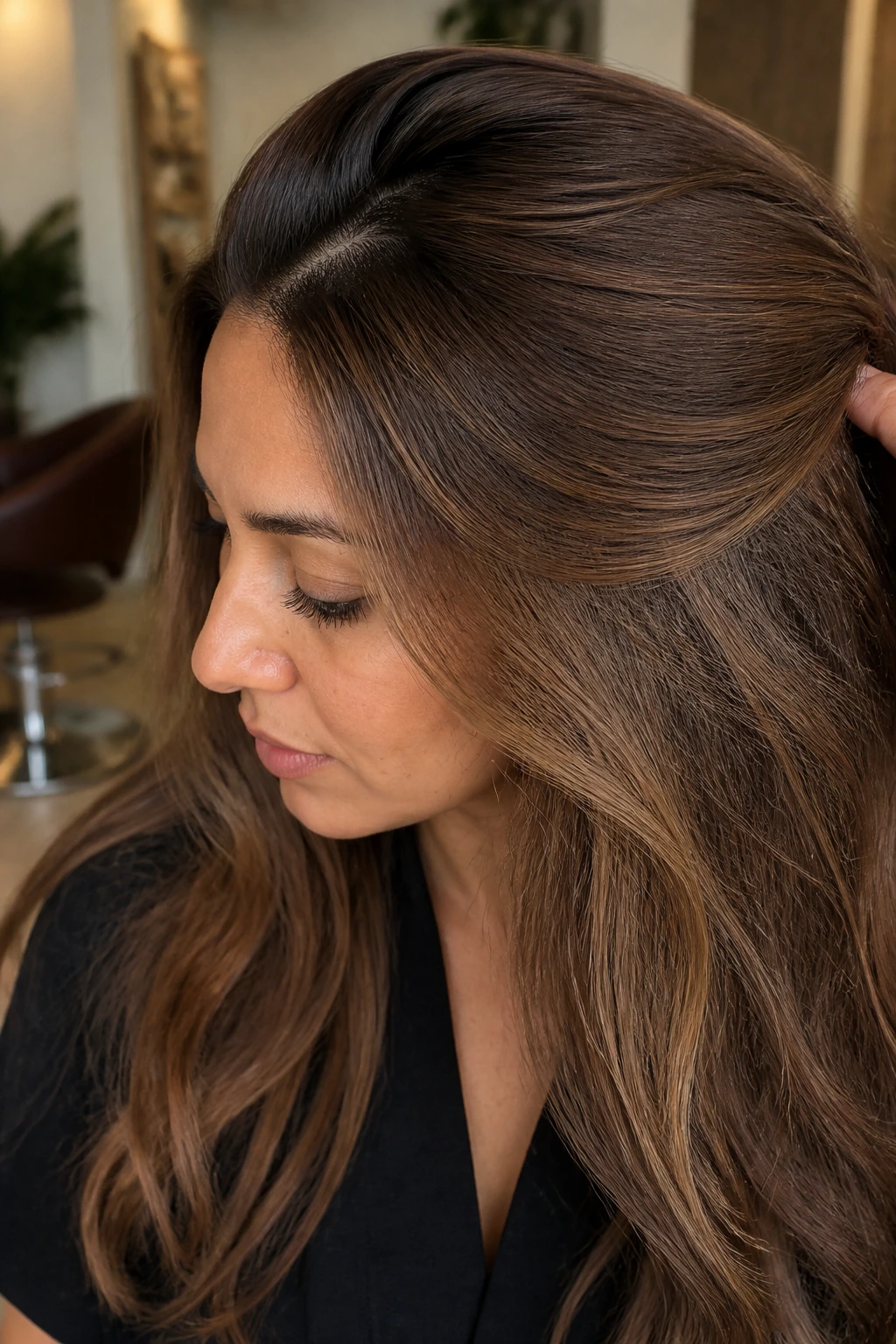
Chestnut is underrated. People rush toward lighter shades when they want to blend gray, and that’s often a mistake on thick hair. A chestnut shadow root gives you warmth, depth, and a clean grow-out in one shot.
Use a shadow root about 1 to 2 inches deep, then fade into softer brown lengths. The chestnut tone keeps tan skin from looking flat, especially if the undertone is warm or golden. It also helps gray at the root line recede instead of shining like a bright stripe against a lighter base.
This is one of the better options if your hair is heavy and layered. The deeper root helps the layers read separately, which matters more than people think.
7. Bronde Melt
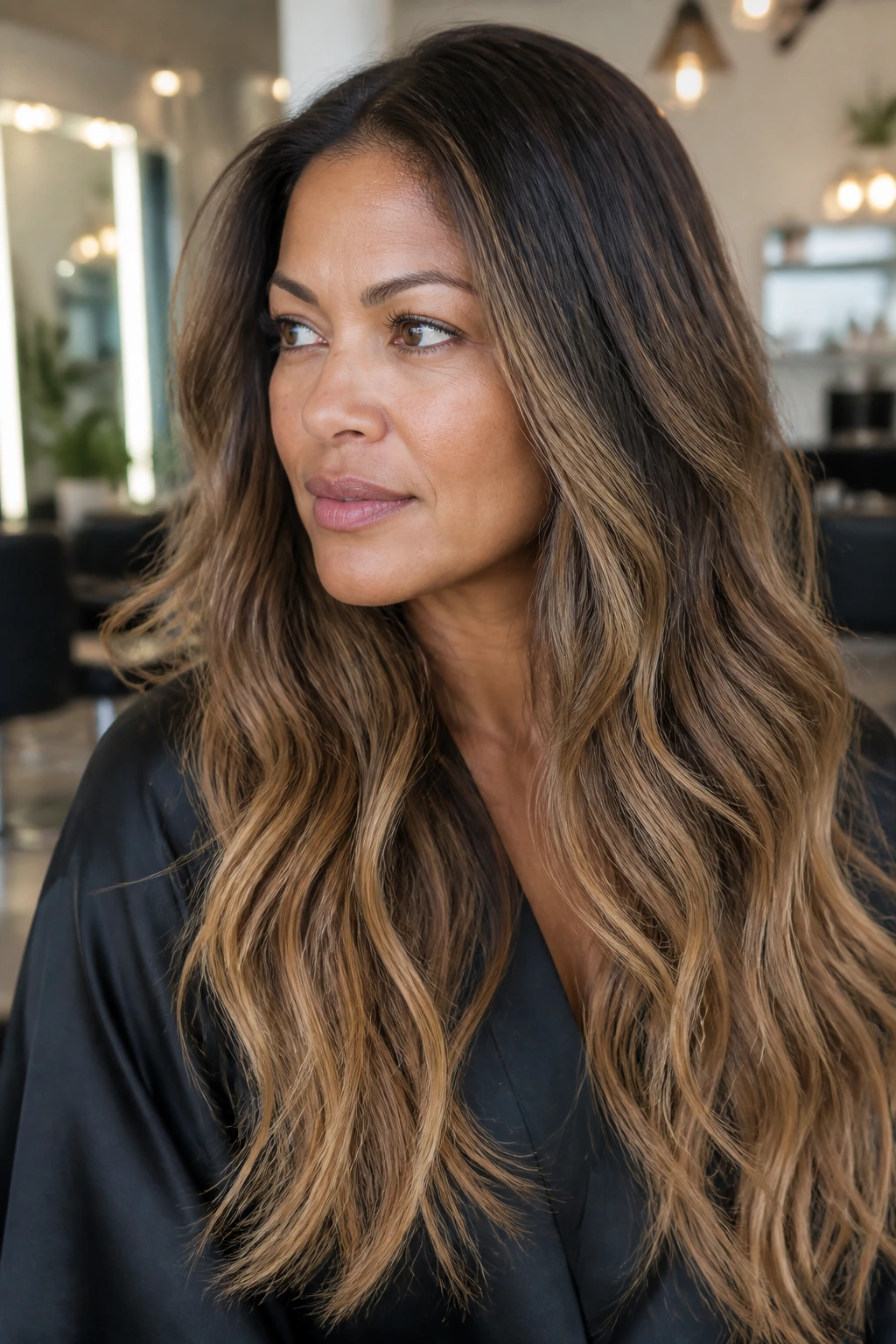
Bronde is what happens when brown and blonde stop arguing and start working together. On tan skin, it often looks more believable than either extreme on its own.
The melt matters here. You want a darker root, a neutral brown mid-shaft, and sandy beige ends that never go too yellow. Thick hair gives this look room to breathe. Fine hair can look thin with too much lightening; dense hair can handle the gradient and still keep visual weight.
If your gray is moderate, bronde is a strong choice because it doesn’t force the silver to vanish. It simply folds it into the middle tones. That’s the whole point.
8. Espresso Underpainting
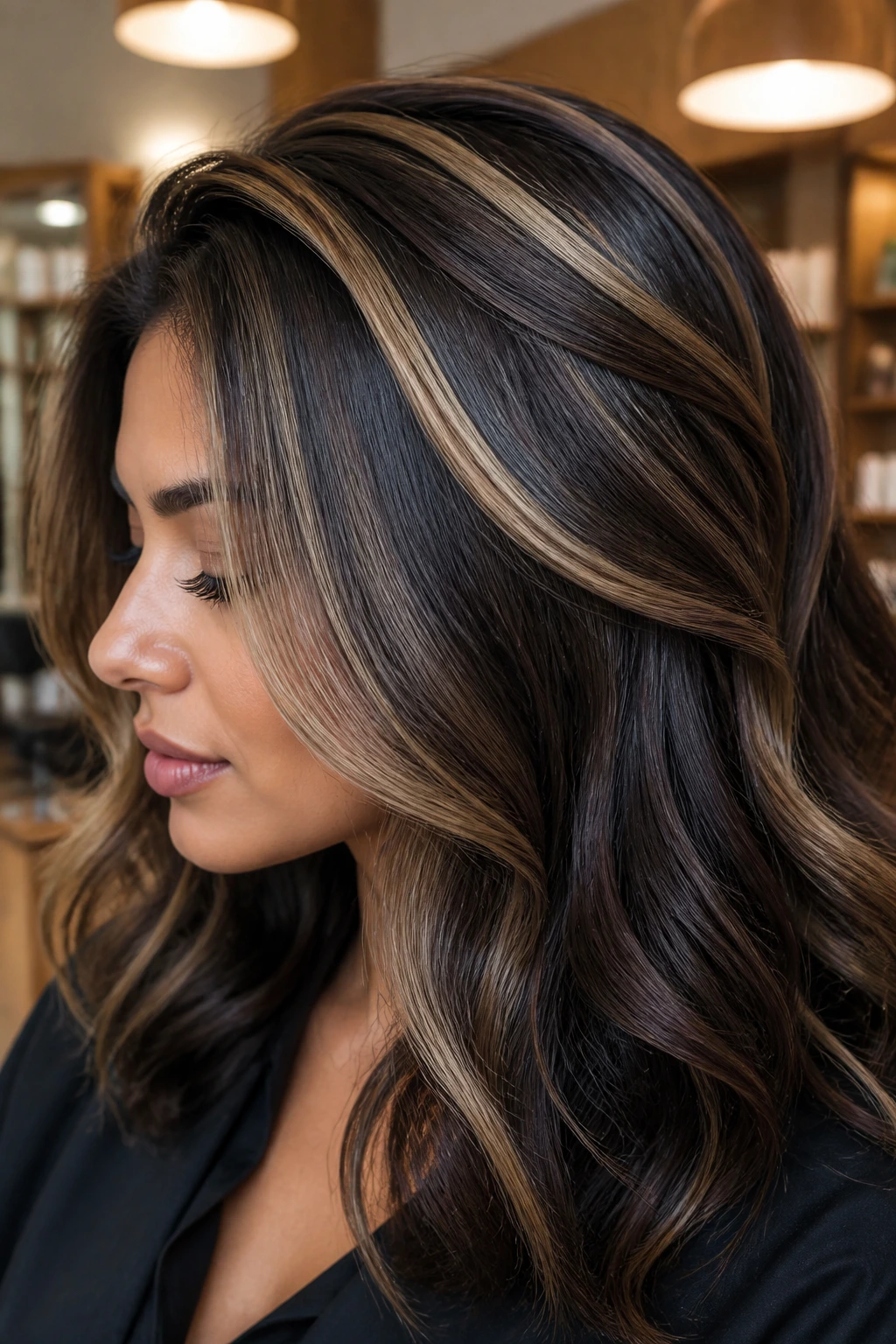
Espresso underpainting is one of those techniques that feels almost sneaky. The darker color sits underneath the surface, so the top layer still moves and reflects light, but the base has enough depth to make gray and lighter pieces look intentional.
For thick hair, this is gold. Dense hair without underpainting can look like one huge color block, especially when it’s air-dried. Tan skin benefits from the contrast because espresso frames the face without turning the complexion washed out.
What to ask for
- A deep espresso or soft black-brown underlayer.
- Lighter ribbons only on the top canopy.
- A soft finish around the face so the look doesn’t go severe.
This is not the place for harsh jet black. Keep it in the brown family.
9. Smoky Silver Face Frame
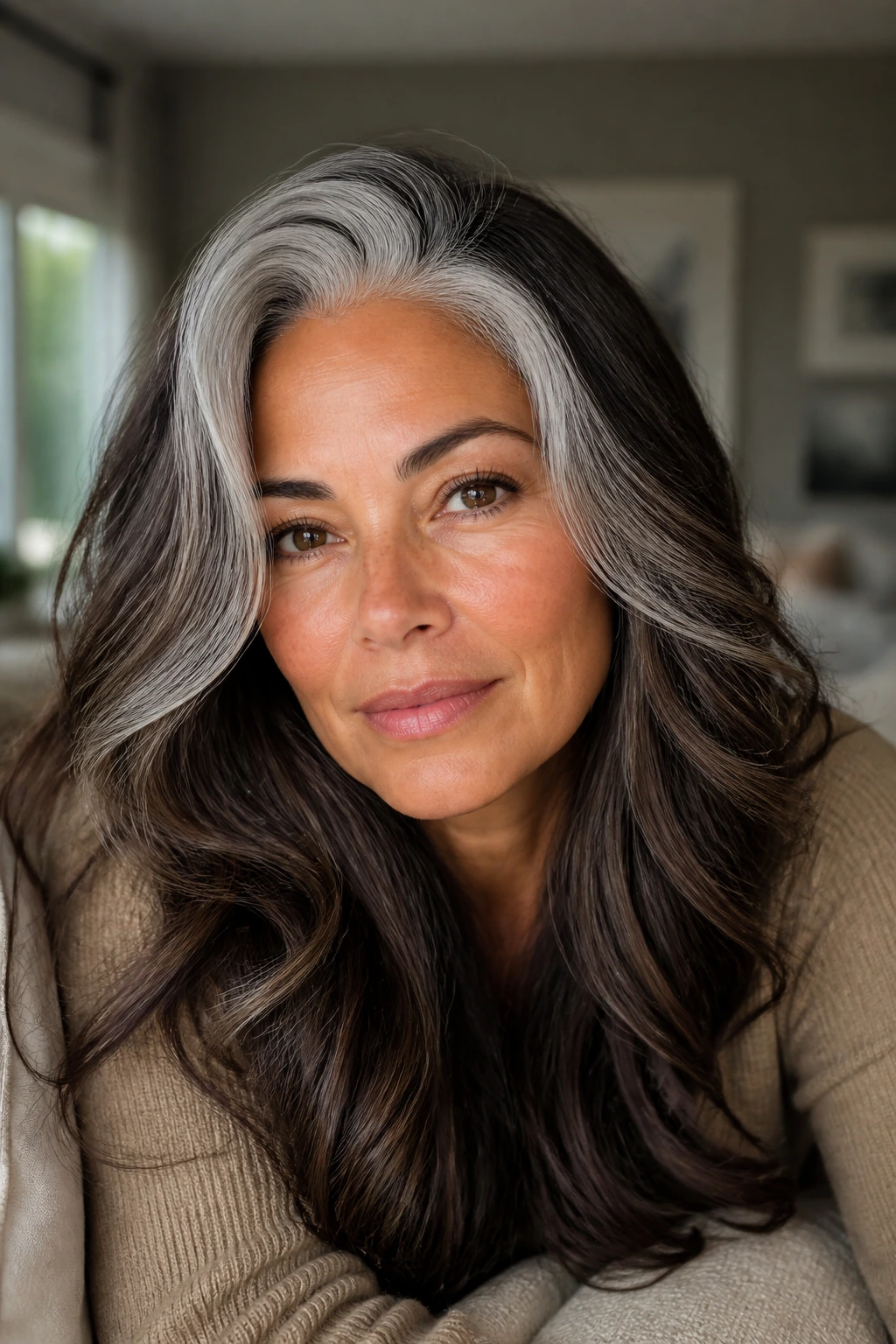
If you have gray around the temples and you’re tired of fighting it, make it part of the design. A smoky silver face frame can look sharp on tan skin when the silver is softened with beige, pearl, or mushroom undertones.
The trick is balance. The face frame should be cool enough to honor the gray, but not so icy that it drains warmth from the cheeks. Thick hair can carry a strong frame because the rest of the color gives it context. Without that density, silver pieces can feel too obvious.
I like this on side parts. The frame shows up where people actually look, which means the gray looks chosen, not accidental.
10. Cinnamon-Taupe Dimension
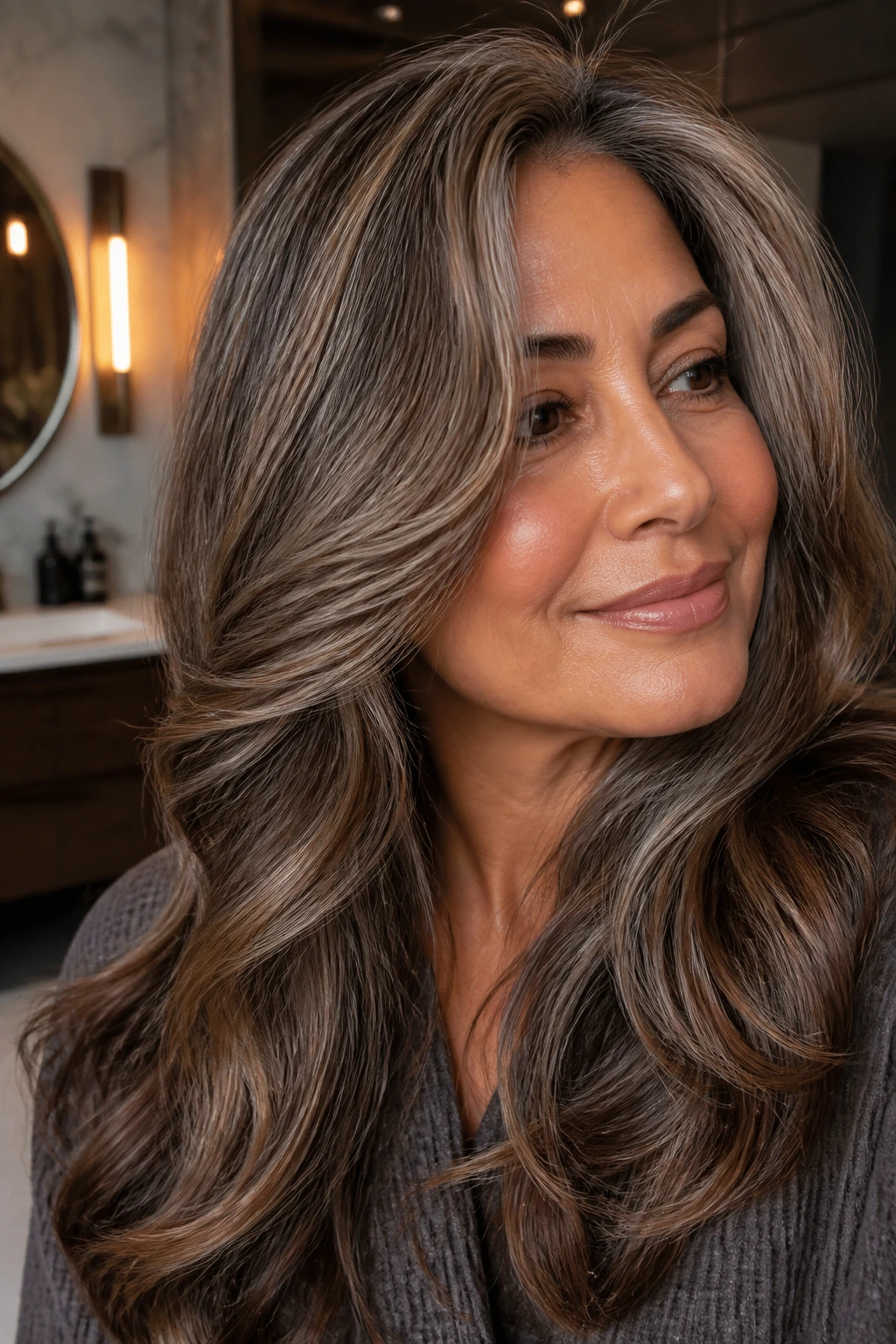
Cinnamon-taupe is a strange little pairing, and that’s why it works. Cinnamon gives tan skin warmth; taupe cools it down before things get orange.
On thick hair, this mix creates a soft dimpling effect. The cinnamon pieces catch light, while the taupe strands keep the overall field from getting too bright. Gray hair slips into the middle and stops shouting. This is a good fit if your natural color sits around medium brown and your gray is spreading unevenly.
The result should feel layered, not painted. If it looks one-note, there is not enough taupe in the formula.
11. Cool Beige Money Piece
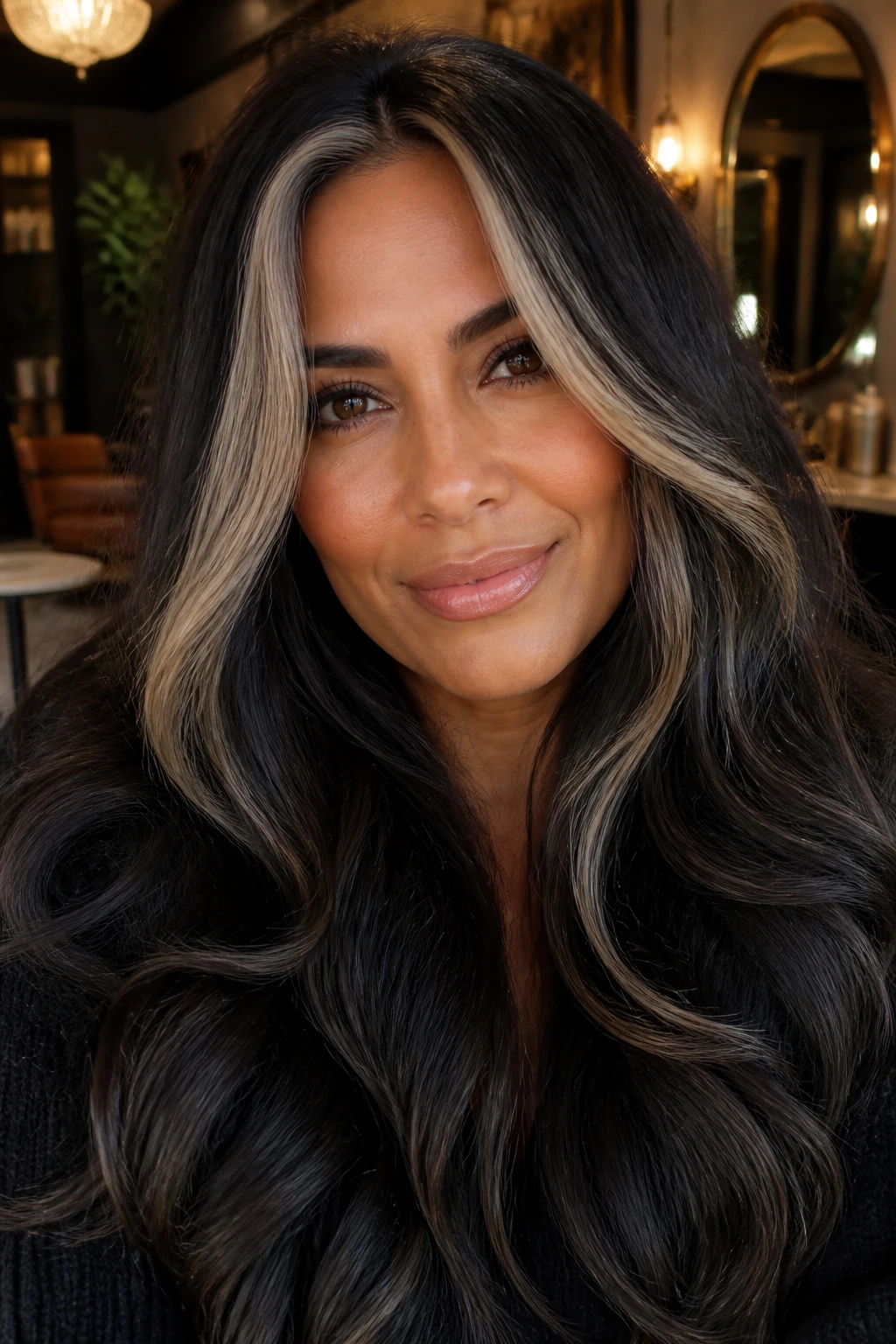
A cool beige money piece can save a color job that feels too dark everywhere else. The front pieces are lifted enough to frame the face, but the beige keeps them from turning icy or yellow.
On tan skin, this only works if the beige has some warmth underneath. Pure pearl blonde can look stark. Thick hair benefits because the front can take a slightly stronger highlight without making the rest of the hair look flat. Place the brightest pieces where the hair falls against the cheekbones and jawline.
Best for: gray concentrated near the hairline, deep brown bases, and anyone who wants visible brightness without bleaching the whole head.
12. Tawny Melt
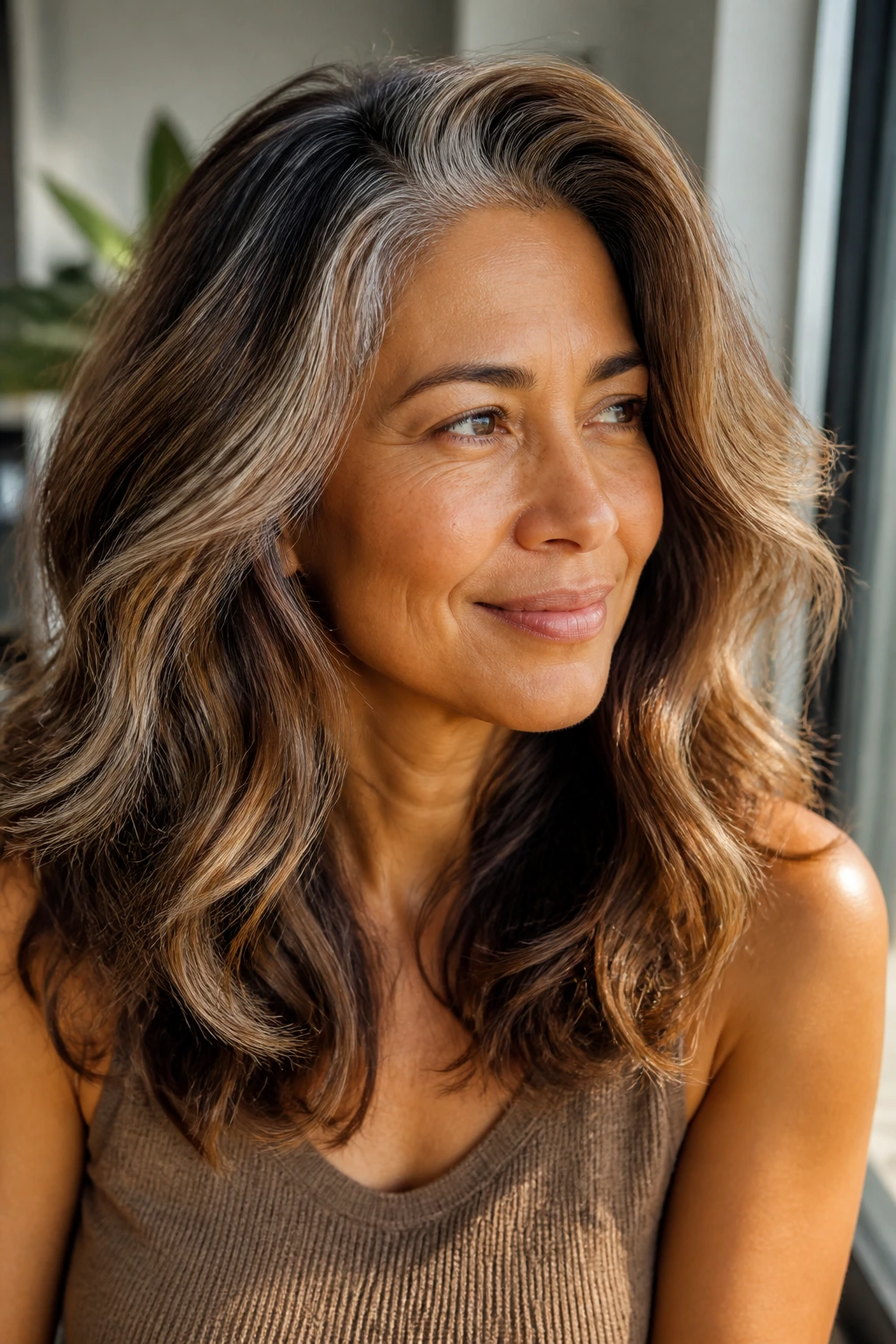
Tawny is that warm, dry, sun-washed brown that sits somewhere between caramel and chestnut. It’s a lovely middle lane for tan skin because it warms the complexion without chasing orange.
A tawny melt usually starts with a deeper root and moves into soft brown-beige mids. Thick hair makes this look richer because the different tones can layer without collapsing into one shade. Gray strands become part of the movement, especially if the melt is done with a root shadow and a few fine lowlights.
This is one of the easiest looks to wear with minimal makeup. It does a lot of work on its own.
13. Mushroom Ombré
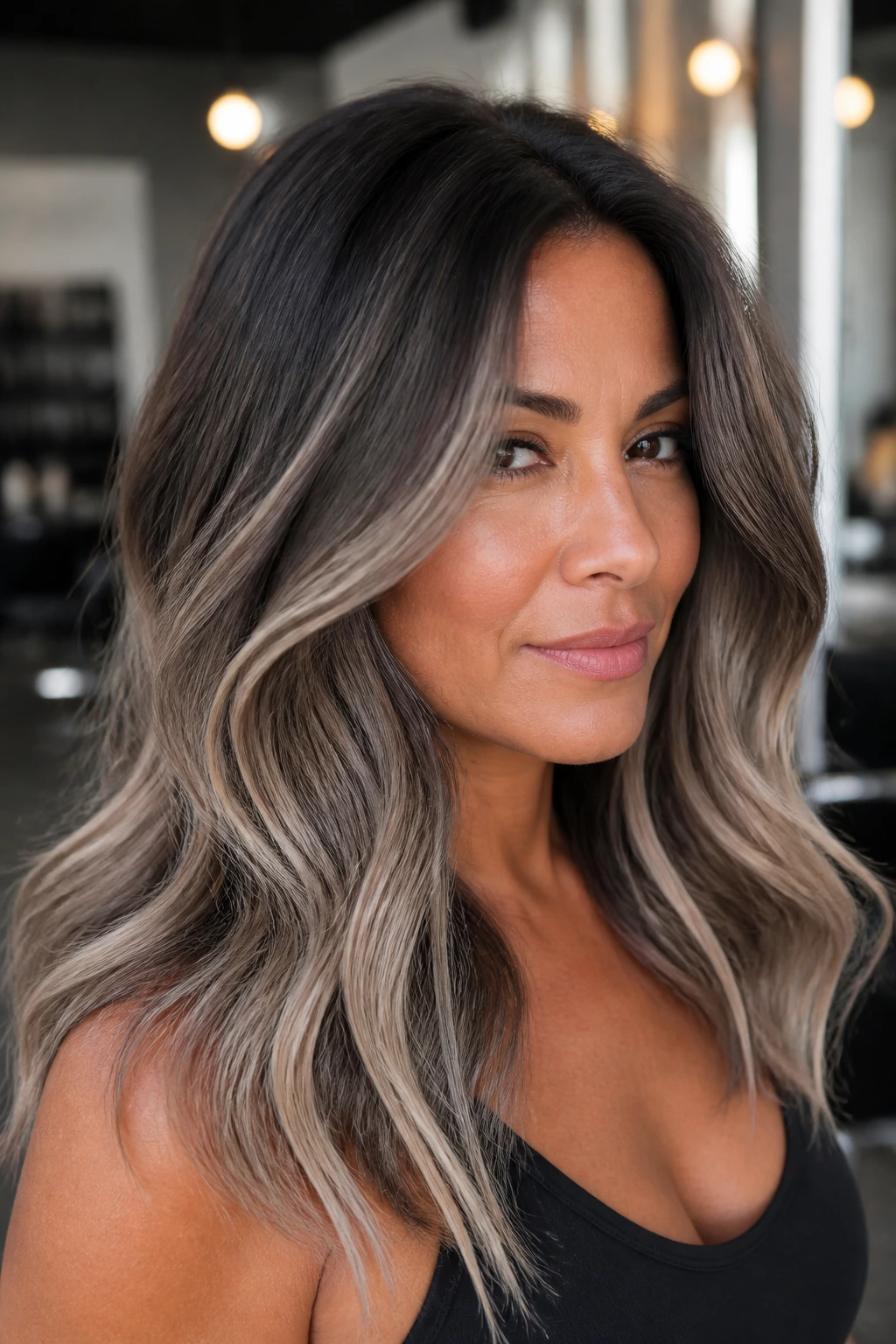
Mushroom ombré gives you a darker root, smoky mid-lengths, and a soft beige finish at the ends. It’s a smart choice if you want gray blending with a little drama but not a hard contrast line.
Tan skin tends to like the softness of mushroom because it avoids the orange cast that some warm blondes bring. Thick hair is the real beneficiary, though. Ombré in dense hair can look messy if the transition is abrupt; mushroom tones make the fade feel deliberate.
Use this if your gray grows in fast and you don’t want a visible line every few weeks. The root can stay deeper, which buys you time.
14. Smoky Bronze Gloss
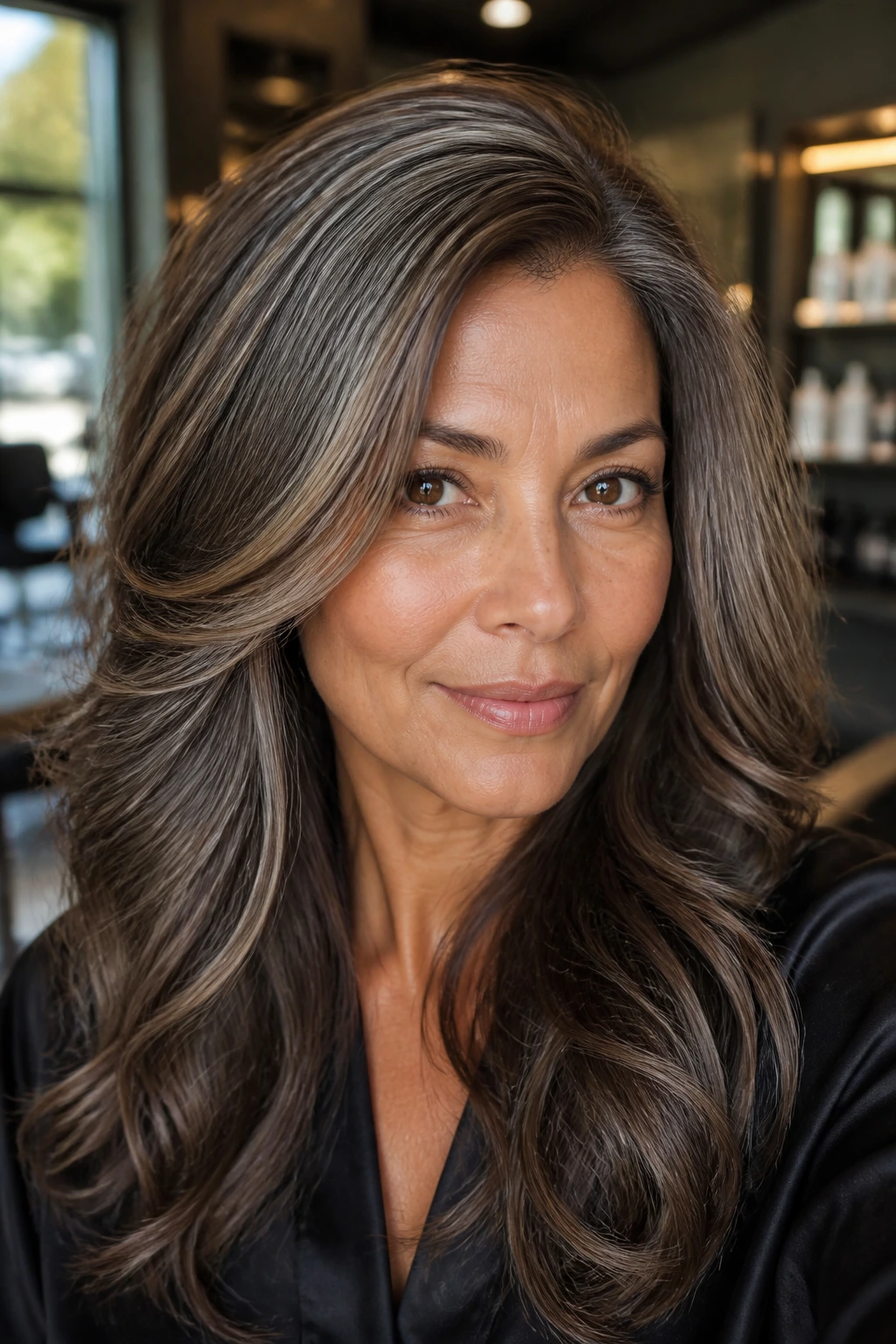
A smoky bronze gloss is one of the easiest ways to make gray hair look polished without major lightening. Glossing doesn’t change the whole structure of the hair color; it tints the surface, smooths the cuticle, and mutes the rough edges between gray and brown.
On tan skin, bronze has enough warmth to be flattering, but the smoky note keeps it from reading brassy. Thick hair loves gloss because coarse or dense strands often hold a rough surface finish. A bronze gloss can make the whole head look smoother and more even.
Use it when:
- You already have balayage or highlights.
- The gray is showing through too starkly.
- You want a softer result without a big color correction.
15. Champagne Beige Foils
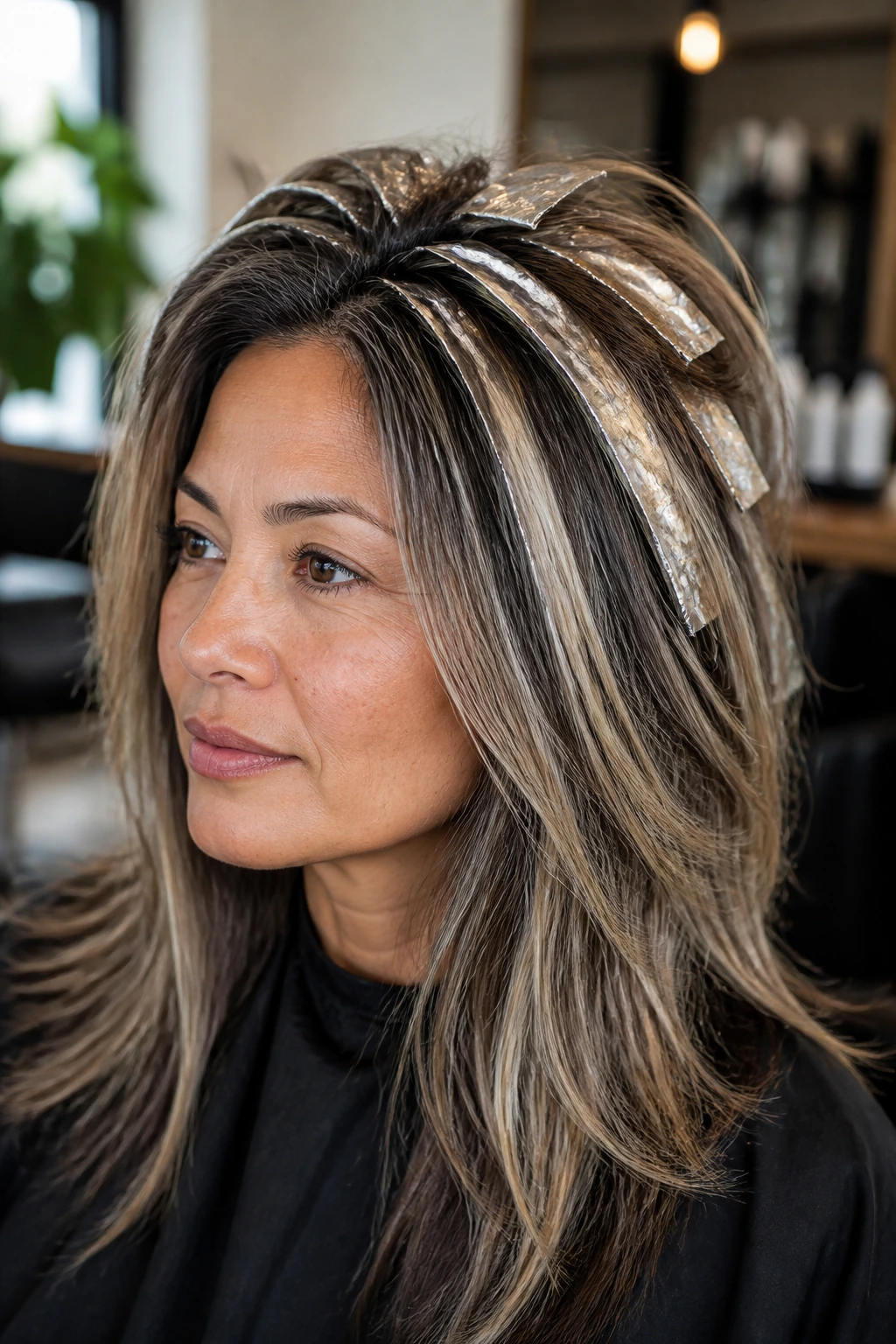
Champagne beige is lighter than mushroom and softer than blonde. That middle ground is exactly why it works on tan skin. It adds brightness without washing the face out.
Foil placement matters here. Thick hair needs enough foils that the color doesn’t disappear in the mass of the hair. If you only place a few, the result can look striped. Ask for fine to medium foils through the crown and sides, then keep the root shadow soft so the grow-out stays clean.
This is a good choice when the gray is mixed throughout, not just at the roots. Champagne beige creates a gentle shimmer that blends rather than masks.
16. Steel-Sand Toning
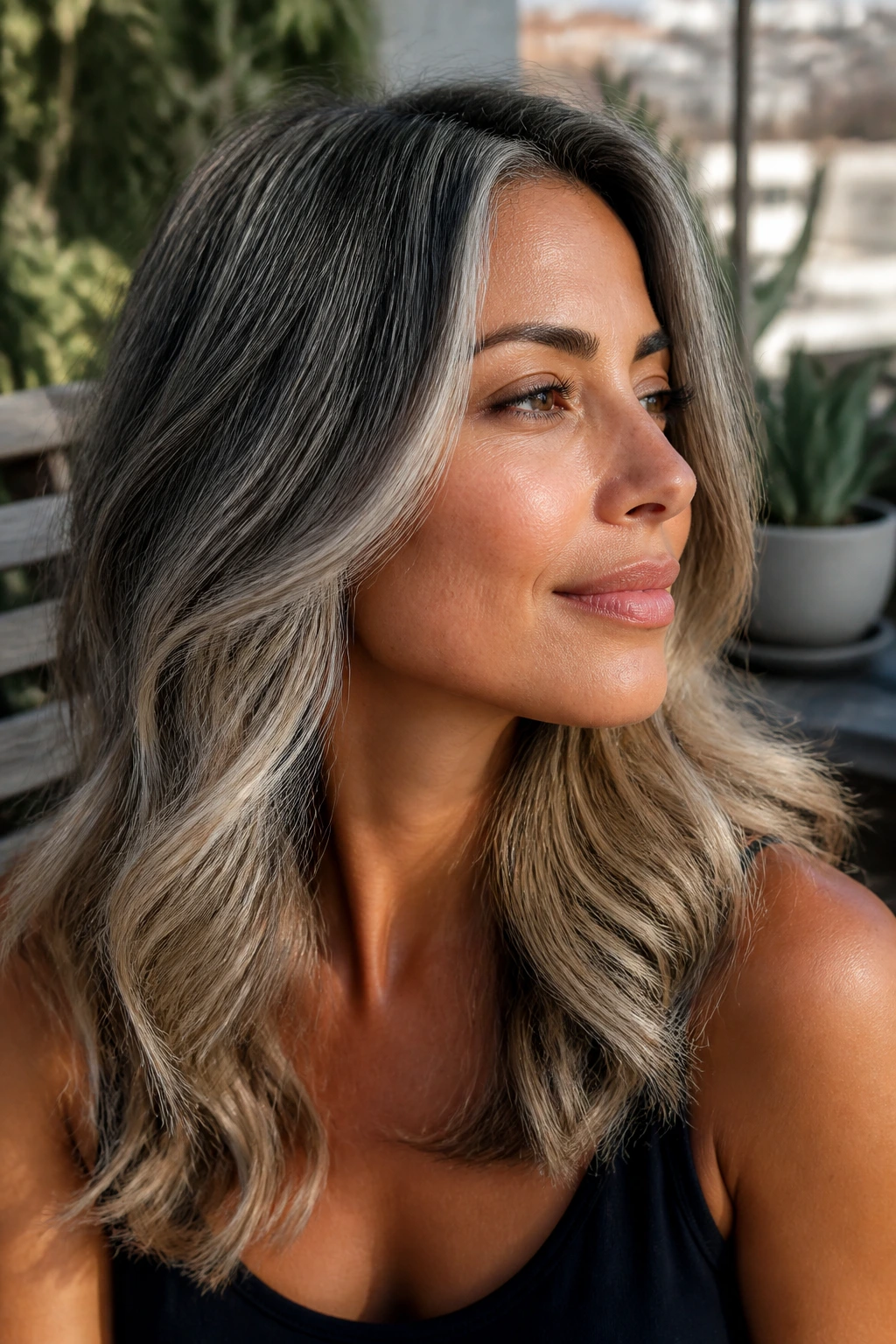
Steel-sand is for people who want the gray to lean cool without going cold. The “steel” gives the silver strands a sharper edge; the “sand” keeps the tone wearable on tan skin.
This works especially well after lightening. Think of it as the finishing move that keeps blond pieces from turning yellow and gray pieces from looking dull. Thick hair often needs a toner with some staying power, because the density can make the color look richer and darker than it did in the bowl.
If your skin leans olive, this is one of the safest cool-leaning options. If your tan is very golden, keep the steel part subtle.
17. Walnut Lowlights
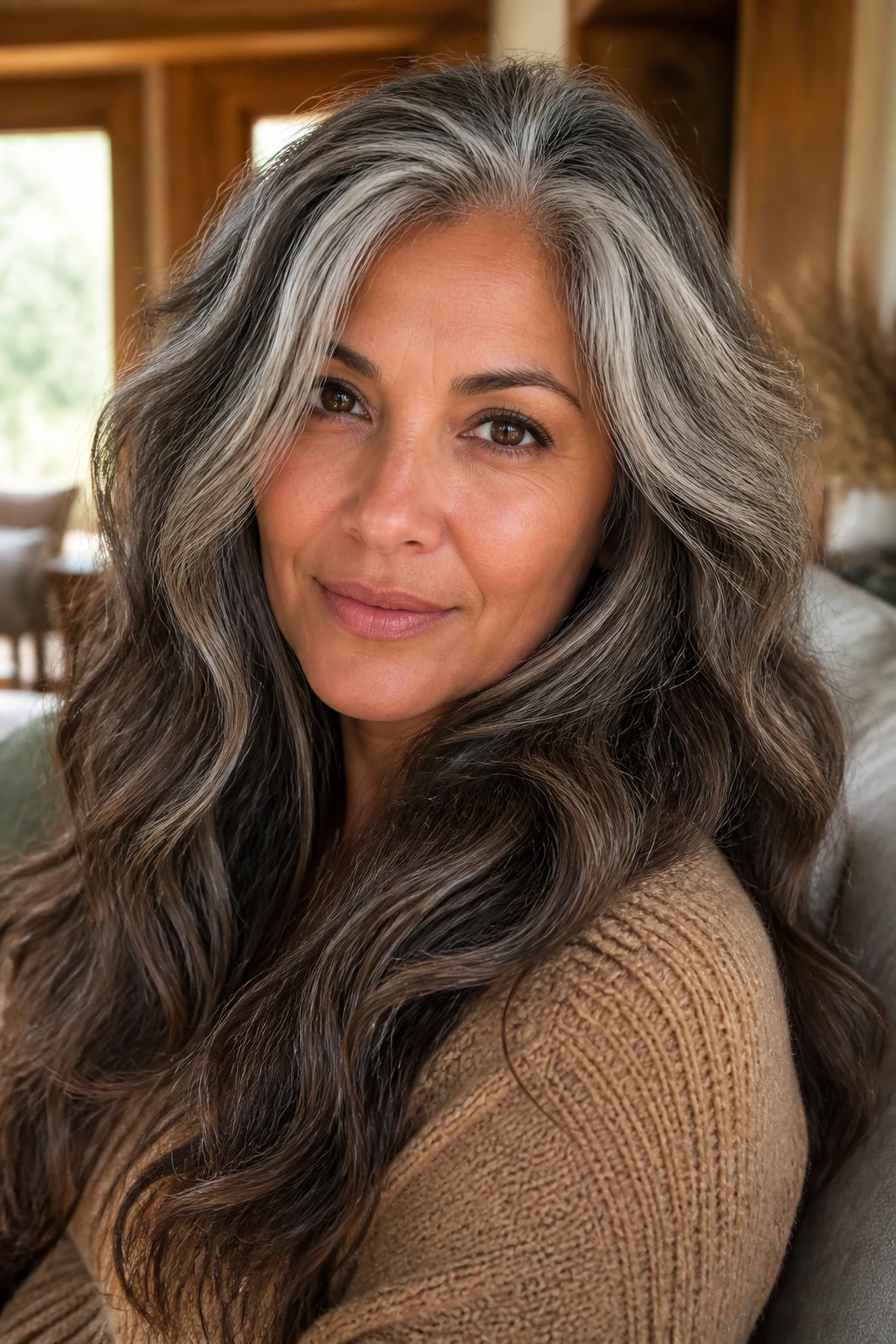
Walnut lowlights are the quiet hero of gray blending. They darken some sections just enough to create a map under the lighter pieces, which is exactly what thick hair needs.
Without lowlights, dense hair can look puffy after lightening. Walnut gives the color some backbone. It also helps gray strands slip into the background, especially if they’re showing up in wide patches rather than fine threads.
This is one of my favorites for wavy hair. Movement makes the walnut and gray play off each other instead of sitting flat.
18. Smoky Root Tap
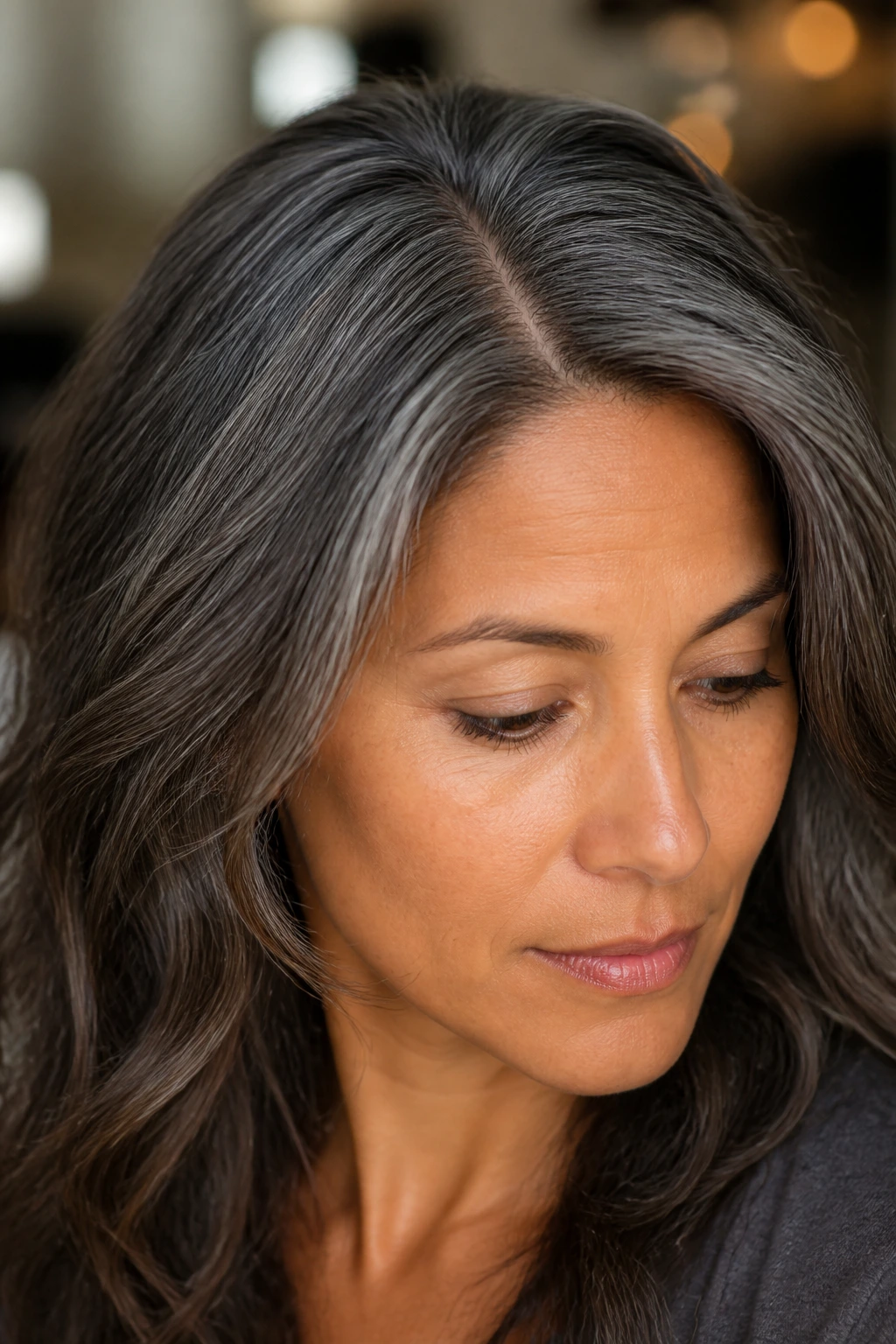
A smoky root tap is lighter than a full root smudge and softer than leaving the root bare. You tap a smoky demi-permanent color just at the root area so the gray doesn’t form a hard halo around the part line.
Tan skin usually looks good with this because the smoky shade keeps the face from being ringed by too much warmth. Thick hair benefits because the root tap helps dense roots blend into the rest of the color instead of separating into bands.
It’s a small move. It changes the whole head.
19. Honey-Taupe Balayage
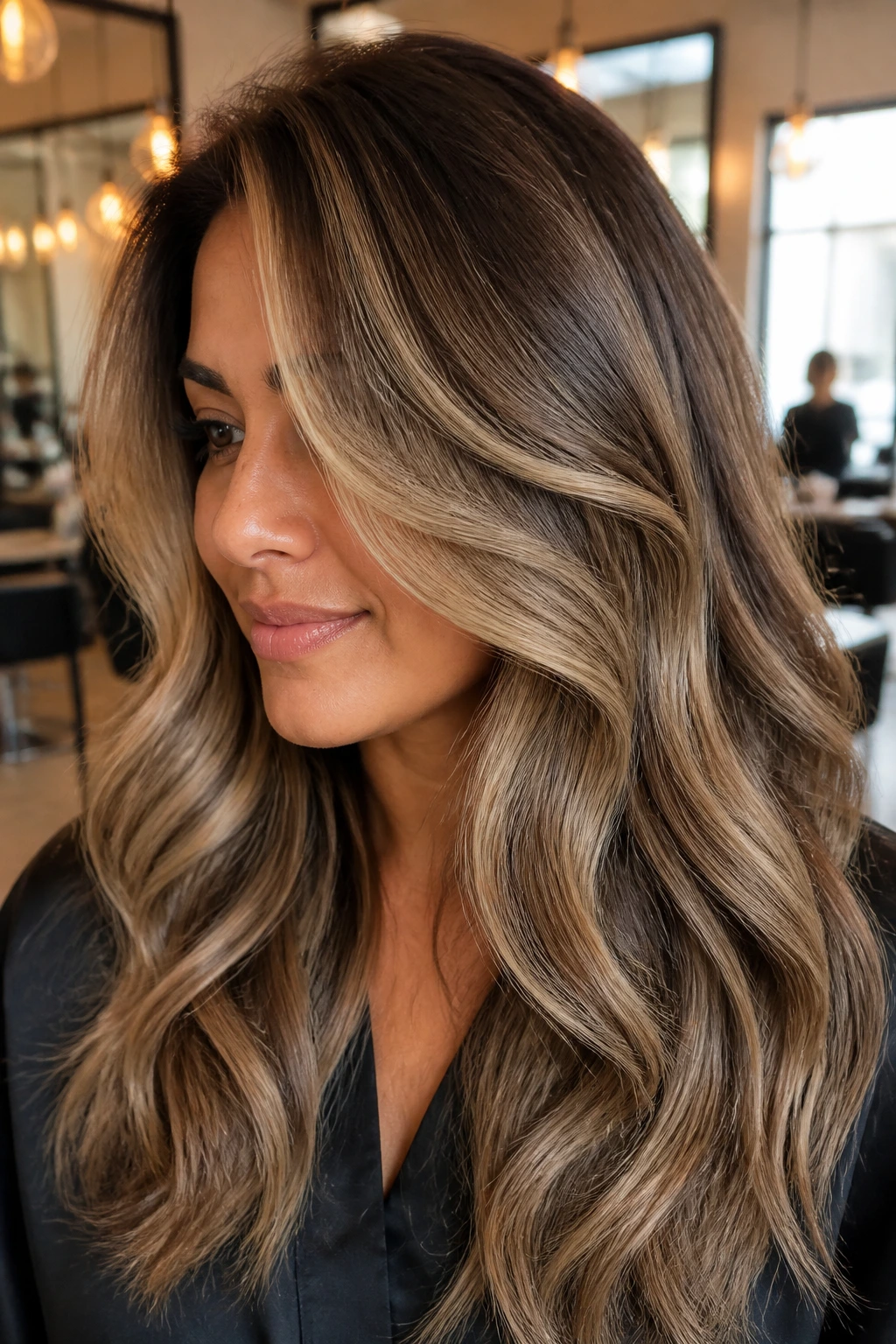
Honey-taupe is one of the best mixed-tone choices when you want warmth but not brass. Honey gives tan skin a soft glow; taupe keeps the gray from fighting the rest of the hair.
Balayage placement should be a little wider than baby lights, especially on thick hair. Tiny pieces can vanish once the hair dries and expands. A few broader pieces, painted with care, make the blend visible without making it loud.
This is a good fit if your gray is creeping in around the front and you still want some natural brown left in the back.
20. Silver Slices
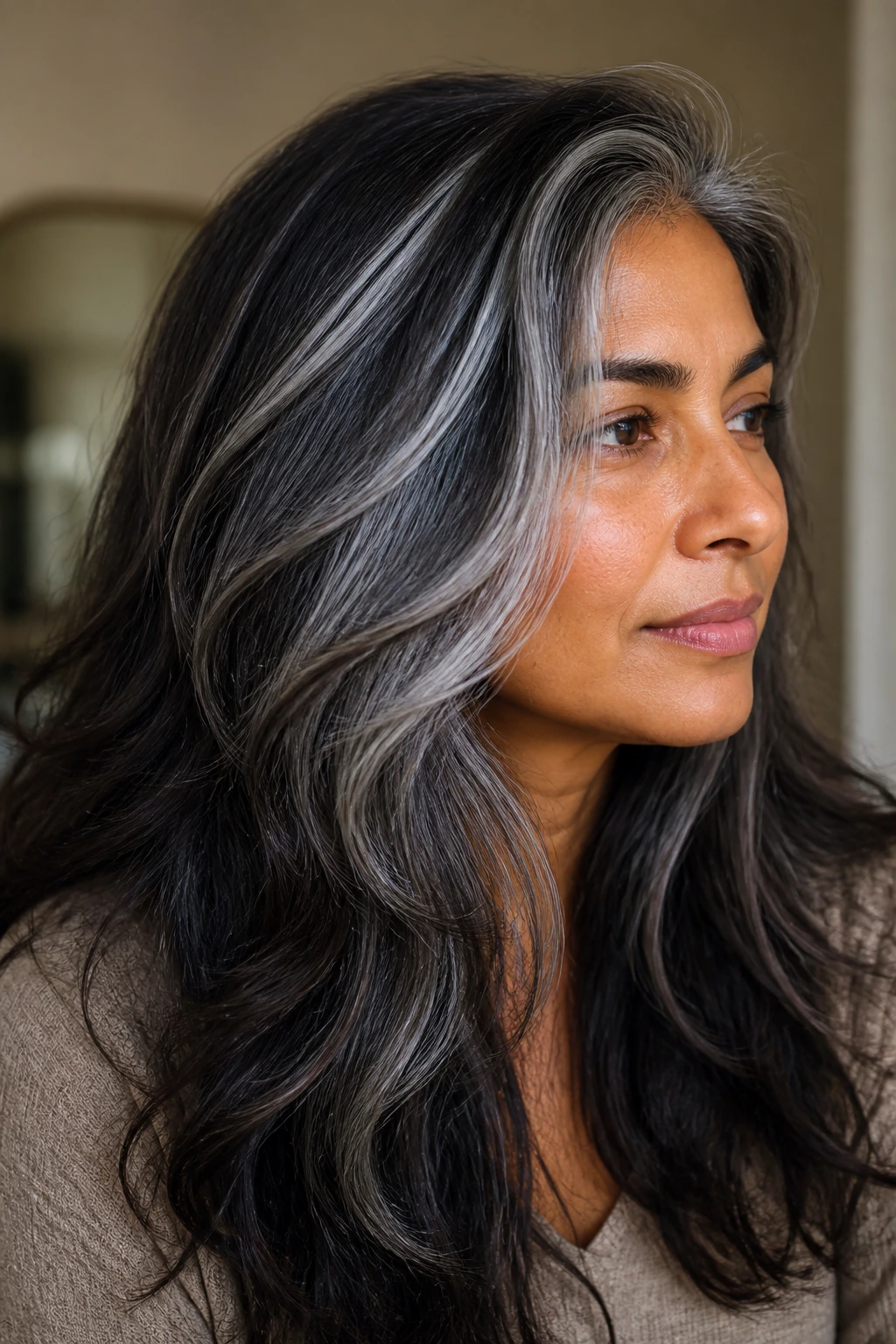
Silver slices are not for hiding gray. They’re for making gray look deliberate. Thin slices of silver, pearl, or icy beige can be threaded through dark or medium brown hair so the natural gray becomes part of the pattern.
On tan skin, this works best when the silver is buffered by beige or mushroom tones. Pure icy silver can look too hard against warm undertones. Thick hair can carry a few bolder slices without looking streaky, especially if they’re placed under the top layer and around the crown.
The advantage: silver slices make regrowth less stressful because the gray is already part of the visual story.
21. Espresso-to-Ash Ribboning
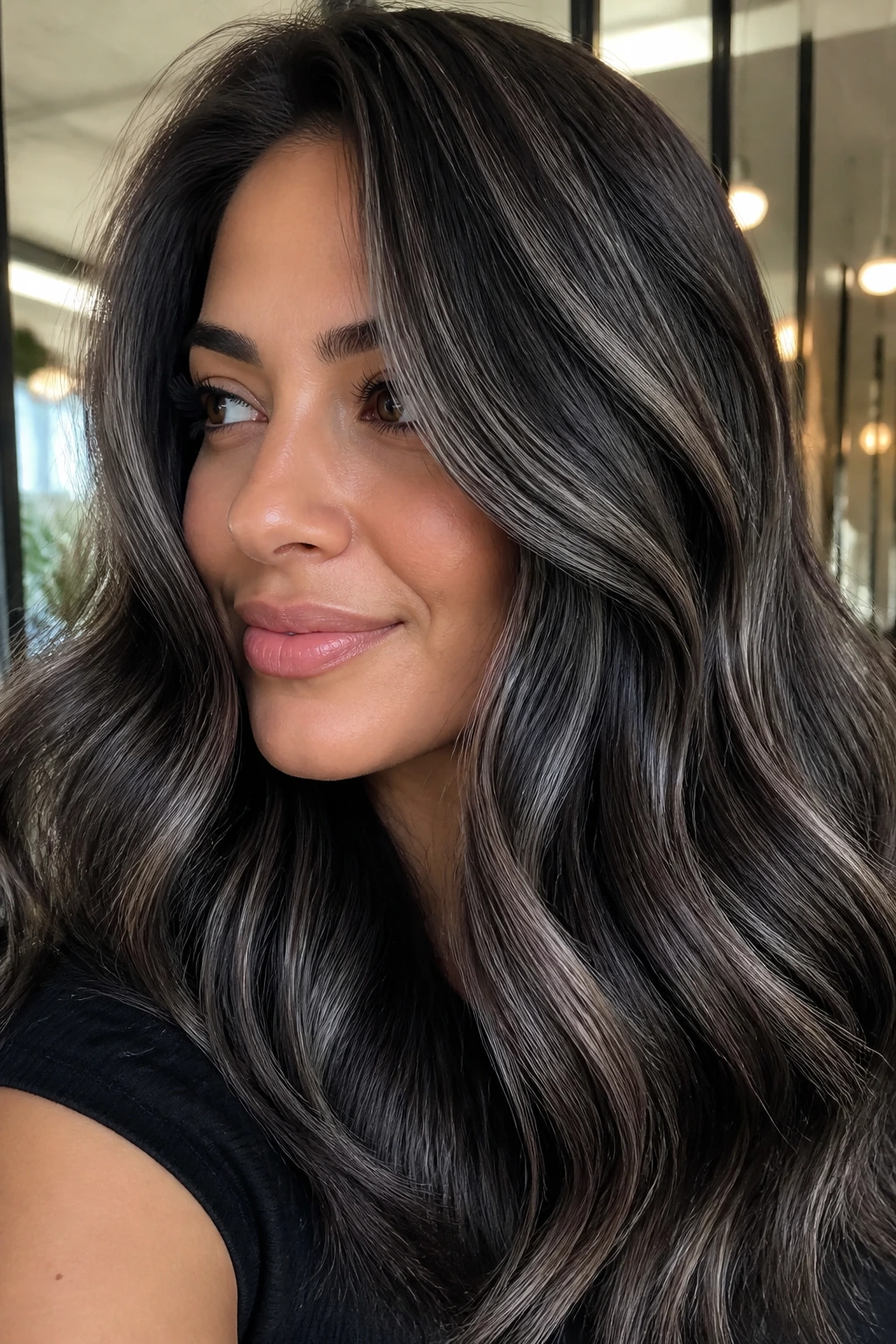
Espresso-to-ash ribboning is a clean contrast strategy. The base stays dark espresso, then ash-brown ribbons run through the top and mid-lengths to break up the gray.
This is one of the strongest options for thick, coarse hair that holds color differently from the fine-haired crowd. The espresso gives structure. The ash softens gray. Tan skin usually likes the contrast as long as the ash is not pushed too blue.
Wear this if you style your hair with a blowout or loose bend. The ribboning shows movement best when the hair isn’t overly flat.
22. Soft Copper Brown
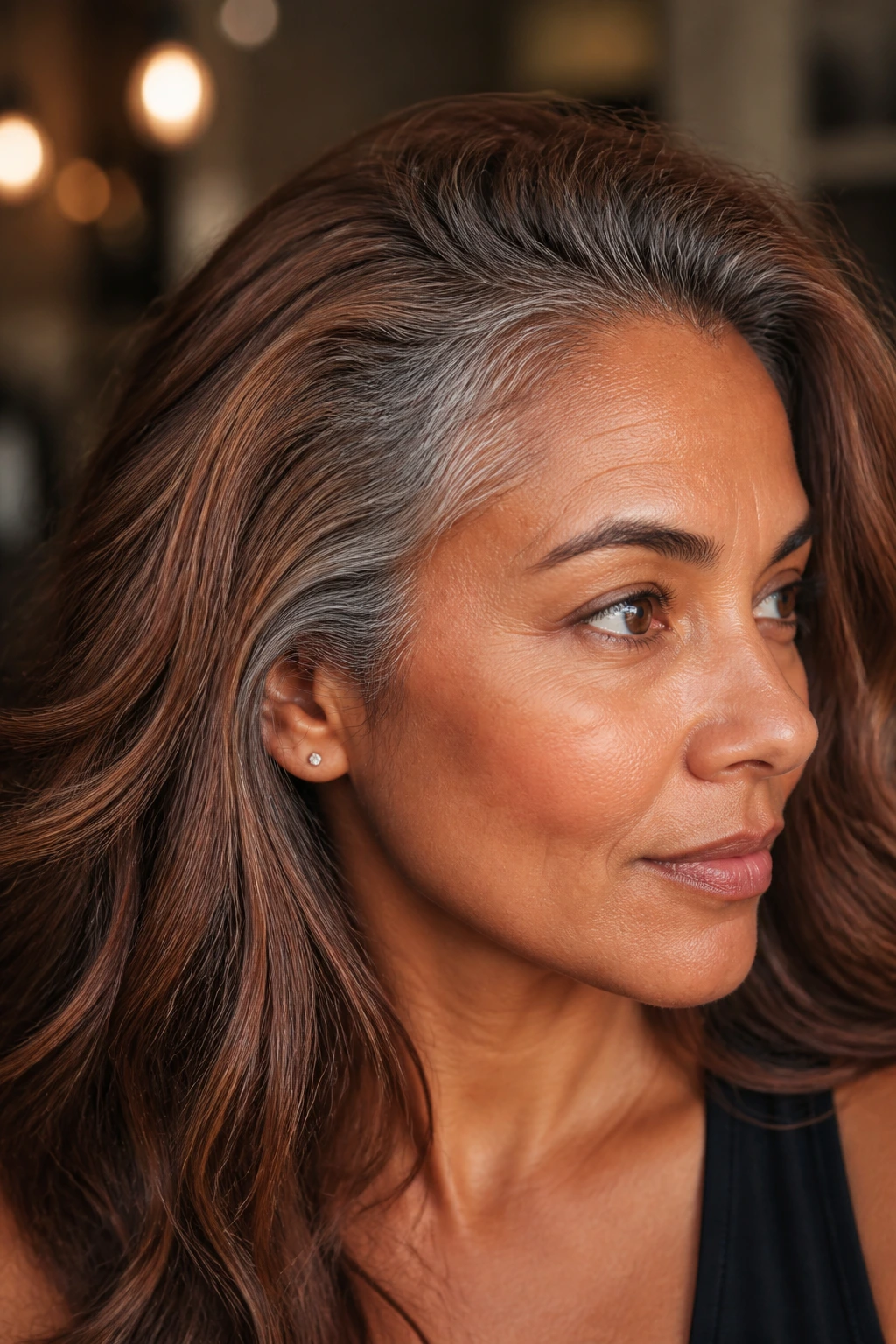
Copper gets a bad reputation because people let it run too orange. Soft copper brown is not that. It’s a brown base with a warm copper note that helps gray blend into the field instead of standing apart.
Tan skin can look especially fresh with this tone. Thick hair handles copper well because the density keeps it from turning see-through. If the gray is concentrated at the temples, a copper-brown glaze over those areas can blur the contrast without going bright.
Keep the copper muted. The second it becomes pumpkin, it stops working for this purpose.
23. Pearl Beige Glaze
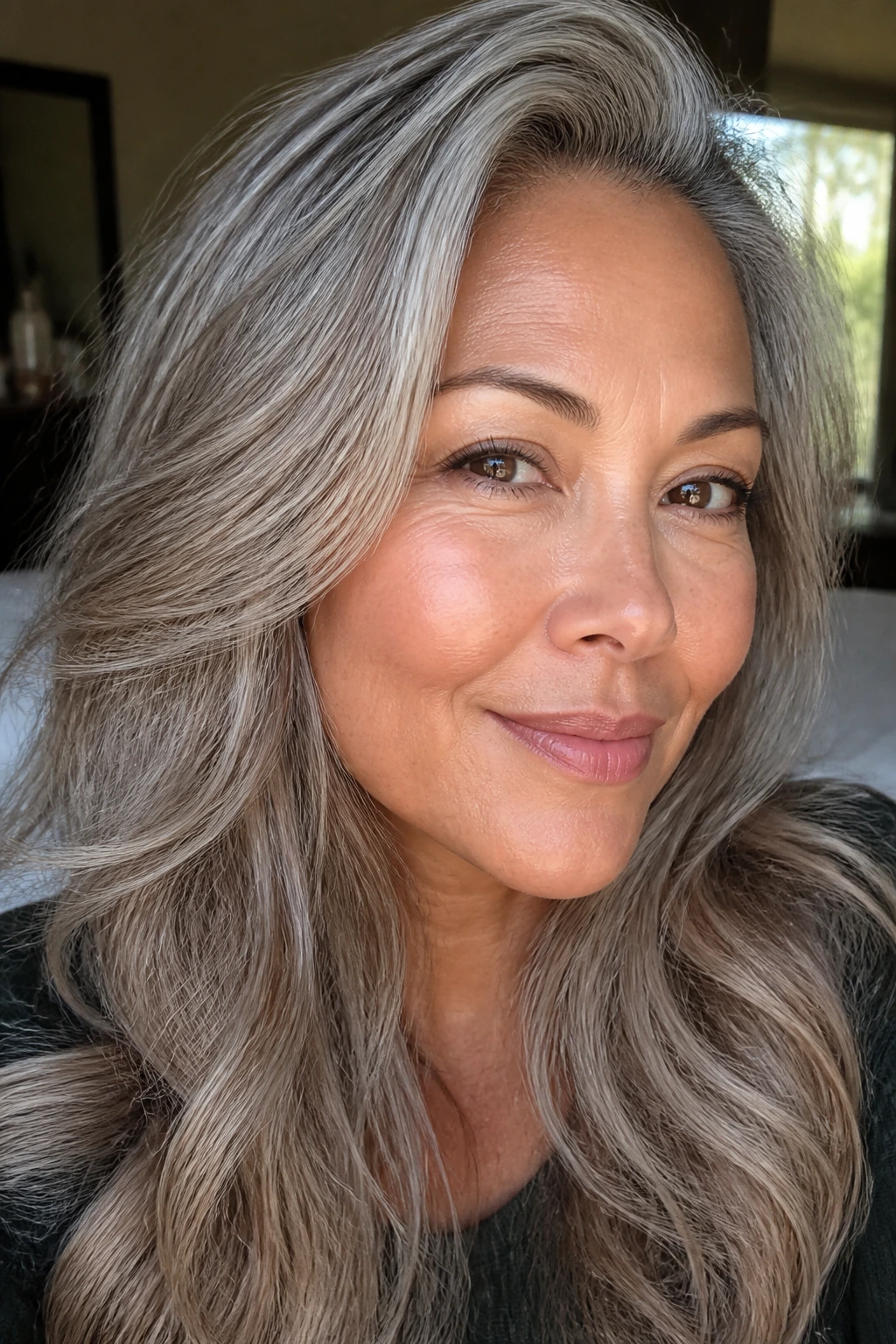
A pearl beige glaze is a finishing choice, not a full color strategy. Still, it deserves a spot here because it can rescue a blend that feels too yellow or too heavy.
Pearl beige softens gray and lightened pieces at the same time. On tan skin, it keeps the hair from looking chalky. On thick hair, it smooths the visual texture so the color looks cleaner and less bulky. I like this after babylights, champagne foils, or even mushroom brown balayage.
When to use it
- After blonding that has gone warm.
- After a summer of sun exposure.
- When your highlights look a little too sharp around the face.
24. Salted Cocoa Blend
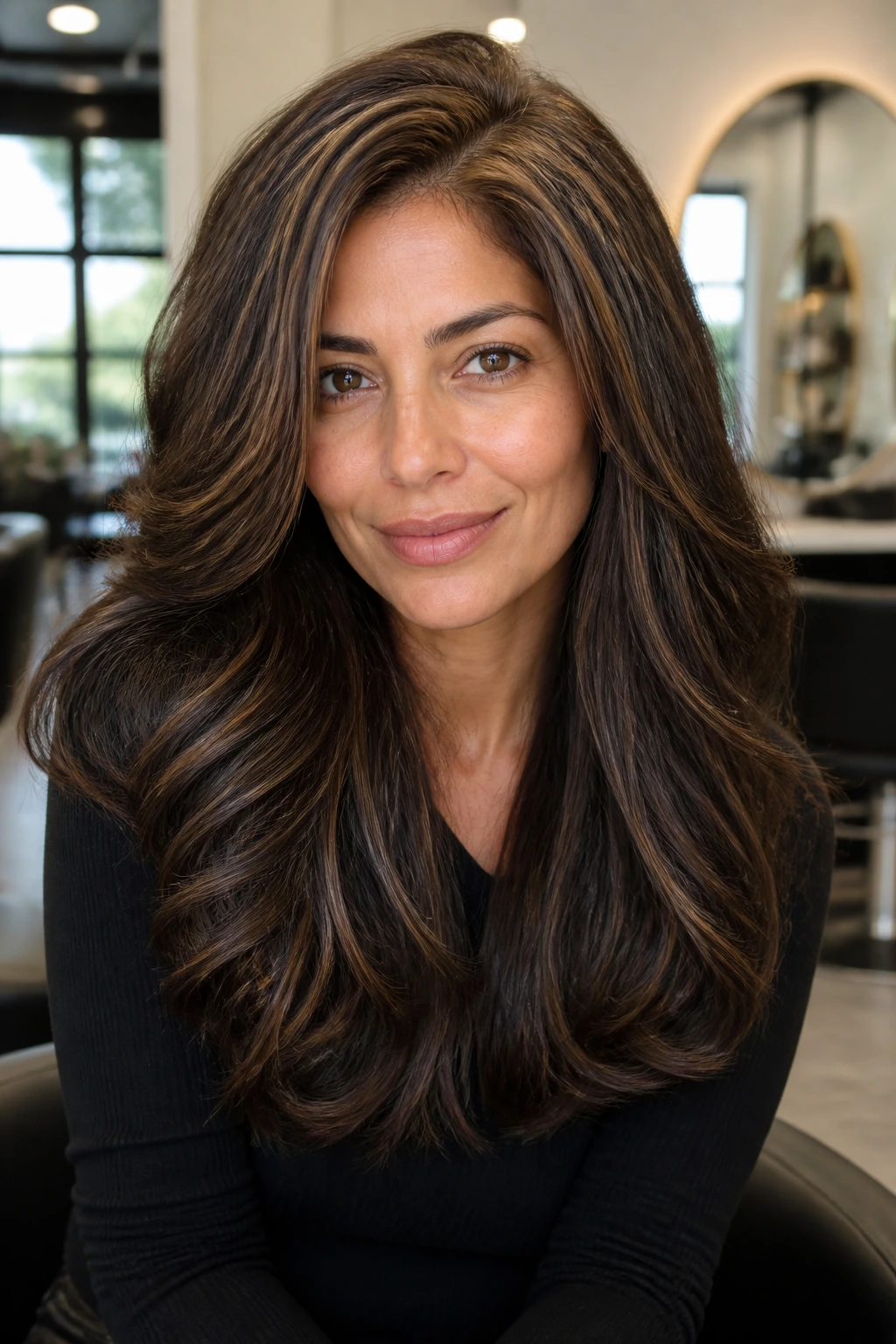
Salted cocoa sounds indulgent because it is, in hair-color terms. Deep cocoa brown sits under lighter, saltier flecks of beige, gray, or mushroom.
This blend is a smart pick if you have a high gray percentage and thick hair that needs structure. The cocoa base keeps the overall look rich; the lighter flecks stop it from becoming a solid helmet of brown. Tan skin usually loves cocoa because it creates depth without going muddy.
The grow-out is forgiving. That’s the real win.
25. High-Contrast Charcoal Veil
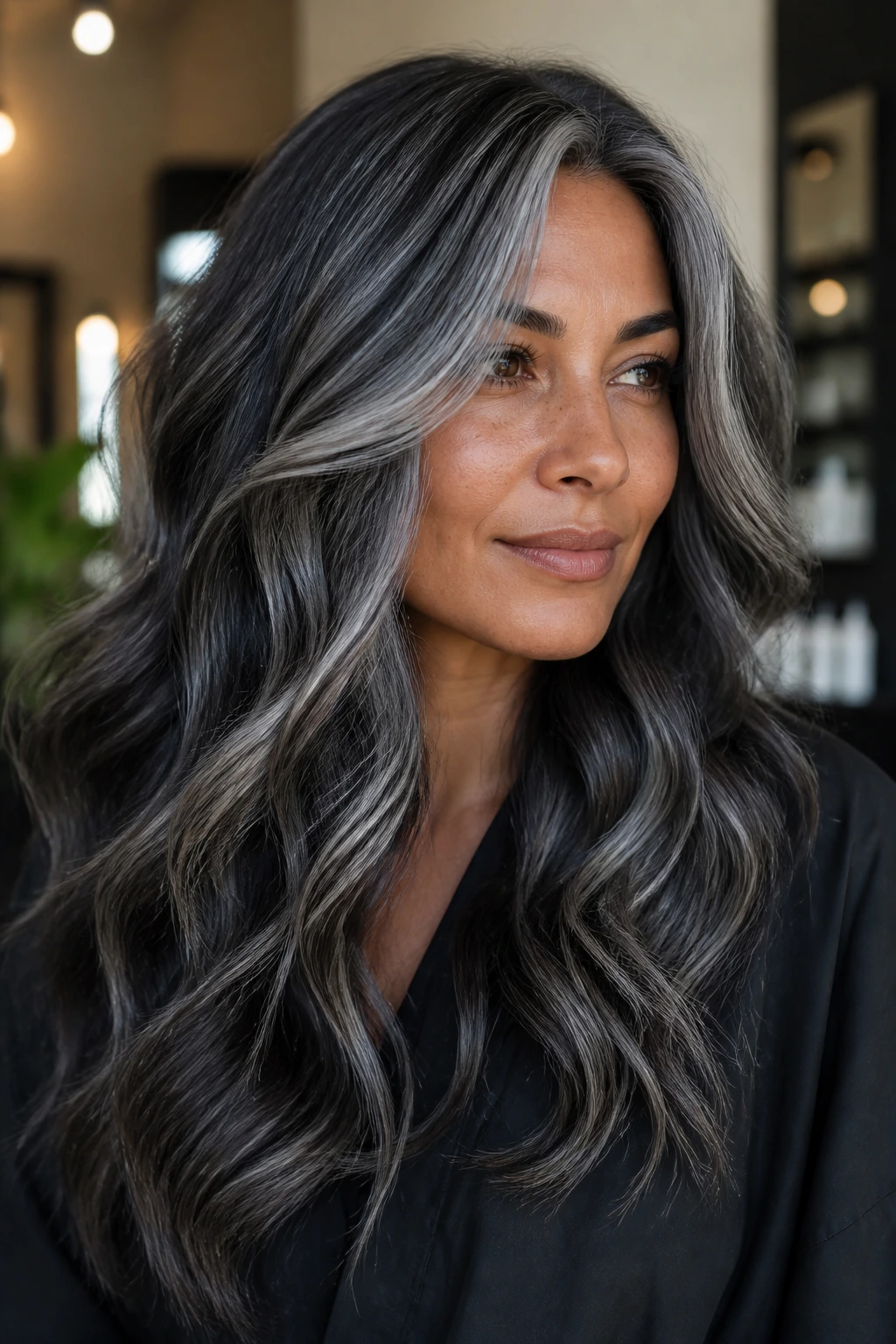
High-contrast charcoal veil is the boldest option in the group. It uses charcoal or smoky lowlights as a veil over deeper sections, while lighter gray and beige pieces stay visible on top.
This can look stunning on tan skin if the charcoal is softened with brown undertones. Thick hair is what makes it believable, because dense hair can hold this much contrast without going ragged. The veil effect also helps gray blend into the overall shape instead of sitting on the surface like scattered glitter.
If you like a stronger, more editorial finish, this is the one to watch. It’s sharp. It’s not flat. And on the right tan complexion, that contrast is the whole point.
Why Gray Blending Needs More Depth on Thick Hair
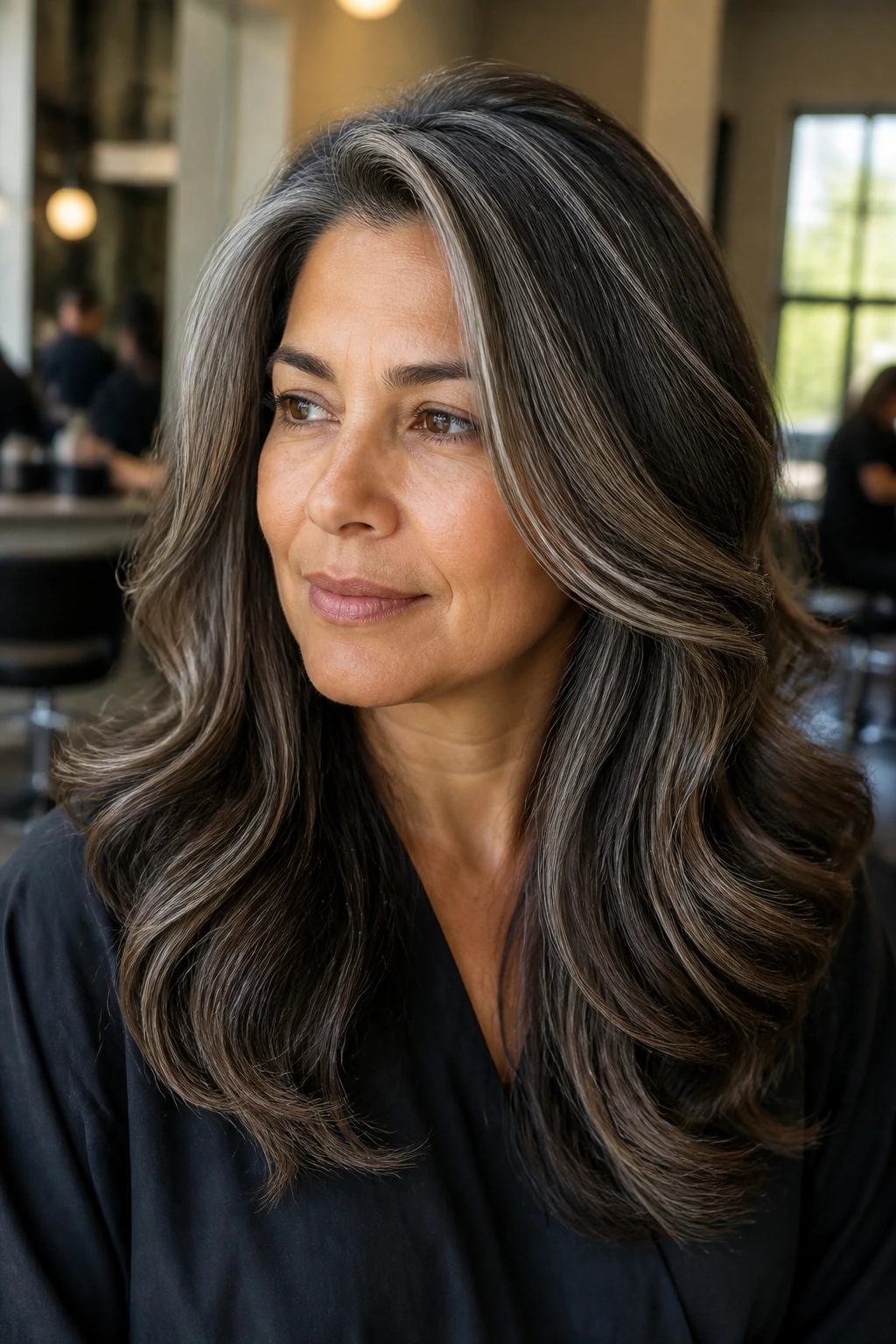
Thick hair changes the rules. A few surface highlights are rarely enough, because the outer layer may look bright while the bulk underneath still reads dark and heavy. Then the gray comes through in one stubborn line at the part, and the whole thing looks unfinished.
That’s why lowlights, root shadows, underpainting, and ribbon placement matter so much here. They break up the mass. They give the eye places to land. Without that internal work, the color can look pasted on instead of woven through.
Tan skin adds one more layer of judgment. Warm undertones can make too much ash look dusty, while too much gold can turn brassy in a hurry. The sweet spot is often a mix of beige, mushroom, taupe, bronze, and chestnut used with a light hand. A good colorist thinks in levels and undertones, not just “lighter” or “darker.” That distinction matters more on dense hair than almost anywhere else.
Choosing the Right Undertones for Tan Skin
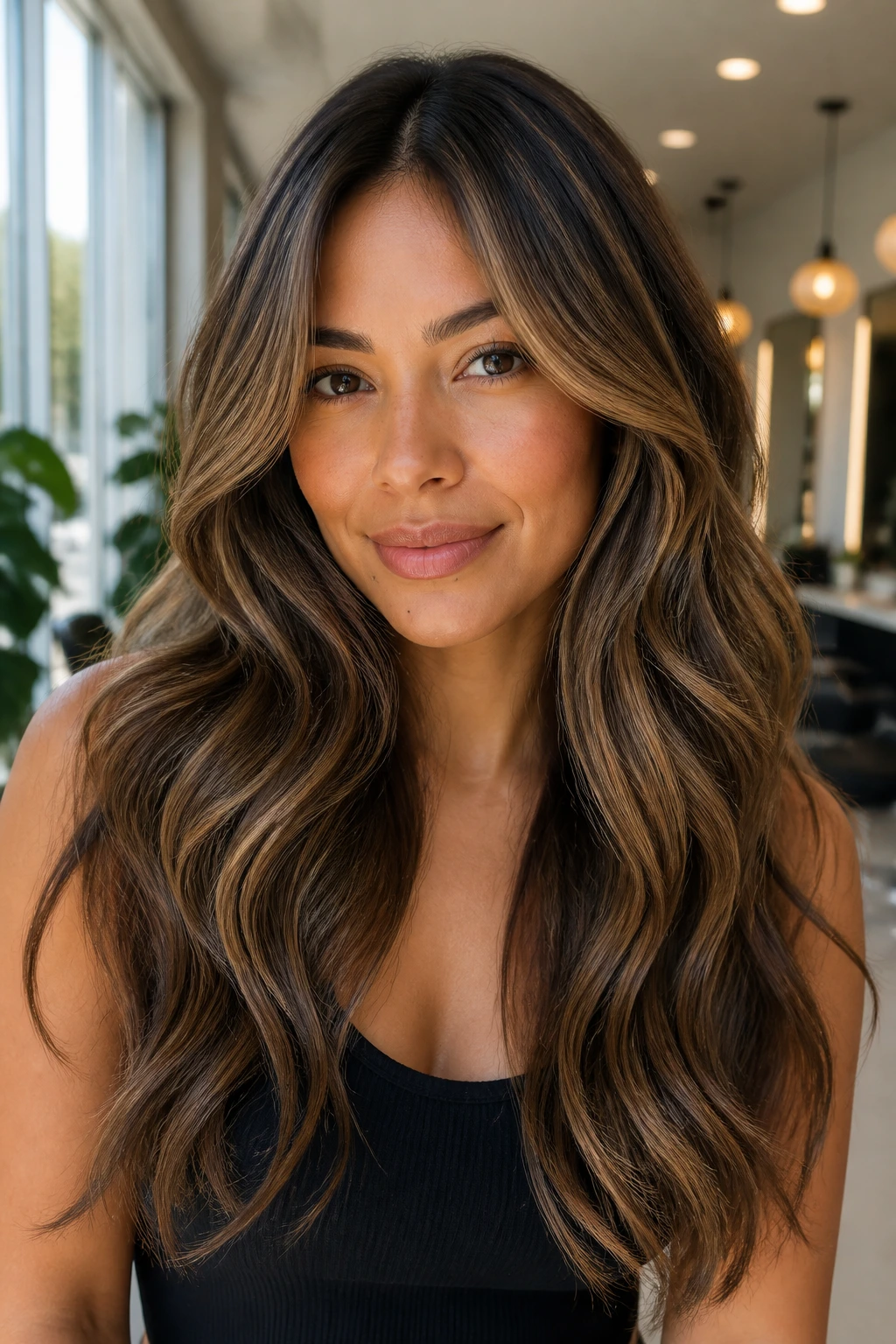
Tan skin is not one tone. That’s the first thing worth getting straight. Some tan complexions lean golden, some lean olive, and some sit in a neutral middle that can swing either way depending on what’s next to the face.
If your skin is golden, caramel, honey, bronze, and tawny shades usually sit well, but they need a little beige or smoke so they do not go orange. If your skin leans olive, mushroom, taupe, steel-beige, and cool brown often behave better because they don’t fight the green-gray cast olive skin can carry. Neutral tan has the most room, but it still needs balance. Too much warmth can look brassy. Too much ash can make the face look tired.
A useful trick is to look at the hairline and the inside of the wrist in daylight, not in bathroom light. Bathroom bulbs lie. They make every brown look richer than it is and every silver look colder. If gold jewelry makes your skin glow, you can probably handle more warmth in the hair. If silver jewelry looks cleaner against your face, lean a little cooler and keep the caramel muted.
Tools, Products, and Appointment Notes Worth Bringing Up
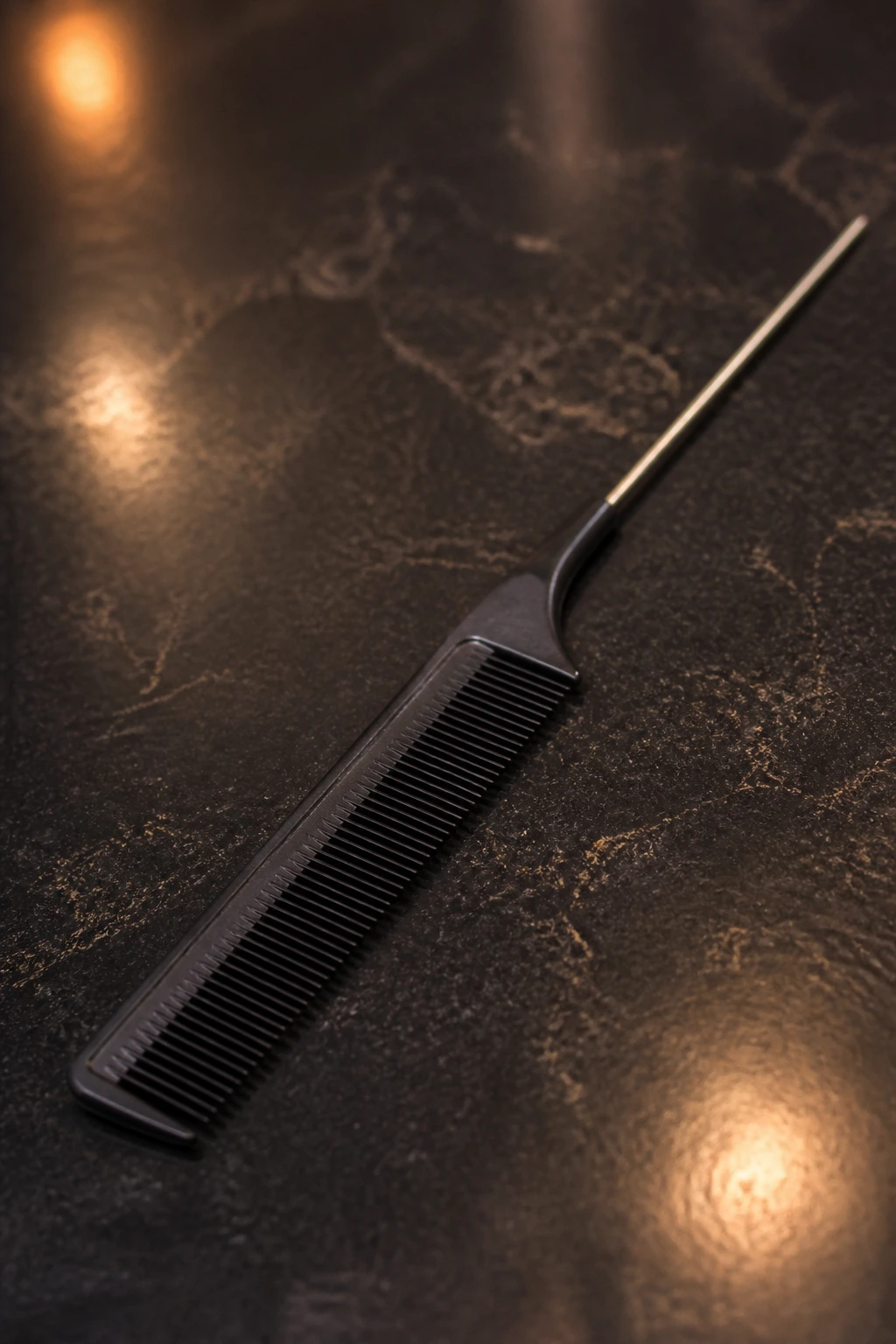
A good gray-blending job on thick hair starts with the right tools and the right conversation. You do not need a bag full of gadgets, but you do need the pieces that keep the color clean and the placement precise.
- Tail comb: Useful for clean parting and for slicing fine sections through dense hair.
- Foils or balayage board: Foils give stronger lift and control; a board helps paint thicker sections evenly.
- Color brush and bowl: Needed for root smudges, glosses, and lowlights with clean saturation.
- Sectioning clips: Thick hair falls apart fast without secure clips.
- Demi-permanent color or gloss: Better than permanent color for soft blending and easier grow-out.
- Low-volume developer: Helps keep the tone controlled so gray blending does not turn into over-processing.
- Purple or blue shampoo: Purple helps blondes and beige pieces stay clean; blue can help brown hair that pulls orange.
- Heat protectant: Gray-blended hair can look amazing with a blowout, but heat without protection roughs up the cuticle fast.
- Wide-tooth comb: Gentler on thick, processed hair than a fine comb.
- Clipless blow-dryer nozzle or concentrator: Helps stretch the cuticle flat so the color looks smoother and shinier.
Bring reference photos, but bring the right kind. Look for pictures with the same skin tone depth, the same hair density, and a similar amount of gray. A style on fine, cool-toned blond hair tells you almost nothing about what will happen on thick tan hair.
How to Wear the Blend So It Shows Movement
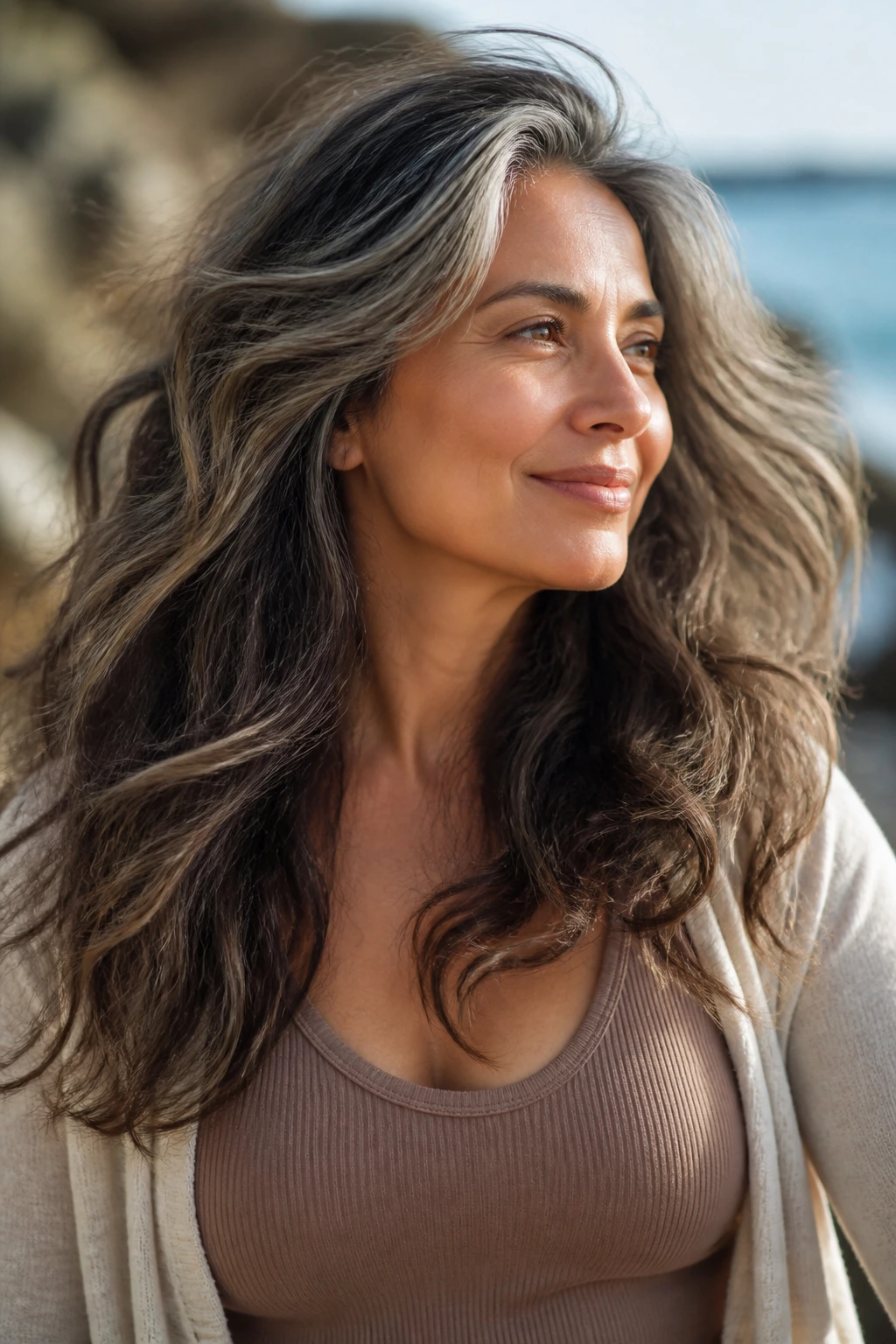
Placement: Put the brightest pieces where the hair moves—around the front hairline, the crown, and the outer surface of the layers. Thick hair hides interior detail unless it’s intentionally exposed.
Styling: Loose waves, a round-brush blowout, or a bent finish do more for gray blending than bone-straight styling. A little curve lets the light catch the ribbons and lowlights instead of flattening them into one color field.
Parting: A center part shows the most gray, which can be beautiful if the blend is soft. A side part gives more room for a smoky root or face frame to hide the line. Switch parts once in a while if your gray concentrates in one spot; it spreads the visual load.
Pairing: Tan skin usually looks best with makeup and clothing that echo the hair tone. Bronze, taupe, warm rose, soft peach, and muted gold tend to sit nicely with beige-brown blends. Heavy black eyeliner next to a soft caramel blend can feel too severe, so if the hair is warm and airy, let the makeup breathe a little too.
Small Moves That Keep the Color Soft
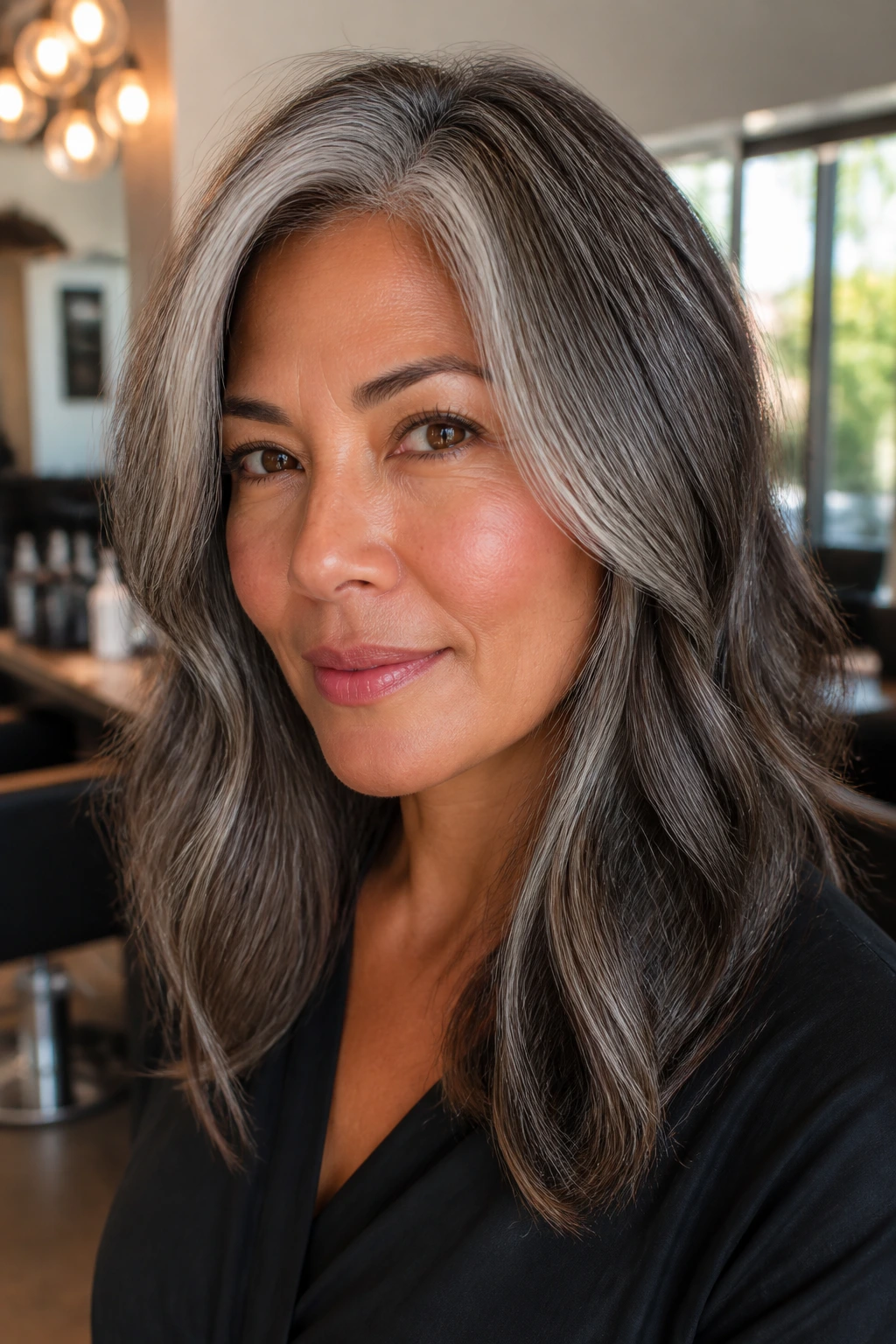
Tone first: A gloss every 4 to 8 weeks can keep beige, mushroom, or bronze tones from going dull. On thick hair, the ends often drink up color unevenly, so the gloss matters more than people expect.
Cut matters: Long layers, invisible layers, or a softly textured lob help show dimension. A blunt, heavy cut can hide the blend and make gray stand out at the ends.
Water matters: Hard water can warm blond pieces and dull silver pieces fast. If your area has mineral-heavy water, a clarifying wash once every couple of weeks and a filter in the shower can help the blend stay cleaner.
Heat matters: Use a heat protectant before blow-drying or hot tools. Gray-blended hair often has different porosity levels, so the lighter pieces burn out faster than the darker ones if you skip this.
Be honest about maintenance: If you want a very soft, low-contrast grow-out, ask for a root shadow and fewer high-lift pieces. If you want more brightness, accept that you’ll need glosses and touch-ups more often. There is no free lunch here.
Common Mistakes That Make Gray Look Stripey
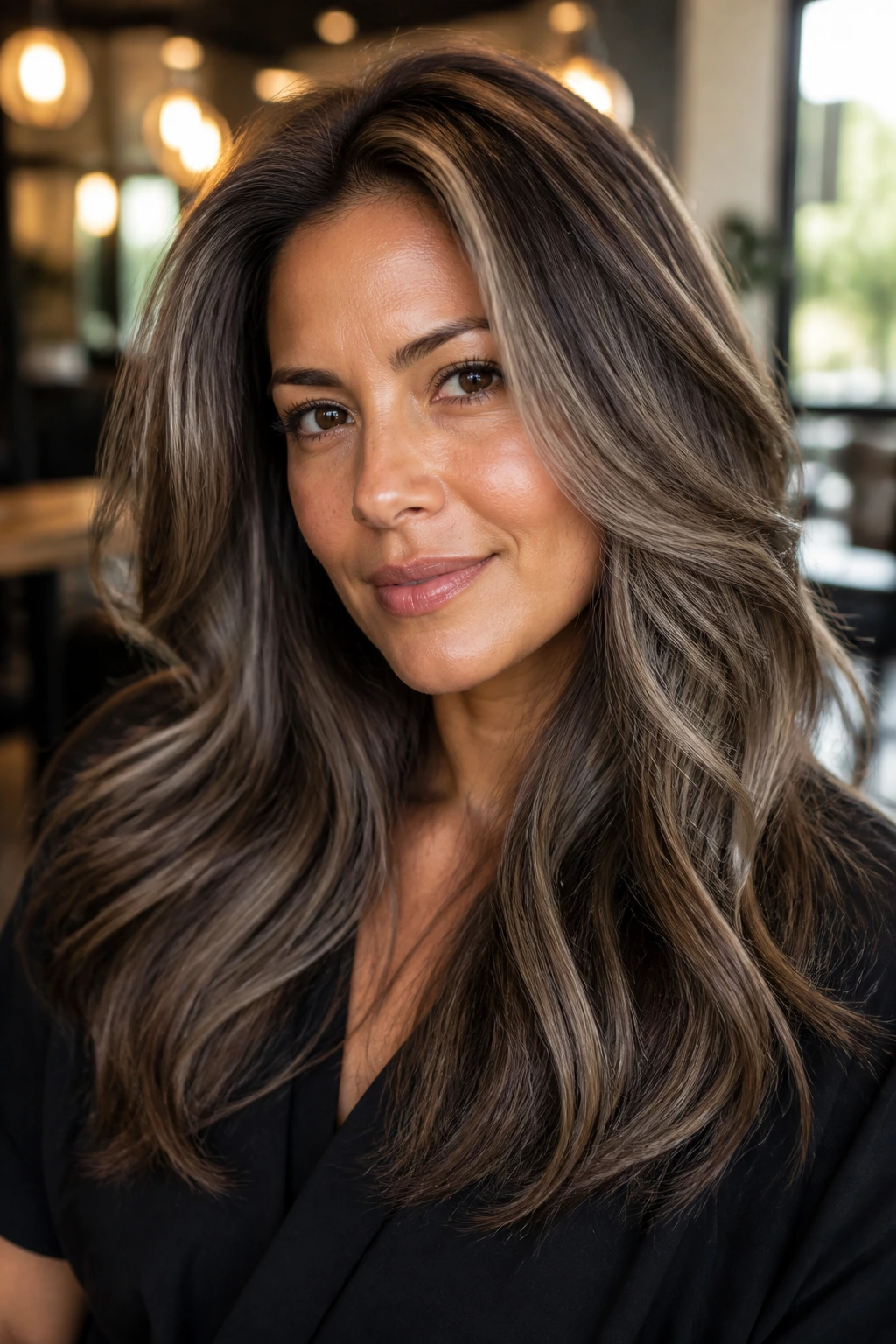
The first mistake is going too blonde too fast. On thick hair, bright pieces can look strong in the bowl and then disappear into the bulk once the hair dries. The result is not dimension; it’s random light spots with gray still announcing itself at the root.
The second mistake is using ash like a hammer. Ash is useful, but too much of it can make tan skin look flat or slightly gray-green. If the complexion is warm, ash needs a little beige or chestnut beside it.
Another common slip is highlighting only the top layer. That leaves the interior dark, the surface bright, and the gray stuck in the middle. Dense hair needs color inside the architecture, not just on the roof.
Skipping lowlights is a big one too. Without darker pieces, the hair can turn too airy and lose the structure that makes gray blending believable. A few walnut, mocha, or espresso notes hold the whole thing together.
Finally, people often ignore the grow-out pattern. If your gray is concentrated at the temples, part line, or crown, those spots need special placement. Throwing the same foil map across the whole head is lazy, and the stripes show it.
Variations for Different Gray Patterns and Skin Undertones
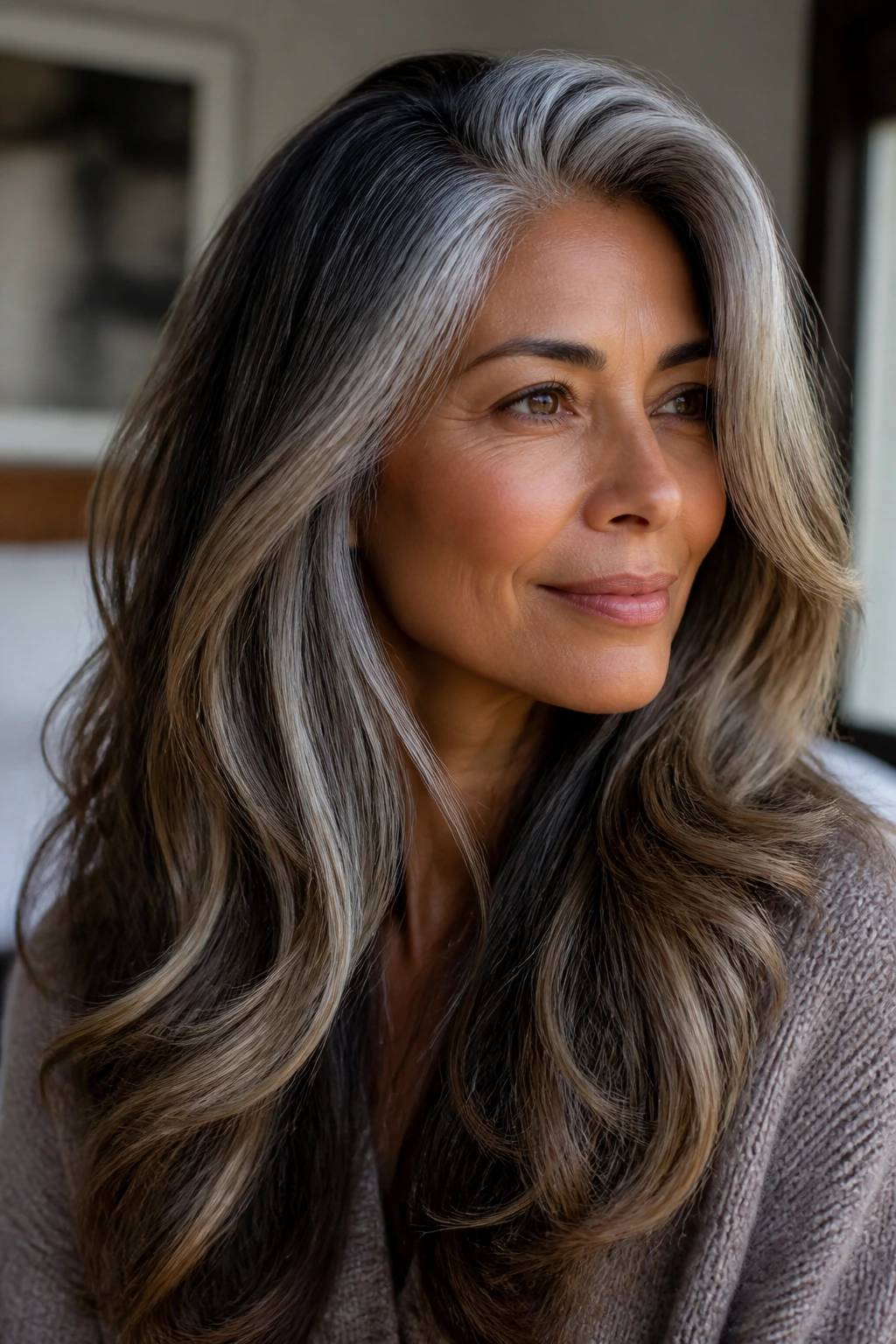
Golden Tan Honey Blend: If your skin leans warm gold, keep the palette in honey, caramel, tawny, and beige. Skip any icy or steel-heavy finish unless it is used in very small pieces, because too much coolness can make warm skin look tired.
Olive Tan Mushroom Shift: Olive tan usually looks best with mushroom, taupe, smoky brown, and steel-sand notes. These shades quiet down brass and keep the face looking calm instead of red or orange.
High-Gray Silver Story: If you have a lot of silver and want to wear it instead of hiding it, go with silver slices, pearl beige gloss, and smoky lowlights. The goal is not camouflage; it is a deliberate pattern that grows out gracefully.
Low-Maintenance Shadow Blend: If salon visits need to stretch, choose a deeper root tap, fewer bright pieces, and a cocoa or chestnut base. The grow-out stays softer, and the part line doesn’t shout as loudly.
Bold Contrast Brunette Veil: If you like stronger contrast, keep the base espresso or charcoal-brown and add beige or silver ribbons on top. This works best when the hair is thick enough to support a darker interior without looking blocky.
Frequently Asked Questions About Blending Gray on Tan, Thick Hair
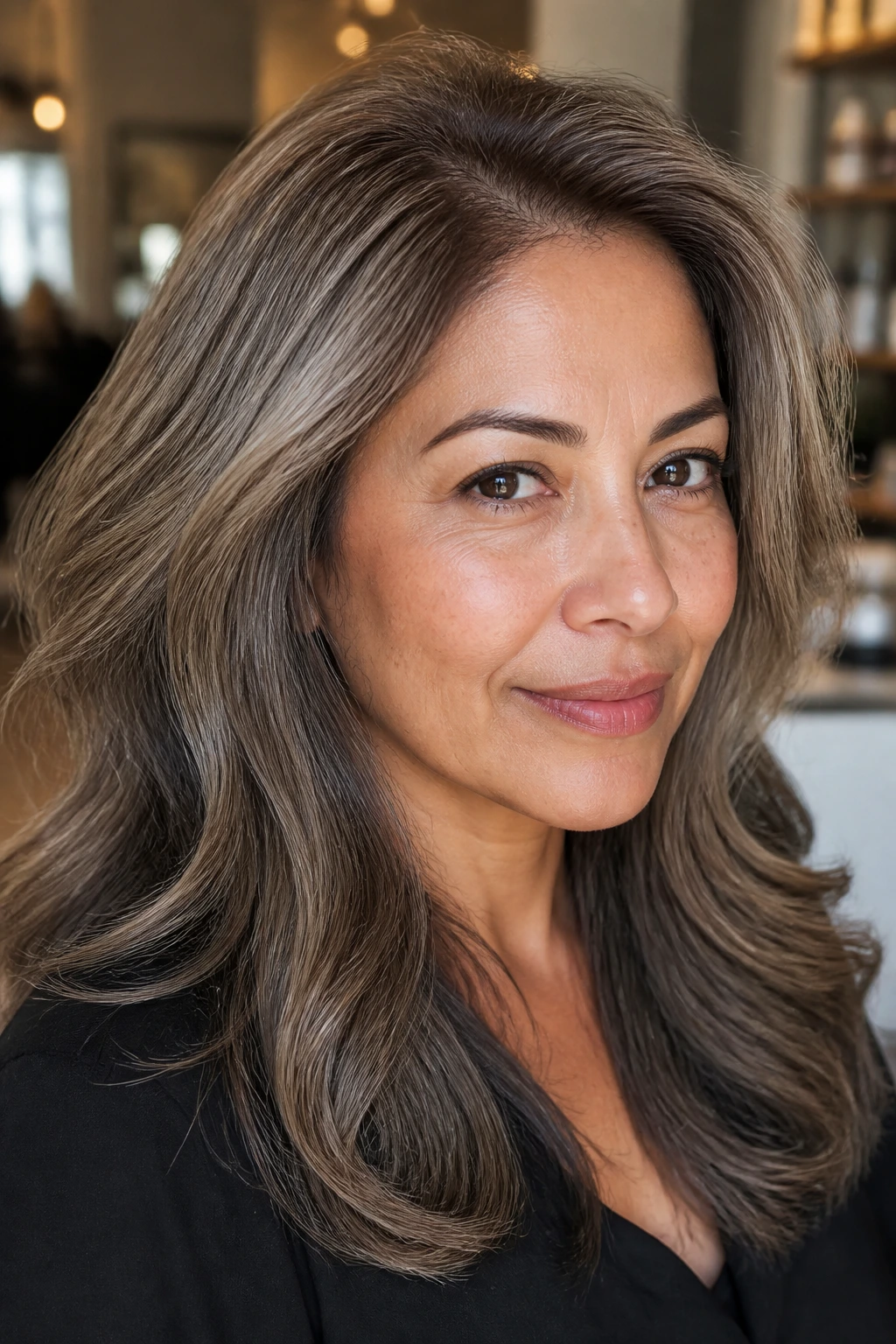
Can you blend gray hair without fully covering it?
Yes, and that is often the better choice on thick hair. Gray blending uses highlights, lowlights, root shadows, and glosses to soften the line so the silver becomes part of the color pattern instead of disappearing under one flat shade.
What shades usually flatter tan skin best?
Beige, mushroom, caramel, bronze, chestnut, taupe, and soft copper-brown are the safest lanes. The exact pick depends on whether your tan leans golden, olive, or neutral, and that detail changes the whole outcome.
Will ash tones wash out tan skin?
They can if they are too strong or too blue. Ash works best when it is balanced with beige, brown, or a little warmth; otherwise the face can start to look dull, especially next to silver strands.
Is balayage or foiling better for thick hair?
Both can work. Balayage gives a softer sweep and is good for a lived-in finish, while foils offer more control and lift, which can be useful when gray is stubborn or the hair is very resistant.
How often does thick, gray-blended hair need maintenance?
Root shadows and glosses usually need attention every 4 to 8 weeks, while a larger color refresh often lands around 8 to 12 weeks. If the gray is concentrated at the part line, you may want a quicker gloss schedule so the line stays soft.
Can gray blending work on curly or wavy thick hair?
Absolutely. In fact, waves and curls show dimension better than flat hair does. The placement just needs to respect the curl pattern so the highlights and lowlights don’t clump in one obvious stripe.
What if my gray is mostly at the temples?
Focus the brightest pieces around the face and keep the root area smoked just enough to blur the line. Temple gray can look very natural when it is framed instead of fought.
Do I need bleach for gray blending?
Not always. Many gray blends rely on demi-permanent color, gloss, and lowlight work instead of full bleach. If you do need lift, it should be used with a plan, because thick hair can hold onto unwanted warmth if the lightening is pushed too far.
A Softer Grow-Out
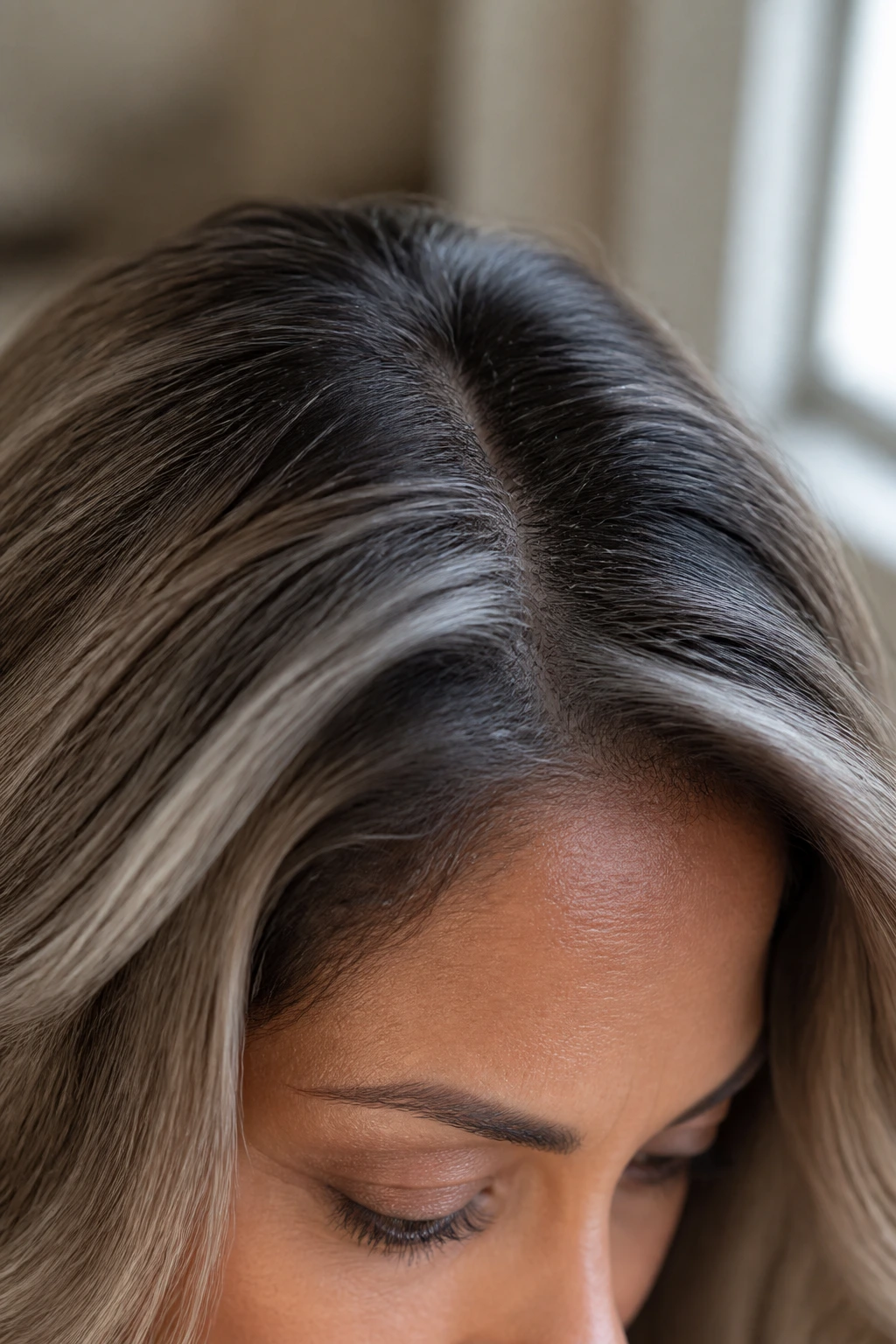
The best gray blend on tan, thick hair does not try to win a fight against the silver. It works with it. That usually means a deeper root, a careful mix of cool and warm tones, and enough interior placement that the hair has shape when it moves.
I like blends that get better after a few weeks, not worse. If the color softens as it grows and the gray settles into the pattern instead of shouting from the part line, the job was done right. That is the standard worth aiming for.
Pick the lane that matches your undertone, your gray pattern, and how much salon time you actually want to spend. Then let the hair breathe a little.