



Grey hair against pale skin can look smoky, soft, or washed-out by lunch. The difference usually comes down to two things: the grey shade and the line the bangs make across the face.
Side-swept bangs do useful work here. They stop the forehead from becoming one flat block of color, and they give silver, slate, or mushroom tones a diagonal shape that feels lighter than a blunt fringe. On very fair skin, that diagonal line matters; it keeps the whole look from going chalky, especially when the hair color sits close to the skin tone.
The best grey looks in this mix are not one-note silver helmets. They lean pearl, graphite, lavender, pewter, or salt-and-pepper, often with a root that sits a half-shade deeper than the ends. My favorite versions move when you turn your head — a little feather at the bang, a little bend at the ends, a little shadow near the crown. That’s where grey starts looking intentional instead of accidental.
Why These Grey Hairstyles for Pale Skin Stand Out
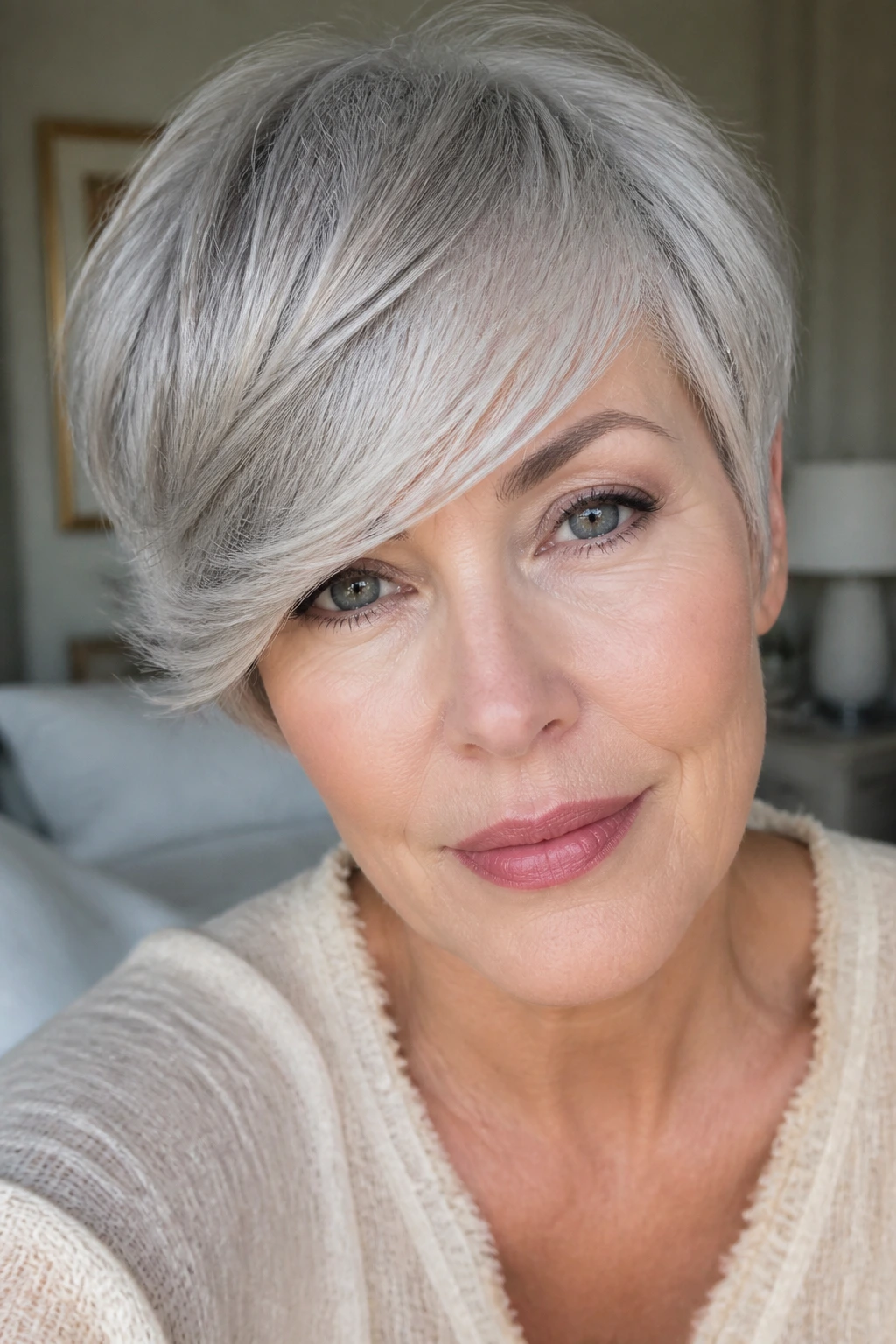
- Face-framing geometry: A side-swept bang cuts a diagonal across the forehead, so the eye moves up through the face instead of stopping at a blunt line.
- Shade control: Pearl, smoke, graphite, and mushroom grey sit differently against pink or neutral undertones, which means you can choose contrast instead of guessing.
- Grow-out forgiveness: Root shadow and balayage keep regrowth from looking stripey after 4 to 8 weeks.
- Texture options: These cuts work on straight, wavy, curly, fine, and thick hair because the shape changes more than the color does.
- Less flatness: The sweep of fringe keeps the front from becoming one heavy panel, which matters when grey hair can look dense under bright indoor light.
- Real-life wear: Most of these styles can be restyled with a round brush or flat iron in under 10 minutes once the cut is right.
1. Pearl Silver Lob with a Long Side Sweep
Pearl silver sits in that sweet spot between icy and soft. On pale skin, it throws back enough light to look fresh, but not so much that the face gets wiped out by brightness. A collarbone-length lob gives the color somewhere to breathe, and the long side sweep adds a little movement right where the cheekbone needs it.
Why it works
The lob length keeps the silhouette clean. It’s long enough to tuck behind one ear, which helps if you wear glasses or want one side to feel open, and short enough that the ends don’t go stringy. Pearl silver also reads smoother than a flat blue-grey, especially when your skin has a pink or neutral cast.
How I’d style it
Blow-dry with a 1.25-inch round brush, pulling the fringe across the forehead and then back toward the temple. Finish the ends with a tiny bit of serum — tiny is the word — because grey hair shows oil fast at the front. If the hair bends too much, run a flat iron over just the first two inches of the fringe and keep the rest airy.
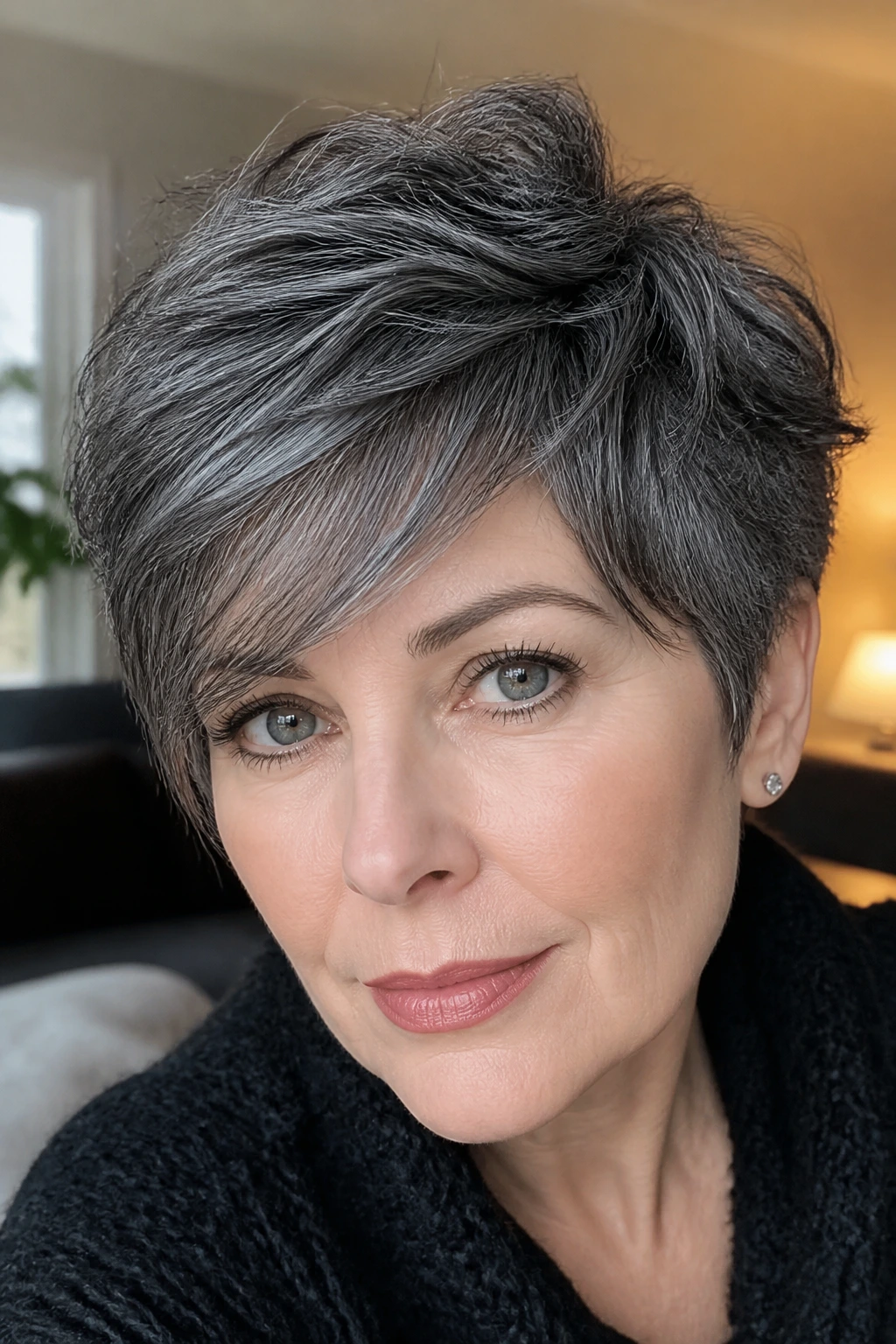
2. Smoky Charcoal Pixie with a Feathered Bang
Short hair can do something long hair can’t. It makes grey look deliberate from the first glance. A smoky charcoal pixie with a feathered bang gives pale skin a dark frame at the roots and a soft sweep in front, which keeps the face from feeling overexposed.
You also get the best part of a pixie: the cut does most of the work. The top can sit a little longer, the sides can stay close, and the fringe can fall across the forehead in a piecey line instead of a helmet shape. That pieceiness matters. It stops charcoal grey from looking severe.
Use a pea-size dab of matte paste and work it into dry hair from the crown forward. Then pinch the bang into a side sweep with your fingers, not a brush. Brushes can over-smooth a pixie and make the whole thing look sticky.
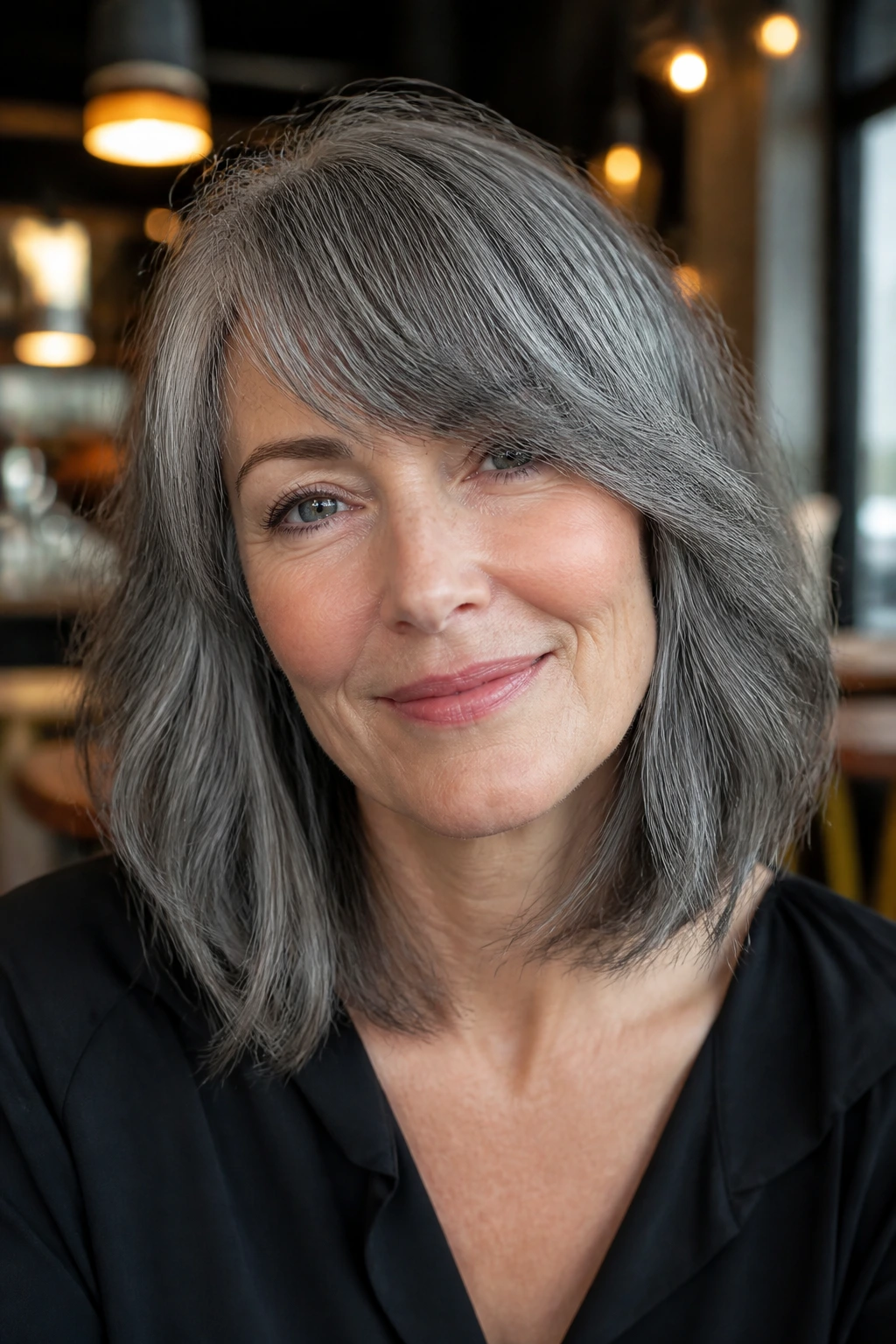
3. Steel Grey Collarbone Cut with Soft Layers
Want a grey style that lands between short and long? This is the one. Steel grey on a collarbone cut feels tidy without looking stiff, and the soft layers keep the ends from sitting like one blunt slab against the neck. On pale skin, steel grey is clean in a way that reads sharp, not harsh.
What makes it flattering
The collarbone line creates a horizontal pause, then the side-swept bang breaks it up with a diagonal. That combination is useful if your face is narrow or your forehead feels long. The layers also let the grey shift between lighter and darker panels as you move, which keeps the color alive under flat lighting.
Styling note
Dry the fringe first with the nozzle aimed from the part toward the opposite temple. That direction is what trains the sweep. If you want the ends to curve inward a little, wrap just the bottom inch around a medium round brush and hold for five seconds.
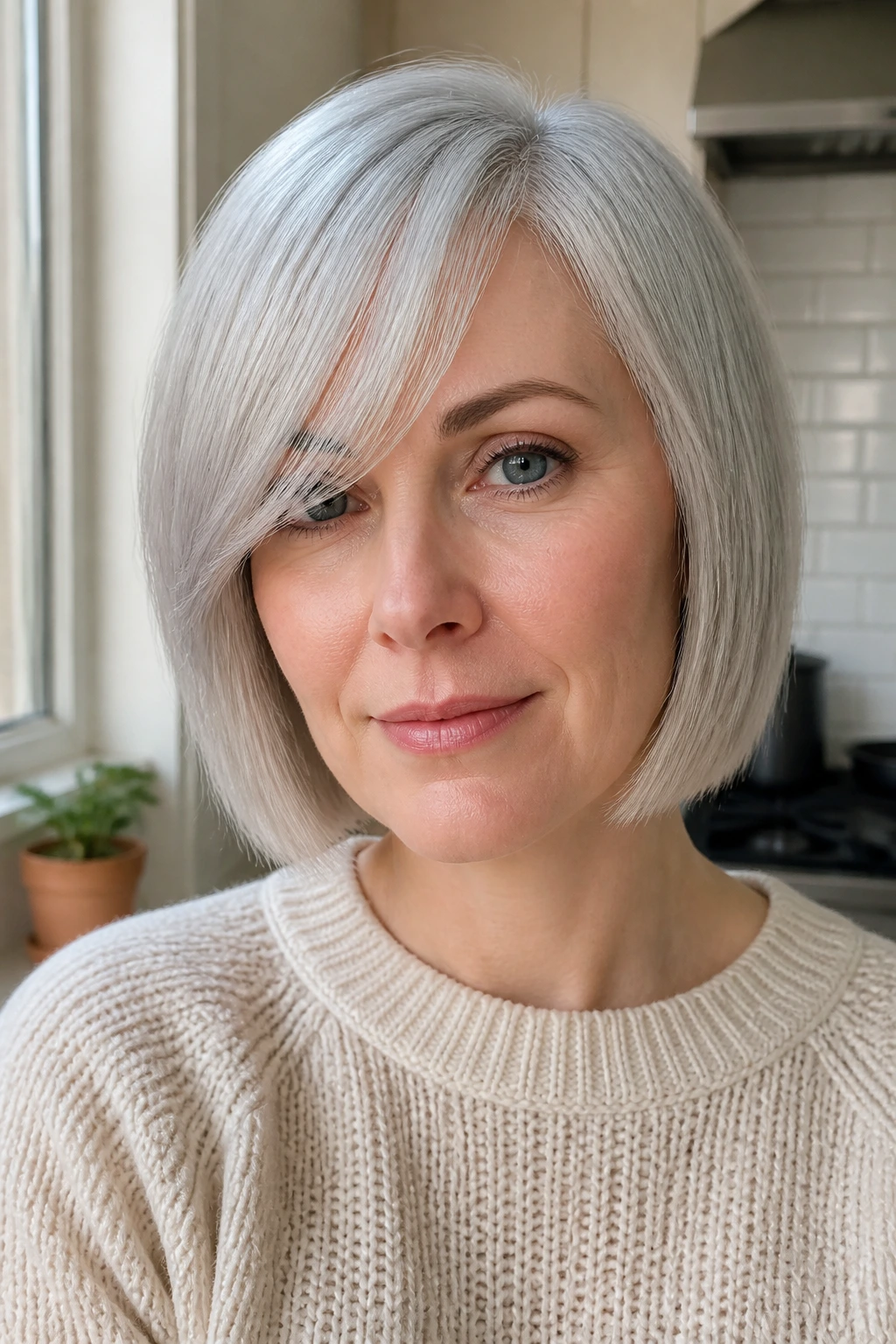
4. Ice Grey Blunt Bob with an Airy Side Fringe
A blunt bob can look too severe on pale skin if the fringe is heavy. Airy side-swept bangs fix that fast. The cut stays graphic and crisp at the jaw, but the front moves enough to keep the face from turning boxy.
This is a smart choice if your hair is straight or naturally smooth. The blunt edge gives ice grey a clean finish, and the airy fringe stops the whole look from feeling like a paper cut. I like this best when the color has a whisper of silver rather than a pure white cast.
Keep the bang light. Ask for point-cut ends so the front doesn’t sit in one thick line. Then use a fine mist of flexible spray and a quick pass with the flat iron, bending the fringe just a touch toward the cheekbone.
5. Mushroom Grey Shag with a Grazing Fringe
Mushroom grey is one of the kindest shades for very fair skin because it has a muted, earthy base. It doesn’t scream for attention. It sits there, cool and soft, and lets the cut do the talking. A shag with a grazing side fringe gives that color some grit, which is exactly what keeps it from looking flat.
The fringe should skim the eyebrow or just below it, then drift into the cheek line. That small bit of movement keeps the forehead from disappearing under hair. The shag layers give you lift at the crown and a little swing around the jaw, which is useful if your hair tends to lie close to the head.
A curl cream or light mousse works better than heavy oil here. You want separation, not gloss. Heavy shine can make mushroom grey look greasy by noon.
6. Silver Balayage on Long Layers
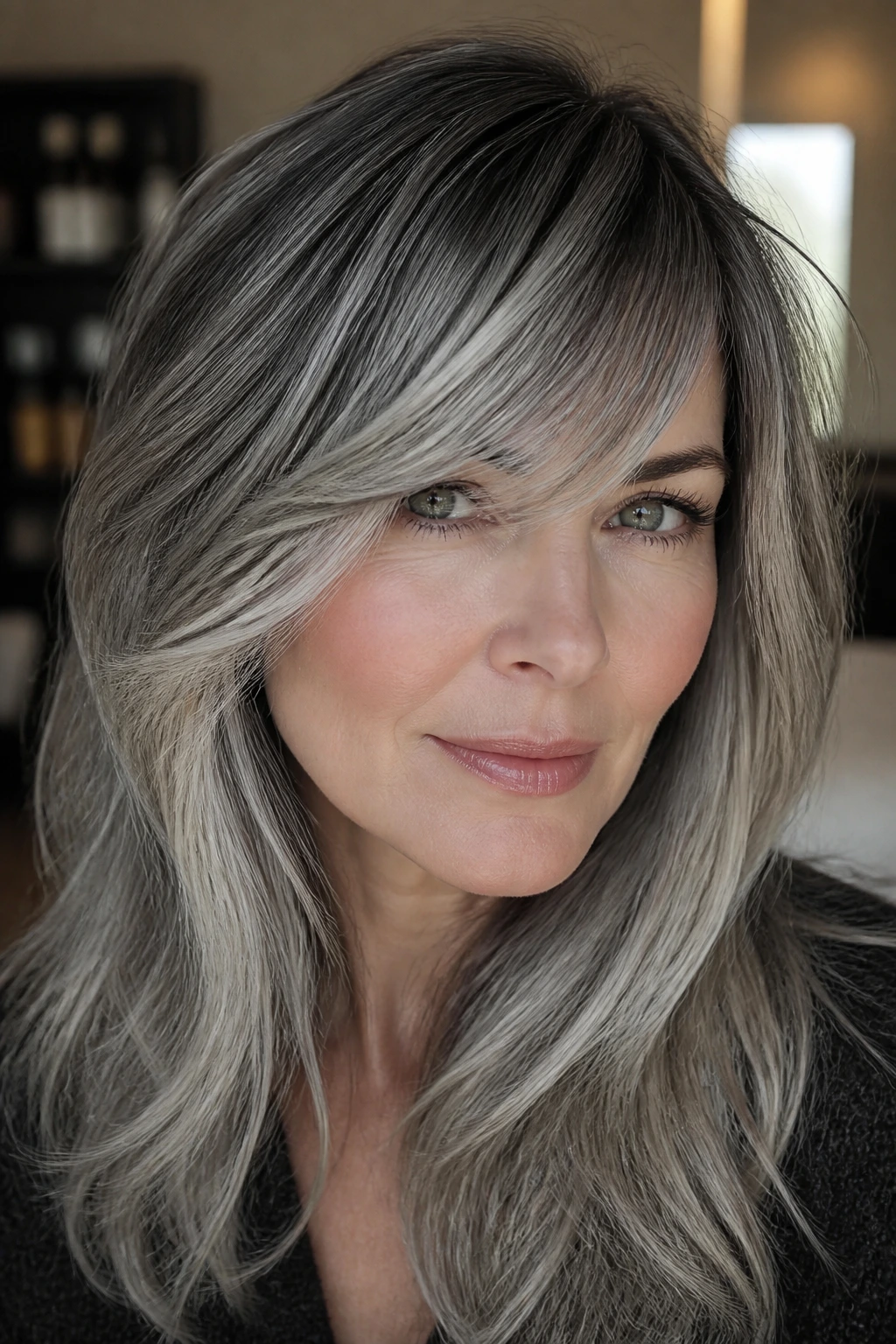
If you like your hair long, balayage gives grey a softer landing. The darker root and silver mids make the color feel lived-in, not pasted on, and pale skin benefits from that shadow near the crown. Side-swept bangs help the whole thing land in a controlled way instead of dragging the face down.
The reason this works is simple: long hair can carry a lot of light. Without depth at the root, silver can flatten out and make the skin look paler than it is. A balayage melt with a side sweep gives you contrast where you need it and brightness where you want it.
Best styling rhythm
Let the layers dry with a large round brush, then bend the front away from the face. Don’t over-curl it. A soft S-curve is enough. If the ends turn wispy, stop adding product. Long grey layers need room, not more cream.
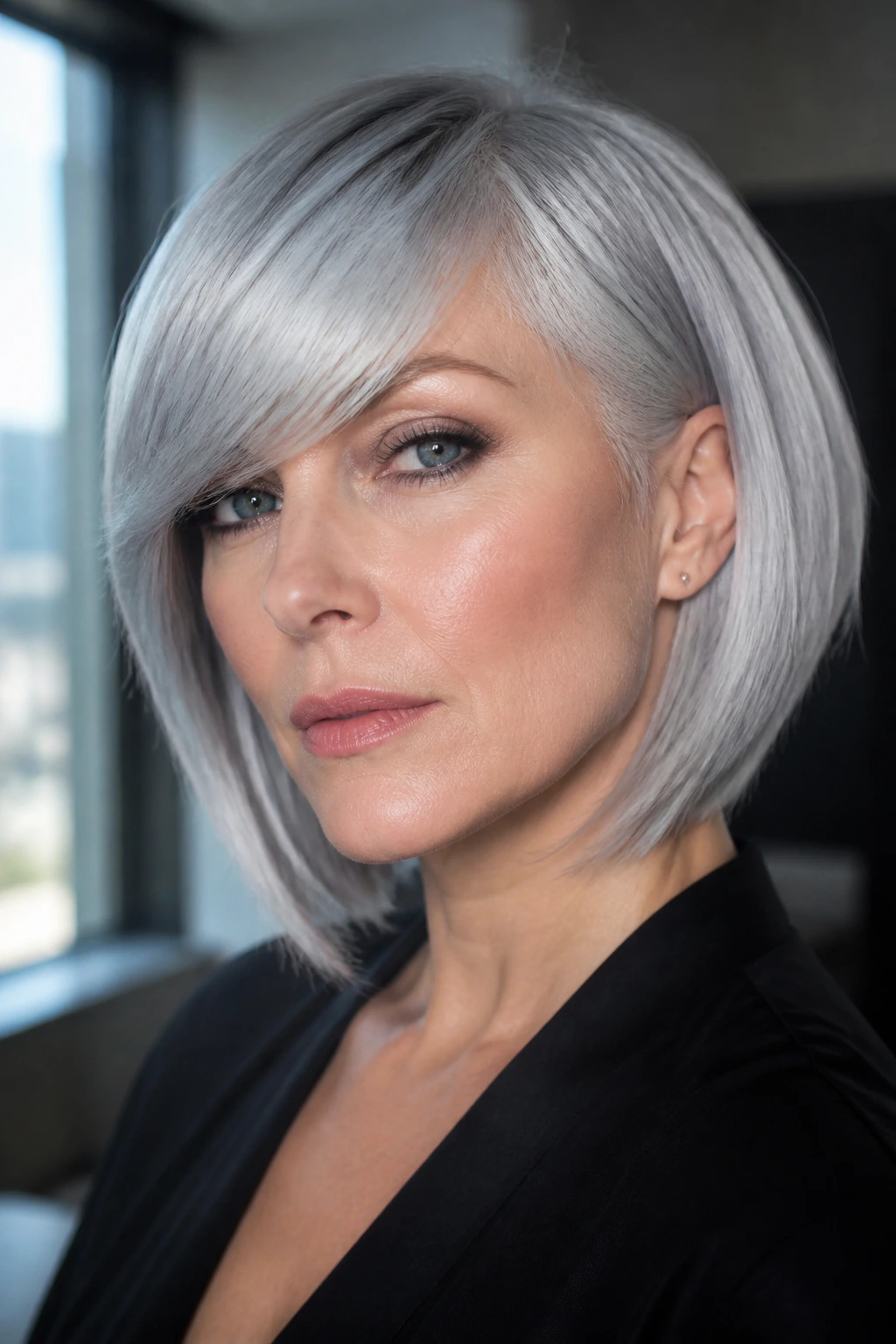
7. Slate Grey Angled Bob
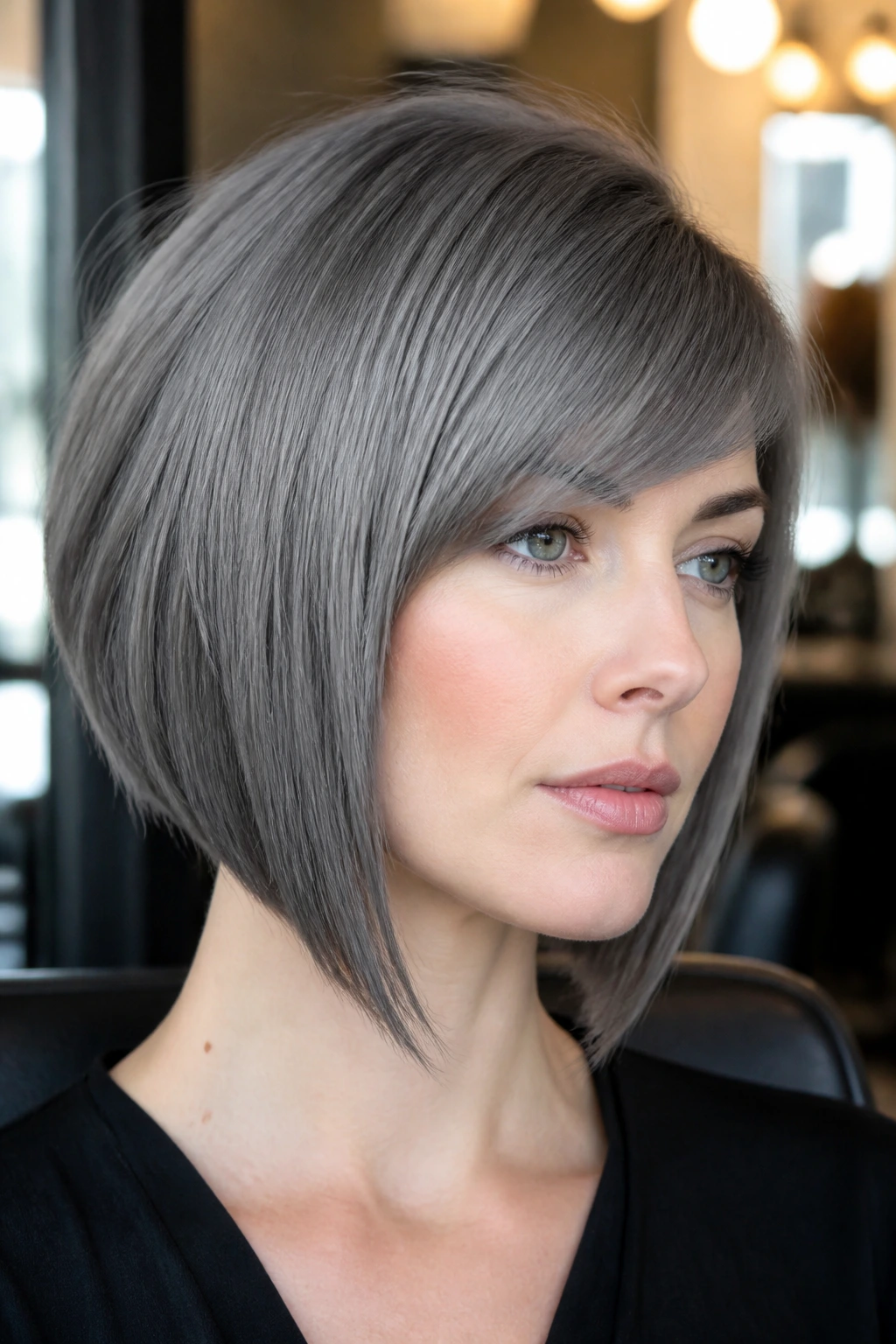
Slate grey has a little more grit than pearl silver and a little more softness than graphite. Put it on an angled bob and you get a clean, modern line that still flatters pale skin. The longer front pieces pull the eye forward, while the shorter back keeps the shape lifted.
This cut is good when you want the bangs to feel part of the architecture, not an afterthought. A side-swept fringe can mirror the angle of the bob, which makes the whole style feel planned from root to end. It’s tidy. It’s sharp. It doesn’t need much.
Keep the front polished and the bang light. If the hair is thick, ask for internal debulking near the nape so the back doesn’t puff out like a triangle. That one cut decision matters more than most people realize.
8. Soft Grey Curls with a Deep Side Part Bang
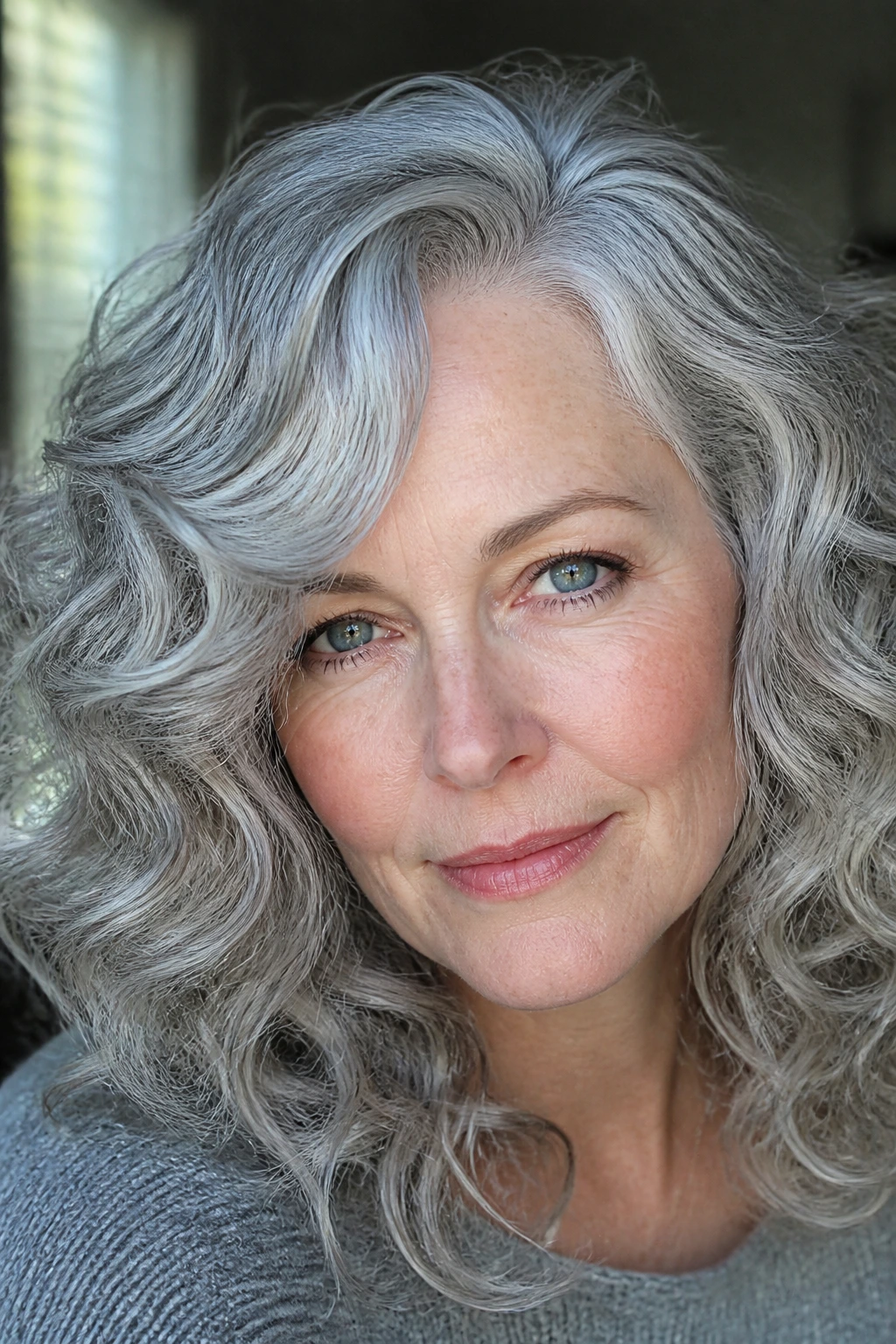
Curly grey hair on pale skin can be lovely when the bang respects the curl pattern. A deep side part lets the front fall in a controlled wave rather than fighting the curl. That matters because curls need a little slack, and bangs that are cut too rigidly end up springing up in the wrong direction.
Why this version behaves
The side part creates a longer visual line, which gives the curls a place to spiral into. Pale skin benefits from the softness around the face, especially if the grey has a mix of silver and ash rather than one bright tone. The shape looks fuller near the cheek and lighter at the top, which is flattering if your hair is dense.
How to handle it
Use a light curl cream and scrunch from the ends upward. Then diffuse on low heat until the curl clumps are set but still touchable. If the fringe separates too much, dampen only that section and twist it once before letting it dry toward the cheek.
9. Graphite Layered Midi Cut with a Face-Framing Sweep
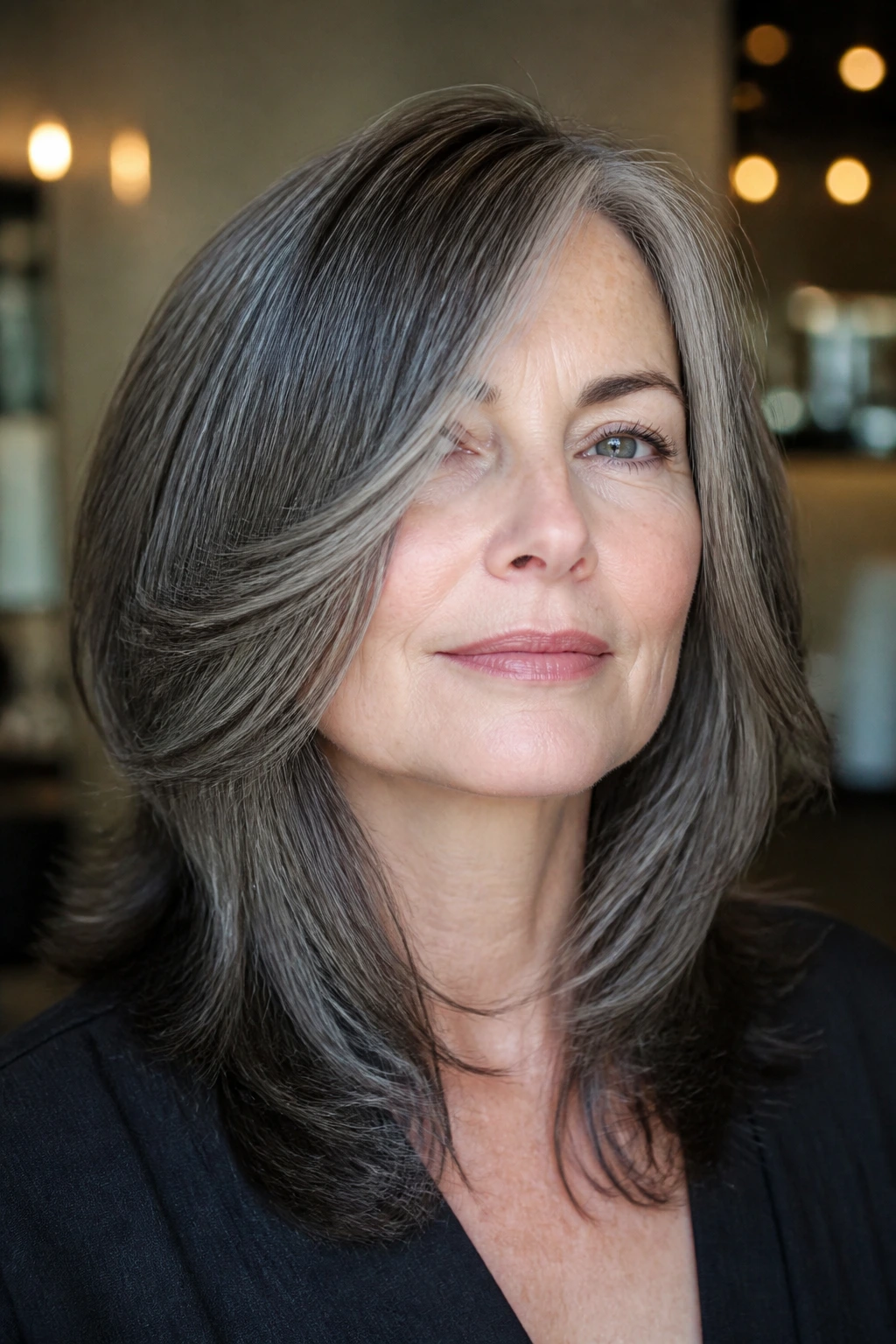
Graphite is darker, moodier, and a little more dramatic than softer grey tones. On pale skin, that contrast can be a gift if you like a look with structure. A layered midi cut keeps the length from feeling heavy, and the face-framing sweep opens the cheek and brow area.
I like this cut when the hair has a bit of natural movement. The layers catch the light at different points, so graphite doesn’t sit as one heavy sheet. The side-swept bang blends into the front layers instead of sitting on top of them, which makes the style look more expensive than it sounds.
A flat brush works well here if you want speed. Pull the fringe across the forehead, then curve the ends under with your hand. That tiny bend keeps the cut from looking too straight and severe.
10. Lavender-Grey Waves with Side-Swept Fringe
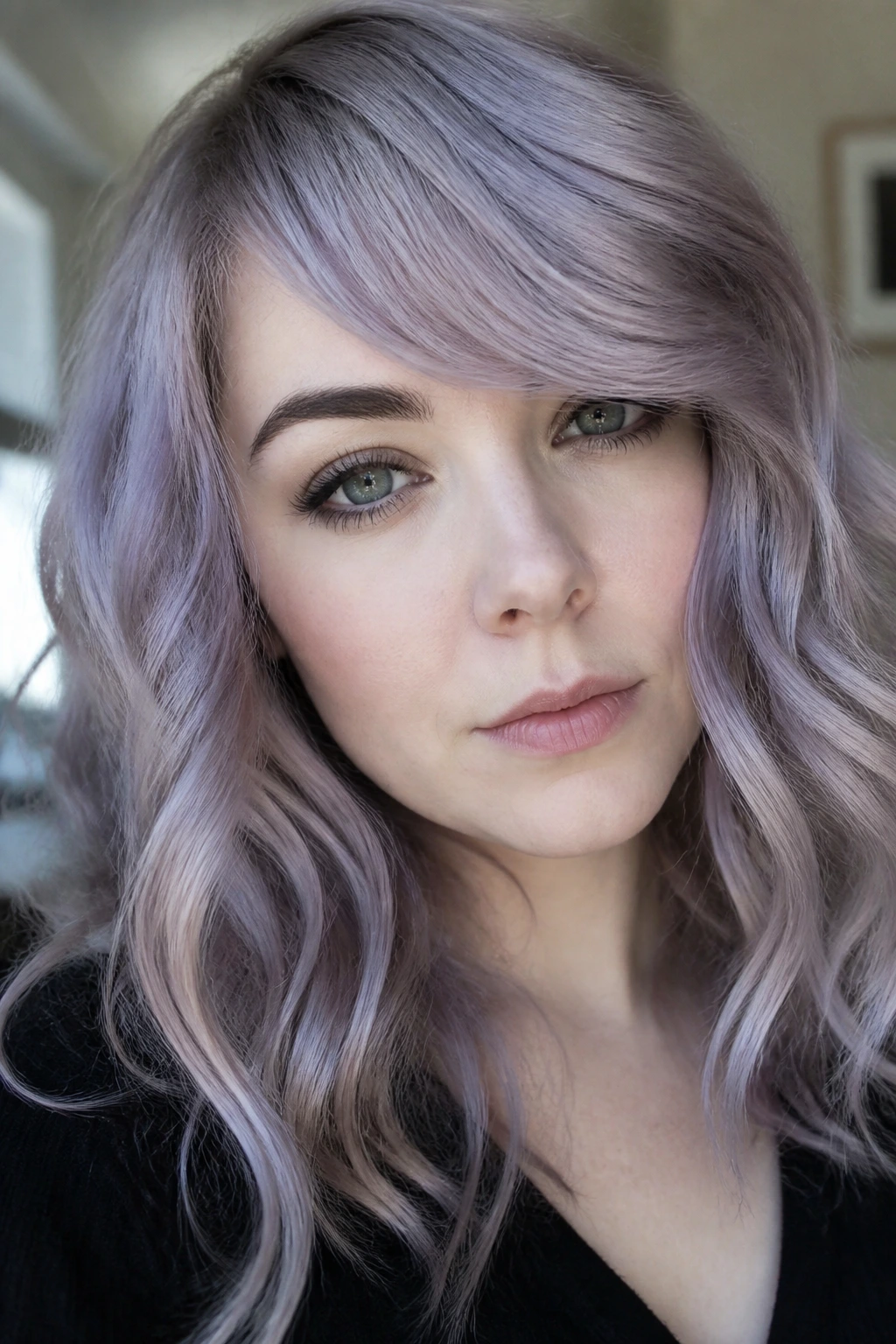
Lavender-grey is not loud if the tone stays smoky. It reads like silver with a whisper of lilac, and on pale skin it can soften redness in a way that pure white-grey sometimes cannot. Side-swept bangs keep the color from feeling too ethereal or too costume-like.
The waves matter as much as the shade. Loose bends break the light into smaller pieces, which is kinder to fair skin than a highly reflective straight finish. I’d keep the crown smooth and let the wave start around the cheekbone. That keeps the front open.
If you try this color, don’t chase a bright purple cast. A tiny amount of violet is enough. Too much and the hair starts looking dusty instead of cool.
11. Salt-and-Pepper Blend with a Polished Blowout
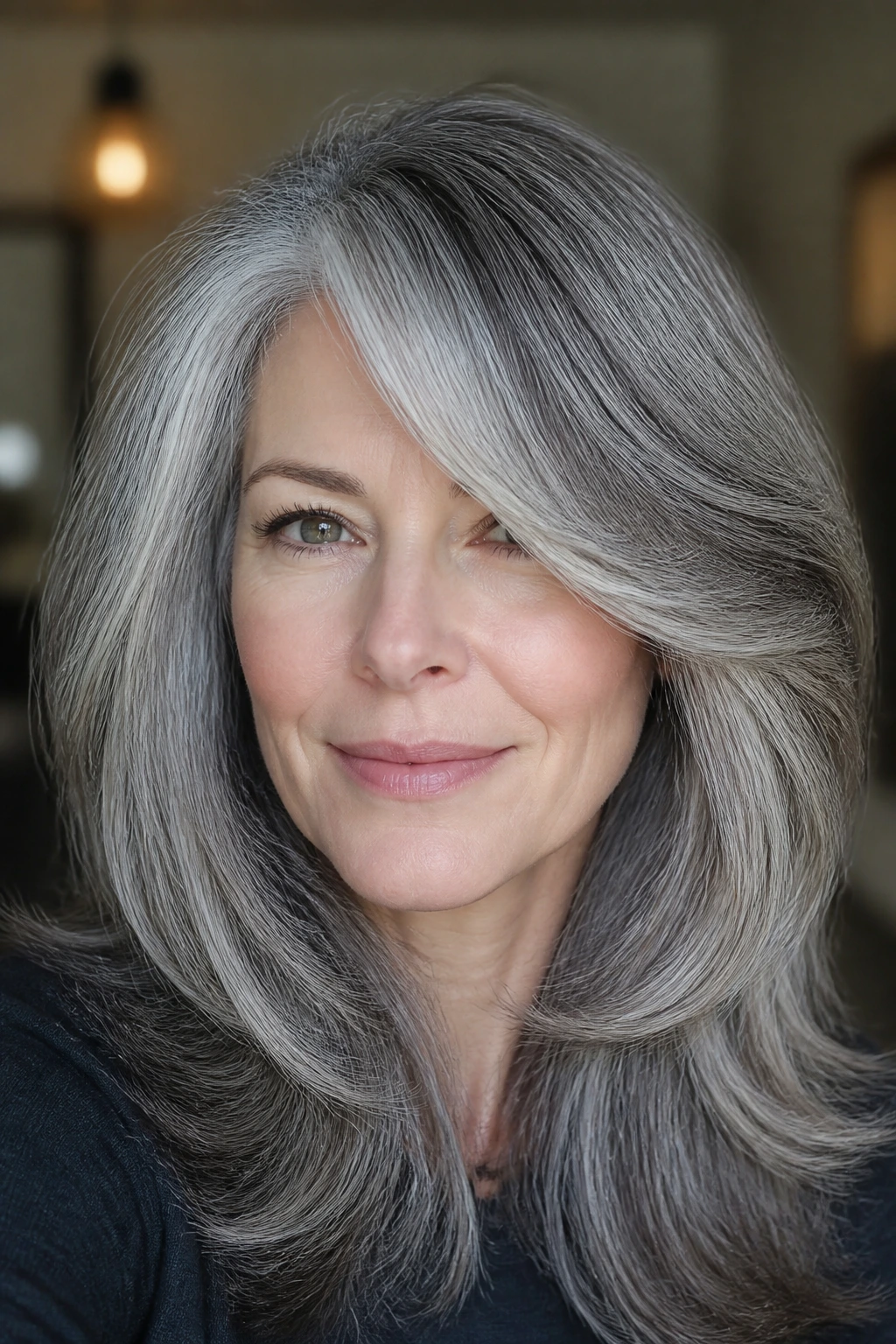
Salt-and-pepper hair can be one of the smartest grey looks on pale skin because it keeps natural depth in the mix. The polished blowout is what makes it feel styled. Without that smoothing, the mix can look random. With it, the pattern reads intentional.
The side-swept bang is doing two jobs here. It lifts the front away from the face, and it guides the eye through the lighter strands instead of stopping on the darker ones. That’s useful if your grey is uneven or growing in at different speeds.
A round brush, medium heat, and a quick cool shot are enough. Don’t chase perfect symmetry. A little irregularity is what makes salt-and-pepper hair look alive instead of dyed into submission.
12. Tapered Grey Crop with a Sweeping Fringe
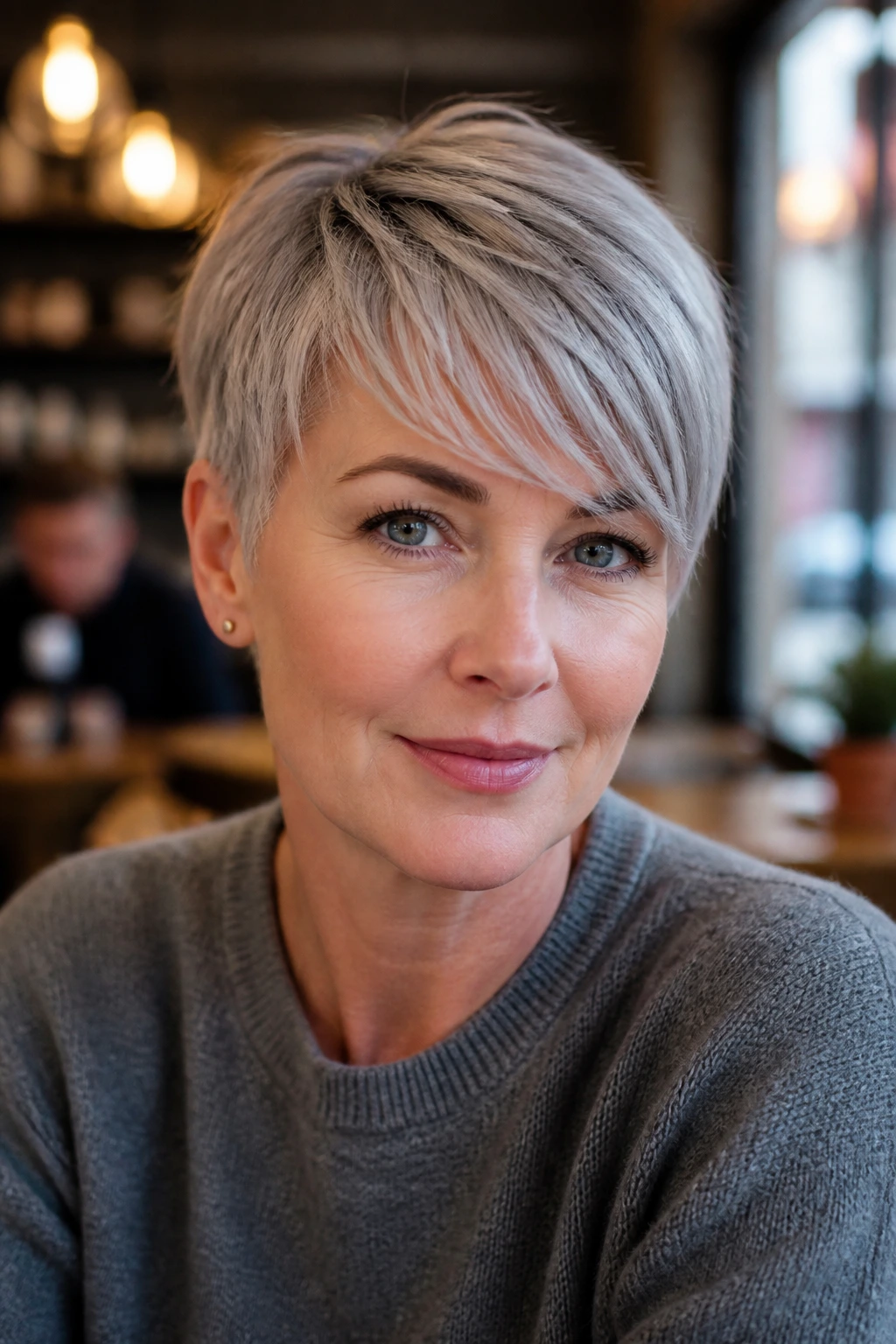
Short, tapered cuts are underrated on pale skin. They show the neck, sharpen the jaw, and let grey read like a color choice rather than a compromise. A sweeping fringe softens the front so the crop doesn’t turn military.
This style works especially well if your hair is fine and you want to fake a bit more volume up top. The taper at the nape keeps the shape snug, while the longer top gives you enough length to move the bang across the forehead. That movement is what saves the look from looking too strict.
Use a lightweight wax, not a heavy pomade. You want texture and direction, not shine that clumps the fringe together. A little separation at the ends keeps the crop from feeling helmet-like.
13. Dimensional Smoke Grey Long Bob
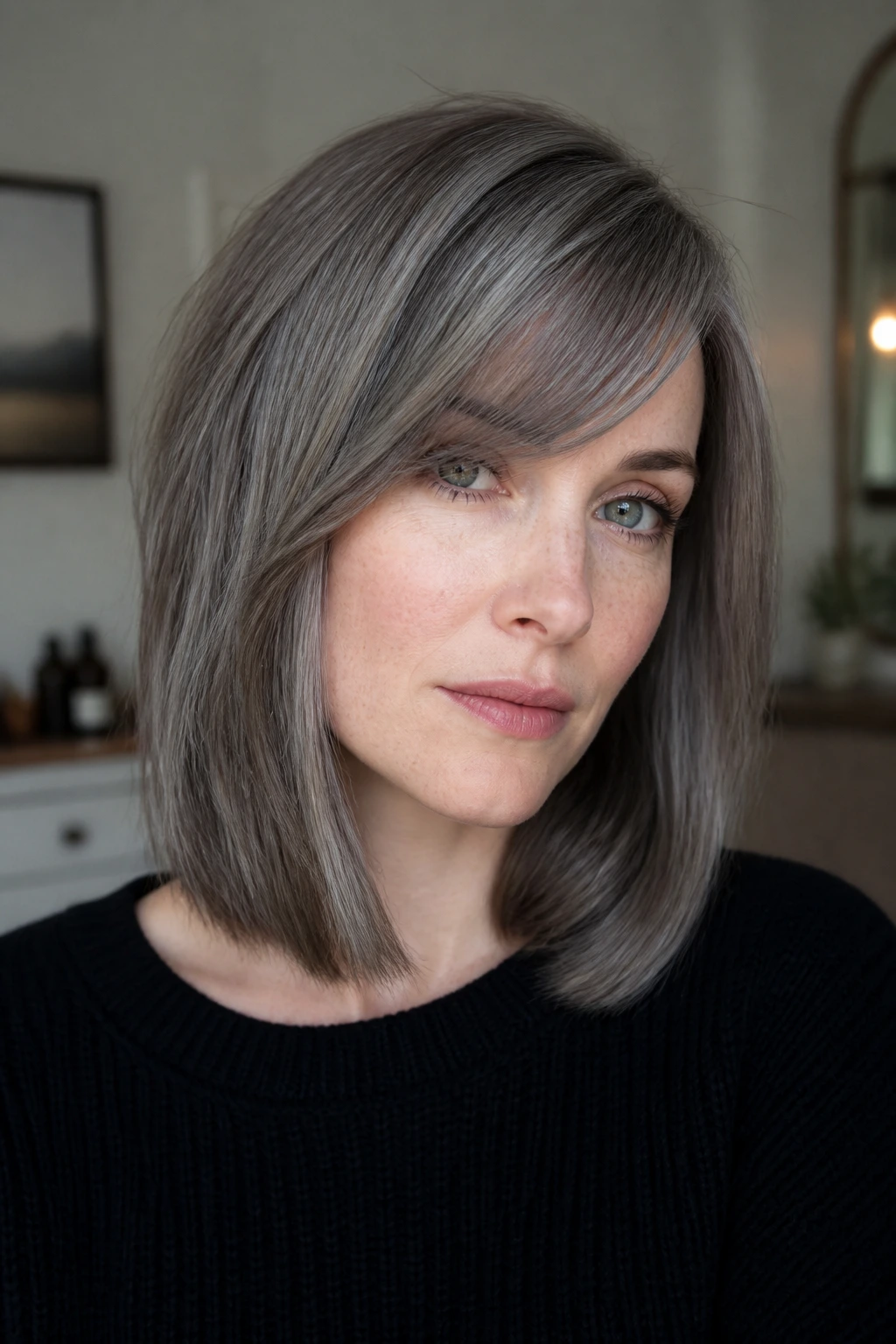
Smoke grey is what happens when silver gets shadow. That shadow is useful. On pale skin, dimension keeps the hair from washing out the face, and a long bob gives the color enough length to show off the subtle shifts between light and dark strands.
What makes it fuller
Dimensional color creates the illusion of thickness. That matters with a lob because the cut already sits in a fairly contained shape. If the grey is one flat tone, the hair can look thinner than it is. Smoke grey with lowlights fixes that by giving the eye more to read.
Styling it without overdoing it
Blow-dry in sections and stop once the hair is about 90 percent smooth. A little bend in the front keeps the cut from reading rigid. Then finish with a light mist of shine spray on the mids only. Leave the fringe softer and drier.
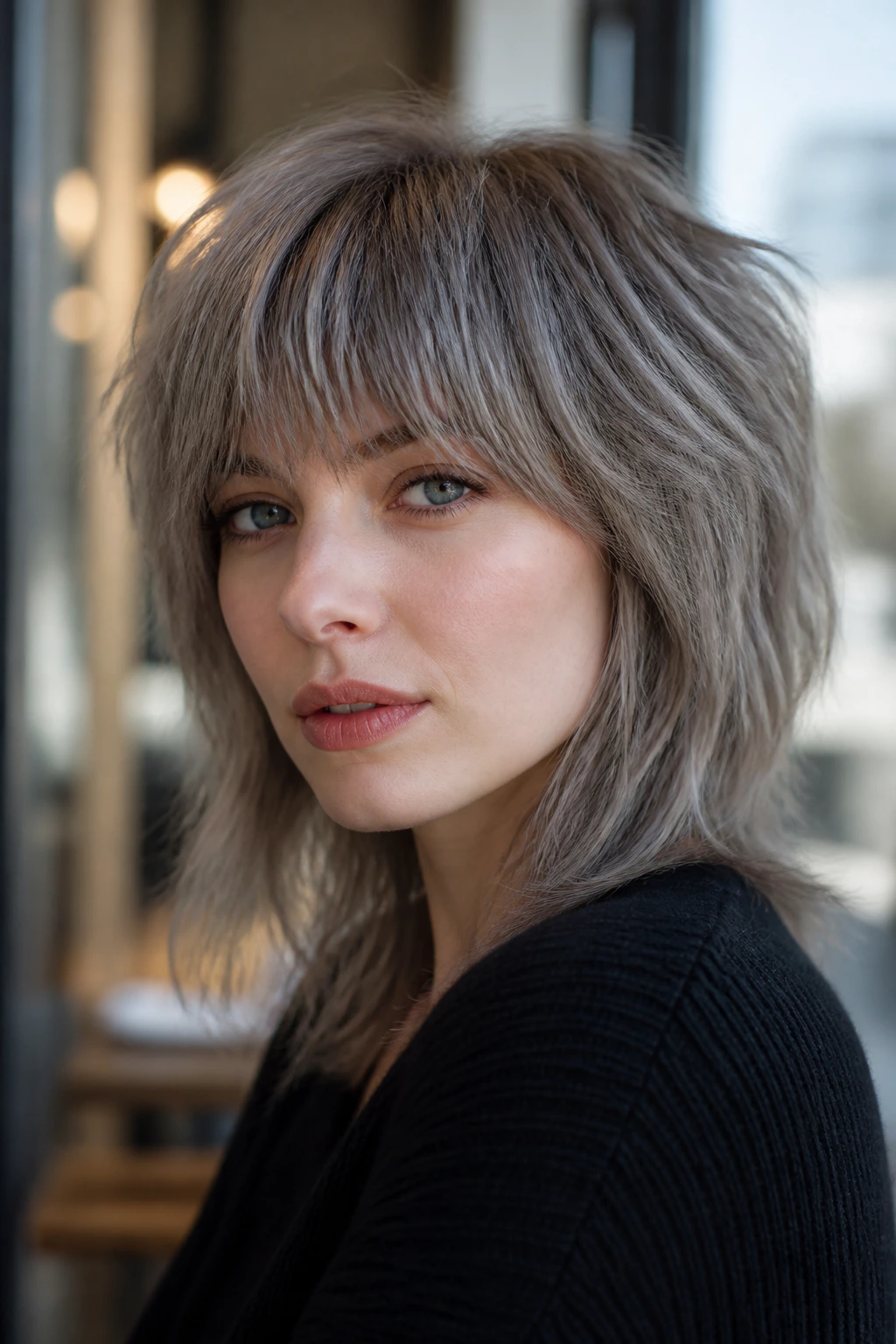
14. Misty Grey Wolf Cut
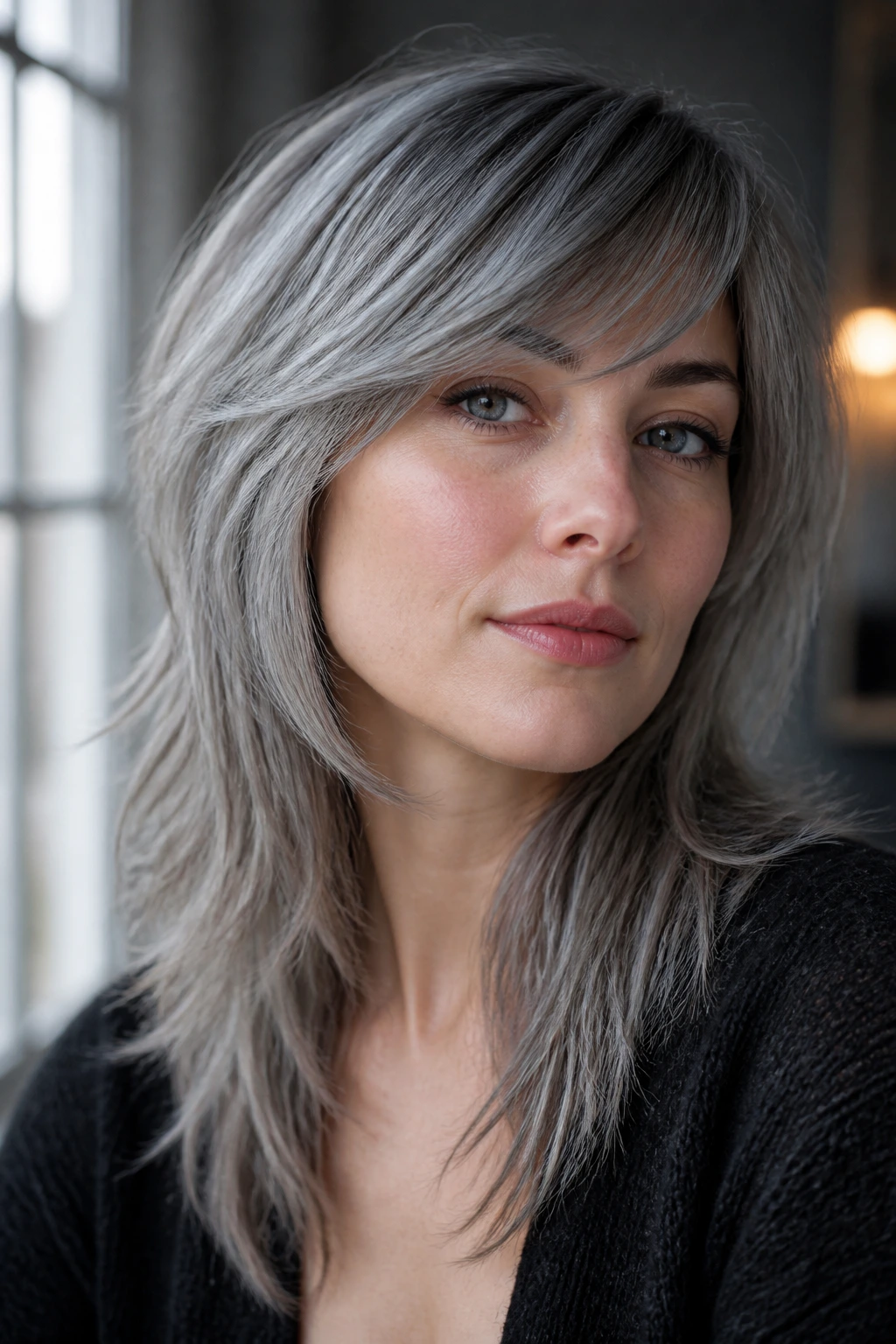
The wolf cut works because it’s loose enough to let grey feel airy. Misty grey adds a little softness to the whole thing, which helps pale skin keep some warmth in the face. The side-swept bangs are the restraint inside the mess.
That balance is the reason this look lands. You get lift at the crown, movement through the mids, and a fringe that sits across the forehead without closing it off. If your hair has natural wave, this cut can look almost better on day two, when the layers have settled and the bang has lost some of its fresh-cut stiffness.
Use mousse at the roots and a diffuser at low heat. Then shake the fringe apart with your fingers. If you brush it too much, the whole cut loses its bite.
15. Satin Silver Asymmetric Bob
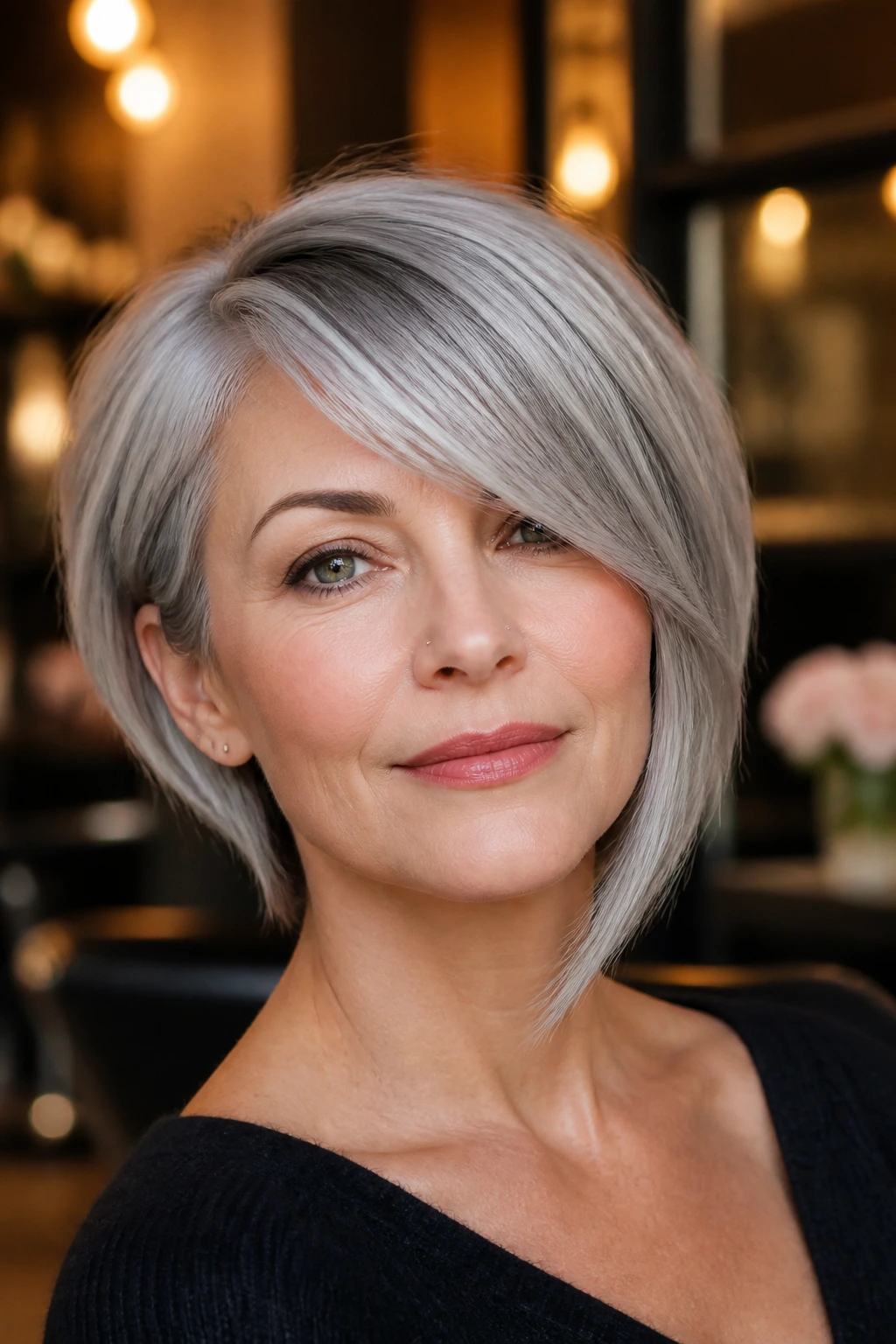
An asymmetric bob can look severe on paper and graceful in real life. Satin silver softens the edges, and the longer side gives the face a little diagonal pull that works well with side-swept bangs. It’s a neat trick. The cut feels tailored, but not cold.
This is especially good if you want one side to graze the jaw and the other to sit a touch higher. That slight imbalance gives pale skin some shape, because the eye keeps moving instead of settling into one static line. The fringe should echo the longer side, not fight it.
Keep the finish smooth, not flat. A little root lift at the crown prevents the bob from clinging to the skull. Grey hair with no lift can look heavy fast.
16. Cool Beige-Grey Shoulder Cut
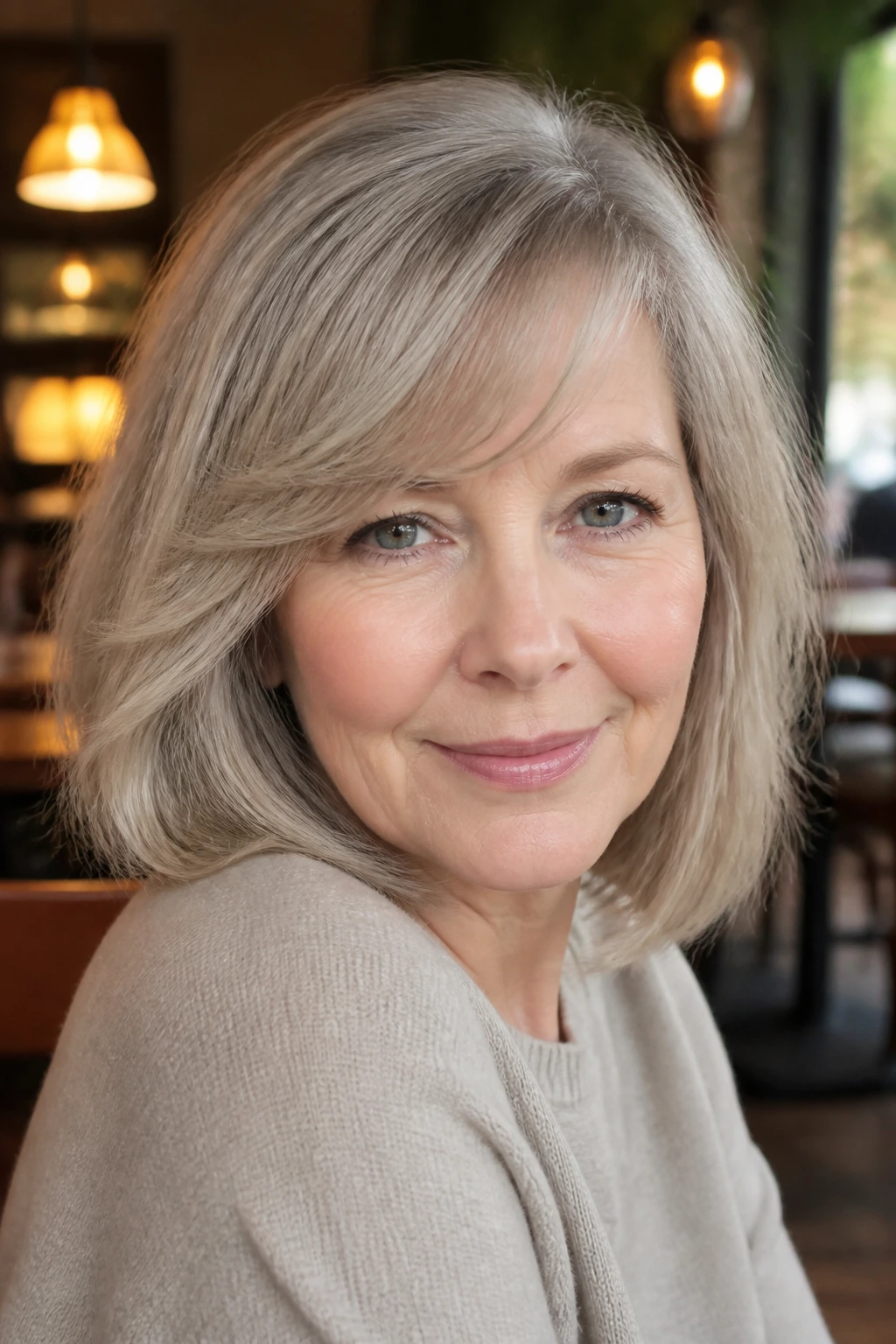
If icy silver feels too sharp, beige-grey is the gentler cousin. On pale skin with pink or peach undertones, it keeps the face from looking drained. A shoulder cut gives that color some swing, and the side-swept bangs provide a softer frame than a center part ever could.
This is one of my favorite “I want grey, but not stark grey” options. It’s calmer. Less glossy. More wearable in ordinary light, which is where most hair lives anyway. The beige note also helps if your natural base is warm blonde or light brown, because the grow-out line doesn’t scream.
Ask for long layers through the front and a slightly deeper root near the crown. That keeps the color from hovering over the face like one sheet of pale paint.
17. Metallic Pewter Layers
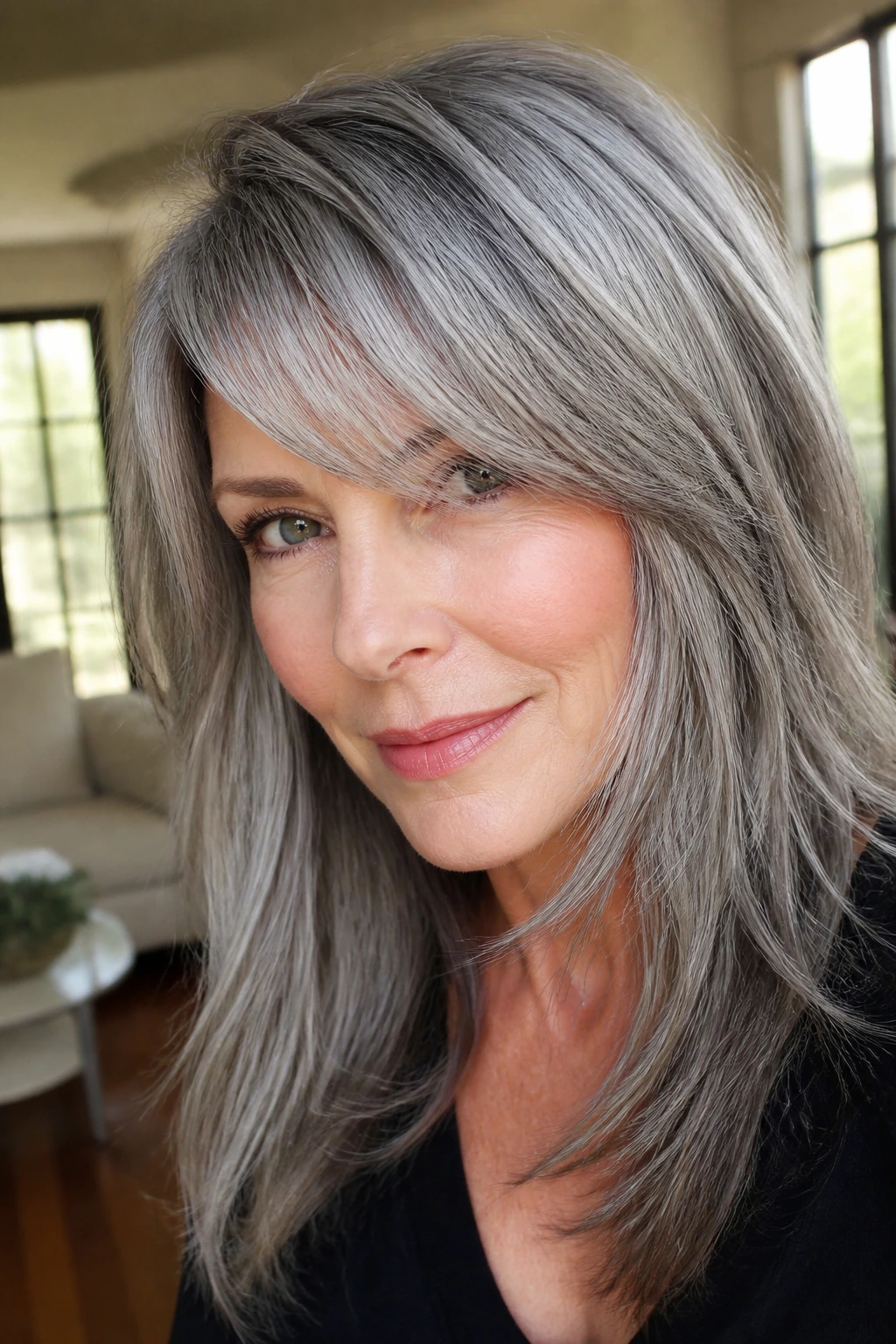
Pewter grey has a muted sheen that looks especially good on layered hair. The layers catch the metallic note without turning the hair into a chrome effect, which can be harsh on very fair skin. Side-swept bangs soften that shine and keep it from feeling too rigid.
A little depth at the root helps here. Pewter can read flat if every strand is the same level. The layers fix that by moving the color around, and the bang keeps the eye anchored near the cheekbone instead of up at the hairline.
A smoothing cream on damp hair is enough to start. Then use a large brush to pull the bang diagonally across the face and let the ends flick just a little. That flick keeps pewter from looking boxy.
18. Frosted Grey Ponytail with Side-Swept Bangs
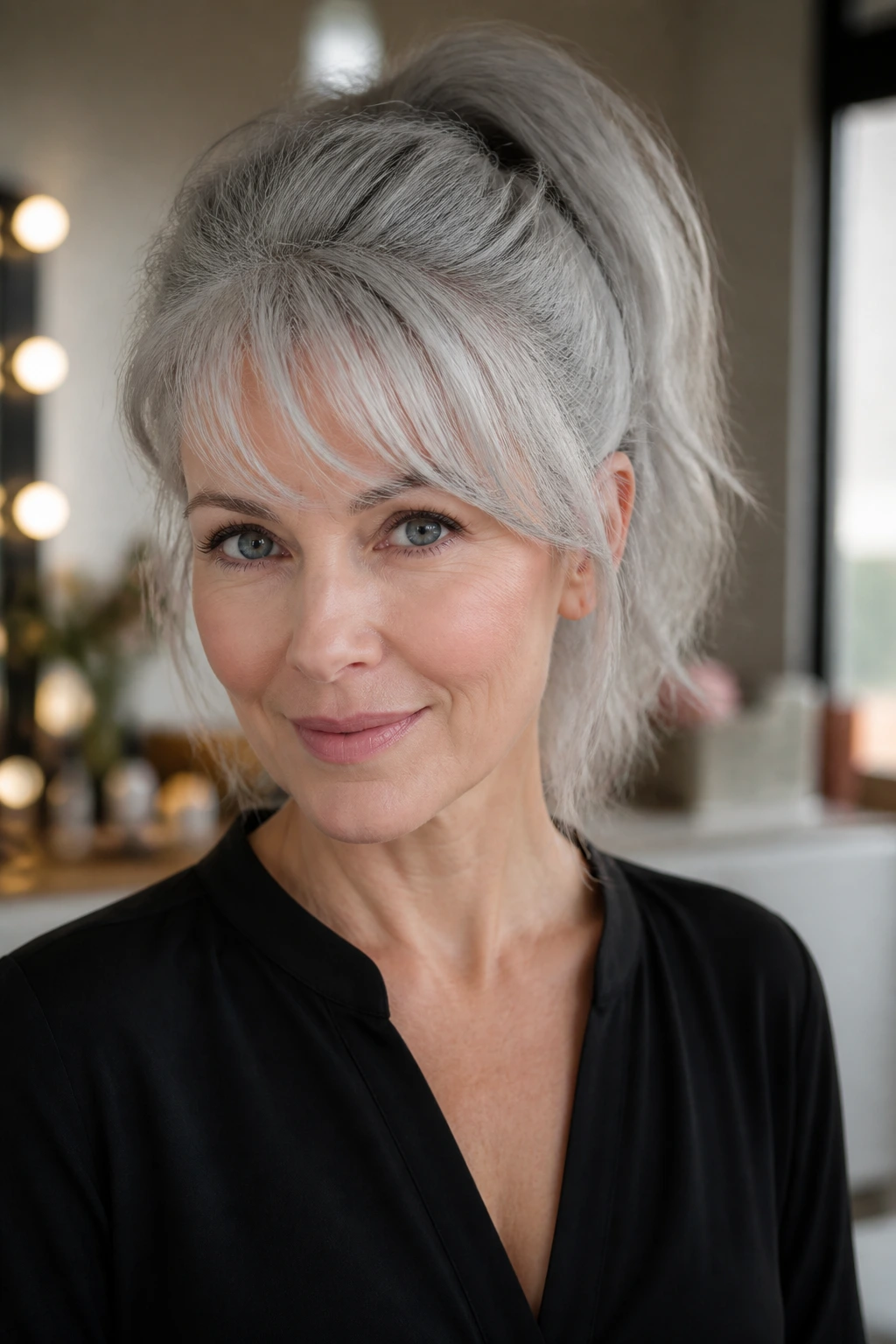
Not every grey hairstyle has to be a cut. A frosted grey ponytail with side-swept bangs can look crisp, clean, and surprisingly finished on pale skin. The ponytail gives lift at the back, and the bang keeps the front from looking too pulled tight.
This is one of those looks that depends on polish. Keep the crown smooth, wrap a small section of hair around the elastic, and leave the fringe loose enough to curve. If the ponytail sits too low and the bang is too stiff, the whole thing loses shape. Keep the front soft.
A mid-height ponytail tends to flatter the most because it keeps the sweep in view. A low ponytail can work too, but it reads more relaxed. Either way, a bit of shine cream on the tail itself gives the grey a frosted finish instead of a frayed one.
19. Grey French Bob with a Side Fringe
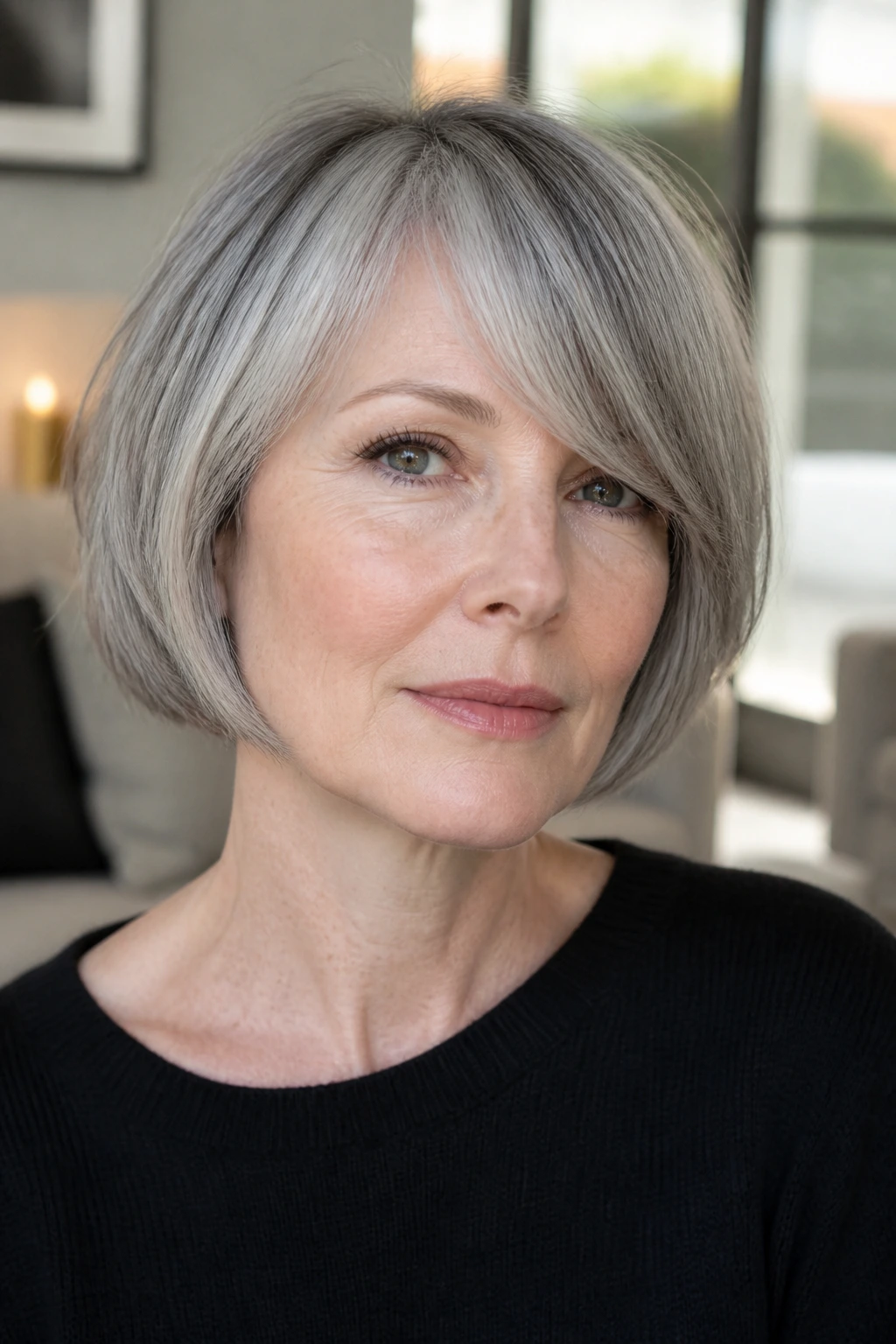
The French bob brings the grey right up to the face. That can be risky on pale skin if the cut is too blunt, but a side fringe fixes the problem. The shape stays chic and compact, while the sweep adds enough openness to keep the face from looking clipped.
I like this version with a tiny bend at the ends and a soft, slightly undone finish. A French bob looks better when it doesn’t look like it came off a ruler. Side-swept bangs keep that looseness in place.
This cut is especially good if you wear lipstick often. The bob sets up a clean frame around the mouth and eyes, which makes the whole face feel more alive. That’s a small thing, but small things add up fast with grey hair.
20. Ash Grey Beach Waves with a Long Fringe
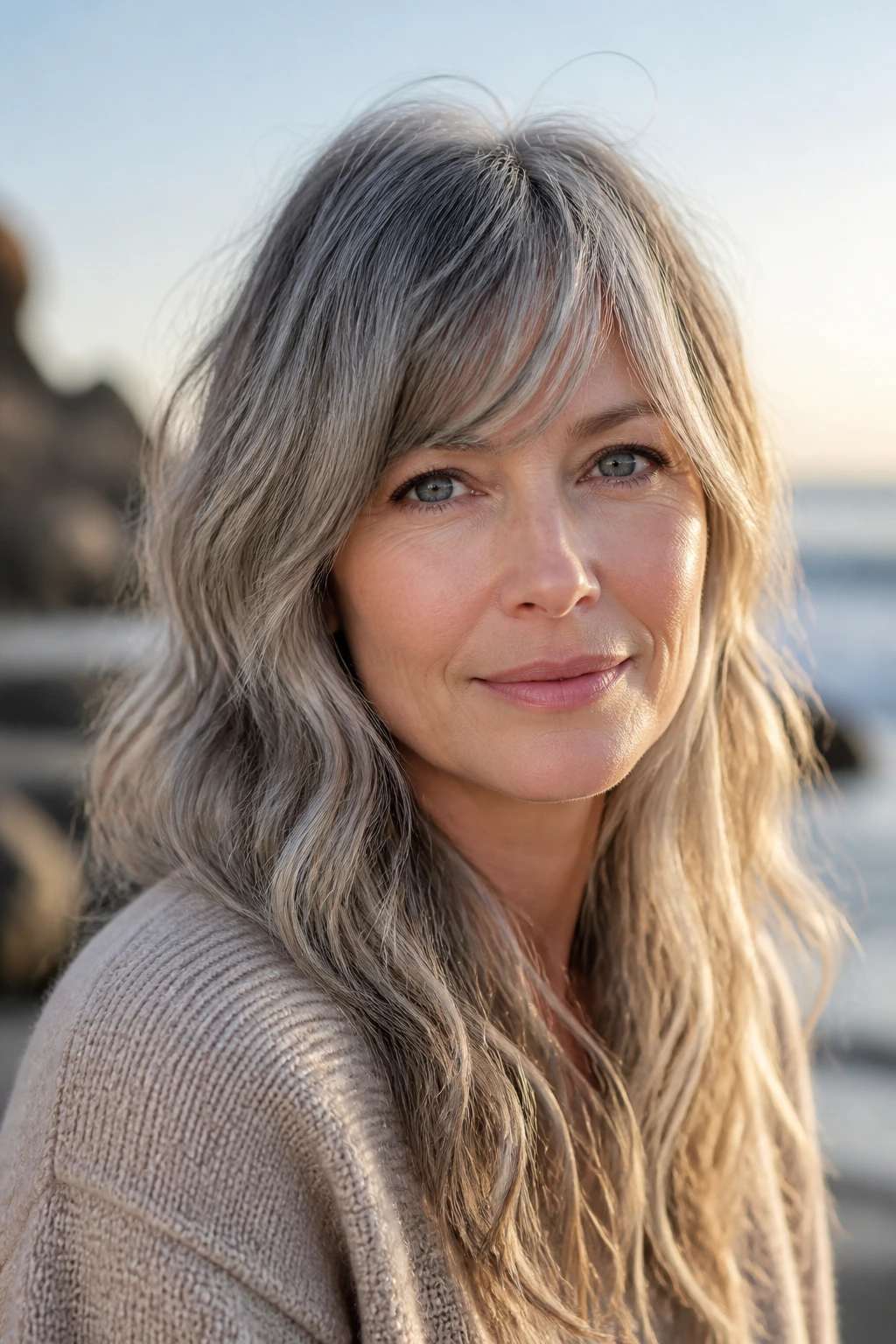
Ash grey beach waves are easy to love because they don’t fight the natural bend of the hair. The long fringe keeps the forehead open without exposing too much skin, which matters when pale skin can go flat under one solid line of hair. The ash tone gives the waves a dusty, cool finish.
The trick is to keep the wave loose. Tight curls can turn ash grey a little stiff, while soft bends let the color move. Spray from mid-length down, then scrunch lightly. Leave the fringe cleaner and smoother than the rest.
I’d avoid too much sea salt spray if your hair is already dry. Grey strands can be porous, and salt can rough them up fast. A light wave mist gives the same texture without the straw effect.
21. Platinum-to-Grey Melt on Layered Length
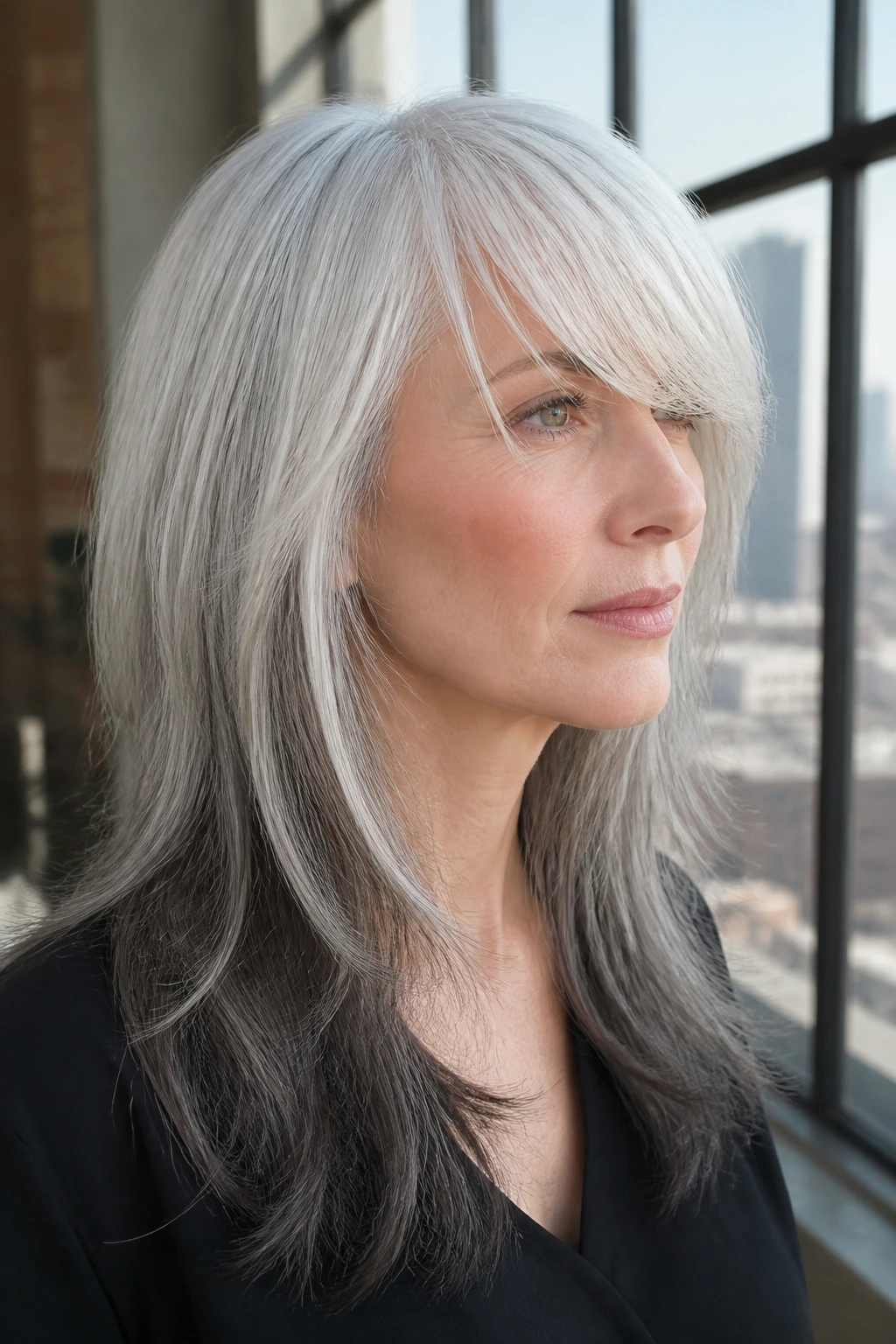
A platinum-to-grey melt is for people who want the brightness of blonde with the mood of silver. On pale skin, the melt works because it doesn’t slam the face with one color. It slides from light to darker, and the side-swept bangs help that transition feel natural around the forehead.
This is a color story as much as a haircut. The layers give the gradient room to show, and the bang prevents the brightest pieces from living only around the face. If the platinum is too close to the skin tone, a deeper grey root or a smoky gloss through the mids brings back definition.
The finish should be soft, not crispy. Think brushed waves or a loose bend, not tight curling iron marks. That keeps the melt from looking striped.
22. Razor-Cut Grey Shullet with a Sweeping Fringe
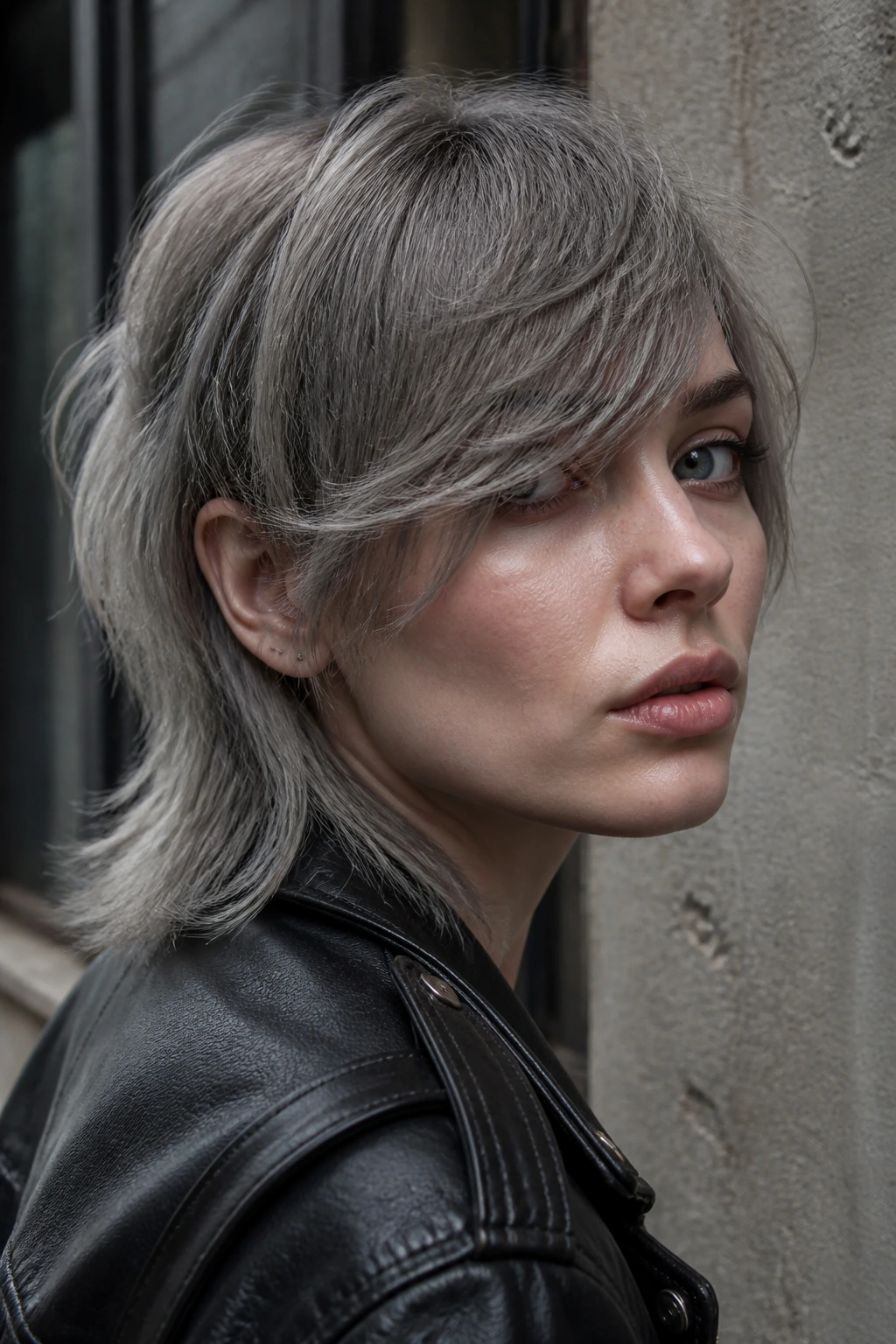
The shullet is not shy. It sits between shag and mullet, which sounds odd until you see how well it handles grey. Razor-cut ends break the shape apart, so the color looks airy instead of blocky, and the sweeping fringe keeps pale skin from getting swallowed by the sharper edges.
This is the most punk of the bunch, and that’s the point. If your style leans edgy, graphite or smoke grey can make the whole cut feel expensive rather than messy. The fringe should be long enough to move, not so short that it feels accidental.
Use texture spray sparingly and only where the layers need separation. Too much product makes razor cuts collapse into a sticky sheet. The best version has movement at the ends and softness right at the face.
23. Soft Graphite Updo with Side-Swept Tendrils
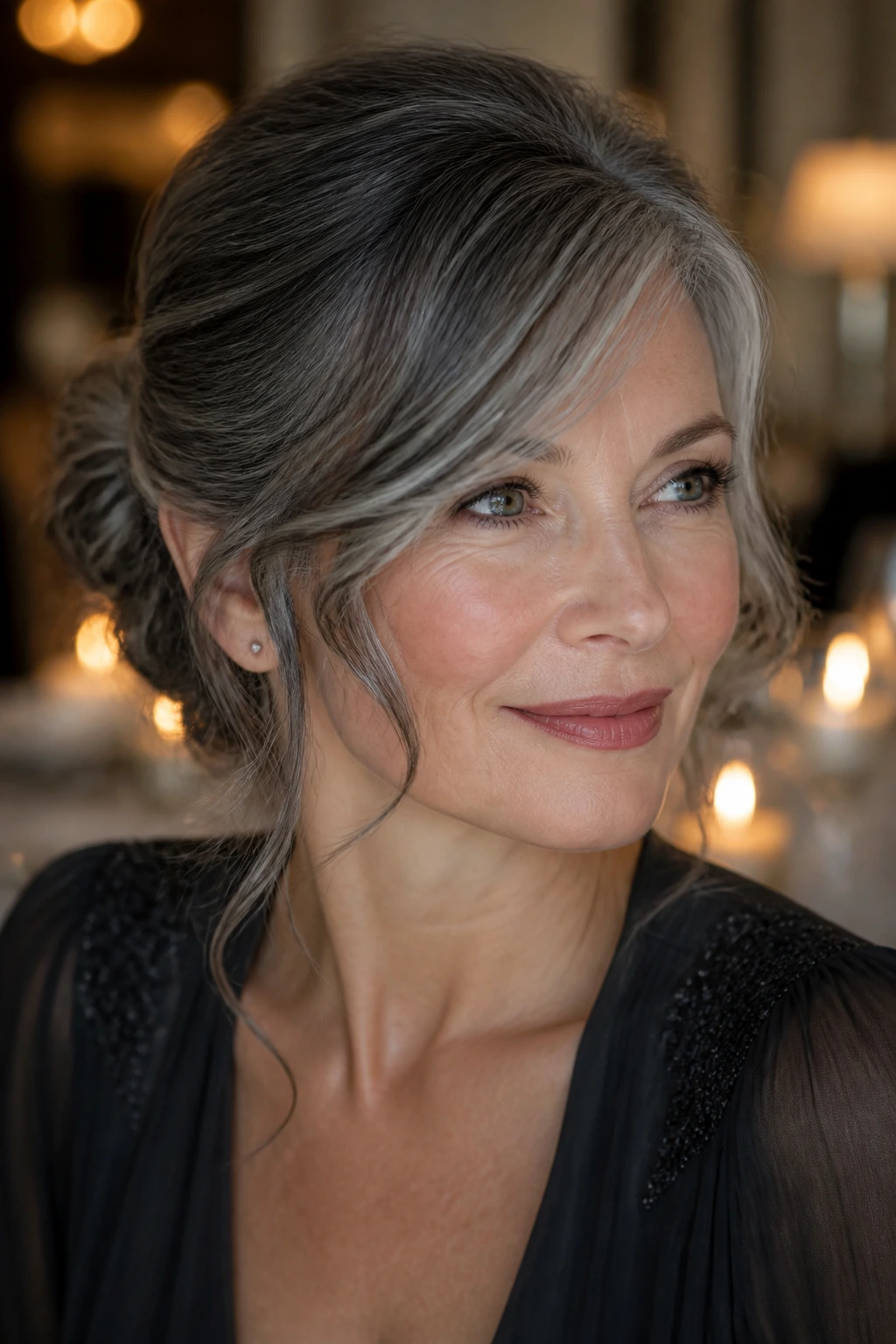
An updo can absolutely belong on this list. Soft graphite hair pulled into a low twist or loose knot looks elegant on pale skin because the darker grey adds shape, and the side-swept tendrils break up the forehead and jawline. That contrast keeps the face from going blank.
This works well for events, dinner, or any day when you want the grey to look done without a full blowout. Leave a few face-framing pieces out, but not too many. Two or three is enough. More than that and the style starts to fall apart.
A shine spray on the bun or twist helps the graphite read rich. Keep the tendrils soft with a curling wand and then brush them out with fingers. You want bend, not ringlets.
24. Tucked-Under Grey Bob with a Rounded Fringe Sweep
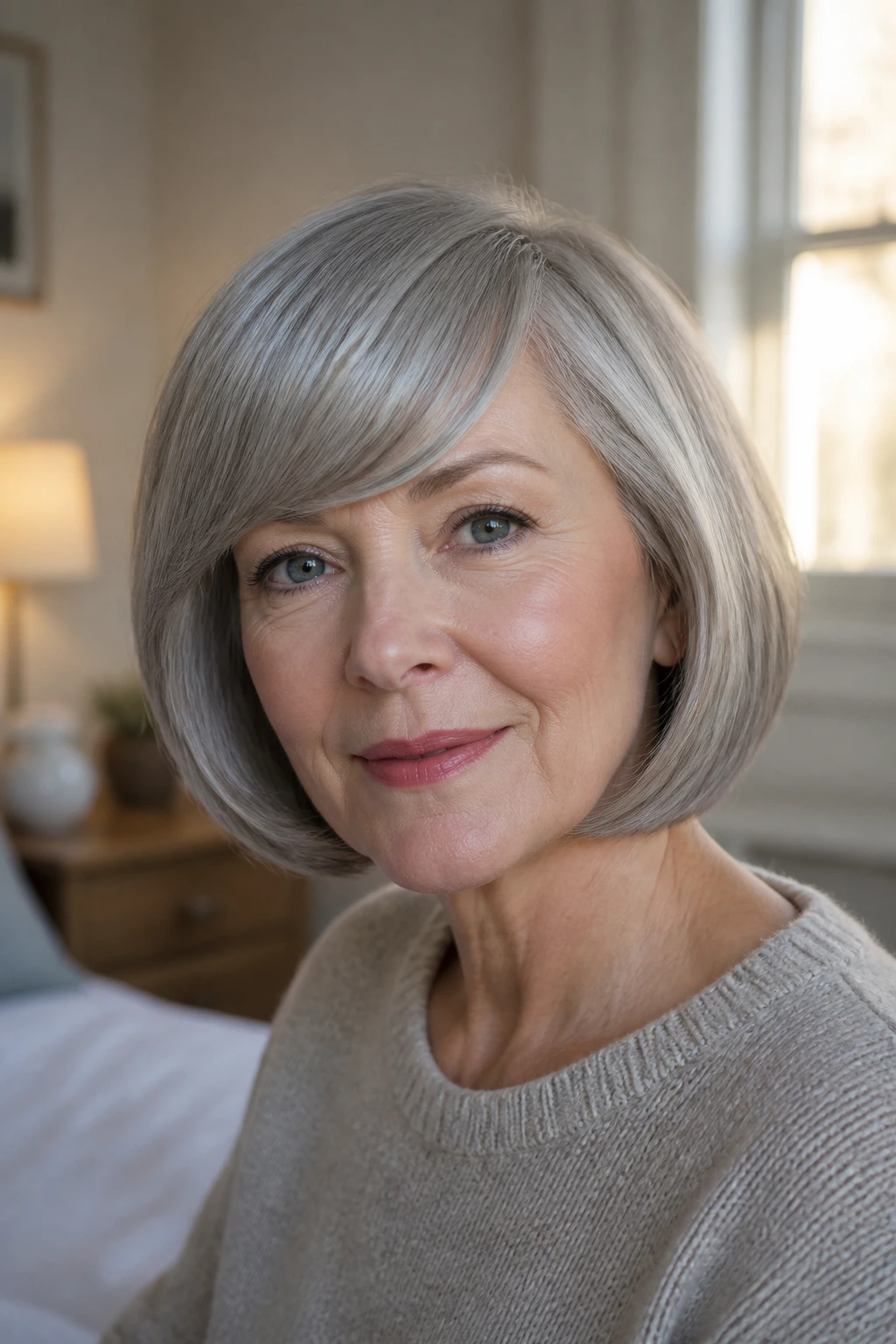
A tucked-under bob has a retro charm that pairs well with pale skin. The rounded ends hug the jawline, and the side-swept fringe keeps the front from feeling too exact. Together, they make grey look tidy in a way that still feels human.
This style is good if your hair is straight or slightly wavy and you like a bit of shape without layers everywhere. The tuck under gives body at the ends, which is useful when grey hair gets wispy. The fringe can be longer on the temple side and shorter near the part, so it falls like a soft arc.
A medium brush and a blow dryer with a nozzle do most of the work. Push the ends under while they’re warm, then let them cool in place. That cooling step is what keeps the curve.
25. Stacked Grey Bob with Feathered Fringe
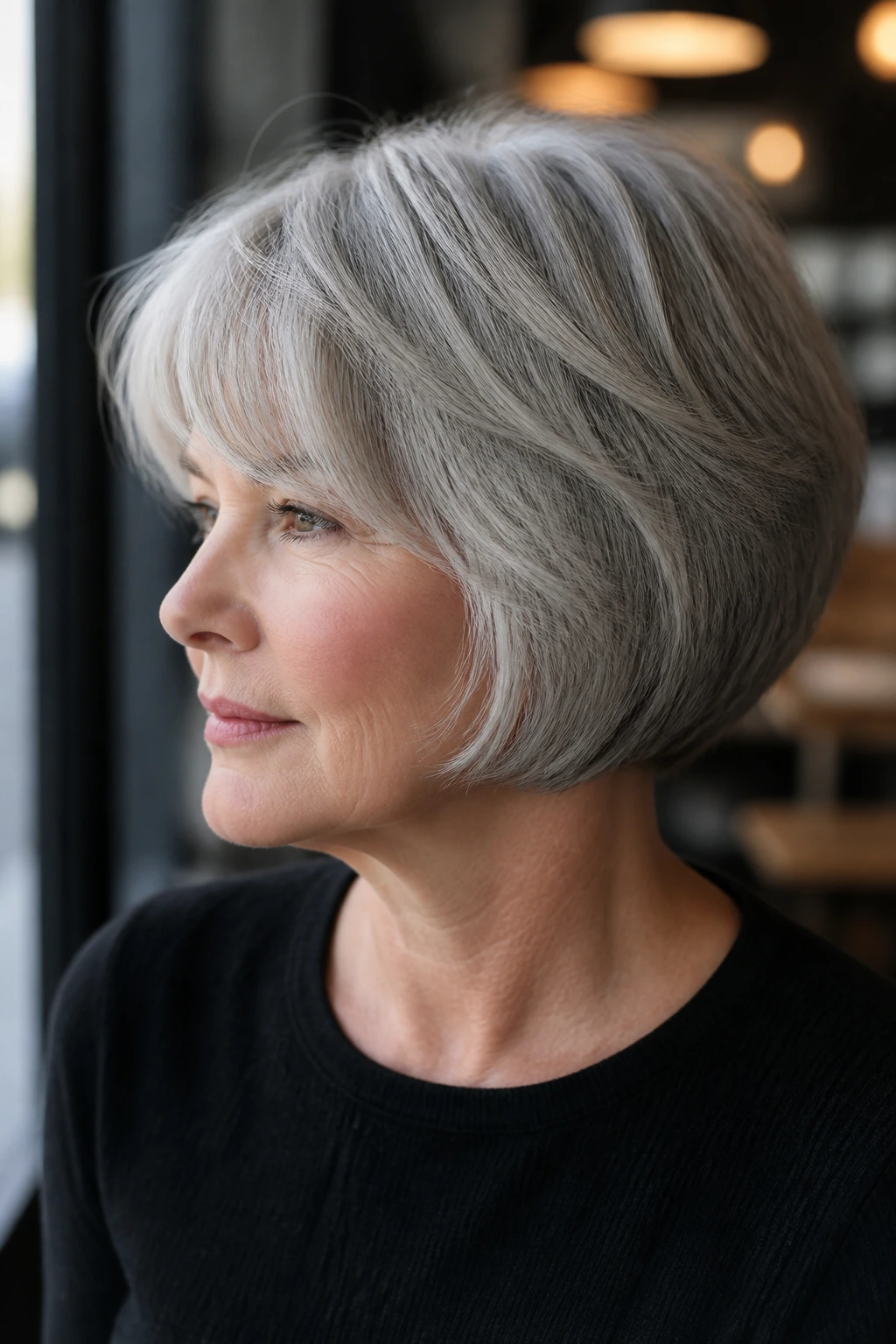
A stacked bob closes the list with structure. The back builds a little lift, the front stays lighter, and the feathered fringe stops the whole thing from feeling too formal. On pale skin, that upward shape keeps the face lively.
It’s a sharp cut, but not a hard one. The stacking gives the nape some density and the side fringe gives the forehead a soft exit. If your hair is fine, this shape can create the illusion of more body without needing a mountain of product.
I’d keep the finish smooth at the crown and softer at the ends. Too much volume at the front can make grey hair look puffed out. The sweet spot is controlled lift, not stiffness.
How Grey Shades Change the Way Pale Skin Reads
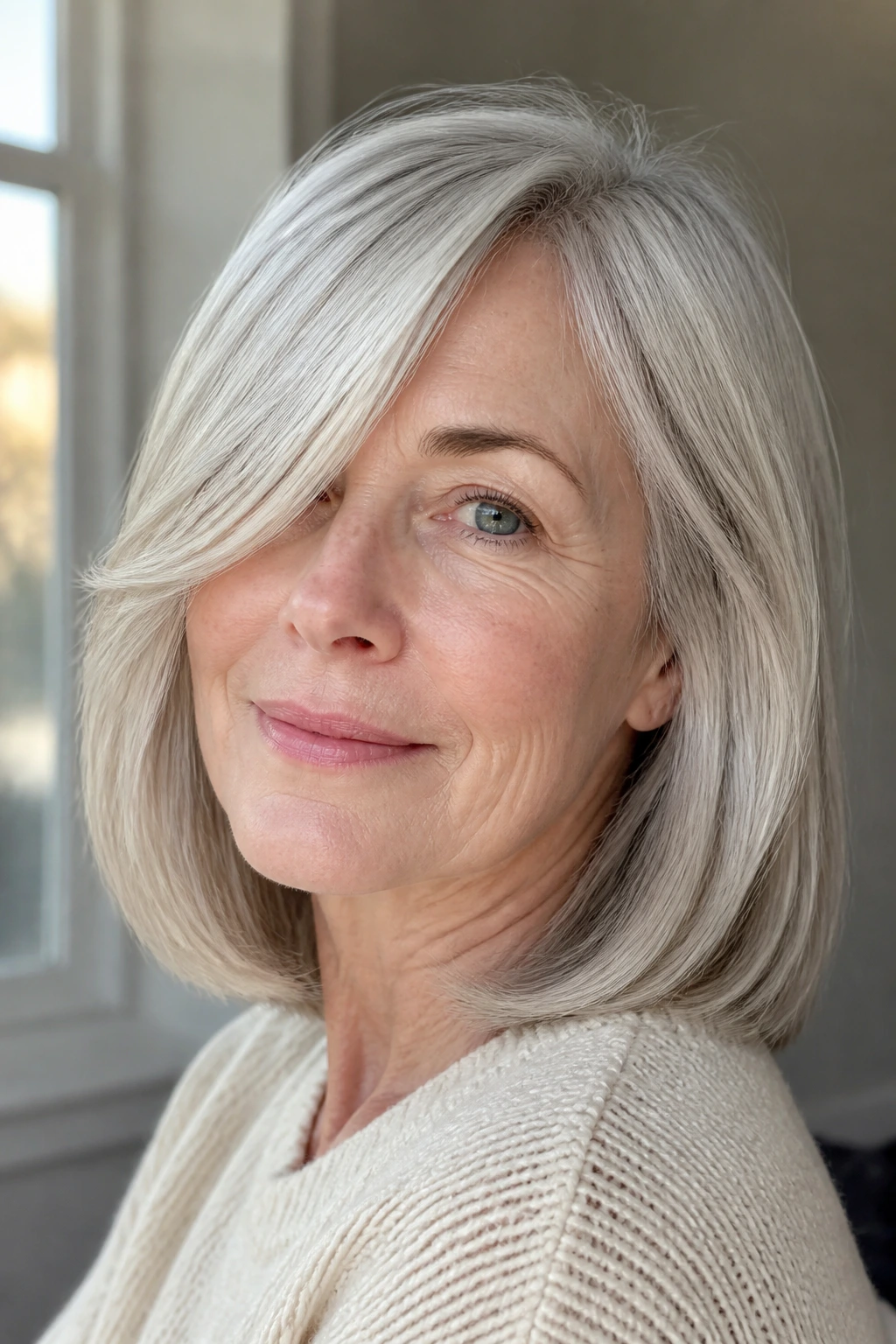
Grey is not one color, and pale skin is not one tone. That sounds obvious until you sit in the chair and realize how fast the wrong grey can wipe out a face. Pearl and silver tones lift cool or neutral skin without turning it flat. Smoke, mushroom, and beige-grey tend to be kinder when the skin runs pink, flushed, or a little translucent.
The main trick is contrast. If your skin is extremely fair, a grey that is too close in brightness can make the complexion look unfinished. A deeper root shadow, a smoky lowlight, or even a graphite panel underneath brings the face back into focus. You do not need dark hair to get that effect. You just need enough variation.
Pink or rosy undertones
Pearl silver, smoky grey, and beige-grey usually sit well here because they don’t echo the redness. A touch of depth at the root helps keep the finish from looking chalky.
Neutral undertones
Steel, slate, pewter, and silver balayage often work because they add shape without adding warmth. These shades give the face a clean frame.
Very cool undertones
Ice grey and platinum-to-grey blends can look striking, but they need a little shadow near the crown or the hair can float away from the face. Side-swept bangs help by adding motion across the forehead.
How to Cut Side-Swept Bangs So They Fall the Right Way
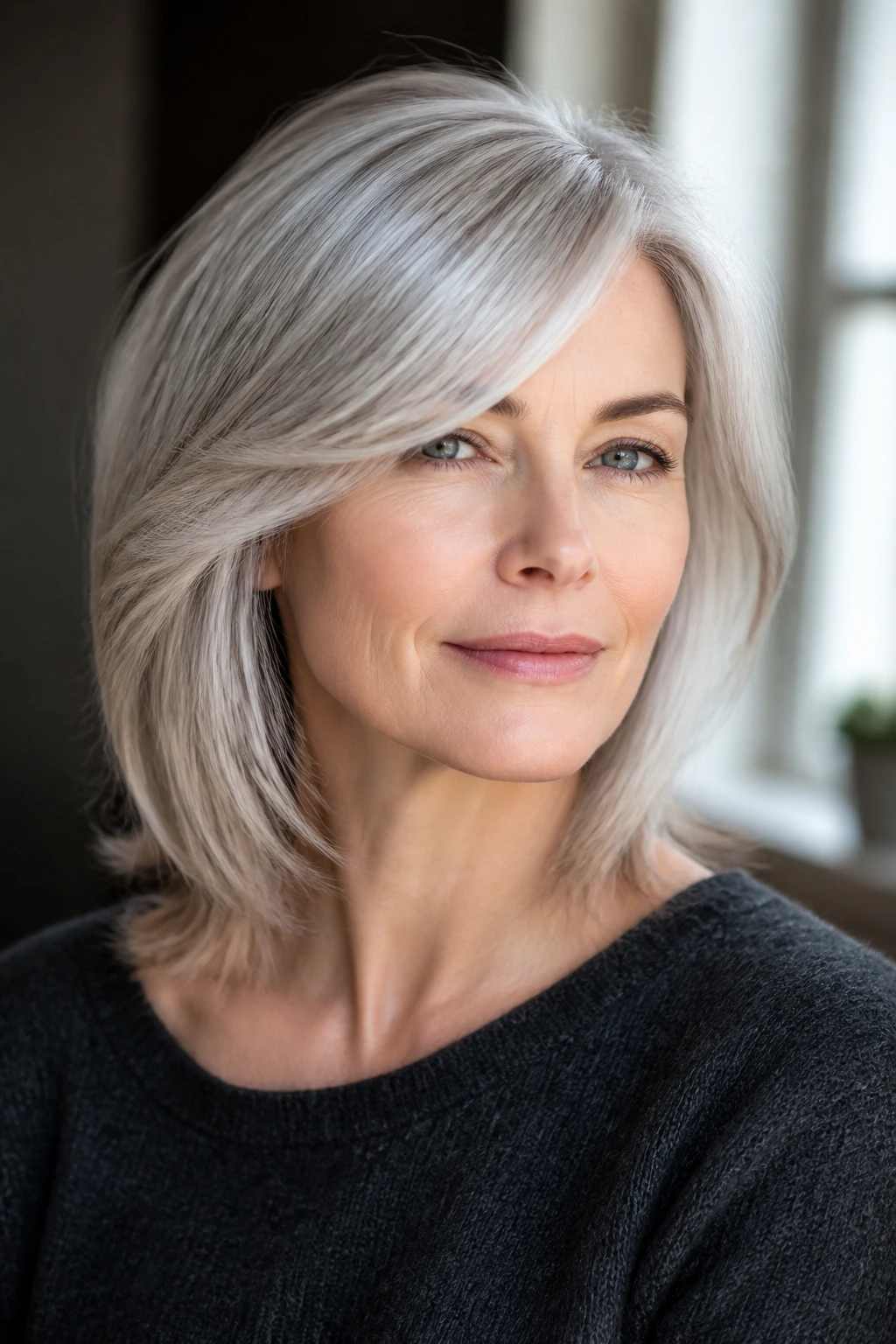
The bang is doing more than people think. A good side sweep should look like it belongs to the haircut, not like it was clipped on at the front five minutes ago. The trick is starting with a part that gives the fringe enough room to travel. A deep side part often works better than a shallow one because it leaves a longer line for the hair to follow.
The length matters
Ask for the shortest point to land around eyebrow level, then let it taper longer toward the temple. Too short, and the bang stands up. Too long, and it turns into a side layer with no purpose. That narrow middle range is where the fringe can brush the face without crowding it.
The cut should be soft at the ends
Point cutting or light texturizing keeps the fringe from sitting as one thick slab. Grey hair shows bluntness fast, and pale skin makes that bluntness even more obvious. Soft ends help the bang move instead of dropping.
The dry-down is part of the haircut
Blow-dry the fringe in the direction you want it to sit, then clip it for a minute while it cools. That tiny pause helps the shape stick. If you skip the cool-down, the hair often springs back in the wrong direction by lunchtime.
Tools That Keep Grey Hair Bright and the Fringe Light
- Blow dryer with a nozzle: Direct airflow keeps the bang from puffing up and helps the cut sit where you want it.
- 1-inch to 1.25-inch round brush: Best for side sweeps, bends, and soft inward curves at the ends.
- Flat iron with adjustable heat: Useful for polishing the front without flattening the whole style.
- Fine-tooth tail comb: Helps make clean side parts and section bangs neatly before drying.
- Sectioning clips: Worth keeping close when you’re blow-drying the fringe in pieces.
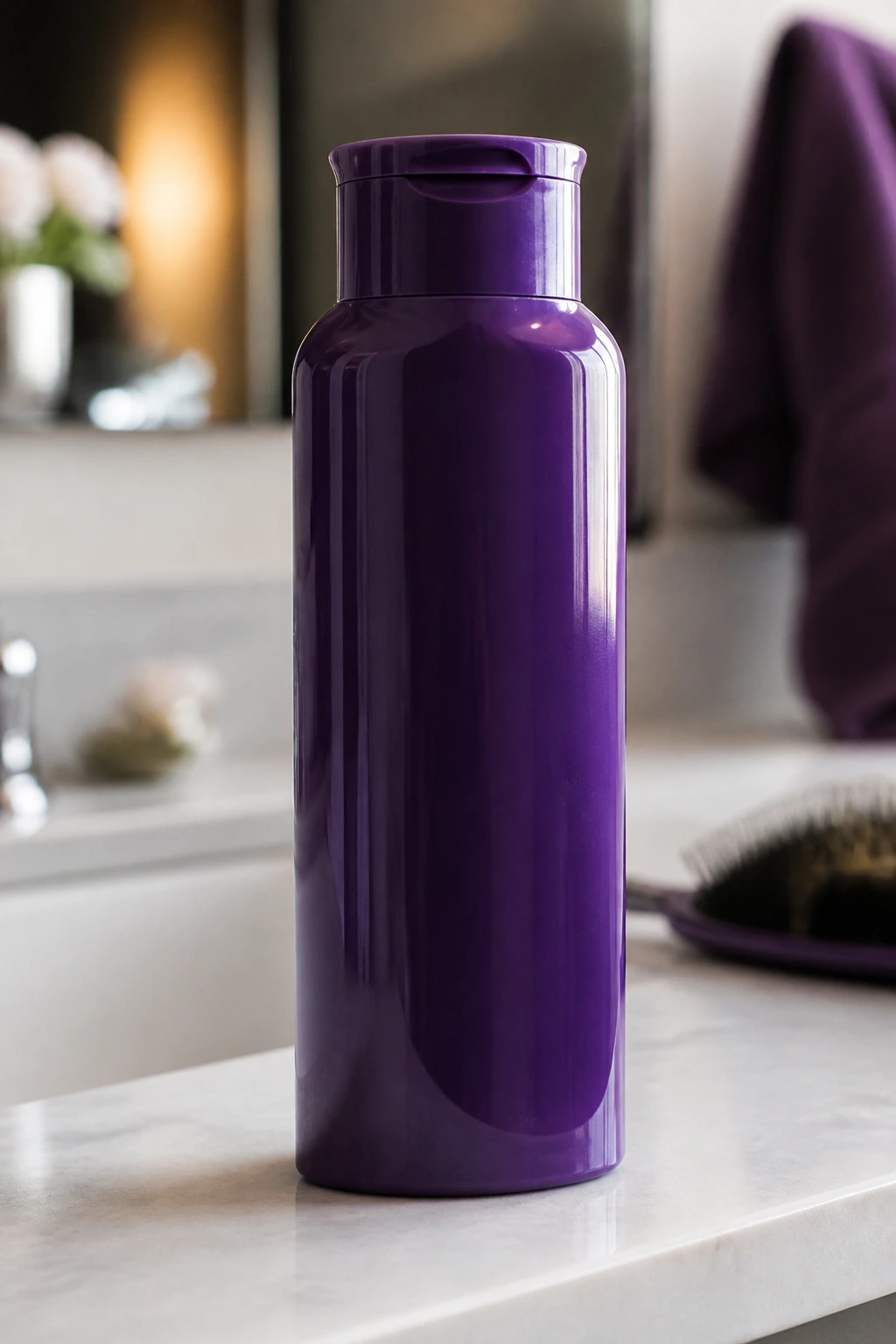
- Purple shampoo: Use it sparingly to keep grey tones bright without over-toning the hair.
- Color-safe conditioner: Grey hair is often dry and porous, so the ends need slip.
- Lightweight serum: One small drop on the mids and ends adds shine without greasing the fringe.
- Dry shampoo: Useful at the roots when the front starts to separate or fall flat.
- Heat protectant spray: Grey hair can feel coarse or fragile, and it hates high heat without protection.
Practical Styling Moves for Busy Mornings
Blow-dry direction: Aim the airflow from the part line down and across the forehead. That one move trains the side-swept bang faster than trying to force it with a brush alone.
Volume control: Use dry shampoo at the crown before the hair looks oily. Grey shades show limpness faster than darker colors, and a little root lift can keep the whole cut from collapsing.
Fringe reset: If the bang splits in the middle, dampen just that section, brush it opposite the way you want it to sit, then redirect it with the dryer. It sounds fussy. It isn’t. It takes about a minute.
Finish choice: Keep oils and heavy creams off the front. Grey hair can take shine, but side-swept bangs need movement more than gloss. Use products where the ends need softness and leave the fringe lighter.
Heat habit: Stay on the lower end of the heat setting if the hair is colored or porous. Grey-dyed hair can frizz fast when it gets too hot, and once the fringe frizzes, it takes extra work to smooth it back down.
Common Mistakes That Flatten the Whole Look
- Choosing a grey that is too close to your skin tone: The face can look drained or washed out. Add a root shadow, a smoky lowlight, or a slightly deeper grey so the hair has a frame.
- Cutting the bangs too blunt: A hard, heavy fringe can box in the face and make the grey feel stiff. Ask for feathered ends and a longer sweep toward the temple.
- Overusing purple shampoo: Too much can leave a dull lilac cast or a dry, powdery finish. Use it once every few washes, not every time you shampoo.
- Loading the fringe with product: Bangs stick together fast, and pale skin makes that separation look messier than it is. Keep serums and creams below the eyebrow line.
- Ignoring the root area: Flat roots make grey hair look heavier and less dimensional. A quick lift with a round brush or a root spray changes the whole head.
- Skipping trims: Side-swept bangs grow into the eyes in a hurry. A trim every 3 to 5 weeks keeps the sweep clean and stops it from turning into awkward half-layers.
Named Variations That Shift the Mood
Ultra-Icy Editorial: Push the silver toward a clean, bright blonde-grey and keep the fringe sharp and sleek. This is the most high-contrast version, and it suits pale skin best when there’s a little shadow at the root.
Soft Mushroom Blend: Swap the brighter silver for taupe-grey and beige undertones. The color feels gentler around rosy skin and works well if you want grey without the icy edge.
Smoke and Shadow: Add lowlights or a deeper root to build contrast through the mids. It’s a smart choice for fine hair because the color variation creates a thicker look.
Lavender Whisper: A faint lilac glaze can soften the face and make the grey feel less severe. Keep it muted; you want a hint, not a pastel wig effect.
Salt-and-Pepper Natural: Let the natural grey and darker strands do the work, then polish the cut and fringe. This version grows out with the least fuss and often looks richer than a fully dyed grey.
Keeping Grey Hair Fresh Between Salon Visits
Grey hair likes a steady, boring routine. That’s not an insult. It’s the truth. Wash too often and the tone can fade; wash too rarely and the fringe goes limp. For most people, a wash every 2 to 4 days keeps the scalp happy without stripping the color. If your hair is dry, stretch that a little longer and use dry shampoo at the roots between washes.
Purple shampoo is useful, but it’s not a daily product. Once every 5 to 7 washes is enough for most grey or silver shades. If the hair starts looking dull instead of bright, back off and use a richer conditioner for one wash. Grey strands are porous, and they pick up pigment quickly.
Trims matter more than people expect. Side-swept bangs usually need a tidy-up every 3 to 5 weeks, especially if they skim the eyebrow or cheekbone. Full color refreshes or glosses tend to land every 6 to 8 weeks, depending on how much contrast you want to keep. If the style is a balayage or rooted grey, the grow-out can stretch longer because the shadow is doing some of the work.
Sleep helps, too. A silk pillowcase or a loose wrap keeps the fringe from bending into a weird kink overnight. Small habit. Big difference.
Grey Hairstyles for Pale Skin with Side-Swept Bangs: FAQs
Will grey hair wash out very pale skin?
It can if the shade is too close to your complexion and the cut has no structure. A side-swept bang, a deeper root, or a smoky lowlight gives the face enough contrast to stay defined.
Which grey shades suit pink undertones best?
Pearl silver, smoke grey, mushroom grey, and beige-grey usually work well because they soften redness instead of echoing it. Bright ice grey can still work, but it often needs a deeper root near the hairline.
Are side-swept bangs better than blunt bangs for grey hair?
Usually, yes, if the goal is softness. A blunt bang can look heavy very fast on pale skin, while a side sweep leaves part of the forehead visible and keeps the face from feeling boxed in.
Can fine hair pull off these grey hairstyles?
Absolutely, but the cut matters. Lobs, stacked bobs, pixies, and layered midi cuts all help create the illusion of body. One flat length is the thing to avoid.
How do I stop my fringe from splitting apart?
Blow-dry it in the right direction, let it cool in place, and keep heavy product away from the roots. If it still splits, a tiny bit of dry shampoo at the root and a quick re-dry usually fixes it.
What if my grey starts looking yellow?
That usually means buildup, heat damage, or too much sun exposure. Use a gentle clarifying wash once every couple of weeks, then follow with a purple shampoo every few washes and a nourishing conditioner on the ends.
Do these styles work on curly hair?
They do, but the fringe needs to respect the curl pattern. A deeper side part and a softer, longer bang usually behave better than a short, stiff sweep.
How often should I trim side-swept bangs?
Most people need a touch-up every 3 to 5 weeks. If the fringe starts falling into the eye or losing its diagonal line, it’s past due.
A Grey Fringe That Still Feels Like You
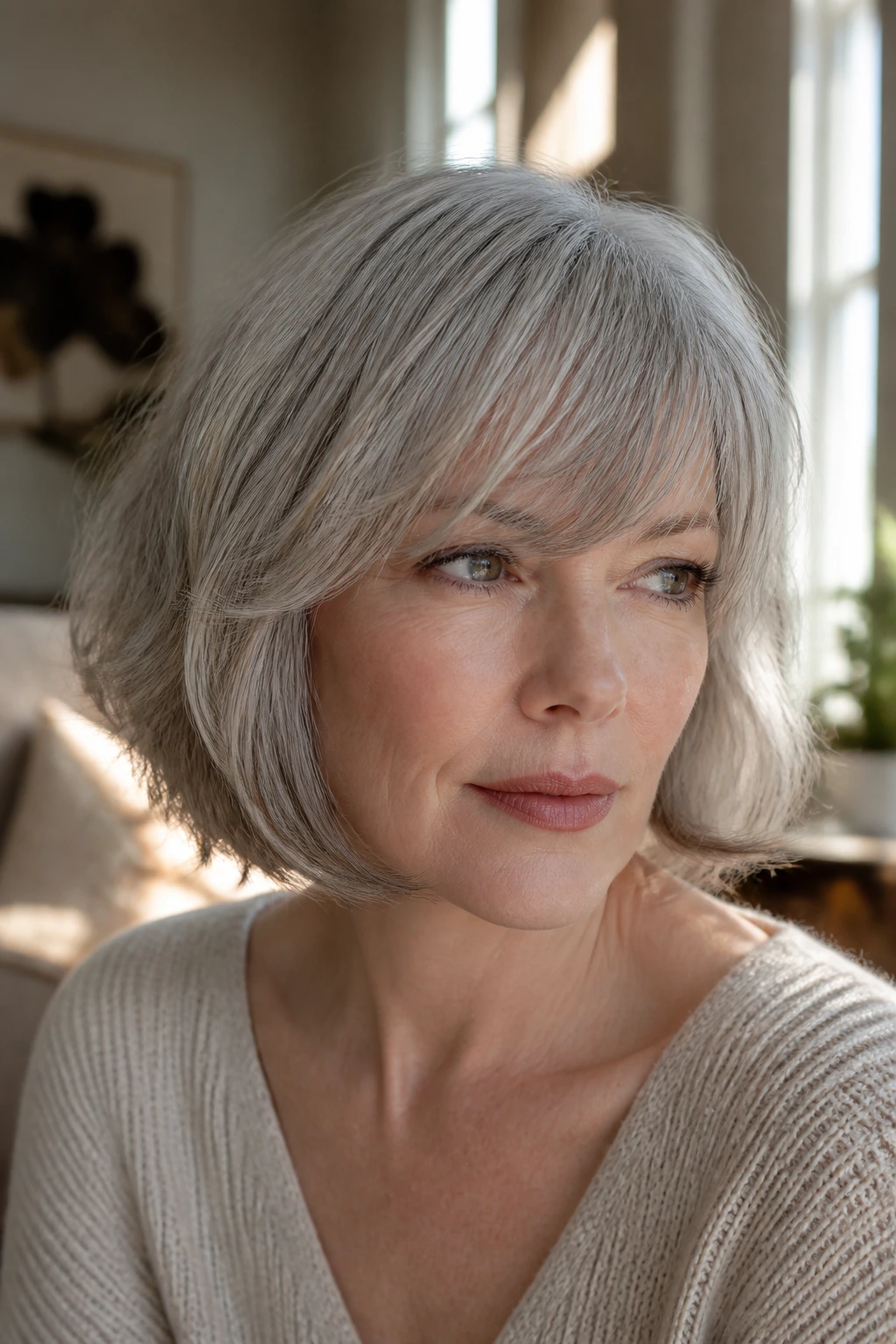
Grey hair on pale skin does not need to be icy, severe, or precious. The best versions have a little shadow, a little movement, and a fringe that bends instead of sitting there like a strip of paper. That combination keeps the face open and gives the color some place to go.
Side-swept bangs are the quiet part of the equation, and they matter more than the trendier bits. They soften the forehead, protect the face from looking too flat, and make grey feel like a haircut instead of a dye job. Pick the shade that fits your undertone, then choose the bang shape that lets it move. The rest falls into place faster than people expect.