



Blonde hairstyles for deep skin tones work best when the color has enough depth to sit beside the skin, not hover above it. Honey, caramel, champagne, butter, beige, and bronze all behave differently once they hit melanin-rich skin, and that difference shows up fast: one shade can make a curl pattern look luminous, while another can flatten the whole head into one pale block.
The part people get wrong is usually not the cut. It’s the tone. A deep brunette lifted to blonde isn’t one decision; it’s a stack of small ones — how high the lift goes, whether the root stays shadowed, where the brightest pieces land, and how much warmth the toner leaves behind. Get those pieces right and blonde stops looking like a costume color. It starts reading as part of the face.
Some blondes here are soft and warm. Some are cooler and sharper. A few are protective styles that keep the hair healthy while still giving you that blonde payoff. The useful thing is that deep skin can carry all of them — but not all of them in the same way, and not without a little planning. That’s where the good stuff starts.
Why These Blonde Looks Earn Their Spot
- Warm blondes do the least fighting: Honey, caramel, maple, and bronzed tones pull warmth back into deep skin instead of making the face look gray.
- Cool blondes can still work hard: Beige, champagne, pearl, and icy vanilla look best with a darker root or lowlight, which keeps them from floating on top of the face.
- Texture changes the whole read: The same blonde looks softer on curls, sharper on a silk press, and bolder on a pixie cut or blunt bob.
- Protective styles lower the stress: Braids, twists, and locs let you wear blonde without bleaching the entire head or hitting it with heat every week.
- Maintenance matters as much as the color: The cleanest blondes are usually the ones with a gloss schedule, a satin bonnet, and a little restraint with heat.
Why Honey, Gold, and Beige Read So Cleanly on Deep Skin
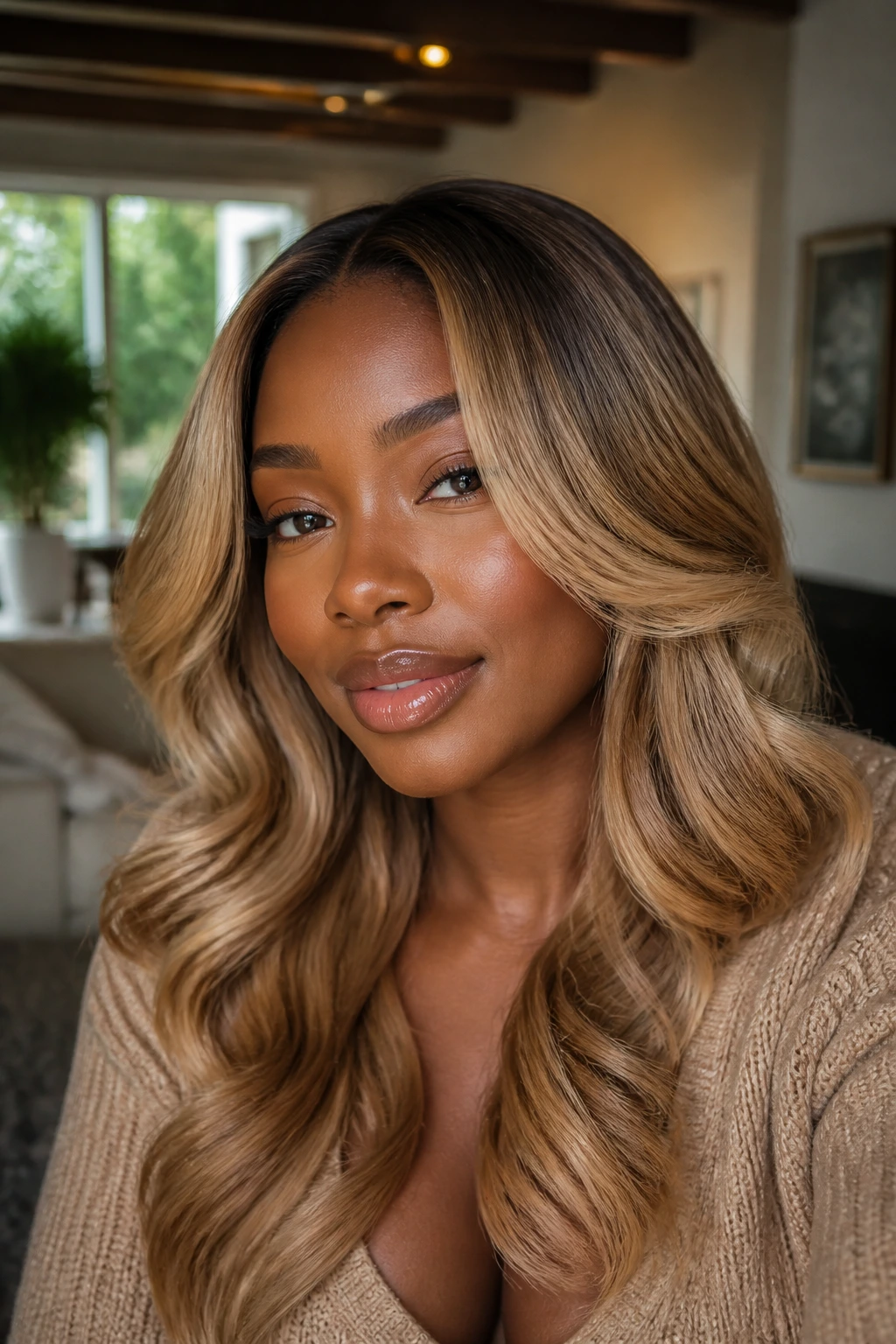
Deep skin tones usually have enough richness to carry both warm and cool blonde shades, but the best versions almost always give the eye a bridge. That bridge can be a root shadow, a lowlight, or simply a cut that holds shape so the color doesn’t do all the work by itself.
Warm blondes — honey, gold, caramel, bronze — echo the tones that often live in deep skin already. They don’t have to match exactly. They just need to lean in the same direction. That’s why a level 7 honey blonde can look soft and glowing where a pale yellow blonde would look unfinished.
Cool blondes need a different kind of support. Beige, champagne, pearl, and icy vanilla can look striking on deep skin, but they need structure: a crisp bob, a clean pixie line, a neat braid pattern, or a dark root smudge. Without that, the color can feel like it’s sitting on top of the hair instead of belonging to it.
Texture matters too. Coils break up light in a way that makes blonde look dimensional fast. Sleek styles show every tone shift, so the toner has to be cleaner. Straight hair with blonde needs precision; curls can get away with a little more softness. That’s one reason blonde hairstyles for deep skin tones can be so satisfying when they’re done well — the contrast is built into the hair itself.
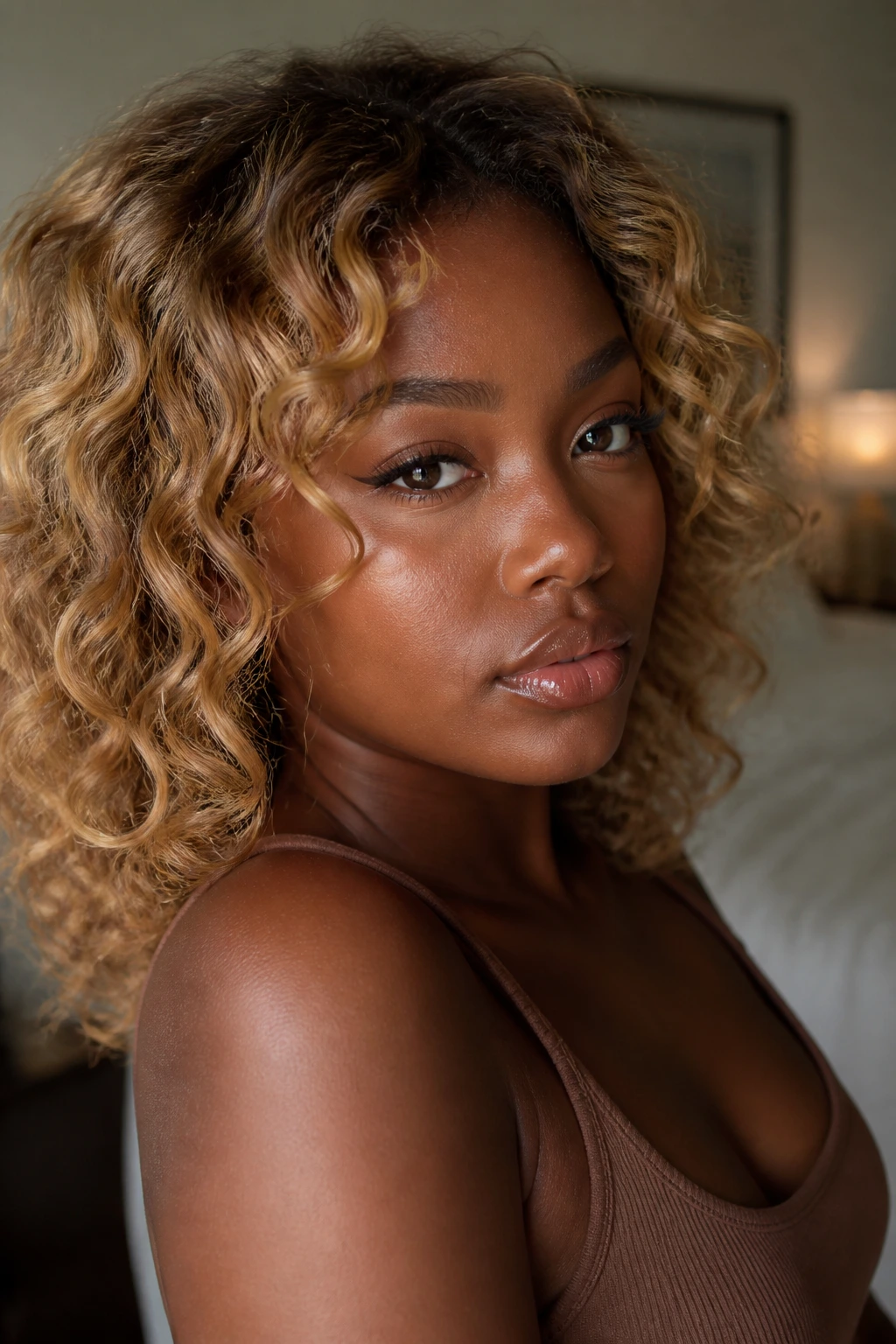
1. Honey Blonde Defined Curls
Honey blonde on defined curls is the easiest way to make blonde feel warm instead of loud. The curls catch the gold at different points, so the color reads in pieces rather than one flat block. On deep skin, that matters. The warmth lands where the light hits and leaves the rest of the hair looking rich, not washed out.
Why it works
Ask for a level 7 or soft level 8 honey with a darker root, especially if your natural base is brown or black. That bit of shadow keeps the style grounded. The curls do the rest. A twist-out, rod set, or diffuser-dried curl pattern gives the blonde movement without needing a sharp cut.
- Best on medium to tight curls
- Works well with a soft root melt
- Looks strongest with shine, not stiffness
A light gloss every 6 to 8 weeks keeps the honey from turning brassy. Too much purple shampoo here is a mistake. It can mute the warmth that makes the shade flattering in the first place.
2. Caramel Balayage on a Silk Press
Caramel balayage on a silk press is for the person who wants blonde ribbons, not an all-over lift. The painted pieces sit where the hair moves, so the color shows up as soft streaks through the press instead of a hard stripe near the scalp. That is exactly why it looks good on deep skin. The contrast feels planned.
This style works best when the caramel pieces start around the cheekbone and sweep toward the ends. Keep the base one or two levels deeper than you think you need. On very dark hair, that extra depth keeps the caramel from looking orange under indoor light. A flat iron with a heat protectant, plus a wrap or silk scarf at night, matters here more than any styling trick.
If you like your hair to swing when you turn your head, this one delivers. And yes, the ends need regular trims. A silk press shows split ends like a spotlight.
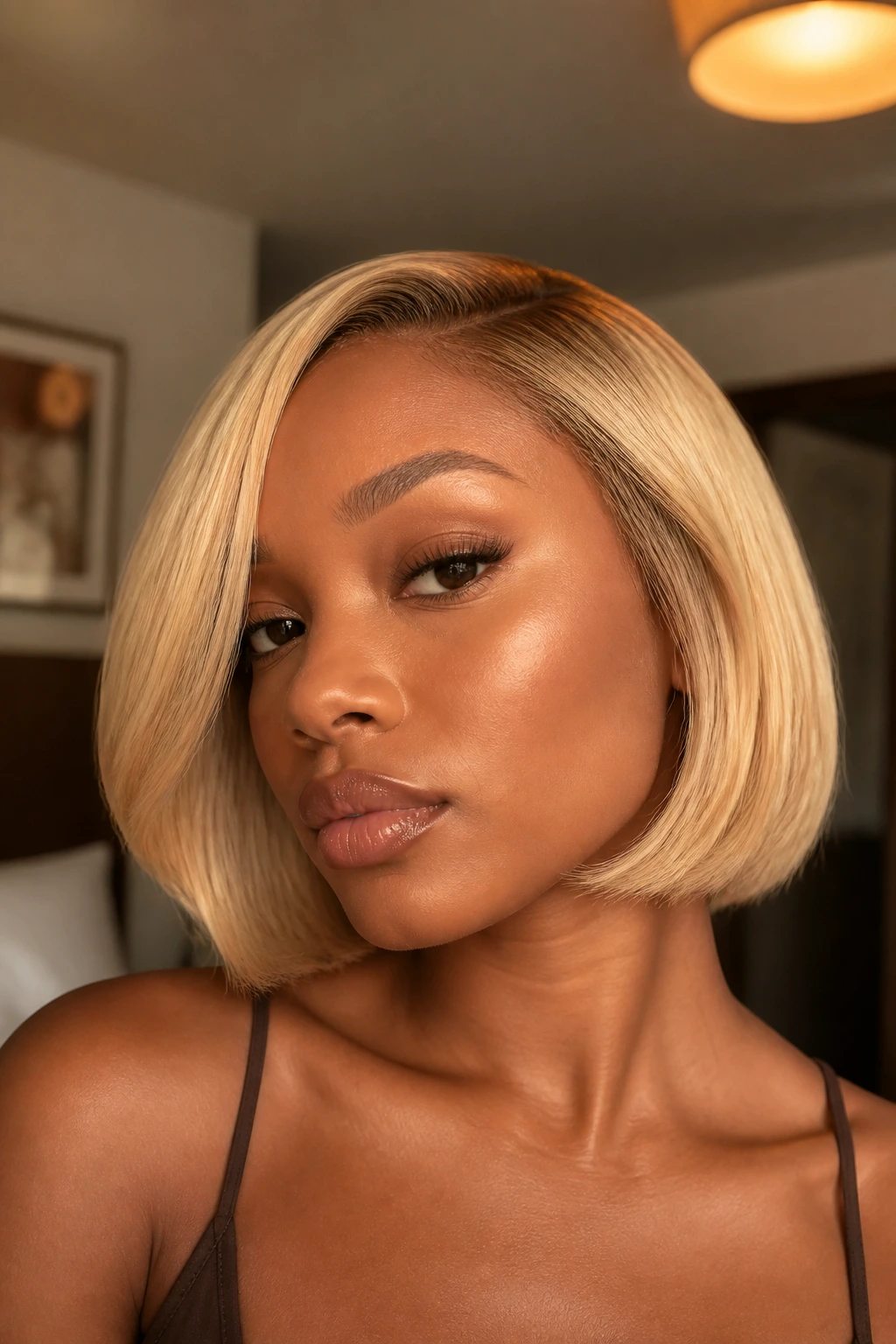
3. Butter Blonde Chin-Length Bob
Butter blonde on a chin-length bob has a softness that pale blonde rarely gets right on deep skin. The warm, creamy tone keeps the blunt shape from looking harsh. Short hair can take on a stiff edge fast. Butter blonde takes some of that away.
The best version sits just under the jawline with a slight bend at the ends. That tiny curve keeps the cut from feeling boxy. If you have a round or oval face, the shape frames cleanly. If you like a side part, keep it shallow so the color doesn’t split the head into two flat halves.
This is a good choice if you want blonde to feel neat and wearable instead of dramatic. It does ask for regular toner touch-ups, though. Short blondes show fade quickly, especially around the nape and hairline.
4. Beige Blonde Face-Framing Layers
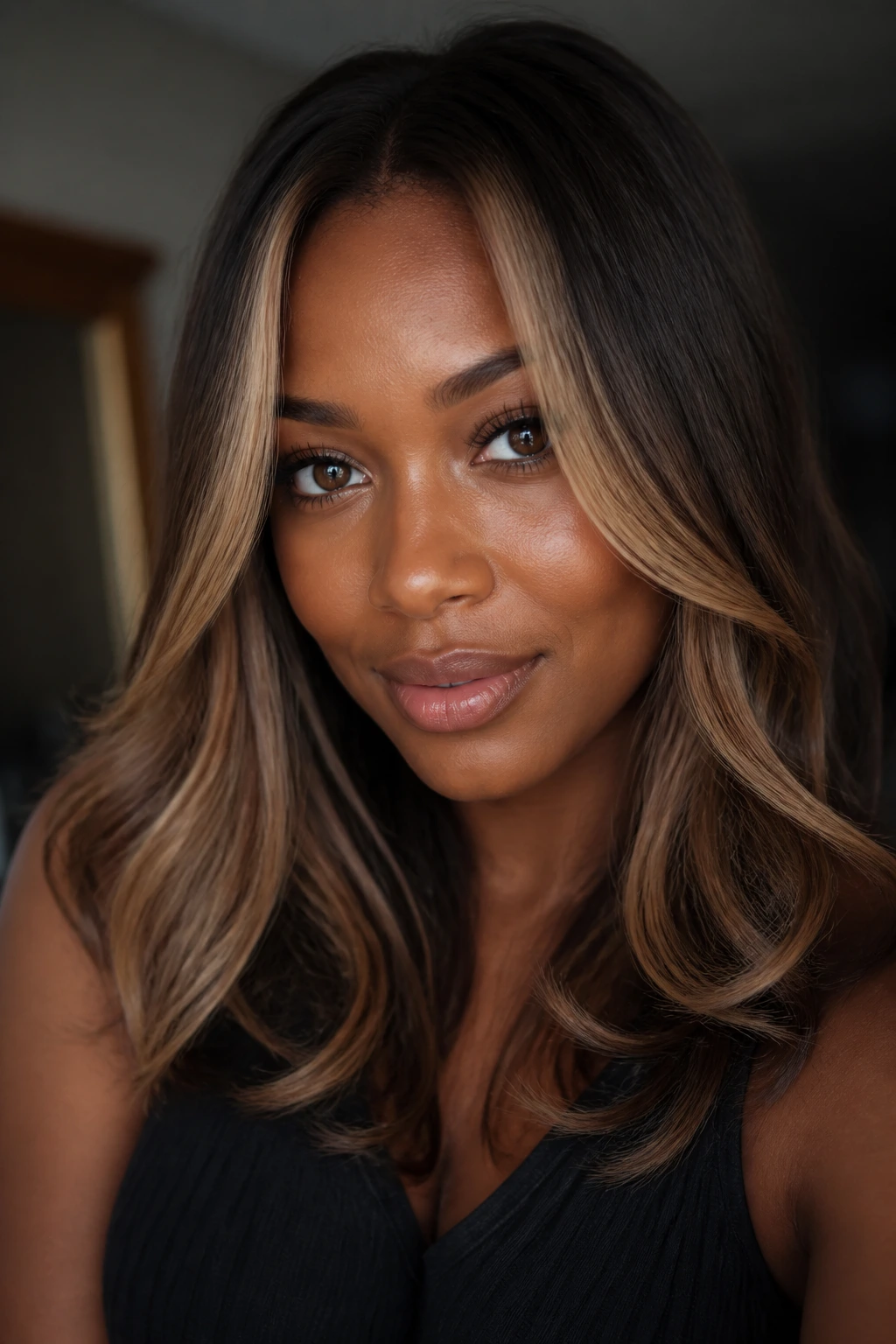
Beige blonde face-framing layers are one of the smartest ways to try a cooler blonde on deep skin without going full icy. The brightest pieces sit around the face, so the skin gets a little lift where it needs it most. The rest of the hair can stay darker or slightly warmer, which keeps the whole look from turning chalky.
The trick is placement. Start the lightest pieces near the cheekbone or just below the brow line, then let them fall into longer layers. That shape pulls attention upward without making the hair look stripey. A soft beige toner is better than a flat ash toner here. Beige carries more life.
If you usually wear your hair straight or in loose waves, this is a dependable pick. It gives you contrast without a heavy color commitment. A middle part makes the blonde pieces more obvious; a side part softens them.
5. Champagne Blonde Flip-Out Lob
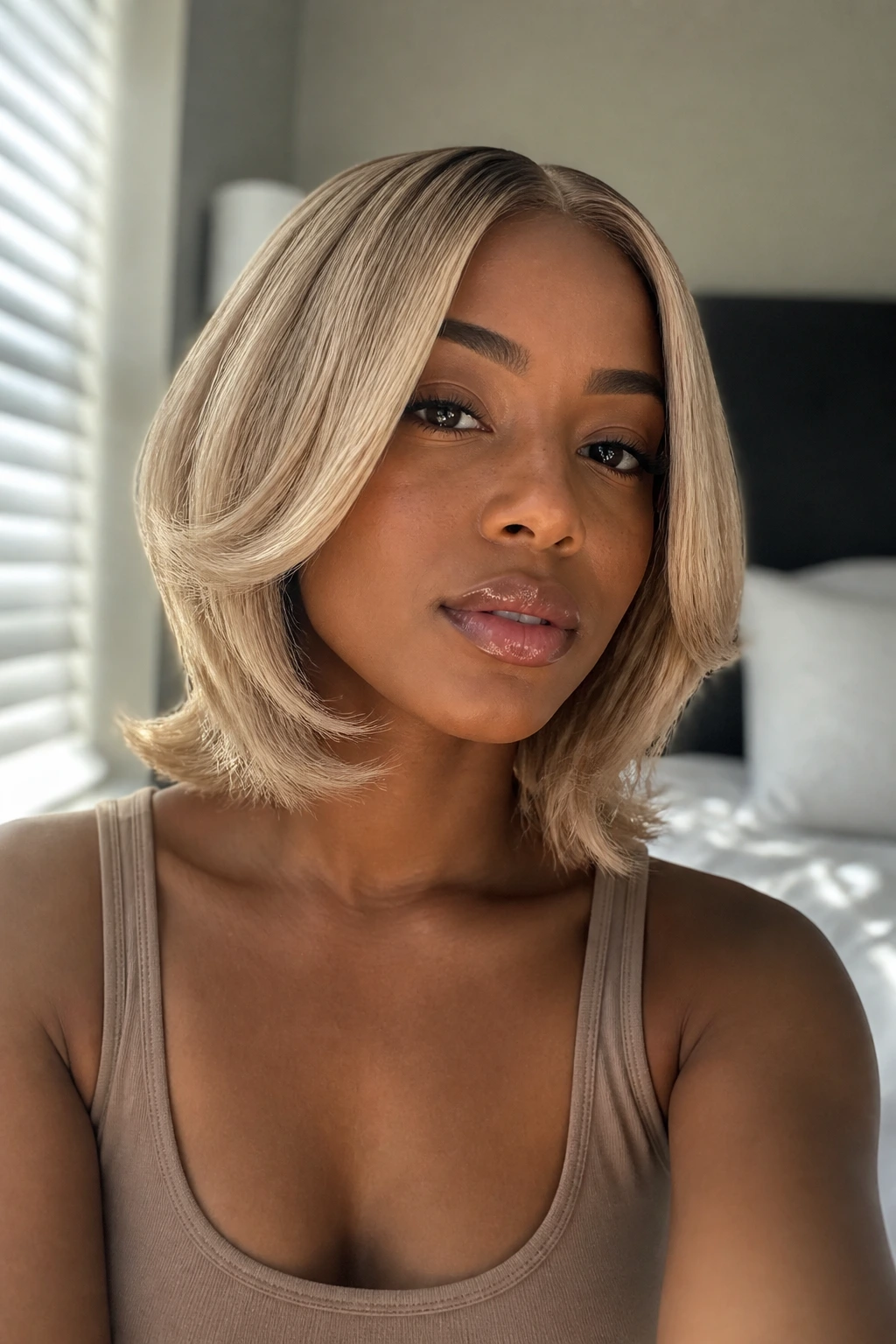
Champagne blonde on a flip-out lob has a crisp, cool sheen that looks sharper than honey, but softer than icy platinum. On deep skin, the contrast can be beautiful when the cut is clean and the ends are styled outward just enough to show movement. If the hair is too flat, champagne can slip into washed-out territory. A little flip fixes that.
What makes it different
The lob length keeps the blonde from overwhelming the face. The flipped ends keep the style from feeling stiff. Together, they give the shade somewhere to go. I like this look best on hair that has a smooth finish and a bit of swing.
Use a round brush or a 1.25-inch curling iron to bend the ends away from the face. Keep the root slightly darker if you can. That tiny depth change helps the champagne stay polished instead of pale.
6. Golden Blonde High Puff
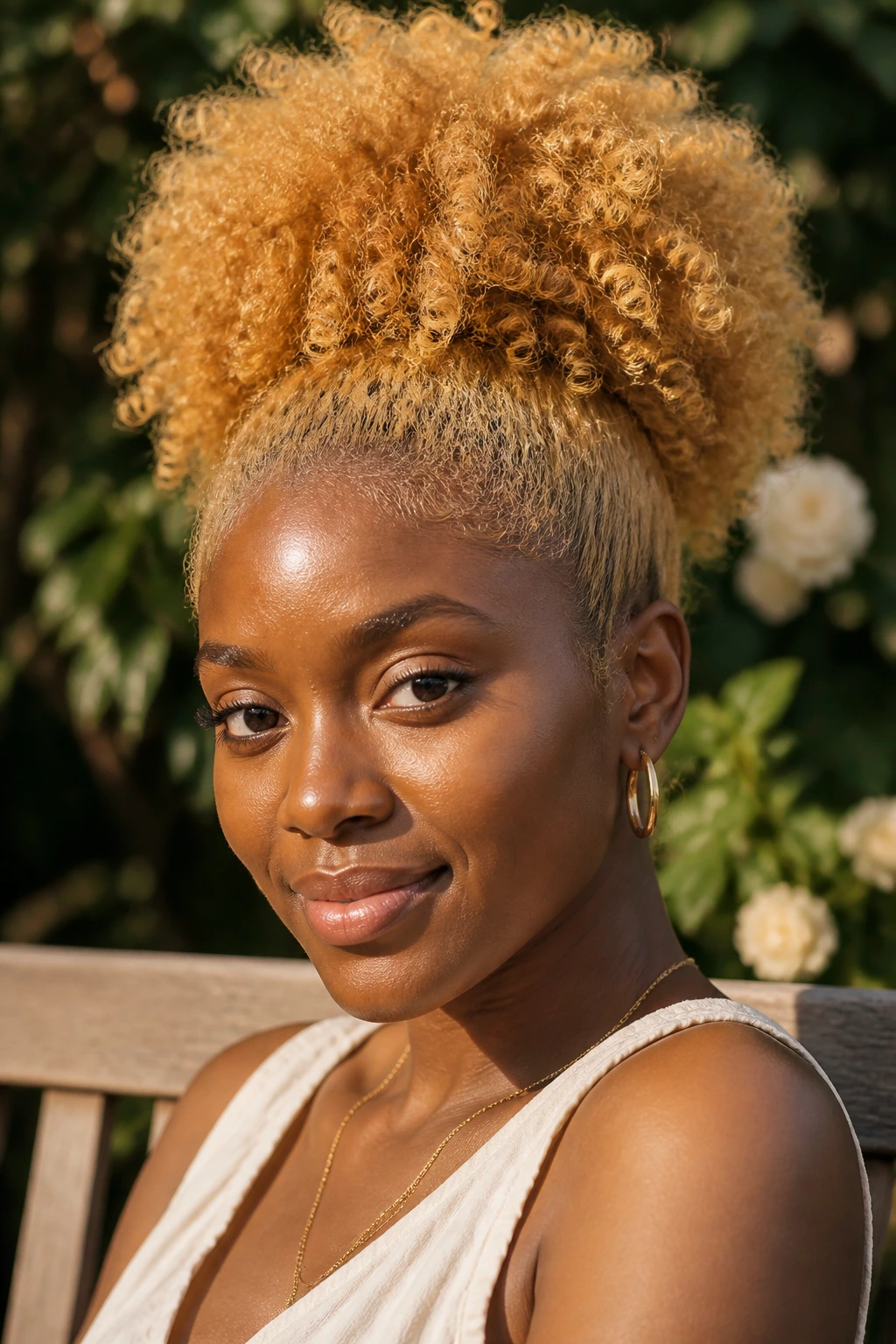
A golden blonde high puff on coils does something I never get tired of: it makes the hair look full, soft, and lifted without needing a blunt cut or a lot of styling drama. Golden blonde is warmer than honey and a touch brighter than caramel, which gives the puff a sunlit look that sits naturally on deep skin.
The puff itself does the framing. Keep the base smooth, but not over-snatched, and let the blonde live mostly in the puff volume. A puff cuff can help if your hair needs a little shape hold. A light edge gel is enough. Heavy gel turns the hair crunchy, and crunchy blonde coils are not the move.
This is one of the few blonde looks that can feel casual and still look intentional. If your hair shrinks hard, stretch it first with twists or banding so the golden pieces show more clearly.
7. Ash-Beige Blonde Sleek Ponytail
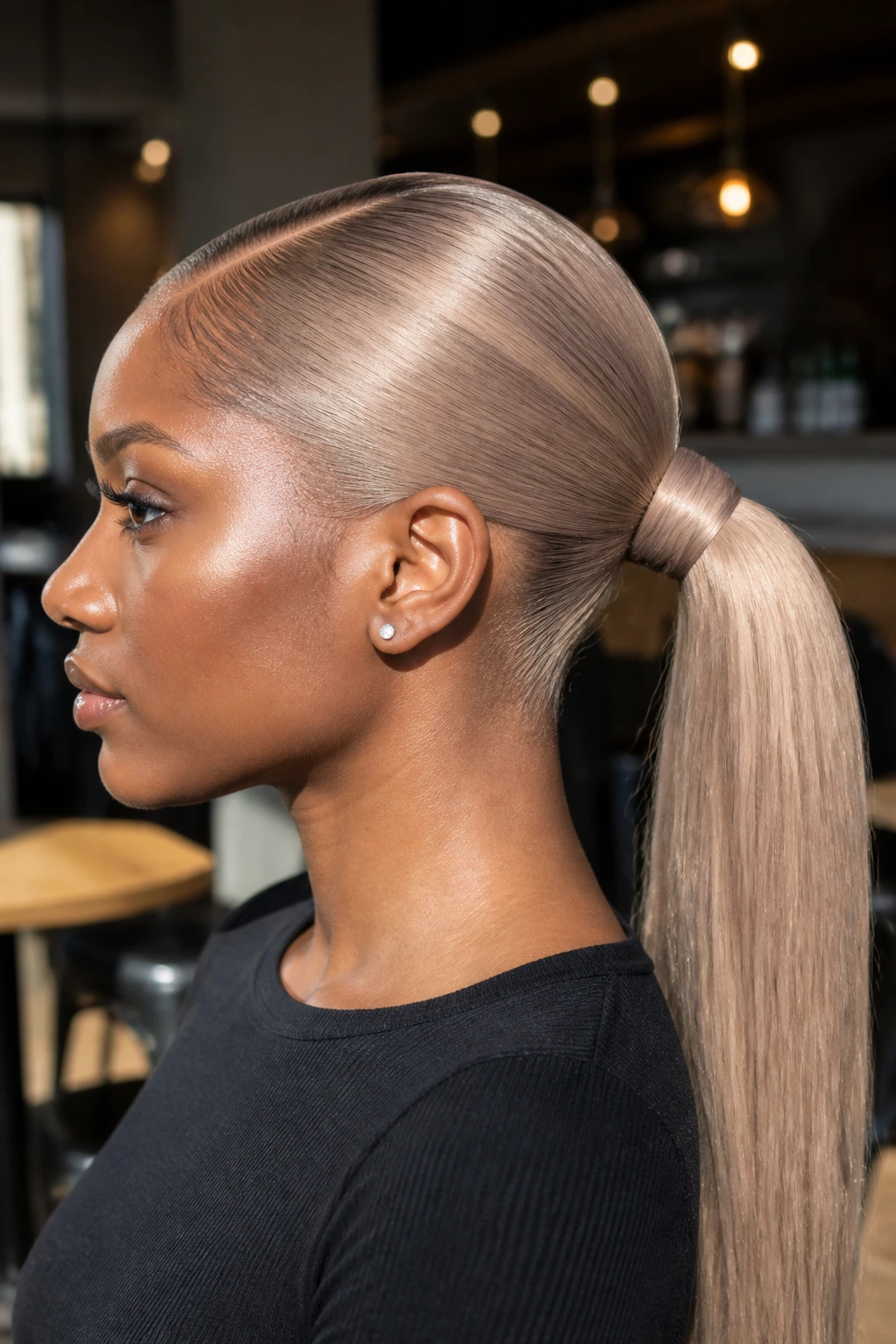
Ash-beige blonde in a sleek ponytail is a high-contrast look, and I mean that in the cleanest way. The cool beige tone needs a deep base or root shadow to keep it from looking dusty against rich skin. When the balance is right, though, it looks sharp from every angle.
The ponytail shape matters. Keep the crown flat, the part precise, and the length smooth. A wrap of hair at the base hides the elastic and makes the style look finished. If you like a middle part, keep the brow line neat so the cool tone doesn’t compete with the face. A soft bronzer or warm lip can keep the whole look balanced.
This is not the easiest blonde here, but it is one of the strongest when you want a sleek, almost editorial effect. The downside is obvious: ash tones fade into dullness if you lean on purple shampoo too much.
8. Creamy Blonde Knotless Braids
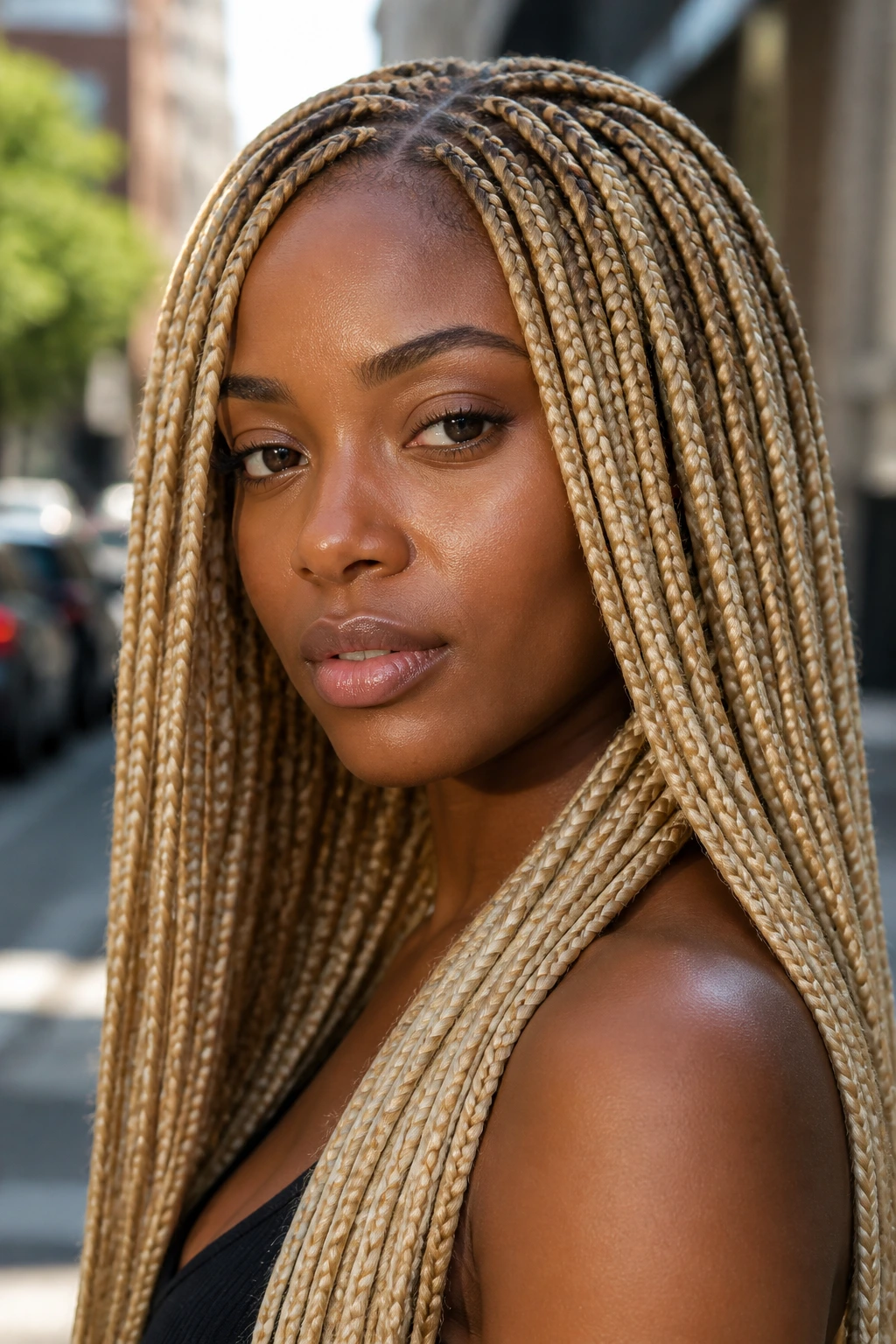
Creamy blonde knotless braids are a good answer if you want blonde without bleaching your own hair all the way out. The color lives in the braiding hair, which means the look can be bold while your scalp gets a break. Creamy blonde is softer than platinum and easier to wear against deep skin, especially if the braid mix includes a little honey or beige.
Knotless braids lay flatter at the root, so the color transition feels cleaner. Keep the parts tidy and the braid size consistent. Mixed tones — think creamy blonde with a few warmer strands — stop the whole head from looking one-note. A mousse finish once a week keeps the braids from fuzzing up too fast.
If you want length and color at the same time, this is one of the most practical picks in the whole set.
9. Buttermilk Blonde Finger Waves
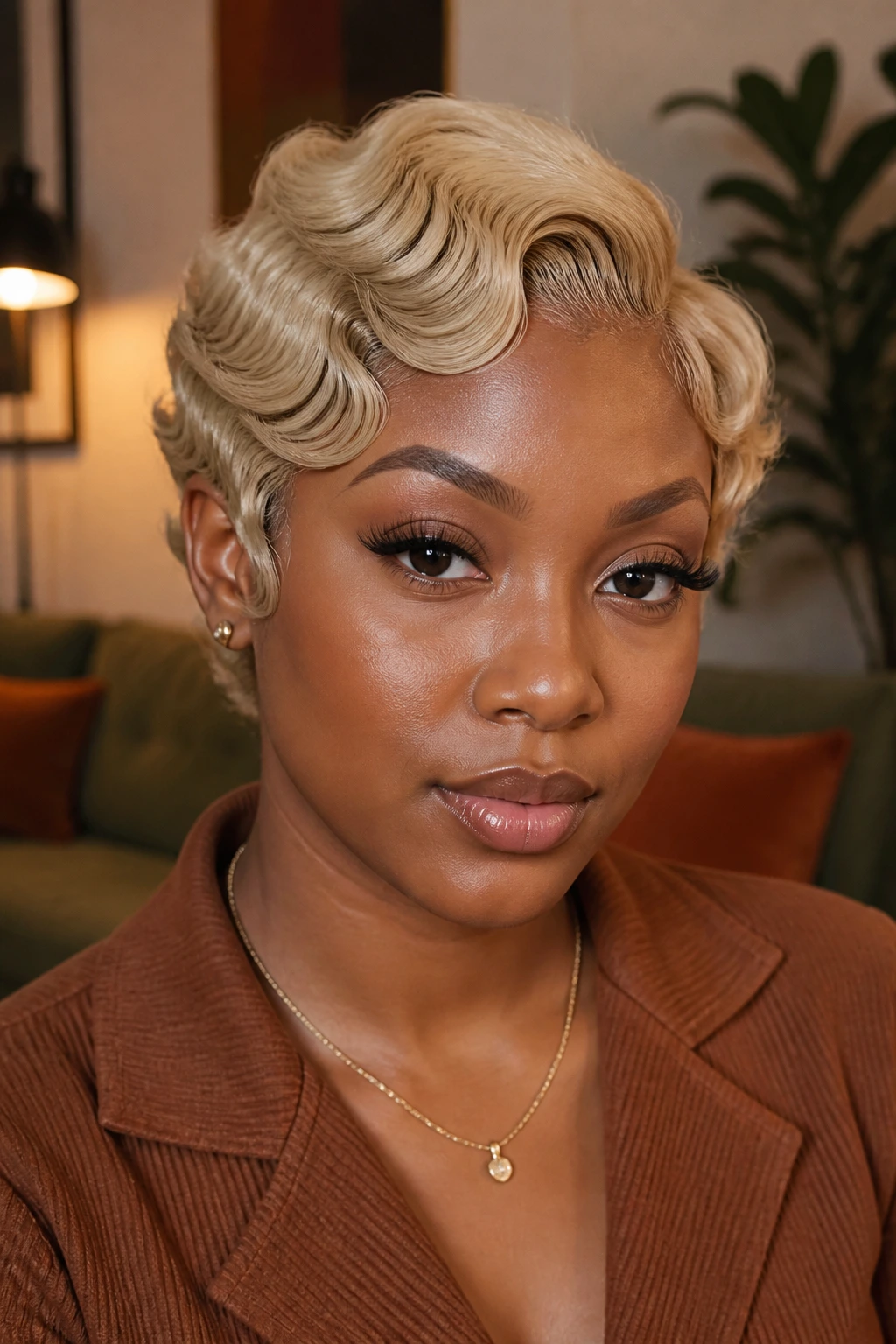
Buttermilk blonde finger waves take all the hardness out of a short blonde cut. The wave pattern gives the color places to fold, which is exactly what a creamy shade needs on deep skin. The finish can feel retro, but not costume-like, if the tone stays soft and the shape stays neat.
How to wear it
This look works best on short, relaxed hair or a carefully fitted wig unit. Use strong-hold gel, a comb with fine teeth, and a wrap scarf to set the waves until they dry fully. If the surface isn’t smooth, the light catches every bump.
Pair it with earrings that have a little shape — hoops, drops, even a small cuff. The hairstyle is already doing a lot. Let the accessories be clean.
10. Sandy Blonde Curtain Bangs
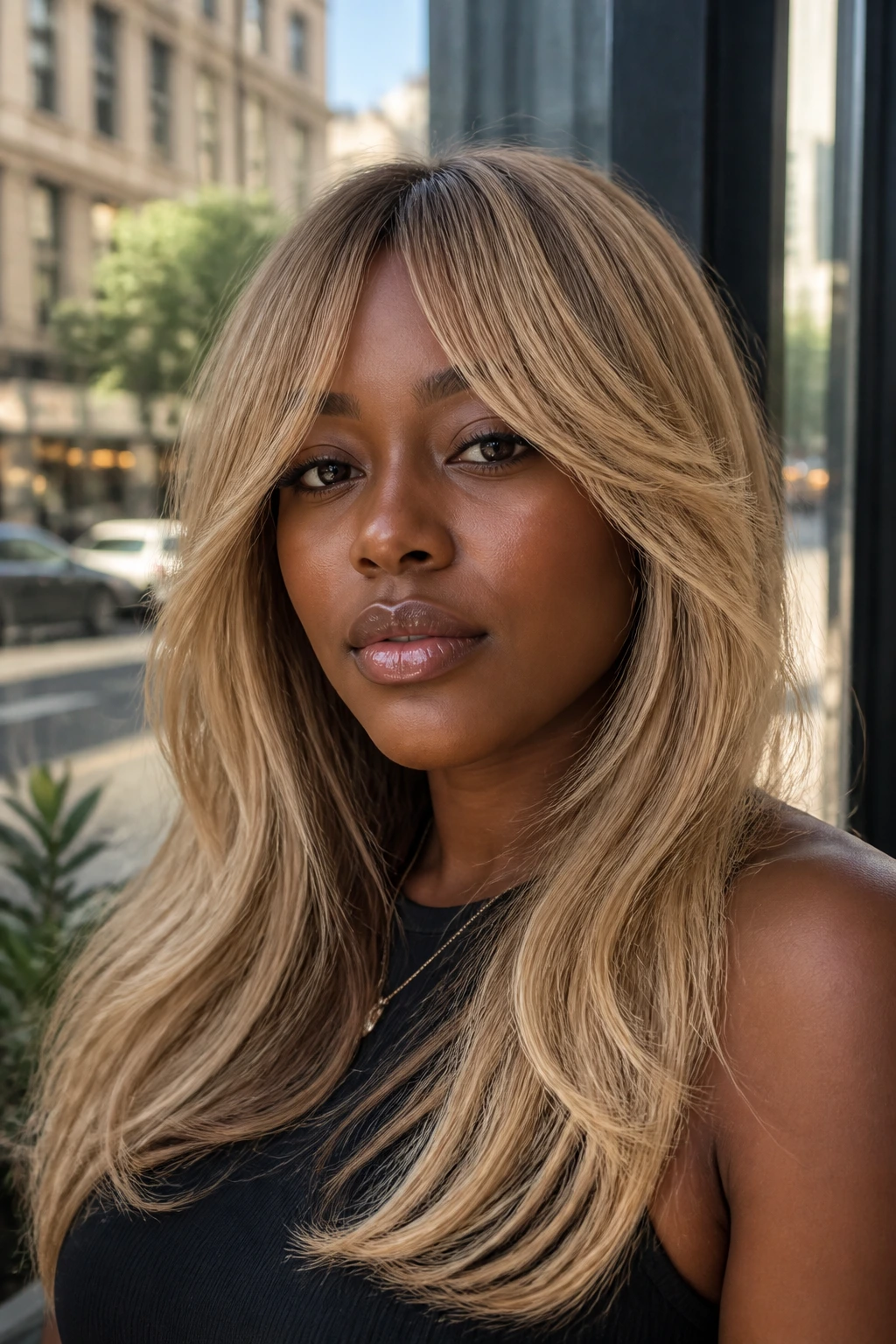
Sandy blonde curtain bangs are softer than full blonde around the face, and that softness matters on deep skin. Sandy sits in that middle space between beige and warm gold, which makes it easy to wear. The bangs break up the color near the forehead, so the blonde never feels too broad or too bright.
The cut needs a bit of movement through the front. Keep the bangs long enough to split around the cheekbones, then let the rest of the hair fall in layers or a lob. Blow-dry them with a round brush, not a stiff paddle brush. Curtain bangs look better when they move a little.
If you want to test blonde without a full commitment, this is a smart place to start. The face-framing pieces give you the payoff, and the rest of the hair can stay deeper.
11. Bronzed Blonde Tapered Cut
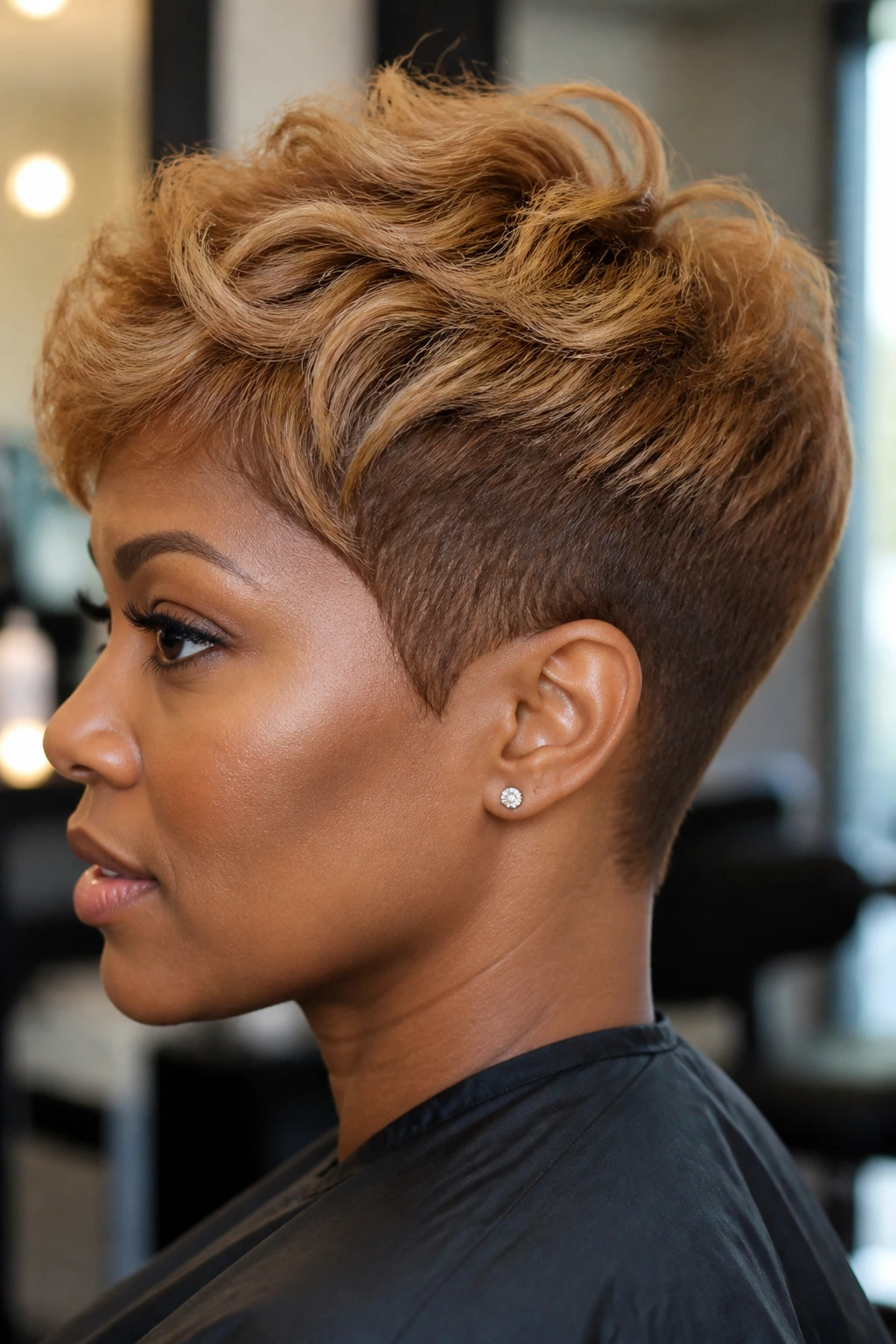
A bronzed blonde tapered cut is one of my favorite short styles for deep skin because the bronze keeps the blonde from going flat. The taper gives the shape a clean outline, and the color lifts the top without overwhelming the sides. That contrast does a lot of work for you.
The cut itself should stay crisp around the nape and ears, with a little fullness at the crown. Ask for bronze highlights or a bronzed gloss rather than a pale all-over blonde. The point is depth. Too much lift on a tapered cut can make the shape lose weight.
This style is low maintenance in a way that matters. You do not need a full styling session every morning. A little cream, a little finger shaping, and you’re done.
12. Beige-to-Platinum Ombre Curls
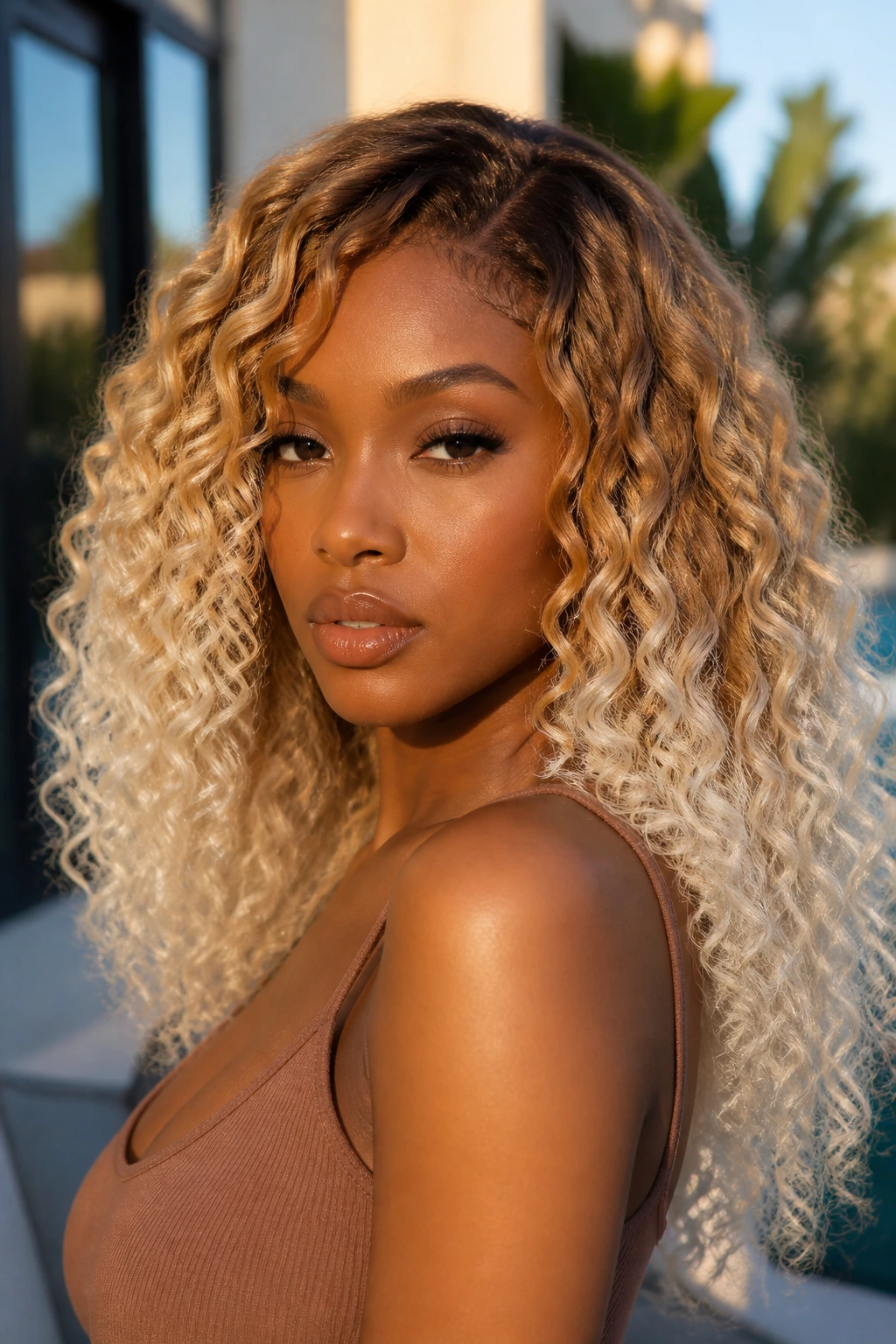
Beige-to-platinum ombre curls are for the person who wants drama, but not chaos. The darker beige root gives the eye something to hold onto, and the platinum ends create the loudest part of the look. On deep skin, that gradient works because the transition is doing the job the skin tone already does naturally: moving from depth to brightness.
This is a high-maintenance color. No way around it. The curls help, because curl clumps soften the line between beige and platinum, but the hair still needs careful lightening and real conditioning. If your ends are dry before the color service, ask the colorist to slow down. Rushing this look usually shows.
I like this best on healthy medium-length curls where the ombre can stretch out and breathe.
13. Maple Blonde Twist-Out
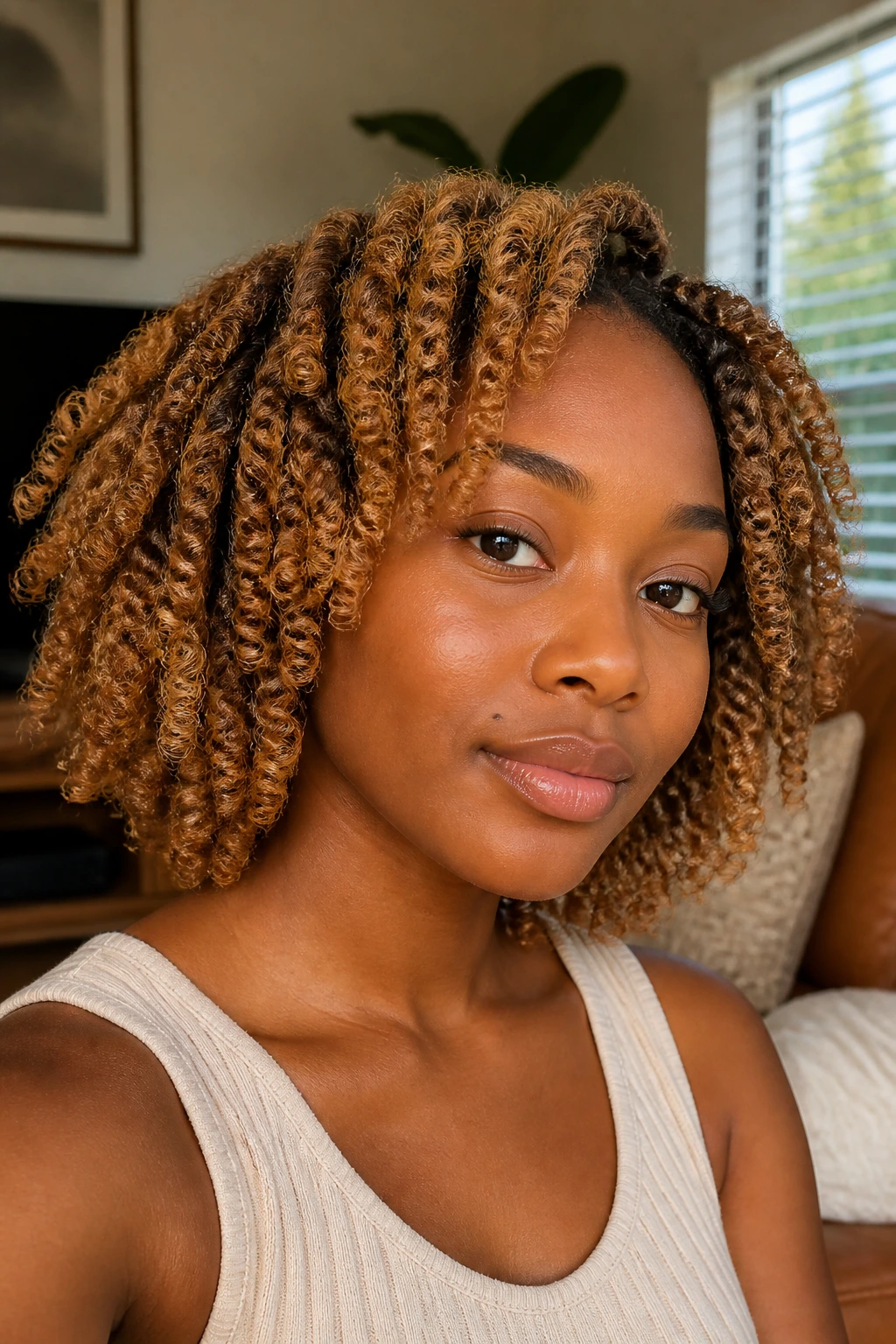
Maple blonde is warmer than honey and a little richer, almost like the color has a brown sugar note running through it. On a twist-out, that warmth breaks across the bends in the hair and gives the style a kind of depth that straight styles don’t get as easily. Deep skin loves that contrast.
Twist-outs also make the color look more expensive — not because the shade is fancy, but because the texture keeps the light from landing all at once. Use stretched, damp hair with a creamy leave-in and twist tightly enough to hold, but not so tight that the hair frizzes at the roots. That’s where the look gets messy fast.
A maple blonde twist-out is especially good if you want softness around the face and more definition through the ends.
14. Sandy Honey Blonde Box Braids
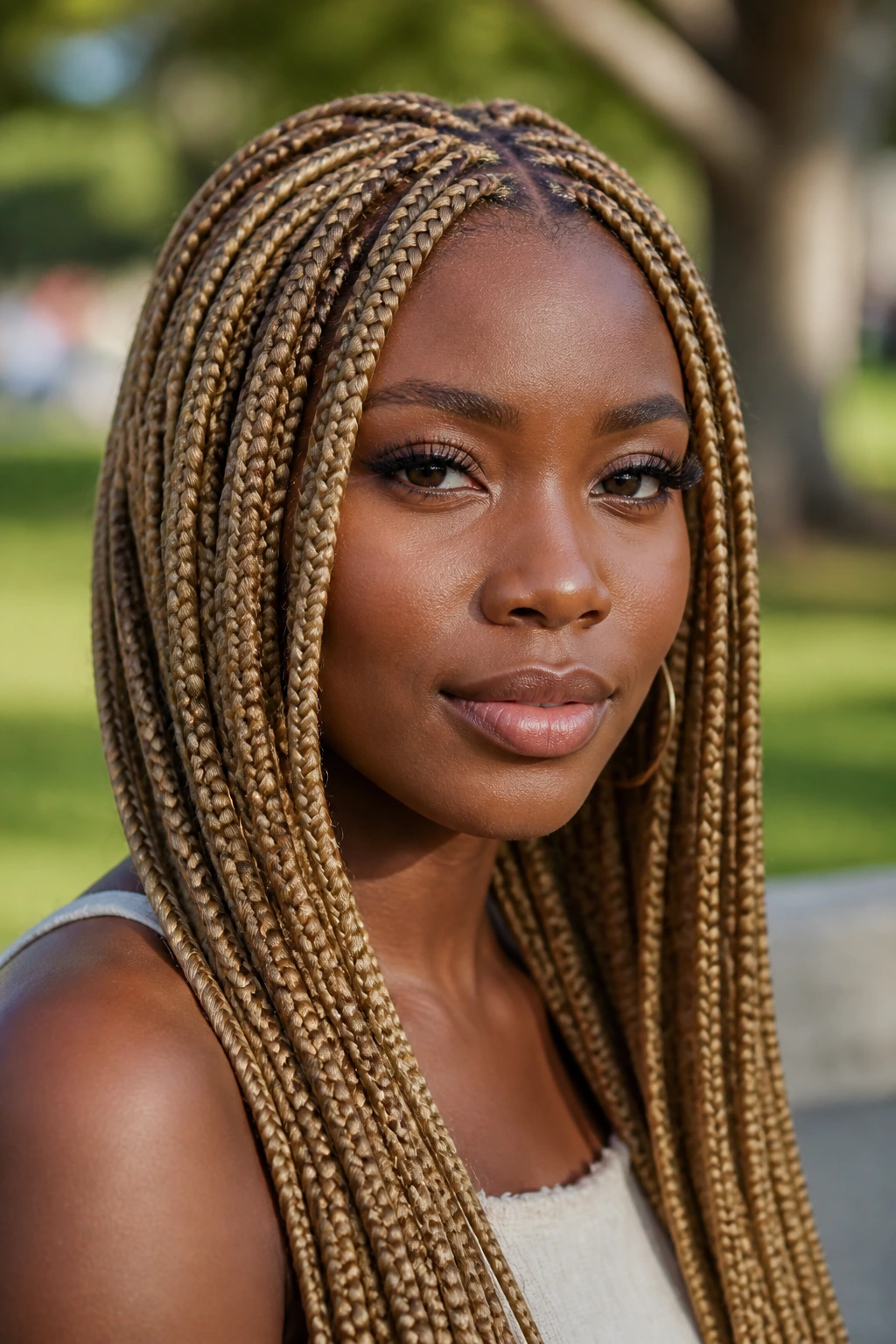
Sandy honey blonde box braids are a smarter choice than a single flat blonde braid color. The mix of sandy and honey strands keeps the braids from looking like one solid sheet of color. On deep skin, that little variation matters more than people expect. It stops the style from looking plastic.
Because the color lives in the braid hair, you get flexibility. You can wear them long, bob-length, or with a blunt cut end. Keep the braid tension comfortable at the scalp and use a light mousse to smooth the surface. Heavy oils can make the braids look dirty fast.
This is a good style if you want warmth, length, and a lower daily maintenance load. It also grows out nicely, which I always appreciate in a protective style.
15. Pearl Blonde Tapered Afro
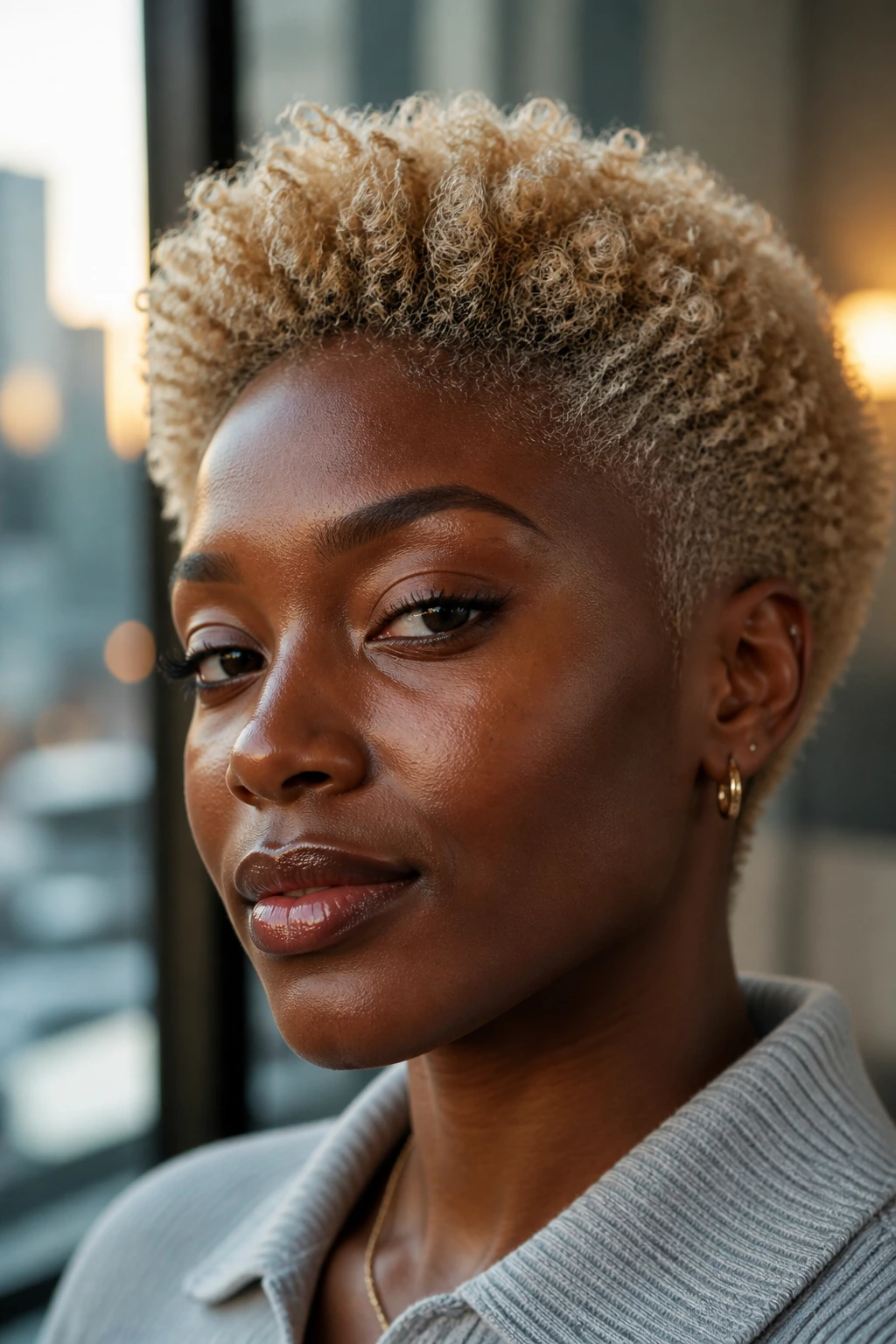
Pearl blonde on a tapered afro has a cooler, almost soft-glow effect that can look fantastic on deep skin when the cut has shape. The taper keeps the sides neat and the top rounded, so the blonde doesn’t spread out too much. Pearl is cooler than champagne, but not as stark as icy platinum.
The style works best with a small amount of lowlight or root depth. Without that, pearl blonde can look thin. With it, the hair looks airy and deliberate. The coil pattern is part of the design, so a curl sponge, pick, or finger shaping should keep the shape alive without roughing up the cuticle.
This is a good pick if you like short hair that still feels soft. It has presence without shouting.
16. Wheat Blonde Blunt Bob
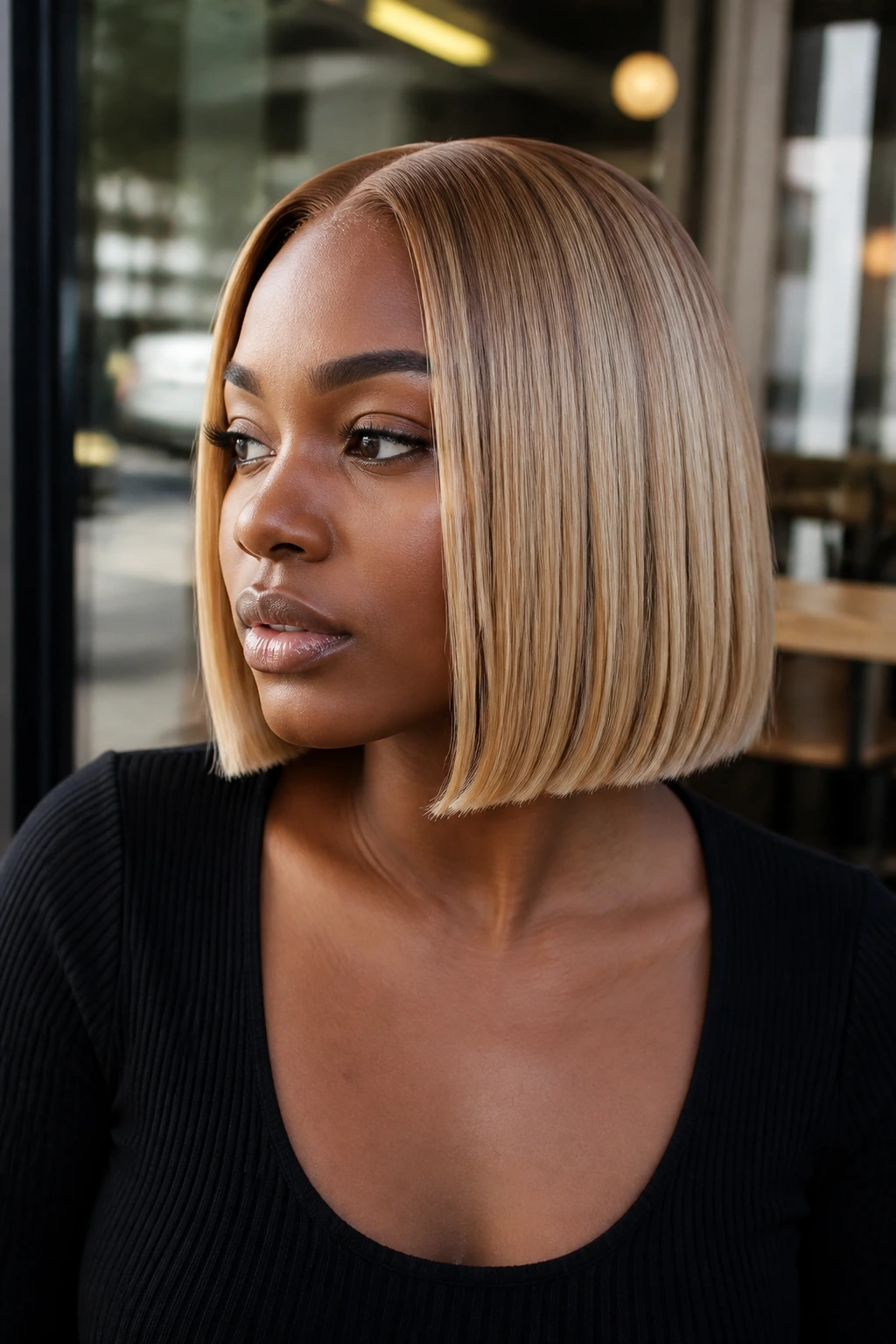
A wheat blonde blunt bob is one of those cuts that punishes sloppy color placement. The line is clean, the ends are even, and the blonde has to support that precision. Wheat is a soft, pale blonde with enough beige in it to keep the style from going chalky against deep skin.
The blunt edge makes the color look denser, which is useful. A little root shadow helps the style grow out without a hard line. I’d keep the bob just below the chin so the shape has enough length to move. Too short, and the whole thing can feel helmet-like.
If you like structure, this is your friend. If you want movement, ask for a tiny bend under the ends instead of pin-straight perfection.
17. Toasted Almond Blonde Locs
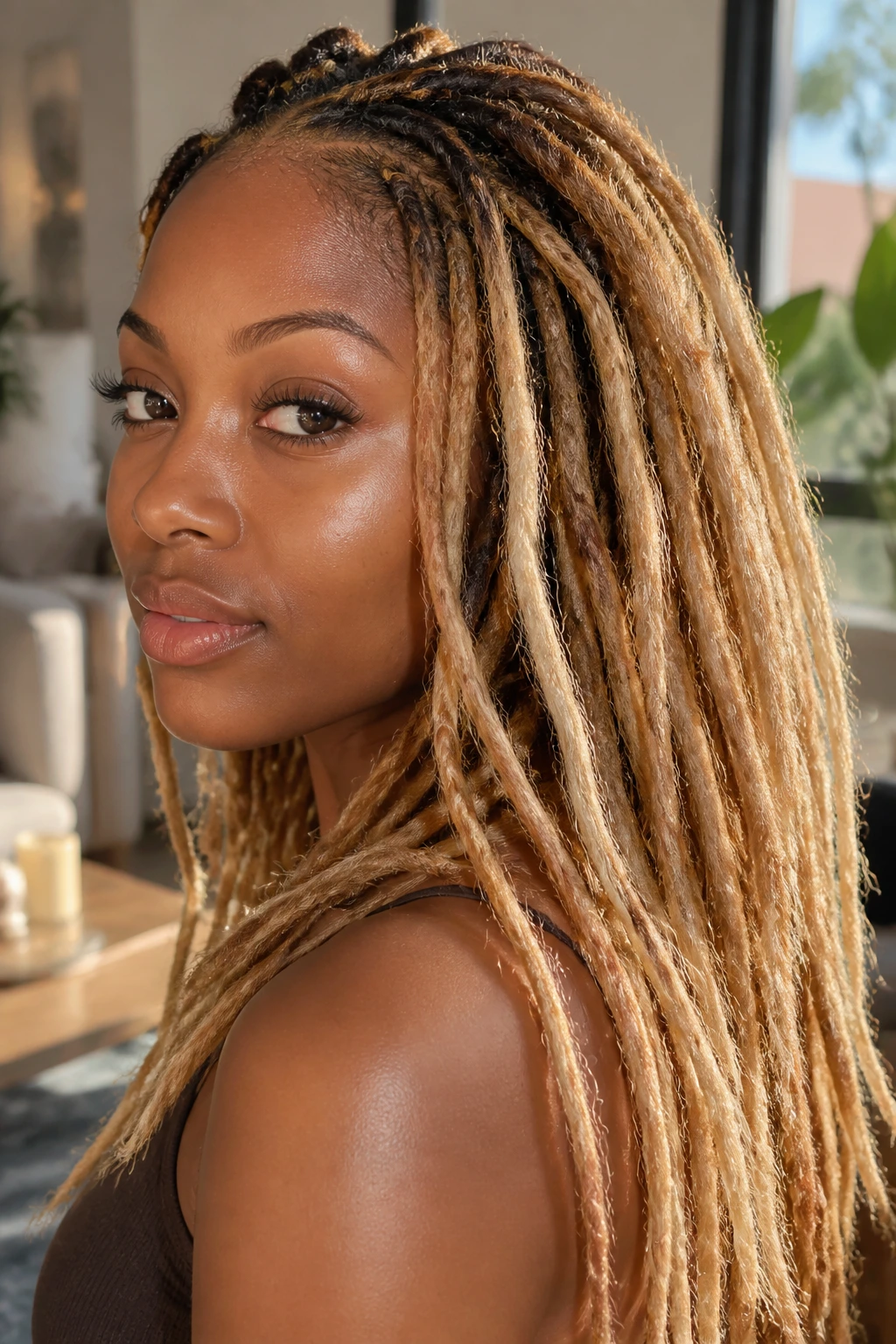
Toasted almond blonde locs work because the shade is warm, muted, and not trying too hard. The blonde threads through the locs like a highlight rather than a full repaint of the head. On deep skin, that restraint matters. It keeps the color rich.
You can add toasted almond through extensions, wraps, or selective coloring, depending on how bold you want the result. Avoid drowning locs in oil. That weighs them down and makes the lighter pieces look dingy. A gentle scalp cleanse and a light mist are enough for most weeks.
This is one of the best options if you want dimension without sacrificing the structure of your locs. It feels lived-in, which is a nicer word than polished, and more honest too.
18. Vanilla Blonde Waterfall Layers
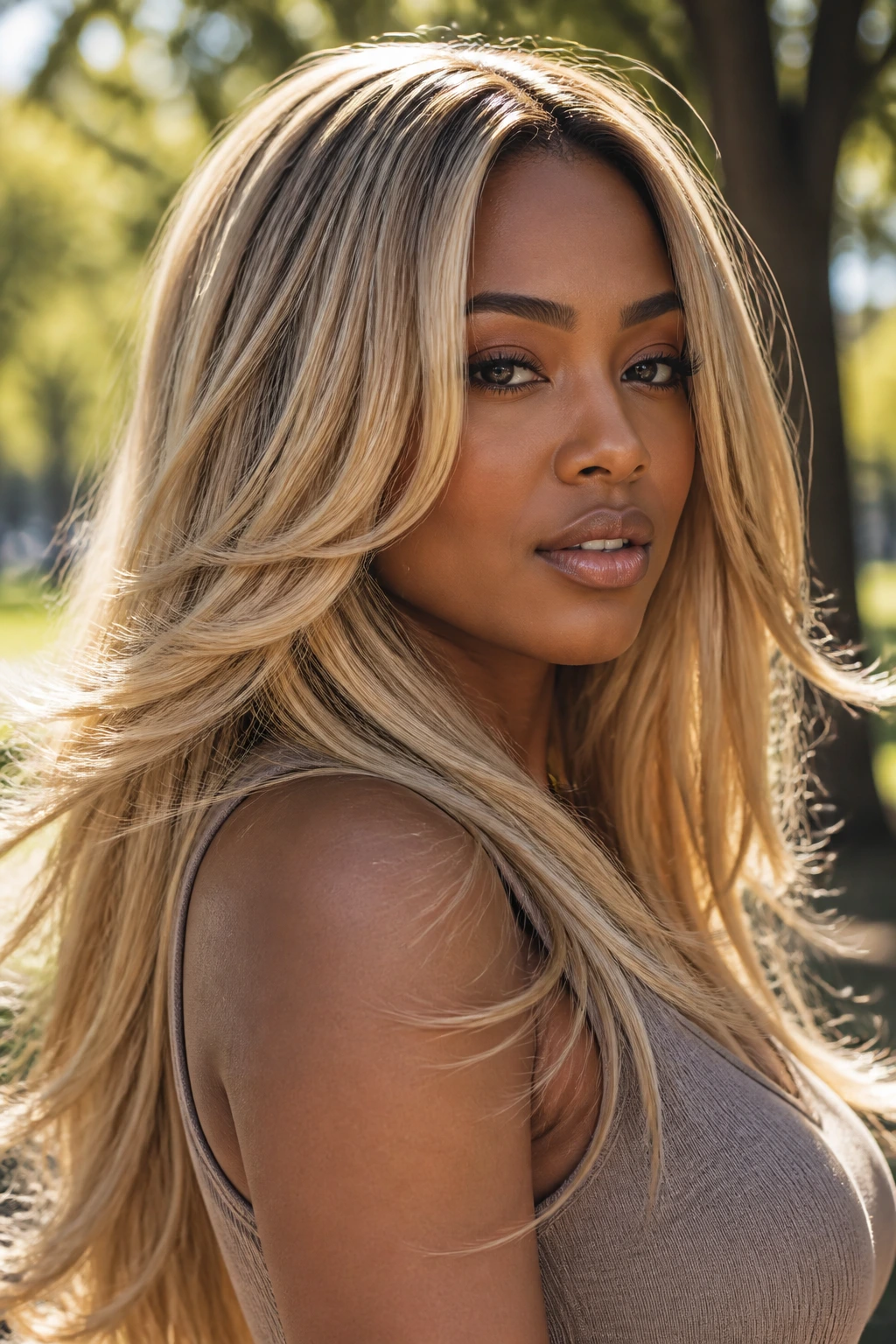
Vanilla blonde waterfall layers are all about movement. The layers let the color spill from one section to the next, and the vanilla tone keeps the result soft rather than harsh. On deep skin, vanilla works best when it has a deeper base under it. Otherwise the color can look too pale and lose the richness that makes blonde flattering.
Long layers are the secret here. They keep the ends from looking heavy and let the brighter pieces travel through the hair instead of sitting in one place. Loose curls or a big round brush blowout help the layers show up. Straight, flat lengths can make vanilla look unfinished.
If you like hair that swings and catches light in bands, this has the right kind of motion. It needs regular glossing, though. Vanilla fades fast when the toner goes.
19. Cashmere Blonde Braided Bun
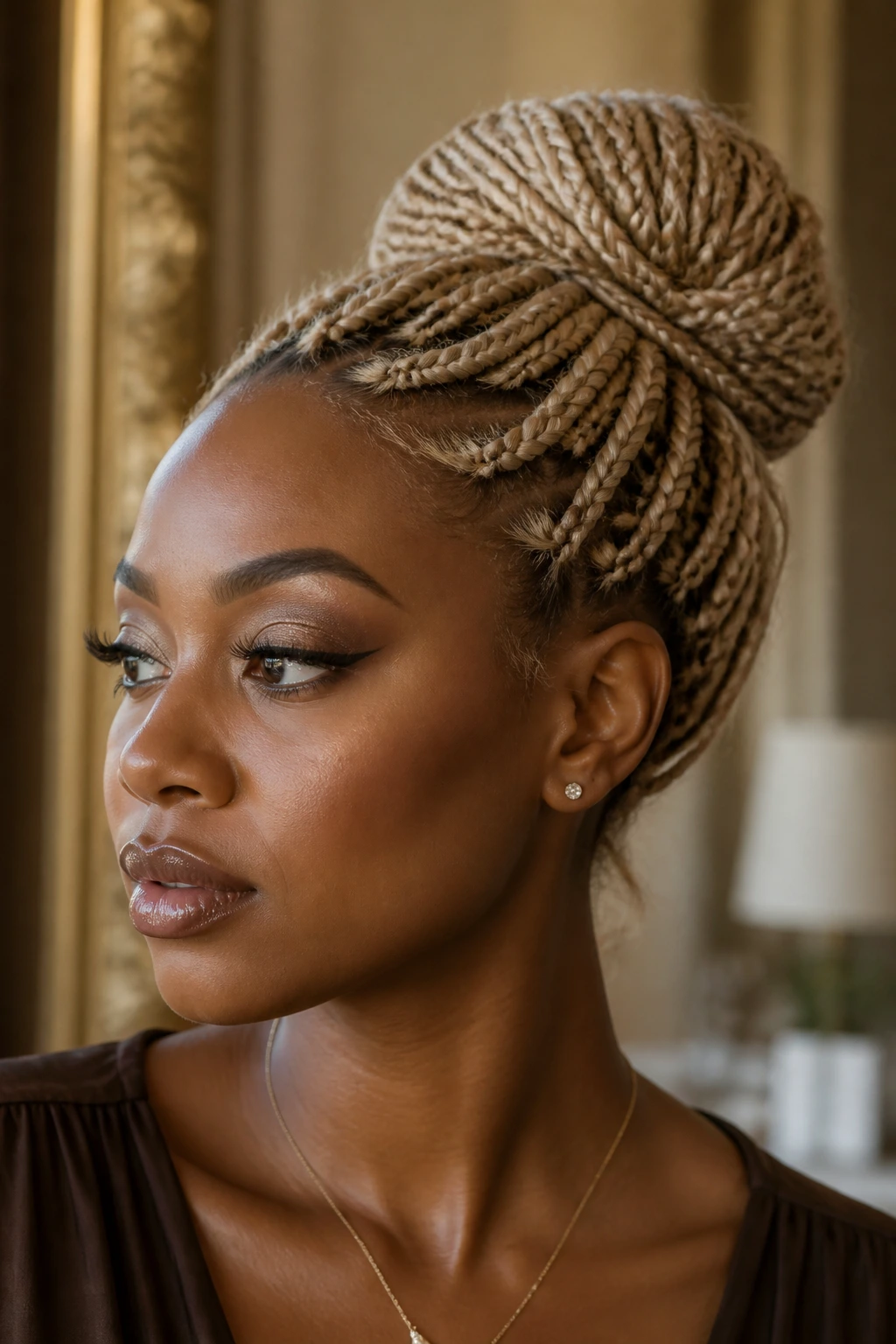
A cashmere blonde braided bun gives you a blonde look with a cleaner line and a little formality. The color is soft, creamy, and slightly muted, which keeps it from overwhelming the face. Wrapped into a bun, the blonde reads as shape first and color second — a useful trick on deep skin if you want elegance without a lot of flash.
The bun should sit either low and neat or high with a little fullness at the crown. Keep the braids smooth before pinning them down. Flyaways should be controlled, not shellacked. A satin scarf for ten minutes after styling helps the set hold.
This one works well for events, workdays, and any time you want the hair out of your way but still visible. It’s practical and a bit graceful, which is a nice combination.
20. Bronde-to-Blonde Bouncy Layers
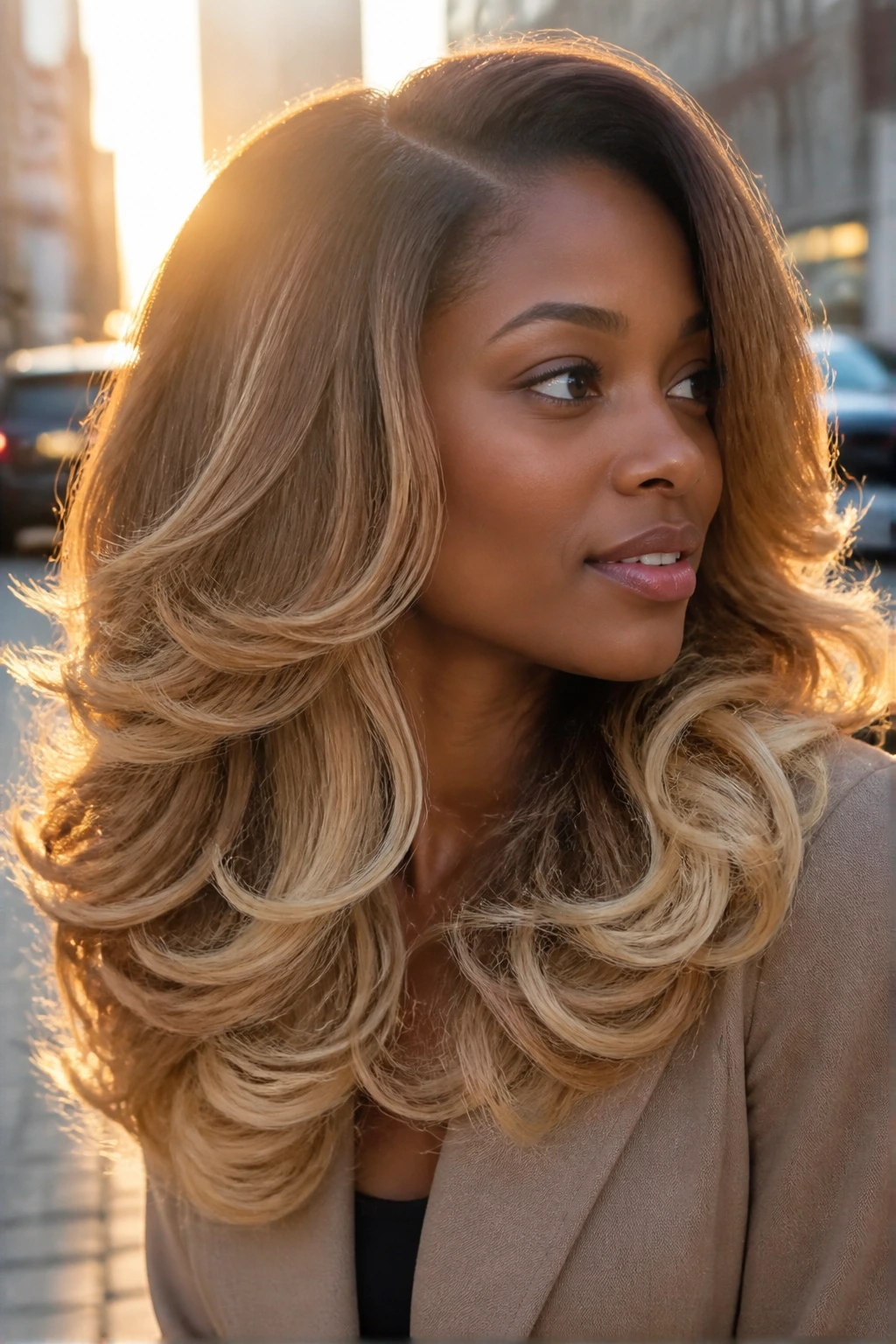
Brond e-to-blonde layers are the safest bridge for anyone nervous about going all the way light. The darker bronde base gives deep skin a familiar anchor, and the blonde ends bring the bright lift. The result feels dimensional instead of bleached.
This style loves volume. A big-barrel curl or blowout bend helps the transition from brown to blonde look natural. If the layers are too flat, the color shift can feel abrupt. If they have bounce, the whole head looks richer.
I like this option for people who want to test blonde in stages. It gives you the brightness without asking the hair to carry an all-over pale shade from root to tip. That’s not a small thing.
21. Soft Gold Blonde Pixie
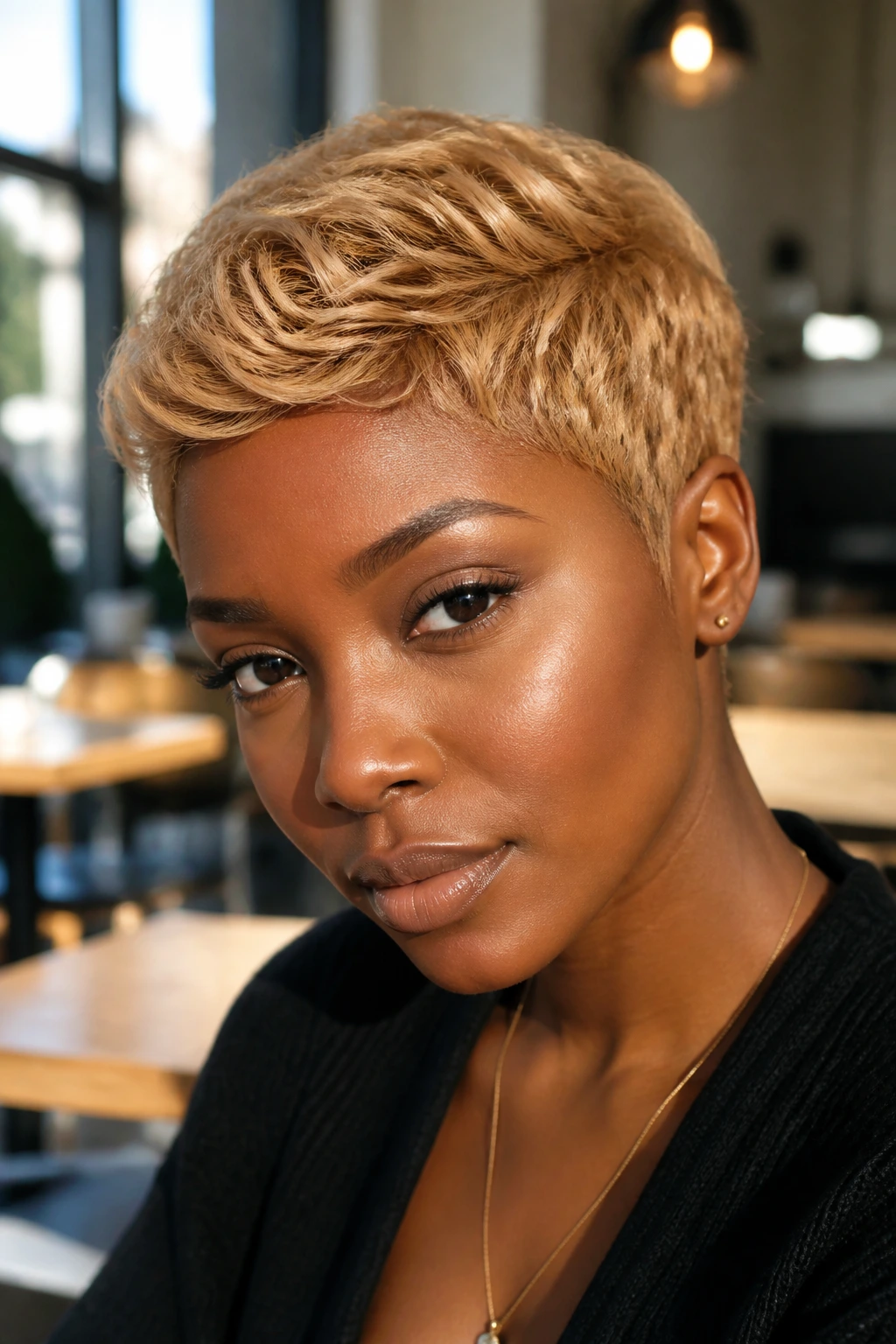
A soft gold blonde pixie is sharp in the best possible way. The haircut does the heavy lifting, and the gold tone keeps the short length from looking severe on deep skin. A pixie without warmth can go cold fast. Gold fixes that.
Best part
You get shape first, color second. That means the cut needs to be precise, especially around the temple and nape. Ask for enough length on top to sweep forward or to the side. A tiny bit of root shadow helps the pixie hold its depth between salon visits.
This is a low-styling cut, but not a low-maintenance one. It wants trims. Short hair always does.
22. Miel Blonde Half-Up, Half-Down
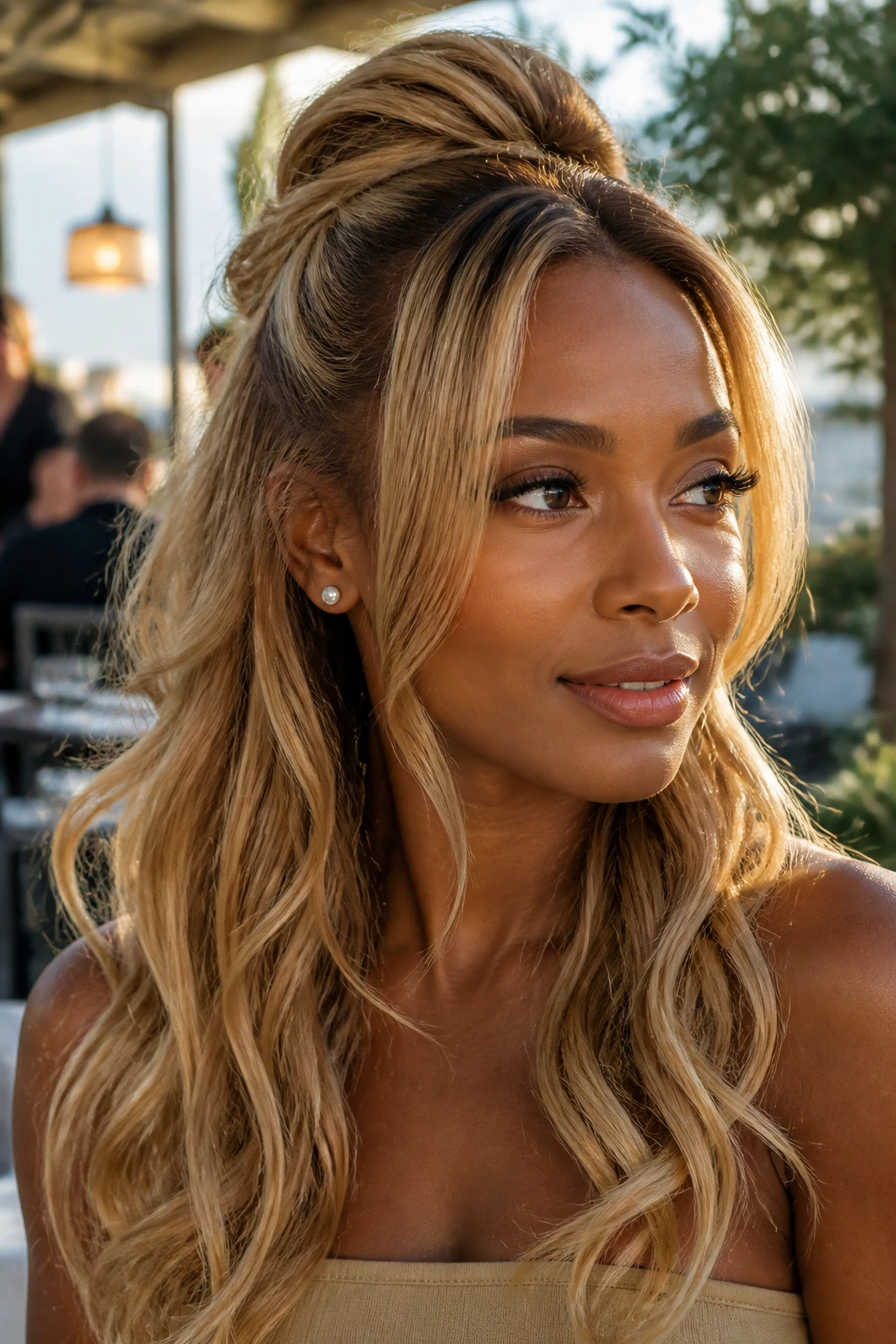
Miel blonde — that honeyed, warm blonde with a soft French-girl feel — makes a half-up, half-down style look easier and sweeter than a full blonde crown can. On deep skin, the warmth pulls the eye in without flattening the face. The half-up section gives structure, and the loose length keeps the color relaxed.
The best version uses curls or bends through the bottom half so the blonde doesn’t fall straight and thin. Keep the top section smooth, but not pulled so tight that it cracks the edges. A little volume at the crown helps the shape read from the front.
This is the kind of style that works for brunch, work, or an evening out without needing a full restyle. That alone makes it worth saving.
23. Champagne Beige Marley Twists
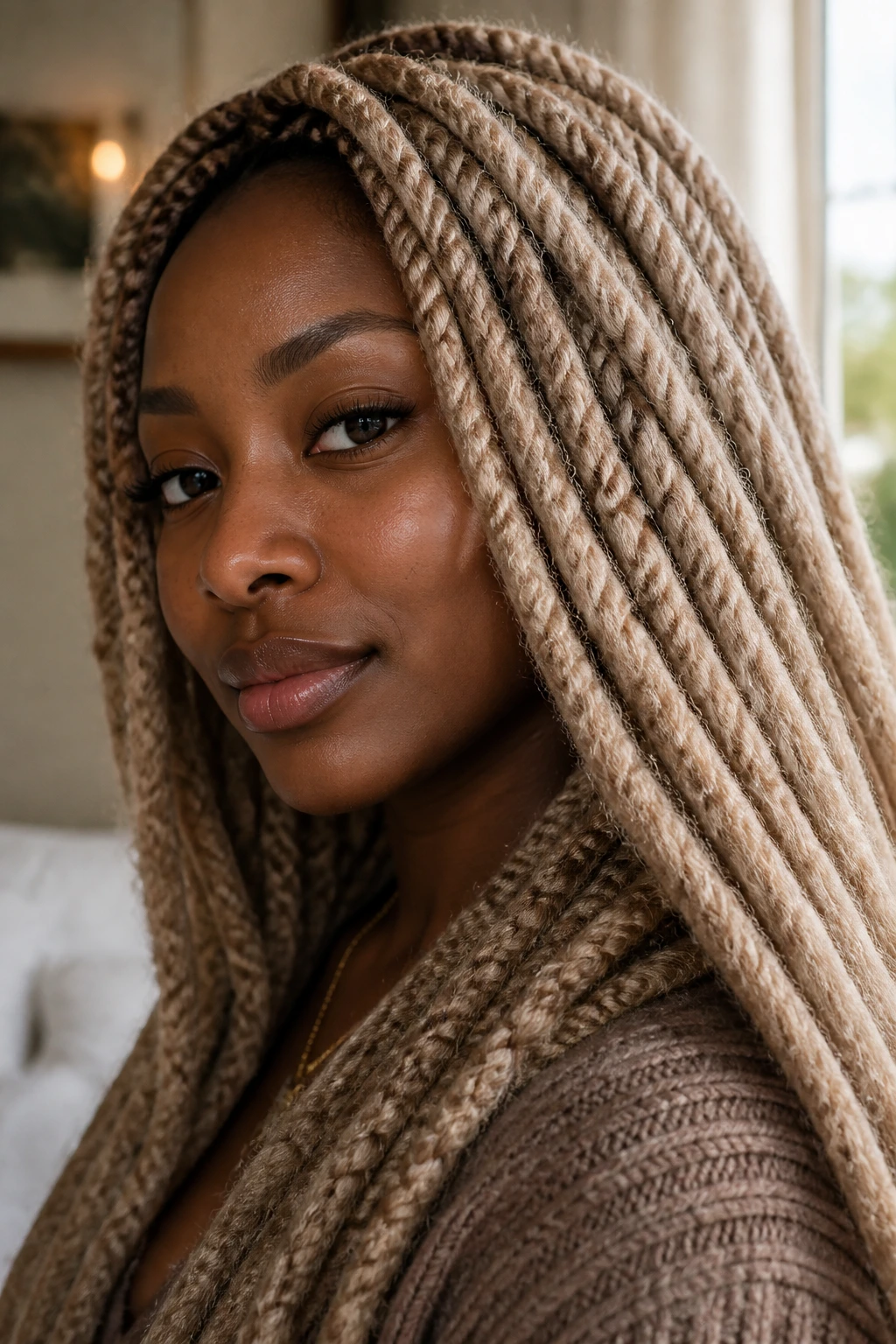
Champagne beige Marley twists have a matte softness that can look especially nice on deep skin when the tone is kept clean. The beige keeps them from looking too yellow, and the champagne note gives the style a faint glow instead of a flat sandy finish.
Because Marley hair has a fuller, fuzzier texture, the color appears more muted than it would on silky extensions. That works here. It keeps the style grounded. Use mousse to smooth the surface and a scarf at night so the twists keep their shape. Heavy sheen sprays can make them look greasy.
If you want a protective style that feels a little more refined than standard dark twists, this is the lane.
24. Icy Vanilla Blonde Sleek Bob
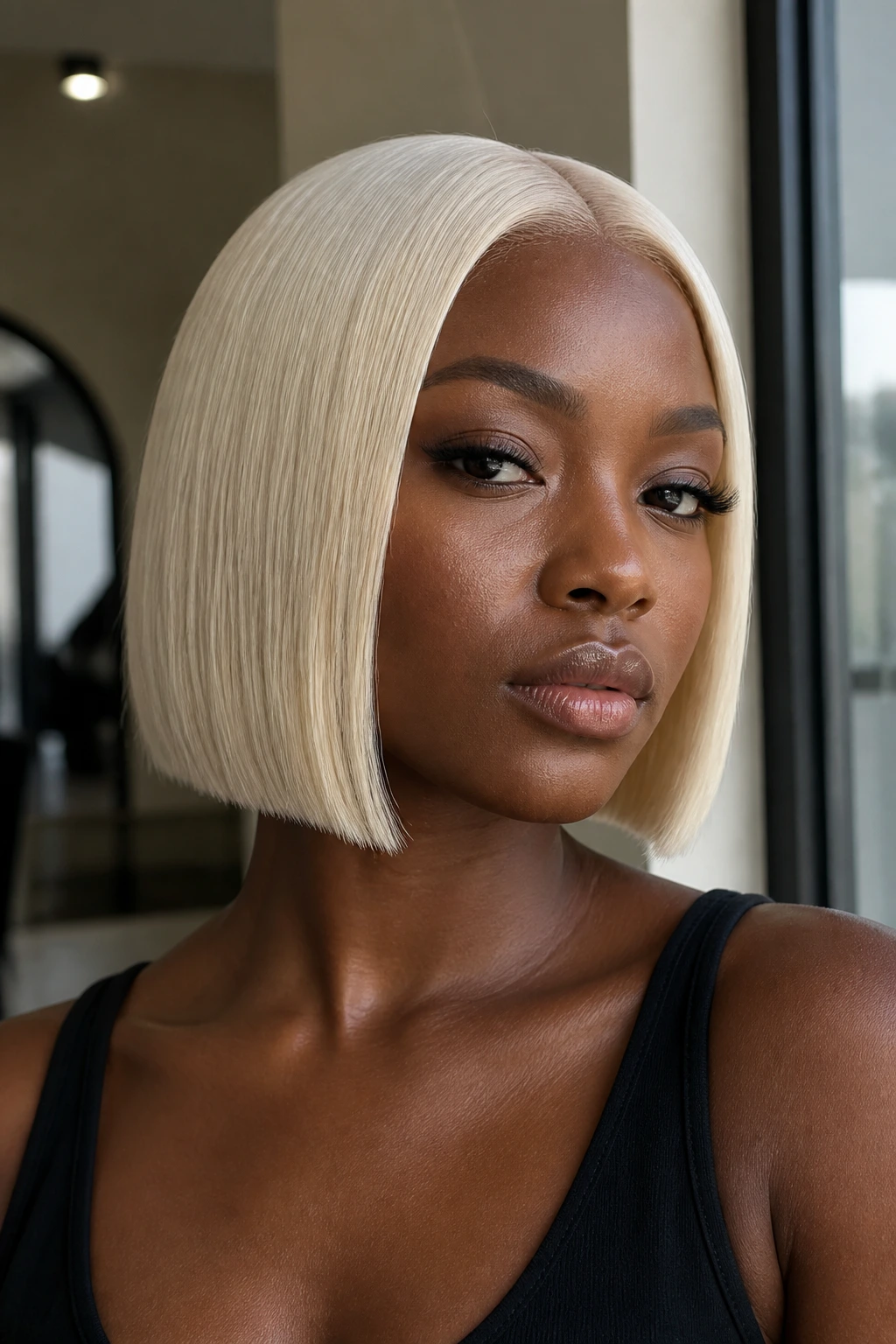
Icy vanilla blonde on a sleek bob is the boldest cool-blonde move in the set. It can look razor-clean on deep skin, but it does not forgive bad tone. The shade needs to be lifted evenly, toned carefully, and paired with a cut that is crisp enough to carry the contrast.
The bob should be sharp at the ends, with a polished finish and minimal frizz. A middle part makes the style feel stricter; a side part softens the face a bit. Either way, the brows and makeup need to hold their own. Icy vanilla can make the rest of the face look bare if everything else is too light.
This is not an everyday casual blonde. It is the kind you pick when you want the hair to announce itself first.
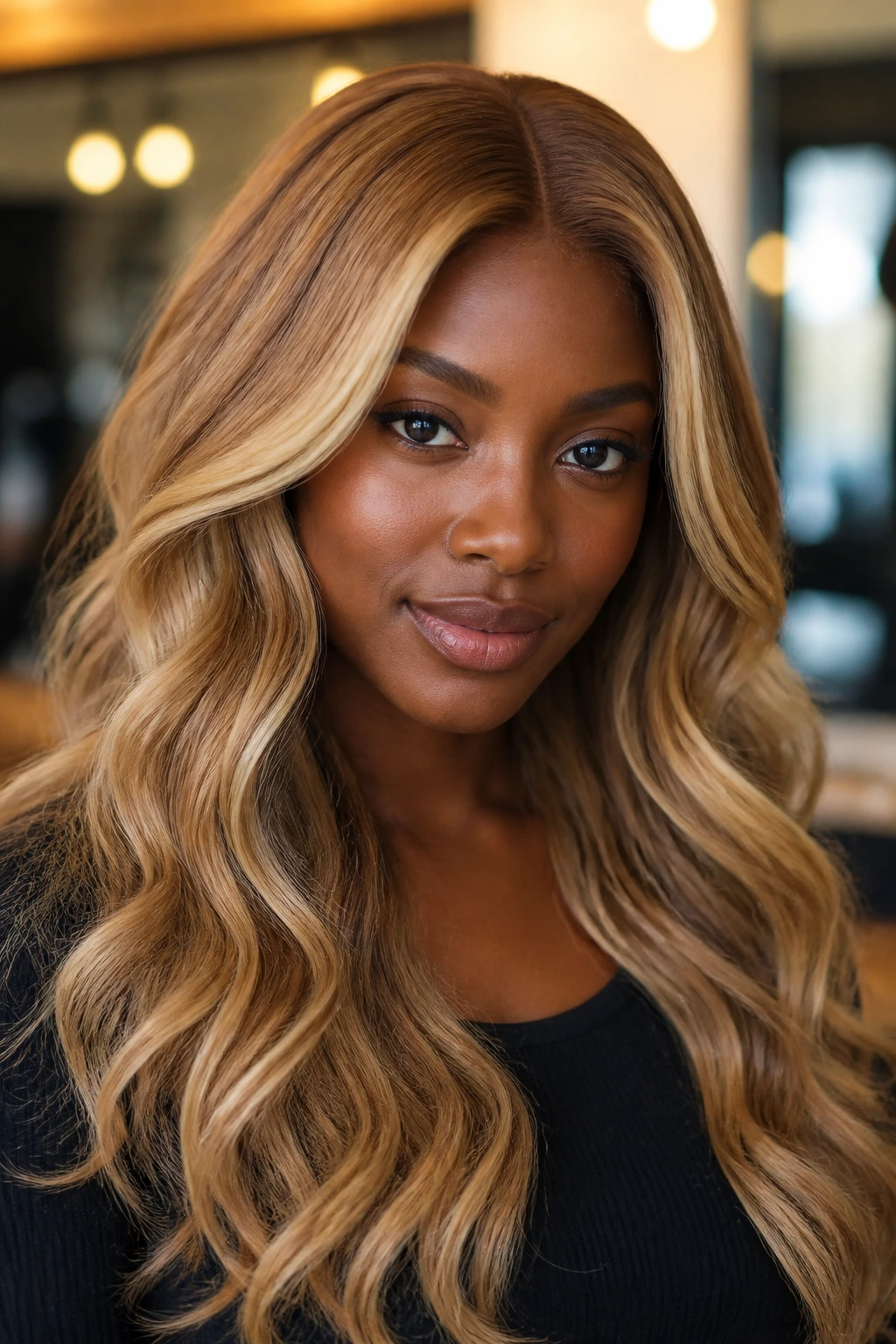
25. Dark Root Honey Blonde Soft Waves
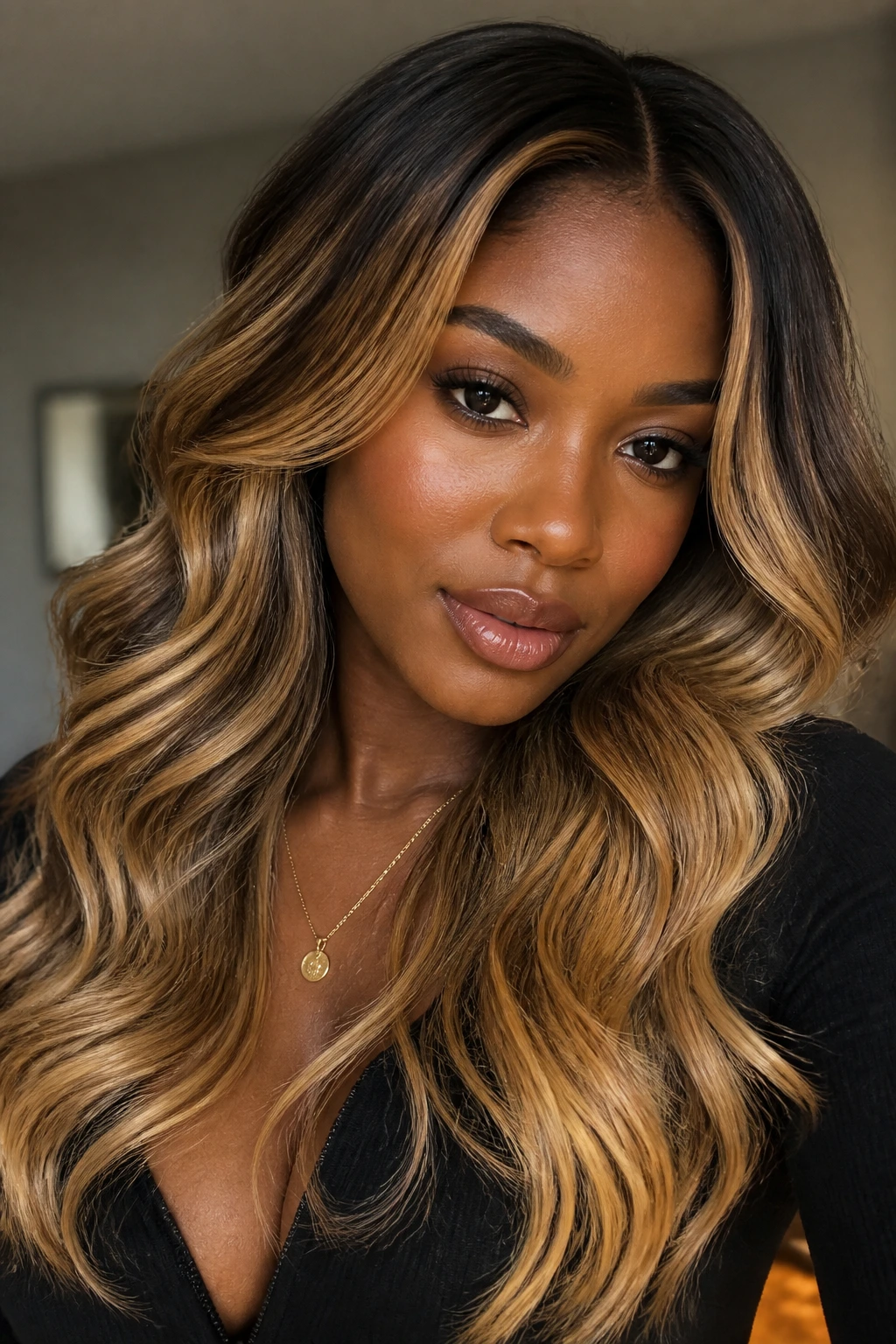
Dark root honey blonde soft waves are the most wearable version of blonde in this whole set, and I mean that without hesitation. The dark root gives the grow-out somewhere to land, the honey warmth flatters deep skin, and the soft waves keep the color moving instead of sitting in one block. It’s the style I’d hand to someone who wants blonde without living at the salon.
The root should stay one or two levels deeper than the mid-lengths. That keeps the look dimensional and makes maintenance easier. Loose waves — not tight curls — show off the blend between root and honey best. A gloss serum on the ends helps the lighter pieces stay bright instead of dry.
If you only remember one thing from this list, remember this: root depth is not a compromise. On deep skin, it’s often the reason the blonde works at all.
What Makes Blonde Read Cleanly on Deep Skin
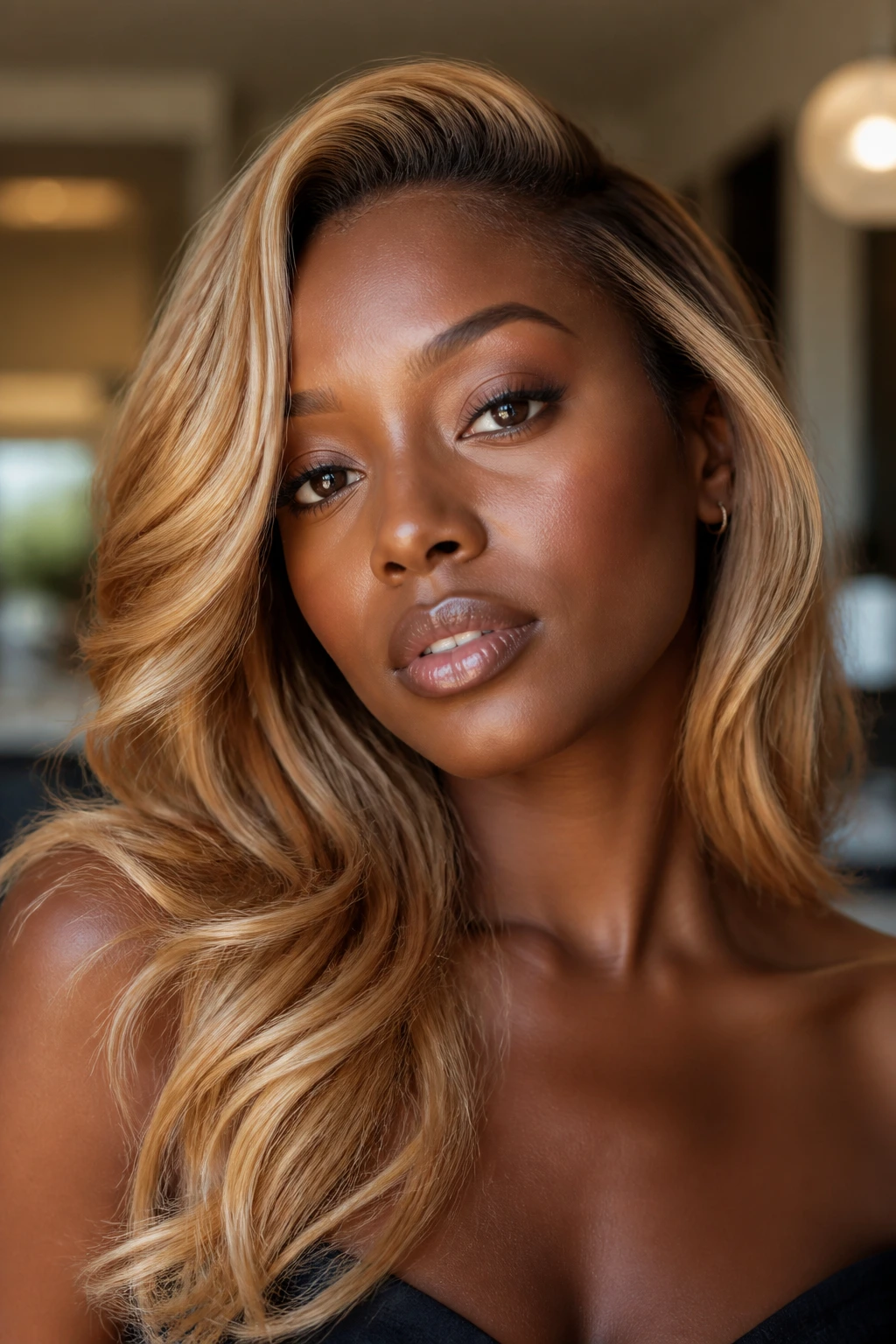
Blonde on deep skin doesn’t need to be loud to work. It needs contrast, depth, and a little tone discipline. The colors that usually win are the ones with a plan: a warm honey that echoes the skin’s gold, a beige blonde that sits under a crisp bob, or a cool champagne that has a root shadow keeping it grounded.
The other piece is texture. Curls scatter light. Waves soften a hard lift. Braids and twists give blonde a built-in pattern so the color doesn’t feel flat. Straight styles can look amazing too, but they ask for cleaner toner work and more precise heat control. There’s less room to fake it.
If you’re booking color, be precise. Saying “blonde” is too vague. Say level, tone, placement, and how much root you want left. That one shift makes the whole conversation easier.
Essential Tools for Blonde Styling and Color Maintenance
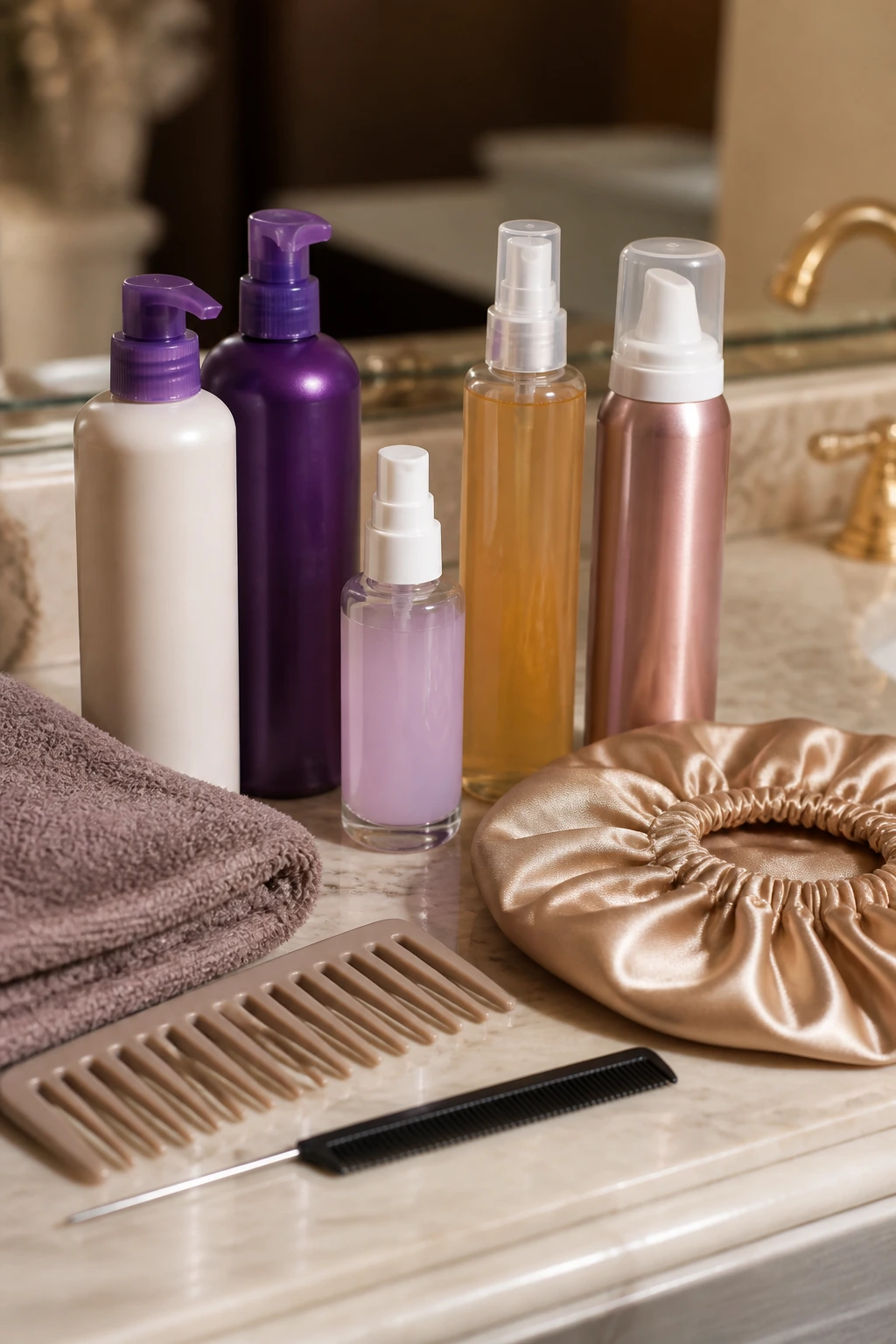
- Sulfate-free color shampoo: Keeps blonde from fading too fast and strips less of the toner.
- Purple or blue shampoo: Use it lightly on cool blondes, not as a daily habit; too much will mute warm shades.
- Bond-building treatment: Helpful after lightening because it supports weak, processed strands.
- Heat protectant spray: Non-negotiable for silk presses, blowouts, and bob styling.
- Wide-tooth comb: Safer on curls, twists, and braids than a fine brush.
- Rat-tail comb: Handy for clean parts, roots, and sleek ponytails.
- Microfiber towel or old T-shirt: Cuts down on frizz after washing.
- Satin bonnet or scarf: Keeps pressed styles and curls from roughing up overnight.
- Tint brush and bowl: Only if you’re doing at-home color or glossing; otherwise skip it.
- Mousse and shine spray: Useful for braids, twists, and waves, but use a light hand.
Smart Shade and Product Shopping Tips
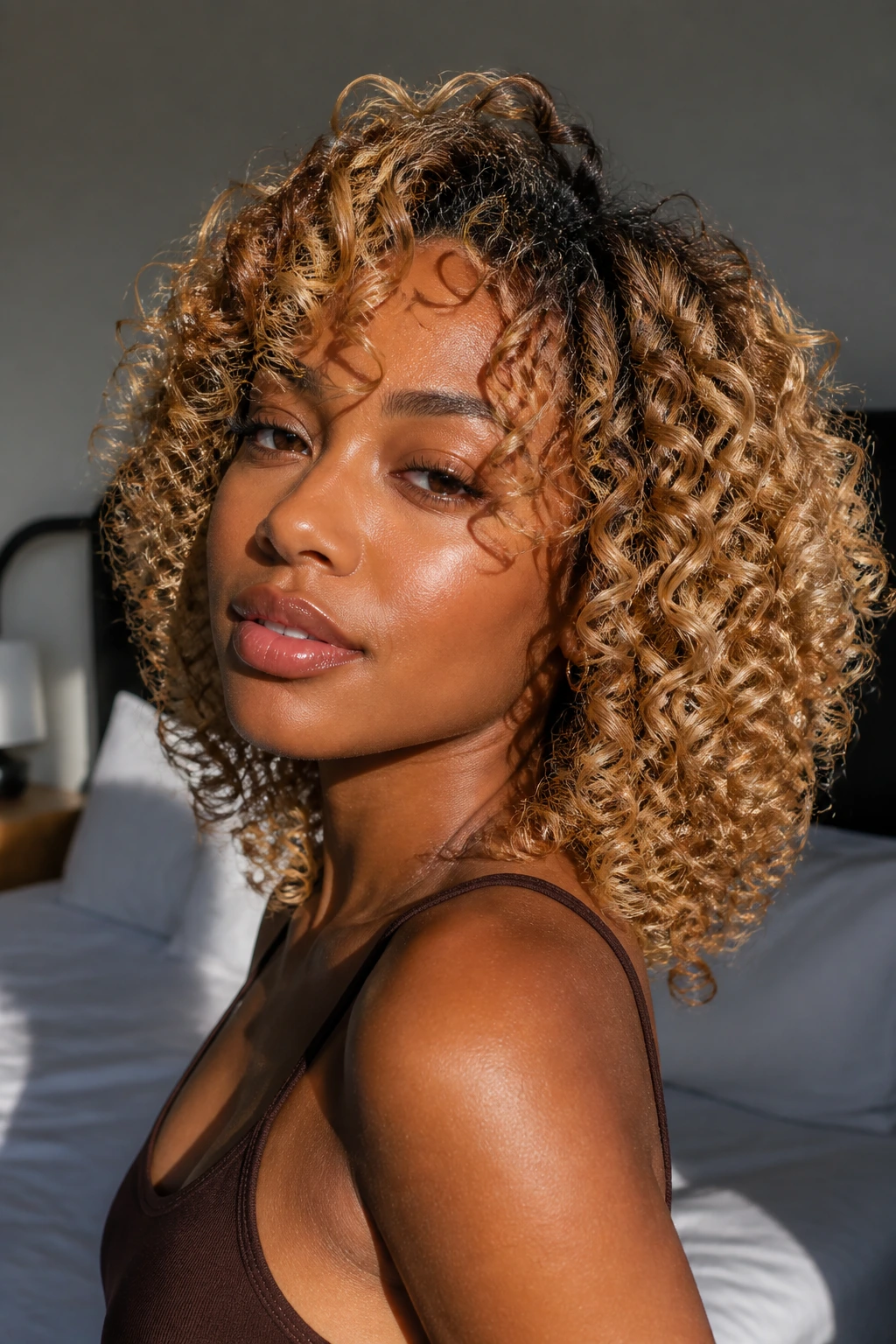
The easiest way to shop for blonde is to stop thinking in the word “blonde” and start thinking in tone families. Honey, caramel, gold, bronze, beige, champagne, pearl, and icy vanilla each sit in a different lane. Deep skin usually looks strongest when the blonde either echoes warmth in the complexion or creates a deliberate contrast that the cut can support.
If you’re buying extension hair, look at the base first. A uniform pale 613 can be too stark unless it’s toned down or mixed with darker strands. Hair labeled 27, 30, 33, 4/27, or mixed hand-painted blends usually gives more depth straight out of the pack. That little darkness at the root or lowlight makes a big difference.
For salon color, bring photos that show the shade in good light and bad light. A blonde that looks creamy in sunlight may look yellow indoors. Ask what level the lift will reach, whether a toner or gloss is included, and how the grow-out will look after four to six weeks. If the answer is vague, press for specifics. Your hair deserves more than a shrug.
How to Wear These Looks
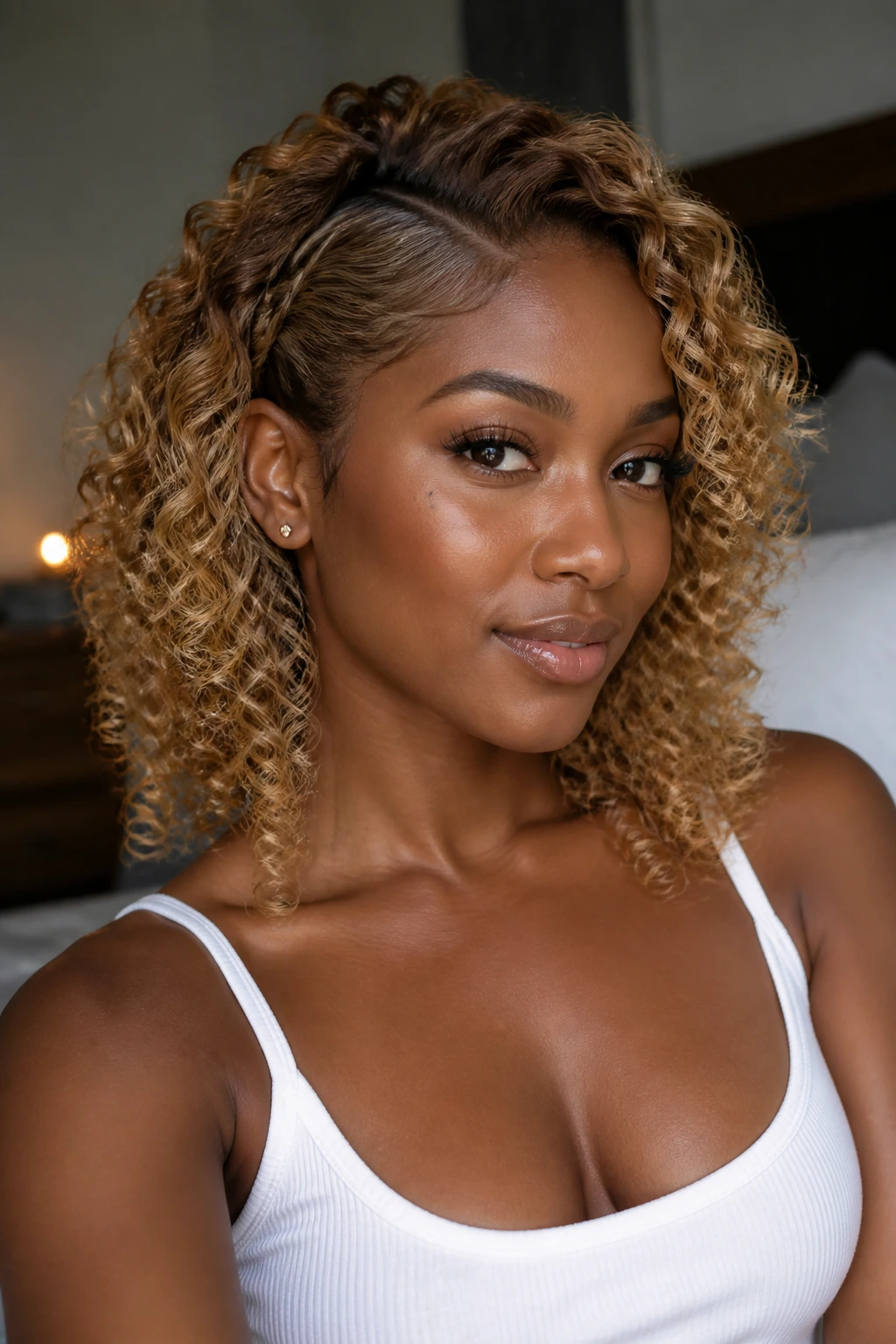
Presentation: Keep the shape clean before you worry about the shade. A honey curl set reads softer when the front pieces are tucked behind the ears, while a platinum bob needs a sharper line so the color doesn’t feel loose. On deep skin, the silhouette matters almost as much as the tone.
Pairings: Gold hoops, warm makeup, and rich clothing colors — emerald, white, black, cobalt, deep plum — tend to make blonde pop without fighting the skin. For cooler blondes, a neutral lip and a defined brow stop the face from disappearing into the hair. A strong neckline helps too. Crew necks can bury a good cut.
Proportion: Large blonde curls and long braids need some shape control around the face. Pixies, bobs, and tapered cuts already do that work for you. If your hair is long, keep a few brighter pieces around the front so the color doesn’t only live in the back.
Maintenance Load: Pick a style that matches your patience. A silk press or icy bob asks for more heat discipline and toner care. Braids, locs, and twists give you a longer runway between touch-ups. That’s not glamour versus practicality. It’s just reality.
Extra Ways to Push the Tone Richer
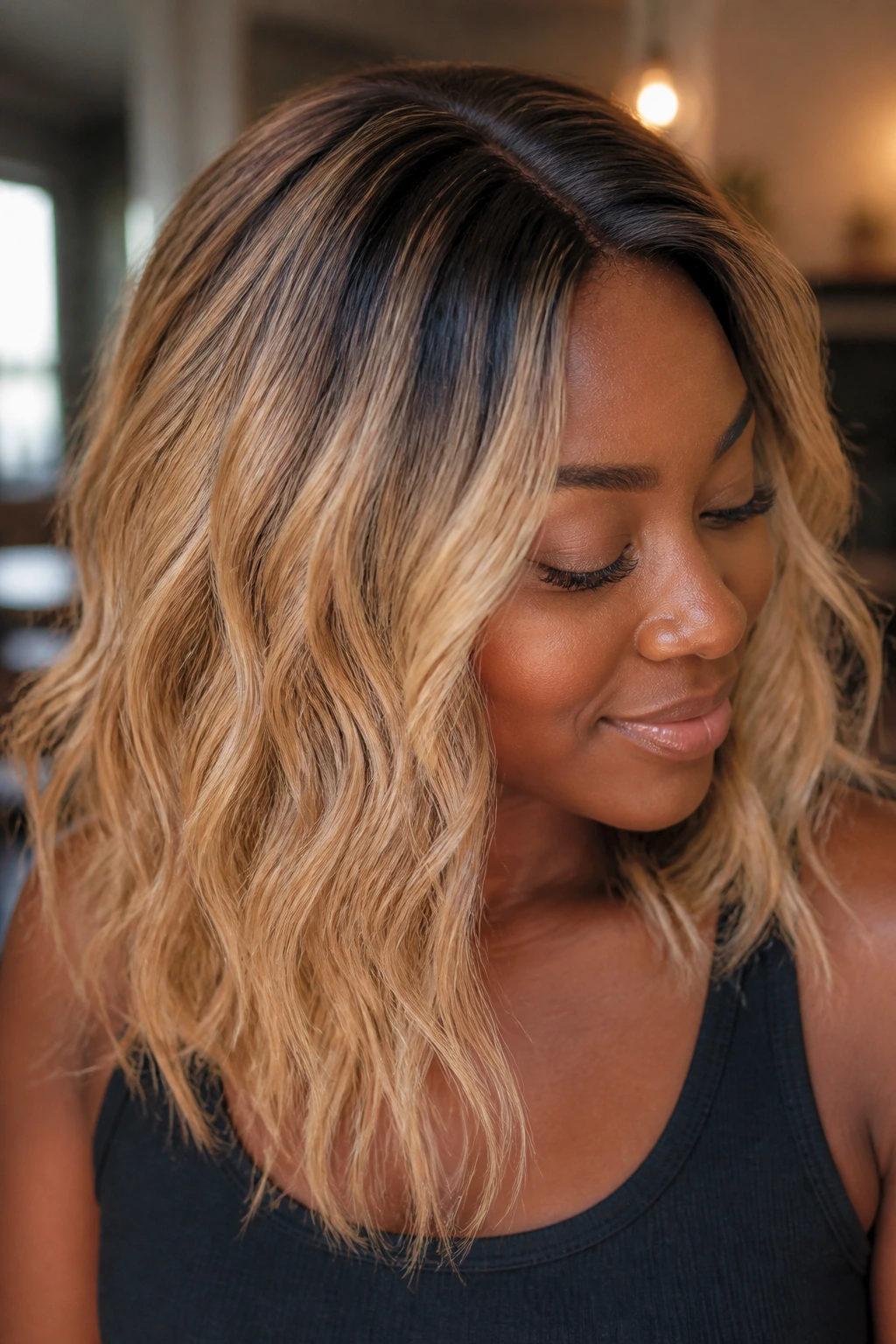
Color Placement: Ask for a root shadow one to two levels deeper than the blonde mid-lengths. That tiny contrast keeps the color from looking pasted on. On deep skin, it can be the difference between “almost there” and “that works.”
Texture Boost: Warm blondes look richer with curls, waves, and twist-outs because the texture breaks the light into pieces. Cool blondes look sharper with smoother finishes. Pick the finish to support the tone, not the other way around.
Glossing: A clear or warm gloss every few weeks can bring tired blonde back to life without another full color session. I’m a bigger fan of glossing than constant purple shampoo; it refreshes shine without sanding down the warmth that often makes deep-skin blonde work.
Make-It-Yours: If you like subtle, keep the blonde near the face and the ends. If you like drama, push the brightest pieces to the crown or the top layer. Protective styles can do both. So can layered cuts. The trick is deciding where you want the eye to land first.
Keeping Blonde Fresh Between Wash Days
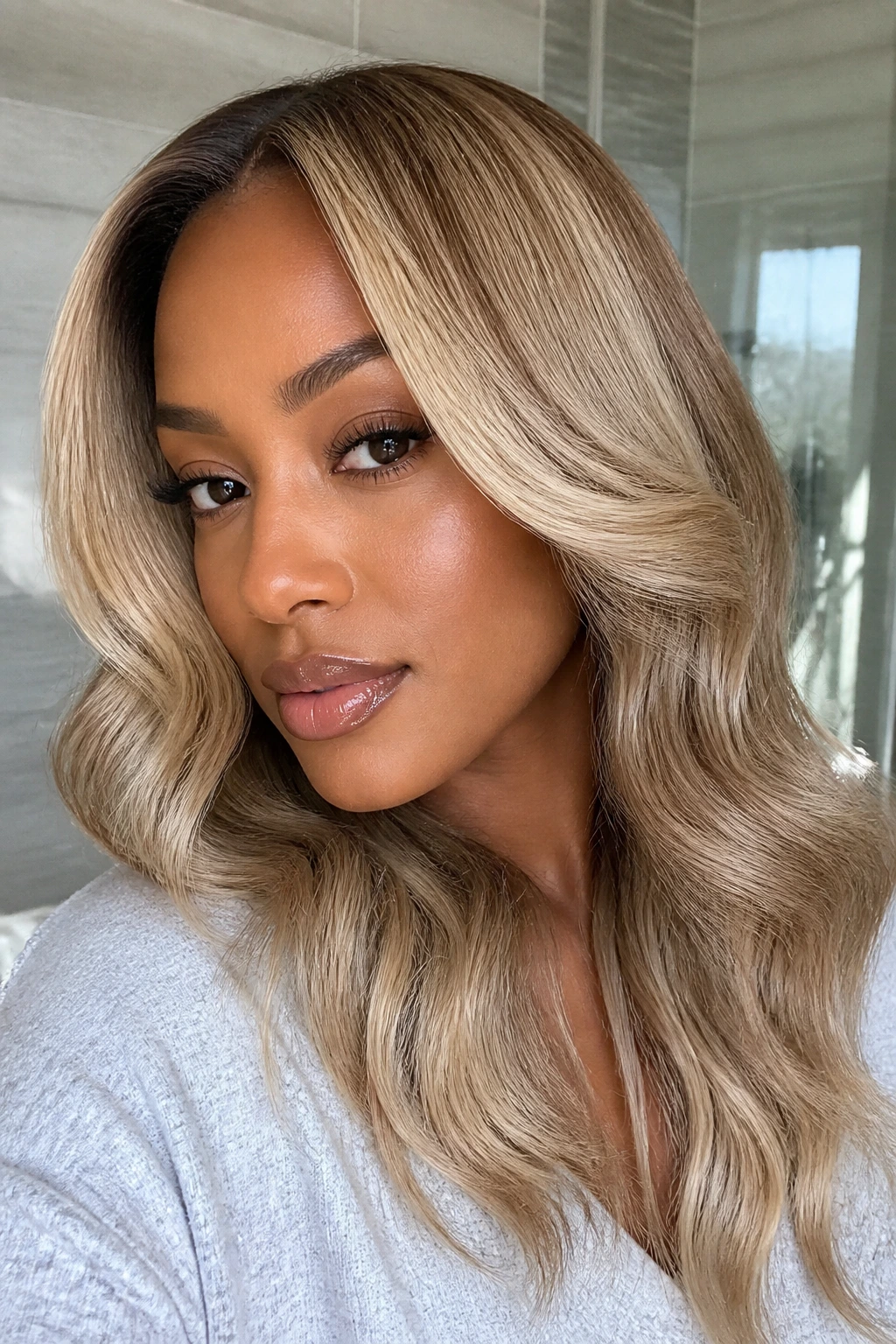
Blonde hair needs a maintenance rhythm, not a panic routine. For most warm blondes — honey, caramel, gold, maple — a wash every 7 to 10 days is enough if the hair isn’t dirty or sweaty. Cool blondes like beige, pearl, champagne, or icy vanilla usually need toner attention every 3 to 5 weeks, but not always a full recolor. A gloss or toning mask can stretch the life of the shade without roughing up the hair again.
Heat is where people burn money and curl patterns. On processed hair, I’d stay in the 300°F to 350°F range for most hot tools and keep one-pass styling the rule. If a curl needs three passes, the iron is too cool, the section is too thick, or both. Repeating heat on the same strand is how blonde turns dry and straw-like.
Night care matters too. Silk presses and bobs need a wrap or bonnet. Curls need a pineapple or loose satin tie. Braids and twists need a scarf over the hairline so the roots don’t fuzz up first. If you wear a protective style, clean the scalp every week or two with a diluted cleanser or foam made for braids. Heavy oil is a quick way to make a light blonde braid look dull by the second week.
Variations and Adaptations to Try
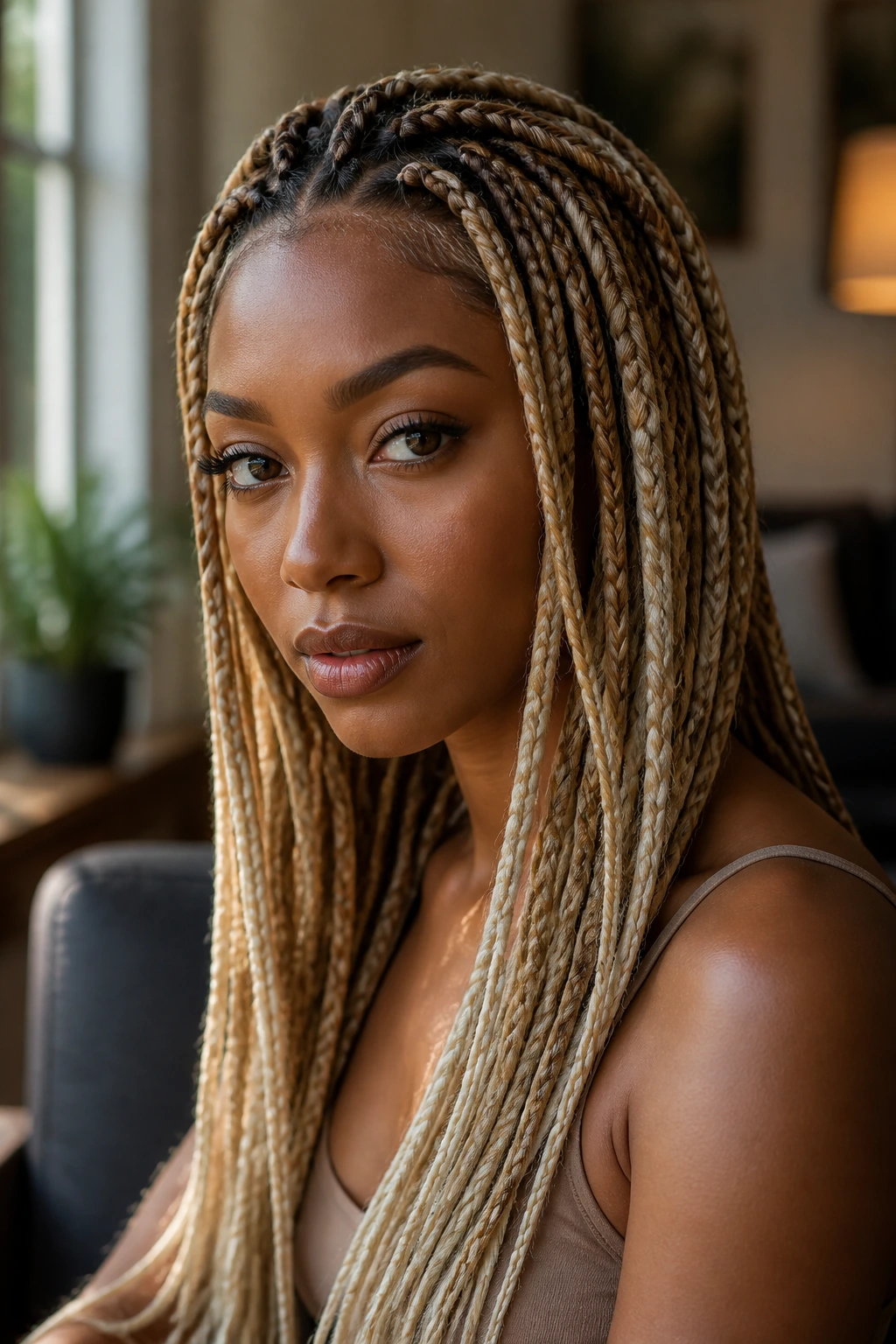
Root-Shadow Honey Melt: Keep the roots deep brown and melt into honey blonde from the mid-lengths down. This works well if you want a softer grow-out and less salon pressure between appointments.
Cool Champagne Sweep: Take a champagne blonde and add beige lowlights under the top layer. The color stays bright, but the lowlights stop it from looking flat on deep skin.
Protective Blonde Blend: Mix honey, sand, and creamy blonde in braids or twists instead of using one single pack color. The variation keeps the style from reading fake or one-note.
Soft Platinum Accent Pieces: If full platinum feels too much, put icy vanilla only around the hairline or top layer. That gives you the high-contrast effect without bleaching the entire head.
Low-Heat Curly Blonde: Keep the cut and color warm, but style with flexi rods, a diffuse dry, or a set that doesn’t need repeated hot tools. The shade lasts longer when the styling stays gentle.
Common Mistakes to Avoid
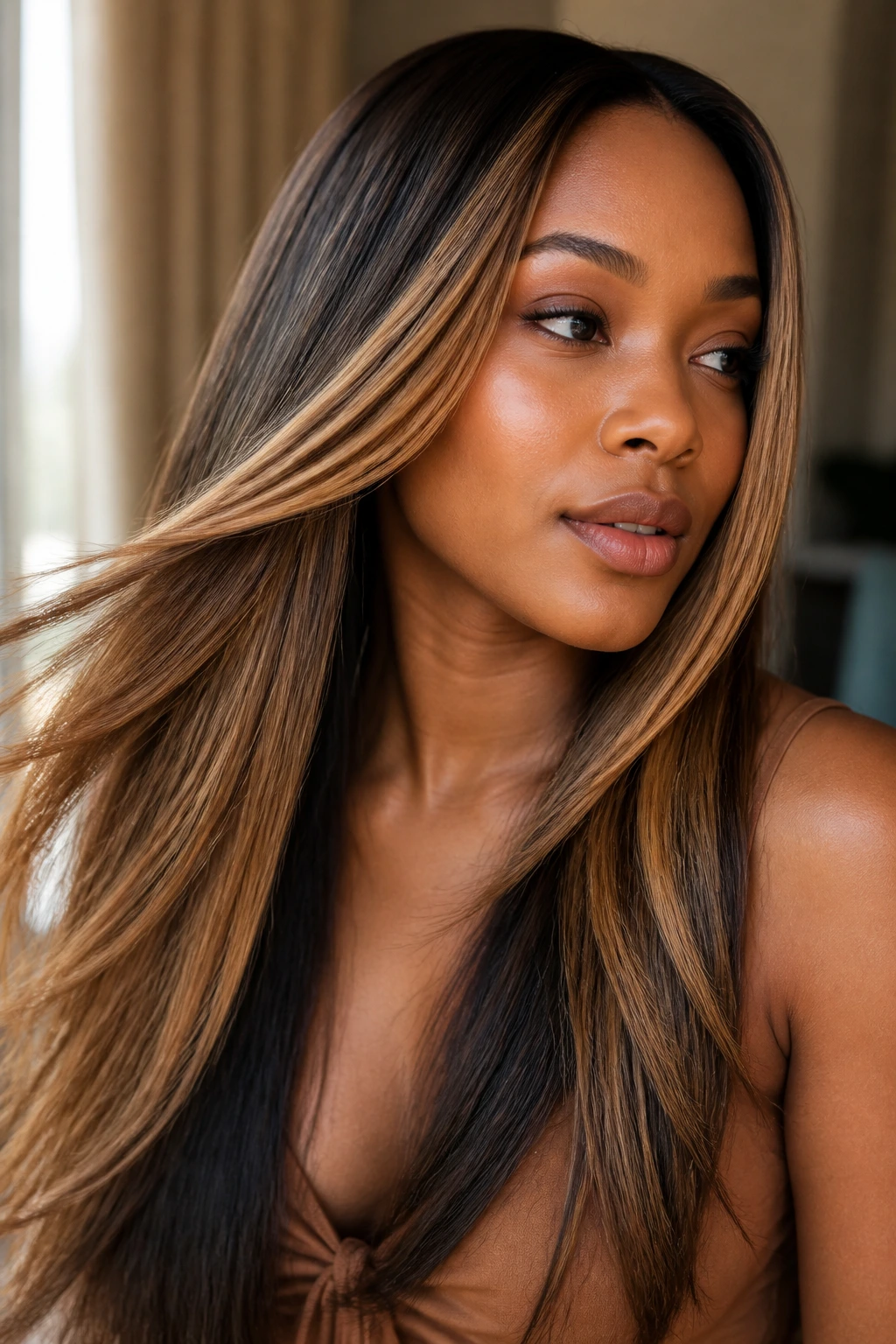
The first mistake is going too pale too fast. A level 10 blonde on dark hair can look exciting in a screenshot and flat in real life if the cut and toner aren’t ready for it. Start with a warmer level 7 to 8 if your hair is virgin dark, then build from there.
The second mistake is forgetting the root. Deep skin usually looks better with some depth near the scalp — not always black, but deep enough to anchor the blonde. A root shadow or lowlight keeps the style from looking like a wig cap in bright light.
Purple shampoo is useful, but too much of it is a mess. It can drag warm blondes toward gray and make beige blondes look chalky. Use it only when the shade starts turning yellow, not every wash day.
Heat is the silent wrecking ball. A blonde silk press that gets flat-ironed every other day will not stay soft for long. If you want blonde and gloss, give the hair a break between heat sessions.
Last: ignoring the brows and makeup. A pale blonde with bare brows and no warmth on the face can look unfinished on deep skin. You do not need full glam. You do need balance.
Frequently Asked Questions
Can deep skin tones wear platinum blonde?
Yes, but platinum usually works best with structure — a crisp bob, pixie, sleek ponytail, or a dark root. Without that contrast, it can look disconnected from the face.
Is honey blonde easier to maintain than ash blonde?
Usually, yes. Honey and caramel tones forgive fade better because they stay warm as they grow out. Ash shades lose their edge faster and can slide into dullness if toner care is sloppy.
What blonde shade looks the most natural on deep skin?
Honey blonde, caramel blonde, and bronzed blonde usually look the most natural because they echo the warmth already present in many deep complexions. That doesn’t mean cooler blondes are off-limits — they just need more intentional placement.
Will blonde damage curly or coily hair?
Lightening does weaken hair, especially if you’re lifting several levels. The damage is manageable when the color service is paced properly, the hair is conditioned after, and heat is kept low. Going blonde and keeping curls healthy is a balancing act, not a fantasy.
How often should blonde hair be toned?
Warm blondes may only need a gloss every 6 to 8 weeks. Beige, pearl, or icy shades often need toner attention sooner, sometimes every 3 to 5 weeks, depending on wash frequency and sun exposure.
Can I wear blonde in braids or twists instead of bleaching my own hair?
Absolutely. That’s one of the smartest ways to try the color. Mixed-tone braiding hair can give you the look with less stress on your natural strands.
What if the blonde makes my skin look tired?
Usually that means the tone is too flat, too pale, or too cool without enough contrast. Add a root shadow, switch to a warmer shade, or try the blonde in a cut with more movement so the color isn’t sitting there alone.
Should the brows match the blonde?
No. On deep skin, dark brows usually help blonde hair look grounded. A tiny bit of balance around the face is enough; you do not need to bleach your brows just to “match.”
The Shade That Stays Rich
The best blonde on deep skin is rarely the palest one in the room. It’s the one that keeps its shape after the first wash, the first humid day, and the first week when the toner starts to soften. Honey, bronze, beige, champagne, pearl, and icy vanilla all have a place — but only when the tone, cut, and texture are working together.
If you’re bringing one of these looks to a salon chair, bring a photo and a note about the root depth you want. That tiny detail changes the entire outcome. Blonde on deep skin gets easier the moment the plan becomes specific.